
FUNCTION POINT ANAYSIS DETERMINING THE SIZE OF ERP IMPLEMENTATION PROJECTS By Paulo Gurevitz Cunha
|
|
|
- Lily Walters
- 10 years ago
- Views:
Transcription
1 FUNCTION POINT ANAYSIS DETERMINING THE SIZE OF ERP IMPLEMENTATION PROJECTS By Paulo Gurevitz Cunha Introduction In general, when we receive a request to implement a package, the first question that comes in the PM s minds is how can we estimate such project as we don t have similar experience? The first step to estimate any project is to determine its size, with which we can estimate effort, duration and staff based on historical data and team experience. This paper shows an approach to calculate the size in Function Points for projects implementing ERP packages such as SAP, PeopleSoft, Oracle Applications, etc Implementing an ERP is no different from implementing any enhancement project and all FPA techniques apply. It generally involves adding, changing and deleting business functionality, reflected in the specific designs by programs, screens, reports and data structures (files or database sets). Understanding the impact on the business functionality is the basis for determining the size in FP. The steps to calculate the functional size involve determining the boundaries impacted by the project scope, identifying the data and transaction functions, calculating the unadjusted FP size and adjusting the FP size. On the present paper the focus is only on the first two steps, determining the boundaries and identifying the functions, as the other steps are exactly the same as in any other type of project. Determining the Boundaries Usually one of the most emphasized lessons taught in function points classes refers to the difficulty in determining the boundaries of the project being counted, which would be like building a context diagram under the FPA viewpoint. It is very difficult for students to visualize how important and complex this task can be because the samples presented on the FPA courses are usually of low complexity new developments and/or enhancements with one single application, which represent the simplest case in terms of boundaries identification. Look at the following example extracted from the IFPUG CPM and some other courses:

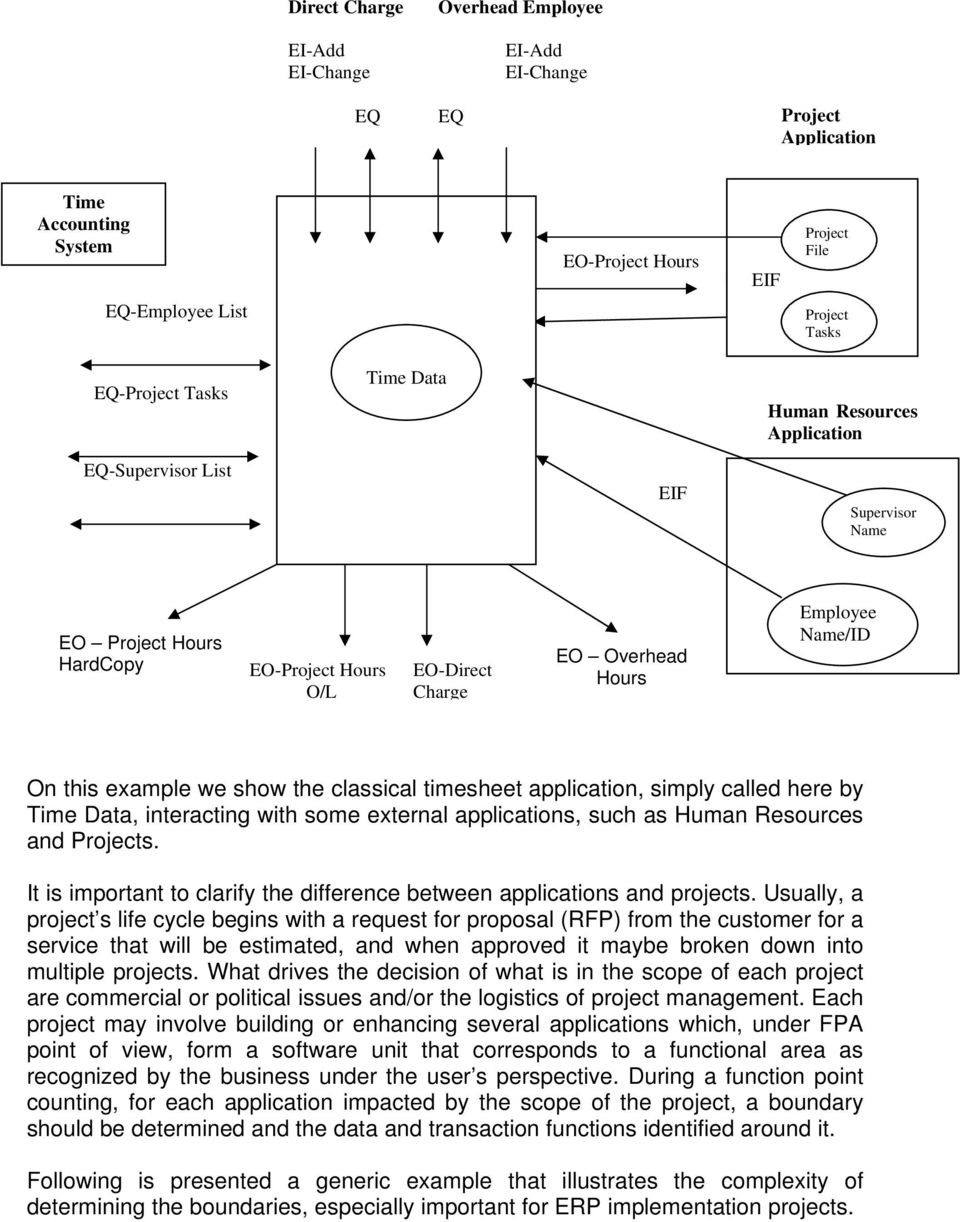
2 Direct Charge EI-Add EI-Change EQ Overhead Employee EQ EI-Add EI-Change Project Application Time Accounting System EO-Project Hours EIF EIF Project File EQ-Employee List Project Tasks EQ-Project Tasks Time Data Human Resources Application EQ-Supervisor List EIF Supervisor Name EO Project Hours HardCopy EO-Project Hours O/L EO-Direct Charge EO Overhead Hours Employee Name/ID On this example we show the classical timesheet application, simply called here by Time Data, interacting with some external applications, such as Human Resources and Projects. It is important to clarify the difference between applications and projects. Usually, a project s life cycle begins with a request for proposal (RFP) from the customer for a service that will be estimated, and when approved it maybe broken down into multiple projects. What drives the decision of what is in the scope of each project are commercial or political issues and/or the logistics of project management. Each project may involve building or enhancing several applications which, under FPA point of view, form a software unit that corresponds to a functional area as recognized by the business under the user s perspective. During a function point counting, for each application impacted by the scope of the project, a boundary should be determined and the data and transaction functions identified around it. Following is presented a generic example that illustrates the complexity of determining the boundaries, especially important for ERP implementation projects.
3 In this example, it is presented a scenario of a very large company whose IT philosophy is driven to developing global solutions to be implemented in each of its units around the world. This global solution can be an ERP or a best practice application identified among its units that is adapted to be a global solution. After the ERP is chosen or a best practice application is developed it needs to be implemented in all units, replacing some legacy applications and adapting the remaining existing applications to interface with the new application. This generic example will show the approach to determine the size of the project to adapt all remaining applications, usually a very large and complex enhancement project. Following is a fictitious legacy architecture in one of the units: Interfaces APPL APPL In this case the solution adopted is going to replace APPL-1 and APPL-2 as follows: Interfaces 1 APPL APPL-2 GLOBAL SOLUTION/ERP 7 8 6

4 The implementation project includes the decommissioning of applications APPL1 and APPL-2 (outside of the scope of this paper as its size is not measurable in function points) and the enhancement of applications, and APPL- C to adapt its functions and interface with the new solution/application. In this case four counting boundaries must be identified, one for the Global Solution/ERP that needs to be enhanced and one for each legacy application (, and APPL_C) impacted by the project, as follows: BOUNDARY 1 GLOBAL SOLUTION/ERP Fig. 3 BOUNDARY 2 Fig. 3 GLOBAL SOLUTION/ ERP Fig. 4

5 BOUNDARY 3 GLOBAL SOLUTION/ ERP Fig. 5 BOUNDARY 4 GLOBAL SOLUTION/ ERP Fig. 6 Completing the counting models for each boundary with the identified functions (EIs, EOs, EQs, ILFs and EIFs) is only possible after the Study or Define phase is finished, determining the high level requirements that will be part of the scope. The study will determine interfaces, reports, inquires and data structures (and corresponding updating transactions) to be changed or created due to the new implemented solution. For example, there could be reports on the decommissioned applications that are still needed but not produced by the Global Solution/ERP, or reports that exist on the Global Solution/ERP but require modification. Also, there could be files that are not currently sent to the decommissioned applications but are required by the Global Solution/ERP and therefore calls for a new interface to be created on some legacy remaining application, or the same interface already exists but need modification. All these objects will be represented in the counting model by FP functions being added, changed or deleted, like any other enhancement project.

6 Identifying Functions With the assumption that the study phase is concluded and all requirements mentioned above identified, lets see how the boundary model for the Global Solution/ERP looks like, based on the following requirements: Produce interfaces 1 and 6 (External Outputs EO) Receive interface 5 (External Input EI, that updates the ILF XPTO-1) Produce a new report (External Output EO) Modify two existing ILFs (XPTO1 and XPTO-2) and corresponding functions to update it and inquire from it. Add a new ILF (XPTO-3) and corresponding functions to update it and inquire from it. BOUNDARY 1 SISTEMA GLOBAL EO - Interface 1 EO -Interface 6 ILF XPTO-1 EQ Inquire XPTO-1 EI - Add, Change and Delete XPTO-1 EI - Interface 5 ILF XPTO-2 EQ Inquire XPTO-2 EO - Report ILF XPTO-3 EI - Add, Change and Delete XPTO-2 EQ Inquire EI - Delete EI - Change Fig. 7 EI - ADD

7 The following table shows the summary of the count to adapt the Global Solution/ERP: Function Function Type Operation (Added, Changed or Deleted) 1. Interface 1 EO C 2. Interface 6 EO C 3. Interface 5 EI A 4. Report EO A 5. ADD XPTO-3 EI A 6. Change XPTO-3 EI A 7. Delete XPTO-3 EI A 8. Inquire XPTO-3 EQ A 9. XPTO-1 ILF C 10. XPTO-2 ILF C 11. XPTO-3 ILF A 12. ADD XPTO-1 EI C 13. Change XPTO-1 EI C 14. Delete XPTO-1 EI C 15. Inquire XPTO-1 EQ C 16. ADD XPTO-2 EI C 17. Change XPTO-2 EI C 18. Delete XPTO-2 EI C 19. Inquire XPTO-2 EQ C Fig. 8 The above table will be the basis for the unadjusted FP calculation, when complexities of each function are determined, which is outside of the scope of this study. Now we need to do the same as we did for the Boundary 1, to all boundaries identified (, and ). Let s use the Boundary 4 () as our next example. Following is the list of requirements identified: Change Interface 7 (External Output EO) to a new format compatible with the ERP. Produce a new Interface 8 (External Output EO) Change an ILF (XYZ-1) and corresponding updating and inquire functions. Change the reception of a file (External Interface File EIF) that is sent from APPL_B and is also changed as part of this project.

8 EO - Interface 7 EO - Interface 8 GLOBAL SOLUTION/ ERP EIF - Interface B ILF XYZ-1 EQ Inquire EI Delete EI - Change EI - Add Fig. 9 The following table shows the summary of the count to adapt : Function Function Type Operation (Added, Changed or Deleted) 1. Interface 7 EO C 2. Interface 8 EO A 3. ADD XYZ-1 EI C 4. Change XYZ-1 EI C 5. Delete XYZ-1 EI C 6. Inquire XYZ-1 EQ C 7. Interface D EIF C 8. XYZ-1 ILF C

9 Conclusion After the conclusion of those tables for each of the four applications impacted by the project, we must calculate separately the adjusted (AFP) and unadjusted (UFP) function points, keeping in mind that each of these applications can reside in different platforms and programming languages and have different project characteristics, what can lead to different value adjustment factors (VAF). Then, and only then, we can add up all sizes counted to come up with the total size of the project of implementing a Global Solution or ERP in one of the units of this fictitious company. Estimating the project (effort, duration and staff) is another story. Whether this is going to be treat as a single project or one project for each application depends on the particular strategies adopted by each organization. Having several counts, one for each application will give also the flexibility of having multiple projects and estimates. It is also important to consider that, although not part of the scope of this study, the legacy applications decommissioned and replaced by the ERP are being deactivated and there is an effort associated that must be estimated and added to the project estimates, but is not based on function points.
DETERMINING THE SIZE OF ERP IMPLEMENTATION PROJECTS. Paulo Gurevitz Cunha EDS EDS --Electronic Data Systems Data Engineering West,
 IFPUG-September 2004 DETERMINING THE SIZE OF ERP IMPLEMENTATION PROJETS Paulo Gurevitz unha EDS EDS --Electronic Data Systems Data Engineering West, Denver, O O USA USA ommunications Industry Solution
Derived Data in Classifying an EO
 itip Guidance from the Functional Sizing Standards Committee on topics important to you Derived Data in Classifying an EO itip # 07 (Version 1.0 08/08/2014) itips provide guidance on topics important to
APPLYING FUNCTION POINTS WITHIN A SOA ENVIRONMENT
 APPLYING FUNCTION POINTS WITHIN A SOA ENVIRONMENT Jeff Lindskoog EDS, An HP Company 1401 E. Hoffer St Kokomo, IN 46902 USA 1 / 16 SEPTEMBER 2009 / EDS INTERNAL So, Ah, How Big is it? 2 / 16 SEPTEMBER 2009
How to Avoid Traps in Contracts for Software Factory Based on Function Metric
 How to Avoid Traps in Contracts for Software Factory Based on Function Metric Claudia Hazan Serviço Federal de Processamento de Dados (SERPRO) SGAN Quadra 601 Modulo V Brasilia, DF, CEP: 70836-900 BRAZIL
FUNCTION POINT ANALYSIS: Sizing The Software Deliverable. BEYOND FUNCTION POINTS So you ve got the count, Now what?
 FUNCTION POINT ANALYSIS: Sizing The Software Deliverable BEYOND FUNCTION POINTS So you ve got the count, Now what? 2008 Course Objectives The primary webinar objectives are to: Review function point methodology
SIZING ANDROID MOBILE APPLICATIONS
 SIZING ANDROID MOBILE APPLICATIONS GURUPRASATH S, CFPS Email: [email protected] Reviewed By: Purnima Jagannathan Prashanth CM Copyright 2011 Accenture All Rights Reserved. Accenture, its
Software Development: Tools and Processes. Lecture - 16: Estimation
 Software Development: Tools and Processes Lecture - 16: Estimation Estimating methods analogy method direct estimating method Delphi technique PERT-type rolling window Constructivist Cost Model (CoCoMo)
FAST Function Points. David Seaver Director Estimation and Measurement Fidelity Investments 8-563-6753
 FAST Function Points David Seaver Director Estimation and Measurement Fidelity Investments [email protected] 8-563-6753 Outline of the Presentation Overview of function points (IFPUG based Technique)
Counting Infrastructure Software
 Counting Infrastructure Software Dr. Anthony L Rollo, SMS Ltd, Christine Green EDS Many function point counters and managers of software counts believe that only whole applications may be sized using the
Measuring Change Requests to support effective project management practices.
 Measuring Change Requests to support effective project management practices. Roberto Meli Abstract Some of the major reasons for software project failures relay in the area of the management of project
Sizing Logical Data in a Data Warehouse A Consistent and Auditable Approach
 2006 ISMA Conference 1 Sizing Logical Data in a Data Warehouse A Consistent and Auditable Approach Priya Lobo CFPS Satyam Computer Services Ltd. 69, Railway Parallel Road, Kumarapark West, Bangalore 560020,
Measuring Software Functionality Using Function Point Method Based On Design Documentation
 www.ijcsi.org 124 Measuring Software Functionality Using Function Point Method Based On Design Documentation Anie Rose Irawati 1 and Khabib Mustofa 2 1 Department of Computer Science, University of Lampung
Calculation of the Functional Size and Productivity with the IFPUG method (CPM 4.3.1). The DDway experience with WebRatio
 Calculation of the Functional Size and Productivity with the IFPUG method (CPM 4.3.1). The DDway experience with WebRatio This document contains material that has been extracted from the IFPUG Counting
Fundamentals of Function Point Analysis
 Fundamentals of Function Point Analysis By [email protected] Abstract Systems continue to grow in size and complexity. They are becoming more and more difficult to understand. Improvement of coding
Why SNAP? What is SNAP (in a nutshell)? Does SNAP work? How to use SNAP when we already use Function Points? How can I learn more? What s next?
 1 Agenda Why SNAP? What is SNAP (in a nutshell)? Does SNAP work? How to use SNAP when we already use Function Points? How can I learn more? What s next? 2 Agenda Why SNAP? What is SNAP (in a nutshell)?
Using Entity-Relationship Diagrams To Count Data Functions Ian Brown, CFPS Booz Allen Hamilton 8283 Greensboro Dr. McLean, VA 22102 USA
 Using Entity-Relationship Diagrams To Count Data Functions Ian Brown, CFPS Booz Allen Hamilton 8283 Greensboro Dr. McLean, VA 22102 USA Contents What Is an Entity-Relationship (E-R) Diagram? E-R Vocabulary
PMI PMBOK & ESTIMATING PMI PMBOK & ESTIMATING PMI PMBOK & ESTIMATING PMI PMBOK & ESTIMATING PMI PMBOK & ESTIMATING PMI PMBOK & ESTIMATING
 PMI PMBOK & ESTIMATING PMI PMBOK & ESTIMATING PMI PMBOK & ESTIMATING PMI PMBOK & ESTIMATING PMI PMBOK & ESTIMATING PMI PMBOK & ESTIMATING 03-23-05 Christine Green, PMI PMBOK and Estimating EDS, Delivery
Function Point Measurement from Java Programs
 Function Point Measurement from Java Programs Shinji Kusumoto, Masahiro Imagawa, Katsuro Inoue Graduate School of Engineering Science Osaka University Toyonaka, Osaka, Japan {kusumoto, imagawa, inoue}@icsesosaka-uacjp
Appendix G Technical Methodology and Approach Document
 Appendix G Technical Methodology and Approach Document Technical Methodology and Approach Document CWS/CMS Technical Architecture Alternatives Analysis (TAAA) California Health and Human Services Agency
Introduction to Function Points www.davidconsultinggroup.com
 By Sheila P. Dennis and David Garmus, David Consulting Group IBM first introduced the Function Point (FP) metric in 1978 [1]. Function Point counting has evolved into the most flexible standard of software
Function Points Analysis Training Course
 Function Points Analysis Training Course Instructor: David Longstreet [email protected] www.softwaremetrics.com 816.739.4058 Page 1 www.softwaremetrics.com Longstreet Consulting Inc Table of Contents
IPA/SEC Data entry form Version 3.0 for IPA/SEC White Paper 20xx on software development projects in Japan
 IPA/SEC Data entry form Version 3.0 for IPA/SEC White Paper 20xx on software development projects in Japan Information-Technology Promotion Agency, Japan(IPA) Software Engineering Center(SEC) Contents
Function Point Counting Practices Manual. Release 4.1.1
 Function Point Counting Practices Manual Release 4.1.1 International Function Point Users Group (IFPUG) Function Point Counting Practices Manual Release 4.1.1 Chairperson, Counting Practices Committee
EPL603 Topics in Software Engineering
 Lecture 10 Technical Software Metrics Efi Papatheocharous Visiting Lecturer [email protected] Office FST-B107, Tel. ext. 2740 EPL603 Topics in Software Engineering Topics covered Quality
Agile Estimating: My DPS Dissertation
 Agile Estimating: My DPS Dissertation Raymond Boehm New York City SPIN Meeting October 11, 2006 Presentation Outline o Agility o Estimation Estimating Software Size Estimating Effort and Schedule o Estimating
Define Activities Sequence Activities Estimate Activity Resources Estimate Activity Durations Develop Schedule Control Schedule
 1 (Image) 2 The process required to manage timely completion of the project. Project time management start with planning by the project management team (not shown as a discrete process). In small project,
Copyright 2014 Alvin J. Alexander All rights reserved. No part of this book may be reproduced without prior written permission from the author.
 How I Estimate Software Development Projects How I Estimate Software Development Projects Copyright 2014 Alvin J. Alexander All rights reserved. No part of this book may be reproduced without prior written
MEASURING THE SIZE OF SMALL FUNCTIONAL ENHANCEMENTS TO SOFTWARE
 MEASURING THE SIZE OF SMALL FUNCTIONAL ENHANCEMENTS TO SOFTWARE Marcela Maya, Alain Abran, Pierre Bourque Université du Québec à Montréal P.O. Box 8888 (Centre-Ville) Montréal (Québec), Canada H3C 3P8
FUNCTION POINT ESTIMATION METHODS: A COMPARATIVE OVERVIEW
 FUNCTION POINT ESTIMATION METHODS: A COMPARATIVE OVERVIEW Roberto Meli, Luca Santillo Data Processing Organization, http://web.tin.it/dpo E-Mail: [email protected] - [email protected] ABSTRACT The
A FRAMEWORK FOR AUTOMATIC FUNCTION POINT COUNTING
 A FRAMEWORK FOR AUTOMATIC FUNCTION POINT COUNTING FROM SOURCE CODE Vinh T. Ho and Alain Abran Sotware Engineering Management Research Laboratory Université du Québec à Montréal (Canada) [email protected]
ALGORITHM OF SELECTING COST ESTIMATION METHODS FOR ERP SOFTWARE IMPLEMENTATION
 ERP, implementation, cost estimation Przemysław Plecka *, Krzysztof Bzdyra ** ALGORITHM OF SELECTING COST ESTIMATION METHODS FOR ERP SOFTWARE IMPLEMENTATION Abstract The article discusses the problem of
Full Function Points for Embedded and Real-Time Software. UKSMA Fall Conference
 Full Function Points for Embedded and Real-Time Software UKSMA Fall Conference London (UK) Oct. 30-31, 1998 Software Engineering Management Research Laboratory Université du Québec à Montréal & Software
How to Determine Your Application Size Using Function Points
 EMBARCADERO HO ME LOCATION ENGLISH LOG ON Watch, Follow, & Connect with Us Share This COMMUNITIES ARTICLES BLOGS RESOURCES DOWNLOADS HELP Conferences» 2004 BorCon» Best Practices How to Determine Your
Automated Function Points in a Continuous Integration Environment (Agile AFP)
 3 International Conference on IT Data collection, Analysis and Benchmarking Florence (Italy) - October 19, 2015 Automated Function Points in a Continuous Integration Environment (Agile AFP) The Benefits
SIZE & ESTIMATION OF DATA WAREHOUSE SYSTEMS
 SIZE & ESTIMATION OF DATA WAREHOUSE SYSTEMS Luca Santillo ([email protected]) Abstract Data Warehouse Systems are a special context for the application of functional software metrics. The use of
Does function point analysis change with new approaches to software development? January 2013
 Does function point analysis change with new approaches to software development? January 2013 Scope of this Report The information technology world is constantly changing with newer products, process models
ERP. Enterprise Resource Planning. Presented at May, 21st by. Mümtaz Copur Andreas Reichert. for. ITTM-class SS 2004. Managers and stakeholders
 Managers and stakeholders Customers Sales + delivery appl. Reporting Financial Central database Manufacturing ERP Service HR management Employees Inventory + supply appl. Enterprise Resource Planning Presented
Defining the Scope of a Project
 The PROJECT PERFECT White Paper Collection Defining the Scope of a Project Neville Turbit Scope v Time & Cost When people talk about scope, they immediately think time and cost. Time and cost are outputs
Enabling Data and Analytics. for Enterprise Asset management (EAM) Devang Patel & Arun Narayanan. SEAL Consulting Inc SESSION CODE: EM2098
 Enabling Data and Analytics for Enterprise Asset management (EAM) Devang Patel & Arun Narayanan SEAL Consulting Inc SESSION CODE: EM2098 Agenda: What is EAM? Business Challenges / Benefits Why EAM? Architecture
Managing Projects with Practical Software & Systems Measurement PSM
 Managing Projects with Practical Software & Systems Measurement PSM Mauricio Aguiar PSM Qualified Instructor TI Métricas Ltda. Av. Rio Branco 181/1910 Rio de Janeiro, RJ Brazil 20040-007 www.metricas.com.br
Press 1 for How to count Press 2 for an IVR Press 3 for using Function Points
 Press 1 for How to count Press 2 for an IVR Press 3 for using Function Points Presented by Tammy Preuss CFPS, PMP, Lean Six Sigma Black Belt AT&T September 13, 2007 1 Overview What is an IVR Using Function
Controlling Risks Safety Lifecycle
 Controlling Risks Safety Lifecycle Objective Introduce the concept of a safety lifecycle and the applicability and context in safety systems. Lifecycle Management A risk based management plan for a system
Rödl Enterprise Application Integration Bus
 Rödl Enterprise Application Integration Bus Supports Microsoft Dynamics CRM 2011 and newer Microsoft Dynamics AX 2012 and newer Microsoft Dynamics NAV 2009 R2 and newer SAP R3 5.0 and newer White Paper
Extending Function Point Estimation for Testing MDM Applications
 Cognizant 20-20 Insights Extending Function Point Estimation for Testing Applications Executive Summary Effort estimation of testing has been a much debated topic. A variety of techniques are used ranging
A Specific Effort Estimation Method Using Function Point
 JOURNAL OF INFORMATION SCIENCE AND ENGINEERING 27, 1363-1376 (2011) A Specific Effort Estimation Method Using Function Point BINGCHIANG JENG 1,*, DOWMING YEH 2, DERON WANG 3, SHU-LAN CHU 2 AND CHIA-MEI
SUMMARY NOMENCLATURE 1. INTRODUCTION
 ADVANCED CAD PLM INTEGRATION IN A NAVAL SHIPBUILDING ENVIRONMENT F. Alonso, SENER Ingeniería y Sistemas S.A., Spain C. Gonzalez, SENER Ingeniería y Sistemas S.A., Spain R. Perez, SENER Ingeniería y Sistemas
The IFPUG Counting Practices On-Going Effort in Sizing Functional Requirements. Janet Russac
 The IFPUG Counting Practices On-Going Effort in Sizing Functional Requirements Janet Russac 2009 IFPUG s method for function point analysis is an ISO standard and must be conformant to ISO/IEC 14143-1:2007.
Mike Chyi, Micro Focus Solution Consultant May 12, 2010
 Mike Chyi, Micro Focus Solution Consultant May 12, 2010 Agenda Load Testing Overview, Best Practice: Performance Testing with Diagnostics Demo (?), Q&A Load Testing Overview What is load testing? Type
A TOOL FOR SOFTWARE PROJECT MANAGEMENT FOR ESTIMATION, PLANNING & TRACKING AND CALIBRATION
 A TOOL FOR SOFTWARE PROJECT MANAGEMENT FOR ESTIMATION, PLANNING & TRACKING AND CALIBRATION DISSERTATION SUBMITTED IN PARTIAL FULLFILMENT OF THE REQUIREMENTS FOR THE DEGREE OF MASTER OF TECHNOLOGY IN INFORMATION
Large Scale Systems Design G52LSS
 G52LSS Refine Requirements Lecture 13 Use Case Analysis Use Case Diagrams and Use Cases Steps of Use Case Analysis Example: University Registration System Learning outcomes: understand the importance of
ATTACHMENT II - WRITTEN PROPOSAL RESPONSE AND GUIDELINES
 ATTACHMENT II - WRITTEN PROPOSAL RESPONSE AND GUIDELINES RFP#CON2014-18 Attachments I through VI from the Response Teams will be evaluated and scored (1000 points total) in accordance with the criteria
Software Cost Estimation using Function Point with Non Algorithmic Approach
 Global Journal of omputer Science and Technology Software & Data Engineering Volume 13 Issue 8 Version 1.0 Year 2013 Type: Double Blind Peer Reviewed International Research Journal Publisher: Global Journals
TEN TIPS FOR A SUCCESSFUL INFOR IMPLEMENTATION
 TEN TIPS FOR A SUCCESSFUL INFOR IMPLEMENTATION Copyright 2015 Panorama Consulting Solutions. All Rights Reserved. 720.515.1377 Panorama- Consulting.com Successfully implementing an Infor ERP system involves
Statement of Work. Shin Woong Sung
 Statement of Work Shin Woong Sung 1. Executive Summary This Statement of Work (SOW) suggests a plan and a solution approach to find out the best mix of machines for each casino site of Lucky Duck Entertainment,
Book 3 Cost Estimating in an Agile Development Environment. (early release)
 Book 3 Cost Estimating in an Agile Development Environment (early release) Book 3: Cost Estimating in an Agile Development Environment In this third book I ll use the slides I gave at a speech several
New Jersey Transportation Authority (NJTA) Request For Proposal And Optional PeopleSoft Financial System
 January 14, 2010 TO ALL PROPOSERS: RE: Request for Proposal New Jersey Turnpike Authority The Upgrade and Enhancement of the PeopleSoft Financial System And Optional PeopleSoft Financial System for South
Timesheet Instructions
 Timesheet Instructions Updated June 2012 Chapter 1 Accessing KDADS Web Applications Table of Contents KDADS Web Applications and Security... 1 Signing into Web Applications... 2 Your Profile Settings...
Function Points Analysis Training Course ANSWERS
 Function Points Analysis Training Course ANSWERS Instructor: David Longstreet [email protected] 816.739.4058 Page 1 Chapter 1 Questions: Problem 1 How would you estimate the number of hot chocolates
Business Intelligence. A Presentation of the Current Lead Solutions and a Comparative Analysis of the Main Providers
 60 Business Intelligence. A Presentation of the Current Lead Solutions and a Comparative Analysis of the Main Providers Business Intelligence. A Presentation of the Current Lead Solutions and a Comparative
ENTERPRISE RESOURCE PLANNING SYSTEMS
 CHAPTER ENTERPRISE RESOURCE PLANNING SYSTEMS This chapter introduces an approach to information system development that represents the next step on a continuum that began with stand-alone applications,
An Integrated Methodology for Implementing ERP Systems
 APDSI 2000 Full Paper (July, 2000) An Integrated Methodology for Implementing ERP Systems Su-Yeon Kim 1), Eui-Ho Suh 2), Hyun-Seok Hwang 3) 1) Department of Industrial Engineering, POSTECH, Korea ([email protected])
REVIEWS ON FUNCTIONAL SIZE MEASUREMENT IN MOBILE APPLICATION AND UML MODEL
 REVIEWS ON FUNCTIONAL SIZE MEASUREMENT IN MOBILE APPLICATION AND UML MODEL Nur Atiqah Sia Abdullah 1, and Nur Ida Aniza Rusli 2 1 Universiti Teknologi MARA(UiTM), Malaysia, [email protected] 2 Universiti
CMMS/EAM AND FINANCIAL INTERFACES. Joe Grassi, Grassi & Associates
 CMMS/EAM AND FINANCIAL INTERFACES Joe Grassi, Grassi & Associates Early this year I had the opportunity to address a number of Mainsaver customers at the 32 nd Annual User Conference and discuss the use
Course Outline. Business Analysis & SAP BI (SAP Business Information Warehouse)
 Course Outline Business Analysis & SAP BI (SAP Business Information Warehouse) This is a combo course of Business Analysis and SAP BI. Business Analysis sessions will cover all the topics from enterprise
Corporate Performance Management Framework
 Version 1.0 Copyright 2004 Answerport, Inc. Table of Contents Table of Contents... 2 Conceptual Overview... 3 Conceptual Overview Diagram... 4 The Foundation... 4 Analytic Presentation Layer... 5 Reports...
Brillig Systems Making Projects Successful
 Metrics for Successful Automation Project Management Most automation engineers spend their days controlling manufacturing processes, but spend little or no time controlling their project schedule and budget.
Query Organizer Tool for Oracle DBA Chennakeshava Ramesh Oracle DBA [email protected]
 1 Organizer Tool for Oracle DBA Chennakeshava Ramesh Oracle DBA [email protected] 1. Abstract This paper presents the need and details of a SQL Organizer tool which organizes the queries in a specific
Course Title: ITAP 3383: Enterprise Resource Planning Systems
 Course Title: ITAP 3383: Enterprise Resource Planning Systems Semester Credit Hours: 3 (3,0) I. Course Overview The course is intended to introduce students to the underlying need for information and business
Printshop Workflow Automation System
 Fictitious Corp. Software Project Plan Revision 1 Printshop Workflow Automation System CEN4021 Spring 2010 Professor: Masoud Sadjadi Paul White 16 th February 2010 TABLE OF CONTENTS 1 Overview... 3 1.1
Business Process and Test Automation For Instrumentation & Measurements Software
 Business Process and Test Automation For Instrumentation & Measurements Software Presented to the IEEE Long Island Section Instrumentation & Measurement Society and the Long Island LabVIEW Users Group
A Comparative Evaluation of Effort Estimation Methods in the Software Life Cycle
 DOI 10.2298/CSIS110316068P A Comparative Evaluation of Effort Estimation Methods in the Software Life Cycle Jovan Popović 1 and Dragan Bojić 1 1 Faculty of Electrical Engineering, University of Belgrade,
Implementing ERP Systems in Government: Case Study of Saudi Organization
 Implementing ERP Systems in Government: Case Study of Saudi Organization Abdulelah Almishal and Majed Almashari Alsaud Abstract An ERP system has become the most important fields under the Information
Seven Reasons to Use PlanView for Timesheets
 Seven Reasons to Use PlanView for Timesheets Background Business professionals often face the tough job of choosing the right timesheet system for their enterprise. The wrong system can lead to lost productivity,
OCR LEVEL 3 CAMBRIDGE TECHNICAL
 Cambridge TECHNICALS OCR LEVEL 3 CAMBRIDGE TECHNICAL CERTIFICATE/DIPLOMA IN IT SYSTEM DESIGN R/505/4647 LEVEL 3 UNIT 33 GUIDED LEARNING HOURS: 60 UNIT CREDIT VALUE: 10 SYSTEM DESIGN R/505/4647 LEVEL 3
MSACMT260A Use planning software systems in manufacturing
 MSACMT260A Use planning software systems in manufacturing Revision Number: 1 MSACMT260A Use planning software systems in manufacturing Modification History Not applicable. Unit Descriptor Unit descriptor
Retained Fire Fighters Union. Introduction to PRINCE2 Project Management
 Retained Fire Fighters Union Introduction to PRINCE2 Project Management PRINCE2 PRINCE stands for: PRojects IN Controlled Environments and is a structured method which can be applied to any size or type
The software maintenance project effort estimation model based on function points
 JOURNAL OF SOFTWARE MAINTENANCE AND EVOLUTION: RESEARCH AND PRACTICE J. Softw. Maint. Evol.: Res. Pract. 2003; 15:71 85 (DOI: 10.1002/smr.269) Research The software maintenance project effort estimation
ICT Project Management. Software Project Planning By J. Ogutu
 ICT Project Management Software Project Planning By J. Ogutu Overview Step Wise project planning framework Preparation of a software project plan Planning and scheduling the activities in software project
Proposal to be returned PRIOR to time and date above.
 DISTRICT FAXING SERVICES Addendum No. 1 to Request for Proposal (RFP) # 23545 Date of Issue: August 6, 2014 Date of Addendum: August 13, 2014 RFP Close Date: August 27, 2014 2:00PM (our clock) Proposal
Function Point Modeler Enterprise Edition A Software Lifecycle Management Tool
 White Paper Function Point Modeler Enterprise Edition A Software Lifecycle Management Tool Writer: CFPS M.E. Dipl.-Ing. M. Öztürk, Update: 01 March 2011 Introduction The Purpose of this paper is to give
www.pwc.com Understanding ERP Architectures, Security and Risk Brandon Sprankle PwC Partner March 2015
 www.pwc.com Understanding ERP Architectures, Security and Risk Brandon Sprankle Partner Agenda 1. Introduction 2. Overview of ERP security architecture 3. Key ERP security models 4. Building and executing
Sizing Application Maintenance and Support activities
 October 2014 Sizing Application Maintenance and Support activities Anjali Mogre [email protected] Penelope Estrada Nava [email protected] Atos India www.atos.net Phone: +91 9820202911 Copyright
OCR LEVEL 3 CAMBRIDGE TECHNICAL
 Cambridge TECHNICALS OCR LEVEL 3 CAMBRIDGE TECHNICAL CERTIFICATE/DIPLOMA IN IT INFORMATION SYSTEMS H/601/7256 LEVEL 3 UNIT 2 GUIDED LEARNING HOURS: 60 UNIT CREDIT VALUE: 10 INFORMATION SYSTEMS H/601/7256
PeopleSoft Compare Process
 PeopleSoft Compare Process Agenda Describe Compare Process Run Compare and Report Viewing Compare Report Describing the Compare Process Source and Target Database PeopleSoft Application Designer enables