
Moving Government from Policy to Results
|
|
|
- Monica Joseph
- 10 years ago
- Views:
Transcription
1 WIC EBT: The Future is Now Moving Government from Policy to Results

2 abstract table of contents Abstract 1 Introduction 2 The WIC Program 3 The Argument for EBT The WIC Purchase: Paper vs. EBT 5 Cost Efficiencies 7 Next-Level Program Management 8 Steps to National WIC EBT 9 State Eligibility Systems 9 Card Technologies 9 Legislative and Regulatory Matters 10 Funding Requirements 13 Conclusion 1 Source Information 15 About the Author 15 The federal government has the opportunity to make a long-term investment in the continued viability and effectiveness of the Supplemental Nutrition Program for Women, Infants and Children (WIC) by implementing electronic benefit transfer (EBT) for benefit access. EBT cards have completely replaced paper food stamps and most public assistance checks, but the WIC program has not kept up with this automation effort. Replacing paper-based WIC benefits distribution with EBT cards has many advantages. EBT eliminates the stigma for WIC mothers when using paper vouchers and allows them to exercise their purchasing power more securely and effectively. EBT also reduces the time retailers spend on WIC sales and in managing their WIC participation, enhances program management and evaluation in many ways, and will save costs over time. Recent developments have made EBT viable for WIC on a broad scale. J.P. Morgan believes the time has arrived for WIC s migration to EBT. The transition from paper food stamps to EBT was not without its issues, but the successful experience of EBT for the Food Stamp Program provides insights on how to resolve the issues that arise for WIC EBT. Strong federal action was necessary to keep the progress of EBT on track then and similar action is needed now for EBT and WIC. Policy makers can accomplish WIC s migration to EBT by taking the following steps: Commit unequivocally to EBT as the future method for WIC benefit delivery. Establish a milestone-based mandate for converting WIC to EBT. Continue the process of upgrading state WIC agencies internal eligibility systems. Focus efforts on developing the least expensive, most feasible EBT card solutions. I will also go through the federal budget, line by line, eliminating programs that no longer work and making the ones we do need work better and cost less because we cannot meet twenty-first century challenges with a twentieth century bureaucracy. Barack Obama Democratic National Convention, Presidential Nomination Acceptance Speech, August 28, 2008 Set aside federal funds within the WIC program dedicated to the national conversion of WIC to EBT; J.P. Morgan approximates that this conversion could be accomplished over a period of seven years at an average annual cost to the federal government of $10,000,000 to $15,000,000. Despite its reliance on paper-based benefit delivery, labor-intensive support services and, in many cases, antiquated state eligibility systems, WIC is a highly regarded and successful program. Without EBT, however, WIC cannot reach its full potential. With EBT, the WIC program can add capabilities that improve program management, objectively assess expenditures against results, and enhance the WIC participation experience for mothers, children and retailers all while controlling, and even saving, costs. WIC is ideally suited for EBT, and an EBT solution is available. The need to move WIC to EBT is widely acknowledged. All that is lacking is the commitment to do so. If the WIC program did not exist and was invented by Congress tomorrow, the legislation would require EBT for distributing all WIC benefits. 1 J.P. Morgan: Moving government from policy to results january 2009

3 introduction Electronic benefit transfer (EBT) cards have revolutionized the way America reaches out to its disadvantaged citizens. EBT has entirely replaced the paper food stamp and is quickly relegating the welfare check to history. Prompted by the success of EBT, other programs at the federal, state and even local levels are turning to card technology. Increasingly, state-issued checks for unemployment, child support, subsidized day care, foster care, and other payments and transfers are being made exclusively by cards or direct deposit. The federal government is pursuing similar initiatives. The Supplemental Nutrition Program for Women, Infants and Children (WIC) has not kept up with this automation effort. Many of the features that have brought WIC bipartisan acclaim also make the effort to automate benefit delivery all the more difficult. WIC benefits are highly specific, driven by federal nutrition policies, tailored by clinicians to the needs of the individual mother and child, and accessed by timelimited paper shopping lists in check or voucher form that are specific by item, quantity and even brand name. A traditional WIC benefit transaction at a retail grocer requires significant human intervention at all steps in the process, making it labor intensive and prone to error. Replacing paper-based WIC benefits distribution with EBT cards has many advantages. For WIC mothers, EBT eliminates the stigma of using paper checks or vouchers and allows them to redeem their benefits more securely and effectively. For retailers, EBT reduces the time spent in-lane on WIC sales and in the back office managing WIC participation. For state WIC agencies, EBT enhances program management and evaluation in many ways. And for clinicians, EBT will produce real-time benefit redemption data useful in responding to participant needs and program management. While this level of benefit specificity presented a challenge to the EBT community, an EBT solution to WIC s requirements has been available for some time. Only recently, however, have technological developments made the EBT option viable on a broad scale within the constraints of WIC program funding and operations. J.P. Morgan believes the time has arrived for WIC policy makers to begin a migration to EBT. By using the successful example of EBT in other programs, federal and state officials can accomplish this worthwhile goal by taking the following steps: Commit unequivocally to EBT as the future method for WIC benefit delivery. Establish a milestone-based statutory mandate for converting WIC to EBT. Continue the process of upgrading state WIC agencies internal eligibility systems. Focus efforts on developing the least expensive, most feasible Ebt card solutions. Set aside federal funds within the WIC program dedicated to an EBT conversion. The federal government has the opportunity to make a long-term investment in the continued viability and effectiveness of a successful program. This is accomplished by approaching the WIC conversion to EBT in a determined and definitive manner rather than focusing on shortterm costs. The approach proposed in this paper to accomplish the conversion also minimizes the funding that will be needed annually by taking into account the capabilities of agencies, clinics, grocers and EBT contractors, and their need for a transition plan that is realistic and phased in over time. 2

4 THE WIC PROGRAM The WIC program serves low-income, pregnant, postpartum and breast-feeding women, and their infants, and children up to age five who are at nutritional risk. The program provides specific food benefits, nutritional education and referrals to health and other social services to participants at no charge. WIC operates in all 50 states, the District of Columbia, 3 Indian tribal organizations and several U.S. territories 1. In total, more than 2,000 local agencies and 10,000 clinic sites administer the program 2. Congress appropriated $6.02 billion for the program for More than nine million people receive WIC benefits every month. The WIC program, funded, administered and regulated by the USDA Food and Nutrition Service (FNS), is highly regarded for its ability to deliver foods prescribed by professional healthcare practitioners to expectant mothers, and their infants and very young children 5. Implementing EBT for WIC will have its challenges, but all can be overcome based on this country s long and successful experience with EBT and other types of cards for government programs. Women participating in WIC access their food benefits using a paper financial instrument (FI), also referred to as vouchers or WIC checks. The FI has no cash value itself, but it is the method used by mothers to purchase their prescribed food items at FNSauthorized WIC retailers. Each FI details the food items, associated quantities and time frames for redeeming the food benefit. Payment to the retailer for the sale actually occurs after-the-fact through a financial settlement process between the retailers and the state WIC agency. Today, significant improvements through the use of technology can assist the WIC program to take the next step to greater efficiency and accountability. By replacing the paper FI with a reusable EBT card, the WIC program can make great strides, positively impacting all WIC stakeholders. The WIC program would leverage the same kind of reusable EBT cards that replaced paper food stamps under a 1996 federal mandate 6, a process that was completed successfully by As a result, Congress recently renamed the Food Stamp Program to the Supplemental Nutrition Assistance Program 8 (for convenience, this paper will continue to use the term Food Stamp Program). For WIC mothers, use of the FI in the checkout lane is stigmatizing. It is also inefficient, often forcing a choice between purchasing an entire food prescription at once or risk having portions of the monthly prescription go unused and expire because items are out-of-stock. Sometimes the mother cannot transport the entire quantity of benefits home due to limited transportation or safe food storage issues. For WIC-participating retailers, FIs are slow to handle in the checkout lane, labor intensive to process and cause unnecessary writeoffs and delays in payments for WIC purchases if submitted incorrectly. For state WIC agencies, FIs provide little reliable information to correlate food prescriptions to actual food purchases. In addition, there is the limited ability to analyze food item/brand selection to support cost containment initiatives and no assurance that the entire prescription is being purchased, resulting in possible overpayment to retailers or underuse of the prescribed benefit. EBT responds to all of these issues. EBT cards are essentially identical to the debit and credit cards used by consumers performing literally billions of transactions to obtain cash at 3 J.P. Morgan: Moving government from policy to results january 2009

5 automated teller machine (ATM) locations and to make purchases at retailer counters through point-of-sale (POS) devices worldwide. EBT cards have also replaced paper checks issued under the Temporary Assistance to Needy Families (TANF) program in all but a handful of states. EBT and debit cards are being used in other programs as well. As the international leader in EBT, J.P. Morgan is responsible for the first-time installation of EBT services in approximately 0 states, managing the conversion of most of these states from paper to EBT in the 1990s. Over the past decade, FNS, state agencies and the private sector have paved the way for WIC EBT by making investments in management information systems (MIS), state agency eligibility systems and EBT technology. This has led to the development and evaluation of an array of EBT solutions that enhance the integrity of benefit delivery, the mother s shopping experience, retailer participation and ways to reduce program costs. The focal point of this broad solution effort is the eventual replacement of FIs with EBT cards. The technology needed to transition WIC to EBT is here. What is required now is a federal commitment to implement a contemporary benefits distribution process and infrastructure suitable for this highly successful program. Relative to WIC benefit expenditures, it will require only a modest annual allocation of modernization funds over the next few years for WIC to follow the example set by the Food Stamp Program to build an EBT-based distribution network that is resilient, convenient and cost effective. The Argument for EBT EBT for the Food Stamp Program is widely acclaimed as a success with accolades too numerous to list. A recent example is testimony from the Food Research and Action Center before the Senate Select Committee on Aging: This feeling [of the Food Stamp Program s success] is only magnified by the replacement in recent years of food stamp coupons by electronic benefits cards and other initiatives which have reduced errors and fraud (more than 98% of benefits go to eligible households). These have made the use of program benefits at the checkout lane much less visible, thereby reducing the stigma of participation 9. Increasingly, EBT and similar types of cards are being used for issuing government payments such as Social Security annuities 10, child support and unemployment compensation to individuals with no banking relationship or who otherwise cannot take advantage of direct deposit. A list of the programs and payments that have been converted or are aggressively moving from checks and vouchers to cards is shown in Figure 1. The WIC program is poised to join these and other government programs, fully entering into the age of electronic disbursements. Card-Delivered Government Payments and Benefits in the United States Food Stamp Program benefits TANF and other cash-based assistance Federal entitlements such as - Social Security - Supplemental Security Income (SSI) - Veterans Administration payments Employee payroll, expense advances and reimbursements Workers compensation payments Child support payments Unemployment compensation Pensions and annuities Foster, disabled and elder caregiver payments Low-Income Heating Assistance Program Income tax refunds and credits Law enforcement (witness and juror fees, inmate release stipends, etc.) Incidental payments (election judges, youth employment, etc.) Healthcare savings accounts (HSAs) and other healthcare-based cards Figure 1

6 The WIC Purchase: Paper vs. EBT The vast majority of WIC participants access their benefits through FI transactions. In a fully functional WIC EBT system, the WIC mother redeems her WIC-prescribed foods in the checkout lane using a plastic card. The side-by-side comparison in Table 1 details the entire WIC process, from prescription issuance to benefit redemption to retailer reimbursement, highlighting the inefficient and cumbersome nature of the prevailing paper system and the efficiencies and improvements available through EBT. WIC Paper Transaction WIC EBT Transaction Participant (mother or expectant mother) visits WIC clinic Clinician determines nutritional need; clinic MIS formulates food package - Participant is provided with paper food prescription using a form of FI - New participants are trained in FI use - Prescriptions valid for period of time determined by agency Participant shops at WIC-participating retailer to redeem prescribed food items, selecting only those stocked items she can transport and store; takes items to checkout Participant presents FI to clerk Clerk manually validates that items selected are as listed on FI, correct quantity/size, brand and expiration date Clerk manually rejects incorrect items Clerk completes sale, files FI for store review and submission to state FI processor; right to buy items not purchased expires with transaction of the FI FI processor receives and reviews FIs - If FI shows any error in the sale, state processor rejects entire FI and returns for retailer correction - Retailer reviews, corrects and resubmits or writes off questioned FIs Approved FIs trigger payment to retailer by mailed check or direct deposit State FI processor reviews resubmitted FIs and rejects/approves, processing payment to retailer for items sold Approved resubmitted FIs trigger payment to retailer after completion of correction, resubmittal and review cycle No comparable capabilities No comparable capabilities No comparable capability No comparable capability Participant visits clinic for regular appointment and new prescription as cycle repeats Participant (mother or expectant mother) visits WIC clinic Clinician determines nutritional need; clinic s MIS formulates food package; prescription is transmitted to EBT contractor host system - New participants receive (in person or by mail) EBT card, select personal identification number (PIN) and are trained in card use - Prescriptions valid for period of time determined by agency Participant shops at WIC-participating retailer to redeem prescribed food items, selecting all or partial prescribed items in stock and takes items to checkout Participant swipes EBT card and inputs PIN Clerk scans items and EBT system validates WIC item, brand (if applicable), associated quantity, prescription date and allowable prices EBT system indicates any inappropriate items for removal by clerk Clerk completes sale, providing participant with register receipt detailing purchase and remaining benefit balance while EBT system automatically reduces item balance on central host processor to show full purchase or purchase of partial quantities; items not purchased on this shopping trip may be purchased on a later trip within the benefit period and, if not, will expire automatically EBT system completes next-day system reconciliation and direct deposits payment for WIC items to retailer s bank account No comparable need No comparable need EBT system produces automated reports for agency and clinicians on all redemption activities - Clinician uses EBT system information to evaluate purchasing trends - Agency uses EBT system information in program management Participant checks item balance for that prescription cycle via: - In-store POS terminal - Toll-free automated phone system - Internet account access - Benefit balance on last receipt WIC prescription may be modified online, for example, to address an allergic reaction Participant may return to store in same prescription benefit period to purchase items or quantities not previously purchased Participant visits clinic for regular appointment and new prescription as cycle repeats Table 1 5 J.P. Morgan: Moving government from policy to results january 2009

7 Table 2 presents the advantages of WIC EBT for the key program stakeholders: recipients, retailers, government agencies and clinicians. The overwhelming advantages of EBT, when compared to paper WIC, justify the need for a national EBT strategy for the WIC program. For Recipients: EBT streamlines unbanked WIC mothers into the electronic payments world. By using a debit card, WIC mothers follow the same purchasing process as other consumers, paying with other forms of cards. Stigma from using a paper FI and delaying the checkout line is eliminated and knowledge is gained of electronic transactions and account management. EBT eliminates the use it or lose it nature of a WIC paper nutrition prescription. Items not purchased in a single shopping trip because they are out of stock, the participant cannot carry them home on that trip due to transportation issues, or cannot safely store the entire food quantity at home cannot be purchased on a separate trip after the FI is transacted. In an EBT system, items can be purchased at any time within the prescription cycle. Customer services for WIC participants are limited in a WIC paper system. WIC EBT participants receive 2/7 telephone customer services via multilingual automated systems and live representatives, and secure, personal Internet account access. Lost or stolen WIC vouchers can be transacted by nonparticipants. A WIC EBT card, like any other EBT card or consumer debit card, is secured by a four-digit PIN that the participant selects and is instructed to keep secret. The participant can deactivate a lost or stolen WIC EBT card through a single, toll-free phone call and request a replacement. For Retailers: In-lane purchase time is substantially less with EBT than in a WIC paper program. To retailers, especially during peak shopping times, lane through-put is a critical measure of profitability. Even a routine WIC paper FI sale is, by far, the most time-consuming routine transaction that a retailer can perform in-lane. Item verification in a WIC paper system is manual but in an EBT system, it is automatic, eliminating this potential for human error. In a paper-based WIC system, retail checkout clerks rely on visual comparisons of items selected to items prescribed. A WIC EBT system relies on a POS-and-scanner solution to automatically conduct all validations, including a confirmation of an approved WIC item based on the uniform product code (UPC) or product look up (PLU) code. Two manual processes must be completed in a WIC paper program before a retailer can be paid. With EBT, the manual back-office verifications performed by the retailer and the state s FI processing contractor are eliminated. EBT allows for an automated ACH (direct deposit) transfer to the retailer for WIC items sold. An entire FI will be rejected if it appears to contain an error. In an EBT system, errors are not only minimized but flagged for later resolution, while the retailer is reimbursed for the correct portion of the purchase pending error resolution. Erroneous vouchers must be reviewed and resubmitted or simply written off. Retailer write-offs are minimized with EBT, based on the automation of validations at POS. For Agencies: EBT enhances program management. Agency staff can use the activity reports produced by the EBT system to make management decisions about the WIC food package, and handle participant-related matters (such as outreach and education). EBT can also free staff from oversight of manual processes and paper systems in order to concentrate on core program activities. EBT is a tool to help evaluate program results. As agencies build experiential data, cause-and-effect analysis of WIC program actions, directions and clinical approaches, and changes in participants shopping behavior and their health profile can be examined and described using objective data. EBT helps achieve program objectives. The greater accuracy and program efficiencies that EBT provides will enable administrators to focus more staff time on program objectives and less on back-office matters. EBT should result in more WIC participation by smaller retailers. Smaller retailers often do not participate in the WIC program presumably due to the administrative burdens involved in handling FIs. EBT provides cost efficiencies. The national experience in the movement to EBT and debit cards for government payments, disbursements and benefits is one of consistent improvements in cost. For Clinicians: EBT system information produces accurate purchase and trend data. By tracking the items purchased, the EBT system provides purchasing reports on a participant level and item level so that clinicians can more reliably evaluate nutritional outcomes as well as food package trending. EBT is responsive to program changes. With the newly introduced WIC food package changes to include fresh fruits and vegetables, EBT technology simplifies the purchase by validating PLUs on a dollars-and-cents basis. Table 2 6

8 Cost Efficiencies Effective use of taxpayer dollars is important for all government programs, but even more so for a discretionary program like WIC. Unlike the Food Stamp Program for which Congress sets aside funds to allow every eligible individual to participate over the life of the program, WIC is a federal grant program for which Congress authorizes a specific amount of funds each year. The amount of funding can vary in each annual federal budget, so the WIC program cannot guarantee that every individual eligible for WIC will be able to participate. WIC also cannot be viewed in isolation. Failure to maximize the reach of WIC can have the unintended consequence of greater reliance among recipient populations on more expensive programs like Medicaid. The use of EBT for WIC is not yet widespread, so it is necessary to look to other programs experiences with EBT and analogize this to WIC. According to the U.S. Government Accountability Office (GAO), EBT saves the federal government money by eliminating the process of printing, safeguarding, distributing, accounting for and destroying paper coupons formerly issued under the Food Stamp Program 11. The U.S. Congress was comfortable enough with the financial performance of EBT that in 2002, a legislative amendment eliminated the statutory requirement that a state s EBT card system had to be cost neutral compared to the paper food stamp coupons the EBT cards had replaced 12. The cost neutrality concept, however, never took into account other, real savings to government. A broader examination of EBT-related savings is shown in Table 3. EBT Improvement Enhanced Food Stamp Program administration through greater automation and benefit use reports Elimination of illegal benefits trafficking or transferring paper coupons to others for cash or goods Ability of EBT cards to deliver cash-based benefits, including TANF Effect on Program During EBT expansion, overpayments and underpayments declined steadily 13 : 1998 overpayments were close to 8% and underpayment was above 2% (the year following completion of the migration to EBT) overpayments dropped to just over % and underpayment to less than 2% 1. EBT replaced untraceable paper coupons with electronic data trails and estimates of trafficking declined 15. Prior to widespread EBT, trafficking diverted up to $2 billion program dollars to the black market and the losses accounted for more than 10% of all Food Stamp Program benefits used 16. Average cost to create a paper check totals just over $ , but administrative costs are higher when dealing with lost, stolen or illegible checks. Automated tools for investigators to identify and prosecute retailer fraud in which EBT cards are used for a false program purchase with the retailer paying a discounted amount to the cardholder in cash and pocketing the balance 18 Multiple-use cards, telephone support and Internet access reduce the amount of waste paper associated with food stamps, government checks and mailing materials In fiscal year 2005 alone, 81 retailers were permanently disqualified from the Food Stamp Program, with EBT system data providing the basis for disqualification in the majority of cases 19. Greater use of EBT and electronic methods removes unnecessary governmental paper from the waste stream; paper still constitutes one-third of the matter in U.S. landfills 20. Table 3 7 J.P. Morgan: Moving government from policy to results january 2009

9 Next-Level Program Management In December 2007, FNS announced a major change to the WIC Food Package to better align it with the 2005 Dietary Guidelines for Americans and infant feeding practice guidelines of the American Academy of Pediatrics. 21 These revisions reflect recommendations made by the Institute of Medicine of the National Academies in its report, WIC Food Packages: Time for a Change, 22 and cost containment and administrative modifications determined necessary by FNS to ensure cost neutrality. The new Food Package has been the most significant change to the WIC program since its inception in Another significant change is the newly added Cash Value Voucher WIC benefit for fresh fruits and vegetables. Many WIC administrators have shared with J.P. Morgan that, with the scope of these changes, EBT is more than a benefit distribution system; it has emerged as a necessary program management tool. EBT provides WIC administrators with the ability to better manage their cost containment objectives the rise in food costs against the rise in participant levels and is a useful tool to evaluate the cost of the food packages against case loads. This enables administrators to more effectively determine their annual Nutritional Services and Administration (NSA) Grant funding requirements. NSA funding is the annual grant used to cover program and food costs for WIC. The management advantages to WIC administrators from using EBT are summarized in Table. The WIC EBT Management Advantage More easily identify required program funding by correlating the automated food cost data with the required participant volume. Manage cost containment objectives using realtime purchasing data to evaluate food costs and purchasing trends at the individual food item UPC/ PLU levels. Evaluate purchasing trends by food item to identify the selection of foods being purchased, which is useful information when educating mothers on the nutritional value of foods and the savings from buying alternate foods. Modify prescriptions online, eliminating the need for participants to return to the clinic for food item changes, which is critical in emergency situations (such as a food allergy to baby formula). Evaluate redemption patterns using real-time data to identify unredeemed food items that can be reobligated to other/new participants or enhance nutritional counseling to household. Validate actual purchases versus general FI amounts with an automated redemption validation process that eliminates the need to validate stale/post dates and signatures. Provide real-time monitoring and reporting of purchases for rebate calculations. Monitor the operations and performance of the EBT system with automated system performance reports, simplifying the process to meet the FReD-E reporting requirements (FReD-E is the FNS Functional Readiness Document that prepares state agencies for eventual implementation of WIC EBT). Prevent vendor overcharges by relying on POS technology to enforce the price at which food is redeemed using peer or state average pricing. Achieve time and cost savings by eliminating the creation and management of paper FIs. Eliminate agency need to retain WIC banking contractors to provide WIC FI processing and settlement. Table 8

10 Steps to NATIONAL WIC EBT In 2003, FNS published a five-year plan to address the issue of identifying an affordable technological EBT solution for WIC 23. The plan called for expansion of WIC EBT through support and evaluation of current state WIC EBT projects, while testing the feasibility of technical alternatives in line with current trends in commercial retail transaction processing. By 2008, FNS expected to have a technically and financially viable national model for retail transaction processing for WIC EBT 2. Also in 2008, a GAO report recommended federal action to move more payments and disbursements to electronics. GAO cited WIC among those that would benefit from such a migration 25. At one time, there were sound reasons for the delay in WIC s movement to EBT, but these reasons no longer apply. Today, there is every reason to bring WIC up to par with other programs that have moved to electronic distribution. Several steps are required. State Eligibility Systems One of the key advantages the Food Stamp Program had over WIC in its migration to EBT was the existence of centralized, automated and highly functional state eligibility systems to keep track of benefit case allotments for the program as well as for TANF and other assistance programs. It is essential to the success of EBT that the EBT contractor s system connects with a counterpart state eligibility system. This enables state agencies to transmit demographic and benefit data to an EBT contractor s system to permit account establishment, update benefit files and for the EBT contractor to provide MIS reporting to the state. The movement of WIC to EBT is, therefore, entirely dependent on WIC administrative agencies having their own internal eligibility system to hold and transmit benefit information to the EBT contractor. This system interacts with the contractor s EBT system through the exchange of various files with detail at the individual product level. This makes the WIC eligibility databases more challenging than a typical eligibility database. Such a database contains recipient demographic information, the programs they are entitled to participate in and the benefit value in any given issuance cycle but not WIC s product- and quantity-specific information. Many WIC agencies today are in the process of enhancing or planning to enhance their MIS platforms to become EBT-ready. FNS is addressing this matter aggressively by encouraging states that do not have central eligibility systems for WIC to consider acquiring one of three platforms being developed for state use with significant FNS involvement. These platforms are Spirit (consortium of WIC agencies led by Chickasaw Nation Industries), Mountain Plains (consortium led by the State of Colorado WIC agency) and Crossroads (consortium led by the State of North Carolina WIC agency), and they will supplement any independent state efforts. The distribution of EBT-ready and non- EBT-ready jurisdictions, driven by MIS capabilities at the time of this writing, is shown in Figure 2. Figure 2 States using EBT for WIC today Nevada Texas New Mexico Wyoming States implementing EBT for WIC Chickasaw Nation States preparing for WIC EBT (awarded grants) Arkansas Florida Mississippi Missouri Kentucky Michigan Montana Virginia Wisconsin Card Technologies Over the past decade, several state WIC agencies have tested EBT technology using both smart cards and the more familiar magnetic stripe cards. Magnetic stripe card technology is an online EBT model using the same type of card that is commonly used in other government programs and for consumer credit and debit cards. The system behind the card accepts participant benefits from a state eligibility database and stores the record of that benefit in a central database (or EBT host). The WIC participant accesses that benefit using a magnetic stripe card, similar to a consumer using a traditional credit or debit card for a purchase or withdrawal. The magnetic stripe EBT card initiates an online contact between the POS or ATM and the EBT host to complete the transaction. This essentially mirrors the EBT model used for the Food Stamp Program and TANF. In contrast, the smart card relies on an off-line EBT model, utilizing a plastic card with an embedded microchip. In the off-line EBT model, participants benefits are also transmitted to and stored on an EBT host but downloaded to the chip on the card as well, using POS devices designed and deployed for that purpose. Participants then use these EBT cards to access their benefits at participating retail locations with POS devices specially equipped to interact with the chip to check the WIC items purchased against the benefit authorization contained on the chip. The POS network then uploads all transactions in a day s cycle to keep the EBT host in synch with the chips on the cards. 9 J.P. Morgan: Moving government from policy to results january 2009

11 The advantages of magnetic stripe WIC EBT versus smart card WIC EBT can easily be summarized. Magnetic stripe cards: Are the unanimous choice of states for the Food Stamp Program and TANF Are familiar to retailers, consumers and EBT participants Cost a fraction of what smart cards cost Leverage an existing POS infrastructure Pose no obsolescence issues Are a path to interoperability Governments are challenged during difficult financial times to provide even basic services, so it is vital to use the most cost-effective technology available to reduce funding pressures on programs and taxpayers. In 2008, food inflation and increased levels of participation made fully funding the WIC program difficult; monies earmarked for technology improvements have been transferred to cover food costs. This strongly indicates maximum effort must be made by the public and private sectors to utilize the least expensive yet most feasible alternative to move WIC to EBT. Multiple magnetic stripe solutions for WIC EBT have been proven successful in a production environment. J.P. Morgan firmly believes the future of WIC EBT is the magnetic stripe card. Legislative and Regulatory Matters The transition from paper food stamps to EBT was not without its issues, and these issues are not unlike the issues that WIC EBT faces. The EBT experience of the Food Stamp Program provides insights on how to resolve these issues for the WIC program. EBT stakeholders including state and federal agencies, EBT contractors, retailers and other participants have worked together to overcome those challenges. In some cases, strong federal action was necessary to keep the progress of EBT on track. Table 5 details the differences in features between the magnetic stripe online and smart card off-line EBT models. There are a number of features of both models to take into consideration when implementing WIC EBT. Over time, magnetic stripe technology will likely prevail due to the ability to share commonalities of technology with traditional POS systems and communication infrastructures. Issue Cost of the card Familiarity of card to consumers Card compatibility with other government programs Information storage potential Smart Card Approximately $3.00 per card; lack of widespread use argues against dramatic price drops Smart cards are used for WIC in NM, NV, TX and WY but are being replaced by magnetic stripe cards in NV Rarely used by U.S. consumers No other government benefit programs use smart cards; WIC EBT would be the exclusive use of the smart card to transmit benefits Cards can be used to store extensive amount of personal information such as vaccination records, biometric (fingerprint) identification, etc. Some military uses Magnetic Stripe Card Approximately $0.30 per card; prices have remained low due to low unit cost and high volumes 26,000,000 Food Stamp Program recipients are supported by magnetic stripe EBT cards Unanimous card choice for TANF, unemployment, child support, foster care and other programs Social Security moving toward magnetic stripe cards for unbanked recipients Common debit and credit card technology for hundreds of millions of U.S. consumers All other government benefit programs using EBT or debit use magnetic stripe cards; same card can deliver WIC, Food Stamp and TANF benefits among others Cards cannot store personal information beyond what is minimally needed to initiate a transaction, but new digitized records storage methods and Internet access offer much more robust storage than chips; if desired, both technologies could be made available through a hybrid card, bearing a chip on the front for information storage and a stripe on the back for transactions Table 5 10

12 Table 5 (continued) details the differences in features between the magnetic stripe online and smart card off-line EBT models. Issue Lost, stolen, damaged or defective cards Retail POS infrastructure Clinic EBT-related infrastructure Obsolescence Other issues Smart Card Card is secured by four-digit PIN preventing misuse, but card cannot be cancelled unless reported and until inserted in a card reader; card replacement rates in EBT programs for lost, stolen or damaged cards can be high (planning for an annual rate of 100% replacement is prudent) so states will often impose cost sharing on recipients for lost cards above a certain number Higher cost of smart cards implies greater cost for replacement cards to both agencies and program participants Visit to clinic or retailer necessary to reload benefit data to chip Requires smart cardaccepting POS; costs vary, but lack of demand and more elaborate technology generally means more expensive devices Retailers must either have dual card-reading devices or maintain stand beside POS devices, one dedicated to WIC and another for EBT and commercial purposes Smaller retailers typically equipped with EBT-only magnetic stripe POS devices at government expense will need to be equipped with single-purpose, more expensive POS compatible with smart cards for the WIC program and magnetic stripe cards for the Food Stamp Program Clinics must have smart-card capable devices to load benefits onto the cards As with all consumer electronics, both the cards and the card-accepting POS devices become obsolete; could require periodic systemwide replacement of both; difficult to maintain standards across varying environments Interoperability with magnetic stripe systems highly impractical Interoperability with other smart card systems problematic due to differing standards System variations may require replacement of card base when a project changes contractor EBT host system benefit data can be out of synch with data on the card for up to 2 hours Authorized representatives or proxy cardholders for the mother, either by the mother s choice or agency mandate, problematic because all benefits must be on a single chip Retailers are unwilling to pay for smart card POS devices just for WIC participation and Food Stamp Program precedent prevents such costs from being imposed; smart card proponents argue smart card systems match cost efficiency of magnetic stripe cards once POS infrastructure is deployed but ignore infrastructure cost to the federal government Magnetic Stripe Card Card is secured by four-digit PIN preventing misuse, and card can immediately be cancelled on the EBT host by a toll-free call Agency can more easily absorb cost of lost or stolen cards up to reasonable limits No benefit data is kept on card so replacement cards can be shipped then remotely activated with only a toll-free call Magnetic stripe cardaccepting POS devices are almost universally deployed among U.S. retailers and are standard equipment in virtually all WIC-participating grocers providing a WIC-ready infrastructure. Smaller retailers equipped with EBT-only magnetic stripe POS devices can also piggyback WIC EBT on their POS infrastructure at a far lower cost to the federal government than the cost of deploying smart card POS terminals dedicated to WIC None needed Magnetic stripe card technology is basic and simple, unchanged for many years Some EBT POS devices have operated effectively in the field for 10 years Older POS units will require upgrading, however, to accept more demanding software load for WIC EBT All magnetic stripe card EBT projects are interoperable Mature set of industry standards promotes uniform magnetic stripe protocols and technology Magnetic stripe EBT cards are not replaced when state EBT contracts change hands EBT host is updated in real time providing current information via Internet and toll-free access Authorized representatives or proxy cardholders for the mother are not an issue because benefits are kept on a central host and can be accessed by multiple cards and accurately tracked Table 5 11 J.P. Morgan: Moving government from policy to results january 2009

13 Mandated EBT After the Food Stamp Program s EBT pilot period of the early 1990s, a number of significant obstacles remained before full migration to EBT was even possible. The 1996 EBT mandate for the Food Stamp Program motivated all EBT stakeholders to take the actions necessary to resolve lingering issues so that EBT could move forward nationally. A similar situation exists today in WIC. Without a federal mandate, states will move in fits and starts toward WIC EBT, lacking a timeline or comprehensive plan. Solving problems in an isolated and ad hoc manner could compromise EBT stakeholder flexibility in the future. WIC EBT has moved beyond the pilot or proof of concept stages; a federal mandate can provide the framework and motivation to resolve remaining issues while placing the country on a gradual path to WIC EBT. A federal mandate containing the following elements would have the best chance to produce a successful program: Provide an unequivocal statement that EBT will be the method under which WIC benefits are transacted. the federal government set a broad and definitive goal in its EBT mandate of eliminating the use of paper food stamps, and that goal was achieved. It is time for Congress to replicate this for the WIC program, directing the country toward a uniform, cost-effective technology. Avoid imposing a false cost neutrality requirement. Comparing the direct cost of EBT to the direct cost of a paper system is not an accurate measure because it fails to address savings and improvements in program management and effectiveness, funds flow, the retail environment and other aspects not directly measured as costs. Congress removed this early EBT requirement for the Food Stamp Program as the advantages of EBT became more evident. Define an annual conversion target of states, territories and possessions to move from paper to EBT each calendar year. Congress set October 2002 as the deadline for food stamp conversion to EBT, but included a waiver provision for states facing technology challenges 26. The WIC conversion is complicated by the lack of overall state EBT-readiness. An effective legislative strategy would be to define a minimum number of states to convert to EBT annually, allowing FNS to adjust that number upwards based on increased state-readiness. Set aside annual technology funding dedicated to establishing state eligibility systems and offsetting EBT start-up costs. Even under the most aggressive timetable imaginable, states and EBT contractors have scope and capacity limitations that govern the number of WIC EBT projects that can be successfully completed each year. This means there is no need to appropriate for the costs of conversion all at once, as long as Congress remains committed to the EBT goal. Continue the EBT exemption from Federal Reserve Regulation E (Reg. E) 27 for WIC. Promulgated under the federal Electronic Funds Transfer Act 28, Reg. E provides certain limitations for consumers liability if their bank debit card is lost or stolen. Reg. E was drafted before EBT emerged as a solution for government programs. For reasons that are beyond the scope of this paper, it was decided in the 1990s that Reg. E was cost-prohibitive in the EBT environment, so needs tested programs were exempted from its coverage 29. That exemption likely already applies to WIC EBT, as it should. Direct the USDA Secretary to promulgate regulations for WIC EBT. Operational issues, procurement issues and others were addressed in FNS EBT regulations for the Food Stamp Program that were promulgated even before the EBT mandate. These can serve as a model for post-wic EBT mandate regulations. The future of FNS WIC EBT regulations is discussed below. Regulations Using its Food Stamp Program EBT regulations as a model, FNS should issue a new set of regulations for public comment specifically for WIC EBT. Due to significant differences in how the Food Stamp and WIC programs operate, and in how EBT responds to those program differences, simply extending the existing FNS Food Stamp Program EBT regulations to WIC is not appropriate. The existing regulations do, however, contain topics that can be replicated for WIC such as transaction speed, system up-time, error rates, required reports, retailer participation and others 30. These regulations should be based on field experience in actual WIC EBT projects and the subject of advance discussion among EBT stakeholders. 12

14 Funding Requirements In times of financial challenges, it is extremely difficult to weigh the merits of the government s conflicting priorities and to make funding decisions. J.P. Morgan submits that the true measure of the effective use of public dollars is whether the use to which they are put demonstrably promotes a desired policy. Characterized in this manner, the WIC program is a great success and automating WIC benefit access through EBT is a wise and timely investment. Industry Standards An important aspect of EBT at the retailer level is the use of standardized messaging formats for the exchange of transactional information, rather than communication protocols specific to the EBT contractor. The American National Standards Institute (ANSI) and the International Standards Organization (ISO) issue and administer these standards. Using ANSI and ISO messaging formats enables retailer POS operations to talk to the EBT contractor s authorizing system. Retailers that use integrated electronic cash register systems are familiar with these nationally accepted messages as they currently use a variant of them to process standard debit transactions. More than one ANSI/ISO option may be available for a given type of transaction; each has its advantages and disadvantages. This is not an area appropriate for legislation or regulation due to evolving practices and technologies. It is important to allow industry participants to resolve questions about what standards to use. Unlike the fundamental question of card technology, which has significant policy and financial implications, mandating particular industry standards at this stage of WIC EBT development would foreclose options and stifle innovation and competition. J.P. Morgan has observed growing interest in the United States and abroad in the government s ability to verifiably associate program expenditures with achieving program objectives. The Food Stamp Program is already a uniquely American invention: a program where benefits may only be used by program participants in programauthorized locations for programapproved purchases. Policy makers are attempting to enhance the program further through the EBT Healthy Foods Initiative a project intended to explore the use of EBT to deliver financial incentives to encourage Food Stamp Program participants to make healthier choices when buying food with their program benefit 31. WIC is unique among public assistance and support programs in both specificity and measurability. It is designed for a highly specific population: expectant mothers and their children. Food benefits are prescribed on an individual case basis and are purchased at authorized locations only. Routine visits enable clinicians to verify progress toward the goal of a healthy mother and a healthy child to help minimize the need for more intensive medical intervention and to avoid other adverse consequences of poor nutrition. EBT would take human error out of the distribution process and provide a wealth of tools and information to clinicians and policy makers alike in a technologically rich, closed loop environment. As was the case for EBT in the 1990s, the national conversion of the WIC program from FIs to cards will be built upon smaller conversions. Converting pilot areas within states to EBT, rolling out the pilot service statewide and repeating this process from state to state with each implementation will provide a core but tailored service for the unique needs of the particular WIC agency, participants and grocers. As was also the case then, the conversion will take place over time. Governments, clinics and the private sector (retailers, EBT contractors, other vendors, etc.) have inherent limitations in their ability to absorb the national conversion. It will take place over years, not months. This is a funding advantage, in that the entire investment capital need not be provided at once, but incrementally over the next several fiscal years. States (or retailers) may elect to spend additional funds on WIC-related technology matters, but the EBT conversion will overwhelmingly be the product of federal funding to the program. No single entity can offer an accurate estimate of total time and cost involved, because each stakeholder has its own financial requirements and concerns. 13 J.P. Morgan: Moving government from policy to results january 2009

15 Conclusion J.P. Morgan approximates that a national WIC EBT conversion can be accomplished over a period of seven years and at an average annual cost to the federal government of $10,000,000 to $15,000,000. It is essential that any funding intended for the conversion of WIC to EBT be treated separately from other program funding. In EBT for the Food Stamp Program, recipients are authorized to spend up to a total dollar value on food in a given month; any price sensitivity is left to the recipient to manage. Administrative costs of the program, including the costs of EBT services, are handled separately from benefit funding. In WIC, Congress appropriates a program funding amount each year and FNS is tasked with applying it to benefit costs and program administration. The benefit, however, is drawn from the federally defined WIC Food Basket, which is modified by the clinician for the needs of the individual mothers and children. Food price sensitivity is an issue for the entire program. In 2008, food inflation drew program funds away from technology, whether for eligibility systems or EBT conversion. Higher participation in WIC has the same impact on technology funds. The remedy is a specific technology allocation, including funds for the one-time costs of converting from paper to EBT. Some states may actually resist the move to EBT if they have developed highly efficient paper systems (this was so even in the history in the Food Stamp Program). Every effort must be made to adjust state WIC grants so that their ability to provide benefits is not compromised by their conversion to EBT. Despite its reliance on paper-based benefit delivery, labor-intensive support services and, in many cases, antiquated state eligibility systems, WIC is still a highly regarded and successful program. However, without EBT, WIC cannot reach its full potential let alone move to a level of efficiency appropriate for the demands of 21st century government. With EBT, the WIC program can add capabilities that improve the management and delivery of prescribed benefits, objectively assess program expenditures against program results, increase retailer participation by removing obstacles and inefficiencies, and reduce the stigma of WIC participation on mothers and families, all while controlling, and even saving, taxpayer dollars. WIC is ideally suited for an EBT distribution scheme. The need to move WIC to EBT is widely acknowledged; all that is lacking is the commitment to do so. The positives that will arise from moving WIC to EBT are also widely acknowledged. Realizing them will take leadership, especially by the federal government, which can transform reasons for delay into problems to solve and milestones to achieve. Based on the collective advantages that EBT provides, if the WIC program did not exist and was invented by Congress tomorrow, the legislation would require EBT for distributing all WIC benefits.

16 About the Author Brian Kibble-Smith is Executive Director of Public Affairs for J.P. Morgan Treasury Services. For the past 18 years, he has specialized in the policy, law and regulation of electronic benefits transfer (EBT), debit cards and electronic funds transfer (EFT) as used by government agencies. Mr. Kibble-Smith has testified as an industry expert to the full U.S. House banking committee and House subcommittees on banking and agriculture, as well as to state assembly committees in California and New York. In addition to authoring papers on EBT, EFT and debit cards, he has published works in areas as diverse as computer law, civil rights, medical ethics and malpractice, and copyright, including an article used as a teaching tool by The Smithsonian. Mr. Kibble-Smith earned his law degree in 1986 from IIT Chicago-Kent College of Law, where he graduated with high distinction and was a law review editor for two years. He earned his undergraduate degree from the University of Michigan-Flint. SOURCE: 1 For simplicity, references to state in this paper may be read as including the District of Columbia, U.S. territories and possessions and Native governments as the context requires. 2 Food and Nutrition Service, U.S. Dep t of Agriculture, About WIC: WIC at a Glance, available at usda.gov/wic/aboutwic/wicataglance.htm (last visited Jan. 15, 2009). 3 Consolidated Appropriations Act, 2008, Pub. L. No , Div. A, Title IV, 121 Stat. 18, 1869 (2007) (to be codified at 2 U.S.C. 1786). As of October 2008, the number of monthly participants in the WIC program was 9,086,397. Food and Nutrition Service, U.S. Dep t of Agriculture, Special Supplemental Nutrition Program for Women, Infants and Children (WIC) (Dec. 30, 2008), available at gov/pd/37wic_monthly.htm. 5 ExpectMore.gov, Program Assessment: Women, Infants, and Children (WIC), available at gov/omb/expectmore/summary/ html (assessing WIC as effective, the highest ranking awarded by the U.S. Office of Management and Budget and other federal agencies) (last visited Jan. 15, 2009). 6 Personal Responsibility and Work Opportunity Reconciliation Act of 1996, Pub. L. No , 825, 110 Stat. 2105, 232 (1996) (codified at 7 U.S.C. 2016(i)(1)(A) (2007)). 7 Press Release, Food and Nutrition Service, U.S. Dep t of Agriculture, Veneman Announces Full Implementation of Food Stamp Program Electronic Benefits Transfer System (June 22, 200), available at pressreleases/200/pr-0251.htm (Agriculture Secretary announcing the end of the paper era ). 8 Food, Conservation, and Energy Act of 2008, Pub. L. No , 001, 122 Stat. 1651, 1853 (2008) (to be codified at 7 U.S.C et seq.). 9 Seniors Going Hungry in America: A Call to Action and Warning for the Future Before the Senate Special Committee on Aging, 110th Cong. (2008) (statement of James Weill, President, Food Research and Action), available at 10 Social Security Administration, Get Your Payment through the Direct Express Card (Sept. 2008), available at (last visited Jan 15, 2009). 11 U.S. Gen. Accounting Office, Food Stamp Program: Electronic Benefit Transfer Systems 18 (2002), available at 12 Farm Security and Rural Investment Act of 2002, Pub. L. No , 110, 116 Stat. 13, 309 (codified at 7 U.S.C. 2016(i)(2)). 13 Dorothy Rosenbaum, Food Stamp Error Rates Hold at Record Low Levels in 2005, Center on Budget and Policy Priorities (July 11, 2006), available at org/6-30-0fa.htm. 1 Id. (Food Stamp Error Rates chart from U.S. Dep t of Agriculture s Food and Nutrition Service). 15 U.S. Gov t Accountability Office, Food Stamp Trafficking: FNS Could Enhance Program Integrity by Better Targeting Stores Likely to Traffic and Increasing Penalties (2006) ( national rate of food stamp trafficking declined from about 3.8 cents per dollar of benefits redeemed in 1993 to about 1.0 cent per dollar during the years 2002 to 2005 ), available at d0753.pdf. 16 U.S. Gen. Accounting Office, Food Assistance: Reducing Food Stamp Benefit Overpayments and Trafficking 35 (1995), available at rc95198.pdf. 17 Based on data obtained from the U.S. Dep t of Labor and the American Payroll Association. 18 Food and Nutrition Service, U.S. Dep t of Agriculture, Food Stamp Electronic Benefit Transfer Systems: A Report to Congress (2003). 19 U.S. Gov t Accountability Office, Food Stamp Trafficking at (2006) (cited in note 15). 20 U.S. Environmental Protection Agency, Municipal Solid Waste Generation, Recycling, and Disposal in the United States: Facts and Figures for 2006, (paper and paperboard products account for 3% of municipal solid waste), available at nonhaz/municipal/pubs/msw06.pdf. 21 Special Supplemental Nutrition Program for Women, Infants and Children (WIC): Revisions in the WIC Food Packages, 72 Fed. Reg. 68,966 (Dec. 7, 2007) (codified at 7 C.F.R. pt. 26). 22 Institute of Medicine of the Nat l Academies, WIC Food Packages: Time for a Change (2005). 23 Food and Nutrition Service, U.S. Dep t of Agriculture, WIC Electronic Benefit Transfer (EBT) System Development, Implementation and Expansion 5-Year Plan: (2003). 2 Id. at U.S. Gov t Accountability Office, Electronic Payments: Many Programs Electronically Disburse Federal Benefits, and More Outreach Could Increase Use 19 (2008), available at 26 Personal Responsibility and Work Opportunity Reconciliation Act of 1996, cited at n. 6, provided a waiver for state agencies facing unusual barriers to implementing EBT. 27 Electronic Fund Transfers (Regulation E), 12 C.F.R. 205 (2008) U.S.C r (2007) U.S.C. 2016(i)(10) (2007) C.F.R (2008). 31 Pub. L. No , 11, 122 Stat. 1651, For information about J.P. Morgan s solutions for the public sector, visit jpmorgan.com/publicsector. Treasury Services jpmorgan.com/ts 2009 JPMorgan Chase & Co. All Rights Reserved. JPMorgan Chase Bank, N.A. Member FDIC Printed on paper using 30% postconsumer fiber. Design by TS Global Marketing. W

Delivering WIC Food Benefits via Electronic Benefit Transfer (EBT)
 Delivering WIC Food Benefits via Electronic Benefit Transfer (EBT) As the nation s premier public health nutrition program, WIC is a cost-effective, sound investment insuring the health of our children.
GAO FOOD ASSISTANCE. Reducing Food Stamp Benefit Overpayments and Trafficking
 GAO United States General Accounting Office Testimony Before the Subcommittee on Department Operations, Nutrition, and Foreign Agriculture, Committee on Agriculture, House of Representatives For Release
Using Prepaid Cards for Claims (and other) Payments
 Using Prepaid Cards for Claims (and other) Payments American Association of State Compensation Insurance Funds Super Conference Presentation October 2 October 5, 2012 Rick Pileggi Senior Vice President
It s in the Cards. Participant s Guide
 Savvy Saving Seniors It s in the Cards This material was prepared by a third party not affiliated with Bank of America or any of its affiliates and is for information and educational purposes only. The
USDA, Food and Nutrition Service Version 2008 2.0 Functional Requirements Document for a Model WIC Information System September 2008
 3.12 The system should produce reports for State and local agencies to use in managing their systems, as well as for information that has to be submitted to FNS or CDC. While standard reports are necessary,
Operating Rules Women, Infants and Children (WIC) Electronic Benefits Transfer (EBT)
 Operating Rules Women, Infants and Children (WIC) Electronic Benefits Transfer (EBT) Publication Date: 12/21/2010 2010 Contents Page Document history... vii Introduction... viii A. WIC EBT features...
Department of Human Services and Oregon Health Authority Public Assistance Audit Response Update November 19, 2013
 John A. Kitzhaber, MD, Governor Office of the Director 500 Summer Street NE Salem, OR 97301 Department of Human Services and Oregon Health Authority Public Assistance Audit Response Update November 19,
Children s Health Insurance Timeline
 Children s Health Insurance Timeline Introduction The health and welfare of children has been a longstanding social concern for policymakers in America. With the establishment of Medicaid in 1965, public
Actorcard Prepaid Visa Card Terms & Conditions
 Actorcard Prepaid Visa Card Terms & Conditions These Terms & Conditions apply to your Actorcard prepaid Visa debit card. Please read them carefully. In these Terms & Conditions: "Account" means the prepaid
GOVERNMENT-ADMINISTERED, GENERAL-USE PREPAID CARD SURVEY
 FR 3063a OMB. 7100-0343 Approval expires December 31, 20142017 GOVERNMENT-ADMINISTERED, GENERAL-USE PREPAID CARD SURVEY Issuer Survey Survey Period: Calendar Year 20132014 1 General Instructions About
Visa Recommended Practices for EMV Chip Implementation in the U.S.
 CHIP ADVISORY #20, UPDATED JULY 11, 2012 Visa Recommended Practices for EMV Chip Implementation in the U.S. Summary As issuers, acquirers, merchants, processors and vendors plan and begin programs to adopt
CREDIT CARD PROCESSING GLOSSARY OF TERMS
 CREDIT CARD PROCESSING GLOSSARY OF TERMS 3DES A highly secure encryption system that encrypts data 3 times, using 3 64-bit keys, for an overall encryption key length of 192 bits. Also called triple DES.
4.11. Ontario Works Program. Chapter 4 Section. Background. Follow-up on VFM Section 3.11, 2009 Annual Report
 Chapter 4 Section 4.11 Ministry of Community and Social Services Ontario Works Program Follow-up on VFM Section 3.11, 2009 Annual Report Chapter 4 Follow-up Section 4.11 Background Under the Ontario Works
Contact information for account assistance is listed on the last page of this brochure. Please read the following terms and conditions carefully.
 2014 ELECTRONIC FUND TRANSFER DISCLOSURES AND AGREEMENT The following disclosures and agreement ( Disclosures and Agreement ) describe your rights, protection, and liabilities as a consumer, pursuant to
FEDERAL GRANTS TO STATES AND LOCALITIES CUT DEEPLY IN FISCAL YEAR 2009 FEDERAL BUDGET By Iris J. Lav and Phillip Oliff
 820 First Street NE, Suite 510 Washington, DC 20002 Tel: 202-408-1080 Fax: 202-408-1056 [email protected] www.cbpp.org February 4, 2008 FEDERAL GRANTS TO STATES AND LOCALITIES CUT DEEPLY IN FISCAL YEAR 2009
San Diego Military Advisory Council (SDMAC) Positon Paper on the Report of the Military Compensation and Retirement Modernization Commission
 San Diego Military Advisory Council (SDMAC) Positon Paper on the Report of the Military Compensation and Retirement Modernization Commission Background: The National Defense Authorization Act of FY2013
Indiana Coalition for Human Services ICHS) Comments on the Healthy Indiana Plan (HIP) 2.0 Waiver Application (submitted 9/20/14)
 Indiana Coalition for Human Services ICHS) Comments on the Healthy Indiana Plan (HIP) 2.0 Waiver Application (submitted 9/20/14) Indiana Coalition for Human Services (ICHS) appreciates the opportunity
Presentation to the 2015 Health and Human Services Joint Appropriation Subcommittee
 Presentation to the 2015 Health and Human Services Joint Appropriation Subcommittee QUALITY ASSURANCE DIVISION Operations Services Branch Department of Public Health and Human Services Reference: Legislative
Q. 4 Can I receive email, or text or voice mail messages letting me know when benefits are deposited to my EBT card?
 Nebraska EBT / Electronic Benefits Transfer Questions & Answers Q. 1 What is Nebraska EBT? A. 1 The Nebraska Electronic Benefits Transfer (EBT) system allows Supplemental Nutrition Assistance Program (SNAP)
Payroll Card Position Paper July 2004
 Payroll Card Position Paper July 2004 This document is and remains the proprietary information of CU Cooperative Systems, Inc. It is intended for the use of the recipient s organization only and any distribution
The Canadian Migration to EMV. Prepared By:
 The Canadian Migration to EMV Prepared By: December 1993 Everyone But The USA Is Migrating The international schemes decided Smart Cards are the way forward Europay, MasterCard & Visa International Produced
Medi-Growth Medicaid, Medicare Poised to Expand
 C H A P T E R 7 Medi-Growth Medicaid, Medicare Poised to Expand More than 100 million Americans rely upon Medicaid and Medicare for insurance coverage. Medicaid, the government s insurance program for
Pennsylvania WIC Any Authorized Vendor (AAV) Project Executive Summary
 Pennsylvania WIC Any Authorized Vendor (AAV) Project Executive Summary The Pennsylvania Women, Infants and Children (WIC) program has created an automated system for grocery stores to report WIC check
Kansas WIC Program. Vendor Manual. Effective: October 2015
 Kansas WIC Program Vendor Manual Effective: October 2015 Kansas Department of Health & Environment Bureau of Family Health Nutrition and WIC Services Curtis State Office Building 1000 SW Jackson St, Suite
A safe and easy way to use your food assistance stamp benefits! benefits!
 The Electronic Benefits Transfer (EBT) OHIO DIRECTION CARD A safe and easy way to use your food assistance stamp benefits! benefits! Frequently Asked Questions about EBT for Ohio Direction Cardholders
Controls over Outsourcing of Food and Nutrition Service s Supplemental Nutrition Assistance Program Electronic Benefits Transfer Call Centers
 U.S. Department of Agriculture Office of Inspector General Controls over Outsourcing of Food and Nutrition Service s Supplemental Nutrition Assistance Program Electronic Benefits Transfer Call Centers
EMV FAQs. Contact us at: [email protected]. Visit us online: VancoPayments.com
 EMV FAQs Contact us at: [email protected] Visit us online: VancoPayments.com What are the benefits of EMV cards to merchants and consumers? What is EMV? The acronym EMV stands for an organization formed
West Virginia Children and Families Funding Study
 West Virginia Children and Families Funding Study Update and Report on Nine Year Trends in Public Expenditures FY 1999 through FY 2007 June, 2009 Supported By: Division of Criminal Justice Services / Department
Virginia Tax Refund Debit Card Frequently Asked Questions for the Virginia Banking Community
 Virginia Tax Refund Debit Card Frequently Asked Questions for the Virginia Banking Community Background and Scope Effective January 2013, tax refunds will be issued through a direct bank deposit or through
1.4. Will my Social Security and Supplemental Security Income benefits be safe?
 1. OVERVIEW 1.1. What is the Direct Express card? The Direct Express card is a prepaid debit card available to Social Security and Supplemental Security Income check recipients who wish to receive their
Payments Transformation - EMV comes to the US
 Accenture Payment Services Payments Transformation - EMV comes to the US In 1993 Visa, MasterCard and Europay (EMV) came together and formed EMVCo 1 to tackle the global challenge of combatting fraudulent
General Guidelines for the Development of Government Payment Programs
 General Guidelines for the Development of Government Payment Programs Social Safety Nets Course Washington D.C., 15 December 2014 Massimo Cirasino, Head, Payment Systems Development Group The World Bank
Supplemental Security Income
 Supplemental Security Income Eligibility In 1972, Congress replaced the categorical Federal-State programs for the needy aged, blind, and disabled with the Federal Supplemental Security Income (SSI) program,
HOUSE BILL 2587 AN ACT
 Senate Engrossed House Bill State of Arizona House of Representatives Fifty-second Legislature First Regular Session 2015 HOUSE BILL 2587 AN ACT AMENDING SECTIONS 35-142 AND 35-315, ARIZONA REVISED STATUTES;
Arab Bank Cards User Guide
 Arab Bank Cards User Guide 4600900 arabbank.jo A card to suit every lifestyle Coming to you from the largest Arab banking network, Arab Bank Cards entitle you to a host of benefits designed to offer you
Boss Revolution Direct to Consumer U.S. Website. Terms of Use for Non-Regulated Products and Services that IDT Distributes
 Boss Revolution Direct to Consumer U.S. Website Terms of Use for Non-Regulated Products and Services that IDT Distributes 1. Introduction Welcome to Boss Revolution from IDT Domestic Telecom, Inc. and
EMV in Hotels Observations and Considerations
 EMV in Hotels Observations and Considerations Just in: EMV in the Mail Customer Education: Credit Card companies have already started customer training for the new smart cards. 1 Questions to be Answered
National Background Check Program (NBCP) For. Long Term Care Facilities and Providers. Frequently Asked Questions (FAQ)
 National Background Check Program (NBCP) For Long Term Care Facilities and Providers Frequently Asked Questions (FAQ) Sponsored by: The Centers for Medicare & Medicaid Services Last Updated: January 2014
NO. 160. AN ACT RELATING TO THE COORDINATION, FINANCING AND DISTRIBUTION OF LONG-TERM CARE SERVICES. (H.782)
 NO. 160. AN ACT RELATING TO THE COORDINATION, FINANCING AND DISTRIBUTION OF LONG-TERM CARE SERVICES. (H.782) It is hereby enacted by the General Assembly of the State of Vermont: Sec. 1. DEFINITIONS For
Incentives to change food purchasing behavior. Rewards Based Incentive Programs on Fruit and Vegetable Purchases. The Rewards Study* Intervention
 Incentives to change food purchasing behavior Rewards Based Incentive Programs on Fruit and Vegetable Purchases PRESENTATION TO THE INSTITUTE OF MEDICINE COMMITTEE TO REVIEW WIC FOOD PACKAGES ETIENNE PHIPPS,
46 Appendix F8: myths & facts about calfresh
 APPENDIX F8: Myths & Facts About CalFresh Myth: You have to give stamps to the cashier at the grocery store in order to use CalFresh benefits. Fact: The CalFresh Program no longer uses paper stamps or
Your Louisiana Purchase Card
 Your Louisiana Purchase Card 5044 7600 0000 0000 JOHN Q PUBLIC WELCOME TO LOUISIANA ELECTRONIC BENEFIT TRANSFER (EBT) AND THE LOUISIANA PURCHASE CARD THE SAFE, CONVENIENT AND EASY WAY FOR YOU TO USE YOUR
NATIONAL PROFILE STATE AFTERSCHOOL PROFILES. Quick Facts. The Afterschool Landscape A View Across the States
 STATE AFTERSCHOOL PROFILES NATIONAL PROFILE This national profile provides a picture of afterschool programs across all 50 states and the District of Columbia. It includes information about promising state
Westchester County Department of Social Services. 2009 Budget Presentation November 18, 2008
 Westchester County Department of Social Services 2009 Budget Presentation November 18, 2008 Kevin P. Mahon Commissioner 11/12/08 Mission Westchester County Department of Social Services 2009 Proposed Budget
Preventive Treatment for the Provider s Back-office
 Preventive Treatment for the Provider s Back-office A Closer Look at Administrative Simplification and the Key Strategies Healthcare Providers Can Take to Prepare By some estimates, nearly a third of every
WVU FOUNDATION & UNIVERSITY PURCHASING CARD PROGRAM POLICIES & PROCEDURES. Updated October 2012
 WVU FOUNDATION & UNIVERSITY PURCHASING CARD PROGRAM POLICIES & PROCEDURES Updated October 2012 Introduction This document contains the guidelines applicable to the WVU Foundation, Inc. Purchasing Card
,2 2 2009 MAY. oß.vi.. Daniel R. Levinson ~ ~ .~~.vi...
 (?.,,,-l'''4,,"vicø -r..'..ll'..410 DEPARTMENT OF HEALTH &. HUMAN SERVICES Office of Inspector General Washington, D.C. 20201 MAY,2 2 2009 TO: James Scanlon Acting Assistant Secretary for Planning Planing
Senate Bill No. 2 CHAPTER 673
 Senate Bill No. 2 CHAPTER 673 An act to amend Section 6254 of the Government Code, to add Article 3.11 (commencing with Section 1357.20) to Chapter 2.2 of Division 2 of the Health and Safety Code, to add
Medicaid Topics Impact of Medicare Dual Eligibles Stephen Wilhide, Consultant
 Medicaid Topics Impact of Medicare Dual Eligibles Stephen Wilhide, Consultant Issue Summary The term dual eligible refers to the almost 7.5 milion low-income older individuals or younger persons with disabilities
Policy Contact: Zags Travel & Expense Credit Card Administrator, Controller s Office
 Effective Date: April 28, 2014 Prepared by: Controller s Office Last Revision: April 28, 2015 Approved by: VP for Finance Policy Contact: Zags Travel & Expense Credit Card Administrator, Controller s Office
BUSINESS CHECK CARD AGREEMENT AND DISCLOSURE
 BUSINESS CHECK CARD AGREEMENT AND DISCLOSURE In this Pacific Continental Bank Business Check Card Agreement and Disclosure for business debit card(s) (this Agreement ), the words we, our, and us mean Pacific
Rules Notice Guidance Note Dealer Member Rules. Client Relationship Model Guidance INTRODUCTION
 Rules Notice Guidance Note Dealer Member Rules Contacts: Please distribute internally to: Internal Audit Institutional Legal and Compliance Retail Senior Management Training Richard J. Corner Vice President,
815 CMR 9.00: DEBT COLLECTION AND INTERCEPT. Section
 815 CMR 9.00: DEBT COLLECTION AND INTERCEPT Section 9.01: Purpose, Application and Authority 9.02: Definitions 9.03: Billing Entity Requirements for Collection of Debts 9.04: Simultaneous Submission of
Cost-management strategies. Your guide to accepting card payments cost-effectively
 Cost-management strategies Your guide to accepting card payments cost-effectively Table of Contents Guidance from Wells Fargo Merchant Services...3 The secret to better interchange rates...4 Why interchange
MOBILE DEPOSIT AGREEMENT AND DISCLOSURE ONLINE BANKING AGREEMENT ADDENDUM
 MOBILE DEPOSIT AGREEMENT AND DISCLOSURE ONLINE BANKING AGREEMENT ADDENDUM This Addendum ( Addendum ) to the Citizens State Bank of Paola Online Banking Agreement between you and Citizens State Bank of
How To Change A Bank Card To A Debit Card
 The Evolution of EFT Networks from ATMs to New On-Line Debit Payment Products * Stan Sienkiewicz April 2002 Summary: On June 15, 2001, the Payment Cards Center of the Federal Reserve Bank of Philadelphia
APPENDIX B: GLOSSARY OF ACRONYMS AND TERMS
 APPENDIX B: GLOSSARY OF ACRONYMS AND TERMS Appendix B: Glossary of Acronyms and Terms APPENDIX B: GLOSSARY OF ACRONYMS AND TERMS A ACH See Automated Clearinghouse Transaction ADP Automated Data Processing.
Credit card: permits consumers to purchase items while deferring payment
 General Payment Systems Cash: portable, no authentication, instant purchasing power, allows for micropayments, no transaction fee for using it, anonymous But Easily stolen, no float time, can t easily
815 CMR: COMPTROLLER'S DIVISION 815 CMR 9.00: DEBT COLLECTION AND INTERCEPT. Section
 815 CMR 9.00: DEBT COLLECTION AND INTERCEPT Section 9.01: Purpose, Application and Authority 9.02: Definitions 9.03: Billing Entity Requirements for Collection of Debts 9.04: Simultaneous Submission of
DEBIT MASTERCARD AGREEMENT Revision 10-27-10
 Please read this disclosure carefully because it tells you your rights and obligation concerning Electronic Fund Transfers and your Debit MasterCard. You should keep this disclosure for further reference.
Department of Labor, Licensing and Regulation Division of Unemployment Insurance
 Audit Report Department of Labor, Licensing and Regulation Division of Unemployment Insurance February 2009 OFFICE OF LEGISLATIVE AUDITS DEPARTMENT OF LEGISLATIVE SERVICES MARYLAND GENERAL ASSEMBLY This
OPTIONS FOR TAX RELIEF FOR FAMILIES. BLUE RIBBON TAX REFORM COMMISSION September 11-12, 2003
 OPTIONS FOR TAX RELIEF FOR FAMILIES BLUE RIBBON TAX REFORM COMMISSION September 11-12, 2003 OPTIONS FOR TAX RELIEF FOR FAMILIES There are a number of options that address the issue of providing additional,
MasterCard Payroll CardTM
 MasterCard Payroll CardTM Pay employees more efficiently Solutions MasterCard Workplace Solutions MasterCard Workplace Solutions MasterCard Workplace Solutions introducing the MasterCard Payroll Card A
Making the right choice: Evaluating outsourced revenue cycle services vendors
 Making the right choice: Evaluating outsourced revenue cycle services vendors Page 1 Managing resources at today s hospitals and health systems is an ongoing challenge, considering the numerous clinical
Virginia EBT. Customer Service. A safe and easy way to use your SNAP benefits. 1-866-281-2448 24 hours a day, 7 days a week. www.ebt.acs-inc.
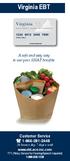 Virginia EBT A safe and easy way to use your SNAP benefits. Customer Service 1-866-281-2448 24 hours a day, 7 days a week www.ebt.acs-inc.com TTY (Relay Service for Hearing/Speech Impaired) 1-800-828-1120
The U.S. social welfare structure has been shaped both by long standing traditions and by changing economic and social conditions.
 The U.S. social welfare structure has been shaped both by long standing traditions and by changing economic and social conditions. In its early history, the United States was an expanding country with
Summary of Federal SCHIP Reauthorization, Economic Stimulus, and Health Care Reform Bills and Proposals
 Summary of Federal SCHIP Reauthorization, Economic Stimulus, and Health Care Reform Bills and Proposals I. Children s Health Insurance Program (CHIP) Reauthorization Act of 2009 A. Funding for CHIP. The