
SPECIAL EDUCATION FUNDING AND CHILD TRACKING SYSTEM (FACTS) APPROVAL PROCEDURES
|
|
|
- Ashley Gibson
- 10 years ago
- Views:
Transcription
1 SPECIAL EDUCATION FUNDING AND CHILD TRACKING SYSTEM (FACTS) APPROVAL PROCEDURES School Year --- (November 2015, Revision #1) For use with iepoint>and NetCheck This is a compilation of procedures and instructions, supported by rules and regulations, to assist local education agencies in approving special needs pupils. ILLINOIS STATE BOARD OF EDUCATION Division of Funding and Disbursement Services 100 North First Street Springfield, Illinois Phone: (217) FAX: (217)
2 TABLE OF CONTENTS SPECIAL EDUCATION FUNDING AND CHILD TRACKING Page # SYSTEM INSTRUCTIONS General Instructions, Electronic Transmission & Additional Data Reports 1-2 Questions ISBE and Harrisburg Contact Information 2-3 Specific Instructions Resident and Serving District and School 4-5 Percent Time In Special Education 5-6 Fund Codes (IDEA, State Reimb & Students NOT Receiving Services) 6-12 Serving District and School Table 13 Private Facility Code, Birth Date and Name 14 SIS ID, Gender, Ethnic Codes & Disability Codes Grade Level, Limited English Proficient Information & Language Codes Bilingual, Related Services Information and Codes Information Educational Environment Narrative, Codes & % Time Inside General Ed Early Childhood (Ages 3-5) Educational Environment Narrative, Codes & % Time Inside General Ed (Ages 6-21) Room & Board Payer Codes, Eligibility Instructions & Codes Term and Begin and End Dates Reasons for Exit State Performance Plan Indicators 8 & State Performance Plan Indicator Non-Public Proportionate Share Calculation 51 FACTS File Format for NetCheck Users 52-55

3 INSTRUCTIONS FOR THE SPECIAL EDUCATION FUNDING AND CHILD TRACKING SYSTEM (FACTS) SCHOOL YEAR GENERAL INSTRUCTIONS "Special Education Funding and Child Tracking System (FACTS)" serves as the primary approval process for children with disabilities who are eligible for state pupil categorical reimbursements under Sections (Private), b (Funding for Children Requiring Special Education Services), (Orphanage) and b (Special Transportation) of the School Code. Each student eligible for state reimbursement, even if only for part of the school year, must be listed and approved on FACTS in order for funding to be claimed. The level of payment is dependent upon amounts appropriated by the General Assembly. Per Section of the School Code, FACTS is also the system for collecting all students with disabilities who are reported to the federal government. Students reported must be eligible to receive services or be in a special education program receiving direct or related services approved by a public school district on December 1, 2014, be at least age three through age 21, inclusive (i.e., through the day before the student s 22 nd birthday) (see 34 CFR (a)), and have an individualized education program (IEP) or individualized services plan (ISP) in place. It is critical that all students with disabilities who are receiving services as of December 1 for the school year) each year are reported accurately in order for the state to receive the proper amount of funding authorized under the Individuals with Disabilities Education Act (IDEA). A FACTS record should be created for every student who has had initial eligibility determined whether or not he or she subsequently receives direct or related services. Every student who does not receive direct or related services should be reported as FUND Code N or U by the serving district. There will be five required transmissions of FACTS and one optional transmission for the purpose of reporting all students eligible for state reimbursement and those eligible only for the December 1 child count. ELECTRONIC TRANSMISSION Data for completing FACTS must be transmitted electronically via Harrisburg Project using either iepoint> or locally developed software. iepoint> is software designed to allow special education cooperatives/districts to manage, analyze and transmit special education data. Additionally, for those with computer software other than iepoint>, NetCheck must be used to ensure data validity and facilitate data transmission. Harrisburg Project provides instructions for transmitting data. If you have any questions contact Harrisburg Project at or by at [email protected]. The Special Education pupil data for every district is transmitted electronically by a Site (iepoint> or NetCheck). To reduce the likelihood of duplicate FACTS records being 1

4 transmitted from two or more Sites, a list of allowable Resident Districts that may be transmitted for each Site has been created. The list of Resident Districts a Site may include is viewable at An error will be generated if a FACTS record is transmitted using a Resident District that is not approved for the Site. If you receive this error, verify the reported Resident District and, if valid, contact Funding and Disbursements at to request an exception. This error does not apply to FUND Codes L, P, or N. The Special Education Authorization (Harrisburg Project) application, located in the Illinois State Board of Education s (ISBE) Web Application Security (IWAS) system, is the electronic authorization system that all districts must complete to authorize the electronic transmission of special education pupil and personnel approval and claim data. IWAS authorization is required for all districts each year based on resident district only. ISBE will NOT accept a file transmission containing districts without IWAS Authorization. PRIVATE RESIDENTIAL PLACEMENTS ADDITIONAL DATA REPORTS When a school district needs to place a student in a private residential facility, pre-approval is required if the district will be paying the room and board costs. ISBE Form 34-37, Application for Approval of Private Residential Placement Room and Board Reimbursement, must be completed and submitted annually for approval. If you have questions specific to this approval process, please contact Boyd Ferguson of the Special Education Services Division by phone at (217) or by FAX at (217) ORPHANAGE ACT ELIGIBILITY Students reported under Fund Codes D, E and F must clear eligibility checks to qualify for reimbursement under Section Orphanage. For students not clearing initial eligibility checks, a preprinted ISBE Form 34-75, Section Student Eligibility Verification based upon data entered on the Type of Residence, Placing Agent and Guardianship Codes of FACTS will be sent to obtain clarification of information reported and/or additional information. QUESTIONS Questions pertaining to the completion of FACTS should be directed to the person(s) listed in the memo regarding the most recent transmission or contact: Illinois State Board of Education Funding and Disbursement Services Division 100 North First Street Springfield, Illinois Attn: Jamie Johnson Phone: (217) FAX: (217)

5 Questions pertaining to State Performance Plan Indicators 8, 11 and 13 should contact: Shangte Shen Illinois State Board of Education Data Analysis Division 100 North First Street Springfield, Illinois Phone: (217) FAX: (217) Questions pertaining to the operation of iepoint> or NetCheck should contact: Harrisburg Project 512 North Main Harrisburg, Illinois Phone: (800) FAX: (618)

6 SPECIFIC INSTRUCTIONS FOR COMPLETION OF FACTS You must select the student s resident district and school. For selected Fund Codes, you must also select the student s serving district and school. In general, the resident district and/or the special education cooperative to which that district belongs are authorized to report student data. However, for non-public students that are being served outside their resident district, the serving district must report these students (Fund Code L only) as long as they are not dually enrolled. For a complete listing of all school districts and schools in Illinois please refer to the Data Analysis and Progress Reporting website at If a student has changed resident districts, but will be claimed for a portion of the school year in the reporting district, add the student s end date on FACTS and complete the Reason for Exit. Resident District For every FACTS record, indicate the unique eleven-digit region-county-district-type number assigned by the Illinois State Board of Education for public school district of residence. Section defines residency for the parent of a student with disabilities and Section (a) defines residency for a student with disabilities. Please note that P.A signed into law on August 15, 2008 modified Sections and a Section (a) Resident District; Student The resident district is the school district in which the student resides when: (1) the parent has legal guardianship but the location of the parent is unknown; or (2) an individual guardian has been appointed but the location of the guardian is unknown; or (3) the student is 18 years of age or older and no legal guardian has been appointed; or (4) the student is legally an emancipated minor; or (5) an Illinois public agency has legal guardianship and such agency or any court in this State has placed the student residentially outside of the school district in which the parent lives. In cases where an Illinois public agency has legal guardianship and has placed the student residentially outside of Illinois, the last school district that provided at least 45 days of educational service to the student shall continue to be the district of residence until the student is no longer under guardianship of an Illinois public agency or until the student is returned to Illinois. The resident district of a homeless student is the Illinois district in which the student enrolls for educational services. Homeless students include individuals as defined in the Stewart B. McKinney Homeless Assistance Act [42 U.S.C et seq.]. Any student served by the Department of Human Services may only be reported by the Resident District. 4
7 Any student served by the following State Charter Schools - Prairie Crossing, Southland College Preparatory High School, Horizon Science Academies McKinley Park or Belmont and LEARN Waukegan may only be reported by those charter schools and must indicate the student s Resident and Serving District as those schools. For Fund Code L and N students who reside outside of Illinois and attend a non-public school in Illinois, report the Category 2 Serving District as their Resident District. Resident School For every FACTS record, indicate the unique fifteen-digit region-county-district-type-school number assigned by the Illinois State Board of Education for a public school that is valid for the Resident District. The Resident School represents the school in the district where the student either attends for educational instruction or where he/she would attend if he/she were educated at a school in his/her resident district. The resident school can only be a public school attendance center. Serving District Indicate the unique eleven-digit number assigned by the Illinois State Board of Education for the Serving District. The Serving District represents the local education agency that operates the program. This may be the same as the resident district or can be another public school district in Illinois. For certain Fund Codes, the serving district may be a special education cooperative, a regional office alternative learning program, a state agency (e.g. Dept of Human Services) or other state funded school (e.g. Laboratory School). Serving School Indicate the unique fifteen-digit number (Region-County-District-Type-School) assigned by the Illinois State Board of Education for the Serving School. The Serving School represents the school or location where the student receives his/her educational instruction. This may or may not be a school in the serving district. For certain Fund Codes, the serving school may be a state approved special education program operated by a special education cooperative, a regional office alternative program, a state agency funded school (e.g. Illinois School For The Deaf), or a non-public parochial school. ISBE has eliminated the Category X additional serving locations and unlisted locations. In the case of Home/Hospital or an undetermined serving location, the serving location would be where the student either attends for educational instruction or where he/she would attend if he/she were educated at a school in his/her serving district. Percent Time in Special Education Enter the percentage that reflects the amount of time for which a student receives special education services under his or her Individualized Education Program (IEP) at the time of entry into the special education program as compared to the total amount of time in the student s regular instructional day. The instructional school day is NOT bell to bell and should omit passing periods, lunch, and recess unless the student s IEP requires support during those times. 5

8 Example: John receives 950 Special Education minutes per week. Total instructional minutes per week = 1,680. (950 / 1680 =.565)*100 = 56.5 or 57% 57% Special Education This percent time in special education must be calculated individually for each student in the program. Half-day preschool students who only attend the special education program should have 100% entered. Beginning with the release of iepoint> in November 2015, failure to enter the Percent Time in Special Education will result in a WARNING when transmitting files to ISBE. A WARNING will not prevent you from transmitting a file but serves as a reminder that you should begin collecting this data. All students (except Funds LNPU) will be required to have Percent Time in Special Education entered by the May 2016 data transmission. Failure to enter this data by May 2016 will result in an ERROR and prevent you from transmitting your file. Fund Indicate the one appropriate code letter for the type of program funding for which application is being made. Students ages 3-21 may be reported under any of the fund codes for which they are eligible. Generally, a student may only be entered once in a particular fund code and/or private facility code during each period of time indicated with a begin and end date. If a student is placed in one private facility for tuition purposes and a different facility for the school district s payment of room and board, the student must have two FACTS records in the same time period. To allow this, the student General record must have the Dually Enrolled indicator checked. Likewise, if a student is placed in a private school program by the school district for part of the day and in a public school program part of the day necessitating the reporting of the student in both funds B and A or X, the Dually Enrolled checkbox should be checked. If a student s fund code has been changed but the student will be claimed for a portion of the school year under both the first and second fund code designations, add an end date and Exit Code 20 in the entry for the first fund code. Reenter the student s data with the second fund code, with a begin date that follows the end date listed on the FACTS entry for the first fund code. If a student has been discontinued from a district program and at a later date during the school year reenters the same district under the same fund code, reenter the student s data on FACTS with the new begin date for the second or subsequent entries. 6
9 Fund Codes Only students in programs on December 1 are to be reported in Fund Codes A, K, L and P. IDEA Fund Codes A IDEA Child Count. Eligible students are enrolled, have an appropriately developed IEP and are receiving special education and related services in public school district programs. Select the serving district and serving school as appropriate. Students who are placed in a state operated school (e.g. Illinois School For The Deaf) must be reported by the resident district. K IDEA Child Count Nonpublic Dually Enrolled. These students are homeschooled or enrolled by the parent/guardian in a nonpublic (e.g., parochial) school for general education and are also enrolled, have an IEP and are receiving special education and/or related services in the public school district. Select the serving district and serving school as appropriate. The serving school may be either a public school attendance center or a non-public school depending on where services are provided. L IDEA Child Count--Nonpublic--Not Enrolled. These students are enrolled by the parent/guardian in a nonpublic (e.g., parochial) school for general education and are not enrolled in the public school district but are receiving special education and/or related services specified on an individualized services plan (ISP) and are provided by the public school district. Select the serving district and serving school as appropriate. The serving school may be either a public school or a non-public school depending on where services are provided. P IDEA Child Count--Home-Schooled--Not Enrolled. These students are homeschooled for general education and are not enrolled in the public school district but are receiving special education and/or related services specified on an individualized services plan (ISP) and are provided by the public school district. Select the serving district and serving school as appropriate. The serving school may be either a public school or a non-public school depending on where services are provided. State Reimbursement Fund Codes B Section (Private Day and Residential Facilities and Out-of-State Public Schools) -- Provides reimbursement for students placed in approved nonpublic facilities and in out-of-state public schools, and includes both tuition and room and board. The tuition formula is specified in the School Code, i.e., the 7
10 school district pays the first district per capita tuition rate (per cap); the state reimburses the difference between the first per cap and $4,500; the school district pays a second per cap above $4,500; and the state pays the remainder above $4,500 plus the second per cap or the sum of two per caps, whichever is greater. This funding is paid quarterly during the school year after service is provided. When a residential placement is necessary, no other agency has agreed to pay room and board, and approval has been given on ISBE Form 34-37, Application for Approval of Private Residential Placement Room and Board Reimbursement, payment of room and board costs based on rate approvals and dependent upon funding availability may be made on a current basis during the school year in which service is provided. Select the Private Facility where the student is being educated. D Section (Orphanage Act) -- Provides full tuition reimbursement for eligible students who attend public school educational programs and are placed in a residence for the purpose of care/custody, welfare, medical/mental health treatment, rehabilitation or protection by an Illinois public agency with authority over and responsibility for the students. This fund code may only be used with written authorization from the Illinois State Board of Education. Use of this fund code requires the completion of Type of Residence, Placing Agency and Guardianship Codes. An eligibility check is conducted for each child reported for this fund source with additional information required for students who cannot be verified as wards of the Department of Children and Family Services. ISBE Form 34-75, Section Eligibility Verification is the data collection instrument for this additional information. Please note that, in order to be eligible for reimbursement under Section , the student s residence must be located in a district other than the district of residence of a parent or courtappointed individual guardian per the requirements of 23 Illinois Administrative Code (e). Estimated funding is paid quarterly during the school year in which service is provided. Select the serving district and serving school as appropriate. E Section (Orphanage Act--Individual Programs) -- Provides full tuition reimbursement for eligible students who attend public school educational programs and who are placed in a residence by an Illinois public agency or court in this State. P.A passed August 15, 2008 modified eligibility requirements for students claimed under Section Eligibility for reimbursement is driven by a determination of residency under Sections or a depending on the status of the rights of the parents/guardian with regards to the student. If the parents have not been subject to a termination of parental rights order then the residency of the student is determined by Section and the district of residence is the district in which the parents reside. That district is responsible for educational service costs and can apply for reimbursement under the appropriate Sections of the School Code but the student is NOT eligible for reimbursement under Section
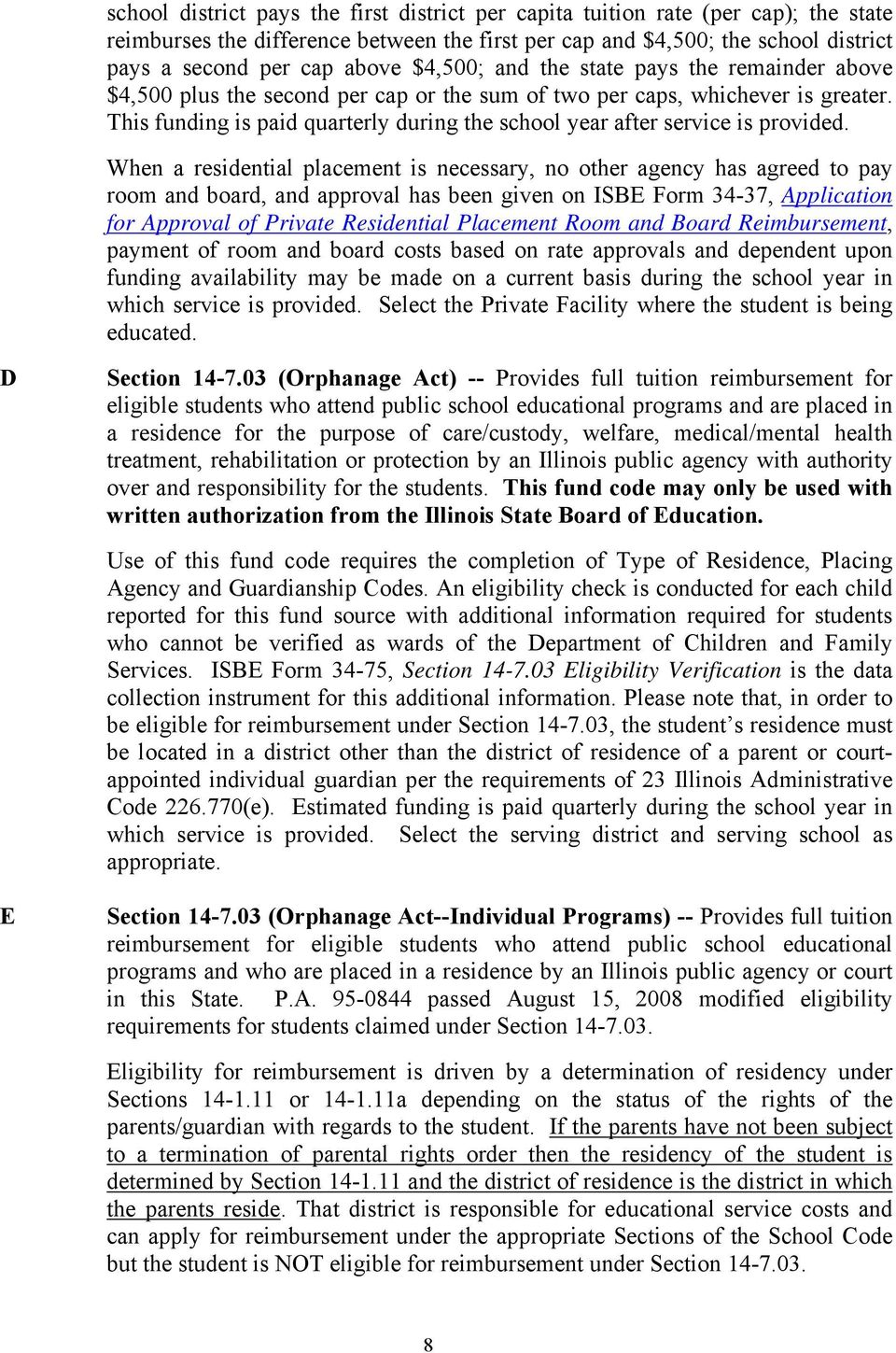
11 If the student s parents have been subject to a termination of parental rights order or DCFS has legal guardianship of a student who has been identified as eligible for special education services under Article 14 of the School Code and is considered a ward of an Illinois public agency, residency is determined under Section a and the district of residence is the district in which the student resides. That district is responsible for educational service costs and can apply for reimbursement under Section Please note that, in order to be eligible for reimbursement under Section , the student s residence must be located in a district other than the district of residence of a parent or court-appointed individual guardian per the requirements of 23 Illinois Administrative Code (e). Use of this fund code requires the completion of Type of Residence, Placing Agency and Guardianship Codes. An eligibility check is conducted for each child reported for this fund source with additional information required for students who cannot be verified as wards of the Department of Children and Family Services. ISBE Form 34-75, Section Eligibility Verification, is the data collection instrument for this additional information. Estimated funding is paid quarterly during the school year in which service is provided. Select the serving district and serving school as appropriate. F Section (Private Facilities/Orphanage Act) -- Provides full tuition reimbursement for eligible students who are placed by an Illinois public agency or court in this State who attend special education private facilities approved by ISBE with per diem rates approved by the Illinois Purchased Care Review Board. Eligibility for reimbursement is driven by a determination of residency under Sections or a depending on the status of the rights of the parents/guardian with regards to the student. If the parents have not been subject to a termination of parental rights order then the residency of the student is determined by Section and the district of residence is the district in which the parents reside. That district is responsible for educational service costs and can apply for reimbursement under the appropriate Sections of the School Code but the student is NOT eligible. If the student s parents have been subject to a termination of parental rights order or DCFS has legal guardianship of a student who has been identified as eligible for special education services under Article 14 of the School Code and is considered a ward of an Illinois public agency, residency is determined under Section a and the district of residence is the district in which the student resides. That district is responsible for educational service costs and can apply for reimbursement under Section Please note that, in order to be eligible for reimbursement under Section , the student must reside in and be placed into the nonpublic educational program by a district other than the district of residence of a parent or court-appointed individual guardian per the requirements of 23 Illinois Administrative Code (e). The nonpublic educational program must meet the approval 9

12 requirements of Section of the School Code and 23 Illinois Administrative Code 401. Use of this fund code requires the completion of Type of Residence, Placing Agency and Guardianship Codes. Eligibility verification is also conducted for these students via ISBE Form if they cannot be verified as wards of the Department of Children and Family Services. Estimated funding is paid quarterly during the school year in which service is provided. H Phillip J. Rock Center and School Allows for any student attending this facility, located in Glen Ellyn, Illinois, to be reported by the resident school district. This facility should not be confused with the Illinois School for the Visually Impaired or the Illinois School for the Deaf, both located in Jacksonville, Illinois. Select the resident school which indicates the public school where the student would attend if he or she were served in the resident district. The serving school must be the Philip J Rock Center and School. J Section and Section b (Private Residential Facility/Public School District Education Program/Funding for Children Requiring Special Education Services) Provides reimbursement for students placed by a school district into a private residential program who attend a public school educational program. The student is residentially placed in an approved nonpublic facility by the public school district of residence. The residential component is provided by the facility with room and board costs reimbursed to the district under the provisions of Section (see Fund Code B). Students placed in private residential placements for whom room and board will be claimed must be preapproved annually through the submission of ISBE Form 34-37, Application for Approval of Private Residential Placement Room and Board Reimbursement. Education is provided by the local school district/joint agreement operating a program for students residing at the facility. Tuition is paid by the district of residence to the serving district under the provisions of Section and 23 IAC Part 130 Determining Special Education Per Capita Tuition Charge. Select the serving district as appropriate. Select the Private Facility which indicates the private facility where the student resides. The serving school may be either a public school or special education private facility approved by the Illinois Purchased Care Review Board depending on where services are provided X Section b (Funding for Children With Excess Costs) - Provides tuition reimbursement for students placed in Illinois public school programs whose educational costs exceed four district per capita tuition charges. The difference between the actual student cost and the four district per capita tuition charges will be reimbursed from unexpended federal room and board funds. Select the serving district and serving school as appropriate. 10

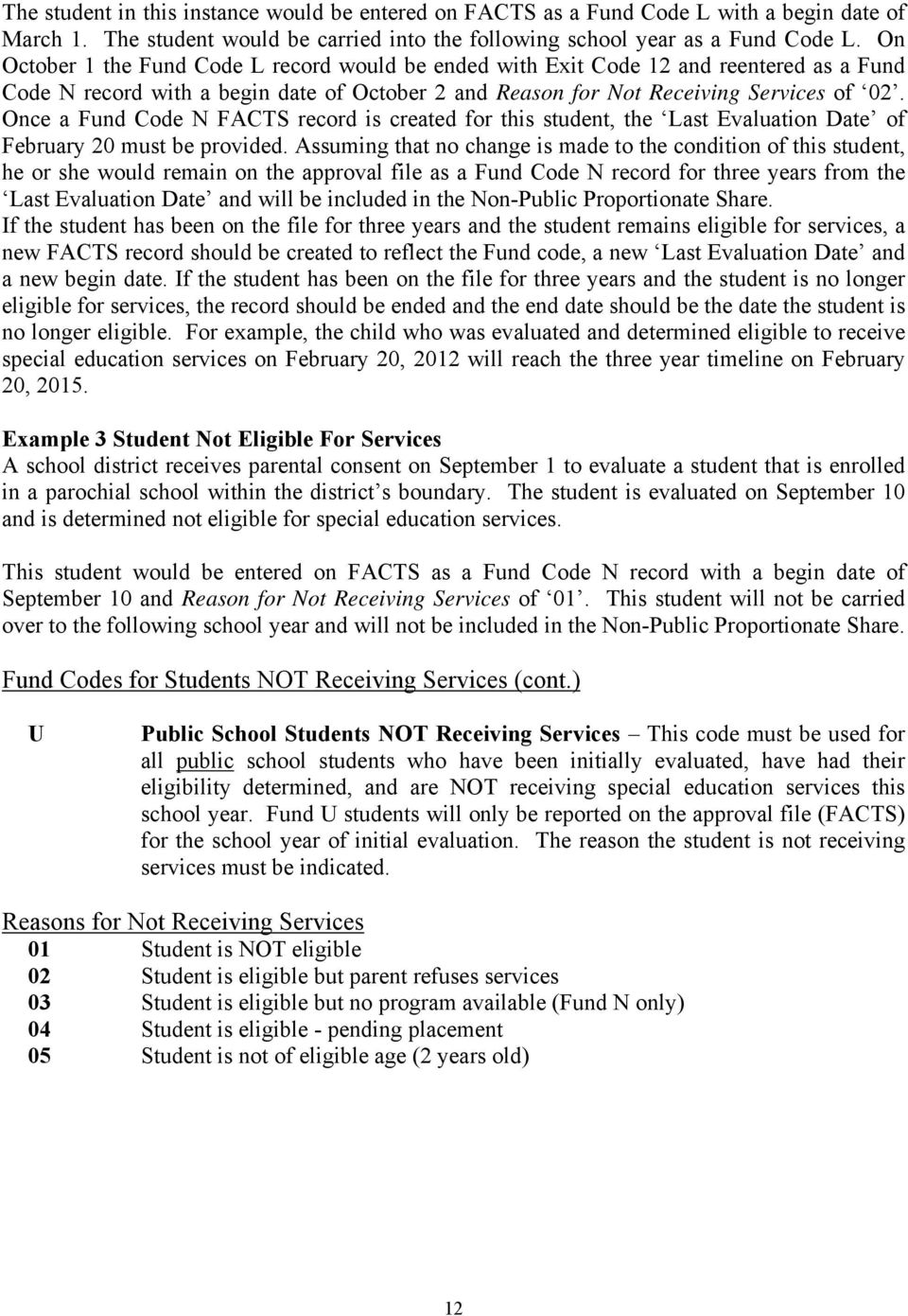
13 Fund Codes for Students NOT Receiving Services N Non-Public School Students NOT Receiving Services This code must be used for all non-public students, including home-schooled, who have been evaluated and have had their eligibility determined to either receive or not receive special education services. The Reason for Not Receiving Services must be entered. Fund Code N students with Reason for Not Receiving Services codes 01 or 05 will only be reported on FACTS for the current school year. Fund Code N students with Reason for Not Receiving Services codes 02, 03, or 04 must be reported on FACTS and will be included in the serving district s Non- Public Proportionate Share for 3 years from the Last Evaluation Date. The Last Evaluation Date is defined as the date of the most recent evaluation. If the student begins receiving services, a new FACTS record must be created with the applicable Fund Code. Examples of Fund Code N Students Example 1 Student Eligible For Services-No Program Available A school district receives parental consent on November 1 to evaluate a student that is enrolled in a parochial school within the district s boundary. The student is evaluated and determined eligible to receive special education services on November 10. The type of services the student needs is not offered by the district. This student would be entered on FACTS as a Fund Code N, with a begin date of November 10 and a Reason for Not Receiving Services of 03. If no program becomes available for this student then he or she would remain on FACTS as a Fund Code N, Reason 03 for three years from the date of November 10 and will be included in the Non-Public Proportionate Share. If the student has been on the file for three years and the student remains eligible for services, a new FACTS record should be created to reflect the Fund code, a new Last Evaluation Date and a new begin date. If the student has been on the file for three years and the student is no longer eligible for services, the record should be ended and the end date should be the date the student is no longer eligible. For example, the student who was evaluated and determined eligible to receive special education services on November 10, 2011 will reach the three year timeline on November 10, Example 2 Student Receiving Services-Condition Change To Not Receiving Services A school district receives parental consent on February 15 to evaluate a non-public student. The student is evaluated and determined eligible to receive special education services on February 20. The student begins ISP services on March 1, is entered on FACTS as a Fund Code L record and continues to receive services into the next school year. On October 1, the parents decide they no longer want their student to receive special education services. 11
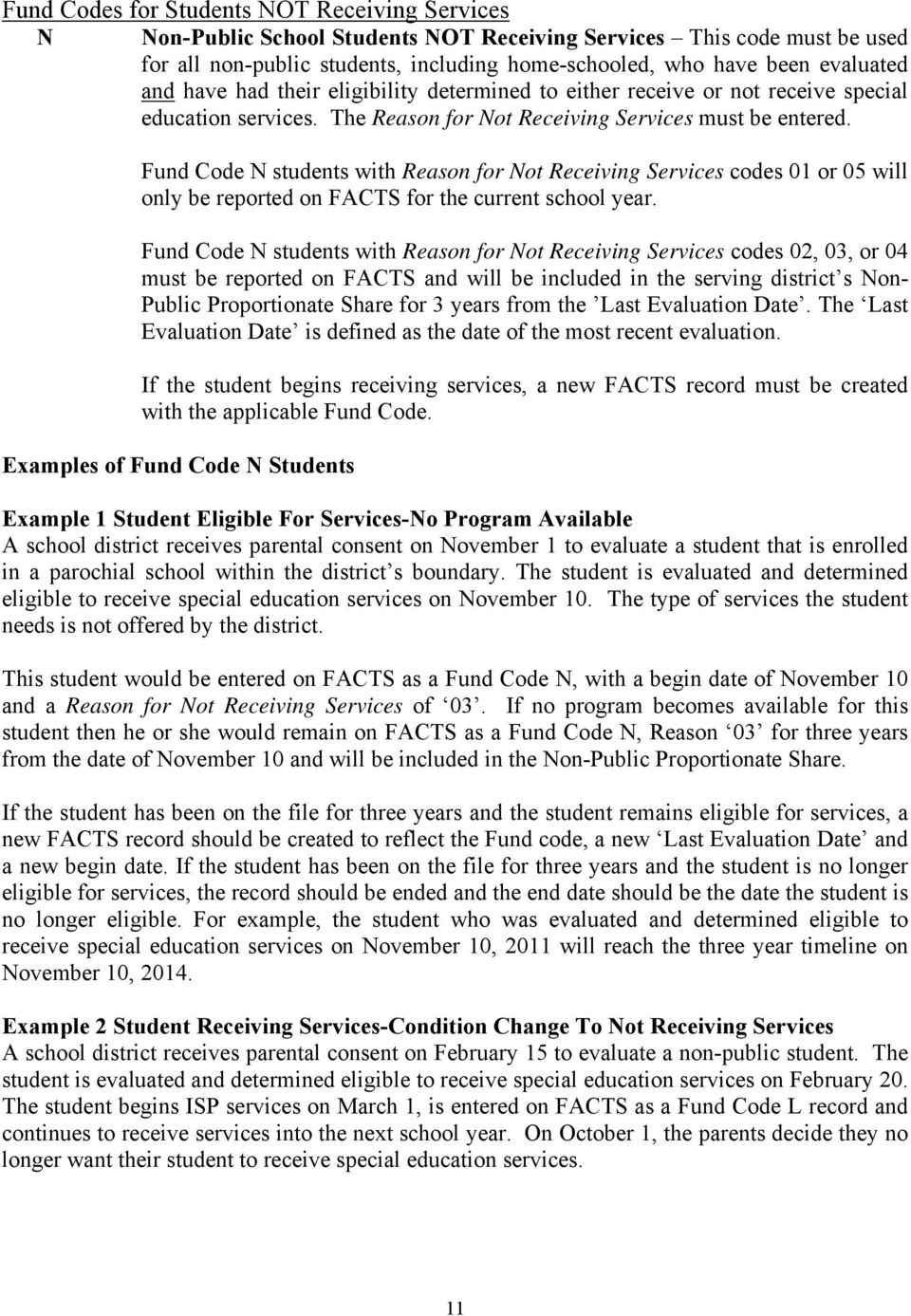
14 The student in this instance would be entered on FACTS as a Fund Code L with a begin date of March 1. The student would be carried into the following school year as a Fund Code L. On October 1 the Fund Code L record would be ended with Exit Code 12 and reentered as a Fund Code N record with a begin date of October 2 and Reason for Not Receiving Services of 02. Once a Fund Code N FACTS record is created for this student, the Last Evaluation Date of February 20 must be provided. Assuming that no change is made to the condition of this student, he or she would remain on the approval file as a Fund Code N record for three years from the Last Evaluation Date and will be included in the Non-Public Proportionate Share. If the student has been on the file for three years and the student remains eligible for services, a new FACTS record should be created to reflect the Fund code, a new Last Evaluation Date and a new begin date. If the student has been on the file for three years and the student is no longer eligible for services, the record should be ended and the end date should be the date the student is no longer eligible. For example, the child who was evaluated and determined eligible to receive special education services on February 20, 2012 will reach the three year timeline on February 20, Example 3 Student Not Eligible For Services A school district receives parental consent on September 1 to evaluate a student that is enrolled in a parochial school within the district s boundary. The student is evaluated on September 10 and is determined not eligible for special education services. This student would be entered on FACTS as a Fund Code N record with a begin date of September 10 and Reason for Not Receiving Services of 01. This student will not be carried over to the following school year and will not be included in the Non-Public Proportionate Share. Fund Codes for Students NOT Receiving Services (cont.) U Public School Students NOT Receiving Services This code must be used for all public school students who have been initially evaluated, have had their eligibility determined, and are NOT receiving special education services this school year. Fund U students will only be reported on the approval file (FACTS) for the school year of initial evaluation. The reason the student is not receiving services must be indicated. Reasons for Not Receiving Services 01 Student is NOT eligible 02 Student is eligible but parent refuses services 03 Student is eligible but no program available (Fund N only) 04 Student is eligible - pending placement 05 Student is not of eligible age (2 years old) 12
15 Local Education Agency Category Serving Serving Fund Fund Description District School A IDEA Child Count For B (Prairie Crossing, Southland, McKinley Park, Belmont or LEARN) 4, E 7, 4, E 8, E A, E A, E X B E K L F D Excess Cost (4 times per cap) Private Day Residential Facs Out-of-State Public Orphanage Act Individual Programs IDEA Child Count Public & Non-Public IDEA Child Count Non-Public Not Enrolled Private Facilities Orphanage Act Orphanage Act Group Programs B Same as above) B (Same as above B (Same as above) B (Same as above) Two 6 s Provided by ISBE 4, E 7, 4, E 8, E A, E A, E 4, E 7, 4, E 8, E A, E A, E 4, 3, E 7, 3, 4, E 8, 3, E A, 3, E B, 3, E 4, 3, E 7, 3, 4, E 8, 3, E A, 3, E 3, E 7 within Serving District, E Local Education Agency Category Serving Serving Fund Fund Description District School 2 4, 3, E J Private Res Facility 6 7, 4, 3, E Public District 8 8, 3, E Extraordinary 1 A, 3, E H Phillip J. Rock 7 P N U Home School Non-Public School Students NOT Receiving Services Public School Students NOT Receiving Services For B (Same as above) For B (Same as above) 4, 3, E 7, 3, 4, E A, 3, E Local Education Agency 0 Public: Intermediate Service Centers 1 ROE 2 Public: Districts 3 Nonpublic Schools 4 Public: Schools 6 Public: Sp. Ed. Coop Districts 7 Public: Sp. Ed. Coop Schools 8 Public: Other State Funded Districts & Schools A Public: Regional Programs & Schools B Charter Schools E Early Childhood (For students ages 3 to less than 7) 13

16 Private Facility Code -- Fund Codes B, F and J Only If funding is requested under Fund Codes B, F or J, provide the appropriate three-digit number (code) assigned for the private facility and program of attendance. Refer to the current list of Approved Eligible Nonpublic Facilities with Allowable Costs. Approval is considered only if the student's primary disability and age match the approved primary disability(ies) and age range served by the private facility or out-of-state public school. Some private facilities have multiple rates, and a separate code has been assigned for each rate. Additionally, facilities approved in prior years may not be approved for the current year. It is extremely important that the correct private facility code be used as this code determines the amount of reimbursement available for the student's placement. If a student changes private facilities during the school year and will be claimed for a portion of the current school year in both the first and second facilities, add an end date and Exit Code 20. Reenter the student with the second private facility code, completing FACTS information as needed. Be sure that the begin date in the second facility is after the end date listed on the FACTS entry for the first private facility code. Birth Date Indicate the birth date as it appears on official school records, using numerals. NetCheck sites should enter a four-digit year followed by a two-digit month and two-digit day (ex: YYYYMMDD). iepoint> users should enter all dates normally. The ISBE student ID code includes the first two letters of the last name, the first letter of the first name, the birth date and a two-digit number assigned by the Illinois State Board of Education. Last Name/First Name/Middle Name Provide the student s legal last, first and middle name. These fields can only contain alpha characters with the exception of hyphens ( - ) and spaces. Periods, commas and apostrophes are not accepted. The period in names should be replaced with a space. These fields should match with the Student Information System (SIS). Indicate the student's legal last name. Space for 30 characters is provided. Spaces are accepted (St John) and hyphens, - (Santiago-Hernandez). [Note: Spaces should not be entered in McCormick, MacCormick, nor an apostrophe in Obrien.] Indicate the student's legal first name. Space for 30 characters is provided. Spaces are accepted (Mary Ann) and hyphens, - (John-Paul). Indicate the student's legal middle name. Space for 30 characters is provided. Spaces are accepted (Mary Ann), and hyphens, - (John-Paul). You are required to enter a middle name or initial when reporting a special needs student if it is available. This will help reduce the number of duplicate student records. If the student does not have a middle name, indicate so by completing the No middle name field. Failure to provide a middle name or an indication that the student does not have a middle name will result in an ERROR. 14
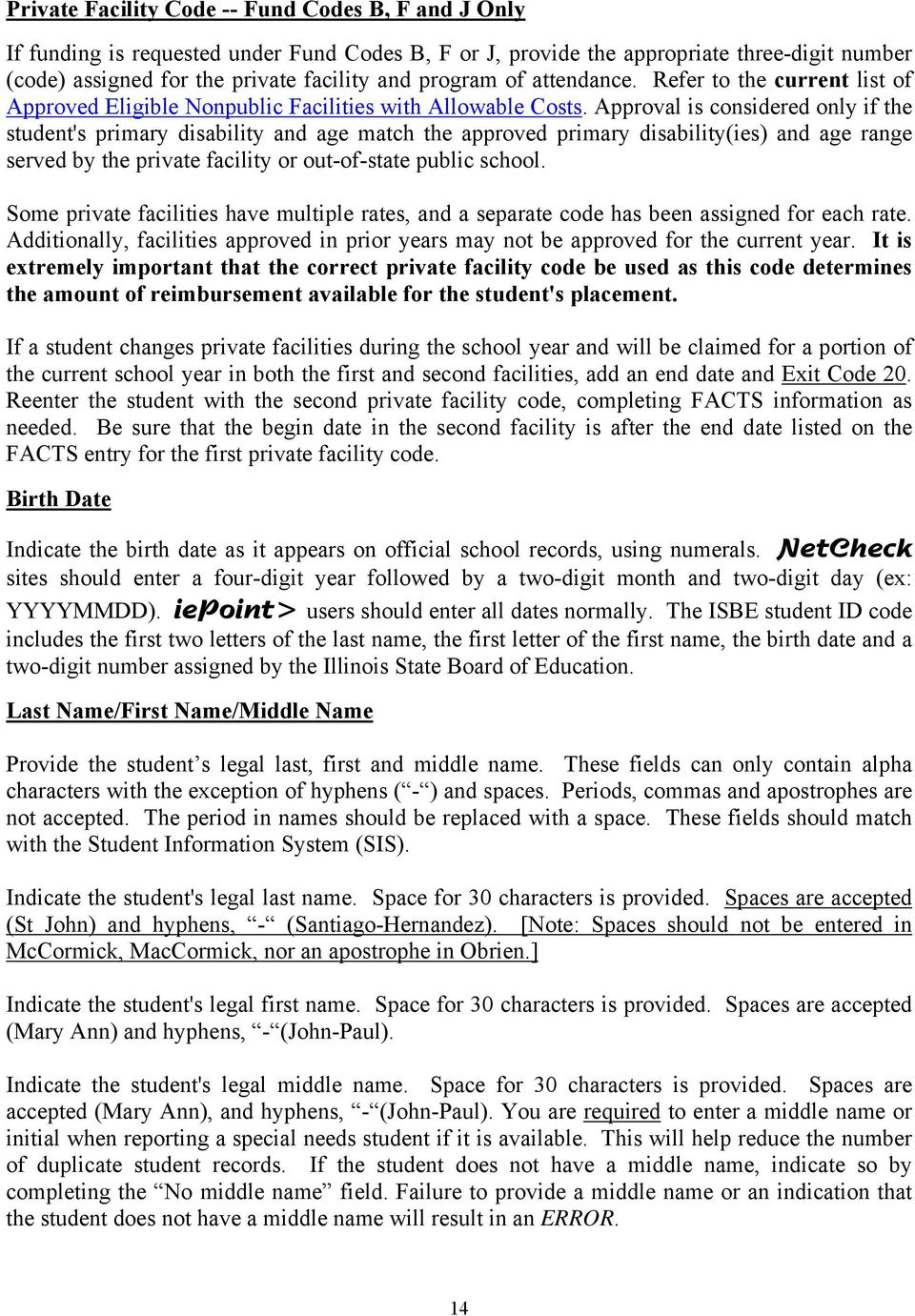
17 If a child is adopted mid-year, you should end the current FACTS record on the day before the name change and enter Exit Code 20. Start a new FACTS record with the new name on the date of the name change. Note that iepoint> users will also be creating a new student General record with the new name. Student Information System (SIS) Id Number This will automatically be populated by ISBE. All client entered SIS IDs will be preserved in a secondary field. If you find discrepancies between the SIS ID automatically populated by ISBE and the client entered SIS ID, please consult with the school district s SIS personnel to ensure an accurate match between the FACTS and SIS systems. The following fields are being compared between the systems to match FACTS records to SIS IDs: Last Name First Name Date of Birth Gender Students reported under Fund Codes L, P or N should be enrolled in SIS under the Private Schooled Student Indicator (PSS). Please note, however, if the student was previously enrolled in an Illinois Public School District and received a SIS ID, the system will likely match this student with his/her SIS ID from a previous enrollment. As this matching process begins, your effort to ensure the integrity of this match and resolve unmatched records is appreciated. If you require further assistance on SIS ID matching, please contact Harrisburg Project at Gender Enter M for male, F for female. Race and Ethnicity Code Using the federal race and ethnicity categories, enter one code to indicate the student's race and ethnicity data. Identification of students should be done by their parents/guardians. These codes should be aligned with the Student Information System (SIS). Your attention to detail is critical since race/ethnicity data are used in many of the data analysis, reporting and progress monitoring requirements of IDEA To this end, individuals reporting race/ethnicity data in FACTS need to keep in mind the following principles: Race/ethnicity reporting in FACTS and SIS must be based upon responses to a required two-part question, as defined in the new federal guidance. Districts are required to collect race/ethnicity data using the two-part question, and parents must provide these responses for elementary and secondary school students. 15
18 Districts must use the data collected from a student's parent(s) to in turn report the student's race/ethnicity to ISBE through SIS and FACTS in one of the seven mutually exclusive race/ethnicity reporting categories. Further information regarding each district's responsibility regarding race/ethnicity data collection vs. reporting can be found in the resources available at Clients reporting race/ethnicity data in FACTS need to ensure consistency in reporting between the FACTS and SIS systems. Districts and cooperatives should utilize the SIS "Student Demographics" report to ensure consistent reporting between systems. While the match between the FACTS and SIS systems is not fully congruent at this time, ISBE continues to work on the full integration of these systems and appreciates the effort made by districts and cooperatives to ensure consistent reporting. Code Race and Ethnicity 11 Hispanic or Latino A person of Cuban, Mexican, Puerto Rican, South or Central American, or other Spanish culture or origin, regardless of race. 12 American Indian or Alaska Native A person having origins in any of the original peoples of North and South America, including Central America, and who maintains tribal affiliation or community attachment. 13 Asian A person having origins in any of the original peoples of the Far East, Southeast Asia, or the Indian subcontinent including, for example, Cambodia, China, India, Japan, Korea, Malaysia, Pakistan, the Philippine Islands, Thailand, and Vietnam. 14 Black or African American A person having origins in any of the black racial groups of Africa. 15 Native Hawaiian or Other Pacific Islander A person having origins in any of the original peoples of Hawaii, Guam, Samoa, or other Pacific Islands. 16

19 16 White A person having origins in any of the original peoples of Europe, the Middle East, or North Africa. 17 Two or More Races A person having origins in more than one race. Student's Identified Disability(ies) (Maximum of 2 Allowed) Sequence each disability as it impacts the student's general education. The primary disability should be listed first and the secondary disability (if identified) listed second. Code A C D E F Disabilities INTELLECTUAL DISABILITY (IntD): The child exhibits significantly subaverage general intellectual functioning, existing concurrently with deficits in adaptive behavior and manifested during the developmental period, that adversely affects a child s educational performance. If this disability is listed, specific learning disability cannot be entered for the student. ORTHOPEDIC IMPAIRMENT (PI): The child exhibits a severe orthopedic impairment that adversely affects a child s educational performance; includes impairments caused by congenital anomaly (e.g., clubfoot, absence of some member, etc.), impairments caused by disease (e.g., poliomyelitis, bone tuberculosis, etc.), and impairments from other causes (e.g., cerebral palsy, amputations, and fractures or burns that cause contractures). SPECIFIC LEARNING DISABILITY (SLD): The child exhibits a disorder in one or more of the basic psychological processes involved in understanding or in using language, spoken or written, that may manifest itself in an imperfect ability to listen, think, speak, read, write, spell or do mathematical calculations. The term includes such conditions as perceptual disabilities, brain injury, minimal brain dysfunction, dyslexia and developmental aphasia. The term does not include children who have learning problems that are primarily the result of visual, hearing or motor disabilities, of mental impairment, of emotional disability, or of environmental, cultural or economic disadvantage. If this disability is listed, cognitive disability cannot be entered for the student. VISUAL IMPAIRMENT (VI): The child has an impairment in vision that even with correction, adversely affects the child s educational performance. If this disability is listed, deaf-blindness cannot also be listed. HEARING IMPAIRMENT (HI): The child has an impairment in hearing, whether permanent or fluctuating, that adversely affects the child s educational performance. If this disability is listed, deaf-blindness cannot be listed. 17

20 G H I K L M N DEAFNESS (D): A hearing impairment that is so severe that the child is impaired in processing linguistic information through hearing, with or without amplification that adversely affects a child s educational performance. If this disability is listed, neither hearing impairment nor deaf-blindness can be listed. DEAF-BLINDNESS (D-B): The child has concomitant hearing and visual impairments, the combination of which causes such severe communication and other developmental and educational needs that he/she cannot be accommodated in special education programs solely for children with hearing impairment or children with visual impairment. SPEECH OR LANGUAGE IMPAIRMENT (S/L): The child exhibits a communication disorder, such as stuttering, impaired articulation, language impairment, or a voice impairment, that adversely affects the child s educational performance. EMOTIONAL DISABILITY (ED): The child exhibits one or more of the following characteristics over an extended period of time and to a marked degree, that adversely affects educational performance 1) an inability to learn that cannot be explained by intellectual, sensory or health factors; 2) an inability to build or maintain satisfactory interpersonal relationships with peers and teachers; 3) inappropriate types of behavior or feelings under normal circumstances; 4) a general pervasive mood of anxiety, unhappiness or depression; or 5) a tendency to develop physical symptoms or fears associated with personal or school problems. OTHER HEALTH IMPAIRMENT (OHI): The child exhibits limited strength, vitality or alertness, including a heightened sensitivity to environmental stimuli, that 1) results in limited alertness with respect to the educational environment; 2) is due to chronic or acute health problems such as asthma, attention deficit disorder or attention deficit hyperactivity disorder, diabetes, epilepsy, a heart condition, hemophilia, lead poisoning, leukemia, nephritis, rheumatic fever, and sickle cell anemia; and 3) adversely affects a child s educational performance. MULTIPLE DISABILITIES (MD): The child has concomitant impairments (such as cognitive disability-blindness, cognitive disability-orthopedic impairment, etc.), the combination of which causes such severe educational needs that they cannot be accommodated in special education programs solely for one of the impairments (does not include deaf-blindness). DEVELOPMENTAL DELAY (DD): This code may be used only for children ages three through nine who are experiencing delay in physical development, cognitive development, communication development, social or emotional development, or adaptive development. When the child becomes 10 years old, this code becomes an error. DO NOT change the disability code in the current FACTS record. Enter an End Date the day before the birth date and create a new FACTS record with the new disability code. This is accomplished in iepoint> by performing an End/Add. 18

21 O P AUTISM (AUT): The child has a developmental disability significantly affecting verbal and nonverbal communication and social interaction, generally evident before age three that adversely affects a child's educational performance. Other characteristics often associated with autism are engagement in repetitive activities and stereotyped movements, resistance to environmental change or change in daily routines, and unusual responses to sensory experiences. The term does not apply if a child's educational performance is adversely affected primarily because the child has an emotional disability. TRAUMATIC BRAIN INJURY (TBI): The child has an acquired injury to the brain caused by an external physical force, resulting in total or partial functional disability or psychosocial impairment, or both that adversely affects the child s educational performance. The term applies to open or closed head injuries resulting in impairments in one or more areas, such as cognition; language; memory; attention; reasoning; abstract thinking; judgment; problem-solving; sensory, perceptual, and motor abilities; psychosocial behavior; physical functions; information processing; and speech. The term does not apply to brain injuries that are congenital or degenerative or to brain injuries induced by birth trauma. 19
22 Grade Level The grade level must be reported for each student and should reflect the grade in which the student is enrolled. If a student is not already assigned to a grade level, please report the grade to which the student would generally be assigned based upon the student s chronological age. These codes are being used to align FACTS with SIS. The codes to be used are: Code Grade Level 14 Pre-K - Attendance in an early childhood program. 15 Kindergarten Grades 1 through 12 as appropriate Limited English Proficient Information New students are to be identified as Limited English Proficient (LEP) within four weeks of enrollment according to provisions in 23 Illinois Administrative Code Section and all identified LEP students are to be reported annually on the Public School Bilingual Census (23 Illinois Administrative Code Section Limited English Proficient (LEP) Y N Yes, this student is LEP. No, this student is not LEP. LIMITED ENGLISH PROFICIENT- The term limited English proficient, when used with respect to an individual, means an individual (A) who is aged 3 through 21; and (B) (C) who is enrolled or preparing to enroll in an elementary school or secondary school; and (i) who was not born in the United States or whose native language is a language other than English; (ii)(i) who is a Native American or Alaska Native, or a native resident of the outlying areas; and (II) who comes from an environment where a language other than English has had a significant impact on the individual's level of English language proficiency; or (iii) who is migratory, whose native language is a language other than English, and who comes from an environment where a language other than English is dominant; and 20
23 (D) whose difficulties in speaking, reading, writing, or understanding the English language (as determined by the State approved English language proficiency test) may be sufficient to deny the individual (i) the ability to meet the State's proficient level of achievement on State assessments described in section 1111(b)(3); (ii) the ability to successfully achieve in classrooms where the language of instruction is English; or (iii) the opportunity to participate fully in society. 21
24 Language Code Please enter the language the student speaks at school. English (000) will be defaulted. These codes are being used to align FACTS with SIS. 076 Afrikaans (Taal) 098 Crow 103 Akan (Fante, Asante) 020 Czech 042 Albanian, Gheg (Kosovo/Macedon) 041 Danish 153 Albanian, Tosk (Albania) 157 Dinlea (Turkish) 006 Algonquin 028 Dutch/Flemish 165 American Sign Language 144 Efik 105 Amharic 000 English 056 Apache 111 Eskimo 010 Arabic 064 Estonian 026 Armenian 052 Ewe 110 Assamese 031 Farsi (Persian) 025 Assyrian (Syriac, Aramaic) 044 Finnish 112 Bagheli 012 French 107 Balinese 148 Fukien/Hokkien (Chinese) 054 Bemba 071 Ga 067 Bengali 102 Gaelic (Irish) 116 Bisaya (Malaysia) 057 Gaelic (Scottish) 152 Bosnian 051 Gbaya 055 Bulgarian 005 German 015 Burmese 002 Greek 073 Cambodian (Khmer) 037 Gujarati 021 Cantonese (Chinese) 115 Guyanese 036 Cebuano (Visayan) 149 Hainanese (Chinese) 158 Chaldean 049 Haitian-Creole 108 Chamorro 113 Hakka (Chinese) 147 Chaochow/Teochiu (Chinese) 080 Hausa 117 Chechen 161 Hawaiian 097 Cherokee 029 Hebrew 065 Chichewa (Nyanja) 081 Hemba 166 Chin (Haka) 014 Hindi 050 Chippewa/ Ojibawa/ Ottawa 068 Hmong 087 Choctaw 095 Hopi 043 Comanche 019 Hungarian 048 Creek 085 Ibo/Igbo 151 Croatian 070 Icelandic 22
25 Language Code (Continued) 130 Ilocano 101 Mende 001 Spanish 143 Ilonggo (Hiligaynon) 072 Menominee 046 Swahili 062 Indonesian 146 Mien (Yao) 024 Swedish 083 Isoko 140 Mina (Geser-Goram) 047 Taiwanese/Formosan/Min Nan 003 Italian 141 Mongolian 094 Tamil 156 Jamaican 061 Navajo 086 Telugu (Telegu) 011 Japanese 077 Nepali 022 Thai 139 Kache (Kaje, Jju) 040 Norwegian 137 Tibetan 159 Kanjobal 127 Okinawan 109 Tigrinya (Tigrigna) 063 Kannada (Kanarese) 079 Oneida 154 Tongan 069 Kanuri 128 Oriya 104 Tuluau 167 Karen (S gaw) 129 Orri (Oring) 032 Turkish 136 Kashi (Uyghur) 099 Other 018 Ukrainian 066 Kashmiri 106 Oulof (Wolof) 033 Urdu 089 Kikamba (Kamba) 160 Palauan 155 Uzbek 168 Kirundi (Rundi) 118 Pampangan 034 Vietnamese 119 Konkani 053 Panjabi (Punjabi) 114 Welsh 008 Korean 131 Pashto (Pushto) 088 Winnebago 142 Kpelle 009 Pilipino (Tagalog) 016 Yiddish 163 Krahn (Liberia, Cote 'de Ivoire) 082 Pima 126 Yombe 120 Krio 004 Polish 090 Yoruba 121 Kurdish 023 Portuguese 074 Lao 084 Pueblo 038 Latvian 027 Romanian 122 Lingala 093 Romany (Gypsy) 017 Lithuanian 035 Russian 123 Luganda 013 Samoan 125 Lunda 007 Serbian 092 Luo 150 Shanghai (Chinese) 124 Luyia (Luhya) 075 Shona 162 Maay or Mai Mai 132 Sikkimese 058 Macedonian 133 Sindhi 059 Malay 134 Sinhalese 060 Malayalam 039 Sioux (Dakota) 091 Maltese 045 Slovak 030 Mandarin (Chinese) 096 Slovenian 100 Mandingo (Mandinka) 164 Somali 138 Maori 135 Sotho 078 Marathi 145 Sourashtra (Saurashtra) 23
26 Bilingual Special Education, Severity of Disability Complete this item only if student s primary or home language is other than English. The severity level of the primary disability is described by the categories of: 1 Mild 2 Moderate 3 Severe 4 Profound Locally determined definitions of these terms as applied in multidisciplinary conferences should be used in deciding which level is appropriate. Related and Other Services (Maximum of 8) IF SPECIAL TRANSPORTATION IS A RELATED SERVICE PROVIDED AND NOTED ON THE STUDENT S IEP IN ACCORDANCE WITH SECTION (b) OF THE SCHOOL CODE, IT MUST BE INCLUDED IN THIS ITEM. This related service is also used for approving claims for special transportation under Section (Fund Code D, E and F). Only include the special transportation if it is provided on a regularly scheduled basis or for students in private residential placement. Using the following list, state the related services provided to each student in accordance with the student s IEP. A maximum of eight (8) services may be listed. If more than eight are provided, list those that are most important and/or consume the most time, being certain to include special transportation if provided. The service listed must be: 1) a service that is other than diagnostic or evaluative and 2) different in amount or kind from services provided to general education students. These parameters are especially applicable to such services as counseling services, school health services, psychological services, social work services, psychiatric services, and career and technical education. Speech/language services should not be listed as a related service for a student who has speech and/or language impairment (Code I) listed as the primary disability because speech and language services are a part of his or her instructional program and are not a related service. Adapted physical education, adapted driver education, career and technical education are listed under related services for reporting purposes, but they are considered to be part of the instructional program as defined by The Illinois Program for Evaluation, Supervision and Recognition of Schools, (23 Ill. Adm. Code Part 1). Transition services, depending upon specific services provided, may be either related or instructional services, but are also listed here for reporting purposes. 24
27 Code Related and Other Services 01 Adapted Physical Education Physical education services, specially designed if necessary, shall be made available to every child receiving FAPE. Each child with a disability shall participate in a regular physical education program available to nondisabled children unless the child is receiving services full time in a separate facility or needs specially designed physical education, as prescribed in the child s IEP. If a child is receiving services full time in a separate facility, the school district shall ensure that he or she receives physical education services appropriate to his or her needs (34 CFR ). 02 Aide-Class The list of related services is not exhaustive and may include other developmental, corrective, or supportive services if they are required to assist a child with a disability to benefit from special education in order for the child to receive FAPE (CFR (b)(2)(iii)). 03 Aide-Individual Student The list of related services is not exhaustive and may include other developmental, corrective, or supportive services if they are required to assist a child with a disability to benefit from special education in order for the child to receive FAPE (CFR (b)(2)(iii)). 04 Art Therapy The list of related services is not exhaustive and may include other developmental, corrective, or supportive services (such as artistic and cultural programs, art, music, and dance therapy) if they are required to assist a child with a disability to benefit from special education in order for the child to receive FAPE (CFR (b)(2)(iii). 05 Audiology Audiology includes such services as: 1) Identification of children with hearing loss; 2) Determination of the range, nature, and degree of hearing loss, including referral for medical or other professional attention for the habilitation of hearing; 3) Provision of habilitative activities such as language habilitation, auditory training, speech reading (lip-reading), hearing evaluation, and speech conservation; 4) Creation and administration of programs for the prevention of hearing loss; 5) Counseling and guidance for pupils, parents, and teachers regarding hearing loss; and 6) Determination of a child's need for group and individual amplification, selecting and fitting an appropriate aid, and evaluating the effectiveness of amplification (CFR (c)(1)). 06 Braillest/Reader In the case of a child who is blind or visually impaired, provide for instruction in Braille and the use of Braille unless the IEP team determines, after an evaluation of the child's reading and writing skills, needs, and appropriate reading and 25
28 writing media (including an evaluation of the child's future needs for instruction in Braille or the use of Braille), that instruction in Braille or the use of Braille is not appropriate for the child ( (a)(2)(iii)). 07 Counseling Services (including supports needed for transition to post-secondary education) The list of related services is not exhaustive and may include other developmental, corrective, or supportive services (such as artistic and cultural programs, art, music, and dance therapy) if they are required to assist a child with a disability to benefit from special education in order for the child to receive FAPE (CFR (c)(2)). 08 Consultant Services The list of related services is not exhaustive and may include other developmental, corrective, or supportive services if they are required to assist a child with a disability to benefit from special education in order for the child to receive FAPE (CFR (c)(2)). 09 Adapted Driver Education (student must be at least 15 years of age) The list of related services is not exhaustive and may include other developmental, corrective, or supportive services if they are required to assist a child with a disability to benefit from special education in order for the child to receive FAPE (CFR (a)). 10 Interpreter Services The following, when used with respect to children who are deaf or hard of hearing: Oral transliteration services, cued language transliteration services, sign language transliteration and interpreting services, and transcription services, such as communication access real-time translation (CART), C-Print, and TypeWell; and Special interpreting services for children who are deaf-blind. (CFR (c)(4)). 11 Assistive Device Any service that directly assists a child with a disability in the selection, acquisition, or use of an assistive technology device as defined in CFR Examples include: 1) The evaluation of the needs of a child with a disability, including a functional evaluation of the child in the child's customary environment; 2) Purchasing, leasing, or otherwise providing for the acquisition of assistive technology devices for children with disabilities; 3) Selecting, designing, fitting, customizing, adapting, applying, maintaining, repairing, or replacing assistive technology devices; 4) Coordinating and using other therapies, interventions, or services with assistive technology devices, such as those associated with existing education and rehabilitation plans and programs; 5) Training or technical assistance for a child with a disability or, if appropriate, that child's family; and 6) Training or technical assistance for individuals providing education or rehabilitation services, employers, or other individuals who provide services to, employ, or are otherwise substantially involved in the major life functions of a student with a disability (CFR ). 26
29 12 Music Therapy The list of related services is not exhaustive and may include other developmental, corrective, or supportive services (such as artistic and cultural programs, art, music, and dance therapy) if they are required to assist a child with a disability to benefit from special education in order for the child to receive FAPE (CFR ). 13 Occupational Therapy Includes services needed for 1) Improving, developing or restoring functions impaired or lost through illness, injury, or deprivation; 2) Improving ability to perform tasks for independent functioning; 3) Preventing, through early intervention, initial or further impairment or loss of function (CFR (c)(6)). 14 Outdoor Education The list of related services is not exhaustive and may include other developmental, corrective, or supportive services (such as artistic and cultural programs, art, music, and dance therapy) if they are required to assist a child with a disability to benefit from special education in order for the child to receive FAPE (CFR ). 15 Orientation and Mobility Services provided to a blind or visually impaired child to enable the child to attain systematic orientation to and safe movement within the environments in school, home, and community. Includes teaching a child: 1) Spatial and environmental concepts and the use of information received by the senses (such as sound, temperature and vibrations) to establish, maintain, or regain orientation and line of travel (for example, using sound at a traffic light to cross the street); 2) The use of the long cane to supplement visual travel skills or as a tool for safely negotiating the environment; 3) The use of remaining vision and low vision aids; and 4) Other concepts, techniques, and tools deemed appropriate for the child (CFR (c)(7)). 16 Other Related Services The list of related services is not exhaustive and may include other developmental, corrective, or supportive services (such as artistic and cultural programs, art, music, and dance therapy) if they are required to assist a child with a disability to benefit from special education in order for the child to receive FAPE (CFR ). 17 Parent Counseling Services to assist parents in understanding the special needs of their child, provide parents with information about child development, and help parents to acquire the skills that will allow them to support the implementation of their child s IEP or ISP (CFR (c)(8)). 27
30 18 Psychological Services May include such activities as: 1) Administering psychological and educational tests and other assessment procedures; 2) Interpreting assessment results; 3) Obtaining, integrating, and interpreting information about children s behavior and conditions relating to learning; 4) Consulting with other staff members in planning school programs to meet the special educational needs of children as indicated by psychological tests, interviews, direct observation and behavioral evaluations; 5) Planning, managing, and providing a program of psychological services, including psychological counseling for children and parents; and 6) Assisting in completing a functional behavioral assessment, as well as assisting in the development of positive behavioral intervention strategies (CFR (c)(10)). 19 Physical Therapy Services provided by a qualified physical therapist (CFR (c)(9)). 20 Psychiatric Services The list of related services is not exhaustive and may include other developmental, corrective, or supportive services if they are required to assist a child with a disability to benefit from special education in order for the child to receive FAPE (CFR ). 21 Recreation Services such as: 1) Assessment of leisure function; 2) Therapeutic recreation services; 3) Recreation programs in schools and community agencies; and 4) Leisure education (CFR (c)(11)). 22 School Health Services Health services that are designed to enable a child with a disability to receive FAPE as described in the child s IEP. School nurse services are services provided by a qualified school nurse. School health services are services that may be provided by either a qualified school nurse or other qualified person..services include such activities as: 1) Preparing a health assessment by conducting interviews with a child s parents and teachers, reviewing the Certificate of Child Health Examination, reviewing the vision and hearing screening results and other pertinent health information, and recommending additional medical evaluations as indicated; 2) Interpreting health assessment results; 3) Obtaining, integrating, and interpreting pertinent health information about a child as it applies to learning; 4) Consulting with other staff members in planning school programs to meet the needs of children who require the provision of special health services at school; 5) Planning and managing a program of school health services to meet the specific needs of all children; 6) Identifying and mobilizing community health resources to enable children to learn as effectively as possible in the educational program; and 7) Administering medication (CFR (c)(13)). 28
31 23 Speech/Language Services Services encompass such activities as: 1) Screening, diagnosis and appraisal of specific speech and language impairments; 2) Identification of children with speech and/or language impairments; 3) Referral and follow-up for medical or other professional attention necessary for the habilitation of speech and language impairments; 4) Planning and developing interventions and programs for children or youth with speech and language impairments; 5) Provision of services for the habilitation and prevention of speech and language impairments; and 6) Counseling and guidance of parents, children, and teachers regarding speech and language impairments (CFR (c)(15)). 24 Social Work Services Services may include activities such as: 1) Preparing a social developmental study on a child with a disability; 2) Group and individual counseling with a child and his or her family; 3) Working with parents and others on those problems in a child's living situation (home, school, and community) that affect the child's adjustment in school; 4) Mobilizing school and community resources to enable the child to learn as effectively as possible in his or her educational program; and 5) Assisting in completing a functional behavioral assessment, as well as assisting in the development of positive behavioral intervention strategies (CFR (c)(14)). 25 Transportation (Special) Services required because of the child's disability or the location of the special education program or related services, and which are in addition to the regular transportation services provided by the local school district, [to include:] 1) Travel to and from school and between schools; 2) Travel in and around school buildings; [and] 3) Specialized vehicles, specialized equipment (such as lifts and ramps, whether provided on regular, adapted, or special buses), and personnel who provide assistance to students in the course of transportation (CFR (c)(16)). 26 Career and Technical Education Services designed to support a student in career development, occupational preparation, academic improvement and postsecondary education/training. (CFR (c)(12) 27 Transition/STEP by Division of Rehabilitation Services (DRS) DRS works in partnership with people with disabilities and their families to assist them in making informed choices to achieve full community participation through employment, education, and independent living opportunities. STEP is a training/placement program that prepares [eligible] students with disabilities for transition to employment and community participation during and after high school. 29
32 28 Behavioral Intervention Plan The IEP of a student who requires a behavioral intervention plan shall: 1) Summarize the findings of the functional behavioral assessment; 2) summarize prior intervention(s) implemented; 3) Describe any behavioral intervention(s) to be used, including those aimed at developing or strengthening alternative or more appropriate behaviors; 4) Identify the measurable behavioral changes expected and method(s) of evaluation; 5) Identify a schedule for a review of the intervention s effectiveness; and 6) Identify provisions for communicating with the parents about their child s behavior and coordinating school-based and homebased interventions (23 IAC (b)). 29 Competitive Employment Paid employment at a job in the regular business community without support or with support that will not exceed six months. Examples of supports that might be required for six months or less include job-finding assistance, on-the-job training, and social skills training to access and/or make initial adjustment to employment. 30 Travel Training Providing instruction, as appropriate, to children with significant cognitive disabilities, and any other children with disabilities who require this instruction, to enable them to: 1) Develop an awareness of the environment in which they live, and 2) Learn the skills necessary to move effectively and safely from place to place within that environment (e.g., in school, in the home, at work, and in the community). 31 Acquisition of Daily Living Skills Training to acquire skills in performing everyday activities such as preparing meals, doing laundry, using public transportation, paying bills, etc. 32 Supported Employment Paid employment at a job in the regular business community that involves intensive or long-term support services matched to the individuals needs to remain employed. Examples of support include job coaching, social skills training, situational assessment, vocational or other training. 33 Supports for Transition to Post-secondary Education Included but is not limited to, Assistance in applying to college/university and/or for financial aid and/or scholarships. Training to teach students to advocate for themselves in post-secondary settings. 34 Interagency Linkages Includes, but is not limited to, DHS Home based services, respite care, DSCC, other non-educational service providers. 30
33 Educational Environment Due to requirements from the federal Office of Special Education Programs (OSEP), all early childhood students with disabilities ages 3 through 5 reported on FACTS must have a valid early childhood EE Code of or For children who have turned six during this school year, a FACTS record must exist containing the appropriate early childhood EE code that covers the timeframe prior to their sixth birthday. For example, a child who turned six on February 14, 2015 would need a FACTS record for the timeframe of August 28, 2014 (or the Begin Date of services) through February 13, 2015 containing the appropriate early childhood EE code (23-27, 30-33). This child would also need a FACTS record with a Begin Date of February 14, 2015 with the appropriate EE code for ages Failure to do this will result in errors during data validity checks and will prevent you from transmitting your file to ISBE. When a child turns six years old, Educational Environment Codes (EE) or become errors. At this time, do not edit the EE code in the current FACTS record. Instead enter an End Date the day before the sixth birthday and create a new FACTS record with the appropriate EE code for ages Early Childhood Educational Environment Codes When reporting educational environments for children ages 3 through 5, use the following decision rules to determine which environment to choose. Please note that the order of the categories for children with disabilities ages 3 through 5 does not reflect a continuum from least to most restrictive. In order to assist school districts/special education cooperatives with the early childhood educational environment codes, ISBE and Harrisburg Project have gathered several resources, which are available at Regular early childhood program a program that includes at least 50 percent nondisabled children. 1 Regular early childhood programs include, but are not limited to: Head Start Kindergarten Private preschools Early Childhood Block Grant/Preschool for All programs Blended classrooms Private kindergartens 2 or preschools Group child development center or child care 1 The Illinois State Board of Education (ISBE) recognizes this definition does not align with that given in Section of the rules for special education; however, this agency (ISBE) does not have the authority to alter federal reporting requirements. Therefore, for collection purposes we must report Early Childhood educational environment data in accordance with the federal requirements. 2 Include children with disabilities enrolled by their parents in a private elementary school and receiving special education and related services in accordance with a services plan. The private elementary school must be a nonprofit institutional day or residential school, including a public elementary charter school, that provides elementary education, as determined under State law. 31
34 Attendance at an early childhood program need not be funded by IDEA, Part B funds. 1. The first factor to consider is whether the child is attending a Regular Early Childhood Program as defined above. If so, report the child under Codes 30 or 31; or Codes 32 or 33 as directed below. If the child does not attend a Regular Early Childhood Program at all, skip to instruction #2 below. Codes 30 and 31 are for children attending a Regular Early Childhood Programs at least 10 hours/600 minutes or more per week. If the child attends a Regular Early Childhood Program at least 10 hours/600 or more minutes per week, refer to the criteria listed under Instruction #3, titled Reporting Special Education and Related Services Environment, to identify which of Codes 30 or 31 best represents the environment in which the child receives the majority of hours of special education and related services. Codes 32 and 33 are for children attending Regular Early Childhood Programs less than 10 hours/599 minutes or less per week, refer to the criteria listed in Instruction #3, tiled Reporting Special Education and Related Services Environment, to identify which of Codes 32 or 33 best represents the environment in which the child receives the majority of hours of special education and related services. 2. If the child does not attend a Regular Early Childhood Program as defined above, the child should be reported within Code 23, 24, 25, 26, 27. Such children would be either Attending a Special Education Program (Codes, 23, 24, or 25), OR Attending neither a Regular Early Childhood Program nor a Special Education Program of any kind, in which case the child would be receiving special education and related services either at home (Code 26) or in a Service Provider Location or some Other Location (Code 27) If the child attends a Special Education Program, as defined below, report the child under Code 23, 24, or 25. Special Education Program. A Special Education Program includes less than 50 percent nondisabled children. Special Education Programs include, but are not limited to: Code 23 - Special education classrooms in regular school buildings; trailers or portables outside regular school buildings; child care facilities; hospital facilities on an outpatient basis; other community-based settings Code 24 - Separate schools 32
35 Code 25 - Residential facilities Report the child in one of the above 3 Codes even if the child also receives special education services in the home (Code 26) or in the service provider location or some other location (Code 27) If the child attends neither a Regular Early Childhood Program nor a Special Education Program, as defined above, the child is to be reported in either: Home. If the child attends neither a Regular Early Childhood Program nor a Special Education Program, the next factor to consider is whether the child receives some or all of his/her special education and related services in the home. Report the child in this category (Code 26), even if the child also receives special education and related services in a service provider location or some other location that is not in any other category (Code 27). Service provider location or some other location not in any other category. If the child attends neither a Regular Early Childhood Program nor a Special Education Program and does not receive any special education and related services in the home report the child in Code Reporting Special Education and Related Services Environment: Code 30 Regular Early Childhood Program: Child receives the majority of hours of special education and related services the Regular Early Childhood Program (and the child attends a Regular Early Childhood Program at least 10 hours/600 minutes or more per week). Fund Codes A, E, J, K, L, P and X Code 31 Regular Early Childhood Program: child receives the majority of hours of special education and related services in some other location (and the child attends a Regular Early Childhood Program at least 10 hours/600 minutes or more per week). Fund Codes A, E, J, K, L, P and X Code 32 Regular Early Childhood Program: child receives the majority of hours of special education and related services in Regular Early Childhood Program (and the child attends a Regular Early Childhood Program less than 10 hours/599 minutes or less per week). Fund Codes A, E, J, K, L, P and X Code 33 Regular Early Childhood Program: child receives the majority of hours of special education and related services in some other location (and the child attends a Regular Early Childhood Program less than 10 hours/599 minutes or less per week). Fund Codes A, E, J, K, L, P and X 33
36 Code 23 Special education Program - Special Education Class: child receives all special education instructional and/or related services in a program with less than 50 percent nondisabled children. (Do not include children who also attended a Regular Early Childhood Program. These children should be reported under Codes 30, 31, 32 or 33.) Fund Codes A, E, J, and X Code 24 - Special education Program - Separate School: child receives all special education instructional and/or related services in a public or private day school designed specifically for children with disabilities. (Do not include children who also attended a Regular Early Childhood Program. These children should be reported under Codes 30, 31, 32 or 33.) Fund Codes A, E, J, X and for Fund Codes B and F only with facility number , or or Code 25 - Special Education Program - Residential facility: child receives all special education instructional and/or related services in a publicly or privately operated residential school or residential medical facility on an inpatient basis. (Do not include children who also attended a Regular Early Childhood Program. These children should be reported under Codes 30, 31, 32 or 33.) Fund Code H, and Fund Codes B and F only with facility number or as well as Fund Codes A and E that are placed in a hospital or Department of Human Services (DHS) Facility (i.e., School for the Deaf) Code 26 - Home: child receives all special education and related services in the principal residence of the child s family or caregivers (including babysitters), and who attended neither a Regular Early Childhood Program nor a Special Education Program provided in a separate class, separate school or residential facility. Include children who receive special education both at home and in a service provider location or some other location that is not in any other category. Fund Codes A, E, P and X Code 27 - Service provider location or some other location that is not in any other category: Child receives all special education and related services from a service provider or some other location that is not in any other category, and who attended neither a Regular Early Childhood Program or a Special Education Program provided in a separate class, separate school, or residential facility. For example, speech instruction provided in: private clinicians offices, clinicians offices located in school buildings, hospital facilities on an outpatient basis, and libraries and other public locations. Fund Codes A, E, K, L, and X Educational Environment (Ages 6-21) Using the following table, enter the one code that best describes the student's educational placement in the least restrictive environment as identified on the IEP. Please note that a student should always be reported in Educational Environment Code 01 (inside general education 80% or more) unless the student s needs identified in the IEP require services to be delivered in a more restrictive placement. A general education classroom is one that is composed of students of whom at least 70 percent are without identified special education eligibility that utilizes the general curriculum, that is taught by an instructor certified for general education, and that is not designated as a general remedial classroom. (23 Illinois Administrative Code ) 34
37 Students, who are dually enrolled and receiving special education and/or related services in the public school (Fund Code K), should be reported in the Educational Environment category that most closely reflects the percentage of time that the student receives special education and related services inside the general education classroom. For example, a student who is dually enrolled in a parochial school and the school district would be considered inside the general education classroom while at the parochial and public school. The only time that would be considered outside the general education classroom would be the amount of time each week the student is receiving special education services outside the general education parochial and public classroom. Code Educational Environment (Ages 6-21) 01 A student that is inside the general education classroom for 80% or more of the school day. (This child received special education and related services outside the general education classroom for less than 21% of the school day.) This may include children with disabilities placed in: The general education classroom with special education/related services provided within general education classes; The general education classroom with special education/related services provided outside general education classes; or The general education classroom with special education/related services provided in resources rooms. (Fund Codes A, D, E, J, K, and X). You must also enter the % Time inside the general education classroom for ages 6-21 (See next section). 02 A student that is inside the general education classroom no more than 79% of the school day and no less than 40% of the school day. (This child received special education and related services outside the general education classroom for at least 21% but no more than 60 % of the school day.) This may include special education children in: Resource rooms with special education/related services provided within the resources room; or Resource rooms with part-time instruction in a general education class. (Fund Codes A, D, E, J, K, and X) You must also enter the % Time inside the general education classroom for ages 6-21 (See next section). 03 A student that is inside the general education classroom less than 40% of the school day. (This child received special education and related services outside the general education classroom for more than 60% of the school day.) This may include children with disabilities placed in: 35
38 Self-contained special classrooms with part-time instruction in a general education class; or Self-contained special classrooms with full-time special education instruction on a school campus. (Fund Codes A, D, E, J, K, and X) You must also enter the percent time inside the general education classroom for ages 6-21 (See next section). 04 Full-time special education class in a separate public day school that does not house programs for students without disabilities. (Fund Codes A, D, E, J, K, and X) 05 Full-time special education class in a separate public day school that does not house programs for students without disabilities in conjunction with a student's placement in a residential facility. Residential and educational components can be separate facilities, but the educational component is always operated by the public school while the residential component may be operated by public or private entities. The student must be approved annually through the ISBE Form 34-37, Application for Approval of Private Residential Placement Room and Board Reimbursement process since the school district is paying room and board for these students. (Fund Code J; private facility code numbers ) 06 Philip J. Rock Center and School. (Fund Code H) 07 Students who are receiving special education services in a county or municipal detention center, state correctional facility or jail. (Fund Code A or E) 08 Private day school program or out-of-state public day school program. (Fund Codes B or F; private facility code numbers , and ) 09 Private residential facility, in-state. This student must also be approved annually through the ISBE Form 34-37, Application for Approval of Private Residential Placement Room and Board Reimbursement process if the school district is paying room and board. The school district may not pay room and board costs for students reported under Fund Code F. (Fund Codes B or F; private facility code numbers ) 10 Private residential facility, out-of-state. This student must also be approved annually through the ISBE Form 34-37, Application for Approval of Private Residential Placement Room and Board Reimbursement process if the school district is paying room and board. The school district may not pay room and board costs for students reported under Fund Code F. (Fund Codes B or F; private facility code numbers ) 36
39 11 Homebound instructional program. Information regarding eligibility for these pupils can be found in 23 Illinois Administrative Code (d). (Fund Codes A, E, and K) 12 Hospital instructional program.. Information regarding eligibility for these pupils can be found in 23 Ill Administrative Code (d). (Fund Codes A, E, and K) 13 Illinois School for the Deaf -- to be used only by the Resident District when reporting students served in a Department of Human Services facility. Serving District must be the Department of Human Services. 14 Illinois School for the Visually Impaired -- to be used only by the Resident District when reporting students served in a Department of Human Services facility. Serving District must be the Department of Human Services. 15 Illinois Center for Rehabilitation and Education -- to be used only by the Resident District when reporting students served in a Department of Human Services facility. Serving District must be the Department of Human Services. 16 Department of Human Services operated facility -- to be used only by the Resident District when reporting students served in a Department of Human Services facility. Serving District must be the Department of Human Services. 28 Parentally Placed in Nonpublic Schools and Home-Schooled. Students who have been enrolled by their parents/guardian in a nonpublic (e.g., parochial) school for general education and are not enrolled in the public school district but are receiving special education and/or related services specified on an individualized services plan (ISP) and are provided by the public school district. Also include children whose parents chose to home-school for general education and are not enrolled in the public school district but are receiving special education and/or related services specified on an ISP and are provided by the public school district. (Children 6 21 for fund codes L and P only.) Percent Time Inside General Education Classroom: Ages 6-21 This field is required for students ages 6 through 21 reported with the educational environment codes of 01, 02 and 03. If this field is not completed you will receive a fatal error. A general education classroom is one that is composed of students of whom at least 70 percent are without identified special education eligibility that utilizes the general curriculum, that is taught by an instructor certified for general education, and that is not designated as a general remedial classroom. (23 Illinois Administrative Code ). To determine the percentage of time INSIDE the general education classroom, divide the time (in minutes or hours) that the student is INSIDE the general education classroom each week by the total time in the school week. Also please note that time spent outside the general education classroom receiving services unrelated to the student s disability (e.g. time receiving LEP services) should be considered time inside the general education classroom. 37
40 EXAMPLE Johnny is in a school that has a bell to bell week with 1950 minutes. He is outside the general education environment for 300 minutes per week. Bell to Bell Minutes per Week Minutes Outside General education Environment ( = 1650) Therefore, he is inside the general education environment for 1650 minutes per week. (Minutes inside general education environment / Minutes Bell to Bell week) * 100 (1650 / 1950 =.85) * 100 = 85% 85% Inside the general education environment 15% Outside the general education environment Room and Board Payer This item is to be completed to identify which agency is paying room and board for all students reported under Fund Code B, F or J with private facility region-county-district-type codes with school code numbers indicating residential placement (private facility codes and ), Educational Environment Codes 09 or 10 for 6-21 year olds and Code 25 for 3-5 year olds. Code A B C D E F G H I Room and Board Payer School district* Department of Human Services Department of Public Aid Governor s Youth Services Initiative Department of Children and Family Services Court Other Third Party Payer Other None * Residential placements in which the school district is paying room and board require preapproval on ISBE Form 34-37, Application for Approval of Private Residential Placement Room and Board Reimbursement. If Code A is entered on FACTS, the ISBE Form will be checked before the student is approved on FACTS. All data reported on FACTS must exactly match the data on ISBE Form in order to obtain approval. Section Eligibility, Type of Residence This item must be completed for all students with Fund Code D, E or F to identify the type of residence in which the student lives. Please note that, in order to be eligible for reimbursement under Section , the student s residence must be located in a district other than the district of residence of a parent or court-appointed individual guardian per the requirements of 23 Illinois Administrative Code (e). 38
41 Code A B C D E F G Type of Residence Department of Human Services or Department of Children and Family Services state-owned institution or facility City or county jail City or county detention center Foster family home licensed by the Department of Children and Family Services Group home operated by a public or private agency Private facility County-operated facility Section Eligibility, Placing Agent This item must be completed for all students with Fund Code D, E or F to identify the agency or person that placed the student in the Type of Residence indicated. Code A B C G I Placing Agent Department of Children and Family Services Department of Human Services Other state agency Court or probation department Department of Juvenile Justice Section Eligibility, Guardianship This item must be completed for all students with Fund Code D, E or F to identify who has guardianship of the student. Code A B C D E F Guardian Parent Court-appointed individual guardian Department of Children and Family Services Office of State Guardian Court or probation department Student is 18 or older with no guardian appointed or is an emancipated minor If Code E is used to indicate that the student is a ward of the court, a copy of the court order is required and may be submitted at the time the student is added to FACTS. If the court order indicates continued parent responsibility, the district of parent residence is responsible for tuition costs. 39
42 Term A term code is required for Fund Codes B, D, E, F, H, J and X. The term code is optional for Fund Codes A, K, L and P. Enter R for regular school term only, S for summer school term only, or B for both regular and summer terms. Begin and End Dates Using numerals, report month, day and year for begin and end dates for students in all fund codes. NetCheck clients should enter a four-digit year, two-digit month, and two-digit day (YYYYMMDD). iepoint> clients should enter all dates normally. A student listed on FACTS for all fund codes must be at least 3 and no more than 22 on that student's begin date. A begin date must be entered for this current school year. For reporting purposes on FACTS, the school year is defined as beginning no earlier than August 1, and ending no later than July 31. To collect Fund N and U records evaluated over the summer, the school year can begin as early as July 1 of the previous school year. For Fund Code U students only, the begin date will be the same as the initial eligibility determination date. For Fund Code N students only: When initially reporting the student, the begin date will be the same as the Last Evaluation Date. Fund Code N students with Reason for Not Receiving Services codes 02, 03, or 04 are required to be reported for 3 years from the Last Evaluation Date for non-public proportionate share count. On subsequent FACTS records, the begin date will correlate with the start of the new school year. A Fund Code N record should not be carried over if the student is being reported by another district as receiving services. This record should be exited from the FACTS file. End Dates An end date should only be entered to reflect the student s last day of enrollment in a school district, fund code, private facility or program. Students who exit from special education or who change resident district, fund code, and/or private facility code during the school year, but who will be claimed for reimbursement for a part of the school year in the reported program, should not be deleted from FACTS. If the student's name is deleted, the student will not be eligible for state reimbursement or the federal counts. Instead, an end date should be entered for the student for that program; exit information should be entered. 40
43 If a student has been discontinued from a district program and at a later date during the school year reenters the same district under the same fund code, reenter the data for the student as a new entry on FACTS using the new begin date. Also, reenter the student on FACTS if: 1) the student is to be claimed by a different district; 2) the student is in a different private facility; or 3) the student is to be listed with a different funding source. PLEASE NOTE: End dates for Fund Codes N with Reason for Not Receiving Services code 01 and Fund Code U will automatically be inserted by iepoint> at the end of the school year. Reason for Exit Enter the code listed below that most accurately describes the reason that an end date has been entered for the student. Note: Codes 01, 02, 03, and 04 are intended for high school age students only. Elementary districts may not use these codes. High School Only 01 Graduated from high school with diploma. 02 Graduated from high school through certificate of completion/fulfillment of IEP requirements. 03 Reached maximum age for special education service, i.e., through the age of Dropped out (age 17 or older). This code includes students, who are not attending the schools of the district as expected, i.e., most districts have a policy of dropping a student from the roles after a certain number of days of nonattendance. This code should also be used for students ages who are truant. Note: Per SB 2918 (P.A ) the compulsory attendance age was raised from age 16 to 17. All Schools 05 Deceased. 06 Moved out of district; known to be enrolled in another district. This code should be used only if the student is known to have moved out of the district and if records have been requested or the district is otherwise certain that the student is enrolled in another district. 07 Moved out of district; unknown if enrolled in another district. This code should be used ONLY if the student is known to have moved out of the district, but records have not been requested or the district is not certain if the student enrolled in another district. Every effort should be made to determine the status of a student before this exit code is used. CAUTION: The use of this exit code will be reported as a drop out on the federal report. 41
44 08 Moved from an elementary district to a high school district. This code is to be used for students who have either graduated from the elementary district or who have reached age 15 and have become the responsibility of a high school district. 09 Returned to general education program full-time; no longer in need of special education services. (Not valid for Funds N & U) 10 Withdrawn by parent/guardian from public school program and placed independently. Placement by the parent/guardian may include options such as home schooling, military school, parochial or other private school, etc. (Not valid for Fund N) 11 Placed in a Department of Human Services school (See Educational Environment Codes 13, 14 or 15) or a Department of Corrections facility or a county-operated jail or detention center. 12 Returned to general education program full-time; parental revocation of consent. This code should be used when special education services have been offered then subsequently refused by the parent or child. If the record you are ending is a Fund Code L or P, a new Fund N FACTS record should be created. (Not valid for Funds N & U) 13 Completed the requirements for a GED. 14 Ran away. 15 Attending alternative educational setting, e.g., a Regional Safe School Program. (Not valid for Fund N) 16 Attending interim alternative educational setting for a maximum of 45 days (23 Illinois Administrative Code (f)). (Not valid for Fund N) 17 Suspended for 10 or fewer days. (Not valid for Fund N) 18 Suspended for more than 10 days during the school year and services provided (23 Illinois Administrative Code (a)). (Not valid for Fund N) 19 Expelled; special education services provided in alternative setting (23 Illinois Administrative Code (k)). (Not valid for Fund N) 20 Changed spelling of name; changed fund code, private facility code, birth date, begin date or any item in the student data. 21 No funds available. Since the child is still eligible but no longer receiving services, a new Fund N FACTS record should be created (Only valid for Funds L and P). 22 Prevent Fund Code N with Reason for Not Receiving Services Code 01, Fund Code N with Reason for Not Receiving Services Code 02, 03, 04 who have reached the end of their three year eligibility timeline, and Fund Code U from being continued into next school year (Only valid for Fund Codes N and U). 42
45 STATE PERFORMANCE PLAN INDICATOR 8 The Illinois State Performance Plan Indicator 8 requires ISBE to conduct a survey of parents of students with disabilities. Annually, ISBE will be sending this survey to a randomized sample of parents of children with disabilities. While districts will not be required to conduct these parent surveys, the following fields are required components for student FACTS records: Resident Address Resident City Resident State Resident Zip Code This address should be the address of the parent/guardian who makes the educational decisions on behalf of the student. These fields are not required for FACTS records using Fund Codes N or U. STATE PERFORMANCE PLAN INDICATOR 11 Indicator 11 measures the percentage of children with initial parental consent to evaluate, who were evaluated and had eligibility determined within 60 school days. A school day is defined as a Pupil Attendance day based on the evaluating district s official calendar submitted annually to ISBE. The evaluating district is the resident district of the student at the time of the initial eligibility determination, unless the student has been parentally placed in a non-public school (Fund Code L or P). The evaluating district for students parentally placed in a non-public school (Fund Code L or P) is the district whose boundaries include the area where the non-public school is physically located. Indicator 11 data is required for all student records. FACTS records without Indicator 11 data will result in errors. If Indicator 11 data is not provided, one of the following reason codes must be entered to avoid an error: 01 Initial eligibility determination was completed prior to August 1, Initial eligibility determination completed when child was a resident of another district. 03 The child was referred from the CFC (Child and Family Connections office) and the IEP team determined further evaluation was unnecessary. (This code is only applicable for students transitioning from Early Intervention to Early Childhood Special Education at age 3). Please note: Only initial parental consent and eligibility determination dates should be reported. Do not provide re-evaluation dates. For students who had an initial eligibility determination after August 1, 2006, the following information is required to avoid an error: Date initial parental consent for evaluation signed, i.e. the date that the parents sign the consent form. 43
46 Date initial eligibility determination completed, i.e. the date of the eligibility determination meeting. Evaluating District, i.e. the resident district of the student at the time of eligibility determination. For students who had initial eligibility determinations completed beyond the 60 school day timeline, as defined in Illinois School Code (105 ILCS 5/ ), one of the following reason codes for delay must be entered to avoid an error: 01 Parent failure or refusal to produce child for evaluation caused a delay in the eligibility determination timeline. 02 The child enrolled in district after parental consent was received in another district, but before eligibility could be determined. 03 Lack of Personnel resources to complete the evaluation caused delay. 04 District was unable to ensure that eligibility determination procedures and practices were completed in a timely manner. 05 District failure to complete eligibility determination due to summer break and lack of personnel or resources during the summer. 06 District failure to complete the eligibility determination due to hearing, vision or other medical issues. 07 Eligibility determination delayed due to the parent s unavailability and/or inability to attend the initial eligibility determination meeting when all eligibility assessments, were completed within the 60 school day timeline. (Districts using this code should maintain documentation locally regarding the eligibility assessment completion dates and the attempts made to schedule the eligibility determination meeting with the parent. As necessary, ISBE may request further information from districts.) 08 Initial eligibility determination timeline is actually within the 60 school day timeline, but appears to be beyond 60 school days due to changes which have not yet been made to the district s official calendar submitted through IWAS (e.g. emergency or snow days have not been updated in the district s official school calendar) This option is only applicable for the transmissions submitted before May 1 st of each school year. Choosing this code after May 1 of a particular school year will result in an error. Thus, the district s official calendar must be updated and this reason code must be changed before the final transmission of the school year. 09 Timeline properly extended in accordance with 34 CFR (c), where the evaluation timeline is extended by mutual written agreement of the child s parents and a group of qualified professionals in the determination of a specific learning disability 44
47 (SLD). In accordance with 23 Illinois Administrative Code , effective with the school year, process that determines how a child responds to scientific, researchbased interventions must be used as part of the evaluation procedures for determining SLD eligibility. A timeline extension using this code (09) may not have the effect of denying a child FAPE and is not allowed for suspected disabilities other than SLD. If this code is used, the Extended Timeline Date must be provided with the FACTS record to avoid an error. If this code is not used, the Extended Timeline Date cannot be transmitted with the FACTS record. Please note: Per the Illinois School Code (105 ILCS 5/ ), instances when a student is referred for evaluation with fewer than 60 school days left in the school year, the eligibility determination must be made prior to the first day of the following school year. Initial eligibility determinations which are beyond this timeline will also be required to enter one of the reason codes above to avoid an error. For reference, Harrisburg Project will be calculating this timeline according to the following business rules: The date of parental consent will be counted as day 0. The first day of the 60 school day timeline will be the next Pupil Attendance day. If the parental consent date is not within the last 60 school days of the school year, the number of school days will be reported as the number of school days between the parental consent date and the initial eligibility determination date. If the parental consent date is within the last 60 school days of the school year and the initial eligibility determination date is on or before the first day of the next school year, the number of school days will be reported as the number of school days between the parental consent date and the last day of the school year. If the parental consent date is during the summer and the initial eligibility determination date is on or before the first day of the next school year, the number of school days will be reported as 0. If the parental consent date is during the summer and the initial eligibility determination date is after the first day of the next school year, the number of school days will be reported as the number of school days between the first day of school and the initial eligibility determination date. If the parental consent date is within the last 60 school days of the school year and the initial eligibility determination date is after the first day of the next school year, the number of school days will be reported as (60 + the number of days between the first day of the school year and the initial eligibility determination date). So, if the initial eligibility determination date is completed 5 school days after the first day of the school year, the number of school days will be reported as
48 If the parental consent date is not within the last 60 school days of the school year and the initial eligibility determination date is after the first day of the next school year, the number of school days will be reported as (the number of school days between the parental consent date and the last day of the school year + the number of days between the first day of the next school year and the initial eligibility determination date). If the reason for delay Code 09 (Timeline properly extended in accordance with 34 CFR (c)) is selected, the number of school days will be reported as follows: o If Initial Eligibility Determination Date is BEFORE Extended Timeline Date Record is in compliance because Initial Eligibility Determination was completed prior to the agreed upon Extended Timeline Date. Calculate School Days between Initial Parental Consent and Initial Eligibility Determination as normal. o If Initial Eligibility Determination Date is AFTER Extended Timeline Date Record is not in compliance because Initial Eligibility Determination was completed after the agreed upon Extended Timeline Date. Calculate School Days as 60 + the number of days between the Extended Timeline Date and the Initial Eligibility Determination Date. 46
49 STATE PERFORMANCE PLAN INDICATOR 13 Indicator 13 measures the percent of youth aged 16 and above with an IEP that includes appropriate measurable postsecondary goals that are annually updated and based upon an age appropriate transition assessment, transition services, including course of study, that will reasonably enable the student to meet those post-secondary goals, and annual IEP goals related to the student s transition service needs. There also must be evidence that the student was invited to the IEP Team meeting where transition services are to be discussed and that, if appropriate, a representative of any participating agency was invited to the IEP Team meeting with the prior consent of the parent or student who has reached the age of majority. (20 U.S.C. 1416(a)(3)(B)) Since the Illinois Administrative Code, Section (c), requires that the student s IEP must contain a transition plan by time the student is 14 ½ years of age, clients must report Indicator 13 data for all students with IEPs ages 14 ½ or older. Indicator 13 information is not required for students reported under Fund Codes L, P, N and U and Indicator 13 data for these records will not be transmitted to ISBE, but iepoint> clients may still enter this data if they wish to track it locally. Transmission errors and warnings will not be generated for students with Fund Codes L, P, N or U (despite the indication of an error/warning on the Transition screen in iepoint>) since these data are not required for these Fund Codes. The collection of this data has been incorporated into iepoint> under the Secondary Transition/Indicator 13 button. iepoint> will produce warnings for all children who are 14 ½ or older with transition data that do not meet the requirements of Indicator 13. The following checklist has been updated and must be used for collecting and reporting Indicator 13 data, beginning with the school year: 47
50 48
51 49
52 In order for an IEP to meet the requirements of State Performance Plan Indicator 13 and to prevent a WARNING in the file being transmitted to ISBE, the following must be true in the transition data reported for students (with reported FACTS records) ages 14 ½ or older: If items 1a through 8r are ALL answered Yes, then the IEP meets Indicator 13 requirements. iepoint> will automatically default the answers of 8s and 8t with No. If items 1a through 7q, 8s and 8t are ALL answered Yes, AND 8r is answered No, then the IEP meets Indicator 13 requirements. If one or more items are answered No, with the exception of question 8, then the IEP does not meet Indicator 13 requirements The final question Does the IEP meet the requirements of Indicator 13? will be automatically updated by iepoint> once all checklist questions have been answered. For all questions, the answer Yes indicates that the requirement is complete in the student s transition plan. The answer No indicates that the requirement in missing from the student s transition plan, but should be there since the question is applicable for this student. A WARNING will not prevent the file from being transmitted to ISBE. This simply is an alert to the client that the IEP does not meet the requirements of State Performance Plan Indicator 13 and that the IEP should be revised to meet these requirements. Be advised that records not in compliance with State Performance Plan Indicator 13 will be reviewed by ISBE. To prevent an ERROR (effective with the June transmission) for State Performance Plan Indicator 13 in the file being transmitted to ISBE, the following must be entered in the transition data for students (with reported FACTS records) ages 14 ½ or older: Answer items 1a-8t on the checklist. An ERROR will prevent the file from being transmitted to ISBE. Clients must complete all questions in order for the ERROR to be removed and to allow a successful file transmission to ISBE. Clients will receive a WARNING for incomplete data through the May 6 th, 2016 transmission. After that date the WARNING for incomplete data will become an ERROR. Clients will then be required to correct any ERROR messages by the June 30 th transmission. 50
53 Non-public Proportionate Share Calculation All public school districts are required to utilize a portion of its Federal IDEA Part B special education funds in order to provide students with disabilities who attend private schools, including home schools, in the district the opportunity to equitably participate in special education and services offered by the district. All non-public students who may be eligible for services must be evaluated by the public district where the non-public school is located. If services are provided via an Individualized Services Plan (ISP), the student must be reported utilizing Fund Code L Non-public-Not Enrolled or Fund Code P Home School-Not Enrolled. Non-public students who are evaluated and determined eligible but are not receiving services will be identified with Fund Code N - Non-Public School Students NOT Receiving Services. These three Fund Codes (L, N & P) are critical variables to calculating the non-public proportionate share for each district. Finally, the total special education child count taken on December 1 each year for each district plus all the aforementioned Fund Codes identified with the Serving District is the final variable to percent calculation for each district. Separate non-public proportionate amounts will be calculated for IDEA Part B Flow Through (ages 3-21) as well as for IDEA Preschool (ages 3-5). An example of the non-public proportionate share calculation for IDEA Part B Flow Through is provided below. IDEA Part B Flow Through Example District 1: Final IDEA Part B Flow Through Amount = $100,000 Serving District Information Total number of Fund Code L students being served and reported as of December 1 = 10 + Total number of Fund Code P students being served and reported as of December 1 = 5 + Total number of Fund Code N students with Reason for Not Receiving Services codes 02, 03, or 04 with a begin date indicated on or before December 1 = 5 ( = 20) Total number of students with disabilities on FACTS as of December 1 = 95 + Total number of Fund Code N students with Reason for Not Receiving Services codes 02, 03, or 04 with a begin date indicated on or before December 1 = 5 ( = 100) Percent Calculation: 20/100 = 20% Non-Public Proportionate Share Amount: 20% X $100,000 = $20,000 NOTE: If zero is calculated as a non-public proportionate share amount, districts are not obligated to provide services to Fund Code L, N, and P students. Proportionate share allocations may not be used to evaluate and/or determine eligibility. 51
54 Student FACTS Combined Approval/Claim Positions Description Size Comments 1-9 ISBE Student ID Code 9 LLFMMDDYY ISBE Accession Code 2 ISBE use only fill with spaces SIS Id (Client Entered) 9 Enter the 9-digit SIS Id Optional for this school year Student s Residential Address Line Student s Residential Address Line 2 30 Optional Student s Residential City Student s Residential State Student s Residential Zip Code Resident District (Region County District Type) 11 Must be a Public School District Resident School Number 15 Must be a Public School valid for the Resident District enter the 15-digit Public School Number Serving District (Region County District Type) Serving School (Region County District Type School) 11 RCDT of District providing services refer to ISBE instructions, varies based on Fund Code 15 RCDTS of School providing services refer to ISBE instructions, varies based on Fund Code Unlisted Serving Location 40 Optional - If the Serving School is an Unlisted Serving Location, enter the Serving Location PPNP Proportionate Share Set aside District (Region County District Type) 170 Fund Code 1 11 Only applicable for Funds L, P, N when a non-category 2 entity is listed as the serving district Private Facility 3 Use 000 if unknown Beginning Date (YYYYMMDD) Ending Date (YYYYMMDD) 8 Use if unknown Student Last Name Student First Name Student Middle Name Student does NOT have a legal middle name 1 Y=Yes, N=No 281 Gender Ethnic Code 2 SIS Codes (01-05) Disability 2 Max of 2 can be listed 286 Limited English Proficient (LEP) 1 Y if true; N if false or not applicable Language 3 SIS Codes ( ) 000=English 290 Severity of Disability 1 Only for Bilingual Students Related and Other Services 16 52
55 Student FACTS Combined Approval/Claim (continued) Positions Description Size Comments Educational Environment Percent Time Inside General education 3 Left fill with 0 classroom 312 Room And Board Payer Eligibility Type Eligibility Placing Agent Eligibility Guardianship Term Reason For Exit Distribution Code 5 ISBE use only fill with spaces Age As Of December 1 2 ISBE use only fill with spaces 326 Approval Code 1 ISBE use only fill with spaces Record Id 6 NetCheck users fill with spaces Site Id 6 Obtain from Harrisburg Project Birth Date 8 YYYYMMDD Grade Level 2 SIS Codes - 01, 02, 03 11, Pre-K 15 KG: Kindergarten Local District Id Indicator 11 Date of Initial Parental Consent to 8 YYYYMMDD Evaluate Indicator 11 Date of Initial Eligibility 8 YYYYMMDD Determination Evaluating District (Region-County-District-Type) 11 RCDT of District evaluating student Reason SPP Indicator 11 Timeline not Met 2 Refer to ISBE instructions Indicator 11 Extended Timeline Date 8 Only used with Reason SPP Indicator 11 not Met code Reason SPP Indicator 11 Not Applicable 2 Refer to ISBE instructions Number of School Days to Complete 3 Left Pad with Reason for not being served used with 2 Only for Fund Codes N & U. Indicator 11 to get students determined ineligible/eligible who are not receiving services Last Evaluation Date 8 YYYYMMDD Only for Fund N 53
56 Student FACTS Combined Approval/Claim (continued) Positions Description Size Comments Indicator 13 Post-secondary Goals Checklist 18 ISBE use only fill with spaces Indicator 13 Positional field (Y=Yes, N=No) Position 1 = Q1a Position 2 = Q1b Position 3 = Q1c Position 4 = Q2d Position 5 = Q2e Position 6 = Q2f Position 7 = Q3g Position 8 = Q3h Position 9 = Q3i Position 10 = Q4j Position 11 = Q4k Position 12 = Q4l Position 13 = Q5m Position 14 = Q6n Position 15 = Q6o Position 16 = Q6p Position 17 = Q7q Position 18 = Q8r Position 19 = Q8s Position 20 = Q8t Position 21 = Does IEP meet Indicator 13? 21 For Age 14 ½ and older Position 21 will be overwritten by ISBE based on data provided in the remaining Indicator 13 and Transition fields. Employment Transition Services 6 For Age 14 ½ and older Education Transition Services 6 For Age 14 ½ and older Training Transition Services 6 For Age 14 ½ and older Independent Living Transition Services 6 For Age 14 ½ and older 430 Student is Dually Enrolled 1 Y=Yes, N=No Regular Days Enrolled 3 Required for Claim Only Left pad with Summer Days Enrolled 3 Required for Claim Only Left pad with Filler Total Days Enrolled 3 Required for Claim Only ISBE use only fill with Regular Days In Session 3 Required for Claim Only Left pad with Summer Days In Session 3 Required for Claim Only Left pad with Filler Total Days in Session 3 Required for Claim Only ISBE use only fill with Filler ADE 4 Required for Claim Only ISBE use only fill with ADE Education Cost 6 Required for Claim Only Whole dollars - Left pad with 0 54
57 Student FACTS Combined Approval/Claim (continued) Positions Description Size Comments Filler Decimal for 1.0 ADE Education Cost 2 Required for Claim Only ISBE use only fill with Education Cost This Pupil 6 Required for Claim Only Whole dollars - Left pad with Filler Decimal for Education Cost This Pupil 2 Required for Claim Only ISBE use only fill with Transportation Cost This Pupil 6 Required for Claim Only Whole dollars - Left pad with Filler Decimal for Transportation Cost This Pupil 2 Required for Claim Only ISBE use only fill with Percent Special Ed. 3 Left fill with Percent FTE 3 Required for Claim Only Left fill with SIS ID (Imported from ISBE) 9 ISBE use only SIS Last Name 30 ISBE use only SIS First Name 30 ISBE use only SIS Middle Name 30 ISBE use only SIS Date of Birth 8 ISBE use only 589 SIS Gender 1 ISBE use only SIS Return Code 2 ISBE use only SIS Exit Code 2 ISBE use only 55
Chapter 4: Eligibility Categories
 23 Chapter 4: Eligibility Categories In this chapter you will: learn the different special education categories 24 IDEA lists different disability categories under which children may be eligible for services.
3030. Eligibility Criteria.
 3030. Eligibility Criteria. 5 CA ADC 3030BARCLAYS OFFICIAL CALIFORNIA CODE OF REGULATIONS Barclays Official California Code of Regulations Currentness Title 5. Education Division 1. California Department
APPENDIX A GLOSSARY OF TERMS AND ABBREVIATIONS
 APPENDIX A GLOSSARY OF TERMS AND ABBREVIATIONS GLOSSARY OF TERMS AND ABBREVIATIONS Special Education Terms/Legal Terms Annual Goals Educational performance to be achieved by a student within one year.
Comprehensive Special Education Plan. Programs and Services for Students with Disabilities
 Comprehensive Special Education Plan Programs and Services for Students with Disabilities The Pupil Personnel Services of the Corning-Painted Post Area School District is dedicated to work collaboratively
The Thirteen Special Education Classifications. Part 200 Regulations of the Commissioner of Education, Section 4401(1)
 The Thirteen Special Education Classifications Part 200 Regulations of the Commissioner of Education, Section 4401(1) Student With a Disability: A student as defined in section 4401(1), who has not attained
43 243.1. Criteria for Entry into Programs of Special Education for Students with Disabilities
 Document No. STATE BOARD OF EDUCATION CHAPTER 43 Statutory Authority: Individuals with Disabilities Education Improvement Act of 2004, 20 U.S.C. 1400 et seq. (2004) 43 243.1. Criteria for Entry into Programs
isability Under IDEA oddlers, Under Introduc tion Years of Age Who is Eligible for Ser 1.800.695.0285 (Voice/TT Y) [email protected] http://nichcy.
 1.800.695.0285 (Voice/TT Y) [email protected] http://nichcy.org Categor egories of Disabilit isability Under IDEA Mar arch h 2012 Introduc troduction tion Every year, under the federal law known as the
Special Education Process
 Special Education Process Special education is intended to provide services to students who have disabilities, and who, because of those disabilities, need help to make progress in the general education
SPECIAL EDUCATION ELIGIBILITY CRITERIA AND IEP PLANNING GUIDELINES
 SPECIAL EDUCATION ELIGIBILITY CRITERIA AND IEP PLANNING GUIDELINES CHAPTER 6 INDEX 6.1 PURPOSE AND SCOPE...6 1 6.2 PRIOR TO REFERRAL FOR SPECIAL EDUCATION.. 6 1 6.3 REFFERRAL...6 2 6.4 ASSESMENT.....6
GETTING A SPECIAL EDUCATION EVALUATION FOR YOUR CHILD
 Making sure that all of Pennsylvania s children have access to quality public schools GETTING A SPECIAL EDUCATION EVALUATION FOR YOUR CHILD IMPORTANT: ELC's publications are intended to give you a general
New U.S. Department of Education Race and Ethnicity Data Standards
 New U.S. Department of Education Race and Ethnicity Data Standards December 2009 Data Collection and Reporting Changes Starting School Year 2010-11 11 Data Analysis and Progress Reporting Division Illinois
EDUCATION RELATED EDUCATIONAL INTERVENTION: EVALUATION, EDUCATION AND THE LAW
 National(Association(of(Pediatric(Nurse(Practitioners,(April(2013 EDUCATION RELATED EDUCATIONAL INTERVENTION: EVALUATION, EDUCATION AND THE LAW Once a pediatric healthcare provider recommends that a child
Collection: Hispanic or Latino OR Not Hispanic or Latino. Second, individuals are asked to indicate one or more races that apply among the following:
 Overview: The United States Office of Management and Budget (OMB) issued standards for maintaining, collecting, and reporting federal data on race and ethnicity. On October 19, 2007 the Department of Education
EVALUATION AND ELIGIBILITY. Processes and Procedures From Referral to Determination of Eligibility
 AZ-TAS EVALUATION AND ELIGIBILITY Processes and Procedures From Referral to Determination of Eligibility Exceptional Student Services January 2012 Table of Contents Introduction.. 3 Child Find...3 Response
A SHARED PATH TO SUCCESS
 Dennis M. Walcott, Chancellor Michael R. Bloomberg Mayor Dennis M. Walcott Chancellor A SHARED PATH TO SUCCESS A PARENT S GUIDE TO SPECIAL EDUCATION SERVICES FOR SCHOOL-AGE CHILDREN welcome Dear Families,
Dennis M. Walcott, Chancellor. Dennis M. Walcott, Chancellor
 Dennis M. Walcott, Chancellor Bill de Blasio Carmen Fariña Mayor Chancellor Dennis M. Walcott, Chancellor welcome Dear Families, We ve come a long way since our special education reform initiative, A Shared
UNDERGRADUATE TEACHER CERTIFICATION ENROLLMENT FORM
 UNDERGRADUATE TEACHER CERTIFICATION ENROLLMENT FORM ELED, SPED and ECED are not available through the Teacher s Certification program. For any K 12 programs listed below, please seek advising from the
NON-DEGREE STUDENT APPLICATION PROCESS
 NON-DEGREE STUDENT APPLICATION PROCESS Thank you for your interest in taking classes as a non-degree student at St. Mary s College of Maryland. Individuals who wish to take a limited number of credit classes
Special Education Advocacy for Children in Oregon. Brian V. Baker, Juvenile Rights Project, Inc. & Joel Greenberg, Oregon Advocacy Center, Inc.
 Special Education Advocacy for Children in Oregon Brian V. Baker, Juvenile Rights Project, Inc. & Joel Greenberg, Oregon Advocacy Center, Inc. Goals Understand eligibility for special education and Section
Special Education Child Count December 1, 2013
 Special Education Child Count December 1, 2013 Reporting Instructions 12/1/2013 Child Count Collection Due No Later Than December 16, 2013 6/30/2014 Exiting Collection Due No Later Than July 15, 2014 General
UNDERGRADUATE NON-DEGREE ENROLLMENT FORM
 UNDERGRADUATE NON-DEGREE ENROLLMENT FORM UNDERGRADUATE STUDENTS ONLY: You WILL NOT be eligible for non-degree enrollment if any of the following statements apply to you. If you have: n Previously attended
A Parent s Guide to Special Education in Commack School District
 COMMACK UNION FREE SCHOOL DISTRICT Commack, NY 11725 Pupil Personnel Services A Parent s Guide to Special Education in Commack School District This informational document is meant to clarify some commonly
EEO Employer/Vet/Disabled
 Job Title: Reports to: Direct Reports: Location: Staff Accountant / Payroll Finance None San Jose, CA Education Required: High School Diploma Skills Required: The ideal candidate will have at least 3 to
WATONGA ELEMENTARY SCHOOL 900 North Leach Main Office: (580) 623-5248 P.O. Box 640 Facsimile: (580) 623-5238 Watonga, Oklahoma 73772
 WATONGA ELEMENTARY SCHOOL 900 North Leach Main Office: (580) 623-5248 P.O. Box 640 Facsimile: (580) 623-5238 Watonga, Oklahoma 73772 Website: www.watongapublicschools.com 2014-2015 STUDENT ENROLLMENT INFORMATION
Rules for the Provision of Special Education
 Special Education... a service, not a place. Rules for the Provision of Special Education Chapter 392-172A WAC Randy I. Dorn State Superintendent of Public Instruction Effective October 25, 2013 This reprint
S P E C I A L E D U C A T I O N. Ventura County Special Education Local Plan Area (SELPA) Mary E. Samples Assistant Superintendent
 Ventura County Special Education Local Plan Area (SELPA) Mary E. Samples Assistant Superintendent S P E C I A L E D U C A T I O N Fran Arner-Costello Director, Programs and Services [email protected] (805)
How To Teach A Disabled Child
 Special Education Services Program/Service Descriptions SES Program/Service Characteristics Specially Designed Instruction Level Class Size Autism (AU) A developmental disability significantly affecting
Ohio Administrative Code Rules 3301-51-01 to 09, 11 and 21. 3301-51-01 Applicability of requirements and definitions.
 3301-51-01 Applicability of requirements and definitions. (A) Applicability of requirements The purpose of Chapter 3301-51 of the Administrative Code is to ensure that all children with disabilities residing
ETR. Evaluation Team Report TYPE OF EVALUATION: CHILD'S INFORMATION: DATES PARENTS'/GUARDIAN INFORMATION ETR FORM STATUS CHILD'S NAME:
 CHILD'S INFORMATION: TYPE OF EVALUATION: STREET: GENDER: CITY: STATE: OH ZIP: DISTRICT OF RESIDENCE: DISTRICT OF SERVICE: GRADE: INITIAL EVALUATION DATES DATE OF MEETING: DATE OF LAST ETR: REFERRAL DATE:
ADMISSIONS POLICY AND PROCEDURES POLICY:
 ADMISSIONS POLICY AND PROCEDURES POLICY: Section 1002.32 (4), Florida Statute - Student Admissions Each developmental research school may establish a primary research objective related to fundamental issues
CAMPUS ADMISSIONS APPLICATION
 FORM 19-18 ASHFORD UNIVERSITY CAMPUS ADMISSIONS APPLICATION 2011/12 ACADEMIC YEAR I will be attending: Full-Time Part-Time Commuter Resident Freshman Transfer Student 1 Personal Information Start Date:
Name Last First Middle. Address Street City State ZIP. Email. Other names you have been known by. Person who can always get a message to you
 Iowa Student Loan is the parent company and sole owner of Aspire Resources Inc. 6775 Vista Drive West Des Moines, IA 50266 Phone: (800) 243-7552 Fax: (515) 273-7244 Application for Employment Name Last
Physical & Health. Impairments (PHI) Education Specialist Credential Program. Overview of the PHI. Sherwood J. Best, CSULA
 Physical & Health Impairments (PHI) Overview of the PHI Education Specialist Credential Program Sherwood J. Best, CSULA Federal Disability Categories Served via the PHI Credential Orthopedic Impairments
Michigan Administrative Rules for Special Education (MARSE)
 Michigan Administrative Rules for Special Education (MARSE) Supplemented With Selected MARSE (September 2013) (July 2010) Michigan Department of Education, Office of Special Education Published October
Patient Registration Form
 Patient Registration Form MRN #: Patient Name: Provider: Sort ID: DOB: Date: Address Home Phone Cell Phone Work Social Security Number Date of Birth Male Female E-mail Address Is your visit today due to
PARENT PLANNER A GUIDE FOR IEP TEAM PARTICIPATION
 PARENT PLANNER A GUIDE FOR IEP TEAM PARTICIPATION TABLE OF CONTENTS I Introduction II IEP Initial Evaluation III IEP Program IV IEP Reevaluation V Frequently Asked Questions VI Glossary of Key Terms VII
1. Name Last First Middle/Maiden. 2. Home Address. 3. Home Phone Alternate # Email. 4. Date of Birth Social Security #
 State of Maryland Department of Health and Mental Hygiene Board of Examiners for Audiologists, Hearing Aid Dispensers and Speech-Language Pathologists 4201 Patterson Avenue, Baltimore, Maryland 21215-2299
Sample enrollment Checklist for Bullis Charter School
 Registration Checklist Open Enrollment Period: November 1, 2011 February 3, 2012 Thank you for registering your child in Bullis Charter School. Enclosed in this packet are the registration materials that
REQUIREMENTS FOR ORIGINAL OPTOMETRY LICENSURE
 REQUIREMENTS FOR ORIGINAL OPTOMETRY LICENSURE Applicants must have attained their 18 th birthday. The academic requirements are at least six calendar years at the college level, four years of which shall
Johns Hopkins University School of Medicine. Application for Postdoctoral Research Fellowship Training
 Johns Hopkins University School of Medicine Application for Postdoctoral Research Fellowship Training General Instructions for Completion of this Application Each section must be complete and legible or
APPLICATION FOR EMPLOYMENT INSTRUCTION SHEET
 APPLICATION FOR EMPLOYMENT INSTRUCTION SHEET Thank you for your interest in Navarro College. Please take a moment to read the following instructions before completing this application. Please follow the
GLOSSARY OF CHILD ACCOUNTING TERMS
 GLOSSARY OF CHILD ACCOUNTING TERMS ACT 80 (1969) EXCEPTION: An approval given by the Pennsylvania Department of Education which allows school districts, area vocational-technical schools and intermediate
SPECIFIC LEARNING DISABILITIES (SLD)
 Together, We Can Make A Difference Office 770-577-7771 Toll Free1-800-322-7065 www.peppinc.org SPECIFIC LEARNING DISABILITIES (SLD) Definition (1) Specific learning disability is defined as a disorder
EMPLOYMENT APPLICATION
 www.pmenv.com [email protected] EMPLOYMENT APPLICATION POSITION INFORMATION POSITION DESIRED: LOCATION DESIRED: Detroit, Michigan Lansing, Michigan Grand Rapids, Michigan Decatur, Alabama Florence Alabama Charlotte
Special Education NSSRS Data Element Definitions
 Special Education NSSRS Data Element Definitions These definitions are compiled to supplement the Special Education Snapshot instructions in the NSSRS Student Template available on the NSSRS Instructions
Recruiting Manager Announcement Number SE-16-0137
 Career Opportunity This is not a Federal Position We are currently accepting applications to fill the following vacancy: Recruiting Manager Announcement Number SE-16-0137 OPEN DATE: March 17, 2016 CLOSING
SOUTHEASTERN TECHNICAL INSTITUTE
 SOUTHEASTERN TECHNICAL INSTITUTE DENTAL ASSISTING MEDICAL ASSISTING APPLICATION FOR ACADEMIC YEAR 201 6-2017 250 Foundry Street South Easton, MA 02375 Phone: 508.238.1860 Website: www.stitech.org Southeastern
THANK YOU FOR APPLYING AT MONROE TRUCK EQUIPMENT
 1051 West 7 th Street Monroe, WI 53566 608-328-8127 ~ Fax: 608-328-4278 THANK YOU FOR APPLYING AT MONROE TRUCK EQUIPMENT We only accept applications or resumes for current job openings. When your application
03/02/2012. The Role of the School Nurse in Special Education. Child Find. Verification Process- Identification. Verification Process- Identification
 TESH: TelehealthEducation for School Health presents: The Role of the School Nurse in Special Education Jill Weatherly Kathy Karsting September 7, 2011 Objectives 1. Discuss the basic right and responsibilities
NON-DEGREE/SPECIAL STUDENT ENROLLMENT
 NON-DEGREE/SPECIAL STUDENT ENROLLMENT Enrolling as a non-degree student enables a person to take one or two graduate level social work courses per term in order to help focus their interests, to test capabilities
Neillsville Care & Rehab
 216 Sunset Pl Phone: (715) 743-5444 Fax: (715) 743-5448 An Equal Opportunity, Affirmative Action Employer Employment Application Position Applying for: PLEASE PRINT IN INK PERSONAL DATA LAST NAME FIRST
SPECIAL EDUCATION RIGHTS AND RESPONSIBILITIES
 SPECIAL EDUCATION RIGHTS AND RESPONSIBILITIES Chapter 13 Information on Preschool Education Services TABLE OF CONTENTS Question Page 1. What is the federal law that requires preschool education services?...
AN EQUAL OPPORTUNITY EMPLOYER ~ THROUGH AFFIRMATIVE ACTION
 APPLICATION FOR EMPLOYMENT ACTION FOR BRIDGEPORT COMMUNITY DEVELOPMENT 1070 PARK AVENUE, BRIDGEPORT, CT O6604 PLEASE PRINT 203 366-8241 =========================================================================================
ATTORNEY APPLICATION FOR EMPLOYMENT DIVISION OF LAW DEPARTMENT OF LAW AND PUBLIC SAFETY STATE OF NEW JERSEY
 ATTORNEY APPLICATION FOR EMPLOYMENT DIVISION OF LAW DEPARTMENT OF LAW AND PUBLIC SAFETY STATE OF NEW JERSEY The Division of Law provides legal counsel and representation to agencies of State government
SOUTHEASTERN TECHNICAL INSTITUTE
 SOUTHEASTERN TECHNICAL INSTITUTE COSMETOLOGY CULINARY ARTS HEATING, VENTILATION AND AIR CONDITIONING APPLICATION FOR ACADEMIC YEAR 2016-2017 250 Foundry Street South Easton, MA 02375 Phone: 508.238.1860
Review Questions for Special Education Eligibility
 Review Questions for Special Education Eligibility 1. The federal law that supports special education and related service programming for students and youth with disabilities is called the: a. Vocational
REQUIRED KNOWLEDGE/SKILLS:
 Sysco Portland, an Operating Company of North America s Leading Foodservice Distributor, is looking for an exceptional Contract Compliance Coordinator. PURPOSE OF POSITION: This position is responsible
Food Safety and Inspection Service Research Participation Program
 Food Safety and Inspection Service Research Participation Program Application Date: Applicant Type: If other, please specify: Position Posting Number: 1. Name: First Name Middle Name Last Name Suffix 2.
Collecting and Reporting Racial and Ethnic Data Instructions and Guidance on the Federal Guidelines effective December 3, 2007
 Collecting and Reporting Racial and Ethnic Data Instructions and Guidance on the Federal Guidelines effective December 3, 2007 January 2008 Maryland State Department of Education Division of Accountability
Categories of Exceptionality and Definitions
 7. CATEGORIES and DEFINITIONS of EXCEPTIONALITIES Purpose of the standard To provide the ministry with details of the categories and definitions of exceptionalities available to the public, including parents
IS SPECIAL EDUCATION THE RIGHT SERVICE?
 Massachusetts Department of Education IS SPECIAL EDUCATION THE RIGHT SERVICE? A TECHNICAL ASSISTANCE GUIDE WORKING DRAFT - MARCH 2001 TABLE OF CONTENTS Page I. Introduction 1 How did we get where we are
Employment Application An Equal Opportunity Employer
 Employment Application An Equal Opportunity Employer PO Box 520 76 East Market Street Xenia, Ohio 45385 937-352-4000 The Greene County Public Library considers applications for all positions without regard
LINCOLN SCHOOL DISTRICT 156 410 157 th Street Calumet City, Illinois 60409-4798
 LINCOLN SCHOOL DISTRICT 156 410 157 th Street Calumet City, Illinois 604094798 Dear Applicant: APPLICATION FOR EMPLOYMENT FOR CERTIFIED PERSONNEL We welcome your application for employment in Lincoln Elementary
Procedural Manual Teacher Edition SECTION 1. Special Education Referrals, Eligibility Determination and Continuum of Program Options
 Procedural Manual Teacher Edition SECTION 1 Special Education Referrals, Eligibility Determination and Continuum of Program Options 1 CHILD FIND Each District, Local Education Agency (LEA/District of Residence),
Kentucky Administrative Regulations
 Kentucky Administrative Regulations Special Education Programs 707 KAR 1:002 707 KAR 1:380 Revised August 26, 2008 For Informational Purposes Only Distributed by: The Division of Exceptional Children Services
UNIVERSITY OF ROCHESTER SCHOOL OF NURSING Accelerated Masters Program for Non-Nurses
 UNIVERSITY OF ROCHESTER SCHOOL OF NURSING Accelerated Masters Program for Non-Nurses Web Page Address: www.son.rochester.edu Thank you for your interest in the University of Rochester School of Nursing.
New Hampshire Rules for the Education of Children with Disabilities
 New Hampshire Rules for the Education of Children with Disabilities Amended as of December 1, 2010 Amended as of May 15, 2014 GOVERNOR OF NEW HAMPSHIRE John Lynch THE EXECUTIVE COUNCIL DISTRICT 1 DISTRICT
Disability Evaluation & Second Language Learners. Martha Buenrostro PhD, Education Program Specialist, ODE [email protected] 503.947.
 Disability Evaluation & Second Language Learners Martha Buenrostro PhD, Education Program Specialist, ODE [email protected] 503.947.5611 Learning Objectives Review: Oregon s ELL SPED K-12 data,
UNIVERSITY OF ROCHESTER SCHOOL OF NURSING
 UNIVERSITY OF ROCHESTER SCHOOL OF NURSING Instructions for Applicants to the PhD Program Web page address: www.son.rochester.edu The University of Rochester School of Nursing uses a self-managed application
2015-2016 SAMPLE APPLICATION
 2015-2016 SAMPLE APPLICATION Pages in the Application 1. Eligibility 2. Student Information 3. Race and Ethnicity 4. Academic Information 5. Academic Plans 6. Activities 7. Work Experience 8. Financial
Ohio Operating Standards for the Education of Children with Disabilities
 Ohio Operating Standards for the Education of Children with Disabilities EFFECTIVE JULY 1, 2014 Table of Contents State-Imposed Rules and Regulations... 2 3301-51-01 Applicability of requirements and definitions...
Fiscal Specialist Posting Open Date: January 4, 2016 Posting Close Date: Open Until Suitable Candidate is Selected
 Fiscal Specialist Posting Open Date: January 4, 2016 Posting Close Date: Open Until Suitable Candidate is Selected Southeast Michigan Community Alliance (SEMCA) Wayne County Health and Family Services
UNIVERSITY OF ROCHESTER SCHOOL OF NURSING Nurse Practitioner Masters Program Web Page Address: www.son.rochester.edu
 UNIVERSITY OF ROCHESTER SCHOOL OF NURSING Nurse Practitioner Masters Program Web Page Address: www.son.rochester.edu Thank you for your interest in the University of Rochester School of Nursing Nurse Practitioner
Speech-Language Pathologist Limited License Application Checklist
 Speech-Language Pathologist Limited License Application Checklist I. All Applicants Must Submit: $100.00 Fee (check or money order payable to the Board of SLP) A recent 2x2 passport size color photo Signed
Frequently Asked Questions about Making Specific Learning Disability (SLD) Eligibility Decisions
 Frequently Asked Questions about Making Specific Learning Disability (SLD) Eligibility Decisions This document is part of the department s guidance on implementing Wisconsin SLD criteria. It provides answers
UNIVERSITY OF ROCHESTER SCHOOL OF NURSING
 UNIVERSITY OF ROCHESTER SCHOOL OF NURSING Instructions for Applicants to the DNP Program Web page address: www.son.rochester.edu Thank you for your interest in the University of Rochester School of Nursing
E. C. GLASS HIGH SCHOOL 2111 MEMORIAL AVENUE, LYNCHBURG, VA 24501
 E. C. GLASS HIGH SCHOOL 2111 MEMORIAL AVENUE, LYNCHBURG, VA 24501 COUNSELING DEPARTMENT MAIN OFFICE Janet Reynolds Director Dr. Tracy Richardson, Principal 434-515-5372 / FAX: 434-522-3746 434-515-5370
SPECIAL EDUCATION RIGHTS AND RESPONSIBILITIES
 SPECIAL EDUCATION RIGHTS AND RESPONSIBILITIES Chapter 3 Information on Eligibility Criteria TABLE OF CONTENTS Question Page 1. Who is eligible for special education under federal and state law?... 1 2.
UNIVERSITY OF ROCHESTER SCHOOL OF NURSING. Accelerated Bachelor s Program for Non-Nurses
 UNIVERSITY OF ROCHESTER SCHOOL OF NURSING Accelerated Bachelor s Program for Non-Nurses Web Page Address: www.son.rochester.edu Thank you for your interest in the University of Rochester School of Nursing.
REGULATIONS OF THE COMMISSIONER OF EDUCATION Pursuant to Sections 207, 3214, 4403, 4404 and 4410 of the Education Law
 Updated July 2013 The University of the State of New York THE STATE EDUCATION DEPARTMENT Office of P-12 Education Office of Special Education Albany, New York 12234 REGULATIONS OF THE COMMISSIONER OF EDUCATION
University Of Rochester School of Nursing. Leadership in Health Care Systems Masters Program Clinical Nurse Leader
 University Of Rochester School of Nursing Leadership in Health Care Systems Masters Program Clinical Nurse Leader Thank you for your interest in the University of Rochester School of Nursing Clinical Nurse
DANVILLE-PITTSYLVANIA COMMUNITY SERVICES 245 HAIRSTON STREET DANVILLE, VIRGINIA 24540 434-799-0456
 APPLICATION FOR EMPLOYMENT DANVILLE-PITTSYLVANIA COMMUNITY SERVICES 245 HAIRSTON STREET DANVILLE, VIRGINIA 24540 434-799-0456 INSTRUCTIONS: PLEASE READ CAREFULLY BEFORE COMPLETING THIS APPLICATION 1. The
University of Michigan STUDENT SERVICES: ADMISSIONS
 RACKHAM GRADUATE SCHOOL University of Michigan STUDENT SERVICES: ADMISSIONS 915 E. Washington Street 0120 Rackham Building Ann Arbor, MI 48109-1070 E-Mail: [email protected] www.rackham.umich.edu/prospective-students/admissions
UNIVERSITY OF ROCHESTER SCHOOL OF NURSING RN to BS Program Web Page Address: www.son.rochester.edu
 UNIVERSITY OF ROCHESTER SCHOOL OF NURSING RN to BS Program Web Page Address: www.son.rochester.edu Thank you for your interest in the University of Rochester School of Nursing combined RN to BS Program
Address: Street City State Zip Code Home Phone: E-mail Address:
 SANDWICH CUSD #430 REGISTRATION FORM SCHOOL YEAR 2013-2014 SELECT AN ATTENDANCE CENTER LG Haskin Prairie View WW Woodbury HE Dummer Middle School High School 1. NAME: 5. SEX: Male Female Last Name First
J O Y H O F M E I S T E R
 J O Y H O F M E I S T E R S T A T E S U P E R I N T E N D E N T O F P U B L I C I N S T R U C T I O N O K L A H O M A S T A T E D E P A R T M E N T O F E D U C A T I O N MEMORANDUM TO: FROM: Superintendents,
Commonwealth of Pennsylvania Department of Education. Chapter 14 Special Education Services and Programs State Regulations COMPARED TO
 Commonwealth of Pennsylvania Department of Education Chapter 14 Special Education Services and Programs State Regulations COMPARED TO Part 300 Individuals with Disabilities Education Act Federal Regulations
APPLICATION FOR EMPLOYMENT AN AFFIRMATIVE ACTION EQUAL OPPORTUNITY EMPLOYER
 HUMAN RESOURCES USE ONLY DATE: TIME: APPLICATION FOR EMPLOYMENT AN AFFIRMATIVE ACTION EQUAL OPPORTUNITY EMPLOYER Instructions: Please print the requested Information In the spaces provided below. Date