
ITIL Intermediate Capability Stream:
|
|
|
- Natalie Potter
- 10 years ago
- Views:
Transcription
1 ITIL Intermediate Capability Stream: SERVICE OFFERINGS AND AGREEMENTS (SOA) CERTIFICATE Sample Paper 2, version 6.1 Gradient Style, Complex Multiple Choice SCENARIO BOOKLET This booklet contains the scenarios upon which the 8 examination questions will be based. All questions are contained within the Question Booklet and each question will clearly state the scenario to which the question relates. In order to answer each of the 8 questions, you will need to read the related scenario carefully. On the basis of the information provided in the scenario, you will be required to select which of the four answer options provided (A, B, C or D) you believe to be the optimum answer. You may choose ONE answer only, and the Gradient Scoring system works as follows: If you select the CORRECT answer, you will be awarded 5 marks for the question If you select the SECOND BEST answer, you will be awarded 3 marks for the question If you select the THIRD BEST answer, you will be awarded 1 mark for the question If you select the DISTRACTER (the incorrect answer), you will receive no marks for the question In order to pass this examination, you must achieve a total of 28 marks or more out of a maximum of 40 marks (70%). The Official ITIL Accreditor The Swirl logo is a trade mark of the Cabinet Office. ITIL is a registered trade mark of the Cabinet Office. ITIL Intermediate Capability SOASample2 SCENARIO BOOKLET v6.1. Page 1 of 9

2 Scenario One An organization relies on internal IT for its IT services. The IT budget is provided by the business units which contribute an equal fixed sum towards the IT running costs. As part of a cost-control exercise, all business units are being asked to make savings and they see the fixed sum given to IT as an area that can provide savings. The business units believe that IT must share the burden of cost reduction but, crucially, must maintain existing service levels. There is no financial management for IT services process in place and all financial matters are dealt with by the corporate finance department. There is no overall view of IT expenditure by business units within the organization and hence little control. The IT organization, however, does possess both a service catalogue and an underpinning configuration management system that allows the effect of infrastructure changes to be predicted. The IT manager is planning to introduce a financial management for IT services process, and believes this will bring the cost of IT under control and provide a better understanding of IT expenditure. In order to gain support they wish to create a clear, realistic plan that will be accepted by all concerned. The Official ITIL Accreditor ITIL Intermediate Capability SOASample2 SCENARIO BOOKLET v6.1. Page 2 of 9
3 Scenario Two The service desk manager (SDM) of an internal IT department within a large commercial organization has been informed by the chief information officer (CIO) that ITIL is to be adopted by the organization. The reason for the adoption is to improve the management of the IT services that are provided to the business. The initial task of this ITIL adoption initiative is to address the many complaints relating to the management of incidents handled by the service desk. Many of the complaints arise from poor processes and tools, and the lack of a centralized repository of incident data. The SDM is keen to introduce integrated IT service management tools that can address many of the current issues and has convinced the CIO of the value such tools can offer. The SDM has been provided with four potential solutions for a new tool based on the requirements identified by the business, the service management process owners, and other areas of IT. The requirements include the support of open standards, support of an incident management data repository, and good incident management reporting. The Official ITIL Accreditor ITIL Intermediate Capability SOASample2 SCENARIO BOOKLET v6.1. Page 3 of 9
4 Scenario Three The IT organization of a printing and publishing company implemented a number of ITIL service management practices some years ago. Generally this has been successful. Service level agreements (SLAs) are in place for most services. A service desk was set up which has a good reputation. A very basic service catalogue was developed and published on the company s IT portal to facilitate self-help for basic service requests. There are still issues, the most serious of which are: - Disagreements over allocation of funding for service improvements Resourcing conflicts during business critical times A silo approach to the management of individual services Some duplication of services. There are many service management processes in place, including service level management, financial management for IT services, and supplier management. A new phase of service management implementation is being planned and will include service portfolio management (SPM), demand management and business relationship management processes. The Official ITIL Accreditor ITIL Intermediate Capability SOASample2 SCENARIO BOOKLET v6.1. Page 4 of 9
5 Scenario Four A car manufacturer has many geographically-dispersed dealerships selling its vehicles, with the IT infrastructure maintained by an internal IT support team based in the head office. Support for the outlying dealerships is limited and consists of incident resolution through remote access or by sending engineers to the offices when required. The IT Director is concerned that this is not the most cost-effective way of resolving incidents as it takes several hours to reach outlying offices, which often leads to breaches in service levels. It has been decided that this remote support should be outsourced to a third party and you have been asked to work with the human resources manager to recruit an individual for a newly-created position of supplier manager. The supplier manager will be responsible for managing all external contracts and your initial task is to write a job specification for this role. The Official ITIL Accreditor ITIL Intermediate Capability SOASample2 SCENARIO BOOKLET v6.1. Page 5 of 9
6 Scenario Five An IT director of a pharmaceutical company is working with the senior management team to establish a method to allocate resources across the range of services they offer and prioritize investments in new services. The team agrees that the best way to establish this is to begin by building a service portfolio. The organization currently utilizes a project portfolio detailing those IT investments that have been approved. The director and managers have held a meeting and created a list of the activities they believe are needed in order to manage services within a service portfolio: a. Establish investment priorities b. Include a document allocating resources in the project portfolio c. Communicate investment decisions to stakeholders d. Decide the level of investment required e. Collect and validate the purpose, outcomes and customers of each service f. Assess proposed investment for added value g. Confirm existence of business cases for services h. Authorize investments in services You have just returned from an ITIL SOA course and have been asked to assist. You remember that the service portfolio management process method is as follows: 1. Define 2. Analyse 3. Approve 4. Charter The Official ITIL Accreditor ITIL Intermediate Capability SOASample2 SCENARIO BOOKLET v6.1. Page 6 of 9
7 Scenario Six A financial company relies heavily on its website and supporting IT services to stay profitable and maintain a competitive edge. The company has a number of key services including customer relationship management and a service allowing the financial credit checks of potential customers. The IT organization supports the use of best practice and has adopted a number of ITIL processes including service level management. Service level agreements (SLAs) are in place for the key services including the customer relationship management service. Recently, concerns have been raised to the IT organization that the business is unhappy with the level of service being delivered for the customer relationship management service. All the targets within the existing SLA for the service have been met for the past six months but, at several recent meetings, it has been suggested that this is not translating into customer satisfaction. The existing SLA for the customer relationship management service does not include a measure for customer satisfaction. Senior management within both the business and IT are unhappy with the perceived failure of the service to perform and want to take prompt action. The Official ITIL Accreditor ITIL Intermediate Capability SOASample2 SCENARIO BOOKLET v6.1. Page 7 of 9

8 Scenario Seven The internal IT organization of a holiday tour operator has had several issues in the last year with meeting fluctuating demand from the business for services. The IT organization has been using the ITIL framework for many years and, in most areas, their processes are mature. However, financial management for IT services is the only service strategy process in place. After the recent issues with business demand for services they are now looking to introduce a demand management process. Focusing on demand management improvements fits into their overall plans to adopt more of the service strategy principles. You have been asked to put together a proposal on how this will help solve the recent issues with meeting business demand for services and how you will approach this activity. The Official ITIL Accreditor ITIL Intermediate Capability SOASample2 SCENARIO BOOKLET v6.1. Page 8 of 9
9 Scenario Eight You are the service catalogue manager for a large construction organization. Following the recent hostile acquisition of a competitor, you have been tasked by senior management to review the services that the IT department of the former competitor offers and produce a revised service catalogue combining all services provided by both departments. It is the intention of the senior management team to review what services should be retained, improved or retired. Your company has good service management processes which have enabled the production and maintenance of up-to-date business and supporting service catalogues. Your IT organization is willing to co-operate in any way it can. The former competitor organization has a poor understanding of the services they provide to their customers and do not place any value on the creation of a service catalogue; they consider the initiative to be a waste of time. Fear that your actions will lead to consolidation of services and job losses has led to strong resistance to change from your newly acquired colleagues. They have been reluctant to assist or provide any information that you have requested. The Official ITIL Accreditor ITIL Intermediate Capability SOASample2 SCENARIO BOOKLET v6.1. Page 9 of 9
10 ITIL Intermediate Capability Stream: SERVICE OFFERINGS AND AGREEMENTS (SOA) CERTIFICATE Sample Paper 2, version 6.1 Gradient Style, Complex Multiple Choice QUESTION BOOKLET Gradient Style Multiple Choice 90 minute paper 8 questions, Closed Book Instructions 1. All 8 questions should be attempted. 2. You should refer to the accompanying Scenario Booklet to answer each question. 3. All answers are to be marked on the answer grid provided. 4. You have 90 minutes to complete this paper. 5. You must achieve 28 or more out of a possible 40 marks (70%) to pass this examination. The Official ITIL Accreditor The Swirl logo is a trade mark of the Cabinet Office. ITIL is a registered trade mark of the Cabinet Office. ITIL Intermediate Capability SOASample2 QUESTION BOOKLET v6.1. Page 1 of 9
11 Question One Refer to Scenario One Which of the following options is the BEST approach for the IT manager to take when introducing financial management for IT services and dealing with the current issues? A. Introduce budgeting so that the IT department can understand the cost of providing the IT services to the business units. Create a structure for controlling IT expenditure to allow a clearer understanding of how the IT budget is spent. Report the cost of providing each service Introduce differential charging (off-peak pricing) in conjunction with demand management and capacity management in order to influence demand patterns and reduce the cost of providing the services. B. Introduce accounting in order to classify expenditure and understand the cost of providing the IT services to the business units. Liaise with the corporate finance department to identify and agree who has control of the capital and operating budgets for IT expenditure. Provide analysis and reporting to business units to allow them to understand both their direct and indirect costs. Use the service catalogue, cost model and CMS to predict the effect of any proposed cost savings. C. Introduce budgeting so that the IT department can gain control of all IT expenditure. Classify items of capital expenditure and exclude them as they are not relevant to IT and so should remain wholly with the corporate finance department. Consider any special IT financial regulatory requirements. Introduce full chargeback as soon as possible as this is the only way to change the behaviour of the business units. D. Introduce accounting so that the IT department can gain control of all IT expenditure by understanding costs. Classify expenditure in order to understand the cost of providing the IT services to the business units. Classification should use categories such as direct, indirect, capital and operational. Produce analysis and reporting to allow understanding of costs of provision by service. Introduce notional charging as soon as possible to give the business units a better understanding of their use of the IT services and influence their usage. The Official ITIL Accreditor ITIL Intermediate Capability SOASample2 QUESTION BOOKLET v6.1. Page 2 of 9

12 Question Two Refer to Scenario Two Which one of the following four potential tools would offer the BEST solution for the needs of the organization? A. While this tool is relatively new it has a good reputation and is rapidly gaining market share. It is a fully integrated service management tool which includes a configuration management system (CMS) as standard and which interfaces to other management tools. It conforms to open standards and includes full support provided by the supplier. A few basic reports are included as standard, and the tool has a good interface for integration with commercial off-the-shelf reporting tools. B. This tool has the largest market share of all the products offered for review. The functionality of the tool is basic, however the supplier has recognized the need to conform to open standards and provide additional service management functionality. Future versions of the tool will include these enhancements. The reputation of the organization is good and full support is provided. A further benefit would be that additional modules can be purchased as required. C. This tool provides most of what is required to resolve the incident management issues. The supplier is currently developing additional modules for other areas. The tool has the facility to import data from other sources, thereby reducing the time needed to implement the new tool. An additional feature offered by the supplier is the development of reports upon request. Whilst this has an associated cost, it will add benefit to the organization by saving valuable development time and effort. D. The supplier is known to the organization and has a reputation for providing quality products. The reporting capability is fully customizable and therefore adds value, especially where ad-hoc reports are required. The supplier is currently developing tool integration with other service management and operational tools, though this may not be available immediately. The provision of tiered support levels means that levels of service can be tailored to suit the needs of the business. The Official ITIL Accreditor ITIL Intermediate Capability SOASample2 QUESTION BOOKLET v6.1. Page 3 of 9
13 Question Three Refer to Scenario Three You have been asked to describe how the new processes will work with the existing processes to address the current issues. You have also been asked to suggest potential enhancements to existing processes which may help the situation improve. Which one of the following options is the BEST description of the interactions and additional improvements not yet suggested? A. The introduction of a service portfolio will give the organization a better view of future developments and allow improved prioritization of investments. Service level management (SLM) should be enhanced to gather information about future business needs and add them to the service portfolio. Introducing demand management will improve the organization s ability to manage the risks associated with business demand for the IT services. Financial management and demand management will work together to identify the cost of providing additional capacity to meet patterns of business activity. B. Business relationship management will work with the customer to identify opportunities for new services or specific improvements to existing services. Introducing demand management will improve the organization s ability to ensure that the available levels of capacity are known during service level negotiations. The introduction of a service portfolio will give the organization a better view of future developments and allow improved prioritization of investments. Owing to their good reputation, the service desk should be more involved in the management of relationships with the customer. C. Business relationship management will work with the customer to identify and document opportunities for new services and to focus on improving the overall relationship. Introducing demand management will improve the organization s ability to manage the risks associated with business demand for the IT services. SPM will work with demand management and financial management to create and approve business cases for service improvements. The current service catalogue serves only as a request catalogue and should be developed further to allow more prompt facilitation of emerging customer needs. D. Business relationship management will negotiate service level agreements with the business. SLM will negotiate the operational level agreements with the IT teams. Introducing demand management will improve the organization s ability to ensure that the available levels of capacity are known during service level negotiations. SLM will allow the risk profile of new services to be measured and allow informed investment decisions. The service catalogue will be expanded to include details of new services that are at the feasibility study stage. The Official ITIL Accreditor ITIL Intermediate Capability SOASample2 QUESTION BOOKLET v6.1. Page 4 of 9

14 Question Four Refer to Scenario Four Which one of the following options is the MOST correct list of specific activities the supplier manager job specification should contain? A. Update supplier contracts Management of contractual dispute resolution Ongoing risk analysis of suppliers and contracts Document roles between lead and sub-contracted suppliers Maintenance of standard contracts, terms and conditions B. Maintenance of a supplier and contract management information system (SCMIS) Ongoing risk analysis of suppliers and contracts Develop and document contacts and relationships with all stakeholders Contract review, renewal and termination Maintenance of standard contracts, terms and conditions C. Ensure that IT has a clear expectation of the level of service to be delivered Maintenance of a SCMIS Contract review, renewal and termination Monitor and improve customer satisfaction with the quality of service delivered Management of suppliers and supplier performance D. Development, negotiation and agreement of contracts Maintenance of a SCMIS Ensure that specific and measurable targets are developed for all IT services Develop and document contacts and relationships with all stakeholders Monitor and improve customer satisfaction with the quality of service delivered The Official ITIL Accreditor ITIL Intermediate Capability SOASample2 QUESTION BOOKLET v6.1. Page 5 of 9

15 Question Five Refer to Scenario Five From the list of activities identified in the scenario, which one of the following options is the CORRECT match of activities to process steps? A. Define a, g Analyse e, f Approve c, h Charter b, d B. Define a, f Analyse c, g Approve b, e Charter d, h C. Define e, g Analyse a, f Approve b, d Charter c, h D. Define e, g Analyse a, f Approve d, h Charter b, c The Official ITIL Accreditor ITIL Intermediate Capability SOASample2 QUESTION BOOKLET v6.1. Page 6 of 9
16 Question Six Refer to Scenario Six The service level manager (SLM) has been asked to investigate the situation and document an action plan. Which one of the following options is the BEST response from the SLM? A. The SLM should introduce measurement of customer satisfaction to establish the actual level of satisfaction with services. Based on the results of this customer satisfaction survey, the targets in the service level agreement (SLA) can be reviewed and revised to ensure that they represent the needs of the business. Management reports can then be produced to ensure that management concerns are addressed. B. The SLM should meet with the business senior management to determine the existing level of customer satisfaction and which areas of service are mission critical. Based on the outcome of these meetings, targets within the SLAs can be reviewed, revised and a trial period of three months agreed. Following the end of the three month trial, further meetings will be held with senior management to validate these targets. C. The SLM should take immediate action on receiving the request from senior management, and revise the targets within the existing SLA and include a customer satisfaction measure. The SLM believes that matching targets to those published in a leading benchmarking report for the industry will raise the level of customer satisfaction but still be fair service levels that the IT organization can meet. D. The SLM should review existing evidence, including performance reports, and include a customer satisfaction target within the SLA. Using the agreed business contacts, the SLM should then begin to review and revise the existing SLA including the new customer satisfaction measure. Improvements will be documented within a service improvement plan, with all comments and complaints being logged and managed. Any revisions to targets will need to be underpinned by revised agreements with internal IT support groups. The Official ITIL Accreditor ITIL Intermediate Capability SOASample2 QUESTION BOOKLET v6.1. Page 7 of 9

17 Question Seven Refer to Scenario Seven Which one of the following options is the BEST proposal to adopt? A. Implementing demand management will enable IT to understand the patterns of business activity (PBA) and ensure that the appropriate service capacity is provided as soon as possible. This can be achieved through discussion between the business managers and problem management which will enable them to understand the characteristics of the service workload demands and enable service capacity to be matched to service workload. A demand management process will allow information on PBA to be used to define polices for management of demand when resources are over-utilized B. Implementing demand management will enable IT to understand the relationship between different service workload demands and ensure that service capacity is provided as soon as possible. This can be achieved through discussion between the business relationship managers and the business managers which will enable them to understand the issues with the past service workload demand fluctuations and enable service capacity to be matched to service workload. A demand management process can then be implemented, with information on demand fluctuations being recorded in the service catalogue. Investment in services can then be assessed and approved by financial management for IT services, within an appropriate time scale, and submitted for authorization by change management. C. Implementing demand management will enable IT to understand the PBA and ensure that the appropriate service capacity is provided. This can be achieved through discussion between the business relationship managers and the business managers which will enable them to understand the characteristics of the PBA and predict their impact on service capacity. A demand management process will allow information on PBA to be used to both define policies for management of demand when resources are over-utilized and implement policies for situations where service utilization is higher or lower than anticipated by the customer. D. Implementing demand management will enable IT to understand the relationship between different service workload demands and ensure that service capacity is provided as soon as possible. This can be achieved through discussion between the business relationship managers and change management which will enable them to understand the issues with service workload demand changes and enable service capacity to be matched to service changes. A demand management process can then be implemented, with information on service changes being recorded within the service portfolio. Investment in services can then be assessed and authorized by change management and financial management for IT services, within an appropriate time scale. The Official ITIL Accreditor ITIL Intermediate Capability SOASample2 QUESTION BOOKLET v6.1. Page 8 of 9

18 Question Eight Refer to Scenario Eight Which one of the following options is the BEST set of actions to take to address the issues identified and produce a revised service catalogue? A Obtain senior management commitment for support and funding Promote the benefits of service catalogue management (SCM) to all staff Mount an on-going awareness campaign throughout the organization and create a joint project Liaise with service level management (SLM) and service desk to verify services and information before adding to the joint service catalogue Review processes, tools and resources needed to maintain information Ensure all staff are trained in the use of the catalogue Promote the service catalogue and maintain it under change management Ensure the detail recorded in service catalogue is consistent with the configuration management system (CMS) and service knowledge management system (SKMS) B. Obtain senior management sponsorship of the project plan Establish a project team with experienced ITIL personnel from both companies Form a project steering group from the management team Use the existing service catalogue and add services once identified Maintain service catalogue under change management Liaise with SLM in verifying services before adding to the catalogue Ensure detail in the service catalogue is used to update the CMS and SKMS Communicate the service catalogue and its use throughout the organization C. Identify the services used in the organization that was acquired and update the service catalogue Review incident, problem and change records to extract information about services Liaise with the finance department to identify what service invoices have been raised Obtain as much information as possible to enable the catalogue to be produced Purchase a discovery tool to identify any other services Review the processes and agree improvements Train key staff to ITIL expert level in order that they understand the role of the service catalogue Review tools and resources required to maintain information Publish the revised service catalogue on the intranet for internal feedback before it is launched on the customer web page. D. Establish a clear vision for SCM and communicate throughout the organization Appoint a project manager and team, involving business and IT personnel of both companies Agree the requirements for a service catalogue covering services in the merged organization Review the SCM processes Maintain revised service catalogue under change management Review the tools and resources required to maintain the information Train key staff in the use of the service catalogue Decide the goals to achieve and the further improvements The Official ITIL Accreditor ITIL Intermediate Capability SOASample2 QUESTION BOOKLET v6.1. Page 9 of 9
19 ITIL Intermediate Capability Stream: SERVICE OFFERINGS AND AGREEMENTS (SOA) CERTIFICATE Sample Paper 2, version 6.1 Gradient Style, Complex Multiple Choice ANSWERS AND RATIONALES The Official ITIL Accreditor The Swirl logo is a trade mark of the Cabinet Office. ITIL is a registered trade mark of the Cabinet Office. ITIL Intermediate Capability SOASample2 ANSWERSandRATIONALES v6.1. Page 1 of 12
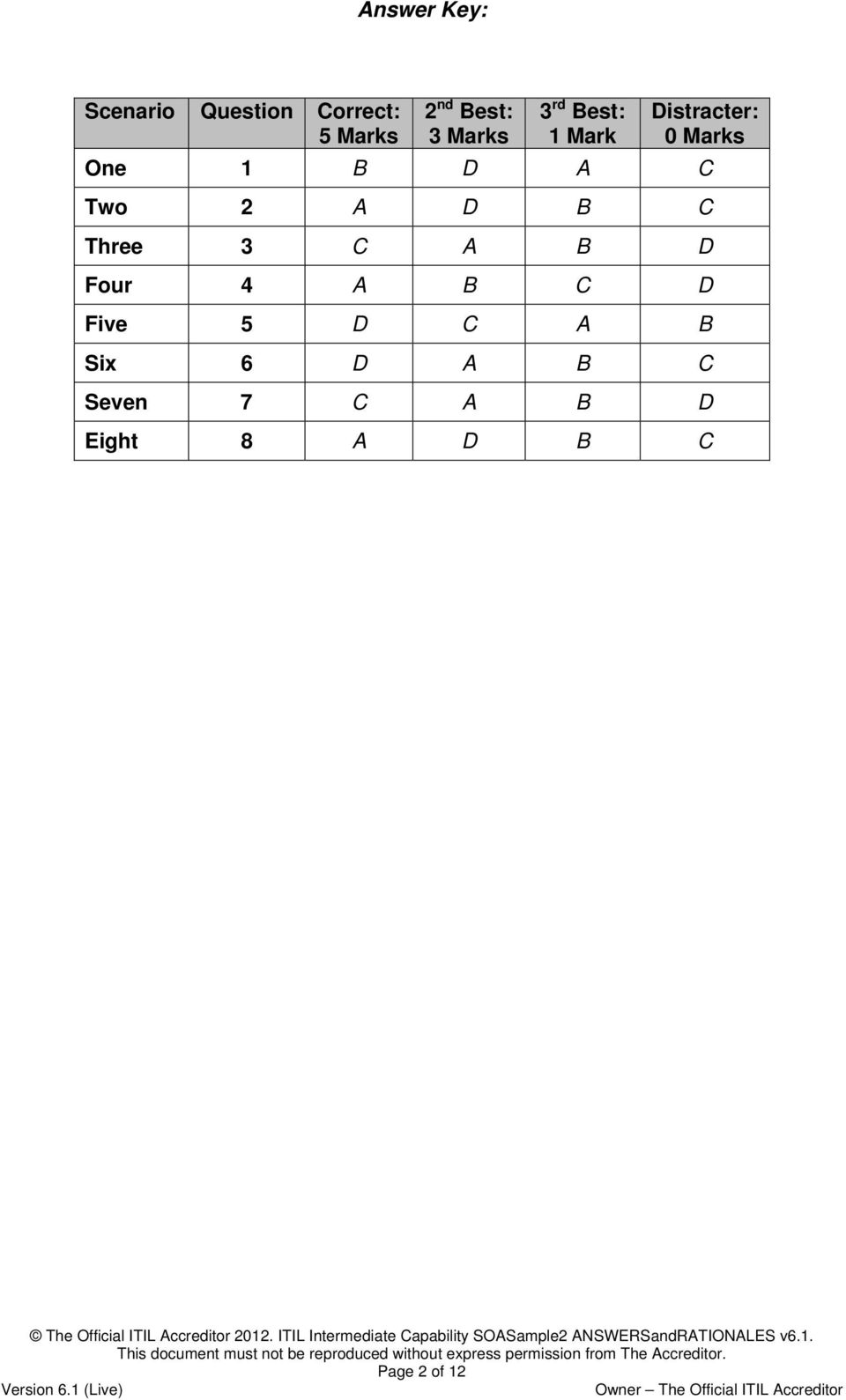
20 Answer Key: Scenario Question Correct: 5 Marks 2 nd Best: 3 Marks 3 rd Best: 1 Mark Distracter: 0 Marks One 1 B D A C Two 2 A D B C Three 3 C A B D Four 4 A B C D Five 5 D C A B Six 6 D A B C Seven 7 C A B D Eight 8 A D B C The Official ITIL Accreditor ITIL Intermediate Capability SOASample2 ANSWERSandRATIONALES v6.1. Page 2 of 12
21 QUESTION One Scenario One Question Rationale This question focuses on an overall understanding of the financial management for IT services process and the approach to introducing the process in an internal IT provider organization. MOST CORRECT (5) B This answer is correct and appropriate for the situation described in the scenario. Bullet 1 - Correct. Introducing accounting is essential for the IT manager to gain an understanding the costs of providing the IT services. Bullet 2 - Correct. All organizations vary in the way they control their budgets. The IT manager must understand the preferences of the corporate finance department. Bullet 3 Correct. This allows the business units visibility of expenditure. Bullet 4 - Correct. A functioning service catalogue and CMS when linked to a cost model will allow cost of changes to be predicted. SECOND BEST (3) D Bullet 1 - Partially correct. Introducing accounting will definitely improve the situation, however the wording is a little vague. Accounting alone will not necessarily improve control. It will improve the understanding of costs which hopefully will lead to better control. Bullet 2 - Correct. This answer is a little vague but nonetheless is not wrong. Classification of costs is necessary, but is not the only step in understanding the financial value of the services. Bullet 3 Partially correct. Cost per service is interesting to the business but their actual costs would be more useful in this scenario. Bullet 4 - Incorrect. Introducing notional charging may improve the current situation, but it should not be rushed into without further consideration. There is no guarantee that the cost of setting up and administering will be offset by savings. THIRD BEST (1) A Bullet 1 - Incorrect. Budgeting alone will not help the IT manager gain an understanding of the costs of providing the IT services. Bullet 2 - Correct. This answer is a little vague but nonetheless is not wrong. Bullet 3 Partially correct. Cost per service is interesting to the business but their actual costs would be more useful in this scenario. Bullet 4 - Incorrect. A leap too far and highly inappropriate in this situation. Budgeting and accounting must be introduced first to provide a clear understanding of the costs of the IT services, before any form of charging is introduced. To introduce charging this soon into an organization with these issues may only make the situation worse. DISTRACTER (0) C Bullet 1 - Incorrect. A bit vague. Budgeting alone will not necessarily improve control. Bullet 2 - Incorrect. Capital expenditure is just as relevant to IT as operational expenditure. In fact it could represent a large proportion of the total IT expenditure. The IT manager must establish who has control of each expenditure type before deciding how to account for it. Bullet 3 Incorrect. This is a vital part of implementing financial management but does little to address the issues in the scenario. Bullet 4 - Incorrect. Introducing chargeback is not the only way to change the behaviour of the business units. Also, charging is inappropriate in this situation - see comments for answer A bullet 4. Syllabus Unit / ITIL SC: SOA07 Financial management for IT services Module supported Blooms Taxonomy Testing Level Level 3 Applying Use ideas, principles and theories in new, particular and concrete situations. Behavioural tasks at this level involve both knowing and comprehension and might include choosing appropriate procedures, applying principles, using an approach or identifying the selection of options. Level 4 Analysis - The ability to use the practices and concepts in a situation or The Official ITIL Accreditor ITIL Intermediate Capability SOASample2 ANSWERSandRATIONALES v6.1. Page 3 of 12
22 unprompted use of an abstraction. Can apply what is learned in the classroom in workplace situations. Can separate concepts into component parts to understand structure and can distinguish between facts and inferences. Subjects covered Book Section Refs Difficulty Application The candidate must apply their knowledge of budgeting, accounting and charging and apply it to the situation described in the scenario. Categories covered: Process activities, methods and techniques: budgeting, accounting and charging SS Financial management for IT services - Process activities, methods and techniques Moderate The Official ITIL Accreditor ITIL Intermediate Capability SOASample2 ANSWERSandRATIONALES v6.1. Page 4 of 12
23 QUESTION Two Scenario Two Question Rationale This question focuses on service management technology considerations. MOST CORRECT (5) A While this is a relatively new tool, it addresses all of the issues with regard to complaints currently faced by the business and IT service management processes. It also has support of reporting and open standards. The ITIL guidance states that an 80% fit with requirements is reasonable, so the compromise with reporting is not unreasonable. SECOND BEST (3) D While not such a good choice as answer A, work is currently being carried out by the supplier to address the issues faced. It provides much of the functionality required and the ability to integrate with other toolsets is being developed. The reporting capability sounds good but customization is not always a good thing. You would need assurance that any customization will be supported in the future. Tool integration (support of open standards) is not yet available. It is dangerous to select tools based on what might be available in the future. There is no mention of a CMS or incident data repository. THIRD BEST (1) B Whilst this organization has the biggest market share, there is a lot of work to be completed to make this a viable option and it could prove costly if additional modules have to be purchased. The current functionality is basic and may not meet the organization s requirements. Further functionality and integration is promised but it is dangerous to select tools based on what might be available in the future. DISTRACTER (0) C There is a lot of work to be completed to make this a viable option and it could prove costly if reports need to be changed or developed for each module purchased. Whilst data import is mentioned it is not clear whether this tool will support open standards. This toolset has limited capability and only has the incident module currently available. Syllabus Unit / ITIL SC: SOA10 Technology and implementation considerations Module supported Blooms Taxonomy Level 3 Applying Use ideas, principles and theories in new, particular and concrete Testing Level situations. Behavioural tasks at this level involve both knowing and comprehension and might include choosing appropriate procedures, applying principles, using an approach or identifying the selection of options. Level 4 Analysis - The ability to use the practices and concepts in a situation or unprompted use of an abstraction. Can apply what is learned in the classroom in workplace situations. Can separate concepts into component parts to understand structure and can distinguish between facts and inferences. Subjects covered Book Section Refs Difficulty Application The candidate must apply their knowledge of service management technology considerations. The key here is to analyse the scenario and understand which requirements are most important, as each answer option has valid requirements depending on specific organization needs. The candidate must determine which option best suits the requirements defined in the scenario and address the issues described. Categories covered: Evaluation criteria for technology and tooling for process implementation SD Technology considerations Service management tools SO Implementation of service operation - Planning and implementing service management technologies Moderate The Official ITIL Accreditor ITIL Intermediate Capability SOASample2 ANSWERSandRATIONALES v6.1. Page 5 of 12
24 QUESTION Three Scenario Three Question Rationale This question focuses on an overall understanding of the SOA processes and how they work together. It draws on foundation material as well as on an overview of the SOA processes. MOST CORRECT (5) C This answer correctly describes the processes and their relationships. Bullet 1 - Correct. One of the main roles of business relationship management is to maintain a good relationship with the customer. In doing so they will be able to identify opportunities for new services. Bullet 2 - Correct. Under- and over-utilized use of services introduces a risk that the service provider will not receive the appropriate return on investment for their services. By identifying predicted patterns of business activity, demand management can help to reduce this risk. Bullet 3 - Correct. As an input to service portfolio management (SPM), demand management will identify patterns of business activity and work with financial management to provide an estimate of the cost of the resources required to meet them, thereby enabling a business case to be created. Bullet 4 - Correct. Developing the service catalogue will help to resolve the issue of duplication of services. It should be straightforward enough to spot any matches for new customer requirements with a more mature service catalogue. SECOND BEST (3) A Bullet 1 - Correct. A service portfolio is a repository of information about all of a provider s services, even conceptual ideas. It should contain details of resources which will improve an organization s ability to prioritize investments. Bullet 2 - Incorrect. The BRM does gather information about business needs and add it to the service portfolio. However, SLM does not get involved until after the service has been chartered. Bullet 3 - Correct. As answer C bullet 2. Bullet 4 - Correct. As an input to SPM, demand management will identify patterns of business activity and work with financial management to provide an estimate of the cost of the resources required to meet them. THIRD BEST (1) B Bullet 1 Partially correct. As answer C bullet 1 for new services. It is unlikely that BRM will get involved to the level of granularity of individual improvement to specific services. This is likely the domain of SLM. Bullet 2 - Incorrect. The purpose of demand management is to identify demand for IT services in order to identify the costs and risks involved with meeting the demand. It does not provide information that will limit negotiations. Bullet 3 - Correct. As answer A bullet 1. Bullet 4 - Incorrect. A Service desk key responsibility is management of the relationship with the users. SLM and BRM have the customer as a focus. DISTRACTER (0) D Bullet 1 - Incorrect. SLM will negotiate service level agreements, not BRM. Bullet 2 - Incorrect. As answer B bullet 2. Bullet 3 - Incorrect. This isn t SLM s job. This is likely to be assessed by SPM when making investment decisions. Bullet 4 - Incorrect. Details of new services are added to the service pipeline in the service portfolio first, not the service catalogue. Syllabus Unit / ITIL SC: SOA01 introduction Module supported Blooms Taxonomy Testing Level Level 1 Knowing - Bring to mind or remember the appropriate material. Includes such tasks as defining, recalling, listing, recognizing, describing and naming. Level 2 Comprehending - Understand or grasp the meaning of what is being communicated and make use of the idea. Tasks include illustrating, inferring, summarizing and interpreting. Application The candidate must use their knowledge of each of the SOA processes in order to select the best answer option. This requires the candidate to distinguish The Official ITIL Accreditor ITIL Intermediate Capability SOASample2 ANSWERSandRATIONALES v6.1. Page 6 of 12
25 Subjects covered Book Section Refs Difficulty between factual statements and inferred ones. Categories covered: The context of the SOA process in the service lifecycle Identifying customer requirements Return on investment (ROI) and the business case and the relevance to the SOA processes SS and SD 1.2 The context of the SOA process in the service lifecycle SD 3.1.3, SD 3.4, SD Identifying customer requirements SS (up to ) - Return on investment (ROI) and the business case and the relevance to the SOA processes SS Purpose and Objectives of BRM Easy The Official ITIL Accreditor ITIL Intermediate Capability SOASample2 ANSWERSandRATIONALES v6.1. Page 7 of 12
26 QUESTION Four Scenario Four Question Rationale This question focuses on identifying the correct roles and responsibilities of the supplier manager. It requires knowledge of the supplier manager roles described in SD and an understanding of the scope of supplier management described in SD MOST CORRECT (5) A All 5 activities listed are responsibilities of a supplier manager. SECOND BEST (3) B Only 4 activities are associated with a supplier manager. Develop and document contacts and relationships with all stakeholders would be a responsibility of the service level manager. THIRD BEST (1) C Only 3 activities are associated with the supplier management process. Ensuring that IT have a clear expectation of the level of service to be delivered, and monitoring and improving customer satisfaction with the quality of service delivered would be the responsibility of the service level manager DISTRACTER (0) D Only 2 activities listed would be carried out by a supplier manager. These are development, negotiation and agreement of contracts, and maintenance of a supplier and contract database. The other 3 are responsibilities of the service level manager. Syllabus Unit / ITIL SC: SOA09 Service offerings and agreement roles and responsibilities Module supported Blooms Taxonomy Testing Level ITIL SC: SOA06 Supplier management Level 3 Applying Use ideas, principles and theories in new, particular and concrete situations. Behavioural tasks at this level involve both knowing and comprehension and might include choosing appropriate procedures, applying principles, using an approach or identifying the selection of options. Level 4 Analysis - The ability to use the practices and concepts in a situation or unprompted use of an abstraction. Can apply what is learned in the classroom in workplace situations. Can separate concepts into component parts to understand structure and can distinguish between facts and inferences. Subjects covered Book Section Refs Difficulty Application The candidate s knowledge of the role of the supplier manager, along with which of the listed activities belong with this role are needed to analyse the scenario and distinguish which option is the most correct one. Categories covered: Roles and responsibilities of supplier manager Scope of supplier management SD Organizing for service design Supplier management roles SD Scope of supplier management Moderate The Official ITIL Accreditor ITIL Intermediate Capability SOASample2 ANSWERSandRATIONALES v6.1. Page 8 of 12
27 QUESTION Five Scenario Five Question Rationale The purpose of this question is test the candidate s understanding of the service portfolio management (SPM) process. The candidate is required to link SPM activities with the appropriate process steps. The correct steps and activities are as follows: Define Collect and validate the purpose, outcomes and customers of each service (e) Confirm existence of business cases for services (g) Analyse Establish investment priorities (a) Assess proposed investment for added value (f) Approve Decide the level of investment required (d) Authorize investments in services (h) Charter Include a document allocating resources in the project portfolio (b) Communicate investment decisions to stakeholders (c) MOST CORRECT (5) D This answer correctly matches the activities to the process steps SECOND BEST (3) C The define and analyse steps are correct. Approve: resources will be identified at this stage but not allocated until the charter step when the decision is communicated. Charter: authorization takes place in the approve stage and must take place before the service is chartered. THIRD BEST (1) A There is one error in each step. Define: establish investment priorities cannot be performed until after data has been collected and stored in the service portfolio. Analyse: collect and validate purpose and outcomes must be done before the proposed service or service changes can be analysed. Approve: communicating decisions to stakeholders can only happen after the service is authorized, i.e. as part of the charter step. Charter: making decisions about the future of each service must take place before the service is chartered and is part of the approve step. DISTRACTER (0) B Every activity is associated with the wrong process step. Syllabus Unit / ITIL SC: SOA02 Service Portfolio Management Module supported Blooms Taxonomy Testing Level Level 3 Applying Use ideas, principles and theories in new, particular and concrete situations. Behavioural tasks at this level involve both knowing and comprehension and might include choosing appropriate procedures, applying principles, using an approach or identifying the selection of options. Level 4 Analysis - The ability to use the practices and concepts in a situation or unprompted use of an abstraction. Can apply what is learned in the classroom in workplace situations. Can separate concepts into component parts to understand structure and can distinguish between facts and inferences. Subjects covered Book Section Refs Difficulty Application The candidate must apply their knowledge of service portfolio management and understand the correct sequence of activities that drives the cycle of SPM. Categories covered: Service portfolio management process activities, methods and techniques SS Service portfolio management - Process activities, methods and techniques Moderate The Official ITIL Accreditor ITIL Intermediate Capability SOASample2 ANSWERSandRATIONALES v6.1. Page 9 of 12
28 QUESTION Six Scenario Six Question Rationale The question tests the candidate s knowledge of the service level management (SLM) process activities and how they can be applied within the context of the issues in the scenario in order to improve the situation. It requires the candidate to recognize the various stakeholders that must be involved in any solution in order for it to have the desired consequence. It also recognizes customer satisfaction as an important service measure. MOST CORRECT (5) D This answer includes key process activities, methods and techniques for SLM. The situation is reviewed to ensure that the perceived problem is correct before a number of appropriate actions are identified and implemented. SECOND BEST (3) A This is a good answer but is too one-sided there is no mention of the SLM working with the IT department to make sure that they can deliver exactly what the business wants. THIRD BEST (1) B This is a good start by the SLM but only contains conversation with senior management within the business. A dialogue should be taking place at all levels of the business to ensure a fair view of the level of customer satisfaction is received. DISTRACTER (0) C This is the wrong answer in this answer the SLM does not discuss the situation with anyone or try to quantify the existing level of customer satisfaction. Targets are raised without consultation with IT or the business, based on a report that may not apply specifically to this company. Syllabus Unit / ITIL SC: SOA04 Service level management Module supported Blooms Taxonomy Testing Level Level 3 Applying Use ideas, principles and theories in new, particular and concrete situations. Behavioural tasks at this level involve both knowing and comprehension and might include choosing appropriate procedures, applying principles, using an approach or identifying the selection of options. Level 4 Analysis - The ability to use the practices and concepts in a situation or unprompted use of an abstraction. Can apply what is learned in the classroom in workplace situations. Can separate concepts into component parts to understand structure and can distinguish between facts and inferences. Subjects covered Book Section Refs Difficulty Application The candidate must distinguish, from the issues described in the scenario, how SLM process activities can be applied in this case to meet the expectations of the management while ensuring that all stakeholder needs are considered. Categories covered: Service level management processes, methods and techniques SD Service level management - Process activities, methods and techniques in general, but especially: SD Monitoring service performance against SLA SD Collating, measuring and improving customer satisfaction SD Critical success factors and key performance indicators Moderate The Official ITIL Accreditor ITIL Intermediate Capability SOASample2 ANSWERSandRATIONALES v6.1. Page 10 of 12
29 QUESTION Seven Scenario Seven Question Rationale This question focuses on the how to establish demand management activities in order to achieve the goal of the IT department to manage business demand fluctuations. It also considers who should be consulted and the correct way to manage the associated activities. MOST CORRECT (5) C This answer correctly describes the establishment of a demand management process based on identifying patterns of business activity (PBA). It subsequently uses demand management to deal with scenarios where IT is stretched by normal demand patterns as defined by the customer, and also to deal with occasions where the customer got it wrong. SECOND BEST (3) A This is close to C but is slightly more reactive, with service capacity being subsequently provided based on service workload demand fluctuations. Paragraph 1 - correct Paragraph 2 - incorrect. Problem management will not be involved at this stage. Paragraph 3 - partially correct. This is fine but, unlike answer C, it fails to deal with situations where customer demand forecasts are wrong. THIRD BEST (1) B Paragraph 1 - incorrect. Service workload and PBA are different things. Service workload demand refers to usage of the IT service and PBA refers to the patterns of business activity, i.e. what the business actually does, not their use of the IT service. Paragraph 2 - partially correct. Demand fluctuation is too weak. Paragraph 3 - incorrect. Demand information is initially recorded in the service portfolio not the service catalogue. DISTRACTER (0) D Paragraph 1 - incorrect. See answer B paragraph 1. Paragraph 2 - incorrect. Change management will not be involved at this stage. Paragraph 3 - incorrect. Investments in services to meet PBA are assessed and approved by service portfolio management, the only snag being they don t have a process for that in the scenario.. Syllabus Unit / ITIL SC: SOA05 Demand management Module supported Blooms Taxonomy Testing Level Level 3 Applying Use ideas, principles and theories in new, particular and concrete situations. Behavioural tasks at this level involve both knowing and comprehension and might include choosing appropriate procedures, applying principles, using an approach or identifying the selection of options. Level 4 Analysis - The ability to use the practices and concepts in a situation or unprompted use of an abstraction. Can apply what is learned in the classroom in workplace situations. Can separate concepts into component parts to understand structure and can distinguish between facts and inferences. Subjects covered Book Section Refs Difficulty Application The candidate must possess a thorough knowledge of demand management and use this knowledge to select the best approach to managing the associated activities and to begin the consultation process for the process improvement. Categories covered: Demand management Business activity patterns Activity based demand management Triggers, inputs, outputs and interfaces SS Demand management in general, but especially: SS Patterns of business activity SS Activity-based demand management SS Triggers, inputs, outputs and interfaces Moderate The Official ITIL Accreditor ITIL Intermediate Capability SOASample2 ANSWERSandRATIONALES v6.1. Page 11 of 12
30 QUESTION Eight Scenario Eight Question Rationale This question focuses on the challenges associated with service catalogue management (SCM). MOST CORRECT (5) A This option addresses the issues identified within the scenario and represents an appropriate approach to gaining buy-in and support to enable a new joint service catalogue to be produced. The answer also addresses the need for cultural change and would ensure that an integrated service catalogue was brought under control of change management. On-going awareness and particularly training for all staff should help to ease fears over job losses. SECOND BEST (3) D There is nothing inherently wrong with the activities described in this answer. However, when compared with answer A it exhibits a few weaknesses. SCM must work very closely with service level management (SLM) to ensure that information in the catalogue is consistent with service levels agreements (SLA). This answer fails to mention this. It is essential that the service catalogue is consistent with the configuration management system (CMS) and service knowledge management system (SKMS). This answer fails to mention this. Training key staff would be sufficient. THIRD BEST (1) B This answer treats service catalogue management as a one-off project and does not address how it will be managed once implemented. The answer also fails to address the people and cultural issues described in the scenario. DISTRACTER (0) C This answer describes a very detailed and technical approach to SCM. It fails to mention SLM and uses very indirect and labour intensive methods of gathering the information. The answer also fails to address the people and cultural issues described in the scenario. Training key staff to expert level is probably excessive for current needs. Syllabus Unit / ITIL SC: SOA03 Service catalogue management Module supported Blooms Taxonomy Testing Level Level 3 Applying Use ideas, principles and theories in new, particular and concrete situations. Behavioural tasks at this level involve both knowing and comprehension and might include choosing appropriate procedures, applying principles, using an approach or identifying the selection of options. Level 4 Analysis - The ability to use the practices and concepts in a situation or unprompted use of an abstraction. Can apply what is learned in the classroom in workplace situations. Can separate concepts into component parts to understand structure and can distinguish between facts and inferences. Subjects covered Book Section Refs Difficulty Application The candidate must apply their knowledge of SCM and distinguish the best activities from the options that meet the needs described in the scenario and which are consistent with the core guidance. Categories covered: Service catalogue management SD 4.2 Service catalogue management Moderate The Official ITIL Accreditor ITIL Intermediate Capability SOASample2 ANSWERSandRATIONALES v6.1. Page 12 of 12
ITIL Intermediate Capability Stream:
 ITIL Intermediate Capability Stream: SERVICE OFFERINGS AND AGREEMENTS (SOA) CERTIFICATE Sample Paper 2, version 5.1 Gradient Style, Complex Multiple Choice SCENARIO BOOKLET This booklet contains the scenarios
ITIL Intermediate Lifecycle Stream:
 ITIL Intermediate Lifecycle Stream: SERVICE DESIGN CERTIFICATE Sample Paper 1, version 6.1 Gradient Style, Complex Multiple Choice SCENARIO BOOKLET This booklet contains the scenarios upon which the 8
ITIL Intermediate Lifecycle Stream:
 ITIL Intermediate Lifecycle Stream: SERVICE DESIGN CERTIFICATE Sample Paper 2, version 6.1 Gradient Style, Complex Multiple Choice SCENARIO BOOKLET This booklet contains the scenarios upon which the eight
INTERMEDIATE QUALIFICATION
 PROFESSIONAL QUALIFICATION SCHEME INTERMEDIATE QUALIFICATION SERVICE CAPABILITY SERVICE OFFERINGS AND AGREEMENTS CERTIFICATE SYLLABUS Page 2 of 23 Document owner The Official ITIL Accreditor Contents SERVICE
ITIL Intermediate Capability Stream:
 ITIL Intermediate Capability Stream: OPERATIONAL SUPPORT AND ANALYSIS (OSA) CERTIFICATE Sample Paper 1, version 6.1 Gradient Style, Complex Multiple Choice SCENARIO BOOKLET This booklet contains the scenarios
ITIL Intermediate Capability Stream:
 ITIL Intermediate Capability Stream: PLANNING, PROTECTION AND OPTIMIZATION (PPO) CERTIFICATE Sample Paper 1, version 5.1 Gradient Style, Complex Multiple Choice ANSWERS AND RATIONALES The Swirl logo is
The ITIL Foundation Examination
 The ITIL Foundation Examination Sample Paper A, version 4.2 Multiple Choice Instructions 1. All 40 questions should be attempted. 2. All answers are to be marked on the answer grid provided. 3. You have
ITIL Intermediate Lifecycle Stream:
 ITIL Intermediate Lifecycle Stream: SERVICE TRANSITION CERTIFICATE Sample Paper 1, version 6.1 Gradient Style, Complex Multiple Choice SCENARIO BOOKLET This booklet contains the scenarios upon which the
ITIL Intermediate Lifecycle Stream:
 ITIL Intermediate Lifecycle Stream: SERVICE TRANSITION CERTIFICATE Sample Paper 1, version 6.1 Gradient Style, Complex Multiple Choice SCENARIO BOOKLET This booklet contains the scenarios upon which the
The ITIL Foundation Examination
 The ITIL Foundation Examination Sample Paper A, version 5.1 Multiple Choice Instructions 1. All 40 questions should be attempted. 2. All answers are to be marked on the answer grid provided. 3. You have
The ITIL Foundation Examination
 The ITIL Foundation Examination Sample Paper A, version 5.1 Multiple Choice Instructions 1. All 40 questions should be attempted. 2. All answers are to be marked on the answer grid provided. 3. You have
INTERMEDIATE QUALIFICATION
 PROFESSIONAL QUALIFICATION SCHEME INTERMEDIATE QUALIFICATION SERVICE LIFECYCLE CONTINUAL SERVICE IMPROVEMENT CERTIFICATE SYLLABUS Page 2 of 18 Document owner The Official ITIL Accreditor Contents CONTINUAL
INTERMEDIATE QUALIFICATION
 PROFESSIONAL QUALIFICATION SCHEME INTERMEDIATE QUALIFICATION SERVICE CAPABILITY RELEASE, CONTROL AND VALIDATION CERTIFICATE SYLLABUS Page 2 of 23 Contents RELEASE, CONTROL AND VALIDATION CERTIFICATE 4
ITIL: Service Offerings & Agreements (SOA) (Revision 1.6)
 ITIL: Service Offerings & Agreements (SOA) (Revision 1.6) Course Overview This hands-on course leads to a Certificate in ITIL Service Capability Management - Service Offerings & Agreements. The series
ITIL Intermediate Capability Stream:
 ITIL Intermediate Capability Stream: RELEASE, CONTROL AND VALIDATION (RCV) CERTIFICATE Sample Paper 1, version 5.1 Gradient Style, Complex Multiple Choice QUESTION BOOKLET Gradient Style Multiple Choice
ITIL Intermediate Qualification: Service Offerings and Agreement. Webinar presentation 8 May 2009
 ITIL Intermediate Qualification: Service Offerings and Agreement Webinar presentation 8 May 2009 Team Lead SOA Vernon Lloyd FISM IT Industry before it was IT (1970) Done most things in most places ITSM
ITIL V3 Intermediate Capability Stream:
 ITIL V3 Intermediate Capability Stream: RELEASE CONTROL AND VALIDATION (RC&V) CERTIFICATE SCENARIO BOOKLET Scenario One A global commercial IT service provider has three service desks that support internal
ITIL: Service Offerings & Agreements
 ITIL: Service Offerings & Agreements Course Course Chapter 01 - Course Lesson: Course Organization Welcome to the Course! Mentoring Community s Why Are You Here? Using Bloom's Taxonomy What Do You Expect?
USING THE PRINCIPLES OF ITIL ; SERVICE CATALOGUE
 USING THE PRINCIPLES OF ITIL ; SERVICE CATALOGUE Examination Syllabus V.0 April 01 ITIL is a registered trade mark of the Cabinet Office APMG Service Catalogue 01 Examination Syllabus INTRODUCTION The
INTERMEDIATE QUALIFICATION
 PROFESSIONAL QUALIFICATION SCHEME INTERMEDIATE QUALIFICATION SERVICE LIFECYCLE SERVICE OPERATION CERTIFICATE SYLLABUS Document owner The Official ITIL Accreditor Page 2 of 18 Contents SERVICE OPERATION
INTERMEDIATE QUALIFICATION
 PROFESSIONAL QUALIFICATION SCHEME INTERMEDIATE QUALIFICATION SERVICE CAPABILITY PLANNING, PROTECTION AND OPTIMIZATION CERTIFICATE SYLLABUS The Swirl logo is a trade mark of the Cabinet Office ITIL is a
The ITIL v.3 Foundation Examination
 The ITIL v.3 Foundation Examination Sample Paper A, version 3.1 Multiple Choice Instructions 1. All 40 questions should be attempted. 2. There are no trick questions. 3. All answers are to be marked on
USING THE PRINCIPLES OF ITIL ; SERVICE CATALOGUE. Examination Syllabus V 1.2. October 2009
 USING THE PRINCIPLES OF ITIL ; SERVICE CATALOGUE Examination Syllabus V 1. October 009 ITIL is a Registered Trade Mark of the Office of Government Commerce in the United Kingdom and other countries APMG
The ITIL Foundation Examination
 The ITIL Foundation Examination Sample Paper A, version 5.1 Multiple Choice Instructions 1. All 40 questions should be attempted. 2. All answers are to be marked on the answer grid provided. 3. You have
The ITIL v.3. Foundation Examination
 The ITIL v.3. Foundation Examination ITIL v. 3 Foundation Examination: Sample Paper 4, version 3.0 Multiple Choice Instructions 1. All 40 questions should be attempted. 2. There are no trick questions.
The ITIL Foundation Examination
 The ITIL Foundation Examination Sample Paper A, version 4.1 Multiple Choice Instructions 1. All 40 questions should be attempted. 2. All answers are to be marked on the answer grid provided. 3. You have
ITIL by Test-king. Exam code: ITIL-F. Exam name: ITIL Foundation. Version 15.0
 ITIL by Test-king Number: ITIL-F Passing Score: 800 Time Limit: 120 min File Version: 15.0 Sections 1. Service Management as a practice 2. The Service Lifecycle 3. Generic concepts and definitions 4. Key
Scenario Two. Scenario Three
 ITIL Intermediate Lifecycle Stream: SERVICE STRATEGY CERTIFICATE SCENARIO BOOKLET Scenario One An education services company offers learning management system (LMS) products and services to support customers
Factsheet ITIL -V3 Capability module Service Offerings and Agreements
 Factsheet ITIL -V3 Capability module Service Offerings and Agreements www.startel.nl 1. GENERAL 1.1. Course data and course hours Training courses IT Service Management Capability module Service Offerings
ITIL 2011 Service Offerings & Agreement (SOA) Certification Program - 5 Days
 ITIL 2011 Service Offerings & Agreement (SOA) Certification Program - 5 Days Program Overview ITIL is a set of best practices guidance that has become a worldwide-adopted framework for Information Technology
INTERMEDIATE QUALIFICATION
 PROFESSIONAL QUALIFICATION SCHEME INTERMEDIATE QUALIFICATION SERVICE LIFECYCLE SERVICE DESIGN CERTIFICATE SYLLABUS Page 2 of 18 Contents SERVICE DESIGN CERTIFICATE 4 Target Candidate 4 Prerequisite Entry
The ITIL Foundation Examination Sample Paper A, version 5.1
 The ITIL Foundation Examination Sample Paper A, version 51 Multiple Choice Instructions 1 All 40 questions should be attempted 2 All answers are to be marked on the answer grid provided 3 You have 60 minutes
INTERMEDIATE QUALIFICATION
 PROFESSIONAL QUALIFICATION SCHEME INTERMEDIATE QUALIFICATION SERVICE CAPABILITY OPERATIONAL SUPPORT AND ANALYSIS CERTIFICATE SYLLABUS Page 2 of 21 Document owner The Official ITIL Accreditor Contents OPERATIONAL
ITIL 2011 Lifecycle Roles and Responsibilities UXC Consulting
 ITIL 2011 Lifecycle Roles and Responsibilities UXC Consulting Date November 2011 Company UXC Consulting Version Version 1.5 Contact [email protected] http://www.uxcconsulting.com.au This summary
ITIL - QUICK REFERENCE GUIDE
 http://www.tutorialspoint.com/itil/itil_quick_guide.htm ITIL - QUICK REFERENCE GUIDE Copyright tutorialspoint.com ITIL Overview ITIL is a framework providing best practice guidelines on all aspects of
Document Control Information
 Document Control Information Document Details Document Name Purpose of Document Document Version Number 3.0 Document Status Document Owner Prepared By ITIL Service Management Practices: V3 Qualifications
Configuration control ensures that any changes to CIs are authorized and implemented in a controlled manner.
 ITIL Intermediate Capability Stream: RELEASE CONTROL AND VALIDATION (RCV) CERTIFICATE SCENARIO BOOKLET Scenario One A global company develops its own applications to support the business. The service transition
The Swirl logo is a trade mark of the Cabinet Office ITIL is a registered trade mark of the Cabinet Office
 Professional Qualifications for ITIL PRACTICES FOR SERVICE MANAGEMENT The ITIL Foundation Certificate in IT Service Management SYLLABUS The Swirl logo is a trade mark of the Cabinet Office ITIL is a registered
Risk profile table for deployment of releases to the main web site. High Acceptable Unacceptable Unacceptable
 ITIL V3 Intermediate Capability Stream: RELEASE, CONTROL AND VALIDATION (RC&V) CERTIFICATE SCENARIO BOOKLET Scenario One A global company develops their own applications to support the business. The Service
ITIL Intermediate Capability Stream:
 ITIL Intermediate Capability Stream: OPERATIONAL SUPPORT AND ANALYSIS (OSA) CERTIFICATE Sample Paper 1, version 5.1 Gradient Style, Complex Multiple Choice QUESTION BOOKLET Gradient Style Multiple Choice
Terms of Use - The Official ITIL Accreditor Sample Examination Papers
 ITIL Sample Papers Terms of Use - The Official ITIL Accreditor Sample Examination Papers Please note that by downloading and/or using this document, you have agreed accepted to comply with the terms of
ITIL Foundation V3. Walaa Omar. +201222874828 [email protected]
 ITIL Foundation V3 Walaa Omar Service Lifecycle Mapping Service Catalogue Management Service Catalogue Management Objectives To provide a single source of consistent information on all of the agreed services.
ITIL Intermediate Qualification: Service Design Certificate. Webinar presentation 17 April 2009
 ITIL Intermediate Qualification: Service Design Certificate Webinar presentation 17 April 2009 Team Lead Service Design Signe-Marie Hernes Bjerke Cand. Scient. degree in Computer Science IT Industry since
Specialist Certificate in Business Relationship Management Syllabus. Version 1.2
 Specialist Certificate in Business Relationship Management Syllabus Version 1.2 August 2010 Specialist Certificate in Business Relationship Management Syllabus Contents Rationale...2 Aims and Objectives...2
EXIN.Passguide.EX0-001.v2014-10-25.by.SAM.424q. Exam Code: EX0-001. Exam Name: ITIL Foundation (syllabus 2011) Exam
 EXIN.Passguide.EX0-001.v2014-10-25.by.SAM.424q Number: EX0-001 Passing Score: 800 Time Limit: 120 min File Version: 24.5 http://www.gratisexam.com/ Exam Code: EX0-001 Exam Name: ITIL Foundation (syllabus
Capacity & Demand Management Processes within the ITIL 2011 Update
 Capacity & Demand Management Processes within the ITIL 2011 Update Andy Bolton CEO Abstract The 2011 Edition of ITIL, released in July, is billed as resolving errors and inconsistency that were in the
ISO 20000-1:2005 Requirements Summary
 Contents 3. Requirements for a Management System... 3 3.1 Management Responsibility... 3 3.2 Documentation Requirements... 3 3.3 Competence, Awareness, and Training... 4 4. Planning and Implementing Service
Hong Kong Information Security Group TRAINING AGENDA
 TRAINING AGENDA THE ITIL FOUNDATION CERTIFICATE IN IT SEVICE MANAGEMENT The purpose of the ITIL Foundation certificate in IT Service Management is to certify that the candidate has gained knowledge of
Service Strategy. Process orientation Terminology Inputs and outputs Activities Process flow / diagram Process Roles Challenges KPIs
 ITIL V3 Over View ITIL V3 Structure Strategy ITIL V3 Overview Design Transition Operation Process orientation Terminology Inputs and outputs Activities Process flow / diagram Process Roles Challenges KPIs
How To Standardize Itil V3.3.5
 Business white paper Standardize your ITSM An HP approach based on best practices Table of contents 3 Introduction 3 Benefits and challenges 5 The HP approach to standardizing ITSM 6 Establish an IT operations
ITSM Specialties, LLC
 Class Overview Upon successful completion of the education and examination components related to this certification, candidates can expect to gain competencies in the following: Service Portfolio Management
Understanding ITIL Service Portfolio Management and the Service Catalog. An approach for implementing effective service lifecycle management
 best practices WHITE PAPER Understanding ITIL Service Portfolio Management and the Service Catalog An approach for implementing effective service lifecycle management Table of Contents Executive Summary...1
White Paper: AlfaPeople ITSM 2013. This whitepaper discusses how ITIL 3.0 can benefit your business.
 White Paper: AlfaPeople ITSM 2013 This whitepaper discusses how ITIL 3.0 can benefit your business. Executive Summary Imagine trying to run a manufacturing business without a comprehensive and detailed
Bringing wisdom to ITSM with the Service Knowledge Management System
 Processes 415 Bringing wisdom to ITSM with the Service Knowledge Management System 7.3 Bringing wisdom to ITSM with the Service Knowledge Management System nowledge is a process of piling up facts; wisdom
An Implementation Roadmap
 An Implementation Roadmap The 2nd Abu Dhabi IT s Forum P J Corum, CSQA, CSTE, ITSM Managing Director Quality Assurance Institute Middle East and Africa Dubai, UAE Quality Assurance Institute Middle East
ITIL Service Lifecycle Design
 ITIL Service Lifecycle Design Course Details Course Code: Duration: Notes: ITILSL-Des 5 days This course syllabus should be used to determine whether the course is appropriate for the students, based on
Foundation. Summary. ITIL and Services. Services - Delivering value to customers in the form of goods and services - End-to-end Service
 ITIL ITIL Foundation Summary ITIL and s Design s - Delivering value to customers in the form of goods and services - End-to-end ITIL Best Practice - Scalable and not prescriptive - Gathered from Users,
SD0-302 Service Desk Manager Qualification
 SD0-302 Service Desk Manager Qualification Version 4.5 Topic 1, Volume A QUESTION NO: 1 What is the key outcome of keeping commitments to users, team members and organizations? A. It boosts credibility,
Role and Skill Descriptions. For An ITIL Implementation Project
 Role and Skill Descriptions For An ITIL Implementation Project The following skill traits were identified as fairly typical of those needed to execute many of the key activities identified: Customer Relationship
Course # 55011A. The ITIL Foundation Certificate in IT Service Management
 Course # 55011A The ITIL Foundation Certificate in IT Service Management Course Outline Module 1: Introduction Module 1 includes Service Management as a Practice, Key Roles, Competence and Training describes
ITIL v3 Qualification Scheme
 ITIL v3 Qualification Scheme ITIL Version 3 Qualification Scheme diagram Key for the Intermediate modules: Lifecycle modules SS Service Strategy SD Service Delivery ST Service Transition SO Service Operation
EDI Level 3 NVQ in Customer Service
 EDI Level 3 NVQ in Customer Service Candidate Pack Effective from: 1 August 2006 Accreditation Number: 100/6105/8 Subject code : N2263 ASNC1235 Vision Statement Our vision is to contribute to the achievements
Service catalogue and SLM: eight steps to success
 Service catalogue and SLM: eight steps to success Everything should be made as simple as possible, but not simpler. Albert Einstein The article offers a structured approach to SLM process and Service catalogue
ITIL Service Lifecycle Stream
 ITIL Lifecycle Stream Syllabus at a Glance Strategy Design Transition Operation Continual Improvement Introduction to service strategy Introduction to service design Introduction to service transition
ITSM Maturity Model. 1- Ad Hoc 2 - Repeatable 3 - Defined 4 - Managed 5 - Optimizing No standardized incident management process exists
 Incident ITSM Maturity Model 1- Ad Hoc 2 - Repeatable 3 - Defined 4 - Managed 5 - Optimizing No standardized incident process exists Incident policies governing incident Incident urgency, impact and priority
The ITIL Foundation Examination
 The ITIL Foundation Examination Sample Paper B, version 4.0 Multiple Choice Instructions 1. All 40 questions should be attempted. 2. All answers are to be marked on the answer grid provided. 3. You have
ITIL v3 Process Cheat Sheets
 CEB Infrastructure Leadership Council ITIL v3 Process Cheat Sheets 2014 CEB. All rights reserved. IEC8051414SYN 1 ITIL v3 Process Cheat Sheets The ITIL v3 process cheat sheets include a definition, description
The ITIL Foundation Examination
 The ITIL Foundation Examination Sample Paper B, version 5.0 Multiple Choice Instructions 1. All 40 questions should be attempted. 2. All answers are to be marked on the answer grid provided. 3. You have
The ITIL v.3 Foundation Examination
 The ITIL v.3 Foundation Examination ITIL v. 3 Foundation Examination: Sample Paper B, version 3.1 Multiple Choice Instructions 1. All 40 questions should be attempted. 2. There are no trick questions.
The ITIL v.3. Foundation Examination
 The ITIL v.3. Foundation Examination ITIL v. 3 Foundation Examination: Sample Paper 3, version 3.0 Multiple Choice Instructions 1. All 40 questions should be attempted. 2. There are no trick questions.
Roles within ITIL V3. Contents
 Roles within ITIL V3 Roles are employed in order to define responsibilities. In particular, they are used to assign Process Owners to the various ITIL V3 processes, and to illustrate responsibilities for
1 What does the 'Service V model' represent? a) A strategy for the successful completion of all service management projects
 1 What does the 'Service V model' represent? a) A strategy for the successful completion of all service management projects b) The path to Service Delivery and Service Support for efficient and effective
Free ITIL v.3. Foundation. Exam Sample Paper 3. You have 1 hour to complete all 40 Questions. You must get 26 or more correct to pass
 Free ITIL v.3. Foundation Exam Sample Paper 3 You have 1 hour to complete all 40 Questions You must get 26 or more correct to pass Compliments of Advance ITSM www.advanceitsm.com 1 A Service Level Package
ITIL Roles Descriptions
 ITIL Roles s Role Process Liaison Incident Analyst Operations Assurance Analyst Infrastructure Solution Architect Problem Manager Problem Owner Change Manager Change Owner CAB Member Release Analyst Test
ITIL v3. Service Management
 ITIL v3 1 as a Practice ITIL = IT Infrastructure Library Set of books giving guidance on the provision of quality IT services Common language Best practices in delivery of IT services Not standards! Platform
BCS Specialist Certificate in Service Desk & Incident Management Syllabus
 BCS Specialist Certificate in Service Desk & Incident Management Syllabus Version 1.8 March 2015 BCS Specialist Certificate in Service Desk & Incident Management Syllabus Contents Change History... 2 Rationale...
ITIL V3 Service Lifecycle Key Inputs and Outputs
 ITIL V3 Lifecycle & ITIL V3 Lifecycle Key 1 ITIL V3 Lifecycle & Use Material Complying with all applicable copyright laws is responsibility user No part this document may be reproduced, stored in or introduced
Achieving ITSM Excellence Through Availability Management
 Achieving ITSM Excellence Through Availability Management Technology Concepts and Business Considerations Abstract This white paper outlines the motivation behind Availability Management, and describes
ITIL Intermediate Capability Stream:
 ITIL Intermediate Capability Stream: OPERATIONAL SUPPORT AND ANALYSIS (OSA) CERTIFICATE Sample Paper 1, version 6.1 Gradient Style, Complex Multiple Choice SCENARIO BOOKLET This booklet contains the scenarios
IT SERVICE MANAGEMENT POLICY MANUAL
 IT SERVICE MANAGEMENT POLICY MANUAL Version - 1.0 SATYAM COMPUTER SERVICES LIMITED Satyam Infocity Unit 12, Plot No. 35/36 Hi-tech City layout Survey No. 64 Madhapur Hyderabad - 500 081 Andhra Pradesh
ITIL: Service Design
 ITIL: Service Design Course Course Chapter 01 - Course Lesson: Course Organization Welcome to the Course! Mentoring Community s Why Are You Here? Using Bloom's Taxonomy What do you Expect? Housekeeping
Three simple steps to effective service catalog and request management
 Three simple steps to effective service catalog and request management Prepare for cloud initiatives and get incremental ROI with self service catalog and request management Business white paper Executive
: SDI SD0-302 : SDI - SERVICE DESK MANAGER QUALIFICATION. Version : R6.1
 Exam : SDI SD0-302 Title : SDI - SERVICE DESK MANAGER QUALIFICATION Version : R6.1 Prepking - King of Computer Certification Important Information, Please Read Carefully Other Prepking products A) Offline
WHITE PAPER December, 2008
 INTRODUCTION Key to most IT organization s ongoing success is the leadership team s ability to anticipate, plan for, and adapt to change. With ever changing business/mission requirements, customer/user
13. Identifying stakeholders and their 1relevance
 13. Identifying stakeholders and their 1relevance All successful public relations work is built on the foundation of good working relationships. These relationships foster trust and open communication,
Contents. viii. 4 Service Design processes 57. List of figures. List of tables. OGC s foreword. Chief Architect s foreword. Preface.
 iii Contents List of figures List of tables OGC s foreword Chief Architect s foreword Preface Acknowledgements v vii viii 1 Introduction 1 1.1 Overview 4 1.2 Context 4 1.3 Purpose 8 1.4 Usage 8 2 Management
Creating and Maturing a Service Catalog
 Creating and Maturing a Service Catalog By Wendy Kuhn and Pam Erskine Third Sky, Inc. Introduction Developing a service catalog can seem like a simple marketing and communications activity or a daunting
Exin ITIL. ITIL Foundation v.3. Version: 15.0. http://www.maitiku.com QQ:860424807
 Exin ITIL ITIL Foundation v.3 Version: 15.0 Topic 1, Volume A QUESTION NO: 1 Which of the following is NOT an example of Self-Help capabilities? A. Requirement to always call the service desk for service
Best Practices Statement Project Management. Best Practices for Managing State Information Technology Projects
 State of Arkansas Office of Information Technology 124 W. Capitol Ave. Suite 990 Little Rock, AR 72201 501.682.4300 Voice 501.682.4020 Fax http://www.cio.arkansas.gov/techarch Best Practices Statement
ITIL Service Management Practices V Qualifications Scheme
 ITIL Service Management Practices V Qualifications Scheme ITIL Service Management Practices Contents 1. Scope and purpose of document 3 1.1. Synopsis 3 1.2. Suggested reading 3 2. ITIL Overview 3 2.1.
What are the three types of metrics that an organization should collect to support Continual Service Improvement (CSI)?
 ITIL Foundation mock exam 1 1. The Process Owner is responsible for which of the following? 1. Documenting the process 2. Defining process Key Performance Indicators (KPI) 3. Improve the process 4. Perform
Table of contents. Standardizing IT Service Management. Best practices based on HP experience in ITSM consolidation. White paper
 Standardizing IT Service Management Best practices based on HP experience in ITSM consolidation White paper Table of contents Go!... 2 Benefits and challenges... 2 The HP approach to standardizing ITSM...
CASE STUDY: Leicestershire County Council SECTOR: Local Government
 CASE STUDY: Leicestershire County Council SECTOR: Local Government Successful SDI Accreditation for Leicestershire County Council helped by Marval and MSM MSM integrated IT Service Management software
John Kacmarynski TLG Learning. ITIL History Benefits of Implementing ITIL Integrated Service Lifecycle Approach and Processes
 John Kacmarynski TLG Learning ITIL History Benefits of Implementing ITIL Integrated Service Lifecycle Approach and es What is not defined cannot be controlled What is not controlled cannot be measured
SESSION 709 Wednesday, November 4, 9:00am - 10:00am Track: Strategic View
 SESSION 709 Wednesday, November 4, 9:00am - 10:00am Track: Strategic View The Business of IT Provisioning Bill Irvine Transformation Strategist, Accelerate Innovation, VMware [email protected] Session
1 Why should monitoring and measuring be used when trying to improve services?
 1 Why should monitoring and measuring be used when trying to improve services? a) To validate, direct, justify and intervene b) To validate, measure, monitor and change c) To validate, plan, act and improve
Software Asset Management (SAM) and ITIL Service Management - together driving efficiency
 Software Asset Management (SAM) and ITIL Service Management - together driving efficiency Ian Preskett MIET C.Eng. MBCS CITP Software Asset Management Consultant [email protected] Agenda
Information Technology Engineers Examination. Information Technology Service Manager Examination. (Level 4) Syllabus
 Information Technology Engineers Examination Information Technology Service Manager Examination (Level 4) Syllabus Details of Knowledge and Skills Required for the Information Technology Engineers Examination