
TURBINE SUPERVISORY GUIDE
|
|
|
- Randolf Riley
- 10 years ago
- Views:
Transcription
1 TURBINE SUPERVISORY GUIDE TECHNIQUES FOR THE MONITORING & PROTECTION OF POWER PLANT EQUIPMENT 25 YEARS

2 CONTENTS Introduction Overview TSE Application Diagram Transducers and Sensors Accelerometer Velocity Transducer Eddy Current Proximity Probe LVDT/RVDT Choosing the right transducer Measurement Techniques Absolute Vibration Eccentricity & Shaft Vibration Rotor Differential Expansion Shaft Position Speed Monitoring Casing & Cylinder Expansion Valve Position Monitoring Auxiliary Plant Monitoring Protection Systems Introduction to API Standard 670 Special Techniques Rod Drop Rundown Monitoring Orbit Analysis System Equipment Bracketry Cubicle Panels Seismic Monitoring and Protection Equipment Site References Quick Product Selection Guide

3 INTRODUCTION For nearly 30 years Sensonics has been supplying Turbine Condition Monitoring solutions to the power generation industry worldwide. Involved in measurement definition through to supply and final system commissioning, our experience within the power sector is second to none. We have produced this guide to capture the essence of that experience and to explain the basics of vibration and expansion measurement techniques relating to turbine and auxiliary plant equipment. The guide starts with an introduction to the basic transducers available for plant mounting with associated options, and details the various measurement techniques used as standard throughout the power industry. This is followed by typical equipment protection configurations for safe plant shutdown. In the final part of this guide the system components are introduced and special measurement regimes discussed. SENSONICS PRODUCTS & COMPETENCES Turbine Supervisory Systems Standalone Monitoring Solutions Accelerometer, Displacement & Seismic Transducers Nuclear Infrastructure Protection Structural Monitoring Solutions Turn-Key Design, Manufacture and Project Support ATEX & IEC61508 Capability Installation & Commissioning The guide aims to provide a balance of basic theory and practical advice but obviously cannot cover all measurement scenarios. For a detailed discussion on any measurement issues you may have, please feel free to contact Sensonics. 3

4 OVERVIEW Turbine supervision is an essential part of the day-to-day running of any power plant. There are many potential faults such as cracked rotors and damaged shafts, which result from vibration and expansion.when this expansion and vibration is apparent in its early stages the problem can usually be resolved without any of the disruption caused when a turbine has to be shut down. By appropriate trending of the various measurement points and the identification of excessive vibration or movement, scheduled equipment stoppages or outages can often be utilised to investigate and resolve the failure mechanism. It is for this predictive maintenance market that Sensonics produces a wide range of sensors and systems specifically for the power generation industry. With flexible and configurable equipment, we can tailor our supervisory equipment to your needs. In this brochure we aim to give a brief explanation of why turbine supervision is so essential and how Sensonics can provide the right solution to protect your turbine. The diagram on page 5 illustrates a generic configuration of a set of Turbine Supervisory equipment. The steam turbine shown is fairly standard with an HP (high pressure) stage followed by a single LP (low pressure) rotor section; different turbine configurations depending on power rating, may have an intermediate (IP) section in addition to a number of LP s which finally drive the turbine generator.this type of configuration is illustrated in the adjacent picture. Although the equipment configuration does vary, the measurement techniques remain the same, with each turbine installation generating its own unique set of measurements. Typical measurement techniques include:- Absolute vibration of bearing pedestals Shaft vibration relative to bearing Shaft eccentricity Differential expansion or shaft movement Valve position on steam inlet Casing expansion, both inner and outer Speed, including overspeed and zero speed Temperature Structural & foundation vibration monitoring Each of the measurement techniques are used to monitor the turbine during its operating cycle, some measurements may be configured to provide warning alarms as well as automated shutdown, although these systems tend to operate on a voted principle to ensure maximum system integrity. 4

5 5 A TYPICAL TURBINE SUPERVISORY EQUIPMENT APPLICATION

6 TRANSDUCERS & SENSORS The Accelerometer The accelerometer is based on the electrical properties of piezoelectric crystal. In operation, the crystal is stressed by the inertia of a mass. The variable force exerted by the mass on the crystal produces an electrical output proportional to acceleration. Two common methods of constructing the device to generate a residual force are compression mode and shear mode respectively. A residual force is of course required to enable the crystal to generate the appropriate response, moving in either direction on a single axis. A shear mode construction is illustrated below. Shear mode construction Shear mode devices which apply a shear force to the inner and outer surfaces of a ring of crystal (as opposed to a perpendicular force to a disk of crystal), offer a distinct advantage over standard compression techniques. When mounting the device to the plant, normally through a stud & screw arrangement, the mechanical stresses within the transducer assembly change. Compression mode devices are particularly affected by these stresses, which produce low frequency effects, compounded if further integration is carried out. Sensonics shear mode range of transducers are unaffected by base strain and offer a true low frequency performance down to 0.4Hz. Although the piezoelectric accelerometer is a selfgenerating device, its output is at a very high impedance and is therefore unsuited for direct use with most display, analysis, or monitoring equipment.thus, electronics must be utilised to convert the high impedance crystal output to a low impedance capable of driving such devices. The impedance conversion electronics may be located within the accelerometer, outside of but near the accelerometer, or in the monitoring or analysis device itself. Accelerometers with internal electronics are convenient and can use inexpensive conventional plugs and cable but they are limited to temperatures of typically 120ºC. Locating the electronics in a cool location away from the accelerometer allows the transducer to tolerate higher temperatures. An accelerometer operates below its first natural frequency. The rapid rise in sensitivity approaching resonance is characteristic of an accelerometer, which is an un-damped single-degree-of-freedom spring mass system. Generally speaking, the sensitivity of an accelerometer and the ratio between its electrical output and the input acceleration is acceptably constant to approximately 1/5 to 1/3 of its natural frequency. For this reason, natural frequencies above 30KHz tend to be used. The frequency response curve can be influenced by a number of factors, mainly the mass, the stiffness and the degree of system damping. The resonant peak of the accelerometer can be eliminated by increasing the damping. However, increasing the damping introduces a phase shift in the linear range whereas un-damped accelerometers have very little phase shift until near the natural frequency. It is therefore usual to have un-damped accelerometers with very high natural frequencies so that the linear range is extended as far as possible. Typical damping ratios are 0.01 to This resonant frequency in combination with the appropriate damping can be utilised to monitor bearing impact. Several manufacturers, including Sensonics have developed transducers that utilise the ringing of the transducer to mechanical impulses to measure the health of roller bearings. This technique analyses the high frequency response of the transducer (at resonance) to determine an impact factor normally in db, which is directly proportional to the quantity and force of metal on metal impacts. This factor is normalised to an overall health measurement by consideration of bearing dimensions and rotational speed. Typical accelerometer frequency response 6

7 Accelerometers are available in various output configurations. The industry standard drive utilises a 2- wire current source interface operating at a nominal bias voltage of +12Vdc typ., with an output sensitivity of 100mV/g. This configuration limits the dynamic range to around ± 70g, which is suitable for most applications. Larger dynamic ranges can be achieved through lowering the sensitivity at the expense of signal to noise ratio, 10mV/g as an example, or utilising current output devices, which can provide ± 1000g depending on sensitivity requirements (10pC/g is typical). Standard accelerometers are also available with velocity outputs in either metric or imperial format, although for these configurations the required measurement range must be understood if the correct sensitivity is to be selected (0-20mm/s, 0-50mm/s etc.). Since the integration function to convert the acceleration to velocity is carried out within the accelerometer, the low frequency performance is typically limited to around a few hertz. The limited complexity of the conditioning circuitry that can be included within the accelerometer combined with the integrated noise tend to be the limiting factors. For direct integration with SCADA and PLC based systems, most manufacturers offer direct 4-20mA outputs covering a factory set range of either acceleration or velocity vibration. This can be an extremely cost effective solution (provided the required measurement range is again well understood) since no signal conditioning unit is required to drive the transducer or process the resulting measurement. The resulting current loop output is typically either a peak or an RMS representation of the vibration signal and therefore signal frequency analysis is not possible. Velocity Transducer The velocity transducer is inherently different to the accelerometer with a conditioned velocity output. This device operates on the spring-mass-damper principle, is usually of low natural frequency and actually operates above its natural frequency. The transducing element is either a moving coil with a stationary magnet, or a stationary coil with a moving magnet. A voltage is produced in a conductor when the conductor cuts a magnetic field and the voltage is proportional to the rate at which the magnetic lines are cut. Thus, a voltage is developed across the coil, which is proportional to velocity. For practical purposes, a typical velocity pick-up is limited to frequencies between approximately 10 and 1500 Hz. This has an advantage in certain applications where high frequency vibration (generated from steam noise for example) can saturate standard accelerometers with a built-in integration function. It is possible to obtain moving coil type transducers which operate in any axis.the high specification units tend to be only available for operation in either the vertical or horizontal plane due to the arrangement of the sprung mechanism and orientation during factory calibration. The ATEX Directive The ATEX directive 94/9/EC defines the specification requirements of equipment intended for use in potentially explosive atmospheres. Equipments supplied to meet the directive are approved by an authorized external body, the manufacturer must also maintain a quality system to meet with the standard. Sensonics produce a wide range of ATEX approved accelerometers and eddy current proximity probes for various intrinsically safe applications. The accelerometer is of particular concern when operating within a potentially explosive atmosphere because of the self-generating nature of piezoelectric devices and the high potential voltages that can be generated under shock conditions. For this reason the ATEX directive specifies complete encapsulation of the inner transducer body and limited capacitive capability within the electrical interface to minimize this effect. The inner crystal construction is voltage limited through the addition of diodes, as is the electrical interface. The construction of the device and the internal features will be specific to the approved temperature range and zone of operation. This type of transducer can provide sensitivities of up to 20mV/mm/s and is convenient because it generates a signal without an external power supply and the signal usually does not require further amplification. The sensitivity vs. frequency response curve of a velocity pickup is limited at low frequencies by the optimum damping of the first natural frequency; at high frequencies its response is limited by the amount of motion necessary to overcome the inertia of the system, as well as by the presence of higher order natural frequencies. The ATEX approved PZS4 7

8 THE EDDY CURRENT PROXIMITY PROBE The principle of operation, as the name implies, depends upon the eddy currents set up in the surface of the target material - shaft, collar, etc. adjacent to the probe tip. The Eddy probe tip is made of a dielectric material and the probe coil is encapsulated within the tip. The coil is supplied with a constant RF current from a separate Eddy Probe Driver connected via a cable, which sets up an electromagnetic field between the tip and the observed surface. In rotating plant, the variations in shaft/bearing distance created by vibration, eccentricity, ovality etc. can thus be measured by probes mounted radially to the shaft. When the target is stationary the measured voltage can be used to set the probe/target static distance. Shaft speed can also be measured by placing the probe viewing a machined slot or a toothed wheel. Any electrically conductive material within this electromagnetic field, i.e. the target material, will have eddy currents induced in its surface. The energy absorbed from the electromagnetic field to produce these eddy currents will vary the strength of the field and hence the energising current, in proportion to the probetarget distance. Such changes are sensed in the driver where they are converted to a varying voltage signal. The whole probe, extension cable and driver system relies for its operation on being a tuned circuit and as such is dependent on the system s natural frequency. Thus each system is set up for a fixed electrical/cable length. Eddy probe systems are usually supplied with 2, 5, 9 or 14 metre total cable lengths. The probe types available are generally according to the API670 standard (see later discussion). Three main variants, straight mount, reverse mount and disc type probes make up the Sensonics range. The main difference between the straight and reverse mount is the location of the thread on the probe body and the fixing nut. Reverse mount tend to be used exclusively with probe holders, while straight mount are the more common and are used on simple bracketry or mounting threads where adjustment to the target is achieved through use of the thread on the probe body in conjunction with a moveable lock nut. The maximum measurement range available on this type of probe is typically 8mm. The disc probe mounts the encapsulated coil on a metal plate with fixed mounting holes, making a very low profile assembly with a side exit cable. Larger coils can be mounted on this plate; for example, the 50mm diameter tip probe can provide a measurement range of beyond 25mm. However, care must be taken to ensure the target area is sufficient to obtain the required linear response. Note the relationship opposite between linear range, probe tip and target area. Eddy current probe empirical relationships System overview T ypical straight probe with driver 8

9 THE LVDT The LVDT is an electromechanical device that produces an electrical signal whose amplitude is proportional to the displacement of the transducer core. The LVDT consists of a primary coil and two secondary coils symmetrically spaced on a cylindrical former. The LVDT can be operated where there is no contact between the core and extension rod assembly with the main body of the LVDT housing the transformer coils. This makes it ideal for measurements where friction loading cannot be tolerated but the addition of a low mass core can. Examples of this are fluid level detection with the core mounted on a float and creep tests on elastic materials. This frictionless movement also benefits the mechanical life of the transducer, making the LVDT particularly valuable in applications such as fatigue life testing of materials or structures.this is a distinct advantage over potentiometers which are prone to wear and vibration. The principle of operation of the LVDT, based on mutual inductance between primary and secondary coils, provides the characteristic of infinite resolution. The limitations lie within the signal processing circuitry in combination with the background noise. Schematic of an LVDT A magnetic core inside the coil assembly provides a path for the magnetic flux linking the coils. The electrical circuit is configured as above with the secondary coils in series opposition. When an alternating voltage is introduced into the primary coil and the core is centrally located, then an alternating voltage is mutually induced in both secondary coils. The resultant output is zero, as the voltages are equal in amplitude and in 180º opposition to each other. When the core is moved away from the null position the voltage in the coil, toward which the core is moved, increases due to the greater flux linkage and the voltage in the other primary coil decreases due to the lesser flux linkage. The net result is that a differential voltage is produced across the secondary tappings, which varies linearly with change in core position. An equal effect is produced when the core is moved from a null in the other direction but the voltage is 180º different in phase. The principles of operation of the LVDT enables the transducer to be configured in a variety of housings depending on the degree of mechanical protection required. The use of rod end bearings, linear rolling element bearings and flexible conduit, helps the LVDT to survive even the most severe environments. The LVDT principle can also be applied to the measurement of angular position; an RVDT (Rotary Variable Differential Transformer) converts the rotation of a shaft into a proportional electrical output signal. Although the transducer is capable of continuous rotation, a plot of angular rotation against magnitude and phase of the output signal over 360º would result in a complete sinusoidal wavelength response and therefore two null positions. To avoid ambiguity, just one of the null positions is chosen during calibration, providing a typical measurement range of ± 60º. Some key characteristics of the Sensonics LVDT range are as follows. Range Core type Signal connection Mechanical conn Operating temp Specials :2.5mm to 600mm :Sprung, guided or free :End or side exit connector or cable with option of conduit. :Rolling, ball or rod end : -40ºC to +220ºC :Submersible (.100m depth) :Short body to stroke ratio Core displacement characteristics 9 A range of Sensonics LVDT devices

10 CHOOSING THE RIGHT TRANSDUCER Each type of transducer has an area of measurement in which it is particularly useful. In the figure below, the relationship is clearly shown. Note that the velocity curve is constant. Acceleration (the first derivative of velocity) increases with frequency, while displacement (the first integral of velocity) decreases. At 2000Hz (or rpm) this example shows that measuring displacement would be impractical: the signal would be too low. A velocity pick up would be adequate, since the 0.3in/sec velocity produces a substantial voltage. However, the highest voltage level would be produced by an accelerometer. Eddy Probe are used for low frequency measurements (typically dc to 1kHz), and the velocity pick-ups cover the mid-frequency band (10Hz to 2kHz). Accelerometers generally have the widest frequency range and certainly the highest (1Hz to 10kHz typically). In practice, combinations of transducers are employed to supply different types of information simultaneously. For example, an Eddy Probe would be required to measure shaft vibration relative to a bearing housing, while an accelerometer (or velocity pick up) would measure the vibration of the housing itself and the bearing. TRANSDUCER ADVANTAGES DISADVANTAGES Eddy Current probes Velocity Transducer Static and dynamic displacement measurements Immune to non-conductive materials such as plastic, wood oil and water Large linear ranges Non-contacting Self-Generating Doesn't require an amplifier Can provide displacement data via integrator Good general purpose vibration transducer Requires power supply Calibrated cable length between probe and driver unit Frequency response limits its lower frequency to 5-10Hz Moving parts make it prone to wear Phase response varies with frequency Accelerometer LVDT Wide frequency range High operating temperature (external electronics) No moving parts Can provide acceleration, velocity or displacement data Infinite resolution Robust High temperature rating Adjustable zero and gain controls Requires charge amplifier Displacement information normally restricted to greater than 10Hz due to problems of double integration Contacting Limited frequency response 10

11 MEASUREMENT TECHNIQUES Absolute vibration Absolute vibration monitoring is perhaps the primary method of machine health monitoring on steam turbines. The type of transducer used is seismic (ie vibration of turbine relative to earth) and can either be a velocity transducer or an accelerometer. The choice of transducer has been the subject of debate for many years and often the final decision is purely subjective. A number of factors however should be taken into account. The steam turbine is a fairly simple machine when considering vibration signatures.the frequencies of interest are normally from one-half to five times running speed (broadly 25 to 300Hz).The unique high frequency detection capability of the accelerometer is not often used. Pedestal vibration monitoring Vibration monitoring is nearly always in terms of velocity or displacement and can therefore be obtained by an accelerometer or a velocity transducer. Particular care needs to be taken when double integrating an accelerometer signal to provide a displacement measurement. Problems usually occur below 10Hz when double integrating and 5Hz when single integrating. In the frequency ranges normally monitored on steam turbines this is not a problem. These measurement issues can be reduced by integrating the signal at source rather than after running the signal through long cables (ie having picked up noise on route). Accelerometers with built-in stages of integration are available to perform this task as discussed in the previous section. Pedestal vibration is normally measured in the two axes perpendicular to the shaft direction where the bearing is under load, providing complete measurement coverage. In some instances the thrust direction is also monitored depending on turbine configuration. Accelerometer with external electronics for high temperature applications Difficulties can be encountered when monitoring the HP turbine pedestals using accelerometers. The high frequencies generated by steam noise can saturate the amplifier electronics. Filtering the signal prior to the charge amplifier will eliminate the problem but this must be incorporated into the amplifier circuit of an accelerometer with built in electronics. In summary, the velocity transducer is simple and easy to fit to a turbine but has limited frequency and phase response (not a problem in the range 10 to 1000Hz) and requires periodic maintenance.the accelerometer on the other hand requires more careful installation but can then be left without maintenance. The velocity transducer has the advantage over the accelerometer of being self generating and not requiring any power supply. On the other hand, the accelerometer has no moving parts and should not require frequent calibration. Gas turbines demand high temperature transducers for absolute vibration monitoring (>400º typ). For this reason, a separate charge amplifier is normally utilised, located away from the high temperature environment. 11

12 ECCENTRICITY & SHAFT VIBRATION Eccentricity monitoring can be subdivided into shaft vibration and bent shaft monitoring. Bent shafts normally result when the turbine is stationary and thermal arching or bowing of the shaft occurs or the shaft sags under its own weight. The Turbine is rotated slowly (barring) to prevent this happening or to straighten the shaft after it has occurred. The accurate monitoring of the shaft, both when at full speed and when on barring is therefore vitally important but often requires two techniques to monitor them effectively. At shaft speeds above 300rpm, conventional detection circuits are used but below this speed, analogue meters and recorder traces fluctuate at the frequency being measured. Recorder traces become a blur of ink as the pen bands at the frequency of the barring speed. Detection circuits can be employed that hold the peak value of eccentricity so that a continuous line trace is obtained. In order to monitor gradually decreasing eccentricities, the peak hold function is discharged by 1% per rev using a tacho signal. One of the difficulties encountered when using shaft displacement transducers be they the eddy current probe or the older inductive probes, is the problem of runout. Runout is the error signal generated by mechanical, electrical or metallurgical irregularities of the shaft surface.these error signals are generally of a low magnitude in comparison to the vibration signal and are often at a much higher frequency. The graphs illustrate that misalignment effects are readily ignored through utilising the peak to peak measurements of eccentricity. When higher frequency components are present (e.g hammer marks) the RMS value is more representative. Sensonics have developed a dual path eccentricity module to specifically eliminate the effects of marks and dents on the shaft. The module utilises a speed signal derived from a second probe to actively tune the low pass elliptical filter response of the eccentricity unit to remove the high frequency components of the eccentricity waveform.this provides accurate peak measurements, particularly at low barring speeds and is effective through the full speed range. To ensure that all the shaft vibration data is captured, probes mounted in the X and Y axis are normally used. Probes are invariably mounted at the 0º and 90º points or at the 315º and 45º points. The eddy current probe measures displacement in the plane of its own axis only. Displacement vibration perpendicular to the probe axis is not measured. Typical probe mounting configuration Measuring eccentricity with runout using RMS or peak to peak detection The 315º and 45º points are used to avoid the half joints of the bearings and to ensure that when bearings are removed the probes are removed along with them. This moves the probes away from possible mechanical damage when the turbine is being worked on. Measuring lower frequency signals using RMS or peak detection Eddy current probes monitoring vibration at 45º and 315º Points 12

13 ROTOR DIFFERENTIAL EXPANSION & SHAFT POSITION The eddy current probe, as well as providing ac vibratory information, also provides dc information of the probe to target gap. This makes it ideal for measuring rotor to casing differential expansion via a non-contact method. The eddy current probe and the measurement of differential expansion are governed by a series of empirical relationships. The linear measurement range of an eddy current probe is approximately one third of its coil diameter as shown earlier. The ideal flat target area for an eddy current probe to observe is twice the coil diameter. Therefore the ideal target size for an eddy current probe is six times the linear measurement range. Probes monitoring differential expansion by observing a tapered collar For differential measurement ranges of 25mm a target of 100mm is therefore required. This large target size is often impractical to fit. It is also often the case when retrofitting differential expansion systems that the existing collar is much smaller than that ideally required. The illustrations opposite show the effect of a less than ideal target on the output of an eddy current probe. One option to overcome this limitation is to reduce the size of the probe and therefore obtain a more linear output against the fixed target area, in combination with measuring both sides of the collar. However, this push pull technique does require some simple arithmetic within the signal conditioning units to generate the correct expansion measurement. To overcome this problem and obtain a linear output the probe electronics can either be calibrated in-situ or supplied pre-calibrated with a non-linear output. This non-linear output becomes linear when the probe is fitted in-situ. Eddy probe drivers are normally precalibrated to give a linear output when observing an ideal target. The diagram opposite illustrates a disc type eddy current probe measuring movement against a flat collar, the limitations in terms of target area can clearly be seen. 13

14 Another technique utilised in measuring differential expansion is to use tapered rather than flat collars.the use of tapered collars fitted to the turbine shaft enables longer linear ranges to be obtained. A 1 in 10 taper enables an axial expansion of 10 times the normal range of the probe to be measured. A problem arises however if there is any radial movement eg if the shaft moves 100 micrometers within the bearings, this is incorrectly seen as 10 x 100 micrometers (ie 1mm) of differential expansion. To overcome this, two eddy probes are fitted. Thus two unknowns can be easily solved by two simultaneous equations through software manipulation. It is also possible to measure differential expansion or axial movement with a small range probe using a mark space technique. This principle operates on detecting movement in special plates attached to the turbine shaft. The shaft target pattern consists of a number of pairs of teeth and slots surrounding the shaft and rotating with it. Each pair of teeth are tapered axially such that alternate teeth taper in the opposite directions, the narrow parallel slot between the teeth being at an angle to the shaft axis. There is a wider parallel slot between each pair of teeth to allow the system to identify each pair. When the shaft rotates, the voltage pulses produced by the proximity probe and driver, have a tooth to slot pulse width ratio dependant upon the axial relationship between the shaft pattern and the probe position. The probe is mounted on a fixed part of the machine so variations in pulse width ratio are a measure of shaft axial position. The shaft pattern is illustrated below. Two probes monitoring expansion by observing a tapered collar A further complication arises when the casing holding the eddy probes is subjected to twisting as can happen if slides start to stick (see below). A further two eddy current probes are then required to give a correct reading of differential expansion. Four probes monitoring expansion by observing a tapered collar Travel = Normalised Range x T 3 +T 4 + Offset T 1 +T 2 +T 3 + T 4 Normalised range is the total travel range divided by the pulse width ratio range determined from each travel extreme. The Sensonics Sentry machine protection MO8612 module is suitable for this type of monitoring. The module exhibits a self-tracking threshold level, which ensures that the width of the signal pulses are measured at the optimum position within the pulse height. The unit is pre-programmed with specific plate patterns that can be selected to suit applications.the number of plates on the mark-space wheel is also an important parameter; when correctly set up this enables the module to minimise plate wobble through the implementation of averaging algorithms. Customised patterns can also be entered into the module. Since this technique measures axial movement based upon the ratio between detected pulses, it is immune to shaft movement in any other direction. This is a distinct advantage over the other techniques detailed in this section. A large expansion range can also be measured with a low cost probe through the fitting of the appropriate plate pattern, several centimetres if necessary, which would be impossible to achieve with a shaft collar. 14

15 SPEED - OVERSPEED - ZERO SPEED MONITORING The eddy current probe as well as being used for shaft vibration and differential expansion can also be used as a speed monitoring transducer. The eddy current probe gives a large voltage output, which is independent of shaft speed. A pulsed signal is obtained by observing a projection, a slot or series of slots. The size of the slot need only be 16mm wide by less than 0.25mm deep. The speed at which the turbine trips is obtained by a display freeze on external contact closure.this contact closure is obtained by a micro-switch on the governor valves or some similar method. The maximum turbine speed is obtained by a sample and hold circuit within the speed monitor. It is imperative however during the screen freezing or peak holding, that the recorder output follows the speed uninterrupted. A zero speed facility can also be incorporated in a speed monitoring system or by a separate system entirely. A zero speed facility works by measuring the period between two pulses. When the period exceeds the selected zero speed time limit an alarm is initiated. Zero speed periods range from 1 second (60 rpm) to 300 seconds (0.2 rpm). Effect of slot width on eddy probe output The number of slots used is dependent on the minimum speed required. Most phase locked loops have a minimum operating frequency. This lower frequency is approximately 4Hz. In order to measure a minimum speed of say 1Hz ie 60 rpm, 4 pulses are required and at 30 rpm, 8 pulses are required. For monitoring of speeds above 240 rpm one pulse/rev is sufficient. The eddy current probe can work using specially fitted speed wheels or by observing an already fitted gear wheel. Where gear teeth are less than 16mm thick then a lower voltage swing output signal is obtained as shown above. Alarm voting within speed trip systems is a common technique. Typically 2 out of 3 or 2 out of 4 voting methods are used, where multiple measurement heads around a single toothed wheel, generate individual trip alarms, which are further processed to generate a plant trip if any two signals are simultaneously valid. These type of systems also incorporate self test facilities that enable signal injection on individual speed channels for trip verification as well as testing the admissible trip combinations;a+c,a+d, B+C and B+D as an example for a 2 out of 4 system. The test rack provides key switch facilities to enable on load testing. This provides an interlock mechanism, which prevents two channels from being selected at the same time. A typical 3-channel system is illustrated below:- Most speed monitors have a conventional 4 or 5 digit display and have a number of alarm set points.the update time of the display should be such as to give a steady reading but respond fast enough to speed changes. An update time of 1 second is sufficient for on load and run-ups but is usually insufficient for overspeed testing. A speed monitor that has a faster update time when in overspeed mode is an advantage: typically 100 milliseconds. When carrying out overspeed testing, to set the emergency stop valves, two speed readings are required:- a) The speed at which the turbine trips b) The maximum turbine speed reached. Turbine speed profile 15 3-channel overspeed trip system

16 CASING & CYLINDER EXPANSION These techniques require a larger measurement range than can be offered through standard proximity probe equipment, the necessary probe target is also not easy to achieve. This is where LVDTs are used to provide the expansion measurements required. A total range of 50mm usually suffices and the various mounting options available with LVDTs makes installation straightforward. The movement of the turbine pedestals on the cylinder sole plates is a relatively easy measurement to make requiring an LVDT mounted on the turbine and the extension rod fixed or sprung onto the slides. The environment is not hostile although care must be taken to prevent mechanical damage to the transducer. Turbine cylinder crabbing, movement of the cylinder in the horizontal plane on the cylinder sole plates, is monitored at the cylinder front and rear by two pairs of LVDT transducers mounted so that one pair is to the cylinder front outer corners and one pair to the rear corners. The outputs of a pair of LVDT transducers are summated and conditioned by an arithmetic unit to determine movement and to give a single output, which is displayed in the control room as cylinder crabbing. Rotor to casing expansion It is also possible by a combination of two different techniques to monitor the rotor to casing expansion by measuring the rotor and casing movement separately with respect to the bearing pedestal and adding or subtracting to achieve the rotor to casing displacement. This is particularly relevant when the rotor differential expansion, carried out typically by a proximity probe, cannot be referenced to the casing through fixed mechanical connection. Sensonics Sentry range provides a solution through the use of an LVDT module for the casing expansion and a displacement module for the rotor expansion. An additional process module is implemented to calculate the relative displacement. This configuration is illustrated below. LVDT monitoring cylinder casing expansion The inner to outer cylinder measurement requires a much higher degree of sealing within the transducer against moisture as the measurement is made inside each outer cylinder. The transducer body is mounted on a bracket.this is adjustable for initial setting up and calibration against the inside structure of the outer cylinder in such a position that the spring loaded core is held at approximately mid travel against a point on the inner cylinder. Expansion of either inner or outer cylinder with respect to the other, changes the relative position of the LVDT core, giving a change in output to the position monitoring instruments. Understanding the relative positions of the LP rotor and casing is extremely important, as contact of these parts can be catastrophic. This is most critical on run-up and run-down, where the expansion between the shaft and casing is occurring at different rates. 16

17 VALVE POSITION MONITORING The Linear Variable Differential Transformer (LVDT) is ideally suited for valve position monitoring. In this type of application the LVDT is used to provide positional feedback to the governor control system to effect a closed loop system. The electrical properties of the LVDT therefore play a key role in determining the system response. Linearity is obviously key as well as a robust construction with flexible mounting options. AC type devices (as opposed to DC) are exclusively used for this type of application, which permit long cable runs and offset adjustment with gain control.the picture below shows a heavy industrial LVDT utilised in a valve position application. The LVDT is usually driven by a 3kHz oscillator which enables frequencies up to 300Hz to be monitored, permitting a fast closed loop response within the control system. Drive electronics can also be combined with signal conditioning functions to provide various forms of positional information in addition to alarm triggering and process outputs. A twelve channel Sensonics Aegis system is illustrated below. Heavy industrial LVDT monitoring valve position The usual LVDT s for this application have universal joints at each fixing point. This feature allows for any lateral movement as well as being a positive fixing. Other options include rod end types, which tend to be spring-loaded but not suitable for this type of application since spring loaded LVDT s are subject to bouncing when the valve is hunting or oscillating. Mounting of the LVDT is also critical to the application custom bracketry may be necessary to position the transducer, away from locations where high temperature steam leaks or vents occur. Although the Sensonics range of devices operate up to 180ºC the life of the LVDT can be extended by minimising these temperature extremes. The LVDT drive electronics would normally be mounted locally (up to 100 metres) either in a weatherproof housing or in a modular rack assembly.the use of external electronics has a number of advantages over internal electronics. 1.LVDT operating temperature increased to 220ºC 2. Setting up is made easier as zero and gain controls are accessible. 3. Local 4-20mA output can be made available. 17 Aegis valve position monitoring system The Aegis system offers a high integrity low cost multichannel monitoring solution in a compact 3U, 19 rack format. The system utilises a common display to view positional information as well as to set up the dual level alarm trip facilities. Each module excites an LVDT with a sinusoidal 3.0kHz waveform of fixed magnitude. The construction of the LVDT provides a feedback signal to the module via inductance in to the secondary windings from the primary dependant on stroke position. The centre of the stroke range is normally the null point. The module performs rectification of the secondary induced signal converting to relative displacement.the module is usually configured to show a percentage of the total stroke length required. Calibration is achieved once the LVDT transducer is installed and the zero displacement point can be determined; this is then set on the module. The LVDT is then stroked to its maximum travel and the unit adjusted to display 100% displacement. It is also possible to display actual distance through the addition of a scaling factor. The module also has a calibrate function which can be enabled remotely. Once in calibration mode the transducer signal is disconnected and replaced with the calibration signal which is common to all units within the rack. The calibration signal is normally set to be 50% of the stroke length, therefore the standard analogue outputs available (4-20mA, 0-5V) can be confirmed as mid range. The rack also has a common reset facility to clear all latched alarms, which can be operated remotely in conjunction with the calibration function for alarm trip testing. As well as two sets of relay contacts per channel for the dual level alarms, (configurable for both positive and negative going alarms) each module also has a transducer integrity relay. This will indicate a fault if either the primary or secondary windings exhibit a continuity problem or short to earth.

18 AUXILIARY PLANT MONITORING Fan & Pump Monitoring The majority of rotary fan and pump systems can be broken down in to three categories; direct coupled, gearbox coupled and belt coupled. Each of these systems will exhibit a unique set of failure modes between the motor and shaft interface. Faults at the blade or driven unit interface are common across the various configurations. Unbalanced Fan or Pump This is likely to be caused by a build up of debris on the blades over time and can put stresses on to other system components. Depending on the amount of imbalance, this generally results in high levels of vibration and can be detected using accelerometers fitted on both the fan/pump bearing and the motor bearing.the typical vibration frequency of the unbalance would be at the shaft rotating frequency. If the problem affects all blades then the frequency would be the shaft rotational speed multiplied by the number of blades. Journal Bearing Defects Like all bearings, sealed bearings will fail over time. Premature failure can be the result of insufficient or contaminated lubrication, as well as excessive operating temperatures. The failure will cause elevated levels of vibration at the shaft frequency and the vibration spectrum signature will normally be high in shaft frequency harmonics. The bearing will typically run at a higher temperature during the early stages of failure. Fitting a sensor offering both vibration and temperature detection is the ideal.vibration can also be measured by monitoring the shaft transverse movement with proximity probes, if access to the bearing is difficult. Roller or Ball Bearing Defects As above, the same causes of failure apply, although for roller or ball bearings, manufacturing defects do play a larger role in premature failure mechanisms.vibration monitoring again is the best method of detection, although the exact signature of failure is dependent not only on the rotational speed but also the bearing race dimensions and configuration. Usually these defects are best detected by using shock transducers mounted directly on the bearing housings. Misalignment This type of problem normally occurs following incorrect assembly of the system components. eg misalignment between the shaft, motor and driven unit.this is normally detected through bearing vibration monitoring, ideally utilising both horizontal and vertical mounted transducers.the typical vibration frequency would be 1,2,or 3 times the shaft speed depending on the exact nature of the misalignment. Gearbox Coupled Type Apart from the bearing monitoring detailed above, gear tooth faults can also be detected at an early stage, using accelerometers mounted directly on the gearbox casing. The typical vibration frequency of a tooth fault can be detected at the shaft frequency multiplied by the number 18 of teeth, as well as harmonics of this. Although in some cases gear hunting problems can generate frequencies 1/10th to 1/20th shaft speed. It is also important on gearbox monitoring to differentiate between tooth faults and shaft/bearing faults. For better diagnostics, a once per shaft revolution pulse is sometimes required. Worn / Loose belts Generates vibration frequencies of 2x, 3x & 4x the belt frequency, normally 2x being the dominant peak and amplitudes are usually erratic. Eccentric Pulleys/Sheaves & Misalignment These problems all cause high levels of vibration at the rotating frequency. If misalignment is the problem, the highest vibration is usually at the fan/pump end and in the axial direction (eccentric vibration is normally in line with the belt). Belt Resonance This is normally detected as a small peak of vibration of regular frequency and amplitude and should only be a problem if the frequency coincides with the motor or fan/pump rotating frequency. Monitoring Solutions A low cost, effective solution, for the protection and monitoring of single or multiple units is to have vibration transducers, temperature sensors and eddy current probes (for shaft vibration, eccentricity or thrust wear) feeding into a local unit with signal conditioning.the Sensonics DN range of products is ideal for this type of application Din Rail Mountable Buffered Sensor O/P LCD Display Alert & Danger Alarms Integrity Alarm 4-20mA per channel The DN2601 is capable of independently monitoring two channels of vibration, allowing user configurable alarm windows for the switching of internal contacts to raise a warning or to trip the fan or pump. The outputs can be used to log/view the pump/fan condition from a remote location (either by analogue current/voltage outputs or by a comms link). The DN2604 offers both vibration and temperature monitoring in a single DIN rail mountable unit; this in combination with Sensonics PZAT range of dual sensors (vibration and temperature) forms a very cost effective solution. Speed measurement with Overspeed protection is available in the DN2608 module configuration.

19 INTRODUCTION TO API STANDARD 670 The American Petroleum Institute has developed a range of standards to assist users in the procurement of standardised systems of equipment for various applications. One standard particularly relevant to the monitoring of rotating equipment is the API Standard 670 covering Machinery Protection Systems, which has become heavily adopted by industry. The standard details the following measuring techniques:- Casing Vibration Radial Shaft Vibration Shaft Axial Position Shaft Rotational Speed Piston Rod Drop Phase Reference Overspeed Critical Machinery Temperatures The standard also covers the transducer & monitoring equipment requirements as well as installation, commissioning and documentation. The majority of the above techniques have been discussed in previous sections. The standard details a clear set of mechanical and electrical properties for both accelerometers and eddy current proximity probes. Adherence by manufacturers to these specifications assist the user in finding several sources for the same component (form, fit and function), as well as a robust product designed for the monitoring of heavy industrial machinery. Parameters detailed include; sensitivity, dynamic range, operating temperature range, accuracy, mechanical mounting options, connector and cabling standards, immunity to shock, etc. The Sensonics range of vibration transducers and eddy current proximity probes both conform to the API 670 standard. In terms of the monitoring system philosophy, the focus is of course on protection, detailing the appropriate measurement technique and associated system elements to form a multi-channel system with high integrity, minimising the effects of single point failures. The standard generally specifies that a single circuit board failure shall not affect more than two channels of measurement. The key concepts are as follows. Integral display indicating measurement & status Monitoring resolution of 2% full scale Adjustments for alarm set points and scaling Channel fault monitoring Buffered transducer outputs Digital output of measured variables and channel configuration Isolated / non isolated 4-20mA per channel Alert and danger setpoints for each channel Relay for each setpoint with programmable delay Alarm defeat for system integrity testing Power supply protection 19 Sensonics Sentry Machine Protection System conforms to the API 670 standard. A typical Sentry rack configuration is pictured below. Sentry Machine Protection System For each of the measurement options detailed opposite, not only is the equipment specification important but also the installation technique. The majority of the complexity and difficulty involves the transducer mounting and cabling. Each application is normally unique, the 670 standard details various standard approaches that can be implemented. Important elements to consider include access to the transducer for servicing or replacement, termination to a suitable local junction box, the selection of armoured cable with or without additional conduit for either isolation or mechanical protection, cable segregation, grounding techniques etc. Protection Systems Incorporating Voting To build on the good practice underpinned by the API 670 standard, some applications require extreme reliability and also safe failure in the event of a fault. Where the system has a direct impact on safety, IEC can be applied to determine the required Safety Integrity Level or SIL rating. The rating can be between 1 and 4, with 4 being the most stringent. The standard defines a methodology for the protection system from concept through to decommissioning, the complete life cycle. To determine system suitability for such an application, the backbone of the analysis is a failure mode and effect analysis; carried out to determine the probability of a failure on demand as well the percentage of safe failure modes. This will determine the SIL rating. Voted systems can provide enhanced system reliability in combination with a high degree of failure detection, therefore quite suitable for SIL rated applications, which may be a requirement because of a commercial impact (ie unnecessary shutdown) rather than safety alone. Two out of three majority voting has already been discussed with respect to turbine overspeed protection. It is possible to implement more complex schemes through the logical combination of many measurement parameters, such as a turbine high vibration trip system where pedestal bearing vibration alarms are processed to only trip under a specific combination, thus reducing the effect of spurious events and transducer failures. Further voting can be added to the alarm processing hardware to ensure complete system robustness, any voted decision is positive detection of a system failure.

20 SPECIAL TECHNIQUES ROD DROP Rod Drop is an ingenious measurement technique for increasing the productivity of industrial plant by providing a reliable and accurate warning of rider band wear on reciprocating compressors, thus eliminating the need to shutdown the machine for inspection. The Sensonics system consists of a special type of eddy current proximity probe (non-contacting displacement sensor) and a real time monitor module, which measures the vertical position of the rod and calculates the wear on the rider bands. This measuring method is a well-proven technique; equipment to do this has been available for many years. The Sensonics system is different in that the probe used has a dramatically increased measurement range, which allows a different monitoring philosophy to be utilised. Traditionally, rod drop monitoring systems have been confined to using standard eddy current probes with a measuring range of just 2mm, which is often not sufficient to cover the full range of lateral (or radial) movement of the connecting rod on most types of machine. This has meant that monitoring system designers have had to utilise a snap shot measuring technique where the vertical position of the rod is measured instantaneously at the same point on each cycle of the machine. This measurement is usually triggered by a pulse from a second eddy current proximity probe looking at a single phase reference slot on the crankshaft.this measuring method relies on the assumption that the rods position is identical from one stroke to the next except for the gradual change in position caused by rider band wear. Research has shown that this is often not the case and in fact each rod stroke cannot always be guaranteed to be repeatable, which is often a cause of inaccuracy in the calculated rod drop reading. The Sensonics system uses a 4mm range probe (in the standard 8mm body) and is therefore able to measure the position of the rod throughout its 360º stroke (even where the rod is coated with ceramic).this in turn enables the monitor to calculate the true mean position of the rod more accurately and give a truly reliable measurement of the rider band wear. Due to the increased measurement range, the unit can also provide a peak to peak vibration measurement which can provide additional information on the machinery health. The Sensonics system was first installed at a chemical plant in the UK, alongside numerous traditional rod drop monitoring systems. Twelve months later the operating staff reported that the new system was 100% reliable and a vast improvement.they have since replaced their old equipment with the new Sensonics system. The system is not just for monitoring rod drop; casing vibration and valve temperature can also be incorporated for early warning of other types of mechanical fault. Fitted through the distance box of the compressor, the small size of the probe means that the Sentry system can be economically retrofitted to installed machines of any make in the field with minimal modification.the whole system can be installed and commissioned from scratch in less time than it takes to strip the machine to take a traditional rider band wear measurement. As illustrated opposite, compressor systems are complex machines and several techniques are normally utilised for machine health monitoring. An effective additional method to rod drop is to fit an impact sensor above the piston housing to detect transient vibration events generated from cracked parts, leaks or general machine wear. Conventional vibration monitoring is excellent for detecting sinusoidal vibration events due to unbalance or bearing wear. However for reciprocating compressors, the transient shock and impact events are key, therefore simple RMS evaluation techniques cannot determine suitable trip levels for plant protection. The impact sensor in combination with a suitable monitor can count the number and magnitude of shock events providing a more reasonable metric to enable effective plant shutdown. A typical compressor with rod drop 20

21 ROD DROP MONITORING SYSTEM Typical Components of a Rod Drop system Probe type AECP04 This is the sensing element of the system, with a measuring range of 4mm, 1 off is required for each cylinder. Probes are supplied with 500mm unarmoured cable and integral connector. Probe Holder type ECPH Aluminium body (standard) or ECPH stainless steel body (when required). 1 off is required for each probe. This item is fitted through the distance box of the compressor and holds the probe at the correct position over the surface of the rod. Adjustment of the probe position is possible from outside the distance box by the mechanism of the probe holder. The length of the insertion piece can be from 30mm to 300mm max. Extension Cable type AEXC Connects the probe to the driver unit. As a tuned system, extension cables are available in certain set lengths, choice of length is entirely dependent on the machine layout and positioning of the driver housing. Driver Unit type AD8 This unit conditions and amplifies the signal from the probe. Driver Housing type DH Series Basically a junction box that holds the driver unit. If the layout of the compressor allows, then 2 drivers can be housed in 1 box. Standard unit is painted steel, (SS an option) sealed to IP66 and supplied with stuffing glands for probe cables. Interconnecting Cable to connect the drivers signals to the monitors. We recommend BS5308 armoured individually screened twisted pair cable. This is best supplied locally although Sensonics can provide it if required. Zener Barriers for Intrinsically Safe applications. Note the barriers and monitors need to be mounted in non-hazardous areas. Monitor Module type M08604 provides a display, outputs and alarms for compressor rod drop. Modules are dual channel and so one is required for every two probes or cylinders. Each module is programmed with a scaling factor for a particular compressor. Rack type RA8606 Standard 19 rack to hold up to 6 dual channel monitor modules. Can be panel mounted or to fit standard 19 enclosures. Blank Panels type MO8600 for spare positions in racks. Sentry Set Up Software is used to configure the monitor modules (the most commonly used functions eg alarm levels, etc can be adjusted from the front panel of the monitor module without the need for the set-up software). A Communications Cable is also provided to connect a laptop PC to the module for set up purposes. 21
22 SPECIAL TECHNIQUES RUNDOWN MONITORING Cracked rotor shafts have plagued nearly all turbine manufacturers (and of course their users) to a greater or lesser extent over the years, due to the costly and disruptive problems they cause.vibration monitoring via pedestal vibration or eccentricity is not appropriate as it is not good when it comes to detecting cracked shafts at the early stage required. In order for a crack to be detected by vibration monitoring alone the size of the crack will be approaching 20 to 30% and by this point the shaft will have to be scrapped. This late diagnosis can however be avoided so that future planning can take into account predictions of the shaft s life-span. A more sophisticated technique than simply monitoring the overall or frequency components of shaft vibration must be adopted to detect shaft cracks at such an early stage. When a crack appears in a shaft it affects the stiffness of that shaft. The stiffness of the shaft is dependant upon the width of the crack.when the crack is at the top, the weight of the rotor forces the crack to close and when the crack is at the bottom, the weight of the rotor causes it to open.therefore during one revolution of a shaft with a crack in it, the stiffness varies according to the crack s position. The varying stiffness as the shaft rotates means that the deflections are not proportional to the forces causing them.this varying stiffness/deflection causes harmonics of the running speed to be generated. When one of these harmonics coincides with a rotor critical, as it is in the case of a run-up or run-down, the vibration response at that frequency changes. A run-down spectra of a cracked shaft will therefore show a change in response at a frequency corresponding to one of the known critical speeds when the rotor is actually spinning at one-half, one-third etc of that critical speed. This allows a crack to be spotted when it is a fraction of the size of a crack spotted using vibration monitoring alone and therefore long before the shaft has to be replaced. Trending of vibration data is an extremely valuable tool for machine health monitoring. Not only does it indicate problems but it enables estimates to be made as to when the problem will become serious enough for the machine to be taken out of service. Trending of vibration data however requires the machine trend data to be taken when machine conditions are identical.the diagrams below show that even when there are relatively small changes in the turbine load, the vibration spectra are markedly different. Trending also becomes difficult when the vibration signature of the machine is constantly changing, due not only to generator load but a number of factors including steam conditions. Conditions between a number of rundowns do however remain constant so comparison between rundown signatures provides valid trending data. Typical run-down plot of vibration Run-down plot from a turbine with cracked rotor spectum from steam turbine at two different loads 22
23 SPECIAL TECHNIQUES ORBIT ANALYSIS When two eddy probes are looking at a stationary shaft at 90 degrees to each other and displayed on the X and Y plates of an oscilloscope, an illuminated dot will appear on the CRT. This dot represents the centre-line of the shaft and will be seen to move in relation to the position of the shaft. At slow roll the shaft centre-line will appear as a discrete dot but as the speed is increased, the centre-line of the shaft is represented as a continuous circle known as a Lissajous figure. This is the actual shaft movement within the bearings. If this Lissajous figure is projected onto the screen with a phase reference on the Z axis input then it is known as an orbit. By aligning the phase marker transducer and the phase marker key way or projection, one can read off the high spot of the shaft. Below the first critical, this high spot indicates the position of unbalance and trial weight needs to be added at 180º. Above the first critical this high spot indicates the position at which the trial weight should be added. Shaft Pre-load (Misalignment - Aerodynamic Forces - Elliptical Bearings) A pre-load is defined as a directional load or force applied to the rotating shaft. The immediate result of preload is to force the shaft into one sector of a bearing and results in non-linear restraint.this is where the spring constant is much higher in the opposite direction to the pre-load than in the perpendicular direction to the preload.this produces the classical twice per rev frequency associated with misalignment. This can be seen below:- The orbit and its resultant shape under various conditions can be used to augment machinery surveillance and analysis. Certain machine conditions produce certain orbit shapes, thus a knowledge of the orbit can lead to detection of machine conditions. As the orbit is a direct display of the output from eddy probes any run-out be it electrical or mechanical will also be displayed. For meaningful orbit displays, then run-out should be minimised. The conditions that cause classical orbit shapes are as follows:- Shaft-Unbalance Oil Whirl Shaft Pre-load Oil Whip Shaft Bow Shaft Rubbing Shaft Unbalance An orbit which is essentially circular is usually generated by an unbalanced condition. It is the phase reference marker that indicates the high spot at any particular time and the dimensions of the orbit on the display that give an indication of the magnitude of unbalance. Orbit from machine with misalignment Oil Whirl The oil film within a sleeve bearing normally flows around with the journal surface to lubricate and cool the bearing. Film flow occurs because of oil shear viscosity.the speed of this oil film flow is slightly less than half the speed of the journal surface. During normal stable rotor conditions, the oil film separates at 180º from the minimum oil thickness. However, when Oil Whirl occurs there is an oil film around the 360º of the bearing. The orbit in the case of Oil Whirl is characterised below.the phase markers are approximately 180º apart and because it is slightly less than 180º the orbit is seen to slowly rotate in the direction opposite to that of rotation.this counter rotation is due to the sub-synchronous frequency of the Whirl at 43% to 46% of rotational speed. Shaft unbalance orbit showing position of high spot Orbit showing oil whirl 23
24 BRACKETRY It is vital when mounting transducers that the bracket itself and the fixing of the bracket is rigid. An insufficiently stiff bracket will resonate in the frequency range which is being measured and false readings of vibration will result. A robust method of mounting eddy current proximity probes is illustrated below. An API670 probe holder Note: A crude but effective test of the resonant frequency of a transducer and bracket is to attach the output of the transducer to a spectrum analyser and monitor the output when struck with a steel hammer. The above configuration of probe holder is used almost exclusively with reverse mount probes with an 8mm tip diameter and measurement range of up to 4mm. Since the probe is threaded up in to the extension piece no further adjustment at this point can be achieved, therefore the definition of length L is critical in offering the probe to the shaft. The top section of this extension piece is threaded to permit fine adjustment and therefore appropriate gapping of the probe to the target. The mechanical configuration of disk probes permit large measurement ranges to be achieved against a shaft collar where mounting space is at a premium. However, without appropriate adjustment, the gapping process is virtually impossible. The disk probe bracket below operates on a sliding plate principle in combination with a thumb wheel to allow accurate setting up of the probe. The mounting thread for the holder can be either standard imperial or NPT (tapered), which forms a tight seal when tightened. If a standard thread is utilised and a seal is required on the shaft housing an additional O ring should be fitted on a suitably prepared mounting face. This type of holder permits robust signal cabling methods to be applied to the installation. The probe extension cable is routed from the driver unit and connects with the probe in the main housing body. This allows flexible conduit or armoured cable options to be utilised whilst retaining an IP66 rating and protecting the probe RF cables. 24 Right angled disk probe bracket
25 CUBICLE PANELS Cubicles are an important part of the turbine supervisory system, forming a central location for the mounting of the instrumentation for collective display as well as terminating the transducer signal cables in the appropriate manner, earthing screens and centralising the communications hub to the DCS. When drawing up a specification for a cubicle, consideration should be given to the following points: Free standing or wall mounted? Dimensions of cubicle? Top or bottom cable entry? Isolated or grounded gland plate? Lifting bolts required? Anti-vibration pads to be fitted? Plinth required? IP sealing required? Number of spare terminals? Ferrule system to be adopted? Internal cable sizes? Segregation of terminals required? Cubicle earthing requirements? Canopy for protection against running water to be fitted? Removable or fixed gland plate or gland box? Paint colour internally and externally? Glass or steel front door? (specify type of glass.) Removable or fixed internal front panels? Number of signal conditioning units to be fitted? Number of incoming and outgoing cables? (specify number of cores) Spring loaded, standard or terminals with test points? Isolation/distribution switch or fused mains power supply? Type of crimped terminals to be fitted? How many electrical supplies to cubicle and of what type? Automatic mains changeover required? Door operated or hand light switch? Type and number of mains sockets inside cubicle - if required? Anti-condensation heater or cooling fans required? Automatic fire extinguisher required? Labelling requirements for: Front of cubicle Fuses Rear of signal Terminal rails Conditioning racks Internal electrical fittings Mimic diagram 25
26 SEISMIC MONITORING & PROTECTION EQUIPMENT As well as our turbine supervisory equipment, we supply seismic sensors for power plants. For many, particularly nuclear stations, monitoring earth movement is as important for safety reasons as monitoring the turbines themselves. Sensonics are the leading supplier of Seismic Monitoring and Protection systems to the UK Nuclear Industry. We offer a range of equipment, which can be scaled to meet the most complex requirements. Integrity and robustness is key to our system concept, offering protected power supply configurations and custom indication panels as well as alarm voting racks suitable for safety critical applications. The systems provide a secure and extremely dependable seismic alarm to the site operational staff, allowing rapid shutdown of plant processes in a controlled manner. The key system components are as follows:- Voting Rack - Offering multi-channel two out of three alarm voting. Utilising either robust electromechanical devices or triplicated programmable logic with self-fault diagnosis. Recorder Robust PC with embedded operating system, contains on board non-volatile memory for program operation and event data storage. Annunciator For local alarm indication and reset facilities. Key operated interlocks and alarm defeat REFERENCE SITES facilities provide additional system robustness. Calibrator Activates individual transducer self test facility for complete system integrity check. UPS Typically configured in a dual redundant PSU configuration and available with various hold up times dependant on system load. Qualifications - Seismic qualification to IEEE Std , EMC approval to Def Stan With over a thousand TSE systems installed within the power sector alone, Sensonics can provide references from most of the major station operators worldwide. Please contact Sensonics for references regarding the monitoring and protection of the following plant:- Turbine & Generator Absolute and Relative Vibration Thrust, Casing & Differential Expansion Eccentricity, Speed & Overspeed Infrastructure Monitoring Voted Protection Systems Boiler Feed Pump Absolute Vibration Voted Protection Speed, Overspeed & Reverse Rotation Milling Plant Absolute Vibration Impact Monitoring Fans, Motors & Pumps Absolute and Relative Vibration Thrust & Speed Temperature Impact 26
27 QUICK PRODUCT SELECTION GUIDE Sensor selection matrix Sensor Range Measurement and Features Accel mV/g Velocity 4mV/mm/s Vel up to 20mV/mm/s Velocity 4 20mA Charge 100pC/g Temperature 120ºC Temperature 140ºC Temperature 200ºC Temperature 240ºC Top Exit Side Exit ATEX Approved Triaxial Version Connector Version Armoured Cable Conduit Version Broadband <0.5Hz 2-Wire Constant Current PZS PZV PZDC PZHT VEL-G PZP Monitor selection matrix type Measurement and Features Absolute Vibration Relative Vibration Eccentricity Thrust / Movement Speed Temperature Differential Exp Rod drop LVDT Multiple Voting Bearing Element RS232 / RS485 TCP / IP Ethernet Alarm Relays 4 20mA Din Rail Mt Rack Mount Sentry Aegis Plant Scan 2/4/8 Channel Configurations of Vibration and Temperature DN2600 Spyder Net 8 Channel Vibration or process inputs with internal trending 27
28
Measurement Types in Machinery Monitoring
 February 2014 Measurement Types in Machinery Monitoring Online machinery monitoring for rotating equipment is typically divided into two categories: 1. Protection Monitoring 2. Prediction Monitoring This
MPC 4. Machinery Protection Card Type MPC 4 FEATURES. Continuous on-line Machinery Protection Card
 Machinery Protection Card Type FEATURES Continuous on-line Machinery Protection Card Real-time measurement and monitoring using state-of-the-art DSP techniques Fully VME-compatible slave interface Fully
Troubleshooting accelerometer installations
 Troubleshooting accelerometer installations Accelerometer based monitoring systems can be tested to verify proper installation and operation. Testing ensures data integrity and can identify most problems.
SEISMIC MONITORING & PROTECTION SYSTEMS
 SEISMIC MONITORING & PROTECTION SYSTEMS PRODUCT GUIDE Seismic Transducers & Switches Nuclear Infrastructure Protection Structural & Environmental Monitoring Data Capture & Analysis 25 YEARS 1978-2003 PROTECTING
Mounting instructions. Acceleration Transducer B12. B 26.B12.10 en
 Mounting instructions Acceleration Transducer B12 B 26.B12.10 en B12 3 Contents Page Safety instructions.............................................. 4 1 Scope of supply..............................................
Vibration Analysis Services. FES Systems Inc. 1
 Vibration Analysis Services FES Systems Inc. 1 FES Systems Inc. 2 What is Vibration? Vibration is the movement of a body about its reference position. Vibration occurs because of an excitation force that
Pump Vibration Analysis
 Pump Vibration Analysis Brian P. Graney, MISTRAS Group, Inc. Monitoring vibration a valuable tool in predictive/preventive maintenance programs The most revealing information on the condition of rotating
T1-40 T1-40BF T1-40V T1-38 T1-38BF T1-38V
 Transducers T1-40 T1-40BF T1-40V T1-38 T1-38BF T1-38V Velocity transducers B A L A N C I N G M A C H I N E S B A L A N C I N G M A C H I N E S Principle of operation A voltage proportional to the velocity
PeakVue Analysis for Antifriction Bearing Fault Detection
 August 2011 PeakVue Analysis for Antifriction Bearing Fault Detection Peak values (PeakVue) are observed over sequential discrete time intervals, captured, and analyzed. The analyses are the (a) peak values
SECTION G2: CABLE PROCESSOR MODULE MAINTENANCE
 SECTION G2: CABLE PROCESSOR MODULE MAINTENANCE Cable Processor Module overview WARNING! When tipping the Cable Processor Module back, (after removing the toggle arm pin), use extreme caution not to drop
T1-40 T1-40BF T1-40V T1-38 T1-38BF T1-38V
 Transducers T1-40 T1-40BF T1-40V T1-38 T1-38BF T1-38V Velocity transducers B A L A N C I N G M A C H I N E S B A L A N C I N G M A C H I N E S Principle of operation A voltage proportional to the velocity
Three Channel Optical Incremental Encoder Modules Technical Data
 Three Channel Optical Incremental Encoder Modules Technical Data HEDS-9040 HEDS-9140 Features Two Channel Quadrature Output with Index Pulse Resolution Up to 2000 CPR Counts Per Revolution Low Cost Easy
Field Application Note
 Field Application Note Reverse Dial Indicator Alignment RDIA Mis-alignment can be the most usual cause for unacceptable operation and high vibration levels. New facilities or new equipment installations
UNIT II Robots Drive Systems and End Effectors Part-A Questions
 UNIT II Robots Drive Systems and End Effectors Part-A Questions 1. Define End effector. End effector is a device that is attached to the end of the wrist arm to perform specific task. 2. Give some examples
Mobile field balancing reduces vibrations in energy and power plants. Published in VGB PowerTech 07/2012
 Mobile field balancing reduces vibrations in energy and power plants Published in VGB PowerTech 07/2012 Dr. Edwin Becker PRÜFTECHNIK Condition Monitoring PRÜFTECHNIK Condition Monitoring GmbH 85737 Ismaning
3500/40M Proximitor* Monitor
 3500/40M Proximitor* Monitor Bently Nevada* Asset Condition Monitoring Description The 3500/40M Proximitor Monitor is a 4-channel monitor that accepts input from Bently Nevada proximity transducers, conditions
Active Vibration Isolation of an Unbalanced Machine Spindle
 UCRL-CONF-206108 Active Vibration Isolation of an Unbalanced Machine Spindle D. J. Hopkins, P. Geraghty August 18, 2004 American Society of Precision Engineering Annual Conference Orlando, FL, United States
Ferrostat Speed Sensor Series DSF Explosion Proof Versions EEx
 Ferrostat Speed Sensor Series DSF Explosion Proof Versions EEx DSF..10.**.HV Ex ATEX Operating Instructions 374E-64368 Valid from lot nr. 0103 General Function Use in potentially explosive environment
Series 6000 Torque measured metal bellow coupling
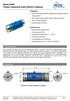 Properties Free of float metal bellow coupling with integrated torque measurement Non-contact measurement system, high robustness High torsional stiffness Limited torque of inertia Performance Measurement
Differential-Hall-Effect based Sensors Series A5S
 Speed and Frequency Seite 1 von 6 Differential-Hall-Effect based Sensors Series A5S Outstanding Characteristics Speed range covering most demands: from close to zero up to 25,000 pulses/second (response
The quadrature signals and the index pulse are accessed through five 0.025 inch square pins located on 0.1 inch centers.
 Quick Assembly Two and Three Channel Optical Encoders Technical Data HEDM-550x/560x HEDS-550x/554x HEDS-560x/564x Features Two Channel Quadrature Output with Optional Index Pulse Quick and Easy Assembly
Basics electronic speed Governor
 Basics electronic speed Governor 1 MAN B&W Diesel Aktiengesellschaft, Augsburg Why do we need Governors? Power sources must be controlled to be converted to useful work. Uncontrolled prime movers, not
SKF Machine Condition Transmitters (MCT) Series
 SKF Machine Condition Transmitters (MCT) Series The CMSS 500 Series of SKF Machine Condition Transmitters (MCT) are 4-20 ma Transmitters. They convert part of the input signal to a 4-20 ma output proportional
Introduction to Process Control Actuators
 1 Introduction to Process Control Actuators Actuators are the final elements in a control system. They receive a low power command signal and energy input to amplify the command signal as appropriate to
AUTOMATED, FULL LOAD MOTOR TESTING AT PRODUCTION SPEEDS
 AUTOMATED, FULL LOAD MOTOR TESTING AT PRODUCTION SPEEDS Abstract: Revolutionary test method coupled with innovative automation yields superior motor performance measurement data without sacrifice of production
THERMAL ANEMOMETRY ELECTRONICS, SOFTWARE AND ACCESSORIES
 TSI and TSI logo are registered trademarks of TSI Incorporated. SmartTune is a trademark of TSI Incorporated. THERMAL ANEMOMETRY ELECTRONICS, SOFTWARE AND ACCESSORIES IFA 300 Constant Temperature Anemometry
Specifying a Variable Frequency Drive s
 Specifying a Variable Frequency Drive s Put on by Bruce Reeves and Jeremy Gonzales Dykman Electrical Covering the Western US For all of your VFD and Soft Start and Motor Needs How To Specify a Variable
Alternative Linear Motion Systems. Iron Core Linear Motors
 Alternative Linear Motion Systems ME EN 7960 Precision Machine Design Topic 5 ME EN 7960 Precision Machine Design Alternative Linear Motion Systems 5-1 Iron Core Linear Motors Provide actuation forces
Application Information
 Moog Components Group manufactures a comprehensive line of brush-type and brushless motors, as well as brushless controllers. The purpose of this document is to provide a guide for the selection and application
RecipCOM. Expertise, reciprocating compressor monitoring and protection tailored to your needs
 RecipCOM Expertise, reciprocating compressor monitoring and protection tailored to your needs Do your reciprocating compressors have sufficient protection? Due to the increasing demands on availability
A descriptive definition of valve actuators
 A descriptive definition of valve actuators Abstract A valve actuator is any device that utilizes a source of power to operate a valve. This source of power can be a human being working a manual gearbox
Chen. Vibration Motor. Application note
 Vibration Motor Application note Yangyi Chen April 4 th, 2013 1 Table of Contents Pages Executive Summary ---------------------------------------------------------------------------------------- 1 1. Table
4 SENSORS. Example. A force of 1 N is exerted on a PZT5A disc of diameter 10 mm and thickness 1 mm. The resulting mechanical stress is:
 4 SENSORS The modern technical world demands the availability of sensors to measure and convert a variety of physical quantities into electrical signals. These signals can then be fed into data processing
1115 4G SERIES GOVERNOR. 4-20 ma ANALOGUE DIGITAL SPEED SETTING
 1115 4G SERIES GOVERNOR with 4-20 ma ANALOGUE & DIGITAL SPEED SETTING PO Box 28, 9300AA Roden, The Netherlands Tel: +31 505019888 Fax: +31 505013618 E-mail: [email protected] 1115 4G
Online Hydro Machinery Monitoring Protection, Prediction and Performance Monitoring Solutions
 Online Hydro Machinery Monitoring Protection, Prediction and Performance Monitoring Solutions 2011, Emerson Process Management. The contents of this publication are presented for informational purposes
HERZ-Thermal Actuators
 HERZ-Thermal Actuators Data Sheet 7708-7990, Issue 1011 Dimensions in mm 1 7710 00 1 7710 01 1 7711 18 1 7710 80 1 7710 81 1 7711 80 1 7711 81 1 7990 00 1 7980 00 1 7708 11 1 7708 10 1 7708 23 1 7709 01
Stepper motor I/O. Application Note DK9222-0410-0014 Motion Control. A General information on stepper motors
 Stepper motor Keywords Stepper motor Fieldbus Microstepping Encoder Phase current Travel distance control Speed interface KL2531 KL2541 Part A of this Application Example provides general information on
Subminiature Load Cell Model 8417
 w Technical Product Information Subminiature Load Cell 1. Introduction... 2 2. Preparing for use... 2 2.1 Unpacking... 2 2.2 Using the instrument for the first time... 2 2.3 Grounding and potential connection...
Product Overview 9100D
 Product Overview 9100D Portable Shaker Vibration Calibrator The Modal Shop 3149 East Kemper Road Cincinnati, OH 45241 Phone: +1.513.351.9919 Fax: 513.458.2171 [email protected] Brief Overview We've taken
The Do s and Don ts of Pressure Transducers
 The Do s and Don ts of Pressure Transducers ABSTRACT When specifying a pressure transducer for a process measurement, a number of items have to be considered. Some of the more important ones are discussed
RISH EM 3490 DS Dual Source Energy Meter RISH EM 3490 DS. Application : Product Features:
 Application : RISH Master 3490 DS measures important electrical parameters of Utility (in normal mode) & Generators (in Power back up) in three phase and single phase Network & replaces the multiple analog
On-line Machine Condition Monitoring [The CMS System]
![On-line Machine Condition Monitoring [The CMS System]](/thumbs/33/16391803.jpg "On-line Machine Condition Monitoring [The CMS System]") On-line Machine Condition Monitoring [The CMS System] Strategic monitoring control your costs Avoid unplanned downtime Monitor your plant stoppers Early warning maintains profit Efficient and profitable
On-line Machine Condition Monitoring [The CMS System] Strategic monitoring control your costs Avoid unplanned downtime Monitor your plant stoppers Early warning maintains profit Efficient and profitable
Series 7500 Torque Sensor
 Properties PTO (Power Take-Off) shaft with integrated torque and angle measurement Non-contact measurement system, high robustness Plug & Play solution, no additional electronics required Performance Measurement
9000 Series Accelerometers Specifications
 Technical Data 9000 Series Accelerometers Specifications Catalog Numbers EK-43781I, EK-43782I, EK-46255I, EK-45890I, EK-43784I, EK-47086I, EK-43792I, EK-47090I, EK-43799I, EK-43794I, EK-43795I, EK-43797I,
Dually Fed Permanent Magnet Synchronous Generator Condition Monitoring Using Stator Current
 Summary Dually Fed Permanent Magnet Synchronous Generator Condition Monitoring Using Stator Current Joachim Härsjö, Massimo Bongiorno and Ola Carlson Chalmers University of Technology Energi och Miljö,
SUSPENSION AND STEERING OVERVIEW
 SUSPENSION SUSPENSION AND STEERING OVERVIEW The S40/V50 has a wide track and a long wheelbase for its relative size and weight. This gives the car stable and predictable driving characteristics. It also
ENERGY TRANSFER SYSTEMS AND THEIR DYNAMIC ANALYSIS
 ENERGY TRANSFER SYSTEMS AND THEIR DYNAMIC ANALYSIS Many mechanical energy systems are devoted to transfer of energy between two points: the source or prime mover (input) and the load (output). For chemical
THE COMPOSITE DISC - A NEW JOINT FOR HIGH POWER DRIVESHAFTS
 THE COMPOSITE DISC - A NEW JOINT FOR HIGH POWER DRIVESHAFTS Dr Andrew Pollard Principal Engineer GKN Technology UK INTRODUCTION There is a wide choice of flexible couplings for power transmission applications,
COUNTERBALANCE VALVES
 COUNTERBALANCE VALVES Introduction They are modulating valves which allow free flow into the actuator and then block the reverse flow until they feel a pilot pressure inversely proportional to the load
APPENDIX F VIBRATION TESTING PROCEDURE
 APPENDIX F VIBRATION TESTING PROCEDURE Appendix F SPS-F-1 of 14 VIBRATION PERFORMANCE TESTING I. General Perform a vibration analysis on all motor driven equipment listed below after it is installed and
Velomitor Piezo-velocity Sensor
 Specifications and Ordering Information Velomitor Piezo-velocity Sensor BENTLY NEVADA MADE IN U.S.A. VELOMITO PN 330500 100 mv/in/s (4 mv/mm/s) Description Velomitor Piezo-velocity Sensors measure absolute
SOLID MECHANICS TUTORIAL MECHANISMS KINEMATICS - VELOCITY AND ACCELERATION DIAGRAMS
 SOLID MECHANICS TUTORIAL MECHANISMS KINEMATICS - VELOCITY AND ACCELERATION DIAGRAMS This work covers elements of the syllabus for the Engineering Council exams C105 Mechanical and Structural Engineering
Unit 24: Applications of Pneumatics and Hydraulics
 Unit 24: Applications of Pneumatics and Hydraulics Unit code: J/601/1496 QCF level: 4 Credit value: 15 OUTCOME 2 TUTORIAL 3 HYDRAULIC AND PNEUMATIC MOTORS The material needed for outcome 2 is very extensive
FXA 2008. UNIT G484 Module 2 4.2.3 Simple Harmonic Oscillations 11. frequency of the applied = natural frequency of the
 11 FORCED OSCILLATIONS AND RESONANCE POINTER INSTRUMENTS Analogue ammeter and voltmeters, have CRITICAL DAMPING so as to allow the needle pointer to reach its correct position on the scale after a single
330505 Low Frequency Velocity Sensor
 330505 Low Frequency Velocity Sensor Bently Nevada* Asset Condition Monitoring Description The Bently Nevada Low Frequency Velocity Sensor is designed to measure absolute (relative to free space) bearing
SYNCHRONOUS MACHINES
 SYNCHRONOUS MACHINES The geometry of a synchronous machine is quite similar to that of the induction machine. The stator core and windings of a three-phase synchronous machine are practically identical
Precision Miniature Load Cell. Models 8431, 8432 with Overload Protection
 w Technical Product Information Precision Miniature Load Cell with Overload Protection 1. Introduction The load cells in the model 8431 and 8432 series are primarily designed for the measurement of force
Beginning Vibration Analysis. Connection Technology Center, Inc. 7939 Rae Boulevard Victor, New York 14564 www.ctconline.com
 Beginning Vibration Analysis Connection Technology Center, Inc. 7939 Rae Boulevard Victor, New York 14564 www.ctconline.com Data Collection Loop Power Output 0.6 Velocity (inches/second peak) Fault 0.5
Single Channel Loop Detector
 Single Channel Loop Detector Model - LD100 Series The LD100 is a single channel inductive loop detector designed for parking and access control applications. The detector is connected to an inductive loop
A1000 Cheat Sheet (Open Loop Vector)
 A1000 Cheat Sheet (Open Loop Vector) The following procedure is a supplement to supplied with this equipment and will guide the user in properly wiring the A1000 and. It will also show the user how to
THE MECHANICS OF TENSION CONTROL By Jeff Damour CONVERTER ACCESSORY COPORATION Wind Gap, PA USA
 THE MECHANICS OF TENSION CONTROL By Jeff Damour CONVERTER ACCESSORY COPORATION Wind Gap, PA USA Introduction This presentation is a basic tutorial in the mechanics of web tension control. We will discuss:
Description. Dimensions. Features. www.pwb-encoders.com. precision works better
 Description The MEC22 is a high resolution optical hollow shaft encoder that can be fixed quickly and easily on different sizes of motor shafts. The encoder provides two square wave outputs in quadrature
Intelligent Vibration Monitoring
 Diagnostic Systems Condition Based Monitoring Diagnostic Systems Condition Based Monitoring Intelligent Vibration Monitoring efector Octavis for real-time vibration monitoring Solutions for Predictive
Surface Profilometry as a tool to Measure Thin Film Stress, A Practical Approach. Gianni Franceschinis, RIT MicroE Graduate Student
 1 Surface Profilometry as a tool to Measure Thin Film Stress, A Practical Approach. Gianni Franceschinis, RIT MicroE Graduate Student Abstract-- As the film decreases in thickness the requirements of more
Unit 24: Applications of Pneumatics and Hydraulics
 Unit 24: Applications of Pneumatics and Hydraulics Unit code: J/601/1496 QCF level: 4 Credit value: 15 OUTCOME 2 TUTORIAL 4 DIRECTIONAL CONTROL VALVES The material needed for outcome 2 is very extensive
Technical Guide No. 100. High Performance Drives -- speed and torque regulation
 Technical Guide No. 100 High Performance Drives -- speed and torque regulation Process Regulator Speed Regulator Torque Regulator Process Technical Guide: The illustrations, charts and examples given in
200350 and 200355 Accelerometers
 and Accelerometers Bently Nevada Asset Condition Monitoring Description The and Accelerometers are general purpose, casemounted seismic transducers designed for use with Trendmaster Pro Constant Current
Module 5 Couplings. Version 2 ME, IIT Kharagpur
 Module 5 Couplings Lesson 1 Introduction, types and uses Instructional Objectives At the end of this lesson, the students should have the knowledge of The function of couplings in machinery. Different
Servo Info and Centering
 Info and Centering A servo is a mechanical motorized device that can be instructed to move the output shaft attached to a servo wheel or arm to a specified position. Inside the servo box is a DC motor
E. K. A. ADVANCED PHYSICS LABORATORY PHYSICS 3081, 4051 NUCLEAR MAGNETIC RESONANCE
 E. K. A. ADVANCED PHYSICS LABORATORY PHYSICS 3081, 4051 NUCLEAR MAGNETIC RESONANCE References for Nuclear Magnetic Resonance 1. Slichter, Principles of Magnetic Resonance, Harper and Row, 1963. chapter
Design and Modeling of Fluid Power Systems ME 597/ABE 591 Lecture 5
 Systems ME 597/ABE 591 Lecture 5 Dr. Monika Ivantysynova MAHA Professor Fluid Power Systems MAHA Fluid Power Research Center Purdue University Displacement Machines Study different design principles and
Candidate Number. General Certificate of Education Advanced Level Examination June 2014
 entre Number andidate Number Surname Other Names andidate Signature General ertificate of Education dvanced Level Examination June 214 Physics PHY4/1 Unit 4 Fields and Further Mechanics Section Wednesday
D.C. Motors. Products and specifications subject to change without notice.
 D.C. Motors Order/Technical Support - Tel: (8) 677-5 / FAX: (8) 677-865 / www.crouzet-usa.com / DC Motors Selection guide Gearbox Speed Torque max (Nm).5. Type of Gearbox 8 8 8. Power usable (w) Torque
13 common causes of motor failure
 13 common causes of motor failure Application Note What to look for and how to improve asset uptime Motors are used everywhere in industrial environments and they are becoming increasingly complex and
VIBRATION MONITORING OF FANS INSTALLED IN ROAD TUNNELS
 VIBRATION MONITORING OF FANS INSTALLED IN ROAD TUNNELS CEMB SPA Via Risorgimento, 9 Mandello del Lario (Lc), Italy [email protected] www.cemb.com INSTRUMENT FOR MONITORING VIBRATIONS OF FANS INSTALLED IN ROAD
NUCLEAR MAGNETIC RESONANCE. Advanced Laboratory, Physics 407, University of Wisconsin Madison, Wisconsin 53706
 (revised 4/21/03) NUCLEAR MAGNETIC RESONANCE Advanced Laboratory, Physics 407, University of Wisconsin Madison, Wisconsin 53706 Abstract This experiment studies the Nuclear Magnetic Resonance of protons
Selecting and Sizing Ball Screw Drives
 Selecting and Sizing Ball Screw Drives Jeff G. Johnson, Product Engineer Thomson Industries, Inc. Wood Dale, IL 540-633-3549 www.thomsonlinear.com [email protected] Fig 1: Ball screw drive is a
TOPIC: 191004 KNOWLEDGE: K1.01 [3.3/3.5] Which one of the following contains indications of cavitation in an operating centrifugal pump?
![TOPIC: 191004 KNOWLEDGE: K1.01 [3.3/3.5] Which one of the following contains indications of cavitation in an operating centrifugal pump?](/thumbs/17/105210.jpg "TOPIC: 191004 KNOWLEDGE: K1.01 [3.3/3.5] Which one of the following contains indications of cavitation in an operating centrifugal pump?") KNOWLEDGE: K1.01 [3.3/3.5] P21 Which one of the following contains indications of cavitation in an operating centrifugal pump? A. Low flow rate with low discharge pressure. B. Low flow rate with high discharge
KNOWLEDGE: K1.01 [3.3/3.5] P21 Which one of the following contains indications of cavitation in an operating centrifugal pump? A. Low flow rate with low discharge pressure. B. Low flow rate with high discharge
Mounting Instructions. Torque Transducer. A0329 3.2 en
 Mounting Instructions Torque Transducer T5 T5 Contents 3 Page Safety instructions.............................................. 4 1 Measuring characteristics..................................... 7 2 Mounting.....................................................
Ampere's Law. Introduction. times the current enclosed in that loop: Ampere's Law states that the line integral of B and dl over a closed path is 0
 1 Ampere's Law Purpose: To investigate Ampere's Law by measuring how magnetic field varies over a closed path; to examine how magnetic field depends upon current. Apparatus: Solenoid and path integral
Reaction Torque Sensor
 Force 1 1 N m up to 1 000 1 000 N m Type 9329A 9389A These easy to install piezoelectric reaction torque sensors are particularly suitable for measuring rapidly changing torques at non-rotating shafts.
VIBROCONTROL 4000. Sensitive Machine Monitoring
 VIBROCONTROL 4000 Sensitive Machine Monitoring Reliable Machine Protection with VIBROCONTROL 4000 Brüel & Kjaer Vibro has for many years been one of the leading manufacturers of machine protection systems.
Vibration Monitoring System Adash 3600
 " User's guide Application: Vibration Monitoring System Adash 3600! Vibration diagnostics, monitoring and protective on-line system! On-line vibration monitoring system of engines, fans, pumps, gearboxes,
Power Electronics. Prof. K. Gopakumar. Centre for Electronics Design and Technology. Indian Institute of Science, Bangalore.
 Power Electronics Prof. K. Gopakumar Centre for Electronics Design and Technology Indian Institute of Science, Bangalore Lecture - 1 Electric Drive Today, we will start with the topic on industrial drive
Guidance for mounting 4-20 ma vibration sensors on fans
 Guidance for mounting 4-20 m vibration sensors on fans This article provides guidance to determine the number and location of 4-20 m loop powered sensors (LPS ) which produce a reliable vibration monitoring
Harmonics and Noise in Photovoltaic (PV) Inverter and the Mitigation Strategies
 Soonwook Hong, Ph. D. Michael Zuercher Martinson Harmonics and Noise in Photovoltaic (PV) Inverter and the Mitigation Strategies 1. Introduction PV inverters use semiconductor devices to transform the
Relationship between large subject matter areas
 H02M APPARATUS FOR CONVERSION BETWEEN AC AND AC, BETWEEN AC AND DC, OR BETWEEN DC AND DC, AND FOR USE WITH MAINS OR SIMILAR POWER SUPPLY SYSTEMS; CONVERSION OF DC OR AC INPUT POWER INTO SURGE OUTPUT POWER;
Case Studies on Paper Machine Vibration Problems
 Case Studies on Paper Machine Vibration Problems Andrew K. Costain, B.Sc.Eng. Bretech Engineering Ltd., 70 Crown Street, Saint John, NB Canada E2L 3V6 email: [email protected] website: www.bretech.com
26 3213.13 Diesel Engine Driven Generators Page 1 of 6
 Last Update: December 8, 2014 A. Description of System Consultant s Handbook Page 1 of 6 1. Provide a diesel engine driven electric generating unit, factory assembled, tested and certified to operate at
GMC 2013: Piping Misalignment and Vibration Related Fatigue Failures
 GMC 2013: Piping Misalignment and Vibration Related Fatigue Failures www.betamachinery.com Authors/Presenters: Gary Maxwell, General Manager, BETA Machinery Analysis Brian Howes, Chief Engineer, BETA Machinery
Linear modules Lifting units Rotary modules Grip modules Inductive proximity switches Plug connectors
 20000 Linear modules Lifting units Rotary modules Grip modules Inductive proximity switches Plug connectors 23000 22000 21000 20000 09000 08000 07000 06000 05000 04000 03000 02000 01000 823 Notes 824 Technical
TwinCAT NC Configuration
 TwinCAT NC Configuration NC Tasks The NC-System (Numeric Control) has 2 tasks 1 is the SVB task and the SAF task. The SVB task is the setpoint generator and generates the velocity and position control
Current Probes. User Manual
 Current Probes User Manual ETS-Lindgren L.P. reserves the right to make changes to any product described herein in order to improve function, design, or for any other reason. Nothing contained herein shall
LINEAR ACTUATORS. Linear Actuators. Linear Actuators. Linear Actuators are Actuators that creates motion in a straight line, as contrasted
 LINEAR ACTUATORS Linear Actuators Linear Actuators Linear Actuators are Actuators that creates motion in a straight line, as contrasted with circular motion of a conventional electric motor. Linear actuators
SELECTION, APPLICATION AND MAINTENANCE
 DIESEL PROTECTION SYSTEMS Automatic Diesel Engine Shut Down System for Safe Area Applications SELECTION, APPLICATION AND MAINTENANCE Series 300 Series 310 SYSTEM DESCRIPTION Suitable for attended engine
CENTRIFUGAL PUMP OVERVIEW Presented by Matt Prosoli Of Pumps Plus Inc.
 CENTRIFUGAL PUMP OVERVIEW Presented by Matt Prosoli Of Pumps Plus Inc. 1 Centrifugal Pump- Definition Centrifugal Pump can be defined as a mechanical device used to transfer liquid of various types. As
Using angular speed measurement with Hall effect sensors to observe grinding operation with flexible robot.
 Using angular speed measurement with Hall effect sensors to observe grinding operation with flexible robot. François Girardin 1, Farzad Rafieian 1, Zhaoheng Liu 1, Marc Thomas 1 and Bruce Hazel 2 1 Laboratoire
Electric Motors and Drives
 EML 2322L MAE Design and Manufacturing Laboratory Electric Motors and Drives To calculate the peak power and torque produced by an electric motor, you will need to know the following: Motor supply voltage,
Shaft. Application of full spectrum to rotating machinery diagnostics. Centerlines. Paul Goldman, Ph.D. and Agnes Muszynska, Ph.D.
 Shaft Centerlines Application of full spectrum to rotating machinery diagnostics Benefits of full spectrum plots Before we answer these questions, we d like to start with the following observation: The
Rebuild Instructions for 70001 and 70010 Transmission
 Rebuild Instructions for 70001 and 70010 Transmission Brinn, Incorporated 1615 Tech Drive Bay City, MI 48706 Telephone 989.686.8920 Fax 989.686.6520 www.brinninc.com Notice Read all instructions before