
D R A F T. Wisely and slow; they stumble that run fast.
|
|
|
- Martin Kelley
- 10 years ago
- Views:
Transcription
1 Grade 9 Module 1 Unit Unit Overview Wisely and slow; they stumble that run fast. Text(s) Number of Lessons in Unit Romeo and Juliet by William Shakespeare (Selected Scenes and Speeches) Romeo + Juliet (Baz Luhrmann, 1996) (Selected Scenes) 20 Introduction In this unit, students continue to develop habits and skills related to close reading, annotation, using evidence, building vocabulary, and participating in structured discussion, and they do so with text that is more qualitatively complex than in earlier units. This may be students first exposure to Shakespeare and the format of a play, so instruction will include a focus on Shakespeare s use of language and on the organization of the play. Students will study the structure of his language and speeches for craft and impact on character development. Students will alternate reading and viewing Shakespeare s Romeo and Juliet, continuing their study of how authors develop complex characters. They will follow the development of Romeo and Juliet from the time each character is introduced, collecting evidence as to how the two characters develop across all five acts of the play as revealed by Shakespeare s language and their interactions with other characters. Throughout the reading and viewing of the play, students will examine Shakespeare s rich use of figurative language, word play, and powerful cadence. While this unit serves as an introduction to Shakespeare, it does not delve into the world and works of Shakespeare. Students will study both the written text and Baz Luhrmann s 1996 film version of the play. Key scenes will be read and analyzed closely, based on their pivotal role in the play and their historic and cultural relevance in the wider range of reading. Luhrmann s film will address the text between the selected excerpts to allow students to contextualize their close readings. Pause periodically during the film for discussion, returning to the written script if necessary. Some parts of the play will be viewed without reading the script, and others will be read closely without viewing. For the Mid-Unit Assessment, students will be assessed with a short written response, preceded by structured discussion. Students will consider Romeo and Juliet s character development throughout the entire balcony scene. Their claim will be supported by evidence from Act 2 Scene 2 as a whole (RL , W ). For the End-of-Unit Assessment, students choose either Romeo or Juliet and write an essay that explains how that character changes throughout the play as revealed by the Shakespeare s language and the structure of the play (RL , W ). File: Overview Date: 8/31/13 Classroom Use: Starting 9/2013 1

2 Grade 9 Module 1 Unit 3 Literacy Skills & Habits Read closely for textual details Annotate texts to support comprehension and analysis Collect evidence from texts to support analysis Organize evidence to plan around writing Review and revise writing Standards for This Unit CCS Standards: Reading Literature RL RL RL RL RL Cite strong and thorough textual evidence to support analysis of what the text says explicitly as well as inferences drawn from the text. Analyze how complex characters (e.g., those with multiple or conflicting motivations) develop over the course of a text, interact with other characters, and advance the plot or develop the theme. Determine the meaning of words and phrases as they are used in the text, including figurative and connotative meanings; analyze the cumulative impact of specific word choices on meaning and tone (e.g., how the language evokes a sense of time and place; how it sets a formal or informal tone). Analyze how an author s choices concerning how to structure a text, order events within it (e.g., parallel plots), and manipulate time (e.g., pacing, flashbacks) create such effects as mystery, tension, or surprise. Analyze the representation of a subject or a key scene in two different artistic mediums, including what is emphasized or absent in each treatment. CCS Standards: Writing W W Write informative/explanatory texts to examine and convey complex ideas, concepts, and information clearly and accurately through the effective selection, organization, and analysis of content. Draw evidence from literary or informational texts to support analysis, reflection, and research. a. Apply grades 9 10 Reading standards to literature (e.g., Analyze how an author draws on and transforms source material in a specific work [e.g., how Shakespeare File: Overview Date: 8/31/13 Classroom Use: Starting 9/2013 2

3 Grade 9 Module 1 Unit 3 treats a theme or topic from Ovid or the Bible or how a later author draws on a play by Shakespeare] ). CCS Standards: Speaking & Listening SL b SL c Work with peers to set rules for collegial discussions and decision-making (e.g., informal consensus, taking votes on key issues, presentation of alternate views), clear goals and deadlines, and individual roles as needed. Propel conversations by posing and responding to questions that relate the current discussion to broader themes or larger ideas; actively incorporate others into the discussion; and clarify, verify, or challenge ideas and conclusions. College and Career Readiness Anchor Standards for Reading CCSS.ELA- Literacy. CCRA.R.7 Integrate and evaluate content presented in diverse media and formats, including visually and quantitatively, as well as in words. Note: Bold text indicates targeted standards that will be assessed in the unit. Unit Assessments Ongoing Assessment Standards Assessed Description of Assessment RL , RL , RL , RL , W Answer text-dependent questions. Write informally in response to text-based prompts. Mid-Unit Assessment Standards Assessed Description of Assessment RL , W The three-lesson arc will culminate in a brief writing assignment, which comprises the Mid-Unit Assessment. Students will consider Romeo and Juliet s character development throughout the entire balcony scene. Their claim will be supported by evidence from Act 2 Scene 2 as a whole. File: Overview Date: 8/31/13 Classroom Use: Starting 9/2013 3

4 Grade 9 Module 1 Unit 3 Students will respond to the following prompt: How do Romeo and Juliet s desires, concerns, and fears change throughout their interactions with one another in this scene? End-of-Unit Assessment Standards Assessed Description of Assessment RL , W Students choose either Romeo or Juliet and write an essay that explains how Shakespeare unfolds the character throughout the play with evidence referencing Shakespeare s language and the events of the play. Unit-at-a-Glance Calendar Lesson Text Learning Outcomes/Goals 1 Text: Prologue: Summarizes the play and foreshadows the action (1.Prol.1 14). Film: N/A 2 Text: Romeo explains to Benvolio that he is in love ( ). Film: [2:37 13:35]: Fight in the street between Montagues and Capulets; dialogue between Montagues, Capulets and the Prince; Montagues and Benvolio talk about Romeo. 3 Text: Romeo explains to Benvolio that he is in love ( ). Film: N/A This lesson provides initial exposure to Shakespearean language and the entry point to comprehension of the text. Students will begin grappling with the thematic complexity of this text, with the summative question: What relationship is Shakespeare establishing in the prologue between love and hate? First lesson in a two-lesson arc. Students will make inferences about the character of Romeo based on his relationship to Benvolio and Rosaline. This lesson is the first introduction students have to Romeo. This lesson also serves as an introduction to the film Romeo + Juliet (Lurhman, 1996), as well as modeling critical film viewing and note taking. Second lesson in a two-lesson arc. Students will continue to make inferences about the character of Romeo based on his relationship to Benvolio and Rosaline. File: Overview Date: 8/31/13 Classroom Use: Starting 9/2013 4

5 Grade 9 Module 1 Unit 3 4 Text: Lady Capulet tells Juliet about Paris ( ). Film: and [15:21 17:05]: Paris and Capulet talk about Juliet; Romeo and Benvolio find out about Capulet ball and decide to go; Lady Capulet and the nurse talk about Juliet s age. Students will make inferences about the character of Juliet based on her interaction with Lady Capulet. This lesson is the first introduction students have to Juliet. 5 6 Text: Romeo and Juliet meet, kiss, find out each other s identity ( ). Film: [27:57 30:26]: Tybalt sees Romeo at the party and wants to kill him; Capulet says no; Romeo catches first sight of Juliet. Text: Romeo and Juliet meet, kiss, find out each other s identity ( ). Film: N/A Students begin a close reading analysis of Romeo and Juliet s first encounter at the Capulet Ball ( ). Students will focus on Romeo s initial overture to Juliet in lines with a focus on Shakespeare s use of imagery. Students continue their analysis of as they explore the focusing question: What can you learn about Juliet from the way that she responds to Romeo? 7 Text: Balcony scene soliloquies ( ). Film: N/A 8 Text: Balcony scene, Juliet worries about Romeo s safety ( ). Film: N/A First lesson in a three-lesson arc on the balcony scene. Students will make inferences about the characters of Romeo and Juliet through close reading of their soliloquies, with a focus on Shakespeare's structural choices in this scene. Students will build shared knowledge of some of the most iconic lines in the play. Second lesson in a three-lesson arc about the balcony scene. Students will make inferences about the characters of Romeo and Juliet based on their conversation with each other in this passage, considering language choice and author's structural choices. 9 Text: Balcony scene, exchange of Third lesson in a three-lesson arc about the balcony scene. This lesson also contains the mid- File: Overview Date: 8/31/13 Classroom Use: Starting 9/2013 5
![5 6 Text: Romeo and Juliet meet, kiss, find out each other s identity (1.5.92 109). Film: 1.5.41 91 [27:57 30:26]: Tybalt sees Romeo at the party and wants to kill him; Capulet says no; Romeo catches first sight of Juliet.](/docs-images/42/14674949/images/page_5.jpg "Text: Romeo and Juliet meet, kiss, find out each other s identity (1.5.92 109). Film: N/A Students begin a close reading analysis of Romeo and Juliet s first encounter at the Capulet Ball (1.5.92 109). Students will focus on Romeo s initial overture to Juliet in lines 1.")
6 Grade 9 Module 1 Unit 3 vows ( ). Film: [46:38 49:39]: Friar and Romeo talk about love and he agrees to marry Romeo and Juliet. 10 Text: Romeo kills Tybalt ( ). Film: [55:57 57:30]: Romeo and Juliet get married [57:31 1:00:10]: Mercutio and Benvolio hang out, Tybalt enters and challenges Mercutio. 11 Text: Romeo kills Tybalt ( ). Film: N/A 12 Text: Romeo kills Tybalt ( ). Film: [1:10:37 1:12:24]: Benvolio, the Capulets and the Montagues argue about what should happen to Romeo. 13 Text: Juliet s speech while she waits for Romeo to come to her room that night ( ). Film: N/A unit assessment. Students will make inferences about the characters of Romeo and Juliet through cumulative comprehension of the balcony scene, considering language use, character interactions, and Shakespeare's structural choices. Students will consider, compare, and contrast the development of Romeo and Juliet's concerns and desires in a formal writing assignment. Students will explore conflicting motivations of three complex characters (Mercutio, Romeo, Tybalt) through this focusing question: Who is to blame for Mercutio s death? Students should make inferences about how this key event affects character development, as well as how the choices that these characters' advance the tragic plot of the play. Students continue their exploration of Romeo s character development as they begin to work through the excerpt , in which Romeo kills Tybalt. Students lay the critical groundwork for the unifying focusing question of this two-lesson arc: Is Romeo fortune s fool? Students resume their analysis of Tybalt s death scene ( ), and directly explore the unifying focusing question of this two-lesson arc: Is Romeo fortune s fool? In this lesson, students will close read Juliet s speech while she waits for Romeo, before she has found out that Romeo killed her cousin Tybalt. The lesson will ask students to draw a comparison between a close reading of this passage and Marc Chagall s painting Romeo and Juliet, with a focus on structural choices and the effects they create. File: Overview Date: 8/31/13 Classroom Use: Starting 9/2013 6
![1.139 199 [1:10:37 1:12:24]: Benvolio, the Capulets and the Montagues argue about what should happen to Romeo. 13 Text: Juliet s speech while she waits for Romeo to come to her room that night (3.2.1 31).](/docs-images/42/14674949/images/page_6.jpg "Film: N/A unit assessment.")
7 Grade 9 Module 1 Unit 3 14 Text: Friar Laurence tells Romeo that the Prince has decided to banish him ( ). Film: N/A 15 Text: Juliet threatens to kill herself to avoid marrying Paris, and Friar Laurence proposes another plan, sends letter to Romeo ( ). This lesson focuses on Romeo s reaction to his banishment in conversation with Friar Laurence, with an emphasis on word choice and meaning, particularly repeating words with multiple meanings. First lesson in two-lesson arc. This lesson focuses on Juliet s character development through an exploration of her word choice and rich imagery. Film: [1:22:19 1:26:38]: Juliet fights with her parents, Juliet goes to see Friar Laurence. 16 Text: Juliet threatens to kill herself to avoid marrying Paris, and Friar Laurence proposes another plan, sends letter to Romeo ( ). Film: [1:32:33 1:39:09]: Romeo hears Juliet is dead; vows to kill himself; buys poison from the apothecary. Second lesson in a two-lesson arc. This lesson asks students to comprehend the tragic events that are to come through an understanding of the Friar s plan. Students compare Juliet s conversation with the Friar to Romeo s in order to build understanding of Romeo and Juliet s character development [1:37:01 1:37:48 and 1:39:10 1:39:36]: Friar founds out his letter was never sent. 17 Text: Romeo enters Juliet s tomb, makes a speech, and kills himself. ( ). Film: N/A 18 Text: Juliet, upon awakening and seeing Romeo dead, stabs herself ( ). Film: N/A This lesson continues to build skills around students making cumulative connections across the text. Students will complete a close reading of Romeo s suicide and connect elements of this passage with parts of the play they have read earlier. This lesson is a final point of comparison for an analysis of Juliet s character development across the five acts of the play. Students will complete a close reading of Juliet s suicide guided by the File: Overview Date: 8/31/13 Classroom Use: Starting 9/2013 7

8 Grade 9 Module 1 Unit 3 focusing question: Who or what is responsible for Juliet s death? 19 Text: Montagues and Capulets make peace ( ). Film: N/A First lesson in a two-lesson arc that makes up the End-of-Unit Assessment. Students should make inferences about Romeo and Juliet's character development using evidence from all five acts of the play. Students will use a tool to organize their thoughts and develop a claim, in preparation to write End-of-Unit Assessment. 20 N/A Second lesson in a two-lesson arc that makes up the End-of-Unit Assessment. Students craft a piece of writing for the End-of-Unit Assessment. Preparation, Materials, and Resources Preparation Read closely and annotate Romeo and Juliet by William Shakespeare. Materials/Resources Shakespeare, William, and René Weis. Romeo and Juliet. London: Bloomsbury Plc, Print. Romeo + Juliet (1996, Lurhmann). Lit2Go (Free): [Single voice dramatic reading] Chagall, Marc. Romeo and Juliet Masterworks Fine Art. Web: BBC Radio Production ($3.99): [Full cast production, heavily accented] Shakespeare Interactive Folio (Free): [Interactive, multimedia, web based, audio for entire play not available] New York Regents Text Analysis Rubric: _ela_regents_nti_document_final.pdf on page 23 of 96. File: Overview Date: 8/31/13 Classroom Use: Starting 9/2013 8

9 Grade 9 Module 1 Unit 3 Lesson Lesson 1 Introduction In this first lesson of the unit, students will build their close reading skills as they work carefully through the fourteen-line prologue of Shakespeare s Romeo and Juliet. This lesson serves as the initial exposure to Shakespearean language and the entry point to comprehension of the text. This fluency is crucial to establish early on, as students will be exploring Romeo and Juliet through a series of excerpted close readings. At the end of class, students should be able to navigate the language to derive meaning and complete an open-ended Quick Write that challenges students to begin grappling with the complexity of this iconic text. Students will begin the lesson by listening to a masterful reading of the Prologue for fluency and comprehension. For the duration of the class students will read in small groups, annotate their text, answer TDQs, and participate in class discussions. Students will draw upon this analysis to complete a Quick Write that sets the groundwork for the exploration of structure and character development that occurs throughout Unit 3. For homework, students will provide a brief summary of the Prologue. Note: Avoid providing explicit context for Shakespeare as a playwright and historical figure. Focusing student analysis on the text itself, rather than contextual information, will encourage students to make meaning through the text without relying on preconceived notions. Standards Assessed Standard(s) RL Addressed Standard(s) RL Determine the meanings of words and phrases as they are used in the text, including figurative and connotative meanings; analyze the cumulative impact of specific word choices on meaning and tone (e.g., how the language evokes a sense of time and place; how it sets a formal or informal tone). Cite strong and thorough textual evidence to support analysis of what the text says explicitly as well as inferences drawn from the text. Assessment Assessment(s) Quick Write: In the Prologue, what relationship does Shakespeare establish between love and hate? How do his specific word choices illustrate this relationship? Use evidence from the text to support your answer. High Performance Response(s) File: Lesson 1 Date: 8/31/13 Classroom Use: Starting 9/2013 1

10 Grade 9 Module 1 Unit 3 Lesson 1 Student responses to this multifaceted question will vary. What is important here is that students begin a productive struggle with the figurative and connotative meanings of Shakespeare s language. This is integral to a complex understanding of Shakespeare s text. Look for students to use language and evidence from the play to begin to make connections. Children from two families with an ancient grudge (3) against each other fall in love. The families are described as having dignity but also as being involved in the ancient grudge. Shakespeare writes that the lovers are responsible for the end of their family s hatred, their death bur[ies] their parents strife (8). However, the feud between these two foes (5) does not end because of the affection between the star-crossed lovers (6). Instead, it is their end, or death, that ends the fight. By placing contrasting words together (e.g., dignity / mutiny, civil / blood, fatal / loins ) Shakespeare is illustrating that love and hate are intertwined, and the results of each are not always what you would expect. Vocabulary Vocabulary to provide directly (will not include extended instruction) dignity (n.) honorable status loins (n.) reproductive organs fatal (adj.) causing death overthrows (n.) ruins, downfalls doth (v.) (archaic) does strife (n.) angry fight Vocabulary to teach (may include direct word work and/or text-dependent questions) prologue (n.) an introduction civil (adj.) relating to ordinary citizens; polite or courteous misadventured (adj.) misfortunate or ill-fated piteous (adj.) deserving of pity; sad Lesson Agenda/Overview Student-Facing Agenda Standards: RL , RL Text: Act 1.Prol.1 14 Introduction of Lesson Agenda Homework Accountability Opening Activity Masterful Reading and Prologue Handout Text-Dependent Questions and Activities Quick Write Closing % of Lesson 5% 5% 5% 5% 70% 5% 5% File: Lesson 1 Date: 8/31/13 Classroom Use: Starting 9/2013 2

11 Grade 9 Module 1 Unit 3 Lesson 1 Materials Prologue Handout File: Lesson 1 Date: 8/31/13 Classroom Use: Starting 9/2013 3

12 Grade 9 Module 1 Unit 3 Lesson 1 Learning Sequence Percentage of Lesson Teacher Actions Student Actions Instructional Notes (extensions, supports, common misunderstandings) 5% Introduction of Lesson Agenda Begin by reviewing the agenda and sharing the standards for this lesson: RL , RL In this lesson, students will close read the first section of Shakespeare s Romeo and Juliet, the Prologue. Students will chunk the text and work through a series of textdependent questions in groups of four to build skills necessary to navigate and derive meaning from Shakespeare s language. 5% Homework Accountability Instruct students to talk in pairs about how they can apply their focus standard to their text. Lead a brief share out on the previous lesson s AIR homework assignment. Select several students (or student pairs) to explain how they applied their focus standard to their AIR text. 5% Opening Activity Write the words progressive, prototype, proactive, and prologue on the board. Provide the following questions for students. Students look at the agenda. Students (or student pairs) discuss and share how they applied their focus standard to their AIR text from the previous lesson s homework. Students answer independently in their notebooks and are prepared with the answer when class begins. The words begin with the prefix pro-. Sharing and discussing the target standards at the beginning of each lesson encourages students to engage directly with the standards and develop a sense of intellectual ownership. In this, and all subsequent opening activities in the unit, the question should be displayed for students as they enter the classroom. Students File: Lesson 1 Date: 8/31/13 Classroom Use: Starting 9/2013 4

13 Grade 9 Module 1 Unit 3 Lesson 1 They should record their responses. What do these words have in common? What does this similarity reveal about the meaning of these words? Ask students for observations about how this understanding can help them to infer the meaning of prologue. 5% Masterful Reading and Prologue Handout Distribute a copy of the Prologue to each student. Tell students that they will listen to a masterful reading of the Prologue before they begin reading it on their own. Read or play an audio version of the prologue in its entirety. 70% Text-Dependent Questions and Activities Have students form small, heterogeneous groups of four for the purpose of discussing the text in more depth and recording insights. During discussions, allow time for each group to share their collaborative work with the class. Instruct groups to read the first four lines aloud, focusing this reading with the following instruction: Find and circle repeating words in lines 1 4. Once students Students work through the meanings of several of the words in order to make connections between them. For example prototype means "an early draft or model," proactive means "to plan ahead," progressive means "ahead of its time." Each word implies an action that occurs before another. Students note that a prologue comes before or introduces the rest of a play. Students follow along, reading silently. Students read the first four lines of the play together in groups. As they read together, students note the repetition of the word civil. are expected to briefly respond on paper as their first task. If students are unable to come up with the meaning of pro, tell them that pro means before. Then ask them for examples of other words beginning with the prefix pro. Have them relate the meaning of the prefix to the meaning of their own examples. Make copies of the Prologue before class. Free Audio Resource: You may choose to create student groups ahead of time, to ensure they are diverse. Assign, or have students assume, a role within the group, such as Facilitator, Reader, and Recorder. Encourage students to read one line each in their groups, so each student has an opportunity to read File: Lesson 1 Date: 8/31/13 Classroom Use: Starting 9/2013 5
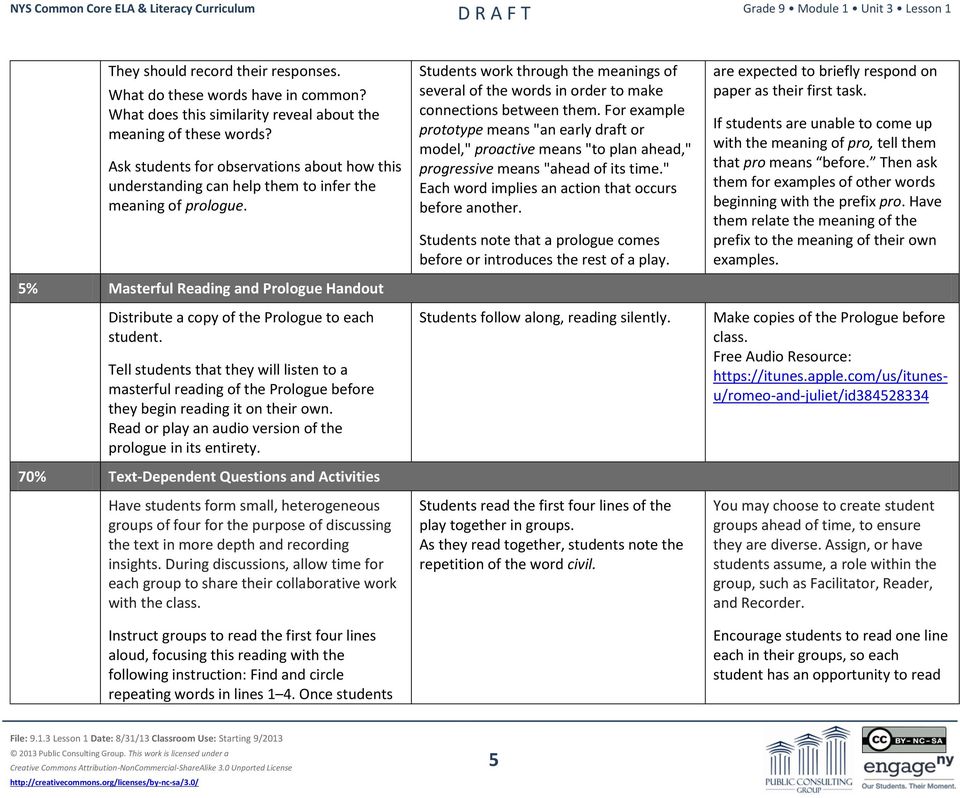
14 Grade 9 Module 1 Unit 3 Lesson 1 have finished reading, ask them to share the repetitions that they identified. Pose the following questions one at a time for full class discussion. Allow time between the questions for students to discuss in their groups before sharing with the class. Direct students to the first use of the word civil in the prologue, where civil blood makes civil hands unclean (1.Prol.4). 1. Used as an adjective, civil is generally defined as polite. Replace the first appearance of the word civil in line 4 with the word polite. How does this substitution change your understanding of the sentence? 2. Civil can also be defined as something that relates to ordinary citizens (e.g., civilians). Replace the first appearance of civil with the word civilian. How does this substitution change your understanding of this sentence? Direct students to the second use of the word civil in the Prologue, where civil blood makes civil hands unclean (line 4). 3. Whose hands are being made unclean? What words and phrases can you find in lines 1 3 to support your understanding of this Student responses may include the following: 1. The people who are bleeding are polite. Some students might note that the word polite seems out of place beside the word blood. 2. The blood and hands belong to normal, everyday people. 3. Students identify the families and make connections between the provided definitions of the vocabulary word dignity (see Vocabulary chart) and the work they have done on the uses of the word civil. aloud. If students are struggling, encourage them to repeat this reading activity several times with the goal of comprehension. 1. If students struggle to define, encourage them to use similar sounding words to make meaning. For example, civil is the first part of the word civilian, which means "a citizen or an ordinary person." Remind students to use the footnotes to aid comprehension. File: Lesson 1 Date: 8/31/13 Classroom Use: Starting 9/2013 6

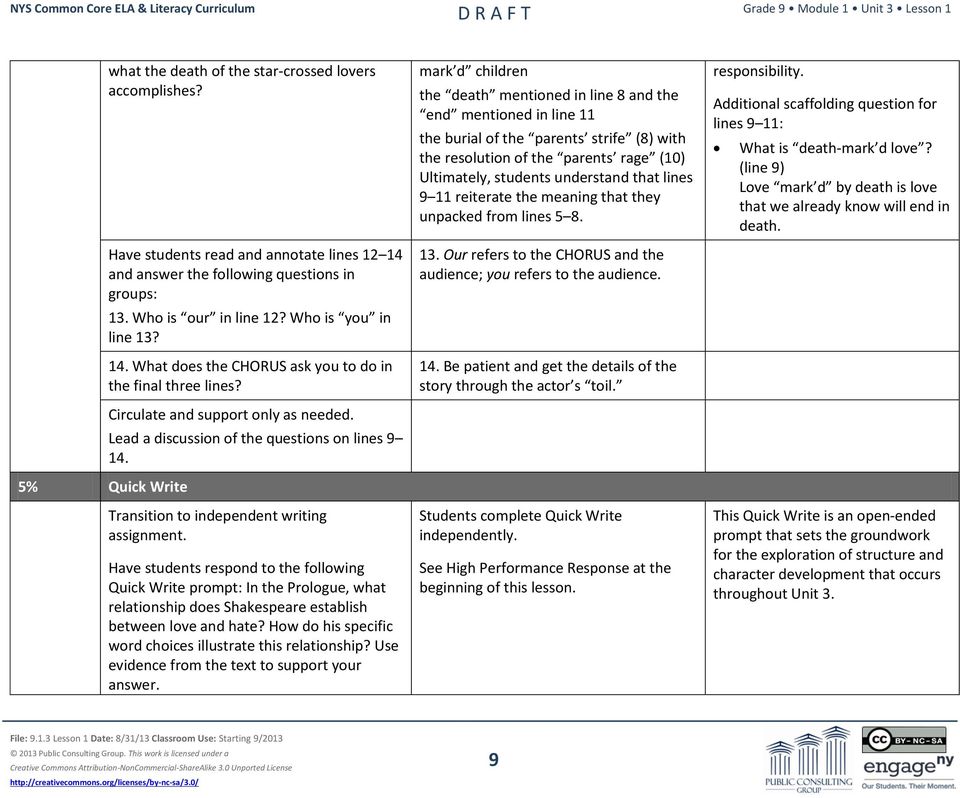
15 Grade 9 Module 1 Unit 3 Lesson 1 second use of civil in line 4? 4. Now consider both uses of the word civil. Ask: What are two different ways you can mix and match the definitions in line 4? Paraphrase the meaning of each sentence you generate. Which meaning supports the claim you made in your answer to question 4? 5. Why do you think Shakespeare uses civil in two different ways in the same sentence? Circulate and support only as needed. Then lead a brief class discussion of each question. Direct student groups to reread lines 1 4. Now that students have a better understanding of the word civil, pose the following question: 6. What is at stake in this ancient fight? Instruct student groups to read lines 5 8. Provide the following question for groups to answer. Instruct students to take note of their observations in their groups and be prepared to share in a class discussion. 7. What happens to the lovers? What adjective in line 5 supports your answer? 4. Polite blood makes civilian hands unclean. or Civilian blood makes polite hands unclean. Students support their claim that it is the household s hands that are unclean by substituting definitions that support this understanding. 5. Shakespeare is playing with the multiple meanings of civil. 6. Ordinary people are dying because of the fight between the two dignified, polite households. Therefore, innocent lives are at stake in this ancient grudge (3). 7. They die. Students point to fatal in line 5 to support the answer. Additional scaffolding questions for lines 5 8: Who are the foes? Hint: review lines 1 4. The two households. How are the lovers related to the two families? They are the children of two feuding families. File: Lesson 1 Date: 8/31/13 Classroom Use: Starting 9/2013 7

16 Grade 9 Module 1 Unit 3 Lesson 1 Now lead student groups through a dissection of lines 7 and 8: 8. Look at the word misadventured in line 7. What familiar word can you find in misadventured? What does this word mean? How does the prefix mis- change your definition? 9. What familiar word do you hear in piteous? How can this familiar word help you to understand what piteous means in this context? 10. What tone or mood does Shakespeare create in this passage through these two words? Direct students to the word overthrows. Tell students that overthrows in this context means downfalls or ruins. Now direct students to line 8 and ask: 11. What does the death of the starcross d lovers accomplish? Circulate and support only as needed. Lead a discussion of the questions on lines 7 8. Have students read lines 9 11 and answer the following questions in their groups: 12. How can you use lines 9 11 to support and strengthen the claim you made about 8. Students identify the familiar word adventure in misadventured. Students may define adventure as an exciting journey or an unexpected event. Students offer familiar words with this prefix, such as mistake, misuse, or misbehave. Students infer that the prefix means something bad, accidental, or wrong. So misadventured means "an adventure that has gone wrong." 9. Students find and define the word pity. Possible definitions: to feel sad for someone else or to look down on someone else. 10. The tone is one of foreboding (a bad feeling about the events to come). 11. The downfall/death or end (11) of the star-crossed lovers ultimately resolves their parents fight. 12. Students may make connections between the following ideas: the star-cross d lovers and the death- 11. This is an essential understanding. If students struggle, provide additional support. 12. Withdraw support and encourage students to struggle here, in a gradual release of File: Lesson 1 Date: 8/31/13 Classroom Use: Starting 9/2013 8

17 Grade 9 Module 1 Unit 3 Lesson 1 5% Quick Write what the death of the star-crossed lovers accomplishes? Have students read and annotate lines and answer the following questions in groups: 13. Who is our in line 12? Who is you in line 13? 14. What does the CHORUS ask you to do in the final three lines? Circulate and support only as needed. Lead a discussion of the questions on lines Transition to independent writing assignment. Have students respond to the following Quick Write prompt: In the Prologue, what relationship does Shakespeare establish between love and hate? How do his specific word choices illustrate this relationship? Use evidence from the text to support your answer. mark d children the death mentioned in line 8 and the end mentioned in line 11 the burial of the parents strife (8) with the resolution of the parents rage (10) Ultimately, students understand that lines 9 11 reiterate the meaning that they unpacked from lines Our refers to the CHORUS and the audience; you refers to the audience. 14. Be patient and get the details of the story through the actor s toil. Students complete Quick Write independently. See High Performance Response at the beginning of this lesson. responsibility. Additional scaffolding question for lines 9 11: What is death-mark d love? (line 9) Love mark d by death is love that we already know will end in death. This Quick Write is an open-ended prompt that sets the groundwork for the exploration of structure and character development that occurs throughout Unit 3. File: Lesson 1 Date: 8/31/13 Classroom Use: Starting 9/2013 9
18 Grade 9 Module 1 Unit 3 Lesson 1 5% Closing Remind students that for homework they will provide a brief summary of the events of the play that the Prologue previews. Their summary will be collected at the start of Lesson 2. Students write a brief summary of the Prologue for homework. Homework The Prologue provides an overview of the "two hours' traffic of our stage." In two well-constructed sentences, provide a brief summary of the events that the Prologue previews. File: Lesson 1 Date: 8/31/13 Classroom Use: Starting 9/

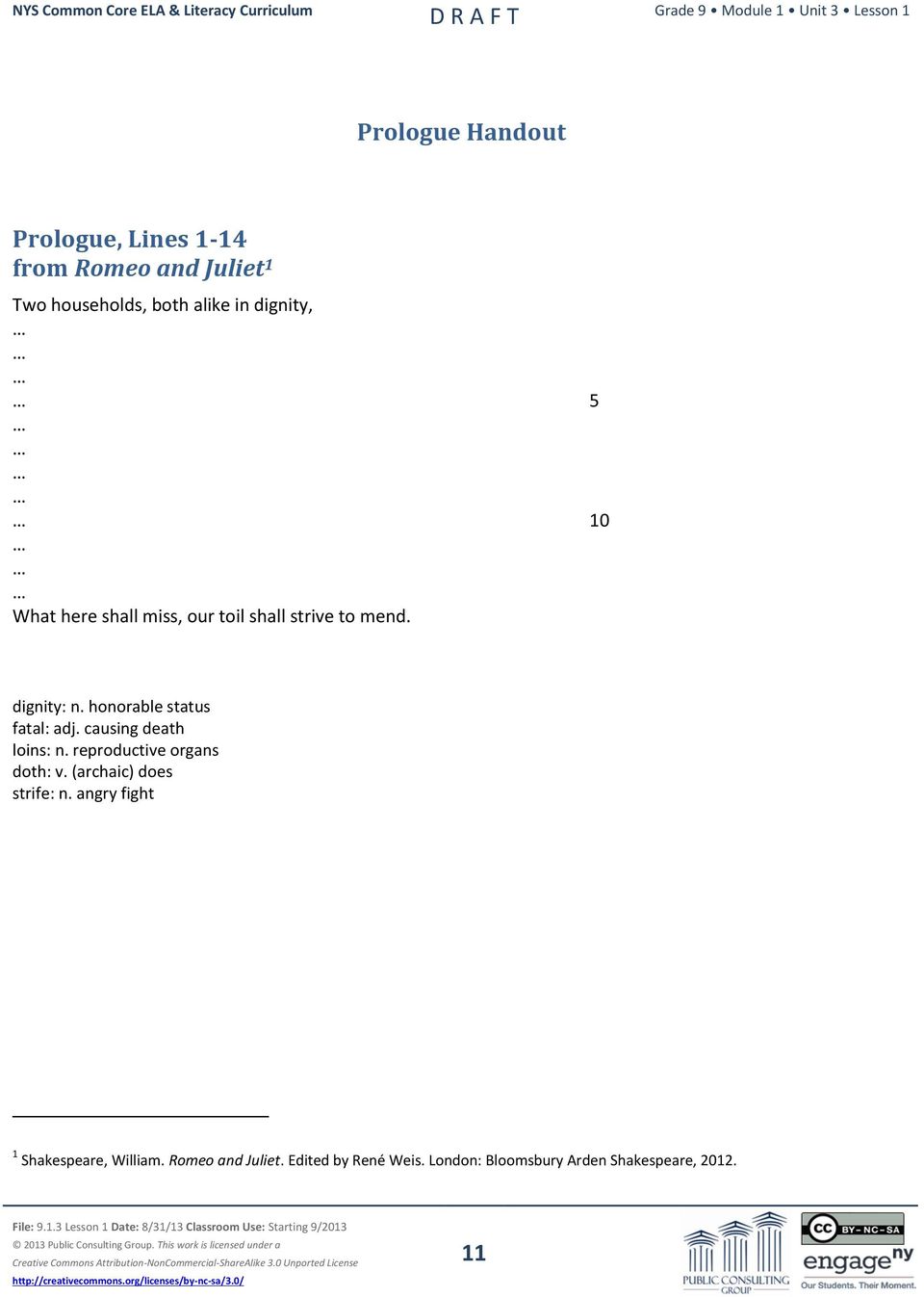
19 Grade 9 Module 1 Unit 3 Lesson 1 Prologue Handout Prologue, Lines 1-14 from Romeo and Juliet 1 Two households, both alike in dignity, 5 10 What here shall miss, our toil shall strive to mend. dignity: n. honorable status fatal: adj. causing death loins: n. reproductive organs doth: v. (archaic) does strife: n. angry fight 1 Shakespeare, William. Romeo and Juliet. Edited by René Weis. London: Bloomsbury Arden Shakespeare, File: Lesson 1 Date: 8/31/13 Classroom Use: Starting 9/
20 Grade 9 Module 1 Unit 3 Lesson Lesson 2 Introduction In this lesson, students will develop their close reading skills as they begin to work carefully through the short excerpt Act In this passage, Romeo discusses his unrequited love for Rosaline with his cousin Benvolio. Students will complete their close reading of this passage in Lesson 3. Activities involve reading aloud, discussion and reflection, and writing work in tandem with a set of text-dependent questions to guide students in their exploration of the unifying focusing question of this two-lesson arc: What can you infer about Romeo from the way that he describes Rosaline? Student work in this lesson will lay the groundwork for this exploration, while Lesson 3 will prompt students to draw upon and further their initial analysis. Students will analyze sentence structure, rhyme scheme, word choice, and figurative language in order to begin their unit-long exploration of Romeo s character development. This passage is students introduction to the character of Romeo. As such, it acts as a point of origin for student analysis of how Romeo s character unfolds throughout the play as revealed by Shakespeare s language and syntax, and Romeo s interactions with other characters. This lesson also functions as an introduction to Baz Luhrmann s film Romeo + Juliet, which will be used regularly throughout the unit to supplement close readings of the text. Students will watch Luhrmann s representation of the events of 1.1 that precede a close reading of excerpt This first section of film will introduce students to many of the key characters of Shakespeare s play, as well as facilitate understanding of the key events that lead up to Romeo s discussion with Benvolio. Additionally, this lesson will introduce students to critical viewing strategies via Film Tool: Stylistic Choices, a tool that will accompany the film throughout the unit and encourage students to think critically about Luhrmann s stylistic choices as well as assist in the collection and organization of notes on the sequential structure of the play. This tool will ensure that film viewing remains a purposeful, critical, and rigorous classroom activity. For homework, students will expand this lesson s Quick Write assessment response to include additional pieces of textual evidence. Standards Assessed Standard(s) RL Determine the meaning of words and phrases as they are used in the text, including figurative and connotative meanings; analyze the cumulative impact of specific word choices on meaning and tone. Addressed Standards RL Cite strong and thorough textual evidence to support analysis of what the text says explicitly as well as inferences drawn from the text. File: Lesson 2 Date: 8/31/13 Classroom Use: Starting 9/2013 1

21 Grade 9 Module 1 Unit 3 Lesson 2 RL Analyze how complex characters develop over the course of a text, interact with other characters, and advance the plot or develop the theme. Assessment Assessment(s) Quick Write: Draw upon your understanding of the metaphor that Romeo has constructed in lines to answer the following prompt: Do Romeo and Rosaline feel the same way about their relationship? High Performance Response(s) Student responses should call upon their understanding of Romeo s motivations and interactions that they have developed through their exploration of word choice and figurative language in this lesson. Lesson 3 will ask students to build on this initial understanding of Romeo s motivations and interactions to begin to develop an understanding of how Shakespeare crafts Romeo as a complex character. Sample response: Although Romeo desires this relationship as evidenced by his pursuit of Rosaline, she ll not be hit with cupid s arrows ( ). Rosaline s resistance to Romeo s arrows of love indicates that she does not seem to feel the same way. Vocabulary Vocabulary to provide directly (will not include extended instruction) Dian (n.) a reference to Diana, the Roman goddess of hunting and chastity proof (n.) in this context, armor chastity (n.) virginity, celibacy posterity (n.) all future generations forsworn (v.) relinquished under oath doctrine (n.) a set of beliefs held and taught by a church, political party, or other group Vocabulary to teach (may include direct word work and/or text-dependent questions) assailing (v.) making a violent attack on Lesson Agenda/Overview Student-Facing Agenda Standards: RL , RL , RL Text: Act Introduction of Lesson Agenda Homework Accountability Film: Excerpt from Baz Luhrmann s Romeo + Juliet (2:37 13:35) % of Lesson 5% 5% 30% File: Lesson 2 Date: 8/31/13 Classroom Use: Starting 9/2013 2
22 Grade 9 Module 1 Unit 3 Lesson 2 Masterful Reading: BBC Radio Production of (14:35 16:14) Text-Dependent Questions and Activities Quick Write Closing 5% 45% 5% 5% Materials Film Tool: Stylistic Choices Film: Excerpt from Baz Luhrmann s Romeo + Juliet (2:37 13:35) Masterful Reading: BBC Radio Production of (14:35 16:14) File: Lesson 2 Date: 8/31/13 Classroom Use: Starting 9/2013 3
23 Grade 9 Module 1 Unit 3 Lesson 2 Learning Sequence Percentage of Lesson Teacher Actions Student Actions Instructional Notes (extensions, supports, common misunderstandings) 5% Introduction of Lesson Agenda Begin by reviewing the agenda and sharing the standards for this lesson: RL , RL , RL Students look at the agenda. 5% Homework Accountability Lead a brief class discussion on student summaries of the Prologue (assigned as homework in Lesson 1). Collect summaries for student accountability. Students discuss the summaries. Student summaries may include: Two families are fighting. Their children are in love, and their death is the only thing that can end the feud. 30% Film: Excerpt from Baz Luhrmann s Romeo + Juliet Prepare to show an 11-minute clip of Baz Luhrmann s 1996 film Romeo + Juliet (2:37 13:35; see Unit Overview). This clip will introduce many of the key characters of Shakespeare s play, as well as facilitate understanding of the events that lead up to the excerpt that students will analyze in this lesson and the next. Hand out Film Tool: Stylistic Choices. Students will use this tool to develop critical observations of Luhrmann s stylistic choices, as well as provide a means to organize the key events of the play. Students will use a new, blank copy of this tool Students watch the film clip and respond on the tool when the film is paused. See Model Film Tool: Stylistic Choices for sample responses. When reviewing categories on Film Tool: Stylistic Choices, it may be necessary to devote extra time to explanations of what is meant by Editing and Lighting/Color. Editing choices might be addressed by explaining that filmmakers make choices about what they focus the camera on at strategic points in the film, where they position the camera in relation to actors, and how they choose to transition between File: Lesson 2 Date: 8/31/13 Classroom Use: Starting 9/2013 4
24 Grade 9 Module 1 Unit 3 Lesson 2 every time they view the film. Explain that the film will be paused at strategic points so that the class can collaboratively generate observations, which you will then show where to place on the tool. In future lessons, the tool will facilitate independent note-taking. Students can refer to this initial collaborative work as a model when necessary. Review the categories on the film tool and answer any clarifying questions. Begin film clip. Pause at the end of each segment as designated below, and ask for student observations. Use their observations to model filling out the tool. Instruct students to record the class-generated observations on their own tool for future reference. Segment 1 2:37 9:15 Segment 2 9:15 9:35 Segment 3 9:36 12:05 Segment 4 12:06 13:35 Lead a brief class discussion on Luhrmann s representation of 1.1. Scaffolding questions include the following: 1. Where are these scenes set? How does this influence your understanding of the action? 2. What important props did the characters use in these scenes? How do the props help convey the action? different shots. Lighting/Color might be addressed by explaining that filmmakers will use light to emphasize or de-emphasize people or objects and to convey a mood. File: Lesson 2 Date: 8/31/13 Classroom Use: Starting 9/2013 5
25 Grade 9 Module 1 Unit 3 Lesson 2 3. How were the characters dressed? What might their costumes suggest about these characters? 4. What sounds did you hear? What effect is Luhrmann creating with these sounds? 5. What did you notice about the lighting in each scene? Why do you think Luhrmann made these choices? 5% Masterful Reading: BBC Radio Production As students may have noted while watching Luhrmann s film, it is often easier to understand a play like Romeo and Juliet through performance. Explain that today s analysis will begin with a short audio performance. Play the BBC radio performance of Act (14:35 16:14). Instruct students to follow along in their text and be prepared to offer their first impressions to the following question: What are Romeo and Benvolio discussing? Lead a quick class debriefing of student observations. Students listen to a professional recording. At this point in the lesson, students may possess only tentative familiarity with the excerpt. Students may be able to identify the topic of the conversation between Benvolio and Romeo: a girl whom Romeo likes. Note: BBC Radio 3 Full Cast Dramatization of Romeo and Juliet is available on both itunes and Amazon. (See Unit Overview.) Alternatively, read aloud the passage or call upon student volunteers to help perform the entire excerpt. Have less fluent readers take Benvolio s part because it has fewer lines and simpler vocabulary. Hearing the lines performed will aid in student comprehension and reinforce the concept that the first excerpt is a dialogue between two characters, unlike the Prologue in Lesson 1. If students struggle to identify the topic Romeo and Benvolio are discussing, explain that you will be working through difficult language and phrases together to come to a better understanding of the excerpt. File: Lesson 2 Date: 8/31/13 Classroom Use: Starting 9/2013 6
26 Grade 9 Module 1 Unit 3 Lesson 2 45% Text-Dependent Questions and Activities 5% Quick Write Read lines aloud to the class. Write the definitions of proof and chastity (see Vocabulary chart) on the board. Direct students to the word proof and ask them to define the word in context. Then point out that this meaning is different from the way the word is generally used. Here it means "armor" not "evidence." Instruct students to reread lines in pairs and then discuss how they might use the definitions of proof and chastity to answer the following question: 1. Why will Rosaline not be hit with cupid s arrows? ( ) Ask students to reread lines in their pairs and underline the words that are related to the definition of proof they have discussed. Then, have them consider the following question: 2. What is the relationship between Romeo and Rosaline? Have students respond to the following Quick Write prompt: Do Romeo and Rosaline feel the same way about their relationship? Be sure to use evidence from the text to support your answer. Inform students that at the beginning of the next Students listen to lines and then discuss definitions of proof and chastity. Students read lines in pairs and answer questions. Student responses may include: 1. Rosaline is using her celibacy like armor to protect herself from falling in love; she is in strong proof of chastity well-armed (209). 2. Romeo is in love with Rosaline and pursuing her, like a hunter trying to catch his prey, as is evidenced by his attempts to hit her with cupid s arrows ( ). Students complete a Quick Write. See High Performance Response at the beginning of this lesson. File: Lesson 2 Date: 8/31/13 Classroom Use: Starting 9/2013 7
27 Grade 9 Module 1 Unit 3 Lesson 2 5% Closing class, they will use their written response as a starting point for continued analysis of in Lesson 3. Inform students that they will expand on their Quick Writes for homework by reviewing the text selection to find additional pieces of evidence. Students expand on their Quick Writes for homework by reviewing the text selection to find additional pieces of evidence. Homework Review today s Quick Write prompt and your response. Then go back and review the text selection from today s lesson and find 1 2 additional pieces of evidence to expand on your Quick Write response. File: Lesson 2 Date: 8/31/13 Classroom Use: Starting 9/2013 8
28 Grade 9 Module 1 Unit 3 Lesson 2 Film Tool: Stylistic Choices Directions: Use this tool to help you record critical observations of Baz Luhrmann s Romeo + Juliet. There is no need to record a lot of detail in every section, but try to note at least one observation under each category. Characters: Who appears in the scene(s)? Who gets the most screen time? Setting: Where is this scene(s) set? What do you notice about this environment? Costumes: What are the characters wearing? Sounds: What sounds do you hear in the scene(s)? Is there a soundtrack? What effects are created through sound? Props: What are the most important objects in the scene(s)? How are they used? File: Lesson 2 Date: 8/31/13 Classroom Use: Starting 9/2013 9
29 Grade 9 Module 1 Unit 3 Lesson 2 Acting Styles: How do the actors portray their characters? Are they dramatic? Are they reserved? Editing: What do you notice about camera position at different moments in the scene(s)? Is it close to the action? Is it farther away? At what angle is the camera positioned? Does it move between actors? What is being framed? What is being left out of the scene? Lighting and Color: How is light used? What colors do you see in the scene(s)? List the key events of the film segment you viewed: File: Lesson 2 Date: 8/31/13 Classroom Use: Starting 9/
30 Grade 9 Module 1 Unit 3 Lesson 2 Model Film Tool: Stylistic Choices* Directions: Use this worksheet to help you record critical observations of Baz Luhrmann s Romeo + Juliet. There is no need to record a lot of detail in every section, but try to note at least one observation under each category. Characters: Who appears in the scene(s)? Who gets the most screen time? Montagues: Benvolio, Lady Montague, Lord Montague Capulets: Tybalt Captain Prince Romeo Tybalt and Benvolio get a lot of screen time. Setting: Where is this scene(s) set? What do you notice about this environment? Fight scene is set in sports cars at a gas station. The movie is set in modern times. After fight scene, the scene reveals the big billboard signs with Montague and Capulet names. There is a huge statue of Jesus right in the middle of violence in the city. Romeo sits amidst the wreckage of what looks like an old stage on the water. Benvolio and Romeo are at the beach, which also seems to be an amusement park. A Ferris wheel and a carousel look deserted. Romeo and Benvolio walk into a Pool Hall. Costumes: What are the characters wearing? Members of the Montague clan wear open Hawaiian shirts and sport tattoos. They all have died hair and wear silver crosses. Lady Montague and Montague are dressed in formal evening wear. Members of the Capulets are dressed in tight black leather. They also wear silver crosses around their necks. Tybalt has a goatee and stiffly styled hair, and a picture of the Virgin Mary adorns his vest. He has spurs on his boots. The Prince is wearing a police uniform. Sounds: What sounds do you hear in the scene(s)? Is there a soundtrack? What effects are created through sound? Very dramatic music introduces the setting and the characters. Sirens scream and car tires squeal during fight scene. Western style adventure music in the background of fight scene. The music changes suddenly to a dramatic, serious tone when the gas station is engulfed in flames. Moody music plays in the background when Romeo is introduced. File: Lesson 2 Date: 8/31/13 Classroom Use: Starting 9/
31 Grade 9 Module 1 Unit 3 Lesson 2 Props: What are the most important objects in the scene(s)? How are they used? Guns are brandished in this scene. Tybalt points a gun at a harmless little boy. Tybalt kisses his gun before he shoots it Action happens in and around flashy sports cars. The characters wear cross necklaces. There is a cross on the dashboard in Montague s car. Helicopters patrol the air over the city. Vanity license plates on the cars show Montague or Capulet. Romeo is smoking, and so is Tybalt. Romeo has a notebook. He may be writing poetry. Acting Styles: How do the actors portray their characters? Are they dramatic? Are they reserved? Montagues are being really goofy, fight scene is a bit overly dramatic, highly stylized. Editing: What do you notice about camera position at different moments in the scene(s)? Is it close to the action? Is it farther away? At what angle is the camera positioned? Does it move between actors? What is being framed? What is being left out of the scene? Camera zooms in on the guns of Montagues and Capulets in the fight scene. This puts emphasis on the weapons. Camera cuts very quickly between Montagues and Capulets in fight scene. This creates and heightens a feeling of inevitable violence. Many alternating close ups of faces in fight scene dramatize the tension. Camera cuts between close up of Montague and Capulet s faces to brief scenes of fighting, patrolling helicopters, army coming in, etc. Some parts of the fight scene are in slow motion. Tybalt leaps through the air with guns blazing. Lighting and Color: How is light used? What colors do you see in the scene(s)? Lots of bright light and colors are used in the fight scene blue sky, pink hair, bright blue, red and yellow sports cars When Montagues question Benvolio about Romeo, the colors are muted and dusky, and the lighting is dark. When Romeo is introduced, he sits on the beach framed by orange and yellows of a romantic sunset. List the key events of the film segment you viewed: There is a street fight between the Montagues and the Capulets. The Prince yells at the families for fighting and tells them to put a stop to it. The Montagues ask Benvolio about the whereabouts of Romeo. Romeo and Benvolio meet and talk about Romeo being in love. *Students are not expected to generate many detailed observations in a single viewing. This sample worksheet illustrates the variety of observations that students might have, not the quantity of notes that they should take. File: Lesson 2 Date: 8/31/13 Classroom Use: Starting 9/
32 Grade 9 Module 1 Unit 3 Lesson Lesson 3 Introduction In this lesson, students will continue to develop their close reading skills as they resume their exploration of the short excerpt begun in Lesson 2. In this passage, Romeo discusses his unrequited love for Rosaline with his cousin Benvolio. Students will analyze sentence structure, rhyme scheme, word choice, and figurative language in order to continue to build upon the foundation of their unit-long exploration of Romeo s character development. In conjunction with Lesson 2, Lesson 3 establishes as a point of origin for future analysis of how Romeo s character unfolds throughout the play, revealed by Shakespeare s language and syntax, and Romeo s interactions with other characters. Activities involve reading aloud, discussion and reflection, and writing work in tandem with a set of text-dependent questions to guide students in their exploration of the unifying focusing question of this two-lesson arc: What can you infer about Romeo from the way that he describes Rosaline? At the close of the lesson, students will consolidate and strengthen the analysis they have performed in both lessons as they craft a final brief written response to the focusing question. For homework, students will continue to read their accountable independent reading texts using a new focus standard to guide their reading. Standards Assessed Standard(s) RL Analyze how complex characters develop over the course of a text, interact with other characters, and advance the plot or develop the theme. Addressed Standard(s) RL Cite strong and thorough textual evidence to support analysis of what the text says explicitly as well as inferences drawn from the text. RL ELA-Literacy CCRA.R.7 Determine the meaning of words and phrases as they are used in the text, including figurative and connotative meanings; analyze the cumulative impact of specific word choices on meaning and tone. Integrate and evaluate content presented in diverse media and formats, including visually and quantitatively, as well as in words. Assessment Assessment(s) Quick Write: What can you infer about Romeo from the way that he describes Rosaline? Consider both File: Lesson 3 Date: 8/31/13 Classroom Use: Starting 9/2013 1
33 Grade 9 Module 1 Unit 3 Lesson 3 form (how Romeo speaks) and content (what he says). Cite specific evidence from the text to support your response. High Performance Response(s) Romeo describes his romantic pursuit of Rosaline as a battle in which he is the aggressor and she is the victim his loving terms are a siege and his gazes assail her. He thinks of himself as a romantic hero or warrior, armed with Cupid s arrows (208). This self-perception seems to influence his understanding of love as ultimately about overpowering and conquering the object of his affection. Romeo s love for Rosaline seems to be entirely dependent on her good looks, as is indicated by his repeated reference to Rosaline s beauty ( O, she is rich in beauty (214)) and his repeated use of the word fair. Rosaline s beauty is all Romeo talks about; he doesn t mention anything else that he admires about her. Romeo takes himself very seriously perhaps more seriously than he deserves, as is suggested by Benvolio s dismissal of Romeo s love for Rosaline as a passing crush when he says forget to think of her examine other beauties ( ). Vocabulary Vocabulary to provide directly (will not include extended instruction) Dian (n.) a reference to Diana, the Roman goddess of hunting and chastity proof (n.) in this context, armor chastity (n.) virginity, celibacy posterity ( n.) all future generations forsworn ( v.) relinquished under oath doctrine (n.) a set of beliefs held and taught by a church, political party, or other group Vocabulary to teach (may include direct word work and/or text-dependent questions) uncharmed (adj.) immune to; not charmed by Lesson Agenda/Overview Student-Facing Agenda Standards: RL , RL , RL.910.4, ELA-Literacy.CCRA.R.7 Text: Introduction of Lesson Agenda Homework Accountability Masterful Reading: BBC Radio Production of [14:35 16:14] Text-Dependent Questions and Activities Quick Write % of Lesson 5% 5% 5% 75% 5% File: Lesson 3 Date: 8/31/13 Classroom Use: Starting 9/2013 2
34 Grade 9 Module 1 Unit 3 Lesson 3 Closing 5% Materials None. File: Lesson 3 Date: 8/31/13 Classroom Use: Starting 9/2013 3
35 Grade 9 Module 1 Unit 3 Lesson 3 Learning Sequence Percentage of Lesson Teacher Actions Student Actions Instructional Notes (extensions, supports, common misunderstandings) 5% Introduction of Lesson Agenda Begin by reviewing the agenda and sharing the standards for this lesson: RL , RL , RL.910.4, ELA-Literacy.CCRA.R.7. Lesson 3 continues the exploration of the excerpt that students began in Lesson 2. At the end of this lesson, students will draw upon the analysis they performed in both lessons to craft a brief written response to the focusing question of this two-lesson arc: What can you infer about Romeo from the way that he describes Rosaline? 5% Homework Accountability Instruct students to review the Lesson 2 Quick Write that they revised and expanded for homework and post the following instructions on the board: Reread your Quick Write and lines of the play. Based on your analysis up to this point, what clues in line 208 can help you to understand what the word uncharmed (line 209) means? Lead a brief class discussion of student Students look at the agenda. Students recap that Rosaline is using her vow of celibacy to protect herself. From here, students may be able to infer that if Rosaline is not hit by Romeo s arrows of love, she is not in love with Romeo. She remains immune to Romeo s romantic overtures, or uncharmed by him. The purpose of the homework accountability activity is to have students revisit their analysis of lines in Lesson 2 and to set the stage for making connections between the Lesson 2 Quick Write and the close reading work in Lesson 3. File: Lesson 3 Date: 8/31/13 Classroom Use: Starting 9/2013 4
36 Grade 9 Module 1 Unit 3 Lesson 3 responses. 5% Masterful Reading: BBC Radio Production As in Lesson 2, begin the class by playing the BBC radio performance of Act (14:35 16:14). Instruct students to follow along in their texts. The purpose of this exercise is to reacquaint students with the excerpt in its entirety. 75% Text-Dependent Questions and Activities Instruct students to form pairs and read lines aloud. When students have read the text, direct their attention to line 211. Pose the following question for a Think-Pair-Share: 1. What clues from lines can help you to understand the meaning of the adjective assailing in line 211? Direct students to return again to their Lesson 2 Quick Write (Do Romeo and Rosaline feel the same way about their relationship?) Pose the follow-up question: 2. Now that you ve taken a closer look at lines , dig deeper. Can you find other evidence in the text to support the claim you made in Lesson 2? Be ready to discuss your observations with the class. Lead a brief class discussion on students observations. Pose the following questions for students to Students follow along, reading silently. Student responses may include the following: 1. Students might point to the words hit in line 206 and siege in line 210. Both refer to Romeo s aggressive descriptions. Students infer that assailing means to make a violent attack on something. 2. Students further support their assertion that Rosaline is refusing Romeo s pursuit with specific references to the text, such as the fact that Rosaline will not stay the siege of Romeo s loving terms, and she will not encounter the onslaught of his assailing eyes. 3. Romeo s courtship of Rosaline is compared to a conquest in battle or a File: Lesson 3 Date: 8/31/13 Classroom Use: Starting 9/2013 5
37 Grade 9 Module 1 Unit 3 Lesson 3 discuss in their pairs: 3. What is Romeo s courtship of Rosaline compared to? Cite evidence from the text to support your answer. 4. What do these comparisons reveal about how Romeo understands himself? What do they reveal about how he understands Rosaline? Have student pairs take turns reading the parts of Romeo and Benvolio to each other. When they have finished they should complete the following activity: Draw lines between pairs of rhyming words. Then, discuss the following questions with your partner: 5. How does Romeo s speech compare to Benvolio s? Hint: consider word choice, pacing, and structure. 6. What can the differences you identified with your partner reveal about these two characters? hunting expedition. Textual evidence might include hit by cupid s arrows, stay the siege, and assailing eyes. 4. Romeo sees himself as a hunter and Rosaline as his prey. Students link the words that rhyme at the end of Romeo s couplets. 5. Students notice that Romeo speaks in long, grandiose text while Benvolio s responses are short, usually one-line. Students also note that romantic Romeo s lines end with rhymes while Benvolio s lines do not rhyme. 6. Students note that Benvolio has little to say in response to his cousin s long ramblings. On the other hand, Romeo appears self-absorbed and emotional. Students might also note that Romeo s use At this point students will have listened to a masterful reading of the excerpt twice. Their familiarity with the language of this passage should support students in reading aloud. Armed with a firmer understanding of plot and character, students are now ready to explore the effect of author s craft on character development. File: Lesson 3 Date: 8/31/13 Classroom Use: Starting 9/2013 6
38 Grade 9 Module 1 Unit 3 Lesson 3 5% Quick Write Pose the following questions for student pairs to discuss: 7. Look carefully back through the entire excerpt. What words does Romeo use repeatedly? Underline them. 8. Why do you think Romeo is pursuing Rosaline? What words or lines in the text make you think so? Direct students to reread lines with the following questions in mind: 9. What is Benvolio s advice to Romeo? What does this suggest about his attitude towards Romeo s infatuation with Rosaline? Lead a brief class discussion of student responses. Pose the following prompt for a Quick Write: What can you infer about Romeo from the of rhyme makes him sound romantic and poetic. 7. Students note that Romeo uses the words fair and beauty multiple times (five times each). 8. Romeo s repeated use of the words fair and beauty when describing Rosaline and his attraction to her indicates that he is only interested in her because she is beautiful. 9. Students paraphrase lines 223 ( Be ruled by me; forget to think of her ) and ( By giving liberty unto thine eyes. Examine other beauties. ) to explain that Benvolio advises Romeo to stop thinking about Rosaline. Benvolio says that Romeo will forget all about Rosaline if he looks at other pretty girls. Students might infer that Benvolio s short and unsympathetic response suggests that he perceives Romeo as shallow and quick to fall in love. As far as Benvolio is concerned, when Romeo finds another girl as pretty as Rosaline, she will be easily replaced. Students complete a Quick Write. See High Performance Response at the beginning of Use the Quick Write to assess students understanding of this File: Lesson 3 Date: 8/31/13 Classroom Use: Starting 9/2013 7
39 Grade 9 Module 1 Unit 3 Lesson 3 5% Closing way that he describes Rosaline? Consider both form (how Romeo speaks) and content (what he says). Support your ideas with evidence from the text. Inform students that you will collect their Quick Write at the end of class. At the beginning of the next class, they will use it as a starting point for continued analysis of the play. Explain homework: Introduce Reading Standard Three as a focus standard to guide students Accountable Independent Reading and model what applying a focus standard looks like. Tell students they should prepare for a brief 3 5 minute discussion that will ask them to apply the language of the standards to their reading. For example, Reading Standard for informational texts asks students to analyze how the author unfolds an analysis or series of ideas or events, including the order in which the points are made, how they are introduced and developed, and the connections that are drawn between them. Students who have read an article on global warming might say, The article began with an anecdote about polar bears and how they re having a hard time finding solid ice to live on in the Artic. The article then talked about the root causes of that problem: how this lesson. Students will continue reading their independent reading text. section of Romeo and Juliet. Some students may choose to annotate their independent reading texts as they read to practice the new skill of annotation. Even though this reading is meant to stimulate interest and enjoyment in reading, some students may find annotating their texts a beneficial strategy for reading comprehension. File: Lesson 3 Date: 8/31/13 Classroom Use: Starting 9/2013 8
40 Grade 9 Module 1 Unit 3 Lesson 3 pollution like toxic chemicals emitted by manufacturing has depleted the ozone layer over the past century. This has led to some of the warmest temperatures on record in recent years, which has directly affected species habitats like the polar bears described in the beginning of the article. Inform students that for homework they should review and expand their notes from today s lesson. Remind students that they should also continue reading their AIR text using the new focus standard for guidance. Students review and expand their notes from today s lesson for homework. Students also continue to read their Accountable Independent Reading text, using the new focus standard for guidance. Homework Students review and expand their notes from today s lesson. Students should also continue their Accountable Independent Reading using the language of the focus standard to guide their reading. Students should continue to read their Accountable Independent Reading through the lens of their focus standard and prepare for a 3 5 minute discussion of their text based on that standard. File: Lesson 3 Date: 8/31/13 Classroom Use: Starting 9/2013 9
41 Grade 9 Module 1 Unit 3 Lesson Lesson 4 Introduction In this lesson, students continue to build their close reading skills as they explore the excerpt , in which Lady Capulet discusses marriage with Juliet. This lesson is the students first introduction to Juliet in the play, and, though her dialogue is brief in this scene, a close reading here will give insight in later lessons about her development as a character. Students will focus their analysis on a comparison of Juliet and Lady Capulet s attitudes toward love and marriage. Students will consider word choice, imagery, and language to frame their analysis. Students will engage in rich discussions with a partner, a small group and the whole class, as well as complete a brief writing assignment to close the lesson. For homework, students will continue to read their Accountable Independent Reading texts. Standards Assessed Standard(s) RL Analyze how complex characters (e.g., those with multiple or conflicting motivations) develop over the course of a text, interact with other characters, and advance the plot or develop the theme. Addressed Standard(s) RL Cite strong and thorough textual evidence to support analysis of what the text says explicitly as well as inferences drawn from the text. RL ELA-Literacy. CCRA.R.7 Determine the meaning of words and phrases as they are used in the text, including figurative and connotative meanings; analyze the cumulative impact of specific word choices on meaning and tone (e.g., how the language evokes a sense of time and place; how it sets a formal or informal tone). Integrate and evaluate content presented in diverse media and formats, including visually and quantitatively, as well as in words. Assessment Assessment(s) Quick Write: What does Juliet s interaction with her mother reveal about her attitude towards marriage? How does this attitude compare to her mother s? Offer at least two pieces of text-based evidence to support your answer. High Performance Response(s) File: Lesson 4 Date: 8/31/13 Classroom Use: Starting 9/2013 1
42 Grade 9 Module 1 Unit 3 Lesson 4 High Performance Responses might include: Juliet doesn t care that much about marriage, she doesn t have anything to say about it, and she says she hasn t thought about it, that it is an honour that I dream not of. She doesn t talk very much and she uses the word like instead of love when agreeing to meet Paris at the party. Her mother thinks marriage is very important, she describes Juliet s suitor as valiant, fair and precious, and she uses love several times. Juliet s mother gives several reasons that Juliet should get married, like other girls from good families are already married and she commands Juliet to think of marriage now. Vocabulary Vocabulary to provide directly (will not include extended instruction) esteem (adj.) well-bred, from a good family (see footnote) valiant (adj.) full of courage, brave lineament (n.) distinctive feature of the body, especially of the face margent (n.) archaic use of 'margin' meaning outer limit Vocabulary to teach (may include direct word work and/or text-dependent questions) dispositions (n.) frame of mind, attitude, temperament consent (n.) permission Lesson Agenda/Overview Student-Facing Agenda Standards: RL , RL , RL , ELA-Literacy.CCRA.R.7 Text: Introduction of Lesson Agenda Homework Accountability Opening Activity Film: Romeo + Juliet [13:36 17:05] Text-Dependent Questions and Activities Quick Write Closing % of Lesson 5% 5% 5% 5% 70% 5% 5% Materials Film Tool: Stylistic Choices (see Lesson 2) Film: Romeo + Juliet [13:36 17:05] DVD File: Lesson 4 Date: 8/31/13 Classroom Use: Starting 9/2013 2
43 Grade 9 Module 1 Unit 3 Lesson 4 Learning Sequence Percentage of Lesson Teacher Actions Student Actions Instructional Notes (extensions, supports, common misunderstandings) 5% Introduction of Lesson Agenda Begin by reviewing the agenda and sharing the standards for this lesson: RL , RL , RL , ELA-Literacy.CCRA.R.7. 5% Homework Accountability Instruct students to talk in pairs about how they can apply their focus standard to their text. Lead a brief share out on the previous lesson s AIR homework assignment. Select several students (or student pairs) to explain how they applied their focus standard to their AIR text. 5% Opening Activity Display the following question as students enter the classroom: How did Romeo describe Rosaline in yesterday s lesson? Students should record their answers. Briefly discuss students responses. Share the target standards for this lesson: RL , RL , RL , ELA-Literacy.CCRA.R.7. Students look at the agenda. Students (or student pairs) discuss and share how they applied their focus standard to their AIR text from the previous lesson s homework. Students respond to the opening question in writing. Students may say Romeo described Rosaline as beautiful, pretty, or good looking. This activity asks students to recall that Romeo described Rosaline s beauty in the last text. It may be helpful to explain to students that reviewing their work from the previous lesson will help them make connections between the excerpts and boost their comprehension of the play. This activity in particular will be helpful as students learn that Lady File: Lesson 4 Date: 8/31/13 Classroom Use: Starting 9/2013 3
44 Grade 9 Module 1 Unit 3 Lesson 4 5% Film: Romeo + Juliet Distribute blank copies of the Film Tool: Stylistic Choices introduced in Lesson 2. Pause the film at strategic points so students can generate their observations. Show the film. (See Unit Overview.) [15:21 17:05] (DVD) Lead a brief class discussion, asking students to offer their observations about the film. 70% Text-Dependent Questions and Activities Students view the film, recording their observations on the tool. Students to summarize details of the plot: Romeo and Benvolio find out about the Capulet ball and decide to go. Lady Capulet and the Nurse search for Juliet, and then bring her into Lady Capulet s room to have a talk. Capulet and the Nurse describe Paris (Juliet s suitor) in much the same way. If students offer too few observations after viewing the film, consider asking: Where is the scene set? How does the setting influence the action of the scene? How were the characters dressed? What might their apparel suggest about the characters? What sounds did you hear? What effect does the filmmaker create with them? 5. What did you notice about the lighting in the scene? Why do you think the filmmaker made these choices? File: Lesson 4 Date: 8/31/13 Classroom Use: Starting 9/2013 4
45 Grade 9 Module 1 Unit 3 Lesson 4 Have students reread lines in small groups. Alternatively, you may choose to play an audio version of this section. Display the following questions for students to discuss in their groups before sharing out with the class: 1. What words or phrases in line 66 can help you make meaning of the word dispositions? What synonyms can you offer for dispositions? 2. What is Lady Capulet asking Juliet? What can you infer about Juliet from her response? Have students reread lines in their groups and complete these activities: 3. Find and circle the references to motherhood. Based on these references, what can you infer Student responses may include the following: 1. Students recognize the root word position in dispositions and its connection to the preceding word stands. Lady Capulet asks Juliet about her position toward marriage. Students offer synonyms such as opinion, view, attitude, or position. 2. Lady Capulet asks Juliet what she thinks about marriage ( how stands your dispositions to be married ). Juliet doesn t dream about marriage; she hasn t begun to consider marriage. Juliet has one very brief line, while her mother uses three lines to ask her the question. Juliet is probably quiet and thoughtful, and she might not have a close relationship with her talkative, overbearing mother. 3. Lady Capulet refers to motherhood twice in these lines, made already mothers, and I was your mother. Students should infer that according to Lady Capulet, the purpose of marriage is to produce children. Have students form small, heterogeneous groups for the purpose of discussing the text in more depth and recording insights. You may choose to create these groups ahead of time, to ensure they are diverse. Assign, or have students assume, a role within the group, such as Facilitator, Reader, and Recorder. During discussions allow time for each group to share their collaborative work with the class. Extension Question: How old is Juliet? How do you know? Students should point to supporting examples from the text, such as Lady Capulet s use of the word maid and the play on the word in "younger than you...are made already mothers. Additionally, the Nurse refers to Juliet as a young lady. To help students make meaning from the text, reread , and , where it explicitly states that Juliet is not yet fourteen. File: Lesson 4 Date: 8/31/13 Classroom Use: Starting 9/2013 5
46 Grade 9 Module 1 Unit 3 Lesson 4 about Lady Capulet s attitude toward marriage? 4. According to Lady Capulet, why should Juliet begin to think about marriage? Have students reread lines in their groups. Then, ask the following questions, allowing sufficient time for students to discuss in their groups before sharing out with the whole class. 5. When and where will Juliet see Paris for herself? 6. What is the cumulative effect of the words, phrases and comparisons used to describe Paris? 7. What can you infer about Lady Capulet s attitude toward marriage? Circle vocabulary or phrases that can help you make a claim about Lady Capulet s attitude toward marriage. Write down any observations you make about the way she is speaking in this passage. Have students finish reading lines in their groups. Have students discuss these questions in their groups, before sharing out with the whole class. 4. Lady Capulet believes that Paris wants to marry Juliet ( the valiant Paris seeks you for his love ). Students read and discuss in their groups. 5. Juliet will see Paris at the Capulet party on that very night ( this night you shall behold him at our feast ). 6. Lady Capulet describes Paris s face as a precious book of love. Paris is valiant, a man of wax, a flower. Lady Capulet and Nurse describe Paris in terms of his physical appearance and his strong character. The cumulative effect is almost overwhelmingly positive. 7. Students should circle works like precious, fair, glory, pride, golden. Students should also notice that Lady Capulet has begun to use end rhymes, and speak more poetically. Students should infer that Lady Capulet thinks marriage is good and important, and she is trying to convince Juliet to think about marriage in the same way through her poetic language and detailed descriptions of Paris beauty. Students may benefit from having vocabulary words from this dense passage displayed or written on the board. (See Vocabulary chart.) Remind students to use their footnotes for clues. Now that students have an understanding of Lady Capulet s attitude toward marriage, they will unpack Juliet s attitude toward File: Lesson 4 Date: 8/31/13 Classroom Use: Starting 9/2013 6
47 Grade 9 Module 1 Unit 3 Lesson 4 5% Quick Write 5% Closing 8. What difference in word choice do you notice between Lady Capulet in line 97 and Juliet in line 98? 9. Consent as a noun is generally defined as permission. How is Juliet using consent in line 100? How would line 100 be different if consent was replaced with command? 10. What can you infer about Juliet s reply based on your understanding of her use of consent? Have students briefly respond in writing to the following prompt: What does Juliet s interaction with her mother reveal about her attitude towards marriage? How does this attitude compare to her mother s? Offer at least two pieces of text-based evidence to support your answer. Inform students that you will collect their Quick Write at the end of class and use it to evaluate their comprehension of the text read in this lesson. 8. Lady Capulet asks if Juliet can like of Paris love but Juliet doesn t use the word love, she only uses the word like. She s agreeing to look at him, but only to see if she likes him, not to fall in love. 9. Juliet is using consent to imply that her mother has given her permission for Juliet to fall in love with Paris, even though it was her mother that brought up the idea. It would be different if Juliet said command because Juliet would be saying explicitly that her mother is not giving her a choice about whether or not she wants to marry Paris. 10. Juliet is saying she will do what her mother is asking her to do, since it seems like she doesn t have a choice. Students complete a Quick Write. See High Performance Response at the beginning of this lesson. marriage. File: Lesson 4 Date: 8/31/13 Classroom Use: Starting 9/2013 7
48 Grade 9 Module 1 Unit 3 Lesson 4 For homework, instruct students to continue their Accountable Independent Reading through the lens of their focus standard and prepare for a 3 5 minute discussion of their text based on that standard. Students continue to read their Accountable Independent Reading text for homework. Homework Students should continue to read their Accountable Independent Reading through the lens of their focus standard and prepare for a 3 5 minute discussion of their text based on that standard. File: Lesson 4 Date: 8/31/13 Classroom Use: Starting 9/2013 8
49 Grade 9 Module 1 Unit 3 Lesson Lesson 5 Introduction In this lesson, students will begin a close reading analysis of Romeo and Juliet s first encounter at the Capulet Ball ( ). Students will focus on Romeo s initial overture to Juliet in lines Slowing down the pace and unpacking Romeo s first four lines will enable students to construct the complex foundational understanding necessary for their continued engagement with this multifaceted extended metaphor. In Lesson 6, students will continue their analysis of this excerpt as they explore how Juliet s response shapes the dialogue that follows, and what this increasingly intricate interaction might reveal about these two complex characters. This lesson and the following one focus student analysis on Shakespeare s use of imagery. A set of textdependent questions with an emphasis on vocabulary guide students in making meaning of Romeo s complex metaphor. At the close of the lesson, students will be introduced to the Stage Directions Tool that will continue to shape their analysis in Lesson 6. For homework students will briefly respond in writing to a focusing question that asks them to consider their understanding from this lesson s close reading. Standards Assessed Standard(s) RL Analyze how complex characters (e.g., those with multiple or conflicting motivations) develop over the course of a text, interact with other characters, and advance the plot or develop the theme. Addressed Standard(s) RL Cite strong and thorough textual evidence to support analysis of what the text says explicitly as well as inferences drawn from the text. RL CCSS.ELA-Literacy. CCRA.R.7 Determine the meaning of words and phrases as they are used in the text, including figurative and connotative meanings; analyze the cumulative impact of specific word choices on meaning and tone (e.g., how the language evokes a sense of time and place; how it sets a formal or informal tone). Integrate and evaluate content presented in diverse media and formats, including visually and quantitatively, as well as in words. Assessment Assessment(s) Stage Directions Tool File: Lesson 5 Date: 8/31/13 Classroom Use: Starting 9/2013 1
50 Grade 9 Module 1 Unit 3 Lesson 5 High Performance Response(s) The paraphrasing and stage directions required by the Stage Direction Tool will encourage students to analyze the interactions between Romeo and Juliet and what these interactions may reveal about the motivations of these two complex characters. See the Stage Direction Tool Model for High Performance Responses. Vocabulary Vocabulary to provide directly (will not include extended instruction) shrine (n.) a place in which devotion is paid to a saint or god; a tomb for the dead pilgrim (n.) one who travels to a shrine or holy place as a devotee saint (n.) one who is officially recognized after death as being holy palmer (n.) another word for pilgrim purged (v.) gotten rid of; cleared of guilt trespass (v.) to sin; to enter someone s land illegally prodigious (adj.) being an omen (obsolete) Vocabulary to teach (may include direct word work and/or text-dependent questions) profane (v.) to treat something sacred with contempt or irreverence Lesson Agenda/Overview Student-Facing Agenda Standards: RL , RL , RL , CCSS.ELA-Literacy.CCRA.R.7. Text: Act Introduction of Lesson Agenda Homework Accountability Watch Romeo + Juliet [27:57 30:26] Opening Activity Text-Dependent Questions and Activities Stage Directions Tool Closing % of Lesson 5% 5% 20% 20% 25% 20% 5% Materials Film Tool: Stylistic Choices (see Lesson 2) Film Clip: Romeo + Juliet [27:57 28:46] Stage Directions Tool (found at the end of this lesson) File: Lesson 5 Date: 8/31/13 Classroom Use: Starting 9/2013 2
51 Grade 9 Module 1 Unit 3 Lesson 5 Learning Sequence Percentage of Lesson Teacher Actions Student Actions Instructional Notes (extensions, supports, common misunderstandings) 5% Introduction of Lesson Agenda Begin by reviewing the agenda and sharing the standards for this lesson: RL , RL , RL , CCSS.ELA-Literacy.CCRA.R.7. In this lesson, students will explore Romeo s initial overture to Juliet ( ) during their first encounter at the Capulet Ball ( ). Students will work with the class and in pairs to unpack the imagery in these first four lines. This analysis will help students to build the foundational understanding necessary for continued engagement with this passage in Lesson 6. 5% Homework Accountability Instruct students to talk in pairs about how they can apply their focus standard to their text. Lead a brief share out on the previous lesson s AIR homework assignment. Select several students (or student pairs) to explain how they applied their focus standard to their AIR text. 20% Watch Romeo + Juliet Pass out blank copies of the Film Tool: Stylistic Students look at the agenda. Students (or student pairs) discuss and share how they applied their focus standard to their AIR text from the previous lesson s homework. Students take notes on their tool as they File: Lesson 5 Date: 8/31/13 Classroom Use: Starting 9/2013 3
52 Grade 9 Module 1 Unit 3 Lesson 5 Choices (see Lesson 2). Inform students that they will be watching a short film clip to fill in the events of 1.5 that precede the close reading excerpt for today. Play film clip (27:57 30:26; see Unit Overview). Circle the room and observe note taking. Offer guidance when needed. Lead a quick debrief of film sequence (use some or all of the quick debrief questions). Ensure that students have recorded the primary event of today s clip on their copy of Film Tool: Stylistic Choices. watch the scene. Student responses to Key Events section of the film tool may include the following: Romeo catches first sight of Juliet. Tybalt sees Romeo at the party. He wants to fight him, but Lord Capulet will not allow it. Sample film debrief questions: Where are these scenes set? How does this influence your understanding of the action of the scene? What important props did the characters use in these scenes? Why do you think these props were emphasized? How were the characters dressed? What might their costumes suggest about these characters? What sounds did you hear? What effect is Luhrmann creating with sound? What did you notice about the lighting in these scenes? What effect is Luhrmann creating with File: Lesson 5 Date: 8/31/13 Classroom Use: Starting 9/2013 4
53 Grade 9 Module 1 Unit 3 Lesson 5 20% Opening Activity Hand out Stage Directions Tool (found at the end of this lesson). Instruct students to follow along on their tool as they listen to a masterful reading of lines Provide an explanation of imagery, for example: Authors use descriptive language to create imagery. Imagery can have different functions in the text. Sometimes these visual pictures add detail to an author's description; other times authors employ figurative language to make a comparison that helps illustrate a point the author or character is trying to make. Instruct students to reread Romeo and Juliet s dialogue ( ) and identify and circle all the images in this passage in their tool. Ask students to share the images they have identified, and record a master list on the board. Pose the following question for class discussion: What do all these images have in common? This discussion will likely incorporate a great deal of direct vocabulary instruction. See Students follow along, reading silently the excerpt on their tool. Student responses may include the following: shrine pilgrim saints palmers Students make the connection between religious words and the imagery in the scene. light? Definitions for all of the words on the sample master list can be found at the bottom of the Stage Directions Tool. Review definitions as needed. Definitions for all of the words on the sample master list can be found at bottom of the Stage Directions Tool. Review definitions as needed. File: Lesson 5 Date: 8/31/13 Classroom Use: Starting 9/2013 5
54 Grade 9 Module 1 Unit 3 Lesson 5 Instructional Notes. Instruct students to read through Romeo and Juliet s dialogue again and underline any other words associated with religion on their tool. Ask students to share the words they underlined and why. Add these words to the list on the board. Address any vocabulary that students are struggling with. 25% Text-Dependent Questions and Activities Have students form reading pairs and reread Romeo s first four lines aloud (92 94). Display the following questions for students to discuss in their pairs. Students should record their answers and be ready to share in full class discussion. 1. What is the holy shrine that Romeo s hand is unworthy to touch? 2. How can this description help you to understand the meaning of the word profane (92) in this context? 3. What is Romeo comparing his lips to? Underline the words in the text. Using the vocabulary box at the bottom of your tool, Sample words to add to master list: holy devotion prayer faith sin Student responses may include the following: 1. Romeo is referring to Juliet, or perhaps more specifically, Juliet s hand. 2. If Romeo is saying that his hand is unworthy to touch Juliet s, then profane describes the result of the contact between something holy and something unworthy. Romeo s touch would make dirty, degrade, or dishonor Juliet s holiness. 3. Two blushing pilgrims. Romeo is comparing his lips to two red-faced, embarrassed, self-conscious, or flushed Additional scaffolding for lines 92 94: Underline the word that Romeo uses to describe his own hand. Students underline unworthiest. What is Romeo comparing his lips to? Underline the evidence in the text. Students underline two blushing pilgrims. File: Lesson 5 Date: 8/31/13 Classroom Use: Starting 9/2013 6
55 Grade 9 Module 1 Unit 3 Lesson 5 paraphrase what you ve underlined. 4. What gentle sin are Romeo s lips about to commit? 5. How might your understanding of this passage change if the word gentle (in gentle sin ) was replaced with rough? How does the adjective gentle inform your understanding of Romeo s tone and intention in this passage? What other adjectives in lines support this understanding? 6. Refer to the definitions of pilgrim and shrine at the bottom of your tool. What extended metaphor is Romeo constructing in these first four lines? 7. What might this metaphor suggest about how Romeo perceives Juliet? Circle around the room and assist as needed. Lead a full class discussion of questions % Stage Directions Tool Explain to students that in a play like this one, stage directions tell the actors what they will travelers to a holy place. 4. Romeo wants to place a tender kiss on Juliet s hand to replace the rough touch of his unworthy hand. 5. If Romeo had referred to his actions as rough sin, it would seem like Romeo believes that this flirtation is truly a bad thing. Although Romeo is using serious religious language, he is flirting with Juliet. His sin, and therefore his overtures, are not truly evil, they are kind and tender (95). 6. Romeo has created a religious metaphor to describe his first interaction with Juliet. Romeo is comparing himself to a religious devotee, and Juliet is the holy thing that he has come to worship. 7. This metaphor suggests that Romeo sees Juliet as something that is worthy of his worship. Some students might infer that Romeo is putting Juliet up on a pedestal or elevating her to a status above himself. Answers will vary, but they should indicate an understanding of the implied actions in Note: If students are unfamiliar with the format and function of stage directions, direct them to File: Lesson 5 Date: 8/31/13 Classroom Use: Starting 9/2013 7
56 Grade 9 Module 1 Unit 3 Lesson 5 5% Closing be doing as they speak their lines. Pose the following activity for students to complete in their pairs: If you were going to write a stage direction for Romeo to accompany the first four lines of this scene, how would you direct the action? Take a minute to think independently, then discuss with your partner. Call upon several student pairs to share their responses. Now direct students in framing a model stage direction to accompany these lines. Finally, have students record this collaboratively formed stage direction on their own tool. Students can refer to this stage direction as a model in their continued work with this tool in Lesson 6. Instruct students to hand in their Stage Directions Tool. The tool will be passed back at the beginning of Lesson 6. For homework students will re-read a portion of the excerpt from this lesson and respond briefly in writing to the following question: How does Romeo s initial approach towards Juliet compare to his approach towards these four lines. Student responses may include the following: Romeo might be reaching for Juliet s hand or moving to grab it. Romeo might be moving to kiss Juliet s hand, lifting it to his mouth. (See the Model Stage Directions Tool for a sample response.) Students re-read and reflect on the close reading they completed in this lesson, responding briefly in writing to a focusing question. lines 106 and 108. Point out the bracketed information in the margin, [kisses her], as an example. File: Lesson 5 Date: 8/31/13 Classroom Use: Starting 9/2013 8
57 Grade 9 Module 1 Unit 3 Lesson 5 Rosaline? Students should come to the next lesson prepared to discuss their response. Homework Reread the lines and review your Lesson 5 notes. Now reread Romeo s description of his love for Rosaline that you analyzed in Lesson 2 ( ). Write a reflective response to the following question: How does Romeo s initial approach towards Juliet compare to his approach towards Rosaline? Be ready to hand in your written response at the beginning of the next lesson. File: Lesson 5 Date: 8/31/13 Classroom Use: Starting 9/2013 9
58 Grade 9 Module 1 Unit 3 Lesson 5 Stage Directions Tool Directions: Follow your teacher s directions to insert stage directions and paraphrase dialogue. (Excerpt Reference: Act 1, Scene 5, ) ROMEO If I profane with my unworthiest hand Stage Directions: JULIET 96 Stage Directions: ROMEO 100 Paraphrase: JULIET 101 File: Lesson 5 Date: 8/31/13 Classroom Use: Starting 9/
59 Grade 9 Module 1 Unit 3 Lesson 5 Paraphrase: ROMEO 102 JULIET 104 Stage Directions: ROMEO 105 JULIET 107 ROMEO 108 JULIET You kiss by th book. 109 shrine (1.5.93) (n.) a place in which devotion is paid to a saint or god; a tomb for the dead pilgrim (1.5.94) (n.) one who travels to a shrine or holy place as a devotee palmer (1.5.99) (n.) another word for pilgrim purged ( ) (v.) to get rid of; to clear of guilt trespass ( ) (v.) to sin; to enter someone else s land illegally File: Lesson 5 Date: 8/31/13 Classroom Use: Starting 9/
60 Grade 9 Module 1 Unit 3 Lesson 5 Model Stage Directions Tool Directions: Follow your teacher s directions to insert stage directions and paraphrase dialogue. (Excerpt Reference: Act 1, Scene 5, ) ROMEO If I profane with my unworthiest hand JULIET 96 [Juliet pulls her hand back away from Romeo s mouth] ROMEO 100 Paraphrase: Don t both pilgrims and saints have lips as well as hands? JULIET 101 Paraphrase: Yes, they do, but they use those lips to pray not to kiss. ROMEO 102 JULIET 104 File: Lesson 5 Date: 8/31/13 Classroom Use: Starting 9/
61 Grade 9 Module 1 Unit 3 Lesson 5 [Juliet stands still, but leans her head up for a kiss] ROMEO 105 [Kisses her.] JULIET 107 ROMEO 108 [Kisses her.] JULIET You kiss by th book. 109 File: Lesson 5 Date: 8/31/13 Classroom Use: Starting 9/
62 Grade 9 Module 1 Unit 3 Lesson Lesson 6 Introduction In this lesson, students will continue their close reading analysis of Romeo and Juliet s first encounter at the Capulet Ball ( ). Students will explore how Juliet s response to Romeo s initial overture shapes the dialogue that follows and what this increasingly intricate interaction might reveal about these two complex characters. This lesson continues the focus from Lesson 5 on Shakespeare s use of imagery. The Stage Directions Tool and a related set of text-dependent questions prompt students to generate stage directions and paraphrase actions at key points in Romeo and Juliet s dialogue. This process will encourage students to make meaning of the sequence of events in this highly metaphorical scene, as well as make inferences about character motivation. Students will synthesize their analysis of this excerpt in a final Quick Write to the focusing question: What can you learn about Juliet from the way that she responds to Romeo? For homework students will read a portion of the text and respond briefly in writing to a question that asks them to consider the actions of the scene. Standards Assessed Standard(s) RL Addressed Standard(s) RL Determine the meaning of words and phrases as they are used in the text, including figurative and connotative meanings; analyze the cumulative impact of specific word choices on meaning and tone (e.g., how the language evokes a sense of time and place; how it sets a formal or informal tone). Cite strong and thorough textual evidence to support analysis of what the text says explicitly as well as inferences drawn from the text. RL Analyze how complex characters (e.g., those with multiple or conflicting motivations) develop over the course of a text, interact with other characters, and advance the plot or develop the theme. File: Lesson 6 Date: 8/31/13 Classroom Use: Starting 9/2013 1
63 Grade 9 Module 1 Unit 3 Lesson 6 Assessment Assessment(s) Quick Write: What can you learn about Juliet from the way that she responds to Romeo? Use evidence from the text to support your response. Stage Directions Tool High Performance Response(s) Student responses to this open-ended Quick Write will vary. The goal here is to get students to begin to think broadly about what they can learn about Juliet through an analysis of her interactions with Romeo. Students might note that it is clear that Juliet really likes Romeo she flirts with him and ultimately lets him kiss her ( you kiss by th book ). Others might make more direct inferences about Juliet s character perhaps her initial refusal to accept Romeo s kiss ( lips that they must use in prayer ) indicates that she is shy or modest. Other students might offer that Juliet is bold she is not afraid to engage in a direct conversation with Romeo on equal terms, and she ultimately lets him kiss her in a public space (the Capulet Ball) with relatively little persuasion. Some students might point to the quality of Juliet s metaphors ( pilgrims, saints ) to support the assertion that Juliet is clever with words she takes Romeo s metaphor and twists it to direct the conversation in a way that she chooses. The paraphrasing and stage directions required by the Stage Directions Tool will indicate whether or not students are struggling with basic comprehension of the text. Vocabulary Vocabulary to provide directly (will not include extended instruction) shrine (n.) a place in which devotion is paid to a saint or god; a tomb for the dead pilgrim (n.) one who travels to a shrine or holy place as a devotee saint (n.) one who is officially recognized after death as being holy palmer (n.) another word for pilgrim purged (v.) gotten rid of; cleared of guilt trespass (v.) to sin; to enter someone s land illegally prodigious (adj.) being an omen (obsolete) Vocabulary to teach (may include direct word work and/or text-dependent questions) mannerly (adj.) polite File: Lesson 6 Date: 8/31/13 Classroom Use: Starting 9/2013 2
64 Grade 9 Module 1 Unit 3 Lesson 6 Lesson Agenda/Overview Student-Facing Agenda % of Lesson Standards: RL , RL , RL Text: Act Introduction of Lesson Agenda Homework Accountability Masterful Reading: Act Text-Dependent Questions and Stage Directions Tool Quick Write Closing 5% 10% 5% 70% 5% 5% Materials Stage Directions Tool (see Lesson 5) File: Lesson 6 Date: 8/31/13 Classroom Use: Starting 9/2013 3
65 Grade 9 Module 1 Unit 3 Lesson 6 Learning Sequence Percentage of Lesson Teacher Actions Student Actions Instructional Notes (extensions, supports, common misunderstandings) 5% Introduction of Lesson Agenda Begin by reviewing the agenda and sharing the standards for this lesson: RL , RL , RL In this lesson, students will continue their exploration of Romeo and Juliet s initial interaction at the Capulet Ball. Students will work with the Stage Directions Tool and associated TDQs to explore this lesson s focusing question: What can you learn about Juliet from the way that she responds to Romeo? Students look at the agenda. 10% Homework Accountability Redistribute Stage Directions Tool (see Lesson 5). Lead a brief discussion of the students homework (How does Romeo s initial approach towards Juliet compare to his approach towards Rosaline?) and collect written responses. 5% Masterful Reading Students forge connections between Romeo s advances in both of these passages. Students note the similarities in Romeo s approach, both in terms of the intense use of imagery and metaphor, as well as the aggressive nature of his pursuit. Some students might indicate that Romeo idolizes Juliet (she is a holy saint ) just as he idolized Rosaline only pages before ( she hath Dian s wit ). The purpose of this activity is to review essential understandings from Lesson 5, as well as to encourage students to continue to build connections across the text in their exploration of character development. File: Lesson 6 Date: 8/31/13 Classroom Use: Starting 9/2013 4
66 Grade 9 Module 1 Unit 3 Lesson 6 Have students listen to a masterful reading of the excerpt in its entirety ( ), as they follow along in their text. Students follow along, reading silently in their texts. 70% Text-Dependent Questions and Stage Directions Tool Have students form heterogeneous groups according to established protocols. Instruct groups to reread Juliet s first 4 lines aloud (96 99), and then display the following questions. Students should discuss in their groups, take notes on their discussion, and be prepared to share with the class. 1. What familiar word(s) do you see in mannerly (97)? What does Juliet mean by "mannerly devotion" (97)? 2. How does Juliet feel about Romeo s advances? Use evidence from the text to support your answer. 3. How does Juliet respond to Romeo s attempt to kiss her hand? How does this response draw upon Student responses may include the following: 1. The word manner(s) appears in mannerly. Having manners means displays of politeness or proper etiquette. In this context, Juliet is saying that Romeo s devotion to her is polite and proper. 2. Juliet does not seem to mind that Romeo is holding her hand. Students might point to the phrase "you do wrong your hand too much" as evidence that she doesn t mind what his hand is doing, or that she counters his assertion that his hand is unworthy to touch hers by describing his devotion as polite and proper. 3. Juliet uses Romeo s own words to stop him from kissing her hand. Juliet asserts that Additional scaffolding questions for lines 96 99: According to Juliet, why does Romeo "wrong [his] hand too much"? Juliet says that Romeo is being too hard on his hand because saints and pilgrims touch hands. Therefore, this is an appropriate thing for them to do. According to Juliet, how do palmers (pilgrims) kiss? (Hint: What part of their body do they use instead of their mouth?) File: Lesson 6 Date: 8/31/13 Classroom Use: Starting 9/2013 5
67 Grade 9 Module 1 Unit 3 Lesson 6 the metaphor Romeo constructed in lines 92 95? 4. How do you think Juliet might communicate this message with her actions? Suggest a stage direction that tells the actor what to do. Record your stage direction on your tool. Circulate and assist as needed. Lead full class discussion. pilgrims worship saints by touching their hands to the hands of the saints. Therefore, pilgrims and saints kiss by touching hands. If Juliet is the saint and Romeo is the pilgrim (as Romeo established in his first four lines), then because he is already touching her hand, kissing with his lips to express his devotion is not necessary. 4. Responses will vary but should indicate a logical stage direction for the character at this point. Juliet is refusing Romeo s offer to kiss her hand, so any action that expresses that she is resisting his attempt or turning away is appropriate. Perhaps she pulls her hand away from his, or perhaps she reaches up to touch his other hand with her own. (See Model Stage Directions Tool for a sample answer.) Pilgrims kiss by placing the palms of their hands together. Which words in Juliet s response also appear in Romeo s first lines? Hand, pilgrims, kiss, and saints are words in both Romeo and Juliet s first lines. Stage Directions Tool Extension Activity: Once students complete the Stage Directions Tool in their groups, have students direct and perform the scene they have just constructed according to the directions they have outlined. Like the stage directions, File: Lesson 6 Date: 8/31/13 Classroom Use: Starting 9/2013 6
68 Grade 9 Module 1 Unit 3 Lesson 6 Instruct groups to reread lines aloud, then complete the following activities on their tool: 5. What is Romeo s reply to Juliet? Paraphrase in your groups and record your answer in the appropriate box on your tool. 6. Take 30 seconds to paraphrase Juliet s response. Record your answer on your tool. Circulate to check for comprehension. Student responses may include the following: 5. Sample paraphrase: Both saints and pilgrims have lips, don t they? 6. Sample paraphrase: Yes, they do have lips, but they are supposed to use them to pray not to kiss. the scene should demonstrate an understanding of the interactions and motivations of Romeo and Juliet in this highly metaphorical scene. Each discussion group can direct and perform their own scene, or all groups can collaborate as a class to direct and perform a single scene. File: Lesson 6 Date: 8/31/13 Classroom Use: Starting 9/2013 7
69 Grade 9 Module 1 Unit 3 Lesson 6 Instruct students to reread lines , then display the following questions for students to discuss in their groups: 7. What course of action is Romeo suggesting to Juliet when he says "let lips do what hands do"? 8. According to Juliet, what do saints do? What do saints not do? 7. Romeo is saying that he and Juliet should put their lips together, i.e., they should kiss on the mouth. 8. Saints grant prayers but do not move (106). Additional scaffolding questions for lines : What word repeats in this section? Underline the repeating word every time it appears. The word sin appears four times in the lines. What does the repetition suggest about how Romeo and Juliet are feeling about their kiss? Romeo and Juliet may feel guilty about their kiss because they are describing it as something that is sinful. 9. Review the definition of saint at the bottom of the Stage Directions Tool. Why can t saints move? 9. Saints can t move because they are dead. 9. If students struggle to grasp this facet of the metaphor in the lines, explain that saints are people who are made into important religious figures after they die. Then explain that pilgrims worship saints in the File: Lesson 6 Date: 8/31/13 Classroom Use: Starting 9/2013 8
70 Grade 9 Module 1 Unit 3 Lesson 6 5% Quick Write 5% Closing 10. How is Juliet using the metaphor of saints and pilgrims as a response to Romeo s plea for a kiss? Write a stage direction to accompany line 104 that clearly expresses what you think Juliet is telling Romeo in this sentence. Record your response in your Stage Directions Tool. Circulate and assist as needed. Lead full class discussion. Display the following prompt for students to respond to independently: What can you learn about Juliet from the way that she responds to Romeo? Remember to use evidence from the text to support your answer. Ask students to hand in both their Quick Write and Stage Directions Tool at the end of class. For homework students will read a portion of the text and respond briefly in writing to a question that asks them to consider the actions of the 10. Stage directions will vary but should indicate that this is a point of acquiescence for Juliet. She yields to Romeo s pleas for a kiss (grants a pilgrim s prayer) but will not initiate the kiss (saints do not move). A possible stage direction is that Juliet stands still, with her gaze averted. (See Model Stage Directions Tool for a sample response.) Students complete a Quick Write. See High Performance Response at the beginning of this lesson for elements to look for in student work. Students read from Romeo and Juliet independently and respond briefly in writing to a focusing question. form of statues and holy relics (preserved objects connected to that person). If necessary, students can complete this Quick Write for homework, or this prompt can be used as a basis for a concluding full class or group discussion. File: Lesson 6 Date: 8/31/13 Classroom Use: Starting 9/2013 9
71 Grade 9 Module 1 Unit 3 Lesson 6 scene. Students should be prepared to discuss their observations at the beginning of the next lesson. Homework Read lines and respond to the following question: What has Juliet just discovered about Romeo? Be prepared to hand in your response at the beginning of Lesson 7. File: Lesson 6 Date: 8/31/13 Classroom Use: Starting 9/
72 Grade 9 Module 1 Unit 3 Lesson Lesson 7 Introduction This lesson is the first in a three-lesson arc that addresses Act 2.2, the balcony scene. Close readings will focus on building student understanding of Romeo and Juliet as they influence each other s character development, as well as building shared knowledge of some of the most iconic lines in the play. The reading is split at strategic points in the arc. The first lesson asks students to focus on soliloquies, one for Romeo and one for Juliet. The next lesson shows Romeo and Juliet in conversation with each other. The arc culminates in a writing assignment that comprises the Mid-Unit Assessment and asks students to consider character development across the three-lesson arc. This concentrated exploration halfway through the unit will prepare students to consider cumulative character development in the End-of-Unit Assessment. The first lesson engages with the lines 1 51, encompassing both Romeo s famous line What light through yonder window breaks and Juliet s iconic musing A rose by any other name. This passage allows for an exploration of Shakespeare s structural and stylistic choices, as well as character development of Romeo and Juliet. Students will focus on the playwright s choices concerning both concrete structural elements (e.g., where the characters are in relation to each other on the stage) and craft (e.g., how the characters are revealed to the audience). Throughout the three-lesson arc, students will be working in small groups. Group work will encourage students to articulate their thoughts and expose students to varying opinions. For homework students will re-read a portion of the text that they have close read in this lesson and complete an activity that asks them to reflect on their understanding. Standards Assessed Standard(s) RL Addressed Standard(s) RL RL Analyze how an author s choices concerning how to structure a text, order events within it (e.g., parallel plots), and manipulate time (e.g., pacing, flashbacks) create such effects as mystery, tension, or surprise. Analyze how complex characters (e.g., those with multiple or conflicting motivations) develop over the course of a text, interact with other characters, and advance the plot or develop the theme. Determine the meaning of words or phrases as they are used in the text, including figurative and connotative meanings; analyze the cumulative impact of specific word choices on meaning and tone (e.g., how the language evokes a sense of time and place; File: Lesson 7 Date: 8/31/13 Classroom Use: Starting 9/2013 1
73 Grade 9 Module 1 Unit 3 Lesson 7 how it sets a formal or informal tone). Assessment Assessment(s) Quick Write: Why do you think Shakespeare crafted the scene so that the audience is aware of Romeo s presence before Juliet is aware? High Performance Response(s) In crafting the scene, Shakespeare involves the audience in eavesdropping and sympathizing with Juliet s plight. The soliloquy reveals Juliet s innermost thoughts, ones she may have kept to herself had she known Romeo was listening, as evidence by her embarrassment else would a maiden blush be paint my cheek. Vocabulary Vocabulary to provide directly (will not include extended instruction) vestal livery (n.) virginal appearance doff (v.) cast off aloft (adv.) high above baptized (v.) gave a name to Vocabulary to teach (may include direct word work and/or text-dependent questions) discourses (v.) speaks, talks Lesson Agenda/Overview Student-Facing Agenda Standards: RL , RL , RL Text: Act Introduction of Lesson Agenda Homework Accountability Masterful Reading: Act Text-Dependent Questions and Activities Quick Write Closing % of Lesson 5% 5% 5% 75% 5% 5% File: Lesson 7 Date: 8/31/13 Classroom Use: Starting 9/2013 2
74 Grade 9 Module 1 Unit 3 Lesson 7 Materials Free Audio Resource: Alternative Audio: File: Lesson 7 Date: 8/31/13 Classroom Use: Starting 9/2013 3
75 Grade 9 Module 1 Unit 3 Lesson 7 Learning Sequence Percentage of Lesson Teacher Actions Student Actions Instructional Notes (extensions, supports, common misunderstandings) 5% Introduction of Lesson Agenda Begin by reviewing the agenda and sharing the standards for this lesson: RL , RL , RL This lesson is the first in a three-lesson arc exploring 2.2. This arc will move slowly through a close reading of this scene, culminating in the Mid-Unit Assessment. In this lesson students will be listening to and close reading % Homework Accountability Lead a brief class discussion asking students to share their responses to the homework question: What has Juliet just discovered about Romeo? 5% Masterful Reading Have students listen to a masterful reading of Instruct students to read along in their text. Students look at the agenda. Students observe that Juliet has discovered Romeo is a Montague, the only son of her family s enemy. Students follow along, reading silently. Free Audio Resource: Alternative Audio: If students are confused about the timeline of the play, inform them that what they are about to read today is happening on the same night File: Lesson 7 Date: 8/31/13 Classroom Use: Starting 9/2013 4
76 Grade 9 Module 1 Unit 3 Lesson 7 Provide the following question to focus student reading: To whom are Romeo and Juliet speaking in this excerpt? How do you know? 75% Text-Dependent Questions and Activities Have students form discussion groups. Throughout the entire three-lesson arc, students will stay in these groups unless independent work is specifically called for. Ask students to read Romeo s lines (1 32) aloud in their groups. 1. To whom is Romeo talking? How do you know? Students form groups and read aloud lines Student responses may include the following: 1. Romeo is talking to himself (or no one) and/or he is talking to the moon. Students point to the fact that Romeo is the only figure present for nine lines before Juliet as the text they read in the last lesson. The Capulet ball has ended, but it is the same night. Have students form small, heterogeneous groups for the purpose of discussing the text in more depth and recording insights. You may choose to create these groups ahead of time to ensure they are diverse. Assign, or have students assume, a role within the group, such as Facilitator, Reader, and Recorder. During discussions, allow time for each group to share their collaborative work with the class. Encourage students to use sentence stems in their group discussion. I think that Romeo is talking to... because... I agree/disagree with (student) because... File: Lesson 7 Date: 8/31/13 Classroom Use: Starting 9/2013 5
77 Grade 9 Module 1 Unit 3 Lesson 7 2. What phrase(s) or word(s) in lines can help you make meaning of the word discourses? What can you infer about Juliet s actions from the way Romeo describes her? Circulate and observe student discussions, assisting only as needed. After students have had time to discuss in groups, have them share their responses with the class. Instruct students to read lines aloud in their groups. Ask students to consider the following questions while they read: 3. To whom is Juliet speaking? How do you know? Hint: Consider how Romeo s lines in this passage help support your answer. 4. What does the audience know that Juliet does not know? Circle and observe, assisting only when necessary. enters and evidence like line 11 O, that she knew she were and line 14 tis not to me she speaks. 2. Listen for students to identify speaks, yet she says nothing, I will answer it and not to me she speaks. Therefore, the word discourses is a reference to speaking. The inference is that Juliet s mouth is silent, but her eyes are communicating. 3. Juliet is also talking to herself (or no one). Romeo states that tis not to me she speaks. He hesitates before revealing himself, by stating "Shall I hear more, or shall I speak at this?" Romeo s lines support the inference that Juliet is thinking out loud. 4. The audience knows Romeo hears Juliet but that she is unaware of his presence. If students struggle over the meaning of the word discourse, encourage them to think of words it sounds similar to discuss or, more loosely, converse. Also encourage them to look into the next line of text, where Romeo explicitly says he will answer the discourse and that she speaks, though Juliet does not say anything. File: Lesson 7 Date: 8/31/13 Classroom Use: Starting 9/2013 6
78 Grade 9 Module 1 Unit 3 Lesson 7 After students have had time to discuss in groups, have them share their responses with the class. Direct students to reread lines aloud in their groups. 5. What does Juliet want Romeo to do? Why? Tell students to consider what they have learned about Romeo and Juliet s families. Direct students to reread lines aloud in their groups. 6. In these lines, what relationship is Juliet establishing between the name of a thing and the thing itself? Direct students to reread lines aloud in their groups. 7. How does Juliet s claim about the nature of a rose apply to Romeo? Students should consider their answer to the previous question. Circulate and observe student discussions, assisting only as needed. After students have had time to discuss in groups, have them share their responses with the class. Ask students to consider lines in context of their discussion. Then have 5. Juliet wants Romeo to refuse thy name and deny thy father and become her lover ( be but sworn my love ). Juliet wants Romeo to deny his name so he won t be her enemy ( tis but thy name that is my enemy ). 6. Juliet says a rose would smell the same if it had a different name ( a rose by any other word would smell as sweet ). Juliet is saying that a living thing in this case Romeo exists independently from its name. 7. Juliet s example of the rose applies to Romeo because if Romeo changed his name, he would still be the same person whom she loves ( Romeo would, were he not Romeo called, retain that dear perfection ). 8. Juliet probably shared more than she might have revealed if she had known Students may struggle with the figurative phrase deny thy father and refuse thy name. Remind students that character development happens over time, so File: Lesson 7 Date: 8/31/13 Classroom Use: Starting 9/2013 7
79 Grade 9 Module 1 Unit 3 Lesson 7 students discuss the following questions in their groups: 8. How might Juliet s soliloquy have been different if she had known Romeo was listening? Hint: Count the number of lines Juliet has in this scene. How does this compare to her earlier speeches? Circulate and observe student discussions, assisting only as needed. After students have had time to discuss in groups, have them share their responses with the class. Have students finish reading lines in their groups. 9. What course of action has Romeo just Romeo was there. Juliet s soliloquy is sixteen lines long. This is the most lines Juliet has spoken so far in the play. 9. Romeo reveals his presence to Juliet and addresses her directly, saying I take thee at thy word This resolves the often comparing past behavior or speech patterns with current ones can offer insight into characters. If students have not yet encountered the word soliloquy offer the following definition: soliloquy (n.) the act of talking to oneself; a dramatic monologue that reveals the inner thoughts and feelings of a character. Encourage students to find examples of both dialogue and monologue in their text. Students could benefit from deconstructing the words monologue and dialogue. The suffix -logue means words or speech. The prefix mono- means one or alone (monochrome means a single color, monotone means one level of speaking, so monologue means one person talking ). Dia- is the same in meaning as the prefix bi-, which means two. (Diameter means a line that splits a circle into two equal halves, so a dialogue is two people talking to one another.) Additional scaffolding TDQs: Offer students a definition for baptized as meaning to give a File: Lesson 7 Date: 8/31/13 Classroom Use: Starting 9/2013 8
80 Grade 9 Module 1 Unit 3 Lesson 7 5% Quick Write 5% Closing taken? How does this affect the scene? Circulate and observe student discussions, assisting only as needed. After students have had time to discuss in groups, have them share their responses with the class. Have students respond to the following Quick Write prompt: Why do you think Shakespeare crafted the scene so that the audience is aware of Romeo s presence before Juliet is aware? Remember to use evidence from the text to support your answer. Ask students to hand in their Quick Write at the end of class. For homework students will re-read the text from this lesson and respond in writing to the following task: Reread the text from this lesson ( ) and choose a specific line from both Romeo and Juliet that demonstrates the emotion Shakespeare is crafting in this scene. Use evidence from the text to support your choice. suspense built to this point in the scene. Students complete a Quick Write. See High Performance Response at the beginning of this lesson. Students re-read the text from this lesson and respond to a task that asks them to reflect on their understanding. name to. What new name does Romeo say he will take? Romeo says he will take love as his new name; he will no longer be known as Romeo. Use the Quick Write to assess students' understanding of this lesson's section of Romeo and Juliet. File: Lesson 7 Date: 8/31/13 Classroom Use: Starting 9/2013 9
81 Grade 9 Module 1 Unit 3 Lesson 7 Homework Reread the text from this lesson ( ) and choose a specific line from both Romeo and Juliet that demonstrates the emotion Shakespeare is crafting in this scene. Use evidence from the text to support your choice. File: Lesson 7 Date: 8/31/13 Classroom Use: Starting 9/
82 Grade 9 Module 1 Unit 3 Lesson Lesson 8 Introduction This is the second lesson in a three-lesson arc that focuses on close reading of the iconic balcony scene from Romeo and Juliet. The text addressed in this lesson is Act This passage provides an opportunity for students to explore Romeo and Juliet in conversation with each other. Through a targeted exploration of word choice and figurative language, students will work toward an understanding of how complex characters develop through interactions with each other. Students will continue working in the groups that were established in Lesson 7, as well as discussing observations with the entire class. For homework, students will continue to read their Accountable Independent Reading texts. Standards Assessed Standard(s) RL Addressed Standard(s) RL Determine the meaning of words and phrases as they are used in the text, including figurative and connotative meanings; analyze the cumulative impact of specific word choices on meaning and tone (e.g., how the language evokes a sense of time and place; how it sets a formal or informal tone). Cite strong and thorough evidence of what the text says explicitly as well as inferences drawn from the text. RL Analyze how complex characters (e.g., those with multiple or conflicting motivations) develop over the course of a text, interact with other characters, and advance the plot or develop the theme. Assessment Assessment(s) Quick Write: What can you infer about Romeo and Juliet by comparing their use of language? Use evidence from the text to support your answer. High Performance Response(s) Reponses will vary but should include text-based evidence and reflect an understanding that language is used to establish, reveal, and compare these characters. Student responses may include the File: Lesson 8 Date: 8/31/13 Classroom Use: Starting 9/2013 1
83 Grade 9 Module 1 Unit 3 Lesson 8 following: Romeo is not thinking about reality, only about being in love with Juliet. He is more romantic, and wants satisfaction, the exchange of thy love s faithful vow. His main concern is love, and his extensive use of imagery ( bright angel love s light wings I am no pilot ) and figurative language reiterates this more romantic focus. Juliet is more practical ( fain would I dwell on form ), and worried about Romeo s safety ( they will murder thee ). Her limited use of imagery shows that she is more pragmatic than Romeo. Vocabulary Vocabulary to provide directly (will not include extended instruction) bescreened (adj.) hidden from sight counsel (n.) private thoughts thine (pron.) that which belongs to you enmity (n.) hatred compliment (n.) a formal act perjuries (n.) false vows fain (adv.) gladly peril (n.) danger Vocabulary to teach (may include direct word work and/or text-dependent questions) cunning (n.) skill, charm strange (adj.) reserved light (adj.) of little weight, shallow, insubstantial Lesson Agenda/Overview Student-Facing Agenda Standards: RL , RL , RL Text: Act Homework Accountability Introduction of Lesson Agenda Opening Activity Masterful Reading: Act Text-Dependent Questions and Activities Quick Write Closing % of Lesson 5% 5% 5% 5% 70% 5% 5% File: Lesson 8 Date: 8/31/13 Classroom Use: Starting 9/2013 2
84 Grade 9 Module 1 Unit 3 Lesson 8 Materials Free Audio Resource: Alternative Audio: File: Lesson 8 Date: 8/31/13 Classroom Use: Starting 9/2013 3
85 Grade 9 Module 1 Unit 3 Lesson 8 Learning Sequence Percentage of Lesson Teacher Actions Student Actions Instructional Notes (extensions, supports, common misunderstandings) 5% Introduction of Lesson Agenda Begin by reviewing the agenda and sharing the standards for this lesson: RL , RL , RL Inform students that they are picking up where they left off in the previous lesson and that they will continue to work in the same groups of four. Students look at the agenda. Let students know that the next lesson will be their third and final lesson on the balcony scene. They will be expected to complete a short writing assignment in the next class for the Mid-Unit Assessment. 5% Homework Accountability Briefly discuss student responses to their rereading ( ) and the prompt: Choose a specific line from both Romeo and Juliet that demonstrates the emotion Shakespeare is crafting in this scene. Student choices from the homework will vary but should demonstrate an understanding of the tension, romance and longing of this scene. Two samples are offered here. Romeo s lines 10 12: It is my lady, O, it is my love!/o, that she knew she were!/she File: Lesson 8 Date: 8/31/13 Classroom Use: Starting 9/2013 4
86 Grade 9 Module 1 Unit 3 Lesson 8 5% Opening Activity Display lines Display the following question to help students place this lesson s excerpt in context: What is Juliet responding to in lines 52 53? 5% Masterful Reading Have students listen to a masterful reading of % Text-Dependent Questions and Activities Instruct students to read aloud lines in their groups of four. 1. Why doesn t Romeo know how to tell Juliet who he is? What relationship is Romeo establishing between his name and himself? speaks yet she says nothing. What of that? Juliet s lines 47 49: Romeo, doff thy name,/and for thy name, which is no part of thee,/take all myself. Students briefly jot an answer to respond to the opening activity. Student responses may include: Juliet is responding to Romeo revealing his presence to her. Students follow along, reading silently. Student responses may include the following: 1. Romeo doesn t know how to tell Juliet Free Audio Resource: Alternative Audio: Additional scaffolding questions for lines 52 61: What information is Juliet asking File: Lesson 8 Date: 8/31/13 Classroom Use: Starting 9/2013 5
87 Grade 9 Module 1 Unit 3 Lesson 8 Instruct students to read aloud in their groups lines Direct students to reread lines According to Romeo, what power does love have? who he is ( I know not how to tell thee who I am ) because his name is the name of Juliet s enemy and hateful to her. Romeo says that his name has become hateful to himself as well. Some students might suggest that by refusing to say his name, Romeo is attempting to divorce himself from his family. He wants to form a new identity that is not associated with this family feud that pits him against Juliet. Students may also point out that this is a response to Juliet s request in the previous soliloquy ( refuse thy name ) that Romeo overheard. 2. Love has the power to help Romeo fly with love s light wings (66) and protect him from her family, therefore thy kinsmen are no stop to me (69). for in these lines? Juliet is asking for the name of the man who has surprised her. How does Romeo respond to these requests? Romeo says he doesn t know how to tell Juliet his name. Direct students to reread lines What concern is Juliet expressing in line 70? 3. Juliet is worried that Romeo will be murdered; they will murder thee (70). Additional scaffolding questions for lines 70 73: What does Romeo say is more dangerous than twenty swords? Juliet s eye. What imagery in line 72 can help you understand what peril means File: Lesson 8 Date: 8/31/13 Classroom Use: Starting 9/2013 6
88 Grade 9 Module 1 Unit 3 Lesson 8 4. Offer students a definition of peril ("dangerous"). For Romeo, why is Juliet s eye more perilous than twenty swords? What concern is Romeo expressing? 5. How does Romeo s concern differ from Juliet s? What might this comparison reveal about these two characters? Direct students to reread lines What does Romeo prefer to life without Juliet s love? How does this support your understanding of what Romeo values? 4. If she looks at him without sweetness. Romeo is expressing the concern that Juliet won t love him. 5. Romeo s concern is about love; Juliet s is about Romeo s safety. This comparison shows that Romeo is more romantic and Juliet is more practical. 6. Romeo prefers death ( my life were better ended ; 77) to life without Juliet ( than... wanting of thy love ; 78). This is again a romantic concern overriding a practical one; Romeo is valuing romance over his own life. in line 71? The image of twenty swords. Peril means danger. Consider the request he makes of her eye. What would the opposite be? What would this indicate about Juliet s feelings toward Romeo? 6. The definition of wanting as lacking may be unfamiliar to students. Take the time to explore the meaning of this word if it causes confusion. Additional scaffolding for lines 74 78: What is Juliet asking Romeo? What is Romeo s answer? Juliet is asking Romeo who led him to her. Romeo says that love led him to Juliet. Direct students to reread lines What extended metaphor is Romeo constructing in these lines? What might this reveal about how Romeo understands his 7. Romeo compares Juliet to merchandise, and himself to a ship s captain, using the metaphor of a treasure hunt. Romeo is trying to tell Juliet that he would do anything to be with her. Offer students the definition of pilot as Romeo uses it, the pilot of a ship. File: Lesson 8 Date: 8/31/13 Classroom Use: Starting 9/2013 7
89 Grade 9 Module 1 Unit 3 Lesson 8 relationship to Juliet? Instruct students to read aloud in their groups lines and circle repeating words. 8. Offer students a definition of fain as gladly. What does the use of fain in these lines reveal about how Juliet is feeling? Why might she be feeling this way? Some students may extend this answer to include the fact that Romeo is also establishing a metaphor of possession, where Juliet is a prize or treasure to be captured. Students circle the repeating word fain three times. 8. The repetition of the word emphasizes this statement: Juliet really, really wishes she could take back what she said. Additional scaffolding questions for lines 85 89: What does Juliet say Romeo would see if it were not night? Romeo would see her blushing. What can you infer from this about how Juliet is feeling? Juliet is feeling embarrassed. She says if it wasn t night time Romeo would see her blushing because of what he overheard. When Juliet says, what I have spoke, what speech is she referring to? Hint: recall your last close read, in Lesson 7. Juliet is referring to her rose speech, which she made when she did not know Romeo was listening. Now that students know what fain means, they can understand that Juliet would gladly take back what she said. File: Lesson 8 Date: 8/31/13 Classroom Use: Starting 9/2013 8
90 Grade 9 Module 1 Unit 3 Lesson 8 9. Offer students a definition of compliment as formality. When Juliet says farewell, compliment to what is she saying goodbye? What shift might this indicate in her attitude? Instruct students to read aloud in groups lines What concerns underlie Juliet s requests? What might this reveal about how she understands her relationship with Romeo? Instruct students to read aloud in groups lines What is the definition of light in line 99 and line 105? How does this description inform your understanding of Juliet s intentions towards Romeo? 9. Students to make connections between the close reading for lesson 7 and today s excerpt. Juliet might be embarrassed because Romeo heard her say that she really likes him. Juliet is saying good-bye to formality. It might mean she s putting her embarrassment behind her. 10. Juliet is unsure of Romeo s feelings toward her, and she is cautious of appearing to be too quickly won (94). Juliet is feeling nervous about her relationship with Romeo. She is unsure of the permanence of his feelings for her. Some students might suggest that once again, Juliet is voicing practical concerns about the outcome of this relationship. 11. Juliet uses light to mean shallow or casual or silly. Light love is just like a crush. Juliet is trying to tell Romeo that she truly loves him. If students are having trouble defining Juliet s use of light, ask: How would these lines be different if light was replaced with casual? The phrase taking it lightly might also be helpful to some students. Additional scaffolding TDQs for lines : Who are those who have more cunning to be strange (line 101)? What does cunning mean here? What about strange? They are other women who File: Lesson 8 Date: 8/31/13 Classroom Use: Starting 9/2013 9
91 Grade 9 Module 1 Unit 3 Lesson 8 Romeo could have fallen in love with, who are better at hiding their feelings than Juliet is. Cunning (defined in footnotes) means more adept, or more artful. Strange (also in footnotes) means reserved. How does Juliet compare herself to these people? Juliet compares herself by saying she doesn t have the same charms that other women might, but she ll be a more true lover than someone who pretends not to care. Ask students to consider their close reading as a whole while they complete this activity in their groups. Instruct students to review the text they have just read and circle all the imagery found in Romeo s lines. Then they will repeat the process for Juliet s lines. Ask students to offer examples of the imagery they identified. Record students' observations on the board. 12. What do you notice about the use of imagery in Romeo s lines versus Juliet s lines? For Romeo, students circle phrases such as love s light wings, twenty of their swords, night s cloak, lent him my eyes, vast shore washed with the farthest sea. For Juliet, students circle drunk a hundred words but not much else. 12. Students identify that Romeo uses a lot of imagery and that Juliet does not use a lot of imagery. Student responses may vary but should File: Lesson 8 Date: 8/31/13 Classroom Use: Starting 9/
92 Grade 9 Module 1 Unit 3 Lesson 8 5% Quick Write 5% Closing Students respond independently in writing to the following question: What can you infer about Romeo and Juliet by comparing their use of language? Consider their main concerns in this excerpt. For homework, instruct students to continue their Accountable Independent Reading through the lens of their focus standard and prepare for a 3 5 minute discussion of their text based on that standard. include an understanding that language is used to establish, reveal, and compare these characters. See High Performance Response. Students continue to read their Accountable Independent Reading text for homework. If students struggle here, direct them back to lines in order to reestablish Romeo s and Juliet s differing concerns. Homework Students should continue to read their Accountable Independent Reading through the lens of their focus standard and prepare for a 3 5 minute discussion of their text based on that standard. File: Lesson 8 Date: 8/31/13 Classroom Use: Starting 9/
93 Grade 9 Module 1 Unit 3 Lesson Lesson 9 Introduction This is the final lesson in the three-lesson arc focusing on the iconic balcony scene, and it contains the Mid-Unit Assessment. The text selection for this lesson is Act , in which Romeo and Juliet exchange vows. Students will read this text selection closely, considering the ways in which Romeo and Juliet influence each other through conversation. The three-lesson arc will culminate in a brief writing assignment, which is the Mid-Unit Assessment. Students will consider Romeo and Juliet s character development throughout the entire balcony scene. Their claim will be supported by evidence from 2.2 as a whole. Students will continue working in the groups of four that were established in Lesson 7, as well as participating in discussion with the entire class. Students will end this lesson by viewing a portion of Baz Luhrmann s Romeo + Juliet that will provide summary and act as a bridge to the next set of lessons. For homework, students will continue to read their Accountable Independent Reading texts. Standards Assessed Standard(s) RL Analyze how complex characters (e.g., those with multiple or conflicting motivations) develop over the course of a text, interact with other characters, and advance the plot or develop the theme. W Write informative/explanatory texts to examine and convey complex ideas, concepts, and information clearly and accurately through the effective selection, organization, and analysis of content. Addressed Standard(s) RL Cite strong and thorough textual evidence to support analysis of what the text says explicitly as well as draw inferences from the text. RL Determine the meaning of words and phrases as they are used in the text, including figurative and connotative meanings; analyze the cumulative impact of specific word choices on meaning and tone (e.g., how the language evokes a sense of time and place; how it sets a formal or informal tone). Assessment Assessment(s) Writing Assignment: Use the text selections found on your Mid-Unit Prep Tool and your own notes and annotations from Lessons 7 9 to answer the following question: How do Romeo and Juliet s desires, concerns, and fears change throughout their interactions with one File: Lesson 9 Date: 8/31/13 Classroom Use: Starting 9/2013 1
94 Grade 9 Module 1 Unit 3 Lesson 9 another in this scene? Use evidence from the text to support your answer. High Performance Response(s) Student responses may vary but could include the following: Romeo: Romeo starts out the scene wanting to be near Juliet, to touch her face ( O, that I were a glove upon that hand that I might touch that cheek! ), and to look at her. Then he expresses concern that she won t love him ( wanting of thy love ), but he isn t worried about being murdered ( let them find me here ). Romeo then expresses a desire to give Juliet his vow of love and to get hers. He doesn t seem to be swayed by Juliet s worry that they are moving too fast, and he convinces her to give him her vow of love. Romeo starts out with romantic desires, not worried about practical things. He ends the scene still concerned with romantic desires. Juliet: Juliet starts the scene wanting Romeo to get rid of his name so he won t be her enemy ( deny thy father and refuse thy name ). Then she fears for his safety and is worried that he might be murdered by her kinsmen ( thy will murder thee ). Then she worries that their relationship is moving too fast and won t last ( too like the lightning which doth cease to be ), but Romeo changes her mind and she ends up giving Romeo her vow of love. Juliet starts out with practical worries and concerns but ends up expressing romantic desires ( my love as deep, the more I give to thee ). Use NY Regents Text Analysis Rubric to assess student writing. Vocabulary Vocabulary to provide directly (will not include extended instruction) contract (n.) formal agreement for marriage (this definition offered in footnotes) bent (n.) purpose procure (v.) to obtain or get by care Vocabulary to teach (may include direct word work and/or text-dependent questions) inconstant (adj.) changeable Additional Scaffolding Questions: vow (v.) make a promise swear (v.) make a promise Lesson Agenda/Overview Student-Facing Agenda Standards: RL , RL , RL , W Text: Act Introduction of Lesson Agenda Homework Accountability % of Lesson 5% 5% File: Lesson 9 Date: 8/31/13 Classroom Use: Starting 9/2013 2
95 Grade 9 Module 1 Unit 3 Lesson 9 Opening Activity Text-Dependent Questions and Activities Mid-Unit Prep Tool Mid-Unit Assessment Independent Writing Assignment Watch Romeo + Juliet [46:38 49:39] Closing 5% 20% 15% 40% 5% 5% Materials Mid-Unit Prep Tool Film Tool: Stylistic Choices (see Lesson 2) Film: Romeo + Juliet [46:38 49:39] Masterful Reading of (see Unit Overview) Free Audio Resource: Alternative Audio: File: Lesson 9 Date: 8/31/13 Classroom Use: Starting 9/2013 3
96 Grade 9 Module 1 Unit 3 Lesson 9 Learning Sequence Percentage of Lesson Teacher Actions Student Actions Instructional Notes (extensions, supports, common misunderstandings) 5% Introduction of Lesson Agenda Begin by reviewing the agenda and sharing the standards for this lesson: RL , RL , RL , W Inform students they are picking up where they left off and will continue to work in the groups established in Lesson 7. 5% Homework Accountability Instruct students to talk in pairs about how they can apply their focus standard to their text. Lead a brief share out on the previous lesson s AIR homework assignment. Select several students (or student pairs) to explain how they applied their focus standard to their AIR text. 5% Opening Activity Project lines and on the board. Display the following question: What word can you find that is used in both these lines? How is it being used in each context? Students look at the agenda. Students (or student pairs) discuss and share how they applied their focus standard to their AIR text from the previous lesson s homework. Students briefly respond to the question in their notebooks. Romeo uses the word light when he sees Juliet s window and uses it to compare Juliet to the sun, the moon, and angels. Light in this context means beauty or brightness. File: Lesson 9 Date: 8/31/13 Classroom Use: Starting 9/2013 4
97 Grade 9 Module 1 Unit 3 Lesson 9 20% Text-Dependent Questions and Activities Have students listen to a masterful reading of (see Unit Overview). Instruct students to get into their groups of four. Direct students to read lines aloud in their groups, circling repeating verbs in their text. Then, lead a discussion of the following questions, allowing students time to discuss in groups before sharing with the whole class. 1. How does Juliet s description of th inconstant moon compare to Romeo s description of the moon? What concern is Juliet expressing with this image? Juliet uses the word light when she is trying to convince Romeo her love is real. "Light" in this context means shallow, or insubstantial. Students follow along, reading silently. Students circle swear five times and vow twice. Student responses may include the following: 1. Romeo s description is more about the beauty of the moon, yonder blessed moon that tips with silver all these fruit tree tops and Juliet s is about the moon as something you can t count on because it doesn t stay the same, it is inconstant. Free Audio Resource: Alternative Audio: Additional scaffolding TDQs for lines : Where have you seen the word swear used before? What does it mean in this context? Listen for students to identify the meaning of the verb swear as curse. Prompt students to File: Lesson 9 Date: 8/31/13 Classroom Use: Starting 9/2013 5
98 Grade 9 Module 1 Unit 3 Lesson 9 Instruct students to read lines aloud in their groups. Then continue the discussion in the same way. 2. How does the use of light in lines compare to how you ve seen it used previously in this scene? What does this image represent for Juliet? Juliet is concerned that if Romeo swears by the moon he will prove likewise variable, and the vow won t last. 2. It is different from how Romeo used light, which was for a description of beauty. It is similar to how Juliet used light, which was a way to describe shallow or insubstantial love. The image of recall Romeo s use of forswear at the Capulet ball, to come to the second definition of swear as to make a promise. If students struggle to make this connection, provide the definition of swear. What words or phrases in line 109 can help you make meaning of vow in line 107? Romeo says he will vow by the moon, and Juliet asks him not to swear by the moon, so students should infer that vow and swear have the same meaning. Why, according to Juliet, is it better for Romeo to swear by himself? Juliet would believe Romeo if he swore by himself because she worships him. Additional scaffolding questions for lines : What does Juliet refer to as too rash? Define rash, using the words and phrases in line 118 to help you. Juliet is referring to the File: Lesson 9 Date: 8/31/13 Classroom Use: Starting 9/2013 6
99 Grade 9 Module 1 Unit 3 Lesson 9 3. What imagery is Juliet using in lines ? What does this image represent for Juliet? What fears might these two contrasting images express? lightning represents something that seems over before it starts, something that happens really fast. Juliet is worried about their love being over before it starts, like lightning. 3. Juliet uses the imagery of a flower, a bud of love blossoming in the summer. This imagery represent love that blossoms over time ( when next we meet ), unlike the lightning which happens really fast and then doth cease to be. contract, or vows, as too rash. Rash means "sudden" or "unadvised." It s a bad idea. You have been reading this scene for three lessons, but consider the action in real time. How much time has it taken for this change in concerns to occur? It s been only a few minutes. 4. Why does Juliet interrupt Romeo? What can you infer about Juliet s opinion of Romeo based on her interruptions? 4. Juliet stops Romeo from swearing his love, or giving her a vow ( well, do not swear ). Juliet thinks Romeo is moving too fast, and is too rash. Instruct students to read lines aloud in their groups. 5. What, according to Romeo, is satisfaction? How does Romeo s desire for satisfaction compare to Juliet s concern in lines ? 5. Satisfaction is to have th exchange of thy love s faithful vow for mine. Romeo s desire to have Juliet exchange vows right now is opposite to Juliet s earlier concern that things are moving too fast. 15% Mid-Unit Prep Tool Inform students that they are going to spend the rest of the class working on a writing assignment that addresses the entire balcony scene, but first they are going to use a tool to review the text and organize their thoughts and observations. Students work on the tool in their groups. See the model tool. This tool provides opportunity for students to practice an activity similar to one they will be asked to complete in preparation for their End-of-Unit Assessment. File: Lesson 9 Date: 8/31/13 Classroom Use: Starting 9/2013 7
100 Grade 9 Module 1 Unit 3 Lesson 9 See tool at the end of this lesson. 40% Mid-Unit Assessment Independent Writing Assignment Instruct students to use the text selections found on their tool and their own notes and annotations from Lessons 7 9 to answer the following prompt: Students write the Mid-Unit Assessment independently. How do Romeo and Juliet s desires, concerns, and fears change throughout their interactions with one another in this scene? Students may choose to focus their answer on either Romeo or Juliet but should focus on the character's interactions with each other. Collect writing assignment from students. Students hand in writing assignment. 5% Watch Romeo + Juliet and Closing Pass out blank copies of the Film Tool: Stylistic Choices and show a clip of the film (46:38 49:39 on the DVD). Briefly discuss using the Film Tool. Students watch the film and take notes on their tool. Students summarize that the Friar agrees to marry Romeo and Juliet. 5% Closing For homework, instruct students to continue their Accountable Independent Reading through the lens of their focus standard and prepare for a 3 5 minute discussion of their text based on that standard. Students continue to read their Accountable Independent Reading text for homework. File: Lesson 9 Date: 8/31/13 Classroom Use: Starting 9/2013 8
101 Grade 9 Module 1 Unit 3 Lesson 9 Homework Students should continue to read their Accountable Independent Reading through the lens of their focus standard and prepare for a 3 5 minute discussion of their text based on that standard. File: Lesson 9 Date: 8/31/13 Classroom Use: Starting 9/2013 9
102 Grade 9 Module 1 Unit 3 Lesson 9 Mid-Unit Prep Tool Name: O, that I were that cheek! Text Selection Identify Who is Speaking Identify the Desire, Concern or Fear Being Expressed O, be some other name!... smell as sweet If they do see My life were of thy love Therefore pardon me to light love Too like lightning Sweet, good night And yet I O blessed but a dream File: Lesson 9 Date: 8/31/13 Classroom Use: Starting 9/
103 Grade 9 Module 1 Unit 3 Lesson 9 Model Mid-Unit Prep Tool O, that I were that cheek! Text Selection O, be some other name!... smell as sweet Identify Who is Speaking Romeo Juliet Name: Identify the Desire, Concern or Fear Being Expressed Romeo wants to touch Juliet, to be near her. Juliet wants Romeo to give up his name so he will no longer be her enemy If they do see Juliet Juliet is worried that Romeo will be murdered if her family sees him. My life were of thy love Romeo Romeo would rather die than live without Juliet s love. Therefore pardon me to light love Juliet Juliet is concerned Romeo will think her love is insubstantial. Too like lightning Sweet, good night Juliet Juliet is concerned that they are moving too fast, and their love will be over before it begins. And yet I Juliet Juliet is expressing her love for Romeo, she wishes for the love she already has. File: Lesson 9 Date: 8/31/13 Classroom Use: Starting 9/
104 Grade 9 Module 1 Unit 3 Lesson 9 O blessed but a dream Romeo Romeo is concerned that the whole conversation was a dream. File: Lesson 9 Date: 8/31/13 Classroom Use: Starting 9/
105 Grade 9 Module 1 Unit 3 Lesson Lesson 10 Introduction In this lesson, students close read In this excerpt, Tybalt kills Mercutio. Guided by a set of text-dependent questions, students will engage in a collaborative analysis of the multifaceted motivations of three of Shakespeare s complex characters. These text-dependent questions will prompt students to explore Shakespeare s figurative language and word choice in order to prepare students to respond independently to the three writing prompts found on their Lesson 10 Tool. The first two prompts on the Lesson 10 Tool ask students to consolidate and summarize the analysis they have performed as a class. The final prompt asks that students independently develop a claim to address the lesson s focusing question: Who is to blame for Mercutio s death? Students will craft their response into a brief paragraph. This writing exercise will allow students to practice developing and supporting a claim by synthesizing information gathered throughout the lesson in order to structure an effective argument. For homework, students will briefly respond to a vocabulary focused writing prompt. Standards Addressed Assessed Standard(s) RL Analyze how complex characters (e.g., those with multiple or conflicting motivations) develop over the course of a text, interact with other characters, and advance the plot or develop the theme. Addressed Standard(s) RL Cite strong and thorough textual evidence to support analysis of what the text says explicitly as well as inferences drawn from the text. RL CCSS.ELA-Literacy. CCRA.R.7 Determine the meaning of words and phrases as they are used in the text, including figurative and connotative meanings; analyze the cumulative impact of specific word choices on meaning and tone (e.g., how the language evokes a sense of time and place; how it sets a formal or informal tone). Integrate and evaluate content presented in diverse media and formats, including visually and quantitatively, as well as in words. Assessment Assessment(s) File: Lesson 10 Date: 8/31/13 Classroom Use: Starting 9/2013 1
106 Grade 9 Module 1 Unit 3 Lesson 10 Lesson 10 Tool High Performance Response(s) See Model Lesson 10 Tool for High Performance Responses. Vocabulary Vocabulary to provide directly (will not include extended instruction) appertaining (v.) belonging or being connected as a rightful part alla stoccado (n.) a stab or thrust with a fencing sword pilcher (n.) a scabbard for a sword rapier (n.) a thin, light, sharp pointed sword for thrusting passado (n.) a thrust in fencing with one foot advanced bandying (v.) exchanging back and forth sped (adj.) finished (archaic) peppered (adj.) ruined (archaic) braggart (n.) a person who brags about achievements or possessions Vocabulary to teach (may include direct word work and/or text-dependent questions) tender (v.) to hold something dear, to value dishonorable (adj.) lacking honor, shameful grave (n.) a place where dead people are buried; (adj.) serious or solemn Lesson Agenda/Overview Student-Facing Agenda Standards: RL , RL , RL , ELA-Literacy.CCRA.R.7 Text: Introduction of Lesson Agenda Homework Accountability Film: Romeo + Juliet (55:57 1:00:10) Text-Dependent Questions and Lesson 10 Tool Closing % of Lesson 5% 5% 10% 75% 5% Materials Film Tool: Stylistic Choices Film Clip: Luhrmann s Romeo + Juliet (55:57 1:00:10) Lesson 10 Tool File: Lesson 10 Date: 8/31/13 Classroom Use: Starting 9/2013 2
107 Grade 9 Module 1 Unit 3 Lesson 10 Learning Sequence Percentage of Lesson Teacher Actions Student Actions Instructional Notes (extensions, supports, common misunderstandings) 5% Introduction of Lesson Agenda Begin by reviewing the agenda and sharing the standards for this lesson: RL , RL , RL , ELA-Literacy.CCRA.R.7. 5% Homework Accountability Instruct students to talk in pairs about how they can apply their focus standard to their text. Lead a brief share out on the previous lesson s AIR homework assignment. Select several students (or student pairs) to explain how they applied their focus standard to their AIR text. 10% Film: Romeo + Juliet Begin the lesson by watching a four-minute clip of Luhrmann s Romeo + Juliet (55:57 1:00:10). This clip encompasses the key events of 2.6 and introduces students to the events of 3.1, providing the necessary context for close reading of excerpt in this lesson. Hand out blank copies of the Film Tool: Stylistic Choices (see Lesson 2). Students look at the agenda. Students (or student pairs) discuss and share how they applied their focus standard to their AIR text from the previous lesson s homework. Students watch film and take notes on their tool. Key events in 55:57 1:00:10: Romeo and Juliet get married. Tybalt challenges Mercutio. Sample film debrief questions: Where are these scenes set? How does this influence your understanding of the action of the scene? What important props did the characters use in these scenes? Why do you think these props were emphasized? How were the characters dressed? What might their File: Lesson 10 Date: 8/31/13 Classroom Use: Starting 9/2013 3
108 Grade 9 Module 1 Unit 3 Lesson 10 Play film clip (55:57 1:00:10). Lead a brief class discussion on student observations of Luhrmann s stylistic choices (see Lesson 2 Model Film Tool). Check for student comprehension of the key events. 75% Text-Dependent Questions and Lesson 10 Tool Hand out Lesson 10 Tool. Explain that you will be pausing the class discussion today at strategic points for students to respond to the three writing prompts found on their tools. Explain that the first two prompts on the Lesson 10 Tool ask students to summarize some of the main ideas they have been discussing in class. The last prompt asks students to take a position and defend it with evidence from the text. The Lesson 10 Tool will be collected at the end of class. Students follow along, silently reading the Lesson 10 tool. costumes suggest about these characters? What sounds did you hear? What effect is Luhrmann creating with sound? What did you notice about the lighting in these scenes? What effect is Luhrmann creating with light? Instruct students to form small heterogeneous groups according to established protocols. Consider instructing student groups to divide the lines according to characters, with one student reading the part of Benvolio, another the part of Tybalt, and another the part of Romeo. Students read aloud in groups, assisting peers with fluency, pacing, and emphasis. The goal here is for students to begin to recognize the complex character dynamics of this excerpt, as well as familiarize themselves with language and key events of the scene before beginning a more detailed analysis. File: Lesson 10 Date: 8/31/13 Classroom Use: Starting 9/2013 4
109 Grade 9 Module 1 Unit 3 Lesson 10 Have students read the entire excerpt ( ) aloud in these groups. Direct students to reread lines At the same time, display the following questions for students to discuss in their groups. Student groups should be prepared to share their thoughts with the class. 1. What reason does Romeo have to love Tybalt? 2. What course of action does Romeo advocate in response to Tybalt s insult? What in the text makes you think so? Lead class discussion of group responses. Have students reread lines Display the following questions for students to discuss in their groups: 3. What clues in this sentence can help you to understand what Romeo means by tender in Student responses may include the following: 1. Juliet, or more specifically Romeo s marriage to Juliet, is the reason of [Romeo s] love for Tybalt. Tybalt is Juliet s cousin. Now that Juliet is Romeo s wife, Tybalt and Romeo share a common family bond. 2. Romeo wants to walk away from Tybalt. He is refusing to fight him. Students point to Romeo s statement therefore, farewell as evidence. 3. Students circle the word dearly to help them understand that tender in this context is a verb that means "to hold something dear," or "to value something." If students struggle to make the connection, point them to the List of Roles in their text and ask the following scaffolding questions: What is Tybalt s relationship to Juliet? Tybalt and Juliet are cousins. What relationship does Romeo have with Juliet? Juliet is Romeo s wife. What relationship does Romeo have with Tybalt? Tybalt, Juliet s cousin, is now related to Romeo through marriage. Additional scaffolding for lines 59 66: In this passage, what does Tybalt call Romeo? Circle your answer in the text. Students should circle the word villain. File: Lesson 10 Date: 8/31/13 Classroom Use: Starting 9/2013 5
110 Grade 9 Module 1 Unit 3 Lesson 10 this context? Circle your answer and be ready to share. 4. Why does Romeo "tender" the name of Capulet as "dearly as his own"? 5. What shift in Romeo s allegiances does this statement suggest? Lead a brief class discussion of student responses. Direct students to the first Quick Write on their Lesson 10 Tool: Why won t Romeo fight Tybalt? Instruct students to take two minutes to write a response or two or three sentences, calling upon the analysis of lines that they completed in their groups. Direct students to reread lines in their groups. Display the following questions for students to discuss in their groups: 6. What root word do you see in dishonorable (72)? How does the prefix dis- change the 4. Romeo holds the name of Capulet as dearly as he holds his own because he loves Juliet and is now married to her. 5. Since Romeo tender[s] the name of Capulet as much as the name of Montague, then perhaps he no longer feels like the Capulets are his enemies. Students might further infer that his love of the name (70) is a metaphor for the love of the family itself, so here Romeo is saying that he loves the Montagues and Capulets equally. Quick Write: See Model Lesson 10 Tool for sample student response. 6. Students to identify the word honor in the word dishonorable. The prefix dismakes the word mean the opposite of the core word. In this case, dishonorable means "without honor," or "shameful." Remind students that this is an informal writing exercise. They should not worry about grammar, spelling, etc. File: Lesson 10 Date: 8/31/13 Classroom Use: Starting 9/2013 6
111 Grade 9 Module 1 Unit 3 Lesson 10 core meaning of this word? 7. What does Mercutio find dishonorable? Circle the words in line 72 that act as clues. Lead class discussion of student responses. Read aloud lines Focus student listening with the following activity: As you listen, read along in the text and circle all the stage directions that you see. Lead a brief class recap of stage directions students have circled, then display the following question for students to discuss in their groups: 8. Based on what Mercutio does, what course of action does he believe to be honorable? Direct students to respond independently to the second Quick Write on their Lesson 10 Tool: Why does Mercutio fight Tybalt? Circle the room and provide support when necessary. Instruct students to reread lines Pose the following question for students to discuss in their groups: 7. Students circle the words calm and/or submission. Mercutio finds Romeo s calmness in the face of Tybalt s insult dishonorable. He sees Romeo s refusal to fight as a shameful surrender to an enemy, an act of vile submission (72). 8. Students determine by Mercutio s actions (as indicated in the stage directions Draws and They fight ) that Mercutio thinks fighting is the honorable response to Tybalt s insult. Quick Write 2: See Lesson 10 Model Tool for sample student response. 9. Students underline the stage direction "Tybalt under Romeo s arm thrusts Mercutio" and "flies" (89), to explain that Tybalt has injured Mercutio. File: Lesson 10 Date: 8/31/13 Classroom Use: Starting 9/2013 7
112 Grade 9 Module 1 Unit 3 Lesson Who is responsible for Mercutio s injury? Underline the words from the text that support your answer. Direct students to reread lines Pose the following question for students to discuss in their groups: 10. Who does Mercutio say is responsible for his injury? Underline the lines in the text that makes you think so. Circulate and observe student discussion, assist only as needed. Direct students to reread lines in pairs. Pose the following questions for class discussion: 11. What phrase do you see repeated in this section? Underline it every time it appears. What does Mercutio mean by this? Who does Mercutio blame for his injuries here? Direct students to question 3 on their Lesson 10 Tool: Who is to blame for Mercutio s death? Instruct students to review the sections of the text that they ve underlined, and then write a short paragraph, using evidence from these sections in their response 10. Students underline lines 104 and 105, why the devil came you between us? I was hurt under your arm, to explain that Mercutio is saying that it is Romeo s fault that he is injured. 11. Mercutio repeats "a plague a both your houses" three times between lines 91 and 110. Some students might note that he shouts the more abbreviated "your houses!" a fourth time in line 110. Mercutio is blaming the two feuding families (the Montagues and the Capulets) for his injuries. Students craft brief written response to the Lesson 10 focusing question (See Model Lesson 10 Tool for sample student response). If necessary, this final prompt can be completed as homework or used as a guide for full class discussion. File: Lesson 10 Date: 8/31/13 Classroom Use: Starting 9/2013 8
113 Grade 9 Module 1 Unit 3 Lesson 10 5% Closing Collect Lesson 10 Tools. Remind students that for homework they will generate two meanings that they think are appropriate for the word grave in the context of this close reading, and then respond in writing to the following question: Why does Mercutio choose this word to describe himself? Students should be prepared to offer their definitions of grave and turn in their written responses at the beginning of Lesson 11. Students respond in writing to the guiding prompt. Homework Reread aloud lines The word grave can have several meanings. Offer two meanings that you think are appropriate in the context of this close reading, and then respond in writing to the following question: Why does Mercutio choose this word to describe himself? Use evidence from the text to support your response. File: Lesson 10 Date: 8/31/13 Classroom Use: Starting 9/2013 9
114 Grade 9 Module 1 Unit 3 Lesson 10 Lesson 10 Tool 1. Why won t Romeo fight Tybalt? Support your answer with evidence from the text. 2. Why does Mercutio fight Tybalt? Support your answer with evidence from the text. 3. Who is to blame for Mercutio s death? Support your assertion with evidence from the text. File: Lesson 10 Date: 8/31/13 Classroom Use: Starting 9/
115 Grade 9 Module 1 Unit 3 Lesson 10 Model Lesson 10 Tool 1. Why won t Romeo fight Tybalt? Romeo won t fight Tybalt because he has a reason to love Tybalt. The reason Romeo has to love Tybalt is that he is married to Romeo s cousin Juliet. Romeo loves Juliet and thinks of her as his family, so he loves Tybalt and thinks of him as his family too. Romeo tells Tybalt this when he says that he holds the name of Capulet as dearly as mine own (71). Romeo s love for Juliet has helped him to understand that the blood feud between the Montagues and the Capulets is pointless and wrong because he feels an allegiance to both families now. 2. Why does Mercutio fight Tybalt? Mercutio fights Tybalt because he thinks that Romeo is being dishonorable (72) in not responding angrily to Tybalt s insult. Mercutio describes Romeo s calm (72) unwillingness to fight as vile submission (72) because he understands Romeo s lack of action as a shameful surrender to a man who has insulted Romeo and by extension all Montagues. Therefore, Mercutio fights Tybalt because he is trying to uphold the Montague family honor. 3. Who is to blame for Mercutio s death? The bloody family feud between the Montagues and the Capulets is to blame for Mercutio s death. Although Mercutio was stabbed by Tybalt s sword, he ultimately places the blame not on the individual man, but on the Montague and Capulet families. After Mercutio is injured he shouts a plague a both your houses, which means that he is cursing both the house of Montague and the house of Capulet. If Mercutio just blamed Tybalt for his injury, he would only have cursed the house of Capulet, not both houses. Mercutio shouts this same curse three different times, in lines 92, 101, and finally in line 108 where he follows his curse with the explanation that they have made worms' meat out of me (109). Here he is clearly blaming both families for his approaching death it is their fault that he will soon be buried in the ground and will decompose. It is clear from his repetition of this curse that Mercutio blames the family feud between the Montagues and the Capulets for his death. The feud is what makes Mercutio feel like he has to defend the Montague family honor against Tybalt s insult. If he hadn t tried to defend the family honor, he never would have been injured. Note: Students might provide a variety of contradictory responses to answer this question. Some students might argue that Tybalt is to blame for Romeo s death, because Tybalt is the one who dealt the killing blow with his rapier ( Tybalt under Romeo s arm thrusts Mercutio in and flies (90)). Other students might make the claim that Romeo is to blame for Tybalt s death, because when he tried to stop the fight between Romeo and Tybalt he came between them, and so Tybalt was able to go beneath Romeo s arm and stab Tybalt ( why the devil came you between us? I was hurt under your arm. (105)) As long as students make a claim and support it with evidence from the text, they have accomplished the primary goal of the assignment. File: Lesson 10 Date: 8/31/13 Classroom Use: Starting 9/
116 Grade 9 Module 1 Unit 1 Lesson Lesson 11 Introduction In this lesson, the first in a two-lesson arc, students will continue their exploration of Romeo s character development as they begin to work carefully through the Act 3 excerpt , in which Romeo kills Tybalt. This passage is a critical turning point in the play and functions as a catalyst for the tragic events that unfold in subsequent scenes. Students will perform a concentrated close reading of lines , in which Romeo outlines his motivations for killing Tybalt. Slowing down the pace and working intensively with a short excerpt will help students hone their skills in comprehending complex text, and prepare them for longer excerpts in the weeks to come. Students will complete their close reading of this passage in Lesson 12. Activities that involve reflection, vocabulary, and writing guide students in their exploration of this arc s unifying focusing question: Is Romeo fortune s fool? This question prompts students to explore Romeo s motivations, his interactions with other characters, and how his decisions advance the tragic plot of Shakespeare s play. Student work in Lesson 11 lays the critical groundwork for this exploration. In Lesson 12, students will draw upon and further their initial analysis, and demonstrate cumulative comprehension in a brief written response to the unifying focusing question. For homework, students will review and expand their Lesson 11 Quick Writes with additional evidence from the text. Standards Assessed Standard(s) RL Addressed Standard(s) RL RL Determine the meaning of words and phrases as they are used in the text, including figurative and connotative meanings; analyze the cumulative impact of specific word choices on meaning and tone (e.g., how the language evokes a sense of time and place; how it sets a formal or informal tone). Cite strong and thorough textual evidence to support analysis of what the text says explicitly as well as inferences drawn from the text. Analyze how complex characters (e.g., those with multiple or conflicting motivations) develop over the course of a text, interact with other characters, and advance the plot or develop the theme. Assessment Assessment(s) Quick Write: What is Romeo implying about his own role in the events to come? Use evidence from the File: Lesson 11 Date: 8/31/13 Classroom Use: Starting 9/2013 1
117 Grade 9 Module 1 Unit 1 Lesson 11 text to support your response. High Performance Response(s) Look for student responses to this Quick Write to demonstrate an understanding of the implications of Romeo s complex statement in lines For example: When Romeo says this but begins the woe others must end (119) he is indicating that he will not be able to resolve the tragedy that has begun with Mercutio s death. Vocabulary Vocabulary to provide directly (will not include extended instruction) mortal (adj.) causing or having caused death temper (n.) disposition; (v.) to soften something by adding the influence of something else aspire (v.) to rise, climb, or soar woe (n.) great sorrow or distress respective (adj.) partial (obsolete) conduct (n.) guide (obsolete) consort (v.) accompany, escort (obsolete) Vocabulary to teach (may include direct word work and/or text-dependent questions) slander (n.) the utterance of false charges which damage another person s reputation effeminate (adj.) having feminine qualities; not manly in appearance or manner valour (n.) strength of mind or spirit that enables a person to encounter danger bravely moe (adj.) more fate (n.) the development of events outside of a person s control; destiny Lesson Agenda/Overview Student-Facing Agenda Standards: RL , RL , RL Text: Act Introduction of Lesson Agenda Homework Accountability Masterful Reading: Act Text-Dependent Questions and Activities Quick Write Closing % of Lesson 5% 5% 5% 75% 5% 5% File: Lesson 11 Date: 8/31/13 Classroom Use: Starting 9/2013 2
118 Grade 9 Module 1 Unit 1 Lesson 11 Materials None. File: Lesson 11 Date: 8/31/13 Classroom Use: Starting 9/2013 3
119 Grade 9 Module 1 Unit 3 Lesson 11 Learning Sequence Percentage of Lesson Teacher Actions Student Actions Instructional Notes (extensions, supports, common misunderstandings) 5% Introduction of Lesson Agenda Begin by reviewing the agenda and sharing the standards for this lesson: RL , RL , RL Introduce students to the unifying focusing question of this two-lesson arc: Is Romeo fortune s fool? Student work in this lesson will lay the groundwork for this cumulative exploration. In Lesson 12, students will conclude their analysis of this passage and craft an independent written response to the unifying focusing question. Students look at the agenda. 5% Homework Accountability Lead a brief class discussion of student responses to the homework from Lesson 10: Read aloud lines The word grave can have several meanings. Offer two that you think are appropriate in the context of line 100, and then respond in writing to the following question: Why does Mercutio choose this word to describe himself? Students volunteer a definition for the noun form of grave (a place where dead people are buried) as well as the adjectival form of grave (serious, or giving cause for alarm). Mercutio describes himself as a grave man because he has been seriously injured and because he thinks he is going to die (and be buried in a grave). Some Consider explaining pun to students who are unfamiliar with this concept. File: Lesson 11 Date: 8/31/13 Classroom Use: Starting 9/2013 4
120 Grade 9 Module 1 Unit 3 Lesson 11 Collect student homework for accountability. 5% Masterful Reading Read aloud or, alternatively, play an audio recording (see Unit Overview). Instruct students to read along in their texts. Explain that students will be working in pairs. They will be exploring the first chunk of this excerpt ( ) together and then responding independently to a culminating Quick Write. 75% Text-Dependent Questions and Activities Direct students to read aloud lines Provide students with the following textdependent questions to discuss in their pairs. Each pair should be prepared to share in class discussion. 1. Whom does Romeo blame for Mercutio s injury? Underline the part of the text that tells you. 2. What is Tybalt s slander (114)? Hint: Review line 60 from your Lesson 10 excerpt. students might note that this is a pun. Students follow along, reading silently. Student responses may include the following: 1. Students underline My very friend, hath got this mortal hurt/in my behalf ( ) as evidence that Romeo blames himself for Mercutio s injury. 2. Tybalt s slander is that he insulted Romeo by calling him a villain. Line 60 directs students to the exact line in which this slander occurs thou art a villain (60). 3. According to Romeo, what are the 3. Romeo says that Tybalt s slander has stained his reputation ( my reputation File: Lesson 11 Date: 8/31/13 Classroom Use: Starting 9/2013 5
121 Grade 9 Module 1 Unit 3 Lesson 11 consequences of Tybalt s slander? stained 110). 4. What familiar word do you see within effeminate (116)? How can this word help you to understand what Romeo feels Juliet s beauty has done to him? 5. Review the definition of valour on your vocabulary chart (n. strength of mind or spirit that enables a person to encounter danger bravely). What do valour and steel have in common? 6. In your own words, what has Juliet s beauty done to Romeo s temper? 7. According to Romeo, why didn t he defend himself against Tybalt s slander? Support your answer with evidence from lines Why does Romeo blame himself for Mercutio s injury? 4. Students identify the familiar word feminine within the word effeminate (113). Romeo feels that Juliet s beauty (113) has made him more feminine or less of a man. 5. Students make the connection that valour and steel share the concept of strength. Valour is strength of mind, while steel is a very strong metal. Some students might make the connection between steel in the form of a weapon that would help someone to face danger bravely. 6. Juliet s beauty has softened Romeo s bravery and dulled his strength. 7. Romeo didn t defend himself against Tybalt s slander because he feels that his relationship with Juliet has made him less of a man. Therefore, he no longer has the strength to encounter danger bravely, as Romeo explains, Juliet, thy beauty hath made me effeminate and in my temper softened valour s steel ( ). 8. Romeo blames himself for Mercutio s injury because he thinks that his relationship with Juliet is ultimately File: Lesson 11 Date: 8/31/13 Classroom Use: Starting 9/2013 6
122 Grade 9 Module 1 Unit 3 Lesson 11 Circle the room and support as needed. Lead class discussion on questions 1 8. Instruct student pairs to read lines cDisplay the following questions for students to answer in their pairs. They should be prepared to share their answers with the class. 9. A letter is missing from moe. Read the sentence again. What do you think it might be? Why do you think Shakespeare omitted this letter? 10. What recent event is Romeo describing when he says this day s black fate (118)? responsible. If Juliet had not made him less manly, then Romeo would not have allowed his reputation to be damaged by Tybalt s insult. If Romeo s reputation had not been damaged, then Mercutio would not have felt the need to defend Romeo s reputation for him by fighting Tybalt. 9. The letter r is missing from moe. Shakespeare took the r out of the word more so it would rhyme with woe. 10. Mercutio s death 5% Quick Write 11. According to Romeo, who will end the woe that has just begun? Circulate and support as needed. Lead class discussion of questions 1 3. Pose the following Quick Write for students 11. others (i.e., not himself) Students complete a Quick Write. See File: Lesson 11 Date: 8/31/13 Classroom Use: Starting 9/2013 7
123 Grade 9 Module 1 Unit 3 Lesson 11 5% Closing to answer independently. Quick Write: What is Romeo implying about his own role in the events to come? Remind students that for homework they will review and expand their Quick Write with additional evidence from the text. Students should be prepared to hand their revised Quick Write in at the beginning of Lesson 12. High Performance Response. Students review and expand their Lesson 11 Quick Write. Homework Review and expand Quick Write with additional evidence from the text. File: Lesson 11 Date: 8/31/13 Classroom Use: Starting 9/2013 8
124 Grade 9 Module 1 Unit 3 Lesson Lesson 12 Introduction In this lesson, students will continue to develop their close reading skills as they resume their analysis of Tybalt s death scene in Act 3 ( ). In conjunction with Lesson 11, Lesson 12 establishes as a turning point in Romeo s character development. In their close reading of lines , students will work in pairs to analyze word choice, figurative language, and character interactions in order to explore the unifying focusing question of this twolesson arc: Is Romeo fortune s fool? At the close of the lesson, students will consolidate and strengthen the analysis they have performed in both lessons as they craft a final brief written response to the focusing question. For homework, students will continue to read their Accountable Independent Reading texts. Standards Assessed Standard(s) RL Addressed Standard(s) RL ELA- Literacy.CCRA.R.7 Analyze how complex characters (e.g., those with multiple or conflicting motivations) develop over the course of a text, interact with other characters, and advance the plot or develop the theme. Cite strong and thorough textual evidence to support analysis of what the text says explicitly as well as inferences drawn from the text. Integrate and evaluate content presented in diverse media and formats, including visually and quantitatively, as well as in words. Assessment Assessment(s) Quick Write: Is Romeo fortune s fool (138)? Use evidence from the text to support your response. High Performance Response(s) Responses to this Quick Write will vary. The sample responses below illustrate elements to look for in student work: Romeo is not fortune s fool because it was his own decision that led to Tybalt s death and the tragic situation he is in now. Romeo could have continued to avoid violence, but instead he chose to kill Tybalt in retribution for Mercutio s death. No one forced his hand; he made the choice to resort to violence on his own when he said away to heaven, respective lenity, and fire-eyed fury be my conduct now ( ). The bad things that happen as a consequence of Tybalt s death are File: Lesson 12 Date: 8/31/13 Classroom Use: Starting 9/2013 1
125 Grade 9 Module 1 Unit 3 Lesson 12 Romeo s own doing, not just the result of fate. Romeo is fortune s fool because the chain of events that led him to kill Tybalt were not under his control. Romeo did not know that his relationship with Juliet would lead to Mercutio s death. This is an example of bad luck because he never could have known how one event would influence the other. Once Mercutio dies, Romeo has no choice but to avenge his friend s death. When Romeo says this day s black fate on moe days doth depend, this but begins the woe others must end ( ), he is explaining just how little control he has over the events that will follow. Vocabulary Vocabulary to provide directly (will not include extended instruction) mortal (adj.) causing or having caused death temper (n.) disposition; (v.) to soften something by adding the influence of something else aspire (v.) to rise, climb, or soar woe (n.) great sorrow or distress respective (adj.) partial (obsolete) conduct (n.) guide (obsolete) consort (v.) accompany, escort (obsolete) Vocabulary to teach (may include direct word work and/or text-dependent questions) lenity (n.) the quality or state of being tolerant fortune (n.) chance or luck, or an outside, random force that affects humans Lesson Agenda/Overview Student-Facing Agenda Standards: RL , RL , ELA-Literacy.CCRA.R.7 Text: Act Introduction of Lesson Agenda Homework Accountability Opening Activity Text-Dependent Questions and Activities Quick Write Film: Romeo + Juliet (1:10:50 1:12:37) Closing % of Lesson 5% 5% 15% 50% 10% 10% 5% Materials Film: Baz Luhrmann s Romeo + Juliet File: Lesson 12 Date: 8/31/13 Classroom Use: Starting 9/2013 2
126 Grade 9 Module 1 Unit 3 Lesson 12 Film Tool: Stylistic Choices (see Lesson 2) File: Lesson 12 Date: 8/31/13 Classroom Use: Starting 9/2013 3
127 Grade 9 Module 1 Unit 3 Lesson 12 Learning Sequence Percentage of Lesson Teacher Actions Student Actions Instructional notes (extensions, supports, common misunderstandings) 5% Introduction of Lesson Agenda Begin by reviewing the agenda and sharing the standards for this lesson: RL , RL , ELA-Literacy.CCRA.R.7. In this lesson, students will close read , concluding the exploration of Tybalt s death scene ( ) begun in Lesson 11. Students look at the agenda. Students will explore the final chunk of this excerpt ( ) in pairs and then respond independently to the focusing question of this two-lesson arc: Is Romeo fortune s fool? 5% Homework Accountability Instruct students to review the Lesson 11 Quick Write that they expanded for homework. (What is Romeo implying about his own role in the events to come?) Lead a brief class discussion of student responses. Students identify a possible discontinuity in Romeo s prediction of the future and the description of events to come as provided by the CHORUS in the prologue of Act 1. The purpose of this activity is to review crucial understandings developed in Lesson 11, as well as to prompt students to continue the process of making connections across the text in its entirety. File: Lesson 12 Date: 8/31/13 Classroom Use: Starting 9/2013 4
128 Grade 9 Module 1 Unit 3 Lesson 12 Collect student homework for accountability. 15% Opening Activity Display the following activity on the board for students to complete independently. Students should jot down their responses and be ready to share with the class. Opening Activity: Reread the Prologue to Act 1 (1.Prol.1 14); then revisit your Lesson 11 Quick Write. How does Romeo s prediction of future events in lines compare to the description of the events of the play provided by the Chorus? Lead brief class discussion of student responses. 50% Text-Dependent Questions and Activities As in Lesson 11, begin with a masterful reading of the entire excerpt ( ). Instruct students to follow along in their texts as they listen. Instruct student to reread lines Display the following questions for students to discuss in their pairs. Pairs should be prepared to share their answers with the class. Student responses may include the following: In , Romeo states that Mercutio s death has begun a terrible chain of events that he will not be able to stop, this but begins the woe others must end (3.1.19). In contrast, in the Act 1 Prologue the CHORUS informs the audience that the death of the two children of the feuding households (Romeo and Juliet) will bury their parent s strife (1.Prol.8). Although Romeo is not present to witness the resolution, according to the CHORUS Romeo does stop the woe through his own death. Students follow along, reading silently. Student responses may include the following: 1. Students identify the phrase fire-eyed fury be my conduct now in line 122 to determine that lenity must be the opposite of fury, or "the state of being tolerant or kind." Students will most likely need to rely heavily on the vocabulary chart provided at the beginning of class throughout this question sequence. File: Lesson 12 Date: 8/31/13 Classroom Use: Starting 9/2013 5
129 Grade 9 Module 1 Unit 3 Lesson What clues in line 122 can help you to determine the meaning of lenity in line 121? 2. What choice is Romeo making in lines ? 3. What three possible paths to justice does Romeo propose in line 128? 4. What do you notice about the pacing of this fight sequence? Hint: How does it compare to Mercutio and Tybalt s duel ( )? Circulate and provide support as needed. Lead full class discussion. Instruct student pairs to read lines Pose the following questions one at a time for full class discussion: 5. In what contexts have you heard the word fortune before? Consider the meaning of 2. Romeo is choosing to approach Tybalt with violence and anger, rather than the tolerance that he formerly demonstrated. 3. Students identify the following three options outlined in Romeo s statement Either thou or I, or both, must go with him (128): I die. You die. We both die. 4. The fight sequence between Romeo and Tybalt is very brief as compared to the extended fight sequence between Mercutio and Tybalt. The fight is encompassed in a single stage direction They fight. Tybalt falls [and dies] (133). This direction is short, and includes very little description. The action here is very abrupt. 5. Students might suggest that they have heard the word fortune in the context of money. Other students might also mention that they have heard the word fortune used in the context of fortune teller or fortune cookie. In this passage, fortune is Additional scaffolding for lines : 5. It may be helpful to have students substitute each definition of fortune that you have discussed File: Lesson 12 Date: 8/31/13 Classroom Use: Starting 9/2013 6
130 Grade 9 Module 1 Unit 3 Lesson 12 fortune in these different scenarios. What do you think fortune means in the context of this passage? used to imply a future or fate that will happen regardless of individual choice or self-determination, it is a future that is destined to happen. and paraphrase the sentence as a strategy for determining the meaning of fortune in this sentence. 10% Quick Write 6. What might it mean to be fortune s fool (138)? Students will draw upon the analysis they have performed in their pairs in Lessons 11 and 12, in order to write a brief independent response to the unifying focusing question of this two-lesson arc. Students will hand in their written responses at the end of class. Display the following Quick Write prompt: Is Romeo fortune s fool (138)? Use evidence from the text to support your response. Collect student Quick Writes. 10% Film: Romeo + Juliet Hand out blank copies of the Film Tool: Stylistic Choices (see Lesson 2). 6. If fortune means luck or destiny or someone s future, and to be a fool means to be tricked by someone, or to be made to look ridiculous, then to be fortune s fool is to be tricked by your destiny, or to have bad luck, or to be a victim of your fate. Student answers to this Quick Write will vary. See High Performance Response(s) for sample student answers. Students watch film and take notes on Lurhmann s stylistic choices and key plot Film debrief questions: Where are these scenes set? File: Lesson 12 Date: 8/31/13 Classroom Use: Starting 9/2013 7
131 Grade 9 Module 1 Unit 3 Lesson 12 5% Closing Conclude the lesson by watching a twominute clip of Baz Lurhmann's Romeo + Juliet (1:10:50 1:12:37; see Unit Overview). This clip will address the culminating events of 3.1 that precede this lesson s excerpt. Lead a brief recap of student observations (see Instructional Notes for possible discussion questions). Ensure that students have noted the key events of this clip in the appropriate space on their tool. For homework, instruct students to continue their Accountable Independent Reading through the lens of their focus standard and prepare for a 3 5 minute discussion of their text based on that standard. events on their film viewing tool. Key event of this clip: Prince banishes Romeo Students continue to read their Accountable Independent Reading text for homework. How does this influence your understanding of the action of the scene? What important props did the characters use in these scenes? Why do you think these props were emphasized? How were the characters dressed? What might their costumes suggest about these characters? What sounds did you hear? What effect is Luhrmann creating with these sounds? What did you notice about the light in these scenes? Why do you think Luhrmann made these choices? File: Lesson 12 Date: 8/31/13 Classroom Use: Starting 9/2013 8
132 Grade 9 Module 1 Unit 3 Lesson 12 Homework Students should continue to read their Accountable Independent Reading through the lens of their focus standard and prepare for a 3 5 minute discussion of their text based on that standard. File: Lesson 12 Date: 8/31/13 Classroom Use: Starting 9/2013 9
133 Grade 9 Module 1 Unit 3 Lesson Lesson 13 Introduction This lesson is a close reading of Act , Juliet s speech while she waits for Romeo, before she has found out that Romeo killed her cousin Tybalt. The lesson will ask students to draw a comparison between a close reading of this passage and Marc Chagall s painting Romeo and Juliet (link in the Materials box), with a focus on structural choices and the effects they create. Students will engage in rich discussion in small groups and with the whole class before completing a short, evidence-based writing assignment at the end of class. For homework, students will continue to read their Accountable Independent Reading texts. Standards Assessed Standard(s) RL Analyze the representation of a subject or a key scene in two different artistic mediums, including what is emphasized or absent in each treatment (e.g., Auden s Musée des Beaux Arts and Breughel s Landscape with the Fall of Icarus). Addressed Standard(s) RL Determine the meaning of words and phrases as they are used in the text, including figurative and connotative meanings; analyze the cumulative impact of specific word choices on meaning and tone (e.g., how the language evokes a sense of time and place; how it sets a formal or informal tone). Assessment Assessment(s) Stylistic Choices Tool: Marc Chagall s Romeo and Juliet Quick Write: In and Chagall s painting Romeo and Juliet, both author and artist structure their work with intention. What aspects of Romeo and Juliet do Chagall and Shakespeare choose to emphasize and to leave absent? What effect do these choices create when you consider them in context of the events of the play? Use evidence from the text and the painting to support your claim. High Performance Response(s) See Model Stylistic Choices Tool Student responses to the Quick Write prompt may vary, but should draw a comparison between the kinds of things that are intentionally absent from this excerpt and from the painting. Examples of possible student observations: o Shakespeare and Chagall highlight and leave out the same kinds of things in the File: Lesson 13 Date: 8/31/13 Classroom Use: Starting 9/2013 1
134 Grade 9 Module 1 Unit 3 Lesson 13 o o o o excerpt and the painting, emphasizing love and leaving out tragedy. In context this makes the emphasis on happiness seem even sadder because the reader/viewer knows that Romeo and Juliet do not get to stay happy. Chagall highlights the happiness of the two lovers through the use of the colors he chooses, and if you did not know that the story of Romeo and Juliet was a tragedy, his painting would just seem really happy. Shakespeare has Juliet deliver this speech about how excited she is for Romeo to get to her room, she repeats the word come and describes herself as an impatient child but she doesn t know that Romeo has just killed her cousin Tybalt. Shakespeare and Chagall both show happiness upfront, but the tragedy is always in the background. Vocabulary Vocabulary to provide directly (will not include extended instruction) apace (adv.) quickly steeds (n.) horses Pheobus (n.) Apollo, god of the Sun, the sun personified Phaeton (n.) son of Apollo bating (v.) coursing, running through Vocabulary to teach (may include direct word work and/or text-dependent questions) civil (adj.) honorable, noble Lesson Agenda/Overview Student-Facing Agenda Standards: RL , RL Text: Introduction of Lesson Agenda Homework Accountability Opening Activity Introduction of RL Text-Dependent Questions and Activities Stylistic Choices Tool: Marc Chagall's Romeo and Juliet Quick Write Closing % of Lesson 5% 5% 5% 5% 45% 25% 5% 5% File: Lesson 13 Date: 8/31/13 Classroom Use: Starting 9/2013 2
135 Grade 9 Module 1 Unit 3 Lesson 13 Materials Marc Chagall s Romeo and Juliet: Stylistic Choices Tool: Marc Chagall s Romeo and Juliet File: Lesson 13 Date: 8/31/13 Classroom Use: Starting 9/2013 3
136 Grade 9 Module 1 Unit 3 Lesson 13 Learning Sequence Percentage of Lesson Teacher Actions Student Actions Instructional Notes (extensions, supports, common misunderstandings) 5% Introduction of Lesson Agenda Begin by reviewing the agenda and sharing the standards for this lesson: RL , RL Explain to students that today they will be doing a close reading of and then comparing it to a piece of modern art. Students look at the agenda. Explain that students will be asked to complete a short writing assignment at the end of class comparing the reading and the art, so they should take care to take detailed notes, as this will help them build the strongest possible response. 5% Homework Accountability Instruct students to talk in pairs about how they can apply their focus standard to their text. Lead a brief share out on the previous lesson s AIR homework assignment. Select several students (or student pairs) to explain how they applied their focus standard to their AIR text. 5% Opening Activity Display the following question. Students should Students (or student pairs) discuss and share how they applied their focus standard to their AIR text from the previous lesson s homework. Student responses may include the following: File: Lesson 13 Date: 8/31/13 Classroom Use: Starting 9/2013 4
137 Grade 9 Module 1 Unit 3 Lesson 13 record a brief answer and be prepared to share. Why has the Prince banished Romeo? Briefly discuss the question. This information will be important for students to keep in mind as they consider the textual context of this lesson s close reading. 5% Introduction of RL Display the full text of Standard RL : Analyze the representation of a subject or a key scene in two different artistic mediums, including what is emphasized or absent in each treatment (e.g., Auden s Musée des Beaux Arts and Breughel s Landscape with the Fall of Icarus). Pose the following questions for class discussion: 1. What clues in this standard can help you to determine the meaning of mediums in this context? 2. Why might an artist choose to emphasize or leave absent certain details when representing a subject or a scene? The Prince has banished Romeo because Romeo killed Tybalt. 1. Students point to the qualifier artistic to indicate that mediums has something to do with different kinds of art. Other students might point to the two examples provided (Auden s poem and Breughel s painting) to indicate that mediums refers to different artistic means of expression. 2. Students make observations about the intentionality behind an artistic product artists may choose to leave elements out accidentally, or they may purposefully choose to omit aspects of the scene or subject that don t further their own interpretation or reading or message. The same goes for If students struggle to understand this concept, consider displaying or handing out an image of Breughel s Landscape with the Fall of Icarus and Auden s Musée des Beaux Arts. The goal here is for students to grasp that these are examples of two different artists engaging with the same material in different artistic formats, rather than to engage with the details of these materials in a critical way. If necessary, provide students with a definition of emphasis. File: Lesson 13 Date: 8/31/13 Classroom Use: Starting 9/2013 5
138 Grade 9 Module 1 Unit 3 Lesson How might the comparison of two representations of the same subject/scene enrich our understanding of this subject/scene? 45% Text-Dependent Questions and Activities Pass out copies of the reading on a sheet of paper. This will allow for more annotation and note taking on the text. Have students listen to a masterful reading of (see Unit Overview). Instruct students to break into heterogeneous groups according to established protocols. Instruct students to read aloud lines 1 31 in their groups. After posing each question, allow time for group discussion before calling on students to share out with the whole class. Instruct students to reread lines 1 7. Offer students definitions for this section (see emphasis. 3. Students begin to consider how analyzing differing interpretations can illuminate how the same subject can be understood or interpreted In different ways. This process highlights the subjectivity of literary analysis and illuminates the rationality behind the deliberate choices (author s craft) made in artistic products of all kinds. Students follow along, reading silently on their copies. 4. Juliet uses the image of fiery steeds that are galloping toward the god of the sun, to bring in the night. Juliet is expressing her desire for night to come. These questions are intended to encourage students to explore and take ownership of the standards. If students struggle with this discussion, it may be worthwhile to return to these questions at the end of the lesson. Students can then use their analysis of Chagall to inform their responses. Copy the reading ahead of time. Consider breaking the text into five six-line sections and encouraging groups to have each member read aloud one section, rather than having one student read the entire passage. File: Lesson 13 Date: 8/31/13 Classroom Use: Starting 9/2013 6
139 Grade 9 Module 1 Unit 3 Lesson 13 vocabulary chart at the beginning of this lesson). 4. What desire is Juliet expressing through her use of imagery in these lines? Instruct students to re-read lines Direct students to the word civil in line 10. Ask students to recall where they have seen civil before. In what context did it first appear? What is the context here? 6. What relationship is being established between Juliet and the night? Instruct students to reread lines 17 25, circling repeating words. 7. What desire is being expressed through this repetition? What does Juliet want to happen? 8. What imagery does Juliet create to talk about Romeo? What can you infer about Juliet s feelings for Romeo based on this imagery? 5. In the Prologue, the word civil was used to refer to blood and the hands of the feuding households becoming unclean. Here it is used as a way to describe the night. 6. Juliet is addressing the night like it is a person; she is expressing desire for the night to come because night is when she will be with Romeo. She is complimenting the night, calling it civil and her matron, and saying that the night will learn [her] how to grow bold. Students circle night five times and come five times. 7. The repetitions emphasize how much Juliet wants the night to arrive immediately, and how great her desire is. 8. Juliet creates the image of Romeo being cut into stars to make the face of night more beautiful ( take him and cut him out in little stars ). Juliet is totally in love with Romeo. 5.If students struggle to recall the use of civil from the Prologue, direct them to look at the Prologue in their text. Additional scaffolding TDQs for lines 8 16: Who or what is Juliet addressing in these lines? Juliet addresses the night. According to Juliet, what time is best for lovers? Night is the best time for lovers. How does Juliet describe the night? Juliet describes the night as civil, or polite, and as a "sobersuited matron." What will the night teach Juliet how to do? The night will teach Juliet how to be bold. Extension: Some students may File: Lesson 13 Date: 8/31/13 Classroom Use: Starting 9/2013 7
140 Grade 9 Module 1 Unit 3 Lesson 13 Instruct students to reread lines 26 31, underlining imagery in these lines. 9. What does Juliet compare herself to? What can this comparison reveal about how she is feeling? Now ask students a series of questions that address Shakespeare s structural choices and the context surrounding this passage. Again, allow students time to discuss in groups before asking them to share. 10. What does the audience know that Juliet does not yet know? Consider what key plot points immediately precede this scene. 10. The audience knows that Romeo has killed Tybalt and been banished by the Prince, but Juliet does not. come to the understanding that Juliet is expressing a desire to lose her virginity. Extension TDQ for entire excerpt: How does Juliet s use of imagery in this passage compare to earlier close readings of Juliet s lines? What might you infer about Juliet s character development? Juliet is using much more imagery than she has before. Juliet is becoming more romantic, and her use of imagery is probably influenced by Romeo, who uses tons of imagery all the time. 11. What effect does Shakespeare create by 11. The effect is one of tragedy or loss, Avoid spending too much time File: Lesson 13 Date: 8/31/13 Classroom Use: Starting 9/2013 8
141 Grade 9 Module 1 Unit 3 Lesson 13 ordering the events in this way? Consider how your knowledge of what has just happened influences the way you understand this passage. Instruct students that this is an example of dramatic irony. This is irony that is inherent in the structure and events of the play; the meaning is understood by the audience but not by the characters. 25% Stylistic Choices Tool: Marc Chagall's Romeo and Juliet Display a copy of Marc Chagall s Romeo and Juliet. Pass out copies of the Stylistic Choices Tool. Students should work through the tool in their groups, discussing each question and recording their observations. This tool will be collected at the end of the lesson to assess student comprehension. because Juliet is so happy and impatient for the night to come, but the reader knows that what is coming is the knowledge that Romeo is banished. It makes the passage seem sad, even though the words are full of excitement. It is sad because the reader knows Juliet won t get what she wants. See Model Stylistic Choices Tool. defining dramatic irony for students. It is important for them to be able to have a name for this feature of the play, but they should be making inferences about its presence and role in the play through questions and observations. If possible, students may benefit from being provided with a color copy, or to have color copies distributed for groups to share. This kind of tool should be familiar to students, as it is very similar to the kind of tool used to focus film viewing in this unit, and should need little introduction. 5% Quick Write After students have had time to complete their Stylistic Choices Tool, they independently respond in writing to the following question: In and Chagall s painting Romeo and Juliet, both author and artist structure their work with intention. What aspects of Romeo and Juliet do Chagall and Shakespeare choose to emphasize and to leave absent? What effect do these choices create when you consider them in See High Performance Response. It may be helpful to display this question for students to return to as they write. This Quick Write is a way for students to consider the role of dramatic irony in the play, and the corresponding choices in Marc Chagall s painting. This will serve as a point of origin for student analysis of File: Lesson 13 Date: 8/31/13 Classroom Use: Starting 9/2013 9
142 Grade 9 Module 1 Unit 3 Lesson 13 context of the events of the play? dramatic irony in Romeo and Juliet and for students to begin to consider these kinds of challenging questions. 5% Closing For homework, instruct students to continue their Accountable Independent Reading through the lens of their focus standard and prepare for a 3 5 minute discussion of their text based on that standard. Students continue to read their Accountable Independent Reading text for homework. Homework Students should continue to read their Accountable Independent Reading through the lens of their focus standard and prepare for a 3 5 minute discussion of their text based on that standard. File: Lesson 13 Date: 8/31/13 Classroom Use: Starting 9/
143 Grade 9 Module 1 Unit 3 Lesson 13 Name: Stylistic Choices Tool: Marc Chagall s Romeo and Juliet 1. What are the predominant colors in the painting? What is the quality of the color (e.g., bright, muted, or dark)? 2. Identify the figures. Who are they? What do you notice about how they are represented? Is their representation realistic? 3. What other symbols or imagery can you identify in the painting? 4. What is the emotion of the painting? How do you know? 5. Where are Romeo and Juliet in relation to the city? What can you infer from their position in the painting? Hint: Recall what is happening inside the city. 6. What has Chagall chosen not to represent in this painting? Consider what you know about the events of the play thus far. 7. How does your knowledge of what Chagall chose not to represent influence your understanding of the painting? File: Lesson 13 Date: 8/31/13 Classroom Use: Starting 9/
144 Grade 9 Module 1 Unit 3 Lesson 13 Name: Model Stylistic Choices Tool: Marc Chagall s Romeo and Juliet* 1. What are the predominant colors in the painting? What is the quality of the color (e.g., bright, muted, or dark)? Green, Purple, Blue, Pink/red. The colors are bright, solid, and without much shading. 2. Identify the figures. Who are they? What do you notice about how they are represented? Is their representation realistic? The figures are Romeo and Juliet. They are hugging and they are smiling. They are alone. They are not painted in a realistic way; they are represented in simple lines and the colors are not lifelike. 3. What other symbols or imagery can you identify in the painting? A dove, a horse, a sun/moon with Romeo s and Juliet s faces in it, a city that is probably Verona. 4. What is the emotion of the painting? How do you know? The painting is happy, Romeo and Juliet are in love, indicated by the fact that the colors are bright and the people are smiling. 5. Where are Romeo and Juliet in relation to the city? What can you infer from their position in the painting? Recall what is happening inside the city. Romeo and Juliet are above the city, in the sky. The inference is that they are above the feud and the violence that is happening in Verona. 6. What has Chagall chosen not to represent in this painting? Consider what you know about the events of the play thus far. Chagall has chosen not to represent the fighting or the death, or any of the violence of Romeo and Juliet. There are no other people in the painting. 7. How does your knowledge of what Chagall chose not to represent influence your understanding of the painting? Knowing that Romeo and Juliet are going to die, and there is a lot of hate and violence that Chagall does not represent, creates a layer of tragedy underneath what would otherwise be a very joyful painting. *As with the Model Film Tool in Lesson 2, this Model Stylistic Choices Tool is an example of student observations, not an answer sheet. File: Lesson 13 Date: 8/31/13 Classroom Use: Starting 9/
145 Grade 9 Module 1 Unit 3 Lesson Lesson 14 Introduction This lesson is a close reading of Romeo s reaction to his banishment, in conversation with Friar Laurence. The text for this lesson is Act 3 Scene 3. Students will read lines 1 11 for comprehension and focus on lines for their close reading. The lesson focuses on word meaning, with an emphasis on Romeo s state of mind and his attitude toward his banishment. Students will participate in rich discussions in small groups and with the whole class, including a definition activity using a Vocabulary Activity Tool that asks them to explore multiple meanings and repetition. Students will conclude with a discussion that asks them to use this information to make an inference about Shakespeare s language use and their understanding of Romeo s character development. For homework students will independently read from Romeo and Juliet and briefly reflect on their understanding in writing. Standards Assessed Standard(s) RL Addressed Standard(s) RL Determine the meaning of words and phrases as they are used in the text, including figurative and connotative meanings; analyze the cumulative impact of specific word choices on meaning and tone (e.g., how the language evokes a sense of time and place; how it sets a formal or informal tone). Analyze how complex characters (e.g., those with multiple or conflicting motivations) develop over the course of a text, interact with other characters, and advance the plot or develop the theme. Assessment Assessment(s) Vocabulary Activity Tool High Performance Response(s) See Model Vocabulary Activity Tool File: Lesson 14 Date: 8/31/13 Classroom Use: Starting 9/2013 1
146 Grade 9 Module 1 Unit 3 Lesson 14 Vocabulary Vocabulary to provide directly (will not include extended instruction) validity (n.) legal acceptability or soundness (this definition offered in footnotes) carrion (n.) dead or rotting flesh displant (v.) to uproot, transplant (this definition offered in footnotes) dispute (v.) to argue estate (n.) situation (this definition offered in footnotes) prevail (v.) to succeed Vocabulary to teach (may include direct word work and/or text-dependent questions) mean* (n.) instrument, method; (adj.) offensive, nasty, malicious adversity (n.) disastrous fortune or fate * used twice in the line, with two different meanings Lesson Agenda/Overview Student-Facing Agenda Standards: RL , RL Text: Introduction of Lesson Agenda Homework Accountability Masterful Reading Text-Dependent Questions and Activities Vocabulary Activity Full Class Discussion Closing % of Lesson 5% 5% 5% 50% 20% 10% 5% Materials Vocabulary Activity Tool File: Lesson 14 Date: 8/31/13 Classroom Use: Starting 9/2013 2
147 Grade 9 Module 1 Unit 3 Lesson 14 Learning Sequence Percentage of Lesson Teacher Actions Student Actions Instructional Notes (extensions, supports, common misunderstandings) 5% Introduction of Lesson Agenda Begin by reviewing the agenda and sharing the standards for this lesson: RL , RL In this lesson, students will close read a conversation between Romeo and the Friar, with a focus on language choices and word meaning. 5% Homework Accountability Lead a brief (3 5 minute) share out on the previous lesson s AIR homework assignment. Select several students (or student pairs) to explain how they applied their focus standard to their AIR text. 5% Masterful Reading Students look at the agenda. Students (or student pairs) share out on how they applied their focus standard to their AIR text from the previous lesson s homework. Have students listen to a masterful reading of (see Unit Overview). Students should annotate with special consideration to repeating words and phrases. Students follow along, reading silently and circling repeating words and phrases. Students note the repetition of the word banishment and the similar word banished. Alternatively, consider having a student read the part of Friar Laurence, while you or a very proficient student handles the more dense passages of Romeo. 50% Text-Dependent Questions and Activities Instruct students (in groups of four) to read Student responses may include the File: Lesson 14 Date: 8/31/13 Classroom Use: Starting 9/2013 3
148 Grade 9 Module 1 Unit 3 Lesson 14 aloud lines 1 11 and be prepared to offer a key plot point that summarizes the content of these lines. This activity will allow students to quickly recall what has just happened in the play (i.e., that Romeo killed Tybalt). Groups should elect a scribe to record their observations. Allow students time to discuss these questions in groups before sharing out with the whole class. Instruct students to read aloud lines in their groups. 1. What can you infer about how Romeo is feeling from his repetition of banished? 2. How does the Friar think Romeo should view his situation? What can you infer about the Friar s attitude toward Romeo s situation? Instruct students to read aloud lines in their groups. 3. Where is heaven according to Romeo? Who gets to live there? Who does not get to live there? Ask students to offer a definition of carrion. If no following: The Friar has told Romeo that Romeo has been banished by the Prince. 1. Romeo is in shock. He is feeling terrible, and he is obsessing over this problem. He sees no solutions, only banishment and death. 2. Friar Laurence thinks Romeo should see this banishment as dear mercy. Romeo should be patient. Romeo should be thankful that the Prince did not sentence him to death. The Friar thinks Romeo s situation is mercy compared to what could have happened to him, which is death. 3. Heaven is where Juliet is ( heaven is here where Juliet lives ). Every unworthy thing can live there, but Romeo may not live there. 4. A carrion fly is an insect that lives on or Additional scaffolding for Lines 29 51: Who is he in line 40? What is happening with pronouns in this line? What happens to the pronouns in line 41? He is Romeo. Romeo is referring File: Lesson 14 Date: 8/31/13 Classroom Use: Starting 9/2013 4
149 Grade 9 Module 1 Unit 3 Lesson 14 student can offer the definition, provide the definition as dead or rotting flesh. 4. According to Romeo, what attributes does the carrion fly have that he does not? 5. What imagery does Romeo use involving the carrion fly? What effect is created by this image? around dead or rotting flesh, but Romeo says it has more validity, honor, and courtship than he does. 5. Romeo creates an image of a carrion fly landing on Juliet s lips. Romeo s reference to carrion flies brings death and decay into this passage. It creates an unsettling image of Juliet. to himself in the third person. In line 41 Romeo starts referring to himself as I again. What can you infer about Romeo s state of mind based on his use of the third person? Romeo is looking at himself from the outside. It makes Romeo sound a little crazy or frantic. 6. According to Romeo, what can the word banished do to him? What does Romeo compare the word to? 6. Romeo says even hearing the word banishment spoken by his friend can mangle him. He compares the Friar saying banished to poison or a knife. Instruct students to read aloud lines in their groups. 7. What request(s) does the Friar make of Romeo in this interaction? How does Romeo respond? 8. How does Romeo compare himself and the Friar in lines 65 70? Of what is Romeo trying to convince the Friar through this comparison? 9. What can you infer about Romeo s state of mind from this interaction? 7. The Friar repeatedly asks Romeo to let him speak ( hear me a little speak ). Romeo won t let the Friar speak ( talk no more ). The Friar keeps asking Romeo to listen to him, but Romeo won t listen. 8. Romeo compares his age to the Friar s age and their situations ( wert thou young as I, Juliet thy love then mightst thou speak ). Romeo is trying to convince the Friar that he would act the same way if he was in Romeo s situation. 9. Romeo is being stubborn, and a little crazy. He does not want to listen to advice. Additional scaffolding for lines 51 70: How does the Friar describe Romeo s state of mind in line 51? The Friar calls Romeo a mad man. File: Lesson 14 Date: 8/31/13 Classroom Use: Starting 9/2013 5
150 Grade 9 Module 1 Unit 3 Lesson 14 He is very emotional and he is grieving. 20% Vocabulary Activity Pass out copies of the Vocabulary Activity Tool. Instruct students to complete the tool in their groups. Circulate and assist only as needed. Once students have had time to complete the tool, briefly discuss student observations. Collect Vocabulary Activity Tool to assess student comprehension. 10% Full Class Discussion Lead a full class discussion about the following questions: How might Romeo define banishment? Students complete the Vocabulary Activity Tool in groups. Student observations will vary but should indicate an understanding that Romeo and the Friar have completely different views of banishment. Romeo defines banishment as hell itself. In Romeo s mind there is nothing worse than banishment, and he would rather die than be banished from the city where Juliet lives. It may be helpful to record student generated definitions and observations on the board, both for student reference and note taking, and to ensure that students avoid repeating observations that have already been made. How might the Friar define banishment? The Friar defines banishment as dear mercy. He wants to make Romeo understand that at least he isn t being sentenced to File: Lesson 14 Date: 8/31/13 Classroom Use: Starting 9/2013 6
151 Grade 9 Module 1 Unit 3 Lesson 14 death. In comparison to death, banishment isn t that bad. 5% Closing How do the two definitions compare? The Friar s definition is more optimistic and practical, but Romeo won t listen to him. For homework students will independently read from Romeo and Juliet and briefly reflect on their understanding in writing. Read from Romeo and Juliet and briefly reflect on their understanding in writing. Students should be prepared to discuss their observations at the beginning of the next lesson. Homework Read lines (from What storm is this through alas the day, it did ) and write an objective summary of this excerpt. File: Lesson 14 Date: 8/31/13 Classroom Use: Starting 9/2013 7
152 Grade 9 Module 1 Unit 3 Lesson 14 Name: Vocabulary Activity Tool Directions: Define these words as Romeo uses them. Some words may have more than one use. Be sure to define all uses of these words. mean (3.3.45) fly (3.3.41) 1. What do you notice about the use of these two words in Scene 3? 2. What might Shakespeare be trying to accomplish using the words in this way? 3. Can you think of another example where you ve encountered this kind of word play in the text? File: Lesson 14 Date: 8/31/13 Classroom Use: Starting 9/2013 8
153 Grade 9 Module 1 Unit 3 Lesson 14 Name: Model Vocabulary Activity Tool Directions: Define these words as Romeo uses them. Some words may have more than one use. Be sure to define all uses of these words. mean (3.3.45) A way/method to kill Romeo no sudden mean of death Cruel though ne er so mean fly (3.3.41) The insect carrion flies To get away from this I must fly 1. What do you notice about the use of these two words in Scene 3? Sometimes Shakespeare repeats a word but with a different meaning in each repetition. This not always the case, and depends on context, but is the case in this excerpt. 2. What might Shakespeare be trying to accomplish using the words in this way? Shakespeare is emphasizing a passage, or playing with language. It also makes Romeo s line seem a little crazy, which is further supported by the Friar calling him a madman. 3. Can you think of another example where you ve encountered this kind of word play in the text? Students may offer examples of the multiple uses and definitions of light that they have encountered (from the balcony scene, among other places), or the use of civil in the Prologue and the text they studied in Lessons 12 and 13. File: Lesson 14 Date: 8/31/13 Classroom Use: Starting 9/2013 9
154 Grade 9 Module 1 Unit 3 Lesson Lesson 15 Introduction This lesson is the first in a two-lesson arc that addresses Juliet s conversation with Friar Laurence, during which Juliet threatens suicide and the Friar proposes the plan that shapes the events of the rest of the play. The arc will address Act 4 Scene 1. In this lesson, students will focus on a close reading of lines 44 88, ending right before the Friar lays out his plan for Juliet s escape. The next lesson will focus on a close reading of lines and guide students to develop their understanding of the Friar s plan. This understanding is crucial for complex comprehension of the tragic sequence of events that are to come. This lesson focuses on Juliet s character development through an exploration of her word choice and rich imagery. Students will read Juliet s conversation with the Friar and engage in both small group and whole class discussions. For homework, students will continue to read their Accountable Independent Reading texts. Standards Assessed Standard(s) RL Addressed Standard(s) RL RL CCSS.ELA- Literacy.CCRA.R.7 Analyze how complex characters (e.g., those with multiple or conflicting motivations) develop over the course of a text, interact with other characters, and advance the plot or develop the theme. Cite strong and thorough textual evidence to support analysis of what the text says explicitly as well as inferences drawn from the text. Determine the meaning of words and phrases as they are used in the text, including figurative and connotative meanings; analyze the cumulative impact of specific word choices on meaning and tone (e.g., how the language evokes a sense of time and place; how it sets a formal or informal tone). Integrate and evaluate content presented in diverse media and formats, including visually and quantitatively, as well as in words. Assessment Assessment(s) Quick Write: According to Juliet, what does her relationship to Romeo enable her to do? What connection is Juliet establishing between her personal safety and her relationship to Romeo? Use evidence from the text to support your answer. File: Lesson 15 Date: 8/31/13 Classroom Use: Starting 9/2013 1
155 Grade 9 Module 1 Unit 3 Lesson 15 High Performance Response(s) Student observations will vary, but should indicate an understanding that Juliet is valuing her relationship with Romeo over her life. Juliet says that her love for Romeo allows her to be fearless and act without doubt ( tell not me of fear ). Juliet is saying that her love for Romeo and their relationship is more important than her own safety or life. She is willing to die ( slay thyself ) or be mangled or be chained with roaring bears if it means she can be with Romeo and avoid marrying someone else ( rather than marry Paris to live an unstained wife to my sweet love ). Students will be asked to complete a Quick Write in Lesson 16 that encompasses the text from this two-lesson arc. Vocabulary Vocabulary to provide directly (will not include extended instruction) umpire (v.) to decide or settle a dispute commission ( n.) authority chide (v.) to disapprove of charnel-house (n.) building next to graveyard where old bones are stored Vocabulary to teach (may include direct word work and/or text-dependent questions) resolution (n.) decision, plan of action long ( adj.) considerable length of time; (n.) desire Lesson Agenda/Overview Student-Facing Agenda Standards: RL , RL , RL , CCSS.ELA-Literacy.CCRA.R.7 Text: Act Introduction of Lesson Agenda Homework Accountability Film: Romeo + Juliet (1:22:19 1:26:38) Text-Dependent Questions and Activities Quick Write Closing % of Lesson 5% 5% 15% 60% 10% 5% Materials Film: Baz Luhrmann s Romeo + Juliet Film Tool: Stylistic choices File: Lesson 15 Date: 8/31/13 Classroom Use: Starting 9/2013 2
156 Grade 9 Module 1 Unit 3 Lesson 15 Learning Sequence Percentage of Lesson Teacher Actions Student Actions Instructional Notes (extensions, supports, common misunderstandings) 5% Introduction of Lesson Agenda Begin by reviewing the agenda and sharing the standards for this lesson: RL , RL , RL , CCSS.ELA-Literacy.CCRA.R.7. 5% Homework Accountability Lead a brief class discussion to review student summaries of lines , as assigned for homework in Lesson % Film: Romeo + Juliet Students look at the agenda. Student summaries may include the following: Juliet found out that Romeo killed her cousin Tybalt and is in mourning. Hand out blank copies of the Film Tool: Stylistic Choices (Found in Lesson 2) or display it and instruct students to draw the categories in their notebooks. This portion of the film addresses the plot gap between Lesson 14 and Lesson 15. Students will watch the film and take notes on their Film Tool. Students observe that Juliet had a fight with her parents about their plans to marry her to Paris. Juliet tells the nurse she is going to go see the Friar. Play film (1:22:19 1:26:38 on the DVD; see Unit Overview). Briefly discuss, using Film Tool: Stylistic File: Lesson 15 Date: 8/31/13 Classroom Use: Starting 9/2013 3
157 Grade 9 Module 1 Unit 3 Lesson 15 Choices. 60% Text-Dependent Questions and Activities Have students listen to a masterful reading of Have students break into their groups of four, electing a scribe to record their observations. Pose the following questions for each group of lines. Allow time for groups to discuss questions before sharing with class. Instruct student groups to read aloud lines 44 49, with attention to repeating words and phrases. 1. What is the cause of Juliet s grief? If necessary, point students to the list of roles, where they can find that County is Paris s title. 2. What might the repetitions you identified reveal about Juliet s emotions or state of mind? Tell students that past can also mean beyond. From here, students might infer that Juliet feels that she is beyond the point of hope. Instruct student groups to read aloud lines According to Juliet, what is her reason for Students follow along, reading silently. Student responses may include the following: 1. She is being forced to marry a man named Paris (or County Paris ) on Thursday. 2. Students generate their own understanding of past (i.e., it already happened, it s not in the present). Others might infer that she is feeling like everything is behind her and nothing is in front of her. 3. Juliet would rather die than marry Paris, and she came to seek advice from the Friar. Juliet has resolved to commit suicide Additional scaffolding for lines 55 59: What words or phrases in lines help you understand the meaning of deed in line 57? Hint: Consider what ceremony the Friar performed for Romeo and Juliet from question 6. Students point to sealed and connect the marriage of Romeo and Juliet to the word deed, understanding it means marriage contract. What is the new deed that Juliet s hand might have to participate in? If students struggle, offer a definition of deed as contract. Point out that in this context the deed is a marriage contract. The new deed is a marriage to Paris. File: Lesson 15 Date: 8/31/13 Classroom Use: Starting 9/2013 4
158 Grade 9 Module 1 Unit 3 Lesson 15 coming to see the Friar? What is Juliet s resolution? Consider why she would need a knife. Instruct student groups to read aloud lines Review lines According to Juliet, what role did the Friar play in her relationship with Romeo? 5. What other outcome does Juliet see for herself, if not marriage to Paris? Hint: This would slay both her hand and her heart. Instruct student groups to read aloud lines According to Juliet, what could prevent her from committing suicide? Consider what request she is making of the Friar. 7. How does Juliet describe the knife? What power is Juliet attributing to the knife? (If students struggle, see additional scaffolding or offer a definition for umpire and arbitrate.) Instruct student groups to read aloud lines 65 67, with attention to repeating words and phrases. 8. How is Juliet using long? Consider the rather than marry Paris. 4. He joined their hands. Students may connect this action to the fact that the Friar performed their marriage, but the essential understanding is that he has assisted in the development of their relationship. 5. To commit suicide with the knife ( my resolution [showing her knife] slay them both, I long to die ). 6. The Friar proposing another viable option ( unless thou tell me how I mat prevent it ). She is asking the Friar to tell her what to do ( give me some present counsel ). 7. Bloody and shall play the umpire. Juliet is saying that the knife will solve the problem, make the decision, and act as the authority. Students identify the repetition of the word long. 8. Long desire; Juliet is longing to die. Long amount of time; Juliet asks the Friar Additional scaffolding questions for lines 60 65: Offer students a definition of commission as meaning authority. According to Juliet, what gives the Friar authority to give her counsel? His age and art. The fact that he is a religious figure, and that he is older and therefore wiser. Direct students to line 63. Ask students to consider the context in which they have heard the word umpire. What does an umpire do? Students identify baseball as a File: Lesson 15 Date: 8/31/13 Classroom Use: Starting 9/2013 5
159 Grade 9 Module 1 Unit 3 Lesson 15 possibility of multiple meanings here. 9. What can you infer about Juliet s resolve based on this repetition? not to take so long to respond to her. 9. Juliet is very serious and desperate; something needs to happen right away. context where they have encountered the word umpire. Students may say that an umpire enforces the rules of the game, makes decisions about plays, etc. Students identify that the umpire solves disputes and acts as an authority. How can your understanding of umpire help you make meaning of the word arbitrate? Students explain that arbitrate means to solve problems, as well as to decide or determine outcomes. Instruct student groups to read aloud lines and circle repeating words and phrases. 10. What does the repetition you identified imply about how Friar Laurence views the hope that he sees? According to the Friar, what will this desperate hope prevent? Instruct student groups to read aloud lines According to the Friar, what kind of strength allows Juliet to consider his plan? Students circle desperate twice. 10. It is a desperate hope; it s a last resort. It might work and it might not, but it s the last chance, or only option. The desperate hope will prevent Juliet s suicide. 11. Juliet has the strength of will to slay [her]self, so she probably has the strength of will to do something scary that might allow her to live ( then it is likely thou wilt undertake a thing like death ). Additional scaffolding for lines 71 76: What letter(s) might be missing from scape that would make it a word you are familiar with? Students identify that scape is an abbreviated form of escape. What is Juliet escaping from? Who does Juliet have to cop st with in order to escape? Marriage to Paris and death. She has to deal with death File: Lesson 15 Date: 8/31/13 Classroom Use: Starting 9/2013 6
160 Grade 9 Module 1 Unit 3 Lesson 15 Instruct student groups to read aloud lines Students should circle the images in this passage, and then go back to reread and underline the verbs. 12. What do these images have in common? Students circle the following images: lurk where serpents are, roaring bears, dead men s rattling bones, etc. Students underline the following verbs: bid, leap, walk, lurk, etc. 12. The images all are scary, disgusting, or disturbing, as well as dangerous. Juliet is describing things no one would want to do. itself. 10% Quick Write 13. Who is the subject of these verbs? 13. Juliet is the subject of the verbs, she says bid me, hide me. These things would be happening to her. Students respond briefly in writing to the following prompt: See High Performance Response. 5% Closing According to Juliet, what does her relationship to Romeo enable her to do? What connection is Juliet establishing between her personal safety and her relationship to Romeo? Use evidence from the text to support your answer. Collect Quick Write at the end of the lesson to assess student comprehension. File: Lesson 15 Date: 8/31/13 Classroom Use: Starting 9/2013 7
161 Grade 9 Module 1 Unit 3 Lesson 15 For homework, instruct students to continue their Accountable Independent Reading through the lens of their focus standard and prepare for a 3-5 minute discussion of their text based on that standard. Students continue to read their Accountable Independent Reading text for homework. Homework Students should continue to read their Accountable Independent Reading through the lens of their focus standard and prepare for a 3-5 minute discussion of their text based on that standard. File: Lesson 15 Date: 8/31/13 Classroom Use: Starting 9/2013 8
162 Grade 9 Module 1 Unit 3 Lesson Lesson 16 Introduction This lesson is the second in a two-lesson arc that addresses Juliet s conversation with Friar Laurence, during which Juliet threatens suicide and the Friar proposes the plan that shapes the events of the rest of the play. The arc will address Act This lesson will focus on a close reading of lines and guide students to comprehend the tragic events that are to come through an understanding of the Friar s plan. Students will first break down the steps in the Friar s plan and then revisit a portion of Romeo s conversation with the Friar from Act 3 Scene 3. Students will use the Annotation and Comparison Tool to compare and contrast the conversations Romeo and Juliet have separately with the Friar. The class will culminate with a brief writing assignment. For homework, students will continue to read their Accountable Independent Reading texts. Note: This is the last lesson before students begin to study Romeo and Juliet s death scene at the end of the play; understanding character motivation and development before moving on is crucial. Standards Assessed Standard(s) RL Addressed Standard(s) RL RL ELA- Literacy.CCRA.R.7 Analyze how complex characters (e.g., those with multiple or conflicting motivations) develop over the course of a text, interact with other characters, and advance the plot or develop the theme. Cite strong and thorough textual evidence to support analysis of what the text says explicitly as well as inferences drawn from the text. Determine the meaning of words and phrases as they are used in the text, including figurative and connotative meanings; analyze the cumulative impact of specific word choices on meaning and tone (e.g., how the language evokes a sense of time and place; how it sets a formal or informal tone). Integrate and evaluate content presented in diverse media and formats, including visually and quantitatively, as well as in words. File: Lesson 16 Date: 8/31/13 Classroom Use: Starting 9/2013 1
163 Grade 9 Module 1 Unit 3 Lesson 16 Assessment Assessment(s) Quick Write: How do Romeo and Juliet s conversations with the Friar compare and contrast? What can you infer about Romeo and Juliet s character development? Use evidence from the text and your annotation tool to support your answer. High Performance Response(s) Romeo does not want to listen to the Friar s advice ( talk no more ); Juliet is asking for the Friar s advice ( tell me how I may prevent it ). Romeo spends many lines talking about Juliet and dwelling on his banishment; Juliet expresses a desire to have a conversation about how to solve the problem. Romeo is being more dramatic and romantic; Juliet is more desperate she wants to kill herself but is still practical in her desire for advice. Some students may extend this comparison to include a connection to the comparison they made during the balcony scene. Similarly to the balcony scene Romeo and Juliet are having the same kinds of feelings (love for each other and desperation about their situation) but responding in very different ways. Romeo is again highly figurative and romantic in his response; everything is dramatic. Juliet is again more practical and thinking about the literal situation and trying to come up with a solution (be that her death or something else). Vocabulary Vocabulary to provide directly (will not include extended instruction) distilling liquor (n.) drug, potion borne (v.) to be carried, taken vault (n.) tomb Vocabulary to teach (may include direct word work and/or text-dependent questions) bridegroom (n.) groom Lesson Agenda/Overview Student-Facing Agenda Standards: RL , RL , RL , ELA-Literacy.CCRA.R.7 Text: Introduction of Lesson Agenda Homework Accountability Opening Activity and Masterful Reading Text-Dependent Questions and Activities % of Lesson 5% 5% 10% 40% File: Lesson 16 Date: 8/31/13 Classroom Use: Starting 9/2013 2
164 Grade 9 Module 1 Unit 3 Lesson 16 Annotation and Comparison Tool Quick Write Closing 25% 10% 5% Materials Free Audio Resource: Alternative Audio: Annotation and Comparison Tool File: Lesson 16 Date: 8/31/13 Classroom Use: Starting 9/2013 3
165 Grade 9 Module 1 Unit 3 Lesson 16 Learning Sequence Percentage of Lesson Teacher Actions Student Actions Instructional Notes (extensions, supports, common misunderstandings) 5% Introduction of Lesson Agenda Begin by reviewing the agenda and sharing the standards for this lesson: RL , RL , RL , ELA-Literacy.CCRA.R.7 Students look at the agenda. 5% Homework Accountability Lead a brief (3 5 minute) share out on the previous lesson s AIR homework assignment. Select several students (or student pairs) to explain how they applied their focus standard to their AIR text. Students (or student pairs) share out on how they applied their focus standard to their AIR text from the previous lesson s homework. 10% Opening Activity and Masterful Reading Pose this question to students: What reason(s) does Juliet have for wanting to commit suicide? Invite students to share their thoughts and ideas regarding the opening question. Encourage students to build off of each other s answers. Have students listen to a masterful reading of Student responses may include one or all of the following plot points: Romeo killed her cousin, Romeo was banished, and her parents want to force her to marry Paris. Students follow along, reading silently. As the majority of the lines in this lesson s close reading are spoken by the Friar, it is important for students to be reminded of Juliet s state of mind; Juliet s motivation is essential to understanding this scene as a whole. Free Audio Resource: File: Lesson 16 Date: 8/31/13 Classroom Use: Starting 9/2013 4
166 Grade 9 Module 1 Unit 3 Lesson 16 40% Text-Dependent Questions and Activities Inform students that they will be picking up where they left off in Lesson 15. Have students return to the groups of four they established in Lesson 15. Each group should once again elect one student to act as a scribe to record their observations. Inform students that they will be focusing on lines for their close reading and then considering the scene as a whole. Pose the following TDQs for each group of lines. Allow time for students to discuss questions before sharing with the class. Instruct student groups to read aloud lines Using the following questions, students will now break down the steps in Friar Laurence s plan. 1. What is Juliet supposed to do immediately? What is Juliet supposed to do tomorrow night?* Student responses may include the following: 1. She is supposed to immediately go home, be merry, and tell her parents she will marry Paris. The next night she is not to let anyone into her room when she goes to bed ( look that thou lie alone ) and then drink the potion ( this distilling liquor drink thou off ). Alternative Audio: Students may benefit from having these questions preprinted, and then recording their answers on the printed copies. This may also be a useful tool for students to review later to support understanding of the final events of the play. *If students struggle, offer the definition of distilling liquor. Additional scaffolding questions for lines : What happens when the effects of the drugs wear off? Juliet will wake up from a File: Lesson 16 Date: 8/31/13 Classroom Use: Starting 9/2013 5
167 Grade 9 Module 1 Unit 3 Lesson 16 pleasant sleep. What familiar words can you find in the word bridegroom? Offer a definition. Students identify the words bride and groom. Who is the bridegroom? Paris, the man Juliet is supposed to marry. What will the bridegroom think has happened to Juliet after he comes to her room? He will think she is dead. Who will be there when Juliet wakes up? The Friar and Romeo. 2. What words and phrases in lines can you find to illustrate the effect the drug will have on Juliet? Circle these words in your text. According to the Friar in line 105, how long will the effects last? 2. Students circle the following details: No warmth, no breath, The roses in thy lips and cheeks shall fade, stiff and stark and cold, appear like death, borrow d likeness of shrunk death. Juliet will only appear to be dead for 42 hours. If students struggle, offer the definition of distilling liquor. 3. Where will Juliet be borne after she is found in this state? 3. Juliet will be taken to the Capulet tomb, that same ancient vault where all the kindred of the Capulets lie. If students struggle, prompt them to contrast the more familiar word born with borne. File: Lesson 16 Date: 8/31/13 Classroom Use: Starting 9/2013 6
168 Grade 9 Module 1 Unit 3 Lesson What, according to Friar Laurence, could prevent the plan from taking place? 5. How does Juliet respond? What can you infer about Juliet s character from her response? Instruct student groups to read aloud lines What is the final step in the Friar s plan? 4. Womanish fear or doubt on Juliet s part. 5. Juliet promises she has no fear ( tell not me of fear ). Student answers may vary but should include that Juliet s grief has made her fearless; her love for Romeo has made her fearless. 6. He will send a letter to Romeo to tell him the plan. 7. How has Juliet s attitude changed over the course of this scene? Consider both this lesson s close reading, and the close reading from the last lesson. 25% Annotation and Comparison Tool Transition students from discussion work to a group comparison activity in which an annotation tool is used. Hand out copies of the Annotation and Comparison Tool. Have student groups read aloud each passage and annotate connections, similarities, and differences they notice in 7. Juliet responds in a brief and calm manner. She says love give me strength and calls the Friar her dear father. She is agreeing to the plan and seems to have accepted the desperate hope as her own hope for being with Romeo. Group work using annotation tool. File: Lesson 16 Date: 8/31/13 Classroom Use: Starting 9/2013 7
169 Grade 9 Module 1 Unit 3 Lesson 16 10% Quick Write 5% Closing word choice and content. Encourage students to discuss inferences they are making as a group, but remind them that they will be responsible for generating their Quick Write responses independently. Prompt: How do Romeo and Juliet s conversations with the Friar compare? What can you infer about Romeo's and Juliet s character development? Collect Quick Write and the Annotation and Comparison Tool to assess student comprehension. For homework, instruct students to continue their Accountable Independent Reading through the lens of their focus standard and prepare for a 3-5 minute discussion of their text based on that standard. Students complete a Quick Write. See High Performance Response at the beginning of this lesson. Students continue to read their Accountable Independent Reading text for homework. Homework Students should continue to read their Accountable Independent Reading through the lens of their focus standard and prepare for a 3-5 minute discussion of their text based on that standard. File: Lesson 16 Date: 8/31/13 Classroom Use: Starting 9/2013 8
170 Grade 9 Module 1 Unit 3 Lesson 16 Annotation and Comparison Tool What can you infer about Romeo and Juliet by comparing their conversations with the Friar? Compare and contrast these two passages. Use this tool to annotate connections between similar word choices and passages, highlight differences, and find evidence that reveals aspects of Romeo and Juliet s character development. Romeo Act 3, Scene 3, More validity, To mangle me with that word banished? Juliet Act 4, Scene 1, Tell me not, Friar, that thou hearest of this, If what thou speak st speak not of remedy. File: Lesson 16 Date: 8/31/13 Classroom Use: Starting 9/2013 9
171 Grade 9 Module 1 Unit 3 Lesson Lesson 17 Introduction This lesson continues to build students skills in making cumulative connections across the text. The text selection for this lesson is Act In this scene, Romeo commits suicide in Juliet s tomb. Students will complete a close reading for this passage and then work through a series of textdependent questions that help them build meaning by connecting elements of this passage with passages read earlier in the unit. Students will engage in rich discussion, first in groups and then with the whole class. This lesson focuses on having students return to previously read text and continue to build skills making connections across all five acts of the play. Student groups will complete an annotation tool together. Individual students will use their completed tools and group discussion answers to complete a Quick Write in which they make an inference about Romeo s character development. For homework, students will return to a portion of the text they studied earlier in the unit and respond to a question that asks them to make connections across the text. Standards Assessed Standard(s) RL Addressed Standard(s) RL RL Analyze how complex characters (e.g., those with multiple or conflicting motivations) develop over the course of a text, interact with other characters, and advance the plot or develop the theme. Determine the meaning of words and phrases as they are used in the text, including figurative and connotative meanings; analyze the cumulative impact of specific word choices on meaning and tone (e.g., how the language evokes a sense of time and place; how it sets a formal or informal tone). Analyze how an author s choices concerning how to structure a text, order events within it (e.g., parallel plots), and manipulate time (e.g., pacing, flashbacks) create such effects as mystery, tension, or surprise. File: Lesson 17 Date: 8/31/13 Classroom Use: Starting 9/2013 1
172 Grade 9 Module 1 Unit 3 Lesson 17 Assessment Assessment(s) Quick Write: Make an observation about Romeo s character development using the comparison tool and your notes from today s close reading. Use evidence from the text to support your answer. High Performance Response(s) Student responses to the Quick Write prompt will vary but should include evidence that students understand Romeo s character is developing throughout the play. Romeo has developed from being fearless and very sure of himself to being quite unsure and afraid. In the balcony scene, he is not afraid of getting caught and killed by Juliet s family, yet now he seems hesitant. He repeatedly questions himself, liest there in thy bloody sheet? shall I believe? and worries that death wants Juliet for a lover ( that unsubstantial death is amorous ), and then states he will kill himself for fear of that. Vocabulary Vocabulary to provide directly (will not include extended instruction) interred (v.) placed a dead body in a tomb ensign (n.) a banner, or standard (this definition offered in footnotes) abhorred (v.) loathed utterly paramour (n.) lover, suitor yoke (n.) agency of oppression (this definition offered in footnotes) engrossing (v.) devouring (this definition offered in footnotes) Vocabulary to teach (may include direct word work and/or text-dependent questions) lightening (v.) cheering or gladdening inauspicious (adj.) unlucky unsavory (adj.) unpleasant Lesson Agenda/Overview Student-Facing Agenda Standards: RL , RL , RL Text: Act Introduction of Lesson Agenda Homework Accountability Film: Romeo + Juliet (1:37:49 1:39:36) Masterful Reading % of Lesson 5% 5% 10% 15% File: Lesson 17 Date: 8/31/13 Classroom Use: Starting 9/2013 2
173 Grade 9 Module 1 Unit 3 Lesson 17 Text-Dependent Questions and Activities Annotation Tool Activity Quick Write Closing 40% 10% 10% 5% Materials Film: Romeo + Juliet (1:37:49 1:39:36) Film Tool: Stylistic Choices (see Lesson 2) Free Audio Resource: Alternative Audio: Annotation Tool File: Lesson 17 Date: 8/31/13 Classroom Use: Starting 9/2013 3
174 Grade 9 Module 1 Unit 3 Lesson 17 Learning Sequence Percentage of Lesson Teacher Actions Student Actions Instructional Notes (extensions, supports, common misunderstandings) 5% Introduction of Lesson Agenda Begin by reviewing the agenda and sharing the standards for this lesson: RL , RL , RL In this lesson students will complete a close reading of and then work through a series of text-dependent questions. Students will return to previously read text and continue to make connections across all five acts of the play. 5% Homework Accountability Students look at the agenda. Lead a brief (3 5 minute) share out on the previous lesson s AIR homework assignment. Select several students (or student pairs) to explain how they applied their focus standard to their AIR text. Students (or student pairs) share out on how they applied their focus standard to their AIR text from the previous lesson s homework. 10% Film: Romeo + Juliet (1:37:49 1:39:36) Hand out blank copies of the Film Tool: Stylistic Choices (see Lesson 2), or instruct students to draw the categories in their Watch film, taking notes on the film tool. Student summaries may include the File: Lesson 17 Date: 8/31/13 Classroom Use: Starting 9/2013 4
175 Grade 9 Module 1 Unit 3 Lesson 17 books. Play film (1:37:49 1:39:36 on the DVD; see Unit Overview). Briefly discuss using the film tool. 15% Masterful Reading Have students listen to a masterful reading of Have students break into their groups of four. A scribe from each group should record their observations. Encourage all students to take notes, which they can use to support their End-of-Unit Assessment. 40% Text-Dependent Questions and Activities Pose the following TDQs for each group of lines. Allow time for students to discuss questions before sharing with class. Instruct student groups to read aloud lines At this point in the play, what does the audience know that Romeo does not? Hint: Consider what you know about the letter that Friar Laurence wrote to Romeo. following: Friar Laurence finds out the letter was never received by Romeo and that Romeo buys poison from the Apothecary. Students follow along, reading silently. Student responses may include the following: 1. The audience knows that Juliet is not really dead. Romeo doesn t know that because he never received the letter from the Friar. Free Audio Resource: Alternative Audio: Encourage students to take turns reading so that every person in the group gets a chance to read aloud. File: Lesson 17 Date: 8/31/13 Classroom Use: Starting 9/2013 5
176 Grade 9 Module 1 Unit 3 Lesson 17 Instruct student groups to reread lines aloud. 2. What words or phrases in these lines can help you make meaning of the word lightening? 3. What is causing Romeo to feel merry in this moment? Tell students that agency is a term that refers to the power that a character or thing possesses. 4. In line 92 96, what agency does Romeo attribute to Juliet? 5. How does the audience s awareness of Juliet s state affect the way you understand Romeo s description of Juliet? 2. Students identify the phrases men at the point of death and have they been merry. Students make the inference that lightening is a term that refers to a happiness before death. 3. Romeo is experiencing happiness at the sight of Juliet. 4. Her beauty has power over death. Death has not been able to conquer her beauty. 5. It is tragic; Romeo describes the fact that she doesn t look dead, death has had no power yet upon [her] beauty and death s pale flag is not advanced, but he is unaware that she isn t actually dead. Instruct student groups to reread lines aloud. 6. What does Romeo offer to do for Tybalt? What does this reveal about how Romeo is feeling? 6. Romeo offers to kill himself as a favour to Tybalt. Romeo is feeling extreme guilt over killing Tybalt. File: Lesson 17 Date: 8/31/13 Classroom Use: Starting 9/2013 6
177 Grade 9 Module 1 Unit 3 Lesson 17 Instruct student groups to read aloud lines aloud. 7. What does Romeo refer to as inauspicious? 8. Where else in the text does Shakespeare describe stars in this way? Instruct student groups to reread lines aloud. 9. Who is Romeo s unsavory guide? 10. What is Romeo s attitude toward death? Take into consideration how Romeo describes death and also what Romeo expects from death. 7. the stars 8. This refers back to the star-cross d lovers from the Prologue. 9. The unsavory guide is the poison Romeo is about to drink. 10. Romeo says he wants to die, but he takes his time giving this speech before drinking the poison. He looks at Juliet for a long time, and then goes through hugging and kissing her 7. If students struggle, inform them that one meaning of inauspicious is unfavorable. 8. If students struggle to make this connection, refer them to the Prologue in their text. Additional scaffolding TDQs: What effect is created by Romeo s description of death in lines ? Romeo describes death as being in love, amorous, with Juliet. This description creates a spooky effect. Romeo refers to his fear. Additional scaffolding TDQs: What is Romeo s last action before his death? Romeo kisses Juliet before he dies. What do the words or phrases that Romeo uses reveal about his state of mind? Romeo says he is weary and world-wearied. Earlier in this File: Lesson 17 Date: 8/31/13 Classroom Use: Starting 9/2013 7
178 Grade 9 Module 1 Unit 3 Lesson 17 before he drinks the poison. He says death is a monster, but he also says it will let him shake the yoke of inauspicious stars and it will let him rest. Romeo s description is complicated. He is unsure of how he feels. passage he talks about fear. He is afraid and tired, and he knows he wants to die. 10. Have students consider the length of Romeo s speech when considering his attitude toward death. Remind students to consider both what he is saying and how he is saying it. 10% Annotation Tool Activity 10% Quick Write Transition student groups from the discussion activity to a worksheet activity. Inform groups they will now complete a comparison activity using an annotation tool similar to the one they completed in Lesson 16. Hand out tool for Lesson 17. Working in their groups, have students read aloud each passage, and then annotate connections, similarities, and differences they notice in word choice and content. Encourage student groups to discuss inferences they are making, but remind them that they will be responsible for generating their Quick Write independently. Students complete the Annotation Tool in groups. File: Lesson 17 Date: 8/31/13 Classroom Use: Starting 9/2013 8
179 Grade 9 Module 1 Unit 3 Lesson 17 5% Closing Students independently respond in writing to the following prompt: Make an observation about Romeo s character development using the comparison worksheet and your notes from today s close reading. For homework, instruct students to return to the Prologue and respond to the following focusing question: What can you infer about the way Romeo and Juliet will end? Use evidence from the Prologue and the understanding you have built from this lesson s close reading. Students return to the Prologue and respond to the prompt in writing. This homework assignment asks students to make cumulative connections across the entire text. Homework Reread the Prologue and respond to the following question: What can you infer about the way Romeo and Juliet will end? Use evidence from the Prologue and the understanding you have built from this lesson s close reading. File: Lesson 17 Date: 8/31/13 Classroom Use: Starting 9/2013 9
180 Grade 9 Module 1 Unit 3 Lesson 17 Annotation Tool Quickwrite: Make a claim about Romeo s development as a character. Re-read these excerpts, and compare. Consider what you know about Romeo s character, and his interactions in these two scenes. Use this sheet for annotation and brainstorming. Write 3 5 sentences. Romeo Act 2, Scene 2, Two of the fairest stars in all the heaven, That I might touch that cheek! 25 Romeo Act 2, Scene 2, I have night s cloak to hide me from their eyes 75 Than death prorogued, wanting of thy love. Romeo Act 2, Scene 2, I am no pilot, yet wert thou as far I should adventure for such merchandise. Romeo Act 5, Scene 3, Lines For here lies Juliet, full of light. Romeo Act 5, Scene 3, Lines Death, that hath sucked the honey of thy breath 95 And death s pale flag is not advanced there. Romeo Act 5, Scene 3, Lines And never from this palace of dim night Here s to my love! File: Lesson 17 Date: 8/31/13 Classroom Use: Starting 9/
181 Grade 9 Module 1 Unit 3 Lesson Lesson 18 Introduction In this lesson, students will draw upon the close reading skills that they have developed over the course of Module 1 as they work carefully through the short excerpt Act In this passage, Juliet wakes up to find Romeo lying dead next to her in the Capulet tomb. Juliet then kills herself with Romeo s dagger. Students will analyze word choice, figurative language, and the structure of events to explore Juliet s final act. As the culminating excerpt of Unit 3, this passage functions as the final point of comparison for an analysis of Juliet s character development across the five acts of Shakespeare s play. Activities involve reading aloud, group reflection, and discussion work with a set of text-dependent questions to guide students in their exploration of the lesson s focusing question: Who or what is responsible for Juliet s death? For homework, students will continue to read their Accountable Independent Reading texts. Standards Assessed Standard(s) RL RL Analyze how complex characters (e.g., those with multiple or conflicting motivations) develop over the course of a text, interact with other characters, and advance the plot or develop the theme. Determine the meaning of words and phrases as they are used in the text, including figurative and connotative meanings; analyze the cumulative impact of specific word choices on meaning and tone (e.g., how the language evokes a sense of time and place; how it sets a formal or informal tone). Addressed Standard(s) SL Initiate and participate effectively in a range of collaborative discussions (one-on-one, in groups, and teacher-led) with diverse partners on grades 9 10 topics, texts, and issues, building on each others ideas and expressing their own clearly and persuasively. File: Lesson 18 Date: 8/31/13 Classroom Use: Starting 9/2013 1
182 Grade 9 Module 1 Unit 3 Lesson 18 Assessment Assessment(s) Brief written response to Round Robin Discussion question: Who or what do you think is responsible for Juliet s death? Why? Use evidence from the text to support your response. High Performance Response(s) Sample student response: I think bad luck or fate is responsible for Juliet s death. Romeo doesn t realize that Juliet is faking her death, and so he kills himself. Juliet never could have predicted this when she agreed to the friar s plan. Then, Juliet wakes up only minutes too late to prevent Romeo from taking his own life. Friar Laurence says that a greater power is responsible for these events. I think this greater power is fate, and fate is ultimately what is responsible for Juliet s death. Vocabulary Vocabulary to provide directly (will not include extended instruction) alack (interj.) an expression of sorrow sepulchre (n.) a burial chamber lamentable (adj.) regrettable contagion (n.) a contagious (communicable by contact) disease thwarted (v.) defeated the hopes or aspirations of churl (n.) a stingy person sheath (n.) a case for a knife Vocabulary to teach (may include direct word work and/or text-dependent questions) discoloured (adj.) being altered or changed in color, especially for the worse chance (n.) something that happens unpredictably without discernible human intention or observable cause masterless (adj.) having no lord or master restorative (adj.) having the power to restore (to bring something back, or return something to its former condition) File: Lesson 18 Date: 8/31/13 Classroom Use: Starting 9/2013 2
183 Grade 9 Module 1 Unit 3 Lesson 18 Lesson Agenda/Overview Student-Facing Agenda % of the Lesson Standards: RL , RL , SL Text: Act Introduction of Lesson Agenda Homework Accountability Text-Dependent Questions and Activities Round Robin Discussion and Brief Written Responses Closing 5% 5% 60% 25% 5% Materials None. File: Lesson 18 Date: 8/31/13 Classroom Use: Starting 9/2013 3
184 Grade 9 Module 1 Unit 3 Lesson 18 Learning Sequence Percentage of Lesson Teacher Actions Student Actions Instructional Notes (extensions, supports, common misunderstandings) 5% Introduction of Lesson Agenda Begin by reviewing the agenda and sharing the standards for this lesson: RL , RL , SL Students look at the agenda. Explain that today s excerpt will be explored in five chunks. There will be a series of text-dependent questions for each chunk. Questions will be explored as a group and then discussed with the class. Introduce this lesson s focusing question: Who or what is responsible for Juliet s death? 5% Homework Accountability Lead a brief full class discussion asking students to share their responses to the previous lesson s homework: Reread the Prologue and respond to the following question: What can you infer about the way Romeo and Juliet will end? Use Student responses to the homework may vary, but may include the following: a prediction of the death of Juliet ( children s end ) or the end of the feud ( bury their parents strife ). File: Lesson 18 Date: 8/31/13 Classroom Use: Starting 9/2013 4
185 Grade 9 Module 1 Unit 3 Lesson 18 evidence from the Prologue and the understanding you have built from this lesson s close reading. 60% Text-Dependent Questions and Activities Read aloud, or play an audio recording. Students follow along, reading silently. Have students form small, heterogeneous groups according to established protocols. Direct student groups to read aloud lines Display the following TDQs only. Allow time for students to discuss in their groups before sharing with class. 1. What familiar word do you see in discoloured? How does the prefix dischange the meaning of this word? 2. Why are the swords discoloured? Why are they masterless? Student responses may include the following: 1. Students identify the familiar words color or colored in discoloured. The prefix dischanges the word colored so that it has a negative connotation (i.e., something has been colored wrongly or badly). 2. The swords are discoloured because they are stained with the red blood of Romeo and Paris, as is evidenced by the stage directions Friar stoops and looks on the blood and weapons (140). They are masterless because their previous owners, Romeo and Paris, are both dead. Additional scaffolding questions for lines : How does Friar Laurence describe the swords in lines ? Underline the adjectives in your text. Students underline the adjectives masterless, gory, and discoloured. How does Friar Laurence describe the hour? What does he mean? Friar Laurence describes the hour as unkind. Students infer that the Friar describes the hour this way because Romeo and Paris have died very recently (likely within the last hour). File: Lesson 18 Date: 8/31/13 Classroom Use: Starting 9/2013 5
186 Grade 9 Module 1 Unit 3 Lesson Review the definition of lamentable provided to you. As a group, develop a definition of chance. Now reread lines What is Friar Laurence implying about recent events in this statement? 4. According to Friar Laurence, who/what is responsible for the deaths of Romeo and Paris? Circulate and support group discussions as needed. Lead a class discussion of lines , calling on groups to offer their answers. Direct student groups to read aloud lines What is Juliet unaware of that both the audience and Friar Laurence know? What effect does this create? Lead a class discussion of lines , calling on groups to offer their answers. 3. Students review the definition of lamentable (adj.) regrettable. Possible student definitions of chance may include the following: something that happens unpredictably; luck; or something that is accidental or coincidental. After unpacking these two words, students make the connection that Friar Laurence is implying that recent tragic events were unpredictable or coincidental, without discernable human intention or observable cause. 4. According to Friar Laurence, the deaths of Romeo and Paris are due to lamentable chance (146). Fate, fortune, or bad luck is responsible for the deaths of Romeo and Paris. 5. At this point in the text, Juliet is unaware that Romeo is dead, she asks the friar Where is my Romeo (149). This creates the added effect of suspense in how the audience experiences this tragedy. Circulate around the room and support group discussions as needed. Extension questions for lines : How does Juliet refer to Romeo in these lines? Underline the part of the text that tells you. Students underline my lord File: Lesson 18 Date: 8/31/13 Classroom Use: Starting 9/2013 6
187 Grade 9 Module 1 Unit 3 Lesson 18 (148) and my Romeo (150). What might this tell you about how Juliet understands her relationship to Romeo? Juliet understands herself as simultaneously possessing Romeo (as indicated by the possessive my, used twice) and as his subject or his inferior (he is her lord). Direct student groups to read aloud lines According to Friar Laurence, who/what is to blame for the tragic events that have transpired? What is Friar Laurence suggesting about the power of individual choice in this situation? Circle and support discussion groups as needed. Lead class discussion of lines Direct student groups to read aloud lines How does Juliet respond to Friar Laurence s counsel? What does she see as 6. Friar Laurence says that a greater power (153) is the cause of these events. Friar Laurence is suggesting that individual choice doesn t stand a chance against a greater power when it comes to how events play out. He explains that despite the individual decisions that he, Juliet, and Romeo made, this tragic event still came to pass because something else was more powerful than all three of them. 7. Juliet refuses to accept Friar Laurence s help and depart with him. She says, I will not away. Juliet thinks that poisoning herself is a better alternative. Students' answers will vary. Some might suggest that Additional scaffolding questions for lines : How does Friar Laurence describe the scene in front of him? Friar Laurence describes the scene as a nest of death, a contagion, and unnatural ( ). What option is Friar Laurence offering to Juliet? Friar Laurence is offering Juliet the option to join a nunnery. It will probably be necessary here to discuss what a nunnery is (a convent) and what a nun is required to renounce (she must take the three vows: poverty, chastity, and File: Lesson 18 Date: 8/31/13 Classroom Use: Starting 9/2013 7
188 Grade 9 Module 1 Unit 3 Lesson 18 a better alternative? Why? Hint: What do you know about Juliet that might make a nunnery a fate worse than death? Juliet s passionate nature (as evidenced most clearly by Juliet s soliloquy in Act 4) would make this a difficult transition. Others might point to the fact that she married Romeo against her parents wishes as evidence that a life of obedience would be difficult and even miserable for her. Others might point to Juliet s affluent background her family throws big parties as a reason why a more spartan lifestyle would be uncomfortable. Still others might say that, for Juliet, any life without Romeo is not a life worth living. obedience). Additional scaffolding: If Juliet accepts Friar Laurence s offer, what sort of a future does she have to look forward to? If Juliet accepts this offer, she has a quiet lifetime of prayer and abstinence to look forward to no more passionate love affairs. 8. Why does Juliet describe the poison as a restorative? What does she think it will restore? 8. Juliet describes the poison as a restorative because she thinks that it has the power to bring Romeo back to her, if only in death, and so return their relationship to what it previously was. Additional scaffolding: What familiar word do you see in restorative? What does this word mean? Students identify the familiar word restore within restorative. The word restore means to return something to its former condition. If students struggle to define restore, ask them scaffolding questions to guide their thought process: What are people doing when File: Lesson 18 Date: 8/31/13 Classroom Use: Starting 9/2013 8
189 Grade 9 Module 1 Unit 3 Lesson 18 they restore old cars? They are making old cars work like new cars again. So what does it mean to restore something? It means to return something to the way it used to be. 9. What does Juliet realize in line 167? How does this compound the tragedy of the scene? Circulate around the room and support group discussions as needed. Lead a class discussion of lines Direct student groups to read aloud lines Whose dagger kills Juliet? What might this symbolize? Allow students time to discuss in their groups. Circle the room and support group discussions as needed. Lead a class discussion of lines In line 167, Juliet realizes that Romeo has died very recently because his lips have not yet grown cold, she exclaims Thy lips are warm! (167). This compounds the tragedy of the scene because if Juliet had woken only minutes earlier, she might have been able to stop Romeo from drinking the poison. 10. Romeo s dagger kills Juliet. Student responses concerning the possible symbolic weight of this scenario will vary widely. Some students might say that Romeo s dagger might symbolize that Juliet has chosen to die for Romeo he is the reason for her death. Others might suggest that the fact that a Montague dagger killed yet another Capulet symbolizes that the Montague Capulet family feud is ultimately responsible for this tragedy. Still others might suggest that Romeo s dagger is symbolic of the tragic consequences of Romeo and Juliet s forbidden love. Additional scaffolding questions for lines : Why does Juliet kill herself with the dagger? Juliet kills herself with the dagger because the Page and Watchmen have just walked in, and the poison has not yet taken effect. Students might also respond that there wasn t enough poison left on Romeo s lips to kill Juliet, so she had to use the dagger instead. How does Juliet describe the File: Lesson 18 Date: 8/31/13 Classroom Use: Starting 9/2013 9
190 Grade 9 Module 1 Unit 3 Lesson 18 dagger? Why might she choose this word? Juliet describes the dagger as happy (169) because she thinks it will reunite her with Romeo, or perhaps because it will end her suffering. How is Juliet s death by dagger different than Romeo s death by poison? Apart from the obvious (i.e., Juliet s death is most likely bloodier and slower than Romeo s), Juliet s death by dagger is more of an impulsive decision than Romeo s death by poison. Romeo went out and bought the poison, which demonstrates that his decision was premeditated. Juliet, on the other hand, has awoken from a deep sleep to find her husband dead beside her. Her death by dagger is a decision made quickly and in the heat of the moment. 25% Round Robin Discussion and Brief Written Responses Inform students that they will conclude their exploration of 5.3 with a Round Robin Example 1 minute Round Robin responses: Round Robin rationale: The purpose of this exercise is for students to File: Lesson 18 Date: 8/31/13 Classroom Use: Starting 9/
191 Grade 9 Module 1 Unit 3 Lesson 18 discussion of the lesson s focusing question: Who or what is responsible for Juliet s death? Directions for Round Robin: Instruct students to arrange themselves into two concentric circles. Each circle should contain the same number of students, creating pairs between the two circles. Student pairs should be facing each other. The Round Robin begins with each student in the inner circle discussing their answer to the following prompt for 1 minute: Who or what do you think is responsible for Juliet s death? Why? Each student s counterpart on the outer circle first listens and then responds with his or her own answer to the focusing question for 1 minute. Then, at your direction, students in the outer circle rotate to the right one spot and repeat the protocols established with a new partner. This Round Robin will include three rotations. Circulate and observe student discussions and assess comprehension. Student 1 from inner circle (1 min): I think Juliet is responsible for her own death because she is the one who decided to take Romeo s dagger and stab herself. She could have decided to go with Friar Laurence, but she didn t. Student 2 from outer circle (1 min): I think Romeo is responsible for Juliet s death because she only kills herself so that she can be with him. If Romeo had only realized that Juliet wasn t dead before he took the poison, he would be alive and so would Juliet. practice how to make a claim and support it with evidence. This exercise also has the added benefit of brainstorming and oral processing. File: Lesson 18 Date: 8/31/13 Classroom Use: Starting 9/
192 Grade 9 Module 1 Unit 3 Lesson 18 5% Closing Once three rotations have been completed, direct students to briefly record their response to the Round Robin discussion question, using evidence from the text to support their response. Collect these written responses to assess for comprehension as students exit the class. For homework, instruct students to continue their Accountable Independent Reading through the lens of their focus standard and prepare for a 3-5 minute discussion of their text based on that standard. Students continue to read their Accountable Independent Reading text for homework. Homework Students should continue to read their Accountable Independent Reading through the lens of their focus standard and prepare for a 3-5 minute discussion of their text based on that standard. File: Lesson 18 Date: 8/31/13 Classroom Use: Starting 9/
193 Grade 9 Module 1 Unit 3 Lesson Lesson 19 Introduction This lesson is the first in a series of two lessons that comprise the End-of-Unit Assessment for Unit 3. This lesson requires students to draw upon their cumulative understanding of Shakespeare s language and structural choices in order to make a claim about character development across all five acts of the play. This exploration will be guided by a pair of complementary tools that prompt students to develop evidence-based claims about both Romeo and Juliet. Working first as a class and then in small groups, students will take note of textual details, establish a connection between these details, and finally draw upon these connections to make a claim about the text. These tools will act as a framework for the final writing assignment in Lesson 20, in which students will choose either Romeo or Juliet as their focus character, and craft a formal written response. This response will serve as their End-of-Unit Assessment. For homework students will continue to review their text and gather evidence in preparation for their End-of-Unit Assessment. Note: The Lesson 19 tools provide students with the key excerpts that will help structure their final analysis of character development. Student essays in Lesson 20 will require that students independently select supporting evidence to build upon the claim they established in Lesson 19. Standards Assessed Standard(s) RL Addressed Standard(s) RL Analyze how complex characters (e.g., those with multiple or conflicting motivations) develop over the course of a text, interact with other characters, and advance the plot or develop the theme. Determine the meaning of words and phrases as they are used in the text, including figurative and connotative meanings; analyze the cumulative impact of specific word choices on meaning and tone (e.g., how the language evokes a sense of time and place; how it sets a formal or informal tone). Assessment Assessment(s) Description Romeo and Juliet evidence-based claims tools High Performance Response(s) Romeo: See model Romeo tool for sample student response. File: Lesson 19 Date: 8/31/13 Classroom Use: Starting 9/2013 1
194 Grade 9 Module 1 Unit 3 Lesson 19 Juliet: See model Juliet tool for sample student response. Note: The two model tools illustrate two different ways students might approach and organize their exploration of the text. The essential goal of this exercise is for students to engage with details of the text and actively make connections. Vocabulary Vocabulary to provide directly (will not include extended instruction) jointure (n.) money that the groom s family pays the bride if the groom dies and she survives her husband enmity (n.) the state of being hostile/angry sacrifices (n.) lives offered for a higher purpose Vocabulary to teach (may include direct word work and/or text-dependent questions) None. Lesson Agenda/Overview Student-Facing Agenda Standards: RL , RL Text: Act Introduction of Lesson Agenda Homework Accountability Text Dependent Questions and Activities Romeo and Juliet Tools Activity EBC Review and End-of-Unit Assessment Preparation Closing % of Lesson 5% 5% 30% 30% 25% 5% Materials Romeo Tool Juliet Tool File: Lesson 19 Date: 8/31/13 Classroom Use: Starting 9/2013 2
195 Grade 9 Module 1 Unit 3 Lesson 19 Learning Sequence Percentage of Lesson Teacher Actions Student Actions Instructional Notes (extensions, supports, common misunderstandings) 5% Introduction of Lesson Agenda Begin by reviewing the agenda and sharing the standards for this lesson: RL , RL Inform students that today is the first day of a two-day arc dedicated to the End-of- Unit Assessment. Today, students will begin the process of developing an evidence-based claim about Romeo and Juliet. In Lesson 20, students will craft their claim into a formal written response. The Lesson 19 tools provide students with the key excerpts that will help structure their final analysis of character development. Students will make observations of Shakespeare s language and structural choices in these excerpts. From these observations, they will make an inference about character. Finally, students will be asked to make connections between these details and inferences. Students will draw upon these connections in order to make a claim about Romeo or Juliet s development across all five acts of the play. Students will begin these tools as a class, and then finish them in groups of four. Students Students look at the agenda. File: Lesson 19 Date: 8/31/13 Classroom Use: Starting 9/2013 3
196 Grade 9 Module 1 Unit 3 Lesson 19 will be expected to draw upon these worksheets as a framework for their final formal written response in Lesson 20. 5% Homework Accountability Lead a brief (3 5 minute) share out on the previous lesson s AIR homework assignment. Select several students (or student pairs) to explain how they applied their focus standard to their AIR text. 30% Text-Dependent Questions and Activities Read aloud , or play an audio recording. Pose the following questions for students to discuss in their groups before sharing out with the whole class. Direct students to Capulet s lines What does Capulet ask from Montague? What is Capulet offering in return? Direct students to lines What does Montague offer to give Capulet? Hint: What is Montague really offering here? Students (or student pairs) share out on how they applied their focus standard to their AIR text from the previous lesson s homework. Students follow along, reading silently. Student responses may include the following: 1. He asks him to give me thy hand. He is offering to make peace. 2. He offers to make a statue of Juliet out of pure gold. He is also offering peace. Additional scaffolding questions for lines : What does Capulet call Montague? Capulet calls Montague brother. File: Lesson 19 Date: 8/31/13 Classroom Use: Starting 9/2013 4
197 Grade 9 Module 1 Unit 3 Lesson 19 Direct students to lines According to Capulet, who/what is to blame for Romeo and Juliet s deaths? What have Romeo and Juliet been sacrificed for? Direct students to lines Who has made peace? Why might the Prince describe this peace as "glooming"? 30% Romeo and Juliet Tools Activity Pass out copies of both the Romeo Tool and the Juliet Tool to students. Project on the board a blank tool (you may choose Romeo or Juliet to model; refer to the model worksheet for examples of responses). Encourage students to fill in their own tool as you perform this model activity. Instruct students to turn back in their text to 3. Capulet blames the feud between the two households for Romeo and Juliet s deaths; he says that Romeo and Juliet are sacrifices to the hatred between the two families ( poor sacrifices of our enmity ). Romeo and Juliet have been sacrificed for peace. 4. The Montagues and the Capulets have made peace. The prince might be saying that it is good that they have made peace but there is sorrow that it took the deaths of Romeo and Juliet to make it happen. Students participate in model tool activity by offering key details and claims about Romeo s character development. Students record class observations on tool. If students struggle with question 3, define the word sacrifice as the offering of lives for a higher purpose. Additional scaffolding question for lines : What words does Capulet use in line 304 to describe the deaths of Romeo and Juliet? Poor sacrifices. Additional scaffolding question for lines : How does the Prince sum up the story of Romeo and Juliet? There never was a story of more woe. File: Lesson 19 Date: 8/31/13 Classroom Use: Starting 9/2013 5
198 Grade 9 Module 1 Unit 3 Lesson 19 the text selection written on their tool. Ask students to offer examples of textual details they see in these lines that may offer insight into Romeo as a character. After students have offered several textual details, ask them to begin to establish a connection between these details. Use questions such as: What do these details have in common? What pattern do you notice? Finally, ask students to draw upon these connections to make an observation about Romeo s character in this passage. Divide students into groups of four. Ask student groups to begin the process for the next row, working as a group to find textual details and make a second inference about Romeo s character. Once students complete the first two boxes in the second row, call the class back together and ask students to compare this second inference with the one that they generated as a class. What has changed? What has stayed the same? Model filling in this response on the tool. Have students reassemble into their small groups. Instruct student groups to repeat this activity for the remainder of class. Explain that the goal is for groups to complete both Student groups complete both tools. File: Lesson 19 Date: 8/31/13 Classroom Use: Starting 9/2013 6
199 Grade 9 Module 1 Unit 3 Lesson 19 tools. Remind students that they may use their past assignments and notes for reference. Circulate around the room. Observe student process and assist as needed. 25% EBC Review and End-of-Unit Assessment Preparation Instruct students that there are two steps in this lesson s homework assignment: Review your tools and decide which character you will focus on in your End-of- Unit Assessment. Formulate a claim about your chosen character s development. Record this claim at the top of your tool, and come to the next class ready to write. Review and Contextualize the EBC Process: The EBC is a three-step process in making evidence-based claims (EBC): Textual details: First take note of textual details that tell you about Romeo or Juliet. Text-to-text connections: Explain a connection you have made between these details. Make a claim: Draw a conclusion about Romeo or Juliet s character development that can be referenced back to the textual Students record the steps to their homework assignment. Students participate in EBC review activity and store their tools in their notebooks for homework and Lesson 20 s End-of-Unit Assessment. Students may benefit from having the EBC steps projected on the board. File: Lesson 19 Date: 8/31/13 Classroom Use: Starting 9/2013 7
200 Grade 9 Module 1 Unit 3 Lesson 19 5% Closing details and text-to-text connections. Instruct students that they have already completed steps 1 and 2 using their tool. Now they need to make a claim that will become the focus of their in-class essay in the next lesson. Demonstrate how you might form a claim using the text-to-text details and connections established on the model Lesson 19 tools. Read aloud observations and observation comparisons from the model Lesson 19 tools (second and third rows of table). Model drawing a conclusion about Romeo or Juliet s character development from these connections. For homework, instruct students to review their completed tools, select which character they are going to focus on, and formulate a claim about that character s development. Students record their claim in the designated place on their tool and bring this tool to the next class. Remind students that they must bring their tools with them to the next class, as the tools will be valuable resources to refer to while writing their End-of-Unit Assessment. File: Lesson 19 Date: 8/31/13 Classroom Use: Starting 9/2013 8
201 Grade 9 Module 1 Unit 3 Lesson 19 Homework Students review their completed tools, select which character they are going to focus on, and formulate a claim about that character s development. Students record their claim in the designated place on their tool and bring this tool to the next class. Note: If students have not been able to complete the tools in class, they may complete them independently for homework. File: Lesson 19 Date: 8/31/13 Classroom Use: Starting 9/2013 9
202 Grade 9 Module 1 Unit 3 Lesson 19 Claim: Romeo Tool ROMEO Text Selection (Act, Scene, Lines) Word Choice/Text Details: What are some specific images, words, and phrases that Shakespeare uses to tell you about Romeo? Observations: What can you infer about Romeo from these details? How does your observation compare to your understanding of Romeo in the previous acts? (Romeo talks to Benvolio about Rosaline) (Balcony scene soliloquy) File: Lesson 19 Date: 8/31/13 Classroom Use: Starting 9/
203 Grade 9 Module 1 Unit 3 Lesson (Mercutio and Tybalt death scenes) * (Romeo commits suicide) *Romeo does not appear in Act 4 of Romeo and Juliet File: Lesson 19 Date: 8/31/13 Classroom Use: Starting 9/
204 Grade 9 Module 1 Unit 3 Lesson 19 Claim: Juliet Tool JULIET Text Selection (Act, Scene, Lines) Word Choice/Text Details: What are some specific images, words, and phrases that Shakespeare uses to tell you about Juliet? Observations: What can you infer about Juliet from these details? How does your observation compare to your understanding of Juliet in the previous acts? (Juliet talks to Lady Capulet about marriage) (Balcony scene exchange of vows) File: Lesson 19 Date: 8/31/13 Classroom Use: Starting 9/
205 Grade 9 Module 1 Unit 3 Lesson (Juliet s speech while she waits for Romeo) (Juliet threatens to kill herself) (Juliet commits suicide) File: Lesson 19 Date: 8/31/13 Classroom Use: Starting 9/
206 Grade 9 Module 1 Unit 3 Lesson 19 Model Romeo Tool Claim: Romeo struggles between his dedication to love and his dedication to honor throughout Romeo and Juliet. ROMEO Text Selection (Act, Scene, Lines) Word Choice/Text Details: What are some specific images, words, and phrases that Shakespeare uses to tell you about Romeo? Observations: What can you infer about Romeo from these details? How does your observation compare to your understanding of Romeo in the previous acts? (Romeo talks to Benvolio about Rosaline) 1. O, she is rich in beauty ( ) She is too fair, too wise, wisely too fair ( ) Fair = x6 in lines and beauty = x4 in lines Romeo only describes his love for Rosaline in terms of her beauty, and he describes her beauty only in general terms. 2. The precious treasure of his eyesight lost ( ) Romeo cares a lot about beauty, and it seems to be what he values most about Rosaline. Romeo takes his love for Rosaline very seriously; he thinks his feelings for Rosaline are unique. Benvolio doesn t take Romeo as seriously as Romeo takes himself. Maybe Romeo takes himself too seriously? Maybe he has said this kind of thing before? n/a (this is first intro to Romeo) Romeo calls Rosaline the precious treasure of his eyesight. 2. Benvolio: Be ruled by me, forget to think of her Examine other beauties. ( ) Benvolio s practicality contrasts with File: Lesson 19 Date: 8/31/13 Classroom Use: Starting 9/
207 Grade 9 Module 1 Unit 3 Lesson 19 Romeo s romanticism. 3. Show me a mistress thou canst not teach me to forget. ( ) Romeo says that he won t ever forget about Rosaline s beauty (Balcony scene soliloquy) 1. But soft, what light her maid art far more fair than she. ( ) Romeo has fallen in love with Juliet and forgotten all about Rosaline. Romeo compares Juliet to the sun. Her beauty is being described as a force that lights things up. 2. She speaks. O speak again a winged messenger of heaven ( ) Romeo repeats the word speak twice in his entreaty. Romeo seems to fall in love easily (Benvolio was right!). Romeo is demonstrating how much he values beauty again. Romeo understands Juliet s beauty as a force that lights up everything around him (the night). Romeo is interested in more than just looking at Juliet, because he asks her to speak to him. Something about Juliet makes Romeo want to hear her voice. Romeo s quick switch from Rosaline to Juliet confirms my observation that maybe in Act 1, he was more in love with being in love than he was with Rosaline herself. Romeo s focus on Juliet s beauty seems different here than it was with Rosaline. He repeatedly describes her beauty as a light that illuminates their surroundings. Romeo doesn t want Juliet to remain just the treasure of his eyesight like in Act 1. When he asks her to speak to him, he is opening a dialogue and giving her the chance to be more than just beautiful. File: Lesson 19 Date: 8/31/13 Classroom Use: Starting 9/
208 Grade 9 Module 1 Unit 3 Lesson (Mercutio and Tybalt death scenes) 1. my very friend And in my temper softened valour s steel! ( ) Romeo feels ashamed that he did not defend his own honor. He thinks that Juliet s beauty has made him less of a man. 2. Away to heaven fury be my conduct now. ( ) Romeo is choosing violence over the tolerance he previously showed Tybalt. Romeo understands his love of beauty as a weakness that makes him not want to fight and defend his family s honor. He eventually chooses violence over peace, and the need to defend his honor over his love for Juliet. Turning point for Romeo? Juliet s beauty is not only not the most important thing to him anymore, it is a negative thing. Romeo understands Juliet s beauty as the cause of his friend s death. Romeo understands his earlier desire for peace between the Montagues and Capulets as shameful. His decision to be guided by fury rather than leniency suggests that his priorities have changed or are being called into question * (Romeo commits suicide) For here lies Juliet full of light. ( ) Romeo sees Juliet s beauty as lighting up the tomb. Oh my love Hath had no power yet upon thy beauty. ( ) Death has not extinguished her light. Romeo sees Juliet s beauty as illuminating the tomb that she and Tybalt lie in. For Romeo, Juliet s beauty is more powerful than Death. Romeo regrets killing Tybalt, seems like he wishes he hadn t given into the anger/violence. After questioning his earlier dedication to Juliet, Romeo makes a choice to stay with her, rather than with his family and the fighting. Tybalt, liest thou there Forgive me, cousin! ( ) Romeo regrets killing Tybalt. *Romeo does not appear in Act 4 of Romeo and Juliet File: Lesson 19 Date: 8/31/13 Classroom Use: Starting 9/
209 Grade 9 Module 1 Unit 3 Lesson 19 Model Juliet Tool Claim: Juliet's attitude toward love and marriage changes throughout Romeo and Juliet. JULIET Text Selection (Act, Scene, Lines) Word Choice/Text Details: What are some specific images, words, and phrases that Shakespeare uses to tell you about Juliet? Observations: What can you infer about Juliet from these details? How does your observation compare to your understanding of Juliet in the previous Acts? (Juliet talks to Lady Capulet about marriage) Juliet only has four lines. She uses like instead of love. Juliet says she has not thought about marriage. Juliet does not care about marriage, but her mother really, really does. Juliet might not have a close relationship with her mother. n/a (first introduction to Juliet) (Balcony scene exchange of vows) Juliet asks Romeo not to swear or vow: swear not by th inconstant moon. Juliet uses the image of lightning: too rash, too unadvised, too sudden Juliet gives Romeo her vow of Juliet wants to take things slow with Romeo. Juliet wants their love to last. Juliet is being practical. BUT Juliet gives Romeo her vow of love, which she Juliet is using Romeo s imagery to respond to him, like in the party scene. She is thinking about practical matters, like in the soliloquy. Juliet changed her mind about taking things slow with Romeo in a matter of minutes. This seems like a turning point for Juliet; there is a big shift in character. File: Lesson 19 Date: 8/31/13 Classroom Use: Starting 9/
210 Grade 9 Module 1 Unit 3 Lesson 19 love. give it thee again Juliet describes her love as deep and infinite. just asked him not to do. Juliet s love for Romeo has made her forget her practical worries (Juliet s speech while she waits for Romeo) Juliet uses imagery of fiery horses and the god of the sun, a raven with snow on its back, and Romeo as stars. Juliet s love for Romeo has made her more romantic in her language and imagery use. Juliet is completely in love with Romeo. She is pretty much only thinking about love and marriage, and not about the practical worries that she expressed in the balcony scene. The word come repeats five times and night repeats ten times. Juliet compares herself to an impatient child (Juliet threatens to kill herself) Juliet uses long to mean a length of time and a desire. Juliet begs the Friar to give her advice. Juliet threatens to kill herself with a knife. Juliet uses lots of imagery to express all the things she would do to avoid marrying Paris. Juliet says she is without fear or doubt. Juliet is very sad and feels like her situation is hopeless. She wants to kill herself, but she also asks for advice, which is really practical. Juliet is willing to do anything to get out of marrying Paris. Juliet uses a combination of imagery and direct language, and expresses both a dramatic desire to die and a practical desire to get advice from the Friar. She has combined her practical ways from before she gave her vow of love to Romeo with her romantic expressions after she gave the vow of love. File: Lesson 19 Date: 8/31/13 Classroom Use: Starting 9/
211 Grade 9 Module 1 Unit 3 Lesson (Juliet commits suicide) It takes Juliet a minute after she wakes up to realize what happened. Juliet tells the Friar to go away, and refuses his offer to take her to a nunnery. Juliet s speech before she kills herself is brief; she says I ll be brief. Juliet uses Romeo s knife to kill herself. Juliet s suicide wasn t something she planned to do in the tomb. Juliet is overcome by sorrow, and is happy to die to escape the situation she is in. The friar offers another option, but Juliet rejects it. Juliet has given up on hope. Her language is brief, like in the first scene where she comes in. She rejects the Friar s advice, which is different from when she begged for it in 4.1. She no longer cares about life, and just wants to die to get out of the terrible situation she is in. Her language is more direct and practical, like before she gave Romeo her vow of love. Juliet calls the poison friendly and the knife happy. File: Lesson 19 Date: 8/31/13 Classroom Use: Starting 9/
212 Grade 9 Module 1 Unit 3 Lesson Lesson 20 Introduction This lesson is the second in a series of two lessons that comprise the End-of-Unit Assessment for Unit 3. In this lesson, students will craft a formal in-class essay exploring how Shakespeare unfolds character throughout the play. This response requires students to draw upon their cumulative understanding of Shakespeare s language and structural choices in order to make a claim about character development across all five acts of the play. Students will use the textual details they collected throughout the unit as well as the connections they established in their Lesson 19 tools to structure their end-of-unit written response. During the writing process, students will independently select supporting evidence to strengthen the claim they produced independently for their Lesson 19 homework. For homework, students will continue to read their Accountable Independent Reading texts. Standards Assessed Standard(s) RL W Addressed Standard(s) RL W Analyze how complex characters (e.g., those with multiple or conflicting motivations) develop over the course of a text, interact with other characters, and advance the plot or develop the theme. Write informative/explanatory texts to examine and convey complex ideas, concepts, and information clearly and accurately through the effective selection, organization, and analysis of content. Cite strong and thorough textual evidence to support analysis of what the text says explicitly as well as inferences drawn from the text. Draw evidence from literary or informational texts to support analysis, reflection and research. Assessment Assessment(s) In-class essay response to the following prompt: Choose either Romeo or Juliet, and write an essay that explains how Shakespeare unfolds that character throughout the play. Reference Shakespeare s language and the events of the play as supporting evidence. High Performance Response(s) File: Lesson 20 Date: 8/31/13 Classroom Use: Starting 9/2013 1
213 Grade 9 Module 1 Unit 3 Lesson 20 See sample student essays for High Performance Responses. Use NY Regents Text Analysis Rubric to assess student work. Vocabulary Vocabulary to provide directly (will not include extended instruction) None. Vocabulary to teach (may include direct word work and/or text-dependent questions) None. Student-Facing Agenda Agenda Items Standards: R , R , W , W Text: Shakespeare s Romeo and Juliet Introduction of Lesson Agenda Homework Accountability Independent Writing: Essay due at end of class period. Closing % of Lesson 5% 10% 80% 5% Materials None. File: Lesson 20 Date: 8/31/13 Classroom Use: Starting 9/2013 2
214 Grade 9 Module 1 Unit 3 Lesson 20 Learning Sequence Percentage of Lesson Teacher Actions Student Actions Instructional Notes (extensions, supports, common misunderstandings) 5% Introduction of Lesson Agenda Begin by reviewing the agenda and sharing the standards for this lesson: R , R , W , W % Homework Accountability Ask students to volunteer the claims they have written on the top of their Lesson 19 tool for homework accountability. Lead a quick debriefing session to ensure that student claims reflect the requirements of the assessment. 80% Independent Writing Students look at the agenda. Students offer the claims they constructed for homework. Transition students to independent writing time. Students write End-of-Unit Assessment essay. 5% Closing Circulate around the room and offer support as needed. Collect student essays as students leave the class. Hand in End-of-Unit Assessment. File: Lesson 20 Date: 8/31/13 Classroom Use: Starting 9/2013 3
215 Grade 9 Module 1 Unit 3 Lesson 20 For homework, instruct students to continue their Accountable Independent Reading through the lens of their focus standard and prepare for a 3-5 minute discussion of their text based on that standard. Students continue to read their Accountable Independent Reading text for homework. Homework Homework Students should continue to read their Accountable Independent Reading through the lens of their focus standard and prepare for a 3-5 minute discussion of their text based on that standard. File: Lesson 20 Date: 8/31/13 Classroom Use: Starting 9/2013 4
216 Grade 9 Module 1 Unit 3 Lesson 20 Model Student Response with Juliet as Focus Character First Comes Love, Then Comes Marriage: Juliet s Shifting Attitude Toward Love and Marriage in Romeo and Juliet Claim: Juliet's attitude toward love and marriage changes throughout Romeo and Juliet. Throughout Romeo and Juliet, by William Shakespeare, Juliet's attitude toward love and marriage changes dramatically. She begins the play ambivalent toward love and marriage, but after meeting Romeo, she quickly shifts her attitude and falls in love. Ultimately, Juliet commits suicide because she discovers Romeo is dead, and she cannot go on living without Romeo's love. Shakespeare provides evidence for this change through Juliet's use of language, imagery, and dramatic irony in the play. Juliet's first introduction in Act 1, Scene 3, establishes the fact that she does not think about marriage, and she is reluctant to use the word love. Juliet's mother asks her what she thinks about marriage and Juliet replies "it is an honour that I dream not of." (1.3.67) Later in the same scene, Juliet's mother asks her if she can "like of Paris' love?" (1.3.97) Juliet replies that she will "look to like" (1.3.98) but does not use the word love. In Act 1, Scene 5, Juliet meets Romeo for the first time and he kisses her. At first she tries to avoid having him kiss her hand, playing with his imagery of the pilgrim and the saint, but she quickly allows him to kiss her. Juliet's interest in Romeo is different from the indifference she shows in 1.3, when she is talking to her mother. Juliet is beginning to consider love, or at least "like," because of her interaction with Romeo. Juliet's soliloquy on the balcony reveals her true feelings for Romeo. She only says so much because she thinks she is alone, but the audience knows that Romeo is listening to her talk. Juliet dwells on Romeo's name and expresses a desire for him to "be but sworn my love" (2.2.35) and "be some other name." (2.2.42) She argues that even with a new name Romeo would still have "dear perfection." (2.2.46) After Romeo reveals himself to Juliet, she worries about his safety and about the possibility that thy will murder Romeo (2.2.70), while in the same passage Romeo uses lots of romantic language and dwells on love and ignores Juliet's worries about his safety. When Romeo tries to give his vow of love to Juliet she stops him, worrying that it will be like "th' inconstant moon" ( ) and that Romeo will "prove likewise variable." ( ) She worries about how fast things are moving and tries to say goodnight to Romeo before they exchange vows, in the hope of allowing "this bud of love" ( ) to become "a beauteous flower" ( ) over time. However, Romeo makes one more request of Juliet, and then she completely changes her mind and gives Romeo her vow of love. She seems to completely forget about her previous worries and give herself over to love. The balcony scene is Juliet's turning point in her opinion of love and marriage. File: Lesson 20 Date: 8/31/13 Classroom Use: Starting 9/2013 5
217 Grade 9 Module 1 Unit 3 Lesson 20 The next time Juliet has a soliloquy, it is while she is waiting for Romeo to come to her room. They are now married, and Juliet does not yet know that Romeo has killed her cousin Tybalt. Juliet uses rich imagery, unlike anything she has used up to this point in the play, including the image of Romeo scattered across the sky, "in little stars" (2.2.22) where "he will make the face of heaven so fine / that all the world will be in love with night." ( ) Juliet's love for Romeo has made love something she thinks about all the time, which is a clear change from her statement in 1.3, where she says marriage is something she "dream[s] not of." (1.3.67) In Act 4, Juliet now knows that Romeo has killed her cousin, and her parents are trying to force her to marry Paris. She goes to see the Friar and gives a speech that combines her old worrying nature and practicality, and her new concern with love and her marriage to Romeo. Juliet begs for the Friar's "wisdom," "counsel," and "remedy" ( ), while simultaneously describing her desire to end her life with a "bloody knife" (4.1.62) and repeating the word "long" (4.1.66) to indicate both her deep desire and the speed with which she needs the Friar's help. After the Friar offers her a plan, Juliet goes to great lengths to describe all the things she would be willing to do to avoid marrying Paris and get to "live an unstained wife" to Romeo, her "sweet love." ( ) Love and marriage give Juliet the strength and the reason to do things she would not have otherwise attempted. When Juliet wakes up in the tomb in Act 5, she is faced with Romeo s dead body. The Friar offers to take her to a nunnery, but Juliet tells him to leave her alone, she will not away ( ) from Romeo. She doesn t talk very much, and even says I ll be brief. ( ) Once Juliet decides to end her life, she doesn t hesitate and even calls the poison that Romeo took friendly ( ) and the knife that she kills herself with happy. ( ) Juliet does not explicitly give a reason for committing suicide, but her final actions indicate that she is dying because Romeo is dead. She calls him her true love ( ) and kisses him before she dies. Romeo changed Juliet and gave her a reason to care about something she didn't care about before. Her love for Romeo changed the way she spoke and the things she was concerned with. When Romeo convinces Juliet to give him her vow of love she changes both the things she spends time talking about, and the way she talks. She uses more complex imagery and is less concerned with practical matters, like the family feud or the possibility her parents will find out about Romeo. Romeo's banishment and her parents making her marry Paris made her desperate and gave her the fearlessness to take the potion and pretend to be dead. Her love for Romeo changed her character to allow her to attempt things she would not have otherwise. Juliet's suicide is ultimately the final confirmation of her shift to being a romantic. She rejects the practical option, and without Romeo, without their marriage, and without love, ends her life. File: Lesson 20 Date: 8/31/13 Classroom Use: Starting 9/2013 6
218 Grade 9 Module 1 Unit 3 Lesson 20 Model Student Response with Romeo as Focus Character Love and Honor in Romeo and Juliet Claim: Romeo struggles between his dedication to love and his dedication to honor throughout Romeo and Juliet. Romeo and Juliet is considered by many to be the greatest romance ever told, and Romeo is often idealized as the perfect romantic partner. Yet a closer examination of the play reveals Romeo to be a man with complex motivations and equally complex relationships. Throughout Shakespeare s play, Romeo struggles between his dedication to love and his dedication to honor. In Act 1, Shakespeare introduces Romeo as a shallow and overly romantic young man. When Romeo swooningly describes his crush Rosaline to his cousin Benvolio, he uses the word fair six times, and the word beauty four times. ( ) The repetition of these words highlights that Rosaline s beauty is what Romeo values most about her; she is the precious treasure of his eyesight. ( ) Benvolio s dismissive response to his lovesick cousin indicates that he thinks Romeo is shallow and inconsistent. He advises Romeo, be ruled by me, forget to think of her examine other beauties. ( ) According to Benvolio, Romeo will forget about Rosaline as soon as he sees another pretty girl. Romeo s refusal to accept Benvolio s advice and his declaration that thou canst not teach me to forget ( ) suggests that Romeo takes himself and his love for Rosaline a lot more seriously than Benvolio does. Benvolio s doubtful opinion of Romeo s devotion is quickly proven correct. Romeo spies Juliet at the Capulet ball and immediately forgets all about Rosaline. Romeo s quick swap of Juliet for Rosaline once again suggests a young man who is more in love with being in love than he is with any individual woman. Yet Romeo s first conversation with Juliet at the ball seems to begin a slight shift in his attitude towards love. As Romeo waits outside Juliet s balcony in the hopes of seeing her again, his declarations of love take on a slightly different hue. Although his speech is still centered upon descriptions of her beauty, he does not describe this beauty in general terms as he did with Rosaline. Instead, Romeo repeatedly compares Juliet s beauty to light; she is the fair sun whose light through yonder window breaks, ( ) a bright angel glorious to this night. ( ) For Romeo, Juliet s beauty is something more powerful and dynamic than a pretty face. She lights up the darkness that surrounds them, and illuminates Romeo with her radiance. Made brighter by Juliet s own brilliance, Romeo doesn t want Juliet to remain just the treasure of his eyesight. When he begs her O speak again (2.1.26), he is opening up a conversation and giving Juliet the chance to be more than just a pretty face. Romeo s relationship with Juliet has deepened his understanding of love. But Romeo and Juliet s relationship cannot stay in the space of Juliet s balcony for long. The young lovers must deal with the bloody feud that pits their families and friends against each other. After File: Lesson 20 Date: 8/31/13 Classroom Use: Starting 9/2013 7
219 Grade 9 Module 1 Unit 3 Lesson 20 witnessing his best friend Mercutio s death at the hands of Juliet s cousin Tybalt, Romeo begins to question his previous dedication to beauty and love. He says my very friend, hath got this mortal hurt on my behalf; my reputation stained With Tybalt s slander...o sweet Juliet, Thy beauty hath made me effeminate And in my temper softened valour s steel! ( ) Here, Romeo blames Juliet s beauty, the very beauty that he once saw as lighting up the world, for his best friend s death. Romeo believes his love for Juliet and her beauty is making him less of a man. He now finds his earlier desire for peace between the Montagues and Capulets shameful and dishonorable. Romeo s decision to be guided by anger rather than forgiveness when he says away to heaven, respective lenity, and fire-eyed fury be my conduct now ( ) suggests that he is questioning everything he once believed in. When Romeo decides to kill Tybalt, he chooses violence over peace and his family s honor over his love for Juliet. This is the true tragedy of Shakespeare s play. As the events of the play reach their disastrous conclusion, Romeo makes the ultimate choice in his struggle between love and honor. As Romeo enters the Capulet tomb and finds Juliet s body lying next to that of Tybalt, he is once again struck by the brilliance of her beauty and his love for her; her beauty makes this vault a feasting presence full of light. ( ) For Romeo, Juliet s beauty is more powerful even than death Oh my love, my wife, Death that sucked the honey of the breath hath had no power yet upon thy beauty. ( ) Faced with the consequences of his decisions, Romeo feels regret for killing Tybalt, Forgive me, cousin! he pleads ( ) before he takes his own life. After questioning his dedication to the peace that his love for Juliet has brought him, Romeo makes the final decision to stay with Juliet in the light, rather than return to the darkness of violence and family feuds. Romeo s suicide is a tragedy, but it is just one death among many. Romeo s conflicting motivations expose the true tragedy of Shakespeare s play the ongoing violence between the Montagues and the Capulets. The Romeo who takes his own life is a very different man from the lovesick young boy who only cared about a pretty face. His final choice indicates a complex understanding of the value of real love and the sacrifices it requires. File: Lesson 20 Date: 8/31/13 Classroom Use: Starting 9/2013 8
Romeo and Juliet. Sample Analytical Paper Topics
 Romeo and Juliet Sample Analytical Paper Topics The following paper topics are based on the entire play. Following each topic is a thesis and sample outline. Use these as a starting point for your paper.
ROMEO AND JULIET Study Questions
 ROMEO AND JULIET Study Questions As you read the play either at home or in class, try to answer the questions as best you can and plan to come to class seeking the answers you could not get on your own.
Romeo and Juliet What happened in the crypt?
 CLASS: TEACHER: 1 2 3 Learning Activities Skills Assessment Resources Sentence level for Informally Evidence cards (r1) Shakespeare through oracy Crime-Scene OHT (r2) Group work/ oracy and their Teacher
Romeo & Juliet. Student Worksheet 1 Reading task 1. shakespeare for life. www.macmillanreaders.com/shakespeare. ROMEO & JULIET: Student worksheet
 Student Worksheet 1 Reading task 1 Before reading the synopsis, read the quiz questions and try to predict the correct answers. Once you ve completed your answers read the play synopsis to check your answers
ROMEO AND JULIET: Act I Reading and Study Guide
 Name Period ROMEO AND JULIET: Act I Reading and Study Guide I. VOCABULARY: Be able to define the following words and understand them when they appear in the play. adversary boisterous nuptial II. LITERARY
Comparing a Play and a Film
 A Rose by Any Other Name INTRODUCTION Attention-getter What s in a name? That which we call a rose By any other word would smell as sweet. (Romeo and Juliet II.2.43-44) Introduction of film, play, and
ROMEO AND JULIET: Act I Reading and Study Guide
 Name Date Period ROMEO AND JULIET: Act I Reading and Study Guide I. VOCABULARY: Define the following words. adversary boisterous nuptial aside blank verse characterization conflict External: 1. vs. 2.
Romeo and Juliet Study Packet. Name. English 9 Mr. Cullen Room 120
 Romeo and Juliet Study Packet Name English 9 Mr. Cullen Room 120 Table of Contents Literary Terms...... 2 Prologue to Act I..4 Video Preview....5 Act I Questions....7 Act II Questions... 12 Act III Questions.....17
Romeo and Juliet Questions
 Romeo and Juliet Questions Prologue 1. What is the purpose of the Prologue? 2. What events does the Prologue foreshadow? 3. What is the name of the poetic form which Shakespeare uses for the Prologue?
Romeo and Juliet Theme Analysis Essay
 and Juliet Theme Analysis Essay To help review and fully analyze the common themes from this play, let s write a five paragraph essay focusing on how one of the overall theme is fully developed through
Romeo and Juliet. a Play and Film Study Guide. Teacher s Book
 Romeo and Juliet a Play and Film Study Guide Teacher s Book Romeo and Juliet a Play and Film Study Guide This study guide was written for students with pre-intermediate to intermediate level English.
English 2 - Journalism Mitch Martin: [email protected]
 Mission English 2 - Journalism Mitch Martin: [email protected] To educate students to be self-directed learners, collaborative workers, complex thinkers, quality producers, and community contributors
Unit 4: Chapter 8 Chapter Literary Focus
 Chapter Literary Focus SKILL BUILDER ELEMENTS OF DRAMA Write T or F on the line to tell whether it is true or false. 1. A story is prose narrative, while a play consists entirely of the characters words
READING. Common Core Standards-Based. Graphic Organizers for GRADES 9-10. In-Depth Analysis. Created by Tracee Orman
 Graphic Organizers for Common Core Standards-Based READING In-Depth Analysis GRADES 9-10 Created by Tracee Orman www.traceeorman.com www.teacherspayteachers.com/store/tracee-orman CCS RL Graphic Organizers
Romeo and Juliet. 2. Benvolio (a Montague) and Tybalt (a Capulet) get involved in the fight. Which one to you seems most aggressive? Why?
 Act 1 Reading Questions Act 1, Scene 1 1. Two Capulets, Samson and Gregory, start a fight with two Montagues, Abraham and Balthazar. Who do you think is most to blame for provoking the fight? 2. Benvolio
Romeo and Juliet Literary Terms and Study Guide
 Romeo and Juliet Literary Terms and Study Guide Characters: The Montagues Lord Montague Lady Montague Romeo Benvolio Balthasar Abraham, servant (I.1 only) The Capulets Lord Capulet Lady Capulet Juliet
Romeo & Juliet : Plot Breakdown. Exposition. Act I:I
 Romeo & Juliet : Plot Breakdown Exposition Act I:I Introduction to two crude capulets who are making crude jokes Fighting in the streets started by Tybalt Prince stops the fight > 3 times these families
Romeo and Juliet: Exploring Timeless Social Issues
 TM Character Education Infused English-Language Arts Lessons William M. Habermehl County Superintendent of Schools Grade Level: 9 Character Education Focus: Respect, Responsibility, and Integrity Summary
Montgomery County Public Schools English 9B Exam Review
 Montgomery County Public Schools English 9B Exam Review June 2013 FORMAT Five Readings an excerpt from a Shakespeare play (not Romeo and Juliet) two poems a narrative a nonfiction article related to the
Romeo & Juliet - Questions & Important Quotes
 Act 1 Romeo & Juliet - & Important Quotes Act 1 Scene 1 lines 39-44 Sampson/Abram lines 85-90 Prince lines 114-115 Lady Montague lines 159-164 Romeo & Benvolio lines 173-177 Romeo Act 1 lines 8-12 Capulet
Common Core State Standards Grades 9-10 ELA/History/Social Studies
 Common Core State Standards Grades 9-10 ELA/History/Social Studies ELA 9-10 1 Responsibility Requires Action. Responsibility is the active side of morality: doing what I should do, what I said I would
1. UBD Unit Plan 2. Lesson Plan Taxonomy of Love 3. Writing Assignment using the Taxonomy of Love
 CARA STEPANIAN SAMPLE SELECTIONS FROM A UBD UNIT ON ROMEO AND JULIET Following is a selection of work from my 9 th grade class. 1. UBD Unit Plan 2. Lesson Plan Taxonomy of Love 3. Writing Assignment using
UNCORRECTED PAGE PROOFS
 UNIT 48 eading film texts Aspects of film While written texts convey meaning through words, film texts convey meaning through a different set of features and structures. Films are multimodal texts: they
Words that may come in handy. Match the words in the left column with the explanations in the right column, and write the word over the definition.
 Romeo and Juliet William Shakespeare Pre-reading 1. Vocabulary: Match word and definition. Words that may come in handy. Match the words in the left column with the explanations in the right column, and
Visual Storytelling, Shot Styles and Composition
 Pre-Production 1.2 Visual Storytelling, Shot Styles and Composition Objectives: Students will know/be able to >> Understand the role of shot styles, camera movement, and composition in telling a story
Lesson 79: Romeo and Juliet Act 4
 Lesson 79: Romeo and Juliet Act 4 Scene 1 The last scene of Act 3 occurred on Tuesday morning. The day is still Tuesday when Scene 1 of Act 5 begins. Paris asks Friar Laurence to perform his and Juliet
How To Reconcile The Conflict Between Individual Rights And Collective Responsibility Toward The Commons
 The Commons: Our Right and Our Responsibility? Teacher s Guide Grade: 9-12 Lesson: The Commons: Our Right and Our Responsibility? Number of Class Periods: 3 45-minute periods The Healthy Commons Lesson
E/I. EQuIP Review Feedback. Lesson/Unit Name: Louisiana Believes- Romeo and Juliet Content Area: English language arts Grade Level: 9.
 EQuIP Review Feedback Lesson/Unit Name: Louisiana Believes- Romeo and Juliet Content Area: English language arts Grade Level: 9 Dimension I Alignment to the Depth of the CCSS Overall Rating: E/I Exemplar
Grade 7: Module 3A: Unit 2: Lesson 1 Introducing the Narrative Arc: The Last Day of Slavery
 Grade 7: Module 3A: Unit 2: Lesson 1 The Last Day of Slavery This work is licensed under a Creative Commons Attribution-NonCommercial-ShareAlike 3.0 Unported License. Exempt third-party content is indicated
Romeo and Juliet Act 2 Summary Notes
 See Act 2 PowerPoint to accompany notes. Play Quia review games and take my Quia practice quizzes to prepare yourself for quizzes and the final exam. Act 2 Prologue Summarizes Act 1 Addresses the speed
2 Mathematics Curriculum
 New York State Common Core 2 Mathematics Curriculum GRADE GRADE 2 MODULE 3 Topic E: Model Numbers Within 1000 with Place Value Disks 2.NBT.A Focus Standard: 2.NBT.A Understand place value. Instructional
Essential Questions and Enduring Understandings
 Multi-Unit Plan: Quarter Two Romeo and Juliet and Argumentation Topics: Reading Literary Texts (Romeo and Juliet), Persuasive Writing and Speech Subject/Grade: English 9 Designer: William Putnam and Binaca
Grade 4: Module 3B: Unit 3: Lesson 2 Reading Opinion Pieces, Part II: How Authors Support Their Opinions with Reasons and Evidence
 Grade 4: Module 3B: Unit 3: Lesson 2 How Authors Support Their Opinions with Reasons and Evidence This work is licensed under a Creative Commons Attribution-NonCommercial-ShareAlike 3.0 Unported License.
Lesson Title: Argumentative Writing (Writing a Critical Review)
 Lesson Title: Argumentative Writing (Writing a Critical Review) Author: Carl Myers, DeeAnne Simonson Subject Area(s): Type an X in the box to the left of the subject area(s) addressed in this lesson: Subject
Teacher's Guide to Meeting the Common Core State Standards* with Scott Foresman Reading Street 2008
 Implementing the Common Core State StandArds Teacher's Guide to Meeting the Common Core State Standards* with Scott Foresman Reading Street 2008 Table of Contents Grade 5 Introduction................................................
Grade 5: Module 1: Unit 2: Lesson 13 Gathering Evidence and Drafting a Two-Voice Poem (Chapter 13: Los Duraznos/Peaches )
 Grade 5: Module 1: Unit 2: Lesson 13 Gathering Evidence and Drafting a Two-Voice Poem This work is licensed under a Creative Commons Attribution-NonCommercial-ShareAlike 3.0 Unported License. Exempt third-party
PENNSYLVANIA COMMON CORE STANDARDS English Language Arts Grades 9-12
 1.2 Reading Informational Text Students read, understand, and respond to informational text with emphasis on comprehension, making connections among ideas and between texts with focus on textual evidence.
ROMEO AND JULIET STUDY QUESTIONS
 PROLOGUE ROMEO AND JULIET STUDY QUESTIONS 1. A prologue gives the reader information. Explain what it says about the plot and length of the play. ACT I, SCENE 1 1. Why do Tybalt and Benvolio fight? 2.
The Literary Essay. The Concluding Paragraph
 The Literary Essay The Concluding Paragraph Every exit is an entry to somewhere else. -Tom Stoppard Recall An Essay s Introduction: Moves from a general topic to a specific thesis. Along the way it previews
Romeo and Juliet. TASK: Find a map of Italy. Your map should be A4 size. Clearly label the major Italian cities.
 Romeo and Juliet Worksheet One. Romeo and Juliet takes place in the Italian city of Verona. TASK: Find a map of Italy. Your map should be A4 size. Clearly label the major Italian cities. On a separate
Romeo and Juliet Act One Study Guide. The Montagues. The Capulets
 Romeo and Juliet ct One Study Guide Characters The Montagues Lord Montague Lady Montague Romeo envolio althasar bram The Capulets Lord Capulet Lady Capulet Juliet Tybalt Old Man Nurse Peter Sampson Gregory
Poetry Unit Test. Directions: Read the following poem, and answer the questions below.
 Poetry Unit Test Directions: Read the following poem, and answer the questions below. The West Wind It s a warm wind, the west wind, full of birds cries; I never hear the west wind but tears are in my
The Alignment of Common Core and ACT s College and Career Readiness System. June 2010
 The Alignment of Common Core and ACT s College and Career Readiness System June 2010 ACT is an independent, not-for-profit organization that provides assessment, research, information, and program management
LANGUAGE! 4 th Edition, Levels A C, correlated to the South Carolina College and Career Readiness Standards, Grades 3 5
 Page 1 of 57 Grade 3 Reading Literary Text Principles of Reading (P) Standard 1: Demonstrate understanding of the organization and basic features of print. Standard 2: Demonstrate understanding of spoken
Activity 1A: Perceptions of Crime and Justice
 Activity 1A: Perceptions of Crime and Justice Students create and share poems that reflect their perceptions of crime and justice. They are introduced to the components and goals of the criminal justice
Romeo and Juliet Study Guide
 Romeo and Juliet Study Guide Romeo and Juliet Act I Questions ACT I, SCENE i 1) At the opening of the play, how does the quarrel begin and how does it escalate? The quarrel begins with Sampson and Gregory,
October 16, 2013. Journal: What do you remember about Romeo and Juliet and the prologue from last quarter?
 October 16, 2013 1. Bring any props or costumes and review your script. Presentations of the scene will be tomorrow/friday!! 2. Analyze how complex characters develop over the course of a text, interact
The Functions of Mercutio in Romeo and Juliet
 The Functions of Mercutio in Romeo and Juliet by Sharon Yu 游 欣 樺 Romeo and Juliet is a famous tragedy written by William Shakespeare. The plot is based on an Italian tale but Shakespeare makes it more
Making Reading Content Comprehensible for Intermediate Language Learners. Colin Dalton. University of Houston-Downtown, United States
 Making Reading Content Comprehensible for Intermediate Language Learners Colin Dalton University of Houston-Downtown, United States 0135 The European Conference on Language Learning 2013 Official Conference
Grade 5: Module 1: Unit 2: Lesson 10 Characters Charging Over Time (Chapter 10: Las Papas/Potatoes )
 Grade 5: Module 1: Unit 2: Lesson 10 Characters Charging Over Time This work is licensed under a Creative Commons Attribution-NonCommercial-ShareAlike 3.0 Unported License. Exempt third-party content is
Take thou some new infection to thy eye, / And the rank position of the old will die (I.i.49-50).
 Romeo and Juliet Study Guide Questions Act I Answer the following questions as you read the play in class, or as you review at home. They will help as a study guide for taking tests. Ensure to provide
Grade 6: Module 1: Unit 2: Lesson 19 Peer Critique and Pronoun Mini-Lesson: Revising Draft Literary Analysis
 Grade 6: Module 1: Unit 2: Lesson 19 Revising Draft Literary Analysis This work is licensed under a Creative Commons Attribution-NonCommercial-ShareAlike 3.0 Unported License. Exempt third-party content
Grade Level: 2 nd Grade
 1. Read closely to determine what the text says explicitly and to make logical inferences from it; cite specific textual evidence when writing or speaking to support conclusions drawn from the text. RL.2.1.
Media Studies / 6th 7th Grade
 Media Studies / 6th 7th Grade MARY ENGLER HAGEN FYI I have set up these lessons/unit on media studies for a 6th or 7th grade class. I have not intended to make these lessons a surface study only of media,
Modifying Curriculum and Instruction
 Modifying Curriculum and Instruction Purpose of Modification: The purpose of modification is to enable an individual to compensate for intellectual, behavioral, or physical disabi1ities. Modifications
CTE Externship Lessons: Communications and Event Management Created by teachers: Valerie Thornton and Raefani Green
 CTE Externship Lessons: Communications and Event Management Created by teachers: Valerie Thornton and Raefani Green This resource was created by Tennessee teachers who participated in teacher externships
Two Example Sections. Quick Text. Featuring a translation into quick modern English.
 Two Example Sections Featuring a translation into quick modern English. Created to support the teaching of two set sections for a particular English Test in the UK, this document can be used for more general
SIXTH GRADE UNIT 1. Reading: Literature
 Reading: Literature Writing: Narrative RL.6.1 RL.6.2 RL.6.3 RL.6.4 RL.6.5 RL.6.6 RL.6.7 W.6.3 SIXTH GRADE UNIT 1 Key Ideas and Details Cite textual evidence to support analysis of what the text says explicitly
English 7 Essential Curriculum
 English 7 Essential Curriculum Genre Autobiography Realistic Fiction Speculative Fiction Theme Facing Injustice Perseverance Thrills and Chills OVERVIEW English 7 students learn how to make purposeful
Lesson Plan for Media Literacy
 Constructions Beliefs & Values Audience Intent Form Lesson Plan for Media Literacy Text Production Audience Lesson Focus: What is the focus of the lesson? How will I teach it? The focus of this shared
Intended Use of the document: Teachers who are using standards based reporting in their classrooms.
 Standards Based Grading reports a student s ability to demonstrate mastery of a given standard. This Excel spread sheet is designed to support this method of assessing and reporting student learning. Purpose
Minnesota K-12 Academic Standards in Language Arts Curriculum and Assessment Alignment Form Rewards Intermediate Grades 4-6
 Minnesota K-12 Academic Standards in Language Arts Curriculum and Assessment Alignment Form Rewards Intermediate Grades 4-6 4 I. READING AND LITERATURE A. Word Recognition, Analysis, and Fluency The student
Middle school students love to
 58 Styslinger Mary and E. Overstreet Styslinger Strengthening and Jessica Argumentative F. Overstreet Writing Strengthening Argumentative Writing with Speaking and Listening (Socratic) Circles Middle school
Message, Audience, Production (MAP) Framework for Teaching Media Literacy Social Studies Integration PRODUCTION
 Message, Audience, Production (MAP) Framework for Teaching Media Literacy Social Studies Integration PRODUCTION All media messages - a film or book, photograph or picture, newspaper article, news story,
Note to Teachers/Parents
 Note to Teachers/Parents Legend has it that when Ernest Hemingway was challenged to write a six-word novel, he came up with, For Sale: baby shoes, never worn. Inspired by Hemingway s short story, SMITH
Integrating the Common Core Standards into the Music Curriculum
 Place Photo Here, Otherwise Delete Box Integrating the Common Core Standards into the Music Curriculum Tom L. Foust January 24 th, 2013 Illinois Music Educators Conference Peoria, Illinois What is the
Paint it Black? A Look at David Fincher's Color Palette. by Juan Hernandez
 Paint it Black? A Look at David Fincher's Color Palette by Juan Hernandez A Look at David Fincher's Color Palette by Juan Hernandez 2 David Fincher has been labelled all variations of a 'prince of darkness'.
MULTIPLE CHOICE STUDY GUIDE/QUIZ QUESTIONS - Romeo and Juliet
 MULTIPLE CHOICE STUDY GUIDE/QUIZ QUESTIONS - Romeo and Juliet Act I 1. Why do Sampson and Gregory fight with Montague's men? a. Montague's men pushed Sampson against the wall. b. Gregory hurt one of the
Critical Reading. English Language Arts Curriculum Framework. Revised 2010
 Critical Reading English Language Arts Curriculum Framework Revised 2010 Course Title: Critical Reading Course/Unit Credit: 1 Course Number: 419110 Teacher Licensure: Please refer to the Course Code Management
Grade 5: Module 2B: Unit 1: Lesson 9 Using Quotes and Comparing and Contrasting Structure: The Invention of Basketball
 Grade 5: Module 2B: Unit 1: Lesson 9 Using Quotes and Comparing and Contrasting Structure: The Invention of Basketball This work is licensed under a Creative Commons Attribution-NonCommercial-ShareAlike
Literature Circles. Preparing for Literature Circles
 Literature Circles Implementing Literature Circles may seem like a daunting task, but, with foresight and planning, this approach provides students an opportunity for tremendous growth. Literature Circles
LDC Template Task Collection 2.0
 Literacy Design Collaborative LDC Template Task Collection 2.0 December 2013 The Literacy Design Collaborative is committed to equipping middle and high school students with the literacy skills they need
Higher Still. Notes. www.hsn.uk.net. Essay 1 1 Essay 2 3 Essay 3 5
 Higher English Romeo and Juliet Sample Essays Contents Essay 1 1 Essay 2 3 Essay 3 5 These notes were created specially for the website, and we require that any copies or derivative works attribute the
Literacy. Work Stations. Source: Diller, D.(2003) Literacy Work Stations, Making Centers Work
 Literacy Work Stations Source: Diller, D.(2003) Literacy Work Stations, Making Centers Work Kyrene Reading Instruction Focus: Improve student achievement through implementation of curriculum and adopted
Romeo and Juliet UNIT TEST
 Romeo and Juliet UNIT TEST Name: Directions: This test has six parts: multiple choice, true-false, match the quote, literary term identification, term application, and short essay. Each question is worth
ROMEO AND JULIET. But it is in Romeo and Juliet that we meet the subject head on, at its most intense and, indeed, at its most perfect.
 ROMEO AND JULIET You already know Romeo and Juliet. Even if you ve never seen a performance or read the script of Shakespeare s play, you know about the two youngsters who fell passionately in love but
Assignment For the Romeo and Juliet Essay
 Student 1 Assignment For the Romeo and Juliet Essay For this assignment, you are to write a thesis driven essay, which quotes from the text of Romeo and Juliet by William Shakespeare. This essay, which
Performance. Interpreting. Drama Through. Unit. Unit Overview. Essential Questions
 Interpreting Unit 4 Drama Through Performance?? Essential Questions What are the essential features of an effective drama and/or dramatic performance? How have the strategies I have learned this year helped
Strategic Reading. English Language Arts Curriculum Framework. Revised 2010
 Strategic Reading English Language Arts Curriculum Framework Revised 2010 Course Title: Strategic Reading Course/Unit Credit: Course Number: 358140 Teacher Licensure: Please refer to the Course Code Management
Guide to Film Analysis in the Classroom ACMI Education Resource
 Guide to Film Analysis in the Classroom ACMI Education Resource FREE FOR EDUCATIONAL USE - Education Resource- Guide to Film Analysis Page 2 CONTENTS THIS RESOURCE... 4 Characterisation... 4 Narrative...
British Literature, Quarter 2, Unit 1 of 3. Macbeth. Overview
 British Literature, Quarter 2, Unit 1 of 3 Macbeth Overview Overall days: 20 (1 day = 50-55 minutes) Purpose The purpose of this unit is to read, analyze, and perform scenes from Shakespeare s Macbeth.
Green Eggs and Ham. by Dr. Seuss. overview THE WHEATLEY PORTFOLIO. overview TeXT-DepenDenT questions assessment fluency. Rationale
 TEXT STUDY Green Eggs and Ham by Dr. Seuss map Grade 1 Unit 3 Unit Life Lessons Type Literary Text (Lexile 30L) overview Rationale overview TeXT-DepenDenT questions assessment fluency This text is one
About This Lesson: Figurative Language and Imagery
 About This Lesson: Figurative Language and Imagery Common Core State Standards Grade 6 Grade 7 Grade 8 RL 4 Determine the meaning of words and phrases as they are used in a text, including figurative and
Critical Reading & The Literary Lenses
 Critical Reading & The Literary Lenses What is Covered / Included in the Lesson Reading Levels: three levels of reading The Literary Lenses: there are five Assignment for reading A Horrible Waste of War
Love Story by Taylor Swift M A R I E S C O T T H O U S E 1 ST 10-27- 08
 Love Story by Taylor Swift M A R I E S C O T T H O U S E 1 ST 10-27- 08 Novelistic/Dramatic Speaker: Juliet Setting: A castle during a ball Protagonist: Juliet Antagonist: Juliet s dad Conflict: man vs.
Virginia English Standards of Learning Grade 8
 A Correlation of Prentice Hall Writing Coach 2012 To the Virginia English Standards of Learning A Correlation of, 2012, Introduction This document demonstrates how, 2012, meets the objectives of the. Correlation
Essay Instructions Activity: 1) What do I want you to learn? 2) Why do I want you to learn it? 3) How will I know that you have learned it?
 Essay Instructions Activity: 1) What do I want you to learn? 2) Why do I want you to learn it? 3) How will I know that you have learned it? Essay Instructions Activity: 1) What do I want you to learn?
Grade 4: Module 1B: Unit 3: Lesson 11 Writing the Essay: Body Paragraph
 Grade 4: Module 1B: Unit 3: Lesson 11 This work is licensed under a Creative Commons Attribution-NonCommercial-ShareAlike 3.0 Unported License. Exempt third-party content is indicated by the footer: (name
Romeo and Juliet Annotated Bibliography. Working Thesis: The connotations associated with light and dark imagery illustrate that an
 Last Name 1 First Name Last Name Ms. Teacher Classics and Composition II: 5 th Hour 3 November 2015 Romeo and Juliet Annotated Bibliography Working Thesis: The connotations associated with light and dark
Annotated work sample portfolios are provided to support implementation of the Foundation Year 10 Australian Curriculum.
 Work sample portfolio summary WORK SAMPLE PORTFOLIO Annotated work sample portfolios are provided to support implementation of the Foundation Year 10 Australian Curriculum. Each portfolio is an example
GRADE 8 LITERACY: FORENSIC ANTHROPOLOGY SUPPORTS FOR ENGLISH LANGUAGE LEARNERS
 GRADE 8 LITERACY: FORENSIC ANTHROPOLOGY SUPPORTS FOR ENGLISH LANGUAGE LEARNERS AGREE DISAGREE SUPPORT NO SUPPORT Your Opinion Finding in Text GRADE 8 LITERACY: FORENSIC ANTHROPOLOGY Supports for ELLs English
American Literature, Quarter 1, Unit 2 of 3 The Puritan Tradition and The Crucible. Overview. (1 day = 50-55 minutes)
 American Literature, Quarter 1, Unit 2 of 3 The Puritan Tradition and The Crucible Overall days: 16 (1 day = 50-55 minutes) Overview Purpose This unit will focus on the beliefs of early American Puritans
Growing Strong Nonfiction Readers and Writers What Matters Most in and out of Class Presenter: Mary Ehrenworth
 Parents as reading and writing partners: A day to help parents understand the literacy work their children are doing in school, and what to do at home to help their children grow and achieve at the highest
Bills, Budgets and Bank Accounts
 Bills, Budgets and Bank Accounts Teacher s Guide Introduction to the Unit... 2 What are the activities? What is the assessment? What are the activity descriptions? How does this unit align with the Common
Content Strategies by Domain
 Content Strategies by Domain In order to be proficient in a language, students need to develop proficiency in four domains: listening, speaking, reading and writing. Intentional practice each day in content
Arizona s College and Career Ready Standards English Language Arts and Literacy in History/Social Studies, Science, and Technical Subjects
 Arizona s College and Career Ready Standards English Language Arts and Literacy in History/Social Studies, Science, and Technical Subjects 6 th 8 th Grade ARIZONA DEPARTMENT OF EDUCATION HIGH ACADEMIC
Language Arts Literacy Areas of Focus: Grade 6
 Language Arts Literacy : Grade 6 Mission: Learning to read, write, speak, listen, and view critically, strategically and creatively enables students to discover personal and shared meaning throughout their
Common Core State Standards Speaking and Listening
 Comprehension and Collaboration. Prepare for and participate effectively in a range of conversations and collaborations with diverse partners, building on others ideas and expressing their own clearly
"Why is it important for ELL students to be active in listening, speaking, reading and writing on a daily basis?"
 "Why is it important for ELL students to be active in listening, speaking, reading and writing on a daily basis?" Monica Gonzalez Bilingual/ESL Specialist [email protected] "Tell me and I
Teaching Companion. Romeo and Juliet. Teaching Guide
 Teaching Companion Romeo and Juliet Teaching Guide www.teachingcompanion.com Copyright 2010 Romeo and Juliet Unit Calendar Week 1 Week 2 Week 3 Monday Tuesday Wednesday Thursday Friday Secret Messages