
Task 4 Extended writing: The advantages and disadvantages of using mobile phones
|
|
|
- Arron Bruce
- 10 years ago
- Views:
Transcription
1 Task 4 Extended writing: The advantages and disadvantages of using mobile phones Level: ISE II Focus: Task 4 Extended writing Aims: To write an essay on the advantages and disadvantages of using mobile phones and also give an opinion Objectives: Planning an essay, writing an introduction, giving advantages and disadvantages, writing a conclusion and giving an opinion Skill: Writing an essay in four paragraphs Topic: Technology Language functions: Highlighting advantages and disadvantages, and giving opinions, preferences and reasons Lexis: Essay writing Materials needed: Student worksheet Timing: 1 hour Preparation Print or copy one worksheet per student. In class 1. Tell the class they are going to do an activity which will help them prepare for ISE II Task 4 Extended writing. For this part of the exam, they have to write an essay of between words in 40 minutes. 2. Write Mobile Phones on the board. Ask the class to think of one word which they think of when they see those words. Ask the students to whisper to their partner what that word is. 3. Ask 5 10 students for some words their partner thought of. Write some of the good examples on the board (eg great, convenient, essential, expensive, easy, fun, apps, friends, music ). 4. Give each student a number from 1 4 (depending on class size maximum six students per group). Now ask all number 1s to work together, all the number 2s to work together, all the number 3s and the number 4s to work together. Give them a few minutes to find their groups and ask them to sit in different parts of the room. 5. Give each student one worksheet and tell the groups of 1s and 3s they are going to work on advantages of mobile phones, and the groups of 2s and 4s that they are going to work on disadvantages of mobile phones. Ask students if they know the meaning of advantages (good or positive things), and disadvantages (bad or negative things). For 10 minutes, each group talks together and writes down their ideas under A on the worksheet. Ask them to write at least five advantages or disadvantages. 6. Now ask the groups to present their ideas to the class. Write down the ideas on the board under two columns: Advantages and Disadvantages. Advantages Disadvantages

2 7. Ask the class which ideas they think are the best. Choose four good ideas for advantages and four for disadvantages. Leave only the good ideas on the board. Now ask the students to look at B on the worksheet, which introduces an essay question. Tell the students that this is a typical exam question. 8. Ask the students the following questions about essays: What is an essay? What is the purpose of an essay? Who do you write an essay for? What types of language do you use in an essay? First ask the students to discuss the questions with their partner and then give feedback in open-class. 9. Explain to the class that before writing any essay, it is essential that they think carefully about the essay question for 10 minutes and write down any ideas they may have in note form. Ask them why they think this is important. (Answer: It gives them time to think about the topic and focus on the best ideas.) 10. Elicit from the students how many paragraphs they think is best for this type of essay. Explain that four paragraphs are appropriate for this type of essay and this is how it should be structured: paragraph 1 an introduction, paragraph 2 a paragraph on the advantages, paragraph 3 a paragraph on the disadvantages and paragraph 4 the conclusion. Ask the students to complete C on the worksheet and then give feedback in open-class. 11. Now ask the students to discuss with their partner what the purpose of the introduction is and what they should include. Elicit some ideas from the students. Then tell the students that in the introduction they should: introduce the topic (for example: There are a number of advantages and disadvantages to using mobile phones ) then tell the audience what the purpose of the essay is (for example: In this essay I will discuss both the advantages and disadvantages of using mobile phones and finally I will give my opinion. ). Ask the students to complete D on the worksheet. 12. Draw the students attention to some of the common expressions used to express the advantages or disadvantages of something. See E on the worksheet. Ask the students to place the expressions in the correct column. Ask students to complete the task individually and then give feedback in open-class. 13. Ask the students to discuss what they should include in paragraph 2 (the first paragraph of the main body). In paragraph 2, they should discuss the advantages (or disadvantages) of using a mobile phone. Elicit some ideas from the students. For example, One advantage of having a mobile phone is that you can contact anyone at any time. This has made life much easier because you can be more flexible and you can contact people at the last minute to change plans. Ask the students to complete the first part of F on the worksheet. 14. Ask the students to discuss what they should include in paragraph 3 (the second paragraph of the main body). In paragraph 3, they should discuss the disadvantages (or advantages) of using a mobile phone. Elicit some ideas from the students. For example, One disadvantage of having a mobile phone is that you might become addicted to using it and you use it too much, so you stop talking to people and instead play games on your phone or use social media. Ask the students to complete the second part of F on the worksheet. 15. Draw the students attention to linking expressions on the worksheet. Explain they are words or phrases used to connect or join language. For example, this is because... Ask the student to complete G on the worksheet. 16. Finally, ask the students to discuss what they should include in paragraph 4 (the conclusion). The final paragraph should be a short conclusion. Elicit from the students what they should include. (For example: It should state both the advantages and disadvantages of mobile phones and their opinion In conclusion, there are both advantages and disadvantages to using a mobile phone. In my opinion the advantages outweigh the disadvantages and mobile phones are essential for our lives today we could not live without them.) Draw the student s attention to key phrases such as in conclusion and in my opinion. The students should complete H on the worksheet. Give feedback in open-class. 17. Give students feedback on their writing and review the main focus of the lesson.

3 Extension activity More advanced students can write down the advantages and disadvantages of something else. Further support activity Students finding the task difficult can practise writing the notes for longer, and writing fewer words. Homework Ask the students to write an essay ( words) (four paragraphs) on the advantages and disadvantages of going to university.

4 Student worksheet: The advantages and disadvantages of using mobile phones You are going to do an activity which will help you prepare for ISE II Task 4 Extended writing. For this part of the exam you have to write an essay. The topic of the essay is mobile phones. A. Introduction to the topic What is the first word you think of when you see the words mobile phones? Tell your partner quietly what the word is. Tell your teacher what your partner s word is. Working with your group, think of some advantages (good things), or disadvantages (bad things), about mobile phones. Write down your best ideas. You should spend 10 minutes on this activity. Think of five or more ideas. Ideas B. An essay question Look at the essay question below. Write an essay ( words) for the school magazine about the advantages and disadvantages of using mobile phones. Give your opinion about whether there are more advantages than disadvantages. C. Overview of an essay (fill in the gaps) An essay this length should have paragraphs A. An i B. A paragraph about C. A paragraph about D. A c D. Writing the introduction Paragraph 1 With your partner, discuss what the purpose of an introduction is and what it should include. Write an introduction to an essay on mobile phones using the following model. There are a number of and to in this essay. I will discuss both and give my opinion.

5 E. Common expressions Here are some expressions used for expressing advantages and disadvantages: A negative effect A good point The downside A drawback An objection A positive aspect An argument in favour of A negative aspect A criticism of Decide which expressions can be used for advantages, and which ones are used for disadvantages. Write them in the box. Advantages Disadvantages F. Main body paragraphs Paragraph 2 In the next paragraph you should discuss the advantages of using mobile phones. For example, One advantage of using a mobile phone is that you can contact anyone at any time. This has made life much easier because you can be more flexible and you can contact people at the last minute to change plans. Now write a paragraph about the advantages of using mobile phones. Write three advantages. Begin like this, One advantage of using a mobile phone is that... Try to use some of the expressions you learned in section E. Paragraph 3 In the next paragraph you should discuss the disadvantages of using mobile phones. For example, One disadvantage of having a mobile phone is that you might become addicted to using it and you use it too much, so you stop talking to people and instead play games on your phone or use social media. Now you write a paragraph about the disadvantages of using mobile phones. Write three disadvantages. Begin like this One disadvantage of using a mobile phone is that... Try to use some of the expressions you learned in section E.

6 G. Linking expressions Now here are some linking expressions. What is a linking expression? What does link mean? Decide together or look it up in a dictionary. Link means Here are some common linking expressions: A common example of this is when This is because In other words However So Therefore Another objection to (this) is that Write three sentences explaining the advantages of using mobile phones with your best ideas. Use a common expression from the box on the previous page, and a linking expression from the box above. You have 10 minutes to do this. Now write three sentences explaining the disadvantages of using mobile phones with your best ideas. Use a common expression from the box on the previous page, and a linking expression from the box above. You have 10 minutes to do this. H. The conclusion Paragraph 4 The final paragraph should be a short conclusion stating both the advantages and disadvantages of mobile phones and giving your opinion. For example: In conclusion there are both advantages and disadvantages to using mobile phones. In my opinion the advantages outweigh the disadvantages and they are essential for our lives today, we could not live without them. What do you think outweigh means? Now we are going to work on a conclusion to your essay. Begin like this: In conclusion, there are both advantages and disadvantages to using mobile phones. In my opinion...

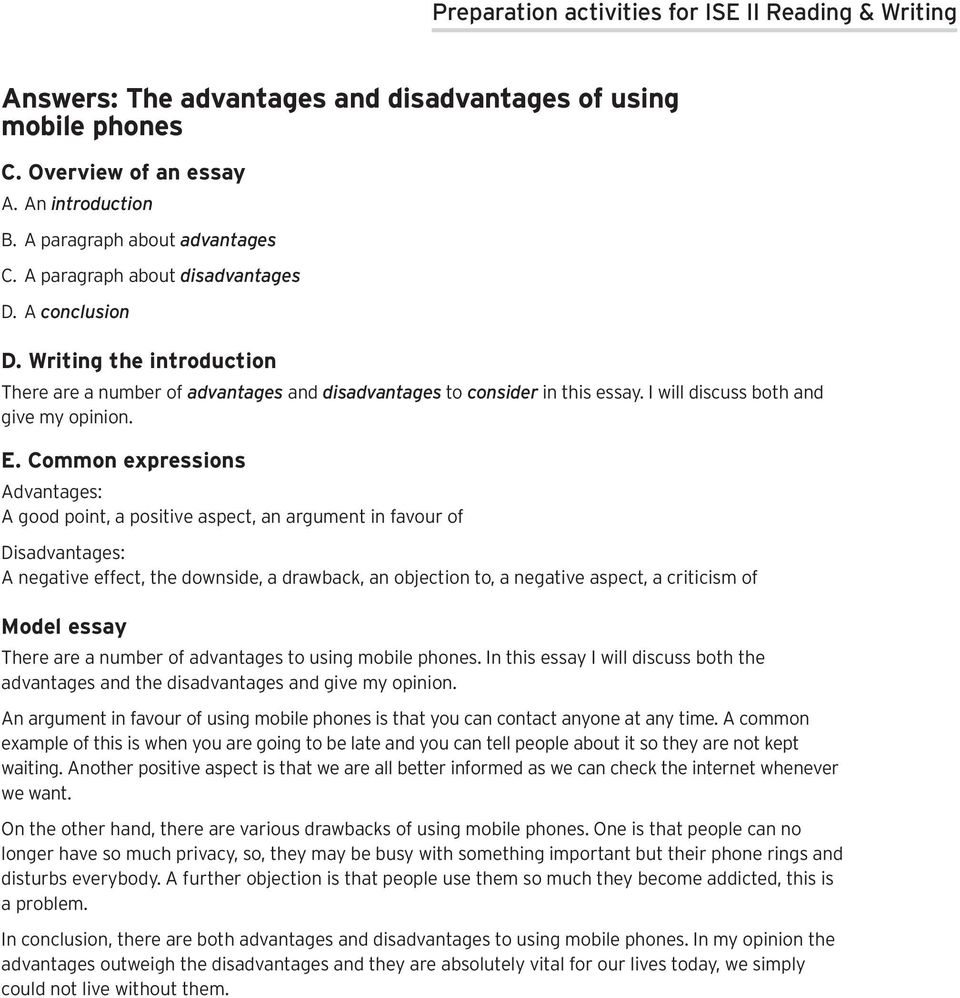
7 Answers: The advantages and disadvantages of using mobile phones C. Overview of an essay A. An introduction B. A paragraph about advantages C. A paragraph about disadvantages D. A conclusion D. Writing the introduction There are a number of advantages and disadvantages to consider in this essay. I will discuss both and give my opinion. E. Common expressions Advantages: A good point, a positive aspect, an argument in favour of Disadvantages: A negative effect, the downside, a drawback, an objection to, a negative aspect, a criticism of Model essay There are a number of advantages to using mobile phones. In this essay I will discuss both the advantages and the disadvantages and give my opinion. An argument in favour of using mobile phones is that you can contact anyone at any time. A common example of this is when you are going to be late and you can tell people about it so they are not kept waiting. Another positive aspect is that we are all better informed as we can check the internet whenever we want. On the other hand, there are various drawbacks of using mobile phones. One is that people can no longer have so much privacy, so, they may be busy with something important but their phone rings and disturbs everybody. A further objection is that people use them so much they become addicted, this is a problem. In conclusion, there are both advantages and disadvantages to using mobile phones. In my opinion the advantages outweigh the disadvantages and they are absolutely vital for our lives today, we simply could not live without them.
Task 3 Reading into Writing: Strict or Relaxed Parents?
 Task 3 Reading into Writing: Strict or Relaxed Parents? Reading & Writing At a glance Level: ISE I Focus: Task 3 Reading into writing Aims: To read information on a topic, write opinions and give advice
Independent Listening Task: Stereotypes
 At a glance Level: ISE III Independent Listening Task: Stereotypes Focus: Independent listening task Aims: To develop listening strategies when listening to a lecture on the use of stereotypes in education
Cambridge English: First (FCE) Writing Part 1
 Cambridge English: First (FCE) Writing Part 1 Teacher s notes Aims of the lesson to familiarise students with Part 1 of the Writing paper and give them practice at planning an essay Time needed 50 minutes
Topic Task: Preparing Students for Conversation in the Topic Task At a glance
 Topic Task: Preparing Students for Conversation in the Topic Task At a glance Level: ISE Foundation Focus: Topic task Aims: Developing skills in connected speech for the topic task and encouraging question
Task 3 Reading into Writing: Family Business
 At a glance Task 3 Reading into Writing: Family Business Level: ISE II Focus: Task 3 Reading into writing Aims: To familiarise students with the format of the reading questions of the ISE II Reading &
Collaborative Task: Just Another Day at the Office
 At a glance Level: ISE II Collaborative Task: Just Another Day at the Office Focus: Collaborative task Aims: To develop speaking skills by responding to prompts related to the workplace Objectives: To
Integrated Skills in English ISE I
 Integrated Skills in English ISE I Reading & Writing exam Sample paper 1 Your full name: (BLOCK CAPITALS) Candidate number: Centre: Time allowed: 2 hours Instructions to candidates 1. Write your name,
School. Lesson plan. Topic. Aims. Age group. Level. Time. Materials. School, school objects, rules, subjects, rooms and uniforms
 School Lesson plan Topic School, school objects, rules, subjects, rooms and uniforms Aims To practise (depending on stages chosen): vocabulary: words connected to school, school objects, rules, subjects,
Integrated Skills in English (ISE) Guide for Students ISE II (B2) Reading & Writing Speaking & Listening
 Integrated Skills in English (ISE) Guide for Students ISE II (B2) Reading & Writing Speaking & Listening Trinity College London www.trinitycollege.com Charity number 1014792 Patron HRH The Duke of Kent
Integrated Skills in English ISE II
 Integrated Skills in English ISE II Reading & Writing exam Sample paper 2 Your full name: (BLOCK CAPITALS) Candidate number: Centre: Time allowed: 2 hours Instructions to candidates 1. Write your name,
Integrated Skills in English (ISE) Guide for Students ISE II (B2) Reading & Writing Speaking & Listening
 Integrated Skills in English (ISE) Guide for Students ISE II (B2) Reading & Writing Speaking & Listening Trinity College London www.trinitycollege.com Charity number 1014792 Patron HRH The Duke of Kent
Words In The News. Teacher s pack Lesson plan and student worksheets with answers
 Words In The News Teacher s pack Lesson plan and student worksheets with answers Britain information blunder 21 November 2007 CONTENTS 1. Level, topic, language, aims, materials 2. Lesson stages 3. Student
Integrated Skills in English (ISE) Guide for Students ISE I (B1) Reading & Writing Speaking & Listening
 Integrated Skills in English (ISE) Guide for Students ISE I (B1) Reading & Writing Speaking & Listening Trinity College London www.trinitycollege.com Charity number 1014792 Patron HRH The Duke of Kent
Integrated Skills in English (ISE) Guide for Students ISE I (B1) Reading & Writing Speaking & Listening
 Integrated Skills in English (ISE) Guide for Students ISE I (B1) Reading & Writing Speaking & Listening Trinity College London www.trinitycollege.com Charity number 1014792 Patron HRH The Duke of Kent
Time: 3 x 45. Aims: To To To To. Resources and. Procedure: ISE II. minutes. Interactive Task. Basic. Next, Show. Task. After skills.
 Lesson plans for exam preparation ISE II Interview: Lesson Plan 3 ISE II (B2) Interview: preparing the Interactive Task Level: ISE II (CEFR B2) Time: 3 x 45 minutes Aims: To prepare for the Interactive
Verbal boxing by Matt Bryer
 Verbal boxing by Matt Bryer Age: Teenagers / Adults Level: Upper Intermediate / Advanced Time: Approx. 60 minutes Objective: To practise phrases used when expressing opinion; fluency Key skills: Speaking,
Teaching Public Speaking Online
 Teaching Public Speaking Online By Tim Sheldon Bryant & Stratton College January 27, 2009 I teach public speaking Online using PowerPoint audio, and it has proven to be as effective in developing speaking
Task 2 Multi-text reading: Interesting facts about butterflies
 Task 2 Multi-text reading: Interesting facts about butterflies Level: ISE III Focus: Task 2 Multi-text reading Aims: To read for gist and specific information and to deduce meaning from context Objectives:
TKT Module 1: Presentation techniques and introductory activities Teacher s Notes
 Teacher s Notes Description Participants discuss some different presentation techniques and introductory activities, which are tested in TKT Module 1 Part 3. They consider the advantages of some of these
Lesson Share TEACHER S NOTES. Making arrangements by Claire Gibbs. Activity sheet 1. Procedure. Lead-in. Worksheet.
 Lesson Share TECHER S NOTES Making arrangements by Claire Gibbs ge: Level: Time: im: Teenagers / dults Pre-intermediate 60 mins To practise functional language for making arrangements Key skills: Speaking
TKT: YL (Young Learners) Part 3: Using practice activities Trainer s notes
 TKT: YL (Young Learners) Part 3: Using practice activities Trainer s notes Description This session covers the area of knowledge using practice activities to consolidate children s language learning. Participants
Intro Lesson (Ages 8-14)
 Lesson: General: Age: Time: Objectives: Structures: Target Vocab: 8-14 years 40 mins - 1 hour Greetings, Asking & answering personal questions, using modal verbs for rules, Identifying different classroom
Task 2 Multi-Text Reading: Holidays and Travel
 At a glance Task 2 Multi-Text Reading: Holidays and Travel Level: ISE Foundation Focus: Task 2 Multi-text reading Aims: Developing strategies for multiple matching, answering true/false questions and note
To download the script for the listening go to: http://www.teachingenglish.org.uk/sites/teacheng/files/learning-stylesaudioscript.
 Learning styles Topic: Idioms Aims: - To apply listening skills to an audio extract of non-native speakers - To raise awareness of personal learning styles - To provide concrete learning aids to enable
Task 2 Multi-Text Reading: Bullying
 At a glance Level: ISE II Task 2 Multi-Text Reading: Bullying Focus: Task 2 Multi-text reading Aims: To develop reading strategies by reading a short article about four famous people and answering three
Integrated Skills in English (ISE) Guide for Students ISE Foundation (A2) Reading & Writing Speaking & Listening
 Integrated Skills in English (ISE) Guide for Students ISE Foundation (A2) Reading & Writing Speaking & Listening Trinity College London www.trinitycollege.com Charity number 1014792 Patron HRH The Duke
ESP MARKETING TEACHER S NOTES
 Teacher s notes: Level 2 (Upper Intermediate Advanced) ESP MARKETING TEACHER S NOTES Worksheet A Pre-reading 1: Discussion Get students to discuss ideas as a class or in groups and then note their suggestions
NORTON MEDICAL CENTRE PATIENT SURVEY OF NEW APPOINTMENT SYSTEM
 NORTON MEDICAL CENTRE PATIENT SURVEY OF NEW APPOINTMENT SYSTEM SUMMARY Responses were from both male and female patients from across the age spectrum. NB: Not all patients responded to the demographic
The Complete Educator s Guide to Using Skype effectively in the classroom
 The Complete Educator s Guide to Using Increasingly, educators globally are transforming their classroom using Skype to create powerful, authentic, motivating learning experiences for their students. From
Keep your English up to date 4. Teacher s pack Lesson plan and student worksheets with answers. Facebook
 Keep your English up to date 4 Teacher s pack Lesson plan and student worksheets with answers British Broadcasting Corporation 2008 Lesson Plan: Teacher's notes CONTENTS 1. Level, topic, language, aims,
An at a glance guide to GCSE orals for Arabic, Greek, Japanese and Russian
 An at a glance guide to GCSE orals for Arabic, Greek, Japanese and Russian Intro: Nick Page, a Principal Examiner for GCSE Russian Speaking has put together the following guidance to support you if you
Teacher's notes. Embedded question drill (indirect questions)
 Teacher's notes Embedded question drill (indirect questions) In this activtiy, groups of learners work together doing transformation drills (changing direct questions into embedded ones). The motivational
S. No. WHAT KIDS WANTS THEIR PARENTS TO KNOW. 1 Encourage me when I do a good job ! " #$ % & "
 1 Encourage me when I do a good job 2 Let me teach you some things. Don't always be the teacher! " #$ % & " '()&% 3 Don't show too much affection in public ( # &% 4 Let me take some risks; you did when
Digital Life 102 LESSON PLAN UNIT 1. Essential Question What is the place of digital media in our lives?
 LESSON PLAN Digital Life 102 UNIT 1 Essential Question What is the place of digital media in our lives? Lesson Overview Students test their knowledge of digital media and learn some statistics about media
Can you answer Milly s question and tell her why? Jot down your answers on a note pad, then check the answer key below.
 When you have to write a lesson plan is it sometimes difficult to write down your aims? This lesson will give you ideas on how to write better aims when you need to. Task 1 Milly s dilemma. Milly is asking
Look Inside For: 30 Family Handouts (one for each student)
 Part 2 of 2 Grades 5 6 Look Inside For: 30 Family Handouts (one for each student) 3 Bonus Activities How to use these materials: 1. Distribute these Bonus Activities to your students: Bonus Activity 1:
Lesson Plan Cover Page
 Lesson Plan Cover Page Name: Mehmet DURMAZ Date: May 9 th, 2013 Time: 10:40-11:30 Level: :Pre-intermediate Length of lesson: 50 mins Main focus of lesson: Reading a text related to birth order skills /
www.eslkidstuff.com Lesson Plans for ESL Kids Teachers
 You will need: Resources: CD / Tape player cushions (if you have enough floor space) name tags for each student glove puppet (for kids under 7) ball (for kids over 7) resources for whatever you are going
Integrated Skills in English (ISE) Guide for Students ISE III (C1) Reading & Writing Speaking & Listening
 Integrated Skills in English (ISE) Guide for Students ISE III (C1) Reading & Writing Speaking & Listening Trinity College London www.trinitycollege.com Charity number 1014792 Patron HRH The Duke of Kent
Teaching paraphrasing to year three (3) and four (4) students exhibiting reading difficulties will lead to increased reading comprehension
 Teaching paraphrasing to year three (3) and four (4) students exhibiting reading difficulties will lead to increased reading comprehension Teaching Unit Paraphrasing Grade Level: Grade three and four students
TIME MANAGEMENT ACTIVITY (LED BY GEAR UP MENTORS)
 (LED BY GEAR UP MENTORS) Purpose: Students will practice time management skills that are essential to college readiness. Grades: 6-10 WWW.GEARUP4LA.NET @GEARUP4LA TOPIC SCRIPT/ DIRECTIONS MATERIALS 1 copy
TeachingEnglish Lesson plans. Mobile phones. Topic: Mobile phones and text communications
 Mobile phones Topic: Mobile phones and text communications Aims: - To develop students understanding of telephone and text communications - To give students a chance to practise speaking Level: Pre-intermediate
PARAGRAPH ORGANIZATION 1 Worksheet 1: What is an introductory paragraph?
 PARAGRAPH ORGANIZATION 1 Worksheet 1: What is an introductory paragraph? Read the paragraph. This is the introductory paragraph for an essay. What is the title of the essay? a The oldest person in your
How To Blog About The Legality Of The U.S. Drone Program
 Blogging Legality INSTRUCTIONAL OBJECTIVES Students will be able to: understand the legal controversy surrounding the use of drone strikes outside traditional battlefields articulate and evaluate various
1 WARMER Complete the sentences using your own words. Use a dictionary to help you. Girls are. Boys are.
 1 WARMER Complete the sentences using your own words. Use a dictionary to help you. Girls are. Boys are. 2 WHAT DOES IT MEAN? Write the words next to their meanings. These words will help you understand
Quick Guide. Oral presentations. Four-step guide to preparing oral presentations. What is in this guide. Step 1: Plan
 Oral presentations What is in this guide Four-step guide to preparing oral presentations Step 1: Plan Step 2: Prepare Step 3: Practise Step 4: Present Reflecting on the presentation Oral presentations
Integrated Skills in English (ISE) Classroom Activities ISE III. Speaking & Listening
 Integrated Skills in English (ISE) Classroom Activities ISE III Speaking & Listening Contents Topic Page 1 Conversation Page 8 Conversation Page 13 Collaborative Page 17 Collaborative Page 24 Listening
a coat hanger a filing cabinet a post-it note a projector a sofa a water cooler a work station an exercise ball 7. 8.
 A A BUSINESS ISSUES Lesson code: J9M9-DQKC-VEHA PRE-INTERMEDIATE 1 In the office Match the words to the images: a coat hanger a filing cabinet a post-it note a projector a sofa a water cooler a work station
TeachingEnglish Lesson plans
 Socialising (1): Breaking the ice Topic: Socialising: Breaking the ice Aims: - To discuss and deal with some of the psychological issues connected with starting conversations with strangers; - To teach
GET THINKING. Lesson: Get Thinking Museums. Teacher s notes. Procedure
 Level: Intermediate + Age: Teenagers / Adult Time: 90 minutes + Language objectives: collocations, understanding vocabulary in context Key life skills: learner autonomy, giving feedback, social responsibility
Teaching Methodology Modules. Teaching Skills Modules
 3.3 Clarendon Park, Clumber Avenue, Nottingham, NG5 1DW, United Kingdom Tel: +44 115 969 2424. Fax: +44 115 962 1452. www.ilsenglish.com. Email: [email protected] Teacher Development Modules for Teachers
computer exam Evie Look back at the story and complete. Read and write Alex or Evie. Be careful Alex or you won t I didn t pass my.
 Worksheet Look back at the story and complete. I didn t pass my. computer exam If you don t, you don t. Be careful Alex or you won t. I It s always nice to make She s wearing. tennis.. To a? Alex Evie
parent ROADMAP SUPPORTING YOUR CHILD IN GRADE FIVE ENGLISH LANGUAGE ARTS
 TM parent ROADMAP SUPPORTING YOUR CHILD IN GRADE FIVE ENGLISH LANGUAGE ARTS 5 America s schools are working to provide higher quality instruction than ever before. The way we taught students in the past
Don t Buy It. Five Sites for Kids: Where Fun and Learning Click! 13
 Don t Buy It challenges kids to think critically about media and advertising. Show kids how to get to Don t Buy It from the Web site of your local PBS station. If the site is not linked to your local station
2013 Satisfaction Survey. How are we doing? Easier to Read Version
 2013 Satisfaction Survey How are we doing? Easier to Read Version We asked people some questions about their support. Here is some of what people said and the changes we will make. That someone who knows
How to complete the FCE Online Practice Test Free Sample: Reading
 First Certificate in English Online Practice Test Free Sample How to complete the FCE Online Practice Test Free Sample: Reading Welcome to the First Certificate in English Online Practice Test Free Sample.
Integrated Skills in English (ISE) Classroom Activities ISE II. Speaking & Listening
 Integrated Skills in English (ISE) Classroom Activities ISE II Speaking & Listening Contents Topic Page 1 Topic Page 6 Conversation Page 10 Conversation Page 16 Collaborative Page 24 Collaborative Page
Getting together. Present simple 1. New Year in Vietnam. Reading: Everybody s birthday. Word focus: Special occasions
 2 A Present simple 1 B Present simple: questions C Communication strategies Showing interest D Interaction Are you a people person? Getting together Present simple 1 Word focus: Special occasions 1 Work
Unit 1: Activities. Keynotes. Preview. Reading 1. Speaking UNIT OBJECTIVES
 UNIT 1 Unit 1: Activities UNIT OBJECTIVES Reading: Move over game boys Language: Present simple and continuous Vocabulary: Roles and activities Word building Career skills: Explaining your job Culture
Critical analysis. Be more critical! More analysis needed! That s what my tutors say about my essays. I m not really sure what they mean.
 Critical analysis Be more critical! More analysis needed! That s what my tutors say about my essays. I m not really sure what they mean. I thought I had written a really good assignment this time. I did
Information for candidates For exams from 2015
 Ready for success in study, work and life Information for candidates For exams from 2015 First Certificate in English (FCE) www.cambridgeenglish.org/first How to use this guide You can print this document
Reading for IELTS. About Reading for IELTS. Part 1: Vocabulary. Part 2: Practice exercises. Part 3: Exam practice. English for Exams.
 About Collins series has been designed to be easy to use, whether by learners studying at home on their own or in a classroom with a teacher: Instructions are easy to follow Exercises are carefully arranged
www.breaking News English.com Ready-to-use ESL / EFL Lessons
 www.breaking News English.com Ready-to-use ESL / EFL Lessons The Breaking News English.com Resource Book 1,000 Ideas & Activities For Language Teachers http://www.breakingnewsenglish.com/book.html Britney
IELTS Academic Writing Task 2 Activity teacher s notes
 IELTS Academic Writing Task 2 Activity teacher s notes Description An activity to introduce Academic Writing task 2, involving task analysis, idea generation, essay planning and language activation. Students
In praise of television: Worksheet
 In praise of television: Worksheet A Before reading the text A1 Questionnaire: How do you watch television? 1) How do you receive television programmes? (Choose as many as relevant) a) Directly, through
John Hanson Community School Homework Guidelines 2014-2015
 Homework is important because the evidence demonstrates that when it is set in a regular and meaningful manner it contributes to advances in student learning. So the setting of homework gives a learning
The benefits and challenges of wind energy
 Lesson Overview The benefits and challenges of wind energy In this lesson, students will evaluate the potential of wind energy in terms of its benefits and challenges. Students will use critical thinking
Complex Sentences. This icon indicates that detailed teacher s notes are available in the Notes Page.
 Complex Sentences This icon indicates that detailed teacher s notes are available in the Notes Page. This icon indicates the slide contains activities created in Flash. These activities are not editable.
This is a simple stage intended to introduce the lesson and some relevant lexis.
 Money conversations A good conversation lesson can often begin with the students not being sure what the topic of the day is. Not that we want to keep them in the dark for long, but it can get their attention
Integrated Skills in English ISE II
 Integrated Skills in English ISE II The Controlled Written examination Wednesday 18 April 2012 10.00am 12.00pm Your full name: (BLOCK CAPITALS) Candidate registration number: Centre: Time allowed: 2 hours
Addiction may be in our genes
 www.breaking News English.com Ready-to-use ESL/EFL Lessons by Sean Banville 1,000 IDEAS & ACTIVITIES FOR LANGUAGE TEACHERS The Breaking News English.com Resource Book http://www.breakingnewsenglish.com/book.html
LESSON 8 -- HOW DOES YOUR FAMILY SAVE??MONEY?
 LESSON 8 -- HOW DOES YOUR FAMILY SAVE??MONEY? LESSON DESCRIPTION AND BACKGROUND This lesson uses the Better Money Habits video Easy Ways to Save on Everyday Expenses (www.bettermoneyhabits.com) to discuss
Essay Question #1. Student s nationality: Japanese Date of correction: 11 December 2009
 Essay Question #1 Increasingly, the western world has been outsourcing its labour- related jobs to cheaper alternatives available in less developed countries. Although this creates opportunities for people
www.webanywhere.co.uk steps to a better school website A Webanywhere Free Guide
 5 steps to a better school website A Webanywhere Free Guide In the last five years, there has been a big change in the way schools are run. Now, more than ever, schools are essentially businesses, with
Arabic in first non-english web addresses
 www.breaking News English.com Ready-to-use ESL/EFL Lessons by Sean Banville 1,000 IDEAS & ACTIVITIES FOR LANGUAGE TEACHERS The Breaking News English.com Resource Book http://www.breakingnewsenglish.com/book.html
Learning English with CBC Radio Living in Alberta. Social Media: How Kids Use the Internet
 Learning English with CBC Radio Living in Alberta Social Media: How Kids Use the Internet by Maroro Zinyemba Project Manager: Justine Light Daylight Consulting Inc. Integration Enhancement Topic: Social
Here are six steps to help you solve problems: 1. Choose the problem 2.
 Everyone has problems from time to time. Facing and solving problems is a part of life. It is easy to feel stress when you have a problem. This stress can make psychosis worse. You can t avoid all problems,
The Truth About Commercials Writing a persuasive advertisement
 The The Truth About Commercials Writing a persuasive advertisement Grades: 5-6 Subjects: English, English As A Second Language, Media Literacy Overview Students will explore the language of persuasive
Marijuana: Download the Facts. Teaching Guide for Grades 7 12. Poster. Lesson Plans. Student Activity Reproducibles
 Grades 7 12 Aligns with National Standards Supplement to Scholastic Magazines. SCHOLASTIC and associated logos are trademarks and/or registered trademarks of Scholastic Inc. All rights reserved. 0-545-43680-X
Exam Skills. The Insider Guide to Trinity College London Examinations. By the Trinity College London Exam Board
 Exam Skills Insider Guides 1/8 Exam Skills The Insider Guide to Trinity College London Examinations The Graded Examinations in Spoken English (GESE) The Integrated Skills in English (ISE) By the Trinity
Lesson plan Literature is GREAT
 Literature is great Topic Education in the UK Level: Intermediate + Time: 90 minutes Objectives To give a short presentation about a book/novel that the student has read. To practise using idioms which
Political Science 1100-A American National Government Distance Education Online Course
 Political Science 1100-A American National Government Distance Education Online Course Instructor Information: Samantha Woolsey, Ph.D. Department of Political Science Email: use the Blackboard internal
Aligning Sales and Marketing - 5 Tips
 The Sales & Marketing Forum Sales are from Mars, Marketing are from Venus Practical steps to align sales and marketing for improved lead generation There are a number of examples in the B2B marketing space
Look at these pairs of adjectives used to describe personal qualities. Which pairs are positive, and which negative in meaning?
 Look at these pairs of adjectives used to describe personal qualities. Which pairs are positive, and which negative in meaning? 1. sensitive and thoughtful 2. dishonest and unreliable 3. mean and tight-fisted
TEST-TAKING STRATEGIES FOR READING
 TEST-TAKING STRATEGIES FOR READING For students who have enrolled in this class shortly before taking the reading proficiency exam, here are some helpful test-taking strategies you can use: 1. Always read
Learning Styles. The VARK Categories. What is a Learning Style?
 Learning Styles What is a Learning Style? Learning styles focus on how your brain receives information. No one else learns or processes information exactly the way you do! If you discover how you process
TKT Online. Self-study Guide
 TKT Online Self-study Guide TKT Online overview The Cambridge ESOL Teaching Knowledge Test (TKT) is a test of knowledge of concepts related to language, language use and the background to practical language
TeachingEnglish Lesson plans
 Worksheets Meetings (1): Getting down to business Reading: Text 1 Let s stop wasting time and get on with it! TeachingEnglish Lesson plans Did you know you can download a clock from the internet to calculate
QUESTION: How has the class helped you grow/change as a communicator in the world of work?
 QUESTION: How has the class helped you grow/change as a communicator in the world of work? The class helped me in knowing that it's ok to make mistakes as long as you learn by them. By learning the different
Elicit Me too and Me neither by asking students if they have a sister or brother (or dog, cat ) and then responding appropriately.
 All about me. Topic: Personal interests, likes and dislikes Aims: To help students focus on fluency when speaking To develop students communication skills To develop students listening skills Level: Pre-intermediate
Task 3 Reading into Writing: Endangered Animals
 At a glance Level: ISE II Task 3 Reading into Writing: Endangered Animals Focus: Task 3 Reading into writing Aims: To read information about endangered animals, to answer questions about the information
1 Time. 5 Answer the questions about yourself. Lesson 1: Time in your life. Listening 1
 Time Listening Lesson : Time in your life. Listen to the information about Linda and Huseyin. Are the sentences true or false? True False Linda likes the early morning. She usually checks her emails when
How to become a successful language learner
 How to become a successful language learner By Alison Fenner English and German Co-ordinator, Institution Wide Language Programme Introduction Your success in learning a language depends on you! You may
Saving and Investing
 Teacher's Guide $ Lesson Three Saving and Investing 07/13 saving and investing websites websites for saving and investing The internet is probably the most extensive and dynamic source of information in
Audience. 2 hours. n Appendix 1.1
 Lesson Plan 23 Choosing a job CLB Level(s): 5-6 CLB Skill(s): Speaking, Reading Essential Skill(s): Thinking Skills (Decision Making), Oral Communication Objective(s) n To explore decision making; brainstorming,