
From hot desks to the connected office Activity-Based Working is driving business outcomes
|
|
|
- Laurel Craig
- 10 years ago
- Views:
Transcription
1 From hot desks to the connected office Activity-Based Working is driving business outcomes
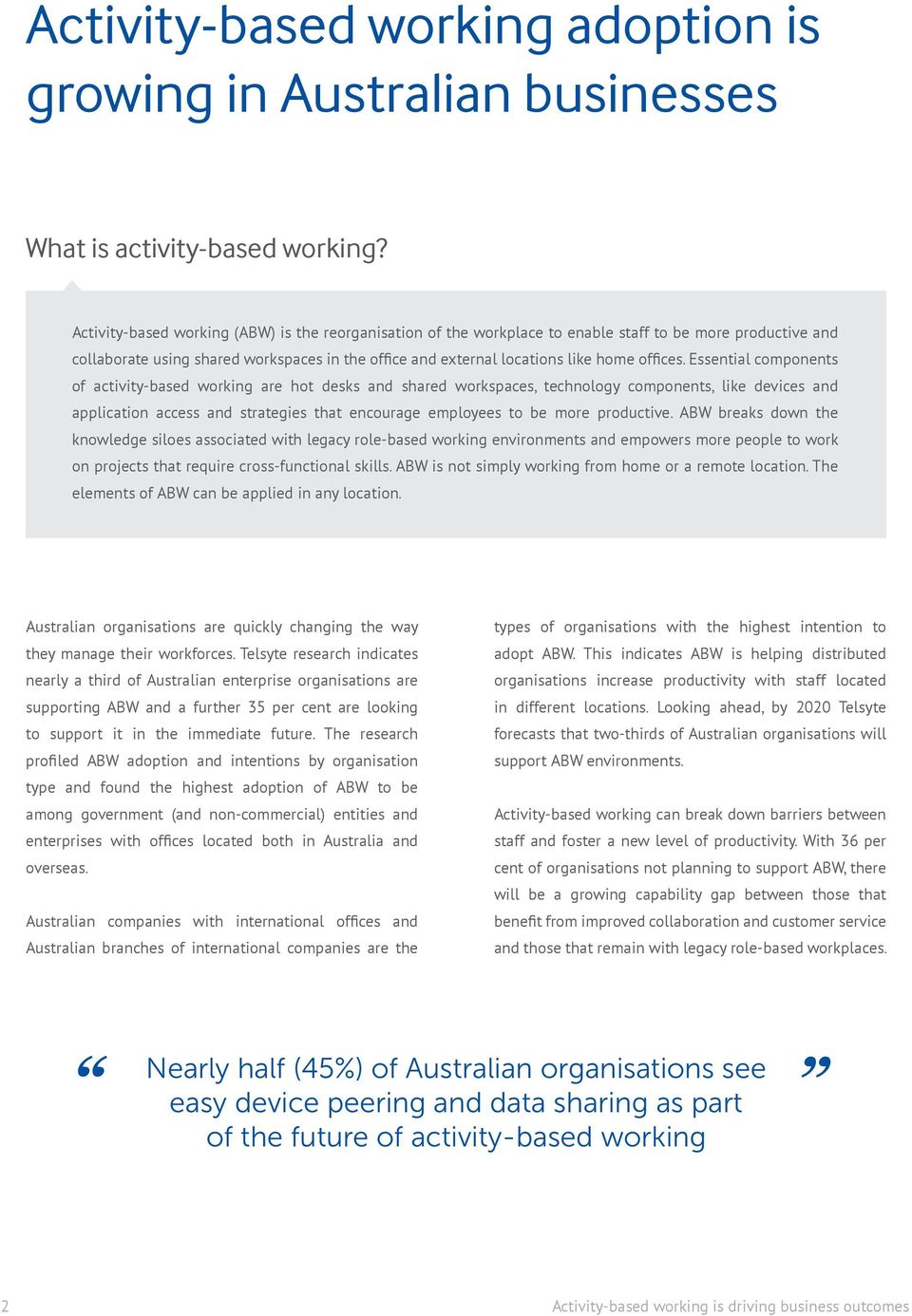
2 Activity-based working adoption is growing in Australian businesses What is activity-based working? Activity-based working (ABW) is the reorganisation of the workplace to enable staff to be more productive and collaborate using shared workspaces in the office and external locations like home offices. Essential components of activity-based working are hot desks and shared workspaces, technology components, like devices and application access and strategies that encourage employees to be more productive. ABW breaks down the knowledge siloes associated with legacy role-based working environments and empowers more people to work on projects that require cross-functional skills. ABW is not simply working from home or a remote location. The elements of ABW can be applied in any location. Australian organisations are quickly changing the way they manage their workforces. Telsyte research indicates nearly a third of Australian enterprise organisations are supporting ABW and a further 35 per cent are looking to support it in the immediate future. The research profiled ABW adoption and intentions by organisation type and found the highest adoption of ABW to be among government (and non-commercial) entities and enterprises with offices located both in Australia and overseas. Australian companies with international offices and Australian branches of international companies are the types of organisations with the highest intention to adopt ABW. This indicates ABW is helping distributed organisations increase productivity with staff located in different locations. Looking ahead, by 2020 Telsyte forecasts that two-thirds of Australian organisations will support ABW environments. Activity-based working can break down barriers between staff and foster a new level of productivity. With 36 per cent of organisations not planning to support ABW, there will be a growing capability gap between those that benefit from improved collaboration and customer service and those that remain with legacy role-based workplaces. Nearly half (45%) of Australian organisations see easy device peering and data sharing as part of the future of activity-based working 2 Activity-based working is driving business outcomes
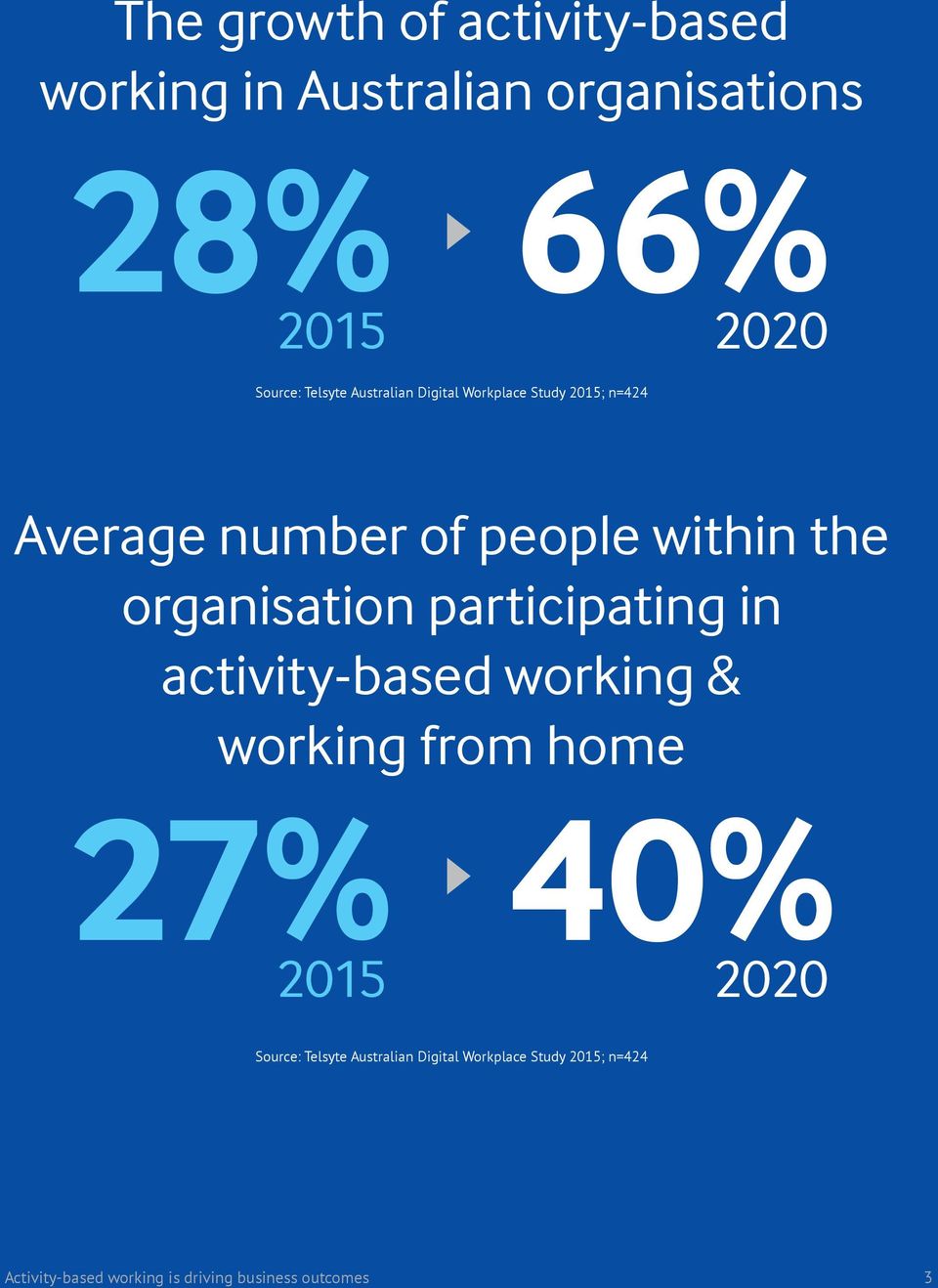
3 The growth of activity-based working in Australian organisations 28% % 2020 Source: Telsyte Australian Digital Workplace Study 2015; n=424 Average number of people within the organisation participating in activity-based working & working from home 27% % 2020 Source: Telsyte Australian Digital Workplace Study 2015; n=424 Activity-based working is driving business outcomes 3
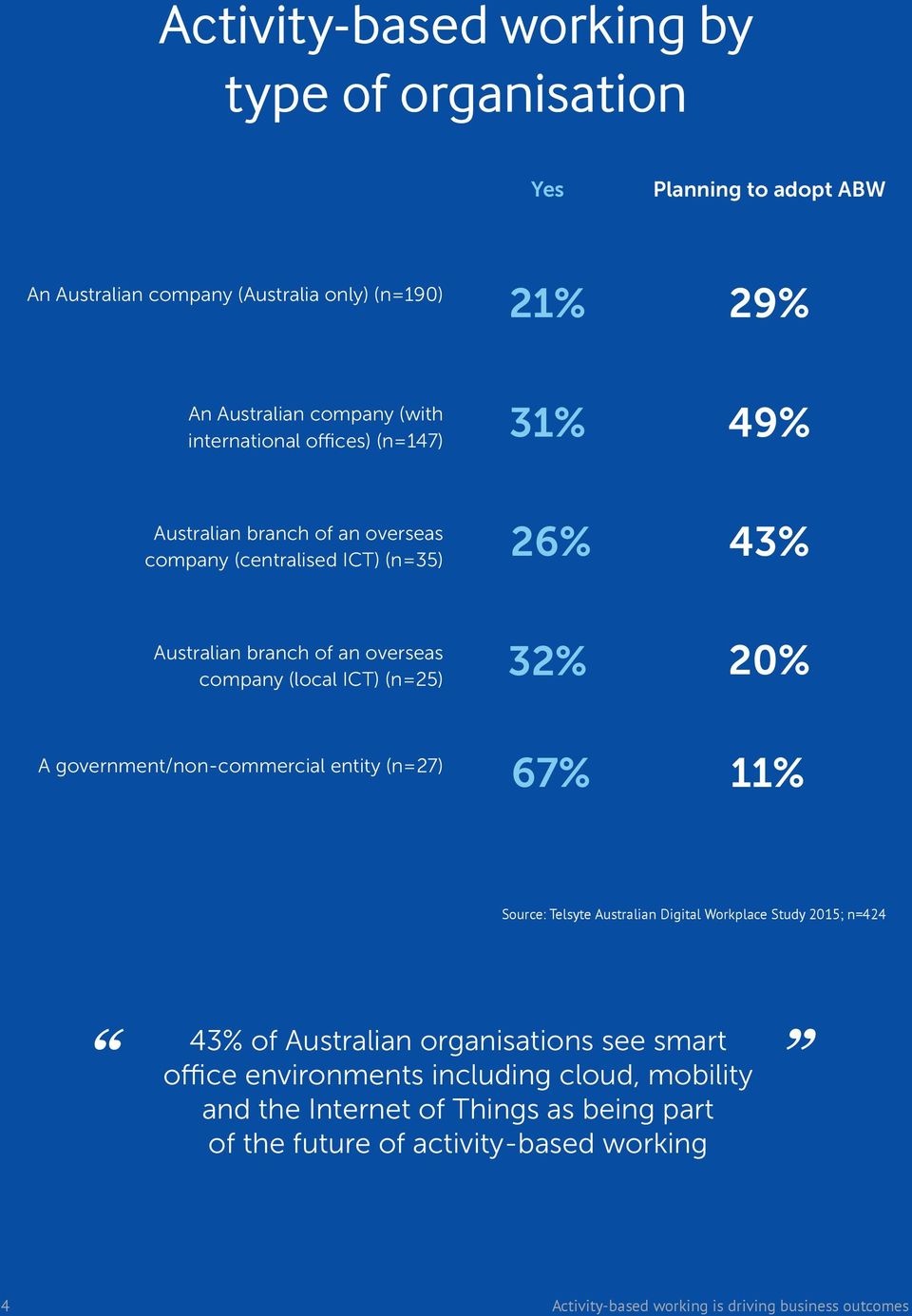
4 Activity-based working by type of organisation Yes Planning to adopt ABW An Australian company (Australia only) (n=190) 21% 29% An Australian company (with 31% 49% international offices) (n=147) Australian branch of an overseas 26% 43% company (centralised ICT) (n=35) Australian branch of an overseas company (local ICT) (n=25) 32% 20% A government/non-commercial entity (n=27) 67% 11% Source: Telsyte Australian Digital Workplace Study 2015; n=424 43% of Australian organisations see smart office environments including cloud, mobility and the Internet of Things as being part of the future of activity-based working 4 Activity-based working is driving business outcomes
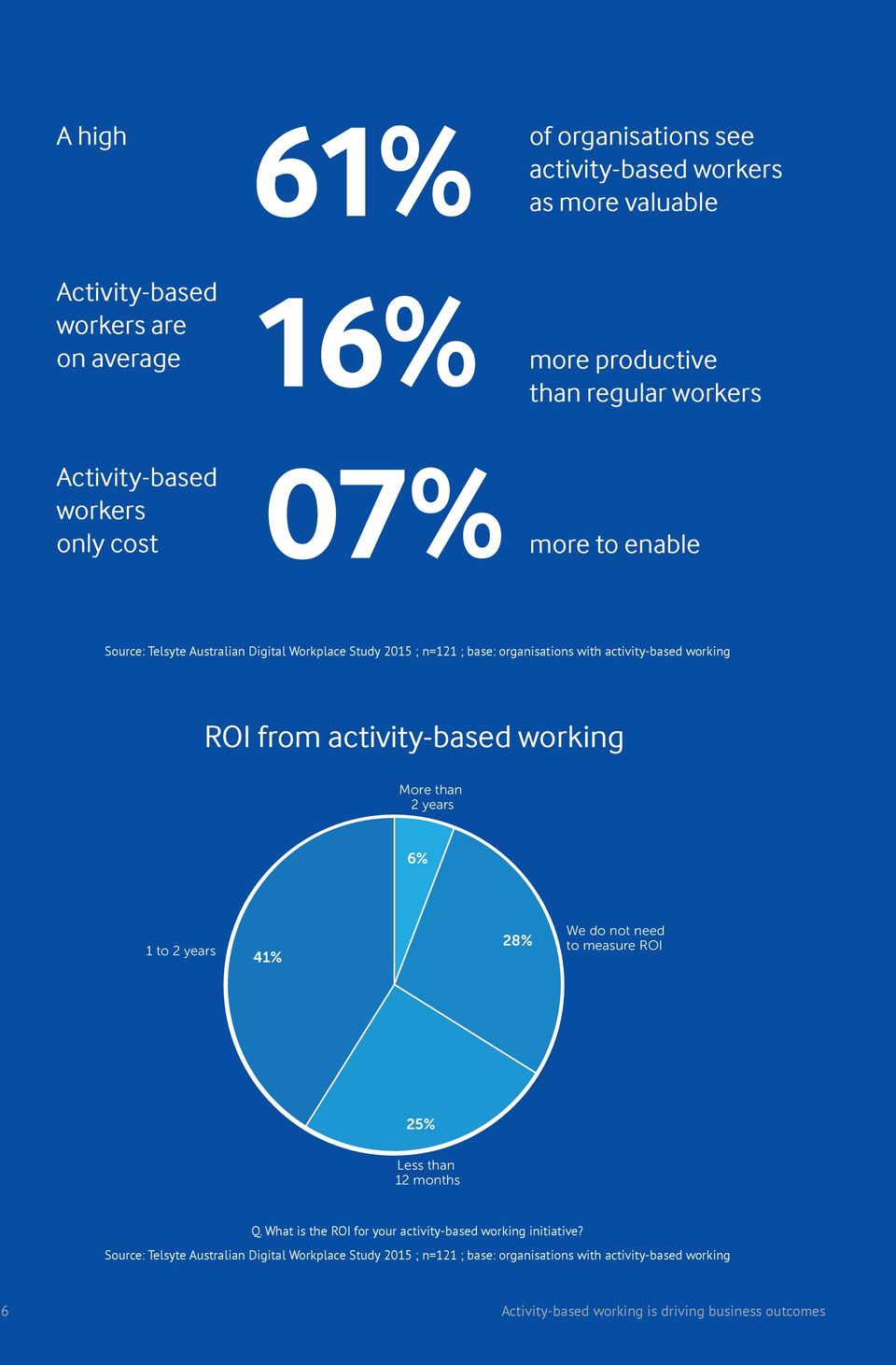
5 Activity-based workers more productive, deliver faster ROI Research is showing that organisations that have invested in activity-based working are experiencing immediate productivity and financial benefits. Activity-based working is also adding value to Australian organisations through increased productivity and better knowledge sharing. How is activity-based working value measured? Better employee productivity Lower real estate and fixed costs Lower operating expenditure (e.g. power savings) Higher job satisfaction Better collaboration Telsyte research found activity-based working adds value in 61 per cent of organisations that have adopted it and, on average, the productivity of an activity-based working employee is seen as 16 per cent more than a regular employee. This is equivalent to an extra 6.4 hours per week per ABW employee. In addition to the tangible time-saving benefits, staff in ABW organisations have shown greater job satisfaction, as seen by one large Australian bank where most staff did not want to return to their old way of working. To determine the costs involved and potential business benefit of activity-based working, Telsyte investigated the relative cost per employee organisations have experienced. Organisations report the cost to enable an activity-based working employee is on average only 7 per cent more than a regular employee. The return on investment (ROI) among organisations that have adopted activity-based working is also strong with 25 per cent of organisations stating they experience a return on their investment in less than 12 months. Additionally, 66 per cent of organisations surveyed by Telsyte see a payback within two years with the average ROI term being around 15 months. Activity-based working is driving business outcomes 5

6 A high 61% of organisations see activity-based workers as more valuable Activity-based workers are on average 16% more productive than regular workers Activity-based workers only cost 07% more to enable Source: Telsyte Australian Digital Workplace Study 2015 ; n=121 ; base: organisations with activity-based working ROI from activity-based working More than 2 years 6% 1 to 2 years 41% 28% We do not need to measure ROI 25% Less than 12 months Q. What is the ROI for your activity-based working initiative? Source: Telsyte Australian Digital Workplace Study 2015 ; n=121 ; base: organisations with activity-based working 6 Activity-based working is driving business outcomes
7 Activity-based working drives better customer engagement Telsyte s research also investigated how activity-based working is adding value to organisation s customer engagement. Nearly one-third of IT and business leaders with activity-based working environments focused on customer service said their business is able to better engage and service customers with ABW. 55% agree staff have better knowledge of customer requirements because of ABW 60% agree staff are able to better engage with customers because of ABW 59% say ABW enables better customer account management 61% of IT and business decision makers agree that real-time customer engagement is enhanced because of ABW Another key change in customer engagement resulting from activity-based working is better knowledge of customer requirements. This is another example of how activity-based working can improve information sharing and knowledge collaboration. Essential components of ABW: Mobility is key 64% Smartphones 60% Notebooks 56% Wireless Network 55% Tablets 33% Desktop PCs 49% Office (design/layout) 31% Furniture (desks/chairs) 37% Headsets 31% Displays Q. Which of the following items do you consider part of an activity-based working system? Source: Telsyte Digital Workplace Study 2015; n=121; base: businesses that support ABW Activity-based working is driving business outcomes 7

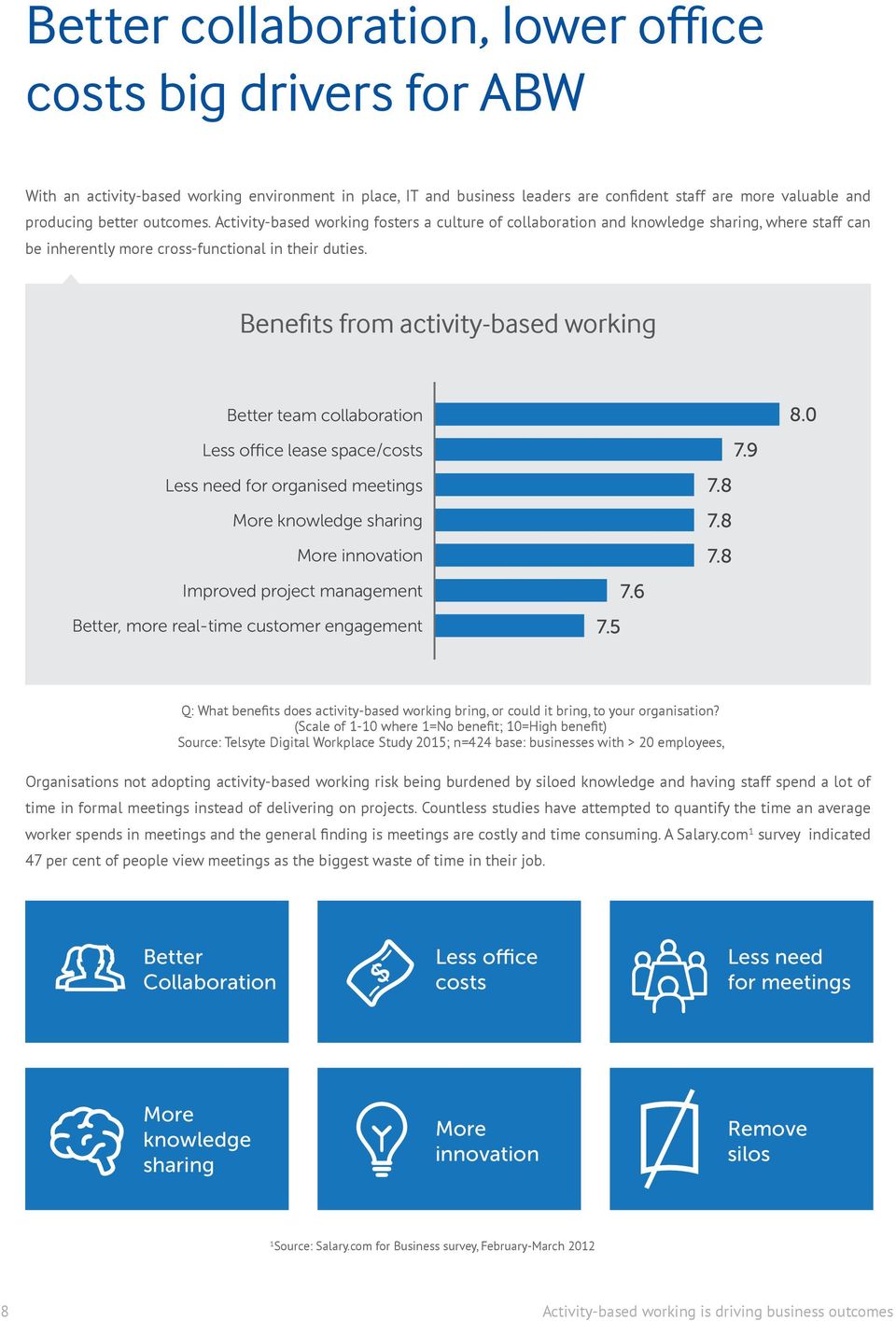
8 Better collaboration, lower office costs big drivers for ABW With an activity-based working environment in place, IT and business leaders are confident staff are more valuable and producing better outcomes. Activity-based working fosters a culture of collaboration and knowledge sharing, where staff can be inherently more cross-functional in their duties. Benefits from activity-based working Better team collaboration Less office lease space/costs Less need for organised meetings More knowledge sharing More innovation Improved project management Better, more real-time customer engagement Q: What benefits does activity-based working bring, or could it bring, to your organisation? (Scale of 1-10 where 1=No benefit; 10=High benefit) Source: Telsyte Digital Workplace Study 2015; n=424 base: businesses with > 20 employees, Organisations not adopting activity-based working risk being burdened by siloed knowledge and having staff spend a lot of time in formal meetings instead of delivering on projects. Countless studies have attempted to quantify the time an average worker spends in meetings and the general finding is meetings are costly and time consuming. A Salary.com 1 survey indicated 47 per cent of people view meetings as the biggest waste of time in their job. Better Collaboration Less office costs Less need for meetings More knowledge sharing More innovation Remove silos 1 Source: Salary.com for Business survey, February-March Activity-based working is driving business outcomes
9 The costs associated with enabling activity-based working involve a combination of shared office space, including hot desks, and technology like wireless networks, devices and software to allow people to collaborate on projects. However, an interesting finding from Telsyte s research is that almost one in five IT and business leaders reported cost reductions associated with activity-based working enablement. The most immediate financial return organisations can experience with activity-based working is reduced office space and IT infrastructure requirements. For example, office rent in Australia s largest city, Sydney, can vary between $650 and $1300 per square metre 2, giving strong incentive to businesses to minimise wasted space. By enabling a more mobile workforce, including hot desks in the office, organisations can reduce their office space requirements and costs. Activity-based working enablement Office fit-out Devices Networks Application access Activity-based working benefits Reduced office lease space Increased productivity Better customer engagement Resource collaboration Any program to implement activity-based working should consider both the tangible and intangible benefits it can bring, including better team collaboration and reduced office space. 2 Source: Sydney CBD Office Spotlight, Savills Research, October 2014 Activity-based working is driving business outcomes 9

10 Company culture biggest barrier to activity-based working The success of an activity-based working program depends on a combination of the technology enablement and the culture of an organisation. Activity-based working is a good example of a business process that involves cooperation between business leaders, staff and technology. As activity-based working matures, there will be more options for connected devices and office equipment to become more crucial productivity enablers. Both IT and business leaders believe company culture is the most important factor for the success of activity-based working, indicating many organisations need to fundamentally change the way work is done. Organisations need to overcome the resistance to change from staff, and managers need to emphasise the benefits of team work and mobility. Other changes such as a personalised digital environment, like workspace profiles, can handle the concern staff have about not having a personal desk or workspace. Organisations can also practice rotation systems where people use a shared workspace on certain days of the week. Barriers to activity-based working Staff prefer role-based working and their own desk 6.5 Company culture, hierarchy Security concerns Business unit managers need to approve it Skills, knowledge to implement it Ability of network (wired or wireless) to support it 6.2 Q. What are the biggest barriers to activity-based working in your organisation? (Scale of 1-10 where 1=Not a barrier; 10=High barrier) Source: Telsyte Australian Digital Workplace Study 2015 ; n=424 ; base: organisations with more than 20 employees 10 Activity-based working is driving business outcomes

11 Most important components to the success of activity-based working Business processes Technology 12% 15% Company culture 37% 36% People/staff Q: What is most important to the success of activity-based working? Source: Telsyte Australian Digital Workplace Study 2015; n=424 ; base: organisations with more than 20 employees Cultural aspects inhibiting uptake of activity-based working Most staff work independently Most staff want their own workspace 40% 43% Senior management don t see the value 34% Lines of business are largely role-based 24% Our business is not suitable 13% Q: What are some of the cultural aspects of your organisation that are inhibiting the uptake of activity-based working? Source: Telsyte Australian Digital Workplace Study 2015 ; n=424 ; base: organisations with more than 20 employees (multiple response) Activity-based working is driving business outcomes 11

12 As most staff are used to working independently in their own workspaces, business leaders need to promote the benefits of shared workspaces, and if possible reorganise the business to be less siloed. With activity-based working becoming more connected and integrated with the wider technology landscape in the future, Telsyte recommends early IT involvement in activity-based working initiatives driven by the business. Activity-based working represents a good opportunity for the CIO and IT leadership team to demonstrate how the application of new technology can change the way people work for the better. Roles best suited to ABW IT staff Operations staff Marketing staff Middle management Sales representatives Accountants Field workers Customer service Senior management HR/Finance managers All staff 11% 13% 16% 28% 26% 25% 23% 22% 20% 35% 46% Q. Which roles in your organisation are best suited to activity-based working? Source: Telsyte Digital Workplace Study 2015; n=121; base: businesses that support ABW (multiple response) 12 Activity-based working is driving business outcomes

13 Recommendations Australian business and IT leaders have a real opportunity to change the way staff work. Access to the right tools and resources is just the first step to unlocking this potential. If structured, centralised working is the only approach an organisation has taken for staff management, opening up to a more flexible, collaborative environment can drive positive change and innovation. Telsyte recommends a number of steps organisations can take to develop an activity-based working environment. Step 1: Identify Start by reviewing work spaces and determine how activity-based working can improve the existing environment. Develop an activity-based working plan for the office and provide the essentials of power, devices, networking and display technology at any location. Step 2: Trial Set up a number of hot desks in the office and invite staff to use them at their convenience. Trial ABW with projects that require cross-functional skills. Step 3: Develop With the future of activity-based working becoming more connected and integrated with the wider technology landscape, IT involvement in activity-based working initiatives is an imperative even if decisions are driven by the business. Continue to develop your ABW environment with staff input, taking onboard feedback on the resources and technology they need to improve their output. The path to changing ABW cultural barriers Communicate. To overcome barriers to activity-based working like company culture and security concerns, IT and business leaders must get staff and business unit managers involved from the outset and communicate the benefits to both individuals and the wider organisation. Consider all benefits. Consider both the tangible and intangible benefits activity-based working can bring as part of the business case and plan for reduced office space. Set expectations and address culture. Company culture is the most important factor for the success of activity-based working, indicating many organisations need to change their approach to how work is performed, including the expectations of staff with regard to their own offices and workspaces. Collaborate. With most staff used to working independently in their own workspaces, business leaders need to promote teamwork, the benefits of shared workspaces and how the business can be re-organised to be less siloed. Developing an activity-based working environment can lead to both tangible cost savings and improvements in quality and productivity in your organisation. Activity-based working is driving business outcomes 13

14 About this report This report was commissioned by Samsung and independently produced by Telsyte. The report offers advice on how business and IT leaders can best prepare and take advantage of changing employee demands associated with activity-based working. The research contained in this report will help empower IT and business leaders to develop a business case to invest in activitybased working initiatives. The report provides comparative productivity and return on investment metrics as experienced by Australian organisations already managing activity-based working. The report also includes recommended steps towards creating an activity-based working environment that delivers business benefits. Telsyte research respondent profile The primary research contained in this report is sourced from the Telsyte Australian Digital Workplace Study The findings are based on an online survey of 424 IT and business decision makers in Australian organisations with between 20 to 20,000+ staff across a representative sample of vertical industries. The survey topics covered a range of business ICT software and technologies and trends, including workplace changes. Respondents identified their key business challenges, technology use and intentions, views on devices, the workplace and mobility. About Samsung About Telsyte Samsung Electronics Co., Ltd. inspires the world and shapes the future with transformative ideas and technologies, redefining the worlds of TVs, smartphones, wearable devices, tablets, cameras, digital appliances, printers, medical equipment, network systems and semiconductors. We are also leading in the Internet of Things space through, among others, our Digital Health and Smart Home initiatives. We employ 307,000 people across 84 countries. Telsyte delivers strategic insights and advisory services to businesses that are producing, or are impacted by, disruptive technologies. Telsyte publishes studies into emerging consumer and business markets and provides custom research and advisory services. Telsyte is a whollyowned, independent business unit of UXC Limited. UXC is an ASX- listed Australian IT services company and the largest Australian-owned ICT consultancy firm with over 2,500 customer organisations in the private and public sectors across Australasia. To discover more, please visit our official website at and our official blog at global.samsungtomorrow.com. T: E: [email protected] For more information about Telsyte, please visit 14 Activity-based working is driving business outcomes

15 Report licence and disclaimer The content in this report is copyright protected, and is property of Telsyte. The contents in this report cannot be re-purposed for re-sale by any organisation. The content in this report is copyright protected and not intended to be altered, copied, distributed, or used for any commercial or non commercial purpose, except for news reporting, comment, criticism, teaching or scholarship. Any non-commercial citations, including media, must include Telsyte as the source of the data. All surveys, forecasts, projections and recommendations made in this study are made in good faith on the basis of information available to Telsyte at the time; and Telsyte disclaims any liability for any loss or damage caused by errors or omissions, whether such errors or omissions resulted from negligence, accident or other causes. Neither Telsyte nor its agents will be liable for any loss or other consequences (whether or not due to the negligence of Telsyte or its agents) arising out of use of information in this report.
Cloud creates path to profitability for Australian businesses. A complimentary report from cloud-based business management software provider NetSuite
 Cloud creates path to profitability for Australian businesses A complimentary report from cloud-based business management software provider NetSuite Introduction Australian businesses are facing a dynamic
Samsung Enterprise Alliance Program
 Samsung Enterprise Alliance Program Samsung Enterprise Alliance Program (SEAP) provides access to the tools and resources needed to develop, market, and sell rich, secure solutions on Samsung mobile devices.
NEC Contact Centres (Genesys)
 Customisable and scalable solutions with enhanced functionality NEC Contact Centres (Genesys) On-premise or Cloud Solutions NEC Australia nec.com.au NEC supports more than 10,000 Genesys-based agent seats
Understanding the Benefits of Unified Communications
 Understanding the Benefits of Unified Communications Overview Increasing operating efficiencies is more important than ever in today s business. Competitive pressures force organizations to improve processes
The changing role of the IT department in a cloud-based world. Vodafone Power to you
 The changing role of the IT department in a cloud-based world Vodafone Power to you 02 Introduction With competitive pressures intensifying and the pace of innovation accelerating, recognising key trends,
The retailers guide to data discovery
 The retailers guide to data discovery How smart retailers are using visual data discovery to search for actionable insights that boost profits and help them understand their customers next move quicker
Fujitsu in Energy & Utilities
 Fujitsu in Energy & Utilities shaping tomorrow with you Winds of Change The pace of change in the energy and utilities industries is increasing rapidly. Pressure is coming from all sides: Regulatory compliance
CIBECS / IDG Connect DATA LOSS SURVEY. The latest statistics and trends around user data protection for business. www.cibecs.
 CIBECS / IDG Connect 2014 DATA LOSS SURVEY The latest statistics and trends around user data protection for business. REPORT www.cibecs.com 2 Table of ontents EXECUTIVE 01 02 03 04 05 06 SUMMARY WHO PARTICIPATED
NEC Cloud Collaboration A simple four-step process to your ideal, cloud-based unified communications and collaboration solution.
 NEC Cloud Collaboration A simple four-step process to your ideal, cloud-based unified communications and collaboration solution. NEC Australia au.nec.com Communication and collaboration. Your way. Modern
04 Executive Summary. 08 What is a BI Strategy. 10 BI Strategy Overview. 24 Getting Started. 28 How SAP Can Help. 33 More Information
 1 BI STRATEGY 3 04 Executive Summary 08 What is a BI Strategy 10 BI Strategy Overview 24 Getting Started 28 How SAP Can Help 33 More Information 5 EXECUTIVE SUMMARY EXECUTIVE SUMMARY TOP 10 BUSINESS PRIORITIES
Enterprise mobility trends 2015 and beyond
 Sponsored by >> Whitepaper Enterprise mobility trends 2015 and beyond How to best manage mobile in the workplace and deal with challenges from current and emerging technologies FEBRUARY 2015 resources
RXP SERVICES LIMITED ABN 30 146 959 917. Release to Australian Stock Exchange
 RXP Services Limited Level 9, 406 Collins Street MELBOURNE VIC 3000 Phone +61 3 8256 4855 www.rxpservices.com.au RXP SERVICES LIMITED ABN 30 146 959 917 Release to Australian Stock Exchange 8 April 2014
10/10. Fortescue Metals Group VDI Case Study. The Dashboard. Overview. Key Findings. Recommendations
 1 Fortescue Metals Group VDI Case Study By Trevor Clarke, Lead Analyst Asia Pacific Overview This Tech Research Asia end user case study analyses the adoption of a Citrix virtual desktop infrastructure
Samsung 2bit 3D V-NAND technology
 Samsung 2bit 3D V-NAND technology Gain more capacity, speed, endurance and power efficiency Traditional NAND technology cannot keep pace with growing data demands Introduction Data traffic continues to
The 2015 Cloud Readiness Survey for Australian Accounting Firms
 The 2015 Cloud Readiness Survey for Australian Accounting Firms HOW FAR HAVE ACCOUNTANTS TRAVELLED TOWARDS CLOUD ACCOUNTING? A DIGITAL FIRST REPORT FOR SAGE AUSTRALIA Contents Cloud Readiness Survey 1
Digital Strategy. Digital Strategy. 2015 CGI IT UK Ltd. Digital Innovation. Enablement Services
 Digital Strategy Digital Strategy Digital Innovation Enablement Services 2015 CGI IT UK Ltd. Contents Digital strategy overview Business drivers Anatomy of a solution Digital strategy in practice Delivery
combining innovative business IT services and consumer technology to inspire the new digital economy The Atos Samsung Alliance
 The Atos Samsung Alliance combining innovative business IT services and consumer technology to inspire the new digital economy Your business technologists. Powering progress The Atos and Samsung alliance
Education about and for S u s ta i n a b i l i t y i n A u s t r a l i a n B u s i n e s s
 Education about and for S u s ta i n a b i l i t y i n A u s t r a l i a n B u s i n e s s Schools STAGE 3 An action research program EXECUTIVE SUMMARY The full report explores the outcomes and discusses
Peer Research Report Insights on the Current State of BYOD
 october 2012 Peer Research Report Insights on the Current State of BYOD Intel s IT Manager Survey Why You Should Read This Document Find out how IT managers across four countries are looking at Bring Your
OVERVIEW OPTUS CONTACT CENTRE AS A SERVICE (CCaaS) CUSTOMER SERVICE, DELIVERED. With Optus Contact Centre As a Service (CCaaS)
 OVERVIEW OPTUS CONTACT CENTRE AS A SERVICE (CCaaS) CUSTOMER SERVICE, DELIVERED With Optus Contact Centre As a Service (CCaaS) CONTENTS ARE YOU READY FOR YOUR CUSTOMERS? 02 THERE S A BETTER WAY 02 HOW CCaaS
Time better spent. Take your organisation somewhere new with Fujitsu Mobile Business Solutions. Reshaping ICT, Reshaping Business
 Time better spent Take your organisation somewhere new with Fujitsu Mobile Business Solutions. Reshaping ICT, Reshaping Business Welcome to What would it mean to your organisation if your people were able
Demand management of electric vehicle charging using Victoria s Smart Grid
 Demand management of electric vehicle charging using Victoria s Smart Grid Demand management of electric vehicle charging using Victoria s Smart Grid Project report May 2013 2013. All Rights Reserved.
THE ROAD AHEAD REPORT:
 2012 THE ROAD AHEAD REPORT: The Future of Field Service Delivery EXECUTIVE SUMMARY THE ROAD AHEAD: The Future of Field Service Delivery The 2012 Future of Field Service Delivery report investigates how
The Australian Public Service Big Data Strategy
 The Australian Public Service Big Data Strategy Improved understanding through enhanced data-analytics capability AIIA response March 2014 Contact for this submission: Suzanne Roche 39 Torrens St Braddon
video communications the foundation for enterprise mobility + + + + + +
 v R video communications the foundation for enterprise mobility executive summary Video at the heart of mobility In order to meet the advanced requirements of an enterprise, mobility must be taken to the
Connect Renfrewshire
 How the council will use its information and technology assets to achieve successful change Contents Strategy Context 2 Digital Delivery and Citizen Engagement 4 Operational Excellence and Transformation
The End of a Cost Centre - Transform Enterprise Printing into Competitive Advantage
 The End of a Cost Centre - Transform Enterprise Printing into Competitive Advantage Xerox Event, Riyadh, 14 May 2012 Tobias Kleu Research Manager Imaging and Hardcopy Peripherals, Print Services & Document
Discovering the Value of Unified Communications
 Research Publication Date: 12 February 2007 ID Number: G00144673 Discovering the Value of Unified Communications Bern Elliot, Steve Cramoysan Unified communications represent a broad range of new solutions
Best Practices for Planning and Budgeting. A white paper prepared by PROPHIX Software October 2006
 A white paper prepared by PROPHIX Software October 2006 Executive Summary The continual changes in the business climate constantly challenge companies to find more effective business practices. However,
How To Make Money From Your Desktop Virtualisation
 Shaping the future of end user services Desktop Virtualisation Seize opportunities before others see them Remember the not-too-distant past?» Traditional thin client systems struggled to gain wide acceptance,
SAMSUNG INTERACTIVE WHITEBOARD SOLUTION
 SAMSUNG INTERACTIVE WHITEBOARD SOLUTION Revolutionize the classroom with a complete solution Technology is driving radical changes within education that foster better and faster learning outcomes from
A Getronics Whitepaper NEW WORLD NEW BEHAVIOUR NEW SUPPORT
 A Getronics Whitepaper NEW WORLD NEW BEHAVIOUR NEW SUPPORT NEW WORLD NEW BEHAVIOUR NEW SUPPORT We see a new world of work beginning to emerge, driving some big changes in the world of ICT support. These
Samsung LYNK SINC 3.0
 Samsung LYNK SINC 3.0 Optimized TV content management solution for an elevated guest experience over an IP-based infrastructure Highlights Choose from user interfaces (UIs) to create a customized property
Application Value Assessment
 Value Assessment Journey to Realising the Value of an Organisation s Portfolio Fujitsu UK & Ireland - Business & Services By Chris Waite, Fujitsu Businesses today operate in highly competitive environments
INTERIM LIBRARY STRATEGIC PLAN 2013-2017
 INTERIM LIBRARY STRATEGIC PLAN 2013-2017 CONTENT THE LIBRARY IN THE UNIVERSITY CONTEXT Page 2 RATIONALE FOR CHANGE Page 2 LIBRARY MISSION AND VISION Page 4 STRATEGIC OUTLOOK Page 5 THE LIBRARY IN THE UNIVERSITY
combining innovative business IT services and consumer technology to inspire the new digital economy The Atos Samsung Alliance
 The Atos Samsung Alliance combining innovative business IT services and consumer technology to inspire the new digital economy Your business technologists. Powering progress The Atos and Samsung alliance
Your Mobility Strategy Guide Book
 The fast adoption in the use of mobile devices to access work files, data and customer information requires companies to deepen their understanding about how to create a balance between flexibility and
Overview. Introduction. Purpose. Goal. Perspectives (of our goal) Strategic Direction. Connected
 2 South Australia Connected Introduction Government is in the connections business. Everything we do ultimately comes down to better connecting the people of South Australia with the things they want and
ICT Benchmarking: Better Practice Roadmap
 ICT Benchmarking: Better Practice Roadmap PART 1 VERSION 1.0 ICT Benchmarking: Better Practice Roadmap 1 Licensing The Department of Finance and Deregulation is licensed to use, reproduce, adapt, modify,
INTERNET OF THINGS: SCIENCE FICTION OR BUSINESS FACT?
 A HARVARD BUSINESS REVIEW ANALYTIC SERVICES REPORT INTERNET OF THINGS: SCIENCE FICTION OR BUSINESS FACT? Copyright 2014 Harvard Business School Publishing. sponsored by SPONSOR PERSPECTIVE Each year the
Best practices for planning and budgeting. A white paper prepared by Prophix
 A white paper prepared by Prophix Executive summary The continual changes in the business climate constantly challenge companies to find more effective business practices. However, common budgeting limitations
Five steps to improving the customer service experience
 Five steps to improving the customer service experience Metrics, tips, and tools for utilizing customer feedback An Ovum White Paper Sponsored by Publication Date: January 2012 INTRODUCTION As the use
BEAT THE ELITE HOW TO USE CRM TO OUT COMPETE YOUR RIVALS.
 BEAT THE ELITE HOW TO USE CRM TO OUT COMPETE YOUR RIVALS. 1 CONTENTS INTRODUCTION 2 ACHIEVE TARGETED MARKETING 6 CUSTOMER SERVICE AND SATISFACTION 3 EMPOWER STAFF WITH MOBILE CRM 7 DON T RELY ON SPREAD
From PC to Workplace. Productivity. Chris Ingle. Copyright IDC. Reproduction is forbidden unless authorized. All rights reserved.
 From PC to Workplace Productivity Chris Ingle Copyright IDC. Reproduction is forbidden unless authorized. All rights reserved. Agenda How Did We Get Here? Evolving Employee Expectations Rapidly Developing
Digital Disruption in Oil and Gas
 Digitizing Energy Digital Disruption in Oil and Gas Industry Supplement to Accenture Technology Vision 2014 The last decade of change and opportunity was driven by digital start-ups. The coming decade
White Paper: Collaborative Working 2013
 White Paper: Collaborative Working 2013 2013, igroup ltd. All rights reserved. INTELLECTUAL PROPERTY DISCLAIMER This white paper is for informational purposes only and is provided as is with no warranties
Asset Factory is a software service that allows you to manage the value, costs, risks and performance of your property, people and supply chain
 Asset Factory is a software service that allows you to manage the value, costs, risks and performance of your property, people and supply chain assets. It is simple to use and provides instant reporting
Intelligent. Buildings: Understanding and managing the security risks
 Version 2 IET Sector Insights Intelligent Buildings: Understanding and managing the security risks More efficient and cost-effective use of the built environment is increasingly being driven by economic
GOVERNMENT USE OF MOBILE TECHNOLOGY
 GOVERNMENT USE OF MOBILE TECHNOLOGY Barriers, Opportunities, and Gap Analysis DECEMBER 2012 Product of the Digital Services Advisory Group and Federal Chief Information Officers Council Contents Introduction...
Your BYOD Strategy Checklist
 Your BYOD Strategy Checklist A 5-STEP GUIDE TO CREATE A BRING YOUR OWN DEVICE STRATEGY FOR YOUR ORGANIZATION [email protected] @SHOWPAD WWW.SHOWPAD.COM Pieterjan Bouten is an IT entrepreneur and Co-Founder/CEO
Bu si n ess In tel l i gen ce: Leveragi ng D at a to B et ter Man age yo u r B u si n ess D r i ve r s
 Bu si n ess In tel l i gen ce: Leveragi ng D at a to B et ter Man age yo u r B u si n ess D r i ve r s We Work Where You Work A DEFINITION OF BUSINESS INTELLIGENCE Business Intelligence is defined as a
The Impact of the Internet of Things on Enterprises
 White paper The Impact of the Internet of Things on Enterprises Forward-looking enterprises are already developing strategies to exploit this game-changing technology. 2 Page IoT is already delivering
Infrastructure Asset Management Report
 Infrastructure Asset Management Report From Inspiration to Practical Application Achieving Holistic Asset Management 16th- 18th March 2015, London Supported by Table of contents Introduction Executive
CSC CLOUD USAGE INDEX
 CSC CLOUD USAGE INDEX CSC CLOUD USAGE INDEX: EXECUTIVE SUMMARY Executive Summary TABLE OF CONTENTS Executive Summary... 1 Survey Method... 2 Key Findings: Full Survey... 3 Statistics by Country... 5 Australia...
Effectiveness or Efficiency? Is your firm tracking the right Real Estate Metrics? TENANT PERSPECTIVES. The Challenge of Real Estate Management
 Effectiveness or Efficiency? Is your firm tracking the right Real Estate Metrics? By Joseph Hamilton, SVP, Cornish & Carey Client Solutions The Challenge of Real Estate Management Managing real estate
Aged Care ICT trends. Findings from a Logicalis survey of Australian Aged Care IT and business decision-makers
 Aged Care ICT trends Findings from a Logicalis survey of Australian Aged Care IT and business decision-makers Unlike the commercial business sector, the majority of Aged Care providers are in the late
Smarter Buildings & Management of Buildings
 Green Building Regional Conference and Exhibition 2011 : Innovations in Green Buildings Smarter Buildings & of Buildings Sreenath P V Vice-President, IBM India Ltd November 25, 2011 Agenda IBM s Smarter
Management of Multi-OS Smart Devices Made Simple.
 Singtel Business Product Factsheet Managed Mobile Device Defense Manager Services Management of Multi-OS Smart Devices Made Simple. A smart solution that enables companies to secure, control and manage
Mobility in Claims Management
 January 2014 Mobility in Claims Management Aparna Krishnan, SENIOR BUSINESS ANALYST, BFSI-Insurance Practice 2 CONTENTS CLAIMS TRANSFORMATION IS THE WAY TO GO 3 BUSINESS DRIVERS FOR ADOPTING MOBILE SOLUTIONS
The Height of Efficiency & Innovation: The Alternative Workplace. How workplace strategy can impact real estate choices
 The Height of Efficiency & Innovation: The Alternative Workplace How workplace strategy can impact real estate choices Best Practices & Office Efficiency In the hypercompetitive business world, Leaders
Digital Leaders Survey
 Contents 1. Key findings 3 2. Top three management issues 4 3. Top three IT topics or trends 5 4. Additional resources needed to address the issues prioritised 6 5. Skills gaps 7 6. Concerns about future
4.5% 2014 Digital Marketing Optimization Survey results > 4.5% Top lessons learned from the leaders
 2014 Digital Marketing Optimization Survey results Top lessons learned from the leaders Table of contents 1: Introduction 2: Five lessons from the top 20% #1: They test to make decisions 3: #2: They put
Digital Customer Insight
 Research report Digital Customer Insight Desk Research on Customer Expectations for HMRC Digital Services Linda Obiamiwe May 2012 Behavioural Evidence & Insight Team About Central Customer & Strategy (CC&S)