
Health Net of Arizona, Inc.
|
|
|
- Marianna Pitts
- 10 years ago
- Views:
Transcription
1 Health Net of Arizona, Inc. Customer Service A Health Maintenance Organization (high and standard option) 2013 Serving: Cochise, Gila, Maricopa, Pima, Pinal, and Santa Cruz counties Enrollment in this plan is limited. You must live or work in our Geographic service area to enroll. See page 11 for requirements. IMPORTANT Rates: Back Cover Changes for 2013: Page 12 Summary of benefits: Page 77 Enrollment code for this Plan: A71 High Option Self Only A72 High Option Self and Family A74 Standard Option Self Only A75 Standard Option Self and Family RI

2 Important Notice from Health Net of Arizona, Inc. About Our Prescription Drug Coverage and Medicare The Office of Personnel Management (OPM) has determined that the Health Net of Arizona, Inc. prescription drug coverage is, on average, expected to pay out as much as the standard Medicare prescription drug coverage will pay for all plan participants and is considered Creditable Coverage. Thus you do not need to enroll in Medicare Part D and pay extra for prescription drug benefit coverage. If you decide to enroll in Medicare Part D later, you will not have to pay a penalty for late enrollment as long as you keep your FEHB coverage. However, if you choose to enroll in Medicare Part D, you can keep your FEHB coverage and Health Net of Arizona, Inc. will coordinate benefits with Medicare. Remember: If you are an annuitant and you cancel your FEHB coverage, you may not re-enroll in the FEHB Program. Please be advised If you lose or drop your FEHB coverage and go 63 days or longer without prescription drug coverage that s at least as good as Medicare s prescription drug coverage, your monthly premium will go up at least 1% per month for every month that you did not have that coverage. For example, if you go 19 months without Medicare Part D prescription drug coverage, your premium will always be at least 19 percent higher than what many other people pay. You ll have to pay this higher premium as long as you have Medicare prescription drug coverage. In addition, you may have to wait until the next Annual Coordinated Election Period (October 15th through December 7th) to enroll in Medicare Part D. Medicare s Low Income Benefits For people with limited income and resources, extra help paying for a Medicare prescription drug plan is available. Information regarding this program is available through the Social Security Administration (SSA) online at www. socialsecurity.gov, or call the SSA at (TTY ). You can get more information about Medicare prescription drug plans and the coverage offered in your area from these places: Visit for personalized help. Call MEDICARE ( ), (TTY ).

3 Table of Contents Introduction...3 Plain Language...3 Stop Health Care Fraud!...3 Preventing Medical Mistakes...4 FEHB Facts...7 Coverage information...7 No pre-existing condition limitation...7 Where you can get information about enrolling in the FEHB Program...7 Types of coverage available for you and your family...7 Family member coverage...8 Children s Equity Act...8 When benefits and premiums start...9 When you retire...9 When you lose benefits...9 When FEHB coverage ends...9 Upon divorce...9 Temporary Continuation of Coverage (TCC)...10 Converting to individual coverage...10 Getting a Certificate of Group Health Plan Coverage...10 Section 1. How this plan works...11 How we pay providers...11 Your rights...11 Your medical and claims records are confidential...11 Service area...11 Section 2. Changes for Changes to this Plan...12 Changes to High Option Only...12 Changes to Standard Option Only...12 Section 3. How you get care...14 Identification Cards...14 Where you get covered care...14 Plan providers...14 Plan facilities...14 What you must do to get covered care...14 Primary care...14 Specialty care...14 Hospital care...15 If you are hospitalized when your enrollment begins...15 You need prior Plan approval for certain services...15 Maternity care...17 How to request precertification for an admission or get prior authorization for Other services...16 What happens when you do not follow the precertification rules when using non-network facilities...17 Section 4. Your cost for covered services...19 Copayments...19 Cost-sharing...19 Deductible Health Net of Arizona, Inc. 1 Table of Contents

4 Coinsurance...19 Your catastrophic protection out-of-pocket maximum...19 Carryover...20 When Government facilities bill us...20 Section 5. High and Standard Option Benefits...21 High and Standard Option Benefits...23 Non-FEHB benefits available to Plan members...58 Section 6. General exclusions services, drugs and supplies we do not cover...60 Section 7. Filing a claim for covered services...61 Section 8. The disputed claims process...63 Section 9. Coordinating benefits with Medicare and other coverage...66 TRICARE and CHAMPVA...66 Workers Compensation...66 Medicaid...66 When other Government agencies are responsible for your care...66 When others are responsible for injuries...67 When you have Federal Employees Dental and Vision Insurance Plan (FEDVIP) coverage...67 Clinical Trials...67 When you have Medicare...67 What is Medicare?...67 Should I enroll in Medicare?...68 The Original Medicare Plan (Part A or Part B)...68 Medicare Advantage (Part C)...69 Medicare prescription drug coverage (Part D)...69 Section 10. Definitions of terms we use in this brochure...71 Section 11. Other Federal Programs...73 The Federal Flexible Spending Account Program - FSAFEDS...73 The Federal Employees Dental and Vision Insurance Program - FEDVIP...74 The Federal Long Term Care Insurance Program - FLTCIP...74 Pre-existing Condition Insurance Program (PCIP)...75 Index...76 Summary of benefits for the High Option of the Health Net of Arizona, Inc Summary of benefits for the Standard Option of the Health Net of Arizona, Inc Rate Information for - Health Net of Arizona, Inc Health Net of Arizona, Inc. 2 Table of Contents
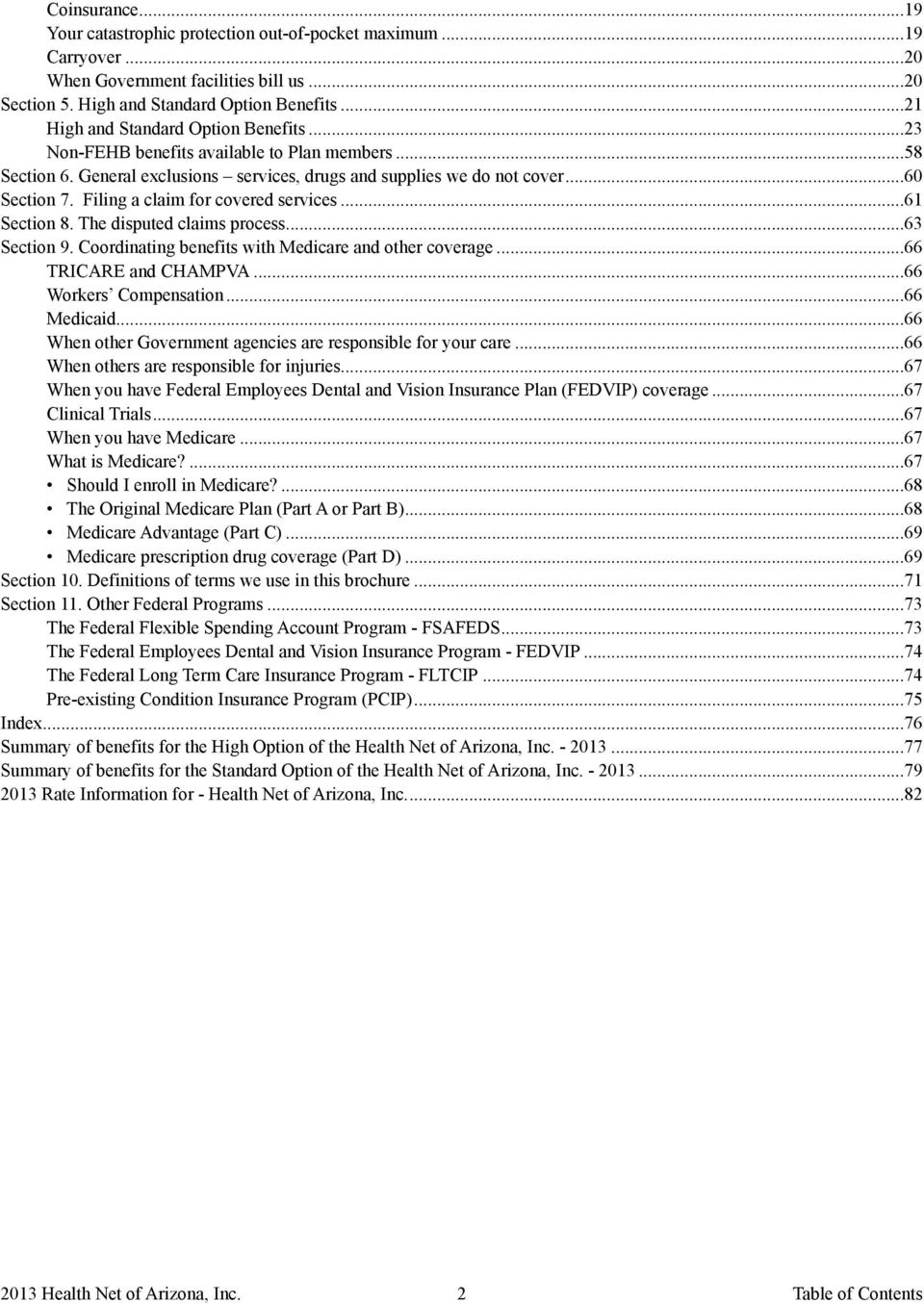
5 Introduction This brochure describes the benefits of Health Net of Arizona, Inc. under our contract (CS 2121) with the United States Office of Personnel Management, as authorized by the Federal Employees Health Benefits law. Customer service may be reached at 1/ or through our website: The address for Health Net of Arizona, Inc. administrative offices is: Health Net of Arizona, Inc W. Washington Street, Suite 401 Tempe, Arizona This brochure is the official statement of benefits. No oral statement can modify or otherwise affect the benefits, limitations, and exclusions of this brochure. It is your responsibility to be informed about your health benefits. If you are enrolled in this Plan, you are entitled to the benefits described in this brochure. If you are enrolled in Self and Family coverage, each eligible family member is also entitled to these benefits. You do not have a right to benefits that were available before January 1, 2013, unless those benefits are also shown in this brochure. OPM negotiates benefits and rates with each Plan annually. Benefit changes are effective January 1, 2013, and changes are summarized on page 12. Rates are shown at the end of this brochure. Plain Language All FEHB brochures are written in plain language to make them easy to understand. Here are some examples, Except for necessary technical terms, we use common words. For instance, you means the enrollee or family member, we means Health Net of Arizona, Inc. We limit acronyms to ones you know. FEHB is the Federal Employees Health Benefits Program. OPM is the United States Office of Personnel Management. If we use others, we tell you what they mean first. Our brochure and other FEHB Plans brochures have the same format and similar descriptions to help you compare plans. Stop Health Care Fraud! Fraud increases the cost of health care for everyone and increases your Federal Employees Health Benefits Program premium. OPM s Office of the Inspector General investigates all allegations of fraud, waste, and abuse in the FEHB Program regardless of the agency that employs you or from which you retired. Protect Yourself From Fraud Here are some things that you can do to prevent fraud: Do not give your plan identification (ID) number over the telephone or to people you do not know, except for your health care providers, authorized health benefits plan, or OPM representative. Let only the appropriate medical professionals review your medical record or recommend services. Avoid using health care providers who say that an item or service is not usually covered, but they know how to bill us to get it paid. Carefully review explanations of benefits (EOBs) statements that you receive from us. Periodically review your claim history for accuracy to ensure we have not been billed for services that you did not receive. Do not ask your doctor to make false entries on certificates, bills or records in order to get us to pay for an item or service. If you suspect that a provider has charged you for services you did not receive, billed you twice for the same service, or misrepresented any information, do the following: 2013 Health Net of Arizona, Inc. 3 Introduction/Plain Language/Advisory
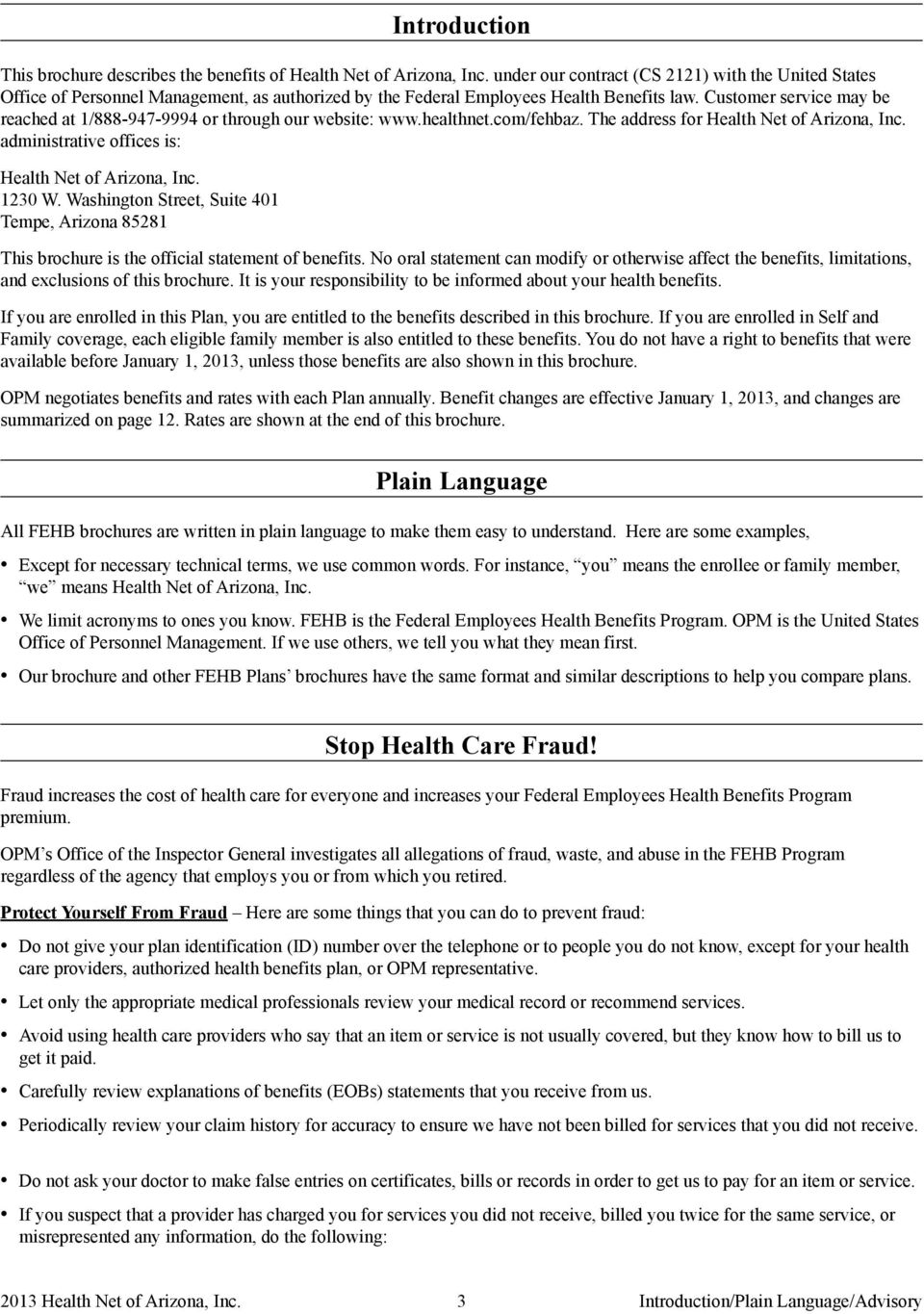
6 - Call the provider and ask for an explanation. There may be an error. - If the provider does not resolve the matter, call us at and explain the situation. - If we do not resolve the issue: CALL - THE HEALTH CARE FRAUD HOTLINE OR go to You can also write to: United States Office of Personnel Management Office of the Inspector General Fraud Hotline 1900 E Street NW Room 6400 Washington, DC Do not maintain as a family member on your policy: - Your former spouse after a divorce decree or annulment is final (even if a court order stipulates otherwise) - Your child age 26 or over (unless he/she was disabled and incapable of self -support prior to age 26) If you have any questions about the eligibility of a dependent, check with your personnel office if you are employed, with your retirement office (such as OPM) if you are retired, or with the National Finance Center if you are enrolled under Temporary Continuation of Coverage. Fraud or intentional misrepresentation of material fact is prohibited under the Plan. You can be prosecuted for fraud and your agency may take action against you. Examples of fraud include, falsifying a claim to obtain FEHB benefits, trying to or obtaining services or coverage for yourself or for someone else who is not eligible for coverage, or enrolling in the Plan when you are no longer eligible. If your enrollment continues after you are no longer eligible for coverage (i.e. you have separated from Federal service) and premiums are not paid, you will be responsible for all benefits paid during the period in which premiums were not paid. You may be billed by your provider for services received. You may be prosecuted for fraud for knowingly using health insurance benefits for which you have not paid premiums. It is your responsibility to know when you or a family member is no longer eligible to use your health insurance coverage. Preventing Medical Mistakes An influential report from the Institute of Medicine estimates that up to 98,000 Americans die every year from medical mistakes in hospitals alone. That s about 3,230 preventable deaths in the FEHB Program a year. While death is the most tragic outcome, medical mistakes cause other problems such as permanent disabilities, extended hospital stays, longer recoveries, and even additional treatments. By asking questions, learning more and understanding your risks, you can improve the safety of your own health care, and that of your family members. Take these simple steps: 1. Ask questions if you have doubts or concerns. Ask questions and make sure you understand the answers. Choose a doctor with whom you feel comfortable talking. Take a relative or friend with you to help you ask questions and understand answers. 2. Keep and bring a list of all the medicines you take Health Net of Arizona, Inc. 4 Introduction/Plain Language/Advisory

7 Bring the actual medicines or give your doctor and pharmacist a list of all the medicines and dosage that you take, including non-prescription (over-the-counter) medicines and nutritional supplements. Tell your doctor and pharmacist about any drug allergies you have. Ask about any risks or side effects of the medication and what to avoid while taking it. Be sure to write down what your doctor or pharmacist says. Make sure your medicine is what the doctor ordered. Ask the pharmacist about your medicine if it looks different than you expected. Read the label and patient package insert when you get your medicine, including all warnings and instructions. Know how to use your medicine. Especially note the times and conditions when your medicine should and should not be taken. Contact your doctor or pharmacist if you have any questions. 3. Get the results of any test or procedure. Ask when and how you will get the results of tests or procedures. Don t assume the results are fine if you do not get them when expected, be it in person, by phone, or by mail. Call your doctor and ask for your results. Ask what the results mean for your care. 4. Talk to your doctor about which hospital is best for your health needs. Ask your doctor about which hospital has the best care and results for your condition if you have more than one hospital to choose from to get the health care you need. Be sure you understand the instructions you get about follow-up care when you leave the hospital. 5. Make sure you understand what will happen if you need surgery. Make sure you, your doctor, and your surgeon all agree on exactly what will be done during the operation. Ask your doctor, Who will manage my care when I am in the hospital? Ask your surgeon: "Exactly what will you be doing?" "About how long will it take?" "What will happen after surgery?" "How can I expect to feel during recovery?" Tell the surgeon, anesthesiologist, and nurses about any allergies, bad reaction to anesthesia, and any medications you are taking. Patient Safety Links. - The Agency for Healthcare Research and Quality makes available a wide-ranging list of topics not only to inform consumers about patient safety but to help choose quality health care providers and improve the quality of care you receive. - The National Patient Safety Foundation has information on how to ensure safer health care for you and your family. - The National Council on Patient Information and Education is dedicated to improving communication about the safe, appropriate use of medicines. - The Leapfrog Group is active in promoting safe practices in hospital care Health Net of Arizona, Inc. 5 Introduction/Plain Language/Advisory

8 - The American Health Quality Association represents organizations and health care professionals working to improve patient safety. Never Events You will not be billed for inpatient services related to treatment of specific hospital acquired conditions or for inpatient services needed to correct never events, if you use Health Net of Arizona providers. This policy helps to protect you from preventable medical errors and improve the quality of care you receive. When you enter the hospital for treatment of one medical problem, you don t expect to leave with additional injuries, infections or other serious conditions that occur during the course of your stay. Although some of these complications may not be avoidable, too often patients suffer from injuries or illnesses that could have been prevented if the hospital had taken proper precautions. We have a benefit payment policy that encourages hospitals to reduce the likelihood of hospital-acquired conditions such as certain infections, severe bedsores and fractures; and reduce medical errors that should never happen called "Never Events". When a Never Event occurs, neither your FEHB plan nor you will incur costs to correct the medical error Health Net of Arizona, Inc. 6 Introduction/Plain Language/Advisory

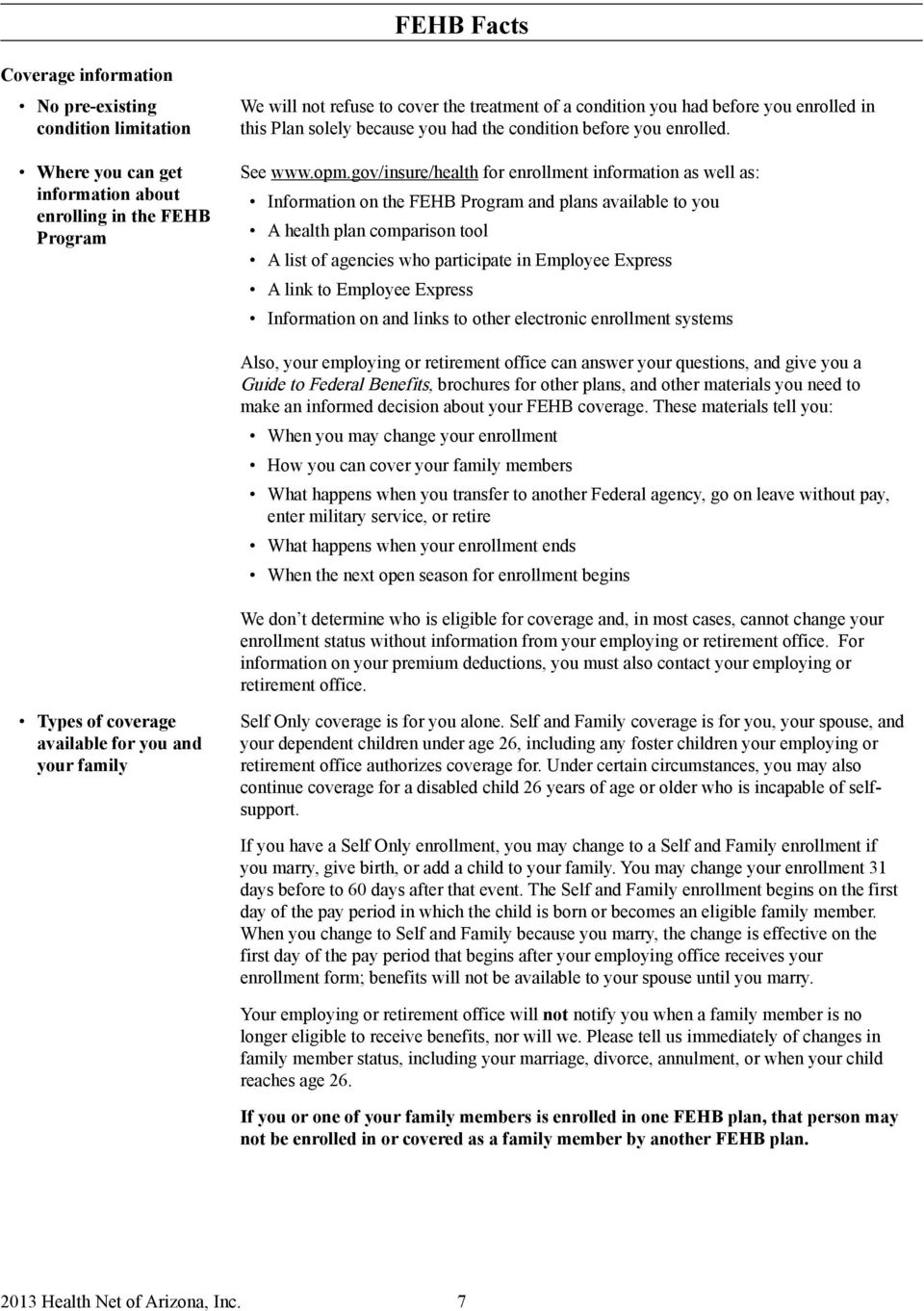
9 FEHB Facts Coverage information No pre-existing condition limitation Where you can get information about enrolling in the FEHB Program We will not refuse to cover the treatment of a condition you had before you enrolled in this Plan solely because you had the condition before you enrolled. See for enrollment information as well as: Information on the FEHB Program and plans available to you A health plan comparison tool A list of agencies who participate in Employee Express A link to Employee Express Information on and links to other electronic enrollment systems Also, your employing or retirement office can answer your questions, and give you a Guide to Federal Benefits, brochures for other plans, and other materials you need to make an informed decision about your FEHB coverage. These materials tell you: When you may change your enrollment How you can cover your family members What happens when you transfer to another Federal agency, go on leave without pay, enter military service, or retire What happens when your enrollment ends When the next open season for enrollment begins We don t determine who is eligible for coverage and, in most cases, cannot change your enrollment status without information from your employing or retirement office. For information on your premium deductions, you must also contact your employing or retirement office. Types of coverage available for you and your family Self Only coverage is for you alone. Self and Family coverage is for you, your spouse, and your dependent children under age 26, including any foster children your employing or retirement office authorizes coverage for. Under certain circumstances, you may also continue coverage for a disabled child 26 years of age or older who is incapable of selfsupport. If you have a Self Only enrollment, you may change to a Self and Family enrollment if you marry, give birth, or add a child to your family. You may change your enrollment 31 days before to 60 days after that event. The Self and Family enrollment begins on the first day of the pay period in which the child is born or becomes an eligible family member. When you change to Self and Family because you marry, the change is effective on the first day of the pay period that begins after your employing office receives your enrollment form; benefits will not be available to your spouse until you marry. Your employing or retirement office will not notify you when a family member is no longer eligible to receive benefits, nor will we. Please tell us immediately of changes in family member status, including your marriage, divorce, annulment, or when your child reaches age 26. If you or one of your family members is enrolled in one FEHB plan, that person may not be enrolled in or covered as a family member by another FEHB plan Health Net of Arizona, Inc. 7
10 If you have a qualifying life event (QLE) - such as marriage, divorce, or the birth of a child-outside of the Federal Benefits Open Season,you may be eligible to enroll in the FEHB Program, change your enrollment, or cancel coverage. For a complete list of QLEs, visit the FEHB website at If you need assistance, please contact your employing agency,personnel/payroll office,or retirement office. Family member coverage Family members covered under your Self and Family enrollment are your spouse (including a valid common law marriage) and children as described in the chart below. Children Natural, adopted children, and stepchildren Foster Children Children Incapable of Self-Support Married Children Children with or eligible for employerprovided health insurance Coverage You can find additional information at Natural, adopted children and stepchildren are covered until their 26 th birthday. Foster children are eligible for coverage until their 26 th birthday if you provide documentation of your regular and substantial support of the child and sign a certification stating that your foster child meets all the requirements. Contact your human resources office or retirement system for additional information. Children who are incapable of self-support because of a mental or physical disability that began before age 26 are eligible to continue coverage. Contact your human resources office or retirement system for additional information. Married children (but NOT their spouse or their own children) are covered until their 26th birthday. Children who are eligible for or have their own employer-provided health insurance are covered until their 26th birthday. Children s Equity Act OPM has implemented the Federal Employees Health Benefits Children s Equity Act of This law mandates that you be enrolled for Self and Family coverage in the FEHB Program, if you are an employee subject to a court or administrative order requiring you to provide health benefits for your child(ren). If this law applies to you, you must enroll for Self and Family coverage in a health plan that provides full benefits in the area where your children live or provide documentation to your employing office that you have obtained other health benefits coverage for your children. If you do not do so, your employing office will enroll you involuntarily as follows: If you have no FEHB coverage, your employing office will enroll you for Self and Family coverage in the Blue Cross and Blue Shield Service Benefit Plan s Basic Option; If you have a Self Only enrollment in a fee-for-service plan or in an HMO that serves the area where your children live, your employing office will change your enrollment to Self and Family in the same option of the same plan; or If you are enrolled in an HMO that does not serve the area where the children live, your employing office will change your enrollment to Self and Family in the Blue Cross and Blue Shield Service Benefit Plan s Basic Option Health Net of Arizona, Inc. 8

11 As long as the court/administrative order is in effect, and you have at least one child identified in the order who is still eligible under the FEHB Program, you cannot cancel your enrollment, change to Self Only, or change to a plan that doesn t serve the area in which your children live, unless you provide documentation that you have other coverage for the children. If the court/administrative order is still in effect when you retire, and you have at least one child still eligible for FEHB coverage, you must continue your FEHB coverage into retirement (if eligible) and cannot cancel your coverage, change to Self Only, or change to a plan that doesn t serve the area in which your children live as long as the court/administrative order is in effect. Contact your employing office for further information. When benefits and premiums start The benefits in this brochure are effective January 1. If you joined this Plan during Open Season, your coverage begins on the first day of your first pay period that starts on or after January 1. If you changed plans or plan options during Open Season and you receive care between January 1 and the effective date of coverage under your new plan or option, your claims will be paid according to the 2013 benefits of your old plan or option. However, if your old plan left the FEHB Program at the end of the year, you are covered under that plan s 2012 benefits until the effective date of your coverage with your new plan. Annuitants coverage and premiums begin on January 1. If you joined at any other time during the year, your employing office will tell you the effective date of coverage. If your enrollment continues after you are no longer eligible for coverage (i.e. you have separated from Federal service) and premiums are not paid, you will be responsible for all benefits paid during the period in which premiums were not paid. You may be billed for services received directly from your provider. You may be prosecuted for fraud for knowingly using health insurance benefits for which you have not paid premiums. It is your responsibility to know when you or a family member are no longer eligible to use your health insurance coverage. When you retire When you lose benefits When FEHB coverage ends When you retire, you can usually stay in the FEHB Program. Generally, you must have been enrolled in the FEHB Program for the last five years of your Federal service. If you do not meet this requirement, you may be eligible for other forms of coverage, such as Temporary Continuation of Coverage (TCC). You will receive an additional 31 days of coverage, for no additional premium, when: Your enrollment ends, unless you cancel your enrollment, or You are a family member no longer eligible for coverage. Any person covered under the 31 day extension of coverage who is confined in a hospital or other institution for care or treatment on the 31 st day of the temporary extension is entitled to continuation of the benefits of the Plan during the continuance of the confinement but not beyond the 60 th day after the end of the 31 day temporary extension. You may be eligible for spouse equity coverage or Temporary Continuation of Coverage (TCC), or a conversion policy (a non-fehb individual policy.) Upon divorce If you are divorced from a Federal employee or annuitant, you may not continue to get benefits under your former spouse s enrollment. This is the case even when the court has ordered your former spouse to provide health coverage for you. However, you may be eligible for your own FEHB coverage under either the spouse equity law or Temporary Continuation of Coverage (TCC). If you are recently divorced or are anticipating a divorce, contact your ex-spouse s employing or retirement office to get RI 70-5, the Guide to Federal Benefits for Temporary Continuation of Coverage and Former Spouse Enrollees, or other information about your coverage choices. You can also download the guide from OPM s Web site, Health Net of Arizona, Inc. 9

12 Temporary Continuation of Coverage (TCC) If you leave Federal service, or if you lose coverage because you no longer qualify as a family member, you may be eligible for Temporary Continuation of Coverage (TCC). For example, you can receive TCC if you are not able to continue your FEHB enrollment after you retire, if you lose your Federal job, if you are a covered dependent child and you turn 26. You may not elect TCC if you are fired from your Federal job due to gross misconduct. Enrolling in TCC. Get the RI 79-27, which describes TCC, and the RI 70-5, the Guide to Federal Benefits for Temporary Continuation of Coverage and Former Spouse Enrollees, from your employing or retirement office or from It explains what you have to do to enroll. Converting to individual coverage You may convert to a non-fehb individual policy if: Your coverage under TCC or the spouse equity law ends (If you canceled your coverage or did not pay your premium, you cannot convert); You decided not to receive coverage under TCC or the spouse equity law; or You are not eligible for coverage under TCC or the spouse equity law. If you leave Federal service, your employing office will notify you of your right to convert. You must apply in writing to us within 31 days after you receive this notice. However, if you are a family member who is losing coverage, the employing or retirement office will not notify you. You must apply in writing to us within 31 days after you are no longer eligible for coverage. Your benefits and rates will differ from those under the FEHB Program; however, you will not have to answer questions about your health, and we will not impose a waiting period or limit your coverage due to pre-existing conditions. Getting a Certificate of Group Health Plan Coverage The Health Insurance Portability and Accountability Act of 1996 (HIPAA) is a Federal law that offers limited Federal protections for health coverage availability and continuity to people who lose employer group coverage. If you leave the FEHB Program, we will give you a Certificate of Group Health Plan Coverage that indicates how long you have been enrolled with us. You can use this certificate when getting health insurance or other health care coverage. Your new plan must reduce or eliminate waiting periods, limitations, or exclusions for health related conditions based on the information in the certificate, as long as you enroll within 63 days of losing coverage under this Plan. If you have been enrolled with us for less than 12 months, but were previously enrolled in other FEHB plans, you may also request a certificate from those plans. For more information, get OPM pamphlet RI 79-27, Temporary Continuation of Coverage (TCC) under the FEHB Program. See also the FEHB Web site at health; refer to the TCC and HIPAA frequently asked questions. These highlight HIPAA rules, such as the requirement that Federal employees must exhaust any TCC eligibility as one condition for guaranteed access to individual health coverage under HIPAA, and information about Federal and State agencies you can contact for more information Health Net of Arizona, Inc. 10

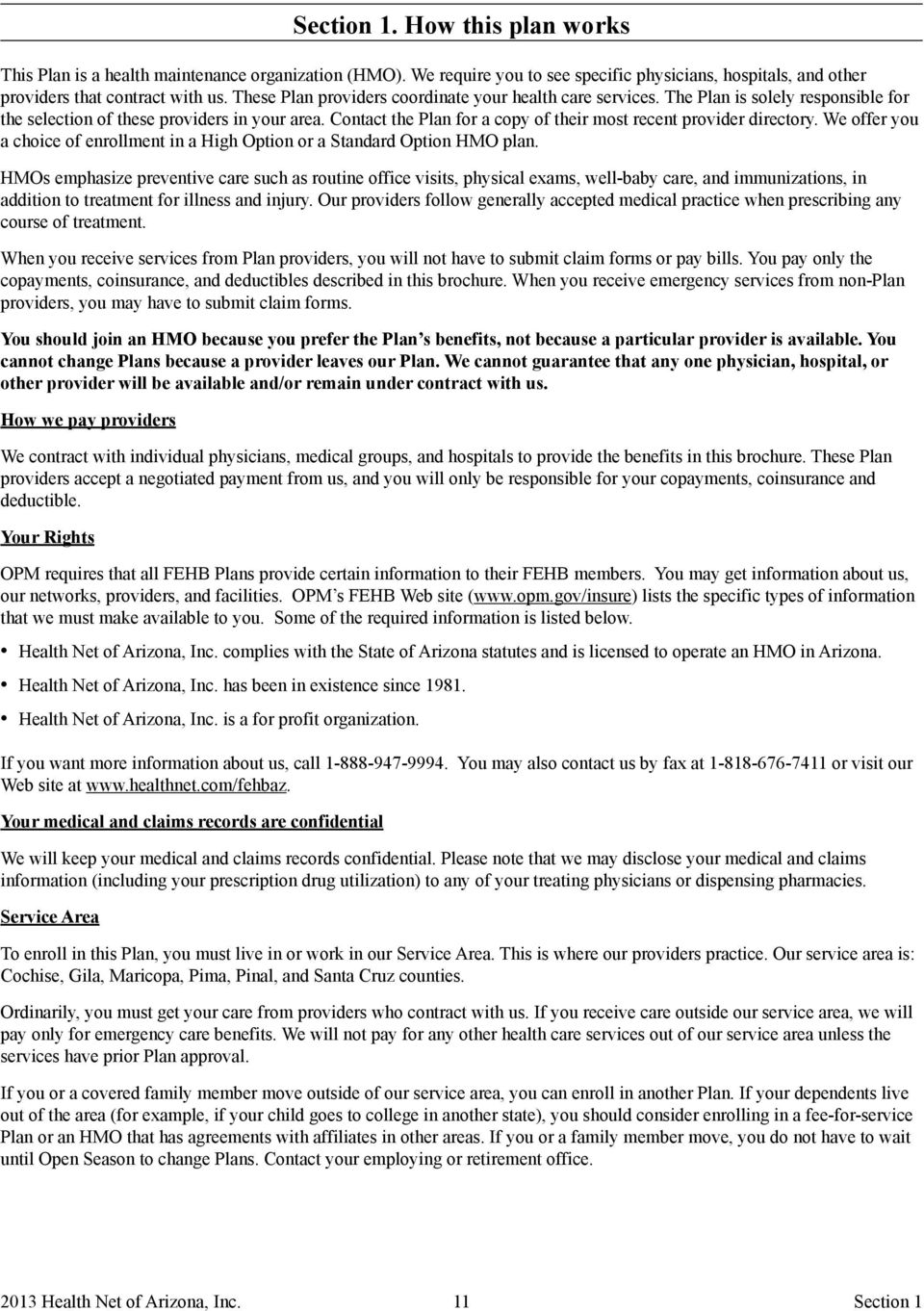
13 Section 1. How this plan works This Plan is a health maintenance organization (HMO). We require you to see specific physicians, hospitals, and other providers that contract with us. These Plan providers coordinate your health care services. The Plan is solely responsible for the selection of these providers in your area. Contact the Plan for a copy of their most recent provider directory. We offer you a choice of enrollment in a High Option or a Standard Option HMO plan. HMOs emphasize preventive care such as routine office visits, physical exams, well-baby care, and immunizations, in addition to treatment for illness and injury. Our providers follow generally accepted medical practice when prescribing any course of treatment. When you receive services from Plan providers, you will not have to submit claim forms or pay bills. You pay only the copayments, coinsurance, and deductibles described in this brochure. When you receive emergency services from non-plan providers, you may have to submit claim forms. You should join an HMO because you prefer the Plan s benefits, not because a particular provider is available. You cannot change Plans because a provider leaves our Plan. We cannot guarantee that any one physician, hospital, or other provider will be available and/or remain under contract with us. How we pay providers We contract with individual physicians, medical groups, and hospitals to provide the benefits in this brochure. These Plan providers accept a negotiated payment from us, and you will only be responsible for your copayments, coinsurance and deductible. Your Rights OPM requires that all FEHB Plans provide certain information to their FEHB members. You may get information about us, our networks, providers, and facilities. OPM s FEHB Web site ( lists the specific types of information that we must make available to you. Some of the required information is listed below. Health Net of Arizona, Inc. complies with the State of Arizona statutes and is licensed to operate an HMO in Arizona. Health Net of Arizona, Inc. has been in existence since Health Net of Arizona, Inc. is a for profit organization. If you want more information about us, call You may also contact us by fax at or visit our Web site at Your medical and claims records are confidential We will keep your medical and claims records confidential. Please note that we may disclose your medical and claims information (including your prescription drug utilization) to any of your treating physicians or dispensing pharmacies. Service Area To enroll in this Plan, you must live in or work in our Service Area. This is where our providers practice. Our service area is: Cochise, Gila, Maricopa, Pima, Pinal, and Santa Cruz counties. Ordinarily, you must get your care from providers who contract with us. If you receive care outside our service area, we will pay only for emergency care benefits. We will not pay for any other health care services out of our service area unless the services have prior Plan approval. If you or a covered family member move outside of our service area, you can enroll in another Plan. If your dependents live out of the area (for example, if your child goes to college in another state), you should consider enrolling in a fee-for-service Plan or an HMO that has agreements with affiliates in other areas. If you or a family member move, you do not have to wait until Open Season to change Plans. Contact your employing or retirement office Health Net of Arizona, Inc. 11 Section 1
14 Section 2. Changes for 2013 Do not rely only on these change descriptions; this Section is not an official statement of benefits. For that, go to Section 5 Benefits. Also, we edited and clarified language throughout the brochure; any language change not shown here is a clarification that does not change benefits. Program wide changes Removed annual limits on essential health benefits as described in section 1302 of the Affordable Care Act. Plans must provide coverage for routine patient costs for items and services furnished in connection with participation in an approved clinical trial. Coverage with no cost sharing for additional preventive care and screenings for women provided in comprehensive guidelines adopted by the Health Resources and Services Administration (HRSA) Changes to Both Options The copay for Level 3 prescriptions changed to 50% (coinsurance) of plan s allowance, limited to $250 per prescription obtained from a plan pharmacy and limited to $500 per prescription or refill obtained through our mail order program. The copay for Self-Injectable Drugs changed to 50% (coinsurance) of plan s allowance, limited to $250 per prescription. Changes to High Option only Your share of the non-postal premium will increase for Self Only and Self and Family. See back cover. The Primary care physician (PCP) office visit including mental health office visit copay has changed to $20 per visit. The Specialist visit copay changed to $40 per visit. The copay for Lab, x-ray, and other diagnostic tests changed to 20% (coinsurance) of our allowance (not subject to deductible). The visit limit for Physical Therapy and Occupational Therapy, Cardiac rehabilitation, and Speech Therapy was removed. The copay for CAT Scans/MRI, MRAs, PET/SPECT scans changed to $300 per visit. The copay for Inpatient Hospital changed to $200 per day up to 5 days per admission. The copay for Outpatient Hospital or Ambulatory Surgical Center changed to $250 per visit. The Catastrophic Protection Out-of-Pocket Maximum changed to $3,000 per person or $6,000 per family enrollment. Changes to Standard Option only Your share of the non-postal premium will increase for Self Only and Self and Family. See back cover. The Catastrophic Protection Out-of-Pocket Maximum changed to $5,000 per person or $10,000 per family enrollment. The Primary care physician (PCP) office visit including mental health office visit copay has changed to $25 per visit. The Specialist visit copay changed to $50 per visit. The copay for Lab, x-ray, and other diagnostic tests changed to 25% (coinsurance) of our allowance (not subject to deductible). The visit limit for Physical Therapy and Occupational Therapy, Cardiac rehabilitation, and Speech Therapy was removed. The coinsurance for CAT Scans/MRI, MRAs, PET/SPECT scans changed to 25% (coinsurance) of our allowance after deductible. The copay for Inpatient Hospital changed to 25% (coinsurance) of our allowance after deductible. The copay for Outpatient Hospital or Ambulatory Surgical Center changed to 25% (coinsurance) of our allowance after deductible Health Net of Arizona, Inc. 12 Section 2

15 The coinsurance for Implanted hearing-related devices changed to 25% of our allowance after deductible. The coinsurance for Orthopedic and prosthetic devices changed to 25% of our allowance after deductible. The coinsurance for Durable medical equipment (DME) changed to 25% of our allowance after deductible. The coinsurance for Home Health Services changed to 25% of our allowance after deductible Health Net of Arizona, Inc. 13 Section 2

16 Section 3. How you get care Identification Cards We will send you an identification (ID) card when you enroll. You should carry your ID card with you at all times. You must show it whenever you receive services from a Plan provider, or fill a prescription at a Plan pharmacy. Until you receive your ID card, use your copy of the Health Benefits Election Form, SF-2809, your health benefits enrollment confirmation letter (for annuitants), or your electronic enrollment system (such as Employee Express) confirmation letter. If you do not receive your ID card within 30 days after the effective date of your enrollment, or if you need replacement cards, call us at You may also request or print replacement cards through our Web site: Where you get covered care Plan providers You get care from Plan providers and Plan facilities. You will only pay copayments, deductibles, and/or coinsurance. Plan providers are physicians and other health care professionals in our service area that we contract with to provide covered services to our members. We credential Plan providers according to national standards. We list Plan providers in the provider directory, which we update periodically. The list is also on our Web site. Plan facilities What you must do to get covered care Primary care Plan facilities are hospitals and other facilities in our service area that we contract with to provide covered services to our members. We list these in the provider directory, which we update periodically. The list is also on our Web site. It depends on the type of care you need. First, you and each family member must choose a primary care physician. This decision is important since your primary care physician provides or arranges for most of your health care. You can find a primary care physician by looking in the provider directory, visiting our Web site or calling us at Your primary care physician can be a Family Practice, General Practice, Internal Medicine or Pediatrician. Your primary care physician will provide most of your health care, or give you a referral to see a specialist. If you want to change primary care physicians or if your primary care physician leaves the Plan, call us. We will help you select a new one. Specialty care Your primary care physician will refer you to a specialist for needed care. When you receive a referral from your primary care physician, you must return to the primary care physician after the consultation, unless your primary care physician authorized a certain number of visits without additional referrals. The primary care physician must provide or authorize all follow-up care. Do not go to the specialist for return visits unless your primary care physician gives you a referral. However, you may see a Plan provider for the following specialties without a referral: obstetrics/gynecology, chiropractic, vision services (for routine eye exams), mental health and substance abuse services, and diabetic members may see an ophthalmologist for an annual eye examination without referral. Here are some other things you should know about specialty care: If you need to see a specialist frequently because of a chronic, complex, or serious medical condition, your primary care physician will develop a treatment plan that allows you to see your specialist for a certain number of visits without additional referrals. Your primary care physician will create your treatment plan. The physician may have to get an authorization or approval from us beforehand. If you are seeing a specialist when you enroll in our Plan, talk to your primary care physician. If he or she decides to refer you to a specialist, ask if you can see your current specialist Health Net of Arizona, Inc. 14 Section 3
17 If your current specialist does not participate with us, you must receive treatment from a specialist who does. Generally, we will not pay for you to see a specialist who does not participate with our Plan. If you are seeing a specialist and your specialist leaves the Plan, call your primary care physician, who will arrange for you to see another specialist. You may receive services from your current specialist until we can make arrangements for you to see someone else. If you have a chronic and disabling condition and lose access to your specialist because we: - terminate our contract with your specialist for other than cause; - drop out of the Federal Employees Health Benefits (FEHB) Program and you enroll in another FEHB program Plan; or - reduce our service area and you enroll in another FEHB Plan; you may be able to continue seeing your specialist for up to 90 days after you receive notice of the change. Contact us, or if we drop out of the Program, contact your new Plan. If you are in the second or third trimester of pregnancy and you lose access to your specialist based on the above circumstances, you can continue to see your specialist until the end of your postpartum care, even if it is beyond the 90 days. Hospital care If you are hospitalized when your enrollment begins Your Plan primary care physician or specialist will make necessary hospital arrangements and supervise your care. This includes admission to a skilled nursing or other type of facility. We pay for covered services from the effective date of your enrollment. However, if you are in the hospital when your enrollment in our Plan begins, call our customer service department immediately at If you are new to the FEHB Program, we will arrange for you to receive care and provide benefits for your covered services while you are in the hospital beginning on the effective date of your coverage. If you changed from another FEHB plan to us, your former Plan will pay for the hospital stay until: you are discharged, not merely moved to an alternative care center; the day your benefits from your former Plan run out; or the 92 nd day after you become a member of this Plan, whichever happens first. These provisions apply only to the benefits of the hospitalized person. If your Plan terminates participation in the FEHB Program in whole or in part, or if OPM orders an enrollment change, this continuation of coverage provision does not apply. In such cases, the hospitalized family member s benefits under the new Plan begin on the effective date of enrollment. You need prior Plan approval for certain services Inpatient hospital admission Other services Since your primary care physician arranges most referrals to specialists and inpatient hospitalization, the pre-service claim approval process only applies to care shown under Other services. Precertification is the process by which-prior to your inpatient hospital admission-we evaluate the medical necessity of your proposed stay and the number of days required to treat your condition. Your primary care physician has authority to refer you for most services. For certain services, however, your physician must obtain prior approval from us. Before giving approval, we consider if the service is covered, medically necessary, and follows generally accepted medical practice. You must obtain prior authorization for some services such as but not limited to: 2013 Health Net of Arizona, Inc. 15 Section 3

18 Acute rehabilitation and behaviorial health facility admissions Air Ambulance and non-emergent ambulance transportation All bariatric-related consultations, services and surgical services Durable medical equipment Growth Hormone Therapy Home health services, including but not limited to IV infusion, hospice Outpatient diagnostic procedures, including but not limited to CT, MRA, MRI, PET and SPECT Transplants Services that are not authorized by your primary care physician or Health Net of AZ will not be covered. How to request precertification for an admission or get prior authorization for Other services Non-urgent care claims First, your physician, your hospital, you, or your representative, must call us at before admission or services requiring prior authorization are rendered. Next, provide the following information: enrollee's name and Plan identification number; patient's name, birth date, identification number and phone number; reason for hospitalization, proposed treatment, or surgery; name and phone number of admitting physician; name of hospital or facility; and number of planned days of confinement. For non-urgent care claims, we will then tell the physician and/or hospital the number of approved inpatient days, or the care that we approve for other services that must have prior authorization. We will make our decision within 15 days of receipt of the preservice claim. If matters beyond our control require an extension of time, we may take up to an additional 15 days for review and we will notify you of the need for an extension of time before the end of the original 15 day period. Our notice will include the circumstances underlying the request for the extension and the date when a decision is expected. If we need an extension because we have not received necessary information from you, our notice will describe the specific information required and we will allow you up to 45 days from the receipt of the notice to provide the information. Urgent care claims If you have an urgent care claim (i.e., when waiting for the regular time limit for your medical care or treatment could seriously jeopardize your life, health, or ability to regain maximum function, or in the opinion of a physician with knowledge of your medical condition, would subject you to severe pain that cannot be adequately managed without this care or treatment), we will expedite our review and notify you of our decision within 72 hours. If you request that we review your claim as an urgent care claim, we will review the documentation you provide and decide whether it is an urgent care claim by applying the judgment of a prudent layperson who possesses an average knowledge of health and medicine. If you fail to provide sufficient information, we will contact you within 24 hours after we receive the claim to provide notice of the specific information we need to complete our review of the claim. We will allow you up to 48 hours from the receipt of this notice to provide necessary information. We will make our decision on the claim within 48 hours of (1) the time we received the additional information or (2) the time you received the notice to provide the additional information, whichever is earlier Health Net of Arizona, Inc. 16 Section 3

19 We may provide our decision orally within these time frames, but we will follow up with written or electronic notification within three days of the oral notification. You may request that your urgent care claim on appeal be reviewed simultaneously by us and OPM. Please let us know that you would like a simultaneous review of your urgent care claim by OPM either in writing at the time you appeal our initial decision, or by calling us at You may also call OPM s Health Insurance 3 at (202) between 8 a.m. and 5 p.m. eastern time to ask for the simultaneous review. We will cooperate with OPM so they can quickly review your claim on appeal. In addition, if you did not indicate that your claim was a claim for urgent care, then call us at If it is determined that your claim is an urgent care claim, we will hasten our review (if we have not yet responded to your claim). Emergency inpatient admission Maternity care If your treatment needs to be extended What happens when you do not follow the precertification rules when using non-network facilities Circumstances beyond our control If you disagree with our pre-service claim decision If you have an emergency admission due to a condition that you reasonably believe puts your life in danger or could cause serious bodily function, you, your representative, the physician, or the hospital must telephone us within two business days following the day of the emergency admission, even if you have been discharged from the hospital. You do not need to precertify a maternity admission for a routine delivery. However, if your medical condition requires you to stay more than 48 hours after a vaginal delivery, or 96 hours after a Cesarean section, then your physician or the hospital must contact us for precertification of additional days. Further, if your baby stays after you are discharged, then your physician or the hospital must contact us for precertification of additional days for your baby. If you request an extension of an ongoing course of treatment at least 24 hours prior to the expiration of the approved time period and this is also an urgent care claim, then we will make a decision within 24 hours after we receive the claim. Except for emergency services, all medical services and treatments must be provided through the direct coordination of your primary care physician who is under contract with this Plan and received within the service area. If the medical services are received by a non-network provider and precertification was not obtained, the services will not be covered and you will be financially responsible for all incurred charges. Under certain extraordinary circumstances, such as natural disasters, we may have to delay your services or we may be unable to provide them. In that case, we will make all reasonable efforts to provide you with the necessary care. If you have a pre-service claim and you do not agree with our decision regarding precertification of an inpatient admission or prior approval of other services, you may request a review in accord with the procedures detailed below. If you have already received the service, supply, or treatment, then you have a postservice claim and must follow the entire disputed claims process detailed in Section 8. To reconsider a nonurgent care claim Within 6 months of our initial decision, you may ask us in writing to reconsider our initial decision. Follow Step 1 of the disputed claims process detailed in Section 8 of this brochure. In the case of a pre-service claim and subject to the request for additional information, we have 30 days from the date we receive your written request for reconsideration to 1. Precertify your hospital stay, or, if applicable, arrange for the health care provider to give you the care or grant your request for prior approval for a service, drug, or supply, or 2. Ask you or your provider for more information. You or your provider must send the information so that we receive it within 60 days of our request. We will then decide within 30 more days Health Net of Arizona, Inc. 17 Section 3

20 If we do not receive the information within 60 days we will decide within 30 days of the date the information was due. We will base our decision on the information we already have. We will write to you with our decision. 3. Write to you and maintain our denial. To reconsider an urgent care claim In the case of an appeal of a pre-service urgent care claim, within 6 months of our initial decision, you may ask us in writing to reconsider our initial decision. Follow Step 1 of the disputed claims process detailed in Section 8 of this brochure. Subject to a request for additional information,we will notify you of our decision within 72 hours after receipt of your reconsideration request. We will hasten the review process, which allows oral or written requests for appeals and the exchange of the information by telephone, electronic mail, facsimile, or other expeditious methods. To file an appeal with OPM After we reconsider your pre-service claim, if you do not agree with our decision, you may ask OPM to review it by following Step 3 of the disputed claims process detailed in Section 8 of this brochure Health Net of Arizona, Inc. 18 Section 3

21 This is what you will pay out-of-pocket for covered care Cost-sharing Section 4. Your cost for covered services Cost-sharing is the general term used to refer to your out-of-pocket costs (e.g., deductible, coinsurance, and copayments) for the covered care you receive. Copayments A copayment is a fixed amount of money you pay to the provider, facility, pharmacy, etc., when you receive certain services. Example: If you have the High Option, a specialist visit will require a $40 copayment per office visit. Example: If you have the Standard Option, a specialist visit will require a $50 copayment per office visit. Copayments do not apply to services and supplies that are subject to a deductible and/or coinsurance amount. Deductible A deductible is a fixed expense you must incur for certain covered services and supplies before we start paying benefits for them. Copayments and coinsurance amounts do not count toward any deductible. Under the Standard Option the calendar year deductible is $1,000 per person. Under a family enrollment, the deductible is considered satisfied and benefits are payable for all family members when the combined covered expenses applied to the calendar year deductible for family members reach $2,000. Under the High Option, there is no calendar year deductible. Note: If you change plans during open season, you do not have to start a new deductible under your old plan between January 1 and the effective date of your new plan. If you change plans at another time during the year, you must begin a new deductible under your new plan. If you change options in this Plan during the year, we will credit the amount of covered expenses already applied toward the deductible of your old option to the deductible of your new option. Coinsurance Coinsurance is the percentage of our allowance that you must pay for certain services you receive. Coinsurance does not begin until you have met your calendar year deductible. Example: In our Standard Option Plan, you pay 25% of our allowance for services such as Inpatient Hospital, Outpatient Hospital, Imaging/Testing, Laboratory/X-ray, ambulatory surgical center, implanted hearing- related devices, orthopedic and prothetic devices, durable medical equiptment and home health services. Your catastrophic protection out-of-pocket maximum After your (copayments and coinsurance) total $3,000 per person or $6,000 per family enrollment (High Option plan) or $5,000 per person or $10,000 per family enrollment (Standard Option) in any calendar year, you do not have to pay any more for covered services. However, copayments and coinsurance for the following services do not count toward your catastrophic protection out-of-pocket maximum, and you must continue to pay for these services: Prescription drugs Infertility services Be sure to keep accurate records of your copayments since you are responsible for informing us when you reach the maximum Health Net of Arizona, Inc. 19 Section 4
22 Carryover If you changed to this Plan during open season from a plan with a catastrophic protection benefit and the effective date of the change was after January 1, any expenses that would have applied to that Plan s catastrophic protection benefit during the prior year will be covered by your old Plan if they are for care you received in January before your effective date of coverage in this Plan. If you have already met your old Plan s catastrophic protection benefit level in full, it will continue to apply until the effective date of your coverage in this Plan. If you have not met this expense level in full, your old Plan will first apply your covered out-of-pocket expenses until the prior year s catastrophic level is reached and then apply the catastrophic protection benefit to covered out-of-pocket expenses incurred from that point until the effective date of your coverage in this Plan. Your old Plan will pay these covered expenses according to this year s benefits; benefit changes are effective January 1. Note: If you change options in this Plan during the year, we will credit the amount of covered expenses already accumulated toward the catastrophic out-of-pocket limit of your old option to the catastrophic protection limit of your new option. When Government facilities bill us Facilities of the Department of Veterans Affairs, the Department of Defense and the Indian Health Services are entitled to seek reimbursement from us for certain services and supplies they provide to you or a family member. They may not seek more than their governing laws allow. You may be responsible to pay for certain services and charges. Contact the government facility directly for more information Health Net of Arizona, Inc. 20 Section 4
23 High and Standard Option Section 5. High and Standard Option Benefits See page 12 for how our benefits changed this year. Page 76 through page 79 are a benefits summary of each option. Make sure that you review the benefits that are available under the option in which you are enrolled. Section 5(a). Medical services and supplies provided by physicians and other health care professionals...24 Diagnostic and treatment services...24 Lab, X-ray and other diagnostic tests...25 Preventive care, adult...25 Preventive care, children...26 Maternity care...26 Family planning...27 Infertility services...28 Allergy care...28 Treatment therapies...29 Physical and occupational therapies...29 Speech therapy...30 Hearing services (testing, treatment, and supplies)...30 Vision services (testing, treatment, and supplies)...30 Foot care...31 Orthopedic and prosthetic devices...31 Durable medical equipment (DME)...33 Home health services...34 Chiropractic...34 Alternative treatments...34 Educational classes and programs...34 Section 5(b). Surgical and anesthesia services provided by physicians and other health care professionals...36 Surgical Procedures...36 Reconstructive surgery...37 Oral and maxillofacial surgery...38 Organ/tissue transplants...39 Anesthesia...43 Section 5(c). Services provided by a hospital or other facility, and ambulance services...44 Inpatient hospital...44 Outpatient hospital or ambulatory surgical center...45 Extended care benefits/skilled nursing care facility benefits...45 Hospice care...45 Ambulance...46 Section 5(d). Emergency services/accidents...47 Emergency within and outside our service area...47 Ambulance...48 Section 5(e). Mental health and substance abuse benefits...49 Professional services...49 Diagnostics...50 Inpatient hospital or other covered facility...50 Outpatient hospital or other covered facility...50 Not covered...50 Section 5(f). Prescription drug benefits...52 Covered medications and supplies Health Net of Arizona, Inc. 21 High and Standard Option Section 5
24 High and Standard Option Section 5(g). Dental benefits...55 Accidental injury benefit...55 Section 5(h). Special features...56 Flexible benefits option hour nurse line...56 Services for deaf and hearing impaired...56 High risk pregnancies...56 Centers of excellence...56 Travel benefit/services overseas...56 Summary of benefits for the High Option of the Health Net of Arizona, Inc Summary of benefits for the Standard Option of the Health Net of Arizona, Inc Rate Information for - Health Net of Arizona, Inc Health Net of Arizona, Inc. 22 High and Standard Option Section 5
25 High and Standard Option Section 5. High and Standard Option Benefits Overview This Plan offers both a High and Standard Option. Both benefit packages are described in Section 5. Make sure that you review the benefits that are available under the option in which you are enrolled. The High and Standard Option Section 5 is divided into subsections. Please read Important things you should keep in mind at the beginning of the subsections. Also read the General exclusions in Section 6, they apply to the benefits in the following subsections. To obtain more information about High and Standard Option benefits, contact us at or at our website at Both plans are designed to include preventive and acute care services provided by our Plan providers. Each Plan offers its own unique features, including different levels of benefits and services for you to choose from. You select the plan that best fits your health care needs. High Option With the High Option your copayments may be lower than the Standard Option. Highlights of the FEHB High Option include: The High Option does not have a calendar year deductible. Most services are subject to copayments. $20 copayment for primary care providers and $40 copayment for specialist. $200 copayment per day up to five days per inpatient hospital admission. $250 copayment for outpatient hospital procedures. $300 copayment for outpatient imaging and testing. $10 copayment for Level 1 drugs, $30 copayment for Level 2 drugs and 50% of plan's allowance, limited to $250 per prescription or refill obtained from a plan pharmacy for Level 3 drugs. Standard Option Our Standard Option features lower bi-weekly premium payments. Highlights of the FEHB Standard Option include: Calendar year deductible of $1,000 per person and $2,000 per family enrollment. $25 copayment for primary care providers and $50 copayment for specialist. 25% of our allowance per visit will apply for outpatient hospital after deductible. 25% of our allowance per visit will apply for outpatient imaging and testing after deductible.. $10 copayment for Level 1 drugs, $40 copayment for Level 2 drugs and 50% of plan's allowance, limited to $250 per prescription or refill obtained from a plan pharmacy for Level 3 drugs Health Net of Arizona, Inc. 23 Health Net of Arizona Section 5 High and Standard Option Benefits Overview
26 High and Standard Option Section 5(a). Medical services and supplies provided by physicians and other health care professionals Important things you should keep in mind about these benefits: Please remember that all benefits are subject to the definitions, limitations, and exclusions in this brochure and are payable only when we determine they are medically necessary. Plan physicians must provide or arrange your care. A facility copay applies to services that appear in this section but are performed in an ambulatory surgical center or the outpatient department of a hospital. Under the High Option, there is no calendar year deductible. Under the Standard Option the calendar year deductible is: $1,000 per person ($2,000 per family). We added (No deductible) to show when the calendar year deductible does not apply. Different copayments apply for primary care visits and specialty care visits. Be sure to read Section 4, Your costs for covered services, for valuable information about how costsharing works. Also read Section 9 about coordinating benefits with other coverage, including with Medicare. Benefit Description You pay After the calendar year deductible Note: The Standard Option plan s calendar year deductible applies to some benefits in this Section. We say (No deductible) when it does not apply. Diagnostic and treatment services High Option Standard Option Professional services of physicians In physician s office Office medical consultations Second Surgical Opinion Professional services of physicians In an urgent care center During a hospital stay In a skilled nursing facility At home $20 per visit to your primary care physician $40 per visit to a specialist Included in the facility copayment See section 5(d) - Urgent Care Copay $50 See section 5(c) for facility charges - $250 per hospital surgical visit $20 per visit to your primary care physician $40 per visit to a specialist $25 per visit to your primary care physician $50 per visit to a specialist (No deductible) Included in the facility copayment See section 5(d) - Urgent Care Copay $50 See section 5(c) for facility charges - 25% of our allowance $25 per visit to your primary care physician $50 per visit to a specialist (No deductible) 2013 Health Net of Arizona, Inc. 24 High and Standard Option Section 5(a)
27 High and Standard Option Benefit Description You pay After the calendar year deductible Lab, X-ray and other diagnostic tests High Option Standard Option Tests, such as: Blood tests Urinalysis Non-routine Pap tests Pathology X-rays Non-routine mammograms Ultrasound Electrocardiogram and EEG Stress tests You pay 20% of our allowance You pay 25% of our allowance (no deductible) Outpatient imaging and testing, such as: CAT Scans/MRI MRAs PET/SPECT scans $300 per visit at the physician s office, freestanding facility or at an outpatient hospital setting You pay 25% of our allowance Preventive care, adult High Option Standard Option Routine physical every 24 months for individuals 18 years of age and older (additional exams will be covered if determined to be medically necessary) which includes: Routine screenings, such as: Total Blood Cholesterol Colorectal Cancer Screening, including - Fecal occult blood test - Sigmoidoscopy, screening every five years starting at age 50 - Double contrast barium enema every five years starting at age 50 - Colonoscopy screening every ten years starting at age 50 Nothing Facility charge applies see section 5(c) - $250 per hospital surgical visit Nothing Facility charge applies see section 5(c) - 25% of our allowance per visit will apply for outpatient hospital/ ambulatory surgical facility Routine Prostate Specific Antigen (PSA) test one annually for men age 40 and older Well woman - one annually; including, but not limited to: Routine pap test Human papillomavirus testing for women age 30 and up once every three years Counseling for sexually transmitted infections on an annual basis. Counseling and screening for human immunedeficiency virus on an annual basis. Nothing Nothing Nothing Nothing Preventive care, adult - continued on next page 2013 Health Net of Arizona, Inc. 25 High and Standard Option Section 5(a)
28 High and Standard Option Benefit Description You pay After the calendar year deductible Preventive care, adult (cont.) High Option Standard Option Contraceptive methods and counseling as prescribed Screening and counseling for interpersonal and domestic violence. Nothing Nothing Routine mammogram - covered for women age 35 and older, or more frequently if recommended by a participating physician, as follows: From age 35 through 39, one during this five year period From age 40 through 64, one every calendar year At age 65 and older, one every calendar year Nothing Nothing Adult routine immunizations endorsed by the Centers for Disease Control and Prevention (CDC) Not covered: Physical exams and immunizations required for obtaining or continuing employment or insurance, attending schools or camp, or travel. Nothing when performed by a non-physician personnel or an affiliated flu shot clinic sponsored by your primary care physician or Health Net of Arizona, Inc. Nothing when performed by a non-physician personnel or an affiliated flu shot clinic sponsored by your primary care physician or Health Net of Arizona, Inc. Preventive care, children High Option Standard Option Childhood immunizations recommended by the American Academy of Pediatrics Well-child care charges for routine examinations, immunizations and care (up to age 22) Examinations, such as: - Eye exams through age 17 to determine the need for vision correction - Hearing exams through age 17 to determine the need for hearing correction - Examinations done on the day of immunizations (up to age 22) Nothing Nothing Nothing Nothing Maternity care High Option Standard Option Complete maternity (obstetrical) care, such as: Prenatal care Screening for gestational diabetes for pregnant women between weeks gestation or first prenatal visit for women at a high risk. Delivery Postnatal care $20 per visit, nothing for prenatal and postnatal care after the initial diagnosis of pregnancy Inpatient copayment will apply for delivery $25 per visit, nothing for prenatal and postnatal care after the initial diagnosis of pregnancy Inpatient copayment will apply for delivery Maternity care - continued on next page 2013 Health Net of Arizona, Inc. 26 High and Standard Option Section 5(a)
29 High and Standard Option Benefit Description You pay After the calendar year deductible Maternity care (cont.) High Option Standard Option Breastfeeding support, supplies and counseling for each birth Note: Here are some things to keep in mind: You do not need to precertify your normal delivery; see page 17 for other circumstances, such as extended stays for you or your baby. You may remain in the hospital up to 48 hours after a regular delivery and 96 hours after a cesarean delivery. We will extend your inpatient stay if medically necessary. We cover routine nursery care of the newborn child during the covered portion of the mother s maternity stay. We will cover other care of an infant who requires non-routine treatment only if we cover the infant under a Self and Family enrollment. Surgical benefits, not maternity benefits, apply to circumcision. We pay hospitalization and surgeon services for non-maternity care the same as for illness and injury. See Hospital benefits (Section 5c) and Surgery benefits (Section 5b). Nothing Nothing Not covered: Non-medically necessary circumcision after the newborn period (after discharge from the hospital). Family planning High Option Standard Option Contraceptive counseling on an annual basis Nothing Nothing A range of voluntary family planning services, limited to: Voluntary sterilization (See Surgical procedures Section 5(b)) Injectable contraceptive drugs (such as Depo provera) Diaphragms Note: We cover oral contraceptives under the prescription drug benefit. Surgically implanted contraceptives (such as Norplant) Intrauterine devices (IUDs) Not covered: Reversal of voluntary surgical sterilization Genetic counseling Diagnostic testing to establish paternity of a child Genetic testing You Pay: Nothing See section 5(c) for facility charges - $250 per hospital surgical visit You Pay: Nothing You Pay: Nothing See section 5(c) for facility charges - 25% of our allowance per visit will apply for outpatient hospital/ambulatory surgical facility You Pay: Nothing 2013 Health Net of Arizona, Inc. 27 High and Standard Option Section 5(a)
30 High and Standard Option Benefit Description You pay After the calendar year deductible Infertility services High Option Standard Option Diagnosis and treatment of infertility such as: Artificial insemination: - intravaginal insemination (IVI) - intracervical insemination (ICI) - intrauterine insemination (IUI) 50% of all covered services 50% of all covered services (No deductible) Not covered: Assisted reproductive technology (ART) procedures, such as: - in vitro fertilization - embryo transfer, gamete intra-fallopian transfer (GIFT) and zygote intra-fallopian transfer (ZIFT) Services and supplies related to ART procedures Cost of donor sperm Cost of donor egg Fertility drugs Allergy care High Option Standard Option Testing and treatment Allergy injections $20 per visit to your primary care physician $40 per visit to a specialist Nothing for allergy injections performed by non-physician personnel $25 per visit to your primary care physician $50 per visit to a specialist (No deductible) Allergy serum Nothing Nothing Not covered: Provocative food testing and sublingual allergy desensitization Skin titration (Rinkel Method) Cytotoxicity testing (Bryans Test) RAST testing MAST testing, and Urine autoinjection Nothing for allergy injections performed by non-physician personnel 2013 Health Net of Arizona, Inc. 28 High and Standard Option Section 5(a)
31 High and Standard Option Benefit Description You pay After the calendar year deductible Treatment therapies High Option Standard Option Chemotherapy and radiation therapy Note: High dose chemotherapy in association with autologous bone marrow transplants is limited to those transplants listed under Organ/Tissue Transplants beginning on page 39. Respiratory and inhalation therapy Dialysis hemodialysis and peritoneal dialysis Intravenous (IV)/Infusion Therapy Home IV and antibiotic therapy Growth hormone therapy (GHT) for children or adolescents who have documented growth hormone deficiency or a concomitant medical condition for which human growth hormone is an FDA approved indication Note: Growth hormone is covered under the prescription drug benefit. $40 per office visit or hospital outpatient setting $50 per office visit or hospital outpatient setting (No deductible) Note: We only cover GHT when we preauthorize the treatment. Call for preauthorization. We will ask you to submit information that establishes that the GHT is medically necessary. Ask us to authorize - GHT before you begin treatment. We will only cover GHT services and supplies that we determine are medically necessary. See Other services under You need prior Plan approval for certain services on page 15. Not covered: Experimental investigational therapies Alternative therapies Physical and occupational therapies High Option Standard Option Qualified physical therapists Occupational therapists Note: We only cover therapy to restore bodily function when there has been a total or partial loss of bodily function due to illness or injury. $40 per visit or outpatient hospital setting Nothing per visit during covered inpatient admission $50 per visit or outpatient hospital setting (No deductible) Nothing per visit during covered inpatient admission Cardiac rehabilitation following a heart transplant, bypass surgery or a myocardial infarction is provided. Not covered: Long-term rehabilitative therapy Exercise programs Therapies provided for the purposes of maintaining physical condition 2013 Health Net of Arizona, Inc. 29 High and Standard Option Section 5(a)
32 High and Standard Option Benefit Description You pay After the calendar year deductible Speech therapy High Option Standard Option Qualified Speech Therapists no visit limitations Hearing services (testing, treatment, and supplies) For treatment related to illness or injury, including evaluation and diagnostic hearing tests performed by an M.D., D.O., or audiologist Note: For routine hearing screening performed during a child's preventive care visit, see Section 5(a) Preventive care, children. External hearing aids testing and examinations (for individuals 18 years and older). A maximum benefit for new hearing aid(s) is not to exceed $4,000 every 36 months $40 per visit or outpatient hospital setting Nothing per visit during covered inpatient admission High Option $20 per visit to your primary care physician $40 per visit to a specialist $20 per visit to your primary care physician $40 per visit to a specialist $50 per visit or outpatient hospital setting (No deductible) Nothing per visit during covered inpatient admission Standard Option $25 per visit to your primary care physician $50 per visit to a specialist (No deductible). External hearing aids testing and examinations (for children through age 17). A maximum benefit for new hearing aid(s) is not to exceed $4,000 every 36 months Implanted hearing-related devices, such as bone anchored hearing aids (BAHA) and cochlear implants Note: For benefits for the devices, see Section 5(a) Orthopedic and prosthetic devices. Not covered: Hearing services that are not shown as covered Vision services (testing, treatment, and supplies) One eye exam for refraction every 24 months Note: Eye examinations for refraction is administered by Health Net Vision. Call One pair of eyeglasses or contact lenses to correct an impairment directly caused by accidental ocular injury or intraocular surgery (such as for cataract surgery, treatment of keratomconus, aphakia or corneal transplants) limited to a frame allowance of up to $75. $20 per visit to your primary care physician $40 per visit to a specialist Nothing See section 5(c) for facility charges - $250 per hospital surgical visit Nothing High Option $20 per visit to your primary care physician $40 per visit to a specialist $25 per visit to your primary care physician $50 per visit to a specialist (No deductible) 25% of our allowance See section 5(c) for facility charges Standard Option Nothing $25 per visit to your primary care physician $50 per visit to a specialist (No deductible) Vision services (testing, treatment, and supplies) - continued on next page 2013 Health Net of Arizona, Inc. 30 High and Standard Option Section 5(a)
33 High and Standard Option Benefit Description You pay After the calendar year deductible Vision services (testing, treatment, and supplies) (cont.) Eye exam to determine the need for vision correction for children through age 17 (see Preventive care, children) High Option $20 per visit to your primary care physician $40 per visit to a specialist Standard Option $25 per visit to your primary care physician $50 per visit to a specialist Not covered: Eyeglasses or contact lenses Eye exercises and orthoptics and other vision training Radial keratotomy and other refractive surgery (No deductible) Foot care High Option Standard Option Routine foot care when you are under active treatment for a metabolic or peripheral vascular disease, such as diabetes. Note: See Orthopedic and prosthetic devices for information on podiatric shoe inserts. Not covered: Cutting, trimming or removal of corns, calluses, or the free edge of toenails, and similar routine treatment of conditions of the foot, except as stated above Treatment of weak, strained or flat feet or bunions or spurs; and of any instability, imbalance or subluxation of the foot (except the initial physician consult and if treatment is by open cutting surgery) $20 per visit to your primary care physician $40 per visit to a specialist $25 per visit to your primary care physician $50 per visit to a specialist (No deductible) Orthopedic and prosthetic devices High Option Standard Option Artificial limbs and eyes Stump hose Externally worn breast prostheses and surgical bras, including necessary replacements following a mastectomy Internal prosthetic devices, such as artificial joints, pacemakers, and surgically implanted breast implant following mastectomy Corrective orthopedic appliances for non-dental treatment of temporomandibular joint (TMJ) pain dysfunction syndrome Implanted hearing-related devices, such as bone anchored hearing aids (BAHA) and cochlear implants Nothing Section 5(b) Surgical procedures - $200 per day up to 5 days per admission. Section 5(c) Services provided by a hospital or other facility, and ambulance services - $250 per hospital surgical visit. 25% of our allowance Orthopedic and prosthetic devices - continued on next page 2013 Health Net of Arizona, Inc. 31 High and Standard Option Section 5(a)
34 High and Standard Option Benefit Description You pay After the calendar year deductible Orthopedic and prosthetic devices (cont.) High Option Standard Option Prosthetic devices when determined to be medically necessary and result from an illness, injury or surgery causing anatomical functional impairment, or from a congenital defect. Coverage includes the fitting and purchase of a standard model. Replacement is covered only if determined to be medically necessary and results from a change in your physical condition. Note: For information on the professional charges for the surgery to insert an implant, see Section 5(b) Surgical procedures. For information on the hospital and/or ambulatory surgery center benefits, see Section 5(c) Services provided by a hospital or other facility, and ambulance services. Hearing services (testing, treatment, and supplies) First hearing aid and testing only when necessitated by accidental injury Hearing testing for children through age 17, which include; (see Preventive care, children) The purchase of new hearing aids, testing and examinations (for children through age 17). A maximum benefit for hearing aid(s) is not to exceed $4,000 every 36 months The purchase of new hearing aids, testing and examination (for individuals 18 years and older). A maximum benefit for hearing aid(s) is not to exceed $4,000 every 36 months All other hearing testing including hearing exams to determine the extent of hearing loss if you are over age 18 Not covered: Orthopedic and corrective shoes, arch supports, foot orthotics, heel pads and heel cups Lumbosacral supports Corsets, trusses, elastic stockings, support hose, and other supportive devices Repair and/or replacement of parts or devised worn out due to misuse or abuse Model upgrades, deluxe, or specialized equipment Over the counter items Nothing Section 5(b) Surgical procedures - $200 per day up to 5 days per admission. Section 5(c) Services provided by a hospital or other facility, and ambulance services - $250 per hospital surgical visit. $20 per visit to your primary care physician $40 per visit to a specialist $20 per visit to your primary care physician $40 per visit to a specialist $20 per visit to your primary care physician $40 per visit to a specialist 25% of our allowance $25 per visit to your primary care physician $50 per visit to a specialist (No deductible) 2013 Health Net of Arizona, Inc. 32 High and Standard Option Section 5(a)
35 High and Standard Option Benefit Description You pay After the calendar year deductible Durable medical equipment (DME) High Option Standard Option We cover rental or purchase of durable medical equipment at our option, including repair and adjustment, prescribed by your Plan physician. Covered items include: Oxygen Dialysis equipment Hospital beds Standard size wheelchairs; one per lifetime Crutches, canes Walkers Plan approved standard blood glucose monitors Insulin pumps Note: Call us at as soon as your Plan physician prescribes this equipment. We will arrange with a health care provider to rent or sell you durable medical equipment at discounted rates and will tell you more about this service when you call. Not covered: Motorized electric or specialized wheelchairs ThAIRpy vest, except when Health Net medical criteria is met, as determined by the Plan Scooters or other power operated vehicles More than one device to provide essentially the same functional assistance Deluxe, specialized or customized equipment, model upgrades Transutaneious Electrical Nerve Stimulation (TENS) units Repair or replacement of equipment or parts due to misuse and/or abuse Prophylactic braces Braces used primarily for sport activities Foot orthotics which are not an integral part of a leg brace Communications equipment, devices and aids (including computer equipment) such as "story boards" or other communications aids to assist communication-impaired individuals and/or training to use such devices Nothing 25% of our allowance 2013 Health Net of Arizona, Inc. 33 High and Standard Option Section 5(a)
36 High and Standard Option Benefit Description You pay After the calendar year deductible Home health services High Option Standard Option Home health care ordered by a Plan physician and provided by a registered nurse (R.N.), licensed practical nurse (L.P.N.), licensed vocational nurse (L.V.N.), or home health aide. Services include oxygen therapy, intravenous therapy and medications. Not covered: Nursing care requested by, or for the convenience of, the patient or the patient s family Home care primarily for personal assistance that does not include a medical component and is not diagnostic, therapeutic, or rehabilitative Housekeeping services Services of a person who resides in the patient s home Custodial care, rest cures, respite cures Services performed by the patient s family member Nothing 25% of our allowance Chiropractic High Option Standard Option Up to 12 visits per year for manipulation of the spine and extremities Adjunctive procedures such as ultrasound, electrical muscle stimulation, vibratory therapy, and cold pack application $40 per visit to a specialist $50 per visit to a specialist (No deductible) Alternative treatments High Option Standard Option anesthesia pain relief $20 per visit to your primary care physician $40 per visit to a specialist $25 per visit to your primary care physician $50 per visit to a specialist Facility charge applies, see section 5(c) for outpatient hospital and ambulatory surgical facility charges - $250 per hospital surgical visit Facility charge applies, see section 5(c) for outpatient hospital and ambulatory surgical facility charges - 25% of our allowance Educational classes and programs High Option Standard Option Coverage is limited to classes offered by or through Health Net s Health Education department. To enroll contact us at Diabetes self management through Plan provider Lamaze Weight Management Nutrition A nominal fee may be required for classroom material A nominal fee may be required for classroom material Educational classes and programs - continued on next page 2013 Health Net of Arizona, Inc. 34 High and Standard Option Section 5(a)
37 High and Standard Option Benefit Description You pay After the calendar year deductible Educational classes and programs (cont.) High Option Standard Option Coverage is provided for: Tobacco cessation programs, including telephonic counseling sessions, online program, and for over the counter (OTC) and prescription drugs approved by the FDA to treat tobacco dependence for up to 2 quit attempts per year. The following Tobacco Cessation prescribed medications: Zyban, Chantix, Nicotrol Inhaler, and Nicotrol NS, dosage limits and prior authorization requirements apply. FDA approved over-the-counter Nicotine replacement therapy medications. Written prescription required and dosage limits apply. Nothing for counseling for up to two quit attempts per year. Nothing for OTC and prescription drugs approved by the FDA to treat tobacco dependence when filled at a Plan pharmacy Nothing for counseling for up to two quit attempts per year. Nothing for OTC and prescription drugs approved by the FDA to treat tobacco dependence when filled at a Plan pharmacy 2013 Health Net of Arizona, Inc. 35 High and Standard Option Section 5(a)
38 High and Standard Option Section 5(b). Surgical and anesthesia services provided by physicians and other health care professionals Important things you should keep in mind about these benefits: Please remember that all benefits are subject to the definitions, limitations, and exclusions in this brochure and are payable only when we determine they are medically necessary. Plan physicians must provide or arrange your care. Under the High Option, there is no calendar year deductible. Under the Standard Option the calendar year deductible is: $1,000 per person ($2,000 per family). We added (No deductible) to show when the calendar year deductible does not apply. Be sure to read Section 4, Your costs for covered services, for valuable information about how costsharing works. Also read Section 9 about coordinating benefits with other coverage, including with Medicare. The amounts listed below are for the charges billed by a physician or other health care professional for your surgical care. Look in Section 5(c) for charges associated with the facility (i.e. hospital, surgical center, etc.). YOUR PHYSICIAN MUST GET PRECERTIFICATION FOR SOME SURGICAL PROCEDURES. Please refer to the precertification information shown in Section 3 to be sure which services require precertification and identify which surgeries require precertification. Benefit Description You pay After the calendar year deductible Note: The Standard Option plan s calendar year deductiable applies to some benefits in this section. We say (No deductible) when the standard option deductible does not apply. Surgical procedures High Option Standard Option A comprehensive range of services, such as: Operative procedures Treatment of fractures, including casting Normal pre- and post-operative care by the surgeon Correction of amblyopia and strabismus Endoscopy procedures Biopsy procedures Removal of tumors and cysts Correction of congenital anomalies (see Reconstructive surgery) Surgical treatment of morbid obesity a condition which an individual weighs 100 pounds or 100% over his or her normal weight according to current underwriting standards, eligible members must be age 18 or over. For more information call Bariatric surgery is reserved for people who are morbidly obese and have failed to lose weight, even after multiple, different medical interventions, including dieting, counseling, behavioral modification, and exercise. $20 per visit to your primary care physician $40 per visit to a specialist Facility charge applies, see section 5(c) for outpatient hospital and ambulatory surgical facility charges - $250 per hospital surgical visit $25 per visit to your primary care physician $50 per visit to a specialist (No deductible) Facility charge applies, see section 5(c) for outpatient hospital and ambulatory surgical facility charges - 25% of our allowance Surgical procedures - continued on next page 2013 Health Net of Arizona, Inc. 36 High and Standard Option Section 5(b)
39 High and Standard Option Benefit Description You pay After the calendar year deductible Surgical procedures (cont.) High Option Standard Option Bariatric surgery is a major surgical procedure with short-term and long-term complications, some of which remain to be completely discovered or understood. Before bariatric surgery is undertaken, the patient should undergo a thorough medical and psychological evaluation by a multidisciplinary team. Bariatric surgery should only be performed by physicians with extensive experience with these procedures in facilities that are equipped and experienced to deal with this treatment. Many patients who undergo bariatric surgery regain some or most of the weight they lost during the immediate post-operative period if other life-style changes are not also made. Insertion of internal prosthetic devices. See 5(a) Orthopedic and prosthetic devices for device coverage information Voluntary sterilization (e.g., tubal ligation, vasectomy) Treatment of burns $20 per visit to your primary care physician $40 per visit to a specialist Facility charge applies, see section 5(c) for outpatient hospital and ambulatory surgical facility charges - $250 per hospital surgical visit $25 per visit to your primary care physician $50 per visit to a specialist (No deductible) Facility charge applies, see section 5(c) for outpatient hospital and ambulatory surgical facility charges - 25% of our allowance Note: Generally, we pay for internal prostheses (devices) according to where the procedure is done. For example, we pay Hospital benefits for a pacemaker and Surgery benefits for insertion of the pacemaker. Reconstructive surgery High Option Standard Option Surgery to correct a functional defect Surgery to correct a condition caused by injury or illness if: - the condition produced a major effect on the member s appearance and - the condition can reasonably be expected to be corrected by such surgery Surgery to correct a condition that existed at or from birth and is a significant deviation from the common form or norm. Examples of congenital anomalies are: protruding ear deformities; cleft lip; cleft palate; birth marks; and webbed fingers and toes. All stages of breast reconstruction surgery following a mastectomy, such as: - surgery to produce a symmetrical appearance of breasts; $20 per visit to your primary care physician $40 per visit to a specialist See section 5(c) for facility charges - $250 per hospital surgical visit $25 per visit to your primary care physician $50 per visit to a specialist (No deductible) See section 5(c) for facility charges - 25% of our allowance Reconstructive surgery - continued on next page 2013 Health Net of Arizona, Inc. 37 High and Standard Option Section 5(b)
40 High and Standard Option Benefit Description You pay After the calendar year deductible Reconstructive surgery (cont.) High Option Standard Option - treatment of any physical complications, such as lymphedemas; - breast prostheses and surgical bras and replacements (see Prosthetic devices). Note: If you need a mastectomy, you may choose to have the procedure performed on an inpatient basis and remain in the hospital up to 48 hours after the procedure. Not covered: Cosmetic surgery any surgical procedure (or any portion of a procedure) performed primarily to improve physical appearance through change in bodily form, except repair of accidental injury Surgeries related to sex transformation $20 per visit to your primary care physician $40 per visit to a specialist See section 5(c) for facility charges - $250 per hospital surgical visit $25 per visit to your primary care physician $50 per visit to a specialist (No deductible) See section 5(c) for facility charges - 25% of our allowance Oral and maxillofacial surgery High Option Standard Option Oral surgical procedures, limited to: Reduction of fractures of the jaws or facial bones; Surgical correction of cleft lip, cleft palate or severe functional malocclusion; Removal of stones from salivary ducts; Excision of leukoplakia or malignancies; Excision of cysts and incision of abscesses when done as independent procedures; and Other surgical procedures that do not involve the teeth or their supporting structures. Non-dental treatment on Treatment of temporomandibular joint (TMJ) disorders. $20 per visit to your primary care physician $40 per visit to a specialist See section 5(c) for facility charges - $250 per hospital surgical visit $25 per visit to your primary care physician $50 per visit to a specialist (No deductible) See section 5(c) for facility charges - 25% of our allowance Not covered: Oral implants and transplants Procedures that involve the teeth or their supporting structures (such as the periodontal membrane, gingiva, and alveolar bone) Routine or general care of teeth or dental structures Extractions or impacted or abscessed teeth Dental splints, dental implants, dental prostheses or dentures Accidental injury to the teeth or gums created by chewing 2013 Health Net of Arizona, Inc. 38 High and Standard Option Section 5(b)
41 High and Standard Option Benefit Description You pay After the calendar year deductible Organ/tissue transplants High Option Standard Option These solid organ transplants are subject to medical necessity and experimental/investigational review by the Plan. See Other services under You need prior Plan approval for certain services on page 15. Solid organ transplants limited to: Cornea Heart Heart/lung Lung: single/bilateral/lobar Kidney Liver Pancreas Intestinal transplants - Small intestine - Small intestine with the liver - Small intestine with multiple organs, such as the liver, stomach and pancreas These tandem blood or marrow stem cell transplants for covered transplants are subject to medical necessity review by the Plan. Refer to Other services in Section 3 for prior authorization procedures. Autologous tandem transplants for AL Amyloidosis Multiple myeloma (de novo and treated) Recurrent germ cell tumors (including testicular cancer) Blood or marrow stem cell transplants limited to the stages of the following diagnoses. For the diagnoses listed below, the medical necessity limitation is considered satisfied if the patient meets the staging description. Physicians consider many features to determine how diseases will respond to different types of treatment. Some of the features measured are the presence or absence of normal and abnormal chromosomes, the extension of the disease throughout the body, and how fast the tumor cells grow. By analyzing these and other characteristics, physicians can determine which diseases may respond to treatment without transplant and which diseases may respond to transplant. Allogeneic transplants for $40 per visit to a specialist office visit $200 per day up to 5 days per admission See section 5(c) for facility charges - $250 per hospital surgical visit $40 per visit to a specialist office visit $200 per day up to 5 days per admission See section 5(c) for facility charges - $250 per hospital surgical visit $40 per visit to a specialist office visit $200 per day up to 5 days per admission See section 5(c) for facility charges - $250 per hospital surgical visit $50 per visit to a specialist office visit 25% of our allowance See section 5(c) for facility charges $50 per visit to a specialist office visit 25% of our allowance See section 5(c) for facility charges $50 per visit to a specialist office visit 25% of our allowance See section 5(c) for facility charges Organ/tissue transplants - continued on next page 2013 Health Net of Arizona, Inc. 39 High and Standard Option Section 5(b)
42 High and Standard Option Benefit Description You pay After the calendar year deductible Organ/tissue transplants (cont.) High Option Standard Option Acute lymphocytic or non-lymphocytic (i.e., myelogenous) leukemia Chronic lymphocytic leukemia/small lymphocytic leukemia (CLL/SLL) Advanced Hodgkin s lymphoma with reoccurance (relapsed) Advanced non-hodgkin s lymphoma with reoccurance (relapsed) Acute myeloid leukemia Advanced Myeloproliferative Disorders (MPDs) Marrow failure and related disorders (i.e. Fanconi's PNH, pure red cell aplasia) Hemoglobinopathy Myelodysplasia/Myelodysplastic syndromes Severe combined immunodeficiency Severe or very severe aplastic anemia Amyloidosis Paroxysmal Nocturnal Hemoglobinuria Phagocytic/Hemophagocytic deficiency diseases (e.g., Miskott-Aldrich syndrome) Autologous transplants for Acute lymphocytic or nonlymphocytic (i.e., myelogenous) leukemia Advanced Hodgkin s lymphoma with reoccurence (relapse) Advanced non-hodgkin s lymphoma with reoccurence (relapse) Neuroblastoma Testicular, Mediastinal, Retroperitoneal, and ovarian germ cell tumors Amyloidosis Autologous tandem transplants for Recurrent germ cell tumors (including testicular cancer) Muliple myeloma $40 per visit to a specialist office visit $200 per day up to 5 days per admission See section 5(c) for facility charges - $250 per hospital surgical visit $50 per visit to a specialist office visit 25% of our allowance See section 5(c) for facility charges Mini-transplants performed in a clinical trial setting (non-myeloablative, reduced intensity conditioning or RIC) for members with a diagnosis listed below are subject to medical necessity review by the Plan. $40 per visit to a specialist office visit $200 per day up to 5 days per admission $50 per visit to a specialist office visit 25% of our allowance See section 5(c) for facility charges Organ/tissue transplants - continued on next page 2013 Health Net of Arizona, Inc. 40 High and Standard Option Section 5(b)
43 High and Standard Option Benefit Description You pay After the calendar year deductible Organ/tissue transplants (cont.) High Option Standard Option Refer to Other services in Section 3 for prior authorization procedures: Allogeneic transplants for Acute lymphocytic or non-lymphocytic (i.e., myelogenous) leukemia Advanced Hodgkin s lymphoma with reoccurrence (relapsed) Advanced non-hodgkin s lymphoma with reoccurrence (relapsed) Acute myeloid leukemia Advanced Myeloproliferative Disorders (MPDs) Amyloidosis Chronic lymphocytic leukemia/small lymphocytic lymphoma (CLL/SLL) Hemoglobinopathy Marrow failure and related disorders (i.e., Fanconi s, PNH, Pure Red Cell Aplasia) Myelodysplasia/Myelodysplastic syndromes Paroxysmal Nocturnal Hemoglobinuria Severe combined immunodeficiency Severe or very severe aplastic anemia Autologous transplants for Acute lymphocytic or nonlymphocytic (i.e., myelogenous) leukemia Advanced Hodgkin s lymphoma with reoccurrence (relapsed) Advanced non-hodgkin s lymphoma with reoccurrence (relapsed) Amyloidosis Neuroblastoma $40 per visit to a specialist office visit $200 per day up to 5 days per admission See section 5(c) for facility charges - $250 per hospital surgical visit $50 per visit to a specialist office visit 25% of our allowance See section 5(c) for facility charges These blood or marrow stem cell transplants are covered only in a National Cancer Institute or National Institutes of health approved clinical trial or a Plan-designated center of excellence and if approved by the Plan s medical director in accordance with the Plan s protocols. $40 per visit to a specialist office visit $200 per day up to 5 days per admission See section 5(c) for facility charges- $250 per hospital surgical visit $50 per visit to a specialist office visit 25 % of our allowance See section 5(c) for facility charges Organ/tissue transplants - continued on next page 2013 Health Net of Arizona, Inc. 41 High and Standard Option Section 5(b)
44 High and Standard Option Benefit Description You pay After the calendar year deductible Organ/tissue transplants (cont.) High Option Standard Option If you are a participant in a clinical trial, the Plan will provide benefits for related routine care that is medically necessary (such as doctor visits, lab tests, x-rays and scans, and hospitalization related to treating the patient s condition) if it is not provided by the clinical trial. Section 9 has additional information on costs related to clinical trials. We encourage you to contact the Plan to discuss specific services if you participate in a clinical trial. Allogeneic transplants for Advanced non-hodgkins lymphoma Multiple myeloma Sickle cell anemia Non-myeloablative allogenic transplants for Acute lymphocytic or non-lymphocytic leukemia Advanced non-hodgkin's lymphoma Chronic myelogenous leukemia Chronic lymphocytic lymphoma/small lymphocytic lymphoma (CLL/SLL) Multiple myeloma Myeloproliferative disorders Myelodysplasia/Myelodysplastic syndromes Sickle cell disease Autologous Transplants for Advanced Childhood kidney cancers Advanced Ewing sarcoma Breast Cancer Childhood rhabdomyosarcoma Epithelial Ovarian Cancer Mantle Cell (Non-Hodgkin lymphoma) Note:We cover related medical and hospital expenses of the donor when we cover the recipient. We cover donor testing for the actual solid organ donor or up to four bone marrow/stem cell transplant donors in addition to the testing of family members. Not covered: Implants of artificial organs Transplants not listed as covered $40 per visit to a specialist office visit $200 per day up to 5 days per admission See section 5(c) for facility charges- $250 per hospital surgical visit $50 per visit to a specialist office visit 25 % of our allowance See section 5(c) for facility charges 2013 Health Net of Arizona, Inc. 42 High and Standard Option Section 5(b)
45 High and Standard Option Benefit Description You pay After the calendar year deductible Anesthesia High Option Standard Option Professional services provided in Hospital (inpatient) Hospital outpatient department Ambulatory surgical center Skilled nursing facility Office Nothing Nothing 2013 Health Net of Arizona, Inc. 43 High and Standard Option Section 5(b)
46 Section 5(c). Services provided by a hospital or other facility, and ambulance services Important things you should keep in mind about these benefits: High and Standard Option Please remember that all benefits are subject to the definitions, limitations, and exclusions in this brochure and are payable only when we determine they are medically necessary. Plan physicians must provide or arrange your care and you must be hospitalized in a Plan facility. Under the High Option, there is no calendar year deductible. Under the Standard Option the calendar year deductible is: $1,000 per person ($2,000 per family). We added (No deductible) to show when the calendar year deductible does not apply. Be sure to read Section 4, Your costs for covered services for valuable information about how costsharing works. Also read Section 9 about coordinating benefits with other coverage, including with Medicare. The amounts listed below are for the charges billed by the facility (i.e., hospital or surgical center) or ambulance service for your surgery or care. Any costs associated with the professional charge (i. e., physicians, etc.) are in Sections 5(a) or (b). YOUR PHYSICIAN MUST GET PRECERTIFICATION FOR HOSPITAL STAYS. Please refer to Section 3 to be sure which services require precertification. Benefit Description You pay Note: The Standard Option plan s calendar year deductible applies to some benefits in this section. We say (No deductible) when the standard option deductible does not apply. Inpatient hospital High Option Standard Option Room and board, such as: Ward, semiprivate, or intensive care accommodations General nursing care Meals and special diets $200 per day up to 5 days per admission You pay 25% of our allowance Note: If you want a private room when it is not medically necessary, you pay the additional charge above the semiprivate room rate. Other hospital services and supplies, such as: Operating, recovery, maternity, and other treatment rooms Prescribed drugs and medicines Diagnostic laboratory tests and X-rays Dressings, splints, casts, and sterile tray services Medical supplies and equipment, including oxygen $200 per day up to 5 days per admission You pay 25% of our allowance Anesthetics, including nurse anesthetist services Nothing Nothing Not covered: Custodial care Non-covered facilities, such as nursing homes, schools Inpatient hospital - continued on next page 2013 Health Net of Arizona, Inc. 44 High and Standard Option Section 5(c)
47 High and Standard Option Benefit Description You pay Inpatient hospital (cont.) High Option Standard Option Personal comfort items, such as telephone, television, barber services, guest meals and beds Collection and/or storage of blood products for any unscheduled or non-covered medical procedure Private nursing care, unless medically necessary Outpatient hospital or ambulatory surgical center Operating, recovery, and other treatment rooms Prescribed drugs and medicines Diagnostic laboratory tests, X-rays, and pathology services Administration of blood, blood plasma, and other biologicals Blood and blood plasma, if not donated or replaced Pre-surgical testing Dressings, casts, and sterile tray services Medical supplies, including oxygen Anesthetics and anesthesia service High Option $250 copay per visit will apply for outpatient hospital / ambulatory surgical facility Standard Option 25% of our allowance per visit will apply for outpatient hospital /ambulatory surgical facility Note: We cover hospital services and supplies related to dental procedures when necessitated by a nondental physical impairment. We do not cover the dental procedures. Not covered: Blood and blood derivatives not replaced by the member Extended care benefits/skilled nursing care facility benefits Skilled nursing facility (SNF): Coverage is provided when full-time skilled nursing care is medically necessary and confinement in a SNF is medically appropriate as determined by Plan doctor and approved by Health Net. High Option $200 per day up to 5 days per admission. Limited to 100 days per calendar year Standard Option 25% of our allowance. Limited to 100 days per calendar year Not covered: Custodial care, domiciliary care or convalescent care Hospice care High Option Standard Option Members who are diagnosed as having an illness giving them a life expectancy of 6 months or less may request Hospice care. All Hospice care must be provided by a licensed participating Hospice and include inpatient and outpatient care related to the condition. Not covered: Independent nursing, homemaker services Nothing 25% of our allowance 2013 Health Net of Arizona, Inc. 45 High and Standard Option Section 5(c)
48 High and Standard Option Benefit Description You pay Ambulance High Option Standard Option Local professional ambulance service when medically appropriate. Air ambulance when prior authorized or if the member s condition is an emergency and the location of the accidental injury and/or illness is inaccessible by ground vehicles or transport by ground ambulance would be detrimental to the member s health. Nothing Nothing 2013 Health Net of Arizona, Inc. 46 High and Standard Option Section 5(c)
49 High and Standard Option Section 5(d). Emergency services/accidents Important things you should keep in mind about these benefits: Please remember that all benefits are subject to the definitions, limitations, and exclusions in this brochure and are payable only when we determine they are medically necessary. Under the High Option, there is no calendar year deductible. Under the Standard Option the calendar year deductible is: $1,000 per person ($2,000 per family). We added (No deductible) to show when the calendar year deductible does not apply. Be sure to read Section 4, Your costs for covered services, for valuable information about how costsharing works. Also read Section 9 about coordinating benefits with other coverage, including with Medicare. What is a medical emergency? A medical emergency is the sudden and unexpected onset of a condition or an injury that you believe endangers your life or could result in serious injury or disability, and requires immediate medical or surgical care. Some problems are emergencies because, if not treated promptly, they might become more serious; examples include deep cuts and broken bones. Others are emergencies because they are potentially life-threatening, such as heart attacks, strokes, poisonings, gunshot wounds, or sudden inability to breathe. There are many other acute conditions that we may determine are medical emergencies what they all have in common is the need for quick action. What to do in case of emergency: If you are faced with a medical emergency, call 911 or go to the nearest emergency room. Please notify your primary care physician within 48 hours following emergency services, or as soon as reasonably possible to do so. Emergency services do not include the use of a hospital emergency room or other emergency medical facility for routine medical care, or follow-up or continuing care unless prior authorization has been given by your primary care physician or Health Net. Emergencies within our service area: call 911 or go to the nearest emergency room Emergencies outside our service area: call 911 or go to the nearest emergency room Benefit Description You pay Emergency within and outside our service area Emergency care at a doctor s office High Option $20 per visit to your primary care physician $40 per visit to a specialist Standard Option $25 per visit to your primary care physician $50 per visit to a specialist (No deductible) Emergency care at an urgent care center $50 per visit $75 per visit (No deductible) Emergency care as an outpatient at a hospital, including doctors services Note: We waive the ER copay if you are admitted to the hospital. $125 per visit (waived if admitted; inpatient hospital benefit then applies - see section 5c- $200 per day up to 5 days per admission) $175 per visit (waived if admitted; inpatient hospital benefit then applies - see section 5c- 25% of our allowance) Not covered: Emergency within and outside our service area - continued on next page 2013 Health Net of Arizona, Inc. 47 High and Standard Option Section 5(d)
50 High and Standard Option Benefit Description You pay Emergency within and outside our service area (cont.) High Option Standard Option Elective care or non-emergency care, continuing, routine or follow-up care without prior authorization; elective care or non-emergency care; Emergency care provided outside the service area if the need for care could have been foreseen before leaving the service area; or Medical and hospital costs resulting from a normal full-term delivery of a baby outside the service area Ambulance High Option Standard Option Professional ambulance service when medically appropriate and in an emergency situation. Air ambulance when prior authorized or if the member s condition is an emergency and the location of the accidental injury and or illness is inaccessible by ground ambulance would be detrimental to the member s health. Note: See 5(c) for non-emergency service. Nothing Nothing 2013 Health Net of Arizona, Inc. 48 High and Standard Option Section 5(d)
51 High and Standard Option Section 5(e). Mental health and substance abuse benefits You need to get Plan approval (preauthorization) for services and follow a treatment plan we approve in order to get benefits. When you receive services as part of an approved treatment plan, cost-sharing and limitations for Plan mental health and substance abuse benefits are no greater than for similar benefits for other illnesses and conditions. Important things you should keep in mind about these benefits: Please remember that all benefits are subject to the definitions, limitations, and exclusions in this brochure and are payable only when we determine they are medically necessary. Under the High Option, there is no calendar year deductible. Under the Standard Option the calendar year deductible is: $1,000 per person ($2,000 per family). We added (No deductible) to show when the calendar year deductible does not apply. Be sure to read Section 4, Your costs for covered services, for valuable information about how costsharing works. Also read Section 9 about coordinating benefits with other coverage, including with Medicare. YOU MUST GET PREAUTHORIZATION FOR THESE SERVICES. Benefits are payable only when we determine the care is clinically appropriate to treat your condition and only when you receive the care as part of a treatment plan that we approve. The treatment plan may include services, drugs, and supplies described elsewhere in this brochure. To be eligible to receive full benefits, you must follow the preauthorization process and get Plan approval of your treatment plan. We will provide medical review criteria or reasons for treatment plan denials to enrollees, members or providers upon request or as otherwise required. OPM will base its review of disputes about treatment plans on the treatment plan's clinical appropriateness. OPM will generally not order us to pay or provide one clinically appropriate treatment plan in favor of another. Benefit Description You pay Professional services High Option Standard Option When part of a treatment plan we approve, we cover professional services by licensed professional mental health and substance abuse practitioners when acting within the scope of their license, such as psychiatrists, psychologists, clinical social workers, licensed professional counselors, or marriage and family therapists. $20 copay per visit $25 copay per visit Diagnosis and treatment of psychiatric conditions, mental illness, or mental disorders. Services include: Diagnostic evaluation Crisis intervention and stabilization for acute episodes Medication evaluation and management (pharmacotherapy) Psychological and neuropsychological testing necessary to determine the appropriate psychiatric treatment Treatment and counseling (including individual or group therapy visits) Professional services - continued on next page 2013 Health Net of Arizona, Inc. 49 High and Standard Option Section 5(e)
52 High and Standard Option Benefit Description You pay Professional services (cont.) High Option Standard Option Diagnosis and treatment of alcoholism and drug abuse, including detoxification, treatment and counseling Professional charges for intensive outpatient treatment in a provider s office or other professional setting Electroconvulsive therapy $20 copay per visit $25 copay per visit Diagnostics High Option Standard Option Outpatient diagnostic tests provided and billed by a licensed mental health and substance abuse practitioner $20 copay per visit $25 copay per visit Outpatient diagnostic tests provided and billed by a laboratory, hospital or other covered facility You pay 20% of our allowance for laboratory, X-ray and other diagnostic tests See section 5(c) for facility charges - $250 per hospital surgical visit You pay 25% of our allowance for laboratory, X-ray and other diagnostic tests (No deductible) See section 5(c) for facility charges Inpatient diagnostic tests provided and billed by a hospital or other covered facility $200 per day up to 5 days per admission 25% of our allowance Inpatient hospital or other covered facility High Option Standard Option Inpatient services provided and billed by a hospital or other covered facility $200 per day up to 5 days per admission 25 % of our allowance Room and board, such as semiprivate or intensive accommodations, general nursing care, meals and special diets, and other hospital services Outpatient hospital or other covered facility High Option Standard Option Outpatient services provided and billed by a hospital or other covered facility $200 per day up to 5 days per admission 25% of our allowance Services in approved treatment programs, such as partial hospitalization, half-way house, residential treatment, full-day hospitalization, or facility-based intensive outpatient treatment Not covered High Option Standard Option Service we have not approved Preauthorization To be eligible to receive these benefits you must obtain a treatment plan and follow all of the following network authorization processes: To access Mental Health and/or Substance Abuse benefits, you must contact MHN Health Services at Services are covered as necessary for the diagnosis and treatment of acute conditions as outlined below. We will provide medical review criteria or reasons for treatment plan denials to enrollees, members or providers upon request or as otherwise required Health Net of Arizona, Inc. 50 High and Standard Option Section 5(e)
53 High and Standard Option OPM will base its review of disputes about treatment plans on the treatment plan s clinical appropriateness. OPM will generally not order us to pay or provide one clinically appropriate treatment plan in favor of another. Limitation We may limit your benefits if you do not obtain a treatment plan Health Net of Arizona, Inc. 51 High and Standard Option Section 5(e)
54 High and Standard Option Section 5(f). Prescription drug benefits Important things you should keep in mind about these benefits: We cover prescribed drugs and medications, as described in the chart beginning on the next page. Please remember that all benefits are subject to the definitions, limitations and exclusions in this brochure and are payable only when we determine they are medically necessary. Be sure to read Section 4, Your costs for covered services, for valuable information about how costsharing works. Also read Section 9 about coordinating benefits with other coverage, including with Medicare. There are important features you should be aware of. These include: Who can write your prescription. A licensed physician must write the prescription. Where you can obtain them. You must fill the prescription at a plan pharmacy, or by mail for a maintenance medication. We use a formulary. (Preferred Drug List). Drugs covered by your prescription drug benefit are assigned to one of the following levels: Level 1 generally includes generic drugs, but may include some brand formulary or preferred brands, and it usually represents the lowest copay. Level 2 generally includes brand formulary and preferred brands, but may include some generics and brands not included in Level 1. Level 2 usually represents brand or middle-range copays. Level 3 may include all other covered drugs (including some generics) not on Levels 1 and 2, i.e. non-formulary, or non-preferred, and some specialty drugs. There may be prior authorization requirements on select drugs in all three levels. FDA-approved drugs may not be immediately covered. They may be available for coverage with prior authorization. The Level 3 copayment will be assessed until the drug has been reviewed by the Health Net Pharmacy & Therapeutics Committee to determine tier placement on the Preferred Drug List. The Preferred Drugs List is updated periodically throughout the year. To order a current Preferred Drug List call or visit our Web site at These are the dispensing limitations. Prescription drugs obtained at a plan pharmacy will be dispensed for up to a 31-day supply. Mail order prescriptions are limited to Health Net s mail order provider and will be dispensed for up to a 93-day supply. Some medications may be dispensed in quantities less than those stated due to the prepackaging by the pharmaceutical manufacturer. Insulin, diabetic supplies and inhalers have quantity per copayment limitations, as stated below. Refills are only covered when authorized by a Plan physician and/or Health Net. Some medications require prior authorization by the Plan. You will be financially liable for the cost of medications obtained after you are no longer eligible for coverage under the plan. Members called to Active Duty or during a National Emergency. Members may contact our Customer Contact Center at Our Customer Contact Center will work with our Pharmacy Department to authorize the medications and/or supplies and which provider to obtain the services from. A generic equivalent will be dispensed if it is available, unless your physician specifically requires a name brand. If you receive a name brand drug when a Federally-approved generic drug is available, you pay a higher brand copayment. Why use generic drugs? Generic drugs offer a safe and economic way to meet your prescription drug needs. The generic name of a drug is its chemical name; the brand name is the name under which the manufacturer advertises and sells a drug. Under federal law, generic and brand name drugs must meet the same standards for safety, purity, strength, and effectiveness. A generic prescription costs you and us less than a name brand prescription. When you do have to file a claim. If you are required to pay for a prescription in an out of-area-emergency situation, you may request reimbursement from Health Net by submitting the actual prescription receipt(s) along with your Name, Member ID number and a brief explanation for the emergency circumstances to Health Net of Arizona, Inc. Attn: Pharmacy Department, 5255 E Williams Circle, Suite 4000, Tucson, Arizona The actual prescription receipt is provided by the pharmacy and includes patient name, medication name, price and date of service. If you do not have the original receipt(s) you may obtain a duplicate from the pharmacy. We are unable to process reimbursements with just cash register receipts Health Net of Arizona, Inc. 52 High and Standard Option Section 5(f)
55 High and Standard Option Benefit Description You pay After the calendar year deductible Covered medications and supplies High Option Standard Option We cover the following medications and supplies prescribed by a Plan physician and obtained from a Plan pharmacy or through our mail order program: Drugs and medicines that by Federal law of the United States require a physician s prescription for their purchase, except those listed as Not covered. Insulin limited to 2 vials per copayment. Disposable needles and syringes for the administration of covered medications limited 100 per copayment. Diabetic supplies, including lancets, glucose test strips, visual reading strips, and urine testing strips limited 100 per copayment. Insulin cartridges for the legally blind limited to the equivalent of 2 vials of insulin per copayment. Automatic lancing devices limited to one every six months per copayment. Insulin aids (insulin pen) limited to one every six months per copayment. Glucagon (requires prior authorization) limited to one per copayment. Spacers and holding chambers for inhaled medications limited to one per six months per copayment. Inhalers up to 2 (nasal or oral), or up to a 31-day supply, whichever is less, per copayment. Drugs for sexual dysfunction require prior authorization and have dispensing limitations. Contact plan for details. Growth hormones therapy (GHT) for children or adolescents who have documented growth hormone deficiency or a concomitant medical condition for which human growth hormone is an FDA approved indication. Growth hormone requires prior authorization. Women's contraceptive drugs and devices : Level 1: $10 per prescription or refill obtained from a plan pharmacy Level 2: $30 per prescription or refill obtained from a plan pharmacy Level 3: 50% of plan's allowance, limited to $250 per prescription or refill obtained from a plan pharmacy Level 1: $20 per prescription or refill obtained through our mail order program Level 2: $60 per prescription or refill obtained through our mail order program Level 3: 50% of plan's allowance, limited to $500 per prescription or refill obtained through our mail order program Note: If there is no generic equivalent available, you will still have to pay the brand name copay. You Pay: Nothing Level 1: $10 per prescription or refill obtained from a plan pharmacy Level 2: $40 per prescription or refill obtained from a plan pharmacy Level 3: 50% of plan's allowance, limited to $250 per prescription or refill obtained from a plan pharmacy Level 1: $20 per prescription or refill obtained through our mail order program Level 2: $80 per prescription or refill obtained through our mail order program Level 3: 50% of plan's allowance, limited to $500 per prescription or refill obtained through our mail order program Note: If there is no generic equivalent available, you will still have to pay the brand name copay. You Pay: Nothing Preventive Contraceptive drugs and devices are covered and require a prescription from your participating provider and obtained from a plan pharmacy Amino acid-based formula for members diagnosed with eosinophilic gastrointestinal disorder (EOS). Limited to $20,000 benefit per calendar year. *Note: we may impose cost sharing on a brand name drug, when a generic version is available *Note: we may impose cost sharing on a brand name drug, when a generic version is available 25% coinsurance 25% coinsurance (no deductible) Enteral nutrition and supplies in the home. Nothing Nothing Covered medications and supplies - continued on next page 2013 Health Net of Arizona, Inc. 53 High and Standard Option Section 5(f)
56 High and Standard Option Benefit Description You pay After the calendar year deductible Covered medications and supplies (cont.) High Option Standard Option Self-injectable drugs require prior authorization (Level 2 copayment applies to insulin). Not covered: Drugs and supplies for cosmetic purposes. Drugs to enhance athletic performance. Fertility drugs. Drugs obtained at a non-plan pharmacy; except for out-of-area emergencies. Vitamins, nutrients and food supplements even if a physician prescribes or administers them. Anorexiants, appetite suppressants, diet aids, weight loss medications, and drugs used to treat obesity. Any drug consumed at a place where it is dispensed or that is dispensed or administered by the physician. Drug prescribed for non-covered services. Take home drugs, drugs prescribed for use after discharge from a hospital, nursing home, skilled nursing facility or other impatient facility must be obtained from a plan pharmacy. Replacement prescriptions. Nonprescription medicines. Note: Over-the-counter and prescription drugs approved by the FDA to treat tobacco dependence are covered under the Tobacco cessation benefit. (See page 34) Self-Injectable Drugs- 50% of plan's allowance, limited to $250 per prescription or refill obtained from a plan pharmacy for a 31-day supply Nothing (No deductible) Self-Injectable Drugs- 50% of plan's allowance, limited to $250 per prescription or refill obtained from a plan pharmacy for a 31-day supply Nothing 2013 Health Net of Arizona, Inc. 54 High and Standard Option Section 5(f)
57 Section 5(g). Dental benefits Important things you should keep in mind about these benefits: High and Standard Option Please remember that all benefits are subject to the definitions, limitations, and exclusions in this brochure and are payable only when we determine they are medically necessary. If you are enrolled in a Federal Employees Dental/Vision Insurance Program (FEDVIP) Dental Plan, your FEHB Plan will be First/Primary payor of any Benefit payments and your FEDVIP Plan is secondary to your FEHB Plan. See Section 9 Coordinating benefits with other coverage. Plan dentists must provide or arrange your care. Under the High Option, there is no calendar year deductible. Under the Standard Option the calendar year deductible is: $1,000 per person ($2,000 per family). We added (No deductible) to show when the calendar year deductible does not apply. We cover hospitalization for dental procedures only when a non-dental physical impairment exists which makes hospitalization necessary to safeguard the health of the patient. See Section 5(c) for inpatient hospital benefits. We do not cover the dental procedure unless it is described below. Be sure to read Section 4, Your costs for covered services, for valuable information about how costsharing works. Also read Section 9 about coordinating benefits with other coverage, including with Medicare. Accidental injury benefit You Pay Accidental injury benefit High Option Standard Option We cover restorative services and supplies necessary to promptly repair (but not replace) sound natural teeth, the jawbone and supporting tissues (does not include injury caused by the act of chewing.) The need for these services must result from an accidental injury. We have no other dental benefits. $20 per visit to your primary care physician $40 per visit to a specialist Facility charge applies, see section 5 (c) for outpatient hospital and ambulatory surgical facility charges - $250 per hospital surgical visit Dental benefits $25 per visit to your primary care physician $50 per visit to a specialist (No deductible) Facility charge applies, see section 5 (c) for outpatient hospital and ambulatory surgical facility charges - 25% of our allowance 2013 Health Net of Arizona, Inc. 55 High and Standard Option Section 5(g)
58 High and Standard Option Section 5(h). Special features Feature Flexible benefits option 24 hour nurse line Services for deaf and hearing impaired High risk pregnancies Centers of excellence Travel benefit/services overseas Description Under the flexible benefits option, we determine the most effective way to provide services. We may identify medically appropriate alternatives to regular contract benefits as a less costly alternative. If we identify a less costly alternative, we will ask you to sign an alternative benefits agreement that will include all of the following terms in addition to other terms as necessary. Until you sign and return the agreement, regular contract benefits will continue. Alternative benefits will be made available for a limited time period and are subject to our ongoing review. You must cooperate with the review process. By approving an alternative benefit, we do not guarantee you will get it in the future. The decision to offer an alternative benefit is solely ours, and except as expressly provided in the agreement, we may withdraw it at any time and resume regular contract benefits. If you sign the agreement, we will provide the agreed-upon alternative benefits for the stated time period (unless circumstances change). You may request an extension of the time period, but regular contract benefits will resume if we do not approve your request. Our decision to offer or withdraw alternative benefits is not subject to OPM review under the disputed claims process. However, if at the time we make a decision regarding alternative benefits, we also decide that regular contract benefits are not payable, then you may dispute our regular contract benefits decision under the OPM disputed claim process (see Section 8). For any of your health concerns, 24 hours a day, 7 days a week, you may call , option1, and talk with a registered nurse (health coach) who will discuss treatment options and answer your health questions. Health Net s Decision Power includes a suite of easy to use, evidence based decision-support tools designed to help people make informed decisions about their health care. We provide a TTY line for the deaf and hearing impaired We contract with Alere Health Improvement Company. This program is directed at highrisk pregnancies including pre-term labor, multiple gestations, tocolytic therapy, hypertension, diabetes, and hydration therapy. The goal is to achieve optimal pregnancy prolongation by providing increased level of education and surveillance. We contract with many respected institutions in our regions, such as, University Medical Center, Maricopa County Burn Unit, St. Joseph s Hospital and Phoenix Children s Hospital. We provide unforeseen urgent or emergency service. All emergency care must be authorized by your primary care physician and the Plan. (Refer to Section 5 (d) for more information). Qualified travel reimbursement coverage on a per diem basis of $150 with a calendar year maximum benefit of $3,000 (it does not accumulate toward the out of pocket maximum) Health Net of Arizona, Inc. 56 High and Standard Option Section 5(h)
59 Notes 2013 Health Net of Arizona, Inc. 57
60 Non-FEHB benefits available to Plan members The benefits on this page are not part of the FEHB contract or premium, and you cannot file an FEHB disputed claim about them. Fees you pay for these services do not count toward FEHB deductibles or catastrophic protection out-of-pocket maximums. These programs and materials are the responsibility of the Plan, and all appeals must follow their guidelines. For additional information contact Health Net of Arizona at or visit their website at Commercial HMO plan rated Excellent by the National Committee for Quality Assurance IN-STORE HEALTH CARE CLINICS (CONVENIENT CARE CLINICS)- Health Net members have access to in-store health care clinics located throughout the Phoenix and Tucson areas. These clinics provide care for minor illnesses, such as flu and allergies. Plus you can access wellness services including immunizations and blood pressure checks. In-store health care clinic services are available through Take Care Health Systems in Walgreen's Pharmacies, MinuteClinics in select CVS Pharmacies and The Little Clinic in select Fry's Food Stores in the Phoenix area. PROVIDER DIRECTORIES AND ONLINE PROVIDER SEARCH - You can request a provider directory be sent to you by mail. Please call our customer contact center at To find a provider online, go to com/fehbaz and click on Provider Search. DECISION POWER: MAKE THE MOST OF YOUR HEALTH - Information, resources and support for every person, every stage of health Decision Power brings together under one roof the information, resources and personal support that fit you, your health and your life. Whether you... have a question want help with a specific health goal need treatment but want to understand all your options are living with an illness We re focused on your whole health, not just one concern or disease. So we work with you to identify potential risks, and help prevent minor concerns from becoming big problems. And we re here for you should you face serious medical concerns. We offer a 24-hr nurse line (Nurse 24) that provides immediate clinical support of everyday health issues and questions. Some of the ways nurses help callers include: caring for minor injuries and illnesses, emergency health situations, preparing for doctor visits There are also online programs and tools so it's easier for you to make lasting health changes such as: Tobacco use - Quit for Life Program - Text to Quit Weight management Stress reduction High blood pressure (hypertension) and, more... you choose how and when to use the information, resources and support available. You can use Decision Power online. Or by calling a Health Coach. Try multiple resources at once, or one at a time. 24 hours-a-day, seven days-a-week, Decision Power is here for you. OVER THE AGE DEPENDENT & DOMESTIC PARTNER COVERAGE - Health Net of Arizona offers Individual and Family Plans that are available for dependents not eligible for the FEHB plan. These options include: An array of flexible plans - PPO, HMO, HSA, Value and Select Choice plans Affordable monthly plan premiums and low copayments Optional dental, vision, and term life insurance Value-added discount products and wellness services For more information, underwriting guidelines and to see if you qualify, please call , option Health Net of Arizona, Inc. 58 Section 5
61 MEDICARE ADVANTAGE ENROLLMENT - This Plan offers Medicare recipients the opportunity to enroll in the Plan (Health Net Medicare Advantage program) through Medicare. Annuitants and former spouses with FEHB coverage and Medicare Part B may elect to drop their FEHB coverage and enroll in a Medicare prepaid plan when one is available in their area. They may later re-enroll in the FEHB Program. Most Federal annuitants have Medicare Part A. Those without Medicare Part A may join Health Net Medicare Advantage program but will have to pay for Medicare Part A in addition to the Part B premium. Before you join the plan, ask whether the plan covers hospital benefits and, if so, what you will have to pay. Contact your retirement system for information on your FEHB enrollment and changing to a Medicare Advantage plan or you may contact us at , Monday through Friday 7:00 a.m. to 6:00 p.m. for more information. Hearing impaired assistance Monday through Friday 7:00 a.m. to 6:00 p.m. TTY Health Net of Arizona, Inc. 59 Section 5
62 Section 6. General exclusions services, drugs and supplies we do not cover The exclusions in this section apply to all benefits. There may be other exclusions and limitations listed in Section 5 of this brochure. Although we may list a specific service as a benefit, we will not cover it unless it is medically necessary to prevent, diagnose, or treat your illness, disease, injury, or condition. For information on obtaining prior approval for specific services, such as transplants, see Section 3 When you need prior Plan approval for certain services. We do not cover the following: Care by non-plan providers except for authorized referrals or emergencies (see Emergencyservices/accidents). Services, drugs, or supplies you receive while you are not enrolled in this Plan. Services, drugs, or supplies not medically necessary. Services, drugs, or supplies not required according to accepted standards of medical, dental, or psychiatric practice. Experimental or investigational procedures, treatments, drugs or devices (see specifics regarding transplants). Services, drugs, or supplies related to abortions, except when the life of the mother would be endangered if the fetus were carried to term, or when the pregnancy is the result of an act of rape or incest. Services, drugs, or supplies related to sex transformations. Services, drugs, or supplies you receive from a provider or facility barred from the FEHB Program. Services, drugs, or supplies you receive without charge while in active military service. Applied Behavior Analysis (ABA) 2013 Health Net of Arizona, Inc. 60 Section 6
63 Section 7. Filing a claim for covered services This Section primarily deals with post-service claims (claims for services, drugs or supplies you have already received). See Section 3 for information on pre-service claims procedures (services, drugs or supplies requiring prior Plan approval), including urgent care claims procedures. When you see Plan physicians, receive services at Plan hospitals and facilities, or obtain your prescription drugs at Plan pharmacies, you will not have to file claims. Just present your identification card and pay your copayment, coinsurance, or deductible. You will only need to file a claim when you receive emergency services from non-plan providers. Sometimes these providers bill us directly. Check with the provider. If you need to file the claim, here is the process: Medical and hospital benefits In most cases, providers and facilities file claims for you. Physicians must file on the form CMS-1500, Health Insurance Claim Form. Your facility will file on the UB-04 form. For claims questions and assistance, contact us at , or at our Web site at www. healthnet.com/fehbaz When you must file a claim such as for services you received outside the Plan s service area submit it on the CMS-1500 or a claim form that includes the information shown below. Bills and receipts should be itemized and show: Covered member s name, date of birth, address, phone number and ID number Name and address of the physician or facility that provided the service or supply Dates you received the services or supplies Diagnosis Type of each service or supply The charge for each service or supply A copy of the explanation of benefits, payments, or denial from any primary payor such as the Medicare Summary Notice (MSN) Receipts, if you paid for your services Note: Canceled checks, cash register receipts, or balance due statements are not acceptable substitutes for itemized bills. Submit your claims to: ACS/Health Net, Inc. P.O. Box 14225, Lexington, KY or call Prescription drugs Follow the process stated above, but send your request for reimbursement to the following address. Submit your claims to: Health Net of Arizona, Inc. Attn: Pharmacy Department, 5255 E Williams Circle, Suite 4000, Tucson, AZ or call Other supplies or services Deadline for filing your claim Post-service claims procedures Submit your claims to: ACS/Health Net, Inc. P.O. Box 14225, Lexington, KY or call Send us all of the documents for your claim as soon as possible. You must submit the claim by December 31 of the year after the year you received the service, unless timely filing was prevented by administrative operations of Government or legal incapacity, provided the claim was submitted as soon as reasonably possible. We will notify you of our decision within 30 days after we receive your post-service claim. If matters beyond our control require an extension of time, we may take up to an additional 15 days for review and we will notify you before the expiration of the original 30-day period. Our notice will include the circumstances underlying the request for the extension and the date when a decision is expected Health Net of Arizona, Inc. 61 Section 7
64 If we need an extension because we have not received necessary information from you, our notice will describe the specific information required and we will allow you up to 60 days from the receipt of the notice to provide the information. If you do not agree with our initial decision, you may ask us to review it by following the disputed claims process detailed in Section 8 of this brochure. Authorized Representative Notice Requirements You may designate an authorized representative to act on your behalf for filing a claim or to appeal claims decisions to us. For urgent care claims, we will permit a health care professional with knowledge of your medical condition to act as your authorized representative without your express consent. For the purposes of this section, we are also referring to your authorized representative when we refer to you. If you live in a county where at least 10 percent of the population is literate only in a non- English language (as determined by the Secretary of Health and Human Services), we will provide language assistance in that non-english language. You can request a copy of your Explanation of Benefits (EOB) statement, related correspondence, oral language services (such as telephone customer assistance), and help with filing claims and appeals (including external reviews) in the applicable non-english language. The English versions of your EOBs and related correspondence will include information in the non-english language about how to access language services in that non-english language. Any notice of an adverse benefit determination or correspondence from us confirming an adverse benefit determination will include information sufficient to identify the claim involved (including the date of service, the health care provider, and the claim amount, if applicable), and a statement describing the availability, upon request, of the diagnosis and procedure codes Health Net of Arizona, Inc. 62 Section 7
65 Section 8. The disputed claims process You may be able to appeal directly to the Office of Personnel Management (OPM) if we do not follow required claims processes. For more information about situations in which you are entitled to immediately appeal to OPM, including additional requirements not listed in Sections 3, 7 and 8 of this brochure, please visit Please follow this Federal Employees Health Benefits Program disputed claims process if you disagree with our decision on your post-service claim (a claim where services, drugs or supplies have already been provided). In Section 3 If you disagree with our pre-service claim decision, we describe the process you need to follow if you have a claim for services, referrals, drugs or supplies that must have prior Plan approval, such as inpatient hospital admissions. To help you prepare your appeal, you may arrange with us to review and copy, free of charge, all relevant materials and Plan documents under our control relating to your claim, including those that involve any expert review(s) of your claim. To make your request, please contact our Customer Service Department by writing P.O. Box , Sacramento, CA or calling Our reconsideration will take into account all comments, documents, records, and other information submitted by you relating to the claim, without regard to whether such information was submitted or considered in the initial benefit determination. When our initial decision is based (in whole or in part) on a medical judgment (i.e., medical necessity, experimental/ investigational), we will consult with a health care professional who has appropriate training and experience in the field of medicine involved in the medical judgment and who was not involved in making the initial decision. Our reconsideration decision will not afford deference to the initial decision and will be conducted by a plan representative who is neither the individual who made the initial decision that is the subject of the reconsideration, nor the subordinate of that individual. We will not make our decisions regarding hiring, compensation, termination, promotion, or other similar matters with respect to any individual (such as a claims adjudicator or medical expert) based upon the likelihood that the individual will support the denial of benefits. 1 Ask us in writing to reconsider our initial decision. You must: a) Write to us within 6 months from the date of our decision; and b) Send your request to us at: P.O. Box , Sacramento, CA 95827; and c) Include a statement about why you believe our initial decision was wrong, based on specific benefit provisions in this brochure; and d) Include copies of documents that support your claim, such as physicians' letters, operative reports, bills, medical records, and explanation of benefits (EOB) forms. e) Include your address (optional for member), if you would like to receive our decsion via . Please note that by giving us your , we may be able to provide our decsion more quickly. We will provide you, free of charge and in a timely manner, with any new or additional evidence considered, relied upon, or generated by us at our direction in connection with your claim and any new rationale for our claim decision. We will provide you with this information sufficiently in advance of the date that we are required to provide you with our reconsideration decision to allow you a reasonable opportunity to respond to us before that date. However, our failure to provide you with new evidence or rationale in sufficient time to allow you to timely respond shall not invalidate our decision on reconsideration. You may respond to that new evidence or rationale to the OPM review stage described in step 4. 2 In the case of a post-service claim, we have 30 days from the date we receive your request to: a) Pay the claim or b) Write to you and maintain our denial or c) Ask you or your provider for more information 2013 Health Net of Arizona, Inc. 63 Section 8
66 You or your provider must send the information so that we receive it within 60 days of our request. We will then decide within 30 more days. If we do not receive the information within 60 days we will decide within 30 days of the date the information was due. We will base our decision on the information we already have. We will write to you with our decision. 3 If you do not agree with our decision, you may ask OPM to review it. You must write to OPM within: 90 days after the date of our letter upholding our initial decision; or 120 days after you first wrote to us - if we did not answer that request in some way within 30 days; or 120 days after we asked for additional information. Write OPM at: United States Office of Personnel Management, Healthcare and Insurance, Federal Employee Insurance Operations, Health Insurance 3, 1900 E Street, NW, Washington, DC Send OPM the following information: A statement about why you believe our decision was wrong, based on specific benefits provisions in this brochure; Copies of documents that support your claim, such as physicians' letters, operative reports, bills, medical records, and explanation of benefits (EOB) forms; Copies of all letters you sent to us about the claim; and Your daytime phone number and the best time to call. Your address, if you would like to receive OPM's decision via . Please note that by providing your address, you may receive OPM's decision more quickly. Note: If you want OPM to review more than one claim, you must clearly identify which documents apply to which claim. Note: You are the only person who has a right to file a disputed claim with OPM. Parties acting as your representative, such as medical providers, must include a copy of your specific, written consent with the review request. However, for urgent care claims, a health care professional with knowledge of your medical condition may act as your authorized representative without your expressed consent. Note: The above deadlines may be extended if you show that you were unable to meet the deadline because of reasons beyond your control. 4 OPM will review your disputed claim request and will use the information it collects from you and us to decide whether our decision is correct. OPM will send you a final decision within 60 days. There are no other administrative appeals. If you do not agree with OPM's decision, your only recourse is to sue. If you decide to sue, you must file the suit against OPM in Federal court by December 31 of the third year after the year in which you received the disputed services, drugs, or supplies or from the year in which you were denied precertification or prior approval. This is the only deadline that may not be extended. OPM may disclose the information it collects during the review process to support their disputed claim decision. This information will become part of the court record. You may not sue until you have completed the disputed claims process. Further, Federal law governs your lawsuit, benefits, and payment of benefits. The Federal court will base its review on the record that was before OPM when OPM decided to uphold or overturn our decision. You may recover only the amount of benefits in dispute Health Net of Arizona, Inc. 64 Section 8
67 Note: If you have a serious or life threatening condition (one that may cause permanent loss of bodily functions or death if not treated as soon as possible), and you did not indicate that your claim was a claim for urgent care, then call us at (888) We will hasten our review (if we have not yet responded to your claim); or we will inform OPM so they can quickly review your claim on appeal. You may call OPM s Health Insurance 3 at (202) between 8 a.m. and 5 p.m. eastern time. Please remember that we do not make decisions about plan eligibility issues. For example, we do not determine whether you or a dependent is covered under this plan.you must raise eligibility issues with your Agency personnel/payroll office if you are an employee, your retirement system if you are an annuitant or the Office of Worker s Compensation programs if you are receiving Worker s Compensation benefits Health Net of Arizona, Inc. 65 Section 8
68 Section 9. Coordinating benefits with Medicare and other coverage When you have other health coverage You must tell us if you or a covered family member has coverage under any other health plan or has automobile insurance that pays health care expenses without regard to fault. This is called double coverage. When you have double coverage, one plan normally pays its benefits in full as the primary payor and the other plan pays a reduced benefit as the secondary payor. We, like other insurers, determine which coverage is primary according to the National Association of Insurance Commissioners (NAIC) guidelines. For more information on NAIC rules regarding the coordinating of benefits, visit the NAIC web site at When we are the primary payor, we will pay the benefits described in this brochure. When we are the secondary payor, we will determine our allowance. After the primary plan pays, we will pay what is left of our allowance, up to our regular benefit. We will not pay more than our allowance. TRICARE and CHAMPVA TRICARE is the health care program for eligible dependents of military persons, and retirees of the military. TRICARE includes the CHAMPUS program. CHAMPVA provides health coverage to disabled Veterans and their eligible dependents. IF TRICARE or CHAMPVA and this Plan cover you, we pay first. See your TRICARE or CHAMPVA Health Benefits Advisor if you have questions about these programs. Suspended FEHB coverage to enroll in TRICARE or CHAMPVA: If you are an annuitant or former spouse, you can suspend your FEHB coverage to enroll in one of these programs, eliminating your FEHB premium. (OPM does not contribute to any applicable plan premiums.) For information on suspending your FEHB enrollment, contact your retirement office. If you later want to re-enroll in the FEHB Program, generally you may do so only at the next Open Season unless you involuntarily lose coverage under TRICARE or CHAMPVA. Workers Compensation We do not cover services that: You (or a covered family member) need because of a workplace-related illness or injury that the Office of Workers Compensation Programs (OWCP) or a similar Federal or State agency determines they must provide; or OWCP or a similar agency pays for through a third-party injury settlement or other similar proceeding that is based on a claim you filed under OWCP or similar laws. Once OWCP or similar agency pays its maximum benefits for your treatment, we will cover your care. Medicaid When you have this Plan and Medicaid, we pay first. Suspended FEHB coverage to enroll in Medicaid or a similar State-sponsored program of medical assistance: If you are an annuitant or former spouse, you can suspend your FEHB coverage to enroll in one of these State programs, eliminating your FEHB premium. For information on suspending your FEHB enrollment, contact your retirement office. If you later want to re-enroll in the FEHB Program, generally you may do so only at the next Open Season unless you involuntarily lose coverage under the State program. When other Government agencies are responsible for your care We do not cover services and supplies when a local, State, or Federal government agency directly or indirectly pays for them Health Net of Arizona, Inc. 66 Section 9
69 When others are responsible for injuries When you receive money to compensate you for medical or hospital care for injuries or illness caused by another person, you must reimburse us for any expenses we paid. However, we will cover the cost of treatment that exceeds the amount you received in the settlement. If you do not seek damages you must agree to let us try. This is called subrogation. If you need more information, contact us for our subrogation procedures. When you have Federal Employees Dental and Vision Insurance Plan (FEDVIP) coverage Clinical Trials Some FEHB plans already cover some dental and vision services. When you are covered by more than one vision/dental plan, coverage provided under your FEHB plan remains as your primary coverage. FEDVIP coverage pays secondary to that coverage. When you enroll in a dental and/or vision plan on BENEFEDS.com, you will be asked to provide information on your FEHB plan so that your plans can coordinate benefits. Providing your FEHB information may reduce your out-of-pocket cost. An approved clinical trial includes a phase I, phase II, phase III, or phase IV clinical trial that is conducted in relation to the prevention, detection, or treatment of cancer or other life-threatening disease or condition and is either Federally funded; conducted under an investigational new drug application reviewed by the Food and Drug Administration; or is a drug trial that is exempt from the requirement of an investigational new drug application. If you are a participant in a clinical trial, this health plan will provide related care as follows, if it is not provided by the clinical trial: Routine care costs - costs for routine services such as doctor visits, lab tests, x-rays and scans, and hospitalizations related to treating the patient's condition, whether the patient is in a clinical trial or is receiving standard therapy. These costs are covered by this Plan. Extra care costs - costs related to taking part in a clinical trial such as additional tests that a patient may need as part of the trial, but not as part of the patient's routine care. This Plan covers some of these costs, providing the Plan determines the services are medically necessary. For more specific information, we encourage you to contact the Plan to discuss specific services if you participate in a clinical trial. Research costs - costs related to conducting the clinical trial such as research physician and nurse time, analysis of results, and clinical tests performed only for research purposes. These costs are generally covered by clinical trials, this Plan does not cover these costs. When you have Medicare What is Medicare? Medicare is a health insurance program for: People 65 years of age or older Some people with disabilities under 65 years of age People with End-Stage Renal Disease (permanent kidney failure requiring dialysis or a transplant) Medicare has four parts: Part A (Hospital Insurance). Most people do not have to pay for Part A. If you or your spouse worked for at least 10 years in Medicare-covered employment, you should be able to qualify for premium-free Part A insurance. (If you were a Federal employee at any time both before and during January 1983, you will receive credit for your Federal employment before January 1983.) Otherwise, if you are age 65 or older, you may be able to buy it. Contact MEDICARE ( ), (TTY ) for more information Health Net of Arizona, Inc. 67 Section 9
70 Part B (Medical Insurance). Most people pay monthly for Part B. Generally, Part B premiums are withheld from your monthly Social Security check or your retirement check. Part C (Medicare Advantage). You can enroll in a Medicare Advantage plan to get your Medicare benefits. We at Health Net of Arizona, Inc. offer a Medicare Advantage plan. Please review the information on coordinating benefits with Medicare Advantage plans on the next page. Part D (Medicare prescription drug coverage). There is a monthly premium for Part D coverage. If you have limited savings and a low income, you may be eligible for Medicare s Low-Income Benefits. For people with limited income and resources, extra help in paying for a Medicare prescription drug plan is available. Information regarding this program is available through the Social Security Administration (SSA). For more information about this extra help, visit SSA online at gov, or call them at ,(TTY ). Before enrolling in Medicare Part D, please review the important disclosure notice from us about the FEHB prescription drug coverage and Medicare. The notice is on the first inside page of this brochure. The notice will give you guidance on enrolling in Medicare Part D. Should I enroll in Medicare? The decision to enroll in Medicare is yours. We encourage you to apply for Medicare benefits 3 months before you turn age 65. It s easy. Just call the Social Security Administration toll-free number , (TTY ) to set up an appointment to apply. If you do not apply for one or more Parts of Medicare, you can still be covered under the FEHB Program. If you can get premium-free Part A coverage, we advise you to enroll in it. Most Federal employees and annuitants are entitled to Medicare Part A at age 65 without cost. When you don t have to pay premiums for Medicare Part A, it makes good sense to obtain the coverage. It can reduce your out-of-pocket expenses as well as costs to the FEHB, which can help keep FEHB premiums down. Everyone is charged a premium for Medicare Part B coverage. The Social Security Administration can provide you with premium and benefit information. Review the information and decide if it makes sense for you to buy the Medicare Part B coverage. If you do not sign up for Medicare Part B when you are first eligible, you may be charged a Medicare Part B late enrollment penalty of a 10% increase in premium for every 12 months you are not enrolled. If you didn't take Part B at age 65 because you were covered under FEHB as an active employee (or you were covered under your spouse's group health insurance plan and he/she was an active employee), you may sign up for Part B (generally without an increased premium) within 8 months from the time you or your spouse stop working or are no longer covered by the group plan. You also can sign up at any time while you are covered by the group plan. If you are eligible for Medicare, you may have choices in how you get your health care. Medicare Advantage is the term used to describe the various private health plan choices available to Medicare beneficiaries. The information in the next few pages shows how we coordinate benefits with Medicare, depending on whether you are in the Original Medicare Plan or a private Medicare Advantage plan. The Original Medicare Plan (Part A or Part B) The Original Medicare Plan (Original Medicare) is available everywhere in the United States. It is the way everyone used to get Medicare benefits and is the way most people get their Medicare Part A and Part B benefits now. You may go to any doctor, specialist, or hospital that accepts Medicare. The Original Medicare Plan pays its share and you pay your share. All physicians and other providers are required by law to file claims directly to Medicare for members with Medicare Part B, when Medicare is primary. This is true whether or not they accept Medicare Health Net of Arizona, Inc. 68 Section 9
71 When you are enrolled in Original Medicare along with this Plan, you still need to follow the rules in this brochure for us to cover your care. Your care must continue to be authorized by your Plan PCP, or Us as required. Claims process when you have the Original Medicare Plan You will probably not need to file a claim form when you have both our Plan and the Original Medicare Plan. When we are the primary payor, we process the claim first. When Original Medicare is the primary payor, Medicare processes your claim first. In most cases, your claim will be coordinated automatically and we will then provide secondary benefits for covered charges. To find out if you need to do something to file your claim, call us at or see our Web site at We do not waive any costs if the Original Medicare Plan is your primary payor. Tell us about your Medicare coverage Medicare Advantage (Part C) You must tell us if you or a covered family member has Medicare coverage, and let us obtain information about services denied or paid under Medicare if we ask. You must also tell us about other coverage you or your covered family members may have, as this coverage may affect the primary/secondary status of this Plan and Medicare. If you are eligible for Medicare, you may choose to enroll in and get your Medicare benefits from a Medicare Advantage plan. These are private health care choices (like HMOs and regional PPOs) in some areas of the country. To learn more about Medicare Advantage plans, contact Medicare at MEDICARE ( ), (TTY ) or at If you enroll in a Medicare Advantage plan, the following options are available to you: This Plan and another plan s Medicare Advantage plan: You may enroll in another plan s Medicare Advantage plan and also remain enrolled in our FEHB plan. We will still provide benefits when your Medicare Advantage plan is primary, even out of the Medicare Advantage plan s network and/or service area (if you use our Plan providers), but we will not waive any of our copayments, coinsurance, or deductibles. If you enroll in a Medicare Advantage plan, tell us. We will need to know whether you are in the Original Medicare Plan or in a Medicare Advantage plan so we can correctly coordinate benefits with Medicare. Suspended FEHB coverage to enroll in a Medicare Advantage plan: If you are an annuitant or former spouse, you can suspend your FEHB coverage to enroll in a Medicare Advantage plan, eliminating your FEHB premium. (OPM does not contribute to your Medicare Advantage Plan premium.) For information on suspending your FEHB enrollment, contact your retirement office. If you later want to re-enroll in the FEHB Program, generally you may do so only at the next Open Season unless you involuntarily lose coverage or move out of the Medicare Advantage plan s service area. Medicare prescription drug coverage (Part D) When we are the primary payor, we process the claim first. If you enroll in Medicare Part D and we are the secondary payor, we will review claims for your prescription drug costs that are not covered by Medicare Part D and consider them for payment under the FEHB plan Health Net of Arizona, Inc. 69 Section 9
72 Medicare always makes the final determination as to whether they are the primary payor. The following chart illustrates whether Medicare or this Plan should be the primary payor for you according to your employment status and other factors determined by Medicare. It is critical that you tell us if you or a covered family member has Medicare coverage so we can administer these requirements correctly. (Having coverage under more than two health plans may change the order of benefits determined on this chart.) Primary Payor Chart A. When you - or your covered spouse - are age 65 or over and have Medicare and you... The primary payor for the individual with Medicare is... Medicare This Plan 1) Have FEHB coverage on your own as an active employee 2) Have FEHB coverage on your own as an annuitant or through your spouse who is an annuitant 3) Have FEHB through your spouse who is an active employee 4) Are a reemployed annuitant with the Federal government and your position is excluded from the FEHB (your employing office will know if this is the case) and you are not covered under FEHB through your spouse under #3 above 5) Are a reemployed annuitant with the Federal government and your position is not excluded from the FEHB (your employing office will know if this is the case) and... You have FEHB coverage on your own or through your spouse who is also an active employee You have FEHB coverage through your spouse who is an annuitant 6) Are a Federal judge who retired under title 28, U.S.C., or a Tax Court judge who retired under Section 7447 of title 26, U.S.C. (or if your covered spouse is this type of judge) and you are not covered under FEHB through your spouse under #3 above 7) Are enrolled in Part B only, regardless of your employment status for Part B services 8) Are a Federal employee receiving Workers' Compensation disability benefits for six months or more B. When you or a covered family member... 1) Have Medicare solely based on end stage renal disease (ESRD) and... It is within the first 30 months of eligibility for or entitlement to Medicare due to ESRD (30-month coordination period) It is beyond the 30-month coordination period and you or a family member are still entitled to Medicare due to ESRD 2) Become eligible for Medicare due to ESRD while already a Medicare beneficiary and... This Plan was the primary payor before eligibility due to ESRD (for 30 month coordination period) Medicare was the primary payor before eligibility due to ESRD 3) Have Temporary Continuation of Coverage (TCC) and... Medicare based on age and disability Medicare based on ESRD (for the 30 month coordination period) Medicare based on ESRD (after the 30 month coordination period) C. When either you or a covered family member are eligible for Medicare solely due to disability and you... 1) Have FEHB coverage on your own as an active employee or through a family member who is an active employee 2) Have FEHB coverage on your own as an annuitant or through a family member who is an annuitant D. When you are covered under the FEHB Spouse Equity provision as a former spouse *Workers' Compensation is primary for claims related to your condition under Workers' Compensation Health Net of Arizona, Inc. 70 Section 9 * for other services
73 Section 10. Definitions of terms we use in this brochure Calendar year Clinical Trials Cost Categories Coinsurance Copayment Cost-sharing Covered services Custodial care Deductible Experimental or investigational service Group health coverage Health care professional Medical necessity January 1 through December 31 of the same year. For new enrollees, the calendar year begins on the effective date of their enrollment and ends on December 31 of the same year. This health plan covers care for clinical trials according to definitions listed below and as stated on specific pages of this brochure: Routine care costs costs for routine services such as doctor visits, lab tests, x-rays and scans, and hospitalizations related to treating the patient s cancer, whether the patient is in a clinical trial or is receiving standard therapy. Extra care costs costs related to taking part in a clinical trial such as additional tests that a patient may need as part of the trial, but not as part of the patient s routine care. Research costs costs related to conducting the clinical trial such as research physician and nurse time, analysis of results, and clinical tests performed only for research purposes. Coinsurance is the percentage of our allowance that you must pay for your care. You may also be responsible for additional amounts. See page 14. A copayment is a fixed amount of money you pay when you receive covered services. See page 14. Cost-sharing is the general term used to refer to your out-of-pocket costs (e.g., deductible, coinsurance, and copayments) for the covered care you receive. Care we provide benefits for, as described in this brochure. Room and board, nursing care (except for skilled nursing care), and personal care designed to assist a member who has reached the maximum level of recovery. Custodial care that last 90 days or more is sometimes known as Long term care. A deductible is a fixed amount of covered expenses you must incur for certain covered services and supplies before we start paying benefits for those services. See page 14. Our parent company Health Net, Inc. (HNI) has a technology assessment policy committee whose sole function is to evaluate if a drug, device, medical treatment or procedure is experimental or investigational. HNI bases its determination on one or more of the following: It is broadly accepted in the medical community as standard, safe and effective for the illness or injury being related; It is approved for use by the appropriate governmental regulatory bodies, including the FDA; It is attainable in the U.S. outside of research institution program or protocol; Does it clearly improve the net health outcome as evaluated against non-experimental or non-investigational health care services using credible and accepted medical evidence. Health care coverage that a member is eligible for because of employment by, membership in, or connection with, a particular organization or group that provides payment for hospital, medical, or other health care services or supplies. A physician or other health care professional licensed, accredited, or certified to perform specified health services consistent with state law. Services required to identify or treat an illness that is either diagnosed or reasonably suspected Health Net of Arizona, Inc. 71 Section 10
74 Medically Necessary service must, in the judgment of Health Net: 1. be required to treat an illness or injury; and 2. be consistent and appropriate for the diagnosis and treatment of the Member s condition; and 3. be in accordance with the standards of accepted principles of medical practice in the United States; and 4. be performed at the most appropriate level of care for the Member as determined by the Member s medical condition not the Member s financial or family situations or the distance the Member lives from the Hospital, or any other non-medical factor; and 5. not be for the convenience of the Member, nor the Member s family, support network, Physician or another Health Professional; and 6. not be Experimental, Unproved or Investigational if furnished in connection with medical or other research. Plan allowance Post-service claims Pre-service claims Us/We You Urgent care claims Plan allowance is the amount we use to determine our payment and your coinsurance for covered services. Plans determine their allowances in different ways. We determine our allowance as follows: Our contracted amount. Any claims that are not pre-service claims. In other words, post-service claims are those claims where treatment has been performed and the claims have been sent to us in order to apply for benefits. Those claims (1) that require precertification, prior approval, or a referral and (2) where failure to obtain precertification, prior approval, or a referral results in a reduction of benefits. Us and We refer to Health Net of Arizona, Inc. You refers to the enrollee and each covered family member. A claim for medical care or treatment is an urgent care claim if waiting for the regular time limit for non-urgent care claims could have one of the following impacts: Waiting could seriously jeopardize your life or health; Waiting could seriously jeopardize your ability to regain maximum function; or In the opinion of a physician with knowledge of your medical condition, waiting would subject you to severe pain that cannot be adequately managed without the care or treatment that is the subject of the claim. Urgent care claims usually involve Pre-service claims and not Post-service claims. We will judge whether a claim is an urgent care claim by applying the judgment of a prudent layperson who possesses an average knowledge of health and medicine. If you believe your claim qualifies as an urgent care claim, please contact our Customer Service Department at You may also prove that your claim is an urgent care claim by providing evidence that a physician with knowledge of your medical condition has determined that your claim involves urgent care Health Net of Arizona, Inc. 72 Section 10
75 Section 11. Other Federal Programs Please note, the following programs are not part of your FEHB benefits. They are separate Federal programs that complement your FEHB benefits and can potentially reduce your annual out-of-pocket expenses. These programs are offered independent of the FEHB Program and require you to enroll separately with no government contribution. Important information about three Federal programs that complement the FEHB Program First, the Federal Flexible Spending Account Program, also known as FSAFEDS, lets you set aside pre-tax money from your salary to reimburse you for eligible dependent care and/or health care expenses. You pay less in taxes so you save money. The result can be a discount of 20% to more than 40% on services/products you routinely pay for out-ofpocket. Second, the Federal Employees Dental and Vision Insurance Program (FEDVIP) provides comprehensive dental and vision insurance at competitive group rates. There are several plans from which to choose. Under FEDVIP you may choose self only, self plus one, or self and family coverage for yourself and any eligible dependents. Third, the Federal Long Term Care Insurance Program (FLTCIP) can help cover long term care costs, which are not covered under the FEHB Program. The Federal Flexible Spending Account Program FSAFEDS What is an FSA? It is an account where you contribute money from your salary BEFORE taxes are withheld, then incur eligible expenses and get reimbursed. You pay less in taxes so you save money. Annuitants are not eligible to enroll. There are three types of FSAs offered by FSAFEDS. Each type has a minimum annual election of $250. The maximum annual election for a health care flexible spending account (HCFSA) or a limited expense health care spending account (LEX HCFSA) is $2,500. Health Care FSA (HCFSA) Reimburses you for eligible health care expenses (such as copayments, deductibles, insulin, products, physician prescribed over-the-counter drugs and medications, vision and dental expenses, and much more) for you and your tax dependents, including your adult children (through the end of the calendar year in which they turn 26) which are not covered or reimbursed by FEHBP or FEDVIP coverage or any other insurance. FSAFEDS offers paperless reimbursement for your HCFSA through a number of FEHB and FEDVIP plans. This means that when you or your provider file claims with your FEHB or FEDVIP plan, FSAFEDS will automatically reimburse your eligible out-ofpocket expenses based on the claim information it receives from your plan Limited Expense Health Care FSA (LEX HCFSA) Designed for employees enrolled in or covered by a High Deductible Health Plan with a Health Savings Account. Eligible expenses are limited to dental and vision care expenses for you and your tax dependents including your adult children (through the end of the calendar year in which they turn 26) which are not covered or reimbursed by FEHBP or FEDVIP coverage or any other insurance. Dependent Care FSA (DCFSA) Reimburses you for eligible non-medical day care expenses for your child(ren) under age 13 and/or for any person you claim as a dependent on your Federal Income Tax return who is mentally or physically incapable of self-care. You (and your spouse if married) must be working, looking for work (income must be earned during the year), or attending school full-time to be eligible for a DCFSA Health Net of Arizona, Inc. 73 Section 11
76 If you are a new or newly eligible employee you have 60 days from your hire date to enroll in an HCFSA or LEX HCFSA and/or DCFSA, but you must enroll before October 1. If you are hired or become eligible on or after October 1 you must wait and enroll during the Federal Benefits Open Season held each fall. Where can I get more information about FSAFEDS? Visit or call an FSAFEDS Benefits Counselor toll-free at FSAFEDS ( ), Monday through Friday, 9 a.m. until 9 p.m., Eastern time. TTY: The Federal Empolyees Dental and Vision Insurance Program FEDVIP Important Information The Federal Employees Dental and Vision Insurance Program (FEDVIP) is separate and different from the FEHB Program and was established by the Federal Employee Dental and Vision Benefits Enhancement Act of This Program provides comprehensive dental and vision insurance at competitive group rates with no pre-existing condition limitations for enrollment. FEDVIP is available to eligible Federal and Postal Service employees, retirees, and their eligible family members on an enrollee-pay-all basis. Employee premiums are withheld from salary on a pre-tax basis. Dental Insurance Vision Insurance Additional Information How do I enroll? All dental plans provide a comprehensive range of services, including: Class A (Basic) services, which include oral examinations, prophylaxis, diagnostic evaluations, sealants and x-rays. Class B (Intermediate) services, which include restorative procedures such as fillings, prefabricated stainless steel crowns, periodontal scaling, tooth extractions, and denture adjustments. Class C (Major) services, which include endodontic services such as root canals, periodontal services such as gingivectomy, major restorative services such as crowns, oral surgery, bridges and prosthodontic services such as complete dentures. Class D (Orthodontic) services with up to a 24-month waiting period for dependent children up to age 19. All vision plans provide comprehensive eye examinations and coverage for lenses, frames and contact lenses. Other benefits such as discounts on LASIK surgery may also be available. You can find a comparison of the plans available and their premiums on the OPM website at and These sites also provide links to each plan s website, where you can view detailed information about benefits and preferred providers. You enroll on the Internet at For those without access to a computer, call (TTY, ). The Federal Long Term Care Insurance Program FLTCIP 2013 Health Net of Arizona, Inc. 74 Section 11
77 It s important protection The Federal Long Term Care Insurance Program (FLTCIP) can help pay for the potentially high cost of long term care services, which are not covered by FEHB plans. Long term care is help you receive to perform activities of daily living such as bathing or dressing yourself - or supervision you receive because of a severe cognitive impairment such as Alzheimer's disease. For example, long term care can be received in your home from a home health aide, in a nursing home, in an assisted living facility or in adult day care. To qualify for coverage under the FLTCIP, you must apply and pass a medical screening (called underwriting). Federal and U.S. Postal Service employees and annuitants, active and retired members of the uniformed services, qualified relatives, are eligible to apply. Certain medical conditions, or combinations of conditions, will prevent some people from being approved for coverage. You must apply to know if you will be approved for enrollment. For more information, call LTC-FEDS ( ) (TTY ) or visit Pre-existing Condition Insurance Program (PCIP) Do you know someone who needs health insurance but can't get it? The Pre-Existing Condition Insurance Plan (PCIP) may help. An individual is eligible to buy coverage in PCIP if: He or she has a pre-existing medical condition or has been denied coverage because of the health condition; He or she has been without health coverage for at least the last six months. (If the individual currently has insurance coverage that does not cover the pre-existing condition or is enrolled in a state high risk pool then that person is not eligible for PCIP); He or she is a citizen or national of the United States or resides in the U.S. legally. The Federal government administers PCIP in the following states: Alabama, Arizona, District of Columbia, Delaware, Florida, Georgia, Hawaii, Idaho, Indiana, Kentucky, Louisiana, Massachusetts, Minnesota, Mississippi, North Dakota, Nebraska, Nevada, South Carolina, Tennessee, Texas, Vermont, Virginia, West Virginia, and Wyoming. To find out about eligibility, visit and/or or call (TTY): Health Net of Arizona, Inc. 75 Section 11
78 Index Do not rely on this page; it is for your convenience and may not show all pages where the terms appear. Accidental injury...55 Allergy tests...28 Allogeneic (donor) bone marrow transplant...42 Alternative treatments...34 Ambulance...46 Anesthesia...43 Autologous bone marrow transplant...39 Biopsy...36 Blood and blood plasma...45 Carryover...20 Casts...44, 45 Catastrophic protection out-of-pocket maximum...19 Changes for Chemotherapy...29 Chiropractic...34 Cholesterol tests...25 Claims...9, 11, 16, 17, 18, 61, 62, 63, 64, 65, 67, 68, 69, 71, 72 Coinsurance...11, 12, 13, 14, 19, 53, 60, 68, 70, 71 Colorectal cancer screening...25 Congenital anomalies...36, 37 Contraceptive drugs and devices...27, 53 Cost-sharing...19, 70 Covered charges...19 Crutches...33 Deductible...71 Definitions...71, 72 Dental care...55 Diagnostic services...24 Donor expenses...28, 42 Dressings...44, 45 Durable medical equipment...33 Effective date of enrollment...9 Emergency...47, 48 Experimental or investigational...60, 63, 71, 72 Eyeglasses...30 Family planning...27 Fecal occult blood test...25 Fraud...3, 4 General exclusions...60 Hearing services...30, 32 Home health services...34 Hospital...5, 6, 9, 11, 12, 14, 15, 16, 17, 19, 23, 24, 27, 29, 32, 33, 37, 38, 42, 43, 44, 45, 47, 48, 50, 54, Immunizations...26 Infertility...28 Inpatient hospital benefits...44 Insulin...52, 53, 54 Magnetic Resonance Imagings (MRIs)...25 Mammograms...25 Maternity benefits...26, 27 Medicaid...65 Medically necessary...15, 25, 27, 29, 32, 42, 44, 45, 60, 67, 72 Medicare...59, 61, 66, 67, 68, 69, 70 Members Associate...71 Family...3, 4, 7, 8, 27 Plan...11 Mental Health/Substance Abuse Benefits...49, 50, 51 Newborn care...27 Non-FEHB benefits...58, 59 Nurse Licensed Practical Nurse (LPN)...34 Nurse Anesthetist (NA)...44 Registered Nurse...34 Occupational therapy...29 Ocular injury...30 Office visits...25 Oral and maxillofacial surgical...38 Oxygen...33, 44, 45 Pap test...25 Physician...11, 12, 14, 15, 16, 17, 24, 25, 26, 31, 33, 34, 37, 39, 47, 52, 53, 54, 56, 61, 67, 71, 72, 77, 79 Precertification...15, 16, 17, 64, 72 Prescription drugs...52, 53, 54 Preventive care, adult...25, 26 Preventive care, children...26 Preventive services...25, 26 Prior approval...16 Prosthetic devices...30, 31, 32 Psychologist...49 Radiation therapy...29 Room and board...44 Second surgical opinion...24 Skilled nursing facility care...45 Social worker...49 Speech therapy...30 Splints...38, 44 Substance abuse...49, 50, 51 Surgery...5, 16, 27, 29, 30, 31, 32, 36, 37, 38 Anesthesia...5, 34, 43, 45 Oral...38 Outpatient...45 Reconstructive...37, 38 Syringes...53 Temporary Continuation of Coverage (TCC)...9, 10 Transplants...15, 16, 29, 30, 38, 39, 40, 41, 42 Treatment therapies...29 Vision care...73, 78, 80 Vision services...30, 31 Wheelchairs...33 Workers Compensation...66, 70 X-rays...25, 42, 44, Health Net of Arizona, Inc. 76 Index
79 Summary of benefits for the High Option of the Health Net of Arizona, Inc Do not rely on this chart alone. All benefits are provided in full unless indicated and are subject to the definitions, limitations, and exclusions in this brochure. On this page we summarize specific expenses we cover; for more detail, look inside. If you want to enroll or change your enrollment in this Plan, be sure to put the correct enrollment code from the cover on your enrollment form. We only cover services provided or arranged by Plan physicians, except in emergencies. Under the High Option, there is no calendar year deductible. High Option Benefits You pay Page Medical services provided by physicians: Diagnostic and treatment services provided in the office Services provided by a hospital: Office visit copay: $20 primary care; $40 specialist 19 Inpatient Outpatient $200 per day up to 5 days per admission 37 $250 per hospital surgical visit 38 Emergency benefits within or outside our service area: Emergency care as an outpatient or inpatient at a hospital, including doctors services Mental health and substance abuse treatment: $125 per visit (waived if admitted; $200 per day up to 5 days per admission inpatient hospital benefit applies) Your cost-sharing responsibilites are no greater than for any other illnesses or conditions Outpatient Inpatient Prescription drugs: $20 copay per visit 43 $200 per day up to 5 days per admission Retail pharmacy Mail order Level 1: $10 per prescription or refill obtained from a plan pharmacy Level 2: $30 per prescription or refill obtained from a plan pharmacy Level 3: 50% of plan's allowance, limited to $250 per prescription or refill obtained from a plan pharmacy Level 1: $20 per prescription or refill obtained through our mail order program Level 2: $60 per prescription or refill obtained through our mail order program Level 3: 50% of plan's allowance, limited to $500 per prescription or refill obtained through our mail order program Health Net of Arizona, Inc. 77 High Option Summary
80 Mail Order Available for two times retail copayments for 93 day supply Note: If there is no Level 1 equivalent available, you will still have to pay the Level 2 or Level 3 copay. Dental care: Vision care: One eye exam for refraction every 24 months No benefit. 48 Nothing 25 Note: Eye examination for refraction is administered by Health Net Vision. Call Special features: Flexible benefits option, Services for deaf and hearing impaired, Centers of excellence, High risk pregnancies, Case Management Programs Protection against catastrophic costs (out-of-pocket maximum): Nothing after $3,000/Self Only or $6,000/ Family enrollment per year Some costs do not count toward this protection Health Net of Arizona, Inc. 78 High Option Summary
81 Summary of benefits for the Standard Option of the Health Net of Arizona, Inc Do not rely on this chart alone. All benefits are provided in full unless indicated and are subject to the definitions, limitations, and exclusions in this brochure. On this page we summarize specific expenses we cover; for more detail, look inside. If you want to enroll or change your enrollment in this Plan, be sure to put the correct enrollment code from the cover on your enrollment form. We only cover services provided or arranged by Plan physicians, except in emergencies. Below, an asterisk (*) means the item is subject to the $1,000 per person ($2,000 per family) calendar year deductible. Standard Option Benefits You Pay Page Medical services provided by physicians: Diagnostic and treatment services provided in the office Services provided by a hospital: Inpatient Outpatient Emergency benefits within or outside our service area: Emergency care as an outpatient or inpatient at a hospital, including doctors services Mental health and substance abuse treatment: Office visit copay: $25 primary care; $50 specialist You pay 25% of our allowance (after deductible) 25% of our allowance per visit will apply for outpatient hospital/ambulatory surgical facility (after deductible) $175 per visit (waived if admitted; 25% of our allowance per admission inpatient hospital benefit applies after deductible) Your cost-sharing responsibilities are no greater than for other illnesses or conditions Outpatient $25 copay per visit 43 Inpatient Prescription drugs: Retail pharmacy Mail order 25% of our allowance (after deductible) Level 1: $10 per prescription or refill obtained from a plan pharmacy Level 2: $40 per prescription or refill obtained from a plan pharmacy Level 3: 50% of plan's allowance, limited to $250 per prescription or refill obtained from a plan pharmacy Level 1: $20 per prescription or refill obtained through our mail order program Health Net of Arizona, Inc. 79 Standard Option Summary
82 Level 2: $80 per prescription or refill obtained through our mail order program Level 3: 50% of plan's allowance, limited to $500 per prescription or refill obtained through our mail order program Mail Order Available for two times retail copayments for 93 day supply Note: If there is no Level 1 equivalent available, you will still have to pay the Level 2 or Level 3 copay. Dental care: Vision care: One eye exam for refraction every 24 months No benefit. 48 Nothing. 25 Note: Eye examination for refraction is administered by Health Net Vision. Call Special features:flexible benefits option, Services for deaf and hearing impaired, Centers of excellence, High risk pregnancies, Case Management Programs Protection against catastrophic costs (out-of-pocket maximum): Nothing after $5,000/Self Only or $10,000/ Family enrollment per year Some costs do not count toward this protection Health Net of Arizona, Inc. 80 Standard Option Summary
83 Notes 2013 Health Net of Arizona, Inc. 81
84 2013 Rate Information for - Health Net of Arizona, Inc. Non-Postal rates apply to most non-postal employees. If you are in a special enrollment category, refer to the Guide to Federal Benefits for that category or contact the agency that maintains your health benefits enrollment. Postal Category 1rates apply to career employees covered by the National Postal Mail Handlers Union (NPMHU), National Association of Letter Carriers (NALC) and Postal Police bargaining units. Postal Category 2rates apply to other non-apwu, non-pces, non-law enforcement Postal Service career employees, including management employees, and employees covered by the National Rural Letter Carriers Association bargaining unit. Special Guides to Benefits are published for American Postal Workers Union (APWU) employees (see RI 70-2A) including Material Distribution Center, Operating Services and Information Technology/Accounting Services employees and Nurses; Postal Service Inspectors and Office of Inspector General (OIG) law enforcement employees (see RI 70-2IN), Postal Career Executive Service (PCES) employees (see RI 70-2EX), and noncareer employees (see RI 70-8PS). Career APWU employees hired before May 23, 2011, will have the same rates as the Category 2 rates shown below. In the Guide to Benefits for APWU Employees (RI 70-2A) this will be referred to as the Current rate; otherwise, New rates apply. For further assistance, Postal Service employees should call: Human Resources Shared Service Center , option 5 TTY: Postal rates do not apply to non-career postal employees, postal retirees, or associate members of any postal employee organization who are not career postal employees. Refer to the applicable Guide to Federal Benefits. Type of Enrollment Enrollment Code Gov't Share Non-Postal Premium Postal Premium Biweekly Monthly Biweekly Your Share Gov't Share Cochise, Gila, Maricopa, Pima, Pinal, and Santa Cruz Counties Your Share Category 1 Your Share Category 2 Your Share High Option Self Only A High Option Self and Family A Standard Option Self Only A Standard Option Self and Family A Health Net of Arizona, Inc. 82
Lovelace Health Plan Administered by Blue Cross and Blue Shield of New Mexico
 Lovelace Health Plan http://www.bcbsnm.com (855)235-1039 Statewide A Health Maintenance Organization 2015 This plan's health coverage qualifies as minimum essential coverage and meets the minimum value
Humana Health Plans of Puerto Rico, Inc.
 Humana Health Plans of Puerto Rico, Inc. http://feds.humana.com 1-800-314-3121 option 9 2013 A Health Maintenance Organization with a Point of Service product Serving: The Commonwealth of Puerto Rico Enrollment
Kaiser Foundation Health Plan, Inc. Northern California Region: Fresno
 Kaiser Foundation Health Plan, Inc. http://kp.org/feds Member Services Call Center 1-800-464-4000 (TTY: 1-800-777-1370) 2015 A Health Maintenance Organization (High and Standard Options) This plan s health
UnitedHealthcare of California
 UnitedHealthcare of California http://www.uhcfeds.com 2015 A Health Maintenance Organization This plan s health coverage qualifies as minimum essential coverage and meets the minimum value standard for
Kaiser Foundation Health Plan, Inc. Southern California Region
 Kaiser Foundation Health Plan, Inc. http://kp.org/feds Member Services Call Center 1-800-464-4000 (TTY: 1-800-777-1370) 2015 A Health Maintenance Organization (High and Standard Options) This plan s health
Capital Health Plan. http://www.capitalhealth.com http://www.capitalhealth.com/fehb Customer service (850) 383-3311
 Capital Health Plan http://www.capitalhealth.com http://www.capitalhealth.com/fehb Customer service (850) 383-3311 2015 A Health Maintenance Organization (high option) This plan's health coverage qualifies
Blue Shield of California Access+ HMO
 Blue Shield of California Access+ HMO http://www.blueshieldca.com/federal Customer service (800)880-8086 A Health Maintenance Organization 2015 This plan s health coverage qualifies as a minimum essential
Health Plan of Nevada
 Health Plan of Nevada http://www.uhcfeds.com 2015 A Health Maintenance Organization This plan's health coverage qualifies as minimum essential coverage and meets the minimum value standard for the benefits
Triple-S Salud. http://www.ssspr.com Customer Service 787-774-6060 or 1-800-981-3241
 Triple-S Salud http://www.ssspr.com Customer Service 787-774-6060 or 1-800-981-3241 2015 A Health Maintenance Organization (high option) with a point of service product This plan's health coverage qualifies
Blue Cross and Blue Shield of Illinois
 Blue Cross and Blue Shield of Illinois www.bcbsil.com 1-855-676-4482 A Health Maintenance Organization 2013 Serving: - Chicago Illinois Area Enrollment in this plan is limited. You must live or work in
Blue Cross and Blue Shield Service Benefit Plan http://www.fepblue.org
 Blue Cross and Blue Shield Service Benefit Plan http://www.fepblue.org 2014 A fee-for-service plan (standard and basic option) with a preferred provider organization IMPORTANT: Rates: Back Cover Changes
How To Get A Health Care Plan With A Health Insurance Plan With An Out Of Plan (Febham)
 Kaiser Foundation Health Plan of the http://kp.org/feds Member Services Department 1-877-KP4-FEDS (1-877-574-3337) (TTY 301-879-6380) 2013 A Health Maintenance Organization (High and Standard Options)
Health Insurance Plan (HIP/HMO)
 Health Insurance Plan (HIP/HMO) http://www.emblemhealth.com Customer Service 1-800-HIP-TALK (1-800-447-8255) A Health Maintenance Organization (high and standard option) 2014 This plan's health coverage
Blue Care Network. A Health Maintenance Organization (High Option) www.bcbsm.com. Customer Service: 1-800-662-6667
 Blue Care Network www.bcbsm.com Customer Service: 1-800-662-6667 2015 A Health Maintenance Organization () This plan s health coverage qualifies as minimum essential coverage and meets the minimum value
Kaiser Foundation Health Plan of Colorado
 Kaiser Foundation Health Plan of Colorado http://kp.org/feds Member Services: 303-338-3800 or toll-free 1-800-632-9700 (Denver/Boulder); 1-800-632-9700 (Northern Colorado); 1-888-681-7878 (Southern Colorado)
Kaiser Foundation Health Plan, Inc. Northern California Region
 Kaiser Foundation Health Plan, Inc. http://kp.org/feds 1-800-464-4000 (TTY 1-800-777-1370) 2014 A Health Maintenance Organization (High, Standard and Basic Options) This plan s health coverage qualifies
Dean Health Plan, Inc.
 Dean Health Plan, Inc. www.deancare.com Customer Care Center 800-279-1301 2014 A Health Maintenance Organization (high option) This plan's health coverage qualifies as minimum essential coverage and meets
MVP Health Care. A Health Maintenance Organization. www.mvphealthcare.com
 MVP Health Care www.mvphealthcare.com 2015 A Health Maintenance Organization This plan s health coverage qualifies as minimum essential coverage and meets the minimum value standard for the benefits it
Group Health Cooperative
 Group Health Cooperative www.ghc.org/fehb Customer Service 1-888-901-4636 A Health Maintenance Organization (high and standard option) 2015 This plan's health coverage qualifies as minimum essential coverage
Aetna HealthFund HDHP and Aetna Direct Plan http://www.aetnafeds.com Customer service 1-888/238-6240
 Aetna HealthFund HDHP and Aetna Direct Plan http://www.aetnafeds.com Customer service 1-888/238-6240 2015 An individual practice plan with a high deductible health plan option and an individual practice
Aetna Whole HealthSM
 Aetna Whole HealthSM http://www.aetnafeds.com Customer service 1-888/238-6240 2014 An Accountable Care Collaboration This plan's health coverage qualifies as minimum essential coverage and meets the minimum
MVP Health Care. A Health Maintenance Organization. http://www.mvphealthcare.com
 MVP Health Care http://www.mvphealthcare.com 2014 A Health Maintenance Organization This plan s health coverage qualifies as minimum essential coverage and meets the minimum value standard for the benefits
How To Get A Health Care Plan From Aetna
 Aetna HealthFund http://www.aetnafeds.com Customer service 1-888/238-6240 2013 An individual practice plan with a consumer driven health plan option and a high deductible health plan option HDHP Serving
Blue Cross and Blue Shield Service Benefit Plan
 Blue Cross and Blue Shield Service Benefit Plan http://www.fepblue.org 2013 A fee-for-service plan (standard and basic option) with a preferred provider organization Sponsored and administered by: The
Humana Health Plan, Inc.
 Humana Health Plan, Inc. http://feds.humana.com Customer Service 1-800-4HUMANA 2015 A Health Maintenance Organization (High and Standard Option) This plan's health coverage qualifies as minimum essential
KPS Health Plans. www.kpsfederal.com. Customer Service 1-800-552-7114
 KPS Health Plans www.kpsfederal.com Customer Service 1-800-552-7114 2015 A Prepaid Comprehensive Medical Plan (high and standard option) with a Point of Service product, and a high deductible health plan
Coventry Health Plan of Florida
 Coventry Health Plan of Florida http://www.chcflorida.com 2015 A Health Maintenance Organization (High and Standard Option), and a High Deductible Health Plan This plan's health coverage qualifies as minimum
SelectHealth Plan. A Health Maintenance Organization (high and standard option) selecthealth.org/fep Customer Service 800-538-5038
 SelectHealth Plan selecthealth.org/fep Customer Service 800-538-5038 A Health Maintenance Organization (high and standard option) 2014 This plan's health coverage qualifies as minimum essential coverage
Health Net of California
 Health Net of California www.healthnet.com/fehb 2012 A Health Maintenance Organization Serving: Northern and Southern California Service Areas Enrollment in this plan is limited. You must live or work
Anthem Blue Cross - Select HMO
 Anthem Blue Cross - Select HMO www.anthem.com/ca Customer service (800) 235-8631 2016 A Health Maintenance Organization This plan's health coverage qualifies as minimum essential coverage and meets the
Anthem Blue Cross - Select HMO
 Anthem Blue Cross - Select HMO http://www.anthem.com/ca Customer service 1-800-235-8631 2014 A Health Maintenance Organization This plan's health coverage qualifies as minimum essential coverage and meets
Blue Cross and Blue Shield Service Benefit Plan http://www.fepblue.org
 Blue Cross and Blue Shield Service Benefit Plan http://www.fepblue.org 2015 A fee-for-service plan (standard and basic option) with a preferred provider organization IMPORTANT: Rates: Back Cover Changes
Blue Cross and Blue Shield Service Benefit Plan www.fepblue.org
 Blue Cross and Blue Shield Service Benefit Plan www.fepblue.org 2016 A fee-for-service plan (standard and basic option) with a preferred provider organization IMPORTANT: Rates: Back Cover Changes for 2016:
Coventry Health Care of Kansas, Inc.
 Coventry Health Care of Kansas, Inc. http://www.chckansas.com Customer Service: 1-800-969-3343 2015 A Health Maintenance Organization (High and Standard option), and a High Deductible Health Plan This
Foreign Service Benefit Plan
 Foreign Service Benefit Plan www.afspa.org/fsbp Customer Service: 202-833-4910 A fee-for-service Plan (high option) with network providers 2015 This Plan's health coverage qualifies as minimum essential
Anthem HealthKeepers http://www.anthem.com Customer service 1-855-580-1200
 Anthem HealthKeepers http://www.anthem.com Customer service 1-855-580-1200 A Health Maintenance Organization with Point-of-Service 2014 This plan's health coverage qualifies as minimum essential coverage
Kaiser Foundation Health Plan of Georgia, Inc.
 Kaiser Foundation Health Plan of Georgia, Inc. http://kp.org/feds Member Services 1-888-865-5813 2015 A Health Maintenance Organization (High and Standard Options) This plan s health coverage qualifies
Humana Health Plan of Texas, Inc.
 Humana Health Plan of Texas, Inc. http://feds.humana.com Customer service 1-800-4HUMANA 2014 A Health Maintenance Organization (High and Standard Option) This plan s health coverage qualifies as minimum
GROUP HEALTH COOPERATIVE OF SOUTH CENTRAL WISCONSIN
 GROUP HEALTH COOPERATIVE http://www.ghcscw.com Member Services (608)828-4853 A Health Maintenance Organization 2014 This plan's health coverage qualifies as minimum essential coverage and meets the minimum
Sanford Health Plan. http://www.sanfordhealthplan.com Customer Service 1-800-752-5863
 Sanford Health Plan http://www.sanfordhealthplan.com Customer Service 1-800-752-5863 2014 A Health Maintenance Organization and a point of service product This plan's health coverage qualifies as minimum
GHI Health Plan. A Prepaid Comprehensive Medical Plan. http://www.emblemhealth.com
 GHI Health Plan http://www.emblemhealth.com 2015 A Prepaid Comprehensive Medical Plan. This plan's health coverage qualifies as minimum essential coverage and meets the minimum value standard for the benefits
APWU Health Plan. http://www.apwuhp.com. Customer Service 1-800-222-(APWU) 2798
 APWU Health Plan http://www.apwuhp.com Customer Service 1-800-222-(APWU) 2798 2016 A fee-for-service plan (high option) and a consumer driven health plan with preferred provider organizations This plan's
Federal Employees Health Benefits (FEHB) Facts
 Federal Employees Health Benefits (FEHB) Facts Information for Federal Civilian Employees on the Federal Employees Health Benefits Program. U.S. Office of Personnel Management RI 75-13 Revised July 2008
NALC Health Benefit Plan
 NALC Health Benefit Plan www.nalc.org/depart/hbp Customer Service: 1-888-636-6252 2015 A fee-for-service plan (High Option, Consumer Driven Health Plan, Value Option) with a preferred provider organization
GHI Health Plan. A Prepaid Comprehensive Medical Plan. http://www.emblemhealth.com 1 (212) 501-4444
 GHI Health Plan http://www.emblemhealth.com 1 (212) 501-4444 2014 A Prepaid Comprehensive Medical Plan. This plan's health coverage qualifies as minimum essential coverage and meets the minimum value standard
Federal Employees Health Benefits (FEHB) Facts
 FEHB Federal Employees Health Benefits Federal Employees Health Benefits (FEHB) Facts Information for Federal Civilian Employees on the Federal Employees Health Benefits Program. United States Office of
The Federal Employees Health Benefits Program and Medicare
 The Federal Employees Health Benefits Program and Medicare This booklet answers questions about how the Federal Employees Health Benefits (FEHB) Program and Medicare work together to provide health benefits
Aetna Open Access. A Health Maintenance Organization (high and basic option) http://www.aetnafeds.com Customer Service 1-800/537-9384
 Aetna Open Access http://www.aetnafeds.com Customer Service 1-800/537-9384 A Health Maintenance Organization (high and basic option) 2015 This plan's health coverage qualifies as minimum essential coverage
Compass Rose Health Plan
 Compass Rose Health Plan www.compassrosebenefits.com (888)-438-9135 A fee-for-service plan with a preferred provider organization 2015 This plan's health coverage qualifies as minimum essential coverage
Blue Cross and Blue Shield Service Benefit Plan http://www.fepblue.org
 Blue Cross and Blue Shield Service Benefit Plan http://www.fepblue.org 2015 A fee-for-service plan (standard and basic option) with a preferred provider organization IMPORTANT: Rates: Back Cover Changes
Altius Health Plans. www.altiushealthplans.com Customer Service (800) 377-4161
 Altius Health Plans www.altiushealthplans.com Customer Service (800) 377-4161 2015 A Health Maintenance Organization (high and standard options) and a high deductible health plan. This plan s health coverage
Dean Health Plan, Inc. http:\\www.deancare.com
 Dean Health Plan, Inc. http:\\www.deancare.com 2012 A Health Maintenance Organization (high option) Serving: South Central Wisconsin Enrollment in this Plan is limited. You must live or work in our geographic
Aetna Open Access. www.aetnafeds.com Customer service 1-800/537-9384. A Health Maintenance Organization (high and basic option)
 Aetna Open Access www.aetnafeds.com Customer service 1-800/537-9384 A Health Maintenance Organization (high and basic option) 2015 This plan's health coverage qualifies as minimum essential coverage and
SAMBA Health Benefit Plan
 SAMBA Health Benefit Plan http://www.sambaplans.com Customer Service 1-800-638-6589 2015 A fee-for-service plan (high and standard option) with a preferred provider organization This plan's health coverage
The Healthy Michigan Plan Handbook
 The Healthy Michigan Plan Handbook Introduction The Healthy Michigan Plan is a health care program through the Michigan Department of Community Health (MDCH). Eligibility for this program will be determined
Foreign Service Benefit Plan
 Foreign Service Benefit Plan www.afspa.org/fsbp Customer Service: 202-833-4910 2014 A fee-for-service Plan (high option) with network providers This Plan's health coverage qualifies as minimum essential
APWU Health Plan. http://www.apwuhp.com Customer Service 1-800-222-(APWU) 2798
 APWU Health Plan http://www.apwuhp.com Customer Service 1-800-222-(APWU) 2798 2014 A fee-for-service plan (high option) and a consumer driven health plan with preferred provider organizations This plan's
The Health Plan of the Upper Ohio Valley
 The Health Plan of the Upper Ohio Valley http://www.healthplan.org Customer Service 1(800)624-6961; 1(800)426-9013 2015 A Health Maintenance Organization () This plan's health coverage qualifies as minimum
The Healthy Michigan Plan Handbook
 The Healthy Michigan Plan Handbook Introduction The Healthy Michigan Plan is a health care program through the Michigan Department of Community Health (MDCH). The Healthy Michigan Plan provides health
APWU Health Plan http://www.apwuhp.com Customer Service 1-800-222-(APWU) 2798
 APWU Health Plan http://www.apwuhp.com Customer Service 1-800-222-(APWU) 2798 2015 A fee-for-service plan (high option) and a consumer driven health plan with preferred provider organizations This plan's
Piedmont WellStar Medicare Choice (HMO) offered by Piedmont WellStar HealthPlans, Inc.
 Piedmont WellStar Medicare Choice (HMO) offered by Piedmont WellStar HealthPlans, Inc. Annual Notice of Changes for 2015 You are currently enrolled as a member of Piedmont WellStar Medicare Choice HMO.
Government Employees Health Association, Inc. Benefit Plan
 Government Employees Health (800) 821-6136 http://www.geha.com 2013 A fee-for-service (high and standard option) health plan with a preferred provider organization Sponsored and administered by: Government
Government Employees Health Association, Inc. Benefit Plan www.geha.com (800) 821-6136
 Government Employees Health Association, Inc. Benefit Plan www.geha.com (800) 821-6136 2016 A fee-for-service (high and standard option) health plan with a preferred provider organization This plan's health
Health Alliance HMO. www.healthalliance.org Customer Service 1-800-851-3379. Health Maintenance Organization High Option and Standard Option Plans
 Health Alliance HMO www.healthalliance.org Customer Service 1-800-851-3379 2015 Health Maintenance Organization High Option and Standard Option Plans This plan s health coverage qualifies as minimum essential
Healthy Michigan MEMBER HANDBOOK
 Healthy Michigan MEMBER HANDBOOK 2014 The new name for Healthy 1 TABLE OF CONTENTS WELCOME TO HARBOR HEALTH PLAN.... 2 Who Is Harbor Health Plan?...3 How Do I Reach Member Services?...3 Is There A Website?....
UnitedHealthCare Insurance Company, Inc.
 UnitedHealthCare Insurance Company, Inc. http://www.uhcfeds.com Customer Service: 1-877-835-9861 2015 Choice Plus Advanced - A Value Plan This plan's health coverage qualifies as minimum essential coverage
Aetna Whole HealthSM
 Aetna Whole HealthSM http://www.aetnafeds.com Customer service 1-888/238-6240 2015 An Accountable Care Collaboration This plan's health coverage qualifies as minimum essential coverage and meets the minimum
Frequently Asked Questions
 Frequently Asked Questions Table of Contents Eligibility & Enrollment... 2 Who can be covered?... 2 Are my parents eligible for coverage?... 2 My state recognizes same sex marriages; how do I add my domestic
Government Employees Health Association, Inc. Benefit Plan
 Government Employees Health www.geha.com (800) 821-6136 2015 A fee-for-service (high and standard option) health plan with a preferred provider organization This plan's health coverage qualifies as minimum
UnitedHealthcare Choice Plus. United HealthCare Insurance Company. Certificate of Coverage
 UnitedHealthcare Choice Plus United HealthCare Insurance Company Certificate of Coverage For Westminster College Enrolling Group Number: 715916 Effective Date: January 1, 2009 Offered and Underwritten
Government Employees Health Association, Inc. Benefit Plan
 Government Employees Health (800) 821-6136 https://www.geha.com 2014 A fee-for-service (high and standard option) health plan with a preferred provider organization This plan's health coverage qualifies
Government Employees Health Association, Inc. Benefit Plan
 Government Employees Health (800) 821-6136 https://www.geha.com 2014 A fee-for-service (high and standard option) health plan with a preferred provider organization This plan's health coverage qualifies
Your Health Care Benefit Program. BlueChoice PPO Basic Option Certificate of Benefits
 Your Health Care Benefit Program BlueChoice PPO Basic Option Certificate of Benefits 1215 South Boulder P.O. Box 3283 Tulsa, Oklahoma 74102 3283 70260.0208 Effective May 1, 2010 Table of Contents Certificate............................................................................
Government Employees Health Association, Inc. Benefit Plan
 Government Employees Health (800) 821-6136 https://www.geha.com 2014 A fee-for-service high deductible health plan with a preferred provider organization This plan s health coverage qualifies as minimum
The State Health Benefits Program Plan
 State of New Jersey Department of the Treasury Division of Pensions and Benefits STATE HEALTH BENEFITS PROGRAM PLAN COMPARISON SUMMARY FOR STATE EMPLOYEES EFFECTIVE APRIL 1, 2008 (March 29, 2008 for State