
WILLS, TRUSTS, AND ESTATE ADMINISTRATION FOR THE PARALEGAL
|
|
|
- May Alexander
- 10 years ago
- Views:
Transcription
1 Dennis R. Hower California Supplement to Accompany WILLS, TRUSTS, AND ESTATE ADMINISTRATION FOR THE PARALEGAL Fifth Edition Prepared by George Yount Australia Canada Mexico Singapore Spain United Kingdom United States

2 CONTENTS 1 The Purpose and Need for a Will 1 2 The Concept of Property Related to Wills, Trusts, and Estate Administration 2 3 The Participants and the Proper Court 6 4 The Law of Succession: Death Testate or Intestate 12 5 Wills: Validity Requirements, Modification, Revocation, and Contests 19 6 Preparation to Draft a Will: Checklists and the Conference with the Client 23 7 Final Draft and Execution of a Valid Will 25 8 Introduction to Trusts 28 9 Classification of Trusts, the Living Trust, and Other Special Trusts Estate Planning and Long-Term Care Personal Representatives: Types, Pre-Probate Duties, and Appointment Probate and Estate Administration Informal Probate Administration Tax Considerations in the Administration of Estates Ethical Principles Relevant to Practicing Legal Assistants 103 In this supplement, a page reference follows each head (Hower 000). This page reference correlates with Dennis Hower s textbook, Wills, Trusts, and Estate Administration for the Paralegal, Fifth Edition. ii
3 1 THE PURPOSE AND NEED FOR A WILL Statutory Requirements for a Will (Hower 2) The statutes governing the requirements for, and validity of, wills in California are primarily found in the California Probate Code (which will be abbreviated Prob in this supplement). Basic Terminology Related to Wills (Hower 3) The terminology found in the text is generally consistent with probate practice in California. The court in California which has jurisdiction over probate matters (the probate court as defined in the text) is the Superior Court. There is one Superior Court for each county in the State, each with geographic jurisdiction over its county. The use of the term heir in California relates to anyone who receives or would receive any property whether real or personal through intestate succession (and not just those receiving real property, as defined in the text). It excludes surviving remarried ex-spouses. Prob 44,

4 2 THE CONCEPT OF PROPERTY RELATED TO WILLS, TRUSTS, AND ESTATE ADMINISTRATION PROPERTY: TERMINOLOGY AND CLASSIFICATION (HOWER 25) Real Property (Hower 25) The definition of real property in California is found in CC 658, et seq. and includes land, fixtures, appurtenances, and things growing upon the land, as well as airspace rights, solid minerals, and the right to drill for liquid minerals (gas, oil, and geothermal steam). Fixtures (Hower 25) Fixtures are defined in CC 660 and trade fixtures in CC Provisions regarding fixtures are as explained in the text, generally. CC 1013, In addition to the three tests identified in the text (annexation, adaptation, and intention), California courts may also look to the relationship between the parties (certain parties being generally favored over others tenants over landlords, buyers over sellers, borrowers over lenders the grantor having presumptively greater knowledge of the property in question); or the court may look to any agreement between the parties, since such agreements are binding between the parties absent other mitigating factors. Oroville-Wyandotte Irr. Dist. v. Ford 47 Cal.App.2d 531 (1941). Transfers of Real Property (Hower 27) Acquisition of real property and the modes by which property may be acquired, are embodied in CC 1000, et seq. Transfers of real property are addressed in CC 1039, et seq. Personal Property (Hower 28) Concepts regarding personal property in California are addressed in CC 946, et seq., and do not differ from the discussion in the text. 2
5 FORMS OF PROPERTY OWNERSHIP (HOWER 32) Ownership of property and all of the rights in property by a single person is absolute ownership. CC 679. When ownership is shared with another, or enjoyment of the property is delayed, or its use is restricted, ownership is qualified. CC 680. Tenancy in Severalty Ownership by One Person (Hower 34) In California, ownership by a single person is designated as a sole or several ownership. CC 681. Forms of Concurrent Ownership Ownership by Two or More Persons (Hower 34) California statutory law does not provide for tenancy by the entirety. However, within the definition of ownership by several persons, CC 682 includes joint tenancy, tenancy in common, community property, and partnership interests. Joint Tenancy (Hower 34) Joint tenancy interests and their creation are set forth in CC 683, et seq., and do not differ from the discussion in the text. Tenancy in Common (Hower 44) All co-ownership not otherwise defined in the grant as community, partnership, or joint tenancy property in California is held as tenancy in common. CC 686. Community Property (Hower 51) As noted in the text, California is a community property state. Any property acquired by a person while married, if not otherwise separate property, is community property (CC 687; Fam 760; Prob 28(a)) and the spouses share equally in community property. Fam 751. Separate property is property owned prior to marriage; or acquired while married by gift, bequest, devise, or descent; or the rents, issues, and profits of either of the foregoing (Fam 770) where neither spouse has any interest in the separate property of the other. Fam 752. Moreover, separate property may also be acquired by transmutation (the transfer of one spouse s interest in property to the other spouse, other than in a will) (CC 850, et seq.), or while the parties are separated (Fam 771, 772). When dealing with the characterization of jointly held property as community or otherwise, care must also be taken to recognize the purposes for which the characterization is being made, as the results will vary. For example, some statutes defining community property limit their application to particular circumstances. Prob 28(b) and (c) defining community property are applicable only for probate purposes; whereas Fam 2581 (defining joint tenancy interests acquired by husband and wife as community property absent an express declaration in the grant that the property interests of the spouses are held as separate property) is expressly applicable only to dissolution proceedings. Intestacy (Hower 54) The laws of intestate succession in California are generally found in Prob 6400, et seq. Contrary to other community property states, in California the length of the marriage has no effect upon the distribution of community property or separate property by intestate succession. 3
6 Division (Hower 54) As stated in the text, at dissolution (California is a no-fault state) the community property is divided equally between the spouses and the separate property of each is affirmed. As previously noted, however, a transmutation of the separate or community property of each spouse may be undertaken, dividing the estate even in the absence of a dissolution. To be valid, a transmutation must be in writing, expressly declaring the transmutation, and made, joined in, consented to, or accepted by the spouse whose interest is adversely affected. Fam 852(a); Estate of MacDonald, 51 Cal.3d 262, 272 Cal.Rptr. 153 (1990). However, no writing is required for gifts between spouses of clothing, wearing apparel, jewelry, or other tangible personal items not of substantial value in light of the circumstances of the marriage. Fam 852(c). Creditors Rights (Hower 54) In general, the separate property of a spouse and the community property are available to satisfy the debts of that spouse. Additionally, the separate property of the other spouse may be available to satisfy debts for necessaries of life of that person s spouse; however, the paying spouse is entitled to reimbursement if separate property of the other spouse or nonexempt community property is available. Fam Quasi-community Property (Hower 55) Quasi-community property is generally treated the same as community property. Fam 125, 912, 2660; Prob 66. ESTATES IN REAL PROPERTY (HOWER 56) Estates in real property are generally treated at CC 761, et seq. Freehold Estates (Hower 57) Fee Simple Estate or Fee Simple Absolute (Hower 57) Fee simple estates are defined at CC In 1983, California did away with the distinction between fee simple determinable estates and fee simple estates subject to a condition subsequent. All such estates are now considered fee simple subject to a condition subsequent giving rise to a power of termination should the stated condition arise. CC , et seq. The abolition of fee simple determinable estates replaced the common law possibility of reverter which accompanied that estate, with the requirement of affirmative action in exercising the power of termination (known at common law as a right of re-entry ). Life Estate (Hower 60) Life estates (treated at CC 761, 766, 779, and 818) are as explained in the text. Future Interests Reversion and Remainder (Hower 61) Future interests, reversions, and remainders are addressed in CC 767, et seq. Dower and Curtesy (Hower 64) Dower and curtesy have been abolished in California. C 5129, Prob

7 Spouse s Right to Election or Elective Forced Share ( Hower 65) A surviving spouse s election to take against a decedent spouse s will is limited to those instances in which the will purports to convey all or some portion of the surviving spouse s half interest in community (or quasi-community) property. Prob 141. Thus, if a spouse dies leaving a will which devises to another all of the community property (including the surviving spouse s 50% interest in that property), the surviving spouse is given an election to take what is provided for him or her in the will, or to take his or her intestate share of the estate as though no will existed. If the election is made to take against the will, the electing spouse receives his or her intestate share of the probate estate first, and the balance of the estate remaining is then distributed in accordance with the decedent s will. The election is made by filing a statement with the court indicating that the surviving spouse claims his or her one-half share of community (and/or quasi-community) property, or that the spouse waives that right and consents to the distribution of property in the will. Waste (Hower 66) CC 818 provides that a life tenant may use the land in the same manner as an owner in fee simple; however, He must do no act to the injury of the inheritance. Leasehold Estates (Hower 66) Tenancy or Estate for Years (Hower 66) Pursuant to CC 717, no lease of agricultural land may be valid for a longer period than 51 years; and no lease of any town or city lot (CC 718) or for the production of minerals, gas, oil, or other hydrocarbons in excess of 99 years in duration is valid. CC 718f. 5
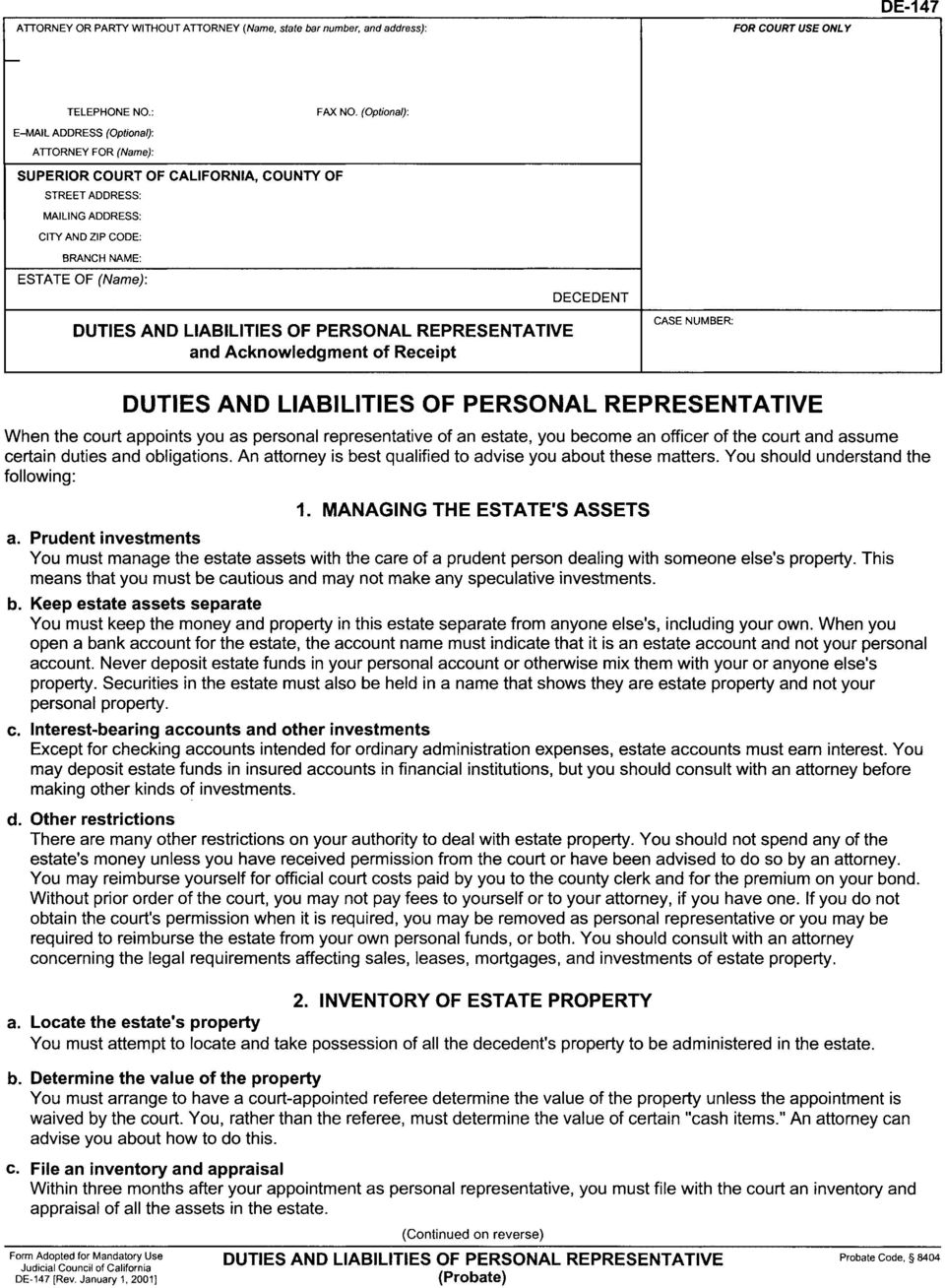
8 3 THE PARTICIPANTS AND THE PROPER COURT THE PARTICIPANTS (HOWER 70) The Personal Representative (Hower 70) Appropriate Terminology (Hower 70) In California, an executor is a person named in a will by a decedent to carry out the terms of the will. Prob 8420, et seq. An administrator with will annexed is appointed where the decedent died testate (having written a will) but no executor was named in the will or all named in the will as executors were unwilling or unable to assume that role. Prob An administrator is appointed as personal representative where the decedent died intestate (without a will). Prob 8460(a). A special administrator is appointed where immediate action is required with regard to the estate but no permanent personal representative has yet been appointed. Prob 8540(a). The Role of the Personal Representative (Hower 71) The role of the personal representative is as described in the text; however, the authority of the personal representative to act is dictated by whether the personal representative is appointed under the Independent Administration of Estates Act (Prob 10400, et seq.), and whether, if so appointed, the personal representative has been granted independent authority by the court to sell real property, exchange real property, grant an option to purchase real property, or borrow money with the loan secured by an encumbrance upon real property. Absent such authority, all of the personal representative s dealings must be approved by the court. Each personal representative is required to acknowledge receipt of a statement of duties and liabilities in a form prescribed by the Judicial Council, prior to issuance of letters to the appointee. Prob The Attorney (Hower 75) The conduct of attorneys in California is governed by the provisions of the State Bar Act found in the California Business & Professions Code (B&P 6000, et seq.) and the California Rules of Professional Conduct. Prob 2640 provides for court-approved payment of attorney s fees in conjunction with guardianships and conservatorships. Prob 2644 authorizes contingent fee contracts, in writing, with attorneys when such is to the advantage, benefit and best interest of the ward or conservatee or the estate... 6
9 Prob establishes a fee schedule based upon the value of the estate accounted for by the personal representative for compensation of an estate attorney for conducting ordinary proceedings as follows: Four percent (4%) on the first fifteen thousand dollars ($15,000); Three percent (3%) on the next eighty-five thousand dollars ($85,000); Two percent (2%) on the next nine hundred thousand dollars ($900,000); One percent (1%) on the next nine million dollars ($9,000,000); One-half of one percent (0.5%) on the next fifteen million dollars ($15,000,000); and Areasonable amount determined by the court for all estates above twenty-five million dollars ($25,000,000). Thus, for example, an attorney representing an estate with a total value of $100,000 shall receive compensation of $3,150 (being.04 $15,000 $600 plus.03 $85,000 $2,550, totalling $3,150); or, for an estate with a value of $600,000, authorized attorney s fees for ordinary services would be $13,750 (being.04 $15,000 $600 plus.03 $85,000 $2,550 plus.02 $500,000 $10,000, totalling $13,750). In addition, Prob authorizes the award of additional compensation for attorney s extraordinary services in an amount determined to be just and reasonable by the court. A will may make provision for the payment of attorney s fees; however, if it does, those fees shall be the full and only compensation of the attorney for the personal representative unless the personal representative or the attorney petition to be relieved from that provision of the will and the court determines, after notice to all interested parties and hearing, that it is to the advantage of the estate and in the best interest of all interested in the estate to authorize an award of attorney s fees in excess of that provided for in the will. Prob Any agreement for payment of attorney s fees in excess of those permitted by statute is void. Prob Moreover, if a special administrator is appointed, the combined fees of the attorneys for both the special administrator and the other personal representative cannot exceed the sums set forth by statute for the ordinary and extraordinary services of attorneys for personal representatives. Prob 8547(c) and (d). However, Prob provides that a personal representative who is an attorney may be compensated as a personal representative, but may not receive compensation as the estate attorney unless the court specifically approves the right to compensation in advance after finding that the arrangement is to the advantage, benefit, and best interests of the estate. The Paralegal or Legal Assistant (Hower 77) Prob 2645 specifically states that: Legal services for which the attorney may be compensated include those services rendered by any paralegal performing the legal services under the direction and supervision of an attorney. The petition or application for compensation shall set forth the hours spent and services performed by the paralegal. The Probate Court/Jurisdiction (Hower 78) Exclusive jurisdiction over all probate matters rests with the Superior Court in California. Prob There is one Superior Court for each county in the State. 7

10 Venue (Hower 84) The proper venue for probate proceedings is the county in which the decedent was domiciled at the time of death, and not the place of death. Prob If the decedent was a nondomiciliary, then proper venue is in the place of death if the decedent s property is also located there; or, if the decedent owned no property located at the place of death or if the place of death was outside California, then the proper venue is any county in which the decedent owned property at the time of death. If property is located in more than one county, then proper venue is in the county in which a petition for ancillary administration is first filed. Prob

11 9
12 10

13 4 THE LAW OF SUCCESSION: DEATH TESTATE OR INTESTATE DEATH WITH A WILL TESTACY (HOWER 90) Terminology Related to Wills (Hower 90) Holographic Will (Hower 91) As noted in the text, California does recognize the validity of holographic wills. Prob To be valid, a holographic will must be signed by the testator and the will s material provisions must be in the handwriting of the testator, and such a document will constitute a valid holographic will whether it has been witnessed or not. Prob 6111(a). In addition, the entire will need not be in the testator s handwriting; statements of testamentary intent in holographic wills may be made either in the testator s handwriting or as part of a commercially printed form will. Prob 6111(c). A holographic will may be proved in the same manner as any other writing (Prob 8222) including through the use of extrinsic evidence (Prob ). A holographic will need not be dated to be valid; however, if not dated and the provisions of the holographic will are inconsistent with the provisions of another will, the holographic will is invalid to the extent of the inconsistency unless the date of execution of the holographic will is proven to be after the date of execution of the other will. Prob 6111(b)(1). Nuncupative Will (Hower 92) As noted in the text, California does not allow nuncupative wills. Statutory Will (Hower 92) Prob 6200, et seq., set forth the provisions regarding the statutory will authorized in California, including the California statutory will form itself (Prob 6240) and its mandatory clauses (Prob 6241). 11

14 Types of Dispositions Gifts Made in a Will (Hower 97) Bequest, Legacy, or Devise (Hower 97) In California, a devise is a gift, or real or personal property, in a will (Prob 32), and vests at the death of the transferor. Prob Prob 2117 defines the classes of testamentary gifts in California as: specific gifts transfers of specifically identified property; general gifts transfers from general assets that do not give specific property; demonstrative gift a general gift that specifies the fund or property from which the gift is to be made; general pecuniary gift a gift of a fixed dollar amount or in an amount determinable by the provision of the instrument giving the gift; annuity a pecuniary gift that is payable periodically; residuary gift a transfer of a gift that remains after satisfaction of all specific and general gifts. Ademption, Lapses, and Abatement (Hower 99) Ademption (Hower 99) The recipient of a specific gift has a right to any portion of the specific gift remaining at the time of transfer plus any balance owing or amount due by reason of the sale or transfer of the specific gift by the transferor. Prob Lapses (Hower 100) Gifts to devisees who do not survive the decedent fail. Prob Failed gifts become a portion of the residuary estate. Prob 21111(a). If a residuary gift or future interest is transferred to two or more persons, but the share of one transferee fails from any reason, then that share passes to the other transferee(s) in proportion to their interest in the gift or future interest. Prob 2111(b). Abatement (Hower 101) The overriding concern in abating gifts is to do so in a manner which will not defeat the transferor s plan or purpose. Prob No distinction is drawn between real and personal property for purposes of determining priority in abatement. Prob Gifts abate in the following order, pursuant to Prob 21402: 1. Property not disposed of by the instrument. 2. Residuary gifts. 3. General gifts not to the transferor s relatives. 4. General gifts to relatives. 5. Specific gifts to others than the transferor s relatives. 6. Specific gifts to relatives. Within any class of gifts, shares of beneficiaries abate pro rata. Prob 21403(a). Annuities and demonstrative gifts are treated as specific gifts to the extent that they are given out of the identified fund, and general gifts to the extent that they may be satisfied out of property other than the specified source. Prob 21403(b). If a specific gift is subject to abatement, the recipient may satisfy the contribution for abatement out of other property to preserve the specific gift. Prob A specific gift is not subject to abatement to exonerate another encumbered specific gift. Prob
15 DEATH WITHOUT A WILL INTESTACY (HOWER 106) Intestate Succession Statutes (Hower 109) General Rules of Distribution Under State Intestate Succession Statutes (Hower 116) The bulk of the intestate succession laws are set forth in Prob 6400, et seq. in California. As California is a community property state, the intestate succession laws take into account the distinction between community property and separate property and treat each differently. [Please note, as previously discussed, that community and quasi-community property are treated identically in California. Hence, all further references to community property in this supplement should be understood to include quasi-community property as well.] In California, if a decedent dies survived by a spouse, all of the community property interest of the decedent passes to the surviving spouse. Prob 6401(a) and (b). This, combined with the surviving spouse s one-half interest, results in the surviving spouse being the sole owner of all of the community property. The decedent s separate property is distributed in accordance with Prob 6401(c). The surviving spouse receives all of the separate property as well if the decedent is not also survived by any issue, parent, brother, sister, or issue of a deceased brother or sister. Prob 64901(c)(1). The surviving spouse receives one-half (1/2) of the decedent s separate property if the decedent also leaves either: (a) one child or the issue of one deceased child, or (b) no issue, both a parent or parents or their issue, or the issue of either of them. Prob 6401(c)(2). The surviving spouse receives one-third (1/3) of the decedent s separate property if the decedent is also survived by: (a) more than one child; (b) one child and the issue of one or more deceased children; or (c) issue or two or more deceased children. Prob 6401(c)(3). That part of the intestate estate not passing to the surviving spouse, as above, or if there is no surviving spouse, is distributed (according to Prob 6402(a)) to the surviving issue of the decedent, in equal shares if of equal degree. If the issue are not of equal degree, then those of more remote degree take as provided in Prob 240 (per stirpes those of the nearest generation to the decedent still living each get a share, and the issue of those of that generation who are deceased equally divide the share of their deceased ancestor of that generation). Prob 6402(a) and 240. If there are no surviving issue, then the estate passes to the following categories of persons, per Prob 6402(c), either equally, if all of the same degree of kinship, or as provided in Prob 240, described above. If there are no surviving persons in the category identified, then the estate passes to the next category identified, in the order indicated: First, to the decedent s parents. Next, to the issue of parents or either of them. Next, to the grandparents or issue of grandparents. Next, to the issue of a predeceased spouse. Next, to the decedent s closest next of kin (if two or more kindred of equal degree claim through different ancestors, then those claiming through the nearest ancestor are preferred). Finally, to the parents of a predeceased spouse, or to the surviving issue of such predeceased parents. Notwithstanding the provisions of Prob 6402, if there are no surviving spouse or issue of a decedent, and the decedent had a predeceased spouse who died less than fifteen (15) years before the decedent, then the real property of the decedent attributable to the decedent s predeceased 13
16 spouse passes, according to Prob (a), to the predeceased spouse s issue, parents, issue of parents, and then kin. With regard to personal property having documents of title and an aggregate value in excess of $10,000, if the predeceased spouse died less than five (5) years before the decedent, pursuant to Prob (b), such personal property passes in a like manner. In order to take by intestate succession, a person must survive a decedent by 120 hours. Prob Relatives of the halfblood, adopted persons, and those conceived before but not born until after the decedent s death take as if they were relatives of the whole blood or had been born prior to the decedent s death. Prob 6406, 6407, 6450, and If a person is related to a decedent by two lines of relationship, he or she may take only a single share through the line of relationship resulting in a larger share. Prob RIGHT OF REPRESENTATION (HOWER 111) In California, the phrase by right of representation may have one of two meanings, depending upon the circumstances under which it is used. Whenever property passes by intestate succession, or a will specifies that property passes to the issue of a deceased beneficiary but does not specify by what method, distribution is made by dividing the property into as many equal shares as there are living members of the nearest generation of issue then living and deceased members of that generation with issue then living. Each living member of that generation receives one share and each deceased member s share is divided in the same manner among his or her then-living issue. Prob 240. Whenever a will, trust, or other document specifies that property is to be divided by right of representation or per stirpes, then the property is first divided into the number of shares equivalent to the total number of children living or deceased but having living issue, with each living child receiving a share and each deceased child s share divided in the same manner. Prob 246. Escheat (Hower 115) If there is no surviving person to whom a decedent s estate may pass pursuant to the laws of intestate succession, the estate escheats to the State. Prob 6404 and 6800, et seq. RIGHTS OF FAMILY MEMBERS TO A DECEDENT S ESTATE (HOWER 117) Rights of a Surviving Spouse (Hower 117) Surviving Spouse s Elective (Forced) Share (Hower 119) As previously noted, if a testator purports to devise the community property interest of a surviving spouse in his or her will, the spouse is put to an election to take either according to the provisions of the will, or to take his or her intestate share of the estate. Prob 141. If the surviving spouse elects his or her intestate share, that property is abated for purposes of distribution and only the balance of the estate is subject to distribution according to the will. This same right to an elective share arises whether or not the decedent or surviving spouse was a domiciliary of California, as long as the decedent left a will disposing of real property located in California. Prob

17 Effect of Divorce and Marriage on a Spouse s Rights (Hower 122) A final dissolution or an annulment of marriage terminates an ex-spouse s intestate succession rights (Prob 78) and revokes any disposition or appointment made in a will executed prior to the dissolution, unless the will expressly provides otherwise, or the parties subsequently remarry. Prob 6122, However, a mere decree of legal separation which does not terminate the marriage does not affect the spouse s inheritance rights (Prob 6122(d), 6227(c)); however, being a party to an action for separate maintenance, annulment or dissolution and living apart from the decedent at the time of the decedent s death will affect the spouse s priority for appointment as or nomination of an administrator of the decedent s estate. Prob 8462, If a testator fails to provide for his or her surviving spouse by will and the spouse and testator married after the execution of the testator s will, then (absent evidence that the testator failed to provide for the spouse intentionally, or that the testator otherwise provided for the spouse outside the will, or that the spouse made a valid agreement waiving any share in the estate Prob 6561), the omitted ( pretermitted ) spouse will receive the testator s one-half of the community and quasi-community property as well as the share of the testator s separate property that the spouse would have received had the testator died intestate. Prob Rights of Children (Issue) (Hower 125) Issue (Hower 125) Issue are all of a person s lineal descendants of all generations. Prob 50. Natural Children (Hower 126) According to California law, a parent and child relationship exists for the purposes of determining intestate succession between a person and the person s natural parents, regardless of the marital status of the natural parents. Prob 6450(a). Adopted Children (Hower 126) A parent and child relationship exists between an adopted person and the person s adopting parent or parents. Prob 6450(b). Adoptions sever the relationship of parent and child between an adopted person and a natural parent unless both: (1) the natural parent and the adopted person lived together as parent and child or both natural parents were living together before the person was conceived but one natural parent died before birth; and (2) the adoption was by the spouse of, or after the death of, either of the natural parents. Prob A natural parent cannot inherit from an adopted child (although the wholeblood siblings and issue of the adopted person may). Prob Nonmarital Children (Hower 127) California no longer utilizes the term illegitimate in reference to children, since the marital status of natural parents has no legal significance on the parent and child relationship, except insofar as that a person may not inherit from a child born out of wedlock if no parent and child relationship has been established. Prob 6450, 6452, 6453; Fam California has adopted the Uniform Parentage Act (Fam 7600, et seq.) for purposes of determining the existence of a natural parent and child relationship. California also recognizes a parent and child relationship between a person and that person s foster parent or stepparent for purposes of intestate succession, where it is shown that: (1) the relationship began during the person s minority and continued throughout the joint 15
18 lifetimes of the person and the foster or stepparent; and (2) the foster or stepparent would have adopted the person but for a legal barrier to doing so. Prob Pretermitted (Omitted) and Posthumous Children (Hower 128) If a testator fails to provide in a will for a child born to the testator after the execution of the will, the child is entitled to receive a share of the testator s estate equal to that which the child would have received had the testator died intestate (Prob 6570), absent evidence that: (1) the failure to provide for the child was intentional and that intention appears from the will; (2) the testator had one or more children at the time of execution of the will and devised substantially all of the estate to the other parent of the omitted child; or (3) the testator provided for the child by transfer outside the will with the intent that the transfer be in lieu of a testamentary share. Prob If a testator fails to provide for a living child in a will at the time of executing the will solely because of the testator s erroneous belief that the child was dead or because the testator was unaware of the birth of the child, the child is entitled to the share he or she would have received had the testator died intestate. Prob Additional Rights or Protections for a Surviving Spouse and Children (Hower 129) Homestead Exemption (Hower 129) In addition to the declared homestead provisions (CCP , et seq.) which provide protection for the equity in real property held by an owner, California law provides for a single probate homestead which may be set aside by the court for the surviving spouse and children. Prob 6520, et seq. The probate homestead provides a surviving spouse with the right to stay in for a period up to the balance of the spouse s lifetime and the minor children with the right to reside in the homestead property until the age of majority. Prob The homestead property is selected from the community property of the estate, or property held jointly by the decedent and those entitled to the homestead, or from property the right to possession of which is vested in another, if the other consents to the homestead. Prob The homestead property may be used to satisfy the costs of administration, creditors claims, and estate liabilities, subject to the homestead rights of the surviving spouse and/or children declared by the court. Prob The probate homestead is sought, declared, and amended by a petition process. Prob 6525, Exempt Property (Hower 131) The court may set aside to the surviving spouse or the minor children of the decedent, or both, all or any part of the property of the decedent exempt from enforcement of a money judgment, other than the family dwelling, on consideration of a petition filed by any interested person. Prob 6510, In addition, until sixty (60) days after the filing of an inventory (or until such further time as the court may direct), the surviving spouse and minor children of the decedent may upon order of the court or upon petition by any interested person and for good cause shown remain in possession of the family dwelling, the wearing apparel of the family, the household furniture, and the other property of the decedent, exempt from enforcement of a money judgment. Prob 6500, Family Allowance (Hower 131) California law provides that the surviving spouse, the minor children, and the adult children of the decedent who are physically or mentally incapacitated and actually dependent upon the 16

19 decedent for support are entitled to such reasonable family allowance out of the estate as is necessary for their maintenance and support during the administration of the estate. Prob 6540(a). In addition, family allowance in the court s discretion may also be given to other adult children and parents of the decedent actually dependent, in whole or in part, upon the decedent for support. Prob 6540(b). A family allowance may be granted retroactively or prospectively from the date of the court s order, for a time period specified by the court, but no earlier than the date of the decedent s death and no later than the distribution of the property of the estate or, if the estate is insolvent, no later than one year after the granting of letters. Prob Family allowances are sought by petition and may be granted or modified only after a hearing, with notice to all interested persons. Prob
20

21 5 WILLS: VALIDITY REQUIREMENTS, MODIFICATION, REVOCATION, AND CONTESTS REQUIREMENTS FOR THE CREATION OF A VALID WILL (HOWER 142) The statutory requirements for creating a valid will in California are found in Prob 6100, et seq. Intent of the Testator (Hower 143) The intent of the transferor is controlling in the interpretation of testamentary documents. Prob 21102(a). Only when the intent of the testator is not clear are the rules of construction set forth in the statutes applied. Prob 21102(b). Capacity of the Testator (Hower 143) Atestator must be at least eighteen (18) years of age and of sound mind to make a will. Prob A person does not have mental competence to make a will if: (a) the individual doesn t have sufficient mental capacity to: 1. understand the nature of the testamentary act; 2. understand and recollect the nature and situation of the individual s property; or 3. remember and understand the individual s relations to living descendants, spouse, and parents, and those whose interests are affected by the will; or (b) the individual suffers from a mental disorder with symptoms including delusions or hallucinations, in which the symptoms result in the devising of property in a way which, except for the delusions or hallucinations, the individual would not have done. Prob To the extent that a will may have been procured by duress, menace, fraud, or undue influence, the will or a part of the will is ineffective. Prob
22 Formal Requirements of a Will (Hower 145) AWritten Will (Hower 145) A will must be in writing (Prob 6110(a)) and signed (1) by the testator or (2) in the testator s name by someone else in the testator s presence and at his or her direction. Prob 6110(b). A will must also be witnessed and signed by two (2) persons, each of whom is present at the same time and witnessed either the signing of the will or the testator s acknowledgment of the signature or of the will, and who understand that the document which they are signing is the testator s will. Prob 6110(c). As previously discussed, a will which fails to meet the formal requirements previously set forth may yet qualify as a holographic will if the signature and material provisions of the will are set forth in the testator s handwriting, whether or not witnessed, and regardless of whether statements of testamentary intent are set forth in the handwriting of the testator or as part of a commercially printed form will. Prob A written will may also take the form of a California statutory will, also as previously discussed. See Prob 6200, et seq. Nuncupative (Oral) Wills (Hower 92) California does not recognize nuncupative (oral) wills. Signature of the Testator (Hower 147) See Prob 6110(b) and 6111, as previously noted. Signatures of Witnesses (Hower 150) See Prob 6110(c) and 6111, as previously noted. MODIFICATION OF A WILL CODICIL VERSUS NEW WILL (HOWER 154) California statutory wills may be modified by codicil, as any other will might be. Prob REVOCATION AND REJECTION OF A WILL (HOWER 156) Revocation by Physical Act (Hower 156) A will is revoked by being burned, torn, canceled, obliterated, or destroyed (or, if executed in duplicate, by such acts upon one of the duplicates (Prob 6121)) by the testator with the intent to revoke it, or by another person in the testator s presence and at the testator s direction. Prob 6120(b). 20
23 Lost Wills (Hower 157) If neither a will nor a duplicate original, last known to be in the testator s possession, cannot be located after the testator s death, it is presumed that the testator destroyed the will with the intent to revoke it. Prob However, lost or unintentionally destroyed wills may be proven by a petition including a written statement of the testamentary words or their substance. Prob Revocation by Operation of Law (Hower 159) As previously noted, provisions of a will are revoked by dissolution or annulment of marriage with regard to the rights of an ex-spouse. Prob If a second will, which would have revoked a prior will had it remained effective at death, is subsequently revoked, the first will remains revoked unless it is evident from the testator s subsequent or contemporaneous declarations or from the circumstances of the second revocation that the testator intended the first will to take effect. Prob 6123(a). Revocation by Subsequent Writing (Hower 160) A valid subsequent testamentary instrument will revoke a prior testamentary instrument either expressly or insofar as the provisions of the two instruments are inconsistent, and the provisions of the later instrument will be given effect over those of the earlier. Prob 6111(b), 6120(a). If a second will, which would have revoked a first will had it remained in effect at the time of death, is subsequently revoked by a third will, the first will is revoked except insofar as it appears from the terms of the third will that the testator intended the first will to take effect. Prob 6123(b). WILL CONTESTS (HOWER 161) The provisions regarding contest of a will are generally contained at Prob 8250, et seq. Who Can Contest a Will (Hower 161) Generally, any interested person may contest a will. Prob 1043, 8004(b), 8270(a). Grounds for Contesting a Will (Hower 162) A will may be contested on any ground which tests the validity of the document; for example, lack of due execution (Prob 6110, 6111), lack of testamentary intent (Estate of Sargavak, 35 Cal.2d 93 (1950)), lack of testamentary capacity (Prob 6100, ), undue influence, fraud, duress (Prob 8252(a)), mistake (Prob 8252(a)), or revocation (Prob ). Prob 8252(a). In Terrorem or No Contest Clause A Forfeiture Clause (Hower 166) In California, forfeiture clauses are valid according to their own terms (Prob ); however, they are strictly construed. Prob If, however, a beneficiary with probable cause challenges a will on grounds of forgery or revocation, a no contest clause is not enforceable against him or her. Prob Similarly, such a clause is not enforceable against a beneficiary, with prob- 21
24 able cause, who contests a provision that benefits: (1) a person who drafted or transcribed the instrument; (2) a person who directed the drafter of the instrument regarding its substantive provisions or to include a no contest clause in the instrument; or (3) a person who acted as a witness to the instrument. Prob Moreover, a beneficiary may seek declaratory relief from the court by petition to determine whether a beneficiary s actions would constitute a contest within the meaning of a no contest clause without reaching the merits of the clause or the action proposed and, hence, without activating the bar of the no contest clause. Prob 21320, et seq. 22
25 6 PREPARATION TO DRAFT A WILL: CHECKLISTS AND THE CONFERENCE WITH THE CLIENT The discussion in the text is applicable to California practice. 23
26 7 FINAL DRAFT AND EXECUTION OF A VALID WILL CONTENTS OF A STANDARD WILL (HOWER 201) SPECIFIC TESTAMENTARY GIFTS (HOWER 207) Inter vivos transfers of property by a transferor to a testamentary beneficiary is treated as a satisfaction of a testamentary gift to that person in whole or in part only if: (1) the instrument provides for the deduction of the lifetime gift from the testamentary gift; (2) the transferor declares in a contemporaneous writing that the lifetime gift is to be deducted or is in satisfaction of the testamentary gift; or, (3) the transferee acknowledges in writing that the lifetime gift is in satisfaction of the testamentary gift. Prob Appointment of a Personal and/or Property Guardian (Hower 214) The provisions regarding guardianship, conservatorship, and other protective proceedings are contained, generally, in Division 4 of the Probate Code. Prob 1400, et seq. In addition, the California Uniform Transfers to Minors Act can be found at Prob 3900, et seq. Simultaneous Death Clause (Hower 216) If a situation or document does not otherwise provide for disposition in instances of simultaneous death (Prob 221), and it cannot be established by clear and convincing evidence that one person survived the other, the property of each person is administered or dealt with as though that person did, in fact, survive the other. Prob 220. With regard to community and quasicommunity property, one-half of the property is dealt with as though one spouse survived the other and the property is the surviving spouse s; and the other half of the property is similarly treated, as though the other spouse had survived the first. Prob 103. If a right to receive property by a beneficiary is conditioned upon surviving another, and it cannot be proven by clear and convincing evidence that the beneficiary did so survive, the beneficiary is deemed not to have survived the other. Prob 222(a). Similarly, if it cannot be proven that either of two or more beneficiaries, or joint tenants, survived the others, the property is divided into equal shares and distributed as if each had survived the others. Prob 222(b), 223. Moreover, in order to be deemed to have survived another, a person must survive a decedent by 120 hours, or the person will be deemed to have predeceased the other (unless application of the 120-hour survival requirement would result in escheat of property to the State). Prob 6211,
27 Testamentary Trust Clauses (Hower 217) The Rule Against Perpetuities and its application are contained in Prob ADDITIONAL NONTESTAMENTARY DOCUMENTS (HOWER 224) Self-proving Provision or Affidavit Clause that Creates a Self-proved Will (Hower 224) Prob 8220 provides for proof of a will, where there is no contest, on evidence of one witness to the will only. Such evidence may consist of an affidavit of a subscribing witness to which a copy of the will is attached, or by an affidavit in the original will that includes or incorporates the attestation clause. Prob 8220(b). In addition, if a subscribing witness is not available, the court may permit proof of the will by: (1) proof of the handwriting of the testator and one witness; or, (2) proof of the handwriting of the testator and (a) a writing in the will bearing all of the subscribing witnesses signatures or (b) an affidavit of a person with personal knowledge of the circumstances of the execution of the will. Prob Right to Die Laws and Related Advance Medical Directive Documents (Hower 228) Durable Power of Attorney for Health Care (Hower 231) Durable powers of attorney for health care are governed by the provisions of Prob 4600, et seq., and a statutory form durable power of attorney for health care deemed valid in California is set forth in Prob WHERE TO KEEP THE WILL (HOWER 240) Prob 700, et seq. deals specifically with the duties and liabilities of attorneys with whom deposits of estate planning documents (including wills, trusts, powers of attorney, or other estate planning documents) have been made. 25
28
29 8 INTRODUCTION TO TRUSTS SCOPE OF THE CHAPTER (HOWER 245) Trusts are generally addressed in Division 9 of the California Probate Code. Prob 15000, et seq. THE ESSENTIAL ELEMENTS OF A TRUST (HOWER 250) The Settlor: The Creator of the Trust (Hower 251) A settlor must manifest an intention to create a trust to do so. Prob A trust may be created for any purpose which is lawful and does not violate public policy. Prob Atrust may be created by a declaration by the settlor that he or she holds the trust property as a trustee; a transfer of property by the owner during his or her lifetime to another as trustee; a transfer of property by testamentary document to another as trustee; or an exercise of a power of appointment to another person as trustee. Prob The Settlor as Trustee or Beneficiary (Hower 252) The settlor may also act as a trustee or beneficiary of the trust. However, if there are successor beneficiaries after the death of the settlor, the trust is not merged or terminated if either: (1) the settlor is both the sole trustee and sole beneficiary during the settlor s lifetime; or (2) there are two or more settlors, one or more of whom are trustees and one or more of whom are beneficiaries during the lifetime of the settlors. Prob The Trustee: The Fiduciary and Administrator of the Trust (Hower 253) Natural or Legal Person as Trustee (Hower 253) A trust company is an entity which has qualified to engage in and conduct a trust business in California (Prob 83) and may be appointed to act as a trustee in the same manner as an individual (Prob 300) without the requirement of giving a bond. Prob 301. Co-Trustees (Hower 255) A co-trustee has an obligation to participate in the administration of the trust, and to take reasonable steps to prevent a co-trustee from committing a breach of trust or to compel a cotrustee to redress a breach of trust. Prob Unless otherwise expressly authorized in the trust document, a power granted co-trustees must be exercised only by unanimous action. Prob
30 A co-trustee may act alone for the trust only where they are the only other trustee and their co-trustee is absent, ill, or temporarily incapacitated, or where there is a vacancy in the office of the co-trustee, where necessary to accomplish the purposes of the trust or to avoid irreparable injury to the trust. Prob , Acceptance or Disclaimer of Trusteeship (Hower 255) A person may accept the position of trustee by a written acceptance, either by signing the trust document or through a separate document; or by knowingly exercising trust powers or authorities (except where the person does so solely to preserve trust property to which there is an immediate risk of damage and the person delivers a written rejection of the trust to the settlor or, if the settlor is dead, to the beneficiary, within a reasonable time). Prob A person named a trustee may reject the trusteeship either by a writing, or by not undertaking any of the acts of acceptance previously identified, within a reasonable time after becoming aware of being named as trustee. Prob Removal or Resignation of Trustee (Hower 255) A vacancy in the position of trustee arises either through resignation or removal, or through death, rejection, inability to identify or lack of existence of the trustee, or appointment of a guardian or conservator of a trustee, bankruptcy of the trustee, revocation of a trust company s charter or suspension of its powers, or appointment of a receiver for a trust company. Prob Having accepted the position, a trustee may resign only: (1) as provided in the trust instrument; (2) if the trust is revocable, with the consent of the person holding the power to revoke; (3) if the trust is irrevocable, with the consent of all adult beneficiaries or conservators of beneficiaries; or (4) pursuant to a court order to do so. Prob A resigning trustee s liability or the liability of the trustee s bond is not affected by his or her resignation. Prob Atrustee may be removed in accordance with the provisions of the trust document or by a court, either on its own motion or on the petition of a settlor, co-trustee, or beneficiary. Grounds for removal by the court include: (1) breach of trust by the trustee; (2) unfitness or insolvency of the trustee; (3) hostility or lack of cooperation among co-trustees impairing trust administration; (4) failure to act by the trustee; (5) excessive compensation to the trustee; (6) disqualification of the sole trustee; or (7) for other good cause. Prob If a vacancy does occur in the position of trustee, a trustee may be appointed by any method specified in the trust instrument; or, failing that, by appointment of a trust company with the consent of the beneficiaries; or, failing that, by appointment of a trustee by the court, giving consideration to any nominations by beneficiaries over the age of 14; or, failing the appointment of any other qualified person willing to act as trustee, the court may appoint the public guardian as trustee of the trust. Prob 15660, Powers of the Trustee (Hower 256) Atrustee has any powers conferred by the trust instrument, and (except as limited by the trust instrument) those powers conferred by statute or to perform any act that a trustee would perform to fulfill its standard of care. Prob However, the mere grant of power to a trustee does not require its exercise, and the exercise of any power by a trustee is subject to the trustee s fiduciary duties. Prob By statute (and absent limitation in the trust document), trustees have the power to: Collect, hold, and retain trust property (Prob 16220). Accept additions to the trust property (Prob 16221). 28
31 Continue, operate, incorporate, dissolve, or change the form of a business or enterprise (Prob 16222). Invest (Prob 16223, 16224). Make deposits (Prob 16223). Acquire and dispose of property, for cash or credit, at public or private sale, or by exchange (Prob 16226). Manage, control, develop, divide, improve, exchange, partition, abandon, or change the character of trust property (Prob 16227). Encumber, mortgage, or pledge trust property (Prob 16228). Repair, alter, improve, demolish, raze, or erect trust property (Prob 16229). Subdivide, develop, dedicate to public use, adjust boundaries, exchange, partition, or dedicate easement of land (Prob 16230). Lease (Prob and 16232). Grant or acquire options (Prob 16233). Hold securities, vote, waive notice, consent, or exercise the rights of shareholders, members, or owners (Prob ). Insure trust property (Prob 16240). Borrow money (Prob 16241). Pay, contest, release, or settle claims (Prob 16242). Pay trust expenses, taxes, assessments, fees, employees, and agents (Prob 16243). Make and guarantee loans to the beneficiary (Prob 16244). Make distributions to beneficiaries and others (Prob 16245, 16246). Hire persons and agents (Prob 16247). Execute and deliver instruments (Prob 16248). Prosecute and defend actions, claims, and proceedings (Prob 16249). Apportion income and expenses between principal, interest, and beneficiaries (Prob ). Duties of the Trustee (Hower 257) The trustee s duties are governed generally by the provisions of Prob Duty of Performance and Due Care (Hower 257) The trustee has a duty to administer the trust in accordance with the terms of the trust instrument and statute, to the extent not limited by the trust instrument. Prob The trustee may not delegate to others the performance of acts the trustee can reasonably be required to personally perform and must exercise supervision over those to whom matters have properly been delegated by the trustee. Prob Atrustee has a duty to use the full extent of the trustee s skills in administration of the trust, and if a settlor has selected a trustee because of a representation of the trustee s having special skills, the trustee is held to the standard of the skills represented. Prob A trustee must administer a trust with the care, skill, prudence, and diligence under the circumstances that a prudent person acting in a like capacity and familiar with such matters would use in the conduct of an enterprise of like character with like aims to accomplish the purposes of trust as determined from the trust instrument. Prob 16040(a). 29
32 Duty of Loyalty (Hower 258) The trustee s duty of loyalty is to administer the trust solely in the interest of the beneficiaries (Prob 16002(a)) and, if there are two or more beneficiaries, to deal with them impartially. Prob Atrustee of two trusts may sell or exchange trust property between the trusts if (a) the sale or exchange is fair and reasonable to the beneficiaries of both trusts and (b) the trustee has given notice to all beneficiaries of all of the material facts known (or which should be known) to the trustee. Prob 16002(b). However, a trustee of one trust may not knowingly become a trustee of another trust adverse to the interests of the beneficiaries of the first trust and has a duty to eliminate the conflict or resign when the conflict becomes known. Prob Atrustee has a duty not to use or deal with trust property for the trustee s own benefit or for any purpose not connected with the trust, and a trustee may not take part in any transaction in which the trustee has an interest adverse to the beneficiary (Prob 16004(a)), including not enforcing claims against trust property acquired by the trustee after contemplation of appointment as trustee. Prob 16004(b). Any transaction between trustee and beneficiary during the term of the trust or while the trustee holds influence over the beneficiary by which the trustee gains an advantage from the beneficiary (other than agreements for the hiring or compensation of the trustee) is presumed to violate the trustee s fiduciary duties. Prob 16004(c). Duty to Take Possession of and Preserve Trust Property (Hower 259) The trustee has a duty to take reasonable steps to take, keep control of, and preserve trust property (Prob 16006); to enforce claims that are part of the trust property (Prob 16010); and to defend actions that may result in a loss to the trust (Prob 16011). Duty to Invest the Trust Property (Hower 260) Atrustee has a duty to make the trust property productive under the circumstances (Prob 16007) and to dispose of trust property that would not be a proper investment for the trustee to make and retain trust property which is in the best interests of the trust or in furtherance of the trust purposes. Prob Atrustee investing trust property must act with the care, skill, prudence, and diligence under the circumstances then prevailing that a prudent person acting in a like capacity and familiar with such matters would use in the conduct of an enterprise of like character and with like aims to accomplish the purposes of the trust. Individual investments will be considered as part of an overall investment strategy. Prob 16040(b). Duty to Make Payments of Income and Principal to the Beneficiaries (Hower 262) Payments of principal and income must be made in accordance with the express terms of the trust. Prob 16302(a)(1). In the absence of such express contrary direction, payments are made, first, pursuant to statutory direction, or pursuant to what is reasonable and equitable in view of the interests of those entitled to income or principal, in accordance with the standard of care imposed upon the trustee by statute. Prob 16302(a)(2) and (3). The statutory scheme regarding distribution of income and application of principal and interest is set forth in Prob Duty to Account (Hower 264) Atrustee owes an obligation to the beneficiaries to keep them reasonably informed of the trust and its administration (Prob 16060), and to account either on request (Prob 16061) or annually, at the termination of the trust, or at a change of trustees to each beneficiary entitled to income or principal. Prob
33 The account shall contain a statement of receipts and disbursements; assets and liabilities; trustee s compensation; a statement that a court review may be obtained by petition; and a statement that claims against the trustee for breach of trust may not be made after three years from the date the beneficiary receives the accounting or report of the trustee. Prob No accounting may be required where the beneficiary and trustee are the same person; where the right to an accounting or report has been waived in writing by the beneficiary (however, such a waiver may be revoked in writing); or where the trust is revocable and the beneficiary does not hold the power to revoke at the time. Prob Any limitation or waiver in a trust instrument of the obligation to account is against public policy and void. Prob 16062(e). Liability of Trustee to Beneficiary (Hower 265) Any violation by a trustee of a duty owed to the beneficiary is a breach of trust for which the trustee is liable. Prob A trustee is only liable for the acts of agents which the trustee improperly supervised, delegated, authorized, hired, concealed, or directed (Prob 16401), and for the acts of a co-trustee which the trustee participated in, approved, concealed, negligently permitted to occur, or failed to cause the co-trustee to redress. Prob Atrustee is not liable for the acts of a predecessor trustee, unless the trustee knowingly fails to correct those acts, or to cause them to be redressed, or to cause property to be delivered to the successor trustee. Prob Atrustee is liable for a breach of trust to a beneficiary for any loss or depreciation in value of the estate, with interest; any profit made by the trustee through the breach of trust, with interest; or any profit that the trust would have realized, with interest, but for the breach. Prob 16440(a). If a court determines that the trustee acted in good faith under the circumstances known to it, it may relieve the trustee of liability for any of these sums. Prob 16440(b). In addition, a beneficiary may pursue equitable remedies against the trustee to compel the performance of duties; to enjoin a breach of trust; to compel redress; to remove the trustee; to set aside the acts of the trustee; to appoint a receiver or temporary trustee; to reduce or deny compensation to the trustee; to trace and recover property; or to impose an equitable lien or constructive trust on trust property. Prob and However, exculpatory provisions of the trust instrument itself may relieve the trustee of any liability to the beneficiary (Prob 16461(a)) so long as the breach is not committed intentionally, with gross negligence, in bad faith, with reckless disregard, or for any profit realized by the trustee from the breach. Prob 16461(b). In addition, the trustee may be relieved of liability by the beneficiary s consent (Prob 16463); written permission or direction from the person holding the power to revoke a revocable trust (Prob 16462); release by, or contract with, the beneficiary (Prob 16464); or affirmation of the transaction by the beneficiary (Prob 16465). Cost of a Trustee (Hower 266) Generally, a trustee is not required to post a bond. However, a trustee may be required by the terms of the trust to post a bond to secure performance of the trustee s duties. A court may modify the terms, amount, or requirement for the posting of a bond. And, in any event and even if such is required by the terms of a trust, a trust company may not be required to give a bond. Prob The cost of a trustee s bond is paid by the trust estate, unless specifically otherwise provided in the trust instrument. Prob (d). Absent express provisions otherwise, a trustee is entitled to reasonable compensation. Prob A trust may expressly provide for a trustee s compensation, subject to a court s determi- 31
34 nation to increase or decrease such compensation based upon the circumstances. Prob A trustee s fee may also be increased on sixty (60) days written notice to beneficiaries. Prob However, an attorney serving as trustee may receive compensation only either as trustee or as attorney for the trustee (and any family member, law partnership, or law corporation associated with the trustee may not receive any compensation) unless first authorized without objection, or pursuant to court order if there is objection, upon thirty (30) days advance written notice to all interested persons. Prob A trustee is also entitled to reimbursement out of the trust property for expenditures incurred in the administration of the trust or for the benefit of the trust (Prob 15684) and the trustee has an equitable lien on the trust property as against the beneficiary for advances, plus interest, for the benefit of the trust and for expenses of administration. Prob The Beneficiary: Recipient of the Trust Property or Benefits (Hower 267) There must be an identified beneficiary for a trust to be valid. Prob 15205(a). However, the beneficiary may either be an identifiable person or a class of beneficiaries ascertainable with reasonable certainty or sufficiently described that it can be determined that some person meets the description or is within the class identified. Prob 15205(b)(1). Alternatively, a power to appoint beneficiaries given to the trustee according to some elucidated standard or in the trustee s or another person s discretion is a sufficient identification of the beneficiary. Prob 15205(b)(2). A beneficiary may disclaim any interest by filing with the Superior Court or the trustee a written disclaimer, signed by the beneficiary, which includes the identity of the creator of the interest, describes the interest to be disclaimed, and states the disclaimer and the extent of it. Prob 260, et seq. Nature of the Beneficiary s Interest (Hower 268) A beneficiary of a trust is one who has a vested or contingent, present, or future interest in the trust, or one who is entitled to enforce the trust. Prob 25(c) and (d). A beneficiary is entitled to special notice of any proceedings regarding a trust (Prob 17204) as well as an accounting from the trustee of the trust assets, liabilities, and status. Prob With regard to revocable trusts, and absent an express trust provision otherwise, where the power to revoke rests with one other than a beneficiary, the person holding the power to revoke, and not the beneficiary, is granted the right to consent, of appointment or withdrawal, and right to notice otherwise due a beneficiary. Prob 15800, et seq. A beneficiary s interest or the trust principal may be restrained from transfer or protected from creditors of the beneficiary by express language in the trust. Prob However, a settlor may not protect himself or herself from claims of his or her own creditors through the creation of a trust with limiting language of which the settlor is also the beneficiary or over which the settlor retains a power of revocation. Prob 15304, Moreover, (a) claims for spousal or child support for the trust beneficiary s spouse, former spouse, or minor child; (b) restitution judgments against the beneficiary resulting from felonious conduct by the beneficiary; or (c) liability of the beneficiary for reimbursement for public support furnished to the beneficiary or the beneficiary s spouse or minor child, may be satisfied from trust principal or interest (notwithstanding restraining language in the trust itself) either: (1) for present and future payments by court order if the beneficiary has the right under the trust to compel the trustee to pay income or principal to or for the benefit of the beneficiary or (2) for future payments by order of a court, regardless of the beneficiary s power to direct the trustee. Prob 15305, , and
35 A court may also order payment of judgment creditors claims against the beneficiary not withstanding a restraint on transfer of the beneficiary s interest in the trust. Prob , Trust Property (Hower 270) There must be trust property for a trust to be created. Prob The trust property may be either personal or real; but, if real, the Statute of Frauds applies and the trust must be in a written document signed by the settlor or trustee. Prob In addition, a trust relating to real property must be recorded in the county in which the real property or some of it is located. Prob The existence and terms of an oral trust of personal property must be proven by clear and convincing evidence, and the mere oral declaration of the settlor alone is not sufficient to do so. Prob TERMINATION OF TRUSTS (HOWER 272) Trusts are terminated by: (1) expiration of the term of the trust; (2) fulfillment of the trust purpose; (3) subsequent illegality of the trust purpose; (4) impossibility of fulfilling the trust purpose; or (5) revocation of the trust. Prob Atrust may be terminated by order of the court on petition of a trustee or beneficiary if the value of the trust property has become so low in relation to the cost of administration that continuation of the trust will defeat or impair its abilities to satisfy the trust s purpose. Prob 15408(a). Also, the trustee has the power to terminate the trust if the trust principal does not exceed twenty thousand dollars ($20,000). Prob 15408(b). Atrust may also be terminated if it continues in existence beyond the period of the statutory rule against perpetuities (Prob 21205) on petition of either a majority of the beneficiaries or the Attorney General (Prob 15414), and a trust provision that the trust may not be terminated is ineffective in that circumstance. Prob Trusts may also be combined or divided by court order if the court determines that to do so would not substantially impair or defeat the interests of the beneficiaries or the trusts ability to satisfy their purposes. Prob 15411, A court may modify or terminate a trust if, due to circumstances unforeseen or unknown to the settlor, continuation of the trust would substantially impair or defeat the accomplishment of the purposes of the trust. A court may also order the trustee to undertake acts specifically prohibited or unauthorized by the trust instrument under those circumstances. Prob
36 9 CLASSIFICATION OF TRUSTS, THE LIVING TRUST, AND OTHER SPECIAL TRUSTS CLASSIFICATION OF TRUSTS (HOWER 276) Express Trusts Private versus Public (Charitable) (Hower 276) Public (Charitable) Trust (Hower 277) Charitable trusts are governed by the provisions of the Uniform Supervision of Trustees for Charitable Purposes Act, enacted in California as Gov 12580, et seq., and are not subject to the limitations of the rule against perpetuities since direct gifts to charities are vested and those after a life interest are exempted. Prob 21225(e). Specific provisions regarding the duties of trustees of charitable trusts with regard to provisions of the Internal Revenue Code may also be found at Prob Public Trust Cy-pres Doctrine (Hower 279) The cy-pres doctrine has been adopted by the courts in California. Estate of Faulkner, 128 Cal.App.2d 575 (1954); Estate of Quinn, 156 Cal.App.2d 684 (1958); Estate of Gatlin, 16 Cal.App.3d 644 (1971); Estate of Klinkner, 85 Cal.App.3d 942 (1978); Estate of Puckett, 11 Cal.App.3d 46 (1980). Implied Trusts Resulting and Constructive (Hower 283) Involuntary trusts are governed by Civ , relating to: Wrongful detention of the property of others (Civ 2223). Gaining property by fraud, accident, mistake, undue influence, breach of trust, or other wrongful acts (Civ 2224). Felons who receive money for books, articles, or films regarding their crimes (Civ 2225). Miscellaneous Trusts (Hower 287) Spendthrift Trusts (Hower 287) A beneficiary s interest or the trust principal may be restrained from transfer or protected from creditors of the beneficiary by express language in the trust. Prob However, a 34
37 settlor may not protect himself or herself from claims of his or her own creditors through the creation of a trust with limiting language of which the settlor is also the beneficiary or over which the settlor retains a power of revocation. Prob 15304, Moreover, (a) claims for spousal or child support for the trust beneficiary s spouse, former spouse, or minor child; (b) restitution judgments against the beneficiary resulting from felonious conduct by the beneficiary, or (c) liability of the beneficiary for reimbursement for public support furnished to the beneficiary or the beneficiary s spouse or minor child may be satisfied from trust principal or interest (notwithstanding restraining language in the trust itself) either: (1) for present and future payments by court order if the beneficiary has the right under the trust to compel the trustee to pay income or principal to or for the benefit of the beneficiary or (2) for future payments by order of a court, regardless of the beneficiary s power to direct the trustee. Prob 15305, , and A court may also order payment of judgment creditors claims against the beneficiary notwithstanding a restraint on transfer of the beneficiary s interest in the trust. Prob , Totten Trusts (Hower 288) Provisions governing Totten Trusts are found in Prob 80 and Sprinkling Trusts (Hower 289) A discretionary power given to a trustee must be exercised reasonably, and not arbitrarily (Prob 16080). A trustee must act in accordance with fiduciary principles and not in bad faith or disregard of the purposes of the trust, even where the trust confers absolute, sole, or uncontrolled discretion on the trustee. Prob 16081(a). Moreover, a power to distribute income or principal to or for the benefit of others may not be used to discharge the legal obligations of the party holding the power. Prob If a beneficiary holds a power to take or distribute income or principal of a trust to or for the benefit of himself or herself, the holder of the power may exercise it only for his or her health, education, support, or maintenance, unless a broader standard is established in the trust instrument. Prob 16081(b). LIVING (INTER VIVOS) TRUSTS (HOWER 296) Revocable Living Trusts (Hower 297) Atrust is presumed to be revocable unless expressly made irrevocable by the terms of the trust instrument. Prob A trust may be modified by the consent of all of the beneficiaries if irrevocable (Prob 15403), or by consent of the settlor if revocable by the settlor (Prob 15402), or by consent of the beneficiaries and the settlor (Prob 15404). settlor. Prob Disadvantages of a Revocable Living Trust (Hower 305) The property of a revocable living trust is subject to the claims of creditors of the settlor to the extent of the power of revocation during the lifetime of the settlor. Prob In addition, after the death of the settlor, the property of the trust is subject to creditors claims in accordance with the provisions of Prob , which provide for the publication and giving of notice to creditors, acceptance and rejection of creditors claims, barring of claims if not filed in accordance with the time limits and procedures identified, and division and distribution of the property of the revocable trust between creditors, the surviving spouse, and other distributees. 35
38 10 ESTATE PLANNING AND LONG-TERM CARE The principles enunciated in the text are representative of California practice. 36
39 11 PERSONAL REPRESENTATIVES: TYPES, PRE-PROBATE DUTIES, AND APPOINTMENT TYPES OF PERSONAL REPRESENTATIVES (HOWER 360) In California, an executor is a person named in a will by a decedent to administer the estate and carry out the terms of the will. Prob 8420, et seq. If it appears from a will that a person was intended by the decedent to administer the estate, but the person was not named specifically as an executor, then the person will be entitled to appointment as a personal representative as though he or she had been named executor. Prob Moreover, a will may designate another to appoint an executor, a co-executor, or a successor executor or co-executor. Such an appointment in writing and filed with the court will be given the same effect as if the testator had named an executor in the will. Prob An administrator with the will annexed is appointed where the decedent died testate (having written a will) but no executor was named in the will or all named in the will as executors were unwilling or unable to assume that role (Prob 8440) and an administrator with the will annexed has the same authority over the decedent s estate as an executor named in the will would have. Prob Priority for appointment as administrator with the will annexed is the same as priority for appointment as administrator, explained below, except that a person who takes more than 50% of the value of the estate under the will, or his or her nominee (or the nominee of a group of several persons who together take more than 50%) have priority over all others; and those who take a greater sum under the will or by statutory authority have priority over those entitled to a lesser sum, or nothing at all. Prob An administrator is appointed as personal representative where the decedent died intestate (without a will). Prob 8460(a). A special administrator is appointed where immediate action is required with regard to the estate but no permanent personal representative has yet been appointed. Prob 8540(a). If a person is appointed as an administrator on the ground of intestacy, or an administrator with the will annexed or executor, and a will or later will, respectively, is subsequently admitted to probate, the appointed personal representative shall be removed from office. Prob Priority for appointment as administrator is as follows: Surviving spouse. Children. Grandchildren. Other issue. Parents. Brothers and sisters. 37
40 Issue of brothers and sisters. Grandparents. Issue of grandparents. Children of a predeceased spouse. Other issue of a predeceased spouse. Other next of kin. Parents of a predeceased spouse. Issue of parents of a predeceased spouse. Conservator or guardian of the estate (with qualifications). Public administrator. Creditors. Any other person. Prob However, if one with priority fails to claim appointment, the court may appoint any other who does claim priority for appointment. Prob Surviving spouses and relatives have priority only if they are entitled to succeed to some or all of the estate either directly or through another deceased person, or by will. Prob A surviving spouse living separate and apart from the decedent at the time of death who is a party to an action for dissolution, annulment, or separate maintenance has priority only next after the brothers and sisters. Prob As among those with equal priority, the court may appoint one or more of them and, if they are unable to agree, the court may appoint the public administrator or a disinterested person of a lower class. Prob In lieu of himself or herself, one with priority may, in writing, nominate another to act as administrator. Prob 8465(a). The nominee will have priority equivalent to that of the nominator (if the nominator is of the class of grandparent or above on the list) but will be chosen next only after all others of the class of the nominator have declined appointment. Prob 8465(b). If the nominator is of a lower class, then the court may appoint a person of a class lower than that of the nominator, rather than appointing the nominee. Prob 8465(c). If the priority of a person is based solely upon being a creditor, the court may deny the appointment and appoint another, in its discretion. Prob Atrust company may be appointed as a personal representative in the same manner as an individual and, if so appointed, may not be required to give a bond. Prob 300, 301. The court may also appoint a successor personal representative, upon petition with notice and according to the same priorities as the original appointment (Prob 8522), whenever the office of the personal representative is left vacant by the death, resignation, removal, or other termination of authority of a personal representative (Prob 8520), and a successor personal representative may exercise all of the powers of the personal representative s office. Prob 8524, During the term of the vacancy, the court may appoint a special administrator. Prob Nonresident personal representatives are deemed to have appointed the Secretary of State, as their attorney permitting service of process and notices upon the Secretary of State on behalf of the nonresident personal representative, and are required to execute and file with the court a statement of permanent address and prompt written notification of changes of address. Prob 8570, et seq. Prob 8420 identifies those ineligible for appointment as personal representatives, including minors, those subject to conservatorship, or nonresidents of the United States. A personal representative may be removed from office on petition of any interested party on the ground that the personal representative has wasted, embezzled, mismanaged, or committed a fraud on the estate, or is about to do so; is incapable of properly executing his or her duties; has 38
41 wrongfully neglected the estate or has long neglected to perform any act; or must be removed for the necessary protection of the estate or interested person. Prob 8500, The court issues a citation to the personal representative to appear and show cause why the personal representative should not be removed and, after demur or answer to the petition by the personal representative and hearing and the taking of evidence, if the court determines that cause exists for removal (and the failure of the personal representative to attend or answer is cause), the court will remove the personal representative and revoke any letter issued, and appoint a successor personal representative. Prob , The court may deny a petition for removal on the ground that the person seeking appointment has higher priority if the court determines that the person had knowledge of the prior appointment and an opportunity to contest it and to grant the petition would be contrary to the sound administration of the estate. Prob A personal representative is entitled to compensation according to statute, based upon the value of the estate, in the same amount as the attorney for the personal representative, as follows: Four percent (4%) on the first fifteen thousand dollars ($15,000); Three percent (3%) on the next eighty-five thousand dollars ($85,000); Two percent (2%) on the next nine hundred thousand dollars ($900,000); One percent (1%) on the next nine million dollars ($9,000,000); One-half of one percent (0.5%) on the next fifteen million dollars ($15,000,000); and Areasonable amount determined by the court for all estates above twenty-five million dollars ($25,000,000). Prob A personal representative is also entitled to additional compensation in such sums as the court determines to be just and reasonable for extraordinary services (Prob 10801(a)) and may employ tax counsel, auditors, accountants, or other tax experts who may be paid from the estate. Prob 10801(b). A special administrator is entitled to compensation as well; however, the special administrator will not be paid until close of the administration of the estate (absent a petition for earlier payment joined in by the general personal representative) and the total compensation paid to the special administrator and to the general personal representatives cannot exceed the total sums set forth in Prob and Prob 8547(a) and (b). PREPARATION FOR PROBATE AND ESTATE ADMINISTRATION GENERAL OVERVIEW (HOWER 378) Pre-probate Duties of the Personal Representative and Paralegal (Hower 379) Search for and Obtain the Will and Other Personal and Business Records (Hower 379) One who is a custodian of a will is required to produce that will to the clerk of the Superior Court of the county in which the estate of the decedent may be administered within thirty (30) days of learning of the death of the decedent. The custodian must also mail a copy of the will within the same time period to any executor named in the will if his or her whereabouts are known to the custodian, or to the beneficiary of the will, if that person s whereabouts are known to the custodian. Prob 8200(a). The custodian is liable for any damages caused by his or her failure to act in accordance with the statute. Prob 8200(b). 39
42 Records and public papers of a notary public must be delivered to the county clerk on the death of the notary. Gov One who holds a key to a safe deposit box in a financial institution where all owners of the box are deceased may obtain access to the box by providing the financial institution with proof of the decedent s death by producing a copy of a death certificate or written statement of death by the treating physician, hospital, coroner, or institution where the decedent died, and reasonable proof of the identity of the person seeking access. Prob 331(a) and (b). Access may be given under the supervision of an officer or employee of the institution for the purpose of making an inventory of the contents of the safe deposit box, removing wills and trust instruments from the box (placing photocopies of the same in the box), and instructions for the disposition of the decedent s remains. All wills shall be delivered to the clerk of the Superior Court and copies mailed to the executor or beneficiaries, as previously described. Prob 331(d),(e), and (f). Government officials, public administrators, law enforcement agencies, employers, or the hospital or institution in which a decedent died may deliver the tangible personal property of the decedent to the decedent s surviving spouse, relative, or conservator or guardian of the estate, unless the person knows of a dispute regarding the right to possession of the property. In addition, the delivering party must maintain an inventory of the property delivered and the identity of the recipient for three years. Prob 330. Obtain Certified Copies of the Death Certificate (Hower 381) Copies of the death certificate may typically be acquired from the County Recorder s office of the county in which the death occurred. The Appointment Procedure The Beginning (Hower 384) Bond (Hower 385) Pursuant to Prob 8480, a bond is required of all personal representatives prior to the issuance of letters. If two or more persons are appointed, either a joint bond or separate bonds from each may be required by the court. Prob 8480(a). The provision for a bond may be waived either by express provision in a will or by a written waiver executed by all beneficiaries. Prob 8422(a), 8481(a). In its discretion, however, a court may disregard the waivers and require the giving of a bond either before or after the issuance of letters for good cause (Prob 8481(b)) or the court may itself waive the giving of a bond. Prob The amount of the bond is fixed by the court, but will be no more than the total estimated value of the estate s personal property plus the estimated annual gross income of the estate. If independent administration of the estate is granted with regard to real property, the estimated value of the decedent s interest in real property is added as well. Prob 8482(a). A personal representative might also deposit the money and property of the estate with financial and trust institutions on condition that the property not be withdrawn except on authorization of the court (Prob 9700) and, if this is done, the value of the bond required may be adjusted by the court to exclude the value of the property deposited or lowered or reduced to an amount the court determines to be reasonable. Prob The personal representative is annually allowed the cost of the bond. Prob Surety (Hower 390) If the bond is given by an admitted surety insurer, the court may establish a fixed minimum for the bond equivalent to the minimum premium required by the surety. Prob 8482(b). If the bond is given by personal sureties, the amount will be doubled. Prob 8482(c). 40
43 Actions against the sureties on the bond must be brought within four years of the discharge or removal of the personal representative or within four years from the date the order surcharging the personal representative becomes final, whichever is later (Prob 8488(b)), or within six years from the date of judgment releasing the personal representative and sureties from the heirs or devisees claims, whichever is later. Prob 7250, 8488(c). Letters Testamentary and Letters of Administration (Hower 391) Personal representatives may only exercise authority when appointed, and such an appointment is not effective until letters are issued to them by the court. Prob 8400(a). Letters are revoked upon removal of a personal representative from office. Prob Relating to personal representatives, letters may mean letters testamentary, letters of administration, letters of administration with the will annexed, or letters of special administration. Prob 52. Letters must be signed by the clerk under the seal of the court, and contain: The county from which the letters are issued. The name of the personal representative and whether he or she is appointed as an executor, administrator, administrator with the will annexed, or special administrator. A notation as to whether the personal representative is authorized to act under the Independent Administration of Estate Acts (essentially without court supervision) and, if so, whether the authority includes or excludes the power to sell, exchange, encumber, or grant an option to purchase real property. Prob
44 42
45 12 PROBATE AND ESTATE ADMINISTRATION As in other areas of practice in California, the Judicial Council (a group appointed to study and make recommendations for the enhancement of the judicial process) has approved or adopted standard forms for use in probate matters. Use of approved forms is generally discretionary, whereas use of adopted forms is mandatory. However, even if a specific form has not been adopted, its use may be required by local court rule, or local court rule may specify the use of a particular locally adopted form. If the use of a particular Judicial Council form or of a local form is not mandatory, office-drafted pleadings may be utilized. The general rules regarding the procedural aspects of estate administration, petition process, giving of notice, filing and setting matters for hearing, conduct of hearings and orders, citations, and so forth, are found at Prob PROBATE OR ESTATE ADMINISTRATION (HOWER 396) Small Estate Settlement and Administration (Hower 398) Depending upon the size and composition of the estate and the marital status of the decedent, different methods exist in California for the summary passing of title to estate property to the decedent s successors or surviving spouse and children without administration. Collection by Affidavit (Hower 398) For Personal Property (Hower 398) One provision for small estate settlement and administration is applicable to estates with a gross value of real and personal property in California not exceeding $100,000. Prob In calculating the gross value of the estate as of the date of death, the following are excluded: Property in which the decedent held a joint tenancy interest. Property which passed to the decedent s spouse. Property in which the decedent held a life or other interest terminable at the decedent s death. Multiple party or POD accounts which pass to another. Registered vehicles and vessels. Registered manufactured homes, mobilehomes, commercial coach, truck camper, and floating homes. Amounts due the decedent for services in the armed forces. Salary or other compensation due the decedent, not exceeding $5,000. Prob If there is no proceeding for the administration of a decedent s estate, or if the personal representative of the estate has consented, the successor of the decedent (either a devisee under a 43
46 will or heir, if the decedent dies intestate (Prob 1006)) may collect money, receive tangible personal property, or have evidences of a debt, obligation, or chose in action (Prob 13100) but not real property (Prob 13115) by executing and delivering to the holder of the decedent s property (Prob 13002) an affidavit or declaration stating: The decedent s name. The date and place of death. That At least 40 days have elapsed since the death of the decedent, as shown in a certified copy of the decedent s death certificate attached to this affidavit or declaration. Either: (1) No proceeding is now being or has been conducted in California for administration of the decedent s estate. or (2) The decedent s personal representative has consented in writing to the payment, transfer, or delivery to the affiant or declarant of the property described in the affidavit or declaration. That The current gross fair market value of the decedent s real and personal property in California, excluding the property described in Section of the California Probate Code, does not exceed one-hundred thousand dollars ($100,000). Adescription of the property of the decedent to be paid, transferred, or delivered pursuant to the affidavit or declaration. The name of the successor of the decedent. Either that the affiant is the decedent s successor or is authorized to act on behalf of the successor with respect to the decedent s interest in the property. That no other person has a superior right to the property or interest. Arequest that the property be paid, delivered, or transferred to the affiant/declarant. Averification that the contents of the affidavit/declaration are true and correct. Prob 13101(a). The affidavit or declaration must have a certified copy of the decedent s death certificate attached to it and, if the decedent s personal representative has consented, a copy of the consent and the personal representative s letters must also be attached to the affidavit or declaration. Prob 13101(d) and (e). If the decedent held evidence of ownership of the property in question, the evidence of ownership should also be attached. Prob If the decedent s estate includes real property located in California, an inventory and appraisal by a probate referee must also be attached to the affidavit or declaration. Prob The person presenting the affidavit must also provide reasonable proof of his or her identity to the holder of the property (Prob 13104) who is bound to release the property to the presenter if the requirements of Prob are met, and is subject to an action to recover the property and an award of reasonable attorney s fees to the person bringing the action if the refusal to deliver the property was unreasonable. Prob A holder of property who releases it pursuant to the statutory requirements is discharged of liability with respect to the property and released of tax liability and may rely in good faith on the statements in the affidavit or declaration and has no obligation to inquire into the truth of those statements. Prob If the obligation sought to be transferred is secured by a lien on real property and an instrument creating the lien has been recorded, then the affidavit shall include a recording reference to the instrument creating the lien, and a notary public s certificate of acknowledgment identifying each person executing the affidavit or declaration, and the affidavit or declaration, must be recorded in the office of the county recorder of that county. Prob
47 The successor of the decedent who has received property is personally liable for the debts of the decedent to the value of the property received (Prob 13109) and is also liable to any person having a superior right to the property by testate or intestate succession, and is liable for three times the value of the property if the property was fraudulently secured. Prob If the decedent was a party to pending litigation, the successor may be substituted in the litigation in the place of the decedent. Prob If proceedings for administration of the decedent s estate are commenced and, even if the personal representative has consented to collection by affidavit, the personal representative may later request that the property be restored to the estate and anyone who received such property is liable to return it or its fair market value to the estate. Prob For Real Property (Hower 398) Where the value of real property located in California does not exceed twenty thousand dollars ($20,000), title may be transferred to a successor to the decedent by affidavit filed not less than six (6) months after the death of the decedent if there is no proceeding for the administration of the decedent s estate or the personal representative of the estate has consented. The affidavit must contain: The name of the decedent. The date and place of death. Alegal description of the real property. The interest of the decedent in the property. The name and address of each guardian or conservator of the decedent at the time of death, to the extent known. That the gross value of all real estate owned by the decedent, excluding that identified in Prob 13050, does not exceed twenty thousand dollars ($20,000). That at least six months have elapsed since the death as shown in an attached certified copy of the decedent s death certificate. Either that there is no proceeding to administer the decedent s estate or that the decedent s personal representative has consented in writing. That funeral expenses, expenses of last illness, and all unsecured debts of the decedent have been paid. That the affiant is the successor of the decedent in and to the property and that no other person has a superior right to the interest of the decedent in the property. Averification under penalty of perjury that the contents of the affidavit are true and correct. Prob 13200(a). A notary public s certificate of acknowledgment is required for each person signing the affidavit (Prob 13200(b)) and an inventory and appraisal by a probate referee must be attached (Prob 13200(c)) as well as a certified copy of the death certificate, a copy of the will if claiming under one and no estate proceeding is pending, and a copy of the personal representative s letters and written consent, if applicable (Prob 13200(d) and (e)), as well as a thirty-five dollar ($35) filing fee. Prob The affidavit and attachments are filed with the court clerk, who issues a certified copy of the affidavit (without attachments), which is recorded in the office of the county recorder where the real property is located, with the decedent indexed as the grantor and the successor indexed as the grantee of the title to the real property. Prob The successor is personally liable to the extent of the fair market value of the property for the decedent s unsecured debts (Prob 13204), and to any person having a superior right to the 45
48 property by testate or intestate succession, and for three times the fair market value of the property if acquired fraudulently. Prob Any action to impose liability must be brought within three years of the date of the affidavit or of discovering the fraud, and the limitations period cannot be tolled for any reason. Prob 15205(c). Upon the request of the personal representative, the property and the net income received from it, as well as the balance due to satisfy any encumbrance placed upon the property by the successor, must be restored to the estate of the decedent, or three times the fair market value of the property if the successor fraudulently executed or filed the affidavit to succeed to the property. Prob Petition for Confirmation (Hower 398) For estates which do not total in excess of $100,000 in real and personal property, and for which there has been no administration instituted or if the personal representative has consented not earlier than forty (40) days after the decedent s death, a petition may be filed with the Superior Court of the county in which the decedent s estate may be administered seeking court confirmation of the title of the successor of the decedent to an interest in real property (and personal property). Prob The petition must be verified and a court order of confirmation requested, which must contain the facts necessary to determine that it has been filed in the proper county; that the decedent s gross estate (less excluded property identified in Prob 13050) does not exceed $100,000; a description of the real and personal property alleged to pass to the successor; the facts upon which it is claimed that the described property passes to the successor; a statement that either there is no administration proceeding or that the personal representative of the decedent s estate has consented; whether estate proceedings have been commenced in any other jurisdiction and, if so, where; and the name, address, and relation to the decedent of all heirs, devisees, executors, trustees, guardians, or conservators of the decedent; as well as attachment of an inventory and appraisal by a probate referee, a copy of a will, if the claim to succession is based upon one, and the written consent of the personal representative, if given. Prob After noticed hearing, the court enters an order describing and confirming the property in the successor (Prob 13153, 13154). The successor will be personally liable to the value of the confirmed property, less any liens or encumbrances, for the unsecured debts of the decedent. Prob Spousal Property (Hower 398) In addition to the foregoing, title property passing by will or by intestate succession to a surviving spouse passes without administration. Prob 13500, et seq. After forty (40) days after death of a spouse, the surviving spouse (or personal representative, guardian, or conservator of the estate of the surviving spouse) may sell, convey, lease, mortgage, or otherwise dispose of community or quasi-community real property, and the title conveyed is free and clear of the claims of the estate or creditors of the deceased spouse, and the surviving spouse may record an affidavit setting forth the facts giving the surviving spouse the right to dispose of the property (Prob 13540), so long as a notice has not been filed by another claiming an interest in the property to be conveyed. Prob The surviving spouse is personally liable for the debts of the deceased spouse to the extent of the value of the decedent s community and separate property interests passing to the surviving spouse as well as that portion of the surviving spouse s property which is not exempt from enforcement of a money judgment, less the amount of any liens and encumbrances, and such debts may be enforced against the surviving spouse to the same extent that they may have been enforced against the deceased spouse. Prob 13550, 13551, In addition, the surviving spouse is liable to any person having a superior right to property by testate succession from the decedent and, if proceedings for the administration of the 46
49 decedent s estate are commenced, the surviving spouse is liable for the restitution to the decedent s estate of the decedent s property, or its fair market value, plus any net income received from the property. Prob 13561, 13562, However, claims of superior right to the decedent s property are barred three years after the death of the decedent and the limitation period cannot be tolled for any reason. Prob 13561(b). The surviving spouse is not liable for any debts of the deceased spouse if the property of the deceased spouse is administered and, if administered, no claim which has not been asserted within the claims period can be asserted against the surviving spouse. Prob 13552, At any time after the death of a spouse, the surviving spouse may collect, by affidavit, salary or other compensation owed to the deceased spouse in an amount not to exceed five thousand dollars ($5,000). Prob The affidavit or declaration must be furnished to the employer of the decedent, and must contain: The name of the decedent. The date and place of death. That the affiant or declarant is the surviving spouse, or guardian or conservator of the estate of the surviving spouse. That the surviving spouse is entitled to the decedent s earnings by will or intestate succession and that no one has a superior right to those earnings. That no proceeding for administration of the decedent s estate has been instituted. That earnings of up to $5,000 be promptly paid to the affiant or declarant by Prob , inclusive. That no other pending request for earnings of another employer exists. That no other compensation has been collected (or, if collected, the amount specified). Arequest for payment of the salary or compensation, not to exceed $5,000. Averification under penalty of perjury of the truth of the contents of the affidavit or declaration. Prob Payment pursuant to this provision discharges an employer of liability with respect to the compensation paid (Prob 13603), and refusal to pay subjects the employer to an action for the amount due, as well as reasonable attorney s fees if the court finds the refusal to pay unreasonable. Prob Confirmation of Ownership (Hower 400) A surviving spouse may petition the Superior Court of the county in which the estate of the deceased spouse may be administered for confirmation of ownership by the surviving spouse of property passing to the surviving spouse without administration. Prob 13650, et seq. The petition must allege that administration of the estate is not necessary, and must set forth the facts necessary to determine the county in which the decedent s estate may be administered; a description of the decedent s property passing to the surviving spouse without administration; the facts upon which it is claimed that the property may pass without administration; a description of any interest in community or quasi-community property which the court is requested to confirm to the surviving spouse; the name, age, address, and relation to the decedent of each heir, devisee, executor, and personal representatives of the decedent known to the surviving spouse; and, if the property is claimed to pass by will, attachment of a copy of the will to the petition. Prob Attorney s fees are not allowed, but are subject to agreement between the petitioner and attorney and, if in dispute, the court may be petitioned to determine the reasonableness of the fees claimed. Prob
50 Notice of hearing on the petition is given to all interested persons and, after determination by the court, an order is entered identifying and confirming property to the surviving spouse and, if appropriate, identifying that property which is subject to administration or further notice and proceedings (such as ownership of an unincorporated business) (Prob 13658). Prob Small Estate Set-aside (Hower 443) Where the decedent s estate (consisting of personal property located anywhere and real property located in California), after deduction of all liens and encumbrances and the value of any probate homestead under Prob 6520, has a net value of $20,000 or less, the estate may be set aside to the surviving spouse and minor children by petition filed in the Superior Court of a county in which the decedent s estate may be administered. Prob 6600, et seq. The petition must be filed by the executor named in the will (if any), the surviving spouse, a child or its guardian, or the personal representative of the decedent s estate, if any, and must contain an allegation that the estate is subject to the small estate set-aside provisions of the Probate Code and a request for an order setting the estate aside; the facts necessary to determine the county in which the estate may be administered; the name, age, address, and relation to the decedent of all heirs and devisees of the decedent; a specific description and estimate of value of the decedent s property and a list of all liens and encumbrances at the date of death; a description and estimate of value of real property located outside of California that passed to the surviving spouse and minor children; a description and estimate of the value of property that passed to the surviving spouse and minor children by joint tenancy or joint account; a designation of probate homestead property which has been set aside; a statement of any unpaid liabilities for expenses of the last illness, funeral charges, and expenses of administration; and the considerations that justify disposition of the estate under the small estate set-aside provisions. Prob 6604, The petition may be filed anytime before the entry of a final order for distribution of the decedent s estate, and may be filed in a pending proceeding for administration, along with a petition for probate of the decedent s will or for administration of the estate, or (if there are no other administration proceedings) independently. Prob Notice of hearing on the petition must be given to all interested persons and the hearing must be set at least 15 days after the filing of the petition. If a pending hearing to determine final distribution is set for before the hearing on the petition, that hearing will continue to coincide with the hearing on the set-aside petition. Prior to the hearing, an inventory and appraisal of the estate (prepared as in any other case) must be filed by the petitioner or personal representative. Prob 6607, If the court determines that it is equitable to do so, it shall order the estate set aside for the surviving spouse and children, after payment of expenses for the last illness, funeral charges, or expenses of administration from the estate. The court takes into consideration the needs of the surviving spouse and children, creditors claims, liens and encumbrances on the property, and the intent of the decedent and the decedent s estate plan as expressed in inter vivos and testamentary documents, and any other relevant considerations. If the spouse is remarried, it is presumed that the needs of the spouse do not justify the setting aside of the estate in his or her favor. The court s order setting aside the estate is final and conclusive, and the person to whom the property is conferred is subject to personal liability for claims for unsecured debts against the decedent to the extent of the value of the property as of the date of death, less any liens or encumbrances. If the court determines not to set aside the estate, the property is subject to administration as though no petition had been filed. Prob Summary Administration (Hower 400) Prob provides for the summary disposition of estates with a total value which does not exceed $20,000 (without court authorization) or $100,000 (with court authorization), if the 48
51 public administrator takes possession or control of, or is appointed personal representative of, the decedent s estate. Prob The public administrator is authorized to receive the property of the decedent, withdraw deposits, collect debts, sell property, pay expenses and claims, and distribute property to the beneficiaries of the decedent (Prob ); to file with the court, and retain a copy of for three years, a statement showing the property which came into the control of the public administrator and its disposition (Prob 7665); and to receive compensation of not less than $600 for services. Prob Persons to whom property is distributed pursuant to these provisions are personally liable to the extent of the value of the property, less liens and encumbrances, for unsecured debts of the decedent. Prob FORMS OF PROBATE OR ESTATE ADMINISTRATION (HOWER 403) In addition to the methods previously identified (for transfer of property where the estate has a total value, excluding vehicles and other registered property, of $100,000 or less, or where there is real property valued at less than $20,000, or where property may be transferred by affidavit or declaration, or where spousal property is involved or the estate is valued at less than $20,000 and may be set aside), California provides for estate administration either as a formal (supervised) process or by the Independent Administration of Estates Act (Prob 10400, et seq.) providing the personal representative with either full authority (Prob 10402) to administer the estate without court supervision (Prob 10401) or limited authority (Prob 10403) to do so, requiring court supervision of specified acts relating to the ownership or sale of real property. Generally, personal representatives have authority to collect and manage the estate of the decedent without approval or supervision by the court unless specifically precluded from doing so by statute. Prob The personal representative may, however, by petition, seek authorization, instruction, approval, or confirmation of the acts of the personal representative, in the administration, management, investment, disposition, care, protection, operation, or preservation of the estate, or in the incurring or payment of costs, fees, or expenses. Prob Moreover, interested persons may also petition and, upon a showing that if the petition is not granted the estate will suffer great and irreparable injury, the court may direct the personal representative to act or not to act concerning the estate, or the court may suspend the powers of the personal representative if the court deems it necessary to do so to protect the interest of the petitioner from being jeopardized. Prob 9613, Personal representatives may also enter into agreements with parties in dispute to refer the dispute to the court or, with court approval, to arbitration. Prob 9620, COMMENCING PROBATE AND ESTATE ADMINISTRATION PROCEEDINGS (HOWER 406) Petition for Probate of a Will or Petition to Prove a Will (Hower 406) Any interested person may petition for determination of the date and place of the decedent s death and administration of the decedent s estate and probate of a will. Prob
52 An executor named in a will who, without good cause, does not petition for administration of the estate within thirty (30) days after knowledge of the decedent s death can be held to have waived the right to appointment as personal representative. Prob The petition shall contain: The date and place of death. The street address and county of decedent s residence at the time of death. The name, age, address, and relation to the decedent of heirs and devisees. The character and estimated value of estate property. The name of the person for whom appointment as personal representative is sought. Prob 8002(a). A photocopy of the will must be attached as well. If holographic, a typed copy of the will is required as well and, if in a foreign language, an English translation must be attached. Also, if an executor is named in the will, the petition must state whether the executor consents to or waives appointment as personal representative. Prob 8002(b). Petition for Administration When No Will Exists (Hower 410) A petition for administration may be filed by any interested person and must contain: The date and place of death. The street address and county of decedent s residence at the time of death. The name, age, address, and relation to the decedent of heirs and devisees. The character and estimated value of estate property. The name of the person for whom appointment as personal representative is sought. Prob 8002(a). Obtain an Order for Hearing the Petition to Prove a Will or for Administration (Hower 410) The petition must be set for hearing not less than fifteen (15) days and not more than thirty (30) days after filing, unless the petitioner requests a longer notice period, in which case the hearing shall be set for not more than forty-five (45) days after the filing of the petition. Prob The contents and form of notice of hearing are as prescribed in Prob Arrange for Publication of the Notice of Order for Hearing and Affidavit of Publication (Hower 411) Notice must be published in a newspaper of general circulation (published at least once a week in the city where the decedent resided at the time of death) with the first publication at least fifteen (15) days before the hearing and publication continuing for three publications (with at least five days between the first and last publication). The notice shall be captioned in 8-point or larger type and the body in 7-point or larger type, and publication must be proved prior to the hearing by an affidavit containing a copy of the notice and specifying the facts regarding publication. Prob
53 Mail the Notice of Order for Hearing and Affidavit of Mailing Notice to All Interested Persons Including Creditors / Mail Notice of Rights to the Spouse and Minor Children and Prepare an Affidavit of Mailing (Hower 411) The notice must be mailed or personally served upon each heir of the decedent and each devisee or executor named in the will, creditors, or interested public entities. Prob 8110, If the will contains a provision for a testamentary trust for charitable purposes (other than a charitable trust with a designated trustee resident in California), notice must also be given to the Attorney General. Prob If the decedent is a citizen of a foreign country who hasn t named an executor, or property will pass to a citizen of a foreign country, notice must be given to the recognized diplomatic or consular official of that country maintaining an office in the United States. Prob Arrange for the Appearance of Witnesses (Hower 413) The attendance of witnesses may be compelled by subpoena. CCP 1985, et seq. PROBATE COURT PROCEDURE (HOWER 416) Hearing on Petition to Prove the Will or Petition for Administration (Hower 416) At the hearing, the court may take evidence with respect to the date, place, and manner of death; the place of domicile and residence at the time of death; the character and value of the decedent s property; and whether a will was left. Prob 8005(a). In addition, the court shall establish the date and place of death; that the decedent was domiciled or left property in this State; the existence or nonexistence of decedent s will; and service and publication of the notice, as required by statute. Prob 8005(b). A will may be proved upon evidence of one subscribing witness only, which may consist of an affidavit of the witness to which a copy of the will is attached or contained in the will itself. Prob If a witness is unavailable, the will may be proved by proof of the handwriting of the testator and either proof of the handwriting of one witness or receipt in evidence of a writing reciting facts showing due execution of the will either as a writing in the will signed by all witnesses or an affidavit of a person with personal knowledge of the circumstances of the execution. Prob If a will is contested, the contestant files an objection to probate of the will with the clerk of court, who issues a summons and a copy of the summons, and objection is served with notice of the petition for administration of the estate on all interested parties. A written response (answer or demurrer on any of the grounds available in a civil action) to the objection is required within thirty (30) days of service of the summons. If the demurrer is sustained, the petitioner may have fifteen (15) days within which to amend the objection; if overruled, the respondent may have fifteen (15) days to answer the objection. Prob 8250, At the trial on the will contest, the proponents of the will have the burden of proving its due execution, and the contestants have the burden of proving the grounds for contest, and the subscribing witnesses and/or other evidence shall be produced and examined. If there is a later will purporting to revoke the contested will which has also been petitioned for probate, the court will first determine whether the later will is entitled to probate. Prob 8252,
54 Selection of the Personal Representative (Hower 418) At the hearing, the court shall appoint a personal representative. Prob The appointment of the personal representative identified in the petition may be contested as being without priority or incompetent to serve as personal representative. If another asserts the right to appointment as personal representative, the contestant must file a petition and serve notice and the court will hear the two petitions together. Prob Order Admitting the Will or Granting Administration (Hower 418) At the hearing, if established, the court shall order the will to probate. Prob Collateral attack on the court s order is not permitted except upon a showing of extrinsic fraud upon the court or that the order is based on the erroneous determination of the decedent s death. Prob If the will is contested, the court shall try to determine any contested issues of fact and may make appropriate orders, either admitting the will to probate or rejecting it, in whole or in part. Prob 8252(b), Within 120 days after a will was admitted to probate, any interested party who was not a party to a will contest and who had no actual notice of such a contest may petition to revoke the probate of the will, setting forth in writing the grounds for objection. The process in the event of a petition for revocation of probate follows that of a will contest. Prob 8270, If the court determines that the will should be denied probate, the court will revoke the probate. Revocation terminates the powers of the personal representative. Prob Issuance of Letters Testamentary or Letters of Administration (Hower 421) A person has no power to administer an estate until the appointment as personal representative becomes effective (i.e., when the person appointed is issued letters). Prob Letters are issued to the appointed personal representative only after the giving of any required bond and the taking and subscribing by the personal representative of an oath to perform, according to law, the duties of the office. The oath includes an acceptance of the office and is filed with the clerk. Prob In addition, the personal representative (other than a trust company or public administrator) must execute and file an acknowledgment of receipt of a statement of the duties and liabilities of the office of personal representative in a form prescribed by the Judicial Council prior to issuance of letters. Prob Notice to Creditors (Hower 424) In addition to the notice of administration generally required, notice to creditors is required pursuant to Prob The form of notice is prescribed in Prob 9052 and must be given within four (4) months after letters are issued to the first general personal representative. Personal representatives must give notice within thirty (30) days of personal knowledge of the creditor if such knowledge comes after (or within thirty days of the expiration of) the fourmonth period identified. Prob 9050, Notice is not required if the creditor has filed a claim or if the personal representative has received a demand for payment from the creditor which is treated by the personal representative as a claim. Prob Appointment of Trustees and Guardians (Hower 424) Guardianship and conservatorship are governed by the provisions of Division of the California Probate Code (Prob 1400, et seq.). 52
55 Order Admitting a Foreign Will to Probate (Hower 425) California has adopted the Uniform International Wills Act (Prob ) as well as provisions relating to the probate of nondomiciliary decedent s wills upon petition. Prob PROCEDURES BEFORE ESTATE DISTRIBUTION (HOWER 427) Collect and Preserve the Decedent s Assets (Hower 429) The personal representative has the right to take control of all of the property of the decedent s estate; collect all debts due; receive all rents, issues, and profits; pay taxes; and take all steps reasonably necessary for the management, protection, and preservation of the estate. Prob All cash shall be kept in interest-bearing accounts or other investments, unless reasonably necessary for the orderly administration of the estate. Prob The personal representative shall commence and prosecute actions to recover fraudulently conveyed property, or gifts in view of death. Recovered property is to be sold and applied to creditors claims. Prob The heirs or devisees, alone or jointly with the personal representative, may maintain actions to acquire title to property or for possession of property. Prob A personal representative may vote shares of stock or exercise corporate ownership rights (Prob 9655); insure estate property (Prob 9657); deposit and withdraw funds (Prob 9700); deposit and withdraw personal property (Prob 9701); invest estate money in specific securities, funds, annuities, options, subscriptions, or exercise the same (Prob ); continue the operation of the business of a decedent (Prob 9760); abandon or dispose of personal property not otherwise specifically devised, upon notice or as approved by the court (Prob ); with court approval, continue as a partner in a partnership (Prob ); with court approval, borrow money and give security interests and encumber property (Prob ); compromise or settle claims or actions (Prob 9830); lease property as lessor on a month-to-month basis, or for not more than a year where the rental does not exceed $5,000 per month. Prob With court approval, the personal representative may sell real or personal property, after public notice and hearing and confirmation (Prob 10000, et seq.); accept deeds in lieu of foreclosure or trustee s sales (Prob 9850, et seq.); dedicate, exchange, encumber, lease, or grant options to, or employ or compensate agents with regard to, real property (Prob , ). Court approval is also required for: Allowance of compensation to the personal representative. Allowance of compensation to the attorney for the personal representative. Settlement of accounts. Sale, exchange, or grant of an option of property of the estate to the personal representative or to the attorney for the personal representative. Allowance, payment, or compromise of a claim of the personal representative of the attorney for the personal representative. Settlement or compromise of a claim, action, or proceeding by the estate against the personal representative or the attorney for the personal representative. Extension, renewal, or modification of the terms of a debt or other obligation of the personal representative or the attorney for the personal representative owing in favor of the decedent or the estate. Prob
56 Prepare the Inventory (Hower 437) The personal representative is required to include in the inventory all of the property of the decedent and to identify, to the extent possible, whether the property is community, quasicommunity, or separate, as well as any debts or demands devised in a will. Prob 8850, The personal representative or any interested person may petition the court for issuance of a citation to any person to answer interrogatories or to appear before the court, or both, concerning the possession or disposition of the decedent s property and/or to account for the same. Prob The inventory lists each item separately and the fair market value of the item at the time of death. Prob Prepare an Appraisal (Same Form as for Inventory) (Hower 441) The appraisal shall be prepared by the personal representative, the probate referee (appointed by the court), or an independent appraiser. Prob The personal representative is authorized to determine the appraisal value of money or cash items (Prob 8901) and then delivers the inventory to the probate referee, who appraises all property other than that appraised by the personal representative. Prob The probate referee must complete the appraisal within sixty (60) days after delivery of the inventory or report to the personal representative and the court as to why the property has not been appraised and estimating the time required to complete the appraisal. Prob 8940, The probate referee must retain and make available to the personal representative, for a period of three (3) years, the appraisal reports and backup data used to make the appraisals. Prob Alternatively, the court, for good cause and upon petition by the personal representative, waives the probate referee s appraisal (Prob 8903); or, for unique, artistic, unusual, or special items, the personal representative may choose to have such items appraised by an independent qualified expert by noting that election on the inventory prior to providing it to the probate referee. The referee may object to the election by petitioning to the court within five (5) days after receipt of the inventory. Prob The personal representative or an interested person may demand an appraisal report, backup data, or justification of the appraisal of an item from the probate referee, or may file a written objection to the appraisal with the court, which will be determined by hearing. Prob 8906, File the Inventory and Appraisal (Hower 442) The inventory and appraisal are filed with the court, and served on each person requesting a special notice, within four (4) months after the first issuance of letters to a general personal representative. Prob 8800, Failure to file an inventory and appraisal within the time period specified may result in the court compelling such filing; the removal of the personal representative; and imposition of personal liability on the personal representative for injury to the estate or an interested person, including attorney s fees. Prob At the time of filing the inventory and appraisal, the personal representative must also file a certification that either: (1) the decedent owned no real property in California and therefore the provisions of R&T 480 do not apply, or (2) a change in ownership statement has been filed with the county recorder or assessor with regard to each piece of property owned by the decedent at the time of death. Prob 8800(d). 54
57 Procedures for Collecting Specific Estate Assets (Hower 442) A preliminary change in ownership form must be filed (along with a notification of death of the real property owner) for each piece of real property owned by the decedent at the time of death, in each county in which real property is located. R&T 480. Sales of real property, whether private or public, with or without notice, requiring court confirmation are provided for in Prob 10300, et seq. Notice of sale is generally required, unless a direction or authority to sell the property is contained in a will. Sale may be public or private and confirmed by the court. If privately sold, an appraisal is required and the bid is at least 90% of the appraised value. At the confirmation hearing, the court may confirm the sale on the submitted bid, or accept new bids for the purchase (the new offer must be at least 10% higher on the first $10,000 and 5% more on the amount bid in excess of $10,000), or order a new sale. Sales of personal property are covered in Prob 10250, et seq. Generally, notice of sale is required either by posting or publication, and sales must be confirmed by the court, unless exempt, after hearing. At the hearing, new bids which are 10% more than the bid at sale may be made and accepted by the court, or the court may order a new sale. Sales of securities are found at Prob 10200, Saving accounts and mutual capital certificates appear in Prob Sales of leasehold interests are dealt with in Prob Partnership interests may be sold in the same manner as personal property. Prob Contracts for the purchase of real property are addressed at Prob DISTRIBUTION OF THE ESTATE AND PAYMENT OF CLAIMS (HOWER 442) Distribution of Family Allowances to a Surviving Spouse and/or Minor Children (Hower 443) Please refer to the prior discussions of family allowances, small estate set-aside, probate homestead, and marital property. Filing and Hearing of Creditors Claims and Payment of Allowed Claims (Hower 443) Creditors claims must be filed with the court (and a copy mailed to the personal representative), or forever be barred, within four (4) months after the first issuance of letters to a general personal representative, or within thirty (30) days of notice of administration given to the creditor, whichever is later. Prob 9002, 9100, The time period may be extended by the court, upon petition by the creditor, if the creditor (or its attorney) received notice less than fifteen (15) days before the close of the four-month notice period or the creditor had no knowledge of the existence of the claim until less than fifteen (15) days before the close of the claim period, and the petition for extension was filed within thirty (30) days after knowledge by the creditor. In no event, however, can the period for the filing of a claim be extended beyond the earlier of either: (1) one year after the first issuance of letters to a general personal representative or (2) the time the court makes an order for final distribution of the estate. Prob
58 A claim must be supported by the affidavit of the creditor: that it is a just claim; setting forth the facts supporting the claim, the amount of the claim, and that all offsets and amounts have been credited; if the claim is not due or contingent or the amount not yet ascertainable, the facts supporting the claim; and, if not made by the creditor, the reason why the affidavit is not made by the creditor. Prob 9151(a). The personal representative may also require satisfactory vouchers or proof to support the claim. Prob 9151(b). If the claim is based on a written instrument, an original or copy of the instrument should be attached or, if a recorded document, a recording reference provided. Prob Claims by public entities are addressed at Prob The personal representative either allows or rejects claims in whole or in part, in writing, setting forth the pertinent information regarding the claim and its rejection or allowance and informing the creditor, if rejected, that it has three (3) months in which to act on a rejected claim, and filing the allowance or rejection with the court and giving notice to the creditor of the same. Prob If the personal representative is not authorized to act under the Independent Administration of Estates Act, all allowed claims must be submitted by the clerk to the court for approval or rejection and the court may examine the creditor and receive evidence to determine the validity of the claim prior to endorsing on the claim whether it is approved or rejected by the court. Prob The refusal or neglect of the personal representative or judge to allow or reject a claim within thirty (30) days of the filing of the claim may be treated by the creditor as a rejection of the claim. Prob Claims by the personal representative, or the attorney for the personal representative, must be submitted to the court and, in the court s discretion, may require a petition and noticed hearing. Prob The allowance of a claim may be contested by any interested party. Prob Creditors may contest the rejection of claims, in whole or in part, by bringing an action on the claim. Prob 9255, 9350, et seq. Claims established by judgment after the death of the decedent are payable as claims in the ordinary course of administration of the estate, and not pursuant to the Enforcement of Judgments Law (CCP , et seq.). Prob An action pending against the decedent at the time of death cannot be continued and no recovery is allowed against property of the decedent s estate unless a claim is first filed, is rejected, and within three (3) months after the rejection the claimant applies to the court in which the action is pending for substitution of the personal representative for the decedent as a party in the action. Prob Similarly, an action cannot be filed against a decedent s personal representative until a claim has been first filed and rejected, and the applicable statute of limitations is tolled during the pendency of the claim until it is allowed or rejected. Prob Debts are to be paid in the following order of priority (except that debts owed to the United States and this State that have preference under the law shall be given that preference): Expenses of administration. Funeral expenses. Expenses of last illness. Family allowance. Wage claims. Obligations secured by mortgage, deed of trust, or lien. General debts. Prob 11420(a). 56
59 No debts of any class may be paid until all debts of the prior class have been satisfied and, as between debts of a class, no priority is given and all receive a proportionate share if the estate is insufficient to satisfy the full amount of all debts of the class. Prob 11420(b). As soon as there are sufficient funds to cover the costs of administration, funeral expenses, expenses of last illness, family allowance, and wage claims are to be paid. All other debts are not required to be paid until ordered by the court. Interest accrues on debts at the legal, or contracted, rate until paid from the date of order for payment (or as specified by contract). Prob THE FINAL ACCOUNT AND CLOSING THE ESTATE (HOWER 454) File the Final Account and Petition for Settlement and Distribution/Request Order for Hearing on Final Account and Petition for Distribution (Hower 455) The personal representative or an interested party may petition for final distribution of the decedent s estate (Prob 11600) when all debts have been paid or provided for, or if the estate is insolvent, and the estate is in a condition to be closed. Prob A final account must be filed when the estate is in a condition to be closed. Prob An account must also be filed when it has been more than one year since the issuance of letters, or more than one year after the filing of the last account, on the petition of an interested person or the court s own motion, and not more than sixty (60) days after the termination of the personal representative s authority. Prob The account must include both a financial statement and report of administration, including (with supporting schedules) a summary statement of the property in all inventories; receipts; gains on sales; acquisitions of property; disbursements; losses on sales; other dispositions of property; property on hand; and the liabilities of the estate, including creditors claims (whether notice to creditors was given; the amounts, names, dates of filing and action taken on claims; and claims not paid, satisfied, or adequately provided for and, if secured, the nature of the security). Prob A petition for an order for final distribution of the estate or a report on the status of the estate must be filed no later than one year (if no federal estate tax return is required) or eighteen (18) months (if a federal estate tax return is required) after the date of issuance of letters. Prob If the personal representative fails to petition or report within the time limits required, the court may cite the personal representative and either order the personal representative to file the petition or order the continued administration of the estate. If the personal representative fails to comply with that order, the personal representative may be removed from office by the court. Prob 12202, The filing of a final account, and such other accounts as may be required, is governed by the provisions of Prob 10900, et seq. Give Notice of the Hearing to Interested Parties (Hower 455) Notice shall be given to all interested parties, to the Attorney General if some portion of the estate would escheat to the State, and to the Controller if property is to be distributed to the State because there is no known beneficiary or if the beneficiary s whereabouts are unknown. Prob
60 Prepare and File Copies of Federal and State Estate and Income Tax Returns with the Final Account (Hower 455) Required California tax returns may include the final personal income tax return for the decedent, the estate (fiduciary) income tax return, and the California estate tax return. Hearing on the Final Account and Petition for Distribution/Request Order Allowing Final Account (Hower 455) The personal representative or any interested party may oppose the petition. Prob If the court determines that the conditions for distribution are satisfied, it will order distribution of the estate to the persons entitled to it, naming the distributees and their shares; and identify the limitations or conditions accompanying the property, if any. Prob If distribution is to be made to a person other than a beneficiary, the court may inquire into the circumstances, consideration, and execution of the transfer and may refuse to order distribution or may order distribution on such terms as the court deems just and equitable if it finds the transfer was obtained by fraud, duress, or undue influence or that the consideration paid to or by the beneficiary was grossly unreasonable. Prob At a hearing for final distribution or for allowance of compensation, the court may also reduce the compensation of the personal representative or the attorney for the personal representative if it determines that the time taken for administration exceeds the time permitted by statute or prescribed by the court, that the delay was within the control of the personal representative, and that the delay was not in the best interest of the estate (even if the reduction would cause the resulting compensation to not be reasonable compensation for the services rendered). Prob If two or more beneficiaries are entitled to the distribution of undivided interests in property but cannot come to an agreement as to the allotment or partition, the court may be petitioned to partition or divide the property between them. Prob et seq. Compute and File State Inheritance Tax Return or Waiver (Hower 456) If the estate has a gross value exceeding $400,000, and assets of $100,000 or more will be distributed to beneficiaries outside of California, a California Income Tax Clearance must be obtained from the California Franchise Tax Board. Receive Order for Settlement and Decree of Distribution (Hower 456) The personal representative may immediately distribute the property to the persons entitled to distribution without further notice or hearing when an order settling the final account and for final distribution is entered. Prob Collect Receipts for Assets by Distributee (Hower 456) The personal representative shall obtain receipts from distributees of estate property in accordance with the terms of the final order for distribution of the estate. With regard to real property, the recordation of the court order for distribution or the personal representative s deed conveying the property in the county in which the real property is located is deemed to be a receipt of the distributee for the property. Prob 11750,
61 If the distributed property is subject to a life estate only in the distributee, the personal representative must demand and receive an inventory of the property from the distributee, copies of which are filed with the court and sent to the remainder distributee. Prob File Petition for Discharge of Personal Representative/Request Order Discharging Personal Representative (Hower 457) A petition for an order discharging the personal representative may be made ex parte after the filing of all receipts (or excuse from filing as provided in Prob after reasonable effort to obtain a receipt after delivery of the property) in compliance with the order for final distribution. Prob 11753, A personal representative may also petition for discharge and an order terminating the proceeding at any time, even before issuance of letters, when it appears that there is no property of any kind belonging to the estate subject to administration. Prob SPECIAL PROBATE PROCEEDINGS (HOWER 457) Special Administration (Hower 457) Special administration, and appointment of a special administrator, may be made at any time the court deems it necessary, with or without notice, with or without bond, in the court s discretion. Prob A special administrator must take the oath and, if the special administrator was appointed to undertake a particular act or exercise certain authority, letters issued must indicate a notation of the particular act or authority the special administrator was appointed to undertake. Prob A special administrator may exercise statutorily granted general authority, unless limited by the letters issued, and the powers of a special administrator cease upon issuance of letters to a general personal representative or as otherwise directed by the court. Prob Administration of Omitted Property (Hower 458) If subsequent administration of an estate is required because other property is discovered or for any other reason, the court, after noticed hearing, will appoint a personal representative in the same order of priority as previously appointed, except that the person who served as personal representative previously at the time of the order of discharge has priority, and the court may require a supplemental account and make further instructions or orders relating to the property. Prob 11642, Decree of Descent (Hower 458) A petition to determine the persons entitled to distribution of the decedent s estate and including the basis for any claim of entitlement may be filed by the personal representative or any interested person at any time after letters are first issued to a general personal representative. Prob
62 Notice of the hearing on the petition must be given to all interested persons (including the Attorney General if any portion of the estate is the escheat to the State) and any interested person or person claiming an interest in the decedent s estate may appear and file a written statement identifying the claim made or opposing the petition. If a person does not file a statement, he or she is precluded from further participation in the proceeding, but there is no adverse impact on his or her interest in the estate. The court, after considering the statements and evidence at the hearing, will enter a final order determining the persons entitled to distribution of the decedent s estate and specifying their shares. Prob One who feloniously and intentionally kills a decedent is precluded from receiving property from the decedent s estate, either by testate or intestate succession. Prob 250. Similarly, a joint tenant who feloniously and intentionally kills his or her co-tenant severs the joint tenancy relationship so that the share of the decedent passes as the decedent s property and there is no right of survivorship. Prob 251. Named beneficiaries of bonds, life insurance policies, or other contractual arrangement, or any other person who acquires property or an interest in property through a felonious and intentional killing of the decedent, also forfeit any right to proceeds or property resulting from the death of the decedent, and may not bring an action for the wrongful death of the decedent or benefit from such an action. Prob 252, 253, 258. A final judgment of conviction of felonious and intentional killing is conclusive. Prob 254. LIMITATIONS ON AND LIABILITY OF THE PERSONAL REPRESENTATIVE (HOWER 459) A personal representative is required to use ordinary care and diligence in the management and control of an estate. Prob If a personal representative breaches a fiduciary obligation, he or she is liable for loss or depreciation in value resulting from the breach, with interest; profit made through the breach by the personal representative, with interest; or profit that would have accrued to the estate, but for the breach. Prob 9601(a). If, however, the personal representative acted reasonably and in good faith under the circumstances as known, the court may excuse the personal representative in whole or in part from liability, if it is equitable to do so. Prob 9601(b). A personal representative is also personally liable (and liable on his or her bond) for: Failure to pay debts ordered (Prob 11424). Failure to file an inventory and appraisal as required (Prob 8804). Contractual obligations on which he or she did not reveal his or her status as personal representative (Prob 9606). 60
63 61
64 62
65
66 64
67 65
68 66
69 67
70 68
71
72
73 71
74
75 73
76 74
77 75
78
79
80
81
82
83
84 82
85 83
86 84
87 85
88 86
89 87
90
91
92
93
94
95
96 13 INFORMAL PROBATE ADMINISTRATION THE CHOICE OF FORMAL OR INFORMAL PROBATE (HOWER 466) Informal probate in California is governed by the provisions of the Independent Administration of Estates Act (Prob 10400, et seq.) ( IAEA ). Absent a restriction in the will of the decedent which does not permit the independent administration of the estate (Prob 10404) or objection by an interested person based on a showing of good cause (Prob 10452), administration with full authority (without court supervision) or with limited authority (with limited court supervision) will be granted by the court upon petition by the personal representative. Prob Limited authority means the authority to administer the estate including all powers except the power to: Sell real property. Exchange real property. Grant an option to purchase real property. Borrow money with the loan secured by an encumbrance upon real property. Prob PRIORITY OF PERSONS SEEKING APPOINTMENT AS PERSONAL REPRESENTATIVES (HOWER 468) The priority for appointment as personal representative does not change under the Independent Administration of Estates Act. A special administrator may be granted authority if the special administrator is appointed with, or has been granted, the powers of a general personal representative. Prob APPLICATION FOR INFORMAL PROBATE AND APPOINTMENT OF PERSONAL REPRESENTATIVE (HOWER 468) A petition for independent administration is included in the petition for appointment of the personal representative in a separate petition, requesting either full or limited authority. Prob
97 NOTICE REQUIREMENTS (HOWER 472) Notice requirements are as for the petition for appointment of the personal representative previously described, but must include in substance a statement that: The petition requests authority to administer the estate under the Independent Administration of Estates Act. This will avoid the need to obtain court approval for many actions taken in connection with the estate. However, before taking certain actions, the personal representative will be required to give notice to interested persons unless they have waived notice or have consented to the proposed action. Independent administration authority will be granted unless good cause is shown why it should not be. Prob At the hearing, an interested person may object to appointment. Unless good cause is shown why the estate should not be administered independently, the court will grant the requested authority. If good cause is shown, the court may either deny independent administration, or grant it with only limited authority. Prob If the personal representative is granted only limited authority, a bond amount will be fixed in the sum of the value of the personal property and annual gross income; if granted full authority, the bond amount will be the foregoing plus the value of any real property in the estate. Prob Upon petition by an interested person, notice of the hearing (which is not less than fifteen (15) days after its filing), for good cause shown the authority of the personal representative, may be revoked or limited by the court. In either event, the personal administrator s letters are revoked; in the former case, a new personal representative issued a new letter, and in the latter, new letters are issued to the existing personal representative. DUTIES AND POWERS OF THE PERSONAL REPRESENTATIVE IN INFORMAL PROBATE (HOWER 475) The personal representative has full authority to administer the estate (to the extent authority has been granted to do so in the letters issued) without court supervision, subject to express restriction in a will, if any (Prob 10502). Prob 10500(a). The personal representative, if granted full authority, is not required to abide by restrictions as to public versus private sales of property, sales with or without notice, court confirmation of sale, or rules regarding the minimum acceptable value received for property sold. Prob However, the personal representative may also seek and obtain court supervision at any time for any act (Prob 10500(b)), and is required to obtain court supervision for: Allowance of compensation to the personal representative. Allowance of compensation to the attorney for the personal representative. Settlement of accounts. Sale, exchange, or grant of an option of property of the estate to the personal representative or to the attorney for the personal representative. Allowance, payment, or compromise of a claim of the personal representative of the attorney for the personal representative. Settlement or compromise of a claim, action, or proceeding by the estate against the personal representative or the attorney for the personal representative. 95
98 Extension, renewal, or modification of the terms of a debt or other obligation of the personal representative or the attorney for the personal representative owing in favor of the decedent or the estate. Prob Notification of Devisees or Heirs and Creditors (Hower 475) A personal representative must give notice to interested parties of the following actions (Prob 10510): Sale or exchange of real property (Prob 10511). Sale incorporation of business (Prob 10512). Abandonment of tangible personal property (Prob 10513). Borrowing or encumbering property (Prob 10514). Granting options to purchase real property (Prob 10515). Transferring property to optioners in will (Prob 10516). Conveyances by contract with the decedent (Prob 10517). Determining claims to property (Prob 10518). Making disclaimers (Prob 10519). Making preliminary property distributions (Prob 10520). Notice of the following actions may be required under certain circumstances (Prob 10530): Entering into contracts which cannot be fully performed by their terms within two (2) years, unless the personal representative has an unrestricted right to terminate the contract within two (2) years (Prob 10532). Investing in securities maturing more than one year from the date of investment (Prob 10533). Continuing as a general partner for more than six (6) months after the date of the first issuance of letters (Prob 10534). Making the first payment of a family allowance or increasing the payment of a family allowance (Prob 10535). Leasing real property to another for a term in excess of one year (Prob 10536). Selling or exchanging personal property (except securities generally) (Prob 10537). Granting an extension of an exclusive right to sell real property to a broker which exceeds 270 days from the date of the first grant (Prob 10538). And, no notice is required in the following situations (Prob 10550): Exercising any powers otherwise not requiring court approval under the Probate Code (Prob 10551). Allowance, payment, acceptance, rejection, compromise, settlement, or release of any claim against the estate or the personal representative (Prob 10552). Commence, maintain, and defend actions (Prob 10553). Extend, renew, and modify obligations owing to the decedent or estate (Prob 10554). Transfer or convey property to carry out a granted specific power (Prob 10555). Pay taxes, assessments, and expenses incurred in administration (Prob 10556). Purchase annuities (Prob 10557). 96
99 Exercise options (Prob 10558). Purchase securities to perform decedent s contract of sale (Prob 10559). Hold securities in the name of a nominee (Prob 10560). Exercise subscription or conversion rights (Prob 10561). Repair and improve real and personal property (Prob 10562). Accept deeds or deeds in trust in lieu of foreclosure (Prob 10563). Give partial satisfactions or reconveyances under deeds of trust (Prob 10564). Where notice is required, it must be given to each known devisee or heir, and all who have requested special notice and the Attorney General if any part of the estate may escheat (Prob 10581) by personal service or mail at least fifteen (15) days prior to the date of the proposed action specified in the notice (Prob 10586); however, notice need not be given to any who have consented to the proposed action in writing or who have waived notice in writing either before or after the proposed action has taken place. Prob The notice must specify: The name and address of the personal representative. The person and telephone number to call for further information. The proposed action (if regarding real property, the material terms of the proposed purchase, sale, option, and brokerage arrangement and fees). The date on which the proposed action will be taken. and must contain a form for objecting to the proposed action. If the Judicial Council form of notice is not used, the notice used must be in substantially the same form as the Judicial Council form. Prob If a party objects to the proposed action, it must submit its written objection to the personal representative delivered or received on or before the date of the proposed action in the notice or the action itself, whichever is later. Prob Alternatively, an objecting party may seek a restraining order from the court prohibiting the personal representative from undertaking the action. Prob If a party does not object, seek a restraining order, consents, or waives notice, it cannot later seek court review of the proposed action, absent a showing of incapacity and lack of notice. Prob If an action is one for which court supervision would otherwise be required absent the authority granted under the IAEA, the personal representative must seek court supervision. If the act is one for which no court supervision would otherwise be required, the personal representative is required to seek court instruction. The personal representative can only undertake the proposed action in accordance with the terms of the court s order or instruction. Prob No action undertaken by the personal representative in violation of the previous provisions is invalid with regard to bona fide purchasers or the rights of third parties dealing in good faith with the personal representative (and there is no duty to inquire of the personal representative s authority or compliance) (Prob 10591); however, the court may itself give the required notice and the personal representative is subject to removal from office. Prob
100 98
101 99
102 14 TAX CONSIDERATIONS IN THE ADMINISTRATION OF ESTATES INTRODUCTION TO TAX CONCERNS (HOWER 490) California imposes no inheritance, gift, succession, or legacy tax. R&T The provisions governing the estate tax may be found in R&T 13301, et seq., and the State Controller is responsible for administering the estate tax provisions. R&T California s estate tax is a pickup tax. The state estate tax imposed is equal to the portion, if any, of the maximum allowable amount of the credit for state death taxes allowable under federal estate tax law, which is applicable to property located in California. R&T Thus, the California estate tax is due only when there is a credit allowed for payment of state death taxes on the federal estate tax due. If there is no federal estate tax payable, there will be no California estate tax payable. AN OVERVIEW OF THE TAX CHANGES OF 1976, 1981, AND 1986 GENERAL TAX CONSIDERATIONS (HOWER 493) If an instrument includes a formula intended to eliminate the federal estate tax, or refers to a maximum fraction or amount that will not result in a federal estate tax, the formula shall be applied to eliminate, not increase or reduce to the maximum extent possible, the federal estate tax. Prob The Marital Deduction (Hower 498) Marital deduction trusts are to be construed to comply with the provisions of federal law, unless the instrument provides a different disposition that qualifies for the marital deduction. Prob If an instrument contains a marital deduction gift, the provisions of the instrument shall be construed so as to comply with the marital deduction provisions of the Internal Revenue Code and no fiduciary shall take any action or have any power which impairs the deduction as applied to the marital gift deduction, which may be satisfied only with property which qualifies for the marital deduction. Prob If an instrument evidences an intent to make a gift that will provide the maximum allowable marital deduction, the instrument passes to the recipient an amount equal to the maximum amount of the marital deduction that would have been allowed as of the date of the gift under federal law. Prob
103 Creation of Trusts (Hower 499) Instruments evidencing an intent to create a charitable remainder unitrust or a charitable lead trust shall be construed to comply with the applicable provisions of the Internal Revenue Code and in no event shall the fiduciary take an action or have a power that impairs the charitable deduction. Prob 21540, Generation-Skipping Transfers and Their Tax Consequences (Hower 504) Provisions regulating generation-skipping transfers and their taxation are found in R&T 16700, et seq. TAX RETURNS (HOWER 506) Decedent s Final Income Tax Returns, Federal and State (Hower 507) State Individual Income Tax Return (Hower 508) The decedent s final state income tax return (Form 540) is due when it would otherwise have been due had the decedent not died. Applicable provisions regarding individual income tax for estates, trusts, beneficiaries, and decedents are found in R&T Fiduciary s Income Tax Returns, Federal and State (Hower 509) State Fiduciary Income Tax Return (Hower 511) State income taxes are due if the gross income of the estate during administration exceeds $7,000, or if the net income exceeds $1,000. Returns (Form 541) may be filed on a calendar or fiscal year basis, regardless of the decedent s filing period. State Inheritance and Gift Tax Return (Hower 512) Effective January 1, 1981, California abolished its pre-existing inheritance and gift tax schemes. Decedent s Estate Tax Returns, Federal and State (Hower 512) State Estate Tax Return (Hower 525) The state estate tax return (acquired from the State Controller s office) is due on or before the date of filing the federal estate tax return (R&T 13501) and an extension for filing the federal return will similarly extend the time period for filing the state return. R&T
104 15 ETHICAL PRINCIPLES RELEVANT TO PRACTICING LEGAL ASSISTANTS (HOWER 529) The discussion in the text is equally applicable to practice principles in California; however, the licensing and practice of attorneys in California are governed by the provisions of the California Business & Professions Code, section 6000, et seq., and the ethical rules are contained in the California Rules of Professional Conduct, with which the paralegal should be intimately familiar. In addition, the California paralegal may also be bound by the ethical rules or code of a professional organization of which he or she may be a member, including national, local, and statewide associations. The California Alliance of Paralegal Associations, an organization made up of many local paralegal associations in California, has adopted an ethical code, as have many of the local associations which make up its membership. 102
THE LAW OF SUCCESSION: DEATH TESTATE OR INTESTATE
 4 THE LAW OF SUCCESSION: DEATH TESTATE OR INTESTATE DEATH WITH A WILL TESTACY (HOWER 90) Terminology Related to Wills (Hower 90) Holographic Will (Hower 91) As noted in the text, California does recognize
What is Estate Planning?
 What is Estate Planning? Estate planning is one of the most important steps any person can take to make sure that their final property and health care wishes are honored, and that loved ones are provided
UNDERSTANDING PROBATE. The Family Guide PREPARED BY ROBERT L. FERRIS
 UNDERSTANDING PROBATE The Family Guide PREPARED BY ROBERT L. FERRIS I FIRST STEPS: WHAT TO DO 1. Obtain certified copies of the Death Certificate. When a person dies in California, an official Death Certificate
15 GCA ESTATES AND PROBATE CH. 7 TESTAMENTARY ADDITIONS
 CHAPTER 7 TESTAMENTARY ADDITIONS TO TRUSTS, LIFE INSURANCE AND OTHER TRUSTS; BEQUESTS TO MINORS; DISCLAIMER OF TESTAMENTARY AND OTHER INTERESTS 2014 NOTE: Unless otherwise indicated, this Title includes
Administrator. Any person to whom letters of administration have been issued to administer an intestate estate.
 An Estate Planning Glossary The estate planning process is a complex one. During the course of your research into the firm to choose to handle your needs in administering your assets you will hear numerous
Living Trust Overview
 Living Trust Overview TABLE OF CONTENTS WHAT IS PROBATE AND WHY DO YOU WANT TO AVOID IT? 2 THE HIGH COST OF DYING 2 A REVOCABLE LIVING TRUST ELIMINATES PROBATE 3 HOW A LIVING TRUST WORKS 3 REVOCABLE LIVING
The following content is taken from the Florida Bar website. To learn more, please contact an attorney.
 The following content is taken from the Florida Bar website. To learn more, please contact an attorney. WHAT IS A WILL? A will is a written direction controlling the disposition of property at death. The
Last Will And Testament Of fname mname lname
 Last Will And Testament Of fname mname lname I, fname mname lname, of city, state, being of sound mind and memory, hereby declare this to be my Last Will and Testament. I revoke any former Wills or amendments
Chapter 3 Probate of Wills and Administration. Part 1 General Provisions
 Chapter 3 Probate of Wills and Administration Part 1 General Provisions 75-3-101 Devolution of estate at death -- Restrictions. The power of a person to leave property by will and the rights of creditors,
Minnesota Laws -Wills
 Minnesota Laws -Wills A will is the most common document used to specify how an estate should be handled after death. Anyone designated to receive property under a will (or trust) is called a beneficiary.
WILLS, TRUSTS, AND ESTATE ADMINISTRATION FOR THE PARALEGAL
 Dennis R. Hower Illinois Supplement To Accompany WILLS, TRUSTS, AND ESTATE ADMINISTRATION FOR THE PARALEGAL Fifth Edition Prepared by Pamela S. Gibson Rockford Business College Australia Canada Mexico
Estate Planning In Saskatchewan
 Estate Planning In Saskatchewan (Last Revised April, 2005, by Allan Haubrich) The following is general information only, regarding some of the issues relating to estate planning in Saskatchewan. You should
Texas Probate Handbook
 Texas Probate Handbook This handbook presents only a basic outline; no attempt has been made to address many of the legal issues that may arise during the administration of an estate in Texas. Persons
Estate Planning Checklist
 Estate Planning Checklist BASIC DOCUMENTS THAT SHOULD BE PART OF EVERY PLAN Last Will and Testament Living Will Durable Power of Attorney For Healthcare Durable Power of Attorney For Finances and Property
INHERITANCE & ESTATE PLANNING
 Chapter Seven INHERITANCE & ESTATE PLANNING Estate planning is the process of determining how the assets you own at the time of your death your estate will be distributed after your death. The distribution
CHAPTER 30.1-05 ELECTIVE SHARE OF SURVIVING SPOUSE
 CHAPTER 30.1-05 ELECTIVE SHARE OF SURVIVING SPOUSE 30.1-05-01. (2-202) Elective share. 1. The surviving spouse of a decedent who dies domiciled in this state has a right of election, under the limitations
CALIFORNIA PROBATE CODE Jan. 1, 2012 - DO NOT FILE WITH THE COURT - Sections 13006, 13050-13051, 13100-13116
 13006. "Successor of the decedent" means: (a) If the decedent died leaving a will, the sole beneficiary or all of the beneficiaries who succeeded to a particular item of property of the decedent under
UNDERSTANDING PROBATE: A BASIC GUIDE TO THE PROBATE PROCESS
 WHAT IS PROBATE? JAY D. FULLMAN A PROFESSIONAL CORPORATION 800 South Beach Boulevard, Suite A La Habra, California 90631 Telephone (562) 694-6005 or (714) 255-2960 Facsimile (562) 697-7700 E-Mail: [email protected]
Terms & Conditions of Janney Montgomery Scott LLC Transfer on Death ( TOD ) Account Registration
 Terms & Conditions of Janney Montgomery Scott LLC Transfer on Death ( TOD ) Account Registration Instructions: Carefully read the Terms & Conditions below and complete all applicable sections of the attached
MICHIGAN STATUTORY WILL NOTICE. 1. Any person age 18 or older and of sound mind may sign a Will.
 MICHIGAN STATUTORY WILL NOTICE 1. Any person age 18 or older and of sound mind may sign a Will. 2. There are several kinds of Wills. If you choose to complete this form, you will have a Michigan Statutory
14 Summary of California Law (10th), Wills and Probate
 14 Summary of California Law (10th), Wills and Probate I. INTRODUCTION A. [ 1] Legislative Power Over Inheritance. B. [ 2] Uniform and Model Acts. C. [ 3] Restatement. D. [ 4] Probate Rules. E. [ 5] Judicial
Table of Contents. Section 1 Introduction... 1. Section 2 Register of Wills... 1. Section 3 Orphans Court... 2. Section 4 Definitions...
 Table of Contents Section 1 Introduction... 1 Section 2 Register of Wills... 1 Section 3 Orphans Court... 2 Section 4 Definitions... 3 Section 5 Regular Estates... 6 Section 6 Small Estates... 12 Section
LOCAL RULES SUPERIOR COURT of CALIFORNIA, COUNTY of ORANGE. Chapter 3. Appointment of Personal Representatives
 Chapter 3 Appointment of Personal Representatives Rule 603.01 Special Letters of Administration A separate Judicial Council form must be used for a petition for special letters of administration, and the
County of Ocean, New Jersey. Jeffrey W. Moran, Surrogate 118 Washington Street, P. O. Box 2191 Toms River, NJ 08754-2191 - Phone: 732-929-2011
 County of Ocean, New Jersey Jeffrey W. Moran, Surrogate 118 Washington Street, P. O. Box 2191 Toms River, NJ 08754-2191 - Phone: 732-929-2011 A PLANNING GUIDE TO THE PROBATE PROCESS The Probate Process
NC General Statutes - Chapter 31 1
 Chapter 31. Wills. Article 1. Execution of Will. 31-1. Who may make will. Any person of sound mind, and 18 years of age or over, may make a will. (1811, c. 280; R.C., c. 119, s. 2; Code, s. 2137; Rev.,
Sweden. International Estate Planning Guide. Individual Tax and Private Client Committee. Contact: Torgny Lebenberg
 Sweden International Estate Planning Guide Individual Tax and Private Client Committee Contact: Torgny Lebenberg LEBENBERG ADVOKATBYRÅ AB Stockholm, Sweden [email protected] Updated 9/2012
Wills, Power of Attorney & Enduring Guardianship
 Wills, Power of Attorney & Enduring Guardianship What is a Will? A Will is a written legal document by which the person making it sets out how he or she wishes their property to be distributed after their
CASEY v. CASEY Court of Appeals of Arkansas No. CA 98-900, 1999 WL 138783 March 10, 1999
 CASEY v. CASEY Court of Appeals of Arkansas No. CA 98-900, 1999 WL 138783 March 10, 1999 GRIFFEN, J. Meverine Casey appeals from a decision filed on March 31, 1998, by the Faulkner County Probate Court.
DISTRICT COURT OF APPEAL OF THE STATE OF FLORIDA FOURTH DISTRICT
 DISTRICT COURT OF APPEAL OF THE STATE OF FLORIDA FOURTH DISTRICT HELEN CARROLL, Appellant, v. STUART G. ISRAELSON, as Personal Representative of the Estate of Thomas Jeffrie Carroll, STUART G. ISRAELSON
Title 18-A: PROBATE CODE
 Title 18-A: PROBATE CODE Article 6: NONPROBATE TRANSFERS Table of Contents Part 1. MULTIPLE-PARTY ACCOUNTS... 3 Section 6-101. DEFINITIONS... 3 Section 6-102. OWNERSHIP AS BETWEEN PARTIES, AND OTHERS;
ESTATE PLANNING OUTLINE
 ESTATE PLANNING OUTLINE By LEONARD S. ROTH Attorney and Counselor at Law The Law Offices of Leonard S. Roth, P.C. 4265 San Felipe, Fifth Floor Houston, Texas 77027 (713) 622-4222 Board Certified in Tax
Index to Rules. Local Probate Rule 1...Hours of Court. Local Probate Rule 2...Examination of Files, Records and Other Documents
 Local Rules of Court Geauga County Court of Common Pleas Probate Division (Effective July 1, 2009) Index to Rules Local Probate Rule 1...Hours of Court Local Probate Rule 2...Examination of Files, Records
How To Get A Property Tax In Pennsylvania
 TRANSFER OF PROPERTY AFTER DEATH: Guide to Estate Settlement Prepared by: John C. Becker and Anthony D. Kanagy The Pennsylvania State University University Park, Pennsylvania 16802 March 2002 TRANSFER
ESTATE PLANNING. Hawaii Real Property Issues and Techniques. Heather K.L. Conahan Loden & Conahan, AAL, ALC. James L. Starshak Carlsmith Ball, LLP
 ESTATE PLANNING Hawaii Real Property Issues and Techniques Heather K.L. Conahan Loden & Conahan, AAL, ALC James L. Starshak Carlsmith Ball, LLP Hawaii State Bar Association Real Property Section February
Florida Wills, Trusts & Probate Questions and Answers
 STEVEN W. LEDBETTER ATTORNEY AT LAW LICENSED IN FLORIDA, OREGON, AND TEXAS 4140 WOODMERE PARK BLVD., STE. 4 TEL: (941) 256-3965 34293 WWW.SWLLAW.COM FAX: (941) 866-7514 Florida Wills, Trusts & Probate
WHAT YOU NEED TO KNOW ABOUT SETTLING AN ESTATE. A handy guide to the steps necessary to settle an estate in Maryland.
 WHAT YOU NEED TO KNOW ABOUT SETTLING AN ESTATE A handy guide to the steps necessary to settle an estate in Maryland. WHAT YOU NEED TO KNOW ABOUT SETTLING AN ESTATE This publication provides general information
IRREVOCABLE LIVING TRUST
 Legal Note: The Documents here are provided for your information and that of your immediate family only. You are not permitted to copy any document provided to you. Each of these Documents provided are
WILLS AND SUCCESSION ACT
 Province of Alberta Statutes of Alberta, Current as of June 1, 2015 Office Consolidation Published by Alberta Queen s Printer Alberta Queen s Printer 7 th Floor, Park Plaza 10611-98 Avenue Edmonton, AB
ABILITY TO TRANSFER "S" CORPORATION STOCK TO INTER VIVOS TRUSTS (Business Advisory No. 10)
 ABILITY TO TRANSFER "S" CORPORATION STOCK TO INTER VIVOS TRUSTS (Business Advisory No. 10) Over the years, we have found that many of our clients elect to transfer their shares of "S" corporation stock
New Changes to the Probate Code
 Horry County Probate Court Continuing Legal Education Program November 1, 2013 New Changes to the Probate Code Jay M. Bultz, Esquire Bultz Law Offices, PA 417 79 th Avenue North, Suite A Myrtle Beach,
The Contingency Planning Guide
 The Contingency Planning Guide for ParaleGals October 2014 Visit For Paralegals at www.lsuc.on.ca or phone 416-947-3315 or 1-800-668-7380 ext 3315 THE CONTINGENCY PLANNING GUIDE Contingency planning for
ESTATE PLANNING OR NO ESTATE PLANNING?
 ESTATE PLANNING OR NO ESTATE PLANNING? Thomas F. Kennedy KENNEDY & ASSOCIATES Attorneys-at-Law Board Certified Estate Planning and Probate Law - Texas Board of Legal Specialization 5851 San Felipe, Suite
Living Trust Agreement
 Living Trust Agreement This Living Trust Agreement ("Agreement"), dated, between ("Grantor" or "Beneficiary") of and ("Trustee"). In consideration of the mutual covenants and promises set forth in this
Probate Proceeding Checklist (see Surrogate s Court Form P-1, rev. 2/08)
 Probate Proceeding Checklist (see Surrogate s Court Form P-1, rev. 2/08) If the will was previously admitted to probate the petitioner should submit Administration c.t.a. form CTA-1. This Checklist is
AMERICAN JOURNAL OF FAMILY LAWYERS PRE & POST NUPTIAL AGREEMENTS GENERAL ESTATE PLANNING ISSUES
 AMERICAN JOURNAL OF FAMILY LAWYERS PRE & POST NUPTIAL AGREEMENTS GENERAL ESTATE PLANNING ISSUES BETH S. COHN, ESQ. JABURG & WILK, P.C. 3200 N. Central Avenue, Suite 2000 Phoenix, Arizona 85012 Direct Dial
Estate Planning. Chapter. In This Chapter. Survivorship Interests Payment on Death Accounts. Life Insurance
 Estate Planning Your estate includes the assets and liabilities you will leave after you pass away. It is important to plan for how you want to pass your estate, including what you want to give away and
AGING SERVICES DIVISION ABOUT WILL YOUR. Prepared in cooperation. www.okdhs.org
 AGING SERVICES DIVISION ABOUT YOUR WILL Prepared in cooperation with Legal Aid of Oklahoma www.okdhs.org Prepared in cooperation with Legal Aid Services of Oklahoma 2 What s a will? A will is a written
INSURANCE BENEFICIARY CHANGES
 LEGISLATIVE GENERAL COUNSEL 6 Approved for Filing: E. Chelsea-McCarty 6 6 01-14-13 12:28 PM 6 H.B. 65 1 INSURANCE BENEFICIARY CHANGES 2 2013 GENERAL SESSION 3 STATE OF UTAH 4 Chief Sponsor: Jim Bird 5
BUY-SELL AGREEMENT. AGREEMENT, made this _(1)_ day of (2), 19_(3)_, by and between. (4), (5), (6), hereinafter separately referred to as
 BUY-SELL AGREEMENT The sample buy-sell agreement below is for information purposes only. Neither MEG Financial, Inc. nor any of its representatives offers legal or tax advice. Please consult your tax and
TEXAS HOMESTEAD AND PROBATE LAW
 May 2, 2013 TEXAS HOMESTEAD AND PROBATE LAW Jonathan D. Baughman McGinnis Lochridge & Kilgore, LLP Houston, Texas Why Homestead Matters 2 Why Homestead Matters 3 Background/Basics 4 Texas Homestead Law
QUESTIONS AND ANSWERS ABOUT NEW HAMPSHIRE WILLS, TRUSTS & PROBATE
 QUESTIONS AND ANSWERS ABOUT NEW HAMPSHIRE WILLS, TRUSTS & PROBATE Prepared by: Warren F. Lake Attorney at Law P.O. Box 123 3 Tower Hill Road Sanbornton, NH 03269 603-286-2287 WILLS What is a will? A person's
Delaware Durable Personal Power of Attorney
 Delaware Durable Personal Power of Attorney Notice to Principal As the person signing this durable power of attorney, you are the Principal. The purpose of this power of attorney is to give the person
A. ALTERNATIVE METHODS: KNOWING YOUR OPTIONS
 BEING THOROUGH TO CLOSE THE ESTATE WITHOUT A HITCH Jill M. Scherff Dinsmore & Shohl LLP 255 E. Fifth Street, Suite 1900 Cincinnati, OH 45202 (513) 977-8109 [email protected] A. ALTERNATIVE METHODS:
A Guide to Arkansas Inheritance
 A Guide to Arkansas Inheritance Table of Contents Chapter 1: Where It All Goes... 3 Chapter 2: Homestead and Other Allowances... 4 Chapter 3: Dower & Curtesy... 6 Chapter 4: Intestate Succession... 13
CALIFORNIA GUIDE TO BASIC ESTATE PLANNING 2014
 CALIFORNIA GUIDE TO BASIC ESTATE PLANNING 2014 Prepared by: GLASER WEIL FINK HOWARD AVCHEN & SHAPIRO LLP Century City Office 10250 Constellation Boulevard, 19 th Floor Los Angeles, California 90067 (310)
DURABLE POWER OF ATTORNEY
 This document was prepared by: John Doe 100 Main Street Miami, Florida 33109 Return To: John Doe 100 Main Street Miami, Florida 33109 DURABLE POWER OF ATTORNEY OF John Doe I. PRINCIPAL AND ATTORNEY-IN-FACT
Your agent is entitled to reasonable compensation unless you state otherwise in the special instructions.
 STATE OF COLORADO STATUTORY FORM POWER OF ATTORNEY (effective January 1, 2010) IMPORTANT INFORMATION This power of attorney authorizes another person (your agent) to make decisions concerning your property
The Basics of Estate Planning
 The Basics of Estate Planning Introduction The process of estate planning can be a daunting prospect. Often individuals will avoid the process altogether. Obviously, this is not the best approach since
California Wills, Trusts and Estate Planning
 California Wills, Trusts and Estate Planning ANDREW M. MEINZER ATTORNEY & COUNSELOR AT LAW 3848 W. Carson St., Ste. 220 Torrance, CA 90503 P.O. Box 14147 Torrance, CA 90503 Voice (310) 375-3350 Fax (310)
STATE OF COLORADO STATUTORY FORM POWER OF ATTORNEY IMPORTANT INFORMATION
 On April 9, 2009, Colorado enacted the Uniform Power of Attorney Act, C.R.S. 15-14-701, et seq., effective January 1, 2010. The Act significantly changes the laws concerning the use of powers of attorney
WISCONSIN BASIC POWER OF ATTORNEY FOR FINANCES AND PROPERTY SECTION 243.10
 WISCONSIN BASIC POWER OF ATTORNEY FOR FINANCES AND PROPERTY SECTION 243.10 NOTICE: THIS IS AN IMPORTANT DOCUMENT. BEFORE SIGNING THIS DOCUMENT, YOU SHOULD KNOW THESE IMPORTANT FACTS. BY SIGNING THIS DOCUMENT,
BERMUDA 1978 : 25 LIFE INSURANCE ACT
 Title 17 Laws of Bermuda Item 50 BERMUDA 1978 : 25 LIFE INSURANCE ACT 1978 ARRANGEMENT OF SECTIONS 1 Interpretation 2 Application 3 Insurer to issue policy 4 Contents of policy 5 Contents of group policy
NC General Statutes - Chapter 1C Article 16 1
 ARTICLE 16. Exempt Property. 1C-1601. What property exempt; waiver; exceptions. (a) Exempt property. - Each individual, resident of this State, who is a debtor is entitled to retain free of the enforcement
NC General Statutes - Chapter 28A Article 13 1
 Article 13. Representative s Powers, Duties and Liabilities. 28A-13-1. Time of accrual of duties and powers. The duties and powers of a personal representative commence upon the personal representative's
Estate Planning For Everyone
 Estate Planning For Everyone Boston College Shaw Society Boston College Alumni Association November 20, 2013 Michael J. Puzo, Esq. Hemenway & Barnes LLP 60 State Street Boston, Massachusetts 02109 617-557-9721
SAMPLE BUY-SELL AGREEMENT Should be reviewed by an attorney familiar with the laws in your state before using for your business.
 SAMPLE BUY-SELL AGREEMENT Should be reviewed by an attorney familiar with the laws in your state before using for your business. This Buy-Sell Agreement (this "Agreement") is made effective as of, between
CHAPTER 47-10 REAL PROPERTY TRANSFERS
 CHAPTER 47-10 REAL PROPERTY TRANSFERS 47-10-01. Method of transfer. An estate in real property, other than an estate at will or for a term not exceeding one year, can be transferred only by operation of
Chapin Law Firm, LLC 11212 Johnson Dr. Shawnee, Kansas 66203 www.chapinlawfirm.com Phone: 913-385-0600 Fax: 913-385-0613
 Chapin Law Firm, LLC 11212 Johnson Dr. Shawnee, Kansas 66203 www.chapinlawfirm.com Phone: 913-385-0600 Fax: 913-385-0613 Thank you for contacting the Chapin Law Firm, LLC regarding estate planning information
The California Probate Paralegal
 The California Probate Paralegal Second Edition Dianna L. Noyes Carolina Academic Press Durham, North Carolina Copyright 2014 Dianna L. Noyes All Rights Reserved Library of Congress Cataloging-in-Publication
TABLE OF CONTENTS. ARTICLE III... 8 TRANSFER DURING LIFE... 8 3.1 Sale of Shares During Shareholder's Life... 8
 BUY SELL AGREEMENT TABLE OF CONTENTS ARTICLE I... 1 TRANSFER RESTRICTION... 1 1.1 Restriction on Transfer... 1 1.2 Agreement Available for Inspection... 2 1.3 Legend on Share Certificates... 2 1.4 Gift
Basics of Estate Planning
 Basics of Estate Planning THE CORNERSTONE OF ANY ESTATE PLAN ARE THE DOCUMENTS THAT SET FORTH YOUR WISHES FOR THE DISPOSITION AND OVERSIGHT OF YOUR ASSETS AT YOUR DEATH. IN ADDITION TO PROVIDING GUIDELINES
Minnesota Probate Litigation Lawyers
 Minnesota Probate Litigation Lawyers Probate: Overview The worst situation anyone could face when attempting to handle the death of a loved one is a legal challenge to the estate. Lawsuits against an estate
A GUIDE TO THE PROBATE PROCESS
 Theodore Sliwinski, Esq. East Brunswick, NJ A GUIDE TO THE PROBATE PROCESS What is the probate process? The probate process begins immediately after death. The first thing that any executor should do upon
Estate Procedures for
 AOC-E-850, July 2014 Estate Procedures for Executors, Administrators, Collectors By Affidavit, and Summary Administration IMPORTANT NOTES The Clerk of Superior Court in all 100 counties serves as the judge
Community Legal Information Association of PEI. Wills. 902-892-0853 or 1-800-240-9798 www.cliapei.ca [email protected]
 Community Legal Information Association of PEI Wills 902-892-0853 or 1-800-240-9798 www.cliapei.ca [email protected] This booklet is part of a series called Putting Your Affairs in Order At Any Age. Publications
What is a Joint Tenancy? What is a Tenancy in Common? How is a Joint Tenancy Created, and What Property Can Be So Held?
 joint tenancy What is a Joint Tenancy? Joint tenancy is a form of ownership by two or more individuals together. It differs from other types of co-ownership in that the surviving joint tenant immediately
THE IMPACT OF THE NEW ILLINOIS CIVIL UNION LAW
 THE IMPACT OF THE NEW ILLINOIS CIVIL UNION LAW Kenny Eathington Husch Blackwell LLP 401 Main St., Suite 1400 Peoria, Illinois 61602 Kenny Eathington is a member of the Real Estate Practice Group in the
Updated 2013 14 Wis. Stats. Published and certified under s. 35.18. October 9, 2015. CHAPTER 854 TRANSFERS AT DEATH GENERAL RULES
 1 Updated 13 14 Wis. Stats. TRANSFERS AT DEATH GENERAL RULES 854.03 CHAPTER 854 TRANSFERS AT DEATH GENERAL RULES 854.01 Definitions. 854.02 Scope. 854.03 Requirement of survival by 120 hours. 854.04 Representation;
MARITAL SETTLEMENT AGREEMENT
 1. INTRODUCTORY PROVISIONS 1.01 IDENTIFICATION OF PARTIES. This agreement is made between, hereafter referred to as Husband and, hereafter referred to as Wife. 1.02 DATE OF MARRIAGE. The parties were married
Probate Law Resource Guide
 Probate Law Resource Guide - probate - wills - revocable living trusts - joint tenancy - living wills & other advance directives - durable power of Attorney - anatomical gifts - guardians & conservators
LIFE INSURANCE TRUST AGREEMENT
 LIFE INSURANCE TRUST AGREEMENT This Trust Agreement is made and entered into this June 12th 2005, by and between Harry Miller, (hereinafter referred to as "Grantor"), and Peter Stuart (hereinafter referred
Probate and Estate Planning Section State Bar of Michigan. Probate Administration of a Decedent s Estate
 Probate and Estate Planning Section State Bar of Michigan Probate Administration of a Decedent s Estate 1 Notes 2 Probate Administration of a Decedent s Estate Table of Contents What is Probate? 4 When
NC General Statutes - Chapter 37A 1
 Chapter 37A. Uniform Principal and Income Act. Article 1. Definitions and Fiduciary Duties; Conversion to Unitrust; Judicial Control of Discretionary Power. Part 1. Definitions. 37A-1-101. Short title.
from Every Canadian s Guide to the Law (HarperCollins 2005) by Linda Silver Dranoff
 from Every Canadian s Guide to the Law (HarperCollins 2005) by Linda Silver Dranoff Planning for a Will A last will and testament, usually called simply a will, is the document of instructions that a mentally
A Guide to Wills following Divorce or Separation
 following Divorce or Separation Understand why it may be necessary to review or create a new Will. Understand the importance of protecting your estate. Understand the other considerations necessary when
Title 7. Probate Rules. Chapter 1. General Provisions
 Title 7. Probate Rules Chapter 1. General Provisions Rule 7.1. Probate rules Rule 7.2. Preliminary provisions Rule 7.3. Definitions and use of terms Rule 7.4. Waiver of rules in probate proceedings Rule
Probate Department 77 Fairfax Street, Suite 1A Berkeley Springs, WV 25411 Phone: (304) 258-8547 Fax: (304) 258-8545
 Probate Department 77 Fairfax Street, Suite 1A Berkeley Springs, WV 25411 Phone: (304) 258-8547 Fax: (304) 258-8545 PROBATE AND ESTATE ADMINISTRATION Morgan County, West Virginia The Probate Department
Founder Stock Purchase Agreement
 Founder Stock Purchase Agreement Document 1330A Access to this document and the LeapLaw web site is provided with the understanding that neither LeapLaw Inc. nor any of the providers of information that
Seniors and the Law. Public Legal Information. Contents: In Newfoundland and Labrador. www.publiclegalinfo.com
 In Newfoundland and Labrador www.publiclegalinfo.com Public Legal Information Association of NL Contents: Wills Enduring Power of Attorney Advance Health Care Directives Glossary of Terms Seniors and The
THE ESTATE SETTLEMENT PROCESS
 THE ESTATE SETTLEMENT PROCESS Please review this information carefully. The success of the probate depends on you. Settlement of an estate involves the process necessary to transfer asset ownership from
Wills & Estates: Help! Where do I start? Applying for a Grant of Probate or Letters of Administration. Public Legal Information
 Supreme Court of Newfoundland and Labrador Public Legal Information Association of NL Wills & Estates: Help! Where do I start? Applying for a Grant of Probate or Letters of Administration Page 2 Public
OUTLINE OF HOW A DECEDENT S ESTATE IS ADMINISTERED Copyright 2007-2014 F. Michael Friedman
 OUTLINE OF HOW A DECEDENT S ESTATE IS ADMINISTERED Copyright 2007-2014 F. Michael Friedman This memorandum outlines the general course by which a decedent s estate is handled in the Commonwealth of Pennsylvania.