
SAVINGS BASICS101 TM %*'9 [[[ EPXEREJGY SVK i
|
|
|
- Georgiana Carr
- 10 years ago
- Views:
Transcription
1 SAVINGS BASICS101 TM i

2 This book is intended as a general guide to the topics discussed, and it does not deliver accounting, personal finance, or legal advice. It is not intended, and should not be used, as a substitute for professional advice (legal or otherwise). You should consult a competent attorney and/or other professionals with specific issues, problems, or questions you may have. Copyright 2009 by Capital Credit Union All rights reserved. The sponsoring editor for this book was Michelle Mielke, the editing supervisor was Loni Bienek, the designer was Amy Schmidt.

3 Savings Basics Your savings will give you the power to get what you want. It s important to get yourself into the savings habit, no matter what amount you can afford to save each month. Even small amounts will add up over the years. The Basics of Savings Accounts A savings account or share account at a credit union is a place to deposit money you don t plan to spend right away. This makes a savings account a good place for short to medium term financial goals. Benefits 1. Your money is easy to access. Many types of savings accounts enable you to get cash out quickly and without penalty. 2. Your money is working for you by earning interest. Interest is the money your financial institution pays you so that they can use your money to fund loans for other people. 3. Your money is safe and secure. Financial institutions are responsible for keeping your money safe and giving it to you, with interest, whenever you ask. Your financial institution carries government insurance of at least $100,000 to protect your deposits. Opening a Savings Account Opening a savings account is easy. Take cash or a check made out to the financial institution for your first deposit. You ll also need to bring a government issued ID such as a driver s license or passport. Your biggest responsibility with a savings account is to keep your account number and information in a safe place. You also need to review your monthly statement and make sure all of the deposits and withdrawals listed on your statement are correct. Insurance companies believe that people who are responsible with their finances tend to be more responsible with managing their risks.

4 Types of Accounts Product Interest Rate Term Regular Savings Money Market Account Certificates of Deposit (CDs) - Regular or IRA Good Better Best Withdrawals can be made anytime Withdrawals can be made anytime Generally the longer the term, the better the rate Smart Savings Strategies Start the savings habit. Open a savings account if you don t already have one. Pay yourself first. Every time you get your paycheck, a raise, or a cash gift, save some of it. Financial experts recommend that you save 10 to 20 percent of your take-home pay every month, but you should pick a dollar amount you can save each month, and stick to it. Build an emergency fund. Experts recommend that you save three to six months living expenses for emergencies. It s also good to have a cushion of extra cash to use for unexpected expenses, such as car repairs or replacing lost or broken items Build your credit history. The first step to building your credit history is to open a savings account and use it responsibly. If you save money on a regular basis, you re proving to a lender that you know the value of money. Save automatically. You can do this easily by taking advantage of direct deposit and payroll deduction. With direct deposit, your entire paycheck is put directly into your account. With payroll deduction, you choose an amount of money to be taken regularly from your paycheck to build up your savings account or pay off a loan. Don t try to save too much too fast. Be realistic when setting up a savings plan. Keep enough money to enjoy yourself, so you ll stick to your plan. 2

5 Calculate Your Return The Rule of 72: Compounding means that your money is making more money even while you sleep. One way to see how powerful this can be is called the Rule of 72. You can figure out how long it will take to double your money simply by dividing 72 by the interest rate. So let s say you get $200 for your birthday and you want to use it to start saving. If you put the money into an account that earns 6 percent interest a year, how long will it take to grow to $400? 72 6% interest = 12 years So in 12 years, your money will have doubled to $400. But what if you find an account where you could earn 9 percent a year on your money? 72 9% interest = 8 years Now you will have that $400 in only eight years. By earning just a little bit more interest, you reduce the time to double your money by four years. And this doesn t include any additional money that you may put into your account over time, which would only speed up the process. But what if eight years seems too long to wait and you want that $400 in four years instead? The Rule of 72 can also tell you the interest rate you would need to earn to double your money in a certain amount of time. So for four years it would be: 72 4 years = 18% interest With only four years to invest, your money will double if you can find an investment that earns 18 percent. Of course, that may be difficult to do as the stock market typically averages only about 10 percent a year over the long term. But you can certainly see how even a small difference in the interest rate you earn can make a big difference in how quickly your money compounds earning you more money over time. 3

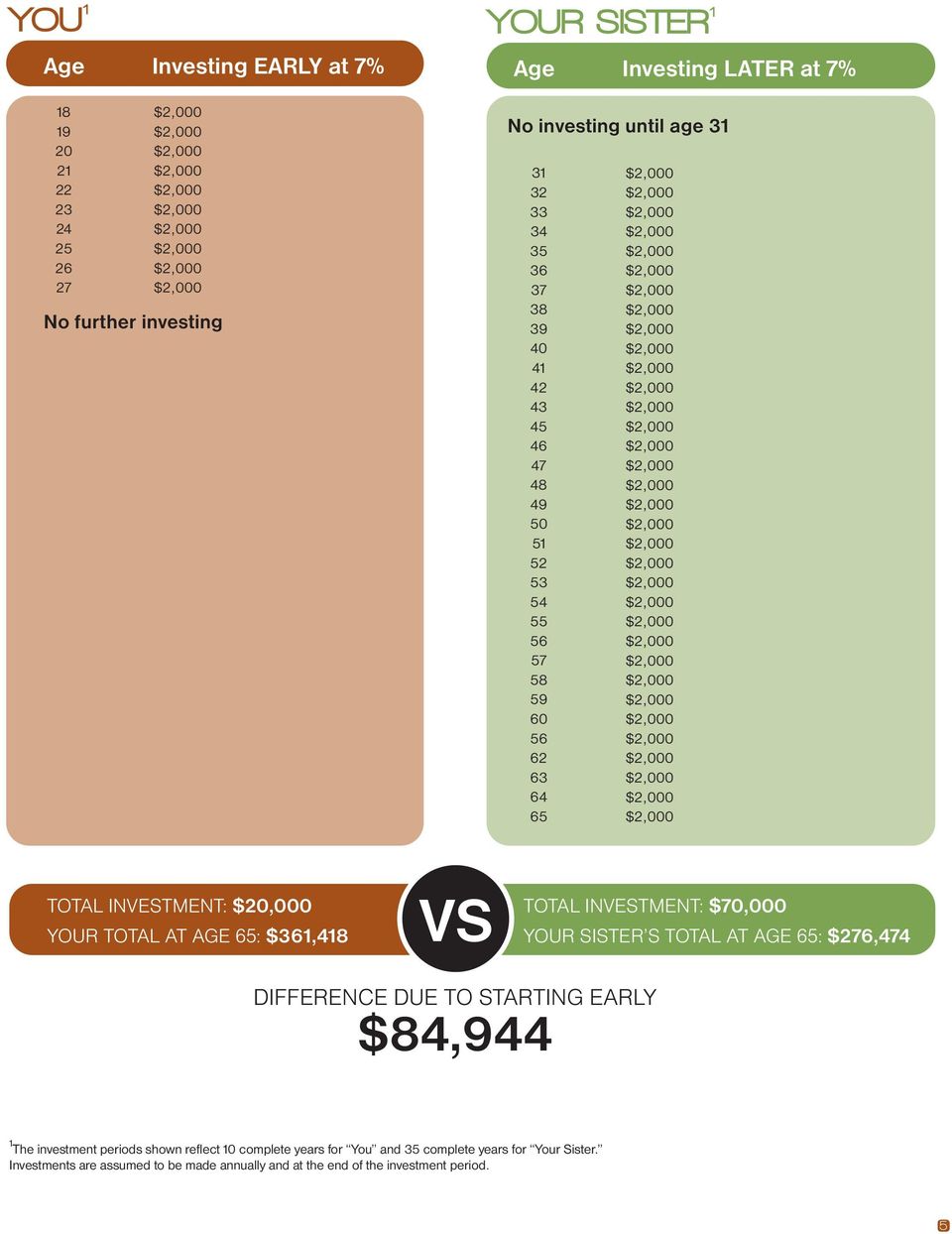
6 The Advantage of Starting Early There s a huge advantage to starting early. Let s say you start investing every year when you re 18. You put it into an account that grows by 7% each year, and continue to invest the same amount for 10 years. Then you stop and just let that money sit for the next 38 years, where it continues to grow at 7% a year, until you re 65 years old. Now say your sister decides not to invest until she turns 31. Then she puts a year into an account that also earns 7% a year and does it for the next 35 years, until she turns 65. Who will have more money? You will! About $85,000 more, in fact. After investing only $20,000, your account will be worth $361,418. But even though she has invested $70,000, your sister will have only $276,474. That s because you had the power of time on your side. See the chart on the next page. If you stick with investing per year from age 18 through age 65, you could end up with more than $706,000! Online Financial Calculators: The web has a wealth of tools and resources you can use to calculate your return. They can also help you answer some common financial questions in the areas of home financing, personal financing, investments, retirement and leasing. Saving vs. Investing To many, the terms saving and investing seem the same, but there are some differences that you need to recognize as you work toward achieving your financial goals. Saving is for the Short-Term: You ll need to save money for two main reasons: 1. You need an emergency fund. Many financial advisors recommend having at least six months worth of living expenses readily available for emergencies. You ll want to keep these funds in an account that can be accessed quickly like a savings or money market account. 2. Major purchases within the next few years. Will you be putting a down payment on a home in the next few years? Or perhaps you are thinking about taking a vacation? For major purchases that are coming up, you may want to keep these funds in a savings, money market or short-term certificate of deposit (CD). Investing is for the Long-Term: You ll need to invest money for your future needs such as college for your children or a comfortable retirement. Many people invest in stocks, bonds and mutual funds. Some good strategies are: 1. Put time on your side. The longer you invest, the better your chances of getting the type of growth you need to meet your goals. 2. Diversify. Use different types of investments to spread your risk. If one doesn t perform, you still have the others to fall back on. Save First, Then Invest: It s important to do both. But by saving first, you ll have money available to cover emergencies and purchases so you won t end up raiding your investments. 4

7 YOU 1 Age YOUR SISTER 1 Investing EARLY at 7% Age Investing LATER at 7% No further investing No investing until age VS TOTAL INVESTMENT: $20,000 TOTAL INVESTMENT: $70,000 YOUR TOTAL AT AGE 65: $361,418 YOUR SISTER S TOTAL AT AGE 65: $276,474 DIFFERENCE DUE TO STARTING EARLY $84,944 1 The investment periods shown reflect 10 complete years for You and 35 complete years for Your Sister. Investments are assumed to be made annually and at the end of the investment period. 5
8 The Cost of College College costs are still on the rise. Here are the latest numbers from the College Board, New York: The Bad News: Annual tuition and fees now average about $6,585 at four-year public universities for in-state students, and about $25,143 at four-year private colleges. When tuition and fees, room and board, books and supplies, personal expenses, and transportation are added together, average published expenses for one year of college total $18,326 for a four-year public university, and $37,390 for a four-year private college. When all the costs for attending college for four years are added up, the average cost of a four-year college education is estimated at $81,366 for a public university and $166,009 for a private college (assuming an average 7% annual increase in expenses). Saving for a College Education The Good News: The median annual income of the average full-time worker with a bachelor s degree is a considerable 62% higher than the annual income of a worker with only a high-school diploma. Similarly, those with Master s degrees earn about twice as much. Typical college graduates can expect to earn about 73% more than typical high-school graduates. Likewise, those with advanced degrees can expect to earn two to three times as much. Clearly one of the best investments you can make for your children is an investment in their educational future! As with any large savings goal, it s best to start investing early and often for college. 1. First, set your goal. Figure out how much you will need to save for each child based on his or her age. 2. Invest. Consider investing the majority of your college savings assets in stocks, as these investments have historically provided the greatest long-term growth potential. 3. Utilize other financing options: - Encourage savings gifts when relatives ask what your children want for birthdays or holidays. - Look into Section 529 Plans. - Apply for financial aid. - Don t rule out less expensive schools. - Develop networks and ask questions to find sources of scholarships, grants and loans. 6

9 Saving for Retirement Longer life spans, more active retirements, rising costs and uncertainty over Social Security make the need for a substantial retirement nest-egg greater than ever. Luckily, there are several investment options available to help you save for that anticipated time of life. Some of the most popular choices are Traditional or Roth IRAs, 401(k) plans and 403(b) plans. 1. Traditional IRAs. This type of retirement plan offers tax-deferred earnings and the possibility for tax-deductible contributions. You can contribute to a traditional IRA if you earn compensation and will not reach age 70 1/2 by the end of the year. If you file a joint return, you can treat your spouse s compensation as your own. Maximum contributions are determined by your age (under age 50 or age 50 and older) and continue to increase as time passes. All earnings in a Traditional IRA are not taxed until they are withdrawn. 2. Roth IRAs. Unlike Traditional IRAs, contributions to a Roth IRA are never tax-deductible. However, the money in your Roth IRA, including earnings, can be withdrawn taxfree. Contribution eligibility is based on modified adjusted gross income. Contributions are allowed at any age and the maximum contribution limit continues to increase. 3. Traditional 401(k) Plans. These employer-sponsored retirement plans are open to employees at most companies. Within limits, employees can contribute to the 401(k) plan by having a designated amount of pretax dollars deducted from their paychecks. The employer often matches part of the employee s contribution. Funds in a 401(k) plan are not taxed until withdrawn. 4. Roth 401(k) Plans. A Roth 401(k) combines features of the traditional 401(k) with those of a Roth IRA. The Roth 401(k) is offered by employers like a regular 401(k) plan but contributions are made with after-tax dollars. This means that you don t get an upfront taxdeduction but the account grows tax-free and withdrawals taken during retirement aren t subject to income tax, provided you re at least 59 1/2 and you ve held the account for five years or more. 5. Traditional 403(b) Plans. This type of plan, also known as a tax-sheltered annuity (TSA) plan, is a retirement plan for certain employees of public schools, employees of certain tax-exempt organizations and certain ministers. Individual accounts in a 403(b) plan can be any of the following types: provided through an insurance company, invested in mutual funds or up for church employees. 6. Roth 403(b) Plans. A Roth 403(b) is similar to a traditional 403(b) plan but the contributions are made with after-tax dollars - just like a Roth IRA. And just like a Roth IRA, the distributions from a Roth 403(b) are free from federal income taxes. Generally, retirement income accounts can invest in either annuities or mutual funds. The features of the 403(b) plan are very similar to the 401(k) plan. Employees may make salary deferral contributions that are usually limited by regulatory caps. Whatever your choice, your retirement plan should be an integral part of your overall financial strategy. Make sure you consider it as you design and implement your personal financial plan. 7

10 Retirement Worksheet 1. Total amount of annual income you want in retirement (this figure should be between 70% and 100% of your current annual income) +$ 2. Subtract the income you expect to receive annually from Social Security (if you make under $25,000 enter $8,000; between $25,000-$40,000 enter $12,000; over $40,000 enter $14,500) $ 3. Total annual income needed (line 1 minus line 2) =$ 4. To determine the amount you ll need to save multiply the amount, from line 3, by the factor below AGE YOU EXPECT TO RETIRE: MALE (up to age 82) FEMALE (up to age 86) MALE (up to age 89) FEMALE (up to age 92) MALE (up to age 94) FEMALE (up to age 97) *BASED ON 3% RATE OF RETURN +$ 5. Multiply your current saving to date by your factor below If you plan to retire in: Your factor is 10 years years years years years years years 3.3 $ 6. Additional savings still needed to save for retirement (line 4 minus line 5) =$ 7. To determine the ANNUAL amount you ll need to save, multiply line 6 by your factor below 10 years years years years years years years.013 +$ Total amount you ll need to save each year =$ 8

11 Important Terms Annual percentage rate (APR) - the annual rate of interest without taking into account the compounding of interest within that year. Annual percentage yield (APY) - the effective annual rate of return taking into account the effect of compounding interest. The annual percentage yield assumes that funds will remain in the investment for a full 365 days. Compounding - your initial deposit earns interest that is added to your account balance. Interest is then earned on that new balance. Interest may be compounded monthly, quarterly, semi-annually or annually. Minimum balance requirements - some accounts require that you maintain a minimum balance in your account. Service fees and penalties - fees for savings accounts are usually pretty minimal, but be sure to read the fine print before you open an account. If your account falls below the minimum balance, you may be charged a service fee. 9

12 Savings Basics 101 The majority of the information contained in this book is from NEFE (National Endowment For Financial Education). However, some of the information is based on the opinions of Capital Credit Union. Revised: 1/09

Peach State Reserves PEACH STATE RESERVES FAQ. Peach State Reserves General Questions
 Peach State Reserves PEACH STATE RESERVES FAQ Peach State Reserves General Questions What is Peach State Reserves The Georgia Retirement Investment Plan? What is a Deferred Compensation/Defined Contribution
A Guide to Planning for Retirement INVESTMENT BASICS SERIES
 A Guide to Planning for Retirement INVESTMENT BASICS SERIES It s Never Too Early to Start What You Need to Know About Saving for Retirement Most of us don t realize how much time we may spend in retirement.
How To Save For Retirement
 Keys to Retirement Planning and Investing Table of Contents Keys to Retirement Planning Keys to Investing for Retirement 1 2 3 4 5 Find out how much you ll need for retirement. Most experts agree that
Get Financially Fit. Define short-and long-term goals. Have your goals changed from 2-3 years ago? When goals change, adjust your plan.
 Get Financially Fit Reduce debt. Save for today. Save for tomorrow. Define short-and long-term goals. Have your goals changed from 2-3 years ago? When goals change, adjust your plan. 1 What Do Your Financial
Basics of IRAs ING FINANCIAL SOLUTIONS. Your future. Made easier. SM
 Basics of IRAs t FDIC/NCUA Insured t A Deposit Of A Bank t Bank Guaranteed May Lose Value t Insured By Any Federal Government Agency ING FINANCIAL SOLUTIONS Your future. Made easier. SM Traditional IRA
You ve worked hard for your savings. Now keep your savings working hard for you.
 You ve worked hard for your savings. Now keep your savings working hard for you. Retire with confidence A guide to your distribution options. You are now faced with an important financial decision When
The easy way to save for your retirement
 The easy way to save for your retirement If you want to live comfortably during your retirement, you really can t afford to wait to begin saving for that goal. And now that your employer is offering the
A Guide to. Planning for Retirement INVESTMENT BASICS SERIES
 A Guide to Planning for Retirement INVESTMENT BASICS SERIES It s Never Too Early to Start What You Need to Know About Saving for Retirement Most of us don t realize how much time we may spend in retirement.
An Easy-to-Understand Introduction to the Retirement Plan and the Savings Plan. How the Plans Work. Contributions. Other Benefits
 An Easy-to-Understand Introduction to the Retirement Plan and the Savings Plan Annuities How the Plans Work Contributions Eligibility Enrollment Other Benefits November 2015 WELCOME TO THE YMCA RETIREMENT
SIMPLE IRA. Savings Incentive Match Plan for Employees
 SIMPLE IRA Savings Incentive Match Plan for Employees Introducing the SIMPLE IRA Plan A comfortable retirement is an important financial goal for many American workers. Some financial professionals estimate
_ Retirement. Planning for the Stages of. Getting started Your 20s and early 30s
 Planning for the Stages of _ Retirement _ Retirement is being reinvented. It s no longer our parent s retirement. Social Security alone w o n t see us through retirement, especially for higher income earners.
Student Take Home Guide. Money Smart. Pay Yourself First
 Student Take Home Guide Money Smart Table of Contents Table of Contents...1 Money Smart...2...3 Worksheet...4 Plan...5 Savings Tips...6 Compound Dividends Exercise...8 Compound Dividends...9 Savings $1
BUYER S GUIDE TO FIXED DEFERRED ANNUITIES
 BUYER S GUIDE TO FIXED DEFERRED ANNUITIES Prepared by the National Association of Insurance Commissioners The National Association of Insurance Commissioners is an association of state insurance regulatory
An IRA can put you in control of your retirement, whether you
 IRAs: Powering Your Retirement One of the most effective ways to build and manage funds to help you meet your financial goals is through an Individual Retirement Account (IRA). An IRA can put you in control
Saving for retirement with a 403(b) plan
 Saving for retirement with a 403(b) plan 2 Saving for retirement with a 403(b) plan Saving for retirement with a 403(b) plan Retirement can be a welcome turning point in your life a time to enjoy hobbies,
Planning for the Stages of Retirement
 Planning for the Stages of Retirement The Financial Planning Association (FPA ) connects those who need, support and deliver financial planning. We believe that everyone is entitled to objective advice
IRA Opportunities. Traditional IRA vs. Roth IRA: Which is right for you? What kind of retirement funding vehicle is right for you?
 IRA Opportunities. Traditional IRA vs. Roth IRA: Which is right for you? What kind of retirement funding vehicle is right for you? Now more than ever, an Individual Retirement Account (IRA) may help provide
Retirement: Get Ready...1 Why planning makes sense...1 Where are you?...2 Getting Started: 20 s and early 30 s...3
 Retirement: Get Ready...1 Why planning makes sense...1 Where are you?...2 Getting Started: 20 s and early 30 s...3 On Your Way: Mid-30 s to early 40 s...4 Crunch Time: Mid-40 s to early 50 s...5 Just Around
Fixed Deferred Annuities
 Buyer s Guide to: Fixed Deferred Annuities National Association of Insurance Commissioners 2301 McGee St Suite 800 Kansas City, MO 64108-2604 (816) 842-3600 1999, 2007 National Association of Insurance
BUYER S GUIDE TO FIXED DEFERRED ANNUITIES
 BUYER S GUIDE TO FIXED DEFERRED ANNUITIES IT IS IMPORTANT that you understand the differences among various annuities so you can choose the kind that best fits your needs. This guide focuses on fixed deferred
The ABC s of the 403b plan
 The ABC s of the 403b plan Presented by: Phyllis L. Simmons Financial Advisor Waddell & Reed, Inc. 515-278-2347 The information contained in this presentation is for informational purposes only and should
Wealth Strategies. www.rfawealth.com. Saving For Retirement: Tax Deductible vs Roth Contributions. www.rfawealth.com
 www.rfawealth.com Wealth Strategies Saving For Retirement: Tax Deductible vs Roth Contributions Part 2 of 12 Your Guide to Saving for Retirement WEALTH STRATEGIES Page 1 Saving For Retirement: Tax Deductible
Five Simple Steps to a Retirement Plan
 Retirement Five Simple Steps to a Retirement Plan Not FDIC Insured May Lose Value Not Bank Guaranteed OppenheimerFunds Five Simple Steps to a Retirement Plan Take a few minutes now and you ll be thankful
Synthesis of Financial Planning
 P 7A R T Synthesis of Financial Planning 1. Tools for Financial Planning Budgeting (Chapter 2) Planned Savings (Chapter 3) Tax Planning (Chapter 4) 2. Managing Your Liquidity Bank Services (Chapter 5)
Pay Yourself First. Identify Steps You Can Take to Save The following tips will help you to save your flexible income.
 Pay Yourself First Use this tip sheet to help you in the process of setting and reaching your personal savings goals. This tip sheet covers the following topics: Identifying steps you can take to save
The Advantages and Disadvantages of Owning an Individual Retirement Account
 IRAs Investing in Your Future Retirement Plans About Stifel Nicolaus Stifel Nicolaus is a full-service Investment firm with a distinguished history of providing securities brokerage, investment banking,
Vertex Wealth Management LLC 10/22/2013
 Vertex Wealth Management LLC Michael J. Aluotto, CRPC President Private Wealth Manager 1325 Franklin Ave., Ste. 335 Garden City, NY 11530 516-294-8200 [email protected] Retirement Basics 10/22/2013
THE MISSISSIPPI AFFORDABLE COLLEGE SAVINGS PROGRAM
 THE WAY TO GO GO THE MISSISSIPPI AFFORDABLE COLLEGE SAVINGS PROGRAM MACS is a program of College Savings Mississippi, and is administered by the Office of the State Treasurer, Lynn Fitch. THE MISSISSIPPI
COLLEGE PLANNING SAVING FOR A COLLEGE EDUCATION. Why is it Important to Start Saving Now? The Projected Cost of College 2012/2013 2017/2018 2022/2023
 Making College a Reality: A college education can be one of the most important investments you ll ever make. But the benefits of increased earning power and expanded horizons come at a price college is
Retirement on the. Brain. Your Retirement Plan: Don t pass up the perks
 Retirement on the Brain Your Retirement Plan: Don t pass up the perks Retirement on the Brain Your Retirement Plan Understanding the advantages of your retirement plan is crucial in making wise savings
PLACEHOLDER IMAGE Replace with Photography. Your guide to Tax-Deferred Annuities or Voluntary Savings Plans. How much can you contribute?
 PLACEHOLDER IMAGE Replace with Photography Your guide to Tax-Deferred Annuities or Voluntary Savings Plans How much can you contribute? Saving for retirement is one of your most important financial goals.
Consumer s Guide to. Fixed Deferred Annuities
 Consumer s Guide to Fixed Deferred Annuities Louisiana Department of Insurance Jim Donelon, Commissioner CONTENTS What is an Annuity?...3 What are the different kinds of Annuities?...4 How are the interest
Traditional IRA/Roth IRA
 premiere select Traditional IRA/Roth IRA Invest in your retirement today. Saving for your retirement. 01 Important Section in head any lorem market. ipsum dolore sit amet If you re planning for your future,
457(b) Deferred Compensation Overview for Governmental and Public School entities
 457(b) Deferred Compensation Overview for Governmental and Public School entities Retirement experts agree...having the money you want in your later years requires careful planning now. Plan ahead. How
How 401k Plans & ROTH IRAs Work.docx. Excerpts from http://money.howstuffworks.com/personal-finance/retirement-planning/401k.htm
 How 401k Plans Work Excerpts from http://money.howstuffworks.com/personal-finance/retirement-planning/401k.htm 401(k) plans are part of a family of retirement plans known as defined contribution plans.
AN ANALYSIS OF ROTH CONVERSIONS 1
 AN ANALYSIS OF ROTH CONVERSIONS In 1997, Congress introduced the Roth IRA, giving investors a new product for retirement savings. The Roth IRA is essentially a mirror image of the Traditional IRA, but
Fixed Deferred Annuities
 Buyer s Guide to: Fixed Deferred Annuities with Appendix for Equity-Indexed Annuities National Association of Insurance Commissioners 2301 McGee St Suite 800 Kansas City, MO 64108-2604 (816) 842-3600 1999,
Financial Milestones: Retirement planning. Tips for every stage of life.
 Financial Milestones: Retirement planning. Tips for every stage of life. Retirement by the numbers. Retirement planning is a journey. And the sooner you start, the easier it is. But whether you re in your
Money Management Test - MoneyPower
 Money Management Test - MoneyPower Multiple Choice Identify the choice that best completes the statement or answers the question. 1. A person s debt ratio shows the relationship between debt and net worth.
PERSI. It s Your Choice to Go Now, Go BIG! Plan Highlights. Learn about your PERSI Choice 401(k) Plan. Ready, Set, Go: the PERSI Base Plan.
 PERSI PERSI Choice 401(k) Plan It s Your Choice to Go Now, Go BIG! Plan Highlights Learn about your PERSI Choice 401(k) Plan Ready, Set, Go: the PERSI Base Plan The PERSI Base Plan gets you into the game,
MANAGING CREDIT101 TM %*'9 [[[ EPXEREJGY SVK i
 MANAGING CREDIT101 TM i This book is intended as a general guide to the topics discussed, and it does not deliver accounting, personal finance, or legal advice. It is not intended, and should not be used,
Your guide to Roth 457 contributions
 THE OREGON SAVINGS GROWTH PLAN PRESENTS Your guide to Roth 457 contributions Wonderful new feature this year Exciting. Thrilling. Fantastic. Best thing to hit the Pacific Northwest! What s in a name? That
CHECKING BASICS101. 701.255.0042 www.capcu.org
 CHECKING BASICS101 701.255.0042 www.capcu.org This book is intended as a general guide to the topics discussed, and it does not deliver accounting, personal finance, or legal advice. It is not intended,
Individual Retirement Plans Investor guide to traditional and Roth IRAs. Individual Retirement Plans: Investor Guide
 Individual Retirement Plans Investor guide to traditional and Roth IRAs a Individual Retirement Plans: Investor Guide Individual Retirement Plans An individual retirement plan may be a beneficial addition
so sodexo Welcome to Your Sodexo Retirement Program Your future P L A N O V E R V I E W A valuable benefit that lets you share in Sodexo s success
 P L A N O V E R V I E W Your future so sodexo Welcome to Your Sodexo Retirement Program A valuable benefit that lets you share in Sodexo s success SOD_Enroll_Guide Mar_09 09IAS-03-003 2009 ING Institutional
Duke. Faculty and Staff Retirement Plan: Consider the advantages of Roth 403(b) contributions
 Duke HUMAN RESOURCES Faculty and Staff Retirement Plan: Consider the advantages of Roth 403(b) contributions The Faculty and Staff Retirement Plan offers a way of saving for retirement known as the Roth
BLUE PAPER. Roth 401(k): Creating a Tax-Advantaged Strategy for Retirement IN BRIEF. January 2016
 BLUE PAPER Roth 401(k): Creating a Tax-Advantaged Strategy for Retirement Roth 401(k) Helps Investors Take Diversification * to the Next Level. IN BRIEF January 2016 Just as a well-diversified portfolio
Immediate Annuity. Move confidently into the future. 10000256 Rev 0413
 MEMBERS Single Premium Immediate Annuity GUARANTEED retirement income Move confidently into the future 10000256 Rev 0413 A financial services company serving financial institutions and their clients worldwide.
Your 403(b). Made better.
 Your 403(b). Made better. A unique opportunity for tax-free retirement income. Your future. Made easier. The Roth 403(b) contribution option. I m ready to Roth. I m still more of a traditional type. Is
A Consumer s Guide To
 A Consumer s Guide To 401(k) Plans NYSUT Member Benefits wants NYSUT members to be the best-informed consumers in the state. This Consumer Guide is one of our contributions towards achieving that goal.
C. Retirement Plans a. 401(k) and 403(b)
 MODULE 3: SAVINGS/ SPENDING PLAN 3-3: Start Investing Cast List Darryl Terri Drew Murphy, 45-50 years old, white male Alicia Bianca, 40-50 years old, white female Synopsis Darryl and Terri discuss investment
Roth IRA. Explore the Opportunity. 2 RBC Wealth Management
 Roth IRA Explore the Opportunity 2 RBC Wealth Management N o w Y o u H a v e E v e n M o r e F l e x i b i l i t y i n H o w Y o u I n v e s t f o r Y o u r F u t u r e Retirement a time that you work
ROTH 401(k) FEATURE QUESTION & ANSWER (Q&A)
 ROTH 401(k) FEATURE QUESTION & ANSWER (Q&A) Purpose of Q&A: Beginning January 1, 2006, employers that sponsor 401(k) retirement plans may offer a new plan design feature after-tax Roth deferrals. The purpose
Congratulations on taking the first step toward saving for your child s education!
 Congratulations on taking the first step toward saving for your child s education! This enrollment guide will walk you through the PA 529 Guaranteed Savings Plan s (GSP) features and benefits such as flexibility,
Part VI Retirement Accounts for Small Businesses and the Self-Employed
 Part VI Retirement Accounts for Small Businesses and the Self-Employed While employees of most large companies have access to 401(k) plans or traditional pension plans, those employed by small firms often
SAVING FOR RETIREMENT
 CHARTING YOUR COURSE SERIES: SAVING FOR RETIREMENT Retirement planning for public sector employees Why save now? Starting to save early, being disciplined about saving enough, and prudently investing those
The Federal Thrift Savings Plan
 Vertex Wealth Management, LLC Michael J. Aluotto, CRPC President Private Wealth Manager 1325 Franklin Ave., Ste. 335 Garden City, NY 11530 516-294-8200 [email protected] www.vertexwm.com The Federal
Chapter 1 The Financial Assessment
 Chapter 1 The Financial Assessment 64 P leasant S treet P hon e: ( 415) 830-52 44 Copyright 2007-2009 Harrison Lazarus Advisors, Inc. All Rights Reserved Page 1 of 15 It doesn t matter where you are in
Alternative Retirement Financial Plans and Their Features
 RETIREMENT ACCOUNTS Gary R. Evans, 2006-2013, November 20, 2013. The various retirement investment accounts discussed in this document all offer the potential for healthy longterm returns with substantial
HOW TO SAVE FOR YOUR FUTURE. a guide for financial security
 HOW TO SAVE FOR YOUR FUTURE a guide for financial security Save for your future. Choose to Save is designed to encourage Americans to take four basic steps to secure their financial future: 1 Calculate
Your Guide to 403(b) Tax-Deferred Annuity Voluntary Savings Plans
 Your Guide to 403(b) Tax-Deferred Annuity Voluntary Savings Plans How much can you contribute in 2015? Tax-Deferred Annuity Plans ( TDA Plans ) are voluntary savings plans that help you build the extra
COLLIERS INTERNATIONAL USA, LLC And Affiliated Employers 401(K) Plan DISTRIBUTION ELECTION
 1. EMPLOYEE INFORMATION (Please print) COLLIERS INTERNATIONAL USA, LLC And Affiliated Employers 401(K) Plan DISTRIBUTION ELECTION Name: Address: Social Security No.: Birth Date: City: State: Zip: Termination
5 Effective Savings Strategies GL 04/09
 5 Effective Savings Strategies GL 04/09 1 Table of Contents THE BASICS A. Saving vs. Investing B. The Time Value of Money C. The Miracle of Compounding Interest THE HOW 1. Make Automatic Transfers 2. Set
Getting to know your CUNY retirement plan
 Getting to know your CUNY retirement plan It s About You If you re the independent type, you can do your own thing. If you want some help, tools are available to assist you. Confused about investing and
Annuities. Introduction 2. What is an Annuity?... 2. How do they work?... 3. Types of Annuities... 4. Fixed vs. Variable annuities...
 An Insider s Guide to Annuities Whatever your picture of retirement, the best way to get there and enjoy it once you ve arrived is with a focused, thoughtful plan. Introduction 2 What is an Annuity?...
Retirement and Estate Planning
 6P A R T Retirement and Estate Planning Should you invest in a retirement plan? Chapter 19 Retirement Planning Chapter 20 Estate Planning How much should you contribute to your retirement plan? How should
RETIREMENT ACCOUNTS (c) Gary R. Evans, 2006-2011, September 24, 2011. Alternative Retirement Financial Plans and Their Features
 RETIREMENT ACCOUNTS (c) Gary R. Evans, 2006-2011, September 24, 2011. The various retirement investment accounts discussed in this document all offer the potential for healthy longterm returns with substantial
WEALTH CARE KIT SM. A consumer s guide to establishing and maintaining a financial wellness plan.
 WEALTH CARE KIT SM A consumer s guide to establishing and maintaining a financial wellness plan. A website built by the dedicated to your financial well-being. THE WEALTH CARE KIT an INTRODUCTION You plan
GUIDE TO RETIREMENT PLANNING FINANCIAL GUIDE. Making the most of the new pension rules to enjoy freedom and choice in your retirement
 GUIDE TO RETIREMENT PLANNING Making the most of the new pension rules to enjoy freedom and choice in your retirement FINANCIAL GUIDE WELCOME Making the most of the new pension rules to enjoy freedom and
Retirement Options: guide to Individual Retirement Accounts through Lending Club
 Retirement Options: guide to Individual Retirement Accounts through Lending Club This material is provided for informational purposes only. Information in this brochure is not directed to the specific