
INTERMEDIATE HOME/OFFICE ELECTRICAL/ELECTRONIC EQUIPMENT SERVICING
|
|
|
- Thomasina Hines
- 10 years ago
- Views:
Transcription

1 Federal Democratic Republic of Ethiopia OCCUPATIONAL STANDARD INTERMEDIATE HOME/OFFICE ELECTRICAL/ELECTRONIC EQUIPMENT SERVICING NTQF Level III

2 Introduction Ethiopia has embarked on a process of reforming its TVET-System. Within the policies and strategies of the Ethiopian Government, technology transformation by using international standards and international best practices as the basis, and, adopting, adapting and verifying them in the Ethiopian context is a pivotal element. TVET is given an important role with regard to technology transfer. The new paradigm in the outcome-based TVET system is the orientation at the current and anticipated future demand of the economy and the labor market. The Ethiopia Occupational Standards (EOS) is the core element of the Ethiopian National TVET-Strategy and an important factor within the context of the National TVET Qualification Framework (NTQF).They are national Ethiopia standards, which define the occupational requirements and expected outcome related to a specific occupation without taking TVET delivery into account. This document details the mandatory format, sequencing, wording and layout for the Ethiopia Occupational Standard which comprised of Units of Competence. A Unit of Competence describes a distinct work activity. It is documented in a standard format that comprises: Occupational title, NTQF level Unit code Unit title Unit descriptor Elements and Performance criteria Variables and Range statement Evidence guide Together all the parts of a Unit of Competence guide the assessor in determining whether the candidate is competent. The ensuing sections of this EOS document comprise a description of the occupation with all the key components of a Unit of Competence: chart with an overview of all Units of Competence for the respective level including the Unit Codes and the Unit Titles contents of each Unit of Competence (competence standard) occupational map providing the technical and vocational education and training (TVET) providers with information and important requirements to consider when designing training programs for this standards and for the individual, a career path Page 1 of 52

3 UNIT OF COMPETENCE CHART Occupational Standard: Intermediate Home/Office Electrical/ Electronic Equipment Servicing Occupational Code: EEL HOS NTQF Level III EEL HOS Perform Maintenance of Home/Office Electrical/Electronic Equipment EEL HOS Assemble and Set-up Home/Office Components and Systems EEL HOS Commission Home/Office Electrical/Electronic Equipment EEL HOS Develop Servicing Procedures for Home/Office Electrical/Electronic Equipment EELHOS Apply Quality Control EEL HOS Develop Basic Electronic System Design EEL HOS Lead Workplace Communication EEL HOS Train Service Technician EEL HOS Lead Small Teams EEL HOS Improve Business Practice EEL HOS Maintain Quality System and Continuous Improvement Processes (Kaizen) Page 2 of 52

4 TOP Occupational Standard: Home/Office Electrical/Electronic equipment Servicing Level III Perform Maintenance of Home/Office Electrical/Electronic Unit Title equipment Unit Code EEL HOS Unit Descriptor This unit covers the knowledge, skills and attitudes required to maintain and repair advanced level Home/Office Electrical/Electronic equipment including diagnosing faults, reassembling, testing and preparing reports. Elements Performance Criteria 1. Prepare unit, tools and workstation 1.1 Complete check-up of advanced level Home/Office Electrical/Electronic equipment is conducted and defects are identified, verified and documented against customer description 1.2 Repair/maintenance history is verified in line with the company procedures 1.3 Service manuals and service information required for repair/maintenance are acquired as per standard procedure 1.4 Workstation is set/prepared for repair job in line with the company requirements and work specifications 1.5 Necessary tools, test instruments and personal protective equipment are prepared in line with job requirements 2. Diagnose faults 2.1 Systematic pre-testing procedure is observed in accordance with manufacturer s instructions 2.2 System defects/fault symptoms are identified using appropriate tools and equipment and in accordance with safety procedures 2.3 Test instruments required for the job are used in accordance with user manuals 2.4 Circuits are checked and isolated using specified testing procedures 2.5 Identified defects and faults are explained to the responsible person in accordance with enterprise or company policy and procedures 2.6 Control settings/adjustments are checked in conformity with service-manual specifications 2.7 Results of diagnosis and testing are documented accurately and completely within the specified time 2.8 Customers are advised / informed regarding the status and serviceability of the unit according to company procedures Page 3 of 52

5 3. Maintain/repair product 4. Test repaired product 3.1 Personal protective equipment is used in accordance with Occupational Health and Safety practices 3.2 Electro-static discharge (ESD) protection procedure is followed in accordance with current industry standards 3.3 Defective parts/components are replaced with identical or recommended appropriate equivalent ratings 3.4 Repaired or replaced parts/components are soldered/mounted in accordance with the current industry standards 3.5 Control settings/adjustments are performed in conformity with service-manual specifications 3.6 Repair activity is performed within the required timeframe 3.7 Care and extreme precaution in handling the unit/product is observed as per procedures 3.8 Cleaning of unit is performed in accordance with standard procedures 4.1 Repaired units are reassembled according to manufacturer s specifications 4.2 Reassembled units are subjected to final testing and cleaning in conformity with manufacturer s specifications 4.3 Service completion procedures and documentations are complied with based on workplace requirements 4.4 Waste materials are disposed of in accordance with environmental requirements Variable Advanced level Home/Office Electrical/Electronic equipment Service manuals Range Home/Office Electrical/Electronic equipment include but may not be limited to the following: PC Lab Performance criteria Washing Machines and Driers Security equipment Remote Control Appliances Photo copy machine Fax machine Printer Scanner UPS May include but not limited to: Service manual/schematic diagram/parts list Operating instructions/user s/owner s manual Page 4 of 52

6 Service Information Tools, Materials and Test Instruments Personal protective equipment Pre- testing procedures May include but not limited to: job report sheets job order bill of materials customer index service flowchart stock and inventory record requisition slips (for acquisition of parts) supplier index May include but not limited to: variable power supply step-down transformer soldering iron/gun desoldering tools screwdriver (assorted) wrenches (assorted) Allen wrench/key signal generator - AF/RF multi-testers (analog/digital) utility knife/stripper pliers (assorted) test jig ESD-free work bench with mirror Degaussing RCA Cables/connectors May include but not limited to: Working clothes/apron Hand gloves Face/Dust Mask Goggles oscilloscope TV pattern generator high-grade magnifying glass with lamp flashlight cleaning brush high voltage probe ball peen hammer soldering lead wires assorted electronic components Contact Cleaner Tweezers Silicon Grease Insulation tester w/ stand Visual inspection of the unit with power off Interview of customer re history of unit Operate the unit according to manual to confirm defects Responsible person immediate supervisor service supervisor / manager OHS requirements in accordance with legislation & regulations Environmental Requirements Use of proper tools and equipment Observe workplace environment and safety Adherence to safety requirements in handling the unit Use of protective device/shields Ethiopia Electrical Code Proper disposal of chemicals and components shall be based on existing requirements of the law and chemical waste management Page 5 of 52

7 Non-biodegradable parts or materials shall be packed and labeled properly for disposal Evidence Guide Critical Aspects of Competence Underpinning Knowledge and Attitudes Assessment requires evidence that the candidate: prepared the unit and required materials, tools equipment and workshop properly applied safety rules and procedures identified faults and defects in accordance with testing procedures and documented the programs explained faults defect to the responsible person and informed costumer accordingly used tools and equipment properly followed service manual specifications/instructions applied appropriate knowledge and technique on actual repair activity restored unit to normal operating condition within timeframe Measurement/Mathematics Conversion of units Applied mathematics Drawing and Schematic Diagram Reading and interpreting orthographic projections and isometric views Reading and interpreting electronic schematic symbols and diagram Page 6 of 52

8 Safety Work Safety requirements and economy of materials with durability Knowledge in 5S application and observation of required procedure Materials, tools/instruments and equipment uses and specifications Identification of hand and power tools Proper care and use of tools Identification of test and measuring instruments Proper care and use of test and measuring instruments System and Processes Principles of Electrical Circuits Fundamentals of Direct Current Circuits Fundamentals of Alternating Current Circuits Fundamentals of Electronic Components And Circuits Fundamentals of Digital Logics, Components & Circuits Fundamentals of Microprocessor Circuits And Programming Analysis of Troubles And Isolation Techniques Pc & Lab Performance criteria Repairing Underpinning Skills Resources Implication Assessment Methods Context of Assessment Demonstrates skills to: application of troubleshooting technique use and maintenance of test instruments, tools, & equipment application of work safety practices and time management application of substitution technique soldering/desoldering and wiring/cabling techniques schematic diagram reading skills The following resources must be provided: tools, equipment and test instruments audio-video products and systems service manuals/schematics ESD free working area/bench complete electronic spare parts/supplies Competence may be assessed through: Interview / written test / oral questioning Observation/Demonstration Competence may be assessed in the work place or in a simulated work place setting TOP Occupational Title: Home/Office Electrical/Electronic Equipment servicing Level III Unit Title Assemble and set up Home/Office Electrical/Electronic Page 7 of 52

9 equipment Unit Code EEL HOS Unit Descriptor This unit covers installing of fixed and non fixed Home/Office Electrical/Electronic components and systems in a residential or business environment. It encompasses safe working practices; secure placement and connection of system components, following written and oral instruction, procedures and customer relations. Elements Prepare to install Home/Office Electrical/Ele ctronic equipment 2. Install Home/Office Electrical/Electr onic components and systems Performance criteria 1.1 OHS procedures for a given work area are identified, obtained and understood through established routines. 1.2 Established OHS risk control measures are followed in preparation for the work. 1.3 Safety hazards, which have not previously been identified, are reported and advise on risk control measures, are sought from the work supervisor. 1.4 The nature and location of the work is obtained from work supervisor or other appropriate person to establish the scope of work to be undertaken. 1.5 Advice is sought from the work supervisor and/or other appropriate person to ensure the work is coordinated effectively with others. 1.6 Sources of materials that may be required for the work are established in accordance with established routines. 1.7 Tools, equipment and testing devices needed to carry out the work are obtained and checked for correct operation and safety. 2.1 Established OHS risk control measures for carrying out the work are followed. 2.2 Circuits/machines/plant are checked as being isolated where necessary in strict accordance OHS requirements and procedures 2.3 Home/Office Electrical/Electronic components are installed to comply with standards and job specifications with sufficient excess to affect terminations. 2.4 Accessories are installed straight and square in the required locations and within acceptable tolerances 2.5 Cables and conductors are terminated at accessories in accordance with manufacture s specifications and regulatory requirements. 2.6 Procedures for referring non-routine events to immediate supervisor for directions are followed. 2.7 The installation is carried out efficiently without waste of Page 8 of 52

10 3 Complete installation work and report. materials or damage to apparatus, circuits or the surrounding environment and using sustainable energy practices. 3.1 OHS work completion risk control measures and procedures are followed. 3.2 Work site is cleaned and made safe in accordance with established procedures. 3.3 Work supervisor is notified of the completion of the installation work in accordance with established routines. Variables Range statement Unit scope This unit shall be demonstrated by assembling and setting up fixed and non -fixed audio/video systems in building and premises on: Systems are to consist of surround sound and multi-room speakers, central audio and home theatre components. Occupational Check the equipment before you turn on for testing, Attention Health & Safety when using test instruments, Inject proper amount of (OH&S) audio/video signal, Proper handling of measuring device, Use heat sink while soldering and disordering, Disconnect battery when AC source is used, Disconnect AC screw when DC battery is used, Impedance of speaker must be greater or equal to impedance of amplifier, Unplug AC supply during installation, Remove shorted speaker, Proper handling of electrician hand tools. Tools and Equipment. Home/Office Electrical/Electronic equipment include but may not be limited to the following: Remote Control Appliances Photo copy machine Fax machine Printer Scanner UPS PC Lab Performance criteria Washing Machines and Driers Security equipment Frequency counter, Blower, Video signal generator, Contact cleaner, Cleaning materials (brush, alcohol, cotton),screw driver, Pliers, Amplifier, Microphone, Speaker, Multimeter, Oscilloscope, Soldering iron, Soldering lead, Tweezers, Signal generator, DC power supply, Brush, Insulation remover, Impedance matching transformer, extension cord, washer and screw Page 9 of 52

11 Types and Sources Organization rules, regulations and guidelines, of Information Related documentations, Technical manuals, Sharing best practices Required Knowledge Technical standards, regulations and codes for extra low voltage work Sound reproduction fundamentals Audio reproduction, electronic components Basic knowledge of power systems Customer handling Definition of terms Work supervisor refers an engineer who supervises the work activity of the technician. Washer refers for a plastic holder used to fix screw. Evidence guide Critical aspects of competence Context of assessment Methods of assessment Resources for assessment Reading and interpreting drawings of circuit arrangements and component locations. Placing and securing components and accessories accurately. Terminating cable and conductors correctly. Connecting components to manufacturer s instructions. Setting functional controls to customer s requirements. Testing functional operation. Completing necessary documentation including hand over all system/component documents to the customer. Dealing with unplanned events by drawing on essential knowledge and skills to provide appropriate solutions incorporated in a holistic assessment with the above listed items Competency is assessed in the work place or simulated environment (software). The unit of competency should be assessed in conjunction with other relevant units in this occupation The competency may be assessed through: Practical assessment o Interview o Observation Theoretical exam Portfolio Assessment (E.g. Certificate from training providers) The following resources MUST be provided: Workplace or fully equipped assessment location with Page 10 of 52
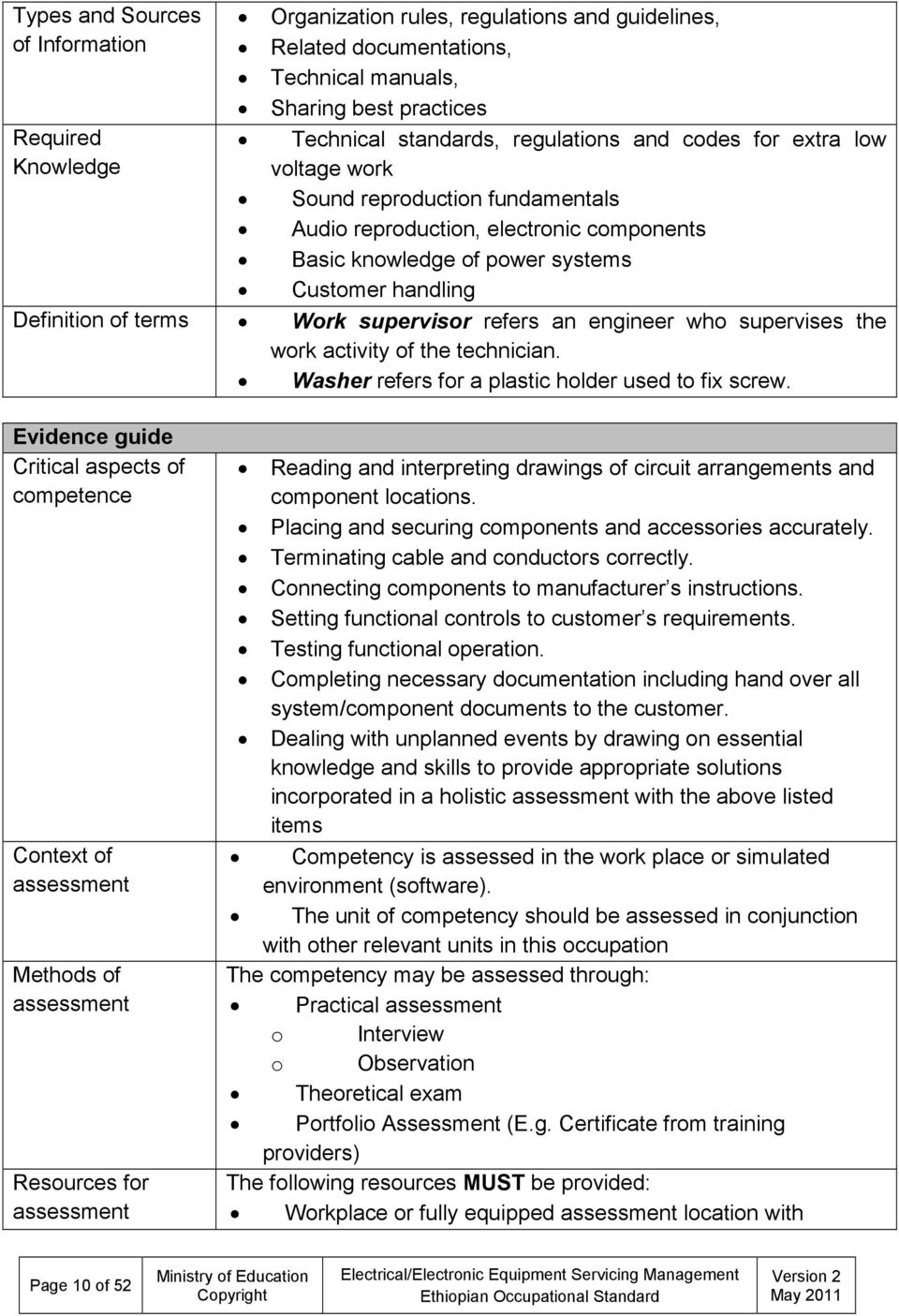
12 necessary tools and equipment and consumable materials Approved assessment tools Certified assessor /Assessor s panel Page 11 of 52

13 TOP Occupational Title: Home/Office Electrical/Electronic Equipment servicing Level III Unit Title: Commission Home/Office Electrical/Electronic equipments Unit Code EEL HOS Unit Descriptor This competency standard unit covers undertaking commissioning procedures of Home/Office Electrical/Electronic equipments to comply with predetermined parameters and delivery to client. It encompasses safe working practices, system parameter testing, analysis and adjusting to assure optimum performance, following procedures, and documenting final operating parameters and settings. Elements Prepare to commission Home/Office Electrical/Electronic equipments Commission Home/Office Electrical/Electronic equipments Performance criteria 1.1. OHS procedures for a given work area are obtained and understood Established OHS risk control measures and procedures in preparation for the work are followed Safety hazards that have not previously been identified are noted and established risk control measures are implemented Appropriate personnel are consulted to ensure the work is coordinated effectively with others involved on the work site System operating parameters are identified by reviewing system specifications and component technical data Tools, equipment, applications, and testing devices needed for the work are obtained in accordance with established procedures and checked for correct operation and safety Preparatory work is checked to ensure no unnecessary damage has occurred and complies with requirements Circuits are checked as being isolated, where necessary, in strict accordance OHS requirements and procedures OHS risk control measures and procedures for carrying out the work are followed Testing/measuring devices are connected and set up in accordance with requirements for a particular system Measurements and adjustments are made to electronics and communications equipment to provide optimum system performance in accordance with system specifications and/or regulatory requirements Decisions for dealing with unexpected situations are made Page 12 of 52

14 3. Completion and reporting of commissioning activities. Variables Unit scope Occupational Health & Safety (OH&S) Tools and Equipment from discussions with appropriate person and job specifications and requirements Methods for dealing with unexpected situations are selected on the basis of safety and specified work outcomes Systems commissioning procedures are performed in accordance with requirements Commissioning is carried out efficiently without unnecessary waste of materials or damage to apparatus, the surrounding environment or services and using sustainable energy principles OHS risk control work completion measures and procedures are followed Adjustment settings are documented in accordance with established procedures Work site is cleaned and made safe in accordance with established procedures Commissioning results and work completion are notified to appropriate person or persons in accordance with established procedures Range Statement This competency standard unit shall be demonstrated in relation to commissioning different types of Home/Office Electrical/Electronic equipments and associated components and controls. Check the equipment before you turn on for testing, Attention when using test instruments, Inject proper amount of audio/video signal, Proper handling of measuring device, Use heat sink while soldering and disordering, Disconnect battery when AC source is used, Disconnect AC screw when DC battery is used, Impedance of speaker must be greater or equal to impedance of amplifier, Unplug AC supply during installation, Remove shorted speaker, Proper handling of electrician hand tools. Consumer Electronic Equipments may include but not limited to the following: Vacuum Cleaners and Polishers Home Food Processing equipment Pressure and Rice Cooker Blender, coffee maker Toaster, waffle maker Microwave Oven Electronic Clock Flat irons and presses Page 13 of 52

15 Rechargeable Light Electronic controlled Light Remote Control Appliances Photo copy machine Fax machine Printer Scanner UPS Frequency counter, Blower, Video signal generator, Contact cleaner, Cleaning materials (brush, alcohol, cotton),screw driver, screw, Pliers, Amplifier, Microphone, Speaker, Multimeter, Oscilloscope, Soldering iron, Soldering lead, Tweezers, Signal generator, DC power supply, Brush, Insulation remover, Impedance matching transformer, extension cord, drilling machine, washer. Types and Sources of Organization rules, regulations and guidelines, Information Related documentations, Technical manuals Sharing best practices Required Knowledge Commissioning processes and procedures Occupational Health and Safety principles Methods of on the job training Evidence guide Description Identifying system design performance parameters and requirements Measuring and adjusting system components to provide optimum system performance Ensuring system operates within regulatory and/or Critical aspects of specification requirements competence Documenting adjustment settings with established procedures Dealing with unplanned events by drawing on essential knowledge and skills to provide appropriate solutions incorporated in the holistic assessment with the above listed item Context of assessment Competency is assessed in the work place or simulated environment (software). The unit of competency should be assessed in conjunction with other relevant units in this occupation Methods of assessment The competency may be assessed through: Practical assessment o Interview Page 14 of 52

16 o Observation Theoretical exam Portfolio Assessment Resources for assessment The following resources MUST be provided: Workplace or fully equipped assessment location with necessary tools and equipment and consumable materials Approved assessment tools Certified assessor /Assessor s panel Page 15 of 52

17 TOP Occupational Standard: Home/Office Electrical/Electronic Equipment servicing Level III Develop Servicing Procedures for Home/Office Unit Title Electrical/Electronic equipment Unit Code EEL HOS Unit Descriptor This unit covers the knowledge, skills and attitudes required to develop servicing systems for Home/Office electronic products and associated circuits, including service schedules. Elements 1. Plan and prepare servicing system 2. Implement servicing system Performance Criteria 1.1 OH&S policies and procedures to be followed are planned and prepared, and work is sequence in accordance with requirements 1.2 Appropriate personnel are consulted to ensure the programs for servicing and maintenance are coordinated effectively with others involved in the work site 1.3 Programs to be developed for servicing and maintenance are checked against job requirements 1.4 Materials necessary to complete the work are identified and detailed in accordance with established procedures and checked against job requirements 1.5 Tools, equipment and testing instruments needed to carry out the work are identified and detailed in accordance with established procedures 2.1 Normal function of Home/Office products and associated circuits are ascertained and detailed in accordance with requirements 2.2 Circuits isolation and specified testing procedures are detailed where necessary 2.3 Servicing system on a trial basis is implemented 2.4 Response to unplanned events or conditions in accordance with established procedures are detailed 2.5 Approval to implement contingencies in accordance with established procedures from appropriate personnel are detailed 2.6 Home/Office products and associated circuit servicing and maintenance is implemented in accordance with requirements 2.7 Identify and organize technique and approached for maintenance of servicing Page 16 of 52

18 3. Evaluate and document servicing system 3.1Adjustments are made in accordance with established procedures, where necessary, to return apparatus and associated circuits to normal operating conditions 3.2Faulty component(s) are rectified or replaced, without damage or distortion to the surrounding environment 3.3 On-going checks of the quality of the work are undertaken in accordance with established procedures 3.4 Consumer electronic products and associated circuits are tested to ensure safety of the installation 3.5 Consumer electronic products and associated circuits are serviced in accordance with established procedures Variable OH&S policies and procedures Requirements Range May include but not limited to: Arrangements of an organization or enterprise to meet their legal and ethical obligations of ensuring that the workplace is safe and without risk to health. this may include: hazard and risk assessment mechanisms implementation of safety regulations safety training safety systems incorporating, work clearance procedures isolation procedures gas and vapor monitoring/testing procedures use of protective equipment and clothing use of codes of practice Requirements may include: Statutory regulations Codes of practice Job specifications Transport documentation Standards called-up in specifications Procedures and work instructions Quality assurance systems Manufacturers specifications Maintenance manuals, schedules and specifications/standards Circuit/cable schedules Design specifications Customer/client requirements and specifications specified underpinning knowledge (specified in units Evidence Guides) Federal and Regional guidelines, policies and imperatives relating to the environment Page 17 of 52

19 Appropriate person Established procedures May include but not limited to: Site managers / Project managers / Line managers Engineers Regulatory personnel Other personnel designated by an organization or enterprise formal arrangements of an organization, enterprise or statutory authority on task performances quality assurance systems incorporating, for example: specifications, requirements and procedures work orders / instructions reporting procedures improvement mechanisms compliance requirements safety management work clearance systems incorporating, for example: work permits monitoring and clearance procedures isolation procedures OH&S practices procedures for operating safety systems, operating plant and equipment and reporting work activities maintenance, modification or supply of relevant schematic drawings and technical data arrangements for dealing with emergency situations Home/Office Washing Machines and Driers Vacuum Cleaners and Polishers Home Food Processing equipment Pressure and Rice Cooker Blender, coffee maker Toaster, waffle maker Microwave Oven Electronic Clock Unplanned events or conditions May include but not limited to: accidents/incidents brownout/blackout equipment breakdown force major e.g., fire, earthquake Flat irons and presses Rechargeable Light Electronic controlled Light Security equipment Remote Control Appliances Air conditioner Refrigerators Evidence Guide Critical Aspects of Competence Assessment requires evidence that the candidate: Planned and prepared the servicing and maintenance system in accordance with OH&S policies and procedures Checked programs to be developed for servicing and maintenance according to job requirements Identified and detailed tools, equipment and materials needed to carry Page 18 of 52

20 Underpinning Knowledge and Attitudes Underpinning Skills Resources Implication Assessment Methods out work as specified in the user s manual and established procedures Implemented consumer electronic products and associated circuit servicing and maintenance in accordance with requirements Maintained records and documentation of servicing and maintenance activities Reported quality management issues and responses in accordance with established procedures o Read blueprint diagram block diagram o Use of schematic diagram and interpreting schematic symbols and process flow o System and process Fundamentals of maintaining in electronically controlled domestic appliances o Safety Work safety requirements and economy of materials with durability Knowledge in 5S application and observation of required timeframe o Materials, Tools and Equipment: Uses and Specifications Materials soldering adhesives and insulation Identification of appropriate tools, equipment and devices o Applied mathematics o Laws and regulations Regional / Local laws or regulations Ethiopia Electrical Code Ethiopia Environment Authority Federal legislations Demonstrates skills to: work efficiency communication skills in interpreting service manual and dealing with the client troubleshooting techniques and applied solutions in repairing consumer electronic products and systems skills in the use and maintenance of test instruments, tools and equipment application of work safety practices and time management skills in operation of basic computer software application drawing and interpreting schematic block diagrams and flowcharts relative to work flow Access is required to real or appropriately simulated situations, including work areas / work table, materials and equipment, and to information on workplace practices and OHS practices. Competence may be assessed through: Interview / Written exam / Oral questioning Demonstration / Observation Page 19 of 52

21 Context of Assessment Competence may be assessed in the work place or in a simulated work place setting Page 20 of 52
22 TOP Occupational Standard: Home/Office Electrical/Electronic Equipment servicing Level III Unit Title Develop Basic Electronic System Design Unit Code EEL HOS Unit Descriptor This unit covers the knowledge, skills and attitudes required to Develop Basic Electronic System Design. It encompasses working safely, ensuring cost effective solution, and designing, constructing, recording, evaluating and reporting the design. Elements 1. Prepare to develop basic electronics system design 2. Develop design briefs 3. Design and develop basic electronic system Performance Criteria 1.1 OHS policy and procedures for a given work area are identified, obtained and understood 1.2 Established procedure for project planning are reviewed are adopted in accordance with organization policies and environmental requirement 1.3 The extent of the proposed project development is determined from the design brief or in consultations with appropriate person(s). 1.4 Project work is planned to meet scheduled timelines in consultation with others involved on the work site. 1.5 Resources required for the work are selected based on compatibility with project requirements and budget constraints 2.1Design brief is developed to include scenarios/requirements established in consultation with appropriate person(s), and regulatory requirements. 2.2Design brief is developed in collaboration with all relevant design professionals and contractors involved in the project. 2.3Competent persons required for the project are identified and their roles specified in the design brief. 2.4Project design brief is reviewed against all inputs and adjusted to rectify any anomalies. 2.5Project design brief proposal is documented in accordance with organization policies and procedures. 3.1 OH&S policies and procedures are followed 3.2 Knowledge of devices and systems and compliance standards are applied to the design 3.3 Alternative arrangements for the design are considered based on the requirements outlined in the design brief. 3.4 Safety, functional and budget considerations are incorporated in the design. 3.5 Prototype hardware systems are constructed and tested for compliance with the design brief and regulatory requirements. Page 21 of 52
23 4. Obtain approval for the design Variable OHS policies and procedures Established procedure 3.6 Prototype malfunctions are rectified and retested to ensure effective operation of design. 3.7 Solutions to unplanned events and conditions are provided consistent with organization policy 3.8 Project design is documented for submission to appropriate person(s) for approval. 4.2The design is presented and explained to client representative and/or other relevant person(s). 4.3Requests for modifications to the design are negotiated with relevant person(s) within the constraints of organization policy. 4.4 Final design is documented and approval obtained from appropriate person(s). 4.5Quality of work is monitored against personal performance agreement and/or established organizational or professional standards Range Arrangements of an organization or enterprise to meet the legal and ethical obligations of ensuring that the workplace is safe and without risk to health. This may include: Hazardous and risk assessment mechanisms Implementation of safety regulations Safety training Safety systems incorporating - Work clearance procedures Isolation procedures Gas and vapor Monitoring/testing procedures Use of protective equipment and clothing Use of codes of practice May include but not limited to: Arrangements of an organization or enterprise to meet their legal and ethical obligations of ensuring that the workplace is safe and without risk to health. this may include: hazard and risk assessment mechanisms implementation of safety regulations safety training safety systems incorporating, work clearance procedures isolation procedures gas and vapor monitoring/testing procedures use of protective equipment and clothing use of codes of practice Page 22 of 52
24 Appropriate person Established procedures Unplanned events or conditions Project requirement May include but not limited to: Site managers Project managers Engineers Line managers Regulatory personnel Other personnel designated by an organization or enterprise formal arrangements of an organization, enterprise or statutory authority on task performances quality assurance systems incorporating, for example: specifications, requirements and procedures work orders / instructions reporting procedures improvement mechanisms compliance requirements safety management work clearance systems incorporating, for example: work permits monitoring and clearance procedures isolation procedures OH&S practices procedures for operating safety systems, operating plant and equipment and reporting work activities maintenance, modification or supply of relevant schematic drawings and technical data arrangements for dealing with emergency situations May include but not limited to: accidents/incidents brownout/blackout equipment breakdown force major e.g. fire May include but not limited to: statutory regulations codes of practice job specifications procedures and work instructions quality assurance systems manufacturers specifications maintenance manuals, schedules and specifications/ standards circuit/cable schedules design specifications customer/client requirements and specifications Federal and Regional guidelines, policies and imperatives relating to the environment Page 23 of 52
25 Environmental Requirements proper disposal of chemicals equipment and components shall be based on existing requirements of the law and chemicals waste management non-biodegradable parts of materials shall be packed and labeled properly for disposal Evidence Guide Critical Aspects of Competence Underpinning Knowledge and Attitudes Assessment requires evidence that the candidate: Implemented Occupational Health and Safety workplace procedures and practices, including the use of risk control measures as specified in the performance criteria and range statement Demonstrate an understanding of the essential knowledge and associated skills as described in this unit While developing the basic electronic system design, demonstrated consistent performance across a representative range of contexts from the prescribed items below: Developing outlines of alternative designs. Developing the design within the safety and functional requirements and budget limitations. Constructing and testing prototype hardware according to design brief and regulatory requirements. Documenting and presenting design effectively. Successfully negotiating design alteration requests. Obtaining approval for final design. communicated effectively with others to ensure safe and effective work operations Blueprint/Diagram reading Use of Schematic Diagram and Interpreting Schematic Symbols System and Processes Troubleshooting Analysis Fundamentals of Electronics Fundamentals of Computer Operation Fundamentals of Microprocessors/Microcontroller and programmable logic control/plc/ Fundamental of engineering design using AutoCAD Fundamentals of Electromagnetic compatibility Electronic testing and measuring devices and techniques Principle and application of different electronics components and circuit e.g. Amplifier, rectifier, regultor, diode, transistors Safety Work safety requirements and economy of materials with durability Knowledge in basic safety application and Page 24 of 52
26 observation of required timeframe Materials, Tools and Equipment: Uses and Specifications Soldering materials adhesives and insulation Identification of appropriate tools, equipment and devices Applied Mathematics Laws and Regulations Regional / Local laws or regulations Ethiopia Electrical Code Federal legislations Fundamental of management and economics Quality management system Purchasing system and costing technique Risk management, application and techniques Underpinning Skills Work efficiency Communication skills in interpreting service manual and dealing with the client Designing technique and problem solving ability in basic electronic system Skills in the use and maintenance of test instruments, tools and equipment Applying work safety practices and time management Skills in operation of basic computer software application Interpreting schematic diagrams in relation to job requirements Resources Implication Assessment Methods Context of Assessment Access is required to real or appropriately simulated situations, including work areas, materials, diagrams and manuals, tools, test instruments and equipment, and to information on workplace practices and OHS practices. Competence may be assessed through: Interview / oral questioning / written exam Simulation/demonstration Observation Competence may be assessed in the work place or in a simulated work place setting Page 25 of 52
27 TOP Occupational Standard: Home/Office Electrical/Electronic Equipment servicing Level III Unit Title Train Service Technicians Unit Code EEL HOS Unit Descriptor This unit covers the knowledge, skills and attitudes required to train service technicians and apprentices. Elements 1. Plan and prepare training activities 2. Guide/mentor service technicians 3. Document and provide feedback Performance Criteria 1.1 Required tools, materials and equipment are prepared in the worksite. 1.2 Stage of development is determined from discussion with the service technician, observation of the service technician and/or a formal assessment being carried out 1.3 Measures are taken to ensure that the service technician understands OHS requirements and safe working procedures and practices for the particular worksite and the activities to be undertaken 1.4 Preparation for particular training includes deciding which activities are to be undertaken by the service technician and the level of supervision is planned 1.5 Confirmation from the service technician is sought regarding the level of understanding of the training activity to be performed 2.1 Service technician is provided with clear instructions on the work to be done and the respective responsibilities associated with the work and others who are involved 2.2 Service technician is guided/mentored and stage check is made at a level appropriate to the stage of development in accordance with industry standards 2.3 Measures are taken to ensure that the service technician completes relevant documentation of the work performed in accordance with established procedures 3.1 Service technician s progress is monitored in accordance with established procedures and documentation requirements 3.2 Work activities and assessment undertaken are documented and verified in accordance with established procedures 3.3 Assessment feedback is provided to service technician and training evaluation report is submitted to responsible person Page 26 of 52
28 Variable OH&S policies and procedures Training Guide / mentor Established procedures Documentation requirements Range May include but not limited to: Arrangements of an organization or enterprise to meet their legal and ethical obligations of ensuring that the workplace is safe and without risk to health. this may include: hazard and risk assessment mechanisms implementation of safety regulations safety training safety systems incorporating, work clearance procedures isolation procedures gas and vapor monitoring/testing procedures use of protective equipment and clothing use of codes of practice May include but not limited to: Knowledge training Skills training Attitudinal & work value training May include but not limited to: coaching instructions demonstrating assessing formal arrangements of an organization, enterprise or statutory authority on task performances quality assurance systems incorporating, for example: OH&S practices procedures for operating safety systems, equipment and reporting work activities maintenance, modification or supply of relevant schematic drawings and technical data arrangements for dealing with emergency situations May include but not limited to: GANTT chart progress chart/report training evaluation report training plan Evidence Guide Page 27 of 52
29 Critical Aspects of Competence Underpinning Knowledge and Attitudes Assessment requires evidence that the candidate: planned and prepared the training activities guided/mentored the service technician monitored and checked the performance of the service technician document the performance of the service technician provided feedback to the service technician and training evaluation report is submitted to the responsible person Fundamentals of maintaining and servicing audio-video products and systems Fundamentals of maintaining and servicing cellular phones Fundamentals of maintaining and servicing of electronically-controlled domestic appliances Fundamentals of coaching and mentoring Theories of adult learning Methods of teaching Underpinning Skills Communicate effectively with trainees Applying effective techniques of coaching and mentoring Demonstrate skills in maintaining and servicing consumer electronic products and system Demonstrate positive work values and attitudes Effectively deliver training in accordance to training plan Develop training plan/lesson plan Perform trainee evaluation Resources Implication Assessment Methods Context of Assessment Access is required to real or appropriately simulated situations, including work areas, materials and equipment, and to information on workplace practices and OHS practices. Competence may be assessed through: Interview / questioning / written test Simulation/demonstration Observation Competence may be assessed in the work place or in a simulated work place setting Page 28 of 52
30 TOP Occupational Standard: Home/Office Electrical/Electronic Equipment servicing Level III Unit Title Apply Quality Control Unit Code EEL HOS Unit Descriptor This unit covers the knowledge, skills, and attitudes needed to apply quality standards in the workplace. The unit also includes the application of relevant safety procedures and regulations, organization procedures and customer specifications. Elements 1. Assess quality of received materials or components 2. Assess quality of service 3. Engage in quality improvement Performance Criteria 1.1 Work instructions are obtained and work is carried out in accordance with standard operating procedures 1.2 Received materials or component parts are checked against workplace standards and specifications 1.3 Faulty material or components related to work are identified and isolated 1.4 Faults and any identified causes are recorded and/or reported in accordance with workplace procedures 1.5 Faulty materials or components are replaced in accordance with workplace procedures 2.1 Information on the quality and other indicators of production performance is documented in accordance with workplace procedures 2.2 Completed work is checked against documented workplace standards relevant to the task undertaken 2.3 Faulty items or below standard services are identified and corrected 2.4 Deviations from specified quality standards and its causes are documented and reported in accordance with the organization standards operating procedures 3.1 Process improvement procedures are participated in relation to workplace assignment 3.2 Work is carried out in accordance with process improvement procedures 3.3 Performance of operation or quality of product or service to ensure customer satisfaction is monitored Variable Range Page 29 of 52
31 Materials / components Faults Documentation Quality standards Materials may include but not limited to: wires cables, soldering lead electrical tape Components may include but not limited to: ICs Capacitors May include but not limited to: components/materials not according to specification components/materials contain manufacturing defects components/materials do not conform with government regulation i.e., electrical/electronic code, environmental code components/materials have safety defect May include but not limited to: Organization work procedures and manuals Manufacturer s instruction manual Customer requirements/specifications Forms May include but not limited to: materials component parts final product production processes services Evidence Guide Critical Aspects of Competence Underpinning Knowledge and Attitudes Assessment requires evidence that the candidate: Carried out work in accordance with the company s standard operating procedures Performed task according to specifications Reported defects detected in accordance with standard operating procedures Carried out work in accordance with the process improvement procedures Demonstrates knowledge of: Relevant production processes, materials and products Characteristics of materials/component parts used in electronic production processes Quality checking procedures Workplace procedures Safety and environmental aspects of production processes Fault identification and reporting Quality improvement process Page 30 of 52
32 Underpinning Skills Resources Implication Assessment Methods Context of Assessment Demonstrates skills to: Reading skills required to interpret work instruction Communication skills needed to interpret and apply defined work procedures Carry out work in accordance with OHS policies and procedures Access is required to real or appropriately simulated situations, including work areas, materials and equipment, and to information on workplace practices and OHS practices. Competence may be assessed through: Interview / questioning / written test Simulation/demonstration Observation Competence may be assessed in the work place or in a simulated work place setting Page 31 of 52
33 TOP Occupational Standard: Home/Office Electrical/Electronic Equipment servicing Level III Unit Title Lead Workplace Communication Unit Code EEL HOS Unit Descriptor This unit covers the knowledge, attitudes and skills to lead in the dissemination and discussion of information and issues in the workplace. Elements 1. Communicate information about workplace processes 2. Lead workplace discussion 3. Identify and communicate issues arising in the workplace Performance Criteria 1.1 Appropriate communication method is selected 1.2 Multiple operations involving several Performance criteriaics areas are communicated accordingly 1.3 Questions are used to gain extra information 1.4 Correct sources of information are identified 1.5 Information is selected and organized correctly 1.6 Verbal and written reporting is undertaken when required 1.7 Communication skills are maintained in all situations 2.1 Response to workplace issues are sought 2.2 Response to workplace issues are provided immediately 2.3 Constructive contributions are made to workplace discussions on such issues as production, quality and safety 2.4 Goals/objectives and action plan undertaken in the workplace are communicated. 3.1 Issues and problems are identified as they arise 3.2 Information regarding problems and issues are organized coherently to ensure clear and effective communication 3.3 Dialogue is initiated with appropriate staff/personnel 3.4 Communication problems and issues are raised as they arise Page 32 of 52
34 Variable Methods of communication Range Non-verbal gestures Verbal Face to face Two-way radio Speaking to groups Using telephone Written Using Internet Cell phone Evidence Guide Critical Aspects of Assessment Underpinning Knowledge and Attitudes Underpinning Skills Resources Implication Assessment Methods Context of Assessment Demonstrates skills and knowledge to: Dealt with a range of communication/information at one time Made constructive contributions in workplace issues Sought workplace issues effectively Responded to workplace issues promptly Presented information clearly and effectively written form Used appropriate sources of information Asked appropriate questions Provided accurate information Demonstrates knowledge of: Organization requirements for written and electronic communication methods Effective verbal communication methods Demonstrates skills to: Organize information Understand and convey intended meaning Participate in variety of workplace discussions Comply with organization requirements for the use of written and electronic communication methods The following resources must be provided: variety of information, communication tools, simulated workplace Competence may be assessed through: Interview Observation/Demonstration Competence may be assessed in the work place or in a simulated work place setting Page 33 of 52
35 Page 34 of 52
36 TOP Occupational Standard: Home/Office Electrical/Electronic Equipment servicing Level III Unit Title Lead Small Teams Unit Code EEL HOS Unit Descriptor This unit covers the knowledge, attitudes and skills to lead small teams including setting and maintaining team and individual performance standards. Elements 1. Provide team leadership 2. Assign responsibilities 3. Set performance expectations for team members 4. Supervised team performance Performance Criteria 1.1. Work requirements are identified and presented to team members 1.2. Reasons for instructions and requirements are communicated to team members 1.3. Team members queries and concerns are recognized, discussed and dealt with 2.1. Duties and responsibilities are allocated having regard to the skills, knowledge and aptitude required to properly undertake the assigned task and according to company policy 2.2. Duties are allocated having regard to individual preference, domestic and personal considerations, whenever possible 3.1. Performance expectations are established based on client needs and according to assignment requirements 3.2. Performance expectations are based on individual team members duties and area of responsibility 3.3. Performance expectations are discussed and disseminated to individual team members 4.1. Monitoring of performance takes place against defined performance criteria and/or assignment instructions and corrective action taken if required 4.2. Team members are provided with feedback, positive support and advice on strategies to overcome any deficiencies 4.3. Performance issues which cannot be rectified or addressed within the team are referenced to appropriate personnel according to employer policy 4.4. Team members are kept informed of any changes in the priority allocated to assignments or tasks which might impact on client/customer needs and satisfaction 4.5. Team operations are monitored to ensure that employer/ client needs and requirements are met 4.6. Follow-up communication is provided on all issues affecting the team 4.7. All relevant documentation is completed in accordance with company procedures Page 35 of 52
37 Variable Work requirements Team member s concerns Monitor performance Feedback Performance issues Range client profile assignment instructions roster/shift details formal process informal process formal process informal process work output work quality team participation compliance with workplace protocols safety customer service Evidence Guide Critical Aspects of Assessment Demonstrates skills and knowledge to: maintained or improved individuals and/or team performance given a variety of possible scenario assessed and monitored team and individual performance against set criteria represented concerns of a team and individual to next level of management or appropriate specialist and to negotiate on their behalf allocated duties and responsibilities, having regard to individual s knowledge, skills and aptitude and the needs of the tasks to be performed set and communicated performance expectations for a range of tasks and duties within the team and provided feedback to team members Page 36 of 52
38 Underpinning Knowledge and Attitudes Underpinning Skills Resources Implication Assessment Methods Context of Assessment Demonstrates knowledge of: company policies and procedures relevant legal requirements how performance expectations are set methods of monitoring performance client expectations team member s duties and responsibilities Demonstrates skills to: communication skills required for leading teams informal performance counseling skills team building skills negotiating skills access to relevant workplace or appropriately simulated environment where assessment can take place materials relevant to the proposed activity or task Competence may be assessed through: Interview / Oral questioning / Written Test Observation/Demonstration Competence may be assessed in the work place or in a simulated work place setting Page 37 of 52
39 TOP Occupational Standard: Home/Office Electrical/Electronic Equipment Servicing Unit Title Improve Business Practice Unit Code EEL HOS Unit Descriptor This unit covers the skills, knowledge and attitudes required in promoting, improving and growing business operations. Elements 1. Diagnose the business 2. Benchmark the business 3. Develop plans to improve business performance 4. Develop marketing and promotional plans Performance Criteria 1.1 Data required for diagnosis is determined and acquired 1.2 Competitive advantage of the business is determined from the data 1.3 SWOT analysis of the data is undertaken 2.1 Sources of relevant benchmarking data are identified 2.2 Key indicators for benchmarking are selected in consultation with key stakeholders 2.3 Like indicators of own practice are compared with benchmark indicators 2.4 Areas for improvement are identified 3.1 A consolidated list of required improvements is developed 3.2 Cost-benefit ratios for required improvements are determined 3.3 Work flow changes resulting from proposed improvements are determined 3.4 Proposed improvements are ranked according to agreed criteria 3.5 An action plan to implement the top ranked improvements is developed and agreed 3.6 Organizational structures are checked to ensure they are suitable 4.1 The practice vision statement is reviewed 4.2 Practice objectives are developed/reviewed 4.3 Target markets are identified/refined 4.4 Market research data is obtained 4.5 Competitor analysis is obtained 4.6 Market position is developed/reviewed 4.7 Practice brand is developed 4.8 Benefits of practice/products/services are identified Page 38 of 52
40 4.9 Promotion tools are selected/developed 5. Develop business growth plans 6. Implement and monitor plans 5.1 Plans to increase yield per existing client are developed 5.2 Plans to add new clients are developed 5.3 Proposed plans are ranked according to agreed criteria 5.4 An action plan to implement the top ranked plans is developed and agreed 5.5 Practice work practices are reviewed to ensure they support growth plans 6.1 Implementation plan is developed in consultation with all relevant stakeholders 6.2 Indicators of success of the plan are agreed 6.3 Implementation is monitored against agreed indicators 6.4 Implementation is adjusted as required Variables Data required includes: Range Organization capability Appropriate business structure Level of client service which can be provided Internal policies, procedures and practices Staff levels, capabilities and structure Market, market definition Market changes/market segmentation Market consolidation/fragmentation Revenue Level of commercial activity Expected revenue levels, short and long term Revenue growth rate Break even data Pricing policy Revenue assumptions Business environment Economic conditions Social factors Demographic factors Technological impacts Political/legislative/regulative impacts Competitors, competitor pricing and response to pricing Competitor marketing/branding Page 39 of 52
41 Competitive advantage includes: Objectives should be 'SMART', that Market research data includes: Competitor analysis SWOT analysis includes: Key indicators may include: Competitor products Services/products Fees Location Timeframe Specific Measurable Achievable Realistic Time defined Data about existing clients Data about possible new clients Data from internal sources Data from external sources such as: Trade associations/journals Yellow Pages small business surveys Libraries Internet Chamber of Commerce Client surveys Industry reports Secondary market research Primary market research such as: telephone surveys personal interviews mail surveys Competitor offerings Competitor promotion strategies and activities Competitor profile in the market place Internal strengths such as staff capability, recognized Quality Internal weaknesses such as poor morale, Under-capitalization, poor technology External opportunities such as changing market and Economic conditions External threats such as industry fee structures, strategic Alliances, competitor marketing Salary cost and staffing Page 40 of 52
42 Organizational structures include: Market position should include data on: Practice brand may include: Personnel productivity (particularly of principals) Profitability Fee structure Client base Size staff/principal Overhead/overhead control Legal structure (partnership, Limited Liability Company, etc.) Organizational structure/hierarchy Reward schemes Product The good or service provided Product mix The core product - what is bought The tangible product - what is perceived The augmented product - total package of consumer Features/benefits Product differentiation from competitive products New/changed products Price and pricing strategies (cost plus, supply/demand, ability to pay, etc.) Pricing objectives (profit, market penetration, etc.) Cost components Market position Distribution strategies Marketing channels Promotion Promotional strategies Target audience Communication Promotion budget Practice image Practice logo/letter head/signage Phone answering protocol Facility decor Slogans Templates for communication/invoicing Style guide Writing style AIDA (attention, interest, desire, action) Page 41 of 52
43 Benefits may include: Promotion tools include: Yield per existing client may be increased by: Features as perceived by the client Benefits as perceived by the client Networking and referrals Seminars Advertising Press releases Publicity and sponsorship Newsletters (print and/or electronic) Websites Direct mail Telemarketing/cold calling Raising charge out rates/fees Packaging fees Reduce discounts Sell more services to existing clients Page 42 of 52
44 Evidence Guide Critical Aspects of Competence Underpinning Knowledge and Attitudes Underpinning Skills The candidate must be able to demonstrate: Ability to identify the key indicators of business performance Ability to identify the key market data for the business Knowledge of a wide range of available information sources Ability to acquire information not readily available within a business Ability to negotiate required improvements to ensure implementation Ability to evaluate systems against practice requirements And form recommendations and/or make recommendations Ability to assess the accuracy and relevance of information Demonstrates knowledge of: Data analysis Communication skills Computer skills to manipulate data and present information Negotiation skills Problem solving Planning skills Marketing principles Ability to acquire and interpret relevant data Current product and marketing mix Use of market intelligence Development and implementation strategies of promotion and growth plans Data analysis and manipulation Ability to acquire and interpret required data Current practice systems and structures Sources of relevant benchmarking data Methods of selecting relevant key benchmarking indicators Communication skills working and consulting with others when developing plans for the business negotiation skills and problem solving using computers to manipulate, present and distribute information planning skills Page 43 of 52
45 Resources Implication Assessment Methods Context of Assessment access to relevant workplace or appropriately simulated environment where assessment can take place materials relevant to the proposed activity or task Competence may be assessed through: Interview / Oral questioning / Written Test Observation/Demonstration Competence may be assessed in the work place or in a simulated work place setting Page 44 of 52
46 TOP Occupational Standard: Home/Office Electrical/Electronic Equipment Servicing Unit Title Unit Code EEL HOS Unit Descriptor Maintain Quality System and Continuous Improvement Processes (Kaizen) This unit of competence covers the skills and knowledge required to prevent process improvements in their own work from slipping back to former practices or digressing to less efficient practices. It covers responsibility for the day- to-day operation of the work/functional area and ensuring that quality system requirements are met and that continuous improvements are initiated and institutionalized. Elements 1. Develop and maintain quality framework within work area 2. Maintain quality documentation 3. Facilitate the application of standardized procedures Performance Criteria 1.1 Distribute and explain information about the enterprise's quality system to personnel 1.2 Encourage personnel to participate in improvement processes and to assume responsibility and authority 1.3 Allocate responsibilities for quality within work area in accordance with quality system 1.4 Provide coaching and mentoring to ensure that personnel are able to meet their responsibilities and quality requirements 2.1 Identify required quality documentation, including records of improvement plans and initiatives 2.2 Prepare and maintain quality documentation and keep accurate data records 2.3 Maintain document control system for work area 2.4 Contribute to the development and revision of quality manuals and work instructions for the work area 2.5 Develop and implement inspection and test plans for quality controlled products 3.1 Ensure all required procedures are accessible by relevant personnel 3.2 Assist personnel to access relevant procedures, as required 3.3 Facilitate the resolution of conflicts arising from job 3.4 Facilitate the completion of required work in accordance with standard procedures and practices Page 45 of 52
47 4. Provide training in quality systems and improvement processes 5. Monitor and review performance 6. Build continuous improvement process 7. Facilitate the identification of improvement opportunities 8. Evaluate relevant components of quality system 4.1 Analyze roles, duties and current competency of relevant personnel 4.2 Identify training needs in relation to quality system and continuous improvement processes (kaizen) 4.3 Identify opportunities for skills development and/or training programs to meet needs 4.4 Initiate and monitor training and skills development programs 4.5 Maintain accurate training record 5.1 Review performance outcomes to identify ways in which planning and operations could be improved 5.2 Use the organization s systems and technology to monitor and review progress and to identify ways in which planning and operations could be improved 5.3 Enhance customer service through the use of quality improvement techniques and processes 5.4 Adjust plans and communicate these to personnel involved in their development and implementation 6.1 Organize and facilitate improvement team 6.2 Encourage work group members to routinely monitor key process indicators 6.3 Build capacity in the work group to critically review the relevant parts of the value chain 6.4 Assist work group members to formalize improvement suggestions 6.5 Facilitate relevant resources and assist work group members to develop implementation plans 6.6 Monitor implementation of improvement plans taking appropriate actions to assist implementation where required. 7.1 Analyze the job completion process 7.2 Ask relevant questions of job incumbent 7.3 Encourage job incumbents to conceive and suggest improvements 7.4 Facilitate the trying out of improvements, as appropriate 8.1 Undertake regular audits of components of the quality system that relate to the work area 8.2 Implement improvements in the quality system in accordance with own level of responsibility and workplace procedures Page 46 of 52
48 8.3 Facilitate the updating of standard procedures and practices 8.4 Ensure the capability of the work team aligns with the requirements of the procedure Variable Coaching and mentoring Continuous improvement processes may include: Technology Customer service Key process indicators Continuous improvement tools Range May refer to: providing assistance with problem-solving providing feedback, support and encouragement teaching another member of the team, usually focusing on a specific work task or skill May include: cyclical audits and reviews of workplace, team and individual performance evaluations and monitoring of effectiveness implementation of quality systems, such as International Standardization for Organization (ISO) modifications and improvements to systems, processes, services and products policies and procedures which allow the organization to systematically review and improve the quality of its products, services and procedures seeking and considering feedback from a range of stakeholders Kaizen Enterprise-specific improvement systems May include: computerized systems and software such as databases, project management and word processing telecommunications devices any other technology used to carry out work roles and responsibilities May be: internal or external to existing, new or potential clients Key process indicators may include: statistical process control data/charts orders lost time, injury and other OHS records equipment reliability charts, etc. May include: statistics cause and effect diagrams fishbone diagram Pareto diagrams Page 47 of 52
49 run charts X bar R charts PDCA Sigma techniques balanced scorecards benchmarking performance measurement upstream and downstream customers internal and external customers immediate and/or final Evidence Guide Critical Aspects of Competence Underpinning Knowledge and Attitudes Evidence of the following is essential: taking active steps to implement, monitor and adjust plans, processes and procedures to improve performance supporting others to implement the continuous improvement system/processes, and to identify and report opportunities for further improvement knowledge of principles and techniques associated with continuous improvement systems and processes assist others to follow standard procedures and practices assist others make improvement suggestions standardize and sustain improvements Assessors should ensure that candidates can: implement and monitor defined quality system requirements and initiate continuous improvements within the work area apply effective problem identification and problem solving techniques strengthen customer service through a focus on continuous improvement implement, monitor and evaluate quality systems in the work area initiate quality processes to enhance the quality of performance of individuals and teams in the work area gain commitment of individuals/teams to quality principles and practices implement effective communication strategies encourage ideas and feedback from team members when developing and refining techniques and processes analyze training needs and implement training programs prepare and maintain quality and audit documentation Demonstrates knowledge of: principles and techniques associated with: benchmarking best practice change management Page 48 of 52
50 Underpinning Skills continuous improvement systems and processes quality systems range of procedures available and their application to different jobs applicability of takt time and muda to jobs identification and possible causes of variability in jobs continuous improvement process for organization questioning techniques methods of conceiving improvements suggestion and try out procedures relevant OHS quality measurement tools for use in continuous improvement processes established communication channels and protocols communication/reporting protocols continuous improvement principles and process enterprise business goals and key performance indicators enterprise information systems management enterprise organizational structure, delegations and responsibilities policy and procedure development processes relevant health, safety and environment requirements relevant national and international quality standards and protocols standard operating procedures (SOPs) for the technical work performed in work area enterprise quality system Demonstrates skills to: coach and mentor team members gain the commitment of individuals and teams to continuously improve innovate or design better ways of performing work communicate with relevant people prioritize and plan tasks related to encouraging and improving use of standardized procedures negotiate with others to resolve conflicts and gain commitment to standardized procedures facilitate other employees in improvement activities implement and monitor defined quality system requirements initiate continuous improvements within the work area apply effective problem identification and problem solving techniques strengthen customer service through a focus on continuous improvement implement, monitor and evaluate quality systems implement effective communication strategies encourage ideas and feedback from team members when Page 49 of 52
51 Resources Implication Methods of Assessment Context of Assessment developing and refining techniques and processes analyze training needs and implementing training programs prepare and maintain quality and audit documentation Access may be required to: workplace procedures and plans relevant to work area specifications and documentation relating to planned, currently being implemented, or implemented changes to work processes and procedures relevant to the candidate documentation and information in relation to production, waste, overheads and hazard control/management enterprise quality manual and procedures quality control data/records Competence in this unit may be assessed by using a combination of the following to generate evidence: demonstration in the workplace suitable simulation oral or written questioning to assess knowledge of procedures and contingency management; principles and techniques associated with change management review of the audit process and outcomes generated by the candidates Those aspects of competence dealing with improvement processes could be assessed by the use of suitable simulations and/or a pilot plant and/or a range of case studies and scenarios. In all cases, practical assessment should be supported by questions to assess underpinning knowledge and those aspects of competence which are difficult to assess directly. Competence may be assessed in the work place or in a simulated workplace setting / environment. Page 50 of 52
52 Sector: Electrotechnology and Telecommunication Sub-Sector: Electrotechnology Page 51 of 52 Version 3
53 Acknowledgement We wish to extent thanks and appreciation to the many representatives of business, industry, academe and government agencies who donated their time and expertise to the development of this occupational standard. We would like also to express our appreciation to the Experts of Minister of Education (MoE) and Engineering Capacity Building program (ECBP) who made the development of this occupational standard possible. This occupational standard was developed on at Addis Ababa, Ethiopia. Page 52 of 52 Version 3