
2013 Kentucky Individual Income Tax Forms
|
|
|
- Patience Walters
- 10 years ago
- Views:
Transcription
1 COMMONWEALTH OF KENTUCKY DEPARTMENT OF REVENUE FRANKFORT, KENTUCKY A740(PKT) (10-13) 2013 Kentucky Individual Income Tax Forms Electronic Filing It s to your advantage! Choose one of these easy methods! Federal/State Electronic Filing Individuals who use a professional tax practitioner to prepare their Kentucky income tax return can file both their state and federal returns by using the E-File Program. With no data entry, you can have your refund in just a few short weeks. Federal/State Online Filing This filing method offers the same benefits as the Federal/State E-Filing Program, but you prepare and file your return from the convenience of your own home computer.

2 What's Inside: Forms and Schedules Included Form 740 Form 740 EZ Schedule A Schedule M Schedule P Form 2210 K Form 5695 K Form 8863 K Taxpayer Assistance 1 What's New 2 General Information 3 5 Federal/State Differences 6 Form 740 Instructions 7 19 Kentucky Use Tax 12 Schedule M Instructions Depreciation Create a Kentucky Form Schedule A Instructions Form 2210-K Instructions 28 Free File Alliance Are you eligible for free, online tax preparation and electronic filing services? Form 5695-K Instructions Form 8863-K Instructions 31 Tax Table Your Rights as a Kentucky Taxpayer inside back cover Thanks to an alliance between the Kentucky Department of Revenue, the Internal Revenue Service (IRS) and the tax software industry called the Free File Alliance, LLC, over one million Kentucky taxpayers may now prepare and file their taxes online at no cost. For those taxpayers without in-home Internet access, a visit to your local public library can provide the Internet access needed to determine eligibility, select a provider and complete the return. Visit our Web site at and check out electronic filing methods.
3 TAXPAYER ASSISTANCE Refund Inquiries You may check the status of your refund at or by calling our automated line at (502) These systems are available 24 hours, 7 days a week, and are updated nightly. The following information from your return will be required: Your Social Security number shown on the return. The exact whole-dollar amount to be refunded to you. Kentucky Taxpayer Service Centers Information and forms are available in the following locations: Ashland 134 Sixteenth Street, (606) Bowling Green 201 West Professional Park Court, (270) Central Kentucky 501 High Street Frankfort, (502) (General Information) (502) (Forms) Corbin 151 North US 25E, Suite 2, (606) Hopkinsville 181 Hammond Drive, (270) Louisville 6 West Cedar Street 2nd Floor West, (502) Northern Kentucky Turfway Ridge Office Park 7310 Turfway Road, Suite 190 Florence, (859) Owensboro Corporate Center 401 Frederica Street Building C, Suite 201, (270) Paducah Clark Business Complex, Suite G 2928 Park Avenue, (270) Pikeville Uniplex Center, Suite Trivette Drive, (606)

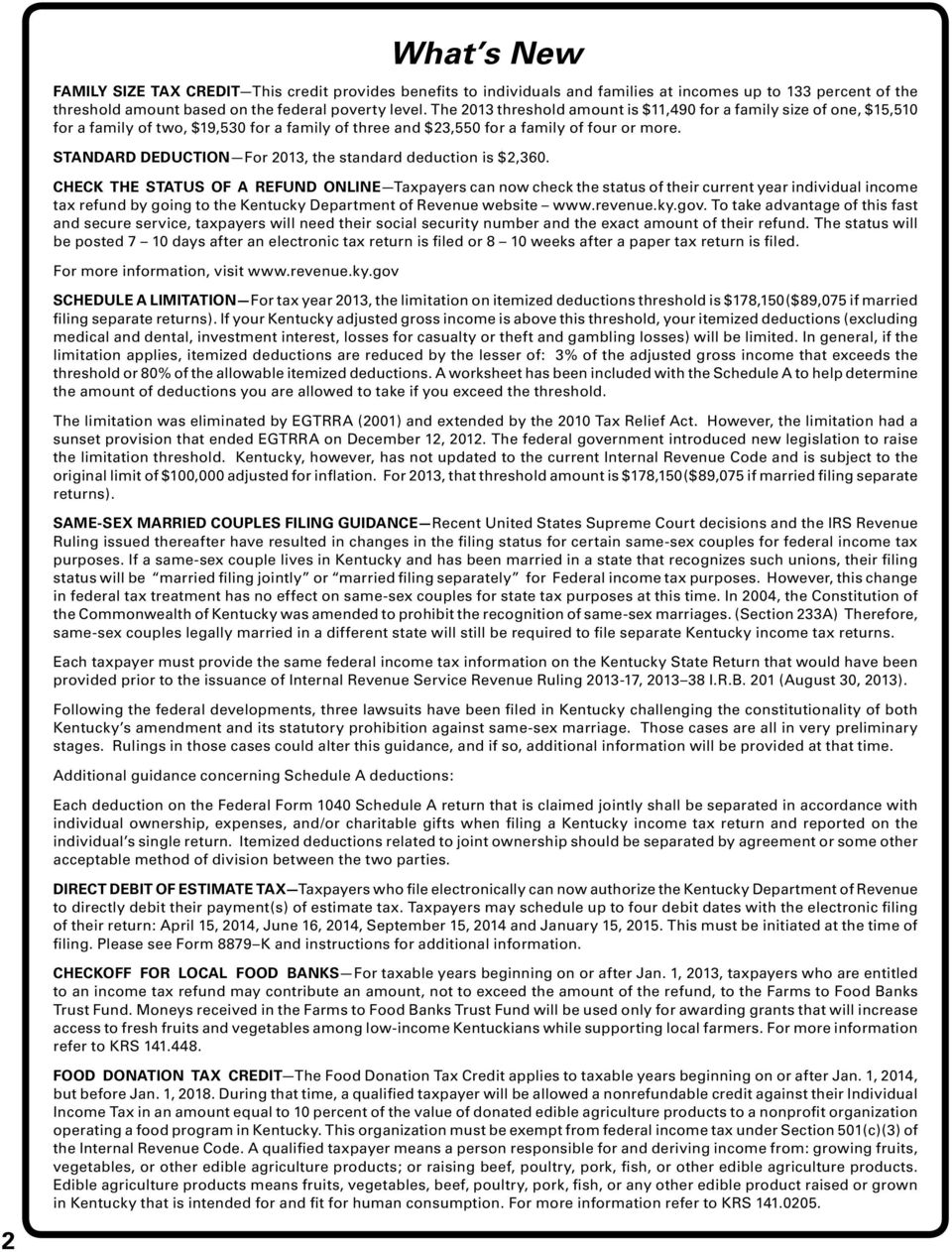
4 FAMILY SIZE TAX CREDIT This credit provides benefits to individuals and families at incomes up to 133 percent of the threshold amount based on the federal poverty level. The 2013 threshold amount is $11,490 for a family size of one, $15,510 for a family of two, $19,530 for a family of three and $23,550 for a family of four or more. STANDARD DEDUCTION For 2013, the standard deduction is $2,360. CHECK THE STATUS OF A REFUND ONLINE Taxpayers can now check the status of their current year individual income tax refund by going to the Kentucky Department of Revenue website To take advantage of this fast and secure service, taxpayers will need their social security number and the exact amount of their refund. The status will be posted 7 10 days after an electronic tax return is filed or 8 10 weeks after a paper tax return is filed. For more information, visit SCHEDULE A LIMITATION For tax year 2013, the limitation on itemized deductions threshold is $178,150($89,075 if married filing separate returns). If your Kentucky adjusted gross income is above this threshold, your itemized deductions (excluding medical and dental, investment interest, losses for casualty or theft and gambling losses) will be limited. In general, if the limitation applies, itemized deductions are reduced by the lesser of: 3% of the adjusted gross income that exceeds the threshold or 80% of the allowable itemized deductions. A worksheet has been included with the Schedule A to help determine the amount of deductions you are allowed to take if you exceed the threshold. The limitation was eliminated by EGTRRA (21) and extended by the 2010 Tax Relief Act. However, the limitation had a sunset provision that ended EGTRRA on December 12, The federal government introduced new legislation to raise the limitation threshold. Kentucky, however, has not updated to the current Internal Revenue Code and is subject to the original limit of $1,0 adjusted for inflation. For 2013, that threshold amount is $178,150($89,075 if married filing separate returns). SAME-SEX MARRIED COUPLES FILING GUIDANCE Recent United States Supreme Court decisions and the IRS Revenue Ruling issued thereafter have resulted in changes in the filing status for certain same-sex couples for federal income tax purposes. If a same-sex couple lives in Kentucky and has been married in a state that recognizes such unions, their filing status will be married filing jointly or married filing separately for Federal income tax purposes. However, this change in federal tax treatment has no effect on same-sex couples for state tax purposes at this time. In 24, the Constitution of the Commonwealth of Kentucky was amended to prohibit the recognition of same-sex marriages. (Section 233A) Therefore, same-sex couples legally married in a different state will still be required to file separate Kentucky income tax returns. Each taxpayer must provide the same federal income tax information on the Kentucky State Return that would have been provided prior to the issuance of Internal Revenue Service Revenue Ruling , I.R.B. 201 (August 30, 2013). Following the federal developments, three lawsuits have been filed in Kentucky challenging the constitutionality of both Kentucky s amendment and its statutory prohibition against same-sex marriage. Those cases are all in very preliminary stages. Rulings in those cases could alter this guidance, and if so, additional information will be provided at that time. Additional guidance concerning Schedule A deductions: What s New Each deduction on the Federal Form 1040 Schedule A return that is claimed jointly shall be separated in accordance with individual ownership, expenses, and/or charitable gifts when filing a Kentucky income tax return and reported on the individual s single return. Itemized deductions related to joint ownership should be separated by agreement or some other acceptable method of division between the two parties. DIRECT DEBIT OF ESTIMATE TAX Taxpayers who file electronically can now authorize the Kentucky Department of Revenue to directly debit their payment(s) of estimate tax. Taxpayers may schedule up to four debit dates with the electronic filing of their return: April 15, 2014, June 16, 2014, September 15, 2014 and January 15, This must be initiated at the time of filing. Please see Form 8879 K and instructions for additional information. CHECKOFF FOR LOCAL FOOD BANKS For taxable years beginning on or after Jan. 1, 2013, taxpayers who are entitled to an income tax refund may contribute an amount, not to exceed the amount of the refund, to the Farms to Food Banks Trust Fund. Moneys received in the Farms to Food Banks Trust Fund will be used only for awarding grants that will increase access to fresh fruits and vegetables among low-income Kentuckians while supporting local farmers. For more information refer to KRS FOOD DONATION TAX CREDIT The Food Donation Tax Credit applies to taxable years beginning on or after Jan. 1, 2014, but before Jan. 1, During that time, a qualified taxpayer will be allowed a nonrefundable credit against their Individual Income Tax in an amount equal to 10 percent of the value of donated edible agriculture products to a nonprofit organization operating a food program in Kentucky. This organization must be exempt from federal income tax under Section 501(c)(3) of the Internal Revenue Code. A qualified taxpayer means a person responsible for and deriving income from: growing fruits, vegetables, or other edible agriculture products; or raising beef, poultry, pork, fish, or other edible agriculture products. Edible agriculture products means fruits, vegetables, beef, poultry, pork, fish, or any other edible product raised or grown in Kentucky that is intended for and fit for human consumption. For more information refer to KRS
5 General Information Which form should I file? File Form 740-EZ if you are a Kentucky resident for the entire year and: are filing federal Form 1040EZ. file as single. do not claim additional credits for being age 65 or over, blind, or a member of the Kentucky National Guard at the end of had only wages, salaries, tips, unemployment compensation, taxable scholarship or fellowship grants, and taxable interest was $1,5 or less. File Form 740 if you are a full-year Kentucky resident and: have farm, business, rental and/or capital gain income or losses. itemize deductions. have additions to or subtractions from federal adjusted gross income (see instructions). Schedule M required. report on an accrual basis. claim Kentucky estimated tax payments. have pension income. File Form 740-NP if you are a nonresident and: had income from Kentucky sources. or are a part-year Kentucky resident and: moved into or out of Kentucky during the taxable year. had income while a Kentucky resident. had income from Kentucky sources while a nonresident. Computer-Generated Returns and 2-D Bar Code Most software packages produce a 2-D bar code. The Department of Revenue scans the bar code that contains all of the information needed to process your return. The bar code is printed in the upper right-hand corner of the return when you prepare your return using an approved software package. Last minute changes should be entered into the program and the entire return printed again so that the bar code also contains the correct information. This bar code should not be covered up or marked through. Using the bar code reduces data entry errors for the department and results in a faster refund for you. Check to be sure your software generates an acceptable form. A list of vendors whose software has been approved is posted on the Internet at the Department of Revenue s Web site. Where to Get Forms Forms and instructions are available online from the Department of Revenue s Web site at and at all Kentucky Taxpayer Service Centers. They may also be obtained by writing FORMS, Kentucky Department of Revenue, Frankfort, KY 40620, or by calling (502) Address Change If you move after you file your tax return, please notify the Kentucky Department of Revenue of your new address. This can be done by sending a change of address card (available at your local post office) to: Taxpayer Assistance Section, Kentucky Department of Revenue, P.O. Box 181, Station 56, Frankfort, KY Notification can also be made to any Kentucky Taxpayer Service Center. A list of locations is included in your packet. Refund Inquiries You may check the status of your refund at or by calling our automated line at (502) These systems are available 24 hours, 7 days a week, and are updated nightly. Information about electronically filed returns should be available within 72 hours of receipt. Information about other refund request filed on paper will be available after the return has completed initial processing (approximately 12 weeks). Need a Copy of Your Tax Return? If you need a copy of your tax return, you must send your request in writing to: Taxpayer Assistance Section, Kentucky Department of Revenue, P.O. Box 181, Station 56, Frankfort, KY Please include your name(s) as it appeared on your return, Social Security number(s), your complete mailing address, and a photo ID. To ensure confidentiality, all requests must include your signature. How Long Should Records be Kept? Keep a copy of your tax return, worksheets and records of all items appearing on it (such as Forms W-2 and 1099 or other receipts) until the statute of limitations runs out for that return. Usually, this is four years from the date the return was due or filed (with extensions), or the date the tax was paid, whichever is later. You should keep some records longer. For example, keep property records (including those on your home) as long as they are needed to figure the basis of the original or replacement property. Filing as an Injured Spouse on Your Federal Form 1040? Kentucky does not recognize the federal injured spouse form. Income tax refunds may be withheld by the department if you owe money to the Kentucky Department of Revenue, another state agency or the Internal Revenue Service. Kentucky law requires the offset of the entire refund if a joint return is filed. If spouses want to keep their tax liabilities and/or refunds separate, each must file a separate tax form. If you choose to file separately on a combined return, for agencies other than the Department of Revenue, the refund will be apportioned between spouses, based 3

6 4 on each spouse s income. The indebted spouse s refund will then be paid to the appropriate agency. Death of a Taxpayer If a taxpayer died before filing a return for 2013, the taxpayer s spouse or personal representative may have to file and sign a return for that taxpayer. A personal representative can be an executor, administrator or anyone who is in charge of the deceased taxpayer s property. If the deceased taxpayer did not have to file a return but had tax withheld, a return must be filed to get a refund. The person who files the return should enter DECD after the deceased taxpayer s name and write DECEASED and the date of death across the top of the return. If your spouse died in 2013 and you did not remarry in 2013, you can file jointly or separately on a combined return. The return should show your spouse s 2013 income before death and your income for all of You can also file jointly or separately on a combined return if your spouse died in 2014 before filing a 2013 return. Write Filing as surviving spouse in the area where you sign the return. If someone else is the personal representative, he or she must also sign. Death of Military Personnel Killed in Line of Duty KRS (10)(t) exempts all income earned by soldiers killed in the line of duty from Kentucky tax for the year during which the death occurred and the year prior to the year during which the death occurred. The exemption applies to tax years beginning after December 31, 21. The income exclusion applies to all income from all sources of the decedent, not just military income. The exclusion includes all federal and state death benefits payable to the estate or any beneficiaries. Amended returns may be filed for the year the soldier was killed in the line of duty and the year prior to the year of death. The amended returns must be filed within the statute of limitations period; four years from the due date, the extended due date or the date the tax was paid, whichever is later. If a combined return was filed, the exclusion would apply to the income reported in Column A or Column B of the Kentucky return attributable to the military member. If a joint return was filed, the income must be separated accordingly. Refunds will be issued in the names on the original return. Beneficiaries or estates that received death benefits that were included in a Kentucky return may file an amended return to request a refund of taxes paid on the benefit. The Department of Revenue will use the Veterans Administration definition for in the line of duty, which states that a soldier is in the line of duty when he is in active military service, whether on active duty or authorized leave; unless the death was the result of the person s own willful misconduct. Income Tax Withholding for 2014 If the amount you owe or the amount you overpaid is large, you may want to change the amount of income tax withheld from your 2014 pay. To do so you must file a new Form K-4 with your employer. The Family Size Tax Credit is based on modified gross income and the size of the family. See instructions for Lines 20 and 21 for further explanation of these limitations. Changes have been made to the Special Withholding Exemption Certificate (Form K-4E) to reflect the Family Size Tax Credit. If you do not expect to have any tax liability for the current year and you meet the modified gross income requirements, you may be entitled to claim exemption from withholding of Kentucky income tax. The Special Withholding Exemption Certificate (Form K-4E) can be downloaded at business/whtax.htm, the Department of Revenue s Web site Estimated Tax Payments Persons who reasonably expect to have income in excess of $5,0 from which no Kentucky income tax will be withheld may be required to make estimated tax payments on Form 740-ES. However, if the amount of estimated tax is $5 or less, no estimated payments are required. Persons who do not prepay at least 70 percent of the tax liability may be subject to a 10 percent penalty for underpayment of estimated tax. If you are required to make estimated tax payments you may also be subject to interest if the payments are not made timely. Prepayments for 2014 may be made through withholding, a credit forward of a 2013 overpayment or estimated tax installment payments. The instructions for Form 740-ES include a worksheet for calculating the amount of estimated tax due and for making installment payments. These forms may be obtained from the Kentucky Department of Revenue, Frankfort, KY 40620, or any Kentucky Taxpayer Service Center, or by calling (502) Return Adjustments If the Department of Revenue adjusts your return and you do not understand the adjustment, you may write to Taxpayer Assistance, Kentucky Department of Revenue, P.O. Box 181, Station 56, Frankfort, KY or call (502) If you disagree with an adjustment made to your return, you may appeal that adjustment by submitting a written protest within 45 days of notification. Amended Returns If you discover that you omitted deductions or otherwise improperly prepared your return, you may obtain a refund by filing an amended return within four years of the due date of the original return. You are required to file an amended return to report omitted income. You may obtain Form 740-X by contacting a Kentucky Taxpayer Service Center or writing FORMS, Kentucky Department of Revenue, Frankfort, KY You may also download Form 740-X at the Department of Revenue s Web site.

7 Federal Audit Adjustments Taxpayers who have received a final determination of an Internal Revenue Service audit must submit a copy to the department within 30 days of its conclusion. The information should be submitted to the Individual Governmental Program Section, Kentucky Department of Revenue, P.O. Box 1074, Station 68, Frankfort, KY Confidentiality Kentucky Revised Statute requires the Department of Revenue to maintain strict confidentiality of all taxpayer records. No employee of the Department of Revenue may divulge any information regarding the tax returns, schedules or reports required to be filed. However, the Department of Revenue is not prohibited from providing evidence to or testifying in any court of law concerning official tax records. Also, Department of Revenue employees or any other person authorized to access confidential state information are prohibited from intentionally viewing such information without an official need to view. The department may provide official information on a confidential basis to the Internal Revenue Service or to any other governmental agency with which it has an exchange of information agreement whereby the department receives similar or useful information in return. Extension of Time to File Individuals who receive a federal extension are not required to request a separate Kentucky extension. They can meet the requirements by attaching a copy of the application for automatic federal extension to the Kentucky return. IRS extensions by e-file (by personal computer or a tax professional) Attach a copy of Form 4868 with the confirmation number in the lower right-hand corner of the form or a copy of the electronic acknowledgment. Military Personnel Kentucky residents who are in the military are often granted extensions for tax filings when serving outside the United States. Any extension granted for federal income tax purposes will be honored for Kentucky income tax purposes. Combat Zone Extension Members of the Army, Navy, Marines, Air Force, or Public Health Service of the United States government who serve in an area designated as a combat zone by presidential proclamation shall not be required to file an income tax return and pay the taxes, which would otherwise become due during the period of service, until 12 months after the service is completed. Members of the National Guard or any branch of the Reserves called to active duty to serve in a combat zone are granted the same extension. Interest and Penalties Interest at the tax interest rate applies to any income tax paid after the original due date of the return. If the amount of tax paid by the original due date is less than 75 percent of the tax due, a late payment penalty may be assessed (minimum penalty is $10). Interest and penalty charges can be avoided or reduced by sending payment with your extension request by the due date. If you wish to make a payment prior to the due date of your return when using the: (1) Kentucky Extension Complete Section II, Kentucky Extension Payment Voucher, of the Application for Extension of Time to File, Form 40A102, and send with payment. Write KY Income Tax 2013 and your Social Security number(s) on the face of the check. (2) Federal Automatic Extension Make a copy of the lower portion of the federal Application for Automatic Extension, Form 4868, and send with payment. Write KY Income Tax 2013 and your Social Security number(s) on the face of the check. Personal Property Forms Kentucky business taxpayers are reminded to report all taxable personal property, except motor vehicles, owned on January 1 to either the property valuation administrator in the county of residence (or location of business) or the Office of Property Valuation in Frankfort. Tangible personal property is to be reported on the Tangible Personal Property Tax Return, Form 62A5. The due date for this return is May 15. Do not mail this return with your income tax return; use a separate envelope. Taxpayers who are unable to file a return by April 15 may request an extension. The request for the extension must be submitted in writing to the Department of Revenue on or before the due date of the return. The request must state a reasonable cause for the inability to file. Inability to pay is not an acceptable reason. Acceptable reasons include, but are not limited to, destruction of records by fire or flood and serious illness of the taxpayer. Extensions are limited to six months. A copy of the Kentucky extension request must be attached to the return. Kentucky Department of Revenue Mission Statement As part of the Finance and Administration Cabinet, the mission of the Kentucky Department of Revenue is to administer tax laws, collect revenue, and provide services in a fair, courteous, and efficient manner for the benefit of the Commonwealth and its citizens. * * * * * * * * * * * * * * * * * * The Kentucky Department of Revenue does not discriminate on the basis of race, color, national origin, sex, age, religion, disability, sexual orientation, gender identity, veteran status, genetic information or ancestry in employment or the provision of services. 5

8 2013 FEDERAL/KENTUCKY INDIVIDUAL INCOME TAX DIFFERENCES Kentucky income tax law is based on the federal income tax law in effect on December 31, 26. The Department of Revenue generally follows the administrative regulations and rulings of the Internal Revenue Service in those areas where no specific Kentucky law exists. The chart below provides a quick reference guide to the major federal/kentucky differences. It is not intended to be all inclusive. Items not listed may be referred to the Department of Revenue to determine Kentucky tax treatment. Provision FEDERAL TAX TREATMENT kentucky tax treatment 1. Interest from Federal Obligations Taxable Exempt 2. Retirement Income from: Commonwealth of Kentucky Retirement Systems Kentucky Local Government Retirement Systems Federal and Military Retirement Systems Taxable Taxable Taxable Partially exempt if retired after December 31, 1997; exempt if retired before January 1, 1998; Schedule P may be required 3. Pensions and Annuities Starting After 7/1/86 3-year recovery rule eliminated 3-year recovery rule retained and Before 1/1/90 4. Other Pension and Annuity Income Taxable 1% excludable up to $41,110; Schedule P may be required 5. Benefits from U.S. Railroad Retirement Board May be taxable Exempt; Schedule P may be required 6. Social Security Benefits May be taxable Exempt 7. Capital Gains on Sale of Kentucky Turnpike Bonds Taxable Exempt 8. Other States Municipal Bond Interest Income Exempt Taxable 9. Kentucky Local Government Lease Interest Payments Taxable Exempt 10. Long-Term Care Insurance Premiums Paid With Limited deduction as self-employed 1% adjustment to gross After-Tax Dollars health insurance income 11. Medical and Dental Insurance Premiums Paid With Limited deduction as self-employed 1% adjustment to gross After-Tax Dollars health insurance income 12. Capital Gains on Property Taken by Taxable Exempt Eminent Domain 13. Election Workers Income for Training or Taxable Exempt Working at Election Booths 14. Artistic Contributions Noncash contribution allowed as Appraised value allowed as itemized deduction itemized deduction or adjustment to income 15. State Income Taxes Deductible Nondeductible 16. Leasehold Interest Charitable Contribution May be deductible Deductible; Schedule HH required 17. Kentucky Unemployment Tax Credit No credit allowed $1 per certified employee; Schedule UTC required 18. Work Opportunity Credit (federal Form 5884) Tax credit allowed; wage expense No credit allowed; entire wage reduced by amount of credit expense is deductible 19. Welfare to Work Credit (federal Form 8861) Tax credit allowed; wage expense No credit allowed; wage expense reduced by amount of credit reduced by amount of federal credit 20. Child and Dependent Care Credit Tax credit based on expenses 20% of federal credit 21. Family Size Tax Credit No credit allowed Decreasing tax credit allowed 22. Education Tuition Tax Credit Tax credit based on expenses Credit allowed Form 8863-K required 23. Taxpayer Who May be Claimed as Dependent May not claim self May claim self on Another s Return (i.e., full-time student) 24. Child s Income Reported by Parent Permitted; taxed at parent s rate Not permitted 25. National Tobacco Settlement TLAP Income Taxable Exempt Quota Buyout (including imputed interest) 26. Bonus Depreciation/Additional Section 179 Expense Deductible Nondeductible 27. Mortgage Debt Forgiveness Exempt Taxable 28. Domestic Production Activities Deduction Deductible Deductible; may be limited 29. Active Duty Military Pay Taxable Exempt 30. Certain Business Expenses of Reservists Deductible Nondeductible 6

9 If you were a Kentucky resident for the entire year, your filing requirement depends upon your family size, modified gross income, Kentucky adjusted gross income and income from self-employment. You must file if your modified gross income exceeds the amount in Chart A and your Kentucky adjusted gross income exceeds the amount in Chart B. Complete your federal tax return first. If you are not required to file a federal tax return, see instructions for Line 5. MODIFIED GROSS INCOME AND FAMILY SIZE (Use With Chart A) Family Size Consists of yourself, your spouse if married and living in the same household and qualifying children. For the purposes of computing the Family Size Tax Credit, the maximum family size is four. Qualifying Dependent Child Means a qualifying child as defined in Internal Revenue Code Section 152(c), and includes a child who lives in the household but cannot be claimed as a dependent if the provisions of Internal Revenue Code Section 152(e)(2) and 152(e)(4) apply. In general, to be a taxpayer s qualifying child, a person must satisfy four tests: Relationship The taxpayer s child or stepchild (whether by blood or adoption), foster child, sibling or stepsibling, or a descendant of one of these. Residence Has the same principal residence as the taxpayer for more than half the tax year. A qualifying child is determined without regard to the exception for children of divorced or separated parents. Other federal exceptions apply. Age Must be under the age of 19 at the end of the tax year, or under the age of 24 if a full-time student for at least five months of the year, or be permanently and totally disabled at any time during the year. Support Did not provide more than one-half of his/her own support for the year. Modified Gross Income Modified gross income is the greater of federal adjusted gross income adjusted to include interest income derived from municipal bonds (non-kentucky) and lump-sum pension distributions not included in federal adjusted gross income; or Kentucky adjusted gross income adjusted to include lump-sum pension distributions not included in federal adjusted gross income. INSTRUCTIONS 2013 FORM 740 Do You Have to File a Kentucky Return? KENTUCKY ADJUSTED GROSS INCOME (Use Chart B if Modified Gross Income is Greater Than the Amounts in Chart A) Kentucky Adjusted Gross Income Consists of your federal adjusted gross income plus any additions and subtractions from Schedule M, Modifications to Federal Adjusted Gross Income. If Your Filing Status is: Chart B Your Kentucky Adjusted Gross Income is greater than: Single Person Under age and... $ 3,360 Single Person Age 65 or over or blind... and... $ 5,360 Single Person Age 65 or over and blind... and... $ 6,630 Husband and Wife Both under age and... $ 4,360 Husband and Wife One age 65 or over... and... $ 6,030 Husband and Wife Both age 65 or over... and... $ 7,130 TAXPAYERS WITH SELF-EMPLOYMENT INCOME Must file a Kentucky individual income tax return regardless of the amount of Kentucky adjusted gross income used in the Chart B if you have gross receipts from self-employment in excess of modified gross income for your family size in Chart A. If Your Family Size is: Chart A Your Modified Gross Income is greater than: One... and...$11,490 Two... and...$15,510 Three... and...$19,530 Four or More... and...$23,550 TIP: Even though the filing requirements are not met, an income tax return must be filed to claim a refund of the Kentucky taxes withheld. 7

10 8 FILING REQUIREMENTS (Continued) Part-time or part-year workers may have income taxes withheld from their paychecks even though the filing requirements are not met. An income tax return must be filed to claim a refund of the Kentucky taxes withheld. A child meeting the filing requirements must file a return even though being claimed as a dependent by the parent. Kentucky income tax law contains no special provisions for taxing the income of a minor child at the parent s tax rates nor the reporting of income of a child on the parent s return. Generally, all income of Kentucky residents, regardless of where it was earned, is subject to Kentucky income tax. Nonresidents and part-year residents must report income on Form 740-NP. Military Personnel MILITARY PAY EXCLUSION Effective for taxable years beginning on or after January 1, 2010, all military pay received by active duty members of the Armed Forces of the United States, members of reserve components of the Armed Forces of the United States, and members of the National Guard will be exempt from Kentucky income tax. KRS (10)(u) Soldiers will claim the exemption by excluding military pay when filing a Kentucky individual income tax return starting with the 2010 return. Provided the military member has no income other than military pay, he or she would not be required to file a Kentucky income tax return. The military pay exemption applies to all Kentucky military members regardless of where the member is stationed. Kentucky income tax should no longer be withheld from checks received for military pay, beginning January 1, If Kentucky income tax is incorrectly withheld from a soldier s military pay, the Department of Revenue will refund the tax withheld. Kentucky residents who are in the military are often granted extensions for military service when serving outside the United States. Any extension granted for federal income tax purposes will be honored for Kentucky income tax purposes. For Fiscal Year Filers Only Most people pay taxes for a calendar year. However, if you file for a taxable year other than a calendar year or for part of a year, enter the beginning and ending dates of that year on the line at the top of the form. When and Where to File The income tax return for calendar year 2013 must be postmarked or submitted electronically no later than April 15, 2014, to avoid penalties and interest. Mail to: Refund/Other Returns Kentucky Department of Revenue Frankfort, KY Pay Returns Kentucky Department of Revenue Frankfort, KY APRIL 2014 S M T W T F S Taxpayers who expect refunds should file as early as possible to receive refunds promptly. If you have your tax return prepared by another person, you may wish to mail the return yourself in order to ensure prompt filing. Social Security Number You are required to provide your social security number per Section 405, Title 42, of the United States Code. This information will be used to establish your identity for tax purposes only. Political Party Fund Designation You may designate $2 of your taxes to either the Democratic or Republican party if you have a tax liability of at least $2 ($4 for married persons filing joint returns). Fifty cents will be paid to the corresponding political organization in your county of residence and the remainder will be paid to the respective state political party. This designation will not increase your tax or decrease your refund. You may make this designation by checking the applicable box. A husband and wife may each make a designation. Persons making no designation should check the No Designation box. Reporting Periods and Accounting Procedures Kentucky law requires taxpayers to report income on the same calendar or fiscal year and to use the same methods of accounting as required for federal income tax purposes. Any federally approved change in accounting period or methods must be reported to the Kentucky Department of Revenue. Attach a copy of the federal approval. Changes to federal income tax law made after the Internal Revenue Code reference date contained in KRS (3) shall not apply for purposes of Chapter 141 unless adopted by the General Assembly. Filing Status Legal liabilities are affected by the choice of filing status. Married persons who file joint or combined returns are jointly and severally liable for all income taxes due for the period covered by the return. That is, each spouse may be held legally responsible for payment of taxes on income earned by the other. If spouses want to credit the refund of one against the liability of the other or combine their tax liabilities or refunds, they must file a combined return. If spouses want to keep their tax liabilities and/or refunds separate, each must file a separate tax form. Check the box that describes your filing status. If you are married, filed a joint federal return and both you and your spouse had income, you may be able to reduce your tax by using Filing Status 2 rather than Filing Status 3. Filing Status 1, Single Use this filing status if you are unmarried, divorced, widowed, legally separated by court decree, or if you filed as Head of Household or Qualifying Widow(er) on your federal return.

11 Filing Status 2, Married Filing Separately on This Combined Return Use this filing status to report your incomes individually but on only one tax form. You do this by filling in both Columns A and B. You may file separately on this combined return regardless of whether you filed jointly or separately for federal purposes if both you and your spouse had income. This filing status usually results in a lower tax than Filing Status 3. Each spouse must claim his or her own income and deductions. The total of Line 5, Columns A and B, must equal your and your spouse s federal adjusted gross income. Filing Status 3, Married Filing Joint Return Use this filing status if you and your spouse choose to file a joint return even if one spouse had no income. Jointly means that you and your spouse add your incomes together and report in Column B. If both you and your spouse have income, it may be to your benefit to use Filing Status 2. Filing Status 4, Married Filing Separate Returns If using this filing status, you and your spouse must file two separate tax forms. The husband s income is reported on one tax form, the wife s on the other. When filing separate returns, the name and Social Security number of each spouse must be entered on both returns. Enter the spouse s Social Security number in the block provided, and enter the name on Line 4. Adjusted Gross Income LINE 5, Federal Adjusted Gross Income Enter the total amount of your federal adjusted gross income from your federal income tax return in Column B if Filing Status 1, 3 or 4 is used. Use Column A only when entering your spouse s income on a combined return (Filing Status 2). When using Filing Status 2, Columns A and B, Line 5, must equal your federal adjusted gross income. (Do not confuse federal adjusted gross income with federal taxable income shown on the federal return.) Where husband and wife have filed a joint return for federal income tax purposes and have not elected to file a joint Kentucky income tax return, each spouse must claim his or her own income and deductions. If you are not required to file a federal income tax return, enter on Line 5 the total of wages, salaries, tips, fees, commissions, bonuses, other payments for personal services, taxable scholarships and fellowships, taxable interest and dividends, trade or business income, unemployment compensation and all other income from sources within and without Kentucky including amounts not reported on attached wage and tax statements. If you have income not supported by a wage and tax statement, attach a supporting schedule showing the source and amount. Determining Kentucky Adjusted Gross Income Kentucky law requires that the individual income tax return begin with federal adjusted gross income and be adjusted for any differences to arrive at Kentucky adjusted gross income. Schedule M is designed to make additions to federal adjusted gross income and provides for subtractions from federal adjusted gross income. For a list of differences, see the Federal/Kentucky Individual Income Tax Differences chart and the line-by-line instructions. Line 6 Additions to Federal Adjusted Gross Income Enter amount from Schedule M, Part I, Line 8. Line 8 Subtractions from Federal Adjusted Gross Income Enter amount from Schedule M, Part II, Line 20. Line 9 Kentucky Adjusted Gross Income Subtract Line 8 from Line 7. This is your Kentucky Adjusted Gross Income. Taxable Income LINE 10, Deductions Itemizers, complete Schedule A and enter allowable deductions on Line 10. If one spouse itemizes deductions, the other must itemize. See specific instructions for Schedule A. Nonitemizers, enter the standard deduction of $2,360. If married filing separately on a combined return, enter $2,360 in both Columns A and B. If filing a joint return, only one $2,360 standard deduction is allowed. LINE 11 Subtract Line 10 from Line 9. This is your Taxable Income. Tax LINE 12 Determining Your Tax Tax Table or Computation An optional tax table is located elsewhere in this publication for your convenience. You may use this table whether or not you itemize. Married taxpayers filing separately on a combined return may use the tax table or the tax rate schedule, or one spouse may use the tax table and the other the tax rate schedule. If you choose not to use the tax table, compute your tax using the tax rate schedule below. Tax Rate Schedule If taxable amount is: Tax is: $3,0 or less... 2% of taxable amount over $3,0 but not over $4,0... $60 plus 3% of amount over $3,0 over $4,0 but not over $5,0... $90 plus 4% of amount over $4,0 over $5,0 but not over $8,0... $130 plus 5% of amount over $5,0 over $8,0 but not over $75,0... $280 plus 5.8% of amount over $8,0 over $75,0... $4,166 plus 6% of amount over $75,0 Farm Income Averaging, Schedule J If you elect farm income averaging on your federal return, you may also use this method for Kentucky. The amount of income you may average is limited to the amount elected for federal purposes. Enter tax from Schedule J, Line 22, on Form 740, Line 12, and check the box for Schedule J. Attach completed Schedule J. 9

12 LINE 13, Lump-sum Distribution Special 10 Year Averaging Kentucky allows a special 10-year averaging method for determining tax on lump-sum distributions received from certain retirement plans that qualify for federal 10-year averaging. If this special method is used for federal purposes, Form 4972-K, Kentucky Tax on Lump-Sum Distributions, and Schedule P, Pension Income Exclusion, must be filed with Form 740. Enter tax from Form 4972-K and check the box. Recycling Composting Recapture Enter amount from Schedule RC-R and check the box. If both Form 4972-K and Schedule RC-R are used, add the amounts together and enter the total on Line 13. LINE 15 Enter amounts from page 3, Section A. See instructions for Section A. LINE 17 Enter amounts from page 3, Section B. See instructions for Section B. LINE 19, Total Tax Liability Married taxpayers filing a combined return must add the amounts on Line 18, Columns A and B, and enter the sum on Line 19. Other taxpayers should enter the amount from Line 18, Column B, on Line

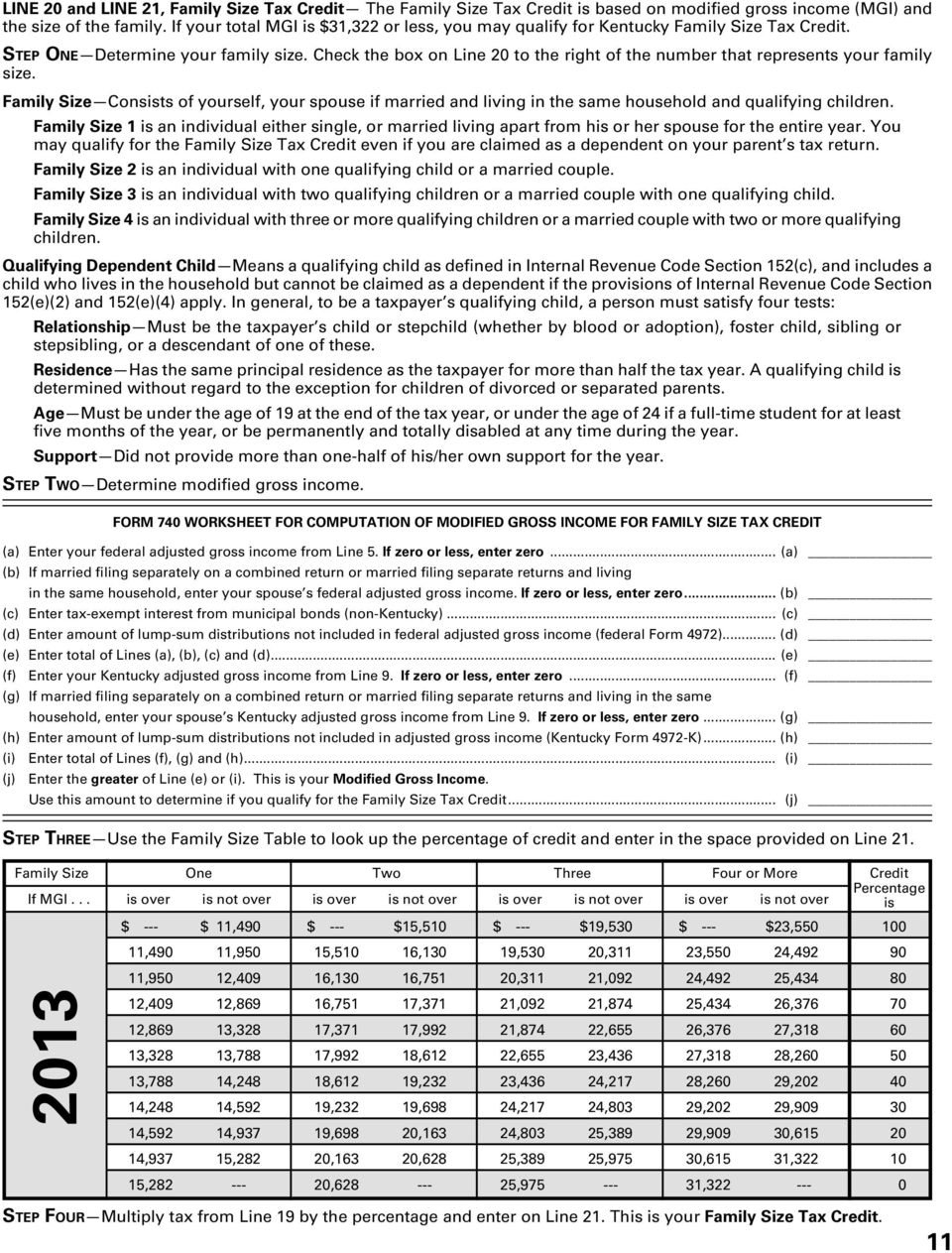
13 LINE 20 and LINE 21, Family Size Tax Credit The Family Size Tax Credit is based on modified gross income (MGI) and the size of the family. If your total MGI is $31,322 or less, you may qualify for Kentucky Family Size Tax Credit. St e p On e Determine your family size. Check the box on Line 20 to the right of the number that represents your family size. Family Size Consists of yourself, your spouse if married and living in the same household and qualifying children. Family Size 1 is an individual either single, or married living apart from his or her spouse for the entire year. You may qualify for the Family Size Tax Credit even if you are claimed as a dependent on your parent s tax return. Family Size 2 is an individual with one qualifying child or a married couple. Family Size 3 is an individual with two qualifying children or a married couple with one qualifying child. Family Size 4 is an individual with three or more qualifying children or a married couple with two or more qualifying children. Qualifying Dependent Child Means a qualifying child as defined in Internal Revenue Code Section 152(c), and includes a child who lives in the household but cannot be claimed as a dependent if the provisions of Internal Revenue Code Section 152(e)(2) and 152(e)(4) apply. In general, to be a taxpayer s qualifying child, a person must satisfy four tests: Relationship Must be the taxpayer s child or stepchild (whether by blood or adoption), foster child, sibling or stepsibling, or a descendant of one of these. Residence Has the same principal residence as the taxpayer for more than half the tax year. A qualifying child is determined without regard to the exception for children of divorced or separated parents. Age Must be under the age of 19 at the end of the tax year, or under the age of 24 if a full-time student for at least five months of the year, or be permanently and totally disabled at any time during the year. Support Did not provide more than one-half of his/her own support for the year. Step Two Determine modified gross income. St e p Th r e e Use the Family Size Table to look up the percentage of credit and enter in the space provided on Line 21. Family Size One Two Three Four or More If MGI... is over is not over is over is not over is over is not over is over is not over 2013 FORM 740 WORKSHEET FOR COMPUTATION OF MODIFIED GROSS INCOME FOR FAMILY SIZE TAX CREDIT (a) Enter your federal adjusted gross income from Line 5. If zero or less, enter zero... (a) (b) If married filing separately on a combined return or married filing separate returns and living in the same household, enter your spouse s federal adjusted gross income. If zero or less, enter zero... (b) (c) Enter tax-exempt interest from municipal bonds (non-kentucky)... (c) (d) Enter amount of lump-sum distributions not included in federal adjusted gross income (federal Form 4972)... (d) (e) Enter total of Lines (a), (b), (c) and (d)... (e) (f) Enter your Kentucky adjusted gross income from Line 9. If zero or less, enter zero... (f) (g) If married filing separately on a combined return or married filing separate returns and living in the same household, enter your spouse s Kentucky adjusted gross income from Line 9. If zero or less, enter zero... (g) (h) Enter amount of lump-sum distributions not included in adjusted gross income (Kentucky Form 4972-K)... (h) (i) Enter total of Lines (f), (g) and (h)... (i) (j) Enter the greater of Line (e) or (i). This is your Modified Gross Income. Use this amount to determine if you qualify for the Family Size Tax Credit... (j) Credit Percentage is $ --- $ 11,490 $ --- $15,510 $ --- $19,530 $ --- $23, ,490 11,950 15,510 16,130 19,530 20,311 23,550 24, ,950 12,409 16,130 16,751 20,311 21,092 24,492 25, ,409 12,869 16,751 17,371 21,092 21,874 25,434 26, ,869 13,328 17,371 17,992 21,874 22,655 26,376 27, ,328 13,788 17,992 18,612 22,655 23,436 27,318 28, ,788 14,248 18,612 19,232 23,436 24,217 28,260 29, ,248 14,592 19,232 19,698 24,217 24,803 29,202 29, ,592 14,937 19,698 20,163 24,803 25,389 29,909 30, ,937 15,282 20,163 20,628 25,389 25,975 30,615 31, , , , , St e p Fo u r Multiply tax from Line 19 by the percentage and enter on Line 21. This is your Family Size Tax Credit. 11
14 LINE 23, Education Tuition Tax Credit Complete Form 8863 K to claim this credit. See form and instructions. LINE 25, Child and Dependent Care Credit Enter in the space provided the amount of credit calculated on federal Form 2441, Line 9, for child and dependent care expenses. Multiply this amount by 20 percent (.20), and enter result on Line 25. If you do not meet the filing requirements to file a federal income tax return but would have been entitled to the federal child and dependent care credit, you may claim the child and dependent care credit for Kentucky purposes. Complete and attach federal Form 2441, state on the form did not meet federal filing requirements and follow instructions for Line 25. LINE 27, Kentucky Use Tax Important Reminder from the Department of Revenue About Out-of-State Purchases: If you made untaxed purchases from out-of-state retailers, the use tax line on your return should contain a number. Like every other state that has a sales tax, Kentucky has a use tax that requires that out-of-state purchases of tangible personal property or digital property for use in Kentucky be taxed at the same amount as if they had taken place in Kentucky and subjected to Kentucky s sales tax. This ensures equality of treatment between in-state and out-of-state transactions. Although the use tax has been in the tax code since 1960, it is now more relevant than ever because of the increasing percentage of online sales. Pursuant to KRS , a 6 percent use tax is due if you make out of state purchases for storage, use or other consumption in Kentucky and did not pay at least 6 percent state sales tax to the seller at the time of purchase. For example, if you order from catalogs, make purchases through the Internet, or shop outside Kentucky for items such as clothing, shoes, jewelry, cleaning supplies, furniture, computer equipment, pre-written computer software, office supplies, books, souvenirs, exercise equipment or subscribe to magazines, you may owe use tax to Kentucky. It is important to remember that use tax applies only to items purchased from a retailer outside Kentucky, including another country, which would have been taxed if purchased in Kentucky. For your convenience, a Use Tax Calculation Worksheet and Optional Use Tax Table are provided below. The Optional Use Tax Table is designed for those purchases of less than $1,0. If you made untaxed out-of-state purchases in amounts under $1,0, but do not have records readily available that show the amount of those purchases, you may use the Optional Use Tax Table below to estimate the compensating use tax based on your Kentucky Adjusted Gross Income (KYAGI). All untaxed purchases in the amount of $1,0 or greater must be accounted for on an actual basis using the Use Tax Calculation Worksheet. Failure to timely report may result in assessment of penalty and interest in addition to the tax amount due. Optional Use Tax Table KY AGI* Tax $0 - $10,0... $4 $10,1 - $20,0... $12 $20,1 - $30,0... $20 $30,1 - $40,0... $28 $40,1 - $50,0... $36 $50,1 - $75,0... $50 $75,1 - $1,0... $70 Above $1,0... Multiply AGI by 0.08% (0.08) * AGI from Line 9 on KY Form 740 or KY Form 740-NP or Line 1 on KY Form 740-EZ. 1. Purchases of $0 to $1,0 x 6 percent (.06) OR Use Tax Table Amount 2. Purchases of $1,0 or more x 6 percent (.06) 3. Total Use Tax Due (add lines 1 and 2) Use Tax Calculation Worksheet Call for assistance. Report this amount on Form 740 or 740-NP, Line 27; or 740-EZ, Line 9. $ $ $ Credit Against the Kentucky Use Tax Due You may reduce or eliminate the amount of Kentucky use tax due by the amount of state sales tax paid to the out-of-state seller on the same transaction. The reduction may not exceed the amount of Kentucky use tax due on the purchase. For example, if Georgia state sales tax of 4 percent is paid, only the additional 2 percent is due to Kentucky, or if Illinois state sales tax of 6.25 percent is paid, no additional Kentucky use tax is due. Sales tax paid to a city, county or another country cannot be used as a credit against Kentucky use tax due. Need more information about use tax? Visit our Web site at: Call or write: Kentucky Department of Revenue Attention: Use Tax P.O. Box 181, Station 53 Frankfort, KY Monday Friday 8 a.m. 5: p.m., ET (502)

15 LINE 30(a), Tax Withheld Enter the amount of 2013 Kentucky income tax withheld by your employer(s). This amount is shown on wage and tax statements, including Forms 1099 and W-2G, which you must attach to Form 740 in the designated area. You will not be given credit for Kentucky income tax withheld unless you attach the wage and tax statements or other supporting documents reflecting Kentucky withholding. Employers are required to give these statements to employees no later than January 31, If by March 1 you are unable to obtain a wage and tax statement from an employer, contact the Department of Revenue for instructions. You may not claim credit for tax withheld by another state. Within certain limitations, Kentucky residents may claim a credit for nonrefundable individual income tax paid to other states. See Section A, Line 5. Local government occupational, license or income tax must not be included on Line 30(a). LINE 30(b), Estimated Tax Paid Enter Kentucky estimated tax payments made for 2013 and amounts credited from the 2012 return. Also, include on Line 30(b) payments prepaid with extension requests. Identify as prepaid with extension. LINE 30(c), Refundable Certified Rehabilitation Credit Enter 2013 approved refundable certified rehabilitation credit per KRS (1)(b). LINE 30(d), Film Industry Tax Credit Enter 2013 approved refundable film industy tax credit per KRS Attach Schedule K-1, if applicable. LINE 31 Total of amounts on Lines 30(a) through 30(d). Compare the amounts on Lines 29 and 31. If Line 31 is larger than Line 29, subtract Line 29 from Line 31. Enter the difference on Line 32. This is the AMOUNT OVERPAID. If Line 31 is smaller than Line 29, you owe additional tax. Subtract Line 31 from Line 29. Enter on Line 41. For instructions on payment, see Line 44, Amount You Owe. LINE 32, Amount Overpaid If you have an overpayment on Line 32 you may have all of this amount refunded to you. You also may contribute all or part of it to the Nature and Wildlife Fund, the Child Victims Trust Fund, the Veterans Program Trust Fund, the Breast Cancer Research and Education Trust Fund, the Farms to Food Banks Trust Fund and/or credit all or part of it toward your 2014 estimated tax. Voluntary Refund Contributions Donations to the following funds are voluntary and amounts donated will reduce your refund. You may contribute all or a portion of your overpayment to one or more of the following funds. Enter the amount you wish to contribute on the appropriate lines. LINE 33, Nature and Wildlife Fund Contributions will purchase and protect Kentucky s finest natural areas as state nature preserves and for nongame species protection. The Kentucky Department of Fish and Wildlife Resources and the Kentucky State Nature Preserves Commission work together to protect Kentucky s rare plants and animals; and acquire the most naturally outstanding forests, wetlands and prairies in order to provide a home for Kentucky s unique and diverse wildlife. Your tax deductible contributions play a critical role in protecting the wildlands that make Kentucky famous. Contributions may also be made directly to the Nature and Wildlife Fund, c/o the Kentucky State Nature Preserves Commission, or c/o the Kentucky Department of Fish and Wildlife Resources, Frankfort, KY Help keep the Bluegrass state green! Kentucky Department of Fish and Wildlife Resources: Kentucky State Nature Preserves Commission: LINE 34, Child Victims Trust Fund (CVTF) Contributions to this fund finance regional and statewide prevention programs which utilize innovative strategies to provide children with personal safety skills, teach adults how to keep children safe from child sexual abuse and exploitation, and inform the public about mandatory reporting of suspected child abuse. The CVTF also provides partial reimbursement for child sexual abuse medical exams at Children s Advocacy Centers across the state. This fund is administered through the Attorney General s office and relies on tax-deductible contributions and private donations. Contributions may be made directly to the Child Victims Trust Fund, Office of Victims Advocacy, 1024 Capital Center Drive, Suite 2, Frankfort, KY For more information call (502) LINE 35, Veterans Program Trust Fund Contributions to this fund are administered by a Board of Directors, who are all veterans. The Trust Fund is used to provide services to veterans that are not already resourced by state law or federal appropriation. In an effort to recognize the service and sacrifice of Kentucky s deserving veterans, the fund supports programs such as state veterans nursing homes, state veterans cemeteries, homeless veterans transition facilities, transportation for disabled veterans and other veteran related projects. Contributions may also be made directly to the Kentucky Veterans Program Trust Fund, 1111B Louisville Road, Frankfort, KY
16 LINE 36, Breast Cancer Research and Education Trust Fund Contribution Contributions will be used to fund breast cancer research, education, awareness, treatment and screening. Additional information may be obtained from the Division of Women s Health, (502) or at Contributions may also be made directly to the state Department for Public Health, Division of Administration and Financial Management, 275 East Main Street, HS1GWA, Frankfort, KY 40621, (502) LINE 37, Farms to Food Banks Trust Fund Contribution Contributions to this fund are used to offset farmers costs for providing surplus Kentucky-grown fruits and vegetables to food banks. Cash flow for farmers is strengthened while access to healthy food among struggling Kentuckians is increased. This fund is administered by the Kentucky Department of Agriculture. Contributions can also be made directly to the Farms to Food Banks Trust Fund, c/o the Kentucky Department of Agriculture, 5 Mero Street, Capital Plaza Tower, 7th Floor, Frankfort, KY (502) LINE 39, Estimated Tax You may credit all or part of the overpayment toward your estimated tax liability for Enter the amount you want credited on Line 39. LINE 40 Subtract amounts entered on Lines 38 and 39 from Line 32. Enter the difference, if any, on Line 40. This amount will be refunded to you. If the total of Lines 38 and 39 equals the amount on Line 32, enter a zero on Line 40. Note: If the amount of Kentucky tax you overpaid is excessive, obtain a copy of Form K-4A from your employer. If you are entitled to additional allowances, file a new Form K-4 with your employer to reduce the amount of Kentucky tax withheld. LINE 41 This is your additional tax due before penalties and interest. Penalties and Interest LINE 42(a), Underpayment of Estimated Tax and/or Interest If the amount owed is more than $5 and more than 30 percent of the income tax liability on Line 26, you may be subject to a penalty of 10 percent of the underpayment of estimated tax. The amount of the penalty may be calculated on Form 2210 K. Form 2210 K may also be used by qualifying farmers and others to claim exemption to the penalty. If paying the penalty or claiming an exemption, complete Form 2210 K, attach it to your return and check the box beside Line 42(a). Enter the amount of the penalty on Line 42(a). The minimum penalty is $25. LINE 42(b), Interest Interest will be assessed at the tax interest rate from the original due date of the return until the date of payment. LINE 42(c), Late Payment Penalty If the amount of tax due as shown on Line 41 is not paid by the original due date of the return, a penalty of 2 percent of the tax computed due may be assessed for each 30 days or fraction thereof that the tax is past due, not to exceed 20 percent. The minimum penalty is $10. However, if the amount timely paid is 75 percent of the tax determined due by the Department of Revenue, no late payment penalty will be assessed. LINE 42(d), Late Filing Penalty If a return is not filed by the due date or the extended due date, a penalty of 2 percent of the total tax due for each 30 days or fraction thereof that a return is not filed may be assessed, not to exceed 20 percent. The minimum penalty is $10. Note: Penalties but not interest may be reduced or waived if reasonable cause for reduction or waiver can be shown. LINE 44, Amount You Owe When filing the return, you must pay any tax due shown on Line 44. Attach check payable to Kentucky State Treasurer to your return. To help identify your payment properly, write KY Income Tax 2013 and your Social Security number on the face of the check. Attach check at the left side of Form 740. Place the check on TOP of any wage and tax statements. Pay by Credit Card or ACH Debit Pay your 2013 Kentucky individual income tax by MasterCard, VISA, Discover or American Express credit card or by ACH Debit through April 15, Access the Department of Revenue s secure Web site ( to make electronic payments over the Internet. Click on the KY E Tax logo and select E Payments Credit Cards and ACH Debits link. If you do not have access to the Internet, you may call the Department of Revenue at (502) for assistance with payments. To make a credit card payment, the following information is needed: credit card type, credit card number, expiration date, and the cardholder s address as it appears on the credit card billing statement. To make an ACH Debit payment, the following information is needed: bank name, bank account number, and bank routing number. Note: If you cannot pay your tax in full, file your return and pay as much as possible by April 15. Contact the Department of Revenue for additional payment information. Failure to make four equal installment payments timely may result in interest due. See Form 2210-K and instructions. If your return is filed after April 15, 2014, or any tax due on the return is paid after April 15, 2014, you may be subject to additional penalties and interest. 14
17 SECTION A BUSINESS INCENTIVE AND OTHER TAX CREDITS Line 1, Nonrefundable Limited Liability Entity Tax Credit (KRS (2)) An individual that is a partner, member or shareholder of a limited liability pass through entity is allowed a limited liability entity tax (LLET) credit against the income tax imposed by KRS equal to the individual s proportionate share of LLET computed on the gross receipts or gross profits of the limited liability pass through entity as provided by KRS (2), after the LLET is reduced by the minimum tax of $175 and by other tax credits which the limited liability pass through entity may be allowed. The credit allowed an individual that is a partner, member, or shareholder of a limited liability pass-through entity against income tax shall be applied only to income tax assessed on the individual s proportionate share of distributive income from the limited liability pass through entity as provided by KRS (3) (b). Any remaining LLET credit shall be disallowed and shall not be carried forward to the next year. Nonrefundable Kentucky limited liability entity tax credit (KRS (2)) The credit amount is shown on Kentucky Schedule(s) K 1 from pass-through entities (PTEs) or Form(s) 725 for single member limited liability companies. Copies of Kentucky Schedule(s) K-1 or Form(s) 725 must be attached to your return. Kentucky Limited Liability Entity Tax Credit Worksheet Complete a separate worksheet for each LLE. Retain for your records. Name Address FEIN Percentage of Ownership... % 1. Enter Kentucky taxable income from Form 740, Line Enter LLE income as shown on Kentucky Schedule K-1 or Form Subtract Line 2 from Line 1 and enter total here Enter Kentucky tax on income amount on Line Enter Kentucky tax on income amount on Line Subtract Line 5 from Line 4. If Line 5 is larger than Line 4, enter zero. This is your tax savings if income is ignored Enter nonrefundable limited liability entity tax credit (from Kentucky Schedule K-1 or Form 725) Enter the lesser of Line 6 or Line 7. This is your credit. Enter here and on Form 740, Section A, Line 1... Line 2, Kentucky Small Business Investment Credit For taxable years beginning after December 31, 2010, a small business may be eligible for a nonrefundable credit of up to one hundred percent (1%) of the Kentucky income tax imposed under KRS or , and the limited liability entity tax imposed under KRS The small business development credit program authorized by KRS and KRS was amended to allow the credit to apply to taxable years beginning after Dec. 31, The definition of base year for purposes of the credit computation was changed to the first full year of operation that begins on or after Jan.1, 29 and before Jan. 1, Small businesses are eligible to apply for credits and receive final approval for these credits one (1) year after the small business: Creates and fills one (1) or more eligible positions over the base employment, and that position or positions are created and filled for twelve (12) months; and Invests five thousand dollars ($5,0) or more in qualifying equipment or technology. The small business shall submit all information necessary to the Kentucky Economic Development Finance Authority to determine credit eligibility for each year and the amount of credit for which the small business is approved. A small business that is a pass-through entity not subject to the tax imposed by KRS and that has tax credits approved under Subchapter 60 of KRS Chapter 154 shall apply the credits against the limited liability entity tax imposed by KRS , and shall also distribute the amount of the approved tax credits to each partner, member, or shareholder based on the partner s, member s, or shareholder s distributive share of income as determined for the year during which the tax credits are approved. The maximum amount of credits that may be committed in each fiscal year by the Kentucky Economic Development Finance Authority shall be capped at three million dollars ($3,0,0). The maximum amount of credit for each small business for each year shall not exceed twenty-five thousand dollars ($25,0). The credit shall be claimed on the tax return for the year during which the credit was approved. As per KRS , individuals entitled to this credit will claim the credit on Line 2, Section A Business Incentive and Other Tax Credits. Unused credits may be carried forward for up to five (5) years. Line 3, Skills Training Investment Tax Credit Enter the amount of credit certified by the Bluegrass State Skills Corporation. A copy of the Kentucky Schedule K-1 for the year the credit was approved must be attached to the return in the first year the credit is claimed. The excess credit over the income tax liability in the year approved may be carried forward for three successive taxable years. For information regarding the application and approval process for this credit, contact the Cabinet for Economic Development, Bluegrass State Skills Corporation at (502)

18 16 Line 4, Nonrefundable Certified Rehabilitation Credit This credit is available to owner occupied residential and commercial preservation projects for structures that are listed in the National Register of Historic Places, or in a National Register historic district, up to $3 million annually. The credit is 30 percent of certified rehabilitation expenses for owner occupied residential properties, not to exceed $60,0 per project, and 20 percent for commercial and income-producing properties. To qualify, an owner must spend at least $20,0 on rehabilitation. Individuals or businesses can apply the credit against their state income tax liability, carry the credit forward up to seven years or transfer it to a banking institution to leverage financing. For applications submitted on or after April 30, 2010, the credit shall be refundable if the taxpayer makes an election under KRS (2)(b). For more information regarding this credit, visit the Kentucky Heritage Council s Web site at or call (502) Line 5, Credit for Tax Paid to Another State Kentucky residents are required to report all income received including income from sources outside Kentucky. Within certain limitations, a credit for income tax paid to another state may be claimed. The credit is limited to the amount of Kentucky tax savings had the income reported to the other state been omitted, or the amount of tax paid to the other state, whichever is less. You may not claim credit for tax withheld by another state. You must file a return with the other state and pay tax on income also taxed by Kentucky in order to claim the credit. A copy of the other state s return including a schedule of income sources must be attached to verify this credit. If you owe tax in more than one state, the credit for each state must be computed separately. Reciprocal States Kentucky has reciprocal agreements with specific states. These agreements provide for taxpayers to be taxed by their state of residence, and not the state where income is earned. Persons who live in Kentucky for more than 183 days during the tax year are considered residents and reciprocity does not apply. The states and types of exemptions are as follows: Illinois, West Virginia wages and salaries Indiana wages, salaries and commissions Michigan, Wisconsin income from personal services (including salaries and wages) Ohio wages and salaries. Note: Wages which an S corporation pays to a shareholder employee if the shareholder employee is a twenty (20) percent or greater direct or indirect equity investor in the S corporation shall not be exempt under the reciprocity agreement. Virginia commuting daily, salaries and wages Kentucky does not allow a credit for tax paid to a reciprocal state on the above income. If tax was withheld by a reciprocal state, you must file directly with the other state for a refund of those taxes. Credit for Taxes Paid to Other State Worksheet Kentucky residents/part-year residents only. Complete a separate worksheet for each state. See instructions for Form 740, Section A, Line 5. TIP Credit for taxes paid to another state may be reduced or eliminated if gambling losses are claimed on Schedule A. Name of other state List Kentucky taxable income from Form 740, Line List any gambling losses from Schedule A, Line Add Lines 1 and 2 and enter total here List income reported to other state included on Kentucky return Subtract Line 4 from Line 3 and enter total here Adjusted gambling losses. Compute gambling losses allowed on Kentucky return if income from other state is ignored Subtract Line 6 from Line 5 and enter total here Enter Kentucky tax on income amount on Line Enter Kentucky tax on income amount on Line Subtract Line 8 from Line 9. This is the tax savings on return if other state s income is ignored Enter tax paid to other state on income claimed on Kentucky return Enter the lesser of Line 10 or Line 11. This is your credit for tax paid to other state. Carry this total to Form 740, Section A, Line 5... Line 6, Employer s Unemployment Tax Credit If you hired unemployed Kentucky residents to work for you during the last six months of 2012 or during 2013, you may be eligible to claim the unemployment tax credit. In order to claim a credit, each person hired must meet specific criteria. For each qualified person, you may claim a tax credit of $1. The period of unemployment must be certified by the Office of Employment and Training, Education Cabinet, 275 East Main Street, 2-WA, Frankfort, KY , and you must maintain a copy of the certification in your files. A copy of Schedule UTC must be attached to your return. Line 7, Recycling and/or Composting Tax Credit Individuals who purchase recycling or composting equipment to be used exclusively in Kentucky for recycling or composting postconsumer waste materials, are entitled to a credit against the tax equal to 50 percent of the installed cost of the equipment pursuant to KRS Application for this credit must be made on Schedule RC, which may be obtained from the Department of Revenue. A copy of Schedule RC and/or Schedule RC (K-1) reflecting the amount of credit approved by the Department of Revenue must be attached to the return. Line 8, Kentucky Investment Fund Tax Credit Limits on Kentucky Investment Fund Act (KIFA) Credits An investor whose cash contribution to an investment fund has been certified by the Kentucky Economic Development Finance Authority (KEDFA) is entitled to a nonrefundable credit against Kentucky income tax equal to 40 percent of the cash contribution. For investments before July 1, 22, the amount

19 of credit that may be claimed in any given year is limited to 25 percent of the total amount certified by the Kentucky Economic Development Finance Authority (KEDFA). For investments after June 30, 22, the credit is claimed on the tax return filed for the tax year following the year in which the credit is granted and is limited in any tax year to 50 percent of the initial aggregate credit apportioned to the investor. Attach a copy of the certification by KEDFA in the first year claimed. Any excess credit may be carried forward. No credit may extend beyond 15 years of the initial certification. Line 9, Coal Incentive Tax Credit A company that owns and operates an alternative fuel facility or a gasification facility as defined in KRS may be entitled to a coal incentive tax credit. Application for this credit is made on Schedule CI, Application for Coal Incentive Tax Credit, and a copy of the credit certificate issued by the Kentucky Department of Revenue must be attached to the return on which the credit is claimed. Line 10, Qualified Research Facility Tax Credit A nonrefundable credit is allowed against individual and corporation income taxes equal to 5 percent of the cost of constructing and equipping new facilities or expanding or remodeling existing facilities in Kentucky for qualified research. Qualified research is defined to mean qualified research as defined in Section 41 of the IRC. Any unused credit may be carried forward 10 years. Complete and attach Schedule QR, Qualified Research Facility Tax Credit. Line 11, Employer GED Incentive Tax Credit KRS Chapter 151B.127 provides a nonrefundable income tax credit for employers who assist employees in completing a learning contract in which the employee agrees to obtain his or her high school equivalency diploma. The employer shall complete the lower portion of the GED-Incentive Program Final Report (Form DAEL-31) and attach a copy to the return to claim this credit. Shareholders and partners should attach a copy of Schedule K-1 showing the amount of credit distributed. For information regarding the program, contact the Education Cabinet, Kentucky Adult Education, Council on Postsecondary Education. Line 12, Voluntary Environmental Remediation Credit This line should be completed only if the taxpayers have an agreed order with the Environmental and Public Protection Cabinet under the provisions of KRS and have been approved for the credit by the Department of Revenue. Maximum credit allowed to be claimed per taxable year is 25 percent of approved credit. For more information regarding credit for voluntary environmental remediation property, contact the Environmental and Public Protection Cabinet at (502) To claim this credit, Schedule VERB must be attached. Line 13, Biodiesel and Renewable Diesel Credit Producers and blenders of biodiesel and producers of renewable diesel are entitled to a tax credit against the taxes imposed by KRS , KRS and KRS The taxpayer must file a claim for biodiesel and renewable diesel credit with the Department of Revenue by January 15 each year for biodiesel produced or blended and the renewable diesel produced in the previous calendar year. The department shall issue a credit certification to the taxpayer by April 15. The credit certification must be attached to the tax return claiming this credit. Line 14, Environmental Stewardship Tax Credit An approved company may be permitted a credit against the Kentucky income tax imposed by KRS , KRS or KRS on the income of the approved company generated by or arising out of a project as determined under KRS An environmental stewardship product means any new manufactured product or substantially improved existing manufactured product that has a lesser or reduced adverse effect on human health and the environment or provides for improvement to human health and the environment when compared with existing products or competing products that serve the same purpose. A company must have eligible costs of at least $5 million and within six months after the activation date, the approved company compensates a minimum of 90 percent of its full-time employees whose jobs were created or retained base hourly wages equal to either: (1) 75 percent of the average hourly wage for the Commonwealth; or (2) 75 percent of the average hourly wage for the county in which the project is to be undertaken. The maximum amount of negotiated inducement that can be claimed by a company for any single tax year may be up to 25 percent of the authorized inducement. The agreement shall expire on the earlier of the date the approved company has received inducements equal to the approved costs of its project, or 10 years from the activation date. For more information, contact the Cabinet for Economic Development, Old Capitol Annex, 3 West Broadway, Frankfort, KY KRS was amended to provide that for tax years beginning on or after June 4, 2010, the base tax year is reduced by fifty percent (50%). The base tax year is the combined income tax and LLET for the first taxable year after December 31, 25, that ends immediately prior to the activation date. If the base year is for a taxable year beginning before January 1, 27, the LLET will not apply. Caution: An approved company under the Environmental Stewardship Act shall not be entitled to the recycling credit provided under the provisions of KRS for equipment used in the production of an environmental stewardship project. Line 15, Clean Coal Incentive Tax Credit A nonrefundable, nontransferable credit against taxes imposed by KRS , KRS , KRS or KRS shall be allowed for a clean coal facility. As provided by KRS , a clean coal facility means an electric generation facility beginning commercial operation on or after January 1, 25, at a cost greater than $150 million that is located in the Commonwealth of Kentucky and is certified by the Environmental and Public Protection Cabinet as reducing emissions of pollutants released during generation of electricity through the use of clean coal equipment and technologies. The amount of the credit shall be two dollars ($2) per ton of eligible coal purchased that is used to generate electric power at a certified clean coal facility, except that no credit shall be allowed if the eligible coal has been used to generate a credit under KRS for the taxpayer, parent or a subsidiary. Line 16, Ethanol Tax Credit An ethanol producer shall be eligible for a nonrefundable tax credit against the taxes imposed by KRS or and in an amount certified by the department. The credit rate shall be one dollar ($1) per ethanol gallon produced, unless the total amount of approved credit for all ethanol producers exceeds the annual ethanol tax credit cap. If the total amount of approved credit for all ethanol producers exceeds the annual ethanol tax credit cap, the department shall determine the amount of credit each ethanol producer receives by multiplying the 17

20 annual ethanol tax credit cap by a fraction, the numerator of which is the amount of approved credit for the ethanol producer and the denominator of which is the total approved credit for all ethanol producers. The credit allowed shall be applied both to the income tax imposed under KRS or and to the limited liability entity tax imposed under KRS , with the ordering of credits as provided in KRS Any remaining ethanol credit shall be disallowed and shall not be carried forward to the next year. Ethanol producer is defined as an entity that uses corn, soybeans, or wheat to manufacture ethanol at a location in this Commonwealth. Line 17, Cellulosic Ethanol Tax Credit A cellulosic ethanol producer shall be eligible for a nonrefundable tax credit against the taxes imposed by KRS or and in an amount certified by the department. The credit rate shall be one dollar ($1) per cellulosic ethanol gallon produced, unless the total amount of approved credit for all cellulosic ethanol producers exceeds the annual cellulosic ethanol tax credit cap. If the total amount of approved credit for all cellulosic ethanol producers exceeds the annual cellulosic ethanol tax credit cap, the department shall determine the amount of credit each cellulosic ethanol producer receives by multiplying the annual cellulosic ethanol tax credit cap by a fraction, the numerator of which is the amount of approved credit for the cellulosic ethanol producer and the denominator of which is the total approved credit for all cellulosic ethanol producers. The credit allowed shall be applied both to the income tax imposed under KRS or and to the limited liability entity tax imposed under KRS , with the ordering of credits as provided in KRS Any remaining cellulosic ethanol credit shall be disallowed and shall not be carried forward to the next year. Cellulosic ethanol producer is defined as an entity that uses cellulosic biomass materials to manufacture cellulosic ethanol at a location in this Commonwealth. Line 18, Energy Efficiency Products Tax Credits This nonrefundable credit is available to taxpayers who install energy efficiency products for residential and commercial property located in Kentucky as provided by KRS for taxable years beginning after December 31, 28, and before January 1, Complete Form 5695-K, Kentucky Energy Efficiency Products Tax Credit, to see if you meet the qualifications for this credit. Individuals or businesses can apply the credit against their state income tax liability and carry the credit forward for one (1) year if the credit cannot be taken in full in the year in which the installation is completed. Line 19, Railroad Maintenance and Improvement Credit The railroad maintenance and improvement credit provided by KRS is a nonrefundable credit that can be applied against the taxes imposed by KRS , KRS and KRS The tax credit shall be used in the tax year of the qualified expenditures which generated the tax credit and cannot be carried forward to a return for any other period. An eligible taxpayer means the owner of a Class II or Class III railroad located in Kentucky, the transporter of property using the rail facilities of a Class II or III railroad in Kentucky, or any person that furnishes railroad-related property or services to a Class II or Class III railroad located in Kentucky. A copy of Schedule RR-I must be attached to your return. 18 Line 20, Endow Kentucky Credit Effective for taxable years beginning on or after Jan. 1, 2011, the Endow Kentucky Tax Credit was created to encourage donations to community foundations across the Commonwealth. KRS was created to allow a nonrefundable income tax and limited liability entity tax credit of 20 percent of the value of the endowment gift, not to exceed $10,0. A taxpayer shall attach a copy of the approved Schedule ENDOW to the tax return each year to claim the tax credit against the taxes imposed by KRS or and A partner, member or shareholder of a pass through entity shall attach a copy of Schedule K 1, Form 720S; Schedule K 1, Form 765; or Schedule K 1, Form 765 GP to the partner s, member s or shareholder s tax return each year to claim the tax credit. Unused credit may be carried forward for use in a subsequent taxable year, for a period not to exceed five years. Line 21, New Markets Development Program Tax Credit A taxpayer that makes a qualified equity investment in a qualified community development entity may be eligible for a credit that may be taken against the corporation income tax, individual income tax, insurance premiums taxes and limited liability entity tax. The qualified community development entity must first submit an application to the Department of Revenue for approval. The person or entity actually making the loan or making the equity investment will be able to claim a credit, subject to a $5 million credit cap each fiscal year, by completing Form 8874(K)-A.
21 740 42A740 Department of Revenue *130101* For calendar year or other taxable year beginning, 2013, and ending, 20. A. Spouse s Social Security Number B. Your Social Security Number KENTUCKY INDIVIDUAL INCOME TAX RETURN Full-Year Residents Only 2013 Name Last, First, Middle Initial (Joint or combined return, give both names and initials.) Mailing Address (Number and Street including Apartment Number or P.O. Box) City, Town or Post Office State ZIP Code FILING STATUS (see instructions) 1 Single 2 Married, filing separately on this combined return. (If both had income.) 3 Married, filing joint return. 4 Married, filing separate returns. Enter spouse s Social Security number above and full name here. POLITICAL PARTY FUND Designating $2 will not change your refund or tax due. A. Spouse B. Yourself Democratic (1) (4) Republican (2) (5) No Designation (3) (6) Attach Form W-2(s), Other Supporting Statement(s) and Payment Here Staple to Top Page Only INCOME/TAX 5 Enter amount from federal Form 1040, line 37; 1040A, line 21 or A. B. Spouse (Use if Filing Status 2 is checked.) Yourself (or Joint) 1040EZ, line 4. (If total of Columns A and B is $31,322 or less, you may qualify for the Family Size Tax Credit. See instructions.) Additions from Schedule M, line Add lines 5 and Subtractions from Schedule M, line Subtract line 8 from line 7. This is your Kentucky Adjusted Gross Income Itemizers: Enter itemized deductions from Kentucky Schedule A. Nonitemizers: Enter $2,360 in Columns A and/or B Subtract line 10 from line 9. This is your Taxable Income Enter tax from Tax Table, Computation or Schedule J. Check if from Schedule J Enter tax from Form 4972-K ; Schedule RC-R Add lines 12 and 13 and enter total here Enter amounts from page 3, Section A, lines 22A and 22B Subtract line 15 from line 14. If line 15 is larger than line 14, enter zero Enter personal tax credit amounts from page 3, Section B, lines 4A and 4B Subtract line 17 from line 16. If line 17 is larger than line 16, enter zero Add tax amount(s) in Columns A and B, line 18 and enter here Check the box that represents your total family size (see instructions before completing lines 20 and 21) Multiply line 19 by Family Size Tax Credit decimal amount. ( %) and enter here Subtract line 21 from line Enter the Education Tuition Tax Credit from Form 8863-K Subtract line 23 from line Enter Child and Dependent Care Credit 24 from federal Form 2441, line 9 x 20% (.20) Income Tax Liability. Subtract line 25 from line 24. If line 25 is larger than line 24, enter zero Enter KENTUCKY USE TAX due on Internet, mail order, or other out-of-state purchases (see instructions) Add lines 26 and 27. Enter here and on page 2, line
22 FORM 740 (2013) Page 2 of 3 *130102* REFUND/TAX PAYMENT SUMMARY 29 Enter amount from page 1, line 28. This is your Total Tax Liability (a) Enter Kentucky income tax withheld as shown on attached 2013 Form W-2(s) and other supporting statements... 30(a) (b) Enter 2013 Kentucky estimated tax payments... 30(b) (c) Enter 2013 refundable certified rehabilitation credit (KRS (1)(b))... 30(c) (d) Enter 2013 film industry tax credit (KRS )... 30(d) 31 Add lines 30(a) through 30(d) If line 31 is larger than line 29, enter AMOUNT OVERPAID (see instructions) Fund Contributions; See instructions. 40 Subtract lines 38 and 39 from line 32. Amount to be REFUNDED TO YOU... REFUND Add lines 41 and 43 and enter here. This is the AMOUNT YOU OWE... OWE 44 (Enter amount(s) checked) 33 Nature and Wildlife Fund... $10 $25 $50 Other Child Victims Trust Fund... $10 $25 $50 Other Veterans Program Trust Fund... $10 $25 $50 Other Breast Cancer Research/Education Trust Fund... $10 $25 $50 Other Farms to Food Banks Trust Fund... $10 $25 $50 Other Add lines 33 through Amount of line 32 to be CREDITED TO YOUR 2014 ESTIMATED TAX If line 29 is larger than line 31, enter ADDITIONAL TAX DUE (a) Estimated tax penalty and/or interest. Check if Form 2210-K attached... 42(a) (b) Interest... (c) Late payment penalty... (d) Late filing penalty Add lines 42(a) through 42(d). Enter here (b) 42(c) 42(d) l l Visit for electronic payment options; or Make check payable to Kentucky State Treasurer, include your Social Security number and KY Income Tax OFFICIAL USE ONLY PWR SECTION A BUSINESS INCENTIVE AND OTHER TAX CREDITS A. Spouse B. Yourself 1 Enter nonrefundable limited liability entity credit (KRS (2)) Enter Kentucky small business investment credit Enter skills training investment credit (attach copy(ies) of certification) Enter nonrefundable certified rehabilitation credit (KRS (1)(a)) Enter credit for tax paid to another state (attach copy of other state s return(s)) Enter unemployment credit (attach Schedule UTC) Enter recycling and/or composting equipment credit (attach Schedule RC) Enter Kentucky investment fund credit (attach copy(ies) of certification) Enter coal incentive credit Enter qualified research facility credit (attach Schedule QR) Enter GED incentive credit (attach Form DAEL-31) Enter voluntary environmental remediation credit (attach Schedule VERB) Enter biodiesel and renewable diesel credit Enter environmental stewardship credit Enter clean coal incentive credit Enter ethanol credit (attach Schedule ETH) Enter cellulosic ethanol credit (attach Schedule CELL) Enter energy efficiency products credit (attach Form 5695-K) Continue to page 3 to complete Section A
23 FORM 740 (2013) Page 3 of 3 *130140* SECTION A BUSINESS INCENTIVE AND OTHER TAX CREDITS (continued) A. Spouse B. Yourself 19 Enter railroad maintenance and improvement credit (attach Schedule RR-I) Enter Endow Kentucky credit (attach Schedule ENDOW) Enter New Markets Development Program credit Add lines 1 through 21, Columns A and B. Enter here and on page 1, line SECTION B PERSONAL TAX CREDITS Check Regular Check both if 65 or over Check both if blind 1 (a) Credits for yourself: (b) Credits for spouse: 2 Dependents: Dependent s Check if qualifying Dependent s relationship child for family First name Last name Social Security number to you size tax credit 1 Enter number of boxes checked on line Enter number of dependents who: lived with you... did not live with you (see instructions)... other dependents... 3 Add total number of credits claimed on lines 1 and 2. If married filing separately on a combined return (Filing Status 2), each taxpayer must claim his or her 3 Enter total credits... own credits from line 1, divide the credits on line 2, and enter the totals in Boxes 3A and 3B. All other filers enter the amount from line 3 in Box 3B... 3A 3B 4 Multiply credits on line 3A by $20 and enter on line 4A. Multiply credits on line 3B by $20 and x $20 x $20 Spouse enter on line 4B. Enter here and on page 1, line 17, Columns A and B... 4A 4B Yourself SECTION C FAMILY SIZE TAX CREDIT (List the name and Social Security number of qualifying children that are not claimed as dependents in Section B.) First name Last name Social Security number First name Last name Social Security number Attach a complete copy of federal Form 1040 if you received farm, business, or rental income or loss. If not required, check here. I, the undersigned, declare under penalties of perjury that I have examined this return, including all accompanying schedules and statements, and to the best of my knowledge and belief, it is true, correct and complete. I also understand and agree that our election to file a combined return under the provisions of Regulation 103 KAR 17:020 will result in refunds being made payable to us jointly and in each of us being jointly and severally liable for all taxes accruing under this return. Your Signature (If joint or combined return, both must sign.) Spouse s Signature Date Signed ( ) Telephone Number (daytime) Typed or Printed Name of Preparer Other than Taxpayer I.D. Number of Preparer Date Firm Name EIN Date Mail to: REFUNDS Kentucky Department of Revenue, Frankfort, KY PAYMENTS Kentucky Department of Revenue, Frankfort, KY
24
25 740 42A740 Department of Revenue *130101* For calendar year or other taxable year beginning, 2013, and ending, 20. A. Spouse s Social Security Number B. Your Social Security Number KENTUCKY INDIVIDUAL INCOME TAX RETURN Full-Year Residents Only 2013 Name Last, First, Middle Initial (Joint or combined return, give both names and initials.) Mailing Address (Number and Street including Apartment Number or P.O. Box) City, Town or Post Office State ZIP Code FILING STATUS (see instructions) 1 Single 2 Married, filing separately on this combined return. (If both had income.) 3 Married, filing joint return. 4 Married, filing separate returns. Enter spouse s Social Security number above and full name here. POLITICAL PARTY FUND Designating $2 will not change your refund or tax due. A. Spouse B. Yourself Democratic (1) (4) Republican (2) (5) No Designation (3) (6) Attach Form W-2(s), Other Supporting Statement(s) and Payment Here Staple to Top Page Only INCOME/TAX 5 Enter amount from federal Form 1040, line 37; 1040A, line 21 or A. B. Spouse (Use if Filing Status 2 is checked.) Yourself (or Joint) 1040EZ, line 4. (If total of Columns A and B is $31,322 or less, you may qualify for the Family Size Tax Credit. See instructions.) Additions from Schedule M, line Add lines 5 and Subtractions from Schedule M, line Subtract line 8 from line 7. This is your Kentucky Adjusted Gross Income Itemizers: Enter itemized deductions from Kentucky Schedule A. Nonitemizers: Enter $2,360 in Columns A and/or B Subtract line 10 from line 9. This is your Taxable Income Enter tax from Tax Table, Computation or Schedule J. Check if from Schedule J Enter tax from Form 4972-K ; Schedule RC-R Add lines 12 and 13 and enter total here Enter amounts from page 3, Section A, lines 22A and 22B Subtract line 15 from line 14. If line 15 is larger than line 14, enter zero Enter personal tax credit amounts from page 3, Section B, lines 4A and 4B Subtract line 17 from line 16. If line 17 is larger than line 16, enter zero Add tax amount(s) in Columns A and B, line 18 and enter here Check the box that represents your total family size (see instructions before completing lines 20 and 21) Multiply line 19 by Family Size Tax Credit decimal amount. ( %) and enter here Subtract line 21 from line Enter the Education Tuition Tax Credit from Form 8863-K Subtract line 23 from line Enter Child and Dependent Care Credit 24 from federal Form 2441, line 9 x 20% (.20) Income Tax Liability. Subtract line 25 from line 24. If line 25 is larger than line 24, enter zero Enter KENTUCKY USE TAX due on Internet, mail order, or other out-of-state purchases (see instructions) Add lines 26 and 27. Enter here and on page 2, line
26 FORM 740 (2013) Page 2 of 3 *130102* REFUND/TAX PAYMENT SUMMARY 29 Enter amount from page 1, line 28. This is your Total Tax Liability (a) Enter Kentucky income tax withheld as shown on attached 2013 Form W-2(s) and other supporting statements... 30(a) (b) Enter 2013 Kentucky estimated tax payments... 30(b) (c) Enter 2013 refundable certified rehabilitation credit (KRS (1)(b))... 30(c) (d) Enter 2013 film industry tax credit (KRS )... 30(d) 31 Add lines 30(a) through 30(d) If line 31 is larger than line 29, enter AMOUNT OVERPAID (see instructions) Fund Contributions; See instructions. 40 Subtract lines 38 and 39 from line 32. Amount to be REFUNDED TO YOU... REFUND Add lines 41 and 43 and enter here. This is the AMOUNT YOU OWE... OWE 44 (Enter amount(s) checked) 33 Nature and Wildlife Fund... $10 $25 $50 Other Child Victims Trust Fund... $10 $25 $50 Other Veterans Program Trust Fund... $10 $25 $50 Other Breast Cancer Research/Education Trust Fund... $10 $25 $50 Other Farms to Food Banks Trust Fund... $10 $25 $50 Other Add lines 33 through Amount of line 32 to be CREDITED TO YOUR 2014 ESTIMATED TAX If line 29 is larger than line 31, enter ADDITIONAL TAX DUE (a) Estimated tax penalty and/or interest. Check if Form 2210-K attached... 42(a) (b) Interest... (c) Late payment penalty... (d) Late filing penalty Add lines 42(a) through 42(d). Enter here (b) 42(c) 42(d) l l Visit for electronic payment options; or Make check payable to Kentucky State Treasurer, include your Social Security number and KY Income Tax OFFICIAL USE ONLY PWR SECTION A BUSINESS INCENTIVE AND OTHER TAX CREDITS A. Spouse B. Yourself 1 Enter nonrefundable limited liability entity credit (KRS (2)) Enter Kentucky small business investment credit Enter skills training investment credit (attach copy(ies) of certification) Enter nonrefundable certified rehabilitation credit (KRS (1)(a)) Enter credit for tax paid to another state (attach copy of other state s return(s)) Enter unemployment credit (attach Schedule UTC) Enter recycling and/or composting equipment credit (attach Schedule RC) Enter Kentucky investment fund credit (attach copy(ies) of certification) Enter coal incentive credit Enter qualified research facility credit (attach Schedule QR) Enter GED incentive credit (attach Form DAEL-31) Enter voluntary environmental remediation credit (attach Schedule VERB) Enter biodiesel and renewable diesel credit Enter environmental stewardship credit Enter clean coal incentive credit Enter ethanol credit (attach Schedule ETH) Enter cellulosic ethanol credit (attach Schedule CELL) Enter energy efficiency products credit (attach Form 5695-K) Continue to page 3 to complete Section A
27 FORM 740 (2013) Page 3 of 3 *130140* SECTION A BUSINESS INCENTIVE AND OTHER TAX CREDITS (continued) A. Spouse B. Yourself 19 Enter railroad maintenance and improvement credit (attach Schedule RR-I) Enter Endow Kentucky credit (attach Schedule ENDOW) Enter New Markets Development Program credit Add lines 1 through 21, Columns A and B. Enter here and on page 1, line SECTION B PERSONAL TAX CREDITS Check Regular Check both if 65 or over Check both if blind 1 (a) Credits for yourself: (b) Credits for spouse: 2 Dependents: Dependent s Check if qualifying Dependent s relationship child for family First name Last name Social Security number to you size tax credit 1 Enter number of boxes checked on line Enter number of dependents who: lived with you... did not live with you (see instructions)... other dependents... 3 Add total number of credits claimed on lines 1 and 2. If married filing separately on a combined return (Filing Status 2), each taxpayer must claim his or her 3 Enter total credits... own credits from line 1, divide the credits on line 2, and enter the totals in Boxes 3A and 3B. All other filers enter the amount from line 3 in Box 3B... 3A 3B 4 Multiply credits on line 3A by $20 and enter on line 4A. Multiply credits on line 3B by $20 and x $20 x $20 Spouse enter on line 4B. Enter here and on page 1, line 17, Columns A and B... 4A 4B Yourself SECTION C FAMILY SIZE TAX CREDIT (List the name and Social Security number of qualifying children that are not claimed as dependents in Section B.) First name Last name Social Security number First name Last name Social Security number Attach a complete copy of federal Form 1040 if you received farm, business, or rental income or loss. If not required, check here. I, the undersigned, declare under penalties of perjury that I have examined this return, including all accompanying schedules and statements, and to the best of my knowledge and belief, it is true, correct and complete. I also understand and agree that our election to file a combined return under the provisions of Regulation 103 KAR 17:020 will result in refunds being made payable to us jointly and in each of us being jointly and severally liable for all taxes accruing under this return. Your Signature (If joint or combined return, both must sign.) Spouse s Signature Date Signed ( ) Telephone Number (daytime) Typed or Printed Name of Preparer Other than Taxpayer I.D. Number of Preparer Date Firm Name EIN Date Mail to: REFUNDS Kentucky Department of Revenue, Frankfort, KY PAYMENTS Kentucky Department of Revenue, Frankfort, KY
28
29 740-EZ Single Persons With No Dependents 42A740-EZ Department of Revenue *130103* KENTUCKY INDIVIDUAL INCOME TAX RETURN 2013 Your Social Security Number Name Last, First, Middle Initial Mailing Address (Number and Street including Apartment Number or P.O. Box) City, Town or Post Office State ZIP Code FAMILY SIZE 1 POLITICAL PARTY FUND Designating $2 will not change your refund or tax due. Mark an X in Box 1 for Democratic, Box 2 for Republican, or Box 3 for No Designation Attach Form W-2, Wage and Tax Statement(s) and Payment Here INCOME TAX 1. Enter federal Adjusted Gross Income from Form 1040EZ, line 4. This is your Kentucky Modified Gross Income (If $15,282 or less, you may qualify for the Family Size Tax Credit. See instructions on page 2.) Standard deduction , Subtract line 2 from line 1. This is your Taxable Income Enter tax from Tax Table or Tax Computation for amount on line Personal tax credit Subtract line 5 from line 4. If line 5 is larger than line 4, enter zero Multiply line 6 by the Family Size Tax Credit for Family Size 1 decimal amount. ( %) and enter here (see instructions on page 2) Subtract line 7 from line 6. This is your Income Tax Liability Enter Kentucky Use Tax due on Internet, mail order, or other out-of-state purchases (see instructions) Add lines 8 and 9. This is your Total Tax Liability Enter Kentucky Income Tax withheld as shown on attached 2013 Form W-2, Wage and Tax Statement(s) If line 11 is larger than line 10, enter AMOUNT OVERPAID (see instructions) Fund Contributions; See instructions... (Enter amount(s) checked) 13. a Nature and Wildlife Fund $10 $25 $50 Other... b Child Victims Trust Fund $10 $25 $50 Other... c Veterans Program Trust Fund $10 $25 $50 Other... d Breast Cancer Research/Education Trust $10 $25 $50 Other... e Farms to Food Banks Trust Fund $10 $25 $50 Other Add amounts contributed on lines 13a, 13b, 13c, 13d and 13e Subtract line 14 from line 12. Amount to be refunded to you... REFUND If line 10 is larger than line 11, enter amount you owe. Enclose check payable to Kentucky State Treasurer. Write your Social Security number and KY Income Tax 2013 on the check.... OWE 16 I, the undersigned, declare under penalties of perjury that I have examined this return, including any accompanying statements, and to the best of my knowledge and belief, it is true, correct and complete. Your Signature Telephone Number (daytime) Date Signed Typed or Printed Name of Preparer Other Than Taxpayer I.D. Number of Preparer Date Mail to: REFUNDS PAYMENTS Kentucky Department of Revenue, Frankfort, KY Kentucky Department of Revenue, Frankfort, KY OFFICIAL USE ONLY PWR
30 Form 740-EZ (2013) INSTRUCTIONS FORM 740-EZ Page 2 Who May Use Form 740-EZ You may use Form 740-EZ if all five of the following apply: you were a Kentucky resident for the entire year; you are filing federal Form 1040EZ; your filing status is single; you do not claim additional credits for being age 65 or over, blind, or a member of the Kentucky National Guard at the end of 2013; and you had only wages, salaries, tips, unemployment compensation, taxable scholarship or fellowship grants, and your taxable interest was $1,5 or less. If you do not meet all five of the above requirements, see Form 740 instructions. When to File The 2013 Form 740-EZ must be postmarked no later than April 15, 2014, to avoid penalties and interest. Social Security Number You are required to provide your social security number per Section 405, Title 42, of the United States Code. This information will be used to establish your identity for tax purposes only. COMPLETING FORM 740-EZ For more information, see the General Instructions. You may also contact the Department of Revenue in Frankfort at (502) or a Kentucky Taxpayer Service Center. Please print your numbers inside the boxes with black ink. Do not use dollar signs. Political Party Fund Designation You may designate $2 of your taxes to either the Democratic or Republican party if you have a tax liability of at least $2. LINE-BY-LINE INSTRUCTIONS Line 1 Enter federal adjusted gross income from Form 1040EZ, Line 4. (Do not confuse federal adjusted gross income with federal taxable income shown on the federal return.) If $15,282 or less, see instructions for Line 7 and enter the decimal amount on Line 7. If you are not required to file a federal income tax return, enter the total income from sources within and without Kentucky. Line 2 The standard deduction of $2,360 has been preprinted. If your itemized deductions exceed $2,360, it will benefit you to file Form 740 and itemize your deductions on Schedule A. Line 4 Compute your tax using the following tax rate schedule. If taxable income is: Tax before credit is: $ 0 $3,0... 2% of taxable income $3,1 $4,0... 3% of taxable income minus $30 $4,1 $5,0... 4% of taxable income minus $70 $5,1 $8,0... 5% of taxable income minus $120 $8,1 $75, % of taxable income minus $184 $75,1 and up... 6% of taxable income minus $334 Example: (Taxable income) $8,5 x 5.8% $184 = $309 Note: An optional tax table is available online at or by calling the Department of Revenue, (502) Line 7, Family Size Tax Credit For single persons eligible to file Form 740-EZ, Kentucky family size is one and Kentucky modified gross income is equal to federal adjusted gross income. A family size tax credit is allowed for single persons whose Kentucky modified gross income is not over $15,282. If over $15,282, you do not qualify for this tax credit. Skip Line 7. Enter in the space provided the decimal amount from the following table. Family Size One Percent of Tax as Family Size Tax Credit If the Kentucky modified Enter decimal amount gross income (Line 1) is: on Line 7 over but not over $ 0 $11, (1%) $11,490 $11, (90%) $11,950 $12, (80%) $12,409 $12, (70%) $12,869 $13, (60%) $13,328 $13, (50%) $13,788 $14, (40%) $14,248 $14, (30%) $14,592 $14, (20%) $14,937 $15, (10%) Multiply amount on Line 6 by decimal amount. Enter result on Line 7. This is your Family Size Tax Credit. Line 9, Kentucky Use Tax Enter 6 percent of out-of-state purchases for use in Kentucky on which sales tax was not charged. Include Internet and catalog purchases, subscriptions, furniture, carpet, boats, etc. Line 11, Kentucky Tax Withheld Enter the amount of Kentucky income tax withheld as shown on your 2013 wage and tax statements. These statements must be attached to your return. Make sure you file the copy designated to be filed with your state return. Do not include amounts withheld by your employer for other states. Amounts withheld in other states cannot be credited to your Kentucky income tax. Local government occupational, license or income taxes must not be included on Line 11. Line 12 If the amount on Line 11 (Kentucky Tax Withheld) is more than the amount on Line 10 (Total Tax Liability), you have an overpayment and are due a refund. Subtract Line 10 from Line 11, and enter the difference on Line 12 as an overpayment. However, if your Total Tax Liability on Line 10 is larger than Line 11, you owe additional tax. Subtract Line 11 from Line 10 and enter on Line 16. Line 13 If you show an overpayment on Line 12, you may contribute to: (a) the Nature and Wildlife Fund, (b) the Child Victims Trust Fund, (c) the Veterans Program Trust Fund, (d) the Breast Cancer Research and Education Trust Fund, and/or (e) the Farms to Food Banks Trust Fund. Donations are voluntary and amounts donated will be deducted from your refund. Enter the amount(s) you wish to contribute on Lines 13(a), 13(b), 13(c), 13(d) and/or 13(e). The total of these amounts cannot exceed the amount of the overpayment. Line 16 You must pay any tax due shown on Line 16. Make check payable to Kentucky State Treasurer, and attach it to your return. On the face of the check, please write KY Income Tax 2013 and your Social Security number. Underpayment of Estimated Tax If the amount owed is more than 30 percent of the income tax liability on Line 8, you may be subject to a penalty of 10 percent of the underpayment of estimated tax. The minimum penalty is $25. The amount of the penalty may be calculated on Form 2210-K, which may be obtained from the Department of Revenue. Interest and Penalties File your return and pay any additional tax due by April 15, 2014 to avoid interest and penalties. See the General Instructions or contact the Department of Revenue for additional information. Note: Penalties but not interest may be reduced or waived if reasonable cause can be shown. Signature Each return must be properly signed by the taxpayer.
31 740-EZ Single Persons With No Dependents 42A740-EZ Department of Revenue *130103* KENTUCKY INDIVIDUAL INCOME TAX RETURN 2013 Your Social Security Number Name Last, First, Middle Initial Mailing Address (Number and Street including Apartment Number or P.O. Box) City, Town or Post Office State ZIP Code FAMILY SIZE 1 POLITICAL PARTY FUND Designating $2 will not change your refund or tax due. Mark an X in Box 1 for Democratic, Box 2 for Republican, or Box 3 for No Designation Attach Form W-2, Wage and Tax Statement(s) and Payment Here INCOME TAX 1. Enter federal Adjusted Gross Income from Form 1040EZ, line 4. This is your Kentucky Modified Gross Income (If $15,282 or less, you may qualify for the Family Size Tax Credit. See instructions on page 2.) Standard deduction , Subtract line 2 from line 1. This is your Taxable Income Enter tax from Tax Table or Tax Computation for amount on line Personal tax credit Subtract line 5 from line 4. If line 5 is larger than line 4, enter zero Multiply line 6 by the Family Size Tax Credit for Family Size 1 decimal amount. ( %) and enter here (see instructions on page 2) Subtract line 7 from line 6. This is your Income Tax Liability Enter Kentucky Use Tax due on Internet, mail order, or other out-of-state purchases (see instructions) Add lines 8 and 9. This is your Total Tax Liability Enter Kentucky Income Tax withheld as shown on attached 2013 Form W-2, Wage and Tax Statement(s) If line 11 is larger than line 10, enter AMOUNT OVERPAID (see instructions) Fund Contributions; See instructions... (Enter amount(s) checked) 13. a Nature and Wildlife Fund $10 $25 $50 Other... b Child Victims Trust Fund $10 $25 $50 Other... c Veterans Program Trust Fund $10 $25 $50 Other... d Breast Cancer Research/Education Trust $10 $25 $50 Other... e Farms to Food Banks Trust Fund $10 $25 $50 Other Add amounts contributed on lines 13a, 13b, 13c, 13d and 13e Subtract line 14 from line 12. Amount to be refunded to you... REFUND If line 10 is larger than line 11, enter amount you owe. Enclose check payable to Kentucky State Treasurer. Write your Social Security number and KY Income Tax 2013 on the check.... OWE 16 I, the undersigned, declare under penalties of perjury that I have examined this return, including any accompanying statements, and to the best of my knowledge and belief, it is true, correct and complete. Your Signature Telephone Number (daytime) Date Signed Typed or Printed Name of Preparer Other Than Taxpayer I.D. Number of Preparer Date Mail to: REFUNDS PAYMENTS Kentucky Department of Revenue, Frankfort, KY Kentucky Department of Revenue, Frankfort, KY OFFICIAL USE ONLY PWR
32 Form 740-EZ (2013) INSTRUCTIONS FORM 740-EZ Page 2 Who May Use Form 740-EZ You may use Form 740-EZ if all five of the following apply: you were a Kentucky resident for the entire year; you are filing federal Form 1040EZ; your filing status is single; you do not claim additional credits for being age 65 or over, blind, or a member of the Kentucky National Guard at the end of 2013; and you had only wages, salaries, tips, unemployment compensation, taxable scholarship or fellowship grants, and your taxable interest was $1,5 or less. If you do not meet all five of the above requirements, see Form 740 instructions. When to File The 2013 Form 740-EZ must be postmarked no later than April 15, 2014, to avoid penalties and interest. Social Security Number You are required to provide your social security number per Section 405, Title 42, of the United States Code. This information will be used to establish your identity for tax purposes only. COMPLETING FORM 740-EZ For more information, see the General Instructions. You may also contact the Department of Revenue in Frankfort at (502) or a Kentucky Taxpayer Service Center. Please print your numbers inside the boxes with black ink. Do not use dollar signs. Political Party Fund Designation You may designate $2 of your taxes to either the Democratic or Republican party if you have a tax liability of at least $2. LINE-BY-LINE INSTRUCTIONS Line 1 Enter federal adjusted gross income from Form 1040EZ, Line 4. (Do not confuse federal adjusted gross income with federal taxable income shown on the federal return.) If $15,282 or less, see instructions for Line 7 and enter the decimal amount on Line 7. If you are not required to file a federal income tax return, enter the total income from sources within and without Kentucky. Line 2 The standard deduction of $2,360 has been preprinted. If your itemized deductions exceed $2,360, it will benefit you to file Form 740 and itemize your deductions on Schedule A. Line 4 Compute your tax using the following tax rate schedule. If taxable income is: Tax before credit is: $ 0 $3,0... 2% of taxable income $3,1 $4,0... 3% of taxable income minus $30 $4,1 $5,0... 4% of taxable income minus $70 $5,1 $8,0... 5% of taxable income minus $120 $8,1 $75, % of taxable income minus $184 $75,1 and up... 6% of taxable income minus $334 Example: (Taxable income) $8,5 x 5.8% $184 = $309 Note: An optional tax table is available online at or by calling the Department of Revenue, (502) Line 7, Family Size Tax Credit For single persons eligible to file Form 740-EZ, Kentucky family size is one and Kentucky modified gross income is equal to federal adjusted gross income. A family size tax credit is allowed for single persons whose Kentucky modified gross income is not over $15,282. If over $15,282, you do not qualify for this tax credit. Skip Line 7. Enter in the space provided the decimal amount from the following table. Family Size One Percent of Tax as Family Size Tax Credit If the Kentucky modified Enter decimal amount gross income (Line 1) is: on Line 7 over but not over $ 0 $11, (1%) $11,490 $11, (90%) $11,950 $12, (80%) $12,409 $12, (70%) $12,869 $13, (60%) $13,328 $13, (50%) $13,788 $14, (40%) $14,248 $14, (30%) $14,592 $14, (20%) $14,937 $15, (10%) Multiply amount on Line 6 by decimal amount. Enter result on Line 7. This is your Family Size Tax Credit. Line 9, Kentucky Use Tax Enter 6 percent of out-of-state purchases for use in Kentucky on which sales tax was not charged. Include Internet and catalog purchases, subscriptions, furniture, carpet, boats, etc. Line 11, Kentucky Tax Withheld Enter the amount of Kentucky income tax withheld as shown on your 2013 wage and tax statements. These statements must be attached to your return. Make sure you file the copy designated to be filed with your state return. Do not include amounts withheld by your employer for other states. Amounts withheld in other states cannot be credited to your Kentucky income tax. Local government occupational, license or income taxes must not be included on Line 11. Line 12 If the amount on Line 11 (Kentucky Tax Withheld) is more than the amount on Line 10 (Total Tax Liability), you have an overpayment and are due a refund. Subtract Line 10 from Line 11, and enter the difference on Line 12 as an overpayment. However, if your Total Tax Liability on Line 10 is larger than Line 11, you owe additional tax. Subtract Line 11 from Line 10 and enter on Line 16. Line 13 If you show an overpayment on Line 12, you may contribute to: (a) the Nature and Wildlife Fund, (b) the Child Victims Trust Fund, (c) the Veterans Program Trust Fund, (d) the Breast Cancer Research and Education Trust Fund, and/or (e) the Farms to Food Banks Trust Fund. Donations are voluntary and amounts donated will be deducted from your refund. Enter the amount(s) you wish to contribute on Lines 13(a), 13(b), 13(c), 13(d) and/or 13(e). The total of these amounts cannot exceed the amount of the overpayment. Line 16 You must pay any tax due shown on Line 16. Make check payable to Kentucky State Treasurer, and attach it to your return. On the face of the check, please write KY Income Tax 2013 and your Social Security number. Underpayment of Estimated Tax If the amount owed is more than 30 percent of the income tax liability on Line 8, you may be subject to a penalty of 10 percent of the underpayment of estimated tax. The minimum penalty is $25. The amount of the penalty may be calculated on Form 2210-K, which may be obtained from the Department of Revenue. Interest and Penalties File your return and pay any additional tax due by April 15, 2014 to avoid interest and penalties. See the General Instructions or contact the Department of Revenue for additional information. Note: Penalties but not interest may be reduced or waived if reasonable cause can be shown. Signature Each return must be properly signed by the taxpayer.
33 SCHEDULE A Form A740-A Enter name(s) as shown on Form 740, page 1. *130112* KENTUCKY ITEMIZED DEDUCTIONS See instructions. Attach to Form Department of Revenue Your Social Security Number Medical and Dental Expenses Do not include expenses reimbursed or paid by others. 1. Medical and dental expenses Enter 7.5% (.075) of the amount from Form 740, line Total medical and dental. Subtract line 2 from line 1. If zero or less, enter Taxes Note: Sales and use taxes and new motor vehicle taxes are not deductible. Interest Expense Note: Personal interest is not deductible. 4. Local income taxes (do not include state income tax) Real estate taxes Personal property taxes Other taxes (list) Total taxes. Add lines 4 through 7. Enter here Home mortgage interest and points reported to you on federal Form Home mortgage interest not reported to you on federal Form 1098 (if paid to an individual, show that person s name, identifying number and address) See instructions for lines 11 and Points not reported to you on federal Form Qualified mortgage insurance premiums Investment interest (attach federal Form 4952 if required) Total interest. Add lines 9 through 13. Enter here Contributions Note: For any contribution of $250 or more, see instructions. 15. Contributions by cash or check Other than cash or check (attach federal Form 8283 if over $5) Artistic charitable contributions deduction (attach copy of appraisal) Carryover from prior year Casualty and Theft Losses Job Expenses and Most Other Miscellaneous Deductions Other Miscellaneous Deductions Total Itemized Deductions 19. Total contributions. Add lines 15 through 18. Enter here Enter amount from attached federal Form 4684, Section A, line Enter 10% (.10) of the amount from Form 740, line Total casualty or theft loss(es). Subtract line 21 from line 20. If zero or less, enter Unreimbursed employee expenses job travel, union dues, job education, etc. (attach Form 2106 or 2106-EZ if applicable) list Tax preparation fees Other (investment, safe deposit box, etc.) list Add the amounts on lines 23, 24 and 25. Enter here Enter 2% (.02) of the amount from Form 740, line Total. Subtract line 27 from line 26. If zero or less, enter Other (see instructions) Add lines 3, 8, 14, 19, 22, 28 and 29. Enter here If single or married filing jointly and your income for Form 740, line 9, column B does not exceed $178,150, enter total itemized deductions on Form 740, line 10, column B. All others go to page 2.
34 SCHEDULE A (Form 740) A740-A *130113* Page 2 If the amount on Form 740, line 9, exceeds $178,150 ($89,075 if married filing separately on a combined return or separate returns), skip Part I and complete Part II. PART I Dividing Deductions Between Spouses Use this schedule if married filing separately on a combined return. 1. Total itemized deductions from page 1, line Percent of income (Form 740, line 9, Column A) to total income (Form 740, total of line 9, Columns A and B)... % 3. Percent of income (Form 740, line 9, Column B) to total income (Form 740, total of line 9, Columns A and B)... % 4. Percent on line 2 times total deductions entered on line 1 (enter here and on Form 740, line 10, Column A) Percent on line 3 times total deductions entered on line 1 (enter here and on Form 740, line 10, Column B)... PART II ITEMIZED DEDUCTIONS LIMITATION SCHEDULE Use this schedule if the adjusted gross income on Form 740, line 9, exceeds $178,150 ($89,075 if married filing separately on a combined return or separate returns). If married filing separately on a combined return, enter in Column A the percent of income (Form 740, line 9, Column A) to total income (Form 740, total of line 9, Columns A and B); enter in Column B the percent of income (Form 740, line 9, Column B) to total income (Form 740, total of line 9, Columns A and B). If single, married filing a joint return or married filing separate returns, enter 1% in Column B. A. Spouse B. Yourself (or Joint) % % 1. Multiply the amount on Schedule A, line 30, by the percent of income shown in Columns A and/or B Add the amounts on Schedule A, lines 3, 13 and 22, plus any gambling losses included on line 29 and multiply by the percent of income shown in Columns A and/or B Note: Be sure your total gambling losses are clearly identified on line Subtract the amount on line 2 from the amount on line 1. If the result is zero, enter the amount from line 1 above on Form 740, line 10; and STOP HERE Multiply the amount on line 3 above by 80% (.80) Enter the amount from Form 740, line Enter $178,150 ($89,075 if married filing separately on a combined return or separate returns) Subtract the amount on line 6 from the amount on line 5. If the result is zero or less, enter the amount from line 1 above on Form 740, line 10; and STOP HERE Multiply the amount on line 7 above by 3% (.03) Compare the amounts on lines 4 and 8 above. Enter the smaller of the two amounts here Total itemized deductions. Subtract the amount on line 9 from the amount on line 1. Enter the result here and on Form 740, line
35 SCHEDULE A Form A740-A Enter name(s) as shown on Form 740, page 1. *130112* KENTUCKY ITEMIZED DEDUCTIONS See instructions. Attach to Form Department of Revenue Your Social Security Number Medical and Dental Expenses Do not include expenses reimbursed or paid by others. 1. Medical and dental expenses Enter 7.5% (.075) of the amount from Form 740, line Total medical and dental. Subtract line 2 from line 1. If zero or less, enter Taxes Note: Sales and use taxes and new motor vehicle taxes are not deductible. Interest Expense Note: Personal interest is not deductible. 4. Local income taxes (do not include state income tax) Real estate taxes Personal property taxes Other taxes (list) Total taxes. Add lines 4 through 7. Enter here Home mortgage interest and points reported to you on federal Form Home mortgage interest not reported to you on federal Form 1098 (if paid to an individual, show that person s name, identifying number and address) See instructions for lines 11 and Points not reported to you on federal Form Qualified mortgage insurance premiums Investment interest (attach federal Form 4952 if required) Total interest. Add lines 9 through 13. Enter here Contributions Note: For any contribution of $250 or more, see instructions. 15. Contributions by cash or check Other than cash or check (attach federal Form 8283 if over $5) Artistic charitable contributions deduction (attach copy of appraisal) Carryover from prior year Casualty and Theft Losses Job Expenses and Most Other Miscellaneous Deductions Other Miscellaneous Deductions Total Itemized Deductions 19. Total contributions. Add lines 15 through 18. Enter here Enter amount from attached federal Form 4684, Section A, line Enter 10% (.10) of the amount from Form 740, line Total casualty or theft loss(es). Subtract line 21 from line 20. If zero or less, enter Unreimbursed employee expenses job travel, union dues, job education, etc. (attach Form 2106 or 2106-EZ if applicable) list Tax preparation fees Other (investment, safe deposit box, etc.) list Add the amounts on lines 23, 24 and 25. Enter here Enter 2% (.02) of the amount from Form 740, line Total. Subtract line 27 from line 26. If zero or less, enter Other (see instructions) Add lines 3, 8, 14, 19, 22, 28 and 29. Enter here If single or married filing jointly and your income for Form 740, line 9, column B does not exceed $178,150, enter total itemized deductions on Form 740, line 10, column B. All others go to page 2.
36 SCHEDULE A (Form 740) A740-A *130113* Page 2 If the amount on Form 740, line 9, exceeds $178,150 ($89,075 if married filing separately on a combined return or separate returns), skip Part I and complete Part II. PART I Dividing Deductions Between Spouses Use this schedule if married filing separately on a combined return. 1. Total itemized deductions from page 1, line Percent of income (Form 740, line 9, Column A) to total income (Form 740, total of line 9, Columns A and B)... % 3. Percent of income (Form 740, line 9, Column B) to total income (Form 740, total of line 9, Columns A and B)... % 4. Percent on line 2 times total deductions entered on line 1 (enter here and on Form 740, line 10, Column A) Percent on line 3 times total deductions entered on line 1 (enter here and on Form 740, line 10, Column B)... PART II ITEMIZED DEDUCTIONS LIMITATION SCHEDULE Use this schedule if the adjusted gross income on Form 740, line 9, exceeds $178,150 ($89,075 if married filing separately on a combined return or separate returns). If married filing separately on a combined return, enter in Column A the percent of income (Form 740, line 9, Column A) to total income (Form 740, total of line 9, Columns A and B); enter in Column B the percent of income (Form 740, line 9, Column B) to total income (Form 740, total of line 9, Columns A and B). If single, married filing a joint return or married filing separate returns, enter 1% in Column B. A. Spouse B. Yourself (or Joint) % % 1. Multiply the amount on Schedule A, line 30, by the percent of income shown in Columns A and/or B Add the amounts on Schedule A, lines 3, 13 and 22, plus any gambling losses included on line 29 and multiply by the percent of income shown in Columns A and/or B Note: Be sure your total gambling losses are clearly identified on line Subtract the amount on line 2 from the amount on line 1. If the result is zero, enter the amount from line 1 above on Form 740, line 10; and STOP HERE Multiply the amount on line 3 above by 80% (.80) Enter the amount from Form 740, line Enter $178,150 ($89,075 if married filing separately on a combined return or separate returns) Subtract the amount on line 6 from the amount on line 5. If the result is zero or less, enter the amount from line 1 above on Form 740, line 10; and STOP HERE Multiply the amount on line 7 above by 3% (.03) Compare the amounts on lines 4 and 8 above. Enter the smaller of the two amounts here Total itemized deductions. Subtract the amount on line 9 from the amount on line 1. Enter the result here and on Form 740, line
37 SCHEDULE M Form A740-M Department of Revenue Enter name(s) as shown on tax return. *130118* Attach to Form 740. KENTUCKY FEDERAL ADJUSTED GROSS INCOME MODIFICATIONS Your Social Security Number 2013 PART I ADDITIONS TO FEDERAL ADJUSTED GROSS INCOME A. Spouse B. Yourself (Use if Filing Status 2 is checked.) (or Joint) 1 Enter interest income from bonds issued by other states and their political subdivisions Enter self-employed health insurance deduction from federal Form 1040, line Enter resident adjustment from partnerships, fiduciaries and S corporations, Schedule K Enter federal depreciation from Form Enter federal Net Operating Loss Enter federal domestic production activities deduction from federal Form 8903, line Other additions (list and enter total): (a) (b) (c) Total Additions. Enter here and on Form 740, page 1, line PART II SUBTRACTIONS FROM FEDERAL ADJUSTED GROSS INCOME 9 Enter state income tax refund or credit reported as income on federal Form Enter interest income from U.S. government bonds and securities Enter excludable amount of retirement income (attach Schedule P if more than $41,110) Enter taxable amount of Social Security and Railroad Retirement Board benefits from federal Form 1040, line 20(b) (1040A, line 14(b)) Enter long-term care insurance premiums Enter health insurance premiums not previously deducted from income. Do not include premiums paid with pretax dollars (cafeteria plan) Enter resident adjustment from partnerships, fiduciaries and S corporations, Schedule K Enter Kentucky depreciation from revised Form Enter Kentucky Net Operating Loss Enter Kentucky domestic production activities deduction (see instructions) Other subtractions (list and enter total): (a) (b) (c) Total Subtractions. Enter here and on Form 740, page 1, line
38
39 SCHEDULE M Form A740-M Department of Revenue Enter name(s) as shown on tax return. *130118* Attach to Form 740. KENTUCKY FEDERAL ADJUSTED GROSS INCOME MODIFICATIONS Your Social Security Number 2013 PART I ADDITIONS TO FEDERAL ADJUSTED GROSS INCOME A. Spouse B. Yourself (Use if Filing Status 2 is checked.) (or Joint) 1 Enter interest income from bonds issued by other states and their political subdivisions Enter self-employed health insurance deduction from federal Form 1040, line Enter resident adjustment from partnerships, fiduciaries and S corporations, Schedule K Enter federal depreciation from Form Enter federal Net Operating Loss Enter federal domestic production activities deduction from federal Form 8903, line Other additions (list and enter total): (a) (b) (c) Total Additions. Enter here and on Form 740, page 1, line PART II SUBTRACTIONS FROM FEDERAL ADJUSTED GROSS INCOME 9 Enter state income tax refund or credit reported as income on federal Form Enter interest income from U.S. government bonds and securities Enter excludable amount of retirement income (attach Schedule P if more than $41,110) Enter taxable amount of Social Security and Railroad Retirement Board benefits from federal Form 1040, line 20(b) (1040A, line 14(b)) Enter long-term care insurance premiums Enter health insurance premiums not previously deducted from income. Do not include premiums paid with pretax dollars (cafeteria plan) Enter resident adjustment from partnerships, fiduciaries and S corporations, Schedule K Enter Kentucky depreciation from revised Form Enter Kentucky Net Operating Loss Enter Kentucky domestic production activities deduction (see instructions) Other subtractions (list and enter total): (a) (b) (c) Total Subtractions. Enter here and on Form 740, page 1, line
40
41 SCHEDULE P 42A740-P Department of Revenue Enter name(s) as shown on tax return. Use this form to calculate excludable retirement income. *130119* KENTUCKY PENSION INCOME EXCLUSION Attach to Form 740, 740-NP or Your Social Security Number Complete this schedule and file with Form 740, 740-NP, or 741 if: 1. your taxable pension and retirement income from all sources is greater than $41,110; and (a) you are retired from the federal government, the Commonwealth of Kentucky or a Kentucky local government; or (b) you receive supplemental (Tier 2) U.S. Railroad Retirement Board benefits. 2. you file Form 4972-K, Tax on Lump-Sum Distributions. All others,, you do not need to complete Schedule P. See instructions for Schedule M, line 11. PART I EXEMPT RETIREMENT INCOME (Do Not Include Income From Deferred Compensation Plans) 1. Enter on line (a) or (b) the amount of federal, Kentucky state and Kentucky local government pension income attributable to service credit earned before January 1, 1998, and supplemental (Tier 2) U.S. Railroad Retirement Board benefits included on federal Form 1040, line 16(b) (Form 1040A, line 12(b)). Also include federal or Kentucky disability retirement income attributable to service credit earned before January 1, (a) If date of retirement is before January 1, 1998, enter here. Names of Payers Date of Retirement Spouse A. B. Yourself Total (b) If date of retirement is after December 31, 1997, see the instructions. Names of Payers Date of Retirement Taxable Pension Exempt Percentage Spouse A. B. Yourself Total (c) Add lines 1(a) and 1(b)... (c) PART II OTHER RETIREMENT INCOME (Amounts Not Included in Line 1(c)) 2. Enter the total of taxable retirement income not included in line 1(c) above as reported on federal Form 1040, line 15(b) and 16(b) (Form 1040A, line 11(b) and 12(b)). Also report other disability retirement income or deferred compensation included on federal Form 1040, line 7 (Form 1040A, line 7)... 2 PART III TOTAL TO BE EXCLUDED THIS YEAR 3. Enter the lesser of line 2 or $41, Add lines 1(c) and 3. Enter here and on Schedule M, line 11 (Form 740-NP, page 4, line 10(b) or Form 741, line 11)... 4 Joint filers Combine lines 4(a) and 4(b) and enter on appropriate form. Stop here unless you have a lump-sum distribution reported on Form 4972-K. Form 4972-K Filers If line 3 is less than $41,110, enter the amount on Form 4972-K, Part II, line 2.
42 INSTRUCTIONS SCHEDULE P Types of Income Subject to Exclusion All pension and retirement income paid under a written retirement plan is eligible for exclusion. This includes pensions, annuities, IRA accounts, 401(k) and similar deferred compensation plans, death benefits, and other similar accounts or plans. As a general rule, if the income is reported on the federal income tax return, Form 1040, line 15(b) or 16(b); Form 1040A, line 11(b) or 12(b); Form 4972; or is a disability retirement benefit or deferred compensation distribution reported on Form 1040, line 7 or 1040A, line 7, then it qualifies for the exclusion. Form 740-NP filers report only pension income received while a resident of Kentucky. LINE-BY-LINE INSTRUCTIONS Column A, Column B This exclusion is for each taxpayer. A husband and wife must compute and claim their own exclusion, regardless of filing status. PART I Exempt Retirement Income Enter the federally taxable portion of pension income paid by the federal government, by the Commonwealth of Kentucky, or by any Kentucky local government. Also include supplemental (Tier 2) U.S. Railroad Retirement Board benefits reported on Form 1040, line 16(b) (Form 1040A, line 12(b)) and federal or Kentucky disability retirement income included on federal Form 1040, line 7 (Form 1040A, line 7). Do not include income from deferred compensation plans in Part I. Use Line 1(a) if retired before January 1, 1998, to report fully exempt pension benefits. Use Line 1(b) if retired after December 31, 1997, to compute the amount of pension income attributable to service credits earned before January 1, Multiply the taxable pension by the exempt percentage, enter the result (exempt amount) in Column A or Column B. Use the worksheet below to compute the exempt percentage in the year of retirement. Note: Subtract the exempt amount from the taxable pension amount and include the difference with other retirement income in Part II. PART II Other Retirement Income, Line 2 Enter the amount reported on federal Form 1040 or 1040A of nonlump-sum pension and retirement income not reported on line 1(c). Also include amounts from Schedule M, line 7 (Form 740-NP, page 4, line 16) that reflect pension and IRA bases differences. PART III Total to Be Excluded This Year, Line 3 Enter the lesser of the amount on line 2 or $41,110. Line 4 Enter the total of lines 1(c) and 3. This is your pension income exclusion. Enter on line 4 and as follows: Schedule M, line 11; Form 740-NP, page 4, line 10(b); or Form 741, page 1, line 11. Definitions For use with Schedule P and the worksheet below. Service Credit Number of months (years) used by your retirement system to determine retirement benefits. Purchased Service Credit Voluntary purchases of service credit as allowed by your retirement system (i.e., military service or prior service with the same or similar system). Note: Purchased time is credited based on the dates of service. Purchased Service Credit (Air-time) Certain retirement plans allow for the purchase of up to five years of service credit unrelated to prior work history. These purchases are commonly known as air-time. Air-time is not included in total service earned after December 31, 1997, regardless of when purchased. Worksheet for Federal, Kentucky State and Kentucky Local Government Retirees Who Retired After 12/31/97 Complete this worksheet only if you retired in 2013 or have not computed your exempt percentage in prior years. Keep this worksheet in your records. The percentage will be used this year and in future years to determine the amount of exempt retirement income. Complete this worksheet to determine what percentage of your pension income is exempt. This percentage must be calculated for each pension. If your retirement system has computed the exempt amount (earned before January 1, 1998), enter the amount on page 1, line 1(b), column A or B. If your retirement system has computed the exempt percentage, enter the exempt percentage on page 1, line 1(b) in the exempt percentage column. Use a separate worksheet for each governmental pension. Retain this worksheet with your tax records. Use the percentage on line 4 to compute the exempt portion of your pension in future years. 1. Enter total months of service credit including purchased service Enter months of service credit earned after 12/31/97. Include sick leave credited at date of retirement, and service credit from purchase of military and other service earned after 12/31/97. Do not include purchased credit unrelated to prior work history (air-time) Subtract line 2 from line 1. Total months of service before January 1, Divide line 3 by line 1. Enter here and on page 1, line 1(b), in the exempt percentage column... Use this percentage to determine the amount of pension attributable to service earned before 1/1/98.
43 SCHEDULE P 42A740-P Department of Revenue Enter name(s) as shown on tax return. Use this form to calculate excludable retirement income. *130119* KENTUCKY PENSION INCOME EXCLUSION Attach to Form 740, 740-NP or Your Social Security Number Complete this schedule and file with Form 740, 740-NP, or 741 if: 1. your taxable pension and retirement income from all sources is greater than $41,110; and (a) you are retired from the federal government, the Commonwealth of Kentucky or a Kentucky local government; or (b) you receive supplemental (Tier 2) U.S. Railroad Retirement Board benefits. 2. you file Form 4972-K, Tax on Lump-Sum Distributions. All others,, you do not need to complete Schedule P. See instructions for Schedule M, line 11. PART I EXEMPT RETIREMENT INCOME (Do Not Include Income From Deferred Compensation Plans) 1. Enter on line (a) or (b) the amount of federal, Kentucky state and Kentucky local government pension income attributable to service credit earned before January 1, 1998, and supplemental (Tier 2) U.S. Railroad Retirement Board benefits included on federal Form 1040, line 16(b) (Form 1040A, line 12(b)). Also include federal or Kentucky disability retirement income attributable to service credit earned before January 1, (a) If date of retirement is before January 1, 1998, enter here. Names of Payers Date of Retirement Spouse A. B. Yourself Total (b) If date of retirement is after December 31, 1997, see the instructions. Names of Payers Date of Retirement Taxable Pension Exempt Percentage Spouse A. B. Yourself Total (c) Add lines 1(a) and 1(b)... (c) PART II OTHER RETIREMENT INCOME (Amounts Not Included in Line 1(c)) 2. Enter the total of taxable retirement income not included in line 1(c) above as reported on federal Form 1040, line 15(b) and 16(b) (Form 1040A, line 11(b) and 12(b)). Also report other disability retirement income or deferred compensation included on federal Form 1040, line 7 (Form 1040A, line 7)... 2 PART III TOTAL TO BE EXCLUDED THIS YEAR 3. Enter the lesser of line 2 or $41, Add lines 1(c) and 3. Enter here and on Schedule M, line 11 (Form 740-NP, page 4, line 10(b) or Form 741, line 11)... 4 Joint filers Combine lines 4(a) and 4(b) and enter on appropriate form. Stop here unless you have a lump-sum distribution reported on Form 4972-K. Form 4972-K Filers If line 3 is less than $41,110, enter the amount on Form 4972-K, Part II, line 2.
44 INSTRUCTIONS SCHEDULE P Types of Income Subject to Exclusion All pension and retirement income paid under a written retirement plan is eligible for exclusion. This includes pensions, annuities, IRA accounts, 401(k) and similar deferred compensation plans, death benefits, and other similar accounts or plans. As a general rule, if the income is reported on the federal income tax return, Form 1040, line 15(b) or 16(b); Form 1040A, line 11(b) or 12(b); Form 4972; or is a disability retirement benefit or deferred compensation distribution reported on Form 1040, line 7 or 1040A, line 7, then it qualifies for the exclusion. Form 740-NP filers report only pension income received while a resident of Kentucky. LINE-BY-LINE INSTRUCTIONS Column A, Column B This exclusion is for each taxpayer. A husband and wife must compute and claim their own exclusion, regardless of filing status. PART I Exempt Retirement Income Enter the federally taxable portion of pension income paid by the federal government, by the Commonwealth of Kentucky, or by any Kentucky local government. Also include supplemental (Tier 2) U.S. Railroad Retirement Board benefits reported on Form 1040, line 16(b) (Form 1040A, line 12(b)) and federal or Kentucky disability retirement income included on federal Form 1040, line 7 (Form 1040A, line 7). Do not include income from deferred compensation plans in Part I. Use Line 1(a) if retired before January 1, 1998, to report fully exempt pension benefits. Use Line 1(b) if retired after December 31, 1997, to compute the amount of pension income attributable to service credits earned before January 1, Multiply the taxable pension by the exempt percentage, enter the result (exempt amount) in Column A or Column B. Use the worksheet below to compute the exempt percentage in the year of retirement. Note: Subtract the exempt amount from the taxable pension amount and include the difference with other retirement income in Part II. PART II Other Retirement Income, Line 2 Enter the amount reported on federal Form 1040 or 1040A of nonlump-sum pension and retirement income not reported on line 1(c). Also include amounts from Schedule M, line 7 (Form 740-NP, page 4, line 16) that reflect pension and IRA bases differences. PART III Total to Be Excluded This Year, Line 3 Enter the lesser of the amount on line 2 or $41,110. Line 4 Enter the total of lines 1(c) and 3. This is your pension income exclusion. Enter on line 4 and as follows: Schedule M, line 11; Form 740-NP, page 4, line 10(b); or Form 741, page 1, line 11. Definitions For use with Schedule P and the worksheet below. Service Credit Number of months (years) used by your retirement system to determine retirement benefits. Purchased Service Credit Voluntary purchases of service credit as allowed by your retirement system (i.e., military service or prior service with the same or similar system). Note: Purchased time is credited based on the dates of service. Purchased Service Credit (Air-time) Certain retirement plans allow for the purchase of up to five years of service credit unrelated to prior work history. These purchases are commonly known as air-time. Air-time is not included in total service earned after December 31, 1997, regardless of when purchased. Worksheet for Federal, Kentucky State and Kentucky Local Government Retirees Who Retired After 12/31/97 Complete this worksheet only if you retired in 2013 or have not computed your exempt percentage in prior years. Keep this worksheet in your records. The percentage will be used this year and in future years to determine the amount of exempt retirement income. Complete this worksheet to determine what percentage of your pension income is exempt. This percentage must be calculated for each pension. If your retirement system has computed the exempt amount (earned before January 1, 1998), enter the amount on page 1, line 1(b), column A or B. If your retirement system has computed the exempt percentage, enter the exempt percentage on page 1, line 1(b) in the exempt percentage column. Use a separate worksheet for each governmental pension. Retain this worksheet with your tax records. Use the percentage on line 4 to compute the exempt portion of your pension in future years. 1. Enter total months of service credit including purchased service Enter months of service credit earned after 12/31/97. Include sick leave credited at date of retirement, and service credit from purchase of military and other service earned after 12/31/97. Do not include purchased credit unrelated to prior work history (air-time) Subtract line 2 from line 1. Total months of service before January 1, Divide line 3 by line 1. Enter here and on page 1, line 1(b), in the exempt percentage column... Use this percentage to determine the amount of pension attributable to service earned before 1/1/98.
45 2210-K 42A740-S1 *130122* 2013 Commonwealth of Kentucky DEPARTMENT OF REVENUE Attach to Form 740 or 740-NP. Enter name(s) as shown on page 1, Form 740 or 740-NP. UNDERPAYMENT OF ESTIMATED TAX BY INDIVIDUALS Your Social Security Number PART I EXCEPTIONS AND EXCLUSIONS The penalty shall not apply if one of the following exceptions is met. If one or more of the following applies to you, check the appropriate box(es), complete any necessary blank(s) and check the Form 2210-K attached box on Form 740, line 42a (Form 740-NP, line 42a). If none of the exceptions apply, go to Part II. Check applicable box(es). 1. The taxpayer died during the taxable year. 2. The declaration was not required until after September 1, 2013, and the taxpayer files a return and pays the full amount of the tax computed on the return on or before January 31, Two-thirds ( 2 / 3 ) or more of the gross income was from farming; this return is being filed on or before March 3, 2014; and the total tax due is being paid in full. Fiscal year taxpayers must file a return and pay the tax due on or before the first day of the third month following the close of the tax year. a. Enter total gross income... b. Multiply by 2 / 3 (.67)... c. Enter gross income from farming... Line (c) must equal or exceed line (b) to qualify for the exception. 4. Prepaid tax equals or exceeds last year s income tax liability. a. Enter the liability from the 2012 return, Form 740 or Form 740-NP, page 1, line b. Enter amount from the 2013 Form 740, line 31 (Form 740-NP, page 2, line 31)*... Line (b) must equal or exceed line (a) to claim the exception. PART II FIGURING THE UNDERPAYMENT AND PENALTY (Complete Part II only if the additional tax due exceeds $5; otherwise, proceed to page 2, Part III.) 1. a. Enter 2013 income tax liability from Form 740, line 26 (Form 740-NP, page 1, line 26).. 1a b. Enter credit for taxes paid to another state from Form 740, Section A, line 5 (Form 740-NP, Section A, line 5)... 1b c. Total (add lines 1a and 1b)... 1c 2. Percentage of liability required to be prepaid is 70%... 2 x.7 3. Multiply line 1c by line a. Enter the amount from Form 740, line 31 (Form 740-NP, page 2, line 31)*... 4a b. Enter credit for taxes paid to another state from Form 740, Section A, line 5 (Form 740-NP, Section A, line 5)... 4b c. Total (add lines 4a and 4b)... 4c 5. Subtract line 4c from line 3 (If line 4c exceeds line 3, no penalty applies.) Penalty percentage is 10%... 6 x.1 7. Multiply line 5 by line 6. This is the amount of the penalty for underpayment of estimated tax (minimum penalty $25) Enter interest amount due from Form 2210-K, page 2, line Add lines 7 and 8. Enter here and on Form 740 or Form 740-NP, line 42(a). Also check the Form 2210-K attached box... 9 To Avoid Underpayment Penalty in the Future, Obtain and File Form 740-ES. *Do not include amounts prepaid with extension after the due date of the fourth declaration installment.
46 FORM 2210-K (2013) 42A740-S1 NOTE: PART III REQUIRED ANNUAL PAYMENT 1. Enter 2013 income tax liability: (Form 740 or Form 740-NP, page 1, line 26) Enter 2013 income tax withheld and refundable credits: (Form 740 or Form 740-NP, page 2, line 30a, 30c and 30d) Enter 2013 nonresident withholding: (Form 740-NP, page 2, line 30e) Add lines 2 and 3. Enter total here Subtract line 4 from line 1. (If the result is $5 or less, stop here. Do not compute this schedule.) Enter 2012 income tax liability: (2012 Form 740 or Form 740-NP, page 1, line 26) Required annual payment. Enter the smaller of line 1 or line Note: If line 4 is equal to or greater than line 7, stop here. You do not owe interest. PAYMENT DUE DATES 8. Required Installments. Enter 1/4 (.25) of line 7 in each column Estimated tax paid and tax withheld. For column A only, enter the amount from line 9 on line 13. If line 9 is equal to or greater than line 8 for all payment periods (columns A through D), stop here. You do not owe interest. Complete lines 10 through 17 of each column before going to the next column Enter amount, if any, from line 17 of previous column Add lines 9 and 10. Enter here Enter the amount from line 16 of previous column Subtract line 12 from line 11. If zero or less, enter -0-. For column A only, enter the amount from line If the amount on line 13 is zero, subtract line 11 from line 12. Otherwise, enter zero Underpayment. If line 8 is equal to or greater than line 13, subtract line 13 from line 8. Otherwise, go to line Add lines 14 and 15. Enter here. If line 8 is equal to or greater than line 13, then go to line 10 of the next column Overpayment. If line 13 is more than line 8, subtract line 8 from line 13, then go to line 10 of the next column FIGURING THE INTEREST 18. Interest calculation payment date Number of days from the payment due date shown at the top of the column above line 8 to the date the amount on line 16 was paid, or the date shown for that column on line 18, whichever is earlier Annual Percentage Rate (APR) Underpayment Number of from line 16 X days from line 19 X APR on line *130146* A B INTEREST DUE: Add amounts on line 21 columns A through D. Enter the total here and on Form 2210-K, page 1, line C D Page 2 Use this page to calculate interest amount due on underpaid or untimely required estimated payments. See instructions for list of exclusions.
47 2210-K 42A740-S1 *130122* 2013 Commonwealth of Kentucky DEPARTMENT OF REVENUE Attach to Form 740 or 740-NP. Enter name(s) as shown on page 1, Form 740 or 740-NP. UNDERPAYMENT OF ESTIMATED TAX BY INDIVIDUALS Your Social Security Number PART I EXCEPTIONS AND EXCLUSIONS The penalty shall not apply if one of the following exceptions is met. If one or more of the following applies to you, check the appropriate box(es), complete any necessary blank(s) and check the Form 2210-K attached box on Form 740, line 42a (Form 740-NP, line 42a). If none of the exceptions apply, go to Part II. Check applicable box(es). 1. The taxpayer died during the taxable year. 2. The declaration was not required until after September 1, 2013, and the taxpayer files a return and pays the full amount of the tax computed on the return on or before January 31, Two-thirds ( 2 / 3 ) or more of the gross income was from farming; this return is being filed on or before March 3, 2014; and the total tax due is being paid in full. Fiscal year taxpayers must file a return and pay the tax due on or before the first day of the third month following the close of the tax year. a. Enter total gross income... b. Multiply by 2 / 3 (.67)... c. Enter gross income from farming... Line (c) must equal or exceed line (b) to qualify for the exception. 4. Prepaid tax equals or exceeds last year s income tax liability. a. Enter the liability from the 2012 return, Form 740 or Form 740-NP, page 1, line b. Enter amount from the 2013 Form 740, line 31 (Form 740-NP, page 2, line 31)*... Line (b) must equal or exceed line (a) to claim the exception. PART II FIGURING THE UNDERPAYMENT AND PENALTY (Complete Part II only if the additional tax due exceeds $5; otherwise, proceed to page 2, Part III.) 1. a. Enter 2013 income tax liability from Form 740, line 26 (Form 740-NP, page 1, line 26).. 1a b. Enter credit for taxes paid to another state from Form 740, Section A, line 5 (Form 740-NP, Section A, line 5)... 1b c. Total (add lines 1a and 1b)... 1c 2. Percentage of liability required to be prepaid is 70%... 2 x.7 3. Multiply line 1c by line a. Enter the amount from Form 740, line 31 (Form 740-NP, page 2, line 31)*... 4a b. Enter credit for taxes paid to another state from Form 740, Section A, line 5 (Form 740-NP, Section A, line 5)... 4b c. Total (add lines 4a and 4b)... 4c 5. Subtract line 4c from line 3 (If line 4c exceeds line 3, no penalty applies.) Penalty percentage is 10%... 6 x.1 7. Multiply line 5 by line 6. This is the amount of the penalty for underpayment of estimated tax (minimum penalty $25) Enter interest amount due from Form 2210-K, page 2, line Add lines 7 and 8. Enter here and on Form 740 or Form 740-NP, line 42(a). Also check the Form 2210-K attached box... 9 To Avoid Underpayment Penalty in the Future, Obtain and File Form 740-ES. *Do not include amounts prepaid with extension after the due date of the fourth declaration installment.
48 FORM 2210-K (2013) 42A740-S1 NOTE: PART III REQUIRED ANNUAL PAYMENT 1. Enter 2013 income tax liability: (Form 740 or Form 740-NP, page 1, line 26) Enter 2013 income tax withheld and refundable credits: (Form 740 or Form 740-NP, page 2, line 30a, 30c and 30d) Enter 2013 nonresident withholding: (Form 740-NP, page 2, line 30e) Add lines 2 and 3. Enter total here Subtract line 4 from line 1. (If the result is $5 or less, stop here. Do not compute this schedule.) Enter 2012 income tax liability: (2012 Form 740 or Form 740-NP, page 1, line 26) Required annual payment. Enter the smaller of line 1 or line Note: If line 4 is equal to or greater than line 7, stop here. You do not owe interest. PAYMENT DUE DATES 8. Required Installments. Enter 1/4 (.25) of line 7 in each column Estimated tax paid and tax withheld. For column A only, enter the amount from line 9 on line 13. If line 9 is equal to or greater than line 8 for all payment periods (columns A through D), stop here. You do not owe interest. Complete lines 10 through 17 of each column before going to the next column Enter amount, if any, from line 17 of previous column Add lines 9 and 10. Enter here Enter the amount from line 16 of previous column Subtract line 12 from line 11. If zero or less, enter -0-. For column A only, enter the amount from line If the amount on line 13 is zero, subtract line 11 from line 12. Otherwise, enter zero Underpayment. If line 8 is equal to or greater than line 13, subtract line 13 from line 8. Otherwise, go to line Add lines 14 and 15. Enter here. If line 8 is equal to or greater than line 13, then go to line 10 of the next column Overpayment. If line 13 is more than line 8, subtract line 8 from line 13, then go to line 10 of the next column FIGURING THE INTEREST 18. Interest calculation payment date Number of days from the payment due date shown at the top of the column above line 8 to the date the amount on line 16 was paid, or the date shown for that column on line 18, whichever is earlier Annual Percentage Rate (APR) Underpayment Number of from line 16 X days from line 19 X APR on line *130146* A B INTEREST DUE: Add amounts on line 21 columns A through D. Enter the total here and on Form 2210-K, page 1, line C D Page 2 Use this page to calculate interest amount due on underpaid or untimely required estimated payments. See instructions for list of exclusions.
49 5695 K 41A720 S7 (10 13) Commonwealth of Kentucky DEPARTMENT OF REVENUE * * 2013 See instructions. KENTUCKY ENERGY EFFICIENCY PRODUCTS TAX CREDIT Attach to Form 720, 720S, 725, 740, 740 NP, 741, 765 or 765 GP. KRS and KRS Name of Entity/Individual Part I Qualifications < Was the installation of the energy efficiency products completed before January 1, 2013?... < Was the installation of the energy efficiency products completed after December 31, 2013?... < Have you taken a tax credit as provided by KRS for an ENERGY STAR home or an ENERGY STAR manufactured home?... If you answered yes to any of the questions above, STOP; you do not qualify for these credits, except for any carryforward balance on line 66. If you answered no to all of the questions above, go to Part II. Part II Installation of Energy Efficiency Products Identification Number (SSN or FEIN) Kentucky Corporation/LLET Account Number (if applicable) Residence or Single family or Multifamily Residential Rental Unit: 1. Qualified upgraded insulation costs Multiply line 1 by 30% (.30) Credit from pass through entities Add lines 2 and Maximum Credit amount... 5 $1 6. Enter the smaller of line 4 or line Qualified energy efficient windows and storm doors Multiply line 7 by 30% (.30) Credit from pass through entities Add lines 8 and Maximum Credit amount $ Enter the smaller of line 10 or line Qualified energy property Multiply line 13 by 30% (.30) Credit from pass through entities Add lines 14 and Maximum Credit amount $ Enter the smaller of line 16 or line Add lines 6, 12 and Maximum Credit amount $5 21. Enter the smaller of line 19 or line Residence or Single family Residential Rental Unit: 22. Qualified active solar space heating system Qualified passive solar space heating system Qualified combined active solar space heating and water heating system Qualified solar water heating system Qualified wind turbine or wind machine Add lines 22 through Multiply line 27 by 30% (.30) Credit from pass through entities Add lines 28 and Qualified solar photovoltaic system Watts of direct current (DC) X $ Credit from pass through entities Add lines 31 and Enter the larger of line 30 or line Maximum Credit amount $5 36. Enter the smaller of line 34 or line Yes No
50 5695 K 41A720 S7 (10 13) Commonwealth of Kentucky DEPARTMENT OF REVENUE * * Page 2 Part II Installation of Energy Efficiency Products (continued) Multifamily Residential Rental Unit or Commercial Property: 37. Qualified active solar space heating system Qualified passive solar space heating system Qualified combined active solar space heating and water heating system Qualified solar water heating system Qualified wind turbine or wind machine Add lines 37 through Multiply line 42 by 30% (.30) Credit from pass through entities Add lines 43 and Qualified solar photovoltaic system Watts of direct current (DC) X $ Credit from pass through entities Add lines 46 and Enter the larger of line 45 or line Maximum Credit amount $1,0 51. Enter the smaller of line 49 or line Commercial Property: 52. Qualified energy efficient interior lighting system Multiply line 52 by 30% (.30) Credit from pass through entities Add lines 53 and Maximum Credit amount $5 57. Enter the smaller of line 55 or line Qualified energy efficient heating, cooling, ventilation or hot water system Multiply line 58 by 30% (.30) Credit from pass through entities Add lines 59 and Maximum Credit amount $5 63. Enter the smaller of line 61 or line Add lines 57 and Add lines 21, 36, 51 and Enter any unused Energy Efficiency Products Tax Credit earned in 2012, if applicable Add lines 65 and Enter the amounts from Form 5695 K on the applicable tax return as follows: Individual, estate or trust filing: Form 740 Enter the amount from Line 67 on Form 740, Section A, Line 18. Form 740 NP Enter the amount from Line 67 on Form 740 NP, Section A, Line 18. Form 741 Enter the amount from Line 67 on Form 741, Line 18. Corporation or pass through entity filing: Form 720 Enter the amount from Line 67 on Schedule TCS, Line 16. Form 720S Enter the amounts from Lines 6, 12, 18, 36, 36, 51, 51, 57 and 63 on Form 720S, Schedule K, Lines 27, 28, 29, 30, 31, 32, 33, 34 and 35, respectively; and the amount from Line 67 on Schedule TCS, Line 16. Form 725 Enter the amount from Line 67 on Schedule TCS, Line 16. Form 765 Enter the amounts from Lines 6, 12, 18, 36, 36, 51, 51, 57 and 63 on Form 765, Schedule K, Lines 28, 29, 30, 31, 32, 33, 34, 35 and 36, respectively; and the amount from Line 67 on Schedule TCS, Line 16. Form 765 GP Enter the amounts from Lines 6, 12, 18, 36, 36, 51, 51, 57 and 63 on Form 765 GP, Schedule K, Lines 28, 29, 30, 31, 32, 33, 34, 35 and 36, respectively. Note: Lines 36 and 51 are reported twice because they are included on two separate lines of the Schedule K and Schedule K-1.
51 5695 K 41A720 S7 (10 13) Commonwealth of Kentucky DEPARTMENT OF REVENUE * * 2013 See instructions. KENTUCKY ENERGY EFFICIENCY PRODUCTS TAX CREDIT Attach to Form 720, 720S, 725, 740, 740 NP, 741, 765 or 765 GP. KRS and KRS Name of Entity/Individual Part I Qualifications < Was the installation of the energy efficiency products completed before January 1, 2013?... < Was the installation of the energy efficiency products completed after December 31, 2013?... < Have you taken a tax credit as provided by KRS for an ENERGY STAR home or an ENERGY STAR manufactured home?... If you answered yes to any of the questions above, STOP; you do not qualify for these credits, except for any carryforward balance on line 66. If you answered no to all of the questions above, go to Part II. Part II Installation of Energy Efficiency Products Identification Number (SSN or FEIN) Kentucky Corporation/LLET Account Number (if applicable) Residence or Single family or Multifamily Residential Rental Unit: 1. Qualified upgraded insulation costs Multiply line 1 by 30% (.30) Credit from pass through entities Add lines 2 and Maximum Credit amount... 5 $1 6. Enter the smaller of line 4 or line Qualified energy efficient windows and storm doors Multiply line 7 by 30% (.30) Credit from pass through entities Add lines 8 and Maximum Credit amount $ Enter the smaller of line 10 or line Qualified energy property Multiply line 13 by 30% (.30) Credit from pass through entities Add lines 14 and Maximum Credit amount $ Enter the smaller of line 16 or line Add lines 6, 12 and Maximum Credit amount $5 21. Enter the smaller of line 19 or line Residence or Single family Residential Rental Unit: 22. Qualified active solar space heating system Qualified passive solar space heating system Qualified combined active solar space heating and water heating system Qualified solar water heating system Qualified wind turbine or wind machine Add lines 22 through Multiply line 27 by 30% (.30) Credit from pass through entities Add lines 28 and Qualified solar photovoltaic system Watts of direct current (DC) X $ Credit from pass through entities Add lines 31 and Enter the larger of line 30 or line Maximum Credit amount $5 36. Enter the smaller of line 34 or line Yes No
52 5695 K 41A720 S7 (10 13) Commonwealth of Kentucky DEPARTMENT OF REVENUE * * Page 2 Part II Installation of Energy Efficiency Products (continued) Multifamily Residential Rental Unit or Commercial Property: 37. Qualified active solar space heating system Qualified passive solar space heating system Qualified combined active solar space heating and water heating system Qualified solar water heating system Qualified wind turbine or wind machine Add lines 37 through Multiply line 42 by 30% (.30) Credit from pass through entities Add lines 43 and Qualified solar photovoltaic system Watts of direct current (DC) X $ Credit from pass through entities Add lines 46 and Enter the larger of line 45 or line Maximum Credit amount $1,0 51. Enter the smaller of line 49 or line Commercial Property: 52. Qualified energy efficient interior lighting system Multiply line 52 by 30% (.30) Credit from pass through entities Add lines 53 and Maximum Credit amount $5 57. Enter the smaller of line 55 or line Qualified energy efficient heating, cooling, ventilation or hot water system Multiply line 58 by 30% (.30) Credit from pass through entities Add lines 59 and Maximum Credit amount $5 63. Enter the smaller of line 61 or line Add lines 57 and Add lines 21, 36, 51 and Enter any unused Energy Efficiency Products Tax Credit earned in 2012, if applicable Add lines 65 and Enter the amounts from Form 5695 K on the applicable tax return as follows: Individual, estate or trust filing: Form 740 Enter the amount from Line 67 on Form 740, Section A, Line 18. Form 740 NP Enter the amount from Line 67 on Form 740 NP, Section A, Line 18. Form 741 Enter the amount from Line 67 on Form 741, Line 18. Corporation or pass through entity filing: Form 720 Enter the amount from Line 67 on Schedule TCS, Line 16. Form 720S Enter the amounts from Lines 6, 12, 18, 36, 36, 51, 51, 57 and 63 on Form 720S, Schedule K, Lines 27, 28, 29, 30, 31, 32, 33, 34 and 35, respectively; and the amount from Line 67 on Schedule TCS, Line 16. Form 725 Enter the amount from Line 67 on Schedule TCS, Line 16. Form 765 Enter the amounts from Lines 6, 12, 18, 36, 36, 51, 51, 57 and 63 on Form 765, Schedule K, Lines 28, 29, 30, 31, 32, 33, 34, 35 and 36, respectively; and the amount from Line 67 on Schedule TCS, Line 16. Form 765 GP Enter the amounts from Lines 6, 12, 18, 36, 36, 51, 51, 57 and 63 on Form 765 GP, Schedule K, Lines 28, 29, 30, 31, 32, 33, 34, 35 and 36, respectively. Note: Lines 36 and 51 are reported twice because they are included on two separate lines of the Schedule K and Schedule K-1.
53 8863-K 42A740-S24 Department of Revenue *130126* Attach to Form 740 or Form 740-NP. KENTUCKY EDUCATION TUITION TAX CREDIT 2013 Enter name(s) as shown on Form 740 or Form 740-NP, page 1. Your Social Security Number If you have a credit carry forward from previous years, see Page 2, Part V. Caution: Requirements for the 2013 Kentucky Education Tuition Tax Credit are different from the federal education requirements. Please review instructions to determine if you meet the qualifications for this credit. PART I Qualifications Are all expenses claimed on this form from an eligible educational institution located within the Commonwealth of Kentucky (Kentucky institution)?... Are all of the expenses claimed on this form for undergraduate studies?... Is your Kentucky filing status single; married filing separately on a combined return; or married filing a joint return?... If you answered No to any of these questions above, STOP, you do not qualify for this credit. If you answered Yes to all questions above, go to Part II. Yes No PART II Hope Credit (List only expenses from Kentucky institutions.) See Instructions 1. (a) Student Name SSN (c) Qualified Expenses (see instructions). Do not enter more than $2,4 for each student. (d) Enter the smaller of the amount in column (c) or $1,2 (e) Add column (c) and column (d) (f) Enter one-half of the amount in column (e) $ $ $ $ (b) Institution Name and Address (a) Student Name SSN (c) Qualified Expenses (see instructions). Do not enter more than $2,4 for each student. (d) Enter the smaller of the amount in column (c) or $1,2 (e) Add column (c) and column (d) (f) Enter one-half of the amount in column (e) $ $ $ $ (b) Institution Name and Address 2. Tentative Hope Credit. Add the amounts on line 1, column (f). If you are taking the Lifetime Learning Credit for another student, go to Part III; otherwise, go to line PART III Lifetime Learning Credit 3. (a) Student Name (b) Student SSN (c) Name and Address of Kentucky Institution (d) Qualified Expenses (See instructions) 4. Add the amounts on line 3, column (d) and enter total here Enter the smaller of line 4 or $10, Tentative Lifetime Learning Credit. Multiply line 5 by 20% (.20), enter here Tentative Kentucky Education Credits. Add lines 2 and 6, enter here and on Page 2, line Note: If you have an unused credit from prior year(s), complete Page 2, Part V to determine your carryforward amount. You must have completed Form 8863-K in prior years to claim any allowable unused credit carryforward.
54 FORM 8863-K (2013) Page 2 42A740-S24 *130145* PART IV Allowable Education Credits 8. Enter tentative Kentucky Education Credits from page 1, line Enter: $127,0 if married filing jointly or married filing separately on a combined return; $63,0 if single Enter the amount from Form 1040, line 37, or Form 1040A, line Subtract line 10 from line 9. If zero or less, STOP; you cannot take any education credits for Kentucky Enter $20,0 if married filing jointly or married filing separately on a combined return; $10,0 if single If line 11 is equal to or more than line 12, enter the amount from line 8 on line 14 and go to line 15. If line 11 is less than line 12, divide line 11 by line 12. Enter the result as a decimal (rounded to at least three places) X. 14. Multiply line 8 by the decimal amount on line 13 and enter here Multiply the amount on line 14 by 25% (.25) and enter total here Enter tentative tax from Form 740 or Form 740-NP, page 1, line Enter amount from Part V, line 37. If Part V, line 37 is blank, enter Subtract line 17 from line Enter the smaller of line 18 or line Add lines 17 and 19. Enter here and on Form 740 or Form 740-NP, line 23. This is your allowable 2013 education credit If line 18 is smaller than line 15, subtract line 18 from line 15. This is the amount of unused credit carryforward from 2013 to Enter here and on the 2013 Carryforward Worksheet, Line E, provided below PART V Credit Carryforward from Prior Years 22. Enter tentative tax from Form 740 or Form 740-NP, page 1, line Enter your credit carryforward from Enter your credit carryforward from Enter your credit carryforward from Enter your credit carryforward from Enter your credit carryforward from Add lines 23 through 27 and enter total here Subtract line 23 from line 22. If zero or less, enter Enter 29 credit carryforward to Subtract line 29 from line 24. If zero or less, enter Subtract line 24 from line 29. If zero or less, enter Enter 2010 credit carryforward to Subtract line 31 from line 25. If zero or less, enter Subtract line 25 from line 31. If zero or less, enter Enter 2011 credit carryforward to Subtract line 33 from line 26. If zero or less, enter Subtract line 26 from line 33. If zero or less, enter Enter 2012 credit carryforward to Subtract line 35 from line 27. If zero or less, enter Enter the smaller of line 22 or line Carryforward Worksheet A. From Part V, Line 30, 29 to 2014 B. From Part V, Line 32, 2010 to 2014 C. From Part V, Line 34, 2011 to 2014 D. From Part V, Line 36, 2012 to 2014 E. From Part IV, Line 21, 2013 to 2014 If you have a carryforward of credit, maintain a copy of this worksheet or Form 8863-K for your records. This information will be needed to prepare future returns.
55 8863-K 42A740-S24 Department of Revenue *130126* Attach to Form 740 or Form 740-NP. KENTUCKY EDUCATION TUITION TAX CREDIT 2013 Enter name(s) as shown on Form 740 or Form 740-NP, page 1. Your Social Security Number If you have a credit carry forward from previous years, see Page 2, Part V. Caution: Requirements for the 2013 Kentucky Education Tuition Tax Credit are different from the federal education requirements. Please review instructions to determine if you meet the qualifications for this credit. PART I Qualifications Are all expenses claimed on this form from an eligible educational institution located within the Commonwealth of Kentucky (Kentucky institution)?... Are all of the expenses claimed on this form for undergraduate studies?... Is your Kentucky filing status single; married filing separately on a combined return; or married filing a joint return?... If you answered No to any of these questions above, STOP, you do not qualify for this credit. If you answered Yes to all questions above, go to Part II. Yes No PART II Hope Credit (List only expenses from Kentucky institutions.) See Instructions 1. (a) Student Name SSN (c) Qualified Expenses (see instructions). Do not enter more than $2,4 for each student. (d) Enter the smaller of the amount in column (c) or $1,2 (e) Add column (c) and column (d) (f) Enter one-half of the amount in column (e) $ $ $ $ (b) Institution Name and Address (a) Student Name SSN (c) Qualified Expenses (see instructions). Do not enter more than $2,4 for each student. (d) Enter the smaller of the amount in column (c) or $1,2 (e) Add column (c) and column (d) (f) Enter one-half of the amount in column (e) $ $ $ $ (b) Institution Name and Address 2. Tentative Hope Credit. Add the amounts on line 1, column (f). If you are taking the Lifetime Learning Credit for another student, go to Part III; otherwise, go to line PART III Lifetime Learning Credit 3. (a) Student Name (b) Student SSN (c) Name and Address of Kentucky Institution (d) Qualified Expenses (See instructions) 4. Add the amounts on line 3, column (d) and enter total here Enter the smaller of line 4 or $10, Tentative Lifetime Learning Credit. Multiply line 5 by 20% (.20), enter here Tentative Kentucky Education Credits. Add lines 2 and 6, enter here and on Page 2, line Note: If you have an unused credit from prior year(s), complete Page 2, Part V to determine your carryforward amount. You must have completed Form 8863-K in prior years to claim any allowable unused credit carryforward.
56 FORM 8863-K (2013) Page 2 42A740-S24 *130145* PART IV Allowable Education Credits 8. Enter tentative Kentucky Education Credits from page 1, line Enter: $127,0 if married filing jointly or married filing separately on a combined return; $63,0 if single Enter the amount from Form 1040, line 37, or Form 1040A, line Subtract line 10 from line 9. If zero or less, STOP; you cannot take any education credits for Kentucky Enter $20,0 if married filing jointly or married filing separately on a combined return; $10,0 if single If line 11 is equal to or more than line 12, enter the amount from line 8 on line 14 and go to line 15. If line 11 is less than line 12, divide line 11 by line 12. Enter the result as a decimal (rounded to at least three places) X. 14. Multiply line 8 by the decimal amount on line 13 and enter here Multiply the amount on line 14 by 25% (.25) and enter total here Enter tentative tax from Form 740 or Form 740-NP, page 1, line Enter amount from Part V, line 37. If Part V, line 37 is blank, enter Subtract line 17 from line Enter the smaller of line 18 or line Add lines 17 and 19. Enter here and on Form 740 or Form 740-NP, line 23. This is your allowable 2013 education credit If line 18 is smaller than line 15, subtract line 18 from line 15. This is the amount of unused credit carryforward from 2013 to Enter here and on the 2013 Carryforward Worksheet, Line E, provided below PART V Credit Carryforward from Prior Years 22. Enter tentative tax from Form 740 or Form 740-NP, page 1, line Enter your credit carryforward from Enter your credit carryforward from Enter your credit carryforward from Enter your credit carryforward from Enter your credit carryforward from Add lines 23 through 27 and enter total here Subtract line 23 from line 22. If zero or less, enter Enter 29 credit carryforward to Subtract line 29 from line 24. If zero or less, enter Subtract line 24 from line 29. If zero or less, enter Enter 2010 credit carryforward to Subtract line 31 from line 25. If zero or less, enter Subtract line 25 from line 31. If zero or less, enter Enter 2011 credit carryforward to Subtract line 33 from line 26. If zero or less, enter Subtract line 26 from line 33. If zero or less, enter Enter 2012 credit carryforward to Subtract line 35 from line 27. If zero or less, enter Enter the smaller of line 22 or line Carryforward Worksheet A. From Part V, Line 30, 29 to 2014 B. From Part V, Line 32, 2010 to 2014 C. From Part V, Line 34, 2011 to 2014 D. From Part V, Line 36, 2012 to 2014 E. From Part IV, Line 21, 2013 to 2014 If you have a carryforward of credit, maintain a copy of this worksheet or Form 8863-K for your records. This information will be needed to prepare future returns.
57 SECTION B PERSONAL TAX CREDITS Line 1(a), Yourself You are always allowed to claim a tax credit for yourself (even if your parent(s) can claim a credit for you on their return). On Line 1(a), there are five boxes under three separate headings. Always check the box under Check Regular to claim a tax credit for yourself. If 65 or older, also check the next two boxes on the line. If legally blind, also check the last two boxes on the line. Line 1(b), Your Spouse Do not fill in Line 1(b) if (1) you are single; (2) you are married and you and your spouse are filing two separate returns; or (3) your spouse received more than half of his or her support from another taxpayer. Fill in Line 1(b) if you are married and (1) you and your spouse are filing a joint or combined return, or (2) if your spouse had no income or is not required to file a return. If you meet these criteria, check the first box on Line 1(b) for your spouse. If your spouse is 65 or older, also check the next two boxes. If your spouse was legally blind at the end of the taxable year, also check the last two boxes on Line 1(b). Dependents You are allowed to claim a tax credit for each person defined as a dependent in the Internal Revenue Code. Generally, dependents who qualify for federal purposes also qualify for Kentucky. Line 2, Dependents Who Live With You Use to claim tax credits for your dependent children, including stepchildren and legally adopted children, who lived with you during the taxable year. If the dependent meets the requirements for a qualifying child under the provisions of IRC 152(c), check the box; this child qualifies to be counted to determine the family size. Dependents Who Did Not Live With You Also use Line 2 to claim tax credits for your dependent children who did not live with you and to claim tax credits for other persons who qualify as dependents. These dependents do not qualify to be counted to determine the family size. Children of Divorced or Separated Parents Attach a copy of federal Form 8332 filed with your federal return. Children may only be counted for family size by the custodial parent. Tax Credits for Individuals Supported by More Than One Taxpayer Attach a copy of federal Form 2120 filed with your federal return. Kentucky National Guard Members Persons who were members of the Kentucky National Guard on December 31, 2013, may claim an additional credit on Line 2. Designate this credit with the initials N.G. Kentucky law specifically restricts this credit to Kentucky National Guard members; military reserve members are not eligible. Lines 3A and 3B, Dividing the Credits Each taxpayer must claim all of his or her own tax credits including the credits for age and blindness. Therefore, if married, each spouse must claim at least one credit. However, spouses may divide tax credits for dependents, or one spouse may claim all dependent credits and the other none. Example I A husband who is 65 and a wife who is 60 are filing separately on a combined return. The husband must claim three credits (one regular and two for being 65 or older), and the wife must claim one. Example II A husband and wife have two dependents. The husband must claim his regular credit, and the wife must claim hers. However, the two dependent credits may be claimed by either spouse, or each spouse may claim one. For married taxpayers, each spouse must claim all of his or her own credits. Therefore, each spouse must claim at least one credit. Credits for dependents may be divided between the spouses, or one spouse may claim all the credits for dependents and the other none. TIP Multiply credits by $20 and subtract from tax on page 1. The tax table and the tax rate schedule do not deduct for tax credits. Remember to carry amounts from page 3, Line 4A and/or 4B, to page 1, Line 17. SECTION C FAMILY SIZE TAX CREDIT Children may only be counted for family size by the custodial parent. Even if you have signed federal Form 8332 and may not claim the child as a dependent, you may count children who otherwise meet the requirements for the Family Size Tax Credit. You must include in Section C the names and Social Security numbers of the qualifying children that are not claimed as dependents in Section B in order to count them in your total family size. COPY OF FEDERAL RETURN You must attach a complete copy of your federal return if you received farm, business, or rental income or loss. The Kentucky Department of Revenue does not require copies if you filed Form 1040EZ or 1040A. Check the box on Form 740, page 3 if you are not required to attach a copy of your federal return. SIGN RETURN Be sure to sign on page 3 after completion of pages 1, 2 and 3 of your return. Each return must be signed by the taxpayer. Joint and combined returns must be signed by both husband and wife. Returns that are not signed may be returned to you for signature. Please enter a telephone number where you can be reached during regular working hours. You may be contacted for additional information needed to complete processing your tax return. 19
58 Instructions for Schedule M Modifications to Federal Adjusted Gross Income Additions to Federal Adjusted Gross Income Line 1 Interest on securities issued by other states and their political subdivisions is taxed by Kentucky and must be reported. Also report dividends received from regulated investment companies (mutual funds) that are taxable for Kentucky income tax purposes. Note: Interest from securities of Kentucky and its political subdivisions is exempt. Line 2 Enter the self-employed health insurance deduction from federal Form 1040, Line 29. Line 3 Enter resident adjustment from Kentucky Schedule K-1. Partners, beneficiaries of estates and trusts and S corporation shareholders, see Kentucky Schedule K-1 instructions. Line 4 Enter total depreciation from federal Form 4562 if you have elected to take the 30 percent or 50 percent special depreciation allowance or the increased Section 179 deduction for property placed in service after September 10, 21. See Line 16 for additional instructions. Line 5 Enter federal net operating loss reported on Line 21 of 2013 federal Form Line 6 Enter federal domestic production activities deduction from federal Form 8903, line 25. Line 7 Enter other additions to federal adjusted gross income not listed above (attach detailed schedule). Include: Reservists and National Guard expenses reported on federal Form 1040, line 24; the portion of a lump-sum distribution on which you have elected the 20 percent capital gains rate for federal income tax purposes (Schedule P and Form 4972-K required); any mortgage debt forgiven under the Mortgage Forgiveness Debt Relief Act of 27; the passive activity loss adjustment (see Form 8582-K and instructions); differences in pension (3-year recovery rule) and IRA bases; differences in gains (losses) from the sale of intangible assets amortized under the provisions of the Revenue Reconciliation Act of 1993; and differences in gains (losses) from the sale of depreciable property placed in service after September 10, 21. Note: Before entering the difference on Line 7 you must take into account any addition or subtraction affecting the at risk limitations. See instructions for Line 19. Line 8, Total Additions Add Lines 1 through 7. Enter on Line 8 and on Form 740, page 1, Line 6. Subtractions from Federal Adjusted Gross Income Line 9 Enter the amount of taxable state income tax refund or credit reported on your federal return and included as income on Form 740, page 1, Line 5. Line 10 Enter interest income from U.S. government bonds and securities. Do not include taxable interest from securities, such as FNMA (Fannie Mae), GNMA (Ginnie Mae) and FHLMC (Freddie Mac), which are merely guaranteed by the U.S. government. Line 11, Pension Income Exclusion The 2013 exclusion amount is 1 percent of taxable retirement benefits or $41,110, whichever is less. All pension and retirement income paid under a written retirement plan (qualified or unqualified) is eligible for exclusion. This includes pensions, annuities, IRA accounts, 401(k) and similar deferred compensation plans, income received from converting a regular IRA to a Roth IRA, death benefits, disability retirement benefits and other similar accounts or plans. This exclusion is for each taxpayer and must be computed independently of your spouse who may be filing on the same return. A husband and wife must complete and claim their own exclusion, regardless of filing status. Joint filers Combine the separately computed pension exclusion amounts and enter on Schedule M, Line 11, Column B. Pension Income Exclusion Worksheet Step 1. a. Enter taxable pension income reported on your federal Form 1040, Line 15(b) or 16(b); Form 1040A, Line 11(b) or 12(b)... a b. Enter disability retirement benefits on Form 1040, Line 7 or Form 1040A, Line 7... b c. Enter deferred compensation reported on Form 1040, Line 7 or Form 1040A, Line 7... c Column A Spouse Column B Yourself 20 d. Add Lines a, b and c... d Step 2. Line d is $41,110 or less. Enter the amount from Line d on Schedule M, Line 11. Step 3. Line d is more than $41,110. Do you have retirement income from the federal government, the Commonwealth of Kentucky or a Kentucky local government; or supplemental U.S. Railroad Retirement Board benefits?... Yes No Yes No If you answered no, enter $41,110 on Schedule M, Line 11. If you answered yes, you must complete Schedule P to determine your pension exclusion.
59 Line 12 Enter Social Security and Social Security equivalent U.S. Railroad Retirement Board benefits included on Form 740, page 1, Line 5. These amounts are reported on federal Form 1040, Line 20(b) (Form 1040A, Line 14(b)). Line 13, Long term Care Insurance Premiums Enter long term care insurance premiums paid in Do not claim as an itemized deduction. Line 14, Health Insurance Premiums Enter medical and dental insurance premiums paid for yourself, your spouse and your dependents. This deduction applies to premiums paid with after-tax dollars. Note: You cannot deduct on Line 14 insurance premiums paid with pretax dollars (cafeteria plans and vouchers already excluded from wage income) because the premiums are not included in box 1 of your W-2 form(s). Do not include long-term care insurance premiums included on Schedule M, Line 13. You may not deduct premiums paid on your behalf (advance payments) and you must reduce the amount you paid by the amount of health coverage tax credit. (See federal Form 8885.) Line 15 Enter resident adjustment from Kentucky Schedule K-1. Partners, beneficiaries of estates and trusts and S corporation shareholders, see Kentucky Schedule K-1 instructions. Subtract the distributive share of net income from an S corporation subject to the franchise tax imposed under KRS or the capital stock tax imposed under KRS Line 16 Depreciation, Section 179 Deduction and Gains/ Losses From Disposition of Assets Important: Use Schedule M, Lines 4 and 16 only if you have elected for federal income tax purposes to take the 30 percent or the 50 percent special depreciation allowance or the increased Section 179 deduction for property placed in service after September 10, 21. A copy of the federal Form 4562 if filed for federal income tax purposes must be submitted with Form 740 to verify that no adjustments are required. Reporting Depreciation and Section 179 Deduction Differences for Property Placed in Service After September 10, 21 Create a Kentucky Form 4562 by entering Kentucky at the top center of a federal Form 4562 above Depreciation and Amortization. In Part I, Line 1 enter the Kentucky limit of $25,0 and in Part I, Line 3 enter the Kentucky phase-out amount of $2,0. In Part II, strike through and ignore Line 14, Special depreciation allowance for qualified property placed in service during the tax year. Use the created Kentucky Form 4562 to compute Kentucky depreciation and Section 179 deduction in accordance with the IRC in effect on December 31, 21. Note: In determining the Section 179 deduction for Kentucky the income limitation on Line 11 is Kentucky net income before the Section 179 deduction instead of federal taxable income. Attach the created Kentucky Form 4562 to Form 740 and enter the amount of Kentucky depreciation from Line 22 on Line 16. Line 17 Enter Kentucky net operating loss calculated from prior years. Keep worksheet detailing the net operating loss claimed with your records. Note: If your net operating loss occurred in 2013, complete Kentucky Schedule KNOL to determine the amount of your loss to be carried forward in future years. Any carry forward of a prior year loss claimed on Line 17 of Schedule M should be calculated using a worksheet. Keep a copy for your records and attach a copy to your return. Line 18 Enter Kentucky domestic productions activities deduction. Beginning on or after January 1, 2010 limit the federal domestic productions activity by the six percent (6%) in lieu of the rate provided by IRC 199(a). Line 19 Enter other subtractions from federal adjusted gross income not listed above (attach detailed schedule). Include: income of active duty military pay; income received from the tobacco quota buyout; income received as a result of the Master Tobacco Settlement Agreement, the secondary settlement fund referred to as Phase II ; income received from the Tobacco Loss Assistance Program (TLAP); income of precinct workers for election training or working at election booths; capital gains on property taken by eminent domain; passive activity loss adjustment (see Form 8582-K and instructions); income of a child reported on the parent s return; artistic charitable contributions (if you do not itemize deductions); the federal work opportunity credit used to reduce wages; at-risk limitations (see instructions below); qualified farm networking project differences per KRS (15); differences in the gains (losses) from the sale of intangible assets amortized under the provisions of the Revenue Reconciliation Act of 1993; differences in gains (losses) from assets purchased after September 10, 21; and income of military personnel killed in the line of duty. Note: All income earned by soldiers killed in the line of duty is exempt from Kentucky tax for the year during which the death occurred and the year preceding the death. Federal and state death benefits payable to the estate or any beneficiaries may also be excluded. Additional information may be found in the General Information section of the instructions for Form 740. Determining and Reporting Differences in Gain or Loss From Disposition of Assets If during the year you dispose of assets placed in service after September 10, 21, on which the 30 percent or the 50 percent special depreciation allowance or the increased Section 179 deduction was taken for federal income tax purposes, you will need to determine and report the difference in the amount of gain or loss on the assets as follows: Create a Kentucky form by entering Kentucky at the top center of a federal Schedule D, federal Form 4797 and other applicable federal forms. Compute Kentucky gain or loss from the disposed assets using the Kentucky basis. Enter the difference in federal gain or loss and the Kentucky gain or loss on the appropriate line. Attach the created Kentucky Schedule D, Kentucky Form 4797 and other forms or schedules to support the deduction. At-Risk Limitations Federal/Kentucky income (loss) differences may create different allowable losses due to at-risk limitations. If you have amounts invested in an activity for which you are not at risk and used federal Form 6198, At-Risk Limitations, complete federal Form 6198 using Kentucky amounts to determine if the Kentucky allowable loss differs from the federal allowable loss. For a passive activity, use the Kentucky allowable loss to complete Form 8582-K. For all other activities (nonpassive), enter the difference as an other addition or other subtraction on Line 7 or Line 19. Line 20, Total Subtractions Add Lines 9 through 19. Enter on Line 20 and on Form 740, page 1, Line 8. 21
60 Instructions for Schedule A Do not include on Schedule A items deducted elsewhere, such as on Schedule C, C-EZ, E, F or Kentucky Schedule M. 22 You may itemize your deductions for Kentucky even if you do not itemize for federal purposes. Generally, if your deductions exceed $2,360, it will benefit you to itemize. If you do not itemize, a standard deduction of $2,360 is allowed. Special Rules for Married Couples If one spouse itemizes deductions, the other must also itemize. Married couples filing a joint federal return and who wish to file separate returns or a combined return for Kentucky may: (a) file separate Schedules A showing the specific deductions claimed by each, or (b) file one Schedule A and divide the total deductions between them based on the percentage of each spouse s income to total income. Limitations on Itemized Deductions for High Income Taxpayers If your adjusted gross income on Form 740, Line 9, exceeds $178,150 ($89,075 if married filing separately on a combined return or separate returns), your itemized deductions are reduced by the lesser of: (a) 3 percent of the amount by which your adjusted gross income exceeds $178,150 ($89,075 if married filing separately on a combined return or separate returns), or (b) 80 percent of your total itemized deductions except medical and dental expenses, casualty and theft losses, gambling losses and investment interest. The limitations are computed on page 2, Part II, Schedule A (Form 740). Lines 1 through 3 Medical and Dental Expenses You may deduct only your medical and dental expenses that exceed 7.5 percent of Line 9, Form 740. Include all amounts you paid during 2013 but do not include amounts which have been previously deducted; paid by hospital, health or accident insurance; or paid by your employer. Federal rules apply for reimbursement. When you compute your deduction, you may include medical and dental bills you paid for: Yourself. All dependents you claim on your return. Your child whom you do not claim as a dependent because of the rules for Children of Divorced or Separated Parents. Any person that you could have claimed as a dependent on your return if that person had not received $3,9 or more of gross income or had not filed a joint return. Examples of Medical and Dental Payments You MAY Deduct To the extent you were not reimbursed, you may deduct what you paid for: Medicines and drugs that required a prescription, or insulin. Medical doctors, dentists, eye doctors, chiropractors, osteopaths, podiatrists, psychiatrists, psychologists, physical therapists, acupuncturists and psychoanalysts (medical care only). Medical examinations, X-ray and laboratory services, insulin treatment and whirlpool baths your doctor ordered. Nursing help. If you paid someone to do both nursing and housework, you may deduct only the cost of the nursing help. Hospital care (including meals and lodging), clinic costs and lab fees. Medical treatment at a center for drug or alcohol addiction. Medical aids such as hearing aids (and batteries), false teeth, eyeglasses, contact lenses, braces, crutches, wheelchairs, guide dogs and the cost of maintaining them. Lodging expenses (but not meals) paid while away from home to receive medical care in a hospital or a medical care facility that is related to a hospital. Do not include more than $50 a night for each eligible person. Ambulance service and other travel costs to get medical care. If you used your own car, you may claim what you spent for gas and oil to go to and from the place you received the care; or you may claim mileage. The mileage rate is 24 cents per mile. Add parking and tolls to the amount you claim under either method. The supplemental part of Medicare insurance (Medicare B). To claim these expenses, see instructions for Schedule M, Line 14. Surgery to improve vision including radial keratotomy or other laser eye surgery. Examples of Medical and Dental Payments You MAY NOT Deduct You may not deduct payments for the following: Elective cosmetic surgery. Hospital, medical and extra Medicare B insurance. To claim these expenses, see instructions for Schedule M, Line 14. The basic cost of Medicare insurance (Medicare A). (Note: If you are 65 or over and not entitled to Social Security benefits, you may deduct premiums you voluntarily paid for Medicare A coverage.) Life insurance or income protection policies. Long-term care insurance premiums. To claim, see instructions for Schedule M, Line 13.
61 The hospital insurance benefits (Medicare) tax withheld from your pay as part of the Social Security tax or paid as part of Social Security self-employment tax. Nursing care for a healthy baby. Illegal operations or drugs. Medicines or drugs you bought without a prescription. Travel your doctor told you to take for rest or change. Funeral, burial or cremation costs. See federal Publication 502 for more information on allowable medical and dental expenses including deductions for capital expenditures and special care for persons with disabilities. Lines 4 through 8 Taxes Taxes You MAY Deduct Line 4, Local Income Taxes Enter the total amount of local occupational (payroll) tax paid. Do not include state or federal income taxes paid or withheld; they are not deductible. Line 5, Real Estate Taxes Enter the amount of local and state property taxes you paid on real estate owned by you. Do not report real estate taxes here that were paid in connection with a business or profession and have been deducted on Schedule C, E or F. Line 6, Personal Property Taxes Enter property taxes paid on automobiles, intangible property (accounts receivable, bonds, etc.) or other personal property. Line 7, Other Taxes Enter other taxes that are deductible. Do not deduct on Schedule A taxes paid in connection with a business or profession which are deductible on Schedule C, E or F. Taxes You MAY NOT Deduct Foreign income taxes paid. Sales and use taxes. New motor vehicle taxes. Usage taxes on motor vehicles. State or federal income taxes. State or federal inheritance or estate taxes. State gasoline taxes. Federal excise taxes on your personal expenditures, such as taxes on theater admissions, furs, jewelry, cosmetics, tires, telephone service, airplane tickets, etc. Federal Social Security taxes. Hunting, fishing or dog licenses. Auto inspection fees. Auto license fees. Cigarette or liquor taxes. Taxes paid by you for another person. Motorboat registration fees. Drivers license fees. Sewer assessments. School taxes based on electric, water, sewer, gas and telephone bills. Local or state insurance premiums taxes or surcharges. Lines 9 through 14 Interest Expense You may deduct interest that you have paid during the taxable year on a home mortgage. You may not deduct interest paid on credit or charge card accounts, a life insurance loan, an automobile or other consumer loan, delinquent taxes or on a personal note held by a bank or individual. Interest paid on business debts should be deducted as a business expense on the appropriate business income schedule. You may not deduct interest on an indebtedness of another person when you are not legally liable for payment of the interest. Nor may you deduct interest paid on a gambling debt or any other nonenforceable obligation. Interest paid on money borrowed to buy tax-exempt securities or single premium life insurance is not deductible. Line 9 List the interest and points (including seller-paid points ) paid on your home mortgage to financial institutions and reported to you on federal Form Line 10 List other interest paid on your home mortgage and not reported to you on federal Form Show name and address of individual to whom interest was paid. Line 11 List points (including seller-paid points ) not reported to you on federal Form Points (including loan origination fees) charged only for the use of money and paid with funds other than those obtained from the lender are deductible over the life of the mortgage. However, points may be deducted in the year paid if all three of the following apply: (1) the loan was used to buy, build or improve your main home, and was secured by that home, (2) the points did not exceed the points usually charged in the area where the loan was made, and were figured as a percentage of the loan amount, and (3) if the loan was used to buy or build the home, you must have provided funds (see below) at least equal to the points charged. If the loan was used to improve the home, you must have paid the points with funds other than those obtained from the lender. Funds provided by you include down payments, escrow deposits, earnest money applied at closing, and other amounts actually paid at closing. They do not include amounts you borrowed as part of the overall transaction. Seller-Paid Points If you are the buyer, you may be able to deduct points the seller paid in You can do this if the loan was used to buy your main home and the points meet item 2 above. You must reduce your basis in the home by those points, even if you do not deduct them. If you are the seller, you cannot deduct the points as interest. Instead, include them as an expense of the sale. This generally does not apply to points paid to refinance your mortgage. Federal rules apply. See federal Publication 936 for more information. 23
62 Line 12, Qualified Mortgage Insurance Premiums Premiums that you pay or accrue for qualified mortgage insurance during 2013 in connection with home acquisition debt on your qualified home are deductible as home mortgage insurance premiums. Qualified mortgage insurance is mortgage insurance provided by the Veterans Administration, the Federal Housing Administration, or the Rural Housing Administration, and private mortgage insurance. Mortgage insurance premiums you paid or accrued on any mortgage insurance contract issued before January 1, 27, are not deductible. Limit on amount you can deduct. You cannot deduct your mortgage insurance premiums if the amount on Form 740, line 9, is more than $109,0 ($54,5 if married filing separately on a combined return or separate returns). If the amount on Form 740, line 9, is more than $1,0 ($50,0 if married filing separately on a combined return or separate returns), your deduction is limited and you must use the worksheet below to figure your deduction. Qualified Mortgage Insurance Premiums Deduction Worksheet See the instructions for Line 12 above to see if you must use this worksheet to figure your deduction. A. Spouse B. Yourself (or Joint) 1. Enter the total premiums you paid in 2013 for qualified mortgage insurance for a contract entered into on or after January 1, Enter the amount from Form 740, Line Enter $1,0 ($50,0 if married filing separately on a combined return or separate returns) Is the amount on Line 2 more than the amount on Line 3? No. Your deduction is not limited. Enter the amount from Line 1 above on Schedule A, Line 12. Yes. Subtract Line 3 from Line 2. If the result is not a multiple of $1,0 ($5 if married filing separately on a combined return or separate returns), increase it to the next multiple of $1,0 ($5 if married filing separately on a combined return or separate returns). For example, increase $425 to $1,0, increase $2,025 to $3,0; or if married filing separately on a combined return or separate returns, increase $425 to $5, increase $2,025 to $2,5, etc Divide Line 4 by $10,0 ($5,0 if married filing separately on a combined return or separate returns). Enter the result as a decimal. If the result is 1.0 or more, enter Multiply Line 1 by Line Qualified mortgage insurance premiums deduction. Subtract Line 6 from Line Add Line 7, Columns A and B. Enter here and on Schedule A, Line Line 13, Interest on Investment Property Investment interest is interest paid on money you borrowed that is allocable to property held for investment. It does not include any interest allocable to a passive activity or to securities that generate tax-exempt income. Complete and attach federal Form 4952, Investment Interest Expense Deduction, to figure your deduction. Exception. You do not have to file federal Form 4952 if all three of the following apply: (a) your investment interest is not more than your investment income from interest and ordinary dividends, (b) you have no other deductible investment expenses, and (c) you have no disallowed investment interest expense from For more details, see federal Publication 550, Investment Income and Expenses. Lines 15 through 19 Contributions You may deduct what you actually gave to organizations that are religious, charitable, educational, scientific or literary in purpose. You may also deduct what you gave to organizations that work to prevent cruelty to children or animals. In general, contributions deductible for federal income tax purposes are also deductible for Kentucky.
63 Examples of qualifying organizations are: Churches, temples, synagogues, Salvation Army, Red Cross, CARE, Goodwill Industries, United Way, Boy Scouts, Girl Scouts, Boys and Girls Clubs of America, etc. Fraternal orders if the gifts will be used for the purposes listed above. Veterans and certain cultural groups. Nonprofit schools, hospitals and organizations whose purpose is to find a cure for, or help people who have arthritis, asthma, birth defects, cancer, cerebral palsy, cystic fibrosis, diabetes, heart disease, hemophilia, mental illness or retardation, multiple sclerosis, muscular dystrophy, tuberculosis, etc. Federal, state and local governments if the gifts are solely for public purposes. If you contributed to a qualifying charitable organization and also received a benefit from it, you may deduct only the amount that is more than the value of the benefit you received. Contributions You MAY Deduct Contributions may be in cash, property or out-of-pocket expenses you paid to do volunteer work for the kinds of organizations described above. If you drove to and from the volunteer work, you may take 14 cents a mile or the actual cost of gas and oil. Add parking and tolls to the amount you claim under either method. (Do not deduct any amounts that were repaid to you.) Note: You are required to maintain receipts, cancelled checks or other reliable written documentation showing the name of the organization and the date and amount given to support claimed deductions for charitable contributions. Separate contributions of $250 or more require written substantiation from the donee organization in addition to your proof of payment. It is your responsibility to secure substantiation. A letter or other documentation from the qualifying charitable organization that acknowledges receipt of the contribution and shows the date and amount constitutes a receipt. This substantiation should be kept in your files. Do not send it with your return. See federal Publication 526 for special rules that apply if: your total contributions exceed 50 percent of Line 9, Form 740, your total deduction for gifts of property is over $5, you gave less than your entire interest in the property, your cash contributions or contributions of ordinary income property are more than 30 percent of Line 9, Form 740, your gifts of capital gain property to certain organizations are more than 20 percent of Line 9, Form 740, or you gave gifts of property that increased in value, made bargain sales to charity, or gave gifts of the use of property. You MAY NOT Deduct as Contributions Travel expenses (including meals and lodging) while away from home unless there was no significant element of personal pleasure, recreation or vacation in the travel. Political contributions. Dues, fees or bills paid to country clubs, lodges, fraternal orders or similar groups. Value of any benefit, such as food, entertainment or merchandise that you received in connection with a contribution to a charitable organization. Cost of raffle, bingo or lottery tickets. Cost of tuition. Value of your time or service. Value of blood given to a blood bank. The transfer of a future interest in tangible personal property (generally, until the entire interest has been transferred). Gifts to: Individuals. Foreign organizations. Groups that are run for personal profit. Groups whose purpose is to lobby for changes in the laws. Civic leagues, social and sports clubs, labor unions and chambers of commerce. Line 15 Enter all of your contributions paid by cash or check (including out-of-pocket expenses). Line 16 Enter your contributions of property. If you gave used items, such as clothing or furniture, deduct their fair market value at the time you gave them. Fair market value is what a willing buyer would pay a willing seller when neither has to buy or sell and both are aware of the conditions of the sale. If your total deduction for gifts of property is more than $5, you must complete and attach federal Form 8283, Noncash Charitable Contributions. If your total deduction is over $5,0, you may also have to obtain appraisals of the values of the donated property. See federal Form 8283 and its instructions for details. Also include the value of a leasehold interest property contributed to a charitable organization to provide temporary housing for the homeless. Attach Schedule HH. Recordkeeping If you gave property, you should keep a receipt or written statement from the organization you gave the property to, or a reliable written record, that shows the organization s name and address, the date and location of the gift and a description of the property. You should also keep reliable written records for each gift of property that include the following information: (a) How you figured the property s value at the time you gave it. (If the value was determined by an appraisal, you should also keep a signed copy of the appraisal.) (b) The cost or other basis of the property if you must reduce it by any ordinary income or capital gain that would have resulted if the property had been sold at its fair market value. (c) How you figured your deduction if you chose to reduce your deduction for gifts of capital gain property. (d) Any conditions attached to the gift. (e) If the gift was a qualified conservation contribution under IRC Section 170(h), the fair market value of the underlying property before and after the gift, the type of legal interest donated and the conservation purpose furthered by the gift. 25
64 26 Line 17 Enter artistic charitable contributions. A deduction is allowed for qualified artistic charitable contributions of any literary, musical, artistic or scholarly composition, letter or memorandum, or similar property. An amount equal to the fair market value of the property on the date contributed is allowable as a deduction. However, the deduction is limited to the amount of the taxpayer s artistic adjusted gross income for the taxable year. The following requirements for a deduction must be met: (a) The property must have been created by the personal efforts of the taxpayer at least one year prior to the date contributed. The creation of this property cannot be related to the performance of duties while an officer or employee of the United States, any state or political subdivision thereof. (b) A written appraisal of the fair market value of the contributed property must be made by a qualified independent appraiser within one year of the date of the contribution. A copy of the appraisal must be attached to the tax return. (c) The contribution must be made to a qualified organization as described in this section. Line 18 Enter any carryover of contributions that you were not able to deduct in an earlier year because they exceeded your adjusted gross income limit. See federal Publication 526 for details on how to figure your carryover. Lines 20 through 22 Casualty and Theft Losses Line 20 Enter casualty or theft losses of property that is not trade, business, rent or royalty property. Attach federal Form 4684, Casualties and Thefts, or a similar statement to figure your loss. Losses You MAY Deduct You may be able to deduct all or part of each loss caused by theft, vandalism, fire, storm, and car, boat and other accidents or similar causes. You may also be able to deduct money you had in a financial institution but lost because of the insolvency or bankruptcy of the institution. You may deduct nonbusiness casualty or theft losses only to the extent that: (a) the amount of each separate casualty or theft loss is more than $1, and (b) the total amount of all losses during the year is more than 10 percent of Line 9, Form 740. Special rules apply if you had both gains and losses from nonbusiness casualties or thefts. See federal Form 4684 for details. Losses You MAY NOT Deduct Money or property misplaced or lost. Breakage of china, glassware, furniture and similar items under normal conditions. Progressive damage to property (buildings, clothes, trees, etc.) caused by termites, moths, other insects or disease. Deduct the costs of proving you had a property loss as a miscellaneous deduction on Line 25, Schedule A. (Examples of these costs are appraisal fees and photographs used to establish the amount of your loss.) For more details, see federal Publication 547, Nonbusiness Disasters, Casualties, and Thefts. It also gives information about federal disaster area losses. Lines 23 through 28 Miscellaneous Deductions Most miscellaneous deductions cannot be deducted in full. You must subtract 2 percent of your adjusted gross income from the total. Compute the 2 percent limit on Line 27. Generally, the 2 percent limit applies to job-related expenses you paid for which you were not reimbursed (Line 23). The limit also applies to certain expenses you paid to produce or collect taxable income (Line 25). See the instructions for Lines 23 and 25 for examples of expenses to claim on these lines. The 2 percent limit does not apply to certain other miscellaneous expenses that you may deduct. These expenses can be deducted in full on Line 29. The Line 29 instructions describe these expenses. Included are deductible gambling losses (to the extent of winnings) and certain job expenses of disabled employees. See federal Publication 529, Miscellaneous Deductions, for more information. Expenses You MAY NOT Deduct Political contributions. Personal legal expenses. Lost or misplaced cash or property (but see casualty and theft losses). Expenses for meals during regular or extra work hours. The cost of entertaining friends. Expenses of going to or from your regular workplace. Education needed to meet minimum requirements for your job or that will qualify you for a new occupation. Travel expenses for employment away from home if that period of employment exceeds one year. Expenses of: (a) Travel as a form of education. (b) Attending a seminar, convention or similar meeting unless it is related to your employment. (c) Adopting a child, including a child with special needs. Fines and penalties. Expenses of producing tax-exempt income. Amounts paid to organizations or establishments which have been found to practice discrimination. Expenses Subject to the 2 Percent Limit Important: The increase in first-year luxury automobile depreciation caps, the 30 percent and the 50 percent special depreciation allowance, the additional New York Liberty Zone Section 179 deduction for property placed in service after September 10, 21, and the increased Section 179 deduction limits and thresholds for property placed in service after December 31, 22, are not allowable for Kentucky tax purposes. For passenger automobiles purchased after September 10, 21, you must compute Kentucky depreciation in accordance with the IRC in effect on December 31, 21. Create a Kentucky Form 2106 by entering Kentucky at the top center of a federal Form 2106, Employee Business Expenses. Complete Section D Depreciation of Vehicles in accordance with the IRC in effect on December 31, 21. Attach a copy of the federal Form 2106 filed for federal income tax purposes if no adjustments are required.
65 Line 23 Use this line to report job-related expenses you paid for which you were not reimbursed. You MUST first fill out Form 2106, Employee Business Expenses, or Form 2106-EZ, Unreimbursed Employee Business Expenses, if you claim any unreimbursed travel, transportation, meal or entertainment expenses for your job; or your employer paid you for any of your job-related expenses reportable on Line 23. Enter the amount of unreimbursed employee business expense from Form 2106 or 2106-EZ on Line 23 of Schedule A. If you do not have to fill out Form 2106 or 2106-EZ, list the type and amount of your expenses in the space provided. If you need more space, attach a statement showing the type and amount of the expense. Enter one total on Line 23. Examples of expenses to include on Line 23 are: Travel, transportation, meal or entertainment expense. (Note: If you have any of these expenses, you must use Form 2106 or 2106-EZ for all of your job-related expenses.) Union dues. Safety equipment, small tools and supplies required for your job. Uniforms required by your employer, which you may not usually wear away from work. Protective clothing, required in your work, such as hard hats and safety shoes and glasses. Physical examinations required by your employer. Dues to professional organizations and chambers of commerce. Subscriptions to professional journals. Fees to employment agencies and other costs to look for a new job in your present occupation, even if you do not get a new job. Business use of part of your home but only if you use that part exclusively and on a regular basis in your work and for the convenience of your employer. For details, including limits that apply, see federal Publication 587, Business Use of Your Home. Education expenses you paid that were required by your employer, or by law or regulations, to keep your salary or job. In general, you may also include the cost of keeping or improving skills you must have in your job. For more details, see federal Publication 508, Educational Expenses. Some education expenses are not deductible. See Expenses You MAY NOT Deduct. Line 24 Use this line to report tax return preparation fees paid during the taxable year including fees paid for filing your return electronically. Line 25 Use this line for amounts you paid to produce or collect taxable income and manage or protect property held for earning income. List the type and amount of each expense in the space provided. If you need more space, attach a statement showing the type and amount of each expense. Enter one total on Line 25. Examples of these expenses are: Safe deposit box rental. Certain legal and accounting fees. Clerical help and office rent. Custodial (e.g., trust account) fees. Your share of the investment expenses of a regulated investment company. Certain losses on nonfederally insured deposits in an insolvent or bankrupt financial institution. For more information (including limits on the amount you can deduct), see federal Publication 529. Deduction for repayment of amounts under a claim of right if $3,0 or less. Expenses related to an activity not engaged in for profit. These expenses are limited to the income from the activity that you reported on federal Form 1040, Line 21. See Not-for-Profit Activities in federal Publication 535, Business Expenses, for details on how to figure the amount to deduct. Line 29 Other Miscellaneous Deductions Use this line to report miscellaneous deductions that are NOT subject to the 2 percent adjusted gross income limit. Only the expenses listed below can be deducted on Line 29. Expenses NOT Subject to the 2 Percent Limit Gambling losses to the extent of gambling winnings. Gambling winnings must be included in federal adjusted gross income (Form 740, Line 5). (Note: Gambling losses must be verified by supplemental records. These include a diary and unredeemed tickets, payment slips and winning statements.) Federal estate tax on income in respect of a decedent. Amortizable bond premium on bonds acquired before October 23, Deduction for repayment of amounts under a claim of right if more than $3,0. See federal Publication 525. Unrecovered investment in a pension. Impairment-related work expenses of a disabled person. Casualty and theft losses of income-producing property. List the type and amount of each expense. Enter one total on Line 29. For more information on these expenses, see federal Publication 529. Note: A credit for tax paid to another state on gambling income may be allowed if the income is taxed by both Kentucky and the other state. However, if you have paid tax on gambling income in another state and you claimed an itemized deduction on your Kentucky Schedule A for losses, the allowable credit may be reduced or eliminated. Line 30 Total Itemized Deductions If the amount on Form 740, Line 9, exceeds $178,150 ($89,075 if married filing separately on a combined return or separate returns), skip Part I and complete Part II on page 2. Dividing Deductions Between Spouses Married taxpayers who are filing separate returns or a combined return but using only one Schedule A must divide the itemized deductions. Complete page 2, Part I, Lines 1 through 5. If one spouse is not required to file a Kentucky return, total deductions may be divided between them based on the percentage of each spouse s income to total income or separate Schedules A may be filed. 27
66 Instructions for Form 2210-K Purpose of Form Use this form to determine if you owe an underpayment of estimated tax penalty for failing to prepay 70% of your tax liability and/or interest for failing to make four equal estimated tax installments timely. You may be subject to one or both even if you are due a refund when you file your tax return. Underpayment of Estimated Tax Penalty You may be charged an underpayment of estimated tax penalty if you did not prepay 70% of your tax liability and you did not meet one of the exceptions listed in Part I. Estimated Tax Interest You may also be charged interest if you failed to make four equal installments timely pursuant to KRS These payments are due by April 15, June 15, September 15 of the taxable year, and on January 15 of the succeeding taxable year. Failure to make these equal installments timely may result in interest due pursuant to KRS The interest is computed separately for each due date. Part I Exceptions and Exclusions The underpayment of estimated tax penalty may not apply if one of the exceptions listed in Part I is met. If you meet one or more of the exceptions, check the appropriate box(es), complete the lines associated with the exception and check the Form 2210-K attached box on Form 740, line 42a (Form 740-NP, line 42a). If none of the exceptions apply, go to Part II. Part II Figuring the Underpayment and Penalty Only complete this section if the additional tax due exceeds $5 and you do not meet one of the exceptions listed in Part I. Do not include amounts that were prepaid with extension or payments made after the due date of the fourth declaration installment. To avoid this penalty in the future, obtain and file Form 740-ES. Part III Required Annual Payment and Interest Calculation This section is used to calculate your required annual payment. The required annual payment is used to calculate the amount of payment that you should have made each quarter. If you do not pay the required amount in each quarter, you will be subject to interest until that payment is made. You may not be required to pay estimated tax payments if you meet one of the following exceptions: Taxpayer died during the taxable year Declaration was not required until after September 1, 2013, and the taxpayer files a return and pays the full amount of the tax computed on the return on or before January 31, Two thirds (2/3) or more of the gross income was from farming; this return is being filed on or before March 3, 2014; and the total tax due is being paid in full. Prepaid your last years tax liability with timely payments. Lines 1 7 Calculates your required annual payment which is the lesser of your current years income tax liability or your previous years tax liability. If you have paid withholding that exceeds the lesser of the two, you do not owe interest and you do not need to complete the rest of the form. Line 8 Multiply line 7, page 2, by 25 percent (.25) and enter amount in columns A through D. However, if your source(s) of income changed unexpectedly throughout the year or your income was received later in the year, the required number of installments may be fewer. required to make installment payments during the remainder of the year. Refer to the payment due dates at the top of columns A D to determine how many installments you are required to make based on when your income changed or was received. If you are required to make 3 installments, multiply line 7 by 33.3 percent (.333) and enter in columns B through D. If you are required to make 2 installments, multiply line 7 by 50 percent (.50) and enter in columns C and D. If you are required to only make 1 installment, multiply line 7 by 1 percent (1.) and enter in column D. Line 9 Enter the sum of estimated tax payments made and Kentucky withholding for each quarter. If you have Kentucky income tax withheld, multiply the total by 25 percent (.25) and enter in columns A through D. If you had a credit forward from a prior year return, enter the total amount in Column A only. Note: Complete lines 10 through 17 for Column A before going to Column B, etc. Line 10 Enter amount from line 17 of the previous column. This amount should be the overpayment if any from the previous column. Line 12 Enter amount from line 16 of the previous column. This amount should be the underpayment amount from the previous column that will be carried over to each column until the payment is made. Line 16 This is the underpayment amount for that column and any underpayment from the previous columns. The underpayment will continue to carryover to the next column until the payment is made or the due date, whichever is earlier. Figuring the Interest Interest will be calculated on each underpayment in each column from the payment due date written above line 8 to the date on line 18 or the date the payment was made, whichever is earlier. The underpayments will carryover to the next column and be added to that columns underpayment to calculate interest on that balance. Line 18 Use this date to calculate the number of days that the current interest amount will be based upon, unless the underpayment was paid prior to this date. Line 19 This is the number of days from the payment due date shown above line 8 to the date the amount on line 16 was paid or the date shown on line 18 for the column in which you are calculating interest. For example, if your underpayment on line 16 for column A is $1,0, you would calculate the interest from to and enter 61 days on line 19. If this $1,0 remains unpaid, it will be added to any underpayment in column B and you would calculate interest from until which would be 92 days for that period, etc. Line 20 The annual interest rate is established by the Department of Revenue for each calendar year. The interest rate for calendar years 2013 and 2014 is 6 percent. The interest calculation for the required third installment payment may be calculated using two different interest rates. 28 A taxpayer who is not required to pay estimated tax in four equal installments at the beginning of the year may be
67 INSTRUCTIONS FOR FORM 5695 K Purpose of Form This form is used by a taxpayer to claim a tax credit for installation of energy efficiency products for residential and commercial property as provided by KRS The nonrefundable credit shall apply against tax imposed under KRS or , and KRS for taxable years beginning after December 31, 28, and before January 1, An unused tax credit may be carried forward one year. PART I QUALIFICATIONS The tax credit provided by KRS shall apply in the tax year in which the installation is complete. If the installation was completed before January 1, 2013, or after December 31, 2013, you do not qualify for this credit. If you have taken the ENERGY STAR home or the ENERGY STAR manufactured home tax credit provided by KRS , you do not qualify for this credit. A taxpayer and spouse may each file Form 5695-K, Kentucky Energy Efficiency Tax Credit, regardless of their filing status, and each of them may claim up to the maximum credit subject to the limitation provided for each type of energy efficiency product. However, the cost of qualified energy efficiency products shall not be claimed more than once. PART II INSTALLATION OF ENERGY EFFICIENCY PRODUCTS Taxpayer s Residence or Single family or Multifamily Residential Rental Unit: Line 1 Enter the installed cost of qualified upgraded insulation. KRS (15) provides that upgraded insulation means insulation with the following R value ratings: (a) Attic insulation rated R 38 or higher; (b) Exterior wall, crawl space, and basement exterior wall insulation rated R 13 or higher; and (c) Floor insulation rated R 19 or higher. Line 2 Enter the amount on Line 1 multiplied by 30 percent (.30). Line 3 Enter the total of the amounts from Form 720S, Schedule K 1, Line 27 and from Form 765 or Form 765 GP, Schedule K 1, Line 28. Line 4 Enter the total of Lines 2 and 3. Line 6 Enter the smaller of Line 4 or Line 5. Line 7 Enter the installed cost of qualified energy efficient windows and storm doors. KRS (8) provides that energy efficient windows and storm doors means windows and storm doors that are: (a) ENERGY STAR labeled; and (b) Certified by the National Fenestration Rating Council as meeting the North Central U.S. climate zone performance standards for U factor (nonsolar heat conductance), solar heat gain coefficient, air leakage, visible light transmittance, and condensation resistance. Line 8 Enter the amount on Line 7 multiplied by 30 percent (.30). Line 9 Enter the total of the amounts from Form 720S, Schedule K 1, Line 28 and from Form 765 or Form 765 GP, Schedule K 1, Line 29. Line 10 Enter the total of Lines 8 and 9. Line 12 Enter the smaller of Line 10 or Line 11. Line 13 Enter the installed cost of qualified energy property. KRS (12) provides that qualified energy property means the following property that meets the performance, quality, and certification standards of and that would have been eligible for the federal tax credit for residential energy property expenditures under 26 U.S.C. 25C, as it existed on December 31, 27: (a) An electric heat pump water heater; (b) An electric heat pump; (c) A closed loop geothermal heat pump; (d) An open loop geothermal heat pump; (e) A direct expansion (DX) geothermal heat pump; (f) A central air conditioner; (g) A natural gas, propane, or oil furnace or hot water heater; (h) A hot water boiler including outdoor wood fired boiler units; or (i) An advanced main air circulating fan. Line 14 Enter the amount on Line 13 multiplied by 30 percent (.30). Line 15 Enter the total of the amounts from Form 720S, Schedule K 1, Line 29 and from Form 765 or Form 765 GP, Schedule K 1, Line 30. Line 16 Enter the total of Lines 14 and 15. Line 18 Enter the smaller of Line 16 or Line 17. Line 19 Enter the total of Lines 6, 12, and 18. Line 21 Enter the smaller of Line 19 or Line 20. Taxpayer s Residence or Single family Residential Rental Unit: Line 22 Enter the installed cost of a qualified active solar space heating system. KRS (1) provides that active solar space heating system means a system that: (a) Consists of solar energy collectors that collect and absorb solar radiation combined with electric fans or pumps to transfer and distribute that solar heat; (b) May include an energy storage space heating system to provide heat when the sun is not shining; and (c) Is installed by a certified installer. Line 23 Enter the installed cost of a qualified passive solar space heating system. KRS (11) provides that passive solar space heating system means a system that: (a) Takes advantage of the warmth of the sun through the use of design features such as large south facing windows and materials in the floors or walls that absorb warmth during the day and release that warmth at night; (b) Includes one or more of the following designs: (i) Direct gain which stores and slowly releases heat energy collected from the sun shining directly into the building and warming materials such as tile or concrete; (ii) Indirect gain which uses materials that are located between the sun and the living space such as a wall to hold, store, and release heat; or (iii) Isolated gain which collects warmer air from an area that is remote from the living space, such as a sunroom attached to a house, and the warmer air flows naturally to the rest of the house; and (c) Meets the guidelines and technical requirements for passive solar design. Line 24 Enter the installed cost of a qualified combined active solar space heating and water heating system. KRS (3) provides that a combined active solar space heating and water heating system means a system that meets the requirements of both an active solar space heating system and a solar water heating system and is installed by a certified installer. Line 25 Enter the installed cost of a qualified solar water heating system. KRS (14) provides that a solar water heating system means a system that: (a) Uses solar thermal energy to heat water; (b) Is an indirect pressurized glycol system that uses propylene glycol or an indirect drainback system that uses distilled water or propylene glycol; (c) Uses OG 1 solar thermal collectors that are certified by the Solar Rating and Certification Corporation and covered by a manufacturer s warranty of not less than five years; (d) Is installed by a certified installer; and (e) Is warranted by the certified installer for a period of not less than two years. Line 26 Enter the installed cost of a qualified wind turbine or wind machine. KRS (16) provides that a wind turbine or wind machine means a turbine or machine used for generating electricity that: (a) Is certified as meeting the U.S. Wind Industry 29
68 INSTRUCTIONS FOR FORM 5695 K Consensus Standards developed by the American Wind Energy Association in partnership with the U.S. Department of Energy; (b) Is covered by a manufacturer s warranty of not less than five years; (c) Is in compliance with all relevant building codes, height restriction variances, other special code requirements, and zoning ordinances; (d) Has been installed in accordance with all building codes and all permits were received prior to the start of construction and installation; (e) Is in compliance with all applicable Federal Aviation Administration regulations; (f) Meets all requirements of Article 705 of the National Electrical Code for electrical components and installations; and (g) Is rated and listed by Underwriters Laboratories. Line 27 Enter the total of Lines 22 through 26. Line 28 Enter the amount on Line 27 multiplied by 30 percent (.30). Line 29 Enter the total of the amounts from Form 720S, Schedule K 1, Line 30 and from Form 765 or Form 765 GP, Schedule K 1, Line 31. Line 30 Enter the total of Lines 28 and 29. Line 31 Enter the total watts of direct current (DC) (enter watts in space provided on this line) of the rated capacity of a qualified solar photovoltaic system multiplied by $3. KRS (13) provides that a solar photovoltaic system means a system for electricity generation that: (a) Includes solar photovoltaic panels, structural attachments, electric wiring, inverters for converting direct current output to alternating current, and appropriate controls and safety measures for output monitoring; (b) Meets the requirements of Article 690 of the National Electrical Code; (c) Uses solar photovoltaic panels and inverters that are rated and listed by Underwriters Laboratories; and (d) Is installed by a certified installer. Line 32 Enter the total of the amounts from Form 720S, Schedule K 1, Line 31 and from Form 765 or Form 765 GP, Schedule K 1, Line 32. Line 33 Enter the total of Lines 31 and 32. Line 34 Enter the larger of Line 30 or Line 33. Line 36 Enter the smaller of Line 34 or Line 35. Multifamily Residential Rental Unit or Commercial Property: Line 37 Enter the installed cost of a qualified active solar space heating system. See instructions for Line 22 to determine qualified cost. Line 38 Enter the installed cost of a qualified passive solar space heating system. See instructions for Line 23 to determine qualified cost. Line 39 Enter the installed cost of a qualified combined active solar space heating and water heating system. See instructions for Line 24 to determine qualified cost. Line 40 Enter the installed cost of a qualified solar water heating system. See instructions for Line 25 to determine qualified cost. Line 41 Enter the installed cost of a qualified wind turbine or wind machine. See instructions for Line 26 to determine qualified cost. Line 42 Enter the total of Lines 37 through 41. Line 43 Enter the amount on Line 42 multiplied by 30 percent (.30). Line 44 Enter the total of the amounts from Form 720S, Schedule K 1, Line 32 and from Form 765 or Form 765 GP, Schedule K 1, Line 33. Line 45 Enter the total of Lines 43 and 44. Line 46 Enter the total watts of direct current (DC) (enter watts in space provided on this line) of the rated capacity of a qualified solar photovoltaic system multiplied by $3. See instructions for Line 31 to determine qualified cost. Line 47 Enter the total of the amounts from Form 720S, Schedule K 1, Line 33 and from Form 765 or Form 765 GP, Schedule K 1, Line 34. Line 48 Enter the total of Lines 46 and 47. Line 49 Enter the larger of Line 45 or Line 48. Line 51 Enter the smaller of Line 49 or Line 50. Commercial Property: Line 52 Enter the installed cost of a qualified energy efficient interior lighting system. KRS (6) provides that energy efficient interior lighting system means an interior lighting system that meets the maximum reduction in lighting power density requirements for the federal energy efficient commercial building deduction under 26 U.S.C. 179D, as in effect December 31, 27. Line 53 Enter the amount on Line 52 multiplied by 30 percent (.30). Line 54 Enter the total of the amounts from Form 720S, Schedule K 1, Line 34 and from Form 765 or Form 765 GP, Schedule K 1, Line 35. Line 55 Enter the total of Lines 53 and 54. Line 57 Enter the smaller of Line 55 or Line 56. Line 58 Enter the installed cost of a qualified energy efficient heating, cooling, ventilation, or hot water system. KRS (7) provides that energy efficient heating, cooling, ventilation, or hot water system means a heating, cooling, ventilation, or hot water system that meets the requirements for the federal energy efficient commercial building deduction under 26 U.S.C. 179D, as in effect December 31, 27. Line 59 Enter the amount on Line 58 multiplied by 30 percent (.30). Line 60 Enter the total of the amounts from Form 720S, Schedule K 1, Line 35 and from Form 765 or Form 765 GP, Schedule K 1, Line 36. Line 61 Enter the total of Lines 59 and 60. Line 63 Enter the smaller of Line 61 or Line 62. Line 64 Enter the total of Lines 57 and 63. Line 65 Enter the total of Lines 21, 36, 51 and 64. Line 66 Enter the carryforward balance of any Energy Efficiency Products Tax Credit earned in 2012, if applicable. Line 67 Enter the total of Lines 65 and
69 Purpose of Form Use Form 8863-K to calculate and claim your education credits. The education credits are: the Hope Credit and the Lifetime Learning Credit. These credits are based on qualified education expenses paid to an eligible postsecondary educational institution located in Kentucky. If you elected to claim the education credit for federal purposes rather than the tuition and fees deduction, you must make that same election for Kentucky purposes. Caution: Requirements for the 2013 Kentucky Education Tuition Tax Credit are different from the federal education requirements due to Kentucky not adopting the American Recovery and Reinvestment Act of 29. Qualified Education Expenses Generally, qualified education expenses are amounts paid in 2013 for tuition and fees required for the student s enrollment or attendance at an eligible educational institution. It does not matter whether the expenses were paid in cash, by check, by credit card, or with borrowed funds. Eligible Educational Institution located in Kentucky An eligible educational institution is generally any accredited public, nonprofit, or private college, university, vocational school, or other postsecondary institution. Also, the institution must be eligible to participate in a student aid program administered by the Department of Education. The institution must also be physically located in Kentucky to qualify. Part I, Qualifications All questions in Part I must be answered yes to be eligible for the Kentucky Education Tuition Tax Credit. Part II, Hope Credit You may be able to take a credit of up to 25% of $1,8 for qualified education expenses paid for each student who qualifies for the Hope Credit. The Hope Credit equals 1% of the first $1,2 and 50% of the next $1,2 of qualified expenses paid for each eligible student. For Kentucky, the credit is then limited to 25% for a maximum amount allowed of $450 for each student who qualified. You can take the Hope Credit for a student if all of the following apply. As of the beginning of 2013, the student had not completed the first 2 years of postsecondary education (generally, the freshman and sophomore years of college), as determined by the eligible educational institution. For this purpose, do not include academic credit awarded solely because of the student s performance on proficiency exams. The student was enrolled in 2013 in a program that leads to a degree, certificate, or other recognized educational credential. The student was taking at least one-half the normal fulltime workload for his or her course of study for at least one academic period beginning in The Hope Credit was not claimed for that student s expenses in more than one prior tax year. The student has not been convicted of a felony for possessing or distributing a controlled substance. Note: If a student does not meet all of the above qualifications, you may be able to take the Lifetime Learning Credit for part or all of the student s qualified education expenses. Line 1, Columns A and B Enter student s name, Social Security number and the name and address of qualified Kentucky institution. Line 1, Column C Enter qualified expenses; do not enter more than $2,4 for each student. Line 1, Column D Enter the amount from Column C or $1,2, whichever is smaller. Instructions for Form 8863-K Line 1, Column E Add Column C and Column D. Line 1, Column F Enter one-half of the amount in Column E. Line 2 Add all amounts in Column F for all students to compute your tentative Hope credit. If you have expenses for more than two students, attach a list to Form 8863-K and list the total for all students on Line 2. If you are taking the Lifetime Learning Credit for another student, go to Part III; otherwise go to Part IV. Part III Lifetime Learning Credit You may be able to take 25% of the Lifetime Learning Credit that equals 20% of qualified expenses paid, up to a maximum of $10,0 of qualified expenses per return. The maximum amount of Lifetime Learning Credit you can claim on your tax return for the tax year is $2,0. For Kentucky, the Lifetime Learning Credit is then limited to 25% of the $2,0 for a maximum allowed of $5 per return. Line 3, Column A D Enter student s name, Social Security number, name and address of qualified Kentucky institution and amount of qualified expenses. Line 4 Add all amounts in Column D for all students. Line 5 Enter the smaller of Line 4 or $10,0. Line 6 Multiply Line 5 by 20%. Do not enter more than $2,0. This is your tentative Lifetime Learning Credit. Line 7 Add Line 2 (tentative Hope Credit) and Line 6 (tentative Lifetime Learning Credit) to get your tentative Kentucky Education Credits. Enter the amount on Line 7 and on page 2, Line 8. Part IV Allowable Education Credits Line 9 Line 13 You cannot take any Kentucky Education Credits if your federal adjusted gross income (federal Form 1040, Line 37 or 1040A, Line 21) exceeds $127,0 if married, filing jointly or married, filing separately on a combined return ($63,0 if single). If you are filing a separate return, you do not qualify for this credit. If your income is greater than $1,0, you may only be entitled to a portion of the credits, if any. Proceed to Line 14 if your income is less than $1,0. Line 14 Enter the amount from Line 8 if your credit was not limited based on income. If the credit was limited based on income, multiply the amount on Line 8 by the decimal amount on Line 13. Line 15 Multiply Line 14 by 25% (.25). This is your tentative Kentucky allowable credit. Line 16 Enter the tentative tax from Form 740 or Form 740-NP, page 1, Line 22. Line 17 Enter the amount from page 2, Part V, Line 37. This is the allowable credit carryforward from prior year(s). If there is no carryforward, enter zero. Line 18 Subtract Line 17 from Line 16. Line 19 Enter the smaller of Line 18 or Line 15. Line 20 Add Lines 17 and 19. Enter here and on Form 740 or Form 740-NP, Line 23. This is your allowable 2013 education credit. Line 21 If Line 18 is smaller than Line 15, subtract Line 18 from Line 15. This is the amount of unused credit carryforward from 2013 to Maintain records for following years. Part V, Credit Carryforward from Prior Years The Kentucky Education Tuition Tax credit can be carried forward for up to 5 years if unused during the preceding tax year(s). You must have completed Form 8863-K for any prior year in which you are claiming a credit carryforward. 31
70 32
71 TAX TABLE 2013 KENTUCKY INDIVIDUAL INCOME TAX Read down the taxable income columns below until you find the bracket for the Taxable Income entered on Form 740-EZ, Line 3; Form 740, Line 11; or Form 740-NP, Line 13. Enter the tax on Form 740-EZ, Line 4; Form 740, Line 12, Column A and/or B; or Form 740-NP, Line 14. If If If If Taxable Income Taxable Income Taxable Income Taxable Income But Not But Not But Not But Not Is Over Over Tax Is Over Over Tax Is Over Over Tax Is Over Over Tax $ 0 $ 1 $ 1 $ 6,5 $ 6,6 $208 $13,0 $13,1 $573 $19,5 $19,6 $ ,6 6, ,1 13, ,6 19, ,7 6, ,2 13, ,7 19, ,8 6, ,3 13, ,8 19, ,9 7, ,4 13, ,9 20, ,0 7, ,5 13, ,0 20, ,1 7, ,6 13, ,1 20, ,2 7, ,7 13, ,2 20, ,3 7, ,8 13, ,3 20, ,0 19 7,4 7, ,9 14, ,4 20,5 1,2 1,0 1,1 21 7,5 7, ,0 14, ,5 20,6 1,8 1,1 1,2 23 7,6 7, ,1 14, ,6 20,7 1,014 1,2 1,3 25 7,7 7, ,2 14, ,7 20,8 1,020 1,3 1,4 27 7,8 7, ,3 14, ,8 20,9 1,025 1,4 1,5 29 7,9 8, ,4 14, ,9 21,0 1,031 1,5 1,6 31 8,0 8, ,5 14, ,0 21,1 1,037 1,6 1,7 33 8,1 8, ,6 14, ,1 21,2 1,043 1,7 1,8 35 8,2 8, ,7 14, ,2 21,3 1,049 1,8 1,9 37 8,3 8,4 3 14,8 14, ,3 21,4 1,054 1,9 2,0 39 8,4 8, ,9 15, ,4 21,5 1,060 2,0 2,1 41 8,5 8, ,0 15, ,5 21,6 1,066 2,1 2,2 43 8,6 8, ,1 15, ,6 21,7 1,072 2,2 2,3 45 8,7 8, ,2 15, ,7 21,8 1,078 2,3 2,4 47 8,8 8, ,3 15, ,8 21,9 1,083 2,4 2,5 49 8,9 9, ,4 15, ,9 22,0 1,089 2,5 2,6 51 9,0 9, ,5 15, ,0 22,1 1,095 2,6 2,7 53 9,1 9, ,6 15, ,1 22,2 1,101 2,7 2,8 55 9,2 9, ,7 15, ,2 22,3 1,107 2,8 2,9 57 9,3 9, ,8 15, ,3 22,4 1,112 2,9 3,0 59 9,4 9, ,9 16, ,4 22,5 1,118 3,0 3,1 62 9,5 9, ,0 16, ,5 22,6 1,124 3,1 3,2 65 9,6 9, ,1 16, ,6 22,7 1,130 3,2 3,3 68 9,7 9, ,2 16, ,7 22,8 1,136 3,3 3,4 71 9,8 9, ,3 16, ,8 22,9 1,141 3,4 3,5 74 9,9 10, ,4 16, ,9 23,0 1,147 3,5 3, ,0 10, ,5 16, ,0 23,1 1,153 3,6 3, ,1 10, ,6 16, ,1 23,2 1,159 3,7 3, ,2 10, ,7 16, ,2 23,3 1,165 3,8 3, ,3 10, ,8 16, ,3 23,4 1,170 3,9 4, ,4 10, ,9 17, ,4 23,5 1,176 4,0 4, ,5 10, ,0 17, ,5 23,6 1,182 4,1 4, ,6 10, ,1 17, ,6 23,7 1,188 4,2 4,3 1 10,7 10, ,2 17, ,7 23,8 1,194 4,3 4, ,8 10, ,3 17, ,8 23,9 1,199 4,4 4, ,9 11, ,4 17, ,9 24,0 1,205 4,5 4, ,0 11, ,5 17, ,0 24,1 1,211 4,6 4, ,1 11, ,6 17, ,1 24,2 1,217 4,7 4, ,2 11, ,7 17, ,2 24,3 1,223 4,8 4, ,3 11, ,8 17, ,3 24,4 1,228 4,9 5, ,4 11, ,9 18, ,4 24,5 1,234 5,0 5, ,5 11, ,0 18, ,5 24,6 1,240 5,1 5, ,6 11, ,1 18, ,6 24,7 1,246 5,2 5, ,7 11, ,2 18, ,7 24,8 1,252 5,3 5, ,8 11, ,3 18, ,8 24,9 1,257 5,4 5, ,9 12, ,4 18, ,9 25,0 1,263 5,5 5, ,0 12, ,5 18, ,0 25,1 1,269 5,6 5, ,1 12, ,6 18, ,1 25,2 1,275 5,7 5, ,2 12, ,7 18, ,2 25,3 1,281 5,8 5, ,3 12, ,8 18, ,3 25,4 1,286 5,9 6, ,4 12, ,9 19, ,4 25,5 1,292 6,0 6, ,5 12, ,0 19, ,5 25,6 1,298 6,1 6, ,6 12, ,1 19, ,6 25,7 1,304 6,2 6, ,7 12, ,2 19, ,7 25,8 1,310 6,3 6, ,8 12, ,3 19, ,8 25,9 1,315 6,4 6, ,9 13, ,4 19, ,9 26,0 1,321 33
72 34 TAX TABLE 2013 KENTUCKY INDIVIDUAL INCOME TAX Read down the taxable income columns below until you find the bracket for the Taxable Income entered on Form 740-EZ, Line 3; Form 740, Line 11; or Form 740-NP, Line 13. Enter the tax on Form 740-EZ, Line 4; Form 740, Line 12, Column A and/or B; or Form 740-NP, Line 14. If If If If Taxable Income Taxable Income Taxable Income Taxable Income But Not But Not But Not But Not Is Over Over Tax Is Over Over Tax Is Over Over Tax Is Over Over Tax $26,0 $26,1 $1,327 $32,5 $32,6 $1,704 $39,0 $39,1 $2,081 $45,5 $45,6 $2,458 26,1 26,2 1,333 32,6 32,7 1,710 39,1 39,2 2,087 45,6 45,7 2,464 26,2 26,3 1,339 32,7 32,8 1,716 39,2 39,3 2,093 45,7 45,8 2,470 26,3 26,4 1,344 32,8 32,9 1,721 39,3 39,4 2,098 45,8 45,9 2,475 26,4 26,5 1,350 32,9 33,0 1,727 39,4 39,5 2,104 45,9 46,0 2,481 26,5 26,6 1,356 33,0 33,1 1,733 39,5 39,6 2,110 46,0 46,1 2,487 26,6 26,7 1,362 33,1 33,2 1,739 39,6 39,7 2,116 46,1 46,2 2,493 26,7 26,8 1,368 33,2 33,3 1,745 39,7 39,8 2,122 46,2 46,3 2,499 26,8 26,9 1,373 33,3 33,4 1,750 39,8 39,9 2,127 46,3 46,4 2,504 26,9 27,0 1,379 33,4 33,5 1,756 39,9 40,0 2,133 46,4 46,5 2,510 27,0 27,1 1,385 33,5 33,6 1,762 40,0 40,1 2,139 46,5 46,6 2,516 27,1 27,2 1,391 33,6 33,7 1,768 40,1 40,2 2,145 46,6 46,7 2,522 27,2 27,3 1,397 33,7 33,8 1,774 40,2 40,3 2,151 46,7 46,8 2,528 27,3 27,4 1,402 33,8 33,9 1,779 40,3 40,4 2,156 46,8 46,9 2,533 27,4 27,5 1,408 33,9 34,0 1,785 40,4 40,5 2,162 46,9 47,0 2,539 27,5 27,6 1,414 34,0 34,1 1,791 40,5 40,6 2,168 47,0 47,1 2,545 27,6 27,7 1,420 34,1 34,2 1,797 40,6 40,7 2,174 47,1 47,2 2,551 27,7 27,8 1,426 34,2 34,3 1,803 40,7 40,8 2,180 47,2 47,3 2,557 27,8 27,9 1,431 34,3 34,4 1,808 40,8 40,9 2,185 47,3 47,4 2,562 27,9 28,0 1,437 34,4 34,5 1,814 40,9 41,0 2,191 47,4 47,5 2,568 28,0 28,1 1,443 34,5 34,6 1,820 41,0 41,1 2,197 47,5 47,6 2,574 28,1 28,2 1,449 34,6 34,7 1,826 41,1 41,2 2,203 47,6 47,7 2,580 28,2 28,3 1,455 34,7 34,8 1,832 41,2 41,3 2,209 47,7 47,8 2,586 28,3 28,4 1,460 34,8 34,9 1,837 41,3 41,4 2,214 47,8 47,9 2,591 28,4 28,5 1,466 34,9 35,0 1,843 41,4 41,5 2,220 47,9 48,0 2,597 28,5 28,6 1,472 35,0 35,1 1,849 41,5 41,6 2,226 48,0 48,1 2,603 28,6 28,7 1,478 35,1 35,2 1,855 41,6 41,7 2,232 48,1 48,2 2,609 28,7 28,8 1,484 35,2 35,3 1,861 41,7 41,8 2,238 48,2 48,3 2,615 28,8 28,9 1,489 35,3 35,4 1,866 41,8 41,9 2,243 48,3 48,4 2,620 28,9 29,0 1,495 35,4 35,5 1,872 41,9 42,0 2,249 48,4 48,5 2,626 29,0 29,1 1,501 35,5 35,6 1,878 42,0 42,1 2,255 48,5 48,6 2,632 29,1 29,2 1,507 35,6 35,7 1,884 42,1 42,2 2,261 48,6 48,7 2,638 29,2 29,3 1,513 35,7 35,8 1,890 42,2 42,3 2,267 48,7 48,8 2,644 29,3 29,4 1,518 35,8 35,9 1,895 42,3 42,4 2,272 48,8 48,9 2,649 29,4 29,5 1,524 35,9 36,0 1,901 42,4 42,5 2,278 48,9 49,0 2,655 29,5 29,6 1,530 36,0 36,1 1,907 42,5 42,6 2,284 49,0 49,1 2,661 29,6 29,7 1,536 36,1 36,2 1,913 42,6 42,7 2,290 49,1 49,2 2,667 29,7 29,8 1,542 36,2 36,3 1,919 42,7 42,8 2,296 49,2 49,3 2,673 29,8 29,9 1,547 36,3 36,4 1,924 42,8 42,9 2,301 49,3 49,4 2,678 29,9 30,0 1,553 36,4 36,5 1,930 42,9 43,0 2,307 49,4 49,5 2,684 30,0 30,1 1,559 36,5 36,6 1,936 43,0 43,1 2,313 49,5 49,6 2,690 30,1 30,2 1,565 36,6 36,7 1,942 43,1 43,2 2,319 49,6 49,7 2,696 30,2 30,3 1,571 36,7 36,8 1,948 43,2 43,3 2,325 49,7 49,8 2,702 30,3 30,4 1,576 36,8 36,9 1,953 43,3 43,4 2,330 49,8 49,9 2,707 30,4 30,5 1,582 36,9 37,0 1,959 43,4 43,5 2,336 49,9 50,0 2,713 30,5 30,6 1,588 37,0 37,1 1,965 43,5 43,6 2,342 50,0 50,1 2,719 30,6 30,7 1,594 37,1 37,2 1,971 43,6 43,7 2,348 50,1 50,2 2,725 30,7 30,8 1,6 37,2 37,3 1,977 43,7 43,8 2,354 50,2 50,3 2,731 30,8 30,9 1,605 37,3 37,4 1,982 43,8 43,9 2,359 50,3 50,4 2,736 30,9 31,0 1,611 37,4 37,5 1,988 43,9 44,0 2,365 50,4 50,5 2,742 31,0 31,1 1,617 37,5 37,6 1,994 44,0 44,1 2,371 50,5 50,6 2,748 31,1 31,2 1,623 37,6 37,7 2,0 44,1 44,2 2,377 50,6 50,7 2,754 31,2 31,3 1,629 37,7 37,8 2,6 44,2 44,3 2,383 50,7 50,8 2,760 31,3 31,4 1,634 37,8 37,9 2,011 44,3 44,4 2,388 50,8 50,9 2,765 31,4 31,5 1,640 37,9 38,0 2,017 44,4 44,5 2,394 50,9 51,0 2,771 31,5 31,6 1,646 38,0 38,1 2,023 44,5 44,6 2,4 51,0 51,1 2,777 31,6 31,7 1,652 38,1 38,2 2,029 44,6 44,7 2,406 51,1 51,2 2,783 31,7 31,8 1,658 38,2 38,3 2,035 44,7 44,8 2,412 51,2 51,3 2,789 31,8 31,9 1,663 38,3 38,4 2,040 44,8 44,9 2,417 51,3 51,4 2,794 31,9 32,0 1,669 38,4 38,5 2,046 44,9 45,0 2,423 51,4 51,5 2,8 32,0 32,1 1,675 38,5 38,6 2,052 45,0 45,1 2,429 51,5 51,6 2,806 32,1 32,2 1,681 38,6 38,7 2,058 45,1 45,2 2,435 51,6 51,7 2,812 32,2 32,3 1,687 38,7 38,8 2,064 45,2 45,3 2,441 51,7 51,8 2,818 32,3 32,4 1,692 38,8 38,9 2,069 45,3 45,4 2,446 51,8 51,9 2,823 32,4 32,5 1,698 38,9 39,0 2,075 45,4 45,5 2,452 51,9 52,0 2,829
73 TAX TABLE 2013 KENTUCKY INDIVIDUAL INCOME TAX Read down the taxable income columns below until you find the bracket for the Taxable Income entered on Form 740-EZ, Line 3; Form 740, Line 11; or Form 740-NP, Line 13. Enter the tax on Form 740-EZ, Line 4; Form 740, Line 12, Column A and/or B; or Form 740-NP, Line 14. If If If If Taxable Income Taxable Income Taxable Income Taxable Income But Not But Not But Not But Not Is Over Over Tax Is Over Over Tax Is Over Over Tax Is Over Over Tax $52,0 $52,1 $2,835 $58,5 $58,6 $3,212 $65,0 $65,1 $3,589 $71,5 $71,6 $3,966 52,1 52,2 2,841 58,6 58,7 3,218 65,1 65,2 3,595 71,6 71,7 3,972 52,2 52,3 2,847 58,7 58,8 3,224 65,2 65,3 3,601 71,7 71,8 3,978 52,3 52,4 2,852 58,8 58,9 3,229 65,3 65,4 3,606 71,8 71,9 3,983 52,4 52,5 2,858 58,9 59,0 3,235 65,4 65,5 3,612 71,9 72,0 3,989 52,5 52,6 2,864 59,0 59,1 3,241 65,5 65,6 3,618 72,0 72,1 3,995 52,6 52,7 2,870 59,1 59,2 3,247 65,6 65,7 3,624 72,1 72,2 4,1 52,7 52,8 2,876 59,2 59,3 3,253 65,7 65,8 3,630 72,2 72,3 4,7 52,8 52,9 2,881 59,3 59,4 3,258 65,8 65,9 3,635 72,3 72,4 4,012 52,9 53,0 2,887 59,4 59,5 3,264 65,9 66,0 3,641 72,4 72,5 4,018 53,0 53,1 2,893 59,5 59,6 3,270 66,0 66,1 3,647 72,5 72,6 4,024 53,1 53,2 2,899 59,6 59,7 3,276 66,1 66,2 3,653 72,6 72,7 4,030 53,2 53,3 2,905 59,7 59,8 3,282 66,2 66,3 3,659 72,7 72,8 4,036 53,3 53,4 2,910 59,8 59,9 3,287 66,3 66,4 3,664 72,8 72,9 4,041 53,4 53,5 2,916 59,9 60,0 3,293 66,4 66,5 3,670 72,9 73,0 4,047 53,5 53,6 2,922 60,0 60,1 3,299 66,5 66,6 3,676 73,0 73,1 4,053 53,6 53,7 2,928 60,1 60,2 3,305 66,6 66,7 3,682 73,1 73,2 4,059 53,7 53,8 2,934 60,2 60,3 3,311 66,7 66,8 3,688 73,2 73,3 4,065 53,8 53,9 2,939 60,3 60,4 3,316 66,8 66,9 3,693 73,3 73,4 4,070 53,9 54,0 2,945 60,4 60,5 3,322 66,9 67,0 3,699 73,4 73,5 4,076 54,0 54,1 2,951 60,5 60,6 3,328 67,0 67,1 3,705 73,5 73,6 4,082 54,1 54,2 2,957 60,6 60,7 3,334 67,1 67,2 3,711 73,6 73,7 4,088 54,2 54,3 2,963 60,7 60,8 3,340 67,2 67,3 3,717 73,7 73,8 4,094 54,3 54,4 2,968 60,8 60,9 3,345 67,3 67,4 3,722 73,8 73,9 4,099 54,4 54,5 2,974 60,9 61,0 3,351 67,4 67,5 3,728 73,9 74,0 4,105 54,5 54,6 2,980 61,0 61,1 3,357 67,5 67,6 3,734 74,0 74,1 4,111 54,6 54,7 2,986 61,1 61,2 3,363 67,6 67,7 3,740 74,1 74,2 4,117 54,7 54,8 2,992 61,2 61,3 3,369 67,7 67,8 3,746 74,2 74,3 4,123 54,8 54,9 2,997 61,3 61,4 3,374 67,8 67,9 3,751 74,3 74,4 4,128 54,9 55,0 3,3 61,4 61,5 3,380 67,9 68,0 3,757 74,4 74,5 4,134 55,0 55,1 3,9 61,5 61,6 3,386 68,0 68,1 3,763 74,5 74,6 4,140 55,1 55,2 3,015 61,6 61,7 3,392 68,1 68,2 3,769 74,6 74,7 4,146 55,2 55,3 3,021 61,7 61,8 3,398 68,2 68,3 3,775 74,7 74,8 4,152 55,3 55,4 3,026 61,8 61,9 3,403 68,3 68,4 3,780 74,8 74,9 4,157 55,4 55,5 3,032 61,9 62,0 3,409 68,4 68,5 3,786 74,9 75,0 4,163 55,5 55,6 3,038 62,0 62,1 3,415 68,5 68,6 3,792 75,0 75,1 4,169 55,6 55,7 3,044 62,1 62,2 3,421 68,6 68,7 3,798 75,1 75,2 4,175 55,7 55,8 3,050 62,2 62,3 3,427 68,7 68,8 3,804 75,2 75,3 4,181 55,8 55,9 3,055 62,3 62,4 3,432 68,8 68,9 3,809 75,3 75,4 4,187 55,9 56,0 3,061 62,4 62,5 3,438 68,9 69,0 3,815 75,4 75,5 4,193 56,0 56,1 3,067 62,5 62,6 3,444 69,0 69,1 3,821 75,5 75,6 4,199 56,1 56,2 3,073 62,6 62,7 3,450 69,1 69,2 3,827 75,6 75,7 4,205 56,2 56,3 3,079 62,7 62,8 3,456 69,2 69,3 3,833 75,7 75,8 4,211 56,3 56,4 3,084 62,8 62,9 3,461 69,3 69,4 3,838 75,8 75,9 4,217 56,4 56,5 3,090 62,9 63,0 3,467 69,4 69,5 3,844 75,9 76,0 4,223 56,5 56,6 3,096 63,0 63,1 3,473 69,5 69,6 3,850 76,0 76,1 4,229 56,6 56,7 3,102 63,1 63,2 3,479 69,6 69,7 3,856 76,1 76,2 4,235 56,7 56,8 3,108 63,2 63,3 3,485 69,7 69,8 3,862 76,2 76,3 4,241 56,8 56,9 3,113 63,3 63,4 3,490 69,8 69,9 3,867 76,3 76,4 4,247 56,9 57,0 3,119 63,4 63,5 3,496 69,9 70,0 3,873 76,4 76,5 4,253 57,0 57,1 3,125 63,5 63,6 3,502 70,0 70,1 3,879 76,5 76,6 4,259 57,1 57,2 3,131 63,6 63,7 3,508 70,1 70,2 3,885 76,6 76,7 4,265 57,2 57,3 3,137 63,7 63,8 3,514 70,2 70,3 3,891 76,7 76,8 4,271 57,3 57,4 3,142 63,8 63,9 3,519 70,3 70,4 3,896 76,8 76,9 4,277 57,4 57,5 3,148 63,9 64,0 3,525 70,4 70,5 3,902 76,9 77,0 4,283 57,5 57,6 3,154 64,0 64,1 3,531 70,5 70,6 3,908 77,0 77,1 4,289 57,6 57,7 3,160 64,1 64,2 3,537 70,6 70,7 3,914 77,1 77,2 4,295 57,7 57,8 3,166 64,2 64,3 3,543 70,7 70,8 3,920 77,2 77,3 4,301 57,8 57,9 3,171 64,3 64,4 3,548 70,8 70,9 3,925 77,3 77,4 4,307 57,9 58,0 3,177 64,4 64,5 3,554 70,9 71,0 3,931 77,4 77,5 4,313 58,0 58,1 3,183 64,5 64,6 3,560 71,0 71,1 3,937 77,5 77,6 4,319 58,1 58,2 3,189 64,6 64,7 3,566 71,1 71,2 3,943 77,6 77,7 4,325 58,2 58,3 3,195 64,7 64,8 3,572 71,2 71,3 3,949 77,7 77,8 4,331 58,3 58,4 3,2 64,8 64,9 3,577 71,3 71,4 3,954 77,8 77,9 4,337 58,4 58,5 3,206 64,9 65,0 3,583 71,4 71,5 3,960 77,9 78,0 4,343 35
74 36 TAX TABLE 2013 KENTUCKY INDIVIDUAL INCOME TAX Read down the taxable income columns below until you find the bracket for the Taxable Income entered on Form 740-EZ, Line 3; Form 740, Line 11; or Form 740-NP, Line 13. Enter the tax on Form 740-EZ, Line 4; Form 740, Line 12, Column A and/or B; or Form 740-NP, Line 14. If If If If Taxable Income Taxable Income Taxable Income Taxable Income But Not But Not But Not But Not Is Over Over Tax Is Over Over Tax Is Over Over Tax Is Over Over Tax $78,0 $78,1 $4,349 $84,5 $84,6 $4,739 $91,0 $91,1 $5,129 $97,5 $ 97,6 $5,519 78,1 78,2 4,355 84,6 84,7 4,745 91,1 91,2 5,135 97,6 97,7 5,525 78,2 78,3 4,361 84,7 84,8 4,751 91,2 91,3 5,141 97,7 97,8 5,531 78,3 78,4 4,367 84,8 84,9 4,757 91,3 91,4 5,147 97,8 97,9 5,537 78,4 78,5 4,373 84,9 85,0 4,763 91,4 91,5 5,153 97,9 98,0 5,543 78,5 78,6 4,379 85,0 85,1 4,769 91,5 91,6 5,159 98,0 98,1 5,549 78,6 78,7 4,385 85,1 85,2 4,775 91,6 91,7 5,165 98,1 98,2 5,555 78,7 78,8 4,391 85,2 85,3 4,781 91,7 91,8 5,171 98,2 98,3 5,561 78,8 78,9 4,397 85,3 85,4 4,787 91,8 91,9 5,177 98,3 98,4 5,567 78,9 79,0 4,403 85,4 85,5 4,793 91,9 92,0 5,183 98,4 98,5 5,573 79,0 79,1 4,409 85,5 85,6 4,799 92,0 92,1 5,189 98,5 98,6 5,579 79,1 79,2 4,415 85,6 85,7 4,805 92,1 92,2 5,195 98,6 98,7 5,585 79,2 79,3 4,421 85,7 85,8 4,811 92,2 92,3 5,201 98,7 98,8 5,591 79,3 79,4 4,427 85,8 85,9 4,817 92,3 92,4 5,207 98,8 98,9 5,597 79,4 79,5 4,433 85,9 86,0 4,823 92,4 92,5 5,213 98,9 99,0 5,603 79,5 79,6 4,439 86,0 86,1 4,829 92,5 92,6 5,219 99,0 99,1 5,609 79,6 79,7 4,445 86,1 86,2 4,835 92,6 92,7 5,225 99,1 99,2 5,615 79,7 79,8 4,451 86,2 86,3 4,841 92,7 92,8 5,231 99,2 99,3 5,621 79,8 79,9 4,457 86,3 86,4 4,847 92,8 92,9 5,237 99,3 99,4 5,627 79,9 80,0 4,463 86,4 86,5 4,853 92,9 93,0 5,243 99,4 99,5 5,633 80,0 80,1 4,469 86,5 86,6 4,859 93,0 93,1 5,249 99,5 99,6 5,639 80,1 80,2 4,475 86,6 86,7 4,865 93,1 93,2 5,255 99,6 99,7 5,645 80,2 80,3 4,481 86,7 86,8 4,871 93,2 93,3 5,261 99,7 99,8 5,651 80,3 80,4 4,487 86,8 86,9 4,877 93,3 93,4 5,267 99,8 99,9 5,657 80,4 80,5 4,493 86,9 87,0 4,883 93,4 93,5 5,273 99,9 1,0 5,663 80,5 80,6 4,499 87,0 87,1 4,889 93,5 93,6 5,279 80,6 80,7 4,505 87,1 87,2 4,895 93,6 93,7 5,285 80,7 80,8 4,511 87,2 87,3 4,901 93,7 93,8 5,291 80,8 80,9 4,517 87,3 87,4 4,907 93,8 93,9 5,297 80,9 81,0 4,523 87,4 87,5 4,913 93,9 94,0 5,303 81,0 81,1 4,529 87,5 87,6 4,919 94,0 94,1 5,309 81,1 81,2 4,535 87,6 87,7 4,925 94,1 94,2 5,315 81,2 81,3 4,541 87,7 87,8 4,931 94,2 94,3 5,321 81,3 81,4 4,547 87,8 87,9 4,937 94,3 94,4 5,327 81,4 81,5 4,553 87,9 88,0 4,943 94,4 94,5 5,333 81,5 81,6 4,559 88,0 88,1 4,949 94,5 94,6 5,339 81,6 81,7 4,565 88,1 88,2 4,955 94,6 94,7 5,345 81,7 81,8 4,571 88,2 88,3 4,961 94,7 94,8 5,351 81,8 81,9 4,577 88,3 88,4 4,967 94,8 94,9 5,357 81,9 82,0 4,583 88,4 88,5 4,973 94,9 95,0 5,363 82,0 82,1 4,589 88,5 88,6 4,979 95,0 95,1 5,369 82,1 82,2 4,595 88,6 88,7 4,985 95,1 95,2 5,375 82,2 82,3 4,601 88,7 88,8 4,991 95,2 95,3 5,381 82,3 82,4 4,607 88,8 88,9 4,997 95,3 95,4 5,387 82,4 82,5 4,613 88,9 89,0 5,3 95,4 95,5 5,393 82,5 82,6 4,619 89,0 89,1 5,9 95,5 95,6 5,399 82,6 82,7 4,625 89,1 89,2 5,015 95,6 95,7 5,405 82,7 82,8 4,631 89,2 89,3 5,021 95,7 95,8 5,411 82,8 82,9 4,637 89,3 89,4 5,027 95,8 95,9 5,417 82,9 83,0 4,643 89,4 89,5 5,033 95,9 96,0 5,423 83,0 83,1 4,649 89,5 89,6 5,039 96,0 96,1 5,429 83,1 83,2 4,655 89,6 89,7 5,045 96,1 96,2 5,435 83,2 83,3 4,661 89,7 89,8 5,051 96,2 96,3 5,441 83,3 83,4 4,667 89,8 89,9 5,057 96,3 96,4 5,447 83,4 83,5 4,673 89,9 90,0 5,063 96,4 96,5 5,453 83,5 83,6 4,679 90,0 90,1 5,069 96,5 96,6 5,459 83,6 83,7 4,685 90,1 90,2 5,075 96,6 96,7 5,465 83,7 83,8 4,691 90,2 90,3 5,081 96,7 96,8 5,471 83,8 83,9 4,697 90,3 90,4 5,087 96,8 96,9 5,477 83,9 84,0 4,703 90,4 90,5 5,093 96,9 97,0 5,483 84,0 84,1 4,709 90,5 90,6 5,099 97,0 97,1 5,489 84,1 84,2 4,715 90,6 90,7 5,105 97,1 97,2 5,495 84,2 84,3 4,721 90,7 90,8 5,111 97,2 97,3 5,501 84,3 84,4 4,727 90,8 90,9 5,117 97,3 97,4 5,507 84,4 84,5 4,733 90,9 91,0 5,123 97,4 97,5 5,513 Over 1,0 5,666 Plus 6% of all over 1,0
75 YOUR RIGHTS AS A KENTUCKY TAXPAYER As a Kentucky taxpayer, you have the right to expect the DOR to honor its mission and uphold your rights every time you contact or are contacted by the DOR. RIGHTS OF TAXPAYER Privacy You have the right to privacy of information provided to the DOR. Assistance You have the right to advice and assistance from the DOR in complying with state tax laws. Explanation You have the right to a clear and concise explanation of: basis of assessment of additional taxes, interest and penalties, or the denial or reduction of any refund or credit claim; procedure for protest and appeal of a determination of the DOR; and tax laws and changes in tax laws so that you can comply with the law. Protest and Appeal You have the right to protest and appeal a determination of the DOR if you disagree with an assessment of tax or penalty, reduction or a denial of a refund, a revocation of a license or permit, or other determination made by the DOR. Conference You have the right to request a conference to discuss the issue. Representation You have the right to representation by your authorized agent (attorney, accountant or other person) in any hearing or conference with the DOR. You have the right to be informed of this right prior to the conference or hearing. If you intend for your representative to attend the conference or hearing in your place, you may be required to give your representative a power of attorney before the DOR can discuss tax matters with your authorized agent. Recordings You have the right to make an audio recording of any meeting, conference, or hearing with the DOR. The DOR has the right to make an audio recording, if you are notified in writing in advance or if you make a recording. You have the right to receive a copy of the recording. Consideration You have the right to consideration of: waiver of penalties or collection fees if reasonable cause for reduction or waiver is given ( reasonable cause is defined in KRS (9) as: an event, happening, or circumstance entirely beyond the knowledge or control of a taxpayer who has exercised due care and prudence in the filing of a return or report or the payment of monies due the department pursuant to law or administrative regulation ); installment payments of delinquent taxes, interest and penalties; waiver of interest and penalties, but not taxes, resulting from incorrect written advice from the DOR if all facts were given and the law did not change or the courts did not issue a ruling to the contrary; extension of time for filing reports or returns; and payment of charges incurred resulting from an erroneous filing of a lien or levy by the DOR. Guarantee You have the right to a guarantee that DOR employees are not paid, evaluated or promoted based on taxes assessed or collected, or a tax assessment or collection quota or goal imposed or suggested. Damages You have the right to file a claim for actual and direct monetary damages with the Kentucky Board of Claims if a DOR employee willfully, recklessly and intentionally disregards your rights as a Kentucky taxpayer. Interest You may have the right to receive interest on an overpayment of tax. DEPARTMENT OF REVENUE RESPONSIBILITIES The DOR has the responsibility to: perform audits, conduct conferences and hearings with you at reasonable times and places; authorize, require or conduct an investigation or surveillance of you only if it relates to a tax matter; make a written request for payment of delinquent taxes which are due and payable at least 30 days prior to seizure and sale of your assets; conduct educational and informational programs to help you understand and comply with the laws; publish clear and simple statements to explain tax procedures, remedies, your rights and obligations, and the rights and obligations of the DOR; notify you in writing when an erroneous lien or levy is released and, if requested, notify major credit reporting companies in counties where lien was filed; advise you of procedures, remedies and your rights and obligations with an original notice of audit or when an original notice of tax due is issued, a refund or credit is denied or reduced, or whenever a license or permit is denied, revoked or canceled; notify you in writing prior to termination or modification of a payment agreement; furnish copies of the agent s audit workpapers and a written narrative explaining the reason(s) for the assessment; resolve tax controversies on a fair and equitable basis at the administrative level whenever possible; notify you in writing at your last known address at least 60 days prior to publishing your name on a list of delinquent taxpayers for which a tax or judgment lien has been filed; and notify you by certified mail 20 days prior to submitting name to the relevant agency for the revocation or denial of professional license, driver s license or motor vehicle registration. * * * * * * * * * * * * * * This information merely summarizes your rights as a Kentucky taxpayer and the responsibilities of the Department of Revenue. The Kentucky Taxpayers Bill of Rights may be found in the Kentucky Revised Statutes (KRS) at Chapter Additional rights and responsibilities are provided for in KRS , , , , , , 131.5, , , , and
76 Electronic Filing It s fast, it s easy, it s simply the best way to file.. Free File options Many taxpayers are eligible to e-file using free commercial online tax preparation software. Visit and click on to see if you qualify for free federal and free Kentucky filing options offered by the tax software industry. It s fast, easy and convenient. Faster refund. Direct deposit and receive your refund even faster. Direct deposit is available only through e-file. Sign your return electronically and file a completely paperless return. Get an electronic acknowledgment that the Department of Revenue has received your return. Schedule debit dates for estimate tax payments and pay any additional income tax owed by using direct debit. Direct debit is available only through e-file. Prepare and file your federal and state returns at the same time. File from the comfort of your home 24 hours a day, 7 days a week. It s accurate and secure. Approved software ensures more accurate returns due to edits within the program. Department of Revenue computers quickly and automatically process return information. IRS/Kentucky e-file meets or exceeds all government security standards. Over 80% of Kentucky taxpayers chose e-file in 2013.
740-NP. Part-Year Resident. Income Tax Return Nonresident or. 2010 Kentucky
 COMMONWEALTH OF KENTUCKY DEPARTMENT OF REVENUE FRANKFORT, KENTUCKY 40620 42A740-NP(P) (10-10) 740-NP Who must file Form 740-NP? Full-year nonresidents with income from Kentucky sources Persons moving into
ATTENTION: NEW NC-4 WITHHOLDING FORMS ENCLOSED
 North Carolina Department of Revenue ATTENTION: NEW NC-4 WITHHOLDING FORMS ENCLOSED IMMEDIATE ACTION REQUIRED North Carolina Department of Revenue TO: IMPORTANT NOTICE: NEW NC-4 REQUIRED FOR PAYMENTS BEGINNING
FREQUENTLY ASKED QUESTIONS
 FREQUENTLY ASKED QUESTIONS How can I get forms and instructions? Forms and instructions are available: Online at www.revenue.ky.gov/forms By writing FORMS, Kentucky Department of Revenue, Frankfort, KY
Arizona Form 2013 Individual Amended Income Tax Return 140X
 Arizona Form 2013 Individual Amended Income Tax Return 140X Phone Numbers For information or help, call one of the numbers listed: Phoenix (602) 255-3381 From area codes 520 and 928, toll-free (800) 352-4090
A Guide to Kentucky Inheritance and Estate Taxes
 A Guide to Kentucky Inheritance and Estate Taxes GENERAL INFORMATION Kentucky Department of Revenue The purpose of this booklet is to help achieve the mission of the Kentucky Department of Revenue by offering
Military Personnel Instructions
 tax.utah.gov Publication Revised 8/15 Military Personnel Instructions Taxation of military compensation and benefits Filing requirements and deadlines Utah State Tax Commission 210 North 1950 West Salt
Military Personnel. What s New in 2014. Military Subtraction
 www.revenue.state.mn.us Military Personnel 5 Income Tax Fact Sheet 5 Minnesota forms you may need: M1, M1B, M1C, M1CD, M1CR, M1ED, M1LTI, M1M, M1MA, M1NR, M1PR, M1READ, M1WFC, M1X, M99, M23 Fact Sheet
North Carolina. Individual Income Tax WWW.DOR.STATE.NC.US. Are you interested in... Instructions for Forms D-400 and D-400EZ.
 North Carolina WWW.DOR.STATE.NC.US NC TAX TALK 2000 Individual Income Tax Instructions for Forms D-400 and D-400EZ IRS Are you interested in... A Faster Refund? A More Accurate Return? Filing Your Federal
General Information. Nonresident Step-by-Step Instructions
 Illinois Department of Revenue Schedule NR IL-1040 Instructions 2014 General Information What is the purpose of Schedule NR? Schedule NR, Nonresident and Part-Year Resident Computation of Illinois Tax,
GENERAL INSTRUCTIONS FOR COMPLETING YOUR RETURN
 GENERAL INSTRUCTIONS FOR COMPLETING YOUR RETURN PITTSBURGH CITY & SCHOOL DISTRICT The City of Pittsburgh Earned Income Tax is levied at the rate of 1% under ACT 511. The Pittsburgh School District Earned
Frequently Asked Questions
 Frequently Asked Questions 1. Do I have to file? In general, you must file a California tax return if you are: Single, or head of household, and either of the following apply: Gross income is more than
New York State Income Tax Information for Military Personnel and Veterans
 Publication 361 New York State Income Tax Information for Military Personnel and Veterans Pub 361 (6/13) Note: A Publication is an informational document that addresses a particular topic of interest to
2013 Montana Form 2. Individual Income Tax Forms and Instructions (Includes Form 2EC) MONTANA DEPARTMENT OF REVENUE
 2013 Montana Form 2 Individual Income Tax Forms and Instructions (Includes Form 2EC) MONTANA DEPARTMENT OF REVENUE Get Your Refund Faster - File Online! Check out the options at revenue.mt.gov. Choose
Withholding Certificate for Pension or Annuity Payments
 NC-4P Web 11-13! Withholding Certificate for Pension or Annuity Payments North Carolina Department of Revenue Important: You must complete a new Form NC-4P for tax year 2014. As a result of recent law
Handbook for Electronic Filers of Individual Income Tax Returns
 Commonwealth of Kentucky Kentucky Department of Revenue Handbook for Electronic Filers of Individual Income Tax Returns KY PUBLICATION 1345 Tax Year 2013 Processing Year 2014 Version 1.5 Revised: March
Arizona Form 2013 Property Tax Refund (Credit) Claim 140PTC
 Arizona Form 2013 Property Tax Refund (Credit) Claim 140PTC NOTICE: If you are age 70 or over and meet certain tests, you may be able to defer the payment of your property taxes on your home. You should
General Information. Illinois Department of Revenue Schedule NR IL-1040 Instructions
 Illinois Department of Revenue Schedule NR IL-1040 Instructions What is the purpose of Schedule NR? Schedule NR, Nonresident and Part-Year Resident Computation of Illinois Tax, allows you, a nonresident
Tax Tips for Tax Year 2007 (Issued January 2008)
 Topic Tax Tips for Tax Year 2007 (Issued January 2008) Publish Before Tax Tip 1 What s New for 2007? January 31, 2008 Tax Tip 2 Filing Requirements January 31, 2008 Tax Tip 3 Tax Assistance January 31,
Cut here and give this certificate to your employer. Keep the top portion for your records. North Carolina Department of Revenue
 Web 2-15 NC-4 Employee s Withholding Allowance Certificate PURPOSE - Complete Form NC-4, Employee s Withholding Allowance Certificate, so that your employer can withhold the correct amount of State income
Exemptions, Standard Deduction, and Filing Information
 Department of the Treasury Internal Revenue Service Publication 501 Cat. No. 15000U Exemptions, Standard Deduction, and Filing Information For use in preparing 2013 Returns Contents What's New... 1 Reminders...
Line-by-Line Instructions for Schedule 1, Additions and Subtractions
 and interest and send you a bill. If you annualize your income, you must complete and attach an MI-2210. Enter the penalty and interest amounts on the lines provided. Line 35: Refund. This includes any
Individual Income Tax Return 2013. North Carolina Department of Revenue. You must enter your social security number(s) M.I. Spouse s Last Name
 Staple All Pages of Your Return Here D-4 Web Print in Black or Blue Ink Only No Pencil or Red Ink For calendar year or fiscal year beginning (MM-DD) Your First Name(USE CAPITAL LETTERS FOR YOUR NAME AND
Did You Know? FREE E-File Available. Arizona Form 2009 Resident Personal Income Tax Return 140
 Arizona Form 2009 Resident Personal Income Tax Return 140 Leave the Paper Behind - e-file! Quick Refunds Accurate Proof of Acceptance Free ** No more paper, math errors, or mailing delays when you e-file!
Income, Gift, and Estate Tax Update
 Income, Gift, and Estate Tax Update Individual Income Tax Rates p. 1 Phil Harris Department of Agricultural and Applied Economics University of Wisconsin-Madison Marriage Penalty Relief p. 1 Capital Gains
Arizona Form 2002 Property Tax Refund (Credit) Claim 140PTC
 Arizona Form 2002 Property Tax Refund (Credit) Claim 140PTC NOTICE: If you are age 70 or over and meet certain tests, you may be able to defer the payment of your property taxes on your home. You should
Slide 2. Income Taxes
 Slide 1 Taxes Income taxes have been a part of American life since 1909 when the 16 th Amendment to the Constitution was ratified. You can t avoid taxes, so you might as well understand how taxes are structured
*149980110000* $.00 x.20 = 2 $.00. Personal information Your social security number (SSN)
 Government of the District of Columbia 2014 SCHEDULE H Homeowner and Renter Property Tax Credit Important: Read eligibility requirements before completing. Print in CAPITAL letters using black ink. Personal
Individual Retirement Arrangements (IRAs)
 Department of the Treasury Internal Revenue Service Publication 590 Cat. No. 15160x Individual Retirement Arrangements (IRAs) (Including Roth IRAs and Education IRAs) For use in preparing 2000 Returns
Personal Income Tax Forms and Instructions NEW FOR TAX YEAR 2009
 2009 West Virginia Personal Income Tax Forms and Instructions NEW FOR TAX YEAR 2009 IT-140W - Beginning this year, it is no longer necessary to enclose your W-2, 1099 or other withholding documents with
2013 TAX PLANNING TIPS FOR INDIVIDUALS
 2013 TAX PLANNING TIPS FOR INDIVIDUALS The 2012 American Taxpayer Relief Act, which was enacted in early January 2013, was a sweeping tax package that included permanent extension of the Bush-era tax cuts
Thank you for choosing our firm to prepare your income tax returns for tax year 2014. This letter confirms the services we will provide.
 Deborah Wright Keystone Management Services, LLC P.O. Box 965564 Marietta, GA 30066 January 19, 2015 Dear Taxpayer, Thank you for choosing our firm to prepare your income tax returns for tax year 2014.
Who Must Make Estimated Tax Payments
 2014 Form Estimated Income Tax for Estates and Trusts Section references are to the Internal Revenue Code unless otherwise noted. Future Developments For the latest information about developments related
INDIVIDUAL INCOME TAX Gift Tax
 State of North Carolina INDIVIDUAL INCOME TAX Gift Tax Estate Tax Rules and BULLETINS Taxable Years 2009 and 2010 Issued by: Personal Taxes Division Tax Administration North Carolina Department of Revenue
Table of Contents. What s New? Tips To Speed Up The Processing Of Your Return. Go Electronic. Illinois Military Veterans. Exemption Allowance
 Illinois Department of Revenue 2014 Form IL-1040 Instructions What s New? Go Electronic More than 80% of Illinois taxpayers file electronically. It is easy and you will get your refund faster. It is free
Withholding Certificate for Pension or Annuity Payments
 Web 12-14 NC-4P Withholding Certificate for Pension or Annuity Payments PURPOSE. Form NC-4P is for North Carolina residents who are recipients of income from pensions, annuities, and certain other deferred
Oregon Income Tax Full-Year Resident Form 40 and Form 40-V Schedules OR-ASC and OR-529
 2014 Oregon Income Tax Full-Year Resident Form 40 and Form 40-V Schedules OR-ASC and OR-529 April 15, 2015 is the due date for filing your return and paying your tax due Find out if you qualify for the
Government of the District of Columbia Office of the Chief Financial Officer Office of Tax and Revenue
 Government of the District of Columbia Office of the Chief Financial Officer Office of Tax and Revenue 2005 D-40 Individual Income Tax Forms and Instructions Secure - Accurate - Faster Refunds... Special
Table of Contents. What s New? Tips To Speed Up The Processing Of Your Return
 Illinois Department of Revenue 2015 Form IL-1040 Instructions What s New? Enhanced Fraud Prevention We are taking additional steps to protect Illinois taxpayers from identity theft and fraud. As a result
Member / Beneficiary Request To Withdraw Contributions / Elect Rollover
 Orange County Employees Retirement System 2223 E. Wellington Avenue. Suite 100 Santa Ana, CA 92701 (714) 558-6200 www.ocers.org Member / Beneficiary Request To Withdraw Contributions / Elect Rollover Please
Earned Income Tax Credit. Informational Paper 3
 Earned Income Tax Credit Informational Paper 3 Wisconsin Legislative Fiscal Bureau January, 2015 Earned Income Tax Credit Prepared by Rick Olin Wisconsin Legislative Fiscal Bureau One East Main, Suite
Individual Retirement Arrangements (IRAs)
 Department of the Treasury Internal Revenue Service Publication 590 Cat. No. 15160x Individual Retirement Arrangements (IRAs) (Including Roth IRAs and Education IRAs) For use in preparing 1999 Returns
WHAT YOU NEED TO KNOW ABOUT SETTLING AN ESTATE. A handy guide to the steps necessary to settle an estate in Maryland.
 WHAT YOU NEED TO KNOW ABOUT SETTLING AN ESTATE A handy guide to the steps necessary to settle an estate in Maryland. WHAT YOU NEED TO KNOW ABOUT SETTLING AN ESTATE This publication provides general information
FORM NP OCCUPATIONAL LICENSE TAX NET PROFIT RETURN
 City of Henderson PO Box 671 Henderson, KY 42419-0671 OCCUPATIONAL LICENSE TAX NET PROFIT RETURN DUE APRIL 15TH OR THE 15TH DAY OF THE 4TH MONTH FOLLOWING THE CLOSE OF THE FEDERAL TAX YEAR FORM NP Name
IT-2105-I. New York State New York City Yonkers MCTMT
 Department of Taxation and Finance Instructions for Form IT-2105 Estimated Tax Payment Voucher for Individuals New York State New York City Yonkers MCTMT IT-2105-I Did you know? You can pay your estimated
Indi v idua l Income Tax. Farmland Preservation Tax Credit
 MICHIGAN 1040 CR-5 Indi v idua l Income Tax Farmland Preservation Tax Credit www.michigan.gov/taxes When e-filing your 2012 Farmland Preservation Tax Credit Claim (MI-1040CR-5) with your Michigan Individual
Pension and Annuity Guidelines
 STATE OF CALIFORNIA FRANCHISE TAX BOARD FTB Publication 1005 Pension and Annuity Guidelines ONLINE SERVICES Go to ftb.ca.gov for: MyFTB Account view payments, balance due, and withholding information.
2015 Universal IT 1040 Individual Income Tax Return
 Rev. 11/15 Do not use staples. Use only black ink and UPPERCASE letters. 2015 Universal IT 1040 Individual Income Tax Return Note: For taxable year 2015 and forward this form encompasses the IT 1040 IT
Pension and Annuity Guidelines
 STATE OF CALIFORNIA FRANCHISE TAX BOARD FTB Publication 1005 Pension and Annuity Guidelines ONLINE SERVICES Go to ftb.ca.gov for: MyFTB Account view payments, balance due, and withholding information.
File by Mail Instructions for your 2012 Federal Tax Return Important: Your taxes are not finished until all required steps are completed.
 File by Mail Instructions for your 0 Federal Tax Return Important: Your taxes are not finished until all required steps are completed. (If you prefer, you can still e-file. Go to the end of these instructions
GUIDE TO OHIO S SCHOOL DISTRICT INCOME TAX Prepared by THE OHIO DEPARTMENT OF TAXATION JUNE 2013 TABLE OF CONTENTS
 Gui det oohi o s SchoolDi st r i ct I ncometax Updat edjune2013 GUIDE TO OHIO S SCHOOL DISTRICT INCOME TAX Prepared by THE OHIO DEPARTMENT OF TAXATION JUNE 2013 TABLE OF CONTENTS General Filing On the
Instructions for Form 5329
 2014 Instructions for Form 5329 Additional Taxes on Qualified Plans (Including IRAs) and Other Tax-Favored Accounts Department of the Treasury Internal Revenue Service Section references are to the Internal
OPIC. Part-Year Residents
 New Jersey Division of Taxation TAX OPIC Part-Year Residents Bulletin GIT-6 Contents Introduction 1 Definitions 2 Filing Requirements 3 Filing Status Considerations 6 How Residents and Nonresidents Are
Form CT-706 NT Instructions Connecticut Estate Tax Return (for Nontaxable Estates)
 (Rev. 06/11) Form CT-706 NT Instructions Connecticut Estate Tax Return (for Nontaxable Estates) General Information For decedents dying on or after January 1, 2011, the Connecticut estate tax exemption
DISCLOSURE STATEMENT
 DISCLOSURE STATEMENT for Individual Retirement Annuities Home Office: Wilmington, Delaware Administrative Office: P.O. Box 19032 Greenville, SC 29602-9032 Telephone 866-262-1161 The following information
How To Pay Out Of Work In The United States
 U.S. Railroad Retirement Board www.rrb.gov RAILROAD RETIREMENT and SURVIVOR BENEFITS U.S. Railroad Retirement Board MISSION STATEMENT The Railroad Retirement Board s mission is to administer retirement/survivor
CITI FUND SERVICES, INC. CUSTODIAL ACCOUNT DISCLOSURE STATEMENT. MERK FUNDS Custodial Account Disclosure Statement. Part One: Traditional IRAs
 MERK FUNDS Custodial Account Disclosure Statement This Custodial Account Disclosure Statement ( Disclosure Statement ) applies to Traditional Individual Retirement Accounts ( IRAs ), Roth IRAs and Coverdell
Oregon Income Tax Full-Year Resident Form 40 and Form 40-V Schedules OR-ASC and OR-529
 2013 Oregon Income Tax Full-Year Resident Form 40 and Form 40-V Schedules OR-ASC and OR-529 Taxes are due April 15, 2014 E-file to get your refund in 7 10 days See page 2. Veterans benefits Find out more
Form CT-W4P Withholding Certificate for Pension or Annuity Payments 2015. Complete this certifi cate in blue or black ink only.
 Department of Revenue Services State of Connecticut (Rev. 12/14) Form CT-W4P Withholding Certificate for Pension or Annuity Payments 2015 Complete this certifi cate in blue or black ink only. CT-W4P Form
DR-15. Instructions for. Sales and Use Tax Returns. www.myflorida.com/dor. Use the correct tax return for each reporting period.
 Instructions for DR-15 Sales and Use Tax Returns DR-15N R. 01/15 Rule 12A-1.097 Florida Administrative Code Effective 01/15 Use the correct tax return for each reporting period. To receive a collection
Instructions for Form 8962
 2014 Instructions for Form 8962 Premium Tax Credit (PTC) Department of the Treasury Internal Revenue Service Complete Form 8962 only for health insurance! coverage in a qualified health plan (described
NORTHEAST INVESTORS TRUST. 125 High Street Boston, MA 02110 Telephone: 800-225-6704
 NORTHEAST INVESTORS TRUST traditional IRA INVESTOR S KIT 125 High Street Boston, MA 02110 Telephone: 800-225-6704 Table of Contents NORTHEAST INVESTORS TRUST TRADITIONAL IRA DISCLOSURE STATEMENT...1 INTRODUCTION...1
Table of contents. 2 Federal income tax rates. 12 Required minimum distributions. 4 Child credits. 13 Roths. 5 Taxes: estates, gifts, Social Security
 2015 Tax Guide Table of contents 2 Federal income tax rates 4 Child credits 5 Taxes: estates, gifts, Social Security 6 Rules on retirement plans 8 Saver s credit 12 Required minimum distributions 13 Roths
General Information - Homestead Property Tax Credit (MI-1040CR)
 General Information - Homestead Property Tax Credit (MI-1040CR) The request for your Social Security number is authorized under USC Section 42. Social Security numbers are used by Treasury to conduct matches
IT-2105-I (5/15) New York State New York City Yonkers MCTMT
 New York State Department of Taxation and Finance Instructions for Form IT-2105 Estimated Tax Payment Voucher for Individuals New York State New York City Yonkers MCTMT IT-2105-I (5/15) Did you know? You
North Carolina s Reference to the Internal Revenue Code Updated - Impact on 2015 North Carolina Corporate and Individual income Tax Returns
 June 3 2016 North Carolina s Reference to the Internal Revenue Code Updated - Impact on 2015 North Carolina Corporate and Individual income Tax Returns Governor McCrory signed into law Session Law 2016-6
General Information - Homestead Property Tax Credit (MI-1040CR)
 General Information - Homestead Property Tax Credit (MI-1040CR) The request for your Social Security number is authorized under USC Section 42. Social Security numbers are used by Treasury to conduct matches
Recent Changes to IRAs
 Recent Changes to IRAs Federal legislation and new IRS regulations have created several changes to IRAs over the past few years. Only one IRA distribution within any 12-month period may be rolled over
MUNICIPAL INCOME TAX
 MUNICIPAL INCOME TAX 2014 INDIVIDUAL TAX FORM INSTRUCTION BOOKLET CCA DIVISION OF TAXATION a return envelope. Estimated payments and prior year credits may be reviewed 24/7 by calling The 2014 Return is
Denver Tax Group, LLC CHADWICK ELLIOTT 1888 Sherman Street SUITE 650 DENVER, CO 80203 (0) Organizer Mailing Slip
 Denver Tax Group, LLC CHADWICK ELLIOTT Sherman Street SUITE 0 DENVER, CO 00, (0) Organizer Mailing Slip TAX ORGANIZER TO:, FROM: Denver Tax Group, LLC Sherman Street SUITE 0 DENVER CO 00 (0) -0 Enclosed
Income Tax Organizer
 Income Tax Organizer This organizer will help you organize your tax information (and make sure that you don't miss important deductions). We hope you find it useful and informative! (This form was prepared
Instructions for Form 1045
 2015 Instructions for Form 1045 Application for Tentative Refund Department of the Treasury Internal Revenue Service General Instructions Future developments. For the latest information about developments
2015 -- S 0163 S T A T E O F R H O D E I S L A N D
 ======== LC000 ======== 01 -- S 01 S T A T E O F R H O D E I S L A N D IN GENERAL ASSEMBLY JANUARY SESSION, A.D. 01 A N A C T RELATING TO TAXATION - PERSONAL INCOME TAX Introduced By: Senators Goldin,
Important Information About. Tax Withholding and Railroad Retirement Payments
 Important Information About Tax Withholding and Railroad Retirement Payments For use with Form RRB W-4P U.S. Railroad Retirement Board 844 North Rush Street Chicago, IL 60611-2092 www.rrb.gov TXB-25 (01-15)
General Instructions. Line-by-Line Instructions. Instructions for Completing MI W-4P, Withholding Certificate for Michigan Pension or Annuity Payments
 Form 4924, Page 2 General Instructions Instructions for Completing MI W-4P, Withholding Certificate for Michigan Pension or Annuity Payments Significant income tax changes take effect for the 2012 tax
Instructions for Form 1040X (Rev. December 2014)
 Instructions for Form X (Rev. December 2014) Amended U.S. Individual Income Tax Return Section references are to the Internal Revenue Code unless otherwise noted. Contents Page Future Developments... 1
Instructions for Form 5329
 2010 Instructions for Form 5329 Additional Taxes on Qualified Plans (Including IRAs) and Other Tax-Favored Accounts Department of the Treasury Internal Revenue Service Section references are to the Internal
Instructions for Form 1045
 2014 Instructions for Form 1045 Application for Tentative Refund Department of the Treasury Internal Revenue Service General Instructions Future developments. For the latest information about developments
Guideline. Income Tax Treatment of Military Personnel. Introduction. Servicemembers Civil Relief Act. Cory Fong Tax Commissioner
 Cory Fong Tax Commissioner Guideline Income Tax Treatment of Military Personnel Introduction If you are a member of the U.S. armed forces or a member of the National Guard or Reserve mobilized for federal
Nebraska. Fiduciary Income Tax Booklet. Nebraska. Department of Revenue. ne dep of 8-305-97
 1 9 9 7 Nebraska Fiduciary Income Tax Booklet ne dep of Nebraska Department of Revenue 8-305-97 1997 Nebraska Fiduciary Income Tax INSTRUCTIONS FIDUCIARY DEFINED. The term fiduciary means a trustee, personal
POWER FINANCIAL LLC JOHN POWER PO BOX 862 BISMARCK, ND 58502 (0) Organizer Mailing Slip
 POWER FINANCIAL LLC JOHN POWER PO BOX 862 BISMARCK, ND 58502, (0) Organizer Mailing Slip TAX ORGANIZER Dear Client, Enclosed is your Tax Organizer for tax year 2012. Your Organizer contains several sections
IRS Federal Income Tax Publications provided by efile.com
 IRS Federal Income Tax Publications provided by efile.com This publication should serve as a relevant source for up to date tax answers to your tax questions. Unlike most tax forms, many tax publications
2014 Michigan MI-1040
 2014 Michigan MI-1040 Individual Income Tax FORMS AND INSTRUCTIONS WWW.MIFASTFILE.ORG aa aa aa aa aa aa E-filing your return is easy, fast, and secure! Three-fourths (over 3.8 million) of all Michigan
NEW YORK STATE DEPARTMENT OF TAXATION & FINANCE OFFICE OF REAL PROPERTY TAX SERVICES
 NEW YORK STATE DEPARTMENT OF TAXATION & FINANCE OFFICE OF REAL PROPERTY TAX SERVICES RP-467-Ins (9/09) INSTRUCTIONS FOR THE APPLICATION FOR THE PARTIAL REAL PROPERTY TAX EXEMPTION FOR SENIOR CITIZENS EXEMPTION
Of the. Are there any other cities in New York State that impose an income tax?
 New York Tax Report 2015 Edition New York Personal Income Tax Although managing your portfolio is primarily an investment decision, tax considerations should also be taken into account. Accordingly, Morgan
2015 SC1040 INDIVIDUAL INCOME TAX FORM & INSTRUCTIONS
 2015 SC1040 INDIVIDUAL INCOME TAX FORM & INSTRUCTIONS SOUTH CAROLINA DEPARTMENT OF REVENUE DOR.SC.GOV JANUARY 2016 TABLE OF CONTENTS 2015 New Information... Electronic Filing Options... Individual Income
2014 SC1040 INDIVIDUAL INCOME TAX FORM AND INSTRUCTIONS www.dor.sc.gov
 SOUTH CAROLINA DEPARTMENT OF REVENUE 2014 SC1040 INDIVIDUAL INCOME TAX FORM AND INSTRUCTIONS www.dor.sc.gov CONFORMITY - South Carolina recognizes the Internal Revenue Code as amended through December
FYI Income 6 Part-Year Resident and Nonresident Individuals
 Colorado Department of Revenue Taxpayer Service Division 01/11 FYI Income 6 Part-Year Resident and Nonresident Individuals HOW IS COLORADO RESIDENCY DETERMINED? A Colorado resident is a person who has
The Vanguard Traditional IRA, SEP IRA, and Roth IRA. Disclosure Statement and Custodial Account Agreement
 The Vanguard Traditional IRA, SEP IRA, and Roth IRA Disclosure Statement and Custodial Account Agreement Contents Vanguard Traditional and Roth IRA Disclosure Statement Section I Revocation.......................................................................................................