
Water Reconditioning in the Food Industry. Where are we and where are we going, a case study.
|
|
|
- Cecily Morton
- 10 years ago
- Views:
Transcription
1 Water Reconditioning in the Food Industry. Where are we and where are we going, a case study. Rolando Flores, Yulie Meneses Food Science and Technology Department May The Food Processing Center
2 Water usage in the food industry U.S Freshwater Withdrawal, 2005 (1) Domestic, 8.5% Public Suplly, 5.40% Irrigation, 37.0% Aquaculture, 2.60% Thermoelectric, 41.50% Manufacturing, 5.00% Food Industry, Others, 70% 1. Agency, U.S.E.P. Water use today 2013 [cited /11/2013] 2. Australian Government Department of Agriculture, F.a.F. Australian Food Statistics [cited /11/2013].
3 UNESCO- Sustainable development goals Reduce water use in agricultural irrigation by 20% industrial water use by 20% domestic water use by 15% Increase water productivity by 50% in all sectors adopting the water demand management approach, less water demanding crops saving technologies and increasing safe reuse of wastewater Water in the post-2015 development agenda and sustainable development goals. UNESCO IHP. 2014
4 Current realities Water is present at different points in the supply chain (agricultural production, processing, preservation and distribution) Water contamination at any stage impacts the whole process Regulation based on risk assessment are becoming more frequently implemented Cost associated with water treatment can be a limiting factor for water reuse Robert E. Brackett. Water as Essential Element in Food Safety. Conference on Food Safety, Security, and Defense: Focus on Food and Water. Institute on Science for Global Policy. UNL. October 2013.
5 Recondition and recycle Potential opportunity for water conservation and waste reduction Limitations Lack of public information on how to recover valuable components Information about the economic benefit of recovery and reuse Lack of legislation and incentives for recovery and reuse Low cost and fines for water use and waste discharge
6 Holistic approach Efficient water recovery and reuse Food Safety- Risk assessment Life cycle assessment Cost analysis Sustainability framework
7 Dairy Processing Scenario Other Trade wash Mannual Washing Cooling tower Operational processes Crate Wash Pasteurisation CIP 3% 4% 6% 6% 12% 16% 25% 28% Rad, S.J. and M.J. Lewis, Water utilization, energy utilization and waste water management in the dairy industry: A review. International Journal of Dairy Technology, (1): p
8 Water for food processing: Regulations Codex alimentarius Environmental Protection Agency (EPA) USDA Reconditioned water
9 Cheese making process 10% 90%
10 fat protein lactose ash minerals 90% Whey 94% water
11 Case study in the dairy sector Cheese whey ( 94% water) Treatment UF/RO Reuse in CIP-Systems 28% water usage Risk assessment Life cycle assessment Cost analysis UF Permeate UF concentrate RO permeate
12 General experiment Cheese whey Permeate UF Recovered Water CIP Whey P-1 / V-101 Storage P-2 / UF-101 Ultrafiltration P-3 / RO-101 Reverse Osmosis P-5 / V-103 Storage P-9 / WSH-101 Washing (Bulk Flow ) Protein concentrate Lactose concentrate Cost analysis Water Life cycle assessment Risk assessment P-4 / V-102 Storage S-102 P-6 / V-104 Storage S-103 S-104 P-8 / MX-101 Mixing P-7 / SDR-101 protein/lactose powder Spray Drying
13 Characterization of reverse osmosis streams RO concentrate Parameter Units Whey RO Permeate Rejection % RO membrane Conductivity µs/cm Ammonia NH4 N mg/l Nitrate NO3 mg N/L UF permeate Nitrite NO2 mg N/L TOC ppm 23, RO permeate = Recovered water COD mg/l 84,
14 Protein and lactose powder characteristics Parameter Protein powder Lactose powder a 25 C Protein content (%) Lipid content (%) Total dry mater(%) Moisture (%) Recovery % Water %
15 Reuse in CIP operations Rotation speed 120 rpm 5 min rinse 10 min wash with alkaline solution at 65 ±1 C Pump flow 10 ml/min 5 min rinse 10 min wash with acid solution at 65 ±1 C 5 min final rinse
16 Experiment 2. Results Log 10 (cfu/cm2) Pseudomonas aeruginosa counts before and after CIP a a TW before CIP ROW before CIP TW after CIP ROW after CIP TW = tap water ROW = recovered water p-value: 0.87 ; α: 0.05
17 Cost Analysis Whey (Million L/year) Investment (Million $) Revenue (Millions $/year) Operating Cost (Millions $/year) IRR after taxes (%) Payback Time (years) Software: SuperPro Designer Whey production: Based on Wisconsin cheddar cheese production Input data: Yield, concentration, flows, membrane area from water recovery experiments Reference cost: equipment manufactures, Lincoln water service, default values from software, published prices for WPC and lactose
18 Cost Analysis Impact of water treatment price increment on savings during payback period Impact of water treatment price increment on savings per year Contribution of Saving to total investment (%) Contribution of Saving to operational cost /year (%) Increments over present cost (40 $/unit) (%) Increments over present cost (40 $/unit) (%) Small Medium Large Small Medium Large
19 Water conservation For efficient plants using 1 L of water /L milk processed, up 80% of water usage can be supplied with this intervention By recycling recovered water, there is not need to use water from the environment The amount of water not consumed by the food company is available for other uses in the community Depending on the location, the per capita water consumption changes but significant impacts are observed special in large scale companies
20 Conclusions 1. A water recovery percentage of 47.3 was obtained from the UF/RO system, and 80% in the overall intervention. 2. The quality of the recovered water (ROW) allows to achieve the same level of sanitation of using potable water, when applied in CIP systems. 3. Good quality lactose and protein powder with commercial value are obtained from the concentrate streams. 4. The proposed intervention is economically feasible for different cheese production scales. 5. Water conservation initiatives in food industries have potential for sustainable production, without competing with the community for the use of natural resources
21 Thank you! Rolando A. Flores, PhD 143 Filley Hall Lincoln, NE Yulie E. Meneses G. Department of Food Science and Technology The Food Processing Center
MEMBRANE TECHNOLOGY TREATING OILY WASTEWATER FOR REUSE
 MEMBRANE TECHNOLOGY TREATING OILY WASTEWATER FOR REUSE Jeff Peeters, P.Eng. ZENON Environmental Inc. SAWEA 2005 Workshop Al-Khobar Holiday Inn Hotel, Saudi Arabia November 29, 2005 Presentation outline
Manufacturing Cost Annual. California 2011 Data
 Manufacturing Cost Annual California 2011 Data C A L I F O R N I A Manufacturing Cost Annual 2011 Data Table of Contents Manufacturing Cost Overview Introduction... 3 Manufacturing Cost Overview... 4 Butter
Membrane Filtration Technology: Meeting Today s Water Treatment Challenges
 Membrane Filtration Technology: Meeting Today s Water Treatment Challenges Growing global demand for clean water and increasing environmental concerns make membrane filtration the technology of choice
Water Conservation in the Semiconductor Industry
 Water Conservation in the Semiconductor Industry Steven Lewis Global Facilities Engineering Manager ON Semiconductor Provide comprehensive portfolio of energy efficient solutions Help customers solve their
Reuse of Alternative Water Sources for Cooling Tower Systems Two Case Studies Using Non-Traditional Water Sources
 Reuse of Alternative Water Sources for Cooling Tower Systems Two Case Studies Using Non-Traditional Water Sources Matthew L. Haikalis Veolia Water Solutions & Technologies April 24, 2013 Operational Priorities
Successful Pollution Prevention Strategies in a Zinc Die-Casting Plant
 Successful Pollution Prevention Strategies in a Zinc Die-Casting Plant An article from the Journal of Environmental Regulation, about successful pollution prevention strategies in a Zinc Die-Casting Plant.
2 OVERVIEW OF DAIRY PROCESSING
 Chapter 2 Overview of Dairy Processing Primary production and dairy processing Focus of this guide Industry structure and trends 2 OVERVIEW OF DAIRY PROCESSING The dairy industry is divided into two main
Dairy Proteins. Table of Contents. Section Page. Cheese Milk Protein Review 2. Basic Flows and Definitions of Milk Products 4
 Dairy Proteins This document, prepared by the Wisconsin Center for Dairy Research and the Wisconsin Milk Marketing Board, is intended to help clarify the present dairy protein issue. It can also be used
Project website: www.leitat.org/projectes/rephater
 ELECTROCHEMICAL WATER TREATMENT PILOT PLANT IN THE DAIRY INDUSTRY WITH PHOSPHATE RECOVERY The Project leading to these results has received funding from the EACI by the Eco-Innovation programme under grant
CENTRAL ARIZONA SALINITY STUDY ---- Phase I. Technical Appendix O. Municipal TDS Research
 CENTRAL ARIZONA SALINITY STUDY ---- Phase I Technical Appendix O Municipal TDS Research Introduction Water availability and quality are among the world s most important environmental issues. Demand for
Dairy Processing Methods to Reduce Water Use and Liquid Waste Load. Kent D. Rausch Extension Specialist, Food Engineering
 1 MF-2071 Waste Water As costs for water and treatment of liquid wastes have continued to increase, dairy processors and producers must be effective managers. They must balance the diverse issues of paying
ENVIRONMENTAL ISSUES IN DAIRY PROCESSING
 ENVIRONMENTAL ISSUES IN DAIRY PROCESSING The dairy industry handles large volumes of milk, and the major waste material from processing is the water. The water removed from the milk can contain considerable
Water and Wastewater Minimization in Dairy Plants using Water Pinch Technology
 Water and Wastewater Minimization in Dairy Plants using Water Pinch Technology Sze-Fei Peng 1, Mohammed Farid 1,, Ian Ho 1, Khaled A. Mahdi 2 1 Department of Chemical & Materials Engineering, The University
Site Visit Report. MEAT PROCESSING FACILITY COD Reduction. Industrial Assistance Section Assessment Team
 N.C. Division of Pollution Prevention and Environmental Assistance North Carolina Department of Environment and Natural Resources Site Visit Report MEAT PROCESSING FACILITY COD Reduction Industrial Assistance
TREATMENT OF PHOSPHATE FERTILIZER PLANT WASTE WATER IN FLORIDA FOR DISCHARGE AND RE USE PURPOSES
 TREATMENT OF PHOSPHATE FERTILIZER PLANT WASTE WATER IN FLORIDA FOR DISCHARGE AND RE USE PURPOSES JOHN F. BOSSLER, SIEMENS Water Technologies Corp., Hoffman Estates, IL RONALD TRAVIS, SIEMENS Water Technologies
www.ceyka.com.tr KİMYA SANAYİ VE DI TİC.LTD. Tİ.
 KİMYA SANAYİ Ceyka is an engineering and international trade company that provides industrial chemicals, recyling plants,water/wastewater/mining chemicals, environmental technologies and equipments. MEMBRANE
Wastewater Reuse. Typical treated wastewater is:
 Wastewater Reuse Most metal finishing industries have in-house wastewater treatment to economically dispose of the acids, alkali, oils, and dissolved metals in the rinse water and occasional tank solution
Performance comparison of ultrafiltration, nanofiltration and reverse osmosis on whey treatment
 Desalination 9 (8) 1 Performance comparison of ultrafiltration, nanofiltration and reverse osmosis on whey treatment M.S. Yorgun a, I. Akmehmet Balcioglu b *, O.Saygin b a Michigan State University, Department
Provided below is a description of the processes generating wastewater in a poultry plant and a typical pretreatment and full treatment system.
 II. PROCESS OVERVIEW Provided below is a description of the processes generating wastewater in a poultry plant and a typical pretreatment and full treatment system. II.1. Wastewater Generation A typical
Presented by Paul Krauth Utah DEQ. Salt Lake Countywide Watershed Symposium October 28-29, 2008
 Basic Nutrient Removal from Water Beta Edition Presented by Paul Krauth Utah DEQ Salt Lake Countywide Watershed Symposium October 28-29, 2008 Presentation Outline Salt Lake County waters / 303(d) listings
EASTERN IRRIGATION SCHEME, VICTORIA: OPERATION OF AN ULTRA-FILTRATION PLANT FOR A CLASS A RECYCLED WATER SCHEME. David Aitken. Earth Tech Engineering
 EASTERN IRRIGATION SCHEME, VICTORIA: OPERATION OF AN ULTRA-FILTRATION PLANT FOR A CLASS A RECYCLED WATER SCHEME Paper Presented by : David Aitken Authors: David Aitken, Plant Operator, Liz Roder, Operations
A NOVEL ION-EXCHANGE/ELECTROCHEMICAL TECHNOLOGY FOR THE TREATMENT OF AMMONIA IN WASTEWATER
 A NOVEL ION-EXCHANGE/ELECTROCHEMICAL TECHNOLOGY FOR THE TREATMENT OF AMMONIA IN WASTEWATER ABSTRACT Leonard P. Seed, M.Sc., P.Eng., Enpar Technologies Inc. * Daren D. Yetman, A.Sc.T., Enpar Technologies
Amiad s AMF² pre-treatment technology ensures efficient and reliable nanofiltration of Scottish Highland loch water
 technical article Document Ref: 0411001-NFPT-text-RevG Status: Re-issued to Elsevier Science Company: Amiad Filtration Systems Limited Issue Date: 10 February 2006 Copy Deadline: 10 February 2006 Publication:
GUIDELINES FOR LEACHATE CONTROL
 GUIDELINES FOR LEACHATE CONTROL The term leachate refers to liquids that migrate from the waste carrying dissolved or suspended contaminants. Leachate results from precipitation entering the landfill and
F. Morgan, J.-J. Maugas
 Whey, the natural source for a broad range of food ingredients F. Morgan, J.-J. Maugas LACTALIS R&D Whey Skim milk Milk Casein production Cheese production Acid Rennet Fresh cheeses Soft cheeses Semi-hard
4 th & Carey Groundwater. Remediation Project and Reverse Osmosis Water Treatment System
 4 th & Carey Groundwater Remediation Project and Reverse Osmosis Water Treatment System Contaminated City Well Well #8 4 th and Carey Groundwater contamination from industry was discovered in the Southeast
Industrial Water Energy Nexus Assessment Campbell Soup California Tomato Processing Facility
 CONSULTANT DRAFT FINAL REPORT CALIFORNIA ENERGY COMMISSION Industrial Water Energy Nexus Assessment Campbell Soup California Tomato Processing Facility August 2013 CEC Jerry Brown, Governor Prepared By:
SÜT ÜRÜNLERİ KONTROL KİMYASAL ANALİZLER YETERLİLİK TEST PLANI
 Testler için aşağıda verilen aylardaki kesin günleri öğrenmek için web sitemizdeki süt ürünleri kontrol yeterlilik testi yıllık plan çizelgemize bakarak uygun zaman değerlendirmenizi yapabilirsiniz. Fat
What Are The Advantages And Disadvantages Of Using Conservation Programs?
 Conservation Programs for Commercial, Industrial & Institutional Accounts Presentation to the NE IL RWSPG April 22, 2008 Hala A. Ahmed, AICP Water Conservation Protects/conserves natural resource base
Monitoring Water Use
 GIIRS Emerging Market Assessment Resource Guide: What s in this Guide? I. Definition: Water Use II. Why Monitor and Record Water Use? III. How to Monitor and Record Water Use? IV. Water Conservation V.
WISI - ABB Water Industrial Sector Initiative Introducing ABB Water for Process Industry. ABB Group July 29, 2009 Slide 1
 WISI - ABB Water Industrial Sector Initiative Introducing ABB Water for Process Industry ABB Group July 29, 2009 Slide 1 Sustainable Water Use in Process Industries What is Sustainability? Sustainability
INTERSTAGE ENERGY RECOVERY TURBINE APPLICATION MARCO ISLAND, FLORIDA
 IWC-00-15 INTERSTAGE ENERGY RECOVERY TURBINE APPLICATION MARCO ISLAND, FLORIDA JULIA NEMETH, PE Harn R/O Systems, Incorporated Venice, Florida STEVEN DURANCEAU, PHD, PE Boyle Engineering Corporation Orlando,
Greening Our Future By Educating Tomorrow s Workforce. Module 2: Lean Manufacturing and the Environment
 Greening Our Future By Educating Tomorrow s Workforce Module 2: Lean Manufacturing and the Environment 11/16/2011 Module 2: Lean Manufacturing and the Environment What You Will Learn From This Module:
Executive summary. by Benjamin Jude and Eric Lemaire
 998-2095-12-09-13AR0. by Benjamin Jude and Eric Lemaire Executive summary Existing clean-in-place (CIP) processes are time intensive and waste large amounts of energy, water, and chemicals. New innovations
WHEY PRODUCTS. Demineralised whey powder is made by removing dissolved salts and water.
 WHEY PRDUCTS Whey is the portion of milk left after cheese or casein is made. Whey is about 96% water but contains some valuable protein, much lactose (milk sugar) and various dissolved salts. Years ago,
DOW Ultrafiltration. Case History. High Turbidity and Temperature Fluctuation No Obstacle for DOW Ultrafiltration
 Case History High Turbidity and Temperature Fluctuation No Obstacle for Site Information Location: HeBei, China Capacity: 12 m 3 /h (5283 gpm) Purpose: Pretreat sea water prior to RO system Time in Operation:
The machine and bulk milk tank cleaning process
 The machine and bulk milk tank cleaning process The cleanliness of the milking system and the dairy is a critical determinant of milk quality. The New Zealand Food Safety Authority has strict guidelines
SUEZ environnement treatment solutions uk. a complete service for water purification, conditioning, industrial water and wastewater treatment
 SUEZ environnement treatment solutions uk a complete service for water purification, conditioning, industrial water and wastewater treatment solutions for water purification, water conditioning, industrial
Fact Sheet on Steam Sterilizers at Stanford University
 Fact Sheet on Steam Sterilizers at Stanford University By: Environmental Quality and Water Efficiency Group, Stanford University; December 2013 Jennifer Fitch, Marty Laporte, Julia Nussbaum, Adam Kern,
1993 Food Industry Environmental Conference SURVEY OF WATER USE IN THE CALIFORNIA FOOD PROCESSING INDUSTRY
 SURVEY OF WATER USE IN THE CALIFORNIA FOOD PROCESSING INDUSTRY Jatal D. Mannapperuma Project Engineer California Institute of Food and Agricultural Research Department of Food Science and Technology University
Sierra Nevada Brewing Co. Water Conservation Efforts. Fred Strachan
 Sierra Nevada Brewing Co. Water Conservation Efforts Fred Strachan Butte County, Ca. Water Source! Underground Aquifer Source.!Utility is Cal Water.! Cal Water responsible for chlorination and overall
Nutrient Removal at Wastewater Treatment Facilities. Nitrogen and Phosphorus. Gary M. Grey HydroQual, Inc. [email protected] 201 529 5151 X 7167
 Nutrient Removal at Wastewater Treatment Facilities Nitrogen and Phosphorus Gary M. Grey HydroQual, Inc. [email protected] 201 529 5151 X 7167 1 Agenda Nitrification and Denitrification Fundamentals
BioEconomy between Food & Non-Food: the Italian Way Stato dell arte, traiettorie di sviluppo ed opportunità per l Italia
 BioEconomy between Food & Non-Food: the Italian Way Stato dell arte, traiettorie di sviluppo ed opportunità per l Italia FOOD4ENERGY Massimo Iannetta - Head of Technical Unit on «Sustainable development
Eco- and water efficiency development prospects in Pulp-Board integrate.
 Eco- and water efficiency development prospects in Jari Räsänen, StoraEnso Oyj March 22, 2013 1 Some remarks as considering water: Water covers 70.9% of the Earth's surface, and is vital for all known
The Challenge of Integrating Non-Continuous Processes Milk Powder Plant Case Study
 The Challenge of Integrating Non-Continuous Processes Milk Powder Plant Case Study Martin Atkins, Michael Walmsley, James Neale Energy Research Group, University of Waikato Private Bag 315, Hamilton, New
Industrial Water Reuse and Wastewater Minimization
 Technical Paper Industrial Water Reuse and Wastewater Minimization Author: James P. McIntyre, P.E. Abstract Many industrial users of fresh water are under increasing pressure to reuse water within their
Industrial Water Use and Reuse Workshop
 Follow the Water Chemical Manufacturing Recycle/Reuse Opportunities and Solutions Industrial Water Use and Reuse Workshop International Society for Water Solutions Gená Leathers [email protected] May
Prof. Shyam R. Asolekar Centre for Environmental Science and Engineering Indian Institute of Technology Bombay Powai, Mumbai 400 076
 Challenges of Sewage Treatment in India Prof. Shyam R. Asolekar Centre for Environmental Science and Engineering Indian Institute of Technology Bombay Powai, Mumbai 400 076 Phones: 022-2576 7851 E-mail:
A GUIDE TO THE PREPARATION OF THE WATER SUPPLY FACILITIES WORK PLAN
 A GUIDE TO THE PREPARATION OF THE WATER SUPPLY FACILITIES WORK PLAN Florida Department of Economic Opportunity Division of Community Development Bureau of Community Planning September 2007. Revised July
Application Note NEW LOGIC RESEARCH. Treating Fuel Storage Tank Bottom Water With VSEP. Overview
 Treating Fuel Storage Tank Bottom Water With VSEP Overview Fuel storage tank bottom water (FSTBW) is one of several types of petroleum contaminated wastewater sources that can be treated using V SEP technology.
FARMING FOR THE FUTURE How mineral fertilizers can feed the world and maintain its resources in an Integrated Farming System
 How mineral fertilizers can feed the world and maintain its resources in an Integrated Farming System european fertilizer manufacturers association Global trends in population growth (Population 1000 million),
Water Efficiency Self-Assessment Guide from
 Water Efficiency Self-Assessment Guide from 1 Water Efficiency Self-Assessment Guide from Anglian Water Introduction More than 97% of the water in the world is too salty to drink, 2% is locked in glaciers
China - Peoples Republic of. Dairy and Products Annual. Annual
 THIS REPORT CONTAINS ASSESSMENTS OF COMMODITY AND TRADE ISSUES MADE BY USDA STAFF AND NOT NECESSARILY STATEMENTS OF OFFICIAL U.S. GOVERNMENT POLICY Required Report - public distribution Date: GAIN Report
GEA in Skanderborg - Seven Specialized Companies in One Place. engineering for a better world
 GEA in Skanderborg - Seven Specialized Companies in One Place engineering for a better world Contents GEA in Skanderborg About Us 3 GEA Farm Technologies GEA Farm Technologies 4 GEA Heat Exchangers GEA
COMPANY PROFILE & CAPABILITY STATEMENT
 COMPANY PROFILE & CAPABILITY STATEMENT November 2014 Contents 1. Introduction... 1 1.1. Corporate Summary... 2 2. Extent of Capabilities... 3 2.1. General... 3 2.2. Water Treatment... 3 2.3. Municipal
NITRATE. is found in the Honolulu Board of Water Supply REGION 3 (Ewa-Waianae-Waipahu System). Here are the EPA s Health Effects for this contaminant,
 NITRATE is found in the Honolulu Board of Water Supply REGION 3 (Ewa-Waianae-Waipahu System). Here are the EPA s Health Effects for this contaminant, as reported in the EPA Reports, & Honolulu Board of
ENGINEERING REPORT Sewage Treatment System
 CIVIL & STRUCTURAL ENGINEERING CONSULTANTS 7A Barbados Avenue, Kingston 5, Jamaica, Tele: (876) 754-2154/5 Fax: (876) 754-2156 E-mail: [email protected] GORE FLORENCE HALL DEVELOPMENT FCS # 0827/76/C
Nine Industrial Scale V SEPs. Feed Tank V SEP. Feed Pumps (Three) Concentrate. Tank. V SEP Treatment System
 River Treatment for Ultrapure Production A cost-effective and environmentally-sound solution Abstract New Logic International installed its Vibratory Shear Enhanced Processing (VSEP) Phase I system in
Water Treatment and Reverse Osmosis Systems
 Water 2012 Treatment Pure Aqua, and Inc. Reverse All Rights Osmosis Reserved. ystems Worldwide Experience uperior Technology About the Company Pure Aqua is a company with a strong philosophy and drive
WASTEWATER TREATMENT
 Freshwater WASTEWATER TREATMENT Water Quality 1. INDICATOR (a) Name: Wastewater treatment. (b) Brief Definition: Proportion of wastewater that is treated, in order to reduce pollutants before being discharged
Water for Injection (WFI) and Pure Steam Production in a Lean Manufacturing Environment. Larry Zanko Project Manager STERIS Corporation
 Water for Injection (WFI) and Pure Steam Production in a Lean Manufacturing Environment Larry Zanko Project Manager STERIS Corporation Agenda Brief overview of multiple-effect water stills (MWS) Lean advancements
Use of Color Removal Membranes on Waste Water Treatment in the Pulp and Paper Industry
 Use of Color Removal Membranes on Waste Water Treatment in the Pulp and Paper Industry R.BODA*, W.T.BATES**, C.R.BARTELS, PhD*** * HYDRANAUTICS A NITTO DENKO COMPANY, 11 Laurel Court, Glasgow G72 7BD,
Water and Energy: Leveraging Voluntary Programs to Save Both Water and Energy
 Water and Energy: Leveraging Voluntary Programs to Save Both Water and Energy Prepared By: ICF International 1725 Eye Street, Suite 1000 Washington, DC 20006 Prepared For: Climate Protection Partnerships
Nitrate and Nitrite Removal from Municipal Drinking Water Supplies with Electrodialysis Reversal
 Technical Paper Nitrate and Nitrite Removal from Municipal Drinking Water Supplies with Electrodialysis Reversal Authors: Ted Prato and Richard G. Parent, Ionics Reprinted from Proceedings of 1993 AWWA
Food Protection Services
 Food Protection Services dairy processing plants Guidelines For the Cleaning of Dairy Plant Processing Equipment TABLE OF CONTENTS PART I...1 INTRODUCTION... 2 PART II GENERAL PRINCIPLES OF CLEANING AND
Environmental, Health, and Safety Guidelines for Dairy Processing
 Environmental, Health, and Safety Guidelines for Dairy Processing Introduction The Environmental, Health, and Safety (EHS) Guidelines are technical reference documents with general and industryspecific
THESES OF DOCTORAL (Ph.D.) DISSERTATION
 THESES OF DOCTORAL (Ph.D.) DISSERTATION UNIVERSITY OF WEST HUNGARY FACULTY OF AGRICULTURAL AND FOOD SCIENCES MOSONMAGYARÓVÁR Institute of Food Science Head of Doctoral School: Prof. Dr. János Schmidt Corresponding
7 STEPS: GOOD PRACTICE GUIDE FOR EMPTY PESTICIDE CONTAINERS
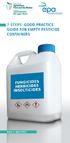 7 STEPS: GOOD PRACTICE GUIDE FOR EMPTY PESTICIDE CONTAINERS Issue 1: April 2012 This Good Practice Guide provides simple guidance for the safe and environmentally friendly recovery of empty plant protection
7.1 Conservation Programs for Industrial, Commercial, and Institutional Accounts
 Industrial, Commercial, and Institutional Accounts Applicability This BMP is intended for all Municipal Water User Groups ( utility ) which serve industrial, commercial, and institutional ( ICI ) customers.
GE Power & Water Water & Process Technologies. Water and Process Solutions for the Refining Industry
 GE Power & Water Water & Process Technologies Water and Process Solutions for the Refining Industry Maximizing Refining and Fuel Production Processes For more than 100 years, GE has maintained its commitment
Water Recycling in action in South Australia: a review of agricultural and municipal reuse schemes and innovation.
 Water Recycling in action in South Australia: a review of agricultural and municipal reuse schemes and innovation. S. Rinck-Pfeiffer * Veolia Water/United Water, Parkside, GPO Box 1875, Adelaide, South
REMOVAL OF PHOSPHATE FROM WASTEWATER USING LOW-COST ADSORBENTS
 International Journal of Engineering Inventions ISSN: 2278-7461, www.ijeijournal.com Volume 1, Issue 7 (October2012) PP: 44-50 REMOVAL OF PHOSPHATE FROM WASTEWATER USING LOW-COST ADSORBENTS Dr. C.R.Ramakrishnaiah
Development of Advanced Wastewater Treatment and Reclamation System
 14 Development of Advanced Wastewater Treatment and Reclamation System TAKESHI TERAZAKI *1 HOZUMI OTOZAI *2 KOSUKE SHIGIISHI *2 HIDEO SUZUKI *3 HIROSHI NAKASHOJI *4 HIROYUKI KAWAMOTO *5 Recycling and the
Water Efficiency. Water Management Options. Boilers. for Commercial, Industrial and Institutional Facilities. Boiler Water Impurities
 Water Efficiency Water Management Options Boilers for Commercial, Industrial and Institutional Facilities Boiler Water Impurities All boiler make-up water contains impurities. As clean steam is released
Parts per million (ppm) or Milligrams per liter (mg/l): one part by weight of analyte to 1 million parts by weight of the water sample.
 2015 Annual Drinking Water Quality Report St. Johns County Utility CR 214 Mainland We're pleased to present to you this year's Annual Water Quality Report. This report is designed to inform you about the
Water is a valuable and expensive resource.
 Conserving Water VIRGINIA SOL Science 6.5 Social studies CE.1, CE.9 Language arts 6.1, 7.1 Math 6.8, 6.10, 6.18, 7.17, 7.18 Technology C/T8.1, C/T8.4 OBJECTIVES Discuss different uses of water Discuss
Ch. 57 MILK AND DAIRY PRODUCTS 7 CHAPTER 57. MILK AND DAIRY PRODUCTS GENERAL PROVISIONS
 Ch. 57 MILK AND DAIRY PRODUCTS 7 CHAPTER 57. MILK AND DAIRY PRODUCTS GENERAL PROVISIONS Subchap. Sec. A. MILK AND DAIRY PRODUCTS DEFINITIONS AND STANDARDS... 57.1 B. LABELING... 57.41 C. OTHER DAIRY PRODUCTS...
Water Management, Conservation, and Preservation
 em feature by Suzanne Thomas-Cole, James Weinbauer, and Don Galya Suzanne Thomas-Cole, P.E., is program director, environment; James Weinbauer is vice president, sustainable development; and Don Galya,
HUGO BOSS ENVIRONMENTAL COMMITMENT. Our claim. Our approach
 HUGO BOSS ENVIRONMENTAL COMMITMENT HUGO BOSS assumes responsibility for future generations. This entails that we also pursue our high standards for quality and performance in environmental protection.