
ADRI. Digital Record Export Standard. ADRI v1.0. ADRI Submission Information Package (ASIP)
|
|
|
- Maximillian Reynard Jennings
- 10 years ago
- Views:
Transcription
1 ADRI Digital Record Export Standard ADRI Submission Information Package (ASIP) ADRI v1.0 Version July 2007

2 Digital Record Export Standard 2 Copyright 2007, Further copies of this document can be obtained from the ADRI Web site or The gives no warranty that the information in this version is correct or complete, error free or contains no omissions. The shall not be liable for any loss howsoever caused whether due to negligence or otherwise arising from the use of this Standard. Version Date Author Comment First released version

3 Digital Record Export Standard 3 Endorsement This document has been endorsed by the Australian Digital Recordkeeping Initiative as a standard on 4 October This document has been issued by the Council of Australasian Archives and Records Authorities as a standard on 31 July Acknowledgements We would like to acknowledge the help given by those people who commented on drafts of this document.

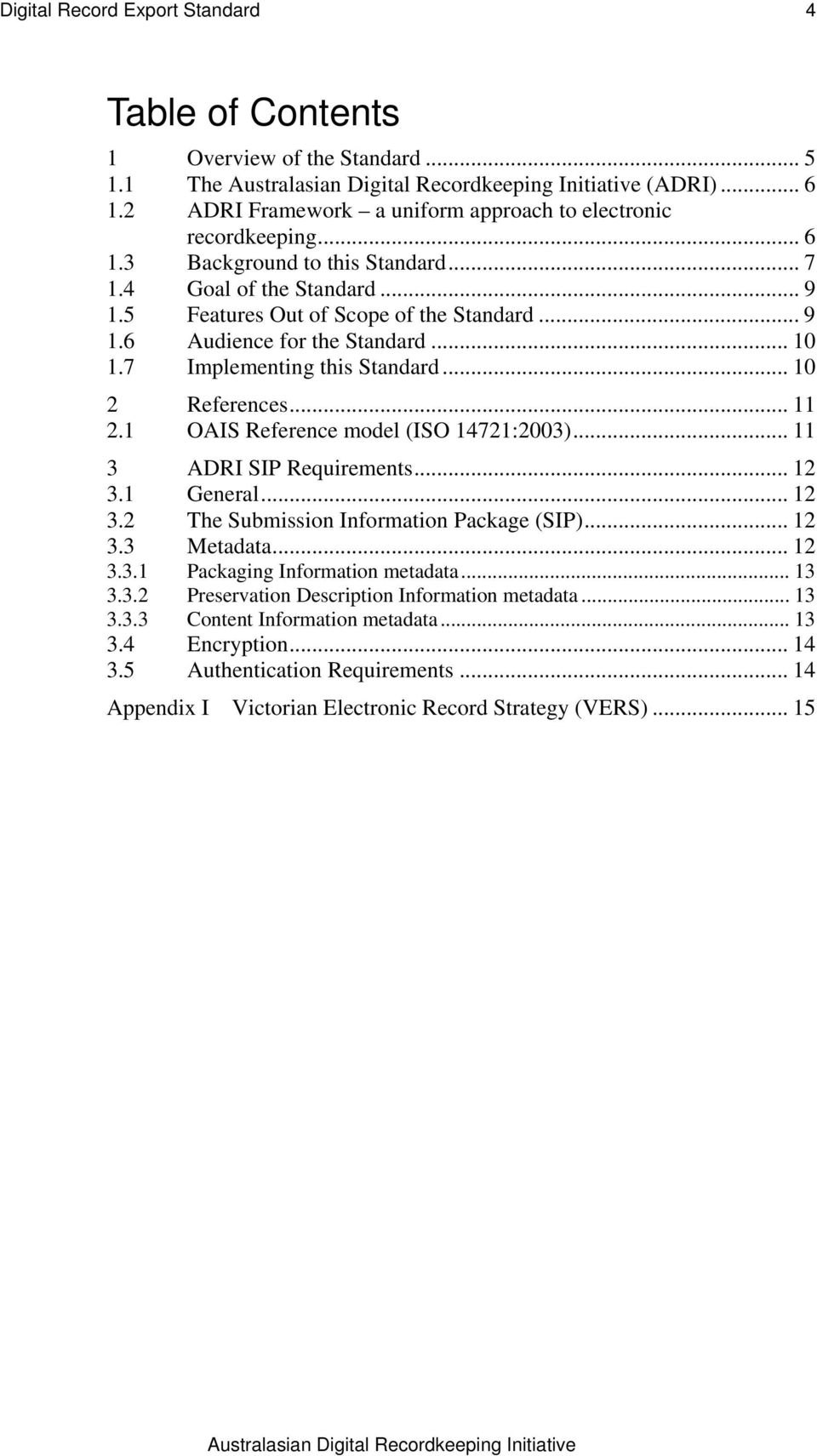
4 Digital Record Export Standard 4 Table of Contents 1 Overview of the Standard The (ADRI) ADRI Framework a uniform approach to electronic recordkeeping Background to this Standard Goal of the Standard Features Out of Scope of the Standard Audience for the Standard Implementing this Standard References OAIS Reference model (ISO 14721:2003) ADRI SIP Requirements General The Submission Information Package (SIP) Metadata Packaging Information metadata Preservation Description Information metadata Content Information metadata Encryption Authentication Requirements Appendix I Victorian Electronic Record Strategy (VERS)... 15
5 Digital Record Export Standard 5 1 Overview of the Standard This standard describes requirements for a transfer package of digital records to an archive. It specifies: the structure of a digital transfer package, the metadata that must be transferred with each record optional metadata that may be transferred with each record The purpose and membership of ADRI as well as its relationship to its parent body CAARA is described in section 1.1. The ADRI Framework for digital recordkeeping, in which this standard fits, is presented in section 1.2. The background to the standard and more detail as to what this standard covers is given in section 1.3 and 1.4. The standard does not cover the: high level transfer process that negotiates and manages the transfer behavior of the records system 1 metadata requirements of a records system beyond that required for export format of the record content low level protocols that ensure complete and accurate transfer physical transfer mechanisms These exclusions are described in more detail in section 1.5. We expect the standard will be of use to those: responsible for records within an organization carrying out transfers of digital records designing or implementing records systems that must conform with this standard testing records systems for conformance to this standard. These roles are described in more detail in section 1.6. The nature of the standard means that there may be differing implementations of the standard. This is described in section 1.7. ADRI is beginning a collaborative, multi year, effort to develop a revised Digital Record Export Standard that will take into account jurisdictional requirements and international developments. The results of this project will be issued as Version 2 of this standard. 1 In this standard we will distinguish between a recordkeeping system (an overarching structure encompassing myriad individual systems both business and records specific people, and resources), records systems (those applications which make and/or manage records). Records systems are further broken down into business systems that have a records creation and/or management component, and records application software which is dedicated to managing records.

6 Digital Record Export Standard The (ADRI) The (ADRI) is composed of representatives from all state and national archival authorities in Australia and New Zealand. The members of ADRI are: National Archives of Australia Archives New Zealand Public Record Office Victoria State Records NSW ACT Territory Records Archives Office of Tasmania Northern Territory Archives Service Queensland State Archives State Records South Australia State Records Office Western Australia The aim of the Initiative is to develop and harmonise a uniform set of standards, guidelines, and practices for digital recordkeeping. A related aim is to improve the organisational capability, capacity, and expertise within the collaborating institutions in relation to digital recordkeeping. ADRI is a working group of the Council of Australasian Archives and Records Authorities (CAARA). CAARA is the peak body of government archives and records institutions in Australia and New Zealand. 1.2 ADRI Framework a uniform approach to electronic recordkeeping The members of ADRI have agreed to collaborate on the development, articulation, and implementation of a common set of strategies for enabling the making, keeping and using of digital records. ADRI will promote a single Australasian approach to digital public recordkeeping across all jurisdictions and provide a space for communication and information sharing between the members. The collaboration builds on and acknowledges many years of Australasian collaboration in the development of concepts, tools, standards, and strategies for good recordkeeping. The collaborative approach to digital recordkeeping adopted by ADRI consists of a number of inter-related component parts. ADRI has prepared a Framework document 2 to provide a high-level overview of these component parts of the Australasian approach to digital recordkeeping in the 21 st Century. Many of these components will have jurisdiction-specific manifestations that, while reflecting local circumstances and requirements, will all nevertheless conform to the fundamental features of the common framework. This Standard relates to that part of the Framework that is 2 ADRI Framework , available from visited 1 June 2007.

7 Digital Record Export Standard 7 specifically concerned with the transfer of digital objects between records systems and between producers and managers of archival records. The ADRI Framework consists of four broad components: making and managing digital records. keeping digital records in agencies and in archives and records authorities transferring digital records to archives and records authorities using digital records All of the components contain guidelines and standards. This standard forms part of the standards associated with the transfer component. The other standard associated with the transfer component deals with minimum authenticity requirements. The guidelines associated with the transfer components are: Preferred data formats and methods for transferring records to archival custody Methods for automatic transfer of recordkeeping metadata Maintenance of provenance and authenticity 1.3 Background to this Standard The purpose of this standard is to simplify and reduce the cost of transferring digital records from agencies to member archives. This is achieved by specifying a standard representation for a digital record. The records are expressed in this standard format, known as a Submission Information Package (SIP), by agencies before transfer. Records are evidence of an organisation or individual carrying out their day-to-day activities. Understanding what happened in the past and why is critical to the continued day-to-day activities of an organisation or individual. It is also the basis on which our legal system is built, and it is the basis of all historical understanding. For all these reasons, preserving the ability to access records is critical to organisations and individuals. Electronic records are simply those represented electronically; today this almost exclusively means represented digitally. Electronic records range from written documents (such as reports and s), to images (photographs, plans), sound (voice mail), video, and databases. The continued integration of the computer into infrastructure means that new types of electronic records are being continually developed. An electronic recordkeeping encompasses recordkeeping metadata relating to content, context, and structure. Metadata establishes the record s authenticity, integrity, and reliability. In an organisation electronic records are stored and managed by many different records systems. These systems may range from the very simple (e.g. the corporate shared file servers) through the sophisticated (e.g. a dedicated electronic document management system which provides

8 Digital Record Export Standard 8 sophisticated record management functionality), to the extremely complex (e.g. custom built business applications that store specialised records). All of these records systems have one characteristic in common: they have a finite, relatively short life. Often a records system has a much shorter life than the records that it holds. The short lifespan of records systems leads to a key challenge in preserving electronic records: ensuring that the electronic records can be extracted from the records systems that currently store and manage them and be reliably transferred to another system. Three transfer instances are of particular importance: Transfer of records from one system to its replacement within an organisation. This type of transfer occurs routinely, albeit at a relatively low frequency. Transfer of long term temporary records from the records system that created them to a specialist storage system (which may be operated by a separate organisation) and back again. This is equivalent to the practice of secondary storage of paper records. This relieves an organisation from having to preserve and store records that have no day-to-day use in operational systems. Transfer of permanent records from the records system that created them to a specialist archival records system (which may be operated by a separate organisation). This ensures that long-term preservation of permanent records is carried out in a specialist system and relieves the creating system from the burden of preserving, storing, and providing access to records. A Submission Information Package (SIP) can be used as a lingua franca between records systems. Without such a standard, any transfer of electronic records between records systems requires specific custom arrangements between each pair of systems. Such custom arrangements have a: high risk of loss or compromised records high cost The high risk and cost can often be managed in the limited case where a records system is superseded within an organisation by another system. In general, however, managing the risk and cost is far more difficult where an organisation (such as an archive or secondary storage supplier) is receiving records from many organisations. A SIP standard allows the risk and cost of transfer to be managed. The use of a SIP standard means that less custom software is required to transfer records, and this software can be re-used. Re-use may occur by the same organisation (e.g. a secondary storage supplier using the same software to accept transfers from many different organisations), or by different organisations (e.g. a vendor of a recordkeeping system implementing the transfer software once and providing it to all users of the system).

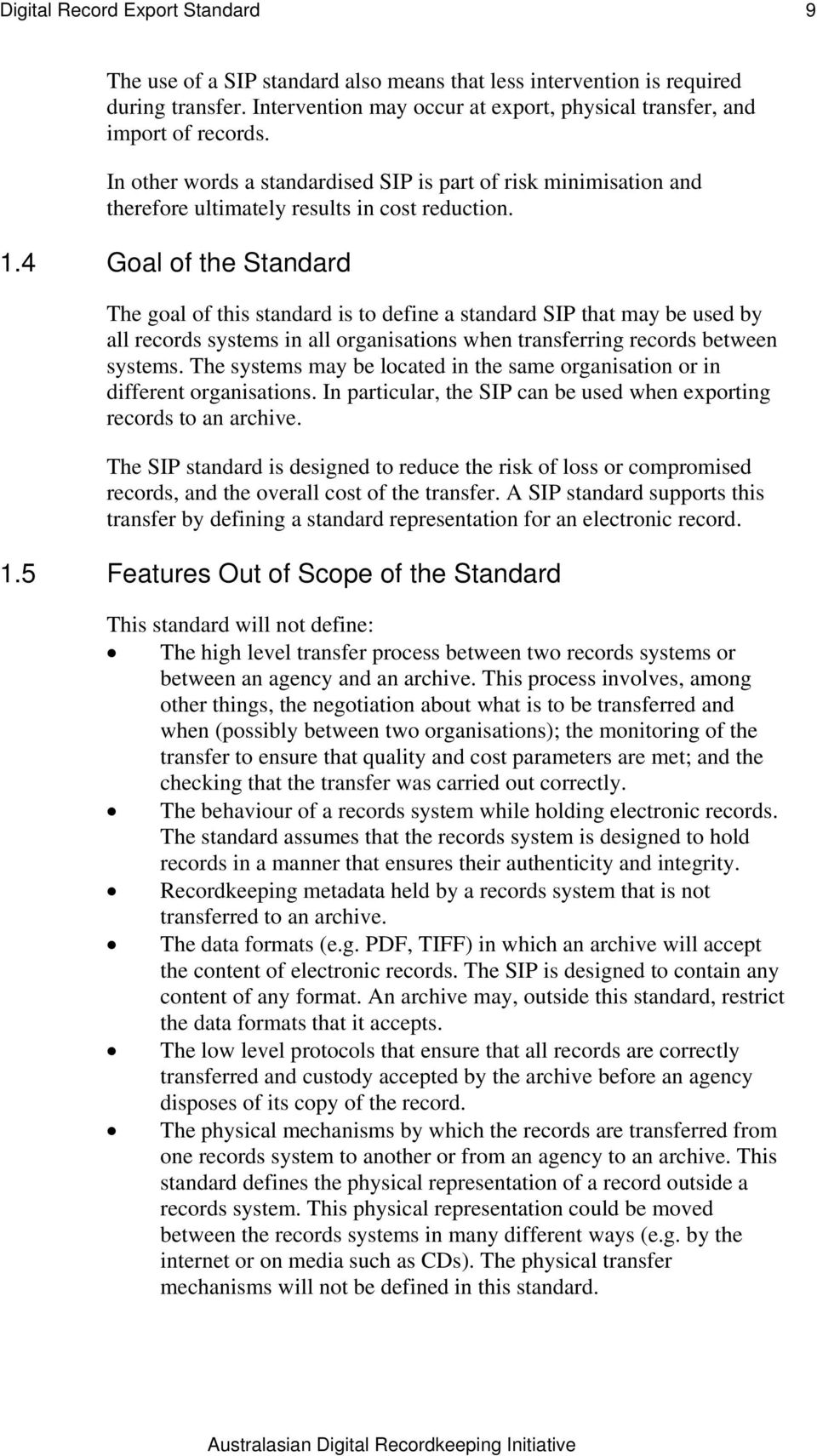
9 Digital Record Export Standard 9 The use of a SIP standard also means that less intervention is required during transfer. Intervention may occur at export, physical transfer, and import of records. In other words a standardised SIP is part of risk minimisation and therefore ultimately results in cost reduction. 1.4 Goal of the Standard The goal of this standard is to define a standard SIP that may be used by all records systems in all organisations when transferring records between systems. The systems may be located in the same organisation or in different organisations. In particular, the SIP can be used when exporting records to an archive. The SIP standard is designed to reduce the risk of loss or compromised records, and the overall cost of the transfer. A SIP standard supports this transfer by defining a standard representation for an electronic record. 1.5 Features Out of Scope of the Standard This standard will not define: The high level transfer process between two records systems or between an agency and an archive. This process involves, among other things, the negotiation about what is to be transferred and when (possibly between two organisations); the monitoring of the transfer to ensure that quality and cost parameters are met; and the checking that the transfer was carried out correctly. The behaviour of a records system while holding electronic records. The standard assumes that the records system is designed to hold records in a manner that ensures their authenticity and integrity. Recordkeeping metadata held by a records system that is not transferred to an archive. The data formats (e.g. PDF, TIFF) in which an archive will accept the content of electronic records. The SIP is designed to contain any content of any format. An archive may, outside this standard, restrict the data formats that it accepts. The low level protocols that ensure that all records are correctly transferred and custody accepted by the archive before an agency disposes of its copy of the record. The physical mechanisms by which the records are transferred from one records system to another or from an agency to an archive. This standard defines the physical representation of a record outside a records system. This physical representation could be moved between the records systems in many different ways (e.g. by the internet or on media such as CDs). The physical transfer mechanisms will not be defined in this standard.
10 Digital Record Export Standard Audience for the Standard The audience for this standard is: Those responsible for records within organisations (e.g. recordkeepers, archivists, and their managers). This group needs to understand the purpose of the standard and, broadly, how it is achieved. This group also need to know what the standard does not cover so that these areas can be negotiated prior to a transfer. Those responsible for carrying out a transfer of records between systems (e.g. recordkeepers, archivists). This standard enables them to know how a record is represented so that they can carry out a specific transfer. Those responsible for designing and implementing software for exporting and importing records from/to records systems (e.g. vendors, software developers). This standard enables them to have a precise, clear, and unambiguous specification of the SIP so that they can accurately implement it. Those responsible for testing systems to ensure that systems accurately implement the SIP. This standard provides a precise, clear, and unambiguous specification, and test tools to ensure defensible decisions about whether an implementation fulfils the standard or not. 1.7 Implementing this Standard It is envisaged that this standard may be implemented in a number of ways. An example of one way of implementing is included in Appendix I but there may in future be other compliant implementations (e.g. using a jurisdictional specific metadata standard different to that outlined in Appendix I). While all ADRI members have endorsed this standard, not all members of its parent body CAARA will accept every implementation of the standard (including the implementation given in Appendix I) for transfer into their own archival custody. Implementers should check with the individual CAARA member about which implementations they will accept before undertaking any implementation work for use in a specific CAARA member s jurisdiction.

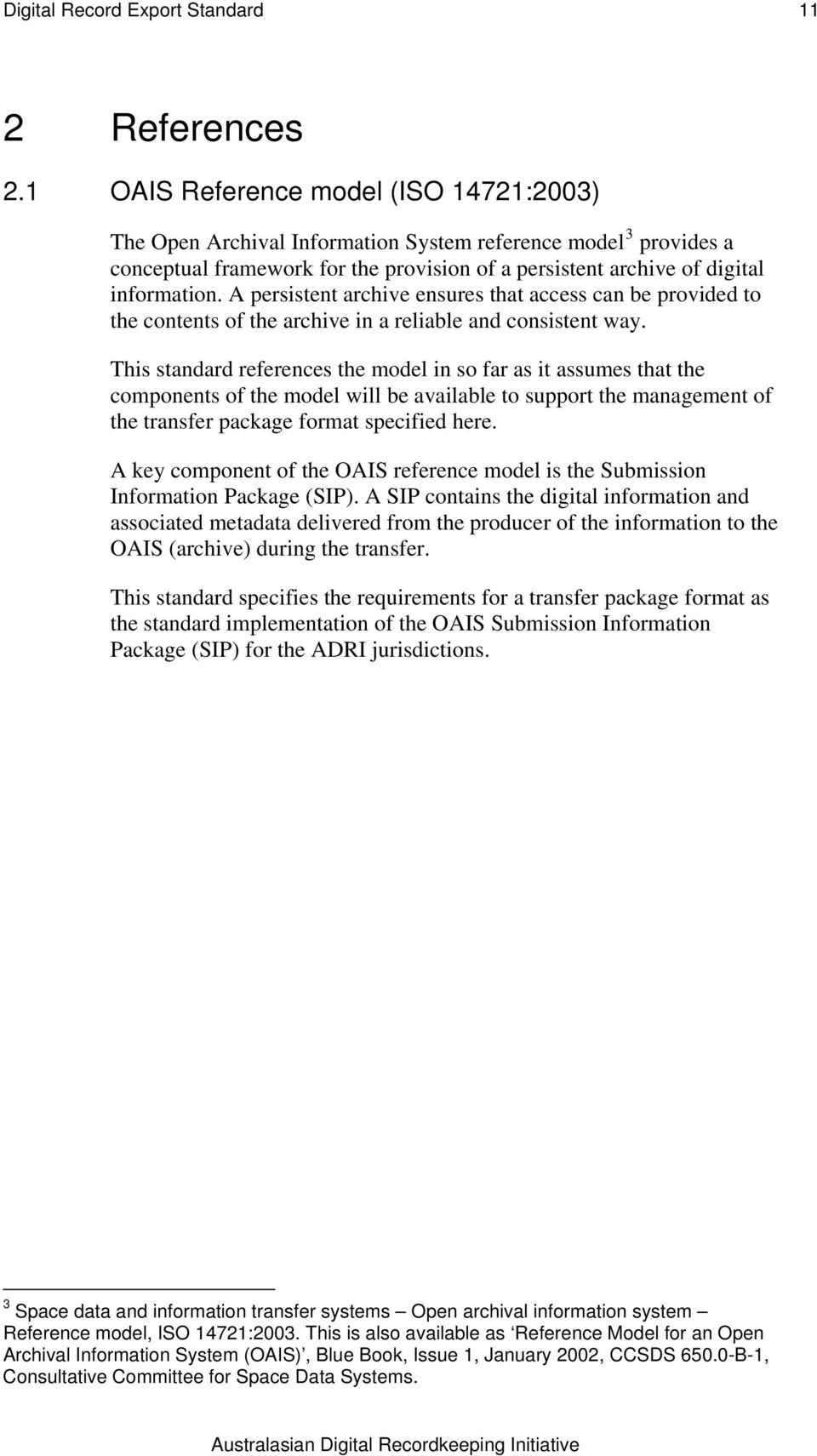
11 Digital Record Export Standard 11 2 References 2.1 OAIS Reference model (ISO 14721:2003) The Open Archival Information System reference model 3 provides a conceptual framework for the provision of a persistent archive of digital information. A persistent archive ensures that access can be provided to the contents of the archive in a reliable and consistent way. This standard references the model in so far as it assumes that the components of the model will be available to support the management of the transfer package format specified here. A key component of the OAIS reference model is the Submission Information Package (SIP). A SIP contains the digital information and associated metadata delivered from the producer of the information to the OAIS (archive) during the transfer. This standard specifies the requirements for a transfer package format as the standard implementation of the OAIS Submission Information Package (SIP) for the ADRI jurisdictions. 3 Space data and information transfer systems Open archival information system Reference model, ISO 14721:2003. This is also available as Reference Model for an Open Archival Information System (OAIS), Blue Book, Issue 1, January 2002, CCSDS B-1, Consultative Committee for Space Data Systems.
12 Digital Record Export Standard 12 3 ADRI SIP Requirements 3.1 General This section defines requirements that all ADRI Submission Information Packages (ASIPs) must support. The specification of a package accepted as an ASIP must: Be freely available to any interested party. The freely available copy may be made available electronically (e.g. via the Web) or via a printed copy. Freely available does not necessarily mean free; a reasonable charge may be made for the specification. Have a formal compliance process so that implementations of the specification can be determined to be compliant or otherwise. 3.2 The Submission Information Package (SIP) For the purposes of this standard, the basic component of an ADRI SIP (ASIP) is a digitally encoded package of one or more records. Each ASIP represents one or more digital records. A transfer between a creator and an archive may contain one or more separate digital records, and hence comprise one or more ASIPs. The structure of a record may vary between archival institutions. For some institutions a record may consist of a single document with one encoding. Other institutions have a more complex structure; for example, a document may contain multiple encodings, or a record may consist of multiple documents. An ASIP consists of: A declaration that this is an ADRI SIP (see section 3.3.1) An authentication method to detect tampering to the body of the ASIP (see section 3.5) Metadata about the record (see sections and 3.3.3) The actual content of the record 3.3 Metadata The purpose of this section is to define the metadata that may occur within an ADRI SIP. The metadata defined in this standard are grouped according to the following categories: Packaging Information (high level descriptive information such as the declaration, ASIP Type etc); Preservation Description Information (information that allows the content information to be understood, including unique identifiers, contextual and provenance information, and fixity information);

13 Digital Record Export Standard 13 Content Information (the actual bits to be preserved and how they are to be interpreted); A recordkeeping system must be capable of generating the mandatory metadata defined in this standard when exporting an ASIP Packaging Information metadata This records ASIP-level metadata that must be included to identify, delimit, and describe an ASIP as a whole. Note that this information does not describe the records held within the ASIP. The metadata captured at this level may include: ASIP Declaration ASIP Format Description ASIP Type Description ASIP Creation Date ASIP Content Preservation Description Information metadata This contains information about the record contained within the ASIP. The information includes: Reference information. This information contains identifier(s) of the record. Typical reference information in an archival environment includes an agency identifier, a series identifier, and a record identifier. Context information. This information contains the context of the record; that is, information describing this record and its relationship to other records and its environment. Provenance information. This information describes the history of the record. Fixity information. This information is used to ensure that the record content has not been modified in an undocumented fashion. Typical fixity information includes: algorithm identifiers, checksums or signatures, and support information such as certificates. The ASIP must specify which recordkeeping metadata standard is being used for contextual and provenance information, e.g. the ASIP may declare the NAA Recordkeeping Metadata Standard, or may declare the New South Wales Recordkeeping Metadata Data Standard. An archival institution may choose to accept only one recordkeeping metadata standard, in which case the specification is implicit Content Information metadata This metadata group contains metadata elements relating to the record content. This group also contains the bits that are being preserved. The elements captured at this level can include: Format encoding

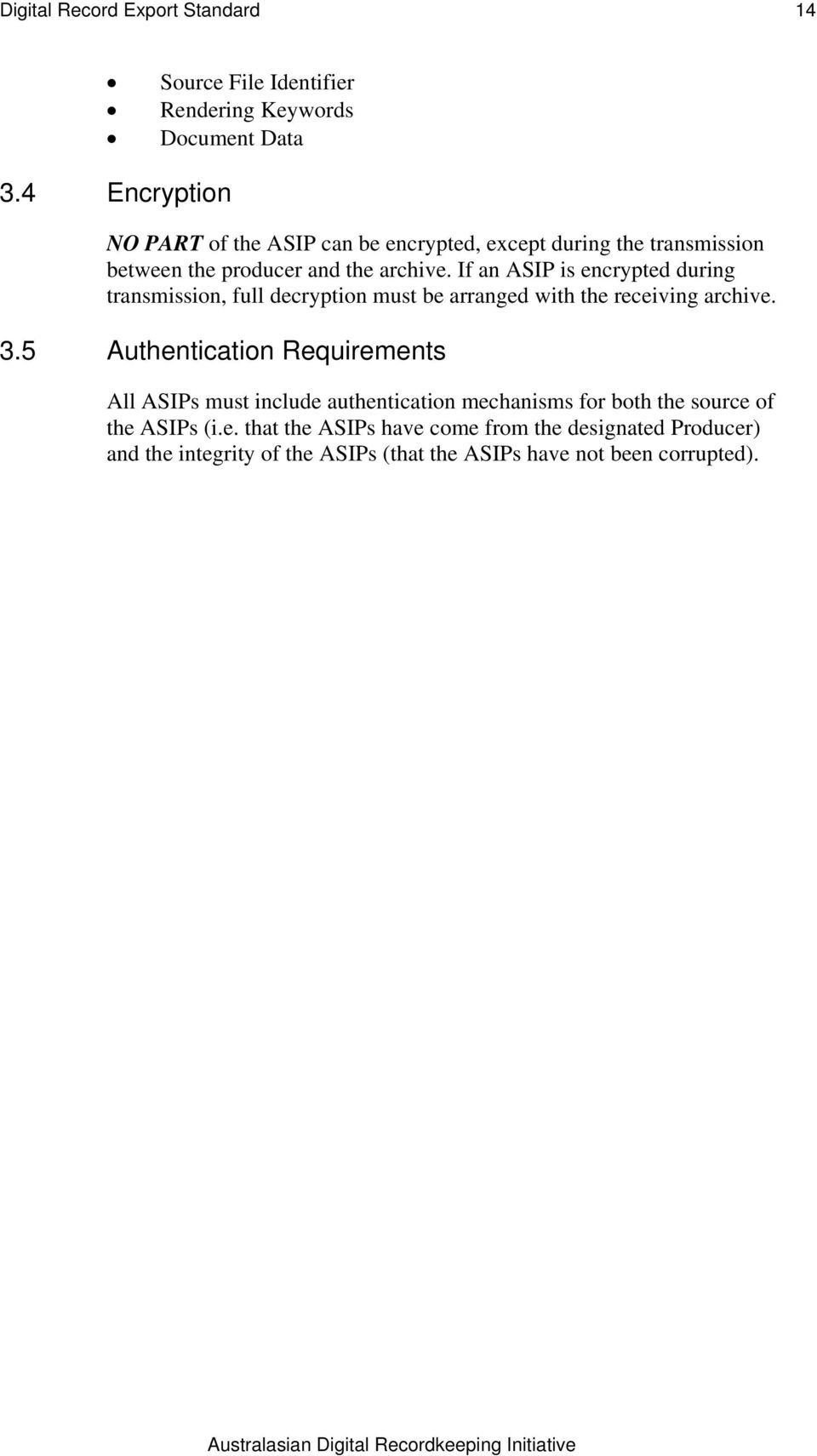
14 Digital Record Export Standard 14 Source File Identifier Rendering Keywords Document Data 3.4 Encryption NO PART of the ASIP can be encrypted, except during the transmission between the producer and the archive. If an ASIP is encrypted during transmission, full decryption must be arranged with the receiving archive. 3.5 Authentication Requirements All ASIPs must include authentication mechanisms for both the source of the ASIPs (i.e. that the ASIPs have come from the designated Producer) and the integrity of the ASIPs (that the ASIPs have not been corrupted).
15 Digital Record Export Standard 15 Appendix I Victorian Electronic Record Strategy (VERS) The following two specifications that form part of PROS 99/007 (PROV Standard Management of Electronic Records, commonly known as the VERS standard) jointly fulfil the functionality required by this standard: Management of Electronic Records (PROS 99/007) version 2, Specification 2, VERS Metadata Schema Management of Electronic Records (PROS 99/007) version 2, Specification 3, VERS Standard Electronic Record Format These components are modified by the Errata for Management of Electronic Records PROS 99/007 (Version 2) The two specifications and the errata are available from and the compliance tests are available on The remaining three specifications that form part of PROS 99/007 are not relevant to ASIP and do not form part of this standard: Specification 1, System Requirements for Preserving Electronic Records Specification 4, VERS Long Term Preservation Formats Specification 5, Export of Electronic Records to PROV
ADRI. Statement on the Application of Digital Rights Management Technology to Public Records. ADRI-2008-001-v1.0
 ADRI Statement on the Application of Digital Rights Management Technology to Public Records ADRI-2008-001-v1.0 Version 1.0 6 August 2008 Statement on the Application of Digital Rights Management Technology
BUSINESS REQUIREMENTS SPECIFICATION (BRS) Business domain: Archiving and records management. Transfer of digital records
 BUSINESS REQUIREMENTS SPECIFICATION (BRS) Business domain: Archiving and records management Business process: Transfer of digital records Document identification: Title: Transfer of digital records Trade
ADRI. Advice on managing the recordkeeping risks associated with cloud computing. ADRI-2010-1-v1.0
 ADRI Advice on managing the recordkeeping risks associated with cloud computing ADRI-2010-1-v1.0 Version 1.0 29 July 2010 Advice on managing the recordkeeping risks associated with cloud computing 2 Copyright
Standards Development. PROS 14/00x Specification 3: Long term preservation formats
 Standards Development PROS 14/00x Specification 3: Long term preservation formats 1 2 Copyright Statement State of Victoria 2014 3 4 5 6 7 8 9 10 11 12 13 14 15 16 17 18 19 20 21 22 This work is licensed
AHDS Digital Preservation Glossary
 AHDS Digital Preservation Glossary Final version prepared by Raivo Ruusalepp Estonian Business Archives, Ltd. January 2003 Table of Contents 1. INTRODUCTION...1 2. PROVENANCE AND FORMAT...1 3. SCOPE AND
Management of Email Records
 Department of Culture and the Arts Government of Western Australia State Records Office of Western Australia SRO Guideline Management of Email Records A Recordkeeping Guideline for State Organizations
North Carolina Digital Preservation Policy. April 2014
 North Carolina Digital Preservation Policy April 2014 North Carolina Digital Preservation Policy Page 1 Executive Summary The North Carolina Digital Preservation Policy (Policy) governs the operation,
A Mapping of the Victorian Electronic Records Strategy Schema to openehr
 VERS openehr Mapping Commentary A Mapping of the Victorian Electronic Records Strategy Schema to openehr Electronic Health Records: Achieving an Effective and Ethical Legal and Recordkeeping Framework
Queensland Government Digital Continuity Strategy
 Queensland Government Digital Continuity Strategy Future proofing the critical digital records of government business September 2012 Queensland State Archives Department of Science, Information Technology,
Guideline. Records Management Strategy. Public Record Office Victoria PROS 10/10 Strategic Management. Version Number: 1.0. Issue Date: 19/07/2010
 Public Record Office Victoria PROS 10/10 Strategic Management Guideline 5 Records Management Strategy Version Number: 1.0 Issue Date: 19/07/2010 Expiry Date: 19/07/2015 State of Victoria 2010 Version 1.0
Queensland recordkeeping metadata standard and guideline
 Queensland recordkeeping metadata standard and guideline June 2012 Version 1.1 Queensland State Archives Department of Science, Information Technology, Innovation and the Arts Document details Security
Guideline 1. Cloud Computing Decision Making. Public Record Office Victoria Cloud Computing Policy. Version Number: 1.0. Issue Date: 26/06/2013
 Public Record Office Victoria Cloud Computing Policy Guideline 1 Cloud Computing Decision Making Version Number: 1.0 Issue Date: 26/06/2013 Expiry Date: 26/06/2018 State of Victoria 2013 Version 1.0 Table
Queensland State Archives. Digital Rights Management Technologies and Public Records - A Guideline for Queensland Public Authorities
 Queensland State Archives Digital Rights Management Technologies and Public Records - A Guideline for Queensland Public February 2010 Document details Security Classification Authority Author Document
System Requirements for Archiving Electronic Records PROS 99/007 Specification 1. Public Record Office Victoria
 System Requirements for Archiving Electronic Records PROS 99/007 Specification 1 Public Record Office Victoria Version 1.0 April 2000 PROS 99/007 Specification 1: System Requirements for Archiving Electronic
Digital Preservation. OAIS Reference Model
 Digital Preservation OAIS Reference Model Stephan Strodl, Andreas Rauber Institut für Softwaretechnik und Interaktive Systeme TU Wien http://www.ifs.tuwien.ac.at/dp Aim OAIS model Understanding the functionality
State Records Guideline No 15. Recordkeeping Strategies for Websites and Web pages
 State Records Guideline No 15 Recordkeeping Strategies for Websites and Web pages Table of Contents 1 Introduction... 4 1.1 Purpose... 4 1.2 Authority... 5 2 Recordkeeping business requirements... 5 2.1
Principles and Functional Requirements
 International Council on Archives Principles and Functional Requirements for Records in Electronic Office Environments Module 3 Guidelines and Functional Requirements for Records in Business Systems Published
Guideline 2. Cloud Computing: Tools. Public Record Office Victoria Cloud Computing Policy. Version Number: 1.0. Issue Date: 26/06/2013
 Public Record Office Victoria Cloud Computing Policy Guideline 2 Cloud Computing: Tools Version Number: 1.0 Issue Date: 26/06/2013 Expiry Date: 26/06/2018 State of Victoria 2013 Version 1.0 Table of Contents
Guideline 2. Cloud Computing: Tools. Public Record Office Victoria Cloud Computing Policy. Version Number: 1.0. Issue Date: 26/06/2013
 Public Record Office Victoria Cloud Computing Policy Guideline 2 Cloud Computing: Tools Version Number: 1.0 Issue Date: 26/06/2013 Expiry Date: 26/06/2018 State of Victoria 2013 Version 1.0 Table of Contents
Public Record Office Standard. Retention & Disposal Authority for Records of the Transport Accident Prevention and Assistance Functions
 Public Record Office Standard PROS 14/01 Authority Retention & Disposal Authority for Records of the Transport Accident Prevention and Assistance Functions Version 2014 14/01 Issue Date: 15/08/2014 Copyright
TERRITORY RECORDS OFFICE BUSINESS SYSTEMS AND DIGITAL RECORDKEEPING FUNCTIONALITY ASSESSMENT TOOL
 TERRITORY RECORDS OFFICE BUSINESS SYSTEMS AND DIGITAL RECORDKEEPING FUNCTIONALITY ASSESSMENT TOOL INTRODUCTION WHAT IS A RECORD? AS ISO 15489-2002 Records Management defines a record as information created,
RECORDS MANAGEMENT POLICY
 RECORDS MANAGEMENT POLICY POLICY STATEMENT The records of Legal Aid NSW are a major component of its corporate memory and risk management strategies. They are a vital asset that support ongoing operations
Records Management Policy
 Records Management Policy Responsible Officer Chief Operating Officer Approved by Vice-Chancellor Approved and commenced April, 2014 Review by April, 2017 Relevant Legislation, Ordinance, Rule and/or Governance
Cloud Computing and Records Management
 GPO Box 2343 Adelaide SA 5001 Tel (+61 8) 8204 8773 Fax (+61 8) 8204 8777 DX:336 [email protected] www.archives.sa.gov.au Cloud Computing and Records Management June 2015 Version 1 Version
Information Management Advice 39 Developing an Information Asset Register
 Information Management Advice 39 Developing an Information Asset Register Introduction The amount of information agencies create is continually increasing, and whether your agency is large or small, if
Interagency Science Working Group. National Archives and Records Administration
 Interagency Science Working Group 1 National Archives and Records Administration Establishing Trustworthy Digital Repositories: A Discussion Guide Based on the ISO Open Archival Information System (OAIS)
Information Management: A common approach
 Information Management: A common approach July 2013 Document Control Document history Date Version No. Description Author July 2013 1.0 Final Department of Finance and Services October 2013 1.1 Updated
Migrating digital records
 Migrating digital records A guideline for Queensland public authorities June 2012 Version 1.0 Queensland State Archives Department of Science, Information Technology, Innovation and the Arts Document details
Records and Information Management. General Manager Corporate Services
 Title: Records and Information Management Policy No: 057 Adopted By: Chief Officers Group Next Review Date: 08/06/2014 Responsibility: General Manager Corporate Services Document Number: 2120044 Version
NSW Data & Information Custodianship Policy. June 2013 v1.0
 NSW Data & Information Custodianship Policy June 2013 v1.0 CONTENTS 1. PURPOSE... 4 2. INTRODUCTION... 4 2.1 Information Management Framework... 4 2.2 Data and information custodianship... 4 2.3 Terms...
Guideline. Managing Records of Outsourced Activity. Public Record Office Victoria PROS 10/10 Strategic Management. Version Number: 1.
 Public Record Office Victoria PROS 10/10 Strategic Management Guideline 2 Managing Records of Outsourced Activity Version Number: 1.0 Issue Date: 19/07/2010 Expiry Date: 19/07/2015 State of Victoria 2010
Client Skills: Skills required by Government as the Construction Industry Client
 Client Skills: Skills required by Government as the Construction Industry Client APCC MEMBER AUTHORITIES AS AT JULY 2002 Department of Public Works and Services New South Wales Building Commission Victoria
Principles and Functional Requirements
 International Council on Archives Principles and Functional Requirements for Records in Electronic Office Environments Module 3 Guidelines and Functional Requirements for Records in Business Systems Published
State Records Guideline No 18. Managing Social Media Records
 State Records Guideline No 18 Managing Social Media Records Table of Contents 1 Introduction... 4 1.1 Purpose... 4 1.2 Authority... 5 2 Social Media records are State records... 5 3 Identifying Risks...
Managing Closed Circuit Television (CCTV) Records
 Queensland State Archives Managing Closed Circuit Television (CCTV) Records Guideline for Queensland Public Authorities October 2010 Document details Security Classification PUBLIC Date of review of security
Records Disposal Schedule. NT Fleet Management. Department of Corporate and Information Services. Disposal Schedule No. 2004/2
 DISPOSAL SCHEDULE FOR RECORDS OF THE NT FLEET SEPTEMBER 2003 Records Disposal Schedule NT Fleet Management Department of Corporate and Information Services Disposal Schedule No. 2004/2 June 2004 For information
State Records Office Guideline. Management of Digital Records
 State Records Office Guideline Management of Digital Records An Information Management Guideline for State Organizations Version 2 January 2015 www.sro.wa.gov.au Contents GLOSSARY... 2 PURPOSE... 5 BACKGROUND...
Australian Recordkeeping Metadata Schema. Version 1.0
 Australian Recordkeeping Metadata Schema Version 1.0 SPIRT RESEARCH TEAM Associate Professor Sue McKemmish Glenda Acland Kate Cumming Barbara Reed Dr Nigel Ward 31 May 2000 Source and Acknowledgement:
Public Record Office Standard PROS 99/007. Public Record Office Victoria. Management of Electronic Records
 Public Record Office Standard PROS 99/007 Public Record Office Victoria Management of Electronic Records Version 1.0 April 2000 PROS 99/007: Management of Electronic Records 1 Table of Contents 1.0 Introduction...
Principles and Functional Requirements
 International Council on Archives Principles and Functional Requirements for Records in Electronic Office Environments Module 2 Guidelines and Functional Requirements for Electronic Records Management
Best Archiving Practice Guidance
 Best Archiving Practice Guidance This document has been published under the auspices of the EU Telematics Implementation Group - electronic submissions (TIGes) Please note that this document has been published
Digital Continuity Plan
 Digital Continuity Plan Ensuring that your business information remains accessible and usable for as long as it is needed Accessible and usable information Digital continuity Digital continuity is an approach
Records Management Policy
 Records Management Policy Document Number SOP2006-073 File No. 07/7 Date issued 1 September 2006 Author Branch Records and Mail Services Unit Branch contact 9320.7722 Division Finance & Data Services Summary
VERS Standard Electronic Record Format PROS 99/007 Specification 3. Public Record Office Victoria
 VERS Standard Electronic Record Format PROS 99/007 Specification 3 Public Record Office Victoria Version 1.0 April 2000 PROS 99/007 Specification 3: VERS Standard Electronic Record Format 1 Table of Contents
Information Management Advice 50 Developing a Records Management policy
 Information Management Advice 50 Developing a Records Management policy Introduction This advice explains how to develop and implement a Records Management policy. Policy is central to the development
DELAWARE PUBLIC ARCHIVES POLICY STATEMENT AND GUIDELINES MODEL GUIDELINES FOR ELECTRONIC RECORDS
 DELAWARE PUBLIC ARCHIVES POLICY STATEMENT AND GUIDELINES MODEL GUIDELINES FOR ELECTRONIC RECORDS STATEMENT OF PURPOSE The Delaware Public Archives (DPA) has issued "Model Guidelines for Electronic Records"
Technology Watch Report
 Technology Watch Report The Open Archival Information System Reference Model: Introductory Guide Brian F. Lavoie Office of Research OCLC Online Computer Library Center, Inc. 6565 Frantz Road, Dublin OH
Construction induction training - changes to regulations
 Construction induction training - changes to regulations General information for industry The Occupational Safety and Health Regulations (1996) have changed to reflect the national approach to construction
Retention & Disposition in the Cloud Do you really have control?
 InterPARES Trust Retention & Disposition in the Cloud Do you really have control? Franks Patricia, San Jose State University, San Jose, USA and Alan Doyle, University of British Columbia, Canada October
Records Disposal Schedule Anti-Discrimination Services Northern Territory Anti-Discrimination Commission
 Records disposal schedule Records Disposal Schedule Anti-Discrimination Services Northern Territory Anti-Discrimination Commission Disposal Schedule No. 2015/12 August 2015 NT Archives Service For information
ELECTRONIC RECORDS MANAGEMENT SYSTEM (ERMS) SYSTEM SPECIFICATIONS FOR PUBLIC OFFICES
 ELECTRONIC RECORDS MANAGEMENT SYSTEM (ERMS) SYSTEM SPECIFICATIONS FOR PUBLIC OFFICES CONTENTS 1. INTRODUCTION 1.1 Scope 1.2 Background 1.3 Purpose 1.4 Audience 1.5 Related standards 1.6 Terminology 1.7
Digital Preservation Guidance Note: Selecting File Formats for Long-Term Preservation
 Digital Preservation Guidance Note: 1 Selecting File Formats for Long-Term Preservation Document Control Author: Adrian Brown, Head of Digital Preservation Research Document Reference: Issue: 2 DPGN-01
Archival principles and data sustainability. Dr Andrew Wilson Queensland State Archives
 Archival principles and data sustainability Dr Andrew Wilson Queensland State Archives 1 Session Topics Drivers for sustaining data What is sustainability Archival theory Archival principles appraisal
Comcare Asbestos Related Compensation Claims & Workers Compensation Claim Management
 Records Authority 2010/00322036 Comcare Asbestos Related Compensation Claims & Workers Compensation Claim Management 2011 CONTENTS INTRODUCTION APPLICATION OF THIS AUTHORITY CONTACT INFORMATION AUTHORISATION
Draft model Work Health and Safety Codes of Practice
 Submission to Safe Work Australia Draft model Work Health and Safety Codes of Practice MANAGING RISKS IN CONSTRUCTION WORK PREVENTING FALLS IN HOUSING CONSTRUCTION Prepared by Roofing Tile Association
COAG National Legal Profession Reform Discussion Paper: Professional Indemnity Insurance
 COAG National Legal Profession Reform Discussion Paper: Professional Indemnity Insurance Introduction Professional indemnity insurance is insurance that:... indemnifies professional people accountants,
EMC Celerra Version 5.6 Technical Primer: Public Key Infrastructure Support
 EMC Celerra Version 5.6 Technical Primer: Public Key Infrastructure Support Technology Concepts and Business Considerations Abstract Encryption plays an increasingly important role in IT infrastructure
1 Building a metadata schema where to start 1
 1 Building a metadata schema where to start 1 1.1 Introduction Purpose Metadata has been defined as data describing the context, content and structure of records and their management through time 2. It
Saskatchewan Records Management Guidelines
 Saskatchewan Archives Board Saskatchewan Records Management Guidelines NOTE: These Records Management Guidelines are intended to guide the development of specific policies and procedures that recognize
WHISTLEBLOWERS LEGISLATION
 Northern Territory Law Reform Committee Report on WHISTLEBLOWERS LEGISLATION Report No. 26 December 2002 2. Recommendations 1. The Committee recommends that, if the Legislative Assembly of the Northern
Essential Standards for Registration
 Essential Standards for Registration State and Territory Registering Bodies Australian Capital Territory New South Wales Northern Territory Queensland South Australia Tasmania Victoria Western Australia
GUIDANCE MATERIAL GUIDANCE ON THE USE OF POSITIVE PERFORMANCE INDICATORS TO IMPROVE WORKPLACE HEALTH AND SAFETY
 GUIDANCE MATERIAL GUIDANCE ON THE USE OF POSITIVE PERFORMANCE INDICATORS TO IMPROVE WORKPLACE HEALTH AND SAFETY Office of the Australian Safety and Compensation Council NOVEMBER 2005 IMPORTANT NOTICE The
Management of Official Records in a Business System
 GPO Box 2343 ADELAIDE SA 5001 Tel (08) 8204 8773 Fax (08) 8204 8777 DX:467 [email protected] www.archives.sa.gov.au Management of Official Records in a Business System October 2011 Version
Feedback on the Inquiry into Serious Injury. Presented to the Road Safety Committee of the Parliament of Victoria. 08 May 2013
 Feedback on the Inquiry into Serious Injury Presented to the Road Safety Committee of the Parliament of Victoria 08 May 2013 About the APA The Australian Physiotherapy Association (APA) is the peak body
Digital Continuity in ICT Services Procurement and Contract Management
 Digital Continuity in ICT Services Procurement and Contract Management This guidance relates to: Stage 1: Plan for action Stage 2: Define your digital continuity requirements Stage 3: Assess and manage
Collection Acquisitions Policy
 Version: 1.0 Last Amendment: Approved by: NSW State Librarian & Chief Executive Policy owner/sponsor: Director, Library Services Policy Contact Officer: Coordinator, Collection Development & Acquisitions
Why archiving erecords influences the creation of erecords. Martin Stürzlinger scopepartner Vienna, Austria
 Why archiving erecords influences the creation of erecords Martin Stürzlinger scopepartner Vienna, Austria Electronic Records In a Productive System Created Used Changed Deleted In an Archival System No
Quality Assurance Guidance
 Quality Assurance Guidance Digitisation and Disposal of Patient Records Policy Toolkit December 2014 Effective: December 2014 TITLE: QUALITY ASSURANCE GUIDANCE 1. BACKGROUND WA Health is reliant on access
Guidance for English and Welsh lawyers on the practice of foreign law in Australia and admission as an Australian legal practitioner
 www.lawsociety.org.uk/international Guidance for English and Welsh lawyers on the practice of foreign law in Australia and admission as an Australian legal practitioner October 2015 Table of contents Introduction
Ex Libris Rosetta: A Digital Preservation System Product Description
 Ex Libris Rosetta: A Digital Preservation System Product Description CONFIDENTIAL INFORMATION The information herein is the property of Ex Libris Ltd. or its affiliates and any misuse or abuse will result
Cloud Computing in the Victorian Public Sector
 Cloud Computing in the Victorian Public Sector AIIA response July 2015 39 Torrens St Braddon ACT 2612 Australia T 61 2 6281 9400 E [email protected] W www.aiia.comau Page 1 of 9 17 July 2015 Contents 1.
Allison Stanton, Director of E-Discovery U.S. Department of Justice, Civil Division. U.S. Department of Agriculture
 Allison Stanton, Director of E-Discovery U.S. Department of Justice, Civil Division Benjamin Young, Assistant General Counsel U.S. Department of Agriculture 1 Disclaimer The views expressed in this presentation
The challenges of becoming a Trusted Digital Repository
 The challenges of becoming a Trusted Digital Repository Annemieke de Jong is Preservation Officer at the Netherlands Institute for Sound and Vision (NISV) in Hilversum. She is responsible for setting out
Information Management Advice 18 - Managing records in business systems Part 1: Checklist for decommissioning business systems
 Information Management Advice 18 - Managing records in business systems Part 1: Checklist for decommissioning business systems Introduction Agencies have systems which hold business information, such as
Records Management Checklist. preservation. accountability. information. security. peoplep. A tool to improve records management
 Records Management Checklist preservation accountability information security busine ess peoplep A tool to improve records management preservation people security business Foreword accountability information
Title Draft Pan-Canadian Primary Health Care Electronic Medical Record Content Standard, Version 2.0 Data Extract Specifi cation Business View
 pic Title Draft Pan-Canadian Primary Health Care Electronic Medical Record Content Standard, Version 2.0 Data Extract Specifi cation Business View Primary Health Care Who We Are Established in 1994, CIHI
HSE P0801 HSE Document Control and Records Management Procedure
 HSE P0801 HSE Document Control and Records 1. DOCUMENT CONTROL... 2 2. PURPOSE... 4 3. SCOPE... 4 4. DEFINITIONS... 4 5. ROLES AND RESPONSIBILITIES... 5 6. PROCESS DETAILS... 7 6.1 Document Control...
Recordkeeping Policy
 Public Record Office Victoria Standards and Policy Recordkeeping Policy Cloud Computing: Implications for Records Management Version Number: 1.0 Issue date: 04/04/2012 Closing for comments: 31/05/2012
Corporate Records Management Policy
 Corporate Records Management Policy Introduction Part 1 Records Management Policy Statement. February 2011 Part 2 Records Management Strategy. February 2011 Norfolk County Council Information Management
Broadform Liability 38 P100032 PLB
 Policy Schedule www.penunderwriting.com.au Class of Insurance: Policy Number: The Insured: Address of the Insured: Broadform Liability 38 P100032 PLB Athletics Australia Australian Masters Athletics, irun,
1.1 The expressions 'we', 'us' and 'our' are a reference to the operator of this Web Site, 'RewardBet'.
 RewardBet - Wagering Interface and Services Terms and Conditions of Use. These Terms and Conditions are subject to change without notice and it is the responsibility of any person seeking to rely on the
Digital Archiving Survey
 Digital Archiving Survey Background information Under the Public Records Act 2002 (the Act), public authorities have a responsibility to ensure that digital records under their control remain accessible
Queensland Taxi Security Camera Program Changes
 Queensland Taxi Security Camera Program Changes Frequently Asked Questions GENERAL INFORMATION 1. What is the taxi security camera program? It is a program administered by the Department of Transport and
Implementing an Electronic Document and Records Management System. Checklist for Australian Government Agencies
 Implementing an Electronic Document and Records Management System Checklist for Australian Government Agencies Acknowledgments The checklist for implementing an electronic document and records management
AITSL is funded by the Australian Government. Guide to the Certification of Highly Accomplished and Lead Teachers in Australia
 AITSL is funded by the Australian Government Guide to the Certification of Highly Accomplished and Lead Teachers in Australia The Australian Institute for Teaching and School Leadership (AITSL) has been
Digital Archiving at the National Archives of Australia: Putting Principles into Practice
 Digital Archiving at the National Archives of Australia: Putting Principles into Practice Michael Carden - August 2012 Introduction The National Archives of Australia has been engaged in digital preservation
Indemnity and Insurance Arrangements for Clinical Trials in the Public and Private Sectors in Australia
 Indemnity and Insurance Arrangements for Clinical Trials in the Public and Private Sectors in Australia Report to the National Health and Medical Research Council Prepared by Rallis Legal Index Definition
information Records Management Checklist business people security preservation accountability Foreword Introduction Purpose of the checklist
 Records Management Checklist Foreword We fi rst developed the Records Management Checklist in 2008 to complement our performance audit Records Management in the Victorian Public Sector. At that time the