
Accreditation in Europe
|
|
|
- Priscilla Elliott
- 11 years ago
- Views:
Transcription
1 Accreditation in Europe Facilitating regulatory compliance and international trade ACCREDITATION INSPECTION TESTING CALIBRATION EXAMINATION VERIFICATION CERTIFICATION

2 About the EA The EA is appointed by the European Commission* to manage the accreditation infrastructure within the EU, EFTA and candidate countries. Established in 1997, the organisation is a non-profit association of nationally recognised accreditation bodies. It is responsible for harmonising accreditation within Europe, with the aim of reducing barriers to trade and protecting health, safety and the environment. * Regulation (EC) No 765/2008, Article 14

3 What is accreditation? All countries, and all market sectors, have seen an increase in the number of technical regulations, standards, testing and certification procedures. Generally, these are introduced to meet the requirements of quality and safety that consumers, businesses, and regulators demand of goods and services. The increasing number of specified standards has seen a corresponding growth in the number of organisations providing third party evaluation of conformity and compliance with these standards. The accreditation process determines the technical competence and integrity of organisations that offer testing, examination, verification, inspection, calibration and certification services (collectively known as conformity assessment). Accreditation operates in the public interest across all market sectors, providing a transparent and impartial assessment of these services against internationally recognised standards and other national or sectoral requirements. Together, conformity assessment and accreditation are important parts of a nation s quality infrastructure, along with metrology and standardisation. They build confidence that goods and services, processes, management systems and the work of individuals comply with national and international standards and regulations. They also assist in the risk-management and decisionmaking of manufacturers and regulators. Who benefits from accreditation? For businesses, accurate calibration, measurement and testing, performed in accordance with best practice, can limit errors and product failure, control production costs and contribute to an innovative environment. Accreditation is therefore an essential tool for decision-making, risk management and supplier selection. It can also provide a competitive advantage in domestic markets through access to public sector contracts, and also overseas with greater acceptance in export markets. For national governments and regulators, accreditation is the preferred mechanism for identifying competent bodies to implement government policies and regulations aimed at safeguarding the public and building public confidence in activities that impact on such fields as health, welfare, security, the environment, education, and financial services. For consumers accreditation helps to increase access to goods and services of consistent and reliable quality and safety.
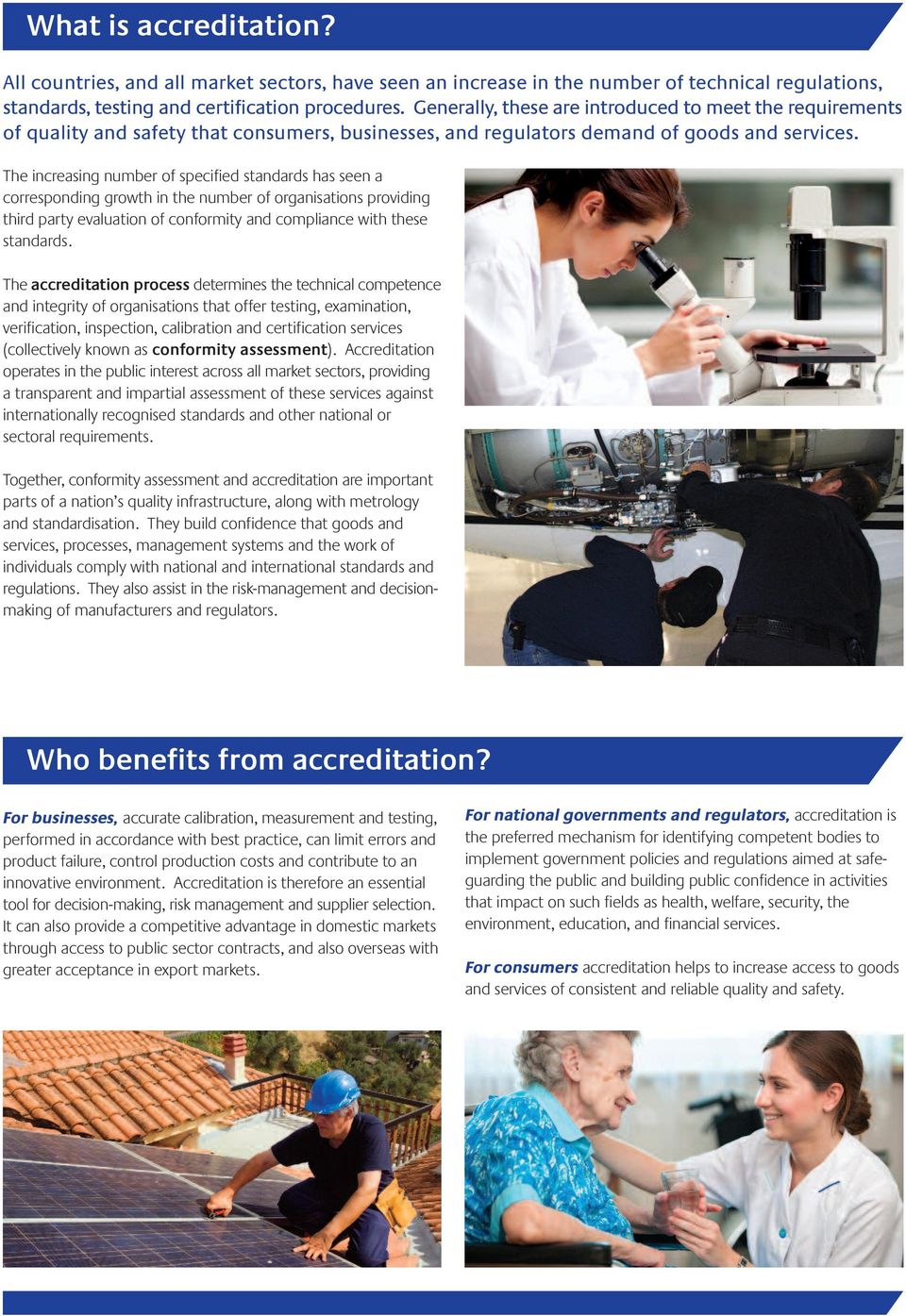
4 The importance of accreditation some examples Accreditation is an on-going process of assessment of a conformity assessment body to ensure that its performance is: impartial, technically competent, to the required standard, appropriately resourced, and can be sustained. These are all vital attributes of testing, examination, calibration, verification, inspection and certification carried out in the areas of activity listed below. These are just some examples of how accreditation is helping to safeguard the health and safety of individuals and to avoid unnecessary costs or potential liability claims. Environment Plant health inspections. These are essential to reducing the risks of importing harmful organisms such as viruses, bacteria, fungi, and insects that can threaten indigenous plants and ecosystems. Improving environmental management. It is increasingly important for businesses to show that they are implementing an effective environmental management system that delivers the benefits not only of improved environmental performance but also of better management and improved regulatory compliance. Safety and security Crime scene investigation. To avoid unnecessary additional costs to all parties within the criminal justice system, let alone miscarriages of justice, it is vital that the examination of crime scenes and the collection and analysis of evidence is carried out correctly and to the highest standards in order to maintain the integrity of the materials being collected and their chain of custody. Telecommunications security. The electronic transfer of information and data includes much that is sensitive for personal, commercial or financial reasons. Telecommunications service providers must be able to demonstrate the integrity and confidentiality of their information security management systems. Health and welfare Supply of clean drinking water. Laboratory analysis of samples of drinking water and the associated reporting of the results must meet regulatory requirements in order that decisions about public health issues are based on the best and most accurate information possible. Medical diagnostics and testing. Tens of thousands of samples are taken and medical tests carried out every day. Patients, doctors and the health commissioners must be able to rely on the correct handling of samples and reporting of results in order that the right diagnosis is made and appropriate course of treatment prescribed. Farming and food Ensuring the safety and authenticity of food. Consumer confidence not only in the safety of food but also in information about the environmental impact and trading ethics of its production and supply can only be gained through the appropriate application of food safety management systems, supported by credible testing and inspection regimes. Commerce and finance Removing technical barriers to trade. Access to new markets is made easier because of the international recognition of accreditation and the equivalence and reliability of conformity assessment services. Once tested or certified by an accredited conformity assessment body, products and services may be exported without the need for re-testing or re-certification for each new market.
5 National Accreditation Bodies Since 1 January 2010 it has been a requirement that every EU Member State should formally appoint a single National Accreditation Body to be the sole provider of accreditation services for that country. Each National Accreditation Body works in the public s interest, ensuring that organisations supplying conformity assessment services such as testing, examination, verification, inspection, calibration and certification are fit to do so. In this way, the certificates, reports and other conformity assessment results that they issue can be relied upon to support the provision of products, processes and services across all sectors of economic activity that comply with voluntary or mandatory regional, national or international standards or requirements. In Europe, National Accreditation Bodies are organised under the auspices of the European co-operation for Accreditation (EA). EA members may also be members of the two organisations with worldwide representation the International Laboratory Accreditation Cooperation (ILAC), and the International Accreditation Forum (IAF). The EA Multilateral Agreement (MLA) reducing barriers to trade The EA MLA is a signed agreement between EA accreditation body members to recognise and accept the equivalence and reliability of their individual accreditation services and thus the certificates and reports issued by the organisations they accredit (conformity assessment results). The EA MLA is fully in line with the World Trade Organisation (WTO) Agreement on Technical Barriers to Trade which strongly encourages countries to recognise the results of other countries conformity assessments such as testing, examination, inspection, calibration, verification and certification. through elimination of the need for products and services to be re-tested, re-calibrated, re-inspected or re-certified in each country into which they are imported and sold. The EA MLA is recognised at international level by the International Laboratory Accreditation Cooperation (ILAC), and the International Accreditation Forum (IAF). Reports or certificates provided by organisations accredited by EA MLA signatories are also recognized by the signatories of the ILAC and IAF multilateral agreements. National Accreditation Bodies are admitted to the MLA only after stringent evaluation of their operations by a peer evaluation team to determine continued compliance with ISO/IEC 17011, the internationally recognised standard for accreditation bodies. Market confidence in the EA MLA and the conformity assessment results provided by organisations accredited by EA MLA signatories supports the free movement of goods and services in Europe and the rest of the world by acting as a passport for trade
6 European co-operation for Accreditation (EA) Appointed by the European Commission to manage the accreditation infrastructure within the EU, EFTA and candidate countries, the main purpose of the EA is to ensure that the results of conformity assessment services in one country are accepted by regulators and the marketplace in another country without further control. The EA s main roles are: to serve as a cooperative association of National Accreditation Bodies in order to achieve a coherent European accreditation system that operates in the general European interest; to define and harmonise accreditation in Europe by ensuring common interpretation and application of the standards used by Members; to ensure transparency of Members operations and results issued; to maintain multilateral agreement on mutual recognition between accreditation activities and reciprocal acceptance of accredited conformity assessment services and results; to manage peer evaluation of National Accreditation Bodies consistent with international practices; to act as a technical resource on European policies on accreditation. Full members of EA are the National Accreditation Bodies from EU and EFTA countries or in a country formally identified by the EU or EFTA as a candidate country for EU or EFTA membership. Associate members of EA are National Accreditation Bodies legally appointed as such by countries or economies identified by EU or EFTA as potential candidate countries or economies for EU or EFTA membership or identified by EU in the European Commission s European Neighborhood Policy (ENP) as countries or economies of particular importance. Further information For further information about the EA please visit the EA website where you can also find contact information about individual European National Accreditation Bodies and links to their websites. Information about Regulation (EC) No 765/2008 of the European Parliament and of the Council can be accessed via the following link : OJ: L:2008:218:0030:0047:en:PDF EA Secretariat 75 avenue Parmentier F PARIS Cedex 11 FRANCE [email protected] Tel: 33 (0) With support from the European Union With support from the EFTA Copyright EA 2013

AGREEMENT ON TECHNICAL BARRIERS TO TRADE. Having regard to the Uruguay Round of Multilateral Trade Negotiations;
 Page 117 AGREEMENT ON TECHNICAL BARRIERS TO TRADE Members, Having regard to the Uruguay Round of Multilateral Trade Negotiations; Desiring to further the objectives of GATT 1994; Recognizing the important
Using and referencing ISO and IEC standards to support public policy
 Using and referencing ISO and IEC standards to support public policy About the IEC and ISO The IEC and ISO are both independent, non-governmental, not-for-profit organizations that develop and publish
Private Certification to Inform Regulatory Risk-Based Oversight: Discussion Document
 Private Certification to Inform Regulatory Risk-Based Oversight: Discussion Document 1 Table of Contents INTRODUCTION... 3 BACKGROUND... 3 PRIVATE CERTIFICATION SCHEMES VS. REGULATORY STANDARDS... 3 PRIVATE
Requirements for certification bodies situation and scope for harmonisation
 INTERNATIONAL TASK FORCE ON HARMONIZATION AND EQUIVALENCE IN ORGANIC AGRICULTURE (ITF) Food and Agriculture Organization of the United Nations International Federation of Organic Agriculture Movements
Side-by-side Comparison of the 2014 and 2015 TPA Bills
 Side-by-side Comparison of the 2014 and 2015 TPA Bills ***Prepared by Ways and Means Committee Democratic Staff*** A comparison of the Bipartisan Congressional Trade Priorities Act of 2014 (Baucus-Hatch-Camp)
ISO 9001. What to do. for Small Businesses. Advice from ISO/TC 176
 ISO 9001 for Small Businesses What to do Advice from ISO/TC 176 ISO 9001 for Small Businesses What to do Advice from ISO/TC 176 ISO Central Secretariat 1, chemin de la Voie-Creuse Case postale 56 CH -
Standards and Guidelines for Quality Assurance in the European Higher Education Area (ESG)
 Standards and Guidelines for Quality Assurance in the European Higher Education Area (ESG) Endorsed by the Bologna Follow-Up Group in September 2014 Subject to approval by the Ministerial Conference in
Council of the European Union Brussels, 9 October 2014 (OR. en)
 Council of the European Union Brussels, 9 October 2014 (OR. en) 11103/13 DCL 1 DECLASSIFICATION of document: dated: 17 June 2013 new status: Subject: WTO 139 SERVICES 26 FDI 17 USA 18 ST 11103/13 RESTREINT
Official Journal of the European Union. (Acts whose publication is obligatory)
 27.12.2006 L 378/1 I (Acts whose publication is obligatory) REGULATION (EC) No 1901/2006 OF THE EUROPEAN PARLIAMT AND OF THE COUNCIL of 12 December 2006 on medicinal products for paediatric use and amending
Suite Overview...2. Glossary...8. Functional Map.11. List of Standards..15. Youth Work Standards 16. Signposting to other Standards...
 LSI YW00 Youth Work National Occupational Standards Introduction Youth Work National Occupational Standards Introduction Contents: Suite Overview...2 Glossary......8 Functional Map.11 List of Standards..15
Guiding Principles on Business. Implementing the United Nations Protect, Respect and Remedy Framework
 Guiding Principles on Business and Human Rights Implementing the United Nations Protect, Respect and Remedy Framework Guiding Principles on Business and Human Rights Implementing the United Nations Protect,
GUIDANCE NOTE ON THE CONCEPT OF RELIANCE
 Final version of 23/02/2009 COCOF 09/0002/01-EN EUROPEAN COMMISSION DIRECTORATE-GENERAL REGIONAL POLICY GUIDANCE NOTE ON THE CONCEPT OF RELIANCE ON THE WORK OF OTHER AUDITORS DISCLAIMER This is a Working
Environmental Management System Tool
 Environmental Management System Tool How to use this Tool The Department of the Environment, Water, Heritage and the Arts (DEWHA) has developed the EMS Tool to assist office based organisation who are
How To Be Sustainable With Tourism
 QUÉBEC DECLARATION ON ECOTOURISM In the framework of the UN International Year of Ecotourism, 2002, under the aegis of the United Nations Environment Programme (UNEP) and the World Tourism Organization
UNSOLICITED PROPOSALS
 UNSOLICITED PROPOSALS GUIDE FOR SUBMISSION AND ASSESSMENT January 2012 CONTENTS 1 PREMIER S STATEMENT 3 2 INTRODUCTION 3 3 GUIDING PRINCIPLES 5 3.1 OPTIMISE OUTCOMES 5 3.2 ASSESSMENT CRITERIA 5 3.3 PROBITY
Reflection paper for laboratories that perform the analysis or evaluation of clinical trial samples
 28 February 2012 EMA/INS/GCP/532137/2010 GCP Inspectors Working Group Reflection paper for laboratories that perform the analysis or evaluation of clinical trial Draft agreed by GCP Inspectors Working
Coordination and Cooperation between SAIs and Internal Auditors in the Public Sector
 INTOSAI GOV 9150 The International Standards of Supreme Audit Institutions, ISSAIs, are issued by the International Organization of Supreme Audit Institutions, INTOSAI. For more information visit www.issai.org
How To Understand The Benefits Of An Internal Audit
 Practice Guide Reliance by Internal Audit on Other Assurance Providers DECEMBER 2011 Table of Contents Executive Summary... 1 Introduction... 1 Principles for Relying on the Work of Internal or External
CONVENTION ON THE PROTECTION AND USE OF TRANSBOUNDARY WATERCOURSES AND INTERNATIONAL LAKES. done at Helsinki, on 17 March 1992
 CONVENTION ON THE PROTECTION AND USE OF TRANSBOUNDARY WATERCOURSES AND INTERNATIONAL LAKES done at Helsinki, on 17 March 1992 The Parties to this Convention, PREAMBLE Mindful that the protection and use
Principles to be observed by Pre-LOUs that wish to integrate into the Interim Global Legal Entity Identifier System (GLEIS)
 Principles to be observed by Pre-LOUs that wish to integrate into the Interim Global Legal Entity Identifier System (GLEIS) Executive Summary This note establishes the principles that should be observed
The Prudential Regulation Authority s approach to insurance supervision. June 2014
 The Prudential Regulation Authority s approach to insurance supervision June 2014 Foreword might further its competition objective without undermining the PRA's general and/or insurance objective. Andrew
POLICIES, RULES AND GUIDELINES
 APEC CROSS-BORDER PRIVACY RULES SYSTEM POLICIES, RULES AND GUIDELINES The purpose of this document is to describe the APEC Cross Border Privacy Rules (CBPR) System, its core elements, governance structure
Financial Conduct Authority The FCA s approach to advancing its objectives
 Financial Conduct Authority The FCA s approach to advancing its objectives July 2013 Glossary helping to explain financial terms As with many industries, the financial marketplace uses terminology that
(Legislative acts) REGULATIONS
 31.10.2012 Official Journal of the European Union L 303/1 I (Legislative acts) REGULATION REGULATION (EU) No 978/2012 OF THE EUROPEAN PARLIAMENT AND OF THE COUNCIL of 25 October 2012 applying a scheme
- 1 - REVISED AGREEMENT ON GOVERNMENT PROCUREMENT * The Parties to this Agreement (hereinafter referred to as "the Parties"),
 - 1 - REVISED AGREEMENT ON GOVERNMENT PROCUREMENT * Preamble The Parties to this Agreement (hereinafter referred to as "the Parties"), Recognizing the need for an effective multilateral framework for government
CETA Summary of the final negotiating results
 This note summarises the key elements of the Comprehensive Economic and Trade Agreement between the EU and Canada (CETA). The negotiators of the Commission and of Canada finalised their work in early August
Standards and Guidelines for Quality Assurance in the European Higher Education Area
 Standards and Guidelines for Quality Assurance in the European Higher Education Area Standards and Guidelines for Quality Assurance in the European Higher Education Area 2 DG Education and Culture This
IFC Performance Standards on Environmental and Social Sustainability
 IFC Performance Standards on Environmental and Social Sustainability Effective January 1, 2012 B IFC Performance Standards on Environmental and Social Sustainability Table of Contents Performance Standards: