
Statutes & Regulations
|
|
|
- Byron Hodge
- 10 years ago
- Views:
Transcription
1 Corporation Income & Franchise Taxes Statutes & Regulations R-6600 August 2008 A publication of the Louisiana Department of Revenue

2

3 Foreword This publication contains general information on the corporation income tax and the corporation franchise tax. It also contains the current text of laws and regulations about the Louisiana corporation income tax and corporation franchise tax, as well as miscellaneous tax provisions that affect one or both of these corporation taxes. The statutes contained within this publication are current through the 2007 Regular Session of the Louisiana Legislature. Listed after each statute is the pertinent regulation or rule that has been promulgated by this Department in accordance with the Administrative Procedures Act. The codified section numbers used for the regulations are those appearing in Title 61, Part I, of the Louisiana Administrative Code. If you have any questions or need additional information, please contact our Taxpayer Services Division at (225) Cynthia J. Bridges Secretary Louisiana Department of Revenue This publication contains selected statutes and regulations amended or enacted through the 2007 Regular Session of the Louisiana Legislature. This document is published as a convenience to provide tax information under the authority of R.S. 47:1509. It is not the official source of the Louisiana Revised Statutes or the Louisiana Administrative Code. i

4

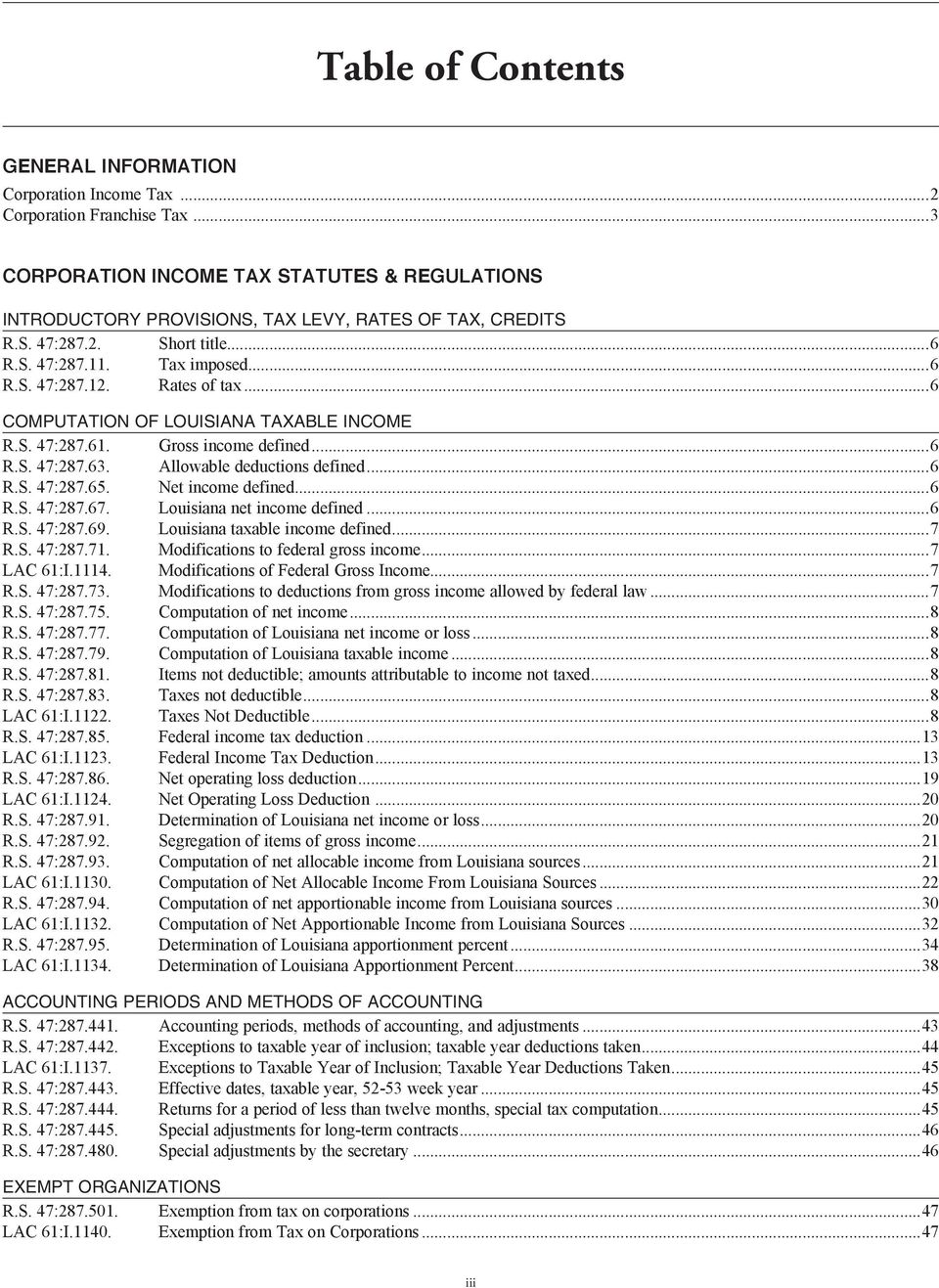
5 Table of Contents General Information Corporation Income Tax...2 Corporation Franchise Tax...3 Corporation Income Tax Statutes & Regulations Introductory Provisions, Tax Levy, Rates of Tax, Credits R.S. 47: Short title...6 R.S. 47: Tax imposed...6 R.S. 47: Rates of tax...6 Computation of Louisiana Taxable Income R.S. 47: Gross income defined...6 R.S. 47: Allowable deductions defined...6 R.S. 47: Net income defined...6 R.S. 47: Louisiana net income defined...6 R.S. 47: Louisiana taxable income defined...7 R.S. 47: Modifications to federal gross income...7 LAC 61:I Modifications of Federal Gross Income...7 R.S. 47: Modifications to deductions from gross income allowed by federal law...7 R.S. 47: Computation of net income...8 R.S. 47: Computation of Louisiana net income or loss...8 R.S. 47: Computation of Louisiana taxable income...8 R.S. 47: Items not deductible; amounts attributable to income not taxed...8 R.S. 47: Taxes not deductible...8 LAC 61:I Taxes Not Deductible...8 R.S. 47: Federal income tax deduction...13 LAC 61:I Federal Income Tax Deduction...13 R.S. 47: Net operating loss deduction...19 LAC 61:I Net Operating Loss Deduction...20 R.S. 47: Determination of Louisiana net income or loss...20 R.S. 47: Segregation of items of gross income...21 R.S. 47: Computation of net allocable income from Louisiana sources...21 LAC 61:I Computation of Net Allocable Income From Louisiana Sources...22 R.S. 47: Computation of net apportionable income from Louisiana sources...30 LAC 61:I Computation of Net Apportionable Income from Louisiana Sources...32 R.S. 47: Determination of Louisiana apportionment percent...34 LAC 61:I Determination of Louisiana Apportionment Percent...38 Accounting Periods and Methods of Accounting R.S. 47: Accounting periods, methods of accounting, and adjustments...43 R.S. 47: Exceptions to taxable year of inclusion; taxable year deductions taken...44 LAC 61:I Exceptions to Taxable Year of Inclusion; Taxable Year Deductions Taken...45 R.S. 47: Effective dates, taxable year, week year...45 R.S. 47: Returns for a period of less than twelve months, special tax computation...45 R.S. 47: Special adjustments for long-term contracts...46 R.S. 47: Special adjustments by the secretary...46 Exempt Organizations R.S. 47: Exemption from tax on corporations...47 LAC 61:I Exemption from Tax on Corporations...47 iii
6 Table of Contents R.S. 47: R.S. 47: R.S. 47: R.S. 47: Farmers cooperatives; all cooperatives...47 Shipowners protection and indemnity associations...48 Political organizations...48 Homeowners associations...48 Administrative Provisions; Records, Returns, Due Dates, Payment of Taxes R.S. 47: Notice of regulations requiring records, statements, and special returns...48 LAC 61:I Notice of Regulation, Requiring Records, Statements and Special Returns...48 R.S. 47: General requirement of return, statement, or list...49 R.S. 47: Corporation returns...49 LAC 61:I Corporation Returns...49 R.S. 47: Alternative forms and instructions...50 R.S. 47: Time and place for filing returns; information concerning federal return; extension of time to file...50 R.S. 47: Failure to file; penalty...50 R.S. 47: Period covered by returns or other documents...51 R.S. 47: Computations on returns or other documents...51 R.S. 47: Identifying number; information...51 R.S. 47: Due date of tax...51 R.S. 47: Payment of tax...51 R.S. 47: Installment payments of estimated income tax by corporations...51 R.S. 47: Failure by corporation to pay estimated income tax...52 R.S. 47: Adjustment of overpayment of estimated income tax by corporation...53 R.S. 47: Refunds and credits of overpayment of estimated income tax by corporations...54 R.S. 47: Refunds and credits; general rules...54 R.S. 47: Overpayment of installment...54 R.S. 47: Overpayment of income taxes applied to corporation franchise taxes for interest computation purposes...54 R.S. 47: Overpayments arising from allowance of deductions for bad debts or worthless stock...54 R.S. 47: Credits arising from refunds by utilities...55 R.S. 47: Administration...55 R.S. 47: Collection from transferee or fiduciary; procedure...55 R.S. 47: Notice of fiduciary relationship...55 LAC 61:I Notice of Fiduciary Relationship...55 Definitions and Special Provisions R.S. 47: Definitions, use of terms and purpose...56 R.S. 47: Effect of Election Out of Federal Partnership Provisions...57 R.S. 47: S Corporations...58 R.S. 47: Qualified Subchapter S subsidiaries...58 R.S. 47: Corporations filing consolidated federal returns...59 LAC 61:I Definition of Separate Corporation Basis...59 R.S. 47: Domestic International Sales Corporations (DISC s) and Foreign Sales Corporations (FSC s)...60 R.S. 47: Real Estate Investment Trusts (REITs)...60 R.S. 47: Other inclusions and exclusions from gross income...60 R.S. 47: Special rule for leases...61 R.S. 47: Deductions from gross income; charges in case of oil and gas wells...61 R.S. 47: Deductions from gross income; depletion...62 R.S. 47: Adjustments to income and deductions...62 R.S. 47: Situs of stock cancelled or redeemed in liquidation...63 LAC 61:I Situs of Stock Canceled or Redeemed in Liquidation...63 R.S. 47: Corporation tax credit; re-entrant jobs credit...63 R.S. 47: Jobs credit...64 R.S. 47: Reconciliation of transitional differences...65 R.S. 47: Tax credit for employment of first time non violent offenders...65 iv

7 Table of Contents R.S. 47: R.S. 47: R.S. 47: R.S. 47: R.S. 47: R.S. 47: LAC 61:I R.S. 47: Neighborhood assistance tax credit...66 Tax credit for contributions to educational institutions...67 Tax credit for environmental equipment purchases...68 Tax credit for conversion of vehicles to alternative fuel usage...69 Tax credit for bone marrow donor expense...70 Tax credit; for employee and dependent health insurance coverage...70 Health Insurance Credit for Contractors of Public Works...70 Rules and regulations...72 Corporation Franchise Tax R.S. 47:601. Imposition of tax...74 LAC 61:I.301. Imposition of Tax...74 R.S. 47:602. Determination of taxable capital...76 LAC 61:I.302. Determination of Taxable Capital...77 R.S. 47:603. Borrowed capital...78 LAC 61:I.303. Borrowed Capital...79 R.S. 47:604. Capital stock...81 LAC 61:I.304. Capital Stock...81 R.S. 47:605. Surplus and undivided profits...82 LAC 61:I.305. Surplus and Undivided Profits...83 LAC 61:I.320. Books of the Corporation...84 R.S. 47: Capital stock, surplus, and undivided profits...86 R.S. 47:606. Allocation of taxable capital...86 LAC 61:I.306. Allocation of Taxable Capital...90 R.S. 47:607. Railroad corporations...98 R.S. 47:608. Exemptions...99 LAC 61:I.308. Exemptions R.S. 47:609. Due date, payment and reporting of tax LAC 61:I.309. Due Date, Payment and Reporting of Tax R.S. 47:611. Newly taxable corporation LAC 61:I.311. Newly Taxable Corporations R.S. 47:612. Extension of time for filing return and paying tax LAC 61:I.312. Extension of Time for Filing Return and Paying the Tax R.S. 47:613. Fiscal year defined; accounting period not to be changed LAC 61:I.313. Fiscal Year; Accounting Period R.S. 47:614. Cost of collection R.S. 47:615. Disposition of collections R.S. 47:616. Franchise taxes by local governments zrohibited R.S. 47:617. Refunds and credits LAC 61:I.317. Refunds and Credits R.S. 47:618. Trucking Company Miscellaneous Provisions R.S. 39: Sports Facility Assistance Fund LAC 61:I Withholding by Professional Athletic Teams R.S. 47:6006. Tax credits for local inventory taxes paid LAC 61:I Inventory Tax Credits R.S. 47:6016. New markets tax credit R.S. 47:6030. Wind or solar energy systems tax credit LAC 61:I Income Tax Credits for Wind or Solar Energy Systems v

8 Table of Contents R.S. 47:6033. Apprenticeship tax credits R.S. 47:6101. Purpose R.S. 47:6102. Definitions R.S. 47:6103. Implementation R.S. 47:6104. Child care expense tax credit R.S. 47:6105. Child care provider tax credit R.S. 47:6106. Credit for child care directors and staff R.S. 47:6107. Business-supported child care R.S. 47:6108. Refundable tax credits R.S. 47:6109. Recapture of credits LAC 61:I Administration of the School Readiness Tax Credits vi

9 General Information

10 Corporation Income Tax General Information Who must file All corporations deriving income from Louisiana sources, whether or not they have any net income, must file an income tax return. Corporations that obtain a ruling of exemption from the Internal Revenue Service must submit a copy of the ruling to the Department to obtain an exemption. Rate of Tax Corporations will pay tax on net income computed at the following rates: Four percent (4%) on the first $25,000 of net income Five percent (5%) on the next $25,000 Six percent (6%) on the next $50,000 Seven percent (7%) on the next $100,000 Eight percent (8%) on the excess over $200,000 Date tax due Returns and payments are due on or before the fifteenth day of the fourth month following the close of an accounting period (April 15 for a calendar year). Extension of time to file returns The secretary may grant a reasonable extension of time to file the combined corporate income and franchise tax returns not to exceed seven months from the due date of the return or the extended due date of the federal income tax return, whichever is later. A copy of the extension request granted by the Internal Revenue Service must be attached to your Louisiana return or a completed Application for Automatic Extension of Time to File Corporation Income and Franchise Tax Return (CIFT- 620EXT). Declaration of estimated tax Any corporation that can reasonably expect its estimated tax for the taxable year to be one thousand dollars ($1,000) or more must file a declaration of estimated tax and pay installments of the tax according to a schedule shown on the declaration voucher (Form CIFT-620ES). Underpayment of or failure to pay estimated tax may result in an additional amount due determined at the rate of twelve percent (12%) per annum on the amount underpaid. Date payment due Any tax not previously remitted by declaration must be paid on or before the original due date of the return. Forms CIFT Corporation Income and Franchise Tax Return CIFT-620A... Corporation Apportionment and Allocation Schedules CIFT-620ES... Estimated Income Tax Declaration Voucher CIFT-620EXT... Application for Automatic Extension of Time to File Corporation Income and Franchise Tax Return R-6701(CIT-624)... Request for a Tentative Refund Resulting from the Election to Carryback a Net Operating Loss Assistance Taxpayer Services Division Louisiana Department of Revenue Post Office Box 201 Baton Rouge, LA (Assistance) (Forms) 2

11 Corporation Franchise Tax General Information Who must file Any corporation meeting any one or more of the following provisions, unless specifically exempted under the provisions of R.S. 47:608, must file a Louisiana corporation franchise tax return: (1) Organized under the laws of Louisiana. (2) Qualified to do business in this state or actually doing business in this state. (3) Exercising or continuing the corporate charter within this state. (4) Owning or using any part, or all, of the corporate capital, plant, or other property in this state in a corporate capacity. Rate of tax The tax liability for the year shall be computed at the rate of one dollar and fifty cents ($1.50) for each one thousand dollars ($1,000) or major fraction thereof up to three hundred thousand dollars ($300,000) of capital employed in Louisiana, and three dollars ($3) for each one thousand dollars ($1,000) or major fraction thereof in excess of three hundred thousand dollars ($300,000) of capital employed in Louisiana, subject to the requirement that the minimum tax is ten dollars ($10) per year. For information concerning capital employed in Louisiana and computation of the tax, see the instructions for the Corporation Income and Franchise Tax Return (CIFT- 620I). The corporation franchise tax due on the initial return is ten dollars ($10). Date returns due Initial return: An initial return, covering the period beginning with the date the corporation first becomes liable for filing a return and ending with the next close of an accounting period, must be filed on or before the fifteenth day of the third month after the corporation first becomes liable. or the extended due date of the federal income tax return, whichever is later. A copy of the request filed with the Internal Revenue Service must be attached to your Louisiana return or a completed Application for Automatic Extension of Time to File Corporation Income and Franchise Tax Return (CIFT- 620EXT). Date payment due All Louisiana corporation franchise taxes must be paid by the earlier of: (1) the original due date of the return or (2) the filing of the return. Forms CIFT Corporation Income and Franchise Tax Return CIFT 620A... Apportionment and Allocation Schedules CIFT 620EXT... Application for Extension of Time for Filing R-6906A... Initial Franchise Tax Return (CFT-4) Assistance Taxpayer Services Division Louisiana Department of Revenue Post Office Box 201 Baton Rouge, LA (Assistance) (Forms) Annual return: Louisiana corporation franchise tax accrues on the first day of each accounting year, and the return for that period must be filed on or before the fifteenth day of the fourth month of that accounting year. Extension of time to file returns The secretary may grant a reasonable extension of time to file the combined corporation income and franchise tax returns not to exceed seven months from the due date of the return 3

12

13 Corporation Income Tax Statutes & Regulations

14 R.S. 47:287.2 Corporation Income Tax Introductory Provisions, Tax Levy, Rates of Tax, Credits R.S. 47: Short title This Act shall be known as and may be cited as the Louisiana Corporation Income Tax Act. Added by Acts 1986, 1st Ex.Sess., No. 16, 1, eff. Dec. 24, R.S. 47: Tax imposed A. There shall be levied, collected, and paid for each taxable year a tax upon the Louisiana taxable income of corporations and other entities taxed as corporations for federal income tax purposes, which entities shall be considered to be corporations for the purposes of this Chapter only, other than insurance companies as hereinafter provided. B. Corporations shall be taxed on their Louisiana taxable income, except as otherwise exempted. C. Taxable years affected. (1) The provisions of this Part shall apply to taxable years beginning after December 31, 1986, including taxable years deemed to have commenced on January 1, 1987, by the provisions of R.S. 47: (2) Taxable years beginning prior to January 1, 1987, shall not be affected by the provisions of this Part, but shall remain subject to the applicable provisions of R.S. 47:21 et seq. D. Insurance companies shall not be subject to this Part but shall continue to be taxed pursuant to the provisions of R.S. 47:21 and R.S. 47:221 et seq., and as otherwise provided by law. Added by Acts 1986, 1st Ex.Sess., No. 16, 1, eff. Dec. 24, Amended by Acts 1998, No. 42, 1. R.S. 47: Rates of tax The tax to be assessed, levied, collected, and paid upon the Louisiana taxable income of every corporation shall be computed at the rate of: (1) Four percent upon the first twenty-five thousand dollars of Louisiana taxable income. (2) Five percent on the amount of Louisiana taxable income above twenty-five thousand dollars but not in excess of fifty thousand dollars. (3) Six percent on the amount of Louisiana taxable income above fifty thousand dollars but not in excess of one hundred thousand dollars. (4) Seven percent on the amount of Louisiana taxable income above one hundred thousand dollars but not in excess of two hundred thousand dollars. (5) Eight percent on all Louisiana taxable income in excess of two hundred thousand dollars. Added by Acts 1986, 1st Ex.Sess., No. 16, 1, eff. Dec. 24, Computation of Louisiana Taxable Income R.S. 47: Gross income defined Gross income of a corporation means the same items and the same dollar amount required by federal law to be reported as gross income on the corporation s federal income tax return for the same taxable year, subject to the modifications specified in this Part, whether or not a federal income tax return is actually filed. Added by Acts 1986, 1st Ex.Sess., No. 16, 1, eff. Dec. 24, R.S. 47: Allowable deductions defined Allowable deductions for a taxable year means the deductions from federal gross income allowed by federal law in the computation of taxable income of a corporation for the same taxable year, subject to the modifications specified in this Part. Added by Acts 1986, 1st Ex.Sess., No. 16, 1, eff. Dec. 24, R.S. 47: Net income defined Net income of a corporation for a taxable year means the taxable income of the corporation computed in accordance with federal law for the same accounting period and under the same method of accounting, including statutorily required accounting adjustments, subject to the modifications specified in this Part. Added by Acts 1986, 1st Ex.Sess., No. 16, 1, eff. Dec. 24, R.S. 47: Louisiana net income defined Louisiana net income means net income which is earned within or derived from sources within the state of Louisiana. Added by Acts 1986, 1st Ex.Sess., No. 16, 1, eff. Dec. 24,

15 R.S. 47: Corporation Income Tax General Information R.S. 47: Louisiana taxable income defined Louisiana taxable income means Louisiana net income, after adjustments, less the federal income tax deduction allowed by R.S. 47: After adjustments means after the application of the net operating loss adjustment allowed by R.S. 47: Added by Acts 1986, 1st Ex.Sess., No. 16, 1, eff. Dec. 24, R.S. 47: Modifications to federal gross income A. There shall be added to gross income determined under federal law, unless already included therein, the following items: (1) Repealed by Acts 2005, No ,eff. for all taxable periods after December 31, 2005 (2) Repealed by Acts 2005, No ,eff. for all taxable periods after December 31, 2005 (3) Any gain on the sale of assets not recognized due to the provisions of Section 633(d) of the Tax Reform Act of 1986 which provides a transitional rule for certain small corporations. (4) Any gain not recognized under I.R.C. Section 1033 resulting from the involuntary conversion of property located in Louisiana not replaced with property located in Louisiana. (5) Inclusions from Subpart F of this Part, where applicable. B. There shall be subtracted from gross income determined under federal law, unless already excluded therefrom, the following items: (1) Income which Louisiana is prohibited from taxing by the constitution or laws of the United States. (2) Funds accrued by a corporation engaged in operating a public transportation system from any federal, state, or municipal governmental entity to subsidize the operation and maintenance of such a transportation system. (3) Refunds of Louisiana corporation income tax received during the taxable year. (4) Interest on obligations or securities issued by the state of Louisiana or its political or municipal subdivisions. (5) Foreign dividend gross-up. Any amounts required by I.R.C. Section 78 to be included in gross income. (6) Amounts received as dividend income from banking corporations organized under the laws of Louisiana, from national banking corporations doing business in Louisiana, and from capital stock associations whose stock is subject to ad valorem taxation. (7) Exclusions from Subpart F of this Part, where applicable. Added by Acts 1986, 1st Ex.Sess., No. 16, 1, eff. Dec. 24, Amended by Acts 1987, No. 5, 1, eff. May 20, LAC 61:I Modifications of Federal Gross Income In order to calculate Louisiana gross income, R.S. 47: requires modifications be made to federal gross income. R.S. 47:287.71(B)(7) provides that exclusions from Subpart F must be taken into account when computing Louisiana gross income. Included in the exclusions from gross income required by R.S. 47:287.71(B)(7) are those modifications provided for in R.S. 47: (C) through (F). AUTHORITY NOTE: Promulgated in accordance with R.S. 47:287.71, R.S. 47: ,and R.S. 47:1511. HISTORICAL NOTE: Promulgated by the Department of Revenue, Policey Service Division, LR 32:261 (February 2006). R.S. 47: Modifications to deductions from gross income allowed by federal law A. The deductions from federal gross income allowed by federal law shall be modified by the deletions and additions specified herein. B. Deletions. The following deductions allowed by federal law are declared inoperative and shall not form a part of allowable deductions in the computation of net income: (1) The net operating loss deduction allowed by I.R.C. Section 172. (2) Income taxes imposed by this Part. (3) The dividends received deductions allowed by I.R.C. Sections 243, 244, and 245. (4) Depletion for oil and gas wells. (5) Deletions required by the provisions of Subpart F of this Part, where applicable. C. Additions. The following items are declared allowable as deductions in the computation of net income and shall be added to the deductions allowed under federal law to the extent not already included therein: (1) Repealed by Acts 2005, No ,eff. for all taxable periods after December 31, 2005 (2) Depletion for oil and gas wells is allowed as a deduction 7

16 R.S. 47: Corporation Income Tax as provided by R.S. 47: (3) Intangible drilling and development costs. Intangible drilling and development costs are allowed as a deduction as provided by R.S. 47: (4) Expenses disallowed by I.R.C. Section 280(C). Expenses which would otherwise be deductible under federal law, but for the disallowance provisions of I.R.C. Section 280(C), relative to certain expenses for which credits are allowable. (5) Additions required by the provisions of Subpart F of this Part, where applicable. Added by Acts 1986, 1st Ex.Sess., No. 16, 1, eff. Dec. 24, R.S. 47: Computation of net income The net income of a corporation is computed by subtracting allowable deductions from gross income for a taxable year. Added by Acts 1986, 1st Ex.Sess., No. 16, 1, eff. Dec. 24, R.S. 47: Computation of Louisiana net income or loss Louisiana net income or loss of a corporation is determined by applying the allocation and apportionment provisions of this Part to the corporation s gross income, allowable deductions, and net income for a taxable year as determined and computed pursuant to this Part. Added by Acts 1986, 1st Ex.Sess., No. 16, 1, eff. Dec. 24, R.S. 47: Computation of Louisiana taxable income Louisiana taxable income is computed by subtracting the federal income tax deduction allowed by R.S. 47: from Louisiana net income, after adjustments. Added by Acts 1986, 1st Ex.Sess., No. 16, 1, eff. Dec. 24, R.S. 47: Items not deductible; amounts attributable to income not taxed In computing Louisiana net income or Louisiana taxable income no deduction shall in any case be allowed in respect of any amount otherwise allowable as a deduction which is attributable to income which, for any reason whatsoever, will not bear the tax imposed by this Part. Added by Acts 1986, 1st Ex.Sess., No. 16, 1, eff. Dec. 24, R.S. 47: Taxes not deductible A. In computing Louisiana taxable income, no federal income tax deduction shall be allowed on net income upon which no Louisiana income tax has been incurred, or upon which, for any reason whatsoever, no Louisiana income tax will be paid. For purposes of this Section, the federal income tax deduction may be recomputed and reduced to reflect the application of a net operating loss adjustment. Any such reduction shall be taken into account as prescribed by the secretary. B. The alternative minimum tax is a federal income tax deductible to the extent that it is applicable to regular federal taxable income. Any alternative minimum tax paid on tax preference items is not deductible. The deductible portion of the alternative minimum tax shall be determined as prescribed by the secretary. Added by Acts 1986, 1st Ex.Sess., No. 16, 1, eff. Dec. 24, Taxes Not Deductible A. General. R.S. 47: provides that federal income tax levied on net income upon which no Louisiana income tax has been incurred, or upon which, for any reason whatsoever, no Louisiana income tax will be paid, is not deductible. B. Federal Alternative Minimum Tax. Federal alternative minimum tax attributable to tax preference items such as, but not limited to, accelerated depreciation, depletion, and intangible drilling and development cost is not deductible. Federal alternative minimum taxable net income from sources other than tax preference items is deductible to the extent that it is applicable to regular federal taxable income. C. Net Operating Loss Carryback. Federal income tax deducted from Louisiana net income in taxable periods to which a net operating loss is carried back shall be computed to determine the amount of federal income tax attributable to net income which is taxed by the federal but which is not taxed by Louisiana as a result of a net operating loss carryback. Federal income tax attributable to net income which is not taxed by Louisiana as a result of a net operating loss carryback is the excess of allowable federal income tax deducted from Louisiana net income before the net operating loss carryback over the allowable deduction after the net operating loss carryback. The federal income tax attributable to net income which is not taxed by Louisiana shall be treated as a reduction to the net operating loss deduction. If the amount of the federal income tax attributable to the net income which is not taxed by Louisiana exceeds the Louisiana net 8

17 1122 Corporation Income Tax operating loss deduction, such excess shall be treated as income in the year of the transaction that gave rise to the excess. These principles are illustrated in the following examples. D. Examples Example 1 The ABC Corporation does not include its net income in a consolidated federal income return as provided by Section 1501 of the Internal Revenue Code. ABC files state and federal income tax returns on a calendar year basis. ABC Corporation s net income and other financial information used to file state and federal income tax returns for the four-year period ending December 31, 1987, include the following: Taxable Periods Federal net income or (loss) $ 2,000,000 $ 4,000,000 $ 5,000,000 $ 600,000 Louisiana net income or (loss) 1,200,000 1,800,000 3,000,000 (1,000,000) Federal income tax 800,000 1,600,000 2,000, ,000 Federal income tax deducted from Louisiana net income 467, ,240 1,171, State income tax deducted from federal net income but not 57,500 86, , Louisiana net income Income tax apportionment ratio 55% 40% 50% 50% Louisiana taxable income 732,720 1,093,760 1,828, ABC Corporation elects to carry their 1987 Louisiana net operating loss back to 1984 pursuant to R.S. 47: Federal income tax attributable to net income which is not taxed by Louisiana as a result of the net operating loss carryback is computed as follows: 1. Louisiana net income, 1984 $1,200, Less: State income tax deduction allowed by the federal but not Louisiana $57,500 Multiplied by the income tax apportionment ratio 55% Balance $31,625 Louisiana net operating loss, 1987 $1,000,000 Adjustment $1,031, Louisiana net income after deducting the net operating loss carryback (line 1 minus line 2) $ 168, Federal net income, 1984 $2,000, Ratio (line 3 divided by line 4) % 6. Federal income tax, 1984 $ 800, Allowable federal income tax deduction after the Louisiana net operating loss carryback (line 6 multiplied by line 5) $ 67, Federal income tax deducted from Louisiana net income before the net operating loss carryback $ 467, Federal income tax attributable to net income which is not taxed by Louisiana (line 8 minus line 7) $ 399, Louisiana net operating loss before deduction for federal income tax attributable to net income which is not taxed by Louisiana $1,000, Federal income tax attributable to net income which is not taxed by Louisiana (from line 9) $ 399, Louisiana net operating loss after deduction for federal income tax attributable to net income which is not taxed by Louisiana (line 10 minus line 11) $ 600,070 9

18 1122 Corporation Income Tax Example 2 Assume the same facts in Example 1 except that the ABC Corporation sustained a $2,000,000 federal net operating loss in 1987 and elects to carry the federal loss back to Federal income tax after the net operating loss carryback is zero. 1. Louisiana net income, 1984 $1,200, Less: State income tax deduction allowed by the federal but not Louisiana $57,500 Multiplied by the income tax apportionment ratio 55% Balance $31,625 Louisiana net operating loss, 1987 $1,000,000 Adjustment $1,031, Louisiana net income after deducting the net operating loss carryback (line 1 minus line 2) $ 168, Federal net income, 1984 $2,000, Federal net operating loss carryback from 1987 ($2,000,000) 6. Federal net income after federal net operating loss carryback from 1987 (line 4 minus line 5) Ratio (line 3 divided by line 6) Federal income tax after the federal net operating loss carryback Allowable federal income tax deduction after the net operating loss carryback (line 8 multiplied by line 7) 10. Federal income tax deducted from Louisiana net income before the net operating loss carryback $ 467, Federal income tax attributable to net income which is not taxed by Louisiana (line 10 minus line 9) $ 467, Louisiana net operating loss before deduction for federal income tax attributable to net $1,000,000 income which is not taxed by Louisiana 13. Federal income tax attributable to net income which is not taxed by Louisiana (from line 11) $ 467, Louisiana net operating loss after deduction for federal income tax attributable to net income which is not taxed by Louisiana (line 12 minus line 13) $ 532,720 Example 3 Assume the same facts in Examples 1 and 2 except that the Louisiana and federal net operating losses in 1987 are $350,000 and $1,800,000 respectively. Federal income tax after the net operating loss carryback is $80, Louisiana net income, 1984 $1,200, Less: State income tax deduction allowed by the federal but not Louisiana $57,500 Multiplied by the income tax apportionment ratio 55% Balance $31,625 Louisiana net operating loss, 1987 $350,000 Adjustment $ 381, Louisiana net income after deducting the net operating loss carryback (line 1 minus line 2) $ 818, Federal net income, 1984 $2,000, Federal net operating loss carryback from 1987 ($1,800,000) 6. Federal net income after federal net operating loss carryback from 1987 (line 4 minus line 5) $ 200,000 10

19 R.S. 47: Corporation Income Tax 7. Ratio (line 3 divided by line 6) 100% 8. Federal income tax after the federal net operating loss carryback $ 80, Allowable federal income tax deduction after the net operating loss carryback (line 8 times line 7) $ 80, Federal income tax deducted from Louisiana net income before the net operating loss carryback $ 467, Federal income tax attributable to net income which is not taxed by Louisiana, 1984 (line 10 minus line 9) $ 387, Louisiana net operating loss before deduction for federal income tax attributable to net $ 350,000 income which is not taxed by Louisiana 13. Federal income tax attributable to net income which is not taxed by Louisiana (from line 11) $ 387, Louisiana net operating loss after deduction for the amount of federal income tax attributable -0- to net income which is not taxed by Louisiana (line 12 minus line 13) 15. Additional Louisiana taxable income for 1987 due to excess of federal income tax attributable to net income which is not taxed by Louisiana over the Louisiana net operating loss (line 13 minus line 12) $ 37,280 E. Definitions. For the purposes of this Section, alternative minimum tax, regular federal income tax, alternative tax on capital gains, and regular tax on ordinary net income are defined as provided in 1123.F. AUTHORITY NOTE: Promulgated in accordance with R.S. 47:287.83, R.S. 47:1511. HISTORICAL NOTE: Promulgated by the Department of Revenue and Taxation, Income Tax Section, LR 14:96 (February 1988), repromulgated by the Department of Revenue, Policy Services Division, LR 30:470 (March 2004), amended by the Department of Revenue, Policy Services Division, LR 33:295 (February 2007). R.S. 47: Federal income tax deduction A. In computing Louisiana taxable income under R.S. 47:287.79, there shall be allowed as a deduction federal income taxes paid. B. For purposes of this Section, federal income taxes shall include taxes based on net income, accumulated earnings, war profits, excess profits, personal holding company income, and tax from recomputation of investment credit. The alternative minimum tax is a federal income tax allowable to the extent provided in R.S. 47:287.83(B). C. (1) The amount of federal income tax to be deducted shall be that portion of the total federal income tax, after all credits, which is levied with respect to the particular income derived from sources in this state to be computed in accordance with rules and regulations prescribed by the secretary. Proper adjustment shall be made for the actual tax rates applying to different classes of income and for all differences in the computation of net income for purposes of federal income taxation as compared to the computation of net income under this Part. (2) Credits as used in this Subsection does not include overpayments of prior year taxes allowed as a credit, estimated tax payments or similar prepayments, or credit for prior year alternative minimum tax which is allowed as a credit against the current regular federal income tax, or federal income tax credits determined by the Secretary to be presidential disaster area disaster relief credits. D. A corporation that files or is included with affiliates in a consolidated federal income tax return shall compute its federal income tax deduction in accordance with rules and regulations prescribed by the secretary. Added by Acts 1986, 1st Ex.Sess., No. 16, 1, eff. Dec. 24, Amended by Acts 1987, No. 53, 1; Acts 1997, No. 165, 1, eff. June 13,

20 LAC 61:I.1123 Corporation Income Tax LAC 61:I Federal Income Tax Deduction A. General. R.S. 47:287.85(C) permits corporations to claim as a deduction in computing net income that portion of the federal income tax levied with respect to the Louisiana net income, which is applicable to the year for which the Louisiana return is filed, regardless of the method of accounting utilized (cash, accrual, etc.). For determination of the deductible amount of federal alternative minimum tax attributable to Louisiana net income, refer to When a corporation includes its net income in a consolidated federal income tax return, total federal income tax for the purpose of this Section shall be the amount determined pursuant to 1123.E. B. Computations. The deductible portion of the federal income tax, the tax attributable to Louisiana income, is the sum of the amounts determined in 1123.B.1 and The deductible portion of federal income tax attributable to Louisiana apportionable and allocable net income which is taxed at alternative capital gain rates is the result obtained by multiplying the federal income tax which is calculated at alternative capital gain rates by a fraction, the numerator of which is Louisiana apportionable and allocable net income which is taxed at alternative capital gain rates and the denominator of which is federal net income which is taxed at alternative capital gain rates. 2. The deductible portion of federal income tax attributable to Louisiana apportionable and allocable net income, less adjustment for the net operating loss deduction if applicable, which is taxed at ordinary rates, is the result obtained by multiplying the federal income tax which is calculated at ordinary rates by a fraction, the numerator of which is Louisiana apportionable and allocable net income, less adjustment for the net operating loss deduction if applicable, which is taxed at ordinary rates and the denominator of which is federal net income which is taxed at ordinary rates. C. Numerator. The numerator to be used in 1123.B shall be determined as set forth in 1123.C.1 and The numerator in the case of Louisiana net income which is taxed by federal at alternative capital gain rates is the sum of: a. the amount of net apportionable and net allocable income, subject to tax at alternative capital gain rates for federal income tax purposes, apportioned and allocated to Louisiana; b. any compensating item of income attributable to Louisiana and which is taxed by federal at alternative capital gain rates but which is not taxed by Louisiana; and c. any compensating loss item of income, of a character which would be allowable by federal in arriving at income which is taxed at alternative capital gain rates, attributed to and allowed by Louisiana but not allowed by federal, reduced by the sum of: i. any compensating item of income, of a character which would be subject to tax by federal at alternative capital gain rates, attributed to and taxed by Louisiana but which is not taxed by federal; ii. any compensating loss item of income attributable to Louisiana and allowed by federal in arriving at income which is taxed at alternative capital gain rates but not allowed by Louisiana; and iii. any excess of the sum of: a. any noncompensating loss item of income attributable to Louisiana and allowed by federal in arriving at income which is taxed at alternative capital gain rates, but not allowed by Louisiana, and b. any noncompensating item of income, of a character which would be subject to tax by federal at alternative capital gain rates, attributed to and taxed by Louisiana but which is not taxed by federal, over c. any noncompensating loss item of income, of a character which would be allowable in arriving at income which is taxed at alternative capital gain rates by federal, attributed to and allowed by Louisiana but not allowed by federal. 2. The numerator in the case of Louisiana net income which is taxed by federal at ordinary rates is the sum of: a. the amount of net apportionable and net allocable income, less adjustment for the net operating loss deduction if applicable, subject to tax at ordinary rates for federal income tax purposes, apportioned and allocated to Louisiana; b. any compensating item of gross income attributable to Louisiana and taxed by federal at ordinary rates but which is not taxed by Louisiana; and c. any compensating item of deduction, of a character which would be allowable by federal in arriving at income which is taxed at ordinary rates, attributed to 12
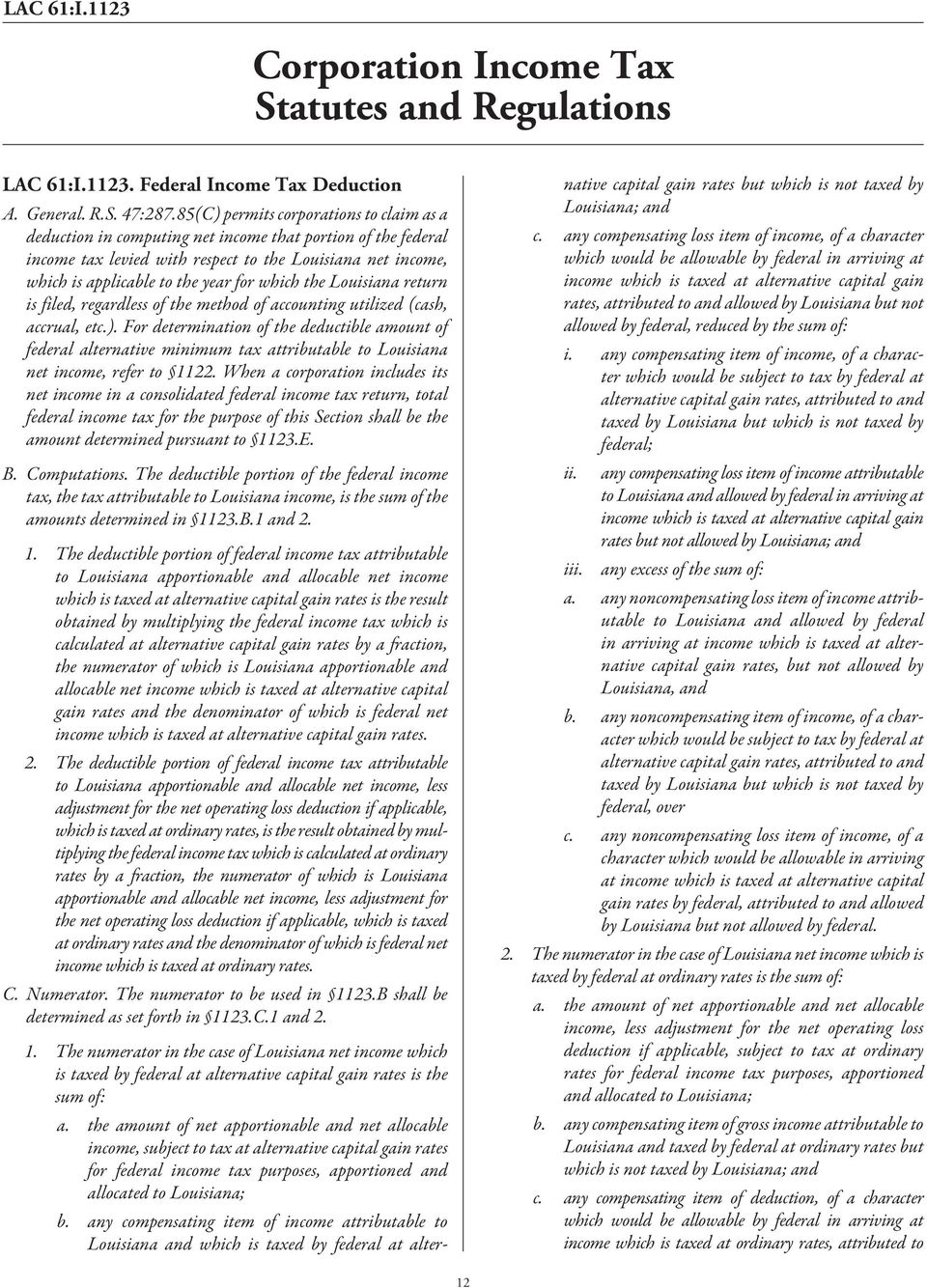
21 LAC 61:I.1123 Corporation Income Tax and allowed by Louisiana but not allowed by federal, and not attributable to any item of gross income taxable by Louisiana but not by federal; reduced by the sum of: i. any compensating item of gross income, which would be subject to tax by federal at ordinary rates, attributed to and taxed by Louisiana but which is not taxed by federal; ii. any compensating item of deduction attributable to Louisiana and allowed by federal in arriving at income which is taxed at ordinary rates but not allowed by Louisiana; iii. any excess of the sum of: a. any noncompensating item of deduction attributable to Louisiana and allowed by federal in arriving at income which is taxed at ordinary rates, but not allowed by Louisiana, and not attributable to any item of gross income taxable by federal but not by Louisiana; and b. any noncompensating item of gross income, of a character which would be subject to tax at ordinary rates, attributed to and taxed by Louisiana but which is not taxed by federal; over c. any noncompensating item of deduction, which would be allowable by federal in arriving at income which is taxed at ordinary rates, attributed to and allowed by Louisiana but not allowed by federal, and not attributable to any item of gross income taxable by Louisiana but which is not by federal. continued on next page... 13
22 LAC 61:I.1123 Corporation Income Tax D. Example. The following example illustrates these principles. Facts: The income reported and deductions claimed by ABC, Inc., a Delaware corporation having its commercial domicile in Louisiana and having several places of business outside this state, are reflected below. The difference between the federal depreciation deduction and the depreciation deducted in arriving at total net income is a compensating item. One-half of the total royalty income, depletion, and other expenses related thereto are attributable to a Louisiana oil property. There are $15,000 in expenses attributable to the royalty income in addition to the depletion deduction. The portion of net income from royalties allocable to Louisiana is $25,000. Of the total profit from the sale of capital assets, $25,000 is allocable to Louisiana. RETURNS Items Federal Louisiana Income Gross profit from sales...$1,400,000...$1,400,000 Royalties , ,000 Interest Bond, State of Mississippi ,000 Interest Bond, U.S. Government... 5, Long-term gain from sale of capital assets , ,000 Total Income...$1,605,000...$1,605,000 Deductions Louisiana income tax... 10, Officers compensation... 50, ,000 Repairs... 10, ,000 Interest... 15, ,000 Bad debts... 5, ,000 Depletion... 27, ,000 Depreciation... 25, ,000 Contributions... 5, ,000 Other deductions , ,000 Total deductions... $497,500...$505,000 Net Income $1,107,500 $1,100,000 Federal income tax Ordinary income... $518,400 Capital gains... 25,000 Total... $543,400 14
23 LAC 61:I.1123 Corporation Income Tax The taxpayer files on the apportionment basis and the following computation discloses the net allocable and net apportionable income derived from Louisiana sources. RETURNS Items Federal Louisiana Total net income...$1,100,000 Deduct allocable income Profit from sale of capital assets... $100,000 Interest Bonds, State of Mississippi... 5,000 Net royalty income... 50,000...$155,000 Net income for apportionment...$945,000 Net income apportioned to Louisiana (20% of $945,000)...$189,000 Add Louisiana allocable income Interest... $5,000 Profit from sale of capital assets... 25,000 Royalty income... 25, ,000 Total Louisiana apportionable and allocable income...$244, Computations Ordinary Rates Alternative Capital Gains Rates Net income apportioned and allocated to Louisiana... $219,000...$25,000 Add: Compensating items of income attributable to Louisiana and taxed by federal but which is not taxed by Louisiana Compensating items of deduction attributed to Louisiana and allowed by Louisiana but not allowed by federal depreciation (20% of $10,000)... 2,000 Total:... $221,000...$25,000 Deduct: Compensating items of income attributed to and taxed by Louisiana but not taxed by federal Compensating items of deduction attributable to Louisiana and allowed by federal but not allowed by Louisiana TOTAL:... $221,000...$25,000 Excess of the sum of noncompensating items of deduction attributable to Louisiana and allowed by federal but not allowed by Louisiana Louisiana income tax (20% of $10,000)*... $2,000 Noncompensating items of gross income attributed to and taxed by Louisiana but which is not taxed by federal Bond interest State of Mississippi... 5,000 Total... $7,000 Over Noncompensating items of deduction attributed to and allowed by Louisiana but not allowed by federal depletion on oil royalties... $3,750 15
24 LAC 61:I.1123 Corporation Income Tax RETURNS Items Federal Louisiana Excess... $3, Louisiana net income which is taxed by federal... $217,750...$25,000 Federal net income...$1,007,500...$100,000 Ratio % % Federal income tax liability... $518,400...$25,000 Deductible federal income tax 21.61% of $518, $112,026 25% of $25, $6, ,026 Grand Total...$118,276 * Where the separate method of reporting is used, the entire amount of Louisiana income tax deducted in the federal return is attributed to Louisiana under this item. E. Consolidated Returns. When a corporation includes its net income in a consolidated federal income tax return, the portion of the consolidated federal income tax after credits attributable to such corporation shall consist of the sum of the amounts determined in 1123.E.1, 2, and 3: 1. the consolidated regular tax on ordinary net income multiplied by the percentage determined by a fraction, the numerator of which is regular tax on ordinary net income of each member of the consolidated group computed on a separate return basis and the denominator of which is regular tax of all members of the group so computed, plus 2. the consolidated alternative tax on net capital gains multiplied by the percentage determined by a fraction, the numerator of which is alternative tax on net capital gains of each member of the consolidated group computed on a separate return basis and the denominator of which is alternative tax on net capital gains of all members of the group so computed, plus 3. the consolidated alternative minimum tax multiplied by the percentage determined by a fraction, the numerator of which is alternative minimum tax of each member of the consolidated group computed on a separate return basis and the denominator of which is alternative minimum tax of all members of the group so computed. F. Definitions Alternative Minimum Tax the excess of the federal tentative minimum tax after credits for the tax year, over the federal regular tax after credits for the taxable year. Alternative Tax on Capital Gains the net tax liability imposed by Section 1201(a)(2) of the Internal Revenue Code on net capital gains, less credits. Compensating Item any difference in any deduction or item of income for a particular year arising solely by reason of the fact that the item is accounted for in different periods for federal and Louisiana income tax purposes. However, if a larger federal income tax deduction would be allowable were an item treated as a compensating item than would be allowable were the item treated as a noncompensating item, the item is a compensating item only to the extent that it is equal to the result obtained by multiplying the difference in the item by a fraction determined as follows: a. in the case of a deduction: i. the numerator shall be the excess, if any, of the amount of the item allowed by federal over the amount allowed by Louisiana in each prior year in which the federal allowance exceeded the Louisiana allowance and which has been taken into consid- 16
25 LAC 61:I.1123 Corporation Income Tax eration fully in determining the allowable federal income tax deduction for Louisiana income tax purposes for such prior years, plus the excess, if any, of the amount of the item to be allowed by federal over the amount to be allowed by Louisiana in each future year in which the federal allowance will exceed the Louisiana allowance and which reasonably can be expected to be taken into consideration in determining the allowable federal income tax deduction for Louisiana income tax purposes in such future years; ii. the denominator shall be the total of all excesses of the amount of the item allowed by federal over the amount of the item allowed by Louisiana in each prior year and of all excesses of the amount of the item to be allowed by federal over the amount to be allowed by Louisiana in each future year; b. in the case of an item of income: i. the numerator shall be the excess, if any, of the amount of the item taxed by Louisiana over the amount taxed by federal in each prior year in which the amount taxed by Louisiana exceeded the amount taxed by federal and which has been fully taken into consideration in determining the allowable federal income tax deduction for Louisiana income tax purposes for such prior years, plus the excess, if any, of the amount of the item to be taxed by Louisiana over the amount to be taxed by federal in each future year in which the amount to be taxed by Louisiana will exceed the amount to be taxed by federal and which can reasonably be expected to be fully taken into consideration in determining the allowable federal income tax deduction in such future years for Louisiana income tax purposes; ii. the denominator shall be the total of all excesses of the amount of the item taxed by Louisiana over the amount taxed by federal in each prior year and of all excesses of the amount of the item to be taxable by Louisiana over the amount to be taxable by federal in each future year. Income Taxed income included in taxable income, regardless of whether tax has been paid thereon. Item of Deduction each individual deduction rather than each category of deduction, and includes loss items of gross income. For example, the amount of depreciation on a particular property, as distinguished from the amount of depreciation on all properties of the taxpayer, would be an item of deduction. Similarly, the term item of income means each amount of income rather than each category of income. The amount of a Louisiana item of income or deduction is the amount apportioned or allocated to Louisiana. Thus, where a taxpayer has a 10 percent apportionment ratio and has an item of deduction of $10,000 allowed by Louisiana in arriving at apportionable net income but not allowed by federal, the amount of the Louisiana item is 10 percent of $10,000 or $1,000. Noncompensating Item any item of difference between federal and Louisiana income or deductions for a particular year other than a compensating item. Regular Federal Income Tax the sum of the tax defined in regular tax on ordinary net income and alternative tax on capital gains. Regular Tax on Ordinary Net Income the federal net tax liability imposed on net income after net income is reduced by the amount of net capital gain subject to alternative tax rates, less credits. Taken into Consideration Fully in Determining the Allowable Federal Income Tax Deduction for Louisiana Income Tax Purposes for Prior Years as used in this Section means fully used in reducing the amount of the federal income tax deduction for such prior years. The purpose of this provision is to allow an adjustment for an item which will increase the federal income tax deduction only to the extent that adjustments applicable to the item in prior years were used to decrease the federal income tax deduction. Similarly, the term to be fully taken into consideration in determining the allowable federal income tax deduction in future years for Louisiana income tax purposes means to be used fully in reducing the amount of the federal income tax deduction for such future years. G. Special Rules 1. The computations prescribed in 1123.B are subject to the rules provided in R.S. 47: That is, the computations cannot have the effect of attributing refunds of federal income tax which arose on account of conditions or transactions occurring after the close of the taxable year, to any year other than that in which arose the transactions or conditions giving rise to the refund. Accordingly, appropriate changes shall be made when necessary to attribute the refund to the proper year. 2. Notwithstanding the definition provided in 1123.F. Noncompensating Item and Compensating Item, deductions which are declared as allowable in the computation of Louisiana net income pursuant to R.S. 47:287.73(C)4 shall be treated as a compensating item of deduction for the purpose of computing the amount of federal income tax deduction under 1123.C. 17
26 LAC 61:I.1123 Corporation Income Tax 3. The federal income tax deduction determined under 1123 must take into account R.S. 47: which provides in part that no federal income tax deduction shall be allowed on net income upon which no Louisiana income tax has been incurred, or upon which, for any reason whatsoever, no Louisiana income tax will be paid. 4. If the tax of any member computed on a separate return basis under 1123.E.1, 2, and 3 is less than zero, then for the purposes of 1123.E, such member s separate return tax shall be zero. 5. The secretary may adjust the consolidated federal income tax allocation formula prescribed in 1123.E when in his opinion such action is necessary to obtain a reasonable allocation and to clearly reflect Louisiana taxable income. 6. The sum of the net consolidated federal income tax attributed to all members of the consolidated group for the taxable period cannot exceed the amount of consolidated federal income tax paid to the U.S. government for the taxable period. 7. When the alternative tax rate on net capital gains is the same as the regular tax rate on ordinary net income reduced by net capital gains, consolidated regular tax on ordinary net income and alternative tax on capital gains, after credits, may be combined and then attributed to each member of the consolidated group. AUTHORITY NOTE: Promulgated in accordance with R.S. 47:287.86, R. S. 47: and R.S. 47:1511. HISTORICAL NOTE: Promulgated by the Department of Revenue, Policy Services Division, LR 30:2494 (November 2004). R.S. 47: Net operating loss deduction A. Deduction from Louisiana net income. Except as otherwise provided, there shall be allowed for the taxable year an adjustment reducing Louisiana net income in an amount equal to the aggregate of: (1) The net operating loss carryovers to such year, plus (2) The net operating loss carrybacks to such year. B. Net operating loss carrybacks and carryovers. The taxable years to which a Louisiana net loss may be carried shall be: (1) A net operating loss carryback to each of the three taxable years preceding the taxable year of such loss, unless carryback treatment is relinquished pursuant to R.S. 47:287.86(D). (2) For losses incurred for taxable years beginning before January, 1984, a net operating loss carryover to each of the five taxable years following the taxable year of such loss. For losses incurred for taxable years beginning on or after January 1, 1984, a net operating loss carryover to each of the fifteen taxable years following the taxable year of such loss. C. Manner and amount of carrybacks and carryovers. The entire amount of Louisiana net loss for any taxable year, hereinafter the loss year, shall be carried back to the earliest of the taxable years allowed, unless an election to relinquish carryback treatment is made, in which case such loss shall be carried to the earliest of the taxable years allowed for carryovers. The portion of such loss which shall be carried to each of the other taxable years allowed by Subsection B shall be the excess, if any, of the amount of such loss over the aggregate of the Louisiana taxable income for each of the prior taxable years to which such loss may be carried. For the purposes of this Subsection: (1) Louisiana taxable income shall not be adjusted to less than zero. (2) In calculating the aggregate Louisiana taxable incomes in cases where more than one loss year must be taken into account, the various net operating loss carryovers and carrybacks to such taxable year are considered to be applied in reduction of Louisiana net income in the order of the taxable years from which such losses are carried over or carried back, beginning with the loss for the earliest taxable year. D. Election to relinquish carryback. Any taxpayer may make an election to relinquish the carryback treatment allowed and have its Louisiana net loss treated only as a carryover. Such election shall be made as prescribed by the secretary. E. Statement with tax return. Every corporation claiming a net operating loss deduction for any taxable year shall file with its return for such year a concise statement setting forth the amount of the net operating loss claimed and all material and pertinent facts relative thereto, including a detailed schedule showing the computation of the net operating loss deduction. F. Adjustment dependent upon Louisiana net loss carryback. If in computing the net operating loss deduction the taxpayer is entitled to a carryback which cannot be ascertained at the time the return is due, the deduction, if any, shall be computed without regard to such carryback. 18
27 R.S. 47: Corporation Income Tax When the taxpayer ascertains the correct amount of such carryback, a claim for credit or refund of the overpayment, if any, resulting from the failure to compute the deduction for the taxable year with the inclusion of such carryback may be filed within the prescriptive period, or the taxpayer may file an application for a tentative refund as provided in Subsection G. G. Tentative refund. A taxpayer may request a tentative refund resulting from the application of a net operating loss carryback in the manner and with forms prescribed by the secretary. If the tentative refund is paid, the secretary may recover any amount thereof determined not to be an overpayment through any collection remedy authorized by R.S. 47:1561 within two years from December thirty-first of the year in which the refund was paid. Any tentatively refunded amount determined not to be an overpayment shall bear interest at the rate provided in R.S. 47:1601, which shall be computed from the date the tentative refund was issued to the date payment is received by the secretary. H. Interest on refunds. Any amount actually refunded as an overpayment resulting from the application of a net operating loss carryback, tentative or otherwise, shall bear interest at the rate provided in R.S. 47:1624, which shall be computed: (1) From the latest of the following dates: (a) Ninety days after the date the request for tentative refund or claim for refund (amended return) is filed. (b) Ninety days after the due date of the loss year return without regard to extensions of time to file. (2) To the date such refund is issued by the secretary. I. Net operating loss carryover. (1) Notwithstanding any other provisions of this Chapter to the contrary, the acquiring corporation shall succeed to and take into account, as of the close of the day of distribution or transfer, the aggregate net operating loss carryovers of the distributors or transferor corporation as determined under this Section, subject to federal law and the limitations provided thereunder. (2) Net operating losses generated after the effective date of a reorganization cannot be carried back to a corporation that does not survive the reorganization, unless the reorganization is a reorganization under Internal Revenue Code Section 368(a)(1)(F). For purposes of this Part, the surviving entity of a reorganization under Internal Revenue Code Section 368(a)(1)(F) is the same entity as the transferor entity, and the reorganization will be treated as a mere change in form. Amended by Acts 1990, No. 849, 2; Acts 1992, No. 1083, 1; Acts 2002, No. 10, 1. LAC 61:I Net Operating Loss Deduction A. Election to relinquish carryback of a net operating loss. The election to relinquish carryback is made by filing a return carrying the net operating loss to the earliest of the taxable years allowed for carryovers. B. Changes to Election 1. Except as otherwise provided herein, a taxpayer may change the election to relinquish carryback of a net operating loss or the decision to carryback a net operating loss provided any additional tax and interest due as a result of the change is paid and any refund due as a result of the change has not prescribed. 2. The change in the election is made by filing an amended return for each tax year affected, paying any tax and interest due and showing any refunds due. C. When a change in election is made during an audit or examination, the taxpayer shall submit to the auditor a written notification of the change in election and provide any additional information the auditor may require. AUTHORITY NOTE: Adopted in accordance with R.S. 47:287.86, R. S. 47: and R.S. 47:1511. HISTORICAL NOTE: Adopted by the Department of Revenue, Policy Services Division, LR 30:0000 (November 2004). R.S. 47: Determination of Louisiana net income or loss A. The Louisiana net income of a corporation is the sum produced by combining the net allocable income or loss as provided in R.S. 47: and the net apportionable income or loss as provided in R.S. 47: when the result is more than zero. B. The Louisiana net loss of a corporation is the sum produced by combining the net allocable income or loss as provided in R.S. 47: and the net apportionable income or loss as provided in R.S. 47: when the result is less than zero. Added by Acts 1986, 1st Ex.Sess., No. 16, 1, eff. Dec. 24,
28 R.S. 47: Corporation Income Tax R.S. 47: Segregation of items of gross income A. All items of gross income, not otherwise exempt, shall be segregated into two general classes designated as allocable income and apportionable income. B. Allocable income. The class of gross income to be designated as allocable income shall include only the following: (1) Rents and royalties from immovable or corporeal movable property. (2) Royalties or similar revenue from the use of patents, trade marks, copyrights, secret processes, and other similar intangible rights. (3) Income from estates, trusts, and partnerships. (4) Income from construction, repair, or other similar services. C. Apportionable income. The class of income to be designated as apportionable income shall include all items of gross income which are not properly includable in allocable income as defined in this Section. Amended by Acts 1992, No. 1029, 1; Acts 1993, No. 690, 1, eff. for taxable periods beginning on or after January 1, 1993; Acts 2002, No. 16, 1, eff. June 7, 2002; Acts 2005, No Added by Acts 1986, 1st Ex.Sess., No. 16, 1, eff. Dec. 24, R.S. 47: Computation of net allocable income from Louisiana sources A. Allocation of items of gross allocable income. Items of gross allocable income or loss shall be allocated directly to the states within which such items of income are earned or derived, as follows: (1) Rents and royalties from immovable or corporeal movable property shall be allocated to the state where such property is located at the time the income is derived. (2) If the corporation elects to pay tax on interest income as provided in R.S. 47: (F)(2), interest received by the corporation shall be allocated to the state in which the securities or credits producing such income have their situs, which shall be at the business situs of such securities or credits if they have been so used in connection with the taxpayer s business as to acquire a business situs, or, in the absence of such a business situs, shall be at the commercial domicile of the taxpayer; provided that interest on securities and credits having a situs in Louisiana received by a corporation from another corporation which is controlled by the former through ownership of fifty percent or more of the voting stock of the latter, shall be allocated to the state or states in which the real and tangible personal property of the controlled corporation is located, on the basis of the ratio of the value of such property located in Louisiana to the total value of such property within and without the state. (3) Royalties or similar revenue from the use of patents, trademarks, copyrights, secret processes, and other similar intangible rights shall be allocated to the state or states in which such rights are used. A mineral lease, royalty interest, oil payment or other mineral interest shall be allocated to the state in which the property subject to such mineral interest is situated. (4) Income from construction, repair, or other similar services shall be allocated to the state in which the work is done. (5) For purposes of this Part only, estates, trusts, and partnerships having a corporation as a member or beneficiary shall compute, allocate, and apportion their income or loss within and without this state in accordance with the processes and formulas prescribed by this Part, and the share of any corporation member or beneficiary in the net income or loss from sources in this state so computed shall be allocated to this state in the return of such corporation. B. Net allocable income. Net allocable income or loss is computed by subtracting the following from Louisiana gross allocable income: (1) All expenses, losses, and other deductions defined in R.S. 47: as allowable deductions which are directly attributable to Louisiana gross allocable income. (2) A ratable portion of such allowable deductions which are not directly attributable to any item or class of gross income. Amended by Acts 1993, No. 690, 1, eff. for all taxable periods beginning after December 31, Added by Acts 1986, 1st Ex.Sess., No. 16, 1, eff. Dec. 24, Amended by Acts 1987, No. 53, 1; Acts 2002, No. 16, 1, eff. June 7, 2002 ; Acts 2005, No
29 LAC 61:I.1130 Corporation Income Tax LAC 61:I Computation of Net Allocable Income From Louisiana Sources A. Allocation of items of income and loss. R.S. 47: provides that items of gross allocable income or loss shall be allocated directly to the state or states within which such items of income are earned or derived. The statute attributes every item of gross allocable income to a location and does not allow for any unallocated items of income. The principles embodied in the statute and this regulation are that items of allocable income from the use of tangible assets are allocated to the location of the tangible asset at the time of the use; income from the use of intangible assets is allocated to the business situs of the intangible asset, or in the absence of a business situs, to the commercial domicile of the corporation; and items of allocable income from services are allocated to the location at which the service was performed. 1. Rents and Royalties from Immovable or Corporeal Movable Property a. Rents and royalties from immovable or corporeal movable property shall be allocated to the state where such property is located at the time the income is derived. b. Rents or royalties from incorporeal immovables, such as mineral interests, are allocated to the state in which the property subject to the interest is located. 2. Interest from Controlled Corporation a. Under the provisions of R.S 47: (F)(2), a corporation may elect to pay tax on interest income from a corporation that is controlled by the former through direct ownership of 50 percent or more of the voting stock of the latter. b. The election is made for each taxable period by employing the method on the return or amended return. c. If the election is made, interest from securities and credits that is received by the electing corporation from another corporation controlled by the former through the direct ownership of 50 percent or more of the voting stock of the latter, shall be allocated to the state or states in which the real and tangible personal property of the controlled corporation is located. The allocation shall be made on the basis of the ratio of the value of such property located in Louisiana to the value of such property within and without the state, as follows: i. Real and tangible personal property includes all such property of the controlled corporation regardless of whether the property is idle or productive and regardless of the nature of the income that it produces. ii. The value of Louisiana real and tangible property and real and tangible property within and without the state shall be the average value of such property at the beginning and close of the taxable period, determined on a comparable basis. If the average value does not fairly represent the average of the property owned during the year, the average value shall be obtained by dividing the sum of the monthly balances by the number of months in the taxable period. iii. Value of Property to Be Used (a). For purposes of this Subsection, the value of property to be used shall be determined using one of the following methods. The taxpayer will choose which valuation method to use on the first return filed following the effective date of this regulation on which a R.S. 47: (F)(2) election is made by employing the chosen valuation method on the tax return. Once a valuation method is chosen, this valuation method must be used on all future returns upon which the R.S. 47: (F)(2) election is made and cannot be changed without the approval of the secretary upon the showing of good cause. (i). The value of property is cost to the taxpayer, less a reasonable reserve for depreciation, amortization, depletion, and obsolescence, or (ii). The value of property is cost to the taxpayer, so long as the property continues to be used in the taxpayer s trade or business. (iii). The value of property is the value reflected on the taxpayer s books, so long as the value is not below zero. (b). The secretary may require a different method of valuation or adjust reserves if the method elected by the taxpayer does not reflect the fair value of the property. 3. Royalties or Similar Revenue Received for the Use of Patents, Trademarks, Copyrights, Secret Processes, and Other Similar Intangible Rights a. Royalties or similar revenue received for the use of patents, trademarks, copyrights, secret processes, and other similar intangible rights shall be allocated to the state or states in which such rights are used. The use referred to is that of the licensee rather than that of the licensor. 21
30 LAC 61:I.1130 Corporation Income Tax i. Example: X Company, Inc., a Delaware corporation with its commercial domicile in California, owns certain patents relating to the refining of crude oil, which at all times were kept in its safe in California. During 2006, the X Company, Inc. entered into an agreement with the Y Corporation whereby that company was given the right to use the patents at its refineries in consideration for the payment of a royalty based upon units of production. The Y Corporation used the patents exclusively at its Louisiana refinery and paid the X Company, Inc. the amount of $100, for such use. The entire royalty income of $100, is allocable to Louisiana. ii. Example: ABC Company, Inc. is a trademark holding company incorporated in Delaware that owns certain trademarks relating to the sale of retail goods and/or services. In 2005, ABC entered into a licensing agreement with XYZ Retail Co. in which XYZ was authorized to use the trademark in exchange for consideration of royalty payments. In 2006, XYZ used the trademark to promote the sale of retail goods and/or services in Louisiana. The royalty payment attributable to the Louisiana stores was $250, ABC must allocate the royalty income of $250, to Louisiana. b. Income from a mineral lease, royalty interest, oil payment, or other mineral interest shall be allocated to the state or states in which the property subject to such mineral interest is situated. 4. Income from Construction, Repair, or Other Similar Services a. Income from construction, repair, or other similar services is allocable to the state or states in which the work is done. b. The phrase other similar services means any work that has as its purpose the improvement of immovable property belonging to a person other than the taxpayer where a substantial portion of such work is performed at the location of such property. i. It is not necessary that the services rendered actually result in the improvement of the immovable property. ii. Mineral Properties. For the purpose of this Section, mineral properties, whether under lease or not, constitute immovable properties. Thus, the drilling of a well on a mineral lease is considered to have as its purpose the improvement of such property notwithstanding the fact that the well may have been dry. c. Examples of other similar services include, but are not limited to: i. landscaping services; ii. the painting of houses; iii. the removal of stumps from farmland; and iv. the demolition of buildings. B. Deduction of expenses, losses and other deductions. From the total gross allocable income from all sources and from the gross allocable income allocated to Louisiana there shall be deducted all expenses, losses, and other deductions, except federal income taxes, allowable under the Louisiana income tax law that are directly attributable to such income plus a ratable portion of the allowable deductions, except federal income taxes, that are not directly attributable to any item or class of gross income. 1. Interest Expense a. The method of allocation and apportionment for interest set forth in these regulations is based on the approach that money is fungible and that interest expense is attributable to all activities and property regardless of any specific purpose for incurring an obligation on which interest is paid. Exceptions to the fungibility method are set forth in LAC 61:I.1130.B.1.b. The fungibility approach recognizes that all activities and property require funds and that management has a great deal of flexibility as to the source and use of funds and that the creditors of the taxpayer look to its general credit for repayment and thereby subject the money loaned to the risk of all of the taxpayer s activities. When money is borrowed for a specific purpose, such borrowing will free other funds for other purposes, and it is reasonable under this approach to attribute part of the cost of borrowing to such other purposes. Consistent with the principles of fungibility, except as otherwise provided, the aggregate of deductions for interest in all cases shall be considered related to all income producing activities and assets of the taxpayer and, thus, allocable to all the gross income that the assets of the taxpayer generate, have generated, or could reasonably have been expected to generate. 22
31 LAC 61:I.1130 Corporation Income Tax b. Exceptions to the fungibility method are allowed in the same circumstances that exceptions are allowed by IRC 861 and the regulations promulgated thereunder. These exceptions include: i. the direct allocation of interest expense to the income generated by certain assets that are subject to qualified nonrecourse indebtedness; ii. the direct allocation of interest expense to income generated by certain assets that are acquired in integrated financial transactions. c. Interest Expense Applicable to Louisiana Gross Allocable Income. Interest expense that is applicable to assets that produce or that are held for the production of Louisiana gross allocable income shall be an item of deduction in determining net allocable income or loss from Louisiana. i. Except as otherwise provided, the amount of interest that is applicable to such assets shall be determined by multiplying the amount of interest expense applicable to total allocable assets, determined without reference to the income limitation in the case of investments in U.S. government bonds and notes held as temporary cash investments, by a ratio, the numerator of which is the average value of assets that produce or that are held for the production of Louisiana allocable income and the denominator of which is the average value of assets that produce or that are held for the production of allocable income within and without Louisiana. ii. When Louisiana net apportionable income is determined on the separate accounting method, refer to LAC 61:I.1132.C.2 for rules pertaining to the determination of the amount of interest expense applicable to Louisiana allocable income. d. Interest Expense Applicable to Total Allocable Assets i. Interest expense applicable to total allocable assets is interest expense that is applicable to assets that produce or that are held for the production of allocable income within and without Louisiana. ii. When a R.S. 47: (F)(2) election is made, assets that produce or that are held for the production of allocable income will include direct investments in 50 percent or more owned subsidiaries (other than normal trade accounts receivable) whether or not such investments, advances, or loans produce any income. iii. The amount of interest that is applicable to assets producing or held for the production of allocable income shall be determined by multiplying the total amount of interest expense by a ratio, the numerator of which is the average value of assets that produce or that are held for the production of allocable income, and the denominator of which is the average value of all assets of the taxpayer. iv. Although income exempt from Louisiana income tax, such as interest, is not taxable and is therefore not included in allocable income, the adjustment for the amount of interest expense applicable to assets producing such income is computed in the same manner as in the case of assets producing allocable income. (a). For convenience of computation such assets are grouped with assets producing or held for the production of allocable income. (b). Whenever interest expense applicable to U.S. government bonds and notes that are held as temporary cash investments determined as provided above, exceeds the amount of income derived from such investments, the interest expense that is attributable to such investments shall be limited to the amount of income derived from such investments. (c). The amount of interest expense applicable to U.S. government bonds and notes that are held as temporary cash investments, determined without reference to the income therefrom, is that portion of the interest expense applicable to assets that produce or that are held for the production of allocable income, that the ratio of the average value of U.S. government bonds and notes held as temporary cash investments bears to the average value of all assets that produce or that are held for the production of allocable income. e. Investments in Stock of Controlled Corporations. When a corporation holds stock in corporations controlled by direct ownership of 50 percent or more of the voting stock of the latter, the stock shall be included in the numerator of the Louisiana interest 23
32 LAC 61:I.1130 Corporation Income Tax expense computation as Louisiana assets based on the following allocation. i. This stock is to be attributed as Louisiana assets on the basis of the proportion of the respective amounts of income upon which Louisiana income tax has been paid to all income, including exempt income, earned everywhere of the controlled corporation. ii. Stock held in corporations exempt from Louisiana income tax shall not be included as a Louisiana asset for the purpose of this computation. f. Loans to Controlled Corporations. i. When a R.S. 47: (F)(2) election is made and the electing corporation loans interest-bearing funds to corporations controlled by direct ownership of 50 percent or more of the voting stock of the controlled corporation, the receivable shall be included in the numerator of the Louisiana interest expense computation as Louisiana assets based on the following allocation. (a). These receivables are to be attributed as Louisiana assets on the basis of the ratio of the value of the controlled corporation s real and tangible personal property located in Louisiana to the value of such property within and without Louisiana. (b). For the purpose of the allocation, real and tangible personal property includes all such property of the controlled corporation regardless of whether the property is idle or productive and regardless of the nature of the income that it produces. ii. Receivables Resulting from Loans of Non- Interest Bearing Funds. When a R.S. 47: (F)(2) election is made: (a). Receivables resulting from loans of non-interest bearing funds to controlled corporations are deemed to be assets producing or held for the production of allocable income for the purpose of determining the amount of interest expense applicable to assets that produce or that are held for the production of allocable income from sources within and without Louisiana. (b). When receivables resulting from loans of noninterest bearing funds to controlled corporations have a Louisiana business situs, or, in the absence of a business situs, the lending corporation has a Louisiana commercial domicile, such receivables shall not be included in the numerator of the interest expense allocation formula for the purpose of LAC 61:I.1130.B.1.c., unless the secretary, in order to clearly reflect Louisiana apportionable and allocable net income, imputes interest income on such receivables. g. Average Value i. Except as otherwise provided in this section, average value shall mean the value at the beginning of the taxable period plus the value at the end of the taxable period, the sum of which is divided by two. ii. If the average value as calculated above does not fairly represent the average of the property owned during the year, the average value shall be obtained by dividing the sum of the monthly balances by the number of months in the taxable period. h. Value of Property to Be Used i. For purposes of this Subsection, the value of property to be used shall be determined using one of the following methods. The taxpayer will elect which method to use on the first income tax return filed for the taxable period following the taxable period in which these regulations take effect by employing the elected method on the tax return. Once made, the election is irrevocable, without the approval of the secretary upon the showing of good cause. (a). The value of property is cost to the taxpayer, less a reasonable reserve for depreciation, amortization, depletion, and obsolescence, or (b). The value of property is cost to the taxpayer, so long as the property continues to be used in the taxpayer s trade or business, or (c). The value of property is the value reflected on the taxpayer s books, so long as the value is not below zero. ii. The secretary may require a different method of valuation or adjust reserves if the method elected by the taxpayer does not reflect the fair value of the property. iii. Intangible assets that produce or that are held 24
33 Corporation Income Tax LAC 61:I.1130 for the production of allocable income within and without Louisiana may acquire a business situs in more than one state. The percentage of the value of the asset that is to be attributed to Louisiana is a factual determination required to be made with respect to each asset and will take into consideration such factors as: (a). the number of locations at which the asset is used, (b). the number of days during the taxable period the asset is used within and without Louisiana, (c). the amount of income that the asset generated within and without Louisiana, and (d). the earning power of the asset at the time the interest expense is generated. i. Examples. The following examples are applicable for both foreign and domestic corporations. (a). Example 1. The XYZ Corporation has incurred interest expense in the amount of $150, during the year 2006 and has not elected to treat interest income from 50 percent or more owned subsidiaries as taxable income. The subsidiary of XYZ Corporation earns no income in Louisiana. During 2006 XYZ Corporation derived total allocable and exempt income and Louisiana allocable income as follows: continued on next page... 25
34 LAC 61:I.1130 Corporation Income Tax Louisiana Total *Interest from 80% owned Subsidiary...$0...$10,000 *Interest (interest bearing checking)...$0... $5,000 *Dividends...$0... $5,000 Net rent income... $10,000...$10,000 Trademark royalty income... $4,000...$10,000 Total... $14,000...$40,000 *Exempt but included with allocable income only for convenience in computing the applicable expense. Its assets, liabilities, and net worth as of January 1, 2006, and December 31, 2006, were as follows: 1/1/06 12/31/06 Assets: Cash (currency on hand)... $10,000...$10,000 Cash (non-interest bearing checking)... 90,000...$140,000 Cash (interest bearing checking)... $110,000...$220,000 Accounts receivable... $780,000...$800,000 Inventories... $600,000...$1,000,000 Stocks 80% owned subsidiary... $100,000...$100,000 Trademark... $80,000...$80,000 Loan to 80% owned subsidiary... $310,000...$430,000 Real estate (rental property)... $100,000...$100,000 Less depreciation reserve... $20,000...$25,000 Net... $80,000...$75,000 Real estate...$5,000,000...$5,125,000 Less depreciation reserve...$1,080,000...$1,300,000 Net...$3,920,000...$3,825,000 Total Assets... $6,080, $6,680,000 Liabilities and Net Worth: Accounts payable... $400,000...$1,000,000 Bonds...$3,000,000...$3,000,000 Total Liabilities...$3,400,000...$4,000,000 Capital stock...$2,080,000...$2,080,000 Earned surplus... $600,000...$600,000 Net worth...$2,680,000...$2,680,000 Total Liabilities and Net Worth... $6,080, $6,680,000 26
35 Corporation Income Tax LAC 61:I.1130 The amount of interest that is applicable to the assets that produce or are held for the production of allocable or exempt income within and without Louisiana is $18,633.00, determined as follows: Allocable Assets Total Assets 1/1/06 12/31/06 1/1/06 12/31/06 Loan to 80% owned subsidiary...$310,000...$430, $310,000...$430,000 Cash (interest bearing checking)...$110,000...$220, $110,000...$220,000 Rental property (net)... $80,000...$75, $80,000...$75,000 Stock 80% owned subsidiary...$100,000...$100, $100,000...$100,000 Trademark asset... $80,000...$80, $80,000...$80,000 Other assets...$0... $0...$5,400,000...$5,775,000 Totals...$680,000...$905,000...$6,080,000...$6,680, totals...$680,000...$6,080,000 Totals... $1,585, $12,760,000 Average...$792,500...$6,380,000 Ratio Interest expense attributed to total allocable or exempt assets ( X $150,000)...$18,633 The amount of interest expense that is applicable to the assets that produce or are held for the production of Louisiana allocable income is $2, determined as follows: Louisiana allocable assets: January 1, 2006 Rental property...$80,000 **January 1, 2006 Trademark asset...$32,000 December 31, 2006 Rental property...$75,000 **December 31, 2006 Trademark Asset...$40,000 Total...$227,000 Average Louisiana allocable assets...$113,500 Average total allocable assets...$792,500 Ratio of Louisiana average to total average allocable assets Interest expense attributed to total allocable or exempt assets...$18,633 Interest expense allocated to Louisiana allocable assets ( x $18,633)... $2,668 **For purposes of this example, it has been assumed that the ratio of trademark royalties for the prior month from Louisiana sources to total trademark royalties for the prior month is representative of the value of the asset attributable to Louisiana at balance sheet date. In December 2005, Louisiana trademark royalties were $ and total trademark royalties were $1, In December 2006, Louisiana trademark royalties were $ and total trademark royalties were $1,
36 LAC 61:I.1130 Corporation Income Tax (b). Example 2. Assume the same facts as Example 1 except that XYZ Corporation has elected under R.S.47: (F) (2) to treat interest income from its 50 percent or more owned subsidiary as taxable allocable income. The ratio of the value of real and tangible personal property of the controlled corporation located in Louisiana to the value of such property within and without Louisiana is 10 percent for both the beginning and ending balance sheets. Therefore, 10 percent of the interest from the subsidiary is allocated to Louisiana and 10 percent of the receivable is attributed to Louisiana. In addition, the ratio of the subsidiary s income earned within Louisiana upon which Louisiana income tax has been paid to income earned everywhere of the subsidiary in the prior and current years is five percent. Therefore five percent of XYZ s investment in the subsidiary is attributed to Louisiana. Example 1 would change as follows: i. Total allocable and exempt income and Louisiana allocable income would be: Louisiana Total *Interest from 80% owned Subsidiary... $1,000...$10,000 **Interest (interest bearing checking)...$0... $5,000 **Dividends...$0... $5,000 Net rent income... $10,000...$10,000 Trademark royalty income... $4,000...$10,000 Total... $15,000...$40,000 ii. The amount of interest that is applicable to the assets that produce or are held for the production of allocable or exempt income within and without Louisiana remains $18,633.00, calculated in the same manner. The only difference is that the loan to the subsidiary is now an allocable asset. The amount of interest expense that is applicable to the assets that produce or are held for the production of Louisiana allocable income or to the portion of the investment in a 50 percent or more owned subsidiary that has produced income that has been taxed by Louisiana is $3, determined as follows: Louisiana allocable assets: January 1, 2006 Rental property...$80,000 January 1, 2006 Trademark asset...$32,000 **January 1, 2006 Stock of subsidiary... $5,000 January 1, 2006 Loan to subsidiary...$31,000 December 31, 2006 Rental property...$75,000 December 31, 2006 Trademark Asset...$40,000 **December 31, 2006 Stock of subsidiary... $5,000 December 31,2006 Loan to subsidiary...$43,000 Total...$227,000 Average Louisiana allocable assets...$155,500 Average total allocable assets...$792,500 Ratio of Louisiana average to total average allocable assets Interest expense attributed to total allocable or exempt assets...$18,633 Interest expense attributed to Louisiana ( x $18,633)... $3,656 * Taxpayer has elected to be taxed on certain interest income. ** Exempt but included only for convenience in computing the applicable expense. 28
37 LAC 61:I.1130 Corporation Income Tax 2. Overhead Expense a. Overhead Expense Attributable to Total Gross Allocable Income Derived from Rent of Immovable or Corporeal Movable Property or from Construction, Repair, or Other Similar Services. i. Overhead expense attributable to Louisiana gross allocable income derived from rent of immovable or corporeal movable property and from construction, repair, or other similar services shall be deducted from such income for the purposes of determining Louisiana net allocable income or loss from such items of income. The amount of overhead expense attributable to such income shall be determined by multiplying overhead expense attributed to total gross allocable income derived from rent of immovable or corporeal movable property and from construction, repair, or other similar services by the arithmetical average of two ratios, as follows: (a). the ratio of the amount of Louisiana gross allocable income derived from rent of immovable or corporeal movable property and from construction, repair, or other similar services to total gross allocable income from such sources. (b). the ratio of the amount of direct cost incurred in the production of Louisiana gross allocable income derived from rent of immovable or corporeal movable property and from construction, repair, or other similar services to total direct cost incurred in the production of such income. ii. Overhead expense attributable to total gross allocable income derived from rent of immovable or corporeal movable property or from construction, repair, or other similar services shall be deducted from such income for the purposes of determining total net allocable income or loss from such items of income. The amount of overhead expense attributable to such income shall be determined by multiplying total overhead expense by the arithmetical average of two ratios, as follows: (a). the ratio of the amount of total gross allocable income derived from rent of immovable or corporeal movable property and from construction, repair, or other similar services to total gross income derived from all sources. (b). the ratio of the amount of direct cost incurred in the production of total gross allocable income derived from rent of immovable or corporeal movable property and from construction, repair, or other similar services to total direct cost incurred in the production of gross income from all sources. iii. If the taxpayer has not maintained documents or records sufficient to compute the ratios required by this Subparagraph, the secretary shall, upon examination, determine the method by which to attribute overhead expense. b. Overhead Expense Attributable to All Other Items of Gross Allocable Income. Overhead expense attributable to items of gross allocable income derived from sources within and without Louisiana, except gross allocable income from rent of immovable or corporeal movable property or from construction, repair or other similar services, may be determined by any reasonable method that clearly reflects net allocable income from such items of income. 3. Generally, direct and indirect expenses, other than interest expenses, attributed to allocable income from foreign sources for federal purposes are deductible in arriving at total net allocable income. Expenses, other than interest expenses, sourced pursuant to federal law and regulations to allocable income from foreign sources are presumed to be actual expenses attributed to such income. C. This regulation shall not restrict the authority of the secretary to adjust the allocation of items of income and expense when the secretary determines that such adjustments are necessary in order to clearly reflect the taxpayer s Louisiana income. AUTHORITY NOTE: Promulgated in accordance with R.S. 47:287.81, R.S. 47:287.92, R.S. 47:287.93, R.S. 47: , and R.S. 47:1511. HISTORICAL NOTE: Promulgated by the Department of Revenue, Feb. 1988, Repromulgated March 2004 and amended in LR 32:410 (March 2006). R.S. 47: Computation of net apportionable income from Louisiana sources A. Total net apportionable income. Total net apportionable income or loss is computed by subtracting the following from gross apportionable income: 29
38 R.S. 47: Corporation Income Tax (1) All expenses, losses, and other deductions defined in R.S. 47: as allowable deductions which are directly attributable to gross apportionable income. (2) A ratable portion of such allowable deductions which are not directly attributable to any item or class of gross income. B. Apportionment to Louisiana. Net apportionable income or loss is computed by multiplying the total net apportionable income or loss by the Louisiana apportionment percent determined in accordance with the provisions of R.S. 47: C. Separate accounting of apportionable income. In lieu of the apportionment as provided in this Section, a taxpayer may apply to the secretary for permission to compute the net apportionable income derived from sources in this state by means of the separate accounting method. The secretary shall grant such permission if the taxpayer shows that the apportionment method produces a manifestly unfair result, and that the unit of the taxpayer s business operating in this state could be successfully operated independently of the units in other states, and makes all of its sales in this state or derives all of its gross revenues from sources in this state, and any merchandise or products sold by the unity in this state are either: (1) Produced by the taxpayer in Louisiana; (2) Purchased by the taxpayer from nonaffiliated sources within or without this state; (3) Purchased from an affiliated source at not more than the price at which similar merchandise or products in similar quantities could be purchased from nonaffiliated sources; or (4) Transferred from another department of the taxpayer s business at not more than the actual cost to the taxpayer; or where it is otherwise shown to the satisfaction of the secretary that the apportionment method produces a manifestly unfair result and that the separate accounting method produces a fair and equitable determination of the amount of net income taxable in this state. D. If such permission is granted by the secretary, the taxpayer shall compute the net apportionable income derived from sources in this state by means of a separate accounting method which shall comply with the regulations to be prescribed by the secretary. When a taxpayer has secured permission to employ the separate accounting method, a change to the method of apportionment shall not be made for any subsequent year without securing the permission of the secretary. E. When the secretary finds that the use of the apportionment method by a taxpayer produces a manifestly unfair result and that the separate accounting method would more equitably determine the amount of net income derived from sources in Louisiana, the secretary may require that the separate accounting method be used in such cases. F. Whenever there is a dispute between the taxpayer and the secretary as to whether the separate accounting method or the apportionment method should be used, the burden shall be upon the party urging the use of the separate accounting method to show that the apportionment method produces a manifestly unfair result. G. In any case where the secretary requires that a taxpayer change to the separate method of accounting, the secretary may, absent the negligence of the taxpayer and upon a showing of reasonable cause by the taxpayer, remit or waive payment of the whole or any part of any accrued interest which would be due from such taxpayer with respect to any additional taxes due as a result of the required change to the separate method of accounting. The secretary shall not waive any interest accruing thirty days after the first issuance to the taxpayer of a proposed assessment in connection with the change to the separate method of accounting. H. When net apportionable income is computed by means of the separate accounting method, or at any time the Louisiana apportionment percent is zero,profits or losses from sales or exchanges of property not made in the regular course of business shall be apportioned to Louisiana on the ratio of gross income from Louisiana sources, other than such profits or losses, to gross income of the corporation, other than such profits or losses. When all of the gross income of thecorporation is from such profits or losses, the portion of the profits or losses from sales or exchanges of property not made in the regular course of business attributable to Louisiana shall be determined as follows: (1) Profits or losses on sales or exchanges of tangible property shall beattributed to Louisiana if the property was located in Louisiana at the time of sale orexchange. (2) Profits or losses on sales or exchanges of an ownership interest in acorporation, partnership, limited liability company, or other business organizationshall be attributed to Louisiana to the extent the assets of the organization, of which an ownership interest was sold, are located in Louisiana at the time of the sale orexchange. 30
39 R.S. 47: Corporation Income Tax (3) Profits or losses on sales or exchanges of a patent, trademark, copyright, secret process, or other similar intangible right shall be attributed to Louisiana to the extent of use of the right in Louisiana compared to use everywhere. (4) Profits or losses on sales or exchanges of other intangible assets, including debt instruments, shall be attributed to the state in which the assets havetheir situs if they have been so used in connection with the taxpayer s business as to acquire a business situs, or in the absence of such a business situs, to the commercial domicile of the taxpayer. Added by Acts 1986, 1st Ex.Sess., No. 16, 1, eff. Dec. 24, Amended by Acts 1993, No. 690, 1, eff. for all taxable periods beginning after December 31, 1992; Amended by Acts 2002, No. 16, 2, eff. June 7, Amended by Acts 2005, No ,eff. for taxable periods beginning after December 31, LAC 61:I Computation of Net Apportionable Income from Louisiana Sources A. General 1. From the total gross apportionable income there shall be deducted all expenses, losses and other deductions except federal income taxes, allowable under this Chapter, which are directly attributable to such income, and there also shall be deducted a ratable portion of allowable deductions, except federal income taxes, which are not directly attributable to any item or class of gross income. Direct and indirect expenses attributed to total allocable income derived from foreign sources, for federal purposes, are not deductible in arriving at total net apportionable income. Expenses sourced pursuant to federal law and regulations to allocable income from foreign sources are presumed to be attributed to such income. 2. R.S. 47: provides two methods for computing the amount of net apportionable income from Louisiana sources, viz., the apportionment method and the separate accounting method. The apportionment method must be used unless it produces a manifestly unfair result and the conditions prescribed by R.S. 47: are met. Where the apportionment method is utilized, the apportionment percentage must be applied to the total apportionable net income without exception. For rules pertaining to the determination of the apportionment percentage refer to B. Separate Accounting Method; Permission Obtained from Secretary. Any taxpayer desiring to use the separate accounting method in determining the portion of the total net apportionable income derived from Louisiana sources must first obtain permission from the secretary to use that method. A written request for such permission should be submitted to the secretary not more than 30 days after the close of the taxable year for which the first use of the separate accounting method is to be made if the permission is granted. The secretary will grant such permission if the taxpayer demonstrates to his satisfaction that the apportionment method as applied to the business operations of the taxpayer would produce a manifestly unfair result, that the separate accounting method produces a fair and equitable determination of the amount of net income taxable by Louisiana, and that the other conditions of R.S. 47: are met. The application of the taxpayer must be accompanied by the following information: 1. a complete description of the nature of the business operations of the taxpayer in Louisiana; 2. a complete description of the nature of the business operations of the taxpayer in other states; 3. a comprehensive statement as to the sources of goods or commodities sold by the taxpayer in Louisiana; 4. a comprehensive statement as to the disposition of goods or commodities produced by the taxpayer in Louisiana; 5. a computation for the preceding taxable year showing the Louisiana net apportionable income on the apportionment basis and on the separate accounting basis; 6. a statement of the particular circumstances in the taxpayer s business operations and the particular factors or elements in the apportionment formula which give rise to the difference between the amounts of Louisiana net apportionable income as computed under the two methods; 7. a statement as to whether the circumstances, factors, and elements mentioned in 1132.B.6 are relatively permanent so that the two methods would reasonably be expected to yield similar differences in results each year, or whether in the ordinary course of the taxpayer s business those circumstances have changed from time-to-time and may be expected to do so in the future; and 8. any other information which the taxpayer may consider pertinent. C. Separate Accounting of Apportionable Income. 1. When the separate accounting method is used, the net apportionable income taxable in Louisiana shall be determined by deducting from the gross apportionable income from sources in Louisiana all costs and expenses directly 31
40 LAC 61:I.1132 Corporation Income Tax attributable to such income and a ratable part of overhead expenses and other expenses which are attributable in part to the Louisiana gross apportionable income. 2. When Louisiana net apportionable income is determined on the separate accounting method, interest expense applicable to Louisiana gross apportionable and allocable income shall be deducted from such gross income for the purposes of determining Louisiana net apportionable and allocable income or loss. The amount of interest expense applicable to Louisiana gross apportionable and allocable income shall be determined by multiplying total interest expense by a ratio, the numerator of which is the average value of assets in Louisiana and the denominator of which is the average value of all assets of the taxpayer. 3. For the purposes of this Paragraph, value to be used and average value mean the same as defined in 1130.B.6 and 7. Special rules as provided in 1130.B.12 also apply to this Section. 4. When Louisiana net apportionable income is determined on the separate accounting method, overhead expense shall be deducted from Louisiana gross apportionable income for the purposes of determining Louisiana net apportionable income or loss. The amount of such overhead expense shall be determined by multiplying total overhead expense attributable to gross apportionable income by a ratio, the numerator of which is the amount of direct cost incurred in the production of Louisiana gross apportionable income determined on a separate accounting method and the denominator of which is total direct cost incurred in the production of gross apportionable income from all sources. For the purpose of this Paragraph, the secretary is authorized to adjust the amount of overhead expense allocated to Louisiana gross apportionable income if he determines that such action is necessary in order to clearly reflect Louisiana apportionable net income. For rules pertaining to the determination of the amount of overhead expense attributable to gross allocable income refer to 1130.B.8, 9 and Income from Natural Resources. If the separate accounting method is used by a taxpayer whose business includes the production of natural resources, such as oil, gas, other liquid hydrocarbons, or sulphur, (a) which are sold by the taxpayer prior to refining or processing, or (b) which are transported by the taxpayer into or from the state of Louisiana for refining or processing prior to sale and at the time of production or transfer into or from this state have an ascertainable market value, the Louisiana net apportionable income of such taxpayer shall be computed as set forth below. a. The gross apportionable income of the taxpayer from sources in Louisiana shall be determined by dividing the activities of the taxpayer into three classes: i. the production of natural resources; ii. the marketing of refined or manufactured products; and iii. all other activities. b. The Louisiana gross apportionable income from the production of natural resources shall include: i. sales of natural resources produced in Louisiana and sold in this state; ii. the market value, at the time of transfer, of all natural resources produced in this state and transferred by the taxpayer to another state for sale, refining, or processing, provided that if the natural resources are sold by means of an arm s length transaction prior to refining or processing, the market value prescribed herein shall not exceed the selling price; and iii. the market value, at the time of transfer, of all natural resources produced by the taxpayer in Louisiana and transferred to a refinery or processing plant of the taxpayer located in Louisiana. c. The Louisiana gross apportionable income from the marketing of refined or manufactured products shall be the amount of gross sales of such products in this state. From such gross sales there shall be deducted, in lieu of the usual deduction for cost of goods sold, the market value of the products sold as of the time of transfer into this state. In determining the market value, the customary prices for the quantities transferred shall be applied. d. The Louisiana gross apportionable income from all activities in this state other than the production of natural resources and the marketing of refined or manufactured products shall include all sales and other apportionable revenues derived in this state from such other activities. e. The net income of the taxpayer from each of the three classes of income set forth in 1132.C.5.b, c, and d shall be determined by deducting from each such class of gross income all allowable deductions directly attributable to the production of such income and a ratable part of all allowable deductions which are attributable 32
41 LAC 61:I.1132 Corporation Income Tax in part to the production of such class of income. 6. For the purpose of this Section, a natural resource shall be deemed to be sold in Louisiana if it is located in this state at the time title thereto passes to the purchaser. 7. In the absence of specific proof of the value of natural resources at the time of transfer from or into this state, the value of the natural resources at the time of production, to be determined in accordance with the methods prescribed for the determination of gross income from the property for purposes of percentage depletion under R.S. 47: (B), shall be deemed to be the market value at the time of transfer. D. Change from Separate Accounting to Apportionment Method. A taxpayer who has obtained permission to use the separate accounting method, or who has been required by the secretary to use that method, shall continue to use that method for succeeding taxable years until a change occurs in the nature of the taxpayer s operations which would warrant a change in accounting method. When such a change occurs, the taxpayer shall report the facts to the secretary not later than 30 days after the close of the taxable year in which the change occurred. If the secretary finds, on the basis of the facts reported by the taxpayer or otherwise obtained by the secretary, that the apportionment method should be used, the taxpayer will be notified to use that method for the year in which the change in operations occurred. The apportionment method shall then be used until a change is made pursuant to R.S. 47: AUTHORITY NOTE: Promulgated in accordance with R.S. 47: HISTORICAL NOTE: Promulgated by the Department of Revenue and Taxation, Income Tax Section, LR 14:104 (February 1988). R.S. 47: Determination of Louisiana apportionment percent A. Air transportation. The Louisiana apportionment percent of any taxpayer whose net apportionable income is derived primarily from the business of transportation by aircraft shall be the arithmetical average of two ratios, as follows: (1) The ratio of the value of immovable and corporeal movable property, other than aircraft, owned by the taxpayer and located in Louisiana to the value of all immovable and corporeal movable property, other than aircraft, owned by the taxpayer and used in the production of apportionable income. (2) The ratio of the amount of gross apportionable income derived from Louisiana sources to the total gross apportionable income of the taxpayer. For the purposes of this Subsection, gross apportionable income from Louisiana sources shall include all gross receipts derived from passenger journeys and cargo shipments originating in Louisiana and any other items of gross apportionable income or receipts derived entirely from sources in this state. B. Pipeline transportation. The Louisiana apportionment percent of any taxpayer whose net apportionable income is derived primarily from the business of transportation by pipeline shall be computed by means of the ratios provided in R.S. 47:287.95(F). C. Other transportation. (1)(a) The Louisiana apportionment percent of any taxpayer whose net apportionable income is derived primarily from the business of transportation, other than by aircraft or pipeline, shall be the arithmetical average of two ratios, as follows: (i) The ratio of the value of immovable and corporeal movable property owned by the taxpayer and located in Louisiana to the value of all immovable and corporeal movable property owned by the taxpayer and used in the production of apportionable income. (ii) The ratio of the amount of gross apportionable income from Louisiana sources to the total amount of gross apportionable income of the taxpayer. (b) For the purposes of this Subsection, gross apportionable income from Louisiana sources shall include all such income that is derived entirely from sources within the state and a portion of revenue from transportation partly without and partly within this state, to be prorated subject to rules and regulations of the secretary, which shall give due consideration to the proportion of service performed in Louisiana. (c) For the purposes of this Subsection, the value of immovable and corporeal movable property owned by the taxpayer and used in Louisiana shall include the value of all such property regularly situated in this state, plus a pro rata of the value of all rolling stock and other mobile equipment owned by the taxpayer and used in the production of apportionable income, whether within or without this state, 33
42 R.S. 47: Corporation Income Tax said proration to be made subject to rules and regulations of the secretary, which shall give due consideration to the mileage operated and traffic density within and without this state. (2)(a) Notwithstanding any other provisions of this Part to the contrary, this Subsection shall not require the apportionment of income to this state of any trucking company whose Louisiana net income is derived solely from the business of transportation by truck if during the course of the income tax year: (i) It does not own or rent any real or personal property in this state, except mobile property. (ii) It makes no pickups or deliveries within this state. (iii) It makes no more than twelve trips into this state. (b) As used in this Paragraph, the term trucking company means a motor carrier as defined by the provisions of R.S. 32:1(37) or R.S. 45:162(10), or an express carrier which primarily transports the tangible personal property of others by motor vehicle for compensation. D. Service enterprises. The Louisiana apportionment percent of any taxpayer whose net apportionable income is derived primarily from a service business in which the use of property is not a substantial income-producing factor shall be the arithmetical average of two ratios, as follows: (1) The ratio of the amount paid by the taxpayer for salaries, wages, and other compensation for personal services rendered in Louisiana to the total amount paid by the taxpayer for salaries, wages, and other compensation for personal services in connection with the production of the net apportionable income. (2) The ratio of the gross apportionable income of the taxpayer from Louisiana sources to the total gross apportionable income of the taxpayer. For the purposes of this Subsection, the gross apportionable income from Louisiana sources shall include the revenue from services performed in this state, and any other gross income derived entirely from sources within this state. E. Repealed by Acts 2005, No 401 2, eff. for taxable periods beginning after December 31, F. (1) Manufacturing, merchandising, and other business. The Louisiana apportionment percent of any taxpayer whose net apportionable income is derived primarily from the business of transportation by pipeline or from any business not included in Subsections A through E of this Section shall be the arithmetical average of three ratios, as follows: (a) The ratio of the value of the immovable and corporeal movable property owned by the taxpayer and located in Louisiana to the value of all immovable and corporeal movable property owned by the taxpayer and used in the production of the net apportionable income. (b) The ratio of the amount paid by the taxpayer for salaries, wages, and other compensation for personal services rendered in this state to the total amount paid by the taxpayer for salaries, wages, and other compensation for personal services in connection with the production of net apportionable income. (c) The ratio of net sales made in the regular course of business and other gross apportionable income attributable to this state to the total net sales made in the regular course of business and other gross apportionable income of the taxpayer. (2)(a) For taxable periods beginning on or after January 1, 1997, and ending on or before December 31, 2005, and for the purpose of this Subsection, the Louisiana apportionment percent of any taxpayer whose net apportionable income is derived primarily from the business of manufacturing or merchandising shall be computed by means of the ratios provided in Subparagraphs (1) (a) through (c) of this Subsection, except that the ratio of net sales as provided in Subparagraph (c) shall be double-weighted or counted twice, and the Louisiana apportionment percent shall be the arithmetical average of the four ratios. (b) For taxable periods beginning on or after January 1, 2006, and for the purpose of this Subsection, the Louisiana apportionment percent of any taxpayer whose net apportionable income is derived primarily from the business of manufacturing or merchandising shall be computed by means of a single ratio consisting of the ratio provided for in Subparagraph (1)(c) of this Subsection. (c) The term business of manufacturing or merchandising shall only include a taxpayer whose net apportionable income is derived primarily from the manufacture, production, or sale of tangible personal property. The term business of manufacturing or merchandising shall not include: 34
43 Corporation Income Tax R.S. 47: (i) A taxpayer subject to the tax imposed pursuant to Chapter 8 of Subtitle II of Title 47 of the Louisiana Revised Statutes of (ii) Any taxpayer whose income is primarily derived from the production or sale of unrefined oil and gas. (iii) Any taxpayer defined as an integrated oil company per the United States Internal Revenue Code - 26 USC 291(b)(4), or integrated oil companies that refine, produce, and have marketing operations, whose income in Louisiana is principally derived from production and sale of unrefined oil and gas, and who also engage in significant marketing of refined petroleum products in Louisiana. Provided, any taxpayer, whose activities during the taxable year do not include any gross receipts from retail sales of oil and/or natural gas, or any refinery activities of oil and/or natural gas, will not be considered as an integrated oil company for Louisiana tax purposes, not withstanding such taxpayer may be a related party or a member of the federal consolidated group under the United States Internal Revenue Code. (3) For the purpose of this Subsection, sales attributable to this state shall be all sales where the goods, merchandise, or property is received in this state by the purchaser. In the case of delivery of goods by common carrier or by other means of transportation, including transportation by the purchaser, the place at which the goods are ultimately received after all transportation has been completed shall be considered as the place at which the goods are received by the purchaser. However, direct delivery into this state by the taxpayer to a person or firm designated by a purchaser from within or without the state shall constitute delivery to the purchaser in this state. (4) For the purpose of this Subsection, salaries, wages, and other compensation for personal services paid by a taxpayer whose principal office is located in Louisiana to officers and employees responsible for the direction and supervision of operations of the taxpayer partly within and partly without Louisiana and salaries, wages, and other compensation for personal services paid to general office employees whose duties pertain to the operations of the taxpayer partly within and partly without Louisiana shall be allocated in part to this state on the basis of the ratio of the amount of direct operating salaries, wages, and other compensation for services rendered in Louisiana to the total of such direct operating salaries, wages, and other compensation paid in connection with the production of net apportionable income. (5) For the purpose of this Subsection, gross apportionable income attributable to this state derived from the transportation of crude petroleum, natural gas, petroleum products, or other commodities for others through pipelines shall include all gross revenue derived from operations entirely within this state plus a portion of any revenue from operations partly within and partly without this state, based upon the ratio of the number of units of transportation service performed in Louisiana in connection with such revenue to the total of such units. A unit of transportation service shall be the transporting of any designated quantity of crude petroleum, natural gas, petroleum products, or other commodities for any designated distance. All other classes of gross apportionable income shall be prorated within or without this state on the basis of such ratio or ratios, prescribed by the secretary, as may be reasonably applicable to the type of business involved. G. Value. For the purposes of this Section, the value at which immovable and corporeal movable property should be included in the apportionment factor is the average of the beginning and close of year values on a comparable basis within and without the state. If the average at the beginning and end of the year does not fairly represent the average of the property owned during the year, the average may be obtained by dividing the sum of the monthly balances by twelve. For the purposes of this Section, the value of property is deemed to be cost to the taxpayer less a reasonable reserve for depreciation, depletion, and obsolescence. Such reserves, reflected on the books of the taxpayer, shall be used in determining value, subject to the right of the secretary to adjust the reserves when in his opinion such action is necessary to reflect the fair value of the property. H. Location. For purposes of this Section, corporeal movable property located in Louisiana in United States customsbonded warehouses or foreign trade zones established under the Foreign Trade Zones Act1 shall be considered as located outside of Louisiana. I. (Repealed by L. 2002, Act 4, 2, eff ) J. (1) Corporations utilizing common paymaster. For purposes of this Section, a parent corporation or any other member of 35
44 R.S. 47: Corporation Income Tax the same affiliated group of corporations serving as common paymaster for payroll purposes shall eliminate all payrolls from the numerator and denominator of its salary, wages, and other compensation factor computation that represent the amounts paid on behalf of affiliated corporations for which it has charged such affiliate the cost and that does not meet the definition of salary, wages, and other compensation insofar as the common paymaster is concerned. A subsidiary or other member of an affiliated group that is a member of or participant in a common paymaster plan for payroll purposes shall include in its numerator and denominator of the salary, wages, and other compensation factor computation amounts paid to a common paymaster as reimbursement in whatever form and by whatever label for salary, wages, and other compensation as defined. (2) For purposes of this Section, salary, wages, and other compensation means remuneration paid or caused to be paid to employees for personal services. Payments made to an independent contractor or any other person not properly classifiable as an employee are excluded. (3) For purposes of this Section, employee means any officer of a corporation, or any individual who has the status of an employee in an employer-employee relationship. Generally, a person will be considered to be an employee if he is included by the taxpayer as an employee for purposes of the payroll taxes imposed by the Federal Insurance Contributions Act. K. Attribution of revenue from television, radio, and other broadcasting. (1) Definitions. For the purposes of this Subsection, the following terms have the following meanings unless the context clearly indicates otherwise: (a) Broadcast means transmission by an electronic or other signal conducted by radio waves or microwaves or by wires, lines, coaxial cables, wave guides, fiber optics, satellite transmissions directly or indirectly to viewers and listeners, or by any other means of communications. (b) Film or film programming means all performances, events, or productions intended to be broadcast for visual perception, including but not limited to news, sporting events, plays, stories, or other literary, commercial, educational, or artistic works. Each episode of a series of films shall constitute a separate film even if the series relates to the same principal subject. (c) Radio or radio programming means all performances, events, or productions intended to be broadcast for auditory perception, including but not limited to news, sporting events, plays, stories, or other literary, commercial, educational, or artistic works. Each episode of a series of radio programming shall constitute a separate radio programming even if the series relates to the same principal subject. (d) Subscriber means the individual residence or other outlet that is the ultimate recipient of the transmission. (2) Gross apportionable income from broadcasting film or radio programming, whether through the public airwaves, by cable, direct or indirect satellite transmission, or any other means of communication, either through a network, including owned and affiliated stations, or through an affiliated, unaffiliated, or independent television or radio broadcasting station, shall be attributed to this state as follows: (a) For purposes of computing the apportionment percents provided by Subsections A through F of this Section, the gross apportionable income, including advertising income, attributed to this state from broadcasting film or radio programming shall be determined by multiplying total gross apportionable income from broadcasting film or radio programming, including advertising revenue, by the audience factor. (b) Except as otherwise provided by this Subsection, the audience factor shall be determined by the ratio of the taxpayer s Louisiana viewing or listening audience to their total viewing or listening audience. The audience factor shall be determined based on the books and records of the taxpayer or on published rating statistics. However, the method used to determine the audience factor must be used consistently from year to year and must fairly represent the taxpayer s activity in Louisiana. (c)(i) When broadcasting is through or by a cable television system or other arrangement under which ultimate viewers or listeners must pay for the right to receive the broadcast, the audience factor shall be the ratio that the subscribers for that cable television system or other arrangement located in Louisiana bears to the total subscribers of that 36
45 R.S. 47: Corporation Income Tax cable television system or other arrangement if the payment entitles the ultimate viewers or listeners to continuous reception of programming during a subscription period. (ii) If the number of subscribers cannot be accurately determined from the taxpayer s books and records, the audience factor shall be determined based on the applicable year s subscription statistics located in published surveys. However, the source selected to determine the audience factor must be consistently used from year to year and must fairly represent the taxpayer s activity in Louisiana. (iii) If the payment entitles the ultimate viewers or listeners to only discrete episodes or instances of film or radio programming, the audience factor shall be the ratio of the subscribers for such discrete programming located in Louisiana to the total subscribers for such discrete programming. If the number of subscribers for such discrete episodes or instances cannot be accurately determined from the taxpayer s books and records, the audience factor shall be determined based on statistics located in published surveys. However, the source selected to determine the audience factor must be consistently used from year to year and must fairly represent the taxpayer s activity in Louisiana. Added by Acts 1986, 1st Ex.Sess., No. 16, 1, eff. Dec. 24, Amended by Acts 1988, No. 841, 1, eff. July 18, 1988; Acts 1993, No. 690, 1, eff. for all taxable periods beginning after December 31, Amended by Acts 1996, No. 19, eff. for taxable years beginning on or after January 1, 1997; Acts 1998, No. 2, 1; Acts 1998, No. 26, 1, eff. June 24, 1998; Acts 2002, No. 16, 2; Added by Acts 2002, No. 65, 1, eff. for taxble years beginning after December 31, 2001; Acts 2005, No USCA 81a et. seq. LAC 61:I Determination of Louisiana Apportionment Percent A. General. R.S. 47: provides for an apportionment percent that is to be applied to the taxpayer s total net apportionable income in determining the Louisiana net apportionable income. Specific formulas are prescribed for air, pipeline, other transportation businesses, and certain service enterprises. A general formula is prescribed for manufacturing, merchandising and any other business for which a formula is not specifically prescribed. The statute contemplates that only one specific formula be used in determining the apportionment percent, that being the formula prescribed for the taxpayer s primary business. As a general rule, where a taxpayer is engaged in more than one business, the taxpayer s primary business shall be that which is the primary source of the taxpayer s net apportionable income. When the numerator and denominator are zero in any one or more ratios in the apportionment formula, such ratio shall be dropped from the apportionment formula and the arithmetical average determined from the total remaining ratios B. Property Ratio 1. The value of immovable and corporeal movable property owned by the taxpayer and used in the production of net apportionable income is included in each formula except those provided for certain service businesses and those using the single sales ratio under the general formula. Where only a part of the property is used in the production of apportionable income, only the value of that portion so used shall be included in the property ratio. However, where the entire property is used in the production of both allocable and apportionable income the value of the entire property shall be included in the property ratio. Idle property and property under construction, during such construction and prior to being placed in service, shall not be included in the property ratio. Property held as reserve or standby facilities, or property held as a reserve source of materials shall be considered used. For example, a taxpayer who purchases a lignite deposit that is held as a reserve source of fuel should include the value of such deposits in the property ratio. Non-productive mineral leases are considered to be held for such use and should be included in the property ratio. The value of inventories of merchandise in transit shall be allocated to the state in which their delivery destination is located in the absence of conclusive evidence to the contrary. R.S. 47:287.95(A)(1) provides that aircraft owned by a taxpayer whose net apportionable income is derived primarily from air transportation should not be included in the property ratio. 2. Proration of Rolling Stock and Other Mobile Equipment. The average value of rolling stock and other mobile equipment owned by the taxpayer shall be prorated within and without Louisiana as set forth below. a. The value of diesel locomotives shall be allocated to 37
46 LAC 61:I.1134 Corporation Income Tax Louisiana on the basis of the ratio of diesel locomotive miles in Louisiana to total diesel locomotive miles. b. The value of other locomotives shall be allocated to Louisiana on the basis of the ratio of other locomotive miles in Louisiana to total other locomotive miles. c. The value of freight train cars shall be allocated to Louisiana on the basis of the ratio of freight car miles in Louisiana to total freight car miles. d. The value of passenger cars shall be allocated to Louisiana on the basis of the ratio of passenger car miles in Louisiana to total passenger car miles. e. The value of passenger buses shall be allocated to Louisiana on the basis of the ratio of bus miles in Louisiana to total bus miles. f. The value of diesel trucks shall be allocated to Louisiana on the basis of the ratio of diesel truck miles in Louisiana to total diesel truck miles. g. The value of other trucks shall be allocated to Louisiana on the basis of the ratio of other truck miles in Louisiana to total other truck miles. h. The value of trailers shall be allocated to Louisiana on the basis of the ratio of trailer miles in Louisiana to total trailer miles. i. The value of towboats shall be allocated to Louisiana on the basis of the ratio of towboat miles in Louisiana to total towboat miles. In the determination of Louisiana towboat miles, one half of the mileage of all navigable rivers or streams bordering on both Louisiana and another state shall be considered Louisiana miles. j. The value of tugs shall be allocated to Louisiana on the basis of the ratio of tug miles in Louisiana to total tug miles. In the determination of Louisiana tug miles, one half of the mileage of all navigable rivers or streams bordering on both Louisiana and another state shall be considered Louisiana miles. k. The value of barges shall be allocated to Louisiana on the basis of the ratio of barge miles in Louisiana to total barge miles. In the determination of Louisiana barge miles, one half of the mileage of all navigable rivers or streams bordering on both Louisiana and another state shall be considered Louisiana miles. l. The value of work and miscellaneous equipment shall be allocated to Louisiana on the basis of the ratio of track miles in Louisiana to total track miles in the case of a railroad, on the basis of the ratio of bank miles operated in Louisiana to total bank miles operated in the case of inland waterway transportation and on the basis of the ratio of route miles operated in Louisiana to total route miles operated in the case of truck and bus transportation. In the determination of bank miles, one half of the bank mileage of navigable rivers or streams bordering on both Louisiana and another state shall be considered Louisiana bank miles. m. The value of other floating equipment shall be allocated to Louisiana on the basis of the ratio of operating equipment miles within Louisiana to the total operating equipment miles, for the particular equipment to be allocated. In the determination of Louisiana operating equipment miles, one half of the mileage of all navigable rivers or streams bordering on both Louisiana and another state shall be considered Louisiana operating equipment miles. 3. Insufficient Records. In any case where the information necessary to determine the ratios listed above is not readily available from the taxpayer s records, the secretary, in his discretion, may permit or require the allocation of such equipment by any method deemed reasonable by him. C. Wage Ratio. Salaries, wages and other compensation for personal services as used in R.S. 47: includes only compensation paid to employees or to a deferred plan for the benefit of employees of the taxpayer for services rendered in connection with the production of net apportionable income. D. Revenue Ratio. This ratio is generally composed of sales, charges for service, and other gross apportionable income. Neither allocable income nor income excluded from gross income, such as interest and dividends, is included in the ratio. For all formulas except that provided by R.S. 47:287.95(F), the revenue ratio consists of the ratio of the gross apportionable income of the taxpayer from Louisiana sources to the total gross apportionable income of the taxpayer. For the formula provided by R.S. 47:287.95(F), the revenue ratio consists of the ratio of net sales made in the regular course of business and other gross apportionable income attributable to this state to the total net sales made in the regular course of business and other gross apportionable income of the taxpayer. Sales not made in the regular course of business are not included in the formula provided by R.S. 47:287.95(F). 1. Revenue from Transportation other than Air Travel. Gross apportionable income attributable to Louisiana 38
47 Corporation Income Tax LAC 61:I.1134 from transportation other than air includes all such revenue derived entirely from sources within Louisiana plus a portion of revenue from transportation performed partly within and partly without Louisiana, based upon the ratio of the number of units of transportation service performed in Louisiana to the total of such units. Revenue from transportation exclusively without Louisiana shall not be included in gross apportionable income attributed to Louisiana. Gross apportionable income attributable to Louisiana shall be computed separately for each of the four classes enumerated below: a. A unit of transportation shall consist of the following: i. in the case of the transportation of passengers, the transportation of one passenger a distance of 1 mile; ii. in the case of the transportation of liquid commodities, including petroleum or related products, the transportation of one barrel of the commodities a distance of 1 mile; iii. in the case of the transportation of property other than liquids, the transportation of 1 ton of the property a distance of 1 mile; iv. in the case of the transportation of natural gas, the transportation of one MCF or one MBTU a distance of 1 mile. b. In any case where another method would more clearly reflect the gross apportionable income attributable to Louisiana, or where the above information is not readily available from the taxpayer s records, the secretary, in his discretion, may permit or require the use of any method deemed reasonable by him. c. Example: ABC Corporation is in the business of transporting natural gas as a common carrier. During the year 2005, ABC entered into five transactions. In the first transaction one million MMCF was transported from Texas, through Louisiana, to Mississippi. The total distance transported was 500 miles, of which 200 miles was in Louisiana. The charge for the transportation was $250, In the second transaction one million MMCF was transported from one point in Louisiana to another point in Louisiana, a distance of 150 miles, for a charge of $150, In the third transaction one million MMCF was transported from one point in Texas to another point in Texas, a distance of 500 miles, for a charge of $250, In the fourth transaction one million MMCF was transported from a point in Louisiana to a point in another state for a charge of $500, The total distance transported was 1,000 miles, of which 100 miles were in Louisiana. In the fifth transaction one million MMCF was transported from a point in Louisiana to a point in another state for a charge of $250, The distance transported was 500 miles, of which 100 was in Louisiana. The portion of the gross apportionable income attributed to Louisiana would be computed as follows: Louisiana Amount First Transaction 200/500 X $250,000 = $100,000 Second Transaction entirely from Louisiana = 150,000 Third Transaction neither entirely nor partially in Louisiana -0- Fourth Transaction 100/1,000 X $500,000 = 50,000 Fifth Transaction 100/500 X $250,000 = 50,000 Louisiana Income From Transportation of Natural Gas $350, Revenue From Telephone, Telecommunications, and Other Similar Services. a. Gross apportionable income attributable to Louisiana from providing telephone, telecommunications, and similar services shall include, but is not limited to: i. revenue derived from charges for providing telephone access from a location in this state. Access means that a call can be made or received from a point within this state. An example of this type of receipt is a monthly subscriber fee billed with reference to a service address located in the state and without regard to actual usage; ii. revenue derived from charges for unlimited calling privileges, if the charges are billed by reference to a service address located in this state; iii. revenue from intrastate telephone calls or other telecommunications, except for mobile telecommunication services, beginning and ending in Louisiana; iv. revenue from interstate or international telephone calls or other telecommunications, except for mobile telecommunication services, either beginning or ending in Louisiana if the service 39
48 LAC 61:I.1134 Corporation Income Tax address charged for the call or telecommunication is located in Louisiana, regardless of where the charges are billed or paid; v. revenue from mobile telecommunications service; (a). revenue from mobile telecommunications services shall be attributed to the place of primary use, which is the residential or primary business street address of the customer; (b). if a customer receives multiple services, such as multiple telephone numbers, the place of primary use of each separate service shall determine where the revenue from that service is attributed; (c). revenue from mobile telecommunications services shall be attributed to Louisiana if the place of primary use of the service is Louisiana; b. Definitions. For the purposes of this paragraph, the following terms have the following meanings unless the context clearly indicates otherwise: i. Call a specific telecommunications transmission; ii. Customer any person or entity that contracts with a home service provider or the end user of the mobile telecommunications service if the end user is not the person or entity that contracts with the home service provider for mobile telecommunications service; iii. Home service provider the facilities-based carrier or reseller with which the customer contracts for the provision of mobile telecommunications services; iv. Place of Primary Use of Mobile Telecommunications Service the street address representative of where the customer s use of mobile telecommunications service primarily occurs. This address must be within the licensed service area of the home service provider and must be either the residential or the primary business street address of the customer. The home service provider shall be responsible for obtaining and maintaining the customer s place of primary use as prescribed by R.S. 47:301(14)(i) (ii)(bb)(xi); v. Service Address the address where the telephone equipment is located and to which the telephone number is assigned; vi. Telecommunications the electronic transmission, conveyance or routing of voice, data, audio, video, or any other information or signals to a point, or between or among points, by or through the use of any medium such as wires, cables, satellite, microwave, electromagnetic wires, light waves or any combination of those or similar media now in existence or that might be devised, but telecommunications does not include the information content of any such transmission; vii. Telecommunications Service providing telecommunications, including service provided by telecommunication service resellers, for a charge and includes telephone service, telegraph service, paging service, personal communication services and mobile or cellular telephone service, but does not include electronic information service or Internet access service. 3. Attribution of Sales Made in the Regular Course of Business a. Sales made in the regular course of business attributable to Louisiana under R.S. 47: are those sales where the goods, merchandise or property are received in Louisiana by the purchaser. Similarly, where the goods, merchandise or property are received in some other state, the sale is attributable to that state. Sales made in the regular course of business include all sales of goods, merchandise or product of the business or businesses of the taxpayer. They do not include the sale of property acquired for use in the production of income. Where a taxpayer under a contract performs essentially a management or supervision function and receives a reimbursement of his costs plus a stipulated amount, the amounts received as reimbursed costs are not sales although the contract so designates them. The stipulated amount constitutes other gross apportionable income and shall be attributed to the state where the contract was performed. Where goods are delivered into Louisiana by a public carrier, or by other means of transportation, including transportation by the purchaser, the place at which the goods are ultimately received after all transportation has been completed shall be considered as the place at which the goods are received by the purchaser. The transportation in question is the initial transportation relating to the sale by the taxpayer, and not the transportation relating to a sale 40
49 Corporation Income Tax LAC 61:I.1134 or subsequent use by the purchaser. b. Where the goods are delivered by the seller in his own equipment, it is presumed that such transportation relates to the sale. Where the goods are delivered by a common or contract carrier, whether shipped F.O.B. shipping point, and whether the carrier be a pipeline, trucking line, railroad, airline or some other type of carrier, the place where the goods are ultimately received by the purchaser after the transportation by the carrier has ended is deemed to be the place where the goods are received by the purchaser. c. Where the transportation involved is transportation by the purchaser, in determining whether or not the transportation relates to the sale by the taxpayer, consideration must be given to the following principles. i. To be related to the initial sale, the transportation should be commenced immediately. However, before a lapse of time is conclusive, consideration must be given to the nature and character of the goods purchased, the availability of transportation, and other pertinent circumstances. ii. The intent of the parties to the sale must also be considered. The intent and purpose of the purchaser may be determined directly, or by an evaluation of the nature and scope of his operation, customs of the trade, customary activities of the purchaser, and all pertinent actions and words of the purchaser at the time of the sale. iii. In order for the transportation by the purchaser to be related to the initial sale by the taxpayer to the purchaser, such transportation must be generally the same in nature and scope as that performed by the taxpayer or by the carrier. There is no difference between a case where a taxpayer in Houston ships F.O.B., Houston, to a purchaser in Baton Rouge, by common carrier, and a case where all facts are the same except that the purchaser goes to Houston in his own vehicle and returns with the goods to Baton Rouge. d. Generally, transportation by public carrier pipelines is accorded the same treatment as transportation by any other type of public carrier. However, because of the nature and character of the property, the type of carrier, and customs of the trade, the natural resources in the pipeline may become intermixed with other natural resources in the pipeline and lose their particular identity. Where delivery is made to a purchaser in more than one state, or to different purchasers in different states, peculiar problems of attribution arise. In solving such problems consideration must be given to the following principles. i. Where it can be shown that a taxpayer in one state sold a quantity of crude oil to a purchaser in another state, and the oil was transported to the purchaser by pipeline carrier, the sale will be attributed to the state where the crude oil is received by the purchaser, even though the crude oil delivered might not be the identical oil sold because of commingling in the pipeline. Custom of the trade indicates the purchaser buys a quantity of oil of certain quality rather than any specific oil. ii. In situations involving several deliveries in several different states to one or more purchasers, the general rules should be applied with logic and common sense. e. In determining the place of receipt by the purchaser after the initial transportation has ended, peculiar problems may be created by the storage of the property purchased immediately upon purchase at a place other than the place of intended use. The primary problem created by such storage is in determining whether or not the transportation after storage relates to the sale by the taxpayer. Generally, the rules and principles set forth above will control where the storage is of temporary nature, such as that necessitated by lack of transportation, by change from one means of transportation to another, or by natural conditions. In cases where the storage is permanent or semipermanent, delivery to the place of storage concludes the initial transportation, and the sale is attributed to the place of storage. 4. Attribution of Gains from Sales Not Made in the Regular Course of Business a. The net profit from sales not made in the regular course of business shall be included in the ratios provided by R.S. 47:287.95(C) and (D). b. The net profit from the sale of a mineral lease, royalty interest, oil payment, or other mineral interest shall be attributed to the state or states in which the property subject to such mineral interest is located. 41
50 LAC 61:I.1134 Corporation Income Tax c. The net profit from the sale of other intangibles shall be attributed to the state or states in which the intangible has acquired a business situs if the intangible has been so used in connection with a business as to acquire a business situs, or, in the absence of such a business situs, shall be at the commercial domicile of the taxpayer. d. The net profit from the sale of the tangibles shall be attributed to the state or states in which the tangible is located at the time of sale. 5. Exchanges. In transactions in which raw materials, products, or merchandise are transferred to another party at one location in exchange for raw materials, products, or merchandise at another location in agreements requiring the subsequent replacement with similar property on a routine, continuing, or repeated basis, all such transactions shall be carefully analyzed in order to determine whether they constitute sales that should be included in the sales ratio or whether they constitute exchanges which are not sales and should be excluded from the sales ratio. 6. Recoveries and Reductions of Expense. Transactions that are actually recoveries of expenses or transactions that are part of a sequence of transactions for the purpose of managing risk, preventing loss, securing product, securing market or protecting profit shall not be considered gross apportionable income for purposes of determining the Louisiana apportionment percent. Examples of such transactions include, but are not limited to: a. Corporation A rents retail space in a shopping mall. The glass in the front door of the shop has broken and Corporation A is unable to immediately contact the building owner. Corporation A has the glass replaced and is later reimbursed by the building owner. The reimbursement is not gross apportionable income for purposes of determining the Louisiana apportionment percent. b. Corporation B buys and sells wheat. As part of securing a supply of wheat at the best possible price Corporation B will, when it believes prices will be rising in the future, purchase options to buy a fixed quantity of wheat at a fixed price on a fixed date in the future. At times market conditions will change subsequent to the purchase of an option and, believing that prices will fall and the wheat can be bought even cheaper than the option price in the future, the option will be sold. The amount received from the sale of the option is not gross apportionable income for purposes of determining the Louisiana apportionment percent. The amount received relates to the ultimate cost of goods sold. c. Corporation C grows and sells wheat. It knows that at harvest it will have at least a certain amount of wheat that must be sold. To ensure a market for its wheat at harvest Corporation B buys options to sell fixed quantities of wheat at fixed prices at harvest time. At times market conditions will change subsequent to the purchase of an option and, believing that there will be sufficient buyers willing to pay a sufficient price at harvest time, the option will be sold. The amount received from the sale of the option is not gross apportionable income for purposes of determining the Louisiana apportionment percent. The amount received relates to marketing expenses. d. Corporation D grows, buys and sells wheat. To manage market risk in its business Corporation D engages in complex, sophisticated transactions involving options, futures contracts and various derivative contracts. Any amounts received in the course of these risk management transactions are not gross apportionable income for the purposes of determining the Louisiana apportionment percent. The amounts received relate to insurance expenses. AUTHORITY NOTE: Promulgated in accordance with R.S. 47:287.95, R.S. 47: , and R.S. 47:1511. HISTORICAL NOTE: Promulgated by the Department of Revenue and Taxation, Income Tax Section, LR 14:105 (February 1988), repromulgated by the Department of Revenue, Policy Services Division, LR 30:482 (March 2004), amended LR 31:694 (March 2005), amended LR 32:421(March 2006). Accounting Periods and Methods of Accounting R.S. 47: Accounting periods, methods of accounting, and adjustments For purposes of determining the period in which to include items of gross income, determining the period in which deductions should be taken, and computing net income under this Part, a corporation shall use the same taxable year and the same method of accounting it is required to use for federal income tax purposes, including its inventory method and statutorily required accounting adjustments, unless otherwise provided in this Part. Added by Acts 1986, 1st Ex.Sess., No. 16, 1, eff. Dec. 24,
51 R.S. 47: Corporation Income Tax R.S. 47: Exceptions to taxable year of inclusion; taxable year deductions taken A. Notwithstanding the provisions of R.S. 47: , if any item of income has been reported in a return and has borne tax in full for a period in which it was not properly reportable, the taxpayer shall not be required to report the same item of income in a subsequent period in which it would otherwise be properly reportable, unless the secretary shall have, prior to the running of prescription with respect to the first period, redetermined the tax liability for that period so as to eliminate the item of gross income improperly reported and shall have refunded or credited any resulting overpayment for that period. B. Period for which deductions and credits shall be taken. (1) The taxable year in which to claim the federal income tax deduction allowed by R.S. 47: shall be determined as follows, regardless of the method of accounting regularly employed by the taxpayer: (a) The federal income tax deduction may be claimed for the same taxable year in which the federal income tax sought to be deducted is incurred, provided the taxpayer files a federal income tax return for such taxable year or is included with affiliates in a consolidated federal income tax return for such taxable year. (b)(i) Taxable year for adjustments to taxpayer s federal income tax return. Except as otherwise provided in this Subparagraph, adjustments affecting federal taxable income which are made to the taxpayer s income tax return subsequent to filing, whether made because of a deficiency proposed by the government, a court order, an amended return, or other appropriate instrument or act, showing an overpayment or a deficiency shall be taken into account for purposes of this Part in the period for which the return was filed, unless the prescriptive period for the collection of tax or the refund or credit of overpayments, as the case may be, has expired. If the applicable prescriptive period has expired, the additional tax paid by the taxpayer in the case of an underpayment or the refund or credit received by the taxpayer in the case of an overpayment shall be for the taxable year such tax was paid, such refund was received, or such credit was allowed, as the case may be. (ii) When a federal refund results from transactions or conditions which arise after the close of the taxable year for which the refund is made, such federal refund shall be taken into account, for purposes of this Part, for the taxable year in which arose the transactions or conditions causing the refund. (c) Taking federal adjustments into account. A payment of additional federal tax upon income which has borne Louisiana tax shall be taken into account by decreasing taxable income. That portion, if any, of such additional federal tax payment which would be disallowed as a deduction under either R.S. 47: or R.S. 47: shall be excluded from such adjustment. Refunds or credits of federal overpayments, including refunds or credits created by the carryback of a federal net operating loss, shall be taken into account by increasing Louisiana net income or decreasing the Louisiana net loss, as the case may be. That portion, if any, of the federal refund or credit of an overpayment which has not previously been charged against or deducted from Louisiana net income shall be excluded from such adjustment. (d) Adjustments made to the Louisiana return. Adjustments to a return filed pursuant to this Part, whether initiated by the secretary or the taxpayer, shall be taken into account in the taxable year for which the return was filed in accordance with rules, regulations, or forms prescribed by the secretary. (d)(2) if a deduction is claimed and allowed in any period, the same deduction cannot again be claimed in a subsequent period in which it otherwise would be properly deductible, unless the taxpayer, prior to the running of prescription with respect to the first period, shall have amended his return for that period so as to eliminate the deduction and shall have paid any additional tax which may be due as a result thereof, together with any interest and penalties that may be applicable thereto. Added by Acts 1986, 1st Ex.Sess., No. 16, 1, eff. Dec. 24,
52 LAC 61:I.1137 Corporation Income Tax LAC 61:I Exceptions to Taxable Year of Inclusion; Taxable Year Deductions Taken A. Improperly Reported Item of Income. R.S. 47: (A) does not relieve a taxpayer of the responsibility of filing a true and correct return and immediately correcting any errors which are discovered after the return is filed. If an error is discovered, it is the obligation of the taxpayer to file promptly an amended return reflecting the correct tax liability. The purpose of R.S. 47: (A), so far as it deals with improperly reported items of income, is to preclude a taxpayer s being required to pay again on an item of income which has borne tax in full previously, even though for a period in which it was not properly reportable. An item of income will be deemed to have previously borne tax in full if the item, when multiplied by the lowest tax rate applicable to the taxpayer, results in a tax not less than the amount of tax actually paid on the return. If the item has not previously borne tax in full, R.S. 47: (A) is not applicable to that portion of the item which has not previously borne tax. That portion, which shall be the difference between the item of income and the taxable balance of net income, shall be reported as income during the year it was properly reportable. B. Example: The ABC Corporation, by mistake, reported on its 1982 income tax return an item of accrued interest in the amount of $5,000 which was properly reportable in It paid the Louisiana income tax shown to be due on the return. The company never discovered its error. In 1987, the secretary discovers the error. The return for 1982 shows the following: Accrued interest...$5,000 Income from operations...20,000 Total income...$25,000 Less total authorized deductions...21,000 Taxable income...$4,000 Tax per return...$160 Computation to determine if item has borne tax in full: Amount improperly reported...$5,000 Tax at lowest rate of taxpayer...$200 Tax paid Amount of tax unpaid... $40 Computation of portion of item to be reported in 1983: Improperly reported item...$5,000 Taxable balance of net income in ,000 Portion of item to be reported...$1,000 AUTHORITY NOTE: Promulgated in accordance with R.S. 47: HISTORICAL NOTE: Promulgated by the Department of Revenue and Taxation, Income Tax Section, LR 14:108 (February 1988). R.S. 47: Effective dates, taxable year, week year In any case in which the effective date or the applicability of any provision of this Part is expressed in terms of taxable years beginning or ending with reference to a specified date which is the first or last day of a month, a taxable year consisting of weeks which is properly elected under law shall be treated as: (1) Beginning with the first day of the calendar month beginning nearest to the first day of such taxable year, or (2) Ending with the last day of the calendar month ending nearest to the last day of such taxable year, as the case may be. Added by Acts 1986, 1st Ex.Sess., No. 16, 1, eff. Dec. 24, R.S. 47: Returns for a period of less than twelve months, special tax computation A. When a separate return for a period of less than twelve months is required by law, or permitted by the secretary pursuant to this Part, Louisiana taxable income of a corporation shall be computed on the basis of such period. B. When Louisiana taxable income is computed on the basis of a period of less than twelve months, it shall be placed on an annual basis by multiplying the amount thereof by twelve and dividing by the number of months included in the period for which the separate return is required or permitted to be made. The tax shall be such part of the tax computed on such annual basis as the number of months in such period is of twelve months. Added by Acts 1992, No Effective for taxable periods beginning on or after January 1,
53 R.S. 47: Corporation Income Tax R.S. 47: Special adjustments for long-term contracts A. General. Notwithstanding any provision to the contrary in this Chapter, any corporation that uses the percentage of completion method prescribed in 26 U.S.C.A. 460 shall upon completion of the contract, or, with respect to any amount properly taken into account after completion of the contract, when such amount is so properly taken into account, pay or shall be entitled to receive interest computed under the look-back method of Subsection B. B. Look-back method. The interest computed under the lookback method of this Subsection shall be determined as follows: (1) First, allocating income under the contract among taxable years in accordance with the provisions of 26 U.S.C.A. 460(b)(2)(A). (2) Second, determine solely for purposes of computing such interest, the overpayment or underpayment of Louisiana corporate income tax for each taxable year referred to in Paragraph (1), which would result solely from the application of Paragraph (1), and (3) Then, applying the rate of interest established by R.S. 47:1624 to the overpayment or underpayment determined under Paragraph (2). C. S corporations. With respect to a corporation which for a taxable year is classified as an S corporation, the principles of I.R.C. Section 460(b)(4)(A) shall apply with respect to its excludible percentage of Louisiana net income attributable to any long-term contract, there shall be no exceptions for S corporations which are closely held pass-through entities and highest rate shall mean the highest rate of tax specified in R.S. 47:296. Added by Acts 1992, No Effective for taxable periods beginning on or after January 1, R.S. 47: Special adjustments by the secretary Notwithstanding any other provisions of this Part to the contrary, the secretary is authorized to require the use of inventories and to allocate income and deductions among taxpayers and require such returns as follows: (1) Inventories. Whenever in the opinion of the secretary the use of inventories is necessary in order clearly to determine the income of any taxpayer, inventories shall be taken by such taxpayer on such basis as the secretary may prescribe as conforming as nearly as may be to the best accounting practice in the trade or business and as most clearly reflecting the income. (2) Allocation between related businesses. In any case of two or more organizations, trades, or businesses, whether or not incorporated, whether or not organized in the United States, and whether or not affiliated, owned or controlled directly or indirectly by the same interests, the secretary may distribute, apportion, or allocate gross income, deductions, credits, or allowances between or among such organizations, trades, or businesses, if he determines that such distribution, apportionment, or allocation is necessary in order to prevent evasion of taxes or clearly to reflect the income of any of such organizations, trades, or businesses. (3) Consolidated returns. (a) Consolidated or combined returns are not allowed under this Part except as required by the secretary pursuant to this Paragraph. (b) For purposes of this Section, whenever a corporation which is required to file an income tax return, is affiliated with or related to any other corporation through stock ownership by the same interests or as parent or subsidiary corporations, or whose income is regulated through contract or other arrangement, the secretary may require such consolidated statements as in his opinion are necessary, if any, in order to determine the taxable income received by any one of the affiliated or related corporations. (c)(i) Whenever two corporations which are each required to file an income tax return are affiliated corporations as defined in Section 1504 of the Internal Revenue Code, as amended, and (aa) If one corporation transfers all or substantially all of its Louisiana assets to the other corporation, and (bb) If the corporations involved in the transfer file their income tax returns in accordance with the separate accounting method as set forth in R.S. 47:287.94, then notwithstanding any other provision of law to the contrary, such transaction may, at the election of the secretary or the taxpayers, be treated as if the transaction was a reorganization as described in Section 368(a)(1)(F) of the Internal Revenue Code, as amended. 45
54 R.S. 47: Corporation Income Tax (ii) If a transaction qualifies under Subparagraph (3)(c) (i) and if an election is made to treat the transaction as a Section 368(a)(1)(F) reorganization, then in determining the tax attributes to be carried over to the transferee, the transferee shall succeed only to those items associated with the transferred assets. (4) The foregoing Paragraphs are operative whether or not a federal income tax return for the taxable year is actually filed by the taxpayer and whether or not such adjustments have been made at federal law. Added by Acts 1986, 1st Ex.Sess., No. 16, 1, eff. Dec. 24, Amended by Acts 1987, No. 137, 1. Exempt Organizations R.S. 47: Exemption from tax on corporations A. General rule. An organization described in I.R.C. Sections 401(a) or 501 shall be exempt from income taxation under this Part to the extent such organization is exempt from income taxation at federal law, unless the contrary is expressly provided. B. Additional exemptions. (1) Mutual savings banks, national banking corporations and banking corporations organized under the laws of the state of Louisiana who pay a tax for their shareholders or whose shareholders pay a tax on their shares of stock under other laws of this state and building and loan associations shall be exempt from taxation under this Part. (2) Any corporation, community chest, fund, or foundation which annually or more frequently contributes all of its current net earnings, less a reasonable reserve not to exceed one thousand dollars for anticipated expenses and future contributions, to organizations which are organized and operated exclusively for religious, charitable, scientific, literary, or educational purposes, or for the prevention of cruelty to children or animals, shall itself be deemed organized and operated exclusively for religious, charitable, scientific, literary, or educational purposes, or for the prevention cruelty to children or animals and shall be exempt from taxation under this Part; provided that said corporation, community chest, fund, or foundation is not engaged in the active conduct of trade or business, no part of its net earnings inures to the benefit of any private shareholder or individual and no substantial part of its activities is carrying on propaganda or otherwise attempting to influence legislation. Added by Acts 1986, 1st Ex.Sess., No. 16, 1, eff. Dec. 24, LAC 61:I Exemption from Tax on Corporations A. Generally, organizations meeting the qualifications included under I.R.C. Sections 501 and 401(a) are exempt from federal and Louisiana income tax liability. B. However, organizations meeting the qualifications under I.R.C. Sections 501 and 401(a) are not exempt from taxation on unrelated business taxable income or income not included under I.R.C. Sections 501 and 401(a) for federal income tax purposes. Since unrelated business taxable income is not exempt from federal income tax, it is not exempt from Louisiana income tax. The Department of Revenue will begin enforcing this requirement of R.S. 47: for all taxable periods beginning on and after January 1, C. Exceptions 1. Mutual savings banks, national banking corporations, building and loan associations, and savings and loan associations are wholly exempt from the tax imposed by this Chapter regardless of where they are organized. 2. Banking corporations, regardless of where they are organized, which are required by other laws of this state to pay a tax for their shareholders, or whose shareholders are required to pay a tax on their shares of stock are also wholly exempt. Banking corporations, other than those described above, are not exempt from the corporation income tax. D. An organization claiming a total or partial exemption under R.S. 47: (A) as an organization described in I.R.C. Sections 501 or 401(a) is required to file an income tax return in the same manner as any other corporation. To claim a partial exemption, the organization must submit a copy of the Internal Revenue Service ruling establishing its exempt status under I.R.C. Sections 501 or 401(a) with its return, report any income subject to federal income tax on its Louisiana return, and include with the return a statement that all income not reported on the Louisiana return is exempt from federal income tax under I.R.C. Sections 501 or 401(a). To claim a total exemption the organization must submit a copy of the Internal Revenue Service ruling establishing its exempt status under I.R.C. Sections 501 or 401(a) with its return and include with its return a statement that none of its income was subject to federal income tax. AUTHORITY NOTE: Promulgated in accordance with R.S. 47:
55 LAC 61:I.1140 Corporation Income Tax HISTORICAL NOTE: Promulgated by the Department of Revenue and Taxation, Income Tax Section, LR 14:108 (February 1988). R.S. 47: Farmers cooperatives; all cooperatives A. Farmers cooperatives. An organization described under federal law as a farmer s cooperative shall be exempt from income taxation under this Part to the extent such organization is exempt from income tax at federal law. B. All cooperatives. (1) Any cooperative taxable under federal law shall be taxed under this Part on its Louisiana taxable income. (2) For purposes of this Subsection: (a) Net income means the taxable income of a cooperative determined in accordance with federal law applicable to cooperatives and their patrons. (b) Gross income and deductions from gross income have the same meanings herein as in federal law pertaining to cooperatives and their patrons. Added by Acts 1986, 1st Ex.Sess., No. 16, 1, eff. Dec. 24, R.S. 47: Shipowners protection and indemnity associations There shall not be included in gross income the receipts of shipowners mutual protection and indemnity associations which are not organized for profit and no part of the net earnings of which inures to the benefit of any private shareholder; but such corporations shall be subject to the tax imposed by this Part on their Louisiana taxable income from interest, dividends, and rents earned within or derived from sources within this state, for a taxable year, the same as any nonexempt corporation. Added by Acts 1986, 1st Ex.Sess., No. 16, 1, eff. Dec. 24, R.S. 47: Political organizations A. A political organization as defined under federal law shall be subject to taxation under this Part as provided in this Section. B. A political organization shall be taxed under this Part on its Louisiana taxable income. income determined in accordance with federal law applicable to political organizations. (2) Gross income and deductions from gross income have the same meaning herein as in federal law pertaining to political organizations. Added by Acts 1986, 1st Ex.Sess., No. 16, 1, eff. Dec. 24, R.S. 47: Homeowners associations A. A homeowner s association as defined under federal law shall be subject to taxation under this Part as provided in this Section. B. A homeowner s association shall be taxed under this Part on its Louisiana taxable income. C. For purpose of this Section: (1) Net income means a homeowner s association taxable income determined in accordance with federal law applicable to homeowners associations. (2) Gross income and deductions from gross income have the same meaning herein as in federal law pertaining to homeowners association. Added by Acts 1986, 1st Ex.Sess., No. 16, 1, eff. Dec. 24, Administrative Provisions; Records, Returns, Due Dates, Payment of Taxes R.S. 47: Notice of regulations requiring records, statements, and special returns Every person liable for any tax imposed by this Part, or for the collection thereof, shall keep such records, render such statements, make such returns, and comply with such rules and regulations as the secretary may from time to time prescribe. Whenever in the judgment of the secretary it is necessary, he may require any person, by notice served upon such person or by regulations, to make such returns, render such statements, or keep such records as the secretary deems sufficient to show whether or not such person is liable for tax under this Part. Added by Acts 1986, 1st Ex.Sess., No. 16, 1, eff. Dec. 24, C. For purposes of this Section: (1) Net income means political organization taxable 47
56 LAC 61:I.1147 Corporation Income Tax LAC 61:I Notice of Regulation, Requiring Records, Statements and Special Returns A. Every corporation subject to the provisions of Part II.A of Chapter 1 shall, for the purpose of enabling the secretary to determine the correct amount of income subject to tax, keep such permanent books of account or records, including inventories, as are sufficient to establish the amount of gross income and the deductions, credits, and other information required to be shown in any return. Such books or records required by this Section shall be available at all times for inspection by the secretary, and shall be retained so long as the contents thereof may be material in the administration of the income tax law. The secretary may at any time require the taxpayer to submit statements of net worth as of the beginning and end of the taxable year. AUTHORITY NOTE: Promulgated in accordance with R.S.47: HISTORICAL NOTE: Promulgated by the Department of Revenue and Taxation, Income Tax Section, LR 14:108 (February 1988). R.S. 47: General requirement of return, statement, or list Any person made liable for the tax imposed by this Part shall make a return or statement according to the forms and regulations prescribed by the secretary. Every person required to make a return or statement shall include therein the information required by such forms or regulations. Added by Acts 1986, 1st Ex.Sess., No. 16, 1, eff. Dec. 24, R.S. 47: Corporation returns Every corporation subject to taxation under this Part shall make a return stating specifically the items of its gross income and the deductions and credits allowed under this Part. The return shall be verified or shall contain a written declaration by the president, vice president, treasurer, assistant treasurer, chief accounting officer, or any other officer duly authorized so to act that it is made under the penalties imposed for false swearing. In cases where receivers, trustees in bankruptcy, or assignees are operating the property or business of corporations, such receivers, trustees, or assignees shall make returns for such corporations in the same manner and form as corporations are required to make returns. Any tax due on the basis of such returns made by receivers, trustees, or assignees shall be collected in the same manner as if collected from the corporations of whose business or property they have custody and control. Added by Acts 1986, 1st Ex.Sess., No. 16, 1, eff. Dec. 24, LAC 61:I Corporation Returns A. General Rules. Every corporation deriving income from Louisiana sources shall file a return on forms secured from the secretary or by electronicically filing a return, unless expressly exempt from the tax. The first return and the last return of a corporation are returns for a full year and not for a fractional part of a year. A corporation does not go out of existence by virtue of being managed by a receiver or trustee who continues to operate it. B. Liquidation. Upon liquidation or dissolution of a corporation there shall be attached to the final return a statement showing: 1. an outline of the plan under which the corporation was dissolved; 2. the date the dissolution was formally commenced; 3. the date the dissolution was completed; 4. the name and address of each shareholder at dissolution and the number and par value of the shares of stock held by each; 5. a description of assets conveyed to each shareholder, creditor, or other person, showing book value, fair market value, and location, as well as the name and address of each such person; 6. the consideration paid by each person for the assets received; and 7. whether the plan is intended to qualify under one of the sections of the Internal Revenue Code relating to nonrecognition in whole or in part of gain by a shareholder, and, if so, the section involved. C. Receivers. Receivers, trustees in dissolution, trustees in bankruptcy, and assignees, operating the property or business of corporations, must file returns for such corporations. If a receiver has full custody of and control over the business or property of a corporation, he shall be deemed to be operating such business or property within the meaning of R.S. 47: whether he is engaged in carrying on the business for which the corporation was organized or only in marshaling, selling, and disposing of its assets for purposes of liquidation. However, a receiver in charge of only part of the property of a corporation, as, for example, a receiver in mortgage foreclosure proceedings involving merely a small portion of its property, need not file a return. D. Change in Ownership 1. Except as otherwise provided herein, when a change in ownership results in no change to the accounting period 48
57 LAC 61:I.1148 Corporation Income Tax but results in the income of the taxpayer being reported on two separate federal returns, the taxpayer may either file one return for the entire accounting period or file two short period returns. If two short period returns are filed the due date of both returns is the due date of the accounting period year-end return. 2. Except as otherwise provided herein, when a change in ownership results in a change to the accounting period, the filing of two short periods is required. The due date of the first short period return is the fifteenth day of the fourth month following the last day of the calendar month in which the change of ownership occurred. If information concerning the federal income deduction is not available, an amended return will be required for this period once the information is known. The due date of the last short period return is the due date of the new accounting period year-end return. 3. When a one-day return is required under federal law, that one-day is a separate accounting period for Louisiana reporting purposes. A separate return is required for that one day. This will usually result in the filing of three short period returns. The due date of the first period return is the fifteenth day of the fourth month following the last day of the calendar month in which the change in ownership occurred. The due date of the one-day return is the fifteenth day of the fourth month following the last day of the calendar month in which the one day falls. The due date of the last short period return is the due date of the new accounting period year-end return. 4. All short period tax is computed under the provisions of R.S. 47: AUTHORITY NOTE: Promulgated in accordance with R.S. 47: , R.S. 47: , R.S. 47: , R.S. 47: , R.S. 47: , R.S. 47: , R.S. 47: , R.S. 47: , R.S. 47: and R.S. 47:1511. HISTORICAL NOTE: Promulgated by the Department of Revenue and Taxation, Income Tax Section, LR 14:108 (February 1988), amended by the Department or Revenue, Policy Services Division, LR 30:0000 (December 2004). R.S. 47: Alternative forms and instructions In addition to the returns authorized and required in this Part the secretary is authorized to prescribe such alternative forms and instructions as he deems practicable for the purpose of simplifying compliance. Such forms and instructions may contain arithmetical short-cuts and abbreviated formulae which do not precisely track the computational scheme of this Part, provided that the use of such forms remains optional. Added by Acts 1986, 1st Ex.Sess., No. 16, 1, eff. Dec. 24, R.S. 47: Time and place for filing returns; information concerning federal return; extension of time to file A. Returns made on the basis of the calendar year shall be made and filed with the secretary at Baton Rouge, Louisiana, on or before the fifteenth day of April following the close of the calendar year. Returns made on the basis of a fiscal year shall be made and filed on or before the fifteenth day of the fourth month following the close of the fiscal year with the secretary at Baton Rouge, Louisiana. B. A taxpayer shall disclose on its Louisiana income tax return the amount of taxable income reported on its federal income tax return for the same taxable year and, when requested by the secretary, shall furnish a true and correct duplicate of its federal income tax return, statement, or report for the same taxable year. C. Any corporation whose federal income tax return is adjusted by the Internal Revenue Service must furnish a statement to the secretary disclosing the nature and amount of such adjustments within sixty days of the taxpayer s receipt of such adjustments from the Internal Revenue Service. D. (1) The secretary may grant a reasonable extension of time for filing returns, not to exceed seven months from the date the Louisiana income tax return is due or the extended due date of the federal income tax return, whichever is later. (2) The secretary may accept a photocopy or duplicate original of the taxpayer s: (a) Federal application for an extension of time to file, or (b) Application for an automatic extension of time to file a federal return. (3) The secretary may otherwise provide for the automatic extension of time to file a corporation return not to exceed seven months. E. Should the day required for filing returns fall on Saturday, Sunday, or a legal holiday, the return shall be made and filed on the next business day. This Subsection is applicable to the filing dates required by Subsection A and filing dates extended pursuant to Subsection D. Added by Acts 1986, 1st Ex.Sess., No. 16, 1, eff. Dec. 24,
58 R.S. 47: Corporation Income Tax Amended by Acts 1987, No. 136, 1, eff. June 18, 1987; Acts 2001, No. 1032, 15. R.S. 47: Failure to file; penalty The intentional failure to file a return with the secretary in accordance with the requirements of this Part and within the time periods specified in R.S. 47: shall be punished by a fine of not more than five hundred dollars or by imprisonment for not more than six months, unless approval for a delay in filing is authorized by the secretary of the Department of Revenue and Taxation in writing and in addition the penalties set forth in R.S. 47:1602 shall be invoked. The penalties provided for in this Section shall not be applicable if said return is filed within ninety days of the final date for filing as provided in R.S. 47: Added by Acts 1986, 1st Ex.Sess., No. 16, 1, eff. Dec. 24, R.S. 47: Period covered by returns or other documents When not otherwise provided for by this Part, the secretary may prescribe the period for which, or the date as of which, any return, statement, or other document required by this Part shall be made. Added by Acts 1986, 1st Ex.Sess., No. 16, 1, eff. Dec. 24, R.S. 47: Computations on returns or other documents A. Amounts shown on Department of Revenue and Taxation forms. The secretary is authorized to provide, with respect to any amount required to be shown on a form prescribed for any return, statement, or other document, that if such amount of such item is other than a whole-dollar amount, either: (1) The fractional part of a dollar shall be disregarded; or (2) The fractional part of a dollar shall be disregarded unless it amounts to one-half dollar or more, in which case the amount, determined without regard to the fractional part of a dollar, shall be increased by one dollar. B. Election not to use whole dollar amounts. Any person making a return, statement, or other document shall be allowed to make such return, statement, or other document without regard to Subsection A. C. Inapplicability to computation of amount. The provisions of Subsection A and B shall not be applicable to items which must be taken into account in making the computations necessary to determine the amount required to be shown on a form, but shall be applicable only to such final amount. Added by Acts 1986, 1st Ex.Sess., No. 16, 1, eff. Dec. 24, R.S. 47: Identifying number; information A. Inclusion of identifying numbers in returns. Any corporation required under the authority of this Part to make a return, statement, or other document shall include in such return, statement, or other document such identifying number as may be prescribed for securing proper identification of such corporation. B. Requirement of information. For purposes of this Section, the secretary is authorized to require such information as may be necessary to assign an identifying number to any corporation. Added by Acts 1986, 1st Ex.Sess., No. 16, 1, eff. Dec. 24, R.S. 47: Due date of tax The tax imposed by this Part shall be due in each case on the day next following the last day of each taxable year. The filing of returns and payment of taxes shall be as provided in this Part. Added by Acts 1986, 1st Ex.Sess., No. 16, 1, eff. Dec. 24, R.S. 47: Payment of tax A. Time of payment. The total amount of tax on a calendar year return imposed by this Part shall be paid on the fifteenth day of April following the close of the calendar year, or, if a calendar year return is filed before said due date, then the tax shall be paid when the return is filed; and, if the return is on the basis of a fiscal year, then the total amount of tax shall be paid on the fifteenth day of the fourth month following the close of the fiscal year, or, if a fiscal year return is filed before said due date, then the tax shall be paid when the return is filed. The full amount of tax disclosed by the return as filed shall constitute an assessment at that time and shall be recorded as an assessment in the records of the secretary. B. Voluntary advance payment. A tax imposed by this Part or any installment thereof may be paid at the election of the taxpayer prior to the date prescribed for its payment. C. Receipts. The secretary, upon any payment of any tax imposed by this Part, shall upon request give to the person making such payment a full written or printed receipt therefor. 50
59 Corporation Income Tax R.S. 47: D. Form of payment. All payments of taxes under this Part shall be made payable to the secretary of revenue and taxation; and the amount may be paid by check, bank draft, post office money order, or express money order, electronic funds transfer, or credit or debit cards. Added by Acts 1986, 1st Ex.Sess., No. 16, 1, eff. Dec. 24, Amended by Acts 1986, 1st Ex. Sess., No. 16, 1, eff. Dec. 24, R.S. 47: Installment payments of estimated income tax by corporations A. Corporations required to pay estimated income tax. Every corporation subject to taxation under this Part shall make payments of estimated tax, as defined in Subsection C, during its taxable year, as provided in Subsection B, if its estimated tax for such taxable year can reasonably be expected to be one thousand dollars or more. B. Payments in installments. Any corporation required under Subsection A to make payments of estimated tax, as defined in Subsection C, shall make such payments in installments as follows: If the requirements of Subsection A are first met: The following percentages of the estimated tax shall be paid on the 15th day of the 4th 6th 9th 12th month month month month (1) Before the 1st day of the 4th month of the taxable year (2) After the last day of the 3rd month and before the 1st day of the 6th month of the taxable year 331/3 331/3 33 1/3 (3) After the last day of the 5th month and before they; 1st day of the 9th month of the taxable year (4) After the last day of the 8th month and before the 1st day of of the 12th month of the taxable year 100 C. Estimated tax defined. The term estimated tax means the amount which a taxpayer estimates to be the tax imposed by this Part for the current period, less the amount which it estimates to be the sum of any credits allowable against the tax. D. Recomputation of estimated tax. If, after paying any installment of estimated tax, the taxpayer makes a new estimate, the amount of each remaining installment, if any, shall be the amount which would have been payable if the new estimate had been made when the first estimate for the taxable year was made, increased or decreased, as the case may be, by the amount computed by dividing: (1) The difference between: (a) the amount of estimated tax required to be paid before the date on which the new estimate is made, and (b) the amount of estimated tax which would have been required to be paid before such date if the new estimate had been made when the first estimate was made, by (2) The number of installments remaining to be paid on or after the date on which the new estimate is made. E. Application to short taxable year. The application of this Section to taxable years of less than twelve months shall be asprescribed by the secretary. F. Installments paid in advance. At the election of the corporation, any installment of the estimated tax may be paid before the date prescribed for its payment. G. Payments of estimated income tax. Payment of the estimated income tax, or any installment thereof, shall be considered payment on account of the income taxes imposed by this Part for the taxable year. Added by Acts 1986, 1st Ex.Sess., No. 16, 1, eff. Dec. 24, R.S. 47: Failure by corporation to pay estimated income tax A. Addition to the tax. In case of any underpayment of estimated tax by a corporation, except as provided in Subsection D, there shall be added to the tax under this Part for the taxable year a penalty of twelve percent per annum upon the amount of the underpayment, determined under Subsection B, for the period of the underpayment as determined under Subsection C. B. Amount of underpayment. For purposes of Subsection A, the amount of the underpayment shall be the excess of: (1) The amount of the installment which would be required to be paid if the estimated tax were equal to eighty percent of the tax shown on the return for the taxable year, or if no return was filed, eighty percent of the tax for such year, over (2) The amount, if any, of the installment paid on or before the last date prescribed for payment. C. Period of underpayment. The period of the underpayment shall run from the date the installment was required to be paid to whichever of the following dates is the earlier: 51
60 R.S. 47: Corporation Income Tax (1) The 15th day of the fourth month following the close of the taxable year. (2) With respect to any portion of the underpayment, the date on which such portion is paid. For purposes of this Paragraph, a payment of estimated tax on any installment date shall be considered a payment of any previous underpayment only to the extent such payment exceeds the amount of the installment determined under Subsection B(1) for such installment date. D. Exception. Notwithstanding the provisions of the preceding Subsections, the penalty imposed with respect to any underpayment of any installment shall not be imposed if the total amount of all payments of estimated tax made on or before the last date prescribed for payment of such installment equals or exceeds the amount which would have been required to be paid on or before such date, if the estimated tax were whichever of the following is the lesser: (1) The tax shown on the return of the corporation for the preceding year was for a taxable year of twelve months. (2) An amount equal to the tax computed at the rates applicable to the taxable year but otherwise on the basis of the acts shown on the return of the corporation for, and the law applicable to, the preceding taxable year. (3) (a) An amount equal to eighty percent of the tax for the taxable year computed by placing on an annualized basis the taxable income: (i) for the first three months of the taxable year, in the case of the installment required to be paid in the fourth month, (ii) for the first three months or for the first six months of the taxable year, in the case of the installment required to be paid in the sixth month of the taxable year, (iii) for the first six months or the first eight months of the taxable year in the case of the installment required to be paid in the ninth month, and (iv) for the first nine months or for the first eleven months of the taxable year, in the case of the installment to be paid in the twelfth month of the taxable year. (b) For purposes of this Paragraph, the taxable income shall be placed on an annualized basis by (i) multiplying by twelve the taxable income referred to in Subparagraph (a), and (ii) dividing the resulting amount by the number of months in the taxable year (3, 5, 6, 8, 9, or 11, as the case may be) referred to in Subparagraph (a). E. Definition of tax. In general. For purposes of Subsections B and D, the term tax means the tax imposed by this Part less the sum of any credits allowable against the tax. F. Short taxable year. The application of this Section to taxable years of less than twelve months shall be as prescribed by the secretary. G. Excessive adjustment under R.S. 47: (1) Addition to tax. If the amount of an adjustment under R.S. 47: made before the fifteenth day of the fourth month following the close of the taxable year is excessive there shall be added to the tax under this Part for the taxable year a penalty of twelve percent per annum upon the excessive amount from the date on which the credit is allowed or the refund is paid to such fifteenth day. (2) Excessive amount. For purposes of Paragraph (1), the excessive amount shall be equal to the lesser of the amount of the adjustment or the amount by which: (a) The income tax liability, as defined in R.S. 47: (C), for the taxable year as shown on the return for the taxable year, exceeds (b) The estimated income tax paid during the taxable year, reduced by the amount of the adjustment. Added by Acts 1986, 1st Ex.Sess., No. 16, 1, eff. Dec. 24, R.S. 47: Adjustment of overpayment of estimated income tax by corporation A. Application of adjustment. (1) Time for filing. A corporation may, after the close of the taxable year and on or before the fifteenth day of the fourth month thereafter, and before the day on which it files a return for such taxable year, file an application for an adjustment of an overpayment by it of estimated income tax for such taxable year. An application under this Subsection shall not constitute a claim for credit or refund. (2) Form of application. An application under this Subsection shall be verified in the manner prescribed in the case of a return of the taxpayer and shall be filed 52
61 R.S. 47: Corporation Income Tax in the manner and form prescribed by the secretary of Revenue and Taxation. The application shall set forth: (a) The estimated income tax paid by the corporation during the taxable year. (b) The amount which, at the time of filing the application, the corporation estimates as its income tax liability for the taxable year. (c) The amount of the adjustment. (d) Such other information for purposes of carrying out the provisions of this Section as may be required by such regulations. B. Allowance of adjustment. (1) Limited examination of application. Within a period of forty-five days from the date on which an application for an adjustment is filed under Subsection A, the secretary shall make, to the extent he deems practicable in such period, a limited examination of the application to discover omissions and errors therein and shall determine the amount of the adjustment upon the basis of the application and the examination, except that the secretary may disallow, without further action, any application which he finds contains material omissions or errors which he deems cannot be corrected within such forty-five days. (2) Adjustment credited or refunded. The secretary, within the forty-five day period referred to in Paragraph (1), may credit the amount of the adjustment against any liability in respect of any tax administered by the secretary on the part of the corporation and shall refund the remainder to the corporation. (3) Limitation. No application under this Section shall be allowed unless the amount of the adjustment equals or exceeds (a) ten percent of the amount estimated by the corporation on its application as its income tax liability for the taxable year, and (b) five hundred dollars. (4) Effect of adjustment. For purposes of this Part, other than R.S. 47: , any adjustment under this Section shall be treated as a reduction in the estimated income tax paid made on the day the credit is allowed or the refund is paid. C. Definitions. For purposes of this Section and R.S. 47: , relating to excessive adjustment: (1) The term income tax liability means the tax imposed by this Part less the sum of any credits allowable against the tax. (2) The amount of an adjustment under this Section is equal to the excess of: (a) The estimated income tax paid by the corporation during the taxable year, over (b) The amount which, at the time of filing the application, the corporation estimates as its income tax liability for the taxable year. Added by Acts 1986, 1st Ex.Sess., No. 16, 1, eff. Dec. 24, R.S. 47: Refunds and credits of overpayment of estimated income tax by corporations A. An overpayment of estimated income tax shall bear no interest if credit is given therefor. Amounts actually refunded to the taxpayer as overpayments shall bear interest at the rate established pursuant to Civil Code Article 2924(B)(3) per year computed from ninety days after the filing date of the return showing the overpayment or from the due date of such return, whichever is later. B. The secretary may net any overpayments of estimated corporate income tax against the corporation s franchise taxes for the purpose of determining the interest due under the provisions of R.S. 47:1601. Added by Acts 1986, 1st Ex.Sess., No. 16, 1, eff. Dec. 24, Amended by Acts 1988, 1st Ex.Sess., No. 4, 1, eff. March 28, R.S. 47: Refunds and credits; general rules Except as otherwise provided in this Part, all matters relating to the refunding or crediting of income taxes shall be governed by the provisions of Part V of Chapter 18 of this Subtitle.1 Added by Acts 1986, 1st Ex.Sess., No. 16, 1, eff. Dec. 24, R.S. 47:1621 et seq. R.S. 47: Overpayment of installment If the taxpayer has paid as an installment of tax more than the amount determined to be the correct amount of such installment, the overpayment shall be credited against the unpaid installments, if any, and any excess shall be credited or refunded as provided in Part V of Chapter 18 of this Subtitle.1 Added by Acts 1986, 1st Ex.Sess., No. 16, 1, eff. Dec. 24, R.S. 47:1621 et seq. 53
62 R.S. 47: Corporation Income Tax R.S. 47: Overpayment of income taxes applied to corporation franchise taxes for interest computation purposes The Secretary may net any overpayment of income tax by a corporation against the corporation s franchise taxes for the purpose of determining the interest due under R.S. 47:1601. Added by Acts 1986, 1st Ex.Sess., No. 16, 1, eff. Dec. 24, R.S. 47: Overpayments arising from allowance of deductions for bad debts or worthless stock In the case of an overassessment which arises from the allowance of a deduction for a bad debt or worthless stock which has not been claimed and allowed on a return of the taxpayer for another year, the period of limitation prescribed in R.S. 47:1623 shall be extended for an additional period of two years, and the limitation on the amount of credit or refund provided in R.S. 47:1623 shall be suspended. Added by Acts 1986, 1st Ex.Sess., No. 16, 1, eff. Dec. 24, R.S. 47: Credits arising from refunds by utilities Whenever a utility refunds to its customers, pursuant to an order of a court or regulatory agency as a result of the denial of a proposed rate increase, an amount or amounts which, if taken as a deduction from gross income in the year paid or accrued, would result in a net loss, then in lieu of such deduction the utility may elect to take a credit against its Louisiana income tax in the amount of the income tax increase which was the sole result of the inclusion of the amount or amounts refunded in gross income in the year or years received irrespective of whether or not the period of limitation provided in R.S. 47:1623 has expired for the year in which the amount refunded was included in gross income. If this credit exceeds the income tax that would be due the state of Louisiana in the year of the refund, computed without the credit, then the excess of this credit may be carried over the following two taxable years. Added by Acts 1986, 1st Ex.Sess., No. 16, 1, eff. Dec. 24, R.S. 47: Administration Except as specifically provided to the contrary in this Part, all matters pertaining to the administration of this Part shall be governed by the provisions of Chapter 18 of this Subtitle.1 Added by Acts 1986, 1st Ex.Sess., No. 16, 1, eff. Dec. 24, R.S. 47: Collection from transferee or fiduciary; procedure A. The liability, at law or in equity, of a transferee of property of a taxpayer, in respect of the tax, including interest, additional amounts, and additions to the tax provided by law, imposed upon the taxpayer by this Part, shall be assessed, collected, and paid in the same manner and subject to the same provisions and limitations as in the case of the collection directly from the taxpayer. B. In the absence of notice to the secretary under R.S. 47: (B), the existence of a fiduciary relationship, notice of liability enforceable under this Section in respect of a tax imposed by this Part, if mailed to the person subject to the liability at his last known address, shall be sufficient for the purpose of this Part, even if such person is deceased or is under legal disability, or in the case of a corporation, has terminated its existence. C. As used in this Section, the term transferee includes donee, heir, legatee, devisee, distributee, shareholder, or former shareholder of a dissolved corporation, successor of a corporation, a party to a reorganization defined in I.R.C. Section 368, and all other classes of distributees, including the transferee of a transferee. Added by Acts 1986, 1st Ex.Sess., No. 16, 1, eff. Dec. 24, R.S. 47: Notice of fiduciary relationship A. Fiduciary of taxpayer. Upon notice to the secretary that any person is acting in a fiduciary capacity, such fiduciary shall assume powers, rights, duties, and privileges of the taxpayer in respect of a tax imposed by this Part until notice is given that the fiduciary capacity has terminated. B. Fiduciary of transferee. Upon notice to the secretary that any person is acting in a fiduciary capacity for a person subject to the liability specified in R.S. 47: , the fiduciary shall assume, on behalf of such person, the powers, rights, duties, and privileges of such person under such Section, until notice is given that the fiduciary capacity has terminated. C. Manner of notice. Notice under R.S. 47: (A) or (B) shall be given in accordance with regulations prescribed by the secretary. Added by Acts 1986, 1st Ex.Sess., No. 16, 1, eff. Dec. 24, R.S. 47:1501 et seq. 54
63 LAC 61:I.1168 Corporation Income Tax LAC 61:I Notice of Fiduciary Relationship A. Notice. As soon as the secretary receives notice that a person is acting in a fiduciary capacity, such fiduciary must, except as otherwise specifically provided, assume the powers, rights, duties, and privileges of the taxpayer with respect to the income tax imposed by Part II.A. of Chapter 1. If the person is acting as a fiduciary for a transferee or other person subject to the liability specified in R.S. 47: , such fiduciary is required to assume the powers, rights, duties, and privileges of the transferee or other person under that section. The amount of the tax or liability is ordinarily not collectible from the personal estate of the fiduciary, but is collectible from the estate of the taxpayer or from the estate of the transferee or other person subject to the liability specified in R.S. 47: [See however R.S. 47:1673]. The notice to the secretary provided for in R.S. 47: shall be a written notice signed by the fiduciary and filed with the secretary. The notice must state the name and address of the person for whom the fiduciary is acting, and the nature of the liability of such person; that is, whether it is a liability for tax, and if so, the year or years involved, or a liability at law or in equity of a transferee of property of a taxpayer, or a liability of a fiduciary in respect of the payment of any tax from the estate of the taxpayer. Any such written notice which has previously been filed with the secretary shall be considered as sufficient notice. Unless there is already on file with the secretary satisfactory evidence of the authority of the fiduciary to act for such person in a fiduciary capacity, such evidence must be filed with and made a part of the notice. If the fiduciary capacity exists by order of court, a certified copy of the order may be regarded as such satisfactory evidence. When the fiduciary capacity has terminated, the fiduciary, in order to be relieved of any further duty or liability as such, must file with the secretary written notice that the fiduciary capacity has terminated as to him, accompanied by satisfactory evidence of the termination of the fiduciary capacity. The notice of termination should state the name and address of the person, if any, who has been substituted as fiduciary. B. Effect of Failure to Give Notice. If the notice of the fiduciary capacity described in Subsection A above is not filed with the secretary before the sending of notice of assessment by registered mail to the last known address of the taxpayer, or the last known address of the transferee or other person subject to liability, no notice of the deficiency will be sent to the fiduciary. In such a case the sending of the notice to the last known address of the taxpayer, transferee, or other person, as the case may be, will be a sufficient compliance with the requirements of the income tax law, even though such taxpayer, transferee, or other person is deceased, or is under a legal disability, or in the case of a corporation, has terminated its existence. Under such circumstances if no petition is filed with the Board of Tax Appeals within 60 days after the mailing of the notice to the taxpayer, transferee, or other person, the assessment becomes final upon the expiration of such 60-day period and demand for payment will be made. C. Definition. The term fiduciary means a guardian, trustee, executor, administrator, receiver, conservator, or any person acting in any fiduciary capacity for any person. D. Limitation. This regulation shall not be taken to abridge in any way the powers and duties of fiduciaries provided for in other sections of the income tax law. AUTHORITY NOTE: Promulgated in accordance with R.S. 47: HISTORICAL NOTE: Promulgated by the Department of Revenue and Taxation, Income Tax Section, LR 14:109 (February 1988). Definitions and Special Provisions R.S. 47: Definitions, use of terms and purpose A. Federal law means the Internal Revenue Code of 1986, as amended, (Title 26 United States Code) and applicable U.S. Treasury Regulations. B. Federal law terms. Except as otherwise provided or clearly appearing from the context, any term used in this Part shall have the same meaning as when used in comparable context at federal law. C. Allocable income or loss or gross allocable income or loss means the general class of gross income designated as allocable income by R.S. 47: D. Apportionable income or loss or gross apportionable income or loss means the general class of gross income designated as apportionable income by R.S. 47: E. Louisiana gross allocable income or loss means those items of, or that portion of, allocable income or loss allocated to Louisiana pursuant to the provisions of R.S. 47:287.93(A). F. Net allocable income or loss means net allocable income or loss earned within or derived from sources within Louisiana and is the mathematical remainder when subtracting from Louisiana gross allocable income or loss: 55
64 R.S. 47: Corporation Income Tax (1) Allowable deductions within the meaning of R.S. 47: which are directly attributable to Louisiana gross allocable income or loss, and (2) A ratable portion of such allowable deductions which are not directly attributable to any item or class of gross income. G. Total net apportionable income or loss means the remainder when subtracting from gross apportionable income or loss: (1) Allowable deductions within the meaning of R.S. 47: which are directly attributable to gross apportionable income or loss, and (2) A ratable portion of such allowable deductions which are not directly attributable to any item or class of gross income. H. Net apportionable income or loss means net apportionable income or loss earned within or derived from sources within Louisiana as computed pursuant to R.S. 47:287.94(B) or (D), as the case may be. I. Renumbered Internal Revenue Code provisions. If a provision of the Internal Revenue Code of 1986, ( I.R.C. ) is specifically mentioned by number in this Part, and if after the effective date of the legislation that established such reference the Internal Revenue Code provision is by law renumbered without any other change whatever being made to it, then the provisions of this Part containing such reference shall be construed as though the renumbering of the Internal Revenue Code had not occurred. J. Subpart, Section, Subsection, Paragraph, and Subparagraph. When used in this Part the word Subpart or Section means a Subpart or Section of this Part unless some other statute is specifically mentioned; Subsection means a Subsection of this Section in which the term occurs unless some other Section is expressly mentioned; Paragraph means a Paragraph of the Subsection in which the term occurs unless another Subsection is expressly mentioned; and Subparagraph means a Subparagraph of the Paragraph in which the term occurs unless another Paragraph is expressly mentioned. K. Other similar services includes but is not limited to the drilling of oil and gas wells. L. Legislative findings. (1) The legislature hereby finds and declares that the adoption by this state, for its corporation net income tax purposes, of certain provisions of the laws of the United States relating to definitions, the allowance of deductions, and the determination of taxable income for federal tax purposes will: (a) Simplify preparation of Louisiana Corporation Income Tax returns by taxpayers. (b) Improve enforcement of the Louisiana Corporation Income Tax through better use of federal information. (c) Aid interpretation of the corporation income tax law through increased use of federal judicial and administrative determinations and precedents, where applicable. (2) The legislature does therefore declare that this Part be construed so as to accomplish the foregoing purposes. (3) For convenience, the sections in this Part are arranged, insofar as practicable, in the same general sequence and pattern as similar sections of the Internal Revenue Code of No special inference, implication, or presumption of legislative construction shall be drawn or made by reason of the location or grouping of any particular Section or provision or portion of this Part, nor shall the descriptive matter or headings relating to any Part, Section, Subsection, or Paragraph be given any legal effect. Added by Acts 1986, 1st Ex.Sess., No. 16, 1, eff. Dec. 24, 1986 R.S. 47: Effect of Election Out of Federal Partnership Provisions A. An election made pursuant to I.R.C. (26 USC) Section 761 to exclude an unincorporated organization from the application of all or part of Subchapter K of the Internal Revenue Code shall be binding upon the members of the unincorporated organization for purposes of computing the tax imposed by this Part. Whenever such an election is made, the unincorporated organization making the election shall not be treated as a partnership for purposes of this Part. B. Under no circumstances shall income from an unincorporated organization that has made the I.R.C. Section 761 election be treated as income from partnerships for purposes of this Part; rather, it shall be treated by a member of the unincorporated organization as income from the underlying property as coowner of the property. The share of each item of income, gain, loss, deduction, or credit, realized or incurred by a member of such unincorporated organization that has made the I.R.C. Section 761 election shall be 56
65 R.S. 47: Corporation Income Tax treated as follows: (1) The member shall be treated as directly realizing the member s share of items of gross income attributable to the unincorporated organization. (2) The member shall be treated as directly incurring the member s share of items of expense attributable to the unincorporated organization. (3) The member shall be treated as directly accruing items of credit attributable to the unincorporated organization. (4) The member shall treat the member s interest in each asset of the unincorporated organization as owned directly by the member. (5) The member shall treat the member s share of each liability as incurred directly by the member. Added by Acts 2005, No , eff. for taxable periods beginning after December 31, R.S. 47: S Corporations (Text of section amended by Acts 1989, No. 622, 1, eff. Jan. 1, 1991) A. Taxation of S corporation. A corporation classified under Subchapter S of the Internal Revenue Code as an S corporation shall be taxed and required to comply with this Part the same as any other corporation. Except as provided in Subsection C of this Section, the provisions of this Part shall apply as if the S corporation had been required to file an income tax return with the Internal Revenue Service as a C corporation for the current and all prior taxable years, in accordance with federal law. B. S corporation exclusion. This Subsection provides an exclusion to corporations classified as S corporations under federal law for the taxable year, as follows: (1) In computing Louisiana taxable income pursuant to this Part, an S corporation may exclude such percentage of its Louisiana net income for the taxable year as is provided in R.S. 47: (B)(2). (2) The excludable percentage of Louisiana net income is determined by multiplying Louisiana net income for a taxable year by a ratio, the numerator of which is the number of issued and outstanding shares of capital stock of the S corporation which are owned by Louisiana resident individuals on the last day of the corporation s taxable year, and the denominator of which is the total number of issued and outstanding shares of capital stock of the corporation on the last day of the corporation s taxable year, provided that no share shall be allowed to be counted in the numerator unless its owner has for the taxable year of inclusion filed a correct and complete Louisiana individual income tax return as a resident. (3) For purposes of Paragraph (2) of this Subsection: (a) Taxable year of inclusion means the taxable year of the S corporation shareholder which includes the last day of the S corporation s taxable year for which the exclusion is claimed. (b) The term resident individual includes resident estates and trusts to the extent that such are allowed to be S corporation shareholders pursuant to federal law. (4) In the application of Paragraph (2), the term Louisiana resident individual shall be construed to include a nonresident individual shareholder who has for the taxable year filed a correct and complete Louisiana individual income tax return, which includes his share of the S corporation s income, and has paid the tax shown to be due thereon. (5) Should an S corporation incur a Louisiana net loss, as described in R.S. 47:287.91, a percentage of such loss shall be excluded from carry-back or carry-over treatment notwithstanding the provisions of R.S. 47: The applicable percentage of the Louisiana net loss to be excluded shall be computed using the same ratio provided in R.S. 47: (B)(2). C. Qualified Subchapter S subsidiary income. The income of a corporation for which an S corporation has made a valid election under the Internal Revenue Code to treat the corporation as a qualified Subchapter S subsidiary shall be included in the income of the S corporation unless the qualified Subchapter S subsidiary is treated as a separate corporation under the provisions of R.S. 47: Added by Acts 1986, 1st Ex.Sess., No. 16, 1, eff. Dec. 24, Amended by Acts 1989, No. 622, 1, eff. Jan. 1, 1991, Acts 2002, No. 17, 1, eff. for taxable periods beginning after December 31, (For text of section as added by Acts 1986, 1st Ex.Sess., No. 16, 1, eff. until Jan. 1, 1991, see ante.) 57
66 R.S. 47: Corporation Income Tax R.S. 47: Qualified Subchapter S subsidiaries A. Taxation of a qualified Subchapter S subsidiary. Except as provided in Subsection C of this Section, a corporation treated as a qualified Subchapter S subsidiary for purposes of the Internal Revenue Code shall be required to comply with this Part the same as any other corporation. The provisions of this Part shall apply as if the qualified Subchapter S subsidiary and its parent had been required to file income tax returns with the Internal Revenue Service as C corporations for the current and all prior taxable years in accordance with federal law. B. Special adjustments by the secretary. In addition to the authority granted by R.S. 47: , whenever a qualified Subchapter S subsidiary does not qualify for the exclusion provided by Subsection C of this Section, the secretary may require combined or consolidated reports or returns as may be necessary to properly reflect the taxable income earned in Louisiana. This authority shall not limit the secretary s authority to require use of the separate accounting method as provided by R.S. 47: when the apportionment method produces a manifestly unfair result. C. Qualified Subchapter S subsidiary exclusion. An exclusion is allowed for corporations classified as qualified Subchapter S subsidiaries under federal law for the taxable year as follows: (1) In computing Louisiana taxable income pursuant to this Part, a qualified Subchapter S subsidiary may exclude all of its Louisiana net income for the taxable year, provided that the S corporation that owns the stock of the qualified Subchapter S subsidiary files a Louisiana income tax return that includes all of the income of the qualified Subchapter S subsidiary in computing its net income for the taxable year. (2) If the Louisiana taxable income of a qualified Subchapter S subsidiary qualifies for the exclusion provided in Paragraph (1) of this Subsection, the qualified Subchapter S subsidiary shall not be treated as a separate corporation, and all assets, liabilities, and items of income, deduction, credit, and any other items of the qualified Subchapter S subsidiary shall be treated as assets, liabilities, and items of income, deduction, credit, and other items of the corporation owning the stock of the qualified Subchapter S subsidiary. (3) If the Louisiana taxable income of a qualified Subchapter S subsidiary is excluded for the taxable year under Paragraph (1) of this Subsection, the S corporation that owns the stock of the qualified Subchapter S subsidiary may exclude the percentage of the qualified Subchapter S subsidiary s Louisiana net income for the taxable year as provided in R.S. 47: (B). Added by Acts 2002, No 17, Section 1, effective for taxable periods beginning after December 31, R.S. 47: Corporations filing consolidated federal returns A. Except as otherwise provided in Subsection B of this Section, when a corporation is included with affiliates in a consolidated federal income tax return in accordance with federal law, the terms and provisions of this Part shall apply as if the corporation had been required to file an income tax return with the Internal Revenue Service on a separate corporation basis for the current and all prior taxable years, in accordance with federal law. Nothing in this Section shall be construed to allow a deduction for federal income tax on a separate corporation basis. B. (1) Notwithstanding the provisions of Subsection A, any gain recognized by the distributing corporation pursuant to Section 311(b) of the Internal Revenue Code,1 but deferred for federal income tax purposes pursuant to the regulations under Section 1502 of the Internal Revenue Code,2 relating to deferred intercompany transactions, shall also be deferred for purposes of this Part and shall be restored to income of the distributing corporation in the year it would be restored to a member of the affiliated group pursuant to the regulations under Section 1502 of the Internal Revenue Code. Except, such deferred income shall be restored to income of the distributing corporation and taxed if the distributing corporation is merged with another corporation, reorganized, or ceases to be liable for corporation income tax for any reason whatsoever. (2) In such case, for the purpose of determining gain or loss but for no other purposes, the adjusted basis of the distributee corporation in the property distributed to it by the distributing corporation shall be the distributing corporation s basis increased by the gain which would have been recognized but which is deferred pursuant to Paragraph B(1). (3) Notwithstanding any other provision of this Section for purposes of determining a deduction for depreciation or amortization, the basis of any property distributed pursuant to Paragraph B(2) shall be the same to the 58
67 R.S. 47: Corporation Income Tax distributee corporation as it was to the distributing corporation. Added by Acts 1986, 1st Ex.Sess., No. 16, 1, eff. Dec. 24, Amended by Acts 1996, No. 42, 1. eff. for taxable periods beginning after December 31, U.S.C.A. 311(b). 226 U.S.C.A LAC 61:I Definition of Separate Corporation Basis Louisiana Revised Statute 47: provides that corporations that are included with affiliates in a consolidated federal income tax return must file their Louisiana corporation income tax on a separate corporation basis. For Louisiana income tax purposes, filing a return on a separate corporation basis means filing a return as if the affiliate either elects not to be part of the consolidated group or is not included in a federal consolidated return. AUTHORITY NOTE: Promulgated in accordance with R.S. 47: , R.S. 47: , and R.S. 47:1511. HISTORICAL NOTE: Promulgated by the Department of Revenue, LR 32:260 (February 2006). R.S. 47: Domestic International Sales Corporations (DISC s) and Foreign Sales Corporations (FSC s) A. The federal law classification Domestic International Sales Corporation (DISC) is not cognizable at law in this state. For the purposes of this Part, a DISC under federal law shall be taxed and required to comply with the law the same as any other corporation. A corporation which owns stock in, makes sales to, or otherwise uses the services of a corporation classified as a DISC under federal law may be required by the secretary to include a proportionate share of DISC income and deductions on its own return to clearly reflect its income for the taxable year. B. The federal law classification Foreign Sales Corporation (FSC) is not cognizable at law in this state. For the purposes of this Part an FSC under federal law shall be taxed and required to comply with the law the same as any other corporation. A corporation which owns stock in, makes sales to, or otherwise uses the services of a corporation classified as an FSC under federal law may be required by the secretary to include a proportionate share of the FSC s income and deductions on its own return to clearly reflect its income for the taxable year. Added by Acts 1986, 1st Ex.Sess., No. 16, 1, eff. Dec. 24, R.S. 47: Real Estate Investment Trusts (REITs) A. The tax imposed by this Part upon corporations shall be imposed upon real estate investment trusts and shall be computed only upon that part of the net income of the real estate investment trust which is subject to federal income tax as provided in Sections 857 and 858 of the Internal Revenue Code of 1986, as amended, except as otherwise provided in this Section. B. The term real estate investment trust shall have the meaning ascribedto such term in Section 856 of the Internal Revenue Code of 1986, as amended. C. The dividend paid deduction otherwise allowed by federal law incomputing net income of a real estate investment trust that is subject to federal income tax shall not be allowed as a deduction in computing the tax imposed by this Part unless the real estate investment trust is either (1) a publicly traded real estate investment trust or (2) a qualified real estate investment trust as defined in this Section. D. For purposes of this Section, the term qualified real estate investmenttrust shall mean any real estate investment trust other than a real estate investmenttrust more than fifty percent of the voting power or value of the beneficial interestsor shares of which are owned or controlled, directly or indirectly, by a single entitythat is: (1) Subject to the provisions of Subchapter C of Chapter 1 of Subtitle A oftitle 26 of the United States Code, as amended, and not exempt from federal incometax pursuant to the provisions of Section 501 of the Internal Revenue Code of 1986,as amended. (2) Not a real estate investment trust as defined in this Section or a qualifiedreal estate investment trust subsidiary under Section 856(i) of the Internal RevenueCode of 1986, as amended. Amended by Acts 2005, No.396 1, eff. for all taxable periods beginning after December 31, 2005; Added by Acts 1986, 1st Ex. Sess., No. 16 1, eff. Dec. 24, R.S. 47: Other inclusions and exclusions from gross income A. Inclusion of payments to non-united States companies. 59
68 R.S. 47: Corporation Income Tax Notwithstanding any federal law to the contrary, gross income as defined in R.S. 47: of this Part shall include rents, salaries, wages, premiums, annuities, compensations, remuneration, emoluments, and other fixed or determinable annual or periodical gains, profits, and income taxed pursuant to United States Internal Revenue Code. Section 881 relative to amounts received from sources within the United States by corporations not created or organized in the United States or under the laws of the United States or any state. B. Inclusion of target company gains. (1) For the purposes of this Part, if a purchasing corporation makes an election under I.R.C. Section 338, or is treated under Subsection (e) of I.R.C. Section 338 as having made such an election, then, in the case of any qualified stock purchase, the target corporation: (a) Shall be treated as having sold all of its assets at the close of the acquisition date at fair market value in a single transaction and (b) Shall be treated as a new corporation which purchased all of the assets referred to in Subparagraph (a) as of the beginning of the day after the acquisition date. (2) Any gain or loss recognized under Paragraph (B)(1) shall be taken into account in determining gross income under R.S. 47: (3) The secretary may prescribe reasonable and needful methods of accounting, computation, and basis determination for the administration of this Subsection, including the allocation and apportionment of any gain within and without Louisiana. (4) The secretary may provide that the gain determined under this Section may be reduced by the gain on the sale of target corporation stock determined to have borne Louisiana income tax. C. Interest on obligations or securities issued by the state of Louisiana or its political or municipal subdivisions is exempt and therefore excluded from gross income. D Basis Adjustment. (1) The adjusted basis for computing gain on the sale of property acquired before January 1, 1934 shall be its adjusted basis under federal law or its fair market value on January 1, 1934, whichever is higher. (2) If the basis determined in Paragraph (D)(1) exceeds the property s adjusted basis under federal law, the difference between the two bases may be excluded from gross income to the extent of the gain included in gross income. E. Gain or loss upon disposition of installment obligations. (1) If an installment obligation is satisfied at other than its face value or distributed, transmitted, sold, or otherwise disposed of, gain or loss shall result to the extent of the difference between the basis of the obligation and (a) In the case of satisfaction at other than face value or a sale or exchange, the amount realized, or (b) In case of a distribution, transmission, or disposition otherwise than by sale or exchange, the fair market value of the obligation at the time of such distribution, transmission, or disposition. The basis of the obligation shall be the excess of the face value of the obligation over an amount equal to the income which would be returnable were the obligation satisfied in full. (2) In the case of a distribution in liquidation, the secretary may permit the distributee to report the gain in the year received. F. Deduction for interest and dividends. (1) Effective for taxable years beginning after December 31, 2005, there shall be allowed for each taxable year a deduction equal to the amount of dividends that would otherwise be included in gross income. (2) Effective for taxable years beginning after December 31, 2005, there shall be allowed for each taxable year a deduction equal to the amount of interest that would otherwise be included in gross income; however, a corporation may elect to pay tax on interest income from a corporation which is controlled by the former through ownership of fifty percent or more of the voting stock of the latter and to use the provisions of R.S. 47:287.93(A)(2). Added by Acts 1986, 1st Ex.Sess., No. 16, 1, eff. Dec. 24, Amended by Acts 2005, No. 401, 1 R.S. 47: Special rule for leases Special federal rules for leases or finance leases shall be ignored in the determination of gross income, allowable deductions, net income, and Louisiana net income under this Part. For purposes of this Section, special federal rules for leases or finance leases means Section 168(f)(8) of the Internal Revenue Code of 1954, as amended by the Tax Equity and Fiscal Responsibility Act of 60
69 R.S. 47: Corporation Income Tax 1982 and the Tax Reform Act of 1984, and such provisions, portions, or principles thereof as are retained in federal law by the transitional rules of the Tax Reform Act of Added by Acts 1986, 1st Ex.Sess., No. 16, 1, eff. Dec. 24, R.S. 47: Deductions from gross income; charges in case of oil and gas wells A. (1) Option with respect to intangible drilling and development costs incurred by an operator (one who holds a working or operating interest in any tract or parcel of land either as a fee owner or under a lease or any other form of contract granting working or operating rights) in the development of oil and gas properties: All expenditures made by an operator for wages, fuel, repairs, hauling, supplies, etc., incident to and necessary for the drilling of wells and the preparation of wells for the production of oil or gas, may, at the option of the operator, be deducted from gross income as an expense or charged to capital account. Such expenditures have for convenience been termed intangible drilling and development costs. They include the cost to operators of any drilling or development work, excluding amounts payable only out of production or the gross proceeds from production and amounts properly allocable to cost of depreciable property, done for them by contractors under any form of contract, including turnkey contracts. Examples of items to which this option applies are all amounts paid for labor, fuel, repairs, hauling, and supplies, or any of them, which are used: (a) In the drilling, shooting, and cleaning of wells. (b) In such clearing of ground, draining, road making, surveying, and geological works as are necessary in preparation for the drilling of wells. (c) In the construction of such derricks, tanks, pipelines, and other physical structures as are necessary for the drilling of wells and the preparation of wells for the production of oil or gas. (2) In general, this option applies only to expenditures for those drilling and development items which in themselves do not have a salvage value. For the purpose of this option, labor, fuel, repairs, hauling, supplies, etc., are not considered as having a salvage value, even though used in connection with the installation of physical property which has a salvage value. Included in this option are all costs of drilling and development undertaken, directly or through a contract, by an operator of an oil and gas property whether incurred by his prior or subsequent to the formal grant or assignment to him of operating rights (a leasehold interest, or other form of operating rights, or working interest); except that in any case where any drilling or development project is undertaken for the grant or assignment of a fraction of the operating rights, only that part of the costs thereof which is attributable to such fractional interest is within this option. In the excepted cases, costs of the project undertaken, including depreciable equipment furnished, to the extent allocable to fractions of the operating rights held by others, must be capitalized as the depletable capital cost of the fractional interest thus acquired. B. (1) Capital items. The option with respect to intangible drilling and development costs does not apply to expenditures by which the taxpayer acquires tangible property ordinarily considered as having a salvage value. Examples of such items are the costs of the actual materials in those structures which are constructed in the wells and on the property, and the cost of drilling tools, pipe, casing, tubing, tanks, engines, boilers, machines, etc. The option does not apply to any expenditure for wages, fuel, repairs, hauling, supplies, etc., in connection with equipment, facilities, or structures not incident to or necessary for the drilling of wells, such as structures for storing or treating oil or gas. These are capital items and are returnable through depreciation. (2) Expense items. Expenditures which must be charged off as expense, regardless of the option provided by this Section, are those for labor, fuel, repairs, hauling, supplies, etc., in connection with the operation of the wells and of other facilities on the property for the production of oil or gas. C. If an election to expense intangible drilling and development costs is not made, the cost may be recovered in the same manner as provided under federal law. Added by Acts 1986, 1st Ex.Sess., No. 16, 1, eff. Dec. 24, R.S. 47: Deductions from gross income; depletion A. In computing net income in the case of oil and gas wells there shall be allowed as a deduction cost depletion as defined under federal law or percentage depletion as provided for in Subsection B, whichever is greater. B. In the case of oil and gas wells, the percentage depletion provided for in Subsection A shall be twenty-two percent of gross income from the property during the taxable year, excluding from such gross income an amount equal to any 61
70 R.S. 47: Corporation Income Tax rents or royalties paid or incurred by the taxpayer in respect of the property. Such allowance shall not exceed fifty percent of the net income of the taxpayer, computed without allowance for depletion, from the property. In determining net income from the property, federal income taxes shall be considered an expense. Added by Acts 1986, 1st Ex.Sess., No. 16, 1, eff. Dec. 24, R.S. 47: Adjustments to income and deductions Income and deductions reported under federal law may be increased or decreased to take into account the differences in reporting under prior Louisiana law or due to modifications, such as depletion and intangible drilling and development costs, under this Part. Such increase or decrease shall be as prescribed by the secretary. Added by Acts 1986, 1st Ex.Sess., No. 16, 1, eff. Dec. 24, R.S. 47: Situs of stock cancelled or redeemed in liquidation In cases where property located in Louisiana is received by a shareholder in the liquidation of a corporation, the stock cancelled or redeemed in the liquidation shall, for purposes of determining taxable gain under this Part, be deemed to have its taxable situs in this state to the extent that the property of the corporation distributed in liquidation is located in Louisiana. If only a portion of the property distributed in liquidation is located in Louisiana, only a corresponding portion of the gain realized by a shareholder shall be considered to be derived from Louisiana sources. Nothing in this Section shall be construed to mean that gain or loss shall be recognized upon the transfer of property in a merger of corporations where the basis of the property in the hands of the merging corporation is carried forward as the basis in the hands of the continuing corporation. Added by Acts 1986, 1st Ex.Sess., No. 16, 1, eff. Dec. 24, LAC 61:I Situs of Stock Canceled or Redeemed in Liquidation A. General Rule. R.S. 47: provides that the situs of stock canceled or redeemed in the liquidation of a corporation, whether domestic or foreign, shall be in Louisiana in the same ratio that property located in Louisiana, and received by a shareholder, bears to the total property received in the liquidation. Property as used in R.S. 47: means all of the assets of the liquidating corporation without regard to liabilities. For the purpose of determining the situs of the stock canceled or redeemed in liquidation, the fair market value of the property distributed in liquidation shall be used. The location of the property of the corporation shall be determined in accordance with the provisions of R.S. 47: B. Example: X, shareholder, owns 10 percent of the shares of ABC, Inc., a foreign corporation. The basis of X s shares is $1,000. On July 1, 1986, ABC Inc., liquidates and exchanges the following property for its outstanding stock, which it cancels. Total Assets (Fair Market Value) Louisiana Assets (Fair Market Value) Cash...$10,000...$2,000 Accounts receivable...50, ,000 Buildings...60, ,000 Land...60, ,000 Stocks...20, $200,000...$50,000 Since one-fourth of the assets distributed in liquidation are located in Louisiana, one-fourth of X s stock has its situs in Louisiana. Gain is computed as follows: Fair market value of property received...$20,000 Basis of property received...1,000 Gain...$19,000 Louisiana taxable gain (1/4 of $19,000)...$4,750 AUTHORITY NOTE: Promulgated in accordance with R.S. 47: HISTORICAL NOTE: Promulgated by the Department of Revenue and Taxation, Income Tax Section, LR 14:109 (February 1988). R.S. 47: Corporation tax credit; re-entrant jobs credit A. The intent of this Section is solely to encourage the employment in full-time jobs in the state of Louisiana of re-entrants who have been convicted of a felony and who have successfully completed the Intensive Incarceration Program as provided for in R.S. 15: Any taxpayer who employs an eligible re-entrant during the taxable year in the state of Louisiana shall be allowed a credit against the tax liability 62
71 R.S. 47: Corporation Income Tax due under the corporate income tax as determined pursuant to Subsection B of this Section. B. (1) The credit shall be one hundred fifty dollars per eligible re-entrant employed, as defined in Subsection C hereof, but shall not exceed fifty percent of corporate income tax. (2) Only one credit shall be permitted for any one individual employee during his employment by the taxpayer and shall be in lieu of any credit available under R.S. 47: (3)(a) The amount of the credit allowed under Subsection B(1) for the taxable year shall be an amount equal to the sum of: (i) A carry-over of prior unused credits arising from taxable years beginning on or after January 1, 1987, carried to such taxable year, plus (ii) The amount of the credit determined under Subsection A for the taxable year. (b) If the sum of the amount of credits as determined under the provisions of Subsection B(3)(a)(i) and (ii) of this Section for the current taxable year exceeds the limitation imposed by Subsection B(1), the excess shall be treated as a carry-over credit and may be carried over for a maximum of five consecutive years following the taxable year in which the credit originated. Such carry-over credits are to be applied in reduction of the tax in the order of the taxable years in which the credits originated, beginning with the credit for the earliest taxable year. C. Eligible re-entrant is defined as a person: (1) Residing and domiciled in this state; who has been convicted of a felony and who has successfully completed the Intensive Incarceration Program as provided for in R.S. 15: (2) Who has been employed by the taxpayer in a full-time position in this state, performing such duties at least thirty hours per week for at least six consecutive calendar months. (3) Who, since his release from custody and prior to this current employment by the taxpayer, has not been employed in a full-time position for six months or more. Added by Acts 1987, No. 758, 1. R.S. 47: Jobs credit A. The intent of this Section is solely to reward the generation of new full-time and part-time jobs in the state of Louisiana. Any taxpayer who establishes or expands a business enterprise in the state of Louisiana shall be allowed a credit against the tax liability due under the corporate income tax as determined pursuant to Subsection B of this Section. B. (1) The credit shall be a portion of the state corporate income tax, but shall not exceed fifty percent of such tax. Such portion shall be an amount determined as follows: (a) One hundred dollars per eligible new employee per taxable year. (b) Two hundred dollars per eligible new economically disadvantaged employee per taxable year. (c) Two hundred twenty-five dollars per new employee who is a resident of a neighborhood with an unemployment rate of ten percent or more per taxable year. (2) Only one of the above credits shall be permitted for any one individual employee. (3) (a) The amount of the credit allowed under Subsection B(1) for the taxable year shall be an amount equal to the sum of: (i) a carry-over of prior unused credits arising from taxable years beginning on or after January 1, 1980, carried to such taxable year, plus (ii) the amount of the credit determined under Subsection A for the taxable year. (b) If the sum of the amount of credits as determined under the provisions of Subsection B(3)(a)(i) and (ii) of this Section for the current taxable year exceeds the limitation imposed by Subsection B(1), the excess shall be treated as a carry-over credit and may be carried over for a maximum of five consecutive years following the taxable year in which the credit originated. Such carry-over credits are to be applied in reduction of the tax in the order of the taxable years in which the credits originated, beginning with the credit for the earliest taxable year. C. Eligible employees are defined as follows: (1) A new employee means a person residing and domiciled in this state, hired by the taxpayer to fill a position for a job in this state which previously did not exist in the business enterprise during the taxable year for 63
72 R.S. 47: Corporation Income Tax which the credit allowed by this Section is claimed. In no case shall the new employees allowed for purpose of the credit exceed the total increase in employment. A person shall be deemed to be employed if such person performs duties in connection with the operation of the business enterprise on: (a) a regular, full-time basis; (b) a part-time basis, provided such person is customarily performing such duties at least twenty hours per week for at least six months during the taxable year. (2) A new economically disadvantaged employee means a new employee who is either: (a) a member of a family which receives public assistance; or (b) a member of a family whose income during the previous six months, on an annualized basis, was such that: (i) the family would have qualified for public assistance, if it has applied for such assistance; or (ii) it does not exceed the poverty level; or (iii) it does not exceed seventy percent of the lower living standard income level. (c) a foster child on whose behalf state or local government payments are made; or (d) where such status presents significant barriers to employment: (i) a client of a sheltered workshop; (ii) a handicapped individual; (iii) a person residing in an institution or facility providing twenty-four hour support, such as a prison, a hospital, or community care facility; or (iv) a regular outpatient of a mental hospital rehabilitation facility or similar institution. (3) A new employee who is a resident of a neighborhood with an unemployment rate of ten percent or more means a new employee whose neighborhood status shall be determined by rules and regulations promulgated by the Louisiana Department of Labor. Any new employee, who is a resident of an enterprise zone established pursuant to the provisions of the Louisiana Enterprise Zone Act,1 shall be deemed to be a new employee who is a resident of a neighborhood with an unemployment rate of ten percent or more for purposes of this Section. Amended by Acts 1992, No. 447, 4, eff. June 20, D. The tax credit allowed by this Section shall be in lieu of or an alternative to the tax exemption allowed pursuant to Article VII, Section 21(F) of the Constitution of Louisiana, or any ad valorem property tax exemption available to business or industry and any tax exemption granted pursuant to the provisions of the Louisiana Enterprise Zone Act.2 Added by Acts 1986, 1st Ex.Sess., No. 16, 1, eff. Dec. 24, Louisiana Enterprise Zone Act, R.S. 51:1781 et seq. 2R.S. 51:1781 et seq. R.S. 47: Reconciliation of transitional differences A. The secretary is authorized to provide methods for transition and allocation between the requirements of prior law and the requirements of this Part in order that timing differences and other differences in tax accounting such as the adjusted basis of property may be reconciled. B. Differences between prior law and this Part respecting basis or other provisions such as those which require or allow a taxpayer to do the following: (1) To report gross income under this Part in a period later than under prior law or earlier than under prior law. (2) To deduct expenses under this Part one or more periods after such expenses are allowable under prior law or one or more periods before such expenses are allowable under prior law. (3) To report an item of income more than once. (4) To deduct an item of cost more than once, may be allocated by the secretary between taxable years, or disallowed, or required to be reported, as the case may be, when the secretary determines such allocations or methods are necessary to clearly reflect income. C. For purposes of this Section, the term require includes lawful elections made by the taxpayer. D. The secretary is authorized to promulgate rules and regulations to carryout and enforce the purposes of this Section. Added by Acts 1986, 1st Ex.Sess., No. 16, 1, eff. Dec. 24,
73 R.S. 47: Corporation Income Tax R.S. 47: Tax credit for employment of first time non violent offenders A. There shall be a credit against the tax liability due under this Chapter, as provided in this Section, for each taxpayer who provides full-time employment to an individual who has been convicted of a first time non violent offense. B. (1) The credit shall be two hundred dollars per taxable year per eligible employee. (a) Only one credit is allowed per taxable year per employee. (b) The credit may be received for a maximum of two years per employee. (2) The credit shall be available upon certification by the employee s probation officer that the employee has successfully completed a court-ordered drug treatment/ rehabilitation program or any other court-ordered program and has worked one hundred eighty days full time for the employer seeking the credit. (3) (a) The form for applying for the credit shall be determined by the Department of Revenue and such form shall contain a signed statement executed by both employer and employee certifying the employee s active full-time work status at the time the credit is taken. (b) The secretary of the Department of Revenue shall promulgate such rules and regulations as may be deemed necessary to carry out the purposes of this Section. C. As used in this Section, the following terms shall have the following meanings: (1) Non violent offense means an offense that is not defined as a crime of violence pursuant to R.s. 14:2(13). (2) Full-time employment means working a minimum of thirty hours per week. (3) Eligible employee and employee mean an individual convicted of a first time non violent offense. Added by Acts 1994, 3rd Ex.Sess., No. 104, 1. Amended by Acts 2001, o R.S. 47: Neighborhood assistance tax credit A. The following words and phrases used in this Section, unless a different meaning is plainly required by the context, shall have the following meanings: (1) Business firm means any business entity authorized to do business in the state of Louisiana and subject to the state corporation income tax imposed by the provisions of Title 47 of the Louisiana Revised Statutes of (2) Community services means any type of counseling and advice, emergency assistance, or medical care furnished to individuals or groups in the state of Louisiana. (3) Crime prevention means any activity which aids in the reduction of crime in the state of Louisiana. (4) Education means any type of scholastic instruction or scholarship assistance to an individual who resides in the state of Louisiana that enables him to prepare himself for better opportunities. (5) Job training means any type of instruction to an individual who resides in the state of Louisiana that enables him to acquire vocational skills so that he can become employable or be able to seek a higher grade of employment. (6) Neighborhood assistance means furnishing financial assistance, labor, material, or technical advice to aid in the physical improvement or rehabilitation of any part or all of a neighborhood area. (7) Neighborhood organization means any organization which performs community services in the state of Louisiana and which is: (a) Determined by the Internal Revenue Service to be exempt from income taxation under the provisions of the Internal Revenue Code. (b) Incorporated in the state of Louisiana as a nonprofit corporation under the provisions of R.S. 12:201 et seq. (c) Designated as a community development corporation by the United States government under the provisions of Title VII of the Economic Opportunity Act of (8) Neighborhood means a specific geographic area, urban, inter-urban, suburban, or rural as certified by the Division of Community Development of the Department of Consumer Affairs regulation and licensing, which is experiencing problems endangering its existence as a viable and stable neighborhood. B. Any business firm engaged in the activities of providing neighborhood assistance, job training, education for individuals, community services, or crime prevention in the state of Louisiana shall receive a tax credit as provided in Subsection C, if the commissioner of administration or his successor annually 65
74 R.S. 47: Corporation Income Tax approves the proposal of the business firm. No proposal shall be approved unless endorsed by the agency of local government within the area in which the business firm is engaging in such activities, which has adopted an overall community or neighborhood development plan, as being consistent with such plan. The proposal shall set forth the program to be conducted, the neighborhood area to be served, why the program is needed, the estimated amount to be invested in the program, and the plans for implementing the program. If, in the opinion of the commissioner of administration or his successor, a business firm s investment can more consistently be made through contributions to a neighborhood organization as defined in Subsection A(7), tax credits may be allowed as provided in Subsection C. The commissioner of administration or his successor is hereby authorized to promulgate rules and regulations for establishing criteria for evaluating such proposals by business firms for approval or disapproval and for establishing priorities for approval or disapproval of such proposals by business firms with the assistance and approval of the secretary of the Department of Revenue. The total amount of tax credit granted for programs approved by the commissioner of administration or his successor for each fiscal year shall not exceed one percent of the total amount of state corporation income tax as collected in the prior fiscal year. C. The division of administration or its successor shall grant a tax credit against the state corporation income tax as provided in this Section. A tax credit of up to seventy percent of the actual amount contributed may be allowed for investment in programs approved by the commissioner of administration or his successor. Such credit for any corporation shall not exceed two hundred fifty thousand dollars annually. No tax credit shall be granted to any bank, bank and trust company, insurance company, trust company, national bank, savings association, or building and loan association for activities that are a part of its normal course of business. Any tax credit not used in the period the investment was made may be carried over for the next five succeeding taxable periods until the full credit has been allowed. D. The decision of the commissioner of administration or his successor to approve or disapprove a proposal pursuant to this Section shall be in writing, and if he approves the proposal, he shall state the maximum credit allowable to the business firm. A copy of the decision of the commissioner of administration or his successor shall be transmitted to the governor and to the secretary of the Department of Revenue. Added by Acts 1986, 1st Ex.Sess., No. 16, 1, eff. Dec. 24, Amended by Acts 1988, No. 625, 4. R.S. 47: Tax credit for contributions to educational institutions A. The intent of this Section is to provide an incentive to corporations, persons, estates, and trusts to contribute, donate, or sell below cost tangible movable property to public educational institutions for purposes of research, research training, or direct education of students in the state. Any corporation, person, estate, or trust contributing, donating, or selling below cost tangible movable property to educational institutions as specified herein shall be allowed a credit against the tax liability due under the income tax as determined pursuant to Subsection C of this Section. B. For purposes of this Section the following words and phrases shall have the follow meanings: (1) Corporation means any business entity authorized to do business in the state of Louisiana and subject to the state corporate income tax. (2) Cost. In the case of a donation or sale below cost by a wholesale or retail business, cost means the amount actually paid by the wholesaler or retailer to the supplier for the machinery or equipment. In the case of a donation or sale below cost by a manufacturer of machinery or equipment, cost means the enhanced value of the materials used to produce the machinery or equipment, which shall be deemed to be the lowest price at which the manufacturer sells the machinery or equipment. (3) Educational institution means any public elementary and secondary, vocational-technical, or higher education facility, private, or parochial institution, community college, special school, museum, or any public library in the state of Louisiana. (4) New means the machinery and equipment is state of the art machinery and equipment which: (a) Has never been used except for normal testing by the manufacturer to insure that the machinery or equipment is of a proper quality and in good working order. (b) Has been used by the retailer or wholesaler solely for the purpose of demonstrating the product to customers for sale. (5) Persons, estates, and trusts shall be as defined by R.S. 47:31. 66
75 Corporation Income Tax R.S. 47: (6) State of the art machinery and equipment means machinery and equipment which is of the same type, design, and capability as like machinery and equipment which is currently sold or manufactured by the donor for sale to customers. (7) Tangible movable property means property of a sophisticated and technological nature, including any computer or data processing equipment, either hardware, software, or both, which is capable of being used for purposes of research, research training, or direct education of students. C. There shall be allowed a credit against the tax liability due under the income tax for donations, contributions, or sales below cost of tangible movable property made to educational institutions in the state of Louisiana. The credit allowed by this Section shall be computed at the rate of forty percent of such property s value, as defined herein, or, in the case of a sale below cost, forty percent of the difference between the price received for the tangible movable property by the taxpayer and the value of the property as defined herein. The credit shall be limited to the total of the tax liability for the taxable year for which it is being claimed and shall be in lieu of the deductions from gross income provided for in R.S. 47:57. The credit shall not be allowed if the taxpayer arbitrarily, capriciously, or unreasonably discriminates against any person because of race, religion, ideas, beliefs, or affiliations. D. (1) Any donations, contributions, or sales below cost of tangible movable property, to an educational institution shall not qualify for this credit unless approved and accepted by the immediate board of jurisdiction charged with supervision and management of the educational institution. Prior to any donation, contribution, or purchase below cost of such property, the board of jurisdiction over the educational institution shall certify in writing that property to be donated, contributed, or purchased shall be used only in research, research training, or direct education of students. (2) The value of the credit against any income tax due shall be based upon the donor s or seller s actual cost of new items of such property and not on retail value and upon appraised value of used items of such property. When new property is donated, contributed, or sold as provided herein, the donor or seller shall furnish to the board of jurisdiction an invoice showing the donor s or seller s actual purchase price. When used property is donated, contributed, or sold below cost, an appraisal shall be obtained by the institution accepting the donation or contribution or purchasing the used property. The institution shall furnish to the donor or seller a certification of such donation, contribution, or sale below cost, which shall include the date and the value of the property donated, contributed, or sold. The sale of used property below cost means the sale of such property below its appraised value. The donor shall attach the certification to the income tax return filed with the Department of Revenue. E. (1) Any corporation, person, estate, or trust contributing, donating, or selling for less than cost any tangible movable property to an educational institution shall enter into an orientation agreement with the educational institution receiving said contribution, donation, or purchase. Such orientation must be provided at no cost to said institution and shall be provided at a location as determined pursuant to said agreement. Orientation shall occur within two weeks after installation of such property. (2) If requested by the donee or purchaser, any corporation, person, estate, or trust contributing, donating, or selling any tangible movable property to an educational institution shall enter into a minimum three months maintenance or service agreement with the educational institution in order to receive tax credit provided herein. (3) Any software or courseware donated under the provisions of this Section shall be compatible with the existing hardware of the educational institution. F. The secretary of the Department of Revenue shall promulgate such rules and regulations as may be deemed necessary to carry out the purposes of this Section. G. Any state educational institution receiving any donation or contribution or purchasing any property below cost under this Section shall report to the Joint Legislative Committee on the Budget, with respect to any tangible movable property donated, contributed, or property purchased below cost, information concerning the type and condition of property, the value of the property, the amount of the tax credit, and any other information which may be requested by the committee. H. The provisions of this Section shall be effective for taxable periods beginning after December 31, Added by Acts 1986, 1st Ex.Sess., No. 16, 1, eff. Dec. 24,
76 R.S. 47: Corporation Income Tax R.S. 47: Tax credit for environmental equipment purchases A. Any business entity authorized to do business in the state of Louisiana and subject to the state corporation income tax imposed by this Part, except a corporation classified under the Internal Revenue Code as a Subchapter S Corporation, shall be allowed a tax credit for the purchase of environmental equipment designed to recover or recycle chlorofluorocarbons used as refrigerants in commercial, home, and automobile air-conditioning systems, refrigeration units, and industrial cooling applications. B. The tax credit shall be twenty percent of the purchase price of the equipment if paid for in a single taxable year. If the equipment purchased is financed over two or more taxable years, the tax credit in a taxable year shall be twenty percent of that portion of the original purchase price paid in that taxable year. C. All environmental equipment for which a tax credit is sought shall conform with technical standards set by the secretary of the Department of Environmental Quality. The secretary of the Department of Revenue shall utilize those standards in the promulgation of such rules and regulations as may be deemed necessary to carry out the purposes of this Section. D. The tax credit allowed by this Section shall apply only to equipment purchased between July 1, 1989 and December 31, The credit for equipment purchased prior to January 1, 1991 shall be claimed on either an amended return for the applicable tax year or in the first taxable year filing following January 1, E. The tax credit allowed by this Section shall not exceed the total income tax liability of the corporation. Added by Acts 1991, No. 312, 1, eff. Jan. 1, R.S. 47: Tax credit for conversion of vehicles to alternative fuel usage A. The intent of this Section is to provide an incentive to persons or corporations to invest in qualified clean-burning motor vehicle fuel property. Any person or corporation investing in such property as specified herein shall be allowed a credit against the tax liability due under the income tax as determined pursuant to Subsection C of this Section. B. As used in this Section, the following words and phrases shall have the meaning ascribed to them in this Subsection. (1) Alternative fuel means a fuel which results in comparably lower emissions of oxides of nitrogen, volatile organic compounds, carbon monoxide, or particulates, or any combination thereof and includes compressed natural gas, liquefied natural gas, liquefied petroleum gas, reformulated gasoline, methanol, ethanol, electricity, and any other fuels which meet or exceed federal clean air standards. (2) Qualified clean-burning motor vehicle fuel property means: (a) Equipment installed to modify a motor vehicle which is propelled by gasoline so that the vehicle may be propelled by an alternative fuel provided such motor vehicle is registered with the Louisiana Department of Public Safety and Corrections. (b) A motor vehicle originally equipped to be propelled by an alternative fuel but only to the extent of the portion of such motor vehicle which is attributable to the storage of such fuel, the delivery to the engine of such motor vehicle of such fuel, and the exhaust of gases from combustion of such fuel provided such motor vehicle is registered with the Louisiana Department of Public Safety and Corrections. (c) Property which is directly and exclusively related to the delivery of an alternative fuel into the fuel tank of a motor vehicle propelled by such fuel, including compression equipment, storage tanks, and dispensing units for such fuel at the point where such fuel is so delivered, provided such property is located in Louisiana. C. The credit provided for in Subsection A of this Section shall be twenty percent of the cost of the qualified clean-burning motor vehicle fuel property. D. In cases where no credit has been claimed pursuant to Subsection C of this Section and in which a motor vehicle is purchased by a taxpayer with qualified clean-burning motor vehicle fuel property installed by the manufacturer of such motor vehicle and the taxpayer is unable or elects not to determine the exact basis which is attributable to such property, the taxpayer may claim a credit in an amount not exceeding the lesser of twenty percent of ten percent of the cost of the motor vehicle or one thousand five hundred dollars, provided such motor vehicle is registered with the Louisiana Department of Public Safety and Corrections. 68
77 R.S. 47: Corporation Income Tax E. If the tax credit allowed pursuant to Subsection A of this Section exceeds the amount of income taxes due or if there are no state income taxes due on the income of the taxpayer, the amount of the credit not used as an offset against the income taxes of a taxable year may be carried forward as a credit against subsequent income tax liability for a period not to exceed three tax years. F. A husband and wife who file separate returns for a taxable year in which they could have filed a joint return may each claim only one-half of the tax credit that would have been allowed for a joint return. Added by Acts 1991, No. 1060, 1. Amended by Acts 1992, No. 169, 1. R.S. 47: Tax credit for bone marrow donor expense A. As used in this Section, the following definitions shall apply: (1) Bone marrow donor expense means the sum of amounts paid or incurred during the tax year by an employer for the following: (a) Development of an employee bone marrow donation program. (b) Employee education related to bone marrow donation, including but not limited to the need for donors and an explanation of the procedures used to determine tissue type and donate bone marrow. (c) Payments to a health care provider for determining the tissue type of an employee who agrees to register or registers as a bone marrow donor. (d) Wages paid to an employee for time reasonably related to tissue typing and bone marrow donation. However, any wages that are used to obtain any tax credit provided in this Section shall not be deductible as an expense for income tax purposes. (e) Transportation of an employee to the site of a donation or any other service which is determined by the Department of Health and Hospitals by rule as essential for a successful bone marrow donation. (2) Employee means an individual: (a) Who is regularly employed by the taxpayer for more than twenty hours per week. (b) Who is not a temporary or seasonal employee. (c) Whose wages are subject to withholding under R.S. 47:111 through (3) Wages has the meaning given the term for purposes of R.S. 47:111 through B. A credit against the taxes otherwise due under this Part for the tax year is allowed to an employer. The amount of the credit is equal to twenty-five percent of the bone marrow donor expense paid or incurred during the tax year by an employer to provide a program for employees who are potential or who actually become bone marrow donors. C. (1) Except as provided in Paragraph (2) of this Subsection, the allowance of a credit under this Section shall not affect the computation of taxable income for purposes of this Part. (2) If in determining the amount of the credit for any tax year an amount allowed as a deduction under Section 170 of the Internal Revenue Code is included in bone marrow donor expense, the amount allowed as a deduction shall be added to federal taxable income. Added by Acts 1992, No. 206, 2. R.S. 47: Tax credit; for employee and dependent health insurance coverage A. When any contractor or subcontractor in the letting of any contract for the construction of a public work offers health insurance coverage as provided for in this Section, they shall be eligible for a five percent income tax credit on forty percent of the amount of the contract received in a tax year if eighty-five percent of the full-time employees of each contractor are offered health insurance coverage and each such general contractor or subcontractor pays seventy-five percent of the total premium for such health insurance coverage for each full-time employee who chooses to participate and pays not less than fifty percent of the total premium for health insurance coverage for each dependent of the full-time employee who elects to participate in dependent coverage. B. For the purposes of this Section, a full-time employee shall be one that is scheduled to work a minimum of thirty-five hours per week and who earns from the general contractor or subcontractor less than forty thousand dollars annually. C. (1) The credit shall be allowed against the income tax for the period in which the credit is earned. (2) A credit shall not be allowed to a general contractor for any contract amounts received that are paid to a subcontractor eligible for a credit on such amount. 69
78 R.S. 47: Corporation Income Tax (3) The credit shall not exceed three million dollars per year. Added by Acts 2005, No , eff. for taxable periods beginning after Jan. 1, 2005 but before Jan. 1, LAC 61:I Health Insurance Credit for Contractors of Public Works A. Louisiana Revised Statutes 47: allows for a tax credit against corporation income tax to contractors and subcontractors constructing a public work who offer health insurance to their employees and their dependents. 1. The amount of the credit is 2 percent of the total amount of the contract for the public work less any amounts paid to a subcontractor for a portion of the work performed by the subcontractor. 2. The total tax credit for all taxpayers is limited to $3 million per calendar year. 3. At least 85 percent of the full-time employees must be offered health insurance. Contractors and subcontractors must pay 75 percent of the total premium for the health insurance of employees who choose to participate and at least 50 percent for each participating dependent of such employees. 4. Employees do not include independent contractors. B. Definitions Dependents spouse and those persons who would qualify as dependents on the employee s federal income tax return; Earnings gross wages of the employee not including fringe benefits. Health Insurance coverage for basic hospital care, and coverage for physician care, as well as coverage for health care. Public Work a building, physical improvement, or other fixed construction owned by the state or a political subdivision of the state; C. Procedure for Allocation of the Health Insurance Credit 1. The department will determine if the $3 million cap on the health insurance credit has been exceeded after all possible extensions to file have passed for all taxpayers. 2. If the $3 million cap on the health insurance credit is not exceeded and all applicable extensions to file returns have expired, contractors and subcontractors who earn the health insurance credit will be allowed the full amount of the credit properly claimed on their tax return with appropriate interest. 3. However, if more than $3 million is claimed statewide, the department will allocate the credit on a pro rata basis in proportion to the amount of health insurance credit properly claimed on each employer s timely filed tax return. The allocation will be made after the filing deadline inclusive of all applicable extension periods. a. Contractors and subcontractors claiming the health insurance credit and an overall refund of overpayment for the taxable year should file their return with the department. i. The department will reduce the taxpayer s total refund of overpayment by the amount of the health insurance credit claimed on the tax return. ii. An initial refund of overpayment, the amount of which is exclusive of the health insurance credit amount, will be sent to the taxpayer with a letter stating that the taxpayer s claimed health insurance credit will be held in abeyance until after the extended filing deadline and subsequently will be refunded with appropriate interest. iii. The health insurance credit will be processed and refunded proportionately after the last extension for filing deadline. iv. If the health insurance credit is reduced as provided by 1195.C.3 and the taxpayer owes additional money to the department, an assessment will be sent exclusive of penalties and interest if paid within 60 days. (a) If the additional amount owed is paid within the 60-day period, the interest will be abated pursuant to R.S. 47:1601. Payment of the additional amount owed within the 60-day period will be considered to be a request for waiver of delinquent payment penalties pursuant to R.S. 47:1603 and will be granted. (b) If the amount owed is not paid within the 60-day period, interest and penalties will be computed from the original due date of the return regardless of any extensions. b. Contractors and subcontractors who claim the health insurance credit and still owe additional taxes for the taxable year, should file their return with the department and remit payment with the return. i. If the taxpayer s health insurance credit is reduced as provided by 1195.C.3, the taxpayer 70
79 LAC 61:I.1195 Corporation Income Tax will receive an assessment for the difference without being subject to penalties and interest if paid within 60 days. ii. If the additional amount owed is paid within the 60-day period, the interest will be abated pursuant to R.S. 47:1601. Payment of the additional amount owed within the 60-day period will be considered to be a request for waiver of delinquent payment penalties pursuant to R.S. 47:1603 and will be granted. iii. If the amount owed is not paid within the 60-day period, interest and penalties will be computed from the original due date of the return regardless of any extensions. c. Contractors and subcontractors who claim the health insurance credit that reduce their tax liability to zero for a taxable year should file their return with the department. i. If the taxpayer s health insurance credit is reduced as provided by 1195.C.3 such that the taxpayer owes additional tax, the taxpayer will receive an assessment for the taxes owed exclusive of interest and penalties if paid within 60 days. ii. If the additional amount owed is paid within the 60-day period, the interest is abated pursuant to R.S. 47:1601. Payment of the additional amount owed within the 60-day period will be considered to be a request for waiver of delinquent payment penalties pursuant to R.S. 47:1603 and will be granted. iii. If the amount owed is not paid within the 60-day period, interest and penalties will be computed from the original due date of the return regardless of any extensions. D. Information that must be submitted with the return in order to properly claim the credit: 1. statement that health insurance has been offered to at least 85 percent of the employees; 2. copy of the health insurance coverage plan from the insurance company; 3. number of full-time employees working for the contractor or subcontractor; and 4. amount of the contract for public work. AUTHORITY NOTE: Promulgated in accordance with R.S. 47: , R. S. 47:1601, R.S. 47:1603, R.S. 47: , and R.S. 47:1511. HISTORICAL NOTE: Promulgated by the Department of Revenue, LR 32:864(May 2006). R.S. 47: Rules and regulations A. The secretary is authorized to promulgate, make, and publish reasonable rules and regulations for the purpose of the proper administration and enforcement of this Part and the collection of revenues hereunder. Such rules and regulations shall not be inconsistent with the provisions of Title 47 or other laws or the Constitution of this state. Rules and regulations adopted and promulgated by the secretary in accordance with law shall have the full force and effect of law. B. To the extent not otherwise provided in this Part, any election under this Part shall be made at such time and in such manner as the secretary may prescribe by instructions, regulations, directions, or forms. C. Regulations in force on effective date of Part. (1) Existing regulations, duly adopted for the administration and interpretation of Chapter 1 of Title 47, relative to the income taxation of corporations, which are in existence and operative on the effective date of this Part shall remain fully effective for taxable years beginning before January 1, (2) Carryover regulations. Existing regulations relative to the income taxation of corporations other than insurance companies, which are not inconsistent with this Part and which the secretary deems necessary and useful for the administration of this Part, shall continue to have the full force and effect of law without formal promulgation pursuant to the provisions of the Administrative Procedure Act, R.S. 49:950 et seq. In connection with the carryover of the regulations, the secretary shall not alter the sense, meaning, or effect of any existing rule or regulation intended carryover effect, but may: (i) Renumber and rearrange Sections or parts of Sections. (ii) Transfer Sections or divide Sections so as to give to distinct subject matters a separate Section number, but without changing the meaning. (iii) Insert or change the wording of headnotes. (iv) Change reference numbers to agree with renum- 71
80 R.S. 47: Corporation Income Tax bered Chapters, Parts, or Sections. (v) Substitute the proper Section number for the term the preceding Section and the like. (vi) Strike out figures where they are merely a repetition of written words and vice-versa. (vii) Change capitalization, spacing, and margins for purposes of uniformity. (viii) Correct manifest typographical and grammatical errors. (ix) Make any other purely formal or clerical changes in keeping with the purpose of revising or updating the carryover of the regulations. Added by Acts 1986, 1st Ex.Sess., No. 16, 1, eff. Dec. 24,
81 Corporation Franchise Tax Statutes and Regulations
82 R.S. 47:601 Corporation Franchise Tax R.S. 47:601. Imposition of tax A. Every domestic corporation and every foreign corporation, exercising its charter, or qualified to do business or actually doing business in this state, or owning or using any part or all of its capital, plant, or any other property in this state, subject to compliance with all other provisions of law, except as otherwise provided for in this Chapter shall pay an annual tax at the rate of one dollar and fifty cents for each one thousand dollars, or major fraction thereof on the first three hundred dollars of taxable capital and at a rate of three dollars for each one thousand dollars or major fraction thereof, which exceeds three hundred thousand dollars of taxable capital. Taxable capital shall be determined as hereinafter provided; the minimum tax shall not be less than ten dollars per year in any case. The tax levied herein is due and payable on any one or all of the following alternative incidents: (1) The qualification to carry on or do business in this state or the actual doing of business within this state in a corporate form. The term doing business as used herein shall mean and include each and every act, power, right, privilege, or immunity exercised or enjoyed in this state, as an incident to or by virtue of the powers and privileges acquired by the nature of such organizations, as well as, the buying, selling, or procuring of services or property. (2) The exercising of a corporation s charter or the continuance of its charter within this state. (3) The owning or using any part or all of its capital, plant, or other property in this state in a corporate capacity. B. It is the purpose of this Section to require the payment of this tax to the state of Louisiana by domestic corporations for the right granted by the laws of this state to exist as such an organization, and by both domestic and foreign corporations for the enjoyment, under the protection of the laws of this state, of the powers, rights, privileges, and immunities derived by reason of the corporate form of existence and operation. The tax hereby imposed shall be in addition to all other taxes levied by any other statute. C. (1) As used herein the term domestic corporation shall mean and include all corporations, joint stock companies or associations, or other business organizations organized under the laws of this state which have privileges, powers, rights, or immunities not possessed by individuals or partnerships. (2) The term foreign corporation shall mean and include all such business organizations as hereinbefore described in this Paragraph which are organized under the laws of any other state, territory or district, or foreign country. Amended by Acts 1958, No. 437, 2; Acts 1970, No. 325, 1, emerg. eff. July 13, 1970 at 2:15 P.M.; Acts 1984, No. 194, 1 eff. July 1, 1984; Acts 2004, 1st Ex. Sess., No. 2 1 eff. Jan. 1, LAC 61:I.301. Imposition of Tax A. Except as specifically exempted by R.S. 47:608, R.S. 47:601 imposes a corporation franchise tax, in addition to all other taxes levied by any other statute, on all corporations, joint stock companies or associations, or other business organizations organized under the laws of the state of Louisiana which have privileges, powers, rights, or immunities not possessed by individuals or partnerships, all of which are hereinafter designated as domestic corporations, for the right granted by the laws of this state to exist as such an organization and on both domestic and foreign corporations for the enjoyment under the protection of the laws of this state of the powers, rights, privileges, and immunities derived by reason of the corporate form of existence and operation. Liability for the tax is created whenever any such organization qualifies to do business in this state, exercises its charter or continues its charter within this state, owns or uses any part of its capital, plant, or any other property in this state, through the buying, selling, or procuring of services in this state, or actually does business in this state through exercising or enjoying each and every act, power, right, privilege, or immunity as an incident to or by virtue of the powers and privileges acquired by the nature of such organizations. B. With respect to foreign corporations, R.S. 12:306 generally grants such organizations authority to transact business in this state subject to and limited by any restrictions recited in the certificate of authorization, and in addition thereto provides that they shall enjoy the same, but no greater, rights and privileges as a business or nonprofit corporation organized under the laws of the state of Louisiana to transact the business which such corporation is authorized to contract, and are subject to the same duties, restrictions, penalties, and liabilities (including the payment of taxes) as are imposed on a business or nonprofit corporation organized under the laws of this state. In view of the grant of such rights, privileges, immunities, and the imposition of the same duties, restrictions, penalties, and liabilities on foreign corporations as are imposed on domestic corporations, the exercise of any right, privilege, or the enjoyment of any immunity within this state by a foreign corporation which might be exercised or enjoyed by a domestic business or nonprofit corporation organized under the laws of this state renders the foreign corporation liable for the same taxes, penal- 74
83 Corporation Franchise Tax LAC 61:I.301 ties, and interest, where applicable, which would be imposed on a domestic corporation. C. Thus, both domestic and foreign corporations which enjoy or exercise within this state any of the powers, privileges, or immunities granted to business corporations organized under the provisions of R.S. 12:41 are subject to and liable for the payment of the franchise tax imposed by this Section. R.S. 12:41 recites those privileges to be as follows: 1. the power to perform any acts which are necessary or proper to accomplish its purposes as expressed or implied in the articles of incorporation, or which may be incidental thereto and which are not repugnant to law; 2. without limiting the grant of power contained in 301.C.1, every corporation shall have the authority to: a. have a corporate seal which may be altered at pleasure, and to use the same by causing it or a facsimile thereof to be impressed or affixed or in any manner reproduced; but failure to affix a seal shall not affect the validity of any instrument; b. have perpetual existence, unless a limited period of duration is stated in its articles of incorporation; c. sue and be sued in its corporate name; d. in any legal manner to acquire, hold, use, and alienate or encumber property of any kind, including its own shares, subject to special provisions and limitations prescribed by law or the articles; e. in any legal manner to acquire, hold, vote, and use, alienate and encumber, and to deal in and with, shares, memberships, or other interests in, or obligations of, other businesses, nonprofit or foreign corporations, associations, partnerships, joint ventures, individuals, or governmental entities; f. make contracts and guarantees, including guarantees of the obligations of other businesses, nonprofit or foreign corporations, associations, partnerships, joint ventures, individuals, or governmental entities, incur liabilities, borrow money, issue notes, bonds, and other obligations, and secure any of its obligations by hypothecation of any kind of property; g. lend money for its corporate purposes and invest and reinvest its funds, and take and hold property or rights of any kind as security for loans or investments; h. conduct business and exercise its powers in this state and elsewhere as may be permitted by law; i. elect or appoint officers and agents, define their duties, and fix their compensation; pay pensions and establish pension plans, pension trusts, profit-sharing plans, and other incentive and benefit plans for any or all of its directors, officers, and employees; and establish stock bonus plans, stock option plans, and plans for the offer and sale of any or all of its unissued shares, or of shares purchased or to be purchased, to the employees of the corporation, or to employees of subsidiary corporations, or to trustees on their behalf; such plans: i. may include the establishment of a special fund or funds for the purchase of such shares, in which such employees, during the period of their employment, or any other period of time, may be privileged to share on such terms as are imposed with respect thereto; and ii. may provide for the payment of the price of such shares in installments; j. make and alter bylaws, not inconsistent with the laws of this state or with the articles, for the administration and regulation of the affairs of the corporation; k. provide indemnity and insurance pursuant to R.S. 12:83; l. make donations for the public welfare, or for charitable, scientific, educational, or civic purposes; and m. in time of war or other national emergency, do any lawful business in aid thereof, at the request or direction of any apparently authorized governmental authority. D. Thus, the mere ownership of property within this state, or an interest in property within this state, including but not limited to mineral interests and oil payments dependent upon production within Louisiana, whether owned directly or by or through a partnership or joint venture or otherwise, renders the corporation subject to franchise tax in Louisiana since a portion of its capital is employed in this state. E. The tax imposed by this Section shall be at the rate prescribed in R.S. 47:601 for each $1,000, or a major fraction thereof, on the amount of its capital stock, determined as provided in R.S. 47:604, its surplus and undivided profits, determined as provided in R.S. 47:605, and its borrowed capital, determined as provided in R.S. 47:603 on the amount of such capital stock, surplus, and undivided profits, and borrowed capital as is employed in the exercise of its rights, powers, and immunities 75
84 LAC 61:I.301 Corporation Franchise Tax within this state determined in compliance with the provisions of R.S. 47:606 and R.S. 47:607. F. The accrual, payment, and reporting of franchise taxes imposed by this Section are set forth in R.S. 47:609. G. In the case of any domestic or foreign corporation subject to the tax herein imposed, the tax shall not be less than the minimum tax provided in R.S. 47:601. AUTHORITY NOTE: Promulgated in accordance with R.S. 47:601. HISTORICAL NOTE: Promulgated by the Department of Revenue and Taxation, Income and Corporation Franchise Taxes Section, Office of Group III, LR 6:25 (January 1980), amended LR 11:108 (February 1985) repromulgated by the Department of Revenue, Policy Services Division, LR 30:448 (March 2004). R.S. 47:602. Determination of taxable capital A. Taxable capital. (1) Taxable capital shall be the amount of a corporation s issued and outstanding capital stock, surplus, undivided profits, and that portion of borrowed capital provided for in R.S. 47:603 until borrowed capital is no longer included in taxable capital. (2) Every corporation taxed under this Chapter shall determine the amount of its issued and outstanding capital stock, surplus, undivided profits, and borrowed capital that portion of borrowed capital provided for in R.S. 47:603 until borrowed capital is no longer included in taxable capital as the basis for computing the franchise tax levied under this Chapter and determining the extent of the use of its franchise in this state. B. Holding corporation deduction. Any corporation having as a subsidiary a banking corporation as defined below shall be entitled to deduct from its capital stock, surplus, undivided profits and borrowed capital taxable capital, as defined in this Chapter, its investments in and advances to such subsidiary banking corporation to the extent that such investments and advances exceed the difference between the total assets and the capital stock, surplus, undivided profits and borrowed capital taxable capital of the holding corporation. Subsidiary banking corporation is defined to be a banking corporation organized under the laws of the United States of America or of the state of Louisiana the capital stock of which to an extent of at least eighty percent is owned by a holding corporation. C. Public utility holding corporation deductions. Any corporation registered under the Public Utility Holding Company Act of having subsidiary corporations as defined hereinbelow, shall be entitled to deduct from the amount of its Louisiana taxable capital the amount of its investments in and advances to subsidiary corporations allocated to Louisiana as provided herein. The amount of the deductions allowed shall be determined by multiplying the sum of the regulated company s investments in and advances to all of its subsidiary corporations wherever located, by the parent corporation s average ratio as determined pursuant to R.S. 47:606. If the amount of its franchise tax calculated by utilizing the applicable formula provided for in R.S. 47:601 is less than one hundred thousand dollars for any tax year, then the tax for such year shall be one hundred thousand dollars. Subsidiary corporation is defined to be a corporation in which at least eighty percent of the voting stock of all classes of its stock, not including nonvoting stock which is limited and preferred at to dividends, is owned by a registered public utility holding corporation. Any repeal of the Public Utility Holding Company Act of 1935 shall not affect the entitlement to deductions under this Subsection of corporations registered under the provisions of the Public Utility Holding Company Act of 1935 prior to its repeal D. Holding Corporation deductions. (1) Any corporation having one or more subsidiary public water utility corporation as defined herein below shall be entitled to deduct from the amount of its taxable capital the amount of its investments in and advances to the subsidiary public water utility corporation in computing its franchise tax. (2) Subsidiary public water utility corporation is defined to be any public utility corporation organized under the laws of the state of Louisiana, subject to the jurisdiction of the Public Service Commission under R.S. 45:1161 et seq., engaged in operating a waterworks or in furnishing water and related services, and in which at least eighty percent of the voting power of all classes of its stock, not including nonvoting stock which is limited and preferred as to dividends and stock which is otherwise nonvoting during the taxable year, is owned by a holding corporation. E. Deduction for members of certain controlled groups. (1) Any corporation in a controlled group, having as a member of such group a telephone corporation regulated by the Louisiana Public Service Commission, shall be 76
85 R.S. 47:602 Corporation Franchise Tax entitled to deduct from its capital stock, surplus, undivided profits, and borrowed capital taxable capital, as defined in this Chapter, its investment in and advances to any member of the controlled group. (2) For purposes of this Subsection, controlled group is defined to be a group of affiliated corporations at least one of which is regulated by the Louisiana Public Service Commission and holds a certificate of public convenience and necessity issued by the Louisiana Public Service Commission to provide local exchange telephone and other members of which are engaged in providing telephone, cellular, microwave, paging, datatransmission, or other telecommunications services and includes subsidiary, brother-sister, or tier corporations engaged in the sale, manufacture, maintenance, financing, or installation of equipment to facilitate the providing of telephone and other related services, and the capital stock of which, to an extent of at least eighty percent, is owned by another member of the controlled group. This Subsection shall not apply to any corporation primarily engaged in activity unrelated to the telecommunications services referred to in the Subsection. F. Insurance Holding Corporation deduction. For tax years beginning on and after July 1, 2002 and before January 1, 2005, any corporation owning at least eighty percent of the capital stock of a subsidiary property and casualty insurance corporation, such subsidiary having capital and surplus of less than twenty million dollars, shall be entitled to deduct from the amount of its taxable capital the amount of its investments in and advances to such subsidiary insurance corporation that was allocated to Louisiana under R.S. 47:606(B). G. (1) For taxable years beginning before January 1, 2012, the portion of the deduction for investments in and advances to as provided for in this Section which is composed of loans and advances, after the application of R.S. 47:605.1, shall be reduced by the same percentage and at the same time as is provided for the reduction of borrowed capital in R.S. 47:603(A). (2) For taxable years beginning after December 31, 2011, the deduction for investments in and advances to as provided for in this Section shall only include amounts included in the taxable capital of the recipient. Added by Acts 1994, 3rd Ex. Sess., No. 134, 1, effective July 7, 1994, applicable to any taxable period beginning on or after January 1, Amended by Acts 2002, No. 59 1, eff. for taxable years beginning after June 30, Amended by Acts 2004, 1st Ex. Sess., No. 2 1, eff. for taxable years beginning after December 31, U.S.C.A. 79 et seq. LAC 61:I.302. Determination of Taxable Capital A. Taxable Capital. Every corporation subject to the tax imposed by R.S. 47:601 must determine the total of its capital stock, as defined in R.S. 47:604, its surplus and undivided profits, as defined in R.S. 47:605, and its borrowed capital, as defined in R.S. 47:603, which total amount shall be used as the basis for determining the extent to which its franchise and the rights, powers, and immunities granted by Louisiana are exercised within this state. Determination of the taxable amount thereof shall be made in accordance with the provisions of R.S. 47:606 and R.S. 47:607, and the rules and regulations issued thereunder by the secretary of Revenue and Taxation. B. Holding Corporation Deduction. Any corporation which owns at least 80 percent of the capital stock of a banking corporation organized under the laws of the United States or of the state of Louisiana may deduct from its total taxable base, determined as provided in 302.A and before the allocation of taxable base to Louisiana as provided in R.S. 47:606 and R.S. 47:607, the amount by which its investment in and advances to such banking corporation exceeds the excess of total assets of the holding corporation over total taxable capital of the holding corporation, determined as provided in 302.A. C. Public Utility Holding Corporation Deductions. Any corporation registered under the Public Utility Holding Company Act of 1935 that owns at least 80 percent of the voting power of all classes of the stock in another corporation (not including nonvoting stock which is limited and preferred as to dividends) may, after having determined its Louisiana taxable capital as provided in R.S. 47:602(A), R.S. 47:606, and R.S. 47:607, deduct therefrom the amount of investment in and advances to such corporation which was allocated to Louisiana under the provisions of R.S. 47:606(B). The only reduction for investment in and advances to subsidiaries allowed by this Subsection is with respect to those subsidiaries in which the registered public utility holding company owns at least 80 percent of all classes of stock described herein; the reduction is not allowable with respect to other subsidiaries in which the holding company owns less than 80 percent of the stock of the subsidiary, notwithstanding the fact that such investments in and advances to the subsidiary may have been attributed to Louisiana under the provisions of R.S. 47:606(B). In no case shall a reduction be allowed with respect 77
86 LAC 61:I.302 Corporation Franchise Tax to revenues from the subsidiary. Any repeal of the Public Utility Holding Company Act of 1935 shall not affect the entitlement to deductions under this Subsection of corporations registered under the provisions of the Public Utility Holding Company Act of 1935 prior to its repeal. AUTHORITY NOTE: Promulgated in accordance with R.S. 47:602. HISTORICAL NOTE: Promulgated by the Department of Revenue and Taxation, Income and Corporation Franchise Taxes Section, Office of Group III, LR 6:25 (January 1980), amended LR 11:08 (February 1985). R.S. 47:603. Borrowed capital A. (1). As used in this Chapter, borrowed capital means all indebtedness of a corporation, subject to the provisions of this Chapter, excluding indebtedness classified as capital stock, surplus, and undivided profits under the provisions of R.S. 47:605.1, maturing more than one year from the date incurred, or which is not paid within one year from the date incurred regardless of maturity date. As to any indebtedness which is extended, renewed, or re-financed, the date such indebtedness was originally incurred or contracted shall be considered for the purpose of this definition the date incurred or contracted. With respect to amounts owed by a taxpayer corporation to an affiliate, all real and actual indebtedness, regardless of age, and which in fact represent capital substantially used to finance or carry on the taxpayer s business, shall be borrowed capital. An affiliated corporation is any corporation which through stock ownership, directorate control, or other means, substantially influences policy of some other corporation or is influenced through the same channels by some other corporation. (2) (a) For taxable years beginning after December 31, 2005, and before January 1, 2007, taxable capital for purposes of this Chapter shall include eighty-six percent of borrowed capital as determined pursuant to the provisions of this Section. (b) For taxable years beginning after December 31, 2006, and before January 1, 2008, taxable capital for purposes of this Chapter shall include seventytwo percent of borrowed capital as determined pursuant to the provisions of this Section. (c) For taxable years beginning after December 31, 2007, and before January 1, 2009, taxable capital for purposes of this Chapter shall include fiftyeight percent of borrowed capital as determined pursuant to the provisions of this Section. (d) For taxable years beginning after December 31, 2008, and before January 1, 2010, taxable capital for purposes of this Chapter shall include fortyfour percent of borrowed capital as determined pursuant to the provisions of this Section. (e) For taxable years beginning after December 31, 2009, and before January 1, 2011, taxable capital for purposes of this Chapter shall include thirty percent of borrowed capital as determined pursuant to the provisions of this Section. (f) For taxable years beginning after December 31, 2010, and before January 1, 2012, taxable capital for purposes of this Chapter shall include sixteen percent of borrowed capital as determined pursuant to the provisions of this Section. (g) For taxable years beginning after December 31, 2011, or thereafter, taxable capital for purposes of this Chapter shall not include borrowed capital. B. The following indebtedness shall be excluded: (1) Federal, state and local tax accruals or taxes due and not delinquent more than thirty days. (2) Advances, credits or sums of money voluntarily left on deposit with the taxpayer, or for credit account by customers or other persons with merchants, agents, brokers or factors, to facilitate the transaction of business between such parties, and by such taxpayer segregated and not otherwise used in the conduct of its business. (3) When deposited with a trustee or other custodian or when segregated into a separate or special account, an amount equivalent to the principal amount of cash or securities actually and in good faith set aside, for the payment of principal or interest on funded indebtedness or other fixed obligations, whether at the date of such segregation matured or maturing within ninety days thereafter or within whatever period such segregation is fixed by prior written commitment, or by court order for the liquidation of such obligation; or for the payment of dividends theretofore lawfully and formally authorized. (4) After the approval or allowance by the court of a petition for receivership, bankruptcy or reorganization of a corporation under the bankruptcy law, there shall be deducted from borrowed capital that part of the indebt- 78
87 R.S. 47:603 Corporation Franchise Tax edness of the corporation which could reasonably be paid by cash and temporary investments on hand and not reasonably currently needed for working capital, if such receivership, bankruptcy or reorganization was not pending; and an equivalent amount will be allowed as an offset against cash and temporary investments on hand. (5) Financing of the inventory of a motor vehicle, manufactured home, recreational vehicle, boat, motorcycle, motor home, or farm implement dealership when the financing is secured by specific motor vehicles, manufactured homes, recreational vehicles, boats, motorcycles, motor homes, or farm implements, each of which is identified by a manufacturer or vehicle identification number, and an amount equivalent to the funds lent on each motor vehicle, manufactured home, recreational vehicle, boat, motorcycle, motor home, or farm implement is required to be repaid as each such unit is sold. Amended by Acts 2002, No. 38, 1, eff. June 25, 2002; Acts 2004, 1st Ex. Sess., No. 2. 1, eff.jan, LAC 61:I.303. Borrowed Capital A. General 1. As used in this Chapter, borrowed capital means all indebtedness of a corporation, subject to the provisions of this Chapter, maturing more than one year from the date incurred, or which is not paid within one year from the date incurred regardless of maturity date. 2. All indebtedness of a corporation is construed to be capital employed by the corporation in the conduct of its business or pursuit of the purpose for which it was organized, and in the absence of a specific exclusion, qualification, or limitation contained in the statute, must be included in the total taxable base. No amount of indebtedness of a corporation may be excluded from borrowed capital except in those cases in which the corporation can demonstrate conclusively that a specific statutory provision permits exclusion of the indebtedness from borrowed capital. 3. In the case of amounts owed by a corporation to a creditor who does not meet the definition of an affiliated corporation contained in R.S. 47:603, all indebtedness of a corporation which has a maturity date of more than one year from the date on which the debt was incurred and all indebtedness which has not been paid within one year from the date the indebtedness was incurred, regardless of the maturity or due date of the indebtedness, shall be included in borrowed capital. Determination of the oneyear controlling factor is with respect to the original date that the indebtedness was incurred and is not to be determined by any date the debt is renewed or refinanced. The entire amount of long-term debt not having a maturity date of less than one year, which was not paid within the one-year period, constitutes borrowed capital, even though it may constitute the current liability for payment on the long-term debt. 4. The fact that indebtedness which had a maturity date of more than one year from the date it was incurred, was actually liquidated within one year does not remove the indebtedness from the definition of borrowed capital. 5. For purposes of determining whether indebtedness has a maturity date in excess of one year from the date incurred or whether the indebtedness was paid within one year from the date incurred, the following shall apply: With respect to any indebtedness which was extended, renewed, or refinanced, the date the indebtedness was originally incurred shall be the date the extended, renewed, or refinanced indebtedness was incurred. All debt extended, renewed, or refinanced shall be included in borrowed capital if the extended maturity date is more than one year from, or if the debt has not been paid within one year from, that date. In instances of debts which are extended, renewed, or refinanced by initiating indebtedness with a creditor different from the original creditor, the indebtedness shall be construed to be new indebtedness and the one-year controlling factor will be measured from the date that the new debt is incurred. 6. For purposes of determining whether indebtedness has a maturity date in excess of one year from the date incurred or whether the indebtedness was paid within one year from the date incurred, with respect to the amount due on a mortgage on real estate purchased subject to the mortgage, the date the indebtedness was originally incurred shall be the date the property subject to the mortgage was acquired by the corporation. 7. In the case of amounts owed by a corporation to a creditor who meets the definition of an affiliated corporation contained in R.S. 47:603, the age or maturity date of the indebtedness is immaterial. An affiliated corporation is defined to be any corporation which through (a) stock ownership, (b) directorate control, or (c) any other means, substantially influences policy of some other corporation or is influenced through the same channels by some other corporation. It is not necessary that control exist between the 79
88 LAC 61:I.303 Corporation Franchise Tax corporations but only that policy be influenced substantially. Any indebtedness between such corporations constitutes borrowed capital to the extent it represents capital substantially used to finance or carry on the business of the debtor corporation, regardless of the age of the indebtedness. For this purpose, all funds, materials, products, or services furnished to a corporation for which indebtedness is incurred, except as provided in this section with respect to normal trading accounts and offsetting indebtedness, are construed to be used by the corporation to finance or carry on the business of the corporation; in the absence of a conclusive showing by the taxpayer to the contrary, all such indebtedness shall be included in borrowed capital. a. To illustrate this principle, assume: i. Corporation A Parent of B, C, D, and E; ii. Corporation B Nonoperating, funds-flow conduit, owning no stock in C, D, or E; iii. Corporation C Other Corporation; iv. Corporation D Other Corporation; v. Corporation E Other Corporation; vi. any funds furnished by the parent A to either B, C, D, or E constitute either a contribution to capital or an advance which must be included in the taxable base of the receiving corporation. vii. any funds supplied by D or E to C, whether or not channeled through A or B, would constitute borrowed capital to C, and the indebtedness must be included in the taxable base. In the absence of a formal declaration of a dividend from D or E to A, the funds constitute an advance to A by D or E and borrowed capital to A. In all such financing arrangements, the multiple transfers of funds are held to constitute capital substantially used to carry on each taxpayer s business. 8. The amount that normal trading-account indebtedness bears to capitalization of a debtor determines to what extent said indebtedness constitutes borrowed capital substantially used to finance or carry on the business of the debtor. Due consideration should also be given to the debtor s ability to have incurred a similar amount of indebtedness, equally payable as to terms and periods of time. 9. In the case of equally demandable and payable indebtedness of the same type between two corporations, wherein each is indebted to the other, only the excess of the amount due by any such corporation over the amount of its receivable from the other corporation shall be deemed to be borrowed capital. 10. With respect to any amount due from which debt discount was paid upon inception of the debt, that portion of the unamortized debt discount applicable to the indebtedness which would otherwise constitute borrowed capital shall be eliminated in calculating the amount of the indebtedness to be included in taxable base. B. Exclusions from Borrowed Capital 1. Federal, State and Local Taxes. R.S. 47:603 provides that an amount equivalent to certain indebtedness shall not be included in borrowed capital. With respect to accruals of federal, state, and local taxes, the only amounts which may be excluded are the tax accruals determined to be due to the taxing authority or taxes due and not delinquent for more than 30 days. In the case of reserves for taxes, only so much of the reserve as represents the additional liability due at the taxpayer s year-end for taxes incurred during the accrual period may be excluded. Any amount of the reserve balance in excess of the amount additionally due for the accrual period shall be included in the taxable base, since the excess does not constitute a reserve for a definitely fixed liability. This additional amount due is determined by subtracting the taxpayer s tax deposits during the year from the total liability for the period. All reserves for anticipated future liabilities due to accounting and tax timing differences shall be included in the taxable base. Any taxes which are due and are delinquent more than 30 days must be included in borrowed capital. For purposes of determining whether taxes are delinquent, extensions of time granted by the taxing authority for the filing of the tax return or for payment of the tax shall be considered as establishing the date from which delinquency is measured. 2. Voluntary Deposits a. The liability of a taxpayer to a depositor created as the result of advances, credits, or sums of money having been voluntarily left on deposit shall not constitute borrowed capital if: i. said moneys have been voluntarily left on deposit to facilitate the transaction of business between the parties; and ii. said moneys have been segregated by the taxpayer and are not otherwise used in the conduct of its business. 80
89 LAC 61:I.303 Corporation Franchise Tax b. Neither the relationship of the depositor to the taxpayer nor the length of time the deposits remain for the intended purpose has an effect on the amount of such liability which shall be excluded from borrowed capital. 3. Deposits with Trustees a. The principal amount of cash or securities deposited with a trustee or other custodian or segregated into a separate or special account may be excluded from the indebtedness which would otherwise constitute borrowed capital if such segregation is fixed by a prior written commitment or court order for the payment of principal or interest on funded indebtedness or other fixed obligations. In the absence of a prior written commitment or court order fixing segregation of the funds or securities, no reduction of borrowed capital shall be made with respect to such deposits or segregated amounts. b. Whenever a liability for the payment of dividends theretofore lawfully and formally authorized would constitute borrowed capital as defined in this Section, an amount equivalent to the amount of cash or securities deposited with a trustee or other custodian or segregated into a separate or special account for payment of the dividend liability may be excluded from borrowed capital. 4. Receiverships, Bankruptcies and Reorganizations. In the case of a corporation having indebtedness which could have been paid from cash and temporary investments on hand which were not currently needed for working capital and in which case the corporation has secured approval or allowance by the court of the petition for receivership, bankruptcy, or reorganization under the bankruptcy law, after such allowance or approval by the court of the taxpayer s petition, the taxpayer may then reduce the amount which would otherwise constitute borrowed capital by the amount of cash or temporary investment which it could have paid on the indebtedness prior to such approval, to the extent that they are permitted to make such payments under the terms of the receivership, bankruptcy, or reorganization proceedings. AUTHORITY NOTE: Promulgated in accordance with R.S. 47:603. HISTORICAL NOTE: Promulgated by the Department of Revenue and Taxation, Income and Corporation Franchise Taxes Section, Office of Group III, LR 6:25 (January 1980), amended LR 11:108 (February 1985). R.S. 47:604. Capital stock For the purpose of ascertaining the tax imposed in this Chapter, capital stock, whether having par value or not, shall be deemed to have such value as is reflected on the books of the corporation, subject to examination and revision by the collector, but in no event shall such value be less than is shown on the books of the taxpaying corporation. Where capital stock is issued for assets and the transaction is treated as a tax free exchange under R.S. 47:131, 132, 133, 135, 136, 137, and 138, the collector shall consider the cost of the assets as determined under R.S. 47:605A and the value of any intangibles acquired as the value of the stock issued to acquire such assets. Capital stock shall include full shares, fractional shares, and any script certificates convertible into shares of stock. Amended by Acts 1950, No. 444, 1; Acts 1962, No. 272, 1. LAC 61:I.304. Capital Stock A. For the purpose of determining the amount of capital stock upon which the tax imposed by R.S. 47:601 is based, such stock shall in every instance have such value as is reflected on the books of the corporation, subject to whatever increases to the recorded book values may be found necessary by the secretary of Revenue and Taxation to reflect the true value of the stock. In no case shall the value upon which the tax is based be less than is shown on the books of the corporation. B. In any case in which capital stock of a corporation has been issued in exchange for assets, the capital stock shall have a value equal to the fair market value of the assets received in exchange for the stock, plus any intangibles received in the exchange, except as provided in the following Subsection. C. In any such case in which capital stock of a corporation is transferred to one or more persons in exchange for assets, and the only consideration for the exchange was stock or securities of the corporation, and immediately after the exchange such person or persons owned at least 80 percent of the total voting power of all voting stock and at least 80 percent of the total number of shares of all of the stock of the corporation, the value of the stock exchanged for the assets so acquired shall be the same as the basis of the assets received in the hands of the transferor of the assets, plus any intangibles received in the exchange. The only other exception to the rule that capital stock exchanged for assets shall have such value as equals the fair market value of the assets received and any intangibles received is in the case of stock issued in exchange for assets in a reorganization, which transaction was fully exempt from the tax imposed by the Louisiana income tax 81
90 LAC 61:I.304 Corporation Franchise Tax law, in which case the value of the stock shall have a value equal to the basis of the assets received in the hands of the transferor of the assets, plus any intangibles received. D. In any case in which an exchange of stock of a corporation for assets resulted in a transaction taxable in part or in full under the Louisiana income tax law, the value of the stock so exchanged shall be equal to the fair market value of all of the assets received in the exchange, including the value of any intangibles received. E. Capital stock, valued as set forth heretofore, shall include all issued and outstanding stock, including treasury stock, fractional shares, full shares, and any certificates or options convertible into shares. AUTHORITY NOTE: Promulgated in accordance with R.S. 47:604. HISTORICAL NOTE: Promulgated by the Department of Revenue and Taxation, Income and Corporation Franchise Taxes Section, Office of Group III, LR 6:25 (January 1980), amended LR 11:108 (February 1985). R.S. 47:605. Surplus and undivided profits A. Determination of value. For the purpose of ascertaining the tax imposed in this Chapter, surplus and undivided profits shall be deemed to have such value as is reflected on the books of the corporation, subject to examination and revision by the collector from the information contained in the report filed by the corporation as hereinafter provided and from any other information obtained by the collector; but in no event shall such revision reflect the value of any asset in excess of the cost thereof to the taxpayer at the time of acquisition; in the case of an acquisition which qualifies as a tax free exchange under R.S. 47:131, 132, 133, 135, 136, 137, and 138, cost to the taxpayer at the time of acquisition shall be deemed to be the basis of such property determined under R.S. 47:146, 148, and 152; provided that in no event shall such value be less than is shown on the books of the taxpaying corporation. In computing surplus and undivided profits there shall be excluded such surplus as may be required by court order to be set aside and segregated in such manner as not to be available for distribution to stockholders or for investment in properties, the earnings from which are distributable to stockholders; provided further that in computing surplus and undivided profits there shall be included all reserves other than those for definitely fixed liabilities, reasonable depreciation (including in reasonable depreciation, at taxpayer s election, amortization of a war, defense or other emergency facility taken by and allowable to a taxpayer for income tax purposes under R.S. 47:65, provided such amortization is recorded on the books of the taxpayer), bad debts and established valuation reserves, such reserves in all cases to be made under rules and regulations to be prescribed by the collector. When, because of regulations of a governmental agency controlling the books of a taxpayer, the taxpayer is unable to record in its books the full amount of depreciation sustained, the taxpayer may apply to the collector of revenue for permission to add to its reserve for depreciation and deduct from its surplus the amount of depreciation sustained but not recorded, and if the collector finds that the amount proposed to be so added represents a reasonable allowance for actual depreciation, he shall grant such permission. The collector also shall allow inclusion in depreciation reserves (but shall not limit the reserve thereto, if otherwise reasonable) depreciation taken by and allowable to a taxpayer under R.S. 47:65 provided such depreciation is recorded on the books of the taxpayer. B. Treatment of deficit. If the accounts titled surplus and undivided profits reflect a negative figure or deficit, such deficit shall be deductible from capital stock and borrowed capital for the purpose of computing the tax. C. Reserves and exclusion from surplus by public utilities. For purposes of this Chapter the term reserves includes all accounts appearing on the books of a corporation that represent amounts payable or potentially payable to others; however, the term reserves shall not include accounts included in capital stock as used in R.S. 47:604 and shall not include accounts that represent indebtedness, regardless of maturity date, as indebtness is used in R.S. 47:603. In computing the surplus of a public utility regulated by the Louisiana Public Service Commission, the Federal Energy Regulatory Commission or other similar local, state, or federal regulator, there shall be excluded from assets, and a corresponding amount excluded from surplus, accounts that represent assets for which no money has previously been paid and no service or thing of value has been paid, given, or advanced by the public utility other than the regulated service or product. Accounts so excluded shall not include accounts established for the purpose of valuing other asset accounts that do not meet the criteria for exclusion, nor shall excluded accounts represent investments, loans, deposits, goodwill, trade notes, accounts receivable from billings to customers, or accrued unbilled revenue. 82
91 R.S. 47:605 Corporation Franchise Tax Amended by Acts 1950, No ; Acts 1956, No. 328, 1; Acts 1962, No. 272, 1, Acts 1992, No. 156, 1, effective for taxable periods beginning on or after January 1, LAC 61:I.305. Surplus and Undivided Profits A. Determination of Value Assets 1. For the purpose of determining the tax imposed by R.S. 47:601, there are statutory limitations on both the maximum and minimum amounts which shall be included in the taxable base with respect to surplus and undivided profits. The minimum amount which shall be included in the taxable base shall be no less than the amount reflected on the books of the taxpayer. Irrespective of the reason for any book entry which increases the franchise tax base, such as, but not limited to, entries to record asset appreciation, entries to reflect equity accounting for investments in affiliates or subsidiaries, and amounts credited to surplus to record accrual of anticipated future tax refunds created by accounting timing differences, the amount reflected on the books must be included in the tax base. 2. Entries to the books of any corporation to record the decrease in value of any investment through the use of equity accounting will be allowed as a reduction in taxable surplus and its related asset account for property factor purposes. This is only in those cases in which all investments are recorded under the principles of equity accounting, and such reductions in the value of any particular investment below cost thereof to the taxpayer will not be allowed. The exception is in those instances in which the taxpayer can show that such reduction is in the nature of a bona fide valuation adjustment based on the fair value of the investment. In no case will a reduction below zero value be recognized. Corresponding adjustments shall in all instances be made to the value of assets for property factor purposes. 3. In any instance in which an asset is required to be included in the property factor under the provisions of R. S. 47:606 and the regulations issued thereunder, the acquisition of which resulted in the establishment of a contra account, such as, but not limited to, an account to record unrealized gain from an installment sale, all such contra accounts shall be included in the taxable base, except to the extent such contra accounts constitute a reserve permitted to be excluded under the provisions of R.S. 47:605(A) and the regulations issued under 305.A. See 306.A for required adjustments to assets with respect to any contra account or reserve which is not included in the taxable base. 4. The minimum value under the statute is subject to examination and revision by the secretary of Revenue and Taxation. The recorded book value of surplus and undivided profits may be increased, but not in excess of cost, as the result of such examination to the extent found necessary by the secretary to reflect the true value of surplus and undivided profits. The secretary is prohibited from making revisions which would reflect any value below the amount reflected on the books of the taxpayer. A taxpayer may, in his own discretion, reflect values in excess of cost; that option is not extended to the secretary in any examination of recorded cost. 5. In determining cost to which the revisions limitation applies, the fair market value of any asset received in an exchange of properties shall be deemed to constitute the cost of the asset to the taxpayer under the generally recognized concept that no prudent person will exchange an article of value for one of lesser value. In application of that concept, the secretary of Revenue and Taxation shall, except as provided in the following Paragraphs, construe cost of any asset to be fair market value of the asset received in exchange therefor. 6. Exception to the rules stated above will be made only in those instances in which the exchange resulted in a fully tax-free exchange under provisions of the Louisiana income tax law, in which case cost shall be construed to be the income tax basis of the properties received for purposes of calculating depreciation and the determination of gain or loss on any subsequent disposition of the assets. Limitation of the valuation of the cost of any asset to the income tax basis will be considered only in the case of fully tax-free exchanges and will not be considered if the transaction was taxable to any extent under the provisions of the Louisiana income tax law contained in R.S. 47:131, 132, 133, 134, 135, 136, and 138. B. Determination of Value Reserves 1. There must be included in the franchise taxable base determined in the manner heretofore described, all reserves other than those for: a. definitely fixed liabilities; b. reasonable depreciation (or amortization), but only to the extent recorded on the books of the taxpayer, except as noted in the following paragraphs with respect to taxpayers subject to regulations of governmental agen- 83
92 LAC 61:I.305 Corporation Franchise Tax cies controlling the books of such taxpayers; c. bad debts; and d. other established valuation reserves. 2. No deduction from surplus and undivided profits shall be made with respect to any reserve for contingencies of any nature, without regard to whether the reserve is partially or fully funded. Reserves for future liability for income taxes shall not be excluded from the tax base. Deferred federal income tax accounts may be netted in determining the amount of reserve to be included in the taxable base. Reserves for fixed liabilities shall be included in the taxable base to the extent that they constitute borrowed capital under the provisions of R.S. 47:603 and the regulations issued thereunder. 3. In addition to the four classifications of reserves which may be excluded from the taxable base, any amount of surplus which has been set aside and segregated pursuant to a court order so as not to be available for distribution to stockholders or for investment in properties which would produce income which would be distributable to stockholders may also be excluded from the taxable base. C. Adjustment by regulated companies for depreciation sustained but not recorded. When, because of regulations of a governmental agency controlling the books of a taxpayer, the taxpayer is unable to record on its books the full amount of depreciation sustained, the taxpayer may apply to the collector of revenue for permission to add to its reserve for depreciation and deduct from its surplus the amount of depreciation sustained but not recorded, and if the collector finds that the amount proposed to be so added represents a reasonable allowance for actual depreciation, he shall grant such permission. 1. Permission to add to depreciation reserves and reduce surplus must be requested in advance and shall be granted only in those instances in which a governmental agency requires that the books of the corporation reflect a depreciation method under which the total accumulated depreciation reflected on the books is less than would be reflected if the straight-line method of depreciation had been applied from the date of acquisition of the asset. The period over which depreciation shall be computed shall be the expected useful life of the asset. 2. The amount of adjustment shall be the amount of accumulated depreciation which would be reflected on the books if the straight-line method had been applied from the date of acquisition of the asset, less the amount of accumulated depreciation actually reflected on the books. 3. Permission granted by the secretary shall be automatically revoked upon a material change in the facts and circumstances presented by the taxpayer. 4. Permission granted by the secretary shall be for a period of six years, at which time the taxpayer must reapply for permission to continue making the adjustments. D. For purposes of this Chapter, reserves include all accounts appearing on the books of a corporation that represent amounts payable or potentially payable to others. However, the term reserves shall not include accounts included in capital stock as used in R.S. 47:604 and shall not include accouts that represent indebtness, regardless of maturity date, as indebtness is used in R.S. 47:603. E. For purposes of this Chapter, the term assets shall mean all of a corporation s property and rights of every kind. The definition of the term assets for corporation franchise tax purposes may differ from the definition of assets for general accounting purposes. AUTHORITY NOTE: Promulgated in accordance with R.S. 47:605, and R.S. 47:1511. HISTORICAL NOTE: Promulgated by the Department of Revenue and Taxation, Income and Corporation Franchise Taxes Section, Office of Group III, LR 6:25 (January 1980), amended LR 11:108 (February 1985), LR 28:1995 (September 2002), LR 29:1520 (August 2003). LAC 61:I.320. Books of the Corporation A. Generally the books of the corporation are financial statements that will include an income statement, a balance sheet (listing assets, liabilities, and owners equity including changes thereto), and other appropriate information. The following may be considered applicable financial statements. 1. Statement required to be filed with the Securities and Exchange Commission (SEC). A financial statement that is required to be filed with the Securities and Exchange Commission. 2. a. Certified audited financial statement. A certified audited financial statement that is used for credit purposes, for reporting to shareholders or for any other substantial nontax purpose. Such a statement must be accompanied by the report of an independent (as defined in the American Institute of Certified Public Accountants Professional Standards, Code of Professional Conduct, Rule 101 and its interpretations and rulings) certified public accoun- 84
93 Corporation Franchise Tax LAC 61:I.320 tant or, in the case of a foreign corporation, a similarly qualified and independent professional who is licensed in any foreign country. A financial statement is certified audited for purposes of this Section if it is: i. certified to be fairly presented (an unqualified or clean opinion); ii. subject to a qualified opinion that such financial statement is fairly presented subject to a concern about a contingency (a qualified subject to opinion); iii. subject to a qualified opinion that such financial statement is fairly presented, except for a method of accounting with which the accountant disagrees (a qualified except for opinion); or iv. subject to an adverse opinion, but only if the accountant discloses the amount of the disagreement with the statement. b. Any other statement or report, such as a review statement or a compilation report that is not subject to a full audit is not a certified audit statement. 3. A financial statement provided to a government regulator. A financial statement that is required to be provided to the federal government, or any agency thereof (other than the Securities and Exchange Commission), a state government or agency thereof, or a political subdivision of a state or agency thereof. Except as otherwise provided herein, an income tax return, franchise tax return or other tax return prepared solely for the purpose of determining any tax liability that is filed with a federal, state or local government or agency cannot be an applicable financial statement. 4. Other financial statements. A financial statement that is used for credit purposes, for reporting to shareholders, or for any other substantial non-tax purpose, even though such financial statement is not described in Paragraphs A.1-3 of this Section. B. Priority Among Statements 1. In general, if a taxpayer has more than one financial statement described in Paragraphs A.1-4 of this Section, the taxpayer s applicable financial statement is the statement with the highest priority. a. Priority is determined in the following order: i. a financial statement described in Paragraph A.1 of this Section; ii. a certified audited statement described in Paragraph A.2 of this Section; iii. a financial statement provided to a government regulator described in Paragraph A.3 of this Section; iv. any other financial statement described in Paragraph A.4 of this Section. b. For example, Corporation A, which uses a calendar year for both financial accounting and tax purposes, prepares a financial statement for calendar year 2003 that is provided to a state regulator and an unaudited financial statement that is provided to A s creditors. The statement provided to the state regulator is A s financial statement with the highest priority and thus is A s financial statement. 2. Special priority rules for use of certified audit financial statements and other financial statements. a. In the case of financial statements described in Paragraphs A.2 and A.4 of this Section, within each of these categories the taxpayer s applicable financial statement is determined according to the following priority: i. a statement used for credit purposes; ii. a statement used for disclosure to shareholders; and iii. any other statement used for other substantial non-tax purposes. b. For example, Corporation B uses a calendar year for both financial accounting and tax purposes. B prepares a financial statement for 2003 that it uses for credit purposes and prepares another financial statement for calendar year 2003 that it uses for disclosure to shareholders. Both financial statements are unaudited. The statement used for credit purposes is B s financial statement with the highest priority and thus is B s applicable financial statement. 3. Priority among financial statements provided a government regulator. In the case of two or more financial statements described in Paragraph A.3 of this Section that are of equal priority, the taxpayer s applicable financial statement is determined according to the following priority: a. a statement required to be provided to the federal government or any of its agencies; b. a statement required to be provided to a state government or any of its agencies; and c. a statement required to be provided to any subdivision of a state or any agency of a subdivision. 85
94 LAC 61:I.320 Corporation Franchise Tax C. Whenever more than one entity, for franchise tax purposes, is included in a corporation s books, as herein defined, separate books shall be constructed for each entity doing business in Louisiana. These books shall be constructed following the same principles and methods as were employed when constructing the original books. D. Nothing in this regulation shall restrict the secretary s authority to revise the books of the corporation as needed for the purpose of ascertaining the correct franchise tax liability. AUTHORITY NOTE: Promulgated in accordance with R.S. 47:604, R.S. 47:605 and R.S. 47:1511. HISTORICAL NOTE: Promulgated by the Department of Revenue, Policy Services Division, LR 30:804 (April 2004). R.S. 47: Capital stock, surplus, and undivided profits A. If a corporation s total debt to all related parties exceeds the capital stock and surplus and undivided profits of the corporation as determined under R.S. 47:604 and 605, then fifty percent of the amount of the excess shall be included in the capital stock and surplus and undivided profits of the corporation and excluded from debt. B. For purposes of this Section, debt shall not: (1) Include trade debt that is less than one hundred eighty days old, (2) Include deposit liabilities to related parties, or (3) Be reduced by receivables. C. For purposes of this Section, related party means any member of a controlled group of corporations as defined in 26 U.S.C. Section 1563, or any other person that would be a member of a controlled group if rules similar to those of 26 U.S.C. Section 1563 were applied to that person. Amended by Acts 2005, No , eff. January 1, 2006; Added by Acts 2004, 1st Ex Sess., No. 2 1, eff. January 1, R.S. 47:606. Allocation of taxable capital A. General allocation formula. For the purpose of ascertaining the tax imposed in this Chapter, every corporation subject to the tax is deemed to have employed in this state the proportion of its taxable capital, computed on the basis of the ratio obtained by taking the arithmetical average of the following ratios: (1) The ratio that the net sales made to customers in the regular course of business and other revenue attributable to Louisiana bears to the total net sales made to customers in the regular course of business and other revenue. For the purposes of this Sub-section net sales and other revenues attributable to Louisiana shall be determined as follows: (a) Sales attributable to this state shall be all sales where the goods, merchandise or property is received in this state by the purchaser. In the case of delivery of goods by common carrier or by other means of transportation, including transportation by the purchaser, the place at which the goods are ultimately received after all transportation has been completed shall be considered as the place at which the goods are received by the purchaser. However, direct delivery into this state by the taxpayer to a person or firm designated by a purchaser from within or without the state shall constitute delivery to the purchaser in this state. Revenue derived from a sale of property not made in the regular course of business shall not be considered. (b) Revenues attributable to this state derived from air transportation shall include all gross receipts derived from passenger journeys and cargo shipments originating in Louisiana. (c) Revenues attributable to this state derived from transportation of crude petroleum, natural gas, petroleum products or other commodities for others through pipelines shall include all gross revenue derived from operations entirely within this state plus a portion of any revenue from operations partly within and partly without this state, based upon the ratio of the number of units of transportation service performed in Louisiana in connection with such revenue to the total of such units. A unit of transportation service shall be the transporting of any designated quantity of crude petroleum, natural gas, petroleum products or other commodities for any designated distance. (d) Revenues attributable to this state derived from transportation other than aircraft or pipeline shall include all such income that is derived entirely from sources within this state, and a portion of revenue from transportation partly without and 86
95 Corporation Franchise Tax R.S. 47:606 partly within this state, to be prorated subject to rules, and regulations of the collector, which shall give due consideration to the proportion of service performed in Louisiana. (e) Revenue from broadcasting film or radio programming, whether through the public airwaves, by cable, direct or indirect satellite transmission, or any other means of communication, either through a network, including owned and affiliated stations, or through an affiliated, unaffiliated, or independent television or radio broadcasting station, shall be attributed to the state as follows: (i) The revenue, including advertising revenue attributed to the state from broadcasting film or radio programming, shall be determined by multiplying total revenue from broadcasting film or radio programming, including advertising revenue, by the audience factor. (ii) Except as otherwise provided by this Subsection, the audience factor shall be determined by the ratio of the taxpayer s Louisiana viewing or listening audience to their total viewing or listening audience. The audience factor shall be determined based on the books and records of the taxpayer or published rating statistics. However, the method used to determine the audience factor must be used consistently from year to year and must fairly represent the taxpayer s activity in Louisiana. (iii) When broadcasting is through or by a cable television system or other arrangement under which ultimate viewers or listeners must pay for the right to receive the broadcast, the audience factor shall be the ratio that the subscribers for that cable television system or other arrangement located in Louisiana bears to the total subscribers of that cable television system or other arrangement if the payment entitles the ultimate viewers or listeners to continuous reception of programming during a subscription period. (aa) If the number of subscribers cannot be accurately determined from the taxpayer s books and records, the audience factor shall be determined based on the applicable year s subscription statistics located in published surveys. However, the source selected to determine the audience factor must be consistently used from year to year and must fairly represent the taxpayer s activity in Louisiana. (bb) If the payment entitles the ultimate viewers or listeners to only discrete episodes or instances of film or radio programming, the audience factor shall be the ratio that the subscribers for such discrete programming located in Louisiana bears to the total subscribers for such discrete programming. If the number of subscribers for such discrete episodes or instances cannot be accurately determined from the books and records maintained by the taxpayer, the audience factor shall be determined on the basis of statistics located in published surveys. However, the source selected to determine the audience factor must be consistently used from year to year for that purpose and must fairly represent the taxpayer s activity in Louisiana. (iv) Definitions. For the purposes of this Subsection, the following terms have the following meanings unless the context clearly indicates otherwise: (aa) Broadcast means transmission by an electronic or other signal conducted by radio waves or microwaves or by wires, lines, coaxial cables, wave guides, fiber optics, satellite transmissions, directly or indirectly to viewers and listeners, or by any other means of communications. (bb) Film or film programming means all performances, events, or productions intended to be broadcast for visual perception, including but not limited to news, sporting events, plays, stories, or other literary, commercial, educational, or artistic works. Each episode of a series of films shall constitute a separate film even if the series relates to the same principal subject. (cc) Radio or radio programming means all performances, events, or productions intended to be broadcast for auditory perception, including but not limited to news, sporting events, plays, stories, or other literary, com- 87
96 R.S. 47:606 Corporation Franchise Tax mercial, educational, or artistic works. Each episode of a series of radio programming shall constitute a separate radio programming even if the series relates to the same principal subject. (dd) Subscriber means the individual residence or other outlet that is the ultimate recipient of the transmission. (f) Revenues from services other than those described above shall be attributed within and without Louisiana on the basis of the location at which the services are rendered. (g) Rents and royalties from immovable or corporeal movable property, shall be attributed to the state where such property is located at the time the revenue is derived. (h) Interest on customers notes and accounts shall be attributed to the state in which such customers are located. (i) Other interest and dividends shall be attributed to the state in which the securities or credits producing such revenue have their situs, which shall be at the business situs of such securities or credits, if they have been so used in connection with the taxpayer s business as to acquire a business situs, or, in the absence of such a business situs shall be at the commercial domicile of the corporation. (j) Royalties or similar revenue from the use of patents, trade marks, copyrights, secret processes and other similar intangible rights shall be attributed to the state or states in which such rights are used. (k) Revenues from a parent or subsidiary corporation shall be allocated as provided in Sub-section B of this Section. (l) All other revenues shall be attributed within and without this state on the basis of such ratio or ratios, prescribed by the collector, as may be reasonably applicable to the type of revenues and business involved. (2) The ratio that the value of all of the taxpayer s property and assets situated or used in Louisiana bears to the value of all of its property and assets wherever situated or used. In determining value, depreciation and depletion reserves must be deducted from the book values of the properties in question. The various classes of property and assets shown below shall be allocated within and without Louisiana on the bases indicated: (a) Cash shall be allocated to the state in which located. (b) Cash in banks and temporary cash investments shall be allocated to the state in which they have their business situs, or in the absence of a business situs, to the state in which is located the commercial domicile of the taxpayer. (c) Trade accounts and trade notes receivable shall be allocated by reference to the transactions from which the receivables arose, on the basis of the location at which delivery was made in the case of sale of merchandise or the location at which the services were performed in case of charges for services rendered. (d) Investments in and advances to a parent or subsidiary shall be allocated as provided in Sub-section B of this Section. (e) Notes and accounts other than those notes and accounts described under items (b) through (d) above shall be allocated to the state in which they have their business situs, or in the absence of a business situs, to the state in which is located the commercial domicile of the taxpayer. (f) Stocks and bonds not included in (b) or (d) above shall be allocated to the state in which they have their business situs or in the absence of a business situs to the state in which is located the commercial domicile of the taxpayer. (g) Immovable and corporeal movable property shall be allocated within and without Louisiana on the basis of actual location. Corporeal movable property of a class which is not normally located within a particular state the entire taxable year shall be allocated within and without Louisiana by use of a ratio or ratios which shall give due consideration to the usage within and without this state. Mineral leases and royalty interests shall be allocated to the state in which the property covered by the lease or royalty interest is located. (h) All other assets shall be allocated within or without Louisiana on the basis, prescribed by the collector, as may reasonably be applicable to the assets and the type of business involved. (3) (a) For taxable periods beginning on or after January 1, 1997, and before January 1, 2007, for corporations 88
97 Corporation Franchise Tax R.S. 47:606 engaged in the business of manufacturing, an additional ratio consisting of net sales made to customers in the regular course of business attributable to Louisiana to the total net sales made to customers in the regular course of business. For the purposes of this Paragraph, the taxable capital allocated to Louisiana shall be the arithmetical average of the three ratios provided in Paragraphs (1), (2), and Subparagraph (3)(a) of this Subsection. (b) For taxable periods beginning on or after January 1, 2007, for corporations engaged in the business of manufacturing, the sole ratio shall be computed by means of a single ratio consisting of the ratio provided for in Paragraph (A)(1) of this Section. (c) The term business of manufacturing shall only include taxpayers whose net sales are derived primarily from the manufacture, production, and sale of tangible personal property; however, the term business of manufacturing shall not include: (i) Any taxpayer whose income is primarily derived from the production or sale of unrefined oil and gas. (ii) Any taxpayer whose income is primarily derived from the manufacture, distribution, distillation, importation, or sale of alcoholic beverages. (iii) Any taxpayer defined as an integrated oil company per the United States Internal Revenue Code - 26 USC 291(b)(4), or integrated oil companies that refine, produce, and have marketing operations, whose income in Louisiana is principally derived from production and sale of unrefined oil and gas, and who also engage in significant marketing of refined petroleum products in Louisiana. Provided, any taxpayer, whose activities during the taxable year do not include any gross receipts from retail sales of oil and/or natural gas, or any refinery activities of oil and/ or natural gas, will not be considered as an integrated oil company for Louisiana tax purposes, notwithstanding such taxpayer may be a related party or a member of the federal consolidated group under the United States Internal Revenue Code. B. Allocation of intercompany items. For the purpose of allocation, investments in, advances to, or revenues from a parent or subsidiary corporation shall be allocated to Louisiana on the basis of the percentage of capital employed in Louisiana for corporation franchise tax purposes by the parent or subsidiary corporation. A subsidiary corporation is any corporation the majority of the capital stock of which is actually, wholly or substantially owned by another corporation and whose management, business policies and operations are, howsoever, actually, wholly or substantially controlled by another corporation; which latter corporation shall be termed the parent corporation. C. Minimum allocation; assessed value of real and personal property. The portion of taxable capital allocated for franchise taxation under this Chapter shall in no case be less than the total assessed value of real and personal property in this state of each such domestic or foreign corporation for the calendar year preceding that in which the tax is due. D. Property located in United States customs-bonded warehouses or foreign trade zones. For purposes of this Section, corporeal movable property (tangible personal property) imported into the United States and located in Louisiana in United States customs-bonded warehouses or foreign trade zones established under the Foreign Trade Zones Act (19 U.S.C.A. 81a et seq.), as amended, shall be considered located outside of Louisiana. E. Adjustments to value of property and assets. Whenever the value of an asset is adjusted or excluded in computing surplus under the provisions of R.S. 47:605, the value shall also be correspondingly adjusted or excluded for the purpose of R.S. 47:606(A)(2). F. Mergers. When a corporation merges with another corporation and the merging corporation dissolves or ceases to exist, the allocation of taxable capital for determining the amount of tax due for the tax period ending after the tax period in which the merger occurred shall be computed as follows: (1) To compute the ratio of sales and other revenues attributable to Louisiana as prescribed under Paragraph (1) of Subsection A of this Section, the merging corporation s net sales and other revenues from the beginning of the surviving corporation s taxable period to the date of the merger must be included with the surviving corporation s net sales and other revenues. (2) To compute the ratio of the value of property and assets attributable to Louisiana as prescribed under Paragraph (2) of Subsection A of this Section, the merging corpora- 89
98 R.S. 47:606 Corporation Franchise Tax tion s property and assets must be included with the surviving corporation s property and assets. If the merger is effective at 12:00 midnight on the last day of the merged corporation s accounting period, which period coincides with the last day of the surviving corporation s accounting period, the surviving corporation shall include the assets of the merged corporation with its assets in computing the ratios of property and assets. Amended by Acts 1951, No. 294, 1; Acts 1964, No. 237, 1; Acts 1989, No. 387, 1, eff. June 30, 1989; Acts 1989, No. 394, 1, eff. June 30, 1989; Acts 1992, No. 156, 1, eff. for taxable periods beginning on or after Jan. 1, 1993; Acts 1996, No. 19, 1, eff. for taxable years beginning on or after Jan. 1, 1997; Acts 1998, No. 5, 1, eff. June 4, 1998, applicable to taxable periods beginning after Dec. 31, 1999; Acts 2002, No. 65, 2, eff. for taxable periods beginning after Dec. 31, 2002; Acts 2004, 1st Ex. Sess., No. 2, 1, eff. Jan. 1, 2006; Acts 2005, No. 401, 1, eff. for all taxable periods beginning after Dec. 31, LAC 61:I.306. Allocation of Taxable Capital A. General Allocation Formula. Every corporation subject to the corporation franchise tax must determine the extent to which its entire franchise taxable base is employed in the exercise of its franchise within this state. For all taxpayers other than those in the business of manufacturing, the extent of such use of total taxable base in the state is determined by multiplying the total taxable capital by the ratio obtained through the arithmetical average of the ratio of net sales made to customers in the regular course of business and other revenues attributable to Louisiana to total net sales made to customers in the regular course of business and total other revenues, and the ratio that the value of all of the taxpayer s property and assets situated or used by the taxpayer in Louisiana bears to all of the taxpayer s property and assets wherever situated or used. For taxpayers in the business of manufacturing, the extent of such use of total taxable base in the state is determined by multiplying the total taxable capital by the ratio of net sales made to customers in the regular course of business and other revenues attributable to Louisiana to total net sales made to customers in the regular course of business and total other revenues. 1. Net Sales and Other Revenue. Net sales to be combined with other revenue in determining both the numerator and denominator of the revenue ratio for purposes of calculating the portion of the taxpayer s total taxable capital to be allocated to Louisiana are only those sales made to customers in the regular course of the taxpayer s business. In transactions in which raw materials, products, or merchandise are transferred to another party at one location in exchange for raw materials, products, or merchandise at another location in agreements requiring the subsequent replacement with similar property on a routine, continuing, or repeated basis, all such transactions shall be carefully analyzed to determine whether they constitute sales made to customers that should be included in the revenue ratio or whether they constitute exchanges that are not sales and should be excluded from the revenue ratio. Sales of scrap materials and by-products are construed to meet the requirements for inclusion in the revenue ratio. Sales made other than to customers, such as, but not limited to, sales of stocks, bonds, futures, options, derivatives, and other evidence of investment on the open market, regardless of the frequency or volume of those sales, shall not be included in the revenue ratio. Similarly, revenues and/or gains on the sale of property other than stock in trade shall not be included in the revenue ratio since they generally do not meet the specific requirements that only sales made to customers in the regular course of business of the taxpayer should be included. Whenever a transaction is not a sale to customers in the regular course of business, the amount does not constitute other revenue so as to qualify for inclusion in either the numerator or the denominator of the allocation ratio. a. Sales attributable to Louisiana are those sales where the goods, merchandise, or property are received in Louisiana by the purchaser. Where goods are delivered into Louisiana by public carrier, or by other means of transportation, including transportation by the purchaser, the place at which the goods are ultimately received after all transportation has been completed shall be considered as the place at which the goods are received by the purchaser. The transportation in question is the initial transportation relating to the sale by the taxpayer. i. Transportation by Taxpayer or by Public Carrier. Where the goods are delivered by the taxpayer in his own equipment, it is presumed that such transportation relates to the sale. Where the goods are delivered by a common or contract carrier, whether shipped F.O.B. shipping point and whether the carrier be a pipeline, trucking line, railroad, airline, or some other type of carrier, the place where the goods are ultimately received by the purchaser after the 90
99 Corporation Franchise Tax LAC 61:I.306 transportation incident to the sale has ended is deemed to be the place where the goods are received by the purchaser. ii. Transportation by Purchaser (a). Where the transportation involved is transportation by the purchaser, it is recognized that it is more difficult to determine whether or not the transportation is related to the sale by the taxpayer. To be related to the initial sale, the transportation should be commenced immediately. However, before a lapse of time is conclusive, consideration must be given to the nature and character of the goods purchased, the availability of transportation, and other pertinent economic and natural circumstances occurring at the time. (b). The intent of the parties to the sale must also be considered. The intent and purpose of the purchaser may be determined directly, or by an evaluation of the nature and scope of his operation, customs of the trade, customary activities of the purchaser, and all pertinent actions and words of the purchaser at the time of the sale. (c). In order for the transportation by the purchaser to be related to the initial sale by the taxpayer to the purchaser, such transportation must be generally the same in nature and scope as that performed by the vendor or by a carrier. There is no difference between a case where a taxpayer in Houston ships F.O.B. Houston to a purchaser in Baton Rouge, by common carrier, and a case where all facts are the same except that the purchaser goes to Houston in his own vehicle and returns with the goods to Baton Rouge. iii. Transportation of Natural Resources by a Public Carrier Pipeline. Generally, transportation by public carrier pipelines is accorded the same treatment as transportation by any other type of public carrier. However, because of the nature and character of the property, the type of carrier, and the customs of the trade, the natural resources in the pipeline may become intermixed with other natural resources in the pipeline and lose their particular identity. Where delivery is made to a purchaser in more than one state, or to different purchasers in different states, peculiar problems of attribution arise. In all cases possible, attribution will be made in accordance with the rules applicable to all public carrier transportation, that is, where it can be shown that a taxpayer in one state sold a quantity of crude oil to a purchaser in another state, and the oil was transported to the purchaser by public carrier pipeline, the sale will be attributed to the state where the crude oil is received by the purchaser, even though the crude oil delivered might not be the identical oil sold because of commingling in the pipeline. Custom of the trade indicates the purchaser buys a quantity of oil of certain quality, but not any specific oil. iv. Storage of Property after Purchase (a). In determining the place of receipt by the purchaser after the initial transportation has ended, peculiar problems may be created by the storage of the property purchased immediately upon purchase and at a place other than the place of intended use. The primary problem created by such storage is in determining whether or not the storage is of a temporary nature. (b). In cases where the storage is permanent or semipermanent, delivery to the place of storage concludes the initial transportation, and the sale is attributed to the place of storage. However, where the storage is of a temporary nature, such as that necessitated by lack of transportation or by change from one means of transportation to another, or by natural conditions, the place of such storage is of no significance. b. Revenue from Air Transportation. All revenues derived from the transportation of cargo or passengers by air shall be attributed within and without this state based on the point at which the cargo shipment or passenger journey originates. c. Revenue from Transportation Other Than Air Travel. Revenue attributable to Louisiana from transportation other than air includes all such revenue derived entirely from sources within Louisiana plus a portion of revenue from transportation performed partly within and partly without Louisiana, based upon the ratio of the number of units of transportation service performed in Louisiana to the total 91
100 LAC 61:I.306 Corporation Franchise Tax of such units. Revenue from transportation exclusively without Louisiana shall not be included in the revenue attributed to Louisiana. Revenue attributable to Louisiana shall be computed separately for each of the four classes enumerated below: i. A unit of transportation shall consist of the following: (a). in the case of the transportation of passengers, the transportation of one passenger a distance of 1 mile; (b). in the case of the transportation of liquid commodities, including petroleum or related products, the transportation of one barrel of the commodities a distance of 1 mile; (c). in the case of the transportation of property other than liquids, the transportation of 1 ton of the property a distance of 1 mile; (d). in the case of the transportation of natural gas, the transportation of one MCF or one MBTU a distance of 1 mile. ii. In any case where another method would more clearly reflect the gross apportionable income attributable to Louisiana, or where the above information is not readily available from the taxpayer s records, the secretary, in his discretion, may permit or require the use of any method deemed reasonable by him. iii. Example: ABC Corporation is in the business of transporting natural gas as a common carrier. During the year 2005, ABC entered into five transactions. In the first transaction one million MMCF was transported from Texas, through Louisiana, to Mississippi. The total distance transported was 500 miles, of which 200 miles was in Louisiana. The charge for the transportation was $250, In the second transaction one million MMCF was transported from one point in Louisiana to another point in Louisiana, a distance of 150 miles, for a charge of $150, In the third transaction one million MMCF was transported from one point in Texas to another point in Texas, a distance of 500 miles, for a charge of $250, In the fourth transaction one million MMCF was transported from a point in Louisiana to a point in another state for a charge of $500, The total distance transported was 1,000 miles, of which 100 miles were in Louisiana. In the fifth transaction one million MMCF was transported from a point in Louisiana to a point in another state for a charge of $250, The distance transported was 500 miles, of which 100 was in Louisiana. The portion of the gross apportionable income attributed to Louisiana would be computed as follows: 92
101 Corporation Franchise Tax LAC 61:I.306 Louisiana Amount First Transaction 200/500 X $250,000 = $100,000 Second Transaction entirely from Louisiana = 150,000 Third Transaction neither entirely nor partially in Louisiana -0- Fourth Transaction 100/1,000 X $500,000 = 50,000 Fifth Transaction 100/500 X $250,000 = 50,000 Louisiana Income From Transportation of Natural Gas $350,000 d. Revenue from Services Other Than from Transportation i. For purposes of R.S. 47:606(A), in addition to any other revenue attributed to Louisiana, the following revenue from providing telephone, telecommunications, and similar services shall be attributed to Louisiana: (a). revenue derived from charges for providing telephone access from a location in this state. Access means that a call can be made or received from a point within this state. An example of this type of receipt is a monthly subscriber fee billed with reference to a service address located in the state and without regard to actual usage; (b). revenue derived from charges for unlimited calling privileges, if the charges are billed by reference to a service address located in this state; (c). revenue from intrastate telephone calls or other telecommunications, except for mobile telecommunication services, beginning and ending in Louisiana; (d). revenue from interstate or international telephone calls or other telecommunications, except for mobile telecommunication services, either beginning or ending in Louisiana if the service address charged for the call or telecommunication is located in Louisiana, regardless of where the charges are billed or paid; (e). revenue from mobile telecommunications service: (i). revenue from mobile telecommunications services shall be attributed to the place of primary use, which is the residential or primary business street address of the customer; (ii). if a customer receives multiple services, such as multiple telephone numbers, the place of primary use of each separate service shall determine where the revenue from that service is attributed; (iii). revenue from mobile telecommunications services shall be attributed to Louisiana if the place of primary use of the service is Louisiana. (f). Definitions. For the purpose of this Subparagraph, the following terms have the following meanings unless the context clearly indicates otherwise: (i). Call a specific telecommunications transmission; (ii). Customer any person or entity that contracts with a home service provider or the end user of the mobile telecommunications service if the end user is not the person or entity that contracts with the home service provider for mobile telecommunications service; (iii). Home Service Provider the facilities-based carrier or reseller with which the customer contracts for the provision of mobile telecommunications services; (iv). Place of Primary Use of Mobile Telecommunications Service the street address representative of where the customer s use of mobile telecommunications service primarily occurs. This address must be within the licensed service area of the home service provider and must be either the residential or the primary business street address of the customer. The home service provider shall be responsible for obtaining and maintaining the customer s place of primary use as prescribed by R.S. 47:301(14)(i) (ii)(bb)(xi); (v). Service Address the address where the telephone equipment is located and to which the telephone number is assigned; (vi). Telecommunications the electronic transmission, conveyance or routing of voice, data, audio, video, or any other information or signals to a point, or between or among points, by or through the use of any medium such as wires, cables, satellite, microwave, electromagnetic wires, light waves or any combination of those or similar media now in existence or that might be devised, by telecommunications does not include the information content of any such transmission; 93
102 LAC 61:I.306 Corporation Franchise Tax (vii). Telecommunication Service providing telecommunications including service provided by telecommunication service resellers, for a charge and includes telephone service, telegraph service, paging service, personal communication services and mobile or cellular telephone service, but does not include electronic information service or Internet access service. ii. Revenue derived from services, other than from transportation, or telephone, telecommunications, and similar services, shall be attributed to the state in which the services are rendered. Services are rendered where they are received by the customer. iii. In any case in which it can be shown that charges for services constitute a pure recovery of the cost of performing the services and do not include a reasonable rate of profit, amounts received in reimbursement of such costs shall not be construed to be revenues received and shall be omitted from both the numerator and denominator of the attribution ratio. e. Rents and Royalties from Immovable or Corporeal Movable Property i. Rents and royalties from immovable or corporeal movable property shall be attributed to the state where the property is located at the time the revenue is derived, which is construed to be the place at which the property is used resulting in the rental payment. Rents, royalties, and other income from mineral leases, royalty interests, oil payments, and other mineral interests shall be allocated to the state or states in which the property subject to such interest is located. ii. In the case of movable property which is used in more than one state or when the lessor has no knowledge of where the property is located at all times, application of the general rule for attributing the revenue from rental of the property may be sufficiently difficult so as to require use of a formula or formulas to determine the place of use for which the rents were paid. The specific formula to be used must be determined by reference to the basis on which rents are charged, the basis of which is usually set forth in the rental agreement. In those cases in which time of possession in the hands of the lessee is the only consideration in calculating rental charges, time used by the lessee in each state will be used as the basis for attributing the revenue to each state. Where miles traveled is the basis for the rental charge, revenue shall be attributed on that basis; where ton miles or traffic density in combination with miles traveled is the basis for the rental charges, revenue will be attributed to each state on that basis. In the case of drilling equipment where rentals are based on the number of feet drilled, income will be attributed to each state based on the ratio of the number of feet drilled within that state to the total number of feet drilled in all states by the rented equipment during the taxable period covered by the rental agreement. f. Interest on Customers Notes and Accounts i. Interest on customers notes and accounts can generally be associated directly with the specific credit instrument or account upon which the interest is paid and shall be attributed to the state at which the goods were received by the purchaser or services rendered. Interest is construed to include all charges made for the extension of credit, such as finance charges and carrying charges. ii. When the records of the taxpayer are not sufficiently detailed so as to enable direct attribution of the revenue, interest, as defined herein, shall be attributed to each state on the basis of a formula or formulas which give due consideration to credit sales in the various states, outstanding customer accounts and notes receivable, and variances in the rates of interest charged or permitted to be charged in each of the states where the taxpayer makes credit sales. g. Other Interest and Dividends i. Interest, other than on customers notes and accounts, and dividends shall be attributed to the state in which the securities producing such revenue have their situs, which shall be at the business situs of such securities if they have been so used in connection with the taxpayer s business as to acquire a business situs, or, in the absence of such a business situs, shall be at the 94
103 Corporation Franchise Tax LAC 61:I.306 commercial domicile of the taxpayer. ii. Used in connection with the taxpayer s business is construed to mean use of a continuing nature in the regular course of business and does not include the mere holding of the instrument at a location or the use of the property as security for credit. Business situs must be established on the basis of facts, indicating precisely the use to which the securities have been put and the manner in which the taxpayer conducts its business. iii. Commercial Domicile is in that state where management decisions are implemented which is presumed to be the state where the taxpayer conducts its principal business and thereby benefits from public facilities and protection provided by that state. The location of board of directors meetings is not presumed to create commercial domicile at the location. iv. Interest and dividends from a parent or subsidiary corporation shall be attributed as provided in R.S. 47:606(B) and the regulations issued thereunder. h. Royalties or Similar Revenue from the Use of Patents, Trademarks, Secret Processes, and Other Similar Intangible Rights i. Royalties or similar revenue received for the use of patents, trademarks, secret processes, and other similar intangible rights shall be attributed to the state or states in which such rights are used by the licensee from whom the income is received. ii. In those cases where the rights are used by the licensee in more than one state, royalties and similar revenue will be attributed to the states on the basis of a ratio which gives due consideration to the proportion of use of the right by the licensee within each of the states. When the royalty is based on a measurable unit of production, sales, or other measurable unit, the attribution ratio shall be based on such units within each state to the total of such units for which the royalties were received. When the royalty or similar revenue is not based on measurable units, the attribution ratio will be based on the relative amounts of income produced by the licensee in each state or on such other ratio as will clearly reflect the proportion of use of the rights by the licensee in each state. i. Revenue from a Parent or Subsidiary Corporation. Revenue from a parent or subsidiary corporation shall be allocated as provided in R.S. 47:606(B) and the regulations issued thereunder. j. All Other Revenues i. All revenues which are not specifically described in 306.A.l.a-i shall be attributed within and without Louisiana on the basis of such ratio or ratios as may be reasonably applicable to the type of revenue and business involved. ii. In the case of revenue from construction, repairs, and similar services, generally, all of the work will be performed at a specific geographical location and the total revenue, including all billings by the taxpayer without regard to the method of reporting gain for purpose of the income tax statutes, shall be attributed to the place where the work is performed. In the case of contracts wherein a material part or parts of the work may have been performed in another state, such as the design, engineering, manufacture, fabrication, or preassembly of component parts, total revenue from the specific elements will be attributed to the place at which that segment of the work was performed on the basis of segregated charges contained in the performance contract. In the absence of segregated charges in the contract, revenues shall be allocated on the basis of a formula or formulas which give due consideration to such factors as direct cost, time devoted to the separate elements, and relative profitability of the specific function. Such ratios may be based on estimates of costs compiled during calculation of bid amounts for purposes of securing the contract in the absence of sufficient contract segregation of the charges between functions or sufficient records necessary to determine direct cost. iii. (a) Revenues from partnerships shall be attributed within and without Louisiana based on the proportion of the partnership s capital employed in Louisiana. The proportion of the partnership s capital employed in Louisiana is the allocation ratio, also known as the franchise 95
104 LAC 61:I.306 Corporation Franchise Tax tax apportionment ratio, that would be computed for the partnership if the partnership were a corporation subject to franchise tax. (b) Revenues from a partnership are the partner s distributive share of partnership net income when the partner s distributive share of partnership net income is a positive amount. Losses from a partnership are not revenues from a partnership. (c) Revenue from a partnership should be revenue from the partnership as reflected on the taxpayer s books. However, if there is no difference in the proportions of incomes, expenses, gains, losses, credits and other items accruing to the taxpayer from the partnership for book purposes and tax purposes the taxpayer may use tax basis revenue from a partnership. Once a taxpayer uses either book basis revenue or tax basis revenue, that basis must be used for all future tax periods. iv. The term partnership includes a syndicate, group, pool, joint venture, limited liability company, or other unincorporated organization through or by means of which any business, financial operation, or venture is carried on. 2. Property and Assets. For the purpose of calculating the ratio of the value of property situated or used by a corporation in Louisiana to the value of all property wherever situated, both tangible and intangible property must be considered. The minimum value to be included in both the numerator and denominator is the value recorded on the books of the taxpayer. Both the cost recorded on the books of the corporation and the reserves applicable thereto are subject to examination and revision by the secretary when such revision is found to be necessary in order to reflect properly the extent to which capital of the corporation is employed in the exercise of its charter; in no event, however, shall the revision by the secretary to any asset value or applicable reserve result in a net valuation which exceeds actual cost of the asset to the taxpayer. Assets will be allocated as follows: a. Cash on hand shall be allocated to the state in which the cash is physically located. b. Cash in banks and temporary cash investments shall be allocated to the state in which they have their business situs if they have been so used as to have acquired a business situs. In the absence of a business situs for such assets, cash in banks and temporary cash investments shall be allocated to the state in which the commercial domicile of the taxpayer is located. c. Trade accounts and trade notes receivable are construed to mean only those accounts and notes receivable resulting from the sale of merchandise or the performance of services for customers in the regular course of business of the taxpayer. Such accounts and notes shall be allocated to the location at which the merchandise was delivered or at which the services were performed resulting in the receivable. In the absence of sufficient recorded detail upon which to base the allocation of specific accounts and notes receivable to the various states, such accounts and notes may, by agreement between the secretary and the corporation, be allocated to the separate states based upon the ratio of credit sales within any particular state to the total of all credit sales. d. Investments in and advances to a parent or subsidiary corporation shall be allocated as provided in R.S. 47:606(B) and the regulations issued thereunder. e. Notes and accounts receivable other than temporary cash investments, trade notes and accounts, and advances to a parent or subsidiary, shall be allocated to the state in which they have their business situs if they have been so used as to have acquired a business situs. In the absence of a business situs for such assets, notes and accounts receivable other than temporary cash investments, trade notes and accounts, and advances to a parent or subsidiary shall be allocated to the state in which the commercial domicile of the taxpayer is located. See 306.A.1.g relative to business situs and commercial domicile. f. Stocks and bonds other than temporary cash investments and investments in or advances to a parent or subsidiary corporation shall be allocated to the state in which they have their business situs if they have been so used as to have acquired a business situs. In the absence of a business situs for such assets, stocks and bonds other than temporary cash investments and advances to a parent or subsidiary corporation shall be allocated to the state in which the commercial domicile of the corporation is located. g. Immovable property and corporeal movable property which is used entirely within a particular state shall be allocated to the state in which the property 96
105 Corporation Franchise Tax LAC 61:I.306 is located. Movable property which is not limited in use to any particular state shall be allocated among the states in which used on the basis of a ratio which gives due consideration to the extent of use in each of the states. For the purpose of determining the amount to be included in the numerator of the property ratio with respect to corporeal movable property used both within and without Louisiana, the following rules shall apply: i. the value of diesel locomotives shall be allocated to Louisiana on the basis of the ratio of diesel locomotive miles traveled in Louisiana to total diesel locomotive miles; ii. the value of other locomotives shall be allocated to Louisiana on the basis of the ratio of other locomotive miles traveled in Louisiana to total other locomotive miles; iii. the value of freight train cars shall be allocated to Louisiana on the basis of the ratio of freight car miles traveled in Louisiana to total freight car miles; iv. the value of railroad passenger cars shall be allocated to Louisiana on the basis of the ratio of passenger car miles traveled in Louisiana to total passenger car miles; v. the value of passenger buses shall be allocated to Louisiana on the basis of the ratio of passenger bus miles traveled in Louisiana to total passenger bus miles; vi. the value of diesel trucks shall be allocated to Louisiana on the basis of the ratio of diesel truck miles traveled in Louisiana to total diesel truck miles; vii. the value of other trucks shall be allocated to Louisiana on the basis of the ratio of other truck miles traveled in Louisiana to total other truck miles; viii. the value of trailers shall be allocated to Louisiana on the basis of the ratio of trailer miles traveled in Louisiana to total trailer miles; ix. the value of towboats shall be allocated to Louisiana on the basis of the ratio of towboat miles traveled in Louisiana to total towboat miles. In the determination of Louisiana towboat miles, one-half of the mileage of navigable rivers or streams bordering on both Louisiana and another state shall be considered Louisiana miles; x. the value of tugs shall be allocated to Louisiana on the basis of the ratio of tug miles traveled in Louisiana to total tug miles. In the determination of Louisiana tug miles, one-half of the mileage of navigable rivers or streams bordering on both Louisiana and another state shall be considered Louisiana miles; xi. the value of barges shall be allocated to Louisiana on the basis of the ratio of barge miles traveled in Louisiana to total barge miles. In the determination of Louisiana barge miles, one-half of the mileage of navigable rivers or streams bordering on both Louisiana and another state shall be considered Louisiana miles; xii. the value of work and miscellaneous equipment shall be allocated to Louisiana in the following manner: (a). in the case of a railroad, on the basis of the ratio of track miles in Louisiana to total track miles; (b). in the case of truck and bus transportation, on the basis of the ratio of route miles operated in Louisiana to total route miles; and (c). in the case of inland waterway transportation, on the basis of the ratio of bank miles in Louisiana to total bank miles. In the determination of bank mileage of navigable rivers or streams bordering on both Louisiana and another state, one-half of such mileage shall be considered Louisiana miles; xiii. the value of other floating equipment shall be allocated to Louisiana on the basis of the ratio of operating equipment miles within Louisiana to total operating equipment miles for the particular equipment to be allocated. In the determination of Louisiana operating equipment miles, onehalf of the mileage of navigable rivers or streams bordering on both Louisiana and another state shall be considered Louisiana miles; xiv. the value of flight equipment shall be allocated to Louisiana on the basis of the ratio of ton miles flown within Louisiana to total ton miles. For the purpose of determining Louisiana ton miles, a passenger and his luggage shall be assigned a weight factor of one tenth of one ton; xv. the value of inventories of merchandise in tran- 97
106 LAC 61:I.306 Corporation Franchise Tax sit shall be allocated to the state in which their delivery destination is located in the absence of conclusive evidence to the contrary; xvi. all other corporeal movable property shall be allocated to Louisiana on the basis of such ratio or ratios as will reasonably reflect the extent of their use within this state. In any case where the information necessary to determine the prescribed ratio is not readily available from the taxpayer s records, the secretary may require the allocation of the value of the property on the basis of any method deemed reasonable by the secretary. h. All other assets shall be allocated within or without Louisiana on such basis as may be reasonably applicable to the particular asset and the type of business involved. Investments in or advances to a partnership shall be attributed within and without Louisiana based on the proportion of the partnership s capital employed in Louisiana. The proportion of the partnership s capital employed in Louisiana is the allocation ratio, also known as the franchise tax apportionment ratio, that would be computed for the partnership if the partnership were a corporation subject to franchise tax. B. Allocation of Intercompany Items 1. Without regard to the legal or commercial domicile of a corporation subject to the corporation franchise tax, and without regard to the business situs of investments in or advances to a subsidiary or parent corporation by a corporation subject to the corporation franchise tax, all such investments in, advances to, and revenue from such parent or subsidiary shall be allocated to Louisiana on the basis of the percentage of capital employed in Louisiana by the parent or subsidiary corporation for franchise tax purposes. The corporation franchise tax ratio of the parent or subsidiary shall be the measure of the extent to which the investment in, advances to, and revenues from the parent or subsidiary are attributable to Louisiana for purposes of determining the revenue and property ratios to be used in allocating the total taxable base of any corporation subject to the corporation franchise tax. 2. A subsidiary corporation is any corporation the majority of the capital stock of which is actually, wholly, or substantially owned by another corporation and whose management, business policies, and operations are, howsoever, actually, wholly, or substantially controlled by another corporation. Such latter corporation shall be termed the parent corporation. 3. In general, the ownership, either directly or indirectly, of more than 50 percent of the voting stock of any corporation constitutes control of that corporation s management, business policies, and operations, whether such control is documented by formal directives from the owner of such stock or not. 4. Other criteria which will be construed to constitute control of the management, business policies, and operations of a corporation are: a. the filing of a consolidated income tax return in which operations of the corporation are included with operations of the corporation owning more than 50 percent of its stock for purposes of determining its federal income tax liability, foreign tax credits, investment credits, other credits against its tax, and the alternative minimum tax; or b. the requirement or policy that the purchase of a majority of the merchandise, equipment, supplies, or services required for operations be made from the corporation owning more than 50 percent of its stock, its designee, or from another corporation in which the owning corporation owns more than 50 percent of the stock; or c. the requirement or policy that a majority of sales of merchandise, products, or service be made to the corporation owning more than 50 percent of its stock, its designee, or to another corporation in which the owning corporation owns more than 50 percent of the stock; or d. the participation in a retirement, profit-sharing, or stock option plan administered by or participating in the profits or purchase of stock of the corporation owning more than 50 percent of its stock; or e. the filing of reports with the Securities and Exchange Commission or other regulatory bodies in which its operations, assets, liabilities, and other financial information are reflected as a part of similar information of the corporation owning more than 50 percent of its stock; or f. the presence on its board of directors of a majority of members who are directors, officers, or employees of the corporation owning more than 50 percent of its stock. 5. In the case of a corporation that owns more than 50 percent of a corporation, the burden of proving that control of the management, business policies, and operations of the 98
107 Corporation Franchise Tax LAC 61:I.306 latter does not exist shall rest with the taxpayer. 6. Accounts receivable which may be considered to be advances resulting from normal trading between the companies in the regular course of business and the sales of merchandise, products, or services in such transactions shall not be included in advances to or revenue from a parent or subsidiary under this provision, but shall be allocated and attributed as provided in R.S. 47:606(A) and the regulations issued thereunder. C. Minimum Allocation; Assessed Value of Real and Personal Property. The minimum amount of taxable capital upon which the corporation franchise tax is calculated shall be the total assessed value of all real and personal property of a corporation in this state. Total assessed value is construed to be the value, after any and all exemptions, upon which the ad valorem tax is based. The assessed value to be used as the basis for the minimum tax calculation is the value upon which the ad valorem tax was calculated for the calendar year preceding the year in which the corporation franchise tax is due. AUTHORITY NOTE: 47:606. Promulgated in accordance with R.S. HISTORICAL NOTE: Promulgated by the Department of Revenue and Taxation, Income and Corporation Franchise Taxes Section, Office of Group III, LR 6:25 (January 1980), amended LR 11:108 (February 1985), repromulgated by the Department of Revenue, Policy Services Division, LR 30:453 (March 2004), amended LR 31:696 (March 2005), LR 32:415 (March 2006). R.S. 47:607. Railroad corporations A. Incorporated in more than one state. Any railroad corporation incorporated under and by virtue of the laws of more than one state, shall compute its tax in the same manner as a foreign corporation. B. Domestic railroad corporations with foreign subsidiaries. Any railroad corporation organized only under the laws of Louisiana and which, in whole or in part, operates, does business or owns property and assets outside of the state, either directly, or indirectly through one or more foreign subsidiary corporations, the capital stock, and funded debt of which to the extent of at least eighty per centum (80%) each is owned by the railroad corporation organized only under the laws of Louisiana, shall compute its tax as follows: For the purpose of such computation the total of the property and assets of the corporation organized only under the laws of Louisiana, both within and without the state, shall include the property and assets of its foreign subsidiary or subsidiaries; the total volume of business done by the corporation, both within and without the state, shall include the volume of business done by its foreign subsidiary or subsidiaries; there shall be included in the report of the corporation a comparative consolidated balance sheet of the corporation and its foreign subsidiary or subsidiaries, as of the beginning and close of its last calendar year or fiscal year; and the entire issued and outstanding capital stock, surplus and undivided profits of the corporation shall be deemed to be the entire issued and outstanding capital stock, surplus and undivided profits, determined as herein provided, of the corporation and its foreign subsidiary or subsidiaries on the basis of their consolidated accounts. R.S. 47:608. Exemptions The provisions of this Chapter do not apply to corporations organized for the following purposes: (1) (a) Labor corporations and corporations organized by labor unions or labor organizations for the purpose of holding title to property, collecting income therefrom, and turning the entire amount thereof less expenses over to such labor union or labor organization for its use in accordance with law, no part of the net earnings of which inures to the benefit of any private stockholder; (b) Family agricultural and family horticultural corporations organized under the laws of and domiciled in the state of Louisiana, provided, however, that family agricultural and family horticultural corporations shall be exempt only if seventy-five percent of the beneficial ownership of the corporation is held by, or for the benefit of, members, or the spouses of members, of a family, and at least eighty percent of its gross revenues are derived from the production, harvesting, and preparation for market of raw agricultural products produced by such corporation. Member of a family shall include only brothers and sisters, spouses, ancestors, and lineal descendants. In determining whether any of these relationships exist, full effect shall be given to a legal adoption. (c) Agricultural and horticultural corporations organized under the laws of and domiciled in the state of Louisiana, other than family corporations exempt under the provisions of Subparagraph (l)(b) of this Section, which derive at least eighty percent of their 99
108 R.S. 47:608 Corporation Franchise Tax gross income from the production, harvesting, and preparation for market of raw agricultural or horticultural products produced by such corporations, provided that such exemption shall apply only to corporations whose gross income does not exceed five hundred thousand dollars per year. (2) Mutual savings banks, national banking corporations and banking corporations organized under the laws of the state of Louisiana who pay a tax for their shareholders or whose shareholders pay a tax on their shares of stock under other laws of this state, and building and loan associations; (3) Fraternal beneficiary societies, orders, or associations operating under the lodge system or for the exclusive benefit of the members of a fraternity itself operating under the lodge system, and providing for the payment of life, sick, accident, or other benefits to members of such society, order or association or their dependents; (4) Cemetery companies owned and operated exclusively for the benefit of their members or which are not operated for profit; and any corporation chartered solely for burial purposes as a cemetery corporation and not permitted by its charter to engage in any business not necessarily incident to that purpose, no part of the net earnings of which inures to the benefit of any private shareholder or individual; (5) Corporations and any community chest, fund, or foundation, organized and operated exclusively for religious, charitable, scientific, literary, or educational purposes or for the prevention of cruelty to children or animals, no part of the net earnings of which inures to the benefit of any private shareholder or individual, and no substantial part of the activities of which is carrying on propaganda, or otherwise attempting to influence legislation; (6) Business leagues, chambers of commerce, real estate boards, or boards of trade, not organized for profit and no part of the net earnings of which inures to the benefit of any private shareholder or individual; (7) Civic leagues or organizations not organized for profit but operated exclusively for the promotion of social welfare, or local associations of employees, the membership of which is limited to the employees of a designated person or persons in a particular municipality, and the net earnings of which are devoted exclusively to charitable, educational, or recreational purposes, and no substantial part of the activities of which is carrying on propaganda, or otherwise attempting to influence legislation; (8) Clubs organized and operated exclusively for pleasure, recreation, and other nonprofitable purposes, no part of the net earnings of which inures to the benefit of any private shareholder; (9) Benevolent life insurance associations of a purely local character, mutual ditch or irrigation companies, mutual or cooperative telephone companies, or like organizations, but only if eighty-five per cent or more of the income consists of amounts collected from members for the sole purpose of meeting losses and expenses; (l0) Insurance corporations paying a premium tax under Title 22 of the Louisiana Revised Statutes of l950; (11) Farmers, fruitgrowers, or like associations organized and operated on a cooperative basis for the purpose of marketing the products of members or other producers, and turning back to them the proceeds of sales, less the necessary marketing expenses, on the basis of either the quantity or the value of the product furnished by them, or for the purpose of purchasing supplies and equipment for the use of members or other persons and turning over such supplies and equipment to them at actual costs, plus necessary expenses. Exemption shall not be denied any such association because it has capital stock, if the dividend rate of such stock is fixed at not to exceed the legal interest rate per annum on the value of the consideration for which the stock was issued, and if substantially all of such stock (other than nonvoting preferred stock, the owners of which are not entitled or permitted to participate, directly or indirectly, in the profits of the association, upon dissolution or otherwise, beyond the fixed dividends) is owned by producers who market their products or purchase their supplies and equipment through the association; nor shall exemption be denied any such association because there is accumulated and maintained by it a reserve required by state law or a reasonable reserve for any necessary purpose. Such an association may market the products of nonmembers in an amount the value of which does not exceed the value of the products marketed for members, and may purchase supplies and equipment for nonmembers in an amount the value of which does not exceed the value of the supplies and equipment purchased for members, provided the value of the purchases made for persons who are neither members nor producers does not exceed fifteen per cent of the value of all its purchases. 100
109 R.S. 47:608 Corporation Franchise Tax (12) Corporations organized by an association exempt under the provisions of Paragraph (ll) of this Section or members thereof, for the purpose of financing the ordinary crop operations of such members or other producers, and operated in conjunction with such association. Exemption shall not be denied any such corporation because it has capital stock, if the dividend rate of such stock is fixed at not to exceed the legal interest rate per annum on the value of the consideration for which the stock was issued, and if substantially all such stock (other than nonvoting preferred stock, the owners of which are not entitled or permitted to participate directly or indirectly, in the profits of the corporation, upon dissolution, or otherwise, beyond the fixed dividends) is owned by such association, or members thereof; nor shall exemption be denied any such corporation because there is accumulated and maintained by it a reserve required by state law or a reasonable reserve for any necessary purpose; (13) Corporations organized for the exclusive purpose of holding title to property, collecting income therefrom, and turning over the entire amount thereof, less expenses, to organizations which are organized and operated exclusively for religious, charitable, scientific, literary, and educational purposes, no part of the net earnings of which inures to the benefit of any private stockholder; (14) Voluntary employees beneficiary association providing for the payment of life, sick, accident, or other benefits to the members of such association or their dependents, if no part of their net earnings inures (other than through such payments) to the benefit of any private shareholder or individual, and if eighty-five per cent or more of the income consists of amounts collected from members for the sole purpose of making such payments and meeting expenses; (l5) Teachers retirement fund associations of a purely local character, if no part of their net earnings inures (other than through payment of retirement benefits) to the benefit of any private shareholder or individual, and if the income consists solely of amounts received from public taxation, amounts received from assessments upon the teaching salaries of members, and income in respect of investments. Amended by Acts 1950, No. 295, 1; Acts 1958, No. 437, 2; Acts 1979, No. 609, 1, Acts 1981, No. 121, 2; Acts 1985, No. 103, 1; Acts 1987, No. 101, 1, eff. June 18, LAC 61:I.308. Exemptions A. General 1. Corporations organized for the purposes described in 308.B.1-15 of this Section are fully exempt from the payment of Louisiana Corporation Franchise Tax. Only those corporations which meet the prescribed standards of organization, ownership, control, sources of income, and disposition of funds are exempt from the tax, whether or not they may enjoy exemption from any other tax, federal, state, or local, or whether or not they may be specifically exempted from all taxes under the laws of the state in which they were organized, chartered, or domiciled. 2. A corporation is not exempt from the corporation franchise tax merely because it is a nonprofit organization. In each case, an organization other than those described in 308.B.1.a.ii and iii as limited by 308.B.1.c.i and ii, must file a verified application for exemption with the secretary of Revenue and Taxation which shall include an affidavit showing, in addition to such other information as the secretary may deem necessary from any particular applicant, the following: a. character of the organization; b. purpose for which organized; c. its actual activities; d. ownership of stock in the corporation; e. the source of its income; f. the disposition of its income; g. whether or not any of its income is credited to surplus, and if so, the intended future use of the retained amounts; h. whether any of its income may inure to the benefit of any shareholder or individual; i. a copy of the charter or articles of incorporation, j. bylaws of the organization; k. the latest statement of the assets, liabilities, receipts, and disbursements; l. any other facts relating to its operations which affect its right to exemption from the tax; and m. a copy of the ruling or determination letter issued by the federal Internal Revenue Service. 3. The required application for exemption may be filed by an organization before it has started operations or at any time it can describe its operations in sufficient detail to permit a conclu- 101
110 LAC 61:I.308 Corporation Franchise Tax sion that it will be clearly exempt under the particular requirements of the Section for which the exemption is sought. 4. Once the secretary has issued a ruling or determination letter that an organization, except those described in 308.B.1.a.ii and iii, as limited by 308.B.1.c.i and ii, meets the exemption requirements, there is no mandatory provision that it make a return or any further showing that it meets the specified requirements unless it changes the character of its organization or operations. The secretary reserves the right to review any exemption granted, and may require the filing of whatever information deemed necessary to permit proper evaluation of the exempt status. 5. No exemption will be granted to a corporation, other than those described in 308.B.1.a.ii and iii, as limited by 308.B.1.c.i and ii, organized and operated for the purpose of carrying on a trade or business for profit, even though its entire income may be contributed or distributed to another organization or organizations which are themselves exempt from the tax. 6. An application for exemption filed by a corporation under either the Louisiana income tax law or the Louisiana corporation franchise tax law may be accepted by the secretary as fulfilling the application requirements under both laws. Taxpayers are cautioned, however, that approval of exemption under either law does not grant exemption under the other law in the absence of a statement contained in the ruling to that effect. 7. A corporation is either entirely exempt from the corporation franchise tax law or it is wholly taxable. There is no statutory provision under which partial exemption may be granted. B. Exempt Corporations 1. Labor, Agricultural or Horticultural Organizations a. Labor, agricultural, or horticultural organizations which are exempt under this provision are those corporations which have: i. no net income inuring to the benefit of any stockholder or member and are educational or instructive in character, and have as their objects the betterment of conditions of those engaged in such pursuits, or improvements of the grade of their respective occupations; or ii. at least 75 percent of the beneficial ownership held by or for the benefit of members, or the spouses of members of a family, and at least 80 percent of total gross income is from the production, harvesting, and preparation for market of products produced by the corporation; or iii. at least 80 percent of total gross income of the corporation derived from the production, harvesting, and preparation for market of products produced by the corporation, but only if total gross income of such corporation did not exceed $500,000 for the previous year. b. For purposes of this Subsection, agricultural includes the art or science of cultivating land, harvesting crops or aquatic resources, excluding minerals, or raising livestock, poultry, fish, and crawfish. Thus, the following types of organizations (but not limited thereto) which meet the requirements of 308.B.1.a.i, will be deemed to be exempt from the tax: i. an organization engaged in the promotion of artificial insemination of livestock; ii. a nonprofit organization of growers and producers formed principally to negotiate with processors for the price to be paid to members for their produce; iii. a nonprofit organization of persons engaged in raising fish (or crawfish) as a cash crop on farms that were formed to encourage better and more economical methods of fish farming and to promote the interest of its members; or iv. parish fairs and like organizations formed to encourage the development of better agricultural and horticultural products through a system of awards, and whose income is used exclusively to meet the necessary expenses of upkeep and operations. c. corporations engaged in growing agricultural or horticultural products for profit are not exempt from the tax, except as provided in 308.B.1.a.ii and iii, subject to the following limitations: i. any corporation engaged in the production, harvesting, and preparation for market of raw agricultural products or horticultural products produced by it and that has at least 80 percent of its gross income from such pursuits is exempt from corporation franchise tax, but only if 75 percent or more of the beneficial ownership in 102
111 Corporation Franchise Tax LAC 61:I.308 such corporation is held by or for the benefit of a single family. For purposes of this Paragraph, a single family shall consist of brothers, sisters, spouses, ancestors, and lineal descendants, including those legally adopted; ii. any corporation engaged in the production, harvesting, and preparation for market of raw agricultural or horticultural products produced by such corporation is exempt from corporation franchise tax, but only if: (a). at least 80 percent of its income is from such activity; and (b). total gross income of the corporation for the previous year did not exceed $500, Mutual Savings Banks, National Banking Corporations and Banking Corporations Organized Under the Laws of Louisiana, and Building and Loan Associations a. Mutual savings banks, national banking corporations, and building and loan associations are exempt from the tax imposed by this Chapter regardless of where organized. b. Banking corporations organized under the laws of the state of Louisiana which are required by other laws of this state to pay a tax for their shareholders, or whose shareholders are required to pay a tax on their shares of stock, are exempt. c. Banking corporations, other than those described in 308.B.2.a and b above, organized under the laws of a state other than the state of Louisiana are not exempt from the tax. 3. Fraternal Beneficiary Societies, Orders or Associations Operating Under the Lodge System. Fraternal beneficiary societies, orders, or associations are exempt from tax only if operated under the lodge system or for the exclusive benefit of the members of a fraternity itself operating under the lodge system. Operating under the lodge system means carrying on its activities under a form of organization that comprises local branches, chartered by a parent organization, and largely self-governing, called lodges, chapters, or the like. In order to be exempt, it is necessary that the organization have an established system for the payment of life, sick, accident, or other benefits to its members or their dependents. 4. Cemetery Companies a. Cemetery companies are exempt from the corporation franchise tax if: i. they are owned and operated exclusively for the benefit of their lot owners who hold such lots for bona fide burial purposes and not for the purpose of resale, or they are not operated for profit; ii. they are not permitted by their charter to engage in any business not necessarily incident to burial purposes; and iii. no part of their net earnings inures to the benefit of any private shareholder or individual. b. For purposes of this Paragraph, a nonprofit corporation engaged in the operation of a crematory, which otherwise meets the exemption qualifications set forth herein, will be deemed to be an exempt cemetery company. c. Such companies may issue preferred stock entitling the holders to dividends at a fixed rate not exceeding 8 percent per annum on the value of the consideration for which the stock was issued, but only if the articles of incorporation require that the preferred stock shall be retired at par as soon as sufficient funds available therefor are realized from sales, and that all funds not required for the payment of dividends or for retirement of the preferred stock shall be used for the care and improvement of the cemetery property. 5. Community Chests, Funds or Foundations a. Organizational and Operational Tests i. In order to be exempt as an organization described in R.S. 47:608(5), an organization must be both organized and operated exclusively for one or more of the purposes specified in such section. If an organization fails to meet either the organizational test or the operational test, it is not exempt. ii. The term exempt purpose or purposes as used in this Section means any purpose or purposes specified in R.S. 47:608(5), as defined and elaborated in Subparagraph d of this Section (see 308.B.5.d). b. Organizational Test i. In General (a). An organization is organized exclusively for one or more exempt purposes only if its articles of organization (referred to in this Section as its articles) as defined in 308.B.5.b.ii: 103
112 LAC 61:I.308 Corporation Franchise Tax (i). limit the purposes of such organization to one or more exempt purposes; and (ii). do not expressly empower the organization to engage, otherwise than as an insubstantial part of its activities, in activities which in themselves are not in furtherance of one or more exempt purposes. (b). In meeting the organizational test, the organization s purposes, as stated in its articles, may be as broad as, or more specific than, the purposes stated in R.S. 47:608(5). Therefore, an organization which, by the terms of its articles, is formed for literary and scientific purposes, within the meaning of R.S. 47:608(5) shall, if it otherwise meets the requirements in this Paragraph, be considered to have met the organizational test. Similarly, articles stating that the organization is created solely to receive contributions and pay them over to organizations which are described in R.S. 47:608(5) and exempt from taxation under R.S. 47:608(5) are sufficient for purposes of the organizational test. Moreover, it is sufficient if the articles set forth the purpose of the organization to be the operation of a school for adult education and describe in detail the manner of the operation of such school. In addition, if the articles state that the organization is formed for charitable purposes, such articles ordinarily shall be sufficient for purposes of the organizational test (see 308.B.5.b.v) for rules relating to construction of terms. (c). An organization is not organized exclusively for one or more exempt purposes if its articles expressly empower it to carry on, otherwise than as an insubstantial part of its activities, activities which are not in furtherance of one or more exempt purposes, even though such organization is, by the terms of such articles, created for a purpose that is no broader than the purposes specified in R.S. 47:608(5). Thus, an organization that is empowered by its articles to engage in a manufacturing business, or to engage in the operation of a social club does not meet the organizational test regardless of the fact that its articles may state that such organization is created for charitable purposes within the meaning of R.S. 47:608(5). (d). In no case shall an organization be considered to be organized exclusively for one or more exempt purposes if, by the terms of its articles, the purposes for which such organization is created are broader than the purposes specified in R.S. 47:608(5). The fact that the actual operations of such an organization have been exclusively in furtherance of one or more exempt purposes shall not be sufficient to permit the organization to meet the organizational test. Similarly, such an organization will not meet the organizational test as a result of statements or other evidence that the members thereof intend to operate only in furtherance of one or more exempt purposes. (e). An organization must, in order to establish its exemption, submit a detailed statement of its proposed activities with and as a part of its application for exemption. ii. Articles of Organization. For purposes of this section, the term articles of organization or articles includes the trust instrument, the corporate charter, the articles of association, or any other written instrument by which an organization is created. iii. Authorization of Legislative or Political Activities (a). An organization is not organized exclusively for one or more exempt purposes if its articles expressly empower it: (i). to devote more than an insubstantial part of its activities attempting to influence legislation by propaganda, (ii). to directly or indirectly participate in, or intervene in (including the publishing or distributing of statements), any political campaign on behalf of or in opposition to any candidate for public office, or (iii). to have objectives and to engage in activities which characterize it as an action organization as defined in 308.B.5.c.iii; (b). The terms used in 308.B.5.b.iii.(a).(i)- (iii) shall have the meanings provided in 308.B.5.c. iv. Distribution of Assets on Dissolution. An organization is not organized exclusively for one or more exempt purposes unless its assets are 104
113 Corporation Franchise Tax LAC 61:I.308 dedicated to an exempt purpose. An organization s assets will be considered dedicated to an exempt purpose, for example, if, upon dissolution, such assets would, by reason of a provision in the organization s articles or by operation of law, be distributed for one or more exempt purposes, or to the federal government, or to a state or local government, for a public purpose, or would be distributed by a court to another organization to be used in such manner as the court decides will best accomplish the general purposes for which the dissolved organization was organized. However, an organization does not meet the organizational test if its articles of incorporation or the law of the state in which it was created provided that its assets would, upon dissolution, be distributed to its members or shareholders. v. Construction of Terms. The law of the state in which an organization is created shall be controlling in interpreting the terms of its articles. However, any organization which contends that such terms have, under state law, a different meaning from their generally accepted meaning must establish such special meaning by clear and convincing reference to relevant court decisions, opinions of the state attorney general, or other evidence of applicable state law. vi. Applicability of the Organization Test. A determination by the secretary that an organization as described in R.S. 47:608(5) and exempt under R.S. 47:608(5) will not be granted the exemption unless such organization meets the organizational test prescribed by this Subparagraph. If an organization has been determined by the secretary to be exempt as an organization described in R.S. 47:608(5) and such determination has not been revoked, the fact that such organization does not meet the organizational test prescribed by this Subparagraph shall not be basis for revoking such determination. Accordingly, an organization which has been determined to be exempt, and which does not seek a new determination of exemption, is not required to amend its articles of organization to conform to the rules of this Subparagraph. c. Operational Test i. Primary Activities. An organization will be regarded as operated exclusively for one or more exempt purposes only if it engages primarily in activities which accomplish one or more of such exempt purposes specified in R.S. 47:608(5). An organization will not be so regarded if more than an insubstantial part of its activities is not in furtherance of an exempt purpose. ii. Distribution of Earnings. An organization is not operated exclusively for one or more exempt purposes if its net earnings inure in whole or in part to the benefit of private shareholders or individuals. iii. Action Organizations (a). An organization is not operated exclusively for one or more exempt purposes if it is an action organization as defined in 308.B.5.c.iii.(b), (c), or (d). (b). An organization is an action organization if a substantial part of its activities is attempting to influence legislation by propaganda or otherwise. For this purpose, an organization will be regarded as attempting to influence legislation if the organization: (i). contacts, or urges the public to contact, members of a legislative body for the purpose of proposing, supporting, or opposing legislation; or (ii). advocates the adoption or rejection of legislation. The term legislation, as used in this Clause, includes action by the Congress, by any state legislature, by any local council or similar governing body, or by the public in a referendum, initiative, constitutional amendment, or similar procedure. An organization will not fail to meet the operational test merely because it advocates, as an insubstantial part of its activities, the adoption or rejection of legislation. (c). An organization is an action organization if it participates or intervenes, directly or indirectly, in any political campaign on behalf of or in opposition to any candidate for public office. The term candidate for public office means an individual who offers himself, or is proposed by others, as a contestant for an elective public office, whether such office be national, state, or local. Activities which constitute participa- 105
114 LAC 61:I.308 Corporation Franchise Tax tion or intervention in a political campaign on behalf of or in opposition to a candidate include, but are not limited to, the publication or distribution of written or printed statements or the making of oral statements on behalf of or in opposition to such a candidate. (d). An organization is an action organization if it has the following two characteristics: (i). its main or primary objective or objectives (as distinguished from its incidental or secondary objectives) may be attained only by legislation or a defeat of proposed legislation; and (ii). it advocates, or campaigns for, the attainment of such main or primary objective or objectives as distinguished from engaging in nonpartisan analysis, study, or research and making the results thereof available to the public. In determining whether an organization has such characteristics, all the surrounding facts and circumstances, including the articles and all activities of the organization, are to be considered. (e). An action organization, described in 308.B.5.c.iii.(b) or (d), though it cannot qualify under R.S. 47:608(5), may nevertheless qualify as a social welfare organization under R.S. 47:608(7) if it meets the requirements set out in R.S. 47:608(7). d. Exempt Purposes i. In General (a). An organization may be exempt as an organization described in R. S. 47:608(5) if it is organized and operated exclusively for one or more of the following purposes: (i). religious; (ii). charitable; (iii). scientific; (iv). literary; (v). educational; or (vi). prevention of cruelty to children or animals. (b). An organization is not organized or operated exclusively for one or more of the purposes specified in 308.B.5.d.i.(a) unless it serves a public rather than a private interest. Thus, to meet the requirement of this Subclause, it is necessary for an organization to establish that it is not organized or operated for the benefit of private interest such as designated individuals, the creator or his family, shareholders of the organization, or persons controlled, directly or indirectly, by such private interest. (c). Since each of the purposes specified in 308.B.5.d.i.(a) is an exempt purpose in itself, an organization may be exempt if it is organized and operated exclusively for any one or more of such purposes. (d). If, in fact, an organization is organized and operated exclusively for an exempt purpose or purposes, exemption will be granted to such an organization regardless of the purpose or purposes specified in its application for exemption. For example, if an organization claims exemption on the ground that it is educational, an exemption will not be denied if, in fact, it is charitable. ii. Charitable Defined (a). The term charitable as used in R.S. 47:608(5) in its generally accepted legal sense is not to be construed as limited by the separate enumeration in R.S. 47:608(5) of other tax-exempt purposes which may fall within the broad outlines of charity as developed by judicial decisions. Such term includes: relief of the poor and distressed or of the underprivileged; advancement of religion; advancement of education or science; erection or maintenance of public buildings, monuments, or work; lessening of the burdens of government; and promotion of social welfare by organizations designed to accomplish any of the above purposes; or (i). to lessen neighborhood tension, (ii). to eliminate prejudice and discrimination, (iii). to defend human and civil rights secured by law, or (iv). to combat community deterioration and juvenile delinquency. (b). The fact that an organization which is organized and operated for the relief of indigent persons may receive voluntary contributions from the persons intended to be relieved will 106
115 Corporation Franchise Tax LAC 61:I.308 not necessarily prevent such organization from being exempt as an organization organized and operated exclusively for charitable purposes. (c). The fact that an organization, in carrying out its primary purpose, advocates social or civic changes or presents opinions on controversial issues with the intention of molding public opinion or creating public sentiment to an acceptance of its views does not preclude such organization from qualifying under R.S. 47:608(5) so long as it is not an action organization of any one of the types described in 308.B.5.c.iii. iii. Educational Defined (a). In General. The term educational, as used in R.S. 47:608(5), relates to: (i). the instruction or training of the individual for the purpose of improving or developing his capabilities, or (ii). the instruction of the public on subjects useful to the individual and beneficial to the community. (b). An organization may be educational even though it advocates a particular position or viewpoint, so long as it presents a sufficiently full and fair exposition of the pertinent facts as to permit an individual or the public to form an independent opinion or conclusion. On the other hand, an organization is not educational if its principal function is the mere presentation of unsupported opinion. (c). Examples of Educational Organizations. The following are examples of organizations which, if they otherwise meet the requirements of this Subsection, are educational: (i). Example. An organization, such as a primary or secondary school, a college, or a professional or trade school, which has a regularly scheduled curriculum, a regular faculty, and a regularly enrolled body of students in attendance at a place where the educational activities are regularly carried on. (ii). Example. An organization whose activities consist of presenting public discussion groups, forums, panels, lectures, or other similar programs. Such programs may be on radio or television. (iii). Example. An organization which presents a course of instruction by means of correspondence or through the use of television or radio. (iv). Example. Museums, zoos, planetariums, symphony orchestras, and other similar organizations. iv. Scientific Defined (a). Since an organization may meet the requirements of R.S. 47:608(5) only if it serves a public rather than a private interest, a scientific organization must be organized and operated in the public interest ( 308.B.5.d.i.(b). Therefore, the term scientific, as used in R.S. 47:608(5) includes the carrying on of scientific research in the public interest. Research when taken alone is a word with various meanings; it is not synonymous with scientific, and the nature of particular research depends upon the purpose which it serves. For research to be scientific within the meaning of R.S. 47:608(5), it must be carried on in furtherance of a scientific purpose. The determination as to whether research is scientific does not depend on such research being classified as fundamental or basic, as contrasted with applied or practical. (b). Scientific research does not include activities of a type ordinarily carried on as an incident to commercial or industrial operations, as, for example, the ordinary testing or inspection of materials or products, or the designing or construction of equipment, buildings, etc. (c). Scientific research will be regarded as carried on in the public interest: (i). if the results of such research (including any patents, copyrights, processes, or formulas resulting from such research) are made available to the public on a nondiscriminatory basis; (ii). if such research is performed for the United States, or any of its agencies or instrumentalities, or for a state or political Subdivision thereof; or (iii). if such research is directed toward benefiting the public. The following are examples of scientific research which will be considered as directed toward benefiting the public, and, therefore, which will be regarded as carried on in the public interest: 107
116 LAC 61:I.308 Corporation Franchise Tax [a]. scientific research carried on for the purpose of aiding in the scientific education of college or university students; [b]. scientific research carried on for the purpose of obtaining scientific information, which is published in a treatise, thesis, trade publication, or in any other form that is available to the interested public; [c]. scientific research carried on for the purpose of discovering a cure for a disease; or [d]. scientific research carried on for the purpose of aiding a community or geographical area by attracting new industry to the community or area or by encouraging the development of, or retention of, an industry in the community or area. Scientific research described in 308.B.5.d.iv.(c) will be regarded as carried on in the public interest even though such research is performed pursuant to a contract or agreement under which the sponsor or sponsors of the research have the right to obtain ownership or control of any patents, copyrights, processes, or formulas resulting from such research. (d). An organization will not be regarded as organized and operated for the purpose of carrying on scientific research in the public interest and, consequently, will not qualify under R.S. 47:608(5) as a scientific organization, if: (i). such organization will perform research only for persons who are (directly or indirectly) its creators and who are not described in R.S. 47:608(5), or (ii). such organization retains (directly or indirectly) the ownership or control of more than an insubstantial portion of the patents, copyrights, processes, or formulas resulting from its research and does not make such patents, copyrights, processes, or formulas available to the public. For purposes of this Subclause, a patent, copyright, process, or formula shall be considered as made available to the public if such patent, copyright, process, or formula is made available to the public on a nondiscriminatory basis. In addition, although one person is granted the exclusive right to the use of a patent, copyright, process, or formula, it shall be considered as made available to the public if the granting of such exclusive right is the only practicable manner in which the patent, copyright, process, or formula can be used to benefit the public. In such a case, however, the research from which the patent, copyright, process, or formula resulted will be regarded as carried on in the public interest [within the meaning of 308.B.5.d.iv. (c).(iii)] if it is carried on for a person described in 308.B.5.d.iv.(c).(ii) or if it is scientific research described in 308.B.5.d.iv.(c).(iii). (e). The fact that any organization (including a college, university, or hospital) carries on research which is not in furtherance of an exempt purpose described in R.S. 47:608(5) will not preclude such organization from meeting the requirements of R.S. 47:608(5) so long as the organization meets the organizational test and is not operated for the primary purpose of carrying on such research (see 308.B.5.e relating to organizations carrying on a trade or business). e. Organizations Carrying on Trade or Business. In general, an organization may meet the requirements of R.S. 47:608(5) although it operates a trade or business as a substantial part of its activities, if the operation of such trade or business is in furtherance of the organization s exempt purpose or purposes and if the organization is not organized or operated for the primary purpose of carrying on an unrelated trade or business. In determining the existence or nonexistence of such primary purpose, all the circumstances must be considered, including the size and extent of the trade or business and the size and extent of the activities which are in furtherance of one or more exempt purposes. An organization which is organized and operated for the primary purpose of carrying on an unrelated trade or business is not exempt under R.S. 47:608(5), even though it has certain religious purposes, its property is held in common, and its profits do not inure to the benefit of individual members of the organization. 6. Business Leagues, Chambers of Commerce, Real Estate Boards, and Boards of Trade. A business league is an association of persons having some common business interest, the purpose of which is to promote such common interest and not to engage in regular business of a kind ordinarily carried on for profit. It is an organization of the same 108
117 Corporation Franchise Tax LAC 61:I.308 general class as a chamber of commerce or board of trade. Thus, its activities should be directed to the improvement of business conditions of one or more lines of business as distinguished from the performance of particular services for individual persons. An organization whose purpose is to engage in a regular business of a kind ordinarily carried on for profit, even though the business is conducted on a cooperative basis or produces only sufficient income to be self sustaining, is not a business league. An association engaged in furnishing information to prospective investors to enable them to make sound investments is not a business league since its activities do not further any common business interest, even though all of its income is devoted to the purpose stated. A stock or commodity exchange is not a business league, a chamber of commerce, or a board of trade within the meaning of R.S. 47:608(6) and is not exempt from the tax. 7. Civic Leagues and Local Associations of Employees a. Civic leagues or organizations may be exempt, provided they are not organized or operated for profit, and are operated exclusively for the promotion of social welfare. An organization is operated exclusively for social welfare only if it is primarily engaged in promoting in some manner the common good and general welfare of people in the community. An organization embraced within this provision is one which is operated primarily for the purpose of bringing about civic betterment and social improvements. A social welfare organization will qualify for exemption as a charitable organization if it falls within the definition of charitable set forth in 308.B.5.d.ii and is not an action organization as set forth in 308.B.5.c.iii. b. The promotion of social welfare does not include direct or indirect participation or intervention in political campaigns on behalf of or in opposition to any candidate for public office, nor is an organization operated primarily for the promotion of social welfare if its primary activity is operating a social club for the benefit, pleasure, or recreation of its members, or is carrying on a business with the general public in a manner similar to organizations which are operated for profit. See R.S. 47:608(6) and the regulations issued thereunder, relating to business leagues and similar organizations. A social welfare organization may qualify under this section even though it is an action organization described in 308.B if it otherwise qualifies under this Section. c. Local associations of employees described in R.S. 47:608(7) are expressly entitled to exemption. As conditions to exemption, it is required that: i. membership of such an association be limited to the employees of a designated person or persons in a particular municipality; ii. the net earnings of the association be devoted exclusively to charitable, educational, or recreational purposes; iii. its activities are confined to a particular community, place, or district. If the activities are limited only by the borders of a state, it cannot be considered to be local in character; and iv. no substantial part of the activities of the association is carrying on propaganda or otherwise attempting to influence legislation. 8. Social Clubs a. The exemption provided by R.S. 47:608(8) applies only to clubs which are organized and operated exclusively for pleasure, recreation, and other nonprofitable purposes, but does not apply to any club if any part of its net earnings inures to the benefit of any private shareholder. In general, the exemption extends to social and recreational clubs which are supported solely by membership fees, dues, and assessments. However, a club otherwise entitled to exemption will not be disqualified because it raises revenue from members through the use of club facilities or in connection with club activities. b. A club which engages in business, such as making its social and recreational facilities available to the general public or by selling real estate or other products, is not organized and operated exclusively for pleasure, recreation, and other nonprofitable purposes, and is not exempt. Solicitation by advertisement or otherwise for public patronage to its facilities is prima facie evidence that the club is engaging in business and is not being operated exclusively for pleasure, recreation, or social purposes. However, an incidental sale of property will not deprive a club of its exemption. 9. Local Benevolent Life Insurance Associations, Mutual Ditch or Irrigation Companies, Mutual Cooperative or Telephone Companies, and Like Organizations a. In order to be exempt under the provision of R.S. 47:608(9), an organization of the type specified must 109
118 LAC 61:I.308 Corporation Franchise Tax receive at least 85 percent of its income from amounts collected from members for the sole purpose of meeting losses and expenses. If an organization issues policies for stipulated cash premiums, or if it requires advance deposits to cover the cost of insurance and maintains investments from which more than 15 percent of its income is derived, it is not entitled to an exemption. Although it may make advance assessments for the sole purpose of meeting future losses and expenses, an organization may be entitled to the exemption provided that the balance of such assessments remaining on hand at the end of the year is retained to meet losses and expenses or is returned to members. b. The phrase of a purely local character applies only to benevolent life insurance associations and organizations exempt on the ground that they are organizations similar to a benevolent life insurance association, and not to the other organizations specified in R. S. 47:608(9). An organization of a purely local character is one whose business activities are confined to a particular community, place, or district, irrespective of political subdivisions. If the activities of an organization are limited only by the borders of a state, it cannot be considered to be purely local in character. 10. Insurance Corporations. Insurance companies which pay or which are required to pay a premium tax under the provisions of Title 22 of the Louisiana Revised Statutes of 1950 are exempt from the corporation franchise tax. 11. Farmers and Fruit Growers Cooperatives a. Farmers cooperative marketing associations engaged in the marketing of farm products for farmers, fruit growers, livestock growers, dairymen, etc. and turning back to the producers the proceeds of the sales of their products, less the necessary operating expenses, on the basis of either the quantity or the value of the products furnished by them, are exempt from the corporation franchise tax. Nonmember patrons must be treated the same as members insofar as the distribution of patronage dividends is concerned. Thus, if products are marketed for nonmember producers, the proceeds of the sales, less necessary operating expenses, must be returned to the patron from the sale of whose goods such proceeds result, whether or not such patrons are members of the association. In order to establish compliance with the statutory requirement that the proceeds of sales, less necessary operating expenses, be turned back to all producers on the basis of either the quantity or the value of the products furnished by them, it is necessary for such an association to keep permanent records of the business done with both members and nonmembers. While patronage dividends must be paid to all producers on the same basis, the requirement is complied with if an association, instead of paying patronage dividends to nonmembers in cash, keeps permanent records from which the proportionate share of the patronage dividends due to nonmember producers can be determined, and such shares are made applicable toward the purchase price of a share of stock or of a membership in the association. b. An association which has capital stock will not for such reason be denied exemption: (i). if the dividend rate of such stock is fixed at not to exceed the legal rate of interest in the state of incorporation on the value of the consideration for which the stock was issued; and (ii). if substantially all of such stock (with the exception noted below) is owned by producers who market their products or purchase their supplies and equipment through the association. Any ownership of stock by others than such actual producers must be satisfactorily explained in the association s application for exemption. The association will be required to show that the ownership of its capital stock has been restricted as far as possible to such actual producers. If by statutory requirement all officers of an association must be shareholders, the ownership of a share of stock by a nonproducer to qualify him as an officer will not destroy the association s exemption. Likewise, if a shareholder for any reason ceases to be a producer and the association because of a constitutional restriction or prohibition or other reason beyond the control of the association is unable to purchase or retire the stock of such nonproducer, the fact that under such circumstances a small amount of the outstanding capital stock is owned by shareholders who are no longer producers will not destroy the exemption. The restriction placed on the ownership of capital stock of an exempt cooperative association shall not apply to nonvoting preferred stock, provided the owners of such stock are not entitled or permitted to 110
119 Corporation Franchise Tax LAC 61:I.308 participate, directly or indirectly, in the profits of the association, upon dissolution or otherwise, beyond the fixed dividends. c. The accumulation and maintenance of a reserve required by state statute, or the accumulation and maintenance of a reasonable reserve or surplus for any necessary purpose, such as to provide for the erection of buildings and facilities required in business or for the purchase and installation of machinery and equipment or to retire indebtedness incurred for such purposes, will not destroy the exemption. An association will not be denied exemption because it markets the products of nonmembers, provided the value of the products marketed for nonmembers does not exceed the value of the products marketed for members. Anyone who shares in the profits of a farmers cooperative marketing association and is entitled to participate in the management of the association must be regarded as a member of such association. d. Cooperative associations engaged in the purchasing of supplies and equipment for farmers, fruit growers, livestock growers, dairymen, etc., and turning over such supplies and equipment to them at actual cost, plus the necessary operating expenses, are exempt. The term supplies and equipment includes groceries and all other goods and merchandise used by farmers in the operation and maintenance of a farm or farmer s household. The provisions relating to a reserve or surplus and to capital stock shall apply to associations coming under this Paragraph. An association which purchases supplies and equipment for nonmembers will not for such reason be denied exemption, provided the value of the purchases for nonmembers does not exceed the value of the purchases made for members, and provided the value of the purchases made for nonmembers who are not producers does not exceed 15 percent of the value of all its purchases. e. In order to be exempt under R.S. 47:608(11), an association must establish that it has no income for its own account other than that reflected in a reserve or surplus authorized therein. An association engaged both in marketing farm products and in purchasing supplies and equipment is exempt only if it meets the prescribed requirements for each of its functions. f. To be exempt, an association must not only be organized but actually operated in the manner of and for the purposes specified in R.S. 47:608(11). g. Cooperative organizations engaged in activities dissimilar from those of farmers, fruitgrowers, and the like, are not exempt. 12. Corporations Organized to Finance Crop Operations. A corporation organized by a farmers cooperative marketing or purchasing association, or the members thereof, for the purpose of financing the ordinary crop operations of such members or other producers is exempt, provided the marketing or purchasing association is exempt under the provisions of R. S. 47:608(11) and the financing corporation is operated in conjunction with the marketing or purchasing association. The provisions of R.S. 47:608(11) relating to a reserve or surplus and to capital stock also apply to corporations coming under this Paragraph. 13. Corporations Organized for the Exclusive Purpose of Holding Title to Property a. Corporations organized for the exclusive purpose of holding title to property are exempt from the corporation franchise tax, but only if: i. the entire amount of income from the property, less expenses, is turned over to organizations which are organized and operated exclusively for: (a). religious purposes; (b). charitable purposes; (c). scientific purposes; (d). literary purposes; or (e). educational purposes; and ii. no part of the net earnings inures to the benefit of any private shareholder or any organization organized and operated for a purpose other than those enumerated under 308.B.13.a.i.(a), whether or not the benefiting organization is exempt under other provisions of R.S. 47:608. b. Corporations whose articles of incorporation or bylaws permit activities other than the holding of title to property, collecting the income therefrom, paying the necessary expenses of operating the property, and turning over the entire amount of its income, after expenses, to the specified types of organizations are not exempt. 14. Voluntary Employees Beneficiary Associations a. In general, the exemption provided by R.S. 47:608(14) applies if all of the following requirements are met: 111
120 LAC 61:I.308 Corporation Franchise Tax i. the organization is an association of employees; ii. membership of the employees in the association is voluntary; iii. the organization is operated only for the purpose of providing for the payment of life, sick, accident, or other benefits to its members or their dependents; iv. no part of the net earnings of the organization inures, other than by payment of the benefits described in 308.B.14.a.iii, to the benefit of any private shareholder or individual; and v. at least 85 percent of the income of the organization consists of amounts collected from members for the sole purpose of such payments of benefits and meeting expenses. b. Explanation of requirements necessary to constitute an organization described in R.S. 47:608(14) [LAC 61.I.308.B.14.b.ii]. For purposes of 308.B.14.b: i. Association of Employees (a). In general, an organization described in R.S. 47:608(14) must be composed of individuals who are entitled to participate in the association by reason of their status as employees who are members of a common working unit. The members of a common working unit include, for example, the employees of a single employer, one industry, or the members of one labor union. Although membership in such an association need not be offered to all the employees of a common working unit, membership must be offered to all of the employees of one or more classes of the common working unit and such class or classes must be selected on the basis of criteria which do not limit membership to shareholders, highly compensated employees, or other like individuals. The criteria for defining a class may be restricted by conditions reasonably related to employment, such as a limitation based on a reasonable minimum period of service, a limitation based on a maximum compensation, or a requirement that a member be employed on a full-time basis. The criteria for defining a class may also be restricted by conditions relating to the type and amount of benefits offered, such as a requirement that members need a reasonable minimum health standard in order to be eligible for life, sick, or accident benefits, or a requirement which excludes, or has the effect of excluding, employees who are members of another organization offering similar benefits to the extent such employees are eligible for such benefits. Whether a group of employees constitutes an acceptable class is a question to be determined with regard to all the facts and circumstances, taking into account the guidelines set forth in this Clause. Furthermore, exemption will not be barred merely because the membership of the association includes some individuals who are not employees (within the meaning of 308.B.14.b.i.(b)) or who are not members of the common working unit, provided that these individuals constitute no more than 10 percent of the total membership of the association. (b). Meaning of Employee (i). The term employee has reference to the legal and bona fide relationship of employer and employee. (ii). The term employee also includes: [a]. an individual who would otherwise qualify for membership under 308.B.14.b.i.(b).(i), but for the fact that he is retired or on leave of absence; [b]. an individual who would otherwise qualify under 308.B.14.b.i.(b).(i), but subsequent to the time he qualifies for membership he becomes temporarily unemployed. The term temporary unemployment means involuntary or seasonal unemployment, which can reasonably be expected to be of limited duration. An individual will still qualify as an employee under 308.B.14.b.i.(b).(i), during a period of temporary unemployment, he performs services as an independent contractor or for another employer; or [c]. an individual who qualifies as an employee under the state or federal unemployment compensation law covering his employment, whether or not such an individual could qualify as an employee under the usual common law rules applicable in determining the employeremployee relationship. ii. Explanation of Voluntary Association. 112
121 Corporation Franchise Tax LAC 61:I.308 An association is not a voluntary association if the employer unilaterally imposes membership in the association on the employee as a condition of his employment and the employee incurs a detriment (for example, in the form of deductions from his pay) because of his membership in the association. An employer will not be deemed to have unilaterally imposed membership on the employee if such employer requires membership as the result of a collective bargaining agreement which validly requires membership in the association. iii. Life, Sick, Accident, or Other Benefits (a). In general, a voluntary employee s beneficiary association must provide solely (and not merely primarily) for the payment of life, sick, accident, or other benefits to its members or their dependents. Such benefits may take the form of cash or non-cash benefits. (i). Life Benefits. The term life benefits includes life insurance benefits, or similar benefits payable on the death of the member, made available to members for current protection only. Thus, term life insurance is an acceptable benefit. However, life insurance protection made available under an endowment insurance plan or a plan providing cash surrender values to the member is not included. Life benefits may be payable to any designated beneficiary of a member. (ii). Sick and Accident Benefits. A sick and accident benefit is, in general, an amount furnished in the event of illness or personal injury to or on behalf of members or their dependents. For example, a sick and accident benefit includes an amount provided under a plan to reimburse a member for amounts he expends because of illness or injury, or for premiums which he pays to a medical benefit program such as Medicare. Sick and accident benefits may also be furnished in noncash form, such as benefits in the nature of clinical care, services by visiting nurses, and transportation furnished for medical care. (iii). Other Benefits. iv. The term other benefits includes only benefits furnished to members or their dependents which are similar to life, sick and accident benefits. A benefit is similar to a life, sick or accident benefit if it is intended to safeguard or improve the health of the employee or to protect against a contingency which interrupts earning power. Thus, paying vacation benefits, subsidizing recreational activities such as athletic leagues, and providing vacation facilities are considered other benefits since such benefits protect against physical or mental fatigue and accidents or illness which may result therefrom. Severance payments or supplemental unemployment compensation benefits paid because of a reduction in force or temporary layoff are other benefits since they protect the employee in the event of interruption of earning power. However, severance payments at a time of mandatory or voluntary retirement and benefits of the type provided by pension, annuity, profit-sharing, or stock bonus plans are not other benefits since their purpose is not to protect in the event of an interruption of earning power. Furthermore, the term other benefits does not include the furnishing of automobile or fire insurance or the furnishing of scholarships to the members dependents. Inurement to the Benefit of Any Private Shareholder or Individual. No part of the net earnings of the organization may inure to the benefit of any private shareholder or individual other than through the payment of benefits described in 308.B.14.b.iii. The disposition of property to, or the performance of services for, any person for less than its cost (including the indirect costs) to the association, other than for the purpose of providing such a benefit, will constitute inurement. Further, the payment to any member of disproportionate benefits will not be considered a benefit within the meaning of 308.B.14.b.iii even though the benefit is of the type described in 308.B.14.b.iii. For example, the payment to highly compensated personnel of benefits which are disproportionate in relation to benefits received by other members of the association will constitute inurement. However, 113
122 LAC 61:I.308 Corporation Franchise Tax the payment to similarly situated employees of benefits which differ in kind or amount will not constitute inurement if such benefits are paid pursuant to objective and reasonable standards. For example, two employees who are similarly situated while employed receive unemployment benefits which differ in kind and amount. These unemployment benefits will not constitute inurement if the reason for the larger payment to the one employee is to provide training for that employee to qualify for reemployment and the other employee has already received such training. Furthermore, the rebate of excess insurance premiums based on experience to the payor of the premium, or a distribution to member-employees upon the dissolution of the association, will not constitute inurement. However, the return of contributions to an employer upon the dissolution of the association will constitute inurement. v. Meaning of the term income. The requirement of R.S. 47:608(14) that 85 percent of the income of a voluntary employees beneficiary association consist of amounts collected from members and amounts contributed by the employer for the sole purpose of making payment of the benefits described in 308.B.14.b.iii (including meeting the expenses of the association) assures that not more than a limited amount (15 percent) of an association s income is from sources such as investments, selling goods, and performing services, which are foreign to what must be the principal source of the association s income, i.e., the employees. Therefore, the term income as used in R.S. 47:608(14) means the gross receipts of the organization for the taxable year, including income from tax-exempt investments (but exclusive of gifts and donations) and computed without regard to losses and expenses paid or incurred for the taxable year. The term income does not include the return to the association of an amount previously expended. Thus, for example, rebates of insurance premiums paid in excess of actual insurance costs do not constitute income for this purpose. In order to be an amount collected from a member, it must be collected as a payment, such as dues, qualifying the member to receive an allowable benefit, or as a payment for an allowable benefit actually received. For example, if the association furnishes medical care in a hospital operated by it for its members, an amount received from the member as payment of a portion of the hospital costs is an amount collected from such a member. However, an amount paid by an employee as interest on a loan made by the association is not an amount collected from a member since the interest is not an amount collected as payment for an allowable benefit received. For the same reason, gross receipts collected by the association as a result of employee purchases of work clothing from an association-owned store, or employee purchases of food from an association-owned vending machine, are not amounts collected from members. Amounts collected from members or amounts contributed to the association by the employer of the members are not considered gifts or donations. vi. Record-Keeping Requirements (a). In addition to such other records which may be required, every organization described in R.S. 47:608(14) must maintain records indicating the amount of benefits paid by such organization to each member. If the organization is financed, in whole or in part, by amounts collected from members, the organization must maintain records indicating the amount of each member s contribution. (b). A supplemental unemployment compensation benefit plan may also qualify for exemption under the provisions of R.S. 47:608(14). 15. Teachers Retirement Fund Associations. Teachers retirement fund associations are exempt from the corporation franchise tax only if: a. they are of a purely local character whose activities are confined to a particular community, place, or district, irrespective of political subdivisions, but if the activities are limited only by the borders of a state, it cannot be considered to be purely local in character; b. its income consists solely of amounts received from public taxation, assessments upon the teaching salaries of members, and income from investments; and 114
123 LAC 61:I.308 Corporation Franchise Tax c. no part of its net earnings inures (other than through the payment of retirement benefits) to the benefit of any private shareholder or individual. AUTHORITY NOTE: Promulgated in accordance with R.S. 47:608. HISTORICAL NOTE: Promulgated by the Department of Revenue and Taxation, Income and Corporation Franchise Taxes Section, Office of Group III, LR 6:25 (January 1980), amended LR 11:108 (February, 1985). R.S. 47:609. Due date, payment and reporting of tax A. (1). The tax levied by this Chapter is for the annual accounting period, fiscal, or calendar year, regularly used by the taxpayer in keeping its books, with no proration for a portion of the year in the case of dissolution of domestic corporations, or withdrawal from the state by foreign corporations, or where a corporation otherwise ceases to become taxable under this Chapter. The tax is due on the first day of each calendar or fiscal year and annually thereafter, except provided for in paragraph (2) of this subsection, and is computed on the basis of the previous calendar or fiscal year closing. The tax is payable to the secretary on or before the fifteenth day of the third month following the month in which the tax is due. However, if the day on which the tax is payable falls on a Saturday, Sunday, or legal holiday the tax shall be payable on the next business day. With its payment the taxpayer shall deliver to the secretary a full, accurate, and complete report and statement signed by a duly authorized official of the corporation, containing such information as the secretary may require. (2) (a) For taxable periods beginning after August 28, 2005, a corporation that incurred extraordinary debt as a result of a gubernatorially declared disaster of 2005 may elect to compute its borrowed capital on the basis of the calendar or fiscal year closing immediately prior to August 28, 2005, if it meets either of the following conditions: (i) Fifty percent or more of the corporation s revenue derived in the state for the fiscal year closing immediately prior to August 28, 2005, was directly attributable to one or more Hurricane Katrina or Hurricane Rita Federal Emergency Management Agency Individual Assistance Areas. (ii) Fifty percent or more of the corporation s property and assets in the state were situated or used in one or more Hurricane Katrina or Hurricane Rita Federal Emergency Management Agency Individual Assistance Areas on the date of the calendar or fiscal year closing immediately prior to August 28, (b) Extraordinary debt incurred as a result of a gubernatorially declared disaster of 2005 means any borrowed capital of a corporation to which Item (2)(a)(i) or (ii) applies that is in excess of the borrowed capital on that corporation s books on the calendar or fiscal year closing immediately prior to August 28, B. If permission is granted to change the corporate accounting period as provided in R.S. 47:613, the corporation shall file a return for the period from the end of the twelve-month period for which the tax had become due to the first fiscal closing of the new accounting period. The tax to be paid in this case shall be based on the preceding fiscal closing and shall be computed by multiplying the ratio that the number of months from the closing date under the prior accounting period to the closing of the new accounting period bears to twelve, times the tax as computed on the yearly basis. Subsequent returns will be filed on the basis of the new accounting period in accordance with the provisions of this Section. Amended by Acts 1991, No. 368, 1, eff. July 6, Amended by Acts 2005, 1st Ex. Sess., No. 27 1, eff. Aug. 15, LAC 61:I.309. Due Date, Payment and Reporting of Tax A. The corporation franchise tax becomes due on the first day of each calendar or fiscal year in which a corporation is subject to the tax, and is based on its entire issued and outstanding capital stock, surplus, and undivided profits, and borrowed capital determined as of the close of the previous calendar or fiscal year. There is no proration of the tax for a portion of the year in the case of dissolution of a domestic corporation, withdrawal from the state by a foreign corporation, or where a corporation otherwise ceases to be subject to the tax. The tax is payable to the secretary of Revenue on or before the fifteenth day of the third month following the month in which the tax becomes due; in the case of a calendar year taxpayer, the tax becomes due on January 1 and is payable to the secretary on or before April 15. If the day on which the tax is payable falls on a Saturday, Sunday, or legal holiday the tax is payable on the next business day. For purposes of this section, fiscal or calendar year shall be determined by reference to the annual accounting 115
124 LAC 61:I.309 Corporation Franchise Tax period regularly used by the corporation in keeping its books. B. Payment of the tax shall be accompanied by a full, accurate, and complete report prepared on forms furnished by the secretary of Revenue, which shall be signed by a duly authorized official of the corporation. C. Whenever the secretary has granted permission to a corporation to change its accounting period under the provisions of R.S. 47:613, the tax to be paid for the period from the end of the last period for which the tax had already become due until the end of the new accounting period shall be determined by multiplying the ratio that the number of such months bears to 12, times the tax computed for an annual period based on the previous period s closing. All subsequent returns shall be prepared on the basis of the new accounting period. 1. The previous period s closing means the closing of the new accounting period. 2. Example: A taxpayer has been filing Corporation Income and Franchise Tax returns on a FYE June 30 basis. In December 2002, the taxpayer obtains approval to change his accounting year-end to December 31. For franchise tax purposes, a taxpayer will compute the franchise tax due based on its December 31, 2002 information and mul tiply the tax by 50 percent (6/12). On its prior return, which was based upon the June 30, 2002 balance sheet, the taxpayer paid franchise tax through June 30, When the taxpayer changes its accounting period to December 31, 2002, the franchise tax is due only for the period July 1, 2003 through December 31, 2003, a period of six months. This short period return will be due April 15, D. In the case of a mere change in the name or change in the state of incorporation, the tax shall be determined and paid as if the change had not occurred. E. For provisions relating to newly taxable corporations, see R.S. 47:611. F. For provisions relating to requests for extensions of time within which to file the report required by this Chapter, see R.S. 47:612. G. In the case of mergers which have an effective time and date of 12 midnight of the last day of the merged corporation s accounting period which coincides with the last day of the surviving corporation s accounting period, the surviving corporation shall include the assets of the merged corporation with its assets in computing the ratios of property and assets for the purpose of determining the amount of tax due for the year following the date of the merger. H. If the surviving corporation was not previously subject to the tax, it shall pay the minimum tax for the accounting period within which such merger date occurs as required of newly taxable corporations under the provisions of R.S. 47:611. AUTHORITY NOTE: Promulgated in accordance with R.S. 47:609 and 47:1511. HISTORICAL NOTE: Promulgated by the Department of Revenue and Taxation, Income and Corporation Franchise Taxes Section, Office of Group III, LR 6:25 (January 1980), amended LR 11:108 (February 1985), amended by the Department of Revenue, Policy Services Division, L.R. 28:97 (January 2002). R.S. 47:611. Newly taxable corporation Every corporation shall pay only the minimum tax of ten dollars in the first accounting period or fraction thereof in which it becomes subject to the tax levied herein. The tax is first due immediately on the corporation s becoming taxable under this Chapter and is payable on or before the fifteenth day of the third month after the month in which the tax is due. After the first closing of the corporate books, the tax is payable as provided in R.S. 47:609. Amended by Acts 1991, No. 368, 1, eff. July 6, LAC 61:I.311. Newly Taxable Corporations Note: Act 59 of 1986 revised the date the tax is payable to the fifteenth day of the third month following the month in which the tax accrues. The following regulation was promulgated prior to the enactment of Act 59 and does not reflect the change in the statute. A. Every corporation shall pay only the minimum tax in the first accounting period or fraction thereof in which it becomes subject to the tax. It is immaterial whether the corporation became liable for the tax on the first day or the last day of the accounting period regularly used by the taxpayer in keeping its books; the minimum tax is due for that accounting period. The tax accrues immediately upon the corporation s becoming subject thereto. B. The tax for all accounting periods subsequent to the period in which the corporation became subject to the tax accrues on the first day of the period and is based on the previous period s closing. C. In all instances, the tax is payable on or before the fifteenth day of the fourth month following the month in which the tax accrues. 116
125 LAC 61:I.311 Corporation Franchise Tax AUTHORITY NOTE: Promulgated in accordance with 47:611. HISTORICAL NOTE: Promulgated by the Department of Revenue and Taxation, Income and Corporation Franchise Taxes Section, Office of Group III, LR 6:25 (January 1980), amended LR 11:108 (February 1985). R.S. 47:612. Extension of time for filing return and paying tax The secretary may grant an extension of time for filing returns as provided for in R.S. 47:103(D) or R.S. 47: (D). Amended by Acts 1958, No. 437, 2; Acts 1985, No. 104, 1; Acts 1987, No. 136, 1, eff. June 18, LAC 61:I.312. Extension of Time for Filing Return and Paying the Tax A. When such application for an extension of time within which to file the report required by this Chapter has been filed, the secretary of Revenue and Taxation may grant such extension for a period not to exceed six months from the due date of the report prescribed by R.S. 47:609 and R.S. 47:611. In any case in which the taxpayer has filed a request for an automatic extension of time within which to file its federal income tax return with the U.S. Internal Revenue Service, a copy of the automatic extension request attached to the report required by this Chapter will be accepted by the secretary as an application filed under this Section, and an extension equal to that granted by the federal government will be granted by Louisiana. B. The granting of an extension of time within which to file the report required by this Chapter does not automatically grant an extension of time within which the tax shall be paid, and the secretary may require payment of the estimated amount of tax due as a condition to granting the report filing extension. C. Whenever an extension has been granted with respect to payment of the tax, interest accrues thereon for the period from the payment date prescribed by R.S. 47:609 to the date on which the tax is paid. AUTHORITY NOTE: Promulgated in accordance with R.S. 47:612. HISTORICAL NOTE: Promulgated by the Department of Revenue and Taxation, Income and Corporation Franchise Taxes Section, Office of Group III, LR 6:25 (January 1980), amended LR 11:108 (February 1985). R.S. 47:613. Fiscal year defined; accounting period not to be changed Fiscal year as used in this Chapter, means an accounting period of twelve months ending on the last day of any month other than December. However, no fiscal year will be recognized, unless, before its close, it was definitely established as an accounting period by taxpayer and the books of such taxpayer were kept in accordance therewith. No accounting period shall be changed without the approval of the collector of revenue. LAC 61:I.313. Fiscal Year; Accounting Period A. Fiscal year means an accounting period of 12 months ending on the last day of any month other than December. In the case of a taxpayer that, in keeping its books, regularly uses a 52- to 53-week period permitted under R.S. 47:91(F), the secretary of Revenue and Taxation may permit the use of such accounting period for purposes of this Chapter, provided that in any case in which the effective date or the applicability of any provisions of this Chapter is expressed in terms of taxable years beginning or ending with reference to a specified date which is the first or last day of a month, such 52- or 53-week accounting period shall be treated: 1. as beginning with the first day of the calendar month beginning nearest to the first day of such taxable period; or 2. as ending with the last day of the calendar month ending nearest to the last day of such taxable period, as the case may be. B. However, no fiscal year will be recognized unless, before its close, it was definitely established as an accounting period and the books of the taxpayer were kept accordingly. C. Once an accounting period has been established, no change from that period shall be made without the approval of the secretary of Revenue and Taxation. AUTHORITY NOTE: Promulgated in accordance with R.S. 47:613. HISTORICAL NOTE: Promulgated by the Department of Revenue and Taxation, Income and Corporation Franchise Taxes Section, Office of Group III, LR 6:25 (January 1980), amended LR 11:108 (February 1985). 117
126 R.S. 47:614 Corporation Franchise Tax R.S. 47:614. Cost of collection Repealed by Acts 1998, No. 4, 1, eff. June 4, R.S. 47:615. Disposition of collections Repealed by Acts 1998, No. 4, 1, eff. June 4, R.S. 47:616. Franchise taxes by local governments zrohibited Parishes, cities and towns shall not levy a franchise tax on the corporations taxed under this Chapter. R.S. 47:618. Trucking Company Notwithstanding any other provisions of this Chapter to the contrary, trucking companies which are not required to apportion income to this state because they do not meet the minimal nexus provisions of R.S. 47:287.95(C)(2) shall not be subject to the corporation franchise tax. Added by Acts 1998, No. 26, 1, eff. June 24, R.S. 47:617. Refunds and credits A. An overpayment shall bear no interest if credit is given therefore. Amounts actually refunded as overpayments shall bear interest at the rate established pursuant to Civil Code Article 2924(B)(3) per year computed from ninety days after the filing date of the return showing the overpayment or from the due date of such return, whichever is later. B. The secretary may net any overpayments against the corporation income taxes for the purpose of determining the interest due under the provisions of R.S. 47:1601. C. No refund of franchise tax shall be paid by the secretary until any claim of offset filed by the office of employment security of the Department of Labor against the taxpayer under R.S. 23:1733 has been satisfied. Added by Acts 1976, No. 87, 1, eff. Jan. 1, Amended by Acts 1982, No. 853, 1, eff. Oct. 1, 1982; Acts 1985, No. 106, 1, eff. June 29, 1985; Acts 1986, No. 597, 2, eff. July 6, 1986; Acts 1988, 1st Ex.Sess., No. 4, 1, eff. March 28, 1988, Amended by Acts 1997, No. 1172, 8, eff. June 30, LAC 61:I.317. Refunds and Credits Repealed. AUTHORITY NOTE: Promulgated in accordance with R.S.47: and R.S. 47:1511. HISTORICAL NOTE: Promulgated by the Department of Revenue and Taxation, Income and Corporation Franchise Taxes Section, Office of Group III, LR 6:25 (January 1980), amended LR 11:108 (February 1985), repealed by the Department of Revenue, Policy Services Division, LR 30:470 (March 2004). 118
127 Miscellaneous Provisions
128 R.S. 39:100.1 Miscellaneous Provisions R.S. 39:100.1 Sports Facility Assistance Fund A. There is hereby created, as a special fund in the statetreasury, the Sports Facility Assistance Fund hereafter sometimes referred to as the fund. B. (1) Notwithstanding any other provision of law, after compliance with the requirements of Article VII, Section 9(B) of the Constitution of Louisiana relative to the Bond Security and Redemption Fund, and after a sufficient amount is allocated from that fund to pay all of the obligations secured by the full faith and credit of the state which become due and payable within any fiscal year, the treasurer shall pay an amount equal to income taxes collected by the state attributable to the income of nonresident professional athletes and professional sports franchises that was earned in Louisiana into the Sports Facility Assistance Fund. (2) The monies in this fund shall be used solely as provided by Subsection C of this Section and only in the amounts appropriated by the legislature. All unexpended and unencumbered monies in the fund at the end of the fiscal year shall remain in the fund. The monies in the fund shall be invested by the state treasurer in the same manner as monies in the state general fund, and interest earned on the investment of these monies shall be credited to the fund following compliance with the requirements of Article VII, Section 9(B) relative to the Bond Security and Redemption Fund. (3) For purposes of this Subpart, professional athlete means an athlete that either plays for a professional sports franchise or who is a member of a professional sports association or league. A professional sports franchise means a member team of a professional sports association or league. Professional sports association or league means any of the following: (a) Professional Golfers Association of America. (b) National Football League. (c) National Basketball Association. (d) National Hockey League. (e) East Coast Hockey League. (f) Pacific Coast League. C. Except as otherwise provided in this Subsection, the monies in the fund shall be appropriated to the owner of the facility, course, stadium, or arena at which nonresident professional athletes and professional sports franchises earned income in Louisiana. Except as otherwise provided in this Subsection, such monies appropriated shall be used for renovations, additions, operations, or maintenance of such facility, course, stadium, or arena. Except for monies deposited in the fund resulting from participation in the Pacific Coast League, monies appropriated to the Louisiana Stadium and Exposition District shall be used solely and exclusively for renovation of the Superdome and for stadium development. Monies deposited in the fund resulting from participation in the Pacific Coast League and appropriated to the Louisiana Stadium and Exposition District shall be used solely and exclusively for renovations, operation, and maintenance of the baseball facility owned by the district in Jefferson Parish. Monies deposited in the fund resulting from the golf tournament known as the Compaq Classic, or its successor, shall be appropriated to the Classic Foundation, Inc. for expenses of the foundation incurred in connection with the Compaq Classic. D. The secretary of the Department of Revenue is authorized to prescribe regulations that provide for the proper attribution of income taxes to the fund, and that require any returns, schedules, and payments necessary to carry out the purposes of this Section. All such regulations shall be promulgated in accordance with the Administrative Procedure Act and shall have the full force and effect of law. Added by Acts 2001, No Amended by Acts 2002, 1st Ex. Sess., No , eff. April 23, 2002; Acts 2003, No ,3 eff. May 28, 2003; Acts 2004, No. 88 1, eff. May 28, LAC 61:I Withholding by Professional Athletic Teams A. Definitions Nonresident any person not domiciled, residing in, or having a permanent place of abode in Louisiana. Professional Athletic Team a member team of a professional sports association or league. Team Member shall include those employees of a professional athletic team who are active players, players on the disabled list, and any other persons required to travel and who travels with and perform services on behalf of a professional athletic team on a regular basis. This definition includes, but is not limited to, coaches, managers, and trainers. B. Withholding Requirement for Nonresident Team Members 1. Professional Athletic Teams not Domiciled in Louisiana a. Any professional athletic team that is not domiciled 120
129 LAC 61:I.1520 Miscellaneous Provisions in Louisiana and that pays compensation to a nonresident individual for services rendered to the team within Louisiana shall be deemed to be an employer making payment of wages and shall be required to withhold Louisiana individual income tax from that portion of the compensation for services rendered to the team attributable to duty days spent in Louisiana, as defined in LAC 61:I.1304(I), for each game played in Louisiana. b. This Section does not alter the professional athletic team s withholding requirements for team members who are residents of Louisiana. The withholding for these team members must be as provided for in R.S. 47: Professional athletic teams with a Louisiana domicile. Professional athletic teams that are domiciled in Louisiana must withhold for all team members as provided for in R.S. 47: This Section does not alter any professional athletic team member s requirement to file the income tax schedule required under LAC 61:I C. Rate of Withholding. The withholding tax rate under this Section shall be 4.2 percent of the compensation attributable to duty days spent in Louisiana. D. Due Date of Withholding Return and Payment. A withholding return and payment must be submitted for each game played in Louisiana. The withholding return and payment must be submitted on or before the last day of the month following the month in which the game was played. E. Account Numbers 1. Each professional athletic team not domiciled in Louisiana will be issued an identification number by the department. 2. The professional athletic team filing the withholding return must be clearly identified by name, address and Louisiana revenue account identification number. The team s federal employer identification number will not be accepted as a substitute. The withholding return will not be considered complete unless the team s Louisiana revenue account identification number is on the return. F. Annual Reconciliation Schedule 1. All professional athletic teams that pay compensation to a nonresident individual for services rendered to the team within Louisiana must submit an annual withholding reconciliation schedule that includes a list of all team members who received Louisiana source income during the year. The list must include the following information: a. the name, social security number, and permanent physical address of all team members regardless of residency, and b. for each nonresident team member: i. the total number of duty days spent with the team during the taxable year; ii. the number of duty days spent in Louisiana; iii. the total amount of compensation for services rendered to the team; iv. the amount of compensation for services rendered to the team in Louisiana; and v. the total amount deducted and withheld under this Section. 2. The annual reconciliation schedule is due on or before the first business day following February 27 of each year for the preceding calendar year. The secretary may grant a reasonable extension of time, not exceeding thirty days for the filing of the annual reconciliation schedule. The annual reconciliation schedule is not considered to be remitted until it is complete. 3. The permanent address listed on the annual reconciliation schedule will be presumed to be the residence of the team member for purposes of administering the Sports Facility Assistance Fund. G. Penalty for Failure to Timely Remit Schedules and Payments 1. The following penalties will be imposed for failure to timely remit these returns, schedules, and payments. a. In the case of failure to timely remit any return or schedule required by this Section, the penalty shall be five hundred dollars for the first such failure, one thousand dollars for the second such failure within the three-year period beginning on the due date of the first delinquent return or schedule, and two thousand five hundred dollars for each subsequent failure within the three-year period beginning on the due date of the first delinquent return or schedule. b. In the case of failure to timely remit any payment required by this Section, the penalty shall be five percent of the total payment due if the delinquency is for not more than thirty days, with an additional five percent for each additional thirty days or fraction thereof during which the delinquency continues, not 121
130 LAC 61:I.1520 Miscellaneous Provisions to exceed fifty percent of the amount due. H. Exception to Withholding Requirement under this Section 1. The secretary may grant an exception to withholding requirements under this Section to any professional athletic team not domiciled in Louisiana that agrees in writing to file team composite returns and remit composite payments as provided in LAC 61:I.1304(J). 2. The composite return and composite payment will be considered to be a return and payment required by the secretary to administer the provisions of the Sports Facility Assistance Fund. 3. This agreement will be binding on the secretary and the professional athletic team until it is revoked. Either party may revoke this agreement. AUTHORITY NOTE: Adopted in accordance with R.S. 39:100.1, R.S. 47:164(D), R.S. 47:295, R.S. 47:1511, and R.S. 47: HISTORICAL NOTE: Promulgated by the Department of Revenue, Policy Services Division, LR 30:0000 (January 2004). R.S. 47:6006. Tax credits for local inventory taxes paid A. There shall be allowed a credit against any Louisiana income or corporation franchise tax for ad valorem taxes paid to political subdivisions on inventory held by manufacturers, distributors, and retailers and on natural gas held, used, or consumed in providing natureal gas storage services or operating natural gas storage facilities. B. Credit for taxes paid by corporations shall be applied to state corporate income and corporation franchise taxes. Credit for taxes paid by unincorporated persons shall be applied to state personal income taxes. The taxpayer shall be entitled to a refund for any allowable credit which exceeds the aggregate tax liability of the taxpayer for the taxes imposed by Chapter 1 and Chapter 5 of Subtitle II of this Title.1 The secretary shall make such refund to the taxpayer in the amount to which he is entitled from the current collections of the taxes collected pursuant to Chapter 1 and Chapter 5 of such Subtitle II. C. The term manufacturer as used herein means a person engaged in the business of working raw materials into wares suitable for use or which gives new shapes, qualities, or combinations to matter which already has gone through some artificial process. The term distributor as used herein means a person engaged in the sale of products for resale or further processing for resale. The term retailer as used herein means a person engaged in the sale of products to the ultimate consumer. D. The credit provided in this Section shall be allowed as follows: (1) For inventory taxes paid to political subdivisions on or after July 1, 1992, and before June 30, 1993, the credit shall be twenty percent of such taxes paid. (2) For inventory taxes paid to political subdivisions on or after July 1, 1993, and before June 30, 1994, the credit shall be forty percent of such taxes paid. (3) For inventory taxes paid to political subdivisions on or after July 1, 1994, and before June 30, 1995, the credit shall be sixty percent of such taxes paid. (4) For inventory taxes paid to political subdivisions on or after July 1, 1995, and before June 30, 1996, the credit shall be eighty percent of such taxes paid. (5) For inventory taxes paid to political subdivisions on or after July 1, 1996, the credit shall be one hundred percent of such taxes paid. Added by Acts 1991, No. 153, 1. Amended by Acts 1994, No. 28, 1; Acts 2002, No. 11, 1 eff. for taxable periods beginning after December 31, In sub sec. B, see R.S. 47:21 et seq. and 47:601 et seq. LAC 61:I Inventory Tax Credits A. Tax Credits for Local Inventory Taxes Paid. R.S. 47:6006 allows a credit for ad valorem taxes paid to local governments on inventory held by manufacturers, distributors, and retailers. B. Application to Corporations. All entities taxed as corporations for Louisiana income or corporation franchise tax purposes shall claim any credit allowable for inventory taxes paid by them on their corporation income and corporation franchise tax return. This includes, but is not limited to: 1. S corporations; 2. partnerships taxed as corporations for income tax purposes; 3. limited liability companies (LLC s) taxed as corporations for income tax purposes. C. Application to Individuals, Estates, and Trusts 1. All individuals shall claim on their individual income tax returns any credit allowable for inventory taxes paid by them. 2. Estates or trusts shall claim on their fiduciary income tax 122
131 LAC 61:I.1902 Miscellaneous Provisions returns any credit allowable for inventory taxes paid by them. D. Application to Partnerships. Any credit allowable for inventory taxes paid by partnerships not taxed as corporations shall be claimed on the returns of the partners as follows. 1. Corporation partners shall claim the credit on their corporation income or corporation franchise tax returns. 2. Individual partners shall claim the credit on their individual income tax returns. 3. Partners that are estates or trusts shall claim the credit on their fiduciary income tax returns. AUTHORITY NOTE: Promulgated in accordance with R.S. 47:6006 and R.S. 47:1511. HISTORICAL NOTE: Promulgated by the Department of Revenue, Policy Services Division, LR 27:0000 (October 2001). R.S. 47:6016. New markets tax credit A. The legislature hereby finds and declares that the health, safety, and welfare of the people of the state are dependent upon the continued encouragement, development, growth, and expansion of the private sector within the state, especially increased access to capital in certain disadvantaged areas of the state. Therefore, it is hereby declared that the purpose of this Section is to encourage and attract private sector capital investment to such areas within the state. B. As used in this Section, the following terms shall have the following meanings: (1) Adjusted purchase price shall mean the product of: (a) The amount paid to the issuer of a qualified equity investment for such qualified equity investment and which, in turn, has been invested in qualified low-income community investments. (b) A fraction, the numerator of which is the dollar amount of qualified low-income community investments held by the issuer of the qualified equity investment in the state, determined as of the credit allowance date for which the calculation is made, and the denominator of which is the total dollar amount of qualified low-income community investments made by the issuer, determined as of the credit allowance date for which the calculation is made. For purposes of the initial credit allowance date only, the issuer of the qualified low-income community investment will be deemed to hold the amount of qualified low-income community investments, both in the state and outside the state, that the issuer projects in the applications for the qualified equity investment submitted pursuant to Subsection E of this Section. If the issuer of the qualified equity investment fails to make sufficient investments in the state to match such projections by the first anniversary of its credit allowance date, the state may disallow or recapture a portion of the credits from the holder of the qualified equity investment so that the credit earned for the initial credit allowance date reflects the actual investments made by the issuer. (c) The maximum amount of qualified low-income community investments that may be issued by a single business, on an aggregate basis with all of its affiliates, and be included in the calculation of the fraction described in R.S. 47:6016(B)(1)(b) for qualified equity investments issued after July 1, 2007, whether to one or more issuers of qualified equity investments, shall not exceed fifteen million dollars. (2) Applicable percentage means: (a) Ten percent for the first two credit allowance dates. (b) Five percent with respect to the remainder of the credit allowance dates. (3) Credit allowance date means with respect to any qualified equity investment the date on which such investment is initially made and the first two anniversaries of such date. (4) Qualified equity investment, qualified low-income community investments, qualified low-income community business and qualified business shall have the same meaning given to them in Section 45D of the Internal Revenue Code, including otherwise qualified businesses located in any special GO Zone Targeted Population or similar census tracts approved as eligible for receipt of qualified low-income community investments under Section 45D of the Internal Revenue Code. No investment shall be considered a qualified equity investment unless it has also been designated as a qualified equity investment for the same amount and is eligible for tax credits according to the provisions of Section 45D of the Internal Revenue Code. C. A natural or juridical person who holds a qualified equity investment which, in turn, has been invested in a qualified 123
132 R.S. 47:6016 Miscellaneous Provisions low-income community investment on a credit allowance date of such investment which occurs during the taxable year may claim a credit against the person s Louisiana income or corporation franchise tax for such taxable year equal to the applicable percentage of the adjusted purchase price paid to the issuer of such qualified equity investment for such investment which, in turn, has been invested in qualified low-income community investments for such credit allowance date. D. The total of all such credits taken by any person under this Section shall not exceed such person s total combined income and corporation franchise tax liability for that taxable year. Any credits that are not used in the first taxable year eligible for use shall carry forward and be eligible for use in future taxable years for a period not to exceed ten years. E. The aggregate amount of credit for all qualified equity investments issued to taxpayers, after July 1, 2007, under this Section shall not exceed fifty million dollars, in the aggregate, over the life of the program. An application for a tax credit pursuant to this Section shall be submitted to the secretary on forms established by the secretary prior to the use of the credit, and the allocation of tax credits under this Section shall be on a first-come, first-served basis. (1) All entities taxed as corporations for Louisiana income tax and franchise tax purposes shall claim any credit allowed under this Section on their corporation income and franchise tax return. (2) Individuals, estates, and trusts shall claim any credit allowed under this Section on their income tax return. (3) Entities not taxed as corporations shall claim any credit allowed under this Section on the returns of the partners or members as follows: (a) Corporate partners or members shall claim their share of the credit on their corporation income tax or franchise tax returns. (b) Individual partners or members shall claim their share of the credit on their individual income tax or franchise tax returns. (c) Partners or members that are estates or trusts shall claim their share of the credit on their fiduciary income tax returns. F. (1) Any tax credits not previously claimed by any taxpayer against its income or franchise tax may be transferred or sold to another Louisiana taxpayer, subject to the following conditions: (a) A single transfer or sale may involve one or more transferees. The transferee of the tax credits may transfer or sell such tax credits subject to the conditions of this Subsection. (b) Transferors and transferees shall submit to the Department of Revenue in writing, a notification of any transfer or sale of tax credits within thirty days after the transfer or sale of such tax credits. The notification shall include the transferor s tax credit balance prior to transfer, the transferor s remaining tax credit balance after transfer, all tax identification numbers for both transferor and transferee, the date of transfer, the amount transferred, a copy of the credit certificate price paid by the transferee to the transferor, and any other information required by the Department of Revenue. The notification submitted shall include a processing fee of up to two hundred dollars per transferee. (i) Failure to comply with this Paragraph will result in the disallowance of the tax credit until the taxpayers are in full compliance. (ii) The transfer or sale of this credit does not extend the time in which the credit can be used. The carry forward period for credit that is transferred or sold begins on the date on which the credit was originally earned. (iii) To the extent that the transferor did not have rights to claim or use the credit at the time of the transfer, the Department of Revenue shall either disallow the credit claimed by the transferee or recapture the credit from the transferee. (2) The transferee shall apply such credits in the same manner and against the same taxes as the taxpayer originally awarded the credit. G. In any amount of the federal tax credit available with respect to a qualified equity investment which is eligible for a credit under this Section is recaptured pursuant to the provisions of Section 45D of the Internal Revenue Code, the Department of Revenue shall have the right to recapture a portion of the credit granted with respect to such qualified equity investment under this Section. The percentage of the credit granted pursuant to this Section that may be recaptured shall be equal to the percentage of the total federal credit earned with respect to such qualified equity. In addition, if an issuer of a qualified equity investment that 124
133 R.S. 47:6016 Miscellaneous Provisions earned credits under this Section fails to maintain qualified low-income community investments in this state in an amount at least equal to the amount used in calculating the credits issued hereunder through the sixth anniversary of the credit allowance date of such qualified equity investment, the Department of Revenue shall have the right to recapture the credits granted with respect to such qualified equity investment under this Section. H. The Department of Revenue shall promulgate such rules and regulations as may be necessary to carry out the purposes of this Section, including rules to facilitate the application for and transfer of credits earned pursuant to this Section. I. Tax credits shall be allowed for qualified equity investments which, in turn, have been invested in qualified low-income community investments made on and after July 1, 2007, until December 31, Acts 2002, No. 66, 1, eff. Sept. 1, 2002; Acts 2005, No. 424, 1, eff. July 11, 2005; Acts 2005, 1st Ex. Sess., No. 58, 1, eff. Dec. 6, 2005; Acts 2007, No. 379, 1, eff. July 1, R.S. 47:6030. Wind or solar energy systems tax credit A. There shall be a credit against the income tax for the cost of purchase and installation of a wind energy system or solar energy system, or both, by a resident individual at his residence located in this state or by the owner of a residential rental apartment project. The credit may be claimed in cases where the resident individual purchases a newly constructed home with such a system already installed or where such a system is purchased and installed at an existing home, or where such systems are installed in new or existing apartment projects. B. (1) The credit shall be equal to fifty percent of the first twenty-five thousand dollars of the cost of each wind energy system or solar energy system, including installation costs, that is purchased and installed on or after January 1, The credit may be used in addition to any federal tax credits earned for the same system. A taxpayer shall not receive any other state tax credit, exemption, exclusion, deduction, or any other tax benefit for property for which the taxpayer has received a tax credit under this Section. (2) In the case of an individual who purchases and installs such a system, the tax credit shall be claimed on the return for the taxable year in which such system is completed and placed in service. In the case of an individual who purchases a newly constructed home with such a system, the tax credit shall be claimed on the return for the taxable year in which the act of sale of the house takes place. In the case of an apartment project owner who purchases and installs such systems, the tax credits for owner entities other than individuals shall be claimed in accordance with the provisions of Subsection E of this Section. C. Notwithstanding any other provision of law to the contrary, any excess of allowable credit over the aggregate tax liabilities against which such credit may be applied, as provided in this Section, shall constitute an overpayment, as defined in R.S. 47:1621(A), and the secretary shall make a refund of such overpayment from the current collections of the taxes imposed by Chapter 1 or Chapter 5 of Subtitle II of this Title, together with interest as provided in R.S. 47:1624. The right to a credit or refund of any such overpayment shall not be subject to the requirements of R.S. 47:1621(B). All credits and refunds, together with interest thereof, must be paid or disallowed within one year of receipt by the secretary of any such claim for refund or credit. Failure of the secretary to pay or disallow, in whole or in part, any claim for a credit or a refund shall entitle the aggrieved taxpayer to proceed with the remedies provided in R.S. 47:1625. D. As used in this Section: (1) Wind energy system means a system of apparatus and equipment with the primary purpose of intercepting and converting wind energy into mechanical or electrical energy and transferring this form of energy by a separate apparatus to the point of use or storage. (2) Solar energy system means an energy system with the primary purpose of collecting or absorbing sunlight for conversion into electricity or an energy system with the primary purpose of collecting or absorbing solar energy for conversion into heat for the purposes of space heating, space cooling, or water heating. E. Credits may be claimed in accordance with the following: (1) Any entity taxed as a corporation for Louisiana income tax and franchise tax purposes shall claim any credit authorized according to the provisions of this Section on its corporation income and franchise tax return. (2) Any individual, estate, or trust shall claim any credit authorized according to the provisions of this Section on its income tax return. (3) Any entity not taxed as a corporation shall claim any credit 125
134 R.S. 47:6030 Miscellaneous Provisions authorized according to the provisions of this Section on the returns of the partners or members as follows: (a) Corporate partners or members shall claim their share of the credit on their corporation income tax or franchise tax returns. (b) Individual partners or members shall claim their share of the credit on their individual income tax or franchise tax returns. (c) Partners or members that are estates or trusts shall claim their share of the credit on their fiduciary income tax returns. F. The secretary of the Department of Revenue in consultation with the secretary of the Department of Natural Resources shall promulgate such rules and regulations in accordance with the Administrative Procedure Act as may be necessary to carry out the provisions of this Section. The rules and regulations shall be promulgated within ninety days of the effective date of this Section. Acts 2007, No. 371, 1, eff. July 10, R.S. 47:6033. Apprenticeship tax credits A. For all taxable periods beginning after December 31, 2007 and ending prior to January 1, 2011, the legislature hereby determines that a major impediment to the economy of the state is the lack of an adequate number of people in the workforce with sufficient on the job training to find and keep good paying jobs already present and those that would be here if more of the workforce was of higher quality. Further, the legislature finds that the availability of a tax credit which provides an incentive for businesses to employ apprentices will be a step toward providing such a workforce. B. (1) Employers shall be allowed a nonrefundable apprenticeship tax credit against any Louisiana individual or corporation income tax or corporation franchise tax each tax year equal to one dollar for each hour of employment of each eligible apprentice, not to exceed one thousand hours for each eligible apprentice, all as provided for in this Section. (2) An eligible apprentice means a person who has entered into a written apprentice agreement with an employer or an association of employers pursuant to a registered apprenticeship program as provided for in Chapter 4 of Title 23 of the Louisiana Revised Statutes of 1950 (R.S. 23:381 et seq.) or a person who is enrolled in a training program accredited by the National Center for Construction Education and Research which has no less than four levels of training and no less than five hundred hours of instruction. (3) The Louisiana Department of Labor and Department of Revenue shall establish by rule the procedures sufficient to determine the employer s eligibility and the amount of the tax credit. (4) The Louisiana Department of Labor shall provide to the Louisiana Department of Revenue an annual list of businesses which participate in the registered apprenticeship program as well as the number of eligible employees that each employer has employed for the taxable year. (5) The Department of Revenue shall determine, through rules, the enrollment and transcript data required from the National Center for Construction Education and Research for students enrolled in one of its accredited training programs which is sufficient for the department to determine the employer s eligibility for, and the amount of the credit, authorized by the provisions of this Section. However, in order to be eligible for a credit, a student enrolled in a training program accredited by the National Center for Construction Education and Research must have successfully completed no less than two levels of training and no less than two hundred fifty hours of instruction. C. The credits provided for in this Section shall be allowed against income tax or corporate franchise tax for the taxable period in which the credit is earned. If the tax credit exceeds the amount of such taxes due, then any unused credit may be carried forward as a credit against subsequent tax liability for a period not to exceed ten years. D. Notwithstanding anything to the contrary in either Chapter 1 or Chapter 5 of Subtitle II of this Title 47, as amended, the following rules shall apply with respect to the application of the credit established in Subsection B of this Section: (1) The credit for taxes paid by or on behalf of a corporation shall be applied against Louisiana corporate income and corporation franchise taxes of such corporation. (2) The credit for taxes paid by an individual shall be applied against Louisiana personal income taxes. (3) The credit for taxes paid by or on behalf of a corporation classified under Subchapter S of the Internal Revenue Code of 1954, as amended, as an S corporation shall be applied first against any Louisiana corporate 126
135 R.S. 47:6033 Miscellaneous Provisions income and corporation franchise taxes due by such S corporation, and the remainder of any such credit shall be allocated to the shareholder or shareholders of such S corporation in accordance with their respective interests and applied against the Louisiana income tax of such shareholder or shareholders of the S corporation. (4) The credit for taxes paid by or on behalf of a partnership shall be allocated to the partners according to their distributive shares of partnership gross income and applied against any Louisiana income tax and corporation franchise tax liability of such partners. (5) The character of the credit for taxes paid by or on behalf of a partnership or S corporation and allocated to the partners or shareholders, respectively, of such partnership or S corporation, shall be determined as if such credit were incurred by such partners or shareholders, as the case may be in the same manner as incurred by the partnership or S corporation, as the case may be. (6) The credit for taxes paid by an estate or trust shall be applied against the Louisiana income tax imposed on estates and trusts. E. The Department of Labor, in consultation with the Department of Revenue, shall promulgate rules and regulations to carry out the purposes of this Section. Acts 2007, No. 472, 1, eff. July 11, R.S. 47:6101. Purpose The legislature hereby determines that the benefits of quality child care are indisputable, and that a striking connection exists between children s learning experiences well before kindergarten and his or her later school success. Acts 2007, No. 394, 1, eff. July 10, R.S. 47:6102. Definitions For purposes of this Chapter, the following terms shall have the following definitions: (1) Child or children means people who are five years of age or less. (2) Child care facility means any entity which the Department of Social Services determines is eligible to participate in the quality rating system according to criteria set forth by rule adopted in the manner provided for in R.S. 47:6103, has applied to the Department of Social Services for evaluation under such system, and is participating in the system. (3) Child care provider means a taxpayer who owns an eligible child care facility or facilities. (4) Child care resource and referral agencies means those agencies with whom the Department of Social Services has contracted to provide child care resource and referral. (5) Eligible business child care expenses means the total of the following expenses of a business that supports quality child care as provided for in R.S. 47:6107: (a) For the construction, renovation, expansion, or major repair of an eligible child care facility, or for the purchase of equipment for such facility, or for the maintenance and operation thereof, not to exceed fifty thousand dollars in expenses per tax year. (b) For payments made to an eligible child care facility for child care services to support employees not to exceed five thousand dollars per child per tax year. (c) For the purchase of child care slots at eligible child care facilities actually provided or reserved for children of employees not to exceed fifty thousand dollars per tax year. (6) Eligible child care director means an individual as defined in Title 48 of the Louisiana Administrative Code, as amended, enrolled in the state practitioner registry developed and maintained by the Department of Social Services, and who is employed in an eligible child care facility which participates in the quality rating system. (7) Eligible child care facility means a child care facility which has applied to the Department of Social Services for an evaluation under its quality rating system and is participating in the quality rating system. (8) Eligible child care staff means an individual enrolled in the state practitioner registry developed and maintained by the Department of Social Services and who is employed in an eligible child care facility which participates in the quality rating system and who otherwise meets the qualifications provided for in Title 48 of the Louisiana Administrative Code, Chapter 53, as amended. (9) (a) Quality rating means the number of stars awarded to an eligible child care facility by the quality rating system. (b) The quality rating of the facility shall be based on 127
136 R.S. 47:6102 Miscellaneous Provisions the initial rating of the facility if it is the facility s first year participating in the quality rating system. Thereafter, the quality rating shall be the rating of the facility as of July first of each year. (10) Quality rating system means a rule promulgated by the Department of Social Services implementing the Louisiana Quality Rating System which establishes criteria for evaluating and rating the quality of an eligible child care facility in terms of the award of stars, with five stars being the highest quality child care facility. Acts 2007, No. 394, 1, eff. July 10, R.S. 47:6103. Implementation A. (1) The Department of Social Services shall promulgate rules and regulations for the purpose of developing and implementing the provisions of this Chapter in accordance with the provisions of the Administrative Procedure Act. (2) The Department of Social Services is authorized to use the emergency rulemaking pocess for the first set of rules developing and implementing this Chapter. Prior to adoption of the emergency rule, the department shall provide written notification that it intends to publish such rule in the State Register and the rule shall be subject to approval by the Senate Committee on Revenue and Fiscal Affairs and the House Committee on Ways and Means. However, if such committees do not take action on the rule within sixty days of publication in the State Register, the rule shall become effective. (3) Any promulgated rule which is first applicable to any calendar year shall be finally adopted prior to December first of the preceding calendar year. B. In addition to the approval of oversight committees provided for in the Administrative Procedure Act, such rule also shall be approved by the Senate Committee on Revenue and Fiscal Affairs and the House Committee on Ways and Means. Acts 2007, No. 394, 1, eff. July 10, R.S. 47:6104. Child care expense tax credit A. There shall be a credit against Louisiana individual income tax for child care expenses in addition to the credit provided for such expenses in R.S. 47: Such credit shall be based upon the credit provided for such expenses in R.S. 47:297.4 and shall be based upon the quality rating of the child care facility which the child attends as follows: Quality Rating of Child Care Facility Percentage of the credit Five star...200% Four star...150% Three star...100% Two star...50% One star or nonparticipating... 0% B. Parents with multiple children shall calculate the credit of each child separately. In the event that a single child receives services in more than one child care facility in a single year, the facility with the highest quality rating shall be used to calculate the credit. C. The credit shall be refundable or shall be carried forward as provided for in R.S. 47: Acts 2007, No. 394, 1, eff. July 10, R.S. 47:6105. Child care provider tax credit There shall be a credit against any Louisiana individual or corporation income tax or corporation franchise tax for a child care provider refundable as provided for in R.S. 47:6108. The tax credit shall be an amount based upon the average monthly number of children who either participate in the Child Care Assistance Program administered by the office of family support in the Department of Social Services or who are foster children in the custody of the Department of Social Services, and who are attending a child care facility or facilities operated by the child care provider, multiplied by an amount which shall be based upon the quality rating of each child care facility operated by the child care provider as follows: Quality Rating of Child Care Facility Tax Credit Per Eligible Child Attending Five star... $1,500 Four star... $1,250 Three star... $1,000 Two star...$750 One star or nonparticipating facility...0 Acts 2007, No. 394, 1, eff. July 10, R.S. 47:6106. Credit for child care directors and staff A. There shall be a credit against Louisiana individual income tax refundable as provided for in R.S. 47:6108 for eligible child care directors and eligible child care staff. The tax credit shall be for the following amounts and shall be based upon the follow- 128
137 R.S. 47:6106 Miscellaneous Provisions ing qualifications, but shall be adjusted for inflation as provided for in Subsection C of this Section: Child Care Director and Child Tax Care Staff Qualification Credit Level Four Director or Level Four Staff... $3,000 Level Three Director or Level Three Staff... $2,500 Level Two Director or Level Two Staff... $2,000 Level One Director or Level One Staff... $1,500 B. The various levels of qualification for the tax credit for eligible child care directors and eligible child care staff as provided for in Subsection A of this Section shall be as defined in the Department of Social Services state practitioner registry in Title 48 of the Louisiana Administrative Code, as amended. C. Beginning calendar year 2009, the tax credit amounts provided for in Subsection A of this Section shall be adjusted annually for each calendar year by the percentage increase in the Consumer Price Index United States city average for all urban consumers (CPI-U), as prepared by the United States Department of Labor, Bureau of Labor Statistics, as determined by the secretary of the Department of Revenue on December first of the preceding calendar year. D. In order to receive the credit provided for in this Section, the child care director or staff person shall file with his income tax return an attestation form provided by the State Practitioner Registry verifying that the individual meets all the requirements and qualifications of a child care director or staff person for the level claimed. Acts 2007, No. 394, 1, eff. July 10, R.S. 47:6107. Business-supported child care A.(1) There shall be a refundable credit against any Louisiana individual or corporation income tax or corporation franchise tax for the eligible business child care expenses supported by a business. The credit shall be the following percentages of such eligible business child care expenses depending upon the quality rating of the child care facility to which the expenses are related or the quality rating of the child care facility the child attends: Quality Rating of Child Percentage of eligible business Care Facility child care expenses Five star...20% Four star...15% Three star...10% Two star... 5% One star or nonparticipating facility...0 (2) There shall be an additional refundable credit against any Louisiana individual or corporation income tax or corporation franchise tax for the payment by a business of fees and grants to child care resource and referral agencies not to exceed five thousand dollars per tax year. B. The credits provided for in this Section shall be allowed against income tax or corporate franchise tax for the taxable period in which the credit is earned. If the tax credit exceeds the amount of such taxes due, then the unused credit shall be refunded as provided for in R.S. 47:6108. Acts 2007, No. 394, 1, eff. July 10, R.S. 47:6108. Refundable tax credits A. Notwithstanding any other provision of law to the contrary, any excess of allowable credit provided in R.S. 47:6105, 6106, and 6107 and the refundable portion of the credit as provided for in R.S. 47:6104 over the aggregate tax liabilities against which such credit may be applied, as provided in this Section, shall constitute an overpayment, as defined in R.S. 47:1621(A), and the secretary shall make a refund of such overpayment from the current collections of the taxes imposed by Chapter 1 or Chapter 5 of Subtitle II of this Title, together with interest as provided in R.S. 47:1624. The right to a credit or refund of any such overpayment shall not be subject to the requirements of R.S. 47:1621(B). All credits and refunds, together with interest thereof, must be paid or disallowed within one year of receipt by the secretary of any such claim for refund or credit. Failure of the secretary to pay or disallow, in whole or in part, any claim for a credit or a refund shall entitle the aggrieved taxpayer to proceed with the remedies provided in R.S. 47:1625. B. Notwithstanding anything to the contrary in either Chapter 1 or Chapter 5 of Subtitle II of this Title, as amended, the following rules shall apply with respect to the application of the credit established in Subsection A of this Section: (1) The credit for taxes paid by or on behalf of a corporation shall be applied against Louisiana corporate income and corporation franchise taxes of such corporation. (2) The credit for taxes paid by an individual shall be applied against Louisiana personal income taxes. 129
138 R.S. 47:6108 Miscellaneous Provisions (3) The credit for taxes paid by or on behalf of a corporation classified under Subchapter S of the Internal Revenue Code of 1954, as amended, as an S corporation shall be applied first against any Louisiana corporate income and corporation franchise taxes due by such S corporation, and the remainder of any such credit shall be allocated to the shareholder or shareholders of such S corporation in accordance with their respective interests and applied against the Louisiana income tax of such shareholder or shareholders of the S corporation. (4) The credit for taxes paid by or on behalf of a partnership shall be allocated to the partners according to their distributive shares of partnership gross income and applied against any Louisiana income tax and corporation franchise tax liability of such partners. (5) The character of the credit for taxes paid by or on behalf of a partnership or S corporation and allocated to the partners or shareholders, respectively, of such partnership or S corporation, shall be determined as if such credit were incurred by such partners or shareholders, as the case may be in the same manner as incurred by the partnership or S corporation, as the case may be. (6) The credit for taxes paid by an estate or trust shall be applied against the Louisiana income tax imposed on estates and trusts. Acts 2007, No. 394, 1, eff. July 10, R.S. 47:6109. Recapture of credits A. If the Department of Social Services or the Department of Revenue find that a child care facility, a business, or an individual has obtained a tax credit in violation of the provisions of this Chapter, including but not limited to fraud or misrepresentation, then the taxpayer s state income tax for such taxable period shall be increased by such amount necessary for the recapture of the tax credit provided for in this Chapter. B. (1) Credits granted to a taxpayer, but later disallowed, may be recovered by the secretary of the Department of Revenue through any collection remedy authorized by R.S. 47:1561 and initiated within three years from December thirty-first of the year in which the credit was taken. (2) The only interest that may be assessed and collected on recovered credits is interest at a rate three percentage points above the rate provided in R.S. 9:3500(B)(1), which shall be computed from the original date of the return on which the credit was taken. C. The provisions of this Section are in addition to and shall not limit the authority of the secretary of the Department of Revenue to assess or to collect under any other provision of law. Acts 2007, No. 394, 1, eff. July 10, LAC 61:I Administration of the School Readiness Tax Credits A. General School Readiness Tax Credit Provisions 1. For purposes of the tax credits in R.S. 47:6101 through 6109, a child will be deemed to be five years of age or less if the child is five years of age or less on any day of the taxable year for which a credit is claimed. 2. The term business as used in this regulation means any for-profit or not-for-profit entity not including any individual operating in their personal capacity. 3. The credits provided for in R.S. 47:6101 through 6109 are applicable against individual income tax and corporation income and franchise tax but not against income taxes imposed on estates and trusts. B. Child Care Expense Tax Credit 1. The Department of Revenue shall make available to qualifying child care facilities a credit certificate to be given to each taxpayer claiming the child care expense tax credit. The credit certificate will consist of a provider portion of the certificate and a taxpayer portion of the certificate. 2. The provider shall complete the provider portion of the credit certificate and shall submit the certificate to each taxpayer who had a child at the facility during the calendar year no later than January 31 of the succeeding year. The provider portion of the credit certificate will include, but not be limited to, the following information: the child care facility name, the child care facility star rating, the child care facility Louisiana tax identification number, the child care facility Department of Social Services license number, the name of the child attending the facility and the issue date and effective year. The provider shall submit to the Department of Revenue a list of all taxpayers to whom a certificate was issued. 3. The taxpayer shall complete the taxpayer portion of the certificate which will include, but not be limited to, the following information: the name and social security number of the taxpayer claiming the credit and the name, social security number and date of birth for the qualifying child 130
139 LAC 61:I.1903 Miscellaneous Provisions for whom this credit is claimed on the tax return. The taxpayer must submit or maintain the certificate as required by the Secretary of the Department of Revenue in forms and instructions. 4. The Department of Social Services shall provide information necessary for the Secretary of the Department of Revenue to determine the child care provider s quality rating. C. Child Care Provider Tax Credit 1. The average monthly number of children as used in R.S. 47:6105 is to be determined on a calendar year basis and the provider shall claim the credit for the tax year that includes December 31. The child care provider tax credit will be calculated based on the average monthly number of children participating full-time in the Child Care Assistance or Foster Care Program, from January to December of a calendar year, as follows: a. full-time participation is considered when the Child Care Assistance or Foster Care Program pays for at least 12 days of service per child during the month; or b. part-time participation is considered when the Child Care Assistance or Foster Care Program pays for at least 40 hours of service per child during the month; or c. part-time participation is considered when the Child Care Assistance or Foster Care Program pays for at least 5 days but no more than 11 days of service per child during the month; d. two part-time participants are considered one fulltime participant for purposes of this calculation. 2. The Department of Social Services shall provide documentation to each qualifying provider of the average monthly number of children participating in the Child Care Assistance Program or in the Foster Care Program. If the provider has multiple sites, the Department of Social Services shall provide this information for each site. The certificate shall be delivered or mailed to all qualifying child care providers by March 1 of the year following the year the credit is earned. The certificate shall include, but not be limited to, the following information: the child care facility name, the child care facility star rating, the child care facility Department of Social Services license number and the issue date and effective year. 3. Child care providers that operate as a corporation or sole proprietorship shall submit or maintain the credit certificate as required by the Secretary of the Department of Revenue in forms and instructions. 4. For child care providers that operate as flow through entities such as partnerships, LLCs electing partnership treatment, or S corporations passing credits through to shareholders, every partner, member, or shareholder claiming the credit must submit or maintain copies of the information issued by the Department of Social Services for each site. Every partner, member, or shareholder claiming the credit must submit or maintain a schedule showing how the total credit is allocated to each partner, member or shareholder. 5. The Department of Social Services shall provide information necessary for the Secretary of the Department of Revenue to determine and/or verify the provider s quality rating. D. Credit for Child Care Directors and Staff 1. The Department of Social Services shall provide information necessary for the Secretary of the Department of Revenue to determine and/or verify the director and staff levels for earning the credit. 2. In order to claim this credit, the Department of Social Services, or their representative, must provide child care facility directors and staff members with a certificate no later than January 31 that states which level of qualification the employee meets according to the criteria established by the Department of Social Services. The taxpayer must submit or maintain the certificate as required by the Secretary of the Department of Revenue in forms and instructions. 3. Each child care facility director and staff member will also have to verify that he/she has worked at the same child care facility for at least six months in the calendar year, unless otherwise approved by the Department of Social Services. 4. Child care director and staff levels will have such meaning as provided by regulation issued by the Department of Social Services. E. Business-Supported Child Care Credits 1. Business Child Care Expense Credit a. In order for a business to claim this credit, the business must provide the Department of Revenue the following information: the name and Louisiana revenue tax identification number of the child care facility to or for whom the eligible expenses were paid or made, the amount and nature of qualifying expenses at each child care facility as defined in R.S. 47:6102 and the child care facility s quality rating. 131
140 LAC 61:I.1903 Miscellaneous Provisions b. The Department of Social Services shall provide information necessary for the Secretary of the Department of Revenue to determine and/or verify the facility s quality rating. 2. Payments and Donations to Child Care Resource and Referral Agencies a. In order for a business to claim this portion of the business child care expense credit, the taxpayer must provide the Department of Revenue a receipt from the child care resource or referral agency for the amount of money the taxpayer paid and/or donated during the taxable year. b. If the child care resource or referral agency is part of a larger charitable organization, only fees and/or donations made to the child care resource or referral agency division of that organization will qualify for this credit. For example, if Volunteers of America has a division that functions as a child care resource or referral agency, only fees and donations made to the division of that organization would qualify for the credit while all other donations to Volunteers of America would not. c. The Department of Social Services shall provide to the Department of Revenue a list of qualifying child care resource or referral agencies for each calendar year. AUTHORITY NOTE: Promulgated in accordance with R.S. 36:474, R.S. 47: , R.S. 47:295, R.S. 47:1511, and R.S. 47:6103. HISTORICAL NOTE: Promulgated by the Department of Revenue and the Department of Social Services, LR 33:2667 (December 2007). 132
141
CHAPTER 241 TAXATION OF BANKS AND OTHER FINANCIAL CORPORATIONS
 TAXATION OF BANKS AND OTHER FINANCIAL CORPORATIONS 241-1 CHAPTER 241 TAXATION OF BANKS AND OTHER FINANCIAL CORPORATIONS Section 241-1 Definitions 241-1.5 Time of application of tax and other provisions
CIFT-620 (1/08) Department of Revenue Page 15
 CIFT-620 (1/08) Department of Revenue Page 15 IMPORTANT The Louisiana Revenue Account Number must appear on all tax documents and correspondence. PLEASE COMPLETE ALL APPLICABLE LINES AND SCHEDULES OF THE
NORTH CAROLINA S REFERENCE TO THE INTERNAL REVENUE CODE UPDATED - IMPACT ON 2014 NORTH CAROLINA CORPORATE AND INDIVIDUAL INCOME TAX RETURNS
 April 1, 2015 NORTH CAROLINA S REFERENCE TO THE INTERNAL REVENUE CODE UPDATED - IMPACT ON 2014 NORTH CAROLINA CORPORATE AND INDIVIDUAL INCOME TAX RETURNS Governor McCrory signed into law Session Law 2015-2
FRANCHISE TAX CORPORATE INCOME TAX PRIVILEGE TAX INSURANCE PREMIUM TAX EXCISE TAX 2006 SUPPLEMENT RULES AND BULLETINS TAXABLE YEARS 2005 & 2006
 State of North Carolina FRANCHISE TAX CORPORATE INCOME TAX PRIVILEGE TAX INSURANCE PREMIUM TAX EXCISE TAX 2006 SUPPLEMENT RULES AND BULLETINS TAXABLE YEARS 2005 & 2006 Issues By Corporate, Excise and Insurance
General Information and Instructions for Completing Form IT-541 Fiduciary Income Tax Return
 IT-541i (1/15) General Information and Instructions for Completing Form IT-541 Fiduciary Income Tax Return Who Must File A Return Louisiana Revised Statute (R.S.) 47:162 provides that every resident estate
Michigan Business Tax Frequently Asked Questions
 NOTICE: The MBT was amended by 145 PA 2007 on December 1, 2007. Act 145 imposes an annual surcharge to taxpayers' MBT liability, as well as makes other changes. Some of the FAQs below have revised answers
U.S. Property and Casualty Insurance Company Income Tax Return. For calendar year 2014, or tax year beginning, 2014, and ending, 20.
 Form 1120-PC Department of the Treasury Internal Revenue Service A Check if: 1 Consolidated return (attach Form 851). 2 Life-nonlife consolidated return.. 3 Schedule M-3 (Form 1120-PC) attached... U.S.
NORTH CAROLINA S REFERENCE TO THE INTERNAL REVENUE CODE UPDATED - IMPACT ON 2014 NORTH CAROLINA CORPORATE AND INDIVIDUAL INCOME TAX RETURNS
 April 1, 2015 NORTH CAROLINA S REFERENCE TO THE INTERNAL REVENUE CODE UPDATED - IMPACT ON 2014 NORTH CAROLINA CORPORATE AND INDIVIDUAL INCOME TAX RETURNS Governor McCrory signed into law Session Law 2015-2
2015 -- S 0163 S T A T E O F R H O D E I S L A N D
 ======== LC000 ======== 01 -- S 01 S T A T E O F R H O D E I S L A N D IN GENERAL ASSEMBLY JANUARY SESSION, A.D. 01 A N A C T RELATING TO TAXATION - PERSONAL INCOME TAX Introduced By: Senators Goldin,
2. Adjustments to Federal Taxable Income The following additions to Federal taxable income must be made in determining State net income:
 C. Computation of Net Income (G.S. 105-130.3, G.S. 105-130.5) 1. Preliminary Statement To compute State net income or net loss, a corporation uses its Federal taxable income as defined in the Internal
2014 Ohio IT 1140. Pass-Through Entity and Trust Withholding Tax Return Instructions. hio. Department of Taxation. For taxable year beginning in
 For taxable year beginning in 2014 Ohio IT 1140 Pass-Through Entity and Trust Withholding Tax Return Instructions hio tax. hio.gov Department of Taxation 2014 Ohio Form IT 1140 General Instructions Note:
Completing and Filing Schedule O
 Department of the Treasury Instructions for Schedule O Internal Revenue Service (Form 1120) (Rev. December 2012) Consent Plan and Apportionment Schedule for a Controlled Group Section references are to
CITY OF TOLEDO MUNICIPAL INCOME TAX REGULATIONS
 REGULATION 1 - Definitions CITY OF TOLEDO MUNICIPAL INCOME TAX REGULATIONS REGULATION 2.1 - Imposition of Tax Resident Employees REGULATION 2.2 - Imposition of Tax Nonresident Employees REGULATION 2.3
Arizona Form 2013 Arizona Corporation Income Tax Return (Short Form) 120A
 Arizona Form 2013 Arizona Corporation Income Tax Return (Short Form) 120A Obtain additional information or assistance by calling one of the numbers listed below: Phoenix (602) 255-3381 From area codes
105-228.4: Recodified as 58-6-7 by Session Laws 1995, c. 360, s. 1(c).
 Article 8B. Taxes Upon Insurance Companies. 105-228.3. Definitions. The following definitions apply in this Article: (1) Article 65 corporation. - A corporation subject to Article 65 of Chapter 58 of the
BY REQUEST OF THE REVENUE AND TRANSPORTATION INTERIM COMMITTEE A BILL FOR AN ACT ENTITLED: "AN ACT REVISING CERTAIN PROVISIONS RELATED TO THE
 SB00.0 SENATE BILL NO. INTRODUCED BY F. THOMAS BY REQUEST OF THE REVENUE AND TRANSPORTATION INTERIM COMMITTEE A BILL FOR AN ACT ENTITLED: "AN ACT REVISING CERTAIN PROVISIONS RELATED TO THE ADMINISTRATION
2012 GRAND RAPIDS CORPORATION INCOME TAX FORM AND INSTRUCTIONS For use by corporations doing business in the City of Grand Rapids
 Grand Rapids Income Tax Department P.O. Box 109 Grand Rapids, Michigan 49501-0109 2012 GRAND RAPIDS CORPORATION INCOME TAX FORM AND INSTRUCTIONS For use by corporations doing business in the City of Grand
General Instructions For S CORPORATION BUSINESS TAX RETURN AND RELATED FORMS. Underpayment of Estimated Corporation Tax
 NEW JERSEY 2015 CBT-100S General Instructions For S CORPORATION BUSINESS TAX RETURN AND RELATED FORMS Form CBT-100S Form CBT-100S-V Form CBT-160-A Form CBT-160-B Form CBT-200-T Schedule NJ-K-1 Form NJ-1040-SC
General Instructions For CORPORATION BUSINESS TAX RETURN AND RELATED FORMS. Underpayment of Estimated Corporation Tax
 NEW JERSEY 2015 CBT-100 General Instructions For CORPORATION BUSINESS TA RETURN AND RELATED FORMS Form CBT-100 Form CBT-100-V Form CBT-160-A Form CBT-160-B Form CBT-200-T Tax Credit Forms Corporation Business
(7) For taxable years beginning after December 31, 2012, every. nonresident estate having for the taxable year any gross income
 IC 6-3-4 Chapter 4. Returns and Remittances IC 6-3-4-1 Who must make returns Sec. 1. Returns with respect to taxes imposed by this act shall be made by the following: (1) Every resident individual having
Nebraska. Fiduciary Income Tax Booklet. Nebraska. Department of Revenue. ne dep of 8-305-97
 1 9 9 7 Nebraska Fiduciary Income Tax Booklet ne dep of Nebraska Department of Revenue 8-305-97 1997 Nebraska Fiduciary Income Tax INSTRUCTIONS FIDUCIARY DEFINED. The term fiduciary means a trustee, personal
Arizona Form 2011 Arizona S Corporation Income Tax Return 120S
 Arizona Form 2011 Arizona S Corporation Income Tax Return 120S Obtain additional information or assistance by calling one of the numbers listed below: Phoenix (602) 255-3381 From area codes 520 and 928,
Arizona Form 2014 Arizona S Corporation Income Tax Return 120S
 Arizona Form 2014 Arizona S Corporation Income Tax Return 120S Obtain additional information or assistance by calling one of the numbers listed below: Phoenix (602) 255-3381 From area codes 520 and 928,
North Carolina s Reference to the Internal Revenue Code Updated - Impact on 2015 North Carolina Corporate and Individual income Tax Returns
 June 3 2016 North Carolina s Reference to the Internal Revenue Code Updated - Impact on 2015 North Carolina Corporate and Individual income Tax Returns Governor McCrory signed into law Session Law 2016-6
Reg.IV.18.(d). Special Regulation: Construction Contractors. [Adopted July 10, 1980]
![Reg.IV.18.(d). Special Regulation: Construction Contractors. [Adopted July 10, 1980]](/thumbs/29/13155224.jpg "Reg.IV.18.(d). Special Regulation: Construction Contractors. [Adopted July 10, 1980]") Reg.IV.18.(d). Special Regulation: Construction Contractors. [Adopted July 10, 1980] The following special rules are established in respect to the apportionment of income of long-term construction contractors:
Reg.IV.18.(d). Special Regulation: Construction Contractors. [Adopted July 10, 1980] The following special rules are established in respect to the apportionment of income of long-term construction contractors:
FORM NP OCCUPATIONAL LICENSE TAX NET PROFIT RETURN
 City of Henderson PO Box 671 Henderson, KY 42419-0671 OCCUPATIONAL LICENSE TAX NET PROFIT RETURN DUE APRIL 15TH OR THE 15TH DAY OF THE 4TH MONTH FOLLOWING THE CLOSE OF THE FEDERAL TAX YEAR FORM NP Name
LOCATION OF OFFICES TOLL-FREE TELEPHONE NUMBER (DELAWARE ONLY) 1-800 - 292-7826 WILMINGTON. Division of Revenue
 STATE OF DELAWARE 2014 S Corporation Reconciliation 2014 And Shareholders Information Return INSTRUCTION HIGHLIGHTS CALENDAR YEAR 2014 AND FISCAL YEAR ENDING 2015 TAX YEAR Section 1158(a) of Title 30 of
Revised SALT Alert! 2015-26: North Carolina Tax Reform Enacted
 Revised SALT Alert! 2015-26: North Carolina Tax Reform Enacted On September 18, 2015, North Carolina Governor McCrory signed the long-delayed budget bill (House Bill 97), which includes significant tax
North Carolina s Reference to the Internal Revenue Code Updated - Impact on 2015 North Carolina Corporate and Individual income Tax Returns
 June 3 2016 North Carolina s Reference to the Internal Revenue Code Updated - Impact on 2015 North Carolina Corporate and Individual income Tax Returns Governor McCrory signed into law Session Law 2016-6
U.S. Corporation Income Tax Return For calendar year 2015 or tax year beginning, 2015, ending, 20
 Form 1120 Department of the Treasury Internal Revenue Service A Check if: 1a Consolidated return (attach Form 851). b Life/nonlife consolidated return... 2 Personal holding co. (attach Sch. PH).. 3 Personal
U.S. Income Tax Return for an S Corporation
 Form 1120S U.S. Income Tax Return for an S Corporation Do not file this form unless the corporation has filed or is attaching Form 2553 to elect to be an S corporation. Information about Form 1120S and
F-1120 INSTRUCTIONS. What s Inside. Florida Department of Revenue www.myflorida.com/dor
 F-1120 INSTRUCTIONS Corporate Income/Franchise Tax Return for taxable years beginning on or after January 1, 2014. F-1120N R. 01/15 Rule 12C-1.051 Florida Administrative Code Effective 01/15 Florida conforms
F-1120 on or after January 1, 2011.
 Corporate Income/Franchise and Emergency Excise Tax Return for taxable years beginning F-1120 on or after January 1, 2011. INSTRUCTIONS F-1120N R. 01/12 Rule 12C-1.051 Florida Administrative Code Effective
North Carolina s Reference to the Internal Revenue Code Updated - Impact on 2015 North Carolina Corporate and Individual income Tax Returns
 June 3, 2016 North Carolina s Reference to the Internal Revenue Code Updated - Impact on 2015 North Carolina Corporate and Individual income Tax Returns Governor McCrory signed into law Session Law 2016-6
Individual income tax
 International Tax Puerto Rico Tax Alert 12 June 2015 Tax reform enacted Contacts Francisco A. Castillo [email protected] Ricardo Villate [email protected] Michelle Corretjer [email protected]
New York State Corporate Tax Reform Outline Part A of Chapter 59 of the Laws of 2014 Signed March 31, 2014 April 2014
 Corporations Subject to [Bill 1 and 5; Law (TL) 209 unless otherwise noted] Unifies Articles 9-A (Corporate Franchise ) and 32 (Bank Franchise ). o Current Article 32 taxpayers are subject to the revised
NC General Statutes - Chapter 105 Article 4 1
 Article 4. Income Tax. Part 1. Corporation Income Tax. 105-130. Short title. This Part of the income tax Article shall be known and may be cited as the Corporation Income Tax Act. (1939, c. 158, s. 300;
TAX CODE, TITLE 2 SUBTITLE F. FRANCHISE TAX CHAPTER 171. FRANCHISE TAX SUBCHAPTER A. TAX IMPOSED
 TAX CODE, TITLE 2 SUBTITLE F. FRANCHISE TAX CHAPTER 171. FRANCHISE TAX SUBCHAPTER A. TAX IMPOSED Sec. 171.001. TAX IMPOSED. (a) A franchise tax is imposed on: (1) each corporation that does business in
Boone County Net Profit Instructions 2015
 BOONE COUNTY FISCAL COURT Boone County Net Profit Instructions 2015 Boone County Finance Department These instructions are a working tool for interpreting and administering the Boone County Ordinance 07-27.
PUBLIC SERVICE TAXATION; ELECTRIC SUPPLIERS. Be it enacted by the General Assembly of Virginia:
 PUBLIC SERVICE TAXATION; ELECTRIC SUPPLIERS Be it enacted by the General Assembly of Virginia: 1. That 58.1-2600 and 58.1-2628 of the Code of Virginia are amended and reenacted as follows: 58.1-2600. Definitions.
Guide for Corporations Starting Business in California
 STATE OF CALIFORNIA FRANCHISE TAX BOARD FTB Publication 1060 Guide for Corporations Starting Business in California Contents General Information........................... 1 Definitions...................................
Instructions for Form 1118
 Instructions for Form 1118 (Rev. December 2009) Foreign Tax Credit Corporations Department of the Treasury Internal Revenue Service Section references are to the Internal Part III; Schedule H; and Schedule
Reg. 1.5833-1 (Effective for tax years beginning on and after January 1, 1998) Allocation and apportionment of Vermont net income by corporations
 Reg. 1.5833 ALLOCATION AND APPORTIONMENT OF INCOME Reg. 1.5833-1 (Effective for tax years beginning on and after January 1, 1998) Allocation and apportionment of Vermont net income by corporations (a)
SUBCHAPTER 5C - CORPORATE INCOME TAX SECTION.0100 - CORPORATIONS SUBJECT TO THE TAX: TAX RATE AND ALLOCATION
 SUBCHAPTER 5C - CORPORATE INCOME TAX SECTION.0100 - CORPORATIONS SUBJECT TO THE TAX: TAX RATE AND ALLOCATION 17 NCAC 05C.0101 DOMESTIC AND FOREIGN CORPORATIONS REQUIRED TO FILE (a) A foreign corporation
Reserve for depreciation permitted for income tax purposes.
 F. Capital Stock, Surplus and Undivided Profits Base (G.S. 105-122(b) & (c)) 1. Based on the Year End Balance Sheet This base is determined from the corporation s books and records, as reflected by its
SAN FRANCISCO S NEW GROSS RECEIPTS TAX AND BUSINESS REGISTRATION FEES
 SAN FRANCISCO S NEW GROSS RECEIPTS TAX AND BUSINESS REGISTRATION FEES This summary provides basic information regarding San Francisco Business and Tax Regulations Code ( Code ), Article 12-A-1, Gross Receipts
Florida Corporate Income/Franchise Tax Return. For calendar year 2015 or tax year beginning, 2015 ending Year end date. Check here if negative
 Florida Corporate Income/Franchise Tax Return R 01/16 Name Address City/State/ZIP Rule 12C-1051 Florida Administrative Code Effective 01/16 Use black ink Example A - Handwritten Example B - Typed 0 1 2
SMALL BUSINESS INVESTMENT ACT OF 1958. This Act may be cited as the Small Business Investment Act of 1958.
 This compilation includes P.L. 110-246, enacted 6/18/08. SMALL BUSINESS INVESTMENT ACT OF 1958 (Public Law 85-699, as amended) Sec. 101. SHORT TITLE This Act may be cited as the Small Business Investment
Adjusted Factor-Based Nexus Thresholds Announced, Other Matters Discussed
 January 2013 California FTB Contacting Nonfilers The California Franchise Tax Board (FTB) is contacting more than 1 million people who did not file a 2011 state income tax return. The deadline to file
Partner's Instructions for Schedule K-1 (Form 1065)
 2012 Partner's Instructions for Schedule K-1 (Form 1065) Partner's Share of Income, Deductions, Credits, etc. (For Partner's Use Only) Department of the Treasury Internal Revenue Service Section references
ADMINISTRATIVE RELEASE. Maryland Income Tax. Administrative Release No. 6. Subject: Taxation of Pass-through Entities Having Nonresident Members.
 Maryland Income Tax ADMINISTRATIVE RELEASE Administrative Release No. 6 Subject: Taxation of Pass-through Entities Having Nonresident Members. I. General Under 10-401 of the Tax-General Article, Annotated
SALT Alert! 2015-14: Louisiana: Budget Agreement Includes Tax Increases Affecting Certain Returns Filed On or After July 1, 2015
 SALT Alert! 2015-14: Louisiana: Budget Agreement Includes Tax Increases Affecting Certain Returns Filed On or After July 1, 2015 On June 11, 2015, the Louisiana Legislature adjourned at 6pm, marking the
New Hampshire Department of Revenue Administration
 GENERAL INSTRUCTIONS FOR FILING BUSINESS ENTERPRISE & BUSINESS PROFITS TAXES GENERAL INSTRUCTIONS NEW SINCE 2010: Failure to Pay by Electronic Means. Effective August 13, 2010 the NH Legislature expanded
How To Pay A New Jersey Tax On Partnership Income
 Instructions for NJ-1065 Partnership Return and New Jersey Partnership NJK-1 The New Jersey Gross Income Tax Act does not follow all Federal income tax provisions for partnerships. For New Jersey gross
Corporation. Income Tax. Regulations
 Agency 006.05 Department of Finance & Administration Revenue Division Comprehensive Corporation Income Tax Regulations Regulation 1998 1 ARKANSAS CORPORATION INCOME TAX REGULATIONS Pursuant to the authority
2014 D-20. Secure - Accurate - Convenient... DISTRICT OF COLUMBIA. District of Columbia (DC) Corporate Franchise Tax Forms and Instructions
 2014 D-20 District of Columbia (DC) Corporate Franchise Tax Forms and Instructions Secure - Accurate - Convenient... DISTRICT OF COLUMBIA electronic TAXPAYER SERVICE CENTER Any payment that exceeds 5,000
BANK OF MONTREAL SHAREHOLDER DIVIDEND REINVESTMENT AND SHARE PURCHASE PLAN
 BANK OF MONTREAL SHAREHOLDER DIVIDEND REINVESTMENT AND SHARE PURCHASE PLAN This Offering Circular covers common shares of Bank of Montreal (the Bank ) which may be purchased on the open market through
North Carolina s Reference to the Internal Revenue Code Updated - Impact on 2015 North Carolina Corporate and Individual income Tax Returns
 June 3, 2016 North Carolina s Reference to the Internal Revenue Code Updated - Impact on 2015 North Carolina Corporate and Individual income Tax Returns Governor McCrory signed into law Session Law 2016-6
TAXES ON CONNECTICUT BUSINESS & INDUSTRY
 TAXES ON CONNECTICUT BUSINESS & INDUSTRY Revised to Reflect 2014 Legislative Developments Revised 6.13.14 Special thanks to Shipman & Goodwin for their assistance. TAXES ON CONNECTICUT BUSINESS & INDUSTRY
BRIEF OVERVIEW OF PENNSYLVANIA PERSONAL INCOME TAX
 CHAPTER 6: BRIEF OVERVIEW OF PENNSYLVANIA PERSONAL INCOME TAX TABLE OF CONTENTS I. OVERVIEW 2 II. TAX RATE...3 III. EIGHT CLASSES OF INCOME 3 A. Gross Compensation... 3 B. Interest... 4 C. Dividends...
APPENDIX 1 SUMMARY ITEMS THAT REDUCE TAX LIABILITY FOR MISSOURI TAXES BY TAX TYPE
 APPENDIX 1 SUMMARY ITEMS THAT REDUCE TAX LIABILITY FOR MISSOURI TAXES BY TAX TYPE BANK FRANCHISE recapture, officer life insurance) the state of Missouri or any political subdivision thereof except taxes
2010 Partner s Instructions for Schedule K-1 (Form 1065) Partner s Share of Income, Deductions, Credits, etc. (For Partner s Use Only)
 2010 Partner s Instructions for Schedule K-1 (Form 1065) Partner s Share of Income, Deductions, Credits, etc. (For Partner s Use Only) Section references are to the Internal Revenue Code unless otherwise
Arizona Form 2007 Exempt Organization Business Income Tax Return 99T
 Arizona Form 2007 Exempt Organization Business Income Tax Return 99T Obtain additional information or assistance, tax forms and instructions, and copies of tax rulings and tax procedures by contacting
C o r p o r at e N e t I nc o m e T a x
 2011 C o r p o r at e N e t I nc o m e T a x Forms & Instructions New Form CNF-120W ORIG. 8-11 B 11 West Virginia Withholding Tax Schedule Corporation Net Income Tax Do NOT send NRW-2 s, K-1 s, and/or
Internal Revenue Service, Treasury 1.960 1
 Internal Revenue Service, Treasury 1.960 1 Section 959 (c)(1) amounts: Section 959(c)(1) net amount for 1963 (as determined under paragraph (b) of this example)... $30 Less: Distribution for 1964 allocated
FYI For Your Information
 TAXPAYER SERVICE DIVISION FYI For Your Information Combined and Consolidated Corporation Returns There are four possible filing alternatives for an affiliated group of corporations in Colorado. The alternatives
A JOINT RESOLUTION BE IT RESOLVED BY THE LEGISLATURE OF THE STATE OF TEXAS. Section 5, Article VII, Texas Constitution, is amended to read as follows:
 By: H.J.R. No. A JOINT RESOLUTION proposing a constitutional amendment relating to establishing the Texas Great Classroom Fund as a sequestered fund, funded by an Education Flat Tax, a Reformed Franchise
Part 5. Tax Credits for Qualified Business Investments. 105-163.010. (Repealed effective for investments made on or after January 1, 2013)
 Part 5. Tax Credits for Qualified Business Investments. 105-163.010. (Repealed effective for investments made on or after January 1, 2013) Definitions. The following definitions apply in this Part: (1)
Partner's Instructions for Schedule K-1 (Form 1065)
 2014 Partner's Instructions for Schedule K-1 (Form 1065) Partner's Share of Income, Deductions, Credits, etc. (For Partner's Use Only) Department of the Treasury Internal Revenue Service Section references
The property factor includes the average value of property includible in the factor.
 I. Apportionment Factors (G.S. 105-130.4) 1. General Business Corporations Corporations engaged in multistate business activity, other than public utilities and excluded corporations, are required to apportion
This is not a current year tax form and cannot be used to file a 2009 return. If you use this form for a tax year other than is intended, it will not
 This is not a current year tax form and cannot be used to file a 2009 return If you use this form for a tax year other than is intended, it will not be processed Instead, it will be returned to you with
AMENDED AND RESTATED CERTIFICATE OF INCORPORATION of BAXTER INTERNATIONAL INC.
 AMENDED AND RESTATED CERTIFICATE OF INCORPORATION of BAXTER INTERNATIONAL INC. Pursuant to Sections 242 and 245 of the General Corporation Law of Delaware Baxter International Inc., a corporation organized
FYI For Your Information
 TAXPAYER SERVICE DIVISION FYI For Your Information Apportionment of Income C CORPORATIONS A C Corporation doing business only in Colorado will compute its tax on 100% of the Colorado taxable income. However,
Wisconsin Tax Treatment of Tax-Option (S) Corporations and Their Shareholders
 State of Wisconsin Department of Revenue Wisconsin Tax Treatment of Tax-Option (S) Corporations and Their Shareholders Publication 102 (2/15) Printed on Recycled Paper 2 Table of Contents Page I. INTRODUCTION...
Ch. 153 CORPORATE NET INCOME TAX 61 CHAPTER 153. CORPORATE NET INCOME TAX SUBJECTABILITY TO TAX REPORTING TAX BASE ALLOCATIONS AND APPORTIONMENTS
 Ch. 153 CORPORATE NET INCOME TAX 61 CHAPTER 153. CORPORATE NET INCOME TAX Sec. 153.1. Taxpayers. 153.2. [Reserved]. SUBJECTABILITY TO TAX REPORTING 153.11. Definition of taxable income. 153.12. Altering
2013 Ohio Small Business Investor Income Deduction
 2013 Ohio Small Business Investor Income Deduction Instructions for Apportioning Business Income Solely for Purposes of Computing the Small Business Investor Income Deduction hio Department of Taxation
141.0401 Limited liability entity tax -- Exemptions -- Rate. (1) As used in this section: (a) "Kentucky gross receipts" means an amount equal to the
 141.0401 Limited liability entity tax -- Exemptions -- Rate. (1) As used in this section: (a) "Kentucky gross receipts" means an amount equal to the computation of the numerator of the sales factor under
MBT FAQ Index. Updated 9/19/2008 1
 *Words surrounded by quotation marks are defined in the MBT statute* A Accounting Methods Actual or Annual A8, A11, A31, C33, U28, M55 Cash or Accrual C32, C40, M16, M33, U17, U21 Accounts Receivable Factoring
CERTIFICATE OF INCORPORATION INTERNATIONAL BUSINESS MACHINES CORPORATION. As Restated and Filed May 27, 1992. And. As Amended through April 27, 2007
 CERTIFICATE OF INCORPORATION of INTERNATIONAL BUSINESS MACHINES CORPORATION As Restated and Filed May 27, 1992 And As Amended through April 27, 2007 TABLE OF CONTENTS Page Article One Name 1 Article Two
Be it enacted hy the Seriate and Rouse of Representatives United States of America in Congress assembled^
 112 PUBLIC LAW 86-69-JUNE 25, 1959 [73 S T A T. Public Law 86-69 June 25, 1959 [H. R. 4245] ^^ ^ ^ ' ^ Relating to the taxation of the income of life insurance companies. Be it enacted hy the Seriate and
TENNESSEE DEPARTMENT OF REVENUE LETTER RULING # 11-44 WARNING
 TENNESSEE DEPARTMENT OF REVENUE LETTER RULING # 11-44 WARNING Letter rulings are binding on the Department only with respect to the individual taxpayer being addressed in the ruling. This presentation
[Business and Tax Regulations Code Enact Gross Receipts Tax and Phase Out Payroll Expense Tax]
![[Business and Tax Regulations Code Enact Gross Receipts Tax and Phase Out Payroll Expense Tax]](/thumbs/27/9549983.jpg "[Business and Tax Regulations Code Enact Gross Receipts Tax and Phase Out Payroll Expense Tax]") FILE NO. MOTION NO. 1 [Business and Tax Regulations Code Enact Gross Receipts Tax and Phase Out Payroll Expense Tax] Motion ordering submitted to the voters an: "Ordinance amending the Business and Tax
FILE NO. MOTION NO. 1 [Business and Tax Regulations Code Enact Gross Receipts Tax and Phase Out Payroll Expense Tax] Motion ordering submitted to the voters an: "Ordinance amending the Business and Tax
RESTATED ARTICLES OF INCORPORATION OF CISCO SYSTEMS, INC., a California Corporation
 RESTATED ARTICLES OF INCORPORATION OF CISCO SYSTEMS, INC., a California Corporation The undersigned, John T. Chambers and Larry R. Carter, hereby certify that: ONE: They are the duly elected and acting
Colorado Severance Tax Booklet
 (06/19/15) Colorado Severance Tax Booklet THIS BOOKLET CONTAINS: DR 0021 Oil and Gas Severance Tax Return DR 0021D Oil and Gas Severance Tax Computation Schedule DR 0021S Application for Extension of Time
Partner s Instructions for Schedule K-1 (Form 1065) Partner s Share of Income, Deductions, Credits, etc. (For Partner s Use Only)
 2009 Partner s Instructions for Schedule K-1 (Form 1065) Partner s Share of Income, Deductions, Credits, etc. (For Partner s Use Only) Department of the Treasury Internal Revenue Service Section references
Amended and Restated ARTICLES OF INCORPORATION CTS CORPORATION ARTICLE I. Name. The name of the corporation is CTS Corporation (the "Corporation").
 Amended and Restated ARTICLES OF INCORPORATION OF CTS CORPORATION ARTICLE I. Name The name of the corporation is CTS Corporation (the "Corporation"). ARTICLE II. Purposes The purpose for which the Corporation
2013 D-30. Secure - Accurate - Convenient... DISTRICT OF COLUMBIA
 2013 D-30 District of Columbia (DC) Unincorporated Business Franchise Tax Forms and Instructions Secure - Accurate - Convenient... DISTRICT OF COLUMBIA electronic TAXPAYER SERVICE CENTER Any tax liability