
PL and Amendments: Impact on Post-Acute Care for Health Care Systems
|
|
|
- August Hudson
- 10 years ago
- Views:
Transcription
1 PL and Amendments: Impact on Post-Acute Care for Health Care Systems By Kathleen M. Griffin, PhD. There are three key provisions of the law that will have direct impact on post-acute care needs and utilization: 1. Avoidable hospital readmission penalties Effective October 1, 2012, hospitals Medicare payments will be reduced for avoidable readmissions for three conditions, most likely beginning with those now reported by hospitals (AMI, pneumonia, and congestive heart failure-chf). In 2015, the number of conditions subject to Medicare payment reductions for avoidable admissions may be increased. Medicare payment reductions will be based on a formula related to avoidable readmissions and aggregate Medicare payments to a hospital and subject to a floor, that is, the payment reductions will be no greater than the following percentages of aggregate Medicare payments to a hospital: FY2013 1% FY2014 2% FY2015 and beyond 3% No floor is mentioned in the law for FY2012. This section of the new law is highly important for post-acute care, inasmuch as almost 37% of feefor-service Medicare hospital admissions utilize a post-acute care venue (long-term acute care hospital-ltach, inpatient rehabilitation facility-irf, skilled nursing facility-snf, or home health agency-hha). Although the overall incidence of 30-day hospital readmissions has been estimated to be 20% (Jencks, et al., NEJM, February 2009), the Research Triangle Institute reported that acute hospital readmissions from post-acute venues was 30% (Bogasky, Research Triangle Institute, February 2009). Acute hospital readmissions from post-acute venues, according to the Medicare Payment Advisory Committee (MedPAC) and based on 2007 data, are most frequently from SNFs, followed by HHAs, LTACHs, and IRFs, as shown in Table 1.

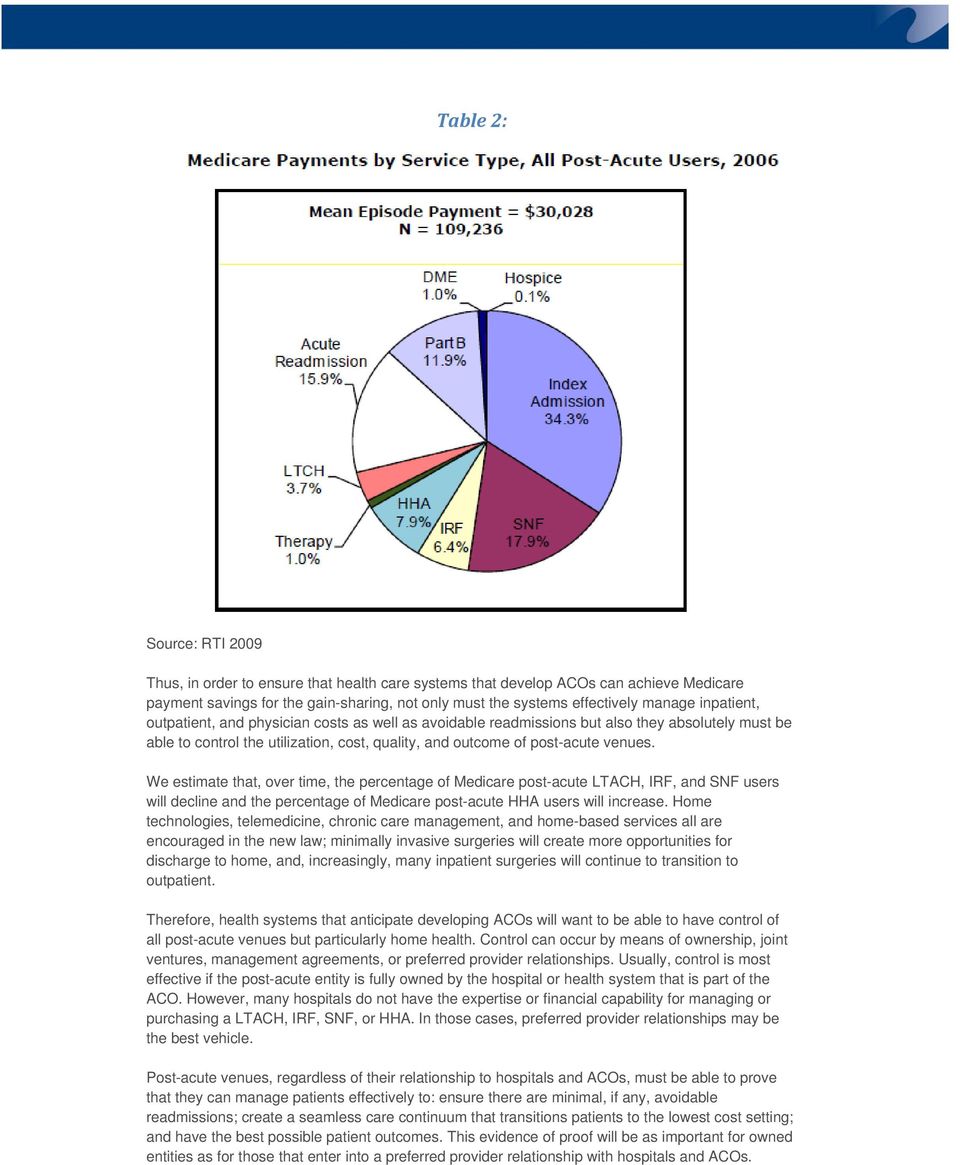
2 PAC Setting Table 1: Acute Hospital Readmissions from Post Acute Venues Discharged From Hospital to PAC Setting Rehospitalized After Using PAC Setting Died in PAC Setting Discharged to a Second PAC Setting Most Common Second PAC Setting Used SNF 17.3% 22.0% 5.4% 29.3% Home Health Home Health Hospice Inpatient Rehabilitation Home Health Hospice Home Health Long-Term Care Hospital Inpatient Psychiatric SNF SNF Total 40.0% 18.0% 6.2% 19.8% Source: MedPAC 2009 Thus, hospitals that are not able to control the quality of care and avoidable readmissions from post-acute venues are at great risk for Medicare payment penalties that can reach up to 3% of their aggregate Medicare payments in FY Accountable Care Organizations (ACOs) Beginning January 1, 2012, the new law establishes a shared savings program that promotes accountability for a Medicare fee-for-service patient population and coordinates items and services under Medicare Part A and Medicare Part B to optimize quality and efficiency in health care services delivery. ACOs include physicians and other providers that have a formal legal structure that allows the organization to receive and distribute payments for shared savings to participating providers of service and suppliers. ACOs must be responsible for a minimum of 5,000 Medicare fee-for-services beneficiaries and enter into a three-year contract with the Centers for Medicare and Medicaid Services (CMS) to manage the defined Medicare patient population. An ACO would be eligible to receive payment for shared savings if the estimated average per capital Medicare expenditures under the ACO for Medicare fee-for-service beneficiaries for parts A and B services, adjusted for beneficiary characteristics, is at least the percent specified below the CMS benchmark. The importance of ACOs cannot be underestimated for hospitals. ACOs provide an opportunity for hospitals to gain-share by being efficient and creating high quality patient outcomes. Today, many hospitals have negative margins on Medicare fee-for-service patient admissions. A mandated market basket reduction beginning in FY2014 and extending at least through FY2019 will likely further reduce hospital Medicare margins. Becoming an ACO and becoming eligible for shared savings may be one of the few methods available to hospitals and health care systems to remain financially viable, particularly as the percentage of Medicare admissions increases due to demographic factors, namely, the aging of America. According to RTI, 2009, the average payment for Medicare beneficiaries utilizing post-acute care in 2006 was $30,000. A key reason for this amount is the fact that many post-acute patients utilize more than one post-acute venue. Table 2 shows a breakdown of the average payment.

3 Table 2: Source: RTI 2009 Thus, in order to ensure that health care systems that develop ACOs can achieve Medicare payment savings for the gain-sharing, not only must the systems effectively manage inpatient, outpatient, and physician costs as well as avoidable readmissions but also they absolutely must be able to control the utilization, cost, quality, and outcome of post-acute venues. We estimate that, over time, the percentage of Medicare post-acute LTACH, IRF, and SNF users will decline and the percentage of Medicare post-acute HHA users will increase. Home technologies, telemedicine, chronic care management, and home-based services all are encouraged in the new law; minimally invasive surgeries will create more opportunities for discharge to home, and, increasingly, many inpatient surgeries will continue to transition to outpatient. Therefore, health systems that anticipate developing ACOs will want to be able to have control of all post-acute venues but particularly home health. Control can occur by means of ownership, joint ventures, management agreements, or preferred provider relationships. Usually, control is most effective if the post-acute entity is fully owned by the hospital or health system that is part of the ACO. However, many hospitals do not have the expertise or financial capability for managing or purchasing a LTACH, IRF, SNF, or HHA. In those cases, preferred provider relationships may be the best vehicle. Post-acute venues, regardless of their relationship to hospitals and ACOs, must be able to prove that they can manage patients effectively to: ensure there are minimal, if any, avoidable readmissions; create a seamless care continuum that transitions patients to the lowest cost setting; and have the best possible patient outcomes. This evidence of proof will be as important for owned entities as for those that enter into a preferred provider relationship with hospitals and ACOs.
4 3. Bundled Medicare payment A pilot project for bundling Medicare payments for all services related to an acute hospital admission, three days prior and 30 days after discharge, will begin on January 1, Initial focus will be on one or more of eight conditions and the single payment will apply to all of the following services provided during the episode: Acute inpatient services (hospital admissions and readmissions) Physician services (in and out of the hospital setting) Outpatient hospital services, including emergency department services Post-acute services The pilot is expected to include use of the Continuity Assessment Record and Evaluation (CARE) tool, or a similar tool, to determine the most clinically appropriate post-acute care venue. Payment will be made either as a single bundled payment or through bids from the entities desiring to participate in the pilot. Such entities must include a hospital, a physician group, a skilled nursing facility, and a home health agency. Assuming that the pilot program shows spending reductions while maintaining quality of care, the program will be expanded before or at least by January 1, The law implies that the pilot project will focus on the eight conditions found by MedPAC to have a high rate and volume of avoidable hospital readmissions for Medicare fee-for-service beneficiaries. It also is specific about the membership of an entity that desires to pilot bundled payment for one or more of these conditions: hospital, physician group, skilled nursing facility, and home health agency (emphasis added). Other post-acute providers may also become part of the entity; however, Congress appeared to understand that the fastest rate of Medicare cost increases for post-acute care has been in utilization of skilled nursing and home health, as shown in Table 3. Table 3: Medicare Post Acute Spending Increases Fueled by SNF and HHAs Source: MedPAC 2009

5 A fast moving trend today is seen in acquisition of physician practices by health care systems and formation of physician networks as integrated components of the systems. Hospitals and health systems that also own SNFs and HHAs are well positioned to become pilot projects for Medicare bundling. The motivation for becoming involved in the pilot is that health systems will be able to learn how to manage the care continuum early on, when payment rates are still being established, instead of being required to accept bundled payment once the pilot has been shown to be successful in maintaining quality of patient care and cost savings. Ownership or well integrated preferred provider relationships are essential for success under bundling. All members of the entity that receives the episodic bundled payment hospitalphysicians-snfs-hhas must be able to demonstrate success with quality measures, including those mentioned in the law: Functional status improvement Reducing rates of avoidable hospital admissions Rates of discharge to community Rates of admission to an emergency room after hospitalization Incidence of health care acquired infections Efficiency measures Measures of patient perception of care Other measures, including measures of patient outcomes Thus, each component of the entity that received the episodic bundled payment must rely on each of the other components to achieve the targets for quality measures in order to receive the anticipated amount of bundled Medicare payment for the episode. Adapting a famous quote from John Donne, no health care provider is an island. As is true for ACOs, bundled episodic payment requires that hospitals and health systems are able to manage the utilization, cost, quality, and outcomes for patients in any post-acute venue with one of the targeted conditions for bundling. Ownership of the SNF and HHA provides the best guarantee of control; however, as mentioned earlier, may health systems have neither the financial ability to purchase nor the expertise to manage these post-acute venues. Therefore, joint ventures and preferred provider relationships are other methods for integrating these post-acute venues with hospitals and physicians. Kathleen M. Griffin, Ph.D. is the National Director, Post Acute and Senior Services for Health Dimensions Group, Minneapolis, MN. She can be reached at or [email protected] Health Dimensions Group 4400 Baker Road, Suite 100 Minneapolis, MN

Post-acute care providers: Shortcomings in Medicare s fee-for-service highlight the need for broad reforms
 C h a p t e r7 Post-acute care providers: Shortcomings in Medicare s fee-for-service highlight the need for broad reforms C H A P T E R 7 Post-acute care providers: Shortcomings in Medicare s fee-for-service
2014: Volume 4, Number 1. A publication of the Centers for Medicare & Medicaid Services, Office of Information Products & Data Analytics
 2014: Volume 4, Number 1 A publication of the Centers for Medicare & Medicaid Services, Office of Information Products & Data Analytics Medicare Post-Acute Care Episodes and Payment Bundling Melissa Morley,¹
Blueprint for Post-Acute
 Blueprint for Post-Acute Care Reform Post-acute care is a critical component within our nation s healthcare system and an essential aspect of care for many patients making a full recovery possible after
Summary: The Improving Medicare Post-Acute Care Transformation Act of 2014 (The IMPACT Act) (H.R. 4994/S. 2553) Overview
 Transformation Act of 2014 (The IMPACT Act) (H.R. 4994/S. 2553) Overview The IMPACT Act amends Title XVIII of the Social Security Act to require post-acute care (PAC) providers to report and share standardized
1,146 1,097 1,008. 2000 2001 2002 2003 2004 2005 2006 2007 2008 2009 2010 2011 2012 Year
 Chairman Brady, Ranking Member McDermott, distinguished Committee members. I am Mark Miller, executive director of the Medicare Payment Advisory Commission (MedPAC). I appreciate the opportunity to be
BUNDLING ARE INPATIENT REHABILITATION FACILITIES PREPARED FOR THIS PAYMENT REFORM?
 BUNDLING ARE INPATIENT REHABILITATION FACILITIES PREPARED FOR THIS PAYMENT REFORM? Uniform Data System for Medical Rehabilitation Annual Conference August 10, 2012 Presented by: Donna Cameron Rich Bajner
Reimbursement Outlook and Analysis
 HIDA Webinar Series Reimbursement Outlook and Analysis SNFs, HHAs, & IRFs Agenda Current Regulatory Landscape Skilled Nursing Facilities Home Health Agencies Independent Rehab Facilities Healthcare Reform
How Will Hospital Readmission Penalties Impact Skilled Nursing Facilities?
 How Will Hospital Readmission Penalties Impact Skilled Nursing Facilities? Patrick V. Trotta, CPA Director of ElderCare Provider Services Glass Jacobson [email protected] 410 356 1000 Presentation
How To Reduce Hospital Readmission
 Reducing Hospital Readmissions & The Affordable Care Act The Game Has Changed Drastically Reducing MSPB Measures Chuck Bongiovanni, MSW, MBA, NCRP, CSA, CFE Chuck Bongiovanni, MSW, MBA, NCRP, CSA, CFE
Population Health Management: Banner Health Network s Perspective. Neta Faynboym, Medical Director Banner Health Network
 Population Health Management: Banner Health Network s Perspective Neta Faynboym, Medical Director Banner Health Network 29 Acute Care Hospitals BANNER AT A GLANCE Banner Health Network with 400K lives
Last January, the parent organization of CMS, the Department of Health and
 Executive White Paper Series April 2015 In Cooperation With: This white paper series is produced by the LINK Conference, whose mission is to accelerate productivity and innovation in long term care and
A Project to Reengineer Discharges Reduces 30-Day Hospital Readmission Rates. April 11, 2014
 A Project to Reengineer Discharges Reduces 30-Day Hospital Readmission Rates April 11, 2014 About the QIO Program Leading rapid, large-scale change in health quality: Goals are bolder. The patient is at
ACOs and Bundled Payments. The Patient Protection and Affordable Care Act (ACA) I. The Basics. Medicare s Financial Condition
 ACOs and Bundled Payments ACO and Bundled Payments What You Need To Know Missouri Health Care Association August 2014 Brian Hickman, CPA Brad Brotherton, CPA Sherri Robbins, RN, LNHA, CLNC, RAC-CT I. The
Moving Towards Bundled Payment
 ISSUE BRIEF Moving Towards Bundled Payment Introduction The fee-for-service system of payment for health care services is widely thought to be one of the major culprits in driving up U.S. health care costs.
The Right Care for the Right Cost: Post-Acute Care and the Triple Aim. Tianna Tu Ike Bennion Michelle Templin
 The Right Care for the Right Cost: Tianna Tu Ike Bennion Michelle Templin September 2014 The Right Care for the Right Cost: Tianna Tu Ike Bennion Michelle Templin CONTENTS Introduction.... 1 What is Post-Acute
Creating Strategic Alliances for Post-Acute Coordination of Care
 Creating Strategic Alliances for Post-Acute Coordination of Care Kathleen Yosko, PhD President/CEO Wheaton Franciscan Health Care Sole Illinois property Free-standing facility 101 IRF beds 27 SNF beds
Presented by Kathleen S. Wyka, AAS, CRT, THE AFFORDABLE CA ACT AND ITS IMPACT ON THE RESPIRATORY C PROFESSION
 Presented by Kathleen S. Wyka, AAS, CRT, THE AFFORDABLE CA ACT AND ITS IMPACT ON THE RESPIRATORY C PROFESSION At the end of this session, you will be able to: Identify ways RT skills can be utilized for
Use and Value of Data Analytics. Comparative Effectiveness Study Inpatient Rehab Hospital (IRH) vs. Skilled Nursing Facility (SNF)
 Use and Value of Data Analytics Comparative Effectiveness Study Inpatient Rehab Hospital (IRH) vs. Skilled Nursing Facility (SNF) Ryan Wilson Vice President of Managed Care HealthSouth Corporation Gerry
Narrow network health plans: New approaches to regulating adequacy and transparency. Michael S. Adelberg
 Compliance TODAY October 2015 a publication of the health care compliance association www.hcca-info.org Combating healthcare fraud in New Jersey an interview with Paul J. Fishman United States Attorney
DEPARTMENT OF HEALTH AND HUMAN SERVICES Centers for Medicare & Medicaid Services. Discharge Planning
 DEPARTMENT OF HEALTH AND HUMAN SERVICES Centers for Medicare & Medicaid Services ICN 908184 October 2014 This booklet was current at the time it was published or uploaded onto the web. Medicare policy
Integrating Post-Acute Providers with Health System Strategies
 Integrating Post-Acute Providers with Health System Strategies Bridging the Acute and Post-Acute Worlds The opinions expressed are those of the presenter and do not necessarily state or reflect the views
Inpatient Transfers, Discharges and Readmissions July 19, 2012
 Inpatient Transfers, Discharges and Readmissions July 19, 2012 Discharge Status Codes Two-digit code Identifies where the patient is at conclusion of encounter Visit Inpatient stay End of billing cycle
Structuring Your ACO Business Model To Achieve Success in a Post Acute Continuum. 2011 Annual Summit of the Executive Operators Forum
 Structuring Your ACO Business Model To Achieve Success in a Post Acute Continuum 2011 Annual Summit of the Executive Operators Forum Healthcare Reform and What it Means to You Loren Claypool CIO, Extendicare
Post-Acute Opportunities in Population Health Management
 Post-Acute Opportunities in Population Health Management Opening Questions Types of facilities Roles Parts of a Pioneer, Medicare Shared Savings Program (MSSP) or Commercial ACO network In a bundled payment
What do ACO s and Hospitals want from SNF s and CCRC s
 What do ACO s and Hospitals want from SNF s and CCRC s Presented to the Institute of Senior Living, April 11, 2013 A Division of Kindred Healthcare 1 Assessing the match: What hospitals and ACO s currently
Value Based Care and Healthcare Reform
 Value Based Care and Healthcare Reform Dimensions in Cardiac Care November, 2014 Jacqueline Matthews, RN, MS Senior Director, Quality Reporting & Reform Quality and Patient Safety Institute Cleveland Clinic
4/27/2015. LeadingAge Michigan 2015 Annual Conference Dearborn, MI Monday May 18th, 2015. Jon Golm, President
 LeadingAge Michigan 2015 Annual Conference Dearborn, MI Monday May 18th, 2015 Jon Golm, President Aging Improving Enriched Post Discharge Services, LLC Outcomes Mike Logan, SVP/COO Wellspring Lutheran
June 2, 2014. RE: File Code CMS-1608-P. Dear Ms. Tavenner:
 . June 2, 2014 Marilyn Tavenner Centers for Medicare & Medicaid Services Room 445-G, Hubert H. Humphrey Building 200 Independence Avenue SW Washington, DC RE: File Code CMS-1608-P Dear Ms. Tavenner: The
Assessment of Patient Outcomes of Rehabilitative Care Provided in Inpatient Rehabilitation Facilities (IRFs) and After Discharge
 Assessment of Patient Outcomes of Rehabilitative Care Provided in Inpatient Rehabilitation Facilities (IRFs) and After Discharge PREPARED FOR: ARA Research Institute PRESENTED BY: Al Dobson, Ph.D. PREPARED
Reforming and restructuring the health care delivery system
 Reforming and restructuring the health care delivery system Are Accountable Care Organizations and bundling the solution? Prepared by: Dan Head, Principal, RSM US LLP [email protected], +1 703 336 6536
Critical Access Hospitals and
 Critical Access Hospitals and Health Care Reform What s in it for you? Patient Protection and Affordable Care Act (ACA) Fundamental changes Moving Medicare from payment for services to payment for outcomes
Massachusetts Acute Care Hospital Readmissions Profile: July, 2012 to June, 2013 Boston Medical Center September 2015
 Massachusetts Acute Care Hospital Readmissions Profile: July, 2012 to June, 2013 Boston Medical Center September 2015 In June, 2015 the Center for Health Information and Analysis (CHIA) released Hospital-Wide
Medicare Provisions in the Patient Protection and Affordable Care Act (PPACA): Summary and Timeline
 Medicare Provisions in the Patient Protection and Affordable Care Act (): Summary and Timeline Patricia A. Davis, Coordinator Specialist in Health Care Financing Jim Hahn Analyst in Health Care Financing
Readmissions as an Enterprise Priority. Presenters 4/17/2014
 Readmissions as an Enterprise Priority April 24, 2014 Presenters Vincent A. Maniscalco, MPA, LNHA Administrator Middletown Park Rehabilitation and Health Care Center [email protected] Eileen
Risk Adjustment in the Medicare ACO Shared Savings Program
 Risk Adjustment in the Medicare ACO Shared Savings Program Presented by: John Kautter Presented at: AcademyHealth Conference Baltimore, MD June 23-25, 2013 RTI International is a trade name of Research
CURRENT AND FUTURE TRENDS IN POST ACUTE CARE The Value and Role of Acute Inpatient Rehab
 CURRENT AND FUTURE TRENDS IN POST ACUTE CARE The Value and Role of Acute Inpatient Rehab Robert S. Djergaian, M.D. Medical Director Banner Good Samaritan Rehabilitation Institute Stewardship Profitability
Bundle Care Care Tool Affordable Insurance Exchanges
 See attached resources for further information about the Health Care Reform buzz words for 2013. Bundle Care Care Tool Affordable Insurance Exchanges CMS - Bundled Payments for Care Improvement Initiative
1900 K St. NW Washington, DC 20006 c/o McKenna Long
 1900 K St. NW Washington, DC 20006 c/o McKenna Long Centers for Medicare & Medicaid Services U. S. Department of Health and Human Services Attention CMS 1345 P P.O. Box 8013, Baltimore, MD 21244 8013 Re:
Henry Ford Health System Care Coordination and Readmissions Update
 Henry Ford Health System Care Coordination and Readmissions Update September 2013 BACKGROUND Most hospital readmissions are viewed as avoidable, costly, and in some cases as a potential marker of poor
Value-Based Payment and Health System Transformation
 Value-Based Payment and Health System Transformation National Health Policy Forum Patrick Conway, M.D., MSc CMS Chief Medical Officer Deputy Administrator for Innovation and Quality Director, Center for
Proposed Rule: Medicare Program; Medicare Shared Savings Program; Accountable Care Organizations (CMS-1461-P)
 Via online submission to http://www.regulations.gov February 6, 2015 Sylvia M. Burwell Administrator Centers for Medicare & Medicaid Services Department of Health and Human Services Attention: CMS 1461
Aiming for Fewer Hospital U-turns: The Medicare Hospital Readmission Reduction Program
 Aiming for Fewer Hospital U-turns: The Medicare Hospital Readmission Reduction Program Cristina Boccuti and Giselle Casillas For Medicare patients, hospitalizations can be stressful; even more so when
Health care trend: Developing ACOs
 Health care trend: Health care trend: Accountable Care Organizations (ACOs) have been a significant topic within health care. While many organizations have embarked on a quest to embrace ACOs as quickly
Nursing and Health Reform
 Nursing and Health Reform The Patient Protection and Affordable Care Act (PPACA) was signed into law by President Obama on March 23, 2010. This law will enact sweeping changes to almost every facet of
Fiscal Year 2016 proposed Inpatient and Long-term Care Hospital policy and payment changes (CMS-1632-P)
 Fiscal Year 2016 proposed Inpatient and Long-term Care Hospital policy and payment changes (CMS-1632-P) Date 2015-04-17 Title Fiscal Year 2016 proposed Inpatient and Long-term Care Hospital policy and
TrendWatch. Today, patients often require a diverse. Maximizing the Value of Post-acute Care. Patient severity of illness varies by PAC setting.
 American Hospital association November 2010 TrendWatch Maximizing the Value of Post-acute Care Today, patients often require a diverse array of services to treat major health episodes, manage chronic disease
Federal Health Care Reform: Implications for Hospital and Physician partnerships. Walter Kopp Medical Management Services
 Federal Health Care Reform: Implications for Hospital and Physician partnerships Walter Kopp Medical Management Services Outline Overview of federal health reform legislation Implications for Care delivery
CMS National Dry Run: All-Cause Unplanned Readmission Measure for 30 Days Post Discharge from Inpatient Rehabilitation Facilities
 CMS National Dry Run: All-Cause Unplanned Readmission Measure for 30 Days Post Discharge from Inpatient Rehabilitation Facilities Special Open Door Forum October 20, 2015 2-3 PM ET RTI International is
May 7, 2012. Submitted Electronically
 May 7, 2012 Submitted Electronically Secretary Kathleen Sebelius Department of Health and Human Services Office of the National Coordinator for Health Information Technology Attention: 2014 edition EHR
A DATA BOOK. Health Care Spending and the Medicare Program
 J U N E 2 0 1 5 A DATA BOOK Health Care Spending and the Medicare Program J U N E 2 0 1 5 A DATA BOOK Health Care Spending and the Medicare Program The MedPAC Data Book provides information on national
UNIVERSITY OF VIRGINIA BOARD OF VISITORS MEETING OF THE MEDICAL CENTER OPERATING BOARD FOR THE UNIVERSITY OF VIRGINIA TRANSITIONAL CARE HOSPITAL
 UNIVERSITY OF VIRGINIA BOARD OF VISITORS MEETING OF THE MEDICAL CENTER OPERATING BOARD FOR THE UNIVERSITY OF VIRGINIA TRANSITIONAL CARE HOSPITAL FEBRUARY 18, 2016 UNIVERSITY OF VIRGINIA MEDICAL CENTER
Sustainable Growth Rate (SGR) Repeal and Replace: Comparison of 2014 and 2015 Legislation
 Sustainable Growth Rate (SGR) Repeal and Replace: Comparison of 2014 and 2015 Legislation Proposal 113 th Congress - - H.R.4015/S.2000 114 th Congress - - H.R.1470 SGR Repeal and Annual Updates General
ST JOHN S LUTHERAN MINISTRIES. Kent Burgess President & CEO
 ST JOHN S LUTHERAN MINISTRIES Kent Burgess President & CEO WHAT S CHANGING MAYBE? -The way we get paid (Reduce Cost) -The way we get measured (Better Care) -What will be required of us (More) -Partnerships/Affiliations
How To Write A Health Care Plan
 Data Standardization: Looking Forward in Post-Acute Care Stella Mandl, RN Technical Advisor Centers for Medicare & Medicaid Services As Is T ransit io n To Be Nursing Homes MDS LTCHS LTCH CARE Data Set
Site-neutral payments for select conditions treated in inpatient rehabilitation facilities and skilled nursing facilities
 C h a p t e r6 Site-neutral payments for select conditions treated in inpatient rehabilitation facilities and skilled nursing facilities C H A P T E R 6 Site-neutral payments for select conditions treated
Empowering Value-Based Healthcare
 Empowering Value-Based Healthcare Episode Connect, Remedy s proprietary suite of software applications, is a powerful platform for managing value-based payment programs. Delivered via the web or mobile
Affordable Care Act at 3: Strengthening Medicare
 Affordable Care Act at 3: Strengthening Medicare ISSUE BRIEF Fifth in a series May 22, 2013 Kyle Brown Senior Health Policy Analyst 789 Sherman St. Suite 300 Denver, CO 80203 www.cclponline.org 303-573-5669
MEDICARE. Results from the First Two Years of the Pioneer Accountable Care Organization Model
 United States Government Accountability Office Report to the Ranking Member, Committee on Ways and Means, House of Representatives April 2015 MEDICARE Results from the First Two Years of the Pioneer Accountable
Using Partial Capitation as an Alternative to Shared Savings to Support Accountable Care Organizations in Medicare
 December 2010 Using Partial Capitation as an Alternative to Shared Savings to Support Accountable Care Organizations in Medicare CONTENTS Background... 2 Problems with the Shared Savings Model... 2 How
7/31/2014. Medicare Advantage: Time to Re-examine Your Engagement Strategy. Avalere Health. Eric Hammelman, CFA. Overview
 Medicare Advantage: Time to Re-examine Your Engagement Strategy July 2014 avalerehealth.net Avalere Health Avalere Health delivers research, analysis, insight & strategy to leaders in healthcare policy
PATTERNS OF POST-ACUTE UTILIZATION IN RURAL AND URBAN COMMUNITIES: HOME HEALTH, SKILLED NURSING, AND INPATIENT MEDICAL REHABILITATION.
 PATTERNS OF POST-ACUTE UTILIZATION IN RURAL AND URBAN COMMUNITIES: HOME HEALTH, SKILLED NURSING, AND INPATIENT MEDICAL REHABILITATION Final Report March 2005 Janet P. Sutton, Ph.D. NORC Walsh Center for
INTEGRATION STRATEGIES FOR A NEW HEALTH CARE ECONOMY
 INTEGRATION STRATEGIES FOR A NEW HEALTH CARE ECONOMY Thomas William Baker Baker Donelson Bearman Caldwell & Berkowitz, P.C. Atlanta, Georgia (404) 221-6510 [email protected] Prepared for East Georgia
FINANCIAL IMPLICATIONS OF EXCESS HOSPITAL READMISSIONS JOSESPH B. HENDERSON, J.D.
 FINANCIAL IMPLICATIONS OF EXCESS HOSPITAL READMISSIONS JOSESPH B. HENDERSON, J.D. Executive MHA Candidate, 2013 University of Southern California Sol Price School of Public Policy Abstract A 2007 Medicare
The Future of Home Health Care Project MAY 2014
 The Alliance for Home Health Quality & Innovation The Future of Home Health Care Project MAY 2014 About the Alliance The Alliance for Home Health Quality & Innovation is a 501(c)(3) foundation with a mission
Accelerating Innovation in Health Care Payment and Delivery: The CMS Innovation Center
 Accelerating Innovation in Health Care Payment and Delivery: The CMS Innovation Center William J. Kassler, MD, MPH Chief Medical Officer, New England Region Center for Medicare & Medicaid Innovation We
Performance Measurement in CMS Programs Kate Goodrich, MD MHS Director, Quality Measurement and Health Assessment Group, CMS
 Performance Measurement in CMS Programs Kate Goodrich, MD MHS Director, Quality Measurement and Health Assessment Group, CMS Mind the Gap: Improving Quality Measures in Accountable Care Systems October
PIONEER ACO A REVIEW OF THE GRAND EXPERIMENT. Norris Vivatrat, MD Associate Medical Director Monarch HealthCare
 PIONEER ACO A REVIEW OF THE GRAND EXPERIMENT Norris Vivatrat, MD Associate Medical Director Monarch HealthCare 2 Agenda Pioneer ACO basics, performance and challenges Monarch HealthCare Post-acute network
Anatomy of an ACO. Through the Eyes of a Physician-owned IPA. Genesis Accountable Care Organization
 Anatomy of an ACO Through the Eyes of a Physician-owned IPA Genesis: IPA by the Numbers 1,400 Physicians PCPs 500 900 SCPs 700 Practices 400 Square miles in North Texas Genesis: Challenges for Change Pressure
Accountable Care Organizations: Opportunities & Challenges for SNFs
 Accountable Care Organizations: Opportunities & Challenges for SNFs James Michel Director, Medicare Research & Reimbursement American Health Care Association 1 Today s Agenda 1 How Reform is Changing Medicare