
Self-study for the EUA review of the Wageningen University PhD programme
|
|
|
- Alaina Sherman
- 10 years ago
- Views:
Transcription
1 Wageningen UR P.O. Box AA Wageningen The Netherlands T +31 (0) Self-study for the EUA review of the Wageningen University PhD programme

2

3 Self-study for the EUA review of the Wageningen University PhD programme Wageningen UR Wageningen, December 2014
4 Contents 1 Aim and context of the evaluation Setting and key questions of the evaluation Definitions and terminology used The PhD in the Netherlands The PhD in Wageningen Research environment 6 2 Structures in the Wageningen PhD programme Aim and learning targets Diversity of PhD candidates Organisational structure Budgets and incentives Support for PhD candidates with problems 11 3 Processes in the Wageningen PhD programme Start and formal admission Evaluation of project proposal Supervision Monitoring of progress Thesis evaluation and graduation ceremony Monitoring the PhD experience 15 4 PhD training and education Introduction The Training and Supervision Plan Training and education offered National and international collaboration Extracurricular activities 18 5 Outcomes of the Wageningen PhD programme Results of PhD experience surveys Time-to-degree and completion rate Thesis quality and contribution to science Employability and career success 23 6 SWOT analysis Analysis Conclusions Questions to the evaluation team 26 Online links 27 Annex A Composition of the evaluation team, Programme of the site visit, Acronyms, Literature 28 Annex B Project proposal form 30 Annex C Training and Supervision Plan form 35 Annex D Go/no go form 37 Annex E Thesis evaluation form 41 Annex F Training and courses offered 44

5 1 Aim and context of the evaluation 1.1 Setting and key questions of the evaluation Wageningen University and Research Centre is a collaboration between Wageningen University (WU) and DLO institutes for strategic and applied research. The joint mission is to explore the potential of nature to improve the quality of life. About 10,000 Bachelor and Master students, 1,900 PhD candidates and 6,500 staff work in the pursuit of this mission for the benefit of science, policy, business and society at large. In the Dutch national research evaluation system, all university research is evaluated by a peer review once every six years. While the national review system offers a comprehensive feedback focused on research groups, WU has asked EUA Solutions to provide additional input with regard to the overall management of its PhD programme, focusing on structures and processes, and on the admission, training and examination of PhD candidates. These aspects are not completely covered by the national review system. The key questions for this evaluation are to determine whether: 1. The learning targets of the Wageningen PhD programme meet international standards. 2. The Wageningen PhD programme has the structure and processes in place for PhD candidates to attain these learning targets. The PhD programme in Wageningen is coordinated by six graduate schools. Four of these schools are national graduate schools, consisting of research groups from several universities. In these cases, the EUA evaluation will only focus on the Wageningen part of the school. 1.2 Definitions and terminology used Terminology used in higher education differs across countries. In this self-study, the terminology will be as commonly used in the Netherlands: PhD candidate = doctoral candidate, PhD student. PhD programme = doctoral programme. PhD degree = doctoral degree, doctorate. PhD thesis = dissertation. Graduate school doctoral school, research school (see also section 1.3). 1.3 The PhD in the Netherlands The first PhD degree in the Netherlands was conferred in 1644 at the University of Utrecht. Like elsewhere in Europe, the PhD gradually changed from a licence to teach to a research degree. The modern doctorate in the Netherlands started in 1920, when a PhD degree merely on propositions was no longer allowed by law. While some traditional ceremonies, such as the public defence, have essentially not changed, the PhD population did change: Increasing numbers of PhD candidates since the 1970s, in line with the global trend. Increasing diversity in the population of PhD candidates since the 1990s, in terms of gender, origin and previous education, as a result of emancipation and increasing mobility. Self-study for the EUA review of the Wageningen University PhD programme 3

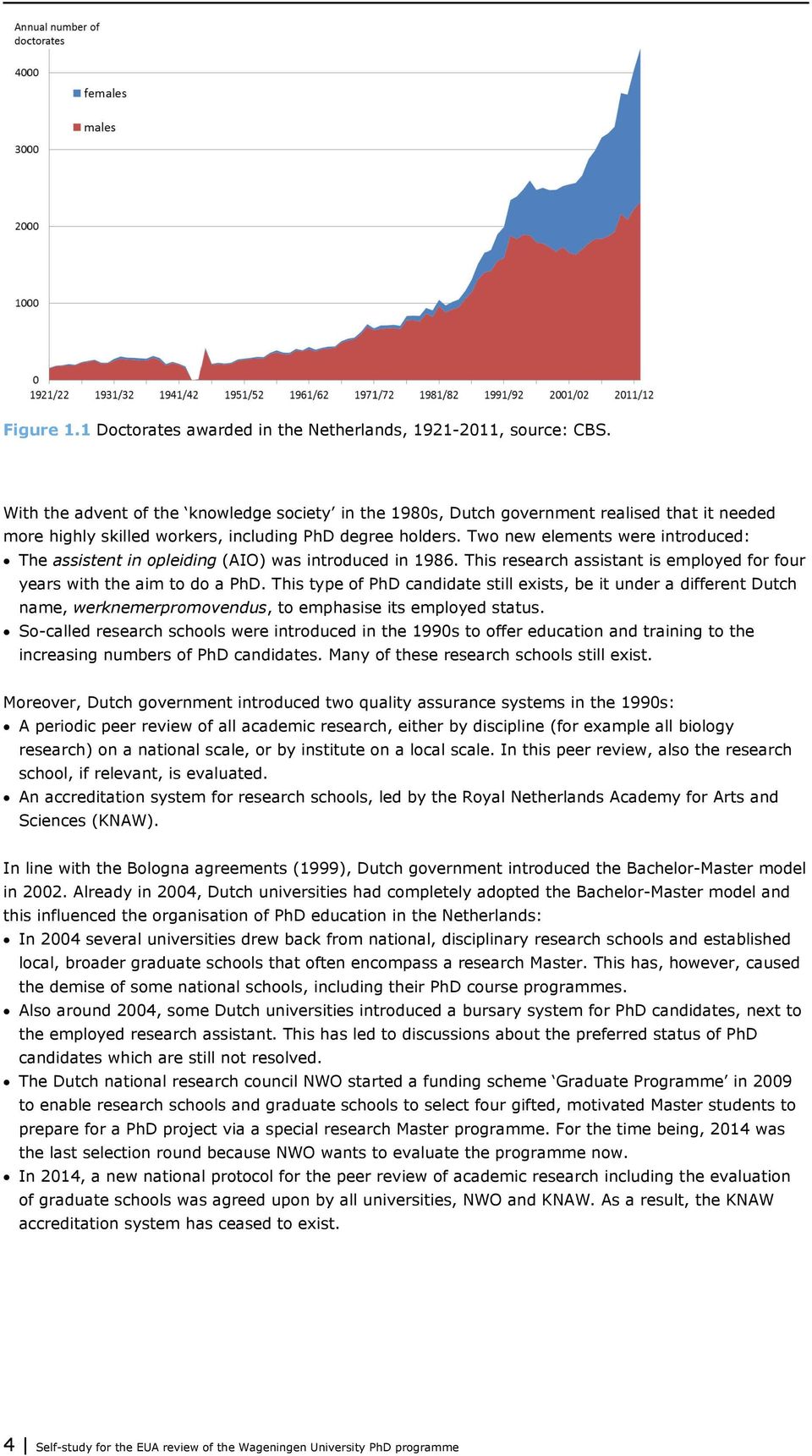
6 Figure 1.1 Doctorates awarded in the Netherlands, , source: CBS. With the advent of the knowledge society in the 1980s, Dutch government realised that it needed more highly skilled workers, including PhD degree holders. Two new elements were introduced: The assistent in opleiding (AIO) was introduced in This research assistant is employed for four years with the aim to do a PhD. This type of PhD candidate still exists, be it under a different Dutch name, werknemerpromovendus, to emphasise its employed status. So-called research schools were introduced in the 1990s to offer education and training to the increasing numbers of PhD candidates. Many of these research schools still exist. Moreover, Dutch government introduced two quality assurance systems in the 1990s: A periodic peer review of all academic research, either by discipline (for example all biology research) on a national scale, or by institute on a local scale. In this peer review, also the research school, if relevant, is evaluated. An accreditation system for research schools, led by the Royal Netherlands Academy for Arts and Sciences (KNAW). In line with the Bologna agreements (1999), Dutch government introduced the Bachelor-Master model in Already in 2004, Dutch universities had completely adopted the Bachelor-Master model and this influenced the organisation of PhD education in the Netherlands: In 2004 several universities drew back from national, disciplinary research schools and established local, broader graduate schools that often encompass a research Master. This has, however, caused the demise of some national schools, including their PhD course programmes. Also around 2004, some Dutch universities introduced a bursary system for PhD candidates, next to the employed research assistant. This has led to discussions about the preferred status of PhD candidates which are still not resolved. The Dutch national research council NWO started a funding scheme Graduate Programme in 2009 to enable research schools and graduate schools to select four gifted, motivated Master students to prepare for a PhD project via a special research Master programme. For the time being, 2014 was the last selection round because NWO wants to evaluate the programme now. In 2014, a new national protocol for the peer review of academic research including the evaluation of graduate schools was agreed upon by all universities, NWO and KNAW. As a result, the KNAW accreditation system has ceased to exist. 4 Self-study for the EUA review of the Wageningen University PhD programme
7 1.4 The PhD in Wageningen Wageningen University is one of the 14 public universities in the Netherlands. It was established as Landbouwhogeschool in 1918 and conferred its first PhD degree in At that time the university was focused on Dutch and colonial agriculture. In the 1970s, its field became much broader and also its international orientation broadened. In 1999, Wageningen University joined with several DLO institutes to form Wageningen University and Research Centre. Figure 1.2 Organisation of Bachelor, Master and PhD programmes in the five WU departments. Wageningen University has one faculty, which is divided into five departments. The core of the organisation is formed by the 90 chair groups, each headed by a full professor. Personal chairs, endowed chairs, associate and assistant professors form the rest of the tenured staff. PhD candidates work within a chair group, along with postdocs and technical staff, often in collaboration with another chair group, a DLO institute or a partner from outside Wageningen UR. The PhD programme is coordinated by the six graduate schools that exist since the 1990s. Unlike their name might suggest, the graduate schools in Wageningen are not responsible for the Master study. However, since a few years, the graduate schools are involved in so-called Research Master programmes that prepare students for a career in research, and a PhD in particular. Also, in the past five years, all graduate schools in Wageningen have applied successfully for the prestigious NWO Graduate Programme that allows selected Master students to prepare for a PhD. Figure 1.3 PhD graduations at Wageningen University. Self-study for the EUA review of the Wageningen University PhD programme 5

8 1.5 Research environment The strength of Wageningen UR lies in its ability to combine the forces of Wageningen University and its application-oriented and field-based DLO research institutes. Its strength also lies in the interaction of the various fields of natural and social sciences that allow for an integrated approach to both fundamental and applied research. This union of expertise leads to scientific breakthroughs that can quickly be put into practice and be incorporated in education. University rankings have become important nowadays, especially for international students. A few examples: The Times Higher Education World University Rankings 2014 again placed Wageningen UR in the top-100 in the world. It takes place 73 in the prestigious ranking, which is high for a specialised university. Wageningen UR is considered a leading university in its research domain worldwide. It ranks first in agricultural research according to the new ranking of US News and the National Taiwan University Ranking, and second by QS World University Rankings in the category Agriculture & Forestry. Also, QS places Wageningen UR in the worldwide top-10 in Environmental Sciences. Every six years, the research programmes of Wageningen University are evaluated by international peer review committees. Here are a few examples of these review reports: Wageningen Institute for Environment and Climate Research (WIMEK) was reviewed in The reviewers said: We salute the academic reputation of WIMEK. Both in the self-assessment report as well as the interviews and subsequent meetings with the PhD students we received a very felicitous impression of intellectual rigour, of joy in being in this active research community, and of overall excellence. All biology research in the Netherlands was subjected to an international peer review through QANU (Quality Assurance Netherlands Universities) in Wageningen University had the highest average score per research group of all six universities that participated in the review. Wageningen School of Social Sciences (WASS) was reviewed in The review report says: The quality and commitment of the research staff in the social sciences is considered to be high by the peer review committee. Output is of high quality and often also has a relevant impact for stakeholders. To summarise, we believe that Wageningen University attracts so many PhD candidates from all over the world because it offers an excellent research environment. 6 Self-study for the EUA review of the Wageningen University PhD programme
9 2 Structures in the Wageningen PhD programme 2.1 Aim and learning targets Wageningen University aims at a four-year PhD programme. The core of the programme is the PhD research project: planning and performing research, reporting the results and presenting them to an international audience. The usual size of the thesis is equivalent to four papers published or publishable in international scientific journals, plus an introduction and a synthesis, often called general discussion, at the end. PhD candidates spend up to 15% of their time on training and education, such as courses, seminars, conferences and workshops to broaden their skills, deepen their knowledge and increase their exposure to the international scientific community. The aim is to attain T-shaped skills as explained in figure 2.1. Employed PhD candidates have the option to spend up to 10% of their time teaching and supervising Master students who participate in the research of the PhD candidate. Professional skills & interdisciplinary overview In-depth disciplinary knowledge Figure 2.1 The principle of T-shaped skills. According to the Doctoral degree regulations of Wageningen University the recipient of the doctorate is capable of: 1. Functioning as an independent practitioner of science, as shown by: a. Formulating scientific questions, whether based on social issues or scientific progress; b. Conducting original scientific research; c. Publishing articles in leading journals, publishing books with leading publishers or making a technical design; 2. Integrating his or her own research in, or placing it within the framework of, the corresponding scientific discipline and against the background of a broader scientific area; 3. Placing the research aims and research results in a societal context; 4. Postulating concisely worded propositions in scientific and societal areas, formulated in such a way that they are subject to opposition and defence. Self-study for the EUA review of the Wageningen University PhD programme 7

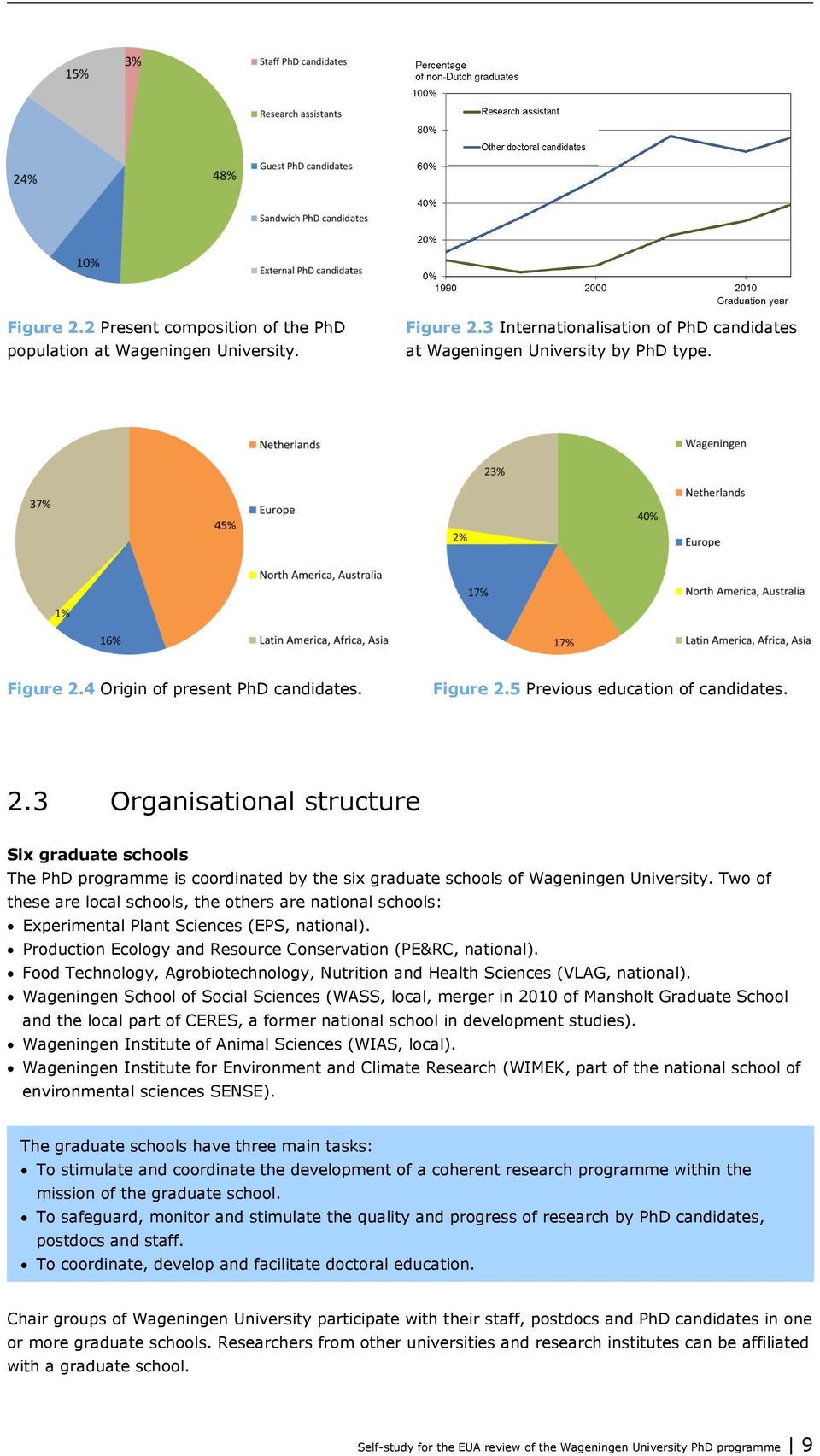
10 2.2 Diversity of PhD candidates At Wageningen University, five types of PhD candidates can be distinguished: Staff PhD candidate Staff PhD candidates are tenured or temporary employees of Wageningen University who are given the opportunity to conduct PhD research besides their regular tasks. This category is very small now because scientific staff enters university with a PhD degree. This category includes technical staff that pursues a PhD. Research assistant Research assistants are employed by Wageningen UR and selected through normal job application procedures. This category makes up about 40% of the PhD population. They are initially appointed for a period of 18 months. A contract for the remaining duration of the PhD project is considered only if the first period has been positively evaluated (the go/no-go evaluation). The appointment period is four years in total, on a full-time basis. At the request of the parties involved that can be changed to five years on a 0.8 basis. In case of illness, pregnancy or other delay, a contract extension can be given. The collective labour agreement of Dutch universities applies. Guest PhD candidate Guest PhD candidates perform their research at Wageningen University but are not employed by the university. These candidates usually have a fellowship or grant for four years from a local, national or international funding agency. When applying for a PhD programme, these candidates must show that they have appropriate financial support and a firm commitment from the relevant department or institute at Wageningen University. Guest PhD candidates pay a tuition fee of 1000 per month. Sandwich PhD candidate Sandwich PhD candidates are mostly international PhD candidates who spend part of their PhD at Wageningen University. Generally they are in Wageningen for the first and the last 6-8 months of their project with possible short periods in between. In the intermediate period the PhD candidates do research in their home country or home institute under co-supervision of a local supervisor. The first 6-8 months is spent on elaborating on the proposal, taking courses and preparing for the research, while the final period is spent completing the thesis at Wageningen University. A sandwich PhD project contributes to local capacity building and requires agreed commitment and support from both the Wageningen supervisor and the home institute in the country of origin. The research of a sandwich PhD candidate is often of direct interest to the home institute, dealing with a local or regional topic. Sandwich PhD candidates pay a tuition fee of 1000 per month stay in Wageningen, except for those funded by Wageningen University or by the Dutch national research council NWO. External PhD Candidate External PhD candidates are not employed by Wageningen University and they conduct or have conducted their research outside Wageningen University. The link with Wageningen University is primarily via the supervisor. External PhD candidates do not pay a tuition fee. Despite their differences in status, all PhD candidates at Wageningen University are regarded as early stage researchers with, as much as possible, equal rights and duties. The present diversity of the PhD population in Wageningen can further be characterised by: Gender: 50% of PhD candidates is female, similar to the national average. Origin: on average, more than 50% of PhD candidates comes from abroad (figure 2.4) but there is a difference between research assistants and other candidates (figure 2.3). Previous education: 40% of PhD candidates has a Wageningen Master degree (figure 2.5). 8 Self-study for the EUA review of the Wageningen University PhD programme

11 Figure 2.2 Present composition of the PhD population at Wageningen University. Figure 2.3 Internationalisation of PhD candidates at Wageningen University by PhD type. Figure 2.4 Origin of present PhD candidates. Figure 2.5 Previous education of candidates. 2.3 Organisational structure Six graduate schools The PhD programme is coordinated by the six graduate schools of Wageningen University. Two of these are local schools, the others are national schools: Experimental Plant Sciences (EPS, national). Production Ecology and Resource Conservation (PE&RC, national). Food Technology, Agrobiotechnology, Nutrition and Health Sciences (VLAG, national). Wageningen School of Social Sciences (WASS, local, merger in 2010 of Mansholt Graduate School and the local part of CERES, a former national school in development studies). Wageningen Institute of Animal Sciences (WIAS, local). Wageningen Institute for Environment and Climate Research (WIMEK, part of the national school of environmental sciences SENSE). The graduate schools have three main tasks: To stimulate and coordinate the development of a coherent research programme within the mission of the graduate school. To safeguard, monitor and stimulate the quality and progress of research by PhD candidates, postdocs and staff. To coordinate, develop and facilitate doctoral education. Chair groups of Wageningen University participate with their staff, postdocs and PhD candidates in one or more graduate schools. Researchers from other universities and research institutes can be affiliated with a graduate school. Self-study for the EUA review of the Wageningen University PhD programme 9
12 Each graduate school has its own research field and mission and is led by a scientific director, assisted by an executive secretary and education coordinator. Each school has: a Board consisting of tenured staff and PhD candidates, an Education Committee consisting of tenured staff and PhD candidates, an International Advisory Board consisting of senior peers from science, society and industry, a PhD Council. Each graduate schools receives a budget from the university for: Scientific director, executive secretary, education coordinator, secretariat. Organisation of courses, workshops, seminars and symposia. Fellowships for visiting scientists. Strategic PhD projects (for employed research assistants) to strengthen the school s mission, boost a newly started chair, and stimulate internal or external collaboration. An external peer review of its research and PhD programme every six years. Though limited, these budgets are generally felt to do the job : to create an environment for excellent research, collaboration and doctoral education. Unlike many other universities in the Netherlands and in Europe, Wageningen University has stable, active graduate schools for already twenty years. Since their start, all graduate schools of Wageningen University have been accredited and re-accredited by the Royal Netherlands Academy of Arts and Sciences (KNAW). Wageningen Graduate Schools The (WU part of) graduate schools of Wageningen University together constitute Wageningen Graduate Schools which is led by the Dean of Sciences. His task is to stimulate quality of research and doctoral education, to stimulate collaboration between the graduate schools and to address matters of common interest. The Dean is also advisor of the Executive Board of Wageningen UR and represents the Rector in national fora. Wageningen Graduate Schools receives a budget for: Professional skills courses for PhD candidates. Training for supervisors. Fellowships for sandwich PhD candidates, either on an individual basis (Wageningen Sandwich Programme) or in interdisciplinary programmes (INREF programme). Both programmes are on a competitive basis with external peer review of proposals. PhD Services, Doctorate Secretariat and Students Desk PhD Services handles administrative matters concerning registration and formal admission, and the Doctorate Secretariat handles all procedures of thesis evaluation and the public defence. This is done through a registration system called Promis. Operational since 2010, Promis is continuously being improved, in terms of data quality, user-friendliness and supply of management information. PhD candidates who intend to take Master level courses, need to register at the Students Desk. PhD Services, Doctorate Secretariat and Students Desk are part of the corporate office Education, Research & Innovation. The Dean of Sciences has an advisory role here, no formal responsibility. This division of responsibilities for PhD candidates has been addressed only recently, initiated by the present Dean. The aim is to create a one-stop shop for PhD candidates. Academic Board The Academic Board is the gatekeeper of the quality of PhD theses at Wageningen University. It currently consists of the Rector, the Dean of Education, the Dean of Sciences and 10 more professors appointed by the Executive Board. The role of the Academic Board in the evaluation of the PhD thesis is described in section 3.5. Wageningen PhD Council The Wageningen PhD Council is a forum in which representatives of the PhD councils of the six graduate schools discuss and address shared issues and concerns that touch upon the work and life of PhD candidates. As such, the PhD Council is first and foremost a body that represents the interests of PhD candidates at a university-wide level. It has monthly meetings with the Dean of Sciences and is 10 Self-study for the EUA review of the Wageningen University PhD programme
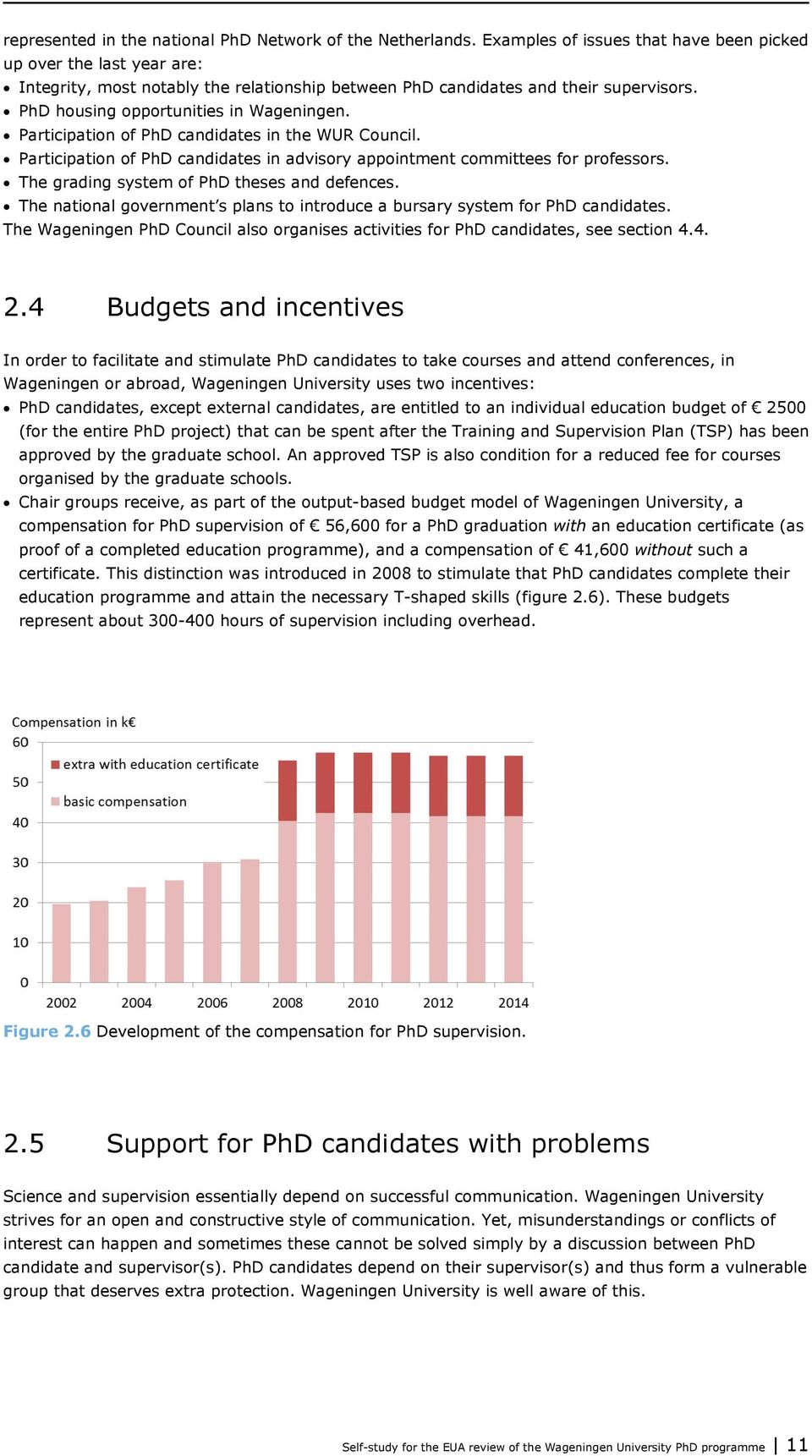
13 represented in the national PhD Network of the Netherlands. Examples of issues that have been picked up over the last year are: Integrity, most notably the relationship between PhD candidates and their supervisors. PhD housing opportunities in Wageningen. Participation of PhD candidates in the WUR Council. Participation of PhD candidates in advisory appointment committees for professors. The grading system of PhD theses and defences. The national government s plans to introduce a bursary system for PhD candidates. The Wageningen PhD Council also organises activities for PhD candidates, see section Budgets and incentives In order to facilitate and stimulate PhD candidates to take courses and attend conferences, in Wageningen or abroad, Wageningen University uses two incentives: PhD candidates, except external candidates, are entitled to an individual education budget of 2500 (for the entire PhD project) that can be spent after the Training and Supervision Plan (TSP) has been approved by the graduate school. An approved TSP is also condition for a reduced fee for courses organised by the graduate schools. Chair groups receive, as part of the output-based budget model of Wageningen University, a compensation for PhD supervision of 56,600 for a PhD graduation with an education certificate (as proof of a completed education programme), and a compensation of 41,600 without such a certificate. This distinction was introduced in 2008 to stimulate that PhD candidates complete their education programme and attain the necessary T-shaped skills (figure 2.6). These budgets represent about hours of supervision including overhead. Figure 2.6 Development of the compensation for PhD supervision. 2.5 Support for PhD candidates with problems Science and supervision essentially depend on successful communication. Wageningen University strives for an open and constructive style of communication. Yet, misunderstandings or conflicts of interest can happen and sometimes these cannot be solved simply by a discussion between PhD candidate and supervisor(s). PhD candidates depend on their supervisor(s) and thus form a vulnerable group that deserves extra protection. Wageningen University is well aware of this. Self-study for the EUA review of the Wageningen University PhD programme 11
14 PhD Adviser Each graduate school has one or two PhD Advisers. They are the first resort for PhD candidates who experience problems with, for example, supervision, unwanted behaviour or scientific integrity. All information given to a PhD Adviser is treated confidentially and the Adviser will only take action with the consent of the PhD candidate. The PhD Adviser can also refer to one of the specialised advisers mentioned below. Personnel adviser PhD candidates employed by Wageningen UR can ask their personnel adviser about matters concerning legal status, tax and pension rights, and other issues affecting them as employees. Counsellor for unwanted behaviour Complaints concerning unwanted behaviour can be filed with the counsellor and eventually submitted to the complaints committee for unwanted behaviour. Social worker Social workers can help with problems related to a PhD candidate s work or private life and will seek, together with the PhD candidate, the most suitable solution to his/her problem. Student psychologist PhD candidates not employed by Wageningen UR are entitled to consult the student psychologist. Scientific integrity Wageningen UR has two Confidential Counsellors for Scientific Integrity who can be contacted in case of suspected fraud, plagiarism or other scientific misconduct. Academic Board Also the Academic Board may be approached by PhD candidates who experience problems, for example with supervision. Ultimately, the Academic Board may appoint a different supervisor. 12 Self-study for the EUA review of the Wageningen University PhD programme
15 3 Processes in the Wageningen PhD programme 3.1 Start and formal admission Well before a PhD candidate starts, visa (for non-eu residents), registration at the University and an application for housing are taken care of by the chair group with the help of PhD Services and the graduate schools. Registered PhD candidates have access to the (digital) library of Wageningen UR and enrol in a graduate school, which gives them access to all courses and workshops offered by WGS and the graduate schools. The PhD Council of the graduate school PE&RC has a buddy system to welcome newly arrived PhD candidates at Wageningen. A 'buddy' helps the new PhD settle in Wageningen in order to make him/her feel welcome and at home more quickly. Wageningen University requires provisionally admitted candidates to obtain formal admission within months after the start of the PhD project. Even when a PhD candidate is invited by a supervisor to come to Wageningen, s/he must still obtain formal admission. To be formally admitted to the PhD Programme, the following requirements must be met: 1. Proficiency in English. PhD candidates are required to submit an internationally recognised certificate of proficiency in the English language (TOEFL, IELTS or Cambridge). This certificate is not a requirement for PhD candidates from Anglophone countries and for candidates who have completed their higher education with English as the language of instruction. 2. Evaluation of the PhD candidate s diploma when it is not a Master degree from a Dutch university. In such a case, the diploma is evaluated by the Academic Board, which bases its decisions on the evaluations done by Nuffic (Netherlands organisation for international cooperation in higher education). When a diploma is not equivalent to a Master degree from a Dutch University, the academic board decides, together with the supervisor, whether a qualifying examination is required and what it should consist of. If a qualifying exam is required, the candidate will not be formally admitted until s/he has passed this exam. 3. Payment of fees, if applicable (see section 2.2). 4. Approval of the Training and Supervision Plan (TSP) by the graduate school where the PhD candidate is enrolled. 5. Approval of the research proposal by the graduate school where the PhD candidate is enrolled. 6. Evaluation of the candidate s progress and performance after months. This evaluation ( go/no-go interview) determines whether a PhD candidate may continue in the PhD programme. 3.2 Evaluation of project proposal PhD candidates benefit from a well-conceived proposal that includes their own ideas and ambitions, provides a quick start, and offers flexibility when needed. The PhD proposal can be written by the candidate or by the supervisor prior to the start of the PhD project, but most commonly it is a joint effort during the first six month of the project based on a rough, one-page idea. Annex B shows a project proposal form that can be used for that purpose. When finished, the supervisor submits the proposal to the graduate school, together with three or four suggestions for reviewers. Proposals that have not been reviewed earlier, for example by NWO or the EU, are sent by the graduate school to two external reviewers who are asked to advice on: The scientific quality and originality of the proposal, i.e. whether it can result in a PhD thesis; Its feasibility in four years, including writing of the PhD thesis. Self-study for the EUA review of the Wageningen University PhD programme 13

16 In many cases, the suggestions of the external referees lead to further improvement of the project proposal. In some cases major revisions are needed before the proposal is approved. In rare cases a proposal is rejected, which means that the candidate may not continue. 3.3 Supervision The old Humboldtian model of one-to-one supervision has long gone at Wageningen University, as figure 3.1 shows. Care is taken, however, that supervising teams do not become too large: three members is the maximum, four can be allowed in interdisciplinary projects. The composition of the supervisory team is checked at two moments: at the start, through the evaluation of the project proposal by the graduate school, and near the end, when the Academic Board appoints the promotor(es) and co-promotor(es). Good and open communication between the PhD candidate and supervisors is crucial, and tasks and responsibilities for both parties must be as clear as possible. For some PhD candidates and supervisors this means weekly meetings, while others may meet only when the need arises. Making each other s expectations explicit is perhaps the most important secret of a successful PhD, and this is exactly the aim of the Training and Supervision Plan (TSP). Annex C shows a TSP form. Figure 3.1 Development of team-wise supervision at Wageningen University. Tenured staff must meet the requirements set by the graduate school to be a (junior or senior) member of the school. These requirements concern scientific output, acquisition of competitive funding, contribution to PhD training and other indicators of academic esteem. Having successfully supervised one or more PhD projects is also such an indicator. To improve PhD supervision, Wageningen Graduate Schools offers training for supervisors, including dealing with intercultural differences and with interdisciplinary research. The Graduate School WASS has a booklet for supervisors with many tips to improve supervision (WASS 2013). 3.4 Monitoring of progress Progress of PhD candidates is monitored in three ways: Similar to other personnel at Wageningen University, employed PhD candidates have an annual Results & Development interview with their superior. For non-employed PhD candidates such an interview is optional. In the interview both the progress of the candidate and the coaching role of the supervisors are evaluated. If delay in the PhD research has occurred, ways to solve the delay are sought and decided on jointly. Sometimes this may lead to an extension of the contract of a few months. Experience has shown that such an extension can prevent much longer delay due to a new job that the candidate would have to take. 14 Self-study for the EUA review of the Wageningen University PhD programme

17 A crucial moment is the go/no-go interview with the supervisor after months. A go is part of the formal admission of the PhD candidate. A no-go means that the candidate has to stop. For this reason, employed PhD candidates are initially appointed for 18 months. The go/no-go decision is monitored by the graduate school. If a PhD candidate wishes to object to the outcome of the evaluation, s/he can appeal to his/her graduate school or to the Academic Board. Annex D shows the format of a go/no-go report. Graduate school directors visit their research groups approximately once every one or two years. During these meetings progress of PhD projects is discussed with staff and PhD candidates separately. Moreover, prior to the meeting PhD candidates are asked to fill in a questionnaire in which candidates are asked to evaluate progress, quality of supervision and facilities, the supporting role of the graduate school and their overall appreciation of the PhD programme. 3.5 Thesis evaluation and graduation ceremony The thesis evaluation procedure can be summarized as follows: It starts with the supervisor s approval of the PhD thesis and of the six to eight propositions conceived by the candidate. Next, the supervisor submits the composition of the thesis committee to the Academic Board. The thesis committee consists of the (co-)promotor(es) and four opponents. To be approved by the Academic Board, the opponents must be independent, i.e. not working at the chair group of the promotor, and not involved in the PhD research. As nearly all PhD theses at Wageningen University are written in English, qualified and independent opponents can be recruited worldwide. Within six weeks after receiving the thesis, the opponents advise the Academic Board whether or not the thesis has provided sufficient proof of competency in science to allow the PhD candidate to defend his/her thesis. A positive decision requires a positive evaluation of all opponents. Minor or major revisions may be advised. If major revisions are needed, this may lead to postponement of the public defence. The whole review procedure is handled on behalf of the Academic Board by the Doctorate Secretariat, not by the supervisor, to ensure an objective advice. If the promotor, or any other member of the thesis committee, had indicated that s/he wants to apply for a cum laude designation, the Academic Board appoints two extra reviewers who read the thesis and recommend on the cum laude proposal. Both these extra reviewers must be professors and at least one must come from abroad. If both of the extra reviewers advise negatively, the cum laude procedure stops. The final decision whether or not to award cum laude is made by the thesis committee after the public defence. The public defence is conducted in English unless the PhD candidate has submitted a request to the Academic Board to conduct the defence in Dutch and all members of the thesis committee are able to discuss in Dutch. After the public defence, the thesis committee decides in a private meeting whether or not to confer the doctorate (which is a formality) and which grade is awarded for thesis and defence. Before 2007, the only distinction made was cum laude. Now the grades for thesis and defence form a five-point scale, from acceptable to excellent. The grades are further discussed in section 5.3. Annex E shows the thesis evaluation form. More details can be found in the Doctoral degree regulations of Wageningen University, see online link page Monitoring the PhD experience Monitoring the PhD experience is a very useful instrument to identify issues at programme level that need improvement. It cannot be used for identifying problems at the level of an individual PhD candidate because anonymity in such surveys must be guaranteed. The PhD experience can be monitored at two different moments: during the PhD project and after graduation, which yields different results, for obvious reasons. Self-study for the EUA review of the Wageningen University PhD programme 15
18 The graduate schools have monitored the PhD experience for already 15 years. A few examples: In 2001, WIAS did a survey focused on graduation delay in which graduates and supervisors were asked to identify and quantify the causes of delay in individual projects (WIAS 2001). The survey questions were used again as part of a survey among Wageningen PhD alumni in 2011 and in In 2009, Mansholt Graduate School of Social Sciences (predecessor of WASS) did a survey among its ongoing PhD candidates as preparation for the peer review of Since its start in 2010, WASS invites freshly graduated PhDs for an exit interview to evaluate their PhD project and the graduate school. In 2010, WIAS did a short survey on the satisfaction of supervision. Since 2010, PE&RC organises exit interviews with their freshly graduated PhDs. Via an evaluation form candidates are asked to evaluate their experiences regarding: the research project, the quality of supervision, the education programme, the role of the graduate school and finally their overall evaluation of their experience as a PhD candidate. Also, questions are asked about the candidate s career plan. When needed, matters are discussed in more detail during a personal meeting. In 2010, Wageningen University participated in a national survey to monitor the PhD experience and labour market position of freshly graduated candidates (Sonneveld et al 2010). In 2011 and 2014, Wageningen University and KLV Wageningen Alumni Network carried out a career survey among alumni, which included questions on the PhD experience. In 2013, VLAG held a survey among its ongoing PhD candidates with questions on supervision, education and training, and the performance of the graduate school. In 2013, the six graduate schools designed a joint survey based on the earlier surveys of the PhD experience. So far, three schools, WASS, WIAS and WIMEK (through the national research school SENSE) have conducted the survey, the other schools will follow in This survey will be repeated in the future on a regular basis. Results are reported in section Self-study for the EUA review of the Wageningen University PhD programme

19 4 PhD training and education 4.1 Introduction When graduate schools were introduced in the Netherlands, twenty years ago, education for PhD candidates was virtually non-existent. Often, the first course to be developed was on scientific writing. Such courses were an immediate success and gradually the course package extended. Now, a vast array of professional skills courses is offered jointly by Wageningen Graduate Schools. In-depth courses are offered by the individual graduate schools, often in collaboration with other graduate schools in Europe. Such courses attract an international audience. In the 1990s, each graduate school in Wageningen developed its own Training and Supervision Plan (TSP). These TSPs were evaluated in 2002 and again in 2007 with the aim to harmonise the TSPs as much as possible, but with respect for functional differences due to the scientific field. In summary, the present course package offered and the present TSP are the result of twenty years development in competitive collaboration by the six graduate schools in Wageningen. 4.2 The Training and Supervision Plan The PhD candidate and his/her supervisor formulate a Training and Supervision Plan (TSP) and submit it to the graduate school for approval within six months. The TSP contains agreements on: The training and education activities to be undertaken by the PhD candidate, with a minimum of 30 ECTS credits. Optional teaching duties, for employed candidates only and at maximum 10% of their time, which can consist of teaching and/or supervising Master students who participate in the research of the PhD candidate. Agreements on supervision, with the aim to make the candidate s and supervisor s mutual expectations and possibilities explicit. The PhD candidate s training and education programme aims to attain the T-shaped skills needed to become an independent scientist: a combination of broad personal skills, interdisciplinary overview and in-depth scientific knowledge. It is a tailor-made plan, which means: Tailor-made: specific for the needs of each particular PhD candidate, A plan: PhD candidates may deviate from the plan in consultation with their supervisors. The graduate school WIAS, for example, has revised its TSP recently to make it even more tailormade. Every new PhD candidate has to take an online-assessment (called My Talent ) to give insight in the capacities and personality of the PhD candidate. WIAS has appointed three of its staff member to be PhD advisors. These PhD advisors received special training. A PhD candidate discusses the results of his/her assessment with one of the PhD advisors. The candidate can choose whether the daily supervisor is present (if not, the candidates discusses the results later with the supervisor). Aim of this meeting is 1) to define learning goals, and 2) translate these into the TSP, in particular the professional skills training. The supervisor helps the PhD candidate with the disciplinary courses. At a second meeting of PhD candidate and PhD advisor, the complete TSP is discussed. With this new procedure, WIAS helps PhD candidates to determine their learning goals and to develop the actions they need to reach those learning goals during the PhD programme. The minimum requirements laid down in a TSP may vary between the graduate schools, depending on the scientific field. Generally, a TSP contains the following elements: Introduction course, including research ethics and scientific integrity. Brush-up courses when needed, for example on statistics. In-depth and interdisciplinary courses, workshops, seminars. Self-study for the EUA review of the Wageningen University PhD programme 17

20 Professional skills courses and training, for example scientific writing, project planning, supervising Master students, career orientation, assessments. Attending and presenting at conferences. Annex C shows a form to fill out the Training and Supervision Plan. 4.3 Training and education offered Registered PhD candidates receive a digital newsletter from their graduate school that provides, among others, news on: Training and education offered by the graduate school. Training and education offered by Wageningen Graduate Schools. In-depth courses offered by others in Europe and elsewhere. Conferences worldwide in the scientific field covered by the school. Ideas for new courses, workshops and discussion groups often originate from PhD candidates and their supervisors, and the graduate school tries to follow up on such ideas. Each course is evaluated by the participants, anonymously and by standard evaluation forms. In most cases, evaluations are very positive, but if a course is repeatedly evaluated negatively, it is either altered or terminated. As a stimulus and acknowledgement for tenured staff to organise in-depth courses, graduate schools award an education prize at their annual Science Day. The jury for that prize consists in majority of PhD candidates. The annual amount of training and education offered at Wageningen University is approximately: By each graduate school ECTS credits of in-depth courses, depending on the school s size. By Wageningen Graduate Schools 60 ECTS credits of skills, competence and career courses. Annex F provides an overview of all training and education offered in National and international collaboration As most graduate schools in Wageningen are national schools, national collaboration in PhD education is easy to accomplish. However, for specialised in-depth courses this is not always enough. Therefore, all schools draw from the international scientific networks of their staff and create their own international network for PhD courses. Funds such as EU Marie Curie help in this respect. Approximately 75% of in-depth courses have international speakers. These courses also have a significant number of international participants, primarily coming from European countries. Besides international contribution and participation, a number of courses (10-20%) are run jointly with international partners. 4.5 Extracurricular activities Registered PhD candidates are entitled to all facilities and events open for personnel and students, such as public lectures and seminars, lunch meetings, exhibitions, concerts, festivities and parties, and a sports card for a reduced fee. The PhD councils of the graduate schools also organise events, which are always well attended. For example, the annual Science Day is in most schools organised by the PhD Council. On a Science Day, PhD candidates present their research to other PhD candidates and staff. This has two goals: 1) to share and discuss the PhD candidates research, and 2) to gain presentation experience. This day also helps to connect staff and PhD candidates in an informal setting. A Science Day mostly ends with drinks and a dinner. 18 Self-study for the EUA review of the Wageningen University PhD programme

21 In addition, the joint Wageningen PhD Council organizes two annual events: the Wageningen PhD Symposium and the PhD Party. The symposium was organized for the first time in It brings PhD candidates from across the various graduate schools together around overarching topics and aims to facilitate the exchange of perspectives and ideas and to provide candidates with a networking opportunity. The PhD Party, which is organized in the Junushoff theatre around the university s Dies natalis, aims the same, but in a more informal setting. Self-study for the EUA review of the Wageningen University PhD programme 19
22 5 Outcomes of the Wageningen PhD programme 5.1 Results of PhD experience surveys PhD training and education In our career survey of 2011, PhD alumni were asked what other activities besides research they had done during their PhD study in Wageningen. The answers show an interesting long-term trend of the impact of graduate schools after their start in the 1990s (figure 5.1): The percentage of candidates that took in-depth courses and professional skills courses increased with the growing participation in graduate schools. Attending international conferences has always been an integral part of doing a PhD, but when participation in graduate schools grew, conference participation increased to 95%. Teaching and supervising students is done by 70-80% of PhD candidates. Figure 5.1 Impact of graduate schools in Wageningen on activities of PhD candidates next to their research, five-year averages, all types of PhD candidates included. Note that participation in graduate school is shown as perceived and reported by the PhD alumni themselves. Recent PhD experience surveys among on-going candidates, by WIMEK-SENSE and WIAS, show: 93% is overall satisfied with their school s education and training programme (score 3-5 on a fivepoint scale) and 73-83% rate it as good or excellent (score 4-5) % indicate that they have been sufficiently informed by their graduate school on regulations, research proposal, TSP and PhD courses (score 3-5), and 63-75% rate the information as good to excellent (score 4-5). These surveys were found to be representative in terms of gender, country of origin, previous education, type of PhD candidate and starting year. PhD supervision In the recent PhD experience surveys candidates were also asked whether they were satisfied with their supervision. Results are: 90-92% of the respondents is overall satisfied with their supervision (score 3-5) and 83% rate it as good to excellent (score 4-5). 20 Self-study for the EUA review of the Wageningen University PhD programme
23 92% regard the opportunities to turn to their supervisors for advice on their PhD research as sufficient (score 3-5) and 80% rate it as good to excellent (score 4-5). Often mentioned positive aspects are: the supervisor s experience and expertise, feedback and support, and the freedom to choose an own focus in research and personal development. Generally, supervision by daily supervisors is evaluated somewhat more positively than supervision by the promotor. This indicates that expectations on the roles of supervisors could be made more explicit. Yet, 8-10% of PhD candidates is not content with their supervision (score 1-2). Reasons may be: Insufficient short-time availability, frequency or time for contact with supervisors. Insufficient clarity in expectations on results to be achieved. Too long time for feed-back on manuscripts. In rare cases conflicts among supervisors are reported. 5.2 Time-to-degree and completion rate Wageningen University offers a four-year PhD programme. Some candidates work 0.8 fte during five years, in particular in social sciences. After the thesis is submitted to the thesis committee, it takes another 4-6 months till the public defence. Therefore, a time-to-degree of 4.5 years is considered as in time. Figure 5.2 shows a trend analysis of time-to-degree and completion rate of employed research assistants based on complete starting cohorts of this category. It shows that time-to-degree has gradually improved without compromising the final completion rate. At present, 82% of a starting cohort graduates and almost 50% graduates within five years. Time-to-degree of guest and sandwich PhDs are similar to research assistants. For external PhD candidates it is often not possible to calculate time-to-degree in a meaningful way. Similar to what is found worldwide, males graduate slightly faster than females and candidates in social sciences have a longer time-to-degree and a lower completion rate. Figure 5.2 Trend analysis of time-to-degree and completion rate of research assistants. Self-study for the EUA review of the Wageningen University PhD programme 21
24 In the past, several surveys on the reasons for graduation delay have been done. All surveys show that the reasons for delay are diverse, both in project-related delay as in delay due to other activities or personal circumstances. The main reason for prolonged delay is the new job after the PhD study, which confirms the importance of our policy: to have the thesis (nearly) finished at the end of the PhD term. 5.3 Thesis quality and contribution to science In 2007, the Academic Board introduced a five-point scale for thesis and defence. In 2010 an extra lowest grade was added to the scale to prevent inflation. The grades are now: Unacceptable: candidate cannot defend his/her thesis Acceptable: the bottom 10% of theses is the field worldwide. Satisfactory: the next 35%. Good: the middle 35%. Very good: the sub-top 17%. Excellent: the top 3%. Note that these grades are defined in terms of frequency and that the intended frequencies differ from the awarded frequencies as shown in figure 5.3. It would make the grading system more transparent if the grades were defined in terms of quality, by using rubrics as in Lovitts (2007). The Academic Board intends to address this issue in the coming year. Two related issues are: The definition for cum laude theses at Wageningen University is the top 3%, which happens to be lower than at all other Dutch universities. For PhD graduates a cum laude is an asset on their CV, in particular when striving for competitive grants. Thus, Wageningen PhD candidates feel that they are at a disadvantage compared to colleagues from other Dutch universities. PhD candidates doubt the added value of the six-point scale. Other than cum laude, the grade is not indicated on the diploma and plays no role on a CV. PhD candidates do see the value of grades for supervisors. Figure 5.3 Grades awarded for thesis and defence Figure 5.4 Publishing and thesis grade. In our career surveys of 2011 and 2014, PhD alumni were asked whether they had published before, during and after their PhD. Figure 5.4 shows a positive correlation between publishing activities and thesis grade, not only during the PhD (which could have influenced the grade awarded) but also after. Also other analyses show a correlation between thesis grade, later career and scientific performance. On average, PhD graduates reported that their PhD project had led to 5.4 papers in peer-reviewed journals, either published before or after the graduation. Due to self-reporting, this figure might be an overestimate, but a bibliometric investigation by the graduate school VLAG in 2012 confirms this high publication output: 22 Self-study for the EUA review of the Wageningen University PhD programme
25 From the 217 theses of the graduate school VLAG defended in , the number of publishable chapters was determined as 5.4 per thesis on average. Of these publishable chapters, 85% was published in 2012, on average 4.6 papers per thesis, and another 2% of the chapters was in the process to be published. In conclusion: Wageningen PhD candidates contribute significantly to science, which adds to their CV and gives a head start to their further career. 5.4 Employability and career success The traditional Humboldtian idea that a PhD degree prepares for a career in academia, has long gone if it was ever a reality. PhD graduates from the graduate school Experimental Plant Sciences (EPS), for example, have excellent career opportunities in the plant breeding industry. In this sector, Dutch companies are among the world market leaders and they are trend setting in innovations. These companies invest up to 20% of their turnover in R&D to stay ahead of their competition. Consequently, these companies have a high demand for well-trained scientists with a PhD education. They have indicated to need annually new employees with a PhD training to fill the vacancies in their research departments. The Graduate School EPS trains about PhDs per year and many of them find a job in the Dutch plant breeding industry. Similar opportunities are present in the Dutch food industry for graduates from the graduate school VLAG and in the Dutch animal breeding industry and the animal feed industry for graduates from WIAS. All these industries need PhD researchers to stay competitive in the global market. In October 2014, Wageningen University and KLV Wageningen Alumni Network carried out a career survey among the 1099 PhD alumni graduated in Of these graduates, 81% could be reached by . Response rate was 53% and the response was representative in terms of gender, country of origin, previous education, type of PhD candidate and graduation year (only the year 2009 is slightly underrepresented due to a lower number of valid accounts). As figure 5.5 shows, already half of the graduates have a permanent position. This is particularly true for sandwich PhD graduates: many returned to their home institution and got a career boost from their PhD degree. This shows that the Wageningen sandwich PhD programme contributes to capacity building in developing countries. Ten graduates in the survey (2%) are still looking for a job. Six of them graduated in the most recent year of the survey, Compared to other people, unemployment is very low among PhD graduates. Figure 5.5 Present employment status of PhD graduates, Self-study for the EUA review of the Wageningen University PhD programme 23
26 Figure 5.6 Present sector and job level of PhD graduates, Figure 5.6 combines two questions of our survey about the current job: sector and job level. It shows that two thirds of our PhD graduates work at a university or research institute, and mostly in a job at PhD level. Half of the graduates who work in other sectors regard their job also to be at PhD level. In total, 76% regards their job to be at PhD level. We also asked graduates what their ambition for work is in ten years time: then, 86% aims for a job at PhD level. Other conclusions from the career survey are: 47% work in the Netherlands, 23% in other western countries, 30% in developing countries. 23% work in the public sector, of which 11% with international organisations. 18% work in the private sector, of which 15% in industry. 85% mention research as one of the three most important activities in their job. 74% say that they use the expertise gained during their PhD study much or very much. 90% say that their job is in their own field of study or an adjacent field. These results are probably best summarised by one of the remarks from the respondents of the career survey: Happy that I did a PhD in Wageningen. 24 Self-study for the EUA review of the Wageningen University PhD programme
27 6 SWOT analysis 6.1 Analysis Strengths The Wageningen PhD programme offers an excellent research environment and a strong international orientation and network, which are important for our PhD candidates. In comparison to other PhD programmes worldwide, there are four strengths that which we cherish in particular, now and in the future. 1. Stable, well-organised graduate schools that are valued by the University s Executive Board, chair groups and PhD candidates. The long history of competitive collaboration among graduate schools has produced a culture of sharing and improving good practices. 2. A tailor-made education programme for each PhD candidate, drawing from a vast, varied and balanced course programme, plus an individual training budget to attend courses and conferences abroad - a solid preparation for the candidate s further career. 3. A significant contribution to science by the PhD thesis and other publications resulting from the PhD research, which adds to the candidate s CV and to the reputation of Wageningen UR. 4. The sandwich PhD programme, which contributes to capacity building in developing countries in Africa, Asia and Latin America - brain gain instead of brain drain, north-south and south-south collaboration. Weaknesses Keeping a well-functioning PhD programme requires continuous adaptation in order to meet the changes in the PhD population and in the internal and external conditions. 1. The pressure to perform experienced by supervisors is inherent in science but has increased recently due to an increase in teaching load, introduction of tenure track and increased competition for funding. Most supervisors can deal with high numbers of PhD candidates, but it leaves little room for error in the selection and supervision of PhD candidates. 2. The grades for PhD thesis and defence, in use at the university since 2007, are defined in terms of frequency (for example, cum laude is defined as the top 3%) and not in terms of quality by using rubrics. PhD candidates have doubts about the added value of the grading system and concerns about the low percentage of cum laude awards compared to other Dutch universities. 3. Tasks and responsibilities regarding the procedures in the PhD programme are fragmented within Wageningen University. This has been addressed only recently. The aim is to create an integrated support unit as a one-stop shop for PhD candidates. Opportunities The globalising knowledge society offers opportunities to PhD programmes and PhD graduates all over the world. More specifically, we see the following opportunities for the Wageningen PhD programme. 1. Increasing attention for our domain and the increasing need for highly trained people will create new opportunities for collaboration and will also improve the career options for our alumni, either as postdocs or as researchers outside academia. 2. The global trend towards doctoral schools deserves wide support. We are willing to share our twenty years of experience with other universities that are setting up PhD programmes. 3. The discussion on three- or four-year PhD programmes offers the opportunity to show the difference. We feel that our four-year programme is not just one more chapter in the thesis and 30 ECTS credits of training, it leads (or should lead) to a substantially higher level of maturity in knowledge, analytic and synthetic capabilities and research skills. Self-study for the EUA review of the Wageningen University PhD programme 25
28 Threats We are optimistic about the future of the Wageningen PhD programme, but there are a few threats. 1. The international trend to three-year PhD programmes creates a difficulty in attracting funding (the EU, for example, sponsors only three-year PhD projects) and in setting up joint degree programmes. 2. The national trend to a bursary system for PhD candidates may put an end to the employed position of PhD candidates, which would make it less attractive to do a PhD in the Netherlands. 6.2 Conclusions European countries such as the Netherlands need highly qualified scientific researchers to maintain their strong position as knowledge-based economy. With its international profile and well-organised PhD programme, Wageningen University is well positioned to attract and train the best brains, but we need to make sure that our PhD programme stays attractive to them: The discussion on three- or four-year PhD programmes is not easy and is often evaded. We feel that maintaining our high quality PhD standard requires a four-year programme, at least for most candidates, and we would welcome that the Dutch universities develop a joint strategy to cover the costs of the fourth PhD year in funding programmes that (now) cover only three-year PhD projects. Also the discussion about a bursary system is not easy and is often evaded. If we define PhD candidates as early stage researchers, then an employed status rather than a student status is obviously the most appropriate. Last but not least, the pressure to perform in science has increased recently. It puts a strain on quality assurance in the selection and supervision of PhD candidates and on the position of PhD candidates, for example in discussions about supervision, teaching duties and authorship issues. We may have to look into the balance of incentives. 6.3 Questions to the evaluation team Key questions a. Do the learning targets of the Wageningen PhD programme meet international standards? b. Does the Wageningen PhD programme have the structure and processes in place for PhD candidates to attain these learning targets? Additional questions a. Does the four-year PhD programme of Wageningen University have added value compared to a three-year programme? b. Does the employed status of PhD candidates make it more attractive to do a PhD in the Netherlands compared to a student status in a bursary system? c. In view of the pressure to perform experienced by supervisors, should we reconsider the balance of incentives at Wageningen University? d. Does the present grading system for PhD thesis and defence have added value for PhD candidates and/or supervisors? 26 Self-study for the EUA review of the Wageningen University PhD programme
29 Online links Wageningen PhD Guide: 3bb0360a0f03_PHD_Guide.PDF Timetable of the Wageningen PhD programme: Doctoral degree regulations of Wageningen University: 487e68c1075a_Doctoral%20degree%20regulations%20WU%20d.d.% pdf Random selection of six PhD theses: Self-study for the EUA review of the Wageningen University PhD programme 27
30 Annex A Composition of the evaluation team Professor Amelie Mummendey, Social Psychology, University Jena, Germany. Professor Jacques Lanares, Qualité et Ressources Humaines, Université de Lausanne, Switzerland Professor Alan Kelly, School of Food and Nutritional Sciences, University College Cork, Ireland Dr. Thomas Jørgensen, European University Association, Council for Doctoral Education, Brussels, Belgium Programme of the site visit, January 2015 Tuesday 13 January 18:00 Welcome meeting with the evaluation team Wednesday 14 January 09:00 Meeting with Rector, Dean and members of Academic Board 10:40 Meeting with self-evaluation group 12:00 Meeting with Scientific Directors of the graduate schools 14:30 Meeting with members of Wageningen PhD Council 15:30 Meeting with PhD alumni Thursday 15 January 09:00 Meeting with supervisors 11:40 Meeting with Dean for any last questions Friday 16 January 09:30 Presentation of preliminary findings by evaluation team Acronyms DLO Research institutes for strategic and applied research within Wageningen UR EPS Graduate School Experimental Plant Sciences INREF Interdisciplinary Research and Education Fund of Wageningen University KNAW Royal Netherlands Academy of Arts and Sciences NWO Dutch national research council Nuffic Netherlands organisation for international cooperation in higher education PE&RC C.T. de Wit Graduate School Production Ecology and Resource Conservation SEP Standard Evaluation Protocol for the periodic peer review of research in the Netherlands TSP Training and Supervision Plan VLAG Graduate School Food Technology, Agrobiotechnology, Nutrition and Health Sciences WASS Wageningen School of Social Sciences WIAS Wageningen Institute of Animal Sciences WIMEK Wageningen Institute for Environment and Climate Research WGS Wageningen Graduate Schools WU Wageningen University 28 Self-study for the EUA review of the Wageningen University PhD programme
31 Literature Lovitts, B.E., Making the implicit explicit. Creating performance expectations for the dissertation. Stylus Publishing, Sterling, Virginia. Mariën, H. & M. von Bergh, Loopbaanmonitor WU-afgestudeerden en gepromoveerden op de arbeidsmarkt. IVA, Tilburg. Nerad, M. & M. Heggelund, Towards a global PhD? Forces and forms in doctoral education worldwide. University of Washington Press, Seattle & London. Powell, S. & H. Green, The doctorate worldwide. Society for Research into Higher Education & Open University Press, Maidenhead, Berkshire. Sonneveld, H., M. Yerkes & R. van der Schoot, PhD trajectories and labour market mobility. A survey of recent doctoral recipients at four universities in the Netherlands. Nederlands Centrum voor de Promotieopleiding / IVLOS, Utrecht. WASS Procedures, Principles and Good Practices for Supervising PhD Candidates at Wageningen School of Social Sciences (WASS). WASS, Wageningen a57b0c730_Supervising%20PhD%20candidates.pdf WIAS, Graduation delay of WIAS PhD students. WIAS, Wageningen. Self-study for the EUA review of the Wageningen University PhD programme 29
32 Annex B Project proposal form PhD PROJECT PROPOSAL (FULL) WAGENINGEN UNIVERSITY PE&RC MAIN RESEARCH GROUP :... OTHER WU GROUPS INVOLVED :... Please read appendix first and fill in with a Computer. 1. PROJECT LEADER 2. PROJECT TITLE (English) 3. PROJECT TITLE (Dutch) 4a. Duration of the project: from:... to:... 4b* Note: If it is a joint project of two (or more) research groups, agreements have to be made about division of the capacity awarded at graduation. These must be communicated to the Education, Research and Innovation Department (ER&I) 5. The experiments will be executed in (please mention country): 6a ANIMAL EXPERIMENTS: will vertebrates be used? YES/NO 6b Are there any other particular ethical issues to be considered with respect to this project YES/NO If YES please elaborate 7. PARTICIPANTS PROJECTGROUP AND ESTIMATED SUERVISION TIME INVOLVED Name + title of the PhD candidate :.. Male/Female : M/F Nationality :... Date of birth: :... Period of appointment : from:... to:... (Year/month/day) Hours per week :... Kind of Appointment: Research assistant employed at WU: Wageningen University funding NWO funding Funding by a third party Guest PhD student Funding by a third party Sandwich PhD students With a Wageningen university fellowship (e.g. INREF) NWO funding (primarily WOTRO) Funding by a third party External Employed at DLO Other 30 Self-study for the EUA review of the Wageningen University PhD programme
33 Staff Wageningen University funding NWO funding Funding by a third party (e.g. EU) NAME AND TITLE SPECIALIZATION ORGANISATION HOURS/WEEK Promotor(s): Co-promotor(s): Supervisor(s): Other scientific staff: Technicians: Financial source(s): (in case of NWO: please mention NWO-foundation i.e. WOTRO, STW, ALW) (in case of EU: please mention EU-programme and number)... Is the financial support and equipment sufficient to carry out the research and TSP? YES/NO If NO, please indicate the reason why! 8. COLLABORATION: with which organisations outside the University will collaboration take place? Other Universities : Research institutes, experimental stations: Ministries, other organisations : International organisations : such as FAO, WHO Self-study for the EUA review of the Wageningen University PhD programme 31
34 9. SUMMARY (max 250 words) If NWO or EU project proposal available then ADD it and only answer questions if not answered already in the project proposal, otherwise go to DETAILED DESCRIPTION OF RESEARCH AREA AND PLAN (MAX 2500 WORDS + 1 PAGE LITERATURE LIST) 11. TIME TABLE OF THE PROJECT AND WORK PROGRAMME 12. SOCIETAL SIGNIFICANCE 13. DATA MANAGEMENT (MAX 250 words) 14. SIGNATURE Chairman of the Research Group Project leader Name: Name: Signature: Signature: EXPLANATION TO THE INDIVIDUAL QUESTIONS OF THE FORM 'PHD PROJECT PROPOSAL (FULL)' Question 1: Name of the project leader and name of the Professor who will act as promotor. Question 2: Short, to the point English title of the research project. Question 3: Translation in Dutch of the title. Question 5: If (part of) the project is carried out outside the Netherlands, please mention countries involved. Question 6a: In some projects animals (vertebrates) may be involved. In that case ethical guidelines of WU might be applicable. Question 6b: In some projects biotechnological research may be involved. In that case ethical guidelines of WU might be applicable. Question 7: Please, mention persons, who are primarily involved in the execution of the research project. Mention name, title, and nationality of the PhD student, period of appointment and indicate kind of appointment. Research Assistant: PhD candidate with a temporary employment of 3-4 years at one of the PE&RC Institutes 32 Self-study for the EUA review of the Wageningen University PhD programme
35 Sandwich PhD: Foreign PhD candidate with a grant whose research is performed in the country of origin and who resides at the (PE&RC affiliated) home university* in the beginning and at the end of the programme Guest PhD: Foreign PhD candidate with a (foreign) grant who does the research at the (PE&RC affiliated) home university* but has no appointment Staff PhD: PhD candidate with a permanent position at the (PE&RC affiliated) home university* External PhD: PhD candidate who has no formal relation with the (PE&RC affiliated) home university* except via the promoter (main supervisor) Mention scientific staff and technicians who are involved in the project. Also mention the department, institute or other organisation responsible for funding of the persons mentioned and add an estimate of the input in hours per week per person. Mention the financial resources used to finance the PhD project. Question 8: Please mention the collaborating organisations in the context of this project. Only mention those collaborations which will result in joint activities such as joint publications. Question 9: The short summary should be written as an explanation of the title of the research project. Question 10: Elaborate your project proposal here This should contain the following elements: Introduction, including history and background Objectives Hypotheses Research methodology Innovative aspects Question 11: Time table and work programme The PhD student should be able to finish the thesis work within 4 years. This means that the reading version of the PhD thesis has to be submitted within 4 years. Within the work programme the following issues should be dealt with: in what way is appropriate supervision guaranteed? what is the role of each member of the supervision team in what way is progress evaluated if during the project period changes will occur in the project team, in what way will supervision be continued? in what way is execution arranged? Please specify. availability of technical equipment and facilities availability of assistance by technical personnel risks (e.g. weather, availability and willingness of third parties,.). Appointments made with collaborating organisations (question 8) and/or other WU-groups, as far as important for the execution of the project. Question 12: What is the societal significance of the proposed research? Question 13: This section outlines the data management plan and must encompass: data storage (short term and long term storage), data ownership (issues with respect to ownership of data produced in this project or external data used for this project) data sharing (agreement on who will have access to and use your (un)published data) Self-study for the EUA review of the Wageningen University PhD programme 33
36 This section may include references to a more comprehensive (i.e. 2 to 3 pages) data management plan in which elements are outlined in more detail and can also refer to a plan at the level of a research group. Note that this document does not need to be included in this proposal. For more details see Services/Facilities/Library/Expertise/Write-cite/Research-data/Data-Management-Plans.htm. Please note that data collection is also part of a data management plan but is specified in section 10 and 11 of this research proposal Question 14: This form has to be signed by the Chairman of your Research Group and the project leader. Please submit form both as hard copy and by to the secretariat of the graduate school PE&RC The proposal will be sent to 3 referees. Please send names, addresses and s of 3-5 potential referees who are in no way involved in this project. Referees from outside WUR are preferred. Your suggestions will be considered when approaching referees. 34 Self-study for the EUA review of the Wageningen University PhD programme
37 Annex C Training and Supervision Plan form Training and Supervision Plan (TSP) Graduate School WIAS How to use this form This form is made in Excel so that credit points of education and training are summed automatically. One ECTS credit equals a studyload of approximately 28 hours; one day is 0.3 ECTS To insert a row, click 'insert', then 'row'. Merging some cells in a new row is possible but not necessary. To delete a row, click 'edit', then 'delete' and then 'entire row'. Before submitting, delete all instruction texts and rows, including this box "how to use this form" Submit to Marianne Bruining, WIAS education coordinator, for approval by WIAS. Section 1. GENERAL INFORMATION AND LEARNING GOALS Name PhD candidate Project title Group Daily supervisor(s) Supervisor(s) PhD study advisor Project term from until Submitted <date> first plan / midterm / certificate Previous education MSc degree obtained at Areas of expertise To start Introduction interview with WIAS secretary: <date> Introduction interview with WIAS education coordinator and PhD students confidant: <date> Competence assessment: <date> Evaluation of learning goals with PhD study advisor at start of PhD training: <date> Evaluation of learning goals with PhD study advisor at mid-term: <date> Personal learning goals What do you want to learn during your PhD study at WIAS 1. At least 3 detailed and specific learning goals should be formulated (in a separate document, to be submitted together with this TSP). The student should indicate how the learning goals are to be attained and how the success of attainment will be evaluated. A competence assessment will help the student to do this effectively 2. An in-depth evaluation of learning goals should be discussed with the PhD study adviser at the start of the PhD training as well as during the mid-term evaluation. Section 2. SUPERVISION Agreements made between daily supervisor(s), supervisor(s) and PhD student Discuss with your supervisor(s) and fill in at least the questions below; extend with potential more agreements Meetings with daily supervisor will take place every Urgent questions will be answered within Meetings with supervisor / supervisory committee will take place every Feedback on manuscripts will be given within Progress and (adjustment of) planning will be discussed at least A midterm progress report must be submitted to WIAS at the end of the second year. In month 14 of the study, progress must be evaluated, resulting in a go/no go decision before month 18. Self-study for the EUA review of the Wageningen University PhD programme 35
38 Section 3. EDUCATION AND TRAINING (minimum 30 credits) A. The Basic Package year credits WIAS Introduction Day (mandatory) Course on philosophy of science and/or ethics (mandatory) Course on essential skills (Frank Little) (recommended) Subtotal Basic Package B. Disciplinary Competences year credits Subtotal Disciplinary Competences C. Professional Competences year credits Subtotal Professional Competences D. Presentation Skills (maximum 4 credits) year credits < title of presentation, name of conference/seminar, place, date, oral / poster > Subtotal presentations E. Teaching competences (max 6 credits) year credits Subtotal Teaching competences Education and Training Total (minimum 30 credits)* *One ECTS credit equals a study load of approximately 28 hours Signatures Approval PhD candidate PhD study adviser Promotor WIAS 36 Self-study for the EUA review of the Wageningen University PhD programme
39 Annex D Go/no go form Confidential Evaluation form for PhD Candidates Go/No-go Decision Tick, if applicable Contract of employment WU Contract of employment DLO No Contract of employment: Sandwich PhD candidate Guest PhD candidate External PhD candidate 1. General Name PhD candidate: Chair / department: Professor (promotor): Daily Supervisor(s): Evaluation period: Dates of performance review meeting: 2. Evaluation made by: Name Professor (promotor): Contact: Daily / Regularly / Occasionally Name Daily Supervisor(s): Contact: Daily / Regularly / Occasionally 3. Starting point of the performance review*: Information, background and basis for the go/no-go decision Starting date: Project proposal approved by the graduate school: yes/no/not applicable TSP approved by the graduate school: yes/no/not applicable MSc degree from Wageningen University or another Dutch university: yes/no In case of an MSc degree from a university abroad a Diploma Evaluation by the Academic Board is required. Has the MSc degree been approved by the Academic Board? yes/no Is a Qualifying Examination (QE) required? yes/no If a QE is required: has the PhD candidate passed the Qualifying Examination? yes / no Proof of proficiency in the English Language*¹): yes/no/not required *¹) English language requirements: IELTS: 6.5, with a minimum of 6.0 for each (academic) module. TOEFL: 580 points for the written TOEFL, 237 points for the computer based TOEFL and points for the Internet based TOEFL. All are to be supplemented by results of the Test of Written English (academic TWE). The minimum score required for this test is 5.0 Submitted test results must be dated within 24 months prior to an application to the PhD Programme. Self-study for the EUA review of the Wageningen University PhD programme 37
40 4. Preliminary remarks (including the circumstances which have influenced the candidate s PhD research) *) For PhD candidates with a contract of employment WU or DLO performance review has to be considered in concordance with the Collective Labour Agreement NU or DLO. 5. Evaluation of elements in the progress of PhD research Evaluation codes: a = not good, and no improvement expected b = insufficient, requires attention and needs to be improved c = adequate, operating in a satisfactory manner d = good, rose above requirements e = excellent, rose above requirements remarkably Elements 1. Fluency in English (oral and written) 2. Knowledge level 3. Rate at which knowledge is assimilated and put into scientific practice (Learning curve) 4. Capacity to place own research in a wider scientific framework 5. Interpretation of information 6. Planning, management and organization of project Evaluation code a b c d e n.a. 7. Study of literature 8. Productivity a. Progress with project proposal b. Posters / Presentations 9. Teaching duties 10. Progress education activities as stipulated in the TSP 11. Documentation of results 12. Oral presentations 13. Problem-solving capacity 14. Independence 15. Initiative 16. Creativity and inventiveness 17. Capacity to synthesize concepts 18. Involvement in the group 19. Professional relationship with colleagues 20. Any other relevant remarks: 38 Self-study for the EUA review of the Wageningen University PhD programme
41 6. Evaluation of the PhD period as a whole Conclusion Evaluation code: a / b / c / d / e 7. Comments of the PhD candidate on the results of the evaluation 8.Understanding 9. Conclusion Professor (Promotor): PhD candidate meets all the quality criteria and the conditions mentioned in item 3. as well: yes/no* (*Clarification if no) : Conclusion: (read the notification on page number 4) Go / No go 10. Signatures Function Name Signature and date Professor (Promotor) Daily Supervisor 11. PhD candidate has taken notice of the content of this document Name PhD candidate: Date: Signature: In case the PhD candidate has a contract of employment with WU or DLO, questions nr. 12 and 13 also have to be filled in. Self-study for the EUA review of the Wageningen University PhD programme 39
42 12. Finalization by review authority (Managing Director) Name: Function: Date: Signature: 13. Decision review authority ( Managing Director) Contract of employment renewed: yes/no Otherwise: Notification The go/no go decision is obligatory to take for all PhD candidates registered at Wageningen University. The form has to be completed within 9-15 months after starting the PhD. It is one of the obligatory steps required for formal admission to the WU PhD programme. The PhD candidate needs formal admission in order to receive contract extension for the rest of the PhD. The conditions for formal admission are: - A positive MSc diploma evaluation or a positive result of a qualifying examination - Proof of proficiency in English - Approval of the project proposal - Approval of the Training and Supervision Plan - A positive go/no go decision by the Promotor Recommended Sequence: 1. The Promotor formulates the go/no go decision by using this evaluation form. 2. A. Employed PhD candidate: The Promotor sends the form to the Personnel Department for the final decision of the review authority (questions 12 and 13 on the form) and informs the Graduate School where the PhD candidate is registered about the result of the decision. B. Sandwich, guest, or external PhD candidate: the Promotor sends the form to the Graduate School. 3. The Graduate School registers the result of the go/no go decision in PROMIS. 4. The PhD desk checks whether all necessary conditions for formal admission to the PhD programme are completed. 5. The PhD candidate receives a formal admission letter by the Dean of the Wageningen Graduate Schools. Note: For employed PhD candidates with a PhD Wageningen UR contract: final decision of the review authority can result in an extension of the initial contract of months to a total contract period of 48 months (in most cases). 40 Self-study for the EUA review of the Wageningen University PhD programme
43 Annex E Thesis evaluation form PhD Thesis Evaluation Form -for members of the examining committee- Please evaluate the PhD Thesis' different aspects using the following scale: unacceptable, acceptable, satisfactory, good, very good, excellent. The qualification of excellent should only be given for a PhD Thesis in the top 3% of the research in your field of expertise. A rating of excellent may also be a reason for awarding with distinction. Extra space has been given with each evaluation to allow for a more detailed explanation of your rating, which would be much appreciated. Evaluation: Indication of frequency Indication of quality Unacceptable candidate will not be allowed to defend the thesis Acceptable 10% Satisfactory 35% Top 90% Good 35% Top 55% Very Good 17% Top 20% Excellent 3% Top 3% This evaluation will be made available to the acting deputy Rector Magnificus only and will be used by her/him when the committee ascertains the qualifications of the PhD candidate, as will be stated in the degree classification. Only when aspects of the thesis are unacceptable specific comments from the examiner will be made known to the supervisor (see below). Requirements for the Degree of Doctor, awarded by Wageningen University: In order to be awarded the degree of Doctor, the candidate must be adjudged by the examiners to have demonstrated the ability to: formulate research questions that address social issues or advance science; carry out original scientific research; publish in reputable journals; integrate his or her research into the scientific discipline in question and put it into a broader scientific context; place both the research objectives and the research results in a social context; postulate concisely formulated propositions in scientific and social areas, formulated in such a way that they are capable of being disputed and defended. Name of the PhD Candidate : Planned Date of the Public defence of the PhD Thesis : Title of the PhD Thesis : Self-study for the EUA review of the Wageningen University PhD programme 41
44 1. Scientific Quality of the PhD Thesis* 1a. Originality of the Research unacceptable / acceptable / satisfactory / good / very good / excellent reason for evaluation (between words): 1b. Scientific Quality of the (Research) Chapters unacceptable / acceptable / satisfactory / good / very good / excellent reason for evaluation (between words): 2. Candidate's Reflection on the Research as Proven in the Introduction and General Discussion unacceptable / acceptable / satisfactory / good / very good / excellent reason for evaluation (between words): 3. Quality of Written Presentation unacceptable / acceptable / satisfactory / good / very good / excellent reason for evaluation (between words): 4. Overall Assessment (based upon the above evaluation categories 1 3) unacceptable / acceptable / satisfactory / good / very good / excellent reason for evaluation (between words): * In case of a design or a thesis on applied research please consider whether the candidate has shown technological competence, scientific rigour, intelligent application of research of design methodologies and advanced analytical and integrative skills. The PhD candidate will not be allowed to defend the thesis if any of the above evaluation criteria are marked as unacceptable by one or more examiner (s). In the case of a mark of 'unacceptable', please indicate your arguments to explain the qualification unacceptable. Additional information on the negative ( No ) decision can be given in the box below. The anonymized evaluation form will be forwarded to the candidate's supervisor with the request to improve the manuscript. The revised version of the manuscript (with a letter explaining the modifications made) will be evaluated by the examiner. Unless changes in the manuscript have been substantial, other members of the examining committee will only be informed about the changes. 5. Conclusion The undersigned considers that the PhD candidate can defend the thesis: yes / no The qualification of excellent indicates a PhD Thesis in the top 3% of the research in your field of expertise and may be a reason for awarding with distinction. The undersigned herewith would like to have this PhD Thesis considered for a with distinction award. yes / no Please note: After the oral defence the committee will be asked to comment on the quality of the defence. 42 Self-study for the EUA review of the Wageningen University PhD programme
45 Name of the Committee Member :... Chair / Function : Date : Signature : Please the completed form to the Doctorate s secretariat: [email protected] Or mail a hard copy to: Wageningen University Ms. Dieuwke Alkema / Ms. Judith Sloot P.O. Box AK Wageningen The Netherlands Internal Post number: 15 Self-study for the EUA review of the Wageningen University PhD programme 43
46 Annex F Training and courses offered Professional skills and career-oriented courses by Wageningen Graduate Schools in 2014 Course Writing, presentation and publication skills Times given Scientific Publishing 1 26 Techniques for Writing and Presenting a Scientific Paper Scientific Writing 8 11 Writing Grant Proposals 1 12 Presentation Skills 2 29 Reviewing a Scientific Paper 2 ~45 Efficient Writing Strategies (Improve your Writing) 2 28 Essentials of Writing & Presenting a Scientific Paper 2 39 Communication and management skills Project & Time Management Interpersonal Communication for PhDs 1 15 Communication with the Media and the General Public 1 12 Mobilising your- scientific- network 2 28 Information Literacy; including introduction EndNote 6 88 Effective behaviour in your professional surroundings 2 23 Voice Matters-Voice and Presentation Skills Training 3 30 Stress Identification & Management 2 23 Data management Plan 3 68 Imaging Science: Video and Audio content in Scientific Communication 1 8 Systematic approaches to reviewing literature 1 14 Career oriented Career Orientation 2 24 Career Perspectives 2 36 Career Assessment individual 24 Post-doc Career Development 2 19 Entrepreneurship in and outside Science 2 40 Competence assessments PhD Competence Assessment 5 75 Ethics courses Fraud, plagiarism and co-authorship (Moral Dilemmas in Daily Scientific Practice) 1?? Philosophy and ethics of Food Science and Technology 1 19 Ethics and Philosophy in Life Sciences 2 23 Other courses / in development Last stretch of the PhD programme 3 89 PhD peer consultation - as support in academic skills development 2 16 Courses for PhD supervisors Professional in Supervision 2 19 Effective Supervision of PhD candidates 3 ~20 Participants 44 Self-study for the EUA review of the Wageningen University PhD programme
47 In-depth courses and seminars organised by EPS in Courses and seminars Date Location 2013 De Novo Assembly from NGS Data, with NBIC January 8-9 Wageningen EPS Theme 1 Symposium Developmental Biology of Plants January 17 Leiden Symposium: Intraspecific Pathogen Variation - Implications and Opportunities January 22 Wageningen EPS Theme 2 Symposium Interactions between Plants and Biotic Agents & Willie Commelin Scholten Day January 24 Utrecht Bioinformatics - A User's Approach, with University of Cambridge March 4-8 Wageningen EPS advanced course: scientific writing for high-impact journals like Science and Nature February 8, 13, March 1 Wageningen EPS Theme 3 Symposium Metabolism and Adaptation March 22 Amsterdam The Art of Presenting Science April 9, 18 and May 7 Wageningen Anther Development under Heat Stress: Cell Biology and Gene Expression Techniques April 8-13 Nijmegen Experimental Plant Sciences Meeting April Lunteren Photosynthesis, climate and change, with PE&RC May Doorwerth The Power of RNA-seq June 5 7 / December Wageningen 5th European Plant Science Retreat (EPSR) July Ghent, B 7th Utrecht PhD Summer School on Environmental Signaling August Utrecht Symposium 'From Model System to Ecology and Evolution August 29 Leiden 8th workshop Plant-Insect Interactions September 24 Wageningen Current Trends in Phylogenetics October Wageningen EPS PhD Students Day 2013 November 29 Leiden An Introduction to Mass Spectrometry-based Plant Metabolomics December 9-13 Wageningen Symposium & Workshop Multiple omics integration & exploring genome functionality December Wageningen using NGS techniques EPS Theme Symposium Theme 4: Genome Biology December 13 Nijmegen Transcription Factors and Transcriptional Regulation December Wageningen 2014 Annual EPS Theme Meeting Theme 1: Developmental Biology of Plants January 24 Wageningen Annual EPS Theme 2 meeting & Symposium & Willie Commelin Scholten Day Interactions between plants and biotic agents February 25 Amsterdam Annual EPS Theme 3 meeting: Metabolism and Adaptation March 11 Wageningen Communication and Ethics in Science (organised by PhD Council) March 28 Wageningen NWO-ALW meeting 'Experimental Plant Sciences' April Lunteren 'Microscopy and Spectroscopy in Food and Plant Sciences, with VLAG May 6-9 Wageningen Host-Microbe Interactomics, with VLAG & WIAS June 2-4 Wageningen The European Plant Science Retreat (EPSR) July 1-4 Amsterdam Symposium Photosynthetic phenome July 7-9 Wageningen 'Bioinformatics - a User's Approach', with University of Cambridge August Wageningen Third international conference Glucosinolate and beyond October Wageningen 9th plant-insect interactions workshop: Costs and benefits of resistance against November 3 Utrecht insects Annual EPS Theme 4 meeting: 'Genome Biology' December 3 Wageningen Bio-energy Production from Crop Plants and Algae November Wageningen EPS Symposium Omics Advances for Academia and Industry: Towards True Molecular Plant Breeding December 11 Wageningen Statistical analysis of ~omics data, with VLAG & PE&RC December Wageningen Self-study for the EUA review of the Wageningen University PhD programme 45
48 In-depth courses and seminars organised by PE&RC in 2014 Courses and seminars Date ECTS Credits Courses Participants Spatial Ecology, with SENSE & RSEE March Introduction to R, with SENSE May Basic Statistics, with SENSE May, 4-6 June Linear Models, with SENSE June Gen. Linear Models, with SENSE June Mixed Linear Models, with SENSE June Meta-analysis June Bugs at your service 31 August - 5 September Companion Modelling, with WASS & WIAS September Consumer Resource International, with SENSE & RSEE October Multivariate Analysis, with SENSE 14-16,22-23 October Bayesian Statistics, with SENSE October Introduction to R, with SENSE October Uncertainty propagation, with SENSE 8-12 December Basic Statistics, with SENSE 8-10, December Zero inflated models & GLMM December Symposia & seminars Netherlands Annual Ecology Meeting 2014 (NERN) February Photosynthetic phenome, with EPS & VLAG 7-9 July CoS-SIS seminar, with WASS 23 September Vegetation Soil International, with SENSE 30 October Current Themes: Biodiversity research at the crossroads (NERN) 20 November MOOCs MOOCs (Jason Hill) 18 mrt MOOCs Masterclass 20 mrt 0.15?? Others PhD discussion groups monthly?? PE&RC weekend first years March PE&RC weekend last years March WGS PhD Carrousel, with EPS, SENSE, VLAG, WASS, WIAS 2 June PE&RC weekend first years October PE&RC weekend last years October PE&RC weekend midterm August PE&RC Day November Self-study for the EUA review of the Wageningen University PhD programme
49 In-depth courses and seminars organised by WIAS in Format Date Ethics and Philosophy in Life Sciences Course January Genetic analysis using ASReml 4.0 Course February WIAS Introduction Day Course 18 March WIAS Introduction course on Essential Skills Course March WIAS Science Day 2014 Seminar 30 April 10 Years Milk Genomics Initiative Seminar 16 May Statistics for the Life Sciences Course May Epigenesis & Epigenetics Course May Nutritional iron, anaemia and infectious diseases Seminar 26 May Spring School Host-Microbe Interactomics, with VLAG Course 2-4 June Solutions for climate change from animal production Seminar 13 June WIAS Fiber Seminar Seminar 20 June Ethics and Philosophy in Life Sciences Course June Pigs in the picture Seminar 3 July Nutrition, Health and Welfare of Calves Seminar 1 September Next generation sequencing of pigs what have we learned from it? Seminar 30 September Design of Experiments Course 8-10 October Introduction to theory and implementation of Genomic Selection Course October How to swat a fly? High speed evasive manoeuvres in flying flies Seminar 21 October Adaptative animals and livestock farming systems in a globally changing context Course 3-7 November WIAS Introduction Day Course 11 November WIAS Introduction course on Essential Skills Course November Investigation of the behavioural and cerebral determinants of food intake in the juvenile Seminar 25 November pig How does it help swine production and biomedical research? Opportunities for Conservation of Local Breeds Seminar 9 December Ethics and Philosophy in Life Sciences Course 9-12 December Tutorial on Bibliometrics in Wageningen Yield and the Researcher ID by Wouter Gerritsma Seminar 11 December Self-study for the EUA review of the Wageningen University PhD programme 47
50 In-depth courses and seminars organised by WIMEK-SENSE in Course General Compulsory SENSE PhD Courses ECTS credits Date Environmental Research in Context Mar Oct 2014 Research context activity 3-6 Individual planning Methodological PhD Courses Basic Statistics, with PE&RC May 6 Jun 2014 Linear Models, with PE&RC Jun Jun 2014 Mixed Linear Models, with PE&RC Jun Jun 2014 Generalized Linear Models, with PE&RC Jun Jun 2014 Bayesian Statistics, with PE&RC Oct Oct 2014 Introduction to R for Statistical Analysis, with PE&RC Jun Oct May Oct 2014 Geostatistics, with PE&RC Dec 2013 Meta analysis Jun 2014 Multivariate Analysis Oct Oct 2014 Survival Analysis Jan 2013 Mathematical Models in Ecology and Evolution, with RSEE 6 18 Mar 29 Jun 2013 i GIS A practical post-graduate GIS course Dec 2013 Modelling critical transitions in nature and society Feb 2014 Introduction scientific and professional publishing on environment and sustainability 4 13 Mar 12 Jun 2013 Feb Jun 2013 C++ for Biologists, with RSEE Oct Sep 17 Oct 2014 SENSE Writing Week Oct Nov 2014 Communicating your Science... Write that op-ed Piece! 6 Mar 2014 Workshop Valorisation of PhD Research in Climate Sciences 1 6 Feb & 6 Mar 2014 CORE 1: Environmental Chemistry, Ecotoxicology, Microbiology and Biotechnology NanoNext course Risk Analysis and Technology Assessment July Sept Nov Mar & 6 Jun & 19 Sep 2014 Speciation and Bioavailability Jun 2013 Lasers and Optics in Fluid Research April May 13 Jun 2014 Masterclass Biobased Innovation Nov 2013 Topics in Ecotoxicology: - Marine Ecotoxicology - Multiple stress in ecotoxicology Sep 2013 Risk Assessment Oct Oct 2014 CORE 2: Environmental Processes and Ecosystem Dynamics Soil Ecology, with PE&RC & RSEE - Soil, Biodiversity and Life: The contribution of soil to sustainability of life Jun Nov 2012 Consumer resource interactions, with PE&RC & RSEE Oct 2014 Spatial Ecology, with PE&RC & RSEE Mar 2014 Dynamic Energy Budgets 12? 18 Feb 15 Apr 2013 (theoretical part) April 2013 (practical part), April 2013 (symposium) 48 Self-study for the EUA review of the Wageningen University PhD programme
51 Course ECTS Date credits New frontiers in microbial ecology, with PE&RC & RSEE Feb 2013 Human induced Soil Degradation in the (sub)tropics July 2014 CORE 3: Global Environmental Change / Biogeochemical Cycles Master class Complex Dynamics in Human- Environment Systems Apr 2013 CORE 4: Sustainable Development and Social Change: actors, institutions and governance International Summer School: Urban Transitions to Sustainability (Rheims University, co-organized by SENSE) WASS and SENSE master class: Conceptual foundations of modern environmental governance Jun Nov 2014 WASS and SENSE master class: Negotiating environmental limits Nov 2014 Self-study for the EUA review of the Wageningen University PhD programme 49
52 In-depth courses and seminars organised by VLAG in Courses and seminars Food sciences Summer Course Glycosciences 11 th 12 th 13 th Food and Biorefinery Enzymology (previously: Food Enzymology) Industrial Food Proteins (previously: Industrial Proteins) 4 th 4 th Advanced Food Analysis 3 rd 4 th Management of Microbiological Hazards in Foods 12 th 13 th 14 th 15 th Genetics and Physiology of Food-associated Microorganisms 6 th 7 th Food Fermentation 4 th Sustainability Analysis in Food and Biobased Production 1 st 2 nd 3 rd Food Structure and Rheology, with University Ghent 2 nd Reaction Kinetics in Food Science 6 th 7 th 8 th Master Class: Nutrient Density of Milk, Milk Genomics and Health Benefits of Dairy, with Dutch Dairy Organisation and WIAS Workshop on Techniques for Measuring Milk Phenotypes, with WIAS 1 st 2 nd Applied Statistics: Multivariate Analysis of Food Science Data 1 st 2 nd 3 rd 1 st Tools in Polysaccharide Engineering Advanced Course on Applied Genomics of Industrial Fermentation, with Biotechnology studies Delft Leiden Biobased Sciences Biorefining Training School st 4 th 5 th 2 nd Master Class: Biobased Innovation 2 nd Bioprocess Design (previously: Bioreactor Design and 5 th 6 th Operation) Microalgae Process Design: From Cells to Photobioreactors 1 st 2 nd Biomolecular Sciences Advanced Proteomics 3 rd 4 th Microscopy and Spectroscopy in Food and Plant Sciences 1 st 2 nd Biorefinery for Biomolecules 1 st In vivo NMR, with Utrecht University Medical Centre Intestinal Microbiome, with Applied BioScience graduate school Finland: - Light in the Intestinal Tract Tunnel (2009) - Functional Metagenomics of the Intestinal Tract and Food- Related Microbes (2011) - Intestinal Microbiome and Diet in Human and Animal Health (2014) Host-Microbe Interactomics, with WIAS ARB Training - Phylogenetic Software for Microbial Genomics 10 th 1 st 2 nd 3 rd 1 st 1 st Advanced Organic Chemisrty 1 st 2 nd 3 rd Applied Biocatalysis, with Groningen Biomolecular Sciences and Biotechnology Institute Food Hydrocolloids: Fundamentals and Applications 2 nd 1 st 2 nd Nutrition Science Production and Use of Food Composition Data in Nutrition 9 th 10 th 11 th 12 th Nutritional and Lifestyle Epidemiology 9 th 10 th Regulation of Energy Intake: The Role of Product Properties 7 th Sensory Perception and Food Preference 5 th 6 th Epigenesis and Epigenetics 2 nd 3 rd Exposure Assessment in Nutrition Research 1 st 2 nd 3 rd NutriScience 1 st Diet and Cancer: From Prevention to Survival Signal Proteins related to Diet and Exercise 1 st 1 st Nutrigenomics: Defining Health - From Basic Science to 8 th 9 th Industrial Relevance Systems Biology Course: Statistics of -omics Data Analysis 5 th 6 th Advanced Visualisation, Integration and Interpretation of -omics Data 1 st 2 nd 3 rd 50 Self-study for the EUA review of the Wageningen University PhD programme
53 Food sciences Nutrigenomics in Clinical Interventions Nutrigenomics Studies in Humans: From Epidemiology to Intervention Master Class: Multilevel Analysis Master Class: Analysis using R Master Class: Longitudinal Data Analysis Master Class: Confounding in Epidemiological Research Starting with the Client: New approaches to Effective Health Promotion Public Health Research in Practice: - The AGORA experience (2010) - How to develop Effective Interventions in Public Health Practice? (2012) - How to evaluate Interventions in Public Health Practice? (2013) - Nutrition and Physical Activity Guidance by Primary Care and Public Health Professionals (2014) - Costs and benefits of public health interventions: challenges and limitations (2015) - Experience as evidence in public health: the contribution of qualitative research methods (2015) - How to develop effective interventions in public health practice? (2015) VLAG-NUTRIM-TIFN International Protein Summit: Interactions of Protein Intake and Metabolism VLAG-NUTRIM Master Class: Health Food Innovation: Research, Development and Claim Substantiation VLAG-NUTRIM Molecular Epidemiology of Chronic Diseases (Maastricht) 1 st 1 st 1 st 1 st 1 st 2 nd 3 rd 4 th 1 st 2 nd 3 rd 4 th 1 st 2 nd 3 rd Self-study for the EUA review of the Wageningen University PhD programme 51
54 In-depth courses and seminars organised by WASS in Date WASS Introduction Course Research Methodology: From topic to proposal Critical perspectives on social theory Qualitative Data Analysis wit Atlas.ti: a hands-on practical 3-5 March 18 March 13 May May 3, 5, 17, 19 June Master class: Psychology of health and environmental behavior: Self-regulation and self-control 4 and 11 September WASS Introduction Course Master class: Conceptual foundations of modern environmental governance Master class: Negotiating environmental limits October November November Research Methodology: From topic to proposal 4 November - 16 December Considering Case Studies: Positioning in methods and reflecting on practices 12 December Governance theories and governance frameworks: tailoring, matching and making them work for YOU 15 December 52 Self-study for the EUA review of the Wageningen University PhD programme
55
56 Wageningen UR P.O. Box AA Wageningen The Netherlands T +31 (0) Self-study for the EUA review of the Wageningen University PhD programme
Code of Good Practice for PhD candidates and Supervisors of TU Delft Graduate School
 Code of Good Practice for PhD candidates and Supervisors of TU Delft Graduate School 1. Introduction This Code of Good Practice serves as a practical guideline for PhD candidates as well as their supervisors
The PhD programme in Economics and Business at NBMU School of Economics and Business. The programme consists of the following programme options:
 1 ECONOMICS AND BUSINESS The Regulations for the Degree of Philosophiae Doctor (PhD) at the Norwegian University of Life Sciences apply for the PhD education. The regulations concern the objectives of,
DOCTORAL DEGREE REGULATIONS. University of Humanistic Studies
 DOCTORAL DEGREE REGULATIONS University of Humanistic Studies UNIVERSITY OF HUMANISTIC STUDIES DOCTORAL DEGREE REGULATIONS CONTENTS PREAMBLE CHAPTER 1 DOCTORAL DEGREE 1 General terms and conditions 2 Admission
Aarhus Graduate School of Business and Social Sciences
 Aarhus Graduate School of Business and Social Sciences School of Business and Social Sciences, Aarhus University Rules and regulations for the PhD degree programme (April 2014) The following is an English
Fields of study within doctoral degree programmes in natural science: Biology Resource Management Biotechnology
 Supplementary provisions to the regulations for the degree PhD at the University of Tromsø - PhD programme in natural and social sciences at the Faculty of Biosciences, Fisheries and Economics Adopted
(The texts printed in grey refer to articles from the Higher Education and Research Act (Dutch abbreviation: W.H.W.))
 DOCTORAL DEGREE REGULATIONS UTRECHT (The texts printed in grey refer to articles from the Higher Education and Research Act (Dutch abbreviation: W.H.W.)) Article 7.19 W.H.W. Doctoral Degree Regulations;
Guidelines for Doctoral Programs in Business and Management
 Guidelines for Doctoral Programs in Business and Management Version EIASM EDAMBA, September 15 th, 2015 Background to this document The EIASM and EDAMBA have long standing traditions and experiences with
1 Applicability of these regulations
 Regulations governing the degree of Philosophiae Doctor (PhD) at Hedmark University College Approved by the University College Board on 16 December 2009 pursuant to Section 3-3 of the Norwegian Act relating
Aarhus Graduate School of Business and Social Sciences
 Aarhus Graduate School of Business and Social Sciences School of Business and Social Sciences, Aarhus University Rules and regulations for the PhD degree programme (December 2012) The following is an English
The aims, organising and good practices of doctoral training at the University of Tampere
 The aims, organising and good practices of doctoral training at the University of Adopted by the Rector on 14 December 2015 (Rector s decision D/1461/401.03/2015) The recommendation contained in this document
PhD Guide. Wageningen University
 PhD Guide Wageningen University PhD Guide Wageningen University Version: 2014 Index 1. Preface 5 2. About Wageningen UR 6 3. The Wageningen University PhD Programme 7 3.1 Formal Admission to the PhD Programme
LEIDEN UNIVERSITY DOCTORATE (PHD) REGULATIONS 2015
 LEIDEN UNIVERSITY DOCTORATE (PHD) REGULATIONS 2015 Chapter 1. General provisions Article 1. Definitions 1. The following definitions apply within these regulations: a. The Act: the Higher Education and
Regulation governing the attainment of doctoral degrees Maastricht University 2013
 Regulation governing the attainment of doctoral degrees Maastricht University 2013 Decreed by resolution of the Board of Deans dated 12 May 2003, changed by resolution of the Board of Deans dated February
PROGRAMME OF STUDY. The PhD programme in Plant Sciences, at the Department of Plant Sciences. MAIN OBJECTIVES
 1 PLANT SCIENCES The Regulations for the Degree of Philosophiae Doctor (PhD) at the Norwegian University of Life Sciences apply for the PhD education. The regulations concern the objectives of, responsibility
Regulations concerning the philosophiae doctor degree (PhD) at the Norwegian University of Science and Technology (NTNU)
 Regulations concerning the philosophiae doctor degree (PhD) at the Norwegian University of Science and Technology (NTNU) Passed by the Board of NTNU on 7 December 2005 in accordance with the Act of 1 April
Rules and Regulations Governing the Doctoral Degree Programme at the Maastricht School of Management
 Rules and Regulations Governing the Doctoral Degree Programme at the Maastricht School of Management Rules and Regulations Governing the Doctoral Degree Programme at the Maastricht School of Management
Degree Regulations of the Aalto University School of Engineering
 Degree Regulations of the Aalto University School of Engineering Approved by the Academic Committee for Engineering on 6 June 2011 (Amended 20 August 2012 and 5 November 2012) Chapter 1 General provisions
Postdoctoral Researchers International Mobility Experience (P.R.I.M.E.)
 Postdoctoral Researchers International Mobility Experience (P.R.I.M.E.) Objective With this new programme and funding from the Federal Ministry of Education and Research (BMBF) and the European Union 1
Rules for the PhD Programme at the Graduate School, Arts
 Rules for the PhD Programme at the Graduate School, Arts Table Of Contents 1. Purpose, structure, etc.... 1 1.1. Purpose... 1 1.2. Organisation... 1 2. Admission etc. to the PhD programme... 2 2.1. The
Regulations of the Graduate School of Communication Science of the Department 06 of the Westfälische Wilhelms University Muenster
 Regulations of the Graduate School of Communication Science of the Department 06 of the Westfälische Wilhelms University Muenster 1 Tasks and objectives 2 About the regulations 3 Structure of the Graduate
RULES ON DOCTORAL STUDIES AT THE REYKJAVÍK UNIVERSITY SCHOOL OF LAW. Article 1 Doctoral studies (Ph.D.)
 RULES ON DOCTORAL STUDIES AT THE REYKJAVÍK UNIVERSITY SCHOOL OF LAW Article 1 Doctoral studies (Ph.D.) The Reykjavik University School of Law offers doctoral studies in law. The name of the degree is Ph.D.
The PhD programme in Ecology and Natural Resource Management at the Department of Ecology and Natural Resource Management.
 1 ECOLOGY AND NATURAL RESOURCE MANAGEMENT The Regulations for the Degree of Philosophiae Doctor (PhD) at the Norwegian University of Life Sciences apply for the PhD education. The regulations concern the
PhD program. at the Vetmeduni Vienna. Veterinärmedizinische Universität Wien
 PhD program at the Vetmeduni Vienna. Veterinärmedizinische Universität Wien Inhalt 1. Objectives of the PhD program 2 2. Admission to the PhD program 2 3. Bodies of the PhD program at the Vetmeduni Vienna
be held within the one year following those six years.
 Regulations of the Doctoral Education Programme and Doctorate of the Institute of Philosophy. Approved by the Doctoral Commission of 12.12.2007. With amendments approved by the Faculty Council of 14.05.2008.
Degree regulations of the School of Electrical Engineering
 Degree regulations of the School of Electrical Engineering Approved by the Academic Committee for Electrical Engineering on 7 June 2011. I General provisions Section 1 Mission As a unit defined in Section
Rules for the PhD Program in Engineering and Applied Sciences at Reykjavík University
 Rules for the PhD Program in Engineering and Applied Sciences at Reykjavík University 1. Introduction These rules describe the objectives and requirements of the PhD program at the School of Science and
Regulation concerning the attainment of doctoral degrees at the KU Leuven
 Regulation concerning the attainment of doctoral degrees at the KU Leuven Target group: students, KU Leuven personnel Contact: An Jansen In advance 1. Communication with potential legal significance must
THE DOCTORATE CHARTER OF THE UNIVERSITY OF STRASBOURG
 THE DOCTORATE CHARTER OF THE UNIVERSITY OF STRASBOURG Preparing a doctorate combines high-level training and professional research experience. Once the thesis has been defended, a Philosopher's Degree
PhD program in International Environment and Development studies at the Department for International Environment and Development Studies.
 INTERNATIONAL ENVIRONMENT AND DEVELOPMENT STUDIES The Regulations for the Degree of Philosophiae Doctor (PhD) at the Norwegian University of Life Sciences apply for the PhD education. The regulations concern
DOCTORATE REGULATIONS
 DOCTORATE REGULATIONS DOCTORATE REGULATIONS 1 2 DOCTORATE REGULATIONS DOCTORATE REGULATIONS SECTION 01 GENERAL PROVISIONS P. 4 SECTION 02 ADMISSION TO THE PHD PROGRAMME P. 7 SECTION 03 THE SUPERVISOR AND
Graduate Program Policies and Procedures
 The University of British Columbia Department of Physics & Astronomy Graduate Program Policies and Procedures Sept 2011 Table of Contents 1. Introduction!... 4 2. Programs!... 4 3. Admissions!... 4 3.1.
Salzburg ii recommendations. EuroPEan universities achievements SincE 2005 in implementing the Salzburg PrinciPlES
 Salzburg ii recommendations EuroPEan universities achievements SincE 2005 in implementing the Salzburg PrinciPlES Copyright 2010 by the European University Association All rights reserved. This information
MASTER S DEGREE IN FINE ART PROGRAMME DESCRIPTION Adopted by the Board of KHiB on 27 October 2011
 MASTER S DEGREE IN FINE ART PROGRAMME DESCRIPTION Adopted by the Board of KHiB on 27 October 2011 1. THE PROFILE AND OBJECTIVES OF THE STUDY PROGRAMME The Master s programme in Fine Art is an interdisciplinary
Regulation on doctoral studies at the Agricultural University of Iceland
 Regulation on doctoral studies at the Agricultural University of Iceland Art. 1. Terms and scope. This Regulation refers to the doctoral studies at the Agricultural University of Iceland which is carried
CHAPTER 1: PhD School in Canon Law Mission and chair (art. 2-3) CHAPTER 2: Admission, enrolment and qualifying (predoctoral) programme (art 4-9)
 Regulations on the doctoral training programme (PhD Programme) and the PhD thesis defence 14 September 2012 Table of Contents INTRODUCTION: doctoral degrees (art. 1) CHAPTER 1: PhD School in Canon Law
General Syllabus for Third Cycle Studies in Music Education Leading to a Doctor of Philosophy
 1 Faculty of Fine and Performing Arts, Malmö General Syllabus for Third Cycle Studies in Music Education Leading to a Doctor of Philosophy 1. Programme details Programme and specialisation: Third cycle
FACULTY OF ECONOMICS AND BUSINESS
 FACULTY OF ECONOMICS AND BUSINESS DOCTORAL REGULATIONS FACULTY OF ECONOMICS AND BUSINESS The doctoral regulations of the Faculty of Economics and Business cover the Doctoral Programmes in Economics and
General Syllabus for Ph.D. Studies in Political Science at Stockholm University (this is a translation of the original document in Swedish)
 General Syllabus for Ph.D. Studies in Political Science at Stockholm University (this is a translation of the original document in Swedish) Adopted by the Faculty of Social Sciences on 3 April 2012, Revised
Curriculum for the Master s Programme at the Royal Danish Academy of Fine Art, School of Architecture
 The Royal Danish Academy of Fine Arts School of Adopted by the School Council on 18 June 2008 Amended on 24 September 2008 and 13 January 2011 September 2008 Unofficial translation File no. 001105 / File
This English translation serves information purposes only and has no legal force. The original German version is the legally binding document.
 Ordinance on Doctoral Studies at the Swiss Federal Institute of Technology Zurich (Ordinance on Doctoral Studies ETH Zurich) 414.13.1 of 1 July 2008 (Version: 1 November 2013) This English translation
Master of Science in Management
 Programme Syllabus for Master of Science in Management 120 higher education credits Second Cycle Established by the Faculty Board of the School of Business, Economics and Law, University of Gothenburg,
SELF-STUDY FORMAT FOR REVIEW OF EXISTING DEGREE PROGRAMS
 SELF-STUDY FORMAT FOR REVIEW OF EXISTING DEGREE PROGRAMS Although programs engage in continual self-assessment and review of their work, periodic program reviews are designed to provide a broader view
Course and Examination Regulations
 Course and Examination Regulations valid from September 1, 2013 Master s Programme International Relations and Diplomacy These course and examination regulations have been drawn up in accordance with Article
DUAL DEGREE PROGRAM: PENN LAW / SCIENCES PO
 DUAL DEGREE PROGRAM: PENN LAW / SCIENCES PO Master Finance et Stratégie Institut d Etudes Politiques de Paris Master of Laws / LLM Program University of Pennsylvania Law School 1 TABLE OF CONTENTS I. Sciences
PhD Degree Programme in Business, Economics and Statistics and Doctoral Degree Programme in Business, Economics and Statistics
 PhD Degree Programme in Business, Economics and Statistics and Doctoral Degree Programme in Business, Economics and Statistics Faculty of Business, Economics and Statistics Brünner Straße 72 A-1210 Vienna
May 2014 Version 2 TU DELFT GS DMA MANUAL FOR PHD CANDIDATES NRH Table of Contents
 Table of Contents Introduction to DMA... 2 DMA and the PhD Development Cycle... 3 Your DMA Portal... 4 The PhD agreement (< 3 months)... 8 Preparing your first PhD Agreement... 10 Doctoral Education planning...
How To Get A Phd In Science
 Date of ratification 2013-01-31 Dnr FAK 2012/628 Faculty Board School of Business and Economics Third-cycle studies at Linnaeus University are regulated in the Higher Education Act and the Higher Education
PROPOSAL ACRONYM - ETN / EID / EJD (delete as appropriate and include as header on each page) START PAGE MARIE SKŁODOWSKA-CURIE ACTIONS
 START PAGE MARIE SKŁODOWSKA-CURIE ACTIONS Innovative Training Networks (ITN) Call: H2020-MSCA-ITN-2015 PART B PROPOSAL ACRONYM This proposal is to be evaluated as: [ETN] [EID] [EJD] [delete as appropriate]
Teaching and Assessment Regulations Language & Communication Research Master s Programme 2010-2011 Tilburg University
 Language & Communication Research Master s Programme 2010-2011 Tilburg University Section 1. General Provisions Article 1.1 Applicability of the Regulations These regulations apply to the educational programme
0. PROGRAM DESCRIPTION
 0. PROGRAM DESCRIPTION DATA SUPPLIED BY PROGRAM Official U of S Program URL: Provide the URL for the graduate program, or department website that introduces the graduate degree, and provides information
TEACHING AND EXAMINATION REGULATIONS PART B: programme specific section MASTER S PROGRAMME IN FORENSIC SCIENCE
 UNIVERSITY OF AMSTERDAM FACULTY OF SCIENCE TEACHING AND EXAMINATION REGULATIONS PART B: programme specific section Academic year 2015 2016 MASTER S PROGRAMME IN FORENSIC SCIENCE Chapter 1 Article 1.1 Article
Università Commerciale Luigi Bocconi
 Università Commerciale Luigi Bocconi PhD Programs Academic Rules and Regulations Pursuant to MIUR decree no.45, 8th February 2013 and Ministerial guidelines, 24 th March 2014 Issued with Rectoral Decree
PROGRAMME SPECIFIC PART OF THE EDUCATION AND EXAMINATION REGULATIONS FOR THE BACHELOR S DEGREE PROGRAMME IN ELECTRICAL ENGINEERING
 PROGRAMME SPECIFIC PART OF THE EDUCATION AND EXAMINATION REGULATIONS FOR THE BACHELOR S DEGREE PROGRAMME IN ELECTRICAL ENGINEERING June 12, 2014 CONTENTS Chapter A General provisions... 3 Article A1 Applicability...
Criteria for the Accreditation of. DBA Programmes
 Criteria for the Accreditation of DBA Programmes 1 1 INTRODUCTION 1.1 This document sets out the criteria for DBA programme accreditation. While setting the standards that accredited provision is expected
Regulations for the Philosophiae Doctor (Ph.D.) degree
 Regulations for the Philosophiae Doctor (Ph.D.) degree Adopted by the Executive Board of the Norwegian School of Economics and Business Administration on 26 April 2007. Changes adopted by the Executive
Instructions for Doctoral Studies at Åbo Akademi University
 Instructions for Doctoral Studies at Åbo Akademi University Approved by the University board 27.4.2015 Comes into force as of 1.5.2015 Unofficial translation by Marian Lundenius Appendix1: Appendix2: -
MSc in Accounting and Management Control 2015/16
 MSc in Accounting and Management Control 2015/16 LUND UNIVERSITY SCHOOL OF ECONOMICS AND MANAGEMENT QUICK FACTS DEGREE Master of Science with a major in Business Administration, specialisation in Accounting
The Graduate School:
 The Graduate School: A Model to Enhance Quantity and Quality in PhD Production Maresi Nerad South African PhD Panel Report October 2009 South Africa s universities are confronted with two major challenges.
Graduate Program Policies and Procedures
 The University of British Columbia Department of Physics & Astronomy Graduate Program Policies and Procedures May 2007 Table of Contents 1 Introduction 4 2 Programs 4 3 Admissions 4 3.1 Eligibility 4 3.2
How To Get A Phd In K.U.Leuven
 New Doctorate Framework Regulations Article 1. These regulations describe the general procedures for the doctoral programmes within the Biomedical Sciences Group which lead to the following degrees: -
DOCTORAL EDUCATION TAKING SALZBURG FORWARD
 EUROPEAN UNIVERSITY ASSOCIATION DOCTORAL EDUCATION TAKING SALZBURG FORWARD IMPLEMENTATION AND NEW CHALLENGES -CDE EUA Council for Doctoral Education Copyright by the European University Association 2016.
Doctoral Studies at LUT
 Doctoral Studies at LUT Contents Lappeenranta University of Technology 3 LUT Doctoral School 4 Good practices and recommendations of LUT DS 5 1. General information on doctoral studies 6 Completing a doctoral
Regulation for the degree of Philosophiae doctor (Ph.D.) at Gjøvik University College
 Regulation for the degree of Philosophiae doctor (Ph.D.) at Gjøvik University College Issued by the board at Gjøvik University College on 22 February 2007, pursuant to the Act of 1 April 2005 no. 15 relating
Curriculum and Module Handbook. Master s Degree Programme. in Finance (Master of Science in Finance) 1 September 2015
 Curriculum and Module Handbook Master s Degree Programme in Finance (Master of Science in Finance) 2015 1 September 2015 1 The curriculum was developed by the following University of Liechtenstein faculty
Regulation concerning the attainment of doctoral degrees at the KU Leuven, including Particulars for the Faculty of Social Sciences
 Regulation concerning the attainment of doctoral degrees at the KU Leuven, including Particulars for the Faculty of Social Sciences In advance 1. Communication with potential legal significance must be
ATILIM UNIVERSITY GRADUATE SCHOOL OF SOCIAL SCIENCES ACADEMIC REGULATIONS CONCERNING GRADUATE STUDY, EXAMINATIONS, AND ASSESSMENT PART ONE Aim,
 ATILIM UNIVERSITY GRADUATE SCHOOL OF SOCIAL SCIENCES ACADEMIC REGULATIONS CONCERNING GRADUATE STUDY, EXAMINATIONS, AND ASSESSMENT PART ONE Aim, Scope, Basis and Definitions Aim ARTICLE 1- (1) The aim of
Future Research Leaders call 2015/16 Guidance notes for non-academic reviewers
 Future Research Leaders call 2015/16 Guidance notes for non-academic reviewers Introduction... 1 Aims and objectives... 1 Procedure... 3 Peer Review form on Je-S... 3 The decision-making process... 3 Assessment
Part-time PhD program RESORG Nijmegen School of Management
 Part-time PhD program RESORG Nijmegen School of Management First edition: start fall 2010 The Nijmegen School of Management (NSM) of the Radboud University Nijmegen will launch a dual PhD program entitled
General Syllabus for Industrial Economics and Organisations at Mälardalen University
 1 Reg.No. MDH 1.1-23-/14 General Syllabus for Industrial Economics and Organisations at Mälardalen University Valid for all doctoral students admitted to the third-cycle subject area after 16 December
FINAL ASSESSMENT REPORT Graduate Review of Electrical and Computer Engineering (MEng, MSc, PhD) March 2013
 Review Process FINAL ASSESSMENT REPORT Graduate Review of Electrical and Computer Engineering (MEng, MSc, PhD) March 2013 The self-study was produced with the assistance of a committee which included the
Curriculum of the Doctoral Programme and the PhD Programme in Life Sciences
 Curriculum of the Doctoral Programme and the PhD Programme in Life Sciences As of October 2012 University Gazette 2002 Universities Act as of 11 May 2009, 22nd edition, number 170 1st (minor) amendment:
Doctoral degree regulations in Lithuanian University of Health Sciences
 Doctoral degree regulations in Lithuanian University of Health Sciences CHAPTER I. GENERAL PROVISIONS Article 1. These regulations are prepared, basing upon the ratified edit of Doctoral degree regulations
REGULATIONS FOR THE PHILOSOPHIAE DOCTOR DEGREE (PHD) AT THE NORWEGIAN UNIVERSITY OF SCIENCE AND TECHNOLOGY (NTNU) 1
 REGULATIONS FOR THE PHILOSOPHIAE DOCTOR DEGREE (PHD) AT THE NORWEGIAN UNIVERSITY OF SCIENCE AND TECHNOLOGY (NTNU) 1 Passed by the Board of NTNU on 23 January 2012 under the provisions of the Act of 1 April
Università Commerciale Luigi Bocconi
 Università Commerciale Luigi Bocconi PhD Programs Academic Rules and Regulations Pursuant to MIUR decree no.45, art. 5, 8th February 2013 1 Art. 1 Sphere of Implementation 1.1 The Rules and Regulations
UNIVERSITY OF GRONINGEN PHD REGULATIONS. PhD Regulations, University of Groningen Page 1
 UNIVERSITY OF GRONINGEN PHD REGULATIONS PhD Regulations, University of Groningen Page 1 Foreword In 2012 the University of Groningen decided that its PhD regulations needed to be adapted to suit the demands
Standard Evaluation Protocol 2015 2021. Protocol for Research Assessments in the Netherlands
 Standard Evaluation Protocol 2015 2021 Protocol for Research Assessments in the Netherlands This Standard Evaluation Protocol (SEP) was published under the authority of the Association of Universities
SCIENCE AND TECHNOLOGY
 1 SCIENCE AND TECHNOLOGY The Regulations for the Degree of Philosophiae Doctor (PhD) at the Norwegian University of Life Sciences apply for the PhD education. The regulations concern the objectives of,
onsa VISIONS AND ACTION PLAN FOR THE PHD DEGREE PROGRAMME AT THE AARHUS FACULTY OF HEALTH SCIENCES FACULTY OF HEALTH SCIENCES AARHUS UNIVERSITY
 US Visi onsa VISIONS AND ACTION PLAN FOR THE PHD DEGREE PROGRAMME AT THE AARHUS FACULTY OF HEALTH SCIENCES FACULTY OF HEALTH SCIENCES AARHUS UNIVERSITY Visions and action plan for the PhD degree programme
Docto. 2016, first round
 Call for proposalss Docto oral Grant for Teachers 2016, first round The Hague, November 2016 Netherlands Organisationn for Scientificc Research Contents 1 Introduction 1 1.1 Background 1 1.2 Available
Rules for PhD Programmes
 AARHUS SCHOOL OF ARCHITECTURE Rules for PhD Programmes at the Aarhus School of Architecture 2013 Contents: Introduction... 3 1 Objectives, Structure, Etc.... 4 1.1 Objectives... 4 1.2 Structure... 4 1.3
KEELE UNIVERSITY CODE OF PRACTICE ON POSTGRADUATE RESEARCH DEGREES
 KEELE UNIVERSITY CODE OF PRACTICE ON POSTGRADUATE RESEARCH DEGREES Revisions Approved by Senate 25 June 2014 First Approved by Senate and Effective from 5 March 2008 Minor modifications June 2008, February
Faculty of Science Course and Examination Regulations Master s Programmes
 Faculty of Science Course and Examination Regulations Master s Programmes valid from September 01, 2016 These Course and Examination Regulations have been drawn up in accordance with the Higher Education
Regulations. PhD programmes in Philosophy. Faculty of Philosophy
 Regulations PhD programmes in Philosophy Faculty of Philosophy Contents 1. General provisions 2. Structure of the PhD programme (training and research) 3. Admission and selection procedure 4. Dispute resolution
Training Programme for Doctoral Thesis Supervisors in University of Turku
 Training Programme for Doctoral Thesis Supervisors in University of Turku Elise Pinta, PhD, Coordinator of University of Turku Graduate School; Kaisa Hytönen, Doctoral Candidate, Master of Education, Project
SCHOLARSHIPS REGULATION FOR HELLENES
 SCHOLARSHIPS REGULATION FOR HELLENES 2015 1 GENERAL TERMS & CONDITIONS The Onassis Foundation grants scholarships for postgraduate studies in Greece and abroad to individuals with Greek nationality or