
Port evolution: a software to find the shady IP profiles in Netflow. Or how to reduce Netflow records efficiently.
|
|
|
- Rafe Hugo Booth
- 10 years ago
- Views:
Transcription
1 TLP:WHITE - Port Evolution Port evolution: a software to find the shady IP profiles in Netflow. Or how to reduce Netflow records efficiently. Gerard Wagener 41, avenue de la Gare L-1611 Luxembourg Grand-Duchy of Luxembourg Electronic address: [email protected]; URL: 1

2 Contents I. Scope 2 II. Introduction 3 III. Port Evolution Model 3 IV. Main Page 4 V. Host Query Interface 5 VI. Port Evolution Graph 6 VII. Examples 9 VIII. Use cases 10 A. Spammers 10 B. Aggressive Scanning 11 C. Tor Nodes 12 References 12 I. SCOPE Netflow records[1] are frequently used for accounting purposes in large Networks. Most router are capable of exporting Netflow data. In CIRCL s Netflow research program we collaborate with partners having large networks willing to exploit Netflow data for monitoring their infrastructures regarding information security incidents. The following objectives are addressed: Validate Received Information Incident response teams or abuse handling teams receive information about incidents such as compromised hosts in their networks. Incident related information is sometimes volatile and quickly outdated. Therefore, it is essential to quickly validate received information. Netflow data can be used to validate this kind of information. Measure the Impact Incident response teams or abuse handling teams including the technical support teams have often limited resources and some tasks must be prioritized. In addition, 2

3 abuse handling teams have multiple choices of actions. A harsh action for instance is to null route a host in a network. In order to facilities the choices, Netflow data often helps if it is presented in a proper way. Identify Victims Netflow data can frequently be used to identify victims that were targeted by compromised hosts in the monitored network. Detect Incidents Compromised systems are frequently reported by third parties. Netflow data can also be used to detect them in a proactive way. However, In CIRCL s Netflow research program CIRCL technically support their partners to develop practical and customized solutions with the interest to improve the overall information security. IP addresses were randomized with Cryptopan[2]. II. INTRODUCTION The system Port Evolution is a practical outcome of research and development activities on Netflow records. Port Evolution emerged after numerous failures of off-the-shelf solutions in order to index and process Netflow data. Due to the high volume of Netflow records, relational databases including numerous NoSQL solutions failed to handle the Netflow data in near-real time. Therefore, Port Evolution is a home grown solution to handle the Netflow data having a delay of 10 minutes. This delay is due to the partition of Netflow data in 5 minutes blocks, transfer, import and processing times. This delay has been observed for an average of flows per seconds on commodity hardware. The delay can be reduced on special and dedicated hardware. III. PORT EVOLUTION MODEL Port Evolution is operated in the Autonomous System (AS) having the ASN (AS Number) A. In this AS the set ALL {0, 1,..., 65535} contains the ports that are monitored by Port Evolution. The following features are directly extracted from Netflow records: bytes Number of bytes transferred. durations Durations of the flows. 3

4 packets Number of packets transferred. src as The AS of the source IP in a Netflow record. dst port The destination port of a Netflow record. The feature num peers is calculated by Port Evolution. The num peers corresponds the unique number of IP addresses in a given block, the IP address contacted. A Netflow block contains all the encountered Netflow records within a period of 5 minutes. The feature flow id is created by Port Evolution. It is a linear counter for each block denoted B. When the word feature references a feature listed above including the term num peers, the word feature is highlighted in bold. A netflow record is modeled as a tuple which is included in a block. Hence, B={(f low id, bytes, durations, packets, src as, dst port,...),...}. Netflow records may also include more information. The minimal set of features F is {bytes, durations, packets, src as and dst as, num peers}. Each block is processed and all the netflow records are preprocessed. During preprocessing the flows are matched according the definition 1. The matched flows are included in the set ˆB B. A more informal definition is: An IP address which belongs to the AS A which communicates with an IP address on a monitored destination port is matched. (..., src as, dst port,...) ˆB src as = A dst port ALL (1) On each feature the following operations are performed. When those are references the word operations is highlighted in bold. sum The sum of a given feature per day. max The maximal value of a feature encountered in a 5 minutes block per day. min The minimal value of a feature encountered in a 5 minutes block per day. IV. MAIN PAGE Once a user connects to the port evolution system, a menu is shown in the left side and various tables are shown in the center. The menu is called Host Query Interface and is shown in figure 2. Each table on the right side contains the top 10 IP addresses that have the highest score regarding a feature and a given operation for a given day. Another day can be selected 4

5 by using the date picker by clicking in the date field which is under the text Specify other date, shown in figure 3. The day selected is written above the tables. The score is computed according the selected operation which is also shown above the tables. The top 10 scores for a given feature are grouped together regarding a port. Next to the score, sometimes a red filled circle emerges. This circle contains a number. This number corresponds to the number of meta-data[3] available related the IP address next to it. The meta data can be displayed by putting the mouse over the red circle. An example is shown in figure 1. The presented top 10 scores are related to the day The sum is the used operation as it is written in the second line. The first large row describes the top 10 addresses communicating on port 25 with machines in other AS. The row contains 4 nested tables. The first nested table has three captions called bytes, The first column having the title bytes contains the top 10 IP addresses having exchanged the highest volume of traffic on port 25 with machines in other AS. The volume is expressed in bytes and written in the column entitled scores. The last column includes the number of available metadata. The version of Port Evolution described in this document was fed with anonymized data and no meta data was available for the randomized IP addresses. Similar nested tables for the monitored ports enumerated in table I can be observed in the next large rows. V. HOST QUERY INTERFACE On the main page only the top 10 IP addresses are shown. However, sometimes it is necessary to investigate an IP address that does not emerge in the top 10 list. This IP address can be entered in the Host Query Interface shown in figure 2. The IP address is entered in the field denoted Host. A port can selected in the Port combo box and an operation can be selected in the Operation combo box. In case the port ALL* is selected, the ports enumerated in table I are considered. The service is assumed by the port number because no payloads are included in Netflow data. Above the Host Query Interface is a link called Overview. When this link is accessed, the main page is displayed. 5
![Next to the score, sometimes a red filled circle emerges. This circle contains a number. This number corresponds to the number of meta-data[3] available related the IP address next to it.](/docs-images/44/14029257/images/page_5.jpg "The meta data can be displayed by putting the mouse over the red circle. An example is shown in figure 1. The presented top 10 scores are related to the day 2014-01- 28.")

6 FIG. 1: Port Evolution - Overview FIG. 2: Host Query Interface VI. PORT EVOLUTION GRAPH The Port Evolution graph can be assessed in two ways. Each IP addresses listed on the main page are links. When these links are clicked, the port evolution graph is shown. The alternative to see the graph is to pass by the Host Query Interface. An example of a Port Evolution graph is shown in 4. The selected IP address, the selected feature and the selected port is shown in the title above graph. The used operation is sum and the selected feature is bytes. On the x-axis, the time is presented in days. The time scale can be interactively changed by dragging the selected area with the mouse. The y-axis describes score of the feature. A logarithmic scale 6

7 FIG. 3: Select an older date to get the top 10 addresses regarding this date. Port Number Assumed service 21 FTP 22 SSH 25 SMTP 80 Web 445 Netbios 1194 OpenVPN 3128 Squid proxy 8080 Webproxy 8081 Webproxy 8118 Privoxy 8123 Polipo web proxy 9050 Tor TABLE I: Monitored Ports is used on the y-axis and the unit is feature dependent. In the shown example the feature is the number of bytes. If a top 10 address link is followed in the main page, then the Host Query Interface is automatically updated with the IP address. However, the option ALL* ports is preselected. In practice this is usually the next step which is done. For instance, if an IP addresses appeared in the top 10 list related to port 25, then just a click on the Submit Query button must be made to get to the results. However, the disadvantage of this feature is that the pre-filled values of the Host Query Interface does not necessarily match the graph which is shown next to it. 7

8 FIG. 4: Example of a Port Evolution Graph Therefore, the title of the graph must be carefully read. Under the graph, two tables are shown. This first table is entitled Netflow Activity. This table contains the two rows. The first row shows a date where an IP address first appeared in the Netflow records. The second row shows when the IP address latest appeared in the Netflow records. The current Port Evolution data structures can hold approximately 6 month of data. In this case 10 6 IP addresses are monitored which corresponds to 10 6 ranked sets holding the top ten scores. The data structure is bound to 32 GB in the current installation but could be increased. The old data is periodically removed by the Port Evolution based on a configuration setting. Therefore, it might be that an IP address has been known before the date shown in the First seen field. The second table is entitled Annotations. This table contains additional Information about a given IP address. Currently, rnames from passive DNS are included. Annotations data might be frequently outdated. Due to the IPv4 exhaustion customer changes regarding IP blocks might 8

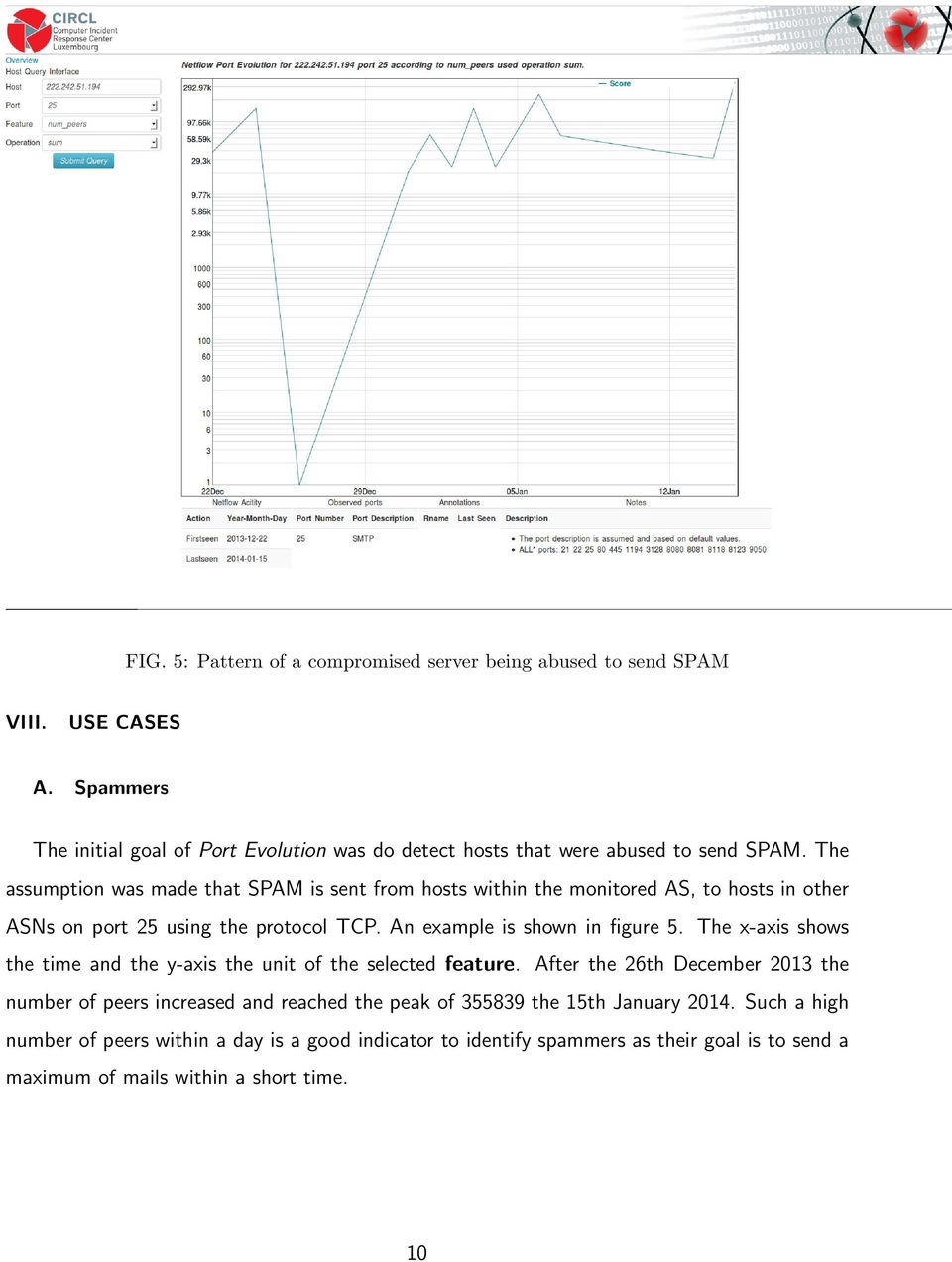
9 Host Port 25 Feature bytes Operation sum TABLE II: Example of the Host Query Interface change frequently. Therefore, the annotation data also includes a last seen field. VII. EXAMPLES How many bytes the IP address exchanged on port 25 over the last months? The data shown in table II is entered in the Host Query Interface and the Submit Query button must be pressed. The result is shown in figure 5. The outgoing traffic from the host on port 25 started on the 22th December 2013 and ended the 15th January A higher version than 2.0 of Port Evolution is required to extend the machine profiles on non monitored ports distributions. The currently documented Port Evolution version only tracks a limited set of outgoing ports. Which other ports the IP address contacted? Port Evolution remembers the last entered IP address. Therefore, just the port denoted ALL* should be selected and the Submit button should be pressed. Looking at the figure 1, the IP address is at the top position of hosts sending out the most of SMTP traffic in the AS. Was it always like that? Or was the machine abused? A click on the IP address gives the evolution of outgoing SMTP traffic for this host for the last months. 9

10 FIG. 5: Pattern of a compromised server being abused to send SPAM VIII. USE CASES A. Spammers The initial goal of Port Evolution was do detect hosts that were abused to send SPAM. The assumption was made that SPAM is sent from hosts within the monitored AS, to hosts in other ASNs on port 25 using the protocol TCP. An example is shown in figure 5. The x-axis shows the time and the y-axis the unit of the selected feature. After the 26th December 2013 the number of peers increased and reached the peak of the 15th January Such a high number of peers within a day is a good indicator to identify spammers as their goal is to send a maximum of mails within a short time. 10
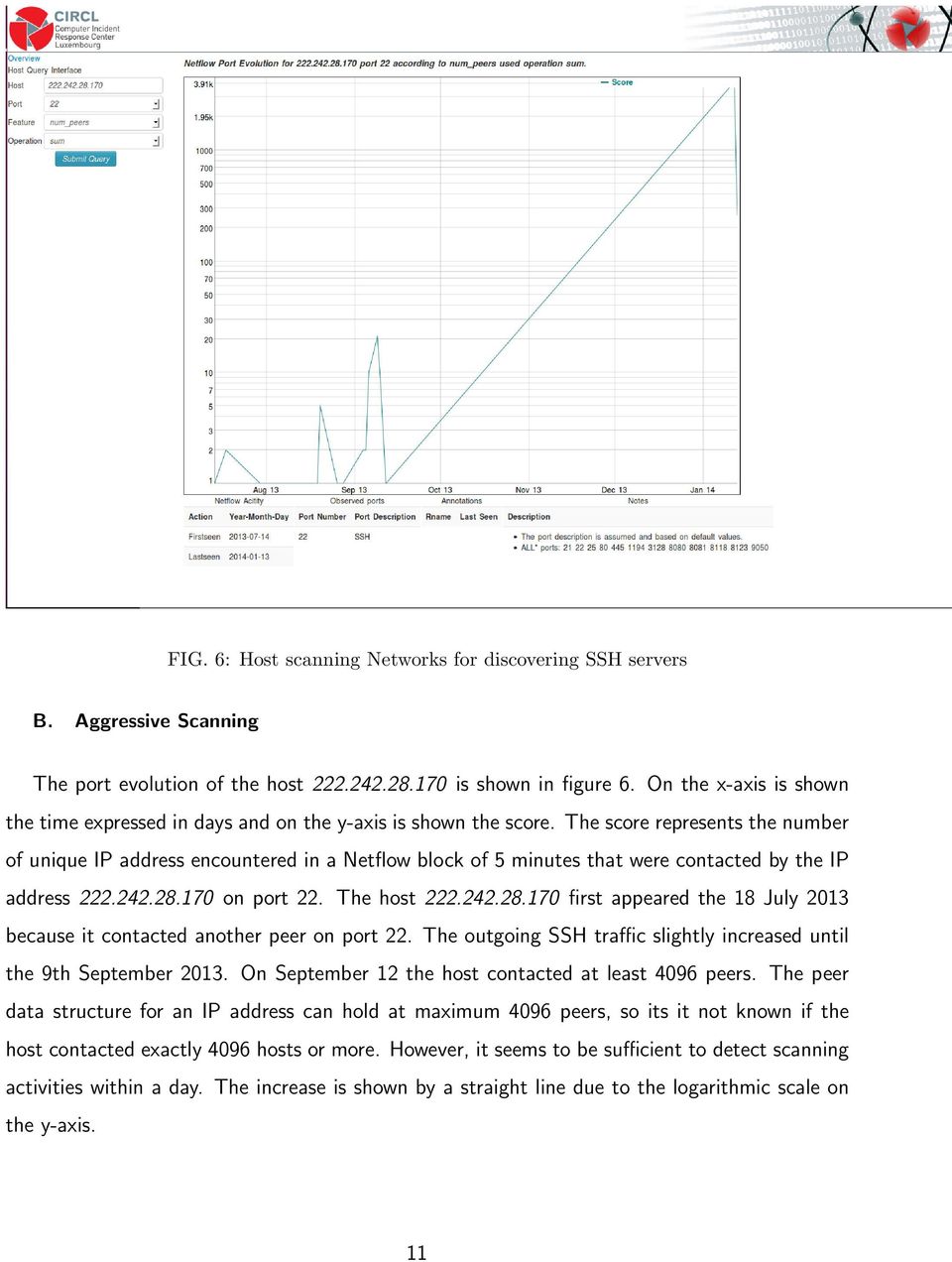
11 FIG. 6: Host scanning Networks for discovering SSH servers B. Aggressive Scanning The port evolution of the host is shown in figure 6. On the x-axis is shown the time expressed in days and on the y-axis is shown the score. The score represents the number of unique IP address encountered in a Netflow block of 5 minutes that were contacted by the IP address on port 22. The host first appeared the 18 July 2013 because it contacted another peer on port 22. The outgoing SSH traffic slightly increased until the 9th September On September 12 the host contacted at least 4096 peers. The peer data structure for an IP address can hold at maximum 4096 peers, so its it not known if the host contacted exactly 4096 hosts or more. However, it seems to be sufficient to detect scanning activities within a day. The increase is shown by a straight line due to the logarithmic scale on the y-axis. 11
12 C. Tor Nodes Deployed Tor exit nodes are generating by definition a lot of outgoing traffic. The outgoing traffic is usually controlled by the Tor exit policy [4] that is configured by the local Tor operator. For instance, if the exit policy only allows outgoing port 80 TCP and outgoing port 443, then the network profile of this exit nodes looks very similar to an open proxy. Tor Exit Nodes usually participate in the Tor Network and thus often communicate with other Tor nodes on port 9050 TCP. In figure 7, is shown an onion router that is participating in the Tor Network. The node was continuously active from the 20th October 2013 to the 26th January In order to see which kind of traffic this Tor node relays, it is sufficient to click on the Submit button in the Host Query Interface. The result is shown in figure 8. The graph looks quite overloaded because it contains 12 curves. The host operating the Tor exit node, communicates with other hosts on the ports {21, 22, 25, 80, 455, 1194, 3128, 8080, 8081, 8118, 8123}. This means that either the exit policy allows these protocols and that these flows were originated from the Tor exit node or the system administrator installed other services on the same host or routed them through the same host. A Port Evolution higher than 2.0 is needed to compare incoming traffic on port 9050 and outgoing traffic. In this case incoming traffic distribution on port 9050 can be compared with the others outgoing ports. [1] [2] [3] e.g. passive dns data, reverse ptr data [4] 12
13 FIG. 7: Onion Router Traffic 13

14 FIG. 8: Tor Exit Node Traffic 14

Assets, Groups & Networks
 Complete. Simple. Affordable Copyright 2014 AlienVault. All rights reserved. AlienVault, AlienVault Unified Security Management, AlienVault USM, AlienVault Open Threat Exchange, AlienVault OTX, Open Threat
Load Balance Mechanism
 Load Balance Application in Dual-WAN Interface Load Balance Mechanism To which WAN port the traffic will be routed is determined according to the Load Balance mechanism. Below diagram shows how Vigor router
DNS (Domain Name System) is the system & protocol that translates domain names to IP addresses.
 Lab Exercise DNS Objective DNS (Domain Name System) is the system & protocol that translates domain names to IP addresses. Step 1: Analyse the supplied DNS Trace Here we examine the supplied trace of a
Spam Marshall SpamWall Step-by-Step Installation Guide for Exchange 5.5
 Spam Marshall SpamWall Step-by-Step Installation Guide for Exchange 5.5 What is this document for? This document is a Step-by-Step Guide that can be used to quickly install Spam Marshall SpamWall on Exchange
Network Security Monitoring and Behavior Analysis Pavel Čeleda, Petr Velan, Tomáš Jirsík
 Network Security Monitoring and Behavior Analysis Pavel Čeleda, Petr Velan, Tomáš Jirsík {celeda velan jirsik}@ics.muni.cz Part I Introduction P. Čeleda et al. Network Security Monitoring and Behavior
Firewall Firewall August, 2003
 Firewall August, 2003 1 Firewall and Access Control This product also serves as an Internet firewall, not only does it provide a natural firewall function (Network Address Translation, NAT), but it also
Configuring Your Gateman Email Server
 Configuring Your Gateman Email Server Your Gateman Lifestyle Server includes an Email Server that provides users access to email via an email client and via your web browser using your laptop and mobile
Internet Protocol: IP packet headers. vendredi 18 octobre 13
 Internet Protocol: IP packet headers 1 IPv4 header V L TOS Total Length Identification F Frag TTL Proto Checksum Options Source address Destination address Data (payload) Padding V: Version (IPv4 ; IPv6)
Configuring Network Address Translation (NAT)
 8 Configuring Network Address Translation (NAT) Contents Overview...................................................... 8-3 Translating Between an Inside and an Outside Network........... 8-3 Local and
Communications and Networking
 Communications and Networking History and Background telephone system local area networks Internet architecture: what the pieces are and how they fit together names and addresses: what's your name and
Services. Vyatta System. REFERENCE GUIDE DHCP DHCPv6 DNS Web Caching LLDP VYATTA, INC.
 VYATTA, INC. Vyatta System Services REFERENCE GUIDE DHCP DHCPv6 DNS Web Caching LLDP Vyatta Suite 200 1301 Shoreway Road Belmont, CA 94002 vyatta.com 650 413 7200 1 888 VYATTA 1 (US and Canada) COPYRIGHT
Internet Privacy Options
 2 Privacy Internet Privacy Sirindhorn International Institute of Technology Thammasat University Prepared by Steven Gordon on 19 June 2014 Common/Reports/internet-privacy-options.tex, r892 1 Privacy Acronyms
Using IPM to Measure Network Performance
 CHAPTER 3 Using IPM to Measure Network Performance This chapter provides details on using IPM to measure latency, jitter, availability, packet loss, and errors. It includes the following sections: Measuring
Flow Analysis Versus Packet Analysis. What Should You Choose?
 Flow Analysis Versus Packet Analysis. What Should You Choose? www.netfort.com Flow analysis can help to determine traffic statistics overall, but it falls short when you need to analyse a specific conversation
Large-Scale TCP Packet Flow Analysis for Common Protocols Using Apache Hadoop
 Large-Scale TCP Packet Flow Analysis for Common Protocols Using Apache Hadoop R. David Idol Department of Computer Science University of North Carolina at Chapel Hill [email protected] http://www.cs.unc.edu/~mxrider
F-Secure Messaging Security Gateway. Deployment Guide
 F-Secure Messaging Security Gateway Deployment Guide TOC F-Secure Messaging Security Gateway Contents Chapter 1: Deploying F-Secure Messaging Security Gateway...3 1.1 The typical product deployment model...4
Chapter 11 Cloud Application Development
 Chapter 11 Cloud Application Development Contents Motivation. Connecting clients to instances through firewalls. Chapter 10 2 Motivation Some of the questions of interest to application developers: How
SpamPots Project: Using Honeypots to Measure the Abuse of End-User Machines to Send Spam
 SpamPots Project: Using Honeypots to Measure the Abuse of End-User Machines to Send Spam Marcelo H. P. C. Chaves [email protected] CERT.br Computer Emergency Response Team Brazil NIC.br Network Information Center
Sage 300 ERP Online. Mac Resource Guide. (Formerly Sage ERP Accpac Online) Updated June 1, 2012. Page 1
 Sage 300 ERP Online (Formerly Sage ERP Accpac Online) Mac Resource Guide Updated June 1, 2012 Page 1 Table of Contents 1.0 Introduction... 3 2.0 Getting Started with Sage 300 ERP Online using a Mac....
Sage ERP Accpac Online
 Sage ERP Accpac Online Mac Resource Guide Thank you for choosing Sage ERP Accpac Online. This Resource Guide will provide important information and instructions on how you can get started using your Mac
SolarWinds. Understanding SolarWinds Charts and Graphs Technical Reference
 SolarWinds Understanding SolarWinds Charts and Graphs Technical Reference Copyright 1995-2015 SolarWinds Worldwide, LLC. All rights reserved worldwide. No part of this document may be reproduced by any
Installing Policy Patrol on a separate machine
 Policy Patrol 3.0 technical documentation July 23, 2004 Installing Policy Patrol on a separate machine If you have Microsoft Exchange Server 2000 or 2003 it is recommended to install Policy Patrol on the
Basic Network Configuration
 Basic Network Configuration 2 Table of Contents Basic Network Configuration... 25 LAN (local area network) vs WAN (wide area network)... 25 Local Area Network... 25 Wide Area Network... 26 Accessing the
Hands-on Network Traffic Analysis. 2015 Cyber Defense Boot Camp
 Hands-on Network Traffic Analysis 2015 Cyber Defense Boot Camp What is this about? Prerequisite: network packet & packet analyzer: (header, data) Enveloped letters inside another envelope Exercises Basic
Running the Tor client on Mac OS X
 Running the Tor client on Mac OS X Note that these are the installation instructions for running a Tor client on Mac OS X. If you want to relay traffic for others to help the network grow (please do),
architecture: what the pieces are and how they fit together names and addresses: what's your name and number?
 Communications and networking history and background telephone system local area networks Internet architecture: what the pieces are and how they fit together names and addresses: what's your name and
Implementing Network Address Translation and Port Redirection in epipe
 Implementing Network Address Translation and Port Redirection in epipe Contents 1 Introduction... 2 2 Network Address Translation... 2 2.1 What is NAT?... 2 2.2 NAT Redirection... 3 2.3 Bimap... 4 2.4
Use Domain Name System and IP Version 6
 Use Domain Name System and IP Version 6 What You Will Learn The introduction of IP Version 6 (IPv6) into an enterprise environment requires some changes both in the provisioned Domain Name System (DNS)
Setting Up Scan to SMB on TaskALFA series MFP s.
 Setting Up Scan to SMB on TaskALFA series MFP s. There are three steps necessary to set up a new Scan to SMB function button on the TaskALFA series color MFP. 1. A folder must be created on the PC and
High Availability and Clustering
 High Availability and Clustering AdvOSS-HA is a software application that enables High Availability and Clustering; a critical requirement for any carrier grade solution. It implements multiple redundancy
Emerald. Network Collector Version 4.0. Emerald Management Suite IEA Software, Inc.
 Emerald Network Collector Version 4.0 Emerald Management Suite IEA Software, Inc. Table Of Contents Purpose... 3 Overview... 3 Modules... 3 Installation... 3 Configuration... 3 Filter Definitions... 4
How To Configure Forefront Threat Management Gateway (Forefront) For An Email Server
 Owner of the content within this article is www.isaserver.org Written by Marc Grote www.it-training-grote.de Configuring and using the E-Mail protection feature in Microsoft Forefront Threat Management
Setting up Microsoft Office 365
 Setup Guide Revision F Using McAfee SaaS Email Protection to Secure Exchange Online in Microsoft Office 365 Setting up Microsoft Office 365 Use this guide to configure Microsoft Office 365 and Microsoft
Configuring Security for FTP Traffic
 2 Configuring Security for FTP Traffic Securing FTP traffic Creating a security profile for FTP traffic Configuring a local traffic FTP profile Assigning an FTP security profile to a local traffic FTP
CMPT 471 Networking II
 CMPT 471 Networking II Firewalls Janice Regan, 2006-2013 1 Security When is a computer secure When the data and software on the computer are available on demand only to those people who should have access
Cisco NetFlow Reporting Instruction Manual Version 1.0
 Cisco NetFlow Reporting Instruction Manual Version 1.0 WiredCity 777 Davis St, Suite 250 San Leandro CA 94577 Ph: + 1 510 297 5874 Fax: +1 510-357-8136 [email protected] www.wiredcity.com www.wiredcity.com
NetFlow Tracker Overview. Mike McGrath x ccie CTO [email protected]
 NetFlow Tracker Overview Mike McGrath x ccie CTO [email protected] 2006 Copyright Crannog Software www.crannog-software.com 1 Copyright Crannog Software www.crannog-software.com 2 LEVELS OF NETWORK
Setting up Microsoft Office 365
 Integration Guide Revision G McAfee SaaS Email Protection Securing Exchange Online in Microsoft Office 365 Setting up Microsoft Office 365 Use this guide to configure Microsoft Office 365 and Microsoft
Setup Guide for Exchange Server
 Setup Guide for Exchange Server Table of Contents Overview... 1 A. Exchange Server 2007/2010 Inbound Mail... 2 B. Exchange Server 2007/2010 Outbound Mail (optional)... 8 C. Exchange Server 2003/2000 Inbound
nfdump and NfSen 18 th Annual FIRST Conference June 25-30, 2006 Baltimore Peter Haag 2006 SWITCH
 18 th Annual FIRST Conference June 25-30, 2006 Baltimore Peter Haag 2006 SWITCH Some operational questions, popping up now and then: Do you see this peek on port 445 as well? What caused this peek on your
GregSowell.com. Mikrotik Security
 Mikrotik Security IP -> Services Disable unused services Set Available From for appropriate hosts Secure protocols are preferred (Winbox/SSH) IP -> Neighbors Disable Discovery Interfaces where not necessary.
Computer and Network Security Exercise no. 4
 University of Haifa Winter Semester 11/1/12 Computer and Network Security Exercise no. 4 Submit in Pairs/Single to mailbox 19 by 25/1/12, 2:00 p.m. 1. Following the sensitivity of the information in its
Applications. Network Application Performance Analysis. Laboratory. Objective. Overview
 Laboratory 12 Applications Network Application Performance Analysis Objective The objective of this lab is to analyze the performance of an Internet application protocol and its relation to the underlying
Technical Note. ISP Protection against BlackListing. FORTIMAIL Deployment for Outbound Spam Filtering. Rev 2.2
 Technical Note ISP Protection against BlackListing FORTIMAIL Deployment for Outbound Spam Filtering Rev 2.2 April 14, 2009 Table of Contents 1 Objective IP address protection... 3 1.1 Context... 3 1.2
Appendix D: Configuring Firewalls and Network Address Translation
 Appendix D: Configuring Firewalls and Network Address Translation The configuration information in this appendix will help the network administrator plan and configure the network architecture for Everserve.
We will give some overview of firewalls. Figure 1 explains the position of a firewall. Figure 1: A Firewall
 Chapter 10 Firewall Firewalls are devices used to protect a local network from network based security threats while at the same time affording access to the wide area network and the internet. Basically,
DEPLOYMENT GUIDE Version 1.1. DNS Traffic Management using the BIG-IP Local Traffic Manager
 DEPLOYMENT GUIDE Version 1.1 DNS Traffic Management using the BIG-IP Local Traffic Manager Table of Contents Table of Contents Introducing DNS server traffic management with the BIG-IP LTM Prerequisites
Introduction to Netflow
 Introduction to Netflow Mike Jager Network Startup Resource Center [email protected] These materials are licensed under the Creative Commons Attribution-NonCommercial 4.0 International license (http://creativecommons.org/licenses/by-nc/4.0/)
escan SBS 2008 Installation Guide
 escan SBS 2008 Installation Guide Following things are required before starting the installation 1. On SBS 2008 server make sure you deinstall One Care before proceeding with installation of escan. 2.
allow all such packets? While outgoing communications request information from a
 FIREWALL RULES Firewalls operate by examining a data packet and performing a comparison with some predetermined logical rules. The logic is based on a set of guidelines programmed in by a firewall administrator,
Security+ Guide to Network Security Fundamentals, Fourth Edition. Chapter 6 Network Security
 Security+ Guide to Network Security Fundamentals, Fourth Edition Chapter 6 Network Security Objectives List the different types of network security devices and explain how they can be used Define network
Connecting with Free IP Call
 Connecting with Free IP Call Free IP Call (http://www.freeipcall.com/) offers telephone service using the VoIP standard SIP. The service allow users making/receiving VoIP calls to/from VoIP telephone numbers
Introduction to Computer Security Benoit Donnet Academic Year 2015-2016
 Introduction to Computer Security Benoit Donnet Academic Year 2015-2016 1 Agenda Networking Chapter 1: Firewalls Chapter 2: Proxy Chapter 3: Intrusion Detection System Chapter 4: Network Attacks Chapter
Network Monitoring and Management NetFlow Overview
 Network Monitoring and Management NetFlow Overview These materials are licensed under the Creative Commons Attribution-Noncommercial 3.0 Unported license (http://creativecommons.org/licenses/by-nc/3.0/)
Connecting with Vonage
 Connecting with Vonage Vonage (http://www.vonage.com/) offers telephone service using the VoIP (Voice over Internet Protocol) standard SIP (Session Initiation Protocol). The service allow users making
DeltaV System Health Monitoring Networking and Security
 DeltaV Distributed Control System White Paper DeltaV System Health Monitoring Networking and Security Introduction Emerson Process Management s DeltaV System Health Monitoring service enables you to proactively
Web Dashboard. User Manual. Build 2.0 2015-09-17
 Web Dashboard User Manual Build 2.0 2015-09-17 This is the official user manual on using SAMLite web dashboard to perform reporting and administrative tasks. This manual describes each section of reporting
18-731 Midterm. Name: Andrew user id:
 18-731 Midterm 6 March 2008 Name: Andrew user id: Scores: Problem 0 (10 points): Problem 1 (10 points): Problem 2 (15 points): Problem 3 (10 points): Problem 4 (20 points): Problem 5 (10 points): Problem
Computer Security CS 426 Lecture 36. CS426 Fall 2010/Lecture 36 1
 Computer Security CS 426 Lecture 36 Perimeter Defense and Firewalls CS426 Fall 2010/Lecture 36 1 Announcements There will be a quiz on Wed There will be a guest lecture on Friday, by Prof. Chris Clifton
Real-Time Handling of Network Monitoring Data Using a Data-Intensive Framework
 Real-Time Handling of Network Monitoring Data Using a Data-Intensive Framework Aryan TaheriMonfared Tomasz Wiktor Wlodarczyk Chunming Rong Department of Electrical Engineering and Computer Science University
Load Balancing and Sessions. C. Kopparapu, Load Balancing Servers, Firewalls and Caches. Wiley, 2002.
 Load Balancing and Sessions C. Kopparapu, Load Balancing Servers, Firewalls and Caches. Wiley, 2002. Scalability multiple servers Availability server fails Manageability Goals do not route to it take servers
NetFlow Aggregation. Feature Overview. Aggregation Cache Schemes
 NetFlow Aggregation This document describes the Cisco IOS NetFlow Aggregation feature, which allows Cisco NetFlow users to summarize NetFlow export data on an IOS router before the data is exported to
Wharf T&T Limited DDoS Mitigation Service Customer Portal User Guide
 Table of Content I. Note... 1 II. Login... 1 III. Real-time, Daily and Monthly Report... 3 Part A: Real-time Report... 3 Part 1: Traffic Details... 4 Part 2: Protocol Details... 5 Part B: Daily Report...
WhatsUpGold. v12.3.1. NetFlow Monitor User Guide
 WhatsUpGold v12.3.1 NetFlow Monitor User Guide Contents CHAPTER 1 WhatsUp Gold NetFlow Monitor Overview What is NetFlow?... 1 How does NetFlow Monitor work?... 2 Supported versions... 2 System requirements...
Cisco IOS Flexible NetFlow Technology
 Cisco IOS Flexible NetFlow Technology Last Updated: December 2008 The Challenge: The ability to characterize IP traffic and understand the origin, the traffic destination, the time of day, the application
1. Installing The Monitoring Software
 SD7000 Digital Microphone Monitor Software manual Table of Contents 1. Installing The Monitor Software 1.1 Setting Up Receivers For Monitoring 1.2 Running The Application 1.3 Shutdown 2. The Detail Monitoring
Product Manual. Administration and Configuration Manual
 Product Manual Administration and Configuration Manual http://www.gfi.com [email protected] The information and content in this document is provided for informational purposes only and is provided "as is" with
Dynamic DNS How-To Guide
 Configuration Guide Dynamic DNS How-To Guide Overview This guide will show you how to set up a Dynamic DNS host name under the D-Link DDNS service with your D-Link ShareCenter TM. Dynamic DNS is a protocol
Analysis of Communication Patterns in Network Flows to Discover Application Intent
 Analysis of Communication Patterns in Network Flows to Discover Application Intent Presented by: William H. Turkett, Jr. Department of Computer Science FloCon 2013 January 9, 2013 Port- and payload signature-based
Nemea: Searching for Botnet Footprints
 Nemea: Searching for Botnet Footprints Tomas Cejka 1, Radoslav Bodó 1, Hana Kubatova 2 1 CESNET, a.l.e. 2 FIT, CTU in Prague Zikova 4, 160 00 Prague 6 Thakurova 9, 160 00 Prague 6 Czech Republic Czech
Network Probe User Guide
 Network Probe User Guide Network Probe User Guide Table of Contents 1. Introduction...1 2. Installation...2 Windows installation...2 Linux installation...3 Mac installation...4 License key...5 Deployment...5
Proxy Server, Network Address Translator, Firewall. Proxy Server
 Proxy Server, Network Address Translator, Firewall 1 Proxy Server 2 1 Introduction What is a proxy server? Acts on behalf of other clients, and presents requests from other clients to a server. Acts as
About Firewall Protection
 1. This guide describes how to configure basic firewall rules in the UTM to protect your network. The firewall then can provide secure, encrypted communications between your local network and a remote
NETWORKS AND THE INTERNET
 NETWORKS AND THE INTERNET Outline to accompany the slide presentation 1. Networks and the Internet A Primer for Prosecutors and Investigators 2. Getting There From networks to the Internet Locating a place
Virtual private network. Network security protocols VPN VPN. Instead of a dedicated data link Packets securely sent over a shared network Internet VPN
 Virtual private network Network security protocols COMP347 2006 Len Hamey Instead of a dedicated data link Packets securely sent over a shared network Internet VPN Public internet Security protocol encrypts
Architecture. The DMZ is a portion of a network that separates a purely internal network from an external network.
 Architecture The policy discussed suggests that the network be partitioned into several parts with guards between the various parts to prevent information from leaking from one part to another. One part
Network Address Translation (NAT) Adapted from Tannenbaum s Computer Network Ch.5.6; computer.howstuffworks.com/nat1.htm; Comer s TCP/IP vol.1 Ch.
 Network Address Translation (NAT) Adapted from Tannenbaum s Computer Network Ch.5.6; computer.howstuffworks.com/nat1.htm; Comer s TCP/IP vol.1 Ch.20 Long term and short term solutions to Internet scalability
DEPLOYMENT GUIDE Version 1.2. Deploying the BIG-IP System v10 with Microsoft IIS 7.0 and 7.5
 DEPLOYMENT GUIDE Version 1.2 Deploying the BIG-IP System v10 with Microsoft IIS 7.0 and 7.5 Table of Contents Table of Contents Deploying the BIG-IP system v10 with Microsoft IIS Prerequisites and configuration
CSE331: Introduction to Networks and Security. Lecture 12 Fall 2006
 CSE331: Introduction to Networks and Security Lecture 12 Fall 2006 Announcements Midterm I will be held Friday, Oct. 6th. True/False Multiple Choice Calculation Short answer Short essay Project 2 is on
ICND2 NetFlow. Question 1. What are the benefit of using Netflow? (Choose three) A. Network, Application & User Monitoring. B.
 ICND2 NetFlow Question 1 What are the benefit of using Netflow? (Choose three) A. Network, Application & User Monitoring B. Network Planning C. Security Analysis D. Accounting/Billing Answer: A C D NetFlow
The data between TC Monitor and remote devices is exchanged using HTTP protocol. Monitored devices operate either as server or client mode.
 1. Introduction TC Monitor is easy to use Windows application for monitoring and control of some Teracom Ethernet (TCW) and GSM/GPRS (TCG) controllers. The supported devices are TCW122B-CM, TCW181B- CM,
Bitrix Site Manager ASP.NET. Installation Guide
 Bitrix Site Manager ASP.NET Installation Guide Contents Introduction... 4 Chapter 1. Checking for IIS Installation... 5 Chapter 2. Using An Archive File to Install Bitrix Site Manager ASP.NET... 7 Preliminary
Single Pass Load Balancing with Session Persistence in IPv6 Network. C. J. (Charlie) Liu Network Operations Charter Communications
 Single Pass Load Balancing with Session Persistence in IPv6 Network C. J. (Charlie) Liu Network Operations Charter Communications Load Balancer Today o Load balancing is still in use today. It is now considered
HOST AUTO CONFIGURATION (BOOTP, DHCP)
 Announcements HOST AUTO CONFIGURATION (BOOTP, DHCP) I. HW5 online today, due in week! Internet Protocols CSC / ECE 573 Fall, 2005 N. C. State University copyright 2005 Douglas S. Reeves 2 I. Auto configuration
Configuring Security for SMTP Traffic
 4 Configuring Security for SMTP Traffic Securing SMTP traffic Creating a security profile for SMTP traffic Configuring a local traffic SMTP profile Assigning an SMTP security profile to a local traffic
Limitations of Packet Measurement
 Limitations of Packet Measurement Collect and process less information: Only collect packet headers, not payload Ignore single packets (aggregate) Ignore some packets (sampling) Make collection and processing
Internet2 NetFlow Weekly Reports
 Internet2 NetFlow Weekly Reports Stanislav Shalunov Internet2 Fall Member Meeting, Indianapolis, 2003-10-13 What is NetFlow? Originally a Cisco proprietary technology Now supported by other vendors and
Chapter 6 Configuring the SSL VPN Tunnel Client and Port Forwarding
 Chapter 6 Configuring the SSL VPN Tunnel Client and Port Forwarding This chapter describes the configuration for the SSL VPN Tunnel Client and for Port Forwarding. When a remote user accesses the SSL VPN
Best of Breed of an ITIL based IT Monitoring. The System Management strategy of NetEye
 Best of Breed of an ITIL based IT Monitoring The System Management strategy of NetEye by Georg Kostner 5/11/2012 1 IT Services and IT Service Management IT Services means provisioning of added value for
Government of Canada Managed Security Service (GCMSS) Annex A-6: Statement of Work - Data Loss Prevention (DLP)
 Government of Canada Managed Security Service (GCMSS) Annex A-6: Statement of Work - Data Loss Prevention (DLP) Date: July 12, 2012 TABLE OF CONTENTS 1 DATA LOSS PREVENTION (DLP)... 1 1.1 DETECTION AND
F-SECURE MESSAGING SECURITY GATEWAY
 F-SECURE MESSAGING SECURITY GATEWAY DEFAULT SETUP GUIDE This guide describes how to set up and configure the F-Secure Messaging Security Gateway appliance in a basic e-mail server environment. AN EXAMPLE
MCTS Guide to Microsoft Windows Server 2008 Applications Infrastructure Configuration (Exam # 70-643)
 MCTS Guide to Microsoft Windows Server 2008 Applications Infrastructure Configuration (Exam # 70-643) Chapter Six Configuring Windows Server 2008 Web Services, Part 1 Objectives Create and configure Web
1 hours, 30 minutes, 38 seconds Heavy scan. All scanned network resources. Copyright 2001, FTP access obtained
 home Network Vulnerabilities Detail Report Grouped by Vulnerability Report Generated by: Symantec NetRecon 3.5 Licensed to: X Serial Number: 0182037567 Machine Scanned from: ZEUS (192.168.1.100) Scan Date:
IMPLEMENTATION OF INTELLIGENT FIREWALL TO CHECK INTERNET HACKERS THREAT
 IMPLEMENTATION OF INTELLIGENT FIREWALL TO CHECK INTERNET HACKERS THREAT Roopa K. Panduranga Rao MV Dept of CS and Engg., Dept of IS and Engg., J.N.N College of Engineering, J.N.N College of Engineering,