
Your investment options explained for the Plum Superannuation Fund
|
|
|
- Marjory Todd
- 10 years ago
- Views:
Transcription
1 Your investment options explained for the Plum Superannuation Fund Trustee: PFS Nominees Pty Ltd ABN AFSL Fund: Plum Superannuation Fund ABN Administrator: Plum Financial Services Limited (Plum) ABN AFSL Level 4, 500 Bourke Street Melbourne Vic 3000 GPO Box 63 Melbourne Vic 3001 Telephone Fax Web plum.com.au Preparation date: 3 May 2012
2 About this guide Important information The information contained in this guide should be read in conjunction with the Product Disclosure Statement (PDS) for the Plum Superannuation Fund. You should assess the information described in this guide before completing your Application form. This guide provides information about the available investment options under the Plan and is not personal investment advice nor should it be used or relied upon as a substitute for professional investment advice. We do not recommend that any member make decisions based solely on the information contained in this guide and each member is ultimately responsible for making his or her own investment decisions and obtaining whatever assistance he or she deems necessary. Any advice in this guide is of a general nature only and has been prepared without taking into account your objectives, financial situation or needs. Because of this, you should, before acting on any information in this guide, consider whether it is appropriate to your objectives, financial situation and needs and seek professional financial advice before you decide to invest in the Fund. The information contained within this guide is current at the time it was prepared. However, changes to the information may subsequently occur. You can access updated information, free of charge, either from our website or by contacting a Member Services Consultant. If there is a materially adverse change to information contained in this guide, we will issue a replacement guide and advise members of the Fund in writing. Calculation of investment performance We provide a broad range of investment options and you can choose any one or more of these investment options. Investment performance figures quoted in this guide: reflect movements in the unit prices of the Plum Pooled Superannuation Trust ABN (Plum PST) unless otherwise noted; are net of tax and ongoing investment management fees; and do not take into account Fund member administration fees. Investment returns provided in this guide are actual returns to Fund members, unless otherwise noted, expressed as an annual return (that is, as a percentage per annum). For example, if an investment earned 2% in one complete year and 12% in the following complete year, this would be expressed as an annualised return of 6.9% p.a. Benchmark returns shown throughout this guide are net of tax. In the Long-term objective section the figures quoted against the Consumer Price Index (CPI) for the Path one investment options are net of tax. costs The indicative investment option management cost and buy/sell costs are currrent as advised to us as at 31 December 2011 and are inclusive of goods and services tax (GST) and reduced input tax credit (RITC) but exclude other taxes. You can access current fee information from the website plum.com.au The indicative investment option management costs disclosed in this guide are expected costs. An amount up to the equivalent of the buy cost may apply during a period of extensive or large withdrawals from the underlying fund. Glossary A number of technical terms are used in this guide and are explained in the Glossary.
3 Contents 2 Consider your investor profile 3 Choosing your investment strategy and switching your investments 4 Choosing your level of investment involvement 5 Investment basics 9 costs 11 Path one simple choice 15 Path two flexible choice 22 Path three specialist choice 29 Closed investment options 31 Investment manager PDSs 32 Ethical investing 33 Glossary 1
4 Consider your investor profile Your investment options explained provides information about investments for your superannuation. Understanding your investor profile may help you to choose an investment mix that suits your needs. For more information about investor profiles, refer to the Five steps to making your investment choice booklet (available from the Forms and publications section of the member website). Some typical investor profiles are outlined in the table below. Sample investor profile Conservative Cautious Moderate Assertive Aggressive Profile description Prefers limited ups and downs in the value of an investment that comes from investing super primarily in cash and fixed interest, and prepared to accept low-to-moderate returns. Comfortable with a balanced mix of assets to achieve steady long-term returns, with smaller fluctuations in the value of investments. Prefers having a slightly higher proportion of super invested in shares and property than cash and fixed interest investments. Realises that higher volatility usually accompanies higher long-term returns. Wants to invest super primarily in shares and property but likes the stabilising influence of having limited exposure to fixed interest investments as well. Prepared to accept higher volatility to seek medium-to-high returns. Comfortable investing all super in shares and seeks high long-term returns albeit with higher volatility. 2

5 Choosing your investment strategy and switching your investments If you want to select how your future contributions are invested, you can make an investment strategy change. Please note that any expenses or deductions such as contributions tax will also follow your investment strategy. If expenses are processed before a contribution is received you may have a negative balance for a short period of time in the selected investment option(s). On receipt and acceptance of an investment strategy request on any business day, we will process the request to the relevant investment options as follows: requests received prior to 4.00pm, Melbourne time will use the unit price applying at close of business on that day. requests received after 4.00pm, Melbourne time will use the unit price applying at the close of business on the next business day. If you want to move some or all of your existing account balance into one or more different investment options, you can make an investment switch. When you request a switch before 4pm, Melbourne time, on any business day: units in your current investment option(s) will be sold at the sell price for the day on which your request is processed; and the sales proceeds will be used to buy units in your new investment option(s) at the buy price for the same day. If we receive your request after 4.00pm Melbourne time, we will use the unit price applying at the close of business on the next business day. Although you can generally make an investment switch at any time, you will need to wait until your first switch is processed and units have been allocated before you can request a second switch. No administration fee is charged when you make an investment strategy change or switch. You may, however, incur transaction costs (buy/sell costs) on some investment option(s) when a switch is conducted. See the Buy/sell costs section for more information about these costs. We will accept instructions for investment strategy changes and switches through the member website plum.com.au or you can contact a Member Services Consultant on Before you make an investment strategy change or switch, you need to consider the relevant information provided in the current version of this guide, the PDS and applicable investment managers PDSs for each investment option selected from the Fund s investment menu. We suggest you seek licensed financial advice before changing your investment strategy or switching investments. 3
6 Choosing your level of investment involvement We have developed three investment paths to suit different levels of involvement and investment knowledge. We provide a broad range of investment options through the Plan and you can choose any one or more of these investment options. We will purchase units in your chosen investment option(s) (or in the Plan s default investment strategy if you do not make an investment choice) when contributions or transferred amounts are received. We will sell units from your chosen investment option(s) (or from the Plan s default investment strategy if you do not make an investment choice) for the deduction of any outstanding fees, insurance premiums and taxes. Path one simple choice is the quickest and easiest way to choose an investment mix and may suit you if you prefer to have a lower level of involvement in your superannuation investments. Path one may suit you if you want to leave investment decisions to professional investment managers. Path two flexible choice may suit you if you have some investment experience and would like to choose the investment mix (broad asset allocation) of your investment strategy. You will need to have some understanding of investments, including the difference between the four main asset classes and whether you prefer an active or indexed investment philosophy. Path three specialist choice may suit you if you have a good understanding about the fundamentals of investing and would like to fully customise your investment choice. You can create your own investment mix and choose from a broad range of investment options with various investment styles. You should have a good understanding of investment risks before investing in this path. We recommend you seek financial advice as greater investment experience is generally required for investing in Path three specialist choice. The table below summarises the features of each investment path. You can obtain more detailed information in the Investment basics section and investment options tables further on in this guide. Path one simple choice Path two flexible choice Path three specialist choice Steps to making your investment choice Consider your investor profile Select your investment option. Consider your investor profile Customise your asset allocation Select your investment options. Consider your investor profile Customise your specific asset allocations, investment styles and management approaches Select your investment options. Level of investment involvement required by you Low Medium High About the investments in this path This path provides five diversified pre-mixed investment options to cater for different investor profiles. These options are constructed by professional investment managers and managed by a wide range of underlying sector-specialist investment managers. This path provides a selection of styleneutral investment options (i.e. options are not biased towards a particular investment management style). In this path, you need to decide on: your asset allocation (investment mix); and your preferred investment philosophy (i.e. active or indexed). You can customise your investment mix using a selection of investment options. This path includes investment options with specific investment styles and/or management approaches including: market capitalisation biases; ethical investment processes; country biases (e.g. emerging markets); and alternative investment approaches. 4

7 Investment basics Investment basics explains types of investment management philosophies, investment management approaches, investment styles and investment risks associated with superannuation investments. See the Glossary for more information about investment terms used in this guide. Investment management philosophies Indexing Index investment managers do not use traditional active management to outperform an index. They aim to match the index return of a particular asset class and incorporate broad diversification at low cost. Index managers do not generally employ high-cost processes (because they follow the index) and have very low transaction costs (because they rarely buy and sell securities). Active Active investment managers change their mix of assets depending on current or expected market conditions. They review investments regularly to try to benefit from movements in the market or from growth in individual assets. Investment management approaches Each of the Plan s investment options has a single-manager or multi-manager management approach. Single-manager Single-managers manage all or most investments themselves. They manage the underlying investments of options that have a particular investment philosophy and style. Multi-manager Multi-managers do not invest directly themselves but use a combination of external investment managers to manage investments on their behalf. They use investment managers with different styles to take advantage of diversification benefits. Investment styles Below are details about the investment styles that investment managers adopt when making investment decisions. Bottom-up (security selection) This is a form of stock or security analysis which focuses more on forecasting returns for individual companies rather than the economy as a whole (opposite of top-down). Top-down (macro view) This is a form of stock or security analysis which focuses more on forecasting broad (macro) economic trends and the effect on the market rather than forecasting returns for individual companies (opposite of bottom-up). Growth Growth investment managers are primarily interested in a company s earnings. They focus on investing in companies that they expect will earn higher profits and shareholder earnings than similar companies. Growth investment managers tend to be concerned with future performance and will most likely invest in companies with a good earnings outlook. They generally price stocks based on forwardlooking estimates. Value Value investment managers are most interested in buying companies stocks for a good price. They may purchase stocks of companies that they consider to be currently undervalued on the share market. Value investment managers tend to be concerned with historical performance and will most likely invest in companies that have good track records. They generally price stocks based on historical data. Neutral/core These investment managers have no specific investment style bias. They aim to produce competitive returns throughout periods of value and growth. 5

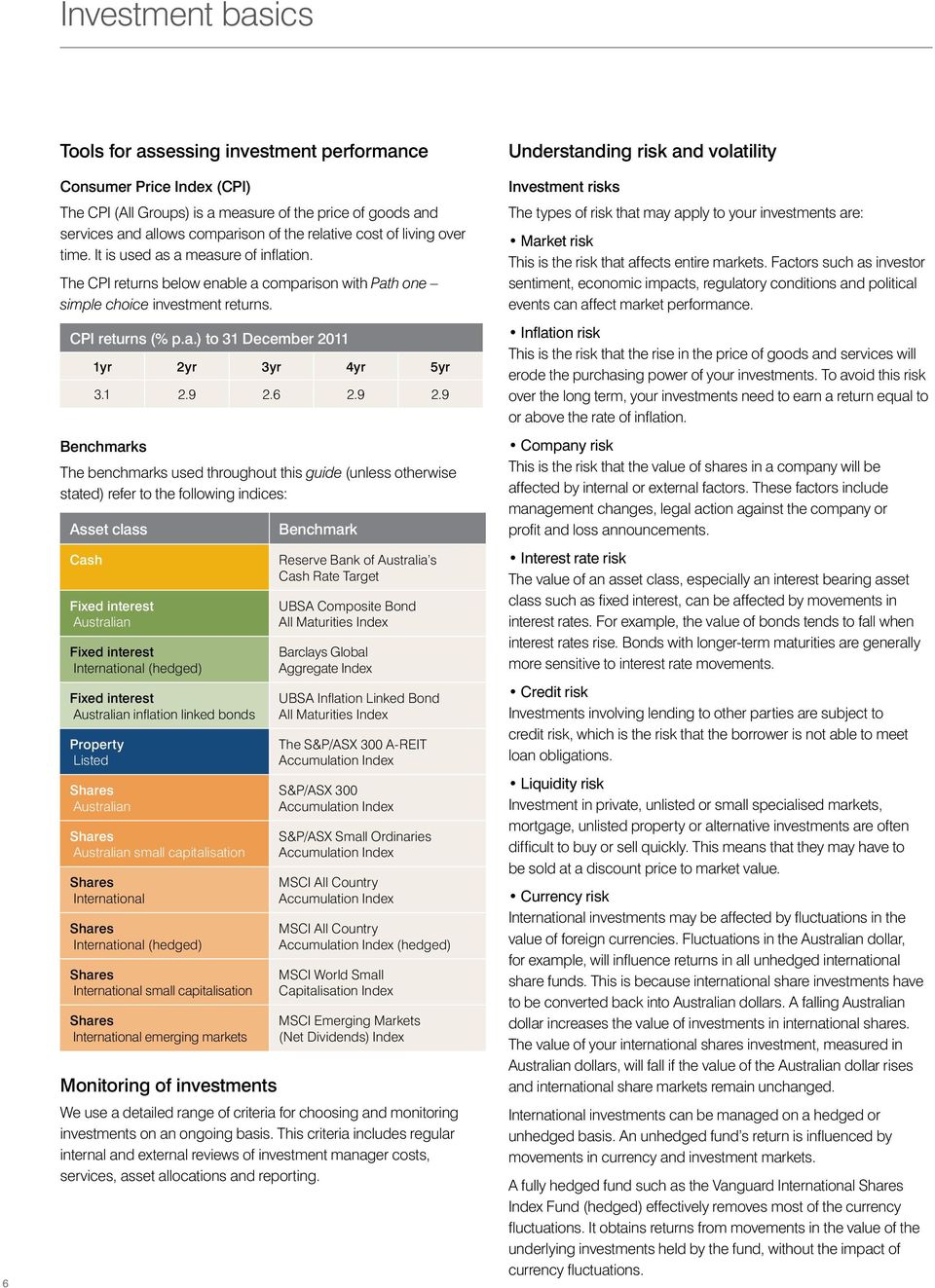
8 Investment basics 6 Tools for assessing investment performance Consumer Price Index (CPI) The CPI (All Groups) is a measure of the price of goods and services and allows comparison of the relative cost of living over time. It is used as a measure of inflation. The CPI returns below enable a comparison with Path one simple choice investment returns. CPI returns (% p.a.) to 31 December yr 2yr 3yr 4yr 5yr Benchmarks The benchmarks used throughout this guide (unless otherwise stated) refer to the following indices: Asset class Cash Australian (hedged) Australian inflation linked bonds Listed Australian Australian small capitalisation (hedged) small capitalisation emerging markets Benchmark Reserve Bank of Australia s Cash Rate Target UBSA Composite Bond All Maturities Index Barclays Global Aggregate Index UBSA Inflation Linked Bond All Maturities Index The S&P/ASX 300 A-REIT Accumulation Index S&P/ASX 300 Accumulation Index S&P/ASX Small Ordinaries Accumulation Index MSCI All Country Accumulation Index MSCI All Country Accumulation Index (hedged) MSCI World Small Capitalisation Index MSCI Emerging Markets (Net Dividends) Index Monitoring of investments We use a detailed range of criteria for choosing and monitoring investments on an ongoing basis. This criteria includes regular internal and external reviews of investment manager costs, services, asset allocations and reporting. Understanding risk and volatility Investment risks The types of risk that may apply to your investments are: Market risk This is the risk that affects entire markets. Factors such as investor sentiment, economic impacts, regulatory conditions and political events can affect market performance. Inflation risk This is the risk that the rise in the price of goods and services will erode the purchasing power of your investments. To avoid this risk over the long term, your investments need to earn a return equal to or above the rate of inflation. Company risk This is the risk that the value of shares in a company will be affected by internal or external factors. These factors include management changes, legal action against the company or profit and loss announcements. Interest rate risk The value of an asset class, especially an interest bearing asset class such as fixed interest, can be affected by movements in interest rates. For example, the value of bonds tends to fall when interest rates rise. Bonds with longer-term maturities are generally more sensitive to interest rate movements. Credit risk Investments involving lending to other parties are subject to credit risk, which is the risk that the borrower is not able to meet loan obligations. Liquidity risk Investment in private, unlisted or small specialised markets, mortgage, unlisted property or alternative investments are often difficult to buy or sell quickly. This means that they may have to be sold at a discount price to market value. Currency risk investments may be affected by fluctuations in the value of foreign currencies. Fluctuations in the Australian dollar, for example, will influence returns in all unhedged international share funds. This is because international share investments have to be converted back into Australian dollars. A falling Australian dollar increases the value of investments in international shares. The value of your international shares investment, measured in Australian dollars, will fall if the value of the Australian dollar rises and international share markets remain unchanged. investments can be managed on a hedged or unhedged basis. An unhedged fund s return is influenced by movements in currency and investment markets. A fully hedged fund such as the Vanguard Index Fund (hedged) effectively removes most of the currency fluctuations. It obtains returns from movements in the value of the underlying investments held by the fund, without the impact of currency fluctuations.
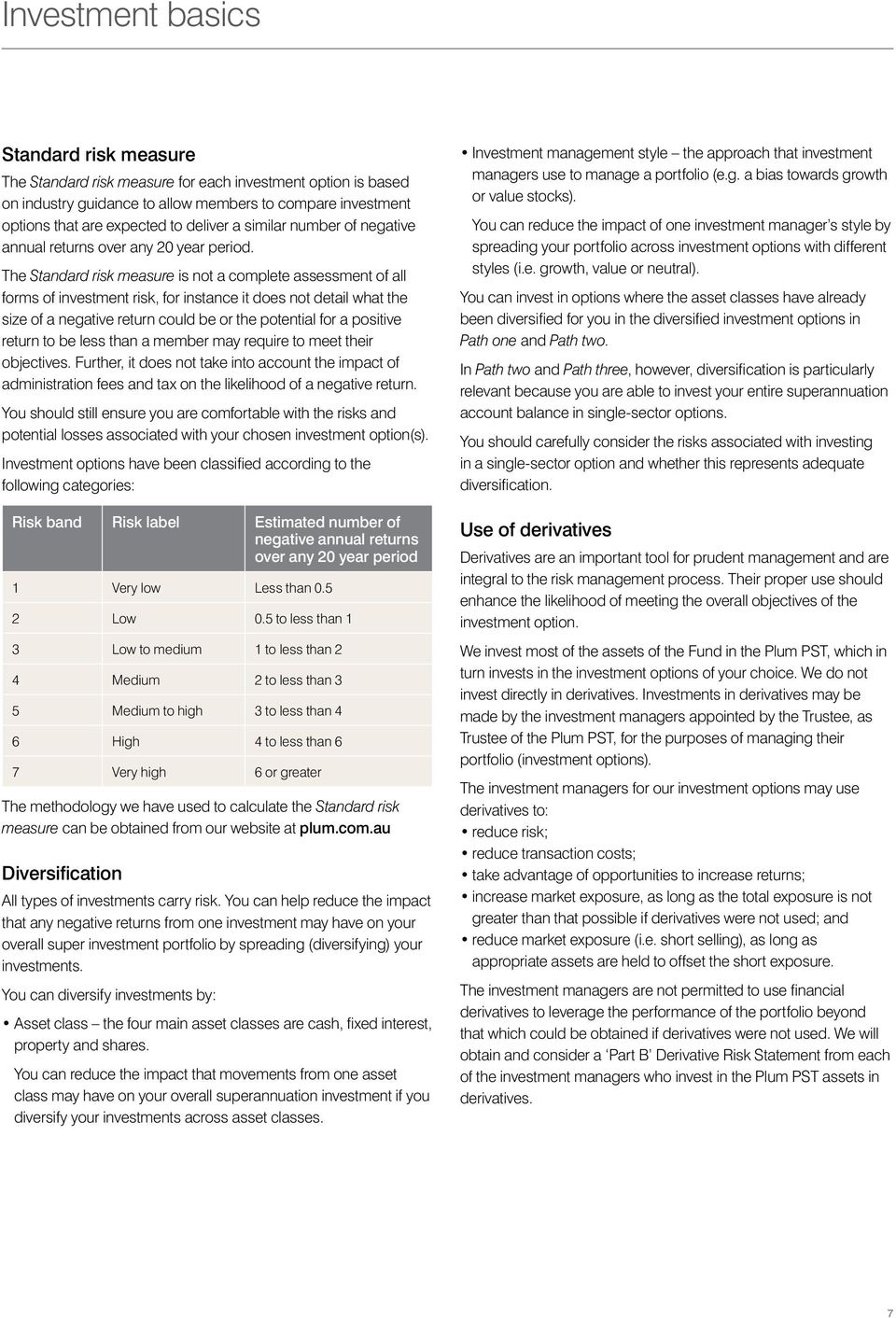
9 Investment basics Standard risk measure The Standard risk measure for each investment option is based on industry guidance to allow members to compare investment options that are expected to deliver a similar number of negative annual returns over any 20 year period. The Standard risk measure is not a complete assessment of all forms of investment risk, for instance it does not detail what the size of a negative return could be or the potential for a positive return to be less than a member may require to meet their objectives. Further, it does not take into account the impact of administration fees and tax on the likelihood of a negative return. You should still ensure you are comfortable with the risks and potential losses associated with your chosen investment option(s). s have been classified according to the following categories: Risk band Risk label Estimated number of negative annual returns over any 20 year period 1 Very low Less than Low 0.5 to less than 1 3 Low to medium 1 to less than 2 4 Medium 2 to less than 3 5 Medium to high 3 to less than 4 6 High 4 to less than 6 7 Very high 6 or greater The methodology we have used to calculate the Standard risk measure can be obtained from our website at plum.com.au Diversification All types of investments carry risk. You can help reduce the impact that any negative returns from one investment may have on your overall super investment portfolio by spreading (diversifying) your investments. You can diversify investments by: Asset class the four main asset classes are cash, fixed interest, property and shares. You can reduce the impact that movements from one asset class may have on your overall superannuation investment if you diversify your investments across asset classes. Investment management style the approach that investment managers use to manage a portfolio (e.g. a bias towards growth or value stocks). You can reduce the impact of one investment manager s style by spreading your portfolio across investment options with different styles (i.e. growth, value or neutral). You can invest in options where the asset classes have already been diversified for you in the diversified investment options in Path one and Path two. In Path two and Path three, however, diversification is particularly relevant because you are able to invest your entire superannuation account balance in single-sector options. You should carefully consider the risks associated with investing in a single-sector option and whether this represents adequate diversification. Use of derivatives Derivatives are an important tool for prudent management and are integral to the risk management process. Their proper use should enhance the likelihood of meeting the overall objectives of the investment option. We invest most of the assets of the Fund in the Plum PST, which in turn invests in the investment options of your choice. We do not invest directly in derivatives. Investments in derivatives may be made by the investment managers appointed by the Trustee, as Trustee of the Plum PST, for the purposes of managing their portfolio (investment options). The investment managers for our investment options may use derivatives to: reduce risk; reduce transaction costs; take advantage of opportunities to increase returns; increase market exposure, as long as the total exposure is not greater than that possible if derivatives were not used; and reduce market exposure (i.e. short selling), as long as appropriate assets are held to offset the short exposure. The investment managers are not permitted to use financial derivatives to leverage the performance of the portfolio beyond that which could be obtained if derivatives were not used. We will obtain and consider a Part B Derivative Risk Statement from each of the investment managers who invest in the Plum PST assets in derivatives. 7
10 Investment basics Past performance The past performance of the investment options described in this guide is not a reliable indicator of future performance and should not be taken to be investment advice nor relied upon when investing in an investment option. The future value of an investment in an investment option may rise or fall on a daily basis with fluctuations in the investment market. Each investment option carries its own level of risk and volatility. The information in this guide does not guarantee performance or payment of income or return of capital. You should consider obtaining professional financial advice before making an investment decision. Allocation of earnings Investment earnings (which may be positive or negative) are reflected in the unit price of your investment option(s) (so the price goes up with positive investment earnings and goes down if there are investment losses). The unit price for an investment option reflects the total dollars held in that investment option divided by the number of units issued. Suspension of transactions Investment switches or withdrawals and allocation of contributions may be delayed or suspended in certain circumstances if we consider such action would be in the interests of members as a whole, for example, if unit prices are unavailable for any reason (included restricted or suspended trading in the relevant market), or if the law requires. 8
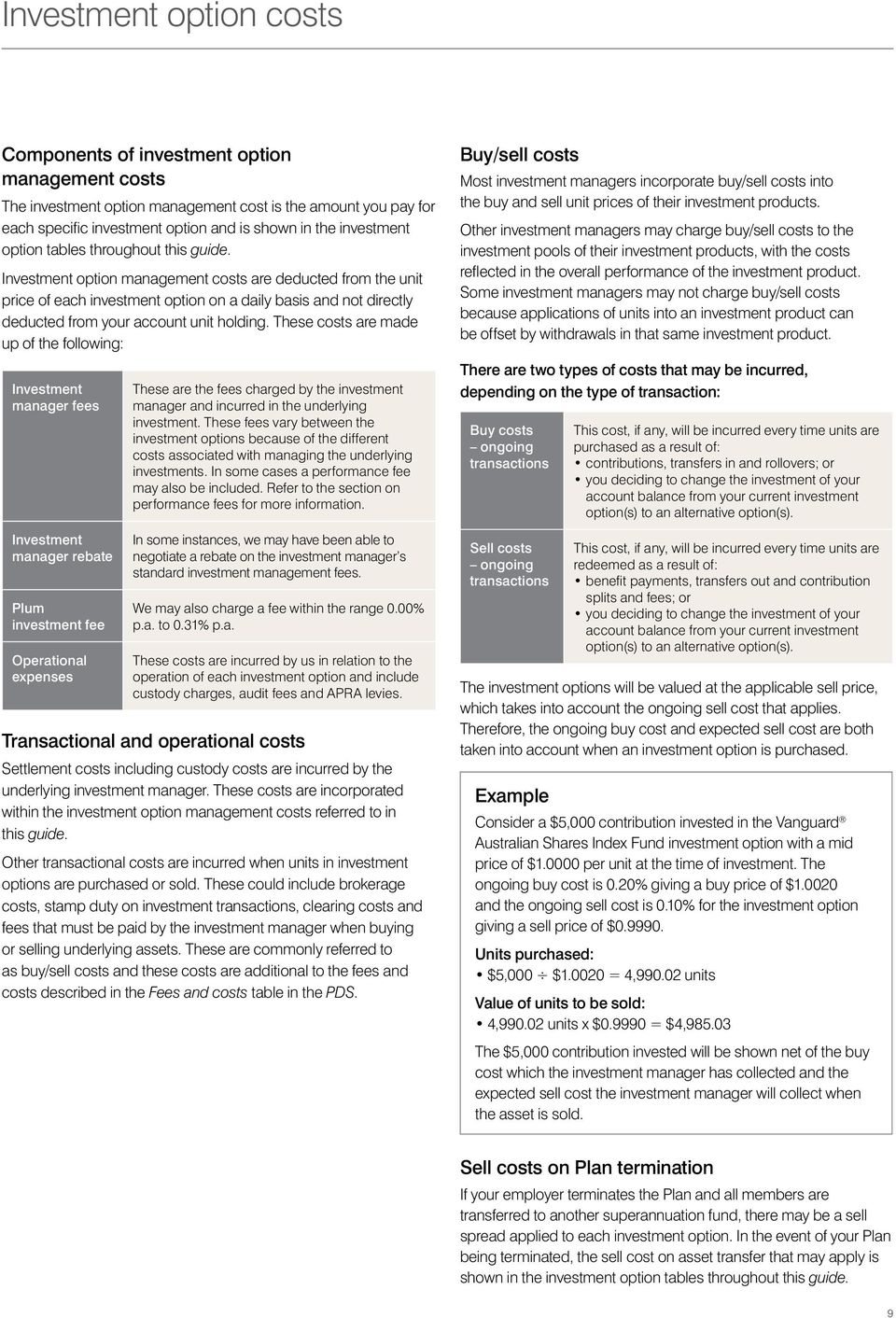
11 costs Components of investment option management costs The investment option management cost is the amount you pay for each specific investment option and is shown in the investment option tables throughout this guide. management costs are deducted from the unit price of each investment option on a daily basis and not directly deducted from your account unit holding. These costs are made up of the following: Investment manager fees Investment manager rebate Plum investment fee Operational expenses These are the fees charged by the investment manager and incurred in the underlying investment. These fees vary between the investment options because of the different costs associated with managing the underlying investments. In some cases a performance fee may also be included. Refer to the section on performance fees for more information. In some instances, we may have been able to negotiate a rebate on the investment manager s standard investment management fees. We may also charge a fee within the range 0.00% p.a. to 0.31% p.a. These costs are incurred by us in relation to the operation of each investment option and include custody charges, audit fees and APRA levies. Transactional and operational costs Settlement costs including custody costs are incurred by the underlying investment manager. These costs are incorporated within the investment option management costs referred to in this guide. Other transactional costs are incurred when units in investment options are purchased or sold. These could include brokerage costs, stamp duty on investment transactions, clearing costs and fees that must be paid by the investment manager when buying or selling underlying assets. These are commonly referred to as buy/sell costs and these costs are additional to the fees and costs described in the Fees and costs table in the PDS. Buy/sell costs Most investment managers incorporate buy/sell costs into the buy and sell unit prices of their investment products. Other investment managers may charge buy/sell costs to the investment pools of their investment products, with the costs reflected in the overall performance of the investment product. Some investment managers may not charge buy/sell costs because applications of units into an investment product can be offset by withdrawals in that same investment product. There are two types of costs that may be incurred, depending on the type of transaction: Buy costs ongoing transactions Sell costs ongoing transactions This cost, if any, will be incurred every time units are purchased as a result of: contributions, transfers in and rollovers; or you deciding to change the investment of your account balance from your current investment option(s) to an alternative option(s). This cost, if any, will be incurred every time units are redeemed as a result of: benefit payments, transfers out and contribution splits and fees; or you deciding to change the investment of your account balance from your current investment option(s) to an alternative option(s). The investment options will be valued at the applicable sell price, which takes into account the ongoing sell cost that applies. Therefore, the ongoing buy cost and expected sell cost are both taken into account when an investment option is purchased. Example Consider a $5,000 contribution invested in the Vanguard Australian Index Fund investment option with a mid price of $ per unit at the time of investment. The ongoing buy cost is 0.20% giving a buy price of $ and the ongoing sell cost is 0.10% for the investment option giving a sell price of $ Units purchased: $5,000 $ = 4, units Value of units to be sold: 4, units x $ = $4, The $5,000 contribution invested will be shown net of the buy cost which the investment manager has collected and the expected sell cost the investment manager will collect when the asset is sold. Sell costs on Plan termination If your employer terminates the Plan and all members are transferred to another superannuation fund, there may be a sell spread applied to each investment option. In the event of your Plan being terminated, the sell cost on asset transfer that may apply is shown in the investment option tables throughout this guide. 9
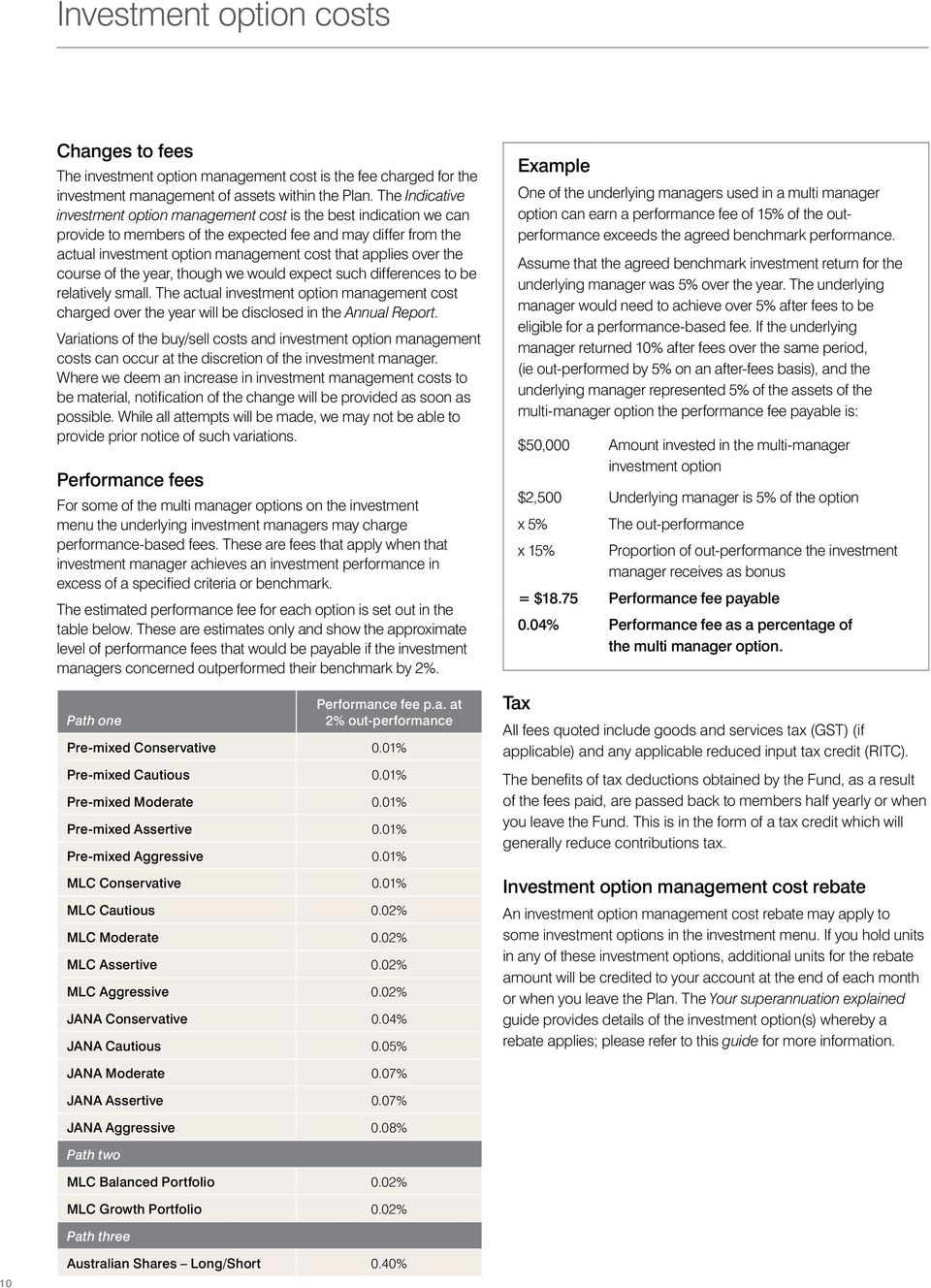
12 costs Changes to fees The investment option management cost is the fee charged for the investment management of assets within the Plan. The Indicative investment option management cost is the best indication we can provide to members of the expected fee and may differ from the actual investment option management cost that applies over the course of the year, though we would expect such differences to be relatively small. The actual investment option management cost charged over the year will be disclosed in the Annual Report. Variations of the buy/sell costs and investment option management costs can occur at the discretion of the investment manager. Where we deem an increase in investment management costs to be material, notification of the change will be provided as soon as possible. While all attempts will be made, we may not be able to provide prior notice of such variations. Performance fees For some of the multi manager options on the investment menu the underlying investment managers may charge performance-based fees. These are fees that apply when that investment manager achieves an investment performance in excess of a specified criteria or benchmark. The estimated performance fee for each option is set out in the table below. These are estimates only and show the approximate level of performance fees that would be payable if the investment managers concerned outperformed their benchmark by 2%. Path one Performance fee p.a. at 2% out-performance Pre-mixed Conservative 0.01% Pre-mixed Cautious 0.01% Pre-mixed Moderate 0.01% Pre-mixed Assertive 0.01% Pre-mixed Aggressive 0.01% MLC Conservative 0.01% MLC Cautious 0.02% MLC Moderate 0.02% MLC Assertive 0.02% MLC Aggressive 0.02% JANA Conservative 0.04% JANA Cautious 0.05% Example One of the underlying managers used in a multi manager option can earn a performance fee of 15% of the outperformance exceeds the agreed benchmark performance. Assume that the agreed benchmark investment return for the underlying manager was 5% over the year. The underlying manager would need to achieve over 5% after fees to be eligible for a performance-based fee. If the underlying manager returned 10% after fees over the same period, (ie out-performed by 5% on an after-fees basis), and the underlying manager represented 5% of the assets of the multi-manager option the performance fee payable is: $50,000 Amount invested in the multi-manager investment option $2,500 Underlying manager is 5% of the option x 5% The out-performance x 15% Proportion of out-performance the investment manager receives as bonus = $18.75 Performance fee payable 0.04% Performance fee as a percentage of the multi manager option. Tax All fees quoted include goods and services tax (GST) (if applicable) and any applicable reduced input tax credit (RITC). The benefits of tax deductions obtained by the Fund, as a result of the fees paid, are passed back to members half yearly or when you leave the Fund. This is in the form of a tax credit which will generally reduce contributions tax. management cost rebate An investment option management cost rebate may apply to some investment options in the investment menu. If you hold units in any of these investment options, additional units for the rebate amount will be credited to your account at the end of each month or when you leave the Plan. The Your superannuation explained guide provides details of the investment option(s) whereby a rebate applies; please refer to this guide for more information. JANA Moderate 0.07% JANA Assertive 0.07% JANA Aggressive 0.08% Path two MLC Balanced Portfolio 0.02% MLC Growth Portfolio 0.02% Path three 10 Australian Long/Short 0.40%
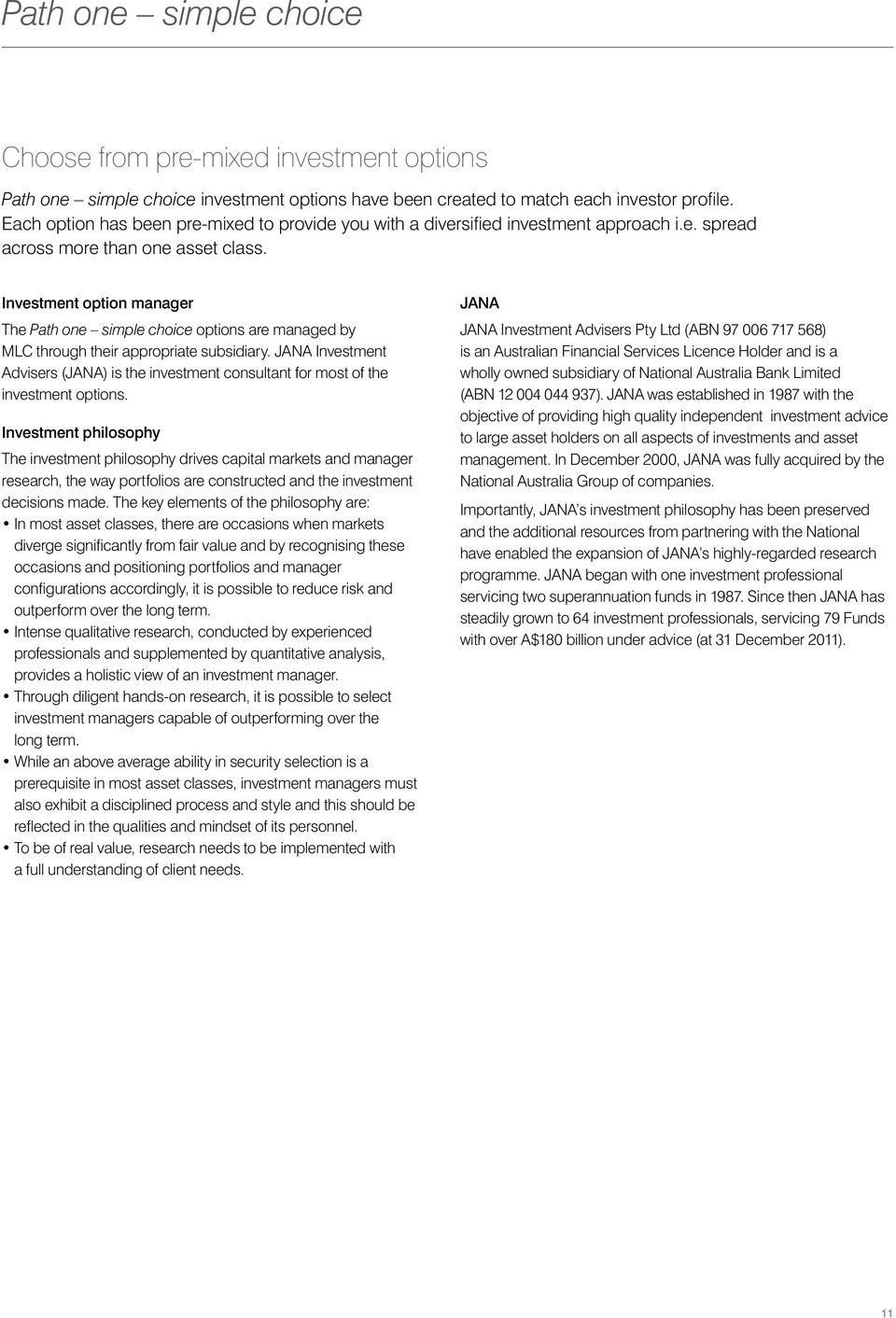
13 Path one simple choice Choose from pre-mixed investment options Path one simple choice investment options have been created to match each investor profile. Each option has been pre-mixed to provide you with a diversified investment approach i.e. spread across more than one asset class. manager The Path one simple choice options are managed by MLC through their appropriate subsidiary. JANA Investment Advisers (JANA) is the investment consultant for most of the investment options. Investment philosophy The investment philosophy drives capital markets and manager research, the way portfolios are constructed and the investment decisions made. The key elements of the philosophy are: In most asset classes, there are occasions when markets diverge significantly from fair value and by recognising these occasions and positioning portfolios and manager configurations accordingly, it is possible to reduce risk and outperform over the long term. Intense qualitative research, conducted by experienced professionals and supplemented by quantitative analysis, provides a holistic view of an investment manager. Through diligent hands-on research, it is possible to select investment managers capable of outperforming over the long term. While an above average ability in security selection is a prerequisite in most asset classes, investment managers must also exhibit a disciplined process and style and this should be reflected in the qualities and mindset of its personnel. To be of real value, research needs to be implemented with a full understanding of client needs. JANA JANA Investment Advisers Pty Ltd (ABN ) is an Australian Financial Services Licence Holder and is a wholly owned subsidiary of National Australia Bank Limited (ABN ). JANA was established in 1987 with the objective of providing high quality independent investment advice to large asset holders on all aspects of investments and asset management. In December 2000, JANA was fully acquired by the National Australia Group of companies. Importantly, JANA s investment philosophy has been preserved and the additional resources from partnering with the National have enabled the expansion of JANA s highly-regarded research programme. JANA began with one investment professional servicing two superannuation funds in Since then JANA has steadily grown to 64 investment professionals, servicing 79 Funds with over A$180 billion under advice (at 31 December 2011). 11
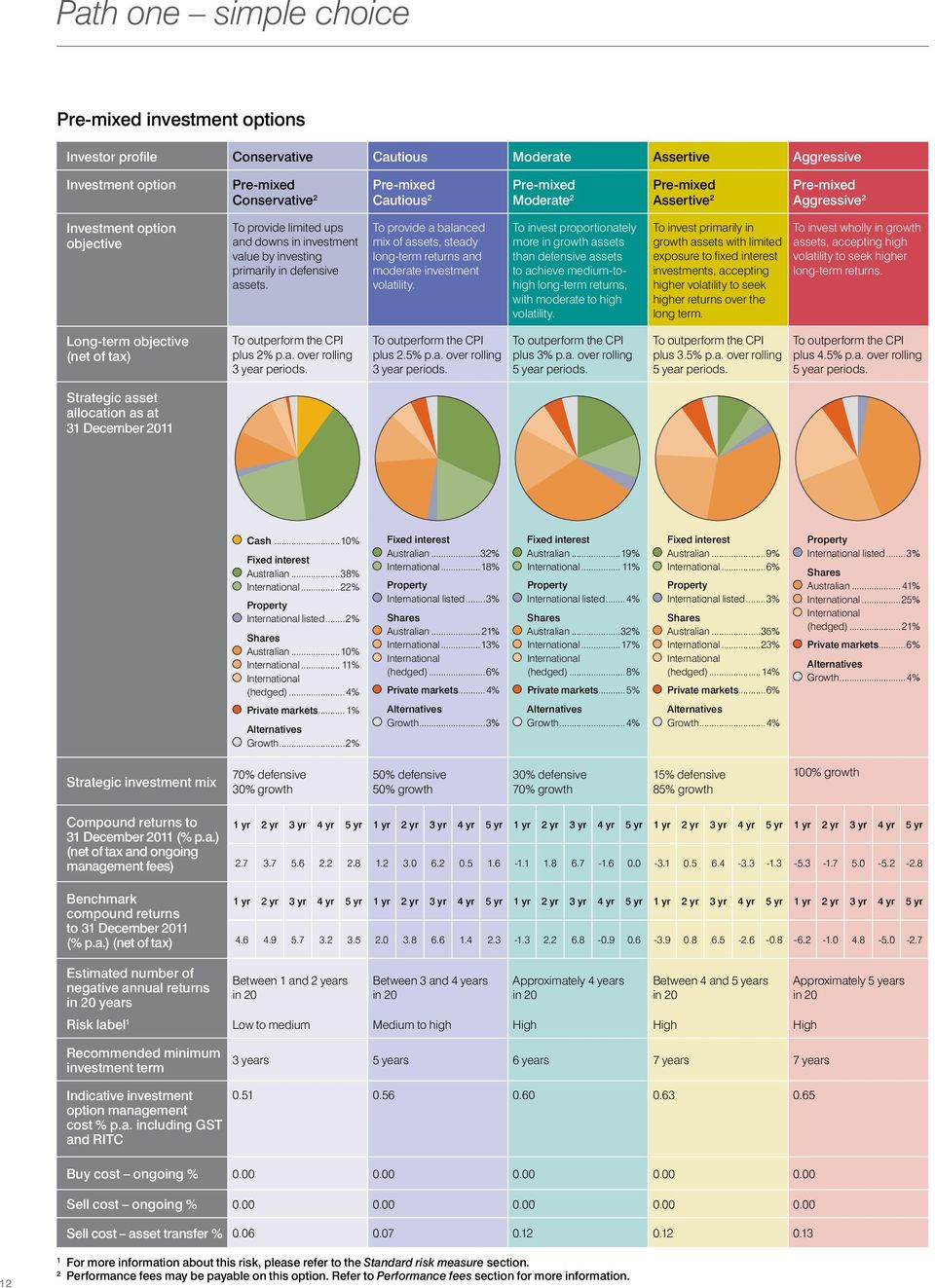
14 Path one simple choice Pre-mixed investment options Investor profile Conservative Cautious Moderate Assertive Aggressive Pre-mixed Conservative 2 Pre-mixed Cautious 2 Pre-mixed Moderate 2 Pre-mixed Assertive 2 Pre-mixed Aggressive 2 objective To provide limited ups and downs in investment value by investing primarily in defensive assets. To provide a balanced mix of assets, steady long-term returns and moderate investment volatility. To invest proportionately more in growth assets than defensive assets to achieve medium-tohigh long-term returns, with moderate to high volatility. To invest primarily in growth assets with limited exposure to fixed interest investments, accepting higher volatility to seek higher returns over the long term. To invest wholly in growth assets, accepting high volatility to seek higher long-term returns. Long-term objective (net of tax) To outperform the CPI plus 2% p.a. over rolling 3 year periods. To outperform the CPI plus 2.5% p.a. over rolling 3 year periods. To outperform the CPI plus 3% p.a. over rolling 5 year periods. To outperform the CPI plus 3.5% p.a. over rolling 5 year periods. To outperform the CPI plus 4.5% p.a. over rolling 5 year periods. Strategic asset allocation as at 31 December 2011 Cash...10% Australian...38%...22% listed...2% Australian...10%... 11% (hedged)...4% Private markets... 1% Alternatives Growth...2% Australian...32%...18% listed...3% Australian...21%...13% (hedged)...6% Private markets...4% Alternatives Growth...3% Australian...19%... 11% listed...4% Australian...32%...17% (hedged)...8% Private markets...5% Alternatives Growth...4% Australian...9%...6% listed...3% Australian...35%...23% (hedged)...14% Private markets...6% Alternatives Growth...4% listed...3% Australian... 41%...25% (hedged)...21% Private markets...6% Alternatives Growth...4% Strategic investment mix 70% defensive 30% growth 50% defensive 50% growth 30% defensive 70% growth 15% defensive 85% growth 100% growth Compound returns to 31 December 2011 (% p.a.) (net of tax and ongoing management fees) Benchmark compound returns to 31 December 2011 (% p.a.) (net of tax) 1 yr 2 yr 3 yr 4 yr 5 yr 1 yr 2 yr 3 yr 4 yr 5 yr 1 yr 2 yr 3 yr 4 yr 5 yr 1 yr 2 yr 3 yr 4 yr 5 yr 1 yr 2 yr 3 yr 4 yr 5 yr yr 2 yr 3 yr 4 yr 5 yr 1 yr 2 yr 3 yr 4 yr 5 yr 1 yr 2 yr 3 yr 4 yr 5 yr 1 yr 2 yr 3 yr 4 yr 5 yr 1 yr 2 yr 3 yr 4 yr 5 yr Estimated number of negative annual returns in 20 years Between 1 and 2 years in 20 Between 3 and 4 years in 20 Approximately 4 years in 20 Between 4 and 5 years in 20 Risk label 1 Low to medium Medium to high High High High Approximately 5 years in 20 Recommended minimum investment term 3 years 5 years 6 years 7 years 7 years Indicative investment option management cost % p.a. including GST and RITC Buy cost ongoing % Sell cost ongoing % Sell cost asset transfer % For more information about this risk, please refer to the Standard risk measure section. 2 Performance fees may be payable on this option. Refer to Performance fees section for more information.
15 Path one simple choice Pre-mixed investment options Investor profile Conservative Cautious Moderate Assertive Aggressive MLC Conservative 2 MLC Cautious 2 MLC Moderate 2 MLC Assertive 2 MLC Aggressive 2 objective To provide limited ups and downs in investment value by investing primarily in defensive assets. To provide a balanced mix of assets, steady long-term returns and moderate investment volatility. To invest proportionately more in growth assets than defensive assets to achieve medium-tohigh long-term returns, with moderate to high volatility. To invest primarily in growth assets with limited exposure to fixed interest investments, accepting higher volatility to seek higher returns over the long term. To invest wholly in growth assets, accepting high volatility to seek higher long-term returns. Long-term objective (net of tax) To outperform the CPI plus 2% p.a. over rolling 3 year periods. To outperform the CPI plus 2.5% p.a. over rolling 3 year periods. To outperform the CPI plus 3% p.a. over rolling 5 year periods. To outperform the CPI plus 3.5% p.a. over rolling 5 year periods. To outperform the CPI plus 4.5% p.a. over rolling 5 year periods. Strategic asset allocation as at 31 December 2011 Cash...10% Australian...38%...22% listed...2% Australian...10%... 11% (hedged)...2% Private markets...2% Alternatives Growth...3% Australian...30%...20% listed...3% Australian...21%...13% (hedged)...2% Private markets...6% Alternatives Growth...5% Australian...18%...12% listed...4% Australian...32%...17% (hedged)...6% Private markets...6% Alternatives Growth...5% Australian...8%...7% listed...3% Australian...36%...23% (hedged)...12% Private markets...6% Alternatives Growth...5% listed...3% Australian... 41%...25% (hedged)...20% Private markets...6% Alternatives Growth...5% Strategic investment mix 70% defensive 30% growth 50% defensive 50% growth 30% defensive 70% growth 15% defensive 85% growth 100% growth Compound returns to 31 December 2011 (% p.a.) (net of tax and ongoing management fees) Benchmark compound returns to 31 December 2011 (% p.a.) (net of tax) 1 yr 2 yr 3 yr 4 yr 5 yr 1 yr 2 yr 3 yr 4 yr 5 yr 1 yr 2 yr 3 yr 4 yr 5 yr 1 yr 2 yr 3 yr 4 yr 5 yr 1 yr 2 yr 3 yr 4 yr 5 yr yr 2 yr 3 yr 4 yr 5 yr 1 yr 2 yr 3 yr 4 yr 5 yr 1 yr 2 yr 3 yr 4 yr 5 yr 1 yr 2 yr 3 yr 4 yr 5 yr 1 yr 2 yr 3 yr 4 yr 5 yr Estimated number of negative annual returns in 20 years Between 1 and 2 years in 20 Approximately 3 years in 20 Between 3 and 4 years in 20 Between 4 and 5 years in 20 Between 4 and 5 years in 20 Risk label 1 Low to medium Medium Medium to high High High Recommended minimum investment term 3 years 5 years 6 years 7 years 7 years Indicative investment option management cost % p.a. including GST and RITC Buy cost ongoing % Sell cost ongoing % Sell cost asset transfer % For more information about this risk, please refer to the Standard risk measure section. 2 Performance fees may be payable on this option. Refer to Performance fees section for more information. 13

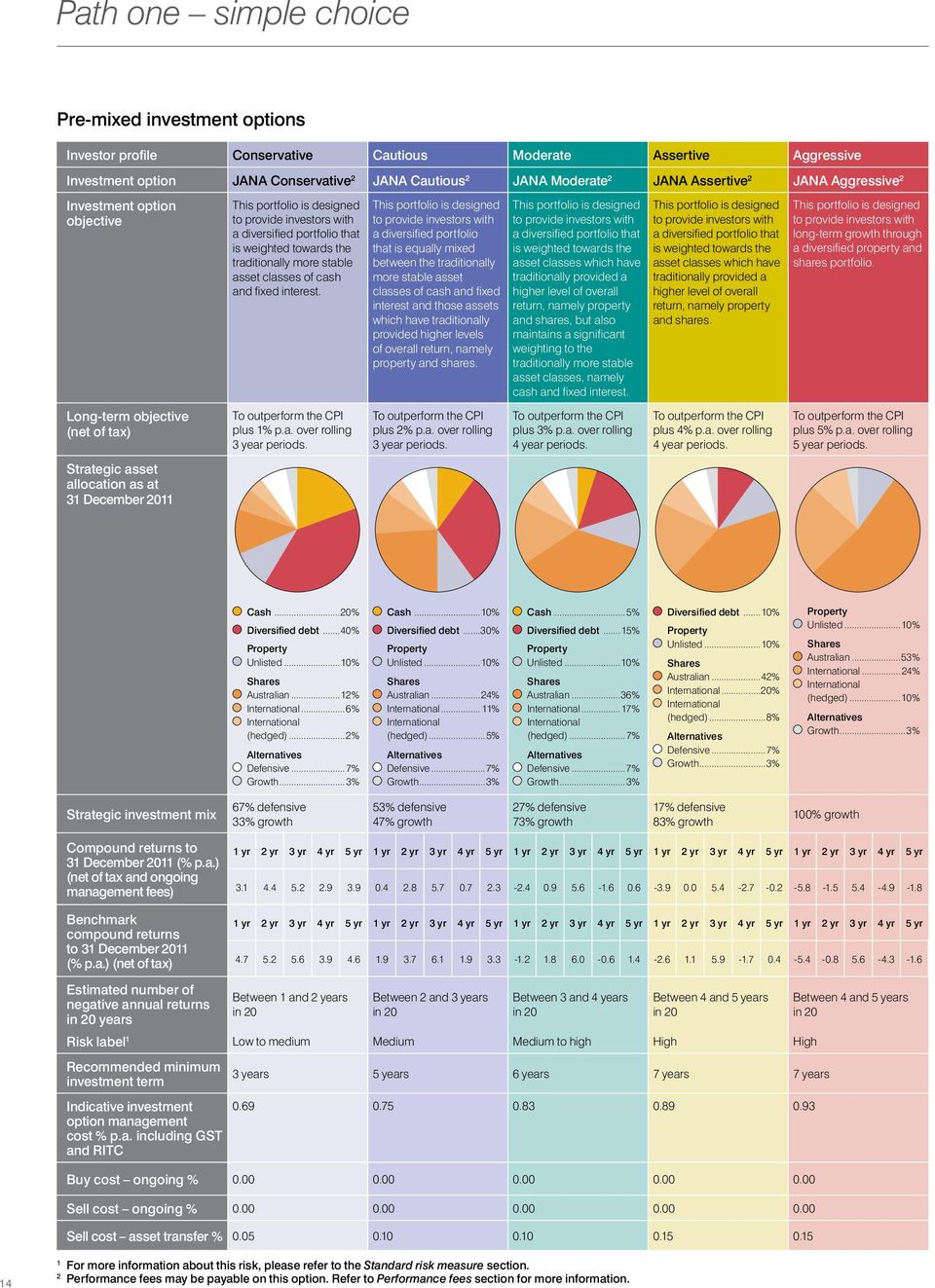
16 Path one simple choice Pre-mixed investment options Investor profile Conservative Cautious Moderate Assertive Aggressive JANA Conservative 2 JANA Cautious 2 JANA Moderate 2 JANA Assertive 2 JANA Aggressive 2 objective Long-term objective (net of tax) Strategic asset allocation as at 31 December 2011 This portfolio is designed to provide investors with a diversified portfolio that is weighted towards the traditionally more stable asset classes of cash and fixed interest. To outperform the CPI plus 1% p.a. over rolling 3 year periods. This portfolio is designed to provide investors with a diversified portfolio that is equally mixed between the traditionally more stable asset classes of cash and fixed interest and those assets which have traditionally provided higher levels of overall return, namely property and shares. To outperform the CPI plus 2% p.a. over rolling 3 year periods. This portfolio is designed to provide investors with a diversified portfolio that is weighted towards the asset classes which have traditionally provided a higher level of overall return, namely property and shares, but also maintains a significant weighting to the traditionally more stable asset classes, namely cash and fixed interest. To outperform the CPI plus 3% p.a. over rolling 4 year periods. This portfolio is designed to provide investors with a diversified portfolio that is weighted towards the asset classes which have traditionally provided a higher level of overall return, namely property and shares. To outperform the CPI plus 4% p.a. over rolling 4 year periods. This portfolio is designed to provide investors with long-term growth through a diversified property and shares portfolio. To outperform the CPI plus 5% p.a. over rolling 5 year periods. Cash...20% Diversified debt...40% Unlisted...10% Australian...12%...6% (hedged)...2% Alternatives Defensive...7% Growth...3% Cash...10% Diversified debt...30% Unlisted...10% Australian...24%... 11% (hedged)...5% Alternatives Defensive...7% Growth...3% Cash...5% Diversified debt...15% Unlisted...10% Australian...36%...17% (hedged)...7% Alternatives Defensive...7% Growth...3% Diversified debt...10% Unlisted...10% Australian...42%...20% (hedged)...8% Alternatives Defensive...7% Growth...3% Unlisted...10% Australian...53%...24% (hedged)...10% Alternatives Growth...3% Strategic investment mix 67% defensive 33% growth 53% defensive 47% growth 27% defensive 73% growth 17% defensive 83% growth 100% growth Compound returns to 31 December 2011 (% p.a.) (net of tax and ongoing management fees) Benchmark compound returns to 31 December 2011 (% p.a.) (net of tax) 1 yr 2 yr 3 yr 4 yr 5 yr 1 yr 2 yr 3 yr 4 yr 5 yr 1 yr 2 yr 3 yr 4 yr 5 yr 1 yr 2 yr 3 yr 4 yr 5 yr 1 yr 2 yr 3 yr 4 yr 5 yr yr 2 yr 3 yr 4 yr 5 yr 1 yr 2 yr 3 yr 4 yr 5 yr 1 yr 2 yr 3 yr 4 yr 5 yr 1 yr 2 yr 3 yr 4 yr 5 yr 1 yr 2 yr 3 yr 4 yr 5 yr Estimated number of negative annual returns in 20 years Between 1 and 2 years in 20 Between 2 and 3 years in 20 Between 3 and 4 years in 20 Between 4 and 5 years in 20 Risk label 1 Low to medium Medium Medium to high High High Recommended minimum investment term Indicative investment option management cost % p.a. including GST and RITC 3 years 5 years 6 years 7 years 7 years Buy cost ongoing % Sell cost ongoing % Sell cost asset transfer % Between 4 and 5 years in For more information about this risk, please refer to the Standard risk measure section. 2 Performance fees may be payable on this option. Refer to Performance fees section for more information.
17 Path two flexible choice Choose your investment Path two flexible choice investment options are divided into asset classes plus four diversified options to help you make your investment choice. managers Path two flexible choice provides a range of investment options managed by MLC and Vanguard. JANA provides advice to the Trustee in selecting and monitoring these options. Vanguard Vanguard Investments Australia Ltd is a wholly owned subsidiary of The Vanguard Group, Inc. which is based in the US and currently manages nearly US$ 1.8 trillion* for nearly 25 million individual and institutional accounts. In Australia, Vanguard has been helping investors meet their long-term financial goals with low cost indexing solutions for nearly 15 years. Vanguard offers institutional investors low cost index management via pooled funds, ETFs and discrete portfolios managed by an expert and stable investment team. Choosing investments You should consider the benefits of diversification before making your investment choice. When choosing an investment mix that suits your individual needs, please consider other assets that you may hold outside of your superannuation. You may also take into account the sample investment mixes that may be suitable for each of the investor profiles, as outlined below. *At 31 December Path two flexible choice example of investment mix Investor profile Sample investment mix Total Conservative 20% 50% 5% 25% 100% Cautious 10% 40% 5% 45% 100% Moderate 30% 5% 65% 100% Assertive 20% 5% 75% 100% Aggressive 100% 100% Cash Note: These suggested investment mixes are a guide only and are examples of an approach that could suit each of the five investor profiles. Refer to page 2 for more information about investor profiles. 15

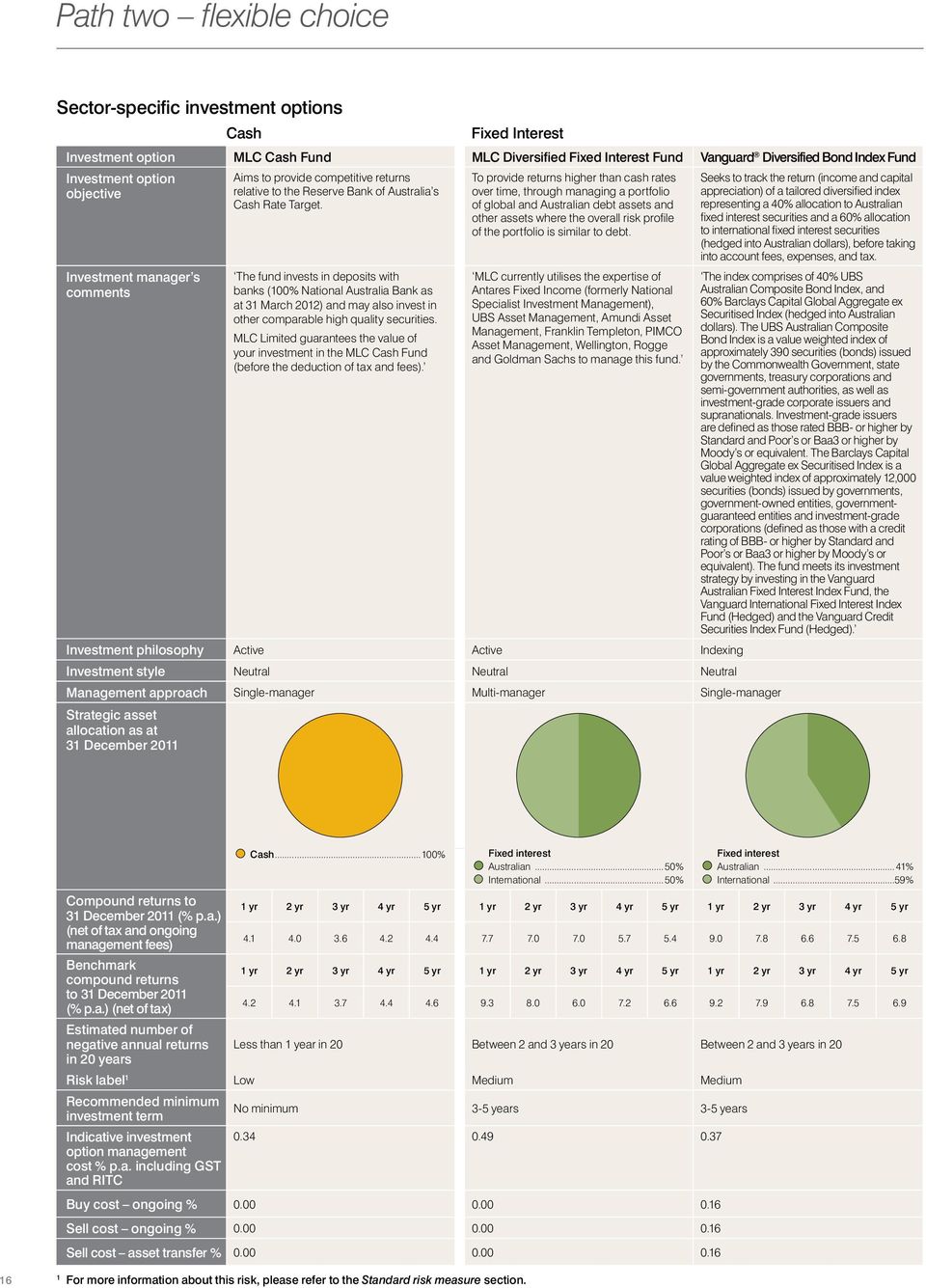
18 Path two flexible choice Sector-specific investment options Cash Fixed Interest MLC Cash Fund MLC Diversified Fixed Interest Fund Vanguard Diversified Bond Index Fund objective Investment manager s comments Aims to provide competitive returns relative to the Reserve Bank of Australia s Cash Rate Target. The fund invests in deposits with banks (100% National Australia Bank as at 31 March 2012) and may also invest in other comparable high quality securities. MLC Limited guarantees the value of your investment in the MLC Cash Fund (before the deduction of tax and fees). To provide returns higher than cash rates over time, through managing a portfolio of global and Australian debt assets and other assets where the overall risk profile of the portfolio is similar to debt. MLC currently utilises the expertise of Antares Fixed Income (formerly National Specialist Investment Management), UBS Asset Management, Amundi Asset Management, Franklin Templeton, PIMCO Asset Management, Wellington, Rogge and Goldman Sachs to manage this fund. Investment philosophy Active Active Indexing Investment style Neutral Neutral Neutral Management approach Single-manager Multi-manager Single-manager Strategic asset allocation as at 31 December 2011 Seeks to track the return (income and capital appreciation) of a tailored diversified index representing a 40% allocation to Australian fixed interest securities and a 60% allocation to international fixed interest securities (hedged into Australian dollars), before taking into account fees, expenses, and tax. The index comprises of 40% UBS Australian Composite Bond Index, and 60% Barclays Capital Global Aggregate ex Securitised Index (hedged into Australian dollars). The UBS Australian Composite Bond Index is a value weighted index of approximately 390 securities (bonds) issued by the Commonwealth Government, state governments, treasury corporations and semi-government authorities, as well as investment-grade corporate issuers and supranationals. Investment-grade issuers are defined as those rated BBB- or higher by Standard and Poor s or Baa3 or higher by Moody s or equivalent. The Barclays Capital Global Aggregate ex Securitised Index is a value weighted index of approximately 12,000 securities (bonds) issued by governments, government-owned entities, governmentguaranteed entities and investment-grade corporations (defined as those with a credit rating of BBB- or higher by Standard and Poor s or Baa3 or higher by Moody s or equivalent). The fund meets its investment strategy by investing in the Vanguard Australian Fixed Interest Index Fund, the Vanguard Fixed Interest Index Fund (Hedged) and the Vanguard Credit Securities Index Fund (Hedged). Cash...100% Australian...50%...50% Australian...41%...59% Compound returns to 31 December 2011 (% p.a.) 1 yr 2 yr 3 yr 4 yr 5 yr 1 yr 2 yr 3 yr 4 yr 5 yr 1 yr 2 yr 3 yr 4 yr 5 yr (net of tax and ongoing management fees) Benchmark compound returns 1 yr 2 yr 3 yr 4 yr 5 yr 1 yr 2 yr 3 yr 4 yr 5 yr 1 yr 2 yr 3 yr 4 yr 5 yr to 31 December 2011 (% p.a.) (net of tax) Estimated number of negative annual returns Less than 1 year in 20 Between 2 and 3 years in 20 Between 2 and 3 years in 20 in 20 years Risk label 1 Low Medium Medium Recommended minimum investment term No minimum 3-5 years 3-5 years Indicative investment option management cost % p.a. including GST and RITC Buy cost ongoing % Sell cost ongoing % Sell cost asset transfer % For more information about this risk, please refer to the Standard risk measure section.
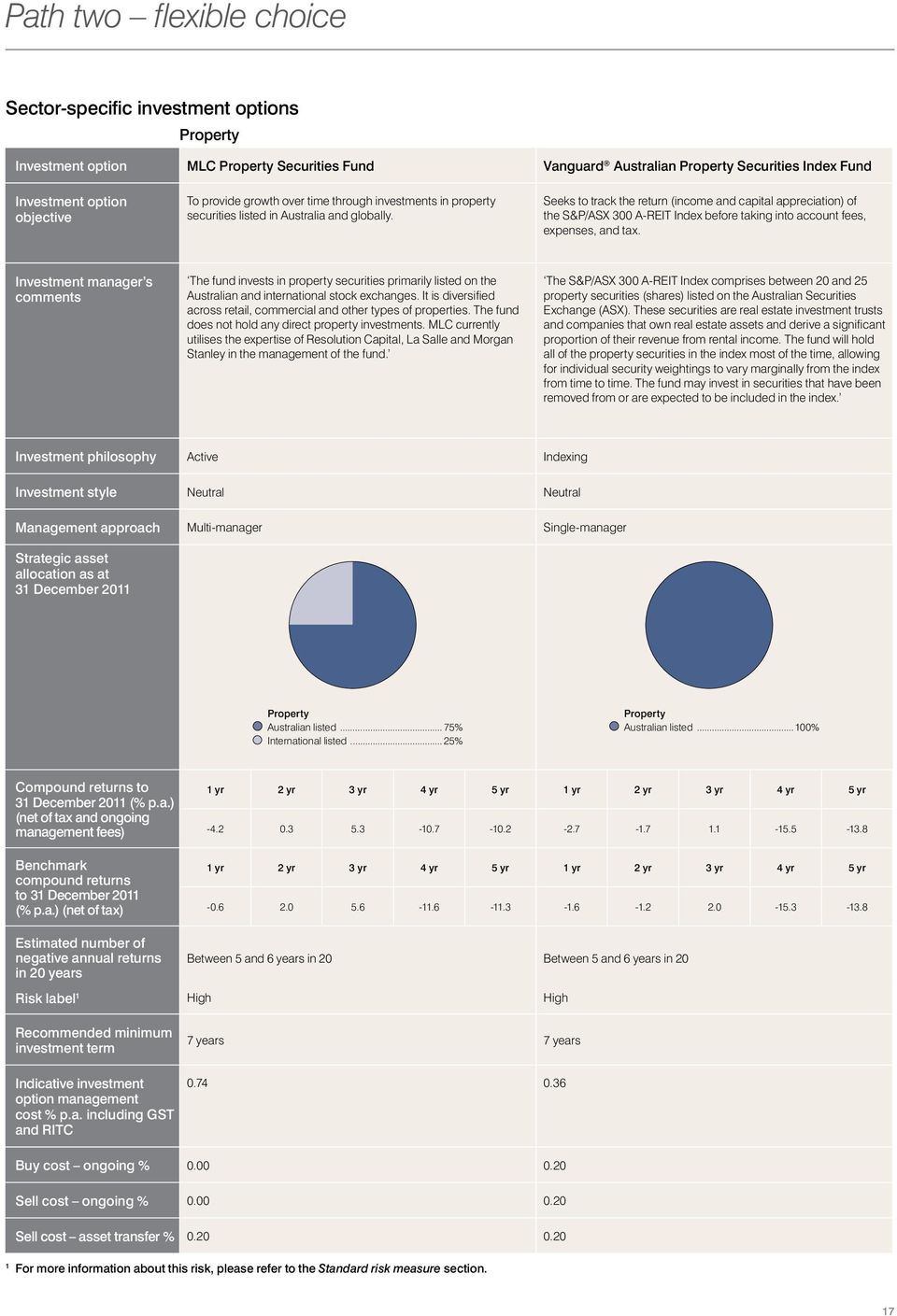
19 Path two flexible choice Sector-specific investment options MLC Securities Fund Vanguard Australian Securities Index Fund objective To provide growth over time through investments in property securities listed in Australia and globally. Seeks to track the return (income and capital appreciation) of the S&P/ASX 300 A-REIT Index before taking into account fees, expenses, and tax. Investment manager s comments The fund invests in property securities primarily listed on the Australian and international stock exchanges. It is diversified across retail, commercial and other types of properties. The fund does not hold any direct property investments. MLC currently utilises the expertise of Resolution Capital, La Salle and Morgan Stanley in the management of the fund. The S&P/ASX 300 A-REIT Index comprises between 20 and 25 property securities (shares) listed on the Australian Securities Exchange (ASX). These securities are real estate investment trusts and companies that own real estate assets and derive a significant proportion of their revenue from rental income. The fund will hold all of the property securities in the index most of the time, allowing for individual security weightings to vary marginally from the index from time to time. The fund may invest in securities that have been removed from or are expected to be included in the index. Investment philosophy Active Indexing Investment style Neutral Neutral Management approach Multi-manager Single-manager Strategic asset allocation as at 31 December 2011 Australian listed... 75% listed... 25% Australian listed...100% Compound returns to 31 December 2011 (% p.a.) (net of tax and ongoing management fees) Benchmark compound returns to 31 December 2011 (% p.a.) (net of tax) Estimated number of negative annual returns in 20 years 1 yr 2 yr 3 yr 4 yr 5 yr 1 yr 2 yr 3 yr 4 yr 5 yr yr 2 yr 3 yr 4 yr 5 yr 1 yr 2 yr 3 yr 4 yr 5 yr Between 5 and 6 years in 20 Between 5 and 6 years in 20 Risk label 1 High High Recommended minimum investment term Indicative investment option management cost % p.a. including GST and RITC 7 years 7 years Buy cost ongoing % Sell cost ongoing % Sell cost asset transfer % For more information about this risk, please refer to the Standard risk measure section. 17
20 Path two flexible choice Sector-specific investment options Australian shares MLC Australian Share Fund Vanguard Australian Index Fund objective To provide long-term growth from an actively managed portfolio of Australian shares. Seeks to track the return (income and capital appreciation) of the S&P/ASX 300 Index before taking into account fees, expenses and tax. Investment manager s comments The fund invests in a broad diversified range of Australian shares, which offer attractive long-term growth potential. MLC currently utilises the expertise of Maple-Brown Abbott, Wallara, Balanced Equity Management, Vanguard, Dimensional, JCP Investment Partners, Northcape, Northward Capital and JF Capital Partners to manage this fund. The S&P/ASX 300 Index comprises approximately 300 securities (shares) listed on the Australian Securities Exchange (ASX). The index represents approximately 85 per cent of the value of all Australian-based companies and property trusts listed on the ASX. The fund will hold most of the securities in the index, allowing for individual security weightings to vary marginally from the index from time to time. The fund may invest in securities that have been removed from or are expected to be included in the index. Investment philosophy Active Indexing Investment style Neutral Neutral Management approach Multi-manager Single-manager Strategic asset allocation as at 31 December 2011 Australian...100% Australian...100% Compound returns to 31 December 2011 (% p.a.) (net of tax and ongoing management fees) Benchmark compound returns to 31 December 2011 (% p.a.) (net of tax) Estimated number of negative annual returns in 20 years 1 yr 2 yr 3 yr 4 yr 5 yr 1 yr 2 yr 3 yr 4 yr 5 yr yr 2 yr 3 yr 4 yr 5 yr 1 yr 2 yr 3 yr 4 yr 5 yr Between 5 and 6 years in 20 Between 6 and 7 years in 20 Risk label 1 High Very high Recommended minimum investment term Indicative investment option management cost % p.a. including GST and RITC 7 years 7 years Buy cost ongoing % Sell cost ongoing % Sell cost asset transfer % For more information about this risk, please refer to the Standard risk measure section. 18

21 Path two flexible choice Sector-specific investment options Global shares MLC Share Fund Vanguard Index Fund Vanguard Index Fund (hedged) objective To provide long-term growth from an actively managed share portfolio selected from world share markets. Seeks to track the return (income and capital appreciation) of the MSCI World ex-australia Index (with net dividends reinvested) in Australian dollars before taking into account fund fees, expenses, and tax. Seeks to track the return (income and capital appreciation) of the MSCI World ex-australia Index (with net dividends reinvested) hedged into Australian dollars before taking into account fees, expenses, and tax. Investment manager s comments The fund invests in companies listed on world sharemarkets. MLC currently utilises the expertise of Sands Capital, Dimensional, Walter Scott, Carnegie, Capital, Mondrian, Tweedy Browne and Harding Loevner to manage the share exposure of this fund. The MSCI World ex-australia Index comprises approximately 1,600 securities (shares) listed on the exchanges of 23 of the world s major developed economies. The fund will hold most of the securities in the index, allowing for individual security weightings to vary marginally from the index from time to time. The fund may invest in securities that have been removed from or are expected to be included in the index. The fund will be fully exposed to the fluctuating values of foreign currencies, as there will not be any hedging of foreign currencies to the Australian dollar. The MSCI World ex-australia Index comprises approximately 1,600 securities (shares) listed on the exchanges of 23 of the world s major developed economies. The fund meets its investment objective by investing in the Vanguard Index Fund, securites in the index, and forward foreign exchange contracts. The fund will hold most of the securities in the index, allowing for individual security weightings to vary marginally from the index from time to time. The fund may invest in securities that have been or are expected to be included in the index. Investment philosophy Active Indexing Indexing Investment style Neutral Neutral Neutral Management approach Multi-manager Single-manager Single-manager Strategic asset allocation as at 31 December 2011 North America... 44% Europe ex-uk... 22% UK...11% Japan... 7% Asia Pacific ex-japan...11% Latin America... 3% Africa... 1% Middle East...1% North America...60% Europe ex-uk... 18% UK... 10% Japan... 10% Pacific ex-japan... 2% (hedged) North America...60% Europe ex-uk... 18% UK... 10% Japan... 10% Pacific ex-japan... 2% Compound returns to 31 December 2011 (% p.a.) (net of tax and ongoing management fees) Benchmark compound returns to 31 December 2011 (% p.a.) (net of tax) Estimated number of negative annual returns in 20 years 1 yr 2 yr 3 yr 4 yr 5 yr 1 yr 2 yr 3 yr 4 yr 5 yr 1 yr 2 yr 3 yr 4 yr 5 yr yr 2 yr 3 yr 4 yr 5 yr 1 yr 2 yr 3 yr 4 yr 5 yr 1 yr 2 yr 3 yr 4 yr 5 yr Between 5 and 6 years in 20 Between 5 and 6 years in 20 Approximately 6 years in 20 Risk label 1 High High High Recommended minimum investment term Indicative investment option management cost % p.a. including GST and RITC 7 years 7 years 7 years Buy cost ongoing % Sell cost ongoing % Sell cost asset transfer % For more information about this risk, please refer to the Standard risk measure section. 19
22 Path two flexible choice Diversified investment options MLC Balanced Portfolio 2 Vanguard Growth Index Fund objective Investment manager s comments To provide consistent returns over time from a portfolio that has a balanced mix of assets. The MLC Balanced Portfolio invests in a balanced mix of fixed interest securities, property and shares. The portfolio is designed to suit an investor prepared to take a higher weighting to growth assets whilst maintaining an average level of risk. Seeks to track the weighted average return of the various indices of each of the Vanguard Wholesale Funds in which the fund invests, in proportion to the strategic asset allocation (SAA) for the fund, before taking into account fees, expenses, and tax. The portfolio targets a 30 per cent allocation to income oriented assets (cash and fixed interest securities) and 70 per cent allocation to growth oriented assets (property securities and shares). Actual allocations are permitted to deviate within a narrow tolerance range. Investment philosophy Active Indexing Investment style Neutral Neutral Management approach Multi-manager Single-manager Strategic asset allocation as at 31 December 2011 Australian... 18%... 12% listed... 4% Australian...32%... 17% (hedged)... 6% Private markets... 6% Alternatives Growth... 5% Cash... 2% Australian...11%... 17% Australian listed... 4% listed... 4% Australian... 34%... 25% (hedged)... 3% Compound returns to 31 December 2011 (% p.a.) (net of tax and ongoing management fees) Benchmark compound returns to 31 December 2011 (% p.a.) (net of tax) Estimated number of negative annual returns in 20 years 1 yr 2 yr 3 yr 4 yr 5 yr 1 yr 2 yr 3 yr 4 yr 5 yr yr 2 yr 3 yr 4 yr 5 yr 1 yr 2 yr 3 yr 4 yr 5 yr Approximately 4 years in 20 Between 4 and 5 years in 20 Risk label 1 Medium to high High Recommended minimum investment term Indicative investment option management cost % p.a. including GST and RITC 6 years 7 years Buy cost ongoing % Sell cost ongoing % Sell cost asset transfer % For more information about this risk, please refer to the Standard risk measure section. 2 Performance fees may be payable on this option. Refer to Performance fees section for more information. 20
23 Path two flexible choice Diversified investment options MLC Growth Portfolio 2 Vanguard High Growth Index Fund objective Investment manager s comments To provide long-term growth through a diversified portfolio that focuses on assets with greater growth potential. The MLC Growth Portfolio invests in fixed interest securities, property and shares, with a bias towards growth assets. The portfolio is designed to suit an investor prepared to take a high weighting to growth assets whilst accepting a higher than average level of risk. Seeks to track the weighted average return of the various indices of each of the Vanguard Wholesale Funds in which the fund invests, in proportion to the strategic asset allocation (SAA) for the fund, before taking into account fees, expenses, and tax. The portfolio targets a 10 per cent allocation to income oriented assets (cash and fixed interest securities) and 90 per cent allocation to growth oriented assets (property securities and shares). Actual allocations are permitted to deviate within a narrow tolerance range. Investment philosophy Active Indexing Investment style Neutral Neutral Management approach Multi-manager Single-manager Strategic asset allocation as at 31 December 2011 Australian... 13%... 8% listed... 3% Australian... 35%... 21% (hedged)... 9% Private markets... 6% Alternatives Growth... 5% Australian... 4%... 6% Australian listed... 5% listed... 5% Australian... 44%...32% (hedged)... 4% Compound returns to 31 December 2011 (% p.a.) (net of tax and ongoing management fees) Benchmark compound returns to 31 December 2011 (% p.a.) (net of tax) Estimated number of negative annual returns in 20 years 1 yr 2 yr 3 yr 4 yr 5 yr 1 yr 2 yr 3 yr 4 yr 5 yr yr 2 yr 3 yr 4 yr 5 yr 1 yr 2 yr 3 yr 4 yr 5 yr Between 4 and 5 years in 20 Approximately 5 years in 20 Risk label 1 High High Recommended minimum investment term Indicative investment option management cost % p.a. including GST and RITC 7 years 7 years Buy cost ongoing % Sell cost ongoing % Sell cost asset transfer % For more information about this risk, please refer to the Standard risk measure section. 2 Performance fees may be payable on this option. Refer to Performance fees section for more information. 21
24 Path three specialist choice Customise your portfolio The Trustee has provided the Path three specialist choice investment options to make available some additional asset classes and investment styles, including some alternative investment options to help you make your investment choice. The Trustee has selected the underlying manager for these options using guidance provided by the MLC group. The current underlying manager of each option is disclosed on our website plum.com.au in the fact sheet for that option. There are more investment management styles included in Path three specialist choice than in Path two flexible choice. You should carefully consider the risks of investing your entire account balance in a single-sector investment option and whether this represents adequate diversification. For more information refer to the previous section Diversification under Investment basics in this guide. Sample investment mixes that may be suitable for each of the investor profiles are outlines below. Path three specialist choice example of investment mix Investor profile Sample investment mix Total Conservative 20% 50% 5% 5% 20% 100% Cautious 10% 40% 5% 5% 40% 100% Moderate 30% 5% 5% 60% 100% Assertive 20% 5% 5% 70% 100% Aggressive 5% 95% 100% Cash Alternatives Note: These suggested investment mixes are a guide only and are examples of an approach that could suit each of the five investor profiles. Refer to page 2 for more information about investor profiles. 22
25 Path three specialist choice Sector-specific investment options Global Fixed Interest 2 Diversified Fixed Interest Australian Securities objective The fund aims to provide a return (before fees, costs and taxes) that exceeds the Barclays Global Aggregate Index, hedged to Australian dollars, over a market cycle. The fund aims to provide a return (before fees, costs and taxes) that exceeds a portfolio with a benchmark of 50 per cent Australian bonds (UBSA Composite Bond All Maturities Index) and 50 per cent overseas bonds (Barclays capital Global Aggregate hedged in AUD), over a market cycle. The fund aims to provide a return (before fees, costs and taxes) that exceeds the S&P/ASX 300 Trusts Accumulation Index over a market cycle. Investment description refers to securities that have a relatively stable flow of income. Fixed interest securities include government, corporate and mortgage securities. They can also include securities that deliver variable income like inflation-linked bonds. This fund is designed to deliver a broad exposure to international fixed interest markets. refers to securities that have a relatively stable flow of income. Fixed interest securities include government, corporate and mortgage securities. They can also include inflation-linked securities that deliver variable income. This diversified fund is designed to deliver a broad exposure to both Australian and international fixed interest markets. The fund is diversified across a variety of property sectors including commercial, retail and industrial sectors predominantly in the Australian market. Investing in listed property securities provide a higher level of liquidity than investing directly in property. Investment philosophy Active Active Active Investment style Neutral Neutral Neutral Management approach Single-manager Single-manager Single-manager Strategic asset allocation as at 31 December % Australian... 50%... 50% Australian listed % Compound returns to 31 December 2011 (% p.a.) (net of tax and ongoing management fees) Benchmark compound returns to 31 December 2011 (% p.a.) (net of tax) Estimated number of negative annual returns in 20 years 1 yr 2 yr 3 yr 4 yr 5 yr 1 yr 2 yr 3 yr 4 yr 5 yr 1 yr 2 yr 3 yr 4 yr 5 yr n.a. n.a yr 2 yr 3 yr 4 yr 5 yr 1 yr 2 yr 3 yr 4 yr 5 yr 1 yr 2 yr 3 yr 4 yr 5 yr Approximately 2 years in 20 Between 2 and 3 years in 20 Between 5 and 6 years in 20 Risk label 1 Medium Medium High Recommended minimum investment term Indicative investment option management cost % p.a. including GST and RITC 3-5 years 3-5 years 7 years Buy cost ongoing % Sell cost ongoing % Sell cost asset transfer % For more information about this risk, please refer to the Standard risk measure section. 2 This investment option was introduced to the Plum PST on 5 December 2008 and has three years of performance returns or historical data. 23
26 Path three specialist choice Sector-specific investment options Australian shares Australian Growth Australian Small Companies Australian Value objective The fund aims to provide a return (before fees, costs and taxes) that exceeds the S&P/ASX 300 Accumulation Index over a market cycle. The fund aims to provide a return (before fees, costs and taxes) that exceeds the S&P/ASX Small Ordinaries Accumulation Index, over a market cycle. The fund aims to provide a return (before fees, costs and taxes) that exceeds the S&P/ASX 300 Accumulation Index, over a market cycle. Investment description A growth fund is focused on investing in companies that are expected to exhibit high profitability levels and earnings growth greater than their industry peers. Growth investment managers tend to be concerned with future performance and will most likely invest in companies that have a good earnings outlook. They generally price stocks based on forward-looking estimates. This fund invests in shares listed on the Australian Stock Exchange (ASX). A small companies fund invests only in companies with a small market capitalisation. In the Australian share market, this represents any stock listed outside the top 100 shares on the Australian Stock Exchange (ASX). A value fund is focused on purchasing shares in the Australian market that appear to be undervalued. Value investment managers may purchase stocks of companies that are currently out of favour with the market, believing the stock is good value for the price. They tend to be concerned with historical performance and will most likely invest in companies with good track records. They generally price stocks based on historical data. This fund invests in shares listed on the Australian Stock Exchange (ASX). Investment philosophy Active Active Active Investment style Growth Value/Growth Value Management approach Single-manager Single-manager Single-manager Strategic asset allocation as at 31 December 2011 Australian % Australian Small companies % Australian % Compound returns to 31 December 2011 (% p.a.) (net of tax and ongoing management fees) Benchmark compound returns to 31 December 2011 (% p.a.) (net of tax) Estimated number of negative annual returns in 20 years 1 yr 2 yr 3 yr 4 yr 5 yr 1 yr 2 yr 3 yr 4 yr 5 yr 1 yr 2 yr 3 yr 4 yr 5 yr yr 2 yr 3 yr 4 yr 5 yr 1 yr 2 yr 3 yr 4 yr 5 yr 1 yr 2 yr 3 yr 4 yr 5 yr Between 5 and 6 years in 20 Between 5 and 6 years in 20 Between 5 and 6 years in 20 Risk label 1 High High High Recommended minimum investment term Indicative investment option management cost % p.a. including GST and RITC 7 years 7 years 7 years Buy cost ongoing % Sell cost ongoing % Sell cost asset transfer % For more information about this risk, please refer to the Standard risk measure section. 24
27 Path three specialist choice Sector-specific investment options Australian shares Australian Australian Ethical 2 Neutral objective The fund aims to provide a return (before fees, costs and taxes) that exceeds the S&P/ASX 300 Accumulation Index over a market cycle, through the investment in quality shares and other securities of socially responsible companies. The fund aims to provide a return (before fees, costs and taxes) that exceeds the S&P/ASX 300 Accumulation Index, over a market cycle. Investment description Ethical investing takes into account attributes other than solely the financial return potential of particular investments in the Australian market. An ethical investment policy may include, for example, a decision to avoid certain industries or to positively favour investing in other industries seen as more ethical or socially responsible. A neutral fund is one which has no specific investment-style bias. The investment manager aims to produce competitive returns through periods characterised by value and growth style momentums. A neutral-style fund is also known as a core-style fund. This fund invests in shares listed on the Australian Stock Exchange (ASX). Investment philosophy Active Active Investment style Value Neutral Management approach Single-manager Single-manager Strategic asset allocation as at 31 December 2011 Australian...100% Australian...100% Compound returns to 31 December 2011 (% p.a.) (net of tax and ongoing management fees) Benchmark compound returns to 31 December 2011 (% p.a.) (net of tax) Estimated number of negative annual returns in 20 years 1 yr 2 yr 3 yr 4 yr 5 yr 1 yr 2 yr 3 yr 4 yr 5 yr yr 2 yr 3 yr 4 yr 5 yr 1 yr 2 yr 3 yr 4 yr 5 yr Between 5 and 6 years in 20 Between 5 and 6 years in 20 Risk label 1 High High Recommended minimum investment term Indicative investment option management cost % p.a. including GST and RITC 7 years 7 years Buy cost ongoing % Sell cost ongoing % Sell cost asset transfer % For more information about this risk, please refer to the Standard risk measure section. 2 This investment option may invest up to 20% of its assets in overseas listed companies. 25
28 Path three specialist choice Sector-specific investment options objective Investment description Global shares Global Growth The fund aims to provide a return (before fees, costs and taxes) that exceeds the MSCI All Country World Index, over a market cycle. A growth fund is focused on investing in companies that are expected to exhibit high profitability levels and earnings growth greater than their industry peers. Growth investment managers tend to be concerned with future performance and will most likely invest in companies that have a good earnings outlook. They generally price stocks based on forward-looking estimates. This fund invests in stocks listed on global stock exchanges. Global Neutral The fund aims to provide a return (before fees, costs and taxes) that exceeds the MSCI World Accumulation Index, over a market cycle. A neutral fund is one which has no specific investment-style bias. The investment manager aims to produce competitive returns through periods characterised by value and growth style momentums. A neutral-style fund is also known as a corestyle fund. This fund invests in stocks listed on global stock exchanges. Global Value 2 To provide long-term growth from an actively managed share portfolio selected from world share markets and companies which are defined as value in nature. A value fund is focused on purchasing shares that appear to be undervalued. Value investment managers may purchase stocks of companies that are currently out of favour with the market, believing the stock is good value for the price. They tend to be concerned with historical performance and will most likely invest in companies with good track records. They generally price stocks based on historical data. This fund invests in stocks listed on global stock exchanges. Investment philosophy Active Active Active Investment style Growth Neutral Value Management approach Single-manager Single-manager Multi-manager Strategic asset allocation as at 31 December 2011 North America... 49% Europe ex-uk... 26% UK... 10% Japan... 2% Asia Pacific ex-japan...1% Africa...1% Middle East...1% Emerging markets... 10% North America... 54% Europe ex-uk... 20% UK... 10% Japan... 7% Pacific ex-japan...5% Emerging markets...4% North America... 43% Europe ex-uk... 27% UK...11% Japan... 6% Asia Pacific ex-japan... 8% Latin America... 3% Africa...1% Middle East...1% Compound returns to 31 December 2011 (% p.a.) (net of tax and ongoing management fees) Benchmark compound returns to 31 December 2011 (% p.a.) (net of tax) 1 yr 2 yr 3 yr 4 yr 5 yr 1 yr 2 yr 3 yr 4 yr 5 yr 1 yr 2 yr 3 yr 4 yr 5 yr n.a. n.a. n.a. n.a. 1 yr 2 yr 3 yr 4 yr 5 yr 1 yr 2 yr 3 yr 4 yr 5 yr 1 yr 2 yr 3 yr 4 yr 5 yr n.a. n.a. n.a. n.a. Estimated number of negative annual returns Between 5 and 6 years in 20 Between 5 and 6 years in 20 Between 5 and 6 years in 20 in 20 years Risk label 1 High High High Recommended minimum investment term 7 years 7 years 7 years Indicative investment option management cost % p.a. including GST and RITC Buy cost ongoing % Sell cost ongoing % Sell cost asset transfer % For more information about this risk, please refer to the Standard risk measure section. 2 The performance of this option in the Plum Pooled Superannuation Trust may differ from the performance of the underlying investment manager due to the impact of the timing of investment cashflows. This investment option was made available on 1 August 2010 and only has one full year of performance returns or historical data.
29 Path three specialist choice Sector-specific investment options Global shares Global Small Companies Global Emerging Markets objective Seeks to track the return (income and capital appreciation) of the MSCI World ex-australia Small Cap Index (with net dividends reinvested) in Australian dollars before taking into account fees, expenses and tax. This portfolio is designed to provide investors with a broad exposure to companies in the emerging markets. Investment description The MSCI World ex-australia Small Cap Index comprises approximately 4,200 securities (shares) listed on the exchanges of 23 of the world s major developed economies. The fund will hold most of the securities in the index, allowing for individual security weightings to vary marginally from the index from time to time. The fund may invest in securities that have been removed from, or are expected to be included in the index. The fund will be fully exposed to the fluctuating values of foreign currencies, as there will not be any hedging of foreign currencies to the Australian dollar. An emerging markets fund invests in countries that are considered emerging markets, such as Russia, Brazil, China, India, South Korea and Thailand. They generally represent a higher risk to investors. This fund invests in stocks listed on the stock exchanges of countries classified as emerging markets. Investment philosophy Indexing Active Investment style Neutral Growth Management approach Single-manager Single-manager Strategic asset allocation as at 31 December 2011 Small companies North America...66% Europe ex-uk... 13% UK... 7% Japan... 12% Asia ex-japan... 2% Emerging markets North America... 4% Europe ex-uk... 14% Asia Pacific ex-japan... 55% Latin America... 18% Africa... 8% Middle East...1% Compound returns to 31 December 2011 (% p.a.) (net of tax and ongoing management fees) Benchmark compound returns to 31 December 2011 (% p.a.) (net of tax) Estimated number of negative annual returns in 20 years 1 yr 2 yr 3 yr 4 yr 5 yr 1 yr 2 yr 3 yr 4 yr 5 yr yr 2 yr 3 yr 4 yr 5 yr 1 yr 2 yr 3 yr 4 yr 5 yr Between 5 and 6 years in 20 Approximately 7 years in 20 Risk label 1 High Very high Recommended minimum investment term Indicative investment option management cost % p.a. including GST and RITC 7 years 7 years Buy cost ongoing % Sell cost ongoing % Sell cost asset transfer % For more information about this risk, please refer to the Standard risk measure section. 27
30 Path three specialist choice Sector-specific and alternative investment options Alternatives Australian Geared Growth Australian Long/Short 2 Income objective The fund aims to provide a return (before fees, costs and taxes) that exceeds the S&P/ASX 300 Accumulation Index, over a market cycle. To provide growth over the long-term through a portfolio of growth assets, which focuses on Australian and global shares. The portfolio will increase the amount of capital invested through the use of borrowing (with an effective exposure to growth assets of 130 per cent). Aims to deliver a growing tax advantaged income stream from a portfolio with a focus on Australian Industrial shares that have the potential to provide future growth in dividends. Investment description A long/short fund takes long and short positions in shares in the Australian market. A long position refers to a purchase of a share that is bought in the expectation that its price will rise. A short position occurs when a sale of a stock occurs that is not already owned in the expectation that its price will fall. This is so that it can be bought back later at a lower cost and therefore at a profit. This fund invests in shares listed on the Australian Stock Exchange (ASX). A geared growth fund increases the exposure to growth assets by borrowing against the equity held in the pool of assets. Gearing increases an investor s overall investment exposure and will lead to increased volatility and the magnification of both positive and negative returns. This fund predominantly invests in Australian and international growth shares. This fund focuses on achieving a growing income stream by investing in Australian shares. Its strategy helps reduce transaction costs and provides tax-effective returns to investors. This fund invests in shares listed on the Australian Stock Exchange (ASX). Investment philosophy Active Active Active Investment style Neutral Neutral Neutral Management approach Multi-manager Multi-manager Multi-manager Strategic asset allocation as at 31 December 2011 Australian % Australian...40%...24% (hedged)...29% Private markets...5% Alternatives Growth...2% Australian % Compound returns to 31 December 2011 (% p.a.) (net of tax and ongoing management fees) Benchmark compound returns to 31 December 2011 (% p.a.) (net of tax) Estimated number of negative annual returns in 20 years 1 yr^ 2 yr^ 3 yr^ 4 yr^ 5 yr^ 1 yr 2 yr 3 yr 4 yr 5 yr 1 yr 2 yr 3 yr 4 yr 5 yr yr^ 2 yr^ 3 yr^ 4 yr^ 5 yr^ 1 yr 2 yr 3 yr 4 yr 5 yr 1 yr 2 yr 3 yr 4 yr 5 yr Between 5 and 6 years in 20 Between 5 and 6 years in 20 Between 5 and 6 years in 20 Risk label 1 High High High Recommended minimum investment term Indicative investment option management cost % p.a. including GST and RITC 7 years 10 years 7 years Buy cost ongoing % Sell cost ongoing % Sell cost asset transfer % For more information about this risk, please refer to the Standard risk measure section. 2 Performance fees may be payable on this option. Refer to Performance fees section for more information. ^ These figures reflect the market neutral strategy that was previously in place for this option. From 1 August 2010, the benchmark changed to the S&P/ASX 300 Accumulation Index from the UBSA Bank Bill Index.
31 Closed investment options MLC Capital Stable Portfolio 2 MLC Share Portfolio 2 Schroder Balanced Fund 2 objective To provide consistent returns over time from a diversified portfolio that favours more secure assets. To provide long-term growth through a diversified share portfolio. To deliver returns before fees and expenses of 5 per cent p.a. above inflation over the medium to long term. Investment description The MLC Capital Stable Portfolio invests in cash, fixed interest securities, property and shares, with a bias towards cash and fixed interest securities. MLC manages the implementation of up to 30 of the world s leading investment management organisations in this portfolio. The MLC Share Portfolio invests in Australian and international share markets. MLC manages the implementation of up to 18 of the world s leading investment management organisations in this portfolio. Schroders philosophy is based on the idea that understanding, managing and allocating risk is as important to meeting investment objectives as is Schroders understanding and allocation of sources of return. While accepting risk is necessary in order to lift returns over time, investors often take more risk than they need to achieve their goals. A properly constructed balanced fund should be a fund that will perform well across diverse economic and market environments (not just in rising equity markets). The fund s investment process incorporates strategic asset allocation; tactical asset allocation; security selection and portfolio construction. Investment philosophy Active Active Investment style Neutral Neutral Value Management approach Multi-manager Multi-manager Single-manager Strategic asset allocation as at 31 December 2011 Cash...10% Australian...38%...22% listed...2% Australian...10%... 11% (hedged)...2% Private markets...2% Alternatives Growth...3% Australian...53%...47% Cash...8% Australian...10%...10% listed...5% Australian...30%...27% Private markets...10% Compound returns to 31 December 2011 (% p.a.) 1 yr 2 yr 3 yr 4 yr 5 yr 1 yr 2 yr 3 yr 4 yr 5 yr 1 yr 2 yr 3 yr 4 yr 5 yr (net of tax and ongoing management fees) Benchmark compound returns 1 yr 2 yr 3 yr 4 yr 5 yr 1 yr 2 yr 3 yr 4 yr 5 yr 1 yr 2 yr 3 yr 4 yr 5 yr to 31 December 2011 (% p.a.) (net of tax) Estimated number of negative annual returns Between 2 and 3 years in 20 Approximately 5 years in 20 Between 4 and 5 years in 20 in 20 years Risk label 1 Medium High High Recommended minimum investment term 3 years 7 years 7 years Indicative investment option management cost % p.a. including GST and RITC Buy cost ongoing % Sell cost ongoing % Sell cost asset transfer % For more information about this risk, please refer to the Standard risk measure section. 2 The information produced is for members who currently have investment in one or more of these options. These options closed on 1 December 2003 and are not available for new investment. 29
32 Closed investment options Vanguard Australian Fixed Interest Index Fund 2 Vanguard Conservative Index Fund 2 Vanguard Balanced Index Fund 2 objective Seeks to track the return (income and capital appreciation) of the UBS Australian Composite Bond Index before taking into account fees, expenses, and tax. Seeks to track the weighted average return of the various indices of each of the Vanguard Wholesale Funds in which the fund invests, in proportion to the strategic asset allocation (SAA) for the fund, before taking into account fees, expenses, and tax. Seeks to track the weighted average return of the various indices of each of the Vanguard Wholesale Funds in which the fund invests, in proportion to the strategic asset allocation (SAA) for the fund, before taking into account fees, expenses, and tax. Investment description The UBS Australian Composite Bond Index is a value weighted index of approximately 360 securities (bonds) issued by the Commonwealth Government of Australia, State Government authorities and treasury corporations, as well as investment-grade corporate issuers. Vanguard seeks to manage credit risk by diversifying the fund s holdings across issuers. The portfolio targets a 70 per cent allocation to income oriented assets (cash and fixed interest securities) and 30 per cent allocation to growth oriented assets (property securities and shares). Actual allocations are permitted to deviate within a narrow tolerance range. The portfolio targets a 50 per cent allocation to income oriented assets (cash and fixed interest securities) and 50 per cent allocation to growth oriented assets (property securities and shares). Actual allocations are permitted to deviate within a narrow tolerance range. Investment philosophy Indexing Indexing Indexing Investment style Neutral Neutral Neutral Management approach Single-manager Single-manager Single-manager Strategic asset allocation as at 31 December 2011 Australian % Cash...42% Australian... 11%...17% Australian listed...2% listed...2% Australian...15%...10% (hedged)...1% Cash...22% Australian... 11%...17% Australian listed...3% listed...3% Australian...24%...18% (hedged)...2% Compound returns to 31 December 2011 (% p.a.) (net of tax and ongoing management fees) Benchmark compound returns to 31 December 2011 (% p.a.) (net of tax) Estimated number of negative annual returns in 20 years 1 yr 2 yr 3 yr 4 yr 5 yr 1 yr 2 yr 3 yr 4 yr 5 yr 1 yr 2 yr 3 yr 4 yr 5 yr yr 2 yr 3 yr 4 yr 5 yr 1 yr 2 yr 3 yr 4 yr 5 yr 1 yr 2 yr 3 yr 4 yr 5 yr Between 3 and 4 years in 20 Approximately 2 years in 20 Between 3 and 4 years in 20 Risk label 1 Medium to high Low to medium Medium to high Recommended minimum investment term Indicative investment option management cost % p.a. including GST and RITC 3-5 years 3 years 6 years Buy cost ongoing % Sell cost ongoing % Sell cost asset transfer % For more information about this risk, please refer to the Standard risk measure section. 2 The information produced is for members who currently have investment in one or more of these options. These options closed on 1 December 2003 and are not available for new investment.
33 Investment manager PDSs Some of the investment options available to you in Path two are financial products that you may otherwise be able to invest into directly. The information in this guide together with any applicable PDS issued in respect of the underlying investment products will contain all the relevant information to help you make an investment choice. Before making any investment decisions about these products, you should consider the information provided in this guide and in any applicable investment managers PDSs. We will not be able to give effect to your investment decision(s) to invest in these financial products unless you are able to confirm that you have received the applicable manager s PDS. If available, the investment managers PDS for the Path two investment options offered through the Fund can be downloaded at plum.com.au or you can contact a Member Services Consultant on to obtain a printed version. s available in Path one and Path three are not financial products that you can invest into directly. Therefore, investment managers PDSs are not available for these investment options. There are differences in investing into an investment option through the Fund as opposed to directly investing into the financial product. These are reflected in this guide and that of the applicable investment managers and include: The timing of information: the investment managers PDSs may have a different preparation date to this guide and may include investment information effective as at different dates. Differing returns: investment returns based on unit prices as calculated for the Fund are likely to differ from the investment managers returns. This is due to differences in investment fees, costs, taxes, and the timing impact of differences in transactions for the investment options offered within the Fund, relative to those for the investment manager s funds. Differing fees: the fees relating to an investment option in the Fund are likely to differ from the fees charged by the investment managers. This is as a result of the fees we have levied to administer the Fund. Minimum and maximum transaction amounts: there are generally no minimum and maximum transaction amounts when investing in the Fund. The investment managers PDSs may prescribe minimum and maximum amounts. Tax implications: tax is payable on each investment option. The unit price of unit options in the Fund will reflect any tax liability. Receipt of reports: you will not receive reports directly from investment managers when you invest through the Fund. The right to attend and vote at unit holder meetings: when you invest through the Fund, you will not hold any rights to attend and vote at unit holder meetings. Cooling-off period: there is no cooling-off period when making an investment in the Fund. If investing directly with an investment manager you would have a 14-day cooling-off period. In general, if there is a conflict between the information shown in the investment managers PDSs and this guide, you should refer to the information disclosed in this guide to understand the terms applying to your investment. 31
34 Ethical investing Ethical option Australian Ethical option We offer one investment option, where the underlying investment manager takes labour standards and/or environmental, social or ethical considerations into account in managing the option (ethical option). This ethical option is the Australian Ethical option. The manager currently selected to manage the Australian Ethical option makes decisions about the companies in which the ethical option will be invested by the following investment process: Negative screen 1. Companies are excluded from this option if: 5% or more of company revenue is derived from following activities: (Note: the 5% materiality test is applied to both manufacturers/ producers and retailers of any of the subsequent by-products). alcohol gambling tobacco uranium weapons and armaments Negative screen 2. Companies are excluded from this option if there are concerns regarding the following issues: environment human rights animal rights genetically modified organisms While the manager takes general labour standards into account for purposes of selecting, retaining or realising investments for this option there are no specific standards for company inclusion. If the manager becomes aware that the fund is invested in a company that no longer meets the screening standards the investment will be sold as soon as practicable in an orderly manner. Other options Apart from making the ethical option (i.e. the Australian Ethical option) available, as Trustee of the Plum Pooled Superannuation Trust we do not take labour standards or environmental, social or ethical considerations into account in the development of the Plan investment strategy or in the appointment of the investment managers for the other investment options available through the Plan. The underlying investment managers appointed by the Trustee of the Plum Pooled Superannuation Trust, for the management of the other options do not take labour standards or environmental, social or ethical considerations into account in their decisionmaking process with respect to selecting, retaining or realising investments, although sometimes these factors do indirectly affect the economic factors upon which investment decisions are based. Decisions about the selection, retention or realisation of investments for the other options, are primarily based on economic factors. Positive screen Companies remaining after the negative screens can be included in this option if they are committed to improving their business practices or reducing the detrimental impact of their practices on: environment human rights community awareness corporate governance corporate ethics animal rights regulatory compliance industrial relations 32
35 Glossary Investment terms Alternative investment options Benchmark Benchmark asset allocation Benchmark returns Bottom-up Capitalisation Cash Consumer Price Index (CPI) Compound return Core investment manager Defensive assets Derivatives Diversified debt Diversified investment options Emerging markets fund Ethical investment Gearing Growth assets Growth investment manager Those investment options with characteristics that do not match those of the major asset classes. A benchmark is an index or combination of indices used by an investment manager as a yardstick to assess the risk and performance of a portfolio. The standard asset allocation for a portfolio. The returns generated by the benchmark. Investment managers generally seek to match or outperform the benchmark return. A form of stock or security analysis which focuses more on forecasting returns for individual companies rather than the economy as a whole (opposite of top-down). A measure of the market value of an organisation. It is measured by the sum of the total amount of various securities issued by a corporation, multiplied by the price of those securities. Short-term securities (tradeable financial assets) which are issued, guaranteed or supported by State or Federal governments, banks or large companies. Examples are term deposits, cash management trusts, bank bills and other cash managed funds. Generally, these assets remain stable in price and return a modest amount of interest. CPI is a measure of the price of goods and services and allows comparison of the relative cost of living over time. It is used as a measure of inflation. The compound return is also known as the average annualised return. It can be thought of as the average return you would have received each year, over the period in which the investment is held. It represents the cumulative effect that a series of gains or losses have on an original amount of capital over a period of time and is expressed in terms of percentage per annum. The formula for the compound return is ((Ending Value) / (Beginning Value))^(1/Number of years)-1. A term used to refer to a manager with no specific style bias. The manager would aim to produce competitive returns through periods characterised by value and growth style momentums. Also known as a neutral investment manager. Assets such as cash and fixed interest. Over the long-term, defensive assets are expected to grow at a slower rate than growth assets but will experience less volatility over the long-term. A financial contract whose value is based on, or derived from, an asset class (such as shares and bonds), an asset (such as a commodity), or a market index. Common derivatives include options, futures and forward exchange contracts. This is a strategy that allows the investment manager to invest across a diversified range of Australian and global debt assets. This includes nominal bonds, inflation linked securities, high yield debt and emerging markets debt. s which are invested across a range of asset classes. A type of fund that invests in countries that are considered emerging markets, such as Russia, Brazil, China, India, South Korea and Thailand. They generally represent a higher risk to investors. An investment approach that takes into account considerations other than solely the financial return potential on particular investments. An ethical investment policy might include, for example, a decision to avoid certain industries or to positively favour investing in other industries seen as more ethical or socially responsible. Consists of securities in which income remains constant and does not fluctuate. This includes bonds, annuities and preference shares. Any debt security which has a fixed flow of income is known as a fixed interest security. A level of indebtedness. Gearing increases the exposure of an investment option by borrowing against the equity held in the pool of assets. Assets such as property and shares. Historically, these assets have grown at a rate greater than inflation over time. Usually they produce higher returns over the long-term than defensive assets but can also demonstrate greater volatility in the short-term. Growth investment managers are earnings oriented. This means these investment managers are primarily interested in a company s earnings. They focus on investing in companies they expect to exhibit high levels of profitability and growth in shareholder earnings greater than their industry peers. Growth investment managers tend to be concerned with future performance and will most likely invest in companies that have a good earnings outlook. They generally price stocks based on forward looking estimates. 33
36 Glossary Hedged fund Index (or passive) management Inflation-linked securities Listed property Long-short fund Minimum investment term Multi-manager Neutral investment manager Plum Pooled Superannuation Trust (Plum PST) Private markets Sector-specific investment options Small cap Top-down Unit price Unlisted property Value investment manager A fund which uses derivatives to hedge currency risk to effectively provide a buffer against currency movements. An investment philosophy that emphasises broad diversification at low cost. An inherent cost advantage exists with index funds because index investment managers do not generally employ high-cost processes (because they follow the index) and have a very low transaction costs (a result of buying and selling securities infrequently). Securities that are issued with an interest rate or maturity value which is indexed to inflation rather than being fixed when the security is issued. Listed property investments have similar characteristics to share investments and like shares, they are listed on stock exchanges such as the Australian Stock Exchange. Listed property trusts allow you to invest in a range of properties, most of which might ordinarily be too expensive for many investors, such as commercial and industrial property. Listed property provides both income (mainly from rent) and capital growth through increases in the market value of the assets. Listed property trusts are liquid you can usually sell your investment quite easily. A fund that takes long and short positions in shares. A long position refers to when the purchases of a share exceed the sales in that same share. In other words, the fund has a positive holding (or position) in the share. A short position occurs when a sale of a stock occurs that is not already owned in the expectation that its price will fall so that it can be bought back later at a lower cost (and therefore at a profit). A suggested minimum length of time investors should consider staying invested in an investment option. An investment manager that does not invest into securities directly, but rather researches other investment managers and builds a portfolio of investment managers with complementary styles and attributes. A term used to refer to an investment manager with no specific style bias. The investment manager would aim to produce competitive returns through periods characterised by value and growth style momentums. Also known as core investment manager. The Plum PST is a wholesale investment vehicle and provides a broad range of underlying investment options. Members invest into the Fund which invests into the Plum PST. An equity interest in an unlisted company or enterprise. The investments may range from small, unlisted companies which have an established track record in their field of business to companies in start-up situations with no track record. s which are invested in just one asset class such as shares. When you invest in the shares of companies in Australia and overseas you become a part owner of a business. This entitles you to share in their future performance. If the business makes a profit, it generally pays some of its earnings to shareholders in the form of dividends. also offer the potential for an increasing share price, over time. Small cap is short for small capitalisation. A small cap fund invests only in companies with a small market capitalisation. In the Australian sharemarket, this represents any stock listed outside the top 100 shares on the stock exchange. small companies are defined as having a market capitalisation of less than US$2 billion. A form of stock or security analysis which focuses more on forecasting broad macro economic trends and the effect on the market rather than forecasting returns for individual companies (opposite of bottom-up). Broadly, the unit price reflects the net assets of the investment option (assets less liabilities) divided by the number of units on issue. Investments held directly in real estate, as opposed to listed property investments such as units in a property trust. Value investment managers are price orientated. This means that they are most interested in getting a company s stock for a good price. They may purchase stocks of companies that are currently out of favour with the market, believing the stock is good value for the price. Value investment managers tend to be concerned with historical performance and will most likely invest in companies that have good track records historically. They generally price stocks based on historical data. 34
37 This page has been left blank intentionally. 35
38 36 This page has been left blank intentionally.
39 This page has been left blank intentionally. 37
40 PLRD _04
Your investment options explained
 Your investment options explained for the Plum Superannuation Fund Issued by the Trustee: PFS Nominees Pty Ltd ABN 16 082 026 480 AFSL 243357 Fund: Plum Superannuation Fund ABN 20 339 905 340 Administrator:
MLC MasterKey Unit Trust Product Disclosure Statement (PDS)
 MLC MasterKey Unit Trust Product Disclosure Statement (PDS) Preparation date 1 July 2014 Issued by MLC Investments Limited (MLC) ABN 30 002 641 661 AFSL 230705 This information is general and doesn t take
BHP Billiton Superannuation Fund
 BHP Billiton Superannuation Fund Investment Menu Preparation date 11 May 2016 Issued by the Trustee PFS Nominees Pty Limited (Plum) ABN 16 082 026 480 AFSL 243357 The Fund BHP Billiton Superannuation Fund
MERCER GLOBAL CREDIT FUND Product Disclosure Statement
 MERCER GLOBAL CREDIT FUND Product Disclosure Statement 1 June 2015 ARSN: 141 046 282 APIR: MIN0032AU Contents Page 1. About Mercer Investments (Australia) Limited 2 2. How the Mercer Global Credit Fund
MLC Investment Trust Product Guide
 MLC Investment Trust Product Guide Preparation date 1 July 2014 Issued by The Trustee, MLC Investments Limited ABN 30 002 641 661 AFSL 230705 The purpose of this guide is to give you the information you
JUMP TO. 1. Risks of superannuation 3. 2. How we invest your money 5. Russell iq Super Employer Division General Division 1 July 2015
 Russell iq Super Employer Division General Division 1 July 2015 JUMP TO 1. Risks of superannuation 3 2. How we invest your money 5 The information in this document provides additional information to the
MERCER GLOBAL LOW VOLATILITY SHARES FUND Product Disclosure Statement
 MERCER GLOBAL LOW VOLATILITY SHARES FUND Product Disclosure Statement 1 June 2015 ARSN: 154 973 154 APIR: MIN0083AU Contents Page 1. About Mercer Investments (Australia) Limited 2 2. How the Mercer Global
ADVANCE INTERNATIONAL SHARES MULTI-BLEND FUND Product Disclosure Statement (PDS)
 ADVANCE INTERNATIONAL SHARES MULTI-BLEND FUND Product Disclosure Statement (PDS) Issued: 1 July 2015 ARSN 087 295 501 APIR ADV0053AU Contents 1. About Advance Asset Management Limited... 2 2. How the Fund
Morningstar Core Equities Portfolio
 Morningstar Core Equities Portfolio Managed Portfolio Disclosure Document for members dated 29/02/2016. The Portfolio Manager is Morningstar Australasia Pty Limited (ABN 95 090 665 544, AFSL 240892). Issued
FirstChoice Employer Super
 FirstChoice Employer Super Investment Options Menu Issue No 2014/1, dated 19 May 2014 Issued by: Colonial First State Investments Limited ABN 98 002 348 352 AFS Licence 232468 MySuper Authorisation Identifier
Plum Superannuation Fund Plum Superannuation Fund Plum Personal Plan Preparation date: 18 December 2015
 Plum Superannuation Fund Plum Superannuation Fund Plum Personal Plan Preparation date: 18 December 2015 This update to the Plum Superannuation Fund Product Disclosure Statement is provided as a result
State Street Global Equity Fund ARSN 162 547 784 APIR SST0050AU
 Product Disclosure Statement State Street Global Equity Fund ARSN 162 547 784 APIR SST0050AU Issued 6 October 2015 by State Street Global Advisors, Australia Services Limited ABN 16 108 671 441, AFSL 274900
Closed to new investors
 Managed Investment Funds Product Disclosure Statement A range of funds that allows you to create an investment portfolio that suits your individual needs This is a combined Financial Services Guide and
Investment options and risk
 Investment options and risk Issued 1 July 2015 The information in this document forms part of the Product Disclosure Statement for the Public Sector Superannuation accumulation plan (PSSap), eighth edition,
1 JULY 2015. Investment Guide INDUSTRY, CORPORATE AND PERSONAL DIVISIONS
 1 JULY 2015 Investment Guide INDUSTRY, CORPORATE AND PERSONAL DIVISIONS Your investment choice TWUSUPER was established in 1984 as the Industry SuperFund for people in transport and logistics. By understanding
BT Balanced Equity Income Fund
 BT Balanced Equity Income Fund Product Disclosure Statement (PDS) Issued 26 September 2012 Contents 1 About BT Investment Management (RE) Limited 2 How the BT Balanced Equity Income Fund works 3 Benefits
T. Rowe Price Wholesale Plus Global Equity Fund
 T. Rowe Price Wholesale Plus Global Equity Fund Product Disclosure Statement ( PDS ) Issued 10 August 2015 ARSN 602 109 357 APIR BTA0538AU Contents 1. About BT Funds Management Limited 2 2. How the Fund
UBS Diversified Fixed Income Fund Product Disclosure Statement
 12 October 2015 UBS Diversified Fixed Income Fund Product Disclosure Statement Issue No. 3 ARSN: 090 428 372 APIR: SBC0007AU MFUND: UAM06 Issued by UBS Global Asset Management (Australia) Ltd ABN 31 003
FIDUCIAN TECHNOLOGY FUND
 PRODUCT DISCLOSURE STATEMENT FIDUCIAN TECHNOLOGY FUND ARSN 093 544 337 2 MARCH 2015 This Product Disclosure Statement (PDS) provides a summary of significant information about the Fiducian Technology Fund
Product Disclosure Statement
 Product Disclosure Statement BT Wholesale Core Global Share Fund Issued 24 July 2015 Contents 1 About BT Investment Management (Fund Services) Limited 2 How the BT Wholesale Core Global Share Fund works
EQT Diversified Fixed Income Fund
 EQT Diversified Fixed Income Fund Product Disclosure Statement ARSN 601 989 815 APIR ETL0420AU Issue Date 10 August 2015 This Product Disclosure Statement ( PDS ) has been prepared and issued by Equity
FIDUCIAN AUSTRALIAN SHARES FUND
 PRODUCT DISCLOSURE STATEMENT FIDUCIAN AUSTRALIAN SHARES FUND ARSN 093 542 271 2 MARCH 2015 This Product Disclosure Statement (PDS) provides a summary of significant information about the Fiducian Australian
Investment Options and Risk
 Investment Options and Risk Issued 1 July 2013 The information in this document forms part of the Product Disclosure Statement for the Military Superannuation and Benefits Scheme (MilitarySuper), third
Vanguard High Growth Index Fund
 Product Disclosure Statement 28 August 2013 Vanguard High Growth Index Fund This Product Disclosure Statement (PDS) is issued by Vanguard Investments Australia Ltd ABN 72 072 881 086 AFSL 227 263 (Vanguard,
www.statewide.com.au/join
 How we invest your money Employer-sponsored and personal superannuation members. This document was prepared on 3 August 2015. The information in this document forms part of the Statewide product disclosure
Zurich Investments Global Growth Share Fund APIR ZUR0580AU
 Zurich Investments Global Growth Share Fund APIR ZUR0580AU Product Disclosure Statement (PDS) Preparation date 22 June 2012 Strategic investment partner: American Century Investments 1. About Zurich Investments
AON MASTER TRUST. Introduction to investments. aonmastertrust.com.au
 AON MASTER TRUST Introduction to investments aonmastertrust.com.au CONTENTS Risk versus return... 3 Asset classes... 4 Defensive and growth asset classes... 5 Asset class performance... 6 Managing risk...
FIRSTCHOICE INVESTMENT OPTIONS MENU
 FIRSTCHOICE INVESTMENT OPTIONS MENU Investments Personal Super Pension Issue No 2015/1, dated 18 May 2015 Issued by: Colonial First State Investments Limited ABN 98 002 348 352 AFS Licence 232468 This
BT Wholesale Multi-manager Australian Shares Fund
 BT Wholesale Multi-manager Australian Shares Fund Product Disclosure Statement ( PDS ) Issued 1 July 2015 ARSN 118 469 720 APIR BTA0259AU Contents 1. About BT Funds Management Limited 2 2. How the Fund
Dimensional Short Term Fixed Interest Trust
 Dimensional Short Term Fixed Interest Trust PRODUCT DISCLOSURE STATEMENT Issued by DFA Australia Limited ( Dimensional ) ABN 46 065 937 671 APIR DFA0100AU Australian Financial Services Licence number:
Whitehaven Equity Income Fund
 Whitehaven Equity Income Fund ARSN: 166 733 133 Product Disclosure Statement Dated 6 January 2014 Whitehaven Private Portfolios Ltd Investment Manager and Responsible Entity ABN 64 109 808 577; AFSL 300878
Schroders Schroder Global Blend Fund
 Schroders Schroder Global Blend Fund Product Disclosure Statement Issued 27 October 2014 Contact details Schroder Investment Management Australia Limited (ABN 22 000 443 274) (AFSL No: 226 473) Registered
This guide contains important information about your NSF Super investment options.
 Investment guide Personal Division This guide contains important information about your NSF Super investment options. You should read it to help you make an informed investment choice. Contents 1. Investment
Investment Menu Retail Managed Accounts
 Investment Menu Retail Managed Accounts IMPORTANT INFORMATION This Investment Menu is issued by Linear Asset Management Ltd (ABN 11 119 757 596, AFSL 304542) ( Responsible Entity we, our or us ), the responsible
Disclosure Document Morningstar High Growth Portfolio
 Disclosure Document Morningstar High Growth Portfolio Managed Portfolio Disclosure Document for investors investing through the IDPS operated by HUB24 Custodial Services Ltd (HUB24) dated 1 December 2015,
Changes to the Product Disclosure Statement for:
 Changes to the Product Disclosure Statement for: FirstChoice Investments FirstChoice Personal Super FirstChoice Pension New Product Disclosure Statement: Issue No. 2013/1, dated 11 June 2013 Old Product
Managed funds. Plain Talk Library
 Plain Talk Library Contents Introduction to managed funds 5 What is a managed fund and how does it work? 6 Types of managed funds 12 What are the benefits of managed funds? 15 Choosing a managed fund
STATE SUPER INVESTMENT FUND CLASS A
 STATE SUPER INVESTMENT FUND CLASS A Product Disclosure Statement Date of Issue 1 July 2014 State Super Financial Services Australia Limited ABN 86 003 742 756 Australian Financial Services Licence No.
ANZ Fixed Income Fund Product Disclosure Statement. 1 April 2014
 ANZ Fixed Income Fund Product Disclosure Statement 1 April 2014 Contents 1. About ANZ Trustees 2 2. How the ANZ Fixed Income Fund works 2 3. Benefits of investing in the ANZ Fixed Income Fund 3 4. Risks
FirstChoice. Investment Options Menu. Investments Personal Super Pension
 FirstChoice Investment Options Menu Investments Personal Super Pension Issue No 2013/1, dated 11 June 2013 Issued by: Colonial First State Investments Limited ABN 98 002 348 352 AFS Licence 232468 This
Supplementary Product Disclosure Statement
 The Portfolio Service Superannuation Plan The Portfolio Service 1 July 2014 Supplementary Product Disclosure Statement Issuer: Questor Financial Services Limited ABN 33 078 662 718 AFS Licence No. 240829
Zurich Investments Managed Growth Fund APIR ZUR0059AU
 Zurich Investments Managed Growth Fund APIR ZUR0059AU Product Disclosure Statement (PDS) Issue date 1 July 2014 1. About Zurich Investments Zurich Investment Management Limited (Zurich Investments) is
Magellan Global Fund. Product Disclosure Statement 16 June 2014. Contents. Contact Details ARSN 126 366 961 APIR MGE0001AU
 Magellan Global Fund ARSN 126 366 961 APIR MGE0001AU Product Disclosure Statement 16 June 2014 Issued by Magellan Asset Management Limited ABN 31 120 593 946, AFS Licence No. 304 301 Contents 1. About
Diversified Investment Strategies
 Diversified Investment Strategies Product Disclosure Statement (PDS) Dated: 1 April 2011 ipac asset management limited ABN 22 003 257 225 AFS Licence No. 234655 Level 31 Grosvenor Place, 225 George Street,
Australian Equities Index Fund
 Contents Page 1. About netwealth 2 2. How the Fund works 2 3. Benefits of investing in the Fund 4 4. Risks of managed investment schemes 4 5. How we invest your money 5 6. Fees and costs 6 7. How managed
Vanguard International Fixed Interest Index Fund (Hedged) Product Disclosure Statement
 Vanguard International Fixed Interest Index Fund (Hedged) Product Disclosure Statement Dated 30 November 2009 This Product Disclosure Statement is only for use by investors investing through a nominee
Investment options and risk
 Investment options and risk Issued 1 November 2013 The information in this document forms part of the Product Disclosure Statement for the Commonwealth Superannuation Scheme (CSS), sixth edition, issued
ADVANCE AUSTRALIAN SHARES MULTI-BLEND FUND Product Disclosure Statement (PDS)
 ADVANCE AUSTRALIAN SHARES MULTI-BLEND FUND Product Disclosure Statement (PDS) Issued: 1 July 2015 ARSN 087 296 008 APIR ADV0045AU Contents 1. About Advance Asset Management Limited... 2 2. How the Fund
Australian Share Fund Class A Units
 Australian Share Fund Class A Units Product Disclosure Statement 21 October 2013 Table of Contents 1 About Ellerston Capital Limited 2 How the Ellerston Australian Share Fund works 3 Benefits of Investing
Helping you own your retirement. North Super and Pension. Product Disclosure Statement Part A
 North Super and Pension Product Disclosure Statement Part A Helping you own your retirement North Personal Superannuation and Personal Pension Issue Number 7, 1 July 2014 To be read in conjunction with
Investment choice. GESB Super and West State Super. Important note. ISSUE DATE: 1 July 2015 PREPARATION DATE: 26 June 2015
 SUP E R ANNUATION Investment choice GESB Super and West State Super Important note The information in this document forms part of the Product Information Booklets for GESB Super and West State Super, each
EQT Australian Equity Income Fund (Common Fund No. 12)
 EQT Australian Equity Income Fund (Common Fund No. 12) Product Disclosure Statement mfund EQY02 ARSN 167 772 830 APIR ETL0399AU Issue Date 1 July 2014 This Product Disclosure Statement ( PDS ) has been
OneAnswer Frontier Personal Super and Pension. Fees Guide
 OneAnswer Frontier Personal Super and Pension Fees Guide 1 July 2014 Entity details in this guide Name of legal entity Registered numbers Abbreviated terms used throughout the PDS OnePath MasterFund ABN
Schroders Schroder Fixed Income Fund
 Schroders Schroder Fixed Income Fund Product Disclosure Statement Issued 31 March 2015 Contact details Schroder Investment Management Australia Limited (ABN 22 000 443 274) (AFSL No: 226 473) Registered
VENTURA MANAGED ACCOUNT PORTFOLIOS Product Disclosure Statement
 VENTURA MANAGED ACCOUNT PORTFOLIOS Product Disclosure Statement Ventura Managed Account Portfolios ARSN 601 085 410 Responsible Entity: Ventura Investment Management Limited ABN 49 092 375 258 Australian
Super Accelerator. Supplementary Product Disclosure Statement. 2 April 2015. Issuer/trustee details: netwealth Investments Limited
 Super Accelerator Supplementary Product Disclosure Statement 2 April 2015 Issuer/trustee details: netwealth Investments Limited Level 8/52 Collins Street MELBOURNE VIC 3000 ABN 85 090 569 109 AFSL 230975
Templeton Global Equity Fund
 Date: 12 May 2014 (ARSN 104 669 427) Product Disclosure Statement Franklin Templeton Investments Australia Limited (ABN 87 006 972 247, AFS Licence Number 225328) Contacting us: If you have any questions
Investment options and risk
 ADF Super Australian Defence Force Superannuation Investment options and Issued 2 June 2016 The information in this document forms part of the Product Disclosure Statement for the Australian Defence Force
AMP Capital Investment Funds
 AMP Capital Investment Funds Investment Statement Dated: 18 September 2015 Issued by AMP Investment Management (N.Z.) Limited Important information (The information in this section is required under the
Macquarie Index Tracking Global Bond Fund Product Disclosure Statement
 Macquarie Index Tracking Global Bond Fund Investment Management 4 July 206 Macquarie Index Tracking Global Bond Fund Product Disclosure Statement Contents. About Macquarie Investment Management Australia
Separately Managed Account Product Disclosure Statement
 Separately Managed Account Product Disclosure Statement Preparation date 1 July 2014 Issued by Navigator Australia Limited (NAL) ABN 45 006 302 987 AFSL 236466 This information is general and doesn t take
INVESTING YOUR SUPER. This document forms part of the NGS Super Member Guide (Product Disclosure Statement) dated 14 August 2015
 This document forms part of the NGS Super Member Guide (Product Disclosure Statement) dated 14 August 2015 INVESTING YOUR SUPER FACT SHEET 5 14 AUGUST 2015 NGS Super offers you flexibility and choice when
Defence Bank Super Type of fee Amount How and when paid
 Fees and Costs This fact sheet details all the fees and costs that may apply to your account. It s designed to be read in conjunction with the Product Disclosure Statement and is subject to review from
Issued ₁ July ₂₀₁₅. AMP Growth Bond. Product disclosure statement. This document is issued by AMP Life Limited ABN 84 079 300 379, AFSL No. 233671.
 Issued ₁ July ₂₀₁₅ AMP Growth Bond Product disclosure statement This document is issued by AMP Life Limited ABN 84 079 300 379, AFSL No. 233671. Contents About the AMP Growth Bond Features at a glance
This document is a Fact Sheet for the Product Disclosure Statement dated 22 May 2010 for Flexible Lifetime - Super and Allocated Pension ( PDS ).
 Fact sheet 4 Fees and other costs This document is a Fact Sheet for the Product Disclosure Statement dated 22 May 2010 for Flexible Lifetime - Super and Allocated Pension ( PDS ). CONTENTS PAGE Taxation
Product Disclosure Statement 2 March 2015
 Product Disclosure Statement 2 March 2015 Acorn Capital Microcap Fund Issued by: Australian Unity Funds Management Limited ( AUFM or Responsible Entity ) ABN 60 071 497 115, AFS Licence No. 234454 Section
Integrity Australian Share Fund
 Integrity Australian Share Fund Product Disclosure Statement (PDS) Issued 21 June 2012 Contents 1 About Integrity Investment Management Australia Limited 2 How the Integrity Australian Share Fund works
MLC Wrap. Investments. Service Guide. MLC Wrap. Preparation date: 17 January 2011
 MLC Wrap MLC Wrap Investments Service Guide Preparation date: 17 January 2011 Issued by: Navigator Australia Limited (NAL) ABN 45 006 302 987 AFSL 236466 MLC Wrap MLC Wrap Investments Supplementary Service
Your investment options
 The information in this document forms part of the Australian Catholic Superannuation and Retirement Fund Superannuation Plan Product Disclosure Statement dated 1 January 2016. If you would like a hard
Ausbil Investment Trusts Australian Active Equity Fund
 Contactus@ ausbil.com.au Ausbil Investment Trusts Australian Active Equity Fund Product Disclosure Statement 18 December 2014 ARSN 089 996 127 APIR AAP 010 3AU mfund AXW01 Commenced April 1997 Issue Number
Product Disclosure Statement (PDS) Issued 12 September 2014
 Product Disclosure Statement (PDS) Issued 12 September 2014 Nikko AM-Tyndall Australian Share Wholesale Fund Contents 1 About Nikko Asset Management Australia Limited 2 How the Nikko AM-Tyndall Australian
Walter Scott Global Equity Fund (Hedged) Macquarie Professional Series Product Disclosure Statement
 Investment Management 1 July 2014 Walter Scott Global Equity Fund (Hedged) Walter Scott Global Equity Fund (Hedged) Macquarie Professional Series Product Disclosure Statement This Product Disclosure Statement
Your guide to the Plan B Superannuation Fund transfer. February 2014
 Your guide to the Plan B Superannuation Fund transfer February 2014 The terms our, we, us refer to IOOF Investment Management Limited as the Trustee of the Plan B Superannuation Fund and the IOOF Portfolio
INFOCUS MANAGED ACCOUNTS
 INFOCUS MANAGED ACCOUNTS Product Disclosure Statement Dated: 22 December 2015 Separately Managed Accounts ARSN 114 818 530 Praemium Australia Limited ABN 92 117 611 784 Australian Financial Services Licence
Investment Funds. Product Disclosure Statement
 Perpetual Select Investment Funds Product Disclosure Statement Product Disclosure Statement Issue number 6 dated 2 January 2014 Issued by Perpetual Investment Management Limited ABN 18 000 866 535 AFSL
INVESTMENT OneAnswer Frontier Investment Portfolio
 INVESTMENT OneAnswer Frontier Investment Portfolio Product Disclosure Statement Product Book 1 July 2014 OneAnswer Frontier Investment Portfolio Entity details in this Product Disclosure Statement (PDS)
Investment Options and Risk Issued 1 March 2013
 Options and Risk Issued 1 March 2013 The information in this document forms part of the Product Disclosure Statement for the Public Sector Superannuation accumulation plan (PSSap), fifth edition, issued
OneAnswer. Investment Funds Guide
 OneAnswer Investment Funds Guide July 0 Investment Portfolio The whole of this OneAnswer Investment Funds Guide forms Part Two of the Product Disclosure Statement (PDS) for: OneAnswer Frontier Investment
Investment options and risk
 Investment options and risk Issued 1 November 2013 The information in this document forms part of the Product Disclosure Statement for the Public Sector Superannuation Scheme (PSS), seventh edition, issued
Your guide to the Lifetime Superannuation Fund transfer. February 2014
 Your guide to the Lifetime Superannuation Fund transfer February 2014 The terms our, we, us refer to IOOF Investment Management Limited as the Trustee of the Lifetime Superannuation Fund and the IOOF Portfolio
Investment Bond & Rollover
 Investment Bond & Rollover This report includes: Deferred Annuity Capital Guaranteed Collection Rollover Rollover Portfolio and Rollover Parking Fund Capital Guaranteed Collection Investment Bond Investment
BT Investment Funds. Second Supplementary Product Disclosure Statement
 BT Investment Funds Second Supplementary Product Disclosure Statement Dated: 1 July 2014 This is a Second Supplementary Product Disclosure Statement ( Second SPDS ) to the BT Investment Funds Product Disclosure
WealthFocus Investment Advantage
 Perpetual WealthFocus Investment Advantage Features Book Product Disclosure Statement Part 1 Issue number 4 dated 21 June 2013 Issued by Perpetual Investment Management Limited ABN 18 000 866 535 AFSL
Bond Investing. Plain Talk Library
 Plain Talk Library Contents Introducing bonds 1 What is a bond? 1 Types of bonds 3 How do bonds work? 4 How interest rates affect bond prices 5 Investing in bonds 6 Bond credit ratings 9 What role do bonds
MLC Horizon 5. The growth portfolio. MLC Investments. MLC Horizon. MLC Horizon. MLC Horizon. MLC Horizon. MLC Horizon
 MLC Investments 5 The growth portfolio 85% Growth assets 1 shares, private markets, property securities, long-term absolute return strategy 15% Debt securities 1 nominal bonds, inflation linked securities,
Northward Equity Income Fund 3
 Northward Equity Income Fund Product disclosure statement ARSN 149 088 497 Dated: 1 July 2014 Contents 1. About Antares Capital Partners Ltd 2 2. How the Northward Equity Income Fund works 2 3. Benefits
Analytic Global Managed Volatility Fund Macquarie Professional Series Product Disclosure Statement
 Investment Management 1 July 2014 Analytic Global Managed Volatility Fund Analytic Global Managed Volatility Fund Macquarie Professional Series Product Disclosure Statement This Product Disclosure Statement
Responsible Investment Leaders Funds
 Responsible Investment Leaders Funds Product Disclosure Statement For investments through a master trust or wrap platform Issued: 11 March 2013 Issued by AMP Capital Funds Management Limited ABN 15 159
BT Lifetime. Personal Super. Contents. 1. About BT Lifetime Personal Super 2 2. How super works 2 3.
 Contents BT Lifetime Personal Super Product Disclosure Statement (PDS) Dated 1 July 2014 1. About BT Lifetime Personal Super 2 2. How super works 2 3. Benefits of investing with BT Lifetime Personal Super
Understanding Managed Funds
 ... Understanding Managed Funds Contact us If you would like to know more about how AMP Capital can help you, please visit ampcapital.com.au, or contact one of the following: Financial Planners Personal
INVESTMENT. OneAnswer Investment Portfolio. (only available to investors who joined prior to 1 July 2013) Product Disclosure Statement Product Book
 INVESTMENT OneAnswer Investment Portfolio (only available to investors who joined prior to 1 July 2013) Product Disclosure Statement Product Book 1 July 2014 OneAnswer Investment Portfolio Entity details
UBS Diversified Fixed Income Fund
 Supplementary No. 1 UBS Diversified Fixed Income Fund This Product Disclosure Statement is only for use by investors investing through an IDPS Dated 28 April 2010 ARSN 090 428 372 Offered by UBS Global
Investment Guide. About this document. Contents. This document explains: Date of issue: 5 October 2015. mtaasuper.com.audate.
 Investment Guide Date of issue: 5 October 2015 mtaasuper.com.audate Phone: 1300December 362 415 2014 of issue: The information in this document forms part of the Product Disclosure Statement for MTAA Super