
Towards Harmonization: An Annotated Guide to Differences in the DSM-IV and ICD-10 Definitions of Mental Disorders:
|
|
|
- Agatha Bradley
- 10 years ago
- Views:
Transcription
1 Towards Harmonization: An Annotated Guide to Differences in the DSM-IV and ICD-10 Definitions of Mental Disorders: Michael B. First, M.D., New York State Psychiatric Institute, Columbia University Department of Psychiatry This document was prepared at the request of WHO and was submitted to WHO in Sept 2007 under contractual arrangements with the Department of Mental Health and Substance Abuse. Note: The currently available version of the American Psychiatric Association s DSM is the Diagnostic and Statistical Manual of Mental Disorders, Fourth Edition, Text Revision which was published in Because there were virtually no changes in the diagnostic definitions (First & Pincus, 2002) between DSM-IV-TR and its predecessor, DSM-IV, this document refers to the current American classification system as DSM- IV. Because copies of DSM-IV are no longer readily available, all page references to text in the DSM are noted using page numbers in DSM-IV-TR.

2 F00-F09 Organic, including symptomatic, mental disorders. Dementia ICD-10 begins the F00-F09 section with general criteria for Dementia which are referred to in the criteria sets for the specific types of Dementia. Although DSM-IV does not have a free-standing criteria set for the syndrome of Dementia, all of the DSM-IV criteria sets for the specific types of dementia (Dementia of the Alzheimer s Type, Vascular Dementia, Dementia Due to Other General Medical Conditions, Substance- Induced Dementia, and Dementia Due to Multiple Etiologies) share the same criteria A and B, so that in effect, these two criteria serve the same purpose as the general criteria in ICD-10. The overall construct of Dementia is similar in DSM-IV and ICD-10 (i.e., memory impairment plus a decline in other cognitive abilities) but there are some potentially significant differences: 1) ICD-10 is very specific as to the type of deficits that can qualify for a diagnosis of dementia: both G1(1) memory impairment and G1(2) a deterioration in judgment and thinking... and in the general processing of information. Although DSM-IV similarly requires another type of deficit in addition to memory impairment, the range of deficits is broader: in addition to disturbance in executive functioning (which is equivalent to ICD-10 G1[2]}, DSM-IV counts accept aphasia, apraxia, or agnosia. ICD-10 does mention that the diagnosis of dementia is further supported by evidence of aphasia, apraxia, or agnosia. 2) While the ICD-10 and DSM-IV definitions both require that the deficits cause clinically significant impairment in functioning, ICD-10 provides criteria for rating the severity of the dementia as mild, moderate, or severe. 3) The ICD-10 definition requires that there be a decline in emotional control or 0motivation, or a change in social behavior. The DSM-IV definition has no such requirement, although it lists disinhibited behavior and mood disturbances as associated features in the text. 4) ICD-10 requires a duration of at least 6 months for a confident clinical diagnosis. The DSM-IV definition does not include duration in any of its criteria sets.. 5) Both ICD-10 and DSM-IV allow a specification of the predominance of delusions, hallucinations, or depressive symptoms. DSM-IV also includes a specifier for presentations in which behavioral disturbances predominate. Likely Overlap: All cases of ICD-10 Dementia would be diagnosed in DSM-IV as Dementia, whereas some cases of DSM-IV dementia would not qualify for a diagnosis of Annotated Guide to DSM-IV/ICD-10 Differences Page 2 of 72

3 Dementia in ICD-10. Examples include: 1) a patient with memory impairment and aphasia, apraxia, or agnosia, but without a deterioration in intellectual abilities; 2) a patient with multiple cognitive deficits, but who does not have a decline in emotional control, motivation, or change in social behavior; 3) a patient with a duration of symptoms of only 3 months. F00 Dementia in Alzheimer s Disease (Dementia of the Alzheimer's Type in DSM- IV) In both the DSM-IV and ICD-10 definitions, Alzheimer s is a diagnosis of exclusion; it can only be made after all other causes of dementia have been ruled out. The definitions differ in that DSM-IV requires that the course be characterized by gradual onset and continuing cognitive decline whereas ICD-10 does not include any criterion regarding course in its definition (although course plays a prominent role in subtyping). The two systems also differ in their definition of Early Onset vs. Late Onset types. ICD-10 offers two different ways to define these subtypes: 1) based on age at onset alone with the cutoff being age 65 (the subtyping used in DSM-IV) and 2) a tripartite subtyping scheme with early onset based on a combination of onset before age 65, rapid onset and progression, and signs indicating the presence of temporal, parietal, and/or frontal lobe involvement. Late onset is based on a combination of onset at 65 or later, very slow progression, and the predominance of memory impairment over intellectual impairment. In ICD-10 only, an atypical or mixed type is provided for the remainder of cases that do not fit into the early or late onset types. ICD-10 notes that the status of this second method is controversial. Likely Overlap: Determining overlap is complicated by the differences in the DSM-IV and ICD-10 definitions of Dementia (see above). Those cases of DSM-IV Alzheimer s that lack intellectual impairment would not meet criteria for ICD-10 Alzheimer s based on the fact that the basic syndromal criteria for dementia are not met. Correcting for the differences in the definitions of dementia, the DSM-IV definition of Dementia of the Alzheimer s Type is more narrowly defined than in the ICD-10 so that all cases of DSM- IV Alzheimer s would meet criteria for ICD-10 F00. However, all cases of ICD-10 Dementia of the Alzheimer s Type With Early Onset would not meet DSM-IV criteria since they would not have the gradual onset and continuing decline required by DSM-IV. Such cases would be diagnosed in DSM-IV as Dementia NOS. Crosswalking DSM-IV Dementia of the Alzheimer s Type into the three ICD-10 subtypes is also complicated. All cases of DSM-IV Dementia of the Alzheimer s Type with Early Onset would correspond to ICD-10 Atypical or Mixed Type since such cases would not meet the ICD- 10 requirement for rapid onset. Those cases of DSM-IV Dementia of the Alzheimer s Type With Late Onset that have an especially slow gradual onset and in which memory impairment predominates over intellectual impairments of ICD-10 would correspond to the ICD-10 With Late Onset type. All other cases of DSM-IV Dementia of the Alzheimer s Type With Late Onset would be diagnosed in ICD-10 as Atypical or Mixed Type. F01 Vascular Dementia Annotated Guide to DSM-IV/ICD-10 Differences Page 3 of 72

4 Whereas the basic concept is the same (i.e., dementia etiologically related to cerebrovascular disease), the definitions differ in several ways: 1) ICD-10 requires that the deficits in higher cognitive functions are unevenly distributed. Although DSM-III-R had a similar criterion (i.e., patchy distribution of deficits), this criterion was dropped from DSM-IV because of evidence suggesting that this feature was not always present in Vascular Dementia. 2) ICD-10 and DSM-IV differ on the evidence required to establish a cerebrovascular etiology. The ICD-10 criterion requires clinical evidence of focal brain damage, and provides a specific list of neurological deficits, one of which must be present. In contrast, DSM-IV requires focal neurological signs and symptoms or laboratory evidence of cerebrovascular disease. 3) ICD-10 subtypes Vascular Dementia based on acute onse typet, multi-infarct type, subcortical type and mixed cortical and subcortical type. There are no corresponding subtypes in DSM-IV and no way to crosswalk a DSM-IV diagnosis of Vascular Dementia to one of the ICD-10 subtypes without reviewing the case material to look for features such as onset, and anatomical distribution of the deficits in the brain. Likely Overlap: Again correcting for the differences in the definitions of the syndrome of dementia, the DSM-IV definition is less stringent than the ICD-10 definition--some cases of DSM-IV Vascular Dementia (e.g., those without focal neurological findings and without the uneven distribution of deficits) would not meet criteria for ICD-10 Vascular Dementia. F02 Dementia in Other Diseases Classified Elsewhere F02.0 Dementia in Pick s Disease (Dementia Due to Pick s Disease in DSM-IV) F02.1 Dementia in Creutzfeldt-Jakob disease (Dementia Due to Creutzfeltd-Jakob Disease in DSM-IV) F02.2 Dementia in Huntington s Disease (Dementia Due to Huntington s Disease in DSM-IV) F02.3 Dementia in Parkinson s Disease (Dementia Due to Parkinson s Disease) F02.4 Dementia in human immunodeficiency virus [HIV] disease (Dementia Due to HIV Disease in DSM-IV) ICD-10 provides specific definitions for dementia that occurs in the context of five different medical conditions, some of which specify course features (e.g., onset is slow with steady deterioration in Dementia in Pick s disease) and neurological findings.. Although DSM-IV includes separate coded categories for these different types of dementia (plus a category for Dementia Due to Head Trauma), it provides only a single generic criteria set for the category Dementia Due to Other General Medical Conditions which essentially requires that criteria be met for the syndrome of dementia and that there be evidence from the history, physical examination, or laboratory findings Annotated Guide to DSM-IV/ICD-10 Differences Page 4 of 72

5 that the dementia is the direct physiological consequence of a general medical condition other than Alzheimer s or cerebrovascular disease (without providing any further guidance in the criteria set). Each type of dementia does have an accompanying paragraph in the DSM-IV that includes the information contained in the ICD-10 criteria set plus more. F04 Organic amnestic syndrome, not induced by alcohol and other psychoactive substances (Amnestic Disorder due to a general medical condition in DSM-IV) Both the ICD-10 and DSM-IV define amnestic disorder as memory impairment in the absence of other cognitive deficits. There are two main differences: 1) The ICD-10 definition is narrower by virtue of requiring that the memory impairment be manifested by both an impaired ability to learn new information and a reduced ability to recall past experiences. DSM-IV allows the memory impairment to be manifested by impairment in the ability to learn new information or the inability to recall previously learned information. 2) ICD-10 also requires that there not be a defect in immediate recall. DSM-IV has no such requirement. Likely Overlap: The ICD-10 definition is narrower; whereas all cases of ICD-10 Amnestic Disorder would meet criteria for DSM-IV Amnestic Disorder, some cases of DSM-IV Amnestic Disorder (i.e., those with only an inability to learn new information, a deficit which depends on the location and severity of brain damage according to the DSM-IV text) would not meet criteria in ICD-10. Although DSM-IV does not require that immediate recall be intact (as in ICD-10), the DSM-IV text notes that immediate recall is typically not impaired, so that cases of memory impairment that include loss in immediate recall are most likely to be rare. F05 Delirium not induced by alcohol and other psychoactive substances (Delirium due to a general medical condition in DSM-IV) Both DSM-IV and ICD-10 define Delirium as a clouding of consciousness with an acute onset and fluctuating course. The two definitions differ considerably in their requirements for additional symptoms that accompany the disturbance in consciousness. 1) DSM-IV also requires either a change in cognition (which is not operationalized other than to provide examples such as memory deficit, disorientation, or language disturbance) or the development of a perceptual disturbance. 2) ICD-10 has separate requirements for cognitive disturbance (which must be evidenced by impairment in immediate recall and recent memory with intact long-term memory and disorientation to time, place, or person), one of four types of psychomotor disturbance and one of three specified manifestations of disturbance of the sleep-wake cycle. Annotated Guide to DSM-IV/ICD-10 Differences Page 5 of 72

6 Likely Overlap: The ICD-10 definition appears to be much narrower than DSM-IV. All cases of ICD-10 Delirium would meet criteria for DSM-IV delirium (since all that is required by DSM-IV is cognitive disturbance in addition to the clouding of consciousness and all ICD-10 cases must have cognitive disturbance). Because of the fairly elaborate criteria required by ICD-10, one could certainly imagine cases of DSM-IV Delirium that would not meet ICD-10 criteria. However, because of the low thresholds (i.e., 1 out of 3 or 4 criteria required) and the fact that all of the ICD-10 items are listed in the Associated Features section of the DSM-IV text, it is not clear how many actual cases of DSM-IV Delirium would not meet the ICD-10 criteria. F06 General criteria defining Due to Brain Damage and Dysfunction or Due to Physical Disease (i.e., Organic ) All of the DSM-IV Mental Disorders Due to a General Medical Condition share two criteria that state: There is evidence from the history, physical examination, or laboratory findings that the disturbance is a direct physiological consequence of a general medical condition, and the disturbance is not better accounted for by another mental disorder. The ICD-10 definition is basically in agreement with the DSM-IV criteria and includes four criteria to help operationalize this concept: 1) there is evidence of a cerebral disease or of a systemic physical disorder known to cause cerebral dysfunction 2) there is a presumed relationship between the development or exacerbation of the medical condition and the mental disorder; 3) there is recovery or significant improvement in the mental disorder following removal or improvement of the medical condition; and 4) there is insufficient evidence for an alternative causation. In fact, the discussion of these criteria in the DSM-IV-TR text (pp ) includes the guidelines set forth in the ICD-10 criteria. The main difference is in terminology and placement. DSM-IV eliminated the term organic from the classification because of the incorrect implication that disorders that are non-organic, like schizophrenia and bipolar disorder, do not have any biological underpinnings. Organic mental disorders that are a manifestation of a general medical condition are called Mental Disorders Due to a General Medical Condition in DSM-IV. Furthermore, in DSM-IV these conditions are placed in diagnostic groupings with which they share symptomatology, rather than together as they are in ICD-10 (i.e., Organic Mood Disorder is placed within the Mood Disorder section in DSM-IV, rather than in the Mental Disorder Due to a general medical condition section. F06.0 Organic Hallucinosis/F06.2 Organic Delusional Disorder (Psychotic Disorder Due to a General Medical Condition in DSM-IV) Both systems have essentially the same definitions--icd-10 has two separate disorders, whereas DSM-IV has a single disorder with two subtypes. The one difference is that ICD-10 provides what appears to be an exhaustive list of types of the delusions that qualify (i.e., persecution, bodily change, disease, death, jealousy ) whereas DSM- IV does not specify the type of delusion. Annotated Guide to DSM-IV/ICD-10 Differences Page 6 of 72

7 Likely Overlap: If taken literally, the ICD-10 definition is more restrictive given that certain types of delusions included in the DSM-IV definition (e.g., grandiose, religious, nihilistic, thought insertion or withdrawal) would not qualify under the ICD-10 criterion B. F06.1 Organic Catatonic Disorder (Catatonic Disorder Due to a General Medical Condition in DSM-IV) The DSM-IV definition requires the presence of catatonia which can be manifested in a number of ways, ranging from immobility, negativism, mutism, excitement, peculiarities of voluntary movement, echolalia, or echopraxia. (Note this is the same list of symptoms in the DSM-IV criteria for Schizophrenia, Catatonic Type, and the Catatonic Features subtype of Mood Disorder). ICD-10 requires that there be stupor or negativism and excitement and that the stupor rapidly and unpredictably alternates with the excitement. Likely Overlap: Given that the ICD-10 definition is more restrictive than the DSM-IV definition, one could easily imagine hypothetical cases of DSM-IV Catatonic Disorder Due to a General Medical Condition that would not meet criteria for ICD-10 Organic Catatonic Disorder. However, because this disorder is relatively rare, it is not clear how many such cases actually exist. F06.3 Organic Mood Disorder (Mood Disorder Due to a General Medical Condition in DSM-IV) Depending on how one interprets the wording of ICD-10 criterion B, the two definitions are either identical or potentially quite different. ICD-10 criterion B states, the condition must meet the criteria for one of the affective disorders laid down in F30- F32 (i.e., manic episode, bipolar affective disorder, depressive episode). All of the disorders with criteria in F30-F32 have a minimum duration of between 4 days for hypomania and 2 weeks for a depressive episode, and various specified symptom thresholds must be met. Therefore, one way to interpret this criterion would be to only include organic mood disturbances that symptomatically resemble one of the non-organic mood disorders. This would differ markedly from the DSM-IV definition which requires only that there be a prominent and persistent disturbance in mood predominating in the clinical picture. If one were to interpret ICD-10 criterion B to include F30.9 (manic episode, unspecified), F31.9 (bipolar affective disorder, unspecified) and F32.9 (depressive episode, unspecified), then the two definitions are identical. It should be noted that this interpretation is also consistent with the ICD-10 criteria for Organic Anxiety Disorder, which also requires that the anxiety symptoms meet the criteria for F41.0 (panic disorder) or F41.1 (generalized anxiety disorder).. Likely Overlap: Assuming that ICD-10 requires the symptomatic picture of one of the specific non-organic mood disorders included in F3, then the ICD-10 definition is much narrower than the DSM-IV definition in that all cases of ICD-10 Organic Mood Disorder Annotated Guide to DSM-IV/ICD-10 Differences Page 7 of 72

8 would meet criteria for DSM-IV Mood Disorder Due to a General Medical Condition, whereas any case of the DSM-IV disorder characterized by mood symptoms that do not meet the symptomatic or duration criteria would not receive a diagnosis of ICD-10 Organic Mood Disorder. It is likely that many such cases exist since the relevant DSM- IV Literature review indicated depressive presentations often do not meet the full symptomatic criteria for a Major Depressive Episode (Popkin & Tucker, 1994).. F06.4 Organic Anxiety Disorder (Anxiety Disorder Due to a General Medical Condition in DSM-IV) While the constructs are similar (anxiety caused by a medical condition), the ICD-10 definition is much narrower in that it requires that anxiety meet the full criteria for either Panic Disorder or Generalized Anxiety Disorder. In contrast, DSM-IV requires only that there be prominent anxiety, panic attacks, obsessions, or compulsions that predominate in the clinical picture. Likely Overlap: As with Organic Mood, the ICD-10 definition is considerably narrower- -there are many presentations that would meet criteria for DSM-IV Anxiety Due to a General Medical Condition but would not meet criteria for ICD-10 Organic Anxiety Disorder (e.g., persistent anxiety lasting less than six months, obsessions or compulsions that are judged to be due to a medical condition). F06.5 Organic Dissociative Disorder Organic Dissociative Disorder is not included as a separate category in DSM-IV. Cases of dissociative symptoms that are due to a general medical condition would be diagnosed in DSM-IV in the Mental Disorder Not Otherwise Specified Due to a General Medical Condition category. F06.7 Mild Cognitive Disorder While not included as an official category in DSM-IV, it is included in the DSM-IV Appendix for Criteria Sets and Axes Provided for Further Study. While the two definitions are close conceptually (quantifiable cognitive deficits due to a medical condition that does not meet the criteria for another cognitive disorder), they differ in the required number of cognitive deficits. ICD-10 requires any one difficulty in memory, attention or concentration, thinking, language, or visual-spatial functioning that lasts at least two weeks. In contrast, DSM-IV requires at least two difficulties. Furthermore, unlike DSM-IV (which includes its standard clinical significance criterion), ICD-10 does not require any evidence that the cognitive difficulties interfere with the person s functioning or in some other way are a cause of distress. Likely Overlap: The DSM-IV criterion is stricter, defining a more cognitively impaired group than in the ICD-10 definition, by virtue of requiring both more evidence of cognitive difficulties, as well as requiring functional impairment or distress. Annotated Guide to DSM-IV/ICD-10 Differences Page 8 of 72

9 F07.0 Organic Personality Disorder/F06.6 Organic Emotionally Labile Disorder (Personality Change Due to a General Medical Condition in DSM-IV) Because the DSM-IV category is so much more broadly defined, both ICD-10 categories (Organic Personality Disorder and Organic Emotionally Labile Disorder) are covered by the DSM-IV definition. The DSM-IV criteria define the condition as a persistent personality disturbance that represents a change from the individual s previous characteristic personality pattern without specifying the nature of the change, other than saying it must cause clinically significant distress or impairment. Both ICD- 10 definitions are specific in the types of personality symptoms that are required. Organic Personality Disorder requires at least 6 months of at least three out of a list of six features: reduced ability to persevere with goal-directed activities, emotional changes, disinhibited expression of needs or impulses, cognitive disturbances, alteration in language production, and altered sexual behavior. In addition, two options for subtypes are specified in ICD-10. One option defines three subtypes: pseudoretarded type, pseuopsychopathic type, and limbic epilepsy personality syndrome. The second option indicates seven types, which are identical to the types included in DSM-IV. Likely Overlap: The ICD-10 definitions are much narrower. All cases of ICD-10 Organic Personality Disorder and Organic Emotionally Labile Disorder would meet criteria for DSM-IV Personality Change Due to a General Medical Condition (except for those whose severity is so mild that they do not cause any impairment or distress). In contrast, many DSM-IV presentations (e.g., a person with a brain tumor who develops a strongly paranoid perspective in the absence of other features) would not qualify for a diagnosis of ICD-10 Organic Personality or Organic Emotionally Labile Disorder. F07.1 Postencephalitic syndrome There is no corresponding category in DSM-IV. Cases would be diagnosed in DSM-IV as a Mental Disorder Not Otherwise Specified due to a general medical condition. F07.2 Postconcussional syndrome (Postconcussional disorder in DSM-IV) While not included as an official category in DSM-IV, it is included in the DSM-IV Appendix for Criteria Sets and Axes Provided for Further Study. The two definitions are different in a number of significant ways. ICD-10 requires that the symptoms develop within four weeks of the head trauma; DSM-IV does not require any specific time frame. ICD-10 requires that the head trauma be accompanied by a loss of consciousness whereas DSM-IV requires that the head trauma has caused significant cerebral concussion without specifying the manifestations of the concussion (although DSM-IV does note that manifestations of the head trauma include loss of consciousness, posttraumatic amnesia, and less commonly posttraumatic onset of seizures but also states that the specific method for defining this criterion needs to be established by further research). DSM-IV requires evidence from neuropsychological testing or quantified cognitive assessment of difficulty in attention or memory, whereas ICD-10 only requires Annotated Guide to DSM-IV/ICD-10 Differences Page 9 of 72

10 subjective complaints of difficulty in concentration and in performing mental tasks and or memory problems without clear objective evidence. Finally, although both DSM-IV and ICD-10 require an additional three symptoms, the item list differs significantly: DSM-IV requires three from a list of eight items including becoming fatigued easily, disordered sleep, headache, vertigo or dizziness, irritability or aggression on little or no provocation, anxiety, depression, or affective lability, changes in personality (e.g., social or sexual inappropriateness), and apathy or lack of spontaneity. The corresponding ICD- 10 list has only six items, including complaints of unpleasant sensations and pains (which includes the DSM-IV items of easy fatiguability, headache, and vertigo, but also mentions noise intolerance); emotional changes such as irritability, emotional lability or some degree of depression and/or anxiety; subjective cognitive complaints, insomnia, reduced tolerance to alcohol, and hypochondriacal ideas and adoption of the sick role. Likely Overlap: Although the two definitions have a number of overlapping items, there appear to be a number of opportunities for discordant cases. For example, a person with noise intolerance, reduced tolerance to alcohol, and preoccupation with the fear of having permanent brain damage would meet criteria in ICD-10 and yet meet none of the criteria in DSM-IV. Similarly, a person with sexual inappropriateness, apathy, and hypersomnia following head trauma would meet the DSM-IV criteria but meet none of the items in ICD-10. F10-F19 Mental and behavioural disorders due to psychoactive substance use DSM-IV and ICD-10 group the substances slightly differently. ICD-10 has ten categories (necessitated by the ten available digits): alcohol, opioids, cannabis, sedatives/hypnotics, cocaine, other stimulants (including caffeine), hallucinogens, tobacco, volatile solvents, and other. DSM-IV includes twelve groupings, separating ICD-10 s other stimulants (including caffeine) into two groups (amphetamines and caffeine) and including an additional category for PCP (phencyclidine). It is not clear from the ICD-10 whether DSM-IV Phencyclidine-related disorders would fall under the ICD-10 Hallucinogen or the ICD-10 Other Substance category. F1x.0 Acute Intoxication Although the wording is different, the generic pan-substance definitions of intoxication are essentially identical and will delineate the same group of individuals. The substance-specific definitions each differ slightly between the two systems. For each substance, both systems present two criteria: one covering maladaptive or dysfunctional behavior and a second covering physical signs. For the dysfunctional behavior criterion, for each substance ICD-10 provides an exhaustive list of specific manifestations of dysfunctional behavior that differs slightly from substance to substance, and requires that at least one item be present. DSM-IV instead uses the same criterion (requiring clinically significant maladaptive behavior or psychological changes) and provides different parenthesized examples of this behavior depending on the substance. For the Annotated Guide to DSM-IV/ICD-10 Differences Page 10 of 72

11 physical signs criterion, the similarities and differences are summarized in the table below. (Note: DSM-IV does not include Nicotine Intoxication as a disorder). Table 1: Comparison of DSM-IV and ICD-10 Criteria for Acute Intoxication Both DSM-IV and ICD-10 Unique to ICD-10 Unique to DSM-IV Alcohol one item is required common signs: slurred speech, unsteady gait, nystagmus, stupor or coma difficulty in standing, flushed face, conjunctival injection incoordination, impairment in attention and memory (latter included in ICD-10 criterion for dysfunctional behavior) Opioids pupillary constriction/ dilatation, drowsiness, coma, slurred speech, one of four signs is required impairment in attention or memory (included in ICD-10 criterion for dysfunctional behavior); all cases must have pupillary constriction/ dilatation AND one of three additional signs Cannabis common signs: conjunctival injection, increased appetite, dry mouth, tachycardia one or more items are required two or more items are required Sedatives/ Hypnotics one item is required common signs: slurred speech, unsteady gait, nystagmus, stupor or coma difficulty in standing, erythematous skin lesions or blisters incoordination, impairment in attention and memory (latter included in ICD-10 criterion for dysfunctional behavior) Cocaine two signs are required; common signs: tachycardia or bradycardia; pupillary dilation; elevated or lowered blood pressure; perspiration or chills; nausea or vomiting; evidence of weight loss; psychomotor agitation muscular weakness and chest pain are in separate criteria muscular weakness and chest part are both part of the same criterion which also includes respiratory depression and cardiac arrhythmias; confusion, dyskinesias, dystonias, or coma included in same criterion as seizures Annotated Guide to DSM-IV/ICD-10 Differences Page 11 of 72

12 or retardation; muscular weakness, chest pain, seizures Other Stimulants (including caffeine) compared to DSM-IV amphetamines two signs are required; common signs: tachycardia or bradycardia; pupillary dilation; elevated or lowered blood pressure; perspiration or chills; nausea or vomiting; evidence of weight loss; psychomotor agitation or retardation; muscular weakness, chest pain, seizures muscular weakness and chest pain are in separate criteria muscular weakness and chest pain are both part of the same criterion which also includes respiratory depression and cardiac arrhythmias; confusion, dyskinesias, dystonias, or coma included in same criterion as seizures Other stimulants and caffeine compared to DSM-IV Caffeine common signs: tachycardia, cardiac arrhythmia, sweating, psychomotor agitation two or more required; additional signs: hypertension, nausea or vomiting, evidence of weight loss, pupillary dilatation, muscular weakness, chest pain, convulsions five or more required; additional signs: restlessness, nervousness, excitement, insomnia, flushed face, gastrointestinal disturbance, muscle twitching, rambling flow of thought and speech, periods of inexhaustibility Hallucinogens two or more are required; all signs identical Volatile Solvents (Inhalants in DSM-IV) common signs: unsteady gait, slurred speech, nystagmus, stupor or coma, muscle weakness, blurred vision or diplopia one or more are required; additional sign: difficulty standing two or more are required; additional signs: dizziness, incoordination, depressed reflexes, tremor, euphoria, psychomotor retardation, lethargy (latter two are included in ICD-10 criterion for dysfunctional behavior) Annotated Guide to DSM-IV/ICD-10 Differences Page 12 of 72

13 Likely Overlap: As can be seen from the table, while the criteria sets overlap considerably, there is a lot of potential for cases to meet criteria in one system but not in the other. Without informative empirical data, it would be difficult to speculate what the significance of these differences would be in the classification of actual cases. F1x.1 Harmful Use (Abuse in DSM-IV) The ICD-10 criteria are much more broadly defined than the DSM-IV criteria for Substance Abuse, requiring that there be "clear evidence that substance use was responsible for (or substantially contributed to) physical or psychological harm, including impaired judgment or dysfunctional behavior, which may lead to disability or have adverse consequences for interpersonal relationships" (emphasis added). In contrast, DSM-IV requires that the harm be manifested in terms of any one of four specified types of problems involving the negative occupational, social, and interpersonal consequences of substance use: failure to fulfill major role obligations, use in situations when dangerous, legal problems, or continued use despite having persistent social or interpersonal problems. Thus, the ICD-10 concept of harmful use includes more severe consequences (i.e., actual physical or psychological harm) than the DSM-IV definition would allow. While ICD-10 and DSM-IV were in development, it was noted that the ICD-10 concept of harmful use and the DSM-IV concept of abuse might differ significantly because of the ICD-10 requirement that substance use is responsible for causing actual psychological or physical harm to the user rather than the potential for harm as in DSM- IV (i.e., use in situations that might be physically hazardous does not require actual negative consequences). This difference was ultimately eliminated by having the ICD-10 criteria make explicit that impaired judgment (e.g., as evidenced by putting oneself at significant risk for immediate harm) counts as an example of substance-induced psychological harm. Other differences in the two definitions include: 1) ICD-10 specifies that the pattern has persisted for at least 1 month or has occurred repeatedly during a 12-month period (which corresponds to the duration requirement in DSM-III-R). DSM-IV does not specify duration, instead relying on the requirement that there be a pattern of substance, leading to recurrent problems that occur within a 12- month period. 2) The exclusion criteria differ in significant ways. DSM-IV conceptually separates Substance Use Disorders (Dependence and Abuse) from Substance-Induced Disorders (e.g., Intoxication, Withdrawal, Substance-Induced Psychotic Disorder, etc.) and encourages co-morbid diagnoses of a Substance Use Disorder along with a Substance- Induced Disorder since they cover different types of problems (Substance Use Disorders are for problems in the pattern of substance use whereas Substance-Induced disorders are for diagnosing the direct physiological effects of the substance on the central nervous system). Therefore in DSM-IV, a diagnosis of Substance Abuse is excluded only by a Annotated Guide to DSM-IV/ICD-10 Differences Page 13 of 72

14 diagnosis of Substance Dependence. In contrast, in ICD-10 a diagnosis of Harmful Use is excluded by any other Substance-Related diagnosis (for the same substance during the same time period) except for Acute Intoxication. Likely Overlap: From a symptomatic perspective, the DSM-IV criteria are more restrictive, requiring at least one of four specified types of problems. In contrast, ICD-10 makes a diagnosis of Harmful Use if there are any substance-related physical or psychological problems. Thus, while all cases of DSM-IV Abuse would meet criteria for ICD-10 Harmful Use, there are a number of cases of ICD-10 Harmful Use which would not meet criteria for DSM-IV Abuse (e.g., a patient with alcohol-related gastric bleeding). This is supported by the results of the DSM-IV Substance Field Trial which showed higher rates of ICD-10 Harmful Use compared to DSM-IV Abuse when these criteria are applied to the same patients (Cottler et al., 1995). Note that since DSM-IV does not have a duration criterion for Abuse, there may be some cases of DSM-IV Abuse that would not meet criteria for ICD-10 Harmful Use on those grounds. Finally, the different exclusion criteria make the ICD-10 Harmful Use definition much more restrictive in practice. Whereas in DSM-IV, patients with a Substance-Induced Disorder like Withdrawal or Substance-Induced Psychotic Disorder would almost invariably receive a co-morbid diagnosis of Substance Dependence or Substance Abuse, in ICD-10 those who do not meet criteria for Substance Dependence could not otherwise get a co-morbid diagnosis of Harmful Use. F1x.2 Dependence The ICD-10 and DSM-IV criteria are similar but not identical. ICD-10 has included all of the seven DSM-IV items but condenses these into five criteria and adds a sixth item describing drug-craving behavior (see table 2 below). The main differences are in the duration requirement and course modifiers. ICD-10 requires either a onemonth duration or repeated occurrences within a 12-month period. In contrast, DSM-IV does not specify duration but instead requires that three or more of the items occur at any time during the same 12-month period. The main focus of the ICD-10 course modifiers is on whether the person is actively using the drug, differentiating between current abstinence (F1x.20, F1x.21, F1x.23), controlled use (F1x.22) and current use (F1x.24). For those patients who are currently abstinent, ICD-10 differentiates between regular abstinence (F1x.20) for which ICD-10 allows subspecification for early, partial and full remission, and abstinence related to being in a protected environment (F1x.21) or to treatment with an aversive or blocking drug (F1x.23). For those patients currently using the substance, ICD-10 further allows for an indication of continuous use (F1x.25) and episodic use (F1x.26). The DSM-IV course specifiers, on the other hand, apply only if criteria are no longer met for dependence. The four remission specifiers (early partial remission, early full remission, sustained partial remission, sustained full remission) appear to be analogous to the ICD- 10 subspecifiers for currently abstinent (early, partial, and full remission). However, since no definitions are provided in ICD-10 for these subspecifiers, it is not clear whether Annotated Guide to DSM-IV/ICD-10 Differences Page 14 of 72

15 they are meant to be mutually exclusive (in contrast to DSM-IV which uses early vs. sustained in combination with partial vs. full) or how someone can be both abstinent and in partial remission. Of the two remaining DSM-IV course specifiers, only the specifier In a Controlled Environment appears to be equivalent to the ICD-10 specifier In a Protected Environment. The remaining DSM-IV specifier, On Agonist Therapy is for individuals being treated with an agonist (e.g., methadone) or a partial agonist/antagonist (e.g., nalorphine). The corresponding ICD-10 specifier is intended only for treatment with antagonists (e.g., naltrexone) or aversive agents (e.g., disulfiram). Presumably individuals on methadone would continue to be diagnosed as having substance dependence in ICD-10. There is no counterpart in DSM-IV to the ICD-10 specifiers continuous use and episodic use. Table 2: Comparison of ICD-10 and DSM-IV Criteria for Substance Dependence ICD-10 DSM-IV strong desire or sense of compulsion to use the substance impaired capacity to control use as evidenced by the substance often being taken in larger amounts or over a longer period than intended or by a persistent desire or unsuccessful efforts to control use.. (1) no corresponding criteria (2) combines DSM-IV (3) and (4) physiologic withdrawal (3) corresponds to DSM-IV (2) tolerance (4) corresponds to DSM-IV (1) preoccupation with substance use as manifested by important interests being given up or reduced or a great deal of time spent in activities necessary to obtain, take, or recover from the effects of the substance Persistent substance use despite clear evidence of harmful consequences (5) combines DSM-IV (5) and (6) (6) corresponds to DSM-IV (7) Likely Overlap: The criteria sets are sufficiently similar that the overlap is likely to be quite high although some cases in which criteria are met for Dependence in one system and not the other are certainly hypothetically possible. This high degree of concordance is supported by the DSM-IV Field Trial which showed that the DSM-IV and ICD-10 Annotated Guide to DSM-IV/ICD-10 Differences Page 15 of 72

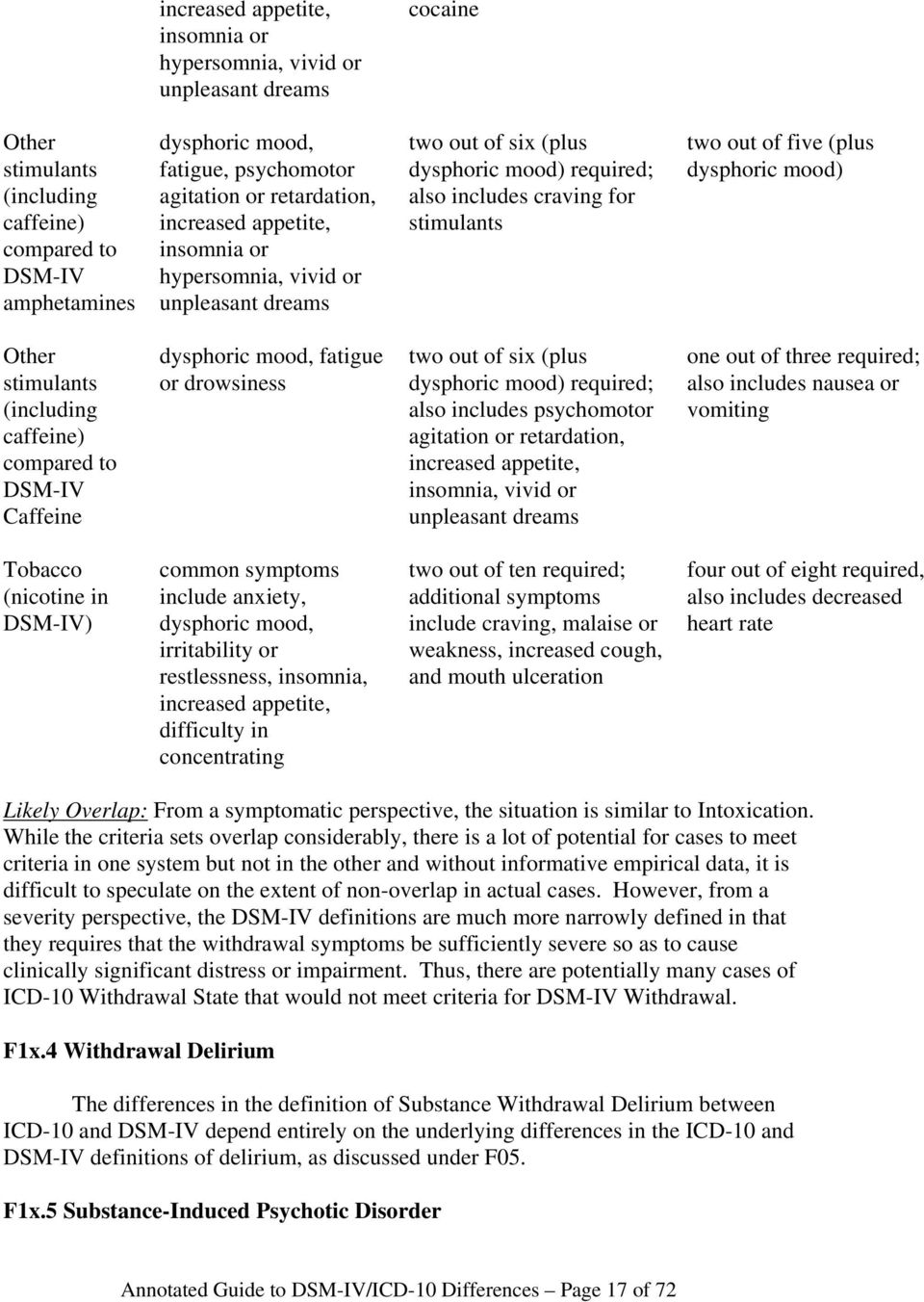
16 definitions of Dependence identified virtually the same group of patients. (Cottler et al., 1995) F1x.4 Withdrawal State The main difference in the definitions is that the DSM-IV criteria specify that the withdrawal symptoms must cause clinically significant distress or impairment. In contrast, the ICD-10 criteria indicate only the presence of characteristic signs and symptoms. As with Intoxication, the substance-specific definitions each differ slightly between the two systems. The table below summarizes the similarities and differences. Table 3: Comparison of ICD-10 and DSM-IV criteria for Substance Withdrawal Both DSM-IV and ICD-10 Unique to ICD-10 Unique to DSM-IV Alcohol common symptoms include hand tremor, sweating, nausea or vomiting, tachycardia, psychomotor agitation, insomnia, transient hallucinations, grand mal seizures three out of ten required; additional symptoms include tremor of tongue or eyelid, headache, malaise or weakness two out of eight required; also includes anxiety Opioid common symptoms include rhinorrhea or sneezing, lacrimation, muscle aches, nausea or vomiting, diarrhea, pupillary dilatation, piloerection or recurrent chills, yawning, or restless sleep three out of twelve required; additional symptoms include drug craving, abdominal cramps, tachycardia or hypertension three out of nine required; additional symptoms include dysphoric mood, fever Sedative/ Hypnotic hand tremor, nausea or vomiting, tachycardia, psychomotor agitation, insomnia, transient hallucinations, grand mal seizures three out of eleven required; also includes tongue or eyelid tremor, postural hypotension, headache, malaise or weakness, paranoid ideation two out of eight required; also includes anxiety Cocaine dysphoric mood, fatigue, psychomotor agitation or retardation, two out of six (plus dysphoric mood) required; also includes craving for two out of five (plus dysphoric mood) Annotated Guide to DSM-IV/ICD-10 Differences Page 16 of 72

17 increased appetite, insomnia or hypersomnia, vivid or unpleasant dreams cocaine Other stimulants (including caffeine) compared to DSM-IV amphetamines dysphoric mood, fatigue, psychomotor agitation or retardation, increased appetite, insomnia or hypersomnia, vivid or unpleasant dreams two out of six (plus dysphoric mood) required; also includes craving for stimulants two out of five (plus dysphoric mood) Other stimulants (including caffeine) compared to DSM-IV Caffeine dysphoric mood, fatigue or drowsiness two out of six (plus dysphoric mood) required; also includes psychomotor agitation or retardation, increased appetite, insomnia, vivid or unpleasant dreams one out of three required; also includes nausea or vomiting Tobacco (nicotine in DSM-IV) common symptoms include anxiety, dysphoric mood, irritability or restlessness, insomnia, increased appetite, difficulty in concentrating two out of ten required; additional symptoms include craving, malaise or weakness, increased cough, and mouth ulceration four out of eight required, also includes decreased heart rate Likely Overlap: From a symptomatic perspective, the situation is similar to Intoxication. While the criteria sets overlap considerably, there is a lot of potential for cases to meet criteria in one system but not in the other and without informative empirical data, it is difficult to speculate on the extent of non-overlap in actual cases. However, from a severity perspective, the DSM-IV definitions are much more narrowly defined in that they requires that the withdrawal symptoms be sufficiently severe so as to cause clinically significant distress or impairment. Thus, there are potentially many cases of ICD-10 Withdrawal State that would not meet criteria for DSM-IV Withdrawal. F1x.4 Withdrawal Delirium The differences in the definition of Substance Withdrawal Delirium between ICD-10 and DSM-IV depend entirely on the underlying differences in the ICD-10 and DSM-IV definitions of delirium, as discussed under F05. F1x.5 Substance-Induced Psychotic Disorder Annotated Guide to DSM-IV/ICD-10 Differences Page 17 of 72
18 The ICD-10 definition is more narrowly defined than DSM-IV in terms of onset and duration. ICD-10 requires duration within 2 weeks of substance use (as opposed to within one month in DSM-IV) and sets a maximum duration of 6 months (apparently regardless of whether the person continues to take substances). Likely Overlap: The ICD-10 definition is narrower than DSM-IV because of its duration and onset requirements. Thus, for example, an individual with recurrent cocaine use who has longstanding substance-induced delusions that have persisted for a year would not meet criteria for ICD-10 Substance-Induced Psychotic Disorder but would under DSM- IV. F1x.6 Amnesic Syndrome (Substance-Induced Persisting Amnestic Disorder in DSM-IV) The differences in the definition of Substance-Induced Amnestic Disorder between ICD-10 and DSM-IV depend entirely on the underlying differences in the ICD- 10 and DSM-IV definitions of Amnestic Disorder, as discussed under F06 (i.e., ICD-10 requirements that both loss of learning and recall of previously learning information be present and the immediate recall be preserved). F1x.70 Residual and Late-Onset Flashbacks No definitions or criteria are provided for flashbacks in ICD-10. Cases of flashbacks related to hallucinogen use are diagnosed in DSM-IV as Hallucinogen Persisting Perception Disorder. Flashbacks related to other substances are not diagnosable in DSM-IV except as Substance-Induced Disorder Not Otherwise Specified. F1x.71 Residual and Late-Onset Personality or Behaviour Disorder The DSM-IV Substance Workgroup decided that there was not sufficient evidence to support including this disorder in DSM-IV. Cases diagnosed as F1x.71 in ICD-10 would be classified as Substance-Induced Disorder Not Otherwise Specified in DSM-IV. F1x.72 Residual Affective Disorder Differences between the ICD-10 and DSM-IV definitions of this disorder parallel differences in the definitions of ICD-10 F06.3 Organic Mood Disorder and DSM-IV Mood Disorder Due to a General Medical Condition, namely that the ICD-10 definition requires that the mood symptoms meet the full duration and symptom requirements for a disorder in F32-34 whereas DSM-IV only requires that the mood symptoms be prominent, persistent, and predominate in the clinical presentation. F1x.73 Dementia (Substance Persisting Dementia in DSM-IV) Annotated Guide to DSM-IV/ICD-10 Differences Page 18 of 72

19 Differences between the ICD-10 definition and DSM-IV definition parallel differences in the definitions of Dementia.. F1x.75 Late-Onset Psychotic Disorder The disorder is for psychotic symptoms that have their onset from between 2 and 6 weeks after cessation of substance use. As discussed above in F1x.5, in DSM-IV Substance-Induced Psychotic Disorder, the onset of the substances must be within the first 4 weeks after cessation of substance use. Likely Overlap: Part of ICD-10 Late-Onset Psychotic Disorder completely overlaps with DSM-IV Substance-Induced Psychotic Disorder (i.e., those cases of DSM-IV with their onset between 2 and 4 weeks after the cessation of psychotic symptoms). However, those cases of ICD-10 Late-Onset Psychotic Disorder with the onset of psychotic symptoms between 4 and 6 weeks would not qualify as a Substance-Induced Psychotic Disorder in DSM-IV. Instead, DSM-IV recommends against considering such cases of psychotic symptoms as being etiologically related to the substance use and instead diagnosing a psychotic disorder from F2. F20-F29 Schizophrenia, Schizotypal, and Delusional Disorders General Criteria for Schizophrenia The ICD-10 and DSM-IV criteria sets have many basic similarities but differ in a number of ways. Symptomatically, the ICD-10 and DSM-IV are quite comparable. Both the ICD-10 and DSM-IV offer two ways to satisfy the symptom requirement for Schizophrenia: either having one symptom from a list of especially characteristic symptoms (i.e., Schneiderian first rank symptoms and others) or alternatively having two from a second list of psychotic symptoms. However, the specific symptoms comprising the lists differ among the two systems. ICD-10 offers a list of very specific types of symptoms, including thought echo, thought insertion or withdrawal or thought broadcasting; delusions of control, influence or passivity; hallucinatory voices giving a running commentary or discussing the patient among themselves or persistent delusions of other kinds that are completely impossible. The corresponding list in DSM-IV contains two items: bizarre delusions (which would cover the three delusional symptoms in the ICD-10 list) and auditory hallucinations also of the type described in ICD-10. The second list in ICD-10 includes four items: hallucinations accompanied by delusions or overvalued ideas; incoherence or irrelevant speech; catatonic behavior; and negative symptoms. In contrast, DSM-IV offers a choice of five symptoms: delusions of any type; hallucinations of any type; disorganized speech; catatonic or grossly disorganized behavior, and negative symptoms. Both systems require these symptoms to be present for most of the time for at least 1 month. Perhaps the most significant difference is in duration. While both definitions require at least 1 month of psychotic symptoms, DSM-IV requires that the total duration Annotated Guide to DSM-IV/ICD-10 Differences Page 19 of 72

20 of the illness be at least 6 months (which can include prodromal and residual symptoms, essentially milder versions of the definitional psychotic symptoms). Finally, DSM-IV also requires that functioning since the onset of the illness be markedly below that achieved prior to the onset. The DSM-IV course modifiers were adapted from ICD-10. The main difference is that in ICD-10, the episodic types are characterized by having negative symptoms (or no symptoms) between episodes. These are further subtyped based on whether the negative symptoms are progressive or stable. In DSM-IV, the episodic types are characterized by the presence or absence of interepisode residual symptoms which may be either negative symptoms or attenuated forms of the defining psychotic symptoms. Likely Overlap: Even though the DSM-IV and ICD-10 symptom definitions differ in form and content, the DSM-IV Field Trial showed that based on the symptom pattern alone, the ICD-10 and DSM-IV definitions identified mostly the same patients (Flaum et al., 1998). The main reasons for discordance in diagnoses were based on differences in the duration requirement and in the boundary between schizophrenia and schizoaffective disorder. Both systems mostly concurred on the diagnosis of individuals with a duration of 6 months or longer (Schizophrenia) and on those with a duration of less than 1 month (Brief Psychotic Disorder). The main difference occurs in those patients with a (typically) first onset of psychotic symptoms lasting for at least 1 month but less than 6 months. In ICD-10, such individuals would be diagnosed as Schizophrenia whereas in DSM-IV the diagnosis would be Schizophreniform Disorder. F20.0 Paranoid Schizophrenia ICD-10 definition requires that the delusions or hallucinations be prominent whereas other specific symptoms (i.e., flattening or incongruity of affect, catatonic symptoms, or incoherent speech) must not dominate the clinical picture. Although the DSM-IV definition is similar, it is not identical; it requires that the individual be preoccupied with one or more delusions or frequent hallucinations and that none of a list of different specific symptoms (i.e., disorganized speech, disorganized or catatonic behavior, or flat or inappropriate affect) be also prominent. F20.1 Hebephrenic Schizophrenia (Disorganized Schizophrenia in DSM-IV) The DSM-IV definition is more severe in that disorganized speech, disorganized behavior and flat or inappropriate affect are all required. ICD-10 requires flat or inappropriate affect and either disorganized speech or disorganized behavior. F20.2 Catatonic Schizophrenia The DSM-IV definition is more severe in that a minimum of two catatonic features must be present. ICD-10 requires only one catatonic symptom lasting at least 2 weeks. The lists of catatonic symptoms share most features in common except for echolalia and echopraxia (only in DSM-IV) and command automatism (only in ICD-10). Annotated Guide to DSM-IV/ICD-10 Differences Page 20 of 72

21 F20.3 Undifferentiated Schizophrenia ICD-10 allows for two ways to meet criteria for this subtype: either having insufficient symptoms to meet the criteria for one of the other subtypes or else so many symptoms that the criteria for more than one of the other subtypes is met. DSM- IV reserves this subtype only for cases that do not meet criteria for any of the other subtypes. F20.4 Post-schizophrenic Depression (Postpsychotic Depressive Disorder of Schizophrenia in DSM-IV) While not included as an official category in DSM-IV, Postpsychotic Depressive Disorder of Schizophrenia is included in the DSM-IV Appendix for Criteria Sets and Axes Provided for Further Study. The two definitions differ by virtue of the DSM-IV criteria specifying that the depressive episode occur only during the residual phase of Schizophrenia. This requirement was added to the DSM-IV definition to help differentiate this disorder from Schizoaffective Disorder. Likely Overlap: Those cases of ICD-10 Post-schizophrenia Depression where the depressive episode is confined to periods in which the general criteria for Schizophrenia (called the active phase in DSM-IV) are not met would be diagnosed in DSM-IV as Postpsychotic Depressive Disorder of Schizophrenia. Cases where the depressive episodes overlap with the active phase symptoms would most likely meet DSM-IV criteria for Schizoaffective Disorder instead. F20.5 Residual Schizophrenia The ICD-10 definition requires that there be at least 12 months of negative symptoms (four drawn from a possible list of six) in an individual for whom the general criteria for Schizophrenia are not currently met. The DSM-IV definition is more broadly defined in that the criteria also allow for two or more active phase symptoms to be present in an attenuated form (e.g., odd beliefs, unusual perceptual experiences). DSM- IV also does not specify a duration. Likely Overlap: Whereas all cases of ICD-10 Residual Type would also meet criteria for DSM-IV Residual Type (subject to the differences in the general definition of Schizophrenia), many cases of DSM-IV Residual Type would not meet the ICD-10 criteria (e.g., those with attenuated positive symptoms, those with negative symptoms lasting less than 12 months, those with three or fewer negative symptoms). F20.6 Simple Schizophrenia (Simple Deteriorative Disorder in DSM-IV) While not included as an official category in DSM-IV, Simple Deteriorative Disorder is included in the DSM-IV Appendix for Criteria Sets and Axes Provided for Further Study. The symptomatic criteria for the two definitions are similar but have Annotated Guide to DSM-IV/ICD-10 Differences Page 21 of 72
22 somewhat different wording. ICD-10 specifies that there be a significant change in the overall quality of some aspects of speech or personal behavior manifest as loss of drive or interests, aimlessness, idleness, a self-absorbed attitude and social withdrawal. The corresponding criterion in DSM-IV requires poor interpersonal rapport, social isolation, or social withdrawal. Furthermore, DSM-IV has a more restrictive exclusion requirement, specifying that it be determined that no Personality, Mood, or Anxiety Disorder better accounts for the symptoms. F21 Schizotypal Disorder In DSM-IV, this disorder is considered to be a type of Personality Disorder. The nine-item ICD-10 and DSM-IV criteria sets share six items in common (inappropriate or constricted affect, odd behavior or appearance, odd beliefs or magical thinking, suspiciousness or paranoid ideas, unusual perceptual experiences, and odd thinking or speech. The three items in ICD-10 (but not in DSM-IV) are: poor rapport with others and a tendency to social withdrawal, ruminations without inner resistance, and transient quasi-psychotic episodes. The three items in DSM-IV (and not ICD-10) are: ideas of reference, lack of close friends or confidants, and excessive social anxiety. The diagnostic thresholds also differ, with ICD-10 requiring at least four out of the nine items and DSM-IV requiring at least five. Another difference concerns the exclusion criterion. ICD-10 disallows the diagnosis of Schizotypal Disorder if the criteria have ever been met for Schizophrenia. In contrast, DSM-IV allows the diagnosis so long as it does not occur exclusively during the course of Schizophrenia, a Mood Disorder With Psychotic Features, another Psychotic Disorder, or a Pervasive Developmental Disorder. Thus, a patient with Schizotypal Personality Disorder who goes on to develop Schizophrenia would be diagnosed as Schizotypal Personality Disorder (Premorbid) so long as the symptoms of Schizotypal Personality Disorder are evident during periods of remission. Likely Overlap: Although the two definitions share only six out of nine symptoms, they probably diagnose more or less the same group of patients. The three DSM-IV criteria, while not explicitly mentioned among the nine ICD-10 criteria, are likely to be covered: having few friends and social anxiety is certainly closely associated with the ICD-10 item poor rapport with others and a tendency toward social withdrawal, and ideas of reference might be covered under either odd beliefs or by the delusion-like ideas that characterize the transient quasi-psychotic episodes. Looking from the opposite direction, certainly the ICD-10 poor rapport and social withdrawal is likely covered by the DSM-IV few friends and excessive social anxiety criteria. While the ICD-10 criterion for transient quasi-like psychotic episodes is not part of the DSM-IV definition, this feature is included in the Associated Features section of the DSM-IV text. Only the ICD-10 ruminations item has no counterpart in DSM-IV. However, since both the ICD-10 and DSM-IV criteria are polythetic, it is unlikely that this single item mismatch among a total of nine items would have much diagnostic significance Annotated Guide to DSM-IV/ICD-10 Differences Page 22 of 72
23 F22.0 Delusional Disorder Both ICD-10 and DSM-IV define Delusional Disorder as persistent delusions with a content other than completely impossible or culturally inappropriate (called nonbizarre in DSM-IV). The main difference in the definitions concern the minimum duration: 3 months in ICD-10 vs. 1 month in DSM-IV. The two definitions also differ somewhat regarding accompanying mood symptoms. ICD-10 allows depressive symptoms to be present intermittently provided that the delusions persist at times when there is no disturbance of mood. In contrast, DSM-IV focuses on the relative duration of delusions vs. mood episodes, requiring that the duration of the mood episodes be brief relative to the duration of the delusional periods. Likely Overlap: DSM-IV is more permissive than ICD-10 with regard to minimum duration (1 month vs. 3 months) whereas DSM-IV is stricter with regard to allowable mood symptoms (although how much so is not clear since brief is not defined in DSM- IV). Cases of DSM-IV Delusional Disorder lasting from between 1 and 3 months would be diagnosed in ICD-10 in F23. F23 Acute and Transient Psychotic Disorders (Brief Psychotic Disorder in DSM-IV) This is perhaps the diagnostic area with the most complicated cross-walking rules (and subsequent discordances) between ICD-10 and DSM-IV. ICD-10 includes four disorders to cover acute and transient psychotic disorders, which differ based on types of psychotic symptoms (i.e., with or without symptoms of schizophrenia) and course (i.e., whether or not they are polymorphic). In contrast, DSM-IV includes only one disorder for psychotic presentations with a duration of at least 1 day but less than 1 month, regardless of type or course of the psychotic symptoms. The crosswalking is complicated by the fact that the ICD-10 disorders have differing maximum durations depending on the type of symptoms (i.e., 1 month for Schizophrenia-like symptoms and 3 months for predominantly delusional symptoms). Table 4 indicates the crosswalking rules for each of the ICD-10 acute psychotic disorders. Table 4: Crosswalk Between ICD-10 and DSM-IV Brief Psychotic Disorders ICD-10 Acute and Transient Psychotic DIsorders DSM-IV Brief Psychotic Disorder DSM-IV Delusional Disorder DSM-IV Psychotic Disorder NOS F23.0 Acute Polymorphic Psychotic Disorder w/o symptoms of Schizophrenia if duration at least 1 day but less than 1 month if duration is between 1 and 3 months and symptoms are nonbizarre delusions only if duration is less than 1 day or between 1 and 3 months and symptoms are other than non-bizarre delusions (e.g., hallucinations) Annotated Guide to DSM-IV/ICD-10 Differences Page 23 of 72
24 F23.1 Acute Polymorphic Psychotic Disorder with symptoms of Schizophrenia if duration at least 1 day but less than 1 month if duration is less than 1 day F23.2 Acute Schizophrenia-Like Psychotic Disorder if duration at least 1 day but less than 1 month if duration is less than 1 day F23.3 Other Acute Predominantly Delusional Psychotic Disorder if duration at least 1 day but less than 1 month if duration is between 1 and 3 months and symptoms are nonbizarre delusions only if duration is less than 1 day or between 1 and 3 months and symptoms are other than non-bizarre delusions (e.g., hallucinations) F24 Induced Psychotic Disorder (Shared Psychotic Disorder in DSM-IV) Although the wording differs, the two criteria sets define the same condition. F25 Schizoaffective Disorder The ICD-10 and DSM-IV definitions are similar in that they both require periods of significant mood symptoms (i.e., that the full criteria be met for a mood episode) and significant schizophrenia-like psychotic symptoms, which must occur concurrently during the same episode of the disorder. The definitions differ significantly with respect to the required relationship between the mood and psychotic symptoms. The ICD-10 diagnosis depends on an approximate balance between the number, severity, and duration of schizophrenic and affective symptoms." In contrast, DSM-IV requires that 1) delusions or hallucinations occur for at least 2 weeks in the absence of prominent mood symptoms; and that the mood symptoms are present for a substantial portion of the total duration of the illness. Likely Overlap: While the two criteria sets will certainly define many cases in common (for example, the patient with one month of depression, followed by a period of concurrent mood and bizarre delusions, followed by a one month period of bizarre delusions that persist even after the depression has remitted), each defines certain cases as Schizoaffective that would not qualify for that diagnosis in the other system. For example, a patient with concurrent bizarre delusions and depressive symptoms would be classified as Schizoaffective Disorder in ICD-10 but would be considered to have a Major Depressive Episode with psychotic symptoms in DSM-IV (due to the lack of a Annotated Guide to DSM-IV/ICD-10 Differences Page 24 of 72
25 period of delusions without prominent mood). Similarly, a patient with 4 months of bizarre delusions in the absence of prominent depressive symptoms who then goes on to have 6 months of concurrent depressive and bizarre delusions would qualify for a diagnosis of Schizoaffective Disorder in DSM-IV but not in ICD-10 (instead, the ICD-10 diagnosis would be Schizophrenia). F30-F39 Mood Disorders F30.0 Hypomania (Not a codable condition in DSM-IV; only diagnosed in context of Bipolar II Disorder) The ICD-10 and DSM-IV definitions both require elevated or irritable mood lasting at least 4 days. The criteria sets differ both in their lists of accompanying symptoms and in the minimum required number of items. Both criteria sets have the following symptoms in common: increased activity or physical restlessness, increased talkativeness, distractibility, decreased need for sleep, and irresponsible or reckless behavior. ICD-10 includes two additional items: increased sexual energy and increased sociability or over-familiarity, and allows difficulty in concentration as an alternative for distractibility. DSM-IV also includes two additional items, inflated self-esteem or grandiosity and flight of ideas, and mentions social and sexual activity as examples of increased goal-directed activity (an item that both ICD-10 and DSM-IV already have in common). While both definitions require three out of seven items when mood is elevated, DSM-IV requires that there be four items if the mood is only irritable (as ICD- 10 does for its definition of mania). Furthermore, DSM-IV has some additional requirements that help to delineate it from normal good mood: a requirement that the episode be associated with an unequivocal change in functioning that is uncharacteristic of the person and that the disturbance in mood and change in functioning be observable by others. Likely Overlap: Although both definitions appear to have similar diagnostic thresholds (i.e., three out of seven items), the ICD-10 definition defines a potentially much less severe disturbance than does DSM-IV. For example, an individual with symptoms of increased activity at work, increased sociability, and increased sexual activity would meet criteria for hypomania in ICD-10 (items (1), (5), and (7) being met), whereas all three symptoms would only count toward the single DSM-IV item increase in goaldirected activity (either socially, at work or school, or sexually). Furthermore, the additional DSM-IV requirements that the disturbance cause an unequivocal change in functioning and be observable by others would also tend to select for more severe cases. F30.1 Mania Without Psychotic Symptoms (Bipolar Disorder, Single Manic Episode in DSM-IV) The ICD-10 and DSM-IV definitions both require abnormally elevated or irritable mood lasting at least one week (or less if hospitalization is required). The ICD-10 set of accompanying symptoms includes all seven of the items in the DSM-IV definition but also contains two additional items: marked sexual energy or indiscretions and loss of Annotated Guide to DSM-IV/ICD-10 Differences Page 25 of 72
26 normal social inhibitions. However, the minimum number of required items in ICD-10 remains the same as the number in DSM-IV (i.e., three items if mood is euphoric, four items if mood is irritable). Finally, although both DSM-IV and ICD-10 exclude a diagnosis if the symptoms are due to a medical condition or substance use, DSM-IV also excludes manic-like episodes caused by somatic antidepressant treatment from counting towards a diagnosis of Bipolar I Disorder; ICD-10 makes no mention of this and presumably would count such episodes towards a diagnosis of Bipolar Disorder. (This applies to Mania With Psychotic Symptoms as well). Likely Overlap: The diagnostic threshold in the ICD-10 criteria set is lower than in DSM-IV since three (or four) out of nine items is required in ICD-10 as opposed to three (or four) out of seven items. F30.2 Mania with psychotic symptoms ICD-10 excludes those delusions or hallucinations that are completely impossible or culturally inappropriate and hallucinations that are in the third person or are giving a running commentary. In contrast, in DSM-IV such delusions or hallucinations are consistent with a diagnosis of Manic Episode With Psychotic Features- -DSM-IV allows delusions or hallucinations of any kind. Both systems define a moodcongruent and mood-incongruent subtype in the same way. Likely Overlap: The DSM-IV definition is more inclusive than the ICD-10 definition. Presentations meeting the full criteria for a manic episode that are accompanied by schizophrenic-like delusions or hallucinations would be diagnosed as Manic Episode with Psychotic Features in DSM-IV and either Schizoaffective Disorder or Schizophrenia in ICD-10. F31 Bipolar Affective Disorder (Bipolar I or Bipolar II Disorder in DSM-IV) The ICD-10 definition of Bipolar Affective Disorder differs from the DSM-IV definitions in two ways. In ICD-10, a diagnosis of Bipolar Affective Disorder requires that there be recurrent mood episodes (i.e., more than one), whereas in DSM-IV a single manic or mixed episode is sufficient for a diagnosis of Bipolar I Disorder. (In ICD-10 a single manic or mixed episode is diagnosed as F30.1 or F30.2 Mania or F38.00 Mixed Affective Episode.) More importantly, DSM-IV makes a fundamental distinction between those cases of Bipolar Affective Disorder that include at least one manic or mixed episode (called Bipolar I Disorder), and those cases that only have hypomanic episodes and major depressive episodes in the absence of a history of manic or mixed episodes (Bipolar II Disorder). ICD-10 makes no such distinction, using the Bipolar Affective Disorder label to apply to any recurrent mood disorder that includes at least one hypomanic, manic, or mixed episode. Finally, while both DSM-IV and ICD-10 demarcate episodes by either a change in polarity or a period of remission, DSM-IV specifies that the minimum duration of the period of remission be two months. Annotated Guide to DSM-IV/ICD-10 Differences Page 26 of 72
27 Likely Overlap: Each of the ICD-10 F30 and F31 disorders have a corresponding disorder in the DSM-IV Bipolar section (see Table 5) with two exceptions: 1) F30.0 Hypomania would not qualify for a diagnosis of a mental disorder in DSM-IV because it does not meet the basic requirement of clinical significance that is part of the definition of a mental disorder in DSM-IV; and 2) cases of F31.0 without any manic mixed, or depressive episodes (i.e., consisting of recurrent hypomanic episodes only) do not meet the basic requirements of either Bipolar I or Bipolar II Disorder and would have to be diagnosed as Bipolar Disorder Not Otherwise Specified in DSM-IV. Table 5: Correspondence Between ICD-10 and DSM-IV Diagnoses of Bipolar Disorder DSM-IV Disorders ICD-10 Disorders Bipolar I Disorder, Single Manic Episode Bipolar I Disorder Bipolar II Disorder Bipolar Disorder Not Otherwise Specified F30.0 Hypomania single hypomanic episode is generally not considered to be a mental disorder in DSM-IV F30.1 Mania w/o Psychotic Symptoms F30.2 Mania With Psychotic Symptoms Mild/ Moderate/ Severe With Psychotic Features F31.0 Bipolar, current episode hypomanic Most Recent Episode Hypomanic (if at least one past manic or mixed episode) Hypomanic (if no past manic or mixed episodes) if recurrent hypomanic episodes only F31.1 Bipolar, current episode manic without Most Recent Episode Manic, Mild/Moderate/ Annotated Guide to DSM-IV/ICD-10 Differences Page 27 of 72
28 psychotic features F31.2 Bipolar, current episode manic with psychotic symptoms F31.3 Bipolar, current episode moderate or mild depression F31.4 Bipolar, current episode severe depression without psychotic features F31.5 Bipolar, current episode severe depression with psychotic features F31.6 Bipolar, current episode mixed F31.7 Bipolar, currently in remission Severe Most Recent Episode Manic With Psychotic Features Most Recent Episode Depressed, mild/moderate (if at least one past manic or mixed episode) Most Recent Episode Depressed, Severe (if at least one past manic or mixed episode) Most Recent Episode Depressed With Psychotic Features (if at least one manic or mixed episode) Most Recent Episode Mixed, Mild/Moderate/Severe Most Recent Episode Manic/Mixed/ Hypomanic/ Depressed, in Partial/Full Remission (if at least one manic or mixed episode in past) Depressed (if no past manic or mixed episodes) Depressed (if no past manic or mixed episodes) Depressed (if no past manic or mixed episodes) Hypomanic/ Depressed (if no past manic or mixed episodes) F32.0-F32.2 Depressive Episode (Major Depressive Disorder, Single Episode, in DSM-IV), mild, moderate, severe without psychotic symptoms The ICD-10 and DSM-IV criteria sets defining a depressive episode are almost identical, but unfortunately they are sufficiently different so as to not define the same groups of individuals as having a major depressive episode. Annotated Guide to DSM-IV/ICD-10 Differences Page 28 of 72
29 1) Although both definitions have eight items in common (i.e., depressed mood, loss of interest, decreased energy or increased fatiguability, recurrent thoughts of death or suicidal behavior, inability to concentrate or indecisiveness, psychomotor agitation or retardation, sleep disturbance, and change in appetite or weight), they differ on the remaining items. ICD-10 has two additional items: loss of confidence or self esteem and inappropriate or excessive guilt, whereas DSM-IV has one additional item that combines the inappropriate or excessive guilt with feelings of worthlessness (which is qualitatively more severe than loss of confidence or self-esteem). 2) The structure of the diagnostic algorithms also differs between the two systems. ICD- 10 groups the items into two sets: one containing the three items depressed mood, loss of interest, and decreased energy and the other set containing the remaining seven items. The ICD-10 diagnostic thresholds are specified in terms of the number of items required from each of the two sets. DSM-IV instead presents the nine items in one set but indicates that either depressed mood or loss of interest is required for a diagnosis of Major Depressive Episode. 3) ICD-10 provides separate diagnostic thresholds for each of the different severity levels: a minimum of four out of ten symptoms defines mild, six out of ten symptoms defines moderate, and eight out of ten symptoms defines severe. Furthermore, the ICD- 10 diagnostic algorithm gives special significance to three symptoms in particular (i.e., depressed mood, loss of interest, and decreased energy) by requiring that there be at least two out of three for the mild and moderate types, and three out of three for the severe type. As discussed above, DSM-IV has a single nine-item criteria set and requires that at least five items be present, and also gives special priority to depressed mood and loss of interest by requiring that at least one of them be present. Severity specifiers in DSM-IV are assigned only after the five-out-of-nine diagnostic threshold for a Major Depressive Episode has been met and are based on how many items in excess of the threshold are present combined with the level of functional impairment (i.e., mild is for few, if any, symptoms above the threshold and no more than minor impairment in functioning, moderate is intermediate, and severe is for several symptoms in excess of the minimum threshold plus marked interference with functioning). 4) The ICD-10 criteria do not mention any exclusion based on bereavement whereas DSM-IV excludes a diagnosis if the depressive disturbance is better accounted for by bereavement. DSM-IV considers depression following the loss of a loved one to be pathological bereavement (which would qualify for a diagnosis of major depression) if the depression is prolonged (lasting more than 2 months) or if it includes certain features uncharacteristic of a normal grief reaction (i.e., marked functional impairment, morbid preoccupation with worthlessness, suicidal ideation, psychotic symptoms, or psychomotor retardation). Likely Overlap: Given that the two definitions share eight items in common, one would expect the overlap to be considerable. However, the differences in the definitions lead to cases that will meet criteria under one definition and not the other. Examples of cases Annotated Guide to DSM-IV/ICD-10 Differences Page 29 of 72
30 that meet criteria under the ICD-10 definition and not the DSM-IV definition include: 1) cases of Mild Depressive Episode with a total of four symptoms (five is the minimum required in DSM-IV, even for the mildest cases); 2) ICD-10 mild depressive episodes occurring in response to the death of a loved one; and 3) ICD-10 mild depressive episodes with five depressive symptoms including loss of confidence or self-esteem as one of the symptoms (which is less severe than the worthlessness item in DSM-IV. Examples of cases that meet criteria under the DSM-IV definition and not the ICD-10 definition include a DSM-IV Major Depressive Episode with depressed mood and four symptoms other than loss of interest or decreased energy (which violates the ICD-10 requirement of two out of three defining symptoms). F32.3 Severe depressive episode with psychotic symptoms The ICD-10 criteria for indicating psychotic features requires that the criteria also be met for severe depressive episode (i.e., eight out of ten items total, and all three of depressed mood, loss of interest, and decreased energy). Depressive episodes with psychotic symptoms that are otherwise less symptomatically severe therefore cannot be indicated using the psychotic symptoms specifier in ICD-10. The DSM-IV literature review documented that although psychotic symptoms typically occur in the most severe cases, this is not necessarily the case (Schatzberg & Rothschild, 1996). Although the corresponding DSM-IV subtype is labeled Severe With Psychotic Features to be compatible in name with ICD-10, the definition of this subtype does not require that the depressive episode be severe; only that delusions or hallucinations (of any kind) must be present. Note that depressive stupor accompanying a depressive episode (diagnosed as Severe With Psychotic symptoms in ICD-10) is diagnosed as With Catatonic Features in DSM-IV. I ICD-10 places restrictions on the type of delusions or hallucinations that are allowed. It excludes those delusions or hallucinations that are completely impossible or culturally inappropriate and hallucinations that are in the third person or are giving a running commentary. In contrast, in DSM-IV such delusions or hallucinations are consistent with a diagnosis of Major Depressive Episode With Psychotic Features. Both systems define a mood-congruent and mood-incongruent subtype in the same way. Likely Overlap: The DSM-IV definition is more inclusive than the ICD-10 definition. Presentations meeting the full criteria for a major depressive episode that are accompanied by schizophrenic-like delusions or hallucinations would be diagnosed as Major Depressive Episode with Psychotic Features in DSM-IV and either Schizoaffective Disorder or Schizophrenia in ICD-10. Somatic Syndrome (With Melancholic Features specifier in DSM-IV) The criteria sets for this specifier for a Depressive Episode share a number of features but have different algorithmic structures. They both include loss of interest or pleasure, lack of reactivity, early morning awakening, depression worse in morning, psychomotor retardation or agitation, appetite loss, and weight loss. ICD-10 includes one Annotated Guide to DSM-IV/ICD-10 Differences Page 30 of 72
31 additional item (loss of libido), whereas the DSM-IV item set also includes a distinct quality to the mood and excessive or inappropriate guilt. Although both have a similar symptom threshold count (four symptoms required), ICD-10 requires a simple four out of eight, whereas DSM-IV gives special emphasis to loss of interest and lack of mood reactivity, requiring one of these for the diagnosis of the specifier. Likely Overlap: DSM-IV provides a more strict definition by requiring that all cases have either loss of pleasure or lack of mood reactivity. F33 Recurrent Depressive Disorder (Major Depressive Disorder, Recurrent in DSM-IV) DSM-IV includes a single category for Major Depressive Disorder with two subtypes; single episode and recurrent, reflecting the belief that they are part of the same illness. ICD-10, on the other hand, has two separate categories; F32 for a depressive episode, and F33 for recurrent depressive disorder. The actual criteria defining recurrence are significantly different in the two systems. ICD-10 requires that there be at least 2 months free from any significant mood symptoms, whereas DSM-IV requires an interval of at least 2 consecutive months in which criteria are not met for a Major Depressive Episode. Likely Overlap: ICD-10 is much more stringent, requiring more or less a 2-month period of full remission in between the episodes. In contrast, DSM-IV would consider an individual to have had separate episodes if the depression improves only so much as to bring the symptom count down from five symptoms to four for at least 2 months. Thus, an individual with a waxing and waning course of chronic depression would be considered to have a single episode in ICD-10 but multiple episodes (i.e., those periods of time in which the depression increased above the threshold for a major depressive episode) in DSM-IV. F34.0 Cyclothymia (Cyclothymic Disorder in DSM-IV) Although the constructs are conceptually similar in the two systems (i.e., a 2 year interval with periods of depression and hypomania not meeting full criteria for a manic or major depressive episode), they are operationalized quite differently in the two systems. 1) The ICD-10 Diagnostic Criteria for Research provides specific lists of symptoms that must be associated with the periods of depressed mood and hypomania, each of which differ from the ICD-10 item sets for dysthymia and hypomanic episodes. In contrast, the DSM-IV criteria do not provide symptom lists at all.. 2) DSM-IV reduces the required duration from two years to one year for children and adolescents; ICD-10 makes no such provision. 3) DSM-IV requires that there be no Major Depressive or Manic Episodes during the first 2 years of the disturbance, allowing such episodes only after the 2 year period Annotated Guide to DSM-IV/ICD-10 Differences Page 31 of 72
32 free of mood episodes has been established. While ICD-10 similarly requires a 2 year period without Major Depressive or Manic Episodes, this period can be preceded by Major Depressive or Manic Episodes. 4) DSM-IV excludes cases in which the symptoms are due to the direct physiological effects of a substance or general medical condition; ICD-10 includes no such exclusion. Likely Overlap: Although symptomatically the ICD-10 criteria appear more stringent in that a specific pattern of depressive symptoms is required (three out of eight in contrast to DSM-IV s requirement for depressive symptoms not meeting criteria for MDE), this difference is unlikely to result in significant differences in terms of identified cases. The ICD-10 criteria are more narrow when applied to children and adolescents (given the 2 year duration in ICD-10 vs. 1 year duration requirement in DSM-IV) but more broad in terms of not requiring the absence of an organic etiology (although given the requirement for a two year period of persistently disturbed mood, actual cases due to a substance or general medical condition are likely to be rare). The ICD-10 definition is also broader in terms of its relationship with prior Major Depressive or Manic Episodes. Cases with Manic Episodes and Depressive Episodes followed by a 2 year period of ups and downs not meeting criteria for full mood episodes would be diagnosed as Cyclothymia plus Bipolar Disorder in ICD-10, whereas such cases would be diagnosed as Bipolar Disorder in partial remission in DSM-IV. F34.1 Dysthymia (Dysthymic Disorder in DSM-IV) While both DSM-IV and ICD-10 require a 2 year period of depressed mood, ICD- 10 requires that the depressed mood be constant or constantly recurring whereas DSM- IV only requires that the depressed mood be present more days than not (i.e., at least 50% of the time). Regarding symptoms that must accompany the depressed mood, ICD- 10 requires that there must be three items present from a list of eleven symptoms (which includes five of the six DSM-IV items; items not on the DSM-IV list include frequent tearfulness, loss of interest in or enjoyment of sex or other pleasurable activities, a perceived inability to cope with the routine responsibilities of everyday life, pessimism about the future or brooding over the past, social withdrawal, and reduced talkativeness). DSM-IV requires two symptoms from a list of six; five of which are essentially part of the eleven ICD-10 symptoms (although worded differently); only poor appetite or overeating appear on the DSM-IV list. DSM-IV includes two modifications to facilitate the application of the criteria to children or adolescents: the mood can be irritable instead of depressed and a duration of only one year is allowed. ICD-10 does not exclude cases in which the depressive symptoms are due to substance use or a general medical condition (although the likelihood that a substance or GMC would cause 2 years of depression is probably low). Finally, while ICD-10 restricts co-occurring Major Depressive Episodes to "none or very few during the 2-year period, DSM-IV does not allow any Major Depressive Episodes during the first 2 years of the disturbance (analogous to a similar requirement in Cyclothymic Disorder). Annotated Guide to DSM-IV/ICD-10 Differences Page 32 of 72
33 Likely Overlap: ICD-10 is clearly narrower in its requirement that the depression be constant or constantly recurring and is more narrow in its application to children and adolescents. The difference in symptom requirement (2 out of 6 vs. 3 out of 11) is of unclear significance empirical data would be informative here. DSM-IV is stricter in its not allowing any Major Depressive Episodes during the 2 year period. F38.00 Mixed affective Episode (uncodable type of episode that is part of Bipolar Disorder in DSM-IV) In DSM-IV, mixed episodes are considered to be a type of manic episode and like a manic episode, a single mixed episode is sufficient to qualify for a diagnosis of Bipolar I Disorder. In ICD-10, mixed episodes are defined as a distinct third type of affective episode. ICD-10 requires a mixture or a rapid alternation (i.e., within a few hours) of hypomanic, manic, and depressive symptoms, and that manic and depressive symptoms must be prominent most of the time during a period of at least 2 weeks. DSM- IV requires that the criteria be met for both a manic episode and a major depressive episode nearly every day during at least a 1 week period, but does not specify any pattern of symptoms. Finally, DSM-IV includes an exclusion criterion for symptoms due to a substance or GMC whereas ICD-10 has no such exclusion, which was probably on oversight.. Likely Overlap: The ICD-10 definition is more stringent by virtue of requiring 2 weeks of symptoms (as opposed to only 1 week in DSM-IV). The differences in symptom pattern appear minor. F38.10 Recurrent brief depressive disorder While not included as an official category in DSM-IV, recurrent brief depressive disorder is included in the DSM-IV Appendix for Criteria Sets and Axes Provided for Further Study. The definitions are very similar with only a few exceptions. Whereas DSM-IV requires a minimum duration of at least 2 days (but less than 2 weeks), ICD-10 only requires that the episodes last less than two weeks; no minimum duration is specified (although the criterion does say that the episodes typically last 2-3 days ). While DSM-IV requires a minimum frequency of at least once a month for 12 consecutive months, ICD-10 indicates that the episodes have occurred about once a month over the past year, suggesting that more frequent episodes might exclude the diagnosis, although this is unclear. Likely Overlap: DSM-IV is more narrowly defined in terms of setting a minimum duration of 2 days but is more broadly defined in terms of allowing for more than 12 episodes a year. F40 Phobic anxiety disorders F40.0 Agoraphobia Annotated Guide to DSM-IV/ICD-10 Differences Page 33 of 72
34 Agoraphobia is conceptualized differently in ICD-10 and DSM-IV. In DSM-IV, agoraphobia is defined as being secondary to panic attacks or panic-like symptoms. Specifically, the definition of agoraphobia requires that focus of the anxiety is about being in places or situations from which escape might be difficult or embarrassing or in which help may not be available in the event of having an unexpected or situationallypredisposed panic attack or panic-like symptoms. Reflecting the primary/secondary conceptualization of panic disorder and agoraphobia, Panic Disorder is subtyped as With Agoraphobia and Without Agoraphobia. Agoraphobia without Panic is a separate category in DSM-IV. In contrast, the ICD-10 definition is couched in terms of specific situations that are feared or avoided (i.e., crowds, public places, traveling alone, traveling away from home). ICD-10 also requires that there be at least two symptoms of anxiety (drawn from the same list of fourteen symptom used in the definition of a panic attack) on at least one occasion and that these anxiety symptoms be "restricted to, or predominate in, the feared situations or contemplation of the feared situations. Agoraphobia is subtyped in ICD-10 as With Panic Disorder or Without Panic Disorder Likely Overlap: The ICD-10 definition is more restrictive than the DSM-IV definition because it limits the scenarios of avoided situations to only four and requires that there be avoidance of at least two of the four situations. By not specifying the avoided situations, the DSM-IV definition is potentially much broader, allowing any avoided situation so long as the person avoids the situation because of a fear of a panic attack or panic-like symptoms. It is likely that virtually all cases of ICD-10 agoraphobia would meet criteria for DSM-IV agoraphobia, since the avoidance of multiple situations is most likely related to a fear of having a panic attack across a number of situations. F40.1 Social Phobia ICD-10 defines the phobia as fear OR avoidance of social situations, whereas DSM-IV requires fear AND either avoidance or endurance with extreme anxiety. While both DSM-IV and ICD-10 require anxiety upon exposure to social situations, ICD-10 specifies that at least two symptoms of anxiety (i.e., from the list of fourteen panic symptoms) be present together on at least one occasion along with at least one of the following anxiety symptoms: blushing or shaking, fear of vomiting, and urgency or fear of micturition or defecation. Each system imposes some requirements not addressed by the other. DSM-IV requires that exposure to the feared social situation almost invariably provokes anxiety, that the avoidance, anticipation or distress interfere significantly with the person s normal routine, occupational functioning or social activities and relationships or else there is marked distress about having the phobia; and that the duration is at least 6 months for those under age 18. Additionally,, if a general medical condition or another mental disorder is present, the fear is unrelated to it. ICD-10, on the other hand, requires Annotated Guide to DSM-IV/ICD-10 Differences Page 34 of 72
35 that the anxiety symptoms be "restricted to, or predominate in, the feared situations or contemplation of the feared situations. Likely Overlap: While it appears that both DSM-IV and ICD-10 define mostly the same individuals as having social phobia, some discordant cases are possible (e.g., a 12 year old with only a few months of these symptoms would be diagnosed in ICD-10 and not DSM-IV). F40.2 Specific (Isolated) Phobia ICD-10 defines the phobia as fear OR avoidance of a specific object or situation, whereas DSM-IV requires fear AND either avoidance or endurance with extreme anxiety. Each system imposes some requirements not addressed by the other. DSM-IV requires that exposure to the phobic stimulus almost invariably provokes anxiety, that the avoidance, anticipation or distress interfere significantly with the person s normal routine, occupational functioning or social activities and relationships or else there is marked distress about having the phobia; and that the duration is at least 6 months for those under age 18. ICD-10, on the other hand, requires that the anxiety symptoms be "restricted to, or predominate in, the feared situations or contemplation of the feared situations. Likely Overlap: While it appears that both DSM-IV and ICD-10 define mostly the same individuals as having specific phobia, some discordant cases are possible (e.g., a 12 year old with only a few months of these symptoms would be diagnosed in ICD-10 and not DSM-IV). F41.0 Panic Disorder The ICD-10 Diagnostic Criteria for Research for a panic attack are identical to the DSM-IV criteria set except that ICD-10 includes an additional item (i.e., dry mouth). In contrast to DSM-IV, which requires any four out of the list of thirteen symptoms, the ICD-10 algorithm requires that at least one of the four symptoms be palpitations, sweating, trembling, or dry mouth. Although both classifications note that the symptoms start abruptly, ICD-10 indicates that they reach a maximum within a few minutes, whereas DSM-IV indicates that they reach a peak within 10 minutes. DSM-IV and ICD-10 differ in how they describe the nature of the relationship of the panic attacks to triggering circumstances. DSM-IV indicates that the panic attacks must be unexpected (without defining precisely what that means) whereas ICD-10 requires that the panic attacks are not consistently associated with a specific situation or object and that they often occur spontaneously (i.e., the episodes are unpredictable) and are not associated with marked exertion or with exposure to dangerous and lifethreatening situations. Although it may appear that the ICD-10 wording is simply an operationalization of the DSM-IV concept of unexpected, the difference in wording Annotated Guide to DSM-IV/ICD-10 Differences Page 35 of 72
36 may lead to significant diagnostic discordance. Although panic attacks in panic disorder must by definition be unexpected to start with, over time the person may start to associate the panic attacks with certain environmental cues so that the attacks eventually become situationally-predisposed (i.e., the person is more likely to have a panic attack in such situations). The ICD-10 criterion requiring that the attacks not be consistently associated with a specific situation or object would seem to exclude a diagnosis of panic disorder in these cases. In addition to requiring that the unexpected attacks be recurrent, DSM-IV includes an additional measure of severity, namely the requirement that at least one of the attacks be followed by one month or more of (a) persistent concern about having additional attacks; (b) worry about the implications of the attack or its consequences; or (c) a significant change in behavior related to the attacks. ICD-10 has no such requirement. ICD-10 excludes a diagnosis of panic attacks that are due to another mental disorder such as schizophrenia, a mood disorder, or a somatoform disorder. There is no such exclusion in DSM-IV (although there was in DSM-III-R). Finally, ICD-10 provides criteria for severity: moderate PD is diagnosed when there are at least four attacks in a 4-week period; severe is diagnosed when there are at least 4 attacks per week in a 4-week period. DSM-IV has no panic-disorder-specific severity criteria. Likely Overlap: The ICD-10 definition is broader in that it allows a diagnosis of panic disorder with recurrent attacks without any sequelae like a change in behavior related to the attacks. The DSM-IV requirement that at least one of the attacks is followed by a month of worry or a significant change in behavior excludes some cases of ICD-10 panic disorder. On the other hand, the ICD-10 definition is narrower in that it excludes case where the panic attacks have become situationally-predisposed during the course of the disorder. F41.1 Generalized Anxiety Disorder DSM-IV requires that there be excessive anxiety and worry more days than not for at least 6 months and that the person finds it difficult to control the worry. ICD-10, on the other hand, requires a period of at least 6 months with prominent tension, worry and feelings of apprehension about everyday events and problems without requiring that the anxiety be excessive and without specifying how often the anxiety must occur during the 6 month period. While both systems require that the anxiety and worry be associated with other symptoms, ICD-10 requires that four symptoms be present from a list of twenty-two and that at least one symptom must be indicative of autonomic arousal. DSM-IV requires three from a list of only six, five of which are included in the ICD-10 list of twenty-two items ( easily fatigued is not on the ICD-10 list). Annotated Guide to DSM-IV/ICD-10 Differences Page 36 of 72
37 The exclusion criteria differ markedly between the two systems. ICD-10 requires that the disorder not meet criteria for panic disorder, phobia anxiety disorders, obsessive-compulsive disorder, or hypochondriacal disorder. DSM-IV excludes GAD if the symptoms occur exclusively during a Mood Disorder, a Psychotic Disorder, or a Pervasive Developmental Disorder and deals with the boundary between GAD and other disorders characterized by anxiety and worry by requiring that the focus of the anxiety and worry not be confined to features of another Axis I Disorder, e.g., the anxiety or worry is not about having a Panic Attack, being embarrassed, etc. Likely Overlap: The DSM-IV requirement that the anxiety and worry be excessive and that the worry is difficult to control makes it much narrower than the ICD-10 definition. This was confirmed by Slade and Andrews analysis of data from the Australian National Mental Health Survey (Slade & Andrews, 2001). F42 Obsessive-Compulsive Disorder ICD-10 differentiates between obsessions and compulsions entirely based on whether they are thoughts, ideas, or images (obsessions) or acts (compulsions). ICD-10 provides a set of features which are shared by both obsessions and compulsions: they are acknowledged as originating in the mind of the patient; they are repetitive and unpleasant and at least one obsession or compulsion is acknowledged as excessive or unreasonable; the patient tries to resist them but at least one obsession or compulsion is unsuccessfully resisted; and experiencing the obsessive thought or carrying out the compulsive act is not in itself pleasurable. In contrast, DSM-IV defines obsessions and compulsions differently and distinguishes between obsessions and compulsions based on whether the thought, idea, or image causes anxiety or distress or prevents or reduces it. DSM-IV defines obsessions as thoughts, impulses or images that are experienced as intrusive and inappropriate and cause marked anxiety or distress. DSM-IV also requires that they are not simply excessive worries about real-life problems, that the person attempts to ignore or suppress such thoughts, impulses or images or to neutralize them with some other thought or action and that the person recognizes them to be a product of his or her own mind. Compulsions are defined as repetitive behaviors that the person feels driven to perform in response to an obsession or according to rules which must be applied rigidly; and that are aimed at preventing or reducing distress or preventing some dreaded event or situation. Thus, DSM-IV would consider a repetitive driven thought (like a prayer) to be a compulsion if it functioned to reduce distress or to prevent some dreaded event, something that would be considered an obsession in ICD-10. In addition, ICD-10 sets a minimum duration of at least 2 weeks,whereas DSM- IV does not specify any minimum duration. Both systems require that the obsessions or compulsions cause marked distress or interfere with the person s social or occupational functioning, DSM-IV, however, also allows the diagnosis to be made if it is particularly time-consuming (i.e., take more than 1 hour a day) even if the person denies distress or impairment. Annotated Guide to DSM-IV/ICD-10 Differences Page 37 of 72
38 Finally, ICD-10 provides a number of subtypes that may be coded based on whether obsessions or compulsions predominate in the presentation, i.e., predominantly obsessional thoughts and ruminations, predominantly compulsive acts, and mixed obsessional thoughts and acts. Likely Overlap: Although DSM-IV and ICD-10 differ on what each system considers to be an obsession vs. a compulsion, it is not clear whether this would have any impact on whether a particular individual is considered to have OCD given that both DSM-IV and ICD-10 require either obsessions or compulsions. Although ICD-10 s requirement of a minimum duration of at least 2 weeks make it more restrictive than DSM-IV in theory, (given the absence of any duration requirement in DSM-IV), it is unlikely in practice that any cases would come to clinical attention with a duration of less than 2 weeks. F43.0 Acute Stress Reaction (Acute Stress Disorder in DSM-IV) The ICD-10 and DSM-IV definitions of Acute Stress Disorder differ in a number of ways. 1) While both definitions define syndromes that develop in response to a traumatic event, the two systems differ in their definition of the event. ICD-10 requires that the person be exposed to an exceptional mental or physical stressor, whereas DSM-IV provides much more detailed and specific guidelines for the exposure (the same ones used in its definition of PTSD). The person must have experienced, witnessed or be confronted with an event or events that involved actual or threatened death or serious injury or a threat to the physical integrity of self or others. In addition, the person s response to the traumatic event must have involved intense fear, helplessness, or horror. The only guidelines provided by ICD-10 for understanding what might be exceptional are in the corresponding criterion for PTSD, i.e., that the event is exceptionally threatening or catastrophic in nature, which would be likely to cause pervasive distress in almost anyone. Note, that the ICD-10 definition of the traumatic stressor is similar to the DSM-III-R definition of stressor (i.e., an event that is outside the range of usual human experience ) which was changed in DSM-IV because of concerns that events that can potentially trigger a disordered reaction are unfortunately relatively common (e.g., automobile accidents) and thus not exceptional experiences. 2) ICD-10 describes the response to the traumatic stressor in terms of three levels of severity: mild which entails meeting the symptomatic criteria for GAD (i.e., four out of a list of twenty-two anxiety symptoms), moderate which require meeting criteria for GAD plus having two symptoms from a list of seven symptoms including social withdrawal, narrowing of attention, disorientation, anger, despair, purposeless overactivity, and uncontrollable grief; or severe which involves meeting criteria for GAD and having four out of the list of seven symptom or else dissociative stupor (i.e., profound diminution or absence of voluntary movements and speech and of normal responsiveness to light, noise, and touch). In contrast, DSM-IV requires at least three frank dissociative symptoms (from a list including numbing, detachment, or absence of Annotated Guide to DSM-IV/ICD-10 Differences Page 38 of 72
39 emotional responsiveness, reduction in awareness of surroundings, derealization, depersonalization, and dissociative amnesia). Furthermore, DSM-IV requires symptoms from the three symptom clusters that define PTSD, i.e., persistently re-experiencing the traumatic event, marked avoidance of stimuli that arouse recollections of the trauma, and marked symptoms of anxiety or arousal. 3) ICD-10 requires the onset of symptoms within one hour of exposure to the stressor; in contrast, DSM-IV requires onset within 4 weeks of the traumatic event. 4) ICD-10 requires that the symptoms begin to diminish within 8 hours for a transient stressor or within 48 hours for a stressor with continuous exposure. DSM-IV has no such requirement but instead requires a minimum duration of 2 days. Likely Overlap: The DSM-IV and ICD-10 definitions are likely to identify different sets of individuals as having Acute Stress Disorder. Symptomatically DSM-IV is more narrowly defined in that it requires at least three dissociative symptoms as well as PTSD symptoms such as re-experiencing the trauma and avoidance of situations, thoughts, and feelings associated with the trauma. ICD-10 is more narrowly defined in terms of requiring onset of the symptoms within 1 hour of the trauma and requiring that the symptoms start to diminish shortly thereafter. F43.1 Posttraumatic Stress Disorder There are a number of differences between the two systems. 1) As discussed above, DSM-IV and ICD-10 have different definitions of the qualifying stressor, with ICD-10 requiring that it be exceptional in the sense that it would be likely to cause pervasive distress in almost anyone. DSM-IV specifies the nature of the stressor in terms of involving actual or threatened death or serious injury or a threat to the physical integrity of self or others. Also, DSM-IV requires that the person s response to the traumatic event involve intense fear, helplessness, or horror, a criterion added to validate the psychological seriousness to the person of the exposure to the trauma. 2) The diagnostic algorithms, while similar, are also not congruent. Whereas both ICD- 10 and DSM-IV have pretty much the same criterion B requiring re-experiencing of the traumatic event (although with some slight differences in wording), the remaining criteria differ. In DSM-IV, criterion C requires persistent avoidance of stimuli associated with the trauma and numbing of general responsiveness, requiring three out of a list of seven symptoms including efforts to avoid thoughts, feelings or conversations associated with the trauma, efforts to avoid activities, places or people that arousal recollections of the trauma; inability to recall an important aspect of the trauma, markedly diminished interest or participation in significant activities; feelings of detachment or estrangement from others; restricted range of affect; and a sense of a foreshortened future. In contrast, ICD-10 focuses only on the first two items from the DSM-IV list by requiring the avoidance of circumstances resembling or associated with the trauma. DSM-IV criterion D requires persistent symptoms of increased arousal, with a minimum of two Annotated Guide to DSM-IV/ICD-10 Differences Page 39 of 72
40 out of a list of five symptoms including difficulty falling or staying asleep, irritability or outburst of anger; difficulty concentrating; hypervigilance; and exaggerated startle response. In contrast, ICD-10 criterion D requires EITHER an inability to recall some important aspect of the trauma (equivalent to DSM-IV criterion C[3]) or persistent symptoms of increased arousal stated in terms identical to DSM-IV criterion D (i.e., the same list of two out of five symptoms). Four of the seven DSM-IV criterion C items are not included in the ICD-10 criteria set at all. 3) ICD-10 requires that in most cases, symptoms have their onset within 6 months of the stressor (although cases with onset of more than 6 months can be considered probable ). In contrast, DSM-IV has no such requirement and provides a specifier to indicate delayed onset for cases with onset after 6 months. 4) DSM-IV requires that the symptoms persist for at least one month and provides an acute/chronic specifier for a duration of less than/ more than 3 months. ICD-10 has no such requirement. Likely Overlap: It appears that the DSM-IV definition is more narrowly defined in two ways. The specification of the types of events that qualify as trauma and the requirement that the person has reacted with fear, helplessness or horror is more stringent that ICD-10, which has a much more vague requirement that the trauma be exceptional. The DSM-IV algorithm also appears to be more stringent, most particularly its criterion C which requires three out of seven items, whereas ICD-10 only requires persistent avoidance of circumstances resembling or associated with the stressor. Furthermore, the fact that cases with avoidance of circumstances associated with the trauma and inability to recall parts of the trauma would meet both ICD-10 criterion C and D (but would only meet DSM-IV criterion C, leaving the DSM-IV requirement for two out of five criterion D items unmet) also suggest that DSM-IV is more narrowly defined. Given the complexity of the respective algorithms, empirical studies comparing the application of the criteria are needed to determine which definition is more broadly defined. STOPPED HERE F43.2 Adjustment Disorder While both DSM-IV and ICD-10 conceptualize Adjustment Disorder as a reaction to a stressor that does not meet criterion for other specified disorders, there are some differences in their actual definitions. DSM-IV aims to differentiate normal nondisordered reactions to stressful events from Adjustment Disorder by excluding Bereavement and by requiring that the symptoms be clinically significant as evidenced either by their being characterized by marked distress that is in excess of what would be expected from exposure to the stressor or else that they lead to significant impairment in social or occupational functioning. ICD-10 has no such requirement. Furthermore, in contrast to DSM-IV, which requires the onset of symptoms within 3 months of the stressor, ICD-10 specifies an onset within 1 month. ICD-10 also excludes stressors of "unusual or catastrophic type" which would presumably justify a diagnosis of Acute Stress Disorder or Posttraumatic Stress Disorder. In contrast, DSM-IV allows stressors Annotated Guide to DSM-IV/ICD-10 Differences Page 40 of 72
41 of any severity including severely traumatic stressors so long as the reaction does not also meet criteria for Posttraumatic or Acute Stress Disorder. While the subtypes are essentially the same, ICD-10 splits depressive reactions into brief depressive reaction (duration less than 1 month) and prolonged depressive reaction ( a mild depressive state occurring in response to a prolonged exposure to a stressful situation but of a duration not exceeding 2 years). Furthermore, ICD-10 includes a subtype for with predominant disturbance of other emotions that would be covered by the unspecified subtype in DSM-IV. Likely Overlap: DSM-IV is defined more narrowly than ICD-10 in terms of requiring that the reaction to the stressor be either in excess of expected or else cause significant impairment. ICD-10 is defined more narrowly in terms of excluding unusual or catastrophic types of stressors. F44 Dissociative (Conversion) Disorders ICD-10 provides general criteria that apply to all of the listed dissociative disorders, requiring that there be "convincing associations in time between the symptoms of the disorder and stressful events, problems, or needs, thus explicitly making an etiological connection between dissociative symptoms and stress. Although the DSM- IV text for most of these disorders notes the frequent association with stress (e.g., the DSM-IV text for conversion disorder states symptoms may be more common following extreme psychosocial stress [e.g., warfare or the recent death of a significant figure] ) there is no general requirement for an association between dissociative symptoms and stress. There are also significant differences in how ICD-10 and DSM-IV group together these disorders. ICD-10 includes as dissociative disorders the following: dissociative amnesia, dissociative fugue, dissociative stupor, trance and possession disorders, dissociative motor disorders, dissociative convulsions, dissociative anaesthesia and sensory loss, Ganser s syndrome, multiple personality disorder, and transient dissociative (conversion) disorders occurring in childhood and adolescence. DSM-IV includes a category called Conversion Disorder among its somatoform disorders, which essentially corresponds to the ICD-10 categories of dissociative stupor, dissociative motor disorder, dissociative convulsions and dissociative anaesthesia and sensory loss. (In fact, DSM-IV provides three subtypes to conversion disorder with motor symptom or deficit, with sensory symptom or deficit, and with seizures or convulsions in an explicit acknowledgment of this equivalence). DSM-IV includes depersonalization disorder in its section on Dissociative Disorders, whereas ICD-10 includes its roughly equivalent category, F48.1 depersonalization-derealization syndrome, in its section for Other neurotic disorders. F44.0 Dissociative Amnesia As part of the requirement for fulfilling the general criteria, ICD-10 requires that there be a "convincing association in time between the onset of symptoms of the disorder and stressful events, problems, or needs." Although the DSM-IV text notes that gaps in Annotated Guide to DSM-IV/ICD-10 Differences Page 41 of 72
42 memory are usually related to traumatic or extremely stressful events, the DSM-IV definition has no such requirement. The nature of the memory loss is also depicted differently in the two systems. ICD-10 requires amnesia, either partial or complete, for recent events or problems that were or still are traumatic or stressful. In contrast, DSM- IV requires one or more episodes of inability to recall important personal information, usually of a traumatic or stressful nature, that is too extensive to be explained by ordinary forgetfulness. Likely Overlap: ICD-10 is more narrowly defined in that it requires the memory loss to be convincingly associated in time with a stressful event, problem or need and that the amnesia be for these recent stressful events or problems. F44.1 Dissociative Fugue As part of the requirement for fulfilling the general criteria, ICD-10 requires that there be a "convincing association in time between the onset of symptoms of the disorder and stressful events, problems, or needs." Although the DSM-IV text notes that the onset of Dissociative Fugue is usually related to traumatic, stressful, or overwhelming life events, the DSM-IV definition has no such requirement. Although both DSM-IV and ICD-10 require amnesia, the nature of the amnesia differs; DSM-IV requires an inability to recall one s past, whereas ICD-10 requires amnesia, either partial or complete for the journey. Likely Overlap: ICD-10 is in theory more narrowly defined in that it requires the fugue to be convincingly associated in time with a stressful event, problem or need and that the amnesia be for these recent stressful events or problems. In practice, it is likely that all such cases of this rare condition are triggered by a stressful event. F44.2 Dissociative Stupor F44.4 Dissociative Motor Disorders F44.5 Dissociative Convulsions F44.6 Dissociative Anaesthesia and sensory loss These ICD-10 categories describe cases which present with neurological symptoms (i.e., coma, paralysis, seizures, anesthesia) without evidence of a physical disorder that can explain the symptoms and in which there is a convincing association between the onset of the symptoms and stressful events, problems or needs. These four disorders correspond to DSM-IV conversion disorder which is defined in terms of one or more symptoms affecting voluntary motor or sensory function that suggest a neurological or other general medical condition in which the initiation or exacerbation of the symptom or deficit is preceded by conflicts or other stressors. DSM-IV includes a criterion excluding cases in which the symptoms are intentionally produced or feigned. Likely Overlap: Although organized differently, the DSM-IV and ICD-10 definitions are essentially the same (with the exception of the lack of a rule out for factitious disorder/malingering in ICD-10). Annotated Guide to DSM-IV/ICD-10 Differences Page 42 of 72
43 F44.80 Ganser s syndrome No criteria are presented in ICD-10 other than indicating that it involves approximate answers and that there be a convincing association in time between its onset and stressful events, problems, or needs. DSM-IV lists Ganser s syndrome as an example of a Dissociative Disorder Not Otherwise Specified. F44.81 Multiple Personality Disorder (Dissociative Identity Disorder in DSM-IV) The definitions are virtually identical except in criterion indicating what it means to have multiple personalities. ICD-10 requires that two or more distinct personalities exist within the individual, only one being evident at a time. In contrast, in keeping with the change in the name of the disorder from Multiple Personality Disorder to Dissociative Identity Disorder, DSM-IV clarifies that instead of there being more than one fully-developed personality in the person, there are actually two or more distinct identities or personality states each with its own relatively enduring pattern of perceiving, relating to, and thinking about the environment and self. Likely Overlap: The DSM-IV definition is potentially more broad in that its requirement for two or more personality states is less stringent that the ICD-10 requirement for two distinct personalities. F45 Somatoform Disorders F45.1 Somatization Disorder There are a number of differences between the ICD-10 and DSM-IV criteria sets. ICD-10 requires a history of at least 2 year s complaints of multiple and variable physical symptoms and that the preoccupation with the symptoms causes persistent distress and leads the patient to seek repeated (3 or more) consultations or there must be persistent self-medication or multiple consultations with local healers. In contrast, DSM-IV requires a history of many physical complaints beginning before age 30 that occur over a period of several years and result in treatment being sought or significant impairment...in functioning. Both the item set of somatoform symptoms and algorithm differ considerably. ICD-10 requires six symptoms out of a list of 14, which are broken down into the following groups: 6 gastrointestinal symptoms, 2 cardiovascular symptoms; 3 genitourinary symptoms; and 3 "skin and pain" symptoms. It is further specified that the symptoms must occur in at least two separate groups. DSM-IV requires a total of at least eight symptoms distributed over four groups, four of the symptoms being pain symptoms, two gastrointestinal symptoms, one sexual symptom, and one pseudo-neurological symptom. Furthermore, unlike the ICD-10 list which specifies the particular symptoms, DSM-IV lists the symptoms as examples within each group allowing for other types of symptoms that are not mentioned but are from same grouping to count as well (e.g., Annotated Guide to DSM-IV/ICD-10 Differences Page 43 of 72
44 orgasmic dysfunction in a woman is not specifically listed but can be counted in DSM- IV). Finally, ICD-10 requires that there must be "persistent refusal to accept medical reassurance that there is no adequate physical cause for the physical symptoms." Likely Overlap: The DSM-IV requirement that the complaints begin before age 30 and last several years is narrower than ICD-10 s 2 years of complaints without any specified onset. While both definitions require that the complaints be significant, they differ on how this is operationalized (three or more consultations or self-medication in ICD-10 vs. seeking treatment or impairment in functioning in DSM-IV). The DSM-IV Somatization Disorder Field Trial (Yutzy et al., 1995) which compared the DSM-III, DSM-III-R, DSM-IV, Perley-Guze, and ICD-10 definitions of somatization disorder demonstrated that while the three DSM criteria sets and Perley-Guze criteria clustered together in terms of identified cases, the ICD-10 criteria set was largely discordant and also identified a lower percentage of cases in the field trial as having Somatization disorder, suggesting that it is more narrowly defined that the DSM-IV criteria. F45.1 Undifferentiated Somatoform Disorder Although conceptually the ICD-10 and DSM-IV definitions are similar in that they are intended to diagnose those individuals who have insufficient somatoform symptoms to meet criteria for Somatization disorder, they differ in that ICD-10 still requires multiple and variable physical symptoms whereas DSM-IV only requires one or more physical complaints. Likely Overlap: The ICD-10 definition is narrower in that it requires at least two symptoms, whereas the DSM-IV definition requires only one symptom. F45.2 Hypochondriacal Disorder (Hypochondriasis in DSM-IV) ICD-10 provides a single criteria set that applies to both Hypochondriasis and Body Dysmorphic Disorder. The ICD-10 definition of Hypochondriacal Disorder requires a persistent belief of the presence of a "maximum of two serious physical diseases (of which at least one be specifically named by the patient.) In contrast, DSM- IV defines Hypochondriasis as preoccupation with fears of having, or the idea that one has, a serious disease based on the person s misinterpretation of bodily symptoms. The fact that the ICD-10 criteria set is intended to also cover Hypochondriacal Disorder leads to significant differences. The DSM-IV definition of Body Dysmorphic Disorder requires a preoccupation with an imagined defect in appearance which causes clinically significant distress or impairment in functioning. Unlike ICD-10, there is no minimum duration of 6 months, no requirement that the patient seek medical treatment or investigations and no requirement that the patient persistently refuse to accept medical reassurance that there is no physical cause for the physical abnormality. Likely Overlap: The ICD-10 definition of hypochondriasis appears narrower in that it specifies a belief of the presence of a maximum of two serious physical diseases one of Annotated Guide to DSM-IV/ICD-10 Differences Page 44 of 72
45 which must be specifically named. DSM-IV, in contrast, requires either fears of having or the belief that one has a serious illness and sets no further requirements about a maximum number or that the patient must specifically name the disease. Furthermore, when applied to cases of Body Dysmorphic Disorder, the ICD-10 definition is much narrower than DSM-IV given its requirement for a minimum duration, treatment seeking, and refusing to accept medical reassurance. F45.3 Somatic Autonomic Dysfunction This category is for autonomic arousal symptoms that are attributed by the patient to a physical disorder. There is no corresponding disorder in DSM-IV: presumably such patients would be subsumed into undifferentiated somatoform disorder if the symptoms have persisted for at least 6 months. F45.4 Persistent Somatoform Pain Disorder (Pain Disorder in DSM-IV) ICD-10 requires that the pain last at least 6 months (and continuously on most days) and that it not be "explained adequately by evidence of a physiological process or a physical disorder." In contrast, DSM-IV does not specify either persistence or duration, and does not force the clinician to make the often impossible judgment about whether the pain can be adequately explained and instead requires only that psychological factors are judged to have an important role in the onset, severity, exacerbation, or maintenance of the pain. DSM-IV provides subtypes for acute vs. chronic (less than 6 months vs. 6 months or longer) and for whether the pain is associated with psychological factors or with both psychological factors and a general medical condition. Likely Overlap: DSM-IV is much more broadly defined in that it includes both acute and chronic pain and does not require evidence that the pain is not adequately explained by a physical disorder. F48 Other Neurotic Disorders F48.0 Neurasthenia The category is not included in DSM-IV. F48.1 Depersonalization-derealization Disorder (Depersonalization Disorder in DSM-IV) ICD-10 has a single category "depersonalization derealization syndrome" for presentations characterized by either depersonalization or derealization. In contrast, the DSM-IV category includes only depersonalization and mentions derealization only as an associated feature in the text. Likely Overlap: Hypothetically DSM-IV is more narrowly defined in that it requires depersonalization, whereas the ICD-10 diagnosis can be made with derealization alone. Annotated Guide to DSM-IV/ICD-10 Differences Page 45 of 72
46 In practice, this discordance depends on how often derealization occurs in the absence of depersonalization. F50.0 Eating Disorders F50.0 Anorexia Nervosa The ICD-10 and DSM-IV criteria differ in several ways. ICD-10 specifically requires that the weight loss be self-induced by the avoidance of "fattening foods," in contrast to DSM-IV which does not require any particular method. Regarding body image, ICD-10 requires a self-perception of being too fat. DSM-IV, on the other hand provides three possible manifestations of problematic body image: a disturbance in the way in which one s body weight or shape is experienced, undue influence of body weight or shape on self-evaluation, or denial of the seriousness of the current low body weight. ICD-10 requires a widespread endocrine disorder involving the hypothalamic-pituitarygonadal axis which is manifested in women by amenorrhea and in men by loss of sexual interest and potency. In contrast, DSM-IV requires amenorrhea in post-menarchal females (defining amenorrhea as the absence of three consecutive menstrual cycles); no corresponding requirement is mentioned for males. Finally, in contrast to DSM-IV which gives Anorexia Nervosa precedence over Bulimia Nervosa (i.e., Bulimia Nervosa is excluded if criteria are also met for Anorexia Nervosa,) ICD-10 excludes a diagnosis of Anorexia Nervosa if regular binge eating has been present. Likely Overlap: The ICD-10 definition is narrower than the one in DSM-IV in that it requires a particular method of weight loss (avoidance of fattening foods), requires a particular type of body image disturbance (self-perception of being too fat), and excludes the diagnosis if regular binge eating is present. F50.2 Bulimia Nervosa There are a number of small differences between the ICD-10 and DSM-IV criteria. 1) While both DSM-IV and ICD-10 define a binge as eating a large amount of food in a short period of time, DSM-IV also requires a sense of lack of control over eating during a binge. 2) ICD-10 includes a general requirement that there be persistent preoccupation with eating and a strong desire or sense of compulsion to eat (craving) for which there is no corresponding criterion in DSM-IV. 3) While both DSM-IV and ICD-10 require attempts to counteract the potential weight gain that might result from binges, ICD-10 requires one from a list of four specified methods: self-induced vomiting, self-induced purging, alternating periods of starvation, or use of drugs such as appetite suppressants, thyroid preparations or diuretics. DSM-IV, in contrast, describes these attempts in general as recurrent inappropriate compensatory Annotated Guide to DSM-IV/ICD-10 Differences Page 46 of 72
47 behavior and provides a number of examples, several of which are not included in the ICD-10 list (i.e., misuse of enemas and excessive exercise). 4) ICD-10 requires, as it does in the definition of Anorexia Nervosa, a self-perception of being too fat with an intrusive dread of fatness (usually leading to underweight). DSM- IV, in contrast, requires only that self-evaluation is unduly influenced by body shape and weight. The DSM-IV-TR text explicitly notes that most patients with Bulimia Nervosa are typically within the normal weight range, although some may be slightly underweight or overweight. (DSM-IV-TR, p. 591). 5) Finally, DSM-IV excludes a diagnosis of Bulimia Nervosa if the behavior (i.e., binging and inappropriate compensatory behavior) occurs exclusively during the course of Anorexia Nervosa. In contrast, ICD-10 excludes a diagnosis of Anorexia Nervosa if regular binge eating has been present. Likely Overlap: There is a significant difference in the DSM-IV and ICD-10 conceptualizations of Bulimia Nervosa. ICD-10 sees Bulimia Nervosa as closely related to Anorexia Nervosa, thus it includes the same requirement as Anorexia for the selfperception of being too fat with an intrusive dread of fatness; the ICD-10 clinical guidelines in fact explicitly state the term [Bulimia Nervosa] should be restricted to the form of the disorder that is related to anorexia nervosa by virtue of sharing the same psychopathology. (ICD-10 CDDG, p. 178). DSM-IV sees these as two distinct conditions that can overlap.. F51 Nonorganic Sleep Disorders F51.0 Nonorganic Insomnia (Primary Insomnia and Insomnia Related to an Axis I or Axis II Disorder in DSM-IV) The ICD-10 Diagnostic Criteria for Research and the DSM-IV criteria are almost identical with a duration of 1 month except that ICD-10 requires a frequency of at least 3 times a week, whereas DSM-IV does not indicate a minimum frequency. This single ICD-10 category corresponds to both DSM-IV Primary Insomnia and Insomnia Related to an Axis I or Axis II Disorder. Likely Overlap: The ICD-10 definition is slightly more narrow since it imposes a minimum frequency of 3 times per week. F51.1 Nonorganic Hypersomnia (Primary Hypersomnia and Hypersomnia Related to an Axis I or Axis II Disorder in DSM-IV) The ICD-10 and DSM-IV definitions differ in how hypersomnia may be manifested. ICD-10 allows for excessive daytime sleepiness, sleep attacks, or prolonged transition to the fully aroused state upon awakening (sleep drunkenness) whereas DSM-IV requires excessive sleepiness as evidenced by either prolonged sleep episodes or daytime sleep episodes. Otherwise the two definitions are virtually Annotated Guide to DSM-IV/ICD-10 Differences Page 47 of 72
48 identical. This single ICD-10 category corresponds to both DSM-IV Primary Hypersomnia and Hypersomnia Related to an Axis I or Axis II Disorder. Likely Overlap: The ICD-10 definition is broader since it allows for other symptoms to count as hypersomnia (i.e., sleep attacks and sleep drunkenness). F51.2 Nonorganic disorder of the sleep-wake schedule (Circadian Rhythm Sleep Disorder in DSM-IV) The ICD-10 and DSM-IV criteria are almost identical except that ICD-10 specifies that the problems (i.e., the consequent insomnia or hypersomnia) must occur nearly every day for at least 1 month (or recurrently for shorter periods of time). DSM- IV provides a number of subtypes that describe the nature of the mismatch between the person s actual sleep-wake pattern and the desired sleep-wake schedule. These include: delayed sleep phase type, jet lag type, shift work type, and unspecified type. Likely Overlap: The ICD-10 definition is narrower in that a minimum duration is imposed. F51.3 Sleepwalking (Sleepwalking Disorder in DSM-IV) The ICD-10 and DSM-IV criteria are almost identical except that ICD-10 adds a requirement concerning the duration of the walks; i.e., that they last for between several minutes to half an hour. Likely Overlap: The ICD-10 definition is hypothetically narrower by virtue of it imposing a duration on the sleepwalking episodes though in practice it might not make any difference since, as noted in the DSM-IV text, most episodes last several minutes to half an hour. (DSM-IV-TR, p. 640). F51.4 Sleep Terrors (Sleep Terror Disorder in DSM-IV) The ICD-10 and DSM-IV criteria sets are almost identical except that ICD-10 explicitly limits the duration of the episode to less than 10 minutes. Likely Overlap: The ICD-10 definition is hypothetically narrower by virtue of imposing a maximum duration on the episode to 10 minutes, although in practice it might not make any difference since it is unclear whether such episodes would even last more than 10 minutes. F51.5 Nightmares (Nightmare Disorder in DSM-IV) Although the two definitions are essentially identical, there are some differencesw in the actual diagnostic criteria. Whereas ICD-10 requires that the awakenings associated with the episodes cause marked distress to the individual, DSM-IV allows the awakenings to cause either marked distress or impairment in functioning. Furthermore, Annotated Guide to DSM-IV/ICD-10 Differences Page 48 of 72
49 whereas the ICD-10 criteria exclude only causative organic factors, DSM-IV excludes the diagnosis if the nightmares occur exclusively during the course of another mental disorder (e.g., a delirium, Posttraumatic Stress Disorder). Likely Overlap: Given its exclusion for nightmares occurring during other mental disorders, the DSM-IV definition is narrower than ICD-10. F52 Sexual dysfunction, not caused by organic disorder or disease F52.0 Lack or loss of sexual desire (Hypoactive Sexual Desire Disorder in DSM-IV) The ICD-10 and DSM-IV criteria differ on their requirements for the manifestations of loss of desire. ICD-10 lists diminution of seeking out sexual cues, thinking about sex with associated feelings of desire or appetite, or sexual fantasies and also requires lack of interest in initiating sexual activity either with a partner or as solitary masturbation. DSM-IV requires persistently or recurrently deficient (or absent) sexual fantasies and desire for sexual activity. By virtue of requiring that the general criteria for a sexual dysfunction be met, ICD-10 also requires an inability to participate in a sexual relationship as he or she would wish, that it occurs frequently, and that it has been present for at least 6 months. DSM-IV has no minimum frequency or duration but does require that the disturbance cause marked distress or interpersonal difficulty. Likely Overlap: The ICD-10 definition is potentially more narrowly defined by its minimum frequency and duration requirements. F52.10 Sexual Aversion (Sexual Aversion Disorder in DSM-IV) The ICD-10 and DSM-IV criteria differ in several ways. In contrast to DSM-IV which restricts the condition to aversion, and avoidance of, sexual genital contact, ICD- 10 also includes cases in which the person experiences aversion, fear, or anxiety at the prospect of sexual interaction with a partner and does not necessarily avoid sexual contact; instead, if sexual contact occurs, it is associated with strong negative feelings and an inability to experience any pleasure." Furthermore, ICD-10 excludes cases in which the aversion is due to performance anxiety. By virtue of requiring that the general criteria for a sexual dysfunction be met, ICD-10 also requires an inability to participate in a sexual relationship as he or she would wish, that it occurs frequently, and that it has been present for at least 6 months. DSM-IV has no minimum frequency or duration, but does require that the disturbance cause marked distress or interpersonal difficulty. Likely Overlap: The ICD-10 definition is potentially more narrowly defined by its minimum frequency and duration requirements. It is unclear to what extent ICD-10 s exception to avoiding sexual activity would cause discordant cases. F52.11 Lack of sexual enjoyment Annotated Guide to DSM-IV/ICD-10 Differences Page 49 of 72
50 DSM-IV does not include a specific category for lack of subjective sense of enjoyment occurring in the context of a normal genital response. This phenomenon is included as an example under Sexual Dysfunction NOS in DSM-IV. F52.2 Failure of genital response (Female Sexual Arousal Disorder and Male Erectile Disorder in DSM-IV) The ICD-10 and DSM-IV criteria differ in several ways. First of all, DSM-IV includes separate female-specific (i.e. Female Sexual Arousal Disorder) and malespecific (i.e., Male Erectile Disorder) criteria sets, whereas ICD-10 has female-specific and male-specific criteria embedded within the same disorder. Regarding the female-specific criteria, whereas DSM-IV requires persistent or recurrent inability to attain, until completion of the sexual activity, an adequate lubrication-swelling response of sexual excitement, ICD-10 notes, in addition, three possible forms of the dysfunction: general: lubrication fails in all relevant circumstances, lubrication may occur initially but fails to persist for long enough to allow comfortable penile entry and situational: lubrication occurs only in some situations (e.g., with one partner but not another, or during masturbation, or when vaginal intercourse in not being contemplated.) DSM-IV instead offers a generalized type and a situational type specifier (that can potentially be applied to any of the sexual dysfunctions in order to indicate the context in which it occurs). Finally, by virtue of requiring that the general criteria for a sexual dysfunction be met, ICD-10 also requires an inability to participate in a sexual relationship as she would wish, that it occurs frequently, and that it has been present for at least 6 months. DSM-IV has no minimum frequency or duration but does require that the disturbance cause marked distress or interpersonal difficulty. Regarding the male-specific criteria, whereas DSM-IV requires persistent or recurrent ability to attain, or to maintain until completion of the sexual activity, an adequate erection, ICD-10 requires that erection sufficient for intercourse fails to occur when intercourse is attempted thus not allowing the diagnosis to be made in the context of sexual activities other than intercourse. Furthermore, ICD-10 enumerates four possible forms that the dysfunction can take: full erection occurs during the early stages of lovemaking, but disappears or declines when intercourse is attempted (before ejaculation if it occurs); erection does occur, but only at times when intercourse is not being considered; partial erection, insufficient for intercourse, occurs but not full erection, or no penile tumescence occurs at all. Finally, by virtue of requiring that the general criteria for a sexual dysfunction be met, ICD-10 also requires an inability to participate in a sexual relationship as he would wish, that it occurs frequently, and that it has been present for at least 6 months. DSM-IV has no minimum frequency or duration but does require that the disturbance cause marked distress or interpersonal difficulty. Annotated Guide to DSM-IV/ICD-10 Differences Page 50 of 72
51 Likely Overlap: The ICD-10 definition is potentially more narrowly defined by its minimum frequency and duration requirements. Furthermore, the ICD-10 definition for male erectile disorder is more narrowly defined in that the dysfunction is couched in terms of interference with the ability to have intercourse, in contrast to DSM-IV in which the interference is with any sexual activity. F52.3 Orgasmic Dysfunction (Female Orgasmic Disorder and Male Orgasmic Disorder in DSM-IV) There are several differences in the DSM-IV and ICD-10 criteria sets. First, as with Failure of Genital Response, DSM-IV has separate criteria sets for Female Orgasmic Disorder and Male Orgasmic Disorder. Also as with Failure of Genital Response, ICD- 10 provides the various forms in which orgasmic dysfunction might take, as opposed to DSM-IV, which provides a single criterion covering the general concept of orgasmic dysfunction. For women, ICD-10 specifies those forms as 1) orgasm has never been experienced in any situation (corresponding to the DSM-IV lifelong subtype); or 2) orgasmic dysfunction has developed after a period of relatively normal response (corresponding to the DSM-IV acquired subtype). For the acquired subtype, ICD-10 specifies two types: general in which the orgasmic dysfunction occurs in all situations and with any partner, or situational, in which orgasm does occur in certain situations (e.g., when masturbating or with certain partners). DSM-IV, in contrast, defines female orgasmic disorder as persistent or recurrent delay in, or absence of orgasm following a normal sexual excitement phase and then goes on to note that the diagnosis should be based on the clinician s judgment that the women s orgasmic capacity is less than would be reasonable for her age, sexual experience, and adequacy of sexual stimulation she receives. For men, ICD-10 specifies the same lifelong, acquired, and general types as with women, but for the situational type has three forms: orgasm occurs only during sleep, never during the waking state; orgasm never occurs in the presence of the partner, or orgasm occurs in the presence of the partner but not during intercourse. DSM-IV, in contrast, defines male orgasmic disorder as persistent or recurrent delay in, or absence of orgasm following a normal sexual excitement phase during sexual activity that the clinician, taking into account the person s age, judges to be adequate in focus, intensity, and duration. Finally, for both women and men, by virtue of requiring that the general criteria for a sexual dysfunction be met, ICD-10 also requires an inability to participate in a sexual relationship as he or she would wish, that it occurs frequently, and that it has been present for at least 6 months. DSM-IV has no minimum frequency or duration but does require that the disturbance cause marked distress or interpersonal difficulty. Likely Overlap: The ICD-10 definition is potentially more narrowly defined owing to its minimum frequency and duration requirements. However, the DSM-IV requirement that Annotated Guide to DSM-IV/ICD-10 Differences Page 51 of 72
52 the clinician consider issues such as the individual s age, prior sexual experience, and the adequacy of the sexual stimulation makes the DSM-IV definition likely to be significantly narrower than the ICD-10 definition which does not take these individualspecific factors into account. F52.4 Premature Ejaculation The ICD-10 and DSM-IV criteria sets differ in several ways. ICD-10 defines two possible ways to get the disorder: either the occurrence of ejaculation before or very soon after the beginning of intercourse or ejaculation occurs in the absence of sufficient erection to make intercourse possible. In contrast, DSM-IV defines the disorder as persistent or recurrent ejaculation with minimal sexual stimulation, before, on, or shortly after penetration and before the person wishes it which corresponds to the first way indicated by ICD-10 but not the second. Furthermore, DSM-IV requires the clinician to take into account factors that affect the duration of the excitement phase, such as age, novelty of the sexual partner or situation, and recent frequency of sexual activity. The only contextual factor taken into account in the ICD-10 definition is that the problem is not the result of prolonged abstinence from sexual activity. Finally, by virtue of requiring that the general criteria for a sexual dysfunction be met, ICD-10 also requires an inability to participate in a sexual relationship as he would wish, that it occurs frequently, and that it has been present for at least 6 months. DSM-IV has no minimum frequency or duration but does require that the disturbance cause marked distress or interpersonal difficulty. Likely Overlap: The ICD-10 definition is potentially more narrowly defined by its minimum frequency and duration requirements. However, the DSM-IV requirement that the clinician take into account a wide array of contextual factors makes the DSM-IV definition narrower in that regard. F52.5 Nonorganic Vaginismus (Vaginismus Not Due to a General Medical Condition in DSM-IV) While both ICD-10 and DSM-IV define vaginismus as spasm of the peri-vaginal muscles that interferes with sexual intercourse, ICD-10 provides a choice of forms that it may take: either that a normal response has never been experienced (corresponding to the DSM-IV lifelong subtype) or that vaginismus has developed after a period of relatively normal response. In such cases, there is either a normal sexual response when vaginal entry is not attempted or any attempt at sexual contact leads to generalized fear and efforts to avoid vaginal entry. In addition, by virtue of requiring that the general criteria for a sexual dysfunction be met, ICD-10 also requires an inability to participate in a sexual relationship as she would wish, that it occurs frequently, and that it has been present for at least 6 months. DSM-IV has no minimum frequency or duration but does require that the disturbance cause marked distress or interpersonal difficulty. Annotated Guide to DSM-IV/ICD-10 Differences Page 52 of 72
53 Likely Overlap: The ICD-10 definition is potentially more narrowly defined by its minimum frequency and duration requirements and also by its more specific requirements that it must take on one of a specified number of forms. F52.6 Nonorganic Dyspareunia (Dyspareunia Not Due to a General Medical Condition in DSM-IV) Whereas DSM-IV defines dyspareunia in a general way as recurrent or persistent genital pain associated with sexual intercourse in a male or female, for women, at least, ICD-10 describes a much more specific pattern: the pain must be experienced at the entry of the vagina, either throughout sexual intercourse or only when deep thrusting of the penis occurs. In addition, by virtue of requiring that the general criteria for a sexual dysfunction be met, ICD-10 also requires an inability to participate in a sexual relationship as she would wish, that it occurs frequently, and that it has been present for at least 6 months. DSM-IV has no minimum frequency or duration but does require that the disturbance cause marked distress or interpersonal difficulty.. Likely Overlap: The ICD-10 definition is potentially more narrowly defined by its minimum frequency and duration requirements and also by its more specific requirements concerning the nature of the pain in women. F52.7 Excessive Sexual Drive There is no corresponding specific category in DSM-IV nor it is included as an example under Sexual Dysfunction NOS or Sexual Disorder NOS because of concerns about its validity. Although included in ICD-10, diagnostic criteria are not provided. F53 Mental and behavioral disorders associated with the puerperium, not elsewhere classified. Although DSM-IV does not include disorders definitionally restricted to the puerperium, a with postpartum onset specifier is available for some disorders, which is defined as onset of the episode with 4 weeks postpartum. It is available for the current or most recent major depressive, manic, or mixed episode in the context of Major Depressive Disorder or Bipolar I Disorder, the current or most recent major depressive episode in the context of Bipolar II Disorder, or brief psychotic disorder. ICD-10 recommends that F53 be used in research work only in exceptional circumstances. (ICD-10 DCR, p. 120). Mental disorders associated with the puerperium should be coded according to the presenting psychiatric disorder while a second code from ICD-10 (O99.3) will indicate the association with the puerperium. Annotated Guide to DSM-IV/ICD-10 Differences Page 53 of 72
54 F54 Psychological and behavioral factors associated with disorders or diseased classified elsewhere ( [Specified Psychological Factor] Affecting [Indicate the General Medical Condition] in DSM-IV) DSM-IV includes a non-mental disorder category (coded in its section for Other Conditions that may be a focus of clinical attention ) with specified criteria that are much more complex and nuanced than the corresponding ICD-10 category. The ICD-10 category is to be used to record the presence of psychological or behavioral factors thought to have included the manifestation, or affected the course of, a physical disorder. In contrast, DSM-IV specifies four possible ways in which a psychological factor can adversely affect a physical condition, including 1) influencing the course of the physical condition; 2) interfering with the treatment of the physical condition; 3) constituting additional health risks for the physical condition, or 4) describing stressrelated physiological responses that precipitate or exacerbate symptoms of the general medical condition. Note that some examples of the fourth type likely correspond to cases of ICD-10 somatic autonomic dysfunction. Furthermore, DSM-IV allows for the specification of the type of psychological factors, ranging from a mental disorder affecting the physical condition, psychological symptoms affecting the physical condition, personality traits or coping styles affecting the physical condition, maladaptive health behaviors affecting the physical condition, and stress-related physiological responses affecting the physical condition. Likely Overlap: The DSM-IV category appears to be more broadly defined by virtue of its much wider range of specified psychological factors. F55 Abuse of non-dependence-producing substances This ICD-10 category is for the abuse of substances that do not produce physiological dependence such as antidepressants, laxatives, over-the-counter analgesics, antacids, vitamins, steroids or hormones, or herbal or folk remedies. DSM-IV would classify these in its Substance Dependence or Abuse section under the other substance rubric. F60 Specific Personality Disorders General Criteria for Personality Disorder While the wording of the ICD-10 and the DSM-IV criteria are quite similar, there are some slight differences. Whereas ICD-10 requires personal distress or adverse impact on the social environment, DSM-IV requires distress or impairment more broadly, indicating impairment in social, occupational, or other important areas of functioning. Perhaps more significantly, ICD-10 requires onset in late childhood or early adolescence whereas DSM-IV requires only that its onset can be traced back at least to adolescence or early aduithood. F60.0 Paranoid Personality Disorder Annotated Guide to DSM-IV/ICD-10 Differences Page 54 of 72
55 Although the two systems define a similar condition, there are a number of discordant items. Overall, three out of the seven items are essentially identical. Both require four items for a list of seven. Items in ICD-10 without a corresponding item in DSM-IV include: excessive sensitivity to setbacks and rebuffs, a combative and tenacious sense of personal rights out of keeping with the actual situation, and persistent self-referential attitude, associated particularly with self-importance. Three DSM-IV items not in ICD-10 include: suspects, without sufficient basis that others are exploiting, harming, or deceiving him or her, is preoccupied with unjustified doubts about the loyalty or trustworthiness of friends or associates, and is reluctant to confide in others because of unwarranted fear that the information will be used maliciously against him or her. (Two DSM-IV items, (4) and (6), correspond to ICD-10 item (3)). F60.1 Schizoid Personality Disorder Although the two systems define a similar condition, there are a number of discordant items. Four out of seven items are required by DSM-IV, whereas four out of nine are required for ICD-10. Overall, all seven of the DSM-IV items are contained among the nine ICD-10 items (with one ICD-10 item (8) corresponding to two DSM-IV items (1) and (5)). Items in ICD-10 but not in DSM-IV include: limited capacity to express either warm, tender feelings or anger towards others, excessive preoccupation with fantasy and introspection, and marked insensitivity to prevailing social norms and conventions; disregard for such norms and conventions is unintentional. F60.2 Dissocial Personality Disorder (Antisocial Personality Disorder in DSM-IV) Although the two systems define a similar condition, there is very little overlap among the items. First of all, DSM-IV requires evidence of Conduct Disorder with onset before age 15 years. In contrast, although persistence irritability and the presence of conduct disorder during childhood and adolescence complete the clinical picture (ICD- 10 DCR, p. 126), they are not required for a diagnosis of Dissocial Personality Disorder in ICD-10. DSM-IV requires three out of seven items, whereas ICD-10 requires three out of six. Two of the DSM-IV items (1) and (6) correspond to ICD-10 item (2), DSM- IV item (7) fairly closely corresponds to ICD-10 item (6) and DSM-IV item (4) somewhat corresponds to ICD-10 item (4). Items unique to DSM-IV include: deceitfulness as indicated by repeated lying, use of aliases, or conning others for personal profit or pleasure, impulsivity or failure to plan ahead, and reckless disregard for the safety of self or others. Items unique to ICD-10 include callous unconcern for the feelings of others, incapacity to maintain enduring relationships, though with no difficulty in establishing them, and incapacity to experience guilt or to profit from adverse experience, particularly punishment. Likely Overlap: The DSM-IV requirement for a childhood history of Conduct Disorder makes it much narrower than the ICD-10 disorder. Annotated Guide to DSM-IV/ICD-10 Differences Page 55 of 72
56 F60.3 Emotionally Unstable Personality Disorder (Borderline Personality Disorder in DSM-IV) Two subtypes are provided: an impulsive type and a borderline type. The DSM-IV category of Borderline Personality Disorder straddles both these subtypes, with some items overlapping each of them. With the exception of one item (DSM-IV item (9)) ( transient, stress-related paranoid ideation or severe dissociative symptoms ), all of the DSM-IV items are contained within at least one of subtypes. DSM-IV items (1), (2), (3), (5), and (7) completely overlap with the five items in the ICD-10 borderline type, whereas DSM-IV items (4), (6), and (8) overlap with items in the ICD-10 impulsive type. One item difficulty in maintaining any course of action that offers no immediate reward is unique to the ICD-10 impulsive type. F60.4 Histrionic Personality Disorder The six ICD-10 items are contained within the eight DSM-IV items. Two items ( has a style of speech that is excessively impressionistic and lacking in detail and considers relationships to be more intimate than they actually are ) are unique to DSM- IV. Finally, ICD-10 requires four out of six items, whereas DSM-IV requires five out of eight. F60.5 Anankastic Personality Disorder (Obsessive-Compulsive Personality Disorder in DSM-IV) Six of the eight items in each system overlap and are essentially identical. Items unique to ICD-10 include feelings of excessive doubt and caution and excessive pedantry and adherence to social conventions. Items unique to DSM-IV include is unable to discard worn out or worthless objects even when they have no sentimental value, and adopts a miserly spending style toward both self and others; money is viewed as something to be hoarded for future catastrophes. F60.6 Anxious (Avoidant) Personality Disorder Four of the six ICD-10 items (and seven DSM-IV items) are essentially identical. Unique ICD-10 items include persistent and pervasive feelings of tension and apprehension and restrictions in lifestyle because of need for physical security. Items unique to DSM-IV include shows restraint within intimate relationships because of the fear of being shamed or ridiculed, is inhibited in new interpersonal situations because of feelings of inadequacy, and is unusually reluctant to take personal risks or to engage in any new activities because they may prove embarrassing. F60.7 Dependent Personality Disorder Five of the six ICD-10 items overlap with five of the eight DSM-IV items. (ICD- 10 requires four out of six and DSM-IV requires five out of eight). The item unique to ICD-10 is unwillingness to make even reasonable demands on the people one depends Annotated Guide to DSM-IV/ICD-10 Differences Page 56 of 72
57 on. The two items unique to DSM-IV are has difficulty initiating projects or doing things on his or her own because of a lack of self-confidence in judgment or abilities rather than a lack of motivation or energy and goes to excessive lengths to obtain nurturance and support from others to the point of volunteering to do things that are unpleasant. Narcissistic Personality Disorder Although this DSM-IV disorder is not included among the personality disorders in ICD-10, the nine DSM-IV criteria appear in Annex 1 among the provisional criteria for selected disorders. F62 Enduring personality changes, not attributable to brain damage and disease F62.0 Enduring personality change after catastrophic experience F62.1 Enduring personality change after psychiatric illness Although considered for inclusion in DSM-IV (see DSM-IV Options Book, pages S:1- S:6) (Task Force on DSM-IV, 1991) neither of these disorders were ultimately included because of concerns about their validity as distinct syndromes. F63 Habit and Impulse Disorders F63.0 Pathological Gambling The ICD-10 and DSM-IV definitions differ markedly. All four of the ICD-10 criteria are required, so that to get a diagnosis of pathological gambling, individuals must have had two or more episodes of gambling in a one year period which do not have a profitable outcome for the individual but are continued despite personal distress and interference with personal functioning in daily living. Furthermore, the individual must describe an intense urge, which is difficult to control and be preoccupied by thoughts of gambling. The DSM-IV definition is polythetic (i.e., five out of ten are required) reflecting the heterogeneity of the condition, and are modeled after the criteria for substance dependence, including items reflecting tolerance ( needs to gamble with increasing amounts of money in order to achieve the desired excitement ), withdrawal ( restless or irritable when attempting to cut down ), loss of control ( repeated unsuccessful efforts to control, cut back, or stop ), and negative consequences ( committed illegal acts to finance gambling lies to family members to conceal extent of involvement, has jeopardized or lost a significant relationship, job, or educational or career opportunity ). Likely Overlap: By virtue of it s the monothetic construction of the criteria set (as compared to the polythetic DSM-IV criteria), the ICD-10 definition is much more narrowly defined since all individuals must meet all four criteria. Annotated Guide to DSM-IV/ICD-10 Differences Page 57 of 72
58 F63.1 Pathological fire-setting (pyromania) Although similar, there are a number of wording differences that affect the concordance in definition. ICD-10 requires tension before the act, whereas DSM-IV requires tension or affective arousal. ICD-10 requires relief after the act, whereas DSM-IV notes pleasure, gratification, or relief when setting fires or when witnessing or participating in their aftermath. ICD-10 requires preoccupation with thoughts of firesetting or of the circumstances surrounding the act, whereas DSM-IV allows for fascination with, interest in, or curiosity about, or attraction to fire or its situational contexts. Finally, DSM-IV excludes a number of situations in which the person might engage in fire-setting for other reasons like arson for monetary gain or to conceal criminal activity. Likely Overlap: On the one hand the DSM-IV criteria are more broadly defined in that each criterion is provided with multiple ways for it to be met (e.g., tension or affective arousal vs. just tension in ICD-10). On the other hand, the lack of a criterion in ICD- 10 to rule-out potential false negatives makes that diagnosis more broadly defined. F63.2 Pathological stealing (kleptomania) Although similar, there are several differences in the definitions. ICD-10 focuses on the behavior itself, specifying that there be two or more thefts in which the individual steals without any apparent motive of personal gain or gain for another person. DSM- IV frames the disorder in terms of a recurrent failure to resist impulses to steal. ICD- 10 requires relief after the act, whereas DSM-IV notes pleasure, gratification, or relief at the time of committing the theft. Finally, DSM-IV excludes a number of situations in which the person might steal for other reasons like to express anger or vengeance. Likely Overlap: On the one hand the DSM-IV criteria are a bit more broadly defined in that each criterion is provided with multiple ways for it to be met (e.g., pleasure, gratification, or relief vs. just relief in ICD-10). On the other hand, the lack of a criterion in ICD-10 to rule-out potential false negatives makes that diagnosis more broadly defined. F63.3 Trichotillomania Although similar, there are some differences in the definitions. ICD-10 requires tension before the act of pulling out the hair and relief afterwards. DSM-IV, requires tension either before pulling out the hair or when attempting to resist the behavior. Finally, ICD-10 requires relief after the act, whereas DSM-IV notes pleasure, gratification, or relief when pulling out the hair. Likely Overlap: The DSM-IV criteria are a bit more broadly defined in that two criteria are provided with multiple ways for it to be met (e.g., pleasure, gratification, or relief vs. just relief in ICD-10). Annotated Guide to DSM-IV/ICD-10 Differences Page 58 of 72
59 F64 Gender Identity Disorder ICD-10, as did DSM-III-R, defines three separate disorders: "Gender Identity Disorder of Childhood," "Dual-role Transvestism," and "Transsexualism" all of which are included under the single DSM-IV category Gender Identity Disorder. F64.0 Transsexualism This category corresponds to the most extreme end of the GID spectrum and would overlap completely with the DSM-IV criteria for GID by virtue of the desire to live or be treated as the other sex and a preoccupation with getting rid of primary and secondary sex characteristics. F641.1 Dual-role transvestism The relationship of this category to the DSM-IV category of GID is less clear. The ICD-10 category simply describes individuals who wear clothes of the opposite sex in order to experience temporarily membership of the opposite sex but who do not want a permanent change to the opposite sex (nor who are motivated by sexual arousal to cross-dressing). The DSM-IV criteria for GID have two components: a strong and persistent cross-gender identification and persistent discomfort with his or her sex or sense of inappropriateness in the gender role of that sex. The first requirement may be manifested by behaviors such as frequent passing as the other sex, which individuals with dual-role transvestism would meet. The second requirement in DSM-IV that there be discomfort with his or her sex can be met either by a preoccupation with getting rid of secondary sex characteristics or the belief that he or she was born the wrong sex neither of which is part of the definition of dual-role transvestism in ICD-10.. Likely Overlap: Individuals with dual-role transvestism for whom there is no persistent discomfort with his or her sex or sense of inappropriateness in the gender role of that sex would not meet criteria for DSM-IV GID. F64.2 Gender identity disorder of childhood Although the DSM-IV and ICD-10 likely identify similar sets of individuals, the criteria sets are quite differently constructed. To get a GID diagnosis in DSM-IV, an individual must have both a strong and persistent cross-gender identification and a persistent discomfort with his or her sex or sense of inappropriateness in the gender role of that sex. The ICD-10 criteria cannot be deconstructed along these lines. For girls, there must a persistent and intense distress about being a girl and a stated desire to be a boy and there must be either persistent marked aversion to normative feminine clothing and insistence on wearing stereotypical masculine clothing or persistent repudiation of female anatomical structures. For boys, there must be persistent and intense distress about being a boy and an intense desire to be a girl, and there must be either preoccupation with stereotypical female activities and a rejection of stereotypical male toys, games and activities or a persistent repudiation of male anatomical structures. Annotated Guide to DSM-IV/ICD-10 Differences Page 59 of 72
60 Likely Overlap: It seems likely that most individuals would be classified as GID in both systems but because of the differences in structure of the criteria sets, there may be some discordant cases. F65 Disorders of Sexual Preference F65.0 Fetishism ICD-10 requires that the fetish (i.e., non-living object) be the most important source of sexual stimulation or be essential for satisfactory sexual response. DSM-IV only requires that there be recurrent intense, sexually arousing fantasies, sexual urges or behaviors involving the use of non-living objects without requiring that this preference be either the most important or mandatory. Furthermore, ICD-10 gives the diagnosis if the individual acts on the urge whereas DSM-IV requires either distress or impairment merely using a fetish in a sexual situation is not enough to qualify for a diagnosis. Likely Overlap: The DSM-IV definition is narrower in the sense that clinically significant distress or impairment is required (not just acting), but the ICD-10 definition is narrower in its requirement that the fetish either be mandatory for satisfactory functioning or be the most important source of sexual stimulation. F65.1 Fetishistic transvestism (Transvestic Fetishism in DSM-IV) DSM-IV defines the condition simply as sexually arousing fantasies, urges or behaviors involving cross-dressing. ICD-10 requires that the motivation for cross-dressing be to create the appearance and feeling of being a member of the opposite sex. Furthermore, ICD-10 specifies a temporal relationship between the cross-dressing and sexual arousal, requiring that once orgasm occurs and sexual arousal declines, there is a strong desire to remove the clothing. Finally, DSM-IV gives the diagnosis only if the fantasies, urges, or behaviors cause clinically significant distress or impairment. The behavior of sexually arousing cross-dressing by itself without any distress or impairment is sufficient to get the diagnosis in ICD-10. Likely Overlap: The DSM-IV definition is narrower in the sense that clinically significant distress or impairment is required (not just acting), but the ICD-10 definition is narrower in its requirement that there be a desire to remove the clothing after orgasm. F65.2 Exhibitionism While both systems define this disorder in terms of urges to expose one s genitals to unsuspecting strangers, ICD-10 requires that there be no intention or invitation to have sexual intercourse with the witnesses although the DSM-IV text notes that if the person acts on these urges, there is generally no attempt at further sexual activity with the Annotated Guide to DSM-IV/ICD-10 Differences Page 60 of 72
61 stranger. Both DSM-IV and ICD-10 assign the diagnosis based on action alone distress or impairment in not necessarily required. Likely Overlap: Although ICD-10 includes an additional requirement of having no intention or invitation to have intercourse with the victim, given its mention in the DSM- IV text as a feature of the disorder, the requirement is unlikely to result in any discordant cases.. F65.3 Voyeurism While both systems define this disorder in terms of sexually arousing urges or fantasies to observe unsuspecting people engaging in sexual or intimate behavior such as undressing, ICD-10 requires that there be no intention of sexual involvement with the person(s) observed, although the DSM-IV text notes that generally no sexual activity with the observed person is sought. Both DSM-IV and ICD-10 assign the diagnosis based on action alone distress or impairment in not necessarily required. Likely Overlap: Although ICD-10 includes an additional requirement of having no intention of sexual involvement with the victim, given its mention in the DSM-IV text as a feature of the disorder it is unlikely to result in any discordant cases. F65.4 Paedophilia (Pedophilia in DSM-IV) ICD-10 defines this disorder as a persistent or predominant preference for sexual activity with a prepubescent child or children suggesting that the desire for sexual activity with a child be the preferred focus of sexual arousal over any other. DSM-IV defines it in terms of recurrent, intense, sexually arousing fantasies, sexual urges, or behaviors involving sexual activity with a prepubescent child without making any mention of whether it is preferred. Both DSM-IV and ICD-10 assign the diagnosis based on action alone distress or impairment in not necessarily required. Likely Overlap: If one interprets ICD-10 to mean that its require that sexual activity with children be the preferred focus, then the ICD-10 definition is narrower than the DSM-IV definition. F65.5 Sadomasochism (Sexual Sadism and Sexual Masochism in DSM-IV) ICD-10 combines both sexual sadism and sexual masochism into the same disorder, defining the condition as a preference for masochistic sexual activity, sadistic sexual activity, or both. DSM-IV has two separate paraphilias one for sexual sadism and one for sexual masochism, although the text noted that some males with sexual masochism also have sexual sadism. ICD-10 requires that the sadomasochistic activity be the most important source of stimulation or is necessary for sexual gratification (as it did for fetishism); DSM-IV has no such requirement. Annotated Guide to DSM-IV/ICD-10 Differences Page 61 of 72
62 Likely Overlap: The ICD-10 definition is narrower due to its requirement that the sadomasochism be the most important source of stimulation or mandatory. F66 Psychological and behavioral disorders associated with sexual development and orientation F66.0 Sexual Maturation Disorder F66.1 Ego-dystonic Sexual Orientation F66.2 Sexual Relationship Disorder None of these disorders are included in DSM-IV. F68.0 Elaboration of physical symptoms for psychological reasons This disorder is defined in terms of the exaggeration or prolongation of physical symptoms which were originally due to a confirmed physical disorder or disease. There is no corresponding category in DSM-IV. Some cases would be classified as malingering (if there are clear external motivations for the behavior and it is being consciously done). F68.1 Intentional production or feigning of symptoms or disabilities, either physical or psychological (factitious disorder) Although very similar, there are some differences in the definitions. DSM-IV requires that the motivation for the behavior is to assume the sick role. ICD-10 does not suggest any motivation but does rule out cases in which there is an external motivation such as financial compensation. ICD-10 requires that there be a persistent pattern of intentional production or feigning of symptoms whereas DSM-IV does not require that the intentional production of symptoms be persistent. Likely Overlap: The extra requirement in DSM-IV that the motivation be to assume the sick role is unlikely to lead to any significant discordant cases since in the absence of external motivations, the most likely other motivation is a need to assume the sick role. The ICD-10 requirement that it be a persistent pattern is narrower than the requirement in DSM-IV, however. F70-79 Mental Retardation Although both DSM-IV and ICD-10 define mental retardation in terms of both a reduced level of intellectual functioning and a consequent diminished ability to adapt to the daily demands of the social environment, the method of defining the level of severity differs slightly between the two systems. ICD-10 defines the levels using exact cut-off scores on IQ testing: Mild is defined as 50 to 69, Moderate is defined as 35 to 49, Severe is defined as 20 to 34, and Profound is defined as below 20. In contrast, DSM-IV-TR provides somewhat greater flexibility in relating severity to a given IQ score by defining severity levels using overlapping scores (i.e., mild is 50 55, moderate is to 50 55, Annotated Guide to DSM-IV/ICD-10 Differences Page 62 of 72
63 severe is to 35 40, and profound is below 20 25). Within the overlapping range, the severity is determined by the level of adaptive functioning. F80 Specific Developmental Disorders of Speech and Language F80.1 Specific Speech Articulation Disorder (Phonological Disorder in DSM-IV) ICD-10 defines the condition in terms of test scores, requiring that articulation skills, as assessed on standardized tests, be two standard deviations below the expected level and one standard deviation below non-verbal IQ. In contrast, DSM-IV defines the disorder in terms of being unable to use developmentally expected speech sounds that are appropriate for age and dialect and that this inability interferes with academic or occupational achievement or with social communication. Finally, in contrast to ICD-10 which does not allow the diagnosis to be made if language, expression, and comprehension, as assessed on standardized tests, are within the 2 standard deviation limit for the child s age or if there are any neurological, sensory, or physical impairments that directly affect speech sound production, DSM-IV allows the diagnosis to be made in these circumstances if the speech difficulties are in excess of those usually associated with these problems. F80.1 Expressive Language Disorder The ICD-10 definition provides specific cutoffs for the expressive language scores: two standard deviations below the expected level and one standard deviation below nonverbal IQ. In contrast, DSM-IV only requires that the scores be substantially below those obtained from standardized measures of both nonverbal intellectual capacity and receptive language development. Furthermore, ICD-10 also requires that use and understanding of non-verbal communication and imaginative language functions be within the normal range. Finally, in contrast to ICD-10 which does not allow the diagnosis to be made if there are any neurological, sensory, or physical impairments that directly affect the use of spoken language, DSM-IV allows the diagnosis in these circumstances if the language difficulties are in excess of those usually associated with these problems. F80.2 Receptive Language Disorder (Mixed Receptive-Expressive Language Disorder in DSM-IV) Perhaps the biggest difference is that DSM-IV does not include a disorder of isolated receptive language; according to DSM-IV, all disorders of receptive language are inevitably accompanied by impairments in expressive language as well. Furthermore, the ICD-10 definition provides specific cutoffs for the language comprehension scores: two standard deviations below the expected level and one standard deviation below nonverbal IQ. In contrast, DSM-IV only requires that the scores be substantially below those obtained from standardized measures of both nonverbal intellectual capacity. Note that in keeping with the above principle of there being a mixed receptive-expressive language disorder in DSM-IV, scores obtained on a battery of measures of both receptive Annotated Guide to DSM-IV/ICD-10 Differences Page 63 of 72
64 and expressive language development have to be below IQ. Finally, in contrast to ICD- 10 which does not allow the diagnosis to be made if there are any neurological, sensory, or physical impairments that directly affect receptive language, DSM-IV allows the diagnosis in these circumstances if the language difficulties are in excess of those usually associated with these problems. F80.3 Acquired aphasia with epilepsy (Landau-Kleffner syndrome) This disorder is not included in DSM-IV. F81 Specific Developmental disorders of scholastic skills F81.0 Specific reading disorder (Reading Disorder in DSM-IV) The ICD-10 definition provides specific cutoffs for the reading test scores: two standard deviations below the expected level based on the child s chronological age and general intelligence. In contrast, DSM-IV only requires that the scores be substantially below that expected given the person s chronological age, measured intelligence, and age-appropriate education. In addition, the ICD-10 definition includes as an alternative a history of serious reading difficulties plus a score on a spelling test that is at least 2 standard errors of prediction below the level expected. In addition, while ICD-10 excludes the diagnosis if the disorder is the direct result of a defect in visual or hearing acuity or of a neurological disorder, the DSM-IV notes that if a sensory deficit is present, the reading difficulties are in excess of those usually associated with it. DSM-IV does not have any exclusions for neurological conditions, and instead recommends that any comorbid neurological conditions be coded on Axis III. In ICD-10, Reading Disorder takes precedence over Mathematics Disorder so that if criteria are met for both, only Reading Disorder is diagnosed; in contrast, in DSM-IV if criteria are met for both, both disorders are diagnosed. F81.1 Specific Spelling Disorder (Disorder of Written Expression in DSM-IV) DSM-IV does not include a spelling disorder per se. It includes instead a Disorder of Written Expression which includes spelling problems as one example of the combination of difficulties in the individual s ability to compose written texts. Spelling problems in the absence of other difficulties (i.e., grammatical or punctuation errors within sentences, poor paragraph organization, and excessively poor handwriting) would not justify a diagnosis in DSM-IV. F81.2 Specific disorder of arithmetic skills (Mathematics Disorder in DSM-IV) The ICD-10 definition provides specific cutoffs for the arithmetic test scores: two standard deviations below the expected level based on the child s chronological age and general intelligence. In contrast, DSM-IV only requires that the scores be substantially below that expected given the person s chronological age, measured intelligence, and age-appropriate education. In addition, ICD-10 requires normal reading and spelling Annotated Guide to DSM-IV/ICD-10 Differences Page 64 of 72
65 skills and no history of significant reading or spelling difficulties. Finally, ICD-10 requires that arithmetical difficulties have been present from the early stages of learning arithmetic. F82 Specific developmental disorder of motor function (Developmental coordination disorder in DSM-IV) ICD-10 requires that the score on a standardized test of fine or gross motor coordination is at least 2 standard deviations below the level expected whereas DSM-IV states that performance in daily activities that require motor coordination is substantially below that expected. F84 Pervasive Developmental Disorders F84.0 Childhood Autism (Autistic Disorder in DSM-IV) Although there are slight differences in wording in the items, the DSM-IV and ICD-10 item sets and diagnostic algorithms are quite similar with only minor differences in wording. For example, compare ICD-10 criterion B(1)(b) failure to develop (in a manner appropriate to mental age and despite ample opportunities) peer relationships that involve a mutual sharing of interests, activities, and emotions with DSM-IV criterion A(1)(b) failure to develop peer relationships appropriate to developmental level. Conceivably, even these small wording differences could lead to diagnostic discordance if one literally interprets the phrase in ICD-10 peer relationships that involve a mutual sharing of interests, activities, and emotions as requiring evidence of lack of mutual sharing in all three domains, in contrast to DSM-IV s lack of specificity regarding what is meant by peer relationships appropriate to developmental level. The ICD-10 exclusion criterion is considerably more broad than the DSM-IV exclusion (which only excludes cases meeting criteria for Rett s or Childhood Disintegrative Disorder), requiring that a number of other disorders be considered instead (e.g., early-onset Schizophrenia, Mental Retardation with an associated emotional or behavioral disorder). F84.1 Atypical Autism There is no corresponding category with criteria in DSM-IV; cases would be diagnosed in DSM-IV as Pervasive Developmental Disorder NOS. F84.2 Rett s syndrome (Rett s Disorder in DSM-IV) Although most of the items are worded identically, there are some slight differences. For example, ICD-10 indicates that the deceleration in head growth and loss of hand skills are associated with concurrent communication dysfunction and impaired social interactions whereas DSM-IV requires loss of social engagement early in the course. Annotated Guide to DSM-IV/ICD-10 Differences Page 65 of 72
66 F84.3 Other Childhood Disintegrative Disorder (Childhood Disintegrative Disorder in DSM-IV) The DSM-IV and ICD-10 item sets and diagnostic algorithms are virtually identical except for the C criterion, which in ICD-10 includes an additional fourth item, "a general loss of interest in objects and the environment." F84.4 Overactive disorder associated with mental retardation and stereotyped movements This disorder in not included in DSM-IV. F84.5 Asperger s syndrome (Asperger's Disorder in DSM-IV) Although there are slight differences in wording in the items, the DSM-IV and ICD-10 item sets and diagnostic algorithms are almost identical and identify the same group of individuals as having Asperger s. The ICD-10 exclusion criterion is considerably more broad than the DSM-IV exclusion (which only excludes cases meeting criteria for other pervasive developmental disorders or Schizophrenia). F90 Hyperkinetic Disorders (Attention-deficit Hyperactivity Disorder in DSM-IV) ICD-10 subdivides the group of hyperkinetic disorders based on whether or not there is associated aggression, delinquency, or antisocial behavior, resulting in combined disorders, i.e., single disorders defined only in terms of meeting the criteria for two separate disorders. For example, Hyperkinetic conduct disorder is defined as meeting the criteria for both Hyperkinetic disorder and Conduct disorder. In contrast, in DSM-IV each of these disorders is diagnosed separately and if criteria are met for more than one disorder, all the relevant comorbid disorders are diagnosed. The ICD-10 and DSM-IV item sets are almost identical but there are some significant differences in the diagnostic algorithm. Both DSM-IV and ICD-10 have an inattention criteria set, in which the same six out of nine symptoms must have persisted for at least six months. DSM-IV also provides a hyperactivity-impulsivity criteria set, for which a similar requirement of six symptoms out of a total of nine are required (with the first six considered hyperactive symptoms and the last three considered to be impulsivity symptoms). In contrast, ICD-10 has two separate lists: a list of five hyperactive symptoms, three of which must have persisted for six months, and a second list of four impulsivity symptoms, one of which must have persisted for six months. The algorithms differ considerably in that ICD-10 requires at least six inattention symptoms, three hyperactivity symptoms, and one impulsivity symptom to qualify for a diagnosis of hyperkinetic disorder (a total of 10 symptoms). DSM-IV requires either six inattention symptoms or six hyperactive-impulsivity symptoms to justify a diagnosis of Attentiondeficit/hyperactivity disorder. Annotated Guide to DSM-IV/ICD-10 Differences Page 66 of 72
67 Looking at the overlap between the DSM-IV and ICD-10 hyperactive-impulsivity items, four of the six DSM-IV hyperactive symptoms are included almost verbatim in the ICD-10 hyperactive list. One ICD-10 symptom exhibits a persistent pattern of excessive motor activity that is not substantially modified by social context or demands is similar, but not identical, to the DSM-IV item is often on the go or often acts as if driven by a motor. The sixth DSM-IV hyperactivity item, often talks excessively, is included among the four ICD-10 impulsivity symptoms. ICD-10 and DSM-IV also differ in terms of required onset of symptoms. ICD-10 requires that the onset of the disorder is no later than age 7 years, implying that at least 10 symptoms (the number required for a diagnosis) must be present by age 7; DSM-IV, in contrast, requires only that some hyperactive-impulsive or inattentive symptoms that caused impairment were present before age 7 years. Likely Overlap: It would appear that the ICD-10 definition of hyperkinetic disorder is more narrowly defined than DSM-IV in that it requires a total of 10 symptoms (as opposed to only six in DSM-IV) and requires that the symptoms be distributed among the different domains so that at least six inattentive symptoms, three hyperactive symptoms, and one impulsive symptom must be present; DSM-IV allows the diagnosis with only six symptoms from only one of its two domains (inattention and hyperactive-impulsive). F91 Conduct Disorders ICD-10 provides a list of 23 items, the latter 15 corresponding exactly to the list of 16 items included in the DSM-IV criteria set for Conduct Disorder. ICD-10 includes four types of Conduct Disorder: Conduct Disorder confined to the family context, Unsocialized Conduct Disorder, Socialized Conduct Disorder, and Oppositional Defiant Disorder. DSM-IV, in contrast, has only two subtypes of Conduct Disorder (childhoodonset type and adolescent-onset type, based on whether the onset of any of the Conduct Disorder symptoms is prior to age 10); Oppositional-defiant disorder is not considered to be a type of Conduct Disorder, but a separate condition.. The first three types of ICD-10 Conduct Disorder require at least three items from the latter list of 15 items, which is the same requirement as in DSM-IV Conduct Disorder. There are some significant differences between ICD-10 and DSM-IV however. 1) ICD-10 Conduct Disorder types require that at least one item from the list of 15 items be present for at least 6 months. DSM-IV does not specify any minimum duration, but does require the presence of at least three or more in the past 12 months, with at least one criterion present in the past six months. 2) The DSM-IV and ICD-10 algorithms for Oppositional-defiant disorder differ considerably. DSM-IV requires a minimum of four items from the list of eight symptoms (which are the first eight out of the ICD-10 list of 23 symptoms). In contrast, while ICD- Annotated Guide to DSM-IV/ICD-10 Differences Page 67 of 72
68 10 also requires a minimum of four symptoms, at least two symptoms can be from the list of symptoms qualifying for Conduct Disorder. Likely Overlap: DSM-IV and ICD-10 cases of Conduct Disorder are likely to be the same, except that ICD-10 Conduct Disorder is slightly more narrowly defined by virtue of its requirement that at least one symptom persists for at least six months. On the other hand, ICD-10 Oppositional defiant disorder is likely to more severe because up to two of the items can be drawn from the Conduct Disorder item set. F92 Mixed Disorders of Conduct and Emotions DSM-IV does not include any such compound categories. If criteria are met for Conduct Disorder and a mood, anxiety, somatoform, or other disorder, both types of disorders are diagnosed separately. F93.0 Separation Anxiety Disorder The DSM-IV and ICD-10 symptom items are almost identical. The ICD-10 definition is narrower in that the age of onset must be before age 6 (in contrast to age 18 in DSM-IV) and the diagnosis cannot be made in ICD-10 if the presentation is "part of a broader disturbance of emotions, conduct, or personality." F93.1 Phobic anxiety disorder of childhood There is no corresponding child-specific category in DSM-IV. Phobias occurring during childhood are diagnosed in DSM-IV as a specific phobia in the Anxiety Disorders section. In DSM-IV, the duration of a specific phobia in individuals under age 18 must be at least 6 months whereas the required duration in ICD-10 is only 4 weeks. Thus, cases of transient phobias in childhood lasting less at least one month but less than 6 months would not be given a diagnosis in DSM-IV. F93.2 Social anxiety disorder of childhood There is no corresponding child-specific category in DSM-IV. Social anxiety occurring during childhood is diagnosed in DSM-IV as Social phobia in the Anxiety Disorders section. In DSM-IV, the duration of Social phobia in individuals under age 18 must be at least 6 months whereas the required duration in ICD-10 is only 4 weeks. Thus, cases of transient social anxiety in childhood lasting less at least one month but less than 6 months would not be given a diagnosis in DSM-IV. F93.3 Sibling Rivalry Disorder There is no corresponding disorder in DSM-IV. Sibling rivalry problem is included in DSM-IV among the Additional conditions that may be a focus of clinical attention but that are not considered to be mental disorders. Annotated Guide to DSM-IV/ICD-10 Differences Page 68 of 72
69 F93.80 Generalized Anxiety Disorder of Childhood There is no corresponding child-specific category in DSM-IV. Generalized anxiety occurring during childhood is diagnosed in DSM-IV as Generalized Anxiety Disorder in the Anxiety Disorders section. The ICD-10 criteria for generalized anxiety disorder of childhood, in contrast to the adult criteria, are virtually identical to the DSM- IV criteria for Generalized Anxiety Disorder, which are less heavily focused on the anxiety symptoms, as per the accompanying note in ICD-10: in children and adolescents the range of complaints by which the general anxiety is manifest is often more limited than in adults and the specific symptoms of autonomic arousal are often less prominent. For these individuals, the following alternative set of criteria can be used if preferred. (ICD-10 DCR, pp ). F94.0 Elective mutism (Selective Mutism in DSM-IV) Although the two criteria sets are worded differently, they define essentially the same condition. DSM-IV adds a requirement that it not be limited to the first month of school in order to avoid false positives. F94.1 Reactive Attachment Disorder of childhood (Reactive Attachment Disorder of infancy or early childhood, inhibited type in DSM-IV) While both ICD-10 and DSM-IV describe a condition in which the child has markedly disturbed social relatedness, they describe slightly different manifestations of it. ICD-10 requires the child to exhibit strongly contradictory or ambivalent social responses and to have evidence of emotional disturbance as shown by lack of emotional reactivity, withdrawal reactions, aggressive responses to the child s own or other s distress, or fearful hypervigilance. DSM-IV requires a persistent failure to initiate or respond to most social interactions as manifest by excessively inhibited, hypervigilant, or highly ambivalent and contradictory responses. More importantly, however, DSM-IV requires that this disturbed behavior is causally related to pathogenic care as evidenced by persistent disregard of the child s basic emotional needs, disregard of the child s basic physical needs, or repeated changes in primary caregivers that prevent formation of stable attachments. ICD-10 has no such requirement. Likely Overlap: DSM-IV is much more narrowly defined by virtue of the requirement for pathogenic care. F94.2 Inhibited attachment Disorder of childhood (Reactive Attachment Disorder of infancy or early childhood, disinhibited type in DSM-IV) While both ICD-10 and DSM-IV describe a condition in which the child has diffuse social attachments, they describe slightly different manifestations of it. ICD-10 Annotated Guide to DSM-IV/ICD-10 Differences Page 69 of 72
70 requires diffuse attachments during the first five years of life plus a failure to show selective social attachments as manifested by a normal tendency to seek comfort from others when distressed accompanied by a lack of selectivity in the people from whom comfort is sought. Furthermore, ICD-10 requires that social interactions with unfamiliar people are poorly modulated and that there be either generally clinging behavior in infancy or attention-seeking and indiscriminately friendly behavior in early or middle childhood. In contrast, DSM-IV requires diffuse attachments as manifest by indiscriminate sociability with marked inability to exhibit appropriate selective attachments. No other requirements are imposed. More importantly, however, DSM-IV requires that this disturbed behavior is causally related to pathogenic care as evidenced by persistent disregard of the child s basic emotional needs, disregard of the child s basic physical needs, or repeated changes primary caregivers that prevent formation of stable attachments. ICD-10 has no such requirement. Likely Overlap: DSM-IV is much more narrowly defined by virtue of the requirement for pathogenic care. F95 Tic Disorders F95.0 Transient Tic Disorder The definitions are virtually identical. F95.1 Chronic Motor or Vocal Tic Disorder The definitions are virtually identical except that ICD-10 sets a 2-month limit on tic-free intervals during the 12 months, whereas DSM-IV sets a limit of three consecutive tic-free months.. F95.2 Combined vocal and multiple motor tic disorder [de la Tourette's syndrome] (Tourette s disorder in DSM-IV) The definitions are virtually identical except that ICD-10 sets a 2-month limit on tic-free intervals during the 12 months, whereas DSM-IV sets a limit of three consecutive tic-free months. F98.0 Nonorganic enuresis (Enuresis Not due to a general medical condition in DSM-IV) The ICD-10 definition has a lower threshold for the number of enuretic episodes that justify a disorder: at least twice a month in children aged under 7 years and at least once a month in children aged 7 years or more. In contrast, DSM-IV requires a frequency of twice a week for at least three consecutive months. Furthermore, ICD-10 Annotated Guide to DSM-IV/ICD-10 Differences Page 70 of 72
71 includes a very strict exclusion criterion, preventing a diagnosis of Enuresis to be made if there is any evidence of another mental disorder. F98.1 Nonorganic functional Encopresis (Encopresis in DSM-IV) In contrast to DSM-IV, which establishes a minimum duration of three months, ICD-10 has set a minimum duration of six months. The two systems provide different subtypes. ICD-10 has three subtypes: failure to acquire physiological bowel control, adequate bowel control with normal feces deposited in inappropriate places, and soiling associated with excessively fluid feces. The two DSM-IV subtypes are With constipation and overflow incontinence and without constipation and overflow incontinence. F98.2 Feeding Disorder of Infancy and Early Childhood (also includes Rumination Disorder in DSM-IV) This ICD-10 category covers two DSM-IV categories: Feeding Disorder of Infancy or Early Childhood and Rumination Disorder. Combining the two definitions into a single criteria set results in some diagnostic differences, however. DSM-IV Rumination Disorder is defined as repeated regurgitation and re-chewing of food lasting at least one month without any requirement for failure to gain weight or other health problems and no requirement for an age of onset..by including rumination within the criteria set for Feeding Disorder, ICD-10 consequently requires an age of onset by age 6 and failure to gain weight or health problems for cases of rumination. F98.3 Pica of infancy and childhood (Pica in DSM-IV) Although both systems describe essentially the same condition, there are several differences in wording. In contrast to DSM-IV, which allows the diagnosis to be made in the presence of other mental disorders if it is sufficiently severe to warrant independent clinical attention, the ICD-10 definition excludes the diagnosis in the presence of any other mental disorder (except Mental Retardation). ICD-10 sets a minimum frequency of at least twice a week whereas DSM-IV does not impose any minimum frequency. Finally, whereas ICD-10 specifies a minimum chronological and mental age of at least 2 years, DSM-IV requires that the eating of non-nutritive substances be inappropriate to the developmental level. F98.4 Stereotyped Movement Disorder (Stereotypic Movement Disorder in DSM- IV) The ICD-10 definition is much narrower in that a diagnosis of Stereotypic Movement Disorder cannot be made in the presence of any other mental disorder (except for Mental Retardation). F98.6 Stuttering Annotated Guide to DSM-IV/ICD-10 Differences Page 71 of 72
72 Although both systems define essentially the same condition, there are several differences. ICD-10 defines stuttering as speech characterized by frequent repetitions or prolongation of sounds or syllables or words or by frequent hesitations or pauses whereas DSM-IV provides a list of eight items describing the various manifestations of stuttering, including circumlocutions (word substitutions to avoid problematic words) and words produced with an excess of tension. DSM-IV also notes that the speech dysfluency must be inappropriate for the individual s age (to avoid false positives for normal developmental fluency problems). Finally, ICD-10 requires a minimum three month duration; DSM-IV does not set a minimum duration. References Cottler, L., Schuckit, M., Helzer, J., Crowley, T., Woody, G., Nathan, P., & Hughes, J. (1995). The DSM- IV field trial for substance use disorders: major results. Drug Alcohol Depend, 38(1), First, M., & Pincus, H. (2002). The DSM-IV Text Revision: rationale and potential impact on clinical practice. Psychiatric Services, 53(3), Flaum, M., Amador, X., Gorman, J., Bracha, S., Edell, W., McGlashan, T., Pandurangi, A., Kendler, K., Robinson, D., Lieberman, J., Ontiveros, A., Tohen, M., McGorry, P., Tyrrell, G., Arndt, S., & Andreasen, N. (1998). DSM-IV Field Trial for Schizophrenia and other psychotic disorders. In T. Widiger & A. Frances & H. Pincus & R. Ross & M. First & W. David & M. Kline (Eds.), DSM- IV Sourcebook Volume 4 (pp ). Washington, D.C.: American Psychiatric Association. Popkin, M., & Tucker, G. (1994). Mental Disorders Due to a General Medical Condition and Substance- Induced Disorders. In T. Widiger & A. Frances & H. Pincus & M. First & R. Ross & W. Davis (Eds.), DSM-IV Sourcebook Volume 1 (pp ). Washington, D.C.: American Psychiatric Association. Schatzberg, A., & Rothschild, A. (1996). Psychotic (delusional) major depression: should it be included as a distinct syndrome in DSM-IV? In T. Widiger & A. Frances & H. Pincus & R. Ross & M. First & W. Davis (Eds.), DSM-IV Sourcebook, Volume 2 (pp ). Washington, D.C.: American Psychiatric Association. Slade, T., & Andrews, G. (2001). DSM-IV and ICD-10 generalized anxiety disorder: discrepant diagnoses and associated disability. Soc Psychiatry Psychiatric Epidemiol, 36(1), Task Force on DSM-IV. (1991). DSM-IV Options Book: Work in Progress 9/1/99. Washington, D.C.: American Psychiatric Association. Yutzy, S., Cloninger, C., Guze, S., Pribor, E., Martin, R., Kathol, R., Smith, G., & Strain, J. (1995). DSM- IV field trial: testing a new proposal for somatization disorder. Am J Psychiatry, 152(1), Annotated Guide to DSM-IV/ICD-10 Differences Page 72 of 72
The ICD-10 Classification of Mental and Behavioural Disorders: Diagnostic criteria for research
 The ICD-10 Classification of Mental and Behavioural Disorders: Diagnostic criteria for research World Health Organization F10-F19 Mental and behavioural disorders due to psychoactive substance use F10.-
hepatolenticular degeneration (E83.0) human immunodeficiency virus [HIV] disease (B20) hypercalcemia (E83.52) hypothyroidism, acquired (E00-E03.
![hepatolenticular degeneration (E83.0) human immunodeficiency virus [HIV] disease (B20) hypercalcemia (E83.52) hypothyroidism, acquired (E00-E03.](/thumbs/30/13936427.jpg "hepatolenticular degeneration (E83.0) human immunodeficiency virus [HIV] disease (B20) hypercalcemia (E83.52) hypothyroidism, acquired (E00-E03.") ICD-10-CM Codes for Mental, Behavioral and Neurodevelopmental Disorders Chapter 5 Mental, Behavioral and Neurodevelopmental disorders (F01-F99) Includes: disorders of psychological development Excludes2:
ICD-10-CM Codes for Mental, Behavioral and Neurodevelopmental Disorders Chapter 5 Mental, Behavioral and Neurodevelopmental disorders (F01-F99) Includes: disorders of psychological development Excludes2:
ICD- 9 Source Description ICD- 10 Source Description
 291.0 Alcohol withdrawal delirium F10.121 Alcohol abuse with intoxication delirium 291.0 Alcohol withdrawal delirium F10.221 Alcohol dependence with intoxication delirium 291.0 Alcohol withdrawal delirium
PHENOTYPE PROCESSING METHODS.
 PHENOTYPE PROCESSING METHODS. We first applied exclusionary criteria, recoding diagnosed individuals as phenotype unknown in the presence of: all dementias, amnestic and cognitive disorders; unknown/unspecified
Phenotype Processing Algorithm
 Phenotype Processing Algorithm 1. Each individual has three associated variables which will be used for diagnostic classification. The variables are SZ, SA, and BS, which correspond to affection status
DSM-5 Do Not Use ICD -10 Codes
 DSM-5 Do Not Use ICD -10 Codes There are ICD-10 codes that DSM 5 is not compatible with. This spreadsheet details the ICD-10 codes that are NOT compatible with DSM 5. ICD10_DX_CD ICD10_DX_DESC F03.90 Unspecified
EXHIBIT D, COVERED BEHAVIORAL HEALTH DIAGNOSES
 EXHIBIT D, COVERED BEHAVIORAL HEALTH DIAGNOSES Part I- Mental Health Covered Diagnoses 295-298.9 295 Schizophrenic s (the following fifth-digit sub-classification is for use with category 295) 0 unspecified
Mental health issues in the elderly. January 28th 2008 Presented by Éric R. Thériault [email protected]
 Mental health issues in the elderly January 28th 2008 Presented by Éric R. Thériault [email protected] Cognitive Disorders Outline Dementia (294.xx) Dementia of the Alzheimer's Type (early and late
CHAPTER 5 MENTAL, BEHAVIOR AND NEURODEVELOPMENT DISORDERS (F01-F99) March 2014. 2014 MVP Health Care, Inc.
 CHAPTER 5 MENTAL, BEHAVIOR AND NEURODEVELOPMENT DISORDERS (F01-F99) March 2014 2014 MVP Health Care, Inc. CHAPTER 5 CHAPTER SPECIFIC CATEGORY CODE BLOCKS F01-F09 Mental disorders due to known physiological
Assessment and Diagnosis of DSM-5 Substance-Related Disorders
 Assessment and Diagnosis of DSM-5 Substance-Related Disorders Jason H. King, PhD (listed on p. 914 of DSM-5 as a Collaborative Investigator) [email protected] or 801-404-8733 www.lecutah.com D I S C L
Exploring and Understanding DSM-5. Neal Adams, MD, MPH, Deputy Director, CiMH Victor Kogler, Executive Director, ADPI
 Exploring and Understanding DSM-5 Neal Adams, MD, MPH, Deputy Director, CiMH Victor Kogler, Executive Director, ADPI 1 Disclosure Information Exploring and Understanding: DSM-5 Neal Adams, MD, MPH Victor
Attachment A. Code Beginning Review
 Attachment A ICD-10-CM Mental Disorders Diagnosis Codes and s Subject to Certification of Admission/Concurrent/Continued Stay Review Based on the Admitting Diagnosis Code This list contains principal diagnosis
Washington State Regional Support Network (RSN)
 Access to Care Standards 11/25/03 Eligibility Requirements for Authorization of Services for Medicaid Adults & Medicaid Older Adults Please note: The following standards reflect the most restrictive authorization
-- No equivalent DSM-IV code disorders 303 Alcohol dependence syndrome -- No equivalent DSM-IV code 303.9 [0-3]*
![-- No equivalent DSM-IV code disorders 303 Alcohol dependence syndrome -- No equivalent DSM-IV code 303.9 [0-3]*](/thumbs/26/8764864.jpg "-- No equivalent DSM-IV code disorders 303 Alcohol dependence syndrome -- No equivalent DSM-IV code 303.9 [0-3]*") Substance Use Disorder Covered Diagnoses ICD-9 DSM-IV Alcohol Use Disorders 291 Alcohol-induced mental -- No equivalent DSM-IV code s 303 Alcohol syndrome -- No equivalent DSM-IV code 303.9 [0-3]* Other
Substance Use Disorder Covered Diagnoses ICD-9 DSM-IV Alcohol Use Disorders 291 Alcohol-induced mental -- No equivalent DSM-IV code s 303 Alcohol syndrome -- No equivalent DSM-IV code 303.9 [0-3]* Other
The Diagnostic and Statistical Manual of Mental Disorders, Fifth Edition (DSM-5)
 The Diagnostic and Statistical Manual of Mental Disorders, Fifth Edition (DSM-5) Cardwell C Nuckols, PhD [email protected] Cardwell C. Nuckols, PhD www.cnuckols.com SECTION I-BASICS DSM-5 Includes
309.28 F43.22 Adjustment disorder with mixed anxiety and depressed mood Adjustment disorder with disturbance of conduct
 Description ICD-9-CM Code ICD-10-CM Code Adjustment reaction with adjustment disorder with depressed mood 309.0 F43.21 Adjustment disorder with depressed mood Adjustment disorder with anxiety 309.24 F43.22
DSM IV TR Diagnostic Codes. (In Numeric Order) DSM IV Codes: Through revisions on 10.01.1996 and 10.01.2005. Code Description Code Description
 290.0 Dementia of the Alzheimer's type, with late onset, uncomplicated NO DSM IV TR 290 code / See codes [294.10 294.1x] 290.10A Dementia due to Creutzfeldt Jakob disease NO DSM IV TR 290.10 code / See
Complete List of DSM-IV Codes
 Complete List of DSM-IV Codes The following 2 tables give basic codes for all DSM-IV diagnoses. Note that the numbers are the least important part of the diagnoses: Additional verbiage, often not stated
How To Diagnose And Treat A Drug Dependence
 The ICD-10 Classification of Mental and Behavioural Disorders: Clinical descriptions and diagnostic guidelines World Health Organization F10 - F19 Mental and behavioural disorders due to psychoactive substance
ICD 9 to ICD 10 Code Conversions Based on 2014 GEMs Alcohol and Drug Abuse Programs Approved ICD 10 Codes 3/21/2014
 291 Alcohol induced mental disorders 291.0 Alcohol withdrawal delirium F10.231 Alcohol dependence with withdrawal delirium F10.121 Alcohol abuse with intoxication delirium F10.221 Alcohol dependence with
Behavioral Health Best Practice Documentation
 Behavioral Health Best Practice Documentation Click on the desired Diagnoses link or press Enter to view all information. Diagnoses: DSM-5 and ICD-10 Codes Major Depressive Disorder Bipolar Disorder Eating
Dementia in other diseases classified elsewhere with behavioral disturbance
 MDC19 Mental Diseases & Disorders Assignment of Diagnosis Codes F0150 F0151 F0280 F0281 F0390 F0391 F04 F05 F060 F061 F062 F0630 F0631 F0632 F0633 F0634 F064 F068 F070 F079 F09 F200 F201 F202 F203 F205
ICD-10 Mental Health Billable Diagnosis Codes in Alphabetical Order by Description
 Mental Health Billable s in Alphabetical Order by Note: SSIS stores code descriptions up to 100 characters. Actual code description can be longer than 100 characters. F40.241 Acrophobia F43.0 Acute stress
Transitioning to ICD-10 Behavioral Health
 Transitioning to ICD-10 Behavioral Health Jeri Leong, R.N., CPC, CPC-H, CPMA Healthcare Coding Consultants of Hawaii LLC 1 Course Objectives Review of new requirements to ICD-10-CM Identify the areas of
Behavioral Health Screening Coding Requirements
 Behavioral Health Screening Coding Requirements The codes to be used to document the receipt of a Behavioral Health (Mental Health and Substance Abuse) Screening are as follows: Option 1: Evaluation and
prodromal premorbid schizophrenia residual what are the four phases of schizophrenia describe the Prodromal phase of schizophrenia
 what are the four phases of prodromal premorbid residual describe the Prodromal phase of a period of normal functioning describe the Premorbid phase of there are signs and symptoms existing that precede
Alcohol Use Scale-Revised {AUS-R)
 FORM C2 Alcohol Use Scale-Revised {AUS-R) Client name: ~ Rater: Date: INSTRUCTIONS This scale pertains to your client's use of alcohol over the past 6 months. Rate the worst period of alcohol use during
Substance Abuse Diagnosis DUG 8.0
 Substance Abuse Diagnosis DUG 8.0 ICD-10 Code ICD-10 Description F10. Alcohol Related Disorders F10.1 Alcohol Abuse F10.10 Alcohol Abuse, Uncomplicated F10.12 Alcohol Abuse With Intoxication F10.120 Alcohol
DSM-5 to ICD-9 Crosswalk for Psychiatric Disorders
 DSM-5 to ICD-9 Crosswalk for Psychiatric s The crosswalk found on the pages below contains codes or descriptions that have changed in the DSM-5 from the DSM-IV TR. DSM-5 to ICD-9 crosswalk is available
TRAUMATIC BRAIN INJURIES AND MENTAL HEALTH- IS THIS REALLY OUR PROBLEM? Leonard Abel, Ph.D.
 TRAUMATIC BRAIN INJURIES AND MENTAL HEALTH- IS THIS REALLY OUR PROBLEM? Leonard Abel, Ph.D. Alaska has a very high incidence of identified Traumatic Brain Injuries (TBI s). The national rate is 82 per
Diagnosis Codes Requiring PASRR Level II_011.22.11.xls
 291.0 DELIRIUM TREMENS ALCOHOL WITHDRAWAL DELIRIUM Mental Illness 291.1 ALCOHOL AMNESTIC DISORDEALCOHOL INDUCED PERSISTING AMNESTIC DISORDER Mental Illness 291.2 ALCOHOLIC DEMENTIA NEC ALCOHOL INDUCED
MENTAL DISORDERS ORGANIC PSYCHOTIC CONDITIONS (290 294.9)
 MENTAL DISORDERS ORGANIC PSYCHOTIC CONDITIONS (290 294.9) 290 SENILE AND PRESENILE ORGANIC PSYCHOTIC CONDITIONS 290.0 SENILE DEMENTIA, SIMPLE TYPE 290.1 PRESENILE DEMENTIA 290.2 SENILE DEMENTIA, DEPRESSED
CO-OCCURRING DISORDERS. Michaelene Spence MA LADC 8/8/12
 CO-OCCURRING DISORDERS Michaelene Spence MA LADC 8/8/12 Activity Chemical Health? Mental Health? Video- What is Addiction HBO Terminology MI/CD: Mental Illness/Chemical Dependency IDDT: Integrated Dual
DRUGS OF ABUSE CLASSIFICATION AND EFFECTS
 Drug and Drug use DRUGS OF ABUSE CLASSIFICATION AND EFFECTS A pharmaceutical preparation or a naturally occurring substance used primarily to bring about a change in the existing process or state (physiological,
New York State Office of Alcoholism & Substance Abuse Services Addiction Services for Prevention, Treatment, Recovery
 New York State Office of Alcoholism & Substance Abuse Services Addiction Services for Prevention, Treatment, Recovery USING THE 48 HOUR OBSERVATION BED USING THE 48 HOUR OBSERVATION BED Detoxification
Mental Health Awareness. Haley Berry and Nic Roberts Nottinghamshire Mind Network
 Mental Health Awareness 2015 Haley Berry and Nic Roberts Nottinghamshire Mind Network The aim of this training:! to provide you with a basic understanding of mental health and mental illness. What do you
DSM 5 SUBSTANCE USE DISORDERS. Ronald W. Kanwischer LCPC, CADC Professor Emeritus Department of Psychiatry SIU School of Medicine
 DSM 5 SUBSTANCE USE DISORDERS Ronald W. Kanwischer LCPC, CADC Professor Emeritus Department of Psychiatry SIU School of Medicine I have no financial relationships to disclose with regard to this presentation.
Approvable Antipsychotic ICD-9 Diagnoses
 Page 6 Atypical Antipsychotics Approvable Antipsychotic ICD-9 Diagnoses Approvable ICD-9 Approvable Diagnosis Description Schizophrenic disorders 295.00 Simple Type Schizophrenia, Unspecified State 295.01
ALCOHOL RELATED DISORDERS Includes Alcohol Abuse and Alcohol Dependence; Does Not Include Alcohol Use Disorders
 1 MH 12 ALCOHOL RELATED DISORDERS Includes Alcohol Abuse and Alcohol Dependence; Does Not Include Alcohol Use Disorders Background This case definition was developed by the Armed Forces Health Surveillance
Column1 Substance Abuse Diagnosis Exclusion Codes ICD-9: Description 291.0 Alcohol withdrawal delirium 291.1 Alcohol-induced persisting amnestic
 Column1 Substance Abuse Diagnosis Exclusion Codes ICD-9: Code Description 291.0 Alcohol withdrawal delirium 291.1 Alcohol-induced persisting amnestic disorder 291.2 Alcohol-induced persisting dementia
Schizoaffective disorder
 Schizoaffective disorder Dr.Varunee Mekareeya,M.D.,FRCPsychT Schizoaffective disorder is a psychiatric disorder that affects about 0.5 to 0.8 percent of the population. It is characterized by disordered
75-09.1-08-02. Program criteria. A social detoxi cation program must provide:
 CHAPTER 75-09.1-08 SOCIAL DETOXIFICATION ASAM LEVEL III.2-D Section 75-09.1-08-01 De nitions 75-09.1-08-02 Program Criteria 75-09.1-08-03 Provider Criteria 75-09.1-08-04 Admission and Continued Stay Criteria
Mental Health ICD-10 Codes Department of Health and Mental Hygiene
 Mental Health ICD-10 Codes Department of Health and Mental Hygiene (2) For dates of service on or after October 1, 2015: F200 F201 F202 F203 F205 F2081 F2089 F209 F21 F22 F23 F24 F250 F251 F258 F259 F28
SUBSTANCE USE DISORDER SOCIAL DETOXIFICATION SERVICES [ASAM LEVEL III.2-D]
![SUBSTANCE USE DISORDER SOCIAL DETOXIFICATION SERVICES [ASAM LEVEL III.2-D]](/thumbs/27/9667060.jpg "SUBSTANCE USE DISORDER SOCIAL DETOXIFICATION SERVICES [ASAM LEVEL III.2-D]") SUBSTANCE USE DISORDER SOCIAL DETOXIFICATION SERVICES [ASAM LEVEL III.2-D] I. Definitions: Detoxification is the process of interrupting the momentum of compulsive drug and/or alcohol use in an individual
SUBSTANCE USE DISORDER SOCIAL DETOXIFICATION SERVICES [ASAM LEVEL III.2-D] I. Definitions: Detoxification is the process of interrupting the momentum of compulsive drug and/or alcohol use in an individual
How To Know If You Should Be Treated
 Comprehensive ehavioral Care, Inc. delivery system that does not include sufficient alternatives to a particular LOC and a particular patient. Therefore, CompCare considers at least the following factors
DSM-5 and its use by chemical dependency professionals
 + DSM-5 and its use by chemical dependency professionals Greg Bauer Executive Director Alpine Recovery Services Inc. President Chemical Dependency Professionals Washington State (CDPWS) NAADAC 2014 Annual
Feeling Moody? Major Depressive. Disorder. Is it just a bad mood or is it a disorder? Mood Disorders. www.seclairer.com S Eclairer 724-468-3999
 Feeling Moody? Is it just a bad mood or is it a disorder? Major Depressive Disorder Prevalence: 7%; 18-29 years old; Female>Male DDx: Manic episodes with irritable mood or mixed episodes, mood disorder
Crosswalk to DSM-IV-TR
 Crosswalk to DSM-IV-TR Note: This Crosswalk includes only those codes most frequently found on existing CDERs. It does not include all of the codes listed in the DSM-IV-TR nor does it include all codes
HAWAII ADMINISTRATIVE RULES TITLE 16 DEPARTMENT OF COMMERCE AND CONSUMER AFFAIRS CHAPTER 16
 HAWAII ADMINISTRATIVE RULES TITLE 16 DEPARTMENT OF COMMERCE AND CONSUMER AFFAIRS CHAPTER 16 MENTAL HEALTH, ALCOHOL, AND DRUG ABUSE TREATMENT INSURANCE BENEFITS Subchapter 1 General Provisions 16-16-1 Purpose
DSM-5: A Comprehensive Overview
 1) The original DSM was published in a) 1942 b) 1952 c) 1962 d) 1972 DSM-5: A Comprehensive Overview 2) The DSM provides all the following EXCEPT a) Guidelines for the treatment of identified disorders
Depression Flow Chart
 Depression Flow Chart SCREEN FOR DEPRESSION ANNUALLY Assess for depression annually with the PHQ-9. Maintain a high index of suspicion in high risk older adults. Consider suicide risk and contributing
Benzodiazepines. And Sleeping Pills. Psychological Medicine
 Benzodiazepines And Sleeping Pills Psychological Medicine Introduction Benzodiazepines are a type of medication prescribed by doctors for its therapeutic actions in various conditions such as stress and
ALCOHOL RELATED DISORDERS Includes Alcohol Abuse and Alcohol Dependence; Does Not Include Alcohol Use Disorders
 1 MH 12 ALCOHOL RELATED DISORDERS Includes Alcohol Abuse and Alcohol Dependence; Does Not Include Alcohol Use Disorders Background This case definition was developed by the Armed Forces Health Surveillance
These changes are prominent in individuals with severe disorders, but also occur at the mild or moderate level.
 Substance-Related Disorders DSM-V Many people use words like alcoholism, drug dependence and addiction as general descriptive terms without a clear understanding of their meaning. What does it really mean
TABLE 6E--REVISED DIAGNOSIS CODE TITLES Page 1 of 9 October 1, 2004
 TABLE 6E--REVISED DIAGNOSIS CODE TITLES Page 1 of 9 041.82 Bacteroides fragilis 070.41 Acute hepatitis C with hepatic coma 070.51 Acute hepatitis C without mention of hepatic coma 250.00 Diabetes mellitus
Covered Diagnoses & Crosswalk of DSM-IV Codes to ICD-9-CM Codes
 Covered Diagnoses & Crosswalk of DSM-IV Codes to ICD-9-CM Codes What is the crosswalk? The crosswalk is a document designed to help you determine which ICD-9-CM diagnosis code corresponds to a particular
Alcohol Withdrawal Recognition and Treatment
 Alcohol Withdrawal Recognition and Treatment Thomas Meyer BS EMS, MICP SREMSC Page 1 Purpose As EMTs a mantle of responsibility is placed upon you to ensure the safety and well-being of those in your charge
Drugs PSYCHOSIS. Depression. Stress Medical Illness. Mania. Schizophrenia
 Drugs Stress Medical Illness PSYCHOSIS Depression Schizophrenia Mania Disorders In preschool children imaginary friends and belief in monsters under the bed is normal (it may be normal in older developmentally
Identifying Individuals with a Dual Diagnosis and Substance Misuse
 Identifying Individuals with a Dual Diagnosis and Substance Misuse Presented by the Dual Diagnosis Substance Misuse Committee 1 Goal of Presentation To raise awareness To assist staff to identify individuals
ENTITLEMENT ELIGIBILITY GUIDELINE
 ENTITLEMENT ELIGIBILITY GUIDELINE BIPOLAR DISORDERS MPC 00608 ICD-9 296.0, 296.1, 296.4, 296.5, 296.6, 296.7, 296.8, 301.13 ICD-10 F30, F31, F34.0 DEFINITION BIPOLAR DISORDERS Bipolar Disorders include:
Memory, Behaviour, Emotional and Personality Changes after a Brain Injury
 Memory, Behaviour, Emotional and Personality Changes after a Brain Injury The consequences of a brain injury on any individual, family or relationship are far reaching. A brain injury not only impacts
Assessment and Management of Opioid, Benzodiazepine, and Sedative-Hypnotic Withdrawal
 Assessment and Management of Opioid, Benzodiazepine, and Sedative-Hypnotic Withdrawal Roger Cicala, M. D. Assistant Medical Director Tennessee Physician s Wellness Program Step 1 Don t 1 It is legal in
Criteria to Identify Abnormal Behavior
 Criteria to Identify Abnormal Behavior Unusualness Social deviance Emotional distress Maladaptive behavior Dangerousness Faulty perceptions or interpretations of reality Hallucinations Delusions Copyright
Care Management Scale--Youth Rev. 10/26/07
 Care Management Scale--Youth Rev. 10/26/07 Client Name: ID: Date: _ Person Completing: Chronicity: Client has a qualifying diagnosis (see attached list) Mental Health condition was first documented to
Dementia & Movement Disorders
 Dementia & Movement Disorders A/Prof Michael Davis Geriatrician ACT Health & GSAHS ANU Medical School Eastern Dementia Network Aged and Dementia Care Symposium Bateman s Bay, 22 October 2010 Types of Dementia
ICD-9/DSM IV TO ICD-10 CROSSWALK TABLE
 ICD-9/DSM IV TO ICD-10 CROSSWALK TABLE DIAGNOSIS MEETS OUTPATIENT "MEDICAL NECESSITY" CRITERIA ICD-9 DSM IV Description ICD-10 ICD-10 Description PSYCHOTIC DISORDERS 295.30 Schizophrenia, Paranoid Type
DEPRESSION CARE PROCESS STEP EXPECTATIONS RATIONALE
 1 DEPRESSION CARE PROCESS STEP EXPECTATIONS RATIONALE ASSESSMENT/PROBLEM RECOGNITION 1. Did the staff and physician seek and document risk factors for depression and any history of depression? 2. Did staff
BIPOLAR DISORDER IN PRIMARY CARE
 E-Resource January, 2014 BIPOLAR DISORDER IN PRIMARY CARE Mood Disorder Questionnaire Common Comorbidities Evaluation of Patients with BPD Management of BPD in Primary Care Patient resource Patients with
Overview, Epidemiology, and the DSM-5 Criteria for Gambling Disorder
 Overview, Epidemiology, and the DSM-5 Criteria for Gambling Disorder Peter E. Nathan, Ph.D. Professor of Psychology and Public Health Emeritus University of Iowa Behavioral Health is Essential to Health
TRANSITIONING FROM ICD-9 to ICD-10 CODES. Presented by: Michael Langer, Office Chief, Behavioral Health and Prevention
 TRANSITIONING FROM ICD-9 to ICD-10 CODES Presented by: Michael Langer, Office Chief, Behavioral Health and Prevention September 25, 2015 2 TOPICS Coding and System Changes Understanding the ICD-10 Format
The Clinical Presentation of Psychotic Disorders Bob Boland MD
 The Clinical Presentation of Psychotic Disorders Bob Boland MD 1 Psychotic Disorders 2 Schizophrenia Archetype As with all the disorders, it is preferable to pick one archetypal disorder for the category
DSM-5. Coding Update. American Psychiatric Association. Supplement to Diagnostic and Statistical Manual of Mental disorders, Fifth Edition
 DSM-5 Coding Update Supplement to Diagnostic and Statistical Manual of Mental disorders, Fifth Edition American Psychiatric Association March 2014 DSM-5 Coding Update Supplement to Diagnostic and Statistical
Welcome New Employees. Clinical Aspects of Mental Health, Developmental Disabilities, Addictive Diseases & Co-Occurring Disorders
 Welcome New Employees Clinical Aspects of Mental Health, Developmental Disabilities, Addictive Diseases & Co-Occurring Disorders After this presentation, you will be able to: Understand the term Serious
See also www.thiswayup.org.au/clinic for an online treatment course.
 Depression What is depression? Depression is one of the common human emotional states. It is common to experience feelings of sadness and tiredness in response to life events, such as losses or disappointments.
ICD-9-CM to ICD-10-CM Resource Guide
 Prescription Drug Monitoring and Toxicology ICD-9-CM to ICD-10-CM Resource Guide Provided as a service of Quest Diagnostics ICD-9-CM to ICD-10-CM Resource Guide 1 Disclaimer This list is intended to assist
Bipolar disorders: Changes from DSM IV TR to DSM 5
 Bipolar disorders: Changes from DSM IV TR to DSM 5 M. Amin Esmaeili, MD, MPH Iranian Research Center for HIV/AIDS (IRCHA) Iranian National Center for Addiction Studies (INCAS) Mood disorders committee
Behavioral Health ICD-9
 Behavioral Health ICD-9 Commonly used billable codes: ICD-9 Code ICD-9 Descriptor 293.83 Mood disorder in conditions classified elsewhere 293.84 Anxiety disorder in conditions classified elsewhere 293.89
PRESCRIPTION DRUG ABUSE prevention
 PRESCRIPTION DRUG ABUSE prevention Understanding Drug Addiction Many people do not understand how someone could abuse drugs even when their life seems to be falling apart. It is often assumed that those
Depression Assessment & Treatment
 Depressive Symptoms? Administer depression screening tool: PSC Depression Assessment & Treatment Yes Positive screen Safety Screen (see Appendix): Administer every visit Neglect/Abuse? Thoughts of hurting
Overview of DSM-5. With a Focus on Adult Disorders. Gordon Clark, MD
 Overview of DSM-5 With a Focus on Adult Disorders Gordon Clark, MD Sources include: 1. DSM-5: An Update D Kupfer & D Regier, ACP Annual Meeting, 2/21-22/13, Kauai 2. Master Course, DSM-5: What You Need
Depression in the Elderly: Recognition, Diagnosis, and Treatment
 Depression in the Elderly: Recognition, Diagnosis, and Treatment LOUIS A. CANCELLARO, PhD, MD, EFAC Psych Professor Emeritus and Interim Chair ETSU Department of Psychiatry & Behavioral Sciences Diagnosis
Mental Health Ombudsman Training Manual. Advocacy and the Adult Home Resident. Module V: Substance Abuse and Common Mental Health Disorders
 Mental Health Ombudsman Training Manual Advocacy and the Adult Home Resident Module V: Substance Abuse and Common Mental Health Disorders S WEHRY 2004 Goals Increase personal comfort and confidence Increase
Abnormal Psychology PSY-350-TE
 Abnormal Psychology PSY-350-TE This TECEP tests the material usually taught in a one-semester course in abnormal psychology. It focuses on the causes of abnormality, the different forms of abnormal behavior,
`çããçå=jéåí~ä= aáëçêçéêëw=^åñáéíó=~åç= aééêéëëáçå. aêk=`=f=lâçåü~ jéçáå~ä=aáêéåíçê lñäé~ë=kep=cçìåç~íáçå=qêìëí=
 `çããçå=jéåí~ä= aáëçêçéêëw=^åñáéíó=~åç= aééêéëëáçå aêk=`=f=lâçåü~ jéçáå~ä=aáêéåíçê lñäé~ë=kep=cçìåç~íáçå=qêìëí= Overview: Common Mental What are they? Disorders Why are they important? How do they affect
Drug addiction. These factors increase the likelihood of your having an addiction to a legal or an illegal drug:
 Drug addiction You may be hooked emotionally and psychologically. You may have a physical dependence, too. If you're addicted to a drug whether it's legal or illegal you have intense cravings for it. You
BEHAVIORAL HEALTH SERVICES
 BEHAVIORAL HEALTH SERVICES ADMINISTRATIVE POLICY Policy Number: BEHAVIORAL 021.11 T0 Effective Date: May 1, 2015 Table of Contents BENEFIT CONSIDERATIONS APPLICABLE LINES OF BUSINESS/PRODUCTS. PURPOSE..
DIAGNOSTIC RELATED GROUP (DRG) DESCRIPTIONS
 Attachment B DIAGNOSTIC RELATED GROUP (DRG) DESCRIPTIONS 424 O.R. Procedure with of Mental Illness Any Operating Room Procedure 425 Acute Adjustment Reaction & Psychosocial Dysfunction 293.0 Acute delirium
Psychosis Psychosis-substance use Bipolar Affective Disorder Programmes EASY JCEP EPISO Prodrome
 Dr. May Lam Assistant Professor, Department of Psychiatry, The University of Hong Kong Psychosis Psychosis-substance use Bipolar Affective Disorder Programmes EASY JCEP EPISO Prodrome a mental state in
A Manic Episode is defined by a distinct period during which there is an abnormally and persistently elevated, expansive, or irritable mood.
 Bipolar disorder Bipolar (manic-depressive illness) is a recurrent mode disorder. The patient may feel stable at baseline level but experience recurrent shifts to an emotional high (mania or hypomania)
Amphetamines Addiction
 Introduction Amphetamines, which are classified as stimulants, work by using the dopamine reward system of the brain. When these drugs are used, the user s central nervous system is simulated which causes
Primary Care Update January 28 & 29, 2016 Alzheimer s Disease and Mild Cognitive Impairment
 Primary Care Update January 28 & 29, 2016 Alzheimer s Disease and Mild Cognitive Impairment Kinga Szigeti, MD Associate Professor UBMD Neurology UB Department of Neurology Questions How do we differentiate
Drug and Alcohol Abuse Training revised: October 2015
 Drug and Alcohol Abuse Training revised: October 2015 FMCSA is considering going to a seven panel and possibly ten panel. Hair testing may also be acceptable. What is a Drug? A substance which
information for service providers Schizophrenia & Substance Use
 information for service providers Schizophrenia & Substance Use Schizophrenia and Substance Use Index 2 2 3 5 6 7 8 9 How prevalent are substance use disorders among people with schizophrenia? How prevalent
mental health-substance use
 mental health-substance use recognition and effective responses from General Practice Gary Croton Eastern Hume Dual Diagnosis Service www.dualdiagnosis.org.au This talk: 25 minutes The territory 5 minutes
Alcohol Withdrawal Syndrome & CIWA Assessment
 Alcohol Withdrawal Syndrome & CIWA Assessment Alcohol Withdrawal Syndrome is a set of symptoms that can occur when an individual reduces or stops alcoholic consumption after long periods of use. Prolonged
Specialty Mental Health Services OUTPATIENT TABLE
 Specialty Mental Health Services Enclosure 3 295.10 Schizophrenia, Disorganized Type F20.1 Disorganized schizophrenia 295.20 Schizophrenia, Catatonic Type F20.2 Catatonic schizophrenia 295.30 Schizophrenia,
Methamphetamine. Like heroin, meth is a drug that is illegal in some areas of the world. Meth is a highly addictive drug.
 Methamphetamine Introduction Methamphetamine is a very addictive stimulant drug. People who use it can form a strong addiction. Addiction is when a drug user can t stop taking a drug, even when he or she
Information for Lesson 10
 Information for Lesson 10 Information regarding completion of the PASRR screen also known as (ODJFS 3622) or RR/ID To wrap up the course, we will discuss information related to the PASRR screen 3622. We