
MOBILE WORKFORCE MANAGEMENT (MWM) 2.1 INSTALLATION AND SYSTEM ADMINISTRATOR GUIDE
|
|
|
- Gwendoline Fisher
- 10 years ago
- Views:
Transcription
1 MOBILE WORKFORCE MANAGEMENT (MWM) 2.1 INSTALLATION AND SYSTEM ADMINISTRATOR GUIDE

2

3 MOBILE WORKFORCE MANAGEMENT (MWM) 2.1 INSTALLATION AND SYSTEM ADMINISTRATOR GUIDE MN000080A01 Revision A July 2013

4 ii MWM 2.1 Installation and System Administrator Guide 2013 Motorola Solutions, Inc. All rights reserved. No part of this publication may be reproduced or used in any form, or by any electrical or mechanical means, without permission in writing from Motorola. This includes electronic or mechanical means, such as photocopying, recording, or information storage and retrieval systems. The material in this manual is subject to change without notice. The software is provided strictly on an as is basis. All software, including firmware, furnished to the user is on a licensed basis. Motorola grants to the user a non-transferable and non-exclusive license to use each software or firmware program delivered hereunder (licensed program). Except as noted below, such license may not be assigned, sublicensed, or otherwise transferred by the user without prior written consent of Motorola. No right to copy a licensed program in whole or in part is granted, except as permitted under copyright law. The user shall not modify, merge, or incorporate any form or portion of a licensed program with other program material, create a derivative work from a licensed program, or use a licensed program in a network without written permission from Motorola. The user agrees to maintain Motorola s copyright notice on the licensed programs delivered hereunder, and to include the same on any authorized copies it makes, in whole or in part. The user agrees not to decompile, disassemble, decode, or reverse engineer any licensed program delivered to the user or any portion thereof. Motorola reserves the right to make changes to any software or product to improve reliability, function, or design. Motorola does not assume any product liability arising out of, or in connection with, the application or use of any product, circuit, or application described herein. No license is granted, either expressly or by implication, estoppel, or otherwise under any Motorola, Inc., intellectual property rights. An implied license only exists for equipment, circuits, and subsystems contained in Motorola products. MOTOROLA, MOTO, MOTOROLA SOLUTIONS and the Stylized M Logo are trademarks or registered trademarks of Motorola Trademark Holdings, LLC and are used under license. All other trademarks are the property of their respective owners. Motorola Solutions, Inc. One Motorola Plaza Holtsville, New York
5 iii Revision History Changes to the original guide are listed below: Change Date Description Rev A 7/2013 Initial release

6 iv MWM 2.1 Installation and System Administrator Guide

7 TABLE OF CONTENTS Revision History... iii About This Guide Introduction... vii Chapter Descriptions... vii Notational Conventions... viii Related Documents... viii Service Information... ix Chapter 1: Getting Started Introduction Server Environment MWM Application Server Database Server Device Environment Hardware Requirements Software Requirements LAN Environment MWM User Interface Clients Chapter 2: Server Software Installation Introduction Software Requirements Installing Oracle 11g R Installing MSSQL 2008 R Installing ODT with ODAC Creating the Database User Installing Desktop Experience Feature Installing the MWM Server Application - Oracle Installing the MWM Server Application - MSSQL Upgrading
8 vi MWM 2.1 Installation and System Administrator Guide Upgrading MWM Server from MWM 2.1 Build to Current Release Verifying MWM Server Setup Registering MWM License Uninstalling the MWM 2.1 Server HTTPS Support Network Connectivity Chapter 3: MWM Client Configuration Introduction Obtaining the Pre-Requisite Add-On ZIP File Add-On Kit Contents Staging the Device for MWM Configuration (Manual Procedure) Changing the Configuration File Configuring the SB1 Device Configuring a Non-SB1 Device Updating Client RhoElements Shell Configuration Parameter User Interface Management Configuring a Device User Launching MWM Launching MWM Client on PC Chapter 4: MWM Maintenance and Troubleshooting Introduction System Maintenance Troubleshooting Log Files Index

9 ABOUT THIS GUIDE Introduction The Mobile Workforce Management (MWM) 2.1 Installation and System Administrator Guide provides instructions for installing the MWM system and components, information for maintaining the system and optimizing its performance. Chapter Descriptions Topics covered in this guide are as follows: Chapter 1, Getting Started describes the hardware and software requirements for setting up the Mobile Workforce Management (MWM) system. Chapter 2, Server Software Installation provides sample instructions for installing and uninstalling the MWM server application, as well as information on prerequisite software. Chapter 3, MWM Client Configuration describes how to configure the client device to connect to the MWM server. Chapter 4, MWM Maintenance and Troubleshooting provides system maintenance information, troubleshooting tips and FAQs, as well as some sample log files.
10 viii MWM 2.1 Installation and System Administrator Guide Notational Conventions The following conventions are used in this document: Italics are used to highlight the following: Chapters and sections in this and related documents Dialog box, window and screen names Drop-down list and list box names Check box and radio button names Bold text is used to highlight the following: Key names on a keypad Button names on a screen. bullets ( ) indicate: Action items Lists of alternatives Lists of required steps that are not necessarily sequential Sequential lists (e.g., those that describe step-by-step procedures) appear as numbered lists. Related Documents MWM 2.1 Associate User Guide, p/n MN000078A01 MWM 2.1 Manager User Guide, p/n MN000079A01 MWM 2.1 Business Operations Administrator Guide, p/n MN000082A01 MWM 2.1 Services Interface Guide, p/n MN000081A01 SB1 Smart Badge User Guide, p/n 72E xx SB1 Smart Badge Integrator Guide, p/n 72E xx SB1 Smart Badge Programmer Guide, p/n 72E xx ES400 User Guide, p/n 72E xx ET1 Enterprise Table User Guide, p/n 72E xx For the latest version of this guide and all Motorola guides, go to:

11 About This Guide ix Service Information If you have a problem using the equipment, contact your facility's technical or systems support. If there is a problem with the equipment, they will contact the Motorola Solutions Global Customer Support Center at: When contacting Motorola Solutions support, please have the following information available: Serial number of the unit Model number or product name Software type and version number Motorola responds to calls by or telephone within the time limits set forth in service agreements. If your problem cannot be solved by Motorola Solutions support, you may need to return your equipment for servicing and will be given specific directions. Motorola is not responsible for any damages incurred during shipment if the approved shipping container is not used. Shipping the units improperly can possibly void the warranty. If you purchased your business product from a Motorola business partner, please contact that business partner for support.

12 x MWM 2.1 Installation and System Administrator Guide

13 CHAPTER 1 GETTING STARTED Introduction This chapter describes the hardware and software requirements for setting up the Mobile Workforce Management (MWM) system. Server Environment The server environment for MWM consists of an application server and a database server. The application server hosts the MWM application software, and the database server hosts the database. The servers can reside on the same machine, or be located independently. MWM Application Server Hardware Requirements Following are basic hardware requirements for servers targeted for MWM application installation. These requirements vary based on the type of deployment: 64-bit CPU Dual core minimum, quad core recommended 2.5 Ghz speed per core (A CPU "Passmark" benchmark score of 2000 or better is recommended) For Intel CPUs: VTX in CPU VTD in chipset (preferred) 4 GB RAM minimum, 8 GB recommended 150 GB available hard drive space 1680 x 1050 minimum resolution display/monitor USB 2.0 connector minimum, USB 3.0 recommended

14 1-2 MWM 2.1 Installation and System Administrator Guide Core MWM Software Requirements MWM application servers must meet the following minimum software requirements: Microsoft Windows Operating System: Windows Server 2008 R2 (64 bit) Microsoft.NET4.x (full package) For Oracle deployments: Oracle dot net connector (32 bit): NOTE You must use the 32-bit Oracle adapter (when using an Oracle database) even when running a 64-bit operating system because MWM is a 32-bit application. Web Server: Microsoft IIS 7.5 (Windows Server 2008 R2 OS) MWM software package External System Interface MWM Software Requirements MWM ESI applications provided by a third party or customer must meet the software requirements specified in the latest published MWM Service Interface Guide (SIG). Database Server Hardware Requirements Customer-dependent, real or virtual. Software Requirements Database servers must meet the following minimum software requirements: Database: Oracle 11g R bit: 32 bit:

15 Getting Started 1-3 Device Environment The MWM device environment consists of client devices that run the MWM Associate, Manager, and Administrator user interface clients. Hardware Requirements MWM supports a range of Motorola Solutions client devices including the ones listed below. See the Release Notes for specific devices supported. See Table 1-4 on page 1-5 for information on which user interface client(s) each device supports. SB1 MC40 MC92 MC55A0 MC65 MC67 MC75A MC9100 MC9200 MC9500 ES400 ET1 See Release Notes for specifics on devices and operating systems supported especially for Android-based devices. Software Requirements The following tables list software requirements for devices used with MWM. Device Logical MWM Required Software Stack Table 1-1 shows the software stack that runs a device used with the MWM application. Table 1-1 Device Logical MWM Required Software Stack Software Component Component Location MWM Application MWM configuration files Shell RhoElements OS Web page downloaded from MWM server to device by RhoElements Device Device Device Device

16 1-4 MWM 2.1 Installation and System Administrator Guide SB1 Family Device Requirements Each SB1 device must include the software packages shown in Table 1-2 in order to run MWM. Table 1-2 SB1 Family Device Requirements Software Packages on SB1 Component Distributor MWM Application MWM configuration files Core Application (includes RhoElements and Shell) OS/BSP Web page downloaded from MWM server to device by RhoElements Provided by Motorola Solutions TA or customer IT team member Pre-installed on SB1 Pre-installed on SB1 MCxx Device Requirements Each MCxx device must include the software packages in Table 1-3 in order to run MWM. Table 1-3 MCxx Device Requirements Software Packages on MCxx MWM Application MWM configuration files RhoElements OS/BSP Component Distributor Web page downloaded from MWM server to device by RhoElements Provided by Motorola Solutions TA or customer IT team member Provided by Motorola MWM team via special device installer or device provisioning software Pre-installed on MCxx or updated by Motorola Solutions TA LAN Environment MWM requires connectivity between the application server and devices. Devices connect to the server via port 80, and the server connects to devices via port The MWM solution deployment team must ensure that LAN security settings allow this method of communication in order for the MWM application to work properly. MWM is architected as a server based solution and requires continuous WLAN coverage at all times in order to function. For an Oracle database installed on a different machine than the MWM server, the server connects to the database via the default port This port may be different depending on the MWM database installation.

17 Getting Started 1-5 MWM User Interface Clients The MWM system includes the following user interface clients: Associate Manager Business Operations Administrator System Administrator Table 1-4 lists the devices that support each UI client. NOTE Some of the devices listed are not available for this beta version. Table 1-4 MWM UI Clients and Devices Supported Devices / Device Family UI Clients QVGA Landscape / Black & White VGA+ / Portrait / Color High Resolution / Landscape / Color SB1 MC3100 MCxx ES400 ET1 PC Display Associate X X X X N/A N/A Manager N/A N/A X X X N/A Business Operations Administrator N/A N/A N/A N/A X X System Administrator N/A N/A N/A N/A X X

18 1-6 MWM 2.1 Installation and System Administrator Guide

19 CHAPTER 2 SERVER SOFTWARE INSTALLATION Introduction This chapter provides a typical example procedure for installing and uninstalling the MWM server application, as well as information on prerequisite software. NOTE Procedures may vary depending on the customer environment. Software Requirements Install and configure the following prerequisite software prior to installing the MWM server application in the order specified. See the documentation provided with each component for instructions on installation and configuration. 1. Prepare the database (on the same or a different server as the MWM application). a. For Oracle Installation Install Oracle database 11g R2 according to user database requirements. See Installing Oracle 11g R2 on page 2-2 for a sample procedure. b. For MSSQL Server Installation Install SQL Server 2008 R2 according to user database requirements. Install with Mixed mode operation (Both Windows Authentication and SQL Server user authentication). MWM installation supports only the SQL Server authentication using LoginID and Password. This can also be enabled post installation using the Management Studio tool. See Installing MSSQL 2008 R2 on page 2-8 for a sample procedure. 2. Prepare the OS and IIS/ASP.NET roles (on the server hosting the MWM application). a. Enable the web server (Microsoft IIS 7.5 (2008)) on the machine running the server. b. Enable the ASP.NET role on the machine running the server. c. Download and install Microsoft.NET4.x (full package) from

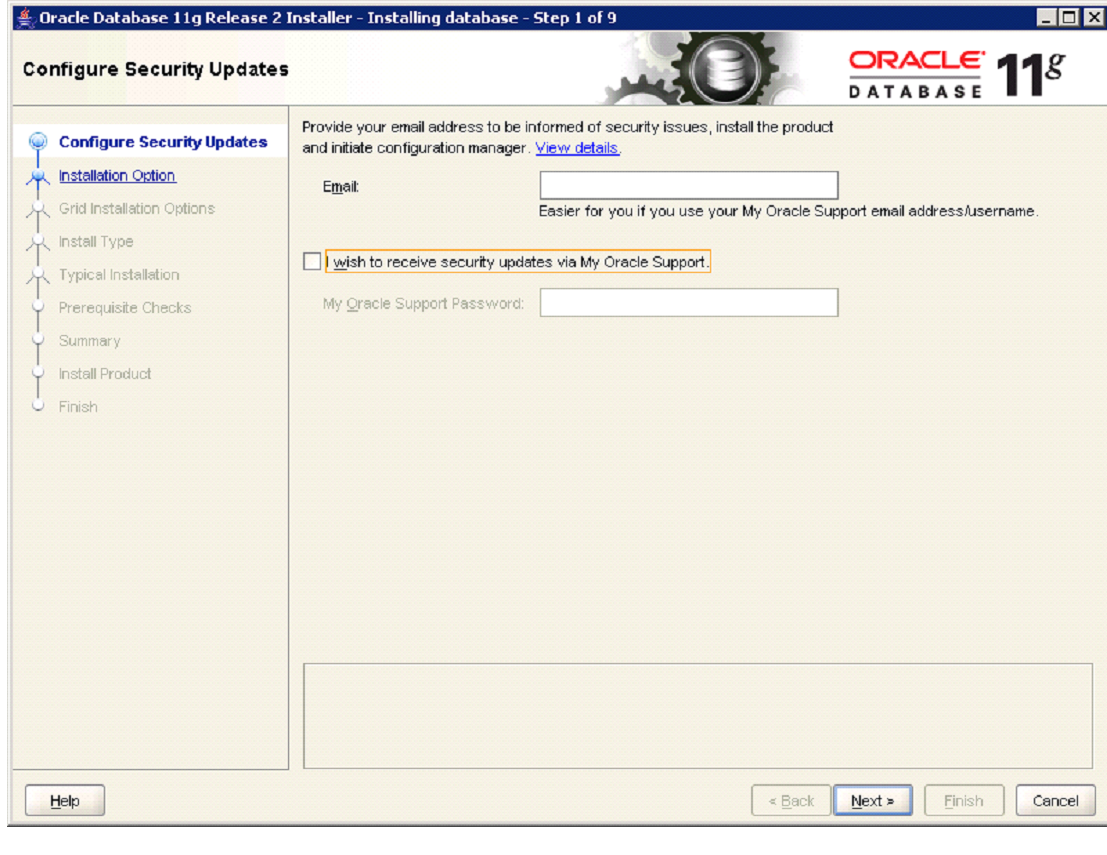
20 2-2 MWM 2.1 Installation and System Administrator Guide 3. Install the Oracle database access client (on the server hosting the MWM application). NOTE This step is only required if installed database is Oracle. Install Oracle Dot Net connector (32 bit) using the default selection for Oracle Data Access Components. See Installing ODT with ODAC on page Provision the MWM Admin User for Oracle Database (via remote access from the MWM hosting server to the database server). See Creating the Database User on page Audio support a. Install the Desktop experience feature in the MWM Server. See Installing Desktop Experience Feature on page b. Install the necessary codec from: For more details please refer to MP4ToWavConversion.doc 6. Install the MWM 32-bit application (on the server hosting the MWM application). See Installing the MWM Server Application - Oracle on page 2-45 or Installing the MWM Server Application - MSSQL on page Installing Oracle 11g R2 Following are sample Oracle database installer screens. These windows vary depending on the database configuration required. 1. Double-click the Oracle database installer file. Figure 2-1 Oracle Installation - Configure Security Updates 2. Click Next, then click Yes on the Address Not Specified pop-up.

21 Server Software Installation 2-3 Figure 2-2 Oracle Installation - Installation Options 3. Select Create and configure a database, then click Next. Figure 2-3 Oracle Installation - System Class 4. In the System Class window, select Server Class, then click Next.

22 2-4 MWM 2.1 Installation and System Administrator Guide Figure 2-4 Oracle Installation - Grid Installation Options 5. Select Single instance database installation, then click Next. Figure 2-5 Oracle Installation - Install Type 6. Select Typical install, then click Next.
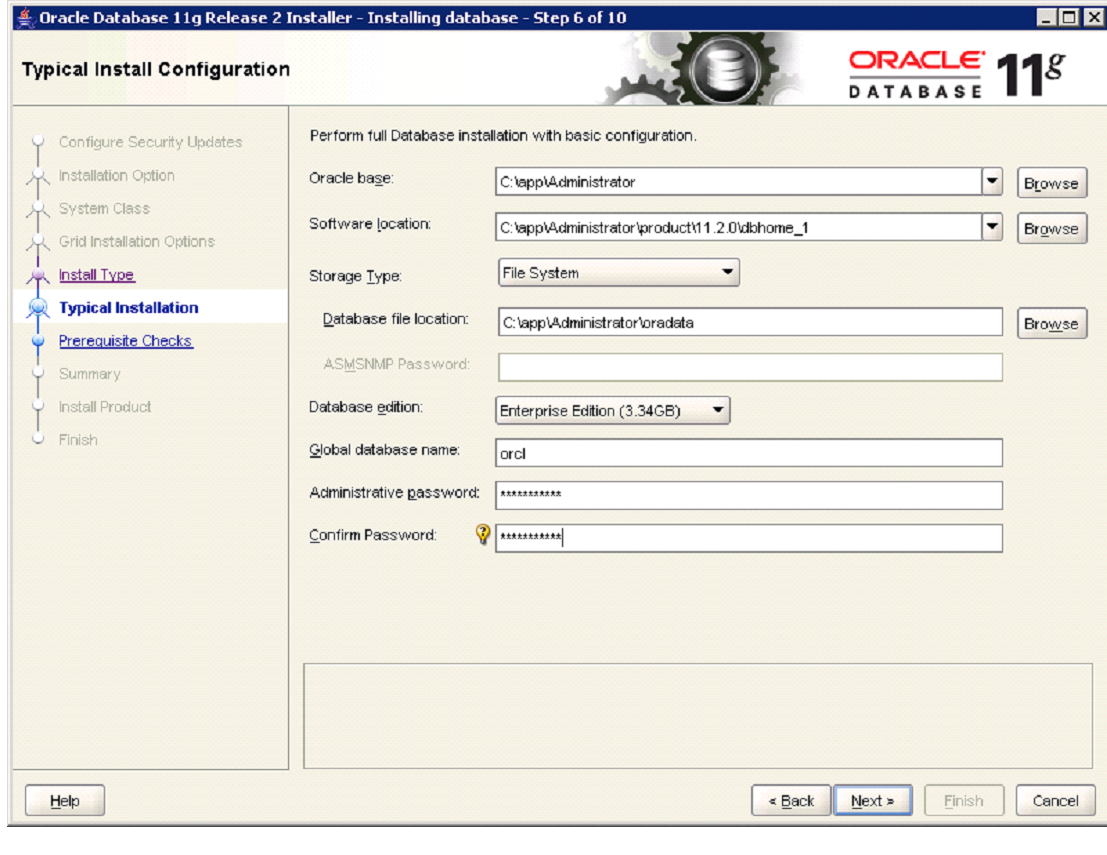
23 Server Software Installation 2-5 Figure 2-6 Oracle Installation - Typical Installation 7. Enter a Global database name. Note that this will be needed for Figure 2-65 on page 2-49 when installing the MWM server application. 8. Enter the Administrative password. Note that this will be needed in Creating the Database User on page Enter the password again in the Confirm Password field, then click Next. 10. Wait while the system performs prerequisite checks to determine if all installation requirements are met.

24 2-6 MWM 2.1 Installation and System Administrator Guide Figure 2-7 Oracle Installation - Summary 11. Review the Summary window and click Finish to begin installation. Figure 2-8 Oracle Installation - Install Product 12. Wait while the Install Product window indicates the progress of the installation. The Database Configuration Assistant window appears.
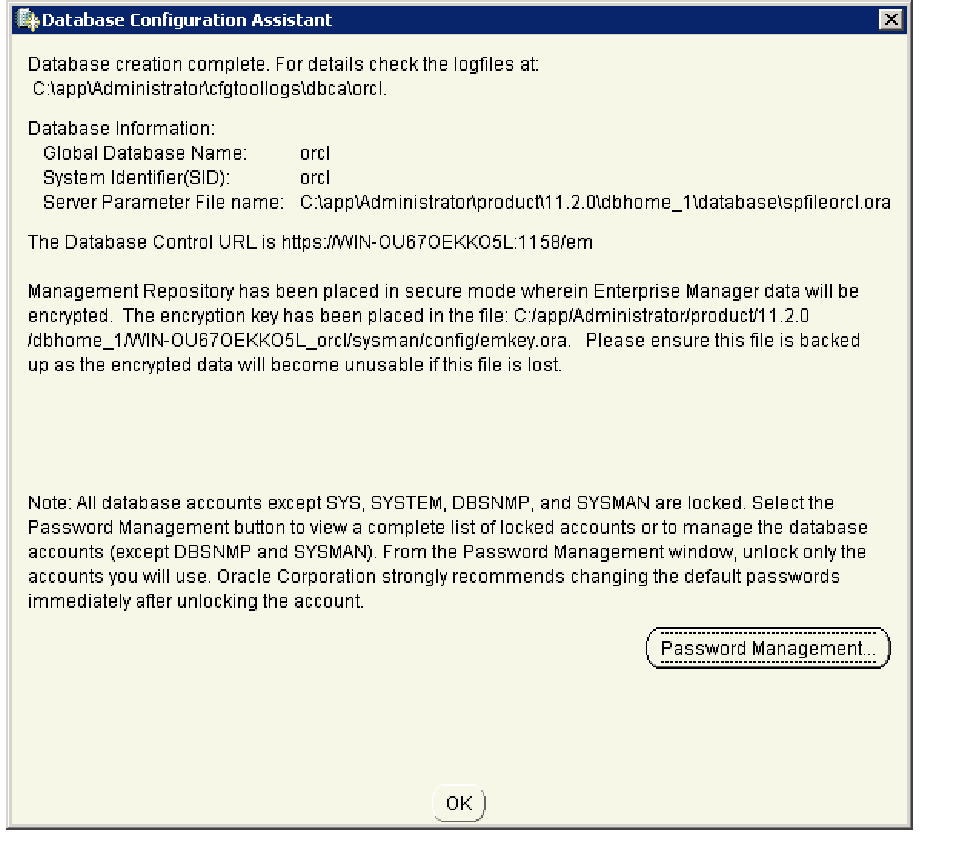
25 Server Software Installation 2-7 Figure 2-9 Oracle Installation - Database Configuration Assistant Figure 2-10 Oracle Installation - Database Configuration Complete 13. Select OK, then select Finish on the Install Product window.
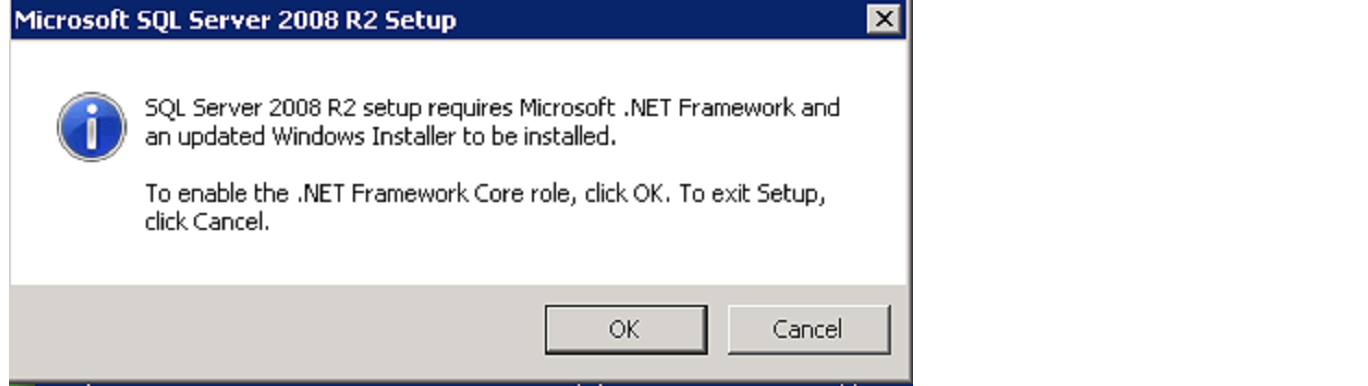
26 2-8 MWM 2.1 Installation and System Administrator Guide Figure 2-11 Oracle Installation - Complete 14. Click Finish to complete the installation. Installing MSSQL 2008 R2 Following are sample MSSQL database installer screens. These windows vary depending on the database configuration required. 1. SQL Server 2008 R2 Setup requires Microsoft.Net Framework & an updated Windows Installer to be installed. Figure 2-12 MSSQL Installation - MSSQL Server 2008 R2 Setup

27 Server Software Installation Select Installation > New Installation or add features to an existing installation. Figure 2-13 MSSQL Server Installation Center Figure 2-14 MSSQL Server Installation Center

28 2-10 MWM 2.1 Installation and System Administrator Guide 3. After completion press OK. Figure 2-15 MSSQL Setup Support Rules Figure 2-16 Figure 3-2 MSSQL Setup Support Rules

29 Server Software Installation 2-11 Figure 2-17 MSSQL Setup process 4. Enter the product key and click Next. Figure 2-18 MSSQL Setup Product Key

30 2-12 MWM 2.1 Installation and System Administrator Guide 5. Check I accept the license terms and then click Next. Figure 2-19 MSSQL Setup Accept Terms

31 Server Software Installation Click Install. Figure 2-20 MSSQL Setup Support Files Figure 2-21 MSSQL Setup Support Files

32 2-14 MWM 2.1 Installation and System Administrator Guide 7. After Installation completes the page below will appear, click Next. Figure 2-22 MSSQL Setup Support Rules

33 Server Software Installation Select SQL Server Feature Installation and click Next. Figure 2-23 MSSQL Setup Role

34 2-16 MWM 2.1 Installation and System Administrator Guide 9. Select the features shown in the screen below and click Next. Figure 2-24 MSSQL Feature Selection Figure 2-25 MSSQL Feature Selection

35 Server Software Installation Click Next. Figure 2-26 MSSQL Installation Rules
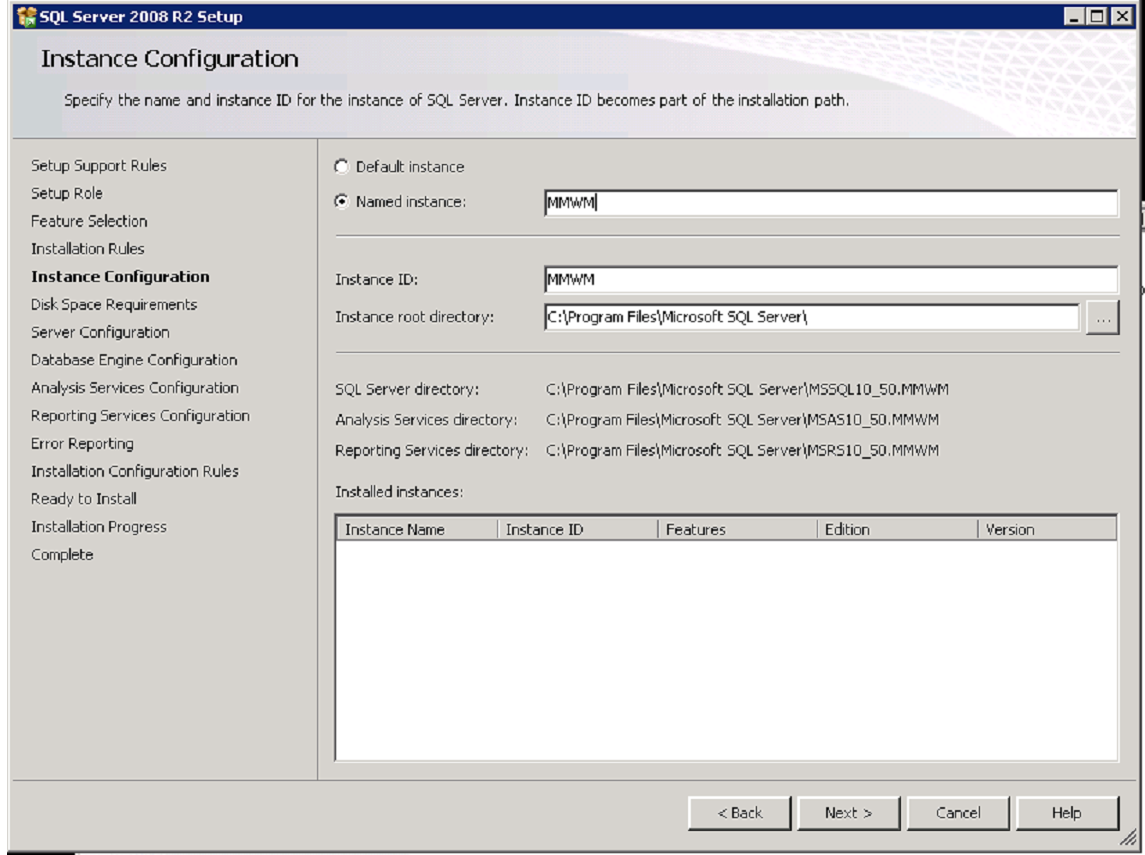
36 2-18 MWM 2.1 Installation and System Administrator Guide 11. Configure as shown below and click Next. Figure 2-27 MSSQL Instance Configuration
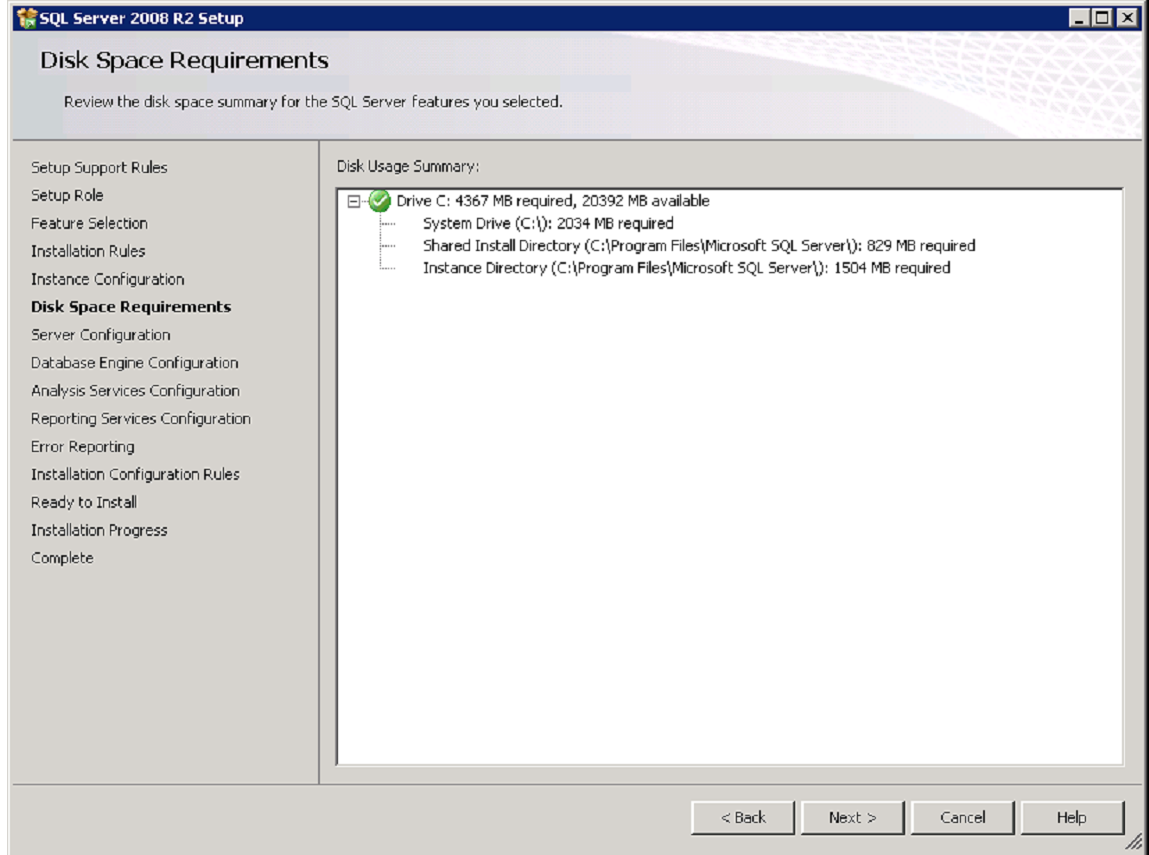
37 Server Software Installation Check whether sufficient disk space is available and click Next. Figure 2-28 MSSQL Disk Space Requirement
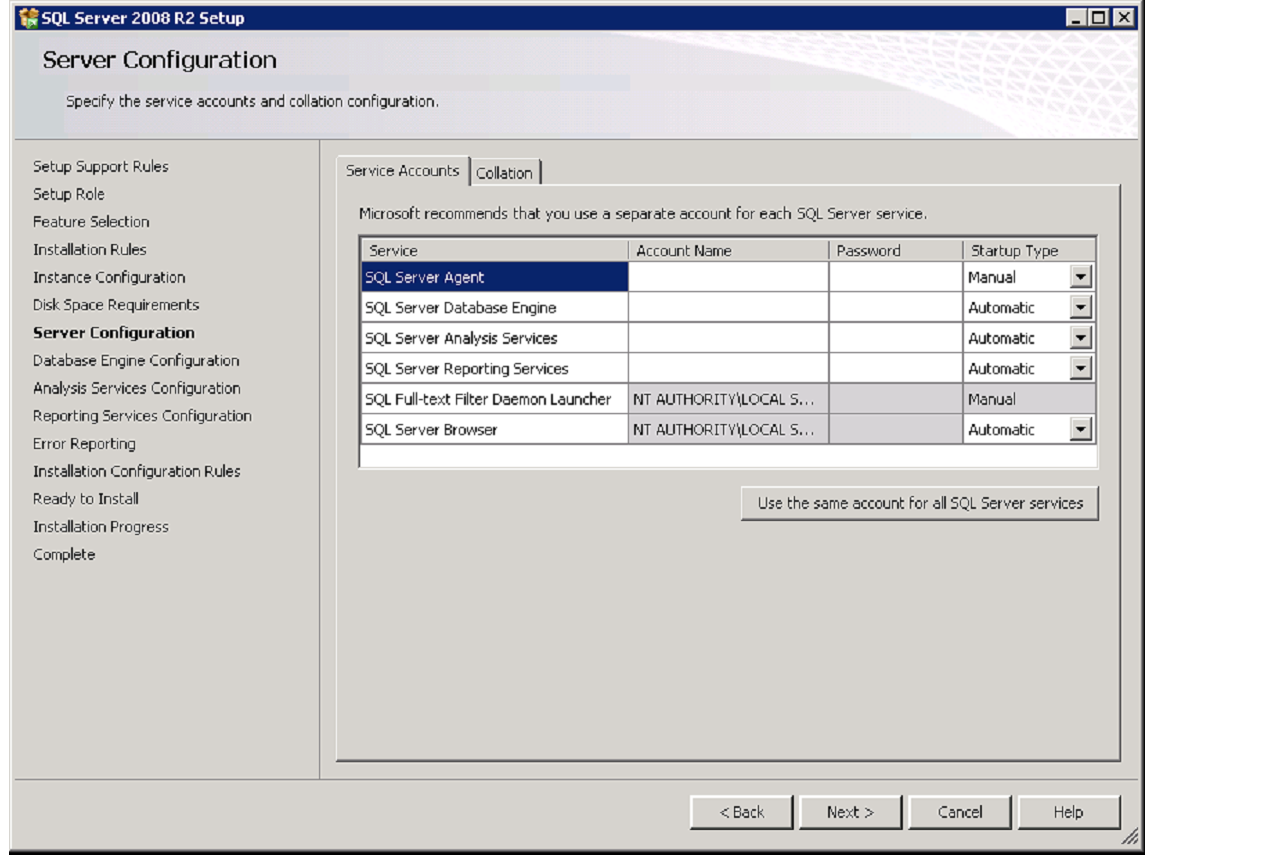
38 2-20 MWM 2.1 Installation and System Administrator Guide 13. Click on Use the same account for all SQL Server Services. The window shown in Figure 2-30 MSSQL Server Configuration on page 2-21 will pop up. Click Browse, type administrator and click Check Names which will configure the admin user. Enter admin password, then press OK. It will fill all the fields automatically, then press Next. Figure 2-29 MSSQL Server Configuration
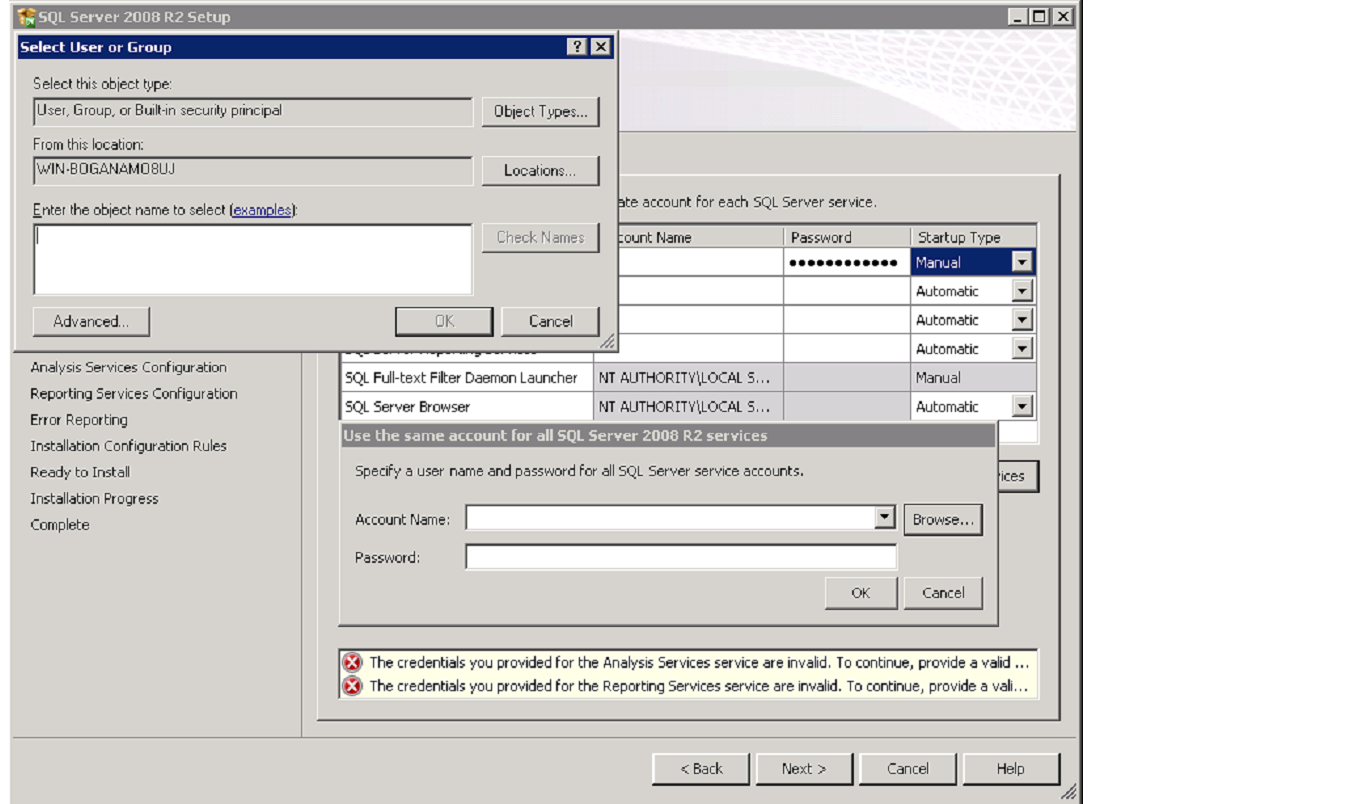
39 Server Software Installation 2-21 Figure 2-30 MSSQL Server Configuration Figure 2-31 MSSQL Server Configuration

40 2-22 MWM 2.1 Installation and System Administrator Guide Figure 2-32 MSSQL Server Configuration

41 Server Software Installation Select Mixed Mode and enter the password for the SQL database. Click Add Current User as shown in MSSQL Database Engine Configuration on page Click Next to continue. Figure 2-33 MSSQL Database Engine Configuration

42 2-24 MWM 2.1 Installation and System Administrator Guide 15. Click Add Current User. Then click Next. Figure 2-34 MSSQL Analysis Services Configuration

43 Server Software Installation Click Next. Figure 2-35 MSSQL Reporting Services Configuration

44 2-26 MWM 2.1 Installation and System Administrator Guide 17. Click Next. Figure 2-36 MSSQL Error Reporting

45 Server Software Installation Click Next. Figure 2-37 MSSQL Installation Configuration Rules

46 2-28 MWM 2.1 Installation and System Administrator Guide 19. Click Install. Figure 2-38 MSSQL Ready To Install

47 Server Software Installation Wait for installation to complete. Figure 2-39 MSSQL Installation Progress

48 2-30 MWM 2.1 Installation and System Administrator Guide 21. When installation completes you can close the screen by clicking Close. Figure 2-40 MSSQL Installation Completed
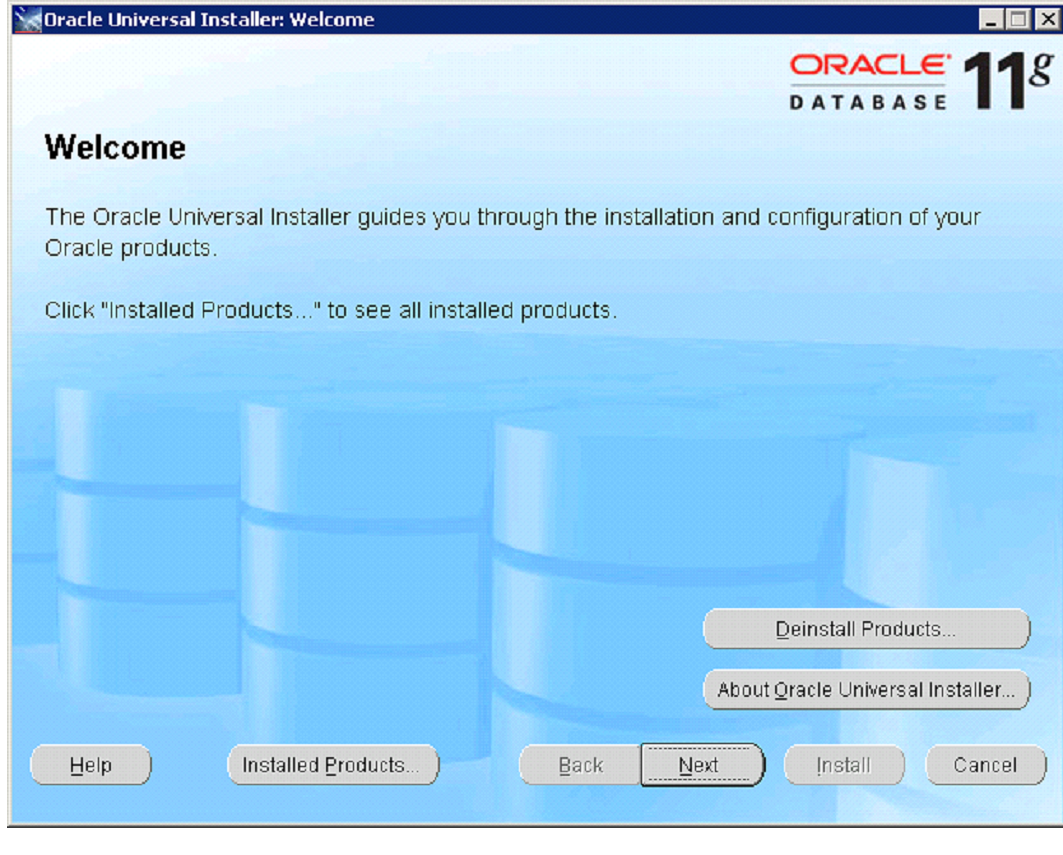
49 Server Software Installation 2-31 Installing ODT with ODAC Install 32 bit Oracle Dot Net connector, selecting the following options when installing and configuring Oracle Data Access Components. NOTE The 32 bit version is required even if using a 64 bit operating system, as MWM supports 32 bit only. 1. Double-click the Oracle universal installer file. Figure 2-41 Oracle Universal Installer - Welcome 2. Click Next.

50 2-32 MWM 2.1 Installation and System Administrator Guide Figure 2-42 Oracle Universal Installer - Select a Product 3. Select Oracle Data Access Components for Oracle Client and click Next. Figure 2-43 Oracle Universal Installer - Specify Home Details 4. Click Next to accept the default Oracle base and software locations.

51 Server Software Installation 2-33 Figure 2-44 Oracle Universal Installer - Available Product Components 5. Uncheck the third check box for Oracle Developer Tools for Visual Studio. All other checkboxes can remain at the default settings indicated in Figure Click Next. Figure 2-45 Oracle Universal Installer - Oracle Providers for ASP.NET 7. Do not run the SQL scripts as indicated in this window. Simply click Next.

52 2-34 MWM 2.1 Installation and System Administrator Guide Figure 2-46 Oracle Universal Installer - Summary 8. Review the Summary window and click Install to begin installation. Figure 2-47 Oracle Universal Installer - End of Installation 9. Do not run the SQL scripts as indicated in this window. Simply click Exit to complete installation.

53 Server Software Installation 2-35 Creating the Database User Use create_user.sql provided with the installation software to create the database user: 1. At the Command prompt, enter sqlplus. Figure 2-48 SQL Plus 2. Next to Enter user-name, enter sys as sysdba. 3. Next to Enter password, enter the password entered in Figure 2-6 on page 2-5 during Oracle installation. 4. At the SQL prompt, followed by the path where the script is stored, followed by the script name create_user.sql. 5. Press Enter to execute the SQL script. 6. Ensure the script execution information indicates that the user was successfully added or modified.
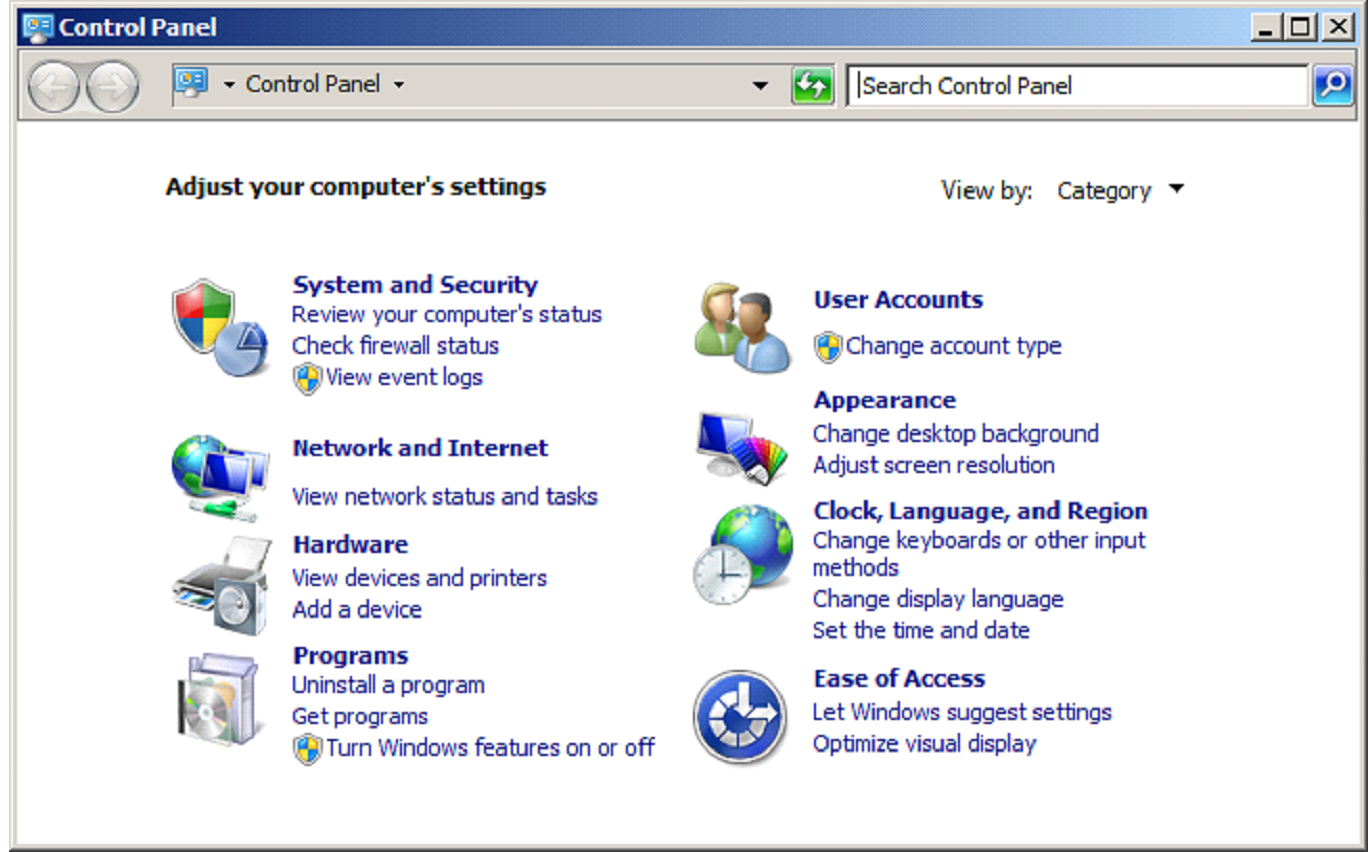
54 2-36 MWM 2.1 Installation and System Administrator Guide Installing Desktop Experience Feature To install the Desktop Experience feature: 1. Click Start > Control Panel. The Control Panel dialog box appears. Figure 2-49 Control Panel dialog box
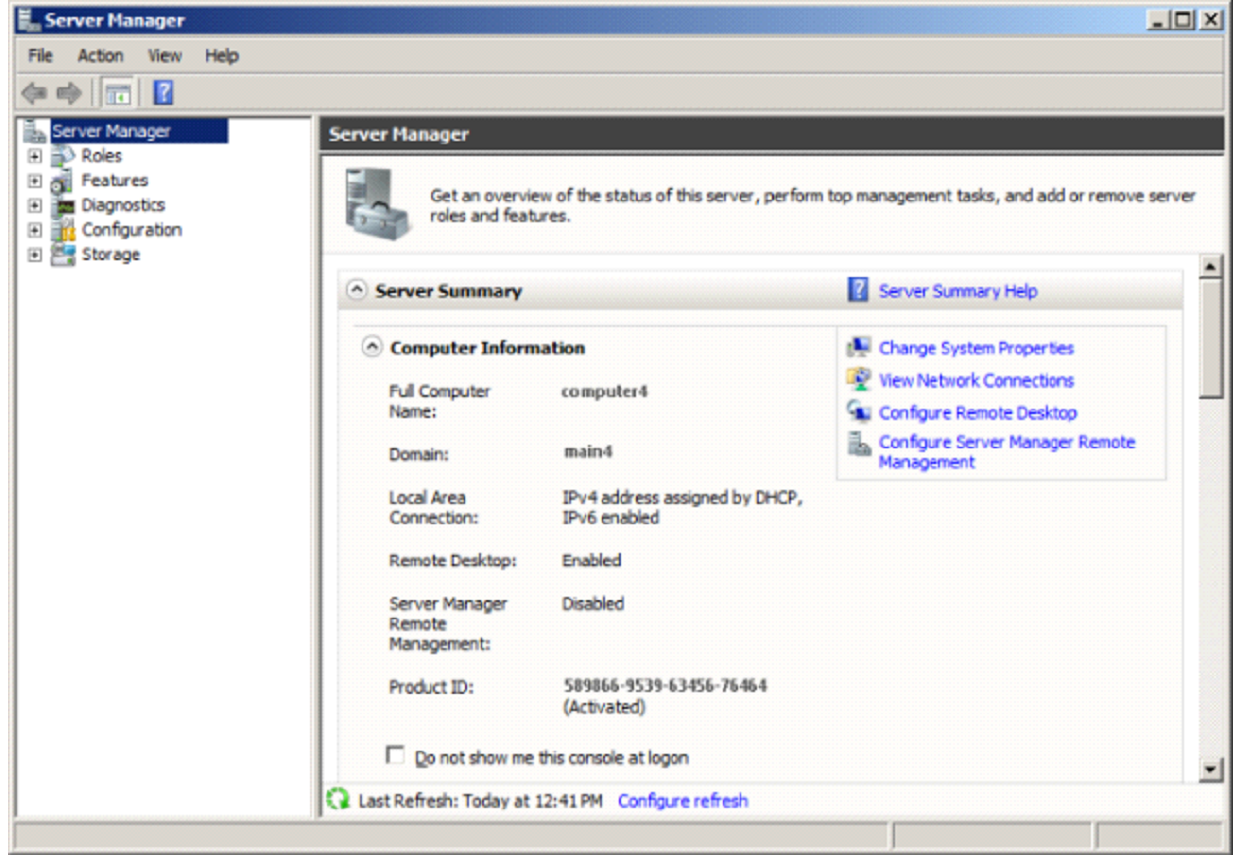
55 Server Software Installation Click Programs. The Programs dialog box appears. Figure 2-50 Programs dialog box 3. Click Turn Windows features on or off. The Server Manager dialog box appears. Figure 2-51 Server Manager dialog box
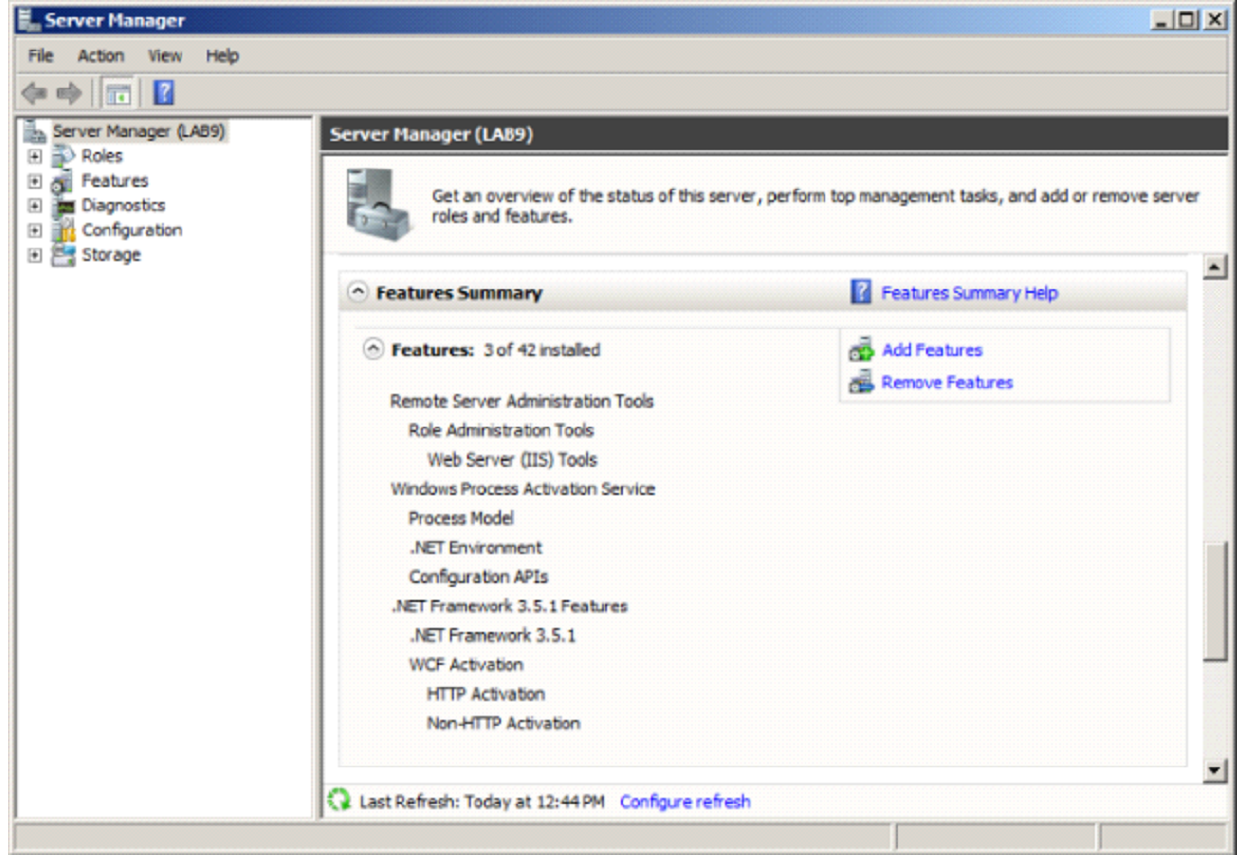
56 2-38 MWM 2.1 Installation and System Administrator Guide 4. In the right pane, scroll to Features Summary section. Figure 2-52 Features Summary
57 Server Software Installation Click the Add Features link. The Add Features Wizard dialog box appears. Figure 2-53 Add Features Wizard

58 2-40 MWM 2.1 Installation and System Administrator Guide 6. Select Desktop Experience. Figure 2-54 Select Features 7. Click Next. a. Depending on the present configuration of the server, other components required by the Desktop Experience feature may need to be installed. The Add Features Wizard changes. Figure 2-55 Add Required Features dialog box b. Click Add Required Features. The Add Features Wizard dialog box appears.
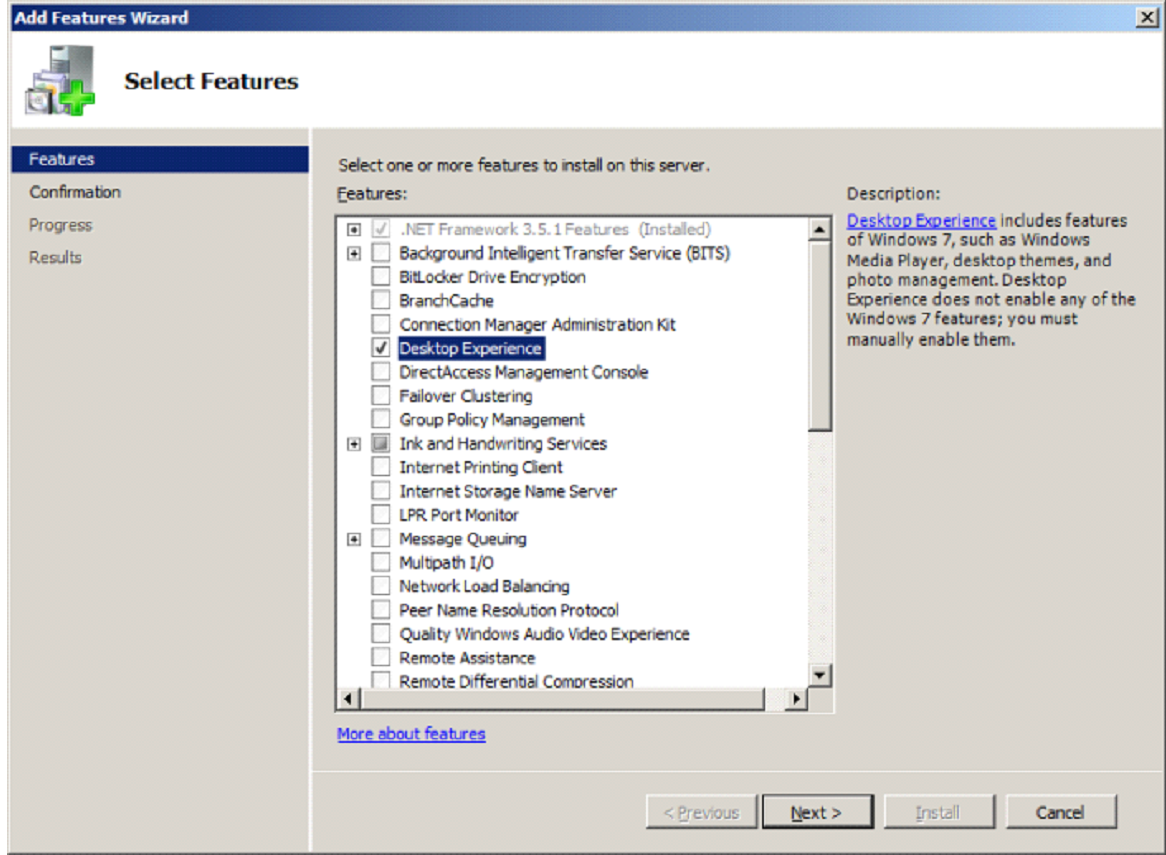
59 Server Software Installation The Add Features Wizard dialog box reappears with Desktop Experience and any required components selected. Figure 2-56 Select Features with required components selected 9. Click Next. The dialog box changes.
60 2-42 MWM 2.1 Installation and System Administrator Guide Figure 2-57 Confirm Installation Selections dialog box 10. Click Install. The dialog box changes and the installation begins.
61 Server Software Installation 2-43 Figure 2-58 Installation Progress Screen

62 2-44 MWM 2.1 Installation and System Administrator Guide 11. When the installation completes, click Close. Figure 2-59 Installation Results 12. Restart the computer.
63 Server Software Installation 2-45 Installing the MWM Server Application - Oracle The MWM setup package is bundled with the required software to provide quick setup. To upgrade MWM from a previous version, refer to the Release Notes before performing the upgrade. To install the MWM server application: 1. Download the setup package mwm_setup_[version Number].exe from Motorola Solutions support. 2. Double-click the setup package file to begin installation. Figure 2-60 Initial MWM Installation Window 3. Click Next.
64 2-46 MWM 2.1 Installation and System Administrator Guide Figure 2-61 MWM Installation License Agreement Window 4. Select the I accept the terms of the license agreement and click Next to accept and proceed.
65 Server Software Installation 2-47 Figure 2-62 Customer Information Window 5. Enter the company name and select Anyone who uses this computer. 6. Click Next.
66 2-48 MWM 2.1 Installation and System Administrator Guide Figure 2-63 Choose Destination Location Window 7. Using the default installation directory is recommended. Click Next. 8. A screen to select database will be presented. Please select Oracle. Figure 2-64 Database Selection Screen
67 Server Software Installation 2-49 Figure 2-65 Oracle Database Window 9. Enter the Oracle server details specified in this window and click Next. NOTE Service Name (SID) is the Oracle instance name. See Figure 2-10 on page 2-7 for this name. The default Port and Service Name are 1521 and orcl respectively, but these entries can vary depending on the database. For the User Name and Password refer to the create_user.sql script in Creating the Database User on page The installer connects to the database with the credentials provided. If the installer detects an earlier version of the MWM database, it upgrades the database and skips the next step.
68 2-50 MWM 2.1 Installation and System Administrator Guide Figure 2-66 Site Configuration Window 10. This screen defines the default MWM root site location and specifies the default MWM Administrator user ID and password. Select the location and time zone from the drop-down lists, then specify the site name for the root site. Enter a user name and password which will be used to log into MWM. Click Next. NOTE This screen appears during new installations only.
69 Server Software Installation A review page will appear. If any of the settings are incorrect, hit Back to correct them, else hit Next to continue. Figure 2-67 Review Settings Window NOTE The Site configuration section appears during new installations only.
70 2-52 MWM 2.1 Installation and System Administrator Guide 12. Click Finish to acknowledge the successful installation. Figure 2-68 Installation Successful Window
71 Server Software Installation 2-53 Installing the MWM Server Application - MSSQL The MWM setup package is bundled with the required software to provide quick setup. Refer to the Release Notes before upgrading MWM from a previous version. To install the MWM server application: 1. Download the setup package mwm_setup_[version Number].exe from Motorola Solutions support. 2. Double-click the setup package file to begin installation. Figure 2-69 Initial MWM Installation Window 3. Click Next.

72 2-54 MWM 2.1 Installation and System Administrator Guide Figure 2-70 MWM Installation License Agreement Window 4. Select the I accept the terms of the license agreement and click Next to accept and proceed.

73 Server Software Installation 2-55 Figure 2-71 Customer Information Window 5. Enter the company name and select Anyone who uses this computer. 6. Click Next.
74 2-56 MWM 2.1 Installation and System Administrator Guide Figure 2-72 Choose Destination Location Window 7. Using the default installation directory is recommended. Click Next.
75 Server Software Installation A screen to select database will be presented. Please select MS SQL and click Next. Figure 2-73 Database Selection screen
76 2-58 MWM 2.1 Installation and System Administrator Guide 9. Enter the MSSQL Server details specified in this window and click Next. Figure 2-74 MSSQL Database Window
77 Server Software Installation This screen defines the default MWM root site location, and specifies the default MWM Administrator user ID and password. Select the location and time zone from the drop-down lists, then specify the site name for the root site. Enter a user name and password which will be used to log into MWM. Click Next. Figure 2-75 Site Configuration Window NOTE This screen appears during new installations only.
78 2-60 MWM 2.1 Installation and System Administrator Guide 11. A review page will appear, If any of the settings need to be changed, hit Back, else hit Next to continue. Figure 2-76 Review Settings Window 12. Click Finish to acknowledge the successful installation. Figure 2-77 Installation Successful Window
79 Server Software Installation 2-61 Upgrading MWM software allows the following upgrade path: 1. MWM 2.1 Build to this release Please contact MSI Technical Architect or MWM Product Management for details. 2. MWM 2.0 to MWM 2.1 Build Please refer to the MWM 2.1 Build Installation guide for detail on MWM 2.0 to MWM 2.1 Build upgrade. 3. MWM 2.1 Build to this release The following section defines this upgrade path. NOTE User can not upgrade from MWM 2.0 to this release directly. MWM 2.0 has to be upgraded to 2.1 Build release first and then 2.1 Build can be upgraded to this release. Upgrading MWM Server from MWM 2.1 Build to Current Release Prerequisite MWM 2.1 (Build ) installed on server with either Patch 1, 2 or 3. Description Upgrading involves two steps: 1. The installer will upgrade the program and Database. Below are the details on how to accomplish this activity. 2. Manually update a few MWM entities after the program and Database have been upgraded (in step 1). Upgrading the Program and Database: 1. Uninstall MWM 2.1 Build release from server Go to Control Panel > Programs > Uninstall a Program

80 2-62 MWM 2.1 Installation and System Administrator Guide Figure 2-78 Uninstall Program Screen Figure 2-79 Uninstall Screen 2. Delete the folders MWMDataService and MWMConsle (if folders present) from C:\inetpub\wwwroot

81 Server Software Installation Follow steps 1-12 of Installing the MWM Server Application to install the update. NOTE Upgrade is similar to a new install, please note that step 10 will not be presented as this is an upgrade and all relevant data will be taken from provided database. Manually Upgrading a few MWM Entities: NOTE Not all settings and Entities are automatically upgraded, below are the list of activities required to complete the upgrade. 1. Change Date Escalation from Minutes to Seconds MWM 2.1 Build accepted reminders in minutes. MWM 2.1 accepts reminders in seconds. Hence after the upgrade, reminder values in all templates have to be manually changed from minutes to seconds Figure 2-80 Date Escalation Minutes to Seconds

82 2-64 MWM 2.1 Installation and System Administrator Guide Verifying MWM Server Setup To verify the server setup, browse the following links. For the MWM administrator console: Figure 2-81 MWM Administrator Console Login Screen For MWM web services: Figure 2-82 MWM Web Service Creation Screen

83 Server Software Installation 2-65 Registering MWM License After installing the MWM server, register the license key using system configuration. Refer to your MWM order confirmation mail for the license key. Log in to the administrator console and select the System tab. Figure 2-83 Administrator Console System Tab Enter the license key in the APPLICATION LICENSE KEY field, then click Finish.

84 2-66 MWM 2.1 Installation and System Administrator Guide Uninstalling the MWM 2.1 Server To uninstall the MWM server: 1. Select Control Panel > Programs > Programs and Features. Figure 2-84 Selecting MWM for Uninstall 2. Double-click MWM. The Installation Wizard opens.
85 Server Software Installation 2-67 Figure 2-85 Installation Wizard 3. Click Next to continue with un-installation, or Cancel to abort. Figure 2-86 Installation Wizard File in Use Window 4. Click OK.
86 2-68 MWM 2.1 Installation and System Administrator Guide Figure 2-87 Installation Wizard Uninstallation Complete Window 5. Click Finish after the successful uninstallation. The uninstallation may not clean folders altered after installation. Manually clean up all install folders after uninstallation. HTTPS Support To configure the MWM server to support secured https connection: 1. Purchase a server certificate from one of the certificate vendors. 2. Install the server certificate in IIS and bind it to the MWM application. Refer to the IIS documentation for more details on configuring https. 3. Enter https in place of http in the request URL. 4. To use https connection from the client device, change the RhoElement configuration to include the appropriate certificate. Refer to the RhoElement user manual at for more details. 5. Modify the MWM configuration URL in the app.json file to call out https in place of http. See Configuring the SB1 Device on page 3-2 for information on modifying this file.
87 Server Software Installation 2-69 Network Connectivity MWM server deployment uses following TCP ports for network communication. Applicable ports need to be enabled on firewall for MWM to work properly. Port Inbound or Outbound Comments 80 or 443 From device to the MWM server 1521 From MWM server to Oracle database server 8080 From MWM server to the device This is the default port used by the MWM server for open and secured connection respectively. This can be modified in the IIS server Note: Modifying the default port needs reconfiguration of MWM url in the device configuration files This is the default port used by the Oracle server This is required if the database server is not co-located with the MWM server This is the default port used by the web server in the device. This can be reconfigured using the config.js in the device Note: Changing the port requires the change in the MWM server system configuration
88 2-70 MWM 2.1 Installation and System Administrator Guide
89 CHAPTER 3 MWM CLIENT CONFIGURATION Introduction This chapter describes how to configure the client device to connect to the MWM server. This procedure varies for each device. For additional information, refer to the device configuration file and/or ask your Motorola Solutions TA. Obtaining the Pre-Requisite Add-On ZIP File The device configuration package is included with the MWM software and also available for download from the following link: This link may also periodically provide updated versions of the add-on kits. Add-On Kit Contents The add-on kit is a.zip file with a name of the form: where: MWMDevicePrerequisite_<version>_<date>.zip <version> indicates the version number of the software delivered in the add-on kit. <date> indicates the release date of the add-on kit.zip file (represented in YYYYDDMM format). Each add-on kit.zip file contains the following contents: The configuration files required for RhoElements and the shell RhoElements runtime file for the appropriate platform Release Notes (optional)

90 3-2 MWM 2.1 Installation and System Administrator Guide Staging the Device for MWM Configuration (Manual Procedure) Changing the Configuration File The add-on.zip file contains the configuration utility used to modify all configuration files to point to the target MWM server. Run the config.exe file in the DevicePreRequisite folder to change the configuration files to point to the MWM server. Figure 3-1 MWM Device Configuration Enter the IP address or the domain name of MWM server and press Config. The Status text box displays all files that were replaced. Configuring the SB1 Device The SB1 OS platform includes RhoElement and the shell. Rebooting the device launches the shell page. 1. Copy the file DevicePreRequisite\SB1\config\apps.json to the \Application\www\config folder on the device. Please do not change MWM app name in apps.json 2. Copy the file DevicePreRequisite\SB1\config\Taskworker_SB1.png to the \Application\www folder on the device. 3. Copy all the files from the DevicePreRequisite\SB1\Shell Resources\ folder to the \UserDrive\config folder on the device. 4. Enable the Scan To feature on the SB1 (optional): a. Copy the DevicePreRequisite\SB1\config\config.js file to the \Application\www\config folder on the device. b. Develop and deploy the Scan To web service as described in the MWM 2.1 Services Interface Guide. c. Modify the RESTfull SCAN TO WEB SERVICE URL system configuration to point to the customer web service. 5. To support Asian languages: a. copy DevicePreRequisite\SB1\AsianFonts\Fonts" folder to "\UserDrive\mwm\"
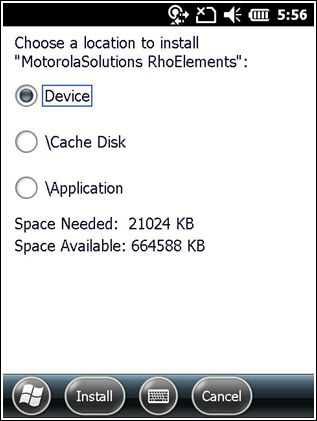
91 MWM Client Configuration 3-3 b. Copy "FontSupport.cpy" file to "\Application" folder" c. Restart the device Configuring a Non-SB1 Device Motorola MWM software runs on the RhoElements browser which must be installed on the device. The supported version of the RhoElements runtime is bundled with the MWM add-on.zip file. Important: Only one version of RhoElements can be installed on the device. Cleanly uninstall any existing versions before installing the version bundled with MWM. RhoElements provided with the MWM is licensed to use only with the MWM application. Existing customer applications running a RhoElements platform cannot run with the RhoElements bundled with MWM. Contact Motorola Solutions Support if you need to run multiple applications on the RhoElements platform. RhoElements runtime is provided in the platform folder as a cab file for Windows Mobile, and an apk file for Android. To install RhoElements on a non-sb1 device: 1. Uninstall any existing RhoElements version using Installed Application and clean the RhoElements folder on the device. 2. Install RhoElements using the.cab for Windows Mobile devices, or the.apk file for Android devices. In Windows Mobile, select Device for the target location, then Install to install RhoElements in the Program Files folder. Figure 3-2 Selecting Installation Location For Android, RhoElements is installed in the \sdcard\android\data\ folder.
92 3-4 MWM 2.1 Installation and System Administrator Guide 3. Copy the configuration file to the RE configuration folder: For MCxx Windows Mobile devices, copy DevicePreRequisite\MCxx-WM\config\config.xml to the Application\RhoElements\config or \Program Files\ RhoElements\config folder in the device. For ET1 devices, copy DevicePreRequisite\Android\config\config.xml to the \sdcard\android\data\com.motorolasolutions.rhoelements\config folder in the device. 4. To support Asian languages in MCxx Windows Mobile devices, copy all files present under "DevicePreRequisite\MCxx-WM\AsianFonts\Fonts" folder to "\Windows" folder. 5. Copy the Badlink page: For Windows Mobile devices copy DevicePreRequisite\MCxx-WM\config\BadLink.html to the \Program Files\RhoElements\HTML folder. For Android devices copy DevicePreRequisite\Android\config\ BadLink.html to the \sdcard\android\data\com.motorolasolutions.rhoelements\ folder. 6. Launch RhoElements on the device to start the MWM application. Updating Client RhoElements Shell Configuration Parameter Modify \WWW\config\config.js CAUTION Modify the Config.js file only if required and you understand the impact of making changes.

93 MWM Client Configuration 3-5 User Interface Management The business operations administrator can customize device screens using the MWM administrator console. Log in to the administrator console and select the System tab. This window lists configuration settings that determine what appears on client device screens. Figure 3-3 Administrator Console System Tab Items listed on this tab correspond to various screens and options on the device, and include the current and default values for each option. Refer to the MWM 2.1 Business Operations Administrator Guide for details on using the System tab to customize device screens. Configuring a Device User The business operations administrator must configure device users in the MWM administrator console: 1. Log in to the administrator console. 2. Select the User tab and create a user. Add the task associate role.
94 3-6 MWM 2.1 Installation and System Administrator Guide Launching MWM To launch MWM: 1. Start the RhoElements exe to open the shell home page. 2. Select the application launcher icon to open a list of applications. 3. Select the MWM icon to open the Security Notice window. 4. Select OK to proceed to the Login window. 5. Log in as a device user, then use the MWM application as described in the MWM 2.1 Associate User Guide or MWM 2.1 Manager User Guide. Launching MWM Client on PC Open the Chrome browser on PC. For Manager experience of ET1 use this URL For Associate and Manager experience of MCxx device use this URL
95 CHAPTER 4 MWM MAINTENANCE AND TROUBLESHOOTING Introduction This chapter provides system maintenance and troubleshooting information. System Maintenance MWM system maintenance involves purging database records in order to free space. Instructions will be provided in a later version of this guide. Troubleshooting Log Files MWM generates system audit logs that provide information such as which associates are signed in, what devices are connected, and errors that may have occurred. The log files are available in an MWM system folder. (default folder is c:\teammate) For information on generating reports that provide detailed associate task data in order to measure key management metrics, refer to the MWM 2.1 Business Operations Administrator Guide.
96 4-2 MWM 2.1 Installation and System Administrator Guide MWM Scheduling Service Sample Log File 8/9/2012 3:11: PM [INFO] - Loading settings for MWM Scheduling service... 8/9/2012 3:11: PM [DEBUG] - Before fetching GetTheSchedulingInterval() 8/9/2012 3:11: PM [DEBUG] - [SystemSettingManager.reloadValues] reloadvalues method starts 8/9/2012 3:11: PM [DEBUG] - [SystemSettingManager.reloadValues] _settings count :49 8/9/2012 3:11: PM [DEBUG] - Monitoring interval for the thread ProcessExpiryTasks is:5 8/9/2012 3:11: PM [DEBUG] - Before fetching GetTheSchedulingInterval() 8/9/2012 3:11: PM [DEBUG] - Monitoring interval for the thread ProcessEscalation is:5 8/9/2012 3:11: PM [DEBUG] - Before fetching GetTheSchedulingInterval() 8/9/2012 3:11: PM [DEBUG] - Monitoring interval for the thread ProcessScheduledTasks is:5 8/9/2012 3:11: PM [DEBUG] -, , SchedulingService has been created 8/9/2012 3:11: PM [DEBUG] - About to Start() 8/9/2012 3:11: PM [DEBUG] - About to Wait for 1(s) before we Start() 8/9/2012 3:11: PM [DEBUG] - Starting... 8/9/2012 3:11: PM [DEBUG] -, , SchedulingService has been started 8/9/2012 3:11: PM [DEBUG] - About to Start() 8/9/2012 3:11: PM [DEBUG] - About to Wait for 1(s) before we Start() 8/9/2012 3:11: PM [INFO] - Service is litening on fe80::6d97:55f3:1d1d:9b17%11# /9/2012 3:11: PM [DEBUG] -, , Current Thread Count: 10 8/9/2012 3:11: PM [DEBUG] - Starting... 8/9/2012 3:11: PM [DEBUG] - Scheduling service Interval is set to 5 8/9/2012 3:11: PM [INFO] - ProcessScheduledTasks Thread has been started.it has the timer interval set to 5 8/9/2012 3:11: PM [DEBUG] - Scheduling service Interval is set to 5 8/9/2012 3:11: PM [INFO] - ProcessExpiryTasks Thread has been started.it has the timer interval set to 5 8/9/2012 3:11: PM [DEBUG] - Scheduling service Interval is set to 5 8/9/2012 3:11: PM [INFO] - ProcessEscalation Thread has been started.it has the timer interval set to 5 8/9/2012 3:11: PM [DEBUG] - Service has started and enabled the timers as well 8/9/2012 3:11: PM [INFO] - Got:0 Created 3:11:12 PM 8/9/2012 3:11: PM [INFO] - Tasks which are in CREATED states are 8/9/2012 3:14: PM [INFO] - Got the resuest type: NewTask 8/9/2012 3:14: PM [INFO] - Immediate task Request generated with task id2 8/9/2012 3:14: PM [INFO] - Enqueued Task id: 2 8/9/2012 3:14: PM [INFO] - Dequeued Task id: 2 8/9/2012 3:14: PM [INFO] - Received the Immediate task :2 8/9/2012 3:14: PM [DEBUG] - UserManager - In GetUsersRE method- start 8/9/2012 3:14: PM [DEBUG] - UserManager - In GetUsersRE method- end 8/9/2012 3:14: PM [DEBUG] - [NotificationManager.sendNotification] to UserId) Sending Notifications to 1 users
97 MWM Maintenance and Troubleshooting 4-3 8/9/2012 3:14: PM [DEBUG] - [NotificationManager.sendNotification] to UserId) Fetching devices for User :4 8/9/2012 3:14: PM [DEBUG] - UserManager - In GetAssociatedDevices method: userid=4- start 8/9/2012 3:14: PM [DEBUG] - UserManager - In GetAssociatedDevices method: userid=4- end 8/9/2012 3:14: PM [DEBUG] - [NotificationManager.sendNotification] to UserId) User :4 has 1 devices 8/9/2012 3:14: PM [INFO] - Notification sent to notification service with the data:<mwm><notification><notificationid>1</notificationid></notification></mwm> 8/9/2012 3:48: PM [INFO] - Got the Expired Task:2 8/9/2012 3:48: PM [DEBUG] - [NotificationManager.sendNotification] to UserId) Sending Notifications to 0 users 8/9/2012 3:48: PM [INFO] - Notification sent to notification service with the data:<mwm><notification><notificationid>1</notificationid></notification></mwm> MWM Notification Service Sample Log File 8/9/2012 3:11: PM [DEBUG] -, , NotificationService has been created 8/9/2012 3:11: PM [DEBUG] - About to Start() 8/9/2012 3:11: PM [DEBUG] - About to Wait for 1(s) before we Start() 8/9/2012 3:11: PM [DEBUG] - Starting... 8/9/2012 3:11: PM [DEBUG] -, , NotificationService has been started 8/9/2012 3:11: PM [INFO] - Service is litening on fe80::6d97:55f3:1d1d:9b17%11# /9/2012 3:11: PM [DEBUG] -, , Current Thread Count: 10 8/9/2012 3:13: PM [INFO] - Got the resuest type: Notification 8/9/2012 3:13: PM [INFO] - Notification request generated 8/9/2012 3:13: PM [INFO] - Got Pending notification id:1 8/9/2012 3:13: PM [INFO] - Retry count:0 8/9/2012 3:13: PM [DEBUG] - [SystemSettingManager.reloadValues] reloadvalues method starts 8/9/2012 3:13: PM [DEBUG] - [SystemSettingManager.reloadValues] _settings count :49 8/9/2012 3:13: PM [DEBUG] - [NotificationDispatcher.pushToDevice] Method starts 8/9/2012 3:13: PM [DEBUG] - [NotificationDispatcher.pushToDevice] URL Constructed :
98 4-4 MWM 2.1 Installation and System Administrator Guide %22action%22%3a1%2c%22args%22%3a%7b%22taskId%22%3a%221%22%7d%7d 8/9/2012 3:13: PM [DEBUG] - [NotificationDispatcher.pushToDevice] PTN Response : StatusCode :OK 8/9/2012 3:13: PM [DEBUG] - [NotificationDispatcher.pushToDevice] PTN Response : String :<html><head><title>rhoelements</title></head><body><h1>repush received OK</h1></body></html> 8/9/2012 3:13: PM [DEBUG] - [NotificationDispatcher.pushToDevice] Method ends return code NotificationPushSuccess 8/9/2012 3:14: PM [INFO] - Got the resuest type: Notification 8/9/2012 3:14: PM [INFO] - Notification request generated 8/9/2012 3:14: PM [INFO] - Got Pending notification id:2 8/9/2012 3:14: PM [INFO] - Retry count:0 8/9/2012 3:14: PM [DEBUG] - [NotificationDispatcher.pushToDevice] Method starts 8/9/2012 3:14: PM [DEBUG] - [NotificationDispatcher.pushToDevice] URL Constructed : %22action%22%3a0%2c%22args%22%3a%7b%22taskId%22%3a%222%22%2c%22taskName%22%3a%22Dem o%22%2c%22subtitle%22%3a%22rack%3a1111%22%2c%22acceptrt%22%3a%221%22%2c%22completio nrt%22%3a%221%22%2c%22priority%22%3a%221%22%7d%7d 8/9/2012 3:14: PM [DEBUG] - [NotificationDispatcher.pushToDevice] PTN Response : StatusCode :OK 8/9/2012 3:14: PM [DEBUG] - [NotificationDispatcher.pushToDevice] PTN Response : String :<html><head><title>rhoelements</title></head><body><h1>repush received OK</h1></body></html> 8/9/2012 3:14: PM [DEBUG] - [NotificationDispatcher.pushToDevice] Method ends return code NotificationPushSuccess 8/9/2012 3:14: PM [INFO] - Got the resuest type: Notification 8/9/2012 3:14: PM [INFO] - Notification request generated 8/9/2012 3:14: PM [INFO] - Got Pending notification id:3 8/9/2012 3:14: PM [INFO] - Retry count:0 8/9/2012 3:14: PM [DEBUG] - [NotificationDispatcher.pushToDevice] Method starts 8/9/2012 3:14: PM [DEBUG] - [NotificationDispatcher.pushToDevice] URL Constructed : %22action%22%3a1%2c%22args%22%3a%7b%22taskId%22%3a%222%22%7d%7d 8/9/2012 3:14: PM [DEBUG] - [NotificationDispatcher.pushToDevice] PTN Response : StatusCode :OK 8/9/2012 3:14: PM [DEBUG] - [NotificationDispatcher.pushToDevice] PTN Response : String :<html><head><title>rhoelements</title></head><body><h1>repush received OK</h1></body></html> 8/9/2012 3:14: PM [DEBUG] - [NotificationDispatcher.pushToDevice] Method ends return code NotificationPushSuccess 8/9/2012 3:48: PM [INFO] - Got the resuest type: Notification 8/9/2012 3:48: PM [INFO] - Notification request generated 8/9/2012 3:48: PM [INFO] - Retry count:0 8/9/2012 3:48: PM [INFO] - Retry count:1 8/9/2012 3:48: PM [INFO] - Retry count:2 8/9/2012 3:48: PM [INFO] - Retry count:3
99 GLOSSARY A Aperture. The opening in an optical system defined by a lens or baffle that establishes the field of view. API. An interface by means of which one software component communicates with or controls another. Usually used to refer to services provided by one software component to another, usually via software interrupts or function calls Application Programming Interface. See API. ASCII. American Standard Code for Information Interchange. A 7 bit-plus-parity code representing 128 letters, numerals, punctuation marks and control characters. It is a standard data transmission code in the U.S. Autodiscrimination. The ability of an interface controller to determine the code type of a scanned bar code. After this determination is made, the information content is decoded. B Bar. The dark element in a printed bar code symbol. Bar Code. A pattern of variable-width bars and spaces which represents numeric or alphanumeric data in machine-readable form. The general format of a bar code symbol consists of a leading margin, start character, data or message character, check character (if any), stop character, and trailing margin. Within this framework, each recognizable symbology uses its own unique format. See Symbology. Bar Code Density. The number of characters represented per unit of measurement (e.g., characters per inch). Bar Height. The dimension of a bar measured perpendicular to the bar width. Bar Width. Thickness of a bar measured from the edge closest to the symbol start character to the trailing edge of the same bar. BIOS. Basic Input Output System. A collection of ROM-based code with a standard API used to interface with standard PC hardware.
100 Glossary - 2 MWM 2.1 Installation and System Administrator Guide Bit. Binary digit. One bit is the basic unit of binary information. Generally, eight consecutive bits compose one byte of data. The pattern of 0 and 1 values within the byte determines its meaning. Bits per Second (bps). Bits transmitted or received. Boot or Boot-up. The process a computer goes through when it starts. During boot-up, the computer can run self-diagnostic tests and configure hardware and software. BOOTP. A protocol for remote booting of diskless devices. Assigns an IP address to a machine and may specify a boot file. The client sends a bootp request as a broadcast to the bootp server port (67) and the bootp server responds using the bootp client port (68). The bootp server must have a table of all devices, associated MAC addresses and IP addresses. bps. See Bits Per Second. Byte. On an addressable boundary, eight adjacent binary digits (0 and 1) combined in a pattern to represent a specific character or numeric value. Bits are numbered from the right, 0 through 7, with bit 0 the low-order bit. One byte in memory is used to store one ASCII character. C CDRH. Center for Devices and Radiological Health. A federal agency responsible for regulating laser product safety. This agency specifies various laser operation classes based on power output during operation. CDRH Class 1. This is the lowest power CDRH laser classification. This class is considered intrinsically safe, even if all laser output were directed into the eye's pupil. There are no special operating procedures for this class. CDRH Class 2. No additional software mechanisms are needed to conform to this limit. Laser operation in this class poses no danger for unintentional direct human exposure. Character. A pattern of bars and spaces which either directly represents data or indicates a control function, such as a number, letter, punctuation mark, or communications control contained in a message. Character Set. Those characters available for encoding in a particular bar code symbology. Check Digit. A digit used to verify a correct symbol decode. The scanner inserts the decoded data into an arithmetic formula and checks that the resulting number matches the encoded check digit. Check digits are required for UPC but are optional for other symbologies. Using check digits decreases the chance of substitution errors when a symbol is decoded. Codabar. A discrete self-checking code with a character set consisting of digits 0 to 9 and six additional characters: ( - $ : /, +). Code 128. A high density symbology which allows the controller to encode all 128 ASCII characters without adding extra symbol elements. Code 3 of 9 (Code 39). A versatile and widely used alphanumeric bar code symbology with a set of 43 character types, including all uppercase letters, numerals from 0 to 9 and 7 special characters (-. / + % $ and space). The code name is derived from the fact that 3 of 9 elements representing a character are wide, while the remaining 6 are narrow. Code 93. An industrial symbology compatible with Code 39 but offering a full character ASCII set and a higher coding density than Code 39.
101 Glossary - 3 Code Length. Number of data characters in a bar code between the start and stop characters, not including those characters. Cold Boot. A cold boot restarts the mobile computer and erases all user stored records and entries. COM port. Communication port; ports are identified by number, e.g., COM1, COM2. Continuous Code. A bar code or symbol in which all spaces within the symbol are parts of characters. There are no intercharacter gaps in a continuous code. The absence of gaps allows for greater information density. Cradle. A cradle is used for charging the terminal battery and for communicating with a host computer, and provides a storage place for the terminal when not in use. D Dead Zone. An area within a scanner's field of view, in which specular reflection may prevent a successful decode. Decode. To recognize a bar code symbology (e.g., UPC/EAN) and then analyze the content of the specific bar code scanned. Decode Algorithm. A decoding scheme that converts pulse widths into data representation of the letters or numbers encoded within a bar code symbol. Decryption. Decryption is the decoding and unscrambling of received encrypted data. Also see, Encryption and Key. Depth of Field. The range between minimum and maximum distances at which a scanner can read a symbol with a certain minimum element width. Discrete 2 of 5. A binary bar code symbology representing each character by a group of five bars, two of which are wide. The location of wide bars in the group determines which character is encoded; spaces are insignificant. Only numeric characters (0 to 9) and START/STOP characters may be encoded. Discrete Code. A bar code or symbol in which the spaces between characters (intercharacter gaps) are not part of the code. DRAM. Dynamic random access memory. E EAN. European Article Number. This European/International version of the UPC provides its own coding format and symbology standards. Element dimensions are specified metrically. EAN is used primarily in retail. Element. Generic term for a bar or space. Encoded Area. Total linear dimension occupied by all characters of a code pattern, including start/stop characters and data. ENQ (RS-232). ENQ software handshaking is also supported for the data sent to the host. ESD. Electro-Static Discharge
102 Glossary - 4 MWM 2.1 Installation and System Administrator Guide F Flash Disk. An additional megabyte of non-volatile memory for storing application and configuration files. Flash Memory. Flash memory is responsible for storing the system firmware and is non-volatile. If the system power is interrupted the data is not be lost. FTP. See File Transfer Protocol. H Hard Reset. See Cold Boot. Host Computer. A computer that serves other terminals in a network, providing such services as computation, database access, supervisory programs and network control. Hz. Hertz; A unit of frequency equal to one cycle per second. I IDE. Intelligent drive electronics. Refers to the solid-state hard drive type. IEC. International Electrotechnical Commission. This international agency regulates laser safety by specifying various laser operation classes based on power output during operation. IEC Class 1. This is the lowest power IEC laser classification. Conformity is ensured through a software restriction of 120 seconds of laser operation within any 1000 second window and an automatic laser shutdown if the scanner's oscillating mirror fails. IEEE Address. See MAC Address. Input/Output Ports. I/O ports are primarily dedicated to passing information into or out of the terminal s memory. Series 9000 mobile computers include Serial and USB ports. Intercharacter Gap. The space between two adjacent bar code characters in a discrete code. Interleaved 2 of 5. A binary bar code symbology representing character pairs in groups of five bars and five interleaved spaces. Interleaving provides for greater information density. The location of wide elements (bar/spaces) within each group determines which characters are encoded. This continuous code type uses no intercharacter spaces. Only numeric (0 to 9) and START / STOP characters may be encoded. Interleaved Bar Code. A bar code in which characters are paired together, using bars to represent the first character and the intervening spaces to represent the second. Interleaved 2 of 5. A binary bar code symbology representing character pairs in groups of five bars and five interleaved spaces. Interleaving provides for greater information density. The location of wide elements (bar/spaces) within each group determines which characters are encoded. This continuous code type uses no intercharacter spaces. Only numeric (0 to 9) and START/STOP characters may be encoded.
103 Glossary - 5 I/O Ports. interface The connection between two devices, defined by common physical characteristics, signal characteristics, and signal meanings. Types of interfaces include RS-232 and PCMCIA. IOCTL. Input/Output Control. IP Address. (Internet Protocol address) The address of a computer attached to an IP network. Every client and server station must have a unique IP address. A 32-bit address used by a computer on a IP network. Client workstations have either a permanent address or one that is dynamically assigned to them each session. IP addresses are written as four sets of numbers separated by periods; for example, IPX/SPX. Internet Package Exchange/Sequential Packet Exchange. A communications protocol for Novell. IPX is Novell s Layer 3 protocol, similar to XNS and IP, and used in NetWare networks. SPX is Novell's version of the Xerox SPP protocol. IS-95. Interim Standard 95. The EIA/TIA standard that governs the operation of CDMA cellular service. Versions include IS-95A and IS-95B. See CDMA. K Key. A key is the specific code used by the algorithm to encrypt or decrypt the data. Also see, Encryption and Decrypting. L LASER. Light Amplification by Stimulated Emission of Radiation.The laser is an intense light source. Light from a laser is all the same frequency, unlike the output of an incandescent bulb. Laser light is typically coherent and has a high energy density. Laser Diode. A gallium-arsenide semiconductor type of laser connected to a power source to generate a laser beam. This laser type is a compact source of coherent light. Laser Scanner. A type of bar code reader that uses a beam of laser light. LCD. See Liquid Crystal Display. LED Indicator. A semiconductor diode (LED - Light Emitting Diode) used as an indicator, often in digital displays. The semiconductor uses applied voltage to produce light of a certain frequency determined by the semiconductor's particular chemical composition. Light Emitting Diode. See LED. Liquid Crystal Display (LCD). A display that uses liquid crystal sealed between two glass plates. The crystals are excited by precise electrical charges, causing them to reflect light outside according to their bias. They use little electricity and react relatively quickly. They require external light to reflect their information to the user.
104 Glossary - 6 MWM 2.1 Installation and System Administrator Guide M MIL. 1 mil = 1 thousandth of a meter. Misread (Misdecode). A condition which occurs when the data output of a reader or interface controller does not agree with the data encoded within a bar code symbol. N Nominal. The exact (or ideal) intended value for a specified parameter. Tolerances are specified as positive and negative deviations from this value. Nominal Size. Standard size for a bar code symbol. Most UPC/EAN codes are used over a range of magnifications (e.g., from 0.80 to 2.00 of nominal). NVM. Non-Volatile Memory. O ODI. See Open Data-Link Interface. Open Data-Link Interface (ODI). Novell s driver specification for an interface between network hardware and higher-level protocols. It supports multiple protocols on a single NIC (Network Interface Controller). It is capable of understanding and translating any network information or request sent by any other ODI-compatible protocol into something a NetWare client can understand and process. Open System Authentication. Open System authentication is a null authentication algorithm. P PAN. Personal area network. Using Bluetooth wireless technology, PANs enable devices to communicate wirelessly. Generally, a wireless PAN consists of a dynamic group of less than 255 devices that communicate within about a 33-foot range. Only devices within this limited area typically participate in the network. Parameter. A variable that can have different values assigned to it. PC Card. A plug-in expansion card for laptop computers and other devices, also called a PCMCIA card. PC Cards are 85.6mm long x 54 mm wide, and have a 68 pin connector. There are several different kinds: Type I; 3.3 mm high; use - RAM or Flash RAM Type II; 5 mm high; use - modems, LAN adaptors Type III; 10.5 high; use - Hard Disks PCMCIA. Personal Computer Memory Card Interface Association. See PC Card.
105 Glossary - 7 Percent Decode. The average probability that a single scan of a bar code would result in a successful decode. In a well-designed bar code scanning system, that probability should approach near 100%. PING. (Packet Internet Groper) An Internet utility used to determine whether a particular IP address is online. It is used to test and debug a network by sending out a packet and waiting for a response. Presentation Mode. Typically used when the digital scanner sits on a countertop or is mounted on a wall, in this mode, the digital scanner operates in continuous (constant-on) mode, where it automatically decodes a bar code presented in its field of view. Print Contrast Signal (PCS). Measurement of the contrast (brightness difference) between the bars and spaces of a symbol. A minimum PCS value is needed for a bar code symbol to be scannable. PCS = (RL - RD) / RL, where RL is the reflectance factor of the background and RD the reflectance factor of the dark bars. Programming Mode. The state in which a scanner is configured for parameter values. See Scanning Mode. Q Quiet Zone. A clear space, containing no dark marks, which precedes the start character of a bar code symbol and follows the stop character. QWERTY. A standard keyboard commonly used on North American and some European PC keyboards. QWERTY refers to the arrangement of keys on the left side of the third row of keys. R RAM. Random Access Memory. Data in RAM can be accessed in random order, and quickly written and read. Reflectance. Amount of light returned from an illuminated surface. Resolution. The narrowest element dimension which is distinguished by a particular reading device or printed with a particular device or method. RF. Radio Frequency. ROM. Read-Only Memory. Data stored in ROM cannot be changed or removed. Router. A device that connects networks and supports the required protocols for packet filtering. Routers are typically used to extend the range of cabling and to organize the topology of a network into subnets. See Subnet. RS-232. An Electronic Industries Association (EIA) standard that defines the connector, connector pins, and signals used to transfer data serially from one device to another.
106 Glossary - 8 MWM 2.1 Installation and System Administrator Guide S Scan Area. Area intended to contain a symbol. Scanner. An electronic device used to scan bar code symbols and produce a digitized pattern that corresponds to the bars and spaces of the symbol. Its three main components are: 1) Light source (laser or photoelectric cell) - illuminates a bar code,; 2) Photodetector - registers the difference in reflected light (more light reflected from spaces); 3) Signal conditioning circuit - transforms optical detector output into a digitized bar pattern. Scanning Mode. The scanner is energized, programmed and ready to read a bar code. Scanning Sequence. A method of programming or configuring parameters for a bar code reading system by scanning bar code menus. SDK. Software Development Kit Self-Checking Code. A symbology that uses a checking algorithm to detect encoding errors within the characters of a bar code symbol. Shared Key. Shared Key authentication is an algorithm where both the AP and the MU share an authentication key. SHIP. Symbol Host Interface Program. SID. System Identification code. An identifier issued by the FCC for each market. It is also broadcast by the cellular carriers to allow cellular devices to distinguish between the home and roaming service. Soft Reset. See Warm Boot. Space. The lighter element of a bar code formed by the background between bars. Specular Reflection. The mirror-like direct reflection of light from a surface, which can cause difficulty decoding a bar code. Standard Trigger Mode. The digital scanner uses this mode when lifted off the counter or removed from the wall mount. In this mode, aim the digital scanner at a bar code and pull the trigger to decode. Start/Stop Character. A pattern of bars and spaces that provides the scanner with start and stop reading instructions and scanning direction. The start and stop characters are normally to the left and right margins of a horizontal code. STEP. Symbol Terminal Enabler Program. Subnet. A subset of nodes on a network that are serviced by the same router. See Router. Subnet Mask. A 32-bit number used to separate the network and host sections of an IP address. A custom subnet mask subdivides an IP network into smaller subsections. The mask is a binary pattern that is matched up with the IP address to turn part of the host ID address field into a field for subnets. Default is often Substrate. A foundation material on which a substance or image is placed. SVTP. Symbol Virtual Terminal Program. Symbol. A scannable unit that encodes data within the conventions of a certain symbology, usually including start/stop characters, quiet zones, data characters and check characters.
107 Glossary - 9 Symbol Aspect Ratio. The ratio of symbol height to symbol width. Symbol Height. The distance between the outside edges of the quiet zones of the first row and the last row. Symbol Length. Length of symbol measured from the beginning of the quiet zone (margin) adjacent to the start character to the end of the quiet zone (margin) adjacent to a stop character. Symbology. The structural rules and conventions for representing data within a particular bar code type (e.g. UPC/EAN, Code 39, PDF417, etc.). T TCP/IP. (Transmission Control Protocol/Internet Protocol) A communications protocol used to internetwork dissimilar systems. This standard is the protocol of the Internet and has become the global standard for communications. TCP provides transport functions, which ensures that the total amount of bytes sent is received correctly at the other end. UDP is an alternate transport that does not guarantee delivery. It is widely used for real-time voice and video transmissions where erroneous packets are not retransmitted. IP provides the routing mechanism. TCP/IP is a routable protocol, which means that all messages contain not only the address of the destination station, but the address of a destination network. This allows TCP/IP messages to be sent to multiple networks within an organization or around the world, hence its use in the worldwide Internet. Every client and server in a TCP/IP network requires an IP address, which is either permanently assigned or dynamically assigned at startup. Telnet. A terminal emulation protocol commonly used on the Internet and TCP/IP-based networks. It allows a user at a terminal or computer to log onto a remote device and run a program. Terminal Emulation. A terminal emulation emulates a character-based mainframe session on a remote non-mainframe terminal, including all display features, commands and function keys. The VC5000 Series supports Terminal Emulations in 3270, 5250 and VT220. Terminate and Stay Resident (TSR). A program under DOS that ends its foreground execution to remain resident in memory to service hardware/software interrupts, providing background operation. It remains in memory and may provide services on behalf of other DOS programs. TFTP. (Trivial File Transfer Protocol) A version of the TCP/IP FTP (File Transfer Protocol) protocol that has no directory or password capability. It is the protocol used for upgrading firmware, downloading software and remote booting of diskless devices. Tolerance. Allowable deviation from the nominal bar or space width. Transmission Control Protocol/Internet Protocol. See TCP/IP. Trivial File Transfer Protocol. See TFTP. TSR. See Terminate and Stay Resident. U UDP. User Datagram Protocol. A protocol within the IP protocol suite that is used in place of TCP when a reliable delivery is not required. For example, UDP is used for real-time audio and video traffic where lost packets are simply
108 Glossary - 10 MWM 2.1 Installation and System Administrator Guide ignored, because there is no time to retransmit. If UDP is used and a reliable delivery is required, packet sequence checking and error notification must be written into the applications. UPC. Universal Product Code. A relatively complex numeric symbology. Each character consists of two bars and two spaces, each of which is any of four widths. The standard symbology for retail food packages in the United States. V Visible Laser Diode (VLD). A solid state device which produces visible laser light. W Warm Boot. A warm boot restarts the mobile computer by closing all running programs. All data that is not saved to flash memory is lost.
109 INDEX A administrator console configuring device configuring user application server hardware requirements LAN connectivity software requirements C chapter descriptions vii configuring device , 3-3 conventions notational viii D database access client , 2-31 database server installing , 2-2 Oracle , 1-4 database user device configuration , 3-3 configuring RhoElements shell configuring user customizing hardware requirements MCxx requirements SB1 requirements software requirements , 1-4 software stack user interface user interface client support device environment E external system interface H HTTPS support I installing RhoElements installing server creating database user , 2-35 database access client , 2-31 MWM application , 2-53 preparing database requirements root site location , 2-59 verifying setup web server L LAN environment launching MWM license log files sample M maintenance MCxx requirements Motorola Solutions support ix MWM application root site location , 2-59
110 Index - 2 MWM 2.1 Installation and System Administrator Guide N uninstalling verifying setup notational conventions viii O Oracle database , 1-4 configuring installing service name overview P purging records server environment service information ix support ix T troubleshooting U uninstalling server user interface clients devices supported W web server R registering license RhoElements configuring shell installing opening shell S sample log files SB1 configuration enabling scan to requirements server application hardware requirements LAN connectivity software requirements database installing , 2-2 Oracle HTTPS support installation requirements installing creating database user , 2-35 database access client , 2-31 MWM application , 2-53 registering license root site location , 2-59 verifying setup web server uninstalling server application , 2-53
111
112 Motorola Solutions, Inc. One Motorola Plaza Holtsville, New York 11742, USA MOTOROLA, MOTO, MOTOROLA SOLUTIONS and the Stylized M Logo are trademarks or registered trademarks of Motorola Trademark Holdings, LLC and are used under license. All other trademarks are the property of their respective owners Motorola Solutions, Inc. All Rights Reserved. MN000080A01 Revision A - July 2013
Mobility Services Platform 3.1 Software Installation Guide
 Mobility Services Platform 3.1 Software Installation Guide Mobility Services Platform 3.1 Software Installation Guide 72E-100159-03 Revision A September 2007 2007 by Motorola, Inc. All rights reserved.
Mobility Services Platform 3.1.1 Software Installation Guide
 Mobility Services Platform 3.1.1 Software Installation Guide Mobility Services Platform 3.1.1 Software Installation Guide 72E-100159-04 Revision D January 2008 2007 by Motorola, Inc. All rights reserved.
http://docs.trendmicro.com
 Trend Micro Incorporated reserves the right to make changes to this document and to the products described herein without notice. Before installing and using the product, please review the readme files,
http://docs.trendmicro.com
 Trend Micro Incorporated reserves the right to make changes to this document and to the products described herein without notice. Before installing and using the product, please review the readme files,
Setting Up a Unisphere Management Station for the VNX Series P/N 300-011-796 Revision A01 January 5, 2010
 Setting Up a Unisphere Management Station for the VNX Series P/N 300-011-796 Revision A01 January 5, 2010 This document describes the different types of Unisphere management stations and tells how to install
formerly Help Desk Authority 9.1.3 Upgrade Guide
 formerly Help Desk Authority 9.1.3 Upgrade Guide 2 Contacting Quest Software Email: Mail: Web site: [email protected] Quest Software, Inc. World Headquarters 5 Polaris Way Aliso Viejo, CA 92656 USA www.quest.com
Interworks. Interworks Cloud Platform Installation Guide
 Interworks Interworks Cloud Platform Installation Guide Published: March, 2014 This document contains information proprietary to Interworks and its receipt or possession does not convey any rights to reproduce,
Installation Guide for Pulse on Windows Server 2012
 MadCap Software Installation Guide for Pulse on Windows Server 2012 Pulse Copyright 2014 MadCap Software. All rights reserved. Information in this document is subject to change without notice. The software
WhatsUp Gold v16.2 Installation and Configuration Guide
 WhatsUp Gold v16.2 Installation and Configuration Guide Contents Installing and Configuring Ipswitch WhatsUp Gold v16.2 using WhatsUp Setup Installing WhatsUp Gold using WhatsUp Setup... 1 Security guidelines
Avalanche Remote Control User Guide. Version 4.1.3
 Avalanche Remote Control User Guide Version 4.1.3 ii Copyright 2012 by Wavelink Corporation. All rights reserved. Wavelink Corporation 10808 South River Front Parkway, Suite 200 South Jordan, Utah 84095
NSi Mobile Installation Guide. Version 6.2
 NSi Mobile Installation Guide Version 6.2 Revision History Version Date 1.0 October 2, 2012 2.0 September 18, 2013 2 CONTENTS TABLE OF CONTENTS PREFACE... 5 Purpose of this Document... 5 Version Compatibility...
Installation Guide for Pulse on Windows Server 2008R2
 MadCap Software Installation Guide for Pulse on Windows Server 2008R2 Pulse Copyright 2014 MadCap Software. All rights reserved. Information in this document is subject to change without notice. The software
VRC 7900/8900 Avalanche Enabler User s Manual
 VRC 7900/8900 Avalanche Enabler User s Manual WLE-VRC-20030702-02 Revised 7/2/03 ii Copyright 2003 by Wavelink Corporation All rights reserved. Wavelink Corporation 6985 South Union Park Avenue, Suite
Kaseya Server Instal ation User Guide June 6, 2008
 Kaseya Server Installation User Guide June 6, 2008 About Kaseya Kaseya is a global provider of IT automation software for IT Solution Providers and Public and Private Sector IT organizations. Kaseya's
SC-T35/SC-T45/SC-T46/SC-T47 ViewSonic Device Manager User Guide
 SC-T35/SC-T45/SC-T46/SC-T47 ViewSonic Device Manager User Guide Copyright and Trademark Statements 2014 ViewSonic Computer Corp. All rights reserved. This document contains proprietary information that
NTP Software File Auditor for Windows Edition
 NTP Software File Auditor for Windows Edition An NTP Software Installation Guide Abstract This guide provides a short introduction to installation and initial configuration of NTP Software File Auditor
MGC WebCommander Web Server Manager
 MGC WebCommander Web Server Manager Installation and Configuration Guide Version 8.0 Copyright 2006 Polycom, Inc. All Rights Reserved Catalog No. DOC2138B Version 8.0 Proprietary and Confidential The information
Desktop Surveillance Help
 Desktop Surveillance Help Table of Contents About... 9 What s New... 10 System Requirements... 11 Updating from Desktop Surveillance 2.6 to Desktop Surveillance 3.2... 13 Program Structure... 14 Getting
Quick Install Guide. Lumension Endpoint Management and Security Suite 7.1
 Quick Install Guide Lumension Endpoint Management and Security Suite 7.1 Lumension Endpoint Management and Security Suite - 2 - Notices Version Information Lumension Endpoint Management and Security Suite
Avalanche Site Edition
 Avalanche Site Edition Version 4.8 avse ug 48 20090325 Revised 03/20/2009 ii Copyright 2008 by Wavelink Corporation All rights reserved. Wavelink Corporation 6985 South Union Park Avenue, Suite 335 Midvale,
Server Installation Guide ZENworks Patch Management 6.4 SP2
 Server Installation Guide ZENworks Patch Management 6.4 SP2 02_016N 6.4SP2 Server Installation Guide - 2 - Notices Version Information ZENworks Patch Management Server Installation Guide - ZENworks Patch
Dell Statistica 13.0. Statistica Enterprise Installation Instructions
 Dell Statistica 13.0 2015 Dell Inc. ALL RIGHTS RESERVED. This guide contains proprietary information protected by copyright. The software described in this guide is furnished under a software license or
Studio 5.0 User s Guide
 Studio 5.0 User s Guide wls-ug-administrator-20060728-05 Revised 8/8/06 ii Copyright 2006 by Wavelink Corporation All rights reserved. Wavelink Corporation 6985 South Union Park Avenue, Suite 335 Midvale,
XenClient Enterprise Synchronizer Installation Guide
 XenClient Enterprise Synchronizer Installation Guide Version 5.1.0 March 26, 2014 Table of Contents About this Guide...3 Hardware, Software and Browser Requirements...3 BIOS Settings...4 Adding Hyper-V
WhatsUp Gold v16.1 Installation and Configuration Guide
 WhatsUp Gold v16.1 Installation and Configuration Guide Contents Installing and Configuring Ipswitch WhatsUp Gold v16.1 using WhatsUp Setup Installing WhatsUp Gold using WhatsUp Setup... 1 Security guidelines
DameWare Server. Administrator Guide
 DameWare Server Administrator Guide About DameWare Contact Information Team Contact Information Sales 1.866.270.1449 General Support Technical Support Customer Service User Forums http://www.dameware.com/customers.aspx
WhatsUp Gold v16.3 Installation and Configuration Guide
 WhatsUp Gold v16.3 Installation and Configuration Guide Contents Installing and Configuring WhatsUp Gold using WhatsUp Setup Installation Overview... 1 Overview... 1 Security considerations... 2 Standard
Pro-Watch Software Suite Installation Guide. 2013 Honeywell Release 4.1
 Pro-Watch Software Suite Release 4.1 Installation Guide Document 7-901073V2 Pro-Watch Software Suite Installation Guide 2013 Honeywell Release 4.1 Copyright 2013 Honeywell. All rights reserved. Pro-Watch
InventoryControl for use with QuoteWerks Quick Start Guide
 InventoryControl for use with QuoteWerks Quick Start Guide Copyright 2013 Wasp Barcode Technologies 1400 10 th St. Plano, TX 75074 All Rights Reserved STATEMENTS IN THIS DOCUMENT REGARDING THIRD PARTY
Ekran System Help File
 Ekran System Help File Table of Contents About... 9 What s New... 10 System Requirements... 11 Updating Ekran to version 4.1... 13 Program Structure... 14 Getting Started... 15 Deployment Process... 15
File Auditor for NAS, Net App Edition
 File Auditor for NAS, Net App Edition Installation Guide Revision 1.2 - July 2015 This guide provides a short introduction to the installation and initial configuration of NTP Software File Auditor for
EventTracker Enterprise v7.5
 EventTracker Enterprise v7.5 Install Guide Publication Date: June 13, 2014 EventTracker 8815 Centre Park Drive Columbia MD 21045 www.eventtracker.com Abstract This guide will help the users to install
Issue Tracking Anywhere Installation Guide
 TM Issue Tracking Anywhere Installation Guide The leading developer of version control and issue tracking software Table of Contents Introduction...3 Installation Guide...3 Installation Prerequisites...3
Veeam Backup Enterprise Manager. Version 7.0
 Veeam Backup Enterprise Manager Version 7.0 User Guide August, 2013 2013 Veeam Software. All rights reserved. All trademarks are the property of their respective owners. No part of this publication may
Crystal Reports Installation Guide
 Crystal Reports Installation Guide Version XI Infor Global Solutions, Inc. Copyright 2006 Infor IP Holdings C.V. and/or its affiliates or licensors. All rights reserved. The Infor word and design marks
Sage HRMS 2014 Sage Employee Self Service Tech Installation Guide for Windows 2003, 2008, and 2012. October 2013
 Sage HRMS 2014 Sage Employee Self Service Tech Installation Guide for Windows 2003, 2008, and 2012 October 2013 This is a publication of Sage Software, Inc. Document version: October 17, 2013 Copyright
Metalogix SharePoint Backup. Advanced Installation Guide. Publication Date: August 24, 2015
 Metalogix SharePoint Backup Publication Date: August 24, 2015 All Rights Reserved. This software is protected by copyright law and international treaties. Unauthorized reproduction or distribution of this
026-1010 Rev 7 06-OCT-2011. Site Manager Installation Guide
 026-1010 Rev 7 06-OCT-2011 Site Manager Installation Guide Retail Solutions 3240 Town Point Drive NW, Suite 100 Kennesaw, GA 30144, USA Phone: 770-425-2724 Fax: 770-425-9319 Table of Contents 1 SERVER
Citrix EdgeSight for Load Testing Installation Guide. Citrix EdgeSight for Load Testing 3.8
 Citrix EdgeSight for Load Testing Installation Guide Citrix EdgeSight for Load Testing 3.8 Copyright Use of the product documented in this guide is subject to your prior acceptance of the End User License
LepideAuditor Suite for File Server. Installation and Configuration Guide
 LepideAuditor Suite for File Server Installation and Configuration Guide Table of Contents 1. Introduction... 4 2. Requirements and Prerequisites... 4 2.1 Basic System Requirements... 4 2.2 Supported Servers
Thinspace deskcloud. Quick Start Guide
 Thinspace deskcloud Quick Start Guide Version 1.2 Published: SEP-2014 Updated: 16-SEP-2014 2014 Thinspace Technology Ltd. All rights reserved. The information contained in this document represents the
AIMS Installation and Licensing Guide
 AIMS Installation and Licensing Guide Version 9 2603 Camino Ramon Suite 110 San Ramon, CA 94583 Toll Free: 800-609-8610 Direct: 925-217-5170 FAX: 925-217-0853 Email: [email protected] Limited Warranty
Core Protection for Virtual Machines 1
 Core Protection for Virtual Machines 1 Comprehensive Threat Protection for Virtual Environments. Installation Guide e Endpoint Security Trend Micro Incorporated reserves the right to make changes to this
Synchronizer Installation
 Synchronizer Installation Synchronizer Installation Synchronizer Installation This document provides instructions for installing Synchronizer. Synchronizer performs all the administrative tasks for XenClient
Bitrix Site Manager ASP.NET. Installation Guide
 Bitrix Site Manager ASP.NET Installation Guide Contents Introduction... 4 Chapter 1. Checking for IIS Installation... 5 Chapter 2. Using An Archive File to Install Bitrix Site Manager ASP.NET... 7 Preliminary
Sharp Remote Device Manager (SRDM) Server Software Setup Guide
 Sharp Remote Device Manager (SRDM) Server Software Setup Guide This Guide explains how to install the software which is required in order to use Sharp Remote Device Manager (SRDM). SRDM is a web-based
USER GUIDE WEB-BASED SYSTEM CONTROL APPLICATION. www.pesa.com August 2014 Phone: 256.726.9200. Publication: 81-9059-0703-0, Rev. C
 USER GUIDE WEB-BASED SYSTEM CONTROL APPLICATION Publication: 81-9059-0703-0, Rev. C www.pesa.com Phone: 256.726.9200 Thank You for Choosing PESA!! We appreciate your confidence in our products. PESA produces
CoCreate Manager Server Installation Guide. CoCreate Manager Server Installation Guide 1
 CoCreate Manager Server Installation Guide CoCreate Manager Server Installation Guide 1 CoCreate Manager Server Installation Guide 2 Table Of Contents 1. CoCreate Manager Server 2008 4 1.1. Installation
Lepide Active Directory Self Service. Installation Guide. Lepide Active Directory Self Service Tool. Lepide Software Private Limited Page 1
 Installation Guide Lepide Active Directory Self Service Tool Lepide Software Private Limited Page 1 Lepide Software Private Limited, All Rights Reserved This User Guide and documentation is copyright of
LifeSize Control Installation Guide
 LifeSize Control Installation Guide April 2005 Part Number 132-00001-001, Version 1.0 Copyright Notice Copyright 2005 LifeSize Communications. All rights reserved. LifeSize Communications has made every
Secret Server Installation Windows 8 / 8.1 and Windows Server 2012 / R2
 Secret Server Installation Windows 8 / 8.1 and Windows Server 2012 / R2 Table of Contents Table of Contents... 1 I. Introduction... 3 A. ASP.NET Website... 3 B. SQL Server Database... 3 C. Administrative
EventTracker Enterprise v7.3 Installation Guide
 EventTracker Enterprise v7.3 Installation Guide Publication Date: Sep 11, 2012 EventTracker 8815 Centre Park Drive Columbia MD 21045 www.eventtracker.com Abstract This guide will help the users to install
System Administration Training Guide. S100 Installation and Site Management
 System Administration Training Guide S100 Installation and Site Management Table of contents System Requirements for Acumatica ERP 4.2... 5 Learning Objects:... 5 Web Browser... 5 Server Software... 5
Lepide Software. LepideAuditor for File Server [CONFIGURATION GUIDE] This guide informs How to configure settings for first time usage of the software
![Lepide Software. LepideAuditor for File Server [CONFIGURATION GUIDE] This guide informs How to configure settings for first time usage of the software](/thumbs/33/16328811.jpg "Lepide Software. LepideAuditor for File Server [CONFIGURATION GUIDE] This guide informs How to configure settings for first time usage of the software") Lepide Software LepideAuditor for File Server [CONFIGURATION GUIDE] This guide informs How to configure settings for first time usage of the software Lepide Software Private Limited, All Rights Reserved
Lepide Software LepideAuditor for File Server [CONFIGURATION GUIDE] This guide informs How to configure settings for first time usage of the software Lepide Software Private Limited, All Rights Reserved
SMART Vantage. Installation guide
 SMART Vantage Installation guide Product registration If you register your SMART product, we ll notify you of new features and software upgrades. Register online at smarttech.com/registration. Keep the
TANDBERG MANAGEMENT SUITE 10.0
 TANDBERG MANAGEMENT SUITE 10.0 Installation Manual Getting Started D12786 Rev.16 This document is not to be reproduced in whole or in part without permission in writing from: Contents INTRODUCTION 3 REQUIREMENTS
HYPERION SYSTEM 9 N-TIER INSTALLATION GUIDE MASTER DATA MANAGEMENT RELEASE 9.2
 HYPERION SYSTEM 9 MASTER DATA MANAGEMENT RELEASE 9.2 N-TIER INSTALLATION GUIDE P/N: DM90192000 Copyright 2005-2006 Hyperion Solutions Corporation. All rights reserved. Hyperion, the Hyperion logo, and
Installation Instruction STATISTICA Enterprise Server
 Installation Instruction STATISTICA Enterprise Server Notes: ❶ The installation of STATISTICA Enterprise Server entails two parts: a) a server installation, and b) workstation installations on each of
Diamond II v2.3 Service Pack 4 Installation Manual
 Diamond II v2.3 Service Pack 4 Installation Manual P/N 460987001B ISS 26APR11 Copyright Disclaimer Trademarks and patents Intended use Software license agreement FCC compliance Certification and compliance
DESLock+ Basic Setup Guide Version 1.20, rev: June 9th 2014
 DESLock+ Basic Setup Guide Version 1.20, rev: June 9th 2014 Contents Overview... 2 System requirements:... 2 Before installing... 3 Download and installation... 3 Configure DESLock+ Enterprise Server...
TROUBLESHOOTING GUIDE
 Lepide Software LepideAuditor Suite TROUBLESHOOTING GUIDE This document explains the troubleshooting of the common issues that may appear while using LepideAuditor Suite. Copyright LepideAuditor Suite,
Quick Start Guide for VMware and Windows 7
 PROPALMS VDI Version 2.1 Quick Start Guide for VMware and Windows 7 Rev. 1.1 Published: JULY-2011 1999-2011 Propalms Ltd. All rights reserved. The information contained in this document represents the
Installing Oracle 12c Enterprise on Windows 7 64-Bit
 JTHOMAS ENTERPRISES LLC Installing Oracle 12c Enterprise on Windows 7 64-Bit DOLOR SET AMET Overview This guide will step you through the process on installing a desktop-class Oracle Database Enterprises
Migrating TimeForce To A New Server
 Rev. 4/28/14 Migrating TimeForce To A New Server Table of Contents 1. Installation Prerequisites... 2 Required... 2 Recommended... 3 2. Update to a Migration Compatible Version... 3 Determine the Database
Manual POLICY PATROL SECURE FILE TRANSFER
 Manual POLICY PATROL SECURE FILE TRANSFER MANUAL Policy Patrol Secure File Transfer This manual, and the software described in this manual, are copyrighted. No part of this manual or the described software
Installing and Configuring vcenter Multi-Hypervisor Manager
 Installing and Configuring vcenter Multi-Hypervisor Manager vcenter Server 5.1 vcenter Multi-Hypervisor Manager 1.1 This document supports the version of each product listed and supports all subsequent
Avalanche Enabler 5.3 User Guide
 Avalanche Enabler 5.3 User Guide 30/05/2012 ii Copyright 2012 by Wavelink Corporation. All rights reserved. Wavelink Corporation 10808 South River Front Parkway, Suite 200 South Jordan, Utah 84095 Telephone:
DOCSVAULT Document Management System for everyone
 Installation Guide DOCSVAULT Document Management System for everyone 9 v Desktop and Web Client v On Premises Solution v Intelligent Data Capture v Email Automation v Workflow & Record Retention Installing
Oracle WebCenter Content Service for Microsoft Exchange
 Oracle WebCenter Content Service for Microsoft Exchange Installation and Upgrade Guide 10g Release 3 (10.3) November 2008 Oracle WebCenter Content Service for Microsoft Exchange Installation and Upgrade
MSP Client Software Guide
 i MSP Client Software Guide MSP Client Software Guide 72E-128805-06 Revision B July 2011 2011 by Motorola Solutions, Inc. All rights reserved. No part of this publication may be reproduced or used in
Topaz Installation Sheet
 Topaz Installation Sheet P/N 460924001E ISS 08FEB12 Content Introduction... 3 Recommended minimum requirements... 3 Setup for Internet Explorer:... 4 Topaz installation... 10 Technical support... 14 Copyright
Installation and Deployment
 Installation and Deployment Help Documentation This document was auto-created from web content and is subject to change at any time. Copyright (c) 2016 SmarterTools Inc. Installation and Deployment SmarterStats
Nexio Connectus with Nexio G-Scribe
 Nexio Connectus with Nexio G-Scribe 2.1.2 3/20/2014 Edition: A 2.1.2 Publication Information 2014 Imagine Communications. Proprietary and Confidential. Imagine Communications considers this document and
NovaBACKUP xsp Version 12.2 Upgrade Guide
 NovaBACKUP xsp Version 12.2 Upgrade Guide NovaStor / August 2011 Rev 20110815 2011 NovaStor, all rights reserved. All trademarks are the property of their respective owners. Features and specifications
Freshservice Discovery Probe User Guide
 Freshservice Discovery Probe User Guide 1. What is Freshservice Discovery Probe? 1.1 What details does Probe fetch? 1.2 How does Probe fetch the information? 2. What are the minimum system requirements
Kaseya 2. Installation guide. Version 7.0. English
 Kaseya 2 Kaseya Server Setup Installation guide Version 7.0 English September 4, 2014 Agreement The purchase and use of all Software and Services is subject to the Agreement as defined in Kaseya s Click-Accept
EntroWatch - Software Installation Troubleshooting Guide
 EntroWatch - Software Installation Troubleshooting Guide ENTROWATCH SOFTWARE INSTALLATION TROUBLESHOOTING GUIDE INTRODUCTION This guide is intended for users who have attempted to install the EntroWatch
To install Multifront you need to have familiarity with Internet Information Services (IIS), Microsoft.NET Framework and SQL Server 2008.
 Znode Multifront - Installation Guide Version 6.2 1 System Requirements To install Multifront you need to have familiarity with Internet Information Services (IIS), Microsoft.NET Framework and SQL Server
Remote Management System
 RMS Copyright and Distribution Notice November 2009 Copyright 2009 ARTROMICK International, Inc. ALL RIGHTS RESERVED. Published 2009. Printed in the United States of America WARNING: ANY UNAUTHORIZED
DeviceAnywhere Enterprise. ios Device Onboarding Guide
 DeviceAnywhere Enterprise ios Device Onboarding Guide DeviceAnywhere Enterprise ios Device Onboarding Guide DeviceAnywhere Enterprise 6.2.1 DeviceAnywhere Enterprise Automation 6.2.1 DeviceAnywhere Enterprise
Hillstone StoneOS User Manual Hillstone Unified Intelligence Firewall Installation Manual
 Hillstone StoneOS User Manual Hillstone Unified Intelligence Firewall Installation Manual www.hillstonenet.com Preface Conventions Content This document follows the conventions below: CLI Tip: provides
Administrators Help Manual
 Administrators Help Manual Lepide Active Directory Self Service Lepide Software Private Limited Page 1 Administrators Help Manual for Active Directory Self-Service Lepide Active Directory Self Service
Sage 200 Web Time & Expenses Guide
 Sage 200 Web Time & Expenses Guide Sage (UK) Limited Copyright Statement Sage (UK) Limited, 2006. All rights reserved If this documentation includes advice or information relating to any matter other than
DESlock+ Basic Setup Guide ENTERPRISE SERVER ESSENTIAL/STANDARD/PRO
 DESlock+ Basic Setup Guide ENTERPRISE SERVER ESSENTIAL/STANDARD/PRO Contents Overview...1 System requirements...1 Enterprise Server:...1 Client PCs:...1 Section 1: Before installing...1 Section 2: Download
POLICY PATROL MFT. Manual
 POLICY PATROL MFT Manual MANUAL Policy Patrol MFT This manual, and the software described in this manual, are copyrighted. No part of this manual or the described software may be copied, reproduced, translated
Request Manager Installation and Configuration Guide
 Request Manager Installation and Configuration Guide vcloud Request Manager 1.0.0 This document supports the version of each product listed and supports all subsequent versions until the document is replaced
STATISTICA VERSION 12 STATISTICA ENTERPRISE SMALL BUSINESS INSTALLATION INSTRUCTIONS
 STATISTICA VERSION 12 STATISTICA ENTERPRISE SMALL BUSINESS INSTALLATION INSTRUCTIONS Notes 1. The installation of STATISTICA Enterprise Small Business entails two parts: a) a server installation, and b)
NetWrix USB Blocker. Version 3.6 Administrator Guide
 NetWrix USB Blocker Version 3.6 Administrator Guide Table of Contents 1. Introduction...3 1.1. What is NetWrix USB Blocker?...3 1.2. Product Architecture...3 2. Licensing...4 3. Operation Guide...5 3.1.
TIBCO Spotfire Metrics Prerequisites and Installation
 TIBCO Spotfire Metrics Prerequisites and Installation Software Release 6.0 November 2013 Two-Second Advantage 2 Important Information SOME TIBCO SOFTWARE EMBEDS OR BUNDLES OTHER TIBCO SOFTWARE. USE OF
Oracle Enterprise Manager. Description. Versions Supported
 Oracle Enterprise Manager System Monitoring Plug-in Installation Guide for Microsoft Active Directory 10g Release 2 (10.2.0.2) B28044-02 June 2006 This document provides a brief description about the Oracle
NovaBACKUP xsp Version 15.0 Upgrade Guide
 NovaBACKUP xsp Version 15.0 Upgrade Guide NovaStor / November 2013 2013 NovaStor, all rights reserved. All trademarks are the property of their respective owners. Features and specifications are subject
Embarcadero Performance Center 2.7 Installation Guide
 Embarcadero Performance Center 2.7 Installation Guide Copyright 1994-2009 Embarcadero Technologies, Inc. Embarcadero Technologies, Inc. 100 California Street, 12th Floor San Francisco, CA 94111 U.S.A.
MadCap Software. Upgrading Guide. Pulse
 MadCap Software Upgrading Guide Pulse Copyright 2014 MadCap Software. All rights reserved. Information in this document is subject to change without notice. The software described in this document is furnished
NTP Software File Auditor for NAS, EMC Edition
 NTP Software File Auditor for NAS, EMC Edition Installation Guide June 2012 This guide provides a short introduction to the installation and initial configuration of NTP Software File Auditor for NAS,
Operating System Installation Guide
 Operating System Installation Guide This guide provides instructions on the following: Installing the Windows Server 2008 operating systems on page 1 Installing the Windows Small Business Server 2011 operating
Installation Guide. Novell Storage Manager 3.1.1 for Active Directory. Novell Storage Manager 3.1.1 for Active Directory Installation Guide
 Novell Storage Manager 3.1.1 for Active Directory Installation Guide www.novell.com/documentation Installation Guide Novell Storage Manager 3.1.1 for Active Directory October 17, 2013 Legal Notices Condrey
Xcalibur Global Version 1.2 Installation Guide Document Version 3.0
 Xcalibur Global Version 1.2 Installation Guide Document Version 3.0 December 2010 COPYRIGHT NOTICE TRADEMARKS 2010 Chip PC Inc., Chip PC (Israel) Ltd., Chip PC (UK) Ltd., Chip PC GmbH All rights reserved.
XenDesktop Implementation Guide
 Consulting Solutions WHITE PAPER Citrix XenDesktop XenDesktop Implementation Guide Pooled Desktops (Local and Remote) www.citrix.com Contents Contents... 2 Overview... 4 Initial Architecture... 5 Installation
HP Business Availability Center
 HP Business Availability Center for the Windows and Solaris operating systems Software Version: 8.05 Business Process Monitor Administration Document Release Date:September 2010 Software Release Date:
User Guide. Version 3.2. Copyright 2002-2009 Snow Software AB. All rights reserved.
 Version 3.2 User Guide Copyright 2002-2009 Snow Software AB. All rights reserved. This manual and computer program is protected by copyright law and international treaties. Unauthorized reproduction or