
THE EDUCATION OF SPECIAL EDUCATION STUDENTS. of DISABLED STUDENTS
|
|
|
- Arnold Gilbert
- 10 years ago
- Views:
Transcription
1 THE EDUCATION OF SPECIAL EDUCATION STUDENTS of DISABLED STUDENTS Schools Legal Service

2 Copyright 2014 by ORANGE COUNTY DEPARTMENT OF EDUCATION ALL RIGHTS RESERVED Printed in the United States of America Inquiries regarding permission for use of material contained in this publication should be addressed to: Ronald D. Wenkart Schools Legal Service Staff General Counsel Ronald D. Wenkart, General Counsel Orange County Dept. of Education Claire Y. Morey, Counsel 200 Kalmus Drive Lysa M. Saltzman, Counsel Costa Mesa, California Kelly R. Barnes, Counsel (714) Norma Garcia, Paralegal

3 THE EDUCATION OF SPECIAL EDUCATION STUDENTS Table of Contents Page HISTORY OF THE INDIVIDUALS WITH DISABILITIES EDUCATION ACT... 1 PURPOSE OF THE IDEA... 2 KEY TERMS UNDER THE IDEA... 3 STATE STATUTORY PROVISIONS... 6 FEDERAL FUNDING OF SPECIAL EDUCATION... 8 PERMISSIVE USE OF IDEA FUNDS DUTY TO SEARCH FOR AND IDENTIFY DISABLED STUDENTS CHARTER SCHOOLS LOCAL EDUCATIONAL AGENCY RISK POOL ELIGIBILITY FOR SPECIAL EDUCATION A. Statutory Provisions B. Preschool Eligibility C. Alternative Process For Eligiblity D. Denial of Eligibility ELIGIBILITY OF STUDENTS WITH SPECIFIC LEARNING DISABILITIES INITIAL EVALUATION A. Evaluation Process B. Parental Consent REEVALUATION ASSESSMENT OF EDUCATIONAL NEEDS A. Qualifications of Assessors B. Assessment Plan C. Response to Intervention (RTI) D. Informed Consent E. Triennial Review F. Assessment Requirements G. Timelines For Assessment H. Written Report DISCLOSURE OF ASSESSMENT INFORMATION INDEPENDENT EDUCATIONAL EVALUATION OBSERVATION BY INDEPENDENT EVALUATOR i

4 THE EDUCATION OF SPECIAL EDUCATION STUDENTS Table of Contents Page STATE PERFORMANCE GOALS AND INDICATORS STANDARDIZED TESTING AND ACCOMMODATION OF SPECIAL EDUCATION STUDENTS PARTICIPATION OF SPECIAL EDUCATION STUDENTS IN STATEWIDE ASSESSMENTS THE CALIFORNIA HIGH SCHOOL EXIT EXAM AND SPECIAL EDUCATION STUDENTS OVERIDENTIFICATION OF MINORITY STUDENTS IN SPECIAL EDUCATION PROHIBITION ON MANDATORY MEDICATION IEP REQUIREMENTS A. Annual Progress B. Alternate Assessment C. Transition Services D. Additional Information E. Attendance at IEP Meetings F. Preschool Children G. Transfer of Students and Records H. Changes to the IEP I. Pilot Program Multi-Year IEPs J. Video Conferences and Conference Calls DEVELOPMENT OF THE IEP A. Statutory Requirements B. Material Failure to Implement IEP C. Parental Interference With Implementation of IEP TRANSITION PLANS REPORT CARDS, GRADES AND TRANSCRIPTS OF DISABLED STUDENTS.. 59 PROVIDING A FREE APPROPRIATE PUBLIC EDUCATION A. Statutory Definition B. The Rowley Decision C. Specialized Schools Versus Neighborhood School D. Extracurricular Activities E. District s Offer of Program F. Educational Benefit ii

5 THE EDUCATION OF SPECIAL EDUCATION STUDENTS Table of Contents Page G. Challenges to the Rowley Standard of Educational Benefit H. Frequent Issues Relating to FAPE I. Procedural Errors and Denial of FAPE J. Outdated IEP CHILDREN WITH AUTISM PROVIDING A FREE APPROPRIATE PUBLIC EDUCATION A. Characteristics of Autism B. Early Identification of Autism C. Awareness of Autism D. District Development of Appropriate Programs E. Early Intervention Programs F. Least Restrictive Environment G. Educational Benefit For Children with Autism H. Home Based Programs I. Meaningful Progress for Children with Autism EXHAUSTION OF ADMINISTRATIVE REMEDIES REMEDIES EMPLOYED BY THE COURTS A. Reimbursement For Unilateral Placement B. Compensatory Education C. Injunctive Relief D. Damages RELATED SERVICES A. Judicial Definition of Related Services B. Psychiatric Hospitalization C. Maintenance of Surgical Devices D. Special Education Transportation UNILATERAL PLACEMENT A. Statutory Provisions B. The Stay-Put Rule and Unilateral Placement C. Home School Placement RESIDENTIAL PLACEMENT A. Early Decisions The Intertwining Standard B. Placement For Medical Reasons C. Intertwining of Medical and Educational Needs iii

6 THE EDUCATION OF SPECIAL EDUCATION STUDENTS Table of Contents Page D. Rejection of the Intertwining Standard E. Placement in Locked Facilities JUVENILE COURT ORDERS LICENSED CHILDREN S INSTITUTIONS AND NONPUBLIC SCHOOLS UNDER CALIFORNIA LAW EXTENDED SCHOOL YEAR GRADUATION OF SPECIAL EDUCATION STUDENTS CHILDREN ENROLLED IN PRIVATE SCHOOLS BY THEIR PARENTS PROCEDURAL SAFEGUARDS NOTICE REQUIREMENTS A. Procedural Safeguards B. Transmittal of Notice C. Contents of Notice D. The 2006 Regulations E. Court Decisions DUE PROCESS PROCEDURES A. Grounds for Filing Due Process Complaint B. Surrogate Parent C. Two Year Statute of Limitations for Due Process Complaints D. Filing Due Process Complaints E. Sufficiency of Due Process Complaint F. General Hearing Requirements G. Resolution Session/Resolution Meeting H. Disclosure of Evaluations I. Qualifications of Hearing Officers J. Conduct of Hearing K. Decision of Hearing Officer L. Appeal of Hearing Officer s Decision THE BURDEN OF PROOF IN IDEA DUE PROCESS HEARINGS A. Burden of Proof In General B. Burden of Proof Under the IDEA REPRESENTATION OF STUDENT BY PARENTS iv

7 THE EDUCATION OF SPECIAL EDUCATION STUDENTS Table of Contents Page ATTORNEYS FEES A. Amendment of the IDEA B. Prevailing Party Failure to Identify Special Education Student C. Determining Prevailing Party Status D. Parent/Attorneys E. Degree of Success F. Award of Attorneys Fees to School District EXPERT WITNESS FEES MAINSTREAMING CURRENT EDUCATIONAL PLACEMENT STAY-PUT RULE A. The Stay-Put Rule B. What Constitutes a Change in Placement C. Modifications to the Placement D. The Current Educational Placement During the Appeal Process E. Limitations on the Stay-Put Rule F. Furlough Days and Special Education G. Issuance of a Preliminary Injunction DISCIPLINE OF SPECIAL EDUCATION STUDENTS A. The Stay-Put Rule and Discipline B. Change of Placement C. Manifestation Determination D. Interim Alternative Educational Setting E. Child Not Yet Eligible for Special Education F. Referral to Law Enforcement Officials BEHAVIOR INTERVENTIONS FOR SPECIAL EDUCATION STUDENTS A. Intent of the Legislature B. Emergency Interventions C. Prohibited Behavior Interventions D. Repeal of Regulations E. Behavior Analyst Certification Board F. Summary SPECIAL EDUCATION SERVICES FOR STUDENTS INCARCERATED IN COUNTY JAILS v

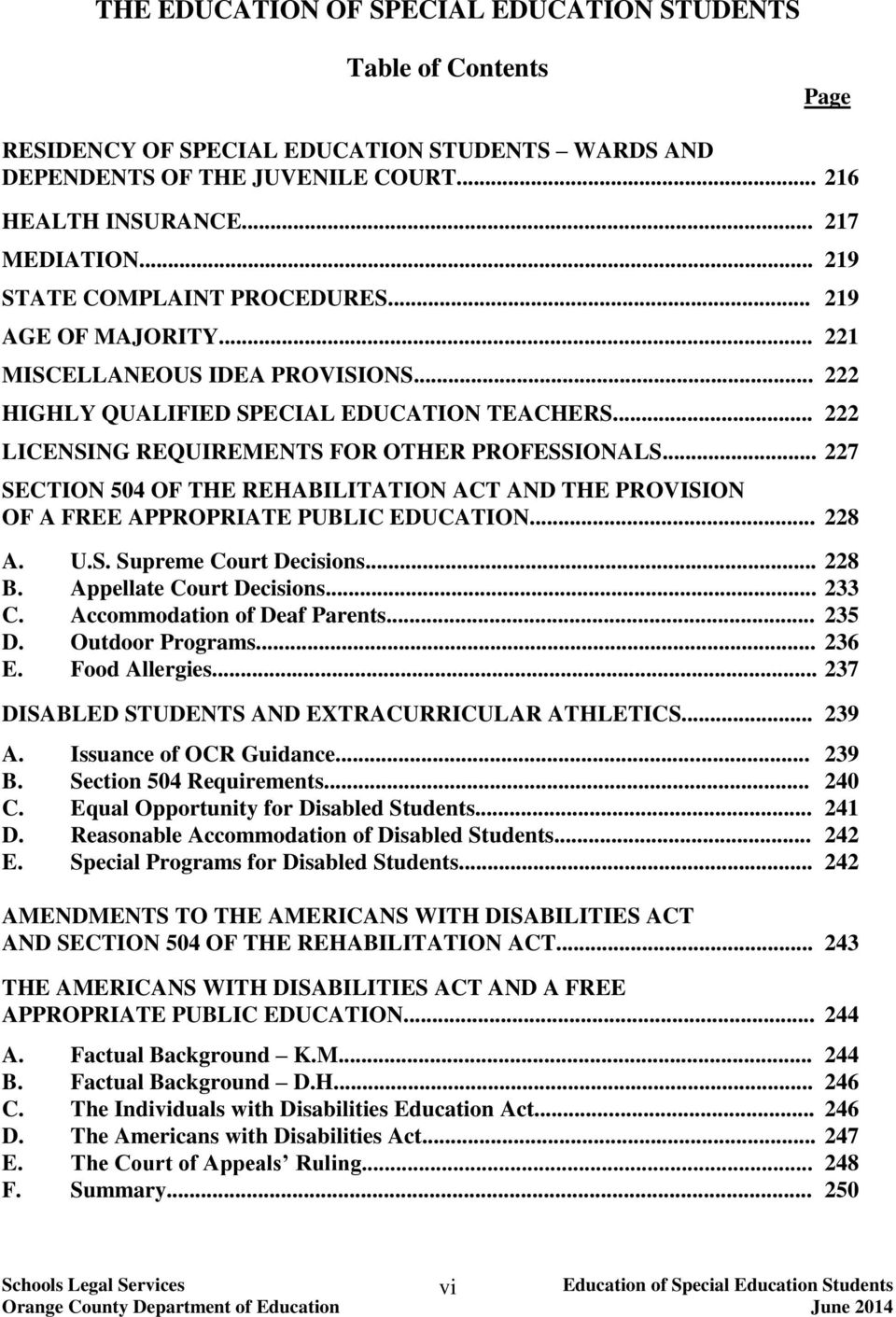
8 THE EDUCATION OF SPECIAL EDUCATION STUDENTS Table of Contents Page RESIDENCY OF SPECIAL EDUCATION STUDENTS WARDS AND DEPENDENTS OF THE JUVENILE COURT HEALTH INSURANCE MEDIATION STATE COMPLAINT PROCEDURES AGE OF MAJORITY MISCELLANEOUS IDEA PROVISIONS HIGHLY QUALIFIED SPECIAL EDUCATION TEACHERS LICENSING REQUIREMENTS FOR OTHER PROFESSIONALS SECTION 504 OF THE REHABILITATION ACT AND THE PROVISION OF A FREE APPROPRIATE PUBLIC EDUCATION A. U.S. Supreme Court Decisions B. Appellate Court Decisions C. Accommodation of Deaf Parents D. Outdoor Programs E. Food Allergies DISABLED STUDENTS AND EXTRACURRICULAR ATHLETICS A. Issuance of OCR Guidance B. Section 504 Requirements C. Equal Opportunity for Disabled Students D. Reasonable Accommodation of Disabled Students E. Special Programs for Disabled Students AMENDMENTS TO THE AMERICANS WITH DISABILITIES ACT AND SECTION 504 OF THE REHABILITATION ACT THE AMERICANS WITH DISABILITIES ACT AND A FREE APPROPRIATE PUBLIC EDUCATION A. Factual Background K.M B. Factual Background D.H C. The Individuals with Disabilities Education Act D. The Americans with Disabilities Act E. The Court of Appeals Ruling F. Summary vi
9 THE EDUCATION OF SPECIAL EDUCATION STUDENTS Table of Contents Page SERVICE ANIMALS UNDER THE AMERICANS WITH DISABILITIES ACT PROPOSITION 63 MENTAL HEALTH FUNDS A. Purpose and Intent of the MHSA B. Definition of Seriously Emotionally Disturbed (SED) Children C. Services to SED and Severely Mentally Ill Children D. Education and Training Programs E. Oversight and Accountability F. County Mental Health Plan G. The Mental Health Services Fund H. Legislative Analyst s Office Analysis vii

10 THE EDUCATION OF SPECIAL EDUCATION STUDENTS Table of Contents Page APPENDICES: APPENDIX I: DEFINITION OF HIGHLY QUALIFIED SPECIAL EDUCATION TEACHERS I. HIGHLY QUALIFIED IN GENERAL II. ALL SPECIAL EDUCATION TEACHERS III. SPECIAL EDUCATION TEACHERS TEACHING CORE ACADEMIC SUBJECTS EXCLUSIVELY TO CHILDREN WHO ARE ASSESSED AGAINST ALTERNATE STANDARDS IV. SPECIAL EDUCATION TEACHERS TEACHING TWO OR MORE CORE ACADEMIC SUBJECTS EXCLUSIVELY TO CHILDREN WITH DISABILITIES V. CATEGORIES OF SPECIAL EDUCATION TEACHERS WHO MAY UTILIZE THE HOUSSE PROCEDURES APPENDIX II: KEY TIMELINES APPENDIX III: KEY TIMELINES APPENDIX IV: CHARTS APPENDIX V: SUMMARY OF KEY PROVISIONS IN THE 2006 IDEA REGULATIONS APPENDIX VI: WRITTEN NOTICE TO PARENT viii

11 HISTORY OF THE INDIVIDUALS WITH DISABILITIES EDUCATION ACT The Individuals with Disabilities Education Act (IDEA) traces its history to an amendment of the Elementary and Secondary Education Act of 1965, which dealt with the education of children with disabilities. 1 Congress gradually became more involved in the education of the disabled by making available more grants to the states for this purpose. Increased awareness of the educational needs of children with disabilities, together with several landmark court decisions, led Congress to conclude that further legislation was needed. 2 Legal challenges by children with disabilities to the inequities in public education had their genesis in Brown v. Board of Education, 3 in which the United States Supreme Court discussed the importance of education by stating: [Education] is a principal instrument in awakening the child to cultural values, in preparing him for later... training and in helping him to adjust normally to his environment. In these days, it is doubtful that any child may reasonably be expected to succeed in life if he is denied the opportunity of an education.... [W]here the state has undertaken to provide it, [education] is a right which must be made available to all on equal terms. 4 Although Brown does not establish the right to an education per se, it does require each state to provide equal opportunity to publicly supported education to all persons who qualify under state law. 5 Based on this premise, two lower courts have held that under the Equal Protection Clause of the Fourteenth Amendment and the Due Process Clause of the Fifth Amendment, states cannot deny children with disabilities access to public education. 6 The federal district court, in Mills v. Board of Education, 7 held that where a state has compulsory school attendance laws, a state may not exclude children with disabilities who come within the provisions of that law. The Mills court emphasized this point by quoting from Brown v. Board of Education: Today, education is perhaps the most important function of state and local governments. Compulsory school attendance laws and the great expenditures for education both demonstrate our recognition of the importance of education to our democratic society. It is required in the performance of our most basic public responsibilities In addition, the Mills court required as a matter of due process that children receive a hearing prior to their exclusion or placement in a special education program. 9 The court also held that no 1 Public Law , April 13, 1970, 84 Stats. 121, which is popularly known as the Elementary and Secondary Education Amendments of See, S.Rep., No. 168, 94 th Congress, 1 st Sess. 8 (1975), reprinted in 1975 U.S. Code Congressional and Administrative News, at U.S. 483 (1954). 4 Id. at Ibid. 6 Mills v. Board of Education, 348 F.Supp. 866, 874 (D.D.C. 1972); Pennsylvania Association for Retarded Children v. Pennsylvania, 343 F.Supp. 279 (E.D. Pa. 1972) F.Supp. 866, 874 (D.D.C. 1972). 8 Brown v. Board of Education, 347 U.S. 483, 493 (1954). 9 Mills v. Board of Education, 348 F.Supp. 866 (D.D.C. 1972). 1

12 child with a disability could be excluded on the basis of a school district s insufficient resources and that each child must be individually assessed and placed in a publicly supported program suited to the child s needs. The court further indicated that each child should be placed in the least restrictive environment in which he or she can function. 10 In Pennsylvania Association for Retarded Children v. Pennsylvania, 11 the federal district court took judicial notice of findings that mentally retarded persons are capable of benefiting from appropriate education programs and that there was no rational basis for excluding them from the public education system. With these cases in mind, Congress passed the Education for All Handicapped Children Act of 1975, also known as the Education of the Handicapped Act. In 1990, Congress renamed the Act the Individuals with Disabilities Education Act and amended several significant provisions. The term handicapped was replaced throughout the IDEA with the term disabled, and handicapped children are now referred to as children with disabilities. PURPOSE OF THE IDEA Congress stated that the purpose of the IDEA is to assure that all children with disabilities have available to them a free and appropriate public education which emphasizes special education and related services designed to meet their unique needs. 12 In addition, the IDEA is designed to assure that the rights of children with disabilities and their parents are protected, to assist states and local districts to provide for the education of all children with disabilities, and to assess and assure the effectiveness of efforts to educate children with disabilities. 13 The IDEA s main provisions provide that in order to be eligible for federal funds, states must meet the following conditions: 1. The state must ensure that all children with disabilities have the right to a free and appropriate public education including children who have been suspended or expelled; The state must formulate a plan designed to locate, identify, and evaluate all children with disabilities within the state; The state must develop and maintain records of an appropriate individualized educational program for each child with a disability and must establish or revise the individualized educational program in accordance with the requirements of the IDEA; The state must establish procedural safeguards which: 10 Ibid F.Supp. 279 (E.D. Pa. 1972) U.S.C. Section 1400(d) U.S.C. Section 1400(d) U.S.C. Section 1412(a)(1)(A) U.S.C. Section 1412(a)(3)(A) U.S.C. Section 1412(a)(4). 2

13 a. provide an opportunity to the parents or guardian of a child with a disability to examine all relevant records with respect to the identification, evaluation, and educational placement of the child; b. provide prior written notice to the parents or guardian of the child with a disability whenever a proposal to change the identification, evaluation or educational placement of the child is proposed or denied; c. fully inform the parents or guardian of all procedures and rights available to them; and d. provide an opportunity to present complaints with respect to any matter relating to the identification, evaluation, or educational placement of the child. 17 The state must establish procedures to provide to the maximum extent appropriate that children with disabilities are educated with children without disabilities and that assessment and testing procedures are not discriminatory. 18 KEY TERMS UNDER THE IDEA The IDEA set forth the following definitions of key terms used in the IDEA: 1. Special Education: Specially designed instruction, at no cost to parents or guardians, to meet the unique needs of a child with a disability, including instruction conducted in the classroom, in the home, in hospitals and institutions and in other settings and instruction in physical education Child with a Disability: A child with intellectual disabilities, hearing impairments (including deafness), speech or language impairments, visual impairments (including blindness), serious emotional disturbance (emotional disturbance), orthopedic impairments, autism, traumatic brain injury, other health impairments, or specific learning disabilities, and who, by reason of their disability, need special education and related services Related Services: Transportation, and such developmental, corrective, and other supportive services as may be required to assist a child with a disability to benefit from special U.S.C. Section 1415(b) U.S.C. Section 1412(a)(5), (6) U.S.C. Section 1401(29) U.S.C. Section 1401(3)(A). 3

14 education, including the early identification and assessment of disabling conditions in children. Such services include speech-language pathology and audiology, interpreting services, psychological services, physical and occupational therapy, recreation, including therapeutic recreation, social work services, school nurse services, counseling services, including rehabilitation counseling, orientation and mobility services, and medical services for diagnostic and evaluation purposes only. Related services do not include a medical device that is surgically implanted or the replacement of such device (e.g., cochlear implant) Transition Services: A coordinated set of activities designed within a results-oriented process to promote a student s movement from school to post-school activities, including post-secondary education, vocational training, integrated employment (including supported employment), continuing and adult education, adult services, independent living, or community participation. The coordinated set of activities shall be based upon the individual student s needs, taking into account the student s strengths, preferences and interests, and shall include instruction, community experiences, the development of employment and other post-school adult living objectives, and, when appropriate, acquisition of daily living skills and functional vocational evaluation Free Appropriate Public Education: Special education and related services which: (a) (b) (c) (d) Have been provided at public expense, under public supervision and direction and without charge; Meet the standards of the state educational agency; Include an appropriate preschool, elementary, or secondary school education in the state involved; and Are provided in conformity with the individualized education program required under the IDEA Individualized Education Program (IEP): A written statement for each child with a disability that is developed, reviewed and revised in accordance with Section 1414(d) U.S.C. Section 1401(26) U.S.C. Section 1401(34) U.S.C. Section 1401(9). 4

15 7. Assistive Technology Device: Any item, piece of equipment, or product system, whether acquired commercially off the shelf, modified, or customized, that is used to increase, maintain, or improve functional capabilities of a child with a disability Assistive Technology Service: Any service that directly assists a child with a disability in the selection, acquisition, or use of an assistive technology device. 26 The IDEA and the federal regulations define emotional disturbance as a condition exhibiting one or more of the following characteristics over a long period of time and to a marked degree that adversely affects a child s educational performance: (a) (b) (c) (d) (e) An inability to learn that cannot be explained by intellectual, sensory or health factors; An inability to build or maintain satisfactory interpersonal relationships with peers and teachers; Inappropriate types of behavior or feelings under normal circumstances; A general pervasive mood of unhappiness or depression; A tendency to develop physical symptoms or fears associated with personal or school problems. 27 The federal regulations go on to note that the term emotional disturbance includes schizophrenia, but does not apply to children who are socially maladjusted, unless it is determined that they also have an emotional disturbance, as defined. 28 Other health impairment means having limited strength, vitality or alertness, including a heightened alertness to environmental stimuli that results in limited alertness with respect to the educational environment. Other health impairments may be due to chronic or acute health problems such as asthma, attention deficit disorder or attention deficit hyperactivity disorder, diabetes, epilepsy, a heart condition, hemophilia, lead poisoning, leukemia, nephritis, rheumatic fever, U.S.C. Section 1401(14) U.S.C. Section 1401(1) U.S.C. Section 1401(2) C.F.R. Section 300.8(c)(4). 28 Ibid. 5

16 Tourette Syndrome, and sickle cell anemia. These conditions must adversely affect a child s educational performance for the child to qualify for special education. 29 The definition of related services does not include a medical device that is surgically implanted, the optimization of that device s functioning (e.g., mapping), maintenance of that device, or the replacement of that device. 30 The public agency is required to appropriately monitor and maintain medical devices that are needed to maintain the health and safety of the child, including breathing, nutrition, or operation of other bodily functions, while the child is transported to and from school or is at school, and to routinely check the external component of the surgically implanted device to make sure it is functioning properly. 31 Interpreting services includes oral transliteration services, cued language transliteration services, sign language transliteration and interpreting services, and transcription services, and special interpreting services for children who are deaf-blind. 32 School health services and school nurse services are health services that are designed to enable a child with a disability to receive a FAPE as described in the child s IEP. School nurse services are provided by a qualified school nurse and school health services may be provided by a qualified school nurse or other qualified person. 33 Supplementary aid and services means aids, services, and other supports provided to enable children with disabilities to participate in extracurricular and nonacademic settings as well as regular education classes, so that children with disabilities may be educated with nondisabled children to the maximum extent appropriate. 34 The federal regulations require that physical education be made available to all children with disabilities receiving a free appropriate public education, unless the public agency enrolls children without disabilities and does not provide physical education to children without disabilities in the same grades. 35 STATE STATUTORY PROVISIONS In 2005 and 2007, the California Legislature amended numerous provisions in the Education Code regulating special education. The purpose of the legislation was to conform state law to federal law. 36 The effect of the legislation is that California law in most respects is identical to federal law. Under California law, the term special education is defined as specially designed instruction at no cost to the parent, to meet the unique needs of individuals with exceptional needs, including instruction conducted in the classroom, in the home, and hospitals and institutions, and other settings, and instruction in physical education C.F.R. Section 300.8(c)(9) C.F.R. Section (b) C.F.R. Section (b)(2) C.F.R. Section (c)(4) C.F.R. Section (c)(13) C.F.R. Section C.F.R. Section See, Stats.2005, ch. 653 (A.B. 1662), effective October 7, 2005; Stats.2007, ch. 454 (A.B. 1663), effective October 10, Education Code section 56031(a). 6

17 In state law, the term individuals with exceptional needs is used rather than children with disabilities, but the definition is virtually the same as federal law. The state statute defines individuals with exceptional needs as those persons who satisfy all of the following: (a) Are identified by an individualized education program team as children with disabilities, as that phrase is defined in Section 1401(3)(A) of Title 20 of the United States Code; (b) Their impairment, as described by subdivision (a), requires instruction and services which cannot be provided with modification of the regular school program; (c) Come within one of the following age categories: (1) Younger than three years of age and identified by the district, the special education local plan area, or the county office as requiring intensive special education and services, as defined by the State Board of Education; (2) Between the ages of three and five years, inclusive, and identified by the district, special education local plan area, or county office pursuant to Section ; (3) Between the ages of 5 and 18 years, inclusive; (4) Between the ages of 19 and 21 years, inclusive; enrolled in or eligible for a special education program prior to his or her 19th birthday; and has not yet completed his or her prescribed course of study or who has not met proficiency standards or has not graduated from high school with a regular high school diploma. 38 The 2005 legislation redefined designated instruction and services to be identical to the term related services as used in federal law. 39 These services may include, but are not limited to, the following: (1) Language and speech development and remediation; (2) Audiological services; (3) Orientation and mobility services; (4) Instruction in the home or hospital; (5) Adapted physical education; 38 Education Code section Education Code section 56363(a). See, also, 20 U.S.C. Section 1401(26), 34 C.F.R. Section

18 (6) Physical and occupational therapy; (7) Vision services; (8) Specialized driver training instruction; (9) Counseling and guidance services, including rehabilitation counseling; (10) Psychological services other than assessment and development of the individualized education program; (11) Parent counseling and training; (12) Health and nursing services; (13) Social worker services; (14) Specially designed vocational education and career development; (15) Recreation services; (16) Specialized services for low incidence disabilities, such as readers, transcribers, and vision and hearing services; and (17) Interpreting services. 40 The term designated instruction and services and related services do not include a medical device that is surgically implanted, or the replacement of that device. 41 FEDERAL FUNDING OF SPECIAL EDUCATION In 1975, Congress passed the Education for All Handicapped Children Act, now known as the Individuals with Disabilities Education Act, or IDEA. The purpose of IDEA was to provide funding to educate the disabled, many of whom were receiving no education at all or who were being warehoused in inadequate programs. The IDEA was envisioned as a federal-state partnership in which Congress would provide 40 percent of the funding and the states 60 percent. 42 However, Congress has not funded IDEA at the promised 40 percent level. Congress even added additional requirements to IDEA in 1997, but did not boost federal funding to assist states in complying with the new mandates. 43 Twice Congress has 40 Education Code section 56363(b). 41 Education Code section 56363(c) U.S.C. Section 1411(a). 43 Public Law , 111 Stat. 37 effective June 4,

19 chastised itself for its failure, once in a 1994 law and once in a 1999 resolution, but it has never increased funding to the 40 percent level. 44 During most of IDEA s 30-plus years, Congress has provided eight percent of the cost of special education. In response to the protests of education organizations and groups representing the disabled, funding was boosted in the 2001 fiscal year federal budget to 12 percent. While that is a step in the right direction, much more needs to be done. The average cost of educating a disabled student in the school year was twice that of educating a student who is not disabled, and the number of disabled students continues to increase, thanks to improvements in medical treatment, new technology for the disabled, and increased parental awareness of programs for the disabled. 45 The bipartisan failure of Congress to fund special education adequately prompted the California Legislature to take action. On August 16, 1999, the Legislature passed a joint resolution demanding that Congress keep its promise and provide the full 40 percent of funding for special education. The Legislature directed the chief clerk of the Assembly to transmit copies of the resolution to President Bill Clinton, Secretary of Education Richard Riley, and key members of Congress. 46 The purpose of the resolution was to bring to the attention of Congress its failure to fulfill its commitment to the disabled. The resolution points out that California and other states have been required, as a result of Congress breach of its promise, to transfer funds from other vital state and local programs to special education. The Legislature estimated that California was transferring almost $1 billion annually from regular education to special education. 47 The resolution states that if Congress funded special education programs at the promised level, California would receive $1.8 billion annually. The receipt of these funds would allow California to increase spending on special education by $800 million and to use $1 billion in state funds for educational reforms. Free of federal restrictions, these state funds could be used for school construction, teacher training, recruitment of new teachers, and the purchase of more books and supplies as determined by local school districts. 48 The impact would be dramatic, allowing states and local school districts to hire additional special education teachers and to purchase more equipment to improve the quality of special education programs. The federal money would free up state funds to pay for education reforms, school construction, and other local needs without an increase in state or local taxes. As additional state funds became available for education, local school boards would set local priorities for improving the quality of education for all students. The greatest impact would be felt in the inner cities, which have suffered most from aging facilities and inadequate books and supplies U.S.C. Section 6062; House Concurrent Resolution 84 (April 13, 1999). 45 National Center for Education Statistics (National School Boards Association Issue Brief, 1999). 46 Assem. Joint Res. No.12 (res. ch. 76) (1999). 47 Ibid. 48 Ibid. 9

20 What we do know is that the continuing failure of Congress to keep its commitment has resulted in cutbacks in other education programs, particularly education reforms, at a time when the public expects improvements in regular education. Local schools take the blame while Congress the source of the under-funding and the reason education reform is not adequately funded escapes public attention or scrutiny on the subject. The fact that the public does not know the real source of the education funding problem makes it much more difficult to solve. In 2004, Congress made an attempt to address the issue and other issues related to funding, enacting legislation that increases the federal funds authorized for special education but does not actually appropriate funds and does not make appropriations mandatory. The intent of the legislation is to increase funding to the promised 40 percent level by Fiscal Year 2011, but Congress is not required to do so. 49 The 2004 legislation added language that a state may not use IDEA funds to satisfy state law mandated funding obligations to local educational agencies, including funding based on student attendance or enrollment, or inflation. 50 The exact meaning of this language is unclear, but it may mean that a state may not use federal funds to satisfy state law mandated funding obligations for growth in average daily attendance. If this language is interpreted in this manner, it may prohibit the State of California from using federal funds to fund growth in the number of special education students in California. PERMISSIVE USE OF IDEA FUNDS A local educational agency may use IDEA funds for early intervening services up to 15 percent of the amount the agency receives to develop and implement coordinated early intervening services, which may include interagency financing structures for students in kindergarten through grade 12 (with a particular emphasis on students in kindergarten through grade 3) who have not been identified as needing special education or related services but who need additional academic and behavioral support to succeed in a general education environment. 51 In implementing coordinated, early intervening services, a local educational agency may carry out activities that include: 1. Professional development for teachers and other school staff to enable such personnel to deliver scientifically based academic instruction and behavioral interventions, including scientifically based literacy instruction, and, where appropriate, instruction on the use of adaptive and instructional software; and 2. Educational and behavioral evaluations, services, and supports, including scientifically based literacy instruction U.S.C. Section 1411(i) U.S.C. Section 1412(d)(20) U.S.C. Section 1413(a)(4). 10

21 The legislation specifically states that nothing in the subsection relating to early intervening services shall be construed to limit or create a right to a free appropriate public education. Each local educational agency that develops and maintains coordinated early intervening services shall annually report to the state educational agency on the number of students served and the number of students served who subsequently receive special education and related services. The funds must be used to supplement, not supplant, funds made available under the NCLB, and may be used to carry out programs aligned with NCLB requirements. 52 DUTY TO SEARCH FOR AND IDENTIFY DISABLED STUDENTS The IDEA requires states to have policies and procedures to assure that all children residing in the state who are disabled, regardless of the severity of their disabilities, and who are in need of special education and related services, are identified, located, and evaluated. 53 Under California law, this requirement, commonly referred to as the child-find process, applies to individuals with exceptional needs ranging in age from 0 through 21 years. 54 Each school district, special education local plan area or county office is required to establish written policies and procedures for a continuous child-find system. 55 A systematic referral system is also required to be established. 56 CHARTER SCHOOLS The duty to serve special education students also applies to charter schools. The IDEA states that charter schools that are public schools of the school district must serve children with disabilities attending charter schools in the same manner as it serves children with disabilities in its other schools. In addition, the school district must provide funds to charter schools in the same manner as it provides funds to its other schools. 57 The statutory language does not require that the charter school maintain special education programs for all disabled children, including low incidence disabilities, but it would require the charter school to maintain special education programs that are typically located in each public school in the district (e.g., RSP programs). In charter petitions that have been submitted to school districts in the past, many of the petitions make the assumption that all special education children will be served outside of the charter school, including RSP children. Such an approach violates the IDEA. The regulations contain a number of provisions that refer to charter schools. Section includes a public charter school established by a local educational agency within the definition of local educational agency. As a result, all regulations which set forth requirements for local educational agencies apply to public charter schools as well. Section includes public charter schools that are not otherwise included as local educational agencies within the definition of public U.S.C. Section 1413(f) U.S.C. Section 1412(a)(3); 34 C.F.R. Section Education Code section et seq. 55 Education Code section Education Code section U.S.C. Section 1413(a)(5). 11
22 agency. Section (a) states that children with disabilities who attend public charter schools, and their parents, retain all rights under the IDEA. Section (c) states that if the public charter school is a local educational agency that receives federal funding, the charter school is responsible for ensuring that the requirements of the IDEA are met, unless state law assigns that responsibility to some other entity. Section (b) states that if a public charter school is a school of the local educational agency and receives federal funding, the local educational agency is responsible for ensuring that the requirements of the IDEA are met, unless state law assigns that responsibility to some other entity. The state law in California is silent on this issue. Therefore, in California, the responsibility for charter school compliance with the IDEA remains with the school district that granted the charter. In summary, it is a violation of federal law for charter schools to refuse to serve special education students. Charter schools should serve special education children in the same manner as other schools in the district. Special education programs which are typically located at each school should also be located at the charter school. Special education programs which, due to the low incidence of the disability, are provided at a limited number of schools in the district or are regionalized may continue to be located in this manner. LOCAL EDUCATIONAL AGENCY RISK POOL The IDEA 58 establishes a local educational agency risk pool for the purpose of assisting local educational agencies in addressing the needs of high need children with disabilities. Each state may reserve up to 10 percent of the state s allocation of federal funds to establish a high cost fund and make disbursements from the fund to local educational agencies for high need children. The disbursements from the fund may not be used for legal fees, court costs, or other litigation costs. A high need child is to be defined by the State in consultation with local educational agencies and must, at a minimum, be a child with a disability that costs three times the average per pupil expenditure in that State. 59 The State plan for the high cost fund must include all of the following: 1. The financial impact of the high need child with a disability on the budget of the child s local educational agency. 2. Eligibility criteria for the participation of a local educational agency that, at a minimum, takes into account the number and U.S.C. Section 1411(e)(3). 59 The definition of average per pupil expenditure is set forth in the NCLB, 20 U.S.C. Section 7801(2) which states: The term average per-pupil expenditure means, in the case of a State or of the United States (A) without regard to the source of funds (i) the aggregate current expenditures, during the third fiscal year preceding the fiscal year for which the determination is made (or, if satisfactory data for that year are not available, during the most recent preceding fiscal year for which satisfactory data are available) of all local educational agencies in the State or, in the case of the United States, for all States (which, for the purpose of this paragraph, means the 50 States and the District of Columbia); plus (ii) any direct current expenditures by the State for the operation of those agencies; divided by (B) the aggregate number of children in average daily attendance to whom those agencies provided free public education during that preceding year. 12
23 percentage of high need children with disabilities served by a local educational agency. 3. A funding mechanism that provides distributions each fiscal year to local educational agencies that meet the criteria developed by the State. 4. An annual schedule by which the State educational agency will make its distributions from the high cost fund each fiscal year. The State is required to make its final State plan available to the public no less than 30 days before the beginning of the school year, including dissemination and posting on the State website. Funds in the pool that are not expended in a fiscal year must be allocated to local educational agencies for the succeeding fiscal year. A. Statutory Provisions ELIGIBILITY FOR SPECIAL EDUCATION The IDEA requires participating states to provide a free and appropriate public education to all children with disabilities between the ages of 3 and In California, students younger than 5 years are eligible for special education if they are in need of intensive special education and services, as defined in state regulations. Education Code section states the eligibility criteria for students age 3 to 5:... [i]f the child meets the following criteria: (1) Is identified as having one of the following disabling conditions, as defined in Section of Title 34 of the Code of Federal Regulations, or an established medical disability, as defined in subdivision (d): (A) Autism. (B) Deaf-blindness. (C) Deafness. (D) Hearing impairment. (E) Mental retardation. (F) Multiple disabilities. (G) Orthopedic impairment U.S.C. Section 1412(a)(1)(A). 13
24 (H) Other health impairment. (I) Serious emotional disturbance. (J) Specific learning disability. (K) Speech or language impairment in one or more of voice, fluency, language and articulation. (L) Traumatic brain injury. (M) Visual impairment. (N) Established medical disability. (2) Needs specially designed instruction or services as defined in Sections and (3) Has needs that cannot be met with modification of a regular environment in home or school, or both, without monitoring or support as determined by an IEP program team member pursuant to Section (4) Meets eligibility criteria specified in Section 3030 of Title 5 of the California Code of Regulations. (c) A child is not eligible for special education and services if the child does not otherwise meet the eligibility criteria and his or her educational needs are due primarily to: (1) Unfamiliarity with the English language. (2) Temporary physical disabilities. (3) Social maladjustment. (4) Environmental, cultural, or economic factors. (d) For purposes of this section, established medical disability is defined as a disabling medical condition or congenital syndrome that the IEP team determines has a high predictability of requiring special education and services. (e) When standardized tests are considered invalid for children between the ages of 3 and 5 years, alternative means, 14
25 including scales, instruments, observations, and interviews, shall be used as specified in the assessment plan. 61 With respect to children aged birth to 4 years and 9 months, inclusive, the State Board of Education has established additional eligibility criteria: (1) The child must meet the standard eligibility criteria. (2) The child must be in need of intensive special education and services. To be eligible for intensive special education and services, the child must meet one of the following criteria: (A) The child is functioning at or below 50 percent of his or her chronological age level in any one of the following skill areas: (1) Gross or fine motor development. (2) Receptive or expressive language development. (3) Social or emotional development. (4) Cognitive development. (5) Visual development. (B) The child is functioning between 51 percent and 75 percent of his or her chronological age level in any two of the skill areas identified in Section 3031(2)(A). (C) The child has a disabling medical condition or congenital syndrome which the Individualized Educational Program Team determines has a high predictability of requiring intensive special education and services. 62 The California Early Intervention Services Act coordinates governmental agency programs to provide family centered early intervention services to children from birth to age two, who have or are at risk of having disabilities. 63 Under this Act, the Department of Education was given the responsibility of providing services to children who have visual, hearing and severe orthopedic impairments or any combination thereof. These children must meet the eligibility criteria in Education Code sections and , but not be eligible for services under the Lanterman Developmental Disabilities Act. 64 These children each shall have an individualized family service plan which takes the place of the IEP used for older children Education Code section C.C.R. Section Government Code sections and 95002; Individuals with Disabilities Education Act, Part H, 20 U.S.C. Section 1471 et seq. 64 Government Code sections and 95014(b)(1). 65 Government Code section
26 B. Preschool Eligibility In Andrew M. v. Delaware County Office of Mental Health, 66 the Court of Appeals held that under Part C of the Individuals with Disabilities Education Act (IDEA) the children involved were eligible for early intervention services and that the county mental health department failed to comply with the IDEA by failing to provide services to the children in their natural environment. 67 The Court of Appeals held that natural environment included a preschool. The Court of Appeals further held that Section 504 of the Rehabilitation Act of 1973 was not violated and the parents were not entitled to attorneys fees. The holding in Andrew M. will indirectly affect school districts. 68 Children under the age of three under Part C of the IDEA in California are generally served by the Regional Center. However, adverse rulings against the Regional Center could affect school districts when the students transition to school based programs under Part B of the IDEA. 69 The two students involved in Andrew M. were fraternal twins. Both twins had significant speech and communication delays and functioned at levels significantly below their peers. Based on these disabilities, the county mental health department determined that both students were eligible for early intervention services under Part C of the IDEA. The county assembled a team to develop an individualized family service plan (IFSP) for each boy. After it was determined that the speech services that the twins received were not effective in the home, the IFSP team determined that services could better be rendered in a classroom-based program as the boys needed social interaction with peers and adults. Thereafter, the IFSP team authorized the services to be provided at a center for special needs children (i.e., a segregated environment). Under Part C of the IDEA, if early intervention services are provided outside the natural environment, an IFSP must include a justification for such a placement. 70 In Andrew M., the parents filed due process claims and the hearing officer determined that natural environment under Part C of the IDEA included the preschool in which the twins were already enrolled. The hearing officer ruled that it was an environment where typical, nondisabled children would be found. The hearing officer concluded that the natural environment requirement under Part C of the IDEA was analogous to the least restrictive environment requirement under Part B of the IDEA. Congress passed Part C of the IDEA to encourage states to create statewide programs to provide for developmentally delayed and disabled toddlers. 71 The IFSP contains a statement of the child s present levels of development, goals to be achieved for the child and the child s family, and the services necessary to meet the stated goals. 72 Services provided under Part C include family F.3d 337 (3 rd Cir. 2007) U.S.C. Section 1432(4)(G); 34 C.F.R. Section In addition, while decisions of the Third Circuit Court of Appeals are not binding in the Ninth Circuit (California is in the Ninth Circuit), the courts in the Ninth Circuit and California may follow the holding in Andrew M. 69 See, Johnson v. Special Education Hearing Office, 287 F.3d 1176, 164 Ed.Law Rep. 52 (9 th Cir. 2002) C.F.R. Section (d)(1)(ii) U.S.C. Section U.S.C. Section 1436(d). 16
27 training and counseling, physical and occupational therapy, speech therapy, special instruction, and social work services. 73 These services are to be provided, whenever possible, in the child s natural environment. 74 If a dispute arises, parents may file a due process claim against the agency responsible for providing the services. 75 The Court of Appeals agreed with the hearing officer that when an agency provides early intervention services under Part C of the IDEA but fails to provide them in the natural environment without appropriate justification, the agency violates Part C of the IDEA. 76 The Court of Appeals held that a preschool with nondisabled students would fall within the definition of natural environment. The Court of Appeals further stated that the parents were not entitled to attorneys fees since Part C of the IDEA does not authorize the award of attorneys fees to parents. C. Alternative Process For Eligibility Under a 2004 amendment to the IDEA, school districts may use an alternative process for determining whether a child has a specific learning disability. 77 In making a determination of eligibility for special education and related services, a child shall not be determined to be a child with a disability if the determining factor is a lack of appropriate instruction in reading, including in the essential components of reading instruction, as defined in Section 1208(3) 78 of the No Child Left Behind Act, lack of instruction in math, or limited English proficiency. 79 D. Denial of Eligibility In Hood v. Encinitas Union School District, 80 the Court of Appeals upheld the Hearing Officer s decision and the District Court s decision finding that a student was not eligible for special education. The Court of Appeals held that the student was able to benefit from her general education program with accommodations under Section 504 of the Rehabilitation Act and, therefore, was not eligible for special education. At the time of the due process hearing, the student was 10 years old and, according to her report cards, was performing at grade level in the average or above average range in the public school classroom. While the student s second, third, fourth, and fifth grade reports indicated that the student had difficulty completing tasks, turning in homework on time, and keeping her belongings organized, her standardized test scores on the Stanford Achievement Test (SAT-9) placed her above the fiftieth percentile in most areas U.S.C. Section 1432(4)(E) U.S.C. Section 1432(4)(G) U.S.C. Section Andrew M. v. Delaware County Office of Mental Health, 490 F.3d 337 (3 rd Cir. 2007) U.S.C. Section 1414(b) U.S.C. Section 6368(3), which defines the essential components of reading instruction as explicit and systemic instruction in phonemic awareness, phonics, vocabulary development, reading fluency, including oral reading skills and reading comprehension strategies U.S.C. Section 1414(b) F.3d 1099, 220 Ed.Law Rep. 518 (9 th Cir. 2007). 81 Id. at
28 The student s medical history indicated that she may suffer from a possible seizure disorder and had been prescribed medication. The school district instituted an accommodation plan under Section 504 to address the possible seizure disorder and increased distractibility and difficulty staying on task. The plan included preferential seating in the classroom, use of a graphic organizer, and Alpha Smart keyboard, one-step directions, visual supports for instruction and concepts, frequent prompts and checks for understanding, and daily teacher checks for homework assignments. 82 On May 15, 2001, the student s advocate wrote to the district to request a special education evaluation. An evaluation was done and the resource specialist and school psychologist concluded that the student did not qualify for special education services as she was performing at least in the average range academically, both in the classroom and in one-on-one testing. The report also noted that the student was eligible for a Section 504 accommodation plan to assist the student s functioning in the regular classroom. 83 On October 5, 2001, an IEP meeting was held and the school district determined that the student did not qualify for special education services and that the student did not have a learning disability. In December 2001, the school district reevaluated the Section 504 plan in place and determined that it should be continued, changing it only to add an accommodation addressing the student s mother s concern about her daughter s self-esteem. Dissatisfied with the school district s provision of services, the student s parents withdrew the student from the school district in February 2002, and enrolled the student in the Winston School, a private school for children with learning differences and filed for a due process hearing with the California Special Education Hearing Office seeking to recover the amounts expended for tuition and assessments. 84 After a four day hearing, the Hearing Officer held that the student did not need special education related services. The Hearing Officer determined that the school district did not violate the IDEA and denied reimbursement to the student s parents for the child s private placement. The Hearing Officer found that the results of the student s testing did not reveal a discrepancy that was severe enough to make the child eligible as learning disabled. The hearing officer also ruled that no single score or product of scores can be used as the sole criterion and that a discrepancy may only be considered a severe discrepancy when it is corroborated by other assessment data. The hearing officer concluded that the totality of evidence, including the student s work samples, scores from other tests, and classroom observations, provided a reasonable basis for the school district to determine that the student s specific learning disability did not require special education. 85 The hearing officer also found that the student did not have any other health impairments to potentially qualify the student for special education services, including that the student s evidence of seizure disorder or attention deficit disorder was not sufficiently clear to qualify the student for special education services since it was unclear whether the seizure disorder and/or attention deficit disorder actually caused the student to have limited strength, vitality, or alertness as required by regulation Id. at Id. at Ibid. 85 Ibid. See, California Code of Regulations, Title V, Section 3030(j)(4)(A). 86 Ibid. See, California Code of Regulations, Title V, Section 3030(f). 18
29 The district court upheld the hearing officer s decision that the school district s refusal to find the student eligible for special education services did not violate the IDEA and accepted the school district s argument that the student s learning disability could be addressed with modifications to the regular classroom. 87 The Court of Appeal reviewed the hearing officer s decision and the district court s decision and noted that the pupil must be assessed as having a specific learning disability if it is determined that a severe discrepancy exists between the intellectual ability and achievement in one or more areas of academics, the discrepancy is due to a disorder in one or more of the basic psychological processes and is not the result of environmental, cultural, or economic disadvantages and the discrepancy cannot be corrected through other regular or categorical services offered within the regular instructional program. The Court of Appeals focused in on the issue of whether the discrepancy could be corrected through other regular or categorical services offered within the regular instructional program. The Court of Appeals stated: We need not consider whether Anna satisfies the calculation. Our decision hinges upon appellant s failure to satisfy the second requirement of specific learning disability qualification for special education eligibility, that being whether any existing severe discrepancy between ability and achievement could not be corrected through other regular or categorical services offered within the regular instructional program. Thus, even assuming the existence of a severe discrepancy, the law does not entitle Anna Hood to special education if we find that her discrepancy can be corrected in a regular classroom. 88 The Court of Appeals held that the Supreme Court s standard in Rowley v. Board of Education 89 may be used to determine if the child not only is receiving adequate special education but if the nondisabled child is receiving adequate accommodations in the general classroom and, thus, is not entitled to special education services. The Court of Appeals held that the benefit standard may be applied to determine if a student qualifies for special education due to a specific learning disability. The Court of Appeals cited the testimony of the student s teachers stating that they would not have considered referring the student for special education because she was working at or above grade level and was benefiting from her education in the regular classroom. Therefore, the Court of Appeals held that based on this evidence, the hearing officer was justified in concluding that the student was receiving the requisite benefit from her education and the school district was therefore in compliance with Section 504 of the Rehabilitation Act and the IDEA. The Court of Appeals stated: The hearing officer had sufficient reason to conclude that the accommodations that the school district offered Anna via her Section 504 plan, particularly the provisions for daily teacher checks for 87 Id. at Id. at U.S. 176 (1982). 19
30 homework assignments, one step directions, and use of a graphic organizer, would assist with Anna s difficulties and allow her to excel in the regular classroom. 90 The Court of Appeals also found that the student did not qualify for special education under the category of other health impairment because the student s needs could be met with appropriate accommodations in a regular education environment. The Court of Appeals stated: The school district determined that a Section 504 plan would be sufficient to serve Anna s special needs. To attempt to accommodate Anna, in spite of her medical conditions, in the general classroom is consistent with the concept of mainstreaming, an objective that the school district is legally bound to pursue. 91 ELIGIBILITY OF STUDENTS WITH SPECIFIC LEARNING DISABILITIES The IDEA states that when determining whether a child has a specific learning disability, a school district shall not be required to take into consideration whether a child has a severe discrepancy between achievement and intellectual ability in oral expression, listening comprehension, written expression, basic reading skill, reading comprehension, mathematical calculation, or mathematical reasoning. In determining whether a child has a specific learning disability, a school district may use a process that determines if the child responds to scientific, research-based intervention as a part of the evaluation procedures. 92 The federal regulations further clarify that a state may not require the use of a severe discrepancy between intellectual ability and achievement for determining whether a child has a specific learning disability, and must permit the use of a process based on the child s response to scientific, research-based intervention and other alternative research-based procedures for determining whether a child has a specific learning disability. 93 The determination of whether a child suspected of having a specific learning disability is a child with a disability must be made by the child s parents and a team of qualified professionals which must include the child s regular teacher, or, if the child does not have a regular teacher, a regular classroom teacher qualified to teach a child of that age, and at least one person qualified to conduct individual diagnostic examinations of children, such as a school psychologist, speech language pathologist, or remedial reading teacher. 94 The child s parents and a team of qualified professionals may determine that a child has a specific learning disability if the child does not achieve adequately for the child s age or meet state approved grade level standards in one of eight areas when provided with learning experiences and instruction appropriate for the child s age or state approved grade level standards. These eight areas are: 90 Id. at Id. at U.S.C. Section 1414(b)(6) C.F.R. Section (a) C.F.R. Section
31 1. Oral expression; 2. Listening comprehension; 3. Written expression; 4. Basic reading skill; 5. Reading fluency skills; 6. Reading comprehension; 7. Mathematics calculation; and 8. Mathematics problem solving. 95 In order to ensure that the underachievement in a child suspected of having a specific learning disability is not due to lack of appropriate instruction in reading or math, the group must consider, as part of the evaluation, data that demonstrates that prior to, or as part of, the referral process, the child was provided appropriate instruction in regular education settings, delivered by qualified personnel. 96 The district must ensure that the child is observed in the child s learning environment (including the regular classroom setting) to document the child s academic performance and behavior in the areas of difficulty. At least one member of the group of professionals must conduct an observation of the child s academic performance in a regular classroom after the child has been referred for an evaluation and parental consent is obtained. 97 The group of professionals must provide specific documentation of the eligibility determination of a specific learning disability that shows that the child is not achieving adequately for the child s age or is not meeting state approved grade level standards and the child is not making sufficient progress to meet age or state approved grade level standards. 98 The group of professionals must prepare a statement concerning the effects of a visual, hearing, or motor disability, mental retardation, emotional disturbance, cultural factors, environmental or economic disadvantage, or limited English proficiency on the child s achievement level. 99 If the child participated in a process that assessed the child s response to scientific, researchbased intervention, the documentation must include instructional strategies used, the studentcentered data collected, and documentation that the child s parents were notified about the state s policies regarding the amount and nature of student performance data that would be collected, the general education services that would be provided, the strategies for increasing the child s rate of learning, and the parent s right to request an evaluation C.F.R. Section (a) C.F.R. Section (b) C.F.R. Section C.F.R. Section (a) C.F.R. Section (a)(6) C.F.R. Section (a)(7). 21
32 INITIAL EVALUATION A. Evaluation Process A parent of a child, a state educational agency, other state agency or local educational agency may initiate a request for an initial evaluation to determine if the child is a child with a disability. 101 The initial evaluation to determine the educational needs of the child and whether the child is a child with a disability shall be completed within 60 days of receiving parental consent for the evaluation, or, if the state establishes a time frame within which the evaluation must be conducted, within the state s timeframe. 102 The applicable timeframe does not apply to a local educational agency if a child enrolls in a school served by the local educational agency after the relevant timeframe has begun, and prior to a determination by the child s previous local educational agency as to whether the child is a child with a disability. The exception applies only if the subsequent local educational agency is making sufficient progress to ensure a prompt completion of the evaluation, and the parent and subsequent local educational agency agree to a specific time when the evaluation will be completed, or the parent of a child repeatedly fails or refuses to produce the child for the evaluation. 103 The agency proposing to conduct an initial evaluation to determine if the child qualifies as a child with a disability shall obtain informed consent from the parent of such child before conducting the evaluation. Parental consent for evaluation shall not be construed as consent for initial provision of special education and related services. An agency that is responsible for making a free appropriate public education available to a child with a disability shall seek to obtain informed consent from the parent of such child before providing special education and related services to the child. If the child is a ward of the state and is not residing with the child s parent, the local educational agency shall make reasonable efforts to obtain informed consent from the parent of the child for an initial evaluation to determine whether the child is a child with a disability. The agency shall not be required to obtain informed consent from the parent of a child for an initial evaluation to determine whether the child is a child with a disability if: 1. Despite reasonable efforts to do so, the agency cannot discover the whereabouts of the parent of the child; 2. The rights of the parent of the child have been terminated in accordance with state law; or 3. The rights of the parent to make educational decisions have been subrogated by a judge in accordance with state law and U.S.C. Section 1414(a)(1); 34 C.F.R. Section California Education Code section requires that the evaluation be completed within 60 days, not counting intersessions or school vacations in excess of five schooldays. Stats.2005, c. 653, AB 1662, effective October 7, C.F.R. Section
33 consent for an initial evaluation has been given by an individual appointed by the judge to represent the child. 104 The screening of a student by a teacher or specialist to determine appropriate instructional strategies for curriculum implementation shall not be considered to be an evaluation for eligibility for special education and related services. 105 The school district must document its attempts to obtain parental consent. 106 Examples of documentation include detailed records of phone calls made or attempted and the results of those calls, copies of correspondence sent to parents and responses received, and detailed records of home visits. 107 B. Parental Consent On December 31, 2008, new Individuals with Disabilities Education Act (IDEA) regulations take effect. The regulations address the issue of parental consent to special education services and authorize states to prohibit the right to be represented by non-attorneys at due process hearings. The new regulations provide that if a parent fails to respond to a request for, or refuses to consent to, the initial provision of special education and related services, the public agency: 1. May not use due process and mediation procedures in order to obtain an agreement or a ruling of the special education services may be provided to the child. 2. Will not be considered to be in violation of the requirement to make a free appropriate public education available to the child because of the failure to provide the child with the special education and related services for which the parent refuses to or fails to provide consent. 3. Is not required to convene an IEP team meeting or develop an IEP for the child. 108 If at any time subsequent to the initial provision of special education and related services, the parent of the child revokes consent in writing for the continued provision of special education and related services, the public agency: 1. May not continue to provide special education and related services to the child, but must provide prior written notice in C.F.R. Section (a) C.F.R. Section C.F.R. Section (d)(5); 34 C.F.R. Section (d) C.F.R. Section (d) C.F.R. Section (b)(3). 23
34 accordance with federal regulations before ceasing the provision of special education and related services. 2. May not use due process or mediation procedures in order to obtain agreement or a ruling of the special education services may be provided to the child. 3. Will not be considered to be in violation of the requirement to make a free appropriate public education available to the child because of the failure to provide the child with further special education and related services. 4. Is not required to convene an IEP team meeting or develop an IEP for the child for further provision of special education and related services. 109 If the parent revokes consent in writing for the child s receipt of special education services after the child is initially provided special education and related services, the public agency is not required to amend the child s education records to remove any references to the child s receipt of special education and related services due to the revocation of consent. 110 The prior written notice referred to in the new regulations requires written notice to the parent before the public agency: 1. Proposes to initiate or change the identification, evaluation or educational placement of the child or the provision of a free appropriate public education to the child; or 2. Refuses to initiate or change the identification, evaluation or educational placement of the child or the provision of a free appropriate public education to the child. 111 The notice must include: 1. A description of the action proposed or refused by the school district. 2. An explanation of why the school district proposes or refuses to take the action. 3. A description of any other options that the school district considered and the reasons why those options were rejected C.F.R. Section (b)(4) C.F.R. Section 300.9(c)(3) C.F.R. Section (a). 24
35 4. A description of each evaluation procedure, test, record, or report the school district used as a basis for the proposed or refused action. 5. A description of any other factors that are relevant to the school district s proposal or refusal. 6. A statement that the parents of a child with a disability have protection under the procedural safeguards of this part, and if this notice is not an initial referral for evaluation, the means by which a copy of a description of the procedural safeguards can be obtained. 7. Sources for parents to contact to obtain assistance in understanding the provisions of this part. 112 The notice must be in a language understandable to the general public and provided in the native language of the parent or other mode of communication used by the parent, unless it is clearly not feasible to do so. 113 If the native language or other mode of communication of the parent is not a written language, the public agency must take steps to ensure that the notice is translated orally or by other means to the parent in his or her native language or other mode of communication, that the parent understands the content of the notice and that there is written evidence that the requirements have been met. 114 With respect to the revocation of a parent s consent, the prior written notice would indicate that the parent has failed to respond or refuses to consent to the provision of special education services and should indicate the special education and related services proposed by the district. The notice would indicate that the reason for the district s action is that the parent failed to respond or refused to consent to special education and related services. A copy of a model notice that can be used when a parent or guardian revokes their consent for special education and related services is set forth in Appendix VI. REEVALUATION A local educational agency is required to ensure that a reevaluation of each child with a disability is conducted in accordance with IDEA procedures, if the local educational agency determines that the educational or related service needs, including improved academic achievement and functional performance, of the child warrant a reevaluation, or if the child s parent or teacher requests a reevaluation. A reevaluation shall occur not more frequently than once a year unless the parent and the local educational agency agree otherwise and at least once every three years, unless the parent and local educational agency agree that a reevaluation is unnecessary U.S.C. Section 1415(c); 34 C.F.R. Section (b) C.F.R. Section (c) C.F.R. Section (c)(2) C.F.R. Section
36 Each public agency must obtain informed consent prior to conducting any reevaluation of a child with a disability. If the parent refuses to consent to the reevaluation, the public agency may, but is not required to, pursue the reevaluation by using the mediation and due process procedures. The public agency does not violate its obligations under the IDEA if it declines to pursue the evaluation or reevaluation. 116 In M.T.V. v. Dekalb County School District, 117 the Court of Appeals affirmed a hearing officer s order requiring parents to consent to a school district s request to reevaluate a special education student or else forfeit the student s services under the IDEA. The Court of Appeals cited an earlier case, Gregory K. v. Longview School District, 118 in which the Court of Appeals held that if parents want their child to receive special education services under the IDEA, they must permit the school district to assess or evaluate the student. As discussed above, in Fitzgerald v. Camdenton R-III School District, 119 the Eighth Circuit Court of Appeals held that a school district may not seek to compel parents to consent to an evaluation of their child for special education services when the parents have withdrawn their child from public school and have enrolled their child in a private school. However, in M.T.V., the Court of Appeals made it clear that if the child is enrolled in public school and the parents wish to continue receiving special education services under the IDEA, they must permit a school district to evaluate the child. The Court of Appeals stated: We agree with these courts and hold the school district was entitled to reevaluate M.T.V. by an expert of its choice. M.T.V. was initially deemed eligible for OHI services in August 1999, making his triennial evaluation for continued OHI eligibility due in Conditions also warranted a reevaluation because M.T.V. had made significant progress on his OHI goals. Finally, the school district had a right to condition M.T.V. s continued OHI services on a reevaluation by an expert of its choice because M.T.V. s initial OHI eligibility was based primarily on evaluations provided by his parents. We agree the school district cannot be forced to rely solely on an independent evaluation conducted at the parent s behest. 120 The school district had convened an IEP team meeting to discuss the child s continued eligibility under the IDEA. The IEP team questioned the child s continued eligibility for services due to progress the child had made. The parents had refused to consent to the reevaluation C.F.R. Section (c)(1) F.3d 1153 (11 th Cir. 2006) F.2d 1307, 1315 (9 th Cir. 1987) F.3d 773 (11 th Cir. 2006) F.3d 1153, 1160 (11 th Cir. 2006). 26
37 A. Qualifications of Assessors ASSESSMENT OF EDUCATIONAL NEEDS Before any action is taken with respect to the initial placement of an individual with exceptional needs, an individual assessment of the pupil s educational needs must be conducted by qualified persons. The assessment must be conducted by persons competent to perform the assessment, as determined by the local educational agency. 121 B. Assessment Plan Whenever an assessment for the development or revision of the IEP is to be conducted, the parent shall be given a written proposed assessment plan within 15 days of the referral for assessment, not counting days between the pupil s school sessions or vacation days in excess of five school days, unless the parent agrees in writing to an extension. In any event, the assessment plan shall be developed within ten days after the start of the next school year if a referral was made within ten days of the end of the regular school year. A copy of the notice of parents rights and an explanation of the procedural safeguards must be attached to the assessment plan. 122 The proposed assessment plan must meet the following requirements: 1. Be in a language easily understood by the general public; 2. Be provided in the native language of the parent or other mode of communication used by the parent unless to do so is clearly not feasible; 3. Explain the type of assessments to be conducted; 4. State that no IEP will result from the assessment without the consent of the parent. 123 No assessment shall be conducted unless the final written consent of the parent is obtained prior to the assessment, except where the public education agency has prevailed in a due process hearing relating such assessment. The parent shall have at least 15 days from the receipt of the proposed assessment plan to arrive at a decision. 124 The assessment must be conducted within 60 days of receiving parental consent for the assessment, not counting days between the pupil s regular sessions, terms or days of school vacation in excess of five days. 125 C. Response to Intervention (RTI) The federal regulations do not specifically indicate whether referring a child to a Response to Intervention (RTI) Program extends the timelines for assessing or evaluating a child for special C.F.R. Sections , ; Education Code sections 56320, Education Code section C.F.R. Section ; Education Code section Education Code section U.S.C. Section 1414(a); 34 C.F.R. Section ; Education Code section 56344(a). 27
38 education. The U.S. Department of Education in comments to the federal regulations in the Federal Register, Volume 71, Number 156, August 14, 2006, page stated the following: D. Informed Consent Instructional models vary in terms of the length of time required for the intervention to have the intended effect on a child s progress. It would not be appropriate for the Department to establish timelines or the other requirements proposed by the commenters in Federal regulations, because doing so would make it difficult for LEAs to implement models specific to their school districts. These decisions are best left to State and local professionals who have knowledge of the instructional methods used in their schools Therefore, we will combine proposed Section (c) and (d), and revise the new Section (c) to ensure that the public agency probably request parental consent to evaluate a child suspected of having an SLD who has not made adequate progress when provided with appropriate instruction, which could include instruction in an RTI model, and whenever a child is referred for an evaluation. Assessments or evaluations must be conducted before the initial provision of special education and related services to a child with a disability. 126 The initial assessment or evaluation shall consist of procedures to determine whether a child is a child with a disability as defined by the IDEA. 127 The school district must obtain the informed consent of the parent of the child before the evaluation is conducted. Parental consent for assessment shall not be construed as consent for placement for receiving special education and related services. If the parents of a child with a disability refuse to consent to an assessment, the school district may continue to pursue an assessment by filing for a due process hearing. 128 E. Triennial Review School districts must ensure that a reevaluation of each child with a disability is conducted if conditions warrant a reevaluation or if the child s parent or teachers request an evaluation, at least once every three years, except with the consent of the parent. 129 F. Assessment Requirements In conducting the assessment, the school district is required to use a variety of assessment tools and strategies to obtain relevant, functional and developmental information, including information provided by the parent, that may assist in determining whether the child is a child with a disability and the content of the child s IEP, including information related to enabling the child to be U.S.C. Section 1414(a)(1) U.S.C. Section 1414(a)(1)(B) U.S.C. Section 1414(a)(1)(D) U.S.C. Section 1414(a) (2). 28
39 involved in and progress in the general curriculum, or, for preschool children, to participate in appropriate activities. The school district is required not to use any single procedure as the sole criterion for determining whether a child is a child with a disability or determining an appropriate educational program for the child, and to use technically sound instruments that may assess the relative contribution of cognitive and behavioral factors, in addition to physical or developmental factors. 130 Each school district is required to insure that tests and other evaluation materials used to assess a child are selected and administered so as to not be discriminatory on a racial or cultural basis and are provided and administered in the child s native language or other mode of communication unless it is not feasible to do so. Any standardized tests that are given to the child must be validated for the specific purpose for which they are used, administered by trained and knowledgeable personnel, and must be administered in accordance with any instructions provided by the producer of such tests. The child must be assessed in all areas of suspected disability, and assessment tools and strategies that provide relevant information that directly assists persons in determining the educational needs of the child must be provided. 131 Upon completion of the assessment, a determination by a team of qualified professionals and the parent of the child should be made to determine whether the child is a child with a disability and a copy of the assessment report and the documentation of eligibility should be given to the parent. 132 In making a determination of eligibility, a child shall not be determined to be a child with a disability if the determining factor for such determination is a lack of instruction in reading or math or limited English proficiency. 133 If the IEP team and other qualified professionals determine that no additional data are needed to determine whether the child continues to be a child with a disability, the school district shall notify the child s parents of that determination and the reasons for it and the right of such parents to request an assessment to determine whether the child continues to be a child with a disability. The school district shall not be required to conduct such an assessment unless requested by the child s parents. 134 However, a school district shall evaluate a child with a disability in accordance with the IDEA before determining that a child is no longer a child with a disability. 135 The assessments are required to be conducted in accordance with requirements including, but not limited to, all of the following: 1. Materials and procedures are selected and administered so as not to be racially, culturally, or sexually discriminatory, and shall be provided in the pupil s native language or mode of communication, unless it is clearly not feasible to do so; U.S.C. Section 1414(b) U.S.C. Section 1414(b)(3) U.S.C. Section 1414(b)(4) U.S.C. Section 1414(b)(5) U.S.C. Section 1414(c)(4) U.S.C. Section 1414(c)(5). 29
40 2. Tests and other assessment materials meet all of the following requirements; A. Are provided and administered in the language and form most likely to yield accurate information on what the pupil knows and can do academically, developmentally, and functionally, unless it is not feasible to so provide or administer; B. Are used for purposes for which the assessments or measures are valid and reliable; C. Are administered by trained personnel in conformance with the instructions provided by the producer of such tests and other assessment materials, except that individually administered tests of intellectual or emotional functioning shall be administered by a psychometrist or credentialed school psychologist; 3. Materials include those tailored to assess specific areas of educational need and not merely those that are designed to provide a single general intelligence quotient; 4. Tests are selected and administered to best ensure that when a test administered to a pupil with impaired sensory, manual or speaking skills produces test results that accurately reflect the pupil s aptitude, achievement level, or other factors the test purports to measure and not the pupil s impaired sensory, manual, or speaking skills unless those skills are the factors the test purports to measure; 5. No single procedure is used as the sole criterion for determining an appropriate educational program; 6. The pupil is assessed in all areas related to the suspected disability, and a developmental history is obtained, when appropriate; 7. The assessment of a pupil, including the assessment of a pupil with a suspected low incidence disability, shall be conducted by persons knowledgeable of that disability. Special attention shall be given to the unique educational needs, including, but not limited to, skills and the need for specialized services, materials, and equipment Education Code section
41 Assessments are required to be conducted as follows: 1. Any psychological assessment of pupils shall be conducted by a credentialed school psychologist who is trained and prepared to assess cultural and ethnic factors appropriate to the pupil being assessed; Any health assessment of pupils shall be conducted by a credentialed school nurse or physician who is trained and prepared to assess cultural and ethnic factors appropriate to the pupil being assessed; Occupational therapy and physical therapy assessments shall be conducted by qualified medical personnel; Psychotherapy and other mental health assessments shall be conducted by qualified mental health professionals. 140 G. Timelines For Assessment Unless the parent agrees in writing to an extension, an IEP required as a result of an assessment shall be developed within a total time not to exceed 60 days, not counting days between the pupil s regular school sessions, or school vacation in excess of five school days, from the date of receipt of the parent s written consent for assessment. When a referral for assessment has been made 30 days or less prior to the end of the regular school year, an IEP shall be developed within 30 days after the commencement of the subsequent regular school year. In the case of school vacations, the 60 day time shall recommence on the date that the pupil school days reconvene. 141 H. Written Report The personnel who assess the pupil are required to prepare a written report or reports, as appropriate, of the results of each assessment. The report must include all of the following: 1. Whether the pupil may need special education and related services; 2. The basis for making the determination; 3. The relevant behavior noted during the observation of the pupil in an appropriate setting; 137 Education Code section 56324(a). 138 Education Code section 56324(b). 139 Government Code section 7572(b). 140 Government Code section 7572(c). 141 Education Code section
42 4. The relationship of that behavior to the pupil s academic and social functioning; 5. The educationally relevant health and development, and medical findings, if any; 6. For pupils with learning disabilities, whether there is such a discrepancy between achievement and ability that it cannot be corrected without special education and related services; 7. A determination concerning the effects of environmental, cultural, or economic disadvantage, when appropriate; and 8. The need for specialized services, materials, and equipment for pupils with low incidence disabilities. 142 DISCLOSURE OF ASSESSMENT INFORMATION Parental consent must be obtained before personally identifiable information is disclosed to parties other than officials of participating agencies, unless the information is contained in educational records, and the disclosure is authorized without parental consent under FERPA regulations. 143 Parental consent is not required before personally identifiable information is released to officials of participating agencies for purposes of meeting a requirement of the IDEA. 144 Parental consent must be obtained before personally identifiable information is released to officials of participating agencies that provide or pay for transition services. 145 Parental consent must be obtained before any personally identifiable information is released between officials in the local educational agency where a private school is located and the local educational agency of the parent s residence with respect to parentally placed private school children with disabilities. 146 INDEPENDENT EDUCATIONAL EVALUATION The IDEA states that the procedural safeguards required under the IDEA must include the right of a parent to obtain an independent educational evaluation of the child. The regulations clarify these rights. 147 The 2006 regulations state that upon request for an independent educational evaluation, each public agency shall provide the parents information about where an independent educational evaluation may be obtained and the agency criteria applicable to independent educational evaluations. An independent educational evaluation is defined as an evaluation conducted by a qualified examiner who is not employed by the public agency responsible for the education of the child in question. Public expense is defined as meaning the public agency either pays for the full 142 Education Code section C.F.R. Section (a) C.F.R. Section (b)(1) C.F.R. Section (b)(2) C.F.R. Section (b)(3) U.S.C. Section 1415(b)(1); 34 C.F.R. Section
43 cost of the independent educational evaluation or ensures that the evaluation is otherwise provided at no cost to the parent. 148 Section (b) states that a parent has a right to an independent educational evaluation at public expense if the parent disagrees with an evaluation obtained by the public agency. If the parent requests an independent educational evaluation at public expense, the public agency must, without unnecessary delay, either initiate a hearing to show that its evaluation is appropriate or ensure that an independent educational evaluation is provided at public expense unless the agency demonstrates in a hearing that the evaluation obtained by the parent did not meet agency criteria. If the public agency initiates a hearing and the final decision is that the agency s evaluation is appropriate, the parent still has the right to an independent educational evaluation but not at public expense. If a parent requests an independent educational evaluation, the public agency may ask the parents why he or she objects to the public evaluation. However, an explanation by the parent is not required and the public agency may not unreasonably delay either providing the independent educational evaluation at public expense or initiating a due process hearing to defend the school district evaluation. Section (c) provides that if the parent obtains an independent educational evaluation at private expense, the results of the evaluation must be considered by the public agency, if it meets agency criteria, in any decision made with respect to the free appropriate public education provided to the child, and may be presented as evidence at a hearing under the IDEA regarding that child. Section (d) states that if a hearing officer requests an independent educational evaluation as part of the hearing, the costs of the evaluation must be at public expense. Section (e) states that if an independent educational evaluation is at public expense, the criteria under which the evaluation is obtained, including the location of the evaluation and the qualifications of the examiner, must be the same as the criteria that the public agency uses when it initiates an evaluation, to the extent those criteria are consistent with the parent s right to an independent educational evaluation. A public agency may not impose conditions or time lines related to obtaining an independent educational evaluation at public expense, other than the criteria the public agency uses when it initiates its own evaluation. The federal regulations clarify that a parent is entitled to only one independent educational evaluation at public expense each time the public agency conducts an evaluation with which the parent disagrees. 149 In Phillip C. v. Jefferson County Board of Education, 150 the Eleventh Circuit Court of Appeals upheld a regulation promulgated by the Secretary of Education which states that parents of a disabled child have the right to a publicly-financed independent educational evaluation (IEE). The Court of Appeals held that the regulation does not exceed the scope of the Individuals with Disabilities Education Act (IDEA). The Court of Appeals held that although the IDEA states that the parent must have an opportunity to obtain an IEE of the child, it does not expressly state that the parent needs to be C.F.R. Section (a) C.F.R. Section (b)(5) F.3d 691, 287 Ed.Law Rep. 50 (11 th Cir. 2012). 33
44 reimbursed for the cost of the IEE. The Court of Appeals held that another section of the IDEA expressly requires the Secretary of Education to preserve any IDEA regulation that existed as of July 20, 1983, and one of the regulations in effect at that time expressly provided to parents the right to an IEE at public expense, and subsequent to 1983, Congress reauthorized the IDEA on three separate occasions without altering the parent s right to a publicly-financed IEE. 151 The court further stated that the right to a publicly-financed IEE guarantees meaningful participation throughout the development of an individualized education program. Without public financing of an IEE, a class of parents would be unable to afford an IEE and their children would not receive, as the IDEA intended, a free appropriate public education as the result of the cooperative process that protects the rights of parents. 152 OBSERVATION BY INDEPENDENT EVALUATOR In Benjamin G. v. Special Education Hearing Office, 153 the Court of Appeal held that a school district must allow an expert witness retained by the parents the opportunity to observe the school district s proposed placement before a due process hearing. The student in Benjamin G. was a 10-year-old autistic child in the Long Beach Unified School District. Benjamin G. s parents asked the Long Beach Unified School District to refer the student for an assessment to determine his eligibility for IDEA services. While the assessment request was still pending, the student s parents enrolled the student in a private school. The district gave the parents a written assessment plan proposal in which the student was to be assessed by a school psychologist through classroom observation. The parents accepted the proposal and a district-employed school psychologist twice observed the student in the private school setting. Later that year, the district convened an IEP meeting and found the student eligible for IDEA services and offered the student a full-time placement in a special day class in one of the district s schools. The parents accepted the eligibility finding but did not consent to the public school placement and requested a due process hearing before the California Special Education Hearing Office (SEHO). Prior to the hearing, the parents submitted a request to have their expert psychologist observe the proposed public school placement. The school district denied the request. The parents then alleged in the pending SEHO proceedings that the proposed public school placement was not appropriate for the student s needs and asked for an order compelling the district to pay for the student s private school placement. In preparation for the hearing, the parents filed a formal motion in the pending SEHO proceedings, asking for an order to compel the district to allow the parent s psychologist to observe the proposed public school placement. The district opposed the motion and the motion was denied by SEHO. SEHO ruled that Education Code section only provides a student s expert an opportunity for observation for a proposed 151 Id. at Id. at Cal. App.4 th 815, 32 Cal.Rptr.3d 366, 200 Ed.Law Rep. 277 (2005). 34
45 special education placement if the observation is undertaken in conjunction with an independent educational assessment. The parents then filed a petition for a writ of mandate in Los Angeles County Superior Court, asking for an order compelling SEHO and the school district to allow the parents psychologist to observe the proposed public school placement. The trial court dismissed the parents petition without leave to amend. The parents appealed to the California Court of Appeal and the Court of Appeal reversed. The Court of Appeal noted that school districts are required to locate potentially eligible children, assess and evaluate them, determine which children are eligible for IDEA benefits, develop IEPs for eligible children, and propose school placements for them. Parents who suspect that their children have a qualifying disability are entitled to refer their children for assessment, to participate in meetings of any group that determines a child s eligibility, to refuse to consent to any assessment proposed for their child, and to participate as members of the IEP team that determines their child s placement. If the parents disagree with the school district s assessment of their child, the parents have a right to an independent educational assessment at the district s expense (i.e., an evaluation by someone other than a district employee, but using the same criteria as the district s evaluation). If the parents disagree with the school district s proposed placement, the parents may unilaterally enroll their child in a private school and seek reimbursement from the district upon a showing (at an administrative hearing) that both the proposed public placement violated the IDEA and that the private school placement was proper under the IDEA. The Court of Appeal noted that the IDEA acknowledges the fact that school districts have better access to information and more educational expertise than parents, and thus provides for a due process hearing that levels the playing field by permitting the parents to present all the evidence they can muster to challenge the district s decision. To that end, IDEA gives the child and their parents the right to be advised by experts, to have those experts testify at their due process hearing, and to have someone other than a district employee as a hearing officer. The Court of Appeal noted that Education Code section gives the parents the right to have their expert observe the proposed placement without regard to whether their child is present so that they need not remove the child from the present placement while they are in the midst of challenging the proposed placement. 154 Section 56329(b) states in part: If a public agency observed the child in conducting its assessment or if its assessment procedures make it permissible to have in-class observation of a pupil, an equivalent opportunity shall apply to an independent educational assessment of the pupil in the pupil s current educational placement and setting, and observation of an educational placement and setting, if any, proposed by the public education agency, regardless of whether the independent educational assessment is initiated before or after the filing of a due process hearing proceeding. 154 Education Code section 56329(b). 35
46 The Court of Appeal rejected the school district s contention that the student s right to have his expert observe the district s proposed placement is contingent upon the student s exercise of his right to conduct an independent educational assessment. The Court of Appeal went on to state that expert testimony is often critical in IDEA cases and that the IDEA procedural safeguards ensure that children and parents have the right to be accompanied and advised by counsel and by individuals with special knowledge or training with respect to children with disabilities. Therefore, the Court of Appeal ruled that the student and his parents had a statutory right to have their expert observe the district s proposed placement and that the district was obligated to allow the observation. The Court of Appeal noted that there was obvious harm to the student and their parents if they were forced to participate in a due process hearing with a partially prepared expert. As a result of this decision, districts should allow parents experts to observe placements proposed by the school district. Districts may have district personnel accompany the parents experts so as to minimize any disruption to the educational program. Districts may also set reasonable time limits on such observations. In L.M. v. Capistrano Unified School District, 155 the Ninth Circuit Court of Appeals held that the school district s policy of limiting parents classroom observations to twenty minutes did not deny the student a free appropriate public education in violation of the Individuals with Disabilities Education Act (IDEA). The Court of Appeals held that the parents had a full opportunity to participate in the IEP process with the assistance of an informed and knowledgeable expert. In L.M., following a four day hearing, the Administrative Law Judge ruled that the school district violated Education Code section 56329(c), which states that the parents shall have an equivalent opportunity to observe the child in the school setting, but concluded that the procedural error in the development of the IEP was harmless and did not amount to a denial of a free appropriate public education. The Administrative Law Judge noted that the parent s expert admitted during her testimony that she was still able to develop opinions about the school program, advise the parents regarding the school program and give informed testimony at the hearing. The parent s expert was given an opportunity to return for additional 20 minute visits, but declined to do so. 156 The Court of Appeals held that procedural flaws in the IEP process do not always amount to the denial of a free appropriate public education. Once a procedural violation of the IDEA is found, the court must determine whether that violation affected the substantive rights of the parent or the child. Procedural inadequacies that result in the loss of educational opportunity or seriously infringe the parents opportunity to participate in the IEP formulation process clearly result in the denial of a free appropriate public education. 157 The Court of Appeals found that the parents failed to present any evidence to show that if their expert had received more classroom observation time there would have been a different result F.3d 900, 242 Ed.Law Rep. 23 (9th Cir. 2008). 156 Id. at Id.at 909; see, also, W.G. v. Board of Trustees of Target Range School District No. 23, 960 F.2d 1479, 1483 (9 th Cir. 1992); M.L. v. Federal Way School District, 394 F.3d 634, 652 (9 th Cir. 2005). 36
47 The Court noted that the parent s expert could have gone back on other occasions for more 20 minute visits. 158 The Court of Appeals also held that the stay put provision did not apply to the parent s unilateral placement of the child. In L.M., there was no functioning IEP at the time the litigation began, since L.M. was making his initial application for public school. 159 STATE PERFORMANCE GOALS AND INDICATORS The IDEA requires states to establish goals for the performance of children with disabilities that promote the purposes of the IDEA, are the same as the State s definition of adequate yearly progress, including the State s objectives for progress by children with disabilities under the NCLB, address the graduation rates and dropout rates, as well as such other factors as the State may determine, and are consistent, to the extent appropriate, with any other goals and standards for children established by the State. The State is also required to establish performance indicators that the State will use to assess progress toward achieving the goals set forth in the NCLB, including measurable annual objectives for progress by children with disabilities, and will annually report to the United States Secretary of Education and the public on the progress of the State and of children with disabilities in the State, toward meeting the goals established under the IDEA and the NCLB. 160 STANDARDIZED TESTING AND ACCOMMODATION OF SPECIAL EDUCATION STUDENTS Special education students are entitled to reasonable accommodations in the administration of standardized tests, but the need for accommodations must be balanced against the necessity of test validity. What is a reasonable accommodation must be decided on an individualized basis by an IEP team, taking into consideration the validity of the test. Therefore, school districts should consider including input from a school administrator familiar with the issues of test validity in preparation for IEP meetings in which test accommodations for a special education student will be discussed. 161 The IDEA, as reauthorized in 1997, places additional emphasis on increased performance expectations by children with disabilities and access to the general curriculum. The IDEA also requires that students with disabilities be educated with their nondisabled peers and in general education classes to the maximum extent appropriate. 162 Students with disabilities are to be placed in settings other than the regular classroom only when the nature or severity of the disability requires that the student cannot be educated successfully in the regular classroom with the use of supplementary aids and services. 163 The IDEA emphasizes the importance of testing to determine whether the child is eligible for special education, to determine what accommodations are needed in the classroom or in testing, and what the appropriate placement for the child is. The IDEA requires that special education students be included in district-wide assessment programs. 164 The U.S. 158 Id. at Id. at U.S.C. Section 1412(a)(15). 161 See, Letter to Chief State School Officers, 34 IDELR 293 (2001) U.S.C. Section 1412(a)(5)(A). 163 Ibid U.S.C. Section 1412(a)( 7); 13 C.F.R. Section
48 Department of Education has concluded that it would violate the IDEA to exclude students with disabilities from participation in high stakes testing programs. 165 In Brookhart v. Illinois State Board of Education, 166 the Court of Appeals upheld the State of Illinois graduation requirement that all students pass a minimal competency test. The court held that the school district had the authority to establish minimum standards for the receipt of a diploma, and that such a requirement did not violate the IDEA. 167 The Court of Appeals also found that the graduation test requirement did not violate Section 504 of the Rehabilitation Act. The court in Brookhart held that school districts were not required to alter the content of the graduation exam to accommodate an individual s inability to learn the tested material due to his disability. The court held that this would be a substantial modification of the testing requirement, and would not be required under Section 504. The court held that the denial of a diploma because of an inability to pass a graduation exam is not discrimination under Section Modifications are usually defined as changes that lower or fundamentally or substantially alter the standards or requirements. 169 As the court noted in Brookhart, modifications would be a fundamental alteration of the program: Altering the content of the test to accommodate an individual s inability to learn the tested material because of his handicap would be a substantial modification as well as a perversion of the diploma requirement. A student who is unable to learn because of his handicap is surely not an individual who is qualified in spite of his handicap. 170 The ruling in Brookhart is consistent with federal regulations, 171 which state: (A)ids, benefits and services, to be equally effective, are not required to produce the identical result or level of achievement for handicapped persons and nonhandicapped persons, but must afford handicapped persons equal opportunity to obtain the same result, to gain the same benefit, or to reach the same level of achievement, in the most integrated setting appropriate to the person s needs. The purpose of accommodations is to provide access to tests, but not to guarantee passage of tests. Therefore, altering or modifying the content of the test (i.e., lowering the standards) is not required by the IDEA, Section 504 or the ADA See, Joint Policy Memorandum on Assessments, 27 IDELR 138 (1997) F.2d 179 (7 th Cir. 1983). 167 Id. at Id. at See, Wynne v. Tufts University School of Medicine, 932 F.2d. 19 (1 st Cir. 1991), 976 F.2d 791, 77 Ed.Law Rep (1 st Cir. 1992); Guckenberg v. Boston University, 974 F.Supp. 106, 121 Ed.Law Rep. 541 (D.Mass. 1997); Zukle v. Regents of the University of California, 166 F.3d 1041, 132 Ed.Law Rep. 81 (9 th Cir. 1999). 170 Brookhart, at C.F.R. Section 104.4(b)(2). 172 See, Brookhart v. Illinois State Board of Education, 697 F.2d 179 (7 th Cir. 1983). 38
49 A number of accommodations have been held to be unreasonable by the Office for Civil Rights (OCR) of the U.S. Department of Education. For example, in Nevada State Department of Education, 173 OCR upheld the State of Nevada s determination that computational skills were an essential part of the State s educational program, and that to provide a calculator to a disabled student would be a significant alteration or modification of the testing program and would not be a reasonable accommodation. In Alabama Department of Education, 174 OCR upheld the State of Alabama s policy of denying the use of reading devices for the Alabama High School exit exam because it would invalidate the test. OCR found that having another person read the test to the disabled student would not provide a valid assessment of the student s ability to read and would invalidate the test. In many cases, test accommodations will mirror those used by the student in school. However, on high stakes tests or standardized tests, permissible accommodations may be more limited so as not to invalidate the test. 175 In Florida State Department of Education, OCR upheld the State of Florida s guidelines prohibiting reading or explaining the communications portion of an exam to a student on the basis that it would invalidate the test. OCR found no violation of either Section 504 or the ADA, even though the student was allowed such accommodations in other test situations in school. Generally, the use of Braille, additional time on the test, dividing the test into smaller sections administered over several days, and providing a quiet distraction-free environment are considered to be permissible, reasonable accommodations. Reasonable accommodations should be made on an individualized basis based on the individual student s needs. Blanket districtwide policies have been held to be violations of Section In summary, accommodations on high stakes or standardized tests should be provided on an individual basis as determined by the student s IEP or Section 504 plan. Accommodations regularly used in the classroom may be denied for use on a high stakes test or standardized test if the accommodation would invalidate the test. The IEP team should consult with a school administrator who is knowledgeable in the validity of standardized tests before agreeing to accommodations which might invalidate the results of the test. PARTICIPATION OF SPECIAL EDUCATION STUDENTS IN STATEWIDE ASSESSMENTS The IDEA requires that all children with disabilities are included in all general state and districtwide assessment programs, including assessments described in the NCLB, with appropriate accommodations and alternative assessments where necessary and as indicated in their respective individualized education programs (IEPs). 177 The State (or, in the case of a districtwide assessment, the local educational agency) is required to develop guidelines for the provision of appropriate accommodations. The State (or, in the case of a districtwide assessment, the local educational IDELR 752 (OCR 1996) IDELR 249 (OCR 1998). 175 See, Florida State Department of Education, 28 IDELR 1002 (OCR 1998). 176 See, Hawaii State Department of Education, 17 EHLR 360 (OCR 1990); Letter to Chief State School Officers, 34 IDELR 293 (2001) U.S.C. Section 1412(a)(16); see, also, Education Code section
50 agency) must develop and implement guidelines for the participation of children with disabilities in alternate assessments for those children who cannot participate in regular assessments with accommodations as indicated in their respective individualized education programs (IEPs). The guidelines for alternate assessments must provide that: 1. The alternate assessment is aligned with the State s challenging academic content standards and challenging student academic achievement standards; and 2. If the State has adopted alternate academic achievement standards permitted under the NCLB regulations, 178 the alternate standards measure the achievement of children with disabilities against those standards. The State is required to conduct the alternate assessments and make available to the public, with the same frequency and in the same detail as it reports on the assessment of non-disabled children, the following: 1. The number of children with disabilities participating in regular assessments, and the number of those children who are provided accommodations in order to participate in those assessments. 2. The number of children with disabilities participating in alternate assessments that are aligned with the State s challenging academic content standards and challenging student academic achievement standards. 3. The number of children with disabilities participating in alternate assessments that include alternate academic achievement standards and measure disabled children against those standards. 4. The performance of children with disabilities on regular assessments and on alternate assessments (if the number of children with disabilities participating in those assessments is sufficient to yield statistically reliable information and reporting that information will not reveal personally identifiable information about an individual student), compared with the achievement of all children, including children with disabilities, on those assessments U.S.C. Section 6311(b)(1). 40
51 The state educational agency (or, in the case of a districtwide assessment, the local educational agency) shall, to the extent feasible, use universal design principles in developing and administering any alternate assessment. 179 THE CALIFORNIA HIGH SCHOOL EXIT EXAM AND SPECIAL EDUCATION STUDENTS Commencing with the school year, an eligible pupil with a disability is not required to pass the California High School Exit Examination (CAHSEE) as a condition of receiving a diploma of graduation or as a condition of graduation from high school. An eligible pupil with a disability is a pupil with an IEP adopted pursuant to the federal IDEA or a Section 504 plan, that indicates that the pupil is scheduled to receive a high school diploma, and that the pupil has satisfied or will satisfy all other state and local requirements for the receipt of a high school diploma, on or after July 1, However, a LEA may not adopt an IEP or Section 504 plan for the sole purpose of exempting the pupil from the requirement to pass the CAHSEE as a condition of receiving a high school diploma, unless that adoption is consistent with federal law. Pupils with exceptional needs must take the CAHSEE in grade 10 for purposes of fulfilling the requirements of the federal No Child Left Behind Act. This exemption shall last until the California State Board of Education makes a determination that the alternative means by which an eligible pupil with disabilities may demonstrate the same level of academic achievement in the portions of, or those content standards required for passage of, the CAHSEE are not feasible or that the alternative means are implemented. 180 To the extent that the State Board determines that it is feasible to create alternate means, the State Board must adopt regulations for alternative means by October 1, 2010, by which eligible pupils with disabilities may demonstrate that they have achieved the same level of academic achievement in the content standards required for passage of the CAHSEE. The regulations must include appropriate timelines and the manner in which pupils and school districts shall be timely notified of the results. 181 OVERIDENTIFICATION OF MINORITY STUDENTS IN SPECIAL EDUCATION The IDEA requires states to adopt policies and procedures designed to prevent the inappropriate overidentification or disproportionate representation by race and ethnicity of children as children with disabilities, including children with disabilities with a particular impairment (e.g., mental retardation, emotional disturbance). 182 PROHIBITION ON MANDATORY MEDICATION The IDEA requires the state educational agency to prohibit state and local educational agency personnel from requiring a child to obtain a prescription for a controlled substance 183 as a condition of attending school, receiving an evaluation or receiving services under the IDEA U.S.C. Section 1412(a)(16). 180 Education Code section Education Code section U.S.C. Section 1412(a)(24) U.S.C. Section 1412(a)(25). 41
52 However, nothing in this section shall be construed to create a federal prohibition against teachers or other school personnel consulting or sharing classroom based observations with parents regarding their student s academic and functional performance, or behavior in the classroom or school, or regarding the need for evaluation for special education or related services under the child find requirements of the IDEA. 184 A. Annual Progress IEP REQUIREMENTS The IEP must include a description of how the child s progress toward meeting the annual goals will be measured and when periodic reports on the progress the child is making toward meeting the annual goals (such as through the use of quarterly or other periodic reports, concurrent with the issuance of report cards) will be provided. 185 The requirement for benchmarks or short-term objectives is now limited to children with disabilities who take alternative assessments aligned to alternate achievement standards. Benchmarks or short-term objectives in addition to annual goals will not be required for all other children with disabilities. B. Alternate Assessment If the IEP team determines that the child will take an alternate assessment on a particular state or districtwide assessment of student achievement, the IEP team must draft a statement of why the child cannot participate in the regular assessment and the particular alternate assessment selected is appropriate for the child must be included in the IEP. C. Transition Services The legislation requires that beginning not later than the first IEP to be in effect when the child is sixteen, and updated annually thereafter, the IEP should include appropriate measurable postsecondary goals based upon age appropriate transition assessments related to training, education, employment, and where appropriate, independent living skills, and the transition services (including courses of study), needed to assist the child in reaching those goals. Beginning not later than one year before the child reaches the age of majority under state law, a statement that the child has been informed of the child s rights under the IDEA, if any, that will transfer to the child on reaching the age of majority under state law should be included in the IEP. If a participating agency, other than the local educational agency, fails to provide the transition services described in the IEP, the local educational agency shall reconvene the IEP team to identify alternate strategies to meet the transition objectives for the child set out in the IEP. 184 See, the Controlled Substances Act, 21 U.S.C. Section 801 et seq U.S.C. Section 1414(d). 42
53 D. Additional Information Additional information is not required to be included in a child s IEP beyond what is explicitly required in the IDEA, and nothing requires the IEP team to include information under one component of a child s IEP that is already contained under another component of the child s IEP. E. Attendance at IEP Meetings A member of the IEP team shall not be required to attend an IEP meeting, in whole or in part, if the parent of a child with a disability and the local educational agency agree that the attendance of that IEP team member is not necessary because the member s area of the curriculum or related services is not being modified or discussed in the meeting. A member of the IEP team may be excused from attending an IEP meeting, in whole or in part, when the meeting involves a modification to or discussion of the member s area of the curriculum or related services, if the parent and the local educational agency consent to the excusal and the member submits, in writing to the parent and the IEP team, input into the development of the IEP prior to the meeting. The parent s agreement to excuse a member of the IEP team must be in writing. In addition, public agencies must ensure that each regular teacher, special education teacher, related service provider, and any other service provider who is responsible for the implementation of the child s IEP, is informed of his or her specific responsibilities related to implementing the child s IEP and the specific accommodations, modifications and supports that must be provided for the child in accordance with the child s IEP. 186 If changes are made to a child s IEP without an IEP meeting, the child s IEP team must be informed of the changes. 187 When conducting a review of the child s IEP, the child s IEP team must consider the same factors it considered when developing the child s IEP. 188 F. Preschool Children In the case of a child who has previously served under Part C of the IDEA (preschool programs), an invitation to the initial IEP meeting shall, at the request of the parent, be sent to the Part C service coordinator or other representatives of the Part C system, to assist with the smooth transition of services. At the beginning of each school year, each local educational agency, state educational agency, or other state agency, as the case may be, shall have in effect, for each child with a disability in the agency s jurisdiction, an individualized education program. In the case of a child with a disability age 3-5 (or, at the discretion of the state educational agency, a 2-year-old child with a disability who will turn age 3 during the school year), the IEP team shall consider the individualized family service plan that contains the material that is developed in accordance with 20 U.S.C. 1436, and the C.F.R. Section (d) C.F.R. Section (a)(4) C.F.R. Section (b). 43
54 individualized service plan may serve as the IEP of the child if using that plan as the IEP is consistent with state policy and agreed to by the agency and the child s parents. 189 In S.B. v. Pomona Unified School District, 190 the U.S. District Court held that the school district was required to include a general education preschool teacher at the IEP meeting. The court held that the school district violated the IDEA when it failed to invite a child s regular education preschool teacher to a series of IEP meetings. The court concluded that the procedural violation resulted in the denial of a free appropriate public education and ordered the school district to pay for child s home-based services. The court noted that the school district obtained some information from the teacher through interviews and questionnaires. However, the court held that those comments did not reflect the full scope of the teacher s experiences with the child and concluded that the teacher might have persuaded the other team members to formulate a different IEP had she attended the IEP meetings. The court held that because the IEP did not address the child s behavioral or occupational therapy needs, issues that the teacher likely would have addressed, the court determined that the teacher s absence from the IEP meetings amounted to a denial of a free appropriate public education. G. Transfer of Students and Records In the case of a child with a disability who transfers school districts within the same academic year, who enrolls in a new school, and who had an IEP that was in effect in the same state, the local educational agency shall provide such child with a free appropriate public education, including services comparable to those described in the previously held IEP, in consultation with the parents, until such time as the local educational agency adopts the previously held IEP or develops, adopts, and implements a new IEP that is consistent with federal and state law. 191 In the case of a child with a disability who transfers school districts within the same academic year, who enrolls in a new school, and who has an IEP that was in effect in another state, the local educational agency shall provide such child with a free appropriate public education, including services comparable to those described in the previously held IEP, in consultation with the parents, until such time as the local educational agency conducts an evaluation, if determined to be necessary by such agency, and develops a new IEP, if appropriate, that is consistent with federal and state law. 192 To facilitate the transition for a child who transfers from another school, the new school in which the child enrolls shall take reasonable steps to promptly obtain the child s records, including the IEP and supporting documents and any other records relating to the provision of special education or related services to the child, from the previous school in which the child was enrolled, C.F.R. Section (b) IDELR 72 (2008) C.F.R. Section (e) C.F.R. Section (f). 44
55 and the previous school in which the child was enrolled shall take reasonable steps to promptly respond to such requests from the new school. 193 H. Changes to the IEP In developing each child s IEP, the IEP team, in addition to considering the strengths of the child and the results of the initial evaluation or most recent evaluation of the child, the IEP team is required to also consider the concerns of the parents for enhancing the education of their child and the academic, developmental, and functional needs of the child. In making changes to a child s IEP after the annual IEP meeting for a school year, the parent of a child with a disability and the local educational agency may agree not to convene an IEP meeting for the purposes of making such changes, and instead may develop a written document to amend or modify the child s current IEP. To the extent possible, the local educational agency shall encourage the consolidation of reevaluation meetings for the child and other IEP team meetings for the child. Changes to the IEP may be made either by the entire IEP team or by amending the IEP rather than redrafting the entire IEP. Upon request, a parent shall be provided with a revised copy of the IEP with the amendments incorporated. 194 I. Pilot Program Multi-Year IEPs In those states that have applied for a waiver to participate in the pilot program authorizing multi-year IEPs, there are certain requirements. The purpose of the program is to provide an opportunity for states to allow parents and the local educational agencies the opportunity for longterm planning by offering the option of developing a comprehensive multi-year IEP, not to exceed three years, that is designed to coincide with the natural transition points for the child. In order to carry out the purpose of the pilot program, the United States Secretary of Education is authorized to approve not more than fifteen proposals from states to carry out the activity. A state desiring to participate in the program must submit a proposal to the Secretary of Education at such time and in such manner as the Secretary may reasonably require. The proposal must include the following: 1. Assurances that the development of a multi-year IEP is optional for parents. 2. Assurances that the parent is required to provide informed consent before a comprehensive multi-year IEP is developed. 3. A list of required elements for each multi-year IEP, including measurable goals, coinciding with natural transition points for the child, that will enable the child to be involved in and make progress in the general education curriculum and that will meet the child s other needs that result from the child s C.F.R. Section (g) C.F.R. Section (a). 45
56 disability; and measurable annual goals for determining progress toward meeting the goals coinciding with natural transition points for the child. 4. A description of the process for the review and revision of each multi-year IEP, including: a. A review by the IEP team of the child s multi-year IEP at each of the child s natural transition points; b. In years other than a child s natural transition points, an annual review of the child s IEP to determine the child s current levels of progress and whether the annual goals for the child are being achieved, and a requirement to amend the IEP, as appropriate, to enable the child to continue to meet the measurable goals set out in the IEP; c. If the IEP team determines on the basis of a review that the child is not making sufficient progress toward the goals described in the multi-year IEP, a requirement that the local educational agency shall ensure that the IEP team carries out a more thorough review of the IEP within 30 calendar days; and d. At the request of the parent, a requirement that the IEP team shall conduct a review of the child s multiyear IEP before rather than subsequent to an annual review. Beginning two years after December 3, 2004, the Secretary of Education is required to submit an annual report to the Committee on Education and the Workforce of the House of Representatives and the Committee on Health, Education, Labor and Pensions of the Senate, regarding the effectiveness of the pilot program and any specific recommendations for broader implementation of the program, including: 1. Reducing the paperwork burden on teachers, principals, administrators and related service providers and noninstructional time spent by teachers in complying with the pilot program; 2. Enhancing longer-term educational planning; 3. Improving positive outcomes for children with disabilities; 46
57 4. Promoting collaboration between IEP team members; and 5. Ensuring satisfaction of family members. The term natural transition points, is defined as those periods that are close in time to the transition of a child with a disability from preschool to elementary grades, from elementary grades to middle or junior high school grades, from middle or junior high school grades to secondary school grades, and from secondary school grades to post-secondary activities, but in no case a period longer than three years. 195 J. Video Conferences and Conference Calls When conducting IEP team meetings and placement meetings and carrying out administrative matters (such as scheduling, exchange of witness lists, and status conferences), the parent of a child with a disability in a local educational agency may agree to use alternate means of meeting participation, such as video conferences and conference calls. 196 A. Statutory Requirements DEVELOPMENT OF THE IEP The 2004 amendments to the IDEA 197 outline the new requirements with respect to the development of the IEP and the review and revision of the IEP. Section 1414(d)(3) states that in developing each child s IEP, the IEP team shall consider the strengths of the child, the concerns of the parents for enhancing the education of their child, the results of the initial evaluation or most recent evaluation of the child, and the academic, developmental, and functional needs of the child. In addition, the IEP team must include positive behavioral intervention strategies and supports in the case of a child whose behavior impedes his or her learning or that of others. In the case of a child with limited English proficiency, the IEP team must consider the language needs of the child as such needs relate to the child s IEP. In the case of a child who is blind or visually impaired, the IEP team must provide for instruction in Braille and the use of Braille unless the IEP team determines, after an evaluation of the child s reading and writing skills, needs and appropriate reading and writing media, that instruction in Braille or the use of Braille is not appropriate for the child. The IEP team must consider the communication needs of the child, and in the case of a child who is deaf or hard of hearing, consider the language and communication needs, opportunities for direct communications with peers and professional personnel in the child s language and communication mode. The child s academic level and full range of needs, including opportunities for direct instruction in the child s language and communication mode, must also be considered. The IEP team must also consider whether the child requires assistive technologies, devices and services U.S.C. Section 1414(a)(5) U.S.C. Section 1414(f) U.S.C. Section 1414(d)(3) and (4) U.S.C. Section 1414(d). 47
58 Section 1414(d)(1) sets forth the requirements for the contents of the IEP. The IEP must include: 1. A statement of the child s present levels of academic achievement and functional performance, including how the child s disability affects the child s involvement and progress in the general curriculum. For preschool children, the IEP must include, if appropriate, how the disability affects a child s participation in appropriate activities. 2. A statement of measurable annual goals, including academic and functional goals, designed to: a. Meet the child s needs that result from the child s disability to enable the child to be involved in and progress in the general curriculum; and b. Meet each of the child s other educational needs that result from the child s disability. 3. A statement of the special education and related services and supplementary aids and services to be provided to the child, or on behalf of the child, and a statement of the program modifications or supports for school personnel that will be provided for the child: a. To advance appropriately toward attaining the annual goals; b. To be involved and make progress in the general curriculum and to participate in extracurricular and other nonacademic activities; and c. To be educated and participate with other children with disabilities and nondisabled children in extracurricular activities and other nonacademic activities. 4. An explanation of the extent, if any, to which the child will not participate with nondisabled children in the regular class and in extracurricular activities and other nonacademic activities. 5. A statement of any individual appropriate accommodations that are necessary to measure the academic achievement and functional performance of the child on state and districtwide assessments, and if the IEP team determines that the child 48
59 shall take an alternate assessment on a particular state or districtwide assessment of student achievement, a statement of why: a. The child cannot participate in the regular assessment; b. The particular alternate assessment selected is appropriate for the child. 6. The projected date for the beginning of the services and modifications and the anticipated frequency, location and duration of those services and modifications. 7. Beginning not later than the first IEP to be in effect when the child is 16, and updated annually thereafter: B. Material Failure to Implement IEP a. Appropriate measurable postsecondary goals based upon age appropriate transition assessments related to training, education, employment, and, where appropriate, independent living skills; b. The transition services (including courses of study) needed to assist the child in reaching those goals; and c. Beginning not later than one year before the child reaches the age of majority under state law, a statement that the child has been informed of the child s rights, if any, that will transfer to the child on reaching the age of majority. In Van Duyn v. Baker School District, 199 the Court of Appeals held that a school district does not violate the Individuals with Disabilities Education Act (IDEA) unless it is shown that the school district materially failed to implement the child s IEP. The court stated that a material failure occurs when there is more than a minor discrepancy between the services provided to a disabled child and those required by the child s IEP F.3d 770 (9 th Cir. 2007), modified on September 6, 2007, 502 F.3d 811, 225 Ed.Law Rep. 136 (9 th Cir. 2007), as follows: In the first opinion, the conclusion stated on the last page of the opinion: The material failure to implement an IEP occurs when the services a school provides to a disabled child falls significantly short of the services required by the child s IEP. Applying that standard here, the services of the district provided did not fall significantly short of what was required by the IEP (again with the exception of the Math instruction provided prior to the ALJ s order). The amended opinion now states: A material failure to implement an IEP occurs when there is more than minor discrepancy between the services a school provides to a disabled child and the services required by the child s IEP. Applying that standard here, the services the district provided were not materially different from what was required by the IEP (again with the exception of the Math instruction provided prior to the ALJ s order). 49
60 The Court of Appeals went on to state that none of the issues raised by the parents were material with the exception of the math instruction which was later remedied in response to the administrative law judge s order. Therefore, the Court of Appeals held that the parents only partially prevailed on the issue of math instruction and were entitled to reasonable attorneys fees for the relevant work done at the administrative hearing level only (but not for the work done by the child s mother who is an attorney). The underlying facts were that the student is a severely autistic boy who was thirteen years old during the school year. On February 22, 2001, a team comprised of teachers, district representatives and the student s mother, finalized the student s IEP for the school year during which the student would transition to Baker Middle School. The IEP called for the student to work on language arts/reading and written work for 6 to 7 hours per week, math computation/math computer drills for 8 to 10 hours per week and adaptive physical education (gymnastics and swimming) for 3 to 4 hours per week. At the middle school, the schedule consisted of alternating red and white days with gym, language arts, reading, math and study skills on red days, and social studies/language arts, computer/vocational, language arts and reading on white days. The IEP also included a behavior management plan that was to be implemented full time. Like the elementary school that he previously attended, the middle school employed a daily behavior card, a visual schedule, social stories and a quiet room. However, his behavior was not accurately recorded on the card, the student did not set up his daily schedule before starting each school day, social stories were not properly used, and he was not ordered to go to the quiet room after all incidents of misbehavior. The IEP stated that the aide would receive state level training in educating children with autism but the aide attended local autism classes and met with individuals who had worked with the student in the past. The court concluded that, on the whole, the middle school report cards did not track the IEP as well as the elementary school report cards did. However, his report cards indicated improvement in the vast majority of categories from October, 2001 to June, The administrative law judge found that the District had failed to implement the IEP with regard to the student s math goals because he was not being given the requisite 8 to 10 hours in math instruction. In every other contested area, the administrative law judge ruled in favor of the District and found that the differences in implementation of the IEP between the elementary school and middle school were not substantial. The administrative law judge found that the student s aide and teachers had been properly trained, the student had been placed in a self-contained classroom, that his teachers had worked with him on oral language skills, he had received daily instruction in reading and that short term objectives such as taking a daily note home had not initially been implemented but were now being followed. The district court also concluded that there had been no failure to implement a substantial provision of the IEP. The court found that the District had complied with the administrative law judge s order that additional math instruction be provided to the student, and the district court denied attorneys fees to the parents. On appeal, the Court of Appeals rejected the parents argument that the failure to implement any portion of an IEP is a per se violation of the IDEA. The Court of Appeals rejected the parents argument that an IEP is similar to a contract and that breach of contract standards should be applied. 50
61 The court stated that the IEP is entirely a federal statutory creation and that state contract law should not apply. In addition, the court noted that the parents play a central role in drafting the IEP, so it is unclear who the IEP s author is for contract law purposes. The Court of Appeals held that a material failure to implement an IEP violates the IDEA and that material failure occurs when there is more than a minor discrepancy between the services a school provides to a disabled child and the services required by the child s IEP. The Court of Appeals went on to state that the child s educational progress, or lack of it, may be probative of whether there has been a significant shortfall in the services provided. The court gave as an example a situation in which the child is not provided the reading instruction called for in their IEP and there is a decline or lack of progress in the child s reading achievement. The court indicated that in that situation that would certainly tend to show that the failure to implement the IEP was material. On the other hand, the court noted that if the child performed at or above the anticipated level, that would tend to show that the shortfall in instruction was not material. With respect to the mathematics instruction, the Court of Appeals found that the 100 minutes of math instruction per week that was added in response to the administrative law judge s order and the testimony that showed that the student was making progress in math led the Court of Appeals to conclude that the District s corrective actions resulted in no material failure to provide the student with the required amount of weekly math instruction. The Court of Appeals noted that several elements of the behavior management plan were not implemented in the same way at the middle school as at the elementary school. The court concluded that these failures to implement the behavior management plan in the same manner as at the elementary school were not material for the following reasons: 1. The IEP did not clearly describe how the daily behavior card, social stories and quiet room were used at the elementary school, nor did it require that they be used in the same way at the middle school. 2. The middle school did employ many of the techniques outlined in the behavior management plan. 3. There is evidence that the elementary school behavior management plan was inappropriate for the middle school context. 4. The student s behavior improved in The testimony and the records showed that the school speech therapist testified that the student was more aware of others in the environment and that behavior incidents decreased during the school year. The court also held that while the structure of the middle school was different than the elementary school, the instruction was still based on the individual needs of the student and was presented in a self-contained classroom. 51
62 The Court of Appeals held that since the parents prevailed on the issue involving math at the administrative level, that the parents were entitled to a partial award of attorneys fees for the administrative hearing to the extent that they partially prevailed in the administrative proceeding, but only for counsel other than the attorney/mother. This decision provides us with some guidance with respect to implementation of IEPs and what constitutes a material failure to implement an IEP. Districts should attempt to implement IEPs as written. If allegations arise that an IEP has not been properly implemented, districts should consult with legal counsel. In M.Y. v. Special School District No. 1, 200 the Eighth Circuit Court of Appeals held that a school district s decision not to provide a disabled student with special education transportation to and from summer school did not deny the student a free appropriate public education. The court held that the school district acted consistently with the child s IEP. The court found no violation of the IDEA or Section 504 of the Rehabilitation Act. The child s IEP stated that the student would be required to use general education transportation in traveling to and from a general education activity such as a field trip or dance. The parents signed the IEP without objection. Therefore, when the district required the student to use general education transportation for summer school, the school district was acting in accordance with the child s IEP. C. Parental Interference With Implementation of IEP In C.G. v. Five Town Community School District, 201 the First Circuit Court of Appeals held that when the completion of a student s IEP is prevented by the parents obstruction of the IEP process, the court may review evidence outside the IEP itself to determine whether the parents are entitled to prevail in the legal action. In C.G., the Court of Appeals held that the parents were not entitled to a residential placement for their child, compensatory education, reimbursement or attorneys fees. The court held that the parents failed to establish any violation by the school district of its duties under the IDEA. The holding in this case, if followed by the Ninth Circuit Court of Appeals, would be helpful to school districts. 202 In March 2004, the parents first met with the school district in Maine about the student s potential to qualify for services under the IDEA. The parents requested that the school district pay for the student s enrollment in an out of state private residential placement. Before the school district could evaluate the parent s request, the parents unilaterally transferred the student into a private residential placement. Unbeknownst to the school district, the student returned to the state of Maine and enrolled for several months in a private school and spent two additional months without any schooling F.3d 885 (2008) F.3d 279, 229 Ed.Law Rep. 18 (1 st Cir. 2008). 202 First Circuit Court of Appeals decisions are not binding in California. However, this is the first case that discusses this issue and other courts, including the Ninth Circuit Court of Appeals, which has jurisdiction over California, may follow the decision in this case. 203 Id. at
63 In June 2005, the parents demanded a due process hearing under the IDEA. The due process hearing was deferred pending the completion of an attempt to reach a consensus. The school district assembled an IEP team meeting in September 2005 and during that IEP team meeting, the parties agreed to an independent evaluator to assess the student. 204 In October 2005, the school district convened an IEP team meeting to discuss the independent evaluator s report. The report concluded that the student would qualify for services under the IDEA and the team began to develop an IEP. The IEP was partially completed but needed additional input from the student, the student s therapist and the parents. 205 During the meeting in October 2005, some placement options were discussed. The independent evaluator indicated that the student could receive an adequate and appropriate education in a public school day program. The school district then described some public school options. The parents expressed concern about these placements. 206 The school district sent the parents a copy of the proposed IEP prior to the next IEP team meeting on October 18, The October 18 version of the IEP included the main components of the program to which the participants had previously agreed. 207 The next IEP Team meeting took place on October 20, At that meeting, the participants discussed placement options. The meeting was very contentious and quickly reached an impasse. The parents insisted on a therapeutic residential placement and the school district insisted on a nonresidential public school placement. The meeting ended abruptly when the parents decided to send the student to an out of state residential placement and to seek reimbursement for the costs incurred. The IEP was not completed at the meeting. 208 The parents then sent a letter to the school district confirming their unilateral placement of the student in an out of state residential placement. The due process hearing then moved forward and the hearing officer ruled in favor of the school district. 209 The parents appealed to the United States District Court. The United States District Court ruled in favor of the school district. The parents then appealed to the United States First Circuit Court of Appeals. 210 The Court of Appeals held that a school district meets its obligation under the IDEA when it offers to a special education student a program that is reasonably calculated to deliver educational benefits. 211 If a school district is unable to furnish a special education student with a free appropriate 204 Id. at Id. at Ibid. 207 Ibid. 208 Ibid. 209 Id. at Id. at Board of Education v. Rowley, 458 U.S. 176, 207 (1982). 53
64 public education through a public school placement, it may be obligated to pay for a private education program. 212 The Court of Appeals also noted that there is a preference in the IDEA for mainstreaming disabled children. The court noted that the IDEA provides that to the maximum extent appropriate, disabled children should be taught with nondisabled children. In essence, the goal is to find the least restrictive educational environment that will accommodate the child s legitimate needs. 213 Under the IDEA, school districts must take steps to identify children who may qualify for special education, evaluate such children to determine their eligibility for statutory benefits, and develop a customized IEP designed to ensure that the child receives the level of educational benefits needed to provide the child with a free appropriate public education. The IEP must include information about the child s disabilities, a statement of educational goals, a description of the measures that will be used to determine whether the child has met those goals, and special education and related services that will be furnished to the child. 214 The court noted that the development of an IEP is meant to be a collaborative project. An IEP team must be identified for that purpose. The team should include parents, a regular education teacher, a special education teacher, a school administrator and sometimes others with expertise in the nature of the disability or the provision of particular services. 215 If no consensus emerges from the collective endeavors of the IEP team meeting, the parents may challenge the school district s handling of the IEP process or the IEP itself. The first step is for the parents to file for a due process hearing. 216 When an IEP is completed, to determine whether an IEP provides the requisite educational benefit in a given case, some courts will review the final version of the IEP that the school district offered during the IEP process. 217 However, the court held that wherever the parents have initiated the adversarial process in advance of the development of a final IEP, the court may consider not only the IEP but the surrounding circumstances in the development of the IEP, particularly in cases where the parent s refusal to cooperate fully in the collaborative process has frustrated the development of the IEP. 218 The court went on to find that the parents in C.G. disrupted the IEP process midstream by unilaterally terminating the IEP process and placing their child in an out of state residential placement. The Court of Appeals stated: 212 Burlington School Committee v. Massachusetts Department of Education, 471 U.S. 359, 370 (1985). 213 Board of Education v. Rowley, 458 U.S. 176 (1982); Honig v. Doe, 484 U.S. 305, 321 (1988) U.S.C. Section 1412(a); 20 U.S.C. Section 1414; Burlington School Committee v. Massachusetts Department of Education, 471 U.S. 359, 368 (1985) U.S.C. Section 1414(d)(1)(b) U.S.C. Section 1415(f). 217 County School Board of Henrico v. Z.P., 399 F.3d 298, 306 n.5 (4 th Cir. 2005); Knable v. Bexley City School District, 238 F.3d 755, 768 (6 th Cir. 2001); Union School District v. Smith, 15 F.3d 1519, 1526 (9 th Cir. 1994); A.K. v. Alexandria City School Board, 484 F.3d 672, 682 (4 th Cir. 2007) F.3d 279, (1st Cir. 2008). 54
65 The parents cannot be heard to complain about the incompleteness of the IEP... because their refusal to cooperate in the IEP process obstructed the development of a full fledged IEP. 219 The Court of Appeals observed that once the parents realized that the school district was focused on a non-residential placement, the parents essentially lost interest in the IEP process. 220 The Court of Appeals noted that had the parents allowed the IEP process to run its course, the school district would have developed a behavioral support plan and formulated a menu of psychiatric services to be offered to the student and that the resulting IEP would have been adequate to provide a free appropriate public education to the student. 221 The Court of Appeals stated: Congress deliberately fashioned an interactive process for the development of IEPs. In so doing, it expressly declared that if parents act unreasonably in the course of that process, they may be barred from reimbursement under the IDEA. 222 The court found that the parents caused the disruption of the IEP process due to their single minded refusal to consider any placement other than a residential placement. Whether or not well intentioned, the parents unreasonable approach to the collaborative process envisioned by the IDEA undermined the process and barred the parents from entitlement to legal relief. 223 The Court of Appeals noted that there was evidence that the school district could have completed the IEP in accordance with the independent evaluator s recommendations. The court found that the need for residential placement was debatable. One of the keys to the school district s success was that they obtained an independent evaluator s report which supported the district s position that the child did not need a residential placement. The school district also presented evidence to show that they were making a good faith effort to complete the IEP process when the parents terminated the process and unilaterally placed their child in an out of state residential placement. For these reasons, the Court of Appeals denied any relief to the parents. This is the first reported appellate case discussing the issue of an incomplete IEP due to the conduct of the parents. This decision should be beneficial to school districts particularly if the Ninth Circuit Court of Appeals takes a similar approach. We will keep you apprised of any further developments with respect to this issue. TRANSITION PLANS The Individuals with Disabilities Education Act (IDEA) defines transition services as a coordinated set of activities for a child with a disability that: 219 Id. at Id. at Ibid. 222 Id. at 288; 20 U.S.C. Section 1412(a)(10)(C). 223 Ibid. 55
66 1. Is designed to be within a results-oriented process, that is focused on improving the academic and functional achievement of the child with a disability to facilitate the child s movement from school to post-school activities, including post-secondary education, vocational education, integrated employment (including supported employment), continuing and adult education, adult services, independent living, or community participation. 2. Is based on the individual child s needs, taking into account the child s strengths, preferences and interests. 3. Includes instruction, related services, community experiences, the development of employment and other post-school adult living objectives, and, when appropriate, acquisition of daily living skills and functional vocational evaluation. 224 Beginning not later than the first individualized education program (IEP) to be in effect when the child is 16, and updated annually thereafter, the IEP team is required to develop appropriate, measurable post-secondary goals based upon age appropriate transition assessments related to training, education, employment, and, where appropriate, independent living skills. The transition services (including courses of study) needed to assist the child in reaching those goals is also required to be included as part of the IEP. 225 The federal regulations also require that beginning not later than the first IEP to be in effect when the child turns 16, or younger if determined appropriate by the IEP team, and updated annually thereafter, the IEP must include: 1. Appropriate, measurable post-secondary goals based upon age appropriate transition assessments related to training, education, employment, and, where appropriate, independent living skills. 2. Transition services (including courses of study), needed to assist the child in reaching those goals. 226 When transition services are contemplated, the public agency must invite the child with the disability to attend the child s IEP team meeting to consider the post-secondary goals for the child and the transition services needed to assist the child in reaching those goals. If the child does not attend the IEP team meeting, the public agency must take other steps to ensure that the child s preferences and interests are considered. To the extent appropriate, with the consent of the parents or U.S.C. Section 1412(34) U.S.C. Section 1414(d)(1)(A)(i)(VIII) C.F.R. Section (b). 56
67 a child who has reached the age of majority, the public agency must invite a representative of any participating agency that is likely to be responsible for providing or paying for transition services. 227 The IEP meeting notice must indicate that a purpose of the meeting will be the consideration of the post-secondary goals and transition services for the child, that the agency will invite the student and identify any other agency that will be invited to send a representative for the first IEP to be in effect when the child turns The federal regulations define transition services in the same manner as the IDEA and require that transition services include instruction, related services and community experiences as well as the development of employment and other post-school adult living objectives and, if appropriate, the acquisition of daily living skills and provision of a functional vocational evaluation. The federal regulations further add that transition services for children with disabilities may be special education, if provided as specially designed instruction, or a related service, if required to assist a child with a disability to benefit from special education. 229 The Education Code also states that beginning not later than the first IEP to be in effect when the pupil is 16 years of age, and updated annually thereafter, the IEP must include: 1. Appropriate measurable post-secondary goals based upon age appropriate transition assessments related to training, education, employment, and where appropriate, independent living skills. 2. The transition services, including courses of study, needed to assist the pupil in reaching those goals. 230 The Education Code defines transition services in the same manner as the IDEA. 231 The Education Code further states that if a participating agency, other than the local education agency, fails to provide the transition services described in the pupil s IEP, the local education agency shall reconvene the IEP team to identify alternative strategies to meet the transition service needs for the pupil set out in the IEP. 232 In regard to transition services, the California Legislature has declared that: The goal of transition services is planned movement from secondary education to adult life that provides opportunities which maximize economic and social independence in the least restrictive environment for individuals with exceptional needs. Planning for C.F.R. Section (b) C.F.R. Section (b) C.F.R. Section Education Code section 56345(a)(8). 231 Education Code section (a)(8). 232 Education Code section (b). 57
68 postsecondary environments should begin in the school system well before the student leaves the system. 233 The California Code of Regulations states that specially designed vocational education and career development for special education students may include: 1. Providing pre-vocational programs in assessing work related skills, interests, aptitudes and attitudes. 2. Coordinating and modifying the regular vocational education program. 3. Assisting individuals in developing attitudes, self-confidence, and vocational competencies to locate, secure and retain employment in the community or sheltered environment, and to enable such individuals to become participating members of the community. 4. Establishing work training programs within the school and community. 5. Assisting in job placement. 6. Instructing job trainers and employers as to the unique needs of the individuals. 7. Maintaining regularly scheduled contact with all work stations and job site trainers. 8. Coordinating services with the Department of Rehabilitation and other agencies as designated in the IEP. 234 In addition, counseling and guidance services may be provided to an individual with exceptional needs who requires additional counseling and guidance services to supplement the regular guidance and counseling program. The IEP team must determine the need for such additional services necessary to implement the IEP, which may include: 1. Educational counseling in which the pupil is assisted in planning and implementing his or her immediate and longrange educational program. 233 Education Code section 56460(e). 234 C.C.R. Title V, Section
69 2. Career counseling in which the pupil is assisted in assessing his or her aptitudes, abilities, and interests in order to make realistic career decisions. 3. Personal counseling in which the pupil is helped to develop his or her ability to function with social and personal responsibility. 4. Counseling and consultation with parents and staff members on learning problems and guidance programs with pupils. 235 Other agencies that may be invited to IEP meetings to assist with transition services are the Regional Center, California Child Services Diagnostic Center, probation, social services, regional occupational programs and community college representatives. Prior to a student graduating or aging out of special education at age 22, the IDEA now requires that the local education agency provide the student with a summary of his or her academic achievement and functional performance, including recommendations on how to assist the student in meeting his or her post-secondary goals. 236 Some advocacy organizations have suggested that services and/or accommodations to assist the student in post-secondary education or employment also be included. Thus, in addition to reviewing the transition plan annually, the IEP team must also prepare a summary of performance prior to the termination of eligibility based on graduation or age. There is very little case law interpreting the provisions in federal and state law regarding transition services. In Urban vs. Jefferson County School District, 237 the Court of Appeals held that although the IEP did not contain a specific statement of transition services, the student was not denied such services. The court found that the student received transition services focusing on generalizing and transferring skills from one environment to another. However, if the student had not received transition services, the court may have found that the student did not receive a free appropriate public education. In such cases, most likely, the courts will order school districts to provide compensatory education to the student. REPORT CARDS, GRADES AND TRANSCRIPTS OF DISABLED STUDENTS It is permissible, under certain circumstances, for a school district to identify special education classes on a high school student s transcript, or to indicate on a student s report card that a student took a special education class. These issues are governed by the Americans with Disabilities Act (ADA) and Section 504 of the Rehabilitation Act of 1973, 29 U.S.C. Section 794(a), which states in part: 235 C.C.R. Title V, Section U.S.C. Section 1414(c)(5)(B)(ii), 34 C.F.R. Section (e)(3) F.3d 720 (10 th Cir. 1996). 59
70 No otherwise qualified individual with a disability... shall, solely by reason of his or her disability, be excluded from the participation in, be denied the benefits of, or be subjected to discrimination under any program or activity receiving Federal financial assistance... The federal regulations implementing Section 504 prohibit discrimination in any aid, benefit or service on the basis of handicap. 238 Section 104.4(b) prohibits the provision of different or separate aid, benefits or services to handicapped persons unless such action is necessary to provide qualified handicapped persons with aid, benefits or services that are as effective as those provided to others. In addition, school districts may not deny a qualified handicapped person the opportunity to participate in programs or activities that are not separate or different from those provided to nonhandicapped persons. There is no case law interpreting Section 504 and the 504 regulations with respect to transcripts and report cards. The Office for Civil Rights (OCR) which administers Section 504 on behalf of the federal government, has issued a letter interpreting Section 504 with respect to report cards and transcripts. Letter to Runkel. 239 In the letter, OCR stated that a school district may not identify special education classes on a student s transcript in order to indicate that the student has received modifications in the general classroom. However, course designations with more general connotations which do not give rise to a suggestion of special education programs are not violative of Section 504 and Title II of the Americans with Disabilities Act (ADA) (e.g., basic, independent study, modified curriculum, honors, independent learning center). OCR also stated that a school district can use asterisks or other symbols on a transcript to designate a modified curriculum in general education, provided the grades and courses of all students are treated in a like manner, and a school district may disclose the fact that a student has taken special education courses to a postsecondary institution if the parent and the student have prior knowledge of what information is on the transcript and have given written consent. In addition, OCR stated in Letter to Runkel that a student with a disability enrolled in a general education class for reasons other than mastery of the course content may be excluded from the class grading system and evaluated on the goals and objectives of the IEP. OCR indicated that the IEP team may determine that the student may take the class for no credit and may be evaluated based upon criteria outlined in the student s IEP. OCR also stated that a general education teacher and a special education teacher, in a collaborative grading effort, may assign the grade for a student with a disability in a general education classroom. OCR indicated that this issue should be addressed in the IEP. OCR indicated in Letter to Runkel that grades earned in special education classes or in general education classes with the support of special education services must be included in districtwide grade point average standings that lead to a ranking of students by grade point average for honor roll and college scholarship purposes, but that the grades may be weighted based on objective rating criteria. OCR stated that special education students may not be summarily C.F.R. Section IDELR 387 (1996). 60
71 disregarded or excluded, but school districts may implement a system of weighted grades. Districts may assign points to a letter grade based on the degree of difficulty of subject matter completed, so long as the system is based on objective rating criteria. OCR indicated that advanced courses or honors courses may be worth more points than basic curriculum courses. The criteria should be based on the difficulty of the course content. In Ann Arbor Public School District, 240 the Office for Civil Rights advised the school district that classes on a transcript which were designated as Independent Learning Center classes, due to the difference in content between those classes and regular classes, do not violate the ADA or Section 504. OCR found that the Independent Learning Center classes used similar materials but covered less information and focused on different concepts. OCR found that in the independent learning center Math course, for example, approximately 30 percent of the material contained in the textbook was covered. In addition, more simple math concepts were covered in the Independent Learning Center math course. The school district used the terms AC and AP for accelerated courses and advanced placement courses on its transcripts. OCR concluded, In such limited circumstances where designation for a special education course is shown to be based on a difference in course content, rather than the manner in which the course is taught, such designations do not arise to the level of a violation of Section 504 and the ADA. In California Department of Education, 241 OCR answered a number of questions posed by the California Department of Education about report cards and transcripts. OCR expressed the opinion that there are differences between report cards, which are sent to parents, and transcripts, which are sent to postsecondary institutions. With respect to standards-based report cards, OCR stated that it would be permissible under Section 504 for a report card to indicate that a student is receiving special education or related services, to the extent that this information is given as a way of informing parents about their child s progress or level of achievement in specific classes, course content, or curriculum, consistent with the underlying purpose of the report card. OCR noted that the school district must provide students with disabilities with report cards that are as meaningful as the report cards provided to students without disabilities. 242 OCR stated that the report card may reflect grades based on the student s grade level with respect to students who are not participating in grade level classes but are taught different course content using a modified or alternate education curriculum for a portion of the day. OCR stated that it would be up to the state educational agency and the local educational agency to establish standards to reflect progress or the level of achievement for different course content. The grades of a disabled student s report card for classes with different course content would be based on the state or local standards. OCR also stated that a local educational agency may distinguish between special education programs and services and general curriculum classes on the report card of a student who has an IEP, if the course content or curriculum in the special education programs or services is different from the IDELR 405 (1998) LRP (2006). 242 In re: Report Cards and Transcripts For Students with Disabilities, 51 IDELR 50, 108 LRP (October 17, 2008). 61
72 course content or curriculum contained in the general education curriculum classes. In these circumstances, the LEA may use asterisks, symbols, or other coding to indicate that the course content or curriculum in the special education program is different from the course content or curriculum contained in the general education curriculum classes. With respect to transcripts, OCR stated that a student s transcript may not indicate that a student has been enrolled in a special education program, has received special education and/or related services, or has a disability. OCR stated that notations that are used exclusively to identify programs for students with disabilities unnecessarily provide these students with different educational benefits or services when contained in transcripts sent to postsecondary institutions or prospective employers. OCR stated that identifying programs as being only for students with disabilities singles out students with disabilities with respect to disclosure of their disability and constitutes different treatment on the basis of disability. Therefore, in OCR s opinion, it would be a violation of Section 504 and the Americans with Disabilities Act for a student s transcript to indicate that a student received special education or a related service or that the student has a disability. OCR went on to state that while a transcript may not disclose that a student has received special education or a related service or has a disability, a transcript may indicate that a student took classes with a modified or alternate education curriculum. Transcript notations concerning enrollment in different classes, course content, or curriculum by students with disabilities would be consistent with similar transcript designations for classes, such as advanced placement, honors or remedial instruction, in which students without disabilities are enrolled and thus would not violate Section 504 or the Americans with Disabilities Act. Notations about modified or alternate education curriculum are permissible, in OCR s opinion, because they do not disclose that a student has a disability, are not used exclusively to identify programs for students with disabilities, and are consistent with the purpose of a student transcript. With respect to special notations on transcripts, when a child with a disability receives accommodations in general education classrooms or has had a modified curriculum in general education, OCR stated that, in general, it would be a violation of Section 504 and the Americans with Disabilities Act for a student s transcript to indicate that the student has received accommodations in a general education classroom, since accommodations are generally understood to include aids or adjustments that enable the student with a disability to learn and demonstrate what the student knows and to not affect course content or curriculum. Based on these OCR opinion letters, an IEP team may specify that a special education student may be graded on a pass/fail basis in a general curriculum class and that an IEP team may authorize a special education student to audit a class which may be reflected on a student s report card. In general, OCR has made a distinction between curriculum modifications (which are permissible to indicate on transcripts and report cards) and identification of a student as disabled (which may not be indicated on a transcript). 62
73 PROVIDING A FREE APPROPRIATE PUBLIC EDUCATION A. Statutory Definition The IDEA defines free appropriate public education as special education and related services provided at public expense, under public supervision and direction, without charge, which meet the standards of the state educational agency and include an appropriate preschool, elementary or secondary school education provided in conformity with the individualized education program (IEP). 243 A free appropriate public education must be available to any child with a disability who needs special education and related services, even though the child has not failed or been retained in a course, and is advancing from grade to grade. 244 B. The Rowley Decision In Board of Education v. Rowley, 245 the United States Supreme Court held that the Education of the Handicapped Act s requirement of a free appropriate public education is satisfied when the state provides personalized instruction with sufficient support services that permits the handicapped child to benefit educationally from that instruction. Such instruction and services must be provided at public expense, must meet the state s educational standards, must approximate grade levels used in the state s regular education program, and must comport with the child s IEP as formulated in accordance with the Act s requirements. The United States Supreme Court summarized its view of the term free appropriate education by stating: When the language of the Act and its legislative history are considered together, the requirements imposed by Congress become tolerably clear. Insofar as a state is required to provide a handicapped child with a free appropriate public education, we hold that it satisfies this requirement by providing personalized instruction with sufficient support services to permit the child to benefit educationally from that instruction. Such instruction and services must be provided at public expense, must meet the state s educational standards, must approximate the grade levels used in the state s regular education, and must comport with the child s IEP. In addition, the IEP, and therefore the personalized instruction, should be formulated in accordance with the requirements of the Act and, if the child is being educated in the regular classrooms of the public education system, should be reasonably calculated to enable the child to achieve passing marks and advance from grade to grade. 246 The United States Supreme Court thus rejected the argument that school districts were required to provide the best possible education to disabled children under the IDEA U.S.C. Section 1401(19) C.F.R. Section (c) S.Ct. 3034, (1982). 246 Id. at
74 Under the federal regulations, each public agency is required to ensure that its disabled children have available to them a variety of education programs and services, including residential placement, if necessary. 247 Each state must ensure that each public agency establishes and implements a goal of providing full educational opportunity to all disabled children including a range of program options similar to those available to non-disabled children, including art, music, industrial arts, consumer and homemaking education and vocational education. 248 Each public agency is required to provide nonacademic and extracurricular services and activities in a manner which will afford disabled children an equal opportunity for participation in those services and activities, including counseling services, athletics, transportation, health services, recreational activities, and school clubs. 249 Physical education must also be provided to each disabled child either in a regular physical education program or in a specially designed physical education program prescribed in the child s IEP. 250 The IDEA law sets up procedural safeguards to ensure that disabled children receive a free appropriate public education. These procedures include allowing the parents an opportunity to examine all relevant records, to obtain an independent educational evaluation of the child, prior written notice to the parents whenever the school district seeks to change or refuses to change the identification, evaluation or educational placement of the child, a procedure to fully inform the parents of their rights under the IDEA in their native language unless it is clearly not feasible to do so, and an opportunity to present complaints with respect to any matter relating to the identification, evaluation or educational placement of the child, and an administrative hearing process. 251 C. Specialized Schools Versus Neighborhood School In determining what constitutes a free appropriate public education, the courts will look at the individual needs of the child and the recommendations of school officials. In Wilson v. Marana Unified School District, 252 the Court of Appeals upheld the school district s proposed transfer of a disabled student from her neighborhood school to a school thirty minutes from the child s home. The school district proposed that the child be placed in a classroom which employed a special education teacher who was certified in physical disabilities. The Court of Appeals found that the proposed placement urged by the school district was appropriate under the IDEA. In Springdale School District v. Grace, 253 the Court of Appeals held that the school district complied with the IDEA when it provided a deaf child with a certified teacher of the deaf even though the child might learn more quickly at the School for the Deaf. The Court of Appeals cited Rowley and held that the school district was not required to provide the best possible education to the child. In placing the child in her home school, the school district was acting in conformance with the Act s mainstreaming provisions which state as a goal that disabled children should be educated with non-disabled children to the maximum extent that is appropriate C.F.R. Section C.F.R. Sections C.F.R. Section C.F.R. Section U.S.C. Section F.2d 1178 (9 th Cir. 1984) F.2d 41 (8 th Cir. 1982); see, also, Cain v. Yukon Public Schools, 775 F.2d 15 (10th Cir. 1985). 64
75 In Mark A. v. Grant Wood Area Education Agency, 254 the Court of Appeals held that a school district was not required to place a disabled child in a private program serving both disabled and nondisabled children even though the private program may have offered the best educational opportunity for the child. The Court of Appeals held that the public educational program serving only disabled children could be an appropriate placement so long as it met the requirements of the Education of the Handicapped Act (now IDEA) and provided educational benefits to the child. The Court of Appeals held that the Act does not compel states to establish an entire new level of public education services to satisfy the Act s mainstreaming requirements. 255 D. Extracurricular Activities With respect to extracurricular activities, in Retting v. Kent City School District, 256 the Court of Appeals held that a school district was not obligated to provide extracurricular activities to a disabled student where the student, because of lack of interest, would receive no significant educational benefit from extracurricular activities. The Court of Appeals held that the IDEA did not absolutely require that a disabled child be provided with each and every special service available to non-disabled children. Rather, the Court of Appeals held that the applicable test under Rowley is whether the disabled child s IEP, when taken in its entirety, is reasonably calculated to enable the child to receive educational benefits. E. District s Offer of Program In Gregory K. v. Longview School District, 257 the Court of Appeals held that if the school district s program reflects the child s needs, provides some benefit and comports with the IEP, the district has offered a free appropriate public education, even if the parents prefer another program and even if the parent s preferred program would result in greater educational benefit. In Gregory K., the court stated: F. Educational Benefit Even if the tutoring were better for Gregory than the district s proposed placement, that would not necessarily mean that the placement was inappropriate. We must uphold the appropriateness of the district s placement if it was reasonably calculated to provide Gregory with educational benefits. 258 In Cypress-Fairbanks Independent School District v. Michael F., 259 the Fifth Circuit held that the IDEA reference to educational benefit means the benefit must be likely to produce progress, not regression or trivial (or de minimis) educational advancement F.2d 52 (8 th Cir. 1986). 255 Ibid F.2d 328 (6 th Cir. 1986) F.2d 1307, 1314 (9 th Cir. 1987). 258 Id. at F.3d 245 (5 th Cir. 1997). 65
76 In that residential placement dispute, the hearing officer held that the school district had not proposed an appropriate IEP and ruled in favor of the parents. The district court reversed, holding for the school district based on a four-part test proposed by a special education expert: 1. Was the program individualized on the basis of the student s assessment and performance? 2. Was the program administered in the least restrictive environment? 3. Were the services provided in a coordinated and collaborative manner by key stakeholders? 4. Were positive academic and non-academic benefits demonstrated? On appeal, the Fifth Circuit affirmed, implicitly adopting and weighing the four factors in determining whether the child s IEP was appropriate. The court noted that at the time the parents unilaterally placed the student in a residential placement, the student was receiving passing grades and was able to attend lunch and pass through the halls between class unaccompanied by school staff. The court emphasized that those objective examples of educational benefit were, in its view, significant and produced more than a modicum of educational benefit. Additionally, the student s October 1993 IEP was reasonably calculated to provide appropriate educational benefit for the student, based on the opinion of those individuals who had the most immediate knowledge of his performance during his enrollment at the school. Those persons included the teachers who worked with him on a daily basis, the assistant principal who was primarily responsible for administering the student s discipline plan, and the school psychologist who counseled the student during this period of time. The court also found testimony of the student s attending psychiatrist persuasive on the issue. The teacher testified that the student was receiving passing grades in three of his five classes. The assistant principal testified that the student s behavior management plan was working and that the student s disruptive behavior was decreasing. Finally, the district psychologist opined that the student s behavior problems were lessening, the student was more cooperative in counseling sessions, and the student had appeared to develop a rapport with his teachers, assistant principal and the staff. Since the Court of Appeals found that the IEPs developed for the student s seventh-grade year were specifically tailored to his individual needs and placed him in the least restrictive educational environment consistent with those needs, it ruled that the District Court committed no reversible error in determining that both his IEPs and his placement within the public school district were appropriate under the IDEA. 66
77 Also concluding that an appropriate education was being delivered to a student with a learning disability, the Fifth Circuit found in Houston Independent School District v. Bobby R., 260 that there were demonstrable academic and nonacademic benefits from the IEP. Importantly, the court also reiterated that the Cypress-Fairbanks four-part test for meaningful education benefit is the standard in the Fifth Circuit. The court further instructed that the child s development should be measured not in relation to the rest of the regular education class, but rather with respect to the individual student. It rejected the argument that declining percentile scores on standardized tests represented a lack of educational benefit, stating that declining percentile scores only show that the child s disability prevented him from maintaining the same level of academic progress achieved by his nondisabled peers. The panel noted that it could be unrealistic to expect that a child with a disability would not experience declining percentile scores, and that such a goal was not mandated by the IDEA. The Court of Appeals held that the District Court correctly focused on the fact that the students test scores and grade-levels in math, written language, comprehension, calculation, applied problems, dictation, writing, word identification, broad reading, basic reading, and proofing improved over a period of time. The child s test scores showed that while he was in the sixth grade his test scores ranged from the second to fourth grade level, and that the child also had made progress over the previous three year period. The court further noted that it is not necessary for the child to improve in every area to obtain an educational benefit from his IEP. In sum, the Fifth Circuit found that the student s IEP, based on documented improvement in his test scores, was reasonably calculated to provide him with a meaningful educational benefit, in accordance with the IDEA. Educational benefit also can be shown by comparing the progress of children with similar disabilities. In Tucker v. Calloway County Board of Education, 261 the Sixth Circuit held that since an appropriate public education indisputably does not mean the absolutely best or potential maximizing education for the individual child, the court s review must necessarily focus on the district s proposed placement, not on the alternative that the family preferred. The court stated that the school district s proposed placement must be upheld if it was found to be reasonably calculated to provide the child with educational benefits. The school district proposed a placement consisting of a self-contained unit with 10 other students, all between the ages of 5 and 8. Those 10 students had a range of disabilities. The classroom had a certified special education teacher with 14 years of teaching experience, along with three full-time aides. The classroom had three computers and a full-time speech and language therapist. The student s IEP, agreed to by all the parties, provided for daily one-on-one speech and language therapy and for occupational and physical therapy two times each week. The parents had unilaterally placed the student at the Learning and Cognitive Development Center (LCDC) in Boston and sought reimbursement. However, LCDC could not and did not provide speech and F.3d 341 (5 th Cir. 2000) F.3d 495 (6 th Cir. 1998). 67
78 language therapy and occupational and physical therapy and had no computers. The teachers at LCDC had not been certified for special education and the children in the classroom were several years younger than the child whose development was at issue. The district presented expert testimony that most children with pervasive development disorder (PDD) were educated in a public school setting and that the classroom proposed by the school district was typical of the classroom setting in which PDD students had been successfully educated. The Sixth Circuit observed that the case law was clear, that the parents were not entitled to dictate educational methodology or to compel a school district to supply a specific program for their child with a disability. It ruled that the District Court properly concluded that the school district s proposed placement in its special education elementary school classroom was an appropriate placement within the meaning of the IDEA s free appropriate public education requirement. In Walczak v. Florida Union Free School District, 262 the Second Circuit emphasized that although the IDEA does not itself articulate any specific level of educational benefits that must be provided through an IEP, the Supreme Court in Rowley rejected the contention that appropriate education required states to maximize the potential of children with disabilities. The Second Circuit noted that in Lunceford v. District of Columbia Board of Education, 263 Justice Ruth Bader Ginsburg stated that because public resources are not infinite, federal law does not secure the best education money can buy, but calls upon government more modestly to provide an appropriate education for each disabled child. The court held that the door of public education must be opened for a child with a disability in a meaningful way and that this could not be accomplished if an IEP afforded the opportunity for only trivial advancement. The court held that an appropriate public education under the IDEA is one that is likely to produce meaningful progress, not regression. The Walczak court held that the judiciary should conduct an independent review of a challenged IEP without impermissibly meddling in the state educational methodology. In doing so, it must examine the record for any objective evidence indicating whether the child was likely to make progress or regress under the proposed plan. If the child was placed in a mainstream class, the court should look to see if the child has attained passing grades and regular advancement from grade to grade. When the child was educated in a self-contained special education class, the court could look to test scores and similar objective criteria. In such circumstances, the court underscored that the record must be viewed in light of the limitations imposed by the child s disability. The evidence in the record in Walczak demonstrated that the student had progressed from the first grade level in reading and mathematics to a second to third grade level in a structured selfcontained classroom at the school district. The court held that these objective academic achievements were not trivial. Instead, the achievements were impressive considered in light of the significant social problems that impeded the student s academic progress when she first entered the program F.3d 119 (2 nd Cir. 1998) F.2d 1577, 1583 (D.C. Cir. 1984). 68
79 The court took note of the fact that when the child entered the program, her social behavior was bizarre and almost psychotic. She was unable to follow simple directions or focus on an assigned task. She could not express herself intelligibly. After two years of concentrating on these social problems, the teacher testified that the child was less disruptive, that she was more focused, and that she was even able to work independently. The child could now speak more clearly and she was beginning to make academic progress. The court held that the IDEA favors the least restrictive environment, which would be a day program rather than a residential program, noting that while the teacher s testimony acknowledged the difficulties encountered in teaching the student, the overall picture was plainly one of improvement, not regression. The court ruled that the parents could not establish the inadequacy of the IEP by simply arguing that the child would make greater progress in a residential placement. The IDEA, the court stated, requires states to provide a child with a disability with meaningful access to an education, but it cannot guarantee totally successful results. The court went on to state that a child with a severe disability did not need to be placed in a classroom with children who have the same disorder. Such a child could be placed with children with a wide variety of problems, but who had characteristics in common, such as slow learning. Each of the children in that case needed a highly structured, multi-sensory program with constant reinforcement in order to grasp the material presented. That was precisely the approach in the school district s program. Case law, the Walczak court concluded, was unequivocal that the parents were not entitled to dictate educational methodology or to compel a school district to supply a specific program for a child with a disability. The Court of Appeals affirmed the district court s decision that the school district s proposed placement of the student in the special education classroom at one of its elementary schools was an appropriate placement under the IDEA. Test scores also played a key role in O Toole v. Olathe District Schools Unified School District No There, the Tenth Circuit held that the school district had offered the student a free appropriate public education, finding it important that both the hearing officer and the reviewing officer concluded that the student made various degrees of progress during the disputed school year. While the student s progress was not steady in all areas and the parents testified as to the student s general difficulties, emotional and otherwise, that she had with school and schoolwork, the court found that the record fully supported the hearing officer s conclusions that progress was being made by a preponderance of the evidence. The court noted that while the improvement may not have been as great as the parents wished or expected, the test scores did not show regression or failure to progress. The Tenth Circuit concluded that the fact that the student made more progress in the unilateral residential placement did not mean that the placement was the appropriate placement for the child under the IDEA. Further, a child was not entitled to placement in a residential school merely because the residential school would enable him to reach his full potential. The court made it F.3d 692 (10 th Cir. 1998). 69
80 clear that an IEP was not inadequate simply because the parents could show that a child was able to make more progress in a different program. In the wake of Rowley, the four-part test promulgated in Cypress-Fairbanks provides further helpful guidance for attorneys and others in determining whether a child with a disability has received an appropriate education under the IDEA. In Bobby R., the Fifth Circuit again made it clear that sufficient progress or educational benefit must be viewed in terms of the individual student and the nature of the disability, and not in comparison to regular education students. In addition, there is agreement that progress does not have to be achieved in all areas for a student to receive a meaningful educational benefit under the IDEA. G. Challenges to the Rowley Standard of Educational Benefit More recently, in J.L. v. Mercer Island School District, 265 the Ninth Circuit Court of Appeals reaffirmed the Rowley standard for determining whether a special education child is being provided a free appropriate public education under the IDEA. 266 The Ninth Circuit Court of Appeals overturned a district court decision that held that amendments to the IDEA changed the Rowley standard. The Court of Appeal stated, We hold that Rowley continues to set the free appropriate public education standard. 267 The Court of Appeals observed that Congress has amended the IDEA several times since the Rowley decision but has not altered the definition of a free appropriate public education. The court noted that Congress has never indicated disapproval of Rowley. The court also noted that if Congress wanted to change the definition of a free appropriate public education it could have done so. The Court of Appeals noted that there has been some confusion in the Ninth Circuit regarding whether the IDEA requires school districts to provide disabled students with educational benefit, some educational benefit, or a meaningful educational benefit. The court stated: As we read the Supreme Court s decision in Rowley, all three phrases refer to the same standard. School districts must, to make access meaningful, confer at least some educational benefit on disabled students. 268 In J.L. v. Mercer Island School District, 269 the Ninth Circuit amended its earlier decision and stated, We hold that Rowley continues to set the free appropriate public education standard. 270 On remand, the Court of Appeals ordered the district court to review the administrative law determination that the district provided J.L. with a free appropriate public education pursuant to the educational benefit standards set forth in Rowley F.3d 938 (9 th Cir. 2009). 266 See, Board of Education v. Rowley, 458 U.S. 176 (1982). 267 Mercer Island at Id. at 951, note F.3d 938, 252 Ed.Law Rep. 591 (9 th Cir. 2010). 270 Id. at
81 H. Frequent Issues Relating to FAPE In A.M. v. Monrovia Unified School District, 271 the Ninth Circuit Court of Appeals affirmed summary judgment in favor of the school district and remanded the issue of attorneys fees back to the U.S. District Court. This decision should be helpful to school districts. The underlying facts highlight a number of issues that arise frequently in contentious cases. The court s decision addresses issues relating to the development of an IEP within 30 days, parental participation in IEP meetings when the parents cancelled three days before the agreed upon date, adequacy of the proposed IEP, least restrictive environment and liability under Section 504 in a manner favorable to school districts. A.M. was a young boy, approximately eleven years old, with cerebral palsy, seizure disorder, and global developmental delays. He was non-ambulatory and required assistance changing body positions. He had cortical blindness, meaning his eyes could see but his brain did not acknowledge what his eyes saw. Thus, A.M. did not always understand, retain, or make associations with what he saw. A.M. could only communicate by responding to yes or no questions, a smile, a sound, or lifting his hand for yes, and a flat affect for no. It was unclear whether A.M. was consistent with his responses so his service providers had difficulty determining whether a yes signal was actually an involuntary movement caused by cerebral palsy. 272 In December 2002, A.M. enrolled in the California Virtual Academy (CAVA), a network of charter schools offering independent study at the student s home. Although plaintiffs lived in Los Angeles County, A.M. enrolled in CAVA Kern County, which services students in any county that is adjacent to Kern County. CAVA provided materials to A.M. s father, who instructed A.M. and reported the results on CAVA s website. A general education teacher visited plaintiffs home three days per week for one and one-half hours per session. The teacher modified the curriculum by converting materials to yes or no questions and enlarging materials. 273 CAVA created a valid IEP for A.M. in CAVA and plaintiffs agreed on an independent study/homeschooling placement with support from a resource specialist five times per week for one hour sessions, occupational therapy once a week for a one-hour session, adaptive physical education once a week for a one-hour session, and speech and language once a week for a one-hour session. CAVA and plaintiffs held IEP meetings again in 2003 and 2004, but they were unable to agree on goals and objectives and A.M. s parents refused to sign the IEP documents. A.M. s placement continued on independent study/homeschooling. 274 On December 9, 2005, the parents agreed on a new IEP that changed A.M. s placement to a third grade general education classroom with appropriate supports. The IEP team found that A.M. had marked improvement academically, socially and physically, and that his academic improvement was due to his service provider s increased ability over time to gauge A.M. s yes or no responses. His social improvement was based on observations of his interactions and communications through F.3d 773, 263 Ed.Law Rep. 44 (9 th Cir. 2010). 272 Id. at Ibid. 274 Ibid. 71
82 his smiles with other people, which indicated awareness of his surroundings. His physical improvement was based on observations that he could sit in his chair and focus. The IEP described A.M. s language proficiency as age appropriate, which means that if a person spoke to A.M. like any other nine or ten year old, A.M. would have understood it completely, though he was nonverbal. The IEP was not based on any formal assessment of A.M. s academic or cognitive abilities. 275 A.M. enrolled in the Monrovia Unified School District because CAVA had no general education classrooms and therefore could not implement the 2005 IEP. The parents submitted proof of residence and a copy of the 2005 IEP to the school district on December 12, Gail Crotty reviewed A.M. s IEP to determine his interim placement. Crotty has a master s degree in educational administration, credentials in adaptive physical education and learning handicaps, and certificates in resource specialist programs and cross-cultural language and academic development. She has held numerous special education related positions and has worked with at least 20 students with disabilities comparable to A.M. s. 276 Crotty was concerned that the school district was being asked to implement an IEP that was never previously implemented and required a change of placement. Crotty was concerned that the placement was determined at the beginning of the IEP meeting, rather than after A.M. s present levels of performance were discussed, and the present levels of performance in the IEP document were unclear and referred to reports that were not attached. Some goals were not measurable, and other goals were on different levels. For example, one goal was to give a big smile when prompted, while another goal was to write a three paragraph report using the third grade curriculum. Crotty was concerned about whether A.M. could succeed if he went straight from homeschooling to a general education classroom, since he was not used to being around other students. 277 Crotty scheduled an intake meeting for December 20, 2005, which was two days before the winter vacation. The parents and the school district disagreed about an appropriate placement. The parents wanted a general education classroom as provided in the 2005 IEP, whereas the school district wanted to continue independent study/homeschooling for a 30-day period to assess A.M. Though the parents did not agree to defendant s offer, A.M. continued in the independent study/homeschooling placement with services beginning on January 9, 2006, which was the first day of the new semester. 278 The school district scheduled an IEP meeting on February 9, Plaintiffs agreed to the February 9, 2006 meeting date, but cancelled three days before the meeting because A.M. s father could not arrange child care for A.M. Plaintiffs requested an IEP meeting date in mid-march or April, but the school district could not agree because of the 30-day requirement. The school district offered to allow A.M. s mother or father to participate by telephone, or to allow plaintiffs father to bring A.M. to the meeting as he had done in the past, but plaintiffs refused these suggestions. The school district held the meeting without the plaintiffs Id. at Id. at Ibid. 278 Ibid. 279 Ibid. 72
83 The school district s IEP team determined that A.M. should be classified as a fourth grader and placed in a special day class on a general education campus. Since the school district did not have an appropriate special day class, the IEP team recommended a referral to the Los Angeles County Office of Education for placement. The school district offered an IEP consisting of a comprehensive assessment of A.M., physical therapy for two hours per week, occupational therapy for one-half hour per week, speech and language for one and one-half hours per week, adaptive physical education twice a week in half-hour sessions, placement in a special day class with a teacher credentialed in moderate to severe special education, a referral to the California Children s Service (CCS), a referral to the Los Angeles County Office of Education for placement in a special day class, and a 1:1 aide at the school site. This offer was sent to the parents but they did not consent to it. 280 The school district held a second IEP meeting on May 1, The parents lawyer attended, though plaintiffs did not attend. A Los Angeles County Office of Education representative attended and the IEP team agreed to offer plaintiffs a placement in a special day class at Encinitas School. 281 The parents and the school district each requested a due process hearing with the Office of Administrative Hearings (OAH). OAH consolidated the requests and ruled for the school district. The parents filed a complaint in U.S. District Court alleging a violation of the IDEA and a violation of Section 504. Defendants moved for summary judgment on both claims and the district court granted the motion. The district court also awarded attorneys fees to defendant on the ground that A.M. s death mooted the case and the parents should not have continued after it became moot. The Court of Appeals noted that an appellate court gives due weight to OAH decisions. 282 The appellate courts give more deference to OAH decisions if the findings are thorough and careful. 283 However, the ultimate determination of whether an IEP was appropriate is reviewed de novo. 284 The parents argued that the school district denied A.M. a free appropriate public education by not developing a procedurally and substantively valid IEP. The parents argued that the school district denied A.M. a procedurally valid IEP by failing to implement the 2005 IEP or develop and implement a new valid IEP within 30 days of A.M. transferring into the school district, by failing to develop an adequate IEP, and by not allowing the parents to meaningfully participate in the IEP process. Under federal and state law, when a special education student transfers from one California school district to another during the school year, the local school district must provide services comparable to those described in the previously-approved IEP for a period not-to-exceed 30 days, by which time the local educational agency must adopt the previously-approved IEP or must develop, adopt and implement a new IEP. 285 The parents argued that Section 56325(a)(1) required the school district to provide services comparable to the 2005 IEP during the initial 30 days because the 2005 IEP was the previously-approved IEP since plaintiffs and CAVA agreed to it, though it was never 280 Id. at Id. at Ibid. Board of Education v. Rowley, 458 U.S. 176, 206 (1982). 283 Ibid. Capistrano Unified School District v. Wartenberg, 59 F.3d 884, 891 (9 th Cir. 1995). 284 Ibid. 285 Ibid. Education Code section 56325(a)(1). 73
84 implemented. The school district argued that it was required only to provide services in accordance with the last implemented IEP because California s Section 56325(a)(1) is modeled after federal law which states that when a special education student who had an IEP that was in effect in the same state transfers to a new school, the school shall provide services comparable to the previously implemented IEP. 286 The school district argued that only the independent study/homeschooling IEP was ever in effect. OAH concluded that Section 56325(a)(1) refers to the last IEP that was actually implemented. The Court of Appeals held that OAH s reasoning was persuasive since providing services in accordance with the previously-implemented IEP effectuates the statute s purpose of minimizing disruption to the student while the parents and the receiving school resolve disagreements about proper placement. 287 The parents argued that the school district violated Section 56325(a)(1) by not developing a new valid IEP within 30 days. A.M. s father filled out the paperwork to enroll A.M. in defendant s school district on December 12, The school district held an intake meeting with the parents on December 20, School closed for the winter break from December 22, 2005 to January 9, The school district began providing services to A.M. on January 9, 2006, and the school district held an IEP meeting on February 9, Therefore, the school district did not hold an IEP within 30 days of A.M. s enrollment. 288 OAH concluded, and the district court affirmed, that defendant s actions were appropriate because the school district would have had insufficient time to evaluate A.M. if the school district were required to hold an IEP within 30 days of A.M. s enrollment on December 20, However, neither OAH nor the district court cited authority for the proposition that school holidays tolled the 30-day requirement in Section 56325(a)(1). 289 The Court of Appeals concluded that whether or not the school district exceeded the 30-day timeline, A.M. suffered no deprivation of educational benefit and therefore has no claim. The Court of Appeals agreed that A.M. s service providers could not have adequately assessed A.M. s needs within 30 days of December 12 or 20, The parents and the school district were unable to agree upon an appropriate IEP and had to schedule a further meeting in May. The court found that the brief delay during winter vacation caused no educational deprivation to A.M. because A.M. s placement continued as independent study/homeschooling in May. Therefore, the Court of Appeals held that the school district did not commit a procedural violation by failing to implement the 2005 IEP or by failing to develop and implement a new valid IEP within 30 days of A.M. transferring into the district. 290 The parents alleged that the December 2005 intake meeting should be construed as an IEP meeting because the resulting intake documents substantially differed from the 2005 IEP, essentially changing it. However, the Court of Appeals disagreed and held that there was no procedural 286 Ibid. 20 U.S.C. Section 1414(d)(2)(C)(i)(I). 287 Ibid. 288 Id. at Ibid. 290 Id. at ; see, Amanda J. v. Clark County School District, 267 F.3d 877, 892 (9 th Cir. 2001). 74
85 violation since the December 20, 2005 meeting was not an IEP meeting and not all of the members of an IEP team needed to be present. 291 The parents alleged that they did not have a meaningful opportunity to participate. However, the Court of Appeals found that the school district took steps to obtain plaintiffs presence at the IEP meetings. The school district scheduled an IEP meeting for a date agreeable to plaintiffs and plaintiffs cancelled three days before the meeting. The school district offered to reschedule, but plaintiffs would only agree to a meeting in mid-march or April, which was too far beyond the 30-day limit. The school district offered to allow the parents to participate by telephone, but the parents refused. Thus, the Court of Appeals held that the school district took steps to obtain parents presence at the IEP meeting. 292 The parents alleged that they could not meaningfully participate in the IEP process because the IEP documents failed to include pertinent information. The Court of Appeals rejected these arguments. The court affirmed OAH s conclusions that the IEP documents provided sufficient supports and modifications necessary for A.M. to participate in the general education setting because the IEP specified that A.M. would have the support of a 1:1 aide during school hours. The court also found that the IEP sufficiently documented the rationale for placing A.M. in a special education classroom and identified the duration and location of the special day classes and speech and language services. Therefore, the Court of Appeals concluded that the district court properly affirmed OAH s carefully-considered decision that the school district did not commit a procedural error. 293 The parents alleged that the IEP was substantively deficient because it was not based on A.M. s unique needs and was not reasonably calculated to provide A.M. an educational benefit. The parents also argued that the school district did not offer A.M. an educational program that comported with his IEP and did not offer A.M. a program in a least restrictive environment. 294 The Court of Appeals rejected all of these arguments and found that the IEP team considered A.M. s unique needs and developed an IEP calculated to provide him an educational benefit. The court found that the IEP team considered A.M. s level of performance and his needs based on the observations of A.M. s service providers during the 30-day period. The court concluded a fourthgrade placement was appropriate. The school district created an IEP that included individual services and placement in a special day class. Thus, the Court of Appeals held that the IEP was based on A.M. s needs and was calculated to provide him a benefit. 295 The Court of Appeals rejected the parents claim that the school district s educational program did not comport with the 2005 IEP. The Court of Appeals found that the school district did offer a program that comported with the IEP created by the school district in Therefore, the school district was in compliance with the IDEA Id. at Id. at Ibid. 294 Id. at Id. at Ibid. 75
86 The Court of Appeals also agreed with OAH s conclusions that the school district properly found that A.M. could not have a meaningful education in a full-inclusion general education setting. A.M. was non-verbal and could respond only to yes or no questions. The general education teacher assigned to A.M. through CAVA testified that a general education classroom would have overwhelmed A.M. A.M. s service providers testified that their attempts to have A.M. interact with other children were fruitless. 297 The Court of Appeals found that the evidence indicated that A.M. would have benefitted from the special education classroom placement offered by the school district. Witnesses testified that the offered placement had the equipment and staffing appropriate for A.M. The program also offered A.M. opportunities for mainstreaming at lunch and recess, and the opportunity for mainstreaming classes if A.M. was able to perform at the appropriate level. Therefore, the Court of Appeals found that the school district placed A.M. in the least restrictive environment. 298 The plaintiffs alleged that the school district discriminated against A.M. by failing to implement the 2005 IEP and by not placing A.M. in a general education classroom in violation of Section 504 of the Rehabilitation Act. The Court of Appeals found that the school district did not commit procedural or substantive errors with respect to A.M. s placement and, therefore, the school district did not discriminate against A.M. The Court of Appeals held that a school district may establish compliance with Section 504 by proposing or implementing a valid IEP. Therefore, the Court of Appeals held that plaintiffs have no viable Section 504 claim against the school district. 299 Under the IDEA, attorneys fees may be awarded to a local educational agency against the attorney of a parent who continued to litigate after the litigation clearly became frivolous, unreasonable or without foundation. The district court concluded that the case became moot upon A.M. s death and should not have been continued after February 13, Therefore, the district court awarded the school district attorneys fees incurred after that date, totaling $49,245, to be paid by the parents attorney. 300 The parents sought reimbursement for expenses caused by caring for A.M. at home during the times when they alleged that A.M. should have been in a school classroom, and also damages for emotional distress. The Court of Appeals held that neither the IDEA claim nor the Section 504 claim was mooted by A.M. s death because the parents sought reimbursement and damages. For these reasons, the Court of Appeals remanded the issue of attorneys fees to the district court to determine whether attorneys fees should be granted because the parents waived reimbursement and damages, and therefore, had no claim that survived A.M. In summary, the Court of Appeals held that the school district s actions were appropriate because there was insufficient time to evaluate the student if the school district was required to hold an IEP meeting within 30 days of A.M. s enrollment. The Court of Appeals concluded that whether or not the school district exceeded the 30-day timeline, A.M. suffered no loss of educational benefit and therefore A.M. had no claim. 297 Ibid. 298 Ibid. 299 Id. at 782; citing, 34 C.F.R. Section (b)(2). 300 Ibid. 20 U.S.C. Section 1415(i)(3)(B)(i)(II). 76
87 The Court of Appeals concluded that parents were given an opportunity to participate in the IEP meeting either by telephone or by attending in person with A.M. The Court of Appeals held that the school district sufficiently documented the reasons for A.M. recommended placement and services and that the recommendations were appropriate and complied with the IDEA, including the least restrictive environment requirements of the IDEA. The Court of Appeals also held that Section 504 of the Rehabilitation Act was not violated since the school district proposed a valid IEP. The holdings in this case should be helpful to school districts. The school district made a comprehensive offer of a free appropriate public education that met A.M. s individual needs in the least restrictive environment. I. Procedural Errors and Denial of FAPE In R.B. v. Napa Valley Unified School District, 301 the Court of Appeals made several key rulings regarding eligibility for special education services and when procedural errors result in the loss of a free appropriate public education under the Individuals with Disabilities Education Act (IDEA). Many of the holdings in the case should be beneficial to school districts. The key rulings made by the Court of Appeals were: The IEP team does not have to include the child s current regular education teacher but at least one regular education teacher who may be someone other than the child s current regular education teacher. The IEP team must include a special education teacher or provider of the child which means that the special education teacher or provider must have taught or provided services to the child. A procedural violation of the IDEA does not constitute a denial of a free appropriate public education if the violation does not result in a loss of educational opportunity. A child who is ineligible for IDEA services cannot lose educational opportunities under the IDEA. A child cannot qualify as seriously emotionally disturbed under the IDEA if the child does not exhibit the characteristics of serious emotional disturbance over a long period of time and to a marked degree. In addition, there must be an adverse impact on the child s educational performance. If a child has average to above average grades and standardized test scores, the child s educational performance is not adversely affected. The student, R.B., was born in 1991 to a mother who abused cocaine, alcohol, and heroin. Both of R.B. s birth parents were incarcerated and R.B. was adopted by a single parent at the age of 18 months. At age three, R.B. was diagnosed with Attention Deficit Hyperactivity Disorder (ADHD) F.3d 932, 223 Ed.Law Rep. 559 (9 th Cir. 2007). 77
88 and began taking medication when she was three. Other diagnoses included Reactive Attachment Disorder and Post Traumatic Stress Disorder. 302 R.B. was expelled from three preschool programs because of her classroom misconduct. R.B. was found eligible for special education services and the Napa Valley Unified School District developed an IEP program for her when she enrolled in kindergarten. R.B. transitioned into a regular kindergarten class with resource support during her kindergarten year. 303 In the 1 st grade, the district concluded that R.B. no longer qualified for special education services. The district found that R.B. was a qualified handicapped individual under Section 504 of the Rehabilitation Act and developed a behavioral intervention plan for R.B. A neutral psychological evaluation also found that R.B. was no longer eligible for special education services in her 1 st grade year. 304 In the 2 nd grade, R.B. banged a classmate s head against a computer monitor for refusing to give up the computer at recess. R.B. was suspended in 3 rd grade for throwing chairs and running off campus until law enforcement restrained her. R.B. was suspended again in 4 th grade when she refused to take her ADHD medication, yelled at her teacher, and was again restrained by law enforcement. 305 In the 5 th grade, R.B. was suspended twice in the span of just over a month. First, R.B. twisted a child s arm during recess and said she hoped her music teacher would die. Then R.B. poked another student with a mechanical pencil while refusing to turn in her work. At the time, R.B. was alternately refusing to take her ADHD medication and receiving occasional double dosages. Working with R.B. s adoptive parent, the district adopted a behavior management plan, which largely remedied R.B. s misconduct. Throughout elementary school, R.B. excelled in her classes, scored high marks on achievement tests, and frequently made the honor roll. 306 In the spring of 2002, the parent met with an educational consultant who referred R.B. to Dr. Paula Solomon for a psychological evaluation. Without observing R.B. in the classroom, Dr. Solomon recommended treatment in a residential placement program. On January 15, 2002, the parent wrote to the school district that R.B. had reached a crisis point, that the parent would place R.B. in a residential treatment facility within 10 days, and that the parent expected the district to reimburse her for the placement. 307 The parent placed R.B. in Intermountain Children s Home and Services, a private school in Helena, Montana. At Intermountain, Tina Morrison, the Intermountain staff psychologist, was R.B. s therapist. Morrison observed that R.B. engaged in controlling and physically aggressive behavior towards staff and fellow students. R.B. s teacher at Intermountain, Kathy Brandt, testified that R.B. took almost twice as long as the average Intermountain student to transition into Brandt s 302 Id. at Ibid. 304 Id. at Id. at Ibid. 307 Ibid. 78
89 classroom. From November, 2002 to March, 2003, Brandt observed R.B. intimidating other students almost daily. 308 On August 6, 2002, the parent requested a due process hearing under the IDEA. The district then arranged for its psychologist, Denise Struven, to travel to Intermountain to conduct an evaluation. Struven concluded that R.B. did not qualify for special education benefits under the IDEA. 309 On January 31, 2003, the district convened an IEP meeting which included the following: 1. Laura Miller, a special education teacher and Director of Special Education for the district 2. Janis Sparks, then a principal of Donaldson Way Elementary and R.B. s kindergarten teacher 3. Denise Struven, District Psychologist 4. Donna Poninski, District Psychologist 5. Sally Dutcher, Attorney for the district 6. Jane F. Reid, Counsel for the parent and student 7. The parent 310 No one from Intermountain attended, although Denise Struven reported her observations of R.B. at Intermountain. The IEP team concluded that R.B. was not eligible for special education benefits. 311 The due process hearing was held for six days in June and August, The hearing officer concluded that R.B. did not meet the IDEA standard for a child with a severe emotional disturbance for either the school year (R.B. s 5 th grade year at Donaldson Way Elementary) or the school year (R.B. s first year at Intermountain). The hearing officer also found that any procedural violation in the composition of the IEP team did not result in a lost education opportunity for R.B. 312 The Court of Appeals noted that it reviews findings of fact for clear error, even if those findings are based on the administrative record. 313 A finding of fact is clearly erroneous if the reviewing court is left with the definite and firm conviction that a mistake has been committed by the 308 Ibid. 309 Ibid. 310 Ibid. 311 Ibid. 312 Id. at Id. at 937. Amanda J. v. Clark County School District, 267 F.3d 877, 887 (9 th Cir. 2001). 79
90 district court. 314 Mixed questions of fact and law are reviewed de novo unless, as here, the question is primarily factual. 315 The Court of Appeals noted that when a party challenges the outcome of an IDEA due process hearing, the reviewing court receives the administrative record, hears any additional evidence, and basing its decision on the preponderance of the evidence, grants such relief as the court determines appropriate. 316 The courts give due weight to the state administrative proceedings and at a minimum must consider the administrative findings carefully. 317 The court gives particular deference where the hearing officer s administrative findings are thorough and careful. 318 The purpose of the IDEA is to provide special education services to children with qualifying disabilities. 319 In drafting the IDEA, Congress placed considerable emphasis upon compliance with procedures as well as upon the measurement of the resulting IEP against a substantive standard. 320 A child is denied a free appropriate public education under the IDEA only when the procedural violation results in the loss of educational opportunity or seriously infringes the parents opportunity to participate in the formation of the IEP. 321 Where a school district improperly constitutes an IEP team, the procedural error may be harmless since not all procedural violations deny a child a free appropriate public education. 322 Prior to the 1997 amendments of the IDEA, the IEP team required the presence of the teacher. 323 Under the amended statute and implementing regulations, the IEP team must include at least one regular education teacher of such child (if the child is, or may be, participating in the regular education environment) and at least one special education teacher, or where appropriate, at least one special education provider of such child. 324 The parent claims that the district s IEP team failed to include a regular education teacher of R.B. and a special education teacher of R.B. by not including Kathy Brandt, R.B. s special education teacher at Intermountain, and by including Janis Sparks, who taught R.B. in Kindergarten, six years before the IEP meeting. 325 With respect to the attendance of the regular education teacher, the Court of Appeals stated: 314 Ibid. 315 Id. at 937; see, Hood v. Encinitas Union School District, 486 F.3d 1099, 1104 n.4 (9 th Cir. 2007); Gregory K. v. Longview School District, 811 F.2d 1307, 1310 (9 th Cir. 1987). 316 Ibid. 20 U.S.C. Section 1415(i)(2)(B). 317 Ibid. Van Duyn v. Baker School District 5J, 481 F.3d 770, 775 (9 th Cir. 2007) (Quoting Board of Education v. Rowley, 458 U.S. 176, 206, 102 S.Ct (1982)); Ojai Unified School District v. Jackson, 4 F.3d 1467, 1474 (9 th Cir. 1993); Gregory K. v. Longview School District, 811 F.2d 1307, 1311 (9 th Cir. 1987). 318 Ibid. Union School District v. Smith, 15 F.3d 1519, 1524 (9 th Cir. 1984). 319 Ibid. 20 U.S.C et seq. 320 Id. at Board of Education v. Rowley, 458 U.S. 176, , 102 S.Ct (1982). 321 Id. at 938. W.G. v. Board of Trustees at Target Range School District No. 23, 960 F.2d 1479, 1484 (9 th Cir. 1992); Park v. Anaheim Union High School District, 464 F.3d 1025, 1031 (9 th Cir. 2006). 322 Id. at M.L. v. Federal Way School District, 394 F.3d 634, 652 (9 th Cir. 2005) (Gould, J., concurring); Park v. Anaheim Union High School District, 464 F.3d 1025, 1033, n.3 (9 th Cir. 2006); Ford v. Long Beach Unified School District, 291 F.3d 1086, 1089 (9 th Cir. 2002). 323 Id. at 939. Former 20 U.S.C. Section 1401(a)(20). 324 Id. at U.S.C. Section 1414(d)(1)(B); 34 C.F.R. Section (a); Education Code section 56341(b). 325 Ibid. 80
91 We conclude that, after the 1997 amendments, the IDEA no longer requires the presence of the child s current regular education teacher on the IEP team. The phrase at least one regular education teacher of such child gives a school district more discretion in selecting the regular education teacher than the phrase the teacher. 326 The Court of Appeals noted that if Congress had wanted the child s current regular education teacher on the IEP team, Congress would have used more specific language. The Court of Appeals concluded that the phrase at least one contemplates that the IEP team will include regular education teachers other than the child s current teacher. The Court of Appeals noted that the U.S. Department of Education s Office of Special Education Programs (OSEP) reached the same conclusion. The Court of Appeals also interpreted the IDEA as to not require the child s current special education teacher to be at the IEP meeting. Therefore, the exclusion of Brandt is not a procedural violation per se. 327 However, the Court of Appeals noted that Laura Miller, the special education teacher on the IEP team, never taught R.B. Therefore, the court concluded that Laura Miller s participation did not satisfy the IDEA because the court interpreted the statute and regulation to require a special education teacher who had actually taught the student. 328 OSEP has also interpreted the statutes and regulations as requiring a special education teacher of the child to attend the IEP meeting. The Court of Appeals concluded that the school district did not have to include Kathy Brandt, but it did not satisfy its legal obligations under the IDEA by including Laura Miller. Therefore, the district s failure to include a special education teacher or provider on the IEP team who actually taught R.B. is a procedural violation of the IDEA. 329 The Court of Appeals then addressed a question of whether the procedural violation of failing to include a special education teacher of R.B. resulted in a loss of educational opportunity for R.B. or was a harmless error. The Court of Appeals noted that the school district cured the procedural error in the composition of the IEP team because Kathy Brandt and Tina Morrison both testified at length during the hearing and Kathy Brandt was R.B. s special education teacher and Tina Morrison was a provider of special education services to R.B. at Intermountain. To the extent that Kathy Brandt and Tina Morrison believed R.B. should be eligible for special education services, they were able to testify at the due process hearing. The Hearing Officer, the District Court, and the Court of Appeals all had the benefit of their testimony in determining whether the school district correctly concluded that R.B. was ineligible for special education services. 330 The Court of Appeals stated: A procedural violation does not constitute a denial of FAPE if the violation fails to result in the loss of educational opportunity... a child ineligible for IDEA opportunities in the first instance cannot 326 Id. at Id. at Id. at U.S.C. Section 1414(d)(1)(B)(iii); 84 C.F.R. Section (a)(3) used the phrase at least one special education teacher or, more appropriate, at least one special education provider of such child. 329 Id. at Id. at
92 lose those opportunities merely because a procedural violation takes place.... In other words, a procedural violation cannot qualify an otherwise ineligible student for IDEA relief. Therefore, the omission of a special education teacher or provider from R.B. s IEP team is harmless if R.B. is ineligible for IDEA benefits. Because we affirm the district court s acceptance of the SEHO s determination that R.B. does not qualify for IDEA relief, we hold that the district s procedural violation in the composition of R.B. s IEP team is harmless error. 331 With respect to eligibility for special education services, the Court of Appeals first reviewed the standard for deference to the hearing officer s decision. The Court of Appeals observed that the Court of Appeals should treat a hearing officer s findings as thorough and careful when the hearing officer participates in the questioning of witnesses and writes a decision containing a complete factual background as well as a discrete analysis supporting the ultimate conclusions. In R.B., the Court of Appeals held that those criteria were satisfied (except as to the testimony of Brandt and Morrison) since the hearing officer asked follow-up questions of many witnesses, included several pages of factual background in the decision, and discretely analyzed all the issues presented for each of the two academic years in question. Therefore, to this extent, the hearing officer s findings were given deference. 332 The Court of Appeals noted that the testimony of Brandt and Morrison at the due process hearing helped cure the procedural violation, but the hearing officer s decision failed to cite any of their testimony. The Court of Appeals ruled that this conveys the impression that the hearing officer did not thoroughly and carefully consider the viewpoints of Brandt and Morrison. However, the Court of Appeals noted that the District Court supported its conclusion that R.B. did not meet the criteria for IDEA eligibility at Intermountain by citing Morrison s testimony that R.B. s behavior eventually improved during her year there. Again, however, the Court of Appeals noted that the District Court did not discuss Brandt s testimony, other than mentioning it in passing. 333 Therefore, the Court of Appeals accorded particular deference to the hearing officer s thorough and careful findings except to the extent that they do not discuss Brandt s and Morrison s testimony. The Court of Appeals independently reviewed the testimony in the record from Brandt and Morrison and reviewed it for clear error. 334 The Court of Appeals then reviewed the criteria for eligibility under the IDEA. Under the IDEA, a child with a serious emotional disturbance is, by reason thereof, in need of special education and related services. 335 Under federal and California regulations, a serious emotional disturbance requires at least one of the following characteristics: 331 Id. at Id. at Id. at Ibid. 335 Id. at U.S.C. Section 1401(3)(A). 82
93 1. Any inability to learn that cannot be explained by intellectual, sensory, or health factors. 2. An inability to build or maintain satisfactory interpersonal relations with peers and teachers. 3. Inappropriate types of behavior or feelings under normal circumstances. 4. A general pervasive mood of unhappiness or depression. 5. A tendency to develop physical symptoms or fears associated with personal or school problems. 336 In addition, the child must exhibit the characteristics over a long period of time and to a marked degree and the serious emotional disturbance must adversely affect a child s educational performance. 337 With respect to interpersonal relationships, the Court of Appeals noted that the evidence was conflicting but the findings of the hearing officer that R.B. could maintain relationships is firmly based on evidence in the record. In the administrative record, there was testimony by a parent that R.B. had a friendship with her daughter and R.B. s 5 th grade teacher and principal both testified that R.B. had friends. In addition, the record indicated that R.B. developed satisfactory relationships with school personnel. For example, R.B. had such a good relationship with her 3 rd grade teacher that, according to the record, as a 5 th grader, R.B. occasionally visited the 3 rd grade classroom to tutor students in reading and R.B. s 5 th grade teacher attended R.B. s year-end music recital. The principal testified she had a great relationship with R.B., who would read to the principal in her office and talk with her on the playground about future plans. Although the parent s psychologist, Dr. Solomon, stated that R.B. could not form satisfactory relationships with teachers, the hearing officer reasonably discounted the weight of that testimony because Dr. Solomon did not observe R.B. at school or speak to school personnel. The Court of Appeals noted that hearing officers decisions regularly give little weight to the opinions of experts who do not consult school personnel. 338 In addition, the Court of Appeals noted that the testimony of Brandt and Morrison from Intermountain confirms that R.B. was able to form friendships with peers and teachers at Intermountain. Brandt testified that R.B. overcame initial hostility towards classmates and developed several peer friendships. Morrison testified that R.B. began to describe one peer as a best friend and developed strong relationships with adult counselors. 339 The Court of Appeals, deferring to the hearing officer s findings, found that a preponderance of the evidence showed that R.B. was able to build and maintain satisfactory relationships with peers 336 Ibid. 34 C.F.R. Section 300.7(c)(4); 5 C.C.R. Section 3030(i). 337 Ibid. 34 C.F.R. Section 300.7(c)(4). 338 Id. at Id. at
94 and teachers during her 5 th grade year at Donaldson Way and her first year at Intermountain. Therefore, R.B. was not eligible for IDEA services under the failure to build or maintain satisfactory interpersonal relationships with peers and teachers prong of the definition of seriously emotionally disturbed. 340 With respect to inappropriate behavior, the Court of Appeals noted that during R.B. s 5 th grade year at Donaldson Way, R.B. was sent to the principal s office for a number of incidents of misbehavior. There is also testimony that R.B. physically attacked counselors at Intermountain and damaged school property as well as other incidents of misbehavior. However, the hearing officer questioned whether R.B. s inappropriate behavior took place under the requisite normal circumstances because R.B. was not regularly taking her ADHD medication for most of the 5 th grade year. The Court of Appeals also questioned whether R.B. s first months at Intermountain were normal circumstances because R.B. was adapting to life at a new school away from her family. The Court of Appeals concluded that a preponderance of the evidence established that R.B. s inappropriate behavior was not to a marked degree over a long period of time. 341 The Court of Appeals noted that the purpose of the behavior support plan is due to R.B. s habitual history of isolated incidents of misconduct. Once the district implemented the behavior support plan, R.B. s behavior improved. Therefore, the Court of Appeals concluded that the inappropriate behavior was not to a marked degree, was not pervasive and ongoing, and, therefore, does not form the basis for finding R.B. eligible for special education services as seriously emotionally disturbed. In addition, the testimony of Morrison and Brandt at Intermountain showed that R.B. began to develop sympathy for others and showed a big improvement in her classroom attitude. 342 The Court of Appeals also noted that R.B. s inappropriate behavior did not amount to severe emotional disturbance because it did not adversely affect her educational performance. R.B. s grades in the 5 th grade were at or above grade level and the majority of her grades at Intermountain were A s or B s, with only one D. R.B. s achievement test scores were average or better. Therefore, the Court of Appeals concluded that the preponderance of the evidence showed that R.B. s exhibiting characteristics did not adversely affect her educational performance. 343 The Court of Appeals also rejected the parent s argument that the district s development of a 504 plan and behavioral support plan showed that the student was eligible under the IDEA. The Court of Appeals rejected this argument by stating: The Rehabilitation Act is, however, a separate statutory scheme with different qualifying criteria, and R.B. s satisfaction of those criteria do not automatically make her eligible under the IDEA. Furthermore, California school districts commonly turn to behavioral support plans as alternative remedies for students who do 340 Id. at Ibid. 342 Id. at Ibid. 84
95 not satisfy the IDEA s criteria for a severe emotional disturbance. In summary, by a preponderance of the evidence and with deference to the SEHO s thorough and careful findings, we conclude that R.B. s inappropriate behavior was not to a marked degree over a long period of time and did not adversely affect her educational performance. Therefore, R.B. was not eligible for IDEA relief under this prong. 344 With respect to pervasive unhappiness or depression, the Court of Appeals noted that the hearing officer concluded that R.B. was not depressed during her 5 th grade year because school personnel testified that R.B. generally seemed happy. The parent s expert s report showed that R.B. was not documented as depressed until R.B. finished the 5 th grade. The Court of Appeals determined that the evidentiary record did not show that R.B. s depression was to a marked degree. The district psychologist concluded that R.B. was only mildly depressed. In addition, the Court of Appeals determined that R.B. s depression did not adversely affect her educational performance and therefore R.B. was not eligible for IDEA services under this prong. 345 The Court of Appeals concluded by stating: After reviewing the record and giving proper deference to the SEHO s thorough and careful findings, we hold that R.B. did not qualify as a child with a disability because she did not meet any of the criteria for a severe emotional disturbance. Because R.B. is substantively ineligible for IDEA relief, we hold that the procedural error in the composition of her IEP team was harmless. 346 In summary, the Court of Appeals, after a detailed analysis of the facts in the case, determined that the procedural errors in the case did not constitute a denial of a free appropriate public education since the violation did not result in a loss of educational opportunity to the child. A child who is not eligible for IDEA services cannot lose educational opportunities under the IDEA. Therefore, the omission of a special education teacher or provider who had provided instruction or other services to R.B. from the IEP team was harmless error. Since the IEP team did include a regular education teacher, there was no procedural error with respect to the regular education teacher. In addition, the child cannot qualify as seriously emotionally disturbed under the IDEA if the child does not exhibit the characteristics of a serious emotional disturbance over a long period of time and to a marked degree. The serious emotional disturbance must adversely affect the child s educational performance and if the child is performing at average or above average level with respect to grades and test scores, the child will not qualify as seriously emotionally disturbed under the IDEA. In the R.B. case, the Court of Appeals found that the preponderance of evidence showed that R.B. did not have an inability to learn that cannot be explained by intellectual, sensory, or health 344 Id. at Id. at Ibid. 85
96 factors, did not have an inability to build or maintain satisfactory interpersonal relationships with peers and teachers, did not exhibit inappropriate types of behaviors or feelings under normal circumstances, did not have a general pervasive mood of unhappiness or depression. The extensive analysis of the Court of Appeals in this case, as well as the rulings on key legal issues by the Court of Appeals, should be beneficial to school districts in future cases. In Poway Unified School District v. Cheng, 347 the United States District Court held that the school district was not required under the IDEA to provide a student with word-for-word transcription services. The district court held that the school district provided a free appropriate public education to the student by offering meaning-for-meaning transcription. The court noted that word-for-word transcription is similar to what a court reporter does in that it creates a running verbatim transcript of everything that is said in the classroom. Meaning-for-meaning transcription is not as exact or thorough as word-for-word transcription, but the degree of the gap between them depends on who is doing the critiquing. According to the school district, meaning-for-meaning transcription captures almost all spoken words with great clarity. It is the functional equivalent of word-for-word transcription. 348 The district court held that under Rowley, the focus is on the adequacy of the school district s proposed program, not whether the program proposed by the parents is superior. 349 The district court held that under Rowley and Gregory K., the student is not entitled to the most beneficial program or the more appropriate program and that the program offered by the school district is appropriate as long as the IEP is reasonably calculated to provide the student with educational benefits. 350 J. Outdated IEP In Anchorage School District v. M.P., 351 the Ninth Circuit Court of Appeals reversed a lower court decision and held that the Anchorage School District deprived M.P. of a substantively adequate free appropriate public education by relying on an outdated IEP to measure M.P. s academic and functional performance and provide educational benefits to M.P. The Court of Appeals further held that M.P. s parents were entitled to reimbursement for private tutoring expenses incurred from January 1, 2008 through December 2008, and a review of the propriety of the private tutoring expenses incurred from January 1, 2009 through May M.P. was eligible for special education and related services because he had been diagnosed with high-functioning autism, pervasive development delay, and sensory integration dysfunction. The Court of Appeals indicated that M.P. s parents were actively involved in their son s education and zealously advocated for amendments to M.P. s IEP. The parents filed numerous due process F.Supp. 2d 1197, 278 Ed.Law Rptr. 158 (S.D. Cal. 2011). 348 Id. at Id. at 1201; see, also, Gregory K. v. Longview School District, 811 F.2d 1307, 1314 (9th Cir. 1987). 350 Id. at F.3d 1047, 283 Ed.Law Rep. 653 (9 th Cir. 2012). 352 Id. at
97 complaints prior to the present lawsuit, resulting in a strained relationship between the parents and the school district. 353 The present dispute arose out of an IEP developed by the Anchorage School District in 2006 with the consent of M.P. s parents. The IEP, which expired by its own terms one year later, established academic, occupational therapy, speech and language, and behavioral goals for M.P. during his second grade year. Pursuant to the 2006 IEP, M.P. received educational instruction in a regular classroom environment with special education support and services from a special education teacher, a teacher s assistant, an occupational therapist, and a speech and language pathologist. 354 M.P. completed the second grade curriculum and moved on to the third grade for the academic year. There were attempts to revise the 2006 IEP, but the parties were unable to develop an updated IEP prior to its expiration on August 25, Approximately half way through the school year, the Anchorage School District prepared a revised IEP for M.P. M.P. s parents did not attend the meeting during which the Anchorage School District formulated a draft IEP, although they were invited. Instead, the parents provided written comments and suggestions that they wanted incorporated into the proposed IEP. 356 After receiving the parents response, the Anchorage School District unilaterally postponed any further efforts to develop an updated IEP until after a final decision had been rendered in the state court appeal of the hearing officer s split decision in the administrative proceeding. 357 For the academic year, M.P. s parents enrolled M.P. in Kincaid Elementary School which was also a part of the Anchorage School District. M.P. s parents declined to meet with staff from Denali (the former school) and Kincaid to discuss M.P. s transition to the new school. At Kincaid, M.P. repeated the third grade at the request of his parents and with the consent of Kincaid s principal. Due to the continuing impasse over the February 2008 draft IEP, the Kincaid staff relied on the 2006 IEP but provided M.P. with third grade lessons and materials. 358 The Court of Appeals held that it must conduct a two-step inquiry to determine whether a child has received a free appropriate public education. First, the Court of Appeals must consider whether the state complied with the procedures set forth in the IDEA. Second, the Court of Appeals must evaluate whether the IEP is reasonably calculated to enable the child to receive educational benefits. The Court of Appeals noted that it is unnecessary to address the second prong if the Court of Appeals determines that procedural inadequacies that result in the loss of educational opportunity, or seriously infringe the parents opportunity to participate in the IEP formulation process, or that caused deprivation of educational benefits Ibid. 354 Id. at Id. at Ibid. 357 Ibid. 358 Ibid. 359 Id. at See, Board of Education v. Rowley, 458 U.S. 176, 206 (1982). 87
98 The Court of Appeals held that the Anchorage School District had an affirmative duty to review and to revise, at least annually, an eligible child s IEP. The court stated, Nothing in the statute makes that duty contingent on parental cooperation with, or acquiescence in, the state or local educational agency s preferred course of action. 360 The Court of Appeals noted that the IDEA, its implementing regulations and case law, all emphasize the importance of parental involvement in advocacy, even when the parents preferences do not align with those of the educational agency. When parents are dissatisfied with any aspect of the educational services provided to their child, the IDEA authorizes them to pursue an administrative remedy. During the pendency of administrative and civil proceedings, the statute permits parents to ensure that their child s educational placement is not disrupted without their consent by invoking the IDEA s stay put provision. 361 The Court of Appeals noted that the zealousness of the parents may have contributed to their strained relationship with the Anchorage School District. However, the Court of Appeals held that when the Anchorage School District received M.P. s parents extensive revisions to the Anchorage School District s February 2008 draft IEP, the Anchorage School District had two options: 1. Continue working with M.P. s parents in order to develop a mutually acceptable IEP, or 2. Unilaterally revise the IEP and then file an administrative complaint to obtain approval of the proposed IEP. 362 The Court of Appeals held that the Anchorage School District could not simply ignore its affirmative duty under the IDEA by postponing its obligation to revise the outdated IEP. The Court of Appeals held that such an approach violated the IDEA. 363 The Court of Appeals held that the stay put order did not hamper the school district s ability to revise the IEP. The court held that the stay put order meant only that the school district could not change M.P. s educational placement which relates to whether the student is moved from one type of program (i.e., regular class) to another type (i.e., home instruction). The court held that the school district could satisfy its statutory obligation to review and revise M.P. s IEP without effecting a change in his educational placement for writing instruction. 364 The court concluded: Thus, we hold that updating an eligible student s present level of academic achievement and functional performance in establishing corresponding goals and objectives does not qualify as a change to a student s educational placement, so long as such revisions do not involve changes to the academic setting in which instruction is 360 Id. at Id. at See, also, 20 U.S.C. Section 1415(j); 34 C.F.R. Section (a). 362 Id. at Id. at Id. at
99 provided or constitute significant changes in the student s educational program. 365 The Court of Appeals noted that Congress addressed the concern of overly demanding parents by providing that a court may reduce or deny reimbursement for private school placement costs upon a judicial finding of unreasonableness with respect to actions taken by the parents, by providing for an award of attorney s fees to a prevailing educational agency when the parents attorney files or continues to litigate a frivolous, unreasonable, or baseless cause of action, by permitting an award of attorney s fees to a prevailing educational agency and against either the parents or the parents attorney when the parents complaint or subsequent cause of action is presented for an improper purpose, such as to harass, to cause unnecessary delay, or to needlessly increase the cost of litigation, or by authorizing a court to reduce an award of attorney s fees in matters in which the parents or the parents attorney unreasonably protracted the final resolution of the controversy. The Court of Appeals held that these safeguards provide a sufficient deterrent to unreasonably demanding or litigious parents. 366 In the present case, the Court of Appeals held that M.P. s third grade teachers and special education staff at both Denali and Kincaid relied on an IEP that was developed and implemented in 2006 for M.P. s second grade school year. The Court of Appeals concluded that an IEP developed for a second grader is not reasonably calculated to ensure educational benefits to that student in his third grade year. Even if M.P. s teachers and aides attempted to overlay third grade expectations onto the 2006 IEP s goals and objectives, it is unclear whether their efforts were appropriate or adequate because the 2006 IEP did not provide an accurate assessment of M.P. s present levels of performance during his third grade year. 367 The court stated: We are simply not persuaded that an IEP designed to address second grade educational standards and objectives was reasonably calculated to enable M.P. to achieve passing marks in his third grade year and then advance to fourth grade. Accordingly, we agree with the hearing officer s factual findings and conclude that the ASD deprived M.P. of a FAPE because the outdated IEP does not satisfy the Rowley educational benefit standard. 368 The Court of Appeals concluded that the school district failed to timely update M.P. s 2006 IEP. When the parents responded to the draft IEP proposed by the school district in February 2008, the school district unilaterally terminated all efforts to revise the outdated and obsolete IEP for M.P. s third grade year. Therefore, the school district s refusal to cooperate in updating the IEP necessarily contributed to the parents need to secure private tutoring services for their child. The Court of Appeals affirmed the hearing officer s ruling that the parents were properly entitled to full reimbursement for M.P. s private tutoring services in math and reading for the 2008 calendar year Id. at Ibid. 367 Id. at Ibid. 369 Id. at
100 When faced with a similar situation, districts should consult with legal counsel and either continue working with the parents to develop an IEP or revise the IEP and then file for a due process hearing to seek approval of the proposed IEP. Districts should not terminate their efforts to revise the IEP and utilize an outdated IEP. A. Characteristics of Autism CHILDREN WITH AUTISM - PROVIDING A FREE APPROPRIATE PUBLIC EDUCATION The case law defining free appropriate public education is of particular importance in the area of educating autistic children. The unique characteristics of children with autism must be addressed when school districts offer an individualized program to children with autism. In Gregory K. v. Longview School District, 370 the Court of Appeals held that the courts must review the school district s proposed program to determine if it meets the child s needs, provides some benefit and complies with the child s IEP. In Gregory K., the Court of Appeals held that even if the parents prefer another program and the parents preferred program would result in greater educational benefit, the IDEA does not require school districts to implement the program. In many cases involving autistic children, the parents have preferred an in-home program developed by Dr. Ivar Lovaas. Dr. Lovaas Discrete Trial Training (DTT) is a form of behavior modification based upon a correlation of very intensive, repetitive requests or stimuli, followed rapidly and consistently with reinforcement with desirable consequences, or with negative consequences for improper responses, or with loud redirection if the child s attention wanders or resorts to self-stimulatory behavior. It emphasizes early intervention, heavy parental involvement, and treatment in the home or elsewhere in the community, rather than in the school or clinical setting. Each trial consists of giving the child a discrete instruction (e.g., stand up, look at me ), waiting for a response, and then providing an appropriate consequence. 371 Discrete Trial Training is considered one approach to educating children with autism. 372 As noted by the Court of Appeals in Amanda J. v. Clark County School District, 373 autism is a developmental disorder of neurobiological origin that generally has lifelong effects on how children learn to be social beings, take care of themselves, and participate in the community. The disorder is present from birth or very early in development. It affects the child s ability to communicate ideas and feelings, use their imagination, and establish relationships with others. No single behavior is characteristic of autism, and no single known cause is responsible for its onset. In addition, there is no known cure for autism. The main characteristics that differentiate autism from other developmental disorders include behavioral deficits in eye contact, orienting to one s name, joint attention behaviors, pretend play, F.2d 1307, 1314 (9 th Cir. 1987). 371 Renner v. Board of Education, 185 F.3d 635, 639 (6 th Cir. 1999). 372 Amanda J. v. Clark County School District, 267 F.3d 877, 159 Ed.Law Rep. 562 (9 th Cir. 2001). 373 Ibid. 90
101 imitation, nonverbal communication and language development. With adequate time and training, the diagnosis of autism can be made reliably in two-year-olds by professionals experienced in the diagnostic assessment of young children with autistic disorders. Early diagnosis is crucial because education is the primary form of treatment, and the earlier it starts, the better. Education covers a wide range of skills or knowledge, including not only academic learning but also socialization, adaptive skills, language and communication, and reduction of behavior problems, to assist the child to develop independence and personal responsibility. 374 B. Early Identification of Autism Without early identification and diagnosis, children suffering from autism will not be equipped with the skills necessary to benefit from educational services. A report by the National Research Council analyzed ten educational intervention models for children with autistic disorders. All ten programs emphasized the importance of starting intervention at an early age. These studies show that intensive early intervention can make a significant difference for many children. All of the models presented positive and remarkably similar findings, which included better than expected gains in IQ scores, language, autistic symptoms, future school placements, and several measures of social behavior. At least two retrospective studies have found less restrictive placement outcomes for children who began intervention at an early age. Thus, the available research strongly suggests that intensive early intervention can make a critical difference to children with autistic disorders. 375 C. Awareness of Autism Awareness of autism is a relatively recent phenomenon. Therefore, there are few federal appellate cases prior to The earliest appellate case, Drew P. v. Clarke County School District, 376 found that the school district did not have an appropriate placement for an autistic child, and ordered residential placement. At that time, the school district did not have trained personnel or appropriate programs in place that would meet an autistic child s needs. Later cases show that school districts began developing programs in their schools to meet the unique needs of autistic children, and as a result, residential placement of autistic children was no longer necessary. However, as shown by the decision in Union School District v. Smith, 377 procedural errors, such as failing to communicate a formal written placement offer to the parents, can result in an order requiring the school district to pay for the residential placement of an autistic child. Also, failure to provide the parents with the district s assessment of the child identifying the child as autistic, and recommending an independent assessment, can also result in an order requiring the district to reimburse parents for expenses and provide compensatory education for failure to provide a free appropriate public education to the child Ibid. 375 Ibid F.2d 927 (11 th Cir. 1989) F.3d 1519 (9 th Cir. 1994). 378 Amanda J. v. Clark County School District, 267 F.3d 877, 157 (9 th Cir. 2001). 91
102 D. District Development of Appropriate Programs Beginning in 1997, the appellate courts began ruling the placements proposed by school districts as appropriate for autistic children. In Hartmann v. Loudoun County Board of Education, 379 the Court of Appeals held that the school district had developed an appropriate program for an autistic child. In Hartmann, the hearing officer upheld the school district s proposal to transfer the autistic student from the regular classroom to a specially structured classroom for autistic children at a nearby elementary school, which would allow for interaction between autistic children and nondisabled students. The proposed class would include five autistic students working with a special education teacher and at least one full-time aide. Under the proposed IEP, the student would receive academic instruction and speech in the self-contained classroom, and would be mainstreamed for art, music, physical education, library, and recess. The parents refused to approve the IEP, claiming that it failed to comply with the mainstreaming requirements of the IDEA. The school district initiated a due process hearing, and the hearing officer upheld the school district s proposed transfer. The hearing officer found that the student s behavior was disruptive in the regular classroom, and that, despite enthusiastic efforts of school district employees, the student obtained no academic benefit from the regular education classroom. The state review officer affirmed the decision. The district court reversed the hearing officer s decision and rejected the administrative findings, concluding that the student could receive significant educational benefits in a regular classroom. The Court of Appeals reversed the district court, holding that the district court did not give sufficient deference to the findings of the hearing officer and state review officer. The Court of Appeals further found that mainstreaming is not required where the disabled child would not receive an educational benefit from the regular class, and any marginal benefit from mainstreaming would be significantly outweighed by benefits which could be obtained in a separate educational setting. The Court of Appeals also held that where a disabled child is a disruptive force in a regular classroom setting, the regular classroom setting may not be appropriate. The Court of Appeals held that the school district s proposed placement was carefully tailored to ensure that the autistic student was mainstreamed to the maximum extent appropriate, and was designed to meet the student s needs. 380 In Renner v. Board of Education, 381 the Court of Appeals upheld the school district s proposed placement for an autistic child. The school district identified the child as eligible for preschool services at an early age, and at approximately age two, the child was evaluated as autistic. The parents retained the services of Dr. Patricia Meinhold, a behavioral psychologist and Assistant Professor at Western Michigan University, whom the court described as a dedicated follower of the Lovaas methodology. 382 Dr. Meinhold recommended extensive home treatment with parental involvement. The parents, on their own, instituted a Lovaas-type discrete trial program in their home in March, By the end of the school year, the parents had increased the hours of the DTT F.3d 996 (4 th Cir. 1997). 380 Ibid. See, also, Metropolitan Board of Public Education v. Guest, 193 F.3d 457, 463 (6 th Cir.1999) (district court exceeded its authority by admitting additional evidence of later IEPs and educational placement proposals without requiring parties to seek a due process review hearing) F.3d 635 (6 th Cir. 1999). 382 Id. at
103 program in their home from 10 hours to about 25 hours per week. During the spring of 1995, the parents met with Dr. Meinhold and felt that the child was making progress in the DTT program. In September, 1995, the school district placed the child in a four hours a day, five day a week school program, which included some DTT instruction. The parents approved the IEP authorizing the program. Soon after, the parents objected to the school program and claimed that the student s behavior was deteriorating. An IEP meeting was held in September, 1995, to address the parents concerns and a new class was proposed, which provided for increased classroom construction, a ratio of seven students to one teacher, and four aides. In addition, a speech and language teacher was provided two days a week and a speech therapist once a week. Discrete Trial Training was incorporated into part of each day, and the student s teacher visited the student s home to meet with the home tutors. Another IEP meeting was held in December, 1995, but no agreement was reached. The parents then requested a due process hearing, and withdrew the student from the school program. The parents proceeded to increase their home-based Discrete Trial Training program. At the time of the due process hearing, the student received at least 35 hours a week of home Discrete Trial Training. 383 In the due process hearing, the parents requested that the school district pay for Dr. Meinhold s independent evaluation, which was completed in March, 1996, after several observations. Dr. Meinhold stated in her evaluation that the school district s IEP was inadequate and inappropriate and she recommended the following: 1. Forty hours of Discrete Trial Training a week, divided between the home and school environments. 2. An extended school year. 3. Weekly team meetings between the school, the parents and the tutors. 4. Staff training and supervision by a consultant with experience in implementing Discrete Trial Training with young autistic children. 5. Recorded trial by trial data on the student s responses to Discrete Trial Training. 6. Appropriate opportunities for interaction with nondisabled peers. 384 In her evaluation, Dr. Meinhold stated that the Lovaas-style package of Discrete Trial Training programs is the only available intervention for young children with autism and related disorders, which has been subjected to an empirical outcome study with strong positive findings. The local hearing officer ruled in the parents favor and ordered one-on-one Discrete Trial Training 383 Id. at Id. at
104 sessions over an extended school year, and reimbursement to the parents for their costs of the home program and independent evaluations. The state review officer reversed the local hearing officer and concluded that the school district s IEP was adequate and valid. The state review officer found that the burden of proof belonged to the parents to show that the school district s IEP was inadequate. 385 The local hearing officer s findings, which were reviewed by the Court of Appeals, acknowledged that there was an academic debate among experts on autism as to the best method for working with autistic children. The Court of Appeals found that the local hearing officer relied heavily upon Dr. Meinhold s opinions, and upon the opinions of the parents, and was selective in his references to the testimony of the school district s expert, Dr. Mesibov, referring to Dr. Mesibov s testimony generally when perceived to be in agreement with Dr. Meinhold. The local hearing officer found that the school district s IEP team did not have the background, experience, and training to assess the autistic child s needs properly because they, individually and collectively, lacked experience in autism and Discrete Trial Training. The Court of Appeals noted: The LHO gave very strong emphasis to one particular approach, which he conceded was academically and professionally challenged as to its efficacy, and concentrated on this approach and its intensive application to the virtual exclusion of other approaches and opinions in his analysis and what he deemed as his conclusions of law. 386 The Court of Appeals noted that the state hearing review officer found neither procedural nor substantive violations of the IDEA, and in reversing the local hearing officer, found that the school district had an adequate and lawful plan. The state hearing review officer found that the local hearing officer did not give sufficient weight to the views of the school district s expert, Dr. Mesibov, and to the testimony of the student s teacher. The state hearing review officer also found that the school district s IEP team had sufficient knowledge and expertise in the area of autism, and did not need to have any additional experts with respect to autism or Discrete Trial Training. The Court of Appeals also noted that Dr. Meinhold s recommendation of forty hours of one-on-one Discrete Trial Training per week was her usual and customary program for all young autistic children with general needs, and was not geared individually to the student. The Court of Appeals found that the school district properly relied on the opinions of Dr. Mesibov, and that Dr. Mesibov and the school district had legitimate concerns about the effectiveness of the Lovaas methods. 387 The Court of Appeals upheld the decision of the state hearing review officer and the district court and found that the district s proposal was designed to meet the individual needs of the child and provide the child with educational benefit, and thus provide the child with a free appropriate public education under the IDEA Ibid. 386 Id. at Id. at Id. at
105 E. Early Intervention Programs In Adams v. State of Oregon, 389 the Court of Appeals upheld the school district s proposed program for an autistic child. The school district was providing early intervention services to the autistic preschool student, 12.5 hours per week of home services by a behavioral consultant or associate, and speech therapy. After consenting to the 12.5 hour per week plan, the parents requested that the services be extended to 40 hours per week, and exclusively employ Discrete Trial Training methods developed by Dr. Lovaas. The school district refused and the parents requested a due process hearing. The Court of Appeals noted that the school district employed an early intervention case manager and an autism consultant to develop the child s program. The school district s consultant relied on research which examined eight examples of model early intervention programs for children with autism, including Discrete Trial Training and developmentally sequenced services and individualized behavior programs. The parents continued to seek 40 hours per week of Discrete Trial Training, based on the research of Dr. Lovaas. 390 Members of the IEP team felt that 40 hours per week would be too punitive and intense for a young child, and that the Lovaas method did not take into account functional ways to analyze behavior. The autism consultant recommended to the school district that they reduce the intensity of the Discrete Trial Training for the child, who was 2.5 years old at the time. The child was considered to be a fairly typical two-year-old in that he was not happy to see his tutors when they arrived, he would shut the door when he saw them, and he wanted to stay with his mother. He was often tired and uncooperative, as any two-year-old would be. Additionally, he often had tantrums when staff worked with him. The school district s autism consultant believed that if the child received more intense services, he might experience more severe behavior problems. 391 As a result, the autism consultant recommended 12.5 hours per week of home services by a behavioral associate or consultant, and the continuation of speech therapy, play group, tutors, home services, behavior consultation, occupational therapy evaluation, working group meetings with the autism consultant, family consultation, and transportation. At the six month review in May, 1996, it was noted that the child was doing satisfactorily. 392 Following the due process hearing, the hearing officer concluded that the child s IEP was sufficient to confer a meaningful benefit on the child, as required by the IDEA. The hearing officer applied the standard in Gregory K. v. Longview School District, 393 and held that the school district does not have to provide the best possible services for the child, or a program preferred by the parents, and noted that there are many available programs which effectively assist autistic children F.3d 1141 (9 th Cir. 1999). 390 Id. at Id. at Id. at F.2d 1307, 1314 (9 th Cir. 1987). 394 Id. at
106 F. Least Restrictive Environment In Dong v. Board of Education, 395 the Court of Appeals held that the IEP offered to an autistic child provided the child with a free appropriate public education in the least restrictive environment. The child was evaluated at age three by the school district and enrolled in a special education early intervention program. In May, 1995, the school district assessed the child as autistic. In October, 1995, the IEP team changed the child s eligibility to autistic, and the child was enrolled in a public school program for autistic impaired children and began attending 13 hours per week. 396 At the same time, the child s parents began a home program. The parents consulted Patricia Meinhold and Rebecca Lepak, a speech therapist. In November, 1995, the child was receiving 10 hours of one-on-one home training in the Lovaas Discrete Trial Training format. It was gradually increased to 20 hours per week by May, At the same time, the child was attending school 13 hours per week. 397 On May 15, 1996, an IEP meeting was held and the parents requested more one-on-one instruction. The IEP team adjourned and reconvened on June 21, 1996, and the IEP team noted that the child had made substantial improvements in virtually every skill area from November, 1995, to June The parents requested more one-on-one time, but did not specifically request the Discrete Trial program, or the Lovaas method, or 40 hours per week of Discrete Trial Training. The school district s autistic program supervisor did not read the memo as a request for 40 hours of Discrete Trial Training, and the IEP team recommended 27.5 hours per week in the school program, beginning August, The school program would also include hours of individualized instruction. 398 After the June 21, 1996 IEP meeting, the parents sent the school district s autistic program supervisor a letter clarifying that they were requesting a 40 hour per week Discrete Trial Training program. The school district rejected the proposal and reaffirmed its support for the IEP, which was signed on June 21, The parents signed the IEP in disagreement and continued to unsuccessfully advocate for the 40 hour per week Discrete Trial Training program. The parents then removed the student from the school, and the student began a hour home based Discrete Trial Training program during the school year. 399 The Court of Appeals noted that the school district s program, known as TEACCH, is a classroom based method that stresses a cognitive approach as opposed to behavioral. The hearing officer, following six days of hearing, concluded that the school district s proposed IEP offered the student a free appropriate public education, and that the school district had complied with the procedural requirements of the IDEA. The parents appealed to the state hearing review officer, who affirmed the decision of the local hearing officer. The parents appealed to the federal district court and then the United States Court of Appeals F.3d 793 (6 th Cir. 1999). 396 Id. at Ibid. 398 Ibid. 399 Id. at Id. at
107 The Court of Appeals held that the school district did not fail to have persons knowledgeable about the child and the meaning of the evaluation data and placement options. The parents had alleged that the failure to invite Dr. Meinhold or Ms. Lepak to participate in the IEP meeting violated the IDEA. The Court of Appeals stated: We reject the contention that the district must include an expert in the particular teaching method preferred by the parents in order to satisfy the requirement that the IEPC include persons knowledgeable about placement options. 401 The Court of Appeals noted that the school psychologist, speech pathologist, and teacher were extremely well qualified in the area of autism treatments, and they were fully qualified to determine if a group or one-on-one setting would be best. The court also noted that the supervisor of the autistic program was familiar with the Discrete Trial Training method and the Lovaas program. 402 The Court of Appeals held that the decision not to provide more intense one-on-one behavioral therapy that the parents requested was not a failure to address the child s unique needs. The Court of Appeals found that the school district s recommended program was a 27.5 hour per week program with a staff to student ratio of one to two, and a mix of one-on-one and small group instruction, mainstreaming and reverse mainstreaming in a functional language based program. The staff working with the child would include paraprofessionals, a teacher, a speech pathologist, and an occupational therapist. The Court of Appeals noted that the school staff saw the TEACCH program as an opportunity for the student to learn generalization of language and spontaneous communication, independence, and social interaction, none of which would be stressed in a Discrete Trial Training program. Therefore, the Court of Appeals concluded that the school district s program addressed the child s individual needs. 403 G. Educational Benefit For Children with Autism In Burilovich v. Board of Education, 404 the Court of Appeals held that the primary responsibility for formulating the educational program for disabled children, including autistic children, was left to state and local agencies. The court held that administrative findings in an IDEA case were only to be set aside if the administrative decision was not based on the agency s presumed educational expertise or testimony. Reviewing the testimony, the court concluded that the school district s proposal was designed to allow the child to receive educational benefit. The school district provided a preschool program for the child. The parents consulted Patricia Meinhold, who concluded that the student was an appropriate candidate for Discrete Trial Training developed by Dr. Lovaas, and suggested that the parents request these services from the school district. In September, 1994, an IEP meeting was held and the child was placed in the school district s pre-primary impaired program 2.5 hours a day, 4 days a week, with minutes per week of speech and language therapy. The parents requested that part of the child s school day be used for Discrete Trial Training, but the school district did not include Discrete Trial Training in the IEP. The child s teacher did provide Discrete Trial Training therapy for a half hour before the school day began. 401 Id. at Id. at Id. at F.3d 560 (6 th Cir. 2000). 97
108 The parents began providing a home program for the child of at least 20 hours per week of Discrete Trial Training. The parents reduced the child s school participation to two days a week, following Christmas vacation, and increased his Discrete Trial Training to hours per week. By the last half of 1995, the student was averaging hours of home-based Discrete Trial Training. On May 17, 1996, an IEP meeting was held and the school district proposed placing the student in a mainstream kindergarten program without Discrete Trial Training. The parents requested a due process hearing. The local hearing officer decided in favor of the parents. However, the state hearing review officer reversed the local hearing officer and found that the May, 1996, IEP was valid. The state hearing officer held that the May, 1996, IEP was developed without procedural or substantive violations and provided a free appropriate public education to the student. The parents filed an appeal in the district court, which granted the school district s motion for summary judgment. The court determined that the parents had the burden of proof and held that the student s recertification as autistic was acceptable, that the school district had conducted a proper evaluation of the student, and the professionals involved were qualified. The court found that the student s parents were sufficiently included in the IEP process and that the school district had a right to conduct staff meetings without the parents to discuss the child s placement and recommendations to be made at an IEP meeting with the parents. The court also found that the district s proposal was designed to meet the student s unique needs. The Court of Appeals also found that the school district staff was not required to be thoroughly familiar with Discrete Trial Training simply because the parents preferred that educational method. The court found that overall the school district staff had experience with autism and educating autistic students. 405 The Court of Appeals found that the school district s program took into consideration the student s unique needs by setting goals for the student and creating a detailed daily schedule to address each of the goals. In contrast, the court noted that the parents proposed program of 40 hours of Discrete Trial Training appeared to be a standard program and not tailored to the student s needs. The court also found that the state review officer gave proper weight to Dr. Meinhold s views and the district s expert, Dr. Mesibov. Dr. Mesibov testified that there were problems with Discrete Trial Training because it emphasized the student s deficits and not his strengths, and isolated the student. The Director of Special Education testified that the staff opposed Discrete Trial Training. They thought it would not be good for the student, because it was not in a natural environment, there was no peer reinforcement, and it did not appear to be individualized to meet the student s needs. 406 The Court of Appeals concluded that the state review officer s decision deserved due weight, the IEP was designed to allow the student to receive educational benefit, and the parents had failed to show that the IEP was inappropriate. H. Home Based Programs In Gill v. Columbia 93 School District, 407 the Court of Appeals upheld the school district s proposed program for an autistic child. The parents requested 40 hours of Lovaas Discrete Trial 405 Id. at Id. at F.3d 1027 (8 th Cir. 2000). 98
109 Training. The school district met with the student s teachers and therapists, consulted with an expert on autism, and offered to make substantial modifications to the child s IEP. The school district proposed increasing the student s time in the self-contained classroom to 12 hours each week, and adding 17 hours in a reverse mainstream classroom, in which nondisabled students were mixed in with disabled students. The school district also offered more one-on-one training in school and proposed hiring an additional aide for the classroom. These proposals were summarized in an IEP dated March 21, The parents agreed to implement the proposed services. 408 The parents continued to request 40 hours of Lovaas Discrete Trial Training, but the school district believed that the home-based program was not appropriate for the student. In December, 1997, the parents requested a due process hearing. A three member hearing panel ruled in favor of the school district and held that the IEP offered by the school district was appropriate. The district court made extensive findings based on the evidence presented to the state hearing panel. The court acknowledged that the competing methods of instruction might impart different skills, but declined to decide which of these skills should be emphasized, deferring to the expertise of the administrative panel. The Court of Appeals affirmed the district court decision and stated: Children with autism have difficulty in developing cognitive, linguistic, and social skills. Although early diagnosis and therapy improve the outlook for such children, autism experts have a variety of opinions about which type of program is best. Federal courts must defer to the judgment of education experts who craft and review a child s IEP, so long as the child receives some educational benefit, and is educated alongside his nondisabled classmates to the maximum extent possible. 409 I. Meaningful Progress for Children with Autism In R.P. v. Prescott Unified School District, 410 the Ninth Circuit Court of Appeals held that the school district s IEP for an autistic child complied with the IDEA. The student was identified as a student with autism. When the student enrolled in elementary school, the school district created an IEP which placed the student in a special education class where he regularly met with speech and occupational therapists. The student also was assigned a paraprofessional aide for one-on-one instruction. 411 When the student started school at age five, the student did not respond to his name, could barely speak, ran away from adults, showed no fear in unsafe situations, had a short attention span, and hit, pinched, and spat. By 2006, at age seven, the student responded to his name, could say short phrases, had got fairly good at solving puzzles, and was better able to communicate with adults. 408 Id. at Id. at 1034, see, also, Blackmon v. Springfield R-XII School District, 198 F.3d 648, 655 (8 th Cir. 1999) (IDEA does not require a school district to provide a child with the specific educational program the parents prefer) F.3d 1117, 264 Ed.Law Rep. 618 (9 th Cir. 2011). 411 Id. at
110 However, the student was still not toilet-trained, lacked the motor skills to draw a picture, and remained at the preschool level academically. 412 The parents were unhappy with the student s progress and filed a due process complaint alleging that the school district violated the IDEA during the , , and school years by failing to provide the student with a free appropriate public education. The administrative law judge ruled in favor of the school district, holding that the student was not denied a free appropriate public education. The parents appealed to the United States District Court and the district court adopted all of the administrative law judge s findings and concluded that the school district provided the student with a free appropriate public education. 413 The Court of Appeals reviewed the facts in the case and held that the school district provided the child with a free appropriate public education. The Court of Appeals rejected the parents complaint that the school district failed to include an autism expert on the student s IEP team which consisted of the parents, a special education teacher, a school district representative, an occupational therapist, a speech language therapist, and a regular education teacher. The Court of Appeals held that the IDEA does not require that the IEP team include an expert on autism and that the student s IEP team was properly constituted under the IDEA. 414 The parents also argued that the IEP did not take the student s individual needs into account as the IDEA required. The Court of Appeals noted that when the student started school, the district retained a licensed pediatric psychologist to evaluate the student s individual needs. The district reassessed the child s needs annually to reflect areas in which the student made progress and revised his IEP accordingly. The IEPs for the years at issue, both of which were signed by the parents, reflect meaningful changes in goals and objectives, and therefore, the Court of Appeals ruled that the record does not support the parents objections. 415 The parents further complained that the school district failed to base its IEP on peer reviewed research as the IDEA requires. The parents complained that the teachers would pick and choose the techniques they liked, rather than utilize the best practices that have been demonstrated to be effective. The Court of Appeals held that the IDEA affords educators broad discretion to select from various methods for meeting the individualized needs of a student, provided those practices are reasonably calculated to provide the student with educational benefit. 416 The Court of Appeals noted that the parents failed to introduce any evidence that the methods selected for the student, including discrete trial training ( DTT ), applied behavior analysis ( ABA ), and TEACCH methods, were inappropriate under the IDEA. The court noted that the parents own expert testified that the ABA and DTT methods have been scientifically ruled as 412 Ibid. 413 Ibid. 414 Id. at Ibid. 416 Ibid. See, Adams v. Oregon, 195 F.3d 1141, (9 th Cir. 1999); Deal v. Hamilton County Board of Education, 392 F.3d 840, (6 th Cir. 2004). 100
111 evidence based for children with autism and that it would be appropriate for teachers to pick and choose among methodologies, if the ones they chose were proven effective. 417 The parents alleged that the student was denied a free appropriate public education because there was no objectively measured data collection since measurement of his IEP goals were based on the teachers subjective observations. The Court of Appeals found that the IEPs contained measurable annual goals, including academic and functional goals, as the IDEA requires. The student s IEP listed goals, such as improved communication skills and increased self-help skills with concrete descriptions of how the student s progress would be measured. For example, the court noted, the goal of improved fine motor skills could be met by performing eight out of ten benchmarks as measured by therapists observations and records. These benchmarks included one out of four times student will copy a vertical line and a horizontal line, two of four times student will cut along a curved line to within three-quarters of an inch of the black line, and when coloring, two out of four times student will stay within the lines of a small design, thirty then forty percent of the time. The school district recorded the objectively measurable progress student made and updated his parents through the annual IEP meetings and quarterly progress reports. 418 The parents also argued that the student failed to make meaningful progress toward his annual goals and objectives. The court found that the record supported findings that while the student did not progress at a constant, linear rate in all areas, the student did progress. When the student began school, he could name some objects and a few pictures, had a short attention span, and ran from adults. By the end of the school year, the student could say many words and form phrases to express a complete thought. He had learned to respond to the word no and to listen to adults. He was able to drink from a cup without assistance and to put things away. He was becoming skilled at figuring out puzzles and his coloring skills had improved. He could wash his hands independently and assist in pulling up his pants. The Court of Appeals found that the student made slow but significant educational progress, and the Court of Appeals held that the school district conferred educational benefit on the student and, therefore, complied with the IDEA. 419 In summary, this decision should be helpful to school districts with respect to the provision of a free appropriate public education. The Court of Appeals makes it clear that so long as the child is making some progress and the school district is conferring educational benefit on a child, the school district has complied with the free appropriate public education provisions of the IDEA. A student is not required to progress at a constant, linear rate in all areas, and the courts will look at the overall progress of the student to determine if the child has received educational benefit. EXHAUSTION OF ADMINISTRATIVE REMEDIES In Kutasi v. Las Virgenes Unified School District, 420 the Court of Appeals held that the parents failed to exhaust their administrative remedies under the IDEA and file for a due process administrative hearing with the Office of Administrative Hearings (OAH) before filing a civil lawsuit in the United States District Court seeking monetary damages. The Court of Appeals held 417 Id. at Ibid. 419 Ibid F.3d 1162, 223 Ed.Law Rep. 117 (9 th Cir. 2007). 101
112 that if relief is also available under the Individuals with Disabilities Education Act (IDEA), the parents must exhaust their administrative remedies before filing a lawsuit under the Americans with Disabilities Act, Section 504 of the Rehabilitation Act, or other federal laws protecting the rights of children with disabilities. This decision should be beneficial to school districts. This decision may reduce the number of civil lawsuits filed directly in federal and state courts. In Kutasi, the parents had numerous disputes with the Las Virgenes Unified School District. In their lawsuit, the parents alleged, in part: The school district failed to properly investigate and remedy complaints of noncompliance filed with the Office for Civil Rights; The school district refused to allow the student to attend A.E. Wright School after he had been assigned classes and had already attended the school; The school district repeatedly refused to reimburse the parents for the student s therapy by failing to pay invoices presented pursuant to a stay put order; The school district repeatedly set the student s IEP meetings on dates and times that were inappropriate; The school district failed to provide the parents periodic reports of the student s progress. 421 The United States District Court dismissed the parents complaint for failure to exhaust administrative remedies. The Court of Appeals affirmed. The Court of Appeals reviewed the language of the IDEA 422 which states: (l) Rule of construction Nothing in this chapter shall be construed to restrict or limit the rights, procedures, and remedies available under the Constitution, the Americans with Disabilities Act of 1990 [42 U.S.C.A et seq.], title V of the Rehabilitation Act of 1973 [29 U.S.C.A. 791 et seq.], or other Federal laws protecting the rights of children with disabilities, except that before the filing of a civil action under such laws seeking relief that is also available under this subchapter, the procedures under subsections (f) and (g) of this section shall be 421 Id. at U.S.C. Section 1415(l). 102
113 exhausted to the same extent as would be required had the action been brought under this subchapter. The Court of Appeals interpreted the above quoted language of the IDEA to state that before parents may file a civil action under the Constitution, the Americans with Disabilities Act, the Rehabilitation Act, or other federal laws protecting the rights of children with disabilities, they must exhaust the IDEA s due process hearing procedures if the action seeks relief that is also available under the IDEA. The Court of Appeals held that if the parents are seeking a remedy from an injury that could not be redressed by the IDEA s administrative procedures, then the parents may not be required to exhaust administrative remedies. On the other hand, if the injury could be redressed to any degree by the IDEA s administrative procedures when the IDEA s ability to remedy an injury is unclear then exhaustion is required. 423 The Court of Appeals ruled that the parent s complaint that the school district refused to allow the student to attend A.E. Wright School after he had been assigned classes and had already attended school, the school district s alleged decision to schedule the student s IEP meetings in an inappropriate manner and the parents allegations that the school district refused to reimburse them for the student s therapy pursuant to a state court order could all be addressed in the due process administrative process. 424 The Court of Appeals stated: Indeed, the Kutasis have themselves received such redress from an IDEA due process hearing in the past. Their notice of related cases submitted to the district court included a copy of a state court complaint the Kutasis filed in 2005, seeking $62, in damages Because the Kutasis allege injuries that could be redressed to some degree by the IDEA s administrative procedures and remedies, the district court s dismissal of the complaint without prejudice is affirmed. 425 In summary, if the allegations in the parent s complaint can be addressed to some degree at an administrative hearing, the parents must exhaust their administrative remedies by seeking a due process hearing and completing the administrative process before filing a lawsuit in civil court. 423 Id. at The Court noted that in Blanchard v. Morton School District, 420 F.3d 918 (9 th Cir. 2005), the parent filed a civil action seeking damages for her own emotional distress caused by the school district s conduct. The parent had represented her son in a series of administrative actions against the school district resulting in an order compelling the district to implement an IEP and to provide compensatory education to the students to remedy the district s past failings. 424 Id. at Id. at
114 REMEDIES EMPLOYED BY THE COURTS A. Reimbursement For Unilateral Placement The courts will employ a number of different remedies to compensate parents and children with disabilities where a violation of the IDEA occurs. In Burlington School Committee v. Department of Education, 426 the United States Supreme Court held that parents may be reimbursed for the expenses incurred in unilaterally placing their child in a private school, if the court ultimately determines that the private placement was proper. The United States Supreme Court held that the courts have the equitable power under the IDEA to fashion an appropriate remedy. 427 In Forest Grove School District v. T.A., 428 the United States Supreme Court held that the IDEA does not prohibit reimbursement for private education costs if the child was not previously receiving special education and related services. In Forest Grove, the student attended public schools in the Forest Grove School District from the time he was in kindergarten through the winter of his junior year of high school. From kindergarten through eighth grade, the student was observed having trouble paying attention in class and completing his assignments. When the student entered high school, his difficulties increased. 429 In December of 2000, during the student s freshman year of high school, his mother contacted the school counselor to discuss the student s problems with his school work. At the end of the school year, the student was evaluated by a school psychologist. After interviewing him, examining his school records, and administering cognitive ability tests, the psychologist concluded that the student did not need further testing for any learning disabilities or other health impairments, including Attention Deficit Hyperactivity Disorder (ADHD). The psychologist and two other school officials discussed the evaluation results with the student s mother in June 2001 and all agreed that the student did not qualify for special education services. The parents did not seek review of that decision, although the hearing officer later found that the school district s evaluation was legally inadequate because it failed to address all areas of suspected disability, including ADHD. 430 During the student s sophomore and junior years at Forest Grove High School, his problems worsened. In February 2003, the student s parents discussed with the school district the possibility of the student completing his high school through a partnership with the local community college. In March 2003, the student was diagnosed with ADHD and a number of disabilities relating to learning and memory by a private professional. The private specialist recommended a structured residential S.Ct (1985). 427 Ibid.; see, also, Florence County School District v. Carter, 114 S.Ct. 361, 86 Ed.Law Rep. 41 (1993) in which the United States Supreme Court held that the court may order reimbursement for parents who unilaterally place their child in a private school even if the private school is not approved by the State U.S. 230, 129 S.Ct. 2484, 245 Ed.Law Rep. 551 (2009). 429 Id. at Ibid. 104
115 learning environment and the student s parents enrolled him at a private academy that focuses on educating children with special needs. 431 Four days after enrolling him in private school, the parents hired an attorney to ascertain their rights and give the school district written notice of the student s private placement. A few weeks later, in April 2003, the student s parents requested an administrative due process hearing regarding the student s eligibility for special education services. In June 2003, the school district engaged a school psychologist to assist in determining whether the student had a disability that significantly interfered with his educational performance. The student and his parents cooperated with the district during the evaluation process. In July 2003, a multidisciplinary team met to discuss whether the student satisfied the IDEA s disability criteria and concluded that he did not because his ADHD did not have a sufficiently significant adverse impact on his educational performance. Because the school district maintained that the student was not eligible for special education services, the school district declined to provide an IEP and the student s parents left him enrolled at the private academy for his senior year. 432 In September 2003, after considering the evidence presented by the school district and the parents, the hearing officer issued a decision in January 2004 finding that the student s ADHD adversely affected his educational performance and that the school district failed to meet its obligations under the IDEA and failed to identify the student as a student eligible for special education services. Because the school district did not offer the student a free appropriate public education and his private school placement was appropriate under the IDEA, the hearing officer ordered the school district to reimburse the student s parents for the cost of the private school tuition. 433 The school district sought judicial review. The U.S. District Court accepted the hearing officer s findings of fact, but set aside the reimbursement award, holding that a reimbursement award was barred since the student had not previously received special education and related services from the school district. The parents appealed and the Ninth Circuit reversed. The Ninth Circuit held that the IDEA and the 1997 amendments to the IDEA did not impose a categorical bar to reimbursement when a parent unilaterally places their child in a private school, even if the child had not previously received special education services through the public school. The Ninth Circuit held that such students are eligible for reimbursement to the same extent as before the 1997 amendments. The school district then appealed to the U.S. Supreme Court. The U.S. Supreme Court agreed to hear the case and affirmed the Ninth Circuit Court of Appeals decision. 434 The U.S. Supreme Court held that under its two prior decisions, the student was eligible for reimbursement. The U.S. Supreme Court held that the 1997 amendments to the IDEA did not alter the IDEA s requirements with respect to reimbursement Ibid. 432 Id. at Ibid. 434 Ibid. 435 Id. at See, School Committee of Burlington v. Department of Education of Massachusetts, 471 U.S. 359, 370, 105 S.Ct (1985); Florence County School District v. Carter, 510 U.S. 7, 114 S.Ct. 361 (1993). 105
116 The court reviewed the 1997 amendments which discuss reimbursement for children who have previously received special education services, and held that these amendments did not prohibit children who have not previously received special education services from the school district from seeking reimbursement. The court held that the lower courts, on remand, may reduce the amount of reimbursement if the parents did not give proper notice to the school district that they were going to unilaterally place the child in the private school in the same manner as other students who had previously received special education services from the school district. 436 The court concluded: Consistent with our decisions in Burlington and Carter, we conclude that IDEA authorizes reimbursement for the cost of private special education services when a school district fails to provide a FAPE and the private school placement is appropriate, regardless of whether the child previously received special education or related services through the public school. When a court or hearing officer concludes that a school district failed to provide a FAPE and the private placement was suitable, it must consider all relevant factors, including the notice provided by the parents and the school district s opportunities for evaluating the child, in determining whether reimbursement for some or all of the cost of the child s private education is warranted. As the Court of Appeals noted, the District Court did not properly consider the equities in this case and will need to undertake that analysis on remand. Accordingly, the judgment of the Court of Appeals is affirmed. 437 On remand from the United States Supreme Court s decision, the United States District Court held that equitable considerations did not support an award of private school tuition as a result of the school district s failure to provide the student with a free appropriate public education under the IDEA. 438 The U.S. District Court held that the parents did not provide the school district with notice of the school district s residential placement until well after the student s enrollment. In addition, the U.S. District Court found that the placement was the result of the student s drug abuse and problem behaviors. The U.S. District Court noted that there was nothing in the application to the residential placement about the student s problems with school work or Attention-Deficit Hyperactivity Disorder (ADHD). Therefore, the district court concluded that the placement was unrelated to the student s difficulties focusing in school and denied the parents reimbursement. 439 On April 27, 2011, the Ninth Circuit Court of Appeal affirmed the decision of the U.S. District Court. The Court of Appeals held that the U.S. District Court did not abuse its discretion and that the facts in the record were sufficient to support the U.S. District Court s decision. The 436 Ibid. See, 20 U.S.C. 1415(i)(2)(C). 437 Id. at F.Supp. 2d 1063 (D.Or. 2009). 439 Ibid. 106
117 Court of Appeals held that it would only reverse a district court s decision under the abuse of discretion standard if the district court s decision was illogical, implausible, or without the support in inferences that may be drawn from the facts in the record. 440 The Court of Appeals decision should be helpful to school districts in cases where the parents place their children in residential placements for non-educational reasons. Another remedy is compensatory educational services. In Miener v. State of Missouri, 441 the Court of Appeals held that a disabled child has a right to compensatory educational services if the child prevails on the child s claim under the Education of the Handicapped Act (now IDEA). In K.D. v. Department of Education, State of Hawaii, 442 the Ninth Circuit Court of Appeals held that the State of Hawaii provided a special education student with a free appropriate public education and complied with the procedural and substantive procedures of the Individuals with Disabilities Education Act (IDEA). The Court of Appeals held: 1. The private school the student attended was not the student s placement for purposes of the IDEA s stay put provision. 2. The student s request for tuition reimbursement was untimely. 3. The Department of Education did not predetermine the student s educational placement. 4. The decision to hold IEP meetings without the parent s presence did not violate the IDEA. 5. The student s IEP constituted a free appropriate public education. 6. The student s IEP was appropriate. The Court of Appeals also ruled that a settlement agreement to fund a residential placement does not create a stay put placement and is distinguishable from a school district placing a student in a private school. The Court of Appeals also provided clarification as to what constitutes predetermination, when a student s IEP is appropriate and when a parent s failure to participate in IEP meetings allows a school district to proceed without the parent. This decision should be very helpful to school districts. The underlying facts are very similar to many cases that arise in Orange County. 440 Forest Grove School District v. T.A., 638 F.3d 1234, 267 Ed.Law Rep. 22 (9 th Cir. 2011); citing, United States v. Hinkson, 585 F.3d 1247, 1263 (9 th Cir. 2009) (en banc) F.2d 749 (8th Cir. 1986); see, also, Burr v. Ambach, 863 F.2d 1071 (2d Cir. 1988); Draper v. Atlanta Independent School System, 518 F.3d 1275, 230 Ed.Law Rep. 545 (11th Cir. 2008) F.3d 1110, 275 Ed.Law Rep. 585 (9th Cir. 2011). 107
118 The plaintiff, K.D., was a student who was diagnosed with autism. K.D. appealed the decision of the hearing officer and the decision of the U.S. District Court in favor of the Hawaii Department of Education. The Court of Appeals affirmed the decision of the U.S. District Court. 443 K.D. was a ten year old boy who had been diagnosed with moderate to severe autism. In November 2006, K.D. s mother, C.L., enrolled him at Loveland, a private school, after he spent his kindergarten year in a public school. C.L. filed a request for a due process hearing with the Department of Education. The Department of Education and C.L. settled the due process request on March 23, As part of the settlement agreement, the Department of Education agreed to pay K.D. s tuition at Loveland for the school year. C.L. agreed to sign consent forms allowing the Department of Education to conduct observations of the student at Loveland, and to obtain the student s education records. The settlement agreement also required the mother to participate in transition planning for the student to a Department of Education public school at the end of the school year, if appropriate. 444 On April 5, 2007, the Department of Education held the first IEP meeting for the student for the school year, and the mother and the Loveland placement director attended. The parties agreed to continue the meeting until July 2007 due to time constraints. After the initial meeting, the Department of Education conducted a visit at Loveland on April 19, 2007, to observe the student. Subsequently, the mother sent a letter to the Department of Education placing limitations on future observations of the student because she felt that the April 19, 2007 visit had been disruptive. The Department of Education objected to the mother s limitations because it did not comply with the settlement agreement, and because the Department of Education needed to perform assessments in order to prepare for the upcoming IEP meeting. After several delays caused by the mother s cancellation of scheduled tests, the tests finally took place in July On June 28, 2007, the Department of Education sent the mother a letter proposing dates for the continued IEP meeting, stating that the meeting would be held on July 25, 2007 if the mother failed to respond. Having received no response to their letter, the Department of Education sent the mother another letter on July 13, 2007 informing the mother that the meeting would be held on July 25, On July 25, 2007, the Department of Education held the second IEP meeting without the mother or Loveland s director being in attendance. The Department of Education finalized the IEP for the student for the school year and sent it to the mother on July 31, The Department of Education proposed placing the student at Pearl Harbor Kai Elementary School in a small classroom setting. 446 The mother did not respond and reenrolled the student at Loveland for the school year. The Department of Education sent several letters between August 2007 and February 2008 regarding the IEP developed for the student and warned the mother that the student s continued enrollment at Loveland was a unilateral decision made by her alone, and that the Department of Education would not be responsible for any tuition payment or reimbursement for the student s 443 Id. at Id. at Ibid. 446 Ibid. 108
119 school year enrollment at Loveland. On February 27, 2008, over seven months after the IEP offer was made by the Department of Education, the mother responded that the student s enrollment at Loveland was not unilateral, and requested that the Department of Education make tuition payments for the student. The mother and the Department of Education exchanged several letters in which they disagreed concerning whether the student s enrollment at Loveland was unilateral. No due process hearing request was filed by the mother at that time. 447 The Department of Education subsequently began preparing the student s IEP. The Department of Education sent letters to the mother requesting the student s progress reports from Loveland, and the mother s written consent to observe the student at Loveland. No written consent was provided to the Department of Education, though the mother later testified that she gave the Department of Education verbal consent. On July 10, 2008, the Department of Education sent the mother a letter proposing dates for the IEP meeting, stating that the meeting will be held on July 25, 2008, if the mother failed to respond. Due to the failure to respond, the IEP meeting was held on July 25, 2008 without the mother or Loveland s director attending. The Department of Education sent the proposed IEP to the mother on August 6, 2008, offering placement at Pearl Harbor Kai Elementary School for the school year. On August 29, 2008, the student filed a request for a due process hearing. 448 The administrative hearing officer issued a written decision on April 3, 2009 in which the hearing officer concluded that the proposed IEP offered the student a free appropriate public education. The hearing officer found that the IEP offered the student the following services: 1. 1,530 minutes of special education per week. 2. 1,350 minutes of speech language therapy per quarter minutes of occupational therapy services per quarter. 4. Transportation services. 449 Supplemental services were also offered to the student, including individualized instructional support during school of 6.25 hours per week, behavioral instructional support for four hours per week, and a one-on-one paraprofessional support after school for two hours, five times a week. The hearing officer concluded that the individualized instructional support during school and the one-onone paraprofessional support after school met the student s need for a one-on-one trainer. 450 The hearing officer also concluded that the IEP team provided the student with a free appropriate public education. The IEP offered the student the following services: 447 Ibid. 448 Id. at Id. at Ibid. 109
120 1. 1,740 minutes per week of special education during school minutes per week after school minutes of occupational therapy per week minutes of speech language therapy per week. 5. Transportation services. 6. 1,800 minutes of paraprofessional services per week during school, and another 950 minutes per week after school of paraprofessional services. 7. Four hours of behavioral support services per week. 8. One hour of parent training per month. 451 The hearing officer dismissed the student s claims for tuition reimbursement for the school year because the student s enrollment at Loveland after the school year had been a unilateral placement and the reimbursement request was filed over a year after the placement. 452 The student appealed the hearing officer s decision to the U.S. District Court. The district court affirmed the hearing officer s decision that the IEPs authored in and were sufficient to constitute a free appropriate public education. The district court affirmed that the request for reimbursement for the school year was untimely because the student s enrollment at Loveland was unilateral. The district court also held that Loveland was not the student s stay put placement. 453 The Court of Appeals held that it reviews the district court s decision de novo to determine if the school district complied with the IDEA. 454 Moreover, the Court of Appeals held that it must give due weight to judgments of education policy when reviewing the administrative decision and ruled that the court must be careful not to substitute its notions of sound educational policy for those of school officials. 455 The extent of the deference given to the state hearing officer s determination is within the discretion of the Court of Appeals. 456 The Court of Appeals must give deference to the state hearing officer s findings when they are thorough and careful, as in this case Ibid. 452 Ibid. 453 Ibid. 454 N.B. v. Hellgate Elementary School District, 541 F.3d 1202, 1207 (9th Cir. 2008). 455 Seattle School District No. 1 v. B.S., 82 F.3d 1493, 1499 (9th Cir. 1996). 456 Ashland School District v. Parents of Student R.J., 588 F.3d 1004, 1009 (9th Cir. 2009). 457 Union School District v. Smith, 15 F.3d 1519, 1524 (9th Cir. 1994). 110
121 The Court of Appeals held that it reviews the district court s factual determinations for clear error, even when based on the administrative record. 458 A finding of fact is clearly erroneous when the evidence in the record supports the finding that the reviewing court is left with a definite and firm conviction that a mistake has been committed. 459 The student, as the party challenging the district court s ruling, bears the burden of proof on appeal. 460 The student argued before the Court of Appeal that the student was entitled to stay at Loveland until the termination of all legal proceedings pursuant to the stay put provisions of the IDEA. The stay put provisions of the IDEA provide that during the pendency of any proceedings conducted under the IDEA, the child shall remain in the then current educational placement of the child unless the state or local educational agency and the parents agree otherwise. 461 The Court of Appeals held that the student was not entitled to reimbursement for the school year based on the stay put provisions of the IDEA. The stay put provision may only be invoked, according to the Court of Appeals, during the pendency of any proceedings. The Court of Appeals held that the stay put provisions do not apply unless and until a request for a due process hearing is filed. 462 The Court of Appeals noted that the student s request for a due process hearing was not filed until August 28, Therefore, the stay put provision had no effect on the student s enrollment at Loveland in the school year, or during the school year prior to August 28, 2008, since no due process hearing was pending. 463 The Court of Appeals then went on to discuss whether the application of the stay put provisions of the IDEA require that the student remain at Loveland Academy after the filing of the August 29, 2008 due process hearing request. The Court of Appeals noted that the stay put rule would only apply after the filing of the August 29, 2008 due process hearing request if Loveland was the student s current educational placement under the IDEA. 464 The Court of Appeals held that when a parent unilaterally changes the placement of a child and a subsequent administrative or judicial decision confirms that the parental placement was appropriate, the decision constitutes an agreement by the state to the change of placement and the placement becomes the current educational placement for the purposes of the stay put provision. 465 However, the Court of Appeals held that such a favorable decision for a parent must expressly find that the private placement was appropriate J.L. v. Mercer Island School District, 592 F.3d 938, 949 (9th Cir. 2010). 459 Burlington Northern, Inc. v. Weyerhaeuser Company, 719 F.2d 304, 307 (9th Cir. 1983). 460 Ms. S. ex rel G. v. Vashon Island School District, 337 F.3d 1115, 1127 (9th Cir. 2003) U.S.C. Section 1415(j). 462 Zvi D. v. Ambach, 694 F.2d 904, 906 (2nd Cir. 1982) F.3d 1110, 1117 (9 th Cir. 2011). 464 Ibid. 465 See, Clovis Unified School District v. California Office of Administrative Hearings, 903 F.2d 635, 641 (9th Cir. 1990); L.M. v. Capistrano Unified School District, 556 F.3d 900, 903 (9th Cir. 2009) F.3d 900, (9 th Cir. 2009). 111
122 The Court of Appeals noted that in the present case, there was no administrative agency or district court decision agreeing with the student s initial unilateral placement at Loveland. The student argued that the court should construe the March 2007 settlement agreement as agreement by the Department of Education to place the student at Loveland. The Court of Appeals found that the settlement agreement never called for placement of the student at Loveland. It only required tuition reimbursement. 467 The Court of Appeals held that it was logical for the Department of Education to settle the case by agreeing to pay tuition for a limited amount of time in order to avoid the costs associated with a full due process hearing. The Court of Appeals noted that the settlement agreement also stated that the student would transition to a public school at the end of the school year. The Court of Appeals held that the settlement agreement was time limited to the school year, and that the Department of Education would assess the student. The Department of Education then proposed in the IEP that the student be placed in a public school in Hawaii. The Court of Appeals concluded, Accordingly, K.D. s stay put placement is not at Loveland, because the March 2007 agreement did not place him there, and was limited to the school year. 468 The Court of Appeals observed that if the student was successful in the case, the Department of Education would be required to reimburse the parent for tuition at Loveland. The Court of Appeals concluded, we hold that Loveland Academy is not K.D. s stay put placement because the DOE only agreed to pay tuition for the limited school year, and never affirmatively agreed to place K.D. at Loveland. 469 The Court of Appeals held that the student s tuition reimbursement claim for the school year was barred by the statute of limitations. The Court of Appeals noted that there was a 90 day statute of limitations in Hawaii for unilateral special education placements. The Court of Appeals held that since the agreement between the Department of Education and the student ended after the school year, and the Department of Education proposed a new IEP placing the student at a different school, the parents continued placement of the student at Loveland was a unilateral placement for the school year. The Court of Appeals held that the 90 day statute of limitations expired and that the parents did not file a request for a due process hearing challenging the IEP until August 29, Since this was over a year after the student s enrollment at Loveland for the school year, the parents claim for tuition reimbursement for the school year was barred by the statute of limitations. 470 The student raised several procedural issues on appeal. The student claimed that the Department of Education predetermined the placement of the student at Pearl Harbor Kai, and that the IEP team did not consider any other placement options for the student. The Court of Appeals noted that a school district violates the IDEA if it predetermines placement for a student before the IEP is developed or steers the IEP to a predetermined placement. The Court of Appeals held that F.3d 1110, 1118 (9 th Cir. 2011). 468 Id. at Id. at Id. at
123 predetermination violates the IDEA because the IDEA requires that the placement be based on the child s IEP, and not vice versa. 471 The Court of Appeals held that the fact that the Department of Education visited Pearl Harbor Kai in March of 2007 as a potential placement for the IEP was not conclusive evidence that the Department of Education had decided to place the student there. The Court of Appeals reviewed the written correspondence in the record and determined that other options were considered including placement at Loveland, placement at another private school setting and placement in a full inclusion class setting. The record showed that the Department of Education rejected the full inclusion class setting because the student required a more distraction free environment with more specialized activities to target his learning style and rate of learning. 472 The Department of Education rejected the other private school because it only enrolled children with severe communication and behavioral needs and it feared that the student might not develop to his potential in that setting. The Department of Education rejected Loveland because Pearl Harbor Kai was a less restrictive environment where the student could receive similar services to those he was receiving at Loveland, and have immediate access to nondisabled peers at Pearl Harbor Kai. Therefore, the Court of Appeals concluded that the record showed that the Department of Education considered other options besides Pearl Harbor Kai, reasonably rejected other options and therefore, did not predetermine the student s placement. 473 The parent also argued that she was deprived of an opportunity to participate in the IEP process. The Court noted that parental participation in the IEP process is an integral part of the IDEA. 474 The Court of Appeals noted that the federal regulations require the Department of Education to take steps to ensure the parents of a disabled student are present at the IEP meeting, or at least afforded the opportunity to participate. However, an IEP meeting may take place without a parent in attendance if the school district is unable to convince the parent that they should attend. In such situations, the agency must keep a record of its attempts to arrange a mutually agreed on time and place and the school district must document phone calls, correspondence and visits to the parents demonstrating attempts to reach a mutually agreed upon place and time for the meeting. 475 The Court of Appeals concluded that the record showed that the Department of Education attempted to have the mother participate in both the and IEP meetings. The Court of Appeals noted that the Department of Education wrote letters to the mother, reminding her that the parties had agreed to continue the April IEP meeting to July, and suggested three possible dates for the meeting. The record also showed that the mother did not respond by July 13, 2007 and the meeting was held on July 25, The record also showed that the mother 471 Id. at See, also, W.G. v. Board of Trustees, 960 F.2d 1479, 1484 (9th Cir. 1992); R.B. v. Napa Valley Unified School District, 496 F.3d 932 (9th Cir. 2007). 472 Id. at Ibid. 474 Ibid. See, also, Amanda J. v. Clark County School District, 267 F.3d 877 (9th Cir. 2001). 475 See, 34 C.F.R. Section ; see, also, Shapiro v. Paradise Valley Unified School District, 317 F.3d 1072, 1078 (9th Cir. 2003). 113
124 did not provide consistent testimony as to why she did not respond to the Department of Education letters. The Court of Appeals concluded that the Department of Education satisfied its obligation to involve the mother in the and IEP process, as required under the IDEA. The parent argued that the and IEPs did not offer adequate goals and objectives and failed to address the student s educational needs. The parent further contended that the goals set forth in the IEPs were poorly written, not measurable, and vague. In preparing the student s IEP, the Department of Education conducted occupational therapy testing, which assessed K.D. s motor skills, academic diagnostic testing, which tested the student s knowledge of body parts, colors and shapes, cognitive development assessment, communication testing, and speech language assessment. Based on these assessments, the IEP provided the student with occupational therapy services, speech language therapy, special education, individualized instructional support, behavioral intensive support services, parent training and oneon-one after school support. The IEP further stated that the student should receive verbal and physical prompts and auditory and visual cues as needed, constant supervision and redirection to ensure that objects are not put in the student s mouth, and constant supervision to ensure that the student remains with the class. The hearing officer concluded that the goals of the treatment plan set forth in the IEP were substantially similar to the plan that was in place for the student at Loveland. 476 The student s only specific substantive complaint about the IEP was that the Department of Education never offered a one-on-one skills trainer. However, both the hearing officer and the district court concluded that the prescribed individualized instructional support and one-on-one after school support met the requirements for a one-on-one skills trainer. 477 The Court of Appeals further found that the IEP showed a focus on evaluating the student s speech and communication progress and offered the student speech and language therapy and behavioral intensive support to address those areas. For example, the Court of Appeals noted that under fine motor skills, the IEP stated that the student could not screw or unscrew a cap, turn pages one at a time, or cut with scissors, and needed assistance dressing, using the toilet, and with grooming and hygiene. In addition, the IEP stated that the student needed to improve eye contact and to respond to social greetings and verbal cues. The Court of Appeals found that the IEP that the Department of Education provided was reasonably calculated to enable the student to receive educational benefits. 478 The Court of Appeals found that the Department of Education prepared the IEP for the student based on many of the same tests considered in the IEP. The student alleged that the Department of Education failed to update the tests. However, the record showed that the Department of Education requested information regarding the student s performance at Loveland in 2008 in order to update its test results and information about the student s performance. The Department of Education sent the mother letters on four separate occasions requesting written 476 Id. at Ibid. 478 Id. at
125 consent to observe the student at Loveland, and requesting access to the student s performance reports. Not having received written consent or any records from Loveland due to the mother s lack of cooperation, the Department of Education could only prepare a IEP that was substantially similar to the IEP. 479 The Court of Appeals held that while it is the Department of Education s responsibility to develop the IEP, the record showed that the Department of Education took reasonable steps to prepare the IEP. The Court of Appeals noted that the mother testified to the hearing officer that she gave verbal consent to the Department of Education to observe the student, but that the mother did not provide details on when this communication allegedly took place. 480 The Court of Appeals held that in light of the letters produced by the Department of Education requesting consent from the mother, it appears that both the hearing officer and the district court gave the mother s claim little weight in reaching the decision that it was reasonable for the Department of Education to base the IEP largely on the 2007 tests. The Court of Appeals found that the district court did not err, particularly in light of the documented issues between the Department of Education and Loveland regarding the mother s history of withholding and revoking consent. The Court of Appeals concluded that the IEP, like the IEP, offered a free appropriate public education to the student. 481 The Court of Appeals further held that the Department of Education complied with the placement requirements of the IDEA. The IEP offered the student a specified free and appropriate public education at Pearl Harbor Kai Elementary School to be supported by an after school program, in a smaller student to teacher ratio setting within a fully self-contained environment designed specially for the student. The IEP further stated that the student would participate with general education peers at lunch in the cafeteria, recess, and schoolwide assemblies. The IEP offered the student placement in a special education setting at Pearl Harbor Kai school in a small group setting with not more than ten students at varying levels of competencies, but with language abilities that will assist in facilitating the student s communication and social skill development. The IEP also indicated that the student may participate with nondisabled peers in after school group activities and outings, if deemed appropriate. 482 The Court of Appeals concluded that the and IEPs offered the student actual placement. Both IEPs identified the specific school that the student was to attend, along with a description of the classroom environment. 483 The Court of Appeals held that the testimony of the principal and resource teacher at Pearl Harbor Kai supported the Department of Education s contention that the offer of placement at Pearl Harbor Kai was an appropriate placement for the student. The district resource teacher testified that she was familiar with the programs and services available at Pearl Harbor Kai, that she was an expert in special education and autism, that she had reviewed the student s records and assessments and had 479 Id. at Ibid. 481 Ibid. 482 Id. at Ibid. 115
126 an understanding of the student s IEP. The resource teacher testified that Pearl Harbor Kai works with students with similar and lower abilities and that one of the classrooms would be an appropriate placement for the student. The Court of Appeals held that the district court properly considered the testimony of Pearl Harbor Kai s principal and the district resource teacher, and concluded that the placement offered in one of Pearl Harbor Kai s classrooms was an appropriate placement. 484 In addition, the Court of Appeals held that the record showed that Pearl Harbor Kai was more appropriate than Loveland as the least restrictive environment for the student. Both the student s and IEPs placing him at Pearl Harbor Kai included provisions providing that he would have the opportunity to interact with nondisabled peers. In contrast, Loveland placed the student in a classroom with only disabled students and Loveland offered no opportunity to interact with nondisabled peers. Thus, the Court of Appeals concluded that the Hawaii Department of Education had offered the student an appropriate placement at Pearl Harbor Kai. 485 In summary, the decision in K.D. should be helpful to school districts. The factual background of the case is similar to many cases that arise in Orange County. The Court of Appeals clearly indicated that a parent may not unilaterally place a student in a private school and claim that the stay put rule applies without the consent of the school district. The Court of Appeals clearly stated that a settlement agreement funding tuition at a nonpublic school does not create a stay put placement and is distinguishable from a school district placing a student in a private school. The Court of Appeals provided clarification as to what constitutes predetermination, when a parent s refusal to participate in IEP meetings allows a school district to proceed without the parent and when a student s IEP and placement are appropriate. 486 In S.L. v. Upland Unified School District, 487 the Ninth Circuit Court of Appeals held that the district court did not err in partially rejecting reimbursement for the costs of private aides. The court found that there was insufficient evidence on the record to prove S.L. s claim that $14,490 in fees were incurred, but ordered reimbursement for $6,999.25, an amount proven by cancelled checks. The Ninth Circuit Court of Appeals held that the student was entitled to transportation reimbursement in the amount of $2,693.21, a sum based on the total mileage driven from the student s home to the educational placement based on the IRS mileage rate. The court found that the private placement was the appropriate placement and that the IDEA includes reimbursement for reasonable transportation expenses. 488 The Court of Appeals held that the parents need only demonstrate that the private placement provides educational instruction specially designed to meet the unique needs of a handicapped child, supported by such services as are necessary to permit the child to benefit from instruction. The Court of Appeals found that the school district failed to provide the child with a free appropriate public education. The private placement provided significant additional one-to-one assistance to the 484 Id. at Ibid. 486 Id. at F.3d 1155 (9 th Cir. 2014). 488 Id. at
127 student and the student progressed in the private placement receiving good grades and being promoted to the fifth grade. Therefore, the Court of Appeals ruled that the private placement was appropriate. 489 B. Compensatory Education In Garcia v. Board of Education of Albuquerque Public Schools, 490 the Tenth Circuit Court of Appeals held that the district court did not abuse its discretion by refusing to award compensatory educational services to a special education student when the student dropped out of school, demonstrated an unwillingness to return to school, and could receive the services she seeks simply by reenrolling in school. The Court of Appeal did not excuse the school district from neglecting its statutory duties to the special education student but held that the district court did not abuse its discretion in exercising its traditional equitable powers. In Durrell v. Lower Merion School District, 491 the Third Circuit Court of Appeals held that the Individuals with Disabilities Education Act (IDEA) did not create a cause of action for children misidentified as being disabled. The court further held that claims for compensatory damages under Section 504 of the Rehabilitation Act or the Americans with Disabilities Act (ADA) required a finding of intentional discrimination and that a showing of deliberate indifference could satisfy the intentional discrimination element of a claim for compensatory damages. The court also held that the plaintiffs failed to establish the school district s deliberate indifference to the student being misidentified as having a learning disability, and therefore, the Court of Appeals affirmed the lower court s summary judgment in favor of the school district. 492 C. Injunctive Relief Another appropriate remedy is injunction. In Doe v. Brookline School Committee, 493 the Court of Appeals held that the courts retain equitable injunctive powers to fashion an appropriate remedy, such as ordering the interim placement of a student. In Honig v. Doe, 494 the United States Supreme Court held that a school district could not suspend a disabled student for more than ten days without utilizing the IEP process for change of placement under the Act. The Supreme Court noted that the remedy of injunctive relief was still available to school districts: In short, then, we believe that school officials are entitled to seek injunctive relief under Section 1415(e)(2) in appropriate cases. In any such action, Section 1415(e)(3) effectively creates a presumption in favor of the child s current educational placement which school officials can overcome only by showing that 489 Id. at F.3d 1116, 231 Ed.Law Rep. 25 (10 th Cir. 2008) F.3d 248, 297 Ed.Law Rep. 58 (3 rd Cir. 2013). 492 Id. at F.2d 910 (1st Cir. 1983) S.Ct. 592 (1988). 117
128 D. Damages maintaining the child in his or her current placement is substantially likely to result in injury either to himself or herself, or to others. 495 The federal appellate courts are split on whether parents of special education students and special education students may recover monetary damages under Section 1983 for statutory violations of the IDEA. In Blanchard v. Morton School District, 496 the Court of Appeals held that the parent of a special education student may not sue a school district for damages to compensate her for lost income and emotional distress she allegedly experienced during her successful efforts to obtain benefits for her child under the Individuals with Disabilities Education Act (IDEA). The Court of Appeals noted that in a previous case, the Court of Appeals held that money damages were not available under the IDEA for the pain and suffering of a disabled child. 497 The Court of Appeals noted that the question for the court in the present case was whether a parent may sue for money damages under the IDEA for the lost earnings and suffering of a parent pursuing relief under the IDEA. The court reviewed the provision of the IDEA and amendments of the IDEA and stated: We now join the First, Third, Fourth, Tenth Circuits and hold that the comprehensive enforcement scheme of the IDEA evidences Congress s intent to preclude a Section 1983 claim for the violation of rights under the IDEA. 498 A. Judicial Definition of Related Services RELATED SERVICES In Irving Independent School District v. Tatro, 499 the United States Supreme Court addressed the meaning of related services under the IDEA. The Supreme Court held that clean intermittent catherization was a related service because it could be provided by a lay person and did not require the services of a physician. The court noted that Congress did not intend to require school districts to provide medical services that might be unduly expensive or beyond their range of competence. However, children with serious medical needs are still entitled to an education and school districts are required to provide instruction in hospitals and at home. The court stated: By limiting the medical services exclusion to the services of a physician or hospital, both far more expensive, the secretary has given a permissible construction to the provision Id. at F.3d 771, 226 Ed.Law Rep. 615 (9 th Cir. 2007); see, also, White v. State of California, 195 Cal.App. 3d 452, 240 Cal.Rptr. 732 (1987). 497 Id. at 773. Witte v. Clark County School District, 197 F.3d 1271, 1275 (9 th Cir. 1999). 498 Id. at S.Ct (1984). 500 Id. at 3378 (1984). 118
129 The court went on to state: To keep in perspective the obligation to provide services that relate to both the health and educational needs of handicapped students, we note several limitations that should minimize the burden petitioner fears. First, to be entitled to related services, a child must be handicapped so as to require special education. See 20 U.S.C. Section 1401(1); 34 C.F.R. Section (1983). In the absence of a handicap that requires special education, the need for what otherwise might qualify as a related service does not create an obligation under the Act. See 34 C.F.R. Section , Comment (1) (1983). Second, only those services necessary to aid a handicapped child to benefit from special education must be provided, regardless of how easily a school nurse or layperson could furnish them. For example, if a particular medication or treatment may appropriately be administered to a handicapped child other than during the school day, a school is not required to provide nursing services to administer it. Third, the regulations state that school nursing services must be provided only if they can be performed by a nurse or other qualified person, not if they must be performed by a physician. See 34 C.F.R. Sections (a), (b)(10)... Finally, we note that respondents are not asking petitioner to provide equipment that Amber needs for CIC (citation omitted). They seek only the services of a qualified person at the school. 501 In Cedar Rapids Community School District v. Garret F., 502 the United States Supreme Court ruled that school districts are required to provide continuous nursing care to special education students while they are in school. The court held that continuous nursing services came within the definition of related services as defined in 20 U.S.C. Section 1401(a)(17). B. Psychiatric Hospitalization In Clovis Unified School District v. Office of Administrative Hearings, 503 the Court of Appeals held that school districts are not required to pay for hospitalization of special education students in private psychiatric hospitals. The court held that such services are excluded medical services. The court stated: We agree with the Detsel court, that under the analysis in Tatro, the Shorey s argument for limiting medically excluded services to those requiring a physician s intervention must fail. The court in 501 Id. at U.S. 66 (119 S.Ct. 992) (1999) F.2d 635 (9 th Cir. 1990). 119
130 Tatro did not hold that all health services are to be provided by other than a licensed physician. (citations omitted) Rather, the court held only that services which must be provided by a licensed physician, other than those which are diagnostic or evaluative, are excluded and that school nursing services of a simple nature are not excluded. In reaching this decision the court considered the extent and nature of the services performed, not solely the status of the person performing the services. We must do the same. Despite the Shoreys arguments, we see no reason why the licensed physician distinction should take on special significance in cases, such as this, which involve intensive psychological rather than physiological disability. A child hospitalized for ear surgery or kidney dialysis who, the Shoreys concede, is not entitled to subsidy of the costs of hospitalization, frequently must receive care by other than licensed physicians. The services of hospital nurses, dieticians, physical therapists, orderlies and other aids constitute integrated medical services in the treatment of a physical illness requiring the medical intervention of licensed professionals. Clearly all such services, including the strictly medical or surgical services themselves, support a child s education. But it would do havoc to the structure of the Act to exclude only the services of licensed physicians in such circumstances, and to require the school district to pay for all other services. At oral argument, the Shoreys conceded that the services of the aforementioned hospital personnel are excluded as medical, not because they are provided by doctors (because they are not), but rather because their institutional efforts are involved in the curing of a physical illness. However, the Shoreys assert that when a child is psychologically or psychiatrically handicapped, as distinguished from a child who suffers a physical handicap, there is no single point at which the needs of the child become medical. They argue that a continuum of educational needs dictates that school districts must pay for the psychiatric hospitalization of such children under the Act s mandate to provide related services to all children regardless of the severity of their handicap. According to the Shoreys, this continuum of needs exists, and a child s educational needs remain unsegregable from her needs for treatment (and thus by hypothesis related ) unless or until those needs must be addressed by licensed physicians. We cannot accept as reasonable a definition of medical which ultimately turns on the distinction between physiological illness and mental illness. Such a definition would mandate huge expenditures by local school boards aimed at curing psychiatric illness but not require similar expenditures for treating children with 120
131 physical problems who require the more traditional medical services. The clear intention of the Act is to provide access to education for all handicapped students on an equal basis. Section 1412(2)(B) precludes such an unfair result. 504 However, in Taylor v. Honig, 505 the Ninth Circuit Court of Appeals found that the Garden Grove Unified School District had to pay the entire cost of hospitalization for a seriously emotionally disturbed student at the San Marcos Treatment Center in San Marcos, Texas. The distinguishing factor was that in Taylor, the child was placed for educational, rather than medical, reasons. The court ruled that the San Marcos Treatment Center was a school rather than a hospital because it operated a full-time school on the premises. C. Maintenance of Surgical Devices In Petit v. United States Department of Education, 506 the Court of Appeals held that regulations excluding mapping of cochlear implants from audiology services within the list of related services was consistent with the language of the IDEA. In 2004, Congress amended the IDEA and amended the definition of related services and assistive technology device to exclude a medical device that is surgically implanted, or the replacement of such device. 507 The statutory language stated that states are not responsible for selecting, designing, fitting, customizing, adapting, applying, maintaining, repairing, or replacing surgically implanted medical devices. 508 However, the statutory definition of related services does not explicitly address whether states must provide optimization and maintenance services for surgically implanted medical devices. 509 In Petit, parents of children who use cochlear implants, a device used by individuals with severe hearing disabilities, sued under the IDEA. Cochlear implants are devices that are surgically implanted, and they include both internal and external components. To function properly, a cochlear implant must be routinely optimized (a process known as mapping ). 510 The Department of Education issued regulations in 2006 that stated that given the new definition of assistive technology device, school districts are not required to provide the mapping of cochlear implants as an assistive technology service. The 2006 regulations also state that school districts are not required to provide mapping as a related service. 511 The regulatory definition of related services specifically excludes a medical device that is surgically implanted, the optimization of that device s functioning (e.g., mapping), maintenance of that device and the replacement of that device Id. at F.2d 627 (9 th Cir. 1990) F.3d 769 (D.C. Cir. 2012) U.S.C. Section 1401 (26)(B), (1)(B) U.S.C. Section 1401 (2)(C). 509 Petit v. United States Department of Education, 675 F.3d 769, 771 (D.C. Cir. 2012). 510 Ibid. 511 Ibid. See, also, 34 C.F.R. Section (b)(1); 34 C.F.R. Section (b)(2). 512 Ibid. See, 34 C.F.R. Section
132 The parents filed suit, challenging the exclusion of mapping from the regulatory definition of related services. The parents contended that the regulations were an impermissible construction of the IDEA and that the Secretary of Education may not implement regulations that substantively lessen the protections provided to children with disabilities. The Court of Appeals concluded that the phrase audiology services, as used in the IDEA s definition of related services, does not unambiguously encompass mapping of cochlear implants. 513 The Court of Appeals held that the regulations excluding mapping were a permissible construction of the IDEA and the regulations do not conflict with the language of the IDEA or substantively lessen the protections afforded by the 1983 regulations. The Court of Appeals noted that the Department of Education s 1983 regulations had no more of a fixed meaning for audiology services than they do now, and the Department of Education interpreted the 1983 regulations as not to include mapping. The Court of Appeals deferred to the Department s construction of its own regulations and upheld the 2006 regulations excluding the mapping of cochlear implants from the definition of related services. 514 Most likely, the Ninth Circuit Court of Appeals will rule in a similar manner. Therefore, school districts are not required to perform mapping services of cochlear implants for special education students, unless further legislation or court decisions require it. D. Special Education Transportation The Individuals with Disabilities Education Act (IDEA) defines related services as transportation, and such developmental, corrective and other supportive services as may be required to assist a child with a disability to benefit from special education. 515 The federal regulations state, Related services means transportation and such developmental, corrective, and other supportive services as are required to assist a child with a disability to benefit from special education In Irving Independent School District v. Tatro, 517 the United States Supreme Court addressed the meaning of related services under the IDEA. The Court held that three conditions must be met: 1. The child must be disabled so as to require special education before the child is entitled to related services. 2. Only those services necessary to aid a child with a disability to benefit from special education must be provided. 3. Related services do not include services performed by a physician Ibid. 514 Id. at U.S.C. Section 1401(26) C.F.R. Section (a) S.Ct (1984). 518 Id. at
133 In McNair v. Oak Hills Local School District, 519 the Sixth Circuit Court of Appeals held that a student was not entitled to transportation as a related service of the IDEA. The court held that the student s disability did not require any special transportation needs, therefore, the child could utilize the same transportation services as a nondisabled child. In Union School District v. Smith, 520 the Ninth Circuit Court of Appeals held that the school district was required to reimburse parents for the transportation costs of commuting between San Jose and Los Angeles at the beginning and end of the student s participation in a program in Los Angeles when the parents lived in San Jose. The Court of Appeals held that if a child s appropriate special education placement is at a nonresidential program not within daily commuting distance of the family residence, transportation costs and lodging near the school are related services that are required to assist that child to benefit from special education. 521 In Donald B. v. Board of School Commissioners, 522 the Eleventh Circuit Court of Appeals held that the IDEA did not require the school district to transport a student from a private school to a public school when the private school was three blocks away from the public school. The Court of Appeals noted that only special education and not related services must correlate to the unique needs associated with a child s specific disability, but under the IDEA, a related service must be needed to assist a child with a disability to benefit from special education. 523 The court concluded that, read in context, the IDEA requires transportation, if that service is necessary for a disabled child to benefit from special education, even if that child has no ambulatory impairment that directly causes a unique need for some form of specialized transportation. The Court of Appeals focused on the word necessary and determined that transportation may be necessary if, in its absence, a child with a disability in private school would be denied a genuine opportunity for equitable participation in a special education program or special education program benefits comparable in quality, scope and opportunity for participation to those provided for students enrolled in public schools. 524 The Court of Appeals established five factors to determine whether a student needs transportation as a related service: 1. The student s age. 2. The distance the student must travel. 3. The nature of the area through which the child must pass. 4. The student s access to private assistance in making the trip F.2d 153, 52 Ed.Law Rptr. 950 (6th Cir. 1989) F.3d 1519, 89 Ed.Law Rptr. 449 (9th Cir. 1994). 521 Id. at F.3d 1371, 119 Ed.Law Rptr. 380 (11th Cir. 1997). 523 Id. at Id. at
134 5. The availability of other forms of public assistance en route, such as crossing guards or public transportation. 525 The Court of Appeals held that the student failed to provide any evidence that the student could not walk or find other means of transportation to travel three blocks from the private school to the public school. The Court of Appeals concluded: On this record, we cannot conclude that, by refusing to provide transportation for Donald B., the Board has deprived him of a genuine opportunity for equitable participation in a special education program, or has withheld special education benefits comparable to those at offers to public school students. As a result, on the facts of this case, the related service of transportation is not necessary for Donald B. to benefit from special education. 526 In Timothy H. v. Cedar Rapids Community School District, 527 the Eighth Circuit Court of Appeals held that the school district was not required to provide transportation to a child with a disability when the student requested an intra-district transfer to another school in the district. The student had requested, pursuant to district policy, an intra-district transfer. Under the school district s policy, students may transfer to another school in the district provided that the transferring student s transportation to and from the school is provided by the parents. In Timothy H., the parents of a high school student with cerebral palsy, spastic quadriplegia, multiple orthopedic problems and severe communication disabilities sought to require a school district to provide specialized transportation to enable the student to attend Kennedy High School rather than the student s neighborhood school. The child s IEP required special transportation services, including a lift bus and establishment of a special route when the student attended her neighborhood school. The school district granted the student s intra-district request, but advised the parents they would be required to transport the student to Kennedy High School pursuant to the intradistrict transfer policy, which states that parents shall be responsible for the transportation of students not attending their neighborhood school. The Court of Appeals noted that it would cost the school district approximately $24,000 per year to provide a lift bus and to establish a special bus route to enable the student to attend Kennedy High School. 528 The Court of Appeals noted that under Section 504 of the Rehabilitation Act of 1973, 529 no otherwise qualified individual with a disability shall, solely by reason of their disability, be excluded from the participation in, be denied the benefits of, or be subjected to discrimination under any program or activity receiving federal financial assistance. To prevail on a claim under Section 504, a plaintiff must establish the following: 525 Id. at Id. at F.3d 968, 135 Ed.Law Rptr. 911 (8th Cir. 1999). 528 Id. at U.S.C. Section 794(a). 124
135 1. The plaintiff is a qualified individual with a disability. 2. The plaintiff was denied the benefits of a program or activity of a public entity receiving federal funds. 3. The plaintiff was discriminated against based on his or her disability. A school district may defend such a lawsuit by asserting that the requested accommodation would constitute an undue burden by imposing undue financial and administrative burdens or if it would require a fundamental alteration in the nature of the program. 530 In reviewing the required elements for a successful lawsuit, the Court of Appeals found that the student was a qualified individual with a disability, but the evidence clearly established that the student was not denied the benefit of participating in the school district s intra-district transfer program since the school district considered and granted the student s application for an intra-district transfer subject to the requirements applicable to everyone that the parents transport their child to the family s school of choice. Therefore, the Court of Appeals held that the student failed to establish the second element of their Section 504 claim. 531 In addition, the Court of Appeals found that under the third element, there was no evidence of overt discrimination in the school district s intra-district transfer program, including its parental transportation requirement, because the program and its incorporated transportation policy are neutral and applicable to all students regardless of disability and unrelated to disabilities or misperceptions about disabilities. The Court of Appeals also found that the parents request to require the school district to modify its program and establish a special bus route for the student was an undue financial burden and a fundamental alteration in the nature of the intra-district transfer program. 532 The Court of Appeals held that the evidence established that the school district would be required to spend approximately $24,000 per year to establish a special bus route to enable the child to attend Kennedy High School, despite the undisputed fact that the student s neighborhood high school had a special education program that met her needs. The Court of Appeals further held that requiring the school district to spend any amount of money to provide transportation to students participating in its intra-district transfer program would fundamentally alter the main requirement of the intra-district program, which was designed to be of no cost to the school district, by requiring parents to transport their children. 533 The Court of Appeals stated: In short, establishment of a special bus route for a single student who admittedly receives a free appropriate public education at her neighborhood school, but who wants to go to another school for 530 Id. at Id. at Id. at Id. at
136 reasons of parental preference, is an undue burden on the school district. 534 In Fick v. Sioux Falls School District, 535 the Eighth Circuit Court of Appeals held that a school district was not required to transport a disabled student to a daycare center under the IDEA, as the parents request for such transportation was made for personal reasons. The Court of Appeals held that the school district was not required under the IDEA to transport a student to a daycare center after school rather than to her home in order to provide a free appropriate public education to the student. The court concluded that all of the disabled child s educational needs were being met by the school within the neighborhood boundaries and the request for transportation to a daycare center outside the boundaries of the transportation zone established by district policy was for reasons of parental preference only. 536 In Ms. S. v. Scarborough School Committee, 537 the U.S. District Court held that the school district did not violate the IDEA when it denied a parent s request that the school bus driver ensure that an adult is present at the bus stop before dropping off a severely disabled student or drop the student off elsewhere. The school district had agreed to have the bus stop in front of the parents home, but refused to ensure the presence of an adult or agree to the alternative arrangements. The school district agreed to these conditions on its special education bus, but the parent refused and requested these conditions on its regular school bus. 538 The U.S. District Court held that the parents request was outside the scope of the IDEA because it was made for personal reasons unrelated to the student s educational needs. The Court of Appeals recognized that the parents request was based on a difficult child care situation, but held that the request did not address the student s educational needs, and was therefore not covered by the IDEA. 539 The U.S District Court noted that the parents request would delay the bus route and affect other students. It could also affect subsequent bus routes. Therefore, transportation on the regular bus could not be achieved satisfactorily and it was appropriate for the school district to recommend the special education bus. 540 In District of Columbia v. Ramirez, 541 the U.S. District Court held that the school district failed to comply with the IDEA by refusing to provide transportation to a disabled student who was confined to a wheelchair by failing to provide transportation between the door of his family s apartment and his school bus. The district court held that the student s educational needs were not being met by the services provided by the school district. The hearing officer found that the student had not attended school for a number of years and that his nonattendance was due to the student s 534 Id. at F.3d 968, 179 Ed.Law Rptr. 144 (8th Cir. 2003). 536 Id. at F.Supp. 2d 98, 198 Ed.Law Rptr. 137 (D.Maine 2005). 538 Id. at Id. at Id. at F.Supp. 2d 63, 200 Ed.Law Rptr. 637 (D.D.C. 2005). 126
137 inability to travel from the door of his family s apartment to the school bus. The court held that deviations from a neutral policy that are requested for convenience alone are factually different from exemptions that are required to enable a student to receive the education and related services guaranteed by the IDEA and the child s IEP. 542 A. Statutory Provisions UNILATERAL PLACEMENT The IDEA places limits on retroactive reimbursement for unilateral placements by parents. This provision allows courts to reduce or deny retroactive reimbursement if the parents did not inform the IEP team that they were rejecting the school district s proposed placement and did not inform the IEP team of their intent to enroll the child in a private school at public expense. 543 The courts may also limit or deny reimbursement if, ten business days prior to the removal of the child from the public school, the parents did not give written notice to the school district. The court may also reduce or deny retroactive reimbursement if, prior to the parents removal of the child from the public school, the public agency informed the parents of the school district s intent to evaluate the child and the parents did not make the child available for assessment, or if the court makes a judicial finding that the parents acted unreasonably when they unilaterally placed the child. The court may not reduce or deny reimbursement to parents if: 1. The school district prevented the parent from providing such notice; 2. The parents had not received notice, pursuant to Section 1415, of the notice requirements in this provision; or 3. Compliance with the provision requiring notice be given to the school district would likely result in physical or serious emotional harm to the child. The cost of reimbursement may, in the discretion of a court or a hearing officer, not be reduced or denied for failure to provide such notice if: 1. The parent is illiterate or cannot write in English; or 2. Compliance will likely result in serious emotional harm to the child. The final regulations contain identical language See, Malehorn v. Hill City School District, 987 F.Supp. 772, 124 Ed.Law Rptr. 101 (D.S.D. 1997), in which the U.S. District Court held that the parents failed to show that the student was unable to travel to school without the board providing door-to-door transportation U.S.C. Section 1412(a)(10)(C) C.F.R. Section (e). 127
138 B. The Stay-Put Rule and Unilateral Placement In K.D. v. Department of Education, State of Hawaii, 545 the Ninth Circuit Court of Appeals held that the State of Hawaii provided a special education student with a free appropriate public education and that the parent may not unilaterally place a student in a private school and claim that the stay put rule applies. The Court of Appeals held: 1. The private school the student attended was not the student s placement for purposes of the IDEA s stay put provision. 2. The student s request for tuition reimbursement was untimely. 3. The Department of Education did not predetermine the student s educational placement. 4. The decision to hold IEP meetings without the parent s presence did not violate the IDEA. 5. The student s IEP constituted a free appropriate public education. 6. The student s IEP was appropriate. 546 The Court of Appeals also ruled that a settlement agreement to fund a residential placement does not create a stay put placement and is distinguishable from a school district placing a student in a private school. The Court of Appeals also provided clarification as to what constitutes predetermination, when a student s IEP is appropriate and when a parent s failure to participate in IEP meetings allows a school district to proceed without the parent. This decision should be very helpful to school districts. The underlying facts are very similar to many cases that arise in Orange County. The plaintiff, K.D., was a student who was diagnosed with autism. K.D. appealed the decision of the hearing officer and the decision of the U.S. District Court in favor of the Hawaii Department of Education. The Court of Appeals affirmed the decision of the U.S. District Court. K.D. was a ten-year old boy who had been diagnosed with moderate to severe autism. In November 2006, K.D. s mother, C.L., enrolled him at Loveland, a private school, after he spent his kindergarten year in a public school. C.L. filed a request for a due process hearing with the Department of Education. The Department of Education and C.L. settled the due process request on March 23, As part of the settlement agreement, the Department of Education agreed to pay K.D. s tuition at Loveland for the school year. C.L. agreed to sign consent forms allowing the Department of Education to conduct observations of the student at Loveland, and to obtain the F.3d 1110, 275 Ed.Law Rep. 585 (9th Cir. 2011). 546 Id. at
139 student s education records. The settlement agreement also required the mother to participate in transition planning for the student to a Department of Education public school at the end of the school year, if appropriate. 547 On April 5, 2007, the Department of Education held the first IEP meeting for the student for the school year, and the mother and the Loveland placement director attended. The parties agreed to continue the meeting until July 2007 due to time constraints. After the initial meeting, the Department of Education conducted a visit at Loveland on April 19, 2007, to observe the student. Subsequently, the mother sent a letter to the Department of Education placing limitations on future observations of the student because she felt that the April 19, 2007 visit had been disruptive. The Department of Education objected to the mother s limitations because it did not comply with the settlement agreement, and because the Department of Education needed to perform assessments in order to prepare for the upcoming IEP meeting. After several delays caused by the mother s cancellation of scheduled tests, the tests finally took place in July On June 28, 2007, the Department of Education sent the mother a letter proposing dates for the continued IEP meeting, stating that the meeting would be held on July 25, 2007 if the mother failed to respond. Having received no response to their letter, the Department of Education sent the mother another letter on July 13, 2007 informing the mother that the meeting would be held on July 25, On July 25, 2007, the Department of Education held the second IEP meeting without the mother or Loveland s director being in attendance. The Department of Education finalized the IEP for the student for the school year and sent it to the mother on July 31, The Department of Education proposed placing the student at Pearl Harbor Kai Elementary School in a small classroom setting. 549 The mother did not respond and reenrolled the student at Loveland for the school year. The Department of Education sent several letters between August 2007 and February 2008 regarding the IEP developed for the student and warned the mother that the student s continued enrollment at Loveland was a unilateral decision made by her alone, and that the Department of Education would not be responsible for any tuition payment or reimbursement for the student s school year enrollment at Loveland. On February 27, 2008, over seven months after the IEP offer was made by the Department of Education, the mother responded that the student s enrollment at Loveland was not unilateral, and requested that the Department of Education make tuition payments for the student. The mother and the Department of Education exchanged several letters in which they disagreed concerning whether the student s enrollment at Loveland was unilateral. No due process hearing request was filed by the mother at that time. 550 The Department of Education subsequently began preparing the student s IEP. The Department of Education sent letters to the mother requesting the student s progress reports from Loveland, and the mother s written consent to observe the student at Loveland. No written consent was provided to the Department of Education, though the mother later testified that she gave 547 Id. at Id. at Ibid. 550 Ibid. 129
140 the Department of Education verbal consent. On July 10, 2008, the Department of Education sent the mother a letter proposing dates for the IEP meeting, stating that the meeting will be held on July 25, 2008, if the mother failed to respond. Due to the failure to respond, the IEP meeting was held on July 25, 2008 without the mother or Loveland s director attending. The Department of Education sent the proposed IEP to the mother on August 6, 2008, offering placement at Pearl Harbor Kai Elementary School for the school year. On August 29, 2008, the student filed a request for a due process hearing. 551 The administrative hearing officer issued a written decision on April 3, 2009 in which the hearing officer concluded that the proposed IEP offered the student a free appropriate public education. The hearing officer found that the IEP offered the student the following services: 1. 1,530 minutes of special education per week. 2. 1,350 minutes of speech language therapy per quarter minutes of occupational therapy services per quarter. 4. Transportation services. 552 Supplemental services were also offered to the student, including individualized instructional support during school of 6.25 hours per week, behavioral instructional support for four hours per week, and a one-on-one paraprofessional support after school for two hours, five times a week. The hearing officer concluded that the individualized instructional support during school and the one-onone paraprofessional support after school met the student s need for a one-on-one trainer. 553 The hearing officer also concluded that the IEP team provided the student with a free appropriate public education. The IEP offered the student the following services: 1. 1,740 minutes per week of special education during school minutes per week after school minutes of occupational therapy per week minutes of speech language therapy per week. 5. Transportation services. 551 Id. at Id. at Ibid. 130
141 6. 1,800 minutes of paraprofessional services per week during school, and another 950 minutes per week after school of paraprofessional services. 7. Four hours of behavioral support services per week. 8. One hour of parent training per month. 554 The hearing officer dismissed the student s claims for tuition reimbursement for the school year because the student s enrollment at Loveland after the school year had been a unilateral placement and the reimbursement request was filed over a year after the placement. 555 The student appealed the hearing officer s decision to the U.S. District Court. The district court affirmed the hearing officer s decision that the IEPs authored in and were sufficient to constitute a free appropriate public education. The district court affirmed that the request for reimbursement for the school year was untimely because the student s enrollment at Loveland was unilateral. The district court also held that Loveland was not the student s stay put placement. 556 The student argued before the Court of Appeal that the student was entitled to stay at Loveland until the termination of all legal proceedings pursuant to the stay put provisions of the IDEA. The stay put provisions of the IDEA provide that during the pendency of any proceedings conducted under the IDEA, the child shall remain in the then current educational placement of the child unless the state or local educational agency and the parents agree otherwise. 557 The Court of Appeals held that the student was not entitled to reimbursement for the school year based on the stay put provisions of the IDEA. The stay put provision may only be invoked, according to the Court of Appeals, during the pendency of any proceedings. The Court of Appeals held that the stay put provisions do not apply unless and until a request for a due process hearing is filed. The Court of Appeals noted that the student s request for a due process hearing was not filed until August 28, Therefore, the stay put provision had no effect on the student s enrollment at Loveland in the school year, or during the school year prior to August 28, 2008, since no due process hearing was pending. 558 The Court of Appeals then went on to discuss whether the application of the stay put provisions of the IDEA require that the student remain at Loveland Academy after the filing of the August 29, 2008 due process hearing request. The Court of Appeals noted that the stay put rule would only apply after the filing of the August 29, 2008 due process hearing request if Loveland was the student s current educational placement under the IDEA Ibid. 555 Ibid. 556 Ibid. 557 Id. at U.S.C. Section 1415(j). 558 Id. at Zvi D. v. Ambach, 694 F.2d 904, 906 (2nd Cir. 1982). 559 Ibid. See, Clovis Unified School District v. California Office of Administrative Hearings, 903 F.2d 635, 641 (9th Cir. 1990); L.M. v. Capistrano Unified School District, 556 F.3d 900, 903 (9th Cir. 2009). 131
142 The Court of Appeals held that when a parent unilaterally changes the placement of a child and a subsequent administrative or judicial decision confirms that the parental placement was appropriate, the decision constitutes an agreement by the state to the change of placement and the placement becomes the current educational placement for the purposes of the stay put provision. However, the Court of Appeals held that such a favorable decision for a parent must expressly find that the private placement was appropriate. 560 The Court of Appeals noted that in the present case, there was no administrative agency or district court decision agreeing with the student s initial unilateral placement at Loveland. The student argued that the court should construe the March 2007 settlement agreement as agreement by the Department of Education to place the student at Loveland. The Court of Appeals found that the settlement agreement never called for placement of the student at Loveland. It only required tuition reimbursement. The Court of Appeals held that it was logical for the Department of Education to settle the case by agreeing to pay tuition for a limited amount of time in order to avoid the costs associated with a full due process hearing. The Court of Appeals noted that the settlement agreement also stated that the student would transition to a public school at the end of the school year. The Court of Appeals held that the settlement agreement was time limited to the school year, and that the Department of Education would assess the student. The Department of Education then proposed in the IEP that the student be placed in a public school in Hawaii. The Court of Appeals concluded, Accordingly, K.D. s stay put placement is not at Loveland, because the March 2007 agreement did not place him there, and was limited to the school year. The Court of Appeals observed that if the student was successful in the case, the Department of Education would be required to reimburse the parent for tuition at Loveland. The Court of Appeals concluded, we hold that Loveland Academy is not K.D. s stay put placement because the DOE only agreed to pay tuition for the limited school year, and never affirmatively agreed to place K.D. at Loveland. 561 The Court of Appeals held that the student s tuition reimbursement claim for the school year was barred by the statute of limitations. The Court of Appeals noted that there was a 90 day statute of limitations in Hawaii for unilateral special education placements. The Court of Appeals held that since the agreement between the Department of Education and the student ended after the school year, and the Department of Education proposed a new IEP placing the student at a different school, the parents continued placement of the student at Loveland was a unilateral placement for the school year. The Court of Appeals held that the 90 day statute of limitations expired and that the parents did not file a request for a due process hearing challenging the IEP until August 29, Since this was over a year after the student s enrollment at Loveland for the school year, the parents claim for tuition reimbursement for the school year was barred by the statute of limitations Ibid. 561 Id. at Id. at
143 The student raised several procedural issues on appeal. The student claimed that the Department of Education predetermined the placement of the student at Pearl Harbor Kai, and that the IEP team did not consider any other placement options for the student. The Court of Appeals noted that a school district violates the IDEA if it predetermines placement for a student before the IEP is developed or steers the IEP to a predetermined placement. The Court of Appeals held that predetermination violates the IDEA because the IDEA requires that the placement be based on the child s IEP, and not vice versa. 563 The Court of Appeals held that the fact that the Department of Education visited Pearl Harbor Kai in March of 2007 as a potential placement for the IEP was not conclusive evidence that the Department of Education had decided to place the student there. The Court of Appeals reviewed the written correspondence in the record and determined that other options were considered including placement at Loveland, placement at another private school setting and placement in a full inclusion class setting. The record showed that the Department of Education rejected the full inclusion class setting because the student required a more distraction free environment with more specialized activities to target his learning style and rate of learning. 564 The Department of Education rejected the other private school because it only enrolled children with severe communication and behavioral needs and it feared that the student might not develop to his potential in that setting. The Department of Education rejected Loveland because Pearl Harbor Kai was a less restrictive environment where the student could receive similar services to those he was receiving at Loveland, and have immediate access to nondisabled peers at Pearl Harbor Kai. Therefore, the Court of Appeals concluded that the record showed that the Department of Education considered other options besides Pearl Harbor Kai, reasonably rejected other options and therefore, did not predetermine the student s placement. 565 The parent also argued that she was deprived of an opportunity to participate in the IEP process. The Court noted that parental participation in the IEP process is an integral part of the IDEA. 566 The Court of Appeals noted that the federal regulations require the Department of Education to take steps to ensure the parents of a disabled student are present at the IEP meeting, or at least afforded the opportunity to participate. However, an IEP meeting may take place without a parent in attendance if the school district is unable to convince the parent that they should attend. In such situations, the agency must keep a record of its attempts to arrange a mutually agreed on time and place and the school district must document phone calls, correspondence and visits to the parents demonstrating attempts to reach a mutually agreed upon place and time for the meeting. The Court of Appeals concluded that the record showed that the Department of Education attempted to have the mother participate in both the and IEP meetings Id. at See, W.G. v. Board of Trustees, 960 F.2d 1479, 1484 (9th Cir. 1992); R.B. v. Napa Valley Unified School District, 496 F.3d 932 (9th Cir. 2007). 564 Ibid. 565 Ibid. 566 Id. at Amanda J. v. Clark County School District, 267 F.3d 877 (9th Cir. 2001). 567 Id. at See, 34 C.F.R. Section ; see, also, Shapiro v. Paradise Valley Unified School District, 317 F.3d 1072, 1078 (9th Cir. 2003). 133
144 The Court of Appeals noted that the Department of Education wrote letters to the mother, reminding her that the parties had agreed to continue the April IEP meeting to July, and suggested three possible dates for the meeting. The record also showed that the mother did not respond by July 13, 2007 and the meeting was held on July 25, The record also showed that the mother did not provide consistent testimony as to why she did not respond to the Department of Education letters. The Court of Appeals concluded that the Department of Education satisfied its obligation to involve the mother in the and IEP process, as required under the IDEA. 568 The parent argued that the and IEPs did not offer adequate goals and objectives and failed to address the student s educational needs. The parent further contended that the goals set forth in the IEPs were poorly written, not measurable, and vague. 569 In preparing the student s IEP, the Department of Education conducted occupational therapy testing, which assessed K.D. s motor skills, academic diagnostic testing, which tested the student s knowledge of body parts, colors and shapes, cognitive development assessment, communication testing, and speech language assessment. Based on these assessments, the IEP provided the student with occupational therapy services, speech language therapy, special education, individualized instructional support, behavioral intensive support services, parent training and oneon-one after school support. The IEP further stated that the student should receive verbal and physical prompts and auditory and visual cues as needed, constant supervision and redirection to ensure that objects are not put in the student s mouth, and constant supervision to ensure that the student remains with the class. The hearing officer concluded that the goals of the treatment plan set forth in the IEP were substantially similar to the plan that was in place for the student at Loveland. 570 The student s only specific substantive complaint about the IEP was that the Department of Education never offered a one-on-one skills trainer. However, both the hearing officer and the district court concluded that the prescribed individualized instructional support and one-on-one after school support met the requirements for a one-on-one skills trainer. 571 The Court of Appeals further found that the IEP showed a focus on evaluating the student s speech and communication progress and offered the student speech and language therapy and behavioral intensive support to address those areas. For example, the Court of Appeals noted that under fine motor skills, the IEP stated that the student could not screw or unscrew a cap, turn pages one at a time, or cut with scissors, and needed assistance dressing, using the toilet, and with grooming and hygiene. In addition, the IEP stated that the student needed to improve eye contact and to respond to social greetings and verbal cues. The Court of Appeals found that the IEP that the Department of Education provided was reasonably calculated to enable the student to receive educational benefits Ibid. 569 Ibid. 570 Ibid. 571 Ibid. 572 Ibid. 134
145 The Court of Appeals found that the Department of Education prepared the IEP for the student based on many of the same tests considered in the IEP. The student alleged that the Department of Education failed to update the tests. However, the record showed that the Department of Education requested information regarding the student s performance at Loveland in 2008 in order to update its test results and information about the student s performance. The Department of Education sent the mother letters on four separate occasions requesting written consent to observe the student at Loveland, and requesting access to the student s performance reports. Not having received written consent or any records from Loveland due to the mother s lack of cooperation, the Department of Education could only prepare a IEP that was substantially similar to the IEP. 573 The Court of Appeals held that while it is the Department of Education s responsibility to develop the IEP, the record showed that the Department of Education took reasonable steps to prepare the IEP. The Court of Appeals noted that the mother testified to the hearing officer that she gave verbal consent to the Department of Education to observe the student, but that the mother did not provide details on when this communication allegedly took place. 574 The Court of Appeals held that in light of the letters produced by the Department of Education requesting consent from the mother, it appears that both the hearing officer and the district court gave the mother s claim little weight in reaching the decision that it was reasonable for the Department of Education to base the IEP largely on the 2007 tests. The Court of Appeals found that the district court did not err, particularly in light of the documented issues between the Department of Education and Loveland regarding the mother s history of withholding and revoking consent. The Court of Appeals concluded that the IEP, like the IEP, offered a free appropriate public education to the student. 575 The Court of Appeals further held that the Department of Education complied with the placement requirements of the IDEA. The IEP offered the student a specified free and appropriate public education at Pearl Harbor Kai Elementary School to be supported by an after school program, in a smaller student to teacher ratio setting within a fully self-contained environment designed specially for the student. The IEP further stated that the student would participate with general education peers at lunch in the cafeteria, recess, and schoolwide assemblies. The IEP offered the student placement in a special education setting at Pearl Harbor Kai school in a small group setting with not more than ten students at varying levels of competencies, but with language abilities that will assist in facilitating the student s communication and social skill development. The IEP also indicated that the student may participate with nondisabled peers in after school group activities and outings, if deemed appropriate. 576 The Court of Appeals concluded that the and IEPs offered the student actual placement. Both IEPs identified the specific school that the student was to attend, along with a description of the classroom environment Ibid. 574 Ibid. 575 Ibid. 576 Ibid. 577 Id. at
146 The Court of Appeals held that the testimony of the principal and resource teacher at Pearl Harbor Kai supported the Department of Education s contention that the offer of placement at Pearl Harbor Kai was an appropriate placement for the student. The district resource teacher testified that she was familiar with the programs and services available at Pearl Harbor Kai, that she was an expert in special education and autism, that she had reviewed the student s records and assessments and had an understanding of the student s IEP. The resource teacher testified that Pearl Harbor Kai works with students with similar and lower abilities and that one of the classrooms would be an appropriate placement for the student. The Court of Appeals held that the district court properly considered the testimony of Pearl Harbor Kai s principal and the district resource teacher, and concluded that the placement offered in one of Pearl Harbor Kai s classrooms was an appropriate placement. 578 In addition, the Court of Appeals held that the record showed that Pearl Harbor Kai was more appropriate than Loveland as the least restrictive environment for the student. Both the student s and IEPs placing him at Pearl Harbor Kai included provisions providing that he would have the opportunity to interact with nondisabled peers. In contrast, Loveland placed the student in a classroom with only disabled students and Loveland offered no opportunity to interact with nondisabled peers. Thus, the Court of Appeals concluded that the Hawaii Department of Education had offered the student an appropriate placement at Pearl Harbor Kai. 579 In summary, the decision in K.D. should be helpful to school districts. The factual background of the case is similar to many cases that arise in Orange County. The Court of Appeals clearly indicated that a parent may not unilaterally place a student in a private school and claim that the stay put rule applies without the consent of the school district. The Court of Appeals clearly stated that a settlement agreement funding tuition at a nonpublic school does not create a stay put placement and is distinguishable from a school district placing a student in a private school. The Court of Appeals provided clarification as to what constitutes predetermination, when a parent s refusal to participate in IEP meetings allows a school district to proceed without the parent and when a student s IEP and placement are appropriate. C. Home School Placement In W.B. v. St. Joseph School District, 580 the Court of Appeals held that the parents were not entitled to reimbursement for a home-based program that was not appropriate under the IDEA. T.B. is an autistic child. In 1997, T.B. began receiving educational services from the St. Joseph School District. In June 2006, the parents informed the school district of their decision to unilaterally withdraw T.B. from school, and enroll him in a home-based program. T.B. did not return to school in the fall of In September 2006, the school district sent the parents a letter stating it was the school district s understanding T.B. was not enrolled for the school 578 Ibid. 579 Ibid F.3d 844 (8th Cir. 2012). 136
147 year. The school district further informed the parents it was prepared and ready to provide services to T.B. 581 On November 17, 2006, following discussions for the development of a new IEP, the parents submitted T.B. s enrollment forms to the school district. The new IEP was finalized on December 4, 2006, and was to take effect upon T.B. s reenrollment in the school district on December 15, However, T.B. did not return to school and after ten consecutive days of non-attendance, the school district dropped T.B. from its rolls in accordance with Missouri law. 582 On March 28, 2007, the parents filed a due process complaint challenging the school district s proposed IEP. A written release and settlement agreement concerning the complaint was reached. However, in June 2009, while the proceedings were pending over the first complaint, the parents filed a second due process complaint for the period November 1, 2007 to June 1, In the second complaint, the parents asserted that the school district had failed to provide a free appropriate public education because the school district did not conduct a three year reevaluation of T.B. by January 24, 2008, and did not inform the parents of its intent not to do so. The parents further asserted that the school district failed to develop annual IEPs for T.B. after November 1, The parents, therefore, sought reimbursement for the cost of placing T.B. in a home-based program. 583 After a hearing, the three member administrative panel held that the school district violated the IDEA by failing to conduct a triennial reevaluation of T.B. The administrative panel also found no IDEA violation regarding the annual IEPs stating that the school district had no continuing duty to develop or review IEPs for T.B. following his unilateral withdrawal from school. The administrative panel denied the parents request for reimbursement on the grounds that T.B. s home-based program was woefully inadequate and the parents had failed to prove they actually paid for the costs associated with it. Specifically, the administrative panel found that the home-based program failed to meet T.B. s academic and social needs because the program did not offer any education related services, such as speech, physical or occupational therapy, there was no set schedule and the program hours were limited, and the academic component was glaringly absent, as demonstrated by the lack of any record indicating T.B. s current cognitive skills, his grade level, or his reading and math levels. 584 The administrative panel concluded that T.B. s home-based program provided primarily personal assistant services intended to assist T.B. with his daily living skills. The parents filed a lawsuit in the United States District Court, and the district court held that the school district had no duty to review or develop annual IEPs for T.B. because the parents unilaterally chose to withdraw T.B. from school in The district court additionally determined that the parents were not entitled to reimbursement because they failed to show what expenses for the home-based program, if any, they actually incurred Id at Ibid. 583 Id. at Id. at Ibid. 137
148 On appeal, the Court of Appeals noted that the parents reimbursement claim was not a typical IDEA claim, in that it did not seek reimbursement on the ground that the school district failed to develop an adequate IEP or failed to provide an IEP at all. Rather, the parents asserted the school district did not offer a free appropriate public education because it failed to develop annual IEPs for T.B. after T.B. was unilaterally placed in a home-based program. The Court of Appeals noted that to qualify for reimbursement, the parents must show that T.B. s placement in the school district violated the IDEA before the parents unilaterally chose to place him in a home-based program, and the home-based program was proper under the IDEA. 586 The Court of Appeals found that the records showed that T.B. s home-based program focused on daily living skills and that academic skills such as math, reading and listening comprehension were secondary to the teaching of social and behavioral skills. The court noted that math, for example, was included as part of learning how to wait in line and place an order, or as part of money management lessons. Spelling and vocabulary expansion were done on the way to a social activity. Based on the record before it, the Court of Appeals held that T.B. s home-based program was not reasonably calculated to enable him to receive educational benefits. Therefore, the program was not proper within the meaning of the IDEA and the parents were not entitled to reimbursement for the costs associated with it. 587 RESIDENTIAL PLACEMENT A. Early Decisions The Intertwining Standard The IDEA and federal regulations require school districts to pay for residential placements, if such placements are necessary for the children with disabilities to benefit from special education. 588 The school district is liable for the cost of the program... including non-medical care and room and board. 589 The early cases have held that where the social, emotional, and educational needs are intertwined and cannot easily be separated, the school must pay the entire cost of the residential placement. 590 B. Placement For Medical Reasons However, where the primary reason for the child s placement is medical, not educational, the school districts are not liable. 591 In Clovis Unified School District, the court stated: 586 Id. at Id at U.S.C. Section 1412(a)(10)(B); 34 C.F.R. Section C.F.R. Section Kruelle v. New Castle County School District, 642 F.2d 687 (3 rd Cir. 1981); San Francisco Unified School District v. State of California, 131 Cal.App.3d 54 (1982). 591 Clovis Unified School District v. California Office of Administrative Hearings, 903 F.2d 635 (9 th Cir. 1990). See, also, Taylor v. Honig, 910 F.2d 627 (9 th Cir. 1990), in which the Court of Appeals held that the placement was for educational rather than medical reasons. 138
149 Michelle was hospitalized primarily for medical, i.e. psychiatric, reasons, and therefore the District Court erred when it determined hospitalization to be a related service for which Clovis was responsible under the Act. The psychotherapeutic services Michelle received at King s View may be qualitatively similar to those she would receive at a residential placement, and it is clear that some psychological services are explicitly included within the definition of related services under the Act when pupils need such services to benefit from their special instruction. However, the intensity of Michelle s program indicates that the services she received were focused upon treating an underlying medical crisis. Where, as here, a child requires six hours per day of intensive psychotherapy, such services would appear medical in that they address a medical crisis. Further, although Michelle could be helped by treatment by psychologists rather than psychiatrists, it stands to reason that the high cost of her placement is due to the status of King s View as a medical facility, requiring a staff of licensed physicians, a high staff to patient ratio, and other services which would not be available or required at a placement in an educational institution.... Furthermore, King s View hardly provided Michelle with any educational services. Rather, the local school district sent both regular and special education teachers to King s View to meet the educational needs of Michelle and other children who were patients there. Because King s View does not provide its patients with educational services, it differs substantially from facilities found by other circuits to be residential placements within the ambit of 34 C.F.R. section for which school districts are financially responsible C. Intertwining of Medical and Educational Needs In Capistrano Unified School District v. Wartenberg, 593 the Court of Appeals held that a student who suffered from a learning disability, attention deficit disorder, was entitled to be placed in a private school even if there was no finding that the learning disability or attention deficit disorder caused the behavior which necessitated the need for a private school. The school district contended that the need for a private school was a result of the student s oppositional, defiant, or anti-social behavior, not his disabilities, and the IEP the school district developed could meet the student s needs if the student chose to cooperate. The court rejected the school district s position and held that the IDEA s requirement to provide a free appropriate public education means that once the student is 592 Id. at F.3d 884 (9 th Cir. 1995). In a strongly worded dissent, Judge Fergusen wrote that there should be a causal link between the child s qualified disability and the need for the service. 139
150 found eligible under the IDEA, all of the child s intertwined needs, whether they are disabilities under the IDEA or not, must be addressed in the student s IEP. More recently, the Ninth Circuit Court of Appeals issued rulings in two cases involving the Ashland School District in Oregon. 594 In both cases, the Court of Appeals affirmed lower court decisions holding that the residential placement was for medical rather than educational reasons, and therefore, the school district was not responsible for the cost of the residential placement under the IDEA. In Ashland School District v. R.J., the student s need for a residential placement was based on risky behaviors outside of school. In Ashland School District v. E.H., the student s need for a residential placement was found to be medical, not educational. The Court of Appeals in E.H. also found that the parents failed to object to the child s IEP before placing E.H. in a residential placement, and failed to give the school notice of their intent to place E.H. in a residential placement, and that the high cost of the residential placement and the limited educational services provided showed that the placement was medical in nature, not educational. 595 In Ashland School District v. R.J., the Court of Appeals affirmed a district court decision denying reimbursement for private school tuition to the parents of a special education student. The Court of Appeals decision included an extensive summary of the facts underlying the case. R.J. was born in 1989 and was diagnosed with Attention Deficit Hyperactivity Disorder (ADHD) as a second grader in Saginaw, Michigan. In 2001, R.J. and her parents moved to Ashland, Oregon, where R.J. enrolled in the Ashland School District. The Ashland School District found R.J. eligible for services under the IDEA and established an IEP for R.J. with her parents approval. In 2003, R.J. repeated the eighth grade because her mother believed she lacked the maturity for high school. In December 2003, a new IEP was developed, with the parents participation, which identified R.J. s disability as ADHD and noted that she had difficulty with distractibility in the classroom, including completing tasks, working independently, and organizing assignments. The IEP stated that R.J. received A s and B s when she completed her assignments and turned them in on time, but she consistently struggles to complete many of her assignments and, as a result, receives C s and D s. To address R.J. s needs, the IEP called for specially designed instruction and counseling support. 596 In April 2004, R.J. s IEP team met again to plan her transition to high school. R.J. entered the ninth grade the following fall. As a freshman, she began meeting with a counselor at school, with whom she discussed her parents divorce, which had recently become final. R.J. also began dating another student at the high school, who allegedly sexually abused her and R.J. started to show signs of depression Ashland School District v. R.J., 588 F.3d 1004, 251 Ed.Law Rep. 60 (9th Cir. 2009); Ashland School District v. E.H., 587 F.3d 1175, 251 Ed.Law Rep. 36 (9th Cir. 2009). 595 Ibid F.3d 1004, 1006 (9th Cir. 2009). 597 Ibid. 140
151 In November 2004, R.J. was reevaluated by the school psychologist, who concluded that while R.J. did have some inattentive behaviors, ADHD was not having a significant impact on her classroom performance. At a meeting in December 2004, R.J. s IEP team decided to renew her existing IEP with only minor changes. R.J. finished the fall semester with one A, three B s and two D s on her report card. 598 In January 2005, R.J. stayed late one night at the home of the custodian who worked at the high school. After R.J. s mother complained to school officials, the school district reassigned the custodian to the night shift and demanded that he have no further contact with R.J. In the weeks that followed, R.J. told her counselor that her parents were upset about the incident and another student saw R.J. harming herself by sticking safety pins in her arm. R.J. s mother then requested a reevaluation of R.J. s IEP. 599 In February 2005, R.J. s parents decided to keep R.J. at home until they learned more about her mental condition. The school district provided R.J. with a home tutor and she continued to meet weekly with her counselor. The counselor discussed R.J. s urges to harm herself and considered that they were triggered by her anger toward her ex-boyfriend and frustration about her parents divorce. After a few weeks of home tutoring, her mother determined that R.J. was ready to return to school. In March 2005, R.J. was back at school half time, and by the end of the month she was attending school again full time. R.J. finished her freshman year of high school with two D s and three F s. 600 During the summer of 2005, R.J. snuck out of the house several times to see male friends, including the ex-boyfriend who allegedly abused her. When school resumed in the fall, R.J. told her counselor that her ex-boyfriend abused her emotionally and physically. She also said that she is attracted to the custodian at the school, and that her mother feared that she would move in with him as soon as she turned eighteen. 601 In late September 2005, R.J. s mother advised the school district that she was considering placing R.J. in a more restrictive program. In October 2005, the school district held an IEP meeting. At the meeting, two of R.J. s teachers reported on her progress in class. Her English teacher said that R.J. had not turned in all her assignments, but that she had earned A s and an occasional B on the assignments she had completed. Her Social Studies teacher described her participation in class as frequent and positive and said that her current grade was a solid B. 602 At the IEP meeting, R.J. s mother expressed concern about R.J. s emotional issues. R.J. s mother expressed concern about her interaction with peers, her lack of trustworthiness, her lying, and her risky behavior, including her behavior with the custodian. Although R.J. insisted that she was making better friends and that she stopped seeing her ex-boyfriend, and the custodian, R.J. s mother stated that R.J. was defiant at home and that there would be no option but to put her in a residential 598 Ibid. 599 Ibid. 600 Ibid. 601 Ibid. 602 Id. at
152 facility if her behavior continued. At the end of the IEP meeting, the IEP team decided to keep R.J. s existing IEP in place, with a new behavior plan. 603 In November 2005, R.J. s mother learned that R.J. was still sneaking out of her house to meet friends. R.J. s mother sent her to live with her father and R.J. later told one of her teachers that her mother was considering sending her away to a private residential facility. The day after Thanksgiving, R.J. s mother formally notified the school district of her plan to remove R.J. from public school in December and place her at Mount Bachelor Academy, a private residential facility in central Oregon. 604 On December 9, 2005, the school district held another IEP meeting, but R.J. s parents did not attend. Representatives of the school district agreed that overall, R.J. was successful in the present placement and did not need a special class or special school to address issues of work completion, tardiness or trustworthy behavior. In an effort to accommodate the concerns of R.J. s parents, the school district revised R.J. s IEP to provide for specially designed instruction on social communication. 605 Notwithstanding the revised IEP, R.J. s parents have ceded to withdraw their daughter from the school district and enroll her at Mount Bachelor Academy, effective December 12, R.J. had a difficult time at Mount Bachelor and was dropped a grade for falling behind on her classes. In August 2006, she was expelled for having sex with another student. 606 Thereafter, R.J. s parents enrolled R.J. at Copper Canyon Academy, a more restrictive clinical, all girls, private residential facility in Arizona, operated by the same company that operates Mount Bachelor. At Copper Canyon, R.J. s treatment plan included individual and group psychotherapy to address matters such as her low self-esteem, her sexual acting out, and her relationships with family members. 607 The Court of Appeals found that substantial evidence supported the district court s finding that R.J. did not require a residential placement for any educational reason, although R.J. s teachers reported that she had difficulty turning in assignments on time, the record shows that she earned good grades when she managed to complete her work. The record before the district court also showed that it was R.J. s risky behaviors outside of school that prompted her parents to enroll her at Mount Bachelor Academy and then at Copper Canyon. Those concerns related to her defiant behavior at home, including her dishonesty about her relationships with her ex-boyfriend and the custodian. In addition, her parents decision to place her at a residential facility was precipitated by their discovery that she is still sneaking out of the house to see friends. 608 Thus, the Court of Appeals found that despite testimony by representatives from Copper Canyon, that R.J. was incapable of succeeding academically outside of the residential facility, the 603 Id. at Ibid. 605 Ibid. 606 Ibid. 607 Id. at Id. at
153 district court did not clearly err in finding that R.J. s placement at Copper Canyon stemmed from issues apart from the learning process, which manifested themselves away from school grounds. The Court of Appeals concluded: We therefore conclude that the district court did not clearly err in finding that R.J. s residential placement at Copper Canyon was not necessary to provide special education and related services. 609 In Ashland School District v. E.H., 610 the Ninth Circuit Court of Appeals affirmed the district court decision and held: 1. The district court adequately responded to the state hearing officer s conclusions before reaching a contrary result; 2. The district court was within its discretion in considering the cost of residential treatment when it denied reimbursement; 3. The district court was within its discretion in considering the parents failure to give the school district notice of their objections to the child s IEP as a factor favoring denial of reimbursement; 4. The district court was within its discretion in not considering the school district s failure to provide parents with additional notice of its potential obligation to pay for residential treatment when it denied reimbursement; 5. The district court was within its discretion in concluding that the child s residential placement was necessitated by medical, rather than education, concerns; 6. The district court was within its discretion in reversing the hearing officer s order; and 7. The district court was within its discretion in denying the parents request for reimbursement as interim relief under the IDEA s Stay Put provision. 611 The Court of Appeals decision included a detailed summary of the facts underlying the case. E.H. first began suffering from emotional problems in 1998 while in the third grade in the Ashland School District. E.H. began exhibiting difficulty with peer integration, was teased by other children and developed migraine headaches. By 2000, E.H. s fifth grade year, the migraines became so 609 Id. at F.3d 1175 (9th Cir. 2009). 611 Id. at
154 severe that E.H. s parents hospitalized E.H. E.H. s treating physician determined that the child was suffering from anxiety and depression, and that the migraines had a medical origin that were triggered by psychological factors. 612 At that time, E.H. was identified as eligible for special education services and an IEP was developed. Throughout the sixth grade and the first two trimesters of seventh grade, E.H. maintained strong academic performance and participated in a program at Southern Oregon University for talented and gifted children. During the latter part of the seventh grade, however, E.H. became depressed, began to talk about suicide, and suffered from frequent migraines that ultimately required hospitalization in the spring of During eighth grade (the school year), E.H. attended one class a day at Ashland Middle School and spent the remainder of the school day in an alternative education program operated by the school district. In September 2003, the school district provided the parents with a pamphlet that outlined the rights and responsibilities under the IDEA, including the requirement that parents notify the school district of their objections to the IEP prior to private school enrollment. In late April 2004, near the end of E.H. s eighth grade year, the school district held an IEP team meeting to consider strategies to smooth the transition to high school the following school year. Over the summer, E.H. was hospitalized on two occasions for suicide attempts. E.H. s treating physicians recommended residential treatment to address E.H. s persistent emotional and medical problems. 614 In September 2004, following an IEP meeting, E.H. was enrolled full time at Ashland High School. The parents indicated to the school district that they were actively searching for a residential facility in which to place their child. By late November 2004, E.H. s emotional problems resurfaced and E.H. was placed on homebound instruction with a tutor. The school district did not draft a new IEP because it believed that the home placement was only temporary pending the child s transfer to a private residential facility. In December 2004, E.H. was once again hospitalized for suicidal tendencies and threatened to injure family members. E.H. briefly returned to Ashland High School for a total of twelve days between December 14, 2004 and January 24, On January 24, 2005, the parents transferred E.H. from Ashland High School to Youth Care, a private, out-of-state residential treatment program. Prior to this transfer, the parents never indicated any dissatisfaction with the education the school district provided to E.H. 615 Youth Care operates several private residential educational facilities that provide both medical and educational support to enrolled students. E.H. initially attended its principal residential treatment program in Utah. Youth Care s treatment plan listed E.H. s significant mental health challenges as chronic depression, repeated suicide attempts, and a homicidal fixation on E.H. s father and sister. Youth care provided psychological care, intensive counseling, and educational support sessions. In July 2005, E.H. was transferred to Youth Care s Pine Ridge facility which offered less intensive psychological treatment Id. at Id. at Id. at Ibid. 616 Id. at
155 The Court of Appeals noted that the district court reviews the records of the state due process hearing, hears additional evidence offered by the parties, and then basing its decision on the preponderance of the evidence, grants such relief as the court deems appropriate. Thus, the statute commands the district court to review the evidence and come to its own conclusion about what relief is appropriate. 617 While the district court must give deference to the state hearing officer s findings, particularly when they are thorough and careful, in the end, the district court is free to determine independently how much weight to give to the state hearing officer s determinations. 618 With respect to the standard of review for the Court of Appeals, the court stated that We do not review the hearing officer s conclusions for abuse of discretion; instead, we focus our review on the district court s decision. When a district court hears an appeal from a state hearing officer, it exercises broad discretion to craft relief under the IDEA. In a case such as this one, where parents seek reimbursement for private school expenses, they are entitled to reimbursement only if a federal court concludes both that the public placement violated the IDEA and that the private school placement was proper under the Act. 619 In addition, the courts retain discretion to reduce the amount of a reimbursement award if the equities so warrant (e.g., if the parents fail to give the school district adequate notice of their intent to enroll the child in private school). 620 Since the district court had equitable discretion to craft appropriate relief, the Court of Appeals reviews the district court s decision to deny reimbursement for abuse of discretion. The Court of Appeals also stated that the district court properly considered the high cost of residential treatment when it denied the parents request for reimbursement. When a student requires a residential placement, the IDEA requires the district to pay for reasonable, non-medical expenses associated with that placement. 621 In denying parents request for reimbursement, the district court noted that much of the cost of residential care was directed to medical expenses. The district court concluded that much of E.H. s medical care was unrelated to educational needs. The court stated, Given that much of E.H. s time in Youth Care was dedicated to psychological care, not education, we do not believe that the district court abused its discretion by considering the cost of residential treatment. 622 The Court of Appeals held that the district court properly considered the parents failure to give the school district notice of their objections to E.H. s IEP as a factor favoring denial of reimbursement. The IDEA grants the district court discretion to reduce or deny reimbursement if parents fail to notify a school district of their objections to their child s IEP prior to withdrawing the child from public school. While it is true that the school district was aware of the possibility the parents might withdraw their child from public school in favor of a private residential facility, the parents failed to give proper notice and the district court did not abuse its discretion in giving greater weight to the parents failure to give proper notice. The Court of Appeals also rejected the parents argument that the school district should have reminded them of their obligation to provide notice. 617 Id. at School Committee of Burlington v. Department of Education, 471 U.S. 359, , 105 S.Ct (1996). 618 Ibid. County of San Diego v. California Special Education Hearing Office, 93 F.3d 1458, 1466 (9 th Cir. 1996); Ash v. Lake Oswego School District, 980 F.2d 585, (9 th Cir. 1992). 619 Id. at Florence County School District v. Carter, 510 U.S. 7, 15, 114 S.Ct. 361 (1994). 620 Ibid. Forest Grove School District v. T.A., 129 S.Ct. 2484, 2496 (2009). 621 Ibid. See, 34 C.F.R Id. at
156 The Court of Appeals held that the school district complied with the IDEA by giving the parents the pamphlet explaining their rights and obligations under the IDEA. 623 The Court of Appeals held that the IDEA does not require a school district to address all of a student s medical concerns. The court s analysis should be focused on whether the residential placement may be considered necessary for educational purposes or whether the placement is a response to medical, social, or emotional problems that are necessarily apart from the learning process. The district court concluded that E.H. was not transferred to a residential facility because of educational deficiencies but for medical reasons. During at least the first six months at Youth Care, E.H. was in no condition to devote much time or effort to school work. The record contained ample evidence supporting the district court s conclusion that the parents placed E.H. in residential care to treat medical, not educational, problems. The record showed that E.H. was hospitalized in December 2004 for threatening to harm relatives and classmates. Therefore, it was not an abuse of discretion for the district court to conclude that the medical nature of the placement weighed against granting parents request for reimbursement. 624 The Court of Appeals also confirmed the district court s conclusion that the parents late notice to the school district did not cure the earlier lack of notice. The Court of Appeals stated, Given that E.H. has now been in a residential facility for a year, the district court concluded that the parents are unlikely to accept an IEP that calls for instruction at an ASD facility. 625 The district court found that the parents participation in the IEP process was not genuine, but rather, was done solely as a prerequisite to seeking reimbursement in September The district court also noted that the school district continued to cooperate with the parents and give in to their demands for home tutoring when E.H. s migraines prevented school attendance. The district court also found that prior to seeking reimbursement, the parents had never complained about any of E.H. s IEPs. The Court of Appeals stated, The fact that parents raised no objection to E.H. s IEPs until they realized that doing so was a prerequisite to reimbursement belies their claim that their complaint with the IEP was genuine. Therefore, the district court did not abuse its discretion by considering this factor and rejecting parents claim for reimbursement. 626 The Court of Appeals also affirmed the district court s finding that the hearing officer s delay was not unreasonable. The court found that based on numerous motions and briefs the parties filed, as well as the voluminous record, the hearing officer acted in a timely fashion. Therefore, the district court did not abuse its discretion by denying parents motion for interim relief. 627 In summary, the holdings in these two cases clarify the law with respect to residential placement issues and should be beneficial to school districts. In both cases, the Court of Appeals affirmed lower court decisions holding that the residential placement was for medical rather than educational reasons and therefore the school district was not 623 Ibid. 20 U.S.C. Section 1412(a)(10)(C)(iii). 624 Id. at See, Clovis Unified School District v. California Office of Administrative Hearings, 903 F.2d 635, 643 (9 th Cir. 1990). 625 Id. at Ibid. 627 Ibid. 146
157 responsible for the costs of the residential placement under the IDEA. In both cases, the Court of Appeals found that the district court s decision was based on substantial evidence. In R.J., the student s need for a residential placement was based on risky behaviors outside of school. In. E.H., the student s need for a residential placement was found to be medical not educational. The Court of Appeals in E.H. also found that the parents failed to object to the child s IEP before placing E.H. in a residential placement, failed to give the school notice of their intent to place E.H. in a residential placement and the high cost of the residential placement and the limited educational services provided showed that the placement was medical in nature not educational. For these reasons, the Court of Appeals denied the parents relief. D. Rejection of the Intertwining Standard In Richardson Independent School District v. Michael Z., 628 the Fifth Circuit Court of Appeals vacated and remanded a decision of the district court in favor of the parent. The Court of Appeals rejected the standard set forth by the Third Circuit in Kruelle v. New Castle County School District 629 in which the Third Circuit held that if the child s medical, social or emotional problems were intertwined and not segregable from the learning process, then the school district was required to provide a residential placement. The Court of Appeals noted that the Seventh Circuit in Dale M. v. Board of Education 630 held that in determining whether a private residential placement is required under the IDEA, the essential distinction is between services primarily oriented toward enabling a disabled child to obtain an education and services oriented more toward enabling a child to engage in noneducational activities. The former are related services within the meaning of the IDEA, the latter are not. 631 The Fifth Circuit has offered the following test in order for a residential placement to be appropriate under the IDEA, the placement must be: 1. Essential in order for the disabled child to receive a meaningful educational benefit, and 2. Primarily oriented toward enabling the child to obtain an education. 632 Under the first prong, the Court of Appeals stated the placement is essential for the child to receive a meaningful educational benefit if the child cannot receive an educational benefit without the residential placement. If the child is able to receive an educational benefit without the residential placement, even if the placement is helpful to a child s education, the school district is not required to pay for it under the IDEA F.3d 286 (5 th Cir. 2009) F.2d 687 (3 rd Cir. 1981) F.3d 813, 817 (7 th Cir. 2001) F.3d 286, 297 (5th Cir. 2009); see, also, Dale M. v. Board of Education, 237 F.3d 813, 817 (7 th Cir. 2001); see, also, Clovis Unified School District v. California Office of Administrative Hearings, 903 F.2d 635 (9 th Cir. 1990). 632 Id. at Id. at
158 Under the second prong of the test, the Court of Appeals held that although the IDEA is broad in scope, it does not require school districts to bear the cost of private residential services that are primarily aimed at treating a child s medical difficulties, or enabling the child to participate in noneducational activities. The court stated, IDEA ensures that all disabled children receive a meaningful education, but it was not intended to shift the costs of treating a child s disability to the public school district. 634 The Court of Appeals noted that the second prong of the test focuses on the appropriateness of the facility at a more specific level, asking whether the particular treatments that the private facility provided were primarily oriented toward enabling the child to receive a meaningful educational benefit. In Dale M., the court noted that the child s problems were not primarily educational, as evidenced by the treatment he received at the private placement. In Dale M., the treatment was primarily related to socialization with the purpose of keeping the student out of jail. 635 The Court of Appeals ruled that a District Court should consider the extent to which the services provided by the residential placement followed in the IDEA s definition of related services. This related services analysis should inform the court as to whether the placement is primarily oriented toward enabling a child to obtain an education. Such factors, include but are not limited to: 1. Whether the child was placed at the facility for educational reasons, and 2. Whether the child s progress at the facility is primarily judged by educational achievement. 636 If, upon analysis of the services as a whole, the court determines that the residential placement is primarily oriented toward enabling the child to obtain an education, the court must then examine each constituent part of the placement to weed out inappropriate treatments from the appropriate ones for purposes of reimbursement. The court stated, In other words, a finding that a particular private placement is appropriate under the IDEA does not mean that all treatments received there are per se reimbursable; rather, reimbursement is permitted only through treatments that are related services as defined by the IDEA at 20 U.S.C. Section 1401 (22). 637 The Court of Appeals then remanded the matter to the district court for the sole purpose of whether under the second prong of the test, the student is entitled to treatment at the residential placement. In Munir v. Pottsville Area School District, 638 the Third Circuit Court of Appeals held that a student s placement in a therapeutic residential treatment program was primarily for treatment of his mental health needs, and thus, was not appropriate for reimbursement under the IDEA. The Court of Appeals held that the IEP offered by the school district satisfied its obligations under the IDEA. 634 Id. at Id. at Id. at Id. at F.3d 423, 295 Ed.Law Rep. 529 (3 rd Cir. 2013). 148
159 The parents placed their son in a private residential facility and private boarding school following multiple suicide attempts and sought reimbursement for the cost of those placements from the Pottsville Area School District. The Court of Appeals noted that to comply with the IDEA, school districts must identify and evaluate all children who they have reason to believe are disabled under the IDEA. Once a school district has identified a child as eligible for IDEA services, it must create and implement an individualized educational plan (IEP) based on the student s needs and areas of disability. School districts are not, however, required to maximize the potential of each disabled student. Instead, to satisfy the IDEA, the district must offer an IEP that is reasonably calculated to enable the child to receive meaningful educational benefits in light of the student s intellectual potential. 639 If parents believe that the school district is not providing a free appropriate public education for their child, they may unilaterally remove the child from the school, enroll the child in a different school, and seek tuition reimbursement for the cost of alternative placement. Parents who change their child s placement without the consent of the state or school district, however, do so at their own financial risk. A court may grant the family tuition reimbursement only if it finds that the school district failed to provide a free appropriate public education and that the alternative private placement was appropriate. 640 O.M. is a 21-year old former Pottsville student who was diagnosed as suffering from emotional disturbance. He first required in-patient hospital treatment for making threats of suicide and suicidal gestures in 2005, when he was enrolled in middle school. At that time, the school district conducted a psychoeducational evaluation to determine whether O.M. suffered from a learning disability and would be eligible for IDEA services. It determined that O.M. was not eligible for learning disability services based on his cognitive and achievement test scores. The school districts determined he was not eligible for emotional disturbance services based on behavioral ratings completed by teachers in a psychiatric report. 641 O.M. returned to Pottsville in the fall of 2005 and performed well academically for three years. He had no problems with attendance, expressed no concerns about school, and received grades in the A to C range in regular college preparatory courses. During the school year, O.M. periodically saw the school psychologist, who observed nothing suggesting that an additional evaluation for IDEA services was necessary. 642 In April 2008, O.M. took an overdose of prescription medication and was hospitalized. Although his parents notified the school district about the incident, they did not provide it with details or medical records. O.M. also was hospitalized twice in the summer of 2008 for making suicidal threats and gestures and attempting suicide. The first hospitalization occurred after an 639 See, D.K. v. Abbington School District, 696 F.3d 233, 244 (3 rd Cir. 2012); P.P. v. W. Chester Area School District, 585 F.3d 727, 735 (3 rd Cir. 2009); T.R. v. Kingwood TWP Board of Education, 205 F.3d 572, 577 (3 rd Cir. 2000); Mary T. v. School District of Philadelphia, 575 F.3d 235, 240 (3 rd Cir. 2009). 640 See, School Committee of Burlington v. Department of Education, 471 U.S. 359, 374, 105 S.Ct (1985); Florence County School District v. Carter, 510 U.S. 7, 15-16, 114 S.Ct. 361 (1993). 641 Id. at Id. at
160 incident with his high school football coach during a summer practice session. The second incident occurred during a family trip to the university that O.M. s sibling attended. 643 In August 2008, O.M. s parents notified the school district that they were going to enroll him in the private boarding school that his brother had attended. The school district assisted in this effort by writing letters of recommendation for O.M. and supplying teacher evaluation forms. O.M. s guidance counselor, who submitted a very positive letter of recommendation, noted that O.M. was ranked 62 out of a class of 278. O.M. was accepted, but after his first day the boarding school notified his parents that he felt depressed and had thoughts of harming himself, and it required the parents to take him home. 644 After his withdrawal from boarding school, O.M. reenrolled in Pottsville Area High School. His behavior and performance at school were, for the most part, unremarkable. O.M. generally attended and participated in his classes and he was observed spending his lunch and free periods socializing with students who were considered popular. 645 In September 2008, O.M. again expressed suicidal ideation and had to be hospitalized. His parents notified the school district and requested an IEP for their son. The school district conducted an evaluation and created a Section 504 plan for O.M. The school district did not, however, create an IEP. 646 In January 2009, O.M. again threatened suicide and was hospitalized for treatment. When he was released, his parents enrolled him at Wediko Children s Services, a therapeutic residential treatment center in New Hampshire for the rest of the school year. While there, O.M. received daily individual and group therapy, during which he received training in social skills, emotional regulation, stress management, and conflict resolution. Wediko also offered a full school day with a curriculum that met New Hampshire s educational standards, which O.M. began attending about two to three weeks after his enrollment. 647 In May 2009, the school district offered an IEP for O.M., which included annual goals and provided for emotional support services. In September 2009, the school district added a cognitive behavioral curriculum for students experiencing anxiety and depression. It also increased social work services and added psychological services. Although these proposals incorporated most of Wediko s recommendations, O.M. s parents rejected the IEP because it did not provide O.M. with small classes or the same types of counseling services that he was receiving at Wediko. O.M. completed the school year at Wediko. 648 Before the start of the school year, O.M. s parents decided that his risk level had decreased to the point where he could function in a less-intensive environment. Accordingly, O.M. s parents decided to send him to the Phelps School, a residential school located in Malvern, 643 Ibid. 644 Ibid. 645 Ibid. 646 Ibid. 647 Id. at Ibid. 150
161 Pennsylvania, and licensed by the Pennsylvania Department of Education. Phelps was closer to home and offered small classes in a supportive environment. 649 O.M. s parents filed a due process complaint in August 2009 and a hearing was conducted. The parents sought compensatory education for the time period between the fall of 2007 and December 2008, and reimbursement for the cost of O.M. s placements at Wediko and Phelps. The hearing officer issued a written administrative decision and order denying relief on January 23, The hearing officer concluded that the school district had no obligation to evaluate O.M. or provide him with specialized educational services between 2005 and spring 2008 because there was no evidence that O.M. s condition was affecting his ability to learn at the time. 650 The hearing officer concluded that the parents were not entitled to reimbursement for the cost of attending Wediko because the primary purpose of that placement was the provision of mental health treatment rather than the provision of special education. The hearing officer concluded that O.M. was placed at Wediko because of a medical/mental health crisis that required immediate treatment. This finding was supported by the testimony of O.M. s father and witnesses from Wediko who emphasized that the student needed to attend Wediko in order to keep him safe from the effects of his depression, which led to suicide threats and gestures when he was living at home. The hearing officer also noted that the services O.M. received while at Wediko were based on a treatment plan designed by a clinical psychologist and were not focused primarily on education. 651 The hearing officer also concluded that O.M. s parents were not entitled to compensation for the cost of attending Phelps because at the time that O.M. went there, the district had proposed an IEP that met all of O.M. s educational needs. The parents appealed the hearing officer s decision. 652 On appeal, the Court of Appeals held that residential placement may be necessary when the disabled child needs a highly-structured environment in order to obtain any kind of educational benefit. 653 School districts are not, however, financially responsible for the placement of students who need 24-hour supervision for medical, social, or emotional reasons and receive only incidental educational benefits from that placement. 654 In determining whether schools should be held financially responsible for the cost of residential placement, courts must consider whether the service is necessary to ensure that the child receives some educational benefit, and they must assess the strength of the link between that service and the child s educational needs. 655 Although Wediko offered an educational component, the court held that the relevant question is whether O.M. attended the residential facility because of his educational needs (i.e., he would have been incapable of learning in a less-structured environment) or rather, he required the residential placement to treat medical or mental health needs segregable from his educational needs. The court 649 Ibid. 650 Ibid. 651 Ibid. 652 Ibid. 653 See, Kruelle v. Newcastle County School District, 642 F.2d 687 (3 rd Cir. 1981); Battle v. Commonwealth of Pennsylvania, 629 F.2d 269, 275 (3 rd Cir. 1980). 654 Mary T. v. School District of Philadelphia, 575 F.3d 235, 240 (3 rd Cir. 2009). 655 Id. at 244. See, also, Clovis Unified School District v. California Office of Administrative Hearings, 903 F.2d 635 (9 th Cir. 1990). 151
162 held that O.M. s participation in some educational programs at Wediko does not conclusively establish that the purpose of the placement was educational. 656 The court stated: Here, O.M. was enrolled at Wediko to meet his mental health needs, and any educational benefit he received from the Wediko placement was incidental. The placement at Wediko was prompted by a medical emergency. His parents feared for his personal safety and they enrolled him at Wediko in order to prevent him from harming himself. 657 The Court of Appeals concluded that although O.M. did attend specialized classes while at Wediko, services there were more medical than educational. The court noted that O.M. was an above-average student at Pottsville who had no serious problem with attendance and socialized well with other students. Because O.M. s parents failed to show that they placed O.M. at Wediko in order to meet his specialized educational needs, the Court of Appeals held that they were not entitled to reimbursement. 658 With respect to the placement at Phelps, the Court of Appeals held that the parents were not entitled to reimbursement since the school district had offered the parents a free appropriate public education. The court held that the parents rejection of the proposed IEP by the school district was not justified and that the school district s offer of an IEP was reasonably calculated to enable the child to receive meaningful educational benefits in light of the student s intellectual potential. 659 E. Placement in Locked Facilities Another perplexing legal issue is raised when residential placement in psychiatric hospitals is sought, particularly where these facilities contain locked units. When a court orders placement in the locked unit of a psychiatric hospital, has the court, in effect, civilly committed the disabled student? In O Connor v. Donaldson, 660 the United States Supreme Court held that a state under the United States Constitution cannot confine an individual who is not dangerous and who can live safely in society alone or with the help of family members or friends. In Addington v. Texas, 661 the court held that to meet the due process requirements of the Fourteenth Amendment, the standard for use in civil commitment hearings must be greater than the preponderance of evidence standard applicable to cases under the IDEA. Thus, when a hearing officer or court orders a school district to pay for the hospitalization of a disabled student in a psychiatric hospital, basing the judgment on a preponderance of evidence standard, the hearing officer may be in violation of the court s holding in Addington v. Texas. 662 The court in Addington stated: F.3d 423, Id. at Id. at Id. at U.S. 563 (95 S.Ct. 2486) (1975) U.S. 418 (99 S.Ct. 1804) (1979). 662 Ibid. 152
163 This court repeatedly has recognized that civil commitment for any purpose constitutes a significant deprivation of liberty that requires due process protection... Moreover, it is indisputable that involuntary commitment to a mental hospital after a finding of probable dangerousness to self or others can engender adverse social consequences to the individual. Whether we label this phenomena stigma or choose to call it something else is less important than that we recognize that it can occur and that it can have a very significant impact on the individual. The state has a legitimate interest... in providing care to its citizens who are unable because of emotional disorders to care for themselves... Since the preponderance standard creates the risk of increasing the number of individuals erroneously committed, it is at least unclear as to what extent, if any, the state s interests are furthered by using a preponderance standard in such commitment proceedings. 663 The court in Addington went on to state that the standards for civil commitment may vary from state to state and held that the procedures must be allowed to vary, as long as they meet the constitutional minimum. In California, the standard of proof in a civil commitment hearing is beyond a reasonable doubt, the standard used in criminal proceedings. 664 A school district is required to fund a residential placement only to the extent that the placement is required to provide educational benefits, not to enable a student to generalize behavioral skills to other than educational settings. In San Rafael Elementary School District v. California Special Education Hearing Office, 665 the United States District Court held that a school district was not responsible for ensuring that a special education student was able to transfer behavior skills learned in the classroom to the home or community settings. The court held that the district s offer to place a student with autistic behaviors at a private school specializing in the education of students with behavioral needs, instead of a residential placement, met the requirements of the IDEA. The SEHO hearing officer had held that the offer to place the student in a day school was inappropriate and that the student needed a 24 hour per day residential placement designed to address the student s behaviors in the school environment and enable the student to generalize his behaviorrelated skills outside the school setting. The hearing officer based his decision on federal and state education law and held that the district s contentions that it cannot control what occurs outside a school setting and, therefore, is not responsible for implementing goals and objectives outside the classroom in regular school hours, are contrary to law. 666 The district court disagreed and overturned the finding of the hearing officer. 663 Id. at Waltz v. Zumwalt, 176 Cal.App.3d 835 (1985); Doe v. Gallinot, 657 F.2d 1017 (9 th Cir. 1981) F.Supp.2d 1152 (C.D. Cal. 2007). 666 Id. at
164 The United States District Court held that a school district must only provide educational benefits in order to provide a student with a free appropriate public education. 667 The District Court held that the IDEA s definition of IEP and free appropriate public education revolve around an individual s performance within the academic setting. The court noted that prior cases held that behavioral and emotional goals are properly addressed through an IEP and may affect academic progress, school behavior, and socialization. 668 The court went on to note that the appropriateness of an IEP is determined by whether the child makes progress toward the goals set forth in his/her IEP. If a proposed placement provides no educational benefit with respect to the student s behavioral IEP goals because the program had little effect on helping the student control his/her anger, reducing his/her tendency to truancy, or diminish his/her frustration over academic work, then the program is not appropriate. 669 The district court stated: Thus, behavioral and emotional goals are properly addressed through an IEP only to the extent that those problems affect the student s educational progress. In sum, County of San Diego does not require a school district to address all of the emotional or behavioral problems a student may have, regardless of where and when those problems manifest. 670 The district court noted that in Devine v. Indian River County School Board, 671 the Eleventh Circuit Court of Appeals held that generalization across settings is not required to show an educational benefit and that anything more than making measurable and adequate gains in the classroom, is not required by the IDEA or Rowley. 672 The court went on to note that the student was making educational progress at the private day school, his behavior was improving, and he was reading at grade level. The record indicated that the student had met his reading goals and was going to be promoted from the 3 rd grade to the 4 th grade. The school district offered a different day school as an offer of a free appropriate public education and the court, based on the testimony of the Assistant Director of the day school, found that the facility was geared primarily toward educating emotionally disturbed students, most of whom have vocal or physical aggression problems and other disruptive behaviors, including noncompliance issues. The court found that the day school focused on the behavioral skills of its students and therefore found that the district s offer of a day school placement was appropriate and complied with the IDEA. 673 The district court concluded by stating: Accordingly, the district s offer to place A.K. at Spectrum was an appropriate response to the behavioral problems he exhibited 667 See, Board of Education v. Rowley, 458 U.S. 176, 102 S.Ct (1992). 668 See, County of San Diego v. California Special Education Hearing Office, 93 F.3d 1458, 1467 (9 th Cir. 1996). 669 San Rafael at 1161, citing, County of San Diego v. California Special Education Hearing Office, 93 F.3d 1458, 1467 (9 th Cir. 1996). 670 Id. at F.3d 1289, (11 th Cir. 2001). 672 Id. at San Rafael at
165 in the Fall of A.K. s only argument to the contrary is that without structure and reinforcement 24 hours a day, 7 days a week, he will not generalize skills learned in one setting to other settings as previously discussed, the district is not required to ensure that a student takes behavioral skills learned at school into the home. The district is only required to ensure that a student s IEP is reasonably calculated to provide educational benefits. The districts did so in this case. 674 JUVENILE COURT ORDERS In Q.N. v. Sacramento County Office of Education, 675 the Court of Appeal held that the juvenile court did not have jurisdiction to order the Sacramento County Office of Education to fund the educational placement of a minor. The Court of Appeal held that the minor failed to exhaust her administrative remedies and held that the juvenile court denied the Sacramento County Office of Education due process under the Individuals with Disabilities Education Act (IDEA). The Court of Appeal reversed the juvenile court order and ordered the juvenile court to appoint a responsible adult as required by Welfare and Institutions Code section The Court of Appeal noted that Welfare and Institutions Code section 727 governs joinder in juvenile court proceedings and that if the county office of education failed to meet a legal obligation to provide services to the minor, the court must give notice to the county office of education. Section 727 goes on to state that the court has no authority to order services unless it has been determined through the administrative process of an agency that has been joined as a party, that the minor is eligible for those services. In Q.N., the juvenile court properly denied the joinder motion because there was no basis for joining the county office in the court proceedings. Therefore, the court lacked the authority to issue an order against the Sacramento County Office of Education. 677 The Court of Appeal held that once the juvenile court determined that the Sacramento County Office of Education could not be joined as a party, the juvenile court also determined that it had no jurisdiction to issue an order against the county office of education. When a court lacks jurisdiction, it lacks the authority to issue an order because the entity that is the subject of the order has not been made a proper party to the action. 678 The Court of Appeal went on to note that the juvenile court has the authority and the responsibility to appoint a responsible adult under Welfare and Institutions Code section 726(b). In a March 2010 juvenile court hearing, the juvenile court terminated the rights of the minor s biological mother and guardian to make educational decisions for the minor. At the April 2010 hearing, the court ruled that because the surrogate parent did not wish to be appointed as the responsible adult, the surrogate parent could not properly represent the minor s interests. Given these circumstances, 674 Id. at Cal.App.4 th 896 (2012). 676 Id. at Id. at 907. See, Southard v. Superior Court, 82 Cal.App.4 th 729, 734 (2000). 678 Ibid. See, In Re Jodi R., 218 Cal.App.3d 615, 622 (1990). 155
166 the Court of Appeal ruled that the proper course of action for the juvenile court would have been to appoint a responsible adult as required by Welfare and Institutions Code section LICENSED CHILDREN S INSTITUTIONS AND NONPUBLIC SCHOOLS UNDER CALIFORNIA LAW California law contains many additional requirements for licensed children s institutions and nonpublic schools. Assembly Bill amended and added numerous provisions to the Education Code relating to licensed children s institutions for foster children, and nonpublic schools for special education students, effective January 1, Section states that a licensed children s institution may not require that a child be identified as an individual with exceptional needs as a condition of admission or residency. Section 56157(a) states that in providing appropriate programs for special education students residing in licensed children s institutions or foster family homes, the local educational agency shall first consider services and programs operated by public education agencies for special education students. If these programs are not appropriate, special education and related services shall be provided by contract with a nonpublic, nonsectarian school. Section 56157(c) and (d) state that if a special education student residing in a licensed children s institution or foster family home is placed in a nonpublic, nonsectarian school, the local educational agency that made the placement shall conduct an annual evaluation, in accordance with federal law, as part of the annual individualized education program process, of whether the placement is the least restrictive environment that is appropriate to meet the pupil s needs. If the special education student residing in a licensed children s institution or foster family home is placed in a nonpublic school, the school shall report to the local educational agency that made the placement, on a quarterly or trimester basis, as appropriate, the educational progress demonstrated by the student towards the attainment of the goals and objectives specified in the student s IEP. Pursuant to federal law, no local educational agency shall refer a pupil to a nonpublic school unless the services required by the IEP can be assured. Section states that as part of the participation of a special education student in the IEP process, the student shall be allowed to provide confidential input to any representative of his or her IEP team. Education Code section 56366(a) states that the master contract with a nonpublic school shall include teacher-to-pupil ratios and an individual services agreement for each student placed by a local educational agency that will be negotiated for the length of time the nonpublic school or nonpublic agency services are specified in the child s IEP. The master contract shall include a description of the process being utilized by the local educational agency to oversee and evaluate placements in nonpublic schools. The description shall include a method for evaluating whether the pupil is making appropriate educational progress. At least once every year, the local educational agency shall: 679 Ibid. 680 Stats. 2004, ch
167 1. Evaluate the educational progress of each student placed in a nonpublic school, including all state assessment results. 2. Consider whether or not the needs of the student continue to be best met at the nonpublic school and whether changes to the IEP of the student are necessary, including whether the student may be transitioned to a public school setting. In the case of a nonpublic school that is owned, operated by or associated with a licensed children s institution, the master contract shall include a method for evaluating whether the nonpublic school is in compliance with the requirement that the licensed children s institution shall not require the student to be enrolled in the nonpublic school as a condition for residing at the licensed children s institution. Section 56366(a)(8) states that a nonpublic school is subject to the alternative accountability system developed by the Superintendent of Public Instruction in the same manner as public schools, and each student placed in a nonpublic school by the local educational agency shall be tested by qualified staff of the nonpublic school in accordance with the accountability program. The test results shall be reported by the nonpublic school to the California Department of Education. Beginning in the school year testing cycle, each nonpublic school shall determine its STAR testing period. The nonpublic school shall determine this period based on the completion of 85 percent of the instructional year at the nonpublic school. Each nonpublic school shall notify the district of residence of a pupil enrolled in the school of its testing period. Staff at the nonpublic school who shall administer the assessments shall attend the regular testing training sessions provided by the district of residence. If staff from a nonpublic school have received training from one local educational agency, that training will be sufficient for all local educational agencies that send pupils to the nonpublic school. The district of residence shall order testing materials for its pupils that have been placed in the nonpublic school. The State Board of Education shall adopt regulations to facilitate the distribution of and the collecting of testing materials. Section 56366(a)(9) states that with respect to a nonpublic school, the school shall prepare a school accountability report card in the same manner as public schools. Section (b)(1) states that a nonpublic school applying for state certification shall provide the SELPA where the applicant is located with written notification of its intent to seek state certification or renewal of its certification. The applicant shall submit, on a form developed by the California Department of Education, a signed verification by the local educational agency representatives that they have been notified of the intent to certify or renew certification. The signed verification shall provide assurances that the local educational agency representatives have had the opportunity to provide input on all required components of the application and that the LEA had at least 60 calendar days prior to submission of an initial application, or at least 30 calendar days prior to submission of a renewal application, to provide input. Section (i)(2) states that the Superintendent of Public Instruction shall conduct an investigation, which may include an unannounced on-site visit to the nonpublic school, if the 157
168 Superintendent receives evidence of a significant deficiency in the quality of the educational services provided or noncompliance with state law. The Superintendent of Public Instruction shall document the complaint and the results of the investigation and shall provide copies of the documentation to the complainant, the nonpublic school, and the contracting local educational agency. Section (i)(3) states that violations or noncompliance that are documented by the Superintendent of Public Instruction shall be reflected in the status of the certification of the school, at the discretion of the Superintendent, pending an approved plan of correction by the nonpublic school. The California Department of Education shall retain for a period of 10 years, all violations pertaining to certification of a nonpublic school or agency. The Superintendent of Public Instruction is required to monitor the facilities, the educational environment and the quality of the educational program, including the teaching staff, the credentials authorizing service, the standards-based core curriculum being employed, and the standard-focused instructional materials used, of an existing certified nonpublic school or agency on a three year cycle as follows: 1. The nonpublic school shall complete a self-review in year one. 2. The Superintendent shall conduct an onsite review of the nonpublic school or agency in year two; 3. The Superintendent shall conduct a follow-up visit to the nonpublic school or agency in year three. Section (l) states that commencing July 1, 2006, notwithstanding any other provision of law, the Superintendent of Public Instruction may not certify or renew the certification of a nonpublic school or agency unless all of the following conditions are met: 1. The entity operating the nonpublic school or agency maintains separate financial records for each entity that it operates, with each nonpublic school or agency identified separately from any licensed children s institution that it operates. 2. The entity submits an annual budget that identifies the projected costs and revenues for each entity and demonstrates that the rates to be charged are reasonable to support the operation of the entity. 3. The entity submits an entity wide annual audit that identifies its costs and revenues, by entity, in accordance with generally accepted accounting and auditing principles. The audit must clearly document the amount of moneys received and expended on the education program provided by the nonpublic school. 4. The relationship between various entities operated by the same entity is documented, defining the responsibilities of the 158
169 entities. The documentation shall clearly identify the services to be provided as part of each program, for example, the residential or medical program, the mental health program, or the education program. The entity shall not seek funding from a public agency for a service, either separately or as a part of a package of services, if the service is funded by another public agency, either separately or as part of a package of services. Section (n) states that notwithstanding any other provision of law, only nonpublic schools and agencies that provide special education and designated instruction and services utilizing staff who hold a certificate, permit, or other document equivalent to that which staff in a public school are required to hold in the service rendered are eligible to receive certification. Section (c) states that any educational funds received from a local educational agency for the educational costs of special education students that the local educational agency placed in a nonpublic school, shall be used solely for those purposes and not for the costs of a residential program. Section states that in addition to the certification requirements, a nonpublic school that provides special education and related services to special education students shall certify in writing to the Superintendent of Public Instruction that it meets all of the following requirements: 1. It will not accept a special education student if it cannot provide or ensure the provision of the services outlined in the student s IEP. 2. Students have access to the following educational materials, services and programs that are consistent with each student s IEP: standards-based, core curriculum and instructional materials, college preparation courses, extracurricular activities (such as art, sports, music and academic clubs), career preparation and vocational training (consistent with transition plans), supplemental assistance (including individual academic tutoring, psychological counseling, and career and college counseling). 3. The teachers and staff provide academic instruction and support services to students with the goal of integrating students into the least restrictive environment. 4. The school has and abides by a written policy for student discipline which is consistent with state and federal law and regulations. 159
170 Section states that the California Department of Education shall implement a program to integrate special education students placed in nonpublic schools into public schools, as appropriate. Under the program, a student placed in a nonpublic school and each individual who has a right to make educational decisions for the student shall be informed of all their rights relating to the educational placement of the student. Existing dispute resolution procedures involving public school enrollment or attendance shall be explained to a student placed in nonpublic school in an age and developmentally-appropriate manner. The Foster Child Ombudsman shall disseminate the information on educational rights to every foster child residing in a licensed children s institution or foster family home. Following the development of the next statewide assessment contract, the California Department of Education shall submit to the Legislature a report on the academic progress of students attending nonpublic schools serving special education students. Using the results of the two most recent years of the STAR program and the California Alternative Performance Assessment, the report shall summarize by district the achievement of all students attending a nonpublic school. The Department shall ensure that the report does not violate the confidentiality of individual pupil scores. In addition, the report shall include an Academic Performance Index score for all students attending nonpublic school for each district. Section states that a nonpublic school shall ensure private and confidential communication between a student of the nonpublic school and members of the student s IEP team, at the student s discretion. Health and Safety Code section states that a licensed children s institution may not require, as a condition of placement, that a child be identified as a special education student. Welfare and Institutions Code section states that it is the intent of the Legislature to maximize federal funding for foster youth services provided by local educational agencies. The State Department of Education and the State Department of Social Services are required to collaborate with the County Welfare Directors Association, representatives from local educational agencies, and representatives of private, nonprofit foster care providers to establish roles and responsibilities, claiming requirements, and sharing of eligibility information for funding under various federal programs. The state agencies shall also assist counties and local educational agencies in drafting memorandums of understanding between agencies to access funding for case management activities associated with providing foster youth services for eligible children. The federal funding shall be an augmentation to the current program and shall not supplant existing state general funds allocated to the program. School districts shall be responsible for 100 percent of the nonfederal share of payments received under the Social Security Act. Section 17 of the Legislation states that public schools are encouraged to apply for all available, federal, state, and local supplemental sources of funding to accomplish the goals set forth in Assembly Bill 1858, including funding available for neglected or delinquent students who are at risk of dropping out of school, homeless students, Social Security and IDEA funding. 160
171 EXTENDED SCHOOL YEAR Generally, the courts have held that special education and related services shall be provided on an extended year basis for each student with a disability who has unique needs and requires special education and related services in excess of the academic year. In Crawford v. Pittman, 681 the Court of Appeals held that a state policy which barred consideration of extending educational programs beyond 180 days per year for disabled children violated the IDEA. The court declared the State of Mississippi s policy to be invalid and directed the district court to enter an order requiring each child s IEP to be individually designed pursuant to the requirements of the IDEA. In Georgia Association of Retarded Children v. McDaniel, 682 the Court of Appeals affirmed the decision of the district court ordering the State of Georgia to reverse its policy of refusing to consider the needs of mentally retarded children for education in excess of the traditional 180 day school year. The Court of Appeals affirmed the granting of the injunction against the challenged policy. In California, regulations state that individuals who have disabilities which are likely to continue indefinitely or for a prolonged period, or where interruption of the pupil s educational programming may cause regression and, coupled with limited recoupment capacity, render it impossible or unlikely that the pupil will attain the level of self-sufficiency and independence that would otherwise be expected in view of his or her disabling condition, are eligible for extended school year. The IEP team is empowered to determine the need for an extended year program. 683 An extended year program is provided for a minimum of 20 instructional days including holidays up to a maximum of 55 instructional days for the severely disabled and 30 instructional days for other eligible pupils. 684 GRADUATION OF SPECIAL EDUCATION STUDENTS The courts generally have upheld state laws requiring disabled students to pass a minimal competency test in order to receive a high school diploma if sufficient notice was given to the students in advance. In Board of Education v. Ambach, 685 a New York court held that the state law requiring disabled students to fulfill graduation requirements, including the passage of basic competency examinations in order to receive a high school diploma, did not violate the Rehabilitation Act of 1973 or the IDEA, where the students were given three years notice of the requirement. However, in Brookhart v. Illinois State Board of Education, 686 the Court of Appeals held that one and a half years notice of the test requirement was not sufficient. The IDEA regulations state that a student s right to a free, appropriate public education is terminated upon graduation with a regular high school diploma, but a regular high school diploma does not include an alternative degree that is not fully aligned with the state s academic standards F.2d 1028 (5 th Cir. 1983) F.2d 1565 (11 th Cir. 1983); see, also, Yaris v. Special School District, 728 F.2d 1055 (8 th Cir. 1984) C.C.R Ibid N.Y.S.2d 680 (Sup. 1982) F.2d 179 (7 th Cir. 1983) C.F.R. Section (a)(3). 161
172 The 2004 amendments to the IDEA require that a school district provide a student with a summary of the child s academic achievement and functional performance and recommendations on assisting the child to meet their postsecondary goals. 688 In California, Education Code section states that a school district may award an individual with exceptional needs a certificate or document of educational achievement or completion if: 1. The individual has satisfactorily completed a prescribed alternative course of study approved by the governing board of the school district and identified in his or her IEP; 2. The individual has satisfactorily met his or her IEP goals and objectives during high school as determined by the IEP team; and 3. The individual has satisfactorily attended high school, participated in the instruction as prescribed in his or her IEP and has met the objectives of the statement of transition services. Education Code section states that an individual with exceptional needs who meets the criteria for a certificate or document of educational achievement or completion shall be eligible to participate in any graduation ceremony and any school activity related to graduation in which a student of similar age, without disabilities, would be eligible to participate. The right to participate in graduation ceremonies does not equate to a certificate or document of educational achievement or completion with a regular high school diploma. Education Code section states that it is not the intent of the Legislature to eliminate the opportunity for an individual with exceptional needs to earn a standard diploma issued by the school district when the pupil has completed the prescribed course of study and has passed the proficiency requirements with or without differential standards. CHILDREN ENROLLED IN PRIVATE SCHOOLS BY THEIR PARENTS The IDEA authorizes the use of federal funds for direct services to parentally placed private school children by the local educational agency. The amount expended for providing these services is required to be equal to a proportion of the amount of federal funds made available by the federal government. 689 In calculating the proportionate amount of federal funds, the local educational agency, after timely and meaningful consultation with representatives of private schools, shall conduct a thorough and complete child find process to determine the number of parentally placed children with U.S.C. Section 1414(c)(5)(B) U.S.C. Section 1412(a)(10); see, also, 34 C.F.R. Section et seq. 162
173 disabilities attending private schools located in the local educational agency. The child find process is required to ensure the equitable participation of parentally placed private school children with disabilities and an accurate account of such children. The consultation with private school representatives during the design and development of special education and related services for private school children must include the following: 1. The child find process and how parentally placed private school children suspected of having a disability can participate equitably, including how parents, teachers, and private school officials will be informed of the process; 2. The determination of the proportionate amount of federal funds available to serve parentally placed private school children with disabilities, including the determination of how the amount was calculated; 3. The consultation process among the local educational agency, private school officials, and representatives of parents of parentally placed private school children with disabilities, including how the process will operate throughout the school year to ensure that parentally placed private school children with disabilities identified through the child find process can meaningfully participate in special education and related services; 4. How, where, and by whom special education and related services will be provided for parentally placed private school children with disabilities, including a discussion of the types of services, including direct services and alternate service delivery mechanisms, how such services will be apportioned if funds are insufficient to serve all children, and how and when these decisions will be made; and 5. How, if the local educational agency disagrees with the views of the private school officials on the provision of services or the types of services, whether provided directly or through a contract, the local educational agency shall provide to the private school officials a written explanation of the reasons why the local educational agency chose not to provide services directly or through a contract. 690 When timely and meaningful consultation has occurred, the local educational agency shall obtain a written affirmation signed by the representatives of participating private schools, and if such representatives do not provide such affirmation within a reasonable period of time, the local U.S.C. Section 1412(a)(10). 163
174 educational agency shall forward the documentation of the consultation process to the state educational agency. A private school official shall have the right to submit a complaint to the state educational agency if the local educational agency did not engage in consultation that was meaningful and timely, or did not give due consideration to the views of the private school official. If the private school official wishes to submit a complaint, the private school official shall provide the basis of the noncompliance by the local educational agency to the state educational agency, and the local educational agency shall forward the appropriate documentation to the state educational agency. If the private school official is dissatisfied with the decision of the state educational agency, such official may submit a complaint to the United States Secretary of Education by providing the basis of the noncompliance by the local educational agency to the Secretary of Education, and the state educational agency shall forward the appropriate documentation to the Secretary of Education. 691 The provision of equitable services to parentally placed private school children shall be provided by employees of the public agency or through contract by the public agency with an individual, association, agency, organization or other entity. Special education and related services provided to parentally placed private school children with disabilities, including materials and equipment, must be secular, neutral and nonideological. No private school child with a disability has an individual right to receive some or all of the special education and related services that the child would receive if enrolled in a public school. 692 Services provided to private school children with disabilities may be provided on site at a child s private school, including a religious school to the extent consistent with law. 693 The trend in the courts is to allow services to be provided at the religious school site. 694 A private school child with a disability must be provided transportation from the child s school or the child s home to a site other than the private school and from the service site to the private school or to the child s home, depending upon the timing of the services. However, school districts are not required to provide transportation from the child s home to the private school. The cost of the transportation may be included in the proportionate amount of federal funds spent on private school students. Due process hearing requirements do not apply to complaints that a school district has failed to meet the requirements of these regulations relating to the education of private school students, including the provision of services indicated on the child s services plan. The due process procedures do apply with respect to evaluating and determining special education eligibility for private school students. 695 Federal IDEA funds may not be used for classes that are organized separately on the basis of school enrollment or religion if the classes are at the same site and the classes include students enrolled in public schools and students enrolled in private schools. Federal funds may not be used to finance the existing level of instruction in a private school or to otherwise benefit the private school U.S.C. Section 1412(a)(10); 34 C.F.R. Section C.F.R. Section C.F.R. Section See, Zobrest v. Catalina School District, 113 S.Ct. 2462, 83 Ed.Law Rep. 930, (1993) (Establishment Clause of the First Amendment does not prohibit school district from providing a sign language interpreter at parochial school) C.F.R. Section
175 A school district may use federal funds to make public school personnel available for private school children with disabilities if those services are not normally provided by the private school. 696 A school district may use funds available to pay for the services of an employee of a private school to provide services to children with disabilities if the employee performs the services outside of his or her regular hours of duty and the employee performs the services under public supervision and control. A school district must keep title to and exercise continuing administrative control of all property, equipment and supplies acquired with federal funds for the benefit of private school children with disabilities. The school district may place equipment and supplies in a private school for a temporary period of time. The school district must ensure that the equipment and supplies placed in a private school are only used for IDEA purposes and can be removed from the private school without remodeling the private school facility. The school district shall remove equipment and supplies from a private school if the equipment or supplies are no longer needed for IDEA purposes or removal is necessary to avoid unauthorized use of the equipment and supplies for other than IDEA purposes. No funds under the IDEA may be used for repairs, minor remodeling or construction of private school facilities. 697 In Zobrest v. Catalina Foothill School District, 698 the United States Supreme Court held that a school district may provide an interpreter to a student attending a private Catholic high school without violating the Establishment Clause of the First Amendment. The court held that giving aid to a broad class of persons is permissible under the Establishment Clause even where the parochial school may be indirectly benefited. In California, the Attorney General opined that state law does not impose any further requirements upon school districts in California. 699 The Attorney General stated: We conclude that a school district is directed to provide special education programs to such children only to the extent the programs may be purchased with the proportionate share of funds made available to the district under federal law. 700 The Attorney General noted that Education Code section requires districts to locate, identify and assess all private school children with disabilities, including religiously affiliated school-age children who have disabilities and are in need of special education and related services. Section states that each district shall spend on providing special education and related services to private school children with disabilities enrolled by a parent in a private elementary and secondary school, an amount of federal state grant funds allocated to the state under the IDEA that is equal to a proportionate amount of federal funds made available under the Part B grant for local assistance. In addition, Education Code section states that it is the intent of the Legislature that nothing in state law shall be construed to set a higher standard of educating individuals with exceptional needs than that established by Congress in the IDEA C.F.R. Sections , , C.F.R. Section S.Ct (1993) Ops.Cal.Atty.Gen. 132 (2000). 700 Id. at
176 The Attorney General concluded that state law was consistent with federal law in 2000 and did not impose any additional requirements beyond what was required by federal law. In essence, school districts are required to utilize a proportionate share of federal funds to provide services to children with disabilities who have been enrolled by a parent in a private school. PROCEDURAL SAFEGUARDS NOTICE REQUIREMENTS A. Procedural Safeguards The IDEA requires states to adopt certain procedural safeguards to assure that parents receive a free appropriate public education for their disabled children. 701 These safeguards include: 1. An opportunity for the parents or guardian of a disabled child to examine all relevant records; 2. Appointment of a surrogate for the parents or guardian where appropriate; 3. Prior written notice to the parents or guardian of the child whenever the school district proposes to initiate or change or refuses to initiate or change the identification, evaluation or educational placement of the child, or the provision of a free appropriate public education to the child; 4. Procedures designed to assure that all prior written notice of procedural safeguards given to the parents or guardian of a disabled child is in their native language unless it is clearly not feasible to do so; 5. An opportunity for mediation of any disputes; 6. An opportunity to present complaints with respect to any matter relating to identification, evaluation or educational placement of the child or the provision of a free appropriate public education to the child. 7. A requirement that the parent or attorney representing the parent provide the state education agency and the school district the name, address and school of the child, a description of the problem and a proposed solution. 8. A state complaint form to assist parents in filing a complaint U.S.C. Section U.S.C. Section 1415(b). 166
177 B. Transmittal of Notice The Procedural Safeguards Notice must be given to parents only one time a year, except that a copy also shall be given to the parents upon initial referral, parent request for evaluation, upon the first occurrence of the filing of a complaint, or upon the request of a parent. A local educational agency may place a current copy of the Procedural Safeguards Notice on its Internet website if such website exists. 703 The federal regulations require the Procedural Safeguards Notice to be given to the parent upon the receipt of the first due process complaint or compliance complaint or if discipline procedures are implemented. 704 C. Contents of Notice The Procedural Safeguards Notice must include notice of the opportunity to present and resolve complaints, including the time period in which to make a complaint, the opportunity for the agency to resolve the complaint, and the availability of mediation. The written agreement resolving a complaint through the mediation process must be legally binding and state that all discussions that occurred during the mediation process shall be confidential and may not be used as evidence in any subsequent due process hearing or civil proceeding. The written agreement must also be signed by both the parent and the representative of the agency who has the authority to bind such agency and must be enforceable in any federal or state court. 705 The contents of the written prior notice to the parents which is required whenever a local educational agency proposes to initiate or change or refuses to initiate or change the identification, evaluation, or educational placement of a special education child, or the provision of a free appropriate public education to the child, must include the following: 1. A description of the action proposed or refused by the agency; 2. An explanation of why the agency proposes or refuses to take the action and a description of each evaluation procedure, assessment, record, or report the agency used as a basis for the proposed or refused action; 3. A statement that the parents of a child with a disability have protection under the procedural safeguards of the IDEA, and if this notice is not an initial referral for evaluation, the means by which a copy of a description of the procedural safeguards can be obtained; 4. Sources for parents to contact to obtain assistance in understanding the provisions of the IDEA; U.S.C. Section 1415(d) C.F.R. Section U.S.C. Section 1415(e). 167
178 5. A description of other options considered by the IEP team and the reasons why those options were rejected; 6. A description of the factors that are relevant to the agency s proposal or refusal. 706 D. The 2006 Regulations The federal regulations 707 require that written notice must be given to the parents of a special education child a reasonable time before the public agency proposes to do any of the following: 1. Initiate or change the identification, evaluation or educational placement of the child for the provision of a free appropriate public education to the child. 2. Refuse to initiate or change the identification, evaluation or educational placement of the child for the provision of a free appropriate public education to the child. 708 The notice is required to include the following: 1. A description of the action proposed or refused by the agency; 2. An explanation of why the agency proposes or refuses to take the action; 3. A description of any other options that the agency considered and the reasons why those options were rejected; 4. A description of each evaluation procedure, test, record, or report the agency used as a basis for the proposed or refused action; 5. A description of any other factors that are relevant to the agency s proposal or refusal; 6. A statement that the parents of a child with a disability have protection under the procedural safeguards of the IDEA and the means by which a copy of the description of the procedural safeguards can be obtained, and; 7. Sources for parents to contact to obtain assistance in understanding the provisions of the IDEA U.S.C. Section 1415(c) C.F.R. Section See, also, 20 U.S.C. Section 1415(b)(1)(c); Union School District v. Smith, 15 F.3d 1519 (9 th Cir. 1994) (school district required to make formal written offer of appropriate educational placement even when parents have expressed an unwillingness to accept the placement). 168
179 The notice must be written in language that is understandable to the general public and provided in the native language of the parent or other mode of communication used by the parent, unless it is clearly not feasible to do so. If the native language or other mode of communication of the parent is not a written language, the public agency must take steps to ensure that the notice is translated orally or by other means to the parent in his or her native language or other mode of communication, that the parent understands the content of the notice and that there is written evidence that the requirements have been met. E. Court Decisions In Union School District v. Smith, 710 the United States Court of Appeals for the Ninth Circuit held that the school district was required to place any offer of placement in writing. The court in Smith held that the requirement should be rigorously enforced. The court stated: The requirement of a formal, written offer creates a clear record that will do much to eliminate troublesome factual disputes many years later about when placements were offered, what placements were offered, and what additional educational assistance was offered to supplement a placement, if any. Furthermore, a formal specific offer from a school district will greatly assist parents in presenting complaints with respect to any matter relating to the educational placement of the child. 711 In Union School District v. Smith, the Court of Appeals noted that the district s sole explicit offer, as set forth in its November 1 letter, was an educational program implementing the student s IEP for 17.5 hours a week in the communicatively handicapped class at Carlton School, supplemented by one-to-one behavior modification counseling. 712 The hearing officer found that this program was inappropriate. The hearing officer found that there were no other autistic children at Carlton and there was no evidence that the teacher had been trained to work with autistic children. The hearing officer relied on the testimony of witnesses who had extensive experience with autistic children, who testified that the learning environment at Carlton was inappropriate for the student s individual needs and that the student needed a more restrictive and less stimulating environment than that offered at Carlton. The hearing officer found that the student needed one-on-one instruction and could not benefit from group instruction. The Court of Appeals gave deference to the hearing officer s decision and found that the student s placement at Carlton was inappropriate because it was not individually designed to meet the student s special needs. 713 The school district further contended that McKinnon, the district s program for autistic children, was an appropriate placement for the student. The District Court found that the school C.F.R. Section F.3d 1519, 89 Ed.Law Rep. 449 (9th Cir. 1994). 711 Id. at Id. at Ibid. 169
180 district never formally offered the student a placement at McKinnon. The school district argued that it did not offer McKinnon because the parents expressed their unwillingness to consider it as a placement. 714 The Court of Appeals ruled that a school district cannot escape its obligation under the IDEA to formally offer an appropriate educational placement by arguing that a disabled child s parents expressed unwillingness to accept that placement. The Court of Appeals held that the IDEA explicitly requires written notice to parents when an educational agency proposes, or refuses, to initiate or change the educational placement of a disabled child. 715 The Court of Appeals held that the formal requirement of a written offer has an important purpose that is not merely technical and held that it should be enforced rigorously. The Court of Appeals held that a formal offer of McKinnon would have alerted the parents to the need to seriously consider whether McKinnon was an appropriate placement under the IDEA and that the parents could not have been reimbursed for their unilateral placement of the student at the clinic if McKinnon were an appropriate placement. The parents could have decided whether to oppose McKinnon or accept it with the supplement of additional educational services and the district could have introduced sufficient relevant evidence to the hearing officer of the appropriateness of McKinnon as a placement for the student. The hearing officer was unable to make a determination of the appropriateness of placing the student at McKinnon because the district failed to set forth sufficient evidence concerning McKinnon. 716 In Glendale Unified School District v. Almasi, 717 the U.S. District Court held that a school district s offer of multiple placement types, rather than a specific, firm recommendation constituted a procedural violation of the IDEA which resulted in a denial of a free appropriate public education for the child. In Almasi, the school district claimed that it offered several educational placements to the student: Esperanza, a nonpublic school, and a preschool special day class at Lincoln Elementary School, or at College View, in combination with one to three afternoons a week at a private preschool with typically developing peers or with opportunities to interact with typically developing peers at Lincoln or College View. The school district also offered to allow the student to remain at the current preschool with an assistant and with consultation from the special education teacher. The District Court stated: The Court interprets Union to require that the district formally offer a single, specific program. Union explains why a specific offer of placement is necessary under IDEA. A specific program offer alerts the parents to the need to consider seriously whether the specific program was an appropriate placement under the IDEA offering a variety of placements puts an undue burden on a 714 Ibid. 715 Id. at U.S.C. Section Id. at F.Supp. 2d 1093, 149 Ed.Law Rep (C.D. Cal. 2000). 170
181 parent to eliminate potentially inappropriate placements, and makes it more difficult for a parent to decide whether to accept or challenge the school district s offer. 718 The hearing officer and the court concluded that the parent cannot be required to ferret out from multiple inappropriate placements the one placement offered by the district that, in fact, could have offered their child an appropriate placement. The court held that discussion of a range of possible placements during the IEP meeting is appropriate; however, a school district cannot abdicate its responsibility to make a specific offer. After discussing the advantages and disadvantages of various programs that might serve the needs of a particular child, the school district must take the final step and clearly identify an appropriate placement from the range of possibilities. It was the district s responsibility to use its expertise to decide which program was best suited for the child s unique needs. 719 In summary, districts should send a written offer to the parents. A well written offer which provides a complete and accurate description of the program being offered by the school district will greatly assist the school district in reaching a resolution with the parent and will assist both parties in clarifying the issues and will meet the legal requirements of the IDEA. The failure to make a definitive written offer of placement to a parent could result, as in the Union School District case and the Almasi case, in the hearing officer refusing to consider the district s offer of placement and ruling in favor of the parent. DUE PROCESS PROCEDURES A. Grounds for Filing Due Process Complaint A parent or a public agency may file a due process complaint on any matters relating to the identification, evaluation, or educational placement of a child with a disability, or the provision of a free appropriate public education to the child. A parent or public agency may file a due process complaint when a public agency proposes to initiate or change the identification, evaluation, or educational placement of the child or the provision of a free appropriate public education to the child, or refuses to initiate or change the identification, evaluation, or educational placement of a child or the provision of a free appropriate education to the child. 720 The federal regulations state that disagreements between a parent and a public agency regarding the availability of a program appropriate for a child with a disability, and the question of financial reimbursement, are subject to the due process procedures. 721 The due process procedures and compliance complaint procedures apply to child find requirements as well Id. at Id. at U.S.C. Section 1415(b)(6); 34 C.F.R. Section (a)(1) C.F.R. Section (b) C.F.R. Section (b). 171
182 B. Surrogate Parent A local educational agency must establish procedures to protect the rights of the child whenever the parents of the child are not known, the agency cannot, after reasonable efforts, locate the parents, or the child is a ward of the state, including the assignment of an individual to act as a surrogate for the parents, which surrogate may not be an employee of the state educational agency, the local educational agency, or any other agency that is involved in the education or care of the child. In the case of a child who is a ward of the state, such surrogate may alternatively be appointed by the judge overseeing the child s care. 723 In the case of an unaccompanied homeless youth, as defined in Section 725(6) of the McKinney-Vento Homeless Assistance Act, 724 the local agency shall appoint a surrogate. The state shall make reasonable efforts to ensure the assignment of a surrogate not more than thirty days after there is a determination by the agency that the child needs a surrogate. 725 C. Two Year Statute of Limitations for Due Process Complaints Parents have an opportunity to present a due process complaint to the state educational agency with respect to any matter relating to the identification, evaluation, or educational placement of the child, or the provision of a free appropriate public education to such child, which sets forth an allegation that occurred not more than two years before the date the parent or public agency knew or should have known about the alleged action that forms the basis of the complaint, or, if the state has an explicit time limitation for presenting such a complaint, in such time as the state law allows. However, this timeline does not apply if the parent was prevented from requesting the hearing due to specific misrepresentations by the local educational agency that it had resolved the problem forming the basis of the complaint, or the local educational agency s withholding of information from the parent that was required to be provided to the parent. 726 Education Code section provides for a two year statute of limitations for due process complaints. 727 D. Filing Due Process Complaints In addition to a description of the nature of the problem, including facts relating to such problem, and any proposed resolution to the problem, the due process complaint notice must also include a requirement that a party may not have a due process hearing until the party, or the attorney representing the party, files a notice that meets the requirements of 20 U.S.C. 1415(b)(7)(A) U.S.C. Section 1415(b)(2) U.S.C. Section 11434(a)(6) U.S.C. Section 1415(b)(2) U.S.C. Section 1415(b)(6). 727 Education Code section establishes a one year statute of limitation for compliance complaints in conformity with 34 C.F.R. Section (c). Education Code section provides for a two year statute of limitations effective October 9, U.S.C. Section 1415(b)(7)(A). These requirements require the party to include the name of the child, the address of the residence of the child (or available contact information in the case of a homeless child), and the name of the school the child is attending, and in the case of a homeless child or youth, available contact information for the child and the name of the school the child is attending. See, also, Education Code section
183 Each state education agency is required to develop model forms for filing a due process complaint but may not require the use of the forms. 729 E. Sufficiency of Due Process Complaint The due process complaint notice filed by either party shall be deemed to be sufficient unless the party receiving the notice notifies the hearing officer and the other party in writing that the receiving party believes the notice has not met the requirements of 20 U.S.C. 1415(b)(7)(A). If the local educational agency has not sent a prior written notice to the parent regarding the subject matter contained in the parent s due process complaint notice, the local educational agency shall, within ten days of receiving the complaint, send to the parent a response that shall include: 1. An explanation of why the agency proposed or refused to take the action raised in the complaint. 2. A description of other options that the IEP team considered and the reasons why those options were rejected. 3. A description of each evaluation procedure, assessment, record, or report the agency used as the basis for the proposed or refused action. 4. A description of the factors that are relevant to the agency s proposal or refusal. A response filed by a local educational agency shall not be construed to preclude such local educational agency from asserting that the parents due process complaint notice was insufficient, where appropriate. The non-complaining party shall, within ten days of receiving the complaint, send to the complainant a response that specifically addresses the issues raised in the complaint. The party providing a hearing officer notification (i.e., that the due process complaint was not sufficient) shall provide the notification within fifteen days of receiving the complaint. Within five days of receipt of the notification alleging insufficiency, the hearing officer shall make a determination on the face of the notice of whether the notification meets the sufficiency requirements of Subsection (b)(7)(a) (i.e., a sufficient description of the nature of the problem and the underlying facts), and shall immediately notify the parents in writing of such determination. A party may amend its due process complaint notice only if the other party consents in writing to such amendment and is given the opportunity to resolve the complaint through a meeting with the parents and the relevant member or members of the IEP team who have specific knowledge of the facts, or the hearing officer grants permission, except that the hearing officer may only grant such permission at any time not later than five days before a due process hearing occurs. The applicable timeline for a due process hearing shall recommence at the time the party files an amended notice C.F.R. Section (a). 173
184 F. General Hearing Requirements The right to an administrative hearing includes the right to a mediation conference, the right to examine pupil records, the right to a fair and impartial administrative hearing at the state level before a person knowledgeable in the laws governing special education and administrative hearings under contract with the State Department of Education, the right to have the pupil present at the hearing and the right to a hearing open to the public. 731 Under California law, the request for a hearing must be filed with the State Superintendent of Public Instruction. 732 The administrative hearing is conducted in accordance with the rules and regulations adopted by the State Board of Education at a time and place reasonably convenient to the parent and the pupil. 733 During the pendency of the hearing proceedings, the pupil shall remain in his or her present placement unless the public agency and the parent agree otherwise. 734 At the hearing, the parties have the following rights: 1. The right to be advised by counsel; 2. The right to present evidence, written arguments and oral arguments; 3. The right to confront, cross-examine and compel the attendance of witnesses; 4. The right to a written or electronic verbatim record of the hearing; 5. The right to written findings of fact and the decision; 6. The right to prohibit the introduction of evidence at the hearing that has not been disclosed to a party at least five days before the hearing. 735 Under California law, the hearing must be completed and a written decision mailed to the parties within 45 days after the expiration of the 30-day resolution period following receipt of the due process hearing request notice. Either party to the hearing may request that the hearing officer grant an extension. The extension shall be granted upon a showing of good cause. An extension shall extend the time for rendering the final administrative decision for a period only equal to the length of the extension U.S.C. Section 1415(c). 731 Education Code section Education Code section Education Code section U.S.C. Section 1415(j); 34 C.F.R. Section (a); Education Code section 56505(d) C.F.R. Section (a); Education Code section 56505(e). 736 Education Code section 56505(f)(3). 174
185 The administrative proceeding is the final administrative determination and binding on all parties. 737 Under California law, in decisions relating to placement, the person conducting the state hearing shall consider costs in addition to other factors that are considered. 738 Any party may appeal the findings and decision of the administrative hearing to a federal district court without regard to the amount in controversy or to a state court. 739 The court shall receive the records of the administrative proceedings, shall hear additional evidence at the request of a party, and base its decision on the preponderance of the evidence. 740 During the pendency of any proceedings, unless the state or local educational agency otherwise agree, the child remains in the current educational placement. However, the parent or guardian may be entitled to retroactive reimbursement for unilateral placement of the child in another program if the parent or guardian ultimately prevails. 741 A court may change the current education placement of the child during the pendency of the proceedings by issuance of a preliminary injunction. 742 On appeal, the courts must consider the findings of the administrative hearing, and after such consideration the courts are free to accept or reject the findings in whole or in part. 743 G. Resolution Session/Resolution Meeting Prior to the opportunity for an impartial due process hearing, the local educational agency shall convene a meeting with the parents and the relevant members of the IEP team within fifteen days of receiving notice of the parents complaint, that includes a representative of the public agency who has decision-making authority on behalf of such agency (without an attorney for the local educational agency, unless the parent is accompanied by an attorney), where the parents of the child may discuss their complaint and the facts that form the basis of their complaint, and the local educational agency is provided the opportunity to resolve the complaint, unless the parents and the local educational agency agree in writing to waive such meeting or agree to use the mediation process. If the local educational agency has not resolved the complaint to the satisfaction of the parents within thirty days of the receipt of the complaint, the due process hearing may occur, and all of the applicable timelines for a due process hearing shall commence. If an agreement is reached to resolve the complaint at the meeting, the parties shall execute a legally binding agreement that is signed by both the parent and a representative of the local educational agency who has the authority to bind such agency and is enforceable in state or federal court. Either party may void the legally binding agreement that has been executed within three business days of the agreement s execution Education Code section 56505(h); 20 U.S.C. Section 1415(i)(1). 738 Education Code section 56505(i). 739 Ibid U.S.C. Section 1415(i)(2). 741 School Committee of Town of Burlington v. Department of Education, 105 S.Ct. 1996, 471 U.S. 359 (1985). 742 Doe v. Brookline School Committee, 722 F.2d 910 (1 st Cir. 1983). 743 Town of Burlington v. Department of Education, 736 F.2d 773, 792 (1 st Cir. 1984) affirmed 105 S.Ct (1985); Gregory K. v. Longview School District, 811 F.2d 1307 (9 th Cir. 1987) U.S.C. Section 1415(f); see, also, Education Code section
186 The failure of a parent in filing a due process complaint to participate in the resolution meeting will delay the timelines for the resolution process and the due process hearing until the meeting is held, unless the parties have jointly agreed to waive the resolution process or to use mediation. 745 If the local educational agency is unable to obtain the participation of the parent in the resolution meeting after reasonable efforts have been made and documented, the local educational agency may, at the conclusion of the 30-day resolution period, request that a hearing officer dismiss the parent s due process complaint. 746 If the local educational agency fails to hold the resolution meeting within 15 days of receiving notice of the parent s due process complaint or fails to participate in the resolution meeting, the parent may seek the intervention of a hearing office to begin the due process hearing timeline. 747 The federal regulations set forth three exceptions to the 30-day resolution period: 1. Where both parties agree in writing to waive the resolution meeting; 2. If either the mediation or resolution meeting starts, but before the end of the thirty day period, the parties agree in writing that no agreement is possible; or 3. If both parties agree in writing to continue the mediation at the end of the thirty day resolution period, but later, the parents or public agency withdraw from the mediation process. 748 A written settlement agreement may be enforced at any state court of competent jurisdiction or through any other state mechanism that permits the party to seek enforcement of resolution agreements. 749 H. Disclosure of Evaluations Not less than five business days prior to a hearing, each party shall disclose to all other parties all evaluations completed by that date, and recommendations based on the offering party s evaluations, that the party intends to use at the hearing. A hearing officer may bar any party that fails to comply with this requirement from introducing the relevant evaluation or recommendation at the hearing without the consent of the other party. 750 I. Qualifications of Hearing Officers A hearing officer conducting a hearing shall, at a minimum, not be an employee of the state educational agency or the local educational agency involved in the education or care of the child or a person having a personal or professional interest that conflicts with the person s objectivity in the C.F.R. Section (b)(3) C.F.R. Section (b)(4) C.F.R. Section (b)(5) C.F.R. Section (c) C.F.R. Section (d)(2). 750 Ibid. 176
187 hearing. The hearing officer shall possess knowledge of, and the ability to understand, the provisions of the IDEA, federal and state regulations pertaining to the IDEA, and legal interpretations of the IDEA by federal and state courts. The hearing officer shall possess the knowledge and ability to conduct hearings in accordance with appropriate, standard legal practice and possess the knowledge and ability to render and write decisions in accordance with appropriate standard legal practice. 751 J. Conduct of Hearing The party requesting the due process hearing shall not be allowed to raise issues at the due process hearing that were not raised in the due process notice unless the other party agrees otherwise. A party or agency shall request an impartial due process hearing within two years of the date the party or agency knew or should have known about the alleged action that forms the basis of the complaint, or, if the state has an explicit time limitation for requesting such a hearing under the IDEA, in such time as the state law allows. The two year timeline shall not apply to a parent if the parent was prevented from requesting the hearing due to specific misrepresentations by the local educational agency that it had resolved the problem forming the basis of the complaint, or the local educational agency s withholding of information from the parent that was required under the IDEA to be provided to the parent. 752 K. Decision of Hearing Officer The decision of the hearing officer shall be made on substantive grounds based on a determination of whether the child received a free appropriate public education. In matters alleging a procedural violation, a hearing officer may find that a child did not receive a free appropriate public education only if the procedural inadequacies impeded the child s right to a free appropriate public education, significantly impeded the parent s opportunity to participate in the decision-making process regarding the provision of a free appropriate public education to the parent s child, or caused a deprivation of educational benefits. A hearing officer, however, is not precluded from ordering a local educational agency to comply with procedural requirements under the IDEA, nor is a parent prohibited from filing a compliance complaint with the state educational agency, alleging procedural violations. 753 L. Appeal of Hearing Officer s Decision Any party bringing a civil action in court must file the action within ninety days from the date of the decision of the hearing officer, or if the state has an explicit time limitation for bringing such action under the IDEA, in such time as the state law allows. 754 The IDEA does not permit immediate judicial review of a hearing officer s partial dismissal of a parent s claim or an interlocutory order U.S.C. Section 1415(f). 752 Ibid. 753 Ibid.; see, also, Education Code section 56505(f). 754 Education Code section 56505(k) states that civil actions must be filed within 90 days from the date of the decision of the hearing officer. See, also, 34 C.F.R (b). 755 M.M. v. Lafayette School District, F.3d (9th Cir. 2012). 177
188 The IDEA authorizes an aggrieved party to bring suit if the party is aggrieved by the findings of the decision made by the administrative law judge following the conclusion of the due process hearing. 756 THE BURDEN OF PROOF IN IDEA DUE PROCESS HEARINGS Prior to 2005, the courts were split as to the appropriate burden of proof in due process hearings under the Individuals with Disabilities Education Act (IDEA). The First, Fourth, Fifth, Sixth and Tenth Circuits held that the burden of proof should be borne by the party seeking a change in the status quo. 757 The Second, Third, Eighth and Ninth Circuits held that the burden of proof is always on the school district. 758 In 2005, the U.S. Supreme Court ruled that the burden of proof should be borne by the party seeking relief. 759 A. Burden of Proof In General Burden of proof (sometimes referred to as the burden of persuasion) is generally defined as the obligation of a party to establish by evidence a requisite degree of belief concerning a fact in the mind of the hearing officer or court. In a civil case, the party with the burden of proof must convince the trier of fact (e.g., jury, judge, or hearing officer) that its version of a fact is more likely than not the true version. If this requisite degree of proof is not achieved, the court or hearing officer must assume the fact is not true. Burden of proof is different from burden of producing evidence which is defined as the obligation of a party to go forward with the evidence or introduce evidence sufficient to avoid a ruling against them on an issue. 760 The general rule in civil proceedings is that the proponent of a rule or order, or the person making a claim, has the burden of proof. 761 Unless there is a specific statute or provision of law, the general rule in most administrative proceedings is that the moving party has the burden of proof. In Director, Office of Workers Compensation Programs, Department of Labor v. Greenwich Collieries, 762 the United States Supreme Court interpreted the provisions of the Administrative Procedures Act and held that the portion of the statute that states,... except as otherwise provided by statute, the proponent of a rule or order has the burden of proof... refers to the burden of persuasion Id. at. 757 Doe v. Brookline School Committee, 722 F.2d 910 (1 st Cir. 1983); Alamo Heights Independent School District v. State Board of Education, 790 F.2d 1153, 1158 (5 th Cir. 1986); Doe v. Board of Education, 9 F.3d 455 (6 th Cir. 1993); Johnson v. Independent School District No. 4, 921 F.2d 1022 (10 th Cir. 1990); Schaffer v. Weast, 377 F.3d 449, (4 th Cir. 2004); cert. granted 2005 U.S. LEXIS 1454 (February 22, 2005). 758 Walczak v. Florida Union Free School District, 142 F.3d 119 (2 nd Cir. 1998); Carlisle Area School District v. Scott P., 62 F.3d 520 (3 rd Cir. 1995); E. S. v. Independent School District No. 196, 135 F.3d 566 (8 th Cir. 1994); Clyde K. v. Puyallup School District No. 3, 35 F.3d 1396 (9 th Cir. 1994). 759 Schaffer v. Weast, 126 S.Ct. 528 (2005). 760 McCormick on Evidence, Vol. 2, section 336, p. 409 (1999); 29 Am Jur 2d Evidence section 155, p. 181 (1994). 761 See, 5 U.S.C U.S. 267 (114 S.Ct. 2251) (1994). 763 Id. at
189 The Supreme Court rejected the Department of Labor s argument that the phrase burden of proof in the statute meant the burden of production or the burden of going forward with the evidence. The court traced the history of the phrase burden of proof and noted that while the phrase burden of proof was ambiguous in the nineteenth century and the early twentieth century, by 1946, when the Administrative Procedures Act was enacted by Congress, the concept of burden of proof was well settled as the burden of persuasion. In Hill v. Smith, 764 the United States Supreme Court resolved the ambiguity. The United States Supreme Court held that burden of proof was,... now very generally accepted, although often blurred by careless speech. 765 The court in Greenwich Collieries noted: In the two decades after Hill, our opinions consistently distinguished between burden of proof, which we defined as burden of persuasion, and an alternative concept, which we increasingly referred to as the burden of production or the burden of going forward with the evidence. 766 The court cited several treatises which defined the burden of proof prior to 1946 as the duty of the person alleging the case to prove it. 767 The court held that the Department of Labor s application of a rule called the true doubt rule, which has shifted the burden of persuasion to the party opposing a benefits claim under the Black Lung Benefits Act, violated Section 7(c) of the Administrative Procedures Act, which stated that except as otherwise provided by statute, the proponent of a rule or order has the burden of proof. 768 The court concluded that in administrative hearings under the Administrative Procedures Act, the burden of proof (i.e., the burden of persuasion) rests with the petitioner or party making the claim. Many state courts have adopted the same rule in connection with state administrative proceedings. 769 B. Burden of Proof Under the IDEA In Schaffer v. Weast, 770 the United States Supreme Court held that the burden of proof or the burden of persuasion in an administrative hearing challenging an IEP should be placed upon the party seeking relief, whether it is the disabled child or the school district. The court held that because the IDEA is silent on the allocation of the burden of persuasion, the court applied the general rule that the party filing the claim bears the burden regarding the essential aspects of their claims. Absent some reason to believe that Congress intended to modify the general rule and place the burden of persuasion elsewhere, the court held U.S. 592 (43 S.Ct. 219) (1923). 765 Id. at Id. at See, W. Richardson, Evidence 143 (6 th Edition 1944); J. McKelvey, Evidence 64 (4 th Edition 1932) U.S.C. Section 556(d). 769 National Retail Transportation, Inc v. Pennsylvania Public Utility Commission, 530a.2d 987 (PA. Commw. 1987); Crossroads Recreation, Inc. v. Broz, 149 N.E. 2d 65 (NY 1958); Pennsylvania Labor Relations Board v. Sansome House Enterprises, Inc., 106a.2d 404 (PA 1954); State Utilities Commission v. Carolina Power and Light Company, 109 S.E. 2d 253 (N.C. 1959); McCoy v. Board of Retirement, 183 Cal.App.3d 1044, 228 Cal.Rptr. 567 (1986) S.Ct. 528 (2005). 179
190 that it must conclude that the general rule applies and the burden of persuasion is on the party seeking relief. The court noted that in numerous other areas of the law, the court has held that the burden of persuasion or the burden of proof rests with the party seeking relief. The court noted that shifting the burden of proof in all cases to school districts would increase litigation and administrative expenditures. The court noted that litigating a due process complaint costs school districts approximately $8,000 to $12,000 per hearing. 771 The court noted that in 2004 Congress added a mandatory resolution session prior to any due process hearing as a means of reducing litigation costs. The court did not address whether states, by state law, could place the burden of proof on school districts in all cases. The court held that since the parties did not raise the issue and the State of Maryland (the state in which the case arose) did not have such a law that the court should not address the issue. In closely contested administrative hearings, the allocation of the burden of proof can determine which party prevails. REPRESENTATION OF STUDENT BY PARENTS In Winkelman v. Parma City School District, 772 the United States Supreme Court ruled that parents of children with disabilities may represent themselves and their children in federal court when appealing a due process hearing decision. In Winkelman, the student was diagnosed with Autism Spectrum Disorder. The parents worked with the school district to develop an IEP but the parents were dissatisfied with the outcome and filed for a due process hearing. The parents lost and filed an appeal in the United States District Court on their own behalf and on behalf of their child. The Court of Appeals dismissed their appeal unless they obtained counsel to represent their child. The Court of Appeals felt that the right to a free appropriate public education belongs to the child alone not to both the parents and the child. 773 The United States Supreme Court overruled the Court of Appeals and held that the IDEA confers rights on both the parents and the child. The Supreme Court reviewed the provisions of the IDEA and cited numerous provisions in the IDEA which confer rights upon the parents including procedures to be followed when developing a child s IEP, criteria governing the sufficiency of an education provided the child, mechanisms for review that must be available when there are objections to the IEP, and the requirement in certain circumstances that allow reimbursement to parents for various expenses. The court noted that parents serve as members of the IEP team that develops the IEP and that the concerns parents have when enhancing the education of their child 771 The Court cited the U.S. Department of Education, J. Chambers, J. Harr, and A. Dhanani, What Are We Spending on Procedural Safeguards in Special Education, , p. 8 (May 2003) (Prepared under contract by American Institute for Research, Special Education Expenditure Project) S.Ct. 1994, 219 Ed.Law Rep. 39 (2007). 773 Id. at
191 must be considered by the team. 774 The court also noted that one of the purposes of the IDEA is to ensure that the rights of children with disabilities and parents with such children are protected. 775 The Supreme Court concluded: We conclude IDEA grants parents independent, enforceable rights. These rights, which are not limited to certain procedural and reimbursement related matters, encompass the entitlement to a free appropriate public education for the parent s child. 776 The Supreme Court returned the matter to the lower courts for further proceedings in which the parents may represent themselves. The impact of the Winkelman decision is uncertain at this time. Many attorneys believe that it may lead to an increased level of litigation under the IDEA. A. Amendment of the IDEA ATTORNEYS FEES In Smith v. Robinson, 777 the United States Supreme Court held that the parents of a disabled child were not entitled to an award of attorneys fees under the Education of the Handicapped Act (now the IDEA). Effective August 5, 1986 (and retroactive to July 3, 1984), Congress amended the Act to allow courts to award attorneys fees to the parents of disabled children. 778 The amendments authorize an award of attorneys fees and related costs to a parent or guardian who is the prevailing party and who was substantially justified in rejecting an offer of settlement proposed by the school district. Attorneys fees may not be awarded when the court finds that the parent or guardian during the course of the action or proceeding unreasonably protracted the final resolution of the controversy, or the amount of the attorneys fees otherwise authorized to be awarded unreasonably exceeds the hourly rate prevailing in the community, or the time spent and legal services extended were excessive considering the nature of the action or proceeding. No bonus or multiplier may be used in calculating the fees awarded. 779 The 2004 amendments to the IDEA 780 state that an award of reasonable attorneys fees may be made to a prevailing party that is a state educational agency or local educational agency against the attorney of a parent who files a complaint or subsequent cause of action that is frivolous, unreasonable, or without foundation, or against the attorney of a parent who continued to litigate after the litigation clearly became frivolous, unreasonable, or without foundation, or to a state or local educational agency against the attorney of a parent or against the parent, if the parents complaint or subsequent cause of action was presented for any improper purpose, such as to harass, to cause unnecessary delay, or to needlessly increase the cost of litigation. 774 Id. at See, 20 U.S.C. Sections 1412 (a)(10), 1414, Id. at U.S.C. Section 1400(d)(1)(B). 776 Id. at S.Ct (1984) U.S.C. Section 1415(i). 779 Ibid U.S.C. Section 1415(i). 181
192 The 2004 amendments also expanded the limitation on the award of attorneys fees for mediation, at the discretion of the state. Previously, Section 1415(i)(3)(D)(ii) stated that a court could not award attorneys fees for a mediation that was conducted prior to the filing of a due process complaint. Section 1415(i)(3)(D)(ii), as amended, now states that attorneys fees may not be awarded relating to any meeting of the IEP team unless such meeting is convened as the result of an administrative proceeding or judicial action, or, at the discretion of the state, for a mediation. Therefore, it will be necessary to obtain state legislation to prohibit a court from awarding attorneys fees for mediations. In addition, a meeting conducted prior to the filing of a due process complaint shall not be considered as a meeting convened as a result of an administrative hearing or judicial action or an administrative hearing or judicial action for the purposes of awarding attorneys fees. Therefore, attorneys fees cannot be awarded for attending these meetings. Federal funds cannot be used to pay either party s attorneys fees. Under California law, the hearing decision must state the extent to which each party prevailed on each issue that was heard and decided. 781 B. Prevailing Party Failure to Identify Special Education Student The courts have held that parents who prevail at an administrative hearing are entitled to an award of attorneys fees. 782 In Compton Unified School District v. Addison, 783 the Ninth Circuit Court of Appeals affirmed the administrative law judge s determination that the school district failed to timely identify Addison as a special education student and affirmed the district court s decision awarding attorneys fees to the student. The court record indicated that in , during Addison s ninth grade year, she received poor grades and scored below the first percentile on standardized tests. The school counselor attributed Addison s poor performance to transitional difficulties. The counselor did not consider it atypical for a ninth grader to perform at a fourth grade level, according to the court. 784 In the fall of her tenth grade year, , Addison failed every academic subject. Teachers reported that Addison did not respond in class and that her work was incomprehensible. Teachers also reported that Addison sometimes refused to enter the classroom, colored with crayons at her desk, played with dolls in class, and urinated on herself in class. 785 Addison s mother was reluctant to have the child evaluated for special education and the school district decided not to pursue the issue. Instead, the school district referred Addison to a mental health counselor. The mental health counselor recommended that the school district assess 781 Education Code section See, Duane M. v. Orleans Parish School Board, 861 F.2d 115 (5 th Cir. 1988); McSomebodies (No. 1) v. Burlingame Elementary School District, 897 F.2d 974 (9 th Cir. 1989); Moore v. District of Columbia, 907 F.2d 165 (D.C. Cir. 1990); Mitten v. Muscogee County School District, 877 F.2d 932 (11 th Cir. 1989); Eggers v. Bullitt County School District, 854 F.2d 892 (6 th Cir. 1988) F.3d 1181, 255 Ed.Law Rep. 20 (9th Cir. 2010). 784 Id. at Id. at
193 Addison for learning disabilities. Despite the recommendation, the school district did not refer Addison for a special education assessment and promoted Addison to the eleventh grade. 786 In September, 2004, Addison s mother wrote a letter to the school district explicitly requesting an educational assessment and IEP meeting. The assessment took place on December 8, The IEP determined that Addison was eligible for special education services on January 26, Addison brought an administrative claim under the IDEA, seeking compensatory educational services for the school district s failure to identify her needs and provide a free appropriate public education. The administrative law judge found in favor of the student and the district court affirmed. The school district appealed to the Ninth Circuit Court of Appeals. 788 The Court of Appeals noted that the IDEA requires states to implement a number of procedural safeguards to ensure that disabled children receive an appropriate education. The IDEA requires school districts to provide written notice to the child s parents whenever the agency proposes to initiate or change or refuses to initiate or change the identification, evaluation or educational placement of the child. 789 California, in compliance with the IDEA, requires school districts to actively and systemically seek out all individuals with exceptional needs and requires that all children with disabilities shall be identified, located and assessed. 790 The school district argued that because it chose to ignore Addison s disabilities and take no action, it had not affirmatively refused to act. Therefore, the school district argued that the notice requirements did not apply. The Court of Appeals rejected this argument and held that the school district should have provided notice of their procedural rights, particularly their right to request a due process hearing. The Court of Appeals further ruled that the IDEA authorizes a party to present a complaint with respect to any matter relating to identification, evaluation, or educational placement of the child. 791 The Court of Appeals affirmed the award of attorneys fees to the parent. The Court of Appeals held that the district court properly considered the parent s degree of success in awarding attorneys fees. 792 Districts should send parents a notice of procedural rights whenever they refuse to identify, assess or place a student in special education. School districts should keep in mind the strong public policy in favor of actively and systemically seeking out individuals with exceptional needs and locating, identifying and assessing all children who may have disabilities. 786 Ibid. 787 Ibid. 788 Ibid. 789 Id. at U.S.C. Section 1415(b)(3); 34 C.F.R. Section (a). 790 Ibid. Education Code sections 56300, 56301(a). 791 Ibid. 20 U.S.C. Section 1415(b). 792 Id. at See, Aguirre v. Los Angeles Unified School District, 461 F.3d 1114, 1115 (9th Cir. 2006). 183
194 C. Determining Prevailing Party Status The United States Supreme Court in Buckhannon Board and Care Home, Inc. v. West Virginia Department of Health and Human Resources, 793 held that in order for a plaintiff to receive an award of attorneys fees under federal statutes which authorize the award of attorneys fees to the prevailing party, the plaintiff must have obtained a judgment on the merits or a court ordered consent decree. The court s decision in Buckhannon overturned lower court decisions around the country (including decisions in the Ninth Circuit which includes California) that had authorized awards of attorneys fees under federal statutes under the so-called catalyst theory where there had been a settlement and the defendant had made some changes in its policies or practices. In Shapiro v. Paradise Valley Unified School District, 794 the United States Ninth Circuit Court of Appeals held that the United States Supreme Court s holding in Buckhannon applies to special education cases brought under the Individuals with Disabilities Education Act (IDEA). There had been some question as to whether the U.S. Ninth Circuit Court of Appeals would apply the Buckhannon decision to special education cases due to the fact that in Barrios v. California Interscholastic Federation, 795 the Court of Appeals held that a plaintiff is a prevailing party under the Americans with Disabilities Act where the plaintiff entered into a legally enforceable settlement agreement with defendant and thus the plaintiff may recover attorneys fees. In Shapiro, the Court of Appeals noted that other circuits had applied Buckhannon to special education cases and held that in order to be considered a prevailing party after Buckhannon, a parent must not only achieve some material alteration of the legal relationship of the parties, but that change must also be judicially sanctioned. In Shapiro, the court found that the parents were the prevailing party and awarded attorneys fees. In P.N. v. Seattle School District, No. 1, 796 the Court of Appeals held that a parent who resolved her differences with the school district and entered into a settlement agreement which did not receive any judicial approval, was not a prevailing party entitled to recover attorneys fees under the Individuals with Disabilities Education Act (IDEA). In P.N., the conflict between the parents and the school district was resolved by a settlement agreement signed only by the parties. Prior to signing the agreement, the parent, through legal counsel, had requested a due process hearing under the IDEA. In the settlement agreement the school district agreed to reimburse the parent for the costs of the child s independent psychological evaluation and attendance at a private school. The settlement agreement expressly reserved any issue of attorneys fees and costs to a later time. Subsequently, the administrative law judge, at the parent s request, dismissed the due process proceeding. The parent then filed an action in United States District Court to recover attorneys fees and costs. The parent sought $13, for attorneys fees incurred in the due process proceedings and S.Ct (2001) F.3d 857, 189 Ed.Law Rep. 524 (2004) F.3d 1128, 161 Ed.Law Rep. 47 (9 th Cir. 2002) F.3d 983 (9 th Cir. 2006). 184
195 in the federal action to recover fees. The district court denied the parent s request for fees and the Court of Appeals affirmed on appeal. The Court of Appeals held that the United States Supreme Court s decision in Buckhannon applied to actions brought under the IDEA. 797 The Ninth Circuit s decision in P.N. is consistent with decisions of the other Circuits. 798 In El Paso Independent School District v. Richard R., 799 the Fifth Circuit Court of Appeals held that the parent was a prevailing party in his suit against the school district because he had won a judicial order granting him his requested relief. But, because the parent rejected a written settlement offer that included all the educational relief that he requested and reasonable attorneys fees, R.R. unreasonably protracted the resolution of the dispute. Therefore, the Court of Appeals vacated the award of attorneys fees to the parent. On September 26, 2006, the parent filed a request for a state due process hearing seeking an order from the Texas Education Agency Hearing Officer directing the school district to perform a full independent evaluation of the student, provide written notice to the student s parents whenever the district proposed to change the student s status, accommodations, or evaluation report, provide notice of procedural safeguards to the student s parent, conduct a review, and pay reasonable attorneys fees. On October 11, 2006, at a required prehearing resolution meeting, the school district offered to conduct a full evaluation of the student within sixty days of the parent s consent to evaluate, convene an IEP meeting within thirty days from the completion of evaluation, continue to comply with the applicable federal and state laws regarding the provision of prior written notice and procedural safeguards and pay attorneys fees. At the meeting, the school district asked for a quantification of the parent s attorneys fees. The parent did not quantify his attorneys fees demand, and instead asked for an agreed order. The school district refused contending that an agreed order was not appropriate because there were factual and legal disputes between the parties. 800 Later, the school district formalized the offer made at the resolution meeting in a written settlement offer faxed to the parents later that day. The faxed letter included everything offered at the resolution meeting and initially suggested an attorneys fee award of $3, The school district stated that it remained ready to negotiate a private settlement and in so doing requested the amount of attorneys fees that would be necessary to finalize a settlement. Rather than continuing to negotiate, the parent refused the school district s settlement offer, and proceeded to a due process hearing See, also, Shapiro v. Paradise Valley Unified School District, 374 F.3d 857, 865 (9 th Cir. 2004); Carbonell v. INS, 429 F.3d 894, 899 (9 th Cir. 2005). 798 See, Doe v. Boston Pub. Sch., 358 F.3d 20, 30 (1 st Cir. 2004) (holding that Buckhannon applies to the IDEA and that IDEA plaintiffs who achieve their desired result via private settlement may not, in the absence of a judicial imprimatur, be considered prevailing parties ); J.C. v. Reg l Sch. Dist. 10, 278 F.3d 119, 125 (2 nd Cir. 2002) (holding that Buckhannon governs plaintiff s claims pursuant to the IDEA); John T. v. Del. County Intermediate Unit, 318 F.3d 545, 555 (3 rd Cir. 2003) (holding that Buckhannon applies to the IDEA s fee-shifting provision); T.D. v. LaGrange Sch. Dist. No. 102, 349 F.3d 469, 478 (7 th Cir. 2003) (holding that Buckhannon is applicable to the IDEA); and Alegria v. Dist. Of Columbia, 391 F.3d 262, 263 (D.C. Cir. 2004) (holding Buckhannon applies to the IDEA s fee-shifting provisions) F.3d 417, 252 Ed.Law Rep. 92 (5 th Cir. 2009). 800 Id. at Id. at
196 At the due process hearing in November 2006, the school district reasserted that there was no dispute between the parties because it was willing to grant all requested relief. Notwithstanding this argument, the state hearing officer conducted a two-day hearing on the issues presented in the parent s due process complaint. After the hearing, the hearing officer made factual findings and entered judgment in favor of the parent ordering the school district to conduct a full evaluation of the student. 802 In April 2007, the school district and parent each filed suit in district court under the IDEA. In its suit, the school district argued the hearing officer s refusal to dismiss the parent s complaint as error because the complaint was non-justiciable. As a result, the school district urged, that the parent s subsequent litigation was frivolous, and the court should award the school district attorneys fees. The parent also sought an award of attorneys fees, asserting in his complaint, based on the state hearing officer s ruling, he was the prevailing party. The two suits were subsequently consolidated. 803 The parent moved for summary judgment on the prevailing party issue in July The district court held that the parent was justified in rejecting the school district s settlement offer and continuing his litigation to obtain an enforceable order. The district court determined that there was a justiciable dispute before the Texas hearing officer because the school district had not offered an enforceable settlement. The district court granted the parent s motion for attorneys fees in August, 2008 and awarded $45,804 in fees, the full amount requested. 804 The Court of Appeals noted that the IDEA requires that a party be a prevailing party in order to be entitled to attorneys fees. 805 Under the IDEA, a prevailing party is one that attains a remedy that both alters the legal relationship between the school district and the disabled child and fosters the purposes of the IDEA. 806 The Court of Appeals noted that several circuits have addressed provisions of the IDEA that contemplate reducing attorneys fees awards for those parties who reject settlement offers and later obtain no more than what was offered. In so doing, these circuits have recognized that such a party still prevails by obtaining judicially sanctioned relief, notwithstanding the reduced attorneys fees award. 807 The court noted that the IDEA envisions that the parties to a dispute should resolve their differences cooperatively. The core of the IDEA is the cooperative process that it establishes between the parents and the schools. 808 Early resolution through settlement is favored under the IDEA. The statute bars an award of attorneys fees for work performed subsequent to a written settlement offer that does not achieve anything more than that which was offered Id. at Ibid. 804 Ibid. 805 Id. at 421. See, 20 U.S.C. Section 1415 (i)(3)(b). 806 Id. at ; Texas State Teachers Association v. Garland Independent School District, 489 U.S. 782, (1989); Hensley v. Eckerhart, 461 U.S. 424, 433 (1983); Buckhannon Board & Care Home, Inc. v. West Virginia Department of Health & Human Resources, 532 U.S. 598, (2001). 807 Id. at 422. See, T.D. v. LaGrange, 349 F. 3d 469, 476 (7 th Cir.2003); Alegria v. District of Columbia, 391 F.3d 262, 267 (D.C. Cir. 2004). 808 Ibid. See, Schaffer v. Weast, 546 U.S. 49, 53 (2005). 809 Id. at
197 Because it is undisputed that the parent did not achieve any educational benefits beyond what the school district offered. The question is whether the parent was substantially justified in rejecting the school district s settlement offer. The district court held that the school district s settlement offer would not have been enforceable if it had been reduced to an agreement. Specifically, the district court determined that a private settlement would have lacked the judicial and imprimatur required to be enforceable in federal court. The Court of Appeals, however, determined that a settlement agreement reached at the resolution meeting would have been enforceable in federal court. Therefore, the Court of Appeals concluded that there was no need for the parent to reject the school district s settlement offer and continue litigation solely to obtain an enforceable order for relief since the settlement agreement could have been enforced in federal court. 810 The Court of Appeals held that because the parent was not substantially justified in rejecting the school district s offer, the district court abused its discretion by awarding attorneys fees to the parent for work performed subsequent to the school district s written settlement agreement. The Court of Appeals also noted that attorneys fees for work performed excludes resolution meetings. The Court of Appeals also rejected the parent s request for attorneys fees for work performed prior to the resolution meeting since the parent unreasonably protracted the final resolution of the controversy, and therefore a reduction in the fee award was warranted. 811 The Court of Appeals held that since the school district included payment of reasonable attorneys fees to the parent as part of its settlement offer and the parent rejected the school district s offer, unreasonably protracting the resolution of the dispute for over three years, the district court abused its discretion in awarding attorneys fees to the parent for work performed prior to the school district s written settlement offer of all requested relief and reasonable attorneys fees. 812 In L.H. v. Chino Valley Unified School District, 813 the United States District Court held that under the IDEA, a partially prevailing plaintiff may recover attorney s fees commensurate with the party s degree of success. 814 In L.H., the court held that the investigation report issued by the California Department of Education did not effect a material alteration in the legal relationship between the school district and the parents and student, and even if the report did alter the legal relationship, the relief obtained was de minimus. Therefore, the court held that the plaintiff was not entitled to attorney s fees. The district court then dismissed the plaintiff s complaint Id. at ; See, H.C. v. Colton Pierrepont Central School District, Case No CV, 2009 WL (2 nd Cir. 2009); see, also, J.M.C. v. Louisiana Board of Elementary and Secondary Education, 584 F.Supp.2d 894, 898 (M.D.La.2008); L.K. v. Burlingame School District, 2008 WL (N.D. Cal. 2008). 811 Id. at Ibid F.Supp.2d 867, 298 Ed.Law Rep. 896 (C.D. Cal. 2013). 814 See, Aguirre v. Los Angeles Unified School District, 461 F.3d 1114, 1121 (9 th Cir. 2006) F.Supp.2d 867, (C.D. Cal. 2013) 187
198 D. Parent/Attorneys In Ford v. Long Beach Unified School District, 816 the Court of Appeals held that a parent/attorney performing legal services for their own child is not entitled to attorneys fees under the IDEA. In Ford, the mother of the child represented her child in a due process proceeding. The matter was settled and the attorney/parent filed an action in federal court to recover attorneys fees. The Ninth Circuit cited decisions of other Circuits which also concluded that an attorney/parent is not entitled to attorneys fees and denied relief to the attorney/parent. 817 In Weissburg v. Lancaster School District, 818 the Ninth Circuit Court of Appeals held that legal representation by a student s grandmother did not prevent an award of attorneys fees. In Ford v. Long Beach Unified School District, 819 the Ninth Circuit Court of Appeals held that an attorney/ parent who provided legal services for their own child in special education proceedings could not be awarded attorneys fees. However, the Court of Appeals refused to extend this limitation on attorneys fees to a grandparent who provides legal representation to his or her grandchild and proceedings brought under the Individuals with Disabilities Education Act (IDEA). E. Degree of Success In Aguirre v. Los Angeles Unified School District, 820 the Court of Appeals held that the trial courts must consider the degree of success of the parents attorneys when awarding attorneys fees under the Individuals with Disabilities Education Act (IDEA). The Court of Appeals remanded the matter back to the district court to award fees based on that standard. In Aguirre, the parents attorneys raised 27 issues in their due process hearing complaint. The 27 issues included failure to provide the child with a free appropriate public education because the district failed to prepare daily reports on the student s work and behavior, failure to provide the student with a one-on-one aide, and failure to provide occupational therapy. The parents sought to recover tuition and other expenses incurred when the parents took the student out of public school and enrolled the student in a private school. The parents ultimately prevailed on 4 of the 27 issues. The Special Education Hearing Office (SEHO) ruled that the Los Angeles Unified School District failed to provide the student with a free appropriate public education insofar as it failed to conduct a timely assessment for assistive technology and failed to provide the technology. SEHO denied Aguirre s request for tuition and other expenses and awarded the student the use of assistive technology for a period not to exceed eight months. The student was not awarded compensatory counseling as it was found that the F.3d 1086 (9 th Cir. 2006). 817 See, S.N. v. Pittsford Central School District, 448 F.3d 601 (2 nd Cir. 2006); Woodside v. School District of Philadelphia Board of Education, 248 F.3d 129 (3 rd Cir. 2001); Dell v. Board of Education of Baltimore County, 165 F.3d 260 (4 th Cir. 1998) F.3d 1255, 252 Ed.Law Rep. 578 (9 th Cir. 2010) F.3d 1087 (9 th Cir. 2006); see, Rickley v. County of Los Angeles, 654 F.3d 950 (9th Cir. 2011) (plaintiff may recover reasonable attorneys fees for legal services provided by an attorney-spouse) F.3d 1114 (9 th Cir. 2006); see, also, Rogel v. Lynwood Redevelopment Agency, 194 Cal.App. 4th 1319, 125 Cal.Rptr. 3d 267 (2011), in which the Court of Appeal held that the Superior Court abused its discretion by applying a negative multiplier in setting the amount of an attorneys fees award against a government agency based on the conclusion that it would be better for less money to be paid to the prevailing parties for their attorneys fees so as to leave the public agency with more money for its ongoing governmental operations. The Court of Appeal held that this was an inappropriate factor by which to reduce otherwise documented attorneys fees. 188
199 student was making excellent progress. The hearing officer concluded that the District prevailed on all the issues except to the extent that it failed to provide an assistive technology assessment and provide technology devices (e.g., computer) in a timely manner. Neither the District nor the parents appealed the underlying SEHO decision. After the hearing, the parents sent the District a bill for attorneys fees and costs totaling $42, The school district requested a detailed billing statement and the attorneys failed to provide the statement. The parents then filed an action in the United States District Court seeking attorneys fees. The district court granted the parents $21, The sum awarded was calculated based on fees and costs incurred on and after the issue of assistive technology was raised but it did not appear that the district court considered the degree of success obtained by the parents. The parents appealed, seeking to recover all of their attorneys fees. On appeal, the Court of Appeals held that in order for a district court to award attorneys fees, the parents must be a prevailing party and be seeking reasonable attorneys fees. The Court of Appeals held that the district court properly found that the parents were a prevailing party under the IDEA, but disagreed with the district court on the standard to be used to determine a reasonable fee. The parents claimed that they were entitled to recover all of their fees because they prevailed on a significant issue. The Court of Appeals held that the standard established by the United States Supreme Court in Hensley v. Eckerhart 821 applies to attorneys fees awards under the IDEA. The Court of Appeals noted that under Hensley, a prevailing party may not recover fees for unsuccessful claims and that the prevailing party s success is relevant to the amount of fees to be awarded. The Court of Appeals noted that the attorneys fees language in the IDEA 822 is almost identical to the general attorney fee-shifting statute, 823 and that Congress is presumed to be aware of administrative and judicial interpretations of a statute when it enacts a similar statute. In addition, the Court of Appeals noted that the legislative history of the IDEA attorneys fees provision indicates that it was the intent of Congress that the IDEA s attorneys fees provisions should be interpreted in a manner consistent with Hensley. 824 Seven other circuit courts have also held that Hensley s degree of success standard applies in IDEA cases. 825 The Court of Appeals also indicated that there are several policy reasons for applying Hensley in IDEA cases. The court noted that Hensley represents an established standard and will guide the courts in establishing a consistent process for awarding reasonable attorneys fees. The court stated: U.S. 424 (1983) U.S.C. Section 1415(i)(3)(B) U.S.C. Section H.R. Rep. No , at (1997); H.R. Rep. No at 5-6 (1986). 825 See, Linda T. v. Rice Lake Area School District, 417 F.3d 704, 708 (7 th Cir. 2005); Wikol v. Birmingham Public School Board of Education, 360 F.3d 604, 612 (6 th Cir. 2004); Neosho R-V School District v. Clark, 315 F.3d 1022, (8 th Cir. 2003); Holmes v. Mill Creek Township School District, 205 F.3d 583, (3 rd Cir. 2000); Jason D.W. v. Houston Independent School District, 158 F.3d 205, (5 th Cir. 1998); Urban v. Jefferson County School District R-1, 89 F.3d (10 th Cir. 1996); In re Conklin, 946 F.2d (4 th Cir. 1991). 189
200 The Hensley standard will help deter submission of multiple, nonmeritorious claims. It is understandable that without cost considerations, parents facing litigation would bring as many claims as possible, hoping to secure a larger share of the district s resourceswhether in the form of reimbursements, additional staff time, or educational technology than would be otherwise allotted to their children. Lawyers may also have incentive to bring baseless claims in order to increase billable hours devoted to a case. Acquiring a client with one strong claim should not give special education attorneys the green light to bill time on every conceivable issue. All children suffer when the schools coffers are diminished on account of expensive, needless litigation. In order to balance the needs of IDEA claimants and school districts, Hensley offers parents and their lawyers an incentive to avoid making frivolous claims while preserving their ability to raise meritorious claims. The Court of Appeals went on to state that there is no precise rule or formula for determining the amount of hours, but suggested that the district court attempt to identify specific hours that should be eliminated, or simply reduce the award to account for the limited success of the parents. The court then remanded the matter back to the district court to make an award of attorneys fees based on the Hensley standard. This case should help reduce the amount of frivolous claims filed by attorneys against school districts and reduce the amount of attorneys fees awards in future cases. The practical implications of these decisions is unclear as to whether it will make it more difficult or less difficult to settle special education cases. Attorneys representing parents and students may still insist on attorneys fees or refuse to settle. The decisions may also encourage parent attorneys to realistically assess the merits of their case before filing and may encourage early settlements. F. Award of Attorneys Fees to School District In R.P. v. Prescott Unified School District, 826 the Ninth Circuit Court of Appeals held that the school district s IEP for an autistic child complied with the IDEA. The Court of Appeals also held that the school district was not entitled to an award of attorneys fees against the parents. The student was identified as a student with autism. When the student enrolled in elementary school, the school district created an IEP which placed the student in a special education class where he regularly met with speech and occupational therapists. The student also was assigned a paraprofessional aide for one-on-one instruction. 827 When the student started school at age five, the student did not respond to his name, could barely speak, ran away from adults, showed no fear in unsafe situations, had a short attention span, F.3d 1117, 264 Ed.Law Rep. 618 (9 th Cir. 2011). 827 Id. at
201 and hit, pinched, and spat. By 2006, at age seven, the student responded to his name, could say short phrases, had got fairly good at solving puzzles, and was better able to communicate with adults. However, the student was still not toilet-trained, lacked the motor skills to draw a picture, and remained at the preschool level academically. 828 The parents were unhappy with the student s progress and filed a due process complaint alleging that the school district violated the IDEA during the , , and school years by failing to provide the student with a free appropriate public education. The administrative law judge ruled in favor of the school district, holding that the student was not denied a free appropriate public education. The parents appealed to the United States District Court and the district court adopted all of the administrative law judge s findings and concluded that the school district provided the student with a free appropriate public education. 829 The Court of Appeals noted that the IDEA allows a prevailing school district to collect attorneys fees in certain rare circumstances. A school district can recover attorneys fees from an attorney who filed a complaint that is frivolous, unreasonable or without foundation, or continued to litigate after the litigation clearly became frivolous, unreasonable or without foundation. A school district can also recover attorneys fees from the parents or from their attorney if the suit was filed for an improper purpose, such as to harass, to cause unnecessary delay, or to needlessly increase the cost of litigation. 830 The school district sought fees on both grounds. 831 The district court awarded $129, in attorneys fees and $11, in nontaxable costs against the parents and their counsel. The district court found that the parents lacked a factual and legal basis for their IDEA claim because even if they could prove an IDEA violation, they were not entitled to any remedy under the IDEA. 832 The Court of Appeals reversed and held that the parents did ask for relief that was available because the IDEA offers compensatory education as a remedy for the harm a student suffers when denied a free appropriate public education. The Court of Appeals held that although the parents did not prevail on their compensatory education claim that does not render the suit without foundation. The Court of Appeals held that the parents made plausible arguments as to why they should prevail, and the fact that the arguments were not successful does not make their claim frivolous. The Court of Appeals held that so long as the plaintiffs present evidence that, if believed by the fact finder, would entitle them to relief, the case is per se not frivolous and will not support an award of attorneys fees. 833 The Court of Appeals also held that anger is not an improper purpose that could justify an award of attorneys fees. The Court of Appeals held that anger is a different motive from those listed in the IDEA as improper (e.g., to harass, to cause unnecessary delay, or to needlessly increase the cost of litigation). The Court of Appeals stated: 828 Ibid. 829 Ibid. 830 Id. at See, 20 U.S.C. 1415(i)(3)(B)(i)(III) U.S.C. Section 1415(i)(3)(B)(i)(II). 832 Id. at Id. at See, Christiansburg Garment Co. v. EEOC, 434 U.S. 412, , 98 S.Ct. 694 (1978); EEOC v. Bruno s Restaurant, 13 F.3d 285, 287 (9 th Cir. 1993). 191
202 In fact, anger is a legitimate reaction by parties who believe that their rights have been violated or ignored. One of the roles of the adversarial system is to peaceably resolve disputes that give rise to personal animosity by channeling that indignation into a lawful resolution in lieu of feuding or personal violence. So long as the claim raised is not frivolous, and the litigation is not being pursued in order to achieve an illegitimate objective (such as harassment, delay, or imposing unnecessary costs on the opposing party), an award of attorneys fees is not justified. 834 This decision also shows how difficult it is to obtain an award of attorneys fees from parents. However, if the claim is frivolous or the claim is brought to harass, to cause unnecessary delay, or to needlessly increase the cost of litigation, school districts may be able to obtain an award of attorneys fees against the parents or their attorney. In Capital City Public Charter School v. Gambale, 835 the United States District Court awarded a public charter school attorney s fees on the grounds that the IDEA lawsuit brought by the parents was frivolous, unreasonable, and without foundation. The public charter school was the prevailing party in the underlying IDEA proceeding and the parent and her attorney never had any basis for a claim regarding an alleged delay in the student s relocation to a residential treatment facility. The court found that the allegations in the IDEA complaint concerning alleged deficiencies in the student s IEP were frivolous and awarded the public charter school attorney s fees in the amount of $11, The court found that the psychologist report indicated that the student needed a residential setting sometime between September 8 and September 14, 2010, and that the public charter school agreed to the residential placement on October 25, 2010, approximately seven weeks later. The court found that if this time period represented any undue delay, it occurred entirely because the parent rescheduled the September 20, 2010 IEP team meeting. The court stated: The parent s frantic efforts to help him are perfectly understandable. But a parent s concern does not license an attorney to file an IDEA complaint that is comprised of allegations that were known to be frivolous, unreasonable, and without foundation The court reviewed the attorney s fees request and found the request to be reasonable. The attorney requested an hourly rate of $225 per hour and billed 55.9 hours for a total of $12, The court found the hourly rate and the hours expended reasonable. 834 Id. at F.Supp.2d (D.D.C. 2014). 836 Id. at. 192
203 EXPERT WITNESS FEES In Arlington Central School District Board of Education v. Murphy, 837 the United States Supreme Court held that the Individuals with Disabilities Education Act (IDEA) does not authorize parents to recover expert fees. The court held that the provisions in the IDEA that provide that a court may award reasonable attorneys fees as part of the cost to parents who prevail in a lawsuit brought under the IDEA, does not authorize prevailing parents to recover fees for services rendered by experts in IDEA proceedings. 838 The parents filed an action under the IDEA against the school district to pay for their son s private school tuition. The parents prevailed in the United States District Court, and the U.S. Court of Appeals for the Second Circuit affirmed. The district court held that the educational consultant, Marilyn Arons, a non-lawyer, could be compensated only for time spent on expert consulting services, not for time spent on legal representation. The Court of Appeals affirmed, even though other circuits had taken the opposite view. The United States Supreme Court reversed and held that the parents were not entitled to any fees for the cost of the educational consultant. The United States Supreme Court based its decision on the statutory language of the IDEA itself. The court noted that the IDEA was passed pursuant to the Spending Clause of the United States Constitution 839 and that when Congress attached its conditions to a state s acceptance of federal funds, the conditions must be set out unambiguously. 840 The court noted that legislation enacted pursuant to the spending power is in the nature of a contract, and therefore, to be bound by federally imposed conditions, recipients of federal funds must accept the conditions voluntarily and knowingly. States cannot knowingly accept conditions of which they are unaware or which they are unable to ascertain. Therefore, the court stated: Thus, in the present case, we must view the IDEA from the perspective of a state official who is engaged in the process of deciding whether the State should accept IDEA funds and the obligations that go with those funds. We must ask whether such a state official would clearly understand that one of the obligations of the Act is the obligation to compensate prevailing parents for expert fees. In other words, we must ask whether the IDEA furnishes clear notice regarding the liability at issue in this case. The court held that the language of the IDEA did not give notice to state officials that expert fees would be considered part of costs, and that generally the term costs, in its ordinary usage, does not include expert fees. The court noted that in prior cases it had interpreted the term costs as not including expert witness fees and limiting the discretion of the courts to award costs S.Ct (2006) U.S.C. Section 1415(i)(3)(B). 839 U.S. Const., art. I, section 8, clause Penhurst State School and Hospital v. Halderman, 451 U.S. 1, 17 (1981). 841 Crawford Fitting Company v. J.T. Gibbons Inc., 482 U.S. 437 (1987); West Virginia University Hospitals, Inc. v. Casey, 499 U.S. 83 (1991). 193
204 MAINSTREAMING Under the IDEA, states must place children with disabilities with other children who are not disabled, to the maximum extent appropriate. 842 However, the Court of Appeals recognized in Greer v. Rome City School District, 843 that the statutory preference for mainstreaming or placement in regular classrooms may not provide an education which meets the unique needs of the child, which is the other main goal of the IDEA. The court used a two-part test for determining compliance with the mainstreaming requirement: (1) whether education in the regular classroom, with the use of supplemental aids and services, can be achieved satisfactorily; and (2) if education in the regular classroom cannot be achieved satisfactorily with the use of supplemental aids and services, it must be determined whether the school district has mainstreamed the child to the maximum extent appropriate. 844 The Ninth Circuit in Sacramento City Unified School District v. Rachel H., 845 enunciated four factors to determine what placement was appropriate for a child with a disability. These factors are: 1. The educational benefit to the child from a regular classroom placement with appropriate aides and services as compared to a special education classroom; 2. The non-academic benefits of interaction with non-disabled children; 3. The effect of the disabled child s presence on the teacher and other children in the classroom; and 4. The cost of mainstreaming. The Rachel H. case involved a child who was eleven years old and moderately mentally retarded. For four years, she attended a variety of special education programs in the school district. In the Fall of 1989, her parents sought to increase the time Rachel spent in a regular classroom and requested that she be placed full time in a regular classroom. The district rejected the parents request and proposed a placement that would have divided Rachel s time between a special education class for academic subjects and a regular class for non-academic activities such as art, music, lunch and recess. This plan would have required moving Rachel at least six times each day between the two classrooms. Instead, her parents enrolled Rachel in a regular kindergarten class at the Shalom School, a private school. She had been there three years by the time the court rendered its opinion. 846 In determining an appropriate placement for Rachel, the district court applied the four-part test. With respect to the first factor, the district court found that the educational benefits to Rachel weighed in favor of placing her in a regular classroom. The district court found that the testimony of U.S.C. 1412(a)(5)(b) F.2d 688 (11 th Cir. 1991). 844 Ibid.; see, also, Daniel R.R. v. State Board of Education, 874 F.2d 1036, 1045 (5 th Cir. 1989) F.3d 1398 (9 th Cir. 1994). 846 Id. at
205 the parents experts was more credible because they had background in evaluating children with disabilities placed in regular classrooms and they had a greater opportunity to observe Rachel over an extended period of time. Rachel s private school teacher also testified that Rachel was a full member of the class, was making progress on her IEP goals, and that her communication abilities and sentence lengths were also improving. 847 With respect to the second factor (non-academic benefits), the district court found that Rachel had developed her social and communication skills, as well as her self-confidence, from placement in a regular class. The district court then addressed the third factor the issue of whether Rachel had a detrimental effect on others in a regular classroom. The court looked at two aspects of this issue, whether there was a detriment because the child was disruptive, distracting or unruly, and whether the child would take up so much of the teacher s time that the other students would suffer from lack of attention. Both parties agreed that Rachel followed directions, was well behaved and not a distraction in class. The private school teacher testified that Rachel did not interfere with her ability to teach the other children and therefore, the district court found in favor of the parents on this issue. 848 With respect to the fourth factor (cost), the district court found that the district had not offered any persuasive or credible evidence in support of its claim that educating Rachel in a regular classroom with appropriate services would be significantly more expensive than educating her in the district s proposed setting. The district court found that the school district had failed to seek a waiver from the California Department of Education with respect to funding and had inflated the cost estimates. 849 The school district appealed to the Ninth Circuit Court of Appeals. The Court of Appeals adopted the four-part balancing test. It rejected the school district s contention that Rachel must be taught by a special education teacher as counter to the Congressional preference that children with disabilities be educated in regular classes with children who are not disabled. A. The Stay-Put Rule CURRENT EDUCATIONAL PLACEMENT STAY-PUT RULE The stay-put provision is one of the most unique and controversial provisions of the IDEA. The stay-put provision limits the ability of school administrators to unilaterally transfer or change the placement of special education students. School administrators view the stay-put rule as a hindrance or impediment to maintaining order and a safe environment in public schools, and as a blunt federal intrusion into their traditional authority to unilaterally make decisions at the local level. Parents and advocates for the disabled see 847 Id. at Id. at Id. at
206 the stay-put rule as a check on the unfettered power of school administrators to transfer special programs without parental input and without consideration of the child s disability and special needs. Parents and advocates for the disabled cite past examples of abuses at the local level as justifying federal intervention. The stay-put provision states: Except as provided in subsection (k)(7), during the pendency of any proceedings conducted pursuant to this section, unless the State or local educational agency and the parents or guardians otherwise agree, the child shall remain in the then-current educational placement of such child, or, if applying for initial admission to a public school, shall, with the consent of the parents or guardian, be placed in the public school program until all such proceedings have been completed. 850 The federal regulations 851 contain similar language. In Honig v. Doe, 852 the United States Supreme Court stated there were no legislative exceptions to the stay-put rule and held that a special education student could not be suspended from school more than ten days without parental permission or a court order. As a result of this decision, districts have had to seek court orders when students bring guns or knives to school or engage in violent behavior. The court in Honig stated: The language of Section 1415(e)(3) is unequivocal. It states plainly that during the pendency of any proceedings initiated under the Act, unless the state or local educational agency and the parents or guardians of a disabled child otherwise agree, the child shall remain in the then current educational placement. 853 Since the Honig decision, Congress has legislatively enacted exceptions to the stay-put rule. These changes, set forth in 20 U.S.C. Section 1415(k), authorize school administrators to order a change in placement to an appropriate interim alternative educational setting under certain conditions. The unilateral authority granted to school administrators is severely limited and can only be exercised after a number of procedural hurdles have been overcome. In A.D. v. Hawaii Department of Education, 854 the Ninth Circuit Court of Appeals held that a stay put order is appealable. The Court of Appeals also held that the student was entitled to an automatic injunction under the IDEA s stay put rule even when the student has exceeded the age limit for eligibility. The court concluded: U.S.C. Section 1415(j) C.F.R S.Ct. 592 (1988). 853 Id. at F.3d 911, 296 Ed.Law Rep. 816 (9 th Cir. 2013). 196
207 The district court correctly granted A.D. s motion for stay put. A.D. was entitled to remain at Loveland Academy as his stay put placement from the date he filed his administrative complaint, and he was entitled to remain there until his case was finally resolved. 855 B. What Constitutes a Change in Placement While the stay-put provision of the IDEA may limit the ability of administrators to unilaterally change a special education student s educational placement, it does not prevent all transfers of students. 856 The court in Sherri A.D. held that the purpose of the stay-put rule was to prevent the alteration of the child s educational placement during the pendency of a dispute under the IDEA, not alteration of the child s residence or the location of their educational program. 857 The court held that an educational placement for the purposes of the IDEA has not changed unless a fundamental change in or elimination of a basic element of the educational program has occurred. 858 In Lunceford v. District of Columbia Board of Education, 859 the Court of Appeals held that the transfer of a student from a private hospital to a government run institution which had the same day time education did not constitute a change in educational placement. The court held that there must be, at a minimum, a fundamental change in or elimination of a basic element of the education program in order for the change to qualify as a change in educational placement. In Weil v. Board of Elementary and Secondary Education, 860 the Court of Appeals held that the stay-put provision of the IDEA applies only to changes in educational placement, not physical location. The Court of Appeals stated: We are not persuaded that the cited notice provisions were mandated in the instance of Kimberly s transfer from Cooley to Kiroli because that transfer did not constitute a change in educational placement within the meaning of 20 U.S.C. section 1415(b)(1)(C). The programs at both schools were under OPSB supervision, both provided substantially similar classes, and both implemented the same IEP for Kimberly. We conclude that the change of schools under the circumstances presented in this case was not a change in educational placement under section In Concerned Parents and Citizens v. New York City Board of Education, 862 the Court of Appeals reversed a lower court decision barring the transfer of special education students to a number of other schools in the district. The district court found that the schools to which the students were transferred did not, in all respects, duplicate the extremely innovative educational 855 Id. at Sherri A.D. v. Kirby, 1975 F.2d 193 (5 th Cir. 1992). See, also, Honig v. Doe. 108 S.Ct. 592, 606, EHLR 559:231 (1988). 857 Id. at Id. at F.2d 1577 (D.C. Cir. 1984) F.2d 1069, (5 th Cir. 1991). 861 Id. at F.2d 751 (2 nd Cir. 1980). 197
208 program formerly provided to the handicapped children at P.S. 79. However, the Court of Appeals held that the reference to educational placement in Section 1415 refers to the general educational program in which a child is enrolled, rather than variations in the program itself. The Court of Appeals held that there are strong policy considerations for narrowly interpreting the meaning of educational placement in Section The Court of Appeals criticized the district court for considering the removal of any of the above programs at the school as constituting a change in educational placement requiring prior notice and a hearing under Section The Court of Appeals stated: Such an interpretation of the Act would virtually cripple the board s ability to implement even minor discretionary changes within the educational programs provided for its students; that interpretation would also tend to discourage the board from introducing new activities or programs or from accepting privately sponsored programs... Thus, we conclude that the term educational placement refers only to the general education program in which the handicapped child is placed and not to all various adjustments of the program that the educational agency, in the traditional exercise of its discretion, may determine to be necessary. Given this interpretation, we do not believe on the record before us that the transfer of students from P.S. 79 constituted a change in placement sufficient to trigger the prior notice and hearing requirements of Section 1415(b)... Accordingly, we conclude that the board was not required under the Act to give parents of handicapped children at P.S. 79 prior notice and a full due process hearing before the transfer of such students to other regular schools within the district. 863 In DeLeon v. Susquehanna Community School District, 864 the Court of Appeals held: The touchstone in interpreting Section 1415 has to be whether the decision is likely to affect in some significant way the child s learning experience. 865 In Thomas v. Cincinnati Board of Education, 866 the Court of Appeals held that the term current educational placement refers to the last implemented placement of the child. An IEP that 863 Id. at ; see, also, A.W. v. Fairfax County School Board, 373 F.3d 674 (4 th Cir. 2004), in which the Court of Appeals held that transfer of a gifted student from one school to another did not violate the stay-put provisions of the IDEA where the student s special education program remained the same F.2d 149 (3 rd Cir. 1984). 865 Id. at F.2d 618 (6 th Cir. 1990). 198
209 was developed or revised but had not been implemented would not constitute the current educational placement of the child. 867 The Court of Appeals stated: Because the term connotes preservation of the status quo, it refers to the operative placement actually functioning at the time the dispute first arises. If an IEP has been implemented, then the program s placement will be the one subject to the stay-put provision. And where, as here, the dispute arises before any IEP has been implemented, the current educational placement will be the operative placement under which the child is actually receiving instruction at the time the dispute arises In Drinker v. Colonial School District, 869 the Court of Appeals adopted the test in Thomas and held that where a dispute arises before the proposed IEP has been implemented, the current educational placement is the placement which is actually functioning when the stay-put order is sought. The Drinker court held that while the stay-put order is in effect and until a final order is entered by the district court, the school district must pay for the child s placement. However, where the parents have not appealed or disputed the school district s proposed change in placement, the parents may not invoke the stay-put rule. 870 The court held that the parent must initiate a due process hearing alleging that the current educational placement is the appropriate placement and should not be changed as the school district has proposed. The court stated, To appeal a decision, which one otherwise has not disputed, in order to keep a child in a residential psychiatric program and avoid family conflict, undermines the purposes of the stay-put provision of the Act. 871 The courts have not applied the stay-put rule to enjoin the closing of a school or to require the provision of transportation. In Tilton v. Jefferson County Board of Education, 872 the Court of Appeals held that where a state or local agency must discontinue a program or close a facility for purely budgetary reasons, the stay-put rule of the IDEA does not apply. The court held that even though the parents had shown that the programs at alternative schools were not comparable to the original program since they did not provide year round instruction, the district court was not required to enjoin the closing of the original placement facility. Rather, the court held that the school district was required to provide the child with a free appropriate public education at another facility. The federal district court in Brookline School Committee v. Golden 873 held that modification of an after school program did not constitute a change in educational placement because it did not significantly affect the child s learning experience. 867 Id. at Id. at F.3d 859, 867 (3 rd Cir. 1996). 870 Tennessee Department of Mental Health and Mental Retardation v. Paul B., 88 F.3d 1466, 1473, 24 IDELR 452 (6 th Cir. 1996). 871 Id. at F.2d 800, 10 Ed.Law Rptr. 976 (6 th Cir. 1983) F.Supp. 113 (D.Mass. 1986). 199
210 In DeLeon v. Susquehanna Community School District, 874 the Court of Appeals held that a change in the method of transportation of a severely disabled child to and from school did not constitute a change in educational placement under the IDEA and could be instituted without affording parents a prior due process hearing. C. Modifications to the Placement In Johnson v. Special Education Hearing Office, 875 the Court of Appeals held that under the stay-put provision of the IDEA, the current educational placement is typically the placement described in the child s most recently implemented IEP. However, in Johnson, the Court of Appeals held that this obligation is not absolute and that when a student falls under the responsibility of a different educational agency or service provider, the new agency need not provide a placement identical to that provided by the old agency. 876 The court in Johnson recognized that when a student transfers educational jurisdictions, the status quo no longer exists. 877 In Ms. S. v. Vaschon Island School District, 878 the Court of Appeals held that when a dispute arises under the IDEA s stay-put provision, and there is a disagreement between the parent and the student s new school district about the most appropriate educational placement, the new district will satisfy the IDEA if it implements the student s last agreed upon IEP. However, if it is not possible for the new district to implement in full the student s last agreed upon IEP, the new district must adopt a plan that approximates the student s old IEP as closely as possible. The plan thus adopted will serve the student until the dispute between the parent and the school district is resolved by agreement or by administrative due process hearing. 879 The Court of Appeals stated: Because implementation of G s last agreed upon IEP would have been impossible in the VISD, and because the explicitly temporary and malleable nature of the placement that the VISD offered approximated the last agreed upon IEP as closely as possible under the circumstances, we conclude that VISD abided by the stay put provisions of the IDEA during the pendency of Hearing In Van Scoy v. San Luis Coastal Unified School District, 881 the United States District Court held that even though the purpose of the stay put provision is to maintain the status quo and to prevent the school district from unilaterally denying placement to a student while the dispute over the F.2d 149 (3 rd Cir. 1984) F.3d 1176, 1180 (9 th Cir. 2002). 876 Id. at Ibid F.3d 1115, , 179 Ed.Law Rptr. 147 (9 th Cir. 2003). 879 Id. at Id. at 1135; see, also, Letter to Campbell, 213 EHLR 265 (OSEP September 16, 1989) (OSEP held that to the extent implementation of the old IEP is impossible, the new district must provide services that approximate, as closely as possible, the old IEP) F.2d 1083 (C.D. Cal. 2005). 200
211 placement is being resolved, courts have recognized that because of changing circumstances, the status quo cannot always be exactly replicated for the purposes of stay-put. 882 The court stated: In the present case, the circumstances have changed because Matthew has moved from Kindergarten into 1 st grade, which includes additional time in the classroom. Certainly the purpose of the stay put provision is not that students will be kept in the same grade during the pendency of the dispute. The stay put provision entitles the student to receive a placement that, as closely as possible, replicates the placement that existed at the time the dispute arose, taking into account the changed circumstances. 883 D. The Current Educational Placement During the Appeal Process As discussed above, the stay-put rule states that the disabled child shall remain in the current educational placement during the pendency of any proceeding conducted pursuant to this section... Section 1415 refers to three types of proceedings state administrative reviews, due process administrative hearings and civil actions seeking review of the administrative decisions in federal or state court. 884 In Andersen, the Court of Appeals held that although an appeal is part of a civil action, the statutory language suggests that Congress intended the stay-put provisions to apply only to civil actions in the trial court. 885 The court in Andersen reasoned that the stay-put rule was intended to protect children from unilateral displacement by school authorities and was not intended to limit judicial power to fashion a remedy. 886 The court in Andersen stated: Once a district court has rendered its decision approving a change in placement, that change is no longer the consequence of a unilateral decision by school authorities; the issuance of an automatic injunction perpetuating the prior placement would not serve the section s purpose. Once a district court has resolved the issue of appropriate placement, the child is entitled to an injunction only outside the stay-put provision, i.e., by establishing the usual grounds for such relief. 887 In cases where the parents are not seeking to block a unilateral change in placement by the school district but are seeking a change in placement over the school district s objections, the portion of the stay-put rule that states,... unless the State or local education agency and the parent otherwise agree... comes into play. The courts have interpreted this phrase to mean that when a state hearing officer issues a decision changing a child s placement, it constitutes agreement between 882 Id. at Ibid. 884 Andersen v. District of Columbia, 877 F.2d 1018 (D.C. Cir. 1989). 885 Id. at Id. at Id. at
212 the state education agency and the parent. In School Committee of the Town of Burlington v. Department of Education, 888 the United States Supreme Court stated: The [administrative panel] decision in favor of the [parents] and the [private school] placements would seem to constitute agreement by the State to the change of placement. 889 In Susquenita School District v. Raelee S., 890 the Court of Appeals cited Burlington and held that following an administrative decision in favor of the parents seeking a change in placement, the school district must pay for the ordered placement prior to the conclusion of the litigation. The court held that the policies underlying the IDEA favor imposing financial responsibility upon the school district as soon as there has been an administrative panel or judicial decision establishing the pendent placement. The court held that the same policy concerns that convinced the U.S. Supreme Court in Burlington to approve retroactive reimbursement as a remedy, favor approving interim assessment of school district financial responsibility as a remedy under the IDEA. 891 The court held that failure to grant interim relief would defeat the purpose of the IDEA to ensure every child a free appropriate public education, since many parents are not able to fund a child s private education while court appeals are pending. The court expressly stated that it would not rule on whether a school district could recover the cost of private education from the parents if the school district ultimately prevails on appeal. 892 In Clovis Unified School District v. Office of Administrative Hearings, 893 the Court of Appeals held that a school district could not recover the cost of private education even though the school district prevailed on appeal. The court held that the school district and the state are responsible for the student s private placement during the court review proceedings regardless of which party prevails on appeal. Under the stay-put provisions of the IDEA, the school district was financially responsible following an administrative decision that the private placement was appropriate, until a court ruled otherwise. 894 The Clovis court cited Burlington and ruled that once the hearing officer decided that the parents private placement was appropriate, it became the current educational placement under the stay-put rule through the appellate process. The court held that an administrative ruling in the parents favor constitutes an agreement by the State to change the placement of the child, and thus becomes the current educational placement of the child within the meaning of the stay-put rule. 895 In Joshua A. v. Rocklin Unified School District, 896 the Ninth Circuit Court of Appeals held that the stay-put requirements of the IDEA 897 apply during the pendency of an appeal to the Ninth U.S. 359 (105 S.Ct. 1996) (1985). 889 Id. at F.3d 78, 84 (3 rd Cir. 1996). 891 Id. at Id. at 87, n F.2d 635, 641 (9 th Cir. 1990). 894 Id. at Id. at F.3d 1036, 242 Ed.Law Rep. 654 (9 th Cir. 2009). The court disagreed with the decision of the District of Columbia Circuit in Andersen v. District of Columbia, 877 F.2d 1018, (D.C. Cir. 1989). 897 Id. at See, 20 U.S.C. Section 1415(j). 202
213 Circuit Court of Appeals. The Court of Appeals held that the language in the IDEA that states that the child shall remain in their current educational placement applies during the pendency of an appeal from the U.S. District Court to the Ninth Circuit Court of Appeals. The Court of Appeals held that a motion for stay-put functions as an automatic preliminary injunction, holding that the moving party does not have to show the traditionally required factors for obtaining preliminary relief. 898 The Court of Appeals noted that the IDEA requires the school district to keep children in their current educational placement during the pendency of any proceedings and that federal regulations also refer to the pendency of any judicial proceeding. 899 The Court of Appeals held that the automatic nature of the stay-put order indicates Congress intent that there was a heightened risk of irreparable harm inherent in the premature removal of a disabled child to a potentially inappropriate educational setting. The court stated: In light of this risk, the stay put provision acts as a powerful protective measure to prevent disruption of the child s education throughout the dispute process. It is unlikely that Congress intended this protective measure to end suddenly and arbitrarily before the dispute is finally resolved. 900 The Court of Appeals noted that refusing to enforce the stay-put provision during the appeals process would force parents to choose between leaving their children in an educational setting which might fail to meet minimum legal standards and placing the child in a private school at their own cost. The Court of Appeals held that Congress sought to eliminate this dilemma by enacting the stay-put rule. The Court of Appeals remanded the matter to the district court to determine the amount the school district owes the parents for the cost of the student s education during the pendency of the appeal. 901 E. Limitations on the Stay-Put Rule In Board of Education v. Illinois State Board of Education, 902 the Court of Appeals held that the stay-put rule does not apply when a child reaches the age of 21. The court noted that the only exception would be where there is a pending claim for compensatory education. The Court of Appeals stated: We think that the stay-put provision does indeed cease to operate when a child reaches the age of 21. Except for the judge created remedial exception for claims for compensatory education, the entitlement created by the Individuals with Disabilities Education Act expire when the disabled individual turns Ibid. See, Drinker v. Colonial School District, 79 F.3d 859, 864 (3 rd Cir. 1996). 899 Id. at See, 34 C.F.R. Section (a). 900 Id. at Ibid F.3d 654 (7 th Cir. 1996). 903 Id. at
214 Compensatory education is the only benefit that extends beyond the age of 21. The statutory protections are limited to individuals under 21 years of age. In Drinker v. Colonial School District, 904 the Court of Appeals held that the stay-put rule does not apply if the underlying placement decision is not appealed. Where the school district has prevailed and the parents have not appealed the placement decision, they may not invoke the stay-put rule unless they appeal the underlying decision. In Drinker, the underlying decision allowed for a transitional period to the new placement. Under the circumstances, the Court of Appeal held that the stay-put rule could be invoked until the transition period either ended as a result of the underlying decision or by court order. In a similar case, the Court of Appeals held that the stay-put rule could not be invoked when there was no genuine appealable issue. In Tennessee Department of Mental Health and Mental Retardation v. Paul B., 905 the Court of Appeals stated: We believe the District Court erred because it failed to see that the stay-put rule is not designed to prolong the current educational placement unless there is a genuine appealable issue that the current educational placement is the appropriate placement under the act and should not be changed. To appeal a decision, which one otherwise has not disputed, in order to keep a child in a residential psychiatric program and avoid family conflict undermines the purposes of the stay-put provision of the act. 906 In Paul B., the parents made no argument that the residential facility was the appropriate placement and should not have been changed or that he had been denied special education or related services under the IDEA. The court held that without such an argument, the stay-put provision of the IDEA does not come into play and the parent cannot allege they were harmed by the lack of notice of the stay-put rule. F. Furlough Days and Special Education In N.D. v. State of Hawaii Department of Education, 907 the Ninth Circuit Court of Appeals held that the stay-put provision of the Individuals with Disabilities Education Act (IDEA) was not intended to cover system wide changes in public schools that affect disabled and non-disabled children alike, and that such system wide changes are not changes in educational placement. The Court of Appeals held that the State of Hawaii s shortening of the school year for students by instituting furlough days did not violate the stay-put provisions of the IDEA. The Court of Appeals noted that the State of Hawaii was in the midst of a major fiscal crisis when the State of Hawaii decided to shut down the public schools for 17 Fridays in the school year. All school children, disabled and non-disabled alike, would not attend school on those F.3d 859 (3 rd Cir. 1996) F.3d 1466 (6 th Cir. 1996). 906 Id. at F.3d 1104, 255 Ed.Law Rep. 537 (9th Cir 2010). 204
215 Fridays. The elimination of those 17 Fridays from the school calendar constituted a reduction in instructional days of approximately 10 percent. 908 The State of Hawaii reached a negotiated agreement with the Hawaii State Teachers Association, covering the and school years, in which the Hawaii State Teachers Association agreed to implement furloughs of all public school teachers on the Fridays when the schools were closed. 909 In response to the impending furloughs, N.D. and other students requested a due process hearing on October 19, 2009, from the State of Hawaii Department of Education regarding the potential change in his individual educational program (IEP). Along with this request, the students invoked the stay-put provisions of the IDEA. The State of Hawaii did not adjust the furloughs in response to the invocation of the stay-put provision and moved forward with the furloughs. 910 The student filed suit in United States District Court on October 20, 2009, naming the State of Hawaii Department of Education as a defendant. The student alleged that the furloughs constituted a change in his educational placement and alleged that they were entitled to remain in their then current educational placement. The student moved for a temporary injunction of the furloughs. The temporary injunction was denied by the district court on October 22, On November 9, 2009, the district court held a hearing on whether a preliminary injunction should be issued and denied the student s motion for a preliminary injunction. The student then appealed to the Ninth Circuit Court of Appeals. 911 The Court of Appeals held that a change in educational placement relates to whether the student has moved from one type of program to another. The court concluded that teacher furloughs and the concurrent shutdown of public schools is not a change in the educational placement of disabled children since the special education students stayed in the same classification, same school district, and same educational program. The children continued to attend the same school, have the same teachers and stay in the same classes, therefore, the educational setting of the disabled children remained the same post-furloughs. The Court of Appeals stated: When Congress enacted the IDEA, Congress did not intend for the IDEA to apply to system wide administrative decisions. Hawaii s furloughs affect all public schools and all students, disabled and non-disabled alike. An across the board reduction of school days such as the one here does not conflict with Congress s intent of protecting disabled children from being singled out.to allow the stay-put provisions to apply in this instance would be essentially to give the parents of disabled children veto power over a state s decisions regarding the management of its schools. The IDEA did not intend to strip administrative powers away from local school 908 Id. at Ibid. 910 Ibid. See, 20 U.S.C. Section 1415(j). 911 Ibid. 205
216 boards and give them to parents of individual children, and we do not read it as doing so. 912 The Court of Appeals went on to state that a school district s failure to provide the number of minutes and type of instruction guaranteed in an IEP could support a claim of material failure to implement an IEP. The school district is required to address such a claim with a due process hearing. However, the Court of Appeals held that a material failure claim does not trigger the stay-put provisions of the IDEA. 913 In summary, the Court of Appeals upheld the State of Hawaii s 17 day furlough and also held that individual students could possibly show that there was a material failure to implement an IEP. The issue of material failure to implement an IEP will have to be decided in later cases. G. Issuance of a Preliminary Injunction The courts will issue a preliminary injunction to transfer a student to a more restrictive placement where there is a substantial likelihood of injury to others. In Light v. Parkway C-2 School District, 914 the Court of Appeals upheld the lower court s removal of such a child from the classroom. Lauren Light was a 13-year-old child with multiple mental disabilities. She had been diagnosed at various times as demonstrating behavioral disorder, conduct disorder, pervasive developmental disorder, mild to moderate mental retardation, certain features of autism, language impairment, and organic brain syndrome. She engaged in impulsive, unpredictable and aggressive behavior. She was sometimes defiant, easily frustrated, irritable, impulsive and easily distracted. 915 Lauren was enrolled in a self-contained classroom for students with mental disabilities at a public middle school. In addition to the classroom teacher, Lauren s IEP required that she be accompanied by one full-time teacher and one full-time teacher s assistant throughout the school day. She received a variety of special programs as well. Nonetheless, Lauren exhibited a steady stream of aggressive and disruptive behaviors, such as biting, hitting, kicking, poking, throwing objects and turning over furniture. The teacher reported that the class was rarely able to complete lesson plans due to Lauren s disruptive behavior. The parents of other students complained that the classroom environment had become tense and stressful, and that their children s academic and social progress had been slowed or halted. 916 Lauren s IEP team recommended a change of placement. The parents objected. The parents invoked the stay-put provision of the IDEA and requested a due process hearing. 917 Lauren tugged the hand of another special education student, and then hit the student three times on the head. She was suspended for 10 days. Lauren s parents brought an action in the federal 912 Id. at Id. at F.3d 1223 (8 th Cir. 1994). 915 Id. at Id. at Id. at
217 district court seeking to have the suspension lifted. The school district counterclaimed, and then invoked the court s equitable power to remove Lauren from that school pending the resolution of the parents administrative challenge to the proposed revisions to Lauren s IEP, including the proposed change in placement. The school district argued that Lauren s aggressive behavior presented a substantial risk of injury to herself and others in her current educational placement. The court granted the school district s motion for an injunction to move Lauren to a different placement, finding that maintaining her current placement was substantially likely to result in injury either to herself or others. 918 The parents appealed, arguing that a disabled child must be shown to be truly dangerous as well as substantially likely to cause injury. This argument was rejected by the Court of Appeal, which stated: We reject... the contention of Lauren s parents that a disabled child must be shown to be truly dangerous as well as substantially likely to cause injury. Their argument derives from a misreading of Honig and warrants no extensive rebuttal.... In sum, a school district seeking to remove an assertedly dangerous disabled child from her current education placement must show (1) that maintaining the child in that placement is substantially likely to result in injury either to himself or herself, or to others, and (2) that the school district has done all that it reasonably can to reduce the risk that the child will cause injury. Where injury remains substantially likely to result despite the reasonable efforts of the school district to accommodate the child s disabilities, the district court may issue an injunction ordering that the child s placement be changed pending the outcome of the administrative review process. 919 The Light case should assist school districts in removing disruptive children from the classroom. DISCIPLINE OF SPECIAL EDUCATION STUDENTS A. The Stay-Put Rule and Discipline The IDEA 920 sets forth a general rule that during the pendency of any proceedings conducted under the IDEA, the child shall remain in the current educational placement unless the state or local education agency and the parents agree otherwise. If the child is applying for initial admission to a public school, the child shall, with the consent of the parents, be placed in the public school program until all such proceedings have been completed. The United States Supreme Court in Honig v. 918 Id. at Id. at U.S.C. Section 1415(j). 207
218 Doe 921 has interpreted this provision as requiring parental permission or a court order if the child is to be removed for more than ten days from the child s current educational placement. The court in Honig v. Doe noted that at that time, Congress had made no exceptions to the stay-put rule. Since the court s decision in Honig v. Doe, Congress has amended the IDEA, most notably in 1997, to provide for a number of exceptions to the stay-put rule which are discussed below. The court in Honig left unanswered whether the limit of ten school days applied to a single incident or to the entire school year. The final regulations state that a change of placement occurs if the child is removed for more than ten consecutive days or the child is subjected to a series of removals that constitute a pattern of exclusion. In determining whether there is an impermissible pattern of exclusion, factors such as the length of each removal, the total amount of time the child is removed and the proximity of the removals to one another will be considered. In the proposed regulations, the U.S. Department of Education had sought to limit suspensions to ten days in a school year. However, due to pressure from school organizations, the United States Department of Education modified the proposed regulations to give school districts more flexibility and to allow removals for separate incidents beyond ten school days in one year. However, the United States Department of Education will look to see if there is a pattern of removals in excess of ten days for the same incident or conduct. Under state law, school districts may suspend students up to twenty days in a school year. 922 Based on the language of the IDEA and the 1999 federal regulations, it appears that districts may suspend students in excess of ten school days in a school year for separate incidents of misconduct. B. Change of Placement School personnel may consider any unique circumstances on a case-by-case basis when determining whether to order a change in placement for a child with a disability who violates a code of student conduct. 923 School personnel may order a change in the placement of a child with a disability who violates a code of student conduct, to an appropriate interim alternative educational setting, another setting, or suspension for not more than ten school days, to the extent that such alternatives are applied to children without disabilities. If school personnel seek to order a change in placement that would exceed ten school days and the behavior that gave rise to the violation of the school code is determined not to be a manifestation of the child s disability, the relevant disciplinary procedures applicable to children without disabilities may be applied to the child in the same manner in which the procedures would be applied to children without disabilities, except that services to suspended or expelled students must be provided, although such services may be provided in an interim alternative educational setting S.Ct. 592, 43 Ed.Law Rep. 857 (1988). 922 Education Code section 48903(a) U.S.C. Section 1415(k); see, also, Education Code section
219 A child with a disability who is removed from the child s current placement, irrespective of whether the behavior is determined to be a manifestation of the child s disability, shall continue to receive educational services so as to enable the child to continue to participate in the general education curriculum, although in another setting, and to progress toward meeting the goals set out in the child s IEP and receive, as appropriate, a functional behavioral assessment, behavioral intervention services and modifications, that are designed to address the behavior violation so that it does not occur again. C. Manifestation Determination The legislation requires a manifestation determination within ten school days of any decision to change the placement of a child with a disability because of a violation of a code of student conduct. The IEP team shall review all relevant information in the student s file, any teacher observations, and any information provided by the parents to determine if the conduct in question was caused by, or had a direct and substantial relationship to the child s disability or if the conduct in question was the direct result of the local educational agency s failure to implement the IEP. If the local educational agency, the parent, and relevant members of the IEP team determine that the conduct in question was caused by, or had a direct and substantial relationship to, the child s disability, or if the conduct in question was the direct result of the local educational agency s failure to implement the IEP, the conduct shall be determined to be a manifestation of the child s disability. If the local educational agency, the parent and the relevant members of the IEP team make the determination that the conduct was a manifestation of the child s disability, the IEP team shall: 1. Conduct a functional behavioral assessment, and implement a behavioral intervention plan for such child, provided that the local educational agency had not conducted such an assessment prior to such determination before the behavior that resulted in a change of placement. 2. In the situation where a behavioral intervention plan has been developed, review the behavioral intervention plan if the child already has such a behavioral intervention plan, and modify it, as necessary, to address the behavior. 3. Return the child to the placement from which the child was removed, unless the parent and the local educational agency agree to a change of placement as part of the modification of the behavioral intervention plan, except if the child s conduct involved carrying or possessing a weapon, knowingly possessing or using illegal drugs, or selling or soliciting the sale of a controlled substance, or the student inflicted serious bodily injury upon another person while at school. 209
220 D. Interim Alternative Educational Setting School personnel may remove a student to an interim alternative educational setting for not more than 45 school days without regard to whether the behavior is determined to be a manifestation of the child s disability, in cases where a child: 1. Carries or possesses a weapon to or at school, on school premises, or to or at a school function under the jurisdiction of a state or local educational agency; 2. Knowingly possesses or uses illegal drugs, or sells or solicits the sale of a controlled substance, while at school, on school premises, or at a school function under the jurisdiction of a state or local educational agency; or 3. Has inflicted serious bodily injury upon another person while at school, on school premises, or at a school function under the jurisdiction of a state or local educational agency. The legislation adds to the IDEA a definition of serious bodily injury. Serious bodily injury, for purposes of the IDEA, is defined as bodily injury which involves a substantial risk of death, extreme physical pain, protracted and obvious disfigurement or protracted loss or impairment of the function of a bodily member, organ, or mental faculty. 924 Not later than the date on which the decision to take disciplinary action is made, the local educational agency shall notify the parents of that decision, and all of the procedural safeguards accorded under Section 1415(k). The alternative educational setting shall be determined by the IEP team. The parent of a child with a disability who disagrees with any decision regarding disciplinary action, placement, or the manifestation determination, or a local educational agency that believes that maintaining the current placement of the child is substantially likely to result in injury to the child or to others, may request a hearing. The hearing officer may order a change in placement of a child with a disability to an appropriate interim alternative educational setting for not more than 45 school days if the hearing officer determines that maintaining the current placement of such child is substantially likely to result in injury to the child or to others or may return the child to the placement from which the child was removed. When a parent or local educational agency requests a hearing regarding the interim alternative educational setting or a manifestation determination, the child shall remain in the interim educational setting pending the decision of the hearing officer, or until the expiration of the 45-day time period, whichever occurs first, unless the parent and the state or local educational agency agree otherwise. In such cases, the state or local educational agency shall arrange for an expedited hearing which shall occur within 20 school days of the date the hearing is requested, and a decision shall be made within 10 school days after the hearing. 924 See, 18 U.S.C. Section 1365(h)(3). 210
221 The federal regulations clarify that school personnel, in consultation with at least one of the child s teachers, will determine which services will be provided to the child when the child is removed from the current educational placement for not more than 10 consecutive school days, and will not specify the location in which the services will be provided. 925 The regulations also indicate that the IEP team will determine which services will be provided to students who are removed from their placement but not the location where the services will be provided. 926 The regulations also state that if the local educational agency, the parent, and the members of the child s IEP team determine that the child s behavior was the direct result of the local educational agency s failure to implement the child s IEP, the local educational agency must take immediate steps to remedy those deficiencies. 927 Unless the parents and the local educational agency agree in writing to waive a resolution meeting or agree to use the mediation process, the resolution meeting must occur within seven days of receiving notice of the due process complaint and the hearing may proceed within 15 days of receipt of the due process complaint unless the matter has been resolved to the satisfaction of both parties when an expedited due process hearing is requested. 928 The school district is required to make a determination, on a case-by-case basis, whether a pattern of removals constitutes a change in placement and that determination is subject to review through the due process and judicial process. It is not required that the child s behavior have been a manifestation of the child s disability before determining that a series of removals constitutes a change in placement. 929 E. Child Not Yet Eligible for Special Education A child who has not been determined to be eligible for special education and related services under the IDEA and who has engaged in behavior that violates a code of student conduct, may assert any of the protections provided for under the IDEA if the local educational agency had knowledge that the child was a child with a disability before the behavior that precipitated the disciplinary action occurred. 930 A local educational agency shall be deemed to have knowledge that a child is a child with a disability if, before the behavior that precipitated the disciplinary action occurred: 1. The parent of the child has expressed concern in writing to supervisory or administrative personnel of the appropriate educational agency, or a teacher of the child, that the child is in need of special education and related services; 2. The parent of the child has requested an evaluation of the child; or C.F.R. Section (d)(4) C.F.R. Section (d)(5) C.F.R. Section (e)(3) C.F.R. Section (c)(3) C.F.R. Section U.S.C. Section 1415(k)(5). 211
222 3. The teacher of the child, or other personnel of the local educational agency, has expressed specific concerns about a pattern of behavior demonstrated by the child, directly to the director of special education of such agency or to other supervisory personnel of the agency. If a local educational agency does not have knowledge that a child is a child with a disability prior to taking disciplinary measures against the child, the child may be subjected to disciplinary measures applied to children without disabilities who engaged in comparable behaviors. However, if a request is made for an evaluation of a child during the time period in which the child is subjected to disciplinary measures, the evaluation shall be conducted in an expedited manner. If the child is determined to be a child with a disability, taking into consideration information from the evaluation conducted by the agency and information provided by the parents, the agency shall provide special education and related services in accordance with the IDEA, except that, pending the results of the evaluation, the child shall remain in the educational placement determined by school authorities. F. Referral to Law Enforcement Officials The IDEA states that nothing in the IDEA shall be construed to prohibit an agency from reporting a crime committed by a child with a disability to appropriate authorities or to prevent state law enforcement and judicial authorities from exercising their responsibilities with regard to the application of federal and state law to crimes committed by a child with a disability. A school district reporting a crime committed by a child with a disability shall ensure that copies of the special education and disciplinary records of the child are transmitted for consideration by the appropriate authorities to whom it reports the crime. 931 The regulations contain similar language with additional language that states that any school district reporting a crime may transmit copies of the child s special education and disciplinary records only to the extent that transmission is permitted by the Family Educational Rights and Privacy Act (FERPA), 20 U.S.C. Section 1232g. Under FERPA and California law, generally, parental permission would be required to send the student s records to law enforcement authorities. However, under the Education Code the records could be sent to a probation officer or district attorney for the purposes of conducting a criminal investigation, declaring a person a ward of the court or involving a violation of a condition of probation. 932 BEHAVIOR INTERVENTIONS FOR SPECIAL EDUCATION STUDENTS Recently, the Legislature enacted and the Governor signed Assembly Bill which amends Education Code Sections as an urgency measure effective July 1, AB 86 amends existing law with respect to behavior intervention plans for special education students, aligns state law with federal law, and adds restrictions on the use of emergency behavior interventions U.S.C. Section 1415(k)(6) C.F.R. Section ; Education Code section 49076(a)(9). 933 Stats. 2013, ch
223 A. Intent of the Legislature Education Code section 56520, as amended, states that some school age individuals with exceptional needs with significant behavioral challenges that have an adverse impact on their learning or the learning of other pupils. Section as amended further states that it is the intent of the Legislature that children exhibiting serious behavioral challenges receive timely and appropriate assessments and positive supports and interventions in accordance with Individuals with Disabilities Education Act (IDEA), and its implementing regulations. 934 B. Emergency Interventions Education Code section , 935 states that emergency interventions may only be used to control unpredictable spontaneous behavior that poses clear and present danger to the individual with exceptional needs, or others, and that cannot be immediately prevented by a response less restrictive than the temporary application of a technique used to contain the behavior. Section further states that emergency interventions shall not be used as a substitute for the systematic behavior intervention plan that is designed to change, replace, modify or eliminate targeted behavior. In addition, no emergency intervention shall be employed for longer than it is necessary to contain the behavior. A situation that requires prolonged use of an emergency intervention shall require the staff to seek assistance of the school site administrator or law enforcement agency as applicable to the situation. 936 The legislation states that emergency interventions shall not include: 1. Locked seclusion, unless it is in a facility otherwise licensed or permitted by state law to use a locked room. 2. Employment of a device, material or objects that simultaneously immobilize all four extremities, except that techniques such as prone containment may be used as an emergency intervention by staff trained in those procedures. 3. An amount of force that exceeds that which is reasonable and necessary under the circumstances. 937 To prevent emergency interventions from being used in lieu of planned, systematic behavior interventions, the parent, guardian and residential care provider, if appropriate, shall be notified within one school day if an emergency intervention is used or serious property damage occurs. A behavioral emergency report shall immediately be completed and maintained in the file of the student. The behavioral intervention report shall include all of the following: 934 Education Code section Under existing law, Education Code section 56521, these requirements apply to special education students in nonpublic school programs as well. 935 Stats. 2013, ch. 48, effective July 1, Education Code section Education Code section (d). 213
224 1. The name and age of the individual with exceptional needs. 2. The setting and location of the incident. 3. The name of the staff or other persons involved. 4. A description of the incident and the emergency intervention used, and whether the individual with exceptional needs is currently engaged in any systematic behavioral intervention plan. 5. Details of any injuries sustained by the individual with exceptional needs or others, including staff, as a result of the incident. 938 All behavioral emergency reports shall be immediately forwarded to, and reviewed by, a designated responsible administrator. 939 If a behavioral emergency report is written regarding an individual with exceptional needs who does not have a behavioral intervention plan, the designated responsible administrator shall, within two days schedule an IEP team meeting to review the emergency report, to determine the necessity for a functional behavioral assessment, and to determine the necessity for an interim plan. The IEP team shall document the reasons for not conducting the functional behavioral assessment, not developing an interim plan, or both. 940 If a behavioral emergency report is written regarding an individual with exceptional needs who has a positive behavioral intervention plan, an incident involving a previously unseen serious behavior problem, or where a previously designed intervention is ineffective, shall be referred to the IEP team to review and determine if the incident constitutes a need to modify the positive behavioral intervention plan. 941 C. Prohibited Behavior Interventions The legislation states that a local educational agency or nonpublic, nonsectarian school or agency serving individuals with exceptional needs shall not authorize, order, consent to, or pay for the following interventions, or any other interventions similar to or like the following: 1. Any intervention that is designed to, or likely to, cause physical pain, including, but not limited to, electric shock. 2. An intervention that involves the release of noxious, toxic, or otherwise unpleasant sprays, mists, or substances in proximity to the face of the individual. 3. An intervention that denies adequate sleep, food, water, shelter, bedding, physical comfort, or access to bathroom facilities. 938 Education Code section (e). 939 Education Code section (f). 940 Education Code section (g). 941 Education Code section (h). 214
225 4. An intervention that is designed to subject, used to subject, or likely to subject, the individual to verbal abuse, ridicule, or humiliation, or that can be expected to cause excessive emotional trauma. 5. Restrictive interventions that employ a device, material, or objects that simultaneously immobilize all four extremities, including the procedure known as prone containment, except that prone containment or similar techniques may be used by trained personnel as a limited emergency intervention. 6. Locked seclusion, unless it is in a facility otherwise licensed by state law to use a locked room. 7. An intervention that precludes adequate supervision of the individual. 8. An intervention that deprives the individual of one or more of his or her senses. 942 In the case of a child whose behavior impedes the child s learning or that of others, the IEP team shall consider the use of positive behavioral interventions and supports, and other strategies, to address that behavior, consistent with IDEA. 943 D. Repeal of Regulations The legislation requires that the State Superintendent of Public Instruction repeal those regulations governing the use of behavioral interventions with special education students that are no longer supported by statute. 944 AB 86 states that the purpose of the legislation is to implement the IDEA and shall be implemented by local educational agencies without the development by the State Superintendent of Public Instruction and adoption by the State Board of Education of any additional regulations. 945 The State Superintendent of Public Instruction may monitor local educational agency compliance with these requirements and may take appropriate action, including fiscal repercussions, if it is found that the local educational agency failed to comply with these requirements and failed to comply substantially with corrective action orders issued by the California Department of Education resulting from monitoring findings or complaint investigations or if the local educational agency failed to implement the decision of a due process hearing officer based on noncompliance with these requirements. 946 E. Behavior Analyst Certification Board A person recognized by the national Behavior Analyst Certification Board as a Board Certified Behavior Analyst may conduct behavior assessments and provide behavior intervention services for 942 Education Code section (a). 943 Education Code section (b). 944 Education Code section 56523(a). 945 Education Code section 56523(b). 946 Education Code section 56523(e). 215
226 individuals with exceptional needs. However, AB 86 does not require a district, SELPA, or county office to use a board certified behavior analyst to conduct behavior assessments and provide behavior intervention services for individuals with exceptional needs. 947 F. Summary In summary, these statutory changes took effect July 1, 2013 and districts should review their existing policies and procedures to determine if changes are needed in their policies and procedures. Districts should inform staff as soon as possible of these statutory changes in the law and modify existing policies and procedures as needed. SPECIAL EDUCATION SERVICES FOR STUDENTS INCARCERATED IN COUNTY JAILS In Los Angeles Unified School District v. Garcia, 948 the California Supreme Court ruled that pursuant to Education Code section 56041, the school district where the parents of eligible pupils between the ages of years reside is responsible for providing special education and related services to qualified individuals who are incarcerated in the county jail. The California Supreme Court reviewed the legislative history of Education Code section and held that even though Section does not specifically address county jail inmates, the statutory language of Section is broad enough to encompass special education programs for eligible county jail inmates between the ages of years. The court held that applying the terms of Section to assign responsibility to the school district where the parents reside is consistent with the purposes of the statute and the special education scheme as a whole. 949 The California Supreme Court held that its interpretation of Section is consistent with the general state educational policy of assigning funding responsibility for a student s public education to the school district in which the student s parents reside. The court reasoned that this interpretation protects a local educational agency serving the geographic area in which a heavily populated county jail is located and protects a local educational agency from becoming overwhelmed by the financial responsibility for educating eligible young adult inmates whose parents reside in other districts. The court noted that school districts that are located at a distance from the county jail may contract with other school districts or agencies to provide special education and related services. 950 RESIDENCY OF SPECIAL EDUCATION STUDENTS WARDS AND DEPENDENTS OF THE JUVENILE COURT In Orange County Department of Education v. California Department of Education, 951 the Ninth Circuit Court of Appeals held that under Education Code section 56028, the school district 947 Education Code section Cal.4 th 175, 165 Cal.Rptr.3d 460, 299 Ed.Law Rep. 658 (2013). 949 Id. at Id. at F.3d 1052, 277 Ed.Law Rep. 74 (9 th Cir. 2011). 216
227 where the parent resides is responsible for funding a special education student s education at an outof-state residential treatment facility. The Court of Appeals held that the school district of residence is responsible for the cost, effective October 10, 2007 when Section was enacted. Prior to October 10, 2007, the Court of Appeals held that state law was unclear and the California Department of Education was responsible for the cost of the child s residential placement. The Court of Appeals based its decision on the language of Education Code section 56028, which, effective October 10, 2007, stated that the definition of a parent includes a guardian generally authorized to act as the child s parent or authorized to make educational decisions for the child. 952 Section was later amended to state that if a judicial decree or order identifies a specific person or persons to act as the parent of a child or to make education decisions on behalf of the child, then that person or persons shall be determined to be the parent for purposes of this part and Article 1 (commencing with Section 48200) of the Education Code. 953 The Court of Appeals held that even though the language of Section from October 10, 2007 through December 31, 2008 did not specifically refer to the residency requirements in Education Code section 48200, the language was sufficiently clear to indicate that the definition of parent in Section applied to residency and therefore, the school district where the responsible adult or de facto parent resided was responsible. 954 The Court of Appeals held that prior to October 10, 2007, state law was unclear as to which agency was responsible for the cost of residential placement for children whose parents had their parental rights terminated. Therefore, the Court of Appeals held that under the Individuals with Disabilities Education Act (IDEA), 955 the state educational agency, or the California Department of Education (CDE), was responsible. 956 The decision in this case makes it clear that the school district where the responsible adult, surrogate parent or de facto parent resides will be deemed the school district of residence for purposes of funding out-of-state residential placements for special education students. HEALTH INSURANCE The federal regulations state that a noneducational public agency may not disqualify eligible services for Medicaid reimbursement because that service is provided in the school context. 957 If a public agency other than an educational agency fails to provide or pay for the special education and related services, the school district shall provide or pay for these services to the child in a timely manner. The school district or state education agency may then claim reimbursement for the services from the noneducational public agency that failed to provide or pay for these services and that agency shall reimburse the school district or state agency in accordance with the terms of the interagency agreement or other mechanism established by the state. These mechanisms may be established by 952 Stats. 2007, chapter 454 (A.B. 1663), effective October 10, Stats. 2008, chapter 223 (A.B. 2057) effective January 1, Id. at U.S.C. Section 1400 et seq. 956 Ibid C.F.R. Section (b). 217
228 state statute, state regulation, signed agreements between respective agency officials or other appropriate written methods as determined by the governor of the state or the designee of the governor. 958 The federal regulations state that a public agency may use Medicaid or other public insurance benefits programs in which a child participates to provide or pay for services required by the IDEA as permitted under the public insurance program. However, the public agency may not require parents to sign up for or enroll in public insurance programs in order for their child to receive a free appropriate public education under the IDEA, and the public agency may not require parents to incur an out-of-pocket expense such as the payment of a deductible or co-payment incurred in filing a claim for services, but the public agency may pay the cost that the parent otherwise would be required to pay. The public agency may not use the child s benefits under a public insurance program if that use would decrease average lifetime coverage or any other insured benefit, result in the family paying for services that would otherwise be covered by the public insurance program and that are required for the child outside of the time the child is in school, increase premiums or lead to the discontinuation of insurance or risk loss of eligibility for home and community based waivers based on aggregate health related expenditures. 959 The regulations state that a public agency may access a parent s private insurance proceeds only if the parent provides informed consent. Each time the public agency proposes to access the parent s private insurance proceeds, it must obtain parental consent and inform the parents that their refusal to permit the public agency to access their private insurance does not relieve the public agency of its responsibility to ensure that all required services are provided at no cost to the parents. 960 The regulations state that if a public agency is unable to obtain parental consent to use the parent s private insurance or public insurance when the parent would incur a cost for a specified service required under the IDEA, the public agency may use its federal IDEA funds to pay for the service. The public agency may use federal IDEA funds to pay the cost the parents otherwise would have to pay to use the parents insurance (e.g., the deductible or co-pay amounts) to avoid financial costs to the parents who would otherwise consent to use private insurance. 961 Under the regulations, proceeds from public or private insurance will not be treated as program income. If a public agency spends reimbursements from federal funds such as Medicaid for services under the IDEA, those funds will not be considered state or local funds for purposes of the maintenance of effort provisions. 962 The regulations state that nothing in the IDEA regulations should be construed to alter the requirement imposed on a state Medicaid agency or any other agency administering a public insurance program by federal statute, regulations or policies C.F.R. Section (c) C.F.R. Section (d) C.F.R. Section (d) C.F.R. Section (f) C.F.R. Section (g) C.F.R. Section (h) 218
229 MEDIATION The IDEA establishes procedures for a mediation process in each state. The mediation must be voluntary on the part of the parties and not used to deny or delay a parent s right to a due process hearing or deny any other rights afforded under the IDEA. The mediation must be conducted by a qualified and impartial mediator trained in effective mediation techniques. In addition, local education agencies or state agencies may establish procedures to require parents who choose not to use the mediation process to meet at a time and location convenient to the parties with a disinterested party who is under contract with a parent training or information center or an appropriate alternative dispute resolution entity, to encourage the use and explain the benefits of the mediation process to the parents. 964 California already has in place a voluntary mediation process. The final regulations contain similar language. 965 STATE COMPLAINT PROCEDURES The federal regulations require each state education agency (SEA) to adopt written procedures for resolving any complaint, including a complaint filed by an organization or individual from another state, by providing for the filing of a complaint with the SEA. At the SEA s discretion, the SEA may review the public agency s decision on the complaint. 966 The state s procedures must be widely disseminated to parents and other interested individuals including parent training and information centers, protection and advocacy agencies, independent living centers and other appropriate entities. The regulations state that in resolving a complaint in which the state has found a failure to provide appropriate services, SEA must address: 1. How to remediate a denial of those services, including, as appropriate, the awarding of monetary reimbursement or other corrective action appropriate to the needs of the child. 2. Appropriate future provision of services for all children with disabilities. 967 The regulations require each SEA to include in its complaint procedures a time limit of 60 days after a complaint is filed to carry out an independent on site investigation if the SEA determines that an investigation is necessary. The procedure must also include: 1. Giving the complainant the opportunity to submit additional information, either orally or in writing, about the allegations in the complaint U.S.C. Section 1415(e)(2) C.F.R. Section C.F.R. Section C.F.R. Section (b). 219
230 2. Reviewing all relevant information and making an independent determination as to whether the public agency is violating a requirement of the IDEA. 3. Issuing a written decision to the complainant that addresses each allegation in the complaint and contains findings of fact and conclusions and the reasons for the SEA s final decision. 968 The regulations state that the SEA s procedures must also: 1. Permit an extension of the time limit only if exceptional circumstances exist with respect to a particular complaint, or the parent and the public agency agree to extend the time to engage in mediation or other alternative means of dispute resolution. 2. Include procedures for effective implementation of the SEA s final decision, including, if needed, technical assistance activities, negotiations and corrective actions to achieve compliance. 969 The regulations state that if a written complaint is received that is also the subject of a due process hearing, or contains multiple issues, one of which is part of a due process hearing, the state must set aside any part of the complaint that is being addressed in the due process hearing until the conclusion of that hearing. However, any issues in the complaint that are not part of the due process action must be resolved within the time limit and procedures set by the state. If an issue is raised in a complaint that has previously been decided in a due process hearing involving the same parties, the hearing decision is binding and the state education agency must inform the complainant to that effect. A complaint alleging a public agency s failure to implement a due process decision must be resolved by the SEA. 970 The regulations state that an organization or individual may file a signed written complaint. The complaint must include a statement that a public agency has violated the requirements of the IDEA and the facts on which the statement is based. The complaint must allege a violation that occurred not more than one year prior to the date that the complaint is received. 971 The regulations state that each state educational agency s complaint procedures must provide the public agency with an opportunity to respond to a complaint including, at a minimum, an opportunity for a parent who has filed a complaint and the public agency to voluntarily engage in mediation C.F.R. Section (a) C.F.R. Section (b) C.F.R. Section (c) C.F.R. Section C.F.R. Section (a)(3). 220
231 In Porter v. Board of Trustees of Manhattan Beach Unified School District, 973 the Court of Appeals held that the parents of a special education student were not required to exhaust California s compliance complaint resolution process before filing a lawsuit in federal court. The Court of Appeals held that the parents could file a complaint directly in the United States District Court to enforce a hearing officer s decision that had not been appealed. In Porter, the parents alleged in their lawsuit that the Manhattan Unified School District had failed to comply with a previous hearing officer s decision that awarded the student compensatory education during the school year. The parents alleged that due to the school district s failure to implement a full compensatory education program, the parents were forced to hire a private tutor for the student at their own expense. On August 7, 2002, the parents filed their lawsuit. The lawsuit was dismissed by the United States District Court and the parents appealed. 974 The Court of Appeals reversed, holding that the parents were not required to file a compliance complaint with the California Department of Education and exhaust that process before filing the lawsuit. The Court of Appeals held that the IDEA creates an enforceable right in federal court, and that Congress did not intend to require parents to exhaust the compliance complaint procedure prior to filing a lawsuit. 975 The Court of Appeals based its decision on the United States Department of Education s interpretation of its own regulations, which state that the compliance complaint procedure was intended to allow parents and school districts to resolve differences without resorting to more costly litigation, but not to create a mechanism that must be exhausted in addition to the due process system and the court system. The Court of Appeals noted that under California s compliance complaint procedure, if the local school district refuses to comply with the state s directives, only the Superintendent of Public Instruction is authorized to file a lawsuit to enforce the compliance order. The other enforcement measure available under the compliance complaint procedure, the state s withholding of funds, may prevent the district from providing the services to the parent s child and other children. 976 Thus, the Court of Appeals concluded that the parents were not required to exhaust California s compliance complaint process before filing a lawsuit, and reversed the district court s decision and returned it to the district court for further proceedings. 977 As a result of the Porter decision, parents may file suit in federal or state court to enforce a hearing officer s decision that has not been appealed. AGE OF MAJORITY The IDEA requires that the IEP, beginning at least one year before the child reaches the age of majority (age 18 in California), include a statement that the child has been informed of his or her rights under the IDEA with respect to transfer of those rights upon the age of majority. Section F.3d 1064, 170 Ed.Law Rep. 152 (9 th Cir. 2002). 974 Id. at Id. at Id. at Id. at
232 1415(m) provides that states may establish a procedure under state law that allows parents to retain control over the child if it has been determined that the child does not have the ability to provide informed consent with respect to the child s educational program. The IDEA states that the state procedure need not require that the child be determined to be incompetent, but authorizes the state to adopt an alternative procedure for appointing the parent of the child, or another appropriate individual to represent the educational interest of the child after the child reaches the age of majority and throughout the period of eligibility under the IDEA. 978 The federal regulations require each state to establish procedures for appointing the parent of the child with a disability, or if the parent is not available, another appropriate individual, to represent the educational interests throughout the child s eligibility under the IDEA if, under state law, the child who has reached the age of majority, but has not been determined to be incompetent, can be determined not to have the ability to provide informed consent with respect to the child s educational program. 979 California presently has no such procedures and it will be up to the California Legislature to establish such procedures. Presently, California has guardianship procedures and conservatorship procedures which generally require a showing of incompetence. MISCELLANEOUS IDEA PROVISIONS Section 1415(n) states that a parent of a child with a disability may elect to receive notices under the IDEA by electronic mail, if the agency makes such option available. Section 1415(o) states that nothing in Section 1415 shall be construed to preclude a parent from filing a separate due process complaint on an issue separate from a due process complaint already filed. HIGHLY QUALIFIED SPECIAL EDUCATION TEACHERS The 2004 amendments to the IDEA add a definition of highly qualified to the Individuals with Disabilities Education Act (IDEA). 980 Special education teachers may become highly qualified in the same manner as general education teachers except that they must also have obtained full state certification as a special education teacher (including alternative routes to certification) or must have passed the State special education teacher licensing examination and hold a license to teach in the State as a special education teacher. To be highly qualified, a special education teacher must also hold a bachelor s degree and not have their license or certification waived on an emergency, temporary or provisional basis U.S.C. Sections 1414(d)(1), 1415(m)(2) C.F.R. Section (b) U.S.C. Section 1401 (10) U.S.C. Section 1401 (10)(A) and (B). 222
233 In addition, the amendments to the IDEA create two new options for special education teachers to become highly qualified if they meet the specified requirements. One option applies to a special education teacher who teaches core academic subjects exclusively to children who are assessed against alternative achievement standards established under the No Child Left Behind Act (NCLB). 982 The term highly qualified for these teachers means the teacher, whether new or not new to the profession, may: 1. Meet the applicable requirements of the No Child Left Behind Act 983 for any elementary, middle or secondary school teacher who is new or not new to the profession (e.g., by demonstrating competence in all academic subjects in which the teacher teaches based on a high objective uniform State standard of evaluation or HOUSSE); or 2. Meet the requirements of subparagraph (B) or (C) of Section 9101(23) of the No Child Left Behind Act 984 as applied to an elementary school teacher, or, in the case of instruction above the elementary level, has subject matter knowledge appropriate to the level of instruction being provided, as determined by the State, needed to effectively teach to those standards. With respect to a special education teacher who teaches two or more core academic subjects 985 exclusively to children with disabilities, a second option to be highly qualified allows the teacher: 1. To meet the applicable requirements of the No Child Left Behind Act for any elementary, middle or secondary school teacher who is new or not new to the profession; 986 or 2. In the case of a teacher who is not new to the profession, demonstrates competence in all of the core academic subjects in which the teacher teaches in the same manner as is required for an elementary, middle or secondary school teacher who is U.S.C. Section 6311(b)(1) U.S.C. Section U.S.C. Section 7801(23). Section 9101(23)(B) of the NCLB states that an elementary school teacher who is new to the profession must hold at least a bachelor s degree and pass a rigorous state test of subject knowledge and teaching skills in reading, writing, mathematics and other areas of basic elementary school curriculum. A middle or secondary school teacher who is new to the profession must hold at least a bachelor s degree and pass a rigorous state test of academic subjects the teacher teaches or successful completion of an undergraduate academic major (or its equivalent), a graduate degree, or advanced certification or credentialing in the subjects the teacher teaches. In California, new to the profession is defined as someone who receives their credential on or after July 1, Section 9101(23)(C) of the NCLB states that a teacher who is not new to the profession (received their California credential prior to July 1, 2002) may meet the standards for a teacher new to the profession or demonstrate competence in all academic subjects in which the teacher teaches based on a high objective uniform state standard of evaluation (HOUSSE). 985 Core academic subjects are defined in the IDEA, as amended, as having the same meaning as in the No Child Left Behind Act, 20 U.S.C. Section 7801(11). The NCLB, 20 U.S.C. Section 7801(11), defines core academic subject as,... English, reading or language arts, mathematics, science, foreign languages, civics and government, economics, arts, history, and geography U.S.C. Section 7801(23). 223
234 not new to the profession under the No Child Left Behind Act 987 which may include a single, high objective uniform State standard of evaluation (HOUSSE) covering multiple subjects; or 3. In the case of a special education teacher who is new to the profession, who teaches multiple subjects and who is highly qualified in mathematics, language arts, or science, (e.g., by passing a rigorous state test), the teacher may demonstrate competence in the other core academic subjects in which the teacher teaches in the same manner as is required for an elementary, middle or secondary school teacher under the No Child Left Behind Act 988 which may include a single, high objective uniform state standard of evaluation (HOUSSE) covering multiple subjects, not later than two years after the date of employment. In essence, for the special education teacher who teaches two or more core academic subjects and is new to the profession, after becoming highly qualified in mathematics, language arts, or science (i.e., by passing a rigorous state test in reading, writing, mathematics or other areas of the basic school curriculum or in mathematics, language arts or science rather than each subject the teacher teaches at the middle school or high school level or holding an advanced undergraduate degree, academic major or course equivalent or advanced certification in each subject taught) may utilize the HOUSSE procedures to become highly qualified in other core academic subjects. It is somewhat unclear what the requirements are for special education teachers who do not exclusively teach students who are assessed against alternative standards or teach two or more academic subjects exclusively to children with disabilities. Most likely, teachers who do not fit into one of these two categories must meet the same highly qualified requirement as general education teachers. The highly qualified requirements for general education teachers are set forth in the NCLB and its implementing regulations. 989 When the term highly qualified is used with respect to any public elementary school or secondary school teacher, it means the following: 1. The teacher has obtained full state certification as a teacher (including certification obtained through alternative routes to certification) or passed the state teacher licensing examination, and holds a license to teach in such state, except that when used with respect to any teacher teaching in a public charter school, the term means that the teacher meets U.S.C. Section 7801(23)(C)(ii) authorizes an elementary, middle or secondary school teacher who is not new to the profession (certificated before July 1, 2002, under proposed California regulations) to demonstrate competence in all the academic subjects in which the teacher teaches based on a high objective uniform State standard of evaluation (HOUSSE) U.S.C. Section 7801(23)(C)(ii) (the HOUSSE requirements) U.S.C. Section 7801; see, also, 34 C.F.R. Section
235 the requirements set forth in the state s public charter school law; and 2. The teacher has not had certification or licensure requirements waived on an emergency, temporary, or provisional basis. Section adds additional requirements for teachers participating in an alternative route to certification program. Section requires that alternative route to certification programs require the teacher to meet the following requirements: 1. A high quality professional development program that is sustained, intensive, and classroom focused, in order to have a positive and lasting impact on classroom instruction before and while teaching; 2. A program of intensive supervision that consists of structured guidance and regular, ongoing support for teachers or a teacher mentoring program; 3. Allows the teacher to function as a teacher in the classroom, only for a specified period of time not to exceed three years; and 4. Demonstrates satisfactory progress toward full certification as prescribed by the state, and the state ensures that through its certification and licensure process, the teacher will have passed a state teacher licensing examination and hold a license to teach in the state. With respect to elementary school teachers who are new to the profession, the term highly qualified means that the teacher holds at least a bachelor s degree and has demonstrated, by passing a rigorous state test, subject knowledge and teaching skills in reading, writing, mathematics and other areas of the basic elementary school curriculum. 990 With respect to a middle or secondary school teacher who is new to the profession, the term highly qualified means that the teacher holds at least a bachelor s degree and has demonstrated a high level of competency in each of the academic subjects in which the teacher teaches by: 1. Passing a rigorous state academic subject test in each of the academic subjects in which the teacher teaches; or 2. Successful completion, in each of the academic subjects in which the teacher teaches, of an academic major, a graduate U.S.C. Section 7801(23)(B)(i). 225
236 degree, coursework equivalent to an undergraduate academic major, or advanced certification or credentialing. 991 The term highly qualified when used with respect to an elementary, middle or secondary school teacher who is not new to the profession means that the teacher holds at least a bachelor s degree, meets the requirements for teachers new to the profession and has passed a rigorous state test or demonstrates competence in all academic subjects in which the teacher teaches based on a high objective uniform state standard of evaluation. 992 A high objective uniform state standard of evaluation (HOUSSE) 993 is defined in the NCLB and the IDEA (as amended by H.R. 1350) as the standard: 1. That is set by the state for both grade appropriate academic subject matter knowledge and special education teaching skills; 2. That is aligned with challenging state academic content and student academic achievement standards, and developed in consultation with core content specialists, teachers, principals, and school administrators; 3. That provides objective, coherent information about the teacher s attainment of core content knowledge in the academic subjects in which a teacher teaches; 4. That is applied uniformly to all special education teachers who teach in the same academic subject and the same grade level throughout the state; 5. That takes into consideration, but is not based primarily on, the time the teacher has been teaching in the academic subject; 6. That is made available to the public on request; and 7. That may involve multiple objective measures of teacher competency U.S.C. Section 7801(23)(B)(ii) U.S.C. Section 7801(23)(C) U.S.C. Section 7801(23)(C)(ii). 994 In summary, to be a highly qualified special education teacher, a teacher must be fully state certified (no waivers), hold at least a bachelor s degree, pass a rigorous state test or for middle or secondary teachers complete an undergraduate academic major (or equivalent coursework), graduate degree or advanced certification in the subject the teacher teaches or if eligible, complete the HOUSSE process (i.e., teachers who teach core academic subjects exclusively to children who are assessed against alternate standards or teachers who are not new to the profession and teach two or more core academic subjects exclusively to children with disabilities.) 226
237 The legislation specifically states that a parent or student may not file a legal action on behalf of an individual student or class of students for the failure of a particular state educational agency or local educational agency employee to be highly qualified. 995 The federal regulations clarify the definition of a highly qualified special education teacher. 996 The regulations state that any special education teacher teaching in a charter school must meet the certification or licensing requirements, if any, set forth in the state s public charter school law. States may develop a separate HOUSSE process for special education teachers so long as any adaptations would not establish a lower standard for the content knowledge requirements for special education teachers and meet all the requirements for regular education teachers. The state may develop a HOUSSE evaluation that covers multiple subjects. 997 The highly qualified special education teacher requirements do not apply to private school teachers hired or contracted by local educational agencies to provide services to parentally placed private school children with disabilities. 998 In addition, private elementary school teachers are not required to meet the highly qualified special education teacher requirements. 999 The regulations state that a judicial action on behalf of a class of students may not be filed alleging the failure of a state educational agency or a local educational agency employee to be highly qualified LICENSING REQUIREMENTS FOR OTHER PROFESSIONALS The state educational agency must establish and maintain qualifications to ensure that personnel necessary to implement the IDEA are appropriately and adequately prepared and trained, including the content knowledge and skills to serve children with disabilities These qualifications include qualifications for related services personnel and paraprofessionals that are consistent with any state approved or state recognized certification, licensing, registration or other comparable requirements that apply to the professional discipline in which those personnel are providing special education or related services. The certification or licensure requirements cannot be waived on an emergency, temporary or provisional basis and must allow paraprofessionals and assistants who are appropriately trained and supervised, in accordance with state law, regulation or written policy, in meeting the requirements of the IDEA, to be used to assist in the provision of special education and related services to children with disabilities. The state is required to ensure compliance with these requirements and adopt a policy that the state will take measurable steps to recruit, hire, train and retain highly qualified U.S.C. Section 1401(10)(E) C.F.R. Section C.F.R. Section (e) C.F.R. Section (h); 34 C.F.R. Section C.F.R. Section C.F.R. Section (e) U.S.C. Section 1412(a)(14). 227
238 personnel to provide special education and related services under the IDEA to children with disabilities. A parent or student may not file an action or lawsuit on behalf of an individual student alleging the failure of a particular state educational agency or local educational agency staff person to be highly qualified. However, a parent may file a compliance complaint about staff qualifications with the state educational agency. SECTION 504 OF THE REHABILITATION ACT AND THE PROVISION OF A FREE APPROPRIATE PUBLIC EDUCATION A. U.S. Supreme Court Decisions In Smith v. Robinson, 1002 the United States Supreme Court concluded that Congress intended the Education of the Handicapped Act (EHA) to be the exclusive avenue through which a plaintiff may assert an equal protection claim to a publicly financed special education. The court noted that the EHA was a comprehensive statutory scheme established by Congress to protect the rights of disabled children to a free appropriate public education. The Supreme Court noted that Section 504 and the EHA are different substantive statutes and while the EHA guarantees a right to a free appropriate public education, Section 504 prohibits discrimination on the basis of handicap in a variety of programs and activities receiving federal financial assistance. The court explained the difference by stating:... [A]lthough both statutes begin with an equal protection premise that handicapped children must be given access to public education, it does not follow that the affirmative requirements imposed by the two statutes are the same. The significant difference between the two, as applied to special education claims, is that the substantive and procedural rights assumed to be guaranteed by both statutes are specifically required only by the EHA... In Southeastern Community College v. Davis,... the Court emphasized that Section 504 does not require affirmative action on behalf of handicapped persons, but only the absence of discrimination against those persons.... In the EHA, on the other hand, Congress specified that affirmative obligations imposed on states to ensure that equal access to a public education is not an empty guarantee, but offers some benefit to a handicapped child... There is no suggestion that Section 504 adds anything to petitioners substantive rights to a free appropriate public education. The only elements added by Section 504 are the possibility of U.S. 992, 104 S.Ct. 3457, 3468, 82 L.Ed.2d 746 (1984). 228
239 circumventing EHA administrative procedure and going straight to court with a Section 504 claim, the possibility of a damages award in cases where no such award is available under the EHA, and attorneys fees The court thus concluded that while the premises of the two statutory schemes are similar, Section 504 does not impose any additional affirmative obligation or set a higher legal standard than does the EHA in the provision of a free appropriate public education to disabled students. The court also went on to conclude that the procedural remedies available under Section 504, such as attorneys fees and damages, were not available in actions alleging a failure to provide a free appropriate public education In response to the decision in Smith v. Robinson, Congress amended the Education of the Handicapped Act (now IDEA) mainly to provide prevailing plaintiffs with attorneys fees in IDEA civil actions There is nothing in the legislative history of the 1986 amendments or the amendments themselves to indicate that Congress intended to enlarge the substantive rights of disabled children under Section 504 of the Rehabilitation Act. Rather, it appears that Congress intended to enlarge the procedural rights of parents to bring an action under Section 504 which Congress believed were limited by the United States Supreme Court in Smith v. Robinson (although administrative remedies under IDEA must be exhausted), to allow an award of attorneys fees and to allow awards of damages under Section 504 which may not be available under the IDEA Similarly, there is nothing in the legislative history of the ADA that indicates a Congressional intent to broaden the substantive rights of disabled children to a free appropriate public education. Had Congress intended the ADA to guarantee a disabled child s right to a free appropriate public education, it would have enacted specific language in the ADA guaranteeing that right. Congress silence on the issue in light of the United States Supreme Court s decision in Smith v. Robinson indicates that Congress intended the IDEA to be the main vehicle for enforcing the right to a free appropriate education, and intended that Section 504 and the ADA would reach grosser forms of discrimination against the disabled. The right to a free appropriate public education is set forth only in the IDEA. It is not addressed by Section 504 or the ADA. Case law interpreting the IDEA has developed the Rowley standard for determining whether a free appropriate public education has been provided. Establishing a single legal standard under the IDEA allows for a clearer understanding of the substantive requirements of the law and makes it easier for school districts to understand their obligations to provide special education students with a free appropriate public education Id. at Id. at See, 1986 U.S. Code Congressional & Administrative News, at See, Smith v. Robinson, 468 U.S. 992, (104 S.Ct. 3457, ), 82 L.Ed.2d 746, 18 Ed.Law Rep. 148 (1984). 229
240 Since the decision of the United States Supreme Court in Smith v. Robinson 1007 and the subsequent amendments to the IDEA, there has been considerable debate as to whether Section 504 of the Rehabilitation Act of 1973 (Section 504) and the Americans with Disabilities (ADA) impose additional obligations on school districts to provide a free appropriate public education. A review of the history of Section 504 and the ADA reveal that Section 504 and the ADA were intended to prohibit discriminatory practices in a broad range of programs, but impose no affirmative obligations with respect to specific educational programs. By contrast, the IDEA contains specific requirements for providing a free appropriate public education to disabled children. The 1986 amendments to the IDEA allowed the awarding of damages under Section 504, if applicable, and attorneys fees. However, Section 504 was not amended to explicitly provide for a substantive right to a free appropriate public education, nor did Congress include a substantive right to a free appropriate public education when it enacted the ADA. Therefore, it does not appear that the ADA or the language in Smith v. Robinson which states that Section 504 does not add anything to a disabled child s substantive right to a free appropriate public education, has been modified by Congress to provide for a right to a free appropriate public education under these statutes. The origins of Section 504 of the Rehabilitation Act of 1973 can be traced back to World War I. Proposals were raised in Congress to rehabilitate soldiers who were disabled as a result of injuries sustained during the war. The first legislation addressing the needs of disabled war veterans and industrially disabled civilians was enacted in Additional programs were enacted in 1943, 1954, 1965, 1967, and 1968, and became part of the Social Security Act in Although Congress has estimated that over three million handicapped people were rehabilitated under those programs, many severely handicapped individuals were not being reached As stated in the legislative history of the Rehabilitation Act of 1973, The key to the intent of the Bill is the Committee s belief that the basic vocational rehabilitation program must not only continue to serve more individuals, but place more emphasis on rehabilitating individuals with more severe handicaps In School Board of Nassau County v. Arline, 1011 the United States Supreme Court noted that the purpose of the Rehabilitation Act was to provide disabled Americans with opportunities for an education, transportation, housing, health care and jobs that other Americans take for granted. The court noted: To that end, Congress not only increased federal support for vocational rehabilitation, but also addressed the broader problem of discrimination against the handicapped by including Section 504, an U.S. 992 (104 S.Ct. 3457), 82 L.Ed.2d 746 (1984) U.S. Code Congressional and Administrative News, at Id. at Id. at U.S. 273 (107 S.Ct. 1123), 94 L.Ed.2d 307 (37 Ed.Law Rep. 448) (1987). 230
241 anti-discrimination provision patterned after Title VI of the Civil Rights Act of The United States Supreme Court decision in Southeastern Community College v. Davis 1013 also supports the thesis that the provisions of Section 504 and the ADA do not set a higher standard than the IDEA in providing a free appropriate public education to disabled students. Davis suffered from a serious hearing disability and sought training as a registered nurse. She was denied admission to the nursing program of Southeastern Community College, a state institution that received federal funds, because the college believed that her hearing disability made it impossible for her to participate safely in the normal clinical training program or to care safely for patients. She could only understand speech directed to her by lip reading. The United States Supreme Court held that the decision to exclude Davis from the community college s nursing program was not discriminatory within the meaning of Section 504 of the Rehabilitation Act of The United States Supreme Court stated: Section 504 by its terms does not compel educational institutions to disregard the disabilities of handicapped individuals or to make substantial modifications in their programs to allow disabled persons to participate. Instead, it requires only that an otherwise qualified handicapped individual not be excluded from participation in a federally funded program solely by reason of his handicap, indicating only that mere possession of a handicap is not a permissible ground for assuming an inability to function in a particular context... An otherwise qualified person is one who is able to meet all of the program s requirements in spite of his handicap The court noted that legitimate physical qualifications may be essential to participation in particular programs. It found that the ability to understand speech without reliance on lip reading is necessary for patients safety during the clinical phase of the program and is indispensable for many of the functions that a registered nurse must perform. The court rejected Davis contention that Section 504 required the community college to undertake affirmative action that would dispense with the need for effective oral communication. She was also not entitled to individual supervision by faculty members whenever she attended patients directly. The Supreme Court held that Section 504 does not require such a fundamental alteration in the nature of a program, stating: Moreover, an interpretation of the regulations that required the extensive modifications necessary to include Respondent in the nursing program would raise grave doubts about their validity. If 1012 Id. at U.S. 397, 99 S.Ct. 2361, 60 L.Ed.2d 980 (1979) Id. at
242 these regulations were to require substantial adjustments in existing programs beyond those necessary to eliminate discrimination against otherwise qualified individuals they would do more than clarify the meaning of Section 504, instead they would constitute an unauthorized extension of the obligations imposed by that statute.... Neither the language, purpose, nor history of Section 504 reveals an intent to impose an affirmative action obligation on all recipients of federal funds The court acknowledged that the difference between illegal discrimination and affirmative action will not always be clear, particularly in light of the rapid technological advances which are taking place. The court concluded that whether a particular refusal to accommodate the needs of a disabled person constitutes discrimination will have to be determined on a case-by-case basis. However, major modifications to the program are not required: In this case, however, it is clear that Southeastern s unwillingness to make major adjustments in its nursing program does not constitute such discrimination... Section 504 imposes no requirement upon an education institution to lower or to effect substantial modifications of standards to accommodate a handicapped person In Mark H. v. Lemahieu, 1017 the Court of Appeals held that the definition of a free appropriate public education under the Section 504 regulations is different than the definition of free appropriate public education under the Individuals with Disabilities Education Act (IDEA). The court held that the free appropriate public education requirements in the IDEA and in Section 504 regulations overlap but are different. The court held that the availability of relief under the IDEA does not limit the availability of the damages remedy under the Section 504 regulations. The court remanded the matter back to the trial court for further proceedings since the Plaintiffs assumed that alleging a violation of the IDEA free appropriate public education requirements was sufficient to allege a violation of Section 504. The court allowed the Plaintiffs to amend their complaint to allege specific violations of the Section 504 free appropriate public education regulations The court noted that the Section 504 regulations define a free appropriate public education as regular or special education and related aids and services that are designed to meet individual educational needs of handicapped persons as adequately as the needs of non-handicapped persons The court held that Section 504 establishes an implied private right of action allowing 1015 Id. at Id. at F.3d 922, 229 Ed.Law Rep. 53 (9 th Cir. 2008) Id. at Ibid. 34 C.F.R. Section
243 victims of prohibited discrimination to seek equitable relief and compensatory damages Punitive damages are not available under Section Under Section 504, school districts need only design education programs for disabled persons that are intended to meet their educational needs to the same degree that the needs of nondisabled students are met. Section 504 does not require substantial adjustments in existing programs beyond those necessary to eliminate discrimination against otherwise qualified individuals, but does require reasonable modifications necessary to correct circumstances in which qualified disabled people are prevented from enjoying meaningful access to program benefits because of their disability The court held that to obtain damages, the Plaintiffs must ultimately demonstrate that the school district was deliberately indifferent to the violation of Section 504. On remand, the court held that Plaintiffs should be given an opportunity to amend their complaint to specify which 504 regulations they believe were violated and which support a privately enforceable cause of action B. Appellate Court Decisions Following the United States Supreme Court s decision in Davis, several lower courts have examined the extent to which Section 504 imposes affirmative obligations to provide a free appropriate public education, and Section 504 s interaction with the IDEA In Timms v. Metropolitan School District, 1025 for example, the Court of Appeals held that an action brought under Section 504 as well as the Education of the Handicapped Act (now IDEA) must be dismissed for failure to exhaust the administrative remedies under the Act. The court noted that regulations under Section 504 require public schools to provide disabled children with a free appropriate public education and that, therefore, Section 504 and the IDEA have considerable overlap. The Court of Appeals stated: We agree with the Eighth Circuit, however, that the Rehabilitation Act is broader than the EAHCA (now IDEA) in the range of federally funded activities that reach us but narrower in the kind of actions it regulates.... As Monahan v. State of Nebraska, 687 F.2d 1164 [6 Ed.Law Rep. 520] (1982)] notes... Section 504 is prohibitory, forbidding exclusion from federally-funded programs on the basis of the handicap, rather than mandatory, creating affirmative obligations. See, Southeastern Community College v. Davis... The 1020 Id. at 930. See, Greater L.A. Council on Deafness Inc. v. Zolin, 812 F.2d 1103, 1107 (9 th Cir. 1987); Barnes v. Gorman, 536 U.S. 181, 189 (2002) Ibid. See, Barnes v. Gorman, 536 U.S. 181, 189 (2002). See, also, W.B. v. Matula, 67 F.3d 484, 104 Ed.Law Rep. 28 (3 rd Cir. 1995); Sellers v. School Board of the City of Manassas, 141 F.3d 524, 725 Ed.Law Rep (4 th Cir. 1998) Id. at Id. at Phipps v. New Hanover County Board of Education, 551 F.Supp. 732, 8 Ed.Law Rep. 15 (E.D.N.C. 1982); Colin K. by John K. v. Schmidt, 715 F.2d 1, 9, 13 Ed.Law Rep. 221 (1 st Cir. 1983); Smith v. Cumberland School Committee, 703 F.2d 4, 10 Ed.Law Rep. 43 (1 st Cir. 1983); Stewart v. Salem School District, 65 Or.App. 188, 670 P.2d 1048, 14 Ed.Law Rep. 204 (1983); Timms v. Metropolitan School District, 722 F.2d 1310, , 15 Ed.Law Rep. 102 (7 th Cir. 1983) F.2d 1310 (7 th Cir. 1983). 233
244 EAHCA, by contrast, because of its focus on appropriate education, imposes affirmative duties regarding the content of the programs that must be provided to the handicapped. Because Section 504 forbids exclusion from programs rather than prescribing the program s content, it reaches grosser kinds of misconduct than the EAHCA A number of lower court decisions have held that Section 504 does not require school districts to provide residential placements for disabled students. In Colin K. v. Schmidt, 1027 for example, the First Circuit Court of Appeals questioned the 504 regulations which require school districts to provide handicapped students with residential placements. In Turillo v. Tyson, 1028 the district court held that Section 504 was not a mandate for affirmative action. The court noted, While Section 504 might require a school system to modify its schools to accommodate handicapped children, it never compels the school system to finance a private educational placement The district court in William S. v. Gill 1030 held that Section 504 does not obligate a school district to finance a private placement under any circumstances. The district court noted: In the wake of Davis, all courts save one have concluded Section 504 does not obligate a school system to finance a private placement under any circumstances (though conceding EAHCA may impose such an obligation)... Because a residential placement represents a new service not available to nonhandicapped students (as distinguished from a modification of an existing service available to nonhandicapped students, which was at issue in Davis), it follows a fortiori from Davis that defendants have no financial responsibility under Section 504 for such a program In Darlene L. v. Illinois State Board of Education, 1032 the district court held that Section 504 does not require a school district to provide disabled students with psychiatric services. The district court noted Section 504 certainly cannot impose any greater educational requirements on states than does the IDEA. In D.L. v. Baltimore City Board of School Commissioners, 1033 the Fourth Circuit Court of Appeals held that a school district was not required by Section 504 of the Rehabilitation Act to provide services to students enrolled in private school. The Court of Appeals noted that the federal regulations were unclear as to whether the term education in 34 C.F.R. Section (c)(4) encompasses special education services. The court noted that the U.S. Department of Education Office for Civil Rights issued an opinion stating that where a school district has offered an 1026 Id. at F.2d 1 (1 st Cir. 1983) F.Supp. 577, 3 Ed.Law Rep. 639 (D.R.I. 1982) Id. at F.Supp. 509, 14 Ed.Law Rep. 279 (N.D. Ill. 1983) Id. at F.Supp. 1340, 13 Ed.Law Rep. 282 (N.D. Ill. 1983) F.3d 256, 289 Ed.Law Rep. 493 (4 th Cir. 2013). 234
245 appropriate education, a school district is not responsible under Section 504 for the provision of educational services to students not enrolled in a public education program based on the personal choice of the parent or guardian The Court of Appeals noted that Section 504 and its implementing regulations prohibit discrimination on the basis of disability not on the basis of school choice. The court further noted that Section 504 is not intended to impose an affirmative obligation on all recipients of federal funds. Public schools are only required to make a free appropriate public education available on equal terms to all eligible children within their district. Because the school district provided D.L. with access to a free appropriate public education on an equal basis with all other eligible students in the district, the court found that the school district had satisfied Section 504 requirements The Court of Appeals held, The school board not need serve up its publicly-funded services like a buffet from which appellants can pick and choose C. Accommodation of Deaf Parents In Rothschild v. Grottenthaler, 1037 the Court of Appeals applied the principal of reasonable accommodation to hearing impaired parents of nonhearing impaired children who attended schools in the district. The parents requested that a sign language interpreter be provided at district expense to assist the parents at parent-teacher meetings and the child s graduation ceremony. The Court of Appeals noted there must be a balance between reasonable accommodation to permit access to disabled persons and the financial and administrative burdens of requiring such an accommodation. The court found that the parents were entitled to sign language interpreter services provided at the school district s expense only at those activities directly involving their child s academic and/or disciplinary progress. The parents were not entitled to a sign language interpreter at the child s graduation ceremony The Court of Appeals in Rothschild was mindful of the need to strike a balance between the rights of the parents and the legitimate financial and administrative concerns of the school district. The court noted that to the extent that the parents wished to voluntarily participate in extracurricular activities that their children may be involved in, the parents must do so at their own expense In our opinion, these activities would include field trips, PTA meetings, open houses, Back to School nights, and other similar activities. When the parents wish to discuss their child s individual academic progress, behavior, or disciplinary issues at a meeting with the teacher, principal, or other staff members, the school district should provide the parents with a sign language interpreter IDELR 864 (1993) F.3d 256, (4 th Cir. 2013) Id. at F.2d 286, 61 Ed.Law Rep. 490 (2 nd Cir. 1990) Id. at Id. at
246 D. Outdoor Programs In Bird v. Lewis and Clark College, 1040 the Court of Appeals affirmed the dismissal of an action brought by a college student under the Americans With Disabilities Act (ADA) and Section 504 of the Rehabilitation Act (Section 504), in which the student alleged that the college failed to provide wheelchair access to the student in various outdoor programs. The ruling in the Bird case is applicable to outdoor programs operated by school districts and community college districts. The college responded that, while not every aspect of the program conformed to Bird s needs, the college offered evidence of having accommodated her disability. The college introduced evidence that it provided alternative modes of transportation by paying for her use of taxis and providing her with an air flight while other class members use buses and trains. The college paid two students enrolled in the program to be her helpers and purchased a sleeping cot manufactured to her specifications, and a special shower head for her use. The college provided a smaller, narrower wheelchair so that Bird could move indoors when door openings were too narrow for the normal wheelchair. On several occasions, the college offered alternative lodgings that were more fully accessible, but Bird refused the alternative accommodations. In addition, the college arranged for a number of outdoor activities with Bird s disability in mind. The college arranged for a raft provided by the contractor so that Bird could float in the water and observe coral reefs. The college conducted a rainforest study at a more accessible location than normally chosen for study, and arranged for a hike at a trail that was wheelchair accessible. In addition, Bird participated in a number of class activities The Court stated that under Section 504, the college was required to provide Bird with meaningful access to its programs, but not required to make fundamental or substantial modifications to its program. Reasonableness depends on the circumstances of each case and requires a fact specific, individualized analysis of the disabled individual s circumstances and the accommodations that might allow the person to meet the program s standards The Court of Appeals rejected Bird s assertion that she should prevail on the ADA or Section 504 claims simply because the college failed to provide her with wheelchair access on a number of occasions. The Court of Appeals held that compliance under the ADA and Section 504 does not depend on the number of locations that are wheelchair accessible, but whether the program, when viewed in its entirety, is readily accessible to and useable by individuals with disabilities The Court of Appeals noted that the college provided ample evidence of having accommodated Bird s disability. It hired two helpers, paid for her to fly while others took trains and buses, and paid for a cot, a second wheelchair, and a unique shower head built to her specifications. Almost everywhere the class stayed, Bird was offered alternative lodgings that were wheelchair accessible. In addition, the Court of Appeals found that the record in the trial court indicated that Bird enjoyed many of the benefits offered by the program, and that, in spite of her disability, Bird F.3d 1015 (9 th Cir. 2002) Id. at Id. at Id. at 1021; see, also, Barden v. City of Sacramento, 29 F.3d 1073, (9 th Cir. 2002). 236
247 participated in outdoor activities with her classmates, attended classes, and received full credit for her semester abroad. The Court of Appeals stated that the trial court did not err in its jury instructions. Ms. Bird requested jury instructions that indicated that carrying a person who has a disability is humiliating and a violation of the ADA and Section 504. The Court of Appeals rejected such a jury instruction as argumentative and misleading. The Court of Appeals concluded: There was ample evidence to support the jury verdict. Because failure to provide wheelchair access does not automatically establish liability under the Rehabilitation Act, the jury was not required to find against the college, even though some aspects of the program were not fully wheelchair accessible The holding in Bird clearly indicates that not every aspect of the program must be wheelchair accessible, and that districts are not required to modify or lower the standards of the program to accommodate students who are disabled. The principle of reasonable accommodation would also apply with respect to severe food allergies. The California School Boards Association has drafted a sample policy to address reasonable accommodation of students with severe food allergies. E. Food Allergies A child with a peanut allergy or other food allergy may qualify as disabled under Section 504 if a licensed physician provides information to the school district that leads the school district to conclude that the food allergy is so severe as to substantially limit one or more major life activities Before taking any action, school districts should require the parents of the child to provide the school district with a comprehensive medical report from the child s physician indicating: The nature of the allergy. The severity of the allergy. How the allergy limits the student s ability to learn and participate in school activities. What triggers the student s allergic reaction (e.g., ingestion of the food product) Id. at U.S.C. Section
248 The physician s recommendations for avoiding an allergic reaction. What action should be taken if the student suffers an allergic reaction. The school district, after reviewing the physician s report, should meet with the parent to determine if the child s disability is so severe as to substantially limit the child s ability to learn or participate in school activities. If the disability is determined to be severe and to substantially limit the child s ability to learn or participate in school activities, then a 504 plan should be drafted to reasonably accommodate the child s disabilities. If the child s disability is determined not to be so severe, then a less formal plan may be drafted if appropriate. The California School Boards Association Sample Board Policy, BP (a), indicates that the U.S. Department of Agriculture guidance indicates that students with food allergies are generally not considered to have a disability under Section 504 or the IDEA. However, if a licensed physician determines that the food allergy is so severe as to substantially limit one or more major life activities, the student may be considered disabled under Section 504 or the Americans with Disabilities Act and should receive reasonable accommodations. The administrative regulation, AR (a), contains recommendations with respect to notification to district staff, food services, class parties and school activities, sanitation and cleaning, professional development, supervision of students, and health education, as follows: When notified by the parent/guardian that a student has a food allergy, the Superintendent or designee shall inform the student s principal, teacher(s), bus driver, school nurse, coach, substitute teacher, and/or any other personnel responsible for supervising the student. The principal or designee shall notify substitute staff of any students with known food allergies and the school s response plan. The district s food services program shall make food substitutions in breakfasts, lunches, and after-school snacks when students are considered to have a disability under Section 504 of the federal Rehabilitation Act of 1973 that restricts their diet and when a physician has signed a statement of need that includes recommended alternate foods. (7 CFR , 220.8) Substitutions may be made on a case-by-case basis for students who do not have a disability under Section 504 but who cannot consume the regular breakfast, lunch, or after-school snack because of medical or other special dietary needs, when supported by a statement of need signed by a recognized medical authority. (7 CFR , 220.8, ) The district s food services staff shall check food labels or specifications to ensure that foods do not contain traces of substances to which the student is allergic. Under no circumstances shall food services staff prescribe nutritional requirements or revise a diet order prescribed by a physician. Food substitutions shall not result in any additional cost to the student. 238
249 Without identifying the student, the principal or teacher may notify parents/guardians of other students in the class that a student is allergic to a specific food and may request that the food not be provided at class parties or other school events. Whenever the ingredients in any food served at class parties or other school activities are unknown, the student shall be encouraged to avoid the food. To avoid spreading allergens, cafeteria tables and classroom surfaces should be cleaned with a fresh cloth or disposable paper towels and cleaning products known to effectively remove food proteins, excluding waterless cleaners or instant hand sanitizers that do not involve a wet-wash step. Cross-contact from a sponge or cloth used to clean allergen-containing tabletops should be avoided. Staff shall use and promote hand washing using soap and water before and after food handling. Students shall be notified that exchanging meals or utensils is prohibited. Schoolwide professional development shall be provided to appropriate staff on the identification and management of food allergies, including avoidance measures, typical symptoms, the proper use of epinephrine auto-injectors, documentation and storage of medication, and emergency drills. Staff who are trained and knowledgeable about symptoms of anaphylaxis and actions to take in an emergency shall provide supervision in the classroom and cafeteria and on the playground whenever students known to have a food allergy are on school grounds. The district s health education curriculum may include instruction on food allergies in order to assist food allergic students in taking responsibility for monitoring their diet and to teach other students about the dangers of sharing foods or utensils with others. The administrative regulation also recommends that epinephrine auto-injectors or other medicine be available for use in the event of an anaphylactic shock reaction. In summary, if a licensed physician determines that the child s food allergy is so severe as to substantially limit one or more major life activities, the student may be considered disabled under Section 504 of the Rehabilitation Act or the Americans with Disabilities Act and should receive reasonable accommodations. What reasonable accommodations are necessary should be determined on a case-by-case basis and should be based upon a licensed physician s evaluation of the severity of the allergy. DISABLED STUDENTS AND EXTRACURRICULAR ATHLETICS A. Issuance of OCR Guidance On January 25, 2013, the United States Department of Education, Office for Civil Rights (OCR) sent out guidance on the implementation and interpretation of Section 504 of the Rehabilitation Act of A copy of the guidance is attached. The guidance, in the form of a Dear Colleague letter, follows a United States Government Accountability Office (GAO) Report that summarized the benefits of participation in extracurricular athletic opportunities for students with disabilities. The GAO report found that athletics provides U.S.C. Section 794(a). 239
250 socialization, improved team work and leadership skills and fitness for students with disabilities. The GAO report recommended that the United States Department of Education clarify and communicate the responsibilities of public schools under Section 504 of the Rehabilitation Act. The guidance focuses on elementary and secondary schools, but notes that students with disabilities at the post-secondary level must also be provided an equal opportunity to participate in athletics, including intercollegiate, clubs, and intramural sports On December 16, 2013, in a letter to the General Counsel for the National School Boards Association (NSBA), the United States Department of Education, Office for Civil Rights (OCR) clarified the guidance in the form of a Dear Colleague letter dated January 25, A copy is attached. In the letter dated December 16, 2013, OCR clarified that its earlier letter did not impose any new obligations on school districts. The letter stated that its prior letter does not mean that every student with a disability has the right to be on the athletic team, and it does not mean that school districts must create separate or different activities just for students with disabilities OCR noted that the guidance urges school districts to create additional opportunities for disabled students but, in OCR s view, a school district is not required to do so. If a school district chooses to create different or separate programs, OCR stated that the school district must ensure that it provide the same level of support that it provides to comparable activities for nondisabled students. In addition, OCR stated that school districts must make a reasonable, timely, and good faith effort to determine whether students with disabilities can participate in existing activities with modifications, aids or supports. OCR indicated that such determination may be made outside of the Section 504 team process. B. Section 504 Requirements Section 504 is a nondiscrimination statute which requires recipients of federal funds including community college districts and school districts to provide a qualified student with a disability an opportunity to benefit from the programs offered by the community college district or school district equal to that of students without disabilities. Section 504 defines a person with a disability as one who: 1. Has a physical or mental impairment that substantially limits one or more life activities; 2. Has a record of such an impairment; or 3. Is regarded as having such impairment The guidance notes that simply because a student is a qualified student with a disability does not mean that the student must be allowed to participate in any selective or competitive program C.F.R. Sections 104.4, Letter from OCR dated December 16, 2013 to NSBA. Republished at 113 LRP U.S.C. Section
251 offered by a community college district or school district. Districts may require a level of skill or ability in order for that student to participate in a selective or competitive program or activity, so long as the selection or competition criteria are not discriminatory. It is a violation of Section 504 to deny a qualified student with a disability the opportunity to participate in or benefit from any aid, benefit or service offered by the district or otherwise limiting a qualified individual with a disability in the enjoyment of any right, privilege, advantage or opportunity enjoyed by others C. Equal Opportunity for Disabled Students The guidance notes that districts may not operate their programs or activities on the basis of generalizations, assumptions, prejudices or stereotypes about disability generally, or specific disabilities in particular. A district may not rely on generalizations about what students with a type of disability are capable of. For example, a district may not exclude students with learning disabilities as a group from a particular sport or activity. Each student should be given an equal opportunity to participate in games as well as practices. While a student does not have a right to participate in games, a coach s decision on whether a student gets to participate in games must be based on the same criteria the coach uses for all players, such as performance reflected during practice sessions. A district that offers extracurricular activities must do so in a manner that affords qualified students with disabilities an equal opportunity for participation Districts must make reasonable modifications and provide aids and services that are necessary to ensure an equal opportunity to participate, unless the school district can show that doing so would be a fundamental alteration to its program Districts may adopt safety standards needed to implement its extracurricular athletic program but must consider whether safe participation by any particular student with a disability can be assured through reasonable modifications or the provision of aids and services Districts may require a level of skill or ability for participation in a competitive program or activity. Equal opportunity does not mean that every student with a disability is guaranteed a spot on an athletic team for which other students must try out. Districts must, however, afford qualified students with disabilities an equal opportunity for participation in extracurricular athletics in an integrated manner to the maximum extent appropriate to the needs of the student Therefore, a district must make reasonable modifications to its policies, practices or procedures, whenever such modifications are necessary to ensure an equal opportunity, unless the district can demonstrate that the requested modification would constitute a fundamental alteration of the nature of the extracurricular athletic activity. A modification might constitute a fundamental alteration if it alters an essential aspect of the activity or game that would be unacceptable even if it affected all competitors equally (e.g., allowing four strikes instead of three in baseball) C.F.R. Section C.F.R. Section See, Southeastern Community College v. Davis, 442 U.S. 397 (1979). (Section 504 does not prohibit a college from excluding a person with a serious hearing impairment if accommodating the impairment would require a fundamental alteration in the college s program.) C.F.R. Section C.F.R. Sections , ,
252 D. Reasonable Accommodation of Disabled Students The guidance gives as an example a student with a hearing impairment. The student is interested in running track for the school team. A reasonable accommodation might be to signal the start of the race with a visual cue rather than an auditory cue. Assuming that the student has the skill to make the team, the guidance indicates that the use of a visual cue does not alter an essential aspect of the activity or give the student an unfair advantage over others. Therefore, the Office for Civil Rights would find it discriminatory not to use the visual cue for the start of a race. The guidance also noted that waiving the two-hand touch rule in swimming to accommodate a student with one arm would not fundamentally alter the nature of the sport or give the student with one arm an unfair advantage over other swimmers. The guidance cites as an example an elementary student with diabetes. Under Section 504, the student is provided assistance in a regular classroom setting with the administration of glucose testing and insulin administration from trained school personnel. The guidance states that OCR would find the school s decision not to provide the same assistance for extracurricular athletic activities to be a violation of Section 504. E. Special Programs for Disabled Students The guidance states that when students with disabilities cannot participate in a district s existing extracurricular athletic program even with reasonable modifications or aids and services, the district still has an obligation to provide an equal opportunity to disabled students to receive the benefits of extracurricular athletics. The guidance states, When the interest and abilities of some students and abilities cannot be fully and effectively met by the school district s existing extracurricular athletic program, the school district should create additional opportunities for students with disabilities However, OCR has indicated in a letter dated December 16, 2013 to the National School Boards Association that school districts are not required by Section 504 to create separate or different activities just for students with disabilities. The guidance further states that a district should offer students with disabilities opportunities for athletic activities that are separate or different from those offered to students without disabilities when students with disabilities cannot participate in the district s existing extracurricular athletic programs. However, school districts are not required to do so. These separate athletic activities provided by districts should be supported equally with the district s other athletic activities. These activities may include such disabilities specific team sports as wheel chair tennis or wheel chair basketball. Districts should review their existing programs to determine whether their programs comply with the requirements of Section 504 of the Rehabilitation Act See, Guidance from United States Department of Education Office for Civil Rights (January 25, 2013), Page
253 AMENDMENTS TO THE AMERICANS WITH DISABILITIES ACT AND SECTION 504 OF THE REHABILITATION ACT On September 25, 2008, President Bush signed legislation amending the Americans with Disabilities Act and Section 504 of the Rehabilitation Act The legislation took effect January 1, The legislation also amended Section 504 of the Rehabilitation Act by indicating that Section 504 applies to any person who has a disability as defined under the Americans with Disabilities Act. It is likely that more individuals will qualify as disabled under the Americans with Disabilities Act and Section 504 of the Rehabilitation Act as a result of this legislation. The purpose of the legislation is to broaden the scope of Section 504 and the Americans with Disabilities Act. Congress made specific findings that it disagreed with rulings of the United States Supreme Court narrowly defining the provisions of the Americans with Disabilities Act Congress redefined the purposes of the Americans with Disabilities Act and stated that the definition of disability in the ADA shall be construed in favor of broad coverage of individuals under the ADA, to the maximum extent permitted by the terms of the Act. Congress stated that an impairment that substantially limits one major life activity need not limit other major life activities in order to be considered a disability. Congress also stated that an impairment that is episodic or in remission is a disability if it would substantially limit a major life activity when active. In addition, Congress stated that the determination of whether an impairment substantially limits a major life activity shall be made without regard to the ameliorative effects of mitigating measures such as medication, medical supplies, equipment, or other devices Previously, no examples of major life activities were found in the Americans with Disabilities Act or Section 504. However, the new amendments include examples of major life activities including, caring for oneself, performing manual tasks, walking, singing, hearing, speaking, breathing, learning, and working Also included are eating, sleeping, standing, lifting, bending, reading, concentrating, thinking and communicating. The term also includes the operation of major bodily function, including functions of the immune system, normal cell growth, digestive, bowel, bladder, neurological, brain, respiratory, circulatory, endocrine and reproductive functions The legislation also sets forth a broad view of the definition of regarded as a disability. An individual is regarded as having such an impairment if the individual establishes that he or she has been subjected to an action prohibited by the ADA or Section 504 because of an actual or perceived impairment whether or not the impairment limits or is perceived to limit a major life activity The regarded as having an impairment definition does not apply to impairments that are transitory 1056 S See, Section 2 of S.3406, citing Congress differences with U.S. Supreme Court decisions in Sutton v. United Airlines, Inc., 527 U.S. 471 (1999); Toyota Motor Mfg. v. Williams, 534 U.S. 184 (2002) The definition excludes ordinary eyeglasses or contact lenses See Section 4 of S amending 42 U.S.C. Section Ibid Ibid. 243
254 and minor. A transitory impairment is an impairment with an actual or expected duration of six months or less The effect of these amendments is to broaden the scope of Section 504 and the definition of disability under Section 504. For example, if a student is learning satisfactorily but has trouble concentrating, the student may be disabled under Section 504. If a student s Attention Deficit Hyperactivity Disorder (ADHD) is completely controlled by medication, the student may still be considered disabled under Section 504. As required by the legislation, the Equal Employment Opportunities Commission (EEOC) will be issuing new regulations defining the term substantially limits in a manner that is consistent with the broad definitions contained in the legislation. The EEOC will also issue new regulations defining regarded as and other key terms in the legislation. These definitions may also apply to Section 504 of the Rehabilitation Act. We recommend that districts review their policies and handbooks to bring policies and practices in line with the new definitions under Section 504 of the Rehabilitation Act. After new regulations are issued, staff should then be trained on the new requirements. Our office will provide assistance to districts when the regulations are issued and would be glad to assist districts with revising their policies following the issuance of regulations. THE AMERICANS WITH DISABILITIES ACT AND A FREE APPROPRIATE PUBLIC EDUCATION In K.M. v. Tustin Unified School District, 1063 the Ninth Circuit Court of Appeals held that a school district s compliance with the Individuals with Disabilities Education Act (IDEA) in providing a free appropriate public education (FAPE) to a special education student, does not as a matter of law, result in automatic compliance with the Americans with Disabilities Act (ADA). The Court of Appeals held that the IDEA and ADA were two different statutes with two different requirements and that while the school districts complied with the IDEA, the matter should be remanded back to the U.S. District Court to determine whether the school districts complied with the ADA The Ninth Circuit ruling came as a surprise to many school attorneys and departs from longstanding precedent in other circuits. The decision imposes new duties and requirements on school districts and could result in requiring school districts to provide auxiliary aids and services that will be more costly than in the past. A. Factual Background K.M. K.M. is a student in the Tustin Unified School District (Tustin) who is eligible for special education services under the IDEA. As required by the IDEA, Tustin convened regular meetings to 1062 Ibid; see, also, School Board of Nassau County v. Arline, 408 U.S. 273 (1987) F.3d 1088, 296 Ed.Law Rep. 800 (9 th Cir. 2013) The Ninth Circuit consolidated two lower court cases K.M. v. Tustin Unified School District and D.H. v. Poway Unified School District. 244
255 develop an IEP identifying K.M. s educational goals and laying out which special services Tustin will provide to address those goals in the upcoming academic year In Spring 2009, when K.M. was completing the eighth grade, Tustin and her parents began to prepare for her upcoming transition to high school. At a June 2009 meeting of K.M. s IEP team, K.M. s mother requested that Tustin provide her with Communication Access Realtime Translation (CART) in the classroom beginning the first day of ninth grade. The IEP team deferred a decision on the CART request and developed an IEP that offered K.M. other accommodations K.M. filed an administrative complaint challenging the June 2009 IEP. During the course of K.M. s ninth grade year, her parents and Tustin officials met for several IEP meetings but were unable to come up with an agreement that would resolve the complaint. After providing K.M. with trials of both CART and an alternative transcription technology called TypeWell, her IEP team concluded that she did not require transcription services to receive a FAPE under the IDEA and reaffirmed the June 2009 IEP A seven-day hearing was held before a California Administrative Law Judge (ALJ). K.M. testified that she could usually hear her teachers but had trouble hearing her classmates and classroom videos. Several of K.M. s teachers testified that, in their opinion, K.M. could hear and follow the classroom discussions well. The ALJ concluded that Tustin had complied with both procedural and substantive obligations under the IDEA and had provided K.M. with a FAPE. The ALJ observed that K.M. s mother was requesting CART so that K.M. could maximize her potential but the IDEA does not require schools to provide a potential maximizing education K.M. appealed to the U.S. District Court challenging the ALJ s decision on her IDEA claim. K.M. also asserted disability discrimination claims under Section 504 of the Rehabilitation Act, Title II of the ADA, and California s Unruh Civil Rights Act. With respect to her ADA claim, K.M. sought, in addition to other relief, an order compelling defendants to provide CART. K.M. submitted a declaration to the court stating that she could only follow along in the classroom with intense concentration, leaving her exhausted at the end of the day The district court granted summary judgment for Tustin. The district court held that K.M. had been provided a FAPE in compliance with the IDEA and held that K.M. s claims under the ADA and the Rehabilitation Act fail on the merits for the same reason that her claim under the IDEA failed (i.e. the school district provided K.M. with FAPE). Further, the district court held that the Unruh Act liability requires intentional discrimination or an ADA violation, neither of which K.M. had shown Id. at Id. at Ibid Ibid. See, Board of Education v. Rowley, 458 U.S. 176, 102 S.Ct (1982) Ibid Id. at Under California law, a violation of the ADA is, per se, a violation of the UNRUH Act. See, Lentini v. California Center for the Arts, 370 F.3d 837, 847 (9 th Cir. 2004). 245
256 B. Factual Background D.H. D.H. is a student of the Poway Unified School District (Poway) and was eligible for and received special educational services under the IDEA. At the IEP meeting held toward the end of D.H. s seventh grade year, D.H. s parents agreed that D.H. was making progress but said they believed that she needed CART in order to have equal access in the classroom. The IEP team then decided that CART was not necessary to provide D.H. with a FAPE, noting that D.H. was making good academic progress D.H. filed an administrative complaint with the Office of Administrative Hearings (OAH) challenging her April 2009 IEP. At the administrative hearing, D.H. testified that she sometimes had trouble following class discussions and teacher instructions. The ALJ concluded, however, that Poway had provided D.H. with a FAPE under the IDEA, finding that D.H. hears enough of what her teachers and fellow pupils say in class to allow her to access the general education curriculum and did not need CART services to receive educational benefit D.H. filed a complaint in the U.S. District Court appealing the ALJ s decision under the IDEA and also alleged disability discrimination claims under Section 504 of the Rehabilitation Act and Title II of the ADA, seeking, in addition to other relief, an order compelling defendant to provide CART. In her declaration, D.H. stated in support of her motion for summary judgment that she was having difficulty hearing in her classes and that although she could use visual cues to follow conversations, the use of these strategies requires a lot of mental energy and focus, leaving her exhausted at the end of the school day The district court granted summary judgment for the school district and held that the IDEA does not require states to maximize each child s potential. The district court granted summary judgment for defendant on the ADA and Section 504 claims, holding that a plaintiff s failure to show a deprivation of a FAPE under the IDEA defeats a claim under Section 504 and the ADA Both K.M. and D.H. appealed to the Ninth Circuit Court of Appeals. C. The Individuals with Disabilities Education Act The Court of Appeals noted that the IDEA requires schools to make available to children with disabilities a FAPE tailored to their individual needs. States receiving federal funds under the IDEA must show that they have implemented policies and procedures to provide disabled children with a FAPE, including procedures to develop an IEP for each eligible child The IDEA states that a child s IEP team must consider the strengths of the child, the concerns of the parents for enhancing the education of their child, the results of the initial evaluation or most recent evaluation of the child, and the academic, developmental, and functional needs of the child in developing the IEP. For a child who is deaf or hard of hearing, the IEP team is required to consider the child s language and communication needs, opportunities for direct communications with peers and professional personnel in the child s language and communication mode, academic levels, and 1071 Id. at Ibid Ibid Id. at Id. at
257 full range of needs, including opportunities for direct instruction in the child s language and communication mode The Court of Appeals noted that the IDEA does not specify any substantive standard prescribing the level of education to be accorded handicapped children. Rather, the IDEA primarily provides parents with various procedural safeguards. However, the IDEA does state that the IEP that is developed through the required procedures must be reasonably calculated to enable the child to receive educational benefits, but the IDEA does not require states to provide disabled children with a potential maximizing education D. The Americans with Disabilities Act In contrast, the Court of Appeals noted that the ADA imposes less elaborate procedural requirements, but that the ADA does establish different substantive requirements that public entities must follow. Title II of the ADA provides that no qualified individual with a disability shall, by reason of such disability, be excluded from participation in or be denied the benefits of the services, programs, or activities of the public entity, or be subjected to discrimination by any such entity and requires the U.S. Department of Justice to promulgate regulations to implement Title II of the ADA The U.S. Department of Justice has promulgated implementing regulations with respect to effective communication The Title II effective communications regulation has two main requirements: 1. Public entities must take appropriate steps to ensure that communications with applicants, participants, and members of the public with disabilities are as effective as communications with others. 2. Public entities must furnish appropriate auxiliary aids and services where necessary to afford an individual with a disability an equal opportunity to participate in, and enjoy the benefits of, a service, program, or activity conducted by a public entity Title II regulations define the phrase auxiliary aids and services as including real time computer-aided transcription services and video text displays In determining what type of auxiliary aid and service is necessary, a public entity must give primary consideration to the request of the individual with disabilities A separate, more general Title II regulation limits the application of the requirements by stating that notwithstanding any other requirements and regulations, a public entity need not, under 1076 Ibid. See, also, 20 U.S.C. Section 1414(d)(3) Id. at Id. at See, 42 U.S.C. Sections 12132, See, 28 C.F.R. Section C.F.R. Section See, 28 C.F.R. Section C.F.R. Section (b)(2). 247
258 Title II, take any action that it can demonstrate would result in a fundamental alteration in the nature of a service, program, or activity, or any action that would be an undue financial and administrative burden The public entity has the burden to prove that a proposed action would result in an undue burden or fundamental alteration, and the decision must be made by the head of the public entity or his or her designee after considering all resources available for use in the funding and operation of the service, program, or activity, and must be accompanied by a written statement of the reason for reaching that conclusion The public entity must take any other action that would not result in such an alteration or such burdens but would nevertheless ensure that, to the maximum extent possible, individuals with disabilities receive the benefits or services provided by the public entity The Court of Appeals observed that the IDEA sets only a floor of access to education for children with communications disabilities, but requires school districts to provide the individualized services necessary to get a child to that floor, regardless of the cost, administrative burdens, or program alterations required. Title II and its implementing regulations, taken together, require public entities to take steps toward making existing services not just accessible but equally accessible to people with communications disabilities, but only insofar as doing so does not pose an undue burden or require a fundamental alteration of their programs Moreover, the Court of Appeals held that Congress has specifically and clearly provided that the IDEA coexists with the ADA and other federal statutes. The Court of Appeals cited the IDEA s nonexclusivity provision, which states: Nothing in this chapter shall be construed to restrict or limit the rights, procedures, and remedies available under the Constitution, the Americans with Disabilities Act of 1990 [42 U.S.C. Section et seq.], Title V of the Rehabilitation Act of 1973 [29 U.S.C. Section 791 et seq.], or other federal laws protecting the rights of children with disabilities, except that before the filing of a civil rights action under such laws seeking relief that is also available under this subchapter, the procedures under subsections (f) and (g) shall be exhausted to the same extent as would be required had the action been brought under this subchapter E. The Court of Appeals Ruling The Court of Appeals rejected the reasoning of the U.S. District Court and held that the IDEA, Section 504, and Title II of the ADA may overlap, but there are material differences between the statutes. The Court of Appeals noted that neither K.M. nor D.H. s theory of Title II liability is predicated on a denial of a FAPE under the IDEA, but rather K.M. and D.H. based their claims under Title II of the ADA under the effective communications regulations which they argue establishes C.F.R. Section Id. at See, also, 28 C.F.R. Section C.F.R. Section Id. at Id. at See, 20 U.S.C. Section 1415(l). 248
259 independent obligations on the part of public schools to students who are deaf or hard of hearing. The Court of Appeals held that if the ADA requirements are sufficiently different from the requirements of the ADA, then compliance with the IDEA s FAPE requirements would not preclude an ADA claim. The Court of Appeals stated: Applying that standard, we conclude from our comparison of the relevant statutory and regulatory text that the IDEA s FAPE requirement and the Title II communications requirements are significantly different. The result is that in some situations, but not others, schools may be required under the ADA to provide services to deaf or hard of hearing students that are different than the services required by the IDEA The Court of Appeals held that under the ADA s effective communications regulation, a public entity, in addition to the requirements under the IDEA, is also required to furnish appropriate auxiliary aids and services when necessary, and must give primary consideration to the request of the individual with disabilities. The court noted that that provision in the ADA regulations has no direct counterpart in the IDEA. In addition, the court held that Title II provides the public entity additional defenses unavailable under the IDEA if it can demonstrate that providing the services would result in a fundamental alteration in the nature of the programs, services, or activities of the public entity or is an undue financial and administrative burden In addition, the Title II effective communications regulations require public schools to communicate as effectively with disabled students as with other students and to provide disabled students the auxiliary aids necessary to afford an equal opportunity to participate in, and to enjoy the benefits of, the school program. The court held that that requirement under the ADA is not relevant to IDEA claims because the IDEA does not require schools to provide equal educational opportunities to all students The Court of Appeals held that the district court erred in granting summary judgment on the basis that providing a FAPE under the IDEA, as a matter of law, resulted in the rejection of the ADA claims. The Court of Appeals remanded the matter back to the district court for further proceedings consistent with its opinion The Court of Appeals stated: Now that we have clarified that the school districts position is not correct, we expect that the parties may wish to further develop the factual record and, if necessary, revise their legal positions to address the specifics of a Title II, as opposed to an IDEA, claim Id. at Id. at See, 28 C.F.R. Section Id. at On remand, the U.S. District Court in D.H. v. Poway Unified School District, 2013 WL (S.D.Cal. 2013), issued a preliminary injunction ordering the Poway Unified School District to provide the CART program to the student Id. at
260 The Ninth Circuit Court of Appeals decision was appealed to the United States Supreme Court. However, recently, the United States Supreme Court refused to review the Ninth Circuit Court of Appeals decision. Therefore, the Ninth Circuit Court of Appeals decision is final. F. Summary In summary, the Court of Appeals held that school districts must not only provide a FAPE under the IDEA to deaf and hard of hearing students, but school districts must also meet the requirements of Title II effective communications regulations under the ADA. School districts must furnish appropriate auxiliary aids and services where necessary giving primary consideration to the request of the individual with disabilities. Districts may attempt to show that providing the services to the individual with the disability would result in a fundamental alteration in the nature of the service program or activity or would result in an undue financial and administrative burden on the school district. The ADA regulations also require public schools to communicate as effectively with disabled children as with other students and to provide disabled students with auxiliary aids necessary to afford an equal opportunity to participate in, and to enjoy the benefits of, the school program. It is expected that this decision by the Ninth Circuit Court of Appeals will have a long-term impact on public school programs, particularly with respect to deaf and hard of hearing students. The decision imposes new duties and requirements on school districts and could result in requiring school districts to provide auxiliary aids and services that will be more costly than in the past. Districts should consult with legal counsel when faced with claims for auxiliary aids and services from deaf and hard of hearing students. SERVICE ANIMALS UNDER THE AMERICANS WITH DISABILITIES ACT Pursuant to the Americans with Disabilities Act, the Department of Justice recently adopted new regulations 1093 for state and local agencies with respect to service animals for individuals with disabilities. The regulations take effect on March 15, A service animal is defined as any dog that is individually trained to do work or perform tasks for the benefit of an individual with a disability, including a physical, sensory, psychiatric, intellectual or other disability. The work or tasks must be directly related to the handler s disability. Examples of work or tasks, include, but are not limited to, assisting individuals who are blind or who have low vision with navigation and other tasks, alerting individuals who are deaf or hard of hearing to the presence of people or sounds, providing non-violent protection or rescue work, pulling a wheelchair, assisting an individual during a seizure, alerting individuals to the presence of allergens, retrieving items such as medicine or a telephone, providing physical support and assistance with balance and stability to individuals with mobility disabilities, and helping persons with psychiatric and neurological disabilities by preventing or interrupting impulsive or destructive behaviors. The crime deterrent effects by an animal s presence and the provision of emotional support, well-being, 1093 See, 28 C.F.R. Section
261 comfort or companionship do not constitute worker tasks for the purpose of the definition of a service animal In general, the new regulations state that a public entity shall modify its policies, practices or procedures to permit the use of a service animal by an individual with a disability The regulations provide for exceptions to this requirement if the animal is out of control and the animal s handler does not take effective action to control it or the animal is not housebroken If a public entity properly excludes the service animal for these reasons, it shall give the individual with a disability the opportunity to participate in the service, program or activity without having the service animal on the premises The regulations require the service animal to be under the control of its handler. The service animal must have a harness, leash or other tether, unless either the handler is unable because of a disability to use a harness, leash or other tether, or the use of a harness, leash or other tether would interfere with the service animal s safe, effective performance of its work or task, in which case the service animal must be otherwise under the handler s control through such things as voice control, signals or other effective means The public entity is not responsible for the care or supervision of the service animal A public entity is prohibited from asking about the nature or extent of a person s disability, but may make two inquiries to determine whether an animal qualifies as a service animal: 1. A public entity may ask if the animal is required because of a disability; and 2. What work or task the animal has been trained to perform. A public entity is prohibited from requiring documentation, such as proof that the animal has been certified, trained or licensed as a service animal. A public entity may not make these inquiries about a service animal when it is readily apparent that an animal is trained to do work or perform tasks for an individual with a disability, such as when the dog is observed guiding an individual who is blind or has low vision, pulling a person s wheelchair, or providing assistance with stability or balance to an individual with an observable mobility disability Public entities must allow individuals with disabilities to be accompanied by their service animals in all areas of a public entity s facilities where members of the public, participants in services, programs or activities, or invitees are allowed to go A public entity is prohibited from requiring an individual with a disability to pay a surcharge, even if people accompanied by pets are required to pay fees or to comply with other requirements generally not applicable to people without C.F.R. Section C.F.R. Section (a) C.F.R. Section (b) C.F.R Section (c) C.F.R. Section (d) C.F.R. Section (e) C.F.R. Section (f) C.F.R. Section (g). 251
262 pets. If a public entity normally charges individuals for the damage they cause, an individual with a disability may be charged for damage caused by his or her service animal In some circumstances, a public entity must make reasonable modifications in its policies, practices or procedures to permit the use of a miniature horse by an individual with a disability if the miniature horse has been individually trained to do work or perform tasks for the benefit of an individual with a disability. In determining whether reasonable modifications can be made to allow a miniature horse into a specific facility, a public entity shall consider the following: 1. The type, size and weight of the miniature horse and whether the facility can accommodate these features; 2. Whether the handler has sufficient control over the miniature horse; 3. Whether the miniature horse is housebroken; and 4. Whether the miniature horse s presence in a specific facility compromises legitimate safety requirements that are necessary for safe operation PROPOSITION 63 MENTAL HEALTH FUNDS On November 2, 2004, the voters of California passed Proposition 63. Proposition 63 imposed a one percent income tax surcharge on California taxpayers taxable personal income above $1 million for the purpose of providing dedicated funding for the expansion of mental health services and programs. Our office has been asked whether Proposition 63 funds may be used to fund special education programs. Proposition 63 funds may not be used to fund special education programs, including services for emotionally disturbed special education students which have been delegated by state law to county mental health departments, 1104 but Proposition 63 funds may be used to offer to severely mentally ill children (which under the definition of severely mentally ill will include many emotionally disturbed special education students) services which may decrease the number of children who need special education services such as counseling, psychological services, and residential placement. A. Purpose and Intent of the MHSA Proposition 63, also known as the Mental Health Services Act (MHSA), amended various provisions of the Welfare and Institutions Code and Revenue and Taxation Code. In Section 2 of the Mental Health Services Act, it is noted that untreated mental illness is the leading cause of disability and suicide and imposes high costs on state and local governments. Children left untreated often C.F.R. Section (h) C.F.R. Section (i) Government Code section 7570 et seq. Also referred to as AB 3632/AB
263 become unable to learn or participate in a normal school environment The initiative further states that the purpose and intent of the MHSA is as follows: 1. To define serious mental illness among children, adults, and seniors; 2. To reduce long term adverse impact on individuals, families and state and local budgets resulting from untreated serious mental illness; 3. To expand the kinds of successful, innovative service programs for children, adults, and seniors most severely affected by or at risk of serious mental illness; 4. To provide state and local funds to adequately meet the needs of all children and adults who can be identified and enrolled in programs. State funds will be available to provide services that are not already covered by federally sponsored programs or by individuals or families insurance programs; 5. To ensure that all funds are expended in the most cost effective manner and services are provided in accordance with recommended best practices subject to local and state oversight to ensure accountability to taxpayers and to the public The initiative adds Welfare and Institutions Code section 5840, which requires the State Department of Mental Health to establish a program designed to prevent mental illnesses from becoming severe and disabling. The program is required to include the following components: 1. Outreach to families, employers, primary care health care providers, and others to recognize the early signs of potentially severe and disabling mental illnesses; 2. Access and linkage to medically necessary care provided by county mental health programs for children with severe mental illness, as defined in Welfare and Institutions Code section , and for adults and seniors with severe mental illness, as defined in Section , as early in the onset of these conditions as practicable; 3. Reduction in the stigma associated with being diagnosed with a mental illness or seeking mental health services; 1105 See, Historical and Statutory Notes, Welfare and Institutions Code section 5840, Section 2(c) Historical and Statutory Notes, Welfare and Institutions Code section 5840, Section
264 4. Reduction in discrimination against people with mental illness The program is required to include mental health services effective in preventing mental illnesses from becoming severe and is required to include components that have been successful in reducing the duration of untreated severe mental illness and in assisting people in quickly regaining productive lives. The program is required to emphasize strategies to reduce suicide, incarceration, school failure or dropout, unemployment, prolonged suffering, homelessness, and removal of children from their homes B. Definition of Seriously Emotionally Disturbed (SED) Children As indicated above, the MHSA defines children with severe mental illness by referencing Welfare and Institutions Code section Welfare and Institutions Code section (a) defines seriously emotionally disturbed children or adolescents as minors under the age of eighteen years of age who have a mental disorder as identified in the most recent edition of the Diagnostic and Statistical Manual of Mental Disorders, other than a primary substance abuse disorder or developmental disorder, which results in behavior inappropriate to the child s age according to expected developmental norms. Seriously emotionally disturbed children or adolescents must meet one or more of the following criteria: 1. As a result of the mental disorder, the child has substantial impairment in at least two of the following areas: a. Self-care; b. School functioning; c. Family relationships; or d. Ability to function in the community 2. The child is at risk of removal from the home or has already been removed from the home, or the mental disorder and impairments have been present for more than six months or are likely to continue for more than one year without treatment. 3. The child displays one of the following: a. Psychotic features; b. Risk of suicide; or c. Risk of violence due to a mental disorder 1107 Welfare and Institutions Code section 5840(b) Welfare and Institutions Code section 5840(d). 254
265 4. The child meets special education eligibility requirements under Government Code section 7570 et seq. (AB 3632/2756) (i.e., seriously emotionally disturbed) The MHSA establishes programs to assure services will be provided to severely mentally ill children who meet the definition of seriously emotionally disturbed children or adolescents defined immediately above under Welfare and Institutions Code section (a) As can be seen by the specific elements of the definitions, the children who will qualify for services under the MHSA will be many of the same children who qualify or will qualify for special education services as severely emotionally disturbed (SED) under the IDEA definition. C. Services to SED and Severely Mentally Ill Children The MHSA states that, subject to the availability of funds, county mental health programs shall offer services to severely mentally ill children for whom services under any other public or private insurance or other mental health or entitlement program is inadequate or unavailable. Other entitlement programs include, but are not limited to, mental health services available pursuant to Medi-Cal, child welfare, and special education programs. The funding is required to cover only those portions of care that cannot be paid for with public or private insurance, other mental health funds, or other entitlement programs. Funding is required to be at sufficient levels to ensure that counties can provide each child served all of the necessary services set forth in the child s applicable treatment plan, including services where appropriate or necessary to prevent an out of home placement The MHSA also funds programs for adults and seniors with severe mental illnesses. Funding is required to be provided at sufficient levels to ensure that counties can provide each adult and senior with the medically necessary mental health services, medication, and supportive services set forth in their treatment plan. The funding is only required to cover the portions of those costs of services that cannot be paid for with other funds, including other mental health funds, public and private insurance, and other local, state and federal funds D. Education and Training Programs The MHSA establishes a program with dedicated funding to remedy the shortage of qualified individuals to provide services to address severe mental illnesses. State and local agencies are required to develop a five-year education and training development plan. The State Department of Mental Health is required to develop an expansion plan for postsecondary education to meet the needs of identified mental health occupational shortages, as well as an expansion plan for the forgiveness of loans and scholarship programs offered in return for a commitment to employment in California s public mental health system. The plan is also required to make loan forgiveness 1109 Welfare and Institutions Code section (a). Section (b) contains similar definitions for adults and older adults Welfare and Institutions Code sections Welfare and Institutions Code sections Welfare and Institutions Code sections
266 programs available to current employees of the mental health system who want to obtain college degrees E. Oversight and Accountability The MHSA creates the Mental Health Services Oversight and Accountability Commission to oversee the administration of MHSA funds and to ensure accountability. Each county mental health program is required to prepare and submit a three-year plan, updated annually, which includes a program for prevention and early intervention, and a program for services to children as well as a program for services to adults and seniors F. County Mental Health Plan Each county mental health program is required to prepare and submit a three-year plan that must be updated annually and approved by the State Department of Mental Health after review and comment by the Mental Health Services Oversight and Accountability Commission. The plan and update must include all of the following: 1. A program for prevention and early intervention; 2. A program for services to children that includes an interagency system of care for children with serious emotional and behavioral disturbances that provides a comprehensive, coordinated system of care, to include a wrap-around program or provide substantial evidence that it is not feasible to establish a wrap-around program in that county; A program for services to adults and seniors; 4. A program for innovations; 5. A program for technological needs in capital facilities needed to provide services; 6. Identification of shortages in personnel to provide services and the additional assistance needed from the education and training program; 1113 Welfare and Institutions Code sections 5820, 5821, and Welfare and Institutions Code section 5845 et seq See, Welfare and Institutions Code section 5850 et seq., et seq. A wrap-around program is defined as a communitybased intervention that emphasizes the strengths of the child and family and includes the delivery of coordinated, highly individualized unconditional services to address needs, and achieves positive outcomes in their lives. See, Welfare and Institutions Code section 18251(d). 256
267 7. Establishment and maintenance of a prudent reserve to ensure that the county program will continue to be able to serve children, adults, and seniors Each plan and update is required to be developed with local stakeholders including adults and seniors with severe mental illness, families of children, adults and seniors with severe mental illness, providers of services, law enforcement agencies, education, social services agencies and other important interests. A draft plan and update is required to be prepared and circulated for review and comment for at least thirty days to representatives of stakeholder interests and any interested party who has requested a copy of such plans The Mental Health Board established pursuant to Section 5604 is required to conduct a public hearing on the draft plan and annual updates at the close of the thirty-day comment period. Each adopted plan and update is required to include any substantive written recommendations for revisions. The adopted plan or update is required to summarize and analyze the recommended revisions. The Mental Health Board is required to review the adopted plan or update and make recommendations to the county mental health department for revisions The State Department of Mental Health is required to establish requirements for the content of the plans. The plans are required to include reports on the achievement of performance outcomes for services funded by the Mental Health Services Fund Mental health services provided under the MHSA are required to be included in the review of program performance by the California Mental Health Planning Council and in the local mental health board s review and comment on the performance outcome data The members of the Mental Health Services Oversight and Accountability Commission are members of the California Mental Health Planning Council. They serve in an ex officio capacity when the Council is performing its statutory duties G. The Mental Health Services Fund The MHSA creates the Mental Health Services Fund in the State Treasury The initiative states that nothing in the establishment of the Mental Health Services Fund, nor any other provision of the MHSA establishing the programs funded with the Mental Health Services Fund shall be construed to modify the obligation of healthcare service plans and disability insurance policies to provide coverage for mental health services Welfare and Institutions Code section Welfare and Institutions Code section 5848(a) Welfare and Institutions Code section 5848(b) Welfare and Institutions Code section 5848(c) Welfare and Institutions Code section 5848(d) Welfare and Institutions Code section Welfare and Institutions Code section Welfare and Institutions Code section
268 The MHSA states: The funding established pursuant to this act shall be utilized to expand mental health services. These funds shall not be used to supplant existing state or county funds utilized to provide mental health services. The state shall continue to provide financial support for mental health programs with not less than the same entitlements, amounts of allocations from the general fund and formula distribution of dedicated funds, as provided in the last fiscal year, which ended prior to the effective date of this act [e.g ]. The state shall not make any change to the structure of financing mental health services, which increases a county s share of costs or financial risk for mental health services, unless the state includes adequate funding to fully compensate for such increased costs or financial risk. These funds shall only be used to pay for the programs authorized in Section These funds may not be used to pay for any other program. These funds may not be loaned to the State General Fund, or any other fund of the state, or a county general fund, or any other county fund for any purpose other than those authorized by Section [Emphasis added] Section 5892 establishes an allocation formula for the Mental Health Services Fund in , and each year thereafter. Twenty percent of the funds are to be used for prevention and early intervention programs distributed to counties in accordance with a formula developed in consultation with the California Mental Health Directors Association. Ten percent of the funds are to be placed in a trust fund to be expended for education and training programs, ten percent for capital facilities and technological needs, five percent for innovative programs, and the balance of funds are required to be distributed to county mental health programs for services to persons with severe mental illnesses, for the children s system of care and for the adult and older adult system of care H. Legislative Analyst s Office Analysis The provisions of the MHSA (Proposition 63) became effective on January 1, The provisions of the MHSA may be amended by a two-thirds vote of the Legislature so long as such amendments are consistent with and further the intent of the MHSA. The Legislature may, by majority vote, add provisions to clarify procedures and terms, including the procedures for the collection of a tax surcharge The analysis by the Legislative Analyst that was provided to voters prior to the November 2, 2004, election indicated that the tax surcharge imposed by the MHSA (Proposition 63) would generate new state revenues estimated as follows: 1124 Welfare and Institutions Code section Welfare and Institutions Code section Historical and Statutory Notes, Welfare and Institutions Code section 5840, sections 16 and
269 : $275 million; : $750 million; : $800 million The Legislative Analyst also stated that Proposition 63 contains provisions that prohibit the state from reducing financial support for mental health programs below the level. The Legislative Analyst also indicated that there would be partially offsetting savings resulting from the expansion of county mental health services by reducing the number of severely mentally ill individuals incarcerated, needing medical care, social services, and homeless shelters. The Legislative Analyst indicated that the extent of the potential savings was unknown but, could amount to as much as the low hundreds of millions of dollars annually on a statewide basis. 259
270 APPENDIX I DEFINITION OF HIGHLY QUALIFIED SPECIAL EDUCATION TEACHERS I. HIGHLY QUALIFIED IN GENERAL A. For any special education teacher, the term highly qualified has the meaning given the term in the No Child Left Behind Act, 1127 except that such term also includes the requirements described in Section II of this outline, and includes the option for teachers to meet the requirements of the No Child Left Behind Act 1128 by meeting the requirements of Sections III or IV of this outline II. ALL SPECIAL EDUCATION TEACHERS A. Full state certification as a special education teacher or passage of a state special education teacher licensing examination and possession of a license to teach in the state as a special education teacher; B. No waiver of license or certification on an emergency, temporary or provision basis; or C. Possession of at least a Bachelor s Degree III. SPECIAL EDUCATION TEACHERS TEACHING CORE ACADEMIC SUBJECTS EXCLUSIVELY TO CHILDREN WHO ARE ASSESSED AGAINST ALTERNATE STANDARDS A. Meet NCLB standards for any elementary, middle or secondary school teacher who is new or not new to the profession; or B. Meet the NCLB general education requirements for an elementary school teacher or in the case of instruction above the elementary level, subject matter knowledge appropriate to the level of instruction provided as determined by the state needed to effectively teach to those standards U.S.C. Section 7801(23) U.S.C. Section 7801(23) U.S.C. Section 1401(a)(10)(A) U.S.C. Section 1401(a)(10)(B) U.S.C. Section 1401(a)(10)(C). 260
271 IV. SPECIAL EDUCATION TEACHERS TEACHING TWO OR MORE CORE ACADEMIC SUBJECTS EXCLUSIVELY TO CHILDREN WITH DISABILITIES A. Must meet NCLB requirements for any general education elementary, middle or secondary teacher who is new or not new to the profession; B. If not new to the profession, demonstrate competence in all of the core academic subjects in which the teacher teaches in the same manner as a general education teacher including a HOUSSE evaluation covering multiple subjects; or C. If new to the profession, a special education teacher who teaches multiple subjects and who is highly qualified in mathematics, language arts or science, may demonstrate competence in other core academic subjects in which the teacher teaches in the same manner as a general education teacher, including a HOUSSE evaluation covering multiple subjects, not later than two years after the date of employment V. CATEGORIES OF SPECIAL EDUCATION TEACHERS WHO MAY UTILIZE THE HOUSSE PROCEDURES A. Special education teachers who teach core academic subjects exclusively to children who are assessed against alternative achievement standards; B. Special education teachers who are not new to the profession, who teach two or more core academic subjects exclusively to children with disabilities; or C. New special education teachers who teach two or more core academic subjects exclusively to children with disabilities, if they are highly qualified in mathematics, language arts or science U.S.C. Section 1401(a)(10)(D). The elementary level teacher must be highly qualified in Mathematics, Language Arts or Science by passing a rigorous state test of teaching skills in reading, mathematics, and other areas of the basic elementary school curriculum. The middle or secondary school teacher must be highly qualified in Mathematics, Language Arts or Science by passing a rigorous state test in one of these subjects, successful completion of an undergraduate academic major (or course equivalent), a graduate degree, or advanced certification in Mathematics, Language Arts or Science Ibid. 261
272 APPENDIX II KEY TIMELINES Education Code section 56043, as amended, sets forth timelines affecting special education programs. Section 56043(c) modifies the timeline for holding an IEP team meeting following an initial assessment from 50 days to 60 days from the date of receiving parental consent for assessment. Section 56043(e) states that postsecondary goals and transition services shall be considered at IEP meetings for special education students who are 16 years of age or younger, if appropriate. Section 56043(f) states that an IEP required as a result of an assessment of pupils shall be developed within a total time not to exceed 60 calendar days, not counting days between the pupil s regular school sessions, terms, or days of school vacation in excess of five schooldays, from the date of the receipt of the parent or guardian s written consent for assessment, unless the parent or guardian agrees, in writing, to an extension. Section states that an IEP required as a result of an assessment shall be developed within 30 days after the commencement of the subsequent regular school year as determined by each district s school calendar for each pupil for whom a referral has been made 30 days or less prior to the end of the regular school year. In the case of pupil school vacations, the 60-day time shall recommence on the days that pupil s school days reconvene. A meeting to develop an initial IEP for the pupil shall be conducted within 30 days of a determination that the pupil needs special education and related services. Section 56043(g) states that beginning not later than the first IEP to be in effect when the pupil is 16 years of age, or younger if determined appropriate by the IEP team, and updated annually thereafter, the IEP shall include appropriate, measurable postsecondary goals and transition services needed to assist the pupil in reaching those goals. Beginning not later than one year before the pupil reaches the age of 18 years, the IEP shall contain a statement that the pupil has been informed of the pupil s rights under the IDEA that will transfer to the pupil upon reaching the age of 18. Beginning at the age of 16 or younger, and annually thereafter, a statement of needed transition services shall be included in the pupil s IEP. Section 56043(j) states that the LEA shall maintain procedures to ensure that the IEP team reviews the pupil s IEP periodically, but not less frequently than annually, to determine whether the annual goals for the pupil are being achieved, and revises the IEP, as appropriate. Section 56043(k) states that a reassessment of a pupil shall occur not more frequently than once a year, unless the parent and the LEA agree otherwise in writing, and shall occur at least once every three years, unless the parent and the local educational agency agree, in writing, that a reassessment is unnecessary. Section 56043(m) states that if an individual with exceptional needs transfers from district to district within the state from another SELPA, the LEA shall provide the student with a free appropriate public education, including services comparable to those described in the previously approved IEP, in consultation with the parents, for a period not to exceed 30 days, by which time the LEA shall adopt the previously approved IEP or develop, adopt and implement a new IEP that is 262
273 consistent with federal and state law. If the child transfers within the SELPA, the new district shall continue, without delay, to provide services comparable to those described in the existing IEP, unless the parent and the local educational agency agree to develop, adopt and implement a new IEP that is consistent with state and federal law. If the child transfers from an educational agency located outside California to a district within California within the same academic year, the LEA shall provide the pupil with a free appropriate public education, including services comparable to those described in the previously approved IEP, in consultation with the parents, until the local educational agency conducts an assessment. In order to facilitate the transition of an individual with exceptional needs, the new school in which the pupil enrolled shall take reasonable steps to promptly obtain the pupil s records. Upon receipt of a request from an educational agency where an individual with exceptional needs has enrolled, a former educational agency shall send the pupil s special education records, or a copy thereof, to the new educational agency within five working days. Section 56043(p) requires the California Department of Education to investigate compliance complaints within 60 calendar days after a complaint is filed. Sections 56043(y) and (z) and (b) state that a complaint filed with the California Department of Education shall allege a violation of the IDEA or state law that occurred not more than one year prior to the date that the complaint is received by the CDE. Section requires the State Superintendent of Public Instruction to develop a model form to assist parents and guardians in filing a request for due process. Section 56502(d) states that the due process hearing request notice shall be deemed to be sufficient unless the party receiving the notice notifies the due process hearing officer and the other party, in writing, that the receiving party believes the due process hearing request notice has not met the notice requirements. The notification must be filed within 15 days of receiving the due process hearing request notice. Within five days of receipt of the notification, the hearing officer must make a determination on the face of the notice whether the notification meets the requirements of federal law and must immediately notify the parents, in writing, of the determination. Effective October 9, 2006, all due process complaints are subject to a two-year statute of limitations. 263
274 APPENDIX III KEY TIMELINES ASSESSMENT, REVIEW TIMELINE OR EVALUATION Production of Records 5 Days 1134 COMMENTS Initial Evaluations 60 Days 1135 The Initial Evaluation to determine the educational needs of a child and whether a child is a child with a disability must be completed within 60 days of receiving parental consent for the evaluation. Other Evaluations 60 Days An IEP required as a result of an assessment or evaluation shall be developed within total time not to exceed 60 days (not counting days between the pupil s regular school sessions or school vacation in excess of five days) from the date of receipt of the parent s written consent for assessment unless the parent agrees in writing to an extension Assessment Plan 15 days 1137 Within 15 days of the referral for assessment (not counting days between the pupil s regular school sessions or school vacation in excess of five days) the parent must be given a proposed assessment plan. Parental Response to Assessment Plan 15 days 1138 The parent has at least 15 days to make a decision as to whether to consent to the assessment plan. Development of an IEP 60 days 1139 An IEP required as a result of an assessment must be developed within a total time not to exceed 60 days Education Code section Education Code section 56043; 20 U.S.C. Section 1414(a)(1) When a referral for assessment has been made 30 days or less prior to the end of the regular school year, an IEP shall be developed within 30 days after the commencement of the subsequent regular school. In cases of school vacations, the 60-day timeline shall be commenced on the date that the pupil s school reconvenes. See, Education Code section Education Code section Education Code section Education Code section The 60-day timeline does not include days between the pupil s regular school sessions, terms or days of school vacation in excess of five days. 264
275 IEP Meeting 30 days 1140 A meeting to review an IEP requested by the parent must be held within 30 calendar days, not counting days between the pupil s regular school sessions, terms, or days of school vacation in excess of five school days, from the date of the parent s written request. Annual Review of IEP Each Year 1141 The IEP team must review the IEP periodically, but not less frequently than annually. Triennial Review of IEP Every Three Years 1142 Generally, a child with a disability must be reevaluated at least once every three years unless the parent and LEA agree it is unnecessary. Transition Services Due Process Hearing Discipline Initial Suspension Discipline Interim Alternative Educational Setting First IEP in Effect at Age year Statute of Limitations Days school days School personnel may remove a student to an interim alternative educational setting whether or not the behavior is determined to be a manifestation of the child s disability in cases involving weapons, illegal drugs or serious bodily injury Education Code section 56043(1) U.S.C. Section 1414(d)(4); Education Code section 56043(d) U.S.C. Section 1414(a)(2); Education Code section 56043(k) U.S.C. Section 1414(d)(1)(A). Education Code section 56043(e) Education Code section The United States Supreme Court in Honig v. Doe, 108 S.Ct. 592 (1988), left unanswered whether the limit of 10 school days applied to a single incident or to the entire school year. The 1999 regulations state that a change of placement occurs if the child is removed for more than 10 consecutive days or the child is subjected to a series of removals that constitute a pattern of exclusion Serious bodily injury is defined as bodily injury which involves a substantial risk of death, extreme physical pain, protracted and obvious disfigurement or protracted loss or impairment of the function of a bodily member, organ or mental faculty. See, 18 U.S.C. Section 1365(h)(3). 265
276 Discipline Expedited Hearing Within 20 school days When a parent or LEA requests a hearing regarding the interim alternative educational setting or a manifestation determination, the child shall remain in the interim educational setting pending a decision of the hearing officer, or until the expiration of the 45 school day time period, whichever occurs first, unless the parent and the LEA agree otherwise. In such cases, the state or local educational agency shall arrange for an expedited hearing which shall occur within 20 school days of the date the hearing is requested and a decision shall be made within 10 school days after the hearing Mental Health Referral 5 days 1148 Within 5 days of receipt of a referral, the community mental health service (MH) shall review the recommendation for a mental health assessment and determine if such an assessment is necessary. 15 days 1149 Within 15 days of receiving the referral, MH shall develop a mental health assessment plan if a mental health assessment is determined to be necessary. 50 days 1150 MH must complete the mental health assessment within 60 days of receiving parental consent and the LEA must schedule an IEP meeting to discuss the MH assessment and recommendation within the 60-day timeline U.S.C. Section 1415(k)(4) C.A.C. Section 60045(a) C.A.C. Section 60045(b) C.A.C. Section 60045(d). 266
277 APPENDIX IV INCREASE IN THE NUMBER OF CHILDREN WITH AUTISM IN U.S. PUBLIC SCHOOLS RECEIVING SPECIAL EDUCATION SERVICES* 350, , , , , , , , , , ,000 78,717 50,000 12, *** *** **** ***** *Source, U.S. Department of Education. **In the U.S., the number of children identified with autism rose from 12,222 in the school year to 78,717 in the school year, an increase of 644%. ***The number of children with autism in the U.S. increased from 118,846 in to 141,002 in the school year. Source, New York Times, October 1, ****Source, Center for Disease Control and Prevention, *****Source, 267

278 70,000 60,000 INCREASE IN THE NUMBER OF CHILDREN WITH AUTISM IN CALIFORNIA PUBLIC SCHOOLS* 59,690 50,000 40,000 30,000 29,370 34,668 39,711 20,000 10, ,605 10, ** *** *** *** *** *Source, U.S. Department of Education. **In California, the number of children identified with autism rose from 1,605 in the school year to 10,557 in the school year, an increase of 668%. ***Source, California Department of Education, Special Education Division. 268
279 $2.1 $2.2 $2.3 $2.3 $3.1 $3.8 $4.3 $5.0 $6.3 $7.5 $8.6 $10.1 $10.6 $10.6 $10.0 $10.7 $11.9 $12.7 $13.5 $14.5 $15.4 $16.6 $17.9 $19.5 $20.7 $21.9 $22.9 $23.9 CONGRESS BROKEN PROMISE Promised 40% Authorization v. Actual Expenditures $35 Billions $30 $25 $20 $15 $10 $5 $ Fiscal Year Part B - Actual Appropriations Part B - 40% Authorization 269
280 APPENDIX V SUMMARY OF KEY PROVISIONS IN THE 2006 IDEA REGULATIONS 34 C.F.R (b) DEVELOPMENTAL DELAY 34 C.F.R (c)(9)(i) OTHER HEALTH IMPAIRMENT 34 C.F.R HIGHLY QUALIFIED SPECIAL EDUCATION TEACHERS 34 C.F.R (e) HIGHLY QUALIFIED SPECIAL EDUCATION TEACHERS 34 C.F.R (h) HIGHLY QUALIFIED SPECIAL EDUCATION TEACHERS 34 C.F.R PARENT OR GUARDIAN 34 C.F.R (b) RELATED SERVICES 34 C.F.R (b)(2) MEDICAL DEVICES The definition of children aged 3 through 9 experiencing developmental delays has been changed to clarify that the use of the term developmental delay is subject to the conditions described in Section (b). The definition of other health impairment has been changed to add Tourette Syndrome to the list of chronic or acute health problems. The definition of highly qualified special education teacher has been modified to clarify that any special education teacher teaching in a charter school must meet the certification or licensing requirements, if any, set forth in the state s public charter school law. Authorizes states to develop a separate HOUSSE process for special education teachers so long as any adaptations would not establish a lower standard for the content knowledge requirements for special education teachers and meets all the requirements for a regular education teacher. The state may develop a HOUSSE evaluation that covers multiple subjects. The highly qualified special education teacher requirements do not apply to private school teachers hired or contracted by LEAs to provide services to parentally placed private school children with disabilities. The definition of parent has been revised to substitute biological for natural and the definition of guardian has been modified to state that the person must be authorized to act as the child s parent or authorized to make educational decisions for the child. The definition of related services does not include a medical device that is surgically implanted, the optimization of that device s functioning (e.g., mapping), maintenance of that device, or the replacement of that device. The public agency is required to appropriately monitor and maintain medical devices that are needed to maintain the 270
281 health and safety of the child, including breathing, nutrition, or operation of other bodily functions, while the child is transported to and from school or is at school, and to routinely check the external component of a surgically implanted device to make sure it is functioning properly. 34 C.F.R (c) INTERPRETING SERVICES 34 C.F.R (c)(7) ORIENTATION AND MOBILITY SERVICES 34 C.F.R (c)(13) SCHOOL HEALTH SERVICES 34 C.F.R SCIENTIFICALLY BASED RESEARCH 34 C.F.R SPECIAL EDUCATION 34 C.F.R SUPPLEMENTARY AIDS AND SERVICES The definition of interpreting services has been changed to clarify that the term includes transcription services such as communication access, real-time translation (CART), C- PRINT, and TypeWell for children who are deaf or hard of hearing, and special interpreting services for children who are deaf-blind. The definition of orientation and mobility services has been changed to remove the term travel training instruction. The definition of school nurse services has been expanded and renamed school health services and school nurse services. The expanded definition clarifies that school nurse services are provided by a qualified school nurse, and school health services may be provided by a qualified school nurse or other qualified person. A definition of scientifically-based research has been added that incorporates the definition of that term from the No Child Left Behind Act The definition of special education has been revised to remove technical education. The definition of supplementary aids and services has been modified to specify that aids, services, and other supports are also provided to enable children with disabilities to participate in extracurricular and nonacademic settings The No Child Left Behind Act, 20 U.S.C. Section 7801(37), defines scientifically based research as,...(a) research that involves the application of rigorous, systematic and objective procedures to obtain reliable and valid knowledge relevant to education activities and programs; and (B) includes research that (i) employs systematic, empirical methods that draw on observation or experiment; (ii) involves rigorous data analyses that are adequate to test the stated hypotheses and justify the general conclusions drawn; (iii) relies on measurements or observational methods that provide reliable and valid data across evaluators and observers, across multiple measurements and observations, and across studies by the same or different investigators; (iv) is evaluated using experimental or quasi-experimental designs in which individuals, entities, programs or activities are assigned to different conditions and with appropriate controls to evaluate the effects of the condition of interest, with a preference for random-assignment experiments, or other designs to the extent that those designs contain within-condition or across-condition controls; (v) ensures that experimental studies are presented in sufficient detail and clarity to allow for replication or, at a minimum, offer the opportunity to build systematically on their findings; and (vi) has been accepted by a peer-reviewed journal or approved by a panel of independent experts through a comparably rigorous, objective, and scientific review. 271
282 34 C.F.R (c) FREE APPROPRIATE PUBLIC EDUCATION 34 C.F.R (a)(3) HIGH SCHOOL DIPLOMA 34 C.F.R (a) SUPPLEMENTARY AIDS AND SERVICES 34 C.F.R (a) PHYSICAL EDUCATION 34 C.F.R MEDICAL DEVICES 34 C.F.R LEAST RESTRICTIVE ENVIRONMENT 34 C.F.R SUPPLEMENTARY AIDS AND SERVICES The definition of a free appropriate public education (FAPE) has been revised to clarify that a free appropriate public education must be available to any individual child with a disability who needs special education and related services, even though the child has not failed or been retained in a course, and is advancing from grade to grade. This section clarifies that a regular high school diploma does not include an alternative degree that is not fully aligned with the state s academic standards, such as a certificate or a general education development credential (GED). This section has been revised to require that each public agency take steps, including the provision of supplementary aids and services determined appropriate and necessary by the child s IEP team, to provide non-academic and extracurricular services and activities in the manner necessary to afford children with disabilities an equal opportunity for participation in those services and activities. This section has been revised to specify that physical education must be made available to all children with disabilities receiving a free appropriate public education, unless the public agency enrolls children without disabilities and does not provide physical education to children without disabilities in the same grades. This section requires local educational agencies to routinely check hearing aids and external components of surgically implanted medical devices to ensure that hearing aids are functioning properly and that external components of surgically implanted medical devices are functioning properly, but local educational agencies are not responsible for the post-surgical maintenance, programming, or replacement of a medical device that has been surgically implanted. The phrase unless the parent agrees otherwise has been removed from this section with respect to the least restrictive environment. This section has been modified to ensure that each child with a disability has the supplementary aids and services determined by the child s IEP team to be appropriate and 272
283 necessary for the child to participate with non-disabled children in the extracurricular services and activities to the maximum extent appropriate to the needs of that child. 34 C.F.R PRIVATE SCHOOL TEACHERS 34 C.F.R CHILD FIND 34 C.F.R (b) DUE PROCESS PROCEDURES 34 C.F.R (a)(3) STATE COMPLAINT PROCEDURES 34 C.F.R (b)(1) STATE COMPLAINT PROCEDURES 34 C.F.R (c) STATE COMPLAINT PROCEDURES 34 C.F.R (d) PARENTAL CONSENT This section has been revised to clarify that private elementary school teachers are not required to meet the highly qualified special education teacher requirements in Section This section has been modified to clarify that the due process complaint procedures and compliance complaint procedures apply to the child find requirements. This section has been added to clarify that disagreements between a parent and a public agency regarding the availability of a program appropriate for a child with a disability, and the question of financial reimbursement, are subject to the due process procedures. This section has been revised to clarify that each state education agency s complaint procedures must provide the public agency with an opportunity to respond to a complaint including, at a minimum, an opportunity for a parent who has filed a complaint and the public agency to voluntarily engage in mediation. This section has been revised to clarify that it would be permissible to extend the sixty (60) day timeline for filing a state complaint if the parent and the public agency agree to engage in mediation or to engage in other alternative means of dispute resolution. This section has been revised to clarify that if a written complaint is received that is also the subject of a due process hearing, the state must set aside any part of the compliance complaint that is being addressed in the due process hearing until the conclusion of the hearing. However, any issue in the compliance complaint that is not part of the due process hearing must be resolved using the time limit and procedures described in the state complaint procedures. This section has been revised to clarify that the public agency must obtain parental consent each time access to the parent s public benefits or insurance is sought and notify parents that refusal to allow access to their public benefits or 273
284 34 C.F.R (e) HIGHLY QUALIFIED EMPLOYEES 34 C.F.R INSTRUCTIONAL MATERIALS 34 C.F.R th AMENDMENT IMMUNITY 34 C.F.R (a) INFORMED CONSENT 34 C.F.R (a)(3) INITIAL EVALUATION 34 C.F.R (b) INFORMED CONSENT 34 C.F.R (c)(1) RE-EVALUATION 34 C.F.R (d)(4) PRIVATE SCHOOL STUDENTS insurance does not relieve the public agency of its responsibility to ensure that all required services are provided at no cost to the parents. This section has been revised to clarify that a judicial action on behalf of a class of students may not be filed alleging the failure of a state education agency or local educational agency employee to be highly qualified. This section has been revised to make clear that states must adopt the National Instructional Materials Accessibility Standard published as Appendix C to the regulations. This section makes clear that a state that accepts funds under the IDEA waives its immunity under the 11 th Amendment of the U.S. Constitution from suit in federal court for violation of Part B of the IDEA. This section has been changed to provide that the public agency proposing to conduct an initial evaluation to determine if the child qualifies as a child with a disability must make reasonable efforts to obtain informed consent from the parent of the child before conducting the evaluation. This section has been changed to clarify that the public agency does not violate its obligations if it declines to pursue the evaluation where the parent has failed to provide consent for the initial evaluation. This section has been modified to require a public agency to make reasonable efforts to obtain informed consent from the parent for the initial provision of special education and related services. This section has been modified to clarify that if a parent refuses to consent to a reevaluation, the public agency may, but is not required to, pursue the reevaluation by using the consent override procedures in Section (a)(3), and the public agency does not violate its obligations if it declines to pursue the evaluation or reevaluation. This section has been added to provide that if a parent of a child who is homeschooled or placed in a private school by the parent at the parent s expense, does not provide consent for initial evaluation or a reevaluation, or the parent fails to respond to a request to provide consent, the public agency 274
285 34 C.F.R (d)(5) INFORMED CONSENT 34 C.F.R RESPONSE TO INTERVENTION (RTI) 34 C.F.R SPECIFIC LEARNING DISABILITY 34 C.F.R (a) SPECIFIC LEARNING DISABILITY 34 C.F.R (b) SPECIFIC LEARNING DISABILITY may not use the consent override procedures and is not required to consider the child eligible for services under the requirements relating to parentally-placed private school children with disabilities. This section has been added to clarify that in order for a public agency to meet the reasonable efforts requirement to obtain informed parental consent for an initial evaluation, initial services, or a reevaluation, a public agency must document its attempt to obtain parental consent using the procedures in Section (d). This section has been revised to clarify that the criteria adopted by the state for identifying children with specific learning disabilities must permit the use of a process based on the child s response to scientific, research-based intervention. This section has been changed to require the eligibility group for children suspected of having specific learning disabilities to include the child s parents and a team of qualified professionals, which must include the child s regular teacher or a regular classroom teacher qualified to teach a child of his or her age, and at least one person qualified to conduct individual diagnostic examinations of children, such as a school psychologist, speech language pathologist or remedial reading teacher. This section has been changed to clarify that the group of professionals may determine that a child has a specific learning disability if the child does not achieve adequately for the child s age or meet state approved grade-level standards in one or more of eight areas when provided with learning experiences and instruction appropriate for the child s age or state approved grade-level standards. This section has been changed to clarify that in order to ensure that underachievement in a child suspected of having a specific learning disability is not due to lack of appropriate instruction in reading or math, the group must consider, as part of the evaluation, data that demonstrate that prior to, or as part of, the referral process, the child was provided appropriate instruction in regular education settings, delivered by qualified personnel. 275
286 34 C.F.R (c) SPECIFIC LEARNING DISABILITY 34 C.F.R OBSERVATION OF STUDENT 34 C.F.R (a)(5) SPECIFIC LEARNING DISABILITY 34 C.F.R (a)(6) SPECIFIC LEARNING DISABILITY 34 C.F.R (a)(7) RESPONSE TO INTERVENTION (RTI) 34 C.F.R DOCUMENTATION OF PARENT CONTACTS This section has been changed to provide that the public agency must promptly request parental consent to evaluate a child suspected of having a specific learning disability who has not made adequate progress after an appropriate period of time when provided appropriate instruction, and whenever a child is referred for an evaluation. This section has been revised to remove the phrase trained in observation, and to specify that the public agency ensure that the child is observed in the child s learning environment. This section has been modified and expanded to state that specific documentation for the eligibility determination of specific learning disability must show that the child is not achieving adequately for the child s age or is not meeting state approved grade-level standards, and the child is not making sufficient progress to meet age or state approved grade-level standards. This section has been modified to require a statement of the specific learning disability eligibility determination of the group concerning the effects of visual, hearing or motor disability, mental retardation, emotional disturbance, cultural factors, environmental or economic disadvantage or limited English proficiency on the child s achievement level. This section has been added to provide that if a child has participated in a process that assesses the child s response to scientific research-based intervention, the documentation must include the instructional strategies used and the student-centered data collected and documentation that the child s parents were notified about the state s policies regarding the amount and nature of student performance data that would be collected and the general education services that would be provided, strategies for increasing the child s rate of learning and the parent s right to request an evaluation. This section has been revised to specify examples of the records a public agency must keep of its attempts to involve the parents in IEP meetings and to take whatever action is necessary to ensure that the parent understands the proceedings of the IEP meeting, including arranging for an interpreter for parents with deafness or whose native 276
287 language is other than English. Examples of documentation include: detailed records of phone calls made or attempted and the results of those calls, copies of correspondence sent to parents and responses received, and detailed records of home visits. 34 C.F.R (d) IEP RESPONSIBILITIES 34 C.F.R (e) TRANSFER STUDENTS 34 C.F.R (a)(4) IEP 34 C.F.R (b) IEP 34 C.F.R (b)(5) INDEPENDENT EVALUATION 34 C.F.R (c) INDEPENDENT EVALUATION 34 C.F.R PROCEDURAL SAFEGUARDS This section has been revised to require public agencies to ensure that each regular teacher, special education teacher, related services provider, and any other service provider who is responsible for the implementation of a child s IEP, is informed of his or her specific responsibilities related to implementing the child s IEP and the specific accommodations, modifications and supports that must be provided for the child in accordance with the child s IEP. This section clarifies the requirements regarding IEPs for children who transfer between public agencies. This section has been modified to require that if changes are made to a child s IEP without an IEP meeting, the child s IEP team must be informed of the changes. This section has been modified to clarify that in conducting a review of the child s IEP, the child s IEP team must consider the same factors it considered when developing the child s IEP. This section has been added to make clear that a parent is entitled to only one independent educational evaluation at public expense each time the public agency conducts an evaluation with which the parent disagrees. This section has been changed to clarify that if a parent obtains an independent evaluation at public expense or shares with the public agency an evaluation obtained at private expense, the public agency must consider the evaluation, if it meets agency criteria, in any decision made with respect to the provision of the free appropriate public education of the child. This section has been revised to add that a copy of the procedural safeguards must be given upon receipt of the first due process complaint or compliance complaint or if discipline procedures are implemented. 277
288 34 C.F.R (b) MEDIATION 34 C.F.R DUE PROCESS MODEL FORMS 34 C.F.R (b)(1) DUE PROCESS HEARING 34 C.F.R (b)(3) RESOLUTION MEETING 34 C.F.R (b)(4) DUE PROCESS HEARING 34 C.F.R (b)(5) DUE PROCESS HEARING 34 C.F.R (c) RESOLUTION MEETING This section deleted the words confidentiality pledge in the context of mediation and clarified that discussions that occur in mediation may not be used in court proceedings. This section has been revised to clarify that each state education agency must develop model forms but may not require the use of the forms for filing for due process hearings. This section has been changed to state that a due process hearing may occur (in lieu of must occur) by the end of the resolution period if the parties have not resolved the dispute that formed the basis for the due process complaint. This section has been added to provide that, except where the parties have jointly agreed to waive the resolution process or to use mediation, the failure of a parent filing a due process complaint to participate in the resolution meeting will delay the timelines for the resolution process and due process hearing until the meeting is held. This section has been added to provide that if a local educational agency is unable to obtain the participation of the parent in the resolution meeting after reasonable efforts have been made, and documented using the procedures in Section (d), the LEA may, at the conclusion of the thirty (30) day resolution period, request that a hearing officer dismiss the parent s due process complaint. This section has been added to provide that if the LEA fails to hold the resolution meeting within 15 days of receiving notice of a parent s due process complaint or fails to participate in the resolution meeting, the parent may seek the intervention of a hearing officer to begin the due process hearing timelines. This section has been added to specify the following exceptions to the 30-day resolution period: 1. Both parties agree in writing to waive the resolution meeting; 2. After either the mediation or resolution meeting starts, but before the end of the 30-day period, the parties agree in writing that no agreement is possible; or 3. If both parties agree in writing to continue the 278
289 mediation at the end of the 30-day resolution period, but later, the parents or public agency withdraws from the mediation process. 34 C.F.R (d)(2) SETTLEMENT AGREEMENT This section has been expanded to allow enforcement of a written settlement agreement in any state court of competent jurisdiction or through any other state mechanism that permits the parties to seek enforcement of resolution agreements. 34 C.F.R (b) JUDICIAL REVIEW 34 C.F.R PART C SERVICES INFANT SERVICES 34 C.F.R (b) AGE OF MAJORITY 34 C.F.R (d)(4) DISCIPLINE OF STUDENT This section has been clarified to state that the 90-day timeline for filing a civil action begins on the date of the decision of the hearing officer or the decision of the state review official. This section has been revised to provide that if a complaint involves an application for initial services under Part B from a child who is transitioning from Part C of the Act and is no longer eligible for Part C services because the child has reached three years of age, the public agency is not required to provide the Part C services that the child has been receiving. If the child is found eligible for special education and related services under Part B and the parent consents to the initial provision of special education and related services under Section (b), then the public agency must provide those special education and related services that are not in dispute between the parties and the public agency. This section has been revised to more clearly state that a state must establish procedures for appointing the parent of the child with a disability, or if the parent is not available, another appropriate individual, to represent the educational interests throughout the child s eligibility under Part B of the Act if, under state law, a child who has reached the age of majority, but has not been determined to be incompetent, can be determined not to have the ability to provide informed consent with respect to the child s educational program. This section has been revised to remove the reference to school personnel, in consultation with at least one of the child s teachers, determining the location in which the services will be provided (it now refers only to the provision of services) with respect to the removal of a child with a disability from the child s current placement for 10 school 279
290 days in the same school year. 34 C.F.R (d)(5) DISCIPLINE OF STUDENT 34 C.F.R (e)(3) DISCIPLINE OF STUDENT 34 C.F.R (h) DISCIPLINE OF STUDENT 34 C.F.R (a) DISCIPLINE OF STUDENT 34 C.F.R (c)(3) DISCIPLINE OF STUDENT 34 C.F.R (a)(2) DISCIPLINE OF STUDENT 34 C.F.R (b) DISCIPLINE OF STUDENT 34 C.F.R ENFORCEMENT OF WRITTEN AGREEMENT This section has been revised to remove the reference to the IEP team determining the location in which services will be provided and now refers only to the provision of services. This section has been added to provide that if the LEA, the parent, and the members of the child s IEP team determine that the child s behavior was the direct result of the LEA s failure to implement the child s IEP, the LEA must take immediate steps to remedy those deficiencies. This section has been changed to specify that on the date on which a decision is made to make a removal that constitutes a change in the placement of a child with a disability because of a violation of a code of student conduct, the LEA must notify the parents of that decision, and provide the parents with the procedural safeguards notice. This section has been modified to clarify that the hearing disputing the discipline of a child is requested by filing a due process complaint. This section has been modified to provide that unless the parents and an LEA agree in writing to waive a resolution meeting, or agree to use the mediation process, the resolution meeting must occur within seven days of receiving notice of the due process complaint, and the hearing may proceed within 15 days of receipt of the due process complaint unless the matter has been resolved to the satisfaction of both parties when an expedited due process hearing is requested. This section has been revised to remove the requirement that a child s behavior must have been a manifestation of the child s disability before determining that a series of removals constitutes change in placement. This section has been added to clarify that the public agency makes the determination, on a case-by-case basis, whether a pattern of removals constitutes a change in placement and that the determination is subject to review through due process and judicial proceedings. This section has been added to clarify that judicial enforcement of a written agreement reached as a result of a mediation or resolution meeting does not prevent the state 280
291 education agency from using other mechanisms to seek enforcement of that agreement, provided that use of those mechanisms is not mandatory and does not delay or deny a party the right to seek enforcement of the written agreement in a state court of competent jurisdiction or in a district court of the United States. 34 C.F.R (a) DISCLOSURE OF INFORMATION 34 C.F.R (b)(1) DISCLOSURE OF INFORMATION 34 C.F.R (b)(2) DISCLOSURE OF INFORMATION 34 C.F.R (b)(3) DISCLOSURE OF INFORMATION This section has been changed to provide that parental consent must be obtained before personally identifiable information is disclosed to parties other than officials of participating agencies, unless the information is contained in education records, and the disclosure is authorized without parental consent under FERPA regulations. This section has been added to clarify that parental consent is not required before personally identifiable information is released to officials of participating agencies for purposes of meeting a requirement of Part B of the IDEA or the IDEA regulations. This section has been added to provide that parental consent must be obtained before personally identifiable information is released to officials of participating agencies that provide or pay for transition services. This section has been added to require that, with respect to parentally placed private school children with disabilities, parental consent must be obtained before any personally identifiable information is released between officials in the LEA where the private school is located and the LEA of the parent s residence. 281
292 APPENDIX VI [WRITTEN NOTICE TO PARENT WHEN PARENT REVOKES CONSENT TO SPECIAL EDUCATION AND RELATED SERVICES] Re: Written Notice Regarding Revocation of Special Education and Related Services Dear : At the IEP meeting on, you advised the School District that it was your intent to revoke your consent in writing for the continued provision of special education and related services to your child. At the IEP meeting, the school district staff outlined the special education program and services that would be provided to your child. If you revoke your consent to the continued provision of special education and related services, you will be giving up your right and your child s right to these services, and your child will become a general education student. In the event that you decide to enroll your child in special education again, please contact the school district by contacting at. You may reenroll your child in special education at any time and all the rights under federal law related to special education would be reinstated. Pursuant to the Individuals with Disabilities Education Act (IDEA), the School District is required to provide prior written notice to you as the parent of the child with disabilities before the school district proposes to initiate or change, or before refusing to initiate or change the identification, evaluation, or educational placement of your child, or in the provision of a free appropriate public education for your child. Pursuant to the IDEA, please be advised as follows: I. A Description of the Action Proposed or Refused by the District - On [date], the School District proposed that your child [student s name] be placed in a special education program that consisted of the following: [provide description of the program per the proposed IEP]. II. An Explanation of Why the School District Proposes or Refuses to Take the Action The school district recommended the special education program and services outlined above based on its evaluation of the student. The School District believes that these special education and related services will provide [student s name] with a free appropriate public education as required by the IDEA [provide explanation of why the school district believes that the student needs the special education and related services that were proposed]. III. A Description of any Other Options that the School District Considered and the Reasons Why Those Options were Rejected The School District considered the parents proposal that the child be placed in the [e.g., general 282
293 education program, Community Home Education Program]. The School District does not believe that the [e.g., general education program, Community Home Education Program] will provide the student with a free appropriate public education. [State additional information as to why the district rejected the CHEP option or other options] IV. A Description of Each Evaluation Procedure, Test, Record, or Report the School District Used as a Basis for the Proposed or Refused Action The district administered the following: [describe the evaluation procedures and tests administered by the district; describe the records and report the reviewed student s file]. V. A Description of Any Other Factors that are Relevant to the School District s Proposal or Refusal [Describe any other factors that are relevant] VI. A Statement that the Parents of a Child with a Disability have Protection Under the Procedural Safeguards of this Part, and if this Notice is not an Initial Referral for Evaluation, the Means by Which a Copy of a Description of the Procedural Safeguards can be Obtained As parents of a child with a disability under the IDEA, you have a number of rights under federal law. A copy of the Procedural Safeguards is attached to this letter. VII. Sources for Parents to Contact to Obtain Assistance in Understanding the Provisions of this Part A copy of a list of resources for you to contact to obtain assistance is attached to this letter. If you have any further questions, please contact at. Sincerely, 283
3030. Eligibility Criteria.
 3030. Eligibility Criteria. 5 CA ADC 3030BARCLAYS OFFICIAL CALIFORNIA CODE OF REGULATIONS Barclays Official California Code of Regulations Currentness Title 5. Education Division 1. California Department
Special Education Process
 Special Education Process Special education is intended to provide services to students who have disabilities, and who, because of those disabilities, need help to make progress in the general education
Comprehensive Special Education Plan. Programs and Services for Students with Disabilities
 Comprehensive Special Education Plan Programs and Services for Students with Disabilities The Pupil Personnel Services of the Corning-Painted Post Area School District is dedicated to work collaboratively
Chapter 4: Eligibility Categories
 23 Chapter 4: Eligibility Categories In this chapter you will: learn the different special education categories 24 IDEA lists different disability categories under which children may be eligible for services.
SPECIAL EDUCATION RIGHTS AND RESPONSIBILITIES
 SPECIAL EDUCATION RIGHTS AND RESPONSIBILITIES Chapter 13 Information on Preschool Education Services TABLE OF CONTENTS Question Page 1. What is the federal law that requires preschool education services?...
Glossary of Common Terminology used in Special Education Programming
 Glossary of Common Terminology used in Special Education Programming State Rule: 160-4-7-.21 Definitions Accommodation Changes in instruction that enable children to demonstrate their abilities in the
(2) Adult student - A student with a disability, age 18 or older, to whom rights have transferred under the IDEA 2004 and Georgia Rule.
 160-4-7-.21 DEFINITIONS. Code: IDDF (21) (1) Accommodation Changes in instruction that enable children to demonstrate their abilities in the classroom or assessment/test setting. Accommodations are designed
Annual Public Notice of Special Education Services and Programs for Students with Disabilities
 1 Annual Public Notice of Special Education Services and Programs for Students with Disabilities Mastery Charter School publishes the following Annual Notice in the school s Parent-Student Handbook and
CHILD FIND POLICY and ANNUAL PUBLIC NOTICE OF SPECIAL EDUCATION STUDENTS AND PROGRAMS FOR STUDENTS WITH DISABILITIES
 CHILD FIND POLICY and ANNUAL PUBLIC NOTICE OF SPECIAL EDUCATION STUDENTS AND PROGRAMS FOR STUDENTS WITH DISABILITIES It is the policy of YouthBuild Philadelphia Charter School that all students with disabilities,
APPENDIX A GLOSSARY OF TERMS AND ABBREVIATIONS
 APPENDIX A GLOSSARY OF TERMS AND ABBREVIATIONS GLOSSARY OF TERMS AND ABBREVIATIONS Special Education Terms/Legal Terms Annual Goals Educational performance to be achieved by a student within one year.
SPECIAL EDUCATION AND RELATED SERVICES
 i SPECIAL EDUCATION AND RELATED SERVICES Updated May 2008 i It is the policy of the South Dakota Department of Education, Office of Educational Services and Supports to provide services to all persons
SPECIAL EDUCATION RIGHTS AND RESPONSIBILITIES
 5051.01 English SPECIAL EDUCATION RIGHTS AND RESPONSIBILITIES Chapter 11 Information on Preschool Education Services From a 13-Chapter Manual Available by Chapter and in Manual Form Written by: Community
Side-by-side Comparison of Early Intervention and Preschool Special Education
 NM Part C Early Intervention Procedures - Appendix A. Side-by-side Comparison of Early Intervention and Preschool Special Education The following is a side-by-side comparison of: Early intervention services
EDUCATION RELATED EDUCATIONAL INTERVENTION: EVALUATION, EDUCATION AND THE LAW
 National(Association(of(Pediatric(Nurse(Practitioners,(April(2013 EDUCATION RELATED EDUCATIONAL INTERVENTION: EVALUATION, EDUCATION AND THE LAW Once a pediatric healthcare provider recommends that a child
03/02/2012. The Role of the School Nurse in Special Education. Child Find. Verification Process- Identification. Verification Process- Identification
 TESH: TelehealthEducation for School Health presents: The Role of the School Nurse in Special Education Jill Weatherly Kathy Karsting September 7, 2011 Objectives 1. Discuss the basic right and responsibilities
Lock in Your Team: The Role of the School Nurse in Special Education
 Lock in Your Team: The Role of the School Nurse in Special Education 2009 National Alliance for Medicaid in Education Thursday, October 15, 10:45 AM 12:15 PM Derby Janet Lowe, LSN, CPN, MA Lock In : To
Glossary of Special Education Terminology
 Glossary of Special Education Terminology 1. "A Child with a Disability": A student who has been properly evaluated in accordance with regulations who is found to have a disability which results in the
Special Education Rights. A Handbook for Maryland Families and Professionals
 Special Education Rights A Handbook for Maryland Families and Professionals i MARYLAND DISABILITY LAW CENTER The Maryland Disability Law Center (MDLC) is a private, non-profit law firm. MDLC is designated
Education 290-8-9 STATE BOARD OF EDUCATION STATE DEPARTMENT OF EDUCATION DIVISION OF SPECIAL EDUCATION SERVICES ADMINISTRATIVE CODE
 STATE BOARD OF EDUCATION STATE DEPARTMENT OF EDUCATION DIVISION OF SPECIAL EDUCATION SERVICES ADMINISTRATIVE CODE CHAPTER 290-8-9 SPECIAL EDUCATION SERVICES TABLE OF CONTENTS 290-8-9-.00 Definitions 290-8-9-.01
Parent s Guide to Special Education
 Revised 2010 Parent s Guide to Special Education Virginia Department of Education Division of Special Education and Student Services Table of Contents Introduction....3 Understanding Special Education
Michigan Administrative Rules for Special Education (MARSE)
 Michigan Administrative Rules for Special Education (MARSE) Supplemented With Selected MARSE (September 2013) (July 2010) Michigan Department of Education, Office of Special Education Published October
43 243.1. Criteria for Entry into Programs of Special Education for Students with Disabilities
 Document No. STATE BOARD OF EDUCATION CHAPTER 43 Statutory Authority: Individuals with Disabilities Education Improvement Act of 2004, 20 U.S.C. 1400 et seq. (2004) 43 243.1. Criteria for Entry into Programs
The Thirteen Special Education Classifications. Part 200 Regulations of the Commissioner of Education, Section 4401(1)
 The Thirteen Special Education Classifications Part 200 Regulations of the Commissioner of Education, Section 4401(1) Student With a Disability: A student as defined in section 4401(1), who has not attained
Special Education Services. Serving Children Supporting Families Encouraging Success
 Special Education Services Serving Children Supporting Families Encouraging Success 1 If you have this brochure in your hand, then you are most likely asking: 1. Does PA Distance Learning Charter School
NEW MEXICO PRIMER ON SPECIAL EDUCATION IN CHARTER SCHOOLS: BACKGROUND SECTION
 NEW MEXICO PRIMER ON SPECIAL EDUCATION IN CHARTER SCHOOLS: BACKGROUND SECTION This section is divided into two parts: a discussion of the legal status of charter schools and their linkage to other local
Catholic Conference of Ohio
 Catholic Conference of Ohio Q&A DOCUMENT TO ASSIST PARENTS OF SPECIAL NEEDS CHILDREN AND SERVE AS A RESOURCE FOR CATHOLIC SCHOOLS ENROLLING CHILDREN WITH DISABILITIES 1. What is the Individual Disability
Rules for the Provision of Special Education
 Special Education... a service, not a place. Rules for the Provision of Special Education Chapter 392-172A WAC Randy I. Dorn State Superintendent of Public Instruction Effective October 25, 2013 This reprint
Students. With. for. Public. Free. Appropriate. Requirements Under Section 504 of The Rehabilitation Act of 1973
 for Students With Disabilities: Free Appropriate Public Education Requirements Under Section 504 of The Rehabilitation Act of 1973 Free Appropriate Public Education for Students With Disabilities: Requirements
Department of Defense INSTRUCTION. Provision of Early Intervention and Special Education Services to Eligible DoD Dependents
 Department of Defense INSTRUCTION NUMBER 1342.12 June 17, 2015 USD(P&R) SUBJECT: Provision of Early Intervention and Special Education Services to Eligible DoD Dependents References: See Enclosure 1 1.
Ohio Administrative Code Rules 3301-51-01 to 09, 11 and 21. 3301-51-01 Applicability of requirements and definitions.
 3301-51-01 Applicability of requirements and definitions. (A) Applicability of requirements The purpose of Chapter 3301-51 of the Administrative Code is to ensure that all children with disabilities residing
NC General Statutes - Chapter 115C Article 9 1
 Article 9. Education of Children With Disabilities. Part 1. State Policy. 115C-106: Repealed by Session Laws 2006-69, s. 1, effective from and after July 1, 2006. Part 1A. General Provisions. 115C-106.1.
PRESCHOOL PLACEMENT CATEGORIES
 PRESCHOOL PLACEMENT CATEGORIES CASEMIS 20 EARLY CHILDHOOD SPECIAL EDUCATION SETTING Early Childhood Special Education Setting: This is a placement setting where children receive all of their special education
Legal Issues in Special Education relating to San Bernardino City USD January 8, 2015
 Legal Issues in Special Education relating to San Bernardino City USD January 8, 2015 Michael Dominguez Director Special Education/SELPA Laws that Protect Students with Disabilities IDEA Core Principals
Special Education Process: From Child-Find, Referral, Evaluation, and Eligibility To IEP Development, Annual Review and Reevaluation
 Special Education Process: From Child-Find, Referral, Evaluation, and Eligibility To IEP Development, Annual Review and Reevaluation Companion Document to NJOSEP Code Trainings October/November 2006 Updated
September 13, 2011 ASSEMBLY BILL 114: NONPUBLIC AGENCY CERTIFICATION
 Page 1 September 13, 2011 Dear County and District Superintendents, Special Education Local Plan Area Directors, Special Education Administrators at County Offices of Education, Charter School Administrators,
EVALUATION AND ELIGIBILITY. Processes and Procedures From Referral to Determination of Eligibility
 AZ-TAS EVALUATION AND ELIGIBILITY Processes and Procedures From Referral to Determination of Eligibility Exceptional Student Services January 2012 Table of Contents Introduction.. 3 Child Find...3 Response
FAIRFAX COUNTY PUBLIC SCHOOLS PROCEDURES REQUIRED FOR IMPLEMENTATION OF SPECIAL EDUCATION REGULATIONS IN VIRGINIA S PUBLIC SCHOOLS
 FAIRFAX COUNTY PUBLIC SCHOOLS PROCEDURES REQUIRED FOR IMPLEMENTATION OF SPECIAL EDUCATION REGULATIONS IN VIRGINIA S PUBLIC SCHOOLS Table of Contents Child Find... 2 Screening... 3 General Screening Procedures...
SPECIAL EDUCATION ELIGIBILITY CRITERIA AND IEP PLANNING GUIDELINES
 SPECIAL EDUCATION ELIGIBILITY CRITERIA AND IEP PLANNING GUIDELINES CHAPTER 6 INDEX 6.1 PURPOSE AND SCOPE...6 1 6.2 PRIOR TO REFERRAL FOR SPECIAL EDUCATION.. 6 1 6.3 REFFERRAL...6 2 6.4 ASSESMENT.....6
RULE 51 EFFECTIVE DATE JULY 15, 2014 (REVISED) NEBRASKA DEPARTMENT OF EDUCATION REGULATIONS AND STANDARDS FOR SPECIAL EDUCATION PROGRAMS
 NEBRASKA DEPARTMENT OF EDUCATION RULE 51 REGULATIONS AND STANDARDS FOR SPECIAL EDUCATION PROGRAMS TITLE 92, NEBRASKA ADMINISTRATIVE CODE, EFFECTIVE DATE JULY 15, 2014 (REVISED) State of Nebraska Department
SECTION 504: EDUCATION S NEGLECTED RED-HEADED STEPCHILD. Section 504. holds the key to school success for many children & young adults!
 SECTION 504: EDUCATION S NEGLECTED RED-HEADED STEPCHILD Chris Zeigler Dendy, M.S. Moderator Tuwanna Hinds, M.S. Children s Hospital of Alabama Nancy Anderson, J.D. Alabama Disabilities Advocacy Program
290-8-9.04(3) 290-8-9.04(4)(e)
 290-8-9.04(3) 290-8-9.04(4)(e) (3) Age Requirements. The following age requirements apply to the provision of special education and related services: (a) Preschool children with disabilities by the child
PART 226 SPECIAL EDUCATION SUBPART A: GENERAL
 ISBE 23 ILLINOIS ADMINISTRATIVE CODE 226 TITLE 23: EDUCATION AND CULTURAL RESOURCES : EDUCATION CHAPTER I: STATE BOARD OF EDUCATION : INSTRUCTION FOR SPECIFIC STUDENT POPULATIONS PART 226 SPECIAL EDUCATION
Staffing Requirements 1. and retain such personnel. All special education teachers K-12 must be highly qualified by
 Staffing Requirements 1 Newport News Public Schools understands the need to retain highly qualified and appropriately and adequately trained personnel with the knowledge and skills to provide special education
Special Education: Understanding Federal and State Statutory Requirements
 From Policy to Practice Brief Special Education: Understanding Federal and State Statutory Requirements PURPOSE OF THIS BRIEF This brief provides local leaders and educators with an overview of the state
Special Education Rights
 Special Education Rights A Handbook for Maryland Families and Professionals Maryland Disability Law Center 1500 Union Avenue, Suite 2000 Baltimore, Maryland 21211 Phone: 410.727.6352 TTY: 410.235.5387
Annual Public Notice of Special Education & Early Intervention Services and Programs
 Annual Public Notice of Special Education & Early Intervention Services and Programs It is the responsibility of the Pennsylvania Department of Education to ensure that all children with disabilities residing
Continuum of Special Education Services for School-Age Students with Disabilities. April 2008 (Updated November 2013)
 Continuum of Special Education Services for School-Age Students with Disabilities April 2008 (Updated November 2013) The University of the State of New York The State Education Department Office of P-12
CHAPTER 4 THE INDIVIDUALIZED EDUCATION PROGRAM (IEP) INTRODUCTION A. IEP TEAM
 C H A P T E R 4 : T H E I N D I V I D U A L I Z E D E D U C A T I O N P R O G R A M ( I E P ) INTRODUCTION The Individualized Education Program is defined as a written statement for each student with an
DISTRICT OF COLUMBIA OFFICE OF THE STATE SUPERINTENDENT OF EDUCATION Student Hearing Office 810 First Street, N.E., 2 nd Floor Washington, DC 20002
 DISTRICT OF COLUMBIA OFFICE OF THE STATE SUPERINTENDENT OF EDUCATION Student Hearing Office 810 First Street, N.E., 2 nd Floor Washington, DC 20002 PETITIONER 1 ) On behalf of STUDENT ) Case No: 2014-0158
The Special Education Referral & Identification Process. Menlo Park City School District Source: US Department of Education and
 The Special Education Referral & Identification Process Olivia Mandilk, Director Menlo Park City School District Source: US Department of Education and Protection and Advocacy, Inc. 11/07 Step One Child
III. FREE APPROPRIATE PUBLIC EDUCATION (FAPE)
 III. FREE APPROPRIATE PUBLIC EDUCATION (FAPE) Understanding what the law requires in terms of providing a free appropriate public education to students with disabilities is central to understanding the
Q&A: Related Services
 Q&A: Related Services The (MDE), Division of Compliance and Assistance, has developed this document to assist school districts and parents who have raised questions about related services. The intention
Ohio Operating Standards for the Education of Children with Disabilities
 Ohio Operating Standards for the Education of Children with Disabilities EFFECTIVE JULY 1, 2014 Table of Contents State-Imposed Rules and Regulations... 2 3301-51-01 Applicability of requirements and definitions...
Individual Education Program (IEP) Form Guidance
 The purpose of the IEP document is to provide a written record of the decisions made at an IEP meeting where parent(s) and school personnel jointly make decisions about the educational program for a student
SUBCHAPTER 3. SPECIAL EDUCATION NEW JERSEY ADMINISTRATIVE CODE TITLE 6A EDUCATION
 CHAPTER 14 SPECIAL EDUCATION NEW JERSEY ADMINISTRATIVE CODE TITLE 6A EDUCATION CHAPTER 14. AUTHORITY: SPECIAL EDUCATION N.J.S.A. 18A:4-15, 18A:7A-1 et seq., 18A:7B-1 et seq., 18A:7C-1 et seq., 18A:40-4,
N.J.A.C. 6A:14, SPECIAL EDUCATION TABLE OF CONTENTS
 N.J.A.C. 6A:14, SPECIAL EDUCATION TABLE OF CONTENTS SUBCHAPTER 1. GENERAL PROVISIONS 6A:14-1.1 General requirements 6A:14-1.2 District eligibility for assistance under IDEA Part B 6A:14-1.3 Definitions
CALIFORNIA SPECIAL EDUCATION MANAGEMENT INFORMATION SYSTEM (CASEMIS) SERVICE DESCRIPTIONS. San Diego Unified SELPA
 210 Family training, counseling, and home visits(ages 0-2 only): This service includes: services provided by social workers, psychologists, or other qualified personnel to assist the family in understanding
A SHARED PATH TO SUCCESS
 Dennis M. Walcott, Chancellor Michael R. Bloomberg Mayor Dennis M. Walcott Chancellor A SHARED PATH TO SUCCESS A PARENT S GUIDE TO SPECIAL EDUCATION SERVICES FOR SCHOOL-AGE CHILDREN welcome Dear Families,
Commonwealth of Pennsylvania Department of Education. Chapter 14 Special Education Services and Programs State Regulations COMPARED TO
 Commonwealth of Pennsylvania Department of Education Chapter 14 Special Education Services and Programs State Regulations COMPARED TO Part 300 Individuals with Disabilities Education Act Federal Regulations
EAST QUOGUE UNION FREE SCHOOL DISTRICT PROGRAMS FOR STUDENTS WITH DISABILITIES UNDER THE IDEA AND NEW YORK EDUCATION LAW ARTICLE 89 Policy 4321
 I. General The Board of Education shall make available a free appropriate public education to all students with disabilities who reside within the School District and are eligible for special education
South Dakota Parental Rights and Procedural Safeguards
 South Dakota Parental Rights and Procedural Safeguards Special Education Programs Revised July 2011 Prior Written Notice... 1 Definition of Parental Consent... 3 Definition of a Parent... 3 Parental Consent...
GETTING A SPECIAL EDUCATION EVALUATION FOR YOUR CHILD
 Making sure that all of Pennsylvania s children have access to quality public schools GETTING A SPECIAL EDUCATION EVALUATION FOR YOUR CHILD IMPORTANT: ELC's publications are intended to give you a general
Please note that this Act can also be viewed online on the Illinois General Assembly website at www.ilga.gov.
 Please note that this Act can also be viewed online on the Illinois General Assembly website at www.ilga.gov. SCHOOLS (105 ILCS 10/) Illinois School Student Records Act. (105 ILCS 10/1) (from Ch. 122,
INDIVIDUALIZED EDUCATION PROGRAM & SPECIAL EDUCATION PROGRAMS & RELATED SERVICES
 INDEX INDIVIDUALIZED EDUCATION PROGRAM & SPECIAL EDUCATION PROGRAMS & RELATED SERVICES 7.1 PURPOSE AND SCOPE..7 1 7.2 INDIVIDUALIZED EDUCATION PROGRAM REQUIREMENTS..7 1 7.2. A. DEVELOPMENT OF IEP......7
SPECIAL EDUCATION RIGHTS AND RESPONSIBILITIES
 SPECIAL EDUCATION RIGHTS AND RESPONSIBILITIES Chapter 3 Information on Eligibility Criteria TABLE OF CONTENTS Question Page 1. Who is eligible for special education under federal and state law?... 1 2.
Navigating the Course:
 Navigating the Course: Finding Your Way Through Indiana s Special Education Rules A companion guide to: ARTICLE 7 September 2009 TABLE OF CONTENTS Table of Contents... 1 Section I: INTRODUCTION... 7 PURPOSE...
504 or IEP: Which is Right for my Child?
 504 or IEP: Which is Right for my Child? Students with disabilities can receive educational plans under one of two federal laws. One is Section 504 of the Rehabilitation Act of 1973, whose plan is commonly
If you asked 100 directors of special education why special
 01-Book 2-4908.qxd 2/10/2006 7:37 PM Page 9 1 Which Laws Affecting Special Education Should Every Teacher Know? If you asked 100 directors of special education why special education services exist in their
Baden Academy Charter School Special Education Policy. with disabilities appropriate to their needs, abilities and interests and that complies with
 Baden Academy Charter School Special Education Policy Baden Academy Charter School is committed to providing a quality education to children with disabilities appropriate to their needs, abilities and
Perkins Cancellation
 FEDERAL STUDENT AID HANDBOOK Volume 6 Managing Campus-Based Programs, 2011 2012 http://ifap.ed.gov/fsahandbook/attachments/1112fsahbkvol6ch5.pdf THIS IS AN EXCERPT FROM VOLUME 6, CHAPTER 5 CHAPTER 5 Perkins
How To Teach A Disabled Child
 Special Education Services Program/Service Descriptions SES Program/Service Characteristics Specially Designed Instruction Level Class Size Autism (AU) A developmental disability significantly affecting
Annual Public Notice of Special Education Services and Programs
 Annual Public Notice of Special Education Services and Programs It is the responsibility of the Pennsylvania Department of Education to ensure that all children with disabilities residing in the Commonwealth,
Special Education Advocacy for Children in Oregon. Brian V. Baker, Juvenile Rights Project, Inc. & Joel Greenberg, Oregon Advocacy Center, Inc.
 Special Education Advocacy for Children in Oregon Brian V. Baker, Juvenile Rights Project, Inc. & Joel Greenberg, Oregon Advocacy Center, Inc. Goals Understand eligibility for special education and Section
Developing IEPs in Minnesota
 702 August 2008 Developing IEPs in Minnesota A Fact Sheet from the Minnesota Disability Law Center Notice: Minnesota Disability Law Center Fact Sheets, including this one, are intended as brief informational
on Special Education a publication of the Education Directorate/Student Services Branch 4040 North Fairfax Drive Arlington, VA 22203-1635
 Parent Handbook on Special Education a publication of the Education Directorate/Student Services Branch 4040 North Fairfax Drive Arlington, VA 22203-1635 Parent Handbook on Special Education Table of Contents
Department of Defense MANUAL. Implementation of Early Intervention and Special Education Services to Eligible DoD Dependents
 Department of Defense MANUAL NUMBER 1342.12 June 17, 2015 USD(P&R) SUBJECT: Implementation of Early Intervention and Special Education Services to Eligible DoD Dependents References: See Enclosure 1 1.
Special Education Program Descriptions School-Based Program Delivery Model
 Special Education Program Descriptions School-Based Program Delivery Model Resource Room Services Resource Room Services, available in all MCPS schools, provide students with disabilities with the support
20 U.S.C. 1401 DEFINITIONS
 20 U.S.C. 1401 DEFINITIONS Introduction On November 17, 2004, a House-Senate Conference Committee agreed on changes to reauthorize the Individuals with Disabilities Education Act (IDEA). On Friday, November
Sp e c i a l. Ed u c a t i o n. National disability
 Sp e c i a l Ed u c a t i o n & Th e La w M e m b e r o f t h e National disability R i g h t s N e t w o r k This publication was prepared by the Disability Law Center of Alaska, The Protection and Advocacy
Public Law 94-142 94th Congress An Act
 PUBLIC LAW 94-142 NOV. 29, 1975 89 STAT. 773 Public Law 94-142 94th Congress An Act To amend the Education of the Handicapped Act to provide educational assistance to all handicapped children, and for
42 U.S.C. 12131 12134; 28 C.F.R. pt. 35. For general information about the ADA, please see www.ada.gov. 3
 U.S. Department of Justice Civil Rights Division U.S. Department of Education Office for Civil Rights Office of Special Education and Rehabilitative Services Introduction Frequently Asked Questions on
SPECIAL EDUCATION RIGHTS OF PARENTS AND CHILDREN UNDER FEDERAL AND STATE REQUIREMENTS
 SPECIAL EDUCATION RIGHTS OF PARENTS AND CHILDREN UNDER FEDERAL AND STATE REQUIREMENTS The Individuals with Disabilities Education Act Amendments of 1997 (IDEA 97) is a federal special education law that
Compliance Standards for Special Education
 s for Special Education Michigan Department of Education Office of Special Education October 2013 State Board of Education John C. Austin, President Casandra E. Ulbrich, Vice President Daniel Varner, Secretary
A Legislative History of Florida s Exceptional Student Education Program
 A Legislative History of Florida s Exceptional Student Education Program 2011 Access requirements to postsecondary education for individuals with intellectual disabilities changed with the amendment of
NEW HAMPSHIRE CODE OF ADMINISTRATIVE RULES. PART He-M 1301 MEDICAL ASSISTANCE SERVICES PROVIDED BY EDUCATION AGENCIES
 CHAPTER He-M 1300 SPECIALIZED SERVICES PART He-M 1301 MEDICAL ASSISTANCE SERVICES PROVIDED BY EDUCATION AGENCIES Statutory Authority: RSA 186-C:27; I-II He-M 1301.01 Purpose. The purpose of these rules
Dennis M. Walcott, Chancellor. Dennis M. Walcott, Chancellor
 Dennis M. Walcott, Chancellor Bill de Blasio Carmen Fariña Mayor Chancellor Dennis M. Walcott, Chancellor welcome Dear Families, We ve come a long way since our special education reform initiative, A Shared
Kentucky Administrative Regulations
 Kentucky Administrative Regulations Special Education Programs 707 KAR 1:002 707 KAR 1:380 Revised August 26, 2008 For Informational Purposes Only Distributed by: The Division of Exceptional Children Services
IS SPECIAL EDUCATION THE RIGHT SERVICE?
 Massachusetts Department of Education IS SPECIAL EDUCATION THE RIGHT SERVICE? A TECHNICAL ASSISTANCE GUIDE WORKING DRAFT - MARCH 2001 TABLE OF CONTENTS Page I. Introduction 1 How did we get where we are
Financing Special Education in New Jersey New Jersey School Boards Association September 2007. History of Special Education in New Jersey
 Financing Special Education in New Jersey New Jersey School Boards Association September 2007 History of Special Education in New Jersey Establishment. By an act of the legislature in 1911, New Jersey
RHODE ISLAND BOARD OF REGENTS FOR ELEMENTARY AND SECONDARY EDUCATION REGULATIONS GOVERNING THE EDUCATION OF CHILDREN WITH DISABILITIES
 RHODE ISLAND BOARD OF REGENTS FOR ELEMENTARY AND SECONDARY EDUCATION REGULATIONS GOVERNING THE EDUCATION OF CHILDREN WITH DISABILITIES Adopted June 3, 2010 Effective July 1, 2010 State of Rhode Island