
Immigration and Refugee Law
|
|
|
- Cory Austen Caldwell
- 10 years ago
- Views:
Transcription
1 Immigration and Refugee Law This project has been made possible through the financial support of The Law Foundation of British Columbia 1720 Grant St. Vancouver BC V5L 2Y MOSAIC 2008
2 This module is for general information only. The information is not legal advice. Please contact a local community legal advocacy program or lawyer if help is needed with a legal situation. Original publication: May 2004 Author: Judith Boer, LLB Project co-ordinator: Judith Boer, LLB Legal support provided by: Embarkation Law Group Immigration and Citizenship Lawyers Revised: November 2008 Updated by: Sonya Sabet-Rasekh, Pro Bono Law Students Program; Miriam Jurigová, LLB Project Co-ordinator: Miriam Jurigová, LLB, MOSAIC Legal Advocacy Program Legal support and review: Shane Molyneaux, LLB, immigration and citizenship lawyer, Elgin Cannon and Associates This publication may not be reproduced commercially, but copying for other purposes, with credit, is encouraged. Feel free to photocopy pages for anyone who needs information. MOSAIC: Public Legal Education Project for Newcomers Revised November 2008 i

3 CONTENTS General Overview...1 Immigration and Refugee Protection Act (IRPA)...1 Citizenship and Immigration Canada (CIC)...1 Provincial Immigration Programs...2 Offices Abroad...2 Offices in Canada...2 Visas and Permits...2 Part I - Immigrants and Temporary Residents... 3 Immigration Program...4 Economic Class...5 Skilled Workers...5 Business Immigrants...6 BC Provincial Nominee Program (BC PNP)...7 Family Class...9 Family Members Living Outside of Canada...9 Applicants...9 Sponsors...11 In-Canada Spouse/Common-law Category...12 Sponsorship Requirements and Responsibilities...12 Sponsorship Breakdown...15 Inadmissibility of Family Members...16 Factors that can Slow Down Processing...17 Temporary Residents...18 Visas and Permits...18 Visitor Visa...18 Work Permit...19 Student Permit...19 Staying Permanently...20 Canadian Experience Class (CEC)...20 Live-in caregivers...20 Assistance for Victims of Human Trafficking...21 Humanitarian and Compassionate Application...22 Application Considerations...22 Establishment in Canada...22 Sponsorship...23 Part II - Inadmissibility and Removal Orders Inadmissibility...25 Indictable and Summary Offences...25 Permanent Residents and Foreign Nationals...25 Overcoming Inadmissibility...27 Removal Orders...29 Refugee Claimants...29 Appeal...30 MOSAIC: Public Legal Education Project for Newcomers Revised November 2008 ii

4 Part III - Refugees United Nations...32 Protected Persons...33 Persons in Need of Protection...33 Convention Refugees...33 Refugee and Humanitarian Resettlement Program...34 Refugee Claimants...35 Refugee Claim Process...35 Legal Counsel...36 Eligibility of Refugee Claimant...36 Safe Third Country Agreement with the U.S Immigration and Refugee Board (IRB)...37 Rejected Refugee Claim...37 Change of Address...38 Pre-removal Risk Assessment (PRRA)...39 Risk to Canada...40 People Who Cannot Apply for PRRA...40 Sponsoring Refugees Overseas...41 Sponsorship Agreement Holders...41 Groups of Five...41 Community Sponsor...41 Joint Assistance Sponsorships (JAS)...41 Government-assisted Refugee Program...42 Employment, Education and Health Services...43 Social Insurance Number (SIN)...43 Work Permit...43 Education...43 Health Services...44 Income Security...45 Part IV - Permanent Residence and Canadian Citizenship Permanent Residents...48 Canadian Citizens...48 Permanent Resident Status...49 Rights of Permanent Residents...49 Permanent Resident Card...49 Residency Obligation...50 Losing Permanent Resident Status...50 Canadian Citizenship...52 Becoming a Canadian Citizen...52 Residency Requirement...52 Citizenship Test...52 The "Application for Citizenship" Form...53 Citizenship Ceremony...53 Children...53 People Who Cannot Become Canadian Citizens...54 MOSAIC: Public Legal Education Project for Newcomers Revised November 2008 iii

5 Dual Citizenship...54 Government and Legal Resources...55 Community Agencies...58 APPENDICES APPENDIX I: Skilled Workers...62 APPENDIX II: Investors...66 APPENDIX III: Entrepreneurs...68 APPENDIX IV: Self-employed Persons...71 APPENDIX V: Live-in Caregivers...72 APPENDIX VI: Visa Requirement...74 APPENDIX VII: Fees...77 APPENDIX VIII: Sponsorship Default Collection...80 APPENDIX IX: Sources...83 MOSAIC: Public Legal Education Project for Newcomers Revised November 2008 iv
6 General Overview Immigration and Refugee Protection Act (IRPA) The Immigration and Refugee Protection Act (IRPA) regulates Canada s immigration system. IRPA came into effect in June 2002, replacing the previous Immigration Act. Canada s immigration system recognizes that foreign nationals come to Canada for a variety of reasons. The term foreign nationals applies to people who are not Canadian citizens or permanent residents. The policies and rules of IRPA provide various options for foreign nationals to immigrate to Canada and establish different criteria for different groups of immigrants. Economic Class Immigrants Economic class immigrants are selected on the basis of their ability to become economically established in Canada. They include skilled workers, business immigrants and live-in caregivers. Family Class Immigrants Family class immigrants are selected on the basis of their relationship to a Canadian citizen or permanent resident who provides an undertaking to support the new immigrant if necessary for a time after his/her arrive in Canada. Members of the family class include spouses, common-law partners, children, parents and other family members. Refugees Convention Refugees and Protected Persons are selected on the basis of their need for protection from persecution. Persecution is the threat to a person s life or freedom because of his/her race, religion, nationality, political opinion or membership in a particular social group. Temporary Residents Temporary residents come to Canada for a limited time to visit, work or study. Citizenship and Immigration Canada (CIC) In Canada, immigration and refugee matters are federal responsibilities. The government department that oversees immigration and refugee matters is Citizenship and Immigration Canada (CIC). In this module, the department will be referred to as CIC. On December 12, 2003, the Canada Border Services Agency (CBSA) was created. It performs certain tasks that were previously performed by CIC, particularly enforcement activities (including investigations, detentions and removals). MOSAIC: Public Legal Education Project for Newcomers Revised November

7 Provincial Immigration Programs Even though immigration is a federal responsibility, most provinces have immigration agreements with the federal government. These agreements give provinces control over various immigration and settlement services. Criteria and selection of skilled workers, for example, may differ from province to province to reflect regional needs. However, in all cases, the federal government continues to be responsible for criminal, medical and security reviews. Offices Abroad CIC s staff members work at Canadian embassies, high commissions and consulates around the world. These immigration officers process applications for immigration, refugee resettlement and temporary visas and permits. Offices in Canada Within Canada, CIC processes applications at three case processing centres: Vegreville, Alberta: Processes extensions for temporary resident and permit statuses, work and study permits, applications for permanent residence by some classes in Canada and loans for the right of permanent residence fees. Mississauga, Ontario: Specializes in overseas family class sponsorships. Sydney, Nova Scotia: Processes applications for Canadian citizenship and Permanent Resident Cards. Visas and Permits Visas and permits are NOT the same. A visa allows a foreign national to come into Canada. A permit, on the other hand, allows a foreign national to do something in particular while in Canada. For example, a foreign national who wants to study in Canada may need a visa to come to Canada (some countries are visa exempt) and a study permit to actually attend school in Canada. There are some exceptions where a foreign national may be allowed to study in Canada without a study permit. Temporary residents must ensure that NEITHER their visa nor permit expires. MOSAIC: Public Legal Education Project for Newcomers Revised November
8 Part I Immigrants and Temporary Residents MOSAIC: Public Legal Education Project for Newcomers Revised November
9 Immigration Program Canada s immigration program includes two main groups of immigrants: 1) Economic Class immigrants 2) Family Class immigrants Economic class immigrants are selected based on their ability to become economically established in Canada soon after they arrive. Their ability to become economically established is assessed based on criteria like work experience, education, language proficiency and business experience. Family class immigrants are people who are sponsored by a family member who is a Canadian citizen or permanent resident. The goal of the family class program is to reunite families in Canada. People within these categories generally apply to immigrate to Canada from abroad. However, certain exceptions allow some family class sponsorships to be done from within Canada. The application processing fees are listed in Appendix VII on page 77. MOSAIC: Public Legal Education Project for Newcomers Revised November

10 Economic Class Within the Federal Immigration Program there are three categories of economic immigrants: Skilled Workers Business Immigrants BC Provincial Nominee Program (BC PNP) Skilled Workers A skilled worker has the education, work experience, language proficiency (can speak English or French) and other abilities that will help him/her establish him/herself in Canada. As a minimum requirement to apply as a skilled worker, foreign nationals must have at least one year of full-time work experience at a certain skill level. If an applicant is determined to have at least the minimum work experience, a point system is used to assess his/her ability to become economically established in Canada. Currently, a pass mark of 67 points will generally indicate that an applicant is qualified to immigrate as a skilled worker. (Please note: The pass mark is subject to change; please verify at the time you are seeking information). To obtain the pass mark, a skilled worker generally requires a post-secondary education, work experience and proficiency in either English or French. For detailed information on skilled workers, see Appendix I on page 60. The following factors are used to assess applicants: Factors Points available Education 25 Language skills 24 Work experience 21 Age 10 Arranged employment 10 MOSAIC: Public Legal Education Project for Newcomers Revised November

11 Factors Points available Adaptability 10 Total Maximum 100 Pass mark 67 CIC offers a self-assessment tool that shows whether a person would qualify as a skilled worker. The self-assessment tool is available at immigrate/skilled/assess/index.asp Business Immigrants In the Federal Immigration Program there are three types of business immigrants: Investor Class Entrepreneur Class Self-employed Class Because some individuals may qualify in more than one economic class, including the skilled worker category (above), they must consider what class or category best suits their personal situation (i.e. consider conditions on visa and financial commitments). Investor Class The Immigrant Investor Program seeks to attract people with sufficient business experience and capital to Canada. In addition to business experience, investors must have a minimum net worth of $800,000 and be willing to invest $400,000 in a specified fund for five years. The applicant must also have at least two years business experience and meet medical/security requirements as well as the minimum number of points on the selection grid for investors based on factors like education, business experience and adaptability. The selection grid is available at immigrate/business/investors/selection.asp The $400,000 is returned to the investor approximately five years and two months after payment. Alternatively, the investor can choose to pay a lower amount upfront that will not be returned. For more information on investors see Appendix II on page 66. MOSAIC: Public Legal Education Project for Newcomers Revised November

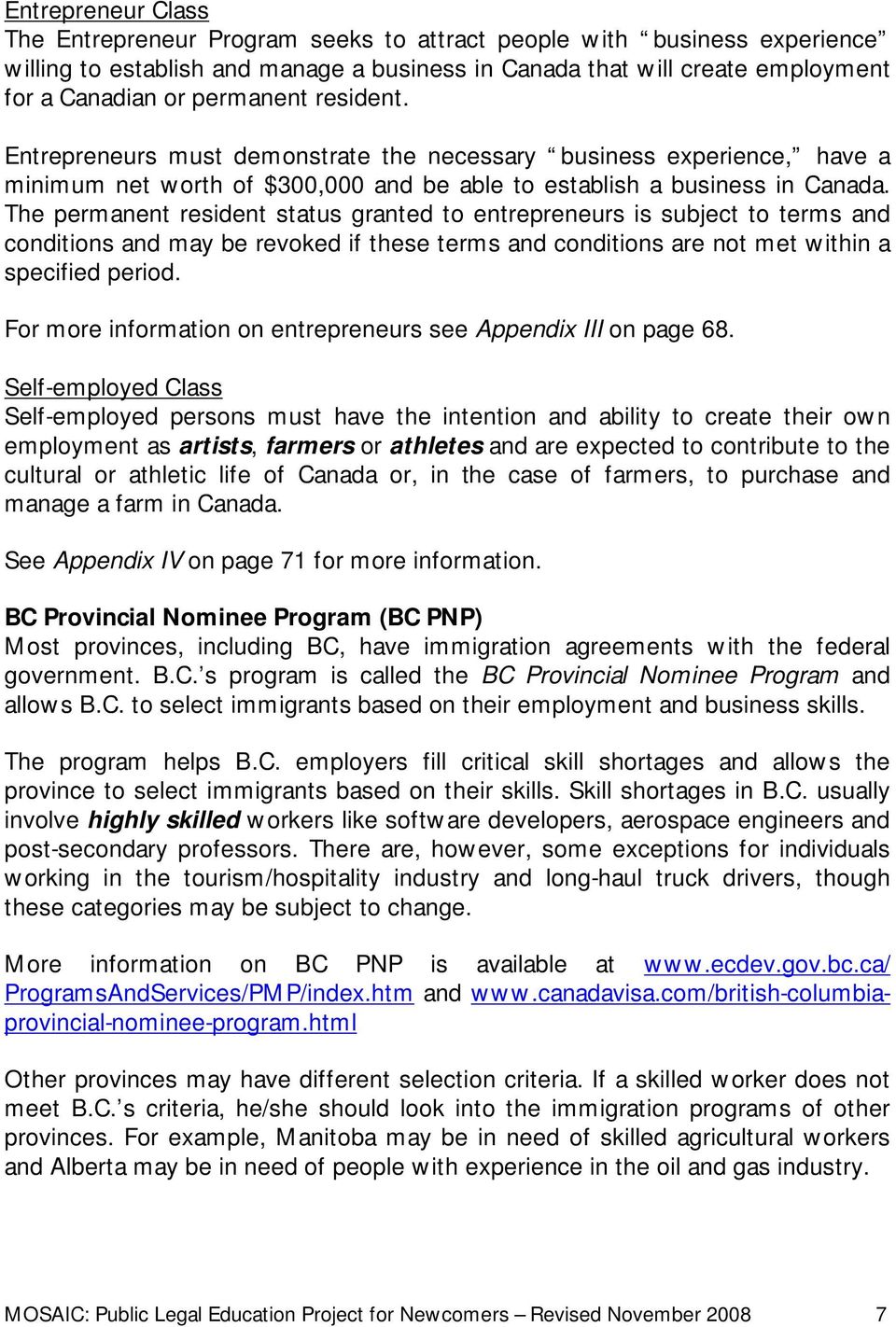
12 Entrepreneur Class The Entrepreneur Program seeks to attract people with business experience willing to establish and manage a business in Canada that will create employment for a Canadian or permanent resident. Entrepreneurs must demonstrate the necessary business experience, have a minimum net worth of $300,000 and be able to establish a business in Canada. The permanent resident status granted to entrepreneurs is subject to terms and conditions and may be revoked if these terms and conditions are not met within a specified period. For more information on entrepreneurs see Appendix III on page 68. Self-employed Class Self-employed persons must have the intention and ability to create their own employment as artists, farmers or athletes and are expected to contribute to the cultural or athletic life of Canada or, in the case of farmers, to purchase and manage a farm in Canada. See Appendix IV on page 71 for more information. BC Provincial Nominee Program (BC PNP) Most provinces, including BC, have immigration agreements with the federal government. B.C. s program is called the BC Provincial Nominee Program and allows B.C. to select immigrants based on their employment and business skills. The program helps B.C. employers fill critical skill shortages and allows the province to select immigrants based on their skills. Skill shortages in B.C. usually involve highly skilled workers like software developers, aerospace engineers and post-secondary professors. There are, however, some exceptions for individuals working in the tourism/hospitality industry and long-haul truck drivers, though these categories may be subject to change. More information on BC PNP is available at ProgramsAndServices/PMP/index.htm and Other provinces may have different selection criteria. If a skilled worker does not meet B.C. s criteria, he/she should look into the immigration programs of other provinces. For example, Manitoba may be in need of skilled agricultural workers and Alberta may be in need of people with experience in the oil and gas industry. MOSAIC: Public Legal Education Project for Newcomers Revised November
13 Similar to the provincial programs for skilled workers, most provinces have immigration programs to attract business immigrants. More information on B.C. s programs to attract entrepreneurs and investors is available at MOSAIC: Public Legal Education Project for Newcomers Revised November

14 Family Class In this section, the person sponsoring a family member will be referred to as the sponsor. The family member being sponsored will be referred to as the applicant. Family Members Living Outside of Canada Canadian citizens and permanent residents can sponsor family members who live outside Canada. Applicants Family members who can be sponsored include: a) Spouse A husband or wife who is at least 16 years old. The marriage must be legally recognized in Canada and in the country where it took place. Canada legally recognizes same-sex marriages. b) Common-law partner A person of the opposite or same gender who has lived with the sponsor for one year or more in a marriage-like relationship. (CIC is very strict about the couple having lived together a minimum of one full year.) Canada legally recognizes same-sex common-law relationships. c) Conjugal partner Person of the opposite or same gender with whom the sponsor has had a conjugal (marriage-like) relationship (a sexual, intimate and exclusive relationship) for at least one year. This type of application will usually only be made when there is a barrier preventing the sponsor and applicant to marry or live together outside of Canada. The couple must explain to CIC why they are not married or living together (e.g. homosexuality is a crime in their home country). Proof of marriage, common-law or conjugal relationship Marriage certificate and wedding invitations Commitment ceremony certificate Pictures of couple Pictures of couple on vacation Joint medical plans, credit cards, bank accounts Joint house, car, furniture Joint membership in organizations or groups MOSAIC: Public Legal Education Project for Newcomers Revised November
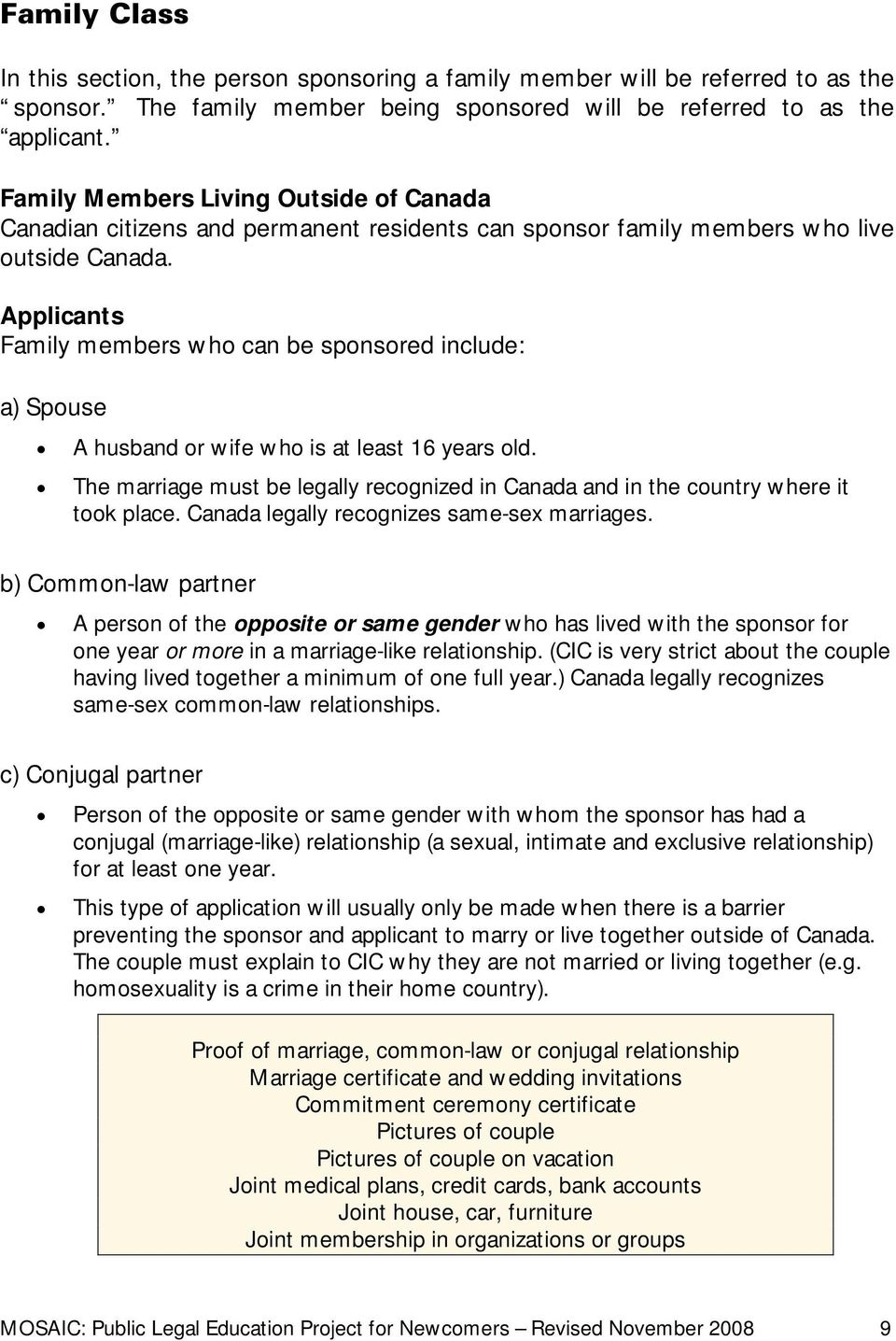
15 Letters from friends and family Shared responsibility for children Long-distance phone bills d) Dependent children A child of the sponsor OR a child of the applicant. Children in the following situations are considered to be dependent: o o o o The child is younger than 22 and is not married or in a common-law relationship. The child is younger than 22, is married or in a common-law relationship AND is going to school or is financially dependent on the parents. The child is older than 22 and, due to a disability, is financially dependent on the parents. The child is older than 22, is a continuous full-time student and is substantially financially supported by the parents. The child must be a student since before the age of 22 and the school must be a recognized post-secondary institution. e) Parents and grandparents f) Brothers, sisters, nieces, nephews and grandchildren Must be orphans under the age of 18. Cannot be married or in a common-law relationship. g) Child under 18 years adopted in Canada h) Only family member If a Canadian citizen or permanent resident in Canada does not have any family members living in Canada or any family members who can be sponsored, he/she may sponsor one family member regardless of age or relationship. Family members that cannot be sponsored include: He/she is under 16 years old. The applicant/sponsor was married to someone else at the time of their marriage. The applicant has lived apart from his/her sponsor for at least one year and either the applicant or sponsor is in a conjugal or common-law relationship with someone else. The sponsor immigrated to Canada and, at the time he/she applied for permanent residence, the family member who should have been included on the application MOSAIC: Public Legal Education Project for Newcomers Revised November

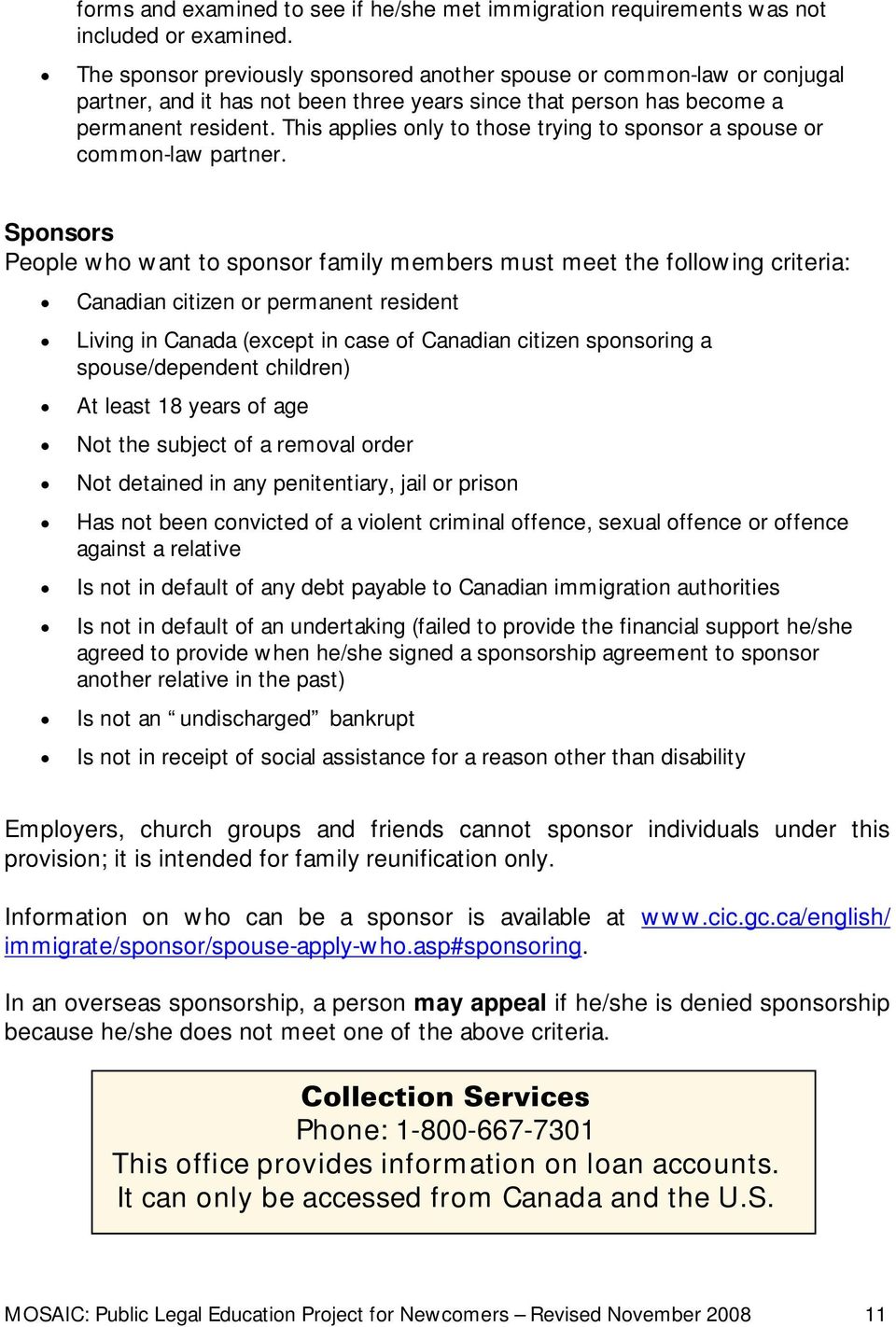
16 forms and examined to see if he/she met immigration requirements was not included or examined. The sponsor previously sponsored another spouse or common-law or conjugal partner, and it has not been three years since that person has become a permanent resident. This applies only to those trying to sponsor a spouse or common-law partner. Sponsors People who want to sponsor family members must meet the following criteria: Canadian citizen or permanent resident Living in Canada (except in case of Canadian citizen sponsoring a spouse/dependent children) At least 18 years of age Not the subject of a removal order Not detained in any penitentiary, jail or prison Has not been convicted of a violent criminal offence, sexual offence or offence against a relative Is not in default of any debt payable to Canadian immigration authorities Is not in default of an undertaking (failed to provide the financial support he/she agreed to provide when he/she signed a sponsorship agreement to sponsor another relative in the past) Is not an undischarged bankrupt Is not in receipt of social assistance for a reason other than disability Employers, church groups and friends cannot sponsor individuals under this provision; it is intended for family reunification only. Information on who can be a sponsor is available at immigrate/sponsor/spouse-apply-who.asp#sponsoring. In an overseas sponsorship, a person may appeal if he/she is denied sponsorship because he/she does not meet one of the above criteria. Collection Services Phone: This office provides information on loan accounts. It can only be accessed from Canada and the U.S. MOSAIC: Public Legal Education Project for Newcomers Revised November
17 In-Canada Spouse/Common-law Category A Canadian citizen or permanent resident can sponsor a spouse or common-law partner who is living with him/her in Canada. Sponsorship of an in-canada spouse or common-law partner may include the person s dependent children. As of February 2005, it is no longer a legal requirement that the spouse or common-law partner have valid temporary status in Canada as a visitor, student or temporary worker. The spouse or common-law partner applicant should always try and maintain his/her temporary status while in Canada. Individuals who are visitors, workers, students and refugee claimants can apply in this category. In certain circumstances, individuals who do not have legal temporary status may also apply in this category. It is important to note that, unlike an overseas sponsorship, the in-canada sponsorship does not have an automatic right of appeal. A proper assessment and weighing of the circumstances should be done before deciding to file an in-canada sponsorship application, particularly if there are any potential admissibility concerns (see pages 21 and 30). Sponsorship Requirements and Responsibilities Undertaking and Sponsorship Agreement Undertaking: Sponsors must sign an agreement, called an undertaking, with the government, in which they agree to provide basic needs for their sponsored family members. Basic needs include food, housing, clothing and medical care. Sponsors must agree to do this for three to 10 years depending on their relationship to the sponsored family member (see next page). THE UNDERTAKING CONTINUES TO EXIST EVEN IF THERE IS A BREAKDOWN IN THE RELATIONSHIP OR CIRCUMSTANCES CHANGE. FOR EXAMPLE, THE UNDERTAKING CONTINUES TO EXIST WHEN A FAMILY MEMBER BECOMES A CANADIAN CITIZEN, A COUPLE GETS A DIVORCE OR A SPONSOR BECOMES UNEMPLOYED. If a sponsored family member uses government programs like welfare, then the sponsor has to repay the government on behalf of the sponsored family member. The sponsor will not be allowed to sponsor other family members until this debt is paid. The B.C. government is currently actively collecting sponsorship defaults. See Appendix VIII on page 80 for more details. MOSAIC: Public Legal Education Project for Newcomers Revised November

18 Sponsored family member Spouse, common-law partner or conjugal partner Dependent child who is younger than 22 Dependent child who is 22 or older Any other person (e.g. father, mother or grandparent) Length of undertaking 3 years from the date the applicant becomes a permanent resident 10 years from the date the child becomes a permanent resident or until the child turns 25, whichever comes first 3 years from the date the child becomes a permanent resident 10 years from the date the applicant becomes a permanent resident Sponsorship Agreement: The sponsor must also sign a sponsorship agreement with the family member, in which the sponsor promises to support the family member and the family member promises to try to become self-supporting. Children under the age of 22 do not have to sign a sponsorship agreement. BC Ministry of Housing and Social Development Sponsorship Default Recovery Program Phone: This office provides information on repaying money for defaults on previous sponsorships. Sponsor s Minimum Income Sponsors must have a minimum income to sponsor most family members (see exception for spouses, common-law partners, conjugal partners and children, below). The level of income required is subject to change. Please check the CIC website for the most current income requirements. MOSAIC: Public Legal Education Project for Newcomers Revised November

19 Family Size Minimum Income Required (Low-income cut-off) Effective until December 31, 2007 Minimum Income 1 $20, $25, $31, $38, $43, $49, $54, 987 Each additional person $5, 598 Source: The minimum income requirement is based on Statistics Canada s Before- Tax Low-Income Cut-Offs and may change from year to year depending on economic measurements like inflation and cost of living. The chart is available on the website of the National Council of Welfare at povertylines/relatedfactsheets.html The minimum income required is the amount listed under cities of 500,000+ REGARDLESS of whether the sponsor lives in a smaller community. Sponsors who do not earn enough money to meet the minimum required income can ask their spouse or common-law partner to be a co-signer for other family members. The income of the spouse or common-law partner is added to the sponsor s income so the minimum income requirement is met. The co-signer will have the same responsibilities as the sponsor, as stated in the undertaking. Sponsors do NOT require a minimum income if they are sponsoring their spouse, common-law partner, conjugal partner and/or children. However, if the sponsor does not meet the minimum income requirement, it is important to show how the applicant will be able to support him/herself in Canada. While the MOSAIC: Public Legal Education Project for Newcomers Revised November
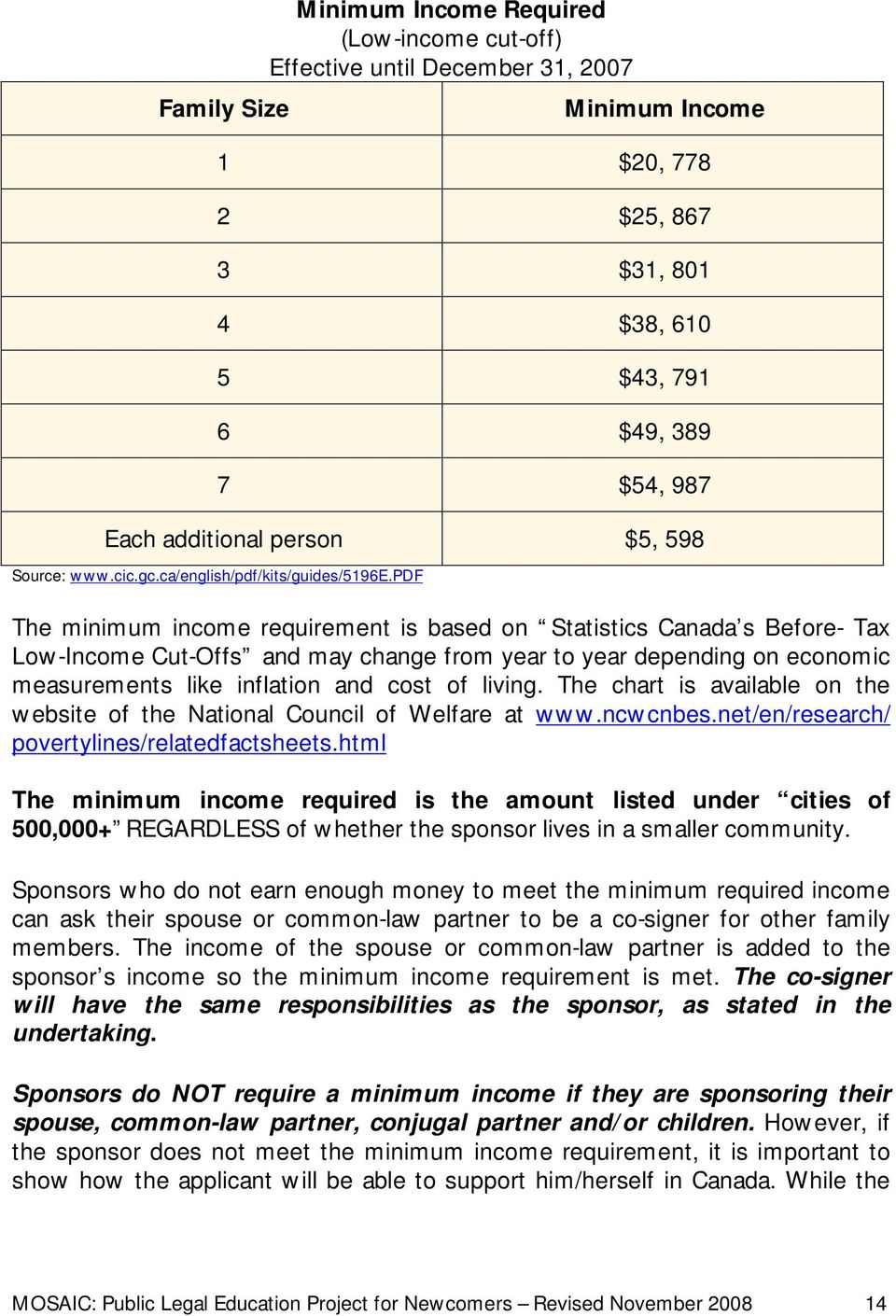
20 sponsorship may be permitted, the applicant can be found inadmissible for financial reasons if he/she is unable or unwilling to support him/herself. Sponsorship Breakdown Sponsorship breakdowns occur when sponsors cannot or will not provide the basic needs of their sponsored family members and the family members cannot support themselves. Examples of Sponsorship Breakdown Sponsor does not have enough money to support the sponsored family member. Sponsor allows the sponsored family member to stay in the home, but does not provide food or clothing. Sponsor divorces the sponsored spouse and wants him/her to leave the home. Sponsor hurts the family member. LSS publishes a booklet entitled Sponsorship Breakdown in Chinese, English, Korean, Punjabi, Spanish and Vietnamese and available at publications/pub.aspx?p_id=113. If the Sponsor is Hurting or Scaring the Family Member Family members should call the police at 911 if they are in immediate danger. Victims of abuse, including women, children, men and seniors, can stay at transition houses or shelters, which are safe and free. The police can take the victim to a shelter. CIC WILL NOT DEPORT SPONSORED FAMILY MEMBERS BECAUSE A SPONSORSHIP BREAKS DOWN IF THEY ARE ALREADY PERMANENT RESIDENTS, CANADIAN CITIZENS or refugee claimants proceeding with their own case. SPONSORED FAMILY MEMBERS WILL NOT LOSE THEIR PERMANENT RESIDENT STATUS IF THEY RECEIVE WELFARE. SPONSORS CANNOT MAKE SPONSORED FAMILY MEMBERS LEAVE CANADA. VictimLINK ( ): A 24-hour, multilingual, province-wide service for victims of family/sexual violence and other crimes. Call to find a shelter and other MOSAIC: Public Legal Education Project for Newcomers Revised November
21 resources. Hearing impaired service available via TTY at or call the Telus Relay Service collect at 711. Multicultural Victim Services Program at MOSAIC ( ): Provides assistance and information to all victims of crime (men and women). Service can be provided in other languages. The module Family Law has information on separation, abuse and child custody. Inadmissibility of Family Members It is important to remember that, in a family class sponsorship, there are actually two applications being assessed: 1. The application by a Canadian citizen or permanent resident to be a sponsor, AND 2. The application by the sponsored family member to become a permanent resident in Canada Even where the sponsor qualifies, the sponsored family member s application for permanent residence may be turned down if the applicant is inadmissible to Canada. An applicant may be inadmissible to Canada on the basis of Security Violating human or international rights Criminality Health grounds (i.e. his/her health condition is likely to be a danger to public health or safety) Misrepresenting or withholding material facts Financial reasons (i.e. he/she is unable or unwilling to support him/herself in Canada without social assistance (this does not apply where the sponsor meets the minimum income requirement)) In addition, family members (other than a spouse, common-law partner, conjugal partner and dependent child) may also be inadmissible if their health condition is expected to cause excessive demand on health or social services. A person can appeal if he/she was approved as a sponsor but the application of the family member was refused; however, there are limitations as to what can be appealed. The sponsor cannot appeal if: MOSAIC: Public Legal Education Project for Newcomers Revised November
22 He/she withdrew or abandoned the sponsorship application The applicant for permanent residence is not eligible to apply as the sponsor s spouse, partner or dependent child The application was refused because he/she provided false information (unless the applicant was a spouse, common-law partner or dependent child) The applicant was refused because of a serious criminal offence The application was refused for security reasons, organized crime or human rights violations If you do not qualify to sponsor your spouse, partner or dependent child in the family class, your spouse may apply to remain in Canada on humanitarian and compassionate grounds (see page 22). For more information on inadmissibility see page 25. Factors that can Slow Down Processing Incomplete or unsigned application forms Missing documents Incorrect or incomplete address Unclear photocopies of documents No certified English or French translations of documents Investigation of sponsors by CIC Verification of information and documents provided A medical condition that requires additional tests or consultations A criminal or security problem Family situations such as divorce, custody or maintenance disputes CIC errors or backlogs MOSAIC: Public Legal Education Project for Newcomers Revised November
23 Temporary Residents Temporary residents are people who come to Canada for a limited time to visit, work or study. Visas and Permits Visas and permits are NOT the same. A visa allows a foreign national to come into Canada. A permit, on the other hand, allows a foreign national to do something in particular while in Canada. For example, a foreign national who wants to study in Canada may need a visa to come to Canada (some countries are visa exempt) and a study permit to actually attend school in Canada. There are some exceptions where visitors can study in Canada without a study permit. Visitor Visa Generally, visitors need a valid passport that will not expire until they leave Canada. Also, visitors must apply for a visa to travel to Canada unless they are from a visaexempt country (see Appendix VI on page 74). Canada does not pay for hospital or medical services for visitors. Visitors should buy travel insurance. If visitors want to stay longer, they must apply to extend their temporary resident status before their status expires. Usually, individuals cannot come to Canada as visitors and then convert their visitor visa into a work permit. These individuals will likely have to apply for a work permit from outside of Canada. Genuine Visitors Visitors must satisfy an immigration officer that they are real visitors who intend to leave Canada at the end of their visit. For example, they can show they have strong ties to their home country (such as family, work and property). Visitors should have a credible reason for wanting to visit Canada. CIC may not believe that a person is a genuine visitor if the person has strong ties to family in Canada and no family in his/her home country. Visitors must be able to show they can and will support themselves and their accompanying family members without working while in Canada. MOSAIC: Public Legal Education Project for Newcomers Revised November
24 Visitors must also show they are able and willing to leave Canada at the end of their visit (valid passport, return plane ticket, etc.). Visitors may need a medical examination and a letter of invitation from someone who lives in Canada. Work Permit In addition to applying for a visa (if not from a visa-exempt country), a person needs to apply for a work permit if he/she intends to work in Canada temporarily. Foreign workers need work permits and must leave Canada when their temporary resident status expires. In most cases, foreign workers need a job offer from an employer in order to obtain a work permit. With some exceptions, foreign workers must apply for work permits from outside of Canada. Most work permits are for one year. Usually, foreign workers can apply from within Canada to extend their work permits (if done before the original permit expires). The employer and/or foreign worker should seek legal advice. Student Permit Foreign students need a student permit for any studies that are longer than six months If students have valid study permits, they can: a) Work on campus at their college or university b) Apply to renew their study permit from within Canada if they want to continue studying in Canada To be eligible to study in Canada, the person applying for a student permit must: Have been accepted by a school, college, university or other educational institution in Canada Prove he/she has enough money to pay for his/her: o o o tuition fees living expenses return transportation Be a law-abiding citizen with no criminal record and not be a risk to the security of Canada Be in good health and willing to complete a medical examination, if necessary MOSAIC: Public Legal Education Project for Newcomers Revised November
25 Satisfy an immigration officer that he/she will leave Canada when he/she has completed his/her studies Staying Permanently People usually CANNOT come to Canada as temporary residents and automatically convert their temporary status into permanent residence status. In most cases, they must apply for permanent resident status outside of Canada. They can submit their permanent resident application to a visa post abroad while they continue to study or work in Canada. However, qualified temporary residents may be able to apply for permanent resident status inside Canada under the Canadian Experience Class, provided they meet specific criteria. This new immigration class was implemented in 2008 for certain skilled temporary workers and international students who possess a Canadian education and Canadian work experience. Canadian Experience Class (CEC) Foreign nationals who are international students and temporary foreign workers are now able to apply for permanent residence inside of Canada. International students must have: Temporary resident status when they submit their application under the CEC Twelve months full-time (or part-time equivalent) work experience in a skilled job within 24 months of applying in the CEC Obtained their work experience after obtaining a diploma/degree in a postsecondary program of studies of at least two years (one year if it is a postgraduate degree) English/French language proficiency Foreign workers can also apply in the CEC if they have: Temporary resident status when they submit their application under the CEC Worked full-time (or part-time equivalent) at a skilled job for at least 24 months within 36 months of applying English/French language proficiency Live-in caregivers Live-in caregivers provide care for children, elderly people or people with disabilities in the home of the person being cared for (i.e. the employer s house). MOSAIC: Public Legal Education Project for Newcomers Revised November
26 A person interested in this program must first get a temporary work permit that allows him/her to work in Canada as a live-in caregiver. After working in Canada for two years, the live-in caregiver may apply for permanent resident status from within Canada. To get a temporary work permit, live-in caregivers must meet the following conditions: Successful completion of high school (or equivalent) At least six months of training or at least a year of paid work experience in a related field Must be able to speak, read and understand sufficient English or French to communicate effectively in an unsupervised setting Must have an employment contract with their future employer Must have a work permit before entering Canada CIC provides detailed information about the Live-in Caregiver Program at or see Appendix V on page 72 for more information on live-in caregivers. Legal advice, advocacy and information for live-in caregivers available at the West Coast Domestic Workers Association: Assistance for Victims of Human Trafficking Victims of human trafficking should visit their closest CIC office. If they need immediate help they should contact the police. Victims of human trafficking may be eligible for a 180-day temporary resident permit that can be renewed depending on the circumstances. For more information visit MOSAIC: Public Legal Education Project for Newcomers Revised November
27 Humanitarian and Compassionate Application At any time an individual can apply to stay in Canada for humanitarian and compassionate reasons (often called an H&C application), even if he/she already lives in Canada and is not eligible to apply for permanent residence status. Application Considerations H&C applications are for people who would suffer hardship if they had to leave Canada and apply for permanent resident status from abroad. The hardship must be unusual, excessive or undeserved in nature. Applicants can present whatever facts they believe are relevant. An H&C application is assessed based on the person s establishment in Canada and/or the risk if he/she were forced to leave Canada. Immigration officers will consider the hardship to the applicant and/or others (e.g. Canadian family members) if the applicant was forced to leave Canada. For example, Canadian citizens or permanent residents may face excessive hardship if the H&C applicant is the sole provider for his/her family or owns a business employing several Canadian citizens or permanent residents. A marriage or common-law relationship with a Canadian person does NOT automatically result in a positive H&C decision. There is no legal right for a spouse or common-law partner to stay in Canada if he/she does not have status. Individuals with Canadian-born children may have an H&C case, as CIC officers must consider what is best for the children. It is not, however, a guarantee that they will be able to stay in Canada. Establishment in Canada An important part of an H&C application is the person s life in Canada. CIC looks at the person s employment history, savings, language skills, friends and family and involvement in the community. CIC will not assess the person s potential for establishment. When deciding on a person s establishment in Canada, CIC will consider such things as: How long was he/she in Canada? Does he/she have a job? What is the importance of the job and how long has he/she done it? MOSAIC: Public Legal Education Project for Newcomers Revised November
28 How are his/her language skills and did he/she try to improve? Does he/she have an education and/or skills? Were there improvements while he/she was in Canada? Has he/she depended on welfare in Canada? Does he/she have family in Canada? Is he/she married to a Canadian citizen or permanent resident? Does he/she have Canadian-born children? How old are they? Does he/she have children in his/her home country? What is his/her community involvement, religious or non- religious? What is the hardship in returning? Who will miss him/her and what will make it difficult to wait in the home country? The applicant should include pictures and letters written by other people (e.g. neighbours and co-workers) with his/her application. Letters: Should introduce the writer, explain how he/she knows the applicant, give reasons why the applicant would be good citizen (e.g. gives back to the community and is hard-working) and provide contact information in case CIC wants to ask more questions. Pictures: Should show family and community events. Sponsorship While an H&C application does not include any formal sponsorship, it can be helpful to include a sponsorship agreement under the family class category to show that one family member will financially support the other in Canada. Process H&C applications are processed in two stages. First, an immigration officer will determine if there is sufficient hardship to grant preliminary approval to the applicant. If preliminary approval is granted, CIC will go on to assess the applicant s medical, criminal and security admissibility. A preliminary approval of the H&C application IS NOT a guarantee of final acceptance. If an applicant believes he/she may be inadmissible to Canada, he/she should also apply to CIC for a waiver of that inadmissibility. Always seek legal advice in these circumstances. MOSAIC: Public Legal Education Project for Newcomers Revised November
29 Part II Inadmissibility and Removal Orders The Immigration and Refugee Protection Act lists grounds that may make permanent residents and/or foreign nationals inadmissible to Canada. People who are inadmissible are not allowed to come into or remain in Canada as temporary residents, immigrants or, in some cases, refugees. Inadmissible people who are already in Canada may be deported. People who may be inadmissible should seek legal advice. MOSAIC: Public Legal Education Project for Newcomers Revised November
30 Inadmissibility Permanent residents and foreign nationals may be inadmissible due to security concerns, human rights violations, serious criminality, organized crime, financial reasons or misrepresentation. Foreign nationals may be inadmissible due to criminality, health grounds, financial reasons or an inadmissible family member. Indictable and Summary Offences There will be references to indictable offences and summary offences within inadmissibility discussion. A summary offence is a less serious offence than an indictable offence. The procedure and punishment for summary offences tend to be less onerous. An indictable offence is more serious than a summary offence. Murder and armed robbery are examples of indictable offences. These crimes are usually tried by federally appointed judges and carry heavy sentences. Permanent Residents and Foreign Nationals Permanent residents and foreign nationals will be inadmissible if they are involved in certain activities. These individuals will not be allowed into Canada as temporary residents, immigrants or refugees. If they are in Canada already they may be deported. Grounds for inadmissibility for foreign nationals AND permanent residents include: Security Permanent residents and foreign nationals are inadmissible if CIC believes they are a danger to Canadian society. For example, the person is a spy or terrorist, or commits acts of dangerous violence. Members of organizations involved in any of these actions are also inadmissible. The Immigration and Refugee Protection Act also contains provisions in which someone CIC believes to be inadmissible on security grounds can apply for ministerial relief and ask the inadmissibility be waived. Human or International Rights Violations Permanent residents and foreign nationals are inadmissible if they committed war crimes or crimes against humanity. MOSAIC: Public Legal Education Project for Newcomers Revised November
31 People will also be inadmissible if they were senior government officials in a government that committed acts of terrorism, gross human rights violations, genocide, war crimes or crimes against humanity. Serious Criminality Permanent residents and foreign nationals are inadmissible if they have been convicted of a serious offence, either inside or outside of Canada. In Canada, an offence is considered serious when it is punishable with a prison sentence of 10 years or more (even if the person does not serve the full 10 years) OR if the person was sentenced to six months or longer in a federal prison. If the person committed an offence outside of Canada, CIC will determine if the activity is punishable under Canadian law and, if so, what the punishment would have been. Organized Criminality Permanent residents and foreign nationals are inadmissible if they are involved with organized crime, which is defined as a pattern of criminal activity planned and organized by a number of persons acting in concert. It includes people smuggling, trafficking in persons and money laundering. Misrepresentation Permanent residents and foreign nationals are inadmissible if they lied to CIC, either by giving false information or not providing all relevant information. If a sponsor misrepresented him/herself, then the sponsored family members may be inadmissible as well. Non-compliance Permanent residents and foreign nationals are inadmissible if they did not comply with the Immigration and Refugee Protection Act. Foreign Nationals In addition to the grounds discussed above, foreign nationals may be inadmissible for a number of other reasons, including criminality, health, finances and inadmissible family members. Criminality Foreign nationals are inadmissible if they committed an indictable offence OR two summary offences in Canada. MOSAIC: Public Legal Education Project for Newcomers Revised November
32 They are also inadmissible if they committed crimes outside of Canada that, if committed in Canada, would be considered an indictable offence or two summary offences. Health Grounds Foreign nationals are inadmissible if they are a danger to public health or safety, or will put an excessive demand on health or social services. Spouses, common-law partners and children within the family class, refugees and protected persons may be inadmissible only if their health condition is a danger to public health or safety. Financial Reasons Foreign nationals are inadmissible for financial reasons if they are unable or unwilling to support themselves and their dependents without relying on welfare. Inadmissible Family Member A foreign national is inadmissible if his/her accompanying family member is inadmissible. This ground for inadmissibility does NOT apply to protected persons. Overcoming Inadmissibility People who are inadmissible due to criminality may be able to overcome their inadmissibility through rehabilitation. Rehabilitation means that they lead a stable lifestyle and are unlikely to be involved in any further criminal activity. A person can apply for rehabilitation or will be automatically deemed rehabilitated after a certain length of time. Offences Outside of Canada People who were convicted of one criminal offence outside of Canada may overcome criminal inadmissibility by applying for rehabilitation. If a person is deemed to have been rehabilitated, he/she does not need to apply for rehabilitation. People are deemed to have been rehabilitated if 10 years have passed since they completed the sentence or committed the offence, or if the offence is one that would, in Canada, be an indictable offence punishable by a maximum term of imprisonment of less than 10 years. If the offence is one that, in Canada, would be a summary offence, and if they were convicted for two or more such offences, that period is five years after the sentence was served or to be served. MOSAIC: Public Legal Education Project for Newcomers Revised November
33 Offences in Canada People who have criminal convictions in Canada must seek a pardon from the National Parole Board of Canada before they will be admissible to Canada. For more information on rehabilitation see the CIC guide Rehabilitation for Persons Who are Inadmissible to Canada Because of Past Criminal Activity available at MOSAIC: Public Legal Education Project for Newcomers Revised November
34 Removal Orders People who have been issued a removal order may be required to leave Canada. Removal orders may be issued to foreign nationals, unsuccessful refugee claimants, permanent residents who do not comply with their immigration requirements and permanent residents who are inadmissible. The individual will be informed of the reasons for the removal and given a copy of the order. Family members in Canada who are dependents (spouse and/or children) may be included in the removal order if they are not Canadian citizens or permanent residents 19 years or older. There are three types of removal orders: Exclusion Order The person cannot return to Canada for one year or, in some cases of misrepresentation, two years. However, the person can try to get permission from CIC to return sooner. Departure Order The person must leave Canada within 30 days after the order becomes effective and must confirm his/her departure with CIC, as well as obtain a certificate of departure. The person can return to Canada without restrictions. A departure order automatically becomes a deportation order if the person does not leave within 30 days of it becoming effective or does not confirm his/her departure with the Canadian Border Services Agency (CBSA). All refugee claimants are issued conditional departure orders as soon as they make a refugee claim. Deportation Order The person is permanently barred from returning to Canada. The person may not return to Canada unless he/she receives written permission from CIC. An escort may be assigned if it is believed the person will not obey the removal order. The RCMP or a medical officer may escort the person out of Canada if the person is considered very dangerous or a threat to the health or safety of other travellers. Refugee Claimants All refugee claimants are given conditional departure orders as soon as they make a refugee claim. If the claim is accepted then the removal order is cancelled. If the MOSAIC: Public Legal Education Project for Newcomers Revised November
35 claim is denied, withdrawn or abandoned then the removal order goes into effect. The person then has 30 days to leave Canada. If he/she does not leave Canada, the departure order will become a deportation order. Please note: Removal orders will be postponed when a person applies for judicial review. Appeal Permanent residents and protected persons can appeal removal orders. The Immigration Appeal Division of the Immigration and Refugee Board hears appeals. A person cannot be removed from Canada if he/she has appealed a removal order and the appeal has not yet been decided. People who cannot appeal removal orders include those who, Are security threats Violated human or international rights Received a sentence of at least two years for criminal activity Are or have been involved in organized crime Made a misrepresentation, except in cases where the person is the sponsor s spouse, common-law partner or child Countries to which removal orders are currently NOT enforced are (this list is subject to change): Afghanistan Burundi Democratic Republic of Congo Haiti Iraq Liberia Rwanda Zimbabwe MOSAIC: Public Legal Education Project for Newcomers Revised November
36 Part III Refugees MOSAIC: Public Legal Education Project for Newcomers Revised November
37 United Nations In 1950, the U.N. General Assembly established the United Nations High Commissioner for Refugees (UNHCR) as one of several attempts by the international community to provide protection and assistance to refugees. In 1951, the United Nations created the Geneva Convention Relating to the Status of Refugees. This document defines refugees and explains the rights of refugees and the duties of countries. The Convention was created to prevent refugees from being sent back to a country where they would face persecution. If a person fits within the Convention s definition of a refugee then he/she is a Convention Refugee. More information on the UNHCR and the Convention can be found at MOSAIC: Public Legal Education Project for Newcomers Revised November
38 Protected Persons A protected person is either a Person in Need of Protection or a Convention Refugee. All protected persons get refugee protection in Canada. Persons in Need of Protection Persons in need of protection are people who would face danger if they were to return to their home country. The danger includes torture, threat to life or risk of cruel and unusual treatment or punishment. The Immigration and Refugee Protection Act defines a person in need of protection as: A person in Canada whose removal to his/her country or countries of nationality or, if he/she does not have a country of nationality, his/her country of former habitual residence, would subject him/her personally a) to a danger, believed on substantial grounds to exist, of torture within the meaning of Article 1 of the Convention Against Torture; or b) to a risk to his/her life or to a risk of cruel and unusual treatment or punishment if (i) the person is unable or, because of that risk, unwilling to avail him/herself of the protection of that country, (ii) the risk would be faced by the person in every part of that country and is not faced generally by other individuals in or from that country, (iii) the risk is not inherent or incidental to lawful sanctions, unless imposed in disregard of accepted international standards, and (iv) the risk is not caused by the inability of that country to provide adequate health or medical care. In other words, persons in need of protection in Canada are afraid to return home because of: a risk of torture a risk of life, or a risk of cruel and unusual treatment or punishment. Convention Refugees A Convention refugee is a person who fits the definition of refugee as defined in the United Nations Convention Relating to the Status of Refugees. MOSAIC: Public Legal Education Project for Newcomers Revised November
39 Canada s Immigration and Refugee Protection Act defines a convention refugee as: a person who, by reason of a well-founded fear of persecution for reasons of race, religion, nationality, membership in a particular social group or political opinion, (a) is outside each of his/her countries of nationality and is unable or, by reason of that fear, unwilling to avail him/herself of the protection of each of those countries; or (b) not having a country of nationality, is outside the country of his/her former habitual residence and is unable or, by reason of that fear, unwilling to return to that country. A person asking for Convention Refugee status or protection in Canada is called a Refugee Claimant. There are two types of refugees. Some refugees are selected and sponsored by the Canadian government from outside Canada. They fall within the Refugee and Humanitarian Resettlement Program. Most refugees, however, arrive in Canada on their own and claim refugee status at the border, airport or immigration office. Refugee and Humanitarian Resettlement Program CIC selects people from refugee camps around the world to move to Canada. These refugees receive money for travel to Canada, housing and basic household items. They also receive welfare for one year after they arrive in Canada. People in this program have to go through medical, security and criminal screenings. Resettlement is the legal process of bringing a refugee to Canada to live as a permanent resident. The CIC relies on the United Nations High Commissioner for Refugees (UNHCR), other referral organizations and private sponsorship groups to identify and refer refugees for resettlement in Canada. There are three refugee classes: Convention Refugees Abroad Class: A person is outside of his/her home country or where he/she normally lives and cannot return to that country because there is a well-founded fear that he/she will be persecuted because of race, religion, political opinion, nationality or membership in a social group (e.g. women or those who have a different sexual orientation) Country of Asylum Class: People who are in a refugee-like situation but do not qualify as Convention refugees, are outside of their home country or where they normally live, have been and continue to be seriously and personally affected by a MOSAIC: Public Legal Education Project for Newcomers Revised November
40 conflict or violations of human rights, cannot find an adequate solution to the problem within a reasonable time and will be privately sponsored or able to support themselves. Source Country Class: Person lives in a home country labelled as a source country for refugees and lives in a country that he/she normally lives in. For more information refer to Refugee Claimants Most refugees travel to Canada on their own to make a refugee protection claim at the border, airport or CIC office in Canada. Each family member (including children) must make a claim. The claims are usually processed together. However, a family member can ask that his/her claim be dealt with separately (called severing the claim ) if he/she does not want his/her family members to hear his/her story. Refugee Claim Process 3. Person makes a refugee claim at the airport, border or CIC office. A CIC officer interviews the person to find out if he/she is eligible to make a claim. The officer will take notes during the interview to later use at the hearing, to check for consistency. 4. Within three days, the CIC officer decides if the claim is eligible to be heard by the Immigration and Refugee Board. See page 37 for more information on eligibility. The refugee claimant is given a conditional departure order (see page 29). 5. If the claim is not eligible, the person may be removed from Canada. See page 29 for information on removal orders. 6. If the claim is eligible, CIC sends it to the IRB for a hearing. 7. The claimant fills out a Personal Information Form (PIF), which must be completed and given to the IRB within 28 days. THE PIF IS VERY IMPORTANT The PIF asks questions about the claimant s identity, family, work history, military service and other personal information. It asks the claimant to state why he/she fears returning to his/her home country. The refugee claimant should include ALL relevant information. The decision of the IRB will be based on the information in the PIF, the claimant s testimony and evidence. MOSAIC: Public Legal Education Project for Newcomers Revised November
41 8. The claimant sends in documents that support his/her claim, e.g. a doctor s report, newspaper articles or reports from human rights agencies. 9. The claimant has an interview or hearing at the IRB and the IRB decides if he/she is a Convention Refugee or Person In Need of Protection. 10. If the decision is yes then the person has protected person status. He/she can stay in Canada and apply for permanent resident status (to be done within 180 days). The person can include his/her dependents inside and outside of Canada in his/her application for permanent resident status. 11. If the decision is no the person can apply to federal court to have the decision reviewed. See page 40 for more information. 12. If the person does not apply to federal court or the court refuses the application, then the person may be removed from Canada. See page 31 for more information on removal orders. 13. The decision may be appealed to the Federal Court of Appeal only if the judge who made the decision states that a serious question of general importance is involved. 14. Before removal, the person can apply for a Pre-removal Risk Assessment. See page 39 for more information. Legal Counsel Refugee claimants have the right to be represented, at their own expense, by legal counsel during the claim process. Limited legal aid funding may be available for refugee claimants who cannot afford a lawyer. If a claimant is not represented by a lawyer, then a friend, relative or other person can act as his/her counsel at the hearing; however it is always strongly advisable to have a lawyer represent the claimant at a hearing. Eligibility of Refugee Claimant To decide if a person is eligible to make a refugee claim, CIC officers ask claimants about their identity, background and the way they travelled to Canada. Officers may also ask claimants why they are asking for protection in Canada. Based on this information, officers will decide if the person is eligible to make a refugee claim. People can be ineligible due to security concerns, human rights violations, serious criminality, organized crime or misrepresentation (see page 33). In addition, people cannot make a refugee claim if they made a refugee claim in Canada before and their claim was rejected, abandoned, withdrawn or ineligible. They are also ineligible if they have refugee protection in another country and can return to that country. MOSAIC: Public Legal Education Project for Newcomers Revised November
42 Safe Third Country Agreement with the U.S. The Immigration and Refugee Protection Act states that people who come to Canada from or through a recognized safe third country where they could have claimed refugee protection are ineligible to make a refugee claim in Canada. The Safe Third Country Agreement is an agreement between Canada and the United States. Under the agreement, persons seeking refugee protection must make a claim in the first country they arrive in unless they qualify for an exception to the agreement. Refugee claimants arriving from the U.S. may be allowed to pursue their refugee claims in Canada if they meet an exception under the agreement. More information is available at Immigration and Refugee Board (IRB) The Immigration and Refugee Board (IRB) is separate from CIC. The IRB hears and decides refugee claims. Refugee claimants can request to have an expedited hearing. However, these are not granted often and most refugee claimants will have a full hearing at the IRB. At the hearing, the claimant s PIF and all other evidence will be reviewed. The claimant will also give oral testimony. An interpreter will be at the hearing if needed. The hearing can be held in either French or English. Most hearings last half a day (the letter from the IRB will state how long the hearing will be). The refugee claimant can request a longer hearing. The IRB may tell the claimant the decision at the end of the hearing or mail it to the claimant later. The decision may take a few days or, if it is a complicated case, several months. Rejected Refugee Claim When the IRB rejects a claim, it sends a letter to the claimant. The letter explains why the claim was not accepted. The refugee claimant can apply for a judicial review within 15 days after receiving the decision of IRB. A judicial review is a legal process and the claimant should speak with a lawyer. If the person does not apply for a judicial review, he/she will be scheduled for an interview with the removal department of CIC. CIC may also give him/her a Preremoval Risk Assessment (PRRA) form. See page 39 for more information on the PRRA. MOSAIC: Public Legal Education Project for Newcomers Revised November
43 When a person has a rejected refugee claim, he/she cannot make another refugee claim in Canada. If a failed refugee claimant does not apply for a judicial review or a PRRA he/she should leave Canada within 30 days. If he/she does not leave within 30 days, his/her departure order automatically becomes a deportation order and he/she will be permanently barred from returned to Canada. See page 29 for more information on removal orders. Change of Address If claimants move they must report their new address to the IRB and CIC. If they do not report the change of address, they will not get important letters from the IRB or CIC, which could lead to their claim being declared abandoned. Claimants can request that their file be transferred. For example, if a claimant moves to Vancouver from Toronto, he/she can ask that his/her hearing be held in Vancouver instead of Toronto. HOWEVER, this must be done well in advance. If the person does not give enough notice, the claim may be declared abandoned. CAUTION: The transfer request may not be granted. MOSAIC: Public Legal Education Project for Newcomers Revised November
44 Pre-removal Risk Assessment (PRRA) A PRRA looks at the risks a person would face if he/she were to be returned to his/her home country. CIC looks at the risk of persecution, torture, cruel and unusual treatment or punishment and the risk to life. In most circumstances, when a person s PRRA is successful, he/she gets refugee protection and can apply for permanent resident status in Canada. He/she must have identity documents and pass criminal and security checks. People who are eligible for a PRRA will be given the application at their interview with the removal department of CIC. Generally, they will get the application when they are removal ready, which means they have a valid passport or travel document and a removal order. In some situations, people can request and make a PRRA application themselves. If a person was given a PRRA application, his/her removal order is postponed during the assessment. The removal order goes back into effect when (a) the person does not apply for the assessment or applies too late, (b) the application is refused or (c) the person withdraws the application. The person has 15 days to send in the application form and another 15 days after that to send in evidence. Applicants must show that: (a) They are not able to get protection from the police and/or other authorities in their home country. (b) The risk they face affects them personally and is not faced by all other people in the country (e.g. the risk is not due to a famine or civil war). (c) The risk exists in every part of the country. They cannot move to another part of the country to be safe. (d) The risk is not punishment for a crime they committed UNLESS the punishment for the crime violates international standards (e.g. torture). (e) The risk is not due to the country s lack of medical care (e.g. the person has AIDS and his/her home country does not have new medications). Only new evidence will be considered for a PRRA. New evidence is information that was not available at the refugee hearing, e.g. events that happened in the home country after the IRB hearing. If the person did not appear before the IRB, MOSAIC: Public Legal Education Project for Newcomers Revised November
45 then all information and evidence can be submitted. Evidence can include newspaper articles, human rights reports, legal documents, medical and psychological reports and expert opinions. A person can apply for a judicial review if his/her PRRA was unsuccessful. If the judicial review is dismissed or unsuccessful, the person will have to leave Canada. Risk to Canada The PRRA process for people who are considered a risk to Canada is different. These are people who are not allowed to make a refugee claim due to security reasons, serious crimes or human rights violations. In these situations, the risk the person faces if he/she is returned to his/her home country is balanced with the possible risk Canadian society faces if he/she stays in Canada. If he/she is allowed to stay in Canada, he/she may be removed when the situation in his/her home country changes. Unlike other PRRA applicants, he/she cannot apply for permanent resident status. People Who Cannot Apply for PRRA Some people are not eligible for PRRA, including: People going through an extradition process. Extraditions return people to another country to stand trial for a crime they committed in that country. People who are recognized as a Convention Refugee by a country to which they can return. Repeat refugee claimants returning to Canada less than six months after leaving Canada and after the claim was refused, withdrawn, abandoned or ineligible. People who came to Canada from a safe third country. If the PRRA application is refused, CBSA will want to remove the person immediately. He/she should contact a lawyer and can appeal the decision to the federal court and try to have the court judicially review it. However, the person can still be removed from Canada unless he/she can get the court to stay (postpone) the removal until it decides to review the decision. Community Legal Education Ontario (CLEO) publishes pamphlets on the PRRA. Visit MOSAIC: Public Legal Education Project for Newcomers Revised November
46 Sponsoring Refugees Overseas Organizations and individuals can sponsor refugees who are abroad and seeking resettlement in Canada. CIC can match refugees with groups interested in sponsoring refugees. Sponsors must be Canadian citizens or permanent residents and at least 18 years old. Refugee claimants who are already in Canada do not qualify for this type of sponsorship. Sponsoring groups must support the refugees for one year. This support includes housing, clothing and food. In special cases, the sponsorship period can be extended for up to three years. More information on sponsoring refugees is available on CIC s website at Sponsorship Agreement Holders A number of organizations and groups across Canada have pre-approved sponsorship agreements with the government of Canada to support refugees from abroad in settling in Canada. Most of these are religious, ethnic, community or service organizations groups. Groups of Five A group of five or more people can sponsor refugees. Each member of the group must be at least 18 years old, live in the community where the refugee will live and provide support. Community Sponsor This sponsorship is for organizations and businesses that have money to support a refugee. There must be people within this group who live in the community where the refugee will live. Joint Assistance Sponsorships (JAS) For this type of sponsorship, the government works together with Canadian groups (sponsorship agreement holders) to sponsor and help resettle a refugee with special needs. The government will provide the money and the people will provide emotional support. Refugees with special needs usually require one year of support to resettle in Canada. People who can be considered for a JAS include women at risk, victims of trauma or torture, large families, people who have been in refugee camps for a long time and people with medical conditions. MOSAIC: Public Legal Education Project for Newcomers Revised November
47 Refugees under the JAS program receive income assistance from the government, which usually lasts for 24 months, depending on the circumstances. Government-assisted Refugee Program Government-assisted refugees are Convention Refugees Abroad resettlement in Canada is entirely supported by the Government of Canada, with support coming from CIC-supported non-governmental agencies. The support usually lasts up to one year from the date of arrival. Urgent Protection Program (UPP) The Urgent Protection Program (UPP) ensures Canada is able to respond to urgent requests by refugees facing the threat of being returned home or direct threats to their lives. In 1988, Canada created the Women at Risk Program for refugee women in desperate circumstances. These women do not have family or friends to support or protect them and they may be at risk of rape or other violence. More information on the Government-assisted Refugee Program is available at MOSAIC: Public Legal Education Project for Newcomers Revised November
48 Employment, Education and Health Services Refugee claimants have certain rights and may have access to Canadian services. Social Insurance Number (SIN) Refugee claimants can apply for a SIN a nine-digit number used as personal identification for government programs. A SIN is needed to work in Canada. Employers must ask to see an employee s SIN card. In order to get a SIN, refugee claimants need to have a work permit. SIN numbers that begin with the number 9 are given to people who are not Canadian citizens or permanent residents. All new 900-series SIN cards have an expiry date that matches the expiry date on the person s immigration documents. Work Permit Refugee claimants are usually eligible for work permits if they cannot survive without public assistance and have passed a medical exam. It can take two to four months to get this free work permit. Refugee claimants can apply for a work authorization once their PIF has been submitted to the IRB and their medical exams have been completed. Refugee claimants can have an open work permit, meaning they do not need a job offer to get a work permit, and the permit is not limited to a specific job or employer. Unsuccessful refugee claimants who are in the process of a PRRA or H&C application have to pay for their work permit. Education Refugee claimants can apply for student permits so they can attend school while waiting for a decision on their claim. However, this is not an easy process; CIC may refuse the application if the claimant wants to attend college or a postsecondary institution. Study permits are only necessary for programs that last longer than six months. Children do not need a student permit to attend school, but they must have a medical exam. MOSAIC: Public Legal Education Project for Newcomers Revised November
49 Student Loans Convention Refugees and Persons in Need of Protection can apply for financial assistance for school through the Canada Student Loans Program. Refugee claimants are not eligible for student loans. The student must have a SIN and a copy of the Protected Persons Status Document, which must be valid the entire period of study. Ministry of Advanced Education Student Services Branch Victoria: Lower Mainland: Toll-free: English Classes A student permit is not usually needed to take English classes. Convention Refugees and Persons in Need of Protection can take government-sponsored ESL classes through ELSA (English Language Services for Adults). See ELSA s website for more information: Refugee claimants are NOT eligible for ELSA classes. Refugee-serving agencies may offer free ESL classes for refugee claimants or may be able to refer refugee claimants to free or low-cost ESL classes in the community. Health Services The Interim Federal Health Program provides refugee claimants with health services while they are not covered by a provincial medical plan. However, it only covers emergency and essential health services and may not cover actual costs of services (e.g. it will only cover a portion of hospital costs). In Vancouver, the Bridge Health Clinic offers free medical services to refugee claimants. Bridge Health Clinic Raven Song Community Health Centre Ontario Street Vancouver, BC Phone: MOSAIC: Public Legal Education Project for Newcomers Revised November
50 Medical Services Plan Vancouver: Toll-free: B.C. s health care plan is called the Medical Services Plan (MSP). Convention refugees and Persons in Need of Protection can apply for MSP three months after they have been determined to be protected persons. The Immigration Loans Program provides refugees and protected persons with loans to cover medical examinations conducted abroad, travel documents and travel to Canada. More information is available at goc/immigration_loan.shtml Income Security Convention Refugees can apply for welfare and disability benefits. Refugee claimants who do not have any sources of income to support themselves and their families can go to the Ministry of Social Development and Housing (be advised that this Ministry s name changes frequently) for financial assistance. Financial assistance is discussed in detail in the module Income Security. Income Assistance The following people can apply for income assistance: Citizens Convention Refugees and Protected Persons Refugee claimants Refugee claimants who are appealing an IRB decision PRRA applicants People with deportation orders that cannot be executed People with a Temporary Resident Permit (formerly Minister s Permit) Hardship Assistance Person undergoing a sponsorship breakdown while still in the sponsorship support period (three to 10 years, as referred to on page 15) while the Ministry verifies if the sponsor can support the applicant. In the case of proven abuse by the sponsor, the person should be put on regular assistance*. MOSAIC: Public Legal Education Project for Newcomers Revised November
51 LawLINE Toll-free Interpretation services available for those who prefer to speak in their first language Find a community advocacy program at: * This applies to people who are already permanent residents. PEOPLE WHO HAVE NOT OBTAINED PERMANENT RESIDENT STATUS SHOULD BE ADVISED TO AVOID INCOME ASSISTANCE AS IT MAY MAKE THEM FINANCIALLY INADMISSIBLE TO CANADA. Please seek advice from the LawLINEor a community legal advocacy program. MOSAIC: Public Legal Education Project for Newcomers Revised November
52 Part IV Permanent Residence and Canadian Citizenship MOSAIC: Public Legal Education Project for Newcomers Revised November
53 Permanent Residents Permanent residents are immigrants, refugees and protected persons who have been given the right to live permanently in Canada. Permanent residents have more rights than visitors to Canada, but they do not have all the rights that Canadian citizens have (e.g. they cannot vote). Rules surrounding permanent resident status are found in the Immigration and Refugee Protection Act. Canadian Citizens Canadian citizens enjoy all the rights, freedoms and protections as outlined in the Canadian Charter of Rights and Freedoms. Rules surrounding citizenship are found in the Citizenship Act. MOSAIC: Public Legal Education Project for Newcomers Revised November
54 Permanent Resident Status Rights of Permanent Residents Permanent residents have the right to enter and live in Canada. They also have most of the rights set out in the Canadian Charter of Rights and Freedoms (commonly called the Charter). These rights include the freedom of religion and legal rights. The Charter is explained in more detail in the module Human Rights. Rights of permanent residents include: Receive most social benefits including health care coverage. Live, work and study anywhere in Canada Apply for citizenship Protection under Canadian law and the Charter Responsibilities include: Paying taxes Respecting all laws Permanent residents cannot: Vote or run for political office Hold certain jobs Remain in Canada if they are inadmissible, have been ordered to leave Canada and had their appeal of that order dismissed Permanent Resident Card In 2002, CIC began to issue Permanent Resident cards as proof of status. The card is also called a PR card. It enhances the paper Record of Landing document. The PR card costs $50. Children s cards also cost $50. The card is valid for five years. As of December 2007, most permanent residents must have the card if they need to re-enter Canada in a commercial carrier (e.g. plane, bus). Since the card is only issued in Canada, a permanent resident should get it before leaving Canada. If he/she does not have a card, he/she can go to a Canadian embassy or consulate MOSAIC: Public Legal Education Project for Newcomers Revised November
55 and get a temporary travel document to re-enter Canada. This document costs $50. If a person came to Canada as a permanent resident before June 2002, the card replaces the original landing papers. For information on the PR card call (in Canada only). Residency Obligation Permanent residents must meet a residency obligation to maintain permanent resident status. They must meet the obligation for two out of every five years. This means that the person must live in Canada for at least two years (730 days) in any five-year period. It does not have to be two years in a row. If the person has been a permanent resident for more than five years, only the last five years will be looked at. A person can meet his/her residency obligations while living abroad in the following circumstances: He/she is accompanying a spouse or common-law partner abroad who is a Canadian citizen. He/she is a child accompanying a Canadian parent. He/she works full-time for a Canadian business or the Canadian government. He/she is accompanying a spouse or common-law partner who is a permanent resident AND who works full-time for a Canadian business or the Canadian government. He/she is a child with a parent who is a permanent resident AND who works full time for a Canadian business or the Canadian government. Even if there is a failure to meet the residency obligation CIC may determine that humanitarian and compassionate considerations justify the retention of resident status. Losing Permanent Resident Status A person who does not meet the residency obligations may lose his/her permanent resident status. A person does not lose his/her permanent resident status immediately and has the right to appeal to the Immigration Appeal Division. He/she should get legal help as soon as possible because an appeal must be filed within 60 days after receiving the decision by the CIC. MOSAIC: Public Legal Education Project for Newcomers Revised November
56 Permanent residents may also lose their permanent resident status if they are found to be inadmissible. See page 27 for more information on inadmissibility. MOSAIC: Public Legal Education Project for Newcomers Revised November
57 Canadian Citizenship Canadian citizens enjoy all the rights, freedoms and protections of the Canadian Charter of Rights and Freedoms. They have the right to have a Canadian passport and to re-enter Canada no matter how long they have been out of the country. They cannot be forced to leave Canada for any reason, unless they obtained their Canadian citizenship or permanent resident status by not telling the truth. A person who wishes to become a Canadian citizen must be at least 18 years old and must be legally admitted into Canada as a permanent resident. He/she must also fulfill a three-year residency requirement. Becoming a Canadian Citizen There are three ways in which a person becomes a Canadian citizen: a) Being born in Canada (some exceptions apply) b) Being born in another country to a Canadian parent c) Being a permanent resident and successfully applying to become a Canadian citizen (see residency requirement below) Residency Requirement Permanent residents can apply for Canadian citizenship after they have had residency in Canada for three years (1,095 days). Usually, they must have lived in Canada for at least three out of the four years right before the day they apply. For example, if a person applies on June 1, 2004, the citizenship judge will count back to June 1, The citizenship judge may consider a person s connection to Canada if the residency requirement is not met. Children do not need to meet this requirement. Time spent outside of Canada, for example to attend school or on business, may or may not count toward the residency requirement. Time spent in prison, on probation or on parole does not count. Citizenship Test Persons wishing to become Canadian citizens must write the citizenship test, which asks questions about Canada and tests whether the person understands English or French. People under the age of 18 and 55 and over do not have to write the test. MOSAIC: Public Legal Education Project for Newcomers Revised November
58 Each applicant receives the study guide A Look at Canada. The study guide is also available in large print, audiocassette and Braille. The study guide helps applicants prepare for the citizenship test. People can also attend a citizenship class. The guide is available at If the person meets the basic requirements for citizenship and is between the ages of 18 and 54, he/she will be scheduled for the test, which consists of shortanswer, multiple-choice and fill-in-the-blank questions. The questions are about governments in Canada, voting, the rights and responsibilities of citizenship, history, geography and features of the region in which the person lives. The "Application for Citizenship" Form Phone the CIC call centre to request a form or download one from Each person who applies for citizenship must complete a separate application form. Children need a different form and each child needs a separate form. If a person does not pass the test, he/she will be given an interview by a citizenship judge, who will ask questions to find out what the person knows about Canada. The person may have to show original documents at the time of his/her test (e.g. immigration papers), so please bring all documents with you. Citizenship Ceremony If a person meets all the requirements to become a Canadian citizen, CIC will send a Notice to Appear to Take the Oath of Citizenship telling the person when and where his/her citizenship ceremony will take place. The person will have to swear an oath of allegiance to the Queen and to observe the laws of Canada. People can bring their own holy book to the ceremony if they wish to do so. The person receives the certificate of citizenship at the citizenship ceremony. The certificate is a small card used for identity and to prove Canadian citizenship. Children Children do not need to have lived in Canada for three years. A parent can apply for the child s citizenship as soon as the child receives permanent resident status. Children under 18 do not have to write the citizenship test. Children over 14 must take the Oath of Citizenship and will be invited to the citizenship ceremony. MOSAIC: Public Legal Education Project for Newcomers Revised November
59 People Who Cannot Become Canadian Citizens People will not be allowed to become Canadian citizens if they have a deportation order, are considered a security risk or have had their Canadian citizenship taken away in the past five years. If a person has criminal convictions or charges he/she should consult a lawyer before applying for citizenship. Dual Citizenship Dual citizenship occurs when a person is the citizen of more than one country. A Canadian citizen is allowed to be a citizen of another country as well. However, some countries do not allow dual citizenship and therefore a person may lose the citizenship of his/her country of origin when he/she becomes a Canadian citizen. People should contact the consulate or embassy of their country of origin or a citizenship lawyer to find out if they are allowed dual-citizenship. The Department of Foreign Affairs and International Trade offers advice on dual citizenship for travellers: MOSAIC: Public Legal Education Project for Newcomers Revised November
60 Government and Legal Resources One can make use of CIC call centres but be advised that it is not legal advice. When specific legal issues related to a foreign national s status in Canada arise, one should seek qualified legal advice. NON-GOVERNMENTAL: LawLINE This telephone service organized by Legal Services Society provides legal information and advice about legal issues to people who cannot afford a lawyer but do not qualify for legal aid. Lower Mainland: Outside Lower Mainland: After dialing, press [7] on your phone to connect to LawLINE LawLINK LawLINK provides online legal information on a variety of topics. The immigration law section includes: Legal Aid Guidelines, Live-in Domestic Workers, Permanent Residents, Refugees, Removal from Canada, Sponsorship, Temporary Visas Legal Services Society Administration Burrard Street Vancouver, BC V6C 3A8 Lower Mainland: Outside Lower Mainland: MOSAIC Legal Advocacy Program 1720 Grant Street Vancouver, BC V5L 2Y West Coast Domestic Workers Association # West Pender Street Vancouver BC V6B 1S MOSAIC: Public Legal Education Project for Newcomers Revised November
61 PICS Agricultural Worker s Legal Advocacy Program th Avenue Surrey, BC, V3W 3A Some additional suggested resources are: Lawyer Referral Service ($25 for 1st ½ hour); Toll-Free B.C.-wide Pro Bono BC: Access Justice Client Hotline for Pro Bono: Brydges Line (emergency advice in criminal law for persons detained): GOVERNMENT Citizenship and Immigration Canada (CIC) 1148 Hornby Street Vancouver, BC Toll-Free: TTY service (8 a.m.-4 p.m.): (in Canada only) Immigration and Refugee Board West Georgia Street Vancouver, BC Toll-Free: Passport Office Vancouver: Toll-Free: Vancouver Office Victoria Office Sinclair Centre 747 Fort Street, 5th floor West Hastings Street Office hours: 8:30 a.m. - 4:30 p.m. Office hours: 7:30 a.m. - 4:30 p.m. Richmond Office Suite Cooney Road Office hours: 8:30 a.m. - 4:30 p.m. Passport pickup service not available at this office Surrey Office th Avenue Office hours: 8 a.m. - 4:30 p.m. MOSAIC: Public Legal Education Project for Newcomers Revised November
62 Refugee Protection Division - Documentation Centre West Georgia Street Vancouver, BC MOSAIC: Public Legal Education Project for Newcomers Revised November
63 Community Agencies AMSSA (Affiliation of Multicultural Societies and Service Agencies of BC) AMSSA is a coalition of organizations that provide multicultural programs and immigrant settlement services throughout B.C. They can refer people to a settlement agency in their community. Lower Mainland: Elsewhere in B.C: Neighbourhood Houses These offer social, educational, cultural and recreational services for families and individuals, including new immigrants and refugees. Most have after-school programs, child care, day camps, ESL classes, seniors and youth programs, family support programs and community information in many languages. Vancouver s neighbourhood houses are listed at All neighbourhood houses in B.C. are listed at neighbou.htm ABBOTSFORD CAMPBELL RIVER Mennonite Central Committee BC Campbell River and Area Marshall Road Multicultural and Immigrant Abbotsford, BC V2T 3T8 Services Association th Avenue Toll-Free from Vancouver: Campbell River, BC V9W 4E4 Elsewhere in B.C.: BURNABY COQUITLAM Vancouver Multicultural Family Support S.U.C.C.E.S.S. Services Society Burnaby-Coquitlam Service Centre 5000 Kingsway Plaza II 435B North Road Kingsway Coquitlam, BC V3K 3V9 Burnaby, BC V5H 4K MOSAIC 7297 Kingsway Burnaby, BC V5E 1G5 Tel: Fax: MOSAIC: Public Legal Education Project for Newcomers Revised November
64 DUNCAN PRINCE GEORGE Cowichan Valley Intercultural and Immigrant and Multicultural Immigrant Aid Society Services Society of Prince George Ingram Street 1633 Victoria Street Duncan, BC V9L 1P3 Prince George, BC V2L 2L KAMLOOPS RICHMOND Kamloops Cariboo Regional Immigrant Richmond Multicultural Concerns Society Society 109 Victoria Street Minoru Boulevard Kamloops, BC V2C 1Z4 Richmond, BC V6Y 3Z Elsewhere in B.C.: S.U.C.C.E.S.S. NANAIMO Caring Place Service Centre Central Vancouver Island Multicultural Minoru Blvd. Society Richmond, BC V6Y 3Z Prideaux Street Nanaimo, BC V9R 2N NORTH VANCOUVER SURREY (PICS) Progressive InterCultural North Shore Multicultural Society Community Services Society East 15th Street nd Avenue North Vancouver, BC V7M 1P4 Surrey, BC V3W 3E PENTICTON S.U.C.C.E.S.S. Penticton and District Multicultural Surrey-Delta Service Centre Society Street 245 Warren Street Surrey, BC V3R 8X8 Penticton, BC V2A 7G Diversecity Community Resources th Street Surrey, BC V3W 1A MOSAIC: Public Legal Education Project for Newcomers Revised November
65 VANCOUVER Storefront Orientation Services Immigrant Services Society of BC (SOS) 530 Drake Street 360 Jackson Avenue Vancouver, BC V6B 2H3 Vancouver, BC V6A 3B S.U.C.C.E.S.S. Inland Refugee Society Social Service Centre West Pender Street Vancouver, BC V6B 1R6 Lesbian and Gay Immigration Taskforce (LEGIT) Bute Street Vancouver, BC V6E 1Z6 Vancouver Association for Survivors of Torture (VAST) 2618 East Hastings Street MOSAIC Vancouver, BC V5K 1Z Grant Street Vancouver, BC V5L 2Y VERNON Vernon and District Immigrant Pacific Immigrant Resources Society Services Society Commercial Drive th Avenue Vancouver, BC V5N 4C8 Vernon, BC V1T 9J Progressive Intercultural Community VICTORIA Services Society Inter-Cultural Association of Main Street Greater Victoria Vancouver, BC V5X 3L2 930 Balmoral Road Victoria, BC V8T 1A Rainbow Refugee Committee 1170 Bute Street Victoria Immigrant and Refugee Vancouver, BC Centre Society ext rd Floor, 535 Yates Street Victoria, BC V8W 2Z MOSAIC: Public Legal Education Project for Newcomers Revised November
66 APPENDICES MOSAIC: Public Legal Education Project for Newcomers Revised November
67 APPENDIX I: Skilled Workers Skilled workers are people who may become permanent residents because they can become economically established in Canada. To be accepted as a skilled worker, applicants must: a) Meet minimum work experience requirements b) Have funds required for settlement c) Earn enough points in the six selection factors to meet the pass mark Minimum Work Experience A skilled worker must meet minimum work experience criteria: Must have at least one year of paid continuous full-time work experience. The work experience must be in the category of Skill Type 0, or Skill Level A or B on the Canadian National Occupational Classification (NOC). See CIC website for details. NOC is classification system for jobs in the Canadian economy. It describes duties, skills and work settings for jobs. The work experience must be within the last 10 years. To find out if a person has the required minimum work experience, follow the steps outlined on CIC s website at index.asp or contact an immigration lawyer. A person does not meet the minimum requirements if none of the work experience is skilled work experience or it did not occur in the 10 years immediately before the person applied for permanent resident status. Funds for Settlement Skilled workers must have enough money to support their families for six months after they arrive in Canada. The money cannot be borrowed from another person. The person must provide proof of funds when he/she sends in his/her application. If skilled workers have arranged employment in Canada, they do not have to show that they have funds available. The amount of money needed depends on the size of the skilled worker s family. See chart on the next page. MOSAIC: Public Legal Education Project for Newcomers Revised November
68 Funds Required for Settlement Number of family members Funds required (CDN $) 1 $10, $13, $16, $19, $22, $25, or more $28, 055 Source: The amount of funds required may change; please consult CIC s website for the current figures. Six Selection Factors Each person is given points for his/her education, English and/or French language skills, age and work experience. Currently, if a person has 67 points he/she may qualify to immigrate to Canada as a skilled worker (the number of points required is subject to change). A self-assessment tool is available at assess/education.asp. This charts show how points are awarded in the six selection factors: Factor 1: Education Maximum 25 Person has a master s degree or PhD and at least 17 years full-time or full-time equivalent study. Person has two or more university degrees at the bachelor s level and at least 15 years of full-time or full-time equivalent study. Person has a three-year diploma, trade certificate or apprenticeship and at least 15 years of full-time or full-time equivalent study. Person has a university degree of two years or more at the bachelor's level and at least 14 years of full-time or full-time equivalent study MOSAIC: Public Legal Education Project for Newcomers Revised November
69 Person has a two-year diploma, trade certificate or apprenticeship and at least 14 years of full-time or full-time equivalent study. Person has a one-year university degree at the bachelor's level and at least 13 years of full-time or full-time equivalent study. Person has a one-year diploma, trade certificate or apprenticeship and at least 13 years of full-time or full-time equivalent study. Person has a one-year diploma, trade certificate or apprenticeship and at least 12 years of full-time or full-time equivalent study Person completed high school. 5 Factor 2: Official languages Maximum 24 First official language High proficiency (per ability) 4 Moderate proficiency (per ability) 2 Basic proficiency (per ability) 1 to max of 2 No proficiency 0 Possible maximum (all four abilities) 16 Second official language High proficiency (per ability) 2 Moderate proficiency (per ability) 2 Basic proficiency (per ability) 1 to max of 2 No proficiency 0 Possible maximum (all four abilities) 8 Factor 3: Experience Maximum 21 One year 15 MOSAIC: Public Legal Education Project for Newcomers Revised November
70 Two years 17 Three years 19 Four years 21 Factor 4: Age Maximum to 49 years old at time of application 10 Less two points for each year over 49 or under 21 Factor 5: Arranged employment in Canada Maximum 10 Human Resources Development Canada (HRDC) approved offer of permanent employment. 10 Person is applying from within Canada and has a temporary work permit that is: a) HRDC-confirmed, including sectoral confirmations; or 10 b) HRDC confirmation exempt under NAFTA, GATS, CCFTA or significant economic benefit (i.e. intra-company transferee). 10 Factor six: Adaptability Maximum 18 Spouse s or common-law partner s education 3-5 Minimum one year full-time authorized work in Canada 5 Minimum two years full-time authorized post-secondary study in Canada Person received points under the Arranged Employment in Canada factor 5 5 Family relationship in Canada 5 Total Maximum 100 Pass mark 67 MOSAIC: Public Legal Education Project for Newcomers Revised November
71 APPENDIX II: Investors The Immigrant Investor Program seeks to attract experienced persons and capital to Canada. Investors must demonstrate business experience, a minimum net worth of $800,000 and make an investment of $400,000. Conditions Investors must make an investment of $400,000, which is placed with the Receiver General of Canada. CIC returns the investment, without interest, approximately five years and two months after payment. Investors must submit the investment within 30 days of receiving notice from CIC. Information about the program is available at immigrate/business/investors/index.asp Definitions for Investors Net Assets: The assets of the business, minus the liabilities of the business, plus shareholder loans made to the business by a foreign national and his/her spouse or common-law partner. Net Income: The after-tax profit or loss of the business plus payment by the business to a foreign national and his/her spouse or common-law partner. Net Worth: The fair market value of all of the assets of the investor and his/her spouse or common-law partner minus the fair market value of all of his/her liabilities. Percentage of Equity: a) Sole proprietorship: 100 percent of the equity of the sole proprietorship controlled by a foreign national or his/her spouse or common-law partner b) Corporation: The percentage of the issued and outstanding voting shares of the capital stock of the corporation controlled by a foreign national or his/her spouse or common-law partner. c) Partnership or joint venture: The percentage of the profit or loss of the partnership or joint venture to which the foreign national or his/her spouse or common-law partner is entitled. MOSAIC: Public Legal Education Project for Newcomers Revised November
72 Qualifying Business: A business that can show evidence of any two of the following activities: a) The percentage of equity multiplied by the number of full-time job equivalents is equal to or greater than two full-time job equivalents per year. b) The percentage of equity multiplied by the total annual sales is equal to or greater than $500,000. c) The percentage of equity multiplied by the next income in the year is equal to or greater than $50,000. d) The percentage of equity multiplied by the net assets at the end of the year is equal to or greater than $125,000. The activities must be performed at least two out of five years, beginning five years before the date of application for a permanent resident visa and ending on the date of the decision. The business cannot be a business that is operated primarily for the purpose of getting investment income such as interest, dividends or capital gains. MOSAIC: Public Legal Education Project for Newcomers Revised November
73 APPENDIX III: Entrepreneurs The Entrepreneur Program seeks to attract experienced persons that will own and actively manage businesses in Canada that will contribute to the economy and create jobs. Entrepreneurs must demonstrate business experience, a minimum net worth of $300,000 and are subject to conditions upon arrival in Canada. Conditions An entrepreneur who becomes a permanent resident must meet the following conditions: a) The entrepreneur must control 33% or more equity in a Canadian business. The entrepreneur must provide active and ongoing management of the Canadian business. b) The entrepreneur must create at least one full-time job (or the equivalent) for a Canadian citizen or permanent resident. The entrepreneur and his/her family members cannot fill the job. c) Entrepreneurs must meet these conditions for at least one year within three years after becoming permanent residents. They must be able to show evidence of meeting the conditions. Entrepreneurs must report the following to CIC: a) Their home address and telephone number. This must be done within six months of becoming a permanent resident. b) Evidence of their efforts to comply with the conditions. This must be done within one to two years of becoming a permanent resident. Before the immigrant visa is issued, an entrepreneur is required to sign a statement that he/she intends to and will be able to meet the conditions of permanent residence. Definitions for Entrepreneurs Business Experience: The management of a business and the control of a percentage of equity of the business. The experience must be relatively recent and for a certain period of time (at least two years out of the five immediately before the application for a permanent resident visa). Full-time Job Equivalent: 1,950 hours of paid employment. MOSAIC: Public Legal Education Project for Newcomers Revised November
74 Net Assets: The assets of the business, minus the liabilities of the business, plus shareholder loans made to the business by a foreign national and his/her spouse or common-law partner. Net Income: The after-tax profit or loss of the business plus payment by the business to a foreign national and his/her spouse or common-law partner. Net Worth: The fair market value of all of the assets of the entrepreneur and his/her spouse or common-law partner minus the fair market value of all of his/her liabilities. Percentage of Equity: a) Sole proprietorship: 100 percent of the equity of the sole proprietorship controlled by a foreign national or his/her spouse or common-law partner. b) Corporation: The percentage of the issued and outstanding voting shares of the capital stock of the corporation controlled by a foreign national or his/her spouse or common-law partner. c) Partnership or joint venture: The percentage of the profit or loss of the partnership or joint venture to which a foreign national or his/her spouse or common-law partner is entitled. Qualifying Business: A business that can show evidence of any two of the following activities: a) The percentage of equity multiplied by the number of full-time job equivalents is equal to or greater than two full-time job equivalents per year. b) The percentage of equity multiplied by the total annual sales is equal to or greater than $500,000. c) The percentage of equity multiplied by the next income in the year is equal to or greater than $50,000. d) The percentage of equity multiplied by the net assets at the end of the year is equal to or greater than $125,000. e) The activities must be performed at least two out of five years, beginning five years before the date of application for a permanent resident visa and ending on the date of the decision. MOSAIC: Public Legal Education Project for Newcomers Revised November
75 The business cannot be a business that is operated primarily for the purpose of deriving investment income such as interest, dividends or capital gains. Qualifying Canadian Business: A business operated in Canada by an entrepreneur. It cannot be a business that is operated primarily for the purpose of getting investment income, such as interest, dividends or capital gains. There must be evidence of any two of the following (in any year within three years of the entrepreneur becoming a permanent resident): a) The percentage of equity multiplied by the number of full-time job equivalents is equal to or greater than two full-time job equivalents per year. b) The percentage of equity multiplied by the total annual sales is equal to or greater than $250,000. c) The percentage of equity multiplied by the net income in the year is equal to or greater than $25,000. d) The percentage of equity multiplied by the net assets at the end of the year is equal to or greater than $125,000. MOSAIC: Public Legal Education Project for Newcomers Revised November
76 APPENDIX IV: Self-employed Persons Self-employed persons are selected on their ability to create their own employment as artists (cultural activities), farmers or athletes. They must have relevant experience and the intention and ability to establish a business that will, at a minimum, create employment for themselves. They must have enough money to support themselves and their family members after they arrive in Canada. Definitions for Self-Employed Persons Self-employed person: A foreign national who has relevant experience and has the intention and ability to be self-employed in Canada and to make a significant contribution to specified economic activities in Canada. Relevant experience: Experience for two years during the five years prior to the permanent resident application in one of the following: a) Self-employment in cultural activities or in athletics. b) Participation at a world-class level in cultural activities or athletics. c) Farm management experience. Specified economic activities: Cultural activities, athletics or the purchase and management of a farm. MOSAIC: Public Legal Education Project for Newcomers Revised November
77 APPENDIX V: Live-in Caregivers In order to qualify as live-in caregivers, applicants must have high school education, six months of relevant training or 12 months of relevant employment, English or French skills and an employment contract. High School Education Caregivers must have the equivalent of a Canadian high school education. Training or Employment Caregivers must have six months of relevant full-time classroom training or 12 months of full-time paid employment. Relevant areas include early childhood education, geriatric care, paediatric nursing or first aid. The experience must be obtained within the three years prior to the caregiver s application for a work permit. English or French Skills Caregivers must be able to speak, read and understand either English or French at a level that allows them to function independently in a home setting. For example, they must be able to contact emergency services if required and to understand labels on medication. Employment Contact Caregivers must have written employment contracts with their future employer. Live-in Criteria An important requirement of the program is that employees must live in the employer's home. The Work Permit Work permits are valid for one year. To renew the permit, caregivers need to supply a copy of their signed contract and a letter from their employer stating that their job as a live-in caregiver is being offered for another year. Changing Jobs Caregivers do not need permission from their present employer to accept a job as a live- in caregiver with a different employer. They cannot be deported for quitting their job or for looking for other employment as a live-in caregiver. New employers must have the offer of employment confirmed by HRCC and the live-in caregivers must get a new work permit before they begin to work for the new employer. MOSAIC: Public Legal Education Project for Newcomers Revised November
78 Working for anyone other than the employer named on the work permit is illegal. Live-in caregivers cannot accept trial employment where a new employer offers to "try out" the caregiver s services for a few weeks or months to determine if the person would be a suitable full-time employee. Applying for Permanent Residence in Canada Live-in caregivers must complete at least two years of employment as live-in caregivers in order to apply for permanent residence. They must complete these two years of employment within three years of arrival in Canada. Proof of employment can include pay stubs and T4 slips. The two-year requirement does not include any extended time away from Canada. For example, if the caregiver goes on vacation for three months, that time will not be included as part of the two years of employment. An application for permanent residence in Canada will not be assessed on the basis of the live-in caregiver s financial situation, skills upgrading in Canada, volunteer work, marital status or the number of family members he/she has in their country of origin. The application for permanent residence can be cancelled if the caregiver misrepresented his/her education, training or experience. Live-in caregivers can include family members in their application for permanent resident status. All family members must pass medical and background checks, whether they are accompanying the caregiver or not. Caregivers can be ineligible for permanent residence if they, their spouse or common-law partner or any of their family members have a criminal record or a serious medical problem. MOSAIC: Public Legal Education Project for Newcomers Revised November
79 APPENDIX VI: Visa Requirement Citizens of certain countries and territories require a visa to visit Canada. An up-todate list is available on the CIC website at Currently, citizens of the following countries and territories require a visa to visit or travel through Canada (subject to change; always consult the most current list online): A Congo, Democratic Rep of H Afghanistan Congo, Rep. of the Haiti Albania Costa Rica Honduras Algeria Croatia Hungary Angola Cuba Argentina I Armenia D India Azerbaijan Djibouti Indonesia Dominica Iran B Dominican Rep. Iraq Bahrain Israel* Bangladesh E Ivory Coast Belarus East Timor Belize Ecuador J Benin Egypt Jamaica Bhutan El Salvador Jordan Bolivia Equatorial Guinea Bosnia-Herzegovina Eritrea K Brazil Ethiopia Kazakhstan Bulgaria Kenya Burkina Faso F Kiribati Burundi Fiji Korea, North Kuwait C Kyrgyzstan L Cambodia Laos Cameroon G Lebanon Cape Verde Gabon Lesotho Central African Rep. Gambia Liberia Chad Georgia Libya Chile Ghana Lithuania China Grenada Colombia Comoros Guatemala Guinea Guinea-Bissau Guyana MOSAIC: Public Legal Education Project for Newcomers Revised November
80 M Philippines U Macao S.A.R. Poland Uganda Macedonia Ukraine Madagascar Q United Arab Emirates Malawi Qatar Uruguay Malaysia Uzbekistan Maldives Islands R Mali Romania V Marshall Islands Russia Vanuatu Mauritania Rwanda Venezuela Mauritius Vietnam Micronesia S Moldova Sao Tome e Principe Y Mongolia Saudi Arabia Yemen Montenegro Senegal Morocco Serbia Z Mozambique Seychelles Zambia Myanmar (Burma) Sierra Leone Zimbabwe Somalia N South Africa Nauru Sri Lanka Nepal Sudan Nicaragua Surinam Niger Syria Nigeria T O Taiwan Oman Tajikistan Tanzania P Togo Pakistan Trinidad and Tobago Palau Tunisia Palestinian Authority Turkey Panama Turkmenistan Paraguay Tuvalu Peru * Israel: only Israeli citizens holding valid Israeli "Travel Document in lieu of National Passport" Visitor Visa Exemptions People who do not require a visa to visit Canada include: Citizens of Andorra, Antigua and Barbuda, Australia, Austria, Bahamas, Barbados, Belgium, Botswana, Brunei, Czech Republic, Cyprus, Denmark, Estonia, Finland, France, Germany, Greece, Iceland, Ireland, Israel (National Passport holders only), Italy, Japan, Liechtenstein, Luxembourg, Malta, Mexico, Monaco, Namibia, MOSAIC: Public Legal Education Project for Newcomers Revised November
81 Netherlands, New Zealand, Norway, Papua New Guinea, Portugal, Republic of Korea, Republic of Latvia, St. Kitts and Nevis, St. Lucia, St. Vincent, San Marino, Singapore, Slovakia, Solomon Islands, Spain, Swaziland, Sweden, Slovenia, Switzerland, United States, and Western Samoa; Persons lawfully admitted to the United States for permanent residence who are in possession of their alien registration card (Green card) or can provide other evidence of permanent residence; British citizens and British Overseas Citizens who are re-admissible to the United Kingdom; citizens of British dependent territories who derive their citizenship through birth, descent, registration or naturalization in one of the British dependent territories of Anguilla, Bermuda, British Virgin Islands, Cayman Islands, Falkland Islands, Gibraltar, Montserrat, Pitcairn, St. Helena or the Turks and Caicos Islands; persons holding a British National (Overseas) Passport issued by the Government of the United Kingdom to persons born, naturalized or registered in Hong Kong; Persons holding a valid and subsisting Special Administrative Region passport issued by the Government of the Hong Kong Special Administrative Region of the People s Republic of China; Persons holding passports or travel documents issued by the Holy See. MOSAIC: Public Legal Education Project for Newcomers Revised November
82 APPENDIX VII: Fees The CIC website lists government fees for immigration applications and processes. All fees are subject to change without notice. In general, fees are payable at the time of application. The list is available at information/fees/index.asp Family Class Applicants PERMANENT RESIDENT VISAS Sponsorship application (per application) $75 Principal applicant (person being sponsored) $475 Principal applicant, if less than 22 years of age and not a spouse or common-law partner (including a dependent child of the sponsor, a child to be adopted and an orphaned brother, sister, niece, nephew or grandchild) $75 The spouse or common-law partner of the principal applicant $550 A family member of the principal applicant who is less than 22 years old $150 Spouse or Common-Law Partner on Canada Applicants Sponsorship application (per application) $75 Principal applicant (person being sponsored) $475 A family member of the principal applicant who is less than 22 years old $550 Investors, Entrepreneurs, or Self-employed Persons Principal applicant $1050 The spouse or common-law partner of the principal applicant $550 A family member of the principal applicant who is 22 years or older $550 A family member of the principal who is less than 22 years $150 MOSAIC: Public Legal Education Project for Newcomers Revised November
83 Other Classes of Permanent Residents (e.g., Protected Persons, H&C Applicants) Principal applicant $550 The spouse or common-law partner of the principal applicant $550 A family member of the principal applicant who is 22 years or older $550 A family member of the principal applicant who is less than 22 years $150 TEMPORARY RESIDENT VISAS Visitor Visa Single entry to Canada $75 Visitor Visa Multiple entry $150 Work Visa $150 Study Visa $125 RIGHT OF PERMANENT RESIDENCE FEE (RPRF) For the acquisition of permanent resident status $490 This fee is payable by principal applicants (with some exceptions) and accompanying spouses and common-law partners. It must be paid before the immigrant visa is issued overseas or before the applicant becomes a permanent resident in Canada. The following applicants are not required to pay this fee: dependent children of a principal applicant or sponsor, a child to be adopted or an orphaned brother, sister, niece, nephew or grandchild protected persons, including Convention refugees MOSAIC: Public Legal Education Project for Newcomers Revised November
84 OTHER APPLICATIONS AND SERVICES Application for a travel document $50 Authorization to return to Canada $400 Certification and replacement of an immigration document $30 Determination of rehabilitation if inadmissible due to serious criminality $1000 Determination of rehabilitation if inadmissible due to criminality $200 Extension of Authorization to Remain in Canada as a Temporary Resident $75 PR Card Application fee $50 PR Card Renewal or replacement of lost, damaged or stolen card $50 Repayment of removal expenses to any other country $1500 Repayment of removal expenses to the U.S. and St. Pierre and Miquelon $750 Restoration of Temporary Resident Status $200 MOSAIC: Public Legal Education Project for Newcomers Revised November
85 APPENDIX VIII: Sponsorship Default Collection MOSAIC Legal Advocacy Program provided the following information on sponsorship default collection: As of November 2003, the Collection and Loan Management Branch of the Ministry of Provincial Revenue and as of 2007 the Revenue Services of British Columbia have been actively seeking repayment of money given out as income assistance to sponsored immigrants from sponsors. The provincial government has strong legal ground to stand on. Sponsors sign sponsorship agreements and undertakings with CIC; this is considered a contract. Sponsors agree to repay all money given out as income assistance to sponsored immigrants regardless of the sponsor's change in financial or other circumstances. CIC has the legal authority to assign their rights under the sponsorship agreement and undertaking to the provinces, which it does when a sponsorship default occurs. Furthermore, the government has the legal authority to charge interest of 3% above prime on debts. If a sponsorship default occurs, it should be treated in law as a debt issue between the person who signed the undertaking (the sponsor) and the debt collector. It is no longer an issue between the sponsor and CIC. However, like any creditor, the province can choose not to take enforcement action or can agree to accept repayment of the debt in installments. We caution you that this only happens in very rare cases, the best approach is to treat the issue as one would treat a debt, and look at the debt to see if there are other legal avenues available: 1. Was the client informed before 10 years elapsed or before the end of the sponsorship agreement period? 2. Was your sponsorship under an old Act and done as a humanitarian and compassionate application as opposed to a Spouse or Common law in Canada Class? If you believe any of these to be the case you should seek qualified legal assistance. Some other issues to review with your client issue are as follows: 1. Review the debt with your client. It is always possible that a calculation mistake was made as to the amount. Clients can ask for and receive a breakdown of all MOSAIC: Public Legal Education Project for Newcomers Revised November
86 money paid out as income assistance and the dates when it was given. If a mistake was made, the client can dispute the amount but should provide proof of their claim. 2. Explore with your client why the default occurred and why the client is not in a position to pay the debt now. If there are humanitarian and compassionate circumstances, you or your client should tell the Ministry those facts. Remember, the Ministry can choose not to enforce the debt if it wants. Again, be prepared to show proof of the circumstances you, or your client, have told the Ministry. However, unless the circumstances are extenuating such as your client is collecting disability benefits, has no assets and no means to pay, or the applicant has been abused by the sponsor and has proof, there will most likely be no acknowledgment of your client s hardship and the only avenue will be to negotiate a lower monthly payment. The debt does not go away if the Ministry decides not to enforce it. It just means that it will not take any enforcement action against your client for a certain period of time (or in very rare cases, may never take action.) 3. You and/or your client should create a written financial statement showing all monthly income, savings, expenses and debt load and collect as much evidence as possible about each item (e.g. hydro bill, rent receipts, etc.) 4. Figure out with your client how much it is realistic for your client to repay the debt on a monthly basis or a lump sum with monthly payments to follow. 5. The client can present the above information to the Ministry in the hopes that it will agree to the client's proposed repayment schedule. 6. If your client s debt is excessive, your client may consider debt counselling to see if Bankruptcy is an option, this should always be treated as a last resort as Bankruptcy has many consequences. Make sure your client gets all the facts and a good Bankruptcy Trusty. The province should not try and recover the debt if the sponsor is in receipt of income assistance or if there are concerns about the safety of the income assistance client (the applicant) due to possible family violence or abuse. As an advocate, you may have to intervene to inform the Ministry of these circumstances. However, it will in most cases seek recovery when circumstances change. Last, this program does not affect the rights of sponsored immigrants to get or continue receiving income assistance. It does however affect the ability of the MOSAIC: Public Legal Education Project for Newcomers Revised November
87 sponsor to be able to sponsor in the future. A person owing a debt for sponsorship default will not be able to sponsor another family member until the debt is paid back. MOSAIC: Public Legal Education Project for Newcomers Revised November
88 APPENDIX IX: Sources Canada Border Services Agency (CBSA) Canadian Council for Refugees Citizenship Act (R.S. 1985, c. C-29) Citizenship and Immigration Canada (CIC) Community Legal Education Ontario (CLEO) Department of Foreign Affairs and International Trade Government of British Columbia - WelcomeBC Immigration and Refugee Board (IRB) Immigration and Refugee Protection Act (2001, c. 27) Legal Services Society of British Columbia (LSS) National Council of Welfare National Student Loans Service Centre United Nations High Commissioner for Refugees (UNHCR) MOSAIC: Public Legal Education Project for Newcomers Revised November
Canada s Citizenship and Immigration Laws
 Canada s Citizenship and Immigration Laws Glossary Administrative Body A board or commission that regulates and administers laws, for example The Immigration and Refugee Board. The board or commission
GUIDE TO FAMILY REUNIFICATION IN CANADA
 GUIDE TO FAMILY REUNIFICATION IN CANADA TABLE OF CONTENTS General Information... 2 Context Canadian law and the importance of keeping families together... 2 General requirements to bring your family to
Key Legal terms: Family Law Issues for Immigrant, Refugee and Non Status Women
 Key Legal terms: Family Law Issues for Immigrant, Refugee and Non Status Women Permanent Resident A permanent resident is an immigrant or refugee who has been given the right to live in Canada permanently.
Understanding a Family Class Sponsorship Breakdown. Ontario Council of Agencies Serving Immigrants, OCASI
 Understanding a Family Class Sponsorship Breakdown Ontario Council of Agencies Serving Immigrants, OCASI What we are NOT going to talk about Family sponsorship applicants either in Canada or overseas waiting
http://www.bcifv.org Revised: May 2003
 A GUIDE FOR SERVICE PROVIDERS ASSISTING IMMIGRANT AND REFUGEE WOMEN ABUSED BY THEIR SPONSORS BC INSTITUTE AGAINST FAMILY VIOLENCE http://www.bcifv.org Revised: May 2003 Acknowledgments Written by: Katrina
What can happen if a permanent resident is convicted of a crime
 IMMIGRATION AND REFUGEE FACT SHEET What can happen if a permanent resident is convicted of a crime This fact sheet explains how being convicted of a crime in Canada can affect someone s status as a permanent
IMMIGRATION Canada. Sponsorship of parents, grandparents, adopted children and other relatives. The Sponsor s Guide. Table of Contents.
 Citizenship and Immigration Canada Citoyenneté et Immigration Canada IMMIGRATION Canada Family Class Sponsorship of parents, grandparents, adopted children and other relatives Table of Contents Overview.........................
IMMIGRATION Canada. Sponsoring parents, grandparents, adopted children and other relatives. Table of Contents. Attachments:
 Citizenship and Immigration Canada Citoyenneté et Immigration Canada IMMIGRATION Canada Sponsoring parents, grandparents, adopted children and other relatives Table of Contents Overview.........................
Sponsorship Breakdown
 Sponsorship Breakdown An Information Guide NEW CANADIANS CENTRE PETERBOROUGH Published by the New Canadians Centre Peterborough, September 2006 Disclaimer This booklet contains general information. It
Immigration and HIV Testing: What you need to know
 Immigration and HIV Testing: What you need to know Citizenship and Immigration Canada requires a medical exam for all immigrants and refugees. The medical exam includes a screening test for HIV for everyone
IP 2. Processing Applications to Sponsor Members of the Family Class
 IP 2 Processing Applications to Sponsor Members of the Family Class Updates to chapter... 4 1. What this chapter is about... 7 1.1. Which immigration category this chapter affects... 7 1.2. Which CIC offices
Sponsoring Your Partner To Immigrate to Canada barbara findlay Q.C.
 The Out/Law Series of Legal Guides Sponsoring Your Partner To Immigrate to Canada barbara findlay Q.C. If you are a Canadian citizen or permanent resident, and your partner lives in another country, you
Application Guide for the Family Members Category SASKATCHEWAN IMMIGRANT NOMINEE PROGRAM (SINP)
 Application Guide for the Family Members Category SASKATCHEWAN IMMIGRANT NOMINEE PROGRAM (SINP) This Application Guide outlines the requirements for the Family Members Category of the Saskatchewan Immigrant
Ontario Works Policy Directives
 Ontario Works Policy Directives 3.11 Sponsored Immigrants Legislative Authority Sections 13(1), 71(1) and 72 of the Act. Sections 6, 13, 15, 17 and 51 of Regulation 134/98. Audit Requirements Adequate
Introduction 70. Who can sponsor under the family class? 70. Who can be sponsored in the family class? 70. Can I sponsor if I live outside Canada?
 Introduction 70 Who can sponsor under the family class? 70 Who can be sponsored in the family class? 70 Can I sponsor if I live outside Canada? 72 Do I have to financially support the person/s I sponsor?
IMMIGRATION Canada. Rehabilitation For Persons Who Are Inadmissible to Canada Because of Past Criminal Activity. Table of Contents.
 Citizenship and Immigration Canada Citoyenneté et Immigration Canada IMMIGRATION Canada Rehabilitation For Persons Who Are Inadmissible to Canada Because of Past Criminal Activity Table of Contents Overview.........................
CHAPTER EIGHTEEN: IMMIGRATION LAW
 CHAPTER EIGHTEEN: IMMIGRATION LAW TABLE OF CONTENTS CHAPTER EIGHTEEN: IMMIGRATION LAW... 1 I. IMPORTANT LEGISLATIVE CHANGES... 1 II. RESOURCES... 1 III. SOURCES OF IMMIGRATION LAW... 1 IV. IMMIGRATION
Citizenship and Immigration Canada. Private Sponsorship of Refugees. Program
 Citizenship and Immigration Canada Private Sponsorship of Refugees Program Minister of Public Works and Government Services Canada, 2011 Ci4-70/2011E-PDF 978-1-100-19054-9 1. Introduction Each year, millions
A U.S. IMMIGRATION LAW FIRM. Immigration Law Overview
 A U.S. IMMIGRATION LAW FIRM Immigration Law Overview Deportation and Removal Proceedings Immigrants face removal from the United States if they are charged with a crime or are caught living or working
B.C. Immigration Trends 2010 Highlights
 B.C. Immigration Trends 2010 Highlights Overview: Immigration to British Columbia* Since 2006, B.C. has welcomed on average 42,000 new immigrants (Permanent Residents) each year. In 2010, B.C. welcomed
HOW TO OBTAIN AND POST AN IMMIGRATION BOND: A Guide for Non-Citizens in Detention
 HOW TO OBTAIN AND POST AN IMMIGRATION BOND: A Guide for Non-Citizens in Detention January 2011 1 AM I ELIGIBLE FOR A BOND? Figuring out whether or not you are eligible for a bond is a very complicated
Sponsoring your Partner to immigrate to Canada
 Sponsoring your Partner to immigrate to Canada (Almost) Everything you need to know barbara findlay QC A B O O K L E T IN T H E OUT/LAWSERIES SPONSORINGYOUR PARTNER TO IMMIGRATE TO CANADA If you are a
for Albertans We re Here to Help You can reach us by phone or by visiting one of our offices:
 We re Here to Help You can reach us by phone or by visiting one of our offices: Phone 1.866.845.3425 Monday to Friday The phone service enables Albertans across the province, and in the most remote areas,
Toolkit for Immigrant Women Working with a Lawyer
 Toolkit Working with a Lawyer NOVEMBER 2010 www.bwss.org www.theviolencestopshere.ca Toolkit Working with a Lawyer NOVEMBER - 2010 www.bwss.org www.theviolencestopshere.ca This resource is part of Battered
HUMANITARIAN AND COMPASSIONATE CLAIMS FOR PERMENENT RESIDENCE
 HUMANITARIAN AND COMPASSIONATE CLAIMS FOR PERMENENT RESIDENCE Who can apply? This is an application to get landed status in Canada. It can be used for anyone who is already in Canada and does not have
Services Available for Asylee and Refugee
 Services Available for Asylee and Refugee WHAT INFORMATION ARE YOU SEEKING? (PLEASE CHOOSE ONE BELOW) Chapter 1 Chapter 2 Chapter 3 Chapter 4 Chapter 5 Chapter 6 Chapter 7 Chapter 8 Filing for Asylum Asylum
OP 10. Permanent Residency Status Determination
 OP 10 Permanent Residency Status Determination Updates to chapter... 4 1 What this chapter is about... 7 2 Program objectives... 7 3 The Act and Regulations... 7 3.1 Forms... 9 4 Instruments and delegations...
Set out guidelines to assist in determining when a rentgeared-to-income (RGI) tenant or co-op member should be required to pursue income.
 DURHAM SOCIAL HOUSING DIRECTIVES Subject: PURSUIT OF INCOME Directive Number: RGI 2012-05 Date: September 20, 2012 Purpose Set out guidelines to assist in determining when a rentgeared-to-income (RGI)
Guide for Skilled Worker Applicants New Brunswick Provincial Nominee Program
 Guide for Skilled Worker Applicants New Brunswick Provincial Nominee Program The Guide for Skilled Worker Applicants explains how you may apply to the Skilled Worker category of the New Brunswick Provincial
Self-Help Guide for a Prosecutorial Discretion Request
 Self-Help Guide for a Prosecutorial Discretion Request In June 2011, Immigration and Customs Enforcement ( ICE ) announced it would not use its resources to deport people it considers low priority and
Position Paper on Violence against Women without Immigration Status* May 2012
 Charitable Registration #119292464RR0001 Introduction WEST COAST LEGAL EDUCATION AND ACTION FUND (LEAF) 555 409 GRANVILLE STREET VANCOUVER, B.C. V6C 1T2 TEL: (604) 684-8772 FAX: (604) 684-1543 E-MAIL:
IP 8. Spouse or Common-law partner in Canada Class
 IP 8 Spouse or Common-law partner in Canada Class Updates to chapter... 3 1. What this chapter is about... 6 1.1. Where to find information on related procedures... 6 1.2. Which CIC offices this chapter
6/10/2015 Guide 3900 - Sponsorship of a spouse, common-law partner, conjugal partner or dependent child living outside Canada
 Guide 3900 - Sponsorship of a spouse, common-law partner, conjugal partner or dependent child living outside Canada Table of Contents Overview Print Before You Apply Step 1. Gather Documents Step 2. Complete
Filing a Form I-751 Waiver of the Joint Filing Requirement of the Petition to Remove Conditions on Residence
 Filing a Form I-751 Waiver of the Joint Filing Requirement of the Petition to Remove Conditions on Residence Prepared by: Northwest Immigrant Rights Project http://www.nwirp.org 615 Second Avenue, Suite
Discussion of Recent Regulatory Changes Implemented by the Government of Canada to Combat Relationship Fraud
 IMMIGRATION ISSUES 2014 UPDATE PAPER 3.2 Discussion of Recent Regulatory Changes Implemented by the Government of Canada to Combat Relationship Fraud These materials were prepared by Andrew Z. Wlodyka
For Your Protection. Peace Bonds and Family Law Protection Orders
 For Your Protection Peace Bonds and Family Law Protection Orders Information for women in relationships who need protection from violence or the threat of violence March 2013 Revised for the new BC Family
Overview of Immigration and Refugee Policy Changes
 Overview of Immigration and Refugee Policy Changes Francisco Rico (Co director) 2013 http://www.fcjrefugeecentre.org/ FCJ Refugee Centre 208 Oakwood Ave, Toronto ON, Tel: 416 469-9754 Presentation Outline
OP 21 Appeals 2005-10-25 1
 OP 21 Appeals Updates to chapter... 2 1. What this chapter is about... 3 2. Program objectives... 3 3. The Act and Regulations... 3 3.1. Forms... 4 4. Instruments and delegations... 4 5. Departmental policy...
Ontario Immigrant Nominee Program Entrepreneur Stream Guide
 Ministry of Citizenship, Immigration and International Trade Ontario Immigrant Nominee Program Entrepreneur Stream Guide Disponible en français Effective: January 20, 2016 NOTE: The information in this
Program Eligibility - Introduction
 Program Eligibility - Introduction The Manitoba Provincial Nominee Program (MPNP) is a provincial immigration program made possible through the Canada-Manitoba Immigration Agreement. It allows the Government
The enacting of the Immigration and Refugee Protection Act, SC, 2001, C27 ( IRPA ) and the Faster Removal of Foreign Criminals Act, SC 2013, c.
 1 2 3 The enacting of the Immigration and Refugee Protection Act, SC, 2001, C27 ( IRPA ) and the Faster Removal of Foreign Criminals Act, SC 2013, c. 16 ( FRFCA ) brought in many changes to the way non-citizens
IP 8. Spouse or Common-law Partner in Canada
 IP 8 Spouse or Common-law Partner in Canada Updates to chapter... 3 1. What this chapter is about... 4 1.1. Where to find information on related procedures... 4 1.2. Which CIC offices this chapter involves...
Nova Scotia Nominee Program: International Graduate Entrepreneur Stream NSNP 500 Application Form for the Principal Applicant
 va Scotia minee Program: International Graduate Entrepreneur Stream NSNP 500 Application Form for the Principal Applicant Refer to the appropriate va Scotia minee Program Application Guide for the stream
Immigration and Work Permit Considerations
 doing business in Canada 46 g Immigration and Work Permit Considerations Canada s immigration legislation and programs are designed to assist the entry into Canada of business people and foreign skilled
OP 17 Loans 2014-05-16 2
 OP 17 Loans Updates to chapter... 7 1 What this chapter is about... 8 2 Program objectives... 8 2.1 Admissibility loan... 8 2.2 Assistance loan... 8 2.3 Right of Permanent Residence Fee loan... 8 2.4 Transportation
REVISED 2015 When I m 64: Benefits for Seniors
 REVISED 2015 When I m 64: Benefits for Seniors This publication tells you about the government benefits you may be entitled to if you are a senior in British Columbia. It covers Old Age Security, the Canada
ENGAGING IN COMMUNITY SPONSORSHIP
 - 1 - Tel: 416.290.1700, 1. 877.290.1701 Fax: 416.290.1710 [email protected], www.rstp.ca Private Sponsorship of Refugees Program ENGAGING IN COMMUNITY SPONSORSHIP Information Brochure This project is made
Non-Status Immigrants in Canada Brief to the Standing Committee on Citizenship and Immigration December 8, 2006 - Toronto
 Mennonite New Life Centre of Toronto Non-Status Immigrants in Canada Brief to the Standing Committee on Citizenship and Immigration December 8, 2006 - Toronto Founded in 1983, the Mennonite New Life Centre
PRO SE GUIDE TO PROSECUTORIAL DISCRETION
 Overview PRO SE GUIDE TO PROSECUTORIAL DISCRETION ********************************************************** Prosecutorial discretion is a kind of temporary relief from deportation for people who are considered
Marriage and Divorce
 FAMILY LAW FOR WOMEN IN ONTARIO Marriage and Divorce All Women. One Family Law. Know your Rights. Canadian Council of Muslim Women (CCMW) has prepared this information to provide Muslim women with basic
SCHEDULE 2 REFUGEES OUTSIDE CANADA
 Citizenship and Immigration Canada Citoyenneté et Immigration Canada SCHEDULE 2 REFUGEES OUTSIDE CANADA PROTECTED WHEN COMPLETED - B PAGE 1 OF 5 FOR OFFICE USE ONLY ID number The principal applicant AND
Application for the purpose of residence of exchange within the context of the Working Holiday Program or Working Holiday Scheme
 Application for the purpose of residence of exchange within the context of the Working Holiday Program or Working Holiday Scheme Read the explanation before you start to fill out the form. For whom is
The Government of the Republic of the Union of Myanmar. Ministry of Immigration and Population. Notification No. 1/ 2014 18-11-2014
 The Government of the Republic of the Union of Myanmar Ministry of Immigration and Population Notification No. 1/ 2014 12 th Waning Day of Tazaungmone 1376 ME 18-11-2014 The Ministry of Immigration and
Seeking Protection from Domestic Violence in New York s. Information for Immigrant Victims with Limited English Proficiency
 Seeking Protection from Domestic Violence in New York s Family Court: Information for Immigrant Victims with Limited English Proficiency What is domestic violence? If your current or former intimate partner
Government Support Programs
 Newcomer Finances Toolkit Government Support Programs Worksheets Ottawa Community Loan Fund Fonds d emprunt Communautaire d Ottawa 22 O Meara St., Causeway Work Centre, Ottawa, ON K1Y 4N6 Tel: 613-594-3535
HOW TO APPLY FOR VOLUNTARY DEPARTURE
 HOW TO APPLY FOR VOLUNTARY DEPARTURE WARNING: This booklet provides general information about immigration law and does not cover individual cases. Immigration law changes often, and you should try to consult
STUDENT LEGAL SERVICES CHILD, YOUTH & FAMILY ENHANCEMENT ACT A GUIDE TO THE LAW IN ALBERTA REGARDING OF EDMONTON COPYRIGHT AND DISCLAIMER
 COPYRIGHT AND DISCLAIMER A GUIDE TO THE LAW IN ALBERTA REGARDING CHILD, YOUTH & FAMILY ENHANCEMENT ACT version: 2010 STUDENT LEGAL SERVICES OF EDMONTON GENERAL All information is provided for general knowledge
Assisting Immigrant Victims of Domestic Violence
 Assisting Immigrant Victims of Domestic Violence ADVOCATE S GUIDE This project was supported by Grant No. 1997-WT-VX-K006 awarded by the Office on Violence Against Women, U.S. Department of Justice. Points
HOW TO COME TO CANADA. STEP 1: Receive Letter of Acceptance to The University of Winnipeg
 General What is a Temporary Resident Visa? A Temporary Resident Visa (TRV) is the official document showing you meet the requirements to enter Canada. The TRV is a sticker that is pasted into your passport
JEWISH DIVORCE? Why do I need a. Questions & Answers about Divorce for Jewish Women. www.acttoendvaw.org. 4 Color.
 Why do I need a JEWISH DIVORCE? Questions & Answers about Divorce for Jewish Women The views expressed in these materials are the views of Act to End Violence Against Women and FLEW and do not necessarily
DEFERRED ACTION FOR CHILDHOOD ARRIVALS (DACA)
 DEFERRED ACTION FOR CHILDHOOD ARRIVALS (DACA) Prepared by California Rural Legal Assistance Foundation (CRLAF), www.crlaf.org UC Davis Immigration Law Clinic WHAT IS DEFFERED ACTION FOR CHILDHOOD ARRIVALS
Child Migration. 1128 (Design date 08/15)
 Child Migration 2 1128 (Design date 08/15) About this booklet This booklet is designed to assist in understanding the steps for applying for Child Migration to Australia, and in how to complete the application
Legal Information for Same Sex Couples
 Community Legal Information Association of Prince Edward Island, Inc. Legal Information for Same Sex Couples People in same sex relationships often have questions about their rights and the rights of their
Part-Time Studies Application
 2010/2011 Part-Time Studies Application Part-Time Studies Financial Assistance WHO IS ELIGIBLE? Applicants must: Be a Canadian citizen, permanent resident/landed immigrant, convention refugee or a protected
HOW TO GET LEGAL STATUS THROUGH YOUR FAMILY MEMBER NOW OR IN THE FUTURE
 HOW TO GET LEGAL STATUS THROUGH YOUR FAMILY MEMBER NOW OR IN THE FUTURE WARNING This booklet provides general information about immigration law and does not cover individual cases. Immigration law changes
Some Frequently Asked Question from Public Meetings
 Some Frequently Asked Question from Public Meetings What is the sponsorship process with Lifeline Syria? Lifeline Syria will recruit, train and assist sponsor groups to welcome and support 1,000 Syrian
Canada. Government-Assisted Refugee Resettlement in GAR. Information Bulletin
 Government-Assisted Refugee Resettlement in Canada Information Bulletin GAR You are interested in resettling to Canada and your application has received an initial review by Canadian offcials. Now you
Applying For Your Social Insurance Number
 Applying For Your Social Insurance Number If you are a Canadian citizen, a newcomer to Canada, or a temporary resident, you need a Social Insurance Number (SIN) to work in Canada or to receive benefits
Instructions for OSAP Paper Application Form for Full-Time Postsecondary Students 2011-2012. April 2011 Version 3
 Student Financial Assistance Branch Ministry of Training, Colleges and Universities Instructions for OSAP Paper Application Form for Full-Time Postsecondary Students 2011-2012 April 2011 Version 3 2011-2012
Newcomer Finances Toolkit. Income Tax. Worksheets
 Newcomer Finances Toolkit Income Tax Worksheets Ottawa Community Loan Fund Fonds d emprunt Communautaire d Ottawa 22 O Meara St., Causeway Work Centre, Ottawa, ON K1Y 4N6 Tel: 613-594-3535 Fax: 613-594-8118
FA1. Application packet. Application for family reunification of spouses
 Application packet Application for family reunification of spouses Contents This application packet contains two forms: Form 1 - Application for family reunification of spouses in Denmark Form 2 - Information
Know your rights. Q: What If police, FBI, or immigration agents contact me? Do I have to answer questions?
 Know your rights What rights do I have as a non-immigrant, F-1/J-1 visa holder? Whether or not you re a citizen, you have rights under the United States Constitution. The Fifth Amendment gives every person
International Student and Scholar Services Middle Tennessee State University. J-1 Visitor s Handbook
 International Student and Scholar Services Middle Tennessee State University J-1 Visitor s Handbook Table of Contents Important Documents and Acronyms...1 Your Activities as a J-1 Visitor...3 Time Limits...4
The Live-in Caregiver Program Edward C. Corrigan *
 84 The Live-in Caregiver Program Edward C. Corrigan * The Live-in Caregiver Program (LCP) is one of the more modest yet successful initiatives that Citizenship and Immigration Canada (CIC) has undertaken.
Law of Georgia. on Refugee and Humanitarian Status
 [Unofficial English translation] Webpage, 111220009, 20/12/2011 Registration Code 010170000.05.001.016513 Law of Georgia on Refugee and Humanitarian Status This law is based on the Constitution of Georgia,
Applying for Canadian student loans for college and university
 Applying for Canadian student loans for college and university A guide for refugee students in British Columbia J U L Y 2 0 0 4 In 2003 Canadian law changed to allow refugee students all protected persons
I WAS ARRESTED BY THE POLICE AND I BELIEVE THEY WILL TURN ME OVER TO IMMIGRATION. I WAS ARRESTED BY IMMIGRATION.
 I AM IN IMMIGRATION DETENTION W HAT I WAS ARRESTED BY THE POLICE AND I BELIEVE THEY WILL TURN ME OVER TO IMMIGRATION. ARE MY RIGHTS? I WAS ARRESTED BY IMMIGRATION. You have a right NOT to sign any statements
Welcome to Ontario Intra-Company Transfer Guide A Guide for Employers and Employees
 Welcome to Ontario Intra-Company Transfer Guide A Guide for Employers and Employees Ministry of Economic Development and Trade Corporate Immigration Services Intra-Company Transfer Guide BACKGROUND Only
Visitor Visa Application
 OFFICE USE ONLY Client no.: Date received: / / Application no.: April 2016 INZ 1017 Visitor Visa Application for a temporary stay in New Zealand Apply for your visa online it s faster & easier The fastest
Family Reunification and Family Class Immigration in Canada. Milena Gulia Immigration Branch, Citizenship and Immigration Canada
 Family Reunification and Family Class Immigration in Canada Milena Gulia Immigration Branch, Citizenship and Immigration Canada Family Reunification in Canadian Context Family reunification is an important
The Immigration (European Economic Area) Regulations 2006
 STATUTORY INSTRUMENTS 2006 No. 1003 IMMIGRATION The Immigration (European Economic Area) Regulations 2006 Made - - - - - 30th March 2006 Laid before Parliament 4th April 2006 Coming into force - - 30th
IMMIGRATION Canada. Warsaw. Sponsorship of parents, grandparents, adopted children and other relatives. Visa Office Specific Instructions
 Citizenship and Immigration Canada Citoyenneté et Immigration Canada IMMIGRATION Canada Table of Contents Appendix A - Document Checklist Appendix B - Photo Specifications Appendix C - Medical Instructions
Hiring Foreign Workers in Alberta. Information for employers who want to find and hire temporary foreign workers
 Hiring Foreign Workers in Alberta Information for employers who want to find and hire temporary foreign workers Content Solving Alberta s labour shortage 5 Government of Alberta services for employers
CHUKS NWAWULOR EBONKA. and THE MINISTER OF CITIZENSHIP AND IMMIGRATION REASONS FOR JUDGMENT AND JUDGMENT
 Date: 20090127 Docket: IMM-2758-08 Citation: 2009 FC 80 Ottawa, Ontario, January 27, 2009 PRESENT: The Honourable Mr. Justice Kelen BETWEEN: CHUKS NWAWULOR EBONKA Applicant and THE MINISTER OF CITIZENSHIP
Commonly Used Immigration Terms and Definitions
 Immigration 101 In an effort to facilitate the ongoing immigration debate, the Bipartisan Policy Center (BPC) compiled the following overview of phrases, terms and information that are commonly used when
New USCIS Immigration Benefit Application Fees
 New USCIS Immigration Benefit Application s I-90 Application to Replace Permanent Resident Card $185 $190 To renew an expiring or expired green card or replace a lost or damaged card. I-102 Application
Guide For Advocates Working With Immigrant Victims of Domestic Violence
 Guide For Advocates Working With Immigrant Victims of Domestic Violence Created by the Domestic Violence Coordinating Council October 2009 This guide is intended to provide information to advocates working