
The Power of the Charitable Remainder Trust
|
|
|
- Hannah Holmes
- 10 years ago
- Views:
Transcription
1 The Power of the Charitable Remainder Trust
2 As people become better educated about the power and fl exibility of the Charitable Remainder Trust (CRT), they are incorporating it more and more as an effective estate and fi nancial planning tool. Everyone with substantial assets should look closely at the way a CRT might help them achieve their fi nancial and charitable objectives.

3 The Potential Benefits of a Charitable Remainder Trust Avoid or reduce taxes. Get a current income tax deduction. Receive a lifetime income. Leave an inheritance The CRT offers an array of benefi ts to people who establish one and allows people to achieve their fi nancial and charitable objectives. These include the ability to avoid capital gains tax on the sale of appreciated assets... receive a current income tax deduction... reduce or eliminate estate taxes... increase current income... establish a charitable legacy, thereby creating a better community in which to live... and increase the value of assets passed on to heirs through an irrevocable life insurance trust or more commonly what is called a wealth replacement trust. What is a Charitable Remainder Trust? An irrevocable trust with an income beneficiary and a charitable beneficiary. A CRT is an irrevocable tax-exempt trust. The splitinterest trust has two parts. The fi rst is the income interest money paid to the person who established the trust (or his or her benefi - ciaries) for a term of years or the lifetime of the donor. The second part is called the remainder interest money that remains in the CRT after the end of the income interest. At that time, the remainder goes to the charitable organizations of the donor s choice, possibly even a family foundation. Benefit organizations to better your community. The CRT is one of the most power and fl exible estate planning tools available to affl uent and charitablyinclined individuals. When the CRT is introduced during the estate and fi nancial planning process, people realize it will solve a variety of estate and fi nancial problems. However, most want to know more about the CRT before they feel comfortable using it as one of their planning tools.

4 How the CRT Works. Step A person establishes the trust... Usually a donor establishes a CRT, naming the benefi ciaries of both the income interest and the remainder interest. The donor can, and often does, name himself or herself as trustee of the trust as well as the income benefi ciary. In this way, he or she retains control of the operation of the trust and the investment strategy. The donor must be mindful that if he is to act as his own trustee, he should employ an organization with specialized CRT administration capabilities. Step 3 Then sells the asset and invests the proceeds. The donor receives income for life... The trustee (or donor/trustee, if the same person) then sells the asset tax-free on behalf of the CRT, and invests the proceeds in a suitable investment. The trust then begins to pay an income, based on the selected payout percentage of the assets, to the income benefi ciaries for the life of the trust. Meanwhile, if the trust is able to earn more than the payout rate, the trust will continue to grow in value, increasing the future income interest and the future benefi t to charity. Step 2 Gives an appreciated asset to it... Next, the donor gives to the trust some asset appreciated stocks, bonds, real estate, mutual funds or even personal property. These assets, if sold outright, would create a capital gains tax to the seller. However, by giving them to the CRT, the assets can be sold by the trust, avoiding capital gains tax. What s more, the charitable gift creates a current income tax charitable deduction. Step 4 And the trust balance goes to charity at the end of the specified term or the second death. Finally, at the death of the income benefi ciary (or the end of some other specifi ed term), the remainder of the trust s assets go to the chosen charities. The not-forprofi t organizations utilize the assets to solve problems or expand opportunities to make society better.

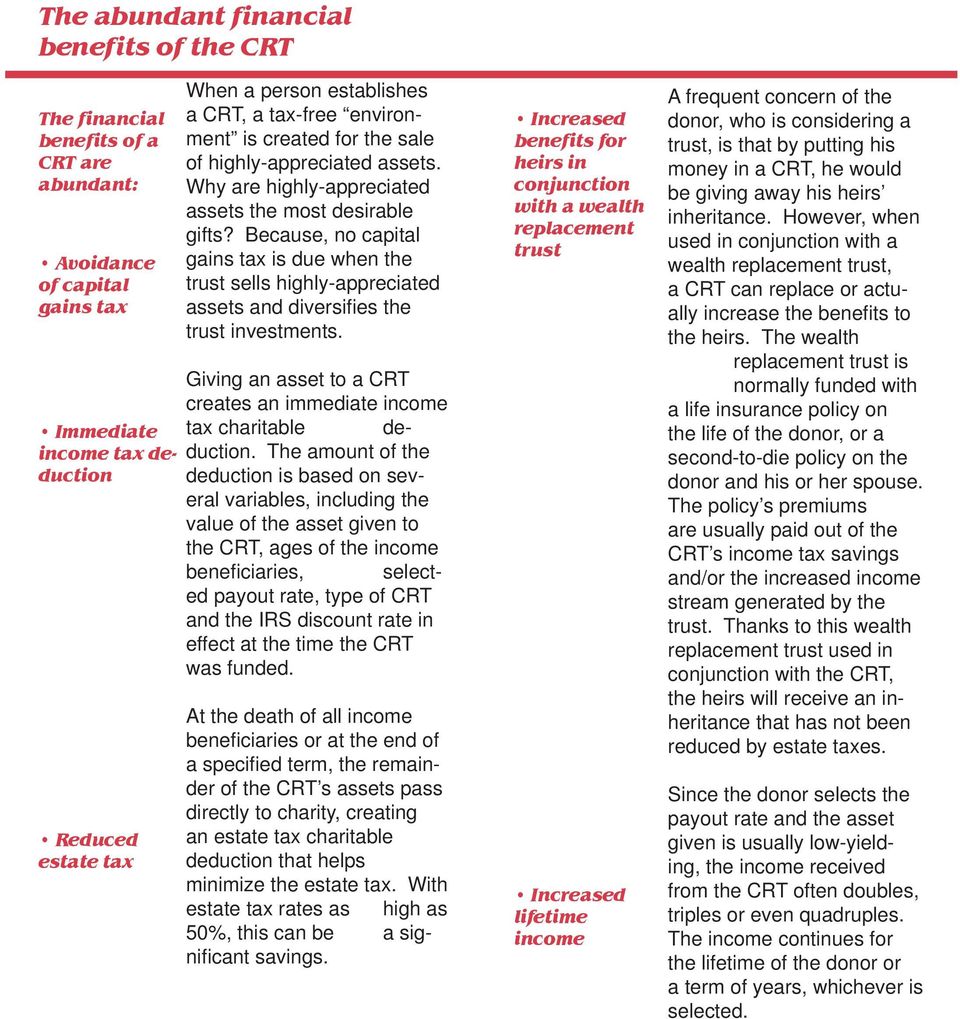
5 The abundant financial benefits of the CRT The financial benefits of a CRT are abundant: Avoidance of capital gains tax Immediate income tax deduction Reduced estate tax When a person establishes a CRT, a tax-free environment is created for the sale of highly-appreciated assets. Why are highly-appreciated assets the most desirable gifts? Because, no capital gains tax is due when the trust sells highly-appreciated assets and diversifi es the trust investments. Giving an asset to a CRT creates an immediate income tax charitable deduction. The amount of the deduction is based on several variables, including the value of the asset given to the CRT, ages of the income benefi ciaries, selected payout rate, type of CRT and the IRS discount rate in effect at the time the CRT was funded. At the death of all income benefi ciaries or at the end of a specifi ed term, the remainder of the CRT s assets pass directly to charity, creating an estate tax charitable deduction that helps minimize the estate tax. With estate tax rates as high as 50%, this can be a signifi cant savings. Increased benefits for heirs in conjunction with a wealth replacement trust Increased lifetime income A frequent concern of the donor, who is considering a trust, is that by putting his money in a CRT, he would be giving away his heirs inheritance. However, when used in conjunction with a wealth replacement trust, a CRT can replace or actually increase the benefi ts to the heirs. The wealth replacement trust is normally funded with a life insurance policy on the life of the donor, or a second-to-die policy on the donor and his or her spouse. The policy s premiums are usually paid out of the CRT s income tax savings and/or the increased income stream generated by the trust. Thanks to this wealth replacement trust used in conjunction with the CRT, the heirs will receive an inheritance that has not been reduced by estate taxes. Since the donor selects the payout rate and the asset given is usually low-yielding, the income received from the CRT often doubles, triples or even quadruples. The income continues for the lifetime of the donor or a term of years, whichever is selected.
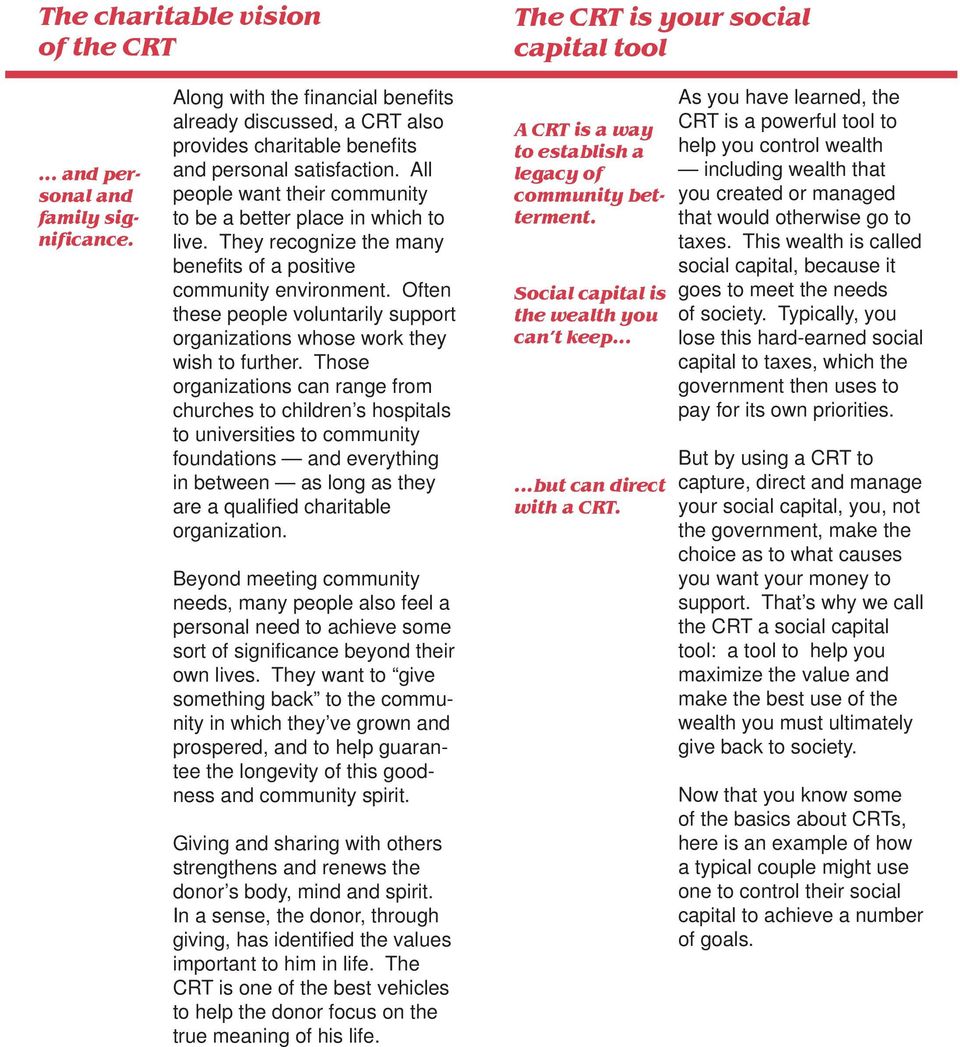
6 The charitable vision of the CRT The CRT is your social capital tool... and personal and family significance. Along with the fi nancial benefi ts already discussed, a CRT also provides charitable benefi ts and personal satisfaction. All people want their community to be a better place in which to live. They recognize the many benefi ts of a positive community environment. Often these people voluntarily support organizations whose work they wish to further. Those organizations can range from churches to children s hospitals to universities to community foundations and everything in between as long as they are a qualifi ed charitable organization. Beyond meeting community needs, many people also feel a personal need to achieve some sort of signifi cance beyond their own lives. They want to give something back to the community in which they ve grown and prospered, and to help guarantee the longevity of this goodness and community spirit. Giving and sharing with others strengthens and renews the donor s body, mind and spirit. In a sense, the donor, through giving, has identifi ed the values important to him in life. The CRT is one of the best vehicles to help the donor focus on the true meaning of his life. A CRT is a way to establish a legacy of community betterment. Social capital is the wealth you can t keep......but can direct with a CRT. As you have learned, the CRT is a powerful tool to help you control wealth including wealth that you created or managed that would otherwise go to taxes. This wealth is called social capital, because it goes to meet the needs of society. Typically, you lose this hard-earned social capital to taxes, which the government then uses to pay for its own priorities. But by using a CRT to capture, direct and manage your social capital, you, not the government, make the choice as to what causes you want your money to support. That s why we call the CRT a social capital tool: a tool to help you maximize the value and make the best use of the wealth you must ultimately give back to society. Now that you know some of the basics about CRTs, here is an example of how a typical couple might use one to control their social capital to achieve a number of goals.
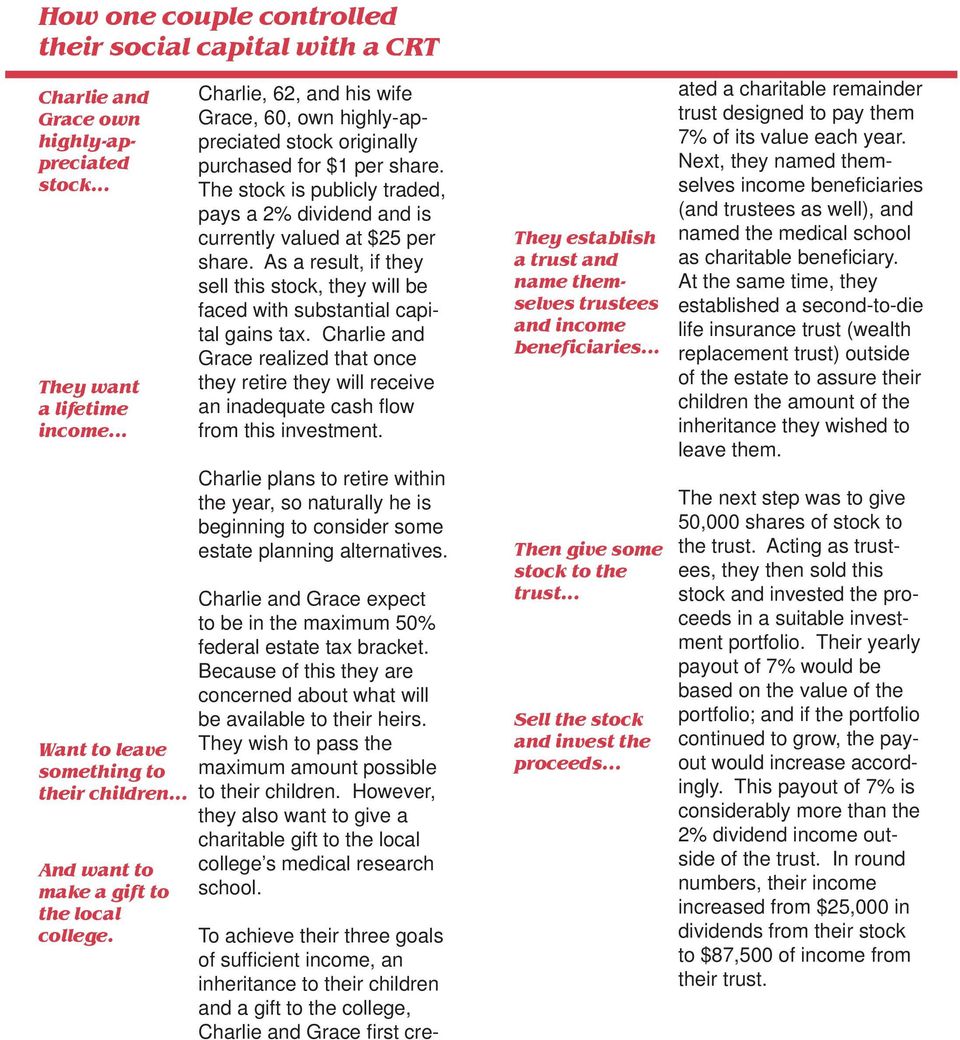
7 How one couple controlled their social capital with a CRT Charlie and Grace own highly-appreciated stock... They want a lifetime income... Want to leave something to their children... And want to make a gift to the local college. Charlie, 62, and his wife Grace, 60, own highly-appreciated stock originally purchased for $1 per share. The stock is publicly traded, pays a 2% dividend and is currently valued at $25 per share. As a result, if they sell this stock, they will be faced with substantial capital gains tax. Charlie and Grace realized that once they retire they will receive an inadequate cash fl ow from this investment. Charlie plans to retire within the year, so naturally he is beginning to consider some estate planning alternatives. Charlie and Grace expect to be in the maximum 50% federal estate tax bracket. Because of this they are concerned about what will be available to their heirs. They wish to pass the maximum amount possible to their children. However, they also want to give a charitable gift to the local college s medical research school. They establish a trust and name themselves trustees and income beneficiaries... Then give some stock to the trust... Sell the stock and invest the proceeds... To achieve their three goals of suffi cient income, an inheritance to their children and a gift to the college, Charlie and Grace fi rst created a charitable remainder trust designed to pay them 7% of its value each year. Next, they named themselves income benefi ciaries (and trustees as well), and named the medical school as charitable benefi ciary. At the same time, they established a second-to-die life insurance trust (wealth replacement trust) outside of the estate to assure their children the amount of the inheritance they wished to leave them. The next step was to give 50,000 shares of stock to the trust. Acting as trustees, they then sold this stock and invested the proceeds in a suitable investment portfolio. Their yearly payout of 7% would be based on the value of the portfolio; and if the portfolio continued to grow, the payout would increase accordingly. This payout of 7% is considerably more than the 2% dividend income outside of the trust. In round numbers, their income increased from $25,000 in dividends from their stock to $87,500 of income from their trust.
8 Many other applications Get an income tax deduction... and buy life insurance to fund the wealth replacement trust. They achieve all their goals. Upon transferring the stock to the CRT, they received a charitable deduction of about $240,000, which should result in federal income tax savings of approximately $93,000. Out of these savings and some of their increased income they paid necessary premiums on the life insurance policy so that their wealth replacement trust would, at their death, pay the desired inheritance to their heirs estate-tax free. In the end, the combination of the CRT and wealth replacement trust met all of Charlie and Grace s goals: Avoid capital gains tax on the sale of the stock; Reduce estate taxes by removing the stock from their taxable estates; Generate an increased lifetime stream of retirement income; Leave a larger inheritance by means of a wealth replacement trust; and Leave a valuable gift to support the work of the college s research school. You can see that the CRT was an excellent tool for turning appreciated assets into retirement income and an increased inheritance to the children just one of the many uses of this most versatile planning tool. The CRT can be used by people of all ages. With different kinds of assets... Different personal circumstances... Different financial objectives... While in our example Charlie and Grace used a CRT to turn their stock into retirement income, this is by no means the only use of a CRT. Indeed, a CRT can be used by people of all ages, who hold a variety of assets (land, securities, personal property, etc.) and have many different fi nancial circumstances and charitable objectives. For example, a CRT could be used by: A couple in their fi fties with appreciated farmland that they wish to turn into retirement income, without having to pay the capital gains tax that they would have to face in an outright sale and could defer income until retirement. A corporate stockholder who wants to diversify to create a more balanced portfolio and then control the income stream through investments, without facing the capital gains tax consequences of a stock sale and large estate taxes at death.
9 And, different charitable interests. A person with a large IRA balance or other substantial qualifi ed funds who is concerned about signifi cant income, estate and penalty taxes that will be due at his or her death, leaving only 25 cents on the dollar as an inheritance, and who wishes to control the timing and amount of mandatory withdrawals in order to minimize income tax and leave as much of the IRA as possible to the children. A young professional couple whose qualifi ed pension plans will not provide suffi cient retirement income, and who wish to put some of their earnings toward a supplemental retirement income and want the fl exibility of naming the charities in their wills. These are just a few of the many ways a Charitable Remainder Trust can be utilized. Because of its great fl exibility and the multiple advantages described here, the CRT deserves careful consideration as a part of any long term planning.

10 As a result of the Tax Reform Act of 1969, the CRT was defi ned by I.R.C. Section 664 of the tax code. This publication illustrates, in a general way, how a charitable remainder trust may be used in an estate plan to achieve a number of charitable and fi nancial objectives. However, the information provided to you is neither legal nor fi nancial advice. This publication is for educational purposes only. For specifi cs on fi nancial, legal and other technical aspects of charitable remainder trusts, such as the one shown here, a qualifi ed fi nancial advisor, an estate planning attorney or other advisor should be consulted. 2002, Renaissance Inc. Rev. 06/02
11 6100 W. 96th St., Suite 100 Indianapolis, Indiana fax

Charitable remainder trusts
 Charitable remainder trusts An estate planning strategy for charitably inclined investors This strategy may be a good fit when: You want to make a significant gift to charity You have assets that you want
The Charitable Remainder Trust: A Valuable Financial Tool for the Agricultural Family
 The Charitable Remainder Trust: A Valuable Financial Tool for the Agricultural Family An Educational Resource From Solid Rock Wealth Management By Christopher Nolt, LUTCF Introduction A charitable remainder
Charitable {Giving Guide
 Charitable {Giving Guide Ways to Give There are many ways to make a charitable contribution. This summary highlights some of the most popular charitable giving options, including gifts of stock, bequests,
CASE District IV Conference Fort Worth, Texas. March 25, 2013. What true assets does your family possess?
 HOW TO INITIATE GIFT PLANNING DISCUSSIONS WITH DONORS The Charitable Planning Process CASE District IV Conference Fort Worth, Texas March 25, 2013 Laura Hansen Dean, J.D. Attorney at Law (Texas, Indiana)
Gifts to The Ridhwan Foundation
 Gifts to The Ridhwan Foundation The following is written with The Ridhwan Foundation as recipient of donations. The Ridhwan Foundation is a 501 (c) 3 charitable, non-profit US corporation and can receive
HERMENZE & MARCANTONIO LLC ADVANCED ESTATE PLANNING TECHNIQUES - 2015
 HERMENZE & MARCANTONIO LLC ADVANCED ESTATE PLANNING TECHNIQUES - 2015 I. Overview of federal, Connecticut, and New York estate and gift taxes. A. Federal 1. 40% tax rate. 2. Unlimited estate and gift tax
Wealth Structuring and Estate Planning. Your vision and your legacy. Life s better when we re connected
 Wealth Structuring and Estate Planning Your vision and your legacy Life s better when we re connected Inside 1 Helping you shape the future 2 The elements of wealth structuring 4 The power and flexibility
Estate planning strategies using life insurance in a trust Options for handling distributions, rollovers and conversions
 Estate planning strategies using life insurance in a trust Options for handling distributions, rollovers and conversions Life s better when we re connected Table of contents Find your questions review
CRT with assets that, if sold by you, would generate a long-term capital gain, your CHARITABLE REMAINDERTRUSTS
 The Charitable Remainder Unitrust CRT ) can be an effective means for diversifying highly appreciated assets while avoiding or postponing capital gains tax, increasing cash flow during your lifetime, obtaining
How To Reduce Income Taxes In 2014
 T A C I T A strategy for reducing income taxes in 2014 Tax deduction for you Avoid capital gains Charitable contribution Income for life or Tax-free passing of assets to your heirs Prepared by Elliot Goldberg
The Charitable Remainder Trust & Charitable Lead Trust. Presented by: Jeffery T. Peetz Woods & Aitken LLP
 The Charitable Remainder Trust & Charitable Lead Trust Presented by: Jeffery T. Peetz Woods & Aitken LLP The Charitable Remainder Trust The charitable remainder trust is a popular and time-tested method
Split-Interest Charitable Giving Techniques in brief
 Split-Interest Charitable Giving Techniques in brief Summary of Split-Interest Charitable Giving Techniques Charitable Remainder Trust Allows the donor to provide a gift to charity (i.e., the remainder
A Guide to Planned Giving
 A Guide to Planned Giving Dear Friend of Mosaic, Planned giving provides many benefits for you and Mosaic. There are ways to increase your income now or in the future and save money on taxes. With a planned
Wealth Transfer Planning
 Wealth Transfer Planning For Business Owners ESTATE PLANNING SERVICES Merrill Lynch does not provide tax, accounting or legal advice. Any information presented about tax considerations affecting client
Charitable Trusts. Charitable Trusts
 Charitable Trusts Charitable Trusts Gifts to charitable trusts can be during lifetime or at the time of death. Charitable trusts provide an income interest to a person, persons, or charities for a period
Please contact us for more information and/or for additional white paper titles or copies.
 Harris Private Bank has helped affluent families grow and preserve their wealth for more than 100 years. We work closely with your existing advisors to make sure all aspects of your wealth strategy fit
Charitable Remainder Annuity Trust. Planned Charitable Giving Using a Split-Interest Trust
 Charitable Remainder Annuity Trust Planned Charitable Giving Using a Split-Interest Trust CRAT Overview Lifetime transfer of cash or property in trust in exchange for annuity interest payable over (a)
Charitable Gifts of IRA/IRD via a Beneficiary Statement - Good. Charitable Gifts of IRA / IRD Assets The Good, The Bad and The Ugly.
 Charitable Gifts of IRA / IRD Assets The Good, The Bad and The Ugly Susan C Dunlop Luther Seminary - Gary G Hargroves Thompson & Associates Minnesota Planned Giving Council Conference 11-5-14 Definitions
The New Era of Wealth Transfer Planning #1. American Taxpayer Relief Act Boosts Life Insurance. For agent use only. Not for public distribution.
 The New Era of Wealth Transfer Planning #1 American Taxpayer Relief Act Boosts Life Insurance For agent use only. Not for public distribution. In January 2013 Congress stepped back from the fiscal cliff
GIVE AND YOU SHALL RECEIVE CHARITABLE GIVING, CREATING A PLAN THAT S RIGHT FOR YOU
 GIVE AND YOU SHALL RECEIVE CHARITABLE GIVING, CREATING A PLAN THAT S RIGHT FOR YOU Contents 1 Give and you shall receive 3 Techniques summary 5 Planning for charitable giving NOT FDIC OR NCUA INSURED NOT
How to Realize the Unrealized
 How to Realize the Unrealized Combining two tax strategies, lump sum stock distributions with charitable planning can be a powerhouse tax savings plan. This article summarizes an underutilized strategy
IN THIS ISSUE: July, 2011 j Income Tax Planning Concepts in Estate Planning
 IN THIS ISSUE: Goals of Income Tax Planning Basic Estate Planning Has No Income Tax Impact Advanced Estate Planning Can Have Income Tax Implications Taxation of Corporations, LLCs, Partnerships and Non-
Charitable giving techniques
 Charitable giving techniques Helping achieve your charitable and estate-planning goals Trust tip A trust can be thought of as having two parts an income interest and a remainder interest. The income interest
Your pension benefit options
 2 Your pension benefit options Traditional pension plans generally provide the option of a lump-sum payment or a fixed monthly payment for life through an annuity. The fixed monthly payment amount is usually
Where you hold your investments matters. Mutual funds or ETFs? Why life insurance still plays an important estate planning role
 spring 2016 Where you hold your investments matters Mutual funds or ETFs? Why life insurance still plays an important estate planning role Should you undo a Roth IRA conversion? Taxable vs. tax-advantaged
Guide to CHRIS Kids Planned Giving: The Shade Tree Society
 Guide to CHRIS Kids Planned Giving: The Shade Tree Society "People have made at least a start at understanding when they plant shade trees under which they know full well they will never sit." - Elton
10 Rules of Thumb for Trust Income Taxation Presented by Adam Scott
 10 Rules of Thumb for Trust Income Taxation Presented by Adam Scott Rule #1: When in doubt, refer to the trust document; an investment policy for a trust cannot be created without it. One advantage of
Mission: Our Vision: United Way Services of Geauga County unites people and resources to improve lives.
 Create your legacy. Mission: United Way Services of Geauga County unites people and resources to improve lives. Our Vision: United Way Services of Geauga County is the organization recognized for collaborating
Charitable Giving. 2012 Page 1 of 7, see disclaimer on final page
 Charitable Giving 2012 Page 1 of 7, see disclaimer on final page By leaving money to charity when you die, the full amount of your charitable gift may be deducted from the value of your taxable estate.
IRAS TAXES AND MOODY STEWARDSHIP. A Ministry of Moody Bible Institute
 MOODY STEWARDSHIP A Ministry of Moody Bible Institute IRAS AND TAXES IRAs and Other Qualified Retirement Plans IRAs, pensions, and estate planning are all excellent resources for preparing an enjoyable,
Overview of Different Types of Trusts
 Overview of Different Types of Trusts Living Trusts The living trust is very popular in America. A living trust helps you avoid the cost and delay of probate. You can also avoid the dangers from jointly
Wealthiest Families Know: 2013 & Beyond
 What the Wealthiest Families Know: 2013 & Beyond Determine How Estate Planning Strategies and Life Insurance May Help You Turn Your Goals into a Wealth Legacy Whether you acquired it or inherited it, wealth
SAF Planned Giving Instrument Descriptions and FAQ s
 SAF Planned Giving Instrument Descriptions and FAQ s The Society of American Foresters has a number of planned giving instruments available which provide a means for members and their families to financially
Charitable Gifting: Overview and Tax Implications
 Charitable Gifting: Overview and Tax Implications Overview The desire to assist a charitable organization must be a primary motive for making a gift; if a charitable inclination does not exist, charitable
Understanding Annuities
 Annuities, 06 5/4/05 12:43 PM Page 1 Important Information about Variable Annuities Variable annuities are offered by prospectus, which you can obtain from your financial professional or the insurance
Advanced Wealth Transfer Strategies
 Family Limited Partnerships (FLPS) Advanced Wealth Transfer Strategies The American Taxpayer Relief Act of 2012 established a permanent gift and estate tax exemption of $5 million, which is adjusted annually
Minimum Distributions & Beneficiary Designations: Planning Opportunities
 28 $ $ $ RETIREMENT PLANS The rules regarding distributions and designated beneficiaries are complex, but there are strategies that will help minimize income and estate taxes. Minimum Distributions & Beneficiary
Giving Through Charitable Remainder Trusts
 Gift & Estate Planning Giving Through Charitable Remainder Trusts SM Stewarding the Giver and The Gift >> Focus on the Family, Attn: Gift & Estate Planning 8605 Explorer Drive Colorado Springs, CO 80920
Nonqualifi ed Annuity Distribution Planning Reference Guide
 Nonqualifi ed Annuity Distribution Planning Reference Guide Compliments of: IL-61-0005-0708 Target Client: Nonqualified assets of $100,000 and above Qualified plan contributions already maximized Key Characteristics:
IRA PLANNING ALTERNATIVES Carl S. Rosen
 BROAD AND CASSEL ATTORNEYS AT LAW SPRING/SUMMER 1999 BOCA RATON FT. LAUDERDALE MIAMI ORLANDO TALLAHASSEE TAMPA WEST PALM BEACH CHARITABLE LEAD TRUSTS CAN PROVIDE GREAT BENEFITS Kenneth Edelman A Charitable
Planning the Legacy of Your Faith
 Planning the Legacy of Your Faith A Guide for Our Parish Members (Updated September 1 st, 2015)...let your light shine before others, so that they may see your good works and give glory to your Father
Planning your estate
 Planning your estate A general guide to estate planning Policies issued by: American General Life Insurance Company The United States Life Insurance Company in the City of New York What is estate planning?
Gifting Using Complex Assets
 Charitable Liquidity Event Planning Gifting Using Complex Assets Prepared for: The Business of Family Business Seminar December 1, 2011 Los Angeles Chamber of Commerce Donating complex assets a tax-efficient
A GUIDE TO FREE THE KIDS PLANNED GIVING PROGRAM
 A GUIDE TO FREE THE KIDS PLANNED GIVING PROGRAM What is more liberating than the knowledge that you are loved? This is what we do here create a place of security and love where children can be freed from
IDENTIFYING THE RIGHT TRUST FOR YOUR SITUATION PLAN FOR TOMORROW, TODAY
 IDENTIFYING THE RIGHT TRUST FOR YOUR SITUATION PLAN FOR TOMORROW, TODAY Life s ups and downs make it difficult to predict the future. Your family, your health, your career may all look fine today, but
wa y s o f g i v i n g that live on Your legacy through planned giving
 wa y s o f g i v i n g that live on Your legacy through planned giving The Birch Society continues a long community tradition of support for New London Hospital throughout the greater Lake Sunapee region.
Script for Presentation of. Premier VI Private Annuity/Trust, Capital Gains Deferral
 Script for Presentation of Premier VI Private Annuity/Trust, Capital Gains Deferral Note to Presenter: A good handout or study guide to go with this presentation is NAFEP s, 7 page Deferring Capital Gains
TOP 20 USES FOR LIFE INSURANCE In Estate, Business Succession, and Financial Planning
 TOP 20 USES FOR LIFE INSURANCE In Estate, Business Succession, and Financial Planning Permanent life insurance is not just about death benefits. It s an essential tool in estate, business succession, and
Common mistakes in estate planning
 Common mistakes in estate planning Disclaimers The Lyon Group is not in the business of providing tax, legal or accounting advice, and none is intended nor should be inferred from the foregoing comments
Your Guide To. Planned Giving. An Overview Of 6 Types of Charitable Planned Gifts
 Your Guide To Planned Giving An Overview Of 6 Types of Charitable Planned Gifts Interesting Ideas in Estate Planning 2 Welcome Are you looking for ways to save on your taxes this year through charitable
ACTIONABLE STRATEGIES FOR REDUCING MEDICARE TAXES
 ACTIONABLE STRATEGIES FOR REDUCING MEDICARE TAXES Medicare taxes increased in 2013 for high-income earners. Timely action can help reduce the impact of higher taxes. KEY TAKEAWAYS High-income taxpayers
Zero Estate Tax Strategy
 Zero Estate Tax Strategy AN PLANNING STRATEGY USING LIFE INSURANCE, A FOUNDATION, AND WEALTH REPLACEMENT TRUST The Prudential Insurance Company of America 0257697 0257697-00003-00 Ed. 07/2015 Exp. 01/20/2017
Personal Trust Services
 TIAA-CREF Trust Company, FSB Personal Trust Services Transfer assets to your heirs with confidence Many people assume trusts are only for the ultra-wealthy, but that is a misconception. Simply defined,
Protect your business and enhance your financial security. Business Insurance Strategies
 Protect your business and enhance your financial security Business Insurance Strategies Ensure your financial security There are often distinct advantages to being a significant shareholder in a private
ANNUITIES: WHAT ARE THEY AND HOW ARE THEY USED
 ANNUITIES: WHAT ARE THEY AND HOW ARE THEY USED (FORC Journal: Vol. 18 Edition 1 - Spring 2007) 1 An annuity is a contract under which the owner of the contract pays money or transfers assets to the obligor
Volunteering. Donor Advised Funds
 Test Your Knowledge True or False It is more beneficial to give during your life. Using stock for a charitable gift is always a good idea. Once you transfer your interest in a property to a charity, you