
TRUSTEES & GOVERNANCE. The Essential Trustee What you need to know
|
|
|
- Adelia Gilmore
- 10 years ago
- Views:
Transcription
1 TRUSTEES & GOVERNANCE The Essential Trustee What you need to know

2 The Charity Commission The Charity Commission is the independent regulator of charities in England and Wales. Its aim is to provide the best possible regulation of charities in England and Wales in order to increase charities effectiveness and public confidence and trust. Most charities must register with the Commission, although some special types of charity do not have to register. There are over 160,000 registered charities in England and Wales. In Scotland the framework is different, and the Commission does not regulate Scottish charities. The Commission provides a wide range of advice and guidance to charities and their trustees, and can often help with problems. Registered charities with an annual income over 10,000 must provide annual information to the Commission. The Commission has wide powers to intervene in the affairs of a charity where things have gone wrong. Published by the Charity Commission

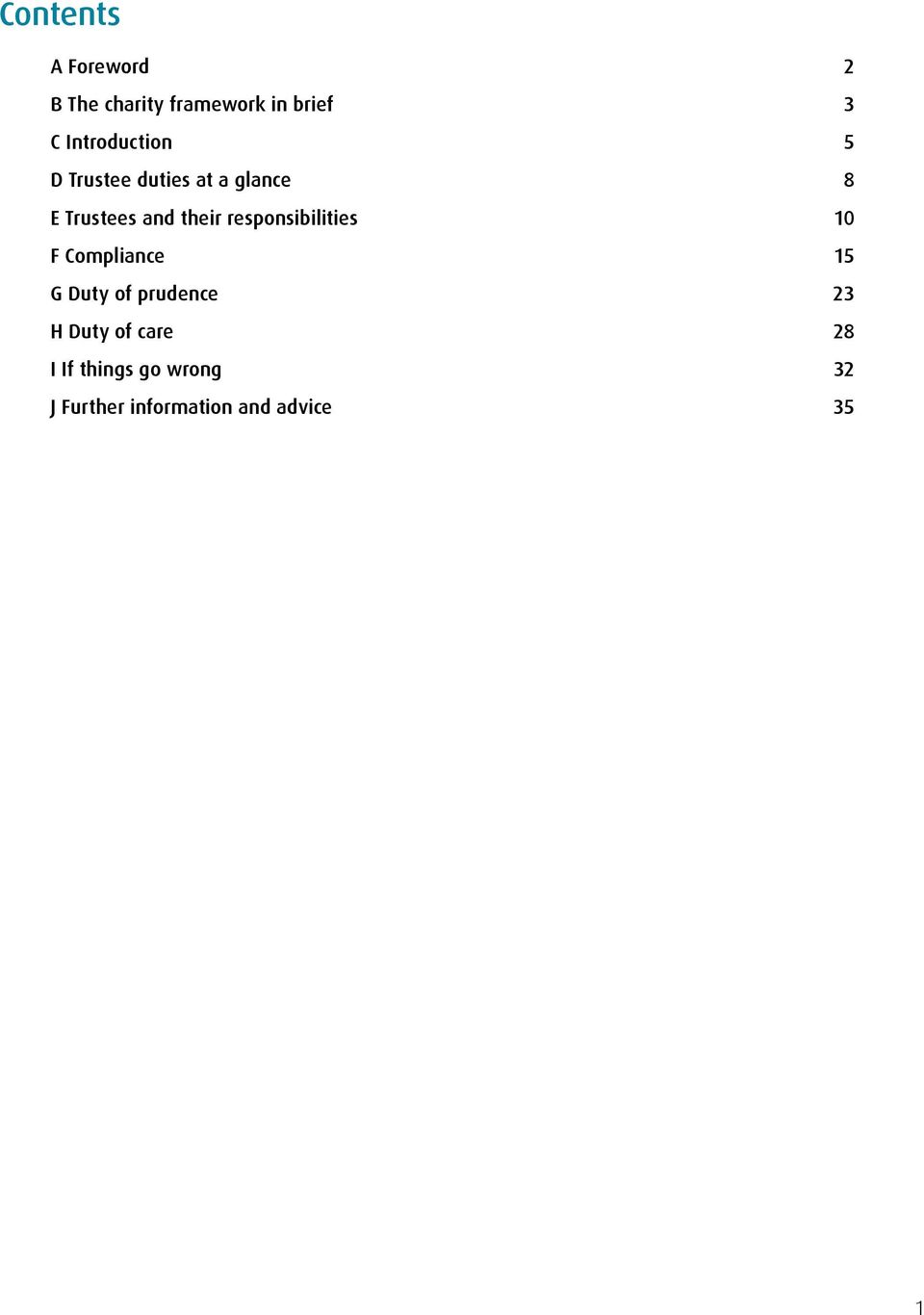
3 Contents A Foreword 2 B The charity framework in brief 3 C Introduction 5 D Trustee duties at a glance 8 E Trustees and their responsibilities 10 F Compliance 15 G Duty of prudence 23 H Duty of care 28 I If things go wrong 32 J Further information and advice 35 1
4 A Foreword A message from the Chair and the Chief Executive of the Charity Commission to charity trustees. Dear Reader, Charities exist to create a better society. The range and scope of their work and the variety of people they help is amazing. Whether working locally, nationally or internationally they have a remarkable history of driving social change which is reflected all around us in the world we live in today. Charities could do none of this without their trustees. You re probably reading this because you have just become a trustee yourself. If so, we welcome you to this role and thank you for taking it on. The commitment and energy you display will make a direct difference to your charity and everyone it helps. You don t have to be a hero or famous to change lives for the better trusteeship allows you to do just that. Being a trustee can be hard work and, for most, it s unpaid. The trustees have the ultimate responsibility for running a charity, for its property, finances and the employment of any staff or volunteers. But being a trustee is also immensely rewarding, providing both expected and unexpected opportunities for personal development. And while you bring your skills and energy to running your charity, you will also find you are gaining new experience and knowledge. For instance, you will help plan the strategic future of the charity and its work, be involved in developing and managing staff and volunteers and make policy decisions for your charity. You will also ensure it s accountable to its beneficiaries, to the Charity Commission and the public in general. But you won t be on your own. You ll be joining a team of trustees and becoming part of the 900,000 charity trustees in England and Wales. Effective trustee boards need a range of people with a good mix of skills. The best boards are also diverse, with people who have a real understanding of the needs to be met and others with good financial, business and management experience. The rewards of working with, and learning from, people from different backgrounds and skills will be great. We hope you will enjoy making a difference to society. And remember that, as well as regulating charities and protecting their reputation, the Charity Commission is here to help you and your fellow trustees. As you read this guidance, you ll learn much more about your responsibilities and about the many sources of help and support. Please accept our congratulations on your new role. William Shawcross, Chairman Sam Younger, Chief Executive 2

5 B The charity framework in brief This section sets out an overall description of the framework for charities, trustees and the Charity Commission. It is not a legal document, but an overall summary of the position, written in everyday language. B1. What are charities? Charities are organisations set up for the benefit of the community. They enjoy some tax advantages from the government. While they can in certain circumstances trade for profit, they must use any such profit for the purposes of the charity. To qualify as a charity, an organisation has to meet strict conditions about its overall purposes, also referred to as its objects, including demonstrating that its purposes are for the public benefit. The organisation also has to be set up with a constitution or rules which meet certain conditions. These rules are usually referred to as a charity s governing document. Some charities are set up to give direct help, advice, grants or support to people in various kinds of need, for instance older people, or those with a particular medical condition. Charities are also set up to carry out research, provide training or education, or to focus on meeting the wider needs of a particular deprived area. And some charities exist mainly to support other charities, by giving grants and other assistance to them. Several kinds of organisation can qualify as a charity. For instance, some charities are also registered companies, while others are trusts. Some charities are also set up by special legislation. All are subject to the general principles of charity law. Most charities are small local organisations, but some are large national operations with household names, such as Age UK or Oxfam. Charities receive their money in various ways, such as donations from the public, payment for services provided, government grants and legacies. B2. Role of the trustees Charity trustees are the people who serve on the governing body of a charity. They may be known as trustees, directors, board members, governors or committee members. Charity trustees are responsible for the general control and management of the administration of a charity. Their responsibilities and duties are summarised on the next page. The great majority of trustees serve as volunteers, and receive no payment for their work. Charity trustees come from all walks of life, and are united by their wish to create positive change in society. Most people are eligible to serve as trustees. The work of a trustee should be rewarding and enjoyable, and an opportunity to serve the community while learning new skills. 3
6 B3. Role of the Charity Commission The Charity Commission is the independent regulator of charities in England and Wales. Our job as regulator is to work closely with charities to ensure that they are accountable, well run and meet their legal obligations in order to promote public trust and confidence. Most charities must register with the Commission, although some special types of charity do not have to register. There are some 180,000 registered charities in England and Wales. In Scotland the framework is different, and the Commission does not regulate Scottish charities. The Commission provides a wide range of advice and guidance to charities and their trustees. Registered charities with an annual income over 10,000 must provide annual information to the Commission. The Commission has wide powers to intervene in the affairs of a charity where things have gone wrong. 4

7 C Introduction C1. What is this guidance about? We are often asked to explain what is expected of someone who is appointed to act as a charity trustee. To be a trustee requires time, understanding and effort. It is also a rewarding opportunity to serve the community and develop personal skills. This guidance answers some of the more common questions and sets out briefly the duties of trustees. C2. Must and should : what we mean In this guidance, where we use must, we mean it is a specific legal or regulatory requirement affecting trustees or a charity. Trustees must comply with these requirements. To help you easily identify those sections which contain a legal or regulatory requirement we have used the symbol next to the short answer in that section. We use should for items we regard as minimum good practice, but for which there is no specific legal requirement. Trustees should follow the good practice guidance unless there s a good reason not to. We also offer less formal advice and recommendations that trustees may find helpful in the management of their charity. C3. Previous guidance This guidance replaces the previous version published in February It has been updated to refer to the Charities Act 2011, which has brought together the provisions of the Charities Act 1993 and the Charities Act A number of additional minor revisions have also been made. C4. Scope of this guidance This guidance covers a range of key areas about the work of charities and their trustees. Some topics are complex and governed by different laws and regulations depending on the kind of charity. You should not rely on this guidance to be an accurate or full description of legal matters affecting your charity. It provides a general introduction and overview, and highlights areas where you may need further advice. C5. Using this guidance The structure of this guidance follows the main headings used in the next section, Trustee duties at a glance. Under each heading, we ask a selection of the relevant questions that new or existing trustees may raise about their duties. Generally we give a concise summary answer ( ), and then give more background ( ). 5

8 C6. Other sources of help and advice There are many resources which trustees can use to help them. We encourage trustees to make use of the expertise of relevant organisations to help them run their charities as effectively as possible. Contact details for all the organisations mentioned in this guidance, with a brief description of what they do, can be found in section J. C7. Some technical terms used Although we have tried to write this guidance in everyday language, we have had to use technical terms in places. This list explains some of them: Custodian trustee: A custodian trustee is a corporation appointed to have the custody, as distinct from the management, of trust property. Where a custodian trustee is appointed to hold property of a charity, the administration of the charity is left in the hands of the charity trustees. A custodian trustee is not a charity trustee. Holding trustee: Holding trustees are individuals appointed to hold the property of the charity. They can only act on the lawful instructions of the charity trustees and in accordance with any provisions contained in the governing document. Governing document: A legal document setting out the charity s purposes and, usually, how it is to be administered. It may be a trust deed, constitution, articles of association, will, conveyance, Royal Charter, Scheme of the Commission, or other formal document. Incorporated charity: A charity which is also a company or has a similar legal status as a corporate entity in law. See section E2 for more detail. Nominee: An individual or corporate body, normally appointed by the trustees, whose function is to hold the legal title to the charity s property or investments on behalf of the trustees. Nominees have no role in the charity s management. They must act on the instructions of the trustees, unless they are told to do something that is in breach of trust. Permanent endowment: The property of the charity (eg land, buildings, investments or cash) which the trustees may not spend as if it were income. It must be held permanently, sometimes to be used in furthering the charity s purposes, sometimes to produce an income for the charity. Trustees can only spend or dispose of permanent endowment if they use the powers in the Charities Act that allow this or if they obtain our authority. Property: Includes not only land and buildings but also investments, cash and other assets. Unincorporated charity: This may be either a trust or an unincorporated association. See section E2 for more detail. Quorum: The minimum number of trustees who must be present for the meeting of the trustees to be properly constituted. The governing document may specify this. Secretary: An officer of a charity. May be a trustee, employee or other agent of the charity. 6
9 Company Secretary: An officer of a charitable company with duties set out in company law to ensure compliance with the charity s own governing document and various legal matters. The Charities Act: This is the Charities Act The 2000 Act: This is the Trustee Act 2000, which sets out the main duties and powers of the trustees of unincorporated charities. Scheme: A legal document made by the Commission, normally under section 69 of the Charities Act, used to change almost any aspect of a charity s purposes or administrative provisions. 7

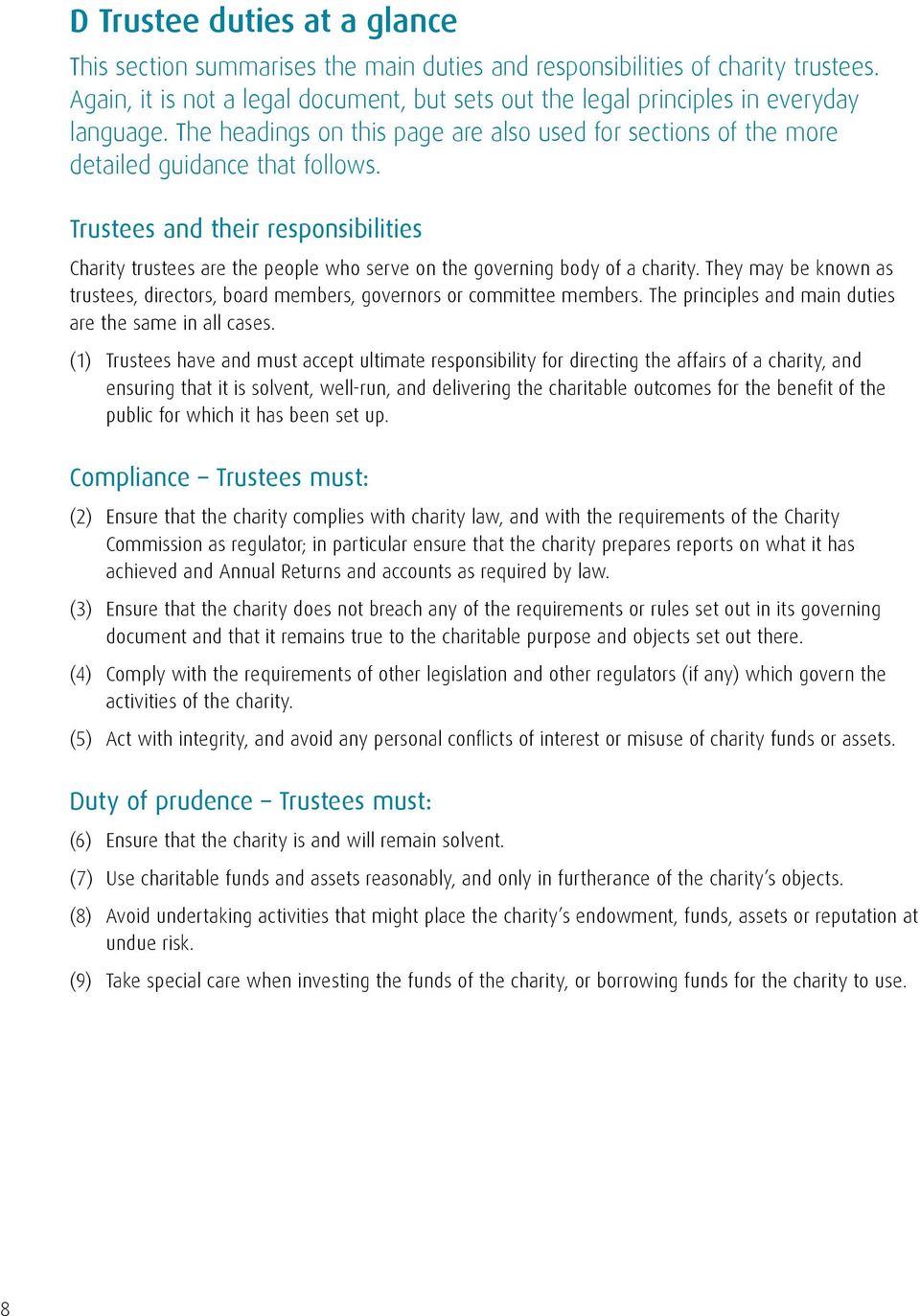
10 D Trustee duties at a glance This section summarises the main duties and responsibilities of charity trustees. Again, it is not a legal document, but sets out the legal principles in everyday language. The headings on this page are also used for sections of the more detailed guidance that follows. Trustees and their responsibilities Charity trustees are the people who serve on the governing body of a charity. They may be known as trustees, directors, board members, governors or committee members. The principles and main duties are the same in all cases. (1) Trustees have and must accept ultimate responsibility for directing the affairs of a charity, and ensuring that it is solvent, well-run, and delivering the charitable outcomes for the benefit of the public for which it has been set up. Compliance Trustees must: (2) Ensure that the charity complies with charity law, and with the requirements of the Charity Commission as regulator; in particular ensure that the charity prepares reports on what it has achieved and Annual Returns and accounts as required by law. (3) Ensure that the charity does not breach any of the requirements or rules set out in its governing document and that it remains true to the charitable purpose and objects set out there. (4) Comply with the requirements of other legislation and other regulators (if any) which govern the activities of the charity. (5) Act with integrity, and avoid any personal conflicts of interest or misuse of charity funds or assets. Duty of prudence Trustees must: (6) Ensure that the charity is and will remain solvent. (7) Use charitable funds and assets reasonably, and only in furtherance of the charity s objects. (8) Avoid undertaking activities that might place the charity s endowment, funds, assets or reputation at undue risk. (9) Take special care when investing the funds of the charity, or borrowing funds for the charity to use. 8
11 Duty of care Trustees must: (10) Use reasonable care and skill in their work as trustees, using their personal skills and experience as needed to ensure that the charity is well-run and efficient. (11) Consider getting external professional advice on all matters where there may be material risk to the charity, or where the trustees may be in breach of their duties. If things go wrong The Charity Commission offers guidance to charities on both legal requirements and best practice to help them operate as effectively as possible and to prevent problems arising. In the few cases where serious problems have occurred we have wide powers to look into them and put things right. Trustees may also be personally liable for any debts or losses that the charity faces as a result. This will depend on the circumstances and the type of governing document for the charity. However, personal liability of this kind is rare, and trustees who have followed the requirements on this page will generally be protected. 9

12 E Trustees and their responsibilities Charity trustees are the people who serve on the governing body of a charity. They may be known as trustees, directors, board members, governors or committee members. The principles and main duties are the same in all cases. Trustees have, and must accept, ultimate responsibility for directing the affairs of a charity, and ensuring that it is solvent, well-run, and meeting the needs for which it has been set up. E1. What should I do before I become a trustee? You should take all reasonable steps to find out as much as you can about the charity, and about what will be expected of you as a trustee. Finding out more: Before you become a trustee, you should learn as much as you can about the charity, and what being a trustee will mean for you. For instance, for an existing larger charity, we advise you to read Annual Reports, important policies and the annual accounts; we also advise that you meet existing trustees, senior staff and perhaps some of the people who benefit from the charity s work. Some charities may also invite you to sit in on a trustee meeting as an observer before you formally join. You may wish to find out what training and support the charity offers its trustees. The governing document: You should also get a copy of the charity s governing document, and read it. It will probably be a dry legal document, but it is the charity s main constitutional document, and governs key aspects of the charity s work. If it isn t clear what it means, then one of the existing trustees or the charity s Secretary should explain it to you. E2. Trustees and directors what s the difference? Although there are many names for trustees, their central responsibilities are the same in all cases. However, there are two main types of charity unincorporated and incorporated. The exact legal position of trustees is slightly different in each. Unincorporated charities : These may be trusts or associations. Their governing document will usually be a trust deed or a constitution or a Scheme of the Charity Commission. In an unincorporated charity, the property of the charity is usually held by the trustees or their nominees. Incorporated charities : Most of these are charitable companies registered with Companies House as well as the Charity Commission. Here, the company is a legal entity in its own right, and the trustees are the directors of the company. You can get more information about the role and responsibilities of company directors from Companies House. Contact details for Companies House are in section J. There 10
13 are also other types of special incorporated charities eg charities incorporated by Royal Charter or by statute. These are not regulated by Companies House. Your position: Before you become a trustee, you should find out whether your charity is incorporated or not, as this will affect your legal position and responsibilities. In this guidance we have stated where differences occur, but have not described them in detail. You will find more in our other publications on particular subjects. E3. Am I eligible to become a trustee? Most people over 18 years of age can become trustees, but a few are not eligible. People aged 16 and over can be trustees of a charitable company, but cannot be trustees of an unincorporated charity. Ineligible people: Those who have already been disqualified as company directors and those who have been convicted of an offence involving dishonesty or deception are some of the people who cannot usually become trustees. In some cases, people who receive benefits from the charity may also be ineligible. Full details are in our guidance Finding New Trustees: What charities need to know (CC30) and Users on Board: Beneficiaries who become trustees (CC24). E4. Who appoints new trustees? Usually, the charity s governing document sets out how trustees are to be appointed this varies according to the particular charity. In other cases the position can be more complicated, and the trustees may need to contact us to help make a new appointment. All trustees, however appointed, must act in the charity s interests, and must not represent the interests of any outside organisation or their own personal interests. Appointment methods: In many cases the charity s governing document says how trustees are to be appointed. It may say that some people are to be trustees because of an office which they hold (known as ex officio trustees); common examples are the mayor of a town or the head teacher of a school. Sometimes a named person or organisation is given the right to appoint new trustees. For an organisation with a wider membership, the members usually appoint some or all of the trustees in an annual election. Existing trustees: If the governing document does not say anything about another method of appointment, then the existing trustees of an unincorporated charity may appoint new trustees. You must follow the procedure set out in the governing document where possible. If there are problems: If it is not possible to appoint new trustees, for example because there is no person with the right to appoint them, the charity must tell us. We have the power to appoint new trustees in those circumstances. Again, detailed information is in Finding New Trustees: What charities need to know (CC30). 11
14 E5. How long does the appointment of a trustee last? If the governing document does not specify the length of service of a trustee, the appointment continues until the trustee dies, resigns or is removed from office. Set terms: In some cases the governing document will say that trustees are to serve for a given period, usually a set number of years. We regard having a set term for trusteeship as best practice. Reappointment: A trustee whose term of office has expired can be appointed for a further term of office, unless the governing document prohibits it. This should be checked before any reappointment. E6. Can a trustee resign? Yes it is usually straightforward for a trustee to resign. But in some situations, especially with unincorporated charities, it is important to check the charity s governing document carefully. Sometimes legal advice will be needed to ensure that things are done properly. Incorporated charities: It is generally straightforward for a trustee of an incorporated charity to resign, unless the number of trustees would then drop below the minimum set out in the governing document. In such cases, a new trustee must first be appointed to replace the outgoing one. In all cases the charity should check the terms of the governing document. Unincorporated charities: In the case of an unincorporated charity, the situation can be more complicated. As above, any resignation must be handled as set out in the governing document. If the governing document does not say anything about this, a legal framework is set out (in the Trustee Act 1925), for how trustees may deal with the situation. Trustees should get proper advice to ensure they act correctly. Title deeds to land: If the resigning trustee s name appears on the title deeds to land owned by the charity, then this must be changed, following a set legal procedure. Again, trustees should obtain proper advice to ensure this is done properly. 12
15 E7. Can trustees delegate their responsibilities? Trustees can generally delegate certain powers to agents or employees, but will and must always retain the ultimate responsibility for running the charity. Delegation powers: Trustees always have the ultimate responsibility for running their charity. But they generally have the power to delegate certain powers to agents, subject to their governing document, and any relevant legislation. The Trustee Act 2000 says that trustees of unincorporated charities can delegate: carrying out a decision that the trustees have taken; the investment of assets, including land subject to the trust; raising funds for the trust other than by the profits of trade which is an integral part of carrying out the trust s charitable purposes; or any other function prescribed by an order made by the relevant Secretary of State. Dealing with third parties: Someone acting as a delegate or agent of the trustees should always make clear in dealings with third parties that they are acting in that capacity (particularly if they are not an employee of the charity), and should always record in writing what was agreed in the conversation. E8. How do trustees make decisions? All decisions by the trustees concerning a charity are taken by all the trustees, acting collectively and as a team. However, the decisions need not be unanimous; a majority decision is sufficient unless the charity s governing document states otherwise. Collective responsibility: Subject to any power of delegation there is a general rule that trustees must take personal responsibility for their decisions, and that all decisions concerning the charity must be taken by the trustees acting together. Setting up groups or committees: Trustees can always invite some of their number to look into particular matters and make recommendations. The decision whether or not to act on the recommendations is for the trustees to take together. In some cases the governing document of a charity may permit the trustees to set up committees with delegated powers to carry out particular functions. Delegating to employees: The trustees of some charities may need to delegate decisions on day-today management matters to employees. In these cases the scope of the authority should be clearly laid down in writing and instructions given for decisions on important matters to be reported to the trustees. Trustees should establish proper reporting procedures and clear lines of accountability. Information and guidance for trustees who employ staff is provided by a number of organisations, including the National Council for Voluntary Organisations (NCVO) and the National Association for Voluntary and Community Action (NAVCA). 13

16 E9. What do the Chair and Treasurer do? Some trustees are known as officers and have special responsibilities. These include the Chair, Treasurer, and in some cases there may also be other designated officers. Special responsibilities: The Treasurer and the Chair of the charity will have wider responsibilities than other trustees. For instance, the Treasurer will ensure that proper accounts are kept, and help set financial and investment policies. The Chair, as well as helping to plan and chair trustee meetings, may also be the link between the trustees and the employees and representing the charity at appropriate events. However, when it comes to making decisions about the charity, the trustees must take them together. A number of organisations, including the Institute of Chartered Secretaries Administrators (ICSA), provide model job descriptions for Chairs and Treasurers. E10. Can a charity s property be held by someone other than the trustees? The trustees of unincorporated charities may find it convenient for the title to land owned by the charity to be held by the Official Custodian for Charities or by a custodian trustee or a holding trustee. Trustees also have a power to appoint a nominee to hold the title. Whether and how they do this depends on the charity s governing document and the law. Reasons for appointing a corporate body to hold title: If the trustees hold the title to the charity s property this can lead to practical difficulties, particularly where the trustees change regularly. It can be more convenient to hold the property titles in the name of a corporate body, whose identity never or rarely changes. This must be done only with proper legal authority and trustees should seek legal advice, especially before doing so for the first time. Making the appointment: To appoint a corporate body in this way, a charity must follow its own governing document, and also comply with relevant legislation. Three Acts of Parliament apply in different situations (the Public Trustee Act 1906, the Trustee Act 2000 and the Charities Act). We may also give powers to appoint nominees. You can get more details in Appointing Nominees and Custodians: Guidance under S.19(4) of the Trustee Act 2000 (CC42). 14

17 F Compliance Trustees must: ensure that the charity complies with charity law, and with the requirements of the Charity Commission as regulator; in particular ensure that the charity prepares reports, Annual Returns and accounts as required by law ensure that the charity does not breach any of the requirements or rules set out in its governing document and remains true to the charitable purpose and objects set out there comply with the requirements of other legislation and regulators which govern the activities of the charity act with integrity, and avoid any personal conflicts of interest or misuse of charity funds or assets F1. Do all trustees have to follow the same set of principles? The principles of trusteeship are set out by law for unincorporated charities. For incorporated charities, the general principles are similar, but will depend on the charity s governing document and the law affecting corporations. The legal position: The Trustee Act 2000 defines some of the key statutory powers and duties of trustees of unincorporated charities. It also gives such trustees the powers they need to administer their charity effectively. If you are such a trustee, you should find out more about the Act, and how it applies to your charity. Incorporated charities: The 2000 Act does not apply to incorporated charities. But where an incorporated charity is itself a trustee of an unincorporated charity, then the Act will apply to its actions as a trustee. 15
18 F2. Can trustees be paid for their duties? Generally, no. Most trustees are unpaid, and must not benefit in any way from their connection with the charity. There are limited exceptions to this rule, and the Charities Act allows trustees to be paid in certain circumstances for providing services to the charity over and above their normal trustee duties. Prohibited benefits: Trustees are not entitled to receive any payment out of the charity s funds other than reasonable and necessary out-of-pocket expenses, such as the cost of travel to attend trustee meetings. Additionally, they must not benefit, either directly or indirectly, from the charity by, for instance: taking a lease of the charity s property; borrowing money from the charity; or making contracts to do business with the charity. When trustees abuse their position: This is a legal rule and any trustee who breaks it may have to make good any loss that results to the charity out of their own pocket. Even if there is no loss, a trustee who makes a profit from breaking the rule may have to pay the amount of any profit to the charity. Exceptions: There is an exception where the governing document (or other rules the charity must follow) explicitly allows payment to trustees, and/or allows them to do business with the charity. Any personal benefit must strictly comply with the terms and conditions of the authority allowing the benefit. We can also authorise a transaction between a charity and a trustee personally, where the trustees can show a clear advantage to the charity. In addition the Charities Act contains provisions that allow payment of trustees, but only for the provision of goods or a service to their charity over and above their normal trustee duties. This does not include contracted employment or payment for acting as a trustee. Trustees must meet certain conditions and have regard to our guidance when using the power. You can find out more by reading our information sheet about the power to pay trustees for services or by reading our guidance Trustee expenses and payments (CC11). F3. Can a trustee be employed by the charity? Generally, no because trustees must not gain from their position. Again, there are limited exceptions to this rule. The legal position: Generally, a trustee cannot become an employee of their charity nor can an employee become a trustee. The exceptions are where the governing document of the charity explicitly authorises it, or if permission has been given by us or a court of law. Our guidance Trustee expenses and payments (CC11) provides more information about this. 16

19 When trustees abuse their position: This is a legal rule and a trustee who breaks it may have to repay to the charity any benefits they have received, such as salary. The rule still applies even where the trustee has resigned as a trustee, before or after taking up employment. The exception: The only instance in which special permission may not be needed is where the charity can show that the trustee has not obtained the employment by reason of being a trustee and there is no ongoing conflict of interest. This would mean that the trustee concerned: has no significant involvement with the charity s decision to create or retain the post, or with any material aspect of the recruitment process; and had resigned as a trustee to apply for the post in advance of a post being advertised publicly in a fair and open competition. Seeking advice: If in any doubt, a charity should obtain advice at an early stage. F4. Must charities register with the Charity Commission? Generally, yes. Most charities must register. There are some exceptions to this rule for special classes of charity. Once registered, charities must comply with our requirements. The law says: The Charities Act requires trustees to register charities in England and Wales with us and to give any information needed for the purposes of registration. Any charity which has a gross income exceeding 5,000 a year is required to register. Some special classes of charity are free from the requirement to register. You can get more details in Registering as a Charity (CC21). Charity status: Once a charity is registered, the law says it should generally be accepted as a charity by outside bodies. This may well help in obtaining tax and rating relief or in obtaining grants from other charities. Letterheads etc: Every registered charity with an income over 10,000 in its last financial year must state that it is a registered charity on any appeal documents and on many of its financial documents, such as cheques, invoices and receipts. It is not a requirement to state the charity s registration number, but many charities do so. Keeping us informed: Once a charity has been registered, trustees must tell us about any changes to the details that appear on the Register of Charities, such as the name or purposes of the charity or the name or address of the charity s correspondent, or if the charity ceases to exist or operate. 17
20 F5. Do trustees have to keep accounts? Yes. All charities must prepare annual accounts. Different rules apply to different sizes and types of charity. Preparing accounts is of course only one part of proper financial planning and control. The legal position: There are legal requirements (in the Charities Act and associated regulations) for charities, relating to: maintenance and retention of accounting records; preparation of charity accounts and Annual Reports; audit or independent examination of accounts; submission of accounts, Annual Reports and Annual Returns to us; and availability of accounts to the public. Financial thresholds: How far any individual charity must comply with these requirements depends on the level of gross income. Trustees must familiarise themselves with the appropriate requirements. Registered charities with gross income of over 25,000 per year must submit their accounts to us annually, within 10 months of the end of the relevant financial year. Non-submission of accounts: If trustees fail to submit their accounts and Annual Return to us on time, this could lead to us taking action against the trustees. This action could include conducting an investigation into the charity or publishing the charity s details on our website as defaulting in the submission of Annual Returns and accounts. Incorporated charities: Different accounting rules apply to charities that are companies, although the Companies Act 2006 introduced provisions that harmonise the accounting and independent examination regimes for company and non-company charities for accounting years beginning on or after 1 April Further information is available from Companies House and on our website. F6. Why are accounts and a report necessary? Because they are a central part of the accountability of charities to funders, regulators and the wider public. Accountability and stewardship: The Annual Report and accounts are the primary means through which trustees report on their stewardship of their charity and show public accountability. The two documents form a package and should be sent out together. The accounts provide financial information as to how resources are obtained and used and about the financial situation of the charity. The Annual Report must explain what the charity is trying to do, how it is going about it, whether it has achieved its objectives, and how it has carried out its aims for the public benefit. It also provides an opportunity to explain the figures in the accounts, such as fundraising costs and their effectiveness. The amount 18

21 of detail required depends on the size of the charity. You can find more information about charities reporting requirements in our guidance Charity Reporting and Accounting: The essentials April 2009 (CC15b) and about public benefit in our guidance Charities and Public Benefit. F7. What guidance is there about accounts? There is a good range of available guidance from us and other bodies. Our guidance: We provide a range of accounting guidance to help trustees prepare their Annual Report and accounts. We recommend you start by reading Charity Reporting and Accounting: The essentials April 2009 (CC15b). Smaller charities: We also provide two accounts packs, aimed at smaller charities and designed to fulfil all legal requirements when completed. Receipts and Payments Accounts Pack (CC16); and Accruals Accounts Pack (CC17). The SORP: In addition, there is the Statement of Recommended Practice, Accounting and Reporting by Charities in effect regulations about how accounts should be prepared. This is usually referred to as SORP 2005 and is available free from our website or copies can be ordered from the publishers CCH at 15 per copy, plus 4.50 P&P. You can find full details of how to order from the publishers in section J. All charities should follow SORP 2005 (unless a more specialist SORP applies), or provide a clear explanation of the reasons for any departure from it. F8. Do charity accounts need external audit or scrutiny? All charities, whether unincorporated charities or charitable companies, with a gross income of more than 25,000 must have their accounts scrutinised by an independent person. Larger charities will need a full external audit. Deciding the requirements: Whether and how the accounts of a particular charity need external scrutiny must take into account statutory requirements and any provisions in the charity s governing document. For further information see Charity Reporting and Accounting: The essentials April 2009 (CC15b). Requirements in the governing document: The governing document of a charity can impose accounts scrutiny requirements which are more stringent than the statutory ones; in such cases trustees may be able to amend the governing document in line with statutory requirements, and should contact us for advice in such circumstances. Statutory requirements must always take precedence over provisions in the governing document. 19
22 Independent person: In general statutory requirements mean that all charities with an income over 25,000 must have their accounts scrutinised by an independent person. This can be by independent examination or an audit by a registered auditor. To be independent the person concerned should not be: a trustee; involved in the administration of the charity; a major donor or beneficiary; or a close relative, business partner or employee of any of the above. If the charity s gross income exceeds 250,000, then extra qualifications are required of an independent examiner. They must be a reporting accountant, a member of the Chartered Institute of Public Finance and Accountancy (CIPFA) or a Fellow of the Association of Charity Independent Examiners. External audit: A charity s accounts must be audited by a registered auditor if either: its gross income for the year exceeds 500,000; or its gross income for the year exceeds 250,000 and at the end of the year the aggregate value of its assets (before deduction of liabilities) exceeds 3.26 million. Unincorporated and incorporated charities: These requirements apply equally to unincorporated and incorporated charities accounts covering periods beginning on or after 1 April For accounts covering periods before this date there are different requirements which depend on whether or not the charity is also a company. F9. What are charity trustees duties in relation to fundraising? Trustees must ensure that they have proper control of funds where people are raising money on their behalf or where they employ a professional fundraiser. They must ensure that funds are spent (or earmarked) for the purposes for which they were raised. The legal position: Where trustees give permission for people to raise money on their behalf (such as someone undertaking a sponsored event) or where they employ people to undertake fundraising on their behalf, all funds raised should be paid into a bank account in the charity s name before deduction of any expenses. In certain circumstances this is a legal requirement. Trustees must always ensure that: any appeal properly describes what donations from the public will be used for; and where professional fundraisers are employed as agents for the charity, a contract is drawn up. Good practice: In addition to these legal requirements, trustees should always: be aware of good fundraising practices, such as the Institute of Fundraising s Codes of Fundraising Practice; insist on approving both the fundraising methods and any appeal literature that will be used on their behalf; 20
23 think carefully about the wording that explains the purpose of any fundraising appeal. Where an appeal has a specific purpose (such as to purchase a particular piece of equipment), it is helpful to specify how the funds can be applied if the main purpose of the appeal fails or if there are any surplus funds left over (for example, the general purposes of the charity); be prepared to be open and honest about the costs of such an appeal if asked; and explain in their Annual Report the effectiveness of fundraising. More information: Charities and Fundraising (CC20) and Charities and Commercial Partners (RS2) explain trustees duties when raising funds in more detail. F10. What if the charity s objects no longer serve a useful purpose? If a charity s objects are no longer relevant there are ways of changing them. Where charities don t have the powers themselves to make the changes, they should contact us. Regular review: Trustees should regularly review whether their charity is still meeting a useful purpose. Sometimes a charity can become more effective by changing the way it works. In other cases it may need to change the objects or provisions (or both) in its governing document. Unincorporated charities: In some cases an unincorporated charity can amend its objects if its governing document and the general law allow this. Otherwise it will be necessary to apply to us for a Scheme. When we make the change by Scheme, we must take account of the founder s intentions as well as modern social and economic needs. Special procedures for small charities: Trustees of unincorporated charities with yearly incomes of not more than 10,000 may change their purposes by resolution which takes effect unless we object, request further information or require publicity within 60 days of receiving it. Incorporated charities: The Charities Act requires a charitable company to seek our prior consent where a change to the objects clause is proposed. After the objects have been changed: Whether or not our prior authorisation is needed trustees must give us details of any change to the objects of the charity. Further information: This can be a complex area our guidance Changing your Charity s Governing Document (CC36) provides an overview of the subject. The section Manage your charity explains how you can use our online services to easily update the information we hold on your charity, in addition to sending us your Annual Returns, Trustees Annual Reports and Accounts. It also provides guidance and online forms to make other administrative tasks easier.. 21
24 F11. With what other laws and regulations must trustees comply? Like all organisations, charities are subject to the law of the land. Aspects of their work may be regulated by other government bodies. Trustees need to be aware of these requirements, and must ensure that the charity complies. Some examples: The exact answer will depend on the type of charity, and the activities it undertakes. The following list gives examples of key areas that may apply to your charity: For charities that are companies, company law. For charities employing staff, employment law. Health and safety legislation, for instance as relating to staff, volunteers and beneficiaries. Legislation concerning racial equality, disability discrimination, equal opportunities and similar areas. For charities providing registered care, the requirements of the Care Quality Commission. For charities working with children or other vulnerable people, the range of legislation protecting those clients. For charities that are housing associations, the requirements of The Tenant Services Authority. External advice: We emphasise that this is not a full list, and that many other regulators and Inspectorates may be involved with certain charities. Trustees may need to seek external advice to be sure they are aware of all their compliance responsibilities. 22
25 G Duty of prudence Trustees must: ensure the charity is and will remain solvent use charitable funds and assets reasonably, and only in furtherance of the charity s objects avoid undertaking activities that might place the charity s endowment, funds, assets or reputation at undue risk take special care when investing the charity s funds or borrowing funds for it to use G1. What are the financial duties of trustees? The trustees of every charity must ensure that its finances are used appropriately, prudently, lawfully and in accordance with its objects. Financial management: This could include making decisions about fundraising, the provision of services, and investments. This is an important duty in any charity. Whatever the size of the capital and income of the charity, proper financial management is the key to the success of the charity and its ability to help its beneficiaries. G2. What are the principles for trustees? Trustees must act reasonably and prudently in all matters relating to the charity and must always bear in mind that their prime concern is the charity s interests. The charity s income and property must be applied only for the purposes set out in the governing document. Fairness and objectivity: The charity s expenditure must be applied fairly among people who are properly qualified to benefit from it. The trustees of charities with permanent endowment must maintain a fair balance between the interests of present and future beneficiaries, for example when selecting investments. Accumulation of surpluses: The income of a charity must be applied for its purposes within a reasonable period of receipt, unless the trustees have an explicit power to accumulate it. Without such a power, the trustees should not allow the charity s income to accumulate unless they have a specific use for it in mind. If the trustees are allowed discretion about the use of the charity s property, but are in any doubt about the proper use of that discretion, they should ask us for advice. You can find information about charities holding reserves in Tell it like it is: The extent of charity reserves and reserve policies (RS13). 23
26 Personal conduct of trustees: Trustees must act reasonably and prudently in all matters relating to the charity and need always to bear in mind that their prime concern is its interests. They must not let any personal views or prejudices affect their conduct as trustees. They must exercise an appropriate degree of care in administering their charity. See also section H concerning the duty of care referred to in the Trustee Act Conflict of interest: Where trustees are required to make a decision that affects the personal interests of one of the trustees, the charity s governing document may require that that person should not be present at any discussion or vote on the matter. Even if the governing document does not require this, trustees should follow this procedure as a matter of good practice. Further information: You can find more details about procedures for dealing with conflicts of interest in our guide to trustees on conflicts of interest. The section Charity requirements and guidance brings together all our published guidance, reports, factsheets and other resources. G3. What duties do trustees have towards charity property? Trustees must always act to protect property owned by the charity. If a charity has permanent endowment, particular care must be taken to maintain its value. The trustee role: Trustees are accountable for the charity s solvency, continuing effectiveness and the preservation of its endowments. They must exercise overall control over its financial affairs. They should ensure that the way the charity is administered is not open to abuse by unscrupulous associates or employees; and that their systems of control are rigorous and constantly maintained. More details and a checklist of controls is in our guidance Internal Financial Controls for Charities (CC8). Land and buildings: If the charity owns land or buildings, trustees need to know on a continuing basis what condition it is in, that it is being properly used, and that adequate insurance is in place. The Trustee Act 2000 confers a power to insure property but it does not impose a duty to do so. However, the trusts of many charities do impose a positive duty to insure: if trustees fail to insure property this will be a breach of trust. More details are available in our guidance Charities and Insurance (CC49). Cash management: Money not needed for immediate expenditure should be invested. We recommend that if expenditure is expected in the near future, surplus cash is deposited to earn interest. Investments need to be reviewed periodically to ensure they remain suitable for the charity s needs. Wherever possible, we suggest that funds are placed in a range of investments so as to avoid substantial losses caused by the failure of a single investment or institution. Bank accounts: Trustees must follow any relevant clause in the charity s governing document that specifies who is authorised to sign cheques. If there is no provision in the governing document which relates to the operation of bank accounts, the bank mandate must specify at least two trustees as signatories, unless the trustees can reasonably claim that it is necessary for employees to sign cheques to allow the charity to operate. Further guidance on security matters related to a charity s finances, is available in our guidance Internal Financial Controls for Charities (CC8). 24
27 Protecting endowed property: In particular, trustees need to ensure that property which is permanent endowment is used in a way that produces enough money for expenditure while at the same time safeguarding the value of the investment. Where they are satisfied that it would be more effective and in the charity s interest to cover the cost of a project by spending permanent endowment as well as income, a charity s trustees can resolve to do so if they comply with certain conditions. Our information sheet Permanent Endowment : What is it and when can it be spent? provides more detail. Debts and money due: Trustees must ensure that all income due to the charity is received and that all tax and rating relief due is claimed. G4. What powers do charity trustees have when investing funds? The Trustee Act 2000 gives trustees a general power of investment. This allows trustees to place funds in any kind of investment as though they were the absolute owner of those funds: trustees must comply with certain conditions when using this power. The general power of investment is in addition to any existing power, but is subject to any restrictions and exclusions in the charity s governing document. Trustees duties: When exercising any power of investment trustees must follow standard investment criteria on the suitability and diversification of investments. They must also review the investments from time to time, and take proper advice when investing or reviewing those investments. They must also comply with the duty of care except, in the case of a constitutional power of investment, where it is excluded. Incorporated charities: The governing documents of charitable companies will usually give comparable powers of investment; they can be changed where they do not. Further information: You can find more guidance on selecting and managing the charity s investments in Charities and Investment Matters: A guide for trustees (CC14). G5. What are Common Investment Funds and Common Deposit Funds? Common Investment Funds and Common Deposit Funds are collective investment schemes which are open only to charities. Common Investment Funds: A Common Investment Fund (CIF) is a type of collective investment scheme in which money contributed to the scheme by investors is pooled and the operator of the scheme invests the money in a range of investments in accordance with the published policy of the scheme. They are similar to unit trusts, and provide specialised investment management. There are a number of CIFs, each of which has different objectives. They can take investments only from charities and may have different requirements about minimum investments. Trustees of investing charities will still be responsible for reviewing their investments periodically and will still need to do so to ensure that investment in a particular CIF continues to be appropriate. 25
28 Common Deposit Funds: Similar to CIFs, but dealing with cash deposits rather than investments, common deposit funds (CDFs) enable charities to deposit their money collectively, with a better rate of interest than if investing alone. The section Charity requirements and guidance contains more information on CIFs and brings together all our published guidance, reports, factsheets and other resources. G6. Can trustees buy land? Yes trustees have a general power to buy land (this term includes buildings). The legal position: The Trustee Act 2000 and the Trusts of Land and Appointment of Trustees Act 1996 give trustees of unincorporated charities the power to acquire and manage freehold or leasehold land in the United Kingdom. The land can be acquired as an investment, for occupation by beneficiaries, or for any other reason. Duty of care: Trustees should remember that the general power to acquire land is subject to the statutory duty of care. Incorporated charities: The governing documents of charitable companies will usually give comparable powers to acquire land. See also our guidance Acquiring Land (CC33). G7. Can trustees sell or lease land belonging to the charity? Yes. Most charities can sell land unless the trusts on which it is held prevent this. There are certain requirements which they must meet when selling a charity s land. Power to sell or lease land: The governing documents of many charities (including most charitable companies) will give the trustees power to dispose of land. Those that lack such a power may be able to rely on statutory powers in the Trustee Act 2000 and the Trusts of Land and Appointment of Trustees Act 1996, provided that this is consistent with the charitable trusts on which the land is held. Procedures for disposal: Before trustees may sell, lease or otherwise dispose of land or buildings, they will normally have to follow a statutory procedure. In certain circumstances, this will require trustees to obtain an Order from us beforehand, giving consent. Trustees considering the sale of charity property should read Sales, leases, transfers or mortgages: What trustees need to know about disposing of charity land (CC28). The requirements: Briefly, trustees must instruct a qualified surveyor and must consider the advice given. Trustees must not sell land for less than the best price reasonably obtainable. To lease land for more than seven years, trustees must follow the statutory procedure for sales, but there is a simpler 26
29 procedure for some leases for seven years or less. If, in either case, trustees are unable to follow the statutory procedure, or they wish to sell land to a person connected with themselves, they must obtain an order from us. Property subject to trusts: When the property being sold or leased is subject to trusts requiring it to be used for charity s specific purposes, the trustees must normally give public notice of the disposal. They may also need to apply to us for a scheme to give them power to sell the property; this should be done before the property is marketed. Sales between charities: Different considerations may apply to a sale by one charity to another charity. The trusts of the first charity may authorise the disposal of the land to the other charity for less than the best price reasonably obtainable. G8. Can the charity borrow money on the security of its land? Generally, a charity can borrow money and give a charge (ie a mortgage) on its land as security for the loan but its trustees must comply with certain conditions. Need for advice: Before they mortgage a charity s property, trustees must get advice from a person with ability in, and experience of, financial matters who has no personal interest in the proposed loan. This person can be a trustee or employee of the charity, and must advise on whether the loan is necessary for the charity, whether the terms are reasonable, and whether the charity will be able to repay the loan on those terms. Unsecured borrowing: Trustees should seek advice in the same way even where the borrowing, such as a temporary overdraft, is unsecured. If trustees do not seek advice on matters on which they are not themselves experts, they could be regarded as having acted imprudently. This may leave them personally liable for the consequences. More information: You can find more details on mortgages in Sales, leases, transfers or mortgages: What trustees need to know about disposing of charity land (CC28). 27
30 H Duty of care Trustees must: use reasonable care and skill in their work as trustees, using their personal skills and experience as needed to ensure that the charity is well-run and efficient consider getting external professional advice on all matters where there may be material risk to the charity, or where the trustees may be in breach of their duties H1. What is the statutory duty of care? This general duty on trustees means they must give enough time, thought and energy to their duties as trustees, and make reasonable use of their skills and experience. The law says: The Trustee Act 2000 sets out what it calls the duty of care to exercise such care and skill as is reasonable in the circumstances having particular regard to: any special knowledge or experience that the trustee has or professes to have; and where a trustee acts in the course of a business or profession, to any special knowledge or experience that it is reasonable to expect of a person acting in the course of that kind of business or profession. Application of duty of care: Narrowly speaking, the statutory duty of care only applies to trustees of unincorporated charities who are exercising specified powers conferred on them by the Trustee Act It also applies when such trustees exercise the same type of powers derived from a source other than that Act. An example might be when they exercise investment powers set out in the governing document. More generally, legal precedent and good practice mean that the duty of care should be considered as applying to all aspects of trustees work in making decisions about their charity. As noted above, trustees should ensure that they know and understand how the Trustee Act 2000 applies to them and their charity. Incorporated charities: In most cases the Trustee Act 2000 does not apply, but the principles of general charity law impose similar duties and requirements on trustee directors. 28
31 H2. How often do trustees need to meet? They must meet as often as needed to do justice to the affairs of the charity, and make well-informed decisions. Trustees who do not meet often enough risk breaching their duty of care. Need for regular meetings: Not every charity conducts all its business at meetings of the trustees, but many do. If the charity does so, it cannot be administered properly unless the trustees meet regularly. How often that needs to be will depend on the size and nature of the charity, but requirements for meetings may be set out in the governing document. Quorum of trustees: The governing document may require a quorum for meetings of the trustees. If so, the trustees must ensure that their number does not fall below the minimum required for a quorum or, if it does, that it does not stay below that number. If there are no such requirements in the governing document, then the number of trustees needs to be kept to an effective working strength. This number will depend on the charity s administrative requirements and the legal rule (if the governing document does not specify otherwise) that no decision can be taken except by the agreement of all or a majority of the trustees. Detailed guidance is in Charities and Meetings (CC48). H3. How much time will be needed? This will depend entirely on the charity s size and activities. But many trustees of larger charities find that they need to give the equivalent of about a day a month. Giving adequate time and energy: Being a trustee will involve preparation for and attendance at trustee meetings, and often also at other meetings and functions. It is essential that trustees are able to devote enough time to these essential duties of being a trustee. This means they should be aware of their responsibilities and duties and how much time they will need to give. 29
32 H4. What else do trustees need to think about? Running a charity can be complex and trustees need to be up to date on the operating environment for their charity. This may involve wider networking, taking up training opportunities, or reading the relevant newsletters or specialist trade papers. Collaboration: Trustees should find out what work is being done by similar organisations working in the same area. In some cases they can do this by joining an umbrella association co-ordinating work in a particular field. Trustees should try to collaborate with other charities and avoid duplicating their efforts. We suggest they also work with local authorities and other statutory bodies which provide services that are similar or complementary to the charity s own. You can find detailed information about working with other charities in our guidance Collaborative Working and Mergers: An introduction (CC34) and our research report Collaborative Working and Mergers (RS4). NCVO provides guidance on its website on all forms of collaborative working, from joint projects to full mergers. Providing public services: Charities may enter into agreements with government or local authorities to provide public services which those authorities are responsible for providing. However, they must be able to meet the following legal requirements: Trustees must only undertake activities that are within the charity s purposes and must only act in the interests of the charity and its beneficiaries. Trustees must act reasonably and make decisions in accordance with their duty of care and duty to act prudently. This means they should seek full cost recovery for the service they provide unless this is not in the beneficiaries interests. Trustees must also ensure that the charity remains independent. You can find detailed information about the issues that trustees should consider when providing public services in our publication Charities and Public Service Delivery: An introduction and overview (CC37). Environmental responsibility and sustainability. Trustees should have regard to the impact of their charity s activities on the environment. They should consider ways in which their charity can take an environmentally responsible and sustainable approach to its work, which is consistent with its purposes even when its purposes are not specifically related to the environment. The Charity Commission has published Questions and Answers on Environmental responsibility: what role should charities play? These are part of a dedicated webpage which signposts charities to organisations that can assist charities in addressing environmental responsibility issues in their own organisation. 30
33 Strategy and risk: Trustees are also responsible for setting the charity s strategic aims, objectives and direction. Identifying risks arising from its activities and managing those risks is important in helping to ensure that the charity achieves its strategic aims and objectives. Should a serious incident occur, which may cause a significant loss of funds or a significant risk to a charity's beneficiaries, resources or reputation, it is good practice for trustees to report this as soon as possible after they become aware of it. Trustees of charities with either a gross annual income in excess of 500,000, or gross assets exceeding 3.26 million, must make a statement in their Annual Report as to whether they have considered the major risks to which the charity is exposed and systems designed to minimise those risks. As part of their Annual Return trustees must report any serious incident if they have not already done so or confirm that no such incident has occurred. Guidance on how to undertake risk management and reporting serious incidents is available in Charity requirements and guidance. 31
34 I If things go wrong The Charity Commission offers guidance to charities to help them operate as effectively as possible and to prevent problems arising. In the few cases where serious problems do arise, we have wide powers to look into these problems and to help resolve them. Trustees may also be personally liable for any debts or losses that the charity faces as a result. This will depend on the circumstances and the charity s governing document. However, personal liability of this kind rarely occurs and trustees who have followed the requirements in this guidance will generally be protected. I1. What are the liabilities of charity trustees? As stated above, a conscientious and committed trustee need have few worries about personal liability. But it is important for all trustees to understand their position. The normal position: If trustees act prudently, lawfully and in accordance with the governing document, then any liabilities (ie debts or financial obligations) that they incur as trustees can normally be met out of the charity s resources. However, if trustees incur liabilities or debts that amount in total to more than the value of the charity s assets they may not be able to cover themselves in full out of the charity s property, even if the liabilities have been properly incurred. If trustees act imprudently: If the trustees act imprudently, or are otherwise in breach of the law or the governing document, the position is different. Here, trustees may be personally responsible for liabilities incurred by the charity, or for making good any loss to the charity. Since trustees act collectively in running a charity, they will usually be collectively responsible to meet any such liability. Our powers: We can take proceedings in court for the recovery, from trustees personally, of funds lost to charity as a result of a breach of trust by the trustees. However, there is only a small likelihood that trustees will have to pay out of their own pocket towards a financial loss suffered by the charity, or towards compensating a third party who has suffered a financial loss as a result of their dealings with the charity. In cases where a breach of trust causes a loss to the charity, we can relieve trustees of their liability to pay, provided they have acted honestly and reasonably. Despite this, we appreciate there are genuine concerns about the risk of personal liability. Reducing risk: We strongly recommend that trustees are particularly careful when entering into substantial contracts or borrowings to ensure that the charity has the means to meet its obligations. If trustees are clear about all the potential risks and identifying the areas, if any, where their charity might be exposed, trustees can take preventative action to lessen the possibility of personal liability. For example, we recommend that trustees: 32
35 familiarise themselves with the governing document; establish effective induction procedures for new trustees; take professional advice when needed or required by statute; take advice from the Commission or a professional expert when unsure about their duties; clarify what powers they have to delegate authority either to an agent or employees; implement effective internal management and financial controls; find out what areas of law might affect the charity s activities, such as employment, health and safety, human rights and data protection; and before they enter into a contract, satisfy themselves that the charity has the resources to meet its part of the contract and understand the consequences of breaching the contract. Incorporated charities: Different rules apply to the directors of charitable companies, as company law also applies; this confers limited liability on trustee company directors. The general principles of prudence are, however, the same. I2. Can a charity insure trustees against personal liability? Where it is in the interests of the charity, trustees can be insured by their charity against personal liability. Insurance that is not a personal benefit: Where reasonable to do so, trustees can insure the charity out of the charity s funds against liabilities to third parties arising from acts properly undertaken in the administration of the charity. This is not a trustee benefit, and explicit authority to buy this type of insurance is not required. Insurance that is a personal benefit: The Charities Act allows almost all charities to buy trustee indemnity insurance policies. There are certain limitations for example, the policies cannot include cover for criminal fines or penalties, a trustee s costs in defending criminal proceedings if he or she is convicted of fraud, dishonesty or reckless conduct, or where the trustee s liability results from a deliberate disregard of the interests of the charity. More information: You can get more details about using the charity s funds to purchase this type of insurance in our guidance Charities and Insurance (CC49). 33
36 I3. Can a charity be wound up? In certain situations, a charity can be wound up, or its assets transferred to another charity. This is a complex area of law, and trustees must ensure that they act lawfully. We can advise, and may need to use our statutory powers. The law says: A charity can only be wound up if: all of its property is expendable and has been disposed of; or the governing document contains a dissolution or winding-up provision; or in the case of a charity with permanent endowment, the trustees have used the powers in the Charities Act to remove the permanent endowment restriction on their charity's capital and have then decided to wind the charity up; or the trustees have decided to transfer their charity to another with similar objects. This can be quite simple for charities whose capital is entirely expendable; for charities with permanent endowment, it is still possible to make a transfer either by using the power in the Charities Act (for charities whose yearly income is 10,000 or less) or (for larger charities) seeking a Scheme from us to allow such a move. After winding up: Whenever a registered charity is wound up or ceases to operate because all its property has been spent or transferred to other charities, the trustees must notify us using the form on our website. Incorporated charities: Different rules apply to the winding up of charitable companies. Further information is available from Companies House. More information: The section 'Manage your charity' explains how you can use our online services to easily update the information we hold on your charity, in addition to sending us your Annual Returns, Trustees' Annual Reports and Accounts. It also provides guidance and online forms to make other administrative tasks easier. You can find more information about removing the restrictions on spending permanent endowment and transferring permanent endowment in our guidance for small charities on our website. 34
37 J Further information and advice There are many resources that charity trustees can use to help them carry out their duties. This is not a definitive list of all the sources of information available, but it offers a good overview and a useful starting point. We encourage trustees to make use of the wide range of organisations that can help them run their charity as effectively as possible. J1. External organisations Action with Communities in Rural England (ACRE) Provides advice, training and publishes leaflets. Has a special service for the managing trustees of village halls. Local ACREs assist charities and voluntary organisations in their area. Action with Communities in Rural England Somerford Court Somerford Road Cirencester Gloucestershire GL7 1TW Tel: Website: Association of Chief Executives of Voluntary Organisations (acevo) Acevo provides good practice resources and information on sector issues. Association of Chief Executives of Voluntary Organisations (acevo) 3 rd Floor 1 New Oxford Street London WC1A 1NU Tel: Website: 35
38 Locality A nationwide network of settlements, development trusts, social action centres and community enterprises. The organisation helps people to set up and support locally owned and led organisations. Locality 33 Corsham Street London N1 6DR Tel: Website: Charity Finance Group A membership organisation which specialises in helping charities to manage their accounting, taxation, audit and other finance related functions. Charity Finance Group CAN Mezzanine East Road London N1 6AH Tel: Website: Small Charities Coalition and Charity Trustee Network Offers trustees mutual support by encouraging and developing self-help trustee network groups providing consultancy and mentoring and trustee finder, a large, free national recruitment portal for trustees. Small Charities Coalition and Charity Trustee Network 24 Stephenson Way London NW1 2DP Tel: Website: 36
39 Charities Aid Foundation (CAF) Provides services to facilitate tax-efficient giving, and offers covenant administration services. Carries out research and publishes information about voluntary sector funding. Charities Aid Foundation 25 Kings Hill Avenue Kings Hill West Malling Kent ME19 4TA Tel: Website: Community Matters Community Matters is the nationwide federation for community associations and similar organisations. It supports and develops the capacity of community organisations and represents them at a national level. Community Matters Baron Street London N1 9LL Tel: Website: Companies House The incorporation authority for limited companies. Also runs seminars for newly appointed directors and company secretaries. Companies House Crown Way Maindy Cardiff CF14 3UZ Tel: Website: 37
40 County Voluntary Councils in Wales (CVCs) The role of the County Voluntary Councils is to provide advice and information to local voluntary organisations on any issue that may affect them. They support voluntary action by supporting volunteering, advising on good practice and providing information on funding sources and a range of other issues. They also represent the voluntary sector on cross-sector partnerships. Contact details for all CVCs can be found on the Wales Council for Voluntary Action (WCVA) website (for details see below). Directory of Social Change (DSC) The Directory of Social Change is an independent source of information and support to the voluntary sector. It provides practical training courses, conferences and seminars and publishes reference guides, handbooks and journals. Directory of Social Change 24 Stephenson Way London NW1 2DP Tel: Website: Fundraising Standards Board This new body has been formed to operate an open self-regulatory scheme for the fundraising sector, with the purpose of encouraging excellence in fundraising and providing a robust and accessible complaints procedure. Fundraising Standards Board 61 London Fruit Exchange Brushfield Street London SE1 6EP Tel: Website: 38
41 The Institute of Chartered Secretaries and Administrators (ICSA) The professional body for chartered secretaries. Produces best practice guides and guidance. Also assists charities looking for new trustees. ICSA 16 Park Crescent London W1B 1AH Tel: Website: Institute of Fundraising The professional body which represents and supports fundraisers. The Institute works to promote the highest standards in fundraising practice and management. Institute of Fundraising Park Place 12 Lawn Lane London SW8 1UD Tel: Website: National Association for Voluntary and Community Action (NAVCA) Local charities can use the NAVCA website to find their nearest Council for Voluntary Service (CVS). These Councils provide support and training for local voluntary organisations on many practical issues, including management issues, IT and volunteering. NAVCA The Tower 2 Furnival Square Sheffield S1 4QL Tel: Website: 39
42 The National Council for Voluntary Organisations (NCVO) Produces a wide range of information and support services for those working in the voluntary sector, including a publication on inducting and supporting trustees. The National Council for Voluntary Organisations Regent s Wharf 8 All Saints Street London N1 9RL Tel: Website: Wales Council for Voluntary Action (WCVA) The voice of the voluntary sector in Wales. It represents the interests of, and campaigns for, voluntary organisations, volunteers and communities in Wales. WCVA provides a comprehensive range of information, consultancy, funding, management and training services. Charities can use the WCVA website to find their nearest County Voluntary Council (CVC). Wales Council for Voluntary Action Baltic House Mount Stuart Square Cardiff Bay Cardiff CF10 5FH Tel: Website: 40
43 J2. Key Charity Commission publications The Charity Commission website is a useful source of information and we would encourage you to use our Frequently asked questions. The Commission also produces a wide range of guidance giving information and advice to charity trustees and the general public on issues relating to charity law, regulation and best practice. The list below is a selection based on the issues covered in this guidance. Internal Financial Controls for Charities Trustee expenses and payments Charities and Investment Matters: A guide for trustees Charity Reporting and Accounting: The essentials April 2009 Receipts and Payments Accounts Pack Accruals Accounts Pack Charities and Fundraising Registering as a Charity Users on Board: Beneficiaries who become trustees Charities and Risk Management: A guide for trustees CC8 CC11 CC14 CC15b Sales, leases, transfers or mortgages: What trustees need to know about disposing of charity land CC28 Finding New Trustees: What charities need to know Acquiring Land Collaborative Working and Mergers: An introduction Charities and Public Service Delivery: An introduction and overview Appointing Nominees and Custodians: Guidance under s.19(4) of the Trustee Act 2000 Charities and Meetings Charities and Insurance Charities and Commercial Partners Collaborative Working and Mergers Tell it like it is: The extent of charity reserves and reserve policies Stand and Deliver: The future for charities providing public services Charity Commission Risk Framework A Guide to Conflicts of Interest for Charity Trustees CC16 CC17 CC20 CC21 CC24 CC26 CC30 CC33 CC34 CC37 CC42 CC48 CC49 RS2 RS4 RS13 RS15 To obtain copies of SORP 2005: The SORP is available as a free PDF download, but you can also buy a printed copy: Download the SORP as a PDF file Find out how to order a printed copy of the SORP 41
44 42
45 Acknowledgement: The Charity Commission is grateful to James Tickell at Campbell Tickell Associates for drafting the first version of this publication. Crown copyright This publication (excluding the Royal Arms and departmental logos) may be reproduced free of charge in any format or medium provided that it is reproduced accurately and not used in a misleading context. The material must be acknowledged as Crown copyright and the title of the publication specified. Created and produced by: Design, Charity Commission
46 Website: The Essential Trustee: What you need to know. March CC3
Charity reporting and accounting: the essentials
 Charity reporting and accounting: the essentials January 2013 Contents 1. The accounting framework at a glance 2 2. Introduction 4 3. Preparing the trustees annual report and the accounts 7 4. Specific
Starting up. Charitable Trusts: Model Trust Deed
 Starting up Charitable Trusts: Model Trust Deed The Charity Commission The Charity Commission is the independent regulator of charities in England and Wales. Its aim is to provide the best possible regulation
17. Trustees Roles and Responsibilities
 17. Trustees Roles and Responsibilities Contents: 1. Trustees... 1 2. The Responsibility of Charity Trustees... 2 3. Liability of Trustees... 3 4. Good Practice for Charity Trustees... 4 5. Trustee Liability
CHARITIES SORP (FRSSE)
 CHARITIES SORP (FRSSE) Accounting and Reporting by Charities: Statement of Recommended Practice applicable to charities preparing their accounts in accordance with the Financial Reporting Standard for
CHARITIES SORP (FRS 102)
 CHARITIES SORP (FRS 102) Accounting and Reporting by Charities: Statement of Recommended Practice applicable to charities preparing their accounts in accordance with the Financial Reporting Standard applicable
Charity Number: 238005
 Charity Number: 238005 ADOPTED 3 rd December 1997 (Amended 2 nd December 1998; 16 th February 1999; 14 th December 2005; and 22 nd October 2014) 1. NAME 1.1. The name of the Council is "The Council of
Receipts and Payments Accounts Introductory Notes
 Receipts and Payments Accounts Introductory Notes Purpose of pro forma receipts and payments accounts These guidance notes reflect the requirements for accounting periods ending on or after 1 April 2009
Obtain professional advice when facing significant risk
 Find out about your charity Observe the law Set clear mission aims and objectives Act responsibly and be accountable Follow the financial regulations Act with honesty and integrity Obtain professional
Articles of Association. Comité International Radio-Maritime (CIRM) Company Limited by Guarantee. The Companies Act 2006
 Articles of Association Comité International Radio-Maritime (CIRM) Company Limited by Guarantee The Companies Act 2006 1 DEFINITIONS 1.1 Act means the Companies Act 2006; 1.2 AGM means annual general meeting;
Receipts and payments accounts for smaller charities. How to prepare receipts and payments accounts and the trustees annual report
 Receipts and payments accounts for smaller charities How to prepare receipts and payments accounts and the trustees annual report CCNI ARR03 consultation document 1 December 2015 The Charity Commission
1. Trustees annual report
 1. Trustees annual report Accounting and reporting by charities Overview and the purpose of the trustees annual report 1.1. The primary purpose of the trustees annual report (the report) is to ensure that
Acquiring land April 2001
 Acquiring land April 2001 Contents 1. What is this guidance about? 2 2. In this guidance 2 3. Trustees powers and duties 3 4. What are the general duties of trustees when acquiring land for their charity?
How To Know What You Can Expect From A Charity Trustee Liability
 Trustee guide Summary of the potential personal liabilities associated with becoming the trustee of a charity David Tyler, Chair of Insurance Working Group and Sarah Payne, Solicitor at Bates Wells & Braithwaite
Rotherwick Village Hall Charity (charity number 258630) ("the Charity")
 Rotherwick Village Hall Charity (charity number 258630) ("the Charity") In accordance with the powers contained in section 280 of the Charities Act 2011 and all other powers them enabling the Trustees
Higher audit threshold for charities
 Higher audit threshold for charities In March 2015, the government announced changes to charity law that allow more charities to become audit exempt. The changes apply to financial years ending on or after
THE COMPANIES ACT 2006 COMPANY LIMITED BY GUARANTEE AND NOT HAVING A SHARE CAPITAL ARTICLES OF ASSOCIATION SHELTERBOX TRUST. Companies Act 2006
 Company No: 04612652 Charity No: 1096479 THE COMPANIES ACT 2006 COMPANY LIMITED BY GUARANTEE AND NOT HAVING A SHARE CAPITAL ARTICLES OF ASSOCIATION OF SHELTERBOX TRUST Companies Act 2006 Company limited
Model Constitution for a Charitable Unincorporated Association
 Model Constitution for a Charitable Unincorporated Association It may be appropriate to establish an unincorporated association where the organisation: is to be relatively small in terms of assets; has
The Wheel. useful information for setting up a voluntary organisation
 The Wheel useful information for setting up a voluntary organisation Introduction When an organisation is starting up it is important for the members to consider the following points carefully: Whether
WaterAid Trustee Manual
 WaterAid Trustee Manual Revised November 2013 Aid/Caroline Irby WaterAid Trustee Manual November 2013 NB: Please hold down ctrl and click on the hyperlinks to be immediately directed to the correct page
ASSOCIATION OF INDEPENDENT LSCB CHAIRS LIMITED ARTICLES OF ASSOCIATION
 ASSOCIATION OF INDEPENDENT LSCB CHAIRS LIMITED ARTICLES OF ASSOCIATION CONTENTS CLAUSE 1. Interpretation... 1 2. Object... 3 3. Powers... 3 4. Not for distribution... 4 5. Winding up... 5 6. Guarantee...
Articles of Association
 Articles of Association June 2015 Institute of Financial Accountants The Podium, 1 Eversholt Street, Euston, London, NW1 2DN T: +44 (0)207 554 0730 F: +44(0) 207 554 0731 E: [email protected] www.ifa.org.uk
How to incorporate. A guide to the Associations Incorporation Act 1985. www.cbs.sa.gov.au
 * How to incorporate A guide to the Associations Incorporation Act 1985 www.cbs.sa.gov.au 1 how to incorporate The information provided in this brochure is of a general nature only and should not be relied
Regulatory Standards of Governance and Financial Management
 Regulatory Standards of Governance and Financial Management 5. Regulatory Standards of Governance and Financial Management Introduction 5.1. This section sets out our Regulatory Standards of Governance
Compliance Toolkit. Protecting Charities from Harm. Chapter 2: Due Diligence, Monitoring and Verification of End Use of Charitable Funds SUMMARY
 Compliance Compliance Toolkit Protecting Charities from Harm Chapter 2: Due Diligence, Monitoring and Verification of End Use of Charitable Funds SUMMARY The Charity Commission The Charity Commission is
Constitution. The International Software Escrow Association ISEA
 The International Software Escrow Association ISEA ISEA_Constitution_16Mar10.doc 16 March, 2010 Table of Contents 1. NAME...3 2. PURPOSE...3 3. OBJECTIVES...3 4. MEMBERSHIP...3 5. SUBSCRIPTIONS AND FEES...4
ACCReDITATION COuNCIL OF TRINIDAD AND TOBAGO ACT
 ACCReDITATION COuNCIL OF TRINIDAD AND TOBAGO ACT ChAPTeR 39:06 Act 16 of 2004 Amended by 16 of 2007 10 of 2008 Current Authorised Pages Pages Authorised (inclusive) by 1 8.. 9 16.. 17 19.. 2 Chap. 39:06
What is a voluntary organisation or charity? (May 2012)
 What is a voluntary organisation or charity? (May 2012) This information sheet briefly sets out what is a voluntary or community organisation and whether your organisation might want to be charitable or
Charities and Institutions of a Public Character
 Code of Governance for Charities and Institutions of a Public Character Issued by: THE CHARITY COUNCIL 19 January 2011 CONTENT INTRODUCTION WHY A CODE OF GOVERNANCE? 05 PREAMBLE 05 TIERED GUIDELINES 06
Reading charity accounts. made simple
 Reading charity accounts made simple January 2016 1 Sayer Vincent LLP Chartered accountants and statutory auditors Invicta House 108 114 Golden Lane London EC1Y 0TL Offices in London, Bristol and Birmingham
The Companies Act 1862-1900. Private Company Limited by Guarantee and not. having a Share Capital. Memorandum of Association. Children North East
 The Companies Act 1862-1900 Private Company Limited by Guarantee and not having a Share Capital Memorandum of Association of Children North East As amended by special resolution dated 11 July 2007 1. Name
trustees & governance Incorporation of Charity Trustees
 trustees & governance Incorporation of Charity Trustees The Charity Commission The Charity Commission is the independent regulator of charities in England and Wales. Its aim is to provide the best possible
Association of Self-Insured Employers of Queensland Inc
 Association of Self-Insured Employers of Queensland Inc PO Box 2477 Fortitude Valley Qld 4006 ABN 91 158 806 819 ASIEQ CONSTITUTION AND RULES 1. WORDS AND EXPRESSIONS TO HAVE MEANING IN THE ACT A word
STATEMENT OF INSOLVENCY PRACTICE 9 (SCOTLAND) REMUNERATION OF INSOLVENCY OFFICE HOLDERS
 STATEMENT OF INSOLVENCY PRACTICE 9 (SCOTLAND) REMUNERATION OF INSOLVENCY OFFICE HOLDERS 1 INTRODUCTION 1.1 This Statement of Insolvency Practice (SIP) is one of a series issued to licensed insolvency practitioners
Guidance Booklet Charity Incorporation Made Simple
 Guidance Booklet Charity Incorporation Made Simple *berwin leighton paisner Contents What is an incorporated charity? 1 What are the key features of an incorporated charity? 2 What is an unincorporated
Lawyers and Conveyancers Act (Trust Account) Regulations 2008
 Lawyers and Conveyancers Act (Trust Account) Regulations 2008 Rt Hon Dame Sian Elias, Administrator of the Government Order in Council At Wellington this 30th day of June 2008 Present: Her Excellency the
LIONS CLUBS INTERNATIONAL MD 105
 LIONS CLUBS INTERNATIONAL MD 105 CHARITY PACK FOR CLUBS IN ENGLAND AND WALES Contents: PACK 1: FOR NEW CHARITABLE TRUSTS (Charities Act 1993 as amended by the Charities Act 2006) 1. Why does a Lions Club
Chapter 3 Financial Year
 [PART 6 FINANCIAL STATEMENTS, ANNUAL RETURN AND AUDIT Chapter 1 Preliminary 269. What this Part contains and use of prefixes - Companies Act and IFRS. 270. Overall limitation on discretions with respect
Charities and investment matters: a guide for trustees
 Charities and investment matters: a guide for trustees October 2011 Contents 1. Introduction 2 2. Executive summary 4 3. The legal framework for financial investment 6 4. Setting a charity s investment
2012 CONSOLIDATED TRUST DEED SECTION 1 - NAME
 THE COMMUNITY PATROLS OF NEW ZEALAND CHARITABLE TRUST 2012 CONSOLIDATED TRUST DEED SECTION 1 - NAME 1.1 THE name of the Trust shall be the COMMUNITY PATROLS OF NEW ZEALAND CHARITABLE TRUST. SECTION 2 INTERPRETATION
THE COMPANIES ACT 2006 PRIVATE COMPANY LIMITED BY GUARANTEE ARTICLES OF ASSOCIATION of CORNWALL PARTNERS IN CARE LIMITED
 THE COMPANIES ACT 2006 PRIVATE COMPANY LIMITED BY GUARANTEE ARTICLES OF ASSOCIATION of CORNWALL PARTNERS IN CARE LIMITED PART 1 INTERPRETATION AND LIMITATION OF LIABILITY 1 Defined terms (1) The regulations
Accruals Accounts Completion Notes
 Accruals Accounts Completion Notes Section 1 Introduction These guidance notes reflect the requirements for accounting periods ending on or after 1 April 2009. Please refer to our reporting thresholds
By-Laws. of the. Friends of Libraries and Archives of Texas. ARTICLE I. Purpose
 By-Laws of the Friends of Libraries and Archives of Texas ARTICLE I. Purpose The Friends of Libraries and Archives of Texas, Inc. (hereinafter the Friends) is organized: To promote the interests and welfare
Office of the Regulator of Community Interest Companies: information and guidance notes. Chapter 9: Corporate Governance MARCH 2013
 Office of the Regulator of Community Interest Companies: information and guidance notes Chapter 9: Corporate Governance MARCH 2013 Contents 9.1. Role of Directors and Members...3 9.1.1. Corporate Governance
EDUCATION AND ADOPTION BILL EXPLANATORY NOTES
 EDUCATION AND ADOPTION BILL EXPLANATORY NOTES What these notes do. These Explanatory Notes have been prepared by the Department for Education in order to assist the reader of the Bill and to help inform
IMPORTANT THIS GUIDANCE SHOULD ONLY BE USED FOR PROGRAMMES FROM 1 APRIL 2015. Debt Arrangement Scheme (DAS) Business DAS
 Debt Arrangement Scheme (DAS) Business DAS Guidance for Payments Distributors Relevant Legislation The Scottish Parliament approved the Debt Arrangement Scheme (DAS) by passing the Debt Arrangement and
6. Finance. Tools for success: doing the right things and doing them right
 6. Finance Tools for success: doing the right things and doing them right Centre for Charity Effectiveness Intellectual leadership: developing talent, enhancing performance www.cass.city.ac.uk/cce 3 What
The Companies Act 2006. Company limited by guarantee and not having a share capital. Articles of Association of Payments UK Management Limited
 The Companies Act 2006 Company limited by guarantee and not having a share capital Articles of Association of Payments UK Management Limited (Adopted by special resolution passed on 17 June 2015) 1 PART
Draft Trust Deed for the Earthsong Centre Trust (Feb 04)
 Draft Trust Deed for the Earthsong Centre Trust (Feb 04) 1. Name The name of the Trust shall be The Earthsong Centre Trust 2. Objects The objects of the Trust shall be: 2.1 To educate the general population
ANZSLA FINANCIAL PROCEDURES MANUAL
 Finance Policy 1 Policy Statement ANZSLA FINANCIAL PROCEDURES MANUAL 1 In keeping with the primary and subsidiary purposes as set out in the Constitution, ANZSLA is committed to providing for its members
BRITISH MUSEUM MANAGEMENT STATEMENT AND FINANCIAL MEMORANDUM
 BRITISH MUSEUM MANAGEMENT STATEMENT AND FINANCIAL MEMORANDUM PART ONE: MANAGEMENT STATEMENT I. INTRODUCTION This document Paragraph(s) 1-7 Founding legislation; status 8 Classification 9-11 The functions,
AUDIT ACT. 2008 Revised Edition CAP. 32.02
 AUDIT ACT CAP. 32.02 Audit Act CAP. 32.02 Arrangement of Sections AUDIT ACT Arrangement of Sections Section PART 1 PRELIMINARY 7 1 Short title... 7 2 Definitions... 7 PART 2 AUDITOR-GENERAL AND THE AUDIT
THE TRUST DEED OF SHROPSHIRE ISLAMIC FOUNDATION
 THE TRUST DEED OF SHROPSHIRE ISLAMIC FOUNDATION In the name of Allah, the Benificent, the Merciful: All praise is due to Allah, the Lord of the Worlds. The Beneficent, the Merciful. Master of the Day of
Financial reporting in schools and academies: Background information
 Financial reporting in schools and academies: Background information 1/9 Introduction The management of the finances of a school or academy is not the responsibility of the headteacher or principal. This
THE COMPANIES ACT 2006 PRIVATE COMPANY LIMITED BY GUARANTEE MEMORANDUM OF ASSOCIATION CAMBRIDGE UNIVERSITY MUSICAL SOCIETY
 THE COMPANIES ACT 2006 PRIVATE COMPANY LIMITED BY GUARANTEE MEMORANDUM OF ASSOCIATION of CAMBRIDGE UNIVERSITY MUSICAL SOCIETY ifelix-10220-jcgbrqidxa.doc/27 2011 Jun 1 COMPANY NOT HAVING A SHARE CAPITAL
THE COMPANIES ACT 2006 PRIVATE COMPANY LIMITED BY GUARANTEE MEMORANDUM OF ASSOCIATION FOREVER ACTIVE FORUM LIMITED
 THE COMPANIES ACT 2006 PRIVATE COMPANY LIMITED BY GUARANTEE MEMORANDUM OF ASSOCIATION OF FOREVER ACTIVE FORUM LIMITED Each subscriber to this memorandum of association wishes to form a Company under the
How To Manage A Major International Event
 New South Wales Sydney 2009 World Masters Games Organising Committee Act 2005 No 65 Contents Part 1 Part 2 Part 3 Preliminary Page 1 Name of Act 2 2 Commencement 2 3 Definitions 2 Constitution of SWMGOC
Articles of Association NATIONAL CHILDREN S ORCHESTRAS OF GREAT BRITAIN
 The Companies Act 2006 Private Company Limited by Guarantee Articles of Association of NATIONAL CHILDREN S ORCHESTRAS OF GREAT BRITAIN Table of Contents 1. Definition... 1 2. Interpretation... 2 3. Eligibility
STANDARD CONDITIONS FOR INDIVIDUAL VOLUNTARY ARRANGEMENTS. Produced by the IVA FORUM
 Protocol Annex 4 STANDARD CONDITIONS FOR INDIVIDUAL VOLUNTARY ARRANGEMENTS Produced by the IVA FORUM Revised January 25 th 2008 TABLE OF CONTENTS FOR STANDARD CONDITIONS PART I: INTERPRETATION Page 1 Definitions
Oxleas NHS Foundation Trust Charitable Funds. Annual Report & Accounts 2010-11
 Oxleas NHS Foundation Trust Charitable Funds Annual Report & Accounts 2010-11 1 Welcome to Oxleas NHS Foundation Trust Our focus is on improving lives the lives of the people who use our services, their
Trustee indemnity insurance
 This information sheet provides guidance and advice for village halls and similar community buildings and how to manage their employees and volunteers Last updated September 2013 Contents Contents Page
Articles of Constitution. Association of Public Finance Accountants of Sri Lanka (APFASL)
 Articles of Constitution Association of Public Finance Accountants of Sri Lanka (APFASL) 1 INTERPRETATION The words standing in the first column of the following table shall bear the meaning set opposite
The board of directors of a company is primarily responsible for:
 The board of directors of a company is primarily responsible for: Determining the company s strategic objectives and policies. Monitoring progress towards achieving the objectives and policies. Appointing
Checklist. Internal financial controls for charities. Contents. 1. Self-assessment checklist
 1 of 9 Internal financial controls for charities Checklist Contents 1. Self-assessment checklist 1 2. Some key issues, monitoring arrangements and risk of fraud 2 3. Income 3 4. Purchases and payments
Dealing with charities
 Dealing with charities Key points for businesses Moira Protani and Neasa Coen of Berwin Leighton Paisner LLP outline some of the issues to be considered by companies when dealing with charities. Illustration:
REPUBLIC OF TRINIDAD AND TOBAGO. Act No. 16 of 2004
 Legal Supplement Part A to the Trinidad and Tobago Gazette, Vol. 43, No. 102, 17th June, 2004 Legal Supplement Part A to the Trinidad and Tobago Second Session Eighth Parliament Republic of Trinidad and
The Provincial Auditor Act
 1 PROVINCIAL AUDITOR c. P-30.01 The Provincial Auditor Act being Chapter P-30.01 of the Statutes of Saskatchewan, 1983 (effective May 18, 1983) as amended by the Statutes of Saskatchewan, 1986-87-88, c.26;
THE COMPANIES ACT 2006 PRIVATE COMPANY LIMITED BY GUARANTEE AND NOT HAVING A SHARE CAPITAL
 Company Number: 5806226 THE COMPANIES ACT 2006 PRIVATE COMPANY LIMITED BY GUARANTEE AND NOT HAVING A SHARE CAPITAL ARTICLES OF ASSOCIATION OF UNITED KINGDON HYDROGEN AND FUEL CELL ASSOCIATION 1 Defined
The Companies Act 2006. Company Limited by Guarantee. Articles of Association. Action 21 (2010) A Company Limited By Guarantee
 The Companies Act 2006 Company Limited by Guarantee Articles of Association of Action 21 (2010) A Company Limited By Guarantee The Companies Acts 2006 COMPANY LIMITED BY GUARANTEE Articles of Association
http://www.cicregulator.gov.uk/ Or contact them by one of the following means:
 COMMUNITY INTEREST COMPANIES CHARITABLE LIMITED COMPANIES There are three This information sheet gives a brief introduction to the new legal structure available since 1st July 2005 for social or community
charity accounting, registration and tax relief in Scotland
 charity accounting, registration and tax relief in Scotland June 2006 1 Lamb s Passage, London EC1Y 8AB t: 020 8502 5600 e: [email protected] w: stewardship.org.uk Briefing Paper Briefing Paper
Charities Accounting Standard Accounting Template Explanatory Notes
 Charities Accounting Standard Accounting Template Explanatory Notes Introduction Purpose of Accounting Template The Accounting Template is designed to help smaller charities prepare and present financial
Private company limited by guarantee. and not having a share capital ARTICLES OF ASSOCIATION
 Private company limited by guarantee and not having a share capital ARTICLES OF ASSOCIATION of WOMEN IN FILM AND TELEVISION (UK) LIMITED (the Company ) () 1. DEFINITIONS AND INTERPRETATIONS 1.1 In these
Incorporated. Associations. Good Business Guide. From the Office of Fair Trading
 Incorporated Associations Good Business Guide From the Office of Fair Trading Introduction Incorporated associations are a vital part of Queensland s non-profit sector, with nearly 20,000 incorporated
Guidance for candidates and agents
 UK Parliamentary general election 2015 Guidance for candidates and agents Part 3 of 6 Spending and donations Translations and other formats For information on obtaining this publication in another language
COLLECTIVE INVESTMENT LAW DIFC LAW No. 2 of 2010
 ---------------------------------------------------------------------------------------------- COLLECTIVE INVESTMENT LAW DIFC LAW No. 2 of 2010 ----------------------------------------------------------------------------------------------
THE COMPANIES ACT 2006 PRIVATE COMPANY LIMITED BY GUARANTEE ARTICLES OF ASSOCIATION PUBLIC SECTOR AUDIT APPONTMENTS LIMITED
 Company Number 9178094 THE COMPANIES ACT 2006 PRIVATE COMPANY LIMITED BY GUARANTEE ARTICLES OF ASSOCIATION of PUBLIC SECTOR AUDIT APPONTMENTS LIMITED CONTENTS Clause Heading Page PART 1 INTERPRETATION
Explanatory Notes to Sample B MODEL ARTICLES OF ASSOCIATION FOR PRIVATE COMPANIES LIMITED BY SHARES
 Explanatory Notes to Sample B MODEL ARTICLES OF ASSOCIATION FOR PRIVATE COMPANIES LIMITED BY SHARES This Model Articles of Association is the Model Articles prescribed in Schedule 2 of the Companies (Model
- 1 - CATHAY PACIFIC AIRWAYS LIMITED. Corporate Governance Code. (Amended and restated with effect from 3rd March 2014)
 - 1 - CATHAY PACIFIC AIRWAYS LIMITED (Amended and restated with effect from 3rd March 2014) This Code sets out the corporate governance practices followed by the Company. The Board and its responsibilities
ONLINE SAVINGS ACCOUNT.
 ONLINE SAVINGS ACCOUNT. TERMS AND CONDITIONS. THE FINE PRINT. All the details to keep everyone smiling. ABOUT THIS BOOKLET. Congratulations on choosing an Online Savings Account with ME Bank. We know that
Articles: means the Club's articles of association for the time being in force; ASA: means the Amateur Swimming Association;
 CONTENTS ARTICLE 1. Interpretation... 1 2. Object... 2 3. Application of income and capital... 3 4. Winding up... 4 5. Guarantee... 4 6. Directors' general authority... 4 7. Directors may delegate... 4
Consumer and Business Services. An Example of Rules For an Incorporated Association
 An Example of Rules For an Incorporated Association Associations Incorporation Act 1985 An example of rules This booklet outlines an example set of rules for an incorporated association in accordance with
3. FACT SHEET ON INCORPORATED SOCIETIES
 DECEMBER 2005 FACT SHEET ON 3. FACT SHEET ON This fact sheet deals with incorporated societies. These are organisations that have at least 15 members and are registered under the Incorporated Societies
STANDARD CONDITIONS FOR INDIVIDUAL VOLUNTARY ARRANGEMENTS. Produced by the IVA FORUM. Revised January 25'h 2008 - - - ~.,;..._.
 STANDARD CONDITIONS FOR INDIVIDUAL VOLUNTARY ARRANGEMENTS Produced by the IVA FORUM Revised January 25'h 2008 - - - ~.,;..._. TABLE OF CONTENTS FORST ANDARD CONDITIONS PART I: INTERPRETATION 1 Definitions
A Financial Planning Technical Guide
 Self Managed Superannuation Funds A Financial Planning Technical Guide Securitor Financial Group Limited ABN 48 009 189 495 AFSL 240687 Contents What is a self managed superannuation fund (SMSF)? 1 What
PRIVATE AND PUBLIC FOUNDATIONS
 PRIVATE AND PUBLIC FOUNDATIONS REFERENCE GUIDE Charitable Foundations, which can be either private or public, can be effective vehicles for charitable giving. This Reference Guide provides an overview
Self managed superannuation funds. A Financial Planning Technical Guide
 Self managed superannuation funds A Financial Planning Technical Guide 2 Self managed superannuation funds What is a self managed 4 superannuation fund (SMSF)? What are the benefits? 4 What are the risks?
STARTING UP. Constitution of a Charitable Incorporated Organisation with voting members other than its charity trustees
 STARTING UP Constitution of a Charitable Incorporated Organisation with voting members other than its charity trustees The Charity Commission The Charity Commission is the independent regulator of charities
BROCK UNIVERSITY FINANCIAL PLANNING AND INVESTMENT COMMITTEE CHARTER
 Board of Trustees BROCK UNIVERSITY FINANCIAL PLANNING AND INVESTMENT COMMITTEE CHARTER The Board of Trustees (the Board ) has established a committee of the Board known as the Financial Planning and Investment
THE CONSTITUTION OF THE HIGHLAND LESBIAN, GAY, BISEXUAL AND TRANSGENDER FORUM (HIGHLAND LGBT FORUM)
 THE CONSTITUTION OF THE HIGHLAND LESBIAN, GAY, BISEXUAL AND TRANSGENDER FORUM (HIGHLAND LGBT FORUM) 1. NAME The Group shall be known as The Highland Lesbian, Gay, Bisexual and Transgender Forum and The
SOCIETY FOR FOODSERVICE MANAGEMENT FOUNDATION. (a Delaware nonprofit, non-stock corporation) Bylaws ARTICLE I NAME AND PURPOSE
 SOCIETY FOR FOODSERVICE MANAGEMENT FOUNDATION (a Delaware nonprofit, non-stock corporation) Bylaws ARTICLE I NAME AND PURPOSE Section 1.1. Name. The name of the Corporation is Society for Foodservice Management