
Opening up infrastructure planning. The need for better public engagement
|
|
|
- Beryl Page
- 10 years ago
- Views:
Transcription
1 Opening up infrastructure planning The need for better public engagement

2 Opening up infrastructure planning The need for better public engagement By Amy Mount Green Alliance Green Alliance is a charity and independent think tank focused on ambitious leadership for the environment. We have a 35 year track record, working with the most influential leaders from the NGO, business, and political communities. Our work generates new thinking and dialogue, and has increased political action and support for environmental solutions in the UK. This report is published under Green Alliance s Low Carbon Energy theme, which is focused on the renewal and rapid decarbonisation of the UK energy sector. This is an independent report. The views expressed are Green Alliance s own. Acknowledgements Thank you to all the individuals that contributed to this work through interviews and attending workshops. In particular, thanks to Adrian Fox, The Crown Estate; Angus Walker, Bircham Dyson Bell; Craig Jones, Alstom; Helen Pallett, University of East Anglia; Hugh Ellis, TCPA; Matthew Spencer, Faye Scott, Cecile Kobryner and Mia Rafalowicz-Campbell, Green Alliance; Jiggy Lloyd, environmental consultant; Joss Garman, IPPR; Dr Matthew Lockwood, Exeter University; Neil Sinden and Paul Miner, CPRE; Professor Nick Pidgeon, Cardiff University; Phil Armstrong, National Grid; Phil Brogan, RES; Robbie Owen, Pinsent Masons; Simon Burall and Clive Mitchell, Involve; Aedan Smith and Simon Marsh, RSPB; Simon Roberts, Centre for Sustainable Energy; Sian Berry and Stephen Joseph, CBT; Steve Schofield and Claire Swadkin, Shell; Professor Susan Owens, Cambridge University; and Tony Burton, founder of Civic Voice. Green Alliance 36 Buckingham Palace Road London SW1W 0RE [email protected] blog: greenallianceblog.org.uk The Green Alliance Trust Registered charity no Company limited by guarantee (England and Wales) no Registered at the above address Published by Green Alliance, February 2015 ISBN Designed by Howdy Cover Photo by Paul West We are grateful to National Grid, Shell and Siemens for supporting this work. Green Alliance, 2015 Green Alliance s work is licensed under a Creative Commons Attribution-Noncommercial-No derivative works 3.0 unported licence. This does not replace copyright but gives certain rights without having to ask Green Alliance for permission. Under this licence, our work may be shared freely. This provides the freedom to copy, distribute and transmit this work on to others, provided Green Alliance is credited as the author and text is unaltered. This work must not be resold or used for commercial purposes. These conditions can be waived under certain circumstances with the written permission of Green Alliance. For more information about this licence go to licenses/by-nc-nd/3.0/

3 Contents Executive summary 2 1 Introduction 5 2 Existing public engagement is inadequate 8 3 Why the public should have a say 14 4 A way forward 18 5 What changes as a result of our recommendations? 25 6 Conclusion 28 1

4 Executive summary Infrastructure has been moving up the political agenda in recent years, with several authoritative reports building a strong case for a more strategic approach. This reflects widespread concern that conflict around individual infrastructure schemes makes delivery very much harder. This report uses examples of recent controversies over energy and transport schemes to explain that the root of the problem is differing assumptions about why we need infrastructure. We make the case that public engagement is critical to finding common ground between different stakeholders and making infrastructure delivery successful in the UK. As the public feels excluded from decision making, people become disengaged from policy and distrustful of the motives of those proposing and delivering it. 1 Preventing public challenge in one forum is likely to force it elsewhere. The government s approach to fracking, for example, has proceeded on the basis that public resistance to the technology is simply due to ignorance. The chancellor has made 5 million available to provide independent evidence about fracking, but even sums of this scale won t deal with the fundamental problem of mistrust: people are uncomfortable with their lack of influence, and there is a belief that decisions are not being made in the public interest. There are three fundamental problems with the current state of infrastructure decision making: Conventional politics alone cannot secure a public mandate for new infrastructure Politicians are elected with, at best, a partial mandate to make decisions about the UK s infrastructure, and the rest of that mandate must be earned through public engagement between elections. The public is not involved enough in defining infrastructure need Many of the most intractable planning controversies boil down to questions about whether the proposed infrastructure is really necessary. Yet the definition of need remains the most opaque part of the decision making process. There is a gap in strategic planning, and associated public engagement, between the national and local levels There is no space for the public to participate in strategic, place-based discussions about where infrastructure should go; the different ways in which needs could be met; and the trade-offs that such choices will involve. Currently, the only opportunity the public has to influence debates about national infrastructure need is during the consultation period for National Policy Statements (NPSs). But quietly asking people to comment on pages of dry, wordy documents barely counts as engagement. Of the consultations for NPSs that have taken place, the one that attracted the most attention was on roads and railways. But this received just 5,800 submissions, equivalent to one in every 9,300 or so English people. That is a similar number of people to the crowd that marched in protest against 2

5 the construction of a single nine mile stretch of road the Newbury bypass in To deliver infrastructure that provides social benefit and moves the low carbon transition forward, these problems must be addressed. Our recommendations, set out below, include two changes to infrastructure planning, each with an associated public engagement dimension essential to their success, and a brand new institution to provide the required support and expertise. What is needed: 1/ A strategic approach to infrastructure planning at national level, with a civil society advisory council The UK needs a national infrastructure strategy that is long term and underpinned by an evidence based assessment of needs. It should integrate all infrastructure sectors, considering both demand and supply side options, consistent with environmental objectives such as carbon budgets. We recommend the establishment of a civil society advisory council, as a formal and transparent part of the national infrastructure planning process. 2/ Spatial planning at combined authority level, informed by local infrastructure dialogues Strategic planning, accompanied by public dialogue, is needed at the combined authority level to fill the gap between national policy and local plans. As combined authorities form, we recommend that they develop infrastructure plans as part of their devolution settlement, using local public dialogue to inform and test their priorities. 3/ A new body to act as an impartial facilitator of public engagement To provide public engagement capacity, we recommend the creation of an independent body, which we have given the working title of Citizen Voice, as an impartial facilitator and a well-resourced source of engagement expertise. It would have a critical role in facilitating a rich debate around the identification of need and strategic direction. Specifically, it would facilitate the civil society advisory council and support combined authorities in running local authority infrastructure dialogues. The diagram overleaf indicates how these recommendations would fit together. In all cases, elected representatives remain the final decision makers. The result would be a more strategic, effective and democratic planning system with greater public support for the resulting infrastructure projects. Developers would be offered clearer indications as to which types of infrastructure are needed and the most appropriate locations. This process would reduce the risk of protracted wrangling at the project stage, thus providing more certainty for businesses and investors. 3
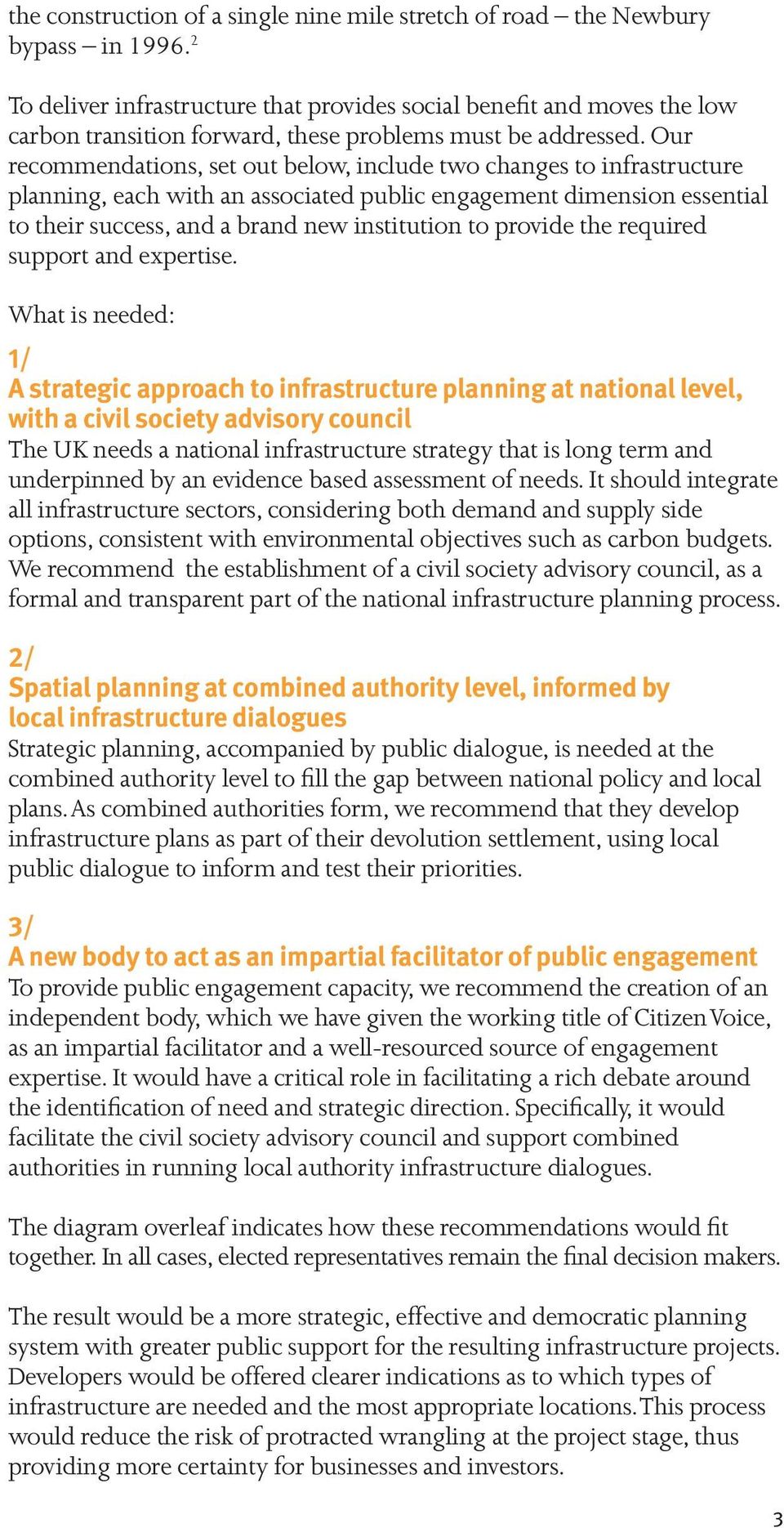
6 Securing a public mandate for new infrastructure will be essential to successful delivery. What is needed is a democratic structure to support the perpetual task of establishing that mandate. Building public engagement into strategic infrastructure planning Planning outputs New public inputs National infrastructure strategy Produced by national government or independent commission Civil society advisory council Citizen Voice Combined authority infrastructure plans Produced by combined authorities Local infrastructure dialogues Local plans Produced by local authorities in consultation with the public Neighbourhood plans Produced by town and parish councils or neighbourhood forums Our recommendations Existing set up 4
7 1 Introduction 5

8 Picture a low carbon UK. The landscape probably features elegant wind turbines turning on the ocean horizon, and well insulated urban roofs peppered with solar panels. There might be charging points for the electric buses trundling between rural villages, hints of a larger and smarter electricity grid and, perhaps, a pipeline connecting a steelworks to a carbon storage facility under the North Sea. If we are going to decarbonise, we are going to need some new infrastructure. If practised effectively, public engagement in infrastructure planning will lead to more informed decisions of higher quality The UK s existing infrastructure is in a bad way, ranking 28 th in the world, an embarrassment for a leading OECD economy. 3 Businesses repeatedly call for the government to improve the situation, with the energy sector being a particular worry. 4 A survey by the CBI in 2013 found that energy has now overtaken transport as the prime infrastructure concern for industry, with 90 per cent of firms surveyed worried about security of supply. 5 In contrast, a later poll has found that the general public doesn t see a particular need to upgrade infrastructure; people are unconvinced by the oft-repeated warning that the lights will go out. Only one in four is dissatisfied with national infrastructure quality, while 46 per cent are satisfied. There s a perception that the short term disruption caused by building new infrastructure is not worth the potential future benefits. 6 Nonetheless, the public does expect change, especially with regard to the transition to a low carbon energy system. An extensive study found that the British public wants and expects change with regard to how energy is supplied, used and governed with the caveat that politicians are expected to deliver the energy transition in a way that aligns with public values. 7 This conclusion was borne out by a recent ComRes poll that revealed 68 per cent of the public supports ways to make it easier to get involved in the planning process. 8 Securing a public mandate for new infrastructure will be essential to successful delivery. But the processes and institutions of the current system of infrastructure planning are inadequate for securing meaningful public input. To improve engagement, new initiatives are needed, which must go with the grain of devolution and deliberation. This will not eliminate controversy and outcry, and nor should it. But if practised effectively, public engagement in infrastructure planning will lead to more informed decisions of higher quality, with improved legitimacy. If the public is excluded from debate, people become disengaged from policy and distrustful of the motives of those proposing and delivering it. 9 Preventing public challenge in one forum is likely to force it elsewhere. Since the abolition of public inquiries for nationally significant infrastructure projects (NSIPs), pressure groups have increasingly resorted to judicial review; and, as these options diminish, opposition is pushed into less formal spaces. 10,11 This can be seen with the protests and civil disobedience against fracking in Balcombe and other test sites. 12 6
9 Making space for public engagement goes hand in hand with the task of making the planning system more strategic. Various organisations and individuals have built a strong case for the latter, most recently in the Labour Party commissioned Armitt Review of Infrastructure, but the central role of the former has been neglected. Armitt and others have assumed that the main problem with infrastructure is the length of time taken to reach decisions on projects. But the real issue is the lack of openness. This report seeks to address that imbalance, by focusing on how revitalised efforts to engage the public could strengthen and sanction a more strategic approach to infrastructure planning. Due to the diversity of planning systems in different areas of the UK, the recommendations presented here are primarily directed at England, although some aspects are relevant to Wales, Scotland, and Northern Ireland. Examples are drawn from the energy and transport sectors, which are the two infrastructure sectors most relevant to the low carbon transition, but the report s recommendations can be applied to other sectors too. Our research involved a literature review, expert interviews and an expert workshop. 7

10 8 2 Existing engagement is inadequate

11 There are three fundamental problems with the current state of infrastructure decision making: Conventional politics alone cannot secure a public mandate for new infrastructure. The public is not involved enough in defining infrastructure need. There is a gap in strategic planning, and associated public engagement, between the national and local levels. Conventional politics is inadequate Many politicians assume a general election provides them with a mandate for any decision that they subsequently make, including those on infrastructure. While there are a few cases where this might be the case (for example, electing Zac Goldsmith in the knowledge that he would oppose a third runway at Heathrow), in general a ballot sheet is a very low resolution representation of the wide array of positions an MP might take on different issues. Politicians are elected with, at best, a partial mandate to make infrastructure decisions, and the rest of that mandate must be earned through public engagement between elections. Politicians are elected with, at best, a partial mandate to make infrastructure decisions Citizens have a right to participate in decisions that affect their lives and communities. This doesn t mean that decisions should be taken out of the hands of elected representatives, but it means that the public should have genuine opportunities for input. This will improve transparency and leave both decision makers and the public with a better understanding of the issues in question and the infrastructure that will be most valued by society. Meaningful participation, however, has been held back in the UK by a political tradition that emphasises top down democracy, favouring leadership rather than participation and assuming that the government knows best. It is a view held by many people at the core of government, and it underpins British political institutions and processes. 13 While the UK s recent history of infrastructure planning has been typified by inconstancy and unpredictability, the top down view of democracy has proved resilient. This is evident in a common response to the public consultation on High Speed Two (HS2): people expressed the view that a decision had already been made and their contribution would have little influence on the government s strategy. 14 The most recent attempts by government to improve infrastructure planning have focused on the question of how to speed it up, rather than considering what was making it so slow and fraught in the first place. In 2008, Labour created the Infrastructure Planning Commission. The current government abolished it, moving its functions to the Planning Inspectorate, with final decisions resting with the secretary of state. But the idea that the system could be improved by building a public mandate into infrastructure planning, with engagement enabling better outcomes, has never had serious consideration. 9

12 Not enough public input in defining infrastructure need Many of the most intractable planning controversies boil down to questions about whether the proposed infrastructure is really necessary. Yet the definition of need remains the most opaque part of the decision making process. This lack of transparency breeds mistrust, affecting the legitimacy of all decisions that cascade down from national infrastructure policy. There is a risk of a vicious circle: the public doesn t bother to turn up to engagement exercises that seem frustratingly superficial, as the major decisions already seem to have been made, while policy makers and developers increasingly treat engagement as tick box exercises, because they perceive that people are not interested. 15 Despite the government s growing acknowledgement of the benefits of public engagement, opportunities are still too concentrated around the details of specific projects, rather than upstream definitions of the need for infrastructure and what it will enable. 16 Justifications for new infrastructure often conflate the definition of need (such as better connections between Manchester and Leeds) with the identification of how a need should be met (a new high speed train line between the two cities). The public is allowed very little space to discuss and define need and alternative ways of meeting it. As a result, these big questions end up getting squeezed, generally unsuccessfully and fractiously, into stages of the planning process that were never designed to handle such matters. Public inquiries were not intended to be the place for debate about the need for services such as energy, mobility or waste management. But, for a long time, they were the only option, as the public had no opportunity to input before the project stage of infrastructure planning. 17 As a result, a process that was supposed to inform ministers about objections to particular developments became a forum for deliberating and critically examining whether there was a national need for them. 18 For example, during the public inquiry into Heathrow Terminal Five (the longest public inquiry in British planning history, running from May 1995 until March 1999), Friends of the Earth s arguments opposing the terminal centred on the question of need. 19 The group disagreed with the government s claims that the terminal was essential for the UK s economy; it argued that London did not need more air capacity and that rail could provide a viable alternative
13 Technical studies can be insufficient if the public doesn t trust the government s assurances that risks will be managed Fracking: how not to do engagement Currently, need tends to be identified based on technical studies, which then form the government s evidence base. But this can be insufficient if the public doesn t trust the government s assessment or its assurances that risks will be managed. Public engagement is essential if broad agreement is to be achieved on controversial topics. This is acutely evident in the case of fracking, which the coalition government has openly advocated, without providing space for public debate about a new technology that is of concern to many. A letter written by the chancellor, George Osborne, and leaked to The Guardian reveals an intent to designate fracking as nationally significant infrastructure, as a way to smooth the process to full production and avoid the uncertainty of local planning decisions. 21 Several technical studies support the government s case, concluding that fracking presents low risks to public health and would have a low impact on overall greenhouse gas emissions, among others. 22 But the public has been unconvinced from the start and, arguably, this position has entrenched in response to the government s efforts to build support. George Osborne s pledge of 5 million in the 2014 Autumn Statement to provide independent evidence directly to the public about the robustness of the existing regulatory regime prompted Friends of the Earth to tweet, 5 million #fracking propaganda fund shows Govt losing the argument on safety & regulations. 23,24 This reveals an outdated adherence to the information deficit model of public engagement, which assumes that public mistrust is due simply to ignorance. 25 In reality, the reasons are more complicated. Management consultancy Futureye argues that four main drivers of outrage have led to the backlash: feelings of lack of control, that industry does not respond to concerns, that the local people affected do not benefit, and that regulatory authorities can t be trusted. 26 Fracking also serves to highlight the consequences of failing to provide space for public debate. As with the decision on Heathrow s third runway, debate is taking the form of protest, as well as finding what space it can in the local planning system where, for the moment, decisions on fracking are still being made. The 2008 Planning Act abolished public inquiries, in the context of major infrastructure projects, and introduced national policy statements (NPSs). They set out the government s objectives for the development of nationally significant infrastructure in particular sectors. There are legal provisions for public consultation on NPSs, at the discretion of the secretary of state. In practice, government departments have fulfilled this duty through organising formal consultation processes based on wordy documents written in dry jargon. For example, the draft networks NPS (covering road and rail) ran to 88 pages plus 543 pages of supplementary appraisals
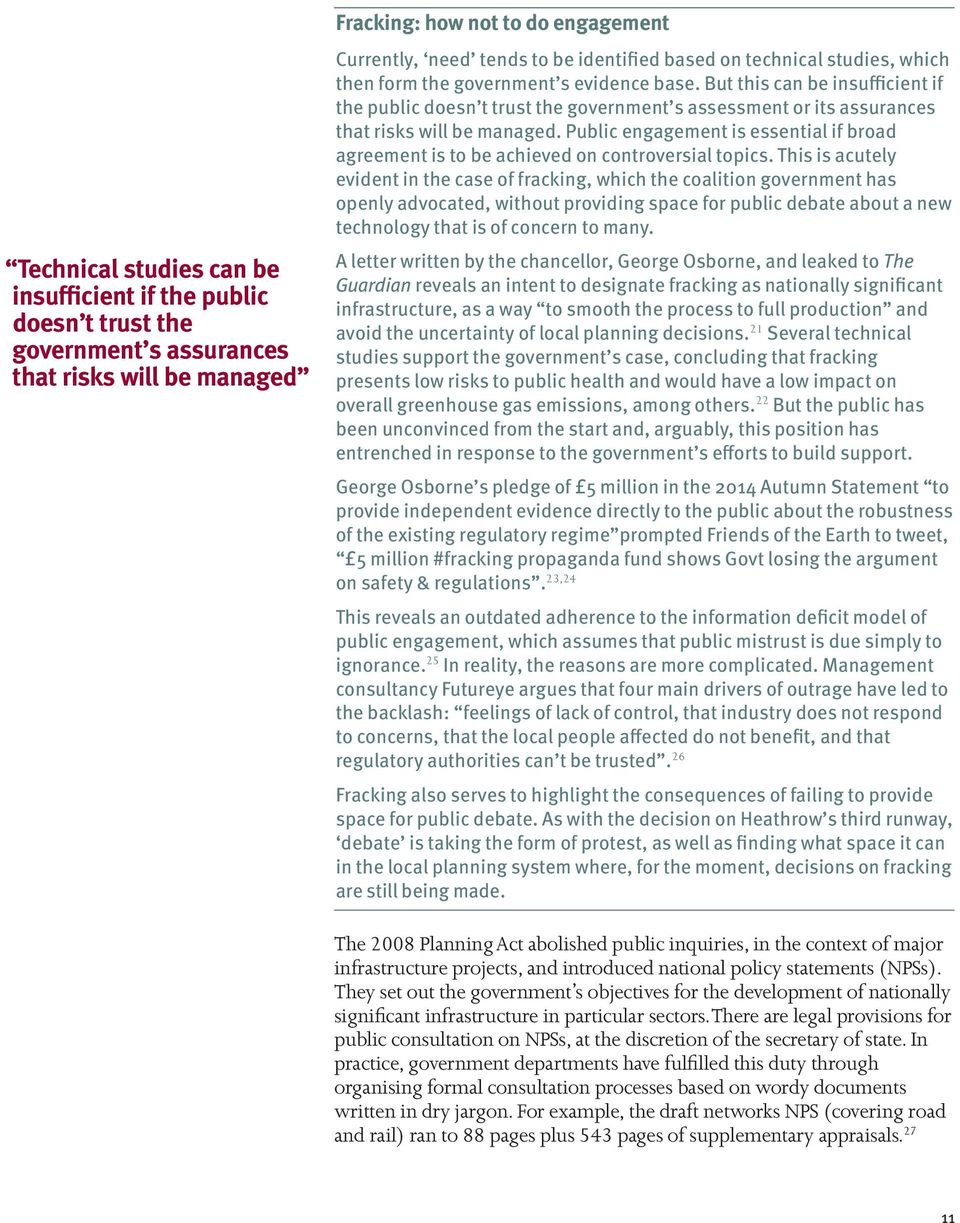
14 It is, therefore, not surprising that the consultation on offer has struggled to attract interest, except when NGOs have organised nationwide campaigns on specific asks. The graph below shows the number of responses to each NPS consultation. 28 Of the 5,800 responses received for the networks consultation, 95 per cent were standardised responses organised by the Campaign for Better Transport (CBT) and the Campaign to Protect Rural England (CPRE). 29 CBT mobilised its supporters to comment on the definition of national need which it considered to be underpinned by inaccurate transport forecasts over estimating traffic growth, thus over estimating the need for road building. 30 The energy NPS consultation actually covered six separate NPSs, so the 2,554 responses averaged out at 425 per NPS. Almost half of the responses were driven by CPRE s postcard campaign calling for the undergrounding of all electricity lines. 31 The opportunity to influence definitions of national infrastructure need via NPSs should not be a passive option, relying only on individual members of the public to keep track of consultations or NGOs to mount a campaign. 32 The government must actively source public input into the NPSs. Not only will this help to avoid resentment later on, when the public becomes frustrated at the decisions that have already been made; it will also improve the quality of decision making. The volume of responses to the networks NPS led to revisions that explored upper and lower scenarios for future traffic growth and clarified that there is still an onus on local schemes to demonstrate need, rather than assuming that all road building will be beneficial. Openness, therefore, improved the policy overall. It makes sense to consider the implications of new infrastructure at a scale beyond local authority boundaries Number of responses to each NPS consultation 5,800 6,000 5,000 4,000 3,000 2,554 2,000 1, Energy Ports National networks Hazardous waste Waste water treatment 12
15 Nowhere is there space for the public to participate in strategic, place-based discussions about where infrastructure should go The missing link between national and local It makes sense to consider the implications of new infrastructure at a scale beyond local authority boundaries. A city s transport network, for example, covers several unitary authorities. And a new electricity generation facility, such as an onshore wind farm sited in a rural district, could require a substation and new connections to the national grid to be built. This associated infrastructure is likely to span neighbouring districts. Of the nationally significant infrastructure projects (NSIPs) proposed since the 2008 Planning Act, even single site projects can be found straddling the boundary between two local authorities, and linear schemes, such as railways, run through multiple jurisdictions. The Thames Tideway Tunnel traverses National infrastructure policy is mostly quite abstract, with the details of implementation and the location of new infrastructure left to developers planning specific projects. After the national definitions of need, the next level down in the planning system is the much finer grain of local plans. These are supposed to be strategic and do involve public consultation, but they cover too small an area to consider infrastructure strategically. And local plans are not taken into account by the Planning Inspectorate when deciding whether to approve NSIPs. Consequently, there is a significant gap between the national policy level and the project level. Nowhere is there space for the public to participate in strategic, place-based discussions about where infrastructure should go; the different ways in which needs could be met; and the trade-offs that such choices will involve. These are the very questions the public is most interested in, but they rarely have the opportunity to engage, due to the gap highlighted. The most significant opportunities for improving the quality of major infrastructure planning and public engagement lie in the gap between the national and the local. In the next chapter we set out our recommendations for combined authority infrastructure plans and local infrastructure dialogues to address this. 13

16 14 3 Why the public should have a say
17 As demonstrated, there are real failings in the public engagement on offer around infrastructure. But what will be the benefits of improving it? There are a number of complementary rationales for investing in more meaningful public engagement: Greater comprehension of risks and perspectives 34 Public engagement enables decision makers, experts and the public to challenge each other s assumptions. It also provides an opportunity to consider alternative perspectives and their merits, and to appreciate the dilemmas that policy makers face. 35 Similarly, engagement enhances public policy s potential for learning and evolution, helping to compensate for the limits of expert knowledge found in political institutions. 36 New ideas enrich political debate With more people involved, from a greater variety of backgrounds, there is more scope for new ideas to feed in. As John Stuart Mill pointed out long ago, the collision of adverse opinions is a process of getting closer to the truth. 37 The quality of the resulting decisions is, therefore, likely to improve. Greater chance of identifying more acceptable outcomes Deliberation creates new opportunities to identify potential compromises, and is likely to result in better policies with a greater chance of them being more widely acceptable. 38 With more people involved, from a greater variety of backgrounds, there is more scope for new ideas to feed in More transparency and accountability improves legitimacy Participation increases the public s trust in government and the perception that procedures are fair, which is an important influence on the public acceptance of decisions. 39,40 Poorly constructed public consultations increase the public s suspicions about proposed projects. 41 Sometimes reticence about new energy infrastructure may not be because people disagree with the change, but because they feel the change is being forced upon them through a process they are unable to influence. 42 Improved implementation Effective public engagement tends to improve the implementation of decisions. 43 Thus, it can reduce the likelihood of developers facing costly delays late in the day, when opponents might otherwise resort to appeals, judicial reviews or civil disobedience. A recent report from the Institute for Government cites four cases in the UK where poor public engagement has caused delays, increased expense and led to inefficient outcomes: electricity generation, HS2, the Thames Tideway Tunnel and aviation in south east England. 44 Reduced development costs The Armitt Review argued that reducing policy uncertainty could improve infrastructure affordability because it lowers the cost of capital due to greater investor confidence. 45 Uncertainty would be reduced further still if there was effective public engagement in infrastructure planning. 15
18 If the public pays, it should have a say People are not only affected by new infrastructure developments; often, they are paying for them too, either as tax payers or as bill payers. It is, therefore, reasonable for them to have a say in infrastructure planning. It s a right Perhaps most fundamentally, the public has a right to participate in decisions as part of wider democratic society. The Aarhus Convention, which came into force in 2001, formalises this right in the specific case of decisions relating to the environment. 46 Public engagement will not remove controversy. There will always be unbridgeable gaps between different world views, between different ideas of social purpose or the common good, and between local interests and the government s definition of the national interest. Better engagement will not eliminate those gaps but it can narrow them, by creating space to explore alternative framings of the issue, providing room for greater understanding and compromise, and allowing alternative proposals to come to the fore. 16
19 There is space for the public to have a greater say in decisions, without having ultimate responsibility for them The spectrum of engagement Part of the challenge with public participation is that it means different things to different people. The approaches below represent a scale of increasing opportunity for the public to influence decisions. 47 Inform: Provide the public with balanced and objective information to assist in understanding the problem, alternatives, opportunities and solutions. Consult: Obtain public feedback on analysis, alternatives and decisions. Involve: Work directly with the public throughout the process to ensure that concerns and aspirations are consistently understood and considered. Collaborate: Work in partnership with the public on each aspect of the decision, including the development of alternatives and the identification of the preferred solution. Empower: Place final decision making in the hands of the public. The key to successful engagement is applying the appropriate kind of participation in a given situation. 48 With decisions about new infrastructure, the consult mode has, unhelpfully, tended to be the dominant method used. Engagement occurs at the downstream end of the decision making process, when the question has already been framed, alternatives defined and technical specifications laid out. This limits the public s opportunity for influence, with many people feeling that the important decisions have already been made. The involve mode is more transparent than consultation and begins further upstream, but has been regrettably absent from decision making processes relating to new infrastructure so far. Collaborate and empower may be appropriate locally, but infrastructure will continue to need national decision making and direction setting by elected representatives. The spectrum outlined above shows that there is space for the public to have a greater say in decisions, without having ultimate responsibility for them. 17
20 18 4 A way forward

21 To deliver infrastructure that will provide social benefit and progress the low carbon transition, the three problems with current infrastructure planning, outlined in chapter two, have to be addressed. We recommend two changes to infrastructure planning, each with an associated public engagement dimension essential to their success, and we propose a new institution to provide the required support and expertise: A strategic approach to infrastructure planning at national level, with a civil society advisory council Spatial planning at combined authority level, informed by local infrastructure dialogues A new body to act as an impartial facilitator of public engagement Strategic national infrastructure planning The UK needs a national infrastructure strategy A national infrastructure strategy The UK needs a national infrastructure strategy. National policy statements would nest under this overarching strategy, and guidance would be issued to local authorities based on the national strategy, to inform local plans. Such a strategy would: be underpinned by an evidence based assessment of needs, taking into account projections of economic growth, population, and technological and environmental change, with clear plans to meet those needs; 49 take a long term perspective, looking to the next years, but with monitoring and review to keep the strategy up to date; consider demand side together with supply side options; fit within the constraints of the carbon budgets adopted by the government; have some broadly spatial elements; for example, it might indicate the need for port upgrades in certain parts of the country; cover all infrastructure sectors; and be informed by the recommendations of a civil society advisory council. There are already moves in this direction. The coalition government is trying to improve along these lines, with the National Infrastructure Plan. Infrastructure UK insists that the latest version is a strategic plan and not just a list of projects, which was how the Public Accounts Committee described the 2013 edition. 50,51 The Armitt Review, endorsed by the Labour Party, recommends creating an independent National Infrastructure Commission to carry out a national infrastructure assessment, underpinned by delivery plans. A number of other recent independent reports echo this approach
22 A civil society advisory council Public input is vital at the national level, because this is where the question of need is decided and where the dominant framings of problems occur. 53 National policy also provides the context for planning at sub-national levels. However, as we saw with the NPSs, national policy discussions are fairly abstract and don t ignite public interest in the same way that concrete proposals do. 54 Securing input should not have to rely on the variable ability of NGOs to respond quickly and mount a campaign. But equally, seeking direct deliberation with individual citizens might not be the ideal way to ensure public involvement. To address this, we recommend tapping the richness of civil society by seeking input from a representative advisory council, as a formal part of the decision making process. The council must include a diverse set of interests, such as trade unions, conservation organisations and consumer groups. The council s members would be able to provide insight into which outcomes are most valued by the people they represent or work with. Each organisation represented on the council would be responsible for mobilising engagement and discussion with its members and stakeholders. The council would carry out its activities and meetings in a highly transparent manner: for example, transcripts or videos of its meetings would be publicly available, so that people outside the room can hold their representatives to account. Strategic planning, accompanied by public dialogue, is needed at the combined authority level to fill the gap between national policy and project delivery Many civil society groups, like the National Trust and the Women s Institutes, are highly trusted by the public. While such organisations might be wary of participating in a council with such a diverse set of members, the transparency of the process would allow each member to show they have accurately represented their organisation s perspective, regardless of the final decisions. If a National Infrastructure Commission is set up, the civil society council would advise it. If the institutional structure of the planning system remains the same, an infrastructure council should be established to advise departments on writing NPSs. Spatial planning at combined authority level Combined authority infrastructure planning Strategic planning, accompanied by public dialogue, is needed at the combined authority level to fill the gap between national policy and project delivery. As momentum builds behind devolution, with more funding devolved to city and county regions for policy areas such as transport, we expect to see more combined authorities take shape. 55 This is an ideal scale at which to undertake infrastructure planning, filling the gap between abstract national policies and finer grained local planning. As combined authorities form, we would expect them to produce infrastructure plans as part of their devolution settlement and for these to be informed by local dialogues. Rather than abruptly imposing a new layer 20
23 of planning, an evolutionary approach would be sensible, encouraging local authorities to work together in combinations that make sense, such as functional economic areas. Greater Manchester has already begun to move in this direction, producing a draft of a statutory Development Plan Document, developed jointly by all councils within the city region, but to be adopted individually by each council in its role as a planning authority. 56 Relating infrastructure proposals to their surroundings is a tangible way of considering the implications of policy Combined authority infrastructure plans would be spatial and they would integrate different infrastructure sectors, enabling local decision makers to consider the cumulative implications of different types of infrastructure. The plans would be high level, indicating areas in need of, or suitable for, particular large scale infrastructure, such as an onshore wind farm or a new railway station (as an example, see the Aberdeen City and Shire Strategic Development Plan overleaf). They would also indicate places that are especially valued locally for being infrastructure-free. Strategic plans at combined authority level would influence more detailed local plans, which would determine site boundaries and smaller scale infrastructure. This would enable wider assessment of decentralised infrastructure provision, as nationally significant infrastructure can be considered alongside smaller scale projects and demand side measures, such as energy efficiency building retrofit. Local infrastructure dialogues Local dialogues must inform combined authority infrastructure planning. These will be an essential part of enabling public debate about infrastructure planning, occurring at a point where meaningful input is possible and the questions that most interest people are still on the table. They will also have a key role in informing the national infrastructure planning process. Discussions would be grounded in the relevant place, which is vital because relating infrastructure proposals to their surroundings is a tangible way of considering the implications of policy. It is easier to engage the public at this scale than with more abstract questions of national policy, and is likely to lead to a richer debate. Communities would have space to discuss the outcomes made possible by different types of infrastructure, the best places to locate it and the investments that different members of society will value. The decision making process at this scale must keep open a path for alternative choices. 57 When the public is presented with a single option and asked to respond yes or no to an already detailed plan, the inclination is often to say no. This is because it doesn t seem like much of a choice at that stage, and the plan is unlikely to be properly attuned to local wishes if no serious engagement has taken place. This can give developers the impression that engagement just provides an opportunity for people to object. Yet, if people are presented with a set of options and the ability to offer their own suggestions, it becomes possible to express views more like 21
24 I prefer that one to that one or I value what that one will make possible, and a more constructive dialogue can follow. The result would be a more strategic, effective and democratic planning system that has greater public support for the resulting infrastructure projects. Developers would be offered clearer indications as to which types of infrastructure are needed, and the most appropriate locations. This process would reduce the risk of protracted wrangling at the project stage, thus providing more certainty for businesses and investors. Strategic plans in Scotland Scotland has already made significant progress towards the kind of combined authority infrastructure planning we recommend. It has four city region plans, called strategic development plans (SDPs), for Aberdeen, Dundee-Perth, Edinburgh and Glasgow. 58 The plans include spatial strategies and they cover issues that cross local authority boundaries, such as housing and transport. The plans are developed and administered by strategic development planning authorities, which are jointly funded by the relevant local authorities. 59 Scotland also has local plans, as in England, but the city region plans sit above them. A review of the SDPs, commissioned by the Scottish Government, found that a spatial approach to infrastructure planning is beneficial and that its value would be increased by including consideration of transport, energy and waste at the city region level, in a broader placemaking approach to areas of major change. The reviewers also argued that the government should hold public hearings as part of the process of examining SDPs. Despite this requiring more resources and appearing to run counter to the aim of streamlining the planning system, the authors make the case for public engagement, suggesting that hearings would be an important opportunity to raise concerns and build confidence in the strategic planning system. 60 Key diagram from the Aberdeen City and Shire Strategic Development Plan (2014). 61 Spatial concept Strategic growth Local growth Regeneration Projects Movement Green Place Infrastructure Housing market area 22
25 Engagement capacity These recommendations demand a significant increase in public engagement related to infrastructure planning. To provide that capacity, we propose the creation of an independent body, which we have given the working title of Citizen Voice, to be an impartial facilitator and a well resourced source of engagement expertise. It would have a critical role in facilitating a rich debate around the identification of need and strategic direction at national and sub-national level. Engagement must be resourced appropriately if it is to be effective and worthwhile The body would facilitate the activities of the civil society advisory council and be available as a resource for local authorities to assist with local infrastructure dialogues. Engagement expertise would be concentrated within the organisation and it would employ deliberative tools, constantly innovating, and using social media and gamification to involve different sections of society. Spanning national to local arenas, Citizen Voice would be able to promote iteration between conversations at different scales, ensuring that lessons learned at the local level informed decisions at the national level and vice versa. An annual report could function as a vehicle for this iterative work. At the local level, Citizen Voice would be available to organise and facilitate dialogue about the combined authority infrastructure planning, ensuring that every local resident in the relevant area has the opportunity to be heard. Citizen Voice should actively create forums for representative cross sections of the communities to deliberate, including those who wouldn t usually get involved, with monetary compensation available for those who participate in time consuming processes, such as focus groups. As well as direct deliberation with local residents, a range of stakeholders would have to be involved, including developers, planning authorities, Local Enterprise Partnerships, Local Nature Partnerships, academics, green groups and consumer groups. Citizen Voice would ensure that a diverse range of considered views is presented to decision makers. Its activities would be transparent, helping to make it a trustworthy intermediary, with no agenda beyond facilitating dialogue. Experts agree that trusted and independent agents carry out engagement most effectively. 62 Citizen Voice itself would not have decision making responsibility. But decision makers would be obliged to take note of Citizen Voice s findings and publish a response, without having to act on the views expressed by the public during its activities. Engagement must be resourced appropriately if it is to be effective and worthwhile. 63 Citizen Voice could be funded by general taxation, or by fees paid by developers. Under the current institutional arrangement, we recommend that it comes under the Cabinet Office, because it will have to engage with multiple departments including the Department for Communities and Local Government, Department for Transport, and Department of Energy and Climate Change. 23
26 An effective public forum: Commission nationale du débat public France s national commission for public debate (CNDP) was created in 1995 in response to citizen activism which was obstructing big developers in getting their plans approved. France copied a system originally developed in Quebec, Canada. Public engagement procedures must be used for large projects above certain thresholds (similar to the definition of NSIPs in the UK s 2008 Planning Act) and the CNDP provides an instructive example for the UK. Two important aspects are worth mentioning. First, the CNDP is well resourced, so all participants are given equal support to draw up and publish their arguments and participate in discussions. Second, the CNDP is not a decision making body; its role is to produce a report after a four month public debate process. The developer then decides whether to push ahead with the scheme or to modify or abandon it. A third of cases up to 2009 were dropped or extensively modified. For example, developers proposing a new rail link, between Charles de Gaulle Airport and the centre of Paris, ended up adopting their opponents alternative proposal. The president of each project commission monitors developers promises to ensure accountability, and this helps to build trust and legitimacy
27 5 What would change as a result of our recommendations? 25
28 These recommendations, encapsulated in the diagram on page four, could work iteratively. For example, the first national strategy could be nonstatutory, having the status of a material consideration for planning decisions. Once the local infrastructure dialogues have a chance to get going, their outputs could feed into the next iteration of the national strategy, which could eventually become statutory. The strategy would be reviewed whenever the results of the ongoing monitoring (by the National Infrastructure Commission or the Planning Inspectorate) suggest a review is needed. We have deliberately omitted the institution responsible for producing the national infrastructure strategy, because it will differ depending on the outcome of the general election. The great advantage of this model for local authorities is that it provides the flexibility to decarbonise in a locally appropriate way What changes as a result of our recommendations, and what remains the same? National level A civil society advisory council would exist to inform national infrastructure planning. It would either inform the existing process of developing NPSs and National Infrastructure Plans or, if such a body is created, it would advise the National Infrastructure Commission. Elected representatives would remain the final decision makers: the national infrastructure strategy must be approved by parliament. Local level There would be a new layer of strategic planning at combined authority level, sitting between national policy and local plans. Our recommendations fit with the trend towards the formation of combined authorities, requiring the development of a strategic infrastructure plan as part of the combination process. Combined authorities would be required to run local infrastructure dialogues, as part of their plan development. While these would be time intensive, the resources and expertise provided by Citizen Voice would ease the burden. In the absence of a combined authority in a given area, authorities designing local plans would have to take the national strategy into account. The rest of the town and country planning process would remain the same. The great advantage of this model for local authorities is that it provides the flexibility to decarbonise in a locally appropriate way, in negotiation with national government, to make sure that local decisions do not undermine the UK s ability to achieve its carbon budgets. A county region would be able to oppose a particular technology, such as onshore wind, as long as the combined authority could demonstrate that it was promoting other green technologies instead. 26
29 Infrastructure developers There would not be major changes to the process of applying for planning permission or development consent orders. Developers would begin the process with greater clarity about how the public would respond during consultations, by referring to the outcomes of local infrastructure dialogues. Developers proposing NSIPs would have to consider their project in light of the national strategy as well as the NPS. This would add an overarching layer to the national infrastructure planning process, but would give greater clarity to developers about where particular projects are needed and where they are likely to be more acceptable. Better strategic planning and improved public engagement will lead to better designed projects, which are more likely to succeed because they would be more locally appropriate and of higher quality. This should cut out time spent by developers on scoping, appeals, judicial review and time spent by the secretary of state calling in. 27
30 28 6 Conclusion
31 There is no perfect way to organise public participation in decisions about the UK s infrastructure. The best approach is to feel the way forward, gradually revising the system and evaluating each step. The context is constantly evolving: technologies emerge and develop, new means of communication take hold and geopolitical configurations change, as we have seen with the unfolding devolution agenda. The pressing need is to build the government s trust in the public s ability to understand the country s problems and participate in designing the solutions The recommendations presented here are only part of the answer to the fundamental problems we have outlined. Major blocks to better public engagement will also be political and institutional inertia, with a desire to cling to a more technocratic status quo. Altering institutional structures will not be sufficient in the face of this: ultimately, a new culture of deliberative engagement is needed within the British political system. In infrastructure circles, there is often talk about how to build the public s trust in industry and government. But perhaps a wary, sceptical public is a good thing for democracy, and the pressing need is to build the government s trust in the public s ability to understand the country s problems and participate in designing the solutions. 29
32 Endnotes 1 Public engagement experts refer to publics in the plural, to denote the diversity of groups within society and to acknowledge that who is expert and who is public changes depending on the context. While we acknowledge the validity of this approach, we ve chosen to refer to the public in the singular, for simplicity s sake. 2 Susanna Rustin, 2013, Road protests return: a new generation takes on the bypass builders, The Guardian, www. theguardian.com/environment/2013/ jan/12/combe-haven-greenprotesters-trees 3 Institution of Civil Engineers, 2014, The State of the nation: infrastructure Jessica Shankleman, 2014, CBI: politicians must stop playing blame game with energy policies, BusinessGreen, com/bg/news/ /cbipoliticians-must-stop-playing-blamegame-with-energy-policies 5 Will Nichols, 2013, CBI: energy blackouts top business concerns, BusinessGreen, com/bg/analysis/ /cbienergy-blackouts-top-businessconcerns 6 CBI, 2014, Building trust: making the public case for infrastructure 7 K Parkhill, C Demski, C Butler, A Spence, and N Pidgeon, 2013, Transforming the UK energy system: public values, attitudes and acceptability: synthesis report. Findings based on interviews with key stakeholders, a series of six in-depth deliberative workshops held in England, Scotland, and Wales, and a nationally representative survey 8 Jamie Carpenter, 2015, Poll finds public lacks awareness on key planning issues, Planning Resource, article/ /poll-finds-publiclacks-awareness-key-planning-issues 30 9 Caroline Kuzemko, 2014, Depoliticisation, institutions and political capacity: explaining sedate energy transition in the UK, EPG Working Paper: The government is implementing reforms to tackle the burden of judicial review, particularly for significant planning cases: www. consult.justice.gov.uk/digitalcommunications/judicial-review 11 S Owens and R Cowell, 2011, Land and limits: interpreting sustainability in the planning process (2nd ed) 12 BBC News, 2014, How summer fracking protest unfolded in Sussex village, 13 D Marsh, D Richards and M Smith, July 2003, Unequal plurality: towards and asymmetric power model of British politics, Government and Opposition 14 Dialogue by Design, 2011, High speed rail: investing in Britain s future, www. gov.uk/government/uploads/system/ uploads/attachment_data/file/11523/ hs2-consultation-summary.pdf 15 M Lee, C Armeni, J de Cendra, S Chaytor, S Lock, M Maslin, C Redgwell and Y Rydin, December 2012, Public participation and climate change infrastructure, Journal of Environmental Law 16 Brian Wynne, 2006, Public engagement as a means of restoring public trust in science hitting the notes, but missing the music?, Community Genetics 17 Levett-Therivel sustainability consultants, 2002, In the national interest? Government proposals for planning major infrastructure projects 18 Susan Owens, October 2011, Three thoughts on the third wave, Critical Policy Studies 19 HC Deb, 20 November 2001, vol 375, col uk/pa/cm200102/cmhansrd/ vo011120/debtext/ htm 20 Friends of the Earth, 2008, Heathrow Terminal 5: Why it must be the last airport expansion, press release, releases/heathrow_terminal_5_why_ it_ interactive/2015/jan/26/georgeosborne-fracking-letter 22 The Royal Academy of Engineering wrote an independent review, see reports/shale-gas-extraction-in-theuk; DECC s chief scientist assessed the potential greenhouse gas emissions and found the overall effect of shale gas production to be relatively small, see policies/providing-regulation-andlicensing-of-energy-industries-andinfrastructure/supporting-pages/ developing-shale-gas-and-oil-inthe-uk; and Public Health England assessed the potential public health risks and decided they would be low, provided that operations are properly run and regulated, see co.uk/news/autumn-statement-boostfor-shale/ article 23 Damian Carrington, 2015, Companies will be legally required to reveal chemicals used for fracking, The Guardian, environment/2015/jan/14/companieswill-be-legally-required-to-revealchemicals-used-for-fracking 24 status/ Sciencewise, 2011, Listening or explaining? Avoiding a deficit approach to public engagement in synthetic biology, Dialogue Bulletin, listening-or-explaining-avoidinga-deficit-approach-to-public-
33 engagement-in-synthetic-biology/ 26 Geoffrey Lean, 2015, Are the frackers in full retreat? The Telegraph, www. telegraph.co.uk/news/earth/ environment/ /are-thefrackers-in-full-retreat.html 27 Department for Transport, 2013, Consultation on a draft national policy statement for the national road and rail networks, uploads/system/uploads/attachment_ data/file/263046/executive-summaryconsultation-document.pdf 28 Graph data sources: Department for Transport, 2010, Summary of and response to the consultation on the draft National Policy Statement for ports, uploads/system/uploads/attachment_ data/file/2383/responses.pdf; Department for Environment, Food and Rural Affairs (Defra), 2013, Summary of responses to the consultation on a draft hazardous waste national policy statement (14 July October 2011), uploads/system/uploads/attachment_ data/file/205394/hazardous-wastesum-resp pdf; Defra, 2012, The government response to parliamentary scrutiny of the draft national policy statement for waste water, uploads/system/uploads/attachment_ data/file/69492/pb13710-wastewater-nps-response.pdf; Department for Transport, 2014, National networks national policy statement: government response to public consultation, system/uploads/attachment_data/ file/387351/cm-8977-accessible. pdf; and DECC, 2011, The government response to consultation on the revised draft national policy statements for energy infrastructure, system/uploads/attachment_data/ file/47861/1945-govt-respconsultation-on-nps.pdf 29 Department for Transport, 2014, National networks national policy statement: government response to public consultation, uk/government/uploads/system/ uploads/attachment_data/ file/387351/cm-8977-accessible.pdf 30 Sian Berry, 2014, New roads policy goes back to the 90s help us take action, Campaign for Better Transport blog, blogs/roads/ national-policystatement-action 31 DECC, 2011, The government response to consultation on the revised draft national policy statements for energy infrastructure, www. gov.uk/government/uploads/ system/uploads/attachment_data/ file/47861/1945-govt-respconsultation-on-nps.pdf 32 Maria Lee et al, 2012, op cit 33 Angus Walker, 2014, Local authority NSIP experience, Bircham Dyson Bell blog, october/582-local-authority-nsipexperience/ 34 what-is-public-dialogue-2/ 35 Royal Commission on Environmental Pollution, 2002, Environmental Planning 36 Susan Owens, 2002, A collision of adverse opinions? Major projects, planning inquiries, and policy change, Environment and Planning A 37 Cited by Susan Owens, 2002, op cit 38 Royal Commission on Environmental Pollution, 2002, op cit, paragraph Carolina Johnson, June 2014, Local civic participation and democratic legitimacy: evidence from England and Wales, Political Studies 40 Carissa Schively, January 2007, Understanding the NIMBY and LULU phenomena: reassessing our knowledge base and informing future research, Journal of Planning Literature; EA Lind and TR Tyler, 1988, The social psychology of procedural justice, Plenum Press; Catherine Gross, January 2007, Community perspectives of wind energy in Australia: the application of a justice and community fairness framework to increase social acceptance, Energy Policy 41 N Pidgeon and C Demski, December 2012, From nuclear to renewable: energy system transformation and public attitudes, Bulletin of the Atomic Scientists 42 Energy Research Partnership, 2014, Engaging the public in the transformation of the energy system 43 J Newig and O Fritsch, 2008, Environmental governance: participatory, multi-level and effective?, UFZ-Discussion Papers GoverNat 8 44 M Coelho and V Ratnoo with S Dellepiane, 2014, The political economy of infrastructure in the UK, Institute for Government 45 Sir John Armitt, 2013, The Armitt review: An independent review of long term infrastructure planning commissioned for Labour s policy review 46 aarhus/ 47 Devised by the International Association for Public Participation, cited in Involve, 2011, People and participation: how to put citizens at the heart of decision-making, p18 48 Involve, op cit 49 Sir John Armitt, 2013, op cit 31
34 50 Stephen Dance, head of infrastructure delivery, Infrastructure UK, HM Treasury, speaking at Westminster Energy, Environment & Transport Forum Keynote Seminar, National infrastructure planning: investment priorities, the Planning Act review and progress on major projects, on 10th December Public Accounts Committee, 2013, HM Treasury: planning for economic infrastructure, Forty-Second Report, uk/pa/cm201213/cmselect/ cmpubacc/872/87202.htm 52 London School of Economics Growth Commission, 2013, Investing for prosperity; Sir George Cox, 2013, Overcoming short- termism with British business; EEF, 2013, Transport for growth; Institute of Civil Engineering, 2013, State of the Nation; and Sir John Armitt, 2013, op cit 53 Energy Research Partnership, 2014, op cit 54 S Owens and R Cowell, 2011, op cit 59 Environment/planning/Development- Planning/Strategic-Planning 60 Kevin Murray Associates and University of Glasgow, 2014, Review of the strategic development plans in Scotland, page Aberdeen City and Shire Strategic Development Planning Authority, 2014, Aberdeen City and Shire Strategic Development Plan, www. aberdeencityandshire-sdpa.gov.uk/ News/2014/SDP_Published.asp 62 Energy Research Partnership, 2014, op cit; P-B Joly and A Kaufmann, 2008, op cit 63 Royal Commission on Environmental Pollution, 2002, op cit; Energy Research Partnership, 2014, op cit 64 Tim Marshall, 2009, Infrastructure planning in France context is critical, Town & Country Planning 55 Mark Sandford, 2015, Combined authorities, House of Commons Library, SN/PC/06649 www. parliament.uk/business/publications/ research/briefing-papers/sn06649/ combined-authorities 56 John Geoghegan, 2014, Manchester councils join forces for England s first city-region plan, Planning Resource, article/ /manchester-councilsjoin-forces-englands-first-city-regionplan 57 P-B Joly and A Kaufmann, September 2008, Lost in translation? The need for upstream engagement with nanotechnology on trial, Science as Culture 58 Introduced by the 2006 Scottish Planning Act 32
35 33
36 Green Alliance 36 Buckingham Palace Road London SW1W 0RE blog: greenallianceblog.org.uk The Green Alliance Trust Registered charity no Company limited by guarantee (England and Wales) no Registered at the above address
The future of UK infrastructure
 The future of UK infrastructure The new giants of UK infrastructure The UK is ahead in the global trend to make new infrastructure low carbon. We are already a world leader in offshore wind and planned
ETI PERSPECTIVE 2020: A FIVE YEAR STRATEGY
 ETI PERSPECTIVE 2020: A FIVE YEAR STRATEGY Introduction This document is the final and Board approved version of ETI s strategic directions based on the ETI Board meeting discussion of 12 th March 2015.
AER reference: 52454; D14/54321 ACCC_09/14_865
 Commonwealth of Australia 2014 This work is copyright. In addition to any use permitted under the Copyright Act 1968, all material contained within this work is provided under a Creative Commons Attribution
Welsh Government. Practice Guide. Realising the potential of pre-application discussions
 Welsh Government Practice Guide Realising the potential of pre-application discussions May 2012 Digital ISBN 978 0 7504 7623 2 Crown Copyright 2012 WG 15424 (2) Table of contents 1 Introduction...3 Background...3
new challenges and how its delivery can be improved in order to maximise its impact in the future.
 Contribution of the Kent, Greater Essex and East Sussex Local Enterprise Partnership to the consultation on the conclusions of the Fifth Cohesion Report on Economic, social and territorial cohesion: the
Planning application process improvements
 Planning application process improvements Government response to consultation January 2015 Department for Communities and Local Government Crown copyright, 2015 Copyright in the typographical arrangement
Right to challenge parking policies
 Right to challenge parking policies Traffic Management Act 2004: Network Management Duty Guidance March 2015 Department for Communities and Local Government Crown copyright, 2015 Copyright in the typographical
upport uy in ccountable ndependent epresentative impact ower and influence Measuring the impact and success of your youth voice vehicle
 Measuring the impact and success of your youth voice vehicle epresentative ccountable ndependent upport uy in impact ower and influence A guide for staff, councillors and young people involved in youth
CONSULTATION RESPONSE BY THOMPSONS SOLICITORS SCOTLAND
 CONSULTATION RESPONSE BY THOMPSONS SOLICITORS SCOTLAND SCOTTISH GOVERNMENT CONSULTATION ON THE DRAFT ORDER IN COUNCIL FOR THE TRANSFER OF SPECIFIED FUNCTIONS OF THE EMPLOYMENT TRIBUNAL TO THE FIRST TIER
The audit and inspection of local authorities
 The audit and inspection of local authorities Memorandum from the Department for Communities and Local Government 1. Summary and introduction The Audit Commission was set up in 1983 to audit local authorities,
Asset Management Policy March 2014
 Asset Management Policy March 2014 In February 2011, we published our current Asset Management Policy. This is the first update incorporating further developments in our thinking on capacity planning and
Southwest Region Women s Law Association
 Southwest Region Women s Law Association (Ontario) SUBMISSION ON ALTERNATIVE BUSINESS STRUCTURES: Response to the request for input from the legal community by the Law Society of Upper Canada in its Discussion
SEA AND SIA - TWO PARTICIPATIVE ASSESSMENT TOOLS FOR SUSTAINABILITY
 SEA AND SIA - TWO PARTICIPATIVE ASSESSMENT TOOLS FOR SUSTAINABILITY Kerstin Arbter Published in: Conference proceedings of the EASY ECO 2 Conference, May 15-17, 2003, Vienna, p. 175-181 1 Introduction
Student accommodation and affordable housing contributions
 Section 106 Planning obligations speeding up negotiations Student accommodation and affordable housing contributions Government Response to consultation March 2015 Department for Communities and Local
Strengthening the incentive to save: a consultation on pensions tax relief. Response to the consultation document published on 8 July 2015
 Strengthening the incentive to save: a consultation on pensions tax relief Response to the consultation document published on 8 July 2015 Grant Thornton UK LLP (Grant Thornton) has considered the proposals
Hanover Declaration Local Action Driving Transformation
 Hanover Declaration Local Action Driving Transformation 1 National Governments: Build upon local authority climate leadership! The International Conference on Climate Action 2015 (ICCA2015) showed that
DELIVERING OUR STRATEGY
 www.lawsociety.org.uk DELIVERING OUR STRATEGY Our three year plan 2015 2018 >2 > Delivering our strategy Catherine Dixon Chief executive Foreword Welcome to our three year business plan which sets out
The Planning System: General Principles
 The Planning System: General Principles The Plan-Led System: Structure 1. In England there is a hierarchical structure of guidance and plans covering national, regional and local planning which includes:
Renewable energy. Impact report
 Renewable energy Impact report Prepared by Audit Scotland May 2015 Audit Scotland is a statutory body set up in April 2000 under the Public Finance and Accountability (Scotland) Act 2000. It provides services
Improving the Effectiveness of Multi-Year Fiscal Planning
 Improving the Effectiveness of Multi-Year Fiscal Planning By Holly Sun Long-term forecasting and fiscal planning has long been advocated by the Government Finance Officers Association and other organizations
Best Practice in Design of Public-Private Partnerships (PPPs) for Social Infrastructure, particularly in Health Care and Education
 EMAIL [email protected] WEB www.fosterinfrastructure.com Best Practice in Design of Public-Private Partnerships (PPPs) for Social Infrastructure, particularly in Health Care and Education
City and County of Swansea. Human Resources & Workforce Strategy 2013-2017. Ambition is Critical 1
 City and County of Swansea Human Resources & Workforce Strategy 2013-2017 Ambition is Critical 1 Delivering quality services for a safer, greener, smarter, fairer, healthier, richer Swansea Executive Summary
INTERNATIONAL COUNCIL OF NURSES
 INTERNATIONAL COUNCIL OF NURSES 3, place Jean-Marteau CH-1201 Geneva (Switzerland) Tel. (+41 22) 908 01 00 Fax (+41 22) 908 01 01 E-mail: [email protected] Web site: www.icn.ch Guidelines on shaping effective
How To Write A New Bill On Flood Management In Scotland
 Scottish Environment LINK is the forum for Scotland's voluntary environment organisations representing a broad spectrum of environmental interests with the common goal of contributing to a more environmentally
Teachers and performance management: one year on. (Provisional results)
 Teachers and performance management: one year on. (Provisional results) David Marsden, Centre for Economic Performance, London School of Economics A personal apology to all the teachers who replied to
Native Vegetation Council. Strategic Plan 2014-16
 Native Vegetation Council Strategic Plan 2014-16 Foreword From the Presiding Member The Native Vegetation Council (NVC) is established under the Native Vegetation Act 1991, and exists to further the objects
INQUIRY ON THE PUBLIC SERVICE OMBUDSMAN FOR WALES Dr Richard Kirkham, School of Law, University of Sheffield 20 March 2015 Some introductory comments
 INQUIRY ON THE PUBLIC SERVICE OMBUDSMAN FOR WALES Dr Richard Kirkham, School of Law, University of Sheffield 20 March 2015 Some introductory comments 1. As well as writing extensively on the Ombudsman,
Logan City Council. Strategic Planning and Performance Management Framework
 Logan City Council Strategic Planning and Performance Management Framework 1 Table of contents 1. Overview 3 a) Purpose 3 b) Key Features 3 2. Context 4 a) National Framework for Sustainability 4 b) Elements
DFID CORE COMPETENCY FRAMEWORK
 DFID CORE COMPETENCY FRAMEWORK DFID s Core Competency Framework presents competencies in three clusters as shown below. The red cluster groups the work-related competencies, the green has peoplerelated
Data Communications Company (DCC) price control guidance: process and procedures
 Guidance document Contact: Tricia Quinn, Senior Economist Publication date: 27 July 2015 Team: Smarter Metering Email: [email protected] Overview: The Data and Communications Company (DCC) is required
Discussion Paper 01: Aviation Demand Forecasting
 Airports Commission Discussion Paper 01: Aviation Demand Forecasting Response from Kent County Council and Medway Council Q1: To what extent do you consider that the DfT forecasts support or challenge
Request for feedback on the revised Code of Governance for NHS Foundation Trusts
 Request for feedback on the revised Code of Governance for NHS Foundation Trusts Introduction 8 November 2013 One of Monitor s key objectives is to make sure that public providers are well led. To this
Questions and Answers on the European Commission Communication: The Paris Protocol A blueprint for tackling global climate change beyond 2020
 European Commission - Fact Sheet Questions and Answers on the European Commission Communication: The Paris Protocol A blueprint for tackling global climate change beyond 2020 Brussels, 25 February 2015
EXPLANATORY MEMORANDUM TO THE UNIVERSAL CREDIT (CONSEQUENTIAL, SUPPLEMENTARY, INCIDENTAL AND MISCELLANEOUS PROVISIONS) REGULATIONS 2013. 2013 No.
 EXPLANATORY MEMORANDUM TO THE UNIVERSAL CREDIT (CONSEQUENTIAL, SUPPLEMENTARY, INCIDENTAL AND MISCELLANEOUS PROVISIONS) REGULATIONS 2013 2013 No. 630 1. This explanatory memorandum has been prepared by
Item: 16 Page: 5. 1. Purpose
 Item: 16 Page: 5 1. Purpose 1.1 Improving Choice in Verification of Building Standards. A Scottish Government consultation on the introduction of the National House Building Council (NHBC) for the verification
Relationship Manager (Banking) Assessment Plan
 1. Introduction and Overview Relationship Manager (Banking) Assessment Plan The Relationship Manager (Banking) is an apprenticeship that takes 3-4 years to complete and is at a Level 6. It forms a key
the indicator development process
 Part Two Part Two: the indicator development process the indicator development process Part Two: the indicator development process Key elements of the indicator development process Define strategic directions
LEGAL AID ADVISORY COMMITTEE REVIEW INTO ESTABLISHING A CONTINGENCY LEGAL AID FUND IN NORTHERN IRELAND
 LEGAL AID ADVISORY COMMITTEE REVIEW INTO ESTABLISHING A CONTINGENCY LEGAL AID FUND IN NORTHERN IRELAND WRITTEN SUBMISSIONS OF THE ASSOCIATION OF PERSONAL INJURY LAWYERS 1. The Association of Personal Injury
Renewable Energy for Kent
 Design + Planning Building Engineering Renewable Energy for Kent Part I: Overview and Action Plan April 2012 Updated Version 1 Committing a Path The development of low carbon and renewable energy sources
How To Build Trust In The Statistics Service
 Whose trust matters most? Paper for the session Meeting expectations from users within resources IAOS Conference Da Nang, Vietnam, 8-10 October 2014. Richard Laux and Richard Alldritt The importance of
Libel Reform Campaign Initial summary assessment of the Defamation Bill
 Libel Reform Campaign Initial summary assessment of the Defamation Bill The Defamation Bill has been agreed by Parliament and is awaiting Royal Assent to become the Defamation Act 2013. We have campaigned
The Community Infrastructure Levy: advice note for culture, arts and planning professionals
 The Community Infrastructure Levy: advice note for culture, arts and planning professionals Martin J Elson, Emeritus Professor in Planning, Oxford Brookes University April 2012 Contents Aims of the advice
Part B1: Business case developing the business case
 Overview Part A: Strategic assessment Part B1: Business case developing the business case Part B2: Business case procurement options Part B3: Business case funding and financing options Part C: Project
Environmental Assessments and Major Projects Policy Considerations
 ASSEMBLY OF FIRST NATIONS Environmental Assessments and Major Projects Policy Considerations March 2011 Table of Contents 1. Introduction P.3 2. Major Projects Management Office P.4 3. First Nation Involvement
BEST PRACTICE CONSULTATION
 BEST PRACTICE CONSULTATION July 2014 Introduction Of the 10 principles for Australian Government policy makers in the Australian Government Guide to Regulation, two are related to consultation: 5. Policy
In our member surveys, the following themes are repeatedly mentioned as concerns:
 The Rt Hon George Osborne MP Chancellor of the Exchequer HM Treasury 1 Horse Guards Road London SW1A 2HQ 22 November 2013 Growth and Britain's Number One Manufacturing Exporter From the Chief Executive
Charter for Budget Responsibility: Autumn Statement 2014 update
 Charter for Budget Responsibility: Autumn Statement 2014 update December 2014 Charter for Budget Responsibility: Autumn Statement 2014 update Presented to Parliament pursuant to Section 1 of the Budget
Gambling Local Concerns Environmental Health & Licensing Manager Head of Planning Services. Regulatory Affairs
 Committee: Licensing Committee Date of meeting: 23 June 2014 Agenda item: 5 Subject: Lead Officer: Portfolio Holder(s): Link to Council Priorities: Exempt information: Delegated status: Gambling Local
CBI Scotland welcomes the opportunity to respond to the Scottish Government s paper Corporation Tax: Discussion Paper Options for Reform.
 SUBMISSION FROM CBI SCOTLAND CBI Scotland welcomes the opportunity to respond to the Scottish Government s paper Corporation Tax: Discussion Paper Options for Reform. We note that the questions contained
Developing The College of Social Work
 Research, Policy and Planning (2010) 28(2), 129-137 Developing The College of Social Work Dorit Braun 1 and Bridget Robb 2 1 Social Care Institute for Excellence (SCIE) 2 British Association of Social
ENA Submission to the Parliamentary Renewable and Sustainable Energy Group Inquiry into the access and management of renewables and the Grid
 1 ENA Submission to the Parliamentary Renewable and Sustainable Energy Group Inquiry into the access and management of renewables and the Grid 1.0 Introduction 1.1 Energy Networks Association (ENA) is
Access Fund for Sustainable Travel Guidance on Bidding. Moving Britain Ahead
 Access Fund for Sustainable Travel Guidance on Bidding Moving Britain Ahead July 2016 The Department for Transport has actively considered the needs of blind and partially sighted people in accessing this
1. a) How effective is the current Climate Change Act 2010 in driving climate change action by:
 Public Submission Review of Climate Change Act 2010 City of Melbourne Questions 1. a) How effective is the current Climate Change Act 2010 in driving climate change action by: Government? (tick one only)
Relaxation of planning rules for change of use from commercial to residential
 Relaxation of planning rules for change of use from commercial to residential Summary of consultation responses and the Government s response to the consultation Relaxation of planning rules for change
DEPARTMENT OF INFRASTRUCTURE AND REGIONAL DEVELOPMENT
 Corporate Plan 2015 2016 Corporate Plan 2015 2016 i DEPARTMENT OF INFRASTRUCTURE AND REGIONAL DEVELOPMENT Commonwealth of Australia 2015 ISBN 978-1-925216-54-7 June 2015 / INFRA2410 Ownership of intellectual
Q&A: Resource Legislation Amendment Bill 2015
 Q&A: Resource Legislation Amendment Bill 2015 1. What are the four most significant changes in the Bill? The four most significant changes in the Resource Legislation Amendment Bill are: Requiring councils
DTI Consultation on Proposals for a Special Administrator Regime for Energy Network Companies Ofgem s Response
 DTI Consultation on Proposals for a Special Administrator Regime for Energy Network Companies Ofgem s Response June 2003 Introduction Ofgem welcomes the DTI consultation on proposals for a special administrator
Portfolio Management 101:
 THOUGHT LEADERSHIP WHITE PAPER In partnership with Portfolio Management 101: Moving from Just Project Management to True PPM A lot of organizations claim that they carry out project & portfolio management
Home Building Protection Review Consultation Responses
 Home Building Protection Review Consultation Responses November 2014 Contents 1 Introduction 1 2 Response overview 2 3 The insurance model 3 First resort model 4 Mandatory last resort fidelity fund 4 Voluntary
HARLOW COUNCIL PERFORMANCE MANAGEMENT FRAMEWORK
 HARLOW COUNCIL PERFORMANCE MANAGEMENT FRAMEWORK July 2013 1 P age Contents Page 1.0 Definition 3 2.0 Context 3 3.0 Purpose and aim of the policy 4 4.0 Policy Statement 4 5.0 Framework for Performance Management
Devolution of Policing & Criminal Justice to Northern Ireland. An Aid for Dialogue. European Union
 European Union European Regional Development Fund Investing in your future Devolution of Policing & Criminal Justice to Northern Ireland An Aid for Dialogue Devolution of Policing & Criminal Justice to
The National Health Service. Constitution. A draft for consultation, July 2008
 The National Health Service Constitution A draft for consultation, July 2008 NHS Constitution The NHS belongs to the people. It is there to improve our health, supporting us to keep mentally and physically
Please send your responses via email, to: [email protected]. Respondent details. Mark Redhead. Head of Policy
 REFORM OF THE PRIVATE FINANCE INITIATIVE RESPONSE Please send your responses via email, to: [email protected] The deadline for responses is Friday 10 February 2012. Respondent details Your
STAFFORDSHIRE MOORLANDS DISTRICT COUNCIL. Report to Cabinet. 9 th January 2007
 AGENDA ITEM 9.3 STAFFORDSHIRE MOORLANDS DISTRICT COUNCIL Report to Cabinet 9 th January 2007 TITLE: The Role of City Development Companies in English Cities and City-Regions A Consultation PORTFOLIO: OFFICER:
Planning Policy Statement 2015
 Planning Policy Statement 2015 Introduction It is just over 50 years since national planning legislation was first implemented in Ireland. The Government wishes to reaffirm its strong belief in the value
THE PROFESSIONAL S FIRST CHOICE. Bridging the Gap How technology can help HR reach out to line management A Croner white paper
 THE PROFESSIONAL S FIRST CHOICE Bridging the Gap How technology can help HR reach out to line management A Croner white paper Executive summary The practice of human resources, or HR, has reached a transitional
CIVIL SERVICE COMMISSION STRATEGIC FRAMEWORK 2012-2016
 CIVIL SERVICE COMMISSION STRATEGIC FRAMEWORK 2012-2016 THE CIVIL SERVICE COMMISSION We are established by statute to provide assurance that civil servants are selected on merit on the basis of fair and
2012 No. 767 TOWN AND COUNTRY PLANNING, ENGLAND. The Town and Country Planning (Local Planning) (England) Regulations 2012
 STATUTORY INSTRUMENTS 2012 No. 767 TOWN AND COUNTRY PLANNING, ENGLAND The Town and Country Planning (Local Planning) (England) Regulations 2012 Made - - - - 8th March 2012 Laid before Parliament 15th March
Hybrid Bills and other consent procedures: October 2014. David Elvin QC
 Hybrid Bills and other consent procedures: October 2014 David Elvin QC Hybrid Bills Hybrid Bills: general introduction (1) Hybrid elements of both public and private bills a public bill which affects a
EXPLANATORY MEMORANDUM TO THE CONDITIONAL FEE AGREEMENTS (AMENDMENT) ORDER 2010. 2010 No. [Draft]
![EXPLANATORY MEMORANDUM TO THE CONDITIONAL FEE AGREEMENTS (AMENDMENT) ORDER 2010. 2010 No. [Draft]](/thumbs/24/2310498.jpg "EXPLANATORY MEMORANDUM TO THE CONDITIONAL FEE AGREEMENTS (AMENDMENT) ORDER 2010. 2010 No. [Draft]") EXPLANATORY MEMORANDUM TO THE CONDITIONAL FEE AGREEMENTS (AMENDMENT) ORDER 2010 2010 No. [Draft] 1. This explanatory memorandum has been prepared by the Ministry of Justice and is laid before Parliament
EXPLANATORY MEMORANDUM TO THE CONDITIONAL FEE AGREEMENTS (AMENDMENT) ORDER 2010 2010 No. [Draft] 1. This explanatory memorandum has been prepared by the Ministry of Justice and is laid before Parliament
How To Reform Social Work
 Social Work Reform Briefing from Children England March 2012 About This Briefing This briefing is provided on behalf of the Department for Education s overarching strategic partnership for voluntary, community
by Mr Paul CLARKE (Digital Strategy Consultant, London, United Kingdom)
 Strasbourg, 25 May 2011 Engl. only EUROPEAN COMMISSION FOR DEMOCRACY THROUGH LAW (VENICE COMMISSION) UNIDEM CAMPUS SEMINAR INFORMATION, (SOCIAL) MEDIA AND THE CIVIL SERVICE Council of the Regione Friuli
Planning Act 2008: Guidance on Changes to Development Consent Orders. December 2015 Department for Communities and Local Government
 Planning Act 2008: Guidance on Changes to Development Consent Orders December 2015 Department for Communities and Local Government Crown copyright, 2015 Copyright in the typographical arrangement rests
Non Traditional Business Models: Supporting transformative change in the energy market
 Non Traditional Business Models: Supporting transformative change in the energy market Response by Community Energy England, Regen SW, Community Energy Coalition and 10:10 SUMMARY This is a collaborative
BIBA response to DEFRA consultation on Securing the future availability and affordability of home insurance in areas of flood risk.
 S:\Wp\Files\Current\Grane\Nicol\2013\July 8 August 2013 Flood Insurance Consultation Department for Environment, Food and Rural Affairs 3 rd Floor, Zone C, Nobel House 17 Smith Square London SW1P 3JR Dear
Royaume-Uni Cour suprême. United Kingdom Supreme Court
 Colloque ACA Europe 15-17 Juin 2014 ACA Europe seminar 15-17 June 2014 Réponses au questionnaire sur la régulation économique Responses to the questionnaire on economic regulation Royaume-Uni Cour suprême
WEST YORKSHIRE BUS STRATEGY
 WEST YORKSHIRE BUS STRATEGY Phase 1 Consultation on Vision and Principles Introduction and Purpose There is a statutory requirement for the West Yorkshire Combined Authority (WYCA) to produce a Local Transport
COMMUNICATION AND ENGAGEMENT STRATEGY 2013-2015
 COMMUNICATION AND ENGAGEMENT STRATEGY 2013-2015 NWAS Communication and Engagement Strategy 2013-2015 Page: 1 Of 16 Recommended by Executive Management Team Communities Committee Approved by Board of Directors