
The Ten Steps to Improve Preexisting Condition Exclusions
|
|
|
- Sherman Hunt
- 5 years ago
- Views:
Transcription
1 August 27, 2010 Office of Consumer Information and Insurance Oversight Department of Health and Human Services Attention: OCIIO-9994-IFC, RIN 0991-AB69 P.O. Box 8016 Baltimore, Maryland Office of Health Plan Standards and Compliance Assistance Employee Benefits Security Administration, Room N-5653 U.S. Department of Labor 200 Constitution Avenue, NW Washington, DC Attention: RIN1210-AB43 Internal Revenue Service CC: PA: LPD: PR, Room 5025 P.O. Box 7604, Ben Franklin Station Washington, DC Attention: REG Re: CCD Comments on Interim Final Rules for Preexisting Condition Exclusions, Lifetime and Annual Limits, Rescissions, and Patient Protections (File Codes OCIIO-9994-IFC, RIN 0991-AB69/ RIN 1210 AB43/REG ) Dear Sir or Madam: The Consortium for Citizens with Disabilities (CCD) appreciates the opportunity to comment on interim final rules that implement provisions of the Patient Protection and Affordable Care Act (Affordable Care Act or ACA) regarding preexisting condition exclusions, lifetime and annual limits, rescissions, and patient protections. We applaud the issuance of these interim final rules by the Departments of Health and Human Services, Labor, and Treasury (collectively, the Departments), because their promulgation is an important step forward in protecting consumers against some of the most harmful practices within the private insurance market. We provide the following comments so that the Departments can strengthen the interim final rules. 1

2 CCD is a coalition of approximately 100 national disability organizations working together to advocate for national public policy that ensures the self determination, independence, empowerment, integration and inclusion of children and adults with disabilities in all aspects of society. Since 1973, the CCD has advocated on behalf of people of all ages with physical and mental disabilities and their families. CCD has worked to achieve federal legislation and regulations that assure that the 54 million children and adults with disabilities are fully integrated into the mainstream of society. Prohibition of Preexisting Condition Exclusions We strongly support interim final rules prohibiting preexisting condition exclusions. 1 These rules are, in a very real sense, the missing link of the Americans with Disabilities Act of 1990 (ADA), as they begin to implement the ACA s prohibition against discrimination based on health or disability status. 2 The ADA did little in the way of private insurance regulation and this was the great unfinished business for the disability community over the past twenty years. Although the interim final rules are important protections, we think the interim final rules could be improved in the following ways: We believe the definition of preexisting condition exclusions should be broadened to include additional forms of discrimination. We make the following recommendations. o Arbitrary restrictions on benefits, particularly in the area of rehabilitation and habilitation services and devices, should be considered a form of preexisting condition exclusion. In fact, coverage exclusions of, or arbitrary restrictions on, any benefits that are identified in the ACA statute as essential health benefits as rehabilitation and habilitation services and devices are should be considered a de facto preexisting condition exclusion and receive the same protections under the interim final rules. o The interim final rules do not provide necessary patient protections against new condition-based exclusions by health plans and health insurance issuers between now and 2014, when adults are protected against preexisting condition exclusions. For instance, to preemptively thwart the new rules on preexisting condition exclusions, health plans and health insurance issuers could simply eliminate coverage for certain benefits altogether. This could be viewed as a permissible condition-based exclusion of benefits, but would have the same effect as imposing a preexisting condition exclusion. Considering that Congress intended to ensure full access to coverage for individuals with preexisting conditions, CCD urges the Departments to take steps to protect patients against health plans and health insurance issuers that impose new condition-based exclusions. CCD suggests that until 2014, the interim final rules should require health plans and health insurance 1 The interim final rules are set forth at 26 CFR T, 29 CFR , 45 CFR The statutory prohibition is set forth at Sec of the Public Health Service Act (PHS Act), which was added by section 1201 of the ACA. Section 2704 broadens current HIPAA provisions, which only apply to group health plans and group health coverage. 2

3 issuers to exercise good faith efforts in implementing condition-based exclusions. In this context, good faith efforts should be defined to prohibit plans from imposing condition-based exclusions if their effect is to subvert the intent of the new preexisting condition exclusions policy. In this instance, the Departments and state Insurance Commissioners should have the authority to nullify conditionbased exclusions. o Excessive waiting periods, which run more than 90 days, should fall within the definition of prohibited exclusions. The Departments should use their regulatory authority to prohibit unreasonable premium increases for children receiving health coverage through the individual market. Currently, federal law prohibits group plans from charging higher premiums, but community rating restrictions in the individual market will not become effective until Accordingly, in the interim, children with preexisting conditions, who receive coverage through the individual market, may be charged excessive premiums. Such high premiums may defeat the purpose of prohibiting preexisting conditions exclusions, i.e., expanding coverage to more children. One way to prevent such unreasonable premium increases may be to prohibit health plans and health insurance issuers from asking questions about the health status of children on health insurance applications, thereby minimizing the risk of discriminatory treatment of children. Further, the Secretary of Health and Human Services (HHS) and state Insurance Commissioners should monitor premiums for individual family policies with children to ensure that excessive premiums are not being imposed. Lifetime and Annual Limits We applaud the interim final rules that prohibit health plans and health insurance issuers from imposing lifetime limits as well as unreasonable annual limits until 2014 when such limits are prohibited all together. 3 These restrictions on lifetime and annual limits only apply to essential health benefits, a term that is defined in the Affordable Care Act to include ten general categories. 4 We believe the interim final rules could be improved in the following ways: Regulations regarding essential health benefits should be issued as soon as practicable. In the meantime, according to the preamble of the interim final rules, health plans and health insurance issuers may use good faith efforts, to determine the meaning of essential health benefits. 5 In 2014, large group and self-insured plans will continue to use good faith efforts to determine whether certain benefits are subject to the lifetime and annual limit restrictions. This may lead to significant variations in the set of benefits subject to the rule. Further, health plans and health insurance issuers may unduly narrow 3 The interim final rules are set forth at 26 CFR T, 29 CFR , 45 CFR The interim final rules implement the statutory provisions of Sec of the PHS Act, which was added by Sec of the ACA. 4 ACA, Patient Protection and Affordable Care Act: Preexisting Condition Exclusions, Lifetime and Annual Limits, Rescissions, and Patient Protections, 75 Fed. Reg , 27191(June 28, 2010). 3

4 the scope of essential health benefits through the imposition of new coverage restrictions. And this may impact the federal government s definition of essential health benefits because this term will, in part, be based on a survey of what constitutes a typical employer health plan. Therefore, the sooner the HHS Secretary can issue the essential health benefit regulations, the better. The rules should provide an objective definition of good faith efforts to comply with a reasonable interpretation of essential health benefits. CCD believes the Departments should provide examples of actions constituting good faith efforts for determining the meaning of essential health benefits. The Departments and insurance commissioners should have the authority to prohibit insurance plans from limiting coverage of benefits to subvert the intention of the ACA provisions on prohibiting lifetime and unreasonable annual limits on those benefits. The Departments should issue restrictions on benefit-specific limitations (e.g., dollar or treatment frequency) that are imposed to subvert the intent of restrictions on lifetime and annual limitations. Different types of illnesses or injuries may require different levels of medical intervention, treatment, or care. Accordingly, it is important that health plans and health insurance issuers not sidestep restrictions on lifetime and annual limits by either imposing caps on costs related to a specific treatment, or by limiting treatment frequency. The Departments should require that health plans and health insurance issuers act in good faith and impose no restriction or limitation designed to subvert the intent of the annual and lifetime limit restrictions. Such a finding by the Departments or state Insurance Commissioners should render these types of limitations null and void. The imposition of restrictions on the use of annual and lifetime limits may have the unintended consequence of prompting health plans and health insurance issuers to impose condition-based exclusions of benefits in order to limit health expenditures in the future. The interim final rule explicitly permits condition-based exclusions of benefits. The rule states: The rules of this section do not prevent a group health plan, or a health insurance issuer offering group or individual health insurance coverage, from excluding all benefits for a condition. 6 CCD strongly urges the Secretaries to clarify that condition-based exclusions of benefits must not violate the requirements of the Americans with Disabilities Act of 1990, which prohibits disability-based distinctions in health insurance coverage. In fact, in issuing interim guidance on this issue in 1993, the Equal Opportunity Employment Commission (EEOC) stated the following: [H]ealth-related insurance distinctions that are based on disability may violate the ADA. A term or provision is disability-based if it singles out a particular disability (e.g., deafness, AIDS, schizophrenia), a discrete group of disabilities (e.g., cancer, 6 Sections 26 CFR T(b)(2), 29 CFR (b)(2), 45 CFR (b)(2). 4

5 muscular dystrophies, kidney diseases), or disability in general (e.g., noncoverage of all conditions that substantially limit a major life activity). 7 CCD believes that health plans and health insurance issuers may react to the elimination of lifetime limits by imposing new annual limits in benefits subject to the new dollar caps that are permissible until 2014 under the interim final rules. CCD believes that the Departments should promulgate a regulatory moratorium which would prohibit health plans and health insurance issuers from imposing new annual limits on essential health benefits. That is, no health plan or health insurance issuer should be permitted to impose an annual limit where none existed prior to enactment of the Affordable Care Act. Such a moratorium would supplement interim final regulations regarding grandfathered health plans, which state that a health plan or health insurance issuer will lose grandfather status if it imposes annual limits on essential health benefits under any of the following situations: (a) the plan, on March 23, 2010, did not impose an overall annual or lifetime limit, and now imposes an overall annual limit; (b) the plan, on March 23, 2010, imposed an overall lifetime limit, and now imposes an annual limit at a dollar value that is lower than the dollar value of the lifetime limit; or (c) the plan, on March 23, 2010, imposed an overall annual limit and now decreases the annual limit. 8 The rules should clarify how lifetime and annual limits will apply to large group and selfinsured plans, because such plans will not be required to provide the essential health benefits package. The interim final rules allow the HHS Secretary to waive restrictions on annual limits if compliance would result in a significant decrease in access to benefits or a significant increase in premiums. Consumer protections should be included to ensure that waivers do not have a negative, disproportionate effect on specific patient populations, especially those based on diagnosis or health status. Indeed, the rules should allow the Secretary to rescind waivers if there is such a negative, disproportionate effect. Prohibition on Rescissions We applaud the interim final rules that prohibit health plans and health insurance issuers from rescinding coverage except for fraud or intentional misrepresentation of a material fact. 9 We believe the rules could be strengthened in the following ways: 7 EEOC Interim Guidance on Application of ADA to Health Insurance, EEOC Compliance Manual, June 8, CFR T(g)(vi), 29 CFR (g)(vi), and 45 CFR (g)(vi). 9 The interim final rules are set forth at 26 CFR T, 29 CFR , 45 CFR The interim final rules implement the statutory provisions of Sec of the PHS Act, which was added by Sec of the ACA. 5

6 The rules now allow rescissions only in a limited set of circumstances. In those circumstances, consumers should be given the opportunity for independent, third-party review of any rescissions. Further, health plans and health insurance issuers should be required to continue coverage during the review and appeals process. The rules should provide a definition for the term material fact. For example, the definition of material fact should require a causal connection linking an alleged omission and the condition that triggered the look back. Consumers should be given independent and clear how-to manuals which instruct how to fairly complete an insurance application. Applications should be standardized to avoid confusion and complexity. Patient Protections CCD also strongly supports the interim final rules regarding patient protections, which allow consumers greater choice in selecting in-network primary care providers and pediatricians. 10 Similarly, we applaud these interim final rules because they also prohibit mandatory referrals or prior authorizations for emergency care or obstetrical and gynecological care. These consumer access provisions were contained in more comprehensive patients rights legislation proposed in CCD strongly supported this patient rights legislation, but it was not enacted at the time. The promulgation, now, of a limited set of patients rights is a positive development, but we urge the Departments to strengthen these consumer protections in the following ways: The Secretaries of the Departments should use their discretion to strengthen the definition of a primary care provider, as used in the consumer protection rules. CCD believes that a primary care provider should be defined in functional terms, and not solely on the basis of who is providing care. In particular, we urge the Departments to adopt a multidimensional definition of primary care, as suggested by the Institute of Medicine (IOM): Primary care is the provision of integrated, accessible health care services by clinicians who are accountable for addressing a large majority of personal health care needs, developing a sustained partnership with patients, and practicing in the context of family and community. 12 CCD believes this definition would remove unnecessarily sharp distinctions between generalists and specialists, at least when it comes to the provision of care to people with chronic conditions and disabilities. Consequently, adoption of this concept of primary care may allow patients, particularly those with disabilities and chronic conditions, to 10 The interim final rules are set forth at 26 CFR AT, 29 CFR A, 45 CFR The interim final rules implement the statutory provisions of Sec. 2719A of the PHS Act, which was added by Sec of the ACA. 11 See the Bipartisan Patient Protection Act, S and H.R (as introduced) from the 107th Congress. Sections 112, 115, 116 contain provisions for access to primary care, obstetrical and gynecological care, and pediatric care, respectively. 12 Institute of Medicine, Committee on the Future of Primary Care, Primary Care: America s Health in a New Era (Washington: National Academy Press, 1996), p

7 have better access to specialty care without prior authorization from a primary care gatekeeper who is a generalist. This would be a critical protection in health plans that use a network of providers that are only accessible through a primary care coordinator. Many people with disabilities and chronic conditions know their condition well and are active participants in managing their health care. In these instances, direct access to a specialist is often more efficient, less costly to the plan, and may lead to better, more timely care. In fact, in many instances, specialists already serve as de facto care coordinators for persons with disabilities. CCD believes that the Secretaries of the Departments should exercise their discretion to ensure that the final rules permit enrollees with disabilities and chronic conditions the option of selecting a willing specialist to serve as a care coordinator in plans that employ a network delivery model that utilizes the care coordinator concept. The provisions for emergency care should be expanded. Notably, the current rule protects patients from undue cost-sharing and administrative burdens if they receive out-ofnetwork emergency care without prior authorization, but there are no explicit similar provisions for in-network care obtained without prior authorization. CCD believes the interim final rules are a significant step forward for persons with disabilities and chronic conditions. Nonetheless, we believe that the rules could be further strengthened in significant ways. If you have any questions, please feel free to contact any of the Health Task Force Co-Chairs listed below. Thank you for your consideration of our comments. Sincerely: CCD Health Task Force Co-Chairs: Mary Andrus Tim Nanof Angelo Ostrom Easter Seals American Occupational Epilepsy Foundation [email protected] Therapy Association [email protected] [email protected] Julie Ward The Arc of the US & United Cerebral Palsy [email protected] Peter Thomas Brain Injury Association of America [email protected] CCD Health Task Force Members: 7

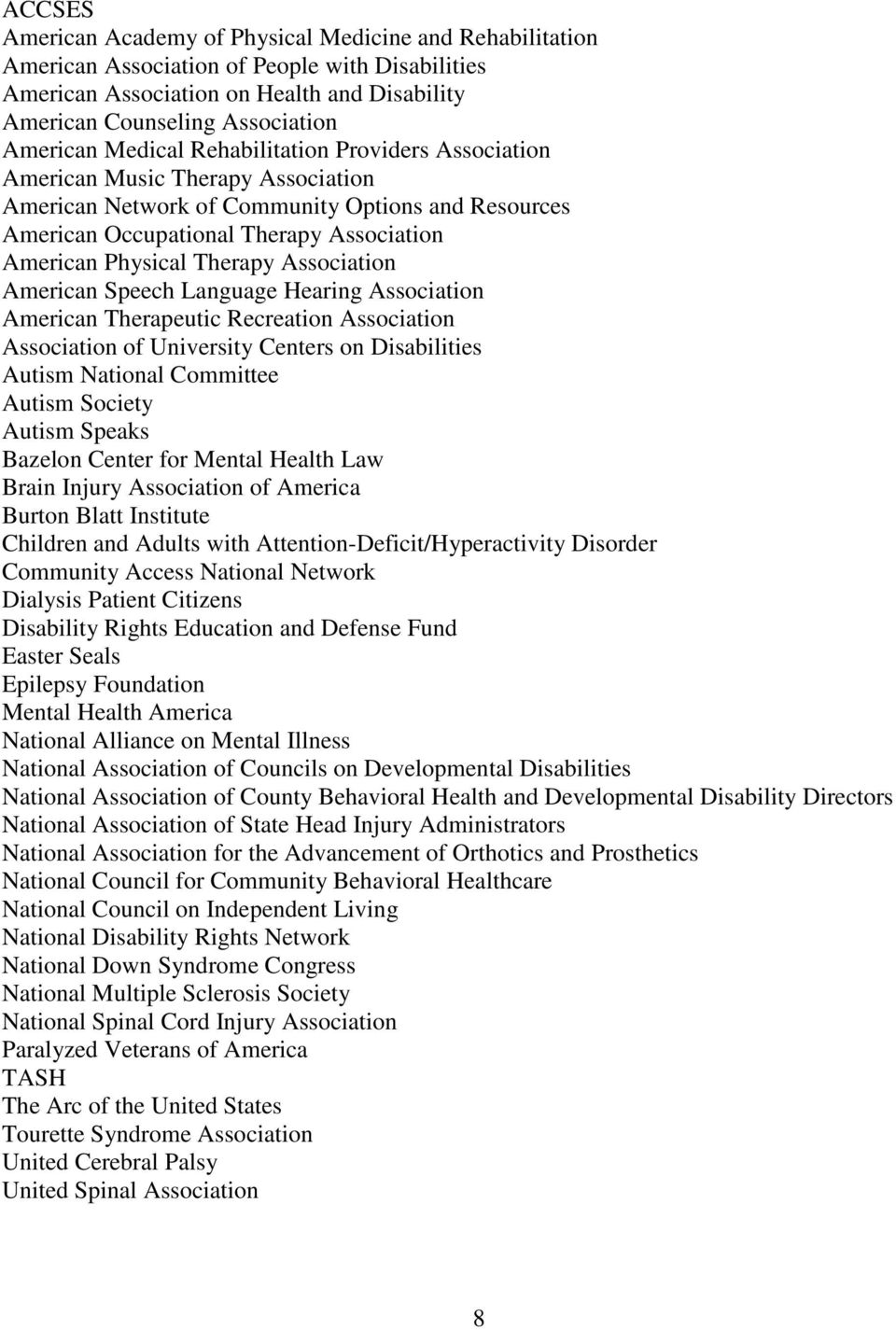
8 ACCSES American Academy of Physical Medicine and Rehabilitation American Association of People with Disabilities American Association on Health and Disability American Counseling Association American Medical Rehabilitation Providers Association American Music Therapy Association American Network of Community Options and Resources American Occupational Therapy Association American Physical Therapy Association American Speech Language Hearing Association American Therapeutic Recreation Association Association of University Centers on Disabilities Autism National Committee Autism Society Autism Speaks Bazelon Center for Mental Health Law Brain Injury Association of America Burton Blatt Institute Children and Adults with Attention-Deficit/Hyperactivity Disorder Community Access National Network Dialysis Patient Citizens Disability Rights Education and Defense Fund Easter Seals Epilepsy Foundation Mental Health America National Alliance on Mental Illness National Association of Councils on Developmental Disabilities National Association of County Behavioral Health and Developmental Disability Directors National Association of State Head Injury Administrators National Association for the Advancement of Orthotics and Prosthetics National Council for Community Behavioral Healthcare National Council on Independent Living National Disability Rights Network National Down Syndrome Congress National Multiple Sclerosis Society National Spinal Cord Injury Association Paralyzed Veterans of America TASH The Arc of the United States Tourette Syndrome Association United Cerebral Palsy United Spinal Association 8
Fact Sheet. AARP Public Policy Institute. Health Reform Changes Insurance Rules
 Fact Sheet Health Reform Changes Insurance Rules The Affordable Care Act (ACA) will greatly increase the availability of health insurance and broadly impact the delivery of health care in America. This
Support for the Ensuring Access to Quality Complex Rehabilitation Technology Act of 2015 (H.R. 1516 / S. 1013)
 June 24, 2015 Chairman Orrin Hatch United States Senate Finance Committee 219 Dirksen Senate Office Building Washington, DC 20510 Chairman Paul Ryan House Ways & Means Committee 1102 Longworth House Office
FAQS ABOUT AFFORDABLE CARE ACT IMPLEMENTATION (PART XVIII) AND MENTAL HEALTH PARITY IMPLEMENTATION January 9, 2014
 FAQS ABOUT AFFORDABLE CARE ACT IMPLEMENTATION (PART XVIII) AND MENTAL HEALTH PARITY IMPLEMENTATION January 9, 2014 Set out below are additional Frequently Asked Questions (FAQs) regarding implementation
[Adapted from Fed. Reg. 52530; NAIC Glossary of Health Insurance and Medical Terms: 3]
![[Adapted from Fed. Reg. 52530; NAIC Glossary of Health Insurance and Medical Terms: 3]](/thumbs/26/7933094.jpg "[Adapted from Fed. Reg. 52530; NAIC Glossary of Health Insurance and Medical Terms: 3]") New York State Benchmark Plan Recommendations Introduction The Patient Protection and Affordable Care Act (ACA) includes Rehabilitative and Habilitative Services and Devices as one of the ten categories
New York State Benchmark Plan Recommendations Introduction The Patient Protection and Affordable Care Act (ACA) includes Rehabilitative and Habilitative Services and Devices as one of the ten categories
Affordable Care Act (ACA) Violations Penalties and Excise Taxes
 Brought to you by The Insurance Exchange Affordable Care Act (ACA) Violations Penalties and Excise Taxes The Affordable Care Act (ACA) includes numerous reforms for group health plans and creates new compliance
HEALTH REFORM UPDATE GRANDFATHERED GROUP HEALTH PLANS August 3, 2010
 HEALTH REFORM UPDATE GRANDFATHERED GROUP HEALTH PLANS August 3, In July, the Departments of Treasury, Labor, and Health and Human Services jointly released the Interim Final Rules for Group Health Plans
CHCC CORPORATE HEALTH CARE COALITION. October 1, 2015. Re: Section 4980I Excise Tax on High Cost Employer- Sponsored Health Coverage, Notice 2015-52
 CHCC CORPORATE HEALTH CARE COALITION CC:PA:LPD:PR (Notice 2015-52) Room 5203 Internal Revenue Service P.O. Box 7604 Ben Franklin Station Washington, D.C. 20044 October 1, 2015 Re: Section 4980I Excise
Benefit and Coverage Rules Under the ACA: California vs. Federal Provisions
 March Benefit and Coverage Rules Under the ACA: California vs. Federal Provisions Since passage of the federal Affordable Care Act (ACA) in 2010, California has enacted implementing state legislation in
Important Effective Dates for Employers and Health Plans
 Brought to you by Krempa Associates, Inc. Important Effective Dates for Employers and Health Plans On March 23, 2010, President Obama signed the health care reform bill, or Affordable Care Act (ACA), into
Important Effective Dates for Employers and Health Plans
 Brought to you by Sullivan Benefits Important Effective Dates for Employers and Health Plans On March 23, 2010, President Obama signed the health care reform bill, or Affordable Care Act (ACA), into law.
Key Provisions of 2010 Healthcare Reform Legislation for Small (under 50) Employers. By Alice Eastman Helle. October 2013 Update
 Key Provisions of 2010 Healthcare Reform Legislation for Small (under 50) Employers By Alice Eastman Helle October 2013 Update The sweeping healthcare reform legislation enacted in 2010 is exceedingly
RE: Essential Health Benefits: Follow Up from the October 2014 Patient Coalition Meeting
 Mr. Kevin Counihan Marketplace Chief Executive Officer (CEO) Centers for Medicare & Medicaid Services 7501 Wisconsin Avenue Bethesda, MD 20814 November 18, 2014 RE: Essential Health Benefits: Follow Up
Cancellation of Nongroup Health Insurance Policies
 Cancellation of Nongroup Health Insurance Policies Bernadette Fernandez Specialist in Health Care Financing Annie L. Mach Analyst in Health Care Financing November 19, 2013 Congressional Research Service
How Health Reform Will Help Children with Mental Health Needs
 How Health Reform Will Help Children with Mental Health Needs The new health care reform law, called the Affordable Care Act (or ACA), will give children who have mental health needs better access to the
Identifying the Scopes of Services for People with Disabilities in Travis County Executive Summary
 Identifying the Scopes of Services for People with Disabilities in Travis County Executive Summary By Louise Bonneau, Jennifer Gordon, Ann Roth, and Ted Wilson The University of Texas at Austin, School
Coinsurance A percentage of a health care provider's charge for which the patient is financially responsible under the terms of the policy.
 Glossary of Health Insurance Terms On March 23, 2010, President Obama signed the Patient Protection and Affordable Care Act (PPACA) into law. When making decisions about health coverage, consumers should
956 CMR COMMONWEALTH HEALTH INSURANCE CONNECTOR AUTHORITY 956 CMR 8.00: STUDENT HEALTH INSURANCE PROGRAM
 Section 8.01: General Provisions 8.02: Definitions 8.03: Mandatory Health Insurance Coverage 8.04: Student Health Insurance Program Requirements 8.05: Waiver of Participation due to Comparable Coverage
Health Reform and the AAP: What the New Law Means for Children and Pediatricians
 Health Reform and the AAP: What the New Law Means for Children and Pediatricians Throughout the health reform process, the American Academy of Pediatrics has focused on three fundamental priorities for
February 18, 2016. Submitted via email to [email protected]
 February 18, 2016 Submitted via email to [email protected] CC:PA:LPD:PR (Notice 2015-87) Room 5203 Internal Revenue Service P.O. Box 7604 Ben Franklin Station Washington, DC 20044 Re:
August 11, 2010. Attention: RIN 1210-AB41. Dear Ms. Turner and Ms. Baum:
 August 11, 2010 Amy Turner Beth Baum Office of Health Plan Standards and Compliance Assistance Employee Benefits Security Administration Room N-5653 U.S. Department of Labor 200 Constitution Avenue, NW
InSight. A Littler Mendelson Report. Health Care Reform: Are You Prepared? A Timeline for Employers to Follow
 A Littler Mendelson Report InSight An Analysis of Recent Developments & Trends In This Issue: April 2010 The Patient Protection and Affordable Care Act was signed into law on March 23, 2010. Amendments
Legislative Brief: COMPREHENSIVE HEALTH COVERAGE ESSENTIAL HEALTH BENEFITS PACKAGE
 Laurus Strategies Legislative Brief: COMPREHENSIVE HEALTH COVERAGE ESSENTIAL HEALTH BENEFITS PACKAGE The Affordable Care Act (ACA) requires non grandfathered health insurance plans in the individual and
Health Insurance Reform in Montana A presentation to the 2011 Montana Legislature
 Health Insurance Reform in Montana A presentation to the 2011 Montana Legislature Presented by Montana Commissioner of Securities and Insurance Monica J. Lindeen January 10, 2011 2 In Montana, 157,000
B-327192. July 28, 2015. The Honorable Orrin G. Hatch Chairman The Honorable Ron Wyden Ranking Member Committee on Finance United States Senate
 441 G St. N.W. Washington, DC 20548 B-327192 July 28, 2015 The Honorable Orrin G. Hatch The Honorable Ron Wyden Committee on Finance United States Senate The Honorable Lamar Alexander The Honorable Patty
Health Care Reform Implications for Employers with Seasonal Employees
 Health Care Reform Implications for Employers with Seasonal Employees Many industries (e.g. ski resorts, retail, restaurants, agriculture, fishing and tourism) have a significant number of seasonal employees.
Insurance Market Reforms in the Patient Protection & Affordable Care Act and the Health Care & Education Reconciliation Act
 Insurance Market Reforms in the Patient Protection & Affordable Care Act and the Health Care & Education Reconciliation Act The new health care reform legislation will provide significant new options for
CBIZ Health Reform Bulletin
 Subject: Year-end Wrap Up Date: December 21, 2011 As the Affordable Care Act (ACA) is approaching its second birthday, it is appropriate to reflect on where we have come and what we can anticipate in the
Fact Sheet: The Affordable Care Act s New Patient s Bill of Rights
 http://www.healthreform.gov/newsroom/new_patients_bill_of_rights.html Fact Sheet: The Affordable Care Act s New Patient s Bill of Rights June 22, 2010 A major goal of the Affordable Care Act the health
Refer to https://www.bcbsal.org/providers/hcreform/hcrpreventivecod ing.pdf for the Quick Reference Guide for HCR Preventive Care Services
 Refer to https://www.bcbsal.org/providers/hcreform/hcrpreventivecod ing.pdf for the Quick Reference Guide for HCR Preventive Care Services Name of Policy: Preventive Care Services under Health Care Reform
Part II. Department of the Treasury Internal Revenue Service 26 CFR Parts 54 and 602
 Thursday, June 17, 2010 Part II Department of the Treasury Internal Revenue Service 26 CFR Parts 54 and 602 Department of Labor Employee Benefits Security Administration 29 CFR Part 2590 Department of
Health Care Reform. Guidance on PPACA Annual Dollar Limit Waivers, Provider Nondiscrimination, Clinical Trials and Transparency Reporting.
 Health Care Reform Guidance on PPACA Annual Dollar Limit Waivers, Provider Nondiscrimination, Clinical Trials and Transparency Reporting Summary The Departments of Labor (DOL), Health and Human Services
Re: REG 130266 11, Additional Requirements for Charitable Hospitals, Proposed Rule
 Sarah Hall Ingram Commissioner IRS Tax Exempt & Government Entities Division Internal Revenue Service P.O. Box 7604 Ben Franklin Station Washington, DC 20044 Re: REG 130266 11, Additional Requirements
Senate-Passed Bill (Patient Protection and Affordable Care Act H.R. 3590)**
 Prevention and Screening Services Cost-sharing Eliminates cost sharing requirements for requirements for all preventive services (including prevention and colorectal cancer screening) that have a screening
Affordable Care Act (ACA) Frequently Asked Questions
 Grandfathered policies Q1: What is grandfathered health plan coverage? A: The interim final rule on grandfathering under ACA generally defines grandfathered health plan coverage as coverage provided by
HEALTH REFORM and VACCINES: Review of Federal Legislation
 HEALTH REFORM and VACCINES: Review of Federal Legislation The Patient Protection and Affordable Care Act (PPACA) And The Health Care and Education Reconciliation Act Alexandra Stewart June 2, 2012 1 Presentation
Florida Senate - 2016 SB 144
 By Senator Ring 1 2 3 4 5 6 7 8 9 10 11 12 13 14 15 16 17 18 19 20 21 22 23 24 25 26 27 28 29 A bill to be entitled An act relating to autism; creating s. 381.988, F.S.; requiring a physician, to whom
Health Care Reform Overview
 Health Care Reform Overview By Marcia S. Wagner The Wagner Law Group 99 Summer Street, 13th Floor Boston, MA 02110 www.erisa-lawyers.com Introduction President Obama signed the Patient Protection and Affordable
OPEN LETTER TO STATES ON DEFINING ESSENTIAL HEALTH BENEFITS PACKAGE. Dear State Leaders Designing Essential Health Benefit Packages:
 OPEN LETTER TO STATES ON DEFINING ESSENTIAL HEALTH BENEFITS PACKAGE RE: TECHNICAL ASSISTANCE FOR STATES TO DESIGN ESSENTIAL HEALTH BENEFITS PACKAGES FOR REHABILITATIVE AND HABILITATIVE SERVICES AND DEVICES
May 7, 2012. Submitted Electronically
 May 7, 2012 Submitted Electronically Secretary Kathleen Sebelius Department of Health and Human Services Office of the National Coordinator for Health Information Technology Attention: 2014 edition EHR
Christy Tinnes, Brigen Winters and Christine Keller, Groom Law Group, Chartered
 Preparing for Health Care Reform A Chronological Guide for Employers This Article provides an overview of the major provisions of health care reform legislation affecting employers and explains the requirements
PROGRAM MEMORANDUM INSURANCE COMMISSIONERS INSURANCE ISSUERS
 PROGRAM MEMORANDUM INSURANCE COMMISSIONERS INSURANCE ISSUERS Department of Health and Human Services Centers for Medicare and Medicaid Services Transmittal No. 04-01 Date March 2004 Title: Subject: Market:
407-767-8554 Fax 407-767-9121
 Florida Consumers Notice of Rights Health Insurance, F.S.C.A.I, F.S.C.A.I., FL 32832, FL 32703 Introduction The Office of the Insurance Consumer Advocate has created this guide to inform consumers of some
OVERVIEW OF PRIVATE INSURANCE MARKET REFORMS IN THE PATIENT PROTECTION AND AFFORDABLE CARE ACT AND RESOURCES FOR FREQUENTLY ASKED QUESTIONS
 OVERVIEW OF PRIVATE INSURANCE MARKET REFORMS IN THE PATIENT PROTECTION AND AFFORDABLE CARE ACT AND RESOURCES FOR FREQUENTLY ASKED QUESTIONS Brief Prepared by MATTHEW COKE Senior Research Attorney LEGISLATIVE
ACP Analysis of the Essential Health Benefits Bulletin, Issued by the HHS Center for Consumer Information and Insurance Oversight (CCIIO)
 ACP Analysis of the Essential Health Benefits Bulletin, Issued by the HHS Center for Consumer Information and Insurance Oversight (CCIIO) Introduction and background: Summarizes the essential benefit package
National Health Insurance Reform
 JANUARY2011 National Health Insurance Reform Impact Year by Year With the passage of National Health Insurance Reform it is crucial that employers and plan sponsors have clear information about the impact
Health Care Reform Frequently Asked Questions (FAQ) Consumers Employers
 This page provides answers to frequently asked questions (FAQ) regarding The Patient Protection and Affordable Care Act (PPACA; P.L. 111-148) and the Health Care and Education Reconciliation Act of 2010
Cynthia G. Tudor, Ph.D., Director, Medicare Drug Benefit and C & D Data Group Cheri Rice, Director, Medicare Plan Payment Group
 DEPARTMENT OF HEALTH & HUMAN SERVICES Centers for Medicare & Medicaid Services 7500 Security Boulevard Baltimore, Maryland 21244-1850 CENTER FOR MEDICARE TO: FROM: SUBJECT: All Part D Sponsors Cynthia
Disability and Rehabilitation Research Coalition
 Disability and Rehabilitation Research Coalition 1501 M Street, N.W. Suite 700 Washington, D.C. 20005 Testimony Submitted for the Written Record by the Disability and Rehabilitation Research Coalition