
JACKSON RECOVERY CENTERS Initial Substance Abuse Assessment Form. Substance used: Method: Age started: Last used: Frequency/progression of use:
|
|
|
- Sharon Wiggins
- 10 years ago
- Views:
Transcription
1 JACKSON RECOVERY CENTERS Initial Substance Abuse Assessment Form PRESENTING PROBLEM DRUGS OF CHOICE Substance used: Method: Age started: Last used: Frequency/progression of use: Indicators of Addiction: Indicator 1 Tolerance Yes No Indicator 2 - Withdrawal Yes No Indicator 3 - Loss of Control Yes No Indicator 4 - Failed efforts to control Yes No Indicator 5 - Preoccupation Yes No (i.e. spending a lot of time thinking about using, borrowing money to buy substances, searching for substances) Indicator 6 - Interferences Yes No (i.e. isolating, giving up or reducing activities with family/friends, missing work/social events) Indicator 7 - Use Despite Consequences Yes No (i.e. use despite warning from health care professional, knowledge of mental health problems, or legal consequences) Substance used: Method: Age started: Last used: Frequency/progression of use: Indicators of Addiction: Indicator 1 Tolerance Yes No Indicator 2 - Withdrawal Yes No Indicator 3 - Loss of Control Yes No Indicator 4 - Failed efforts to control Yes No Indicator 5 - Preoccupation Yes No Indicator 6 - Interferences Yes No Indicator 7 - Use Despite Consequences Yes No Assessment-CP

2 Substance used: Method: Age started: Last used: Frequency/progression of use: Indicators of Addiction: Indicator 1 Tolerance Yes No Indicator 2 - Withdrawal Yes No Indicator 3 - Loss of Control Yes No Indicator 4 - Failed efforts to control Yes No Indicator 5 - Preoccupation Yes No Indicator 6 - Interferences Yes No Indicator 7 - Use Despite Consequences Yes No Other Substance Use History Drug Alcohol Marijuana Methamphetamine Cocaine/Crack Heroin Hallucinogen Methadone Tranquilizer Opiates Inhalant Phencyclidine (PCP) Over-the-counter Nicotine Other Past 30 Days Amount/Frequency Last 12 Months Amount/Frequency Method Age of First Use Date of Last Use None Other Longest Period of Abstinence (Include dates): Assessment-CP

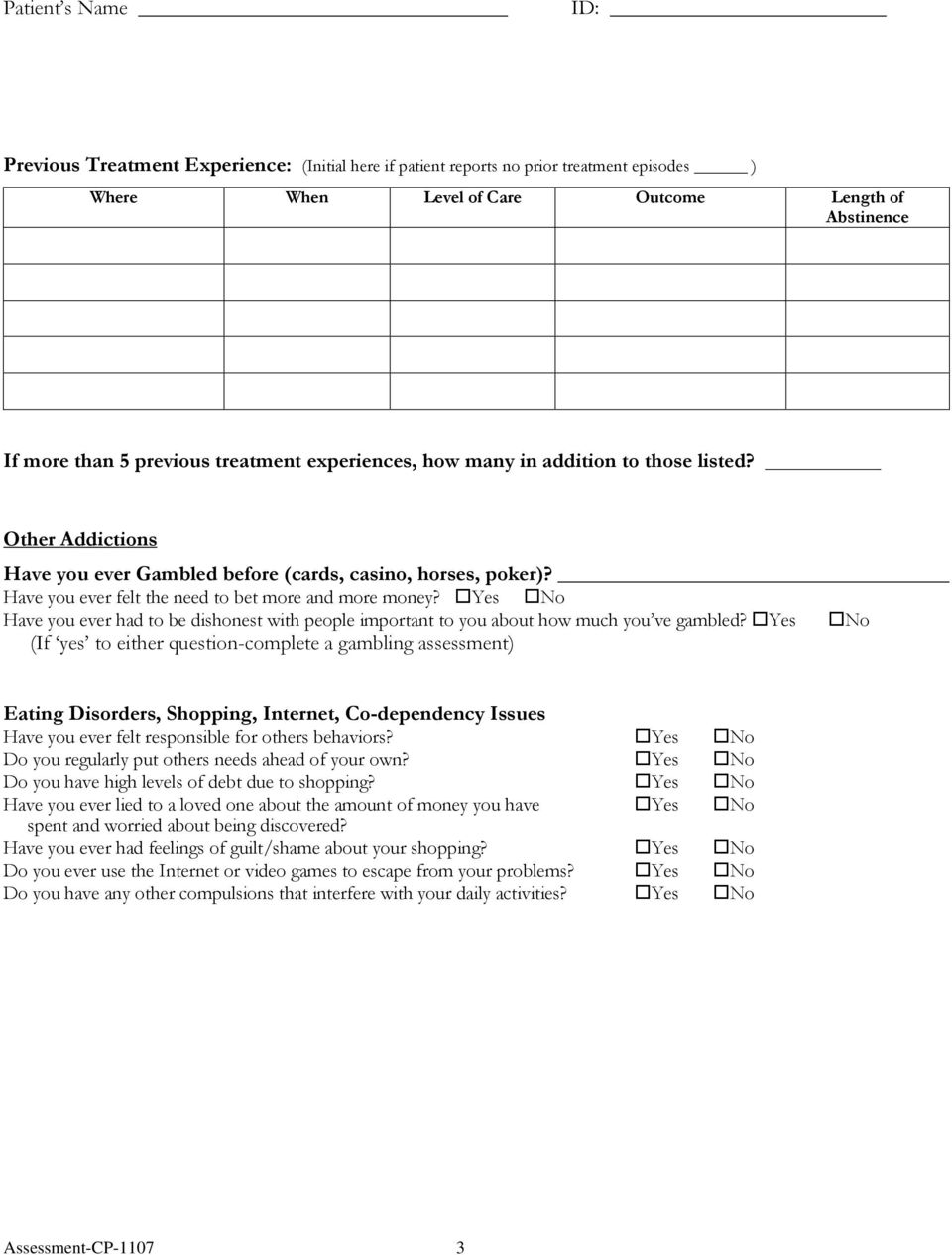
3 Previous Treatment Experience: (Initial here if patient reports no prior treatment episodes ) Where When Level of Care Outcome Length of Abstinence If more than 5 previous treatment experiences, how many in addition to those listed? Other Addictions Have you ever Gambled before (cards, casino, horses, poker)? Have you ever felt the need to bet more and more money? Yes No Have you ever had to be dishonest with people important to you about how much you ve gambled? Yes (If yes to either question-complete a gambling assessment) No Eating Disorders, Shopping, Internet, Co-dependency Issues Have you ever felt responsible for others behaviors? Yes No Do you regularly put others needs ahead of your own? Yes No Do you have high levels of debt due to shopping? Yes No Have you ever lied to a loved one about the amount of money you have Yes No spent and worried about being discovered? Have you ever had feelings of guilt/shame about your shopping? Yes No Do you ever use the Internet or video games to escape from your problems? Yes No Do you have any other compulsions that interfere with your daily activities? Yes No Assessment-CP
4 ASAM Dimensions DIMENSION 1 - ACUTE INTOXICATION OR WITHDRAWAL POTENTIAL Current signs/symptoms: Yes No Hx of withdrawal: Yes No Describe: Cold Sweats Irritability Tremors Diarrhea Hallucinations Headaches Seizures Vomiting Anxiety Paranoia Insomnia Mood Swings Current Symptoms: (0) None or Stable (1) Minimal risk of severe withdrawal (2) Moderate signs/symptoms; moderate risk of severe withdrawal (3) Severe withdrawal, but manageable; medically monitored inpatient detoxification services (4) Severe signs symptoms; severe withdrawal and danger; medically monitored inpatient detoxification services DIMENSION 2 - MEDICAL CONDITIONS Health History (Significant Health Issues/Pregnant?/ Hosp. in last 6 mos for subs reason): Current Medications for medical problems (name, dose, frequency): Current Physician (name, address, phone): (0) None or Stable (1) Mild to moderate symptoms: e.g. symptoms interfering with daily function (2) Acute, non-life threatening medical signs/symptoms; biomedical conditions are severe enough to warrant inpatient placement, e.g. signs of malnutrition (3) Severe medical problems; patient requires medical monitoring but not intensive continuous medical management; e.g. brittle diabetes (4) Severe medical problems; client is incapacitated; client requires 24-hour medical care Assessment-CP

5 DIMENSION 3 - EMOTIONAL/BEHAVIORAL CONDITIONS Psychological Hx/ Mental Status (Current emotional status, Current Psych meds/effectiveness/physician) Current Stressors: Suicidal/Homicidal Thoughts/Attempts: Hx of Abuse/Violence: Hx of Counseling: Medication Hx: (0) None or Stable (1) Mild to moderate symptoms: adequate resources and skills but impaired judgement; adequate impulse control (2) Frequent and intensive symptoms; moderate or minimal skills and resources; prominent Axis II diagnosis; mild to moderate risk behaviors to self or others (3) Severe symptoms result in significant impairment; severe lack of resources or skills; e.g., frequent impulses to harm self or others; repeated inability to control impulses; requires 24 hour structure (4) Severe acute, life-threatening symptoms; dangerous or impulsive behavior placing self and/or others at imminent risk; symptoms of psychosis, hallucinations, delusions, etc.; requires medically managed intensive psychiatric services. Assessment-CP

6 DIMENSION 4 READINESS TO CHANGE (0) Cooperative, motivated; ready for change (1) Ambivalent about illness or need for change, but willing to explore need for treatment (2) Verbal compliance with treatment recommendations, but without consistent behaviors; passively involved in evaluation/treatment process (3) Inconsistent compliance; minimal awareness; poor follow through on treatment recommendations (4) Unable to follow through with treatment recommendations; no awareness of illness; patient needs motivating strategies; if in imminent danger of harm to self or others may need 24-hour structure DIMENSION 5 - RELAPSE/CONTINUED USE POTENTIAL Description: (0) No relapse potential; low potential with good coping skills (1) Minimal relapse potential with some vulnerability; has fair to good coping/refusal skills (2) Impaired recognition and understanding of relapse issues, but is able to self-manage with prompting (3) Little recognition and understanding of substance use relapse issues and poor skills to cope with and interrupt addiction problems, or to avoid or limit relapse (4) Continued use despite treatment involvement; if relapse places patient and/or others in imminent danger then patient may require 24-hour support and monitoring DIMENSION 6 - RECOVERY ENVIRONMENT Current Living Situation: Support System: Employment/Education (Current and History): Legal History (OWI hx, # of arrests in last 12 mos): 12 Step Meeting Attendance: # Attended in Last 30 days: Assessment-CP

7 Family History (Dynamics, Description of Relationships, Hx of Mental Illness, Substance Abuse History): (0) Supportive recovery environment or able to cope with poor support (1) Limited support from significant others but able to cope (2) Non-supportive environment, but with structure can cope most of the time (3) Non-supportive environment; somewhat dangerous environment; patient finds coping difficult. (4) Unsupportive, actively hostile and dangerous environment for patient; needs 24 hour structure. Assessment-CP

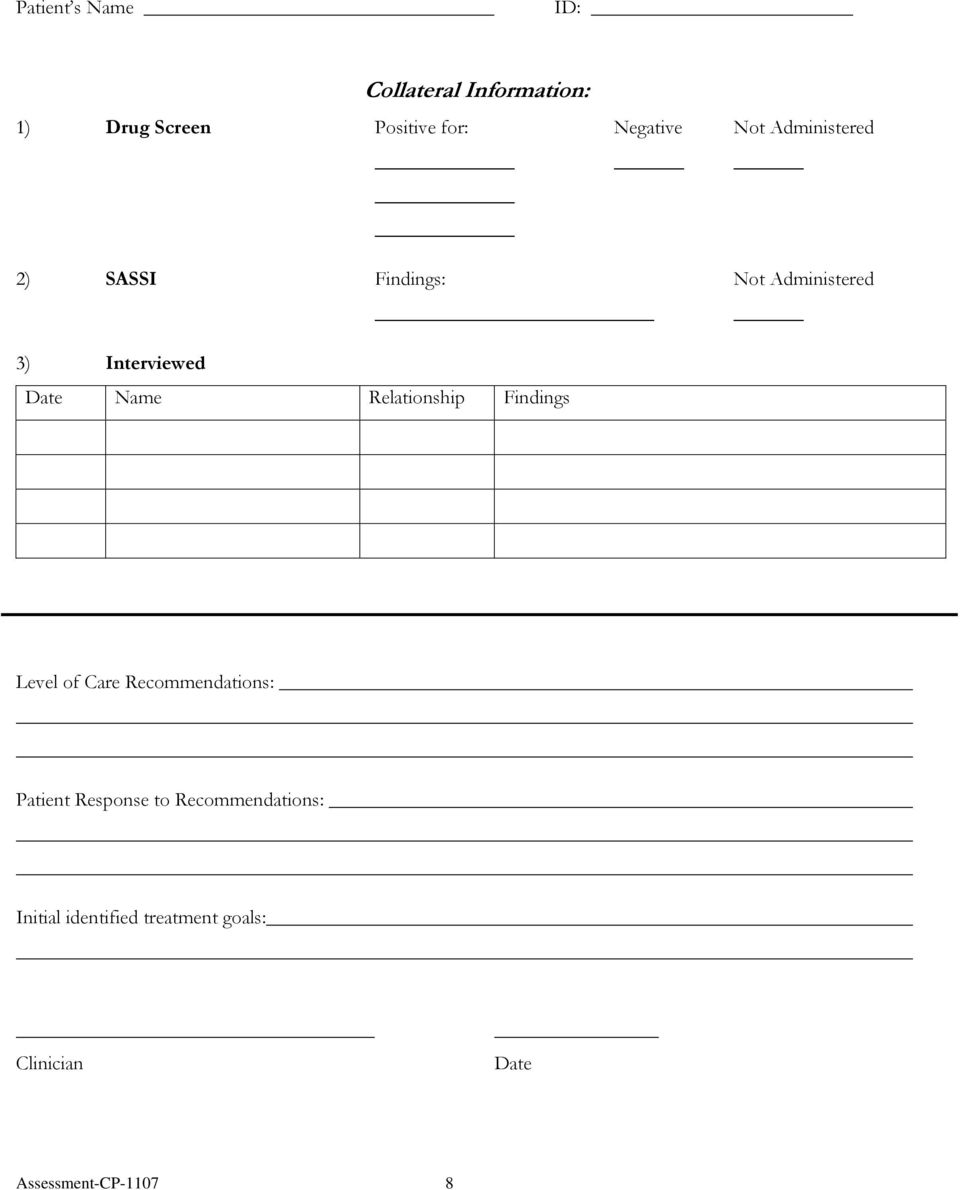
8 Collateral Information: 1) Drug Screen Positive for: Negative Not Administered 2) SASSI Findings: Not Administered 3) Interviewed Date Name Relationship Findings Level of Care Recommendations: Patient Response to Recommendations: Initial identified treatment goals: Clinician Date Assessment-CP
New York State Office of Alcoholism & Substance Abuse Services Addiction Services for Prevention, Treatment, Recovery
 New York State Office of Alcoholism & Substance Abuse Services Addiction Services for Prevention, Treatment, Recovery USING THE 48 HOUR OBSERVATION BED USING THE 48 HOUR OBSERVATION BED Detoxification
ADVANCED BEHAVIORAL HEALTH, INC. Clinical Level of Care Guidelines - 2015
 The Clinical Level of Care Guidelines contained on the following pages have been developed as a guide to assist care managers, physicians and providers in making medical necessity decisions about the least
CO-OCCURRING DISORDERS. Michaelene Spence MA LADC 8/8/12
 CO-OCCURRING DISORDERS Michaelene Spence MA LADC 8/8/12 Activity Chemical Health? Mental Health? Video- What is Addiction HBO Terminology MI/CD: Mental Illness/Chemical Dependency IDDT: Integrated Dual
the Treatment Of Substance-Related Making it Real, Making it Work
 ASAM Patient Placement Criteria for the Treatment Of Substance-Related Disorders (ASAM PPC-IIr): Making it Real, Making it Work Terrence D. Walton, MSW, ICADC Director of Treatment Pretrial Services Agency
How To Know If You Should Be Treated
 Comprehensive ehavioral Care, Inc. delivery system that does not include sufficient alternatives to a particular LOC and a particular patient. Therefore, CompCare considers at least the following factors
The Department of Children and Families Substance Abuse Program
 The Department of Children and Families Substance Abuse Program Florida Supplement To the American Society of Addiction Medicine Patient Placement Criteria For the Treatment of Substance-Related Disorders
ADDICTIONS. BEHAVIOURAL Internet Shopping Work Sex Gambling Food. SUBSTANCE - RELATED Alcohol Drugs Medicine Tobacco
 ADDICTIONS BEHAVIOURAL Internet Shopping Work Sex Gambling Food SUBSTANCE - RELATED Alcohol Drugs Medicine Tobacco Addiction is a chronic, relapsing disease affecting the brains's reward, motivation and
LEVEL I SA: OUTPATIENT INDIVIDUAL THERAPY - Adult
 LEVEL I SA: OUTPATIENT INDIVIDUAL THERAPY - Adult Definition The following is based on the Adult Criteria of the Patient Placement Criteria for the Treatment of Substance-Related Disorders of the American
Appendix D. Behavioral Health Partnership. Adolescent/Adult Substance Abuse Guidelines
 Appendix D Behavioral Health Partnership Adolescent/Adult Substance Abuse Guidelines Handbook for Providers 92 ASAM CRITERIA The CT BHP utilizes the ASAM PPC-2R criteria for rendering decisions regarding
opiates alcohol 27 opiates and alcohol 30 April 2016 drug addiction signs 42 Ranked #1 123 Drug Rehab Centers in New Jersey 100 Top 10 380
 opiates alcohol 27 opiates and alcohol 30 April 2016 drug addiction signs 42 ed #1 123 Drug Rehab Centers in New Jersey 100 Top 10 380 effects of alcohol in the brain 100 Top 30 698 heroin addiction 100
LEVEL III.5 SA: SHORT TERM RESIDENTIAL - Adult (DUAL DIAGNOSIS CAPABLE)
 LEVEL III.5 SA: SHT TERM RESIDENTIAL - Adult (DUAL DIAGNOSIS CAPABLE) Definition The following is based on the Adult Criteria of the Patient Placement Criteria for the Treatment of Substance-Related Disorders
Chapter 7. Screening and Assessment
 Chapter 7 Screening and Assessment Screening And Assessment Starting the dialogue and begin relationship Each are sizing each other up Information gathering Listening to their story Asking the questions
Methamphetamine. Like heroin, meth is a drug that is illegal in some areas of the world. Meth is a highly addictive drug.
 Methamphetamine Introduction Methamphetamine is a very addictive stimulant drug. People who use it can form a strong addiction. Addiction is when a drug user can t stop taking a drug, even when he or she
Psychiatric Residential Treatment Facility (PRTF): Aligning Care Efficiencies with Effective Treatment. BHM Healthcare Solutions 2013 1
 Psychiatric Residential Treatment Facility (PRTF): Aligning Care Efficiencies with Effective Treatment 1 Presentation Objectives Attendees will have a thorough understanding of Psychiatric Residential
THE OFFICE OF SUBSTANCE ABUSE SERVICES REQUIREMENTS FOR THE PROVISION OF RESIDENTIAL DETOXIFICATION SERVICES BY PROVIDERS FUNDED WITH DBHDS RESOURCES
 THE OFFICE OF SUBSTANCE ABUSE SERVICES REQUIREMENTS FOR THE PROVISION OF RESIDENTIAL DETOXIFICATION SERVICES BY PROVIDERS FUNDED WITH DBHDS RESOURCES PURPOSE: The goal of this document is to describe the
Comprehensive Behavioral Care, Inc. Level of Care Guidelines Substance Abuse Children/Adolescents
 Medical Necessity In considering the appropriateness of any level of care, the four basic elements of Medical Necessity should be met: 1. A diagnosis as defined by standard diagnosis nomenclatures (DSM
The University of Toledo - Main Campus Policy
 The University of Toledo - Main Campus Policy IV-12 3360-30-12 Alcohol and Substance Abuse. (A) Alcohol and drug abuse policy statement The University of Toledo is committed to promoting and maintaining
Alcohol Use Scale-Revised {AUS-R)
 FORM C2 Alcohol Use Scale-Revised {AUS-R) Client name: ~ Rater: Date: INSTRUCTIONS This scale pertains to your client's use of alcohol over the past 6 months. Rate the worst period of alcohol use during
General Information. Age: Date of Birth: Gender (circle one) Male Female. Address: City: State: Zip Code: Telephone Numbers: (day) (evening)
 Kelly Bernstein, MS, LCDC, LPC Medical Center Psychological Services 7272 Wurzbach Road, Suite 1504 San Antonio, Texas 78240 Office: (210) 522-1187 Fax: (210) 647-7805 Functional Assessment Tool The purpose
DSM-5 and its use by chemical dependency professionals
 + DSM-5 and its use by chemical dependency professionals Greg Bauer Executive Director Alpine Recovery Services Inc. President Chemical Dependency Professionals Washington State (CDPWS) NAADAC 2014 Annual
Behavioral Health Medical Necessity Criteria
 Behavioral Health Medical Necessity Criteria Revised: 7/14/05 2 nd Revision: 9/14/06 3 rd Revision: 8/23/07 4 th Revision: 8/28/08; 11/20/08 5 th Revision: 8/27/09 Anthem Blue Cross and Blue Shield 2 Gannett
ASAM 101: How to complete the ASAM Placement Form
 ASAM 101: How to complete the ASAM Placement Form What is the ASAM? The ASAM Placement Form is a document required by contract The ASAM Form is an ASSESSMENT tool as well as a PLACEMENT tool It seeks to
UNDERSTANDING CO-OCCURRING DISORDERS. Frances A. Campbell MSN, PMH CNS-BC, CARN Michael Beatty, LCSW, NCGC-1 Bridge To Hope November 18, 2015
 UNDERSTANDING CO-OCCURRING DISORDERS Frances A. Campbell MSN, PMH CNS-BC, CARN Michael Beatty, LCSW, NCGC-1 Bridge To Hope November 18, 2015 CO-OCCURRING DISORDERS What does it really mean CO-OCCURRING
McLean Ambulatory Treatment Center Adult Partial Hospital and Residential Program for Alcohol and Drug Abuse 115 Mill Street Belmont, MA 02478-9106
 Program Description Staffed by highly experienced psychiatrists, psychologists, social workers, nurses and addiction specialists, we are committed to working collaboratively with referring providers. Program
COLLEGIATE RECOVERY COMMUNITY Application for the OSU CRC and Recovery House
 REQUIREMENTS FOR ADMISSION TO THE CRC Must be admitted to The Ohio State University Must follow OSU Code of Student Conduct Preferred minimum of 6 months complete abstinence from all drugs and alcohol,
- UNDERSTANDING - Dual Diagnosis
 - UNDERSTANDING - Dual Diagnosis TABLE OF CONTENTS Introduction 3 The Link Between Mental Illness and Substance Abuse 4 Characteristics of an Effective Dual Diagnosis Treatment Plan 6 Dual Diagnosis Treatment
Inpatient Behavioral Health and Inpatient Substance Abuse Treatment: Aligning Care Efficiencies with Effective Treatment
 Inpatient Behavioral Health and Inpatient Substance Abuse Treatment: Aligning Care Efficiencies with Effective Treatment BHM Healthcare Solutions 2013 1 Presentation Objectives Attendees will have a thorough
How To Know If You Can Get Help For An Addiction
 2014 FLORIDA SUBSTANCE ABUSE LEVEL OF CARE CLINICAL CRITERIA SUBSTANCE ABUSE LEVEL OF CARE CLINICAL CRITERIA Overview Psychcare strives to provide quality care in the least restrictive environment. An
AN INTRODUCTION ASAM
 AN INTRODUCTION ASAM 2013 Ray Caesar LPC, LADC-MH Director of Addiction Specialty Programs ODMHSAS (405)522-3870 [email protected] AMERICAN SOCIETY OF ADDICTON MEDICINE ASAM ASAM is a professional organization
Levels of Care Guide
 Levels of Care Guide What Type of Drug Rehab Is Right for You? A Guide to Understanding Levels of Care in Addiction Treatment Looking for help for yourself or a loved one? Congratulations! You are on the
SUBSTANCE USE QUESTIONNAIRE. Name: Date: Ever Used? Ever a Problem? Age of 1 st Use When last used?
 SUBSTANCE USE QUESTIONNAIRE Name: Date: Part I. Substance Abuse History Ever Used? Ever a Problem? Age of 1 st Use When last used? Alcohol Yes No Yes No Barbiturates or Yes No Yes No other sleeping pills
Cocaine. Like heroin, cocaine is a drug that is illegal in some areas of the world. Cocaine is a commonly abused drug.
 Cocaine Introduction Cocaine is a powerful drug that stimulates the brain. People who use it can form a strong addiction. Addiction is when a drug user can t stop taking a drug, even when he or she wants
Who We Serve Adults with severe and persistent mental illnesses such as schizophrenia, bipolar disorder and major depression.
 We Serve Adults with severe and persistent mental illnesses such as schizophrenia, bipolar disorder and major depression. We Do Provide a comprehensive individually tailored group treatment program in
Department of Social and Health Services Division of Alcohol and Substance Abuse. WAC 388-805 Revision Recommendations Patient Placement Criteria
 Department of Social and Health Services Division of Alcohol and Substance Abuse WAC 388-805 Revision Recommendations Patient Placement Criteria April 2003 WAC 388-805 WAC 388-805-005 What definitions
American Society of Addiction Medicine
 American Society of Addiction Medicine Public Policy Statement on Treatment for Alcohol and Other Drug Addiction 1 I. General Definitions of Addiction Treatment Addiction Treatment is the use of any planned,
Substance Abuse Worksheet
 Substance Abuse Worksheet Reliant Behavioral Health, L.L.C EAP Clinical Manager: 1-866-750-1327 Fax: 1-877- 730-5113 Date: Name: Referred by: Length of Employment: Employer: ROI to: Precipitating event:
Co-occurring Disorder Treatment for Substance Abuse and Compulsive Gambling
 Co-occurring Disorder Treatment for Substance Abuse and Compulsive Gambling Midwest Conference on Problem Gambling and Substance Abuse 2006 Problem Gambling and Co-occurrence: Improving Practice and Managing
Adult Information Form Page 1
 Adult Information Form Page 1 Client Name: Age: DOB: Date: Address: City: State: Zip: Home Phone: ( ) OK to leave message? Yes No Work Phone: ( ) OK to leave message? Yes No Current Employer (or school
North Bay Regional Health Centre
 Addictions and Mental Health Division Programs Central Intake Referral Form The Central Intake Referral Form is used in the District of Nipissing by the North Bay Regional Health Centre s Addictions and
Kanawha Valley Fellowship Home
 Kanawha Valley Fellowship Home Client Assessment Form Date: Time: Assessment Taken Caller s Name: Agency (if applicable) Address: County: Relationship to Patient: Phone # Client s Name: Age: D.O.B.: Current
Overview of the ASAM Patient Placement Criteria, Second Edition Revised (ASAM PPC-2R)
 SAMHSA s Co-occurring Center for Excellence (COCE) Overview of the ASAM Patient Placement Criteria, Second Edition Revised (ASAM PPC-2R) David Mee-Lee, M.D. Chief Editor, ASAM PPC-2R www.dmlmd.com June
And, despite the numbers, for many people, the Facts About Drugs are not clear.
 According to the National Survey on Drug Use and Health (NSDUH), an estimated 20 million Americans aged 12 or older used an illegal drug in the past 30 days. This estimate represents 8% percent of the
Santa Fe Sage Counseling Center
 Couple/Family Client Intake Date: Names: Partner/Parent/Child (circle one) Partner/Parent/Child (circle one) Parent/Child (circle one) Parent/Child (circle one) Parent/Child (circle one) Insurance ID #:
AMERICAN SOCIETY OF ADDICTION MEDICINE Patient Placement Criteria for the Treatment of Substance-Related Disorders (Second Edition-Revised) 2001
 AMERICAN SOCIETY OF ADDICTION MEDICINE Patient Placement Criteria for the Treatment of Substance-Related Disorders (Second Edition-Revised) 2001 LME Utilization Review Training LEARNING GOALS: By the end
SUBSTANCE USE DISORDER SOCIAL DETOXIFICATION SERVICES [ASAM LEVEL III.2-D]
![SUBSTANCE USE DISORDER SOCIAL DETOXIFICATION SERVICES [ASAM LEVEL III.2-D]](/thumbs/27/9667060.jpg "SUBSTANCE USE DISORDER SOCIAL DETOXIFICATION SERVICES [ASAM LEVEL III.2-D]") SUBSTANCE USE DISORDER SOCIAL DETOXIFICATION SERVICES [ASAM LEVEL III.2-D] I. Definitions: Detoxification is the process of interrupting the momentum of compulsive drug and/or alcohol use in an individual
SUBSTANCE USE DISORDER SOCIAL DETOXIFICATION SERVICES [ASAM LEVEL III.2-D] I. Definitions: Detoxification is the process of interrupting the momentum of compulsive drug and/or alcohol use in an individual
McLean Ambulatory Treatment Center Adult Partial Hospital and Residential Program for Alcohol and Drug Abuse 11 Mill Street Belmont, MA 02478-9106
 Program Description Staffed by highly experienced psychiatrists, psychologists, social workers, nurses and addiction specialists, we are committed to working collaboratively with referring providers. Program
Conceptual Models of Substance Use
 Conceptual Models of Substance Use Different causal factors emphasized Different interventions based on conceptual models 1 Developing a Conceptual Model What is the nature of the disorder? Why causes
How To Treat A Drug Addiction
 1 About drugs Drugs are substances that change a person s physical or mental state. The vast majority of drugs are used to treat medical conditions, both physical and mental. Some, however, are used outside
DEPRESSION Depression Assessment PHQ-9 Screening tool Depression treatment Treatment flow chart Medications Patient Resource
 E-Resource March, 2015 DEPRESSION Depression Assessment PHQ-9 Screening tool Depression treatment Treatment flow chart Medications Patient Resource Depression affects approximately 20% of the general population
Alcohol Addiction. Introduction. Overview and Facts. Symptoms
 Alcohol Addiction Alcohol Addiction Introduction Alcohol is a drug. It is classed as a depressant, meaning that it slows down vital functions -resulting in slurred speech, unsteady movement, disturbed
DrugFacts: Treatment Approaches for Drug Addiction
 DrugFacts: Treatment Approaches for Drug Addiction NOTE: This is a fact sheet covering research findings on effective treatment approaches for drug abuse and addiction. If you are seeking treatment, please
Benzodiazepine Detoxification and Reduction of Long term Use
 Benzodiazepine Detoxification and Reduction of Long term Use Malcolm Lader 1 Model of general drug misuse and dependence. Tactical interventional options Social dimension Increasing breaking of social
Wesley Mental Health. Drug and Alcohol Addiction Program. Wesley Hospital Ashfield. Journey together
 Wesley Mental Health Drug and Alcohol Addiction Program Wesley Hospital Ashfield Journey together Mission Continuing the work of Jesus Christ in Word and deed Wesley Mission is an organisation with a long
PENNSYLVANIA S CLIENT PLACEMENT CRITERIA FOR ADULTS
 Appendix T Part C PENNSYLVANIA S CLIENT PLACEMENT CRITERIA FOR ADULTS Second Edition Tom Ridge Governor Commonwealth of Pennsylvania Page i Commonwealth of Pennsylvania Table of Contents I) Introduction
Medical Cannabis and Addictions. October 2015 Charlie Reznikoff
 Medical Cannabis and Addictions October 2015 Charlie Reznikoff Medical Cannabis Topics Is marijuana addictive? Is medical cannabis addictive? Will medical cannabis lead to increased adolescent use of recreational
Narrative Report - BHI-MV Behavioral Health Index - Multimedia Version
 Site: Address: Behavioral Health Services 320 Needham St., Newton, MA Narrative Report - BHI-MV Behavioral Health Index - Multimedia Version Summary of Results for: Client Name: Sample Client Client ID:
Are You Addicted to Drugs? Do you abuse drugs or alcohol regularly? Do you often use the drug when others are not around?
 Are You Addicted to Drugs? If you are concerned about your drug or alcohol use, then you might want to determine if you are addicted to the substance. Being addicted to drugs is a serious condition that
SUBSTANCE ABUSE ASSESSMENT FORM
 SUBSTANCE ABUSE ASSESSMENT FORM Please make copies as needed and please type or print legibly. Instructions for use: Complete this form and use these questions to guide the EAP client interview when conducting
Like cocaine, heroin is a drug that is illegal in some areas of the world. Heroin is highly addictive.
 Heroin Introduction Heroin is a powerful drug that affects the brain. People who use it can form a strong addiction. Addiction is when a drug user can t stop taking a drug, even when he or she wants to.
Assessment of depression in adults in primary care
 Assessment of depression in adults in primary care Adapted from: Identification of Common Mental Disorders and Management of Depression in Primary care. New Zealand Guidelines Group 1 The questions and
SOMERSET DUAL DIAGNOSIS PROTOCOL OCTOBER 2011
 SOMERSET DUAL DIAGNOSIS PROTOCOL OCTOBER 2011 This document is intended to be used with the Somerset Dual Diagnosis Operational Working guide. This document provides principles governing joint working
GDC Session #1 Symptoms of Cocaine Addiction
 GDC Session #1 Symptoms of Cocaine Addiction Objectives of Session 1. Define cocaine addiction as a biopsychosocial disease. 2. Identify the symptoms of addiction that clients have experienced. 3. Identify
Drug Abuse and Addiction
 Drug Abuse and Addiction Introduction A drug is a chemical substance that can change how your body and mind work. People may abuse drugs to get high or change how they feel. Addiction is when a drug user
information for service providers Schizophrenia & Substance Use
 information for service providers Schizophrenia & Substance Use Schizophrenia and Substance Use Index 2 2 3 5 6 7 8 9 How prevalent are substance use disorders among people with schizophrenia? How prevalent
INSTRUCTIONS FOR FORM PCF05: PSYCHIATRIC/SUBSTANCE ABUSE EXTENSION OR RECONSIDERATION. NOTE: Fields 1 6 MUST be filled in
 INSTRUCTIONS FOR FORM PCF05: PSYCHIATRIC/SUBSTANCE ABUSE EXTENSION OR RECONSIDERATION NOTE: Fields 1 6 MUST be filled in Any incomplete form WILL BE REJECTED 1. Enter the assigned Pre-Certification Case
Assessment and Management of Opioid, Benzodiazepine, and Sedative-Hypnotic Withdrawal
 Assessment and Management of Opioid, Benzodiazepine, and Sedative-Hypnotic Withdrawal Roger Cicala, M. D. Assistant Medical Director Tennessee Physician s Wellness Program Step 1 Don t 1 It is legal in
Treatment for substance abuse and dependence at HC Marbella
 Detox Unit Treatment for substance abuse and dependence at HC Marbella The disease Addiction is a disease that is becoming a common problem in our society today. In actual fact, addiction is a chemical
Withdrawal Symptoms: How Long Do They Last?
 Withdrawal Symptoms: How Long Do They Last? Posted by First Step Medical Detox on November 24, 2015 When considering stopping drugs or alcohol, many addicts and alcoholics are concerned about the withdrawal
Behavioral Health Medical Necessity Criteria
 Behavioral Health Medical Necessity Criteria Effective January 1, 2011 Revised and approved on 8/19/2010 The Office of Medical Policy and Technological Assessment (OMPTA) has developed policies that serve
Psychiatric Residential Treatment Facility Referral
 Psychiatric Residential Treatment Facility Referral Date of referral: Psychiatric Residential Treatment Facility (PRTF) Referral Information Referral contact: Phone number: Referring facility/agency: Fax
Cincinnati Christian University Drug Abuse Prevention Program
 Cincinnati Christian University Drug Abuse Prevention Program Cincinnati Christian University maintains that our bodies are created by God and should be used to glorify Him. The misuse or abuse of alcohol
Treatment Approaches for Drug Addiction
 Treatment Approaches for Drug Addiction NOTE: This is a fact sheet covering research findings on effective treatment approaches for drug abuse and addiction. If you are seeking treatment, please call the
Today s Topics. Session 2: Introduction to Drug Treatment. Treatment matching. Guidelines: where should a client go for treatment?
 Session 2: Introduction to Drug Treatment Today s Topics Level of care determination How to know when treatment works What does treatment include Description of treatment modalities Naomi Weinstein, MPH
Residential Sub-Acute Detoxification Guidelines
 I. Background Information A. Definition of Detoxification Residential Sub-Acute Detoxification Guidelines SAMSA s TIP #45, Detoxification and Substance Abuse Treatment: Treatment Improvement Protocols
WCHO PIHP/CA POLICY for the LIVINGSTON- WASHTENAW COORDINATING AGENCY Department: Coordinating Agency Author: Marci Scalera Approval Date 4/17/12
 WCHO PIHP/CA POLICY for the LIVINGSTON- WASHTENAW COORDINATING AGENCY Department: Coordinating Agency Author: Marci Scalera Approval Date 4/17/12 Policy and Procedure Residential Treatment Services Policy
OUTPATIENT SUBSTANCE USE DISORDER SERVICES FEE-FOR-SERVICE
 OUTPATIENT SUBSTANCE USE DISORDER SERVICES FEE-FOR-SERVICE Brief Coverage Statement Outpatient Substance Use Disorder (SUD) Fee-For-Service (FFS) Treatment Services are available for the treatment of substance
Gambling is an Addiction: treatment strategies
 Gambling is an Addiction: treatment strategies Michael H. Rosen, MSW, LGSW Network Development Coordinator Maryland Center of Excellence on Problem Gambling www.mdproblemgambling.com Problem Gambling Helpline
CATC Exam Practice Questions: 2015
 CATC Exam Practice Questions: 2015 These practice questions are included within the Certified Addictions Treatment Counselor (CATC) Examination Candidate Handbook, presented by California Association for
Management of benzodiazepine misuse
 York Service Management of benzodiazepine misuse Version 2 JT July 2013 page 1 background Note: not all those who use benzodiazepines are dependent, and not all those who are dependent will benefit from
SOUTH COAST PRIVATE ADDICTION RECOVERY PROGRAM. Your care in our hands. southcoastprivate.com.au
 SOUTH COAST PRIVATE ADDICTION RECOVERY PROGRAM southcoastprivate.com.au Your care in our hands The abuse of alcohol and other drugs is common and widespread; affecting people from all walks of life. 1.0
Prescription Drug Abuse
 Prescription Drug Abuse Introduction Most people take medicines only for the reasons their health care providers prescribe them. But millions of people around the world have used prescription drugs for
Instructions for Funding Authorization/Reauthorization Process. Residential Alcohol and Other Drug Treatment Programs
 Instructions for Funding Authorization/Reauthorization Process Clinician Instructions: Residential Alcohol and Other Drug Treatment Programs For initial authorization or authorization of continued stay,
GAIN and DSM. Presentation Objectives. Using the GAIN Diagnostically
 GAIN and DSM GAIN National Clinical Training Team 2011 Version 2 Materials Presentation Objectives Understand which DSM diagnoses are generated by GAIN ABS for the GAIN reports and which ones must be added
LEVEL II.1 SA: INTENSIVE OUTPATIENT - Adult
 LEVEL II.1 SA: INTENSIVE OUTPATIENT - Adult Definition The following is based on the Adult Criteria of the Patient Placement Criteria for the Treatment of Substance- Related Disorders of the American Society
Identifying Individuals with a Dual Diagnosis and Substance Misuse
 Identifying Individuals with a Dual Diagnosis and Substance Misuse Presented by the Dual Diagnosis Substance Misuse Committee 1 Goal of Presentation To raise awareness To assist staff to identify individuals
FAMILY QUESTIONNAIRE Please Print Clearly
 FAMILY QUESTIONNAIRE Please Print Clearly The following questionnaire encompasses many aspects of your life, and the life of the alcoholic/addict. Please check and comment on the items listed below as
Problem Gambling: The Hidden Addiction
 Problem Gambling: The Hidden Addiction Gambling in America Americans annually spend more money on legal forms of gambling than on movies, music, sporting events, theme parks and video games combined. All
CHARLES & SUE S SCHOOL OF HAIR DESIGN DRUG AND ALCOHOL POLICY DRUG AND ALCOHOL POLICY; SUBSTANCE ABUSE RESOURCES:
 CHARLES & SUE S SCHOOL OF HAIR DESIGN DRUG AND ALCOHOL POLICY DRUG AND ALCOHOL POLICY; SUBSTANCE ABUSE RESOURCES: At Charles & Sue s School of Hair Design, the illicit use of drugs and/or alcohol by staff
Treatment Approaches for Drug Addiction
 Treatment Approaches for Drug Addiction [NOTE: This is a fact sheet covering research findings on effective treatment approaches for drug abuse and addiction. If you are seeking treatment, please call
Treatment of Alcoholism
 Treatment of Alcoholism Why is it important Prevents further to body by getting people off alcohol. Can prevent death. Helps keep health insurance down. Provides assistance so alcoholics don t t have to
HAWAII ADMINISTRATIVE RULES TITLE 16 DEPARTMENT OF COMMERCE AND CONSUMER AFFAIRS CHAPTER 16
 HAWAII ADMINISTRATIVE RULES TITLE 16 DEPARTMENT OF COMMERCE AND CONSUMER AFFAIRS CHAPTER 16 MENTAL HEALTH, ALCOHOL, AND DRUG ABUSE TREATMENT INSURANCE BENEFITS Subchapter 1 General Provisions 16-16-1 Purpose
Behavioral Health Medical Necessity Criteria
 Behavioral Health Medical Necessity Criteria Effective January 1, 2013 Revised and approved on 8/09/2012 Anthem Blue Cross 21555 Oxnard St. Woodland Hills, CA 91365 Toll free: 1-800-274-7767 The Office
Alcohol and Dependence
 The facts about... Alcohol and Dependence Five key things you need to know A glass of wine with dinner, a beer after work, a cocktail in the sunshine on holiday. Alcohol makes an appearance in so many
OK to leave Messages?
 Jami Howell, Psy.D., LLC Licensed Clinical Psychologist 1215 SW 18 th Avenue, Portland OR 97205 p (503) 504-5222 f (503) 224-2134 [email protected] Client Information Name: Preferred Name: Date
The CCB Science 2 Service Distance Learning Program
 S2S 2055 DETOXIFICATION Module 1 Post-Test 1. A common use of a biochemical marker is. a. to support or refute other information that leads to proper diagnosis b. for forensic purposes c. in detecting
Intensive Residential Treatment Services -IRTS. Program Description
 Intensive Residential Treatment Services -IRTS Program Description A highly structured non-hospital based treatment setting that brings comprehensive and specialized diagnostic and treatment services to
Dual diagnosis: working together
 Dual diagnosis: working together Tom Carnwath RCGP conference Birmingham 2007 DSM-IV & cocaine Cocaine intoxication Cocaine withdrawal Cocaine-induced sleep disorder Cocaine-induced sexual dysfunction
Care Manager Resources: Common Questions & Answers about Treatments for Depression
 Care Manager Resources: Common Questions & Answers about Treatments for Depression Questions about Medications 1. How do antidepressants work? Antidepressants help restore the correct balance of certain
Problem Gambling. Over the last decade, legalized gambling in Canada has grown - rapidly! So has problem gambling!
 Problem Gambling Introduction Over the last decade, legalized gambling in Canada has grown - rapidly! So has problem gambling! Should people with mood disorders be especially concerned? Probably yes! There