
The term bid can be confusing because no competitive bidding takes place. If CMS accepts plan bids, it signs contracts with the MAOs.
|
|
|
- Kathlyn Oliver
- 10 years ago
- Views:
Transcription
1 United States Government Accountability Office Washington, DC February 4, 2011 Congressional Requesters Subject: Medicare Advantage: Comparison of Plan Bids to Fee-for-Service Spending by Plan and Market Characteristics While most of Medicare s 46 million beneficiaries are covered by the traditional fee-forservice (FFS) program, about one in four beneficiaries receives benefits through private health plans under the Medicare Advantage (MA) program. Under the FFS program, Medicare pays health care providers for each covered service they furnish. While Medicare sets the price it pays, the volume of services and, as a consequence, total spending remains largely uncontrolled. In contrast, MA plans have more control over both the price they pay to providers and the quantity of services they deliver. As of September 2010, more than 11 million beneficiaries were enrolled in approximately 3,900 MA plans sponsored by 181 parent MA organizations (MAO). MAOs generally offer beneficiaries one or more plans to choose from with different coverage, premiums, and cost sharing features in the areas they serve. Also, MA plans may provide additional benefits not offered under FFS Medicare, such as reduced cost sharing or vision and dental coverage. Medicare pays plans a fixed amount per enrolled beneficiary monthly. In 2010, Medicare payments to MA plans totaled an estimated $115 billion. In June of each year, MA plans submit bids to the Centers for Medicare & Medicaid Services (CMS) the agency that administers the Medicare program prior to the start of the contract year that begins January 1. 1 To assist plans in preparing their bids, CMS publishes projections of FFS spending by county. Plans bids consist of their projected revenue requirements (including profit) for providing standard Medicare services to an average enrollee (riskadjusted for differences in health status) in its service area. 2 The bids also include countylevel projections of enrollment and average beneficiary risk scores. Comparisons of plan bids to projected FFS spending indicate the extent to which MA revenue requirements are less or greater than spending for the same services under traditional Medicare. 3 1 The term bid can be confusing because no competitive bidding takes place. If CMS accepts plan bids, it signs contracts with the MAOs. 2 MA plans must cover Medicare Part A and Part B benefits except hospice care. Medicare Part A includes inpatient hospital, skilled nursing, and some home health services. Medicare Part B includes physicians services, outpatient care, and durable medical equipment. 3 In this report, FFS spending refers to our projections of service area spending which were developed by adjusting CMS s county-level FFS spending projections.
2 The payment to each plan is determined by the bid and a benchmark the maximum amount Medicare will pay in each county within the plan s service area. 4 The relationship of the bid to the benchmark determines whether the plan s enrollees pay additional premiums or receive additional benefits. If a plan s bid is higher than the benchmark, Medicare pays the plan its benchmark and enrollees pay the remainder in their monthly premium. If the bid is lower than the benchmark, the plan receives its bid and a portion of the difference as a rebate, which must be used to reduce premiums, reduce cost sharing, or provide extra coverage. However, because the benchmarks are generally greater than spending in FFS, even plans that bid below FFS spending levels in their service areas are paid above FFS spending amounts. The 2010 Patient Protection and Affordable Care Act as amended (PPACA) changed how payment amounts are set. 5 Under PPACA, benchmarks in 2011 will be held at the 2010 levels; beginning in 2012, the methodology ties the benchmark to a percentage of average FFS spending. A county s average FFS spending relative to all other counties will determine whether the county benchmark will be set at 95, 100, 107.5, or 115 percent of average FFS spending. 6 As a result, the benchmark will be lower than FFS spending in relatively high spending areas and higher than FFS spending in relatively low spending areas. 7 CMS s Office of the Actuary expects that under the revised methodology plans will receive smaller rebates and, in turn, have less to spend on additional benefits used to attract beneficiaries. 8 According to the Congressional Budget Office, tying MA benchmarks closer to spending in FFS Medicare (or below that level) will generate an estimated $117 billion in savings over 10 years. 9 You asked us to examine the relationship between MA plan bids and service area spending. In this report, we assessed: (1) how MA plan bids compare to FFS spending in their service areas overall and by plan type, FFS spending level, and payment benchmarks; (2) the association between the level of MAO market concentration and plan bids relative to FFS spending in their service areas; and (3) how the components of MA plan bids compare by plan and market characteristics. On December 8, 2010, we provided a briefing to your offices on the results of this work. Enclosure I contains the briefing slides (as updated). 4 From 2007 through 2010, county benchmarks were generally updated annually by the overall growth in Medicare expenditures. Benchmarks for regional MA plans are updated by combining the county benchmarks in each region with a weighted average of regional plan bids. 5 See Patient Protection and Affordable Care Act, Pub. L. No , 3201, 124 Stat. 119, 442 (2010), as amended by the Health Care and Education Reconciliation Act of 2010, Pub. L. No , 1102, 124 Stat. 1029, 1040 (2010). For purposes of this report, references to PPACA include the amendments made by the Health Care and Education Reconciliation Act of CMS will rank all counties from highest to lowest by per capita FFS spending and divide them into quartiles. The new benchmark formula will be a product of county FFS spending and the fixed percentages for each quartile specified in PPACA. The new benchmarks will be phased in gradually from 2012 to PPACA also stipulated that plans with high quality ratings, new plans, or plans with low enrollment may qualify for benchmark increases. In addition, PPACA ties the rebates plans receive to measures of plan performance. 7 The highest quartile is composed mainly of counties in Metropolitan Statistical Areas. 8 Memorandum from CMS s Chief Actuary, Estimated Financial Effects of the Patient Protection and Affordable Care Act, as Amended, Apr. 22, See Congressional Budget Office, Comparison of Projected Enrollment in Medicare Advantage Plans and Subsidies for Extra Benefits Not Covered by Medicare Under Current Law and Under Reconciliation Legislation Combined with H.R as Passed by the Senate, Mar. 19,
3 To address the research objectives, we analyzed contract year 2010 bid data submitted to CMS by 2,121 MA plans. 10 We focused our analyses on the four major types of plans: health maintenance organizations (HMO), local preferred provider organizations (PPO), regional PPO, and private FFS plans (as described in slide 8 in enclosure I). We used each plan s projected county enrollments and CMS s projected county-level FFS spending to compute a weighted average of FFS spending in its service area (as shown in slide 28 in enclosure I). In doing so, we assumed that Medicare physician fees would remain at 2009 levels. 11 To compare MA bids to FFS spending by plan type and market characteristics, we separately aggregated plan bids and FFS spending using February 2010 actual plan enrollments as weights. To make this comparison by the level of service area FFS spending, we distinguished between plans that had more than half of their projected service area enrollment in counties with the highest FFS spending from all other plans. 12 To make this comparison by the degree to which plan benchmarks exceeded FFS spending, we differentiated between service areas with above average and below average benchmarks relative to FFS spending. To assess the influence of MAO market concentration, we computed the percentage of enrollment of the three largest MAOs in a plan s service area. We then predicted plan bids relative to FFS spending as a function of this measure, holding other factors constant. Finally, to assess MA bid components by plan and market characteristics, we combined the reported bid components into three major cost categories: medical expenses (e.g., hospital and professional services), nonmedical expenses (e.g., marketing and administrative costs), and profits. We computed group averages of these data using February 2010 actual plan enrollments as weights. 13 We conducted this performance audit from February 2010 to December 2010 in accordance with generally accepted government auditing standards. Those standards require that we plan and perform the audit to obtain sufficient, appropriate evidence to provide a reasonable basis for our findings and conclusions based on our audit objectives. We believe that the evidence obtained provides a reasonable basis for our findings and conclusions based on our audit objectives. Background Largely due to differences in the use of services nationwide, average FFS spending is higher in some areas than in others. 14 Because MA plans payments are partially based on average FFS spending in their service areas, the program tends to pay more to MA plans in high spending areas. In addition, the distribution of MA enrollment across areas with different FFS 10 To focus on plans that compete for all eligible beneficiaries in their service area, we excluded plans with restricted enrollment employer-sponsored plans and special needs plans. We also excluded plans in U.S. territories, plans that serve beneficiaries eligible for only Medicare Part B, and plans with 10 or fewer enrollees as of February CMS s Office of the Actuary provided an adjustment factor. 12 Plans bids and benchmarks are based on projected enrollment. Plans projected enrollment will be referred to as enrollment unless otherwise stated. 13 Profit or profit margins refer to MA organizations remaining revenue after medical and nonmedical expenses are paid. 14 Congressional Budget Office, Geographic Variation in Health Care Spending (Washington, D.C.: February 2008). 3

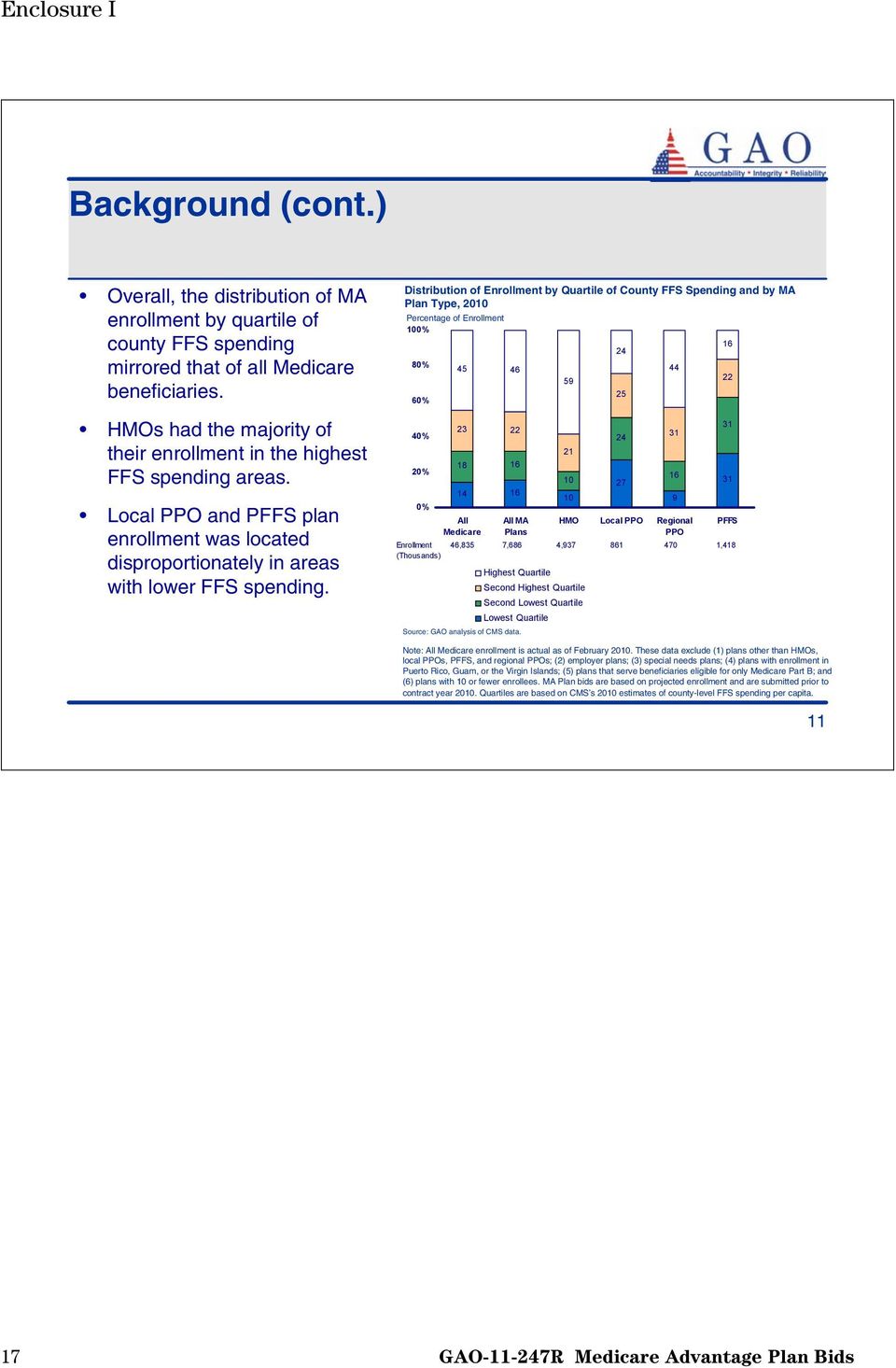
4 spending levels generally conforms to that of traditional Medicare, with about 45 percent of all beneficiaries located in the highest spending areas in Four of the five states with the most Medicare beneficiaries California, Florida, New York, and Texas have the majority of their actual MA enrollment in the highest FFS spending areas. Unlike other plan types, HMOs have the majority of their enrollment (59 percent) in the highest FFS spending areas. Results in Brief In comparing 2010 MA plan bids to FFS spending in their service areas overall and by plan type, FFS spending level, and payment benchmarks, we found the following: Overall, MA plans projected that they could cover their costs for providing Medicare s standard benefits for about 98 percent of the amount that would be spent under the FFS program. 15 HMOs were the only MA plan type that, in aggregate, submitted bids below FFS spending levels in their service areas. Bids relative to FFS spending also varied within plan types, particularly for HMOs. Only MA plans with the majority of their enrollment in the highest FFS spending areas had, in aggregate, bids below FFS spending. Among those plans, only HMOs and regional PPOs submitted bids that were lower than FFS spending. In aggregate, MA bids were generally lower than FFS spending in service areas where benchmarks were closer to FFS spending levels. In those areas, only the bids of HMOs and regional PPOs were lower than FFS spending. In comparing MA plan bids to FFS spending in their service areas by the level of MAO market concentration, we found the following: Nearly all of the MA plans we studied operated in areas where three dominant MAOs accounted for over half of the MA enrollment. When other factors are held constant, predicted bids relative to FFS spending are higher for plans with service areas where MAO market concentration is greater. At all levels of market concentration, predicted bids of plans sponsored by the five largest MAOs nationwide exceed FFS spending, when other factors are held constant. The FFS spending level, the benchmark amount, and plan type are more strongly associated with plans bids relative to service area FFS spending than MAO market concentration. In comparing the distribution of MA plan bid components by plan and market characteristics, we found the following: Projected profits were similar 4 percent to 5 percent for HMOs, local PPOs and private FFS plans. 15 Areas that had the highest bids relative to FFS spending included Seattle, Wash.; Sacramento, Calif.; Buffalo, N.Y.; Portland, Ore.; and Providence, R.I. Areas that had the lowest bids relative to FFS spending included Miami, Fla.; Los Angeles, Calif.; Tampa, Fla.; Las Vegas, Nev.; and Riverside, Calif. 4

5 In general, plans of all types, in relatively high and low FFS spending areas, and in relatively high and low benchmark areas projected medical expenses to account for at least 85 percent of revenue. Regardless of the relationship between their bids and service area FFS spending, plans differed little in the shares of their bids allocated to medical expenses, nonmedical expenses, and profit. More than a third of MA enrollees were in plans that allocated less than 85 percent of their bid to medical expenses. Agency and Other External Comments We obtained comments on a draft of this report from CMS. The agency responded that it had no general comments and provided technical comments, which we incorporated as appropriate. We also obtained comments on a draft of this report from America s Health Insurance Plans (AHIP), a national organization that represents private health insurance companies, including those that participate in the MA program. AHIP commented that a relatively high concentration of HMOs in the highest FFS spending areas may be influenced by higher rates of provider participation in networks allowing the HMO model to work best in those areas. As agreed with your offices, unless you publicly announce the contents of this report earlier, we plan no further distribution until 30 days from the date of the report. At that time we will send copies of this report to the CMS Administrator and other interested congressional committees. In addition, the report will be available at no charge on GAO s Web site at If you or your staff have any questions regarding this report, please contact me at (202) or [email protected]. Contact points for our Offices of Congressional Relations and Public Affairs may be found on the last page of this report. Individuals making key contributions to this report include Rosamond Katz, Assistant Director; Eric Wedum, analystin-charge; and Luis Serna III. Beth Morrison also provided valuable assistance. James Cosgrove Director, Health Care Enclosure 5
6 List of Requesters The Honorable Henry A. Waxman Ranking Member Committee on Energy and Commerce House of Representatives The Honorable Sander M. Levin Ranking Member Committee on Ways and Means House of Representatives The Honorable Frank Pallone, Jr. Ranking Member Subcommittee on Health Committee on Energy and Commerce House of Representatives The Honorable Pete Stark Ranking Member Subcommittee on Health Committee on Ways and Means House of Representatives The Honorable John D. Dingell House of Representatives The Honorable Charles B. Rangel House of Representatives 6
7 MEDICARE ADVANTAGE: Comparison of Plan Bids to Fee-for- Service Spending by Plan and Market Characteristics Briefing to Congressional Requesters December 8, 2010 (Updated) 1 7

8 Introduction As of September 2010, more than 11 million Medicare beneficiaries (24 percent of all Medicare beneficiaries) were enrolled in approximately 3,900 Medicare Advantage (MA) plans sponsored by 181 parent MA organizations (MAO). In 2010, MA payments are expected to total about $115 billion, or 22 percent of total Medicare spending. Since 2006, payment to each plan has been determined by the plan s bid the projected cost of providing Medicare Part A and B benefits* and a benchmark the maximum amount Medicare will pay for those benefits in the plan s service area. If a plan s bid is higher than the benchmark, Medicare pays the plan its benchmark and enrollees pay the remainder in their monthly premium. If the bid is lower than the benchmark, the plan receives its bid and 75 percent of the difference as a rebate, which must be used to reduce premiums, reduce cost sharing, or provide additional benefits. * Medicare Part A services include inpatient hospital, skilled nursing, and some home health services. Medicare Part B services include physicians services, outpatient care, and durable medical equipment. 2 8

9 Introduction (cont.) In general, MA benchmarks are set at or above CMS projections of per capita fee-for-service (FFS) spending in each county where plans operate.* The 2010 Patient Protection and Affordable Care Act as amended (PPACA) changed the way MA payments are made. Although it retained an administrative pricing system, PPACA tied the MA benchmarks to projected county-level FFS spending. Beginning in 2012, benchmarks will be a blend of current and new amounts. The new benchmark formula will be a product of county FFS spending and a percentage that varies by spending quartiles, as follows: highest quartile counties 95 percent second highest quartile counties 100 percent third highest quartile counties percent lowest quartile counties 115 percent By 2017, the new benchmarks will be fully phased in to reflect the FFS spending quartiles. The Office of the Actuary in the Centers for Medicare & Medicaid Services (CMS) the agency that administers the Medicare program expects these benchmarks to be lower than the previous benchmarks in many areas. *In general, MA payments exceed plan bids and typically exceed FFS spending, even when bids are below FFS spending. 3 9

10 Objectives This report examines the relationship between MA plan bids and Medicare FFS spending to cover the standard benefits for equivalent beneficiaries in their service areas. 1. How do MA plan bids compare to FFS spending in their service areas overall and by plan type, FFS spending level, and payment benchmark? 2. What is the association between the level of MAO market concentration and plan bids relative to FFS spending in their service areas? 3. How do the components of MA plan bids compare by plan and market characteristics? 4 10
11 Scope and Methodology To compare bids to FFS spending, we analyzed contract year 2010 data on projected and actual enrollment and bids for 2,121 MA plans. We limited our analysis to the four major types of plans that account for over 99 percent of MA enrollment: health maintenance organizations (HMO), local preferred provider organizations (PPO), regional PPOs, and private FFS plans (PFFS). To focus on plans that compete for all eligible beneficiaries in their service area, we excluded plans with restricted enrollment employer-sponsored plans and special needs plans. We excluded plans in U.S. territories, plans that serve beneficiaries eligible for only Medicare Part B, and plans with 10 or fewer enrollees as of February For each plan, we computed a FFS spending amount comparable to each plan s bid using the plan s projected county enrollments to compute a weighted average of projected FFS spending in its service area. (See appendix I.) In doing so, we assumed that Medicare physician fees would remain at 2009 levels.* *CMS s Office of the Actuary provided an adjustment factor. 5 11

12 Scope and Methodology (cont.) To compare bids to FFS spending for a group of plans, we separately aggregated plan bids and FFS spending using February 2010 actual plan enrollments as weights. We did this so that small plans bids would not overly influence our comparisons. We distinguished plans that had more than half of their projected enrollment concentrated in areas in the highest quartile of county-level FFS spending (770 plans) from all other plans (1,351 plans). We differentiated between service areas with above average and below average benchmarks relative to FFS spending. In 2010, benchmarks averaged 12 percent higher than FFS spending for the plans we reviewed. 6 12
13 Scope and Methodology (cont.) We computed MAO market concentration as the percentage of enrollment of the three largest MAOs in a plan s service area. We then predicted plans bids relative to FFS spending as a function of this measure when other factors are held constant. These factors included: Service area FFS spending Service area benchmark Market share of the five largest MAOs nationwide Whether the plan was sponsored by one of the five largest MAOs nationwide Type of plan MA market penetration We examined bid components relative to plans total bids by combining plan reported data on the components into three major cost categories: medical expenses, nonmedical expenses (e.g., marketing and administration), and profits.* We computed group averages of these data using February 2010 actual plan enrollments as weights. *Profits or profit margins refer to MA organizations remaining revenue after medical and nonmedical expenses are paid. 7 13
14 Background The most common types of MA plans differ in their arrangements with providers and other features. HMOs (66 percent of 2010 MA enrollment): Plans may choose which counties to serve; enrollees are generally restricted to seeing network providers. Local PPOs (12 percent of 2010 MA enrollment): Plans may choose which counties to serve; enrollees may pay higher cost-sharing amounts if they use out-of-network providers. Regional PPOs (7 percent of 2010 MA enrollment): Plans serve an entire state or multiple states and have provider networks. PFFS plans (15 percent of 2010 MA enrollment): Plans may choose which counties to serve; in 2010, PFFS plans were not required to have networks; enrollees could see any Medicare provider that accepts the plan s payment terms. (Beginning in 2011, certain PFFS plans must have networks.) MA plans typically provide additional benefits not offered under FFS Medicare, such as reduced cost sharing or vision and dental coverage. 8 14

15 Background (cont.) The number of counties in plan service areas varied considerably. Roughly half of the plans we examined had service areas comprising seven or fewer counties. By contrast, about 6 percent had service areas comprising 100 or more counties. In June prior to the contract year beginning January 1, MA plans submit bids that consist of their projected cost of providing Medicare Part A and Part B services to an average beneficiary (risk-adjusted, or standardized, for differences in health status) in each service area. Plans also report county-level estimates of expected enrollment and average beneficiary risk scores. 9 15
16 Background (cont.) Largely due to differences in use of services across the country, per capita spending in FFS Medicare is higher in some areas than in others. In the highest quartile of FFS spending, the range of spending was larger than all other quartiles combined. County-level FFS Spending by Quartile, 2010 Monthly per-capita FFS spending Average Range Highest quartile $807 $744 to $1306 Second highest quartile to 744 Second lowest quartile to 691 Lowest quartile to 640 Source: GAO analysis of CMS data. Note: Quartiles are based on CMS s 2010 estimates of county-level FFS spending per capita. Averages shown for each quartile are county-weighted

17 Background (cont.) Overall, the distribution of MA enrollment by quartile of county FFS spending mirrored that of all Medicare beneficiaries. HMOs had the majority of their enrollment in the highest FFS spending areas. Local PPO and PFFS plan enrollment was located disproportionately in areas with lower FFS spending. Distribution of Enrollment by Quartile of County FFS Spending and by MA Plan Type, 2010 Percentage of Enrollment 100% 80% 60% 40% 20% 0% Enrollment (Thousands) All Medicare All MA Plans Highest Quartile Second Highest Quartile Second Lowest Quartile Lowest Quartile Source: GAO analysis of CMS data HMO Local PPO Regional PPO PFFS 46,835 7,686 4, ,418 Note: All Medicare enrollment is actual as of February These data exclude (1) plans other than HMOs, local PPOs, PFFS, and regional PPOs; (2) employer plans; (3) special needs plans; (4) plans with enrollment in Puerto Rico, Guam, or the Virgin Islands; (5) plans that serve beneficiaries eligible for only Medicare Part B; and (6) plans with 10 or fewer enrollees. MA Plan bids are based on projected enrollment and are submitted prior to contract year Quartiles are based on CMS s 2010 estimates of county-level FFS spending per capita
18 Background (cont.) In the highest FFS spending areas, nearly all MA enrollees lived in urban areas. In the lowest FFS spending areas, 29 percent of MA enrollees lived in rural counties. Distribution of MA Enrollment by Quartile of County FFS Spending, Urban versus Rural, 2010 Percentage of Enrollment 4 100% % 60% % % 0% Highest Quartile Second Highest Quartile Second Lowest Quartile Lowest Quartile Rural Urban Source: GAO analysis of CMS data. Note: These data exclude (1) plans other than HMOs, local PPOs, PFFS, and regional PPOs; (2) employer plans; (3) special needs plans; (4) plans with enrollment in Puerto Rico, Guam, or the Virgin Islands; (5) plans that serve beneficiaries eligible for only Medicare Part B; and (6) plans with 10 or fewer enrollees. Plan bids are based on projected enrollment. Quartiles are based on CMS s 2010 estimates of county-level FFS spending per capita. Urban counties are those in metropolitan statistical areas. Rural counties are those outside of metropolitan statistical areas

19 Background (cont.) Among plans with enrollment concentrated in the highest FFS spending areas, HMOs operated where average FFS spending was 6 percent to 9 percent greater than areas served by other plan types. Service Area FFS Spending for MA Plans Concentrated in the Highest Spending Areas, by Plan Type, 2010 Monthly per-capita FFS spending HMO $869 Local PPO 821 Regional PPO 817 PFFS 798 Source: GAO analysis of CMS data. Notes: These data exclude (1) plans other than HMOs, local PPOs, PFFS, and regional PPOs; (2) employer plans; (3) special needs plans; (4) plans with enrollment in Puerto Rico, Guam, or the Virgin Islands; (5) plans that serve beneficiaries eligible for only Medicare Part B; and (6) plans with 10 or fewer enrollees. FFS spending is weighted by February 2010 actual plan enrollment. Plans concentrated in the highest spending areas were defined as those with more than 50 percent of their enrollment in counties that fall in the highest quartile of FFS spending per capita. Quartiles are based on CMS s 2010 estimates of per capita county FFS spending

20 Summary of Findings 1. In aggregate, the only MA plan types with bids below service area FFS spending were HMOs and regional PPOs concentrated in areas that had the highest FFS spending or low benchmarks relative to FFS spending. 2. After other market factors were taken into account, greater MAO market concentration was associated with higher bids relative to FFS spending. 3. The shares of plans bids represented by medical expenses, nonmedical expenses, and profits were similar across plan and market characteristics

21 Finding 1 In aggregate, the only MA plan types with bids below service area FFS spending were HMOs and regional PPOs concentrated in areas that had the highest FFS spending or low benchmarks relative to FFS spending
22 1: Overall, MA plans projected their costs of providing Medicare benefits to be less than FFS spending, but bids relative to FFS spending varied by and within plan type Overall, MA plan bids were 98 percent of FFS spending in their service areas.* HMOs were the only plan type that, in aggregate, submitted bids below FFS spending levels. All plan types exhibited wide variation in the comparison of their bids to FFS spending. MA Plan Bids as a Percentage of FFS Spending, by Plan Type, 2010 Overall 25 th percentile 75 th percentile All plan types 98% 94% 109% HMO Local PPO Regional PPO PFFS Source: GAO analysis of CMS data. Notes: These data exclude (1) plans other than HMOs, local PPOs, PFFS, and regional PPOs; (2) employer plans; (3) special needs plans; (4) plans with enrollment in Puerto Rico, Guam, or the Virgin Islands; (5) plans that serve beneficiaries eligible for only Medicare Part B; and (6) plans with 10 or fewer enrollees. Data on bids and FFS spending are weighted by February 2010 actual plan enrollment. *In general, MA payments exceed plan bids and typically exceed FFS spending, even when bids are below FFS spending
23 1: Only HMOs and Regional PPOs concentrated in the highest FFS spending areas, in aggregate, submitted bids below service area FFS spending Taken together, MA plans with enrollment concentrated in the highest FFS spending areas had bids below FFS spending. Among these plans, HMO plans bids were 89 percent of service area FFS spending. Regional PPO plans bids were 97 percent of service area FFS spending. Among plans with enrollment concentrated in lower FFS spending areas, plans of all types generally submitted bids in excess of FFS spending. MA Plan Bids as a Percentage of FFS Spending and Enrollment of Plans Concentrated in the Highest Spending Areas, and for All Other Plans, 2010 Plans concentrated in the highest spending areas All other plans Bids Actual Bids Actual compared to enrollment compared to enrollment FFS spending (Thousands) FFS spending (Thousands) All plan types 90% 3, % 4,116 HMO 89 2, ,996 Local PPO Regional PPO PFFS ,181 Source: GAO analysis of CMS data. Notes: These data exclude (1) plans other than HMOs, local PPOs, PFFS, and regional PPOs; (2) employer plans; (3) special needs plans (4) plans with enrollment in Puerto Rico, Guam, or the Virgin Islands; (5) plans that serve beneficiaries eligible for only Medicare Part B; and (6) plans with 10 or fewer enrollees. Data on bids and FFS spending are weighted by February 2010 actual plan enrollment. Plans concentrated in the highest spending areas were those with more than 50 percent of their enrollment in counties in the highest quartile of FFS spending per capita. Quartiles are based on CMS s 2010 estimate of per capita county FFS spending
24 1: In aggregate, only HMOs and RPPOs in service areas where benchmarks were relatively close to FFS spending submitted bids lower than FFS spending MA bids tended to be lower than FFS spending in areas where benchmarks were closer to FFS spending. Among plans that served areas with benchmarks closer to FFS spending levels, HMOs had bids that, in aggregate, were 89 percent of FFS spending. Among plans that served areas with high benchmarks relative to FFS spending, all plan types submitted bids that, in aggregate, were more than FFS spending. MA Plan Bids as a Percentage of FFS Spending, by Plan Type and Benchmark, 2010 Benchmark less than 112 percent of FFS spending Benchmark greater than 112 percent of FFS spending All plan types 92% 105% HMO Local PPO Regional PPO PFFS Source: GAO analysis of CMS data. Notes: These data exclude (1) plans other than HMOs, local PPOs, PFFS, and regional PPOs; (2) employer plans; (3) special needs plans; (4) plans with enrollment in Puerto Rico, Guam, or the Virgin Islands; (5) plans that serve beneficiaries eligible for only Medicare Part B; and (6) plans with 10 or fewer enrollees. Data on bids and FFS spending are weighted by February 2010 actual plan enrollment. On average, 2010 benchmarks were 112 percent of FFS spending for plans in our study
25 Finding 2 After other market factors were taken into account, greater MAO market concentration was associated with higher bids relative to FFS spending
26 2: Nearly all of the MA plans we studied operated in areas characterized by a high degree of market concentration among MAOs Nearly all plans served areas where the three dominant MAOs accounted for the majority of all MA enrollment. Distribution of Plans by Market Share of the Three Dominant MAOs in a Plan s Service Area Number of Plans Market Share of the Three Dominant MAOs in a Plan s Service Area Source: GAO analysis of CMS data. Note: These data exclude (1) plans other than HMOs, local PPOs, PFFS, and regional PPOs; (2) employer plans; (3) special needs plans; (4) plans with enrollment in Puerto Rico, Guam, or the Virgin Islands; (5) plans that serve beneficiaries eligible for only Medicare Part B; and (6) plans with 10 or fewer enrollees
27 2: Greater MAO market concentration associated with higher bids relative to FFS spending, other factors held constant Plans predicted bids relative to FFS spending rise as the market concentration increases and other factors remain constant: A 10 percentage point increase in market share held by the three dominant MAOs is associated with a 1.1 percent increase in predicted bids relative to FFS spending. For example, as the market share of the three dominant MAOs increases from 50 percent to 90 percent, plans predicted bids increase relative to FFS spending from 98 percent to 102 percent
28 2: At all levels of market concentration, plans sponsored by the top five MAOs nationwide have predicted bids relative to FFS spending that exceed those of other plans, other factors held constant At all levels of market concentration, the predicted bids of plans sponsored by one of the top five MAOs nationwide exceed FFS spending levels when other factors are held constant. As market concentration rises from 50 percent to 90 percent, predicted bids as a percentage of FFS spending increase from 102 percent to 104 percent for plans sponsored by a top five MAO, compared to 95 percent to 100 percent for all other plans
29 2: Market concentration not the most important factor associated with variation in plans bids relative to FFS spending Overall, our analysis accounted for nearly 65 percent of the variation in plans bids relative to FFS spending. Three factors accounted for most of the explained variation: Service area FFS spending Service area benchmark Plan type Market concentration, along with MA market area penetration, market share of the five largest MAOs nationwide, and plan sponsorship by one of those five MAOs, accounted for the remaining explained variation
30 Finding 3 The shares of plan bids represented by medical expenses, nonmedical expenses, and profits were similar across plan and market characteristics
31 3: Generally, the shares of medical expenses and nonmedical expenses were similar for HMOs, local PPOs, and PFFS plans On average, the share of medical expenses was 85 percent or more. On average, the share of nonmedical expenses ranged from about 9 percent to 11 percent. On average, the share of profit was similar for the three types of plans shown. Distribution of MA Plan Bid Components by Plan Type, 2010* Bid components as a percentage of total bid 100% % 60% 40% % 0% HMO Local PPO PFFS Medical expenses Nonmedical expenses Profit Source: GAO analysis of CMS data. *Regional PPOs are excluded due to the small number of MAOs that offer those plans. Notes: These data exclude (1) plans other than HMOs, local PPOs, and PFFS plans ; (2) employer plans; (3) special needs plans; (4)plans with enrollment in Puerto Rico, Guam, or the Virgin Islands; (5) plans that serve beneficiaries eligible for only Medicare Part B; and (6) plans with 10 or fewer enrollees. Bid data are weighted by February 2010 actual enrollment. Totals may not sum due to rounding
32 3: On average, the shares of bids representing medical expenses, nonmedical expenses, and profit were consistent across market characteristics Regardless of differences across market area characteristics, the average share of: medical expenses was about 86 percent to 87 percent, nonmedical expenses was about 9 percent to 10 percent, and profit was about 4 percent to 5 percent.* Distribution of Bid Components by Plan and Market Characteristics, 2010 Medical Nonmedical expenses expenses Profit By plan bids relative to FFS spending Plans with bids above FFS spending 86.7% 9.3% 4.0% Plans with bids below FFS spending By service area benchmarks relative to FFS spending* Plans with benchmarks above 112 percent of FFS spending Plans with benchmarks below 112 percent of FFS spending By service area level of FFS spending Plans concentrated in highest spending areas All other plans Source: GAO analysis of CMS data. Notes: These data exclude (1) plans other than HMOs, local PPOs, PFFS, and Regional PPOs; (2) employer plans; (3) special needs plans; (4) plans with enrollment in Puerto Rico, Guam, or the Virgin Islands; (5) plans that serve beneficiaries eligible for only Medicare Part B; and (6) plans with 10 or fewer enrollees. Bid data are weighted by February 2010 actual enrollment. Totals may not sum due to rounding. * On average, 2010 benchmarks were 112 percent of FFS spending for the plans in our study. *CMS requires that the share of profit for each plan sponsor does not exceed plus or minus 1.5 percent of its other lines of business
33 3: More than a third of MA enrollees were in plans that allocated less than 85 percent of their bid to medical expenses Distribution of MA Enrollees by Share of Plan Bids Allocated to Medical Expenses, 2010 Medical expenses 90% or more Medical expenses less than 80% 27% 9% 38% 27% Medical expenses 85% to 89% Medical expenses 80% to 84% Source: GAO analysis of CMS data. Notes: These data exclude (1) plans other than HMOs, local PPOs, PFFS, and regional PPOs; (2) employer plans; (3) special needs plans; (4) plans with enrollment in Puerto Rico, Guam, or the Virgin Islands; (5) plans that serve beneficiaries eligible for only Medicare Part B; and (6) plans with 10 or fewer enrollees. The distribution of MA enrollees by the share of plans' bids allocated to medical expenses is based on shares rounded to the nearest whole percent. Due to rounding, the distribution percentages do not sum to
34 Appendix I: GAO s Calculation of MA Plans Bids and Benchmarks Relative to FFS Spending from County-Level Data Service Area Data County-Level Input Data Risk-adjusted FFS spending estimates* County-Level Weighting Factor Plan s projected enrollment Plan s riskadjusted bid Service area FFS spending comparable to plan s riskadjusted bid Bid as a percentage of FFS spending Benchmark as a percentage of FFS spending Plan s riskadjusted benchmark * We assumed that Medicare physician fees would remain at 2009 levels. Items in italics were computed by GAO using CMS data. 28 (290803) 34
35 This is a work of the U.S. government and is not subject to copyright protection in the United States. The published product may be reproduced and distributed in its entirety without further permission from GAO. However, because this work may contain copyrighted images or other material, permission from the copyright holder may be necessary if you wish to reproduce this material separately.
36 GAO s Mission Obtaining Copies of GAO Reports and Testimony The Government Accountability Office, the audit, evaluation, and investigative arm of Congress, exists to support Congress in meeting its constitutional responsibilities and to help improve the performance and accountability of the federal government for the American people. GAO examines the use of public funds; evaluates federal programs and policies; and provides analyses, recommendations, and other assistance to help Congress make informed oversight, policy, and funding decisions. GAO s commitment to good government is reflected in its core values of accountability, integrity, and reliability. The fastest and easiest way to obtain copies of GAO documents at no cost is through GAO s Web site ( Each weekday afternoon, GAO posts on its Web site newly released reports, testimony, and correspondence. To have GAO you a list of newly posted products, go to and select Updates. Order by Phone The price of each GAO publication reflects GAO s actual cost of production and distribution and depends on the number of pages in the publication and whether the publication is printed in color or black and white. Pricing and ordering information is posted on GAO s Web site, Place orders by calling (202) , toll free (866) , or TDD (202) Orders may be paid for using American Express, Discover Card, MasterCard, Visa, check, or money order. Call for additional information. Contact: To Report Fraud, Waste, and Abuse in Web site: [email protected] Federal Programs Automated answering system: (800) or (202) Ralph Dawn, Managing Director, [email protected], (202) Congressional U.S. Government Accountability Office, 441 G Street NW, Room 7125 Relations Washington, DC Chuck Young, Managing Director, [email protected], (202) Public Affairs U.S. Government Accountability Office, 441 G Street NW, Room 7149 Washington, DC 20548
GAO MEDICARE ADVANTAGE. Relationship between Benefit Package Designs and Plans Average Beneficiary Health Status. Report to Congressional Requesters
 GAO United States Government Accountability Office Report to Congressional Requesters April 2010 MEDICARE ADVANTAGE Relationship between Benefit Package Designs and Plans Average Beneficiary Health Status
June 14, 2011. Congressional Committees. Subject: Private Health Insurance: Waivers of Restrictions on Annual Limits on Health Benefits
 United States Government Accountability Office Washington, DC 20548 June 14, 2011 Congressional Committees Subject: Private Health Insurance: Waivers of Restrictions on Annual Limits on Health Benefits
ELECTRONIC HEALTH RECORDS. Fiscal Year 2013 Expenditure Plan Lacks Key Information Needed to Inform Future Funding Decisions
 United States Government Accountability Office Report to Congressional July 2014 ELECTRONIC HEALTH RECORDS Fiscal Year 2013 Expenditure Plan Lacks Key Information Needed to Inform Future Funding Decisions
GAO. MEDICARE DEMONSTRATION PPOs. Financial and Other Advantages for Plans, Few Advantages for Beneficiaries
 GAO United States Government Accountability Office Report to the Ranking Minority Member, Committee on Finance, U.S. Senate September 2004 MEDICARE DEMONSTRATION PPOs Financial and Other Advantages for
SOFTWARE LICENSES. DOD s Plan to Collect Inventory Data Meets Statutory Requirements
 United States Government Accountability Office Report to Congressional July 2014 SOFTWARE LICENSES DOD s Plan to Collect Inventory Data Meets Statutory Requirements GAO-14-625 July 2014 SOFTWARE LICENSES
Proposed changes to 2014 Medicare Advantage payment methodology and the effect on Medicare Advantage organizations and beneficiaries
 Proposed changes to 2014 Medicare Advantage payment methodology and the effect on Medicare Advantage organizations and beneficiaries February 26, 2013 GLENN GIESE FSA, MAAA CHRIS CARLSON FSA, MAAA CONSIDERATIONS
GAO. HEALTH INFORMATION TECHNOLOGY HHS Is Pursuing Efforts to Advance Nationwide Implementation, but Has Not Yet Completed a National Strategy
 GAO United States Government Accountability Office Testimony Before the Senate Committee on the Budget For Release on Delivery Expected at 10:00 a.m. EST February 14, 2008 HEALTH INFORMATION TECHNOLOGY
The Medicare Advantage program: Status report
 C h a p t e r13 The Medicare Advantage program: Status report R E C O M M E N D A T I O N S (The Commission reiterates its March 2014 recommendations on improving the bidding rules in the Medicare Advantage
November 17, 2009. Congressional Committees
 United States Government Accountability Office Washington, DC 20548 November 17, 2009 Congressional Committees Subject: Higher Education: Factors Lenders Consider in Making Lending Decisions for Private
September 9, 2005. The Honorable John D. Rockefeller, IV United States Senate. Subject: Overview of the Long-Term Care Partnership Program
 United States Government Accountability Office Washington, DC 20548 September 9, 2005 The Honorable Charles E. Grassley Chairman The Honorable Max Baucus Ranking Minority Member Committee on Finance United
VA PRIMARY CARE Improved Oversight Needed to Better Ensure Timely Access and Efficient Delivery of Care
 United States Government Accountability Office Testimony Before the Subcommittee on Health, Committee on Veterans Affairs, House of Representatives For Release on Delivery Expected at 10:00 a.m. ET Thursday,
GAO VA STUDENT FINANCIAL AID
 GAO United States Government Accountability Office Report to the Ranking Minority Member, Committee on Veterans Affairs, U.S. Senate March 2007 VA STUDENT FINANCIAL AID Management Actions Needed to Reduce
GAO PATIENT PROTECTION AND AFFORDABLE CARE ACT. Effect on Long-Term Federal Budget Outlook Largely Depends on Whether Cost Containment Sustained
 GAO United States Government Accountability Office Report to the Ranking Member, Committee on the Budget, U.S. Senate January 2013 PATIENT PROTECTION AND AFFORDABLE CARE ACT Effect on Long-Term Federal
GAO. VA HEALTH CARE Weaknesses in Policies and Oversight Governing Medical Equipment Pose Risks to Veterans Safety
 GAO United States Government Accountability Office Testimony Before the Committee on Veterans Affairs, House of Representatives For Release on Delivery Expected at 10:30 a.m. EDT Tuesday, May 3, 2011 VA
GAO. DEFENSE CONTRACTING Progress Made in Implementing Defense Base Act Requirements, but Complete Information on Costs Is Lacking
 GAO For Release on Delivery Expected at 10:00 a.m. EDT Thursday, May 15, 2008 United States Government Accountability Office Testimony Before the Committee on Oversight and Government Reform, House of
United States Government Accountability Office March 2011 GAO-11-268
 GAO United States Government Accountability Office Report to the Secretary of Health and Human Services and the Secretary of Labor March 2011 PRIVATE HEALTH INSURANCE Data on Application and Coverage Denials
GAO. VA HEALTH CARE Reported Outpatient Medical Appointment Wait Times Are Unreliable
 GAO United States Government Accountability Office Statement for the Record to the Committee on Veterans Affairs, U.S. House of Representatives For Release on Delivery Expected at 10:00 a.m., EST Wednesday,
Health Pricing Boot Camp August 10-11, 2009 Session 1b: Medicare Coverage for the Aged and Disabled
 Health Pricing Boot Camp August 10-11, 2009 Session 1b: Medicare Coverage for the Aged and Disabled Charles P. Miller, FSA, MAAA Introductions Daniel W. Bailey, FSA, MAAA Ingenix Consulting Russell D.
a GAO-02-188 GAO LOAN MONITORING SYSTEM SBA Needs to Evaluate Use of Software Report to Congressional Requesters
 GAO United States General Accounting Office Report to Congressional Requesters November 2001 LOAN MONITORING SYSTEM SBA Needs to Evaluate Use of Software a GAO-02-188 Contents Letter 1 Recommendation
Introducing OneExchange.
 RETIREE BENEFITS Introducing OneExchange. OneExchange provides you with plan advice and enrollment assistance to choose Medicare supplemental healthcare and prescription drug coverage that s right for
GAO Report: Higher Loan Limits Didn't Drive Up College Costs
 May 26, 2011 GAO Report: Higher Loan Limits Didn't Drive Up College Costs The higher Stafford Loan limits enacted for the 2007-08 academic year (AY) didn't drive up the price of higher education, according
GAO HEALTH INSURANCE. Report to the Committee on Health, Education, Labor, and Pensions, U.S. Senate. United States Government Accountability Office
 GAO United States Government Accountability Office Report to the Committee on Health, Education, Labor, and Pensions, U.S. Senate March 2008 HEALTH INSURANCE Most College Students Are Covered through Employer-Sponsored
MEDICARE PHYSICAL THERAPY. Self-Referring Providers Generally Referred More Beneficiaries but Fewer Services per Beneficiary
 United States Government Accountability Office Report to Congressional Requesters April 2014 MEDICARE PHYSICAL THERAPY Self-Referring Providers Generally Referred More Beneficiaries but Fewer Services
MEDICAID PAYMENT. Comparisons of Selected Services under Fee-for- Service, Managed Care, and Private Insurance
 United States Government Accountability Office Report to Congressional Committees July 2014 MEDICAID PAYMENT Comparisons of Selected Services under Fee-for- Service, Managed Care, and Private Insurance
VETERANS AFFAIRS CONTRACTING Improved Oversight Needed for Certain Contractual Arrangements
 United States Government Accountability Office Testimony before the Subcommittee on Oversight and Investigations, Committee on Veterans' Affairs, House of Representatives For Release on Delivery Expected
Trends in Medigap Enrollment and Coverage Options, 2013
 November 2014 Trends in Medigap Enrollment and Coverage Options, 2013 www.ahipresearch.org LIST OF TABLES AND FIGURES TABLE 1. TABLE 2. TABLE 3. TABLE 4. Distribution of Medigap Companies with Standardized
December 23, 2008. Congressional Committees
 United States Government Accountability Office Washington, DC 20548 December 23, 2008 Congressional Committees Subject: Homeland Security Grant Program Risk-Based Distribution Methods: Presentation to
FACT SHEET Medicare Advantage (Part C): An Overview (C-001) p. 1 of 5
 FACT SHEET Medicare Advantage (Part C): An Overview (C-001) p. 1 of 5 Medicare Advantage (Part C): An Overview Medicare Advantage is also known as Medicare Part C. A Medicare Advantage (MA) plan is an
FEDERAL STUDENT LOANS Oversight of Defaulted Loan Rehabilitation Needs Strengthening
 For Release on Delivery Expected at 2:30 p.m. EDT Wednesday, March 12, 2014 United States Government Accountability Office Testimony Before the Subcommittee on Higher Education and Workforce Training,
7/31/2014. Medicare Advantage: Time to Re-examine Your Engagement Strategy. Avalere Health. Eric Hammelman, CFA. Overview
 Medicare Advantage: Time to Re-examine Your Engagement Strategy July 2014 avalerehealth.net Avalere Health Avalere Health delivers research, analysis, insight & strategy to leaders in healthcare policy
Private Health Insurance: Concentration of Enrollees among Individual, Small Group, and Large Group Insurers from 2010 through 2013
 441 G St. N.W. Washington, DC 20548 December 1, 2014 Congressional Addressees Private Health Insurance: Concentration of Enrollees among Individual, Small Group, and Large Group Insurers from 2010 through
Depot Maintenance: Status of the Public-Private Partnership for Repair of the Dual-Mode Transmitter in the F-16 Fire-Control Radar
 441 G St. N.W. Washington, DC 20548 January 27, 2015 The Honorable John McCain Chairman The Honorable Jack Reed Ranking Member Committee on Armed Services United States Senate Depot Maintenance: Status
1 GAO-12-281R Equipment Lease versus Purchase Analysis
 United States Government Accountability Office Washington, DC 20548 February 7, 2012 The Honorable Joseph I. Lieberman Chairman The Honorable Susan M. Collins Ranking Member Committee on Homeland Security
Part D payment system
 Part D payment system paymentbasics Revised: October 204 This document does not reflect proposed legislation or regulatory actions. 425 I Street, NW Suite 70 Washington, DC 2000 ph: 202-220-3700 fax: 202-220-3759
Medi-Growth Medicaid, Medicare Poised to Expand
 C H A P T E R 7 Medi-Growth Medicaid, Medicare Poised to Expand More than 100 million Americans rely upon Medicaid and Medicare for insurance coverage. Medicaid, the government s insurance program for
 Prescription drugs are a critical component of health care. Because of the role of drugs in treating conditions, it is important that Medicare ensures that its beneficiaries have access to appropriate
Issue Brief. The Cost of Privatization: Extra Payments to Medicare Advantage Plans Updated and Revised
 NOVEMBER 2006 Issue Brief The Cost of Privatization: Extra Payments to Medicare Advantage Plans Updated and Revised Brian Biles, Lauren Hersch Nicholas, Barbara S. Cooper, Emily Adrion, and Stuart Guterman
Medicare Advantage special needs plans
 O n l i n e A p p e n d i x e s14 Medicare Advantage special needs plans 14-A O n l i n e A p p e n d i x Additional data on Medicare Advantage special needs plans and information on quality TABLE 14 A1
SMALL EMPLOYER HEALTH TAX CREDIT Limited Use Continues Due to Multiple Reasons
 For Release on Delivery Expected at 10:00 a.m. ET Tuesday, March 22, 2016 United States Government Accountability Office Testimony Before the Subcommittee on Economic Growth, Tax and Capital Access, Committee
MEDICARE PART B DRUGS. Action Needed to Reduce Financial Incentives to Prescribe 340B Drugs at Participating Hospitals
 United States Government Accountability Office Report to Congressional Requesters June 2015 MEDICARE PART B DRUGS Action Needed to Reduce Financial Incentives to Prescribe 340B Drugs at Participating Hospitals
Regional PPOs in Medicare: What Are The Prospects?
 Regional PPOs in Medicare: What Are The Prospects? How Do They Contain Rising Costs? By Steven D. Pizer, Austin B. Frakt and Roger Feldman* February 2007 * Steven D. Pizer, Ph.D. is assistant professor
Health Care Reform Update January 2012 MG76120 0212 LILLY USA, LLC. ALL RIGHTS RESERVED
 Health Care Reform Update January 2012 Disclaimer This presentation is for educational purposes only. It is not a complete analysis of the material contained herein. Before taking any action on the issues
Medicare Advantage Star Ratings: Detaching Pay from Performance Douglas Holtz- Eakin, Robert A. Book, & Michael Ramlet May 2012
 Medicare Advantage Star Ratings: Detaching Pay from Performance Douglas Holtz- Eakin, Robert A. Book, & Michael Ramlet May 2012 EXECUTIVE SUMMARY Rewarding quality health plans is an admirable goal for
GAO. INFORMATION SECURITY Governmentwide Guidance Needed to Assist Agencies in Implementing Cloud Computing
 GAO For Release on Delivery Expected at 10:00 a.m. EDT Thursday, July 1, 2010 United States Government Accountability Office Testimony Before the Committee on Oversight and Government Reform and Its Subcommittee
Medicare: Humana s Strategic Actuarial Positioning John M. Bertko, F.S.A., M.A.A.A.
 Medicare: Humana s Strategic Actuarial Positioning John M. Bertko, F.S.A., M.A.A.A. Vice President and Chief Actuary Humana Inc. 1 Cautionary Statement This presentation is intended for instructional purposes
GAO. STUDENT AND EXCHANGE VISITOR PROGRAM DHS Needs to Take Actions to Strengthen Monitoring of Schools
 GAO For Release on Delivery Expected at 10:00 a.m. EST Tuesday, July 24, 2012 United States Government Accountability Office Testimony Before the Subcommittee on Immigration, Refugees, and Border Security,
Border Security: U.S. Customs and Border Protection Provides Integrity-Related Training to Its Officers and Agents throughout Their Careers
 441 G St. N.W. Washington, DC 20548 August 28, 2013 The Honorable Mary Landrieu Chairman The Honorable Dan Coats Ranking Member Subcommittee on Homeland Security Committee on Appropriations United States
As of March 2010, a record 11.1 million people
 Life & Health Insurance Advisor Los Angeles San Diego San Francisco Sacramento 1-800-334-7875 Licence #s: CA: 0294220c NV: 53484 AZ: 124074 GA: 556644 TX: 1220240 WS: 2431931 OR: 713105 Medicare Advantage
a GAO-04-1096T GAO DIPLOMA MILLS Diploma Mills Are Easily Created and Some Have Issued Bogus Degrees to Federal Employees at Government Expense
 GAO United States Government Accountability Office Testimony Before the Subcommittee on 21st Century Competitiveness, Committee on Education and the Workforce, House of Representatives For Release on Delivery
Medicare Advantage Cuts in the Affordable Care Act: March 2013 Update Robert A. Book l March 2013
 Medicare Advantage Cuts in the Affordable Care Act: March 2013 Update Robert A. Book l March 2013 The Centers for Medicare and Medicaid Services (CMS) recently announced proposed rules that would cut payments
GAO AVIATION SECURITY. Measures for Testing the Impact of Using Commercial Data for the Secure Flight Program. Report to Congressional Committees
 GAO United States Government Accountability Office Report to Congressional Committees February 2005 AVIATION SECURITY Measures for Testing the Impact of Using Commercial Data for the Secure Flight Program
GAO. TAX DEBT COLLECTION Measuring Taxpayer Opinions Regarding Private Collection Agencies
 GAO United States Government Accountability Office Testimony Before the Committee on Ways and Means, House of Representatives For Release on Delivery Expected at 10:00 a.m. EDT Wednesday, May 23, 2007