
Programming Microsoft SQL Server 2005
|
|
|
- Ralf Norton
- 10 years ago
- Views:
Transcription
1 Programming Microsoft SQL Server 2005 Andrew J. Brust, Stephen Forte To learn more about this book, visit Microsoft Learning at Publication Date: December 2004
2 Table of Contents Acknowledgements xix Introduction xxiii Who This Book Is For xxiv How This Books is Organized xxv System Requirements xxvi Using the Samples xxvii Support for This Book xxix Questions and Comments xxix Part I Design Fundamentals and Core Technologies 1 Overview A Tough Act to Follow The Software Industry and Disruptive Change Industry Trends, SQL Server Features, and a Book to Show You the Way Programming the Server Application Code and SQL Server: Extending Your Database s Reach It s the Strategy, Stupid A Collaborative Effort for, and by, Developers Exploring the T-SQL Enhancements in SQL Server Introducing SQL Server Management Studio Common Table Expressions Recursive Queries with CTEs The PIVOT and UNPIVOT Operators Using UNPIVOT Dynamically Pivoting Columns The APPLY Operator TOP Enhancements Ranking Functions ROW_NUMBER() RANK() DENSE_RANK() and NTILE(n) Using All the Ranking Functions Together Ranking over Groups: PARTITION BY What do you think of this book? We want to hear from you! Microsoft is interested in hearing your feedback about this publication so we can continually improve our books and learning resources for you. To participate in a brief online survey, please visit: vii

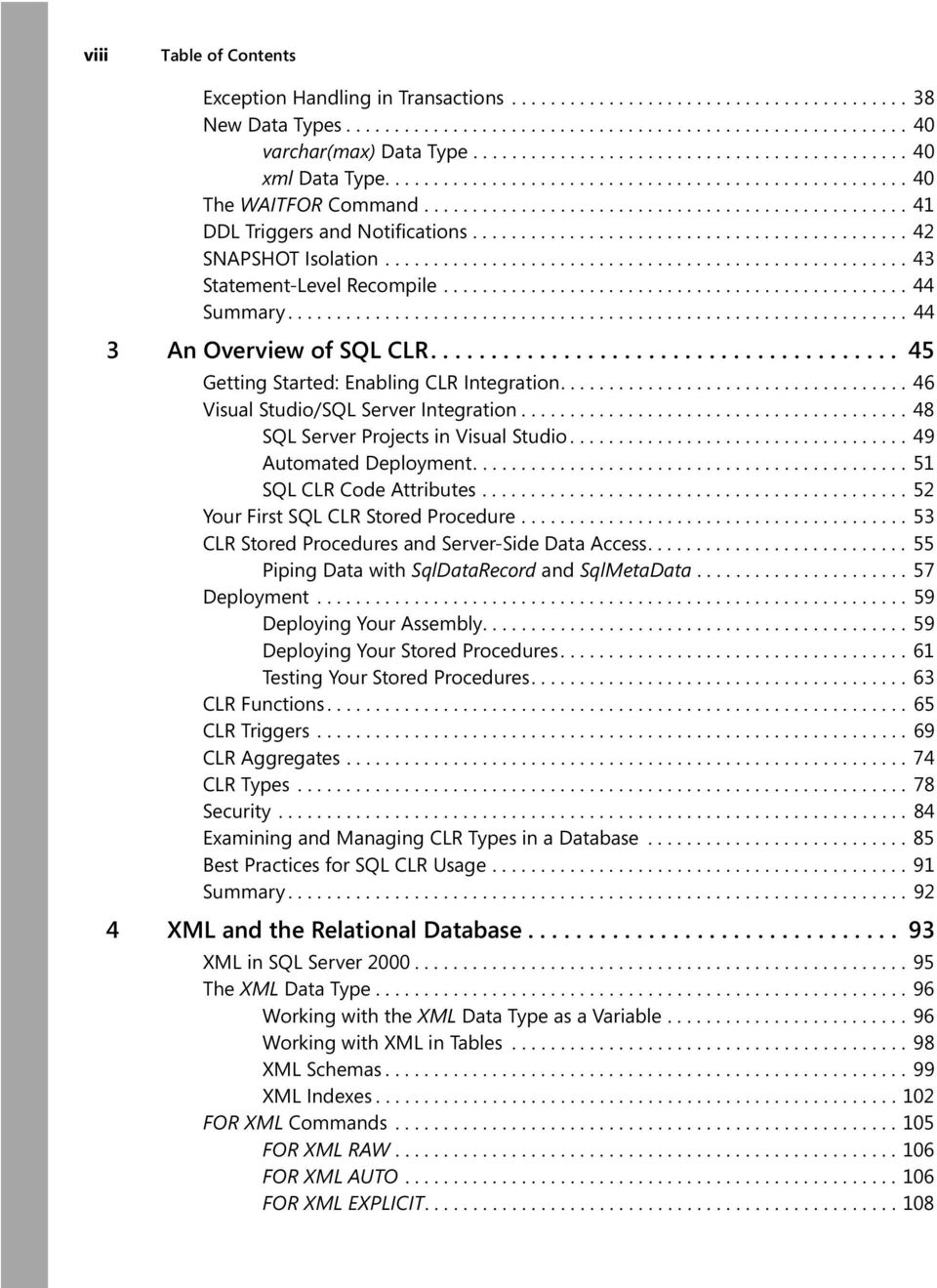
3 viii Table of Contents Exception Handling in Transactions New Data Types varchar(max) Data Type xml Data Type The WAITFOR Command DDL Triggers and Notifications SNAPSHOT Isolation Statement-Level Recompile Summary An Overview of SQL CLR Getting Started: Enabling CLR Integration Visual Studio/SQL Server Integration SQL Server Projects in Visual Studio Automated Deployment SQL CLR Code Attributes Your First SQL CLR Stored Procedure CLR Stored Procedures and Server-Side Data Access Piping Data with SqlDataRecord and SqlMetaData Deployment Deploying Your Assembly Deploying Your Stored Procedures Testing Your Stored Procedures CLR Functions CLR Triggers CLR Aggregates CLR Types Security Examining and Managing CLR Types in a Database Best Practices for SQL CLR Usage Summary XML and the Relational Database XML in SQL Server The XML Data Type Working with the XML Data Type as a Variable Working with XML in Tables XML Schemas XML Indexes FOR XML Commands FOR XML RAW FOR XML AUTO FOR XML EXPLICIT
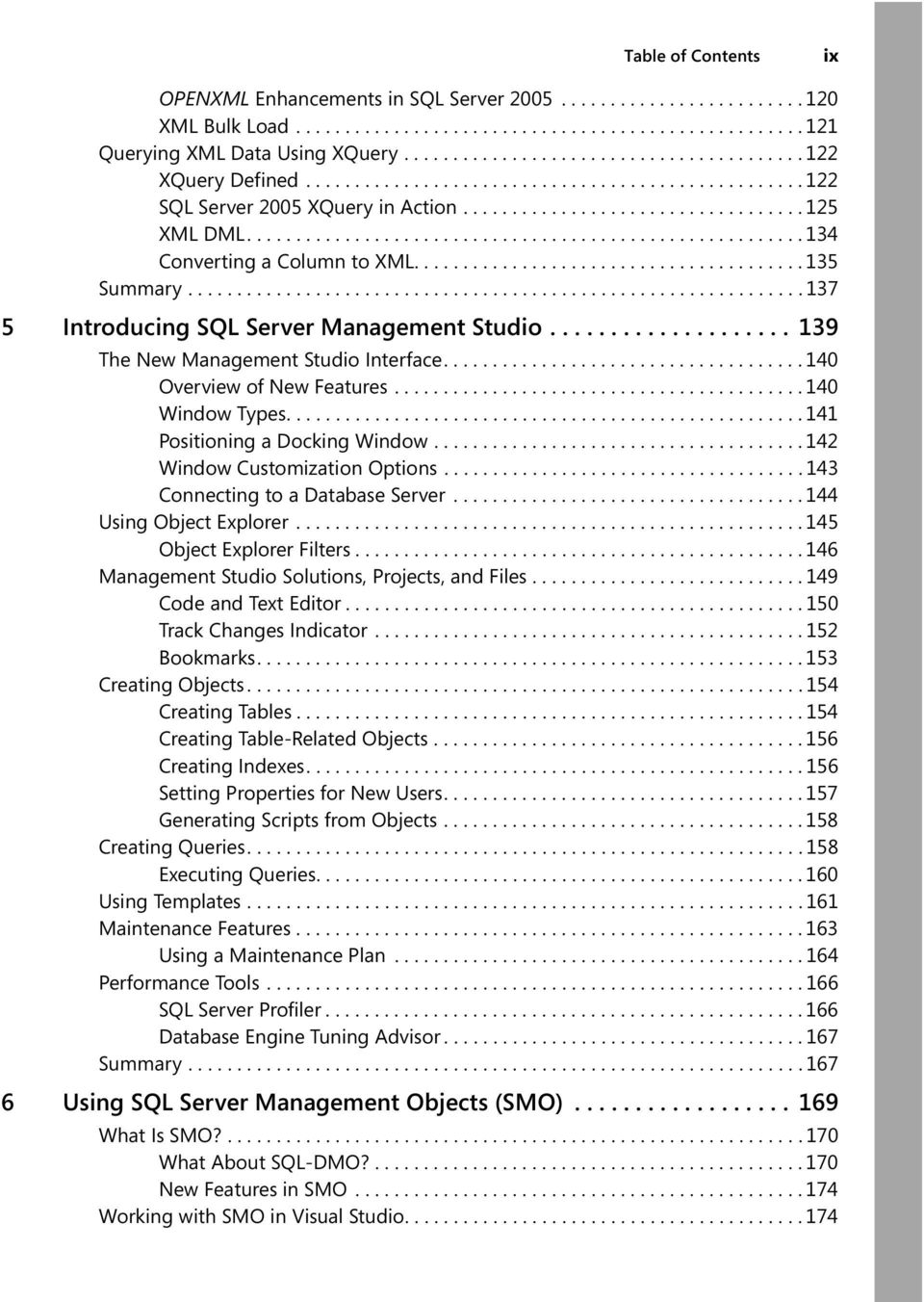
4 Table of Contents ix OPENXML Enhancements in SQL Server XML Bulk Load Querying XML Data Using XQuery XQuery Defined SQL Server 2005 XQuery in Action XML DML Converting a Column to XML Summary Introducing SQL Server Management Studio The New Management Studio Interface Overview of New Features Window Types Positioning a Docking Window Window Customization Options Connecting to a Database Server Using Object Explorer Object Explorer Filters Management Studio Solutions, Projects, and Files Code and Text Editor Track Changes Indicator Bookmarks Creating Objects Creating Tables Creating Table-Related Objects Creating Indexes Setting Properties for New Users Generating Scripts from Objects Creating Queries Executing Queries Using Templates Maintenance Features Using a Maintenance Plan Performance Tools SQL Server Profiler Database Engine Tuning Advisor Summary Using SQL Server Management Objects (SMO) What Is SMO? What About SQL-DMO? New Features in SMO Working with SMO in Visual Studio
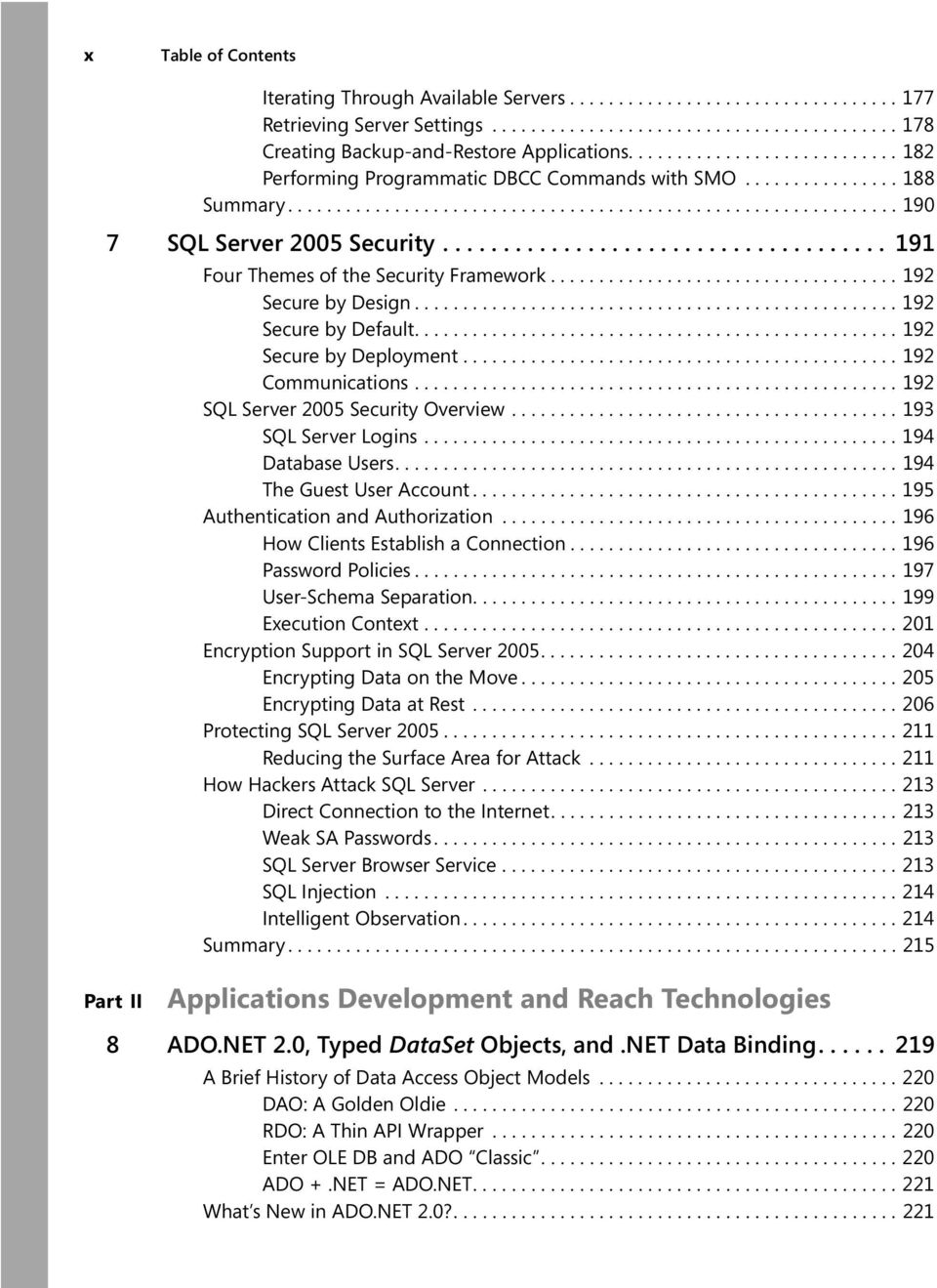
5 x Table of Contents Iterating Through Available Servers Retrieving Server Settings Creating Backup-and-Restore Applications Performing Programmatic DBCC Commands with SMO Summary SQL Server 2005 Security Four Themes of the Security Framework Secure by Design Secure by Default Secure by Deployment Communications SQL Server 2005 Security Overview SQL Server Logins Database Users The Guest User Account Authentication and Authorization How Clients Establish a Connection Password Policies User-Schema Separation Execution Context Encryption Support in SQL Server Encrypting Data on the Move Encrypting Data at Rest Protecting SQL Server Reducing the Surface Area for Attack How Hackers Attack SQL Server Direct Connection to the Internet Weak SA Passwords SQL Server Browser Service SQL Injection Intelligent Observation Summary Part II Applications Development and Reach Technologies 8 ADO.NET 2.0, Typed DataSet Objects, and.net Data Binding A Brief History of Data Access Object Models DAO: A Golden Oldie RDO: A Thin API Wrapper Enter OLE DB and ADO Classic ADO +.NET = ADO.NET What s New in ADO.NET 2.0?
6 Table of Contents xi New Typed DataSet Members Other Enhancements Typed DataSet Enhancements DataTable Objects in the Typed DataSet Designer TableAdapter Objects Connection String Management Using the TableAdapter Configuration Wizard More on Queries and Parameters Adding Query Objects DBDirect Methods and Connected Use of Typed DataSet Objects Standalone DataTable Objects Pure ADO.NET: Working in Code Querying Keeping Data Up to Date Responsive UIs: Executing Queries Asynchronously Not for Servers Only: Client-Side Bulk Copy It s Not Just Text: Processing XML Columns with ADO.NET and the System.Xml Namespace Nothing but.net: Consuming SQL CLR UDT Data as Native.NET Objects Back to the Drawing Board Embedding SQL CLR Objects in Typed DataSet Objects Adding a CLR Stored Procedure to a Typed DataSet TVFs: Easy Living Aggregates and UDTs Windows Forms Data Binding DataGridView Binding Details View Binding Smart Defaults Binding to Stored Procedures and Views SQL CLR Binding Master-Detail and Lookup Binding Parameterized Query Data Binding Data Binding on the Web Typed DataSet Objects and the Web.config File The Data Source Configuration Wizard, the ObjectDataSource Control, and the New Data-Bound Controls Summary Debugging About the Sample Code Ad Hoc Debugging Creating Database Connections
7 xii Table of Contents T-SQL Step Into Debugging Application Debugging Entering Debugging Mode Debugging SQL CLR Code Breakpoints and Context Switching Mixing SQL CLR and T-SQL Code Test Script Debugging Debugging Queries External to Visual Studio Remote Debugging Server Configuration Server Firewall Considerations Back to the Client Client Firewall Configuration Attaching to a Remote Process Summary SQL Server 2005 Native XML Web Services Understanding Native XML Web Services Comparing Native XML Web Services and SQLXML Exposing SQL Programmability as Web Services Stored Procedures and User-Defined Functions SQL Batch Reserving URLs with Http.sys Creating and Managing Endpoints Granting Endpoint Permissions Calling Native XML Web Service Endpoints from Client Applications Example Native XML Web Services Project Creating the SQL Server Functionality Registering the URL with Http.sys Exposing the Endpoints Granting Security Access to the Endpoints Creating the Client Application Best Practices for Using Native XML Web Services Advantages of Native XML Web Services Limitations of Native XML Web Services Security Recommendations Performance Recommendations When to Avoid Native XML Web Services When to Use Native XML Web Services Summary
8 Table of Contents xiii 11 Transactions What Is a Transaction? Understanding the ACID Properties Local Transactions Support in SQL Server Autocommit Transaction Mode Explicit Transaction Mode Implicit Transaction Mode Batch-Scoped Transaction Mode Using Local Transactions in ADO.NET Transaction Terminology Isolation Levels Isolation Levels in SQL Server Isolation Levels in ADO.NET Distributed Transactions Distributed Transaction Terminology Rules and Methods of Enlistment Distributed Transactions in SQL Server Distributed Transactions in the.net Framework Using a Resource Manager in a Successful Transaction Transactions in SQL CLR (CLR Integration) Putting It All Together Summary SQL Server Service Broker: The New Middleware What Is Middleware? What Is SQL Server Service Broker? Comparing Service Broker and MSMQ What Is a SQL Server Service Broker Application? Service Broker Architecture Integrated Management and Operation Routing and Load Balancing Service Broker Programming in T-SQL A Word About Programming Languages Enabling Service Broker Defining Service Broker Objects The Sending Service Program The Receiving Service Program Running the Application A More Robust, Real-World Application Service Broker and Query Notification Service Broker s Place in the Middleware World Summary

9 xiv Table of Contents 13 Using SQL Server 2005 Notification Services What Is a Notification Application? Notification Services Components Notification Services Deployment Strategies Working with Notification Services Creating Notification Applications A Sample Notification Application Flight Price Notification Sample Application Summary Developing Desktop Applications with SQL Server Express Edition What Is SQL Server Express Edition? Licensing Feature Review SQL Server 2005 Express Edition with Advanced Services Configuration Working with SQL Server Express Edition SQLCMD Command-Line Tool User Instances SSEUTIL Installing SQL Server Express Edition Using the Setup Wizard to Manually Install Express Edition Installing via Command-Line Parameters or a Configuration File Deploying Express Edition Applications Using a Wrapper Deploying Express Edition Applications Using ClickOnce Updating ClickOnce Deployments That Use Express Edition Summary Developing Applications with SQL Server 2005 Everywhere Edition and SQL Server Merge Replication SQL Everywhere Integration with SQL Server Working with SQL Everywhere Databases in Management Studio Working with SQL Everywhere Data in Management Studio Creating a SQL Everywhere Application with SQL Server Replication and Visual Studio Creating a Publication Installing and Configuring SQL Everywhere Server Components for IIS Creating a Subscription Using Management Studio Creating a Mobile Application Using Visual Studio Summary
10 Table of Contents xv Part III Reporting and Business Intelligence 16 Using SQL Server 2005 Integration Services History of Data Transfer in SQL Server DTS Packages Working with Integration Services Packages Control Flow Data Flow Using Integration Services Packages Creating Packages Using the Import And Export Wizard Creating Packages Using BI Development Studio Managing Packages Using Management Studio Using the Command Line to Execute and Manage Packages Scheduling Packages Using SQL Server Agent Configuring and Deploying Packages Overview of Programming Package Extension Security Dealing with Sensitive Information and Assets Considerations for Working on a Single Development Machine Considerations for Workgroups Programming Integration Services Programming in Visual Studio Loading and Executing Packages in Applications Creating Packages Programmatically Extensibility Script Tasks Custom Tasks Custom Components Script Components Custom Connection Managers Log Providers Foreach Enumerator Summary Basic OLAP Wherefore BI? OLAP OLAP Vocabulary Dimensions, Axes, Stars, and Snowflakes Building Your First Cube Preparing Star Schema Objects A Tool by Any Other Name
11 xvi Table of Contents Creating the Project Adding a Data Source View Creating a Cube with the Cube Wizard Using the Cube Designer Using the Dimension Wizard Using the Dimension Designer Working with the Properties Window and Solution Explorer Processing the Cube Running Queries Summary Advanced OLAP What We ll Cover in This Chapter MDX in Context And Now a Word from Our Sponsor Advanced Dimensions and Measures Keys and Names Changing the All Member Adding a Named Query to a Data Source View Parent-Child Dimensions Member Grouping Server Time Dimensions Fact Dimensions Role-Playing Dimensions Advanced Measures Calculations Calculated Members Named Sets More on Script View Key Performance Indicators KPI Visualization: Status and Trend A Concrete KPI Testing KPIs in Browser View KPI Queries in Management Studio Other BI Tricks in Management Studio Actions Actions Simply Defined Designing Actions Testing Actions Partitions, Aggregation Design, Storage Settings, and Proactive Caching Editing and Creating Partitions Aggregation Design Partition Storage Options

12 Table of Contents xvii Proactive Caching Additional Features and Tips Perspectives Translations Roles Summary OLAP Application Development Using Excel Working Within Excel Using PivotTables and Charts in Applications and Web Pages Beyond OWC: Full-On OLAP Development MDX and Analysis Services APIs Moving to MDX Management Studio as an MDX Client OLAP Development with ADO MD.NET XMLA at Your (Analysis) Service Analysis Services CLR Support: Server-Side ADO MD.NET Summary Extending Your Database System with Data Mining Why Mine Your Data? Getting Started Preparing Your Source Data Creating Training and Test Samples Adding an SSAS Project Using the Data Mining Wizard and Data Mining Designer Creating a Mining Structure Creating a Mining Model Editing and Adding Mining Models Deploying and Processing Data Mining Objects Viewing Mining Models Validating and Comparing Mining Models Nested Tables Using Data Mining Extensions Data Mining Modeling Using DMX Data Mining Predictions Using DMX DMX Templates Data Mining Applied Data Mining and API Programming Using the WinForms Model Content Browser Controls Executing Prediction Queries with ADO MD.NET

13 xviii Table of Contents Model Content Queries ADO MD.NET and ASP.NET Using the Data Mining Web Controls Developing Managed Stored Procedures XMLA and Data Mining Data Mining and Reporting Services Summary Reporting Services Report Definition and Design Data Sources Report Layouts Report Designer Report Builder Report Definition Language Report Management Publishing Report Manager SQL Server Management Studio Command-Line Utilities Programming: Management Web Services Report Access and Delivery Delivery on Demand Subscriptions Presentation Formats Programming: Rendering Report Server Architecture Deployment Modes Extensibility Report Integration Summary Index What do you think of this book? We want to hear from you! Microsoft is interested in hearing your feedback about this publication so we can continually improve our books and learning resources for you. To participate in a brief online survey, please visit:

14 Chapter 3 An Overview of SQL CLR Andrew Brust In this chapter: Getting Started: Enabling CLR Integration Visual Studio/SQL Server Integration Your First SQL CLR Stored Procedure CLR Stored Procedures and Server-Side Data Access Deployment CLR Functions CLR Triggers CLR Aggregates CLR Types Security Examining and Managing CLR Types in a Database Best Practices for SQL CLR Usage Summary The banner headline for Microsoft SQL Server 2005 is its integration of the Microsoft.NET common language runtime (CLR). This architectural enhancement means that SQL Server can use certain.net classes as basic data types and can accommodate the use of.net languages for the creation of stored procedures, triggers, and functions, and even user-defined aggregates. Note Throughout this chapter, we will refer to the CLR integration in SQL Server as SQL CLR features, functionality, or integration, and we will refer to stored procedures, triggers, functions, aggregates, and user-defined types as the five basic SQL CLR entities. Let s face facts: Transact SQL (T-SQL) is essentially a hack. Back when SQL Server was first developed, Microsoft and Sybase took SQL a declarative, set-based language and added variable declaration, conditional branching, looping, and parameterized subroutine logic to make it into a quasi-procedural language. Although extremely clever and useful, T-SQL lacked, and still lacks, many of the niceties of a full-fledged procedural programming language. 45

15 46 Part I: Design Fundamentals and Core Technologies This shortcoming has forced some people to write T-SQL stored procedures that are overly complex and difficult to read. It has forced others to put logic in their middle-tier code that they would prefer to implement on the database. And it s even forced some people to abandon stored procedures altogether and use dynamic SQL in their applications, a practice that we do not endorse. Because of these workarounds to address T-SQL s procedural limitations, CLR integration is a welcome new feature in SQL Server, and it has caught the market s attention. Meanwhile, T-SQL and, one might argue, SQL itself is vastly superior to procedural languages for querying and manipulating data. Its set-based syntax and implementation simply transcend the approach of procedurally iterating through rows of data. This is no less true in SQL Server 2005 than in previous versions of the product, and T-SQL has been greatly enhanced in this release (as detailed in Chapter 2), making it more valuable still. So this places database application developers at a crossroads. We must simultaneously learn how the SQL CLR features work and develop a sophisticated, judicious sense of when to use T-SQL instead of the SQL CLR feature set. We must resist the temptation to completely.netify our databases but learn to take advantage of the SQL CLR feature set where and when prudent. This chapter aims to help you learn to use SQL CLR features and to develop an instinct for their appropriate application. In this chapter, you will learn: How to enable (or disable) SQL CLR integration on your SQL Server How SQL Server accommodates CLR code, through the loading of.net assemblies How to use SQL Server 2005 and Visual Studio 2005 together to write SQL CLR code and deploy it, simply and quickly How to deploy SQL CLR code independently of Visual Studio, using T-SQL commands, with or without the help of SQL Server Management Studio How to create simple CLR stored procedures, triggers, functions, aggregates, and userdefined types, use them in your databases, and utilize them from T-SQL How both the standard SQL Server client provider and the new server-side library can be combined to implement SQL CLR functionality How SQL CLR security works and how to configure security permissions for your assemblies When to use SQL CLR functionality, and when to opt to use T-SQL instead Getting Started: Enabling CLR Integration Before you can learn how to use SQL CLR features, you need to know how to enable them. As with many new products in the Microsoft Windows Server System family, many advanced features of SQL Server 2005 are disabled by default. The reasoning behind this is sound: Each

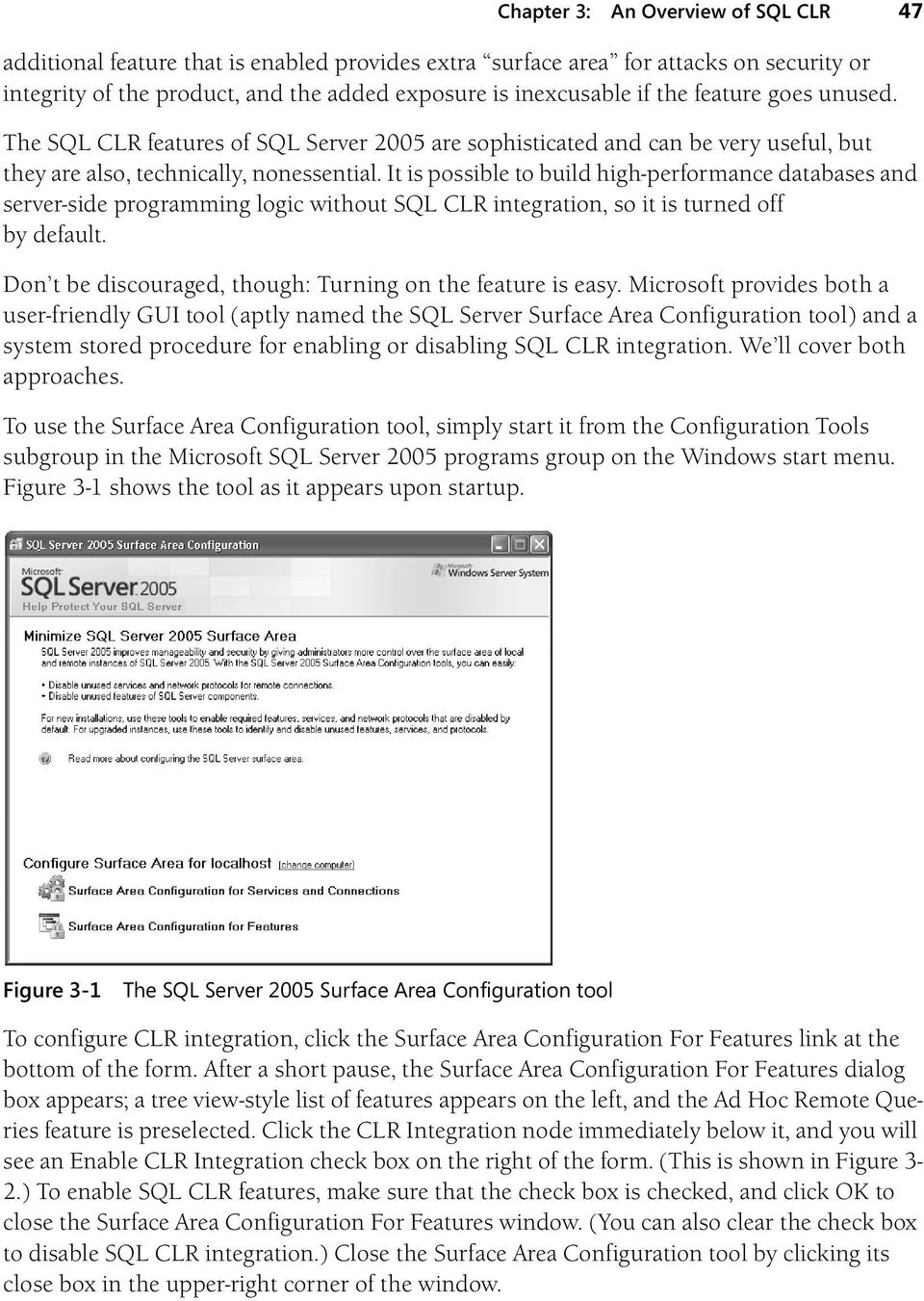
16 Chapter 3: An Overview of SQL CLR 47 additional feature that is enabled provides extra surface area for attacks on security or integrity of the product, and the added exposure is inexcusable if the feature goes unused. The SQL CLR features of SQL Server 2005 are sophisticated and can be very useful, but they are also, technically, nonessential. It is possible to build high-performance databases and server-side programming logic without SQL CLR integration, so it is turned off by default. Don t be discouraged, though: Turning on the feature is easy. Microsoft provides both a user-friendly GUI tool (aptly named the SQL Server Surface Area Configuration tool) and a system stored procedure for enabling or disabling SQL CLR integration. We ll cover both approaches. To use the Surface Area Configuration tool, simply start it from the Configuration Tools subgroup in the Microsoft SQL Server 2005 programs group on the Windows start menu. Figure 3-1 shows the tool as it appears upon startup. Figure 3-1 The SQL Server 2005 Surface Area Configuration tool To configure CLR integration, click the Surface Area Configuration For Features link at the bottom of the form. After a short pause, the Surface Area Configuration For Features dialog box appears; a tree view-style list of features appears on the left, and the Ad Hoc Remote Queries feature is preselected. Click the CLR Integration node immediately below it, and you will see an Enable CLR Integration check box on the right of the form. (This is shown in Figure 3-2.) To enable SQL CLR features, make sure that the check box is checked, and click OK to close the Surface Area Configuration For Features window. (You can also clear the check box to disable SQL CLR integration.) Close the Surface Area Configuration tool by clicking its close box in the upper-right corner of the window.
17 48 Part I: Design Fundamentals and Core Technologies Figure 3-2 The Surface Area Configuration For Features window If you d prefer a command-line method for enabling or disabling SQL CLR functionality, open up SQL Server Management Studio and connect to the server you d like to configure. Then, from a query window, type the following commands, and click the Execute button on the Management Studio SQL Editor toolbar. sp_configure 'clr enabled', 1 GO RECONFIGURE GO That s all there is to it! To disable SQL CLR integration, just use a value of 0, instead of 1, as the second parameter value in the sp_configure call. Tip Don t forget that this will work from any tool that can connect to SQL Server, not just Management Studio. In fact, you could issue the previous command text from your own code using the ADO.NET SqlCommand object s ExecuteNonQuery method as long as your code can connect to your server and your sever can authenticate as a user in the sysadmin server role. With SQL CLR integration enabled, you re ready to get started writing SQL CLR code. Before we dive in, we need to discuss Visual Studio/SQL Server integration and when to use it. Visual Studio/SQL Server Integration Visual Studio 2005 and SQL Server 2005 integrate tightly in a number of ways. It s important to realize, however, that the use of Visual Studio integration is completely optional and the use of T-SQL is a sufficient substitute. T-SQL has been enhanced with new DDL commands for

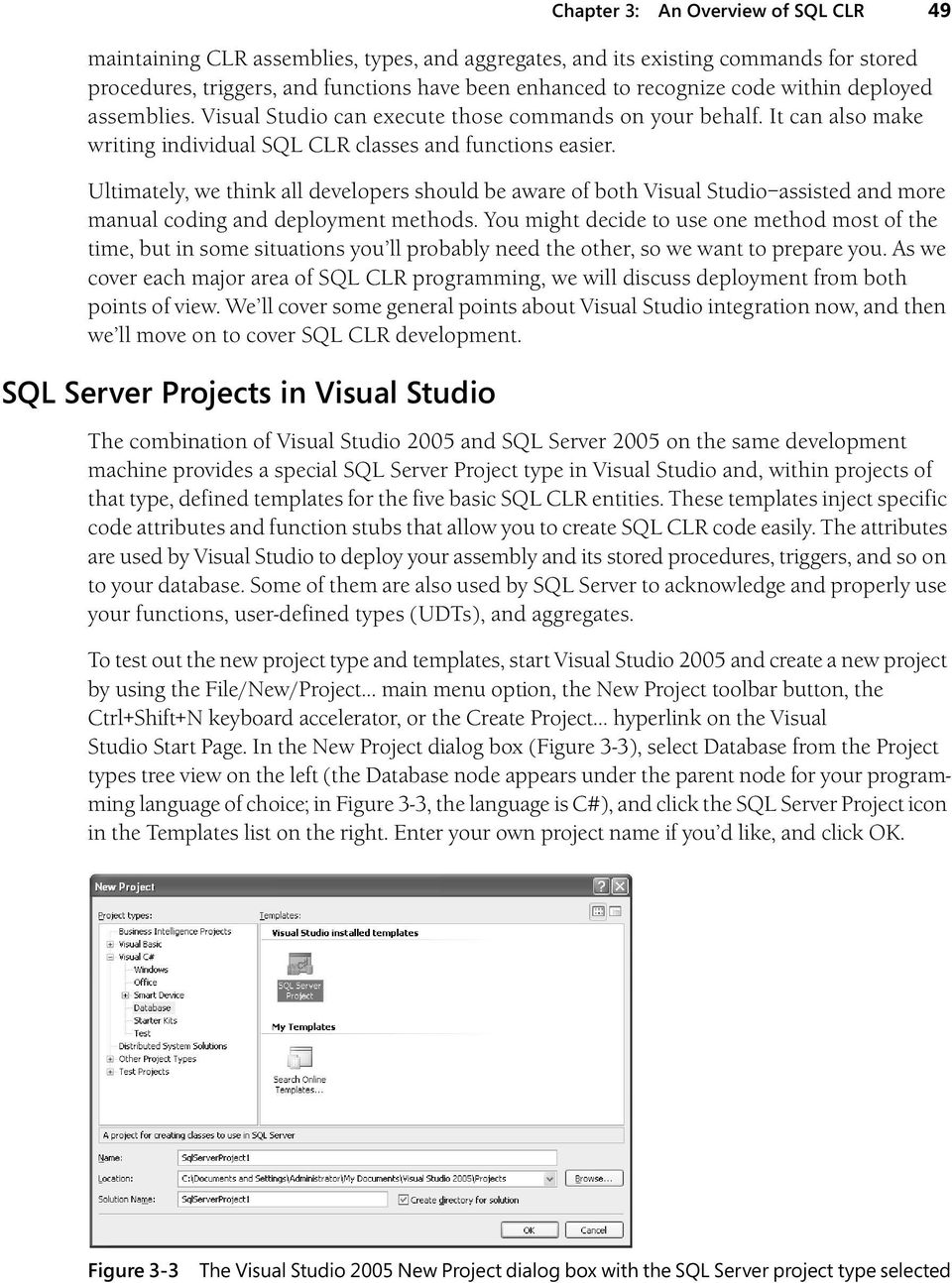
18 Chapter 3: An Overview of SQL CLR 49 maintaining CLR assemblies, types, and aggregates, and its existing commands for stored procedures, triggers, and functions have been enhanced to recognize code within deployed assemblies. Visual Studio can execute those commands on your behalf. It can also make writing individual SQL CLR classes and functions easier. Ultimately, we think all developers should be aware of both Visual Studio assisted and more manual coding and deployment methods. You might decide to use one method most of the time, but in some situations you ll probably need the other, so we want to prepare you. As we cover each major area of SQL CLR programming, we will discuss deployment from both points of view. We ll cover some general points about Visual Studio integration now, and then we ll move on to cover SQL CLR development. SQL Server Projects in Visual Studio The combination of Visual Studio 2005 and SQL Server 2005 on the same development machine provides a special SQL Server Project type in Visual Studio and, within projects of that type, defined templates for the five basic SQL CLR entities. These templates inject specific code attributes and function stubs that allow you to create SQL CLR code easily. The attributes are used by Visual Studio to deploy your assembly and its stored procedures, triggers, and so on to your database. Some of them are also used by SQL Server to acknowledge and properly use your functions, user-defined types (UDTs), and aggregates. To test out the new project type and templates, start Visual Studio 2005 and create a new project by using the File/New/Project main menu option, the New Project toolbar button, the Ctrl+Shift+N keyboard accelerator, or the Create Project hyperlink on the Visual Studio Start Page. In the New Project dialog box (Figure 3-3), select Database from the Project types tree view on the left (the Database node appears under the parent node for your programming language of choice; in Figure 3-3, the language is C#), and click the SQL Server Project icon in the Templates list on the right. Enter your own project name if you d like, and click OK. Figure 3-3 The Visual Studio 2005 New Project dialog box with the SQL Server project type selected
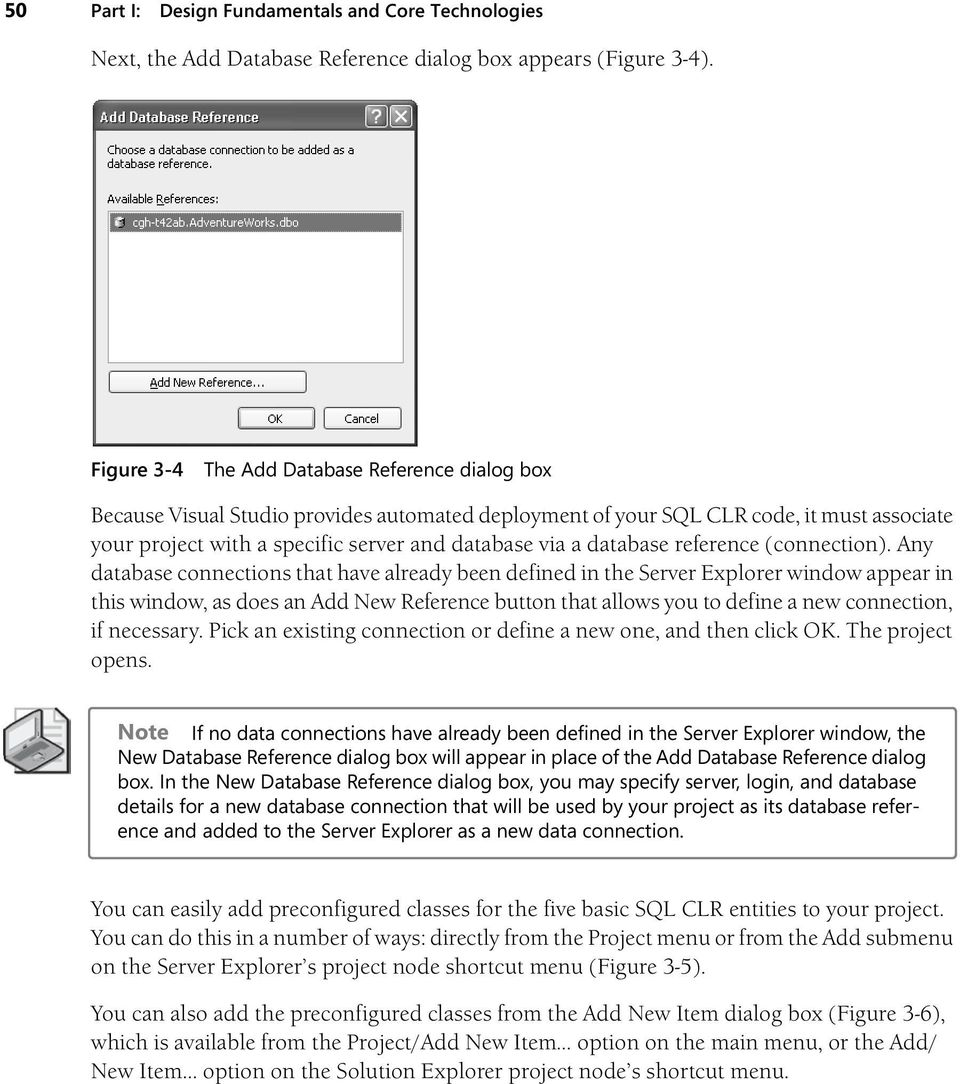
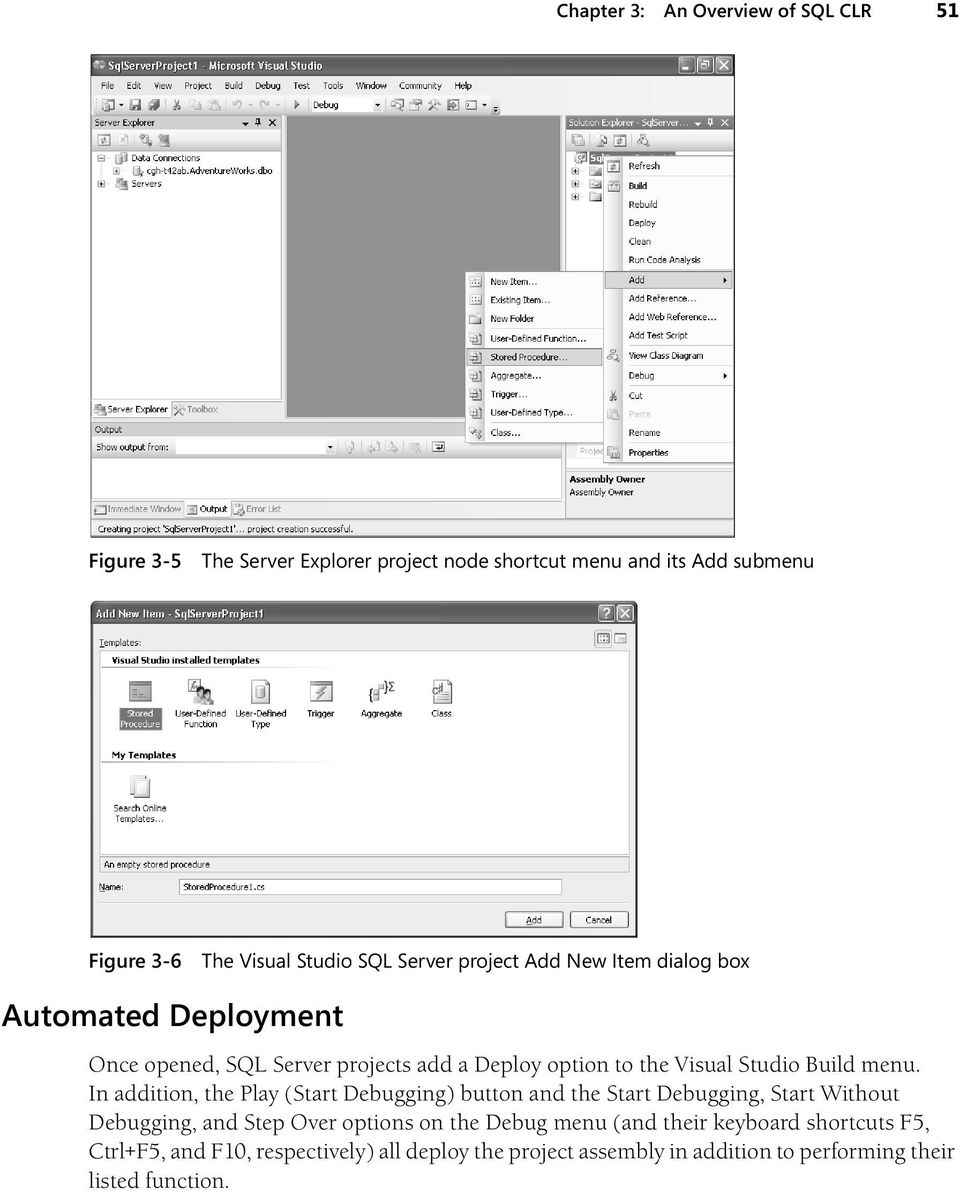
19 50 Part I: Design Fundamentals and Core Technologies Next, the Add Database Reference dialog box appears (Figure 3-4). Figure 3-4 The Add Database Reference dialog box Because Visual Studio provides automated deployment of your SQL CLR code, it must associate your project with a specific server and database via a database reference (connection). Any database connections that have already been defined in the Server Explorer window appear in this window, as does an Add New Reference button that allows you to define a new connection, if necessary. Pick an existing connection or define a new one, and then click OK. The project opens. Note If no data connections have already been defined in the Server Explorer window, the New Database Reference dialog box will appear in place of the Add Database Reference dialog box. In the New Database Reference dialog box, you may specify server, login, and database details for a new database connection that will be used by your project as its database reference and added to the Server Explorer as a new data connection. You can easily add preconfigured classes for the five basic SQL CLR entities to your project. You can do this in a number of ways: directly from the Project menu or from the Add submenu on the Server Explorer s project node shortcut menu (Figure 3-5). You can also add the preconfigured classes from the Add New Item dialog box (Figure 3-6), which is available from the Project/Add New Item option on the main menu, or the Add/ New Item option on the Solution Explorer project node s shortcut menu.
20 Chapter 3: An Overview of SQL CLR 51 Figure 3-5 The Server Explorer project node shortcut menu and its Add submenu Figure 3-6 The Visual Studio SQL Server project Add New Item dialog box Automated Deployment Once opened, SQL Server projects add a Deploy option to the Visual Studio Build menu. In addition, the Play (Start Debugging) button and the Start Debugging, Start Without Debugging, and Step Over options on the Debug menu (and their keyboard shortcuts F5, Ctrl+F5, and F10, respectively) all deploy the project assembly in addition to performing their listed function.
21 52 Part I: Design Fundamentals and Core Technologies Visual Studio can do a lot of deployment work for you. But as you ll learn, you can do so on your own and, in certain circumstances, have more precise control over the deployment process when you do so. SQL CLR Code Attributes A number of.net code attributes are provided for SQL CLR developers; these are contained in the Microsoft.SqlServer.Server namespace. Many of them are inserted in your code when you use the various templates in the SQL Server project type, as is a using statement for the Microsoft.SqlServer.Server namespace itself. If you choose to develop code without these templates, you must add the appropriate attributes, and optionally the using statement, yourself. Although all these attributes are provided in the same namespace, some are used exclusively by Visual Studio and others are used by both Visual Studio and SQL Server. Covering all SQL CLR attributes and their parameters would itself require an entire chapter, so our coverage will be intentionally selective. Specifically, we will provide coverage of the SqlProcedure, SqlFunction, SqlTrigger, SqlUserDefinedAggregate, and SqlUserDefinedType attributes. We will not cover the SqlFacet and SqlMethod attributes. Just as certain attributes are not covered here, we cover only some of the parameters accepted by the attributes that we do cover. And in some cases, we cover only certain of the possible values that can be passed to these attributes. For example, SqlFunction accepts several parameters but the only ones we will cover are Name, FillRowMethodName, and TableDefinition. For SqlUserDefinedAggregate and SqlUserDefinedType, we will cover only a single value setting for the Format parameter, and will not cover the several other parameters those two attributes accept. The coverage we provide will be more than sufficient for you to implement basic, intermediate, and certain advanced functionality with all the basic five SQL CLR entities. The attributes and parameters that we won t cover are useful mostly for optimizing your SQL CLR code, and they are well documented in SQL Server Books Online and articles on MSDN. About the Sample Code The sample.net code for this chapter is provided in two versions. The primary material is supplied as a Visual Studio SQL Server project, accessible by opening the solution file Chapter03.sln in the Chapter03 subfolder of this chapter s VS sample code folder. We also supply the code as a standard Class Library project, accessible by opening the solution file Chapter03Manual.sln in the Chapter03Manual subfolder. The code in each project is virtually identical, although the Class Library project does not autodeploy when the various Build and Debug options are invoked in Visual Studio As we cover each SQL CLR feature, we ll discuss how automated deployment takes place from the SQL Server project and how command-driven deployment should be performed for the Class Library project.
22 Chapter 3: An Overview of SQL CLR 53 We ll also discuss executing test scripts from within Visual Studio for the SQL Server project and from SQL Server Management Studio for the Class Library project. As a companion to those discussions, we also provide a Management Studio project, accessible by opening Chapter03.ssmssln in this chapter s SSMS folder. This project consists of a number of SQL scripts used for testing the sample SQL CLR code and a script for cleaning up everything in the database created by the sample code and tests. The project also contains a script file called CreateObjects.sql, which deploys the Class Library assembly and the SQL CLR entities within it. Your First SQL CLR Stored Procedure Although SQL CLR programming can get quite complex and involved, it offers in reality a simple model that any.net developer can use with high productivity in relatively short order. That s because the crux of SQL CLR functionality is nothing more than the ability of SQL Server 2005 to load.net assemblies into your database and then to allow you to use the procedures, functions, and types within the assembly as you define your columns, views, stored procedures, triggers, and functions. To give you a good understanding of SQL CLR integration, we must go through its features and techniques carefully. Before doing so, however, let s quickly go through an end-to-end scenario for creating and executing a SQL CLR stored procedure. This will make it easier for you to understand the individual features as we describe them. Strictly speaking, any.net class library assembly (in certain cases using appropriate.net code attributes in its classes and functions) can be loaded into your database with a simple T-SQL command. To see how easily this works, start up Management Studio and open a query window using a connection to the AdventureWorks sample database. In the sample code folder for this chapter, confirm that the file Chapter03.dll is located in the VS\Chapter03Manual\Chapter03\bin\Debug subfolder. If the parent folder were C:\ProgrammingSQL2005\Chapter03, you would load the assembly into the Adventure- Works database with the following T-SQL command: CREATE ASSEMBLY Chapter03 FROM 'C:\ProgrammingSQL2005\Chapter03\VS\Chapter03Manual\Chapter03\bin\Debug\Chapter03.dll' There are other syntax options for the CREATE ASSEMBLY command, but for now we ll focus on the previous limited usage. Functions in an assembly that reside within a class and perform local computational tasks and/or certain types of data access can be easily exposed as SQL Server stored procedures, triggers, or functions. As with conventional stored procedures, triggers, and functions, all it takes is a simple T-SQL CREATE PROCEDURE, CREATE TRIGGER, or CREATE FUNCTION
23 54 Part I: Design Fundamentals and Core Technologies command to make this happen. We ll go through each of these options in this chapter, but let s cut to the chase and create a simple CLR stored procedure right now. You can view the source code for the Chapter03 assembly by opening the solution file VS\Chapter03Manual\Chapter03Manual.sln in this chapter s sample code folder. Within the project, the file Sprocs.cs contains the following code: using System.Data.SqlClient; using Microsoft.SqlServer.Server; public partial class Sprocs public static void spcontactsquick() SqlContext.Pipe.ExecuteAndSend(new SqlCommand("Select * from Person.Contact")); ; The code within the procedure is designed to connect to the database in which its assembly has been loaded (AdventureWorks), perform a SELECT * against the Person.Contact table, and use special server-side objects to send the data back to the client application. To make this CLR code available via SQL Server as a stored procedure, also called spcontactsquick, you simply execute the following command from the Management Studio query window you opened previously. CREATE PROCEDURE spcontactsquick AS EXTERNAL NAME Chapter03.Sprocs.spContactsQuick Important Be sure to enter the Sprocs.spContactsQuick portion of the command verbatim. This phrase is case-sensitive. To test the SQL CLR stored procedure, run it from a Management Studio query window as you would any conventional stored procedure: EXEC spcontactsquick Or simply: spcontactsquick Management Studio should respond by displaying the contents of the Person.Contact table in the Results tab of the query window. As you can see from this rather trivial example, writing a CLR stored procedure can be very easy and is a lot like writing client-side or middle-tier code that performs data access using
24 Chapter 3: An Overview of SQL CLR 55 ADO.NET. The biggest differences involve the provision of a database connection and the fact that the data must be piped back to the client rather than loaded into a SqlDataReader and returned, manipulated, or displayed through a UI. In addition, the presence of the SqlContext object differentiates SQL CLR code from conventional.net data access code. We ll cover the use of the SqlContext object and its Pipe property in the next section. The bits of T-SQL and C# code just shown certainly don t tell the whole SQL CLR story. The use of the ExecuteAndSend method allowed us to skip over a number of otherwise important concepts. There are three ways to deploy assemblies, and you ve seen only a simplified version of one of those ways. Security considerations must be taken into account, and we haven t even begun to look at triggers, functions, aggregates, or UDTs. So although the example showed how easy SQL CLR programming can be, we ll now take our time and show you the nooks and crannies. CLR Stored Procedures and Server-Side Data Access Our previous quick and dirty sample looked at CLR stored procedure development, but we need to cover that topic more thoroughly now. We ve already covered the mechanics of writing and deploying a stored procedure, but let s back up a bit and try and understand how CLR stored procedures work from a conceptual standpoint. SQL CLR stored procedure code runs in an instance of the.net CLR that is hosted by SQL Server itself; it is not called as an external process, as COM-based extended stored procedures (XPs) would be. Because SQL CLR code runs in the context of the server, it treats objects in the database as native, local objects, more or less. Likewise, it must treat the client that calls it as remote. This contextual environment is, in effect, the opposite of that under which client and middle-tier ADO.NET code runs. This takes a little getting used to, but once you ve mastered thinking about things this way, SQL CLR code becomes easy to write and understand. Meanwhile, as.net has no intrinsic way of accessing local objects on the server or transmitting data and messages to the client, you must use a special set of classes to perform these tasks. These classes are contained in the Microsoft.SqlServer.Server namespace. Note As an aside, it is interesting and important to note that the Microsoft.SqlServer.Server namespace is actually supplied by the System.Data Framework assembly. This means that you don t need to worry about adding a reference to your project to use this namespace. The namespace s location within System.Data also further emphasizes the tight integration between.net and SQL Server. If you d like, you can think of Microsoft.SqlServer.Server as a helper library for System.Data.Sql- Client. It supplies the SQL CLR code attributes we already mentioned, a few enumerations, an exception class, an interface, and five classes: SqlContext, SqlPipe, SqlTriggerContext, SqlMeta- Data, and SqlDataRecord. We ll cover SqlMetaData and SqlDataRecord at the end of this
25 56 Part I: Design Fundamentals and Core Technologies section, and we ll cover SqlTriggerContext when we discuss CLR triggers. We ll cover the Sql- Context and SqlPipe objects right now. At a high level, the SqlContext object, which is static, provides a handle to the server-side context in which your code runs. It also has a channel to the client through which you can return data and text: its Pipe property, which in turn provides access to a properly initiated SqlPipe object. A SqlPipe object can send data and messages to the calling client though several methods: Send, SendResultsStart, SendResultsRow, SendResultsEnd, and ExecuteAndSend. In the previous code sample, we used the SqlPipe object s ExecuteAndSend method to implicitly open a connection, call ExecuteReader on an SqlCommand object that uses that connection, and transmit the contents of the resulting SqlDataReader back to the client. Although the implicit work done by ExecuteAndSend might have been convenient, it s important to avoid such shortcuts in our detailed discussion on SQL CLR programming. In general, SQL CLR stored procedure code that queries tables in the database must open a connection to that database, use the SqlCommand object s ExecuteReader method to query the data, and then use one or a combination of the Send methods to send it back. The Send methods do not accept DataSet objects; they accept only SqlDataReader objects, strings, and/or special SqlDataRecord objects. Listing 3-1, which shows the implementation of the function spcontacts from sptest.cs in the sample project, is a representative example of how this is done. Listing 3-1 spcontacts from sptest.cs [SqlProcedure] public static void spcontacts() SqlConnection conn = new SqlConnection("context connection=true"); SqlCommand cm = new SqlCommand("Select * from Person.Contact", conn); conn.open(); SqlDataReader dr = cm.executereader(); SqlContext.Pipe.Send("Starting data dump"); SqlContext.Pipe.Send(dr); SqlContext.Pipe.Send("Data dump complete"); dr.close(); conn.close(); For this code to work, we need to use both the Microsoft.SqlServer.Server and System.Data.SqlClient namespaces (and if you look in the sample project rather than Listing 3-1, you ll see that we have). This is because any conventional ADO.NET objects we might use, such as SqlConnection, SqlCommand, and SqlDataReader, are supplied to us from System.Data.SqlClient, just as they would be in a conventional client application or middle-tier assembly. As already discussed, we need the Microsoft.SqlServer.Server namespace in order to use objects such as SqlContext and
26 Chapter 3: An Overview of SQL CLR 57 SqlPipe. The stored procedure template in Visual Studio SQL Server projects includes the using statement for Microsoft.SqlServer.Server and System.Data.SqlClient automatically. Note Readers who worked with early beta versions of SQL Server 2005 might recall a System.Data.SqlServer library, which in effect supplied all conventional and server-side ADO.NET objects necessary to write SQL CLR code. This hybrid library was eliminated and replaced with the dual-library approach later in the beta process. Although server-side code uses SqlClient objects, it does so in a specialized way. For example, notice that the context connection=true connection string passed to the SqlConnection object s constructor. This essentially instructs ADO.NET to open a new connection to the database in which the CLR assembly resides. Notice also the second call to the SqlContext.Pipe object s Send method. Here, the SqlDataReader parameter overload of the SqlPipe object s Send method is used to push the contents of the SqlDataReader back to the client. You can think of this method as performing a while (dr.read()) loop through the SqlDataReader and echoing out the values of each column for each iteration of the loop, but instead of having to do that work yourself, the Send method does it for you. Before and after the SqlDataReader is piped, we use the String parameter overload of the Send method to send status messages to the client. When this stored procedure is run in Management Studio, the piped text appears on the Results tab of the query window when you use the Management Studio Results To Text option and on the Messages tab when you use the Results To Grid option. The rest of the listing contains typical ADO.NET code, all of it using objects from the SqlClient provider. And that illustrates well the overall theme of SQL CLR programming: Do what you d normally do from the client or middle tier, and use a few special helper objects to work within the context of SQL Server as you do so. Piping Data with SqlDataRecord and SqlMetaData We mentioned that the SqlPipe object s Send method can accept an object of type SqlDataRecord, and we mentioned previously that Microsoft.SqlServer.Server provides this object as well as an object called SqlMetaData. You can use these two objects together in a CLR stored procedure to return a result set one row at a time, instead of having to supply the SqlPipe object s Send method with an SqlDataReader. This allows (but does not require) you to inspect the data before sending it back to the client. Sending SqlDataReader objects prevents inspection of the data within the stored procedure because SqlDataReader objects are forward-only result set structures. Using the ExecuteAndSend method and an SqlCommand object has the same limitation. The SqlDataRecord object permits.net code to create an individual record/row to be returned to the calling client. Its constructor accepts an array of SqlMetaData objects, which in turn describe the metadata for each field/column in the record/row.
27 58 Part I: Design Fundamentals and Core Technologies Listing 3-2, which shows the implementation of function spcontactcount from sptest.cs in the sample project, illustrates how to use SqlPipe.Send together with SqlDataRecord and SqlMeta- Data objects to return a single-column, single-row result set from a stored procedure. Listing 3-2 spcontactcount from sptest.cs [SqlProcedure()] public static void spcontactcount() SqlConnection conn = new SqlConnection("context connection=true"); SqlCommand cm = new SqlCommand("Select Count(*) from Person.Contact", conn); SqlDataRecord drc = new SqlDataRecord(new SqlMetaData("ContactCount", SqlDbType.Int)); conn.open(); drc.setint32(0, (Int32)cm.ExecuteScalar()); SqlContext.Pipe.Send(drc); conn.close(); The code declares variable drc as a SqlDataRecord object and passes its constructor a single Sql- MetaData object. (Passing a single object rather than an array is permissible if the SqlDataRecord object will only have a single field/column.) The SqlMetaData object describes a column called ContactCount of type SqlDbType.Int. Note The SqlDbType enumeration is contained within the System.Data.SqlTypes namespace. The SQL Server Stored Procedure template inserts a using statement for this namespace. If you are creating SQL CLR code without using this template, you should add the using statement yourself. The rest of the code is rather straightforward. First, a context connection and command are opened and a SELECT COUNT(*) query is performed against the AdventureWorks Person.Contact table. Because the query returns a single scalar value, it is run using the SqlCommand object s ExecuteScalar method. Next, the value returned by ExecuteScalar is casted into an integer and that value is loaded into field/column 0 (the only one) of the SqlDataRecord object using its SetInt32 method. The SqlDataRecord is then piped back to the client using the SqlContext object s Send method. Note If we wanted to send back multiple SqlDataRecord objects, we would send the first one using the SqlContext object s SendResultsStart method and then send all subsequent SqlDataRecord objects using the SendResultsRow method. We would call the SendResultEnd method after all SqlDataRecords had been sent. Once the stored procedure has been deployed (the techniques for which we will discuss shortly), you can execute it from SQL Server Management Studio as you would any other stored procedure. Although the result is a single value, it is presented as a column and the
28 Chapter 3: An Overview of SQL CLR 59 column name ContactCount is shown on the Results tab of the query window. Keep in mind that this COUNT(*) query result could have been returned without using the SqlMetaData and SqlDataRecord objects; the sample is provided to demonstrate the use of these objects as an alternative to piping SqlDataReader objects and text to the client. CLR Stored Procedure Usage Guidelines It s important to understand how to perform data access and retrieval in CLR stored procedures. As a.net developer, you already know how to do more computational tasks within your code, so our samples illustrate server-side data access more than anything else. As proof-of-concept code, these samples are completely adequate. Meanwhile, you should avoid writing CLR stored procedures that merely perform simple CRUD (Create, Retrieve, Update, and Delete) operations. Such tasks are better left to conventional T-SQL stored procedures, which typically perform these operations more efficiently than ADO.NET can. CLR stored procedures work well when you need to perform computation on your data and you need the expressiveness of a.net language to do so (where such expressiveness is missing from T-SQL). For example, implementing a fuzzy search using business logic embedded in.net assemblies to determine which data has an affinity to other data is a good use of SQL CLR stored procedures. Regular-expression-based data validation in an update or insert stored procedure is another good application of SQL CLR integration. As a general rule, straight data access should be left to T-SQL. Higher-valued computations are good candidates for SQL CLR integration. We ll revisit the SQL CLR usage question at various points in this chapter. Deployment Before you can test your SQL CLR code, you must deploy the assembly containing it and register the individual functions that you want recognized as stored procedures. A number of deployment methods are at your disposal; we will pause to cover them now, before discussing testing of your stored procedures and the other four basic SQL CLR entities. Deploying Your Assembly As mentioned earlier, Visual Studio deploys the SQL Server project version of the sample code when you build, start, or step through the project or use the Build/Deploy function on Visual Studio s main menu. If you re working with the SQL Server project version of the samples, go ahead and use the Deploy option or one of the Start or Build options in Visual Studio now. For deploying the Class Library project version, assuming C:\ProgrammingSQL2005\ Chapter03 as this chapter s sample code parent directory, you can execute the following T-SQL command
29 60 Part I: Design Fundamentals and Core Technologies from within Management Studio: CREATE ASSEMBLY Chapter03 AUTHORIZATION dbo FROM 'C:\ProgrammingSQL2005\Chapter03\VS\Chapter03Manual\Chapter03\bin\Debug\Chapter03.dll' WITH PERMISSION_SET = SAFE GO The AUTHORIZATION clause allows you to specify a name or role to which ownership of the assembly is assigned. The default authorization is that of the current user, and because you are most likely logged in as dbo for AdventureWorks, in this case the clause is unnecessary (which is why we omitted it from our previous example). The meaning and effect of the WITH PERMISSION_SET clause are discussed at the end of this chapter. For now, just note that this clause allows you to specify the security permissions with which your assembly runs. As with the AUTHORIZATION clause, in this case the WITH PERMISSION_SET clause is technically unnecessary because SAFE is the default PERMISSION_SET value used when a CREATE ASSEMBLY command is executed. If your assembly has dependencies on other assemblies, SQL Server looks to see if those assemblies have already been loaded into the database and, if so, confirms that their ownership is the same as that of the specified assembly. If the dependent assemblies have not yet been loaded into the database, SQL Server looks for them in the same folder as the specified assembly. If it finds all dependent assemblies in that location, it loads them and assigns them the same ownership as the primary assembly. If it does not find the dependent assemblies in that folder, the CREATE ASSEMBLY command will fail. You can supply a string expression instead of a literal in the FROM clause, allowing for some interesting data-driven possibilities. For example, you could fetch an assembly path reference from a table in your database. It is also possible to supply a bitstream in the FROM clause instead of a file specification. You do this by specifying a varbinary literal value or expression (or a comma-delimited list of varbinary values or expressions, when dependent assemblies must be specified) that contains the actual binary content of your assembly (or assemblies). This allows the creation of a database, including any CLR assemblies it contains, to be completely scripted, without requiring distribution of actual assembly files. The binary stream can be embedded in the script itself or, using an expression, it can be fetched from a table in a database. More Info See SQL Server Books Online for more information on this option. In addition to using Visual Studio deployment and the T-SQL CREATE ASSEMBLY command, you can upload the assembly into your database interactively from Management Studio. Simply right-click the servername/adventureworks/programmability/assemblies node in the Object Explorer (where servername is the name of your server) and choose New Assembly from the shortcut menu. The New Assembly dialog box, shown in Figure 3-7, appears.
30 Chapter 3: An Overview of SQL CLR 61 Figure 3-7 The Management Studio New Assembly dialog box Type the assembly path and file name in the Path To Assembly text box, or use the Browse button to specify it interactively. You can specify AUTHORIZATION and WITH PERMISSION_SET details in the Assembly Owner text box (using the ellipsis button, if necessary) and the Permission Set combo box, respectively. Regardless of the deployment method you use, once your assembly has been added to your database, it becomes an integral part of that database and its underlying MDF file. This means if your database is backed up and restored, or xcopy deployed, any assemblies within it move along with the data itself and need not be manually added as a subsequent step. Deploying Your Stored Procedures In the SQL Server project version of the sample code, deployment of all the stored procedures is handled by Visual Studio when the assembly itself is deployed. This is due to the application of the SqlProcedure attribute to the functions in class StoredProcedures (found in file sptest.cs). The SqlProcedure attribute accepts an optional Name parameter, the value of which is the actual callable stored procedure name. If you do not supply a value for the Name parameter, the name of the.net function is used as the stored procedure name. The SqlProcedure attribute is used only by Visual Studio in SQL Server projects. Therefore, it has been removed from the source code in the Class Library project. Deploying the stored procedures from that version of the source code requires issuing a CREATE PROCEDURE T-SQL command using the new EXTERNAL NAME clause to specify the assembly, fully qualified class name specifier, and function name. For example, to load the Class Library version of spcontacts, you would issue the following command.
31 62 Part I: Design Fundamentals and Core Technologies CREATE PROCEDURE spcontacts AS EXTERNAL NAME Chapter03.StoredProcedures.spContacts The preceding command specifies that function spcontacts, in class StoredProcedures, in the loaded assembly with T-SQL name Chapter03, should be registered as a CLR stored procedure callable under the name spcontacts. Note All necessary CREATE PROCEDURE commands for the Class Library project version of the sample code are contained in the CreateObjects.sql script in the Management Studio project supplied with the sample code. You will need to run that script in order to execute the various SQL CLR entities implemented in the Class Library project. Note that had the CLR stored procedure been written in Visual Basic.NET rather than C#, the class name specifier would change to Chapter03.StoredProcedures. This would necessitate a change to the deployment T-SQL code as follows: CREATE PROCEDURE spcontacts AS EXTERNAL NAME Chapter03.[Chapter03.StoredProcedures].spContacts In Visual Basic projects, the default namespace for a project itself defaults to the project name, as does the assembly name. The class within the project must be referenced using the default namespace as a prefix. Because the class specifier is a multipart dot-separated name, it must be enclosed within square brackets so that SQL Server can identify it as a single indivisible name. Because C# projects handle the default namespace setting a little differently, the namespace prefix is not used in the class specifier for C# assemblies. One last point before we discuss how to test your now-deployed CLR stored procedures. It is important to realize that the class specifier and function name in the EXTERNAL NAME clause are case-sensitive and that this is true even for assemblies developed in Visual Basic.NET. Although this point perplexed us quite a bit at first, it does make sense in hindsight. SQL Server searches for your subs/functions within your assemblies, not within your source code. In other words, it s looking within Microsoft Intermediate Language (MSIL) code, not Visual Basic.NET or C# source code. Because MSIL is case-sensitive (it has to be, to support casesensitive languages like C#), SQL Server must be as well as it searches for a specific class and sub/function. The fact that SQL Server is not case sensitive by default (even though it once was) and that Visual Basic.NET is not a case-sensitive language is of no import! If you attempt to register a sub/function and you receive an error that it cannot be found within the assembly, doublecheck that the case usage in your command matches that of your source code.
32 Chapter 3: An Overview of SQL CLR 63 Testing Your Stored Procedures With your assembly and stored procedures now deployed, you re ready to run and test them. Typically, you should do this from Management Studio; however, Visual Studio SQL Server projects allow you to test your SQL CLR code from Visual Studio itself. When you create a Visual Studio SQL Server project, a folder called Test Scripts is created as a subdirectory in your source code directory. Within that subdirectory, Visual Studio creates a script file called Test.sql. If you look at that file, you will see that it contains commented instructions as well as commented sample T-SQL code for testing stored procedures, functions, and UDTs. It also contains an uncommented generic SELECT command that echoes a text literal to the caller. Visual Studio connects to your database and runs this script immediately after your assembly is deployed, and the output from the script appears in Visual Studio s Output window. This allows you to execute any number of T-SQL commands directly from Visual Studio without having to switch to another tool. Although this approach is much less interactive than a Management Studio query window, it allows you to run quick tests against your code. It is especially useful for regression testing that is, confirming that a new version of your assembly does not break older, critical functionality. The file extension of the script must be.sql, but otherwise the name of the file is inconsequential. You can have multiple script files in the Test Scripts folder. To add a new one, right-click the Test Scripts folder node or the project node in the Solution Explorer window and select the Add Test Script option from the shortcut menu. Only one script can be active at one time, and as soon as you have more than one script, you must specify which one is active. To make a script active, simply right-click its node in the Solution Explorer window and select the Set As Default Debug Script option from its shortcut menu. When you do so, the node is displayed in bold. You may run or debug a script even if it is not the active script. To do so, rightclick its node in the Solution Explorer window and select the Debug Script option from its shortcut menu. Warning At press time, there appears to be an anomaly in the working of the test script facility and the Output window in Visual Studio Simply put, if your test script executes a query (whether it be a T-SQL SELECT command or a call to a stored procedure) that returns a column of type uniqueidentifier (GUID), the query s result set will not appear in the Output window, and execution of the test script might hang Visual Studio. For this reason, you should avoid calling the sample code CLR stored procedures spcontactsquick and spcontacts (both of which perform a SELECT * FROM Person.Contact query and thus retrieve the rowguid column, which is of type uniqueidentifier) from your test script and instead test these procedures from SQL Server Management Studio, where the anomaly does not occur. You can safely call spcontactcount, which simply performs a SELECT COUNT(*) FROM Person.Contact query, from your Visual Studio test script. Alternatively, you can modify spcontactsquick and/or spcontacts to select specific columns from the Person.Contact table, making sure that rowguid is not one of them.
33 64 Part I: Design Fundamentals and Core Technologies If you re working with the Class Library version of the sample code, you must test the stored procedures from Management Studio or another SQL Server query tool. Even if you are working with the SQL Server project version, you ll find that testing your SQL CLR code in Management Studio provides a richer experience and more flexibility. The script file TestStoredProcs.sql in the Management Studio project supplied with the sample code will run both of our CLR stored procedures (spcontactcount and spcontacts). Open the file in Management Studio, and click the Execute button on the SQL Editor toolbar, choose the Query/Execute option on the main menu, or press F5. (You can also right-click the query window and select Execute from the shortcut menu.) When the script runs, you should see the single-valued result of the spcontactcount stored procedure appear first, as shown in Figure 3-8. Note that the column name ContactCount appears on the Results tab and recall that this is a direct result of your using the SqlMetaData object in the CLR code. Below the spcontactcount result, you will see the results from the spcontacts stored procedure come in. Because the Person.Contact table has almost 20,000 rows, these results might take some time to flow in. Figure 3-8 TestStoredProcs.sql script code and results Even while the results are coming in, the Starting data dump status message should be visible on the Messages tab (or on the Results tab if you re using Management Studio s Results To Text option). Once all rows have been fetched, you should see the Data dump complete message appear as well. If you get impatient and want to abort the query before all rows have been fetched, you can use the Cancel Executing Query button on the SQL Editor toolbar or the Query/Cancel Executing Query option on the main menu; you can also use the Alt+Break keyboard shortcut.
34 Chapter 3: An Overview of SQL CLR 65 We have yet to cover CLR functions, triggers, aggregates, and UDTs, but you have already learned most of the skills you need to develop SQL CLR code. You have learned how to create Visual Studio SQL Server projects and use its autodeployment and test script features. You have also learned how to develop SQL CLR code in standard Class Library projects and to use T-SQL commands and Management Studio to deploy the code for you. You ve learned about the subtle differences between deploying C# code and Visual Basic.NET code, and we ve covered the case-sensitive requirements of T-SQL-based deployment. With all this under your belt, we can cover the remaining four basic SQL CLR entities relatively quickly. CLR Functions Let s take everything we ve discussed about CLR stored procedures and deployment and apply it to CLR functions. As any programmer knows, a function is a lot like a procedure, except that it returns a value (or an object). Mainstream.NET functions typically return.net types. SQL CLR functions, on the other hand, must return a SqlType. So to start with, we need to make sure our classes that implement SQL CLR functions import/use the System.Data.SqlTypes namespace. The SQL Server Project template for User Defined Functions contains the appropriate using code by default; you must add the code manually to standard Class Library class code. Once the namespace is imported, you can write the functions themselves. In Visual Studio SQL Server Projects, they should be decorated with the SqlFunction attribute; this attribute accepts an optional name parameter that works identically to its SqlProcedure counterpart. In our sample code, we will not supply a value for this parameter. SqlFunction is used by Visual Studio SQL Server projects for deployment of your SQL CLR functions, but for scalar-valued functions in Class Library projects it is optional, so it appears in the Class Library sample code only for our table-valued function (described later). Listing 3-3, which shows the code for function fnhelloworld from fntest.cs in the sample project, implements a simple Hello World function that returns a value of type SqlString. Listing 3-3 fnhelloworld from fntest.cs [SqlFunction()] public static SqlString fnhelloworld() return new SqlString("Hello World"); Notice that SqlType objects require explicit instantiation and constructor value passing; you cannot simply declare and assign values to them. The code in Listing 3-3 instantiates a SqlString object inline within the return statement to avoid variable declaration.
35 66 Part I: Design Fundamentals and Core Technologies A function that returns a hardcoded value is of little practical use. Typically, functions are passed values and perform calculations on them, and they are often used from within T-SQL statements, in effect as extensions to the functions built into the T-SQL language itself. Listing 3-4, which shows the code for function fntocelsius in fntest.cs in the sample project, implements a Fahrenheit-to-Celsius conversion function. Listing 3-4 fntocelsius from fntest.cs [SqlFunction()] public static SqlDecimal fntocelsius(sqlint16 Fahrenheit) return new SqlDecimal((((Int16)Fahrenheit) - 32) / 1.8); The function accepts a Fahrenheit temperature (as a SqlInt16), converts it to Celsius, and returns it (as a SqlDecimal). Notice that the code casts the input parameter from a SqlInt16 to a.net Int16, applies a Fahrenheit-to-Celsius conversion formula, and passes the result to the constructor of a new SqlDecimal object. Deployment of these functions is automatic in the Visual Studio SQL Server project version of our sample code. For the Class Library version, use the T-SQL CREATE FUNCTION command in a similar fashion to our use of the CREATE PROCEDURE command in the previous section, but include a data type specification for the return value. For example, to deploy the fnhelloworld function, you would use this command: CREATE FUNCTION fnhelloworld() RETURNS NVARCHAR(4000) WITH EXECUTE AS CALLER AS EXTERNAL NAME Chapter03.UserDefinedFunctions.fnHelloWorld Notice the use of data type NVARCHAR(4000) to correspond with the SqlString type used in the function s implementation. The WITH EXECUTE AS CALLER clause specifies that the SQL CLR function should execute under the caller s identity. Tip You can enter the CREATE FUNCTION command yourself, but all such necessary commands for the sample code SQL CLR functions are contained in the CreateObjects.sql script file in the Management Studio project supplied with the sample code. You can test these functions using the Visual Studio SQL Server project test script or in Management Studio. Use the following query in your test script or a Management Studio query window to test the two functions. (You can also run the TestScalarFunctions.sql script file in the Management Studio sample project.)
36 Chapter 3: An Overview of SQL CLR 67 SELECT dbo.fnhelloworld() AS HelloWorld, dbo.fntocelsius(212) AS CelsiusTemp T-SQL functions can return result sets as well as scalar values. Such functions are called tablevalued functions (TVFs). Writing SQL CLR TVFs is possible, although you do so differently than you would CLR scalar-valued functions or CLR stored procedures. CLR TVFs must return a type that implements the.net interface IEnumerable, and they must declare a FillRow method that interprets that type and converts an instance of the type to a table row. Listing 3-5, which shows the code for functions fnportfoliotable and FillTickerRow in fntest.cs in the sample project, implements a TVF called fnportfoliotable. Listing 3-5 fnportfoliotable and FillTickerRow from fntest.cs [SqlFunction( FillRowMethodName="FillTickerRow", TableDefinition="TickerSymbol nvarchar(5), Value decimal")] public static System.Collections.IEnumerable fnportfoliotable(sqlstring TickersPacked) string[] TickerSymbols; object[] RowArr = new object[2]; object[] CompoundArray = new object[3]; char[] parms = new char[1]; parms[0] = ';'; TickerSymbols = TickersPacked.Value.Split(parms); RowArr[0] = TickerSymbols[0]; RowArr[1] = 1; CompoundArray[0] = RowArr; RowArr = new object[2]; RowArr[0] = TickerSymbols[1]; RowArr[1] = 2; CompoundArray[1] = RowArr; RowArr = new object[2]; RowArr[0] = TickerSymbols[2]; RowArr[1] = 3; CompoundArray[2] = RowArr; return CompoundArray; public static void FillTickerRow(object row, ref SqlString TickerSymbol, ref SqlDecimal Value) object[] rowarr = (object[])row; TickerSymbol = new SqlString((string)rowarr[0]); Value = new SqlDecimal(decimal.Parse(rowarr[1].ToString()));
37 68 Part I: Design Fundamentals and Core Technologies Rather than implementing its own IEnumerable-compatible type, fnportfoliotable uses an array. This is perfectly legal because arrays implement IEnumerable. Function fnportfoliotable accepts a semicolon-delimited list of stock ticker symbols and returns a table with each ticker symbol appearing in a separate row as column TickerSymbol and a value for the ticker as column Value. The structure of the returned table is declared in the TableDefinition parameter of the SqlFunction attribute in SQL Server projects and in the CREATE FUNCTION T-SQL command for Class Library projects. The assigned values are hardcoded, and only three rows are returned, regardless of how many ticker symbols are passed in. As with our other samples, this one is more useful as a teaching tool than as a practical application of TVFs. Arrays are the name of the game here. First the String.Split method is used to crack the delimited ticker list into an array of single ticker strings. Then the TVF structures the data so that each element in the return value array (CompoundArray) is itself a two-element array storing a single ticker symbol and its value. The function code itself needs only to return CompoundArray. Next, the FillTickerRow function (named in the FillRowMethodName parameter of the SqlFunction attribute) takes each two-element array and converts its members to individual scalars that correspond positionally to the columns in the TableDefinition argument of the SqlFunction attribute. Because the FillRowMethodName parameter of the SqlFunction attribute is required by SQL Server, we have decorated the Class Library version of function fnportfoliotable with that attribute, supplying a value for that one parameter. In the SQL Server project version, we also supply a value for the TableDefinition parameter to enable autodeployment of the TVF. As with the other functions, deployment of this function is performed by Visual Studio in the SQL Server project sample code. For the Class Library version, you can deploy the function using the following T-SQL command (also contained in the CreateObjects.sql script file): CREATE FUNCTION fnportfoliotable(@tickerspacked [NVARCHAR](4000)) RETURNS TABLE ( TickerSymbol NVARCHAR(5), VALUE DECIMAL ) WITH EXECUTE AS CALLER AS EXTERNAL NAME Chapter03.UserDefinedFunctions.fnPortfolioTable As with fnhelloworld, we have mapped the SqlString data type to an NVARCHAR(4000), this time for one of the input parameters. Because fnportfoliotable is a TVF, its return type is declared as TABLE, with inline specifications for the table s definition. Use the following query in your Visual Studio test script or a Management Studio query window to test the TVF (or run the TestTableValuedFunction.sql script file in the Management Studio sample project): SELECT * FROM fnportfoliotable('ibm;msft;sun')
38 Chapter 3: An Overview of SQL CLR 69 The following data should be returned: TickerSymbol Value IBM 1 MSFT 2 SUN 3 CLR Triggers T-SQL triggers are really just stored procedures that are called by SQL Server at specific times and query values in the inserted and deleted pseudo-tables. SQL CLR triggers are similar to SQL CLR stored procedures, and they can be created for all data manipulation language (DML) actions (updates, inserts, and deletes). SQL Server 2005 introduces the concept of data definition language (DDL) triggers, which handle actions such as CREATE TABLE and ALTER PROCEDURE. Like DML triggers, DDL triggers can be implemented in T-SQL or SQL CLR code. We will cover SQL CLR DML and DDL triggers in this section. SQL CLR DML triggers, like their T-SQL counterparts, have access to the inserted and deleted pseudo-tables and must be declared as handling one or more specific events for a specific table or, under certain circumstances, a specific view. Also, they can make use of the SqlTriggerContext object (through the SqlContext object s TriggerContext property) to determine which particular event (update, insert, or delete) caused them to fire and which columns were updated. Once you latch on to these concepts, writing SQL CLR DML triggers is really quite simple. Listing 3-6, which shows the code for function trgupdatecontact from trgtest.cs in the sample project, shows the SQL CLR code for DML trigger trgupdatecontact, which is designed to function as a FOR UPDATE trigger on the Person.Contact table in the AdventureWorks database. Listing 3-6 trgupdatecontact from trgtest.cs //[SqlTrigger(Target="Person.Contact", Event="for UPDATE")] public static void trgupdatecontact() SqlTriggerContext TriggerContext = SqlContext.TriggerContext; String OldName = String.Empty; String NewName = String.Empty; String OldDate = String.Empty; String NewDate = String.Empty; SqlConnection conn = new SqlConnection("context connection=true"); SqlCommand cmold = new SqlCommand("SELECT FirstName, ModifiedDate from DELETED", conn); SqlCommand cmnew = new SqlCommand("SELECT FirstName, ModifiedDate from INSERTED", conn); conn.open(); SqlDataReader drold = cmold.executereader(); if (drold.read())
39 70 Part I: Design Fundamentals and Core Technologies OldName = (string)drold[0]; OldDate = drold[1].tostring(); drold.close(); SqlDataReader drnew = cmnew.executereader(); if (drnew.read()) NewName = (string)drnew[0]; NewDate = drnew[1].tostring(); drnew.close(); conn.close(); SqlContext.Pipe.Send("Old Value of FirstName:" + OldName); SqlContext.Pipe.Send("New Value of FirstName:" + NewName); SqlContext.Pipe.Send("Old Value of ModifiedDate:" + OldDate); SqlContext.Pipe.Send("New Value of ModifiedDate:" + NewDate); for (int i = 0; i <= TriggerContext.ColumnCount - 1; i++) SqlContext.Pipe.Send("Column " + i.tostring() + ": " + TriggerContext.IsUpdatedColumn(i).ToString()); This CLR DML trigger queries the deleted and inserted tables and echoes back the before and after values for the FirstName and ModifiedDate columns when a row is updated. It does so not by piping back SqlDataReader objects but by fetching values from them and echoing back the values as text using the SqlPipe object s Send method. The trigger code also uses the TriggerContext.IsUpdatedColumn method to echo back a list of all columns in the Person.Contact table and whether each was updated. To deploy the trigger automatically, you would normally configure a SqlTrigger attribute and apply it to the.net function that implements the trigger. Because DML triggers are applied to a target object (a table or a view) and an event (for example, for update or instead of insert ), the SqlTrigger attribute has parameters for each of these pieces of information and you must supply values for both. The SqlTrigger attribute deploys only a single copy of the trigger, but you can use T-SQL to deploy the same code as a separate trigger for a different event and/ or table. Each separate deployment of the same code is assigned a unique trigger name. Unfortunately, a bug in Visual Studio prevents the SqlTrigger attribute from being used for target objects not in the dbo schema. (For example, our table, Person.Contact, is in the Person schema rather than the dbo schema.) This is because the value for the Target parameter is surrounded by square brackets when Visual Studio generates its T-SQL code (generating, for example, [Person.Contact], which will cause an error). It is for this reason that the SqlTrigger attribute code is commented out in Listing 3-6. A workaround to this problem is available
40 Chapter 3: An Overview of SQL CLR 71 through the use of pre-deployment and post-deployment scripts, which we will discuss shortly. Important Although you might be tempted to work around the Visual Studio schema bug by supplying a Target value of Person].[Contact instead of Person.Contact, rest assured that this will not work. You may initiate a trace in SQL Server Profiler to observe the erroneous T-SQL generated by Visual Studio in either scenario. Although Listing 3-6 does not demonstrate it, you can create a single piece of code that functions as both the update and insert trigger for a given table. You can then use the TriggerContext object s TriggerAction property to determine exactly what event caused the trigger to fire, and you can execute slightly different code accordingly. Should you wish to deploy such a CLR trigger using the SqlTrigger attribute, you would set its Event parameter to FOR UPDATE, INSERT. The T-SQL command to register a.net function as a SQL CLR trigger for the update event only is as follows: CREATE TRIGGER trgupdatecontact ON Person.Contact FOR UPDATE AS EXTERNAL NAME Chapter03.Triggers.trgUpdateContact Note All necessary CREATE TRIGGER commands for the Class Library project version of the sample code are contained in the CreateObjects.sql script in the Management Studio project supplied with the sample code. Beyond using such T-SQL code in Management Studio, there is a way to execute this T-SQL command from Visual Studio, and thus work around the SqlTrigger non-dbo schema bug. An essentially undocumented feature of Visual Studio SQL Server projects is that they allow you to create two special T-SQL scripts that will run immediately before and immediately after the deployment of your assembly. To use this feature, simply create two scripts, named PreDeployScript.sql and PostDeployScript.sql, in the root folder (not the Test Scripts folder) of your project. Although not case-sensitive, the names must match verbatim. Tip You can create the PreDeployScript.sql and PostDeployScript.sql scripts outside of Visual Studio and then add them to your project using Visual Studio s Add Existing Item feature. You can also add them directly by right-clicking the project node or Test Scripts folder node in the Solution Explorer, choosing the Add Test Script option from the shortcut menu, renaming the new scripts, and dragging them out of the Test Scripts folder into the root folder of your project.
41 72 Part I: Design Fundamentals and Core Technologies To use this feature to work around the SqlTrigger non-dbo schema bug, insert the preceding CREATE TRIGGER code in your PostDeployScript.sql file and insert the following T-SQL code into your PreDeployScript.sql: IF EXISTS (SELECT * FROM sys.triggers WHERE object_id = OBJECT_ID(N'[Person].[trgUpdateC ontact]')) DROP TRIGGER Person.trgUpdateContact Regardless of deployment technique, you can use the following query in your Visual Studio test script or a Management Studio query window to test the trigger (this T-SQL code can be found in the TestTriggers.sql script file in the Management Studio project): UPDATE Person.Contact SET FirstName = 'Gustavoo' WHERE ContactId = 1 When you run the preceding query, you will notice that the trigger is actually run twice. This is because the AdventureWorks Person.Contact table already has a T-SQL update trigger, called ucontact. Because ucontact itself performs an update on the ModifiedDate column of Person.Contact, it implicitly invokes a second execution of trgupdatecontact. By looking at the output of trgupdatecontact, you can confirm that the FirstName column is updated on the first execution (by the test query) and the ModifiedDate column is modified on the second execution (by trigger ucontact). The two executions output might appear out of order, but the values of ModifiedDate will make the actual sequence clear. If you place the TriggerContext object s TriggerAction property in a comparison statement, IntelliSense will show you that there is a wide array of enumerated constants that the property can be equal to, and that a majority of these values correspond to DDL triggers. This demonstrates clearly that SQL CLR code can be used for DDL and DML triggers alike. In the case of DDL triggers, a wide array of environmental information might be desirable to determine exactly what event caused the trigger to fire, what system process ID (SPID) invoked it, what time the event fired, and other information specific to the event type such as the T-SQL command that caused the event. The SqlTriggerContext object s EventData property can be queried to fetch this information. The EventData property is of type SqlXml; therefore it, in turn, has a CreateReader method and a Value property that you can use to fetch the XMLformatted event data as an XmlReader object or a string, respectively. The code in Listing 3-7, taken from function trgcreatetable in trgtest.cs in the sample project, shows the SQL CLR code for the DDL trigger trgcreatetable registered to fire for any CREATE TABLE command executed on the AdventureWorks database.
42 Chapter 3: An Overview of SQL CLR 73 Listing 3-7 trgcreatetable from trgtest.cs [SqlTrigger(Target = "DATABASE", Event = "FOR CREATE_TABLE")] public static void trgcreatetable() SqlTriggerContext TriggerContext = SqlContext.TriggerContext; if (!(TriggerContext.EventData == null)) SqlContext.Pipe.Send("Event Data: " + TriggerContext.EventData.Value.ToString()); The code interrogates the Value property of SqlContext.TriggerContext.EventData, casts it to a string, and pipes that string back to the client. Note that the SqlTrigger attribute is not commented out in this case because a schema prefix is not used in the Target parameter value. Thus, you can use attribute-based deployment in the SQL Server project or the following command for the Class Library version: CREATE TRIGGER trgcreatetable ON DATABASE FOR CREATE_TABLE AS EXTERNAL NAME Chapter03.Triggers.trgCreateTable Use the following T-SQL DDL command in your Visual Studio test script or a Management Studio query window to test the DDL trigger. (You can find this code in the TestTriggers.sql script file in the sample Management Studio project.) CREATE TABLE Test (low INT, high INT) DROP TABLE Test Your result should appear similar to the following: <EVENT_INSTANCE> <EventType>CREATE_TABLE</EventType> <PostTime> T16:37:50.690</PostTime> <SPID>54</SPID> <ServerName>CGH-T42AB</ServerName> <LoginName>CGH-T42AB\AndrewB</LoginName> <UserName>dbo</UserName> <DatabaseName>AdventureWorks</DatabaseName> <SchemaName>dbo</SchemaName> <ObjectName>Test</ObjectName> <ObjectType>TABLE</ObjectType> <TSQLCommand> <SetOptions ANSI_NULLS="ON" ANSI_NULL_DEFAULT="ON" ANSI_PADDING="ON" QUOTED_IDENTIFIER= "ON" ENCRYPTED="FALSE" /> <CommandText>CREATE TABLE Test (low INT, high INT)</CommandText> </TSQLCommand> </EVENT_INSTANCE>
43 74 Part I: Design Fundamentals and Core Technologies Note The actual output would consist of continuous, unformatted text. We added the line breaks and indentation to make the EventData XML easier to read. CLR Aggregates T-SQL has a number of built-in aggregates, such as SUM(), AVG(), and MAX(), but that set of built-in functions is not always sufficient. Luckily, the SQL CLR features in SQL Server 2005 allow us to implement user-defined aggregates in.net code and use them from T-SQL. Userdefined aggregates can be implemented only in SQL CLR code; they have no T-SQL equivalent. Because aggregates tend to perform computation only, they provide an excellent use case for SQL CLR code. As it turns out, they are also quite easy to build. At first, aggregates feel and look like functions because they accept and return values. In fact, if you use an aggregate in a non-data-querying T-SQL call (for example, SELECT SUM(8)), you are in fact treating the aggregate as if it were a function. The thing to remember is that the argument passed to an aggregate is typically a column, and so each discrete value for that column, for whichever WHERE, HAVING, ORDER BY, and/or GROUP BY scope applies, gets passed into the aggregate. It is the aggregate s job to update a variable, which eventually will be the return value, as each discrete value is passed to it. CLR aggregates require you to apply the SqlUserDefinedAggregate attribute to them. The SqlUserDefinedAggregate attribute accepts a number of parameters, but all of them are optional except Format. In our example, we will use the value Format.Native for the Format parameter. For more advanced scenarios, you might want to study SQL Server Books Online to acquaint yourself with the other parameters this attribute accepts. Sticking with Format.Native for the Format parameter is sufficient for many scenarios. Unlike the SqlProcedure, SqlFunction, and SqlTrigger attributes, the SqlUserDefinedAggregate attribute is required by SQL Server for your class to be eligible for use as an aggregate. Visual Studio SQL Server projects do use this attribute for deployment, and the attribute is included in the aggregate template, but it also must be used in generic Class Library project code in order for T-SQL registration of the aggregate to succeed. Aggregate classes must have four methods: Init, Accumulate, Merge, and Terminate. The Accumulate method accepts a SQL type, the Terminate method returns one, and the Merge method accepts an object typed as the aggregate class itself. The Accumulate method handles the processing of a discrete value into the aggregate value, and the Terminate method returns the final aggregated value after all discrete values have been processed. The Init method provides startup code, typically initializing a class-level private variable that will be used by the Accumulate method. The Merge method is called in a specific multi-threading scenario, which we will describe later on.
44 Chapter 3: An Overview of SQL CLR 75 Just to be perfectly clear, your aggregate class will not implement an interface to supply these methods; you must create them to meet what we might term the conventions that are expected of SQL CLR aggregate classes (as opposed to a contract with which they must comply). When you develop your code in a Visual Studio 2005 SQL Server project, the Aggregate template includes stubs for these four methods as well as the proper application of the SqlUserDefinedAggregate attribute. Creating your own aggregates is fairly straightforward, but thinking through aggregation logic can be a bit confusing at first. Imagine you want to create a special aggregate called Bakers- Dozen that increments its accumulated value by 1 for every 12 units accumulated (much as a baker, in simpler times, would throw in a free 13th donut when you ordered 12). By using what you now know about CLR aggregates and combining that with integer division, you can implement a BakersDozen aggregate quite easily. Listing 3-8, the code from struct BakersDozen in aggtest.cs in the sample project, contains the entire implementation of the aggregate BakersDozen. Listing 3-8 struct BakersDozen from aggtest.cs [Serializable] [Microsoft.SqlServer.Server.SqlUserDefinedAggregate(Format.Native)] public struct BakersDozen private SqlInt32 DonutCount; public void Init() DonutCount = 0; public void Accumulate(SqlInt32 Value) DonutCount += Value + ((Int32)Value) / 12; public void Merge(BakersDozen Group) DonutCount += Group.DonutCount; public SqlInt32 Terminate() return DonutCount; The code here is fairly straightforward. The private variable DonutCount is used to track the BakersDozen-adjusted sum of items ordered, adding the actual items- ordered value and incrementing the running total by the integer quotient of the ordered value divided by 12. By this
45 76 Part I: Design Fundamentals and Core Technologies logic, bonus items are added only when an individual value equals or exceeds a multiple of 12. Twelve includes a full dozen, and so would 13. Twenty-four includes two dozen, and so would 27. Two individual orders of 6 items each would not generate any bonus items because a minimum of 12 items must be ordered in a line item to qualify for a bonus. To deploy the aggregate, use attribute-based deployment in the SQL Server project or the following command for the Class Library version: CREATE AGGREGATE BakersDozen (@input int) RETURNS int EXTERNAL NAME Chapter03.BakersDozen Notice that no method name is specified because the aggregate is implemented by an entire class rather than an individual function. Notice also that the return value data type must be declared as the data type of the values this aggregate function will process. parameter acts as a placeholder, and its name is inconsequential. Note that aggregates can be built on SQL CLR types (covered in the next section) as well as SQL scalar types. Note The preceding CREATE AGGREGATE command for the Class Library project version of the sample code is contained in the CreateObjects.sql script in the Management Studio project supplied with the sample code. To see the aggregate work, first run the CreateTblAggregateTest.sql script file in the Management Studio sample project to create a table called AggregateTest with columns OrderItemId, OrderId, and ItemsOrdered and several rows of data, as shown here: CREATE TABLE tblaggregatetest( [OrderItemId] [int] IDENTITY(1,1) NOT NULL, [OrderId] [int] NULL, [ItemsOrdered] [int] NOT NULL ) GO INSERT INTO tblaggregatetest VALUES (1,2) INSERT INTO tblaggregatetest VALUES (1,4) INSERT INTO tblaggregatetest VALUES (2,1) INSERT INTO tblaggregatetest VALUES (2,12) INSERT INTO tblaggregatetest VALUES (3,3) INSERT INTO tblaggregatetest VALUES (3,2)
46 Chapter 3: An Overview of SQL CLR 77 With such a table built, use the following T-SQL DDL command in your Visual Studio test script or a Management Studio query window to test the aggregate function: SELECT OrderId, SUM(ItemsOrdered) AS SUM, dbo.bakersdozen(itemsordered) AS BakersDozen FROM tblaggregatetest GROUP BY OrderId For each distinct value in the OrderId column, this query effectively uses our CLR code under the following algorithm: Call Init(). Call Accumulate once for each row with the same OrderId value, passing it that row s value of the ItemsOrdered column. Call Terminate upon a change in the OrderId value to retrieve the aggregated value that the query will pipe to the client. The results should be as follows: OrderId SUM BakersDozen By including the built-in T-SQL aggregate SUM in our query, we can see how many bonus items were added. In this case, for OrderId 2, a single bonus item was added, due to one row in the table with the following values: OrderItemId OrderId ItemsOrdered All the other rows contain ItemsOrdered values of less than 12, so no bonus items were added for them. Because SQL Server sometimes segments the work required to satisfy a query over multiple threads, the query processor might need to execute your aggregate function multiple times for a single query and then merge the results together. For your aggregate to work properly in this scenario, you must implement a Merge method. The Merge method takes the result of one thread s aggregation and merges it into the current thread s aggregation. The calculation required to do this could be complicated for some aggregates; in our case, we simply added the DonutCount value from the secondary thread s aggregate (accessible via the Group input parameter) to our own. There is no need to add bonus
47 78 Part I: Design Fundamentals and Core Technologies items because they would have been added in the individual Accumulate calls on the secondary thread. Simple addition is all that s required. An aggregate that calculated some type of average, or tracked the largest value in the data series supplied, for example, would require more complex merge code. Don t forget that aggregates can be passed scalar values and can be used from T-SQL without referencing a table. Your aggregate must accommodate this scenario, even if it seems impractical. In the case of BakersDozen, single scalar values are easily handled. To see for yourself, try executing the following table-less T-SQL query: SELECT dbo.bakersdozen(13) You will see that it returns the value 14. Note The TestAggregate.sql script file in the Management Studio project contains both aggregate-testing queries. Aggregates are an excellent use of SQL CLR programming. Because they are passed data values to be processed, they typically perform only computational tasks and no data access of their own. They consist of compiled CLR code, so they perform well, and unlike stored procedures, triggers, and functions, they cannot be implemented at all in T-SQL. That said, you must still make your aggregate code, especially in the Accumulate method, as lean and mean as possible. Injecting your own code into the query processor s stream of work is an honor, a privilege, and a significant responsibility. Take that responsibility seriously, and make sure that your code is as low-impact as possible. CLR Types The last SQL CLR feature for us to explore is user-defined types (UDTs). This feature is perhaps the most interesting, yet also the most controversial. It s interesting because, technically, it allows for storage of objects in the database. It s controversial because it s prone to abuse. CLR types were not implemented to allow developers to create object-oriented databases; they were created to allow multi-value or multi-behavior data types to be stored, retrieved, and easily manipulated. CLR types have an 8 KB size limit. They also have certain indexing limitations, and their entire value must be updated when any of their individual property/field values is updated. Note More information on CLR user-defined types is available in the MSDN article Using CLR Integration in SQL Server 2005 by Rathakrishnan, Kleinerman, et al. You can find this article online at sqlclrguidance.asp.
48 Chapter 3: An Overview of SQL CLR 79 CLR type methods must be static. You cannot, therefore, call methods from T-SQL as instance methods; instead, you must use a special TypeName::MethodName() syntax. You can implement properties as you would in any conventional class and read from them or write to them from T-SQL using a standard variable.property/column.property dot-separated syntax. Listing 3-9, the code from struct typpoint in typtest.cs in the sample project, shows the implementation of typpoint, a CLR type that can be used to store Cartesian coordinates in the database. Listing 3-9 struct typpoint from typtest.cs [Serializable] [SqlUserDefinedType(Format.Native)] public struct typpoint : INullable private bool m_null; private double m_x; private double m_y; public override string ToString() if (this.isnull) return "NULL"; else return this.m_x + ":" + this.m_y; public bool IsNull get return m_null; public static typpoint Null get typpoint pt = new typpoint(); pt.m_null = true; return pt; public static typpoint Parse(SqlString s) if (s.isnull) return Null; else
49 80 Part I: Design Fundamentals and Core Technologies typpoint pt = new typpoint(); char[] parms = new char[1]; parms[0] = ':'; string str = (string)s; string[] xy = str.split(parms); pt.x = double.parse(xy[0]); pt.y = double.parse(xy[1]); return pt; public static double Sum(typPoint p ) return p.x + p.y; public double X get return m_x; set m_x = value; public double Y get return m_y; set m_y = value; Through the class s X and Y properties, you can process coordinates in a single database column or variable. You can assign coordinate values to an instance of the type as a colondelimited string (for example, 3:4, by using the Parse method [implicitly]); you can read them back in the same format by using the ToString method. Once a value has been assigned, you can individually read or modify its X or Y portion by using the separate X and Y properties. The class implements the INullable interface and its IsNull property. The Sum method demonstrates how to expose a static member and allow it to access instance properties by accepting an instance of the CLR type of which it is a member. Notice that the class is a struct and that the Serializable and SqlUserDefinedType attributes have been applied to it. As with the SqlUserDefinedAggregate attribute, SqlUserDefinedType is required by SQL Server and appears in the Class Library sample code as well as the SQL Server project version. As with the SqlUserDefinedAggregate, we simply assign a value of Format.Native to the Format parameter and leave the other parameters unused. More Info You might want to study SQL Server Books Online for information on using other parameters for this attribute.
50 Chapter 3: An Overview of SQL CLR 81 Listing 3-10, the code from struct typbakersdozen in typtest.cs in the sample project, re-implements the BakersDozen logic we used in our aggregate example, this time in a UDT. Listing 3-10 struct typbakersdozen from typtest.cs [Serializable] [SqlUserDefinedType(Format.Native)] public struct typbakersdozen : INullable private bool m_null; private double m_realqty; public override string ToString() return (m_realqty + (long)m_realqty / 12).ToString(); public bool IsNull get return m_null; public static typbakersdozen Null get typbakersdozen h = new typbakersdozen(); h.m_null = true; return h; public static typbakersdozen Parse(SqlString s) if (s.isnull) return Null; else typbakersdozen u = new typbakersdozen(); u.realqty = double.parse((string)s); return u; public static typbakersdozen ParseDouble(SqlDouble d) if (d.isnull) return Null; else
51 82 Part I: Design Fundamentals and Core Technologies typbakersdozen u = new typbakersdozen(); u.realqty = (double)d; return u; public double RealQty get return m_realqty; set m_realqty = value; public double AdjustedQty get return (m_realqty + (long)m_realqty / 12); set if (value % 12 == 0) m_realqty = value; else m_realqty = value - (long)value / 13; The RealQty and AdjustedQty properties allow the ordered quantity to be assigned a value and the adjusted quantity to be automatically calculated, or vice versa. The real quantity is the default input value, the adjusted quantity is the default output value of the type, and the Parse and ToString methods work accordingly. If the AdjustedQty property is assigned a value that is an even multiple of 12 (which would be invalid), that value is assigned to the RealQty property, forcing the AdjustedQty to be set to its passed value plus its integer quotient when divided by 12. To deploy the UDTs, use attribute-based deployment for the SQL Server project. The script file CreateObjects.sql in the Management Studio project supplied with the sample code contains the T-SQL code necessary to deploy the Class Library versions of the UDTs. Here s the command that deploys typpoint: CREATE TYPE typpoint EXTERNAL NAME Chapter03.typPoint The script file TestTypPoint.sql in the Management Studio project contains T-SQL code that tests typpoint. Run it and examine the results for an intimate understanding of how to work
52 Chapter 3: An Overview of SQL CLR 83 with the type. The script file CreateTblPoint.sql creates a table with a column that is typed based on typpoint. Run it, and then run the script file TestTblPoint.sql to see how to manipulate tables that use SQL CLR UDTs. The script file TestTypBakersDozen.sql contains T-SQL code that tests typbakersdozen. The ParseDouble method demonstrates how to implement a non-sqlstring parse method. We named it ParseDouble because the Parse method itself cannot be overloaded. You must call ParseDouble explicitly as follows: AS dbo.typbakersdozen = typbakersdozen::parsedouble(12) This is equivalent to using the default Parse method (implicitly) and assigning the string 12 as follows: AS dbo.typbakersdozen = '12' Notice that typbakersdozen essentially stores a value for the real quantity, and its properties are really just functions that accept or express that value in its native form or as an adjusted quantity. There is no backing variable for the AdjustedQty property; the get block of the AdjustedQty property merely applies a formula to the backing variable for RealQty and returns the result. So typbakersdozen is not really an object with distinct properties, as typpoint is (with its admittedly simple ones). Because it merely implements a SqlDouble and adds some specialized functionality to it, typbakersdozen is a more appropriate implementation of CLR UDTs than is typpoint. In this vein, other good candidates for CLR UDTs include date-related types (for example, a type that stores a single underlying value for an annual quarter and accepts/presents its value as a calendar quarter or a fiscal quarter) and currency types (especially those with fixed rates of exchange between their native and converted values). In general, you can think of CLR UDTs as super scalars classes that wrap a scalar value and provide services and conversion functions for manipulating that scalar value and converting it among different interpretive formats or numbering systems. Do not think of SQL CLR UDTs as object-relational entities. This might seem counterintuitive, but consider the use of (de)serialization and the XML data type as more appropriate vehicles for storing objects in the database. We have now investigated all five SQL CLR entities. Before we finish up, we need to discuss assembly security and ongoing maintenance of SQL CLR objects in your databases.
53 84 Part I: Design Fundamentals and Core Technologies Security Depending on the deployment method, you have numerous ways to specify what security level to grant a CLR assembly. All of them demand that you specify one of three permission sets: Safe Assembly can perform local data access and computational tasks only. External_Access Assembly can perform local data access and computational tasks and also access the network, the file system, the registry, and environment variables. Although External_Access is less restrictive than Safe, it still safeguards server stability. Unsafe Assembly has unrestricted permissions and can even call unmanaged code. This setting can significantly compromise SQL Server security; only members of the sysadmin role can create (load) unsafe assemblies. When you deploy an assembly from Visual Studio, its security level is set to Safe by default. To change it, you can select the project node in the Solution Explorer window and set the Permission Level property in the Properties window by selecting Safe, External, or Unsafe from the combo box provided (Figure 3-9). Figure 3-9 window The Permission Level property and its options in the Visual Studio 2005 Properties Alternatively, you can right-click the project node in the Solution Explorer window and select Properties from the shortcut menu. You can also double-click the Properties node (or the My Project node in Visual Basic projects). Either action opens up the project properties designer. Select the designer s Database tab and then select a permission set from the Permission Level combo box (Figure 3-10). (The same three options are available here as in the Properties window.) To specify an assembly s permission set using T-SQL, simply specify SAFE, EXTERNAL_ACCESS, or UNSAFE within the WITH PERMISSION_SET clause of the CREATE ASSEMBLY statement covered earlier in this chapter. Recall that our example used the default SAFE setting in this clause. Finally, in the Management Studio New Assembly dialog box (shown earlier in Figure 3-7), you can select Safe, External Access, or Unsafe from the Permission Set combo box.
54 Chapter 3: An Overview of SQL CLR 85 Figure 3-10 The Database tab of the Visual Studio project properties designer Examining and Managing CLR Types in a Database Once deployed, your SQL CLR stored procedures, functions, triggers, aggregates, and userdefined types and their dependencies might become difficult to keep track of in your head. Luckily, you can easily perform discovery on deployed CLR entities using the Management Studio UI. All CLR objects in a database can be found in Management Studio s Object Explorer window. To find them within the Object Explorer window s tree view, first navigate to the \servername\databases\databasename node (where servername and databasename are the names of your server and database, respectively). Refer to Table 3-1 for the subnodes of this node that contain each CLR entity. Table 3-1 Finding CLR Objects in Object Explorer To view Parent node for SQL CLR stored procedures, DDL triggers, functions, aggregates, and UDTs Look in Programmability (see Figure 3-11) Assemblies Programmability\Assemblies (see Figure 3-12) Stored procedures Programmability\Stored Procedures (see Figure 3-13) Functions Programmability\Functions\Scalar-Valued Functions and Programmability\Functions\Table-Valued Functions (see Figure 3-14) Aggregates Programmability\Functions\Aggregate Functions (see Figure 3-14) DML triggers Tables\tablename\Triggers, where tablename is the name of the database table, including schema name, on which the trigger is defined (see Figure 3-15)
55 86 Part I: Design Fundamentals and Core Technologies Table 3-1 To view Finding CLR Objects in Object Explorer Look in DDL triggers Programmability\Database Triggers (see Figure 3-16) (also \servername\server Objects\Triggers, where servername is the name of your server) User-defined types Programmability\Types\User-Defined Types (see Figure 3-17) Figure 3-11 The SQL Server Management Studio Object Explorer window, with Programmability node highlighted Figure 3-12 The Object Explorer window, with Assemblies node highlighted Figure 3-13 The Object Explorer window, with CLR stored procedures highlighted
56 Chapter 3: An Overview of SQL CLR 87 Figure 3-14 The Object Explorer window, with CLR table-valued, scalar-valued, and aggregate functions highlighted Figure 3-15 The Object Explorer window, with CLR DML trigger highlighted
57 88 Part I: Design Fundamentals and Core Technologies Figure 3-16 The Object Explorer window, with CLR DDL trigger highlighted Figure 3-17 The Object Explorer window, with CLR UDTs highlighted Bear in mind that you might need to use the Refresh shortcut menu option on the nodes listed in the table to see your CLR objects. If you ve deployed or deleted any SQL CLR objects (as discussed shortly) since opening the Object Explorer s connection to your database, the tree view will be out of date and will have to be refreshed. Notice that the tree view icons for CLR stored procedures and CLR DML triggers differ slightly from their T-SQL counterparts; they have a small yellow padlock on the lower-right corner. Once you ve located a CLR entity in the Object Explorer window, you can right-click its tree view node and generate CREATE, DROP, and in some cases ALTER scripts for it by selecting
58 Chapter 3: An Overview of SQL CLR 89 the Script object type As option from the shortcut menu (where object type is the SQL CLR object type selected). The script text can be inserted into a new query window, a file, or the clipboard. For stored procedures, you can also generate EXECUTE scripts or, by selecting Execute Stored Procedure from the shortcut menu, execute it interactively and generate the corresponding script via Management Studio s Execute Procedure dialog box. This dialog box explicitly prompts you for all input parameters defined for the stored procedure. In addition to generating scripts for your CLR entities, you can view their dependencies (either objects that are dependent on them or objects on which they depend). Just right-click the object and choose the View Dependencies option from the shortcut menu. To remove your CLR objects, either in preparation for loading a new version of your assembly or to delete the objects permanently, you have several options. For Visual Studio SQL Server projects, redeploying your assembly causes Visual Studio to drop it and any SQL CLR objects within it that were previously deployed by Visual Studio. This means that new versions can be deployed from Visual Studio without any preparatory steps. For Class Library projects, you must issue T-SQL DROP commands for each of your SQL CLR objects and then for the assembly itself. You must drop any dependent objects before you drop the SQL CLR entity. For example, you must drop tblpoint before dropping typpoint. You can write these DROP scripts by hand or generate them by using the Script object type As/ DROP To shortcut menu options in the Management Studio Object Explorer window. You can also use the Delete shortcut menu option on any SQL CLR object in the Management Studio Object Explorer window to drop an object. This option brings up the Delete Object dialog box (Figure 3-18). Figure 3-18 The Management Studio Delete Object dialog box
59 90 Part I: Design Fundamentals and Core Technologies The script file Cleanup.sql in the Management Studio project provided with the sample code contains all the necessary DROP commands, in the proper order, for removing all traces of our Visual Studio SQL Server project or Class Library project from the AdventureWorks database. For the SQL Server project, run this script only if you want to permanently remove these objects. For the Class Library project, run it before you deploy an updated version of your assembly or if you want to permanently remove these objects. SQL CLR objects, with the exception of DDL triggers, can also be viewed in Visual Studio 2005 s Server Explorer window, as shown in Figure Figure 3-19 The Visual Studio Server Explorer window, with CLR stored procedures, functions, aggregates, and UDTs highlighted You ll find most of the objects under their appropriate parent nodes within the data connection parent node: CLR stored procedures appear under the Stored Procedures node; scalar and table-valued functions, as well as aggregates, appear under the Functions node; the Types and Assemblies nodes contain their namesake objects; and DML triggers appear under the node of the table to which they belong. You may also drill down on a particular assembly node and view a list of all its SQL CLR objects, as well as the source code files that make it up (see Figure 3-20). For assemblies created from Visual Studio 2005 SQL Server projects, you may double-click on any SQL CLR object in the Server Explorer window to view its source code. (You may also do this by selecting the Open option from the SQL CLR object node s shortcut menu or the Data/Open option from Visual Studio s main menu while the node is selected.) If the assembly s project is open when you open the object s source, the code will be editable; if the project is not open, the source will be read-only.
60 Chapter 3: An Overview of SQL CLR 91 Figure 3-20 The Server Explorer window, with the Assemblies node and its child nodes highlighted Caution Because trgupdatecontact, our SQL CLR DML trigger, was deployed via T-SQL in the PostDeployScript.sql script and not via the SqlTrigger attribute, its source cannot be browsed through the Server Explorer window connection s Tables\Contact (Person)\trgUpdateContact node or its Assemblies\Chapter03\trgUpdateContact (Person) node. You can, however, view its source through the Assemblies\Chapter03\trgTest.cs node. Best Practices for SQL CLR Usage Before we close this chapter, we d like to summarize certain best practices for the appropriate use of SQL CLR programming. The CLR integration in SQL Server 2005 is a powerful technology. In some cases, it allows you to do things you can t do practically in T-SQL (such as apply complex business logic in stored procedures or triggers), and in other cases it allows you to do things you can t do at all in T-SQL (such as create your own aggregate functions). The fact remains, however, that set-based data selection and modification is much better handled by the declarative constructs in T-SQL than in the procedural constructs of.net and the ADO.NET object model. SQL CLR functionality should be reserved for specific situations when the power of.net as a calculation engine is required. In general, functions and aggregates are great uses of SQL CLR integration. UDTs, if used as super scalars rather than objects per se, make good use of SQL CLR integration as well. For stored procedures and triggers, we recommend that you start with the assumption that these should be written in T-SQL and write them using SQL CLR code only if a case can be made that they cannot be reasonably written otherwise. And before you make such a case,
61 92 Part I: Design Fundamentals and Core Technologies Summary consider that SQL CLR functions, aggregates, and UDTs can be used from within T-SQL stored procedures and triggers. In this chapter, you ve been exposed to the mechanics of developing the five basic SQL CLR entities and using them from T-SQL. You ve seen how to take advantage of SQL Server 2005/ Visual Studio 2005 integration as well as how to develop SQL CLR code in conventional Class Library assemblies and deploy them using T-SQL and SQL Server Management Studio. You ve also been exposed to most of the SQL CLR.NET code attributes and their use in SQL Server projects and standard Class Library projects. You ve gotten a sense of how to use Management Studio and the Visual Studio 2005 Server Explorer window as management tools for your SQL CLR objects, and we ve discussed scenarios in which using SQL CLR integration is a good choice as well as scenarios in which T-SQL is the better choice. This first part of the book essentially covers building databases, so in this chapter we intentionally kept our focus on using SQL CLR objects from T-SQL and Management Studio. In the previous chapter, we highlighted a number of enhancements to T-SQL that you can use in your database development process. The second part of the book covers developing applications that use your databases. In Chapter 8, we ll look at how to consume your SQL CLR objects in.net applications by using ADO.NET, including within strongly typed DataSet objects, and optionally using Windows Forms and ASP.NET data binding. And in Chapter 9, we ll show you how to perform end-to-end debugging of client-side and SQL CLR code, as well as T-SQL code, in Visual Studio The sum total of the material from Chapters 3, 8, and 9 provides a rich resource for diving into SQL CLR development.
62 Chapter 14 Developing Desktop Applications with SQL Server Express Edition Rob Walters In this chapter: What Is SQL Server Express Edition? Configuration Working with SQL Server Express Edition Installing SQL Server Express Edition Summary As time passes, database engines that perform basic relational database actions are becoming more of a commodity. With the advent of MySQL, Postgres, and a number of other open source database vendors, more options exist today for developers then ever before. The impact of these disruptive technologies can be seen in the free database offerings not only from Microsoft but also from Oracle (Oracle Express) and IBM (DB2 Express). Each of these relational database vendors wants you, the developer, to use their product so that one day your application might grow enough that you actually need to buy a license for an upperlevel edition. Although these marketing tactics might be of little interest to us as developers, in reality we benefit tremendously from this competitive environment. Could you ever have imagined 10 years ago that companies like Microsoft would essentially give away a powerful developer tool like Visual Studio Express? Bundled with a rock-solid database like SQL Server, it solves a lot of development needs for a reasonable price: free. This chapter covers SQL Server Express Edition. It goes into depth about installation, configuration, and management, and it explores Express Edition s features. It also compares and contrasts Express Edition with the Microsoft SQL Server Desktop Engine (MSDE). Finally, you will learn how Express Edition fits into the overall SQL Server product lineup. What Is SQL Server Express Edition? Express Edition is one of four SQL Server editions. The others are Workgroup, Standard, and Enterprise. Figure 14-1 shows the progression of editions from Express to Enterprise. 427
63 428 Part II: Application Development and Reach Technologies Express Fastest way for developers to learn, build, & deploy siimple data driven applications Workgroup Easiest to use & most affordable database solution for smaller departments & growing businesses Standard Complete data management & analysis platform for medium busninesses and large departments Enterprise Fully integrated data management and analysis platform for business critical enterprise applications 1 CPU 1 GB RAM 4 GB Database Size 2 CPU 3 GB RAM 4 CPU Unlimited RAM (64bit) Unlmited Scale + Partitioning Management Tool Reporting Management Tools Import/Export Database Mirroring OLAP Server Database mirroring, Complete online & parallel operations. Replication Service Broker Full Text Limited Replication Publishing Back-up Logshipping Report Server New Integraton Services Data Mining Database snapshot Advanced Analysis Tools including full OLAP % Data Mining Full Replication Customized & High Scale Reporting Figure 14-1 The four editions of SQL Server 2005 Some people might be wondering, Where is Developer Edition? The Developer and Evaluation editions are actually the same as Enterprise Edition, but with some licensing restrictions. Each SQL Server edition builds on the previous one s functionality. So Standard Edition, for example, has the same functionality as Express Edition and Workgroup Edition (such as management tools, the ability to import and export, and so on). Note that the Express database engine itself is the same as those of the other editions. It differs only in the restrictions imposed on its use: 1 CPU, 1 GB of RAM, and 4 GB database file size. There are some interesting things to note about these restrictions. If you have a multi-core CPU, Express Edition will leverage all the cores. (After all, to the SQL engine it s still just one CPU.) If you exceed the database file size limit, you will get an error on the command that caused the size to exceed the limit and any transactions in that session will be rolled back. This is the same behavior you would see if you set a fixed size for a database, the database almost reached that size, and then you tried to insert one more row, causing it to exceed the limit. One of the restrictions that existed previously in MSDE was the workload governor. This feature intentionally decreased performance as the workload increased. You can forget about this in Express Edition there is no such thing, so you can throw as much work at Express Edition as your box can handle (and as the CPU, RAM, and database size restrictions allow). Express Edition truly is the same database engine as all the other editions.
64 Chapter 14: Developing Desktop Applications with SQL Server Express Edition 429 Licensing Some in the developer community might be thinking about deploying Express Edition with their own applications. This is possible, legal, and royalty-free as long as you do not change any parts of the shipped bits of Express Edition. You must also register on Microsoft s Web site if you want to redistribute Express Edition. The URL is Later in this chapter, we will cover how to silently install Express Edition this is the most likely way you will deploy Express Edition with your application. In addition to the database engine, Express Edition contains a few extra components such as SQL Server Management Studio Express and SQLCMD. All these tools are also redistributable as long as you don t change them. You cannot redistribute the tools alone, however you must redistribute Express Edition in addition to the tools. You can, however, redistribute just the SQL Server Express Edition engine. Feature Review With the exception of the memory, database size, and CPU restrictions, SQL Server Express Edition contains all the basic relational database features seen in the other editions. For example, you can create common language runtime (CLR) stored procedures, store data as XML, and encrypt your data using symmetric keys. However, Microsoft did not give away the farm in this edition if you want to use more enterprise-like features such as database mirroring or partitioning, you have to pay for the upper-level edition. The business intelligence tools (such as SQL Server Analysis Services) and extract, transform, and load (ETL) tools (such as SQL Server Integration Services, known as Data Transformation Services in SQL 2000) are also not available in Express Edition. The lack of Integration Services in Express Edition causes some minor pain. For one thing, there is no Import And Export Wizard for moving a database nor any relatively easy alternative. The easiest workaround is to perform a detach, file copy, and attach. Alternatively, you can back up and then restore a database on the destination server. If you need just specific tables within a database, you might consider using the Bulk Copy Program (BCP), which ships with Express Edition as well as all the other editions of SQL Server. Now let us focus on the database engine specific features that are significant to SQL Server Express Edition users. Table 14-1 shows key database administration features for the SQL Server product as described by the folks in SQL Server marketing. This table includes a column that describes the availability of the feature in Express Edition. Table 14-1 Feature Database Mirroring Online Restore Online Indexing Operations Fast Recovery SQL Server Database Engine Features Available in Express Edition? No No Yes Yes
65 430 Part II: Application Development and Reach Technologies Table 14-1 Feature Security Enhancements New SQL Server Management Studio Dedicated Administrator Connection Snapshot Isolation Data Partitioning Available in Express Edition? Yes Available as a scaled-down version called SQL Server Management Studio Express. Yes, but it is not enabled by default. To use it in Express Edition, you must start the service using the trace flag You do not need to specify this trace flag if you are using any other edition of SQL Server. No No Replication Enhancements Available but scaled down. Later in this chapter, see the Replication in Express Edition section for additional details. SQL Server Agent No. The workaround is to create Transact-SQL (T-SQL) scripts that are executed via SQLCMD through the Windows Task Scheduler. SQL Mail and Database No Mail Mirrored Media Sets No Address Windowing No Extensions (AWE) Hot-add memory No Failover clustering No VIA Protocol support No Table 14-2 shows the key development features of SQL Server as well as their availability in Express Edition. Table 14-2 SQL Server Database Development Features Feature.NET Framework Hosting XML Technologies ADO.NET 2.0 T-SQL Enhancements SQL Service Broker Notification Services Web Services Reporting Services Full-Text Search Enhancements SQL Server Database Engine Features Available in Express Edition? Yes. This feature is off by default in all SQL Server editions, so you must enable the CLR by selecting the Enable CLR check box in the SQL Server Surface Area Configuration tool. Yes Yes Yes Available but scaled down. Later in this chapter, see the Service Broker in Express Edition section for additional details. No No. You cannot create HTTP endpoints in Express Edition, but it is still possible to create a Web service and use Express Edition you just can t make Express Edition an HTTP listener. Yes. Later in this chapter, see the Reporting Services in Express Edition section for additional details. Yes. Later in this chapter, see the Full Text in Express Edition section for additional details.
66 Chapter 14: Developing Desktop Applications with SQL Server Express Edition 431 Replication in Express Edition Express Edition can serve as a Subscriber for all types of replication, providing a convenient way to distribute data to client applications that use SQL Server Express Edition. Note that this is a change in behavior from MSDE. If you are using MSDE for replication, MSDE can be either a Snapshot Publisher or a Merge Publisher. If you want to continue to use this functionality, you must upgrade to at least Workgroup Edition. SQL Server Express Edition does not include the SQL Server Agent, which is typically used to run replication agents. If you use push subscription, replication agents run at the Distributor, which will be an instance of SQL Server 2005, so options are available for synchronizing. But if you use a pull subscription, in which agents run at the Subscriber, you must synchronize the subscription by using the Windows Synchronization Manager tool or do it programmatically using Replication Management Objects (RMO). Windows Synchronization Manager is available with Microsoft Windows 2000 and later. If SQL Server is running on the same computer as Synchronization Manager, you can do the following: Synchronize a subscription. Reinitialize a subscription. Change the update mode of an updatable transactional subscription. Service Broker in Express Edition Service Broker is a new technology in SQL Server 2005 that helps developers create distributed applications that provide support for queuing and reliable messaging. Developers can compose applications from independent, self-contained components called services. Applications can then use messages to interact with these services and access their functionality. Service Broker uses TCP/IP to exchange messages between SQL Server instances, and it includes features to help prevent unauthorized access from the network and to encrypt messages sent over the network. The SQL Server Express Edition database engine supports Service Broker only as a client. Express Edition can participate in a Service Broker messaging application only when a paid edition of SQL Server (Workgroup, Standard, or Enterprise) is part of the message chain. Express Edition can also send Service Broker messages to itself. SQL Server 2005 Express Edition with Advanced Services At the time SQL Server 2005 Express Edition shipped, Microsoft promised that it would soon release a version of Reporting Services as well as Full-Text Search capabilities for Express Edition. The time has come with the release of Service Pack 1 (SP1) also comes the release of SQL Server Express Edition with Advanced Services, SQL Server Express Edition Toolkit, and SQL Server Management Studio Express.
67 432 Part II: Application Development and Reach Technologies Express Edition Download Page SQL Server 2005 Express Edition with Advanced Services is available for download from the main SQL Server Express Edition page. The URL is msdn.microsoft.com/vstudio/express/sql/download/. On the download page for Express Edition, you have a number of options, depending on exactly what features you need. The following are the available downloads: SQL Server Express Edition with SP1 (SQLEXPR.exe) This download gives you just the Express Edition database engine and connectivity tools. It does not include any management tools or any of the advanced services such as Full-Text Search or Reporting Services. SQL Server Express Edition with Advanced Services (SQLEXPR_ADV.exe) This download gives you the Express Edition database engine plus additional components that include SQL Server Management Studio Express, support for full-text catalogs, and support for viewing reports via Report Server. SQL Server Express Edition with Advanced Services also includes SP1. It s a bit tricky if you already have Express Edition installed from RTM: Installing this component is just like installing another instance of Express Edition. During the setup of Express Edition with Advances Services, if you choose not to upgrade your current Express Edition installation, you will end up with two installations of Express Edition on your box. SQL Server Express Edition Toolkit (SQLEXPR_TOOLKIT.exe) SQL Server 2005 Express Edition Toolkit provides tools and resources to manage SQL Server Express Edition and SQL Server Express Edition with Advanced Services. It also allows you to create reports using SQL Server 2005 Business Intelligence Development Studio. This download does not include the database engine; it includes only the management tools. SQL Server Management Studio Express (SQLServer2005_SSMSEE.msi) SQL Server Management Studio Express provides a graphical management tool for managing SQL Server 2005 Express Edition and SQL Server 2005 Express Edition with Advanced Services instances. Management Studio Express can also manage relational engine instances created by any edition of SQL Server It cannot manage Analysis Services, Integration Services, SQL Server 2005 Mobile Edition, Notification Services, Reporting Services, or SQL Server Agent. This download is just for the Management Studio Express tool; it does not contain the database engine or the reporting services designer. In summary, if you want to install Express Edition with all the bells and whistles, just download and install SQL Server Express Edition with Advanced Services (SQLEXPR_ADV.exe) followed by SQL Server Express Edition Toolkit (SQLEXPR_TOOLKIT.exe). This will get you all the components that Express Edition has to offer.
68 Chapter 14: Developing Desktop Applications with SQL Server Express Edition 433 Reporting Services in Express Edition Reporting Services in SQL Server Express Edition is a server-based solution that enables the creation and management of reports derived from data stored in Express Edition. The full version of Reporting Services found in other editions provides many more features such as the ability to schedule deployment of reports and create subscriptions but even without these advanced features, Express Edition users have a powerful enough database engine and toolset to conquer many scenarios. To use Reporting Services within Express Edition, you must have Microsoft Internet Information Services (IIS) installed before you install Express Edition. Note If you installed the Microsoft.NET Framework before installing IIS, you might receive an error in the Express Edition setup program asking you to reinstall the.net Framework. To avoid rolling back and reinstalling the.net Framework, run the following on the command line and then click the Retry button. Aspreg_iis.exe i This.exe file is located in the.net Framework folder under <installation drive>:\windows\microsoft.net\framework\v Reporting Services can be considered a two-part installation. The Reporting Server service and Web-based administration page can be installed as an option with SQL Server Express Edition with Advanced Services (SQLEXPR_ADV.exe). If you want to actually create reports and do not want to modify XML using Notepad, you might want to also install BI Development Studio from the SQL Server Express Edition Toolkit (SQLEXPR_TOOLKIT.exe). BI Development Studio is a Visual Studio application that allows you to create reports using a full-featured wizard or by manually building reports using a designer surface (Figure 14-2). Figure 14-2 Report designer in SQL Server BI Development Studio
69 434 Part II: Application Development and Reach Technologies During the setup of SQL Server Express Edition with Advanced Services, if you opt to include Report Server, you are presented with some additional forms asking whether you want to configure the Report Server now or later. If you install the report server without configuring it, you can use the Reporting Services Configuration Manager to perform the same configuration work. You must configure the Report Server before you can deploy any reports (Figure 14-3). Figure 14-3 Configure Report Server tool Note If you instructed setup to automatically configure Report Server, you should know that it creates the Report Server Virtual Directory as ReportServer$SQLEXPRESS and it creates the Report Manager Virtual Directory as Reports$SQLEXPRESS. This is important because when you are deploying your report using the Report Designer, you must tell the designer to use ReportServer$SQLEXPRESS, not ReportServer, which is the default. This property is called the TargetServerURL, and you can change it by going to the Properties dialog box reached via the Project menu. An in-depth discussion of Reporting Services is beyond the scope of this book, but a plethora of resources are available online, including free Report Packs to help you get started writing reports. Report Packs can be found at details.aspx?familyid=d81722ce-408c-4fb6-a429-2a7ecd62f674&displaylang=en. MSDN provides tutorials on Reporting Services as well as Webcasts and many other types of information. Go to this URL: Full Text in Express Edition The full-text feature within SQL Server Express Edition is no different than in any other edition of SQL Server. The main issue with full text in Express Edition is that the SQL Server
70 Chapter 14: Developing Desktop Applications with SQL Server Express Edition 435 Management Studio Express tool does not have any fancy user interface to manage the full-text catalogs or anything related to full text. Thus, to use full text within Express Edition, you must brush up on your T-SQL skills. Luckily, Template Explorer within Management Studio Express helps you by providing templates for creating a full-text catalog, creating a full-text index, populating an index, and stopping population of an index. To start playing with full text in Express Edition, we ll walk through creating a full-text index on the ProductName of the Products table in the Northwind database. First we must create our full-text catalog as shown here: USE Northwind GO CREATE FULLTEXT CATALOG MyNorthwindCatalog AS DEFAULT In SQL Server 2005, all user-defined databases are enabled for full text by default, so there is no need to explicitly call sp_fulltext_database enable, as you do in previous versions of SQL Server. Next we will create the actual index: CREATE FULLTEXT INDEX ON dbo.products(productname) KEY INDEX PK_Products Now we can use this index and query the Products table. Because I love gumbo, I can now quickly return all the gumbo products using the CONTAINS keyword, as shown here: SELECT ProductName from Products where CONTAINS(ProductName,'Gumbo') The result is as follows: ProductName Chef Anton s Gumbo Mix In SQL Server 2005, only columns of type char, varchar, nchar, nvarchar, text, ntext, image, xml, and varbinary can be indexed for full-text search. The previous example shows how to quickly get an index up and running. However, as with most multi-generational features in SQL Server, the capabilities of full text go far beyond what was discussed here. If you are interested in learning more about full-text searching within SQL Server 2005, go to msdn2.microsoft.com/en-us/library/ms142547(sql.90).aspx. Configuration Every new database version seems to have even more features, more knobs to turn, and other things that users must learn about. SQL Server 2005 reflects a lot of effort put into improving the security of the product. One aspect of this effort was an off by default initiative, which basically required all nonessential features of SQL Server to be turned off. For example, on a default installation of SQL Server, the Browser service and Full-Text service are not running. Turning these features off reduces the surface area available for a malicious user.
71 436 Part II: Application Development and Reach Technologies The SQL Server Surface Area Configuration tool allows you to turn on and off these various features. This tool is installed as part of a database engine installation, so you have it regardless of which edition or components you install. When the Surface Area Configuration tool is launched, you get two options: Surface Area Configuration for Services and Connections, and Surface Area Configuration for Features. The Services and Connections dialog box, shown in Figure 14-4, shows a tree view list of SQL Server components installed on the server. Figure 14-4 The Surface Area Configuration tool s remote connections panel Under Database Engine you ll find two panels: Services allows the user to start, stop, and change the automatic startup settings of the service, and Remote Connections is perhaps one of the more important switches to remember. By default, in the Express, Evaluation, and Developer editions of SQL Server, remote connections are disabled. Thus, if you installed Express Edition and try to connect to it from another client machine, the connection will fail. To enable remote connections, you must choose which kind of remote connections to allow. Note If you allow remote connections and are still having trouble connecting, check your firewall settings. You might have to add an exception for the sqlsvr.exe process or open a specific port for SQL Server. The other important feature of this tool is the ability to configure which features should be on or off. Clicking on Surface Area Configuration for Features launches the dialog box shown in Figure 14-5.
72 Chapter 14: Developing Desktop Applications with SQL Server Express Edition 437 Figure 14-5 The Surface Area Configuration tool s features panel Express Edition has a reduced set of features to enable or disable compared to other versions of SQL Server. This is because Express Edition doesn t have features such as SQL Mail, Database Mail, and SQL Server Agent. In Figure 14-5, you can see that the Surface Area Configuration tool allows you to enable and disable the use of the xp_cmdshell extended stored procedure. Other features that you can turn on and off include the CLR, ad hoc remote queries, and Service Broker. You can programmatically turn on and off each of these options via the sp_configure stored procedure. To view these options, set the Show Advanced property on sp_configure first. There is also a new system view called sys.configurations that effectively shows the same information as sp_configure with the Show Advanced option set. Working with SQL Server Express Edition SQL Server Management Studio Express is a graphical user interface tool for managing SQL Server. It is a stripped-down version of its parent SQL Server Management Studio. The full version, which ships with all other editions of SQL Server, includes support for managing Analysis Services and Integration Services and offers much more functionality. This isn t to say that Management Studio Express is not useful; on the contrary, it supports all the basic administration functions, such as backup and restore, and it provides a rich text editor for creating and executing queries. You can launch Management Studio Express from the Start menu. You first see a Connection dialog box. The default SQLEXPRESS instance name is automatically provided for you, so to connect to your Express Edition instance on your local machine, simply click the Connect button.
73 438 Part II: Application Development and Reach Technologies The GUI has three main parts: the toolbar, the Object Explorer tree view, and the document window, as shown in Figure Visual Studio users will be most familiar with how the GUI works in fact, SQL Server Management Studio is technically a Visual Studio application. Figure 14-6 The SQL Server Management Studio Express tool Figure 14-6 shows Management Studio Express connected to a server. The Object Explorer tree enumerates the Tables node of the Northwind database. One issue to note is that multiselect is not supported in Object Explorer in either Management Studio or Management Studio Express. To perform an action such as deleting multiple objects, you must use the Summary panel. By default, this panel shows information that depends on which object is selected in Object Explorer. You can close this panel without closing Management Studio Express. If this panel is not visible, you can always enable it by choosing Summary from the View menu or by pressing F7. On the subject of multi-select, you can hold down the Ctrl key and select multiple objects in the grid and then right-click on the grid to see a shortcut menu of available options. This is the same behavior you would expect from any other Windows application. Another thing you will notice with shortcut menus and multi-select is that a lot more options are available when you select only one object. Because Object Explorer only supports selecting one item at a time, you get the same shortcut menu for both Object Explorer and the Summary grid if you have only one object selected. You can use Management Studio Express to manage other editions of SQL Server, but the functionality is limited to what is available for Express Edition. (For example, when you connect to Workgroup Edition or Enterprise Edition, there is no way to manage Agent jobs.)
74 Chapter 14: Developing Desktop Applications with SQL Server Express Edition 439 At this point, we are ready to discuss some of the more useful features within Management Studio Express. For this example, we will create a new database called CustomerOrders. Connect to your Express Edition server and select New Database from the shortcut menu of the Database Node in Object Explorer. This brings up the New Database dialog box (Figure 14-7). Figure 14-7 The New Database dialog box in Management Studio Express Using this dialog box, we can specify the most common parameters, such as data and log file location, autogrowth parameters, and other database attributes. Almost all dialog boxes in Management Studio Express (including those in the full version of Management Studio) allow you to script the action instead of actually executing the action against the server. This is useful in a variety of ways for example, if we want to know exactly what will be executed against our server without actually executing any commands. All you do is click the Script button in the dialog box and choose where to dump the script. Once we have specified the name of the database in our case, CustomerOrders we can click OK, and we will see the new CustomerOrders node in Object Explorer. Now it s time to create a table for our new database. We could open a new query window and type the CREATE TABLE syntax with all the interesting columns we want, but there is a much simpler way to use Management Studio Express. Management Studio Express provides a table designer for creating and modifying tables, as well as a view designer. To launch the table designer, right-click on the Tables node under our new database and choose New Table. This launches the table designer in another document window, as shown in Figure This modeless approach allows users to go back and forth between document windows without having to close down each one first. Every dialog box used in Management Studio Express is modeless, so you do not have to launch another instance of Management Studio Express to do other work while another task (such as restoring a database) is taking a long time.
75 440 Part II: Application Development and Reach Technologies Figure 14-8 The table designer in Management Studio Express The table designer has two main sections, the column definition grid and the column properties panel at the bottom of the window. The grid allows you to simply type the name of the column, select a data type from the combo box, and specify whether the column will allow null values. You can set the primary key, create an index, and create check constraints among other things by right-clicking a row in the grid. The power of the table designer and its ease of use make it a valuable asset in Management Studio Express. The View designer in Management Studio Express provides a feature-rich environment for creating and modifying views. This designer has four panes: Diagram, Criteria, SQL, and Results. You can enable all panes at once (which results in a busy user interface, but if you have a big enough monitor this might be OK). For a clearer demonstration, Figure 14-9 shows the designer with the Diagram and Criteria panes, and Figure shows the SQL and Results panes. These figures show data from the Northwind database because it offers a more complex relationship than the single table we have built so far in this chapter. The Diagram pane shows an entity relationship among the various tables within the view. Note To diagram the database, you can use a separate Diagram node in Object Explorer, which produces a user interface that is similar to the designers previously described. The boxes indicate a table; you can resize and move them by clicking and dragging with the mouse. This view is not read-only; it s interactive you can modify the contents of the tables and add or remove tables. For example, if you selected the Description check box in the Categories table, this would add Description to the criteria pane and you can add this to your view.
76 Chapter 14: Developing Desktop Applications with SQL Server Express Edition 441 Figure 14-9 The View designer with the Diagram and Criteria panes Figure The View designer with the SQL and Results panes If you want to tweak the T-SQL in the view, you can do so through the SQL pane. Any changes made in the SQL pane are carried over to all the other panes, and vice-versa. So if you checked the Description check box in the Categories table, this information is automatically added to the Criteria pane and the T-SQL within the SQL pane. To conclude our discussion of Management Studio Express, we ll look at the ability to create and manage ad hoc queries. To create a new query, you simply click the New Query button. This creates a new document window and allows you to free-type T-SQL or load or save a script file. The query editor (as it is called) does not have IntelliSense (which offers autocompletion based on the first few characters of an object name that are typed), but it does have some other helpful features, such as line numbering and displaying the execution plan. Figure shows the execution plan of the Invoices view in the Northwind database.
77 442 Part II: Application Development and Reach Technologies Figure Invoices view Notice the three tabs in the bottom section of the document window: Results, Messages, and Execution Plan. The Results tab normally shows up by default, displaying the results of whatever we submitted to SQL Server. In this example, to get the Execution Plan tab to show up, we had to first choose Include Actual Execution Plan from the Query menu. Management Studio Express goes far beyond any management tool provided with MSDE which is, basically, nothing. Most important, its tools are free and can be freely distributed with any custom application as long as the SQL Server Express Edition engine is shipped in the same application. SQLCMD Command-Line Tool Traditionally, command-line tools have always been available for executing script or ad hoc queries against SQL Server. These have included isql and osql, which each use a different technology, such as Open Database Connectivity (ODBC), to connect to the server instance and have different features. In SQL Server 2005, a new command-line tool replaces both osql and isql. SQLCMD is not just a replacement it extends the functionality of the current tools in a variety of ways. Some of the new features include the following: Scripting variables Ability to include multiple in-line scripts Ability to dynamically change connections Support for Dedicated Administrator Connection (DAC) Support for the new SQL Server 2005 data types: xml and nvarchar(max)
78 Chapter 14: Developing Desktop Applications with SQL Server Express Edition 443 Suppose you need to create a maintenance script that performs a DBCC CHECKDB, performs a database backup, and then copies the backup file to another location. Here is an example T-SQL script: DBCC CHECKDB ( Northwind ) WITH NO_INFOMSGS GO BACKUP DATABASE [Northwind] TO DISK= C:\Backups\Northwind\Northwind.bak GO Exec xp_cmdshell copy C:\Backups\Northwind\*.bak D:\TapeBackupDropFolder\Northwind GO Life with this single script file goes well, and eventually you are tasked with doing this for another database. Fine you copy and paste the code and change the Northwind entries to pubs entries, and now you have the script shown in Listing Listing 14-1 T-SQL script DBCC CHECKDB ( Northwind ) WITH NO_INFOMSGS GO BACKUP DATABASE [Northwind] TO DISK= C:\Backups\Northwind\Northwind.bak GO Exec xp_cmdshell copy C:\Backups\Northwind\*.bak D:\TapeBackupDropFolder\Northwind GO DBCC CHECKDB ( Pubs ) WITH NO_INFOMSGS GO BACKUP DATABASE [Pubs] TO DISK= C:\Backups\Pubs\Pubs.bak GO Exec xp_cmdshell copy C:\Backups\Pubs\*.bak D:\TapeBackupDropFolder\Pubs GO Time passes, and you are asked to do this for another three databases, and the location of the drop folder has changed. You can imagine that every time you want to add databases to this script, another copy and paste will be required, which introduces the possibility of bugs within the script. Wouldn t it be great if we could use variables within the script instead? SQL- CMD in SQL Server 2005 supports the use of variables for this type of scenario. To create a variable, we use :SETVAR, as shown in the modified script in Listing Listing 14-2 T-SQL script (modified) :SETVAR DatabaseName Northwind DBCC CHECKDB ($(DatabaseName)) WITH NO_INFOMSGS GO BACKUP DATABASE $(DatabaseName) TO DISK= C:\Backups\$(DatabaseName)\$(DatabaseName).bak GO Exec xp_cmdshell copy C:\Backups\$(DatabaseName)\*.bak D:\TapeBackupDropFolder\ $(DatabaseName) GO :SETVAR DatabaseName Pubs
79 444 Part II: Application Development and Reach Technologies DBCC CHECKDB ($(DatabaseName)) WITH NO_INFOMSGS GO BACKUP DATABASE $(DatabaseName) TO DISK= C:\Backups\$(DatabaseName)\$(DatabaseName).bak GO Exec xp_cmdshell copy C:\Backups\$(DatabaseName)\*.bak D:\TapeBackupDropFolder\$(DatabaseName) GO Before we optimize this example, we should mention a few key points. You can create and change variables throughout the script. You can also place the value of the variable by typing the name of the variable preceded by $( and followed by ). The replacement happens at run time for the script, and as you can see in this example, it dynamically places the backup in the folder whose name is defined in the variable. In addition, a list of environment variables are available to use within your script. They are listed in Table Table 14-3 SQLCMD Environment Variables Variable Related Switch Read/Write SQLCMDUSER U R SQLCMDPASSWORD P N/A SQLCMDSERVER S R SQLCMDWORKSTATION H R SQLCMDDBNAM d R SQLCMDLOGINTIMEOUT l R/W SQLCMDSTATTIMEOUT t R/W SQLCMDHEADERS h R/W SQLCMDCOLSEP s R/W SQLCMDCOLWIDTH w R/W SQLCMDPACKETSIZE a R SQLCMDERRORLEVEL m R/W SQLCMDMAXVARTYPEWIDTH y R/W SQLCMDMAXFIXEDTYPEWIDTH Y R/W Using these special variables is the same as using a custom variable. For example, if we want to print out the name of the workstation executing the script, we can do the following: Print $(SQLCMDWORKSTATION) Returning to our example, if we simply left the script as is, our managers and colleagues might question our programming skills. To make this script more efficient, let s just write the process once and define the variables on the command line. So our script, which we will call BackupMyDatabase.sql, becomes that shown in Listing 14-3.
80 Chapter 14: Developing Desktop Applications with SQL Server Express Edition 445 Listing 14-3 BackupMyDatabase.sql DBCC CHECKDB ($(DatabaseName)) WITH NO_INFOMSGS GO BACKUP DATABASE $(DatabaseName) TO DISK= C:\Backups\$(DatabaseName)\$(DatabaseName).bak GO Exec xp_cmdshell copy C:\Backups\$(DatabaseName)\*.bak D:\TapeBackupDropFolder\ $(DatabaseName) GO To back up each database, we can use SQLCMD as follows: SQLCMD E S.\SQLEXPRESS i C:\MaintenanceScripts\BackupMyDatabase.sql v DatabaseName= Northwind Notice that the parameters are case sensitive. A -v tells SQLCMD that the subsequent value is a variable name, not a severity level (as in the case of a capital V). In this example, we tell SQL- CMD to connect to the SQLEXPRESS instance, execute the.sql script file BackupMyDatabase.sql, and define the DatabaseName variable to be Northwind. Now all we have to do is repeat this for pubs, and we are all set. However, we can leverage yet another feature to make this even more efficient. We can include a script within an existing script and still keep our variable values. Expanding on this example, let s create a new script called LaunchBackup.sql, as defined in Listing Listing 14-4 LaunchBackup.sql :SETVAR DatabaseName Northwind :R BackupMyDatabase.sql :SETVAR DatabaseName Pubs :R BackupMyDatabase.sql The :R tells SQLCMD to load the.sql script in-line at run time, before execution. Now it s quite easy to add another database to our process of backing up the database. Note To run this script, all we have to do is tell SQLCMD to launch the script file. We don t have to pass variables because they are defined in the script file itself. SQLCMD E S.\SQLEXPRESS i LaunchBackup.sql What if we want to perform this operation on multiple servers or multiple instances of SQL Server? SQLCMD has yet another feature that allows the script to make connections from within the script using the :CONNECT command. Expanding on our example, say we want to connect to our test server and perform this operation. We can do this with the code in Listing 14-5.
81 446 Part II: Application Development and Reach Technologies Listing 14-5 LaunchBackup.sql connecting to multiple servers --Connect to my local express machine :CONNECT.\SQLEXPRESS :SETVAR DatabaseName Northwind :R BackupMyDatabase.sql --Now connect to my test server and backup Northwind :CONNECT TESTSERVER1\SQLEXPRESS :SETVAR DatabaseName Northwind :R BackupMyDatabase.sql Combining the powerful functionality of connecting to different servers and variables gives us the ability to do a plethora of tasks within our database scripts. One additional key feature of SQLCMD is worth mentioning here. In the SQL Server 2005 engine there is a special thread that basically waits just for a connection from an SQLCMD client with a -A parameter. This special connection is called the Dedicated Administrator Connection (DAC), and its purpose is to provide administrators with a way to connect to SQL Server if, for whatever reason, the server becomes unresponsive. The DAC is available only when you connect to SQL Server via SQLCMD with the special -A parameter. You cannot make this connection from any other client software (such as SQL Server Management Studio). In addition, only one connection of this type is allowed per instance of SQL Server because this feature is designed to be used only in the event that administrators cannot gain access through a normal network connection. There is one more important point about the DAC: In Express Edition, the DAC is disabled. To use the DAC, you must start the service running a trace flag of If you have trouble connecting to the DAC once you restart the service with this trace flag, make sure the SQL Server Browser service is running. Note To set a trace flag in SQL Server, use -T# as a startup parameter, where # is the trace flag number. If you view the SQL Server service properties from the Service control panel, you will see a Start Parameters text box. To experiment with the DAC, you can place -T7806 (no space between the T and 7) there. SQLCMD can connect to the Express Edition only feature called User Instances. However, there is another tool called SSEUTIL (available for download on MSDN) that looks and feels like SQLCMD but is used primarily to manage Express Edition user instances. Before we go into the details of SSEUTIL and how it compares with SQLCMD, we should first provide an overview of User Instances. User Instances SQL Server 2005 Express Edition supports a new feature called User Instances that is available only when you use the.net Framework data provider for SQL Server (SqlClient). This feature is available only with Express Edition. A user instance is basically a separate
82 Chapter 14: Developing Desktop Applications with SQL Server Express Edition 447 instance of the Express Edition database engine that is generated by a parent instance. For example, as a Windows administrator, I can install Express Edition on my client machine. I can then take an application that will connect to Express Edition and create a separate instance of Express Edition for each client user of the application. When connected to this user instance, the client is the sysadmin for that instance but does not have any special privileges on the parent Express Edition instance. This is important because software executing on a user instance with limited permissions cannot make system-wide changes. This is because the instance of Express Edition is running under the non-administrator Windows account of the user, not as a service. Each user instance is isolated from its parent instance and from any other user instances running on the same computer. Databases running on a user instance are opened in single-user mode only, and multiple users cannot connect to databases running on a user instance. Replication, distributed queries, and remote connections are also disabled for user instances. When you install Express Edition, one of the setup wizard pages asks if you want to enable User Instances. This is one way to enable them; the other is to toggle the setting using sp_configure, as follows: -- Enable user instances. sp_configure 'user instances enabled','1' -- Disable user instances. sp_configure 'user instances enabled','0' There are a couple more restrictions on user instances. For one thing, the only way to connect to them is through Named Pipes. In addition, SQL Server logins are not supported on User Instances; connections to the User Instance must be made using Windows Authentication. Now that we have discussed User Instances and some of the restrictions on them, take a look at the example connection string shown here: Data Source=.\\SQLExpress;Integrated Security=true; User Instance=true;AttachDBFilename= DataDirectory \InstanceDB.mdf; Initial Catalog=InstanceDB; Note the following: The Data Source keyword refers to the parent instance of Express Edition that is generating the user instance. The default instance is.\sqlexpress. Integrated Security is set to true. To connect to a user instance, you must use Windows Authentication; SQL Server logins are not supported. User Instance is set to true, which invokes a user instance. (The default is false.) AttachDBFilename indicates the location of the InstanceDB database.
83 448 Part II: Application Development and Reach Technologies The DataDirectory substitution string enclosed in the pipe symbols refers to the data directory of the application opening the connection and provides a relative path indicating the location of the.mdf and.ldf database and log files. If you want to locate these files elsewhere, you must provide the full path to the files. When the SqlConnection is opened, it is redirected from the default Express Edition instance to a run-time-initiated instance running under the caller s account. Unlike with versions of SQL Server that run as a service, SQL Server Express Edition user instances do not need to be manually started and stopped. Each time a user logs in and connects to a user instance, the user instance is started if it is not already running. User instance databases have the AutoClose option set so that the database is automatically shut down after a period of inactivity. The Sqlservr.exe process that is started is kept running for a limited timeout period after the last connection to the instance is closed, so it does not need to be restarted if another connection is opened before the timeout has expired. The user instance automatically shuts down if no new connection opens before that timeout period has expired. A system administrator on the parent instance can set the duration of the timeout period for a user instance by using sp_configure to change the user instance timeout option. The default is 60 minutes. The first time a user instance is generated for each user, the master and msdb system databases are copied from the Template Data folder to a path under the user s local application data repository directory for exclusive use by the user instance. This path is typically C:\Documents and Settings\<UserName>\Local Settings\Application Data\Microsoft\Microsoft SQL Server Data\SQLEXPRESS. When a user instance starts up, the tempdb, log, and trace files are also written to this directory. A name is generated for the instance, which is guaranteed to be unique for each user. By default, all members of the Windows Builtin\Users group are granted permissions to connect on the local instance as well as read and execute permissions on the SQL Server binaries. Once the credentials of the calling user hosting the user instance have been verified, that user becomes the sysadmin on that instance. Only shared memory is enabled for user instances, which means that only operations on the local machine are possible. Note that users must be granted both read and write permissions on the.mdf and.ldf files specified in the connection string. These files represent the database and log files, respectively, and are a matched set. The main database file will not open if it is coupled with the wrong log file. To prevent data corruption, a database in the user instance is opened with exclusive access. If two different user instances share the same database on the same computer, the user on the first instance must close the database before it can be opened in a second instance. User instances are given a globally unique ID (GUID) as a name. This makes them a bit more challenging to manage. The SSEUTIL command-line tool makes managing user instances easier.
84 Chapter 14: Developing Desktop Applications with SQL Server Express Edition 449 SSEUTIL SSEUTIL is available as a free download from MSDN at details.aspx?familyid=fa87e f-472e-a85c-27ed01cf6b02&displaylang=en. The tool lets you easily interact with SQL Server. Among other things, it allows you to: Connect to the main instance or user instance of SQL Server Create, attach, detach, and list databases on the server Upgrade database files to match the version of the server Execute SQL statements via the console (similar to SQLCMD) Retrieve the version of SQL Server that is running Enable and disable trace flags (for example, to trace SQL statements sent to the server by any client application) List the instances of SQL Server on the local machine or on remote machines Checkpoint and shrink a database Measure the performance of executing specific queries Create and play back lists of SQL commands for the server to execute Log all input and output Although SSEUTIL might appear to be very similar to SQLCMD, it uses different commandline switches to connect to SQL Server. Once you connect to SQL Server Express Edition using SSEUTIL, you can either use a command prompt (which resembles the SQLCMD behavior) or you can request a graphical console window. Either way, you must specify either -c for a command prompt or -consolewnd to use the graphical user interface, as shown here: C:\>sseutil s.\sqlexpress c The default in Express Edition is to call the named instance, SQLEXPRESS. SSEUTIL does not require you to specify the -s (servername) parameter; if you omit it, SSEUTIL assumes that you want to connect to the SQLEXPRESS instance on your local box. Another important point about SSEUTIL and defaults is worth noting. From the preceding information, you might think that we are connecting to the default parent instance of Express Edition. In reality, we are connecting to the server instance,.\sqlexpress, but our connection is then redirected to the user instance of the user who is logged in. If we specifically want to connect to the Express Edition parent instance, we must pass the -m parameter, as shown here: C:\>sseutil s.\sqlexpress m If you do not specify -m, SSEUTIL uses the -child parameter, which tells SSEUTIL to connect to the user instance of the user who is currently logged in to the box. You can append a
85 450 Part II: Application Development and Reach Technologies different user name to this parameter if you want to connect to another user instance. To obtain a list of active user instances, you can use the -childlist parameter, as shown here: C:\>sseutil -childlist User Pipe ProcessId Status DOMAIN\robwal \\.\pipe\07eb27d8-877e-4f\tsql\query 2168 alive Now that we have discussed how to connect to both the parent and child instances using SSEUTIL, it s time to do something useful with SSEUTIL. Suppose we want to attach the Northwind database to our user instance. We can enumerate the databases that are attached to our instance by using the -l parameter: C:\>sseutil -child DOMAIN\robwal -l Using instance '\\.\pipe\07eb27d8-877e-4f\tsql\query'. 1. master 2. tempdb 3. model 4. msdb SSEUTIL lets you attach or detach a database from both the parent instance and any user instance on your box. Let s attach Northwind, whose database files we ll assume are located in a directory called C:\databases. C:\>sseutil -child DOMAIN\robwal -a "C:\databases\northwnd.mdf" Northwind Using instance '\\.\pipe\07eb27d8-877e-4f\tsql\query'. Command completed successfully. For completeness, we specified the -child parameter, but it does not actually need to be there because it s the default. The -a attach parameter takes two values. The first is the location of the.mdf file to be attached. The second parameter, which is optional, is the name of the database. Once attached, the database exists on the instance but not on the parent instance, again reinforcing our belief that user instances are truly a separate instance of SQL Server. Here is a list of databases on the parent Express Edition instance: C:\>sseutil -m -l master 2. tempdb 3. model 4. msdb 5. CustomerOrders
86 Chapter 14: Developing Desktop Applications with SQL Server Express Edition 451 Here is a list of databases on the user instance of the logged-in user: C:\>sseutil -child DOMAIN\robwal -l Using instance '\\.\pipe\07eb27d8-877e-4f\tsql\query'. 1. master 2. tempdb 3. model 4. msdb 5. Northwind If you develop an application that uses user instances, you will find that SSEUTIL is a useful tool for quickly obtaining information and performing tasks against the instance. Alternatively, you can use SQL Server Management Studio Express against a user instance. To do this, you simply obtain the pipename of the user instance. One way to get the pipename is to use the -childlist parameter. In the examples in this section, our pipename was \\.\pipe\07eb27d8-877e-4f\tsql\query. Open Management Studio Express and, in the Connection dialog box, paste the pipename into the Server Name text box. Installing SQL Server Express Edition Express Edition offers three ways to perform an installation or upgrade: via the Setup Wizard, silently through the use of command-line parameters, or via a configuration file. Using the wizard to quickly get your development or test environment set up is useful if you don t already have Express Edition on your box. When bundling Express Edition with your application, you might find that installing Express Edition via a configuration file provides the best user experience. Note You might already have Express Edition installed if you already have Visual Studio installed on your box. You can check to see whether Express Edition is installed by going to the Services applet in Control Panel and looking for SQL Server (SQLEXPRESS). Note that if you installed Express Edition and gave it a different instance name from the default SQLEXPRESS, the name shown in Control Panel might be different. You can also run the Express Edition setup to install another instance of Express Edition. Express Edition supports up to 50 instances on a single computer. Existing Beta Versions of SQL Server 2005 If your box contains previously released versions of SQL Server, you might run into problems if you attempt to upgrade to the released version by simply executing the setup program of the released version. To ensure a successful installation, manually remove all pre-release versions of SQL 2005, Visual Studio 2005, and the.net
87 452 Part II: Application Development and Reach Technologies Framework 2.0. If you are lucky enough to be in this situation, it will be beneficial to read through the MSDN article Uninstalling Previous Versions of Visual Studio 2005, which can be found at If you want to download SQL Server 2005 Express Edition from the Microsoft Web site, you can go to On this Web page, you will see the prerequisites for installing Express Edition. You need Windows Installer 3.0 and the.net Framework 2.0. The Web page includes links for downloading these you must install them before you can run setup for Express Edition, which is the file on this Web page called SQLEXPR.exe. If you simply run this executable, it self-extracts and runs through the Setup Wizard. To perform a silent installation or an installation using the configuration file, you can download this file and run SQLEXPR.exe /X with the /X attribute; this extracts the files without running the Setup Wizard. If you do not want to extract all the Express Edition installation files, you can also pass installation parameters to SQLEXPR.exe. After we have the Express Edition setup bits on our box, we can either run through the wizard to install or upgrade to SQL Server 2005 Express Edition or we can use a configuration file called Template.ini to silently perform an installation. We will first cover installing Express Edition using the Setup Wizard. Using the Setup Wizard to Manually Install Express Edition Once you have the.net Framework 2.0 and at least version 3.0 of the Windows Installer, you are ready to run the Setup Wizard for Express Edition. In this example, we ll use the setup for SQL Server Express Edition with Advanced Services (SQLEXPR_ADV.exe). Setup first installs the SQL Native Client and some additional setup support files. The SQL Native Client is a standalone data access API that is used for both the Object Linking and Embedding Database (OLE DB) and ODBC. It combines the SQL OLE DB provider and the SQL ODBC driver into one native dynamic link library (DLL). It also provides new functionality beyond that supplied by the Microsoft Data Access Components (MDAC). Next, the familiar Welcome screen appears. Continuing through the wizard brings us to the System Configuration Check page. This page does some rudimentary checks to see whether your operating system is appropriate for Express Edition and whether you have any pending reboot requests from another application, and it looks at a number of other issues that could prevent setup from working correctly. The next page in the wizard is for registration (Figure 14-12). Notice the Hide Advanced Configuration Options check box at the bottom of the page. This is selected by default; if we uncheck it, we can change the name of the instance and database
88 Chapter 14: Developing Desktop Applications with SQL Server Express Edition 453 collation, as well as specify some of the service settings for the SQL Server and SQL Server Browser service. Figure Registration Information page of the Setup Wizard If we uncheck the box and continue with the wizard, we are presented with the Feature Selection page. This page is not an advanced option; users see it whether or not they chose to hide the advanced options. Figure shows this page. Figure Feature Selection page of the Setup Wizard
89 454 Part II: Application Development and Reach Technologies Note If you are running the Advanced Services setup and have IIS installed, you will see an option for installing Reporting Services. Choosing to install Reporting Services leads to a few other dialog boxes not listed here. If you choose to install Reporting Services, the wizard will ask if you want to configure Report Server now or later. If you select later, you can always configure it through the Report configuration tool, which is one of the tools provided under the Microsoft SQL Server node on the Start Menu. Note that by default, only the database engine and its support files (such as the master database) are installed. If you want Replication, Full-Text, or Management Tools, you must explicitly add them using the drop-downs in the tree view. If we had requested to see the advanced options, we would see the Instance Name page next. This page has two option buttons, one for installing Express Edition as the default instance and one for installing it as a named instance. The default is to install Express Edition as a named instance with the name SQLEXPRESS. This is how all Visual Studio installations of Express Edition create their installations of Express Edition, and it is the recommended installation. The next advanced page is the Service Account page (Figure 14-14). Figure Service Account page of the Setup Wizard The first option you see is the ability to specify credentials for each service account. This is applicable if you are planning to use both the SQL Server service and the SQL Browser service. Most of the time, you can run both services using the Network service account.
90 Chapter 14: Developing Desktop Applications with SQL Server Express Edition 455 Most developers can probably intuit what the SQL Server service is. But some of us might not be so sure about the SQL Browser service. In previous versions of SQL Server that supported the idea of instances, there needed to be a way for client machines to connect to SQL and ask, What are all your available instances and their corresponding port numbers? Traditionally, UDP port 1434 was used for this. As you can imagine, having this inside the server process was not only taxing but there was no way to effectively turn it off. In SQL Server 2005, this functionality has been separated out into a new service called the SQL Browser service. The next page is the Authentication Mode page. Here you can set Express Edition to support only Windows Authentication or both SQL Authentication and Windows Authentication. If you choose Windows Authentication, you will still have an sa account, but that account will be disabled and have a random complex password. Continuing on with the wizard, if you elected to show advanced pages, you will see the Collation Settings page. This page allows you to specify whether databases should be case sensitive or case insensitive, as well as what kind of sort order the database should use. The next page asks you if you want to enable User Instances. User Instances is an Express Edition specific feature it is not available on any other edition of SQL Server. (User Instances were covered in the earlier section titled Working with SQL Server Express Edition. ) At this point, we are almost done with the wizard. The last page that requires us to make some sort of decision is the Error And Usage Report Settings page. This page asks two questions: Can SQL automatically send error reports to either a central server in your organization or directly to Microsoft? and Can SQL send data on feature usage to Microsoft? Both of these options enable Microsoft to compile a lot of information about the use of SQL Server and common errors. With the second option, no personally identifiable information is sent, so if you are in the mood to contribute to future products, you might want to select this box. The next page shows a summary of the actions the wizard will perform. After this page, the wizard proceeds and installs Express Edition, including whatever options you have selected. The final page (Figure 14-15) displays some information about the installation, as well as two hyperlinks. Figure The final page of the Setup Wizard
91 456 Part II: Application Development and Reach Technologies The Summary Log link loads the installation log into Notepad for your reading or troubleshooting enjoyment. The other link launches the Surface Area Configuration tool (described previously in this chapter). If you do not run this tool now, you can always launch it from the Start menu later. At this point, you are ready to start working with Express Edition. Installing via Command-Line Parameters or a Configuration File There are two ways to programmatically install, modify, and remove SQL Server Express Edition components. First, you can call Setup.exe and pass a series of parameters on the command line. Alternatively, you can configure all the parameters within a single file and pass that file as a command-line parameter to Setup.exe. This file is called Template.ini, and it is located in the root directory of SQL Server Express Edition. An example of launching Setup and passing the configuration file is as follows: start /wait setup.exe /qb /settings c:\template.ini For those not familiar with the Windows command line, start is an application that opens a new console window. The /wait parameter tells the console window to wait until the program finishes execution before terminating itself. A complete list of parameters for the start command can be obtained by passing /? as a parameter. The next parameter in the line of code is setup.exe. This is the name of the application to launch; in this case, it s SQL Server Express Edition Setup. The rest of the parameters are arguments for the setup program. The Setup.exe argument /qb tells Setup to run in quiet mode, which requires no user interaction. This mode does provide some visual indicators about the status of the installation. Note Alternatively, you can specify /qn. The only difference between /qb and /qn is that when you use /qn, there is no visual status indicator. All errors from Setup in SQL Server are recorded in the setup log files. If you call Microsoft for support on a setup-related issue, the Product Support specialist will probably want you to find these files. By default, the setup log files are located at C:\Program Files\Microsoft SQL Server\90\Setup Bootstrap\LOG\Files. If you encounter problems when developing a custom SQL Server Express Edition installation, these files are a good place to start debugging. The /settings parameter in the command-line code tells Setup to obtain all installation information from the file that is defined in the next parameter. In the code example, the Template.ini file is stored in the root of the C drive.
92 Chapter 14: Developing Desktop Applications with SQL Server Express Edition 457 Important If you have downloaded SQL Server Express Edition from the Web, you might not see the Setup.exe application if you downloaded a single SQLEXPR.exe file. If this is the case, you need to call Setup.exe from the command line to extract the Express Edition files from this compressed executable. To perform this extraction, run SQLEXPR /X from the command line. A dialog box appears, prompting you for a location to extract the files to. The Express Edition files are copied to the location that you specify. These files include Setup.exe and Template.ini, among many other files and folders. The Template.ini file is a plain-text file that can be opened by using a text editor such as Notepad. When you open this file, you see a long commented introduction citing examples of how to use the file. The file itself is well documented, and a lot of the options are explained in great detail within the file itself. For that reason, this chapter will not cover all the options. Instead, here are just a few parameters of interest. PIDKEY This parameter is required for all SQL Server editions except Express Edition. ADDLOCAL This parameter specifies which components to install. If ADDLOCAL is not specified, Setup will fail. You can specify ADDLOCAL=ALL, which installs all components. There are some rules around this parameter: 1. Feature names are case sensitive. 2. To use ADDLOCAL, you must provide a comma-delimited list of features to install, with no spaces between them. 3. Selecting a parent feature installs only the parent feature, not the child features. Installing a child feature installs the parent and the child. Removing the parent feature removes both the parent and the child. 4. You can also use ADDLOCAL to add components in maintenance mode. Confused yet? We will give a few examples to demonstrate various installation combinations. First we must explain the possible valid feature names for each edition of SQL Server. Tables 14-4, 14-5, and 14-6 list the feature names unique to Express Edition, Express Edition with Advanced Services, and the Express Edition Toolkit, respectively. Table 14-4 Valid ADDLOCAL Parameters for Express Edition Feature Parent Feature Name Child Feature Name SQL Server Database Services SQL_Engine Data Files Replication SQL_Data_Files SQL_Replication Client Components Client_Components Connectivity Components Software Development Kit Connectivity SDK
93 458 Part II: Application Development and Reach Technologies Table 14-5 Valid ADDLOCAL Parameters for Express Edition with Advanced Services Feature Parent Feature Name Child Feature Name SQL Server Database Services SQL_Engine Data Files Replication Full-Text Search Engine SQL_Data_Files SQL_Replication SQL_FullText Reporting Services RS_Server Report Manager RS_Web_Interface Client Components Client_Components Connectivity Components Software Development Kit Management Studio Express Connectivity SDK SQL_SSMSE Table 14-6 Valid ADDLOCAL Parameters for Express Edition Toolkit Feature Parent Feature Name Child Feature Name Client Components Client_Components Connectivity Components Software Development Kit BI Development Studio Management Studio Express Connectivity SDK SQL_WarehouseDevWorkbench SQL_SSMSE Even though some of these feature names are self-descriptive, Table 14-7 provides a description of each feature, for completeness of our discussion. Table 14-7 Feature SQL_Engine SQL_Data_Files SQL_Replication Feature Descriptions Description Installs the SQL Server database, including the SQL Server and SQL Browser services. Installs core SQL Server databases, including master, the resource database, and tempdb. Installs files necessary for replication support in SQL Server Express Edition.
94 Table 14-7 Feature SQL_FullText RS_Server RS_Web_Interface Client_Components Connectivity SDK Chapter 14: Developing Desktop Applications with SQL Server Express Edition 459 Feature Descriptions SQL_SSMSE SQL_WarehouseDevWork bench Description Installs files necessary for Full-Text Search support in SQL Server Express Edition. Installs the Report Server service, which manages, executes, and renders reports. Installs a Web-based tool used for managing a report server. Installs components for communication between clients and servers, including network libraries for ODBC and OLE DB. Also installs applications such as the sqlcmd utility (osql replacement), SQL Server Configuration Manager, and the Surface Area Configuration tool. Installs components for communication between clients and servers, including network libraries for ODBC and OLE DB. Installs software development kits containing resources for model designers and programmers. This includes SQL Server Management Objects (SMO) and Replication Management Objects (RMO). Installs SQL Server Management Studio Express. Installs BI Development Studio. It also installs Visual Studio Premier Partner Edition if no other edition of Visual Studio is installed on the computer. With this many options, quite a number of installation combinations are possible. The following are examples of common installation configurations. Install everything ADDLOCAL=All Install just the database engine ADDLOCAL=SQL_Engine,SQL_Data_Files,Connectivity Install just the management tool ADDLOCAL=SQL_SSMSE REMOVE This parameter is similar to ADDLOCAL, but instead of adding components, it either removes a specific component or completely uninstalls SQL Server Express Edition if you use REMOVE=ALL. The following example removes the client components of an existing Express Edition installation: REMOVE=Client_Components. You do not have to specify an instance name because the Client_Components are not instance-specific. If you were removing SQL_Replication support, you would also need to add the following parameter: INSTANCENAME=<<name of the SQL Server Express Instance>> The INSTANCENAME parameter is needed whenever the feature is instance-specific.
95 460 Part II: Application Development and Reach Technologies UPGRADE This parameter is used for upgrading from MSDE to SQL Server 2005 Express Edition. When you use UPGRADE, you must also specify the same instance name as the name of the MSDE instance you want to upgrade. This is because it is possible to have up to 16 MSDE instances on a single computer. Here is an example upgrade parameter: UPGRADE=SQL_Engine INSTANCENAME=<<name of the MSDE instance>> When you write custom installation applications, it can be difficult to remember these parameter names for all your projects. To make things easier, you can write a custom wrapper class to encapsulate setting the parameters and to provide a reusable stub for your custom applications. The wrapper class does not expose every option available, but it should give enough direction to suit your own custom installation needs. Deploying Express Edition Applications Using a Wrapper As a custom application developer, you have three options for including SQL Server Express Edition within your application: Install Express Edition and then install the custom application. Install the custom application and then install Express Edition. Create a wrapper that combines the two-step process into a single step. Note An SQL Server Express Edition wrapper cannot be MSI based because Windows Installer does not support multiple instantiation of the Windows Installer service. The remainder of this section focuses on creating a wrapper for your custom application. In the example code (Listing 14-6), the wrapper is a simple class that exposes three public methods: IsExpressInstalled, EnumSQLInstances, and InstallExpress. Ideally, you would not need to know if Express Edition or any other instance of SQL Server is already installed on the local computer. This example includes this information in case you want to give the user the flexibility of selecting an existing instance of Express Edition to install your application against instead of always creating a new instance. The first step is to create a simple class. This class will contain local variables of most of the command-line switches supported by the SQLEXP.exe installation executable. These switches will be exposed as properties of the class object. Important The following code is only a guideline for installing SQL Server Express Edition with your custom application. It is not complete and does not contain robust error-handling routines.
96 Chapter 14: Developing Desktop Applications with SQL Server Express Edition 461 Listing 14-6 EmbeddedInstall class definition public class EmbeddedInstall #region Internal variables //Variables for setup.exe command line private string instancename = "SQLEXPRESS"; private string installsqldir = ""; private string installsqlshareddir = ""; private string installsqldatadir = ""; private string addlocal = "All"; private bool sqlautostart = true; private bool sqlbrowserautostart = false; private string sqlbrowseraccount = ""; private string sqlbrowserpassword = ""; private string sqlaccount = ""; private string sqlpassword = ""; private bool sqlsecuritymode = false; private string sapassword = ""; private string sqlcollation = ""; private bool disablenetworkprotocols = true; private bool errorreporting = true; private string sqlexpresssetupfilelocation = System.Environment.GetEnvironmentVariable("TEMP") + "\\sqlexpr.exe"; #endregion #region Properties public string InstanceName get return instancename; set instancename = value; public string SetupFileLocation get return sqlexpresssetupfilelocation; set sqlexpresssetupfilelocation = value; public string SqlInstallSharedDirectory get
97 462 Part II: Application Development and Reach Technologies return installsqlshareddir; set installsqlshareddir = value; public string SqlDataDirectory get return installsqldatadir; set installsqldatadir = value; public bool AutostartSQLService get return sqlautostart; set sqlautostart = value; public bool AutostartSQLBrowserService get return sqlbrowserautostart; set sqlbrowserautostart = value; public string SqlBrowserAccountName get return sqlbrowseraccount; set sqlbrowseraccount = value; public string SqlBrowserPassword get
98 Chapter 14: Developing Desktop Applications with SQL Server Express Edition 463 return sqlbrowserpassword; set sqlbrowserpassword = value; //Defaults to LocalSystem public string SqlServiceAccountName get return sqlaccount; set sqlaccount = value; public string SqlServicePassword get return sqlpassword; set sqlpassword = value; public bool UseSQLSecurityMode get return sqlsecuritymode; set sqlsecuritymode = value; public string SysadminPassword set sapassword = value; public string Collation get return sqlcollation;
99 464 Part II: Application Development and Reach Technologies set sqlcollation = value; public bool DisableNetworkProtocols get return disablenetworkprotocols; set disablenetworkprotocols = value; public bool ReportErrors get return errorreporting; set errorreporting = value; public string SqlInstallDirectory get return installsqldir; set installsqldir = value; #endregion Now that you have set up the local variables and properties for the class object, you can work on the public methods IsExpressInstalled, EnumSQLInstances, and InstallExpress. Assuming a local server installation, you can simply look to the local registry to see if Express Edition or any other instance of SQL Server is installed. The method in Listing 14-7 enumerates and checks the Edition value for keys under this location, where X is an instance of SQL Server: HKEY_LOCAL_MACHINE\Software\Microsoft\Microsoft SQL Server\MSSQL.X
100 Chapter 14: Developing Desktop Applications with SQL Server Express Edition 465 Listing 14-7 IsExpressInstalled method public bool IsExpressInstalled() using (RegistryKey Key = Registry.LocalMachine.OpenSubKey("Software\\Microsoft\\Microsoft SQL Server\\", false)) if (Key == null) return false; string[] strnames; strnames = Key.GetSubKeyNames(); //If we cannot find a SQL Server registry key, we don't have SQL Server Express installed if (strnames.length == 0) return false; foreach (string s in strnames) if (s.startswith("mssql.")) //Check to see if the edition is "Express Edition" using (RegistryKey KeyEdition = Key.OpenSubKey(s.ToString() + "\\Setup\\", false)) if ((string)keyedition.getvalue("edition") == "Express Edition") //If there is at least one instance of SQL Server Express installed, return true return true; return false; By using the local registry, you can determine more information about all the SQL Server instances, regardless of edition, that are installed on the local server. Having this information is useful if you want to provide a better installation experience. The method in Listing 14-8 takes a reference and populates a string array for instances, editions, and versions. It returns the number of instances of SQL Server that are installed on the local computer. Listing 14-8 EnumSQLInstances method public int EnumSQLInstances(ref string[] strinstancearray, ref string[] streditionarray, ref string[] strversionarray) using (RegistryKey Key = Registry.LocalMachine.OpenSubKey("Software\\ Microsoft\\Microsoft SQL Server\\", false))
101 466 Part II: Application Development and Reach Technologies if (Key == null) return 0; string[] strnames; strnames = Key.GetSubKeyNames(); //If we can not find a SQL Server registry key, we return 0 for none if (strnames.length == 0) return 0; //How many instances do we have? int inumberofinstances = 0; foreach (string s in strnames) if (s.startswith("mssql.")) inumberofinstances++; //Reallocate the string arrays to the new number of instances strinstancearray = new string[inumberofinstances]; strversionarray = new string[inumberofinstances]; streditionarray = new string[inumberofinstances]; int icounter = 0; foreach (string s in strnames) if (s.startswith("mssql.")) //Get Instance name using (RegistryKey KeyInstanceName = Key.OpenSubKey(s.ToString(), false)) strinstancearray[icounter] = (string)keyinstancename.getvalue(""); //Get Edition using (RegistryKey KeySetup = Key.OpenSubKey(s.ToString() + "\\Setup\\", false)) streditionarray[icounter] = (string)keysetup.getvalue("edition"); strversionarray[icounter] = (string)keysetup.getvalue("version"); icounter++; return icounter; Now you can install SQL Server Express Edition. First convert the properties of the class into a command-line argument that can be passed to the SQLEXPR.exe installation application. The BuildCommandLine method performs this task, as shown in Listing 14-9.
102 Chapter 14: Developing Desktop Applications with SQL Server Express Edition 467 Listing 14-9 BuildCommandLine method private string BuildCommandLine() StringBuilder strcommandline = new StringBuilder(); if (!string.isnullorempty(installsqldir)) strcommandline.append("installsqldir=\"").append(installsqldir).append("\""); if (!string.isnullorempty(installsqlshareddir)) strcommandline.append("installsqlshareddir=\"").append(installsqlshareddir).append("\""); if (!string.isnullorempty(installsqldatadir)) strcommandline.append("installsqldatadir=\"").append(installsqldatadir).append("\""); if (!string.isnullorempty(addlocal)) strcommandline.append(" ADDLOCAL=\"").Append(addLocal).Append("\""); if (sqlautostart) strcommandline.append(" SQLAUTOSTART=1"); else strcommandline.append(" SQLAUTOSTART=0"); if (sqlbrowserautostart) strcommandline.append(" SQLBROWSERAUTOSTART=1"); else strcommandline.append(" SQLBROWSERAUTOSTART=0"); if (!string.isnullorempty(sqlbrowseraccount)) strcommandline.append("sqlbrowseraccount=\"").append(sqlbrowseraccount).append("\""); if (!string.isnullorempty(sqlbrowserpassword))
103 468 Part II: Application Development and Reach Technologies strcommandline.append("sqlbrowserpassword=\"").append(sqlbrowserpassword).append("\""); if (!string.isnullorempty(sqlaccount)) strcommandline.append(" SQLACCOUNT=\"").Append(sqlAccount).Append("\""); if (!string.isnullorempty(sqlpassword)) strcommandline.append(" SQLPASSWORD=\"").Append(sqlPassword).Append("\""); if (sqlsecuritymode == true) strcommandline.append(" SECURITYMODE=SQL"); if (!string.isnullorempty(sapassword)) strcommandline.append(" SAPWD=\"").Append(saPassword).Append("\""); if (!string.isnullorempty(sqlcollation)) strcommandline.append(" SQLCOLLATION=\"").Append(sqlCollation).Append("\""); if (disablenetworkprotocols == true) strcommandline.append(" DISABLENETWORKPROTOCOLS=1"); else strcommandline.append(" DISABLENETWORKPROTOCOLS=0"); if (errorreporting == true) strcommandline.append(" ERRORREPORTING=1"); else strcommandline.append(" ERRORREPORTING=0"); return strcommandline.tostring();
104 Chapter 14: Developing Desktop Applications with SQL Server Express Edition 469 Now you can create the InstallExpress method, as shown in Listing Listing InstallExpress method public bool InstallExpress() //In both cases, we run Setup because we have the file. Process myprocess = new Process(); myprocess.startinfo.filename = sqlexpresssetupfilelocation; myprocess.startinfo.arguments = "/qb " + BuildCommandLine(); /* /qn -- Specifies that setup run with no user interface. /qb -- Specifies that setup show only the basic user interface. Only dialog boxes displaying progress information are displayed. Other dialog boxes, such as the dialog box that asks users if they want to restart at the end of the setup process, are not displayed. */ myprocess.startinfo.useshellexecute = false; return myprocess.start(); Finally, we can create the sample application that calls the wrapper class and installs Express Edition, as shown in Listing Listing Main application class Program static void Main(string[] args) EmbeddedInstall EI = new EmbeddedInstall(); if (args.length > 0) int i = 0; while (i < args.length) if ((string)args[i].toupper() == "-V") string[] strinstancearray = new string[0]; string[] strversionarray = new string[0]; string[] streditionarray = new string[0]; int iinstances = EI.EnumSQLInstances(ref strinstancearray, ref streditionarray, ref strversionarray); if (iinstances > 0) for (int j = 0; j <= iinstances - 1; j++) Console.WriteLine("SQL Server Instance: \"" + strinstancearray[j].tostring() + "\" -- " +
105 470 Part II: Application Development and Reach Technologies streditionarray[j].tostring() + " (" + strversionarray[j].tostring() + ")"); else Console.WriteLine("No instance of SQL Server Express found on local server.\n\n"); return; if ((string)args[i].toupper() == "-I") if (EI.IsExpressInstalled()) Console.WriteLine("An instance of SQL Server Express is installed.\n\n"); else Console.WriteLine("There are no SQL Server Express instances installed.\n\n"); return; i++; Console.WriteLine("\nInstalling SQL Server 2005 Express Edition\n"); EI.AutostartSQLBrowserService = false; EI.AutostartSQLService = true; EI.Collation = "SQL_Latin1_General_Cp1_CS_AS"; EI.DisableNetworkProtocols = false; EI.InstanceName = "SQLEXPRESS"; EI.ReportErrors = true; EI.SetupFileLocation = "C:\\Downloads\\sqlexpr.exe"; //Provide location for the Express setup file EI.SqlBrowserAccountName = ""; //Blank means LocalSystem EI.SqlBrowserPassword = ""; // N/A EI.SqlDataDirectory = "C:\\Program Files\\Microsoft SQL Server\\"; EI.SqlInstallDirectory = "C:\\Program Files\\"; EI.SqlInstallSharedDirectory = "C:\\Program Files\\"; EI.SqlServiceAccountName = ""; //Blank means Localsystem EI.SqlServicePassword = ""; // N/A EI.SysadminPassword = "ThIsIsALoNgPaSsWoRd1234!!"; //<<Supply a secure sysadmin password>> EI.UseSQLSecurityMode = true;
106 Chapter 14: Developing Desktop Applications with SQL Server Express Edition 471 EI.InstallExpress(); Console.WriteLine("\nInstalling custom application\n"); // If you need to run another MSI install, remove the following comment lines //and fill in information about your MSI /*Process myprocess = new Process(); myprocess.startinfo.filename = "";// <<Insert the path to your MSI file here>> myprocess.startinfo.arguments = ""; // <<Insert any command line parameters here>> myprocess.startinfo.useshellexecute = false; myprocess.start();*/ Deploying Express Edition Applications Using ClickOnce ClickOnce is a new feature that is part of the.net Framework 2.0. ClickOnce lets you deploy Windows-based client applications to a computer by placing the application files on a Web or file server that is accessible to the client, and then providing the user with a link. This lets users download and run applications from centrally managed servers without requiring administrator privileges on the client machine. In this section, we will illustrate the ClickOnce/SQL Server Express Edition experience by developing a simple Windows Forms application. This application uses the AdventureWorks sample database, which can be downloaded from This example demonstrates how to create a single WinForm for viewing the departments in the HumanResources.Department table in the AdventureWorks database. To create a Windows Form that displays the Department table: 1. Launch Visual Studio. 2. Create a new Windows Application project. 3. When the Form1 Designer opens, add a reference to the AdventureWorks database. 4. Right-click the Project node in the Solution Explorer pane, and then select both Add and Existing Item. Navigate to the AdventureWorks database and click OK. 5. In the Data Source Configuration Wizard, under the Tables node, select the Department table, and then continue with the wizard. 6. When the wizard finishes, you will notice the AdventureWorks.mdf database icon in the Solution Explorer pane and a new AdventureWorks connection in Database Explorer.
107 472 Part II: Application Development and Reach Technologies Database Explorer lets you perform database operations such as creating new tables, querying and modifying existing data, and other database development functions. 7. Add the DataGridView control to the WinForm. This grid control is located in the toolbox. When you drag the grid control onto the design surface, you have the option of selecting the AdventureWorks dataset that you created when you ran the Data Source Configuration Wizard. This dialog box is shown in Figure Figure DataGridView task properties When a data source is configured, you should be able to run the application and have the grid control display the values for the Department table, as shown in Figure Figure Department table enumerated using the DataGridView control You can now deploy this application using ClickOnce. To deploy the application by using ClickOnce: 1. To publish the application, select Publish from the Build menu. The Publish Wizard opens, as shown in Figure
108 Chapter 14: Developing Desktop Applications with SQL Server Express Edition 473 Figure The Publish Wizard s Where Do You Want To Publish The Application? page 2. On the first page of the wizard, you specify where the compiled bits should physically be placed. In the Specify The Location To Publish This Application box, enter C:\deploy\ViewDepartments. Click Next. 3. On the next page of the wizard (Figure 14-19), you specify the location from which users will install the application. Select From A CD-ROM Or DVD-ROM. Click Next. Figure The Publish Wizard s How Will Users Install The Application? page 4. On the next page of the wizard (Figure 14-20), you specify whether the application will check for updates.
109 474 Part II: Application Development and Reach Technologies Figure The Publish Wizard s Where Will The Application Check For Updates? page 5. ClickOnce gives applications the ability to look for updates at certain times, such as when the application starts or whenever the application developer chooses to call the appropriate update APIs. (There are some issues when you use this feature with a database, which we will discuss later in this chapter.) For this example, select The Application Will Not Check For Updates. Click Next. 6. The last page of the wizard (Figure 14-21) displays summary information and notifies you that, because you are writing to a CD or DVD-ROM, Setup will install a shortcut and entry in Add Or Remove Programs for your application. Click Finish. Figure The last page of the Publish Wizard You can write an application that will live on the application server only and will never be installed on the client machine. Regardless, ClickOnce will prompt the user to install any missing prerequisites, such as the.net Framework 2.0 or SQL Server Express Edition, as shown in Figure
110 Chapter 14: Developing Desktop Applications with SQL Server Express Edition 475 Figure Prerequisites not installed when user launches application Note Whether the application itself is designed to be run on demand from an application server or to be installed locally, SQL Server Express Edition is always installed on the local machine if the custom application requires it. When the Publish Wizard finishes, new files are placed in the deployment directory. These files include the compressed data files and the setup installer application. You might want to copy these files to a CD and distribute them to your users, to provide them with the necessary information about applications that use SQL Server Express Edition. Important A user who is not an administrator on the local machine cannot install the.net Framework or SQL Server Express Edition. In this case, system administrators should deploy these components first. They can do this manually or by using a distributed software management system such as Microsoft Systems Management Server. Updating ClickOnce Deployments That Use Express Edition Let s say the user has successfully installed your application. The user had all necessary prerequisites installed, and the application is running successfully. The user has entered data into version 1.0 of the database and now the developers have come out with version 2.0. This new version has an additional column named Location in the Departments table. This new column stores the geographical location of the department. When the developer deploys version 2.0, the new version of the database is pushed down to the client, and the previous version is automatically moved to a separate folder named Pre. The developer must now write a database migration script to move all the data from the 1.0 version in the Pre folder to the new database. Because Visual Studio does not have any tools to support this migration, it is completely up to the developer to perform the migration.
111 476 Part II: Application Development and Reach Technologies Otherwise, none of the data that was entered in version 1.0 will be accessible to the application. Additionally, if the developer publishes an interim version (for example, 2.1) to reconcile this migration problem, or if the developer accesses the.mdf file by simply viewing the structure in Server Explorer, ClickOnce will see that the date and time stamp has changed and deploy version 2.1 of the database. This moves version 2.0 of the database to the Pre folder and deletes version 1.0 of the database. This results in complete data loss and a poor customer experience. To avoid this, Visual Studio should not include the database files when the application is deployed. Instead, it should provide installation scripts to create the database. Also, when you perform a ClickOnce update, you must write and call a separate update script. The ViewDepartments example from the previous section is used in this section to help clarify the workaround solution. ViewDepartments is a single WinForm application that connects to the AdventureWorks database and enumerates the Departments table. When you developed this application, you pointed Visual Studio to the AdventureWorks.mdf file, which created a new data source. As the application functions now, if you were to use ClickOnce to deploy the application, the application would always include the AdventureWorks.mdf file and cause the overwrite problems mentioned previously. To avoid unwanted data loss in your application: 1. In the Solution Explorer pane, click the AdventureWorks database icon, as shown in Figure In the Properties pane, select Do Not Copy for the Copy To Output Directory property. Figure Copy To Output Directory property for the AdventureWorks database
112 Chapter 14: Developing Desktop Applications with SQL Server Express Edition Choose Properties from the Project menu to open the Project Properties panel. On the Publish tab, click Application Files. This launches a dialog box that contains a list of all the files in the solution. Change the Publish Status to Exclude for the.mdf and.ldf files of the AdventureWorks database, as shown in Figure Figure Excluding database files Next you script the creation of the AdventureWorks database. You can script a database in many ways. In SQL Server Management Studio, you can right-click the database in Object Explorer and create the entire script there. Or you can use the Generate SQL Server Scripts Wizard for more scripting options. If you do not have a license for this tool or any other scripting tool, you can easily create a small program that uses the SQL Server Management Objects (SMO) object model to create a script by using the Scripter class. Note If you installed SQL Server Express Edition with the developer components, the SMO DLLs are located by default in C:\Program Files\Microsoft SQL Server\90\SDK\Assemblies. Listing shows a modified AdventureWorks creation script that creates and populates the Departments table. Listing AdventureWorks creation script USE [master] GO CREATE DATABASE [AdventureWorks] ON PRIMARY ( NAME = N'AdventureWorks_Data', FILENAME = N'C:\Program Files\Microsoft SQL Server\MSSQL.1\MSSQL\Data\AdventureWorks_Data.mdf', SIZE = KB, MAXSIZE = UNLIMITED, FILEGROWTH = 16384KB )
113 478 Part II: Application Development and Reach Technologies LOG ON ( NAME = N'AdventureWorks_Log', FILENAME = N'C:\Program Files\Microsoft SQL Server\MSSQL.1\MSSQL\Data\AdventureWorks_Log.ldf', SIZE = 2048KB, MAXSIZE = 2048GB, FILEGROWTH = 16384KB ) COLLATE SQL_Latin1_General_CP1_CI_AS GO GO USE [AdventureWorks] GO SET ANSI_NULLS ON GO SET QUOTED_IDENTIFIER ON GO CREATE TYPE [dbo].[name] FROM [nvarchar](50) NULL GO EXEC sys.sp_executesql N'CREATE SCHEMA [HumanResources] AUTHORIZATION [dbo]' GO CREATE TABLE [HumanResources].[Department]( [DepartmentID] [smallint] IDENTITY(1,1) NOT NULL, [Name] [dbo].[name] NOT NULL, [GroupName] [dbo].[name] NOT NULL, [ModifiedDate] [datetime] NOT NULL CONSTRAINT [DF_Department_ModifiedDate] DEFAULT (getdate()), CONSTRAINT [PK_Department_DepartmentID] PRIMARY KEY CLUSTERED ( [DepartmentID] ASC )WITH (IGNORE_DUP_KEY = OFF) ON [PRIMARY] ) ON [PRIMARY] GO insert into [HumanResources].[Department](Name,Groupname) values('engineering','research and Development') GO insert into [HumanResources].[Department](Name,Groupname) values('tool Design','Research and Development') GO insert into [HumanResources].[Department](Name,Groupname) values('sales','sales and Marketing') GO insert into [HumanResources].[Department](Name,Groupname) values('marketing','sales and Marketing') GO insert into [HumanResources].[Department](Name,Groupname) values('purchasing','inventory Management') GO insert into [HumanResources].[Department](Name,Groupname) values('research and Development','Research and Development') GO insert into [HumanResources].[Department](Name,Groupname) values('production','manufacturing') GO insert into [HumanResources].[Department](Name,Groupname) values('production Control','Manufacturing')
114 Chapter 14: Developing Desktop Applications with SQL Server Express Edition 479 GO insert into [HumanResources].[Department](Name,Groupname) values('human Resources','Executive General and Administration') GO insert into [HumanResources].[Department](Name,Groupname) values('finance','executive General and Administration') GO insert into [HumanResources].[Department](Name,Groupname) values('information Services','Executive General and Administration') GO insert into [HumanResources].[Department](Name,Groupname) values('document Control','Quality Assurance') GO insert into [HumanResources].[Department](Name,Groupname) values('quality Assurance','Quality Assurance') GO insert into [HumanResources].[Department](Name,Groupname) values('facilities and Maintenance','Executive General and Administration') GO insert into [HumanResources].[Department](Name,Groupname) values('shipping and Receiving','Inventory Management') GO insert into [HumanResources].[Department](Name,Groupname) values('executive','executive General and Administration') GO --This next table is used to identify the version of the database CREATE TABLE AdventureWorks..AppInfo (Property nvarchar(255) NOT NULL, Value nvarchar(255)) GO INSERT INTO AdventureWorks..AppInfo Values( Version',' ') GO Because the actual.mdf file is not included in this solution, you must define and synchronize versions of the database that the application is connected to. An easy workaround is to add the AppInfo table to the AdventureWorks database. When you start the application, it should first check to see if the versions match. If they don t, the application should either run an upgrade script or fail. This is explained in more detail next. To implement a version check, you add a resource file to your project and then store the script as an embedded resource within the application: 1. Right-click the project in the Solution Explorer pane and select Add, and then select New Item. Select Resource File, and then click Add. This launches the Resource File document window shown in Figure You can add the SQL scripts as separate strings or as text files; for simplicity, we ll store the Create and Update scripts as separate files within this resource. From the Add Resource drop-down menu, select Add Existing File. Locate the creation script we produced earlier and add this file.
115 480 Part II: Application Development and Reach Technologies Figure Resource document window showing our creation script 3. Next we ll create an upgrade script for the AdventureWorks database. Although you might not have to upgrade your application right away, you should also include the upgrade script to upgrade your database to version USE [AdventureWorks] GO ALTER TABLE [HumanResources].[Department] ADD Location char(2) GO UPDATE AdventureWorks..AppInfo set Value=' ' where Property='Version' GO 4. Save this script as UpgradeAdventureWorks.sql. Add it to the resource file, as described earlier. 5. Modify the application to check versions and run any necessary scripts. Note In the previous example, the Form_Load method contains code that was autogenerated when we assigned the AdventureWorks dataset via the UI: this.departmenttableadapter.fill(this.adventureworks_datadataset.department); You should remove or comment out this code because you want to perform the database version check first. You should also set the DataSource property (which was pre-populated in the grid control when you used the UI to bind the grid to the data source) to None (Figure 14-26).
116 Chapter 14: Developing Desktop Applications with SQL Server Express Edition 481 Figure DataSource property autogenerated by Visual Studio Listing shows the complete code for the Form1 class: Listing Form1.cs using System; using System.Collections.Generic; using System.ComponentModel; using System.Data; using System.Drawing; using System.Text; using System.Windows.Forms; using System.Data.SqlClient; using System.Text.RegularExpressions; namespace ViewDepartments public partial class Form1 : Form enum VersionCheck Failed = 0, Equal, DatabaseIsMoreNew, DatabaseIsOlder, DatabaseNotFound ; private SqlConnection sqlcon = new SqlConnection(); private SqlCommand sqlcmd = new SqlCommand(); public Form1() InitializeComponent(); if (SetupDatabase() == false) return; PopulateGrid();
117 482 Part II: Application Development and Reach Technologies public bool SetupDatabase() bool bcontinue = false; //Create a connection to SQL Server try sqlcon.connectionstring = "Server=.\\sqlexpress;Integrated Security=true"; sqlcon.open(); catch (SqlException sql_ex) MessageBox.Show("Fail to connect to SQL Server Express\n" + sql_ex.number.tostring() + " " + sql_ex.message.tostring()); return bcontinue; //Now that you are connected to Express, check the database versions switch (CheckVersion()) case (int)versioncheck.equal: bcontinue = true; break; case (int)versioncheck.failed: bcontinue = false; break; case (int)versioncheck.databaseisolder: //Run the upgrade script bcontinue = RunScript(Resource1.UpdateAdventureWorks.ToString()); break; case (int)versioncheck.databaseismorenew: bcontinue = false; break; case (int)versioncheck.databasenotfound: //Run the creation script bcontinue = RunScript(Resource1.CreateAdventureWorks.ToString()); break; default: bcontinue = false; break;
118 Chapter 14: Developing Desktop Applications with SQL Server Express Edition 483 return bcontinue; public bool RunScript(string strfile) string[] strcommands; strcommands = ParseScriptToCommands(strFile); try if (sqlcon.state!= ConnectionState.Open) sqlcon.open(); sqlcmd.connection = sqlcon; foreach (string strcmd in strcommands) if (strcmd.length > 0) sqlcmd.commandtext = strcmd; sqlcmd.executenonquery(); catch (SqlException sql_ex) MessageBox.Show(sql_ex.Number.ToString() + " " + sql_ex.message.tostring()); return false; return true; public int CheckVersion() //Get Version information from application Version v=new Version(Application.ProductVersion.ToString()); try string strresult; //Verify that the AdventureWorks Database exists sqlcmd = new SqlCommand("select count(*) from master..sysdatabases where name='adventureworks'",sqlcon); strresult = sqlcmd.executescalar().tostring(); if (strresult == "0") sqlcon.close(); return (int)versioncheck.databasenotfound;
119 484 Part II: Application Development and Reach Technologies sqlcmd = new SqlCommand("SELECT value from AdventureWorks..AppInfo where property='version'", sqlcon); strresult=(string)sqlcmd.executescalar(); Version vdb = new Version(strResult); sqlcon.close(); if (vdb == v) return (int)versioncheck.equal; if (vdb > v) return (int)versioncheck.databaseismorenew; if (vdb < v) return (int)versioncheck.databaseisolder; catch (SqlException sql_ex) MessageBox.Show(sql_ex.Number.ToString() + " " + sql_ex.message.tostring()); return (int)versioncheck.failed; catch (Exception system_ex) MessageBox.Show(system_ex.Message.ToString()); return (int)versioncheck.failed; return (int)versioncheck.failed; public string[] ParseScriptToCommands(string strscript) string[] commands; commands = Regex.Split(strScript, "GO\r\n", RegexOptions.IgnoreCase); return commands; public void PopulateGrid() ]"; String strcmd = "Select * from [AdventureWorks].[HumanResources].[Department SqlDataAdapter da; da = new SqlDataAdapter(strCmd, sqlcon); DataSet ds = new DataSet(); da.fill(ds, "Departments"); datagridview1.datasource = ds; datagridview1.datamember = "Departments";
120 Chapter 14: Developing Desktop Applications with SQL Server Express Edition 485 private void Form1_Load(object sender, EventArgs e) // TODO: This line of code loads data into the 'adventureworks_datadataset.department' table. You can move or remove this line as necessary. //this.departmenttableadapter.fill(this.adventureworks_datadataset. Department); In the code for Form1.cs, a call is made to SetDatabase(). This function first attempts to make a connection to SQL Server Express Edition. When that call succeeds, it calls into the Check- Version() method, which checks to see if the AdventureWorks database exists. If it does, the method obtains the version number from the AppInfo table. If the AdventureWorks database does not exist, the creation script located in the resource file is executed. If the database version is earlier than the application version, the upgrade script is run. Note The version that is compared against the database comes from the File Version property of the project. This property can be set within the Assembly Information dialog box (which is accessible from the Application tab in Project Properties). Summary When you first execute this application against a blank SQL Server Express Edition database, it creates the AdventureWorks database, and you see the four columns of the Departments table. The next time you execute this application, it will be upgraded to include another column in the table named Location. SQL Server Express Edition uses the same database engine as all the other editions of SQL Server, but with memory, disk, and some feature restrictions. Even with these restrictions, it is possible to develop and deploy a variety of Express Edition applications. SQL Server Express Edition with Advanced Services, which was released simultaneously with Service Pack 1, allows users to develop reports and issue full-text queries against Express Edition databases. This upgrade comes with a stripped-down version of SQL Server Management Studio. The Advanced Services Toolkit also includes a graphical report designer used to create reports for Report Server. With all these features and functionality, SQL Server Express Edition provides users with a powerful relational database engine for free.
SQL Server Administrator Introduction - 3 Days Objectives
 SQL Server Administrator Introduction - 3 Days INTRODUCTION TO MICROSOFT SQL SERVER Exploring the components of SQL Server Identifying SQL Server administration tasks INSTALLING SQL SERVER Identifying
SSIS Training: Introduction to SQL Server Integration Services Duration: 3 days
 SSIS Training: Introduction to SQL Server Integration Services Duration: 3 days SSIS Training Prerequisites All SSIS training attendees should have prior experience working with SQL Server. Hands-on/Lecture
Microsoft SQL Server 2008 Step by Step
 Microsoft SQL Server 2008 Step by Step Mike Hotek To learn more about this book, visit Microsoft Learning at http://www.microsoft.com/mspress/books/12859.aspx 9780735626041 2009 Mike Hotek. All rights
An Overview of SQL CLR
 Chapter 3 An Overview of SQL CLR Andrew Brust In this chapter: Getting Started: Enabling CLR Integration................................ 46 Visual Studio/SQL Server Integration.....................................
Delivering Business Intelligence With Microsoft SQL Server 2005 or 2008 HDT922 Five Days
 or 2008 Five Days Prerequisites Students should have experience with any relational database management system as well as experience with data warehouses and star schemas. It would be helpful if students
LearnFromGuru Polish your knowledge
 SQL SERVER 2008 R2 /2012 (TSQL/SSIS/ SSRS/ SSAS BI Developer TRAINING) Module: I T-SQL Programming and Database Design An Overview of SQL Server 2008 R2 / 2012 Available Features and Tools New Capabilities
SQL SERVER TRAINING CURRICULUM
 SQL SERVER TRAINING CURRICULUM Complete SQL Server 2000/2005 for Developers Management and Administration Overview Creating databases and transaction logs Managing the file system Server and database configuration
Beginning C# 5.0. Databases. Vidya Vrat Agarwal. Second Edition
 Beginning C# 5.0 Databases Second Edition Vidya Vrat Agarwal Contents J About the Author About the Technical Reviewer Acknowledgments Introduction xviii xix xx xxi Part I: Understanding Tools and Fundamentals
SQL Server 2005 Features Comparison
 Page 1 of 10 Quick Links Home Worldwide Search Microsoft.com for: Go : Home Product Information How to Buy Editions Learning Downloads Support Partners Technologies Solutions Community Previous Versions
SQL Server. 2012 for developers. murach's TRAINING & REFERENCE. Bryan Syverson. Mike Murach & Associates, Inc. Joel Murach
 TRAINING & REFERENCE murach's SQL Server 2012 for developers Bryan Syverson Joel Murach Mike Murach & Associates, Inc. 4340 N. Knoll Ave. Fresno, CA 93722 www.murach.com [email protected] Expanded
SQL Server 2008 Administration
 SQL Server 2008 Administration Real World Skills for ITP Certification and Beyond Tom Carpenter WILEY Wiley Publishing, Inc. Contents Introduction xxi Part i Introducing SQL Server 2008 1 Chapter 1 Understanding
Excel 2007. OLAP@Work Excel 97 Add-In. Excel 2010 PowerPivot. Excel Add-In Pivot Table Services Office Web Components
 Excel Excel OLAP features and limitations Pivot tables, charts, named sets, cube formulas, online/offline cubes and so much more Best of combined PowerPivot with Analysis Services cubes Demo: Excel with
Pro SQL Server 2012. Reporting Services. Third Edition. mm m. Brian McDonald. Shawn McGehee. Rodney Landrum. Apress*
 Pro SQL Server 2012 Reporting Services Third Edition mm m Brian McDonald Shawn McGehee Rodney Landrum Apress* Contents About the Authors About the Technical Reviewers Acknowledgments m Introduction xvn
Beginning SQL Server. 2012 Administration. Apress. Rob Walters Grant Fritchey
 Beginning SQL Server 2012 Administration Rob Walters Grant Fritchey Apress Contents at a Glance About the Authors About the Technical Reviewer Acknowledgments Introduction xv xvi xvii xviii Chapter 1:
COURSE SYLLABUS COURSE TITLE:
 1 COURSE SYLLABUS COURSE TITLE: FORMAT: CERTIFICATION EXAMS: 55043AC Microsoft End to End Business Intelligence Boot Camp Instructor-led None This course syllabus should be used to determine whether the
Microsoft SQL Server 2008 Administrator's Pocket Consultant
 Microsoft SQL Server 2008 Administrator's Pocket Consultant William R. Stanek To learn more about this book, visit Microsoft Learning at http://www.microsoft.com/mspress/books/12755.aspx 9780735625891
SQL Server 2012. Integration Services. Design Patterns. Andy Leonard. Matt Masson Tim Mitchell. Jessica M. Moss. Michelle Ufford
 SQL Server 2012 Integration Services Design Patterns Andy Leonard Matt Masson Tim Mitchell Jessica M. Moss Michelle Ufford Contents J Foreword About the Authors About the Technical Reviewers Acknowledgments
SQL Server 2005 Reporting Services (SSRS)
 SQL Server 2005 Reporting Services (SSRS) Author: Alex Payne and Brian Welcker Published: May 2005 Summary: SQL Server 2005 Reporting Services is a key component of SQL Server 2005. Reporting Services
How To Use A Microsoft Sql Server 2005
 Trening za pripremu certifikata Microsoft Certified Technology Specialist (MCTS): SQL Server 2005 Pregled Ovaj trening je priprema za certifikacijski ispit Exam 70 431: TS: Microsoft SQL Server 2005 Implementation
CHAPTER 4: BUSINESS ANALYTICS
 Chapter 4: Business Analytics CHAPTER 4: BUSINESS ANALYTICS Objectives Introduction The objectives are: Describe Business Analytics Explain the terminology associated with Business Analytics Describe the
Release 2.1 of SAS Add-In for Microsoft Office Bringing Microsoft PowerPoint into the Mix ABSTRACT INTRODUCTION Data Access
 Release 2.1 of SAS Add-In for Microsoft Office Bringing Microsoft PowerPoint into the Mix Jennifer Clegg, SAS Institute Inc., Cary, NC Eric Hill, SAS Institute Inc., Cary, NC ABSTRACT Release 2.1 of SAS
AV-005: Administering and Implementing a Data Warehouse with SQL Server 2014
 AV-005: Administering and Implementing a Data Warehouse with SQL Server 2014 Career Details Duration 105 hours Prerequisites This career requires that you meet the following prerequisites: Working knowledge
Visual Basic. murach's TRAINING & REFERENCE
 TRAINING & REFERENCE murach's Visual Basic 2008 Anne Boehm lbm Mike Murach & Associates, Inc. H 1-800-221-5528 (559) 440-9071 Fax: (559) 440-0963 [email protected] www.murach.com Contents Introduction
Reviewing Microsoft SQL Server 2005 Management Tools
 Chapter 3 Reviewing Microsoft SQL Server 2005 Management Tools After completing this chapter, you will be able to: Use SQL Server Books Online Use SQL Server Configuration Manager Use SQL Server Surface
Microsoft SQL Server 2008 Bible
 Brochure More information from http://www.researchandmarkets.com/reports/1093469/ Microsoft SQL Server 2008 Bible Description: Harness the power of SQL Server, Microsoft s high-performance database and
Outlines. Business Intelligence. What Is Business Intelligence? Data mining life cycle
 Outlines Business Intelligence Lecture 15 Why integrate BI into your smart client application? Integrating Mining into your application Integrating into your application What Is Business Intelligence?
Social Relationship Analysis with Data Mining
 Social Relationship Analysis with Data Mining John C. Hancock Microsoft Corporation www.johnchancock.net November 2005 Abstract: The data mining algorithms in Microsoft SQL Server 2005 can be used as a
SQL Server Training Course Content
 SQL Server Training Course Content SQL Server Training Objectives Installing Microsoft SQL Server Upgrading to SQL Server Management Studio Monitoring the Database Server Database and Index Maintenance
Business Benefits From Microsoft SQL Server Business Intelligence Solutions How Can Business Intelligence Help You? PTR Associates Limited
 Business Benefits From Microsoft SQL Server Business Intelligence Solutions How Can Business Intelligence Help You? www.ptr.co.uk Business Benefits From Microsoft SQL Server Business Intelligence (September
Author: Ryan J Adams. Overview. Policy Based Management. Terminology
 Author: Ryan J Adams Overview We will cover what Policy Based Management is and how you can leverage its power to better manage your environment. With PBM we'll see what it can and cannot do to help you
Microsoft Corporation. Project Server 2010 Installation Guide
 Microsoft Corporation Project Server 2010 Installation Guide Office Asia Team 11/4/2010 Table of Contents 1. Prepare the Server... 2 1.1 Install KB979917 on Windows Server... 2 1.2 Creating users and groups
BUILDER 3.0 Installation Guide with Microsoft SQL Server 2005 Express Edition January 2008
 BUILDER 3.0 Installation Guide with Microsoft SQL Server 2005 Express Edition January 2008 BUILDER 3.0 1 Table of Contents Chapter 1: Installation Overview... 3 Introduction... 3 Minimum Requirements...
Implementing Data Models and Reports with Microsoft SQL Server 20466C; 5 Days
 Lincoln Land Community College Capital City Training Center 130 West Mason Springfield, IL 62702 217-782-7436 www.llcc.edu/cctc Implementing Data Models and Reports with Microsoft SQL Server 20466C; 5
Dynamic Web Programming BUILDING WEB APPLICATIONS USING ASP.NET, AJAX AND JAVASCRIPT
 Dynamic Web Programming BUILDING WEB APPLICATIONS USING ASP.NET, AJAX AND JAVASCRIPT AGENDA 1. Introduction to Web Applications and ASP.net 1.1 History of Web Development 1.2 Basic ASP.net processing (ASP
SQL Server Analysis Services Complete Practical & Real-time Training
 A Unit of Sequelgate Innovative Technologies Pvt. Ltd. ISO Certified Training Institute Microsoft Certified Partner SQL Server Analysis Services Complete Practical & Real-time Training Mode: Practical,
Windchill Service Information Manager 10.2. Curriculum Guide
 Windchill Service Information Manager 10.2 Curriculum Guide Live Classroom Curriculum Guide Introduction to Windchill Service Information Manager 10.2 Building Information Structures with Windchill Service
SQL SERVER DEVELOPER Available Features and Tools New Capabilities SQL Services Product Licensing Product Editions Will teach in class room
 An Overview of SQL Server 2005/2008 Configuring and Installing SQL Server 2005/2008 SQL SERVER DEVELOPER Available Features and Tools New Capabilities SQL Services Product Licensing Product Editions Preparing
Creating a Patch Management Dashboard with IT Analytics Hands-On Lab
 Creating a Patch Management Dashboard with IT Analytics Hands-On Lab Description This lab provides a hands-on overview of the IT Analytics Solution. Students will learn how to browse cubes and configure
Connectivity Pack for Microsoft Guide
 HP Vertica Analytic Database Software Version: 7.0.x Document Release Date: 2/20/2015 Legal Notices Warranty The only warranties for HP products and services are set forth in the express warranty statements
SQL SERVER BUSINESS INTELLIGENCE (BI) - INTRODUCTION
 1 SQL SERVER BUSINESS INTELLIGENCE (BI) - INTRODUCTION What is BI? Microsoft SQL Server 2008 provides a scalable Business Intelligence platform optimized for data integration, reporting, and analysis,
SOFTWARE TESTING TRAINING COURSES CONTENTS
 SOFTWARE TESTING TRAINING COURSES CONTENTS 1 Unit I Description Objectves Duration Contents Software Testing Fundamentals and Best Practices This training course will give basic understanding on software
New 11g Features in Oracle Developer Tools for Visual Studio. An Oracle White Paper January 2008
 New 11g Features in Oracle Developer Tools for Visual Studio An Oracle White Paper January 2008 New 11g Features in Oracle Developer Tools for Visual Studio Introduction... 3 Integration with Visual Studio
Getting Started with the Ed-Fi ODS and Ed-Fi ODS API
 Getting Started with the Ed-Fi ODS and Ed-Fi ODS API Ed-Fi ODS and Ed-Fi ODS API Version 2.0 - Technical Preview October 2014 2014 Ed-Fi Alliance, LLC. All rights reserved. Ed-Fi is a registered trademark
Windchill PDMLink 10.2. Curriculum Guide
 Windchill PDMLink 10.2 Curriculum Guide Live Classroom Curriculum Guide Update to Windchill PDMLink 10.2 from Windchill PDMLink 9.0/9.1 for the End User Introduction to Windchill PDMLink 10.2 for Light
SQL Server 2012 Business Intelligence Boot Camp
 SQL Server 2012 Business Intelligence Boot Camp Length: 5 Days Technology: Microsoft SQL Server 2012 Delivery Method: Instructor-led (classroom) About this Course Data warehousing is a solution organizations
Microsoft SQL Server 2005 Reporting Services Step by Step
 Microsoft SQL Server 2005 Reporting Services Step by Step Stacia Misner; Hitachi Consulting To learn more about this book, visit Microsoft Learning at http://www.microsoft.com/mspress/books/9153.aspx 9780735622500
How to test and debug an ASP.NET application
 Chapter 4 How to test and debug an ASP.NET application 113 4 How to test and debug an ASP.NET application If you ve done much programming, you know that testing and debugging are often the most difficult
Microsoft SQL Server Security Best Practices
 Microsoft SQL Server Security Best Practices This white paper contains administrative and operational best practices that should be performed from a security perspective when using Microsoft SQL Server.
Expanded contents. Section 1. Chapter 2. The essence off ASP.NET web programming. An introduction to ASP.NET web programming
 TRAINING & REFERENCE murach's web programming with C# 2010 Anne Boehm Joel Murach Va. Mike Murach & Associates, Inc. I J) 1-800-221-5528 (559) 440-9071 Fax: (559) 44(M)963 [email protected] www.murach.com
NNT CIS Microsoft SQL Server 2008R2 Database Engine Level 1 Benchmark Report 0514a
 NNT CIS Microsoft SQL Server 2008R2 Database Engine Level 1 Benchmark Report 0514a: WIN- 2LR8M18J6A1 On WIN-2LR8M18J6A1 - By admin for time period 6/10/2014 8:59:44 AM to 6/10/2014 8:59:44 AM NNT CIS Microsoft
Jet Data Manager 2012 User Guide
 Jet Data Manager 2012 User Guide Welcome This documentation provides descriptions of the concepts and features of the Jet Data Manager and how to use with them. With the Jet Data Manager you can transform
FHE DEFINITIVE GUIDE. ^phihri^^lv JEFFREY GARBUS. Joe Celko. Alvin Chang. PLAMEN ratchev JONES & BARTLETT LEARN IN G. y ti rvrrtuttnrr i t i r
 : 1. FHE DEFINITIVE GUIDE fir y ti rvrrtuttnrr i t i r ^phihri^^lv ;\}'\^X$:^u^'! :: ^ : ',!.4 '. JEFFREY GARBUS PLAMEN ratchev Alvin Chang Joe Celko g JONES & BARTLETT LEARN IN G Contents About the Authors
Creating Dashboards for Microsoft Project Server 2010
 Creating Dashboards for Microsoft Project Server 2010 Authors: Blaise Novakovic, Jean-Francois LeSaux, Steven Haden, Microsoft Consulting Services Information in the document, including URL and other Internet
Microsoft' Excel & Access Integration
 Microsoft' Excel & Access Integration with Office 2007 Michael Alexander and Geoffrey Clark J1807 ; pwiueyb Wiley Publishing, Inc. Contents About the Authors Acknowledgments Introduction Part I: Basic
Microsoft 20466 - Implementing Data Models and Reports with Microsoft SQL Server
 1800 ULEARN (853 276) www.ddls.com.au Microsoft 20466 - Implementing Data Models and Reports with Microsoft SQL Server Length 5 days Price $4070.00 (inc GST) Version C Overview The focus of this five-day
for Networks Installation Guide for the application on the server August 2014 (GUIDE 2) Lucid Exact Version 1.7-N and later
 for Networks Installation Guide for the application on the server August 2014 (GUIDE 2) Lucid Exact Version 1.7-N and later Copyright 2014, Lucid Innovations Limited. All Rights Reserved Lucid Research
A Tutorial on SQL Server 2005. CMPT 354 Fall 2007
 A Tutorial on SQL Server 2005 CMPT 354 Fall 2007 Road Map Create Database Objects Create a database Create a table Set a constraint Create a view Create a user Query Manage the Data Import data Export
for Networks Installation Guide for the application on the server July 2014 (GUIDE 2) Lucid Rapid Version 6.05-N and later
 for Networks Installation Guide for the application on the server July 2014 (GUIDE 2) Lucid Rapid Version 6.05-N and later Copyright 2014, Lucid Innovations Limited. All Rights Reserved Lucid Research
Microsoft End to End Business Intelligence Boot Camp
 Microsoft End to End Business Intelligence Boot Camp Längd: 5 Days Kurskod: M55045 Sammanfattning: This five-day instructor-led course is a complete high-level tour of the Microsoft Business Intelligence
How To Create An Easybelle History Database On A Microsoft Powerbook 2.5.2 (Windows)
 Introduction EASYLABEL 6 has several new features for saving the history of label formats. This history can include information about when label formats were edited and printed. In order to save this history,
Licenze Microsoft SQL Server 2005
 Versione software Licenze Microsoft SQL Server 2005 Noleggio/mese senza assistenza sistemistica Noleggio/mese CON assistenza sistemistica SQL Server Express 0,00+Iva da preventivare SQL Server Workgroup
Developing and Deploying SQL Server Applications on HP Integrity Servers
 Developing and Deploying SQL Server Applications on HP Integrity Servers Abstract...3 Environment Setup...4 Installation...4 HP Integrity Server...4 Windows Client...4 Tools...5 SQL Server Management Studio
Introduction. It has been just over six years since SQL Server 2000 was
 Introduction It has been just over six years since SQL Server 2000 was released and just over five years since we published the first edition of SQL Server 2000 Unleashed. In that time, SQL Server has
Comparing SQL Server 2005 and IBM DB2 v8.2 as a Database Platform for Visual Studio and.net Developers
 Comparing SQL Server 2005 and IBM DB2 v8.2 as a Database Platform for Visual Studio and.net Developers Revision 1.0 October, 2004 The information contained in this document represents the current view
SQL Server Integration Services Design Patterns
 SQL Server Integration Services Design Patterns Second Edition Andy Leonard Tim Mitchell Matt Masson Jessica Moss Michelle Ufford Apress* Contents J First-Edition Foreword About the Authors About the Technical
J j enterpririse. Oracle Application Express 3. Develop Native Oracle database-centric web applications quickly and easily with Oracle APEX
 Oracle Application Express 3 The Essentials and More Develop Native Oracle database-centric web applications quickly and easily with Oracle APEX Arie Geller Matthew Lyon J j enterpririse PUBLISHING BIRMINGHAM
BI xpress Product Overview
 BI xpress Product Overview Develop and manage SSIS packages with ease! Key Features Create a robust auditing and notification framework for SSIS Speed BI development with SSAS calculations and SSIS package
Top 10 Oracle SQL Developer Tips and Tricks
 Top 10 Oracle SQL Developer Tips and Tricks December 17, 2013 Marc Sewtz Senior Software Development Manager Oracle Application Express Oracle America Inc., New York, NY The following is intended to outline
Introduction. Part I: Finding Bottlenecks when Something s Wrong. Chapter 1: Performance Tuning 3
 Wort ftoc.tex V3-12/17/2007 2:00pm Page ix Introduction xix Part I: Finding Bottlenecks when Something s Wrong Chapter 1: Performance Tuning 3 Art or Science? 3 The Science of Performance Tuning 4 The
SAS BI Dashboard 4.3. User's Guide. SAS Documentation
 SAS BI Dashboard 4.3 User's Guide SAS Documentation The correct bibliographic citation for this manual is as follows: SAS Institute Inc. 2010. SAS BI Dashboard 4.3: User s Guide. Cary, NC: SAS Institute
Microsoft Dynamics GP. econnect Installation and Administration Guide Release 9.0
 Microsoft Dynamics GP econnect Installation and Administration Guide Release 9.0 Copyright Copyright 2006 Microsoft Corporation. All rights reserved. Complying with all applicable copyright laws is the
DiskBoss. File & Disk Manager. Version 2.0. Dec 2011. Flexense Ltd. www.flexense.com [email protected]. File Integrity Monitor
 DiskBoss File & Disk Manager File Integrity Monitor Version 2.0 Dec 2011 www.flexense.com [email protected] 1 Product Overview DiskBoss is an automated, rule-based file and disk manager allowing one to
RDS Migration Tool Customer FAQ Updated 7/23/2015
 RDS Migration Tool Customer FAQ Updated 7/23/2015 Amazon Web Services is now offering the Amazon RDS Migration Tool a powerful utility for migrating data with minimal downtime from on-premise and EC2-based
http://msdn.microsoft.com/en-us/library/4w3ex9c2.aspx
 ASP.NET Overview.NET Framework 4 ASP.NET is a unified Web development model that includes the services necessary for you to build enterprise-class Web applications with a minimum of coding. ASP.NET is
ASP.NET Using C# (VS2012)
 ASP.NET Using C# (VS2012) This five-day course provides a comprehensive and practical hands-on introduction to developing applications using ASP.NET 4.5 and C#. It includes an introduction to ASP.NET MVC,
Google AdWords, 248 Google Analytics tools, 248 GoogleAdsExtract.xlsx file, 161 GoogleAnalytics, 161
 Index A AccountName table, 20 achieving targets, 41, 47 Activity Goals gauge, 236 Activity level metric, 45, 48, 50 ActivityLevel dataset, 70, 79 Actual close date dimension, 146 Actual value measure,
$99.95 per user. SQL Server 2008/R2 Reporting Services CourseId: 162 Skill level: 100-400 Run Time: 37+ hours (195 videos)
 Course Description This course is a comprehensive course for Microsoft SQL Server 2008 and for SQL Server 2008 R2 Reporting Services (yes, it covers both!). This course features coverage of the two main
2074 : Designing and Implementing OLAP Solutions Using Microsoft SQL Server 2000
 2074 : Designing and Implementing OLAP Solutions Using Microsoft SQL Server 2000 Introduction This course provides students with the knowledge and skills necessary to design, implement, and deploy OLAP
Installing Globodox Web Client on Windows Server 2012
 Installing Globodox Web Client on Windows Server 2012 Make sure that the Globodox Desktop Client is installed. Make sure it is not running. Note: Please click on Allow or Continue for all required UAC
SQL Server Management Studio
 CHAPTER 3 SQL Server Management Studio IN THIS CHAPTER. What s New in SSMS. The Integrated Environment. Administration Tools. Development Tools SQL Server Management Studio (SSMS) is a new integrated application
OneStop Reporting 3.7 Installation Guide. Updated: 2013-01-31
 OneStop Reporting 3.7 Installation Guide Updated: 2013-01-31 Copyright OneStop Reporting AS www.onestopreporting.com Table of Contents System Requirements... 1 Obtaining the Software... 2 Obtaining Your
NUTECH COMPUTER TRAINING INSTITUTE 1682 E. GUDE DRIVE #102, ROCKVILLE, MD 20850 WEB: www.nutechtraining.com TEL: 301-610-9300
 NUTECH COMPUTER TRAINING INSTITUTE 1682 E. GUDE DRIVE #102, ROCKVILLE, MD 20850 WEB: www.nutechtraining.com TEL: 301-610-9300 MCTS SQL Server 2005 Developer Course Outlines Exam 70 431: TS: Microsoft SQL
SAP BusinessObjects Business Intelligence (BI) platform Document Version: 4.1, Support Package 3-2014-04-03. Report Conversion Tool Guide
 SAP BusinessObjects Business Intelligence (BI) platform Document Version: 4.1, Support Package 3-2014-04-03 Table of Contents 1 Report Conversion Tool Overview.... 4 1.1 What is the Report Conversion Tool?...4
Visual COBOL ASP.NET Shopping Cart Demonstration
 Visual COBOL ASP.NET Shopping Cart Demonstration Overview: The original application that was used as the model for this demonstration was the ASP.NET Commerce Starter Kit (CSVS) demo from Microsoft. The
Workflow Administration of Windchill 10.2
 Workflow Administration of Windchill 10.2 Overview Course Code Course Length TRN-4339-T 2 Days In this course, you will learn about Windchill workflow features and how to design, configure, and test workflow
MODULE FRAMEWORK : Dip: Information Technology Network Integration Specialist (ITNIS) (Articulate to Edexcel: Adv. Dip Network Information Specialist)
 Year: 2011 (2 nd year) Term: 3 Class group: Blue Facilitator: C. Du Toit Description: Learn how to install, configure and administer a Microsoft SQL Server. Learn how to manage a SQL database hosted on
SourceAnywhere Service Configurator can be launched from Start -> All Programs -> Dynamsoft SourceAnywhere Server.
 Contents For Administrators... 3 Set up SourceAnywhere... 3 SourceAnywhere Service Configurator... 3 Start Service... 3 IP & Port... 3 SQL Connection... 4 SourceAnywhere Server Manager... 4 Add User...
Course: SharePoint 2013 Business Intelligence
 Course: SharePoint 2013 Business Intelligence Course Length: 3 days Course Code: M55042 Description This three-day instructor-led course provides students with the necessary knowledge to work with all
MS 50511A The Microsoft Business Intelligence 2010 Stack
 MS 50511A The Microsoft Business Intelligence 2010 Stack Description: This instructor-led course provides students with the knowledge and skills to develop Microsoft End-to-End business solutions using
Microsoft SQL Server 2005 Product Overview
 Microsoft SQL Server 2005 Product Overview Author: Michelle Dumler Published: April 2005 Summary: This paper provides an overview of the new benefits and functionality available in SQL Server 2005. Copyright
End to End Microsoft BI with SQL 2008 R2 and SharePoint 2010
 www.etidaho.com (208) 327-0768 End to End Microsoft BI with SQL 2008 R2 and SharePoint 2010 5 Days About This Course This instructor-led course provides students with the knowledge and skills to develop
Special Edition for FastTrack Software
 08/14 The magazine for professional system and networkadministration Special Edition for FastTrack Software Tested: FastTrack Automation Studio www.it-administrator.com TESTS I FastTrack Automation Studio
MicrosoftDynam ics GP 2015. TenantServices Installation and Adm inistration Guide
 MicrosoftDynam ics GP 2015 TenantServices Installation and Adm inistration Guide Copyright Copyright 2014 Microsoft Corporation. All rights reserved. Limitation of liability This document is provided as-is.
Chapter 4 Accessing Data
 Chapter 4: Accessing Data 73 Chapter 4 Accessing Data The entire purpose of reporting is to make sense of data. Therefore, it is important to know how to access data locked away in the database. In this
ecopy ShareScan 5.0 SQL installs guide
 ecopy ShareScan 5.0 SQL installs guide Created by Rob O Leary, 3/28/2011 5.0 SQL installs guide 2 ShareScan 5.0 has two SQL setup types: Complete: Installs and connects the local MS SQL Server 2008 Express