
Make Breastfeeding Your Business: An Action Support Kit
|
|
|
- Baldric Barber
- 10 years ago
- Views:
Transcription
1 Make Breastfeeding Your Business: An Action Support Kit

2 Acknowledgement This toolkit was created by Sarah Frittenburg, 4 th year Dalhousie Nursing student, in collaboration with the Lunenburg & Queens Baby - Friendly Initiative Committee. This binder may be copied, adapted, and distributed without further permission provided that there is an acknowledgement to Sarah Frittenburg and the Lunenburg & Queens Baby - Friendly Initiative Committee. The intent of Make Breastfeeding Your Business: An Action Support Kit is that it is used in the spirit of the Baby - Friendly Initiative, in building community supports for breastfeeding families. Lunenburg and Queens Baby- Friendly Initiative Committee (February 2009) 2

3 Welcome! On February 18, 2000 the Nova Scotia Human Rights Act defined that breastfeeding is a human right and women cannot be discriminated against based on sex or family status. The Baby-Friendly Initiative (BFI) is an international initiative that helps organizations adopt practices that protect, promote and support breastfeeding. It has been created by the World Health Organization and UNICEF to support breastfeeding and its many benefits for the baby, the mother, families and the community. This initiative is also supported by the federal and provincial governments. Throughout Nova Scotia, committees exist that provide leadership for the protection, promotion, and support of breastfeeding in local communities. The goal is for our Nova Scotia communities to become baby friendly, with breastfeeding becoming the cultural norm for infant feeding. Although it is recognized that breastfeeding is not an option for all women, by developing supportive spaces within our communities, barriers are removed that may influence women s decision to begin and/or continue breastfeeding their babies. This kit has been created to help local businesses build their knowledge about breastfeeding and provide tools to better support breastfeeding women whether they are employees or clients. Feel free to publicly display the provided poster to demonstrate your breastfeeding support. Congratulations on being a progressive leader in the recognition of the importance of supporting breastfeeding women in our community! 3

4 Welcome! We are a Breastfeeding Friendly Place We will do our best to support you

5 Section 1: Creating a Breastfeeding Friendly Place for Your Employee 5

6 Breastfeeding and Employment: An Introduction In Canada, women may have the opportunity for a paid, one-year maternity leave from their employment. However, many women return to work earlier for various reasons such as ineligibility for maternity benefits, sharing of parental leave with their partner, and not being able to afford the loss in income. It is recommended by Health Canada that babies be exclusively breastfed for the first six months of their lives. Breastfeeding is encouraged to continue after solid foods are introduced up to and beyond 2 years of age. For many women, returning to work can be seen as a barrier to beginning and/or continuing to breastfeed her child. The rights of breastfeeding women are protected under the Federal Labour Standards Maternity-Related Reassignments and Leave, Maternity Leave and Parental Leave (Pamphlet 5). In addition, the rights of breastfeeding women are protected in the Nova Scotia Human Rights Act. Refer to the Resource section of this kit for more detailed information. Prior to returning to work, an individualized plan can be made which will depend on the woman, the baby, childcare and the job. Some women, if possible, will have their babies brought to them for feedings during scheduled work breaks. For others, it will be more convenient to pump their breastmilk so that it can be given to their babies with a bottle or a cup at a later time. This plan will be unique to the situation and it should not be expected that every breastfeeding employee would do the same thing. As an employer, there are some simple steps that you can take to ease the transition for an employee who is breastfeeding when returning to work so that the mother, the baby, and you, the employer, can all enjoy the benefits that breastfeeding offers. Creating a breastfeeding friendly place for your employee 6

7 The Benefits of Breastfeeding Breastfeeding has many benefits for the baby, the mother, the employer, and the community. The Baby Breastfeeding can lower chances the child will have: asthma respiratory infections ear infections obesity diabetes Breastfeeding also helps with mother-child bonding because it gives the baby time for close contact with the mother. The Mother Breastfeeding is also good for the mother. It lowers a woman s risk of: breast cancer ovarian cancer osteoporosis heart disease Bonding with the baby is also good for the mother. Commercially sold baby formulas are expensive. Breastmilk is free and takes no time to prepare. As a result a mother will save money and have more time to spend with her family. The Employer The baby who receives breastmilk is healthier. This results in fewer missed days from work to tend to a sick child and money saved by the employer. Also, as a result of creating a welcoming environment for your breastfeeding employee, the employee tends to be more satisfied with the balance of her life resulting in increased job satisfaction and greater productivity. By allowing a woman to return to work and continue to provide her child with breastmilk, she is more likely to return to work once her maternity leave is finished. This also results in money saved for your business because recruitment and retraining a new employee, is not necessary. Creating a breastfeeding friendly place for your employee 7

8 The Benefits of Breastfeeding (continued) Implementing a breastfeeding policy at your workplace can be promoted as a health benefit. This will enhance your business image as progressive and family friendly. Refer to the next section for a sample policy that can be implemented. The Community Support breastfeeding at your workplace. Show the community that breastfeeding and providing a child with breastmilk is important. Breastfeeding is environmentally friendly. There is no waste that results from milk preparation. Support is a key factor that can influences a mother to decide to breastfeed. As a business that supports breastfeeding, you are a vital part of creating a community that supports breastfeeding. Make it a part of our culture. Healthier people, healthier relationships, and a healthier community will be the result. A more detailed list of breastfeeding benefits, called Breastfeeding 101, can be found in the Resource section of this kit. Creating a breastfeeding friendly place for your employee 8

9 Management Tips for Creating a Breastfeeding Friendly Place Managers and supervisors can help a woman be more comfortable breastfeeding in her community. The following tips can help create a breastfeeding friendly place: Help create policies and procedures specific to your business that will help your employees support a co-worker who is breastfeeding. Encourage staff to express any concerns about breastfeeding. Make use of the materials provided in this kit. After your employees have learned how to support breastfeeding, display the poster and/or a sticker to show the public that breastfeeding is welcome in your workplace. Make your workplace baby friendly by having a place for a parent to change diapers. If there is room, provide a breastfeeding area for a woman who chooses to breastfeed in private. A small, clean space (separate from the bathroom) with a chair is all that is really required. Hang Staff Tips for Creating a Breastfeeding Friendly Place in central place where staff can find it and use it when needed. Use your efforts to your advantage. Advertise your business as breastfeeding friendly. Research shows that families go to public places that are welcoming and supportive to families and mothers who are breastfeeding. In October, participate in local activities for World Breastfeeding Week. Check with your local breastfeeding support groups regarding local events. Creating a breastfeeding friendly place for your employee 9

10 Creating a Breastfeeding Friendly Workplace The keys in creating a breastfeeding friendly workplace include space, time, and support. Space The space required is very little. Often a small, clean area with a comfortable chair is sufficient. If the employee is pumping her breastmilk, this room should also be equipped with an electrical outlet. It is at the discretion of the place of employment whether a breast pump will be provided or if it is the responsibility of the employee to provide the pump. Electric breast pumps, which are the most efficient, can be bought or rented. Refer to the Resource section of this kit for a list of local providers of breast pumps. A properly functioning refrigerator should be accessible to store the breastmilk in until the employee finishes her shift. If this is not possible, she can use a cooler and ice packs. Time In most cases, breastfeeding or pumping times can be incorporated into regular breaks throughout the workday. However, the time required can vary according to the mother and baby. Support Sit down and talk with an employee prior to them returning to work. This will allow for an opportunity for the development of a plan that is workable for everyone involved and can result in a win-win situation. Support and understanding is key in successfully creating a breastfeeding friendly workplace for your employee. Information should be provided to other employees so that they can effectively support their co-worker. Post the Providing Support to Your Breastfeeding Co-Worker poster found in the Resource Section of this kit, for ways that staff can support a breastfeeding co-worker. Creating a breastfeeding friendly place for your employee 10

11 Workplace Breastfeeding Policies and Procedures: An Example Creating and implementing a breastfeeding policy is an effective way to ensure that all staff are aware of the support that they will receive and provide. Policies will be specific to each workplace. The following is a policy offered by the Peterborough County-City Health Unit in Ontario, which can serve as an example for your own breastfeeding policy: (Insert workplace) recognizes that breast milk is the optimal food for healthy growth and development of infants. (Insert workplace) promotes and supports breastfeeding and the expression of breast milk by employees who are breastfeeding when they return to work. Management staff of (insert workplace) shall work with breastfeeding employees to determine mutually agreeable hours of work, assignments and breaks, which support breastfeeding practices, and are compatible with the collective agreement and other policies. In order for the success of a breastfeeding policy, active implementation is necessary. The Peterborough County-City Health Unit has also developed the following procedures to ensure that the policy is followed: 1. Supervisors will advise staff of the breastfeeding policy and the supports available if they wish to breastfeed following return from Pregnancy/Parental Leave. 2. Supervisors will meet with employees returning from Pregnancy/Parental Leave, to establish a schedule and assignment that facilitates breastfeeding. The employee is responsible to make up time missed from work. 3. The Multi-Purpose Room can be booked (for 30 minute periods) for women who wish privacy in order to breastfeed or express breast milk. 4. Employees are encouraged to address individuals with concerns about breastfeeding in public by providing information about the benefits of breastfeeding and the importance of supportive environments. Again, these are examples, which can be used to develop such policy and procedures within your own business, as they will be specific to each workplace. Creating a breastfeeding friendly place for your employee 11

12 Providing Support to Your Breastfeeding Co-Worker It is recommended by Health Canada that babies be exclusively breastfed for the first six months of their lives. Breastfeeding is encouraged to continue after solid foods are introduced up to and beyond 2 years of age. When a co-worker returns to work after having a baby, she may choose to continue to breastfeed her baby. This will require her to either breastfeed her baby or express her breastmilk throughout the day. Most often, these times can be incorporated into regular breaks in the normal workday. As an employee who is breastfeeding, a co-worker will be provided with a private room to either breastfeed or pump. If pumping, she may need to store her pumped milk in a fridge. Returning to work after having a child can be very difficult for a mother. Providing her with the opportunity to continue breastfeeding can make her more at ease with her decision to leave her child each day. Your employer has offered her this opportunity as a health benefit to both her and her baby. Equally important in her success is the support that is provided by you, her co-worker. Some ways that you can show your support to a co-worker incorporating breastfeeding into her workday include: Show interest in her baby. Ask her questions or to see a picture of her baby. Even though there is no mention of breastfeeding in the conversation, you are acknowledging that her child is important. Don t be afraid to ask questions. Acknowledge and applaud her decision to continue providing breastmilk to her baby, after she has gone back to work. Recognize the positive impact her decision will make on the community. Creating a breastfeeding friendly place for your employee 12

13 Combining Breastfeeding and Work: The Preparation Before having her baby, an employee should be made aware of the support that she will have to breastfeed her child when she returns to work. This could greatly influence her decision to breastfeed and/or return to work. The provided document Making Breastfeeding Work At Work! can be made available to a woman prior to leaving work to have her baby. This gives suggestions to make the transition from home to work easier for the mother and her employer. Closer to the date that the employee will be returning to work, a plan can be made to incorporate breastfeeding into her workday. As discussed earlier, this plan will be specific to the mother, the baby, and the job. This plan may also change as a result of factors such as increased need of the baby. For example, a baby experiences predictable growth spurts when breastmilk needs will be greater. When this occurs, more frequent breastfeeding or pumping will be necessary for two or three days. As the employer, it is important for you to provide an open line of communication. It may be difficult for your employee to ask you for what she needs, and it may be difficult for you to know what she needs. Effective communication is required for the transition of combining breastfeeding and employment to be successful. This can be achieved by: Ask your employee what she needs to make this transition easier. Ensure her of your support. Make the business support of breastfeeding common knowledge among all employees. Post the Providing Support to Your Breastfeeding Co-worker poster, provided in this kit. A woman may feel co-workers will resent her as, allowing women to breastfeed or pump breastmilk during business hours may be perceived as special treatment by other employees who are not breastfeeding. Active implementation of policies and procedures can raise awareness to other employees and make the employee who is breastfeeding more comfortable. Show your support to non-breastfeeding employees and their families. Provide a bulletin board for employees to post pictures and/or accomplishments of their own family members or include them in your company newsletters. Consult the necessary resources for help. The Community Breastfeeding Resources list located in the Resource section of this kit provides many contacts that can be helpful. Creating a breastfeeding friendly place for your employee 13

14 Making Breastfeeding Work At Work! Before leaving on your maternity leave. Meet with your employer to discuss your plan to continue breastfeeding when you return to work. Begin to explore possible options. Before returning to work Meet with your employer to develop a plan to continue breastfeeding. Let him or her know what you will need and what they can do to help you. Discuss the possibility of starting back to work part way through the week so that your first week is short. Another possibility is returning part-time and gradually increasing to full-time. Working from home for a part of the day may be another possibility to ease back into work, while incorporating breastfeeding into the workday. You may want to get your baby used to drinking from a bottle or a cup so your baby can be fed pumped breastmilk, while you are at work. Learn about expressing and storing breastmilk. Find the method of expression that works best for you. For more information, call local community supports or refer to Breastfeeding Basics, a free Public Health resource. Begin storing your breastmilk about 2 weeks prior to returning to work to ensure that your baby has enough. Check your wardrobe. Two-piece work outfits are a more practical choice when breastfeeding or expressing at work. Patterned tops can hide leakage and/or the contour of a nursing pad. It may be useful to keep a sweater at work, just in case. Perform a test run workday. Arrange for the baby to be left with the caregiver for a typical workday. Breastfeed and/or pump as you would during a workday. As a result, any kinks can be worked out before actually returning to work. When you are back to work Stay organized. This can decrease the stress associated with returning to work and maximize your success with continuing to provide your baby breastmilk. Give yourself time in the morning to breastfeed at least once and breastfeed right after you return from work. At work, pump or breastfeed as often as you would if you were at home with your child. When at home, breastfeed as often as you can. This will help you maintain your milk supply. Don t sweat the small stuff. Decide what is important and accept help from family and friends. Eat and drink well and get enough rest. Talk to other women who have combined work and breastfeeding. Provide feedback to your employer about your progress. Be proud of yourself and celebrate your accomplishments! Creating a breastfeeding friendly place for your employee 14

15 Section 2: Creating a Breastfeeding Friendly Place for the Client 15

16 Breastfeeding Friendly Spaces and Places Health Canada recommends that babies be fed only breastmilk for the first six months of their lives. Breastfeeding is encouraged to continue after solid foods are introduced. This can be up to 2 years of age or longer. Community members have identified that there is a need to support breastfeeding families who are using services in the community. Some mothers are concerned that if they breastfeed in public, it may make others feel uncomfortable. This may keep mothers from taking their babies out and may influence their decision to breastfeed. This kit has been created to help local businesses build their knowledge about breastfeeding and provide tools to better support breastfeeding women. As a result, breastfeeding will become normal practice within our community. The rights of breastfeeding women are protected under the Federal Labour Standards Maternity-Related Reassignments and Leave, Maternity Leave and Parental Leave (Pamphlet 5).The Nova Scotia Human Rights Act recognizes breastfeeding as a human right. This means that women have the right to breastfeed their babies anytime, anyplace. Feel free to post the We are a baby friendly place poster provided in this kit (page 4). Displaying a baby friendly sticker and/or poster tells people that your business is a breastfeeding friendly place. It also tells mothers that you and your staff respect the decision to breastfeed and will do your best to protect mothers rights. Creating a breastfeeding friendly place for the client 16

17 The Benefits of Breastfeeding Breastfeeding has many benefits for the baby, the mother, and the community. The Baby Breastfeeding can lower chances the child will have: asthma respiratory infections ear infections obesity diabetes Breastfeeding also helps with mother-child bonding because it gives the baby time for close contact with the mother. The Mother Breastfeeding is also good for the mother. It lowers a woman s risk of: breast cancer ovarian cancer osteoporosis heart disease Bonding with the baby is also good for the mother. Commercially sold baby formulas are expensive. Breastmilk is free and takes no time to prepare. As a result the mother will save money and have more time to spend with her family. The Community Support breastfeeding at your workplace. Show the community that breastfeeding and providing a child with breastmilk is important. Breastfeeding is environmentally friendly. There is no waste from milk preparation. Support is a key factor that can influence a mother to decide to breastfeed. As a business that supports breastfeeding, you are a vital part of creating a community that supports breastfeeding. Make it a part of our culture. Healthier people, healthier relationships, and a healthier community will be the result. Creating a breastfeeding friendly place for the client 17

18 Management Tips for Creating Breastfeeding Friendly Place Managers and supervisors can help a woman be more comfortable breastfeeding in her community. The following tips can help create a breastfeeding friendly place: Help create policies and procedures specific to your business that will help your employees support women who are breastfeeding. Encourage staff to express any concerns about breastfeeding. Make use of the materials provided in this kit. After your employees have learned how to support breastfeeding, display the poster and/or a sticker to show the public that breastfeeding is welcome in your workplace. Make your workplace baby-friendly by having a place for a parent to change diapers. If there is room, provide a breastfeeding area for a woman who chooses to breastfeed in private. A small, clean space (separate from the bathroom) with a chair is all that is really required. Hang Staff Tips for Creating a Breastfeeding Friendly Place in central place where staff can find it and use it when needed. Use your efforts to your advantage. Advertise your business as breastfeeding friendly. Research shows that families go to public places that are welcoming and supportive to families and breastfeeding mothers. In October, participate in local activities for World Breastfeeding Week. Check with your local breastfeeding support groups regarding local events. Creating a breastfeeding friendly place for the client 18

19 Staff Tips for Creating a Breastfeeding Friendly Place The following are some ways that you can make a mother who is breastfeeding feel more comfortable: Ask a woman with a baby where she would like to sit. Allow her to pick a spot where she will be comfortable breastfeeding, if she chooses. Talk to her in a comfortable manner. Ask about her baby. Making eye contact with a mother who is breastfeeding shows her that you are comfortable with it and that you support her. If a customer expresses a concern about a woman breastfeeding in public: o Explain that you are a family friendly establishment and it is your policy to support breastfeeding. o Explain that the Nova Scotia Human Rights Act and Breastfeeding Policy protect a woman s right to breastfeed in public. Use the copy of the Act from INFACT Canada, provided in this kit, to support yourself. o Offer to move the concerned customer to another seat instead of offering another seat to the breastfeeding mother. This supports the fact that breastfeeding her baby is a right. Creating a breastfeeding friendly place for the client 19

20 Section 3: Resources 20

21
22 Nova Scotia protects promotes and supports breastfeeding! It is our policy to promote, protect, and support breastfeeding And to respect the decision each mother makes about how to feed her baby. We pledge to help you and your baby breastfeed - in hospital, at home and in the community. In hospital Everyone who takes care of you before, during, and after the birth of your baby is educated to support you while you begin breastfeeding. We will give you all the information you need to make an informed decision about feeding your baby based on the latest research and experience. We will encourage skin-to-skin contact between you and your baby right after birth to help you get a good start breastfeeding. We will help you learn how to position and latch your baby to breastfeed successfully. We will not feed your baby anything other than your breastmilk unless it s medically needed. We will keep you and your baby together day and night unless a medical or safety reason prevents this. We will help you learn to understand hunger signs and feeding cues so you ll know when to feed your baby. We will not give your baby soothers or bottles with nipples because these can cause problems with breastfeeding. We will make sure you know about community breastfeeding support programs and have their phone numbers. In the community Our staff is educated to support you with breastfeeding your baby. While you re pregnant, we will give you all the information you need to make an informed decision about feeding your baby based on the latest research and experience. We will support you to feed your baby only breastmilk for the first 6 months. We will help you to learn about the solid foods your baby needs from six months on while continuing to breastfeed. We will continue to support you and your baby to breastfeed for 2 years and beyond. We will offer a welcoming place for you to breastfeed your baby. We will work with your community to promote, protect and support breastfeeding. Breastfeeding is the normal, safest, and best way to feed your baby and toddler. It s the first step in a lifetime of healthy eating! 22
23 POLICY STATEMENT SUBJECT: Breastfeeding in Nova Scotia: Responsibilities of the Nova Scotia Department of Health and the Nova Scotia Department of Health Promotion and Protection Approval Date: September 2005 Updated: June 2006 Approved by: Department of Health, Senior Leadership Team Nova Scotia Health Promotion, Executive Effective by: October 2005 I. POLICY STATEMENT The Department of Health and the Department of Health Promotion and Protection hold a firm and unequivocal position in favor of breastfeeding and communicates its position both within government, the health system, to health system providers as well as the general population. Such an affirmation provides a fundamental point of reference for all provincial government and health system funded practitioners and staff. II. DEFINITIONS Baby Friendly Initiative: An international program established by the World Health Organization and UNICEF to promote, support and protect breastfeeding worldwide in hospital and in the community. Three evidence-based documents provide the foundation for the Baby Friendly Initiative: The Baby Friendly Hospital Initiative; The Seven Point Plan for the Protection, Promotion & Support of Breastfeeding in Community Health Services and; The International Code of Marketing of Breastmilk Substitutes. International Code of Marketing of Breastmilk Substitutes: The International Code was adopted by a resolution of the World Health Assembly (of which Canada is a member state) in The Code bans all promotion of formula and sets out requirements for labeling and information on infant feeding. Any activity that undermines breastfeeding also violates the aim and spirit of the code. Breastfeeding Committee for Canada: Established in 1991 as the national authority for the Baby Friendly Initiative in Canada, with a mandate to oversee and facilitate the implementation of the Baby Friendly Initiative. 23
24 Breastfeeding Initiation and Duration: Exclusive breastfeeding is recommended for the first six months of life for healthy term infants with continued breastfeeding for up to two years & beyond with the introduction of complementary foods at six months. (Health Canada 2004 endorsed by Canadian Pediatric Society, Dietitians of Canada, College of Family Physicians of Canada) III. POLICY OBJECTIVES Provide leadership for the protection, promotion and support of breastfeeding Improve the health status of mothers and babies by increasing breastfeeding initiation & duration in Nova Scotia Support the implementation of the Baby Friendly Initiative IV. POLICY APPLICATION The policy applies to Department of Health, Department of Health Promotion & Protection, District Health Authorities, the IWK Health Centre and all health system funded providers. V. POLICY DIRECTIVES 5.1 The Department of Health and the Department of Health Promotion & Protection state its position on breastfeeding, consistent with Healthy Babies, Healthy Families: Postpartum and Postnatal Guidelines and the Public Health Services: Infant Feeding Position Statement. Make it known and applied at every level within the health system. To this end, the Department of Health and the Department of Health Promotion and Protection, will, in part, through the Provincial Breastfeeding and Baby-Friendly Initiative Committee: appoint a person to coordinate breastfeeding and the Baby-Friendly Initiative at the provincial level; integrate breastfeeding into all government programs relating to child health; ensure that information on breastfeeding and infant feeding is standardized and updated in provincial documents or services to which parents and professionals refer (i.e. A New Life, Breastfeeding Basics, Year One Food for Baby, After Year One Food for Children, etc.); include and maintain information on breastfeeding, including the position of the Department of Health and the Department of Health Promotion and Protection, to its website; ensure the development and use of standardized infant feeding assessment and care planning tools by providers throughout the health system. 24
25 5.2 Put in place the conditions (time, space and support) necessary to facilitate breastfeeding by employees of the Department of Health and the Department of Health Promotion and Protection and work to ensure the same across government. 5.3 Ensure that social policies (interdepartmental and cross-sectoral) that promote breastfeeding are maintained and improved. 5.4 Establish a breastfeeding social marketing strategy aimed at the general population. 5.5 Promote the implementation of the Baby-Friendly Initiative (BFI) through a provincial committee (Provincial Breastfeeding and BFI Committee). The following are included within the mandate of the committee: I. provide leadership for the protection, promotion and support of breastfeeding; II. support the implementation of the Baby-Friendly Initiative within Nova Scotia, in partnership with the Breastfeeding Committee of Canada (BCC), the National Authority for the Baby-Friendly Initiative (BFI); III. make known the Ten Steps to Successful Breastfeeding and the Seven Step Plan for the Protection, Promotion and Support of Breastfeeding in Community Health to health system funded organizations and agencies; IV. distribute to health system funded facility and organization administrators appropriate information concerning programs aimed at protecting, promoting and supporting breastfeeding (e.g. BFI); V. assume responsibility, in collaboration with the organizations concerned (e.g. WHO, UNICEF, the Breastfeeding Committee for Canada, etc.), for the certification of baby-friendly facilities and for recommendations made to the Department of Health and the Department of Health Promotion and Protection For the granting of the designation; VI. build commitment throughout the province for breastfeeding and to implement the BFI so that breastfeeding will be the cultural norm for infant feeding in Nova Scotia. 5.6 Encourage the application of the International Code of Marketing of Breastmilk Substitutes, which implies: I. Include in policy relating to ministerial publications, both written and audiovisual, the obligation to respect the Code, while emphasizing that breastfeeding is the normal method of infant feeding. Images representing bottlefeeding, baby bottles, nipples or commercial infant feeding formula (artificial milk) should not be used unless absolutely necessary; 25
26 II. Ensure that policies relating to government publications are respected, and using influence on other Departments to ensure that the Code is respected. 5.7 With the Provincial Committee and the District Health Authorities/IWK Health Centre, support the implementation of tools e.g. infant feeding/nutrition assessment & care planning tool (under development) and activities, such as, individual breastfeeding support, community capacity building e.g. peer support groups, local coalitions/networks, by DHAs and other health system funded organizations and agencies. 5.8 With the Provincial Committee, encourage all professional bodies to ensure that universities, community and vocational colleges offer students who will be future health professionals, adequate theoretical and practical training in the area of breastfeeding. 5.9 Ensure the development and implementation of a provincial breastfeeding surveillance system using standardized definitions and timelines (initiation and duration) developed and approved by the Breastfeeding Committee for Canada. [Consistent with Healthy Babies, Healthy Families infant feeding and growth (i.e. height and weight) should be monitored at 3-7 days of age, ten to fourteen days of age and at one month.] 5.10 Regularly monitor progress towards achievement of the BFI in Hospitals and Community Health Services across the province. VI. ACCOUNTABILITY Department of Health, Department of Health Promotion & Protection, District Health Authorities, the IWK Health Centre and all health system funded providers are responsible for the implementation of the policy. VII. MONITORING Monitoring tool(s) and processes will be developed in collaboration with District Health Authorities and the IWK Health Centre. VIII. REFERENCES Healthy Babies, Healthy Families: Postpartum & Postnatal Guidelines (2002) Healthy Eating Nova Scotia (2005) IX. ENQUIRIES Enquiries about this policy should be directed to: Name: Michelle Amero ( ) or Kathy Inkpen ( ) Nova Scotia Department of Health Promotion and Protection 26
27 Nova Scotia defines breastfeeding status as a human right On February 18, 2000 the Nova Scotia's Human Rights Act clarified the law regarding discrimination based on sex and family status Under the Human Rights Act women are protected from discrimination and harassment because of sex, which includes pregnancy, and family status, which means being in a parent-child relationship. In Nova Scotia it is illegal to discriminate because a women is or was pregnant, because she may become pregnant or because she has had a baby. This includes a woman's right to breast-feed her baby The Human Rights Act prohibits discrimination in the area of "the provision of or access to services and facilities". Woman have the right to breast-feed a child in public areas, including restaurants, retail stores and shopping centres, theatres and so forth. Women shall not be prevented from nursing a child in a public area, nor asked to move to another area that is more "discreet" The Human Rights Act prohibits discrimination in the area of employment against women who are breastfeeding. Employers have a duty to accommodate employees who are breastfeeding. This duty is limited only if the accommodation would create undue hardship. Accommodation could include allowing the employee to have the baby brought into the workplace by a caregiver for feeding, and arranging a quiet place to breast-feed. The onus is on the employer to show an undue hardship if a request for accommodation related to breastfeeding is refused The Nova Scotia Human Rights Commission will accept complaints of discrimination based on sex and/or family status related to breastfeeding, and will deal with them in accordance with the above policies. 27

28 Section 4: References 28
29 References Boyd, R. and McIntyre, E. (2004). Improving community acceptance of breastfeeding in public: a collaborative approach. Breastfeeding Review 12(2), Retrieved on December 1, 2008 from CINAHL in PDF format. Daigle, M. (n.d.) Mothering's breastfeeding symbol contest has a winner. Retrieved on December 11, 2008 from Eldridge, S. and Crocker, A. (2005). Breastfeeding friendly workplace accreditation: creating supportive workplaces for breastfeeding women. Breastfeeding Review 13(2), Retrieved on January 2, 2009 from CINAHL in PDF format. Federal Labour Standards: Pamphlet 5 - Labour Standards: Maternity-Related Reassignment and Leave, Maternity Leave and Parental Leave Retrieved June 12, 2009 from ernity.pdf Government of Nova Scotia. Nova Scotia Provincial Breastfeeding Policy. (Updated June 2006). Retrieved on February 27, 2009 from Halton Baby Friendly Initiative. (September 8, 2005). The Halton baby friendly initiative policy. Author. Health Canada. (2004). Exclusive breastfeeding duration: 2004 Health Canada recommendation (HC Publication No. 4824). Retrieved on December 2, 2008 from INFACT Canada (n.d.), Breastfeeding 101. Retrieved on January 11, 2009 from INFACT Canada (Summer/Fall 2000). INFACT Canada Newsletter. Nova Scotia defines breastfeeding status as a human right. Retrieved from Johnston, M.L. and Esposito, N. (January/February 2007). Barriers and facilitators for breastfeeding among working women in the United States. Journal of Obstetric, Gynecological, and Neonatal Nursing 36(1), Retrieved on November 22, 2008 from CINAHL in PDF format. 29
30 Middlesex-London Health Unit (n.d.). Resource Package: creating a breastfeeding friendly workplace. Retrieved from Nova Scotia Department of Health Promotion and Protection. (n.d.). Family friendly pledge. Retrieved on December 30, 2008 from Peterborough County-City Health Unit. (July 16, 2008). Breastfeeding. Retrieved on January 2, 2009 from Thinkwell Research and Nova Scotia Department of Health Promotion and Protection. (July 2007). Breastfeeding campaign: focus group research. Author. Toronto Public Health (June 2008). Breastfeeding friendly: anytime, anywhere. Author. U.S. Department of Health and Human Services, Health Resources and Services Administration, Maternal and Child Health Bureau. (2008). The business case for breastfeeding: steps for creating a breastfeeding friendly worksite. Washington, D.C.:Author. 30
Breastfeeding Friendly Business A Tool Kit
 Breastfeeding Friendly Business A Tool Kit justfood.ca/bfb Breastfeeding Friendly Business (BFB) Contents Welcome Thank you for becoming a Breastfeeding Friendly Business... 2 About the Just Food Breastfeeding
Supporting the Breastfeeding Mom in Child Care. Gwen Marshall RD, IBCLC Washington State WIC Nutrition Program September 25, 2013
 Supporting the Breastfeeding Mom in Child Care Gwen Marshall RD, IBCLC Washington State WIC Nutrition Program September 25, 2013 At the end of this presentation participants will be able to: 1. State the
Breastfeeding and Work. A Guide for Working Mothers
 Breastfeeding and Work A Guide for Working Mothers Inside This Booklet... Facts About Breastfeeding.p.3 Planning During Pregnancy p.5 Talking to Your Employer...p.7 During Your Maternity Leave...p.9 Choosing
Breastfeeding WORKS for Working Women! Here s HoW
 E m p l o y E E s G u i d E t o B r E a s t f E E d i n G a n d W o r k i n G B o t t o m l i n E B E n E f i t s Breastfeeding WORKS for Working Women! Here s HoW Breastfeeding is the most precious gift
Breastfed Babies in Child Care. Breastfeeding Works! How to Meet the Needs of
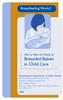 Breastfeeding Works! How to Meet the Needs of Breastfed Babies in Child Care Massachusetts Department of Public Health Bureau of Family and Community Health Nutrition and Physical Activity Unit WIC Nutrition
Breastfeeding Welcome Here. Helping to bridge the Gap between you, and one of your biggest potential customer bases nursing mothers
 Helping to bridge the Gap between you, and one of your biggest potential customer bases nursing mothers Breastfeeding Welcome Here The Breastfeeding Welcome Here Project is focused on helping nursing mothers
Sample Breastfeeding Policy for Health Services in the Community
 Sample Breastfeeding Policy for Health Services in the Community Overview: This sample policy covers The Seven Point Plan for the Protection, Promotion and Support of Breastfeeding in the Community. It
BENEFITS OF BREASTFEEDING
 BENEFITS OF BREASTFEEDING There are many benefits to breastfeeding. Even if you are able to do it for only a short time, your baby's immune system can benefit from breast milk. Here are many other benefits
Support for Breastfeeding in the Workplace
 Support for Breastfeeding in the Workplace Definition Support for breastfeeding in the workplace includes several types of employee benefits and services, 20,21 including writing corporate policies to
CENTRAL SURREY HEALTH BREASTFEEDING POLICY
 CENTRAL SURREY HEALTH BREASTFEEDING POLICY PRINCIPLES To ensure that all children receive a chance to grow and develop to their fullest potential, it is not enough simply to make breastfeeding possible;
Healthy Start FAQ: How to Talk with Moms about Breastfeeding: Starting the Conversation
 Healthy Start FAQ: How to Talk with Moms about Breastfeeding: Starting the Conversation On May 12, 2015, Cathy Carothers facilitated the first part of a three-part webinar on breastfeeding. This first
Populations With Lower Rates of Breastfeeding. Background Information
 Populations With Lower Rates of Breastfeeding Background Information Revised July 2014 Benefits of Breastfeeding Breastfeeding is the natural way to feed a baby, providing a wide range of benefits to the
Position Statement on Breastfeeding
 ABN 64 005 081 523 RTO 21659 Applies to All ABA staff and volunteers Position statement The Australian Breastfeeding Association (ABA) endorses the following statement from the Joint WHO/ UNICEF Meeting
Off to the best start. Important information about feeding your baby
 Off to the best start Important information about feeding your baby mum s milk the best start for your baby What happens in your baby s first years has a big effect on how healthy he or she will be in
New York State Ten Steps to a Breastfeeding Friendly Practice Implementation Guide June 2014
 Ten Steps to a Breastfeeding Friendly Practice 1. Develop and maintain a written breastfeeding friendly office policy. 2. Train all staff to promote, support and protect breastfeeding and breastfeeding
American Academy of Pediatrics Section on Breastfeeding. Ten Steps to Support Parents Choice to Breastfeed Their Baby
 American Academy of Pediatrics Section on Breastfeeding 1 2 3 4 5 6 7 8 9 10 Ten Steps to Support Parents Choice to Breastfeed Their Baby This practice enthusiastically supports parents plans to breastfeed
A Guide to Your Baby s Care The First Year
 A Guide to Your Baby s Care The First Year A Guide to Your Baby s Care The First Year What s Inside Congratulations! Your baby is finally here. Having a baby is a special gift. You ll want to take good
Breastfeeding. Nursing Education
 Breastfeeding AWHONN supports breastfeeding as the optimal method of infant nutrition. AWHONN believes that women should be encouraged to breastfeed and receive instruction and support from the entire
Pregnancy and Human Rights In the Workplace. A Guide for Employers
 Pregnancy and Human Rights In the Workplace A Guide for Employers Pregnancy and Human Rights In the Workplace A Guide for Employers For more information about this guide, contact: Canadian Human Rights
SUPPORT OF BREASTFEEDING FAMILIES IN NICU THE WOMEN S HOSPITAL AT JACKSON MEMORIAL
 SUPPORT OF BREASTFEEDING FAMILIES IN NICU THE WOMEN S HOSPITAL AT JACKSON MEMORIAL OBJECTIVES To verbalize the benefits of breast milk for preterm and critical ill infants To recognize how to assist mother
Congratulations on your big news!
 focus a family Congratulations on your big news! At Madison Hospital, we re excited to help you welcome the newest member of your family. We know this is a very special time, and our staff is dedicated
Tour Obstetrical Units Grey Nuns Community Hospital. Congratulations on the anticipated arrival of your baby!
 Tour Obstetrical Units Congratulations on the anticipated arrival of your baby! Virtual Tour Obstetrical Units Welcome to the Grey Nuns Community Hospital We hope this virtual tour will answer some of
CDC National Survey of Maternity Practices in Infant Nutrition and Care (mpinc)
 OMB #0920-0743 EXP. DATE: 10/31/2010 CDC National Survey of Maternity Practices in Infant Nutrition and Care (mpinc) Hospital Survey Conducted for Centers for Disease Control and Prevention National Center
Breastfeeding vs. Formula Feeding
 KidsHealth.org The most-visited site devoted to children's health and development Breastfeeding vs. Formula Feeding A Personal Decision Choosing whether to breastfeed or formula feed your baby is one of
Navy Guidelines Concerning Pregnancy & Parenthood. Command Advisor on Pregnancy and Parenthood
 Navy Guidelines Concerning Pregnancy & Parenthood Command Advisor on Pregnancy and Parenthood Overview Navy Instructions & Policies: Notification Requirements Operational Deferment Maternity Uniforms and
Breast milk is the best food for babies.
 Breast milk is the best food for babies. The first years of life are a period of rapid development, and good nutrition is essential. The American Academy of Pediatrics (AAP) and the American Dietetic Association
A guide to infant formula for parents who are bottle feeding
 A guide to infant formula for parents who are bottle feeding Introduction This document is designed to help parents who are not breastfeeding decide which infant formula to use to feed their baby. There
CODE OF CONDUCT April 2014
 All correspondence to: The Breastfeeding Network PO Box 11126, Paisley PA2 8YB Tel: 0844 412 0995 e-mail: [email protected] www.breastfeedingnetwork.org.uk PURPOSE CODE OF CONDUCT April
Social Marketing and Breastfeeding
 Global Journal of Management and Business Studies. ISSN 2248-9878 Volume 3, Number 3 (2013), pp. 303-308 Research India Publications http://www.ripublication.com/gjmbs.htm Social Marketing and Breastfeeding
Caring for your baby in the NICU: feeding
 C1 At birth, all newborns need a great deal of energy and nutrients from food to help their bodies grow, and to adjust to life outside the womb. Babies who are born early (premature) and/or with a very
Suggested Open Ended Questions Suggested Affirming Statements Suggested Nutrition Education Statements
 Suggested Open Ended Questions Suggested Affirming Statements Suggested Nutrition Education Statements Caregiver: How did your baby s last check-up go? Primary Feeding: Tell me about the kind of formula
The degree that the Greek institutional framework allow and support mothers' free decision about breastfeeding
 The degree that the Greek institutional framework allow and support mothers' free decision about Maria Ι. Daglas Department of Midwifery, Technological Educational Institution of Athens, Athens, Greece
B I N G O. Human milk may appear thin and slightly blue in color. There are properties in breastmilk that destroy bacteria.
 BREASTFEEDING BINGO for Childcare Providers Card #1 Produced by Texas Initiative and Texas WIC and putting baby on his back to sleep help prevent SIDS. is good for the environment. Human milk may appear
2.1 When a breastfeeding woman is admitted to hospital, the support she needs depends on the nature of her illness and the treatment needed
 CARE OF BREASTFEEDING WOMEN ADMITTED TO HOSPITAL, CLINICAL GUIDELINE 1. Aim/Purpose of this Guideline 1.1 Breastfeeding is known to be one of the most powerful health protective influences and as such,
Introduction to WIC. Objectives
 Objectives Introduction to WIC After completing this lesson, you will be able to: Describe the participants served by WIC. Describe how WIC improves the health of participants. Identify the history and
Your FY 2004 Nutrition Education Tool Kit
 Your FY 2004 Nutrition Education Tool Kit The FY 2004 Tool Kit Topics: Tips for New Breastfeeding Coordinators: New breastfeeding coordinators will find where to get training on breastfeeding, responsibilities
Family Life Education
 Family Life Education 2015 classes & events lewisvillemedical.com/womens Congratulations! The Family Life Education Team Mai Tran, BS Paula Hanna, BSN, RN, IBCLC, ICCE, RLC Alma Rivera, BSN, RN, IBCLC,
Welcome to BC Children s Hospital Emergency Department
 Welcome to BC Children s Hospital Emergency Department Developed by the health care professionals of the Emergency Department with assistance from the Department of Learning and Development. All rights
Common Concerns About Breastfeeding
 Patient Education Page 51 Caring for Yourself and Your New Baby Common Concerns About Breastfeeding Breastfeeding is healthy and natural. So are the questions and concerns that come with it. Whether you
Listening to Mothers: The Experiences of Expecting and New Mothers in the Workplace
 Listening to Mothers: The Experiences of Expecting and New Mothers in the Workplace JANUARY 2014 INTRODUCTION Today, holding a paying job during and after a pregnancy is not only common, it is a financial
Chapter 5: Healthy Start Services Breastfeeding Education and Support
 Chapter 5: Healthy Start Services Breastfeeding Education and Support Introduction Breastfeeding is the normative method of infant and young child feeding and should be woven into the foundation of society
BREAST FEEDING AND BOTTLE FEEDING
 BREAST FEEDING AND BOTTLE FEEDING Choosing whether to breastfeed or formula feed your baby is one of the first decisions expectant parents will make. Although there's no right or wrong choice, the American
Returning to Work After Baby. www.beststart.org
 Returning to Work After Baby www.beststart.org Making Difficult Choices Returning to work after a maternity, parenting or adoption leave can be difficult. This booklet offers helpful tips and information
COLCHESTER EAST HANTS HEALTH CENTRE: WOMEN AND CHILDREN S HEALTH UNIT BIRTH PLAN
 COLCHESTER EAST HANTS HEALTH CENTRE: WOMEN AND CHILDREN S HEALTH UNIT BIRTH PLAN Name: Obstetrical Physician: Family Physician: Congratulations on your pregnancy! As your Childbirth Team we want you to
Cytotoxic Precautions at Home A Guide for Cancer Patients and Families
 Cytotoxic Precautions at Home A Guide for Cancer Patients and Families Your cancer treatment... 1 What are cytotoxic precautions?... 1 What body fluids are cytotoxic?... 1 How do I handle my body wastes?...
Discussion Paper: Clarification and Guidance on Inappropriate Promotion of Foods for Infants and Young Children
 BACKGROUND Discussion Paper: Clarification and Guidance on Inappropriate Promotion of Foods for Infants and Young Children 1. Appropriate feeding of infants and young children is central to health and
Nutrition On Your Own
 Self-Paced Lesson SP-000-08 Nutrition On Your Own Breastfeed Twins, Triplets or More? You can do it! It s true*, breastmilk is the very best food for babies. Even though breastfeeding is the natural way
Module 1: Becoming a WIC Peer Counselor. You Will Learn:
 Module 1: Becoming a WIC Peer Counselor Module 1: Becoming a WIC Peer Counselor Sneak Preview Module 1, Becoming a Peer Counselor, helps you learn ways to feel confident and comfortable in your new role
Neonatal Intensive Care Unit A photographic tour
 Patient Education : A photographic tour Neonatal Intensive Care Unit A photographic tour This booklet was created by mothers who gave birth to premature babies at University of Washington Medical Center
The Joint Commission; Provision of Care, Treatment, and Services (PC) LEGAL REFERENCES: Women s & Children s. Lactation Program I.
 [ ] All Sharp HealthCare AFFECTED DEPARTMENTS: ACCREDITATION: [ ] System Services Surgery Centers: [ ] SRS [ ] CV-OPS [ ] SCMG [ ] GPSC [ ] SHP [ ] SMH-OPP Hospitals (check all that apply): [ ] SCOR [
Presented by: Bre Haviland. Bureau of Maternal and Child Health Ohio Department of Health
 Presented by: Bre Haviland Bureau of Maternal and Child Health Ohio Department of Health Updated: May 2015 Training Objectives Upon completion of this train-the-trainer program, trainees will be able to:
NIH Parent Resource Packet
 NIH Parent Resource Packet Working for Quality Child Care at NIH The NIH Child Care Board: Supports employees who are seeking quality child care. Serves as an advocate for affordable, accessible, and quality
My Birth Experience at Mercy
 My Birth Experience at Mercy This booklet provides information about labor and birth practices at Mercy and includes an optional birth plan that you can complete prior to your baby s birth. Discuss your
AGES AND STAGES: BREASTFEEDING DURING YOUR BABY S FIRST YEAR
 AGES AND STAGES: BREASTFEEDING DURING YOUR BABY S FIRST YEAR Adapted from Ages and Stages: What to Expect During Breastfeeding by Vicki Schmidt, RN, IBCLC BREASTFEEDING YOUR 1-2 MONTH OLD 2» Turn his head
Is there a baby in your future? Plan for it.
 Is there a baby in your future? Plan for it. You plan for school, work, holidays and even your retirement. What about your baby? Parenting begins long before your baby is conceived. Babies begin to develop
Breastfeeding Your Baby
 Getting the Help You Need If you have questions or problems, don t wait. Another nursing mother or mothers support group can often help. Your hospital, WIC office, baby s doctor, midwife, or obstetrician/gynecologist
Benefits of Breastfeeding. Breastfeeding WORKS for Working Women! Here s How
 Breastfeeding WORKS for Working Women! Here s How I am honored to work for an agency that recognizes the changing times and the value of retaining employees. It is your choice to work and breastfeed your
Top Tips for Involving Fathers in Maternity Care
 Compared with past generations, society s expectations are increasingly for fathers to play a full role throughout pregnancy, labour, childbirth and in the postnatal period. Most expectant mothers want
Evaluation of the National Breastfeeding Awareness Campaign: Implications for the WIC Campaign
 Evaluation of the National Breastfeeding Awareness Campaign: Implications for the WIC Campaign Suzanne G. Haynes, Ph.D. DHHS Office on Women s Health Babies were born to be breastfed TARGET POPULATION
James Smith Community Health Nursing Program
 James Smith Community Health Nursing Program The Nursing Program endeavors to deliver the best quality health care to the Band Membership in a holistic manner, respecting the individual s personality,
Republika e Kosovës Republika Kosovo - Republic of Kosovo Kuvendi - Skupština - Assembly
 Republika e Kosovës Republika Kosovo - Republic of Kosovo Kuvendi - Skupština - Assembly Law No. 05/L -023 ON THE PROTECTION OF BREASTFEEDING The Assembly of the Republic of Kosovo, Based on Article 65
Caring for your baby at night A guide for parents
 Caring for your baby at night A guide for parents Caring for your baby at night Becoming a parent is a very special time and can be one of the most rewarding experiences of your life as you get to know
Why you and your Family Should Get the Flu Shot
 Why you and your Family Should Get the Flu Shot Why Get VaCCinated against influenza? Influenza (flu) is a virus that can lead to serious complications, hospitalization, or even death. Even healthy children
Research Report MumBubConnect:
 Research Report MumBubConnect: A digital approach to supporting breastfeeding Supported by: the Australian Breastfeeding Association Funded by: The Gambling Community Benefit Fund Dr Danielle Gallegos
Neonatal Abstinence Syndrome. A Guide for Families
 Neonatal Abstinence Syndrome A Guide for Families Contents What is Neonatal Abstinence Syndrome (NAS)?...................... 4 When will my baby show signs of NAS?..................................................
Weaning. Breastfeeding. and 1-800-445-6175. Arkansas WIC Breastfeeding Helpline. (WIC de Arkansas Línea de Ayuda para la Lactancia)
 Arkansas WIC Breastfeeding Helpline (WIC de Arkansas Línea de Ayuda para la Lactancia) 1-800-445-6175 Breastfeeding and Weaning The WIC program is an equal opportunity provider and employer. (El programa
Goal: Teen Breastfeeding Success. Linda Haggerty, CNP, IBCLC Health Partners Como Clinic St. Paul, MN
 Goal: Teen Breastfeeding Success Linda Haggerty, CNP, IBCLC Health Partners Como Clinic St. Paul, MN Current US Breastfeeding Statistics Adolescents
Baby Friendly Hospital Initiative in Neonatal Units Expansion of the original WHO/UNICEF BFHI program
 Baby Friendly Hospital Initiative in Neonatal Units Expansion of the original WHO/UNICEF BFHI program A developmentally supportive family centered breastfeeding strategy Soins de développement en néonatologie.
A New Mother s Guide. to Breastfeeding Success
 A New Mother s Guide to Breastfeeding Success Congratulations on your new baby! This is one of the happiest moments in a new family s life, and the staff at Howard County General Hospital (HCGH) is committed
Welcome to the Maternity Unit at. Site
 Welcome to the Maternity Unit at Halton Healthcare Services Oakville Site Before you have your baby Please take some time eto read having gthe Having your Baby at Halton Healthcare booklet. You should
Prenatal Classes. Time: 7:00 9:00pm, see calendar for dates Place: Maternity Service, One Family Place Phone: 561-955-5110 Fee: $125/couple
 At Boca Raton Community Hospital s One Family Place we know that peace of mind comes with being informed about every aspect of your prenatal and parenting experience. We are proud to offer a wide array
What to Expect After Delivery
 What to Expect After Delivery Welcome to the Mother Baby Unit This is a special time in your life and we are happy to share it with you! It is a time to learn new things about yourself, your new baby and
For more information, please visit anthem.com/ca.
 For more information, please visit anthem.com/ca. SpecialOffers is provided by Anthem Blue Cross as a service to our members. These services do not constitute benefits under Anthem Blue Cross plans and
Appendix C. Logistic regression analysis
 Appendix C. Logistic regression analysis Summary Logistic regression analysis was undertaken in order to explore the factors associated with breastfeeding initiation and prevalence at two and six weeks.
QMC campus Virtual Tour Script for DVD
 QMC campus Virtual Tour Script for DVD Welcome to the Nottingham University Hospital NHS Trust maternity unit at Queen s Medical Centre Hospital campus This film has been made to provide you with information
Tool Kit Reproducible Resources
 Tool Kit Reproducible Resources The Tool Kit contains both electronic files and hard copies of the following materials. The reproducible templates can be personalized to fit your needs. Worksite Breastfeeding
Born Free is the natural choice for safe and calm feeding. The Most Natural
 newbornfree.com The Most Natural colic solution The Born Free bottle system is designed to address the feeding needs of all babies. With its innovative anti-colic system, it is the preferred natural choice
Off to the best start
 Off to the best start Important information about feeding your baby existing In this leaflet What is Start4Life? 3 The best start for your baby 4 What does breastfeeding help protect against? 5 After your