
Personal Lending Overview for 2013
|
|
|
- Cordelia Atkinson
- 5 years ago
- Views:
Transcription
1 Simple, straightforward banking Secure Trust Bank PLC Annual Report & Accounts 2012 A pioneering approach to simple, straightforward banking
2 Contents 1 Introduction 2 Group highlights 4 Chairman s statement 6 Chief Executive s statement 12 Culture 14 Business review Personal Lending 16 Business review Retail and Motor Lending 18 Business review Current Accounts 20 Business review Savings 22 Financial review 26 Board of Directors 28 Group Directors report 31 Corporate Governance statement 33 Remuneration report 35 Independent Auditor s report 36 Consolidated statement of comprehensive income 37 Consolidated statement of financial position 38 Company statement of financial position 39 Consolidated statement of changes in equity 41 Company statement of changes in equity 42 Consolidated statement of cash flows 43 Company statement of cash flows 44 Principal accounting policies 51 Notes to the consolidated financial statements 87 Five year summary 88 Notice of Meeting 90 Corporate contacts & advisers

3 Pioneering at every level Personal unsecured lending fixed rate, fixed term products with payments received monthly. Loan terms are between 12 months and 60 months with advances varying from 500 to 15,000. Motor finance includes a multi-channel offering through motor dealers and brokers. Fixed rate, fixed term hire purchase agreements secured mainly against used cars with finance term periods ranging from 24 to 60 months with a maximum loan size of 15,000. Creating innovative online solutions for our current account customers enabling them to take control of their finances. Retail point of sale finance includes lending solutions for store and online retailers and an e -tailer proposition distributed through partnership with Pay4Later. Unsecured, fixed rate and fixed term loans with payments received monthly. Loans vary in term from six months to 48 months and range from 250 to 12,000. Current account combines a current account with a prepaid card. The account charges a monthly fee of but customers have the ability to earn rewards at participating retailers. Savings a combination of instant access accounts, notice deposits and deposit bonds with competitive interest rates.

4 Simple, straightforward banking Secure Trust Bank PLC Secure Trust Bank is a longstanding established UK bank. Its core business is to provide banking services including a range of lending solutions and saving products. It also provides fee-based current accounts to UK customers who may not be adequately served by other banks. The Company, which was incorporated in 1954, operates from its head office in Solihull, West Midlands, has been a subsidiary of Arbuthnot Latham & Co., Limited since 1976 and a subsidiary of Arbuthnot Banking Group PLC since The Company successfully listed on AIM on 2 November On 8 June 2012 the Company acquired Everyday Loans Holdings Limited ( Everyday Loans ) and its subsidiaries. Everyday Loans is a provider of unsecured loans operating through a national network of 26 branches where loans are advanced, serviced and collected. As at 31 December 2012 the Group, including Everyday Loans, had 434 employees. In September 2012 the Company became the first bank in the UK to be awarded the Customer Service Excellence Award, whilst in the following month the Company was awarded a 4 star Fairbanking Mark for its current account. On 7 December 2012 the Company placed 1,481,482 shares on AIM, raising gross proceeds of 20.0 million and reduced the shareholding of Arbuthnot Banking Group PLC to 70.7%. The proceeds will be used for potential acquisitions and also to fund increased organic growth. Subsequent to the year end the Company acquired the V12 Finance Group as well as the trade and assets of the Debt Managers Group. The Company s diversified lending portfolio focuses on unsecured personal loans, motor finance and retail point of sale finance. Its lending is entirely funded by customer deposits, with no exposure to wholesale funding. This reflects the Company s cautious approach to risk. REPORT & ACCOUNTS

5 Group highlights Secure Trust Bank has shown significant growth in 2012, both organically and through acquisition. This growth has been achieved alongside prudent capital management % % m m , ,713 75% 2011: 57% Net interest margin Operating income Customer numbers Loan to deposit ratio m m m m % % 23.3% 2011: 23.3% Profit before tax Total assets Core Tier 1 capital ratio Total capital ratio 108.9p 2011: 39.6p Earnings per share 2 SECURE TRUST BANK PLC

6 Simple, straightforward banking Personal Lending Personal lending showed controlled organic growth in 2012, with new business personal lending volumes growing by over 125% to 78 million. The acquisition of Everyday Loans in June 2012 has significantly broadened the Group s reach to a wider market. Retail and Motor Lending New business lending volumes grew by 29% to 125 million and the Company has increased lending in all segments. The Company now services the majority of the Top 100 UK car dealer groups. Current Accounts The fee-based current account has undergone progressive enhancements during 2012 and has also shown significant growth, continuing the momentum from its introduction in late On average 920 new accounts were opened per month during the year. Savings The Bank continues to be entirely funded by customer deposits. Deposit balances grew by 47% during 2012 to million. REPORT & ACCOUNTS

7 Chairman s statement Secure Trust Bank PLC marked its 60th year in business by achieving profits before tax of 17.2m; a record for the bank, and a clear demonstration that our principles and philosophies have served us well. The successful IPO has allowed the business to seize the opportunities that are available to a well funded and robust bank. 4 SECURE TRUST BANK PLC
8 Simple, straightforward banking Significantly, we were able to complete the acquisition of Everyday Loans in the first half of the year. This was the result of many months of hard work and we were delighted to welcome the management team and business to the Group. Our relationship with them dates back to 2007 when we agreed to refer lending opportunities to them in order to help their business get started. As a result, we have worked closely with them and respect their knowledge and experience of the market within which they operate. I am confident that both, they and the business will play a significant role in the future growth of the Group. I have been pleased with the progress made across the whole bank in serving our customers and in particular, I would draw attention to the contribution made by our lending operations. Loan balances have increased by 93% as we have played our part in promoting growth by lending money to support the UK economy. For example, at a time when the retail sector has been struggling, we have enabled UK businesses to sell over 100,000 of their products, with the help of our retail point of sale operations. We believe we were the largest financiers of musical equipment and cycles during the year. Indeed the levels of demand for new cycles reached record levels, stimulated by the success of the Olympics and Paralympics. Many commentators have noted that the UK banking industry needs to promote more competition and allow smaller banks to challenge the dominance of the larger players. Many factors have developed to leave the smaller banks at a competitive disadvantage, not least of which is the regulatory environment. The advantage afforded the larger banks via their sophisticated advanced capital models should not be underestimated. I and others have many times called for regulators to take a more judgemental approach towards all banks and reward them for their previous good performance and management. This would go some way to creating a level playing field and promote further competition. Encouragingly, I have detected positive signals from the newly created Prudential Regulatory Authority (PRA), which has indicated that it is in favour of judgemental regulation. I hope this will be to the long term benefit of Secure Trust Bank PLC and the economy as a whole. These results reflect the dedication and commitment of our employees who have done well in the current environment. On behalf of the Board, I would like to extend our thanks to all our staff for their contributions to the Group in With the benefit of strong capital and funding, the opportunities arising for organic growth coupled with the benefits from the acquisitions completed in 2012 and early 2013, I am confident that Secure Trust Bank PLC will continue to demonstrate profitable and sustainable growth over the coming period. A levelling of the competitive landscape, were it to happen, should allow us to achieve faster progress. However, we are not immune to developments in the wider economy. The Board proposes to pay a final dividend of 43p per share. If approved the dividend will be paid on 10 May 2013 to shareholders on the register as at 12 April Henry Angest Chairman 20 March 2013 REPORT & ACCOUNTS

9 Chief Executive s statement 2012 was a very important year for Secure Trust Bank (STB) marking as it did our 60th anniversary and our first full year as a public company. I am pleased with the financial performance detailed in this report and feel that we delivered on the commitments made at the time of our flotation in November The magnitude of the growth of the business over the last 12 months clearly demonstrates the scale of the opportunity that lies ahead. 6 SECURE TRUST BANK PLC
10 Simple, straightforward banking Dec ,708 Dec ,446 Dec ,174 Dec ,713 Customer numbers progression We strive to provide our customers with simple, straightforward banking solutions coupled with great service. Customer Numbers Our reputation with our customers A bank s reputation is the by-product of the behaviour of its staff, which in turn is influenced by its leadership and culture. In 2012, just as in the 59 years before, Secure Trust Bank has striven to provide customers with simple straightforward banking solutions coupled with great service delivered by friendly and professional staff. This is evident in the way we interact with our customers and the fact that every week we reward customer service heroes for going the extra mile for their customers. As a result of an 18 month long programme, in September 2012 we became the first bank in the UK to receive the Customer Service Excellence award (CSE). This award was introduced by the Cabinet Office in 2010 to replace the Kite Mark. The CSE is a strong independent endorsement of the way customer focus is embedded in the culture of the business and the improvements we are making to our products and services. The quote from the 60 page final CSE assessment below is insightful. There is absolutely no doubt that the culture of this organisation is to treat its customers as pivotal to their success. Without exception, the assessor was impressed with staff and their levels of knowledge, their empathic handling of customer issues and their involvement in developing policies and procedures. All customers spoken to were highly complimentary about staff and one customer even named an individual for special mention. This attitude is clearly driven from the very top and the commitment to customers is the first message to appear on their website. We followed up the CSE award by becoming the only UK bank to be granted a 4 star mark from the Fairbanking Foundation in respect of our current account product. This represented an upgrade from the previous 3 star mark and reflected the investment we have made in our Internet and SMS Banking platforms during These have made it much easier for customers to interact with us at times of their choosing and should enable us to achieve good growth in this product this year. Whilst we were delighted to receive the CSE award and Fairbanking mark, we know we are not perfect and will continue to invest in people, systems and processes to improve our service and products still further. Ultimately all of these words and awards are meaningless unless they are reflected in the experience customers have when dealing with us. I am therefore pleased to note improving trends in our internal customer satisfaction (from a high base) and reductions in customer complaint levels (from a low base). This in turn has helped us to increase like for like customer numbers by 42% from 145,174 in 2011 to 206,273. Inclusive of Everyday Loans (EDL) customers, the overall Secure Trust Bank Group customer base at the end of 2012 was 231,713 representing an increase of 60% on the prior period. REPORT & ACCOUNTS

11 Chief Executive s statement Continued Controlling growth The Board s on-going top strategic priority is to protect the reputation and sustainability of the bank via prudent balance sheet management, investment for growth and robust risk and operational controls. During 2012 we have continued to invest in our risk control and governance capabilities to reflect the growth in the business. Specifically we have made new appointments in the roles of Chief Risk Officer, Chief Operating Officer, Deputy Finance Director and Group Head of Compliance to strengthen our senior team. We have also recruited additional staff with internal audit and operational risk experience gained at larger financial institutions. Stronger funding profile Throughout 2012 we have further enhanced our funding profile. As at 31 December we had no direct exposure to wholesale funding or interbank markets. All of our lending activities continued to be funded by customer deposits. To achieve a broadly matched asset: liability position we increased the average tenor of our deposits over the year. This treasury management has largely removed the bank s exposure to interest rate basis risk whilst improving our resilience in the event of unexpected major market shocks. Our year-end Loan to Deposit ratio was a modest 75%. The bank continues to enjoy strong demand for its deposit products and is in the position of having a waiting list of people looking to lodge their savings with us. Substantial capital surpluses We were delighted to complete a very successful placing in December. This raised 19.2 million of core tier one capital after costs, which allowed us to repay a 5 million subordinated loan from Arbuthnot Banking Group and boost our capital reserves. The placing coupled with robust capital levels at the beginning of the year and the profits generated during 2012 results in a very strong year end Tier 1 Capital ratio of 23.3%. Comparing the relative balance sheet strength of individual banks is extremely difficult due to the differing methodologies used under Basel II which can lead to a picture of seemingly similar capital ratios despite the underlying gross leverage positions being wildly different. As at 31 December the Secure Trust Bank Gross Leverage (total customer lending divided by equity capital) was only 5.8x. The leverage ratios disclosed by the major UK banks over recent weeks are considerably higher which highlights the scope we have to increase our lending activities whilst remaining modestly leveraged on a comparable basis. Robust profit growth The statutory pre-tax profits for 2012 of 17.2 million are 136% higher than the 7.3 million recorded in Costs continue to be rigorously controlled and the enlargement of the Group should increase our negotiating position with key suppliers going forward. It is imperative that we do not allow the pace of growth to exceed our ability to manage the risks associated with increased business volumes. We are investing in all areas of the business, especially in Risk and Finance, to ensure we are suitably resourced to grow in a sustainable manner. We have enhanced our Project Management capability to help us take advantage of opportunities as they arise without deflecting management focus from the core business. This investment in our organisational capabilities inevitably means the short term cost to income ratio is higher than if the business was growing more slowly. Claims management companies are acting indiscriminately In various briefings and media interviews during 2012 I have referred to us being inundated with high volumes of baseless claims alleging mis-selling of payment protection insurance (PPI). This issue is common to both STB and EDL as detailed in note 21. The majority of the claims we are receiving are from people who have never been sold PPI. Many are loyal longstanding customers who are being duped into authorising unscrupulous claims management companies to submit claims on their behalf. During 2012 we have had to deal with allegations that we mis-sold PPI on credit cards and mortgages despite the fact that we have never provided these products. We have had customers who have received more in successful claims than they ever paid in premiums alleging mis-selling. We have even had the quite surreal instance of the emergency telephone in our office s lift receiving a call from a claims management company advising it could reclaim 2,500 for mis-sold PPI! It is useful to note that every 6 months the Financial Ombudsman Service (FOS) publishes data, available to all, that shows the levels of mis-selling allegations they find in favour of complainants and the levels they find in favour of the financial institution. STB has not featured in this data. EDL has a record of approximately 92% of cases being found in its favour in the second half of Putting this in context during 2012 EDL paid less than 10,000 in compensation as a result of FOS cases going against them. The fact is that despite the FOS supporting EDL in the vast majority of cases it has still cost us well in excess of 1 million to deal with claims management companies and the baseless claims they are submitting. A simple solution to this problem is for the FOS to oblige claims management companies to pay a fee, which would be refunded if the case is won. This would immediately free us of the scourge of unwanted texts or cold calls when we are trying to eat tea at home of an evening. It would also mean that rather than wasting significant resources for no benefit we would instead be making larger profits enabling us to increase our lending further and to pay more tax. 8 SECURE TRUST BANK PLC

12 Simple, straightforward banking Secure Trust Bank is a UK only business. We have continued to create jobs for young and old. We have substantially increased our net lending balances thereby supporting consumers and businesses just as the Government has been calling on banks to do. Lending portfolio performing as expected We monitor all aspects of risk extremely closely with particular attention to the performance of our lending book. In absolute quantum terms our impairment levels have risen as we expected given our growing and maturing lending portfolio. These remained below the level which we had assumed within our pricing models when writing the business in both the core STB and the EDL portfolios. We continue to adopt a robust and dynamic formulaic approach to impairment provisioning. We do not seek to manage our impairments via forbearance activities. The Group has however looked to support customers who are in financial difficulty and we seek to engage in early communication with borrowers experiencing difficulty in meeting their repayments. The 2012 impairment numbers are lower than expectations at origination which we believe is due to two factors: the first is that in the light of the deteriorating economic outlook in late 2011 we tightened our lending criteria, which had a modest impact on new business volumes but protected the quality of the book. Secondly we have migrated all of the STB collections activity onto a single common operating platform which has improved efficiency. Lending operations 2012 saw continued strong, controlled, organic growth. Overall new business lending volumes excluding Everyday Loans grew 28% to million (2011: million) which translated to an increase of 44% in overall balance sheet lending assets to million (2011: million). Including the year-end Everyday Loans portfolio of 73.8 million, the overall STB lending balances of million increased by 93% during Motor finance which is our most mature lending book increased lending, net of provisions, to 89.6 million at 31 December 2012 (2011: 63.4 million). This business, which focuses on the near prime market segment now services the majority of the Top 100 UK car dealer groups. We were delighted to be named Motor Finance Provider of the Year by the Institute of Transport Management in Personal unsecured lending also evidenced strong growth with the 31 December 2012 balance sheet increasing to 68.2 million (2011: 43.6 million). The bank has broadened its distribution capabilities in this segment and entered into a number of significant new introducer relationships during the year including Shop Direct. Retail Point of sale business grew strongly driven by retailer demand for our in store and online services with balances at 31 December 2012 increasing to 64.2 million (2011: 42.6 million). The acquisition of V12 Finance Group on 2 January 2013 should enable us to accelerate the growth rate of this portfolio. The portfolios of books acquired in 2009 have now been collected as expected and the remaining balances are negligible. REPORT & ACCOUNTS

13 Chief Executive s statement Continued Positive contribution from Everyday Loans division We were delighted to acquire the Everyday Loans Group (EDL) on 8th June 2012 after almost 18 months working on a transaction with the management team and vendors. As part of the post-acquisition integration project either Paul Marrow (who chairs the EDL Board) or I have visited the vast majority of the 26 branches. We have been very impressed with the quality of the staff and their commitment to doing the right thing for their customers. The integration was completed rapidly and without issue and the EDL management are now contributing to the development of the wider STB Group. As EDL only provides loans to customers after a full face to face income and expenditure review it is able to tailor loans to nonstandard borrowers enabling them to borrow at affordable interest rates whilst ensuring that the loans are an acceptable risk for the bank to take. The branch staff incentive scheme is biased in favour of the safe repayment of loans which means the staff are focused on prudent rather than volume lending. The EDL portfolio credit quality remained stable throughout 2012 despite the underlying difficulties in the economy. The portfolio derived from the branch based lending model comprises a wide spread of unsecured personal loan customers with a relatively low average balance ( 2,700) geographically spread across the U.K. thereby minimising any concentration of risk. EDL has performed robustly albeit the accounting differentials between UKGAAP and IFRS are such that it will take time for this upside to be reported in the STB accounts. The lending balances as at 31 December 2012 were 5% higher than as at 30 June The underlying profits have exceeded target despite the higher than expected costs of dealing with baseless PPI mis-selling allegations. The performance criteria for the payment of the deferred consideration of 1.5 million and the agreed management bonuses have been met and the costs of these payments have been accrued for in the 2012 accounts. We have now begun the process of investing in the future growth of the business and opened a new office in Middlesbrough in the fourth quarter of I am pleased to report that this is already breaking even. A new office was opened in Belfast in January and a minimum of a further two offices are likely to open during Fee based accounts During 2012 we have made substantial improvements to our current account product. These included the launch of a new internet banking platform in the second quarter and SMS banking modules in the fourth quarter. In addition we have spent a significant amount of time working with our card processor, Fidelity Information Services, to improve the robustness and scalability of their systems and processes. Whilst this work was on-going we did not proactively sell the current account product. Nevertheless customer numbers grew by 22% with 20,962 current account holders at the end of the year (2011: 17,178). Our new iapply module is scheduled for launch in the first quarter of 2013 which will support increased promotion of this product through digital marketing channels which should lead to increased new business volumes. As expected the OneBill customer numbers continue to decline over time. 8.9 million of income was generated in 2012 compared to 9.6 million in The reduction in income would have been somewhat lower but for the increased costs of handling large volumes of baseless PPI claims during the second half of The project to develop a next generation OneBill product was deferred whilst we completed work on the current account product and the acquisitions of V12 Finance Group and Debt Managers. This project has now resumed and we expect to launch customer trials in the coming months. The acquisition of Debt Managers and planned growth of this business will serve to increase our revenue from commission based activities in the periods ahead which is consistent with our strategy to grow both lending and non-lending income. Our people We were identified as one to watch in the Sunday Times Best Companies to Work For 2012 survey. We believe this reflects positively on our expansion which is creating new jobs and our investment in overall staff proposition. Our 2012 new joiners were aged between 16 and 66 bringing with them a wide variety of skills and experience. We continue to place considerable focus on the training and development of our people and we are currently supporting over 25% of STB staff to undertake some form of academic qualification ranging from modern apprenticeships to master s degrees. I am delighted that so many staff are willing to 10 SECURE TRUST BANK PLC

14 Simple, straightforward banking Lending operations 2012 saw continued strong, controlled organic growth, with new business lending volumes, excluding Everyday Loans, growing by 28% Dec m Dec m June m Dec m Lending Assets invest in their own development which I am sure will improve their day to day performance and give them the skills needed to take on the larger roles that will inevitably arise as the business continues to expand. STB staff numbers, excluding Everyday Loans, at 31 December 2012 increased by 30 last year representing 11% growth on the prior period. Secure Trust Bank employees have remained heavily involved in charitable activities during the year. Numerous events took place ranging from participation in the annual movember campaign in aid of prostate cancer charities through to supporting Sports Relief to raise over 100,000. I am especially proud of all the work done to help those less fortunate than ourselves and I applaud my colleagues for both their charitable work and the sheer commitment to delivering great service in a very friendly manner to our customers throughout the year. The benefits of doing the basics right Secure Trust Bank is a UK only business. We have continued to create jobs for young and old. We have substantially increased our net lending balances thereby supporting consumers and businesses just as the Government has been calling on banks to do. We have made profits and paid our taxes thus contributing to the public purse. We have worked hard to maintain our reputation as a simple, straightforward bank to deal with. I believe that we could make an even greater contribution to the recovery of the UK economy if the Government and Regulators take steps to reduce the competitive disadvantages we continue to face relative to the larger banks especially in relation to capital requirements and funding costs. I completely support the Chairman s comments in this regard and will continue to work with him and my peers to try to achieve progress here. Current developments There has been no material change to the underlying performance of the business in the early months of We continue to see strong demand for all of our core products. We have a clear growth strategy and the pipeline of new business opportunities outlined in the Chairman s letter in our circular in November 2012 is being progressed as evidenced by the acquisitions of V12 Finance Group and Debt Managers in January With the economic outlook remaining very difficult to predict it is appropriate for us to exercise prudence and caution. We have therefore positioned the bank to continue to grow at a good pace and in a sustainable manner whilst maintaining low balance sheet leverage and robust capital and funding positions. This will allow us to achieve strong organic new business volumes and leave scope for new product or business development opportunities should these arise, possibly as a consequence of regulatory or competitive changes. Against our expectations of a broadly flat economy, we are very confident of making further positive progress with our strategic plan during Paul Lynam Chief Executive Officer 20 March 2013 REPORT & ACCOUNTS

15 Culture It is our objective to be the Best Bank in Britain and to help us achieve that we have chosen 5 values which underpin the way we do business and the behaviour we expect from all our staff. They are: Customer Focused Innovative Team Orientated Performance Driven Risk Aware They are used in evaluating individual s personal performance and their contribution to the overall vision of the Company. 12 SECURE TRUST BANK PLC

16 Simple, straightforward banking The FairBanking Foundation operates an accreditation scheme to encourage banking organisations to improve the financial wellbeing delivered by their products. Employee support The success enjoyed by the Company, which is fuelling strong growth, is also creating numerous opportunities for our staff as evidenced by employee numbers increasing from 263 to 293 during Financial support and study time allowances are also helping over a quarter of the Company s employees to take academic qualifications ranging from apprenticeships to master s degrees. The majority of promotions continue to go to internal staff which evidences the range of career paths within the Company. As the size of the Group grows, these opportunities will further expand. The Company celebrates exceptional performance by awarding regular Customer Service hero awards. Individuals are also recognised through the annual Outstanding Achievers award. Every employee who achieved 100% attendance in 2012 was recognised for team orientated behaviour and awarded an additional days annual leave to be taken in Furthermore on a quarterly basis the Chief Executive Officer reviews all the employee suggestions for improving performance, efficiency and effectiveness and awards a cash prize for the best suggestion. Employee Council The Company operates an Employee Council, which has Employee Representatives from each department within the Company and operates within a structured Terms of Reference. The Council meets on a regular basis to encourage a two way process of communication between employees and directors. The aim of the Employee Council is to promote employee engagement and give Employee Representatives the opportunity to represent the views of the employees in a forum which can make a positive difference. Treating customers fairly Lending balances have almost doubled over the year and the Company has continued to enjoy strong demand for its deposit accounts. Overall customer numbers went through the 200,000 barrier in June 2012 which was a significant milestone. On the back of the great service we have provided to our customer base as a whole we have won a number of prestigious awards including the Customer Service Excellence Award from the Cabinet Office and the 4 star mark for Current Account from the Fairbanking Foundation. It is not by accident that Secure Trust Bank has avoided being drawn into the various scandals surrounding many of the other banks. It goes to show just why treating customers fairly and providing simple, straightforward banking is so important. The Company has received the Dealer Finance Provider 2012 award from the Institute of Transport Management. Moneyfacts Annual Ratings assess the technical merit of ranges of financial products, paying attention to the added quality features. The prestigious Customer Service Excellence Award was developed by the Cabinet Office to acknowledge excellence in public services. Active partners for business The Company has again shown the importance of being a partner for business through its strong and successful relationships. The Company won the Business partner of the year award from the Association of Cycle Traders as well as Motor Finance provider of the year award from the Institute of Transport Management. This reflects positively on our staff and our aim to be a strong supporter of UK business. Environmental consideration The Company tries to limit its footprint on the environment through the use of energy saving initiatives, recycling consumables and encouraging greener travel methods for its employees. REPORT & ACCOUNTS

17 Business review Personal Lending a distinct market territory The Bank s lending operations continued to grow in a controlled way, with new personal lending volumes in the year, including Everyday Loans, increasing to 77.8 million from 34.5 million in the previous year. This generated an increase in personal lending assets during the year which at the year-end, including Everyday Loans totalled million (December 2011: 43.6 million). The growth in new business volumes has again not been at the expense of price or quality. The business utilises highly automated underwriting systems which, in addition to providing significant cost advantages, ensure that very consistent credit decisions are made which improves ongoing performance monitoring and future policy decision making. Differential pricing that reflects the credit risk of the underlying customer is standard. These systems have enabled the business to control risk whilst retaining the speed of service needed to support our introducers. The bad debt performance on all of the books has been better than the expectations set in the pricing models and this continues to be frequently scrutinised. To support this further the business has continued to invest in a new collections system that is more appropriate for the balance sheet size the business now operates. Personal lending Secure Trust Bank is well established in personal unsecured lending having been lending for nearly 35 years. Net outstanding loans, excluding Everyday Loans, totalled 68.2 million at 31 December 2012 (31 December 2011: 43.6 million). Following the decision in 2007 materially to reduce new lending in response to deteriorating lending conditions the portfolio reduced to less than 10 million. However new lending was strategically increased in 2009 and since then has delivered annual growth. Net new lending volumes amounted to 48.9 million in the twelve months to 31 December 2012, from 34.5 million in the previous year. Personal unsecured loans are fixed rate, fixed term products with payments received monthly in arrears. Loan terms are between 12 months and 60 months with advances varying from 500 to 15,000. Loans are provided to customers for a variety of purposes which might include, for example, home improvements, personal debt consolidation and the purchase of vehicles. Distribution of unsecured personal loans is through brokers, existing customers and Affinity Partners, and targeted to UK-resident customers who are either employed or self-employed. Everyday Loans During the year, the Company acquired Everyday Loans and this represents a significant strategic development for Secure Trust Bank. Everyday Loans is a provider of unsecured loans to a customer base predominantly in lower income groups and it operates through a network of offices where loans are originated, serviced and collected. The business will continue to operate through the well known brand name of Everyday Loans and will enable it to expand whilst creating synergistic benefits for the Group. Net new lending volumes amounted to 28.9 million in the period since acquisition, with a net lending position of 73.8 million at the end of December SECURE TRUST BANK PLC

18 Simple, straightforward banking Moneyway is the Company s personal lending brand. Personal loans are made through our experienced team of advisers. Loans are made to individuals over 21 years of age with an annual income over 20,000. Everyday Loans provide any purpose unsecured loans from 500 to 10,000 for tenants as well as homeowners. Fees are not charged on application, with applications being made by phone or online. The Company has broadened its distribution capabilities in the personal lending segment and has entered into significant new introducer relationships in 2012, including Shop Direct. Personal Lending: KPIs m m m m Personal lending portfolio Personal lending revenue REPORT & ACCOUNTS

19 Business review Retail and Motor Lending premium products New business lending volumes for motor and retail lending increased to million, an increase of 29% on the previous year. This generated a significant increase in lending assets during the year, which at the year-end totalled million (December 2011: million). The growth in new business volumes has not been at the expense of price or quality. Secure Trust Bank are playing a key role in changing the face of independent cycle retailing. In partnership, we have already developed a network of over 500 cycle specialists offering retail finance throughout the UK. Secure Trust Bank s success is reflected in them having been voted Partner of the Year twice in the last three years. We have no doubt that Secure Trust Bank s proven commitment to business support will deliver long term growth and development of the cycle sector. The National Association of Cycle Traders 16 SECURE TRUST BANK PLC

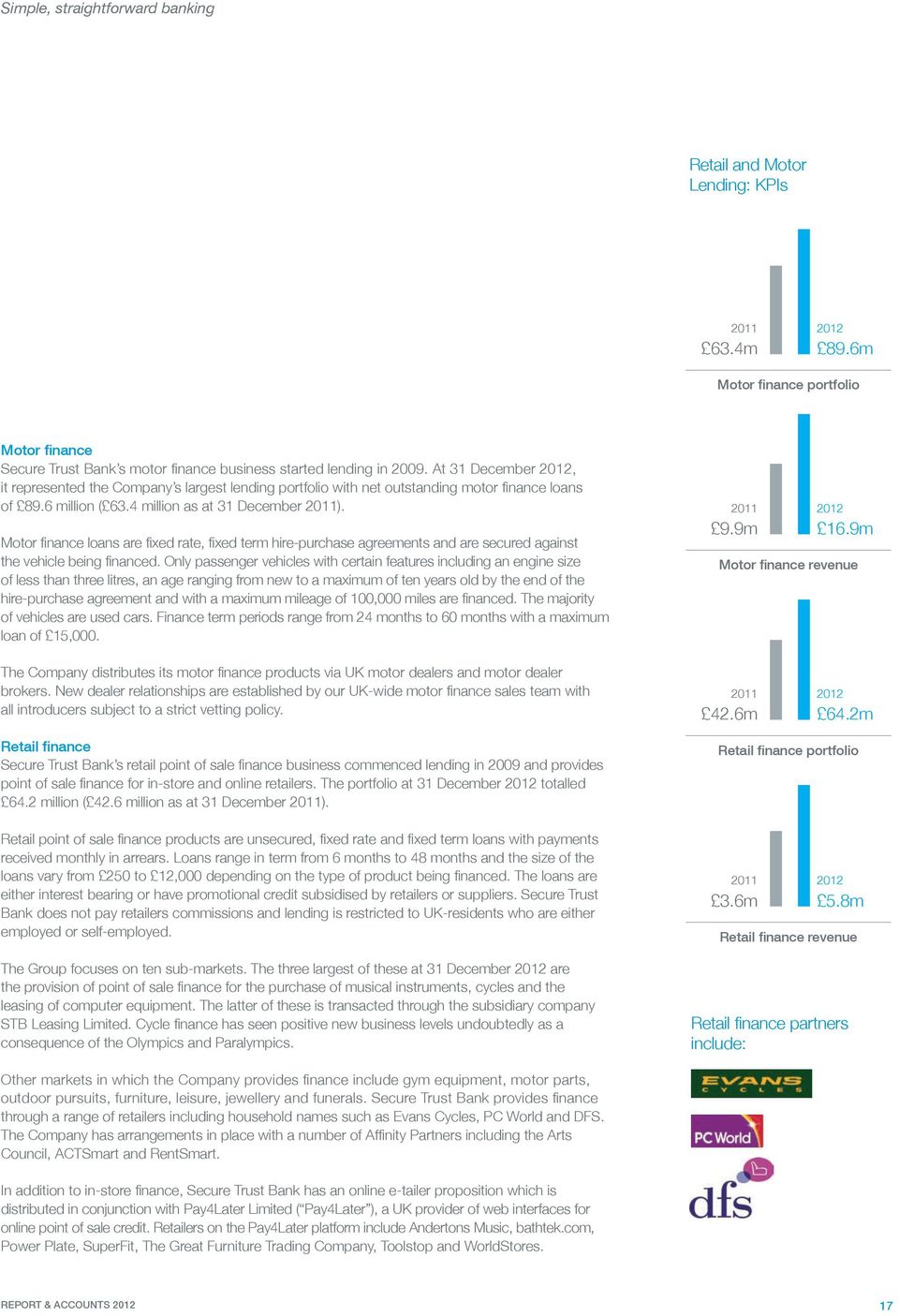
20 Simple, straightforward banking Retail and Motor Lending: KPIs m m Motor finance portfolio Motor finance Secure Trust Bank s motor finance business started lending in At 31 December 2012, it represented the Company s largest lending portfolio with net outstanding motor finance loans of 89.6 million ( 63.4 million as at 31 December 2011). Motor finance loans are fixed rate, fixed term hire-purchase agreements and are secured against the vehicle being financed. Only passenger vehicles with certain features including an engine size of less than three litres, an age ranging from new to a maximum of ten years old by the end of the hire-purchase agreement and with a maximum mileage of 100,000 miles are financed. The majority of vehicles are used cars. Finance term periods range from 24 months to 60 months with a maximum loan of 15, m m Motor finance revenue The Company distributes its motor finance products via UK motor dealers and motor dealer brokers. New dealer relationships are established by our UK-wide motor finance sales team with all introducers subject to a strict vetting policy m m Retail finance Secure Trust Bank s retail point of sale finance business commenced lending in 2009 and provides point of sale finance for in-store and online retailers. The portfolio at 31 December 2012 totalled 64.2 million ( 42.6 million as at 31 December 2011). Retail point of sale finance products are unsecured, fixed rate and fixed term loans with payments received monthly in arrears. Loans range in term from 6 months to 48 months and the size of the loans vary from 250 to 12,000 depending on the type of product being financed. The loans are either interest bearing or have promotional credit subsidised by retailers or suppliers. Secure Trust Bank does not pay retailers commissions and lending is restricted to UK-residents who are either employed or self-employed. The Group focuses on ten sub-markets. The three largest of these at 31 December 2012 are the provision of point of sale finance for the purchase of musical instruments, cycles and the leasing of computer equipment. The latter of these is transacted through the subsidiary company STB Leasing Limited. Cycle finance has seen positive new business levels undoubtedly as a consequence of the Olympics and Paralympics. Retail finance portfolio m m Retail finance revenue Retail finance partners include: Other markets in which the Company provides finance include gym equipment, motor parts, outdoor pursuits, furniture, leisure, jewellery and funerals. Secure Trust Bank provides finance through a range of retailers including household names such as Evans Cycles, PC World and DFS. The Company has arrangements in place with a number of Affinity Partners including the Arts Council, ACTSmart and RentSmart. In addition to in-store finance, Secure Trust Bank has an online e-tailer proposition which is distributed in conjunction with Pay4Later Limited ( Pay4Later ), a UK provider of web interfaces for online point of sale credit. Retailers on the Pay4Later platform include Andertons Music, bathtek.com, Power Plate, SuperFit, The Great Furniture Trading Company, Toolstop and WorldStores. REPORT & ACCOUNTS
21 Business review Current Accounts clear and transparent The Secure Trust Bank Current Account is a refreshingly simple and transparent bank account. In late 2010, Secure Trust Bank relaunched its current account product. At 31 December 2012, the current account product had been taken up by almost 21,000 customers with the account experiencing new account openings averaging over 920 per month for the twelve months to 31 December The Current Account generated income of over 3.9 million in the year, which represented growth of 34% over the previous year. The growth in the current account volumes has continued to outstrip the reduction in OneBill accounts. OneBill generated income of 8.9 million in the year, but the Company has closed this product to new customers. Current accounts are distributed via the Company s website, price comparison websites, including Moneysupermarket and Compareprepaid, Debt Management Companies and through a direct outbound sales team. The business has developed an on-line capability to both service and sign up accounts. It is now possible for a customer to open an account on-line, be provided with the new account details and automatically to transfer all of their direct debits and standing orders in minutes. The account charges a monthly fee of but as part of this the customers get rewarded for using their card by selected retailers and this is between 3% and 4% of the amount spent. Any cash rebated as a consequence of customer spending at the retailers on the scheme can, in effect, help to reduce or offset the monthly account charge. A real Current Account with a Prepaid Card The Current Account helps the customers control their finances and manage their budget by only letting them spend the money they have available each month. This is because the account does not have an overdraft facility so the account holder cannot spend money that isn t there. The account comes with a Prepaid Card, onto which money must be loaded before it can be used similar to a Pay as You Go mobile phone top-up. This way, it can help the customers manage their money more effectively because the money set aside on the Prepaid Card is separated from the money in their Current Account, so they can shop safe in the knowledge that the bills will be paid from the money kept aside in the Current Account. Customers generally make sure that they have enough money in their Current Account to cover Direct Debits, Standing Orders and any other regular payments, and the remaining money can be transferred onto their Prepaid Card to spend at over 30 million outlets and for online and telephone purchases and to make cash withdrawals at ATMs showing the MasterCard acceptance mark. Rewards The Current Account gives the customer the ability to earn cash rewards of up to 4% paid back into the account on purchases made with their Prepaid Card, both online and in store, at over 30 participating major high street retailers. The account holder can have additional Prepaid Cards linked to their account for family members at home or abroad, at no extra monthly fee, with all cards eligible to earn Rewards. Participating retailers include well known stores such as Asda, Argos, Boots, Debenhams, B&Q and M&S. Putting the account holder in control Our Current Account is designed to help customers to manage their money and keep control of what they are spending, giving them the peace of mind that the money they spend is money they actually have. Once the account is opened the account holder can register for our online and telephone banking service which gives access to their account 24 hours a day, 7 days a week and allows the movement of money to and from the Current Account and Prepaid Card free of charge. Clear and transparent charges In addition, there are no charges should a Direct Debit or Standing Order payment fail - our fees are simple and transparent, there are no hidden or unexpected charges. So, unlike most high street banks, if a Direct Debit or Standing Order payment is returned unpaid, there isn t a penalty fee. 18 SECURE TRUST BANK PLC
22 Simple, straightforward banking The Secure Trust Bank Current Account is open to everyone regardless of credit history. The account comes with a prepaid card which can be used for effective personal budgeting. Retail partners include: Enhancements to the current account product in 2012 included the launch of a new internet banking platform and SMS banking modules. Current Accounts: KPIs m m Revenue , ,962 Customer numbers REPORT & ACCOUNTS
23 Business review Savings attractive products The Company continues to manage its liquidity on a conservative basis with none of its funding coming from the wholesale markets. All of the lending is entirely funded by way of customer deposits. 20 SECURE TRUST BANK PLC
24 Simple, straightforward banking Instant Access Accounts can be opened with as little as 1 and withdrawals can be made without notice or loss of interest. Notice Deposits are made available in periods ranging from 60 to 183 days, depending on the Company s funding requirements. Fixed Price Deposit Bonds are launched by the Company to achieve desired maturity profiles and have been extremely successful. Deposit bonds have more than doubled during the year. Savings: KPIs m m Current / demand accounts m m Term deposits Secure Trust Bank s deposit activities comprise deposit accounts and fee-based accounts, being fee-based current accounts and the OneBill accounts. At 31 December 2012 customer deposits totalled million. This represents an increase of million since the last year end. The Bank s deposit accounts consist of instant access accounts, notice accounts and fixed term, fixed price bonds. Competitive rates At Secure Trust Bank, savings accounts offer a simple way to save money. Interest rates offered are very competitive and provide real value for money. Methods of attracting deposits include product information on price comparison websites (such as Moneysupermarket), Best Buy tables and newspaper articles about the deposit accounts offered by the Company m Total deposits m By virtue of a focus on higher margin lending, the absence of large fixed overheads in the form of a branch network and a policy of not cross-subsidising loss making products with profitable ones, the Bank is able to offer competitive rates and has been very successful in attracting term deposits from a wide range of personal and non-personal customers. Notice deposits The deposit account notice periods range from 60 days to 183 days, with the majority at the 120 day term. This provides a secure funding profile which again gives additional financial security to the business. The Bank s notice deposits totalled million at the year end (December 2011: 170 million), an increase of 41.5 million or 24%. The 120 day notice account was introduced in June 2012 and was highly successful, raising additional new deposits of 35.8 million during the second half of the year. Introduction of further deposit bonds During the year, the Bank launched further fixed rate deposit bonds in two, three, four, five and six year maturities. These again were very successful as the Company raised new deposits of 85 million achieving its desired funding maturity profile at that time. At the year end term deposit balances totalled million. The Bank is a member of the Financial Services Compensation Scheme (FSCS). REPORT & ACCOUNTS
25 Financial review Secure Trust Bank adopts a conservative approach to risk taking and seeks to maximise long term revenues and returns. Summarised income statement Variance million million million Income by income stream: Personal lending Everyday Loans Motor finance Retail finance Current account One Bill (0.7) Acquired portfolios (1.3) Other (1.2) Interest, fee and commission expense (13.7) (7.0) (6.7) Operating income Impairment losses (8.9) (4.6) (4.3) Net operating expenses (29.3) (16.1) (13.2) Gain from a bargain purchase Cost arising from acquisitions (1.4) (1.4) Share listing costs (0.5) 0.5 Profit before tax Operating income increased by 65% to 47.0 million. The acquisition of Everyday Loans in June 2012 generated a fair value adjustment of 9.8 million. The amortisation of this fair value reduced income by 1.2 million and also increased expenses by 0.7 million in the year. 1.7 million, including employer s national insurance, has also been accrued in relation to management bonuses as agreed at acquisition. An additional 12.5 million of operating income was generated for the Group during the period of ownership. Organic growth was achieved through increased levels of activity in the lending business, which has three main product areas: asset finance, personal lending and acquired portfolios. Income from motor finance increased by over 70%, whilst income from retail finance increased by 61%. Secure Trust Bank intends to create diversified and balanced growth in our lending books which will serve the business well when the market becomes more competitive. Income from the current account with a prepaid card increased by 34%, and this offsets the expected decline in the OneBill account following its closure to new accounts in The current account closed this year with 20,962 open accounts (2011: 17,178), and OneBill ended the year with 26,154 open accounts (2011: 28,698). Net operating expenses have increased, in line with expectations, as a result of the Everyday Loans acquisition as well as the organic growth of the business. 22 SECURE TRUST BANK PLC
26 Simple, straightforward banking Lending portfolio composition (2011, %) Lending portfolio composition (2012, %) Motor finance 41.0 Retail finance 27.6 Personal lending 28.2 Acquired portfolios 1.6 Other 1.6 Motor finance 30.0 Retail finance 21.6 Personal lending 22.9 Everyday Loans 24.9 Other 0.6 Summarised balance sheet million million Assets Loans and advances to customers Asset finance Motor finance Retail finance Personal lending Everyday Loans 73.8 Acquired portfolios Other Loans and advances to banks Other assets Liabilities and equity Deposits from customers Other liabilities Total equity The total assets of the Group increased by 54% due to the continued growth in the lending business and the acquisition of Everyday Loans, total assets are now almost half a billion pounds. Customer deposits grew by 47% to close at million. The Group continues with its conservative funding policy, remaining entirely funded by customer deposits and closed with a loan to deposit ratio of 75% (2011: 57%). During the year the asset finance business increased its portfolio size by 45% to close at million, being predominantly due to a growth in motor vehicle finance of 26.2 million. Personal lending, excluding Everyday Loans, grew by 24.6 million as the business was able to source new business from online brokers and offer new financing to customers from the acquired portfolios. The acquisition of Everyday Loans has increased the Group s lending by an additional 73.8 million. The acquired portfolios reduced to 0.2 million as customers continued to repay their loans according to our expectations. Capital The Group s capital management policy is focused on optimising shareholder value over the long term. There is a clear focus on delivering organic growth and ensuring capital resources are sufficient to support planned levels of growth. The Board reviews the capital position at every Board Meeting. In accordance with the EU s Capital Requirements Directive (CRD) and the required parameters set out in the FSA Handbook (BIPRU 2.2), the Arbuthnot Banking Group s Individual Capital Adequacy Assessment Process (ICAAP), of which the Group is a major component, is embedded in the risk management framework of the Group and is subject to ongoing updates and revisions where necessary, but as a minimum an annual review as part of the business planning process. The ICAAP is a process which brings together the risk management framework and the financial disciplines of business planning and capital management. Not all material risks can be mitigated by capital, but where capital is appropriate the Board has adopted a Pillar I plus approach to determine the level of capital the Group needs to hold. This method takes the Pillar I capital formula calculations as a starting point, and then considers whether each of the calculations deliver a sufficient capital sum adequate to cover anticipated risks. Where it is considered that the Pillar I calculations did not reflect the risk, an additional capital add-on in Pillar II is applied. REPORT & ACCOUNTS
27 Financial review Continued Capital Continued The Group s regulatory capital is divided into: Tier 1, comprises shareholders funds and non-controlling interest, after deducting intangible assets. Tier 2 comprises qualifying subordinated loan capital and revaluation reserves. This tier cannot exceed 50% of tier 1 capital. The ICAAP includes a summary of the capital required to mitigate the identified risks in its regulated entities and the amount of capital that the group has available. All regulated entities have complied with all of the externally imposed capital requirements to which they are subject. Net Core Tier 1 capital Tier 2 capital Total capital 51.6 million 23.3% of Basel II Risk Weighted Assets 0.1 million 51.7 million 23.3% of Basel II Risk Weighted Assets Risk and Uncertainties The Group regards the monitoring and controlling of risks as a fundamental part of the management process. Consequently, senior management are involved in the development of risk management policies and in monitoring their application. The principal risks inherent in the Company s business are credit, liquidity, market, operational and regulatory risks. A detailed description of the risk management policies in these areas is set out in Note 4 to the financial statements. Credit risk is the risk that a counterparty will be unable to pay amounts in full, when due. This risk is managed through the Company s internal controls and its credit risk policies as well as through the Credit Committee, with significant exposures also being approved by the Group s Risk Committee. Liquidity risk is the risk that the Group cannot meet its liabilities as they fall due. The Group takes a conservative approach to managing its liquidity profile and is entirely funded by retail customer deposits, placing no reliance on the wholesale lending markets. The loan to deposit ratios are maintained at prudent levels. The Assets and Liabilities Committee ( ALCO ), comprising senior executives of the Company, is the formal body that has the responsibility for liquidity risk management. The ALCO meet formally on a monthly basis to review liquidity risk against set thresholds and risk indicators including early warning indicators, liquidity risk tolerance levels and ILAA metrics. Market risk arises in relation to movements in interest rates. Arbuthnot Latham & Co., Limited s treasury function operates on behalf of the Company and it does not take significant unmatched positions in any market for its own account. The Company also has no significant exposure to currency fluctuations. Operational risk is the risk that the Group may be exposed to financial losses from failures of its systems and processes. The Group maintains clear compliance guidelines and provides ongoing training to all staff. The Group s overall approach to managing internal control and financial reporting is described in the Corporate Governance section of the Annual Report. 24 SECURE TRUST BANK PLC
28 Simple, straightforward banking Revenue composition (2011, 000) Revenue composition (2012, 000) Personal Lending 5,993 Everyday Loans Motor Finance 9,941 Retail Finance 3,554 One Bill 9,644 Other 6,366 Personal Lending 8,683 Everyday Loans 15,468 Motor Finance 16,889 Retail Finance 5,790 One Bill 8,947 Other 4,904 Capital risk is the risk that the Group will have insufficient capital resources to support the business. The Group adopts a conservative approach to managing its capital and at least annually assesses the robustness of the capital requirements as part of ICAAP. Stringent stress tests are performed to ensure that capital resources are adequate over a future three year horizon. Conduct risk is the risk that the Group does not comply with regulatory requirements including, for example, the way it conducts its business or treats its customers. The Group reviews performance against key customer and conduct risks on a monthly basis. Exceptional items During the year there were exceptional costs of 1.4 million relating to costs arising on the acquisition of Everyday Loans and the post balance sheet acquisitions. During the previous year, there were exceptional items totalling 0.5 million, relating to the transaction costs on the AIM market share listing in November Taxation The full effective tax rate on underlying profit before tax is 9% (2011: 30%) reflecting the effects of non-taxable income during the year, primarily the gain from a bargain purchase, as well as the benefit of the lowering of the UK corporation tax rate. Distribution to shareholders The directors recommend the payment of a final dividend of 43 pence per share which, together with the interim dividend of 14 pence per share paid on 21 September 2012, represents a total dividend for the year of 57 pence per share (2011: final dividend of 4.2 pence per share following a special interim dividend of 7 million). Earnings per share Detailed disclosures of earnings per share are shown in note 10 of the financial statements. Basic earnings per share increased by 175% to 108.9p per share (2011: 39.6p). Neeraj Kapur Chief Financial Officer 20 March 2013 REPORT & ACCOUNTS
29 Board of Directors 26 SECURE TRUST BANK PLC
30 Simple, straightforward banking Henry Angest LLL, Hon.F.UHI Non-Executive Chairman Henry Angest is Chairman and Chief Executive of Arbuthnot Banking Group PLC as well as Chairman of Arbuthnot Latham & Co., Limited. He gained extensive national and international experience as an executive of The Dow Chemical Company and Dow Banking Corporation. He was Chairman of the Banking Committee of the London Investment Banking Association and a director of the Institute of Directors. He is a Past Master of the Worshipful Company of International Bankers. 2 Paul Lynam ACIB, AMCT, Fifs Chief Executive Officer Paul Lynam joined Secure Trust Bank in September 2010, having spent 22 years working for NatWest and RBS. He is an Associate of the Chartered Institute of Bankers and the Association of Corporate Treasurers. Paul was the Managing Director, Banking, running RBS/ NatWest s SME banking business across the UK and spent four years as the Managing Director of Lombard North Central PLC, running the largest asset finance and leasing business in Europe. 3 Neeraj Kapur BEng, ACGI, FCA, CF, FCIBS Chief Financial Officer Neeraj Kapur has over 23 years financial services experience spent in both the accounting and banking industries. He is a Chartered Banker, a fellow of the Institute of Chartered Accountants in England & Wales, and Council and Vice Chair of the ICAEW Financial Services Faculty. Neeraj spent 11 years working in professional practice before joining RBS in 2001 and has undertaken a number of roles which included Chief Financial Officer of Lombard North Central PLC. 4 Andrew Salmon ACA Non-Executive Director Andrew Salmon joined Arbuthnot Banking Group in 1997 and is currently the Chief Operating Officer and Head of Business Development of Arbuthnot Banking Group PLC. He was previously a director of Hambros Bank Limited and qualified as a Chartered Accountant with KPMG. 5 Paul Marrow ACIB Independent Non-Executive Director Paul Marrow has over 36 years banking experience and has over the last decade been responsible for the Commercial Banking and Specialist Corporate Banking business divisions of RBS Group in the UK. Prior to retiring from RBS in July 2009, Paul was involved in a change programme in the RBS UK banking business. Paul is currently the Chairman of JCB Finance Limited, a joint venture between J C Bamford Excavators Limited and RBS Group. 6 Carol Sergeant BA, MBA, CBE Independent Non-Executive Director Carol Sergeant has extensive banking experience gained over a 37 year career with the Bank of England, the Financial Services Authority (which she helped to set up) and latterly as the Chief Risk Officer and a member of the Group Executive Committee of Lloyds Banking Group PLC. Carol holds a BA from Cambridge University and a MBA from the CASS Business School. 7 Jeremy Kaye FCIS Company Secretary REPORT & ACCOUNTS
31 Group Directors report The directors present their annual report and the audited consolidated financial statements for the year ended 31 December Principal activities and review The principal activity of the Group is retail banking. A business review in accordance with Section 417 of the Companies Act 2006 forming part of this report is set out in the Business review. Results and dividend The results for the year are shown on page 36. The profit for the year after taxation amounted to 15.5 million (2011: 5.1 million). The directors recommend the payment of a final dividend of 43 pence per share which, together with the interim dividend of 14 pence per share paid on 21 September 2012, represents a total dividend for the year of 57 pence per share (2011: final dividend of 4.2 pence per share following a special interim dividend of 7 million). The final dividend, if approved by members at the Annual General Meeting, will be paid on 10 May 2013 to shareholders on the register at the close of business on 12 April Acquisitions during the year On 8 June 2012 the Company acquired the issued capital of Everyday Loans Holdings Limited and its subsidiaries for 1 with a further payment of 1.5 million to be made in April 2013 if the management team of Everyday Loans achieved performance targets in The provision of a loan facility to Everyday Loans has enabled the acquired company to repay about 34 million of subordinated debt. Share capital On 6 December 2012 the Company placed 1,481,482 ordinary shares at 1350 pence per share. At the Annual General Meeting shareholders will be asked to approve one Ordinary and two Special Resolutions. The Ordinary Resolution seeks to give directors general authority to allot shares up to 5% of the Company s existing ordinary share capital during the period expiring on 31 May 2014, or if earlier on the conclusion of the next Annual General Meeting of the Company. The first Special Resolution provides for the Articles of Association to be amended so that equity shares may be issued either on a preemptive basis pro rata to existing shareholdings or subject to a limited account namely, 5% of the present issued share capital otherwise than to existing shareholders pro rata to their holdings. The directors have no present intention of issuing any shares and will not issue shares which would effectively change the control of the Company without prior approval of shareholders in general meeting. The second Special Resolution renews the authority of the directors to make market purchases of shares not exceeding 10% of the existing share capital. The directors will keep the position under review in order to maximise the Company s resources in the best interests of shareholders. Substantial shareholders The Company was aware at 20 March 2013 of the following substantial holdings in the ordinary shares of the Company. Arbuthnot Banking Group PLC 11,066,205 shares 70.7% Cazenove Capital Management Limited 818,955 shares 5.2% Axa Investment Management (UK) Limited 792,757 shares 5.1% Miton Group plc 548,300 shares 3.5% Ruffer LLP 480,967 shares 3.1% Quantum Partners LP 470,410 shares 3.0% Directors The directors who served during the year and up to the date of signing these financial statements were as follows: H Angest P A Lynam N Kapur P Marrow A A Salmon C F Sergeant Non-Executive Chairman Chief Executive Officer Chief Financial Officer Independent Non-Executive Director Non-Executive Director Independent Non-Executive Director Mr Angest, Mr Lynam and Mr Salmon are directors of the ultimate parent company Arbuthnot Banking Group PLC and their interests in the share capital and share options of group companies are shown in the Directors Report of that Company. According to the information kept under Section 3 of the Disclosure and Transparency Rules 2006, the interests of the directors and their families in the ordinary 40p shares of the Company at the dates shown were as follows: Acquired during At 31 December 2012 At 1 January 2012 the year and 20 March 2013 N Kapur 1,000 1,000 P A Lynam 6,600 2,200 8,800 P Marrow 5,440 5,440 A A Salmon 7,500 7,500 C F Sergeant 6,600 6, SECURE TRUST BANK PLC
32 Simple, straightforward banking On 2 November 2011, Mr Lynam and Mr Salmon were both granted an option to subscribe between 2 November 2014 and 1 November 2021 for 141,666 ordinary 40p shares in the Company at 720p a share, as well as an option to subscribe between 2 November 2016 and 1 November 2021 for 141,667 ordinary 40p shares in the Company at 720p a share. On 2 November 2011, Mr Kapur was granted an option to subscribe between 2 November 2014 and 1 November 2021 for 35,416 ordinary 40p shares in the Company at 720p a share, as well as an option to subscribe between 2 November 2016 and 1 November 2021 for 35,417 ordinary 40p shares in the Company at 720p a share. During 2012 the Share Option Scheme was modified to become cashsettled rather than equity-settled (see note 26). Apart from the interests disclosed above, no director was interested at any time in the year in the share capital of Group companies. Board Committees The report of the Remuneration Committee on pages 33 to 34 will be the subject of an Ordinary Resolution at the Annual General Meeting. Information on the Audit and Nomination Committees is included in the Corporate Governance section of the Annual report on pages 31 to 32. Employees The Company gives due consideration to the employment of disabled persons and is an equal opportunities employer. It also regularly provides employees with information on matters of concern to them, consults on decisions likely to affect their interests and encourages their involvement in the performance of the Company. Charitable donations The Company supports a local charity, the Queen Alexandra College and made total donations in the year to this and other charities of 1,436 (2011: 3,230). Supplier payment policy The Company s supplier payment policy is to make payment in line with terms agreed with individual suppliers, payments being effected on average within 6 days of receipt of invoice (2011: 6 days). Forbearance The Group has always looked to support customers who are in financial difficulty. We seek to engage in early communication with borrowers experiencing difficulty in meeting their repayments. The Company may at its discretion agree to reducing or deferring payments but will not revise the contractual payment plan (see note 4). Post balance sheet events On 2 January 2013 the Company acquired 100% of the ordinary share capital of V12 Finance Group Limited, which along with its wholly owned subsidiaries V12 Retail Finance Limited and V12 Personal Finance Limited provide retail point of sale loans, typically for 12 months on an unsecured basis to consumers who are predominantly classified as prime borrowers. The acquisition is complementary to the Group s existing retail finance proposition and the V12 management team will continue in the business. The cash consideration of 3.5 million was paid on completion and the Company provided funding such that the V12 Group could redeem 7 million of subordinated debt and also repay existing bank finance amounting to 28.5 million. On 15 January 2013 the Company acquired the trade and assets of Debt Managers Holdings Limited and its subsidiaries Debt Managers (AB) Limited and Debt Managers Limited. These companies collect delinquent debt on behalf of a range of clients including banks and utility companies. The Company acquired Debt Managers for an initial cash payment of 364,000 paid on completion of the transaction which includes payment for the estimated book value of the net assets of 14,000. In addition deferred consideration of up to 400,000 in cash is payable by the Company one year after completion subject in part to the business achieving certain income criteria. The assets acquired are expected to be fair valued at circa 760,000 after completion. Going concern After making appropriate enquiries which assessed strategy, profitability, funding and capital resources, the directors are satisfied that the Company and the Group have adequate resources to continue in operation for the foreseeable future. The financial statements are therefore prepared on the going concern basis. Statement of Directors responsibilities in respect of the Annual Report and the Financial Statements The directors are responsible for preparing the Annual Report and the financial statements in accordance with applicable law and regulations. Company law requires the directors to prepare group and parent company financial statements for each financial year. As required by the AIM Rules of the London Stock Exchange they are required to prepare the group financial statements in accordance with IFRSs as adopted by the EU and applicable law and have elected to prepare the parent company financial statements on the same basis. Under company law the directors must not approve the financial statements unless they are satisfied that they give a true and fair view of the state of affairs of the group and parent company and of their profit or loss for that period. In preparing each of the group and parent company financial statements, the directors are required to: REPORT & ACCOUNTS
33 Group Directors report Continued select suitable accounting policies and then apply them consistently; make judgements and estimates that are reasonable and prudent; state whether they have been prepared in accordance with IFRSs as adopted by the EU; and prepare the financial statements on the going concern basis unless it is inappropriate to presume that the group and the parent company will continue in business. The directors are responsible for keeping adequate accounting records that are sufficient to show and explain the parent company s transactions and disclose with reasonable accuracy at any time the financial position of the parent company and enable them to ensure that its financial statements comply with the Companies Act They have general responsibility for taking such steps as are reasonably open to them to safeguard the assets of the group and to prevent and detect fraud and other irregularities. The directors have decided to prepare voluntarily a Directors Remuneration Report in accordance with Schedule 8 to The Large and Medium-sized Companies and Groups (Accounts and Reports) Regulations 2008 made under the Companies Act 2006, as if those requirements were to apply to the Company. The directors have also decided to prepare voluntarily a Corporate Governance Statement as if the Company were required to comply with the Listing Rules and the Disclosure Rules and Transparency Rules of the Financial Services Authority in relation to those matters. The directors are responsible for the maintenance and integrity of the corporate and financial information included on the Company s website. Legislation in the UK governing the preparation and dissemination of financial statements may differ from legislation in other jurisdictions. Statement of disclosure of information to auditor The directors confirm that, so far as each of the directors are aware, there is no relevant audit information of which the Company s auditor is unaware and the directors have taken all the steps that they ought to have taken as directors in order to make themselves aware of any relevant audit information and to establish that the Company s auditor is aware of that information. Annual General Meeting The next Annual General Meeting of the Company will be held on 8 May The Notice of Meeting is included on pages 88 and 89. Auditor In accordance with Section 489 of the Companies Act 2006, a resolution for the re-appointment of KPMG Audit Plc as auditor of the Company is to be proposed at the forthcoming Annual General Meeting. By order of the board J R Kaye Secretary 20 March SECURE TRUST BANK PLC
34 Simple, straightforward banking Corporate Governance statement AIM companies are not required to comply with The UK Corporate Governance Code. Nevertheless, the Board endorses the principles of openness, integrity and accountability which underlie good corporate governance and intends to take into account the provisions of The UK Corporate Governance Code in so far as they are appropriate to the Group s size and circumstances. The Board The Group is led and controlled by an effective Board of Directors which comprises Henry Angest (Non-Executive Chairman), Paul Lynam (Chief Executive Officer), Neeraj Kapur (Chief Financial Officer), and three other non-executive directors. Under the Company s Articles and pursuant to the relationship agreement in place between the Company and Arbuthnot Banking Group PLC ( ABG ), one third of the directors will be appointed by ABG, one third of the directors will be fulltime executive directors, and one third of the directors will be independent directors. The Board meets regularly throughout the year. Substantive agenda items have briefing papers, which are circulated in a timely manner before each meeting. The Board will ensure that it is satisfied that it is supplied with all the information that it requires and requests, in a form and of a quality to enable it to fulfil its duties. The Company Secretary is responsible for ensuring that Board processes and procedures are appropriately followed and support effective decision making. All directors have access to the Company Secretary s advice and services and there is an agreed procedure for directors to obtain independent professional advice in the course of their duties, if necessary, at the Company s expense. The Board has delegated certain of its responsibilities to Committees, which are summarised below. Each of these Committees has written terms of reference. Audit Committee Membership of the Audit Committee is limited to Non-Executive directors and the current Audit Committee comprises Paul Marrow as Chairman, Andrew Salmon and Carol Sergeant. The primary responsibilities of the Audit Committee are to review arrangements established by the Directors for compliance with regulatory and financial reporting requirements, monitor the integrity of the Group and subsidiary statutory accounts, oversee the work of external auditors, monitor and review the scope, results and effectiveness of the Company s internal audit function and liaise with the Audit Committee of ABG. The Audit Committee s responsibilities include reviewing the Group s system of internal control and the process for evaluating and monitoring risk. The Committee also considers any other matters which might have a financial impact on the Company, including the Group s arrangement by which staff may, in confidence, raise concerns about possible improprieties in matters of financial reporting or other matters. The Audit Committee has the authority to obtain any information it requires from any employee or external party, and at least once a year will meet with the Company s external auditors and internal audit function without any Executive Directors being present. REPORT & ACCOUNTS
35 Corporate Governance statement Continued The Committee also reviews the appointment, terms of engagement and objectivity of the external auditors, including the level of non-audit services provided, and ensures that there is an appropriate audit relationship. The Audit Committee provides a forum for discussing with the Group s external auditors their report on the annual accounts. Risk Committee The Risk Committee is chaired by Andrew Salmon. Other members are Paul Lynam and Paul Marrow. The primary responsibilities of the Risk Committee is to approve specific risk policies for the Company and its subsidiaries, approve trading positions in excess of the limits set by the management of the Group, oversee the development, implementation and maintenance of the Group s overall risk management framework and its risk appetite, strategy, principles and policies, oversee the Group s risk exposures, risk/return and proposed improvements to the Group s risk management framework, oversee adherence to Group risk principles, policies and standards, and at all times act in adherence with and with regard to the risk principles, policies and standards adopted by ABG and keep ABG regularly informed of any risk issues or breaches faced by the Group which may affect the ABG Group. Remuneration Committee Details of the Remuneration Committee and directors remuneration are set out in the separate Remuneration Report. Nomination Committee The Nomination Committee is chaired by Henry Angest and its other members are Paul Marrow and Carol Sergeant. The primary responsibilities of the Nomination Committee are to review the number of Directors and the balance between Executive and Independent Directors, recommend new Independent Director and Executive Director appointments to the Board and the length of term for which a Non-Executive Director may be expected to serve, and have regard to provisions of the Relationship Agreement when performing its duties. Before a Board appointment is made the skills, knowledge and experience required for a particular appointment are evaluated. The Nomination Committee also follows the ICSA Guidance on Terms of Reference for Nomination Committees. Shareholder communications The Company maintains a regular dialogue with its shareholders and makes full use of the Annual General Meeting and any other General Meetings to communicate with investors. The Company aims to present a balanced and understandable assessment in all its reports to shareholders, its regulators and the wider public. Key announcements and other information can be found at Internal control and financial reporting The Board of Directors has overall responsibility for the Group s system of internal control and for reviewing its effectiveness. Such a system is designed to manage rather than eliminate risk of failure to achieve business objectives and can only provide reasonable but not absolute assurance against the risk of material misstatement or loss. The directors and senior management of the Group have formally adopted a Group Risk and Controls Policy which sets out the Board s attitude to risk and internal control. Key risks identified by the Directors are formally reviewed and assessed at least once a year by the Board. Key business risks are also identified, evaluated and managed by operating management on an ongoing basis. The Board also receives regular reports on any risk matters that need to be brought to its attention. Significant risks identified in connection with the development of new activities are subject to consideration by the Board. The effectiveness of the internal control system is reviewed regularly by the Board and the Audit Committee, which also receives reports of reviews undertaken by the internal audit function which is outsourced to Ernst & Young. The Audit Committee also receives reports from the external auditors, KPMG Audit Plc, which includes details of internal control matters that they have identified. Certain aspects of the system of internal control are also subject to regulatory supervision, the results of which are monitored closely by the Board. 32 SECURE TRUST BANK PLC
36 Simple, straightforward banking Remuneration report Remuneration Committee Membership of the Remuneration Committee is limited to Non-Executive Directors. The present members of the Committee are Henry Angest, Chairman, Paul Marrow and Carol Sergeant. The Committee has responsibility for producing recommendations on the overall remuneration policy for Directors and for setting the remuneration of individual Executive Directors, both for review by the Board. Remuneration is set having regard to any roles that may be performed by such Directors as Directors of any other Group companies in the corporate Group of which the Company forms a part. The Committee applies the Company s remuneration code and monitors its implementation, reviews the Directors Remuneration Report, considers and if thought fit awards any incentives to be offered under the Share Option Scheme and pension arrangements, subject to the achievement of specific criteria. The Remuneration Committee also follows the ICSA Guidance on Terms of Reference for Remuneration Committees. Members of the Committee do not vote on their own remunerations. Remuneration policy The Remuneration Committee determines the remuneration of individual directors having regard to the size and nature of the business; the importance of attracting, retaining and motivating management of the appropriate calibre without paying more than is necessary for this purpose; remuneration data for comparable positions; the need to align the interests of executives with those of shareholders; and an appropriate balance between current remuneration and longer term performance related rewards. The remuneration package can comprise a combination of basic annual salary and benefits (including pension), a discretionary annual bonus award related to the Committee s assessment of the contribution made by the executive during the year and longer term incentives, including executive share options. Pension benefits take the form of annual contributions paid by the Company to individual money purchase schemes. The Remuneration Committee reviews salary levels each year based on the performance of the Group during the preceding financial period. This review does not necessarily lead to increases in salary levels. During 2012 the Group implemented all the provisions required under the FSA Remuneration Code. The Group and its subsidiaries are all considered to be Tier III institutions, due to the size of their relevant total assets. REPORT & ACCOUNTS
37 Remuneration report Continued Directors emoluments This part of the Remuneration Report is audited information Fees (including benefits in kind) Salary payments (including bonuses and benefits in kind) 1,234 1,032 Pension contributions ,312 1,183 Total Total Salary Bonus* Benefits Pension Fees Directors service contracts Mr Lynam and Mr Kapur each have service contracts terminable at any time on 12 months notice in writing by either party. Mr Marrow and Mrs Sergeant have service contracts terminable at any time on 3 months notice in writing by either party. Mr Angest and Mr Salmon have service contracts with Arbuthnot Banking Group and their details are disclosed in the financial statements of that company. Share Option Scheme On 17 October 2011 the Company established The Secure Trust Bank Share Option Scheme which is administered by the Remuneration Committee. On 2 November 2011, Mr Lynam and Mr Salmon were both granted an option to subscribe between 2 November 2014 and 1 November 2021 for 141,666 ordinary 40p shares in the Company at 720p a share, as well as an option to subscribe between 2 November 2016 and 1 November 2021 for 141,667 ordinary 40p shares in the Company at 720p a share. On 2 November 2011, Mr Kapur was granted an option to subscribe between 2 November 2014 and 1 November 2021 for 35,416 ordinary 40p shares in the Company at 720p a share, as well as an option to subscribe between 2 November 2016 and 1 November 2021 for 35,417 ordinary 40p shares in the Company at 720p a share. During 2012 the Share Option Scheme was modified to become cashsettled rather than equity-settled. The market price for each ordinary share at the year end was 1,570p. The highest and lowest market price for each ordinary share during the year was 830p and 1,570p. A detailed description of the Share Option Scheme, including Scheme Conditions, is contained in Note 26 of the financial statements. N Fielden (to 3 June 2011) 94 K Hayes (between 17 June and 9 September 2011) 28 N Kapur (from 31 May 2011) P Lynam P Marrow (from 3 March 2011) D Nield (to 9 September 2011) 109 C Sergeant (from 8 September 2011) ,312 1,183 * These bonus awards are at this time indicative. The Remuneration Committee, at its meeting on 22 January 2013, placed certain conditions which require final approval by the committee prior to the award becoming unconditional and payable. This is anticipated to take place in the second quarter of The Remuneration Committee awarded the above directors bonuses on a preliminary basis, pending finalisation of the year end audit. Once the year end audit is completed and the year end accounts approved, the Remuneration Committee will meet again to finalise and approve the bonuses. The cost of the provision of the services of Mr Angest and Mr Salmon of 60,000 and 45,000 respectively, have been recharged to the Company in accordance with the Services and Relationship Agreements created at the time of the IPO (2011: Mr Angest 139,000, of which 129,000 relates to the period prior to the IPO and 10,000 relates to the period after the IPO. Mr Salmon 216,000, of which 209,000 relates to the period prior to the IPO and 7,000 relates to the period after the IPO). The emoluments of the highest paid director were 870,000 (2011: 686,000), including pension contributions of 35,000 (2011: 35,000). Retirement benefits are being paid for 2 directors who served during 2012 (2011: 2). Henry Angest Chairman of the Remuneration Committee 20 March SECURE TRUST BANK PLC
38 Simple, straightforward banking Independent Auditor s report To the members of Secure Trust Bank PLC We have audited the financial statements of Secure Trust Bank PLC for the year ended 31 December 2012 set out on pages 36 to 86. The financial reporting framework that has been applied in their preparation is applicable law and International Financial Reporting Standards (IFRSs) as adopted by the EU and, as regards the parent company financial statements, as applied in accordance with the provisions of the Companies Act In addition to our audit of the financial statements, the directors have engaged us to audit the information in the Directors Remuneration Report that is described as having been audited, which the directors have decided to prepare (in addition to that required to be prepared) as if the company were required to comply with the requirements of Schedule 8 to the The Large and Medium-sized Companies and Groups (Accounts and Reports) Regulations 2008 (SI 2008 No. 410) made under the Companies Act This report is made solely to the company s members, as a body, in accordance with Chapter 3 of Part 16 of the Companies Act 2006 and, in respect of the separate opinion in relation to the Directors Remuneration Report and reporting on corporate governance, on terms that have been agreed. Our audit work has been undertaken so that we might state to the company s members those matters we are required to state to them in an auditor s report and, in respect of the separate opinion in relation to the Directors Remuneration Report, those matters that we have agreed to state to them in our report, and for no other purpose. To the fullest extent permitted by law, we do not accept or assume responsibility to anyone other than the company and the company s members, as a body, for our audit work, for this report, or for the opinions we have formed. Respective responsibilities of directors and auditor As explained more fully in the Directors Responsibilities Statement set out on pages 29 and 30, the directors are responsible for the preparation of the financial statements and for being satisfied that they give a true and fair view. Our responsibility is to audit, and express an opinion on, the financial statements in accordance with applicable law and International Standards on Auditing (UK and Ireland). Those standards require us to comply with the Auditing Practices Board s Ethical Standards for Auditors. Scope of the audit of the financial statements A description of the scope of an audit of financial statements is provided on the Financial Reporting Council s website at uk/auditscopeukprivate. Opinion on financial statements In our opinion: the financial statements give a true and fair view of the state of the group s and of the parent company s affairs as at 31 December 2012 and of the group s profit for the year then ended; the group financial statements have been properly prepared in accordance with IFRSs as adopted by the EU; the parent company financial statements have been properly prepared in accordance with IFRSs as adopted by the EU and as applied in accordance with the provisions of the Companies Act 2006; the financial statements have been prepared in accordance with the requirements of the Companies Act Opinion on other matters prescribed by the Companies Act 2006 and under the terms of our engagement In our opinion: the part of the Directors Remuneration Report which we were engaged to audit has been properly prepared in accordance with Schedule 8 to The Large and Medium-sized Companies and Groups (Accounts and Reports) Regulations 2008 made under the Companies Act 2006, as if those requirements were to apply to the company; and the information given in the Directors Report for the financial year for which the financial statements are prepared is consistent with the financial statements. Matters on which we are required to report by exception We have nothing to report in respect of the following: Under the Companies Act 2006 and under the terms of our engagement we are required to report to you if, in our opinion: adequate accounting records have not been kept by the parent company, or returns adequate for our audit have not been received from branches not visited by us; or the parent company financial statements and the part of the Directors Remuneration Report which we were engaged to audit are not in agreement with the accounting records and returns; or certain disclosures of directors remuneration specified by law are not made; or we have not received all the information and explanations we require for our audit. Andrew Walker (Senior Statutory Auditor) for and on behalf of KPMG Audit Plc, Statutory Auditor Chartered Accountants One Snowhill Snow Hill Queensway Birmingham B4 6GH 20 March 2013 REPORT & ACCOUNTS
39 Consolidated statement of comprehensive income Year ended Year ended 31 December 31 December Note Interest and similar income 44,893 22,836 Interest expense and similar charges (10,467) (5,609) Net interest income 6 34,426 17,227 Fee and commission income 15,788 12,662 Fee and commission expense (3,206) (1,429) Net fee and commission income 12,582 11,233 Operating income 47,008 28,460 Impairment losses on loans and advances 13 (8,946) (4,601) Gain from a bargain purchase 30 9,830 Other income Costs arising from acquisitions (1,397) Share listing transaction costs 25 (536) Operating expenses 7 (29,367) (16,079) Profit before income tax 17,165 7,280 Income tax expense 9 (1,628) (2,216) Profit for the year 15,537 5,064 Other comprehensive income, net of income tax Hedging reserve Effective portion of changes in fair value (34) (333) Net amount transferred to profit or loss 4 Other comprehensive income for the year, net of income tax (34) (329) Total comprehensive income for the year 15,503 4,735 Profit attributable to: Equity holders of the Group 15,537 5,064 Total comprehensive income attributable to: Equity holders of the Group 15,503 4,735 Earnings per share for profit attributable to the equity holders of the Group during the year (expressed in pence per share) Basic and diluted earnings per share The notes on pages 44 to 86 are an integral part of these consolidated financial statements 36 SECURE TRUST BANK PLC
40 Simple, straightforward banking Consolidated statement of financial position At At 31 December 31 December Note ASSETS Derivative financial instruments Loans and advances to banks , ,498 Loans and advances to customers , ,585 Current tax assets 351 Property, plant and equipment 17 5,414 4,926 Intangible assets 15 5, Deferred tax assets 23 5, Other assets 19 5,966 7,524 Total assets 474, ,840 LIABILITIES AND EQUITY Liabilities Deposits from customers , ,063 Debt securities in issue 22 3,000 Current tax liabilities Deferred tax liabilities 23 1, Other liabilities 21 18,302 8,853 Total liabilities 418, ,025 Equity attributable to owners of the parent Share capital 25 6,259 5,667 Share premium 28,206 9,547 Retained earnings 21,679 8,790 Cash flow hedging reserve (363) (329) Revaluation reserve Total equity 55,921 23,815 Total liabilities and equity 474, ,840 The financial statements on pages 36 to 86 were approved by the Board of Directors on 20 March 2013 and were signed on its behalf by: P Lynam Chief Executive Officer N Kapur Chief Financial Officer The notes on pages 44 to 86 are an integral part of these consolidated financial statements REPORT & ACCOUNTS
41 Company statement of financial position At At 31 December 31 December Note ASSETS Derivative financial instruments Loans and advances to banks , ,498 Loans and advances to customers , ,613 Current tax assets 351 Property, plant and equipment Intangible assets Investments Deferred tax assets Other assets 19 98,091 23,394 Total assets 451, ,673 LIABILITIES AND EQUITY Liabilities Deposits from customers , ,063 Debt securities in issue 22 3,000 Current tax liabilities 334 Other liabilities 21 8,672 6,028 Total liabilities 407, ,091 Equity attributable to owners of the parent Share capital 25 6,259 5,667 Share premium 28,206 9,547 Retained earnings 9,629 6,697 Cash flow hedging reserve (363) (329) Total equity 43,731 21,582 Total liabilities and equity 451, ,673 The Company has elected to take exemption under section 408 of the Companies Act 2006 not to present the parent company profit and loss account. The profit for the parent company for the year is presented in the Statement of Changes in Equity. The financial statements on pages 36 to 86 were approved by the Board of Directors on 20 March 2013 and were signed on its behalf by: P Lynam Chief Executive Officer N Kapur Chief Financial Officer Registered number: The notes on pages 44 to 86 are an integral part of these consolidated financial statements 38 SECURE TRUST BANK PLC
42 Simple, straightforward banking Consolidated statement of changes in equity Cash flow Share Share Revaluation hedging Retained capital premium reserve reserve earnings Total Balance at 1 January ,667 9, (329) 8,790 23,815 Total comprehensive income for the period Profit for ,537 15,537 Other comprehensive income, net of income tax Cash flow hedging reserve Effective portion of changes in fair value (34) (34) Total other comprehensive income (34) (34) Total comprehensive income for the period (34) 15,537 15,503 Transactions with owners, recorded directly in equity Contributions by and distributions to owners Dividends (2,578) (2,578) Credit for share based payments (70) (70) Issue of ordinary shares ,408 20,000 Transaction costs on issue of shares (749) (749) Total contributions by and distributions to owners ,659 (2,648) 16,603 Balance at 31 December ,259 28, (363) 21,679 55,921 The notes on pages 44 to 86 are an integral part of these consolidated financial statements REPORT & ACCOUNTS
43 Consolidated statement of changes in equity Continued Cash flow Share Share Revaluation hedging Retained capital premium reserve reserve earnings Total Balance at 1 January , ,654 15,796 Total comprehensive income for the period Profit for ,064 5,064 Other comprehensive income, net of income tax Revaluation reserve Amount transferred to profit and loss (2) 2 Cash flow hedging reserve Effective portion of changes in fair value (333) (333) Net amount transferred to profit and loss 4 4 Total other comprehensive income (2) (329) 2 (329) Total comprehensive income for the period (2) (329) 5,066 4,735 Transactions with owners, recorded directly in equity Contributions by and distributions to owners Dividends (7,000) (7,000) Charge for share based payments Issue of ordinary shares ,333 12,000 Transaction costs on issue of shares (1,786) (1,786) Total contributions by and distributions to owners 667 9,547 (6,930) 3,284 Balance at 31 December ,667 9, (329) 8,790 23,815 The notes on pages 44 to 86 are an integral part of these consolidated financial statements 40 SECURE TRUST BANK PLC
44 Simple, straightforward banking Company statement of changes in equity Cash flow Share Share hedging Retained capital premium reserve earnings Total Balance at 1 January ,000 9,200 14,200 Total comprehensive income for the period Profit for ,427 4,427 Other comprehensive income, net of income tax Cash flow hedging reserve Effective portion of changes in fair value (333) (333) Net amount transferred to profit or loss 4 4 Total other comprehensive income (329) (329) Total comprehensive income for the period (329) 4,427 4,098 Transactions with owners, recorded directly in equity Contributions by and distributions to owners Dividends (7,000) (7,000) Charge for share based payments Issue of ordinary shares ,333 12,000 Transaction costs on issue of shares (1,786) (1,786) Total contributions by and distributions to owners 667 9,547 (6,930) 3,284 Balance at 1 January ,667 9,547 (329) 6,697 21,582 Total comprehensive income for the period Profit for ,580 5,580 Other comprehensive income, net of income tax Cash flow hedging reserve Effective portion of changes in fair value (34) (34) Total other comprehensive income (34) (34) Total comprehensive income for the period (34) 5,580 5,546 Transactions with owners, recorded directly in equity Contributions by and distributions to owners Dividends (2,578) (2,578) Credit for share based payments (70) (70) Issue of ordinary shares ,408 20,000 Transaction costs on issue of shares (749) (749) Total contributions by and distributions to owners ,659 (2,648) 16,603 Balance at 31 December ,259 28,206 (363) 9,629 43,731 The notes on pages 44 to 86 are an integral part of these consolidated financial statements REPORT & ACCOUNTS
45 Consolidated statement of cash flows Year ended Year ended 31 December 31 December Note Cash flows from operating activities Profit for the year 15,537 5,064 Adjustments for: Income tax expense 1,628 2,216 Depreciation Amortisation Profit on sale of property, plant and equipment (3) Gain from a bargain purchase 30 (9,830) Provisions against amounts due from customers 8,946 4,601 Share based compensation (70) 70 Cash flows from operating profits before changes in operating assets and liabilities 17,683 12,554 Changes in operating assets and liabilities: net increase in loans and advances to customers (80,727) (69,704) net decrease/(increase) in derivative financial instruments 33 (58) net decrease in other assets 4,521 9,328 net increase in loans and advances to banks (41,333) (19,953) net increase in amounts due to customers 126, ,285 net increase/(decrease) in other liabilities 6,714 (986) Income tax paid (1,446) (1,815) Net cash inflow from operating activities 32,273 47,651 Cash flows from investing activities Borrowings repaid on acquisition of subsidiary undertaking 30 (71,618) Cash acquired on purchase of subsidiary undertaking 991 Purchase of computer software 15 (256) (42) Purchase of property, plant and equipment 17 (603) (98) Proceeds from sale of property, plant and equipment 10 3 Net cash from investing activities (71,476) (137) Cash flows from financing activities (Decrease)/increase in subordinated loan (3,000) 600 Net inflow on issue of share capital 19,251 10,214 Dividends paid (2,578) (7,000) Net cash used in financing activities 13,673 3,814 Net (decrease)/increase in cash and cash equivalents (25,530) 51,328 Cash and cash equivalents at 1 January 119,545 68,217 Cash and cash equivalents at 31 December 27 94, ,545 The notes on pages 44 to 86 are an integral part of these consolidated financial statements 42 SECURE TRUST BANK PLC
46 Simple, straightforward banking Company statement of cash flows Year ended Year ended 31 December 31 December Note Cash flows from operating activities Profit for the year 5,580 4,427 Adjustments for: Income tax expense 1,377 1,983 Depreciation Amortisation Profit on sale of property, plant and equipment (3) Release of a provision against investments (100) Provisions against amounts due from customers 6,225 4,616 Share based compensation (70) 70 Cash flows from operating profits before changes in operating assets and liabilities 13,626 11,521 Changes in operating assets and liabilities: net increase in loans and advances to customers (66,131) (57,956) net decrease/(increase) in derivative financial instruments 33 (58) net increase in other assets (2,978) (1,298) net increase in loans and advances to banks (41,333) (19,953) net increase in amounts due to customers 126, ,285 net increase/(decrease) in other liabilities 2,610 (1,075) Income tax paid (1,096) (1,815) Net cash inflow from operating activities 31,559 47,651 Cash flows from investing activities Borrowings repaid on acquisition of subsidiary undertaking 30 (71,618) Purchase of computer software 15 (256) (42) Purchase of property, plant and equipment 17 (555) (98) Proceeds from sale of property, plant and equipment 3 Net cash from investing activities (72,429) (137) Cash flows from financing activities (Decrease)/increase in subordinated loans (3,000) 600 Net inflow on issue of share capital 19,251 10,214 Dividends paid (2,578) (7,000) Net cash used in financing activities 13,673 3,814 Net (decrease)/increase in cash and cash equivalents (27,197) 51,328 Cash and cash equivalents at 1 January 119,545 68,217 Cash and cash equivalents at 31 December 27 92, ,545 The notes on pages 44 to 86 are an integral part of these consolidated financial statements REPORT & ACCOUNTS
47 Principal accounting policies The principal accounting policies applied in the preparation of these consolidated financial statements are set out below. These policies have been consistently applied to all the years presented, unless otherwise stated. 1.1 Reporting entity Secure Trust Bank PLC is a company domiciled in the United Kingdom (referred to as the Company ). The registered address of Secure Trust Bank PLC is One Arleston Way, Solihull, B90 4LH. The consolidated financial statements of Secure Trust Bank PLC as at and for the year ended 31 December 2012 comprise Secure Trust Bank PLC and its subsidiaries (together referred to as the Group and individually as subsidiaries ). The Group is primarily involved in banking and financial services. 1.2 Basis of presentation The Group s consolidated financial statements and the Company s financial statements have been prepared in accordance with International Financial Reporting Standards (IFRSs) (as adopted and endorsed by the EU) and the Companies Act 2006 applicable to companies reporting under IFRS. They have been prepared under the historical cost convention, as modified by the revaluation of land and buildings, financial instruments at fair value through profit or loss and liabilities for cash settled share based payments arrangements measured at fair value. The preparation of financial statements in conformity with IFRS requires the use of certain critical accounting estimates. It also requires management to exercise its judgement in the process of applying the Group s accounting policies. The areas involving a higher degree of judgement or complexity, or areas where assumptions and estimates are significant to the consolidated financial statements are disclosed in note 2. The Directors have assessed, in the light of current and anticipated economic conditions, the Group s ability to continue as a going concern. The Directors confirm they are satisfied that the Company and the Group have adequate resources to continue in business for the foreseeable future. For this reason, they continue to adopt the going concern basis for preparing accounts. The consolidated financial statements were authorised for issue by the board of directors on 20 March a) Standards, interpretations and amendments effective in 2012 relevant to the Group IFRS 7 (Revised), Disclosures Transfers of Financial Assets (endorsed for use in the EU on 22 November 2011). The revised standard requires additional disclosures for transfers of financial assets and where there are a disproportionate amount of transactions undertaken around the period end. Improvements to IFRSs. Sets out minor amendments to IFRS standards as part of annual improvements process. The above changes did not have any material impact on the financial statements. b) Standards, amendments and interpretations to existing standards (applicable to the Group) that are not yet effective and have not been early adopted by the Group The following standards and amendments to existing standards have been published and are mandatory for the Group s accounting periods beginning on or after 1 January 2013 or later periods, but the Group has not early adopted them: IAS 1 (Revised), Presentation of Financial Statements Presentation of items of other comprehensive income (effective 1 July 2012). The revised standard requires that an entity present separately the items of other comprehensive income that may subsequently be reclassified to profit or loss from those items that will not be reclassified to profit or loss. IFRS 7 (Revised), Disclosures Offsetting Financial Assets and Financial Liabilities (effective 1 January 2013). The revised standard amend the required disclosures to include information that will enable users of an entity s financial statements to evaluate the effect or potential effect of netting arrangements, including rights of set-off associated with the entity s recognised financial assets and recognised financial liabilities, on the entity s financial position. 44 SECURE TRUST BANK PLC
48 Simple, straightforward banking 1.2 Basis of presentation continued IFRS 10, Consolidated Financial Statements and IAS 27 (Revised), Separate Financial Statements (effective 1 January 2013). IFRS 10 supersedes IAS 27 and SIC-12, and provides a single model to be applied in the control analysis for all investees. There are some minor clarifications in IAS 27, and the requirements of IAS 28 and IAS 31 have been incorporated into IAS 27. IFRS 11, Joint Arrangements (effective 1 January 2013). This standard replaces the existing accounting for subsidiaries and joint ventures (now joint arrangements) and removes the choice of equity or proportionate accounting for jointly controlled entities, as was the case under IAS 31. IFRS 12, Disclosure of Interests in Other Entities (effective 1 January 2013). This standard replaces the existing accounting for subsidiaries and joint ventures (now joint arrangements) and contains the disclosure requirements for entities that have interests in subsidiaries, joint arrangements, associates and/or unconsolidated structured entities. IFRS 13, Fair Value Measurement (effective 1 January 2013). This standard replaces the existing guidance on fair value measurement in different IFRSs with a single definition of fair value, a framework for measuring fair values and disclosures about fair value measurements. IAS 32 (Revised), Offsetting Financial Assets and Financial Liabilities (effective 1 January 2014). This standard was amended to clarify the offsetting criteria, specifically when an entity currently has a legal right of set off; and when gross settlement is equivalent to net settlement. The above standards are unlikely to have a material impact on the Group. IFRS 9 Financial instruments (effective from 1 January 2015). Phase one of this standard deals with the classification and measurement of financial assets and will replace IAS 39. The requirements of this standard represent a significant change from the existing requirements in IAS 39. The standard contains two primary measurement categories for financial assets: amortised cost and fair value. The standard eliminates the existing IAS 39 categories of held to maturity, available for sale and loans and receivables. The potential effect of phase one of this standard is currently being evaluated but it is not expected to have a pervasive impact on the Group s financial statements, due to the nature of the Group s operations. Further development phases of IFRS 9 are scheduled to cover key areas such as impairment and hedge accounting. The impact of these future developments is likely to be material to the Group once it becomes effective. 1 1 This standard has not yet been endorsed by the EU. 1.3 Consolidation Subsidiaries Subsidiaries are all entities over which the Group has the power to govern the financial and operating policies, generally accompanying a shareholding of more than one-half of the voting rights. The existence and effect of potential voting rights that are currently exercisable or convertible are considered when assessing whether the Group controls another entity. Subsidiaries are fully consolidated from the date on which control is transferred to the Group. They are de-consolidated from the date that control ceases. The purchase method of accounting is used to account for the acquisition of subsidiaries by the Group. The cost of an acquisition is measured as the fair value of the assets given, equity instruments issued and liabilities incurred or assumed at the date of exchange. Identifiable assets acquired and liabilities and contingent liabilities assumed in a business combination are measured initially at their fair values at the acquisition date, irrespective of the extent of any non-controlling interest. The excess of the cost of acquisition over the fair value of the Group s share of the identifiable net assets acquired is recorded as goodwill. If the cost of acquisition is less than the fair value of the net assets of the subsidiary acquired, the difference is recognised directly in the income statement. Inter-company transactions, balances and unrealised gains on transactions between group companies are eliminated. Unrealised losses are also eliminated. Accounting policies of subsidiaries have been changed where necessary to ensure consistency with the policies adopted by the Group. REPORT & ACCOUNTS
49 Principal accounting policies Continued 1.4 Interest income and expense Interest income and expense are recognised in the statement of comprehensive income for all instruments measured at amortised cost and held to maturity using the effective interest method. The effective interest method calculates the amortised cost of a financial asset or a financial liability and allocates the interest income or interest expense over the relevant period. The effective interest rate is the rate that discounts estimated future cash payments or receipts through the expected life of the financial instrument or, when appropriate, a shorter period to the net carrying amount of the financial asset or financial liability. When calculating the effective interest rate, the Group takes into account all contractual terms of the financial instrument but does not consider future credit losses. The calculation includes all fees paid or received between parties to the contract that are an integral part of the effective interest rate, transaction costs and all other premiums or discounts. Once a financial asset or a group of similar financial assets has been written down as a result of an impairment loss, interest income is recognised using the rate of interest used to discount the future cash flows for the purpose of measuring the impairment loss. 1.5 Net fee and commission income Fees and commissions which are not included in the effective interest rate are generally recognised on an accruals basis when the service has been provided. Fees and commissions income consists principally of weekly and monthly fees from the One Bill and Current Account products, arrears fees in the Everyday Loans business along with associated insurance commissions. Fees and commissions expense consists primarily of referral fees and broker commission. 1.6 Financial assets and financial liabilities The Group classifies its financial assets in the following categories: at fair value through profit and loss, loans and receivables and held-tomaturity investments and its financial liabilities as other financial liabilities. Management determines the classification of its investments at initial recognition. A financial asset or financial liability is measured initially at fair value. At inception transaction costs that are directly attributable to its acquisition or issue, for an item not at fair value through profit or loss, is added to the fair value of the financial asset and deducted from the fair value of the financial liability. (a) Financial assets at fair value through profit or loss This category comprises interest rate caps. All caps at 31 December 2012 are in qualifying hedge relationships. These cash flow hedges are used to hedge against fluctuations in future cash flows from interest rate movements on variable rate customer deposits. On initial purchase the derivative is valued at fair value and then the effective portion of the change in the fair value of the hedging instrument is recognised in equity (cash flow hedging reserve) until the gain or loss on the hedged item is realised, when it is amortised; the ineffective portion of the hedging instrument is recognised in the statement of comprehensive income immediately. Fair values are based on quoted market prices in active markets and where these are not available, using valuation techniques such as discounted cashflow models (See also 1.7). (b) Loans and receivables Loans and receivables are non-derivative financial assets with fixed or determinable payments that are not quoted in an active market. They arise when the Group provides money, goods or services directly to a debtor with no intention of trading the receivable. Loans are recognised on origination. Loans and receivables are carried at amortised cost (see (e) below). (c) Other financial liabilities Other financial liabilities are non-derivative financial liabilities with fixed or determinable payments. Other financial liabilities are recognised when cash is received from the depositors. Other financial liabilities are carried at amortised cost using the effective interest method. The fair value of other liabilities repayable on demand is assumed to be the amount payable on demand at the balance sheet date. (d) Derecognition Financial assets are derecognised when the rights to receive cash flows from the financial assets have expired or where the Group has transferred substantially all risks and rewards of ownership. In transactions in which the Group neither retains nor transfers substantially all the risks and rewards of ownership of a financial asset and it retains control over the asset, the Group continues to recognise the asset to the extent of its continuing involvement, determined by the extent to which it is exposed to changes in the value of the transferred asset. There have not been any instances where assets have only been partially derecognised. The Group derecognises a financial liability when its contractual obligations are discharged, cancelled or expire. 46 SECURE TRUST BANK PLC
50 Simple, straightforward banking 1.6 Financial assets and financial liabilities continued (e) Amortised cost measurement The amortised cost of a financial asset or financial liability is the amount at which the financial asset or financial liability is measured at initial recognition, minus principal payments, plus or minus the cumulative amortisation using the effective interest method of any difference between the initial amount recognised and the maturity amount, minus any reduction for impairment. (f) Fair value measurement Fair value is the amount for which an asset could be exchanged, or a liability settled, between knowledgeable, willing parties in an arm s length transaction on the measurement date. The fair value of assets and liabilities traded in active markets are based on current bid and offer prices respectively. If the market is not active the Group establishes a fair value by using appropriate valuation techniques. These include the use of recent arm s length transactions, reference to other instruments that are substantially the same for which market observable prices exist, net present value and discounted cash flow analysis. 1.7 Hedge accounting cash flow hedges On initial designation of the hedge, the Group formally documents the relationship between the hedging instruments and the hedged items, including the risk management objective and strategy in undertaking the hedge, together with the method that will be used to assess the effectiveness of the hedging relationship. The Group makes an assessment, both at the inception of the hedge relationship as well as on an ongoing basis, as to whether the hedging instruments are expected to be highly effective in offsetting the changes in the fair value or cash flows of the respective hedged items during the period for which the hedge is designated, and whether the actual results of each hedge are within a range of %. The Group makes an assessment for a cash flow hedge of a forecast transaction, as to whether the forecast transaction is highly probable to occur and presents an exposure to variations in cash flows that could ultimately affect profit or loss. If a hedging derivative expires or is sold, terminated, or exchanged, or the hedge no longer meets the criteria for cash flow hedge accounting, or the hedge designation is revoked, then hedge accounting is discontinued prospectively. In a discontinued hedge of a forecast transaction the cumulative amount recognised in other comprehensive income from the period when the hedge was effective is reclassified from equity to profit or loss as a reclassification adjustment when the forecast transaction occurs and affects profit or loss. If the forecast transaction is no longer expected to occur, then the balance in other comprehensive income is reclassified immediately to profit or loss as a reclassification adjustment. 1.8 Offsetting financial instruments Financial assets and liabilities are offset and the net amount reported in the statement of financial position when there is a legally enforceable right to offset the recognised amounts and there is an intention to settle on a net basis, or realise the asset and settle the liability simultaneously. 1.9 Impairment of financial assets Assets carried at amortised cost On an ongoing basis the Group assesses whether there is objective evidence that a financial asset or group of financial assets is impaired. Objective evidence is the occurrence of a loss event after the initial recognition of the asset that impacts on the estimated future cash flows of the financial asset or group of financial assets, and can be reliably estimated. The criteria that the Group uses to determine that there is objective evidence of an impairment loss include, but are not limited to, the following: Delinquency in contractual payments of principal or interest; Cash flow difficulties experienced by the borrower; and Initiation of bankruptcy proceedings. If there is objective evidence that an impairment loss on loans and receivables or held-to-maturity investments carried at amortised cost has been incurred, the amount of the loss is measured as the difference between the asset s carrying amount and the present value of estimated future cash flows discounted at the financial asset s original effective interest rate. The carrying amount of the asset is reduced through the use of an allowance account and the amount of the loss is recognised in the statement of comprehensive income. If a loan or held-to-maturity investment has a variable interest rate, the discount rate for measuring any impairment loss is the current effective interest rate determined under the contract. REPORT & ACCOUNTS
51 Principal accounting policies Continued 1.9 Impairment of financial assets continued The Group considers evidence of impairment for loans and advances at both a specific asset and collective level. All individually significant loans and advances are assessed for specific impairment. Those found not to be specifically impaired are then collectively assessed for any impairment that has been incurred but not yet identified. In assessing collective impairment the Group uses historical trends of the probability of default, the timing of recoveries and the amount of loss incurred, adjusted for management s judgement as to whether current economic and credit conditions are such that the actual losses are likely to be significantly different to historic trends. When a loan is uncollectible, it is written off against the related provision for loan impairment. Such loans are written off after all the necessary procedures have been completed and the amount of the loss has been determined. Subsequent recoveries of amounts previously written off decrease the amount of the provision for loan impairment in the statement of comprehensive income Intangible assets (a) Goodwill arising on business combinations Goodwill represents the excess of the acquisition cost over the fair value of the net identifiable assets acquired at the date of acquisition. Goodwill is held at cost less accumulated impairment losses. Goodwill is deemed to have an infinite life. Goodwill is tested at least annually for impairment or when events or changes in economic circumstances indicate that impairment may have taken place. Impairment losses are recognised in the statement of comprehensive income if the carrying amount exceeds the recoverable amounts. (b) Computer software Acquired computer software licences are capitalised on the basis of the costs incurred to acquire and bring to use the specific software. These costs are amortised on the basis of the expected useful lives (three to five years). Costs associated with developing or maintaining computer software programs are recognised as an expense as incurred in line with IAS 38. (c) Other intangibles The acquisition of subsidiaries is accounted for in accordance with IFRS 3 Business Combinations, which requires the recognition of the identifiable assets acquired and liabilities assumed at their acquisition date fair values. As part of this process, it is necessary to recognise certain intangible assets which are separately identifiable and which are not included on the acquiree s balance sheet. The intangible assets recognised as part of the EDL acquisition have been recorded at fair value and are being amortised over their expected useful lives, which is four years Property, plant and equipment Property is held at historic cost as modified by revaluation less depreciation. The Group has elected under IAS to measure its property at fair value. Revaluations are kept up to date such that the carrying amount does not differ materially from its fair value as required by IAS Revaluation of assets and any subsequent disposal are addressed through the revaluation reserve and any changes are transferred to retained earnings. Plant and equipment is stated at historical cost less depreciation. Historical cost includes expenditure that is directly attributable to the acquisition of the items. Depreciation is calculated using the straight-line method to reduce their cost to their residual values over their estimated useful lives, applying the following annual rates, which are subject to regular review: Land not depreciated Freehold buildings 2% Leasehold improvements shorter of life of lease or 12.5% Other equipment 5% to 15% Computer equipment 20% to 33% Gains and losses on disposals are determined by comparing proceeds with carrying amounts. These are included in the statement of comprehensive income. 48 SECURE TRUST BANK PLC
52 Simple, straightforward banking 1.12 Leases (a) As a lessor Assets leased to customers under agreements which transfer substantially all the risks and rewards of ownership, with or without ultimate legal title, are classified as finance leases. When assets are held subject to finance leases, the present value of the lease payments is recognised as a receivable. The difference between the gross receivable and the present value of the receivable is recognised as unearned finance income. Lease income is recognised over the term of the lease using the net investment method, which reflects a constant periodic rate of return. Assets leased to customers under agreements which do not transfer substantially all the risks and rewards of ownership are classified as operating leases. When assets are held subject to operating leases, the underlying assets are held at cost less accumulated depreciation. The assets are depreciated down to their estimated residual values on a straight line basis over the lease term. Lease rental income is recognised on a straight line basis over the lease term. (b) As a lessee Rentals made under operating leases are recognised in the statement of comprehensive income on a straight line basis over the term of the lease Cash and cash equivalents For the purposes of the statement of cash flows, cash and cash equivalents comprise cash in hand and demand deposits, and cash equivalents comprise highly liquid investments that are convertible into cash with an insignificant risk of changes in value with a maturity of three months or less at the date of acquisition, including certain loans and advances to banks and building societies and short-term highly liquid debt securities Employee benefits (a) Post-retirement obligations The Group contributes to a defined contribution scheme and to individual defined contribution schemes for the benefit of certain employees. The schemes are funded through payments to insurance companies or trustee-administered funds at the contribution rates agreed with individual employees. The Group has no further payment obligations once the contributions have been paid. The contributions are recognised as an employee benefit expense when they are due. Prepaid contributions are recognised as an asset to the extent that a cash refund or a reduction in the future payments is available. There are no post-retirement benefits other than pensions. (b) Share based payment transactions During 2012 the scheme was changed to become cash-settled. In accordance with IFRS 2, the valuation technique adopted by the Company in calculating the fair value of the share options includes a number of inputs including: the exercise price of the option, the current share price, the expected life of the option, the expected volatility, the expected dividend yield, a risk-free interest rate and incorporates an assessment of the probability of pay out. The fair value of the liability is remeasured at each reporting date and at each settlement date and is recognised on a straight line basis over the vesting period Share issue costs Incremental costs directly attributable to the issue of an equity instrument are deducted from the initial measurement of the equity instruments. Costs associated with the listing of shares are expensed immediately Income taxation Current income tax which is payable on taxable profits is recognised as an expense in the period in which the profits arise. Deferred tax is provided in full, using the liability method, on temporary differences arising between the tax bases of assets and liabilities and their carrying amounts in the financial statements. Deferred tax is determined using tax rates (and laws) that have been enacted or substantially enacted by the statement of financial position date and are expected to apply when the related deferred tax asset is realised or the deferred tax liability is settled. REPORT & ACCOUNTS
53 Principal accounting policies Continued 1.16 Income taxation continued Deferred tax assets are recognised where it is probable that future taxable profits will be available against which the temporary differences can be utilised Dividends Dividends on ordinary shares are recognised in equity in the period in which they are approved Significant items Items which are material by both size and nature (i.e. outside of the normal operating activities of the Group) are treated as significant items and disclosed separately on the face of the statement of comprehensive income. The separate reporting of these items helps to provide an indication of the Group s underlying business performance. 50 SECURE TRUST BANK PLC
54 Simple, straightforward banking Notes to the consolidated financial statements 2. Critical judgements and estimates The Group makes critical judgements and estimates which affect its reported assets, liabilities and profits. Estimates are calculated using various assumptions and judgements. Critical judgements and the assumptions used in calculating estimates are continually evaluated and are based on historical experience and other factors, including expectations of future events that are believed to be reasonable under the circumstances. 2.1 Impairment losses on loans and advances The Group reviews its loan portfolios to assess impairment at least on a half-yearly basis. The basis for evaluating impairment losses is described in accounting policy 1.9. In determining whether an impairment loss should be recorded in the statement of comprehensive income, the Group makes judgements as to whether there is any observable data indicating that there is a measurable decrease in the estimated future cash flows from a portfolio of loans before the decrease can be identified with an individual loan in that portfolio. This evidence may include observable data indicating that there has been an adverse change in the payment status of borrowers in a group, or national or local economic conditions that correlate with defaults on assets in the group. Loans and advances are identified as impaired by taking account of the age of the debt s delinquency and the product type. The impairment provision is calculated by applying a percentage rate to the balance of different ages and categories of impaired debt. The methodology and assumptions used for estimating both the amount and timing of future cash flows are reviewed regularly to reduce any differences between loss estimates and actual loss experience. Where financial assets are individually evaluated for impairment, management uses their best estimates in calculating the net present value of future cash flows. Management has to make judgements on the financial position of the counterparty and the net realisable value of collateral (where held), in determining the expected future cash flows. In assessing collective impairment the Group uses historical trends of the probability of default, the timing of recoveries and the amount of loss incurred, adjusted for management s judgement as to whether current economic and credit conditions are such that the actual losses are likely to be significantly different to historic trends. To the extent that the default rates differ from that estimated by 10%, the allowance for impairment on loans and advances would change by an estimated 1.6 million. 2.2 Acquisition accounting The Group recognises identifiable assets and liabilities at their acquisition date fair values. The exercise of attributing a fair value to the balance sheet of the acquired entity requires the use of a number of assumptions and estimates, which are documented at the time of the acquisition. These fair value adjustments are determined from the estimated future cash flows generated by the assets. Loans and advances to customers The methodology of attributing a fair value to the loans and advances to customers involves discounting the estimated future cashflows after impairment losses, using a risk adjusted discount factor. A fair value adjustment is then applied to the carrying value in the acquiree s balance sheet. Intangible assets Identifying the separately identifiable intangible assets of an acquired company is subjective and based upon discussions with management and a review of relevant documentation. During the year the acquisition of Everyday Loans indicated that there were four separately identifiable intangible assets which met the criteria for separation from goodwill, these being Trademarks, Customer Relationships, Broker Relationships and Technology. Trademarks are valued by estimating the fair value of the estimated costs savings resulting from the ownership of trade names as opposed to licensing them. Customer Relationships are valued through the application of a discounted cashflow methodology to net anticipated renewal revenues. The valuation of Broker Relationships are derived from a costs avoided methodology, by reviewing costs incurred on non-broker platforms versus costs which are incurred in broker commission. Technology is valued by the market derived royalty rate applied to the related cash flows to arrive at estimated savings resulting from the use of the acquired credit decisioning technology. 2.3 Share Option Scheme valuation The cost of the cash settled share option scheme is determined by reference to a range of factors aimed at estimating the fair value of the liability at the balance sheet date. In deriving that fair value, the Directors have also considered the probability of the options vesting. In the opinion of the Directors the terms of the scheme are such that there remain a number of key uncertainties to be considered when calculating the probability of pay out, which are set out below. REPORT & ACCOUNTS
55 Notes to the consolidated financial statements Continued 2.3 Share Option Scheme valuation continued Much of the bank s lending is in the near and sub-prime categories, with performance of the book heavily influenced by employment trends. The UK economy remains fragile, with stagnant growth, high street closures and a triple dip recession a realistic possibility. The impact of a further downturn would be increasing unemployment, potentially causing impairments to rise and new business levels to fall, thereby affecting the bank s ability to sustain the levels of dividend growth required under the terms of the scheme. Depending on the product type, market and customer demographics, the bank s current product range includes expected lifetime losses of between 1% and 20%. Uncertainties in the regulatory environment continue, with pressure on the government to further constrain the activities of banks following the well reported catalogue of recent issues in the industry. Further uncertainly exists with the forthcoming demise of the FSA and the likely additional scrutiny following its replacement, with effect from 1 April 2013, by the Prudential Regulation Authority (PRA) and the Financial Conduct Authority (FCA). Any tightening of capital requirements will impact on the ability of the Company to exploit future market opportunities and furthermore may inhibit its ability to maintain the required growth in distributions. One participant in the share option scheme left the Company during the year and was consequently withdrawn from the scheme. The Directors consider that there is further uncertainty surrounding whether the remaining participants will all still be in situ and eligible at the vesting date. Having taken all of the above risk factors into account, the Directors are of the opinion that there is currently a probability of 70% that the 2014 options will vest and a probability of 50% that the 2016 options will vest. A change in the probability percentage of 10% across the two option dates would result in a 269,000 movement in the charge for the year. In establishing an estimated share price at the vesting dates, an average market consensus valuation has been taken, by reference to a number of share investment research analysts. The average valuations as at 31 December 2012 were determined as per share and per share for 2014 and 2016 respectively. The highest and lowest estimates were within 10% of these average prices. 2.4 Average life of lending IAS 39 requires interest earned from lending to be measured under the effective interest rate method. The effective interest rate is the rate that exactly discounts estimated future cash receipts or payments through the expected life of the financial instrument or, when appropriate, a shorter period to the net carrying amount of the financial asset. Management must therefore use judgement to estimate the expected life of each instrument and hence the expected cash flows relating to it. The accuracy of the effective interest rate would therefore be affected by unexpected market movements resulting in altered customer behaviour, inaccuracies in the models used compared to actual outcomes and incorrect assumptions. 2.5 Valuation of financial instruments In designating financial instruments in qualifying hedge relationships, the Group has determined that it expects the hedges to be highly effective over the period of the hedging relationship. In accounting for derivatives as cash flow hedges, the Group has determined that the hedged cash flow exposure relates to highly probable future cash flows. Fair values of financial assets and financial liabilities that are traded in active markets are based on quoted market prices. If the market is not active the Group establishes a fair value by using appropriate valuation techniques which include the use of recent arm s length transactions, reference to other instruments that are substantially the same for which market observable prices exist, net present value and discounted cash flow analysis. The objective of valuation techniques is to determine the fair value of the financial instrument at the reporting date as the price that would have been agreed between active market participants in an arm s length transaction. The Group measures fair value using the following fair value hierarchy that reflects the significance of the inputs used in making measurements: Level 1: Quoted prices in active markets for identical assets or liabilities. Level 2: Inputs other than quoted prices included within Level 1 that are observable for the asset or liability, either directly (i.e. as prices) or indirectly (i.e. derived from prices). Level 3: Inputs for the asset or liability that is not based on observable market data (unobservable inputs). 52 SECURE TRUST BANK PLC
56 Simple, straightforward banking 2.5 Valuation of financial instruments continued Fair value of financial assets and financial liabilities that are traded in active markets are based on quoted market prices. Observable market prices are available in the market for simple over the counter derivatives like interest rate caps and their availability reduces the need for management judgement and estimation and also reduces the uncertainty associated with the determination of fair values. The consideration of factors such as the magnitude and frequency of trading activity, the availability of prices and the size of bid/offer spreads, assist in the judgement as to whether a market is active. If in the opinion of management, a significant proportion of the instrument s carrying amount is driven by unobservable inputs, the instrument in its entirety is classified as valued using significant unobservable inputs. Unobservable in this context means that there is little or no current market data available from which to determine the level at which an arm s length transaction would be likely to occur. It generally does not mean that there is no market data available at all upon which to base a determination of fair value (consensus pricing data may, for example, be used). Level 1 Level 2 Level 3 Total At 31 December Derivative financial instruments Total Level 1 Level 2 Level 3 Total At 31 December Derivative financial instruments Total Maturity analysis of consolidated assets and liabilities The table below shows the contractual maturity analysis of the consolidated assets and liabilities as at 31 December 2012: Due after Due within more than one year one year Total At 31 December ASSETS Derivative financial instruments Loans and advances to banks 155, ,301 Loans and advances to customers 105, , ,631 Property, plant and equipment 5,414 5,414 Intangible assets 5,231 5,231 Deferred tax assets 5,031 5,031 Other assets 5,966 5,966 Total assets 266, , ,599 LIABILITIES Deposits from customers 268, , ,891 Current tax liabilities Deferred tax liabilities 1,145 1,145 Other liabilities 13,843 4,459 18,302 Total liabilities 282, , ,678 REPORT & ACCOUNTS
57 Notes to the consolidated financial statements Continued 3. Maturity analysis of consolidated assets and liabilities continued The table below shows the contractual maturity analysis of the consolidated assets and liabilities as at 31 December 2011: Due after Due within more than one year one year Total At 31 December ASSETS Derivative financial instruments Loans and advances to banks 139, ,498 Loans and advances to customers 52, , ,585 Current tax assets Property, plant and equipment 4,926 4,926 Intangible assets Deferred tax assets Other assets 7,524 7,524 Total assets 199, , ,840 LIABILITIES Deposits from customers 200,945 71, ,063 Debt securities in issue 3,000 3,000 Current tax liabilities Deferred tax liabilities Other liabilities 5,924 2,929 8,853 Total liabilities 206,881 77, ,025 The Directors do not consider that the behavioural maturity is significantly different to the contractual maturity. The table below shows the contractual maturity analysis of the Company assets and liabilities as at 31 December 2012: Due after Due within more than one year one year Total At 31 December ASSETS Derivative financial instruments Loans and advances to banks 153, ,634 Loans and advances to customers 65, , ,519 Property, plant and equipment Intangible assets Deferred tax assets Other assets 98,091 98,091 Total assets 316, , ,628 LIABILITIES Deposits from customers 268, , ,891 Current tax liabilities Other liabilities 8,672 8,672 Total liabilities 277, , , SECURE TRUST BANK PLC
58 Simple, straightforward banking 3. Maturity analysis of consolidated assets and liabilities continued The table below shows the contractual maturity analysis of the Company assets and liabilities as at 31 December 2011: Due after Due within more than one year one year Total At 31 December ASSETS Derivative financial instruments Loans and advances to banks 139, ,498 Loans and advances to customers 43,951 93, ,613 Current tax assets Property, plant and equipment Intangible assets Investments Deferred tax asset Other assets 23,394 23,394 Total assets 207,194 95, ,673 LIABILITIES Deposits from customers 200,945 71, ,063 Debt securities in issue 3,000 3,000 Other liabilities 6,028 6,028 Total liabilities 206,973 74, ,091 The Directors do not consider that the behavioural maturity is significantly different to the contractual maturity. 4. Financial risk management Strategy The directors and senior management of the Group have formally adopted a Risk and Controls Policy which sets out the Board s attitude to risk and internal controls. Key risks identified by the Directors are formally reviewed and assessed at least once a year by the Board, in addition to which key business risks are identified, evaluated and managed by operating management on an ongoing basis by means of procedures such as physical controls, credit and other authorisation limits and segregation of duties. The Board also receives regular reports on any risk matters that need to be brought to its attention. Significant risks identified in connection with the development of new activities are subject to consideration by the Board. There are budgeting procedures in place and reports are presented regularly to the Board detailing the results of each principal business unit, variances against budget and prior year, and other performance data. A more detailed description of the risk governance structure is contained in the Corporate Governance Statement on pages 31 to 32. The principal non-operational risks inherent in the Group s business are credit, market and liquidity risk. (a) Credit risk The Group takes on exposure to credit risk, which is the risk that a counterparty will be unable to pay amounts in full when due. A formal Credit Risk Policy has been agreed by the Board whilst credit risk is monitored on a monthly basis by the Credit Risk Committee which reviews performance of key portfolios including new business volumes, collections performance, provisioning levels and provisioning methodology. The Group structures the levels of credit risk by placing limits on the amount of risk accepted in relation to individual borrowers or groups of borrowers. Such risks are monitored on a revolving basis and subject to an annual or more frequent review. The limits on the level of credit risk are approved periodically by the Board of Directors and actual exposures against limits monitored daily. Impairment provisions are provided for losses that have been incurred at the statement of financial position date. Significant changes in the economy could result in losses that are different from those provided for at the statement of financial position date. Management therefore carefully manages its exposures to credit risk as they consider this to be the most significant risk to the business. REPORT & ACCOUNTS
59 Notes to the consolidated financial statements Continued 4. Financial risk management continued Exposure to credit risk is managed through regular analysis of the ability of borrowers and potential borrowers to meet interest and capital repayment obligations and by changing these lending limits where appropriate. The assets undergo a scoring process to mitigate risk and are monitored by the Board. Disclosures relating to arrears on loans and advances to customers are disclosed in note 12. The Board monitors the ratings of the counterparties in relation to the Group s loans and advances to banks. Disclosures of these at the year end are contained in note 11. There is no direct exposure to the Eurozone and peripheral Eurozone countries. Motor finance loans, the largest lending balance by value, are secured against motor vehicles. Details of the collateral held in respect of these loans are detailed in note 12. The Group s maximum exposure to credit risk is as follows: Credit risk exposures relating to on-balance sheet assets are as follows: Loans and advances to banks 155, ,498 Loan and advances to customers 297, ,585 Amounts due from related companies 2,002 4,795 Derivative financial instruments Credit risk exposures relating to off-balance sheet assets are as follows: Loan commitments 1, At 31 December 456, ,860 The Company s maximum exposure to credit risk is as follows: Credit risk exposures relating to on-balance sheet assets are as follows: Loans and advances to banks 153, ,498 Loan and advances to customers 197, ,613 Amounts due from related companies 96,938 21,332 Derivative financial instruments Credit risk exposures relating to off-balance sheet assets are as follows: Loan commitments At 31 December 449, ,288 The above table represents the maximum credit risk exposure (net of impairment) to the Group and Company at 31 December 2012 and 2011 without taking account of any collateral held or other credit enhancements attached. For on-balance-sheet assets, the exposures are based on the net carrying amounts as reported in the statement of financial position. Forbearance Secure Trust Bank does not reschedule contractual arrangements where customers default on their repayments. Under its Treating Customers Fairly (TCF) policies however, the Company may offer the customer the option to reduce or defer payments for a short period. If the request is granted, the account continues to be monitored in accordance with the Group s impairment provisioning policy. Such debts retain the customer s normal contractual payment due dates and will be treated the same as any other defaulting cases for impairment purposes. Arrears tracking will continue on the account with any impairment charge being based on the original contractual due dates for all products. 56 SECURE TRUST BANK PLC
60 Simple, straightforward banking 4. Financial risk management continued In June 2012, the Group acquired Everyday Loans whose policy on forbearance is that a customer s account may be modified to assist customers who are in or, have recently overcome, financial difficulties and have demonstrated both the ability and willingness to meet the current or modified loan contractual payments. These may be modified by way of a reschedule or deferment of repayments. Rescheduling of debts retains the customers contractual due dates, whilst the deferment of repayments extends the payment schedule up to a maximum of four payments in a 12 month period. As at 31 December 2012 the gross balance of rescheduled loans included in the consolidated statement of financial position was 12.3 million, with an allowance for impairment on these loans of 1.2 million. The gross balance of deferred loans was 2.9 million with an allowance for impairment on these of 0.4 million. (b) Market risk Market risks arise from open positions in interest rate and currency products, all of which are exposed to general and specific market movements. Currency risk The Group and Company have no significant exposures to foreign currencies. Interest rate risk Interest rate risk is the potential adverse impact on the Group s future cash flows from changes in interest rates and arises from the differing interest rate risk characteristics of the Group s assets and liabilities. In particular, fixed rate products expose the Group to the risk that a change in interest rates could cause either a reduction in interest income or an increase in interest expense relative to variable rate interest flows. The Group seeks to match interest rate risk on either side of the statement of financial position. However, this is not a perfect match and interest rate risk is present on money market deposits of a fixed rate nature. The Group monitors the interest rate mismatch on a daily basis in conjunction with liquidity and capital. The interest rate mismatch is monitored, throughout the maturity bandings of the book on a parallel scenario for 50, 100 and 200 basis points movements. The Group consider the 50 and 100 basis points movement to be appropriate for scenario testing given the current economic outlook and industry expectations. This typically results in a pre-tax mismatch of 0.1m or less (2011: 0.2m or less) for the Company and Group, with the same impact to equity pre-tax. In 2011 the Group put interest rate caps in place primarily to hedge the exposure to cash flow variability from interest rate movements on variable rate customer deposits. REPORT & ACCOUNTS
61 Notes to the consolidated financial statements Continued 4. Financial risk management continued Interest rate sensitivity gap The following tables summarise the repricing periods for the assets and liabilities in the Group, including derivative financial instruments which are principally used to reduce exposure to interest rate risk. Items are allocated to time bands by reference to the earlier of the next contractual interest rate and the maturity date. Group More than More than More than 3 months 6 months 1 year Non Within but less than but less than but less than More than interest 3 months 6 months 1 year 5 years 5 years bearing Total As at 31 December ASSETS Derivative financial instruments Loans and advances to banks 126,836 28, ,301 Loans and advances to customers 65,044 29,740 60, , (11,222) 297,631 Other assets 21,642 21,642 Total assets 191,880 58,205 60, , , ,599 LIABILITIES Deposits from customers 107, , ,866 1,838 32, ,891 Other liabilities 19,787 19,787 Equity 55,921 55,921 Total liabilities 107, , ,866 1, , ,599 Impact of derivative instruments (20,000) 20,000 Interest rate sensitivity gap 64,478 (70,423) 60,068 45,013 (1,716) (97,420) Cumulative gap 64,478 (5,945) 54,123 99,136 97,420 Group More than More than More than 3 months 6 months 1 year Non Within but less than but less than but less than More than interest 3 months 6 months 1 year 5 years 5 years bearing Total As at 31 December ASSETS Cash Loans and advances to banks 124,532 14, ,498 Loans and advances to customers 16,658 14,796 23, ,936 (4,654) 154,585 Other assets 13,699 13,699 Total assets 141,190 29,762 23, ,936 9, ,840 LIABILITIES Deposits from customers 200,945 71, ,063 Debt securities in issue 3,000 3,000 Other liabilities 8,962 8,962 Equity 23,815 23,815 Total liabilities 203,945 71,118 32, ,840 Impact of derivative instruments (40,000) 20,000 20,000 Interest rate sensitivity gap (102,755) 49,762 23,849 52,818 (23,674) Cumulative gap (102,755) (52,993) (29,144) 23,674 23, SECURE TRUST BANK PLC
62 Simple, straightforward banking 4. Financial risk management continued Company More than More than More than 3 months 6 months 1 year Non Within but less than but less than but less than More than interest 3 months 6 months 1 year 5 years 5 years bearing Total As at 31 December ASSETS Derivative financial instruments Loans and advances to banks 125,169 28, ,634 Loans and advances to customers 21,381 19,674 33, , (13,571) 197,519 Other assets 72,115 28, ,450 Total assets 218,665 48,139 33, , , ,628 LIABILITIES Deposits from customers 107, , ,866 1,838 32, ,891 Other liabilities 9,006 9,006 Equity 43,731 43,731 Total liabilities 107, , ,866 1,838 84, ,628 Impact of derivative instruments (20,000) 20,000 Interest rate sensitivity gap 91,263 (80,489) 33,100 27,961 (1,730) (70,105) Cumulative gap 91,263 10,774 43,874 71,835 70,105 Company More than More than More than 3 months 6 months 1 year Non Within but less than but less than but less than More than interest 3 months 6 months 1 year 5 years 5 years bearing Total As at 31 December ASSETS Derivative financial instruments Loans and advances to banks 124,532 14, ,498 Loans and advances to customers 14,588 12,693 19,657 95,329 (4,654) 137,613 Other assets 25,504 25,504 Total assets 139,120 27,659 19,657 95,329 20, ,673 LIABILITIES Deposits from customers 200,945 71, ,063 Debt securities in issue 3,000 3,000 Other liabilities 6,028 6,028 Equity 21,582 21,582 Total liabilities 203,945 71,118 27, ,673 Impact of derivative instruments (40,000) 20,000 20,000 Interest rate sensitivity gap (104,825) 47,659 19,657 44,211 (6,702) Cumulative gap (104,825) (57,166) (37,509) 6,702 6,702 REPORT & ACCOUNTS
63 Notes to the consolidated financial statements Continued 4. Financial risk management continued (c) Liquidity risk Liquidity risk is the risk that the Group will encounter difficulty in meeting obligations associated with its financial liabilities that are settled by delivering cash or another financial asset. The Group s approach to managing liquidity is to ensure, as far as possible, that it will always have sufficient liquidity to meet its liabilities when due, under both normal and stressed conditions, without incurring unacceptable losses or risking damage to the Group s reputation. The liquidity requirements of the Group are met through short-term repayments of its deposits with Arbuthnot Latham & Co., Limited s treasury department to cover any short term fluctuations and longer term, funding to address any structural liquidity requirements. The Company has a formal governance structure in place to manage and mitigate liquidity risk on a day to day basis. The Board sets and approves the Company s liquidity risk management strategy. The Asset and Liability Committee ( ALCO ), comprising senior executives of the Company, monitors liquidity risk. Key liquidity risk management information is reported by the finance team and monitored by the Chief Executive Officer and Chief Financial Officer on a daily basis. The ALCO meets monthly to review liquidity risk against set thresholds and risk indicators including early warning indicators, liquidity risk tolerance levels and ILAA metrics. The Group relies on deposits from customers. During the current year the Company issued over 84.8million of fixed rate deposit bonds to customers over terms ranging from 2 to 6 years. These were issued to broadly match the term lending by the Company. The new Liquidity regime came into force on the 1 October The FSA requires a firm to maintain at all times liquidity resources which are adequate, both as to amount and quality, to ensure that there is no significant risk that its liabilities cannot be met as they fall due. There is also a requirement that a firm ensures its liquidity resources contain an adequate buffer of high quality, unencumbered assets (i.e. Government Securities in the liquidity asset buffer); and it maintains a prudent funding profile. The liquid assets buffer is a pool of highly liquid assets that can be called upon to create sufficient liquidity to meet liabilities on demand, particularly in a period of liquidity stress. The liquidity resources outside the buffer must either be marketable assets with a demonstrable secondary market that the firm can access, or a credit facility that can be activated in times of stress. The Group has a Board approved Individual Liquidity Adequacy Assessment (ILAA). The liquidity buffer required by the ILAA has been put in place and maintained since. Liquidity resources outside of the buffer are made up of deposits placed via Arbuthnot Latham & Co., Limited at the Bank of England. The Group is exposed to daily calls on its available cash resources from current accounts, maturing deposits and loan draw-downs. The Group maintains significant cash resources to meet all of these needs as they fall due. The matching and controlled mismatching of the maturities and interest rates of assets and liabilities is fundamental to the management of the Group. It is unusual for banks to be completely matched, as transacted business is often of uncertain term and of different types. An unmatched position potentially enhances profitability, but also increases the risk of losses. The maturities of assets and liabilities and the ability to replace, at an acceptable cost, interest-bearing liabilities as they mature are important factors in assessing the liquidity of the Group and its exposure to changes in interest rates and exchange rates. The key measure used by the Group for managing liquidity risk is the ratio of net liquid assets to deposits from customers. For this purpose net liquid assets are considered to be loans and advances to banks. At the year end this ratio was 38.9% (2011: 51.3%). 60 SECURE TRUST BANK PLC
64 Simple, straightforward banking 4. Financial risk management continued The table below analyses the contractual undiscounted cash flows for the Group and Company s non-derivative financial liabilities into relevant maturity groupings at 31 December 2012: More than More than 3 months 1 year Carrying Gross nominal Not more than but less than but less than More than amount inflow/(outflow) 3 months 1 year 5 years 5 years At 31 December Non-derivative liabilities Deposits from customers 398,891 (419,396) (66,068) (205,391) (145,527) (2,410) 398,891 (419,396) (66,068) (205,391) (145,527) (2,410) The table below analyses the contractual undiscounted cash flows for the Group and Company s non-derivative financial liabilities into relevant maturity groupings at 31 December 2011: More than More than 3 months 1 year Carrying Gross nominal Not more than but less than but less than More than amount inflow/(outflow) 3 months 1 year 5 years 5 years At 31 December Non-derivative liabilities Deposits from customers 272,063 (283,672) (70,002) (132,968) (80,702) Debt securities in issue 3,000 (3,825) (3,825) 275,063 (287,497) (70,002) (132,968) (80,702) (3,825) The maturities of assets and liabilities and the ability to replace, at an acceptable cost, interest-bearing liabilities as they mature are important factors in assessing the liquidity of the Group and its exposure to changes in interest rates and exchange rates. REPORT & ACCOUNTS
65 Notes to the consolidated financial statements Continued 4. Financial risk management continued (d) Financial assets and liabilities The tables below sets out the Group s financial assets and financial liabilities into the respective classifications: Fair value through other Other liabilities Total comprehensive Loans and at amortised carrying income receivables cost amount Fair value At 31 December Loans and advances to banks 155, , ,301 Loans and advances to customers 297, , ,631 Derivative financial instruments , , ,957 Deposits from customers 398, , , , , ,891 Fair value through other Other liabilities Total comprehensive Loans and at amortised carrying income receivables cost amount Fair value At 31 December Loans and advances to banks 139, , ,498 Loans and advances to customers 154, , ,585 Derivative financial instruments , , ,141 Deposits from customers 272, , ,063 Debt securities in issue 3,000 3,000 3, , , ,063 The tables below sets out the Company s financial assets and financial liabilities into the respective classifications: Fair value through other Other liabilities Total comprehensive Loans and at amortised carrying income receivables cost amount Fair value At 31 December Loans and advances to banks 153, , ,634 Loans and advances to customers 197, , ,519 Derivative financial instruments , , ,178 Deposits from customers 398, , , , , , SECURE TRUST BANK PLC
66 Simple, straightforward banking 4. Financial risk management continued Fair value through other Other liabilities Total comprehensive Loans and at amortised carrying income receivables cost amount Fair value At 31 December Loans and advances to banks 139, , ,498 Loans and advances to customers 137, , ,613 Derivative financial instruments , , ,169 Deposits from customers 272, , ,063 Debt securities in issue 3,000 3,000 3, , , ,063 (e) Operational risk Operational risk is the risk of direct or indirect loss arising from a wide variety of causes associated with the Group s processes, personnel, technology and infrastructure, and from external factors other than the risks identified above. Operational risks arise from all of the Group s operations. The Group s objective is to manage operational risk so as to balance the avoidance of financial losses and damage to the Group s reputation with overall cost effectiveness and innovation. In all cases, the Group s policy requires compliance with all applicable legal and regulatory requirements. The Corporate Governance statement on pages 31 and 32 describes the Group s system of internal controls which are used to mitigate against operational risk. 5. Capital management The Group s capital management policy is focused on optimising shareholder value, in a safe and sustainable manner. There is a clear focus on delivering organic growth and ensuring capital resources are sufficient to support planned levels of growth. The Board regularly reviews the capital position. In accordance with the EU s Capital Requirements Directive (CRD) and the required parameters set out in the FSA Handbook (BIPRU 2.2), the Arbuthnot Banking Group s Individual Capital Adequacy Assessment Process (ICAAP), of which the Group is a major component, is embedded in the risk management framework of the Group and is subject to ongoing updates and revisions when necessary. However, at a minimum, the ICAAP is updated annually as part of the business planning process. The ICAAP is a process that brings together the management framework (i.e. the policies, procedures, strategies, and systems that the Group has implemented to identify, manage and mitigate its risks) and the financial disciplines of business planning and capital management. Not all material risks can be mitigated by capital, but where capital is appropriate the Board has adopted a Pillar 1 plus approach to determine the level of capital the Group needs to hold. This method takes the Pillar 1 capital formula calculations (standardised approach for credit, market and operational risk) as a starting point, and then considers whether each of the calculations delivers a sufficient capital sum adequately to cover managements anticipated risks. Where it is considered that the Pillar 1 calculations do not reflect the risk, an additional capital add-on in Pillar 2 should be applied, as per the Individual Capital Guidance (ICG) issued by the FSA. Pillar 3 complements the minimum capital requirements (Pillar 1) and the supervisory review process (Pillar 2). Its aim is to encourage market discipline by developing a set of disclosure requirements which would allow market participants to assess key pieces of information on a firm s capital, risk exposures and risk assessment processes. Pillar 3 disclosures for the year ended 31 December 2012 are published as a separate document on the Arbuthnot Banking Group website. The Group s regulatory capital is divided into two tiers: Tier 1 comprises mainly shareholders funds, non-controlling interests, after deducting goodwill and other intangible assets. Tier 2 comprises qualifying subordinated loan capital and revaluation reserves. Lower Tier 2 capital cannot exceed 50% of Tier 1 capital. REPORT & ACCOUNTS
67 Notes to the consolidated financial statements Continued 5. Capital management continued The following table shows the regulatory capital resources as managed by the Group: Tier 1 Share capital 6,259 5,667 Share premium 28,206 9,547 Retained earnings 21,679 8,790 Cash flow hedging reserve (363) (329) Goodwill (309) (309) Other deductions (3,905) (377) Total Tier 1 capital 51,567 22,989 Tier 2 Revaluation reserve Debt securities in issue 3,000 Total Tier 2 capital 140 3,140 Total Tier 1 & Tier 2 capital 51,707 26,129 Reconciliation to total equity: Goodwill Other deductions 3, Debt securities in issue (3,000) 55,921 23,815 The following table shows the regulatory capital resources as managed by the Company: Tier 1 Share capital 6,259 5,667 Share premium 28,206 9,547 Retained earnings 9,629 6,697 Cash flow hedging reserve (363) (329) Goodwill (309) (309) Other deductions (486) (478) Total Tier 1 capital 42,936 20,795 Tier 2 Debt securities in issue 3,000 Total Tier 2 capital 3,000 Total Tier 1 & Tier 2 capital 42,936 23,795 Reconciliation to total equity: Goodwill Other deductions Debt securities in issue - (3,000) 43,731 21, SECURE TRUST BANK PLC
68 Simple, straightforward banking 5. Capital management continued The Group forms part of Arbuthnot Banking Group s ICAAP which includes a summary of the capital required to mitigate the identified risks in its regulated entities and the amount of capital that the Group has available. The FSA sets ICG for each UK bank calibrated by references to its Capital Resources Requirement, broadly equivalent to 8 percent of risk weighted assets and thus representing the capital required under Pillar 1 of the Basel II framework. The ICAAP is a key input into the FSA s ICG setting process, which addresses the requirements of Pillar 2 of the Basel II framework. The FSA s approach is to monitor the available capital resources in relation to the ICG requirement. The Group maintains an extra internal buffer and capital ratios are reviewed on a monthly basis to ensure that external and internal requirements are adhered to. 6. Net interest income Total interest income and expense calculated using the effective interest method reported that relates to financial assets or liabilities not carried at fair value through profit or loss are 44,577,000 (2011: 22,454,000) and 10,467,000 (2011: 5,605,000) respectively. Included in interest income is income on loans and advances to banks of 316,000 (2011: 382,000). 7. Operating expenses Operating expenses comprise: Staff costs, including Directors: Wages and salaries 13,999 6,705 Social security costs 1, Pension costs Share based payment transactions 1, Amortisation of intangible assets (Note 15) Depreciation (Note 17) Profit on disposals of property, plant and equipment (3) Operating lease rentals Other administrative expenses 9,827 7,537 Total operating expenses 29,367 16,079 Remuneration of the auditor and its associates, excluding VAT, was as follows: Fees payable to the Company s auditor for the audit of the Company s annual accounts Fees payable to the Company s auditor for other services: The audit of the Company s subsidiaries, pursuant to legislation 82 5 Audit related assurance services 105 Tax advisory services Corporate finance services All other non-audit services Remuneration for corporate finance services in 2012 comprise 250,000 in relation to the acquisition of Everyday Loans Holdings Limited (2011: 250,000 for providing services in respect of the issue of new shares and 250,000 for providing services in respect of the share listing). The cost of the advice on the share issue has been charged against the share premium account, all other costs have been expensed. REPORT & ACCOUNTS
69 Notes to the consolidated financial statements Continued 8. Average number of employees Directors 6 9 Management Administration Total Income tax expense Current taxation United Kingdom corporation tax at 24.5% (2011: 26.5%): Corporation tax charge current year 2,107 2,326 Corporation tax charge/(credit) adjustments in respect of prior years 18 (49) 2,125 2,277 Deferred taxation Deferred tax credit current year (457) (63) Deferred tax (credit)/charge adjustments in respect of prior years (40) 2 (497) (61) Income tax expense 1,628 2,216 Tax reconciliation Profit before tax 17,165 7,280 Tax at 24.5% (2011: 26.5%) 4,205 1,929 Marginal relief (3) Permanent differences (2,730) 337 Tax rate change 178 (3) Prior period adjustments (22) (47) Corporation tax charge for the year 1,628 2,216 Of the 2,730,000 permanent differences, 2,408,000 relates to the non-taxable gain from a bargain purchase. During the year the Government substantively enacted a reduction in UK corporation tax rate to 24% with effect from 1 April 2012 and to 23% with effect from 1 April Furthermore, on 5 December 2012 the Government announced its intention to further reduce the UK corporation tax rate to 21% by April This will reduce the Company s future current tax charge accordingly. 10. Earnings per ordinary share Basic and diluted Earnings per ordinary share are calculated by dividing the profit attributable to equity shareholders of the Group of 15,537,000 (2011: 5,064,000) by the weighted average number of ordinary shares 14,267,861 (2011: 12,773,973) in issue during the year. 11. Loans and advances to banks Group Placements with banks included in cash and cash equivalents (Note 27) 94, ,545 Other loans and advances to banks 61,286 19, , ,498 Included within loans and advances to banks are amounts placed with Arbuthnot Latham & Co., Limited, a related company, of 24,859,000 (31 December 2011: 81,601,000). 66 SECURE TRUST BANK PLC
70 Simple, straightforward banking 11. Loans and advances to banks continued Moody s long term ratings: Group Aaa 68,783 52,936 Aa3 4,961 A2 23,076 No rating 63,442 81, , ,498 Company Placements with banks included in cash and cash equivalents (Note 27) 92, ,545 Other loans and advances to banks 61,286 19, , ,498 Moody s long term ratings: Company Aaa 68,783 52,936 Aa3 4,961 A2 21,409 No rating 63,442 81, , ,498 None of the loans and advances to banks is either past due or impaired. 12. Loans and advances to customers Group Gross loans and advances 313, ,449 Less: allowances for impairment on loans and advances (Note 13) (16,225) (8,864) 297, ,585 The fair value of loans and advances to customers is considered to be in excess of their book value due to the interest rates being priced including credit risk. For a maturity profile of loans and advances to customers, refer to Note 3. REPORT & ACCOUNTS
71 Notes to the consolidated financial statements Continued 12. Loans and advances to customers continued Loans and advances to customers include finance lease receivables as follows: Group Gross investment in finance lease receivables: No later than 1 year 22,157 12,804 Later than 1 year and no later than 5 years 13,047 10,663 35,204 23,467 Unearned future finance income on finance leases (8,897) (6,495) Net investment in finance leases 26,307 16,972 The net investment in finance leases may be analysed as follows: No later than 1 year 10,495 8,365 Later than 1 year and no later than 5 years 15,812 8,607 26,307 16,972 Loans and advances to customers can be further summarised as follows: Group Neither past due nor impaired 282, ,299 Past due but not impaired Past due up to 90 days and impaired 19,866 10,989 Past due after 90 days and impaired 10,974 7,797 Gross 313, ,449 Less: allowance for impairment (16,225) (8,864) Net 297, ,585 Gross amounts of loans and advances to customers that were past due up to 90 days were as follows: Group Past due up to 30 days 11,207 8,550 Past due days 7,135 1,861 Past due days 2, Total 20,424 11,353 Interest income on loans classified as impaired totalled 1,534,000 (2011: 716,000). Company Gross loans and advances 211, ,477 Less: allowances for impairment on loans and advances (Note 13) (13,571) (8,864) 197, ,613 For a maturity profile of loans and advances to customers, refer to Note SECURE TRUST BANK PLC
72 Simple, straightforward banking 12. Loans and advances to customers continued Loans and advances to customers can be further summarised as follows: Company Neither past due nor impaired 186, ,694 Past due up to 90 days and impaired 16,008 10,989 Past due after 90 days and impaired 8,966 7,794 Gross 211, ,477 Less: allowance for impairment (13,571) (8,864) Net 197, ,613 Gross amounts of loans and advances to customers that were past up to 90 days were as follows: Company Past due up to 30 days 9,042 8,292 Past due days 5,916 1,796 Past due days 1, Total 16,008 10,989 The majority of the loans are unsecured personal loans with an average size at inception of 5,000; therefore the portfolio does not have a significant concentration to any individuals, sectors or geographic locations. 188,000 (2011: 204,000) of the loans are secured upon residential property and these are neither past due nor impaired. The residential property over which the mortgage is secured has a fair value of 245,000 based on other recent property sales, giving a loan to value ratio of 77% (2011:83%). 89,620,000 (2011: 63,376,000) of the loans are secured against motor vehicles where the security is discharged when the buyer exercises an option to buy the goods at a predetermined price at the end of the loan term. During June 2012 a third party provided a fair value of the motor vehicles of 54.3 million, at a time when the net motor lending balances were 78.0 million. REPORT & ACCOUNTS
73 Notes to the consolidated financial statements Continued 13. Allowances for impairment of loans and advances A reconciliation of the allowance accounts for losses on loans and advances is as follows: Group Specific allowances for impairment At 1 January 8,864 7,814 Provision for impairment losses 9,210 5,280 Amounts recovered previously written off (634) (679) Release of provision on debt sale (2,439) Loans written off during the year as uncollectible (1,585) (1,112) At 31 December 15,855 8,864 Collective allowances for impairment At 1 January Provision for impairment losses 370 At 31 December 370 Total allowances for impairment 16,225 8,864 Company Specific allowances for impairment At 1 January 8,864 7,797 Provision for impairment losses 6,189 5,295 Amounts recovered previously written off (334) (679) Release of provision on debt sale (2,439) Loans written off during the year as uncollectible (1,518) (1,110) At 31 December 13,201 8,864 Collective allowances for impairment At 1 January Provision for impairment losses 370 At 31 December 370 Total allowances for impairment 13,571 8, SECURE TRUST BANK PLC
74 Simple, straightforward banking 14. Debt securities held-to-maturity Debt securities represent certificates of deposit. The Group s intention is to hold them to maturity and, therefore, they are stated in the statement of financial position at amortised cost. All of the debt securities had maturities, when placed, of 3 months or less and are therefore included in cash and cash equivalents (Note 27). The movement in debt securities held to maturity may be summarised as follows: Group and Company At 1 January 25,627 Additions 9,507 Redemptions (35,134) At 31 December 15. Intangible assets Other Computer intangible Goodwill software assets Total Group Cost or valuation At 1 January ,932 2,241 Additions At 31 December ,974 2,283 Additions On acquisition of subsidiary undertaking (Note 30) 50 5,115 5,165 At 31 December ,280 5,115 7,704 Accumulated amortisation At 1 January 2011 (1,458) (1,458) Amortisation charge (139) (139) At 31 December 2011 (1,597) (1,597) Amortisation charge (181) (695) (876) At 31 December 2012 (1,778) (695) (2,473) Net book amount At 31 December At 31 December ,420 5,231 REPORT & ACCOUNTS
75 Notes to the consolidated financial statements Continued 15. Intangible assets continued Computer Goodwill software Total Company Cost or valuation At 1 January ,932 2,241 Additions At 31 December ,974 2,283 Additions At 31 December ,230 2,539 Accumulated amortisation At 1 January 2011 (1,458) (1,458) Amortisation charge (139) (139) At 31 December 2011 (1,597) (1,597) Amortisation charge (147) (147) At 31 December 2012 (1,744) (1,744) Net book amount At 31 December At 31 December Goodwill is monitored throughout the period. This enables management to complete goodwill impairment testing if indicators arise. 16. Shares in subsidiary undertakings Shares at Impairment cost provisions Net Company At 1 January ,513 (1,512) 1 Write back of impairment At 31 December ,513 (1,412) 101 Acquisition of Everyday Loans Holdings Limited (Note 30) On liquidation of subsidiaries (101) (101) At 31 December ,412 (1,412) The principal subsidiary undertakings of Secure Trust Bank PLC at 31 December 2012 were: Country of incorporation Interest % Principal activity Everyday Loans Holdings Limited UK 100 Holding Company Everyday Loans Limited * UK 100 Sourcing and Servicing of Unsecured and Secured Loans Everyday Leasing Limited UK 100 Provider of Unsecured and Secured Loans Secure Homes Services Limited UK 100 Property Rental STB Leasing Limited UK 100 Leasing Shares in subsidiary undertakings are stated at cost less any provision for impairment. All subsidiary undertakings are unlisted. None of the subsidiary undertakings are banking institutions. All the above subsidiary undertakings are included in the consolidated financial statements and have an accounting reference date of 31 December. All the above interests relate wholly to ordinary shares. * These companies are owned indirectly by Secure Trust Bank PLC. Their immediate parent is Everyday Loans Holdings Limited 72 SECURE TRUST BANK PLC
76 Simple, straightforward banking 17. Property, plant and equipment Freehold Computer land and Leasehold and other buildings improvements equipment Total Group Cost or valuation At 1 January ,400 8,138 12,538 Additions Disposals (12) (12) At 31 December ,400 8,224 12,624 Additions On acquisition of subsidiary undertaking Disposals (32) (32) At 31 December , ,973 13,686 Accumulated depreciation At 1 January 2011 (156) (7,087) (7,243) Depreciation charge (78) (389) (467) Disposals At 31 December 2011 (234) (7,464) (7,698) Depreciation charge (78) (101) (417) (596) Disposals At 31 December 2012 (312) (79) (7,881) (8,272) Net book amount At 31 December , ,926 At 31 December , ,092 5,414 Computer and other equipment Company 000 Cost or valuation At 1 January ,138 Additions 98 Disposals (12) At 31 December ,224 Additions 555 At 31 December ,779 Accumulated depreciation At 1 January 2011 (7,087) Depreciation charge (389) Disposals 12 At 31 December 2011 (7,464) Depreciation charge (367) At 31 December 2012 (7,831) Net book amount At 31 December At 31 December REPORT & ACCOUNTS
77 Notes to the consolidated financial statements Continued 17. Property, plant and equipment continued The Group s freehold property was valued on 17 December 2008 by an Independent external valuer, who is a Fellow of the Royal Institute of Chartered Surveyors. The Valuation was in accordance with the requirements of the RICS Valuation Standards 6th Edition and the International Valuation Standards. The Valuation of the property was on the basis and assumption it is an Owner/Occupied property, valued to Market Value assuming that the property will be sold as part of the continuing business. The Valuer s opinion of Market Value was primarily derived using comparable recent market transactions on arms-length terms. The Directors have assessed the value at year end through comparison to current rental yields on similar properties in the year and do not believe that the fair value of freehold property is materially different from the carrying value. The carrying value of freehold land not depreciated is 0.5 million (2011: 0.5 million). The property is fully utilised for the Group s own purposes. The historical cost of freehold property included at valuation is as follows: Cost 3,778 3,778 Accumulated depreciation (981) (903) Net book amount 2,797 2, Derivative financial instruments In order to protect its floating rate deposit book from increases in Bank of England base rates above 1.5%, the Group entered into an interest rate cap on 30 June 2011, with a notional amount of 20 million and a maturity date of 30 June This hedge meets the condition for qualifying for hedge accounting during the year and also was an effective hedge and as such the loss on the hedging instrument was recognised in other comprehensive income. Contract/ Contract/ notional Fair value Fair value notional Fair value Fair value amount assets liabilities amount assets liabilities Group and Company Interest rate caps held in qualifying hedge relationships 20, , , , Moody s long term ratings: Contract amount: A2 20,000 A1 40,000 20,000 40, SECURE TRUST BANK PLC
78 Simple, straightforward banking 19. Other assets Group Trade receivables 143 1,559 Amounts due from related companies 2,002 4,795 Prepayments and accrued income 3,821 1,170 5,966 7,524 Company Trade receivables 129 1,485 Amounts due from related companies 96,938 21,332 Prepayments and accrued income 1, ,091 23, Deposits from customers Group and Company Current/demand accounts 32,158 31,197 Term deposits 366, , , ,063 For a maturity profile of deposits from customers, refer to Note Other liabilities Group Trade payables 5,903 6,047 Amounts due to related companies 640 1,305 Accruals and deferred income 11,759 1,501 18,302 8,853 Company Trade payables 998 3,117 Amounts due to related companies 640 1,410 Accruals and deferred income 7,034 1,501 8,672 6,028 Within Group trade payables at 31 December 2012 there is 4,459,000 (2011: 2,929,000) collateral held from RentSmart. The Group buys assets which are then leased to customers of RentSmart and the Group pays RentSmart a commission, which is recognised within operating income. In return RentSmart will continue to operate the agreement, retain the credit risk and provide the Group with a collateral amount that is based upon the balance of customer receivables and expected new agreements during the following month. Within Group accruals and deferred income there is 1,075,000 relating to case fees payable to the Financial Ombudsman Service (FOS) and a further 667,000 relating to potential compensation if PPI mis-selling allegations are proven. Within Group and Company accruals and deferred income there is 2,662,000 relating to accrued interest payable. At the previous year-end all interest was paid. REPORT & ACCOUNTS
79 Notes to the consolidated financial statements Continued 21. Other liabilities continued FSCS Levy In common with all regulated UK deposit takers, the Company pays levies to the Financial Services Compensation Scheme ( FSCS ) to enable the FSCS to meet claims against it. The FSCS levy consists of two parts: a management expenses levy and a compensation levy. The management expenses levy covers the costs of running the scheme and the compensation levy covers the amount of compensation the scheme pays, net of any recoveries it makes using the rights that have been assigned to it. During 2008 and 2009 claims were triggered against the FSCS in relation to Bradford & Bingley plc, Kaupthing Singer and Friedlander, Heritable Bank plc, Landsbanki Islands hf, London Scottish Bank plc and Dunfermline Building Society. The FSCS meets these current claims by way of loans received from HM Treasury. The terms of these loans were interest only for the first three years, and the FSCS seeks to recover the interest cost, together with ongoing management expenses, by way of annual management levies on members over this period. The Company s FSCS provision reflects market participation up to the reporting date. 189,422 of the provision relates to the estimated management expense levy for the scheme years 2012/13 and 2013/14. This amount was calculated on the basis of the Company s current share of protected deposits taking into account the FSA s estimate of total management expense levies for each scheme year. The management expenses levy for scheme year 2011/12, which formed part of the provision at 31 December 2011, was calculated using the agreed funding rate of 12 month LIBOR + 30bps. Following the expiry of the initial three year fixed interest term, extensive negotiations between HMT and FSCS resulted in an agreed funding rate of 12 month LIBOR + 100bps which is the rate that will be charged for the HMT loans for the period from 1 April 2012, on which the management expenses levy for scheme year 2012/13 and 2013/14 has been based. In addition to the management levies, from scheme year 2013/14, triggered by participation in the market at 31 December 2012, the FSCS is to levy over three years the current estimated shortfall on capital loans outstanding of 802m. In common with the management expenses levy, the capital loan repayment was calculated on the basis of the Company s current share of UK protected deposits. The Company has therefore recognised a provision of 65,213 related to the compensation levy. 22. Debt securities in issue Group and Company Subordinated loan 3,000 As a consequence of the revised regulatory framework being introduced under Basel II, the Company raised 1 million by way of a subordinated loan from the parent Arbuthnot Banking Group PLC in December This was due to be repaid in 2016 and attracted interest at the rate of LIBOR plus 1.5%. The loan was increased by 1.4 million in 2009 under the same terms as above. In June 2011 the loan was increased by a further 0.6 million and the interest rate changed to LIBOR plus 4%. The repayment date of the loan was also extended to The loan was increased by a further 2.0 million in June On the share issue in December million was fully repaid. 76 SECURE TRUST BANK PLC
80 Simple, straightforward banking 23. Deferred taxation Group Deferred tax liability: Unrealised surplus on revaluation of freehold property (71) (97) Other short term timing differences (1,074) Deferred tax liability (1,145) (97) Deferred tax asset: Accelerated capital allowances and other short-term timing differences 102 Cash flow hedges 110 Carried forward losses 5,031 Deferred tax asset 5, Deferred tax liability: At 1 January (97) (126) Arising on acquisition of Everyday Loans Holdings Limited (Note 30) (3,039) Profit and loss account 1, At 31 December (1,145) (97) Deferred tax asset: At 1 January Arising on acquisition of Everyday Loans Holdings Limited (Note 30) 6,313 Profit and loss account (1,494) 32 Cash flow hedges 110 At 31 December 5, Company Accelerated capital allowances and other short-term timing differences Cash flow hedges Deferred tax asset At 1 January Profit and loss account accelerated capital allowances and other short-term timing differences Cash flow hedges 110 Deferred tax asset at 31 December During the year the Government substantively enacted a reduction in UK corporation tax rate to 24% with effect from 1 April 2012 and to 23% with effect from 1 April This will reduce the Group s future current tax charge accordingly. Deferred tax has been calculated based on a rate of 23% to the extent that the related temporary or timing differences are expected to reverse. On 5 December 2012 the Government announced its intention to further reduce the UK corporation tax rate to 21% by April It has not yet been possible to quantify the full anticipated effect of the announced further 2% reduction, although this will further reduce the Group s future tax charge and reduce the Group s deferred tax assets and liabilities accordingly. REPORT & ACCOUNTS
81 Notes to the consolidated financial statements Continued 24. Contingent liabilities and commitments Capital commitments At 31 December 2012, the Group and Company had no capital commitments (2011: nil). Credit commitments At 31 December 2012, the Group had commitments of 1,218,000 and the Company had commitments of 943,000 (2011: 924,000 and 787,000 respectively) to extend credit to customers. The future aggregate lease payments under non-cancellable operating leases are as follows: Land and Land and Buildings Other Buildings Other Group Operating leases which expire: Within 1 year Between 1 year and 5 years Over 5 years Land and Land and Buildings Other Buildings Other Company Operating leases which expire: Within 1 year Between 1 year and 5 years Over 5 years There are 31 leases under Land and Buildings in 2012 (2011: 1 branch). Other leases include motor vehicles and computer hardware. Other commitments At 31 December 2012 a commitment exists to make further payments with regard to the Financial Compensation Scheme Levy for 2013 and thereafter. Due to uncertainties regarding the calculation of the levy and the Group s share thereof, the Directors consider this cost to be unquantifiable. 25. Share capital Number of shares Ordinary shares 000 At 1 January ,000,000 5,000 Consolidation of ordinary shares (2,500,000) Sub-division of ordinary shares 10,000,000 Shares issued during year 1,666, At 31 December ,166,667 5,667 Shares issued during year 1,481, At 31 December ,648,149 6, SECURE TRUST BANK PLC
82 Simple, straightforward banking 25. Share capital continued On 27 October 2011 an ordinary resolution of the Company was passed such that each of the existing 5,000,000 ordinary shares of 1 per share be consolidated into 2,500,000 ordinary shares of 2 per share and then subsequently each of the 2,500,000 ordinary shares of 2 per share be sub-divided by 5 into 12,500,000 ordinary shares of 40 pence each. On 2 November 2011, an additional 1,666, pence ordinary shares were allotted and the gross proceeds on the issue of these shares were 12,000,000. Transaction costs of 1,786,000 were incurred as part of the share issue and have been net against the share premium account, whilst 536,000 was incurred as part of the consequent share listing and have been expensed. On 20 November 2012 an ordinary resolution of the Company proposing the placing of 1,481,482 new ordinary shares at 1350 pence each was passed. On 7 December 2012, an additional 1,481,482 ordinary shares were placed and admitted to trading on the Alternative Investment Market (AIM), raising 20 million. Following the admission of the new shares, the Company had 15,648,149 ordinary shares of 40 pence each in issue. 26. Share based payments On 17 October 2011, the Group established the Share Option Scheme entitling key management personnel and senior employees to purchase shares in the Company. The performance conditions of the Scheme are that for the duration of the vesting period, the dividends paid by the Company must have increased in percentage terms when compared to an assumed dividend of 8 million in respect of the financial year ending 31 December 2012, by a minimum of the higher of: a) the increase in the Retail Prices Index during that period; or b) 5% per annum during that period. All dividends paid by the Company each year during the vesting period must be paid from the Company s earnings referable to that year. Also from the grant date to the date the Option is exercised, there must be no public criticism by any regulatory authority on the operation of the Company or any of its subsidiaries which has a material impact on the business of the Company. Options are forfeited if they remain unexercised after a period of more than 10 years from the date of grant. If the participant ceases to be employed by the Group by reason of injury, disability, ill-health or redundancy; or because his employing company ceases to be a shareholder of the Group; or because his employing business is being transferred out of the Group, his option may be exercised within 6 months after such cessation. In the event of the death of a participant, the personal representatives of a participant may exercise an option, to the extent exercisable at the date of death, within 6 months after the death of the participant. On cessation of employment for any other reason (or when a participant serves, or has been served with, notice of termination of such employment), the option will lapse although the Remuneration Committee has discretion to allow the exercise of the option for a period not exceeding 6 months from the date of such cessation. In such circumstances, the performance conditions may be modified or waived as the Remuneration Committee, acting fairly and reasonably and taking due consideration of the circumstances, thinks fit. The number of Ordinary Shares which can be acquired on exercise will be pro-rated on a time elapsed basis, unless the Remuneration Committee, acting fairly and reasonably and taking due consideration of the circumstances, decides otherwise. In determining whether to exercise its discretion in these respects, the Remuneration Committee must satisfy itself that the early exercise of an option does not constitute a reward for failure. On 2 November ,998 share options were granted at an exercise price of 7.20 per share. Half of the share options are exercisable on 2 November 2014 with the remainder exercisable on 2 November REPORT & ACCOUNTS
83 Notes to the consolidated financial statements Continued 26. Share based payments continued During 2011 the Share Option Scheme was established as a share settled scheme with an expense recognised in the Statement of Comprehensive Income and a corresponding movement within reserves during the year of 70,000. In 2012 the Scheme was changed to be a cash settled Long Term Incentive Plan (LTIP). An expense has been recognised in the Statement of Comprehensive Income of 1,610,000. The prior year s reserves movement has been reversed No. LTIP1 LTIP2 Total Key management personnel 3 318, , ,499 Senior management 5 141, , ,332 Share Options in issue 8 460, , ,831 Exercise price ( ) Current share price ( ) Market consensus share price ( ) Expected volatitlity 10% 10% Risk free 5 year UK gilt rate 0.86% 0.86% Liability at 31 December (,000) 1, , Cash and cash equivalents For the purposes of the cash flow statement, cash and cash equivalents comprises of the following balances with less than three months maturity from the date of acquisition. Group Loans and advances to banks (Note 11) 94, ,545 94, ,545 Company Loans and advances to banks (Note 11) 92, ,545 92, , SECURE TRUST BANK PLC
84 Simple, straightforward banking 28. Related-party transactions Related parties of the Company and Group include subsidiaries, Key Management Personnel, close family members of Key Management Personnel and entities which are controlled, jointly controlled or significantly influenced, or for which significant voting power is held, by Key Management Personnel or their close family members. A number of banking transactions are entered into with related parties in the normal course of business on normal commercial terms. These include loans and deposits. Except for the directors disclosures, there were no other Key Management Personnel disclosures; therefore the tables below relate to directors. Directors Loans Loans outstanding at 1 January 229 Interest capitalised 3 Loan repayments during the year (232) Loans outstanding at 31 December Interest income earned 3 Deposits Deposits outstanding at 1 January Interest applied 6 8 Additional deposits made during the year 135 Deposit reclassification (162) Deposits outstanding at 31 December Interest expense on deposits 6 8 The deposit reclassification in 2011 relates to directors who resigned during the year. The above transactions arose during the normal course of business and are on substantially the same terms as for comparable transactions with third parties. Deposits held with Group Companies Deposits made during the year 3,000 Deposit repayments during the year (3,000) Balance at 31 December Interest income earned 5 REPORT & ACCOUNTS
85 Notes to the consolidated financial statements Continued 28. Related-party transactions continued The Company undertook the following transactions with other companies in the Arbuthnot Banking Group: Arbuthnot Latham & Co., Ltd recharge income of shared services (212) (136) Arbuthnot Latham & Co., Ltd interest income on call account (121) (77) Arbuthnot Banking Group PLC group recharges 300 1,781 Everyday Lending Limited interest income on loan receivable (1,597) Secure Homes Services Limited building rental paid (1,270) 1,928 For convenience the loans and advances with, and amounts receivable and payable to, related companies are noted below: Group Loans and advances to related companies 24,859 81,601 Amounts receivable from ultimate parent undertaking 1,994 4,745 Amounts receivable from related companies 8 50 Amounts payable to related companies (640) (1,305) Subordinated loan from ultimate parent undertaking (3,000) 26,221 82,091 Company Loans and advances to related companies 24,859 81,601 Amounts receivable from ultimate parent undertaking 1,994 4,745 Amounts receivable from related companies 8 50 Amounts receivable from subsidiary undertakings 94,936 16,537 Amounts payable to subsidiary undertakings (101) Amounts payable to related companies (640) (1,309) Subordinated loan from ultimate parent undertaking (3,000) 121,157 98, SECURE TRUST BANK PLC
86 Simple, straightforward banking 28. Related-party transactions continued Directors remuneration The directors emoluments (including pension contributions and benefits in kind) for the year were as follows: Other emoluments 1,252 1,079 Pension contributions ,312 1,183 The emoluments of Mr Angest and Mr Salmon are paid by Arbuthnot Banking Group PLC and disclosed in the Arbuthnot Banking Group PLC consolidated financial statements. The aggregate emoluments of the highest paid director were 870,000 for the period ended 31 December 2012 (2011: 685,728), including 35,000 (2011: 35,000) of contributions made to a money purchase scheme on their behalf. No share options were exercised or were exercisable as at 31 December 2012 (2011: none). On 2 November 2011, Mr Lynam and Mr Salmon were both granted an option to subscribe between 2 November 2014 and 1 November 2021 for 141,666 ordinary 40p shares in the Company at 720p a share, as well as an option to subscribe between 2 November 2016 and 1 November 2021 for 141,667 ordinary 40p shares in the Company at 720p a share. On 2 November 2011, Mr Kapur was granted an option to subscribe between 2 November 2014 and 1 November 2021 for 35,416 ordinary 40p shares in the Company at 720p a share, as well as an option to subscribe between 2 November 2016 and 1 November 2021 for 35,417 ordinary 40p shares in the Company at 720p a share. During 2012 the Share Option Scheme was modified to become cash-settled rather than equity settled. The interests of any directors whom hold shares in the ultimate parent company are shown in the Directors Report of the ultimate parent company. At the year end the ordinary shares held by the directors (including non-executive directors) were: At 1 January Acquired during At 31 December the year and 20 March 2013 N Kapur 1,000 1,000 P A Lynam 6,600 2,200 8,800 P Marrow 5,440 5,440 A A Salmon 7,500 7,500 C F Sergeant 6,600 6,600 REPORT & ACCOUNTS
87 Notes to the consolidated financial statements Continued 29. Operating segments The Group is organised into five main operating segments, which consist of the different products available, disclosed below: 1) Personal lending Unsecured consumer loans sold to existing customers via brokers and affinity partners. 2) Everyday Loans An acquired entity during the period. A provider of unsecured loans. 3) Motor finance Hire purchase agreements secured against the vehicle being financed. 4) Retail finance Point of sale unsecured finance for in-store and online retailers. 5) One Bill An account designed to aid customers with their household budgeting and payments process. The only transaction between the operating segments was loan interest paid by Everyday Loans to the Company. Management review these segments by looking at the income, size and growth rate of the loan books, impairments and customer numbers. Except for these items no costs or balance sheet items are allocated to the segments. Personal Everyday Motor Retail Group Lending Loans Finance Finance One Bill Other Total Year ended 31 December Interest revenue 8,683 12,751 16,889 5, ,893 Fee and commission income 2,717 8,947 4,124 15,788 Revenue from external customers 8,683 15,468 16,889 5,790 8,947 4,904 60,681 Impairment losses 2,634 2,722 2, (90) 258 8,946 Lending balances 68,175 73,806 89,620 64, , ,631 Personal Everyday Motor Retail Group Lending Loans Finance Finance One Bill Other Total Year ended 31 December Interest revenue 5,993 9,941 3,554 3,348 22,836 Fee and commission income 9,644 3,018 12,662 Revenue from external customers 5,993 9,941 3,554 9,644 6,366 35,498 Impairment losses 2,089 2, (87) 86 4,601 Lending balances 43,601 63,376 42,608 2,316 2, ,585 The Other segment above includes segments below the quantitative threshold for separate disclosure and fulfils the requirement of IFRS 8 28 by reconciling operating segments to the amounts reported in the financial statements. As interest and operating expenses are not aligned to operating segments for day-to-day management of the business and cannot be allocated on a reliable basis, profit by operating segment has not been disclosed. All the Group s operations are conducted wholly within the United Kingdom and geographical information is therefore not presented. 84 SECURE TRUST BANK PLC
88 Simple, straightforward banking 30. Acquisition of Everyday Loans On 8 June 2012 Secure Trust Bank PLC (STB) acquired 100% of the shares in Everyday Loans Holdings Limited and its wholly owned subsidiaries Everyday Loans Limited and Everyday Lending Limited (together EDL ). EDL was previously controlled by its management team and Alchemy Partners Nominees Limited. The acquisition of Everyday Loans represents a significant strategic development for STB and will enable the Company to broaden its distribution channels to a wider market. The acquisition resulted in a gain from a bargain purchase as STB acquired EDL for consideration of 1. This was because upon acquisition STB provided funding so that EDL could redeem the remaining 34 million of subordinated debt principally held by Alchemy and also provided a loan facility of 37 million to refinance EDL s existing bank debt and to fund future loans. A payment of 1.5 million will be made to the management team of EDL, and has been included in accruals in 2012, if the team met certain performance targets in The revenue included in the consolidated statement of comprehensive income since 8 June 2012 contributed by EDL was 15.5 million and EDL also contributed profit of 1.8 million during the same period. Had EDL been consolidated from 1 January 2012, the consolidated statement of comprehensive income would have included revenue of 28.8 million and profit of 4.3 million. The costs of the acquisition, which are included in operating expenses, totalled 0.8 million. Acquired Recognised assets/ Fair value values on liabilities adjustments acquisition Intangible assets 50 5,115 5,165 Property, plant and equipment Loans and advances to customers 63,720 7,545 71,265 Cash at bank Other assets Prepayments and accrued income 2,939 2,939 Deferred tax asset * 6,313 6,313 Total assets 68,215 18,973 87,188 Loans and debt securities 71,618 71,618 Other liabilities Accruals and deferred income 1,741 1,741 Deferred tax liabilities 3,039 3,039 Total liabilities 74,319 3,039 77,358 Net identifiable (liabilities)/assets (6,104) 15,934 9,830 Consideration 1 Gain from a bargain purchase 9,830 * The deferred tax asset has increased by 913,000 when compared to the interim accounts for the period ending 30 June This is due to a revision to the amount of losses acquired. 31. Immediate and ultimate parent company The Directors regard Arbuthnot Banking Group PLC, a Company registered in England and Wales, as the immediate and ultimate parent company. Henry Angest, the Group Chairman and Chief Executive has a beneficial interest in 53.6% of the issued share capital of Arbuthnot Banking Group PLC and is regarded by the directors as the ultimate controlling party. A copy of the consolidated financial statements of Arbuthnot Banking Group PLC may be obtained from the Secretary, Arbuthnot Banking Group PLC, One Arleston Way, Solihull, B90 4LH. REPORT & ACCOUNTS
89 Notes to the consolidated financial statements Continued 32. Events after the balance sheet date On 2 January 2013 the Company acquired 100% of the ordinary share capital of V12 Finance Group Limited, which along with its wholly owned subsidiaries, V12 Retail Finance Limited and V12 Personal Finance Limited provide retail point of sale loans, typically for 12 months on an unsecured basis to consumers who are predominantly classified as prime borrowers. The acquisition is complementary to the Group s existing retail finance proposition and the V12 management team will continue in the business. The cash consideration of 3.5 million was paid on completion and the Group provided funding such that the V12 Group could redeem 7 million of subordinated debt and also could repay existing bank finance amounting to 28.5 million. The acquisition of V12 Finance Group Limited is accounted for in accordance with IFRS 3 Business Combinations, which requires the recognition of the identifiable assets acquired and liabilities assumed at their acquisition date fair values. As part of this process, it is also necessary to identify and recognise certain assets and liabilities which are not included on the acquiree s balance sheet, for example intangible assets. The exercise to fair value the balance sheet is inherently subjective and required management to make a number of assumptions and estimates. The unaudited net assets being acquired are expected to be fair valued at 3.4 million and the associated costs incurred by STB to complete the transaction are expected to be 0.7 million. On 15 January 2013 the Company acquired the businesses of Debt Managers Holdings Ltd, Debt Managers (AB) Limited and Debt Managers Limited (together Debt Managers ). Debt Managers collects delinquent debt on behalf of a range of clients including banks and utility companies. Key benefits of this acquisition to STB include: Broadening the income base of STB without the requirement for large amounts of capital; The acquisition of a scalable collections platform through which STB intends to channel its delinquent debt; and The acquisition of the latest call centre and collections technology, including market leading dialler capability, IVR technology and payment websites. STB acquired Debt Managers for an initial cash payment of 0.4 million paid on completion of the transaction which includes payment for the estimated book value of the net assets of 14,000. In addition deferred consideration of up to 0.4 million in cash is payable by STB one year after completion subject in part to the business achieving certain income criteria. The assets acquired are expected to be fair valued at circa 0.8 million after completion. Debt Managers generated an unaudited loss before tax of 0.1 million under UK GAAP for the year ended 31 August No material differences are anticipated under IFRS. The acquisition is initially expected to be earnings neutral. The initial cash consideration was funded from STB s existing cash resources and the additional regulatory capital requirements arising as a result of this acquisition are expected to be minimal. No regulatory approvals were required in relation to the transaction. STB also funded the repayment of Debt Managers outstanding overdraft of 1.7 million. 86 SECURE TRUST BANK PLC
90 Simple, straightforward banking Five year summary (unaudited) Profit for the year Interest and similar income 44,893 22,836 15,891 9,935 3,420 Interest expense and similar charges (10,467) (5,609) (3,419) (1,345) (830) Net interest income 34,426 17,227 12,472 8,590 2,590 Net fee and commission income 12,582 11,233 11,750 13,119 15,423 Operating income 47,008 28,460 24,222 21,709 18,013 Impairment losses on loans and advances (8,946) (4,601) (2,168) (1,173) (533) Gain from a bargain purchase 9,830 Other income Exceptional costs (1,397) (536) (693) Arbuthnot Banking Group recharges (91) (1,781) (960) (320) Operating expenses (29,276) (14,298) (13,390) (11,468) (12,567) Profit before income tax 17,165 7,280 8,686 8,096 5,034 Earnings per share for profit attributable to the equity holders of the Group during the year (expressed in pence per share) basic and diluted Financial position Loans and advances to banks 155, ,498 42,577 39,334 12,882 Loans and advances to customers 297, ,585 89,482 51,440 12,551 Debt securities 25,627 11,000 14,293 Other assets 21,667 13,757 23,013 14,021 13,473 Total assets 474, , , ,795 53,199 Deposits from customers 398, , ,778 93,342 35,828 Other liabilities 19,787 11,962 11,125 10,405 8,624 Total shareholders equity 55,921 23,815 15,796 12,048 8,747 Total liabilities and shareholders equity 474, , , ,795 53,199 REPORT & ACCOUNTS
91 Notice of Meeting NOTICE IS HEREBY GIVEN that the fifty eighth Annual General Meeting of the Company will be held at Arbuthnot House, 20 Ropemaker Street, London EC2Y 9AR on Wednesday, 8 May 2013 at 3pm for the following purposes: ORDINARY BUSINESS To consider and, if thought fit, pass the following resolutions which will be proposed as ordinary resolutions: 1. To receive and adopt the report of the directors and the financial statements for the year ended 31 December To receive the report of the Remuneration Committee. 3. To declare a final dividend in respect of the year ended 31 December 2012 which the directors propose should be 43p per ordinary share, payable on 10 May 2013 to shareholders on the register of members at the close of business on 12 April To re-elect Mr. P. Marrow as a director who retires by rotation in accordance with Article 82 of the Articles of Association and offers himself for re-election. 5. To re-appoint KPMG Audit Plc as Auditors and to authorise the directors to fix their remuneration. SPECIAL BUSINESS To consider and, if thought fit, pass the following resolutions which, in the case of resolution 6, will be proposed as an ordinary resolution and, in the case of resolutions 7 and 8, will be proposed as special resolutions: 6. That for the purposes of section 551 of the Companies Act 2006 the directors be and are hereby generally and unconditionally authorised in accordance with Article 6 of the Articles of Association of the Company to allot shares in the Company or grant rights to subscribe for or to convert any security into shares in the Company up to a nominal amount of 312,000 in substitution for any existing authorities of the Company (being the Section 551 Amount for the purposes of such Article 6) such authority to expire on 31 May 2014, or if earlier on the conclusion of the next Annual General Meeting of the Company (the prescribed period for the purposes of such Article 6), save that the Company may before such expiry make an offer or agreement which would or might require equity securities to be allotted after such expiry and the directors may allot equity securities in pursuance of such an offer or agreement as if the authority conferred hereby had not expired. 7. THAT subject to and conditionally upon the passing of resolution 6 above: A. Article 6.2(B) of the Articles of Association of the Company shall be deleted and the following substituted therefor; The Board shall be empowered during each prescribed period to allot equity securities (as defined in section 560(1) of the Companies Act 2006 (the Act)) wholly for cash in accordance with the said authority and, independently of such power, shall be empowered to sell treasury shares (within the meaning of section 724(5) of the Act), in each case as if section 561(1) of the 2006 Act did not apply to such allotment or sale provided that such powers shall be limited to the allotment or sale of equity securities wholly for cash: I. in conjunction with a pre-emptive issue; and II. otherwise than in connection with a pre-emptive issue, up to an aggregate amount equal to the section 561 Amount; and B. in substitution for all subsisting authorities, the directors be and they are hereby empowered pursuant to section 570 of the Act and in accordance with Article 6 of the Articles of Association of the Company to allot equity securities (as defined in section 560(1) of the Act) wholly for cash as if section 561(1) did not apply to such allotment during the prescribed period, referred to in resolution 6 above, up to an aggregate nominal amount of 312,000 (being the Section 561 Amount for the purposes of such Article 6), save that the Company may before the expiry of the prescribed period make an offer or agreement which would or might require equity securities to be allotted after such expiry and the directors may allot equity securities in pursuance of such an offer or agreement as if the authority conferred hereby had not expired. 88 SECURE TRUST BANK PLC
92 Simple, straightforward banking 8. That the Company be and is hereby generally and unconditionally authorised to make market purchases (as defined in section 693(4) of the Companies Act 2006) of ordinary shares of 40p each in the capital of the Company ( ordinary shares ) provided that: (a) the maximum number of ordinary shares hereby authorised to be purchased shall be 1,564,800 (being approximately 10% of the issued share capital of the Company as at 20 March 2013); (b) the minimum price which may be paid for an ordinary share shall be 40p; (c) the maximum price which may be paid for an ordinary share shall be 5% above the average of the closing middle market price of the ordinary shares (as derived from the London Stock Exchange Daily Official List) for the 10 business days prior to the day the purchase is made; (d) the authority hereby conferred shall expire on 31 May 2014 or, if earlier, on the conclusion of the next Annual General Meeting of the Company unless such authority is renewed prior to such time; and (e) the Company may enter into contracts to purchase ordinary shares under the authority hereby conferred prior to the expiry of such authority, which contracts will or may be executed wholly or partly after the expiry of such authority, and may make purchases of ordinary shares pursuant to any such contracts. By order of the Board J.R. Kaye Secretary 5 April 2013 Registered Office One Arleston Way Solihull B90 4LH NOTES: 1. In accordance with Regulation 41 of the Uncertificated Securities Regulations 2001, the Company gives notice that only those shareholders entered on the relevant register of members (the Register ) for certificated or uncertificated shares of the Company (as the case may be) at 6 p.m. on 6 May 2013 ( the Specified Time ) will be entitled to attend or vote at the Annual General Meeting in respect of the number of shares registered in their name at that time. Changes to entries on the Register after the Specified Time will be disregarded in determining the rights of any person to attend or vote at the Annual General Meeting. Should the Annual General Meeting be adjourned to a time not more than 48 hours after the Specified Time, that time will also apply for the purpose of determining the entitlement of members to attend and vote (and for the purpose of determining the number of votes they may cast) at the adjourned Annual General Meeting. Should the Annual General Meeting be adjourned for a longer period, then to be so entitled, members must be entered on the Register at the time which is 48 hours before the time fixed for the adjourned Annual General Meeting, or, if the Company gives notice of the adjourned Annual General Meeting, at the time specified in the notice. 2. Members who want to attend and vote should either attend in person or appoint a proxy or corporate representative to attend, speak and vote on his/her behalf. A member may appoint more than one proxy in relation to the Annual General Meeting provided that each proxy is appointed to exercise the rights attached to a different share or shares of the member, but must attend the meeting in person. A proxy need not be a member. A paper Form of Proxy is enclosed. Please read carefully the instructions on how to complete the form. Forms of Proxy, together with the power of attorney or other authority (if any) under which it is signed or a notarially certified copy of such power of attorney or other authority, must be lodged with the Registrars or submitted not later than 48 hours before the time for which the Annual General Meeting is convened. Completion of the appropriate Form of Proxy does not prevent a member from attending and voting in person if he/she is entitled to do so and so wishes. 3. There are no service contracts of directors other than ones which may be terminated on up to 12 months notice at any time. Copies of these service agreements will be available for inspection at the registered office during usual business hours on any weekday (Saturdays and public holidays excepted) from the date of this notice until the date of the Annual General Meeting and at the place of the Annual General Meeting for 15 minutes prior to and during the Annual General Meeting. REPORT & ACCOUNTS
93 Corporate contacts & advisers Secretary & Registered Office J R Kaye FCIS One Arleston Way Solihull B90 4LH T F Advisers Independent Auditor: KPMG Audit Plc Chartered Accountants One Snowhill Snow Hill Queensway Birmingham B4 6GH Principal Banker: Barclays Bank PLC 38 Hagley Road Edgbaston Birmingham B16 8NY Stockbroker: Canaccord Genuity Limited 88 Wood Street London EC2V 7QR Nominated Adviser: Canaccord Genuity Limited 41 Lothbury London EC2R 7AE Registrar: Capita Registrars Limited The Registry 34 Beckenham Road Beckenham Kent BR3 4TU 90 SECURE TRUST BANK PLC
94 Secure Trust Bank PLC One Arleston Way Shirley Solihull West Midlands B90 4LH T Registration No
Secure Trust Bank PLC. 2014 YEAR END RESULTS 19th March 2015
 Secure Trust Bank PLC 2014 YEAR END RESULTS 19th March 2015 Introduction PAUL LYNAM Chief Executive Officer Strategy Continues to Deliver Maximise shareholder value by: To maximise shareholder value through
PRESS RELEASE. For immediate Release. 20 March 2014 SECURE TRUST BANK PLC. Audited Final Results for the year to 31 December 2013
 PRESS RELEASE For immediate Release 20 March 2014 SECURE TRUST BANK PLC Audited Final Results for the year to 31 December 2013 Continued growth and record profits Secure Trust Bank PLC ("STB" or the Company")
Secure Trust Bank PLC. 2015 INTERIM RESULTS 21st July 2015
 Secure Trust Bank PLC 2015 INTERIM RESULTS 21st July 2015 Introduction & business review PAUL LYNAM Chief Executive Officer Strategy continues to deliver Maximise shareholder value: To maximise shareholder
NEWCASTLE BUILDING SOCIETY ANNOUNCES FINANCIAL RESULTS FOR THE YEAR ENDED 31 DECEMBER 2013
 Stock Exchange Announcement Strictly embargoed until 9.00 a.m. Tuesday 25 th February 2014 NEWCASTLE BUILDING SOCIETY ANNOUNCES FINANCIAL RESULTS FOR THE YEAR ENDED 31 DECEMBER 2013 Newcastle Building
AIB Group (UK) p.l.c. Highlights of 2015 Business and Financial Performance. For the year ended 31 December 2015. Company number: NI018800
 AIB Group (UK) p.l.c. Highlights of 2015 Business and Financial Performance For the year ended 31 December 2015 Company number: NI018800 Contents Page Financial and Business review 1. 2015 Performance
Close Brothers Close Brothers Finance plc (incorporated with limited liability in England and Wales with registered number 4322721)
 SUPPLEMENTARY PROSPECTUS DATED 9 APRIL Close Brothers Close Brothers Finance plc (incorporated with limited liability in England and Wales with registered number 4322721) 1,000,000,000 Euro Medium Term
N Brown Group plc Interim Report 2013
 N Brown Group plc Interim Report 2013 2013 4CUSTOMER CENTRIC SEGMENTS FINANCIAL SUMMARY Financial Highlights 2013 2012 Revenue 409.6m 379.3m Operating profit 48.4m 45.7m Adjusted profit before taxation*
Fairpoint Group plc. Interim Results for the six months ended 30 June 2011
 Fairpoint Group plc Interim Results for the six months ended 30 June 2011 13 September 2011 Fairpoint Group plc ( Fairpoint or the Group ) today announces its interim results for the six months ended 30
Guide to Financial Reporting In Irish Life & Permanent plc European Embedded Value and IFRS
 Guide to Financial Reporting In Irish Life & Permanent plc European Embedded Value and IFRS This guide to financial reporting is designed to help investors and other users of our financial statements to
Earnings attributed to equity shareholders after tax were K9.1 billion (2005: K6.1 billion), a rise of 49% and Return on Shareholders funds of 39%.
 MANAGING DIRECTOR S REVIEW OVERVIEW Zambia enjoyed a robust economic growth of 5.8% in 2006 (2005: 5.2%) mainly driven by positive growth in mining, construction and transport sectors. Other positive developments
Presentation to Analysts 2009 Preliminary Results. 16 March 2010
 Presentation to Analysts 2009 Preliminary Results 16 March 2010 Contents Executive Summary Delivering returns 2009 performance overview Business progress Market place Positive outlook The numbers behind
Results for the 3 months to 31 March 2015
 Results for the Key highlights Recommended offer from Banco de Sabadell (Sabadell) TSB received a 340p per share cash offer for the entire business, which has been recommended by the Board to the Group
Close Brothers Group plc Annual Report 2014. Modern Merchant Banking
 Close Brothers Group plc Annual Report Modern Merchant Banking Close Brothers is a leading UK merchant banking group providing lending, deposit taking, wealth management services and securities trading.
K3 BUSINESS TECHNOLOGY GROUP PLC ( K3 or the Group ) Announces. Unaudited Half Yearly Report For the six months to 30 June 2009.
 KBT 2 September K3 BUSINESS TECHNOLOGY GROUP PLC ( K3 or the Group ) Announces Half Yearly Report For the six months Key Points Encouraging results in more difficult trading environment demonstrate resilience
Northern Rock plc: Half Year Results 2011
 Press Release 3 August 2011 Northern Rock plc: Half Year Results 2011 Northern Rock has continued to build momentum during the first half of the year and considerably improved its position over 2010 The
Personal and Commercial Client Group Canada
 Management s Discussion and Analysis Personal and Commercial Client Group Canada Robert W. Pearce President and Chief Executive Officer, Personal and Commercial Client Group Canada Group Description Personal
Accounting and Reporting Policy FRS 102. Staff Education Note 14 Credit unions - Illustrative financial statements
 Accounting and Reporting Policy FRS 102 Staff Education Note 14 Credit unions - Illustrative financial statements Disclaimer This Education Note has been prepared by FRC staff for the convenience of users
I know it s a busy day as HSBC are also reporting. and we re doing the same again today. with the equivalent period in 2008
 Barclays Interim Management Statement 10 November 2009 Chris Lucas Good morning and thanks for joining us I know it s a busy day as HSBC are also reporting so I m going to talk for about fifteen minutes
MMS Group FY15 Results Presentation. August 2015
 August 2015 Group Overview 2 Overview MMS generated a record financial result in FY15 o EBITDA up 20%, NPAT up 23%, EPS up 18% MMS has entered a new stage in its evolution o Step change in scale, competitiveness
JUST RETIREMENT (HOLDINGS) LIMITED ( JUST RETIREMENT OR THE GROUP )
 INTERIM RESULTS 9 April 2013 INTERIM RESULTS JUST RETIREMENT (HOLDINGS) LIMITED ( JUST RETIREMENT OR THE GROUP ) Just Retirement, the specialist UK life assurance group focusing on the provision of financial
For personal use only
 17 August 2015 Lodged to the ASX Online The Manager Company Announcements Office ASX Limited Level 6, 20 Bridge Street Sydney NSW 2000 Strategy Update Dear shareholders and investors The mortgage sector
Net cash balances at the year-end were 2.87 million (2014: 2.15 million) and total capital expenditure during the year was 626,000 (2014: 386,000).
 Preliminary Announcement for the year ended 30 September 2015 Chairman s Statement The result for the year to 30 September 2015 is a net Profit before Taxation of 1,869,000 (2014: 1,333,000), on Revenues
Residential mortgages general information
 Residential mortgages general information Residential mortgages general information 2 Contents Who we are and what we do 2 Forms of security 2 Representative Example 2 Indication of possible further costs
FOR IMMEDIATE RELEASE 17 September 2013 BOND INTERNATIONAL SOFTWARE PLC UNAUDITED INTERIM RESULTS
 FOR IMMEDIATE RELEASE 17 September 2013 BOND INTERNATIONAL SOFTWARE PLC UNAUDITED INTERIM RESULTS Bond International Software Plc ( the Group ), the specialist provider of software for the international
Financial Overview INCOME STATEMENT ANALYSIS
 In the first half of 2006, China s economy experienced steady and swift growth as evidenced by a 10.9% surge in GDP. In order to prevent the economy from getting overheated and to curb excess credit extension,
The first quarter was highlighted by:
 Mercantile Bank Corporation Reports Strong First Quarter 2013 Results Diluted earnings per share increased 79 percent Continued asset quality improvement and outlook remains positive GRAND RAPIDS, Mich.,
APPENDIX 4E ANNUAL REPORT THORN GROUP LIMITED ACN 072 507 147 YEAR ENDED 31 MARCH 2015. Page 1 of 7
 APPENDIX 4E ANNUAL REPORT THORN GROUP LIMITED ACN 072 507 147 YEAR ENDED 31 MARCH 2015 1 Details of the reporting period and the previous corresponding period Current period: 1 April 2014 to 31 March 2015
EAST AYRSHIRE COUNCIL CABINET 21 OCTOBER 2009 TREASURY MANAGEMENT ANNUAL REPORT FOR 2008/2009 AND UPDATE ON 2009/10 STRATEGY
 EAST AYRSHIRE COUNCIL CABINET 21 OCTOBER 2009 TREASURY MANAGEMENT ANNUAL REPORT FOR 2008/2009 AND UPDATE ON 2009/10 STRATEGY Report by Executive Head of Finance and Asset Management 1 PURPOSE OF REPORT
The consolidated financial statements of
 Our 2014 financial statements The consolidated financial statements of plc and its subsidiaries (the Group) for the year ended 31 December 2014 have been prepared in accordance with International Financial
K3 Business Technology Group plc. Unaudited Half Yearly Report for the six months to 31 December 2014
 K3 Business Technology Group plc Unaudited Half Yearly Report for the six months to 31 December 2014 World World Class Class Software. Software. World World Class Class Service. Service. K3 Business Technology
FOR IMMEDIATE RELEASE 28 September 2015 BOND INTERNATIONAL SOFTWARE PLC UNAUDITED INTERIM RESULTS
 FOR IMMEDIATE RELEASE 28 September 2015 BOND INTERNATIONAL SOFTWARE PLC UNAUDITED INTERIM RESULTS Bond International Software Plc ( the Group ), the specialist provider of software for the international
TREASURY AND INVESTMENT MANAGEMENT POLICY
 TREASURY AND INVESTMENT MANAGEMENT POLICY 1.0 INTRODUCTION 1.1 This document sets out the policy for the University and its subsidiary companies concerning raising capital finance and investment of surplus
Interim report 1st quarter 2016
 Interim report 1st quarter 2016 About Komplett Bank ASA Komplett Bank ASA started banking operations on 21 March 2014 when the company received its banking licence from the Norwegian authorities. Komplett
Group Financial Review
 Management Discussion and Analysis of Financial Statements. Fifth consecutive year of record performance for the Group. Simplified Income Statement RM Million +/- RM Million % Net interest income 2,065.9
for Analysing Listed Private Equity Companies
 8 Steps for Analysing Listed Private Equity Companies Important Notice This document is for information only and does not constitute a recommendation or solicitation to subscribe or purchase any products.
10 th March 2015 Embargoed until 7.00 a.m. InterQuest Group plc ( InterQuest or Group )
 10 th March 2015 Embargoed until 7.00 a.m. InterQuest Group plc ( InterQuest or Group ) The InterQuest Group is a specialist recruitment business operating in high growth areas in the new digital economy
Interim Report 2002/3
 Interim Report 2002/3 Highlights Financial results Turnover increased by 42% to 111.7m (2001: 78.6m) Profit before tax, goodwill and exceptional item increased by 2% to 15.3m (2001: 15.1m) Earnings per
EU Supply Plc ( EU Supply, the Company or the Group ) Interim results for the six months ended 30 June 2015
 9 September EU Supply Plc ( EU Supply, the Company or the Group ) Interim results for the six months ended EU Supply, the e-procurement SaaS provider, is pleased to announce its unaudited interim results
Crimson Tide plc. Preliminary Announcement of Results to 31 December 2010
 12 May 2011 Crimson Tide plc Preliminary Announcement of Results to 2010 Crimson Tide plc ( Crimson Tide or the Company ), a leading service provider of mobile data and software solutions for business,
Roche Capital Market Ltd Financial Statements 2014
 Roche Capital Market Ltd Financial Statements 2014 1 Roche Capital Market Ltd - Financial Statements 2014 Roche Capital Market Ltd, Financial Statements Roche Capital Market Ltd, statement of comprehensive
How To Improve Profits At Bmoi
 Bank of America Merrill Lynch Banking and Insurance CEO Conference London, 29 September 2009 Good morning. I d like to thank Bank of America Merrill Lynch for letting us speak this morning. Before I talk
Q3 INTERIM MANAGEMENT STATEMENT Presentation to analysts and investors. 28 October 2014
 INTERIM MANAGEMENT STATEMENT Presentation to analysts and investors 28 October HIGHLIGHTS FOR THE FIRST NINE MONTHS OF Continued successful execution of our strategy and further improvement in financial
EMPRESARIA GROUP PLC
 5 September EMPRESARIA GROUP PLC Half Yearly Results for the six months ended Empresaria Group plc ( Empresaria or the Group, AIM: EMR), the international specialist staffing group announces its unaudited
PAGE 04/ ASSET FINANCE 06/ BRIDGING FINANCE 08/ DEVELOPMENT FINANCE
 We understand PAGE 04/ ASSET FINANCE 06/ BRIDGING FINANCE 08/ DEVELOPMENT FINANCE WELCOME TO UNITED TRUST BANK is an established specialist lender providing a wide range of short to medium term secured
HSBC BANK CANADA FIRST QUARTER 2014 RESULTS
 7 May 2014 HSBC BANK CANADA FIRST QUARTER 2014 RESULTS Profit before income tax expense for the quarter ended 2014 was C$233m, a decrease of 13.4% compared with the same period in and broadly unchanged
INTERIM RESULTS. For the six months ended 31 December 2014
 INTERIM RESULTS For the six months ended 31 December 1 CONTENTS Page Six Month Key Highlights 3 Overview 4-6 Consolidated Income Statement 7 Consolidated Statement of Comprehensive Income 8 Consolidated
Significantly improved cash flow from operations of 1.3m (2013: outflow 1.3m)
 Thu, 24th Jul 2014 07:00 RNS Number : 1728N RTC Group PLC 24 July 2014 RTC Group Plc ("RTC", "the Company" or "the Group") Interim results for the six months June 2014 RTC Group Plc,the business services
DBS BANK (HONG KONG) LIMITED
 DBS BANK (HONG KONG) LIMITED INTERIM FINANCIAL DISCLOSURE STATEMENT FOR THE SIX MONTHS ENDED 30 JUNE 2004 TABLE OF CONTENTS Page Unaudited consolidated profit and loss account 2 Unaudited consolidated
 1 Regional Bank Regional banks specialize in consumer and commercial products within one region of a country, such as a state or within a group of states. A regional bank is smaller than a bank that operates
Preliminary Results for the year ended 31 march 2010
 Preliminary Results for the year ended 31 march 2010 Portsmouth Water Limited, a supplier of water to Hampshire and West Sussex, announced its results for the year to 31 March 2010. Highlights During the
Numis Corporation Plc Half Year Results for the six months ended 31 March 2014
 Numis Corporation Plc Half Year Results for the six months ended 31 March 2014 London, 7 May 2014: Numis Corporation Plc ( Numis ) today announces results for the six months ended 31 March 2014. Numis
Midas Capital announces preliminary results for the year to 31 December 2009
 News Release 31 March 2010 Midas Capital announces preliminary results for the year to 31 December 2009 Midas Capital plc, the AIM quoted company Fund Management company, announces its preliminary results
Roche Capital Market Ltd Financial Statements 2012
 R Roche Capital Market Ltd Financial Statements 2012 1 Roche Capital Market Ltd - Financial Statements 2012 Roche Capital Market Ltd, Financial Statements Reference numbers indicate corresponding Notes
Review of business 2014
 Review of business The review of business presented in this annual report includes highlights on page 1 of the full annual report, the Chairman s statement and the Chief Executive s review. PayPoint processes
VASSETI (UK) PLC CONSOLIDATED FINANCIAL STATEMENTS FOR THE SIX MONTHS ENDED 30 JUNE 2013
 CONSOLIDATED FINANCIAL STATEMENTS FOR THE SIX MONTHS ENDED 30 JUNE 2013 INTERIM MANAGEMENT REPORT (UNAUDITED) FOR THE 6 MONTHS ENDED 30 JUNE 2013 1. Key Risks and uncertainties Risks and uncertainties
NEED TO KNOW. IFRS 9 Financial Instruments Impairment of Financial Assets
 NEED TO KNOW IFRS 9 Financial Instruments Impairment of Financial Assets 2 IFRS 9 FINANCIAL INSTRUMENTS IMPAIRMENT OF FINANCIAL ASSETS IFRS 9 FINANCIAL INSTRUMENTS IMPAIRMENT OF FINANCIAL ASSETS 3 TABLE
Annual Report and Financial Statements 2007
 Financial Statements 2007 RISK.MANAGED. CATTLES PLC WHAT WE DO We operate in the UK financial services markets of non-standard consumer credit, debt recovery and invoice finance that provide significant
OUR HISTORY, RESTRUCTURING AND OPERATIONAL REFORM
 OUR HISTORY We were established in 1951 as an agricultural cooperative bank. In the 1950s, as a specialized subsidiary bank of the PBOC, we assumed the functions of organizing and promoting rural financial
Investing in community shares
 Investing in community shares Investing in community shares Introduction Give, lend or invest? Have you been invited to buy shares in a community enterprise? Then you are not alone. You are one of thousands
mr. M.G.F.M.V. Janssen Secretary to the Managing Board T: +31 20 557 52 30 I: www.kasbank.com
 Date: 27 August 2015 For information: mr. M.G.F.M.V. Janssen Secretary to the Managing Board T: +31 20 557 52 30 I: www.kasbank.com Growth of 20% in net result, excluding non-recurring items, to EUR 8.3
Liberty s earnings surge 38% as key businesses grow market share. Liberty performance demonstrates strong platform for growth
 Press Release Liberty s earnings surge 38% as key businesses grow market share Financial highlights 2012 BEE normalised headline earnings per share up 39% to 1328.3cps BEE normalised group equity value
The ReThink Group plc ( ReThink Group or the Group ) Unaudited Interim Results. Profits double as strategy delivers continued improved performance
 The ReThink Group plc ( ReThink Group or the Group ) Unaudited Interim Results Profits double as strategy delivers continued improved performance The Group (AIM: RTG), one of the UK s leading recruitment
Dhanamitr Factoring Public Company Limited (Formerly: Dhanamitr Factoring Company Limited)
 Annual financial statements and Audit report of Certified Public Accountant For the years ended 31 December 2005 and 2004 DHANA MITR FACTORING COMPANY LIMITED Notes to Financial Statements (Continued)
Halma has a very long record of growing its dividend, increasing it by 5% or more for every one of the last 35 years.
 Financial Review Long-term model delivering widespread growth This is another set of record results with widespread growth in all sectors and all regions. High returns were maintained and good cash generation
The Scottish Investment Trust PLC
 The Scottish Investment Trust PLC INVESTOR DISCLOSURE DOCUMENT This document is issued by SIT Savings Limited (the Manager ) as alternative investment fund manager for The Scottish Investment Trust PLC
Change (%) Six months ended June 30, 2013 Six months ended June 30, 2012. Operating income ( million) Change (%) 24.6 133.1.
 Consolidated Financial Statements for the First Half of 2013 These financial statements have been prepared for reference only in accordance with accounting principles and practices generally accepted in
Funding business expansion. Asset Finance and Asset-Based Lending as alternative approaches to Debt Finance
 Funding business expansion Asset Finance and Asset-Based Lending as alternative approaches to Debt Finance Targeting growth If there was any doubt whether the UK economy remains on the path to growth,
INTERIM RESULTS ANNOUNCEMENT SIX MONTHS ENDED 28 AUGUST 2010
 12 October 2010 N Brown Group plc INTERIM RESULTS ANNOUNCEMENT SIX MONTHS ENDED 28 AUGUST 2010 N Brown Group plc, the internet and catalogue home shopping company, today announces its interim results for
Consolidated Financial Results (Japanese Accounting Standards) for the First Half of the Fiscal Year Ending February 28, 2013
 Consolidated Financial Results (Japanese Accounting Standards) for the First Half of the Fiscal Year Ending February 28, 2013 September 27, 2012 Company name Aeon Mall Co., Ltd. Listings The First Section
Roche Capital Market Ltd Financial Statements 2009
 R Roche Capital Market Ltd Financial Statements 2009 1 Roche Capital Market Ltd, Financial Statements Reference numbers indicate corresponding Notes to the Financial Statements. Roche Capital Market Ltd,
CANADIAN TIRE BANK. BASEL PILLAR 3 DISCLOSURES December 31, 2014 (unaudited)
 (unaudited) 1. SCOPE OF APPLICATION Basis of preparation This document represents the Basel Pillar 3 disclosures for Canadian Tire Bank ( the Bank ) and is unaudited. The Basel Pillar 3 disclosures included
RISK MANAGEMENt AND INtERNAL CONtROL
 RISK MANAGEMENt AND INtERNAL CONtROL Overview 02-09 Internal control the Board meets regularly throughout the year and has adopted a schedule of matters which are required to be brought to it for decision.
NN Group N.V. 30 June 2015 Condensed consolidated interim financial information
 Interim financial information 5 August NN Group N.V. Condensed consolidated interim financial information Condensed consolidated interim financial information contents Condensed consolidated interim
FACTORS AFFECTING THE LOAN SUPPLY OF BANKS
 FACTORS AFFECTING THE LOAN SUPPLY OF BANKS Funding resources The liabilities of banks operating in Estonia mainly consist of non-financial sector deposits, which totalled almost 11 billion euros as at
Inquiry into matters relating to Credit Card interest rates
 Committee Secretary 15 August 2015 Senate Standing Committees on Economics PO Box 6100 Parliament House Canberra ACT 2600 Inquiry into matters relating to Credit Card interest rates The Westpac Group thanks
Strategic and Operational Overview May 11, 2016
 Strategic and Operational Overview May 11, 2016 Safe Harbor Statement This presentation contains several forward-looking statements. Forward-looking statements are those that use words such as believe,
Page 69. Sutton Living Business Plan and Loan Agreement. Mary Morrissey, Strategic Director of Environment, Housing and Regeneration
 Page 69 Agenda Item 5b Report to: Opportunity Sutton Limited Sub- Committee Date: 4 August 2015 Report title: Report from: Ward/Areas affected: Chair of Committee/Lead Member: Author(s)/Contact Number(s):
Credit cards explained
 Credit cards explained What is a credit card? As its name suggests, a credit card lets you buy things on credit meaning that you don t need to have the money upfront to pay for your purchases. If large,
Access to Finance Guide: 1. Bank Finance Options
 Access to Finance Guide: 1. Bank Finance Options Overdrafts An overdraft is a flexible way for you to manage short-term borrowing requirements. Business overdrafts are traditionally easy to arrange and
Poste Italiane: growth in revenue and operating profit. Board of Directors approves Half Year results
 Poste Italiane: growth in revenue and operating profit Board of Directors approves Half Year results Approves filing of regulatory files for a listing and the adoption of a new governance code Total revenues:
SUB: STANDARD CHARTERED PLC (THE "COMPANY") STOCK EXCHANGE ANNOUNCEMENT
 April 26, 2016 To, Ms. D'souza AVP, Listing Department National Stock Exchange of India Exchange Plaza Bandra Complex Bandra (East) 400 001 Limited SUB: STANDARD CHARTERED PLC (THE "COMPANY") STOCK EXCHANGE
Liberty Africa Insurance
 Highlights Opened a life insurance business in Zambia Liberty Online was implemented in three countries and enhanced business integration in East A new short-term administration system was implemented
BetaShares Geared U.S. Equity Fund - Currency Hedged (hedge fund) ASX code: GGUS
 BetaShares Geared U.S. Equity Fund - Currency Hedged (hedge fund) ASX code: GGUS ARSN 602 666 615 Annual Financial Report for the period 10 November 2014 to 30 June 2015 BetaShares Geared U.S. Equity Fund
COMPUTERSHARE TRUST COMPANY OF CANADA BASEL III PILLAR 3 DISCLOSURES
 COMPUTERSHARE TRUST COMPANY OF CANADA BASEL III PILLAR 3 DISCLOSURES December 31, 2013 Table of Contents Scope of Application... 3 Capital Structure... 3 Capital Adequacy... 3 Credit Risk... 4 Market Risk...
We provide a truly personal service
 We provide a truly personal service Welcome C. Hoare & Co. is a bank which is proud of its heritage but focused on the future. We combine the traditional values of prudence and integrity with thoroughly
By Alister Steele September 2012
 A New Role for Housing Associations By Alister Steele September 2012 Introduction Housing association s core role is providing housing for those in greatest need underpinned by traditionally high levels
Countrywide Holdings, Ltd. Financial results for the quarter ended
 Financial results for the quarter ended March 31, TABLE OF CONTENTS Page Forward looking statements 1 Highlights 2 Business review 3 Selected financial data Condensed consolidated income statement 9 Condensed
About Komplett Bank ASA. Outlook. Developments to date
 Interim report 4th quarter 2015 About Komplett Bank ASA Komplett Bank ASA started banking operations on 21 March 2014 when the company received its banking licence from the Norwegian authorities. Komplett
News Release January 28, 2016. Performance Review: Quarter ended December 31, 2015
 News Release January 28, 2016 Performance Review: Quarter ended December 31, 20% year-on-year growth in total domestic advances; 24% year-on-year growth in retail advances 18% year-on-year growth in current
Indian Accounting Standard (Ind AS) 7 Statement of Cash Flows
 Contents Indian Accounting Standard (Ind AS) 7 Statement of Cash Flows Paragraphs OBJECTIVE SCOPE 1 3 BENEFITS OF CASH FLOW INFORMATION 4 5 DEFINITIONS 6 9 Cash and cash equivalents 7 9 PRESENTATION OF