
S303 CODE BLUE I Multipurpose Patient Care Simulator
|
|
|
- Lionel Craig
- 10 years ago
- Views:
Transcription
1 S303 CODE BLUE I Multipurpose Patient Care Simulator General Patient Care CPR Intubatable Airway Breast Palpation Injection Training Gaumard Scientific SW 136 St. Miami, FL [email protected] Gaumard Scientific All Rights Reserved

2 PLEASE READ THE FOLLOWING INSTRUCTIONS PRIOR TO COMMENCING TRAINING EXERCISES ON YOUR NEW MANIKIN. HANDLE YOUR SIMULATOR IN THE SAME MANNER AS YOU WOULD HANDLE YOUR PATIENT - WITH CARE AND CONSIDERATION. SHOULD YOU HAVE ANY QUESTIONS AFTER READING THIS INSTRUCTIONAL MANUAL, PLEASE CALL OUR TOLL-FREE NUMBER USA (800) or [email protected] 2

3 TABLE OF CONTENTS SECTION 1 - INTRODUCTION 5 1. Contents 5 2. Assembly 7 SECTION 2 - GENERAL CARE CAPABILITIES 9 1. Bandaging 9 2. Eyes/Ophthalmological Exercises 9 3. Teeth and Tongue 9 4. Hygienic Care 9 5. Injection Sites Breast Palpation and Examination Male and Female Organs Range of Simulated Movement Ears, Nose and Throat Stomach and Liver Transverse Colostomy, Ileostomy, and Suprapubic Stoma Intestinal Tract Urinary System Female Catheterization Male Catheterization Decubitus Ulcers Injection Training Arm and Hand Amputation Stump 19 3

4 SECTION 3 - CPR 20 SECTION 4 AIRWAY MANAGEMENT 21 SECTION 5 - BREAST EXAMINATION 23 SECTION 6 - GENERAL NOTES Catheters Emptying the Reservoir System Filling of the Bladder Interchangeable Male and Female Breasts and Genitalia Internal Cleaning Lubrication 26 4

5 SECTION 1 - INTRODUCTION S- 303 Contents Upper body with intubatable airway. Neckbrace removed. Also shown is the IV arm to her right. Lower body with legs and feet. Also shown is the waist rod that joins the upper and lower torsos as well as the blue bulb used to inflate an internal cushion lifting the uterus and bladder anteriorly. 5

6 Accessory package containing: (1) powder; (2) Allen wrench to remove legs; (3) blue bulb to increase pressure in blood bag; (4) enema bottle; (5) disposable cleaners; (6) blood bag with inlet and outlet ports; (7) portable IV stand; (8) spare arm skin; (9) synthetic blood concentrate to be mixed with clean water; (10) funnel. Accessories with: (1) Bra used to cover breast inserts; (2) breast showing lymphatic drainage; (3) two ostomy ports; (4) male organ with two stoppers used when attaching the male organ over the female organ; (5) set of seven interchangeable female breasts; (6) male breasts. 6

7 Assembly of the S303 Code Blue I To assemble, unscrew one knob at either end of the waist rod, pull rod out. Make sure the white guide tube remains in place. Within the upper torso locate the stomach reservoir. Connect the tube from the stomach to the port shown above. The click valve on this tube is normally closed to prevent air from leaking past during CPR exercises. You are now ready to attach the lower torso of the manikin to the upper torso. 7

8 Ease the lower torso into the upper torso, being careful not to disengage the stomach reservoir. Line up the holes and slide the waist rod through the white guide tube. Replace the waist knob and finger tighten. 8

9 SECTION 2 - GENERAL CARE CAPABILITIES 1. Bandaging The fingers and toes of this simulator are separated to permit bandaging exercises. The surface of the manikin is smooth and resistant to water, oil, and liniments. 2. Eyes/Ophthalmologic Exercises The head has removable eyes that open and close permitting the following exercises: Administration of orbital medicines into the conjunctival sac Removal of foreign bodies Eye irrigation One pupil is blown 3. Teeth and Tongue The teeth and tongue are of normal size and care must be taken not to damage them while placing an endotrachial tube using a conventional laryngoscope. 4. Hygienic Care The head is supplied with a wig, permitting instruction in combing, shampooing, and head draping. The manikin surface is water resistant so that bathing exercises may be practiced. 9

10 5. Injection Sites Sites in the upper left and right arm, as well as the left and right thigh, allow administration of intramuscular injections. Sites are removable. Inside each site is a sponge to absorb the injectate. There is also a site in the upper gluteal region to permit intramuscular injections in the buttocks. All injection sites are easily removed and replaced. S 301 has numerous injection sites in the Injection Training Arm and hand described later. IM site on shoulder Subcutaneous site on injection training arm 10

11 IM site on upper buttock IM sites on left and right thighs 11

12 6. Breast Palpation and Examination The manikin is provided with seven (7) interchangeable male and female breast inserts. These breasts demonstrate chronic mastitis, benign growth, carcinoma and the orange peel effect, giant sarcoma, scirrhus carcinoma, the lymphatic drainage system, and movement of the mammary gland on the surface of the pectoralis major muscle. 7. Male and Female Organs The male and female organs are lifelike. S 303 is shipped with a red adaptor at the opening of the urethra for female catheterization exercises. This red adaptor will be removed when the male organ is used for catheterization. 8. Range of Simulated Movement The joints are strong and their movements are lifelike and realistic. The manikin bends at the waist. The head and jaw articulate. 9. Ears, Nose and Throat Left ear - the interior of the ear contains a simulated ear canal with a capacity of 10 ml, facilitating syringing exercises. Nasal/oral openings: both are connected to the stomach reservoir/tank, so that a #10 Levine tube may be used to demonstrate tube feeding and gastric suction. A gastric reservoir (capacity: 850 ml) is provided, with an opening for gastrostomy. REMEMBER TO ALWAYS USE A LUBRICANT PRIOR TO INTRODUCTION OF A LEVINE TUBE OR ANY OTHER INVASIVE DEVICE. NOTE: The nostrils can be pinched for exercises in CPR. 12

13 10. Stomach and Liver The upper torso contains a realistic stomach and liver. The upper torso also includes a stomach tank into which a #10 Levine tube may be used to demonstrate tube feeding and gastric suction. A gastrostomy port connects directly to the stomach tank from the red flange located near the waist. ALWAYS USE A LUBRICANT WHEN INTRODUCING THE LEVINE TUBE. 11. Transverse Colostomy, Ileostomy, and Suprapubic Cystostomy The creation of an ostomy port, a temporary or permanent excretory opening, is an important part of abdominal surgery. The simulator demonstrates the appearance of ostomy openings. The S 303 has anatomically sculptured stomas of a transverse colostomy, ileostomy, and suprapubic cystostomy, which may be performed as a result of abdominal surgery. Conventional ostomy drainage and irrigation exercises can be performed on the simulator. The ostomy sites connect to reservoirs of appropriate size, and disposable or permanent ostomy bags may be applied to all openings. Exercises in skin preparation and stoma hygiene, as well as treatment of skin conditions around the sites may also be practiced. The reservoirs may be cleansed by introducing a solution of soap and water or detergent with a 60 cc. syringe. Alternatively, the reservoirs can be removed from the lower torso and cleaned. 13

14 12. Intestinal Tract Administration of an enema may be performed on this manikin. The legs articulate sufficiently to permit enema exercises with the manikin on its back. The enema should be introduced with an anal nozzle of small diameter. Remember to use a lubricant. PLEASE NOTE: A non-return valve is built into the anal canal to prevent fluid spilling during instillation. The enema reservoir capacity is approximately 750 ml. 13. Urinary System The urethral passage and the bladder (capacity: approximately 1800 ml) are connected by a valve assembly to make catheterization exercises more lifelike. Fluid can be withdrawn from the bladder after the insertion of a #18 French catheter. The suprapubic opening may be used for filling the bladder or for drainage exercises. Please note that repeated sterilization can cause a variance in catheter diameters. An older device might permit fluid leakage. Therefore, different catheters should be inserted to determine a proper fit. NOTE: ALWAYS USE A LUBRICANT WHEN INTRODUCING A CATHETER. 14. Female Catheterization Bladder catheterization may be required to remove urine. This procedure must be conducted under aseptic conditions to prevent the subsequent infection or inflammation of the urinary tract. A suprapubic cystostomy opening is also present for practice in cystostomy management and maintenance. When practicing catheterization, the labia minora must be separated to examine the urethral opening, as in the female patient. The realistic simulation of the vulva area also permits instruction in asepsis and disinfection. When actually performing catheterization on the simulator, a "one eye" #18 French catheter is recommended. Smaller catheters may cause leakage. 14

15 Always lubricate the distal end of the catheter. Once the catheter is in place, use the blue squeeze bulb to increase bladder pressure and assure a good flow of urine. 15. Male Catheterization The S 303 permit catheterization of the male in the upright or recumbent position by the attachment of the male organ. The flexible vinyl male organ contains the urethra, which is connected to an internal urinary bladder through a one-way valve. A suprapubic cystostomy opening is also present for practice in cystostomy management and maintenance. When performing catheterization, the penis must be manipulated to permit passage of the catheter, as in the male patient. The realistic simulation of the male genitalia also permits instruction in asepsis and disinfection. When actually performing catheterization, a "one eye" #18 French catheter is recommended for the most efficient use of the simulator. The simulator also demonstrates the appearance of the ostomy opening in the patient who has had a suprapubic stoma as a result of surgery on the bladder or prostate. All suprapubic cystostomy drainage and irrigation exercises can be performed on the simulator. 15

16 In order to perform male catheterization, this red flange must be removed and retained. Attach the male organ by inserting the tube into the urethra and securing with Velcro 16

17 NOTE: ALWAYS USE A LUBRICANT WHEN INTRODUCING A CATHETER. 16. Decubitus Ulcers A decubitus ulcer is caused by prolonged pressure in a patient confined to bed and in one position for a long period of time. They are also known as pressure sores or bed sores. The simulator is supplied with two of these ulcers. These ulcers are anatomically accurate. The first decubitus ulcer illustrates the initial stage of ulceration. The second decubitus ulcer illustrates the suppuration or pus/deeply infected stage. 17

18 17. Patient Training Arm and Hand Injection Simulator This simulator is a training tool for infusion, blood collection, intravenous injection, intramuscular injection, TB screening and subcutaneous injection exercises. I The simulator is attached to the manikin, and is to be used connected to a blood dispensing bag. You may use the metal stand supplied or a conventional IV pole. The arm is also supplied with an amount of synthetic blood concentrate, and a spare arm skin. The arm and hand contain venous grooves, which are fitted with soft latex tubes that simulate the consistency of the veins. A translucent, pliable vinyl skin, which is removable and washable, is stretched over the venous structure, simulating the normal adult arm. The arm features the following: (1) subcutaneous injection areas on the volar side of the forearm and the lateral side of the upper arm; (2) an intramuscular injection site in the deltoid area; and (3) two veins in the dorsum of the hand for additional intravenous training techniques. In addition, the training arm contains simulated cephalic, basilic, antecubital, radial and ulnar veins. Simulated blood may be placed in the dispensing bag, which is equipped with a squeeze bulb. Applying pressure via the squeeze bulb permits the veins to stand out, simulating a clenched fist or tourniquet situation. Release of pressure simulates collapsed veins. Use of the squeeze bulb permits the palpability of the veins to be varied, as seen in routine hospital or emergency situations. Note that the use of cannulas/needles larger than 21 gauge will shorten the life of the venistructure. 18

19 Replacing the skin and veins 1. To remove the vinyl outer skin, start at the top of the arm and remove by rolling it down and over the wrist. Use of water based silicone or talcum powder will ease movement. 2. Select a new skin and heat it in warm soapy water to a temperature of about 125 degrees F or about 50 degrees C. Dry the skin, and insert it onto the arm at the fist and pull the new skin up into place. 3. To replace the veins make sure you are not allergic to latex. Gaumard uses very pure latex veins to produce the best possible self-sealing possible. Cleaning and repair of the training arm and hand 1. The skin of the training arm can be cleaned with a mild detergent, or soap and water. After drying the arm, lightly dust it with talcum powder. This will keep the training arm supple and easy to use. 2. If the venous system is blocked, first check that the tubes are not kinked. If blockage persists, remove the fist and flush veins with water. 3. Indelible marks made with ballpoint pens, ink or magic markers will remain. 18. AMPUTATION STUMP Either lower leg may be removed and the amputation stump inserted. 19

20 SECTION 3 - CPR The S 303 is equipped with an articulating head and jaw, an intubatable airway with realistic chest rise, heart, ribs and lungs. It is also supplied with an electronic monitor to measure whether the ventilations and compressions are too low, too high or just right. Please follow the recommendations and instructions from the American Heart Association detailed in the Basic Life Support Heartsaver Guide manual. Monitor is powered by a single 9 volt cell Tube with red marking connects heart to monitor. Tube with blue marking connects lungs to monitor. Note that a switch permits either adult or pediatric monitoring. 20

21 SECTION 4 AIRWAY MANAGEMENT Use of a well-fitting mask will limit air leakage providing a visible chest rise. Intubation Using a Straight or Curved Blade Intubate using a MAC 31/2 or Miller 4 blade and a mm endotracheal tube. ALWAYS use a lubricant when intubating this simulator. Use water based silicone spray, a non-aerosol cooking spray, or soap and water. NEVER attempt to introduce an ET tube, NP tube, OP tube, or other invasive device without the use of a lubricant. Failure to use a proper lubricant may result in damage to the simulator. 21
22 SECTION 5 - BREAST EXAMINATION INTRODUCTION Breasts come in all shapes and sizes and do not remain the same throughout the life of an adult woman. There are variations due to the course of menstrual cycles, childbirth, breast feeding, age, and the use of birth control pills or other hormone related drugs. Breast self examination should be done monthly, preferably at the end of a menstrual period. The post-menopausal woman should examine herself on a chosen day, or on a monthly basis. If a lump, dimpling of the nipple, or discharge from the nipple is noticed, the physician should be contacted immediately. INSTRUCTIONS FOR USE Breast examination should be done with the torso in a semi-upright position. Place the desired breast (s) in place and attach the skin. Feel the left breast with the right fingers and the right breast with the left fingers. Move the fingers in a circular movement around the breast. Move from the periphery toward the center until you reach the nipple. Raise the nipple gently. It should lift up without resistance. Breast #1: Demonstrate and practice the movement of the mammary gland on the surface of the pectoralis major muscle, which lies directly under the breast. 22
23 Breast #2: Seven discreet nodes on one side, a somewhat larger node on the other side, and a very discreet puckered area around the nipple. This breast represents various stages of fibrocystic disease which is due to an endocrine imbalance and may be found in many normal women. The larger node may be felt either as a hard node or as a cystic mass or swelling. Breast #3: There is a solitary tumor in the breast below. It is well circumscribed and has a stalk. The tumor can be moved, and is not adherent to breast tissue. It is benign and usually occurs in younger women. 23
24 Breast #4: Attach the Velcro on the nipple to the Velcro on the inside of the skin. This breast shows a retracted nipple and on careful palpation, a mass may be felt immediately under the nipple. This breast represents a carcinoma in one of the milk ducts and also shows the so-called orange skin effect. Breast #5: The breast below shows a comparatively rare but easily palpable tumor: a giant sarcoma (or giant mammary myxoma) of which the wildly growing masses (the largest one shown in ulcerated form) can be easily felt and seen. 24
25 Breast #6: This form of breast cancer (scirrus carcinoma) is one of the more commonly encountered malignant tumors of the breast. When palpating, note the infiltrating nature of the growth. It has no well-defined borders and cannot be moved within the breast. Breast #7: This replica of the lymphatic drainage of the left breast outlines the various pathways along which breast tumors metastasize. The auxiliary pathway, subclavian pathway, and internal mammary pathway are shown and are easily palpable. Initially, the instructor may find it worthwhile to examine and palpate the various pathological breasts without the bra in place. 25
26 SECTION 6 - GENERAL NOTES 1. Lubrication ALWAYS USE A LUBRICANT WHEN INTRODUCING A CATHETER OR INVASIVE DEVICE. IN ADDITION, PLEASE NOTE THAT REPEATED STERILIZATION OF OLDER CATHETERS CAN CAUSE A VARIANCE IN CATHETER DIAMETER. SEVERAL CATHETERS SHOULD BE TRIED TO DETERMINE A PROPER FIT. 2. Catheters - Troubleshooting There may not be an immediate outflow of water on introduction of the catheter into the bladder. Should blockage occur, use the blue squeeze bulb at the side of the lower torso to increase pressure in the bladder. 3. Emptying the Reservoir System To remove the remaining fluid from the bladder reservoir after catheterization exercises are complete, lift the abdominal cover and remove the reservoir. 4. Filling of the Bladder The bladder should be filled through the suprapubic opening. This may be done in one of two ways. Instillation of water (approximately 500 ml into the1800 ml tank) through introduction of an appropriate funnel at the suprapubic site; or, by using a catheter with a large syringe. 5. Cleaning The manikin may be cleaned with a mild detergent, or with soap and water. Do not clean with harsh abrasives. Indelible marks made with ballpoint pens, ink, or markers will remain. Store the manikin in a cool area in the box provided. Do not stack heavy materials on top of the box Do not wrap the manikin or any Gaumard product in newsprint. 6. Removal of Internal tanks (reservoirs) The lower torso contains several reservoirs for patient care exercises. Each is connected using click connectors permitting that reservoir to be removed and cleaned or replaced as needed. 26
27 SHOULD YOU HAVE ANY QUESTIONS AFTER READING THIS INSTRUCTION MANUAL, PLEASE CONTACT OUR CUSTOMER SERVICE DEPARTMENT FOR FURTHER ASSISTANCE: Toll Free USA or Worldwide (Fax) OR US AT: Gaumard Scientific SW 136 Street Miami, FL
INSTRUCTION MANUAL S230.6 ADVANCED PATIENT CARE FEMALE CATHETERIZATION SIMULATOR
 INSTRUCTION MANUAL S230.6 ADVANCED PATIENT CARE FEMALE CATHETERIZATION SIMULATOR Gaumard Scientific Company, Inc. 14700 SW 136 Street Miami, FL 33196-5691 email: [email protected] 2005 Gaumard Scientific
2. Does the patient have one of the following appropriate indications for placing indwelling urinary catheters?
 A. Decision to Insert a Urinary Catheter: 1. Before placing an indwelling catheter, please consider if these alternatives would be more appropriate: Bladder scanner: to assess and confirm urinary retention,
Female Catheterization/Enema Simulator. Instruction Manual
 Attention Do not let ink from pens, newspapers, this manual or other sources come in contact with the manikin, as they cannot be cleaned the manikin skin. MW2B Female Catheterization/Enema Simulator Instruction
Foley Catheter Placement
 Foley Catheter Placement Indications for a Foley Catheter Retention of urine leading to urinary hesitancy, straining to urinate, decrease in size and force of the urinary stream, interruption of urinary
Female Multi-Venous IV Arm Kit. Directions for Use
 Female Multi-Venous IV Arm Kit Directions for Use. 375-50001 2 Table of Contents Recommends 4 Items Included 4 Skill Taught 4 Multiple Veni-puncture 4 Instructions for Use 5 Replacing Skin and Veins 5
PEDIATRIC INJECTABLE TRAINING ARM SIMULATOR LF00958U INSTRUCTION MANUAL
 PEDIATRIC INJECTABLE TRAINING ARM SIMULATOR LF00958U INSTRUCTION MANUAL DO NOT REMOVE FILM FROM TUBING! THIS PRODUCT CONTAINS DRY NATURAL RUBBER! Products by NASCO About the Simulator The Life/form Pediatric
Pediatric Multi-Venous IV Arm Kit. Directions for Use
 Pediatric Multi-Venous IV Arm Kit Directions for Use 375-70001 2 Table of Contents Recommends 4 Items Included 4 Skill Taught 4 Multiple Venipuncture Sites 5 Instructions for Use 5 Replacing Skin and Veins
A Guide to Help You Manage Your Catheter and Drainage Bags
 A Guide to Help You Manage Your Catheter and Drainage Bags A catheter can make a difference to your health and quality of life. We understand that it can be a big adjustment for you. This information will
URINARY CATHETER INSERTION - STRAIGHT OR INDWELLING CATHETER
 URINARY CATHETER INSERTION - STRAIGHT OR INDWELLING CATHETER PURPOSE To obtain a sterile urine specimen. To facilitate emptying bladder. To relieve bladder distention. To irrigate bladder. To measure residual
Male Catheterization/Enema Simulator. Instruction Manual
 Attention Do not let ink from pens, newspapers, this manual or other sources come in contact with the manikin, as they cannot be cleaned the manikin skin. MW2A Male Catheterization/Enema Simulator Instruction
MegaCode Kid Advanced ECG Kid
 MegaCode Kid Advanced ECG Kid ENGLISH www.laerdal.com Directions for Use Table of Contents Items Included... 1 Skills Taught... 1 Introduction...1 Laerdal Recommends...1 SimPad Connection... 2 Intubation...
ATI Skills Modules Checklist for Urinary Catheter Care
 For faculty use only Educator s name Score Date ATI Skills Modules Checklist for Urinary Catheter Care Student s name Date Verify order Patient record Assess for procedure need Identify, gather, and prepare
Fact Sheet. Caring for and Changing your Supra-Pubic Catheter (SPC) Queensland Spinal Cord Injuries Service
 and Caring for and Changing your Supra-Pubic Catheter (SPC) What is a Suprapubic Catheter? A supra-pubic catheter is a tube that goes into your bladder through your abdominal wall which continuously drains
URINARY CATHETER CARE
 URINARY CATHETER CARE INTRODUCTION Urinary catheter care is a very important skill, and it is a skill that many certified nursing assistants (CNAs) must know. Competence at providing urinary catheter care
Location: Clinical Practice Manual
 Subject: Area: Classification: Relevant to: Bladder Management Clinical Practice All Clinical Staff Implementation Date: March 2001 Review Date: March 2004 Responsible for Review: Approved by: Distribution:
How to Change a Foley Catheter Step-by-step instructions for the caregiver
 Patient Education How to Change a Foley Catheter Step-by-step instructions for the caregiver This handout gives stepby-step instructions for changing a Foley catheter, a tube in the bladder to drain urine.
online version Understanding Indwelling Urinary Catheters and Drainage Systems Useful information When to call for help
 When to call for help This will depend on the individual situation, but usually help should be sought if any of the following occurs: 1. The catheter does not start to drain, despite trying the problem
BARD MEDICAL DIVISION UROLOGICAL DRAINAGE. Foley Catheter Care & Maintenance. Patient Education Guide
 BARD MEDICAL DIVISION Foley Catheter Care & Maintenance Patient Education Guide WHAT IS A FOLEY CATHETER? Because of your medical problem, your body is having trouble completely emptying your bladder of
Achieving Independence
 Bard: Intermittent Self-Catheterization A Guide to Self-Catheterization Achieving Independence Introduction This brochure is provided by Bard, a leading provider of urology products since 1907. The best
Nursing Training Manikin
 Tender For Nursing Training Manikin At All India Institute of Medical Sciences, Jodhpur NIT No. :. NIT Issue Date : June 22, 2013. Last Date of Submission : July 05, 2013 at 3:00 PM. All India Institute
III-701 Urinary Catheterization/Bladder Irrigation Original Date: 3/1/1977 Last Review Date: 10/28/2004
 III-701 Urinary Catheterization/Bladder Irrigation Original Date: 3/1/1977 Last Review Date: 10/28/2004 Purpose A. Allow for precise measurement of urine output. B. Collect a sterile urine specimen. C.
Caring for a Tenckhoff Catheter
 Caring for a Tenckhoff Catheter UHN A Patient s Guide What is a Pleural Effusion? There is a small space between the outside of your lung and the chest wall (ribs). This space is called the pleural space.
Bladder Catheterization
 Approved by: Bladder Catheterization Gail Cameron Senior Director, Operations, Maternal, Neonatal & Child Health Programs Dr. Ensenat Medical Director, Neonatology Neonatal Nursery Policy & Procedures
Managing your bladder with a suprapubic catheter at home
 Managing your bladder with a suprapubic catheter at home Gateshead Primary Care Trust South Tyneside Primary Care Trust Sunderland Teaching Primary Care Trust What is a suprapubic catheter? A suprapubic
PICCs and Midline Catheters
 Patient Education PICCs and Midline Catheters Patient s guide to PICC (peripherally inserted central catheter) and midline catheters What are PICCs and midline catheters used for? Any medicine given over
Clinical Guideline for: Aseptic Technique
 Clinical Guideline for: Technique Summary This guideline provides the principles of, Non Touch, and Clean Techniques to be implemented in the hospital environment. Key Points The essential elements of
CATHETERISATION. East Lancashire Hospitals NHS Trust Eileen Whitehead 2010
 CATHETERISATION East Lancashire Hospitals NHS Trust Eileen Whitehead 2010 1 Indications for catheterisation: A person is unable to void naturally due to injury or a disease process Diagnostic or therapeutic
Men s Health: Testicular & Breast. September 2012
 Men s Health: Testicular & Breast September 2012 Objectives: You will learn: How to perform a testicular self-exam and breast self-exam. You will know when to perform testicular and breast self-exams.
Indwelling urinary catheter. Information for patients and carers. RDaSH. Doncaster Community Integrated Services
 Indwelling urinary catheter Information for patients and carers RDaSH Doncaster Community Integrated Services What is a catheter? A catheter is a hollow flexible tube designed to drain urine from the bladder.
Catheter Care. What you need to know. Jacinta Stewart Continence Nurse
 Catheter Care What you need to know Jacinta Stewart Continence Nurse Indications for Long Term Catheter Use Long term urinary catheters should only be used with clients who cannot satisfactorily be managed
PROCEDURE FOR CLEAN INTERMITTENT CATHETERIZATION MALE
 PROCEDURE FOR CLEAN INTERMITTENT CATHETERIZATION MALE 1. Wash hands. PROCEDURE POINTS TO REMEMBER 2. Assemble equipment. Water-soluble lubricant, such as K-Y Jelly, Lubrifax, Surgel Catheter, plastic or
After care following insertion of a suprapubic catheter
 Other formats After care following insertion of a suprapubic catheter If you need this information in another format such as audio tape or computer disk, Braille, large print, high contrast, British Sign
Peripheral Venous Catheter Placement Simulator
 Attention Do not let ink from pens, newspapers, this manual or other sources come in contact with the manikin, as they cannot be cleaned the manikin skin. MW9 Peripheral Venous Catheter Placement Simulator
Your Recovery After a Cesarean Delivery
 Your Recovery After a Cesarean Delivery It is normal to have many questions about your care after delivery. Cesarean delivery is surgery and your body needs time to heal and recover for the next 6 weeks,
Nursing college, Second stage Microbiology Dr.Nada Khazal K. Hendi L14: Hospital acquired infection, nosocomial infection
 L14: Hospital acquired infection, nosocomial infection Definition A hospital acquired infection, also called a nosocomial infection, is an infection that first appears between 48 hours and four days after
X-Plain Foley Catheter Male Reference Summary
 X-Plain Foley Catheter Male Reference Summary Introduction A Foley catheter is a tube that is put through the urinary opening and into your bladder to drain urine. Your doctor may have placed or may ask
ORGAN SYSTEMS OF THE BODY
 ORGAN SYSTEMS OF THE BODY DEFINITIONS AND CONCEPTS A. Organ a structure made up of two or more kinds of tissues organized in such a way that they can together perform a more complex function that can any
Simulator Maintenance: SimMan3G & SimMan Essen5al
 Simulator Maintenance: SimMan3G & SimMan Essen5al Introductions Sam Rhudy, Laerdal Field Service, America s Philip Foley, Laerdal Technical Support, America s Basic Manikin Trouble shooting ASSEMBLY &
Placement of an indwelling urinary catheter in female dogs
 Female Dog Urinary Catheterization 1 of 6 Placement of an indwelling urinary catheter in female dogs Bernie Hansen DVM MS North Carolina State University College of Veterinary Medicine Materials Needed
CARING FOR YOUR URINARY CATHETER GRAMPIANS REGIONAL CONTINENCE SERVICE. Author: GRCS Date: 20/06/09 Catalogue No: 712438
 CARING FOR YOUR URINARY CATHETER GRAMPIANS REGIONAL CONTINENCE SERVICE Author: GRCS Date: 20/06/09 Catalogue No: 712438 What is a urinary catheter? A urinary catheter is a hollow tube which drains urine
Understand nurse aide skills needed to promote skin integrity.
 Unit B Resident Care Skills Essential Standard NA5.00 Understand nurse aide s role in providing residents hygiene, grooming, and skin care. Indicator Understand nurse aide skills needed to promote skin
To maintain a port of entry to venous flow when all available peripheral ports have failed.
 I. Purpose: To maintain a port of entry to venous flow when all available peripheral ports have failed. II. General Comments: Since its development, these catheters have been used with increasing frequency
Introduction Breast cancer is cancer that starts in the cells of the breast. Breast cancer happens mainly in women. But men can get it too.
 Male Breast Cancer Introduction Breast cancer is cancer that starts in the cells of the breast. Breast cancer happens mainly in women. But men can get it too. Many people do not know that men can get breast
Management of urinary catheters
 Information for patients and relatives This leaflet is available in other formats including large print, audio tape, CD and braille, and in languages other than English, upon request. Corp/326.2 (2012)
Urinary Diversion: Ileovesicostomy/Ileal Loop/Colon Loop
 Urinary Diversion: Ileovesicostomy/Ileal Loop/Colon Loop Why do I need this surgery? A urinary diversion is a surgical procedure that is performed to allow urine to safely pass from the kidneys into a
Intermittent Self Catheterization for Males
 Intermittent Self Catheterization for Males CEAC 0371 January 2016 Intermittent Self Catheterization This involves inserting a catheter (small tube) into your bladder at regular intervals to help empty
All About Your Peripherally Inserted Central Catheter (PICC)
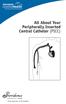 All About Your Peripherally Inserted Central Catheter (PICC) General Information Intravenous (IV) therapy is the delivery of fluid directly into a vein. An intravenous catheter is a hollow tube that is
PATIENT GUIDE. Care and Maintenance Drainage Frequency: Max. Drainage Volume: Dressing Option: Clinician s Signature: Every drainage Weekly
 PATIENT GUIDE Care and Maintenance Drainage Frequency: Max. Drainage Volume: Dressing Option: Every drainage Weekly Clinician s Signature: ACCESS SYSTEMS Pleural Space Insertion Site Cuff Exit Site Catheter
AXIRON (AXE-e-RON) CIII
 Medication Guide 1 AXIRON (AXE-e-RON) CIII (testosterone) topical solution Read this Medication Guide before you start using AXIRON and each time you get a refill. There may be new information. This information
Looking after your urinary catheter at home. An information guide
 TO PROVIDE THE VERY BEST CARE FOR EACH PATIENT ON EVERY OCCASION Looking after your urinary catheter at home An information guide Looking after your urinary catheter at home This leaflet is provided for
Introduction A JP Drain is a soft tube and container used to drain fluids that build up under the skin after surgery.
 JP Drain Introduction A JP Drain is a soft tube and container used to drain fluids that build up under the skin after surgery. This reference summary explains what a JP Drain is and discusses how to take
Care for your child s Central Venous Catheter (CVC)
 Care for your child s Central Venous Catheter (CVC) This booklet is intended for general informational purposes only. You should consult your doctor for medical advice. Please call the clinic or your home
Going home with a urinary cathether
 Going home with a urinary cathether A patient s guide 1 Your doctor has advised that you require a urinary catheter so that urine can be drained from your bladder. This leaflet provides advice to help
Safety FIRST: Infection Prevention Tips
 Reading Hospital Safety FIRST: Infection Prevention Tips Reading Hospital is committed to providing high quality care to our patients. Your healthcare team does many things to help prevent infections.
Chester Chest Model 2400 User s Manual
 Chester Chest Model 2400 User s Manual 308 South Sequoia Parkway, Canby, Oregon 97013 USA ph. 503.651.5050 fax 503.651.5052 email [email protected] Thank You For Your Purchase! Thank you for your purchase
Medications or therapeutic solutions may be injected directly into the bloodstream
 Intravenous Therapy Medications or therapeutic solutions may be injected directly into the bloodstream for immediate circulation and use by the body. State practice acts designate which health care professionals
PERIPHERALLY INSERTED CENTRAL CATHETERS (PICC) Fong So Kwan APN, Haematology unit Medical Department, QMH
 PERIPHERALLY INSERTED CENTRAL CATHETERS (PICC) Fong So Kwan APN, Haematology unit Medical Department, QMH 1 What is a PICC catheter? Primary vascular access device since their introduction in the mid-1970s,
Spinal Cord and Bladder Management Male: Intermittent Catheter
 Spinal Cord and Bladder Management Male: Intermittent Catheter The 5 parts of the urinary system work together to get rid of waste and make urine. Urine is made in your kidneys and travels down 2 thin
UW MEDICINE PATIENT EDUCATION. Using Insulin. Basic facts about insulin and self-injection. What is insulin? How does diabetes affect the body?
 UW MEDICINE PATIENT EDUCATION Using Insulin Basic facts about insulin and self-injection This handout explains what insulin is, the different types of insulin, how to store it, how to give an injection
PATIENT URINARY CATHETER PASSPORT
 n PATIENT URINARY CATHETER PASSPORT A guide on how to look after your Catheter NHS Hertfordshire Patient Experience Team Charter House Parkway Welwyn Garden City Hertfordshire AL8 6JL Telephone: 01707
Enables MDA Medical Teams to categorize victims in mass casualty scenarios, in order to be able to triage and treat casualties
 MDA Disposable ALS + BLS Medical Ambulance Equipment Prices shown in CDN. Funds Items Description Picture Mass Casualty ID tag 1000 units = $350 Enables MDA Medical Teams to categorize victims in mass
Patient Information:
 Patient Information: Care of an indwelling Urinary Catheter What is a Urinary Catheter? A catheter is a hollow, flexible tube designed to drain urine from the bladder. Following insertion into the bladder,
Coloplast Product Guide Ostomy, Continence, Wound & Skin Care. Effective March 2010
 Coloplast Guide Ostomy, Continence, Wound & Skin Care Effective March 2010 SpeediCath TM Intermittent Catheters The only ready-to-use hydrophilic catheter. Clinical research indicated that twice as many
Breast Cancer. Sometimes cells keep dividing and growing without normal controls, causing an abnormal growth called a tumor.
 Breast Cancer Introduction Cancer of the breast is the most common form of cancer that affects women but is no longer the leading cause of cancer deaths. About 1 out of 8 women are diagnosed with breast
The Drink-Aide The NEW look of independence
 The Drink-Aide The NEW look of independence Introducing Drink-Aide What is Drink-Aide? The Drink-Aide is a water bottle that attaches easily to a wheelchair for use by persons with little or no upper
Feeling Your Way To Healthy Breast. Lisa Barnes, BSN, RN Ruth Fay,B.A.,M.B.A.,RN Mary Grady, BSN, RN Margaret Richmond, MA, RN
 Feeling Your Way To Healthy Breast Lisa Barnes, BSN, RN Ruth Fay,B.A.,M.B.A.,RN Mary Grady, BSN, RN Margaret Richmond, MA, RN WHAT ARE MY BREASTS MADE OF? A breast is made of three main parts: glands,
Chemotherapy. What is chemotherapy? How does it work? What is cancer? How will I be given chemotherapy? Cannula
 INFORMATION SHEET This information sheet has been written to help you understand more about chemotherapy. The sheet discusses the support and information your doctors, nurses and the Cancer Society can
X-Plain Chemotherapy for Breast Cancer - Adriamycin, Cytoxan, and Tamoxifen Reference Summary
 X-Plain Chemotherapy for Breast Cancer - Adriamycin, Cytoxan, and Tamoxifen Reference Summary Introduction Breast cancer is a common condition that affects one out of every 11 women. Your doctor has recommended
Instructions for Use Item #315, 317 PHTLS by Simulaids Warning Contains Latex!
 Instructions for Use Item #315, 317 PHTLS by Simulaids Warning Contains Latex! Accessory Pack with the PHTLS Manikin (Manubrium I/O inserts package of 10 not shown) Instructions for Use Item #315, 317;
Functional rehab after breast reconstruction surgery
 Functional rehab after breast reconstruction surgery UHN A guide for women who had DIEP, latissimus dorsi with a tissue expander or implant, or two-stage implant based breast reconstruction surgery Read
PATIENT GUIDE. Understand and care for your peripherally inserted central venous catheter (PICC). MEDICAL
 PATIENT GUIDE Understand and care for your peripherally inserted central venous catheter (PICC). MEDICAL Introduction The following information is presented as a guideline for your reference. The best
Breast Cancer: from bedside and grossing room to diagnoses and beyond. Adriana Corben, M.D.
 Breast Cancer: from bedside and grossing room to diagnoses and beyond Adriana Corben, M.D. About breast anatomy Breasts are special organs that develop in women during puberty when female hormones are
About the Uterus. Hysterectomy may be done to treat conditions that affect the uterus. Some reasons a hysterectomy may be needed include:
 Hysterectomy removal of the uterus is a way of treating problems that affect the uterus. Many conditions can be cured with hysterectomy. Because it is major surgery, your doctor may suggest trying other
INJECTION TECHNIQUE. IVF NURSING OFFICE: (301) 400-2151 Darshana (301) 400-2146 Nicole
 IVF NURSING OFFICE: (301) 400-2151 Darshana (301) 400-2146 Nicole PLEASE NOTE: If you do not have medications for the next day s dose, you MUST go to the clinic that morning at 6:30 AM for more medications.
Breast Cancer. Breast Cancer Page 1
 Breast Cancer Summary Breast cancers which are detected early are curable by local treatments. The initial surgery will give the most information about the cancer; such as size or whether the glands (or
8 GENITOURINARY Order inquiries? 204.945.3000 Items may not be exactly as shown. Foley Catheters
 GENITOURINARY GENITOURINARY 7 A Foley atheters Silastic Foley atheters Latex, 2-way, silicone/elastomer coated, short round tip, ribbed balloon, inflation valve, 2 opposing eyes, 10/box. ard 16 French,
Biliary Drain. What is a biliary drain?
 Biliary Drain What is a biliary drain? A biliary drain is a tube to drain bile from your liver. It is put in by a doctor called an Interventional Radiologist. The tube or catheter is placed through your
Urinary Incontinence FAQ Sheet
 Urinary Incontinence FAQ Sheet Are you reluctant to talk to your doctor about your bladder control problem? Don t be. There is help. Loss of bladder control is called urinary incontinence. It can happen
NIH Clinical Center Patient Education Materials Giving a subcutaneous injection
 NIH Clinical Center Patient Education Materials What is a subcutaenous injection? A subcutaneous injection is given in the fatty layer of tissue just under the skin. A subcutaneous injection into the fatty
Instruction Guide to Sterile Self-Catheterization for Women Using the Cure Catheter Closed System
 Cure Medical donates 10% of net income to medical research in pursuit of a cure for spinal cord injuries and central nervous system disorders. For information on scientific advancements, visit www.curemedical.com.
Tell your doctor about all the medicines you take, including prescription and nonprescription medicines, vitamins, and herbal supplements.
 SOMAVERT pegvisomant for injection PATIENT INFORMATION SOMAVERT (SOM-ah-vert) (pegvisomant for injection) Read the patient information that comes with SOMAVERT before you start using it and each time you
PICC & Midline Catheters Patient Information Guide
 PICC & Midline Catheters Patient Information Guide medcompnet.com 1 table of contents Introduction 4 What is a PICC or Midline Catheter? 4 How is the PICC or Midline Catheter Inserted? 6 Catheter Care
INTERDISCIPLINARY CLINICAL MANUAL Practice Guideline
 INTERDISCIPLINARY CLINICAL MANUAL Practice Guideline TITLE: Insertion of a curved tip Urinary Catheter (Coude/Tiemann) NUMBER: CC 50-013 Effective Date: August 2015 Page 1 of 5 Applies To: All Preamble:
Infection Prevention & Control Team. Your urinary catheter & how to care for it 0151 430 2452 / 0151 430 1384. Patient Information Leaflet
 Contact details Infection prevention team - 0151 430 2452 This leaflet can be made available in alternative languages/formats on request. Infection Prevention & Control Team 0151 430 2452 / 0151 430 1384
A PRINTED copy of this guideline may not be the most recent version. The OFFICIAL version is located on IHNET at the Policies & Procedures Home Page
 A PRINTED copy of this guideline may not be the most recent version. The OFFICIAL version is located on IHNET at the Policies & Procedures Home Page IX0200: Prevention & Control of Catheter Associated
Urinary Indwelling Catheter. The Urinary System
 Patient Education CARE AND TREATMENT Urinary Indwelling Catheter This information will help you care for a urinary indwelling catheter at home. It will answer many of your questions. Please ask your doctor
Please read these instructions carefully before using Poise* Bladder Supports
 For the Temporary Management of Stress Urinary Incontinence in Women INSTRUCTIONS FOR USE Please read these instructions carefully before using Poise* Bladder Supports 500000023088 For the Temporary Management
You have been sent home with. Suprapubic Catheter
 You have been sent home with Suprapubic Catheter 1 SUPRAPUBIC CATHETER 1.- What is a suprapubic catheter? 2.- What do you need on discharge. 3.- Basic care 4.- Choosing your bag and bag care 5.- Possible
Self- Lymphatic Massage for Arm, Breast or Trunk Lymphedema
 Self- Lymphatic Massage for Arm, Breast or Trunk Lymphedema Patient Education Improving health through education The lymphatic system is part of our circulatory system. It helps balance the fluids of our
Changes to Your Baby and Your Body During Pregnancy
 Changes to and Your Body During Pregnancy 1st Trimester: Conception to Week 16 Your baby s traits and sex are set when the sperm meets the egg. During this time: The brain, nerves, heart, lungs and bones
X-Plain Inguinal Hernia Repair Reference Summary
 X-Plain Inguinal Hernia Repair Reference Summary Introduction Hernias are common conditions that affect men and women of all ages. Your doctor may recommend a hernia operation. The decision whether or
Going Home with a Urinary Catheter
 Going Home with a Urinary Catheter Doctor: Phone Number: About Your Catheter A urinary catheter is a small tube that goes through your urethra and into your bladder. This tube then drains the urine made
Bladder reconstruction (neo-bladder)
 Bladder reconstruction (neo-bladder) We have written this leaflet to help you understand about your operation. It is designed to help you answer any questions you may have. The leaflet contains the following
Achieving Independence. A Guide to Self-Catheterization with the Bard Touchless Plus Intermittent Catheter System
 Bard: Intermittent Self-Catheterization A Guide to Self-Catheterization with the Bard Touchless Plus Intermittent Catheter System Achieving Independence Introducing the Bard Touchless Plus Catheter One
Exercises after breast or upper body lymph node surgery
 Exercises after breast or upper body lymph node surgery Surgery may limit the strength and movement of your arm. These exercises are helpful if you have had: breast surgery with or without lymph node removal
Frequently Asked Questions About Ovarian Cancer
 Media Contact: Gerri Gomez Howard Cell: 303-748-3933 [email protected] Frequently Asked Questions About Ovarian Cancer What is ovarian cancer? Ovarian cancer is a cancer that forms in tissues
Self Catheterization Guide
 Self Catheterization Guide An introduction to intermittent self-catheterization Medical professionals have recommended that you selfcatheterize in order to completely empty your bladder. This prevents
Procedure Code A4215 22 Insulin pen needles A4230 Infusion set for external insulin pump, non needle cannula type A4231 Infusion set for external
 A4215 22 Insulin pen needles A4230 Infusion set for external insulin pump, non needle cannula type A4231 Infusion set for external insulin pump, needle type A4232 Syringe with needle for external insulin
Patient Information Guide Morpheus CT Peripherally Inserted Central Catheter
 Patient Information Guide Morpheus CT Peripherally Inserted Central Catheter IC 192 Rev C A measure of flexibility and strength. Table of Contents 1. Introduction 2. What is the Morpheus CT PICC? 3. What
Red rubber all-purpose urethral. Catheters. Bard Clean-Cath Intermittent catheter: 802408-22 8-22 Fr. 100/case
 BARDIA Urethral Catheters Red rubber all-purpose urethral catheters: Radiopaque red rubber catheter with a round, hollow tip Can be used as a Robinson or a Nelaton catheter Two opposing drainage eyes 16