
WEB SITE OPTIMIZATION THROUGH MINING USER NAVIGATIONAL PATTERNS
|
|
|
- Colin Bryan
- 10 years ago
- Views:
Transcription
1 WEB SITE OPTIMIZATION THROUGH MINING USER NAVIGATIONAL PATTERNS Biswajit Biswal Oracle Corporation ABSTRACT With the World Wide Web (www) s ubiquity increase and the rapid development of various online businesses, the complexity of web sites grow. The analysis of web user s navigational pattern within a web site can provide useful information for server performance enhancements, restructuring a website and direct marketing in e-commerce etc. In this paper, an algorithm is proposed for mining such navigation patterns. The key insight is that users access information of interest and follow a certain path while navigating a web site. If they don t find it, they would backtrack and choose among the alternate paths till they reach the destination. The point they backtrack is the Intermediate Reference Location. Identifying such Intermediate locations and destinations out of the pattern will be the main endeavour in the rest of this report. KEYWORDS: Web Engineering, Data Mining. 1. INTRODUCTION From a user s perspective, hypertext links on the web page form a directed graph between distinct information sources. A website is a collection of web pages forming a hierarchically nested graph (see Figure. 1). A web site generally has a root page from which there should be author-designed paths to all local content. However different users have different needs. The same user may need different information at different times. A web site may be designed in a particular way, but be used in many different ways. Therefore, it is hard to organize a web site such that pages are located where users expect to find them. In this paper, an algorithm is proposed to identify all the destination pages in a web site whose location is different from the location where users expect to find them. The key insight is that users will backtrack if they do not find the page where they expect it. The point from where they backtrack is the Intermediate Reference Location (IRL) for the page. IRL s with maximum hits will then be made to include navigation links to the destination page. It is also worth mentioning that users may try multiple IRL for a destination page. 1
2 User navigational patterns can be studied from the web access-logs generated by the system. Web access-logs record the access history of users that visit a web server. Web servers register a web log entry for every single access they get, in which important pieces of information about accessing are recorded, including the URL requested, the IP address from which the request originated, and a timestamp. A sequential access-pattern is generated out of these logs. A sequential access-pattern represents an ordered group of pages visited by users. Mining of these access-patterns will lead to the identification of user behaviour and thus the solution. The rest of this paper is organized as follows: Section 2 gives an overview of the related work, whereas the mining of sequential access-patterns is described in Section 3. Section 4 contains the experimental results, and finally Section 5 concludes the paper. 2. RELATED WORK A lot of work has been done in web access pattern mining. Pei et al. [5] propose Web access pattern tree or WAP-tree for efficient mining of access patterns from web logs. The WAP-tree can store highly compressed, critical information and facilitates the development of novel algorithms for mining access patterns in large set of logs. Perkowitz et al. [3 & 4] present adaptive web sites, which is the semi-automatic creation of web pages. Their PageGather algorithm finds pages that co-occur frequently and create an index page which consists of all the links to these pages. Nakayama et al. [6] discover the gap between web site designer s expectations and user s behaviour by measuring the inter-page conceptual relevance and access co-occurrence. The technique suggests a multiple traversal frequently from page layout features. Shahabi et al. [2] propose a profiler, which captures client s selected links and pages order, accurate page viewing time and cache references, using a Java based remote agent, which is then utilized by a knowledge discovery technique to cluster users with similar interests. Shiliopoulou et al. [8] compare navigation patterns of registered users with those of unregistered users. This comparison leads to rules on how the site s topology should be improved to turn non-customers into customers. However one drawback of these approaches is that they work on some dependencies with the client side browser or the other. Some of these approaches suggest no clues to improve the web site structure and concentrate less on the user s behaviour. 3. MINING WEB ACCESS-LOGS As mentioned earlier, web pages are linked together and users travel through them back and forth in accordance with the links and icons provided. Therefore, some node might be visited only because of its location, not content. Consequently, such backwards traversals should be taken into consideration in the research to study user s behaviour. 2

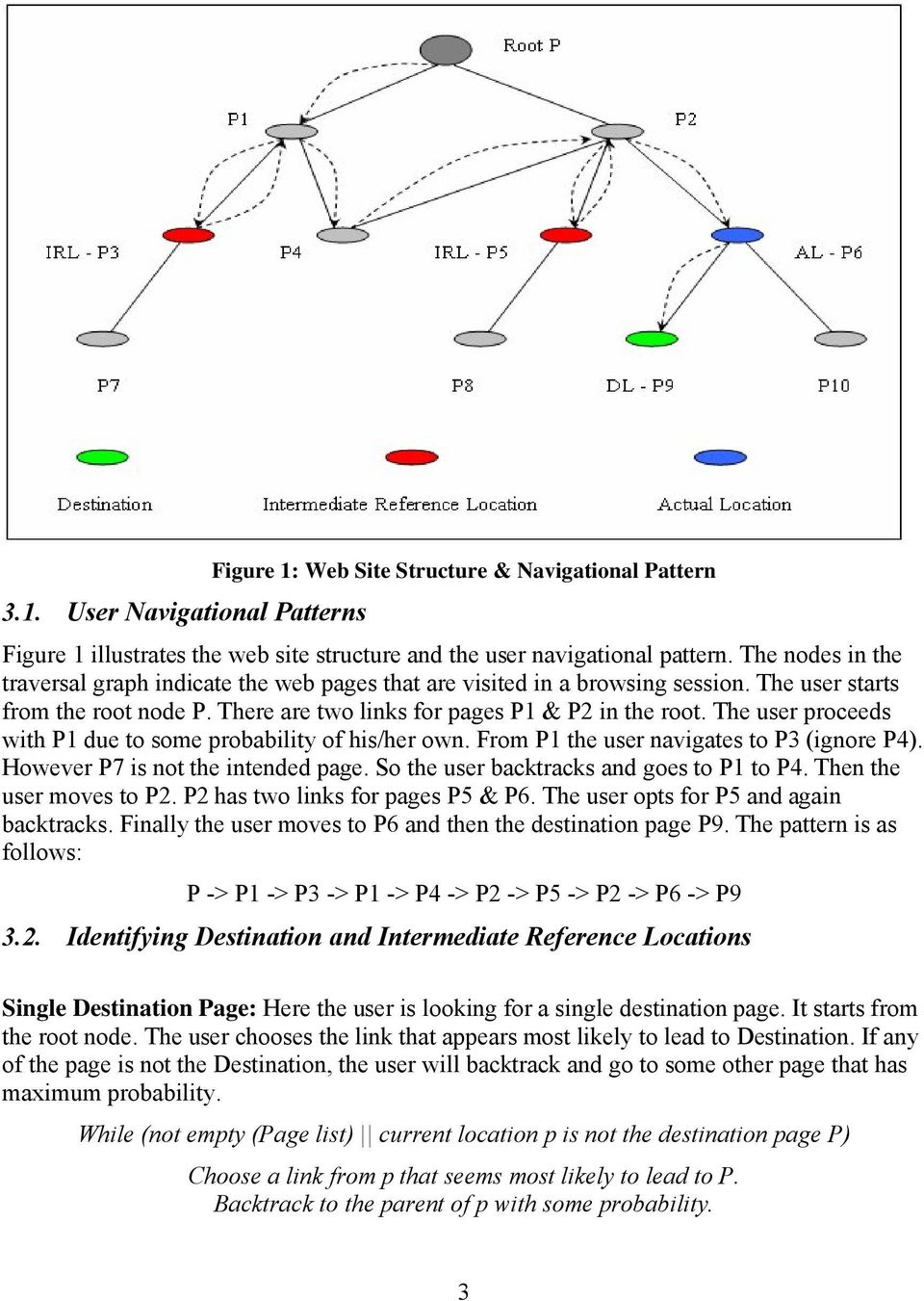
3 3.1. User Navigational Patterns Figure 1: Web Site Structure & Navigational Pattern Figure 1 illustrates the web site structure and the user navigational pattern. The nodes in the traversal graph indicate the web pages that are visited in a browsing session. The user starts from the root node P. There are two links for pages P1 & P2 in the root. The user proceeds with P1 due to some probability of his/her own. From P1 the user navigates to P3 (ignore P4). However P7 is not the intended page. So the user backtracks and goes to P1 to P4. Then the user moves to P2. P2 has two links for pages P5 & P6. The user opts for P5 and again backtracks. Finally the user moves to P6 and then the destination page P9. The pattern is as follows: P -> P1 -> P3 -> P1 -> P4 -> P2 -> P5 -> P2 -> P6 -> P Identifying Destination and Intermediate Reference Locations Single Destination Page: Here the user is looking for a single destination page. It starts from the root node. The user chooses the link that appears most likely to lead to Destination. If any of the page is not the Destination, the user will backtrack and go to some other page that has maximum probability. While (not empty (Page list) current location p is not the destination page P) Choose a link from p that seems most likely to lead to P. Backtrack to the parent of p with some probability. 3
4 Multiple Destination Pages: Consider the case where the user has a set of Destination pages P 1..P n. The pattern is similar, except that after finding (or giving upon) P i, the user then starts looking for P i+1. While (not empty (Page list) current location P is not the destination page P i Choose a link from P that seems most likely to lead to P i Backtrack to the parent of P with some probability or give up on P i and look for P i+1 The pattern illustrated in Figure: 1 might be of Single Destination or multiple Destinations. It is hard to identify by looking at the web log. The only distinguishing factor would be the time spent at each of these locations. The average time spent at each page by all the users can then be evaluated and become a delimiting factor for this page to be an Intermediate Reference Location or a Destination Location. However, it is likely that a starter (who has spent less time on the site) might spent more time in the page than the time spent by an veteran (who has spent more time on the site) user. So, the total time the user has spent in the web site prior to coming to this page should also be considered. The threshold time for each page could be evaluated as follows: Let assume that Page P has t 1, t 2...t n times spent by n users. These users have spent T 1, T 2,.T n times on the web site before coming to this page respectively. The parameter đ is a damping factor which can be set between 0.15 and Its value is proportional to the popularity of the page in the web site which can be set by the web site administrator. The parameter is valued so to better approximate the time stated by the log Sources T P = đ ( t 1 T 1 + t 2 T t n T n ) ( T 1 + T T n ) Figure 2: Example of a Web Access Log 4

5 Let s look at a typical web access log in Figure 2. Each web log entry represents each user s access to a web page and contains the user s IP address, the Timestamp, the URL address of the requested object, and some additional information. Access requests issued by a user within a single session with a web server constitute a user s access sequence. These data sets commonly used for web traversal mining are collected at the server-level, proxy-level or client-level. Each data source differs in terms of format, accuracy, scope and method of implementation. Client-level logs hold the most accurate account of user behaviour over www. If a client connection is through an Internet Service Provider (ISP) or is located behind a firewall, its activities may be logged at this level. The primary function of proxy servers or firewalls is to serve both as a measure of security to block unwanted users or as a cache resource to reduce network traffic by reusing their most recently fetched files. Their log files may include many clients accessing many Web Servers. In the log files, their client request records are interleaved in their received order. The process of logging is automatic and requires less intervention. The web access log can be specialized to different sets of patterns based upon the IP address and Time stamp as shown in Figure 2. The last two blocks consists of entry for a single client sorted by the timestamp. These extracted patterns can then be indexed to a database or to some temporary buffer for mining. Note that only the html pages are considered for the research work. So, all the other objects (jpg, gif, etc.) accessed by the users are ignored from the pattern Algorithm Let, Array page_array contains the ordered set of pages {P1, P2, P3. Pn}. Function Mark (Page, Indicator) marks the page as specified in the indicator parameter (DL or IRL). Function IsConnected (Page1, Page2) returns True if Page1 has a link to Page2 or False otherwise. For i: = 1 to n-1 begin end; if( ( page_array [i-1] ) = = ( page_array [i+1] ) ( IsConnected (page_array[i], page_array [i+1] ) ) ) if( t ( page_array [i] ) T (page_array [i] ) ) then Mark ( page_array [i], DL ); else Mark ( page_array [I], IRL ) ; Now the pattern will have a list of IRL s followed by a DL, and so on. The Actual Location (AL) is the page traversed before the DL. For each DL in page_array begin Add (DL, IRL List, AL) to the table. End; The algorithm checks for the previous and next page. If the pages are same, then the current page could either be an IRL or a DL. It also checks for the absence of a link from the current 5

6 to the next page. In that case the user might have used a navigation link or hit the back button to go to the next page. In either of the case the page is either an IRL or a DL. Next, the algorithm compares the time currently spent at the page with the threshold time. If the current time spent is greater than the threshold, then the page is a Destination Location else an Intermediate Reference Location Optimization From the above algorithm a table is created with the following columns: D, AL, Ĩ 1, Ĩ 2 where D is the Destination Location, AL is the Actual Location and Ĩ 1, Ĩ 2 are the list of IRL s. The table structure is not normalized and can be ignored as it s out of scope of this report. D AL Ĩ 1 Ĩ 2 Ĩ 3 Ĩ 4 P3 P5 P4 P1 P2 P1 P1 P3 P4 P2 Let, β k, be the probability of finding the destination in page Pk. Ω n, be the probability of finding the destination in nth IRL. Ω values can be set as 1, 0.75, 0.5, 0.25 for Ĩ 1, Ĩ 2, Ĩ 3, Ĩ 4 respectively. S P represent the average probability of finding the destination for any IRL. P1, P2, P3 Pk represents k pages. Ĩ 1, Ĩ 2, Ĩ 3, Ĩ 4.. Ĩ n represents n IRL s. β k : = Ω (Pk position in each record), S P : = β k k For each Record in Table begin For i : = 1 to n begin Increment β value for each IRL as per Ω n end end S P = β k k ; P = Max(β k ); For each page in IRL_List begin if β k end; S p then Mark the page Pk as recommended. end For each Record in Table begin For i : = 1 to n begin If β k S P then Remove Ĩ k, Ĩ k+1, Ĩn from record. end end The IRL with the maximum probability is marked as recommended page and all the subsequent pages are removed from the table. The table mentioned above is evaluated as follows: 6
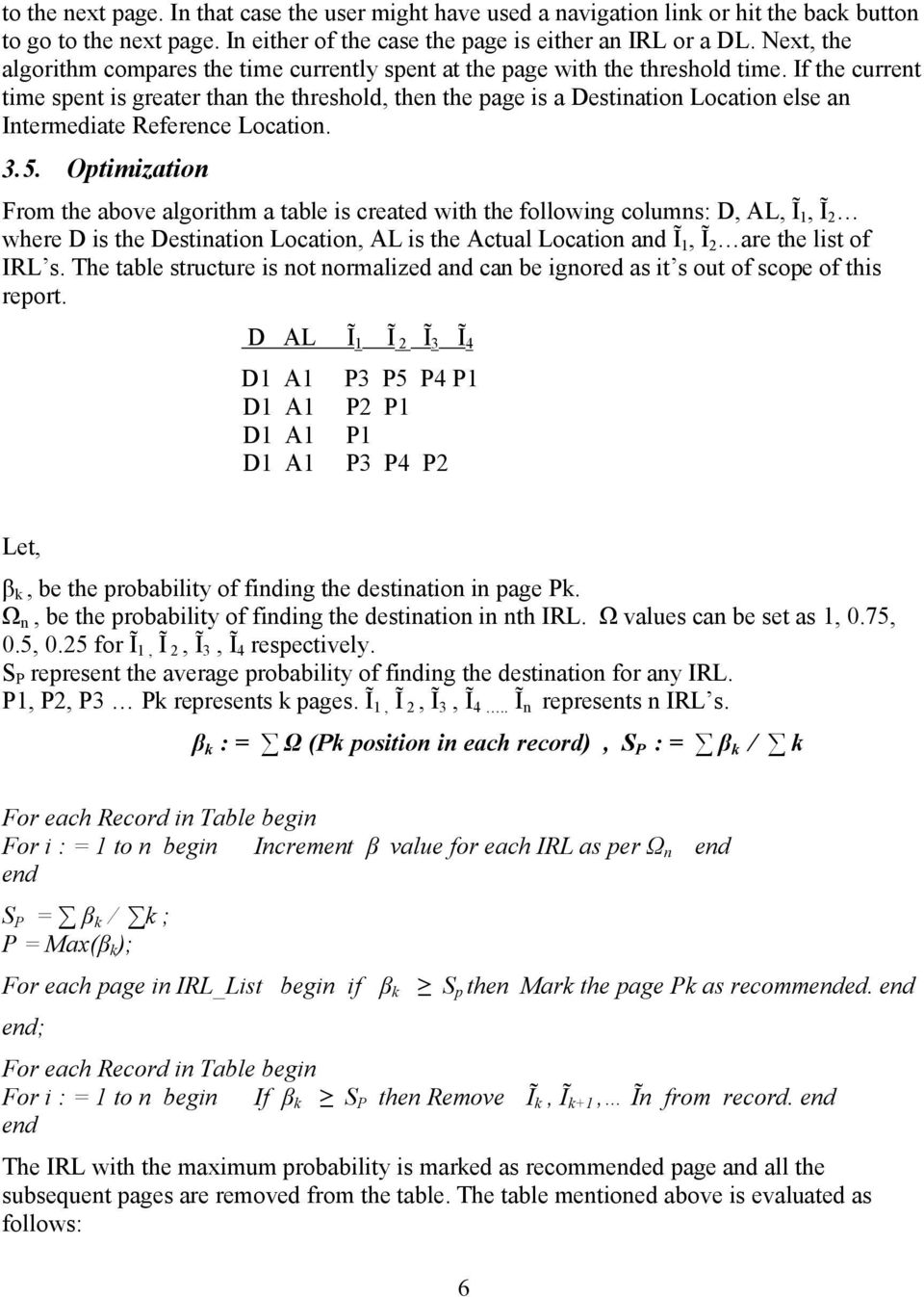
7 β1 = 0.25 (1 st Row) (2 nd Row) + 1 (3 rd Row) = 2 β2 = 1 (2 nd Row) (4 th Row) = 1.25 β3 = 1 (1 st Row) + 1 (4 th Row) = 2 β4 = 0.5 (1 st Row) (4 th Row) = 1.25 β5 = 0.75 (1 st Row) = 0.75 S P = ( ) 5 = 1.45 P1 & P3 pages are recommended and the new table is constructed below: D AL Ĩ 1 Ĩ 2 Ĩ 3 Ĩ 4 P2 The algorithm identifies the IRL that has maximum probability of attempt for any user. This IRL can then be made to include navigation links to the destination page. The recommended IRL now becomes one of the Actual Location for the Destination page. Other way is to restructure the web site using a similarity matrix on these extracted pages. 4. EXPERIMENTAL RESULTS Figure. 3 Figure. 4 The experiments were carried out for a period of one year on a real online ordering system of a major telecom corporation of US. The web site was restructured and optimized after analysing the web access logs. Figure. 3 shows the number of hits to that destination page for every month from period Jul till Jul The blue (dark) block illustrates the number of hit to the destination page through the old path before optimization and the red (light) block illustrates the number of hits to the destination page through the additional new path after optimization. It clearly suggests that more users are visiting the new path. 7
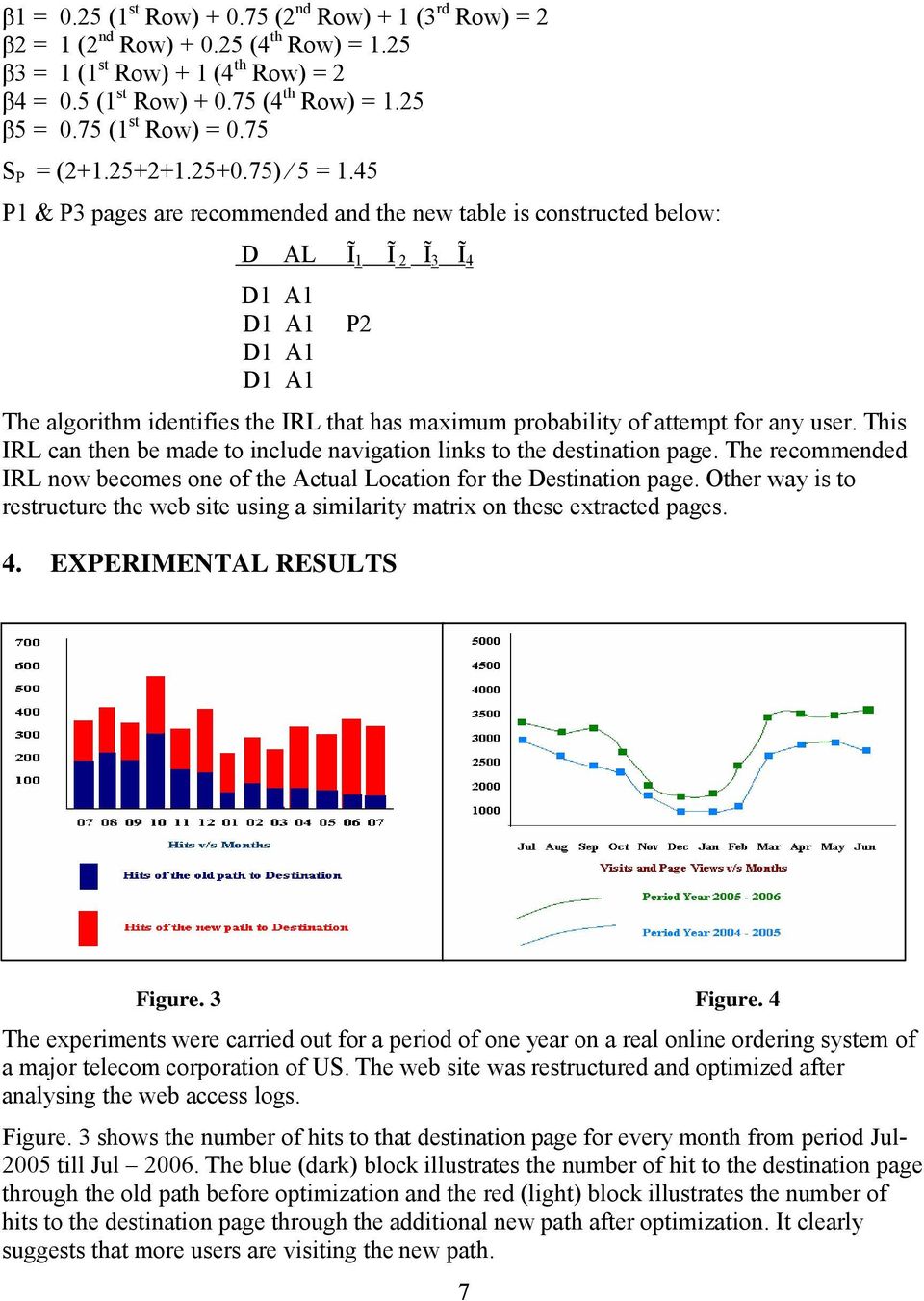
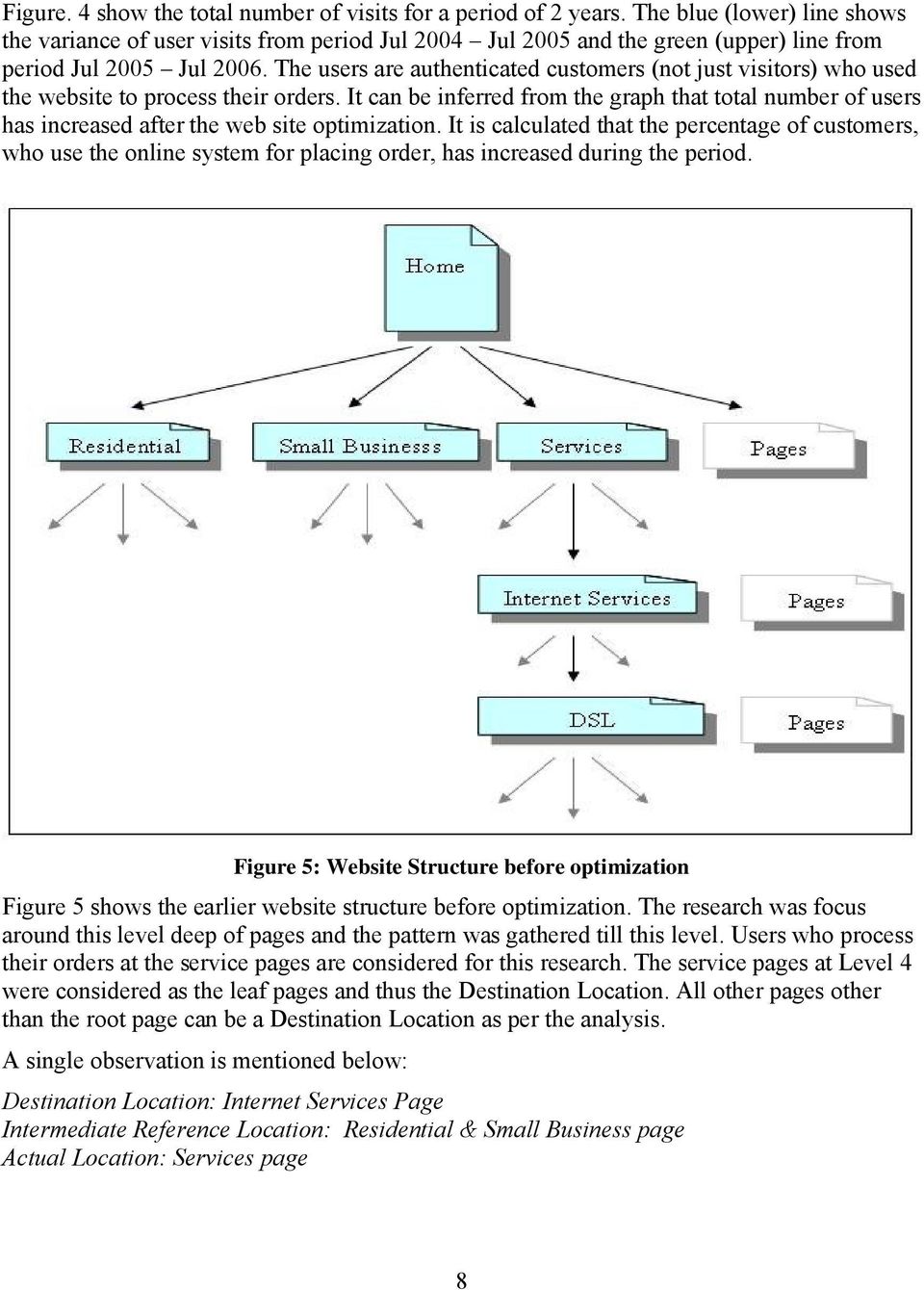
8 Figure. 4 show the total number of visits for a period of 2 years. The blue (lower) line shows the variance of user visits from period Jul 2004 Jul 2005 and the green (upper) line from period Jul 2005 Jul The users are authenticated customers (not just visitors) who used the website to process their orders. It can be inferred from the graph that total number of users has increased after the web site optimization. It is calculated that the percentage of customers, who use the online system for placing order, has increased during the period. Figure 5: Website Structure before optimization Figure 5 shows the earlier website structure before optimization. The research was focus around this level deep of pages and the pattern was gathered till this level. Users who process their orders at the service pages are considered for this research. The service pages at Level 4 were considered as the leaf pages and thus the Destination Location. All other pages other than the root page can be a Destination Location as per the analysis. A single observation is mentioned below: Destination Location: Internet Services Page Intermediate Reference Location: Residential & Small Business page Actual Location: Services page 8
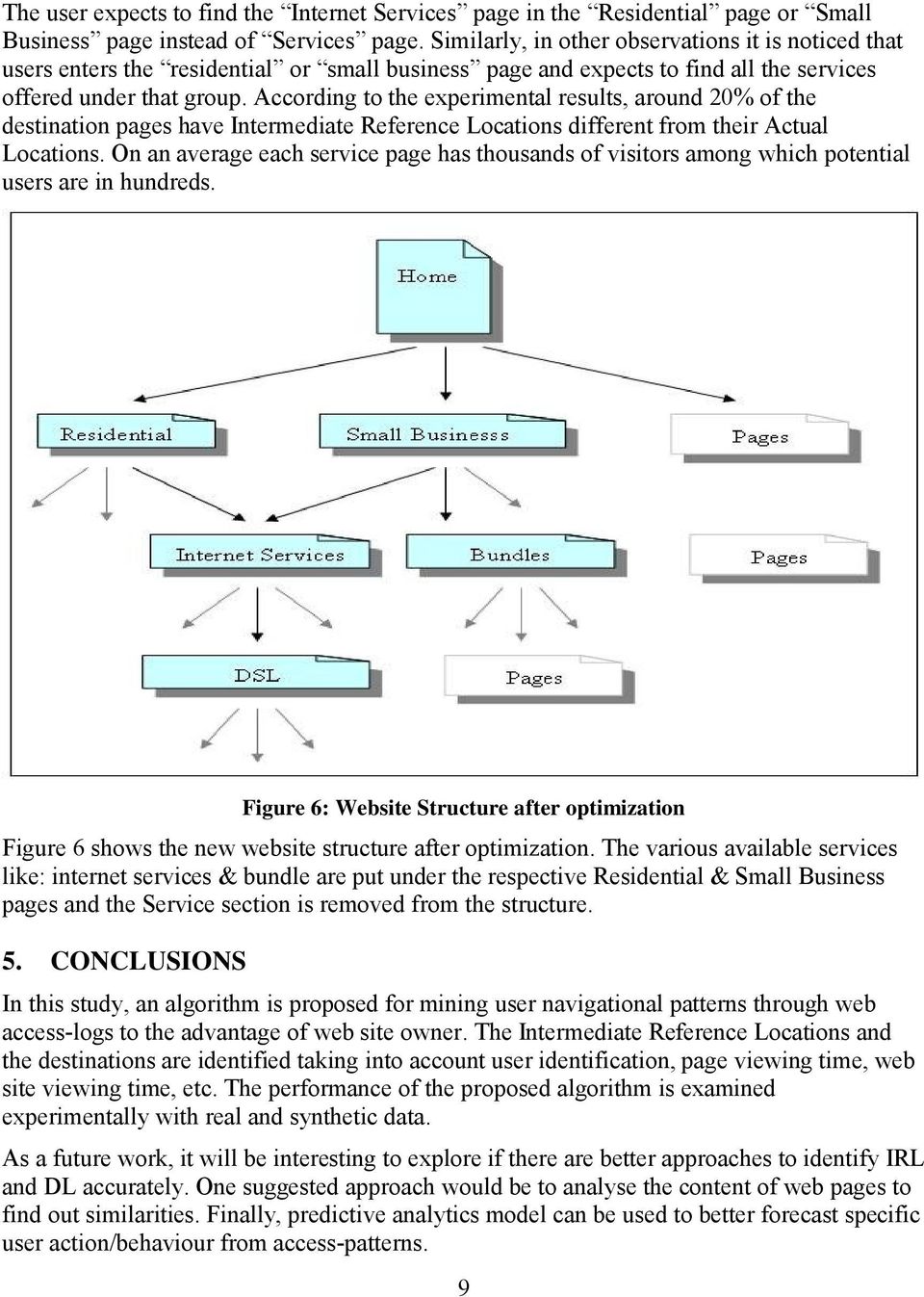
9 The user expects to find the Internet Services page in the Residential page or Small Business page instead of Services page. Similarly, in other observations it is noticed that users enters the residential or small business page and expects to find all the services offered under that group. According to the experimental results, around 20% of the destination pages have Intermediate Reference Locations different from their Actual Locations. On an average each service page has thousands of visitors among which potential users are in hundreds. Figure 6: Website Structure after optimization Figure 6 shows the new website structure after optimization. The various available services like: internet services & bundle are put under the respective Residential & Small Business pages and the Service section is removed from the structure. 5. CONCLUSIONS In this study, an algorithm is proposed for mining user navigational patterns through web access-logs to the advantage of web site owner. The Intermediate Reference Locations and the destinations are identified taking into account user identification, page viewing time, web site viewing time, etc. The performance of the proposed algorithm is examined experimentally with real and synthetic data. As a future work, it will be interesting to explore if there are better approaches to identify IRL and DL accurately. One suggested approach would be to analyse the content of web pages to find out similarities. Finally, predictive analytics model can be used to better forecast specific user action/behaviour from access-patterns. 9
10 6. REFERENCES 1. R. Srikant, R. Agarwal (March 1995). Mining sequential patterns, In Proceedings ICDE 95, Taipei, Taiwan. pages C. Shahabi, A. M. Zarkesh, J. Abidi, and V. Shah (1997). Knowledge discovery from users web-page navigation, In Proceedings of the 7 th IEEE Int l Workshop on Research Issues in Data Engineering (RIDE). pages M. Perkowitz and O. Etioni (May 1999). Towards adaptive web sites: Conceptual framework and case study, In Proceedings of the Eighth Int l WWW Conference, Toronto, Canada. 4. M. Perkowitz and O. Etioni (1998). Towards adaptive web sites: Automatically synthesizing web pages, In Proceedings of the Fifteenth National Conference on Artificial Intelligence (AAAI). pages J. Pei, J. Han, B. Mortazavi-asl, and H.Zhu (April 2000). Mining Access Patterns Efficiently from Web Logs, In Proc. of the 4 th Pacific-Asia Conf. on Knowledge Discovery and Data Mining. pages T. Nakayama, H. Kato, and Y. Yamane (May 2000). Discovering the gap between web site designer s expectations and users behaviour, In Proc. of the Ninth Int l WWW Conference, Amsterdam. 7. J. Chen and T. Cook (May 2007). Mining contiguous sequential patterns from web logs, In Proc. of the WWW 2007, Banff, Alberta, Canada. 8. M. Spiliopoulou, C. Phle, and L. C. Faulstich (1999). Improving the Effectiveness of a Web Site with Web Usage Mining, In Proc. of the Workshop on Web Usage Analysis and User Profiling. 9. M. S. Chen, J. S. Park, and P. S. Yu. (May 1996). Data mining for path traversal patterns in a web environment, In Proceedings of the 16 th International Conference on Distributed Computing Systems. Pages M. Spiliopoulou, L. C. Faulstich, and K. Wilkler (July 1999). A data miner analysing the navigational behaviour of web users, In Proc. of the Workshop on Machine Learning in User Modelling of the ACA199, Greece. 11. T. Sullivan (June 1997). Reading Reader Reaction: A proposal for inferential analysis of Web Server log files, In Proc. of the 3 rd Conference of Human Factors & The Web, Denver, Colorado. 10
KOINOTITES: A Web Usage Mining Tool for Personalization
 KOINOTITES: A Web Usage Mining Tool for Personalization Dimitrios Pierrakos Inst. of Informatics and Telecommunications, [email protected] Georgios Paliouras Inst. of Informatics and Telecommunications,
A Time Efficient Algorithm for Web Log Analysis
 A Time Efficient Algorithm for Web Log Analysis Santosh Shakya Anju Singh Divakar Singh Student [M.Tech.6 th sem (CSE)] Asst.Proff, Dept. of CSE BU HOD (CSE), BUIT, BUIT,BU Bhopal Barkatullah University,
AN EFFICIENT APPROACH TO PERFORM PRE-PROCESSING
 AN EFFIIENT APPROAH TO PERFORM PRE-PROESSING S. Prince Mary Research Scholar, Sathyabama University, hennai- 119 [email protected] E. Baburaj Department of omputer Science & Engineering, Sun Engineering
131-1. Adding New Level in KDD to Make the Web Usage Mining More Efficient. Abstract. 1. Introduction [1]. 1/10
![131-1. Adding New Level in KDD to Make the Web Usage Mining More Efficient. Abstract. 1. Introduction [1]. 1/10](/thumbs/25/4963058.jpg "131-1. Adding New Level in KDD to Make the Web Usage Mining More Efficient. Abstract. 1. Introduction [1]. 1/10") 1/10 131-1 Adding New Level in KDD to Make the Web Usage Mining More Efficient Mohammad Ala a AL_Hamami PHD Student, Lecturer m_ah_1@yahoocom Soukaena Hassan Hashem PHD Student, Lecturer soukaena_hassan@yahoocom
1/10 131-1 Adding New Level in KDD to Make the Web Usage Mining More Efficient Mohammad Ala a AL_Hamami PHD Student, Lecturer m_ah_1@yahoocom Soukaena Hassan Hashem PHD Student, Lecturer soukaena_hassan@yahoocom
Enhance Preprocessing Technique Distinct User Identification using Web Log Usage data
 Enhance Preprocessing Technique Distinct User Identification using Web Log Usage data Sheetal A. Raiyani 1, Shailendra Jain 2 Dept. of CSE(SS),TIT,Bhopal 1, Dept. of CSE,TIT,Bhopal 2 [email protected]
Advanced Preprocessing using Distinct User Identification in web log usage data
 Advanced Preprocessing using Distinct User Identification in web log usage data Sheetal A. Raiyani 1, Shailendra Jain 2, Ashwin G. Raiyani 3 Department of CSE (Software System), Technocrats Institute of
WebAdaptor: Designing Adaptive Web Sites Using Data Mining Techniques
 From: FLAIRS-01 Proceedings. Copyright 2001, AAAI (www.aaai.org). All rights reserved. WebAdaptor: Designing Adaptive Web Sites Using Data Mining Techniques Howard J. Hamilton, Xuewei Wang, and Y.Y. Yao
ANALYSIS OF WEB LOGS AND WEB USER IN WEB MINING
 ANALYSIS OF WEB LOGS AND WEB USER IN WEB MINING L.K. Joshila Grace 1, V.Maheswari 2, Dhinaharan Nagamalai 3, 1 Research Scholar, Department of Computer Science and Engineering [email protected]
Binary Coded Web Access Pattern Tree in Education Domain
 Binary Coded Web Access Pattern Tree in Education Domain C. Gomathi P.G. Department of Computer Science Kongu Arts and Science College Erode-638-107, Tamil Nadu, India E-mail: [email protected] M. Moorthi
Web Usage Mining for a Better Web-Based Learning Environment
 Web Usage Mining for a Better Web-Based Learning Environment Osmar R. Zaïane Department of Computing Science University of Alberta Edmonton, Alberta, Canada email: zaianecs.ualberta.ca ABSTRACT Web-based
Arti Tyagi Sunita Choudhary
 Volume 5, Issue 3, March 2015 ISSN: 2277 128X International Journal of Advanced Research in Computer Science and Software Engineering Research Paper Available online at: www.ijarcsse.com Web Usage Mining
Web Mining using Artificial Ant Colonies : A Survey
 Web Mining using Artificial Ant Colonies : A Survey Richa Gupta Department of Computer Science University of Delhi ABSTRACT : Web mining has been very crucial to any organization as it provides useful
Pre-Processing: Procedure on Web Log File for Web Usage Mining
 Pre-Processing: Procedure on Web Log File for Web Usage Mining Shaily Langhnoja 1, Mehul Barot 2, Darshak Mehta 3 1 Student M.E.(C.E.), L.D.R.P. ITR, Gandhinagar, India 2 Asst.Professor, C.E. Dept., L.D.R.P.
Web Log Based Analysis of User s Browsing Behavior
 Web Log Based Analysis of User s Browsing Behavior Ashwini Ladekar 1, Dhanashree Raikar 2,Pooja Pawar 3 B.E Student, Department of Computer, JSPM s BSIOTR, Wagholi,Pune, India 1 B.E Student, Department
ANALYSIS OF WEBSITE USAGE WITH USER DETAILS USING DATA MINING PATTERN RECOGNITION
 ANALYSIS OF WEBSITE USAGE WITH USER DETAILS USING DATA MINING PATTERN RECOGNITION K.Vinodkumar 1, Kathiresan.V 2, Divya.K 3 1 MPhil scholar, RVS College of Arts and Science, Coimbatore, India. 2 HOD, Dr.SNS
ASSOCIATION RULE MINING ON WEB LOGS FOR EXTRACTING INTERESTING PATTERNS THROUGH WEKA TOOL
 International Journal Of Advanced Technology In Engineering And Science Www.Ijates.Com Volume No 03, Special Issue No. 01, February 2015 ISSN (Online): 2348 7550 ASSOCIATION RULE MINING ON WEB LOGS FOR
An Enhanced Framework For Performing Pre- Processing On Web Server Logs
 An Enhanced Framework For Performing Pre- Processing On Web Server Logs T.Subha Mastan Rao #1, P.Siva Durga Bhavani #2, M.Revathi #3, N.Kiran Kumar #4,V.Sara #5 # Department of information science and
A Survey on Web Mining From Web Server Log
 A Survey on Web Mining From Web Server Log Ripal Patel 1, Mr. Krunal Panchal 2, Mr. Dushyantsinh Rathod 3 1 M.E., 2,3 Assistant Professor, 1,2,3 computer Engineering Department, 1,2 L J Institute of Engineering
Identifying the Number of Visitors to improve Website Usability from Educational Institution Web Log Data
 Identifying the Number of to improve Website Usability from Educational Institution Web Log Data Arvind K. Sharma Dept. of CSE Jaipur National University, Jaipur, Rajasthan,India P.C. Gupta Dept. of CSI
Understanding Web personalization with Web Usage Mining and its Application: Recommender System
 Understanding Web personalization with Web Usage Mining and its Application: Recommender System Manoj Swami 1, Prof. Manasi Kulkarni 2 1 M.Tech (Computer-NIMS), VJTI, Mumbai. 2 Department of Computer Technology,
Keywords: NCSA, W3C, WHOWEDA, HTTP, DOS
 Volume 4, Issue 6, June 2014 ISSN: 2277 128X International Journal of Advanced Research in Computer Science and Software Engineering Research Paper Available online at: www.ijarcsse.com Mining Web Log
A Comparative Study of Different Log Analyzer Tools to Analyze User Behaviors
 A Comparative Study of Different Log Analyzer Tools to Analyze User Behaviors S. Bhuvaneswari P.G Student, Department of CSE, A.V.C College of Engineering, Mayiladuthurai, TN, India. [email protected]
Data Preprocessing and Easy Access Retrieval of Data through Data Ware House
 Data Preprocessing and Easy Access Retrieval of Data through Data Ware House Suneetha K.R, Dr. R. Krishnamoorthi Abstract-The World Wide Web (WWW) provides a simple yet effective media for users to search,
Data Mining of Web Access Logs
 Data Mining of Web Access Logs A minor thesis submitted in partial fulfilment of the requirements for the degree of Master of Applied Science in Information Technology Anand S. Lalani School of Computer
Generalization of Web Log Datas Using WUM Technique
 Generalization of Web Log Datas Using WUM Technique 1 M. SARAVANAN, 2 B. VALARAMATHI, 1 Final Year M. E. Student, 2 Professor & Head Department of Computer Science and Engineering SKP Engineering College,
Chapter 5. Regression Testing of Web-Components
 Chapter 5 Regression Testing of Web-Components With emergence of services and information over the internet and intranet, Web sites have become complex. Web components and their underlying parts are evolving
Concept of Cache in web proxies
 Concept of Cache in web proxies Chan Kit Wai and Somasundaram Meiyappan 1. Introduction Caching is an effective performance enhancing technique that has been used in computer systems for decades. However,
FRAMEWORK FOR WEB PERSONALIZATION USING WEB MINING
 FRAMEWORK FOR WEB PERSONALIZATION USING WEB MINING Monika Soni 1, Rahul Sharma 2, Vishal Shrivastava 3 1 M. Tech. Scholar, Arya College of Engineering and IT, Rajasthan, India, [email protected] 2 M.
W3Perl A free logfile analyzer
 W3Perl A free logfile analyzer Features Works on Unix / Windows / Mac View last entries based on Perl scripts Web / FTP / Squid / Email servers Session tracking Others log format can be added easily Detailed
Web Mining as a Tool for Understanding Online Learning
 Web Mining as a Tool for Understanding Online Learning Jiye Ai University of Missouri Columbia Columbia, MO USA [email protected] James Laffey University of Missouri Columbia Columbia, MO USA [email protected]
CHAPTER 3 PREPROCESSING USING CONNOISSEUR ALGORITHMS
 CHAPTER 3 PREPROCESSING USING CONNOISSEUR ALGORITHMS 3.1 Introduction In this thesis work, a model is developed in a structured way to mine the frequent patterns in e-commerce domain. Designing and implementing
Experiments in Web Page Classification for Semantic Web
 Experiments in Web Page Classification for Semantic Web Asad Satti, Nick Cercone, Vlado Kešelj Faculty of Computer Science, Dalhousie University E-mail: {rashid,nick,vlado}@cs.dal.ca Abstract We address
A Way to Understand Various Patterns of Data Mining Techniques for Selected Domains
 A Way to Understand Various Patterns of Data Mining Techniques for Selected Domains Dr. Kanak Saxena Professor & Head, Computer Application SATI, Vidisha, [email protected] D.S. Rajpoot Registrar,
Chapter 12: Web Usage Mining
 Chapter 12: Web Usage Mining By Bamshad Mobasher With the continued growth and proliferation of e-commerce, Web services, and Web-based information systems, the volumes of clickstream and user data collected
PREPROCESSING OF WEB LOGS
 PREPROCESSING OF WEB LOGS Ms. Dipa Dixit Lecturer Fr.CRIT, Vashi Abstract-Today s real world databases are highly susceptible to noisy, missing and inconsistent data due to their typically huge size data
Attix5 Pro. Your guide to protecting data with Attix5 Pro Desktop & Laptop Edition. V6.0 User Manual for Mac OS X
 Attix5 Pro Your guide to protecting data with Attix5 Pro Desktop & Laptop Edition V6.0 User Manual for Mac OS X Copyright Notice and Proprietary Information All rights reserved. Attix5, 2011 Trademarks
ExtraHop and AppDynamics Deployment Guide
 ExtraHop and AppDynamics Deployment Guide This guide describes how to use ExtraHop and AppDynamics to provide real-time, per-user transaction tracing across the entire application delivery chain. ExtraHop
A Survey on Preprocessing of Web Log File in Web Usage Mining to Improve the Quality of Data
 A Survey on Preprocessing of Web Log File in Web Usage Mining to Improve the Quality of Data R. Lokeshkumar 1, R. Sindhuja 2, Dr. P. Sengottuvelan 3 1 Assistant Professor - (Sr.G), 2 PG Scholar, 3Associate
Importance of Domain Knowledge in Web Recommender Systems
 Importance of Domain Knowledge in Web Recommender Systems Saloni Aggarwal Student UIET, Panjab University Chandigarh, India Veenu Mangat Assistant Professor UIET, Panjab University Chandigarh, India ABSTRACT
A Cube Model for Web Access Sessions and Cluster Analysis
 A Cube Model for Web Access Sessions and Cluster Analysis Zhexue Huang, Joe Ng, David W. Cheung E-Business Technology Institute The University of Hong Kong jhuang,kkng,[email protected] Michael K. Ng,
ANALYSING SERVER LOG FILE USING WEB LOG EXPERT IN WEB DATA MINING
 International Journal of Science, Environment and Technology, Vol. 2, No 5, 2013, 1008 1016 ISSN 2278-3687 (O) ANALYSING SERVER LOG FILE USING WEB LOG EXPERT IN WEB DATA MINING 1 V. Jayakumar and 2 Dr.
Mining for Web Engineering
 Mining for Engineering A. Venkata Krishna Prasad 1, Prof. S.Ramakrishna 2 1 Associate Professor, Department of Computer Science, MIPGS, Hyderabad 2 Professor, Department of Computer Science, Sri Venkateswara
Discover the best keywords for your online marketing campaign
 Discover the best keywords for your online marketing campaign Index n... 3 Keyword discovery using manual methodology... 5 Step 1: Keyword analysis and search... 6 Step 2... 10 Additional tools... 11 Competitors...
How To Analyze Web Server Log Files, Log Files And Log Files Of A Website With A Web Mining Tool
 International Journal of Advanced Computer and Mathematical Sciences ISSN 2230-9624. Vol 4, Issue 1, 2013, pp1-8 http://bipublication.com ANALYSIS OF WEB SERVER LOG FILES TO INCREASE THE EFFECTIVENESS
Visualizing e-government Portal and Its Performance in WEBVS
 Visualizing e-government Portal and Its Performance in WEBVS Ho Si Meng, Simon Fong Department of Computer and Information Science University of Macau, Macau SAR [email protected] Abstract An e-government
A Review on Zero Day Attack Safety Using Different Scenarios
 Available online www.ejaet.com European Journal of Advances in Engineering and Technology, 2015, 2(1): 30-34 Review Article ISSN: 2394-658X A Review on Zero Day Attack Safety Using Different Scenarios
A Comparison Framework of Similarity Metrics Used for Web Access Log Analysis
 A Comparison Framework of Similarity Metrics Used for Web Access Log Analysis Yusuf Yaslan and Zehra Cataltepe Istanbul Technical University, Computer Engineering Department, Maslak 34469 Istanbul, Turkey
An Effective Analysis of Weblog Files to improve Website Performance
 An Effective Analysis of Weblog Files to improve Website Performance 1 T.Revathi, 2 M.Praveen Kumar, 3 R.Ravindra Babu, 4 Md.Khaleelur Rahaman, 5 B.Aditya Reddy Department of Information Technology, KL
Web Mining in E-Commerce: Pattern Discovery, Issues and Applications
 Web Mining in E-Commerce: Pattern Discovery, Issues and Applications Ketul B. Patel 1, Jignesh A. Chauhan 2, Jigar D. Patel 3 Acharya Motibhai Patel Institute of Computer Studies Ganpat University, Kherva,
Business Process Discovery
 Sandeep Jadhav Introduction Well defined, organized, implemented, and managed Business Processes are very critical to the success of any organization that wants to operate efficiently. Business Process
Web Usage Mining - Languages and Algorithms. 1 Introduction. John R. Punin, Mukkai S.Krishnamoorthy, Mohammed J.Zaki
 Web Usage Mining - Languages and lgorithms John R. Punin, Mukkai S.Krishnamoorthy, Mohammed J.Zaki omputer Science Department Rensselaer Polytechnic Institute, Troy NY 12180, US bstract: Web Usage Mining
So today we shall continue our discussion on the search engines and web crawlers. (Refer Slide Time: 01:02)
 Internet Technology Prof. Indranil Sengupta Department of Computer Science and Engineering Indian Institute of Technology, Kharagpur Lecture No #39 Search Engines and Web Crawler :: Part 2 So today we
Configuring Microsoft IIS 5.0 With Pramati Server
 Configuring Microsoft IIS 5.0 With Pramati Server 46 Microsoft Internet Information Services 5.0 is a built-in web server that comes with Windows 2000 operating system. An earlier version, IIS 4.0, is
Original-page small file oriented EXT3 file storage system
 Original-page small file oriented EXT3 file storage system Zhang Weizhe, Hui He, Zhang Qizhen School of Computer Science and Technology, Harbin Institute of Technology, Harbin E-mail: [email protected]
LOAD BALANCING AS A STRATEGY LEARNING TASK
 LOAD BALANCING AS A STRATEGY LEARNING TASK 1 K.KUNGUMARAJ, 2 T.RAVICHANDRAN 1 Research Scholar, Karpagam University, Coimbatore 21. 2 Principal, Hindusthan Institute of Technology, Coimbatore 32. ABSTRACT
Attix5 Pro Server Edition
 Attix5 Pro Server Edition V7.0.2 User Manual for Mac OS X Your guide to protecting data with Attix5 Pro Server Edition. Copyright notice and proprietary information All rights reserved. Attix5, 2013 Trademarks
Static Data Mining Algorithm with Progressive Approach for Mining Knowledge
 Global Journal of Business Management and Information Technology. Volume 1, Number 2 (2011), pp. 85-93 Research India Publications http://www.ripublication.com Static Data Mining Algorithm with Progressive
USER GUIDE MANTRA WEB EXTRACTOR. www.altiliagroup.com
 USER GUIDE MANTRA WEB EXTRACTOR www.altiliagroup.com Page 1 of 57 MANTRA WEB EXTRACTOR USER GUIDE TABLE OF CONTENTS CONVENTIONS... 2 CHAPTER 2 BASICS... 6 CHAPTER 3 - WORKSPACE... 7 Menu bar 7 Toolbar
The Data Mining Process
 Sequence for Determining Necessary Data. Wrong: Catalog everything you have, and decide what data is important. Right: Work backward from the solution, define the problem explicitly, and map out the data
Exploitation of Server Log Files of User Behavior in Order to Inform Administrator
 Exploitation of Server Log Files of User Behavior in Order to Inform Administrator Hamed Jelodar Computer Department, Islamic Azad University, Science and Research Branch, Bushehr, Iran ABSTRACT All requests
Bitrix Site Manager 4.1. User Guide
 Bitrix Site Manager 4.1 User Guide 2 Contents REGISTRATION AND AUTHORISATION...3 SITE SECTIONS...5 Creating a section...6 Changing the section properties...8 SITE PAGES...9 Creating a page...10 Editing
Web Usage Mining: Identification of Trends Followed by the user through Neural Network
 International Journal of Information and Computation Technology. ISSN 0974-2239 Volume 3, Number 7 (2013), pp. 617-624 International Research Publications House http://www. irphouse.com /ijict.htm Web
Velaro End User Guide. 2011 Velaro, Inc.
 I Table of Contents Part I Introduction 1 1 Copyrights... and Trademarks 1 2 System... Requirements 1 3 Customer... Support 2 Part II Getting Started 2 1 Installation... 3 2 The Quick... Start Wizard 3
RANKING WEB PAGES RELEVANT TO SEARCH KEYWORDS
 ISBN: 978-972-8924-93-5 2009 IADIS RANKING WEB PAGES RELEVANT TO SEARCH KEYWORDS Ben Choi & Sumit Tyagi Computer Science, Louisiana Tech University, USA ABSTRACT In this paper we propose new methods for
MultiExperiment Viewer Quickstart Guide
 MultiExperiment Viewer Quickstart Guide Table of Contents: I. Preface - 2 II. Installing MeV - 2 III. Opening a Data Set - 2 IV. Filtering - 6 V. Clustering a. HCL - 8 b. K-means - 11 VI. Modules a. T-test
Guide to Analyzing Feedback from Web Trends
 Guide to Analyzing Feedback from Web Trends Where to find the figures to include in the report How many times was the site visited? (General Statistics) What dates and times had peak amounts of traffic?
Novell ZENworks 10 Configuration Management SP3
 AUTHORIZED DOCUMENTATION Software Distribution Reference Novell ZENworks 10 Configuration Management SP3 10.3 November 17, 2011 www.novell.com Legal Notices Novell, Inc., makes no representations or warranties
User Guide to the Content Analysis Tool
 User Guide to the Content Analysis Tool User Guide To The Content Analysis Tool 1 Contents Introduction... 3 Setting Up a New Job... 3 The Dashboard... 7 Job Queue... 8 Completed Jobs List... 8 Job Details
Automatic Recommendation for Online Users Using Web Usage Mining
 Automatic Recommendation for Online Users Using Web Usage Mining Ms.Dipa Dixit 1 Mr Jayant Gadge 2 Lecturer 1 Asst.Professor 2 Fr CRIT, Vashi Navi Mumbai 1 Thadomal Shahani Engineering College,Bandra 2
A Sun Javafx Based Data Analysis Tool for Real Time Web Usage Mining
 A Sun Javafx Based Data Analysis Tool for Real Time Web Usage Mining Kiran Patidar Department of Computer Engineering Padmashree Dr.D.Y. Patil Institute of Engineering And Technology Pimpri,Pune Abstract-
CRSP MOVEit Cloud Getting Started Guide
 CRSP MOVEit Cloud Getting Started Guide General Information and Support https://crsp.moveitcloud.com This information is available at the Sign On screen, and on other screens on the left side under Need
Data Mining and Analytics in Realizeit
 Data Mining and Analytics in Realizeit November 4, 2013 Dr. Colm P. Howlin Data mining is the process of discovering patterns in large data sets. It draws on a wide range of disciplines, including statistics,
EMC Smarts Integration Guide
 vcenter Operations Manager Enterprise 1.0 This document supports the version of each product listed and supports all subsequent versions until the document is replaced by a new edition. To check for more
An application for clickstream analysis
 An application for clickstream analysis C. E. Dinucă Abstract In the Internet age there are stored enormous amounts of data daily. Nowadays, using data mining techniques to extract knowledge from web log
Attix5 Pro Server Edition
 Attix5 Pro Server Edition V7.0.3 User Manual for Linux and Unix operating systems Your guide to protecting data with Attix5 Pro Server Edition. Copyright notice and proprietary information All rights reserved.
graphical Systems for Website Design
 2005 Linux Web Host. All rights reserved. The content of this manual is furnished under license and may be used or copied only in accordance with this license. No part of this publication may be reproduced,
Chapter-1 : Introduction 1 CHAPTER - 1. Introduction
 Chapter-1 : Introduction 1 CHAPTER - 1 Introduction This thesis presents design of a new Model of the Meta-Search Engine for getting optimized search results. The focus is on new dimension of internet
Interpreting Web Analytics Data
 Interpreting Web Analytics Data Whitepaper 8650 Commerce Park Place, Suite G Indianapolis, Indiana 46268 (317) 875-0910 [email protected] www.pentera.com Interpreting Web Analytics Data At some point in
QualysGuard WAS. Getting Started Guide Version 4.1. April 24, 2015
 QualysGuard WAS Getting Started Guide Version 4.1 April 24, 2015 Copyright 2011-2015 by Qualys, Inc. All Rights Reserved. Qualys, the Qualys logo and QualysGuard are registered trademarks of Qualys, Inc.
FAQs for Oracle iplanet Proxy Server 4.0
 FAQs for Oracle iplanet Proxy Server 4.0 Get answers to the questions most frequently asked about Oracle iplanet Proxy Server Q: What is Oracle iplanet Proxy Server (Java System Web Proxy Server)? A: Oracle
Web Mining Techniques in E-Commerce Applications
 Web Mining Techniques in E-Commerce Applications Ahmad Tasnim Siddiqui College of Computers and Information Technology Taif University Taif, Kingdom of Saudi Arabia Sultan Aljahdali College of Computers