
Only Representatives Organisation
|
|
|
- Alfred West
- 10 years ago
- Views:
Transcription
1 Only Representatives Organisation Best Practice Guide Version 1.0 May 2014 ORO Best Practice Guide v ORO Page 1

2 CHANGES TO PREVIOUS VERSION Not applicable ORO Best Practice Guide v ORO Page 2

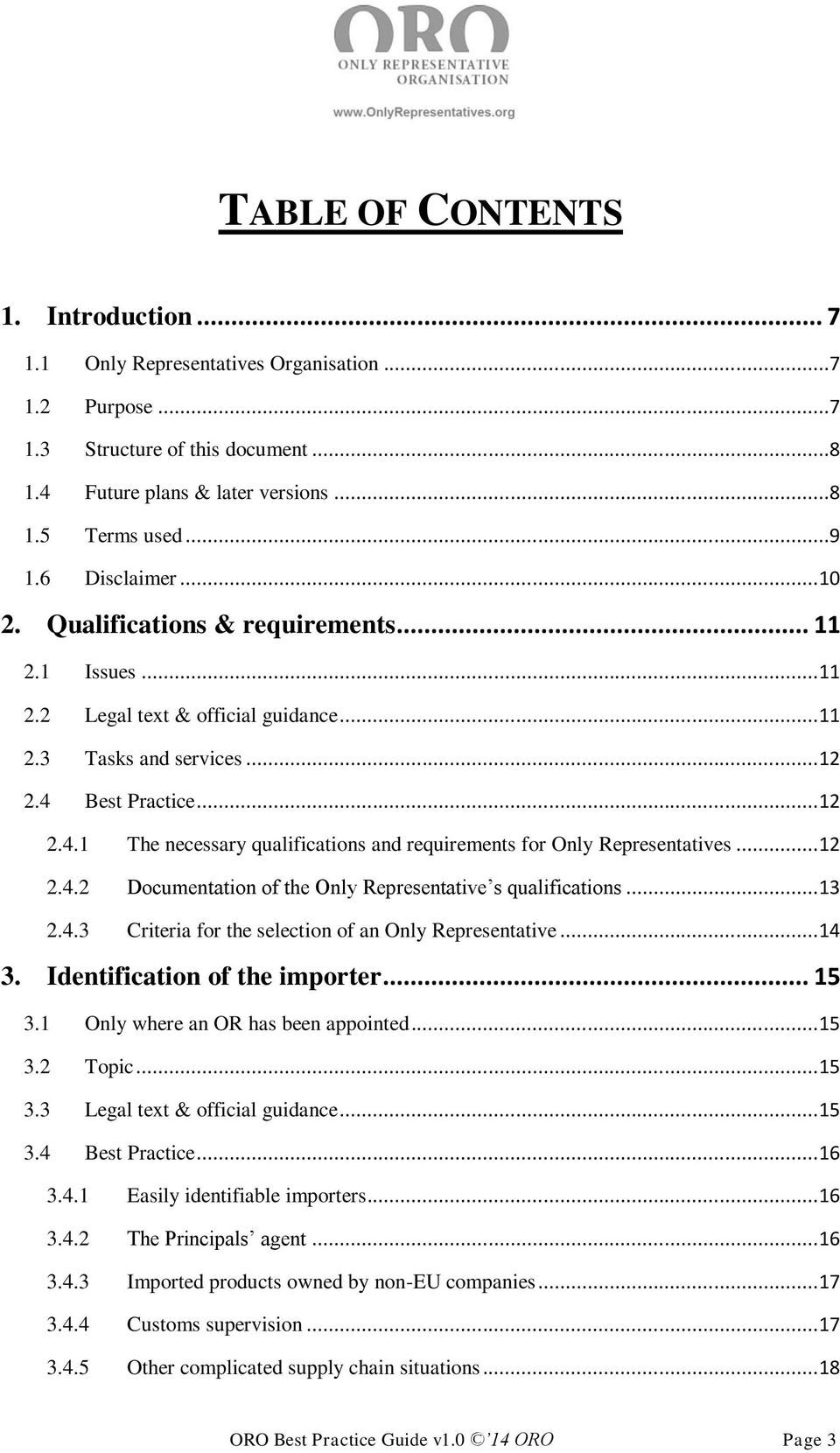
3 TABLE OF CONTENTS 1. Introduction Only Representatives Organisation Purpose Structure of this document Future plans & later versions Terms used Disclaimer Qualifications & requirements Issues Legal text & official guidance Tasks and services Best Practice The necessary qualifications and requirements for Only Representatives Documentation of the Only Representative s qualifications Criteria for the selection of an Only Representative Identification of the importer Only where an OR has been appointed Topic Legal text & official guidance Best Practice Easily identifiable importers The Principals agent Imported products owned by non-eu companies Customs supervision Other complicated supply chain situations ORO Best Practice Guide v ORO Page 3
4 4. Volume tracking Topics Legal text & official guidance Distinction between different situations Full or partial coverage of the Principal s imports Substances on their own, Common mixtures and Proprietary mixtures Best Practice The meaning of Up-to date Full coverage; Substances on their own & Common mixtures Full coverage: Proprietary mixtures & confidentiality Partial coverage of imports The principal does not supply timely information on quantities How long must records be kept Double registrations & pre-registrations Topic Legal text & official guidance Best practice The importer also purchases the substance from other Non EU producers Importer s purchases outside the OR arrangement Records in case of a late OR appointment Topics Legal text & official guidance Best Practice Quantities preceding the late appointment of an Only Representative SME claims Topics Legal text & official guidance Company Size Determination ORO Best Practice Guide v ORO Page 4

5 7.4 Best Practice Initial Client engagement Periodic Confirmation of Company Size Confirmation prior to Registration of Substance Verification Process Contractual arrangements Safety Data Sheets Topics Legal text & guidance Definitions Best Practice Availability of Safety Data Sheets in the supply chain Supply of Safety Data Sheets by an Only Representative Sharing information Registration numbers on Safety Data Sheets for mixtures Dissemination records New hazard information or new harmonised classification Contractual arrangements between OR and Principal Communications with Downstream Users Topics Legal text & official guidance Best Practice Appointment and Downstream User Contact Details Identified Uses: Registration on the Basis of a Letter of Access to an existing joint submission Identified uses: Registration dossier prepared by the Only Representative Previously unknown risk to human health or the environment Unsolicited downstream user communications ORO Best Practice Guide v ORO Page 5

6 LIST OF ANNEXES Annex 1 Annex 2 Annex 3 Annex 4 Annex 5 Documents required for SME verification. Overview of the legal text and Guidance mentioning Downstream User communications. ORO Position Paper Only Representatives and Safety Data Sheets. Commission letter to an ORO member regarding the OR obligations with regard to Safety Data Sheets. Commission letter dd 24 April 2010, regarding the registration numbers on Safety Data Sheets. ORO Best Practice Guide v ORO Page 6

7 1. INTRODUCTION 1.1 Only Representatives Organisation The Only Representative Organisation (ORO) is the international trade association of REACH Only Representatives. Only Representatives have a role that enables non-eu companies to place their product on the EU market in accordance with Article 8 of REACH (1907/2006). ORO has (January 2014) approximately thirty members, all of which take their role seriously. The Only Representative keeps in custody his client s right to access to the European market. Reliability, competence and sense of responsibility are obvious requirements. ORO wishes to ensure that its members meet all of these requirements. For this reason, one of the fundamental qualifications and requirements for Only Representatives who are, or wish to become, members of ORO, as adopted by the ORO General Assembly, is the following: 1.2 Purpose ORO members will actively strive to work in accordance with the ORO Best Practice Guide Only a small portion of the REACH legal text is devoted to the Only Representatives role and activities. This is unlike most other roles under REACH, which are in different ways addressed in ECHA Guidance. This lack of guidance affects not only the Only Representatives, their Principals (non-eu clients) and the importers covered by their services, but also REACH inspectors. During inspections the requirements for Only Representatives are seldom clear and there are considerable national differences in the requirements that are put forward. This Best Practice Guide (BPG) is aimed at helping both the Only Representative and the REACH inspectors to know what can and should be expected from Only Representatives. It also clarifies the limits to the Only Representatives obligations and responsibilities. This Best Practice Guide informs the non-eu producers and their EU based customers. The Only Representatives Principals are shown what is required from them to enable the Only Representative to deliver the required service. The importers/downstream users are shown what they can, and cannot, expect from an Only Representative. The purpose of this Best Practice Guide is to provide a de facto standard for the work of all Only Representatives, including those who are not ORO members. The BPG is available on the public access part of the ORO website. All those with an interest in the work of Only Representatives are encouraged to download, read and use the document. Updates and additions will be announced and published on the ORO web site. For each identified issue this guide provides Best Practice; a recommended way in which to address the issue. In practice other methods may exist that obtain the same result. Where this is the case, there is no objection against employing these other methods. ORO Best Practice Guide v ORO Page 7

8 1.3 Structure of this document In this ORO Best Practice Guide each chapter addresses a specific topic. The most urgent topics are addressed in this first release of the BPG. Additional chapters on other topics will follow in the near future. All chapters have the same format and contain at a minimum the following sections: Topic A short description of the topic addressed in the chapter and the issues at play. Legal text & Official Guidance A list of subjects for which Best Practice is recommended. The most relevant parts of legal text. Where applicable a reference to a relevant legal analysis or ORO position paper. The most relevant parts of ECHA Guidance Documents. Relevant correspondence from the European Commission, ECHA or other authorities. Best Practice A short description of the issue or topic Best Practice recommendations. References to other chapters in the Best Practice Guide. Occasionally, where necessary for a good understanding, more sections have been added. 1.4 Future plans & later versions ORO plans to complete this Best Practice Guide in the near future. The Guide will also be updated regularly. Users are advised to visit the ORO web site regularly to ensure that they have the latest version. Users of this BPG in need of further clarification or wishing to suggest changes or additions are requested to contact ORO at [email protected] ORO Best Practice Guide v ORO Page 8

9 1.5 Terms used Some terms used in this Best Practice Guide have a specific meaning; these are defined below. Unless indicated differently other REACH terms are used as defined in the legal text. Downstream User Principal European Union, EU, Non-EU & EU based Substance on its own Common mixtures Proprietary mixtures Late OR appointment To compile a Safety Data Sheet To provide or supply a Safety Data Sheet The supplier of a Safety Data Sheet Unless indicated differently this means an Importer who, because of the appointment of the Only Representative, is regarded as a Downstream User in accordance with REACH Art.8. The non-eu based manufacturer of substances, mixtures or articles who is a customer of the Only Representative and who has appointed the Only Representative in accordance with REACH Art.8. Although REACH applies also in Norway, Iceland and Liechtenstein, these terms are used for the sake of brevity. European Union, EU and EU based include these countries and non-eu excludes them. Substance not being part of a mixture. Mixtures such as denatured ethanol or blended motor fuels. Their composition often conforms to industry standards and is not confidential. They can be purchased from several different producers, in the same way as most substances on their own. Mixtures that can only be purchased from one single producer and are easily recognisable as such, both in documentation and physically and often also in packaging. Refers to the situation where, until the appointment of the Only Representative, importers have themselves fulfilled their REACH obligations. After the OR appointment these obligations are transferred to the OR. Making a Safety Data Sheet. Can be done by an authoring service. If the compiler of the Safety Data Sheet is different from the supplier, the company, department or person that has compiled the Safety Data Sheet may be identified under section 16 in the SDS. The responsibility for the supply of the Safety Data Sheet remains with the supplier of the substance or mixture to which the Safety Data Sheet relates. Answering to the legal requirement of REACH Art.31. To Provide a Safety Data Sheet means the same as to Supply a Safety Data Sheet. The person or company who provides the SDS. This must be the same as the supplier of the product to which the SDS relates. The supplier of the Safety Data Sheet is identified as such under section 1.3 of the Safety Data Sheet. ORO Best Practice Guide v ORO Page 9

10 Distribution of Safety Data Sheets Making the Safety Data Sheets available to those needing them. Can be done on paper, as a computer file, via a web site or in another convenient way. Distribution can be done by a service provider on behalf of the supplier. The distributor of the SDS need not be the supplier of the SDS. 1.6 Disclaimer The Only Representative Organisation, the authors and editors have done everything reasonably possible to avoid mistakes and to ensure that the recommendations in this Best Practice Guide are correctly based upon the legal text, commonly accepted interpretation of the legal text and, unless indicated otherwise, the most recent versions of the applicable ECHA Guidance Documents. The reader is however reminded that the text of the REACH regulation is the only authentic legal reference. Neither the Only Representatives Organisation nor the authors or editors are in any way liable for any incorrectness or incompleteness in this Best Practice Guide. ORO Best Practice Guide v ORO Page 10
11 2. QUALIFICATIONS & REQUIREMENTS 2.1 Issues The Only Representative is the representative of a non-community producer and therefore, his reliability, competence and sense of responsibility reflect on the reputation of his non-eu client. It is an important decision for a non-community producer to choose the right Only Representative, with whom a long-term contractual relationship will be established. Mutual trust is a pre-requisite because the Only Representative keeps in custody his client s right to access to the European market. The other side of the coin is that the Only Representative is legally liable if the applicable REACH obligations are not met. His clients therefore must enable him to do his work and provide all the necessary information correctly and in a timely fashion. Non-Community manufacturers and formulators should therefore, before committing themselves, ascertain that their prospective Only Representative is competent and reliable. They should also ensure that their administrative systems can provide timely information necessary to the Only Representative. The REACH legal text and the ECHA Guidance Documents do not specify in detail the qualifications and requirements for an Only Representative. REACH Article 8(2) contains a generic statement, that the Only Representative...shall have a sufficient background in the practical handling of substances and the information related to them. This is however not further defined. Another requirement is that the Only Representative is a natural or legal person established in the European Union. This BPG chapter addresses the following: The necessary qualifications and requirements for Only Representatives. Documentation of the Only Representative s qualifications Criteria for the selection of an Only Representative 2.2 Legal text & official guidance REACH Art.8.2. To this end, he shall have a sufficient background in the practical handling of substances and the information related to them and,. ECHA Guidance Document on Registration: Only Representative of a non-eu manufacturer Who can be an only representative? An Only Representative is a legal entity established in the EU which has sufficient background in the practical handling of substances and the information related to them to be able to fulfil the obligations of importers. ORO Best Practice Guide v ORO Page 11

12 ECHA FAQ: 17 What is meant by the sufficient background of an only representative? There are no detailed requirements or criteria regarding what is regarded as sufficient background in the practical handling of substances and the information related to them, other than what is laid down in Article 8(2) of REACH. 2.3 Tasks and services The legal text, the ECHA Guidance documents and the ECHA Helpdesk do not further define the necessary qualifications and requirements for Only Representatives. These necessary qualifications and requirements can however be derived from the tasks and services of an Only Representative. They are partly based on the legal requirements and partly on the service agreement with his Principal. Due to his position the Only Representative is often the most important REACH adviser and service provider to his Principal. Tasks and services of an Only Representative may, but do not necessarily always, include: Advising his principal, the non-community manufacturer or formulator, on REACH to enable correct REACH-implementation; Secure handling of confidential information and data; Establishing, managing and maintaining REACH-IT accounts; Submitting pre-registrations, inquiries, registrations, C&L notifications, PPORDs and authorization dossiers; Keeping correct and up-to-date records of substances, documentation, imported and re-imported quantities and importer contact details, including those in complex non-eu supply chains; The Only Representative may also Confirm the Downstream User status to EU Importers for the covered substances and issue REACH compliance certificates to Downstream Users and customs authorities; Ensure the distribution and compliance of Safety Data Sheets; Verify appropriate Company Size selection by the Principal Communicate with ECHA, enforcement authorities, SIEFS, consortia and actors in the Principal s supply chain; 2.4 Best Practice The necessary qualifications and requirements for Only Representatives Because no satisfactory requirements regarding the qualifications and requirements for an Only Representative exist, ORO has established quality standards for its members. These are minimum criteria which every ORO member company (except Associated Members) must meet: ORO Best Practice Guide v ORO Page 12

13 Best Practice is therefore: Only Representatives should adhere to the ORO Membership-criteria, which are the following: ORO Members, with the exception of associate Members, must be active as Only Representatives under REACH Article 8 and shall: Be in compliance with REACH Article 8 requirements; Have a clear understanding of REACH and the applicable regulatory and administrative processes Be competent in handling large amounts of data, including confidential information. Employ competent people with relevant technical qualifications and experience. Have a permanent physical presence of at least one competent person in the EU. (There is no objection against the operation of a back-office in a non-eu country.) Have a Sustainability Process in place, which adequately addresses the risks for the non-eu Producer in case of bankruptcy or long lasting absence of key personnel. Have a professional liability/indemnity insurance specifically covering the Only Representative activities. Promote the good reputation of Only Representatives generally through proper behaviour, active communications with parties and professional execution of services Actively strive to work in accordance with the ORO Best Practice Guide Cooperate fully where his Principal wishes to transfer to another Only Representative or to move the REACH obligations to an importer, unless there are compelling circumstances to do otherwise. Not use contact details of registrants, pre-registrants, notifiers or other submitters of information obtained from REACH IT for promotional or marketing purposes Documentation of the Only Representative s qualifications The Only Representative must be able to demonstrate that they are established in the European Union and comply with the ORO Membership Criteria. Best Practice is therefore for the Only Representative to have available for prospective Principals: Official Certificate of the Only Representative s establishment in the Community (e.g. from a Commercial Register); Proof of an insurance policy covering Only Representative business; Proof of expertise and qualification of Only Representative s employees, e.g. through CVs and résumés of key staff; Confirmation through self-declaration of the operation of a robust administrative systems to fulfil the tracking obligations and for secure data storage; Availability of a draft contract for review which is reasonable and fair Please note: What the requirements are for a reasonable and fair contract, will be addressed in a future chapter of the Best Practice Guide. ORO Best Practice Guide v ORO Page 13

14 2.4.3 Criteria for the selection of an Only Representative As mentioned above, Non-EU manufacturers should, before committing themselves, ascertain that their prospective Only Representative is competent and reliable. Membership of ORO, though much appreciated, is not a pre-requisite, but answering to qualifications and requirements for Only Representatives is. Best Practice is therefore that the non-eu producer ascertains that the prospective Only Representative: Is a member of ORO or at least actively strives to work in accordance with this Best Practice Guide; Provides appropriate documentation on his qualifications upon request; Has available a draft for the Only Representative contract that is fair and reasonable. ORO Best Practice Guide v ORO Page 14

15 3. IDENTIFICATION OF THE IMPORTER 3.1 Only where an OR has been appointed Where an Only Representative has been appointed, the pre-registration and registration obligations rest with the Only Representative. The Importers no longer have these obligations as long as they feature correctly in the Only Representative s records. 3.2 Topic This chapter only addresses the identification of the importer under REACH for situations where an Only Representative has been appointed. This chapter does not necessarily provide an answer to the question of who is to be regarded as the Importer in situations where no Only Representative has been appointed, and who in that situation as a consequence has the obligations to register or pre-register the imported. Importers of substances or mixtures have considerable obligations under REACH. Where a non-eu manufacturer or formulator has appointed an Only Representative, these obligations are transferred from the Importers to the Only Representative. The Only Representative must record which importers are covered by his activities. (For the quantities that need to be recorded see chapter 4: Volume tracking ) This must be done to the satisfaction of enforcement authorities. This ensures that both his Principal s customers and the other actors in the supply chain are secure in relying on the registrations and pre-registrations submitted by the Only Representative. The importer is not necessarily the same legal entity in whose name customs are cleared. Import is the introduction into the customs territory of the Community ; and the customs territory of the Community includes the territory of all the EU Member States, their air space and their territorial waters. The following is addressed in this chapter: Easily identifiable importers The Principal s agent Imported products owned by non-eu companies Customs supervision Other complicated supply chain situations 3.3 Legal text & official guidance REACH Art.8 1. A natural or legal person established outside the Community. may. appoint a natural or legal person established in the Community to fulfil, as his only representative, the obligations on importers under this Title. 2. The representative. without prejudice to Article 36, shall keep available and up-todate information on quantities imported and customers sold to,.. ORO Best Practice Guide v ORO Page 15
16 3. the non-community manufacturer shall inform the importer(s) of the appointment. These importers shall be regarded as downstream users for the purposes of this Regulation. ECHA Guidance on Registration (V2.0 May 2012) Page 19 & Who is responsible for the registration in case of import? The responsibility for import depends on many factors such as who orders, who pays, who is dealing with the customs formalities, but this might not be conclusive on its own. For example, in the case of a sales agency established in the EU and acting as an intermediary, i.e. transmitting an order from a buyer to a non-eu supplier (and being paid for that service) but taking no responsibility whatsoever on the goods or the payment for the goods and not having their ownership at any stage, then, the sales agency is not to be considered as the importer for the purposes of REACH. The sales agency is not responsible for the physical introduction of the goods. In many instances it will be the ultimate receiver of the goods (the consignee) who is the legal entity that is responsible for the import. However this is not always the case.. (Example). It is important to note that the non-eu manufacturer or supplier who is exporting a substance or mixture into the EU has no responsibilities under REACH. The shipping company that is transporting the substance or mixture normally has no obligations under REACH either. Exceptions may occur under specific contractual arrangements if the shipping company is established in the EU and if it is responsible for the introduction of the substance into the EU. In addition, it should be noted that when interpreting the term importer according to the REACH Regulation, it is not possible to fall back upon the Community Customs Code (Regulation (EEC) No 2913/92) or the INCOTERMS. 3.4 Best Practice Easily identifiable importers The most common situation is that the importer is clearly identifiable. This is the case where one EU based company orders products from the Principal, pays for the goods, has ownership of and authority over the products and decides where they should be stored or delivered. Best Practice is therefore the following: Where one EU based company orders products from the Principal, pays for these products, has ownership of and authority over the products and decides where they should be stored or delivered, this company is to be considered the importer under REACH. o Where the importer can thus easily be identified, there is no need for separate agreements or a specific mention of the importer s contact details in the documents accompanying the importation of the products The Principals agent The Only Representatives Principal may employ a sales agent. For good reason ECHA Guidance warns explicitly that such agents cannot automatically be considered to be the importer. Sales ORO Best Practice Guide v ORO Page 16

17 agents often do not have ownership and authority over the imported products and are not actually responsible for the importation. Where an agent may not be regarded as being the importer, someone else must be the importer. Upstream there is only the Principal, who is non-eu based and therefore by definition cannot be the importer. Lacking other likely candidates, the first EU based owner of the imported products is the most likely to be considered the importer in case of an inspection. Best Practice is therefore: Where the Principal employs an agent, this agent shall only be considered the importer under REACH if, when the products arrive in the EU, he actually has ownership of, and full authority over, these products. Where the Principal s agent does not meet the requirement above, the first EU based owner of the products is to be considered the importer under REACH Imported products owned by non-eu companies Non-EU companies, by definition, cannot be the importer under REACH. Frequently, however, non-eu based companies still own the chemicals after they have entered the EU. The Only Representatives Principal may himself still be the owner, or some other non-eu company to whom the product has been sold. Often, but not always, these products remain under customs supervision until some EU based company purchases them. In this case, even though there has been import (the product has entered the EU customs area), there is not yet an importer. As a result, the importer in this case must be found further down the supply chain. Best Practice is therefore: Where the Principal s products remain temporarily under his ownership and responsibility after they have physically entered the EU, the first EU based company later owning the products should be identified as the importer. o In this case the documents accompanying the Principal s products should clearly state the contact details of the Only Representative, to ensure that actors further down the supply chain can be certain that the REACH obligations for the substances in the products have been met. Where the products are present in the EU, but have been sold to another non-eu company the first EU based company in the supply chain owning the product should be identified as the importer under REACH. o In this case the second non-eu owner must disclose the contact details of this first EU based owner of the products to the Only Representative. If the second non-eu owner does not wish to disclose these contact details, the Only Representative cannot cover these imports. A separate confidentiality agreement between Only Reprsentative and the second non-eu owner may solve the issue Customs supervision Where chemicals are under customs supervision, REACH does not apply unless they are treated or processed. Bulk chemicals, such as fuels, are however often blended with other substances while under customs supervision. In this situation REACH does apply, but no importer can yet be ORO Best Practice Guide v ORO Page 17

18 identified and it could therefore be unclear who is responsible for REACH compliance. However, since an Only Representative has been appointed, the REACH obligations can be fulfilled. Best Practice is therefore: When a Principals products, introduced to the EU but still owned by the Principal, are being treated or processed under customs supervision, the Only Representative should encourage his Principal to ensure that REACH obligations are met even in advance of the identification of the first EU based customer. o For example: blending with registered or preregistered substances only, availability of appropriate Safety Data Sheets etc. Where in accordance to the above it is ensured that REACH obligations are met in advance of the identification of the first EU based customer, the documents accompanying the Principal s products should clearly state the contact details of the Only Representative Other complicated supply chain situations In practice there will be more complicated situations in the supply and transportation chain than addressed above. In such cases the Only Representative and his Principal should decide on a case by case basis who is the importer. Best Practice is therefore: In complicated supply chain situations not addressed in this chapter, the Only Representative, helped by his Principal, should decide which EU based company is to be considered to be the importer. In doing so they should stay as close as possible to the Best Practice recommendations given in the sections above. Where a case by case decision is needed it should be formally agreed who in the supply chain will be on the Only Representative s records as the importer under REACH. This agreement should be between the Principal and this importer. The Only Representative must be informed of this agreement. Where it is necessary to identify the importer on a case by case basis, the documents accompanying the product should mention both the contact details of this importer and the Only Representative in the documents accompanying the Principal s products. Remark: When no Only Representative has been appointed, an agreement on who should be considered the importer under REACH could be misused. For example where one single EU company holds the registration of a substance, several non-eu producers could contractually designate this particular legal entity as their importer under REACH, without actually doing business with this importer. They could thus avoid or drastically reduce the cost of registration. This misuse will however not occur where an Only Representative has been appointed, since the Only Representative is appointed by non-eu manufacturers or formulators and will hold separate registrations for all his Principals, even if they produce the same substance. This approach is therefore only suitable in situations where an Only Representative has been appointed. ORO Best Practice Guide v ORO Page 18

19 4. VOLUME TRACKING 4.1 Topics REACH calls for Only Representatives to keep available and up-to-date information on quantities imported and customers sold to. The following topics are addressed in this chapter: Distinction between full and partial coverage of the Principal s imports Distinction between substances on their own, common mixtures and proprietary mixtures The meaning of Up-to date Full coverage: Substances on their own & Common mixtures Full coverage: Proprietary mixtures & confidentiality Partial coverage of imports The Principal does not supply timely information on quantities How long should records be retained 4.2 Legal text & official guidance REACH Article 8: Only representative of a non-community manufacturer 2. The representative shall keep available and up-to-date information on quantities imported and customers sold to. REACH Article 36: Obligation to keep information 1. Each manufacturer, importer, downstream user and distributor shall assemble and keep available all the information he requires to carry out his duties under this Regulation for a period of at least 10 years after he last manufactured, imported, supplied or used the substance or preparation. ECHA Guidance on Registration (Version 2.0 May 2012):...it is recommended that the non-eu manufacturer provides his only representative with up to date information on the list of EU importers which should be covered by the registration of the only representative and the quantities imported into the EU. This information may also be supplied by other means (e.g. it may be notified directly to the only representative by the EU importers) depending on the arrangements made between the non- EU manufacturer and the only representative......the only representative s registration should clearly specify which quantity of the imported substance it covers be it the entire import into the EU from a given non-eu manufacturer, or only specified quantities within that total. Although the importer will receive confirmation from his non-eu manufacturer on the appointment of the only representative, he should preferably also obtain confirmation in writing from the only representative that his imported tonnage and use is indeed covered by the registration submitted by the only representative. ORO Best Practice Guide v ORO Page 19
20 ... appointment of an only representative creates the need to keep exact documentation on which imported quantities of the substance are covered by the only representative registration and which imported quantities are not. In case of import of mixtures the importers will also need to know what quantity of the substance in a mixture is covered by an only representative registration......the only representative shall keep an up-to-date list of EU customers (importers) within the same supply chain of the non-eu manufacturer and the tonnage covered for each of these customers.....the tonnage of the substance to be registered in each registration is the total of the tonnages of the substance covered by the contractual agreements 4.3 Distinction between different situations Full or partial coverage of the Principal s imports A first distinction is made between the following two situations: The Only Representative covers all the Principal s imports: The Only Representative s registrations or pre-registrations are in tonnage bands that are high enough to cover the sum of all the imports of the Principal s products. In most cases, this will be the normal situation. The Principal appoints an Only Representative to discharge all his customers (the importers) from their REACH obligations. o Where substances are registered in the > 1000 t/a tonnage band, this is automatically high enough to cover all the Principal s imports. The Only Representative covers a limited part of the imports: The OR s registrations and pre-registrations are in tonnage bands that do not fully cover the total of all the principal s products imported into the EU. This situation may, for example, occur where a bulk chemical is mostly sold to large importers who have their own registrations. The Only Representative s registrations are in this case reserved for smaller importers who have not registered the substances themselves. Remark: Complex non-eu supply chains with multiple Only Representatives involved in the import of mixtures are not addressed in this chapter Substances on their own, Common mixtures and Proprietary mixtures A second distinction needs to be made between Substances on their own, Common mixtures and Proprietary mixtures. Substances on their own: Substance not being a part of a mixture. Common mixtures: Mixtures such as denatured ethanol or blended motor fuels. Their composition often conforms to industry standards and is not confidential. They can be purchased from several different producers, in the same way as substances on their own. ORO Best Practice Guide v ORO Page 20

21 Proprietary mixtures: Mixtures that can only be purchased from one single producer and are easily recognisable as such, both in documentation and physically and often also in packaging. For the purpose of this chapter, Substances on their own and Common mixtures are treated in the same way 4.4 Best Practice The meaning of Up-to date The records of the Only Representative must be up-to-date. This is understood as being sufficiently recent to be able to determine whether the Only Representative s and importers REACH obligations are complied with and which importers are covered by his services. Best Practice is therefore: Importer contact details should be provided to the Only Representative before the first shipment to the importer arrives. For the importers, it is important that they can be certain of coverage from that moment on and can prevent potential supply chain delays. All substances together with their pre-registration and registration information should also be in the Only Representatives records before the first imports arrive. The annual quantities of the substances imported should be provided to the Only Representative in the first six months after the reporting year. If the quantities imported are indicated by the Principal as likely to surpass a tonnage band threshold necessitating a registration or a change to a registration, the Principal should quarterly provide the Only Representative with records of the imported volumes Full coverage; Substances on their own & Common mixtures In the case of Substances on their own & Common mixtures, the importer may buy the same product from other sources. The importer should therefore be able to demonstrate to the competent authorities which part of his purchases are covered by an Only Representative s registrations or pre-registrations. The importer himself is responsible for the registration or pre-registration of the other part of his purchases. Best Practice is therefore the following: The Principal provides in the first six months each year the quantity sold to each separate importer of each substance in the previous year. The Only Representative checks that the tonnage bands of his pre-registrations and registrations still adequately cover the total amount imported for each substance as provided by the Principal. o Where substances are registered in the > 1000 t/a tonnage band, this is automatically the case. No separate check is necessary The Only Representative annually records the quantities of each separate substance sold to each separate importer. ORO Best Practice Guide v ORO Page 21
22 The Only Representative or the Principal annually confirms to the importer of each separate substance the quantity sold to him according to the Only Representative s records. With this confirmation the importer can demonstrate which part of his imports are covered by the Only Representative. In case of confirmation by the Principal, the Only Representative should receive a copy of this confirmation Full coverage: Proprietary mixtures & confidentiality In the case of proprietary mixtures, the formulation of these mixtures may generally not become known to the importer. As a result the actual amount of the substances contained in these mixtures cannot be revealed to the importer. Since however these mixtures are easily recognisable as such, inspectors can still ensure that the REACH obligations for these products are adequately covered by an Only Representative. Best Practice is therefore the following: The Principal provides to the Only Representative annually the total quantity sold in the Community for each of the substances in his mixtures which the Only Representative shall record The Only Representative checks that the tonnage bands of his pre-registrations and registrations still adequately cover the total amount imported for each substance. o Where substances are registered in the > 1000 t/a tonnage band, this is automatically the case. No separate check necessary. The Principal provides the Only Representative with a list of the product names of the mixtures sold in the EU. The Only Representative annually confirms to the importer which of the Principals products are covered by him. With this confirmation the importer can demonstrate that his imports of the proprietary mixtures are covered by the OR. o Often this confirmation will be for all the products produced by the Principal, in which case a separate listing of these products is not necessary. If the Principal fears parallel imports which are not covered by the Only Representative, he may provide the Only Representative with the quantities and product names of all the separate mixtures (not substances) sold to each separate importer. The Only Representative should then confirm these quantities for each separate product to the importer Partial coverage of imports Where the Only Representative covers only a part of the imports originating from a Principal, care must be taken that those imports covered by the Only Representative can be clearly distinguished from those for which the REACH obligations remain with the importers. Best Practice is therefore: Where the Principal sells to importers who have their own adequate registrations, these importers should not receive the Only Representative appointment letter from the Principal or the confirmation from the Only Representative. Their contact details should not be officially recorded by the Only Representative. o There is no harm in knowing who these importers are, but from the records it should be clear that they are not covered by the Only Representative. ORO Best Practice Guide v ORO Page 22
23 Where a change takes place and an importer who was previously covered by the Only Representative no longer is, this should be communicated by the Principal to the importer and confirmed to the importer by the Only Representative. The change must be clearly recorded by the Only Representative. Where a Principal sells to an importer and only a part of these sales are covered by the Only Representative, the Principal should clearly communicate this to the importer including the maximum quantities covered by the Only Representative. The arrangement should be confirmed to the importer by the Only Representative. The Only Representative must clearly record the accompanying documentation The principal does not supply timely information on quantities For the Only Representative to fulfil his duties, it is required that information provided by the Principal is timely and adequately detailed. The Only Representative delivers his services based on the information provided to him by the Principal which is assumed to be correct and complete. Should such information fail to be provided, the Only Representative should actively engage with the principal to explain the importance of this information. If the client persists in failing to provide data, the Only Representative may consider this as grounds for termination of the mutual agreement. Should additional information become available during the year which is material to the service, the Principal has an obligation to provide this to the Only Representative. Ensuring the supply of correct, comprehensive, timely and adequately detailed information by the Principal can only be addressed in the contract between the Only Representative and the principal. If the necessary information is not available, the Only Representative may be found not in conformity of the legislation. The Only Representative should therefore actively request his Principal to provide necessary information. In doing so and keeping record of his requests, the Only Representative will be able to show the necessary due diligence. Best Practice is therefore: The supply of correct, comprehensive, timely and adequately detailed information by the Principal shall be addressed in the contract between the Only Representative and the principal. The Only Representative should annually, or more frequently if necessary, ask the Principal to provide the required information on quantities sold. Where no timely answer is received he should remind the Principal of his request. The Only Representative should keep records of his requests and reminders How long must records be kept Article 36 tells manufacturers, importers, downstream users and distributors to keep all relevant information for a period of ten years. Article 8.2 obliges Only Representatives to keep information without prejudice to Article 36 (Obligation to keep information). As a result, even though Article 36 does not mention Only Representatives explicitly, these have the same obligations as importers. ORO Best Practice Guide v ORO Page 23
24 Best Practice is therefore: The Only Representative will keep records and documents for a period of at least 10 years. Where a Principal changes Only Representative or appoints an exclusive importer, the old Only Representative continues to keep those records for the remainder of the required period, unless they are fully transferred to the new Only Representative or the exclusive importer. The new Only Representative or exclusive importer must in that case agree in writing to keep those records for the remainder of the required period. Where a Principal ceases completely to export into the EU or leaves REACH compliance to multiple importers, the Only Representative shall keep the existing records for the remainder of the required period. ORO Best Practice Guide v ORO Page 24
25 5. DOUBLE REGISTRATIONS & PRE-REGISTRATIONS 5.1 Topic Importers may have pre-registered or registered the same substance that has been pre-registered or registered by an Only Representative on behalf of a Principal. These importers may purchase the same substance from several different non-eu producers. The ECHA Guidance on Registration (Version 2.0, May 2012) currently indicates a requirement for data exchange between Only Representative and Importer which may be open to interpretation. This chapter clarifies this requirement. Where an importer, purchasing from the Only Representatives Principal has submitted a preregistration or a registration for the substance; two situations must be distinguished. The importer also purchases the substance from other Non EU producers The importer purchases the substance from the ORs Principal outside of the OR arrangement 5.2 Legal text & official guidance Legal text There is no legal text requiring the Only Representative to keep records on imports not covered for his Principal. ECHA Guidance on Registration (Version 2.0, May 2012) Section (What should a non-eu manufacturer do when appointing an only representative?) The non-eu manufacturer needs to inform all the EU importers in the same supply chain that he has appointed an only representative to conduct the registration thus relieving the importers from their registration obligations. A non-eu manufacturer can only appoint one only representative per substance. The only representative s registration should clearly specify which quantity of the imported substance it covers be it the entire import into the EU from a given non-eu manufacturer, or only specified quantities within that total. In cases where an importer is also importing quantities of the same substance from other non- EU sources, then both the only representative and the importer must be able to clearly document to enforcement authorities which imports are covered by the registration of the only representative; and which are covered by the importer; otherwise, the importer remains responsible for all his imports. In other words, an importer has to submit a registration for the quantity of a substance he imports, but does not have to cover the volume of the substance that is covered by the registration of the only representative. ORO Best Practice Guide v ORO Page 25
26 5.3 Best practice The importer also purchases the substance from other Non EU producers While the ECHA guidance could be read to indicate that the Only Representative and the Importer must be able to demonstrate to the authorities which tonnages are covered by each party, this is not the case. Instead, the OR and the Importer each have a separate obligation to demonstrate the quantity of the substance which is covered by their respective pre-registration or registration if requested by a national enforcement authority. There is, after all, no contract between the Only Representative and the Importer and the information could be commercially sensitive if it were inadvertently shared between the parties. Also this information, even if it were possible to collect it, would serve no purpose in the enforcement of REACH. The Only Representative is in no way responsible for the REACH compliance of the importer other than for the products supplied by his Principal. Best Practice is therefore: The Only Representative should for importers who also buy the same substance from other suppliers fully follow up the BPG recommendations in Section 2.1 Volume tracking. Especially those under Full coverage: Substances on their own & Common mixtures. The Only Representative should maintain all correspondence with his Principal regarding requests for importer details and import quantities, as appropriate backup documentation Importer s purchases outside the OR arrangement This subject is addressed in Chapter 4: Volume tracking and especially under Partial coverage of the imports. ORO Best Practice Guide v ORO Page 26
27 6. RECORDS IN CASE OF A LATE OR APPOINTMENT 6.1 Topics A late OR appointment refers to the situation where, until the appointment, the importers have themselves fulfilled their REACH obligations. After the Only Representative s appointment these obligations are transferred to the Only Representative. When an Only Representative is appointed late, several questions arise regarding the level of recordkeeping necessary to appropriately document import quantities, in particular since these quantities provide the basis for the tonnage band calculations and respective registration deadlines. The following is addressed in this chapter: Records of quantities marketed in the period preceding the late appointment of an Only Representative 6.2 Legal text & official guidance There is no specific legal text regarding the recording by the Only Representative of imported tonnages before his appointment. However, REACH Article 3 (30) generally defines the method to calculate tonnages: REACH Article 3 (30) per year: means per calendar year, unless stated otherwise, for phase-in substances that have been imported or manufactured for at least three consecutive years, quantities per year shall be calculated on the basis of the average production or import volumes for the three preceding calendar years. ECHA Guidance on Registration, V2.0, May 2012 Calculation of the tonnes per year for the registration of phase-in substances. In the case of a phase-in substance that has been imported or manufactured for at least three consecutive years, the tonnes per year shall be calculated on the basis of the average tonnes manufactured or imported in the three preceding calendar years. If the substance has not been manufactured or imported for three consecutive years then the tonnes manufactured or imported in a calendar year should be used. This provision has been put in place to avoid situations where a sudden increase in demand would lead to the impossibility to comply with the registration obligations. Note that in the case of pre-registered phase-in substances the tonnes per year determine the deadline for registration. Detailed examples on how to determine the tonnes per year and the registration deadline for phase-in substances are provided in section ORO Best Practice Guide v ORO Page 27
28 6.3 Best Practice Quantities preceding the late appointment of an Only Representative Whether assigned late or not, the Only Representative should if at all possible maintain records of imported volumes for a sufficient number of years to legally determine the registration deadline and the correct tonnage bands for the registrations and pre-registrations, unless the OR starts his coverage with a registration in the > 1000 t/a tonnage band. There may however be cases where this information cannot be obtained. The Principal may for example not know the previously imported quantities if previously exports to the EU were made by a non-eu distributor. Best Practice is therefore: Where the Principal knows that quantities of substances previously placed on the market in the EU have not surpassed 1 tonne per year, the Only Representative should obtain suitable written documentation of this from his Principal. This documentation should be recorded for the substances in question Where the Principal knows the quantities of substances previously placed on the market in the EU and these have exceeded 1 tonne per year, the Only Representative should obtain from his Principal the total annual import tonnages for the previous three years for each of the substances. This information should form the basis for the rolling three-year tonnage band calculations until each future year s data becomes available. o Where the OR starts his coverage for the principal with a registration in the tonnage band > 1000 t/a, there is no added value in obtaining annual import tonnages for the period preceding his appointment. o Where the Principal does not know the quantities previously placed on the market in the EU, the Only Representative is to obtain from his Principal or from the importers an estimate of the expected imports and use these as a basis to determine the need for pre-registrations or registrations. ORO Best Practice Guide v ORO Page 28
29 7. SME CLAIMS 7.1 Topics REACH has been structured to enable lower registration cost for SMEs (Small and Medium Sized Enterprises). For the sake of fair competition and equal treatment, ECHA verifies the size of companies claiming to be SMEs When an Only Representative is appointed, the company size declared by the Only Representative, must be that of his Principal; the Non-EU Company being represented. In the case of errors or failure to pass the ECHA verification process, the Only Representative will be invoiced for the resulting additional registration fee and where applicable administrative charges. It is in the Only Representative s interest to avoid where possible SME claims that are erroneous or for whatever other reason will not withstand ECHA s verification. It must pointed out that it cannot be expected from the Only Representative that he should be able to expertly interpret or review the Principal s documentation supporting his SME claim. Only Representatives are not accountants; they cannot be expected to be able to analyse the company accounts and legal documentation provided by his Principal. The Only Representative may only be expected to ensure that Principal is in the position to take the correct decision and to provide the required documentation. The SME topic is particularly relevant for Only Representatives as many of their Principals are SMEs. The following is addressed in this chapter: Company size determination Initial client engagement Periodic confirmation of company size Confirmation prior to registration of substance Verification process Contractual arrangements 7.2 Legal text & official guidance REACH Recital (8): Special account should be taken of the potential impact of this Regulation on small- and medium-sized enterprises (SMEs) and the need to avoid any discrimination against them REACH Article 3(36): SME: means small and medium-sized enterprises as defined in the Commission Recommendation of 6 May 2003 concerning the definition of micro, small and medium-sized enterprises Fee Regulation 340/2008 Article 13(3) The Agency may request, at any time, evidence that the conditions for a reduction of fees or charges or for a fee waiver apply ORO Best Practice Guide v ORO Page 29
30 Commission Recommendation of 6 May 2003 (2003/361/EC): Annex, Title 1, Article 2: Staff headcount and financial ceilings determining enterprise categories: 1. The category of micro, small and medium-sized enterprises (SMEs) is made up of enterprises which employ fewer than 250 persons and which have an annual turnover not exceeding EUR 50 million, and/or an annual balance sheet total not exceeding EUR 43 million. 2. Within the SME category, a small enterprise is defined as an enterprise which employs fewer than 50 persons and whose annual turnover and/or annual balance sheet total does not exceed EUR 10 million. 3. Within the SME category, a microenterprise is defined as an enterprise which employs fewer than 10 persons and whose annual turnover and/or annual balance sheet total does not exceed EUR 2 million. ECHA Guidance on Registration: 9.1 Applicable fees and calculation of fees When calculating the fee, the following points will be taken into consideration: the scale of fees fixed for the different tonnage bands; an SME (small and medium-sized enterprise) reduction if applicable, for this purpose the registrant will be asked to make a declaration of his status in REACH-IT; [..] Where a registration is submitted by an only representative, the size of the non-eu manufacturer is decisive for the fee and must be entered into the relevant field in REACH-IT, not the size of the only representative. ECHA checks whether companies that claimed to be SMEs and thus paid reduced fees for their registrations are indeed SMEs. Where such a verification results in a finding that the registrant was not a SME and hence not entitled to the fee reduction, he will be liable to pay the difference between the reduced fee and the full registration fee as well as an administrative charge. 7.3 Company Size Determination The SME system stems from a common methodology in the EU under the auspices of DG Enterprise (Commission Recommendation 2003/361/EC). ECHA references this methodology and provides further guidance. A considerable amount of Guidance and even an SME-test can be accessed through the following links: To determine if a company is entitled to an SME claim can be a complex process. It not only depends on its headcount, turnover and balance sheet, but also the ownership of the company and the level of inter-connectedness with other enterprises. The fact that Only Representatives deal with non-eu companies often adds to the complexity. ORO Best Practice Guide v ORO Page 30


31 This BPG does not attempt to improve on existing guidance but rather points towards the principles and the procedures that Only Representatives are recommended to follow vis-à-vis their Principals. With regard to the content of this complex subject, the reader is encouraged to familiarise themselves with above mentioned supporting guidance documents. Summary of 5 key steps to company size determination: 1. Is the company Autonomous, Linked or Partnered Linking and Partnering are defined based on the levels of ownership and other influences by/in other entities (upstream and downstream) at the time of each submission in REACH- IT. Keep in mind that indirect relationships are also to be considered. Provision is made for certain investors (Business Angels, Venture Capital Firms etc.) to hold a certain holding without affecting autonomy. 2. Reference years for Financial and Headcount Data ECHA uses the term concrete submission, interpreted as being the submission of a Registration, Update, Notification etc. The two full accounting periods immediately prior to this should be used as the basis of company size. An enterprise may lose/acquire an SME status only if the SME ceilings are exceeded/fallen below over two consecutive accounting periods and therefore two accounting periods are considered. 3. Determine Headcount, Turnover and Balance Sheet The determination of size is based on Headcount and a choice of either Turnover or Balance Sheet. 4. Overall Enterprise Data If the company is Linked or Partnered (upstream and/or downstream) at the time of the submission, the calculation of Overall Enterprise size for the non EU client must include the aggregated headcount, balance sheet total and turnover of all such linked and partnered enterprises. 5. Determine Company Size The following table defines the criteria for determination of company size. If a Principal, together with all its partner and linked enterprises, does not meet criteria below, it is considered to be large. No SME claim can be made on its behalf. ORO Best Practice Guide v ORO Page 31
32 7.4 Best Practice Initial Client engagement Initial client engagement will generally be followed by one or more pre-registrations. In this stage REACH IT already demands a declaration of company size. Although there are no consequences for the pre-registrant in the case of errors and ECHA does not check these submissions, it is important that the Only Representative s Principal declares his company size correctly. Best Practice is therefore: At the time of pre-registration the Only Representative should determine if the Principal s company could possibly be entitled to an SME claim. (If for example the headcount of the company, or the group of which it is a fully integrated part, exceeds 250 this is obviously not the case) Where the Principal may be entitled to an SME claim, the following applies: At the time of pre-registrations the Only Representative should explain to the Principal the importance of a correct SME claim and how company size is determined. The Only Representative should share the links to guidance with his Principal and encourage the Principal to do the SME-test. (For links see above). If the Principal claims to fall into an SME category, the Only Representative should request his Principal to provide confirmation of its company size based on the principles in the Guidance above. When creating a REACH-IT Account, the Only Representative should apply the company size which has been confirmed by his Principal. When the Only Representative becomes aware of a change in the company size of his Principal, he should make the appropriate change in the REACH IT account. The company size must be re-confirmed prior to submission of any substance registration through this account Periodic Confirmation of Company Size Company sizes change. But even if the Principal s company does not grow or shrink, mergers, acquisitions, change in ownership etc. may lead to a change in SME status. Both the Principal and the Only Representative should be aware of such a change in SME status. Best Practice is therefore: Where the Principal claims SME status, the Only Representative should check annually with the Principal if any changes have taken place that would lead to a change in SME status in the previous accounting period. Where a change in SME status has occurred, the Only Representative should amend the REACH IT account accordingly Confirmation prior to Registration of Substance In the case of a registration, an erroneous or non-defensible SME claim unavoidably leads to severe financial consequences. Hence it is critically important that the company size submitted is correct and defensible with documentary evidence at the time of submission. ORO Best Practice Guide v ORO Page 32
33 Best Practice is therefore: Where the Principal claims SME status, the Only Representative should, well in advance of the submission of the registration, reaffirm the importance of a correct and defensible SME claim, the necessary documentary evidence and how to determine the correct company size by direction to the relevant guidance. The Only Representative should specifically point out that a change in the ownership structure may result in a change in SME status. The Principal is to submit to the Only Representative, a confirmation of company size and to provide supporting factual and official documentation to this effect before the registration is submitted. (For the documents required see Annex 1 to this BPG) o If the Principal is not claiming SME Status, no documentary evidence is required. Failure of the client to adequately confirm the company size or to provide the actual supporting documentation should prompt the OR to defer the submission or to submit the Registration under a Large company designation The OR should check that the company size is set correctly in REACH-IT and the associated Legal Entity prior to each submission Remark: As pointed out earlier, it cannot be expected from the OR that he should be able to expertly interpret or review the supporting documentation. The Only Representative may only be expected to ensure that Principal is in the position to take the correct decision and that he provides the required documentation Verification Process Verification by ECHA is triggered pursuant to substance registration (or any other chargeable submission activity) when an SME status is claimed. The Only Representative will be approached by ECHA as part of a verification process where SME status has been claimed. It is the Only Representative s task to be a professional liaison between ECHA and his Principal and ensure that the verification process is properly managed and that the timelines are realistic and achievable. ECHA has over the past years refined the requirements in documentation for SME verification. Although the Principal should already have provided the Only Representative with SME documentation at the time of registration, this documentation may not be exactly what ECHA requires at the time of verification. In the case of an SME check by ECHA, Best Practice is therefore: The Only Representative should engage with the Principal to explain the verification process and the additional evidence-based documentation which is required to ensure a successful outcome of the ECHA verification. The Only Representative should check the documentation received from the Principal at the time of the registration against the documentation required for verification, inform the Principal of any discrepancies and request the additionally required documents. Where timelines set by ECHA are too tight and not achievable, the Only Representative should ask for an appropriate extension. ORO Best Practice Guide v ORO Page 33
34 The Only Representative should, with full engagement with the Principal, follow through the process to its conclusion and ensure that any resulting financial transactions are executed correctly, thereby ensuring continued market access for the Principal. The Only Representative should check all other dossiers which may have been submitted for this Principal for their SME validity and, after having obtained his Principal s permission, inform ECHA if any discrepancies are identified Contractual arrangements With regard to SME claims, the Only Representative is completely dependent on the information provided by his Principal. There must be no misunderstanding between Principal and Only Representative about the need for SME claims to be correct and the consequences when an SME claim is erroneous or for whatever other reason will not withstand ECHA s verification. Best Practice is therefore: The contract between Only Representative and Principal should clearly reflect the Best Practice recommendations in this chapter, the Principal s ultimate responsibility and the fact that the consequence of an erroneous SME claim may be that the registration in question will be declared void. ORO Best Practice Guide v ORO Page 34
35 8. SAFETY DATA SHEETS 8.1 Topics In the early days of REACH the responsibilities of Only Representatives with regard to Safety Data Sheets have been much discussed. The ORO position paper and a Commission communication to one of the ORO members have however clarified the issues. Although the legal obligations of the Only Representative with regard to Safety Data Sheets are small, Best Practice is that where necessary he takes a role in the compilation and distribution of these documents. For communications with Downstream users, see chapter 9 Downstream user Communications. The following is addressed in this chapter: Availability of Safety Data Sheets in the supply chain Supply of Safety Data Sheets by an Only Representative Contractual arrangements between OR and Principal Sharing information Registration numbers on Safety Data Sheets for mixtures Dissemination records New hazard information or new harmonised classification 8.2 Legal text & guidance The legal obligations of Only Representatives with regard to Safety Data Sheets are subject of the ORO Position Paper Only Representatives and Safety Data Sheets of June The Position Paper is attached as Annex 3 to this BPG. Two Commission letters are relevant to this chapter. They are attached as annexes to this BPG: Annex 4: Letter to an ORO member regarding the OR obligations with regard to Safety Data Sheets Annex 5: Letter dd 24 April 2010, regarding the registration numbers on Safety Data Sheets 8.3 Definitions In the REACH legal text, its annexes and the ECHA Guidance Documents, the choice of words regarding Safety Data Sheets is not always consistent. For the purpose of this chapter the following is meant: ORO Best Practice Guide v ORO Page 35
36 To compile a Safety Data Sheet To provide or supply a Safety Data Sheet The supplier of a Safety Data Sheet Distribution of Safety Data Sheets Making a Safety Data Sheet. Can be done by an authoring service. If the compiler of the Safety Data Sheet is different from the supplier, the company, department or person that has compiled the Safety Data Sheet may be identified under section 16 in the SDS. The responsibility for the supply of the Safety Data Sheet remains with the supplier of the substance or mixture to which the Safety Data Sheet relates. Answering to the legal requirement of REACH Art.31. To Provide a Safety Data Sheet means the same as to Supply a Safety Data Sheet. The person or company who provides the SDS. This must be the same as the supplier of the product to which the SDS relates. The supplier of the Safety Data Sheet is identified as such under section 1.3 of the Safety Data Sheet. Making the Safety Data Sheets available to those needing them. Can be done on paper, as a computer file, via a web site or in another convenient way. On behalf of the supplier, distribution can be done by a service provider. The distributor of the SDS need not be the supplier of the SDS. 8.4 Best Practice Availability of Safety Data Sheets in the supply chain In the case of hazardous substances or mixtures being imported into the EU, the legal obligation to supply a REACH compliant Safety Data Sheet applies when the substance or mixture is placed on the EU market by the importer. This however places the obligation to compile REACH Compliant Safety Data Sheet in the hands of an actor (the importer) in the supply chain who may not have the necessary information and knowledge. Where this is the case, it is highly preferable that the non-eu producer of the hazardous substance or mixture provides the importers with REACH compliant Safety Data Sheets. The Only Representative should encourage the compilation of such REACH compliant Safety Data Sheets by their Principal for supply onto the EU market. Best Practice is therefore: An Only Representative should encourage its Principal to compile REACH compliant Safety Data Sheets and to provide these to the importers, unless the importers can be expected to correctly compile the Safety Data Sheets themselves. Where the Principal cannot be expected to correctly do so himself, the Only Representatives should offer to facilitate the compilation and distribution of Safety Data Sheets. He may for example assist the Principal in finding an SDS authoring service, review the SDS and advise on areas of non-compliance, or advise on a REACH-compliant system for distributing SDSs to downstream users or offer such a system himself. ORO Best Practice Guide v ORO Page 36
37 8.4.2 Supply of Safety Data Sheets by an Only Representative The Only Representative has no legal obligation to supply Safety Data Sheets for the hazardous substances or mixtures exported to the EU by the principal. Note: Where Only Representatives themselves place hazardous substances or mixtures on the market in the EU, they do this in an additional role under REACH. For example the role of Importer, Downstream User or Distributor. In that additional role they may very well have the obligation to provide a Safety Data Sheet. These additional roles are however not subject of this Best Practice Guide. If an Only Representative were the provider of the Safety Data Sheet and identified as such under section 1.3, this would impose legal duties onto the Only Representative for the content, update and distribution of the SDS to EU Downstream Users. Also, under national legislation, it would bring about considerable liabilities in the case of a mistakes in the Safety Data Sheet or if the Safety Data Sheet and the product that it refers to do not match. Best Practice is therefore: An Only Representative shall not be named as the provider or supplier of Safety Data Sheet, unless explicitly agreed differently with his Principal. Where an Only Representatives compiles a Safety Data Sheet for his principal or for an importer, the principal or the importer shall be identified as the supplier of the document. The Only Representative shall be clearly identified as being the appointed Only Representative. This information may be provided in section 1.3. The OR s contact details may be provided in section Sharing information Where an Only Representative has registered a hazardous substance, he holds the Chemical Safety Report (CSR) and therefore the information necessary to compile the extended Safety Data Sheet for that substance. If the Principal or an importer wishes to compile an extended Safety Data Sheet for the substance, they should have access to content of the CSR. There may however be cases where the Letter of Access contains stipulations that prevent the supply of the original CSR to a 3 rd party. In such a case the Only Representative would be in breach of a contract if he were to distribute the original CSR to either his Principal or an importer. Best Practice is therefore: Where an Only Representative has registered a hazardous substance of which the LoA does not restrict the distribution of the CSR and his Principal or an importer wishes to make an extended Safety Data Sheet for the substance, the Only Representative will provide them access to the content of the CSR. Where the LoA restricts the distribution of the CSR, the Only Representative may offer to extract from the CSR the information necessary to produce the esds, or alternatively produce the esds himself. o Depending on the contractual relationship between Only Representative and Principal, the Only Representative may require the Principal s permission before providing an importer with access to the CSR. ORO Best Practice Guide v ORO Page 37
38 8.4.4 Registration numbers on Safety Data Sheets for mixtures In accordance with REACH Annex II the last four digits of the registration numbers for the hazardous substances in mixtures may be omitted in the Safety Data Sheet for the mixture under certain conditions. This possibility exists for the benefit of EU based formulators who do not wish to identify their suppliers or who wish to source the same substance from different suppliers. Where this possibility is used, the formulator must, upon request, provide the full registration numbers to competent authorities within seven days. The same possibility is open to Only Representatives and their Principals. Since the Principal has no obligations under REACH, the Only Representative will have to provide the full registration number to the Competent Authority if requested. The Only Representative will, resulting from his obligation to keep records, know the registration numbers of the substances. He may however not know which registration number applies to the substance in a certain batch of an imported mixture. Best Practice is therefore: Where the Principal is a producer of mixtures and uses the possibility to omit the last four digits of the registration numbers of the substances in the mixture, the Only Representative must ensure that the Principal can provide him without delay with the full registration numbers of the substances used to produce a certain batch of a mixture. In such a case the Only Representative should have copies of the Safety Data Sheets as distributed by the Principal to the importers. Remark: This situation will only occur in complex supply chains where the substances have not been registered by the OR of the non-eu formulator. Where the OR of the non-eu formulator has registered the substance in question, the registration number does not identify the Manufacturer/Importer of the substance, but the Only Representative. The non-eu formulator may source the same substance from different suppliers under this registration number Dissemination records Where the importer provides Safety Data Sheets, he is obliged to keep a record of their dissemination. Where the Principal provides Safety Data Sheets, he is under no obligation to record their dissemination. It is however highly preferable if these records are kept adequately and are available in the EU. Best Practice is therefore: Where the Principal provides Safety Data Sheets, the Only Representative should encourage him to keep adequate records as intended under Art.31 REACH. Where the Principal keeps records of the dissemination of Safety Data Sheets he should be encouraged to provide the Only Representative with access to these records New hazard information or new harmonised classification The Only Representative may become aware of new hazard information or new harmonised classification concerning a hazardous substance featuring in a Safety Data Sheet that is provided to the importers by his Principal. ORO Best Practice Guide v ORO Page 38
39 As a consequence it may be necessary to adapt the Safety Data Sheet to the new information. The Only Representative should in such a case inform his Principal and encourage him to arrange for the necessary adaptation of the Safety Data Sheets. Best Practice is therefore: Where an Only Representative becomes aware of new hazard information or new harmonised classification of a substance featuring on a safety Data Sheet provided by his Principal, the Only Representative should inform his Principal and encourage adaptation of the Safety Data Sheet if necessary, Please note: for other possible consequences of becoming aware of new hazard data, such as informing the Lead registrant or an update of the registration dossier, see Chapter 9 on Downstream User Communications Contractual arrangements between OR and Principal There must be no misunderstanding between Principal and Only Representative with regard to the compilation and supply of Safety Data Sheets. Best Practice is therefore: The contract between Only Representative and Principal should clearly reflect the Best Practice recommendations above under Supply of Safety Data Sheets by an Only Representative. ORO Best Practice Guide v ORO Page 39
40 9. COMMUNICATIONS WITH DOWNSTREAM USERS 9.1 Topics There are several situations in which Only Representatives must communicate with the customers of their Principal, the Downstream Users. Remark: For the avoidance of doubt; in this chapter Downstream Users are the Importers which are regarded Downstream Users as a result of the appointment of the Only Representative. This chapter addresses the communication with Downstream Users, other than the communication on quantities of chemicals imported and Safety Data Sheets. For quantities see chapter 4 Volume tracking. For safety Data Sheets see chapter 8 Safety Data Sheets. The following situations are addressed: Appointment and Downstream User contact details. Identified uses: Registration on the basis of a Letter of Access. Identified uses: Registration dossier prepared by the Only Representative. Substances posing a previously unknown risk to human health or the environment. Unsolicited downstream user communications: o SDS request o New hazard data 9.2 Legal text & official guidance Downstream users and the communication with them is mentioned numerous times in the legal text and the ECHA Guidance. The communications between Only Representatives and the importers now regarded as Downstream Users is however hardly mentioned. For an overview of the legal text and Guidance mentioning Downstream User communications, see Annex 2 of this BPG 9.3 Best Practice Appointment and Downstream User Contact Details It is important that it is established beyond doubt from which importers the Only Representative takes over REACH obligations and who, consequently become de facto Downstream Users. Clarity is needed for the importers in question, the Only Representative, and the enforcement authorities. For cases where it is not obvious who is the Importer under REACH, see Chapter 3 Identification of the importer. According to REACH Art. 8.3, the non-community manufacturer must inform the importers within the same supply chain, (i.e. his EU-based customers) of the appointment of the Only Representative. ORO Best Practice Guide v ORO Page 40
41 Best Practice is therefore the following: The Only Representative should receive copies of the letters of his nomination as sent by the Principal to his EU-based customers. This enables the OR to check and keep current his own list of importers/downstream users. Although the Downstream User receives a letter of nomination of an Only Representative coming from the non-eu manufacturer, the Downstream User should also receive a written confirmation of this appointment from the Only Representative. The confirmation by the Only Representative should name the Principal, the products covered and the fact that, where necessary, registrations or pre-registrations have been submitted in the appropriate tonnage bands. It is essential to identify clearly the imports for which the Only Representative is responsible. The Only Representative will maintain a current list of all Downstream Users for each Principal and their contact details. Later correspondence with the Downstream Users should be used to keep this information up to date Identified Uses: Registration on the Basis of a Letter of Access to an existing joint submission Registrations on the basis of a Letter of Access take place when a consortium has already finished the dossier and it has been submitted by the Lead Registrant. This is in most cases the preferred solution. Not only because there is a legal obligation to submit joint registration whenever possible, but also for cost reasons. Making a registration dossier from scratch is generally much more expensive and time consuming than buying access to an existing joint submission. This Lead Registrant s dossier normally addresses all the foreseeable uses. The consortium will have communicated with users of the chemicals. As a result, it is for the Only Representative a matter of checking whether the uses of the importers are adequately covered by the Lead Registrant dossier. In most cases, the Chemical Safety Report (CSR) in registration dossiers for which Letter of Access (LoA s) are sold cover all the known uses of the registered substance. Sometimes however, for the same substance, Letters of Access are available for different dossiers, drafted by different consortia and submitted by different Lead Registrants. These different dossiers may cover different sets of uses. Occasionally, the use of a Downstream User is unusual and not covered by a Lead Registrant dossier. A registration that does not fully cover the uses of the Principal s EU-based customers must be avoided. The Only Representative will, in some cases, be in a position to determine that the Downstream Users uses are adequately covered without communication with his Principal or the Downstream Users. This may, for example, be the case with fuels, monomers in a polymer, components in proprietary mixtures, etc. ORO Best Practice Guide v ORO Page 41
42 Downstream Users uses not self-evident. Where the Downstream Users uses are not self-evident Best Practice is the following: Where a LoA to an existing dossier is used for a registration and the Downstream Users uses are not self-evident, the Only Representative should check with the Principal if theidentified uses in the dossier cover the actual uses of the Principal s customers. Where the Principal cannot confirm that all his EU customers uses are covered, he may ask the Only Representative to contact the Downstream Users directly and check if their use of the substance is covered by the dossier. Where, for a single substance, more than one joint submission exists, the Only Representative should carefully check the uses covered by these submissions against the uses of the downstream users before choosing which submission to join. Downstream Users uses not covered in the CSR It is possible that the Downstream Users uses are not covered by the CSR in the Lead Registrants dossier or. Such uses should be avoided. Best Practice is therefore the following: Where it is known to the Only Representative that a Principal s customer uses a substances in a way not covered by the CSR or a supplement to the CSR, he should inform his Principal and encourage the Principal not to supply the substance to the customer in question Identified uses: Registration dossier prepared by the Only Representative When a CSR is prepared by the Only Representative, he should ensure that the Downstream Users uses for the substance will be adequately covered. The Principal should provide the necessary information, based on information on realistic uses and conditions of use gathered from his customers. Especially where the substance to be registered is a substance on its own or a common mixture, the Downstream Users uses of the substance may however not all be known to the Principal Best Practice is therefore the following: Where the Principal may not know all the Downstream Users uses of the substance that is to be registered, the Only Representative will inform the Downstream Users of all of the exposure scenarios that are intended to be covered by the CSR and ask for confirmation that all their uses are covered. Experience shows that not all Downstream Users will react adequately to this information and request for confirmation. Three different situations may occur, in which case Best Practice is the following: No response: Here a follow up communication should be made. If the downstream user still does not respond, the Only Representative can currently assume that he has covered all uses. Although not the preferable solution, Down Stream Users can make unsupported uses known later. Full Confirmation: The downstream user confirms that all its uses are covered by the CSR. In this situation, no further action is required on the Only Representative s part. ORO Best Practice Guide v ORO Page 42
43 Partial Confirmation: The downstream user confirms that not all its uses are covered by the CSR. In this situation, on receipt of the details of the additional uses that the Downstream User wishes covered, these should be communicated to the Principal. The Principal has the choice whether he wishes the additional uses covered. If he does, these uses can be added to the CSR and a new CSR generated. If he does not, the OR should communicate this to the downstream user. It then becomes the downstream user s responsibility to either stop applying the product for the non-covered uses or create a supplement to the CSR to cover these additional uses and report to ECHA Previously unknown risk to human health or the environment An Only Representatives may become aware, for example as result of information from a SIEF member or his Principal or as result of newly generated test data, that a substance covered by him poses a previously unknown risk to human health or the environment. In such a case, the Downstream Users should be informed. Best Practice is the following Where the Only Representative becomes aware of a previously unknown risk to human health or the environment for one of the substances covered, the Only Representative should communicate this clearly to all affected Downstream Users. This includes PBT and vpvb properties as per Annex I Unsolicited downstream user communications On occasions, a Downstream User may take the initiative to contact the Only Representative directly. Given that the Only Representative is representing the Principal, the OR should act in a professional manner and provide accurate information in a timely fashion Some specific scenarios to be anticipated include: SDS Request: The Downstream User wishes to receive a Safety Data Sheet. Although not Best practice, it is possible that the Principal does not provide any Safety Data Sheets to his EU customers or does not pro-actively distribute them. Where this is the case, Only Representatives are sometimes asked for a Safety Data Sheet. Best Practice is the following: If the Only Representative is distributing the Safety Data Sheets for his Principal, the Only Representative should check if the Downstream User is indeed a customer of his Principal. Assuming that this is the case, the SDS should be sent to the Downstream User, or he should be directed to the website if this is the chosen distribution vehicle. If the Only Representative is not distributing the Safety Data Sheets for his Principal, the Downstream User should be directed to the Principal. New hazard data or inappropriate risk management measures: A downstream user communicates hazard data that they believe the OR or his Principal should be aware of or inappropriate risk management measures. ORO Best Practice Guide v ORO Page 43
44 Best Practice is the following: Where a Downstream user communicates hazard data or inappropriate risk management measures, the Only Representative should evaluate the importance of the data from a REACH perspective and advise his principal. If the information warrants a change in the dossier of an already-registered substance, the CSR and any Exposure Scenario s may have to be changed. ECHA will need to be advised and the registration dossier must be updated. If the information relates to a dossier in preparation, the data will need to be added to the IUCLID file. If the lead registrant is another SIEF member, the Downstream User would need to be directed to the Lead Registrant. In all of the above situations, the OR may have to negotiate with the Downstream User regarding data compensation costs. ORO Best Practice Guide v ORO Page 44
45 ANNEX 1: DOCUMENTS REQUIRED FOR SME VERIFICATION. ECHA Information request Please note: Over time ECHA has occasionally changed the exact wording of their requests for information. The text below dates from mid-2013; it is not guaranteed to be identical to the text in future ECHA letters. ECHA starts the verification process by sending a letter asking for information. Below the relevant text from such an ECHA letter is quoted. 1. Ownership structure at the date of the submission(s) in REACH-IT, including all partner and linked enterprises upstream and downstream, taking into account any shares, voting rights or other exercise of influence relevant to determining linkages and partnerships, as appropriate, within the meaning of Article 3 of the Annex to the Commission Recommendation. Please note that the ownership structure is to include enterprises which are linked through other partner or linked enterprises, if applicable. 2. Copies of the official audited financial accounts, together with the accompanying notes and annual reports, for the two latest approved accounting periods preceding the time of the submission(s). Similar documents should be provided also for any partner and linked enterprises, in accordance with Articles 3, 4 and 6 of the Annex to the Commission Recommendation. In addition, in case the company concerned and/or any of its partner and linked enterprises draw up consolidated accounts or are included by consolidation in the accounts of another enterprise, you are requested to submit these consolidated statements with the accompanying notes and the annual reports for the two latest approved accounting periods preceding the time of the submission(s) as well. 3. Official certificate/information from an Official Authority confirming the headcount of staff that corresponds to the number of annual work units CAWU1), in accordance with Article 5 of the Annex to Commission Recommendation, for the two latest approved accounting periods preceding the time of the submission(s). Similar documents should be provided for all partner and linked enterprises in accordance with Article 6 of the Annex to the Commission Recommendation. In case this information is included in the annual reports or the notes to the audited financial statements, you are not required to submit these documents. Lessons learnt Below are given a number of lessons learnt by Only Representatives who have successfully passed an SME verification. Please note: This list is certainly not comprehensive and there is no guarantee that ECHA will always accept the solutions offered below! Annual reports: Annual reports generally contain the figures for both the reporting year and the preceding year. Although the required figures for both years are contained in the most recent report, it will only contain the notes for the most recent year. Since notes may contain important information, the full report of the previous year must also be submitted. ORO Best Practice Guide v ORO Page 45
46 Audited financial accounts: In some countries, the annual accounts of very small companies are not truly audited. The accountant produces the accounts based on information provided to him by the management of the company. Such accounts produced by an independent external accountant are however accepted by ECHA. Headcount: Unless information on the headcount is included in the annual report, ECHA requires a certificate from an official authority confirming the headcount. In some countries this sort of certificate from official authorities does not exist. In such a case it is recommended to ask the accountant who made the annual report, to produce a letter certifying the headcount. Translations: If the information is not available in an EU language an official translation must be provided. Translation into English is best for rapid progress. It must be a certified translation. The translation should make clear who the translator was. A document proving that the translator was certified should be added. Ownership structure 1: Where a company is autonomous, it may be difficult to prove that there are no linked or partnered enterprises. In such a case it is recommended to ask the accountant who made the annual reports to certify that Mr. Xxx is the sole owner of the company, has full authority over it and that he does not own any other companies or businesses. Ownership structure 2: If the SME that is being verified itself owns other companies or parts thereof, the annual accounts often adequately describe these holdings. In that case no additional documents are necessary to describe this part of the ownership structure. It is however still necessary to provide the annual accounts of these other companies when they are to be considered as partner or linked enterprises. ORO Best Practice Guide v ORO Page 46
47 ANNEX 2: OVERVIEW OF THE LEGAL TEXT AND GUIDANCE MENTIONING DOWNSTREAM USER COMMUNICATIONS. REACH Legal text (Recital 55) Manufacturers and importers of a substance on its own or in a mixture should be encouraged to communicate with the downstream users of the substance with regard to whether they intend to register the substance. Such information should be provided to a downstream user sufficiently in advance of the relevant registration deadline if the manufacturer or importer does not intend to register the substance, in order to enable the downstream user to look for alternative sources of supply. (Recital 56) Part of the responsibility of manufacturers or importers for the management of the risks of substances is the communication of information on these substances to other professionals such as downstream users or distributors. In addition, producers or importers of articles should supply information on the safe use of articles to industrial and professional users, and consumers on request. This important responsibility should also apply throughout the supply chain to enable all actors to meet their responsibility in relation to management of risks arising from the use of substances. (Recital 58) In order to have a chain of responsibilities, downstream users should be responsible for assessing the risks arising from their uses of substances if those uses are not covered by a safety data sheet received from their suppliers, unless the downstream user concerned takes more protective measures than those recommended by his supplier or unless his supplier was not required to assess those risks or provide him with information on those risks (Recital 59) The requirements for undertaking chemical safety assessments by downstream users should also be prescribed in detail to allow them to meet their obligations. (Recital 66)The Agency should also be empowered to require further information from manufacturers, importers or downstream users on substances suspected of posing a risk to human health or the environment, including by reason of their presence on the internal market in high volumes, on the basis of evaluations performed. (Recital 82)To allow effective monitoring and enforcement of the authorisation requirement, downstream users benefiting from an authorisation granted to their supplier should inform the Agency of their use of the substance. (Recital 86) It should be the responsibility of the manufacturer, importer and downstream user to identify the appropriate risk management measures needed to ensure a high level of protection for human health and the environment from the manufacturing, placing on the market or use of a substance on its own, in a preparation or in an article. Article 1(3) This Regulation is based on the principle that it is for manufacturers, importers and downstream users to ensure that they manufacture, place on the market or use such substances that do not adversely affect human health or the environment. Its provisions are underpinned by the precautionary principle. Article 3( 26) Identified use: means a use of a substance on its own or in a mixture, or a use of a mixture, that is intended by an actor in the supply chain, including his own use, or that is made known to him in writing by an immediate downstream user; ORO Best Practice Guide v ORO Page 47
48 Article 3(37) Exposure scenario: means the set of conditions, including operational conditions and risk management measures, that describe how the substance is manufactured or used during its life-cycle and how the manufacturer or importer controls, or recommends downstream users to control, exposures of humans and the environment. These exposure scenarios may cover one specific process or use or several processes or uses as appropriate; Article 8(3) If a representative is appointed in accordance with paragraphs 1 and 2, the non-community manufacturer shall inform the importer(s) within the same supply chain of the appointment. These importers shall be regarded as downstream users for the purposes of this Regulation. Article 31: Requirements for Safety Data Sheets Article 31(4) The safety data sheet need not be supplied where dangerous substances or mixtures offered or sold to the general public are provided with sufficient information to enable users to take the necessary measures as regards the protection of human health, safety and the environment, unless requested by a downstream user or distributor. Article 32: Duty to communicate information down the supply chain for substances on their own or in mixtures for which a safety data sheet is not required Article 33: Duty to communicate information on substances in articles Article 34: Duty to communicate information on substances and mixtures up the supply chain Article 36(1) Each manufacturer, importer, downstream user and distributor shall assemble and keep available all the information he requires to carry out his duties under this Regulation for a period of at least 10 years after he last manufactured, imported, supplied or used the substance or preparation. That manufacturer, importer, downstream user or distributor shall submit this information or make it available without delay upon request to any competent authority of the Member State in which he is established or to the Agency, without prejudice to Titles II and VI. Article 36(2) In the event of a registrant, downstream user or distributor ceasing activity, or transferring part or all of his operations to a third party, the party responsible for liquidating the registrant, downstream user or distributor's undertaking or assuming responsibility for the placing on the market of the substance or mixture concerned shall be bound by the obligation in paragraph 1 in place of the registrant, downstream user or distributor. Article 37 Downstream user chemical safety assessments and duty to identify, apply and recommend risk reduction measures (1) A downstream user or distributor may provide information to assist in the preparation of a registration. (2) Any downstream user shall have the right to make a use, as a minimum the brief general description of use, known in writing (on paper or electronically) to the manufacturer, importer, downstream user or distributor who supplies him with a substance on its own or in a mixture with the aim of making this an identified use. In making a use known, he shall provide sufficient information to allow the manufacturer, importer or downstream user who has supplied the substance, to prepare an exposure scenario, or if ORO Best Practice Guide v ORO Page 48
49 appropriate a use and exposure category, for his use in the manufacturer, importer or downstream user's chemical safety assessment. (3) For registered substances, the manufacturer, importer or downstream user shall comply with the obligations laid down in Article 14 either before he next supplies the substance on its own or in a mixture to the downstream user making the request referred to in paragraph 2 of this Article, provided that the request was made at least one month before the supply, or within one month after the request, whichever is the later. Where the manufacturer, importer or downstream user, having assessed the use in accordance with Article 14, is unable to include it as an identified use for reasons of protection of human health or the environment, he shall provide the Agency and the downstream user with the reason(s) for that decision in writing without delay and shall not supply downstream user(s) with the substance without including these reason(s) in the information referred to under Articles 31 or 32. The manufacturer or importer shall include this use in section 3.7 of Annex VI in his update of the registration in accordance with Article 22(1)(d). Article 38 Obligation for downstream users to report information Article 39 Application of downstream user obligations Article 56(1) Distributors shall pass on such information to the next actor or distributor up the supply chain. Downstream users in receipt of such information may prepare an exposure scenario for the identified use(s), or pass the information to the next actor up the supply chain. A manufacturer, importer or downstream user shall not place a substance on the market for a use or use it himself if that substance is included in Annex XIV, unless: (e) in cases where the substance is placed on the market, authorisation for that use has been granted to his immediate downstream user. Article 56 (2) A downstream user may use a substance meeting the criteria set out in paragraph 1 provided that the use is in accordance with the conditions of an authorisation granted to an actor up his supply chain for that use. Article 62 (2): Applications for authorisation may be made by the manufacturer(s), importer(s) and/or downstream user(s) of the substance. Applications may be made by one or several persons. Article 65: Holders of an authorisation, as well as downstream users referred to in Article 56(2) including the substances in a mixture, shall include the authorisation number on the label before they place the substance or a mixture containing the substance on the market for an authorised use without prejudice to Directive 67/548/EEC and Regulation (EC) No 1272/2008 and Directive 1999/45/EC. This shall be done without delay once the authorisation number has been made publicly available in accordance with Article 64(9). ANNEX I GENERAL PROVISIONS FOR ASSESSING SUBSTANCES AND PREPARING CHEMICAL SAFETY REPORTS ORO Best Practice Guide v ORO Page 49
50 0.5 Thus the information to be considered includes information related to the hazards of the substance, the exposure arising from the manufacture or import, the identified uses of the substance, operational conditions and risk management measures applied or recommended to downstream users to be taken into account. If the manufacturer or importer considers that further information is necessary for producing his chemical safety report and that this information can only be obtained by performing tests in accordance with Annex IX or X, he shall submit a proposal for a testing strategy, explaining why he considers that additional information is necessary and record this in the chemical safety report under the appropriate heading. While waiting for results of further testing, he shall record in his chemical safety report, and include in the exposure scenario developed, the interim risk management measures that he has put in place and those he recommends to downstream users intended to manage the risks being explored Part A of the chemical safety report shall include a declaration that the risk management measures outlined in the relevant exposure scenarios for the manufacturer's or importer's own use(s) are implemented by the manufacturer or importer and that those exposure scenarios for the identified uses are communicated to distributors and downstream users in the safety data sheet(s). 6.5 For substances satisfying the PBT and vpvb criteria, the manufacturer or importer shall use the information as obtained in Section 5, Step 2 when implementing on its site, and recommending for downstream users, risk management measures which minimise exposures and emissions to humans and the environment, throughout the lifecycle of the substance that results from manufacture or identified uses. ANNEX XII Introduction In carrying out the chemical safety assessment and producing the Chemical Safety Report, the downstream user shall take account of information received from the supplier of the chemical in accordance with Article 31 and 32 of this Regulation. Part A of the Chemical Safety Report shall include a declaration that the risk management measures outlined in the relevant exposure scenarios are implemented by the downstream user for his own uses and that the risk management measures outlined in the exposure scenarios for the identified uses are communicated down the supply chain ECHA Guidance for downstream users Version 2.0 December Registration One of the main requirements of REACH is the registration of chemical substances. This means that each manufacturer or importer of a substance, if he manufactures/imports the substance at 1 tonne or more per year, must provide a defined set of information, in the form of a registration dossier, to the European Chemicals Agency (ECHA). This information includes the hazards of the substance and the expected exposure from using the substance. If the substance is manufactured or imported in quantity of 10 tonne or more per year a chemical safety assessment (CSA) is required. Firstly, the hazards resulting from intrinsic ORO Best Practice Guide v ORO Page 50
51 properties of the substance are assessed (hazard assessment). If the substance fulfils certain hazard criteria, an assessment of the nature and extent of the exposure it is also required (exposure assessment and risk characterisation). The aim is to demonstrate that the risks stemming from exposure can be controlled with a set of operational conditions (OC) and risk management measures (RMM) designed for that use. The CSA and its results are documented in a chemical safety report (CSR) which forms a part of the registration dossier. This should be updated whenever new relevant information is available. How does registration affect you as downstream user? The registration process yields information on the substance hazard and risk. Information on recommended risk management measures for specified uses is detailed in the chemical safety report. This is provided, where applicable, in the form of exposure scenarios that are annexed to the safety data sheet (SDS). For mixtures, the relevant information from exposure scenarios may be included in the SDS in different ways according to the case. ORO Best Practice Guide v ORO Page 51
52 ANNEX 3: ORO POSITION PAPER ONLY REPRESENTATIVES AND SAFETY DATA SHEETS. Summary Where importers wish to be provided with Safety Data Sheets (SDS) by either their non-european Union (EU)-based supplier or its Only Representative, this will have to be agreed on a Business-to- Business basis. Neither the non-eu based supplier nor its Only Representative (OR) has a legal obligation under REACH to provide safety data sheets. In practice, non-eu producers often provide SDS to their European customers. They may do this for reasons of efficiency, quality assurance, or to safeguard confidential business information. Only in this particular case the OR must keep the information on the dissemination of the SDS available and up-to-date. Only Representatives also often provide a service with regard to SDSs. They may prepare the SDSs for their non-eu based customers and may even distribute these to the importers. This, however, does not imply an obligation under REACH to do so, let alone a responsibility for the content or liability in the case of non-compliant SDSs. The Issue Where non-eu based producers of substances or formulations have appointed an OR, both importers and authorities often assume that the OR has the obligation to provide SDSs for the imported products. This assumption is thought to be substantiated by REACH Art. 8.2 and 8.3, which state that the Only Representative shall also comply with all other obligations of importers under this regulation and that the importers shall be regarded as Downstream Users. In addition, Art. 8.2 obliges the Only Representative to keep available and up to date.. information on the supply of the latest update of the safety data sheet referred to in Art. 31. Legal analysis No Obligation for the Non-EU Producer Art.31 obliges suppliers to provide recipients with an SDS. According to definition Art. 3 No. 32, a supplier is either a manufacturer, an importer, a downstream user or a distributor. Each of these four categories of REACH actors are defined as natural or legal persons established in the community (definitions Art. 3 Nos. 9, 11, 13 and 14). The non-eu based producer of substances, formulations or articles therefore is not, and cannot be, a supplier according to REACH. As a result, the non-eu based producer of the substance or preparation does not have the obligation to supply the importer with an SDS. It may be interesting to note that for similar reasons, an EU-based company that is exporting to non-eu countries also does not have an obligation to provide a SDS to its non-eu customer. In this case, the non-eu customer is not a recipient, since a recipient must also be an EU-based legal entity. ORO Best Practice Guide v ORO Page 52
53 No Obligations for the Only Representative The first time that an obligation to supply a SDS exists in the supply chain is when one EU based legal entity (the supplier ) supplies the product to another EU- based legal entity; the recipient. A downstream user who places a substance or preparation on the market is a supplier and has all the obligations associated with this role. The fact that through the appointment of an OR the importer has become a downstream user, does therefore not relieve him of this duty to provide an SDS to his customers. Discussion Transportation and Storage The safety of product transportation and storage en route from the non-eu producer to the importer does not fall within the scope of REACH. It is regulated elsewhere and special safety documents must be provided; also by the non-eu based producer. Import Means Placing on the Market It could be argued that since according to definition Art. 3 No. 12, import shall be deemed to be placing on the market, the importer automatically becomes a supplier according to definition 32. If at the same time he could also be called a recipient, he might, according to Art.32, have the obligation to provide himself with an SDS; however, only downstream users or distributors can be recipients according to definition Art. 3 No. 34. An importer cannot be a recipient. As a result, an importer does not need to provide himself with an SDS, and there is consequently also no such obligation for the OR. This is analogous to the situation of the manufacturer, who also does not have to provide an SDS to himself. The obligation to provide an SDS arises as soon as the product is supplied to a recipient. Where the importer has no obligation to provide himself with an SDS, there is also no obligation for the OR to take over any obligation from the importer. OR Obligation to Maintain Dissemination Records It is logical that if, in spite of the lack of any legal obligation, a non-eu producer or his OR disseminate SDSs, the OR is to keep the records associated to this dissemination. These records should be carefully maintained. The OR is the only EU-based legal entity eligible for this work. An obligation to keep records in the case that there is a dissemination of SDSs may very well coexist with a lack of a legal obligation to provide an SDS. The obligation to keep the records does not imply any legal obligation to provide the SDS in the first place. REACH Annex II REACH Annex II, under Requirements for the Compilation of Safety Data Sheets, Part A, subsection 1.3, mentions the Only Representative as a possible supplier. This could be read as to mean that, in contradiction to the above, an Only Representative can be a supplier. The word supplier here however is not intended to be understood as the supplier of a product, but as the supplier of the Safety Data Sheet itself. The title of this section makes this clear: Details of the supplier of the Safety Data Sheet. As argued above, it is indeed possible that an Only Representative supplies Safety Data Sheets, even if he has no legal obligation to do so. ORO Best Practice Guide v ORO Page 53
54 ORO Support ORO is always prepared to support, contribute with its expertise and cooperate with ECHA, the European Commission and Member States in order to help find appropriate solutions for the implementation of REACH. ORO is the professional industry association of Only Representatives, which represents the interest of non-eu manufacturers and ORs and has set-up quality standards for Only Representatives. ORO Best Practice Guide v ORO Page 54
55 ANNEX 4: COMMISSION LETTER TO AN ORO MEMBER REGARDING THE OR OBLIGATIONS WITH REGARD TO SAFETY DATA SHEETS. ARES Reference: ARES (2012) /04/2012. Dear Mr XXX, Thank you for the question concerning the REACH requirements for the OR and the safety data sheet that you addressed to the REACH Unit of DG Enterprise and Industry. ORs are subject to a specific legal status outlined in Article 8 of the REACH Regulation. In order to tackle your question, Articles 8(2) and 31 of the REACH Regulation, as well as the adaptations brought by the Commission Regulation (EU) No 453/2010 to the Annex II to the REACH Regulation are relevant. To answer your question, please note that our reply distinguishes three different situations: a) Situation when the OR does not act as actual supplier in the supply chain; b) Supply of the SDS when the OR also acts as an actual supplier of a substance; c) Substances in mixtures. a) The OR does not act as actual supplier in the supply chain An OR is responsible, as a registrant, to ensure the consistency of the SDS with the registration dossier and the Chemical Safety Assessment in particular. To this end, they have to place the relevant exposure scenarios in an annex to the SDS covering identified uses and including specific conditions resulting from the application of Section 3 of Annex XI. They would need to provide the importer (now downstream user) with all that information. Additionally, in line with Section 1.3 of Annex II, the OR should be identified in the SDS if such SDS is supplied by the non-eu manufacturer to the importer (details of the non-eu manufacturer or formulator may also be provided). The registration number should be also provided by OR to the importer (now downstream user). In sum, the OR should be responsible for providing the importer (now downstream user) with all the necessary elements so that he is able to compile his own SDS for further recipients down the supply chain. In any case the individual importer (now downstream user) who supplies the substance further on the market will have to supply the SDS with his identification as the supplier of the SDS vis-à-vis his recipients of the substance. b) Supply of the SDS when the OR also acts as an actual supplier of a substance ORs could themselves be responsible for the physical introduction of a substance into the EU customs territory and subsequently act as suppliers of this substance to recipients in their supply chain. In such a case, apart from the obligations mentioned above under point a), they have to provide SDS and have to be also indicated in it for the substance they supply to their recipients as per Article 31(1). ORO Best Practice Guide v ORO Page 55
56 c) Substances in mixtures Where the ORs were appointed by the non-eu manufacturers of substances, as opposed to non-eu formulators of a mixture, ORs are not in a position to bear the responsibility to provide an SDS for a mixture. Nevertheless, ORs should provide the mixture importer at least with the necessary elements regarding their registered substance with a view to facilitating the compilation of the SDS for the mixture. For further inquiries on REACH and CLP matters, please contact the national REACH and CLP Helpdesk at the following address Hoping that this reply answers your question, we thank you for having contacted the REACH Unit of DG Enterprise and Industry. Yours sincerely, Chemicals - REACH Unit European Commission DG Enterprise and Industry The above represents the position of the concerned service of the European Commission and is not an official position of the European Commission. The Commission does not assume any legal liability or responsibility for the accuracy or completeness of the content of this message. This e- mail, including any files transmitted with it, is confidential and intended solely for the use of the individual to whom it is addressed. If you have received this message in error, please notify me as soon as possible. ORO Best Practice Guide v ORO Page 56
57 ANNEX 5: COMMISSION LETTER DD 24 APRIL 2010, REGARDING THE REGISTRATION NUMBERS ON SAFETY DATA SHEETS. ORO Best Practice Guide v ORO Page 57
58 ORO Best Practice Guide v ORO Page 58
Company A EU Legal Entity Company A Only Representat. Customer. Supply polymer preparation
 REACH Registration of s in s Executive Summary Article 6.3 of REACH states that any manufacturer or importer of a polymer shall submit a registration to the Agency for the monomer substance(s) or any other
Date. Object: REACH Regulation N 1907/2006 1. Dear Supplier,
 Model letter for structuring communication between companies and upstream suppliers Pre-registration and registration of substances on their own, in preparations or in articles Letter to be adapted according
Data Submission Manual
 Data Submission Manual Part 04 - How to Pass Business Rule Verification ("Enforce Rules") 2 Data Submission Manual Version: 3.1 Version Changes 3.1 04/2014 Minor textual revision P 5.3.3.2 Addition of
Tonnage Aggregation or Not? Separate (pre-)registration or Not?
 Session I Tonnage Aggregation or Not? Separate (pre-)registration or Not? - REACH (2008. 5. 16, ) REACH,. OR 2007. 2., Q&A Question: Does it mean that the representative "substitutes" the manufacturer?
Authorisation and Restriction Newsletter
 Authorisation and Restriction Newsletter August 2010, N 1 The information contained in this document is intended for guidance only and whilst the information is provided in utmost good faith and has been
Overview of Key Obligations Under Regulation (EC) No. 1272/2008 on the Classification, Labelling and Packaging of Substances and Mixtures (CLP)
 Overview of Key Obligations Under Regulation (EC) No. 1272/2008 on the Classification, Labelling and Packaging of Substances and Mixtures (CLP) Summary This document examines the key aspects of the CLP
Compilation of safety data sheets
 GUIDANCE IN A NUTSHELL Compilation of safety data sheets The document aims to explain in simple terms the main principles and obligations relating to the compilation and provision of safety data sheets
Explanatory notes VAT invoicing rules
 Explanatory notes VAT invoicing rules (Council Directive 2010/45/EU) Why explanatory notes? Explanatory notes aim at providing a better understanding of legislation adopted at EU level and in this case
REACH. Scope REGISTRATION. The Current EU Chemicals Policy REACH
 Introduction to the New Chemicals Policy REACH REACH and Developing Countries Brussels 28-29 October 2004 Eva Sandberg DG Environment, European Commission The Current EU Chemicals Policy Problems Existing
Chemicals Regulation: A comparison of US and European Approaches. James Searles
 Chemicals Regulation: A comparison of US and European Approaches James Searles April 11, 2011 www.steptoe.com April 11, 2011 TSCA vs.. REACH - OVERVIEW Both TSCA and REACH aim at gathering scientific information
Guideline on good pharmacovigilance practices (GVP)
 1 2 20 February 2012 EMA/541760/2011 3 4 Guideline on good pharmacovigilance practices (GVP) Module I Pharmacovigilance systems and their quality systems Draft finalised by the Agency in collaboration
REGULATION (EEC) No 2309/93
 REGULATION (EEC) No 2309/93 Council Regulation (EEC) No 2309/93 of 22 July 1993 laying down Community procedures for the authorization and supervision of medicinal products for human and veterinary use
Financial Services Guidance Note Outsourcing
 Financial Services Guidance Note Issued: April 2005 Revised: August 2007 Table of Contents 1. Introduction... 3 1.1 Background... 3 1.2 Definitions... 3 2. Guiding Principles... 5 3. Key Risks of... 14
Mapping of outsourcing requirements
 Mapping of outsourcing requirements Following comments received during the first round of consultation, CEBS and the Committee of European Securities Regulators (CESR) have worked closely together to ensure
EU chemical regulation- REACH Brief Overview and Q&A
 EU chemical regulation- REACH Brief Overview and Q&A Jytte Syska, 3E Company 1 REACH Regulation (EC) No 1907/2006 of the European Parliament and of the Council of 18 December 2006 concerning the Registration,
Polymers. Cefic Polymers Working Group interpretation of specific polymers issues
 Polymers Cefic Polymers Working Group interpretation of specific polymers issues 18 December 2008 Disclaimer The information contained in this paper is intended for guidance only and whilst the information
Working Party on Control of Medicines and Inspections. Final Version of Annex 16 to the EU Guide to Good Manufacturing Practice
 Version 8 (final) EUROPEAN COMMISSION ENTERPRISE DIRECTORATE-GENERAL Single market, regulatory environment, industries under vertical legislation Pharmaceuticals and cosmetics Brussels, July 2001 S\common\legal-legislation\75-319nd81-851\91-356\eudralexvol4\Annex
Summary of questions submitted to Chemical Watch during and after K-REACH webinar on 14/5/2013
 Summary of questions submitted to Chemical Watch during and after K-REACH webinar on 14/5/2013 1) Can you list three key differences between REACH, K-REACH and China REACH? EU REACH China-REACH K-REACH
This document is meant purely as a documentation tool and the institutions do not assume any liability for its contents
 2006R1907 EN 20.02.2009 004.001 1 This document is meant purely as a documentation tool and the institutions do not assume any liability for its contents B C1 REGULATION (EC) No 1907/2006 OF THE EUROPEAN
EUROPEAN COMMISSION DIRECTORATE-GENERAL JUSTICE CALL FOR PROPOSALS JUST/2013/DAP/SAG/CAAM FOR CHILD ABDUCTION ALERT MECHANISMS SPECIFIC ACTION GRANTS
 EUROPEAN COMMISSION DIRECTORATE-GENERAL JUSTICE Directorate A: Civil justice Unit A.4: Programme management SPECIFIC PROGRAMME "DAPHNE III (2007 2013) CALL FOR PROPOSALS JUST/2013/DAP/SAG/CAAM FOR CHILD
Classification and Labelling notifications under the CLP regulation: How to be prepared? How to notify? C&L inventory creation
 Classification and Labelling notifications under the CLP regulation: How to be prepared? How to notify? C&L inventory creation CEFIC - REACH Implementation Workshop VI Brussells - November 2009 Sandrine
Guide to the VAT mini One Stop Shop
 EUROPEAN COMMISSION DIRECTORATE-GENERAL TAXATION AND CUSTOMS UNION Indirect Taxation and Tax administration VAT Brussels, 23 October 2013 Guide to the VAT mini One Stop Shop Table of Contents Background...
Guideline on good pharmacovigilance practices (GVP)
 22 June 2012 EMA/541760/2011 Guideline on good pharmacovigilance practices (GVP) Module I Pharmacovigilance systems and their quality systems Draft finalised by the Agency in collaboration with Member
EU chemicals management rules and your clients business
 Guide for SME Advisers on REACH, CLP and the BPR EU chemicals management rules and your clients business What every adviser from Enterprise Europe Network needs to know and check Disclaimer/Legal Notice
REACH-IT Industry User Manual
 REACH-IT Industry User Manual Part 02 - Sign-up and account management 2 REACH-IT Industry User Manual Version: 2.1 Version Changes 2.1 April 2014 Updates related to REACH-IT 2.7 regarding Terms and Conditions,
LAW. ON ELECTRONIC SIGNATURE (Official Gazette of the Republic of Montenegro 55/03 and 31/05)
 LAW ON ELECTRONIC SIGNATURE (Official Gazette of the Republic of Montenegro 55/03 and 31/05) I GENERAL PROVISIONS Article 1 This Law shall regulate the use of electronic signature in legal transactions,
REACH-IT Industry User Manual
 REACH-IT Industry User Manual Part 06 - Dossier submission 2 REACH-IT Industry User Manual Version 2.2 Version Changes 2.2 04/2014 Chapter 2.8.1 and 2.8.2 - Updated the instructions regarding lead registrant
Antonia Reihlen, Ökopol GmbH
 Roles and obligations Antonia Reihlen Ökopol GmbH Introduction The role of roles under REACH Types of roles and related obligations How to identify roles of the company The role of roles REACH aims to
Insurance Prudential Rules. ICR Intermediary Conduct. Non-Bank Financial Institutions Regulatory Authority
 Insurance Prudential Rules Intermediary Conduct Non-Bank Financial Institutions Regulatory Authority January 2014 Contents 1. Introduction... 3 1.1. Insurance Prudential Rules... 3 1.2. Purpose... 3 2.
GHS - GLOBALLY HARMONIZED SYSTEM
 GHS - GLOBALLY HARMONIZED SYSTEM of Classification and Labelling of Chemicals GHS is a system proposed by the United Nations (UN) for the harmonised world-wide classification and labelling of chemical
CLP regulation & 2015 deadline for mixtures
 CLP regulation & 2015 deadline for mixtures CEFIC REACH Information and Experience Exchange Forum Zaventem, 18 December 2013 Maurits-Jan Prinz European Commission DG Enterprise & Industry Table of contents
GE Healthcare Approach to REACH
 2008/SOM1/SCSC/TFTF/005 Agenda Item: 5 GE Healthcare Approach to REACH Purpose: Information Submitted by: GE Healthcare Sub-Committee on Standards and Conformance Trade Facilitation Task Force Meeting
Registration, Evaluation, Authorization and Restriction of Chemicals (REACH) Compliance
 Registration, Evaluation, Authorization and Restriction of Chemicals (REACH) Compliance Applies to: SAP REACH Compliance Summary Chemicals have always been a boon for Human development but its negligent
DRAFT GUIDANCE DOCUMENT ON THE LOW VOLTAGE DIRECTIVE TRANSITION
 EUROPEAN COMMISSION Directorate-General for Internal Market, Industry, Entrepreneurship and SMEs Industrial Transformation and Advanced Value Chains Advanced Engineering and Manufacturing Systems DRAFT
DISCUSSION NON-PAPER. How to put ideas for cooperation under TTIP into practice a few examples
 1 DISCUSSION NON-PAPER How to put ideas for cooperation under TTIP into practice a few examples Introductory Note: This paper provides descriptions of various processes under REACH and CLP, and is destined
Data Protection. Processing and Transfer of Personal Data in Kvaerner. Binding Corporate Rules Public Document
 Data Protection Processing and Transfer of Personal Data in Kvaerner Binding Corporate Rules Public Document 1 of 19 1 / 19 Table of contents 1 Introduction... 4 1.1 Scope... 4 1.2 Definitions... 4 1.2.1
Copyright, Language, and Version Notice The official language of this [Certification Protocol] is English. The current version of the [Certification
![Copyright, Language, and Version Notice The official language of this [Certification Protocol] is English. The current version of the [Certification](/thumbs/28/12972204.jpg "Copyright, Language, and Version Notice The official language of this [Certification Protocol] is English. The current version of the [Certification") Copyright, Language, and Version Notice The official language of this [Certification Protocol] is English. The current version of the [Certification Protocol] is maintained on the Bonsucro website: www.bonsucro.com.
Copyright, Language, and Version Notice The official language of this [Certification Protocol] is English. The current version of the [Certification Protocol] is maintained on the Bonsucro website: www.bonsucro.com.
TITLE III CUSTOMS DEBT AND GUARANTEES SECTION 1 SECTION 2 SECTION 3 SUBSECTION 1 SUBSECTION 2
 TITLE III CUSTOMS DEBT AND GUARANTEES CHAPTER 1 Incurrence of a customs debt SECTION 1 CUSTOMS DEBT ON IMPORT Disclaimer: NO IA foreseen. SECTION 2 CUSTOMS DEBT ON EXPORT Disclaimer: NO IA foreseen. SECTION
Guidance for monomers and polymers
 GUIDANCE Guidance for monomers and polymers April 2012 Version 2.0 Guidance for the implementation of REACH 2 Guidance for monomers and polymers Version 2.0 April 2012 Version Changes Date Version 0 First
FIRST DATA CORPORATION PROCESSOR DATA PROTECTION STANDARDS
 FIRST DATA CORPORATION PROCESSOR DATA PROTECTION STANDARDS As a world leader in electronic commerce and payment services, First Data Corporation and its subsidiaries ( First Data entity or entities ),
CHAPTER 13 COMPLIANCE
 CHAPTER 13 COMPLIANCE By a Trading Member / Clearing Member 13.1 Annual Accounts and Audit 13.1.1 Every trading member / clearing member shall prepare annual accounts for each financial year ending on
Authorisation and Restriction: Interplay and other Strategic Considerations
 Authorisation and Restriction: Interplay and other Strategic Considerations Informa Conference on REACH Montfort, Jean-Philippe Partner +32 (0)2 551 5970 [email protected] Brussels, 5 March 2012
General Terms and Conditions of Purchase
 Art. 1 Scope of Appliction These shall exclusively apply between the companies Nonwovens & Man-Made Fibers GmbH, Egelsbach, or Nonwovens GmbH, Dülmen, or GmbH & Co. KG, Mönchengladbach, or Card Clothing
General Terms and Conditions for Online Sales of TomTom Inc ( TomTom )
 General Terms and Conditions for Online Sales of TomTom Inc ( TomTom ) 1) Scope a) These Terms and Conditions shall apply to all purchase orders submitted or to be submitted by you for any item, service
General Terms of Public Procurement in Service Contracts JYSE 2014 SERVICES
 General Terms of Public Procurement in Service Contracts January 2015 Contents Introduction...3 Issues to be observed in applying...5 General Terms of Public Procurement in Service Contracts ()...9 1 Definitions...9
The potential legal consequences of a personal data breach
 The potential legal consequences of a personal data breach Tue Goldschmieding, Partner 16 April 2015 The potential legal consequences of a personal data breach 15 April 2015 Contents 1. Definitions 2.
OVERVIEW. stakeholder engagement mechanisms and WP29 consultation mechanisms respectively.
 Joint work between experts from the Article 29 Working Party and from APEC Economies, on a referential for requirements for Binding Corporate Rules submitted to national Data Protection Authorities in
GHS CLP ATREAT. The new classification and labelling of hazardous chemicals. Providing a single source for your water treatment chemicals
 GHS CLP The new classification and labelling of hazardous chemicals ATREAT Providing a single source for your water treatment chemicals Dear customer The current European system for classification and
The Law on the Return of Unlawfully Removed Objects of Cultural Heritage
 THE NATIONAL ASSEMBLY OF THE REPUBLIC OF SLOVENIA Number: 612-04/03-7/1 Ljubljana, Nov. 28, 2003 At the session held on November 28, 2003, The National Assembly of the Republic of Slovenia enacted the
NPSA GENERAL PROVISIONS
 NPSA GENERAL PROVISIONS 1. Independent Contractor. A. It is understood and agreed that CONTRACTOR (including CONTRACTOR s employees) is an independent contractor and that no relationship of employer-employee
REACH: The role of the UK Competent Authority. Helen McGarry Chemicals Regulation Directorate Redgrave Court, Bootle, HSE
 REACH: The role of the UK Competent Authority Helen McGarry Chemicals Regulation Directorate Redgrave Court, Bootle, HSE 1 Outline of presentation Description of UK s competent authority (CA) for REACH
CP14 ISSUE 5 DATED 1 st OCTOBER 2015 BINDT Audit Procedure Conformity Assessment and Certification/Verification of Management Systems
 Certification Services Division Newton Building, St George s Avenue Northampton, NN2 6JB United Kingdom Tel: +44(0)1604-893-811. Fax: +44(0)1604-893-868. E-mail: [email protected] CP14 ISSUE 5 DATED 1 st OCTOBER
CERTIFIED PUBLIC ACCOUNTANT LICENSING ACT
 CERTIFIED PUBLIC ACCOUNTANT LICENSING ACT 58-26a-101. Short title. This chapter is known as the "Certified Public Accountant Licensing Act." 58-26a-102. Definitions. In addition to the definitions in Section
REACH-IT Industry User Manual
 REACH-IT Industry User Manual Part 08 - Invoicing 2 REACH-IT Industry User Manual Version: 2.1 Version Changes 2.1 March 2013: Chapter 2.10 Invoice payment. New text on the possibility to request an extension
LAW FOR THE ELECTRONIC DOCUMENT AND ELECTRONIC SIGNATURE
 LAW FOR THE ELECTRONIC DOCUMENT AND ELECTRONIC SIGNATURE Prom. SG. 34/6 Apr 2001, amend. SG. 112/29 Dec 2001, amend. SG. 30/11 Apr 2006, amend. SG. 34/25 Apr 2006, amend. SG. 38/11 May 2007, amend. SG.
POLICY STATEMENT AND GUIDANCE NOTES ON: (1) OUTSOURCING; AND
 POLICY STATEMENT AND GUIDANCE NOTES ON: (1) OUTSOURCING; AND (2) DELEGATION BY JERSEY CERTIFIED FUNDS AND FUND SERVICES BUSINESSES Issued: May 2011 Contents CONTENTS Contents...3 Background...4 1 Scope...
General Rules for the certification of Management Systems
 General Rules for the certification of Management Systems Effective from 19/11/2015 RINA Via Corsica 12 16128 Genova - Italy tel. +39 010 53851 fax +39 010 5351000 website : www.rina.org Technical rules
Insurance Regulatory Authority
 Insurance Regulatory Authority MARKET CONDUCT GUIDELINES FOR INSURANCE INTERMEDIARIES JUNE 2011 THE INSURANCE ACT (CAP 487) MARKET CONDUCT GUIDELINES FOR INSURANCE INTERMEDIARIES TABLE OF CONTENTS 1.0
on Electronic Signature and change to some other laws (Electronic Signature Act) The Parliament has hereby agreed on this Act of the Czech Republic:
 227/2000 Coll. ACT of 29 th June 2000 on Electronic Signature and change to some other laws (Electronic Signature Act) Amendment: 226/2002 Coll. Amendment: 517/2002 Coll. Amendment :440/2004 Coll. Amendment:
Listing and Admission to Trading Rules for. Short Term Paper. Release 2
 Listing and Admission to Trading Rules for Short Term Paper Release 2 14 April 2014 Scope These Listing and Admission to Trading Rules ( Rules ) relate to the Listing and admission to trading on the Main
Authorised Persons Regulations
 Authorised Persons Regulations Contents Part 1: General Provisions Article 1: Preliminary... Article 2: Definitions... Article 3: Compliance with the Regulations and Rules... Article 4: Waivers... Part
Act on Insurance Mediation and Reinsurance Mediation
 Act on Insurance Mediation and Reinsurance Mediation The full wording of Act No. 340/2005 Coll. dated 23 June 2005 on insurance mediation and resinsurance mediation and on amendments to certain laws, as
Ministry of Labour and Social Policy LAW ON VOLUNTARY FULLY FUNDED PENSION INSURANCE (189347.11)
 Ministry of Labour and Social Policy LAW ON VOLUNTARY FULLY FUNDED PENSION INSURANCE 1 Table of Contents CHAPTER 1 GENERAL PROVISIONS... 3 CHAPTER 2 VOLUNTARY PENSION FUNDS... 7 CHAPTER 3 PENSION COMPANIES
Guidance on intermediates
 Guidance on intermediates Version: 2 December 2010 LEGAL NOTICE This document contains guidance on REACH explaining the REACH obligations and how to fulfil them. However, users are reminded that the text
INFORMATION FOR OBSERVERS. Project: Compliance Costs for REACH (Agenda Paper 3)
 30 Cannon Street, London EC4M 6XH, United Kingdom Tel: +44 (0)20 7246 6410 Fax: +44 (0)20 7246 6411 E-mail: [email protected] Website: www.iasb.org International Accounting Standards Board This observer note
Estonian Health Insurance Fund Act
 Issuer: Riigikogu Type: act In force from: 23.03.2014 In force until: 31.12.2016 Translation published: 02.04.2014 Amended by the following acts Passed 14.06.2000 RT I 2000, 57, 374 Entry into force 01.01.2001,
RULES. The Central Securities Depository of Poland (KDPW) CHAPTER I GENERAL PROVISIONS
 rules_ of The Central Securities Depository of Poland (KDPW) Valid as of 3 February, 2014 RULES Of The Central Securities Depository of Poland (KDPW) CHAPTER I GENERAL PROVISIONS 1 1. The Rules of the
REACH and Safety Data Sheets
 This leaflet explains the requirements for safety data sheets and how they will change in the future. What is REACH? REACH (Registration, Evaluation, Authorisation and restriction of Chemicals) is the
TENDER INSTRUCTIONS Consulting services and auction software in connection with the 1800 MHz auction. 23 March 2015 Case no.
 TENDER INSTRUCTIONS Consulting services and auction software in connection with the 1800 MHz auction 23 March 2015 Case no. 2015-2800 Table of contents List of annexes... 3 1. The overall framework for
Client Asset Requirements. Under S.I No.60 of 2007 European Communities (Markets in Financial Instruments) Regulations 2007
 Client Asset Requirements Under S.I No.60 of 2007 European Communities (Markets in Financial Instruments) Regulations 2007 Instructions Paper November 2007 1 Contents 1 Contents 2 Introduction 1 2.1 Scope
Qualified Persons in the Pharmaceutical Industry Code of Practice 2009, updated August 2015
 Qualified Persons in the Pharmaceutical Industry Code of Practice 2009, updated August 2015 *QP Code of Practice 2008 updated Aug15 Page 1 of 13 Code of Practice for Qualified Persons 1. INTRODUCTION 2.
How to notify substances to the Classification and Labelling Inventory Practical Guide 7
 Annankatu 18, P.O. Box 400, FI-00121 Helsinki, Finland Tel. +358 9 686180 Fax +358 9 68618210 echa.europa.eu How to notify substances to the Classification and Labelling Inventory Practical Guide 7 June
ACT. of 22 May 2003. on insurance mediation 1. Chapter 1. General Provisions
 Kancelaria Sejmu Page 1 of 29 ACT of 22 May 2003 on insurance mediation 1 Chapter 1 General Provisions Article 1. This Act lays down rules for pursuing insurance mediation in the field of life and non
KINGDOM OF SAUDI ARABIA. Capital Market Authority CREDIT RATING AGENCIES REGULATIONS
 KINGDOM OF SAUDI ARABIA Capital Market Authority CREDIT RATING AGENCIES REGULATIONS English Translation of the Official Arabic Text Issued by the Board of the Capital Market Authority Pursuant to its Resolution
TERMS AND CONDITIONS OF PAYMENT CARD ACQUIRING SERVICES AGREEMENT Valid from 16.02.2015
 TERMS AND CONDITIONS OF PAYMENT CARD ACQUIRING SERVICES AGREEMENT Valid from 16.02.2015 1. DEFINITIONS 1.1 Settlement Day a day on which the Bank is open for general banking operations. Generally, the
Processor Binding Corporate Rules (BCRs), for intra-group transfers of personal data to non EEA countries
 Processor Binding Corporate Rules (BCRs), for intra-group transfers of personal data to non EEA countries Sopra HR Software as a Data Processor Sopra HR Software, 2014 / Ref. : 20141120-101114-m 1/32 1.
Invitation to Tender
 Invitation to Tender Provision of Training in Technology Transfer and Related Areas for The Southern Africa Innovation Support Programme 1. Drawing up the tender The tender must be submitted in writing
Note: This sectoral guidance is incomplete on its own. It must be read in conjunction with the main guidance set out in Part I of the Guidance.
 13: Private Equity Overview of the sector Note: This sectoral guidance is incomplete on its own. It must be read in conjunction with the main guidance set out in Part I of the Guidance. 13.1 Private equity
General Rules for the Certification of Management Systems Code: RG
 General Rules for the Certification of Management Systems Code: RG Drafted on: 1 April 2012 Effective from: 1 October 2012 TABLE OF CONTENTS CHAPTER TITLE PAGE CHAPTER 1 GENERAL 3 CHAPTER 2 REFERENCE STANDARD
IPInfoDB Web Service Agreement
 IPInfoDB Web Service Agreement PLEASE READ THIS WEB SERVICE AGREEMENT CAREFULLY BEFORE DOWNLOADING, INSTALLING OR USING IPINFODB SERVICES. BY CHECKING THE I HAVE READ, UNDERSTAND AND AGREE WITH THE SERVICE
Regulations for Shareholders Safekeeping Accounts at Swiss Life
 Regulations for Shareholders Safekeeping Accounts at Swiss Life Regulations for Shareholders Safekeeping Accounts at Swiss Life 3 Contents 1. Entitlement / Assets in safe custody 4 2. Opening a safekeeping
Getting Ready for REACH Advanced Solutions for Compliance. John Phyper, CSO & EVP Atrion International Inc.
 Getting Ready for REACH Advanced Solutions for Compliance John Phyper, CSO & EVP Atrion International Inc. Getting Ready for REACH Advanced Solutions for Compliance Introduction What is REACH? What Does
QBE European Operations Professional practices update
 QBE European Operations Professional practices update Undertakings - a guide QBE Professional practices update - Undertakings - a guide/jan 2013 1 Undertakings - a guide Introduction Undertakings given
The Internal Market Information System. Setting up IMI: guide for the first user in an authority
 The Internal Market Information System Setting up IMI: guide for the first user in an authority EN Europe Direct is a service to help you find answers to your questions about the European Union Freephone
General Protocol relating to the collaboration of the insurance supervisory authorities of the Member States of the European Union March 2008
 CEIOPS-DOC-07/08 General Protocol relating to the collaboration of the insurance supervisory authorities of the Member States of the European Union March 2008 CEIOPS e.v. - Westhafenplatz 1 60327 Frankfurt
ΗΜΟΣΙΑ ΕΠΙΧΕΙΡΗΣΗ ΗΛΕΚΤΡΙΣΜΟΥ ΑΕ ΑΡΙΘ. ΙΑΚΗΡΥΞΗΣ :401102 ΙΕΥΘΥΝΣΗ YΛΙΚΟΥ & ΠΡΟΜΗΘΕΙΩΝ ΜΕΤΑΦΟΡΑΣ Οδός ΥΡΡΑΧΙΟΥ 89 & ΚΗΦΙΣΟΥ
 Σελίδα 1 από 9 1. FORMULATION OF THE BIDS 1.1 All offers shall have to be complete and include all typical and technical evidence required by the bidding. 1.2. It is stressed that after the unsealing of
LAW FOR THE ELECTRONIC DOCUMENT AND ELECTRONIC SIGNATURE. Chapter two. ELECTRONIC DOCUMENT AND ELECTRONIC SIGNATURE
 LAW FOR THE ELECTRONIC DOCUMENT AND ELECTRONIC SIGNATURE Prom. SG. 34/6 Apr 2001, amend. SG. 112/29 Dec 2001, amend. SG. 30/11 Apr 2006, amend. SG. 34/25 Apr 2006, amend. SG. 38/11 May 2007 Chapter one.