
isophane human insulin (prb) A Guide to Starting Humulin I
|
|
|
- Blaze Allen Henderson
- 10 years ago
- Views:
Transcription
1 isophane human insulin (prb) A Guide to Starting Humulin I This leaflet is intended only for those individuals who have been prescribed Humulin I. It is intended to be used in addition to the Patient Information Leaflet (PIL) which is included in your medicine and should also be read.

2 Contents What should I have received from the Pharmacist? Why have I been given this booklet? What is Humulin I and how does it work? When do I take my insulin? Who decides how much insulin I need? When do I check my blood glucose levels? Instructions for self-adjustment of my insulin How do I inject my insulin? Preparing your injection What if I forget an injection? What is a hypo and why does it happen? How do I deal with hypos? What should I do if I feel unwell? When should my treatment be reviewed? 2

3 What should I have received from the Pharmacist? KwikPen Cartridge Vial You have been prescibed an insulin called Humulin I. Ensure that your medicine has Humulin I on the packaging, as shown above Your insulin should be - please tick 3ml Humulin I cartridge for use in a durable pen device e.g The HumaPen Savvio 3ml Humulin I KwikPen (prefilled) 10ml Humulin I vial (for use with a syringe) 3

4 Why have I been given this booklet? You have been prescribed Humulin I (your insulin), to help you manage your diabetes. The aim of this booklet is to assist you in learning more about your insulin and help you make the right decisions about adjusting your insulin, and taking control of your diabetes. It is intended to be used in addition to the Patient Information Leaflet provided with your medicine. The information in this booklet is specific for Humulin I. You may be on other medication for your diabetes and should refer to the information you have been given for that. 4

5 What is Humulin I and how does it work? Humulin I is an intermediate acting insulin. Humulin I reduces your blood glucose levels. This is how Humulin I works over a 24 hour period. 24 hour action profile Insulin Activity This profile may vary with factors such as size of dose, site of injection, temperature and physical activity. 5

6 When do I take my insulin? You may need to take Humulin I in the morning (before breakfast) and/or in the evening (either before your evening meal or before bed). Your healthcare professional will advise you how often you need to take your insulin. How much will I need? Before Breakfast Before Evening Meal Before Bed Dose This is your starting dose and may change. Your dose may need to be increased or decreased based on your blood glucose readings. 6

7 Who decides how much insulin I will need? Your insulin dose will be adjusted by you and/or your healthcare professional according to the results of blood glucose tests you do. Do not worry if it takes a while before you reach your target blood glucose levels and you need more insulin. Each person is different and what is important is that it is the right amount for you. Why do I need to test my blood glucose levels? It is important that you are aware of your own blood glucose levels in order for you to take the appropriate action, for example, adjusting your insulin dose. There are a number of reasons why you may need to adjust your insulin dose, including: High blood glucose levels (hyperglycaemia) Low blood glucose levels (hypoglycaemia) Stress/illness 7

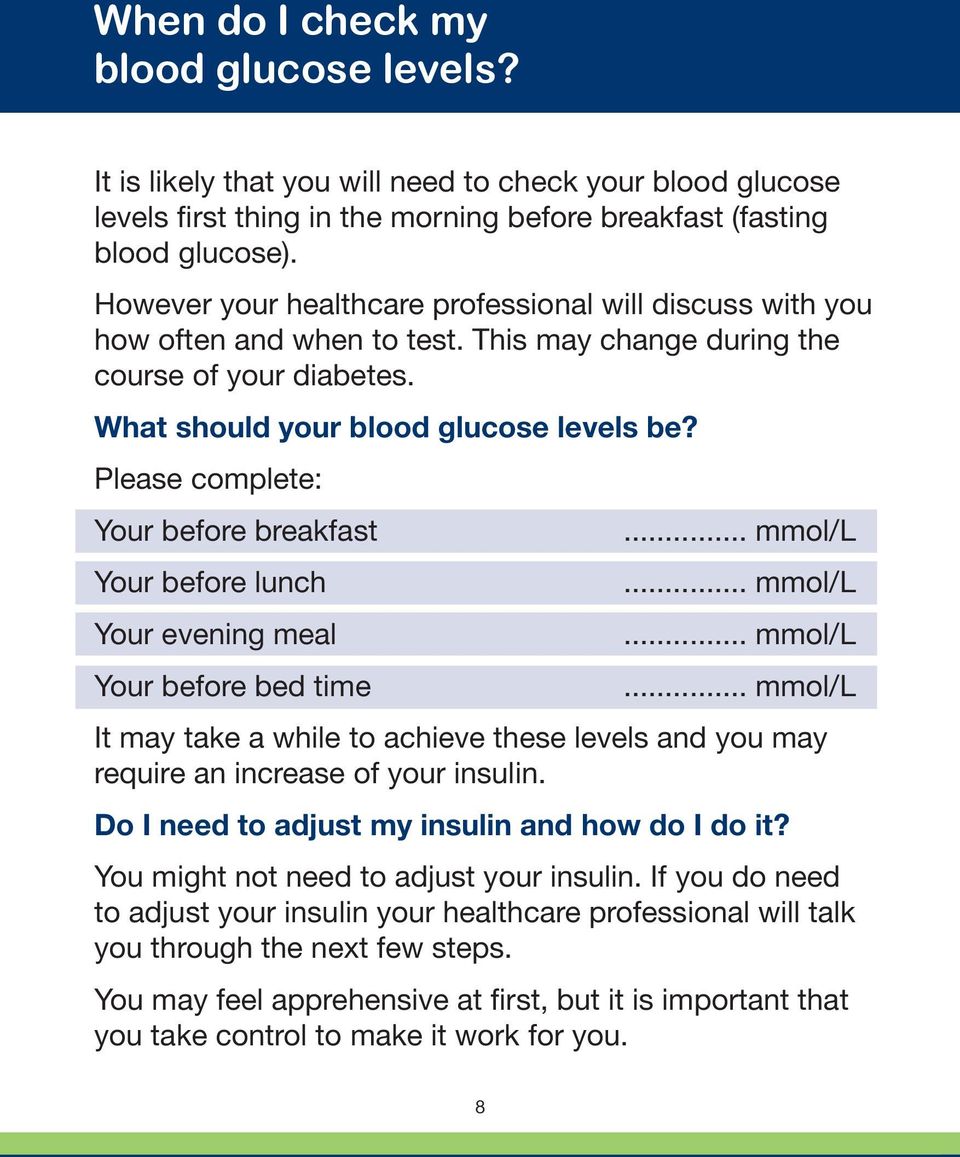
8 When do I check my blood glucose levels? It is likely that you will need to check your blood glucose levels first thing in the morning before breakfast (fasting blood glucose). However your healthcare professional will discuss with you how often and when to test. This may change during the course of your diabetes. What should your blood glucose levels be? Please complete: Your before breakfast Your before lunch Your evening meal Your before bed time... mmol/l... mmol/l... mmol/l... mmol/l It may take a while to achieve these levels and you may require an increase of your insulin. Do I need to adjust my insulin and how do I do it? You might not need to adjust your insulin. If you do need to adjust your insulin your healthcare professional will talk you through the next few steps. You may feel apprehensive at first, but it is important that you take control to make it work for you. 8
9 Instructions for self-adjustment of my insulin When testing your blood glucose, if you have consistently high readings for more than three days at any testing point, then you will need to adjust your insulin. Your healthcare professional will explain to you how to adjust your insulin and will complete the following table for your needs. Night-time Humulin I Adjust units of insulin Night-time Humulin I only Fasting (before breakfast) mmol/l above... below... Morning Humulin I only Before evening meal mmol/l Morning Humulin I above... below... Adjust units of insulin 9

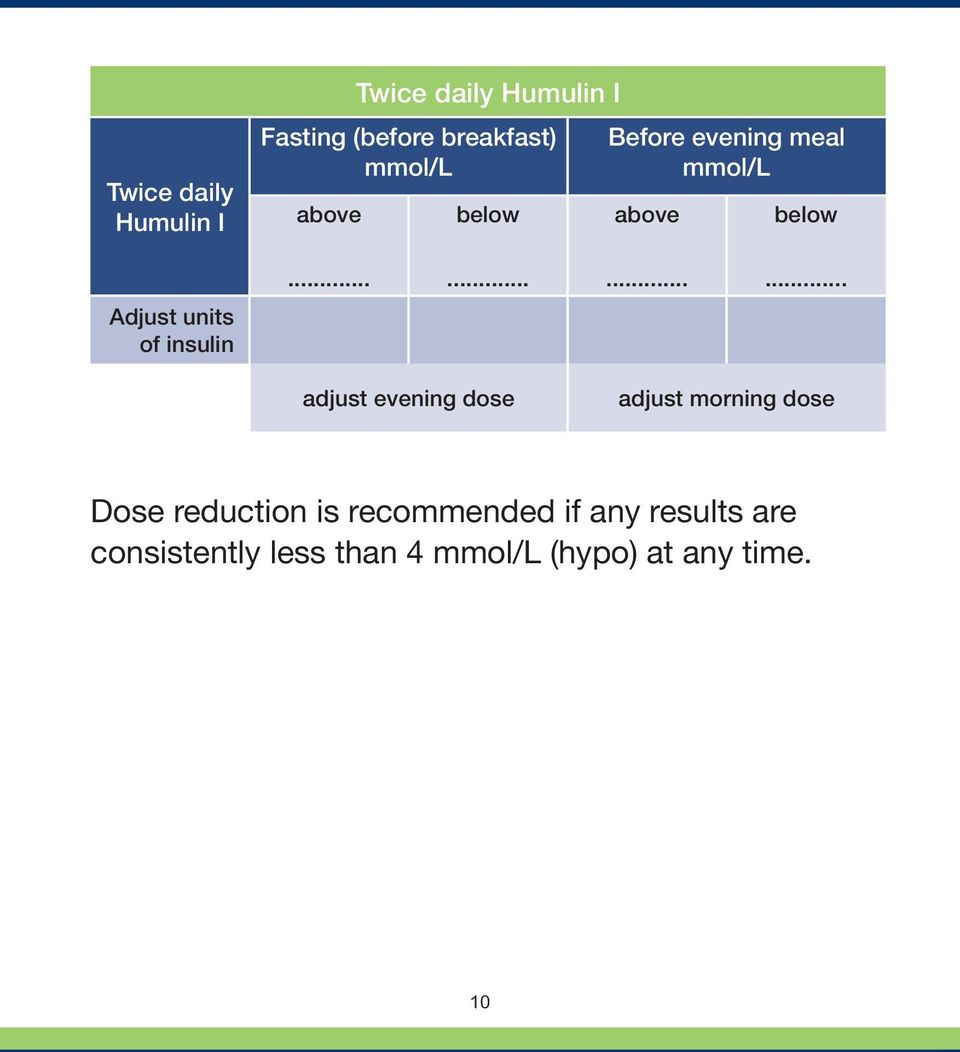
10 Twice daily Humulin I Twice daily Humulin I Fasting (before breakfast) mmol/l above below Before evening meal mmol/l above below Adjust units of insulin adjust evening dose adjust morning dose Dose reduction is recommended if any results are consistently less than 4 mmol/l (hypo) at any time. 10
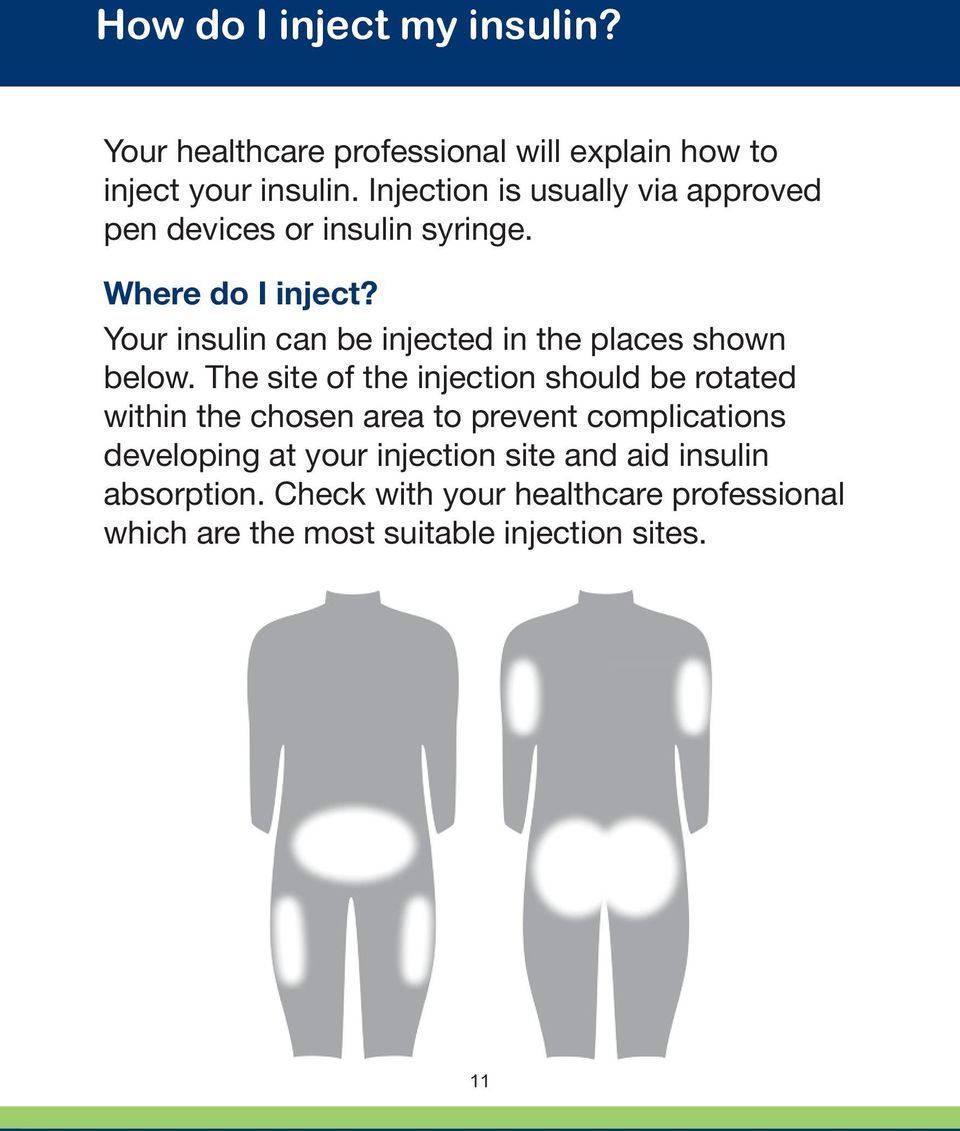
11 How do I inject my insulin? Your healthcare professional will explain how to inject your insulin. Injection is usually via approved pen devices or insulin syringe. Where do I inject? Your insulin can be injected in the places shown below. The site of the injection should be rotated within the chosen area to prevent complications developing at your injection site and aid insulin absorption. Check with your healthcare professional which are the most suitable injection sites. 11
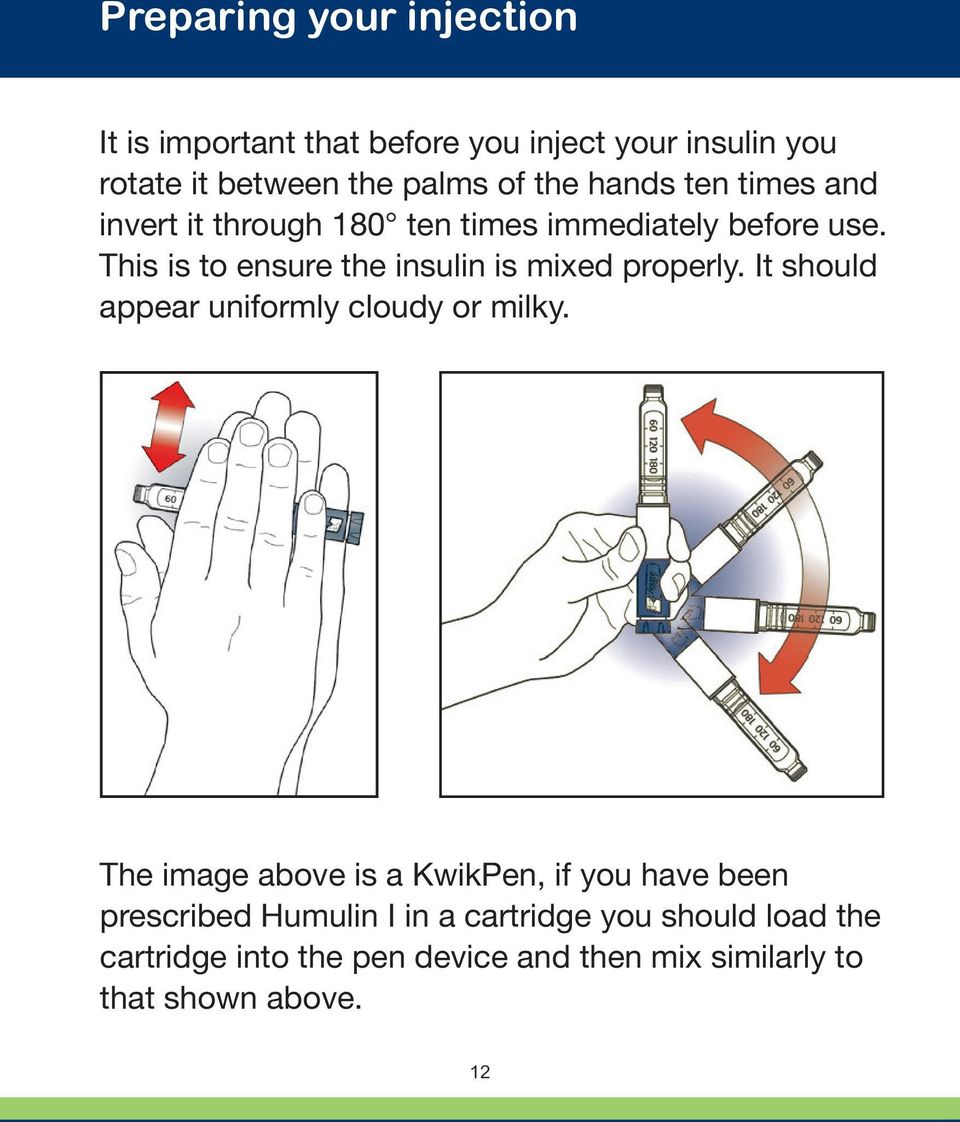
12 Preparing your injection It is important that before you inject your insulin you rotate it between the palms of the hands ten times and invert it through 180 ten times immediately before use. This is to ensure the insulin is mixed properly. It should appear uniformly cloudy or milky. The image above is a KwikPen, if you have been prescribed Humulin I in a cartridge you should load the cartridge into the pen device and then mix similarly to that shown above. 12
13 What if I forget an injection? Forgetting your insulin is rarely an emergency situation. Seek advice from your diabetes team. The advice will vary depending on when you have realised you have forgotten to take your insulin What if I cannot remember if I had my insulin? If you are in any doubt, do not take your insulin again. In both cases your blood glucose may run a little higher after the injection you have forgotten. Do not worry. It is very important that you know the name of your pen device, your insulin and the name of your blood glucose meter My insulin is: My pen is: My blood glucose meter is: 13

14 What is a hypo and why does it happen? A blood glucose reading of 4mmol/L and under is hypoglycaemia (a hypo ). A hypo occurs when blood glucose falls too low. People feel different things when a hypo is starting, you may also find some of your hypos feel different from others. A hypo can happen for a number of reasons: If you ve missed a meal or had one later than usual If you ve not had enough food or eaten less food than normal If you ve had more insulin than necessary If you ve been more active than usual If you ve been drinking alcohol If you ve experienced extremes in temperature, either hot or cold If your diabetes is well controlled occasional hypos are a normal part of life for people with diabetes, but they shouldn t take over your life. If you are having frequent hypos, speak with your diabetes team. 14

15 Hypos begin quickly, but there are usually warning signs. Symptoms can vary from person to person, but may include the following: Sweating Thumping heart Looking pale Weakness or tiredness Pins and needles sensation Dizziness/ feeling tipsy, drunk Disturbed vision Mild confusion Slurred speech Hunger Aggression or altered behaviour Headache If hypoglycaemia isn t corrected it can lead to more serious conditions such as loss of consciousness. 15

16 How do I deal with hypos? If you experience a hypo, you should deal with it by taking 15-20g of quick acting carbohydrate such as: 5-7 Dextrosol tablets or, ml of original Lucozade or, ml of pure fruit juice such as orange juice Your healthcare professional may also advise you of quick acting carbohydrate such as: It is advisable to re-check your blood glucose level after taking carbohydrate to ensure your blood glucose levels are rising. 16

17 If you are not about to eat a meal, ensure you eat grams of slow acting carbohydrate, to maintain your blood glucose levels until you next eat. This can be: half a sandwich fruit a small bowl of cereal biscuits and milk Your healthcare professional may also advise you of slow acting carbohydrate such as: The exact quantity will vary from person to person. Remember to carry your identity card and glucose tablets with you in case of an emergency. If you have regular hypos consider adjusting your insulin and/or contacting your nurse or doctor. 17

18 What should I do if I feel unwell? A number of common illnesses can cause your blood glucose to rise. When you are unwell you may not want to eat or take your insulin treatment as normal, but it is important to follow these basic rules: 1. Keep on taking your insulin However ill you feel and however little food you are eating, according to your blood glucose levels you may still need insulin. Sometimes in these circumstances you need more than your usual dose. Ask your healthcare professional for specific advice on what action to take when you are ill. 2. Monitor your blood glucose Monitor your blood glucose. Test at least 4 times daily as your blood glucose levels will indicate whether you require extra insulin doses. 3. Take carbohydrates in liquid form Take unsweetened fluids if your blood glucose is high. If you still do not feel like eating as your blood glucose returns to normal then substitute food with sweetened fruit juices or drinks that contain glucose. 18

19 When should my treatment be reviewed? If you have type 2 diabetes then we recommend that you contact your healthcare professional when you have reached a total of... units. This is so your treatment can be discussed with you and you may also be advised to monitor blood glucose tests at different times of the day or night. You should contact your healthcare professional earlier if you have any questions or are unsure what to do with your insulin. 19

20 If you have type 2 diabetes it is important to note that diabetes is a progressive condition. Over time your pancreas makes less and less insulin. In the future you may need mealtime insulin. Mealtime insulin is taken with food. Your current basal insulin covers your blood glucose (sugar) levels between meals and at night while mealtime insulin can help you control the rise in your levels when you eat. It requires you to add injections and possibly increase the number of blood glucose tests each day. Your management plan will be individually developed to meet your needs and lifestyle. 20

21 Notes Page 21
22 Notes Page 22
23 Notes Page 23
24 Side effects should be reported. This includes any possible side effects not listed in the package leaflet. If you experience side effects talk to your doctor or other healthcare professional. Any side effects from your medication can be reported at Side effects and product complaints can also be reported to Lilly: please call Lilly UK on By reporting side effects you can help provide more information on the safety of medicines. Eli Lilly & Company Priestley Road Basingstoke RG24 9NL This booklet has been developed with the Diabetes Specialist Nurses in Sheffield, Middlesbrough and Salford Royal Foundation Trusts and Diabetes Specialist Nurses from Dumfries & Galloway Royal Infirmary. The booklet has been reviewed for medical accuracy and printed by lilly. UKHML00004c(1) March 2014
human insulin (prb) 30% soluble insulin 70% isophane insulin A Guide to Starting Humulin M3
 human insulin (prb) 30% soluble insulin 70% isophane insulin A Guide to Starting Humulin M3 This booklet is intended only for those who have been Prescribed Humulin M3. It is intended to be used in addition
A Guide to Starting. Humalog Mix25
 A Guide to Starting Humalog Mix25 This booklet is intended only for those individuals who have been prescribed Humalog Mix 25. It is intended to be used in addition to the Patient Information Leaflet (PIL)
Starting mealtime insulin
 Starting mealtime insulin This booklet is designed for people with type 2 diabetes who are moving from a basal insulin regimen to a mealtime insulin regimen. A mealtime insulin regimen may include an insulin
Starting insulin treatment for people with type 2 diabetes. What you need to know
 Starting insulin treatment for people with type 2 diabetes What you need to know Contents Information 3 Any questions? 3 Glossary of terms 3 Why do I need insulin? 4 What does insulin do? 5 Why are there
Starting insulin for people with type 2 diabetes
 Starting insulin for people with type 2 diabetes What you need to know Contents Page Why do I need insulin? 3 What does insulin do? 4 Why are there different types of insulin? 4 How do I take insulin?
Insulin Safety. The safe use of insulin and you. Patient Information Booklet
 Insulin Safety The safe use of insulin and you The Right insulin The Right dose The Right way The Right time Hypoglycaemia Diabetes Patient Information Booklet Adapted from the National Patient Safety
An introduction to carbohydrate counting
 An introduction to carbohydrate counting Delivering the best in care UHB is a no smoking Trust To see all of our current patient information leaflets please visit www.uhb.nhs.uk/patient-information-leaflets.htm
Diabetes Insulin Pump Health Care Plan District Nurse Phone: 262-560-2104 District Nurse Fax: 262-560-2106
 EMPOW ERING A COMMUNITY OF LEARNERS AND LEADERS Diabetes Insulin Pump Health Care Plan District Nurse Phone: 262-560-2104 District Nurse Fax: 262-560-2106 Student DOB School Grade Doctor Phone School Year
Your blood sugar will be checked on arrival to Endoscopy and monitored whilst you are there.
 GASTROSCOPY TABLET CONTROLLED DIABETES (Including injectable medication which is not insulin) MORNING APOINTMENT Take your tablets as normal on the day before the test. On the day of the test: Omit your
Guidance for self administration of insulin injections
 Guidance for self administration of insulin injections You have been recommended to give yourself insulin by injection during your pregnancy. The diabetes specialist midwife has already shown you how to
Information for Starting Insulin Basal-Bolus Regime
 Information for Starting Insulin Basal-Bolus Regime Department of Diabetes Page 12 Patient Information Insulin Instructions for Basal Bolus Regimen Two types of insulin are used in this insulin regimen.
The safe use of insulin and you
 Ambulatory Care & Local Networks The safe use of insulin and you Information for patients The right insulin The right dose The right way The right time 3 Insulin treatment improves the quality of life
Gestational Diabetes. A Guide to Insulin in Pregnancy
 Gestational Diabetes A Guide to Insulin in Pregnancy Why do I need insulin? It is important for your baby that your blood glucose stays below 5.5 mmols before breakfast and below 7 two hours after meals
TYPE 1 DIABETES - SICK DAY RULES
 TYPE 1 DIABETES - SICK DAY RULES Information Leaflet Your Health. Our Priority. Page 2 of 6 Introduction People with diabetes don t get ill any more often than other people, but illness and infections
Diabetes Monitoring Diary
 Diabetes Monitoring Diary For those Counting Diabetes Service My targets: Before breakfast Before other meals Before bed... mmol/l... mmol/l... mmol/l Correcting high blood glucose levels: Information
Department of Health Commencing insulin therapy
 Department of Health Commencing insulin therapy Great state. Great opportunity. State of Queensland (Queensland Health) 2008 2013 This work is licensed under a Creative Commons Attribution No Derivatives
Glycaemic Control in Adults with Type 1 Diabetes
 Glycaemic Control in Adults with Type 1 Diabetes Aim(s) and objective(s) This document aims to provide guidance on good clinical practice in managing glycaemic control in adult patients with Type 1 Diabetes
Changing to Basal Bolus Insulin Regimen
 Changing to Basal Bolus Insulin Regimen What is a basal bolus insulin regimen? Basal insulin (Lantus) is injected once per day and ensures there is insulin in the body at all times. Bolus insulin (NovoRapid/Humalog)
Humulin (HU-mu-lin) R
 1 PATIENT INFORMATION Humulin (HU-mu-lin) R Regular U-500 (Concentrated) insulin human injection, USP (rdna origin) Read the Patient Information that comes with Humulin R U-500 before you start taking
Information for Patients
 Information for Patients Guidance for Diabetic Persons having bowel preparation for a flexible sigmoidoscopy or a colonoscopy or a combined gastroscopy and colonoscopy This guidance is provided to assist
Diabetes and exercise
 Diabetes and exercise Summary Symptoms of hypoglycaemia are caused by low blood sugar. Hypoglycaemia can occur if you take your diabetes medication and then do not eat enough or exercise more than usual.
Insulin onset, peak and duration of action
 Insulin onset, peak and duration of action Insulin was first discovered in the early 190 s. Before then, diabetes could not be treated. Insulin was then taken from cow and pig pancreases, but nearly all
Starting Insulin Injections
 Starting Insulin Injections A Gestational Diabetes Information Booklet Supported by What does insulin do? insulin Insulin is made by your pancreas. pancreas Insulin is released into the blood when you
N HUMAN Novo Nordisk Patient Information for Novolin N
 N HUMAN Novo Nordisk Patient Information for Novolin N NOVOLIN N (NO-voe-lin) NPH, Human Insulin Isophane Suspension Injection (recombinant DNA origin) 100 units/ml Important: Know your insulin. Do not
Riley Hospital for Children General Diabetes Medical Management Information- Injections
 Riley Hospital for Children General Diabetes Medical Management Information- Injections 1. HEALTH CARE SUPERVISION All school support staff, including: secretaries, cafeteria staff, custodians and bus
Medication Guide. SYMLIN (SĬM-lĭn) (pramlintide acetate) injection
 Page 1 Medication Guide SYMLIN (SĬM-lĭn) (pramlintide acetate) injection Read the Medication Guide and the Patient Instructions for Use that come with your SYMLIN product before you start using it and
Safe use of insulin e- learning module
 Safe use of insulin e- learning module Page 1 Introduction Insulin is a hormone produced by the beta cells in the pancreas, it is released when blood glucose levels are raised for example after a meal.
Diabetes, driving and the law. Your simple guide to Driving and Vehicle Licensing Agency (DVLA) requirements
 Diabetes, driving and the law Your simple guide to Driving and Vehicle Licensing Agency (DVLA) requirements Diabetes, driving and the law Many people with diabetes drive safely and happily every day. In
University Hospitals of Leicester NHS Trust. Carbohydrates. A guide to carbohydrate containing foods for people with diabetes
 University Hospitals of Leicester NHS Trust Carbohydrates A guide to carbohydrate containing foods for people with diabetes This information is designed to help you to understand how carbohydrates affect
Insulin Pumps. with Diabetes
 Insulin Pumps with Diabetes Continuous subcutaneous insulin infusion (with an insulin pump) is an alternative to multiple daily injections for people with type 1 diabetes Streetwise What is an insulin
P A T I E N T I N F O R M A T I O N. Apidra
 P A T I E N T I N F O R M A T I O N Apidra We have written this leaflet for those of you with diabetes who have been prescribed Apidra by your doctor. The primary goal of all diabetes treatment is to achieve
A patient guide to the use of insulin for diabetes
 A patient guide to the use of insulin for diabetes Delivering the best in care UHB is a no smoking Trust To see all of our current patient information leaflets please visit www.uhb.nhs.uk/patient-information-leaflets.htm
Sick Day Management for People with Type 2 Diabetes Using Insulin
 Sick Day Management for People with Type 2 Diabetes Using Insulin When you are sick, controlling your blood sugar (glucose) can be a challenge. Nausea, vomiting, illness and changes in eating will affect
A Guide to Monitoring Blood Glucose for Patients with diabetes in Care Homes
 A Guide to Monitoring Blood Glucose for Patients with diabetes in Care Homes 1. Summary... 1 2. Background... 2 3. Purpose 2 4. Responsibilities. 2 5. Blood Glucose Monitoring. 2 6. Resident Groups that
Hypoglycemia and Diabetes
 My Doctor Says I Should Avoid Low Blood Glucose Reactions... How Can I Prevent Them? BD Getting Started Hypoglycemia and Diabetes What You Should Know About Low Blood Glucose Reactions If you are taking
See, Think, and Act! Diabetes
 See, Think, and Act! Diabetes California After School Resource Center (CASRC) Administered for the California Department of Education (C.D.E.) Hello. My name is Joan Edelstein. I am a health trainer for
Diabetes Information
 Diabetes Information Your diabetes team includes: Consultant Paediatric Endocrinologist Paediatric Diabetes Clinical Nurse Specialists Senior Clinical Nutritionists/Dietitians Senior Clinical Psychologist
A list of all medications you are taking also include any vitamins, supplements, over-the-counter medicines, or herbal products
 This is your customized insulin discussion guide to bring to your next doctor s visit. WHAT TO BRING TO YOUR NEXT CHECK UP A record of your recent blood sugar readings A list of all medications you are
Getting the Big Picture
 About Diabetes This health information is being provided for general educational purposes only. Your health care provider is the single best source of information regarding your health. Please consult
Steroid Induced Diabetes
 What is high blood sugar (hyperglycemia)? Hyperglycemia is a high level of sugar in the blood. Blood sugar is also called glucose. Some people are unable to process the sugar that is found in food and
Procedure for the Management of. when unwell. To be completed at the start of each academic year and reviewed regularly.
 The student/parents should provide the teacher/school with: Sufficient oral and written information to allow the school to have a safe and appropriate environment for their child Supplies to treat low
BLOOD GLUCOSE MONITORING MEDICATION
 DIABETES CARE FOR SCHOOL MEDICAL MANAGEMENT PLAN Most Recent A1C and Date: BLOOD GLUCOSE MONITORING Meter Type: Testing Independently: yes no Testing times: Before meals Two hours after insulin dosing
Self-care guide for people with diabetes
 Self-care guide for people with diabetes English Version Supported by an unrestricted grant from 1 When the diagnosis is diabetes..................03 What is diabetes?............................04 What
X-Plain Diabetes - Introduction Reference Summary
 X-Plain Diabetes - Introduction Reference Summary Introduction Diabetes is a disease that affects millions of Americans every year. Your doctor may have informed you that you have diabetes. Although there
Package Leaflet: Information for the user
 Package Leaflet: Information for the user Actrapid 100 IU/ml solution for injection in vial Insulin human (rdna) Read all of this leaflet carefully before you start using your insulin Keep this leaflet.
Type 2 Diabetes. What is diabetes? Understanding blood glucose and insulin. What is Type 2 diabetes? Page 1 of 5
 Page 1 of 5 Type 2 Diabetes Type 2 diabetes occurs mainly in people aged over 40. The 'first-line' treatment is diet, weight control and physical activity. If the blood glucose level remains high despite
ALCOHOL. 1300 136 588 ndss.com.au AND TYPE 1 DIABETES
 ALCOHOL AND TYPE 1 DIABETES 1300 136 588 ndss.com.au The National Diabetes Services Scheme (NDSS) is an initiative of the Australian Government administered by Diabetes Australia. Contents Topic Page Introduction
Diabetes and insulin. A pamphlet for adults who need insulin for either Type 1 or Type 2 diabetes
 Diabetes and insulin A pamphlet for adults who need insulin for either Type 1 or Type 2 diabetes Contents page Who this pamphlet is for 1 What is diabetes? 1 The two types of diabetes 1 Diagnosis of diabetes
Surgery and Procedures in Patients with Diabetes
 Surgery and Procedures in Patients with Diabetes University Hospitals of Leicester NHS Trust DEFINITIONS Minor Surgery and Procedures: expected to be awake, eating and drinking by the next meal, total
Myths About Type 2 Diabetes and Insulin
 About Diabetes This health information is being provided for general educational purposes only. Your health care provider is the single best source of information regarding your health. Please consult
INSULIN IN DIABETES MANAGEMENT
 INSULIN IN DIABETES MANAGEMENT Do you know that in Diabetes, Insulin therapy gives maximum HbA1C reduction? What is Insulin? It is a hormone produced by pancreas to regulate the levels of glucose in the
PHARMACOTHERAPY HOW TO INJECT INSULIN. Living your life as normal as possible. www.lilly-pharma.de www.lilly-diabetes.de
 PHARMACOTHERAPY HOW TO INJECT INSULIN Living your life as normal as possible www.lilly-pharma.de www.lilly-diabetes.de In Germany about 1.9 million people with diabetes are being treated with insulin.
Diabetes Medical Management Plan
 Diabetes Medical Management Plan 1 School District: School: School Year: Grade: Student Name: DOB: Provider Name: Phone #: Fax #: Blood Glucose Monitoring at School Blood Glucose Target Range: - mg/dl
University College Hospital. Sick day rules insulin pump therapy
 University College Hospital Sick day rules insulin pump therapy Children and Young People s Diabetes Service Children whose diabetes is well controlled should not experience more illness or infections
ONCE ONLY GLUCAGON and Fast Acting Glucose gel (PGD) For nurse administration under Patient Group Direction (Trust wide PGD in place)
 ADULT INSULIN PRERIPTION AND BLOOD GLUCOSE MONITORING CHART Ward CONSULTANT DATE OF ADMISSION Please affix Patient s label here Ward Ward.../...year PATIENT NAME....... DATE OF BIRTH... NHS NUMBER.......
Shropshire Children s Diabetes Team Insulin Pump Training Workbook & Care Plan
 Shropshire Children s Diabetes Team Insulin Pump Training Workbook & Care Plan Table of Contents Overview of training for insulin pump starts... 3 On the initiation visit... 4 General pump Information
Lead Clinician(S) (DATE) Approved by Diabetes Directorate on: Approved by Medicines Safety Group on: This guideline should not be used after end of:
 Guideline for members of the diabetes team and dietetic department for advising on insulin dose adjustment and teaching the skills of insulin dose adjustment to adults with type 1 or type 2 diabetes mellitus
Diabetes. Emergency Checklists. From A Child in Your Care Has Diabetes. A Collection of Information. Copyright 2005 by Elisa Hendel, M.Ed.
 Diabetes Emergency Checklists From A Child in Your Care Has Diabetes. A Collection of Information. Copyright 2005 by Elisa Hendel, M.Ed. Hyperglycemia High Blood Sugar * Hyperglycemia occurs when the blood
written by Harvard Medical School Insulin Therapy Managing Your Diabetes www.patientedu.org
 written by Harvard Medical School Insulin Therapy Managing Your Diabetes www.patientedu.org What Is Insulin? The cells of your body need energy and one source of energy is sugar in your blood. Insulin
Insulin Dependent Diabetes Trust
 Insulin Dependent Diabetes Trust Type 2 and You April 2010 Registered Company Number 3148360 Registered Charity No 1058284 Welcome to the third issue of Type 2 and You. In this issue we look at healthy
Diabetes. Patient Education. What you need to know. Diabetes Facts. Improving Health Through Education. What is Diabetes?
 Diabetes What you need to know Diabetes Facts More than 3 million Canadians have diabetes (Canadian Diabetes Association, 2009). It is the 4th leading cause of death in the world (CDA, 2009). Patient Education
Insulin pen start checklist
 Insulin pen start checklist Topic Instruction Date & Initials 1. Cognitive Assessment 2. Insulin Delivery loading appropriate mixing priming shot dialing up dose delivery of insulin 3. Insulin type/action
Ketones and Ketoacidosis
 Ketones and Ketoacidosis If you have diabetes and become unwell or have high blood glucose levels of 14 mmol/l or more please check for ketones If the body does not have enough insulin its energy levels
My Sick Day Plan for Type 1 Diabetes on an Insulin Pump
 My Sick Day Plan for Type 1 Diabetes on an Insulin Pump When you are sick, your blood sugar levels may be harder to keep under control. Your blood sugar may go too high or too low. Use this guide to help
An estimated 280 Australians develop diabetes every day. It is Australia s fastest-growing chronic disease.
 Diabetes and insulin Summary Even with the help of your doctor and diabetes nurse educator, it may take a while to find the right insulin dose to reduce your blood glucose to your target levels. Insulin
Feeling sick? What to do. Information for people with Type 1 Diabetes
 Feeling sick? What to do Information for people with Type 1 Diabetes Diabetes and sick days A minor illness can result in a major rise in blood glucose levels Common illnesses such as tonsillitis, ear,
Blood Glucose Management
 Blood Glucose Management What Influences Blood Sugar Levels? There are three main things that influence your blood sugar: Nutrition Exercise Medication What Influences Blood Sugar Levels? NUTRITION 4 Meal
Continuous Subcutaneous Insulin Infusion (CSII) pump therapy
 Continuous Subcutaneous Insulin Infusion (CSII) pump therapy GHPI1267_04_15 Department: Diabetes team Review due: April 2018 www.gloshospitals.nhs.uk 21 BETTER FOR YOU BETTER FOR YOU 1 Introduction This
Insulin Dependent Diabetes Trust
 Insulin Dependent Diabetes Trust Type 2 and You Issue 6 - January 2011 Registered Company Number 3148360 Registered Charity No 1058284 Welcome to the sixth issue of Type 2 and You. Counting Carbs Why count
INSULINThere are. T y p e 1 T y p e 2. many different insulins for
 T y p e 1 T y p e 2 INSULINThere are many different insulins for Characteristics The three characteristics of insulin are: Onset. The length of time before insulin reaches the bloodstream and begins lowering
Insulin. and diabetes. What is insulin? Who needs to inject insulin? Why must it be injected? What if I have to go on to insulin?
 Insulin What is insulin? and diabetes Insulin is a hormone made by special cells, called beta cells, in the pancreas. When we eat, insulin is released into the blood stream where it helps to move glucose
Student Name: Date of Birth:
 Place Photo Here ITASCA DISTRICT 10 DIABETES CARE PLAN Student Name: Date of Birth: Date of Conference: School Nurse: Health Data: has diabetes. This is a condition in which the pancreas is unable to make
Introduction to Insulin. Your guide to taking insulin
 Introduction to Insulin Your guide to taking insulin Introduction Insulin helps control the level of blood glucose in the body. Everyone with type 1 diabetes must take insulin, and many people with type
Novo Nordisk Customer Care 0845 600 5055
 Novo Nordisk Customer Care 0845 600 5055 Call charges may vary, please check with your service provider. Calls may be monitored for training purposes. (Office hours 8.30am - 5.30pm) Hartmut Kraft lives
A new insulin order form should be completed for subsequent changes to type of insulin and/or frequency of administration
 of nurse A new insulin order form should be completed for subsequent changes to type of insulin and/or frequency of administration 1. Check times for point of care meter blood glucose testing. Pre-Breakfast
A guidebook for people with diabetes
 A guidebook for people with diabetes This booklet is designed to supplement, not replace, your doctor s advice. Please consult your doctor if you have any questions about what you read. You ll learn how
This information explains the advice about type 2 diabetes in adults that is set out in NICE guideline NG28.
 Information for the public Published: 2 December 2015 nice.org.uk About this information NICE guidelines provide advice on the care and support that should be offered to people who use health and care
Sick Day Management of Adults with Type 2 Diabetes. CONSUMER RESOURCE December 2014
 Sick Day Management of Adults with Type 2 Diabetes CONSUMER RESOURCE December 2014 Acknowledgement The 2014 Sick Day Management of Adults with Type 2 Diabetes Consumer resource is develop based on the
What is Type 2 Diabetes?
 Type 2 Diabetes What is Type 2 Diabetes? Diabetes is a condition where there is too much glucose in the blood. Our pancreas produces a hormone called insulin. Insulin works to regulate our blood glucose
Insulin Pump Workbook
 Insulin Pump Workbook Local Phone Numbers: Pump manufacturers helpline: Developed by Joan Everett and Dr Helen Lockett on behalf of Diabetes Education Network 1 Page 3 Page 4 Page 5 Page 6 Page 7 Page
DIABETES AND INSULIN PUMP THERAPY TOP TIPS FOR TRAVELLING
 DIABETES AND INSULIN PUMP THERAPY TOP TIPS FOR TRAVELLING Information Leaflet Your Health. Our Priority. Page 2 of 6 People with diabetes who use an insulin pump can still enjoy foreign travel. However
THE INS AND OUTS OF INSULIN. Mary Beth Wald, RN,BSN,CDE
 THE INS AND OUTS OF INSULIN Mary Beth Wald, RN,BSN,CDE WHAT HAPPENS IN MY BODY? When we eat, the food gets changed into glucose, a type of sugar. Glucose travels in the blood to all the cells in your body
A simple guide to using the HumaPen Luxura HD. If you need help with your Pen, call the. HumaPen Luxura HD Help Line: 0800 783 6764
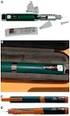 A simple guide to using the HumaPen Luxura HD If you need help with your Pen, call the Introducing your new Half Unit Dose Insulin Delivery Device Pen Cap Rubber Seal Cartridge Holder Pen needle (available
how to control blood glucose during PREGNANCY?
 how to control blood glucose during PREGNANCY? one HOW THE BODY WORKS DURING PREGNANCY During all pregnancies, the placenta makes a called human placental lactogen which allows the baby to grow and develop.
New Zealand Consumer Medicine Information
 New Zealand Consumer Medicine Information PenMix 30 100 IU/ml suspension for injection in cartridge PenMix 40 100 IU/ml suspension for injection in cartridge PenMix 50 100 IU/ml suspension for injection
Eating Guidelines for Diabetes
 Eating Guidleines Chronic Nutrition Fact Sheets Introduction If you have both diabetes and Chronic (CKD), it may seem that the diabetes and kidney diets don t fit well together. However, with careful planning,