
Personal Care Assistance (PCA) Program
|
|
|
- Darren Welch
- 10 years ago
- Views:
Transcription
1 DHS-3858-ENG 5-07 Personal Care Assistance (PCA) Program Consumer Guidebook Minnesota Department of Human Services Disability Services Division This guidebook provides information about Minnesota s Personal Care Assistance (PCA) program and the many options you have. We strive for a consumer-directed service model so you make decisions about your PCA services. We have included sections in this guidebook that will help you develop skills and provide you with resources to take more control of these important services that allow you to live independently in the community. As with any public program, there will be changes to rules, regulations and policies, but the information in this guidebook is current as of May 2007.

2 This information is available in other forms to people with disabilities by contacting us at (651) (voice) or toll free at (800) TTY/TDD users can call the Minnesota Relay at 711 or (800) For the Speech-to-Speech Relay, call (877)

3 Table of Contents Part 1: Personal Care Assistance (PCA) Program... 7 Description of Personal Care Assistance... 7 Eligibility for Personal Care Assistance... 7 Qualifying for Medical Assistance... 7 Medical Assistance for Employed Persons with Disabilities (MA-EPD)... 8 TEFRA (Tax Equity and Fiscal Responsibility Act)... 8 Part 2: PCA Services... 9 Accessing PCA Services... 9 Categories of PCA Services... 9 PCA Personal Identification Number Part 3: PCA Assessment Assessment Information Service Authorization Care Plan Appealing Service Unit Authorization Decisions Part 4: PCA Services for Children Under Age Part 5: Using PCA Services Personal Care Assistants (PCAs) Location of PCA Services PCA Services in the Workplace Hours of Services per Week PCA Consumer Responsibilities PCA Responsible Party

4 Table of Contents (continued) Part 6: Consumer Safeguards Vulnerable Adult Abuse and Exploitation Confidentiality Office of Long-term Care Ombudsman Office of Ombudsman for Mental Health and Developmental Disabilities Emergency Plans Part 7: PCA Program Decisions Decision 1: Choosing a PCA Provider Option Decision 2: Choosing a PCA Provider Agency Decision 3: Choosing PCA Supervision Decision 4: Shared Care PCA Staffing Decision 5: Flexible Use Option Changing Program Options Part 8: Hiring a PCA Finding a Personal Care Assistant Writing a Job Description Criminal Background Checks Identifying Potential PCAs Placing an Ad Advertising Do s and Don ts Interviewing Potential PCAs Telephone Interviews Face-to-Face Interviews Reference Checks Making the Decision

5 Table of Contents (continued) Hiring the PCA Written Agreement Orientation Topics Part 9: PCA Staff Management Training Your PCA(s) PCA Staff Scheduling PCA Task Scheduling Communicating with Your PCA(s) Evaluating Your PCA(s) Suggestions for Correcting Poor Performance Discharging a PCA Termination Firing Part 10: Record Keeping Time Sheets Files to Keep Part 11: Frequently Asked Questions Part 12: Department of Human Services Resource List Minnesota Department of Human Services Contact Information: Other Community Resources List of Reference Materials

6 Table of Contents (continued) Appendix A: Sample PCA Care Plan PCA Care Plan Health-Related Care Needs Behavioral-Related Care Needs Appendix B: Sample Job Description Questions Appendix C: Sample PCA Job Descriptions Appendix D: Sample Job Application Job Application: Please Print or Type Appendix E: Interviews and the Law Appendix F: Sample Employer and Personal Reference Check Forms Employment Reference Form Personal Reference Form Appendix G: PCA Face-to-Face Interview Questions Appendix H: Sample PCA Reference Check Questions

7 Table of Contents (continued) Appendix I: Sample Written Agreements Consumer and PCA Choice Provider Agreement Consumer Pricing Schedule Agreement for Provider and PCA Agreement for Provider and Qualified Professional Appendix J: Sample Monthly Staffing Schedule for PCAs Appendix K: Sample Weekly PCA Task Schedule Appendix L: Sample PCA Evaluation Form Appendix M: Sample PCA Notice of Unsatisfactory Job Performance Appendix N: PCA Time Sheet Appendix O: Flexible Use Toolkit The original 2003 guidebook was developed in collaboration with the Centers for Medicaid & Medicare Services Grants: 2001 Real Choice Systems Change Grant Consumer-Directed Personal Assistance Services and Supports and the Medicaid Infrastructure Grant. 5

8

9 Part 1: Personal Care Assistance (PCA) Program Description of Personal Care Assistance Minnesota s Personal Care Assistance (PCA) program, referred to as Personal Assistant Services (PAS) in many other states, is designed to support people of all ages with disabilities to live independently in the community. Personal Care Assistants (PCAs) provide services to people who need help with activities of daily living, instrumental activities of daily living and health-related functions. PCA services are services and supports provided to an individual, as needed, to assist in accomplishing activities of daily living; instrumental activities of daily living; health-related functions through handson assistance, supervision, and cuing; and redirection and intervention for behavior including observation and monitoring. The PCA program provides support to: People with disabilities of all ages The elderly (over 65) People with chronic health conditions. Eligibility for Personal Care Assistance There are four basic requirements to be eligible for PCA services. You must meet all four. They are: 1. You must be eligible for or receiving Medical Assistance (MA) or Minnesota Care Expanded benefits (for pregnant women or children under age 21) or be eligible for the Alternative Care program for qualifying seniors. 2. You must be assessed by your county as having a need for PCA services. 3. You must have a doctor s statement of need every year, and when there are changes in your care needs. 4. You are able to make decisions about your care or have a person or Responsible Party who can make decisions about your care for you. 7 PCA services are not available to: General Assistance Medical Care (GAMC) consumers Adults enrolled in MinnesotaCare except for pregnant women. (See page 16, PCA Responsible Party Responsibilities.) A Responsible Party must actively participate in the planning and directing of your PCA services. Your Responsible Party cannot be your PCA. Requirements include: Be at least 18 years old Is available to you and your PCA Monitor cares at least once a week and Attend the assessment. Qualifying for Medical Assistance More than 400,000 Minnesotans receive health care coverage through Medical Assistance (MA) Minnesota s Medicaid program. MA provides necessary medical services for low-income families, children, pregnant women, and people who are elderly (65 or older) or have disabilities. General requirements for all Medical Assistance in Minnesota include: Asset limits and minimum income guidelines Minnesota residency U.S. citizen or status as a qualified noncitizen. For more information, contact your county financial worker or review the information on the Minnesota Department of Human Services (DHS) Web site at: DM 0005-ENG.

10 Medical Assistance for Employed Persons with Disabilities (MA-EPD) This program promotes competitive employment and economic self-sufficiency of people with disabilities by assuring continued access to Medical Assistance for necessary health care services. MA-EPD allows working people with disabilities to qualify for MA under higher income and asset limits than regular MA. The goal of the program is to encourage people with disabilities to work and enjoy the benefits of being employed. Additional eligibility requirements for MA-EPD include: Being certified disabled by either the Social Security Administration or the State Medical Review Team Being between age 16 and 65 years of age Being employed Being ineligible for MA under other, more beneficial categories Meeting the asset limit Paying a premium. In MA-EPD, your income determines the amount of monthly premium paid to remain active on the program. For more information, contact your county financial worker or review the information on the DHS Web site at: TEFRA (Tax Equity and Fiscal Responsibility Act) This is a federal program for children with disabilities who live with their families and allows the child to qualify for Medical Assistance without regard to the income of their parents. There may be a parental fee payment for TEFRA. The cost of the care must not be more than the cost for the care in a medical institution. For more information, contact your county financial worker or review the information on the DHS Web site at: To qualify for TEFRA, the child must: Be living with at least one parent Be under age 18 Be certified disabled by either the Social Security Administration or the State Medical Review Team Need a level of home health care to stay at home that compares to the level of care provided in a hospital, nursing home or intermediate care facility for persons with mental retardation. 8

11 Part 2: PCA Services Accessing PCA Services A person can receive PCA services through one of the programs described below. Think of these as doors to starting PCA services, with each one differing in how it is administered. To find out about your eligibility for any of these services, contact your county social services department. There are four different ways you can access PCA services. 1. Home Care is sometimes called Medical Assistance (MA) or state plan Home Care. PCA services are one of the home care services people on MA are eligible to receive. Contact your county public health agency for more information. 2. Home and Community-Based Waiver Programs. A waiver is a program that provides services that are above what MA can pay for. These services allow people to live in the community instead of going into or staying in an institutional setting. You must qualify for a waiver and meet criteria for the services offered under the waiver. Contact your county social services agency to learn more about waivers. Types of waivers are: Community Alternative Care (CAC) Community Alternatives for Disabled Individuals (CADI) Elderly Waiver (EW) Developmental Disabilities (DD) Traumatic Brain Injury (TBI) Waiver 3. Alternative Care is for people who are over 65 but whose assets are too high to qualify for the Elderly Waiver. 4. Managed Care is mandatory for most people over age 65 and an option for people with disabilities under age 65. People receive their services from health plans or managed care organizations. Examples are Minnesota Senior Health Options or Minnesota Disability Health Options. Managed care organizations will have different requirements, processes and rules for getting PCA services. Categories of PCA Services There are four different categories of service you can receive in the PCA program. 1. Assistance with doing activities of daily living (ADLs). These are things you do every day such as dressing, grooming, bathing, eating, positioning, transferring, toileting and mobility. 2. If your PCA assessment determines that you have a need for assistance with activities of daily living (ADLs), you may also use your PCA services for assistance with instrumental activities of daily living or IADLs. IADL assistance includes meal planning and preparation, managing your finances, shopping for food, clothing, and other items, homemaking tasks, communicating by telephone or other means, getting around and participating in community activities. 3. Assistance in Health-Related Functions, which are services that must be delegated or assigned by a licensed health care professional such as a nurse or doctor. Health-Related Functions must be provided under the direction of a Qualified Professional (QP) or a doctor. Examples of health-related functions are special skin care, non-sterile catheter care, tube feedings and respiratory assistance. 4. Redirection and intervention for behavior issues which require observation and monitoring. For example, reminders to do activities of daily living or redirection of behavior that is potentially harmful to you or others. 9

12 AQualified Professional can be a Registered Nurse (RN), a Mental Health Professional, or a Licensed Social Worker. A Qualified Professional is responsible for: Assisting you in writing your care plan that describes your needs and how a PCA will assist you Providing information to new PCAs about your needs for assistance Providing training to your PCAs on your health care needs Providing ongoing monitoring of your PCAs to make sure things are going smoothly Telling your doctor or public health nurse about changes you may need in your PCA services Monitoring the work and supervising the ability of your PCA to provide care. PCA Personal Identification Number Each PCA is required to get a unique Personal Identification Number. Most providers will provide the forms for the PCA and send it to Minnesota Health Care Programs. In order to get a PCA personal identification number the PCA must pass a background study. PCAs can get the forms at: DHS-4469-ENG. PCAs can also contact the Provider Call Center at (800) or in the Twin Cities metro area at (651)

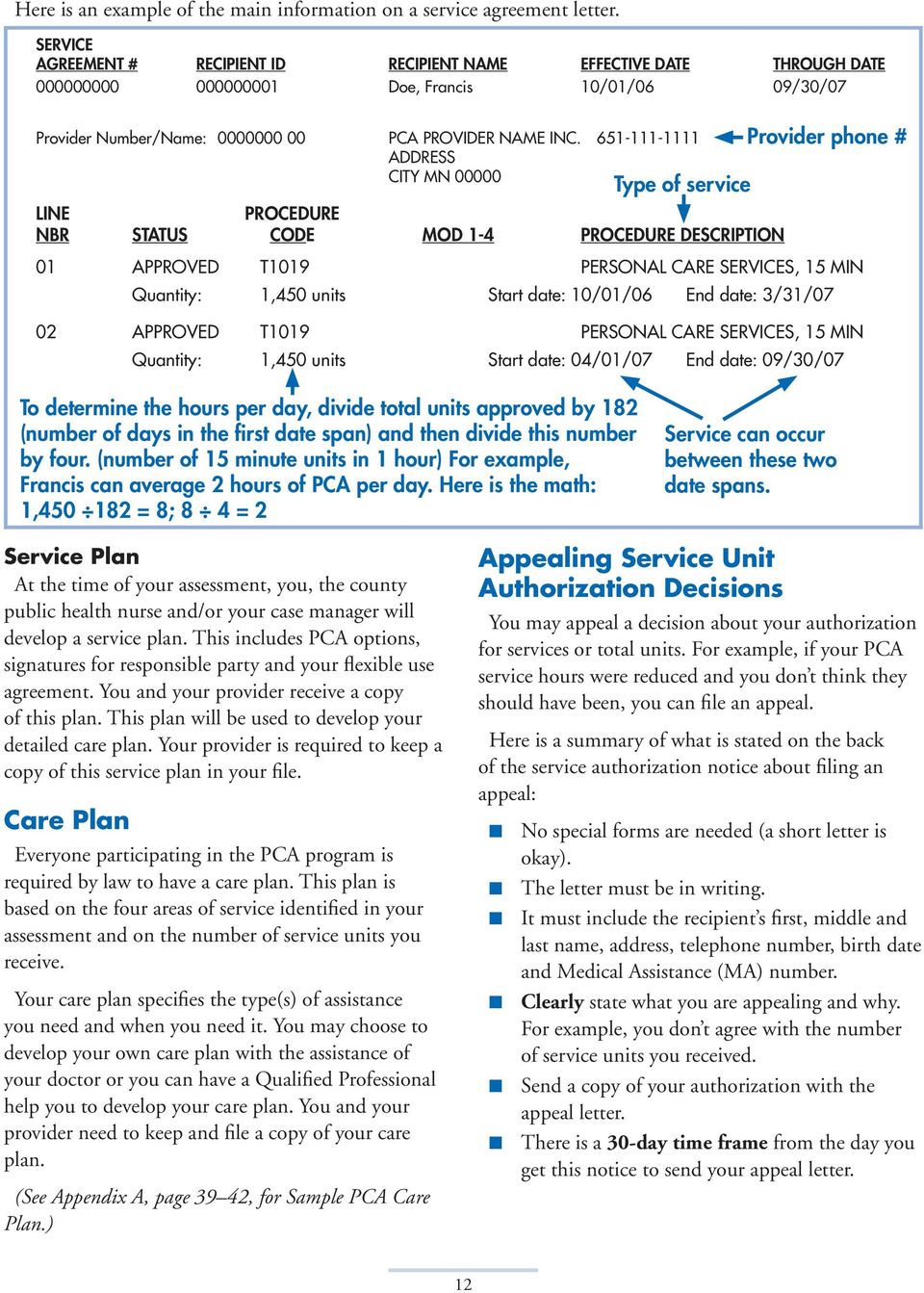
13 Part 3: PCA Assessment Assessment Information An assessment must be completed to determine your needs for assistance. The assessment reviews the tasks and assistance that you need and assigns a unit of time for these activities. The home care program you are in determines who will do your assessment. Here is a list of people who can complete an assessment: County public health nurse for MA Home Care or DD Waiver Program County case manager/service coordinator for CAC, CADI, TBI, EW Waiver Programs or AC Program Someone from your managed care organization (such as MNSHO) if you are in a managed care program. This assessment should happen within 30 days after you contact someone about your need for PCA services. The assessment is done before PCA services can start and every year after that. If your condition changes and you think you need more assistance, you can request another assessment at any time. The assessment is done in your home and should take about one hour to complete. If you have a responsible party, they must be present at the assessment. The assessment will include: Questions asked about the types of assistance needed Descriptions of different PCA program options Choice of a PCA provider (See pages for more information.) Choice of the type of PCA supervision (See page 21 for more information.) Decisions about using the Shared Care option (See page 22 for more information.) Flexible Use Option PCA hours (See page for more information.). During the assessment you will be asked questions about the types of assistance you need. These include activities of daily living (ADLs), behavior needs, health-related needs and some instrumental activities of daily living (IADLs) associated with these services. After you answer all of the questions, you will be asked to sign the assessment and other forms included in the assessment. Here is what will happen next: For non-waiver consumers, the county public health nurse will complete the forms and recommend a number of PCA units of care. The information will be sent to the state for review and approval. You and your agency will receive a copy of the service plan from the county and a service agreement letter from the state. For waiver and Alternative Care consumers, the service coordinator determines and approves a number of PCA units and submits the information to the state. You can ask for a copy of the assessment. You and your provider will receive a service agreement letter from the state. For managed care program consumers, contact your managed care organization to learn about your assessment. Service Authorization Service agreement letter If the units of PCA services are approved, DHS will send you a service authorization verification. It will tell you how many service units you can receive. Each unit of service is 15 minutes. Service authorizations are usually approved for a one year period and will list your provider, who also will get a copy of your service authorization. Your service agreement will have two time spans (typically 6 months each) and will specify whether you have Flexible Use or Standard Use of your PCA hours. 11

14 Here is an example of the main information on a service agreement letter. SERVICE AGREEMENT # RECIPIENT ID RECIPIENT NAME EFFECTIVE DATE THROUGH DATE Doe, Francis 10/01/06 09/30/07 Provider Number/Name: PCA Provider NAME INC ADDRESS CITY MN Type of service LINE PROCEDURE NBR STATUS CODE MOD 1-4 PROCEDURE DESCRIPTION Provider phone # 01 APPROVED T1019 PERSONAL CARE services, 15 MIN Quantity: 1,450 units Start date: 10/01/06 End date: 3/31/07 02 Approved T1019 Personal Care Services, 15 MIN Quantity: 1,450 units Start date: 04/01/07 End date: 09/30/07 To determine the hours per day, divide total units approved by 182 (number of days in the first date span) and then divide this number by four. (number of 15 minute units in 1 hour) For example, Francis can average 2 hours of PCA per day. Here is the math: 1, = 8; 8 4 = 2 Service can occur between these two date spans. Service Plan At the time of your assessment, you, the county public health nurse and/or your case manager will develop a service plan. This includes PCA options, signatures for responsible party and your flexible use agreement. You and your provider receive a copy of this plan. This plan will be used to develop your detailed care plan. Your provider is required to keep a copy of this service plan in your file. Care Plan Everyone participating in the PCA program is required by law to have a care plan. This plan is based on the four areas of service identified in your assessment and on the number of service units you receive. Your care plan specifies the type(s) of assistance you need and when you need it. You may choose to develop your own care plan with the assistance of your doctor or you can have a Qualified Professional help you to develop your care plan. You and your provider need to keep and file a copy of your care plan. (See Appendix A, page 39 42, for Sample PCA Care Plan.) Appealing Service Unit Authorization Decisions You may appeal a decision about your authorization for services or total units. For example, if your PCA service hours were reduced and you don t think they should have been, you can file an appeal. Here is a summary of what is stated on the back of the service authorization notice about filing an appeal: No special forms are needed (a short letter is okay). The letter must be in writing. It must include the recipient s first, middle and last name, address, telephone number, birth date and Medical Assistance (MA) number. Clearly state what you are appealing and why. For example, you don t agree with the number of service units you received. Send a copy of your authorization with the appeal letter. There is a 30-day time frame from the day you get this notice to send your appeal letter. 12
15 If you miss the deadline of 30 days, you still may be able to appeal. To appeal: Write an appeal letter. State in the letter a valid reason why you did not appeal within 30 days. Send in a copy of the authorization letter. The state will have to agree with you that you had a valid reason. If the state agrees with you, the time frame is then 90 days from the day you receive the authorization notice to appeal. To keep your current services or hours during the appeal process: Send your appeal within 10 days of the date in the upper left hand corner of the notice. Send your appeal before the effective date to the right of the notice. If you lose your appeal, you may have to repay MA for the difference in the cost of care that was provided. If you want to appeal, ask your county social services office to help you or write directly to: Minnesota Department of Human Services Appeals Office PO Box St. Paul, MN If you have questions, call Metro: (651) (Voice) Outstate: (800) TTY/TDD: (800) Fax: (651)

16 Part 4: PCA Services for Children Under Age 18 PCA services for children are based on the needs of a child with a disability that are over and above what a parent or caregiver would typically provide for a child without a disability. PCA services can be used for children with disabilities who meet the PCA program eligibility requirements. (See page 8 for more information.) PCA services are not intended to replace the parent s responsibility to meet the basic care, nurturing and supervision needs of minor children. Parents are responsible for: Instrumental activities of daily living (IADLs), like grocery shopping, meal preparation, laundry and house cleaning for children Administering medication Taking children to medical appointments. When being assessed for PCA services, a child is considered to be dependent in an activity of daily living if they need assistance with something that a typical child of the same age would do. For example, a 12-year-old child could receive PCA services if they are not able to dress themselves because a child without a disability at that age would dress themselves. PCA services can provide assistance to children with disabilities to live with their families and participate in activities in the community where a person may go in a typical day. It is not intended to staff child care sites. PCA is an individual service; a PCA may be responsible for one child unless there is a shared care option agreement (see page 22). Children may be assessed as needing PCA services for observation and monitoring of behavior. In addition to or instead of PCA services, a child with behavioral issues may need other services, such as children s mental health, independent living services or educational services. (Please see the resource list on page 36.) If your child has an Individualized Education Plan (IEP), Individualized Family Services Plan (IFSP) or Individual Interagency Intervention Plan (IIIP), he or she may be able to get additional healthrelated services through the school. To obtain more information about this area, you can download a brochure entitled Minnesota Health Care Programs Individualized Education Program (IEP) Services: Information for Families at DHS-3456-ENG. A parent CANNOT be paid as a PCA for his/her minor child. Otherwise, all the other aspects of the PCA program apply for children. 14

17 Part 5: Using PCA Services Personal Care Assistants (PCAs) A personal care assistant (PCA) must be able to provide the services specified in your care plan. They can either live with you or separate from you. A PCA must: Be at least 18 years old or be 16 to 17 years old with additional documented special training Be employed by a PCA agency Be trained (by you or an agency or school) and competent to help you Be able to provide the services you need based on your care plan Be able to communicate with you Pass a criminal background check (according to state standards) Be able to work in the U.S. Have a personal PCA identification number. A PCA must not be a Spouse Consumer of PCA services Parent of the minor child Corporate guardian Responsible party for a PCA consumer. Location of PCA Services PCA services are to be used in your home and in the community for the normal activities you participate in. PCA services are not to be used in the PCA s home unless the PCA lives with the consumer. If the location of services includes a fee or other costs, this should be discussed with the PCA prior to the event. PCAs are not required to pay for expenses related to providing services. John is going out to dinner with friends and needs assistance eating. He has several options for getting his needs met: 1. Offer to pay for a meal for a PCA. 2. Ask a PCA to join them for dinner, but tell the PCA that he has to pay for his own meal. 3. Suggest the PCA eat before accompanying John to the restaurant. Candace wants to attend a concert but needs assistance during the concert. Tickets are $50 per person. She has a few options for getting her needs met: 1. Purchase a ticket for her PCA to attend the concert with her. 2. Ask a friend or family member who also wants to go to the concert and see if he/she is willing to provide assistance. PCA Services in the Workplace PCAs may provide assistance to you at your work site. They may provide the assistance you need in your care plan. You have the following choices for getting personal care assistance at work: You may schedule a PCA to come in to your workplace at the times you need help You may find someone employed at your workplace who is willing to be hired as a PCA for you. Please check with your employer before hiring a co-worker to be a PCA in the workplace. Sometimes you may need help with things specific to your job, such as typing or filing. Talk with your employer about the options you have for getting this help. Perhaps someone else at the workplace can help arrange assistance or assist with tasks. These are often 15

18 considered reasonable accommodations under the Americans with Disabilities Act. Hours of Services per Week Provider agencies may not be willing to pay overtime. Check with your provider for information on the total number of hours a PCA can work per week. Keep this in mind when determining how many PCAs you may need. PCA Consumer Responsibilities The PCA program is designed to be flexible and driven by you. However there are certain responsibilities you should keep in mind. PCA services are supposed to provide direct assistance to you. Your PCA should be with you providing assistance when you need it. You are responsible to document when they are working with you. For example, a PCA is not working when they are on call or traveling to your house. Medical Assistance fraud is the term used when PCAs try to get paid for working times they did not work. It is also fraud if you help your PCA do that by signing blank time sheets. For example, it is fraud when PCAs ask you to sign a time sheet stating they worked 30 hours, when they only worked 20 hours. You or your PCA could be held legally responsible. When signing time sheets, draw a line through any blank date and time spaces on it. This makes it difficult for PCAs to enter hours they didn t work. If you are being pressured to sign time cards for hours your PCA has not worked, talk to your provider or report it to the Minnesota Department of Human Services Surveillance and Integrity Review Section at (651) (Metro) or (800) , which may then conduct an investigation. PCA Responsible Party When the person receiving PCA services cannot direct his or her own care, Minnesota law requires a Responsible Party. The Responsible Party must meet all of the requirements and responsibilities listed below. Requirements to be a PCA Responsible Party The PCA Responsible Party must be at least 18 years old and capable of providing the support necessary to assist the person who cannot direct their own care to live in the community. The Responsible Party does not need to live with the person receiving services. Neither the Responsible Party nor a delegate may be the recipient s PCA. Responsibilities for the PCA Responsible Party The PCA Responsible Party must: Continuously monitor whether the person is safe in their home Attend annual PCA or LTC (Long-term care) assessments Be accessible to the person and PCA while services are provided. The mode of accessibility must be communicated in the care plan. Develop the care plan with the qualified professional or person s physician Make choices regarding PCA provider, supervision, hiring, training of staff and scheduling of PCA services Monitor PCA services at least once per week Report suspected abuse/neglect of the person to the local county human service agency Sign required forms including time sheets Notify the PCA agency and the county if they are no longer able to meet the requirements and responsibilities of the PCA Responsible Party. 16

19 Part 6: Consumer Safeguards PCAs and other home care workers work very closely with you in your home. You should be aware of safety concerns. This section contains information and resources to increase your awareness of issues related to your health and safety. Vulnerable Adult Abuse and Exploitation People who use PCA services have rights and protections under Minnesota laws that govern the Maltreatment of Minors and Vulnerable Adults. Here are some of the things that are covered under these laws: Physical abuse is when someone is harming you by hurting your body. This includes hitting, slapping, punching, pushing, refusing to help someone with a medical need or not giving someone important medication. An example is someone forcing you to take medications/food that they know will be harmful to you and are not part of your plan of care. Sexual abuse is when someone touches you sexually, talks to you sexually or shows you sexual material or body parts when you did not want them to. Abuse can also be when someone touches you in ways that make you uncomfortable. Sexual abuse can also be when someone makes you touch them in a sexual way, or asks you to show them your private body parts, or asks you to speak to them in a sexual manner and you do not want to. Financial abuse/exploitation is when someone uses your money or accounts without your giving permission or in a different way than you instructed. For example, if your PCA does not purchase what they are supposed to with your money but uses it for his/her own personal use. This type of abuse can also occur when someone takes your money or personal property and you did not give them permission to do so. Because PCAs work very closely with you, they may have access to your personal financial items and personal belongings in your home. Be careful with your money, checks, credit and debit cards and other personal items when you have a PCA in your home. If any of these types of abuse are happening to you, you need to report this immediately to someone who can help you. This could be: Your case manager A friend or family member or Your PCA agency. If you are in immediate danger, call 911. Confidentiality Information about your personal care needs is considered confidential and should not be shared with other people. It is illegal for your PCAs, agency staff and/or your Qualified Professional to talk with other people about your care. Your agency may share information in your care plan with new PCA staff to ensure they are able to provide the assistance you need. This information should only be provided if someone is going to work for you or you request that it be shared with someone. Your provider may ask you to sign a release of information form. If you feel your confidentiality has been violated, contact your provider or either of the Offices of Ombudsman listed on the next page. 17

20 Office of Long-term Care Ombudsman The Office of Long-term Care Ombudsman is available to anyone receiving home care services for help with: Quality of services Rights, including privacy and confidentiality Termination of services Service agreements or care plans Access and referral to services Appeals Abuse or neglect issues. You can reach them at (800) or (800) (TTY). Office of Ombudsman for Mental Health and Developmental Disabilities The Office of Ombudsman for Mental Health and Developmental Disabilities provides assistance to people receiving services for mental illness, developmental disabilities, chemical dependency and emotional disturbance in children. You can reach them at (651) or (800) Emergency Plans Emergency plans address your immediate health needs when something unexpected happens to you. Medical Emergencies It is good to have a plan in place for a medical emergency. For instance, having a plan in place to tell a PCA what to do if you have a seizure or develop a high fever. You may want to carry a card or small piece of paper with you and also post this information in your home: Your diagnosis Your medications Your allergies Health conditions that might occur and what to do Emergency contact information Name and phone number of your doctor Insurance information. Emergency Evacuation Plans Be sure to discuss evacuation plans with your friends, family and PCA. Discuss the type of emergency and what action would be needed to evacuate safely. Develop a checklist for evacuation with contact numbers for those who might assist, transportation options, medications and medical supplies. Also, put together a disaster supply kit that includes what you would need to survive for 3-10 days on your own. For additional information or assistance, please feel free to contact the Minnesota State Council on Disability at (651) (V/TTY) or (800) (V/TTY). 18

21 Part 7: PCA Program Decisions There are two ways to start the process so PCA services can begin: 1 2 Choose a PCA Provider Assessment Assessment Choose a PCA Provider PCA Services Begin There are decisions that need to be made prior to receiving PCA services. There are five basic elements that need to be determined: Type of PCA option program, PCA provider, supervision of PCAs, one-to-one and/or shared care services and Flexible Use option. Decision 1: Choosing a PCA Provider Option PCA Provider Option PCA Provider Agency PCA Supervision Shared Care Option Flexible Use Option This decision determines whether you choose a consumer-directed or traditional PCA option. The Minnesota Department of Human Services (DHS) requires consumers to receive services through a provider agency. There are two kinds of PCA service provider options: 1. Traditional PCA Provider Option In this option, there are two types of service providers: A Personal Care Provider Organization (PCPO) or sometimes called a PCA Agency. This agency only provides PCA services. A Home Health Agency has a license from the Department of Health and is Medicarecertified. This agency also provides skilled nursing visits, home health aide visits, occupational and physical therapy (OT/PT) visits, as well as PCA services. Under the Traditional PCA Provider Option, the PCA Provider is responsible for: Finding, hiring/firing and training of PCA staff Finding back-up PCA staff Assigning a Qualified Professional if you want one Applying for the criminal background check for PCA staff Billing the state for PCA services Scheduling and paying PCAs and a Qualified Professional Getting a physician s statement of need and maintaining it in your case file Monitoring and evaluating PCA staff Maintaining the required liability insurance and Workers Compensation for PCAs. Throughout this handbook, Traditional Provider Agency refers to both Home Health Agencies and Personal Care Provider Organizations. 19
22 2. Consumer-Directed Option Under the consumer-directed PCA option, which is called PCA Choice, you have the greatest control over staffing. The PCA Choice agency role is mostly managing financial matters. The PCA Choice agency is called the fiscal intermediary. This type of agency is responsible for billing DHS for PCA services and paying the PCA staff and/or Qualified Professional. Under the PCA Choice Option, you are responsible for: Finding, hiring/firing and training of PCA staff Finding back-up PCA staff Supervising PCA staff Finding a Qualified Professional if you want one Scheduling PCAs and a Qualified Professional Monitoring and evaluating PCA staff Entering into a written agreement with the PCA Choice agency Maintaining documentation of the PCA tasks and actions. The fiscal intermediary is responsible for: Billing for PCA services and a Qualified Professional Paying and withholding taxes for PCA staff and the Qualified Professional Applying for the criminal background check for PCA staff and Qualified Professional Maintaining the written agreements for all PCA staff and Qualified Professionals (See Appendix I, page 57 71, for Sample Written Agreements.) Maintaining the required liability insurance and Workers Compensation for PCAs and Qualified Professionals Getting a physician s statement of need for PCA services annually and keeping a copy in your records. Here are some questions to consider that may help you in choosing the best option: Do I want the responsibility of finding and supervising my own staff? Do I want greater flexibility in scheduling PCAs? Am I happy with the service I am getting from my current provider? Do I have a back-up plan in place if my regular PCAs are unable to work? Do I want more control of my care? You can choose to join PCA Choice or change PCA providers at the time of your assessment or at any time during the year. Decision 2: Choosing a PCA Provider Agency PCA Provider Option PCA Provider Agency PCA Supervision Shared Care Option Flexible Use Option The option you choose (consumer-directed or traditional) can help to determine what provider agency or agencies you will decide to use. Some agencies only provide services through the traditional option. Some agencies only provide services through the PCA Choice option. Some agencies provide services through both options. If you have not chosen a PCA provider agency or would like to change providers, a list of providers is available by calling the Disability Linkage Line at (866) or go to Here is some information regarding PCA agencies: If you choose the Traditional Provider option, you can have more than one agency providing your PCA staffing needs. (This may be a good option if you are having difficulty getting enough PCAs to cover your hours). You can have only one PCA Choice agency. You cannot have both a Traditional Provider agency and a PCA Choice agency provide PCA services. 20
23 To help you choose a PCA provider you may want to call a few providers and ask them questions to help determine which one can best meet your needs. This may also help you decide between PCA Choice and a Traditional Provider. Here are some examples of questions you might ask a potential provider: Traditional Provider PCA Choice How can you meet my staffing needs? What types of benefits do you offer your staff? How much do PCAs and Qualified Professionals get paid? Do you offer health insurance for PCAs? How do you share information with consumers? What kind of training do you provide for your staff? Can I assist in setting my schedule? How do you share information with consumers? What is your fee for being my fiscal intermediary? How much do PCAs and Qualified Professionals get paid? Do you offer health insurance for PCAs? Can I meet/interview PCAs before they work for me? Do you have back-up staff for emergencies? What if I do not like my PCA? Can you provide my physical therapy? Decision 3: Choosing PCA Supervision Under either PCA Provider Option, you have the choice to supervise your own PCAs or to request supervision from a Qualified Professional. (See page 10 for more information.) PCA Provider Option PCA Provider Agency PCA Supervision Shared Care Option Flexible Use Option During the assessment, you will be given information about supervision tasks and then be asked about what kind of supervision you want. Tasks may include, but are not limited to: Care plan development Orientation of PCAs to personal cares and needs Training PCAs to provide hands-on assistance with special health care tasks Daily supervision of PCAs to ensure that cares are provided correctly Communication of changes in your needs to the provider, physician or others Documentation of PCA tasks and activities. There are three types of supervision that you can choose: 1. You conduct all the tasks of PCA supervision. 2. A Qualified Professional conducts all the tasks of PCA supervision. 3. Joint supervision in which you and a Qualified Professional share supervision tasks. 21
24 Decision 4: Shared Care PCA Staffing PCA Provider Option PCA Provider Agency PCA Supervision Shared Care Option Flexible Use Option Shared Care allows two or three consumers to share PCA services in the same setting at the same time from the same PCA worker. You can also receive one-to-one PCA care as well as shared care. This option works well if two or three PCA consumers live in the same home or work in the same building. This option also works in a child care setting. There are requirements when you choose Shared Care: Each person who needs PCA assistance must have authorized PCA hours Each person must have a plan for how they are using Shared Care Back-up plans for any of the consumers must be in place in case of consumer or PCA illness This option has to be determined appropriate and safe for each person Billing for Shared Care is at a different rate than for one-to-one PCA services. If you have PCA Choice (the consumerdirected option): Each consumer has to be using the same PCA Choice agency. If you have a Traditional Provider agency: There may be more than one agency involved with Shared Care. Decision 5: Flexible Use Option PCA Provider Option PCA Provider Agency PCA Supervision Shared Care Option Flexible Use Option The public health nurse (or your case manager if you have one), DHS and you will determine whether you can use the Flexible Use option for your PCA hours. Flexible Use is the planned use of authorized PCA service hours in a flexible manner to allow for differing needs people may have. When you have flexible use of hours, you can use more hours on some days and fewer hours on other days. For example, if you are authorized to receive an average of 8 service hours a day, you can use 10 hours on some days and 6 hours on other days. Things that will be considered in deciding if this is an appropriate option include: your needs, preferences, abilities and history of service use. Your public health nurse or case manager will request Flexible Use from DHS. Your total PCA hours will be divided into two date spans (typically 6 month periods). With flexible use, you can put more of your hours in one six-month 22 period and less in the other. For example, if you use more hours during the summer, you could put more service hours during the six-month period in which the summer months fall. You will be asked to sign a flexible use agreement form. The form specifies that you would like flexible use and how you would like your hours divided between the six-month periods. (Please see Appendix O Flexible Use Toolkit, pages 83 88, if you would like more information about planning for flexible use.) You and your provider will need to develop a written month-to-month plan of how you plan to use your PCA services. Your provider will help you with monitoring how many service hours you are using and have left to use in your authorization period. This is very important because, if you use your hours up prior to the end of the authorization period, DHS will not authorize for more hours unless your medical condition changes requiring an increase in service
25 needs and you obtain a new physician statement of need. If you have Standard Use of your PCA hours, you can only use the number of hours allocated per month. Hours do not transfer from month to month. For example, if you are allocated 30 hours per month and only use 25, the 5 remaining hours are not available to use in the next month. In Standard Use, if you use all your PCA hours before the end of the month, the DHS cannot authorize additional PCA service hours. For example, if you are assessed to receive 2 hours a day of PCA services, you cannot use more than 60 hours in a month. Whether you have Standard or Flexible Use PCA services, you cannot carry over unused hours from one 6 month period to the next 6 month period. For example, if you had a total of 500 hours during your first 6 month period but you only used 470 hours, the extra 30 hours would not carry over to the next six-month authorization period. Changing Program Options Type of PCA provider You can change from a traditional provider to a PCA Choice agency at any time. Contact the person or agency that did your assessment to make the change. Should the outgoing provider refuse to send in a Home Care fax form, the incoming provider needs to send in the Home Care fax form. The above information should be included along with a note signed by the consumer indicating the first date of service and the amount of units that should be transferred. Your new provider should be able to assist you with this process. PCA Supervision You can choose to add PCA supervision or increase your Qualified Professional supervision time at any point. Contact your provider to do this. Shared Care Option You can choose to add or not participate in the option at any time. Contact your county to change this option. Flexible Use Option You can change from Flexible Use to Standard Use or from Standard Use to Flexible Use. Contact the person who did your assessment. You will have to sign a new flexible use agreement, so this change may not go into effect until the end of your current sixmonth service span. PCA Provider You can change providers at any time. You or your responsible party need to sign a statement requesting a change in providers. Both providers need to submit the Home Care fax form indicating the last day of service for the outgoing provider and how many service hours they have provided. Include how many service hours are available for transfer. The incoming provider will indicate the first day of service and how many units they expect to receive. 23
26 Part 8: Hiring a PCA Whether you decide to go through a PCA Choice agency and are responsible for finding your own PCAs or you have a traditional provider and would like to assist your agency in finding PCAs, this section is a guide to finding and hiring a PCA. It will also provide suggestions on issues to cover when you first meet with PCAs. Finding a Personal Care Assistant In the PCA Choice option, you, the consumer, are responsible for finding your PCAs. This section talks about the different steps you can take to find a PCA. Writing a Job Description When hiring staff, establishing clear expectations is essential. Before someone is hired, the PCA should understand what would be expected of him or her. A good first step is writing down what you want the PCA to do and what skills are needed to do these tasks. This is called a job description. Look at your care plan and write out a list of tasks that you need assistance with and would like the PCA to do. If you need help, ask your Qualified Professional or a friend/relative to work with you on this. (See Appendix B, page 43, for Sample Job Description Questions and Appendix C, page 45, for Sample PCA Job Descriptions.) Criminal Background Checks A background study must be done before the PCA begins providing direct contact services. For PCAs, direct contact means providing face-to-face care for a consumer. The purpose is to determine if the individual PCA has a record of committing a felony or gross misdemeanor and might endanger you or your property. PCA agencies apply for the criminal background checks. For more information, call the Licensing Division of the Minnesota Department of Human Services at (651) , or look at its Web site at Traditional Provider Agency Finding/Hiring: The agency is responsible for staffing your PCAs. There may be times when you may want to find your own PCA or may already know someone that you want to be a PCA. Give their name and contact information to your provider. They may hire them if they pass a background check and complete any requirements your agency has. Identifying Potential PCAs When trying to identify potential people who could work as your PCA, you need to determine whether you would like to have a PCA who lives with you or comes to your home. You may want to consider things like the size of your home and the hours you need assistance. For example, if you need overnight assistance, a live-in PCA may be a good option. Remember, a PCA cannot be a spouse, parent of the minor child, corporate guardian or responsible party for a PCA consumer. Here are some basics when finding a PCA: Ask people you know (friends, family) if they want to be a PCA. Check with other people with disabilities about PCAs. Contact disability-related organizations or agencies for recommendations. Make sure the PCA has passed a criminal background check. 24
27 Placing an Ad You may have to advertise to find a PCA. An ad can tell people what kind of work you need done, the number of hours per day or per week, pay range and other details. To write an ad, you may first want to look at the job description for information. Once you have a good idea of what you want a PCA to do and when you need them, then you can write the ad. On the right are two examples of ads: The ad can be run in a local newspaper, posted on a bulletin board or the Internet, posted at local colleges and universities or placed in a church or organization s newsletter. An ad in a newspaper or a newsletter may cost money, so you will want your ad to be short. Advertising Do s and Don ts How to advertise is as important as where to advertise. A successful ad must: Assistant Needed Part-time personal care assistant needed for female with a disability 8 10 a.m. and 9 11 p.m. Non-smoker, $8 10/hour Call (555) PCA Needed To help a young man with MS 3 hours a day with personal cares Must be familiar with Somali language and culture Call after 5 p.m. (555) Be concise in wording (short and to the point) Explain specifically what you expect the person to do for you. Do s Do read other ads for ideas. Which ones caught your eye? Which ones do you think would be most successful? Do include basics of the job (hours, duties, name of the position and how to contact you). Do include your personal preferences (a non-smoker, valid drivers license). Do ask for advertising charges. Will you pay by the number of words or size of the ad? (Be specific how many times you want your ad to run and when.) Interviewing Potential PCAs The screening process usually comes in two steps: Telephone interview Face-to-face interview Don ts Do not list your full name and address with your telephone number. You may receive crank telephone calls or unwanted visits. Do not put too much information in the ad. Save details for the interview. Do not include words that may be considered discriminatory with regard to age, race or gender. Do not use jargon or acronyms that the public may not understand. Doing so could limit potential staff. Telephone Interviews After you place an ad, be ready to receive telephone calls. Keep your job description near the telephone along with a paper and pen to take notes. When someone contacts you about the position, talk to 25
28 him or her to see if they are a good fit. This kind of interview will allow you to screen out people who are not a good fit for the position. Here are some tips for conducting a telephone interview: Have a list of prepared questions and ask each applicant the same questions. Make sure you write down the applicant s name and telephone number. Ask open-ended questions. For example: Instead of asking, Did you like your last job? ask What about your last job did you like and dislike? Do not ask questions that could be considered discriminatory (See Appendix E, page 49, Interviews and the Law for more information.). Take notes to review later when you will decide whom to hire. Be specific in describing job duties, salary, and schedules. Ask the applicant if they can perform the duties required, for example, heavy lifting or other physical activity. Ask about their previous experience. Without giving your exact address, generally describe where you live and ask if the travel could be a problem. Ask if they are available for the hours and days that you need them. Discuss any special equipment that the applicant may need to know about. Near the end of the conversation, ask the applicant if they have any questions about the job and answer them as best you can. After you have completed the telephone interview, thank the applicant for their interest and let them know when you may contact them for a possible inperson interview. Once you have finished all your telephone interviews, review your notes and start thinking about which of the applicants you would like to interview face to face. When making this decision, consider the following: Qualifications and experience Availability Ability to carry out the tasks they will be assigned How you felt about the applicant (Did you like their responses and attitude?) Be careful of callers who sound desperate for a job or a place to live. Face-to-Face Interviews After the phone interviews, call the people back that you feel might be good PCAs and set up a face-toface interview. If you would like, ask a friend, relative or current PCA to be there. Another person s opinion can be helpful. You can interview someone in a public area (restaurant or library) if you do not want the potential PCA to know where you live. Make sure you are prepared for the interview. You will want each applicant to: Complete a job application (See Appendix D, page 47, Sample Job Application.) Sign a reference check release form (See Appendix F, pages 51 52, Sample Employer and Personal Reference Check Forms.) Bring a Social Security card or other permit to work in this country Bring a valid drivers license if driving will be required for the job. You might want to send out the job application and reference release form to the applicant and ask them to complete and bring them to the interview. Otherwise you can ask them to complete them when they come for the interview. The questions that you ask during the face-toface interview should be different than the phone interview questions. (See Appendix G, page 53, for PCA Face-to-Face Interview Questions.) These questions will help to make the final hiring decisions. Ask everyone the same questions and make sure you do not ask for information that is considered private. (See Appendix E, page 49, Interviews and the Law for more information.) Take notes during the interview. The questions should be more detailed and explain more about the job duties. For example, if you 26
29 need help getting into bed and you weigh over 150 pounds, then ask the question Tell me about your experience in lifting and transferring people weighing more than 150 pounds. It may be a good idea to have them watch someone demonstrate a transfer to make sure they can do this. If this is the case, make sure that you have the interview in your home and someone is available to demonstrate how to do your transfer. Look over the care plan to develop the list of questions. Make sure they are comfortable doing everything. Some people may not be aware they will need to do very intimate care like bathing and helping with a bowel program. Asking the applicant during the interview about your specific care needs will help both of you to make a decision about whether he/she is a good match for the job. Other issues to discuss during the interview include: Rate of pay Schedule and their availability in case your schedule changes How they will get to work. Encourage the person you are interviewing to ask questions they have of you. Thank them for coming and let them know when you will be making a final decision. Reference Checks Once all the interviews are completed, make a list of all the applicants that you might want as a PCA. Reference checks are calls or letters to people that can talk about the potential PCA. A reference check can be with an employer (past or present) or a personal friend or family member. Mail out the completed reference check forms to the applicant s references so they will expect a call from you. Calling references can help provide more information in making a good hiring choice. When you call, explain who you are and why you are calling. References can tell you about past work history and reliability. Listen to how the reference is answering your questions. Do they hesitate? Do they answer the questions directly? Take notes on what the reference says. (See Appendix H, page 55, for Sample PCA Employer and Personal Reference Check Questions.) Making the Decision You may feel pressured to make a decision quickly because you need someone soon. It is important to think carefully about the people you ve interviewed. This person will be providing personal assistance for you. Think about the information you received from the interviews and how the person responded. How something is said can be as important as what is said. Think about what the references told you. Here are some questions you may want to ask yourself as you consider the people you interviewed: Was there anything that stood out in the interviews? Did you feel comfortable with this person? Did she or he seem uncomfortable about some of your questions? Which ones? If you are having trouble deciding, talk to a friend or relative. You may want to talk to other people you know who are also PCA consumers. Sometimes talking about things with someone else can help you decide who is the best choice. Also, if you have obtained references or know consumers who someone has previously worked for, you may want to give extra consideration to their recommendations. If you have decided on a PCA to hire, contact the potential PCA and ask if they are still interested in the job. If they are, offer the job based on the wage and hours that were discussed in the interview and agreed upon with your agency. You may need to confirm this with your agency. You may decide to hire more than one person to work all of the hours you need covered. Also, contact the people you decided not to hire at this time by phone or letter. You can ask if you can keep their application on file if hours become available in the future. Hiring the PCA Once the potential PCA accepts your job offer, you can direct them to your PCA agency to fill out the necessary paperwork. If you have a PCA Choice agency, you will need to complete the written agreements discussed in the next section. Remember: the new PCA must pass the criminal background 27
30 check before beginning work. Confirm when the PCA will begin work. If you do hire more than one PCA, it s a good idea for them to get to know each other. This can help in case there s an emergency and one has to fill in for the other. Get contact information like their cell phone number and ask them for the hours they may be available to work or serve as a back-up. Written Agreement If you have chosen the PCA Choice option, you will need to have a written agreement with your PCA Choice provider agency, all PCA(s) and the Qualified Professional, if you choose to have one. Written agreements spell out the responsibilities of all parties. All agreements must contain the following elements: Salary and benefits for each PCA and the Qualified Professional Administrative fee of the PCA Choice agency and services paid for with that fee, including background check fees Procedures to respond to billing or payment complaints Procedures for hiring and terminating PCAs and Qualified Professionals. Except for the administrative fee and payroll deductions taken out by the PCA Choice agency, the remaining portion of your MA reimbursement for PCA services and Qualified Professional must be paid directly in salary to your PCAs and Qualified Professional. These are all requirements by law for the PCA Choice option. (See Appendix I, page 57 71, for Sample Written Agreements.) Adapt these to fit your own needs. Orientation Topics Different people have different boundaries. What one person is comfortable with or thinks is appropriate may not be what someone else considers appropriate. It is important to talk about boundaries with any new PCA. You may want to establish some house rules. Here are examples of issues that you may want to address when you meet with new PCAs: Personal property. PCAs should respect your personal property and ask permission if they want to use it. For instance, you may or may not want to share food and beverages with your PCAs. Personal phone calls. PCAs should ask to make or answer a call (either on your phone or their cell phone). Placing a time limit on the calls may be beneficial. Also, be aware that long distance phone calls may happen. Talk to your PCA about costs prior to the phone call. Smoking. You should discuss whether it is okay for a PCA to smoke in your house, or in a designated area outside of your house. Let them know about how to dispose of butts. Live-in PCAs. There will be additional issues to discuss with PCAs who live with you. Issues can include free time, common spaces used by everyone, cleaning schedules, use of personal items and payment of bills. You may consider writing down your expectations so they are clear. You and your PCAs can refer back to them. Use of vehicles. Things you might want to consider if you ask PCAs to drive for you include insurance and liability. There are issues whether the PCAs use your vehicle or theirs. You may find out if someone has a valid Minnesota driver s license by going to the following Web site: and entering a driver s license number. You can also get information by calling (651) If you would like to obtain a copy of someone s driving record, complete the form found on the site. This form needs to be sent into the Department of Public Safety s Division of Driver and Vehicle Services. There is a small fee for this information. If you have a traditional provider agency, there may already be agency policies for these issues. Check with your provider for more information. 28
31 Part 9: PCA Staff Management Training Your PCA(s) Training is one of the most important parts of managing your PCA(s). You are the expert in knowing your care needs. Even experienced PCAs need to be trained in how you want your cares done. If you have had PCA(s) before, you probably already have a good idea of what works for you. There is more than one way to train PCAs. Some people will respond well to oral directions while others may respond better to hands-on demonstrations. You may feel comfortable training your own PCA by yourself or would like one of your experienced PCAs to assist with the training. Some people prefer to have their Qualified Professional do the training. If you are training a new PCA, here are things you may want to do: Talk about your disability and how it affects your life. The more your PCA knows about your disability, the better they will be able to meet your needs. Give a lot of examples and explain any technical terms you use. Talk about any symptoms or health concerns they need to be aware of. Include anything that may arise and how to handle the situation. For example, if you have epilepsy, what can the PCA do when you are having a seizure? As you go through your routine, explain why tasks need to be done. This will help PCAs realize the importance of these tasks. For example, if you get range of motion exercises, explain that this helps you maintain movement and flexibility. Provide training on how to operate any life support equipment (i.e. feeding tubes, ventilators, etc.) you have. Include how to properly handle and clean this equipment or any other medical supplies you use. If you have a traditional provider agency: Training Your PCA(s) The agency is responsible for training PCAs and may have a required general training session. For example, new PCAs may have training regarding agency policies, basic first aid and universal precautions. You may also need to do the specific training on your cares. For example, how to transfer from a bed to a chair or how to style your hair. Be patient. Learning how to do new things takes a while. Don t become frustrated if your PCA does not catch on right away. Ask for feedback about how you are explaining things. Maybe there is a way you could be clearer in your explanations. Stress the importance of documentation of tasks and times. By providing good training up front, you may increase the chances of a PCA being able to be more effective at their job. Taking more time at the beginning can lead to better overall results. You may be interested in contacting the College of Direct Support, which has an online direct service worker training program. The Web site is The telephone number is (865)
32 PCA Staff Scheduling In PCA Choice, you make the schedule. The schedule that is being developed should meet your needs and be clear to you and your PCA(s). Here are some suggestions to develop a PCA staff schedule: (See Appendix J, page 73, for Sample Monthly Staffing Schedule for PCAs.) Schedule staff on a monthly basis. If changes need to happen, there is time to work out the details. Post the schedule in at least two places. Give a copy to each PCA. Give advance notice for schedule changes (both you and the PCAs). For example, if you are going on vacation, tell your staff ahead of time about the change in the work schedule. Schedule the PCAs for longer blocks of time instead of finding someone to come multiple times for short shifts. If You Have A Traditional Provider Agency: PCA Staffing The agency is responsible for scheduling staff for you. The agency should work with you to develop a schedule that meets your needs for assistance. Areas to review for more information include: PCA staff scheduling PCA task scheduling Communicating with your PCA(s). PCA Task Scheduling Task scheduling is an activity that you direct, regardless of whether you are in PCA Choice or use a Traditional Provider. Tasks are the activities that PCAs do to assist you in maintaining your independence. Examples of tasks include assistance with bathing, driving, cleaning and cooking. Remember, PCAs need to document tasks on a daily basis. Tasks can be scheduled on a daily basis and/or on a weekly basis. Here is an example of a morning schedule: 6:00-6:30 Get up, assist with showering, dressing and brushing hair and teeth 6:45-7:15 Make breakfast, assist with eating, clean up dishes 7:15-7:45 Assist with toileting, make lunch, take medications 8:00 Wait and assist with Metro Mobility (if necessary) Shift done after leaving for work on Metro Mobility Here is an example of a weekly task schedule: Monday Tuesday Wednesday Thursday Friday Saturday Sunday Daily tasks and pool therapy Daily tasks, ironing, clean bathroom Daily tasks, clean kitchen and refrigerator Daily tasks and pool therapy Daily tasks and clean bedroom and living room Daily tasks, laundry and clean medical equipment Daily tasks, grocery shopping and errands 30
33 (See Appendix K, page 75, for Sample Weekly PCA Task Schedule.) Here are some hints for PCA task scheduling: Try to schedule things that can be done in the same block of time. For instance, the PCA can start laundry when he/she arrives, help you with your morning cares, put laundry in the dryer, get meals ready and clean the kitchen and put the laundry away just before leaving. This way you will use the hours you have most efficiently. Figure out the PCAs strengths and what they do well. For instance, some PCAs may be better at cooking meals and some are better at helping with baths or showers. Communicating with Your PCA(s) Clear communication is the most important thing about supervising PCA(s). Be clear about what you need when giving directions. Encourage the PCA(s) to ask questions if they don t understand something. Don t assume they know what you want. Be consistent in your communication. The more consistent you are in your decisions and requests, the better the PCA(s) will meet your needs. Your PCA(s) may prefer to do things one way and you prefer another. The choice is yours and the PCA(s) need(s) to follow your directions. Here are some tips that may help both of you communicate more effectively: Explain any technical words or terms that you use. Even an experienced PCA may not know the terms you use. Understanding terms helps the PCA(s) better understand your disability and meet your needs. Be clear about your expectations. For example, if your PCA leaves dishes in the sink and you want them put in the dishwasher, you need to tell your PCA to do this instead of getting angry when the dishes are in the sink. Be pleasant, patient, and fair. Even though you get to make decisions about your care and schedule, sometimes you may need to compromise with your PCAs so they can also meet their needs. For example, they may have children, which could prevent them from having a flexible schedule. Avoid gossiping about other PCAs. Also, do not criticize another PCA s work but instead address issues directly with PCAs. Treat your PCAs the way you would like to be treated! PCAs who quit often say they re leaving because of poor communication with their employer. Evaluations can give you and your PCAs the opportunity to talk openly with each other about things that might be frustrating. Over time, small irritations, hurt feelings and misunderstandings can build up and destroy what could have been a good working relationship. Give feedback on a daily basis on which tasks are being done well and which tasks need improvement. If there is a serious conflict between you and your PCA(s), you may decide to resolve it rather than fire the PCA. Talking openly can clear the air. Here are some suggestions on how to approach the conversation: 1. Set aside time when both of you will not be rushed. 2. Give full attention to the PCA. 3. Describe the PCA s actions, not the person. 4. Define the conflict as a mutual problem that you want to solve. This is not a contest in which one person wins and the other loses. 5. Talk about the problem in specific terms. Give examples. Don t accuse. 6. Describe your feelings and reactions. 7. Describe how you might have contributed to the problem. 8. Let your PCA utilize these same steps. It is important that neither of you feel accused of doing something wrong. If you can work through the problem together, it can make a stronger and better working relationship. 31
34 Evaluating Your PCA(s) It is important for PCAs to know how they are performing and whether they are meeting your expectations. This can occur both informally with daily feedback and by doing a formal evaluation. It is recommended that you formally evaluate your PCA at least once a year and probably more often for new PCAs. Here are some tips on giving feedback to your PCAs: Give feedback often. Praise good performance and initiative. It will make the PCA(s) feel good and encourage continued good performance. Praise will also balance the times when you need to correct them. If you do need to correct your PCA(s), do not attack the person: Mike, you are really dumb! Haven t I told you many times how to transfer me? It is better to say something like, Mike, I know you tried, but that transfer didn t go very well. Maybe we should practice that again and I ll explain how to do it. Do not save praise or criticism for the evaluations. Evaluation is a formal review process and is done at least once a year. Feedback can happen on a daily basis. PCAs need to know how they are doing so they can continue to do things correctly or change what they are doing if it is not correct. In PCA Choice, you are responsible for doing formal evaluation of your PCA staff. How often you evaluate your PCA(s) may be different for each one. If you are having problems with a PCA, it is a good idea to evaluate him or her more often than once a year to follow up on the areas of concern. Using an evaluation form can help structure the evaluation and serve as a record to document job performance. (See Appendix L, page 77, for Sample PCA Evaluation Form.) When you adapt this for your own needs, include daily cares, timeliness and how you interact with one another. Evaluating Your PCA(s) If you have a traditional provider agency: The agency is responsible for evaluating your PCA. You may be asked or can ask to provide information about your PCA, but any formal evaluation will be done by the provider agency. If you are having a problem with your PCA(s), contact your provider agency for assistance. differently that would make it easier for your PCA(s). Remember that you are in charge! Keep copies of the evaluations in your PCA s file and give a copy to your PCA(s). Review past evaluations when a PCA is having problems. Going over past evaluations can be helpful when you are thinking of firing a PCA. It may be a good reminder to see if there has been an ongoing problem and whether you have addressed it in past evaluations. Suggestions for Correcting Poor Performance Some PCAs may need more time to perform well. If feedback and evaluations do not improve performance, give a written warning that things need to improve by a certain date. Be sure to document this warning and put it in the PCA s file. (See Appendix M, page 79, Sample PCA Notice of Unsatisfactory Job Performance.) If one warning doesn t work, you may issue a second warning. Again, it is important to write this down and put it in the PCA s file. After the second warning, make sure the PCA understands that things need to improve or they may be fired. Formal evaluations can help you remind your PCA(s) of their job duties and what is important to you. It is also a chance for your PCA(s) to give you feedback. There may be ways you can do things 32
35 Discharging a PCA In PCA Choice, you are responsible for termination and firing. There is a difference between terminating and firing. Termination Termination of employment can be based upon work (poor work quality) or unanticipated events (for example, the PCA is moving to another town). When termination occurs, there is generally a two-week notice given. It is suggested that feedback, work evaluations and a formal warning be given prior to termination based on job performance. Here are some common reasons for termination: Performance is not acceptable. Frequently late or does not show up for work. Personal habits bother you. For example, the PCA smokes while doing your care or has poor personal hygiene. PCA does not listen to your instructions. You do not feel safe with the PCA, even though he/she has been working for you for several weeks and training has been provided. Firing A PCA may need to be fired when his or her behavior endangers you or your property. In this case, it is unnecessary to give a two-week notice. The firing can be immediate. While it is good to try to work things out whenever possible, sometimes actions or behaviors can be a cause for firing. The reasons for firing should be discussed at the first meeting. Here are examples of reasons for immediate dismissal: Not passing a criminal background check Coming to work drunk or high on drugs or using them while on duty Stealing from you (See page 17 for more information.) Not showing up for work and not calling to let you know Abusing or neglecting you. (See page 17 for more information.) Termination and Firing If you have a traditional provider agency: The agency is responsible for termination and firing. You can talk to them to request that someone not work for you again, but your agency will make the final decision. If you decide to fire a PCA, here are some tips that may be helpful: 1. For safety reasons, it is a good idea to have someone with you when you fire the PCA. 2. Be ready to give your reasons to the PCA in writing. 3. Have a replacement PCA ready. Make sure you have someone who can step in right away. 4. Ask for keys to your home and any other personal property of yours the PCA may have. Consider changing your door locks. 5. Be prepared for the PCA to be upset. Remain calm and avoid a confrontation. 6. Be firm, but kind. Say that things are just not working out and while you both have tried, it is just not enough. 7. Don t change your mind once you have decided. If you change your mind about firing the PCA, things may not improve and could get considerably worse. 8. Notify your PCA Choice agency immediately. 9. The final paycheck for a fired PCA should be requested immediately. Make sure you have the correct address. 33
36 Part 10: Record Keeping Time Sheets It is important for you to keep track of the hours and the tasks your PCAs do when they work for you. The hours they work should be recorded on a time sheet which you will need to sign to verify the times they worked for you. It is also important to make sure you sign completed time sheets only. Do not sign blank time sheets. Your PCA agency will provide time sheets. DHS has a time sheet that meets legal requirements. Your provider can also get DHS approval for their own time sheets. (See Appendix N, page 81, for a PCA Time sheet.) You and your PCA can talk about who should turn in time sheets to make sure PCAs get paid on time. Files to Keep As a PCA consumer, it is a good idea to keep the following information in a folder: Your PCA assessment Your service agreement letter from DHS Your service plan from your county Your care plan Your physician statement of need for a PCA Your PCA agency policies or agreement forms Your back-up and emergency plans with phone numbers Your PCA agency contact information Copies of the PCA s time sheets with the tasks done by your PCA during the day. The PCA is responsible for documenting tasks done throughout the day on your time sheet. Under PCA Choice, since you are responsible for staffing, it is also essential that you keep records of all of your PCAs. Maintain a file for all current and potential PCAs (those you have interviewed). Here is a summary of what should go in those files: Contact information for all PCAs Signed job application Resumè and/or job history and references Copy of all signed agreements (current PCAs) All written evaluations (current PCAs) Completed time sheets (current PCAs). Time sheets Your provider will provide time sheets to your PCA. You will still need to sign them to ensure the hours your PCA worked are accurate. 34
37 Part 11: Frequently Asked Questions Below is a list of frequently asked questions. If the question has been covered in the handbook, refer back to the section or page listed after the question. 1. When a person cannot direct his or her own care, who can be a responsible party? A responsible party is someone who actively participates in the planning and directing of a consumer s PCA services when a consumer cannot direct their own care. (See page 16 for more information.) 2. What is in the service agreement letter? This computer-generated letter reports the total number of PCA units and Qualified Professional units that have been approved for your use. It will state the length of time for which the service agreement has been authorized. This is important to know if you are monitoring the use of your PCA units/hours when using the Flexible Service Use Option. Your appeal rights are on the back of the letter. 3. What is a care plan? A care plan specifies the types of assistance you need and when you need it. A Qualified Professional may develop your care plan or you may develop your own care plan along with assistance from your doctor. (See page 12 for more information and Appendix A, pages 39 42, for Sample PCA Care Plan.) 4. Can I use more than one provider agency to provide PCA services? The answer depends on the type of provider you have chosen. Yes If you are using the traditional service provider option or home health care agency, then you can use more than one agency to meet your PCA staffing needs. No If you are using the consumerdirected/pca Choice option. You can use only one PCA Choice agency since you are responsible for finding and managing your own staff. 5. What does appeal mean? An appeal is a challenge about a decision that was made. (See page 12 for more information.) 6. Why do I need to have a physician s statement of need? This is a requirement of the PCA Program. PCA services are based on you having a medical need for this service. A physician s statement of need documents that you have this need. 7. What is the Home Care Bill of Rights? This is a document that the State of Minnesota requires for all persons receiving home health services. It makes clear the rights of consumers. You have the right to participate in the planning of services you receive at home. These services need to be written down along with the plan to provide them. You also have the right to refuse services. Ask your provider for a copy of the Home Care Bill of Rights. 8. Why is a criminal background check required for PCAs? The background check is to ensure your safety. The purpose is to see if a PCA has committed a felony or gross misdemeanor. 35
38 Part 12: Department of Human Services Resource List Minnesota Department of Human Services Contact Information: Appeals and Regulations Division (651) or (800) takes appeals for the PCA program. Disability Services Division (651) or (800) manages publicly funded programs that support people with a variety of disabilities. Minnesota Health Care Programs Member Help Desk (651) (Metro area) or (800) answers questions about Medical Assistance. Office of Long-term Care Ombudsman (651) (Metro area) or (800) investigates concerns, resolves disputes and advocates for reform in Minnesota s long-term care programs, including home care. Office of Ombudsman for Mental Health and Developmental Disabilities (651) (Metro area) or (800) provides assistance to people receiving services for mental illness, developmental disabilities, chemical dependency and emotional disturbances in children. Surveillance and Integrity Review Section (651) (Metro area) or (800) investigates Medical Assistance provider fraud. Other Community Resources College of Direct Supports (865) provides online training for direct care professionals. Disability Linkage Line (866) provides free statewide information and referral service for all disability-related questions. Minnesota State Council on Disability (651) or (800) provides information about emergency planning Minnesota Work Incentives Connection (651) (Metro area) or (800) helps people with disabilities understand how work affects their government benefits. Senior Linkage Line (800) provides free telephone information and assistance service for older adults and families to find community services. 36
39 List of Reference Materials AVOIDING Attendants from HELL: A Practical Guide to Finding, Hiring & Keeping Personal Care Attendants. 2nd Edition. June Price. Science and Humanities Press CDAS Training Manual, State of Colorado, Department of Health Care Policy and Financing. Consumer-Directed Personal Care Services, Consumer Training Manual. Access Alaska, Inc. [email protected] Managing Personal Assistants: A Consumer Guide. Paralyzed Veterans of America. Personal Assistance Services Users Manual. Everett, Washington, 37
40
41 Appendix A: Sample PCA Care Plan PCA Care Plan Name Date: Use the PHN s Service Plan to complete this plan. After completion of the PCA Care plan, give a copy to all your PCAs and another to your PCA agency. Activities of daily living Check the box that identifies the amount of help you need to complete daily tasks. Make comments about any special needs you have including physical limitations, precautions or reminders. Task No Help Some Help Total Help Comments Eating (includes nutritional concerns/special diets/ assistance with eating. Example: cutting, risk of choking/need for adequate fluid intake) Bathing (tub/shower/bed bath) (includes getting into tub/shower, washing hair and body, getting out of tub/shower, drying off or bed/bath process) Dressing (includes choosing clothes, reaching clothes, getting dressed and/or undressed) Grooming (includes brushing and styling hair, brushing teeth, shaving, applying make-up and/or lotions) Mobility (driving) (includes use of vehicle to move from one place to another) Mobility (walking) (includes assistance with crutches, walkers, balancing, or general help with walking) Mobility (wheelchair) (includes pushing a manual wheelchair, clearing a path for the wheelchair, opening doors, daily maintenance of the wheelchair) Positioning (includes amount of help needed for comfort or to relieve pressure while sitting or sleeping or positioning of pillows or wedges) Toileting (includes assistance needed for bowel programming, catheter and/or colostomy cares, and general toileting assistance) Transfers (includes moving from one position to another. Example: moving from bed to a wheelchair or sitting to standing position) 39
42 Other living supports Check the box that identifies the help you need to complete daily tasks. Make comments about any special needs you have including physical limitations, precautions or reminders. Task Meal Planning and Food Preparation Menu planning Grocery shopping Assistance Needed Comments Putting food away in cupboards and refrigerator Preparing food (cutting, cooking) Putting food on plates and table Serving food Clearing the table Putting away leftovers Washing dishes/putting dishes in dishwasher Laundry Sorting clothes Putting soap in the washing machine Putting clothes in the washing machine Putting clothes in the dryer Folding clothes Ironing clothes Putting clothes away Medical Appointments Assistance into vehicle Accompanying to appointment Help into/out of the building and office Registering as a patient Going into exam room Taking notes during exam Filling prescriptions 40
43 Other living supports, continued Task Assistance Needed Comments Light Housekeeping and Essential Household Chores Sweeping Mopping Vacuuming Dusting Taking out the garbage Making the bed Cleaning the kitchen Cleaning the bathroom Shopping Preparing a shopping list Assistance into the vehicle Help into/out of the store Taking the items off the shelves Carrying the items Putting them away at home Accompany to events or outings Keeping a calendar of events Getting directions Assistance into a vehicle Help into/out of the building or event Help at the meeting Other: 41
44 Health-Related Care Needs Identify the special health care needs you have. These are in the assessment done by the public health nurse. Also include how the PCA will help you. Include cares such as wound cares, non-sterile respiratory cares, monitoring and safety precautions for seizures, physical therapy needs (range of motion exercises, ambulation, pool therapy, strengthening exercises). Use extra pages if you need them. Your doctor or Qualified Professional needs to give direction to the PCA for these cares! Special Health Care Needs: Instructions for PCA Help: Behavioral-Related Care Needs Check the public health nurse s assessment for any behaviors that might affect your ability to function at home or in the community. Write down how that PCA should help you. Use extra paper if needed. Attach the Behavioral Intervention Plan to this Care Plan 42
45 Appendix B: Sample Job Description Questions Here is a list of questions that could be used to develop a job description: Brief summary of work What are the qualifications for this job? (Examples: dependability, able to follow directions, need a valid driver s license, knows first aid, able to lift a certain amount, knows any special medical training, etc ) Do they have a Social Security Number or permit to work in this country? Any educational/training requirements? What are the duties of this job? What personal cares need to be done? (Examples: bathing, grooming, cooking, laundry, toileting, driving and transfers) Are there any preferences? (Examples: animal lover, smoker or non-smoker, language skills) What are the shift times? What is the salary? 43
46
47 Appendix C: Sample PCA Job Descriptions Personal Care Assistant DUTIES: The person in this position will assist the employer with activities of daily living. The employer is a 25 year-old man who has a physical disability, lives in his own apartment and uses a wheelchair. Specific activities include assistance with bathing, dressing, personal hygiene, toileting (includes bowel and bladder care), eating, transferring to and from the wheelchair, taking medications and range of motion exercises. The position also involves meal preparation, housekeeping, shopping, laundry and other household chores. The position requires a valid Minnesota driver s license, as the attendant will drive the employer s adapted van occasionally. EDUCATION AND EXPERIENCE: Nothing specific is required, though some experience providing attendant services in the home of a person with a disability is helpful. SALARY RANGE: $9.50 to $11.50 an hour depending upon experience. BENEFITS: Health insurance, sick and vacation leave, worker s compensation. HOURS: 2 hours a day in the early morning, typically 6:00 to 8:00 a.m., and some weekend hours. OTHER REQUIREMENTS: The person selected should be prompt, reliable, and able to work independently and have good personal hygiene. The person selected must submit to a criminal background check. Personal Assistant Needed Summary of Work: The personal assistant will provide valuable supportive services to a person with physical disabilities. Qualifications: Must be dependable, drug and alcohol free, and able to follow directions Must have documentation of current immunizations, TB test and hepatitis B vaccine Should have basic first aid training and CPR certification Should be able to lift 100 pounds Must have state driver s license Must have a Social Security number or a permit to work in this country. Duties: The duties of this job include, but are not limited to: Personal care services such as bathing, skin care, shampoo, grooming, caring for teeth, helping in and out of bed and assistance with medications Assistance with bowel and bladder care by performing catheterization, emptying catheter and changing colostomy drainage bags Assistance with transfers, range of motion exercises, and other activities to increase muscle strength, self-care and independence Housekeeping, including vacuuming, cleaning bathroom, making bed, etc. Shopping, grocery and personal Driving on occasion Participation in in-service education programs on aspects of the employer s disability. Schedule: Be available to work Monday through Friday 7:00 a.m. 9:30 a.m. and 6:30 p.m. 9:00 p.m. Occasional work on weekends. Salary: $9-$11 per hour, depending on qualifications and experience. 45
48
49 Appendix D: Sample Job Application Job Application: Please Print or Type Name First Middle Last Address City State Zip Phone number (cell and home) Social Security number Driver s License number State issued Education High School Name City/State Years Attended Date Graduated College Other Education Employment History 1. Employer Phone number ( ) From To Position or Title Supervisor s Name Reason for leaving 2. Employer Phone number ( ) From To Position or Title Supervisor s Name Reason for leaving 3. Employer Phone number ( ) From To Position or Title Supervisor s Name Reason for leaving 47
50 What days are you available to work? What times? Are you available on short notice? Yes No Would you want extra hours? Yes No Employment Reference Information 1. Name Phone number ( ) Company City/State Relationship to you Can I contact this person? Yes No 2. Name Phone number ( ) Company City/State Relationship to you Can I contact this person? Yes No 3. Name Phone number ( ) Company City/State Relationship to you Can I contact this person? Yes No I declare that all information provided is true and complete. My signature on this document provides permission to contact my references for more information and conduct a criminal background check if necessary. Signature Date 48
51 Appendix E: Interviews and the Law You cannot ask certain questions at any time during the applicant search or interview process. These questions, if asked, violate the Minnesota Human Rights Act. The following are guidelines on what you can or cannot ask or do during an interview. Subject Do NOT Ask or Do May Ask or Do Marital status Are you married? Single? Divorced? Engaged? Separated? Maiden Name? AFTER hire, marital status for insurance or tax needs only. Children Do you have children at home? How old? Who takes care of them? Do you plan to have children? AFTER hire, number and ages of children for insurance needs only. Housing Do you own your home? Do you rent? Do you live in an apartment or a house? If you have no telephone, how can I reach you? Criminal record Have you ever been arrested or spent time in jail? If criminal background checks are required, you may ask, Have you ever been convicted of a serious crime? Military status What type of military discharge do you have? In what branch did you serve? Are you a veteran? Do you have job-related military experience? National origin Of what country are you a citizen? Nationality of applicant s parents. Native-born or naturalized? Languages commonly used by applicant. Are you an U.S. citizen? If not, do you have the legal right to remain permanently in the U.S.? Languages applicant speaks and writes fluently are O.K. Age How old are you? Are you over 18? Age may be asked when an employee must be of a legal minimum age. AFTER hire, exact age or date of birth can be asked. Ethnic background Any questions about ethnic origin. Any notes regarding complexion or color of skin. Religion AFTER hire, you may ask about religious observances that might interfere with work. 49
52
53 Appendix F: Sample Employer and Personal Reference Check Forms Employment Reference Form Applicant s Name Employer s Name Employer s Phone Number Employer s Address Supervisor s Name/Title I,, authorize (applicant) (supervisor) to release information to may further evaluate my qualifications. Applicant s Signature (consumer) so they Date 51
54 Personal Reference Form Applicant s Name Reference s Name Reference s Phone Number Relationship to applicant I,, authorize (applicant) to release information to (consumer) may further evaluate my qualifications. so they (reference) Applicant s Signature Date 52
55 Appendix G: PCA Face-to-Face Interview Questions Here is a list of sample questions that could be included in a job interview: 1. Have you ever worked as a PCA before? Where? How long? 2. What is your experience with people with disabilities? 3. Why are you interested in being a PCA? 4. Are you looking for temporary or permanent work? 5. What other jobs have you had? 6. What did you like or dislike about those jobs? 7. Why did you leave those jobs? 8. Talk about the job description and the duties they would need to perform. Then ask if any of these tasks make them uncomfortable. Why? 9. Do you prefer a job which is highly structured or one that is more flexible (i.e., regular hours or a changing schedule)? 10. Tell me about a mistake you made at a previous job and how you handled it. 11. How would you get to work? 12. What hours and days are you available? 13. Everyone who works as a PCA must pass a criminal background check. Is this going to be a problem? 53
56
57 Appendix H: Sample PCA Reference Check Questions It is good to begin the conversation with an introduction of why you are checking this reference and then briefly explain the job description. Then, you can begin to ask questions. Here is a list of questions you could ask an employer reference for a potential PCA: 1. How long did (insert name) work for you? 2. Was (insert name) dependable? 3. How was (insert name) attendance? 4. Do you consider (insert name) to be honest? 5. How did (insert name) take supervision? 6. Can (insert name) work independently? 7. Did (insert name) get along with other employees? 8. Would you hire (insert name) again? Here is a list of questions you could ask a personal reference for a potential PCA: 1. What is your relationship with (insert name)? 2. How long have you known (insert name)? 3. In your opinion, is (insert name) trustworthy? 4. Would you want (insert name) to work for you in my situation? 5. Are there any outstanding things, either positive or negative, I should know about (insert name) before hiring them? 55
58
59 Appendix I: Sample Written Agreements Consumer and PCA Choice Provider Agreement Agreement between (consumer) and located at an enrolled PCA Choice provider with the State of Minnesota. Purpose We enter into this agreement to become joint employers of record for PCA services received by the consumer using, a PCA Choice provider. Term This agreement is effective on either party chooses to terminate. (date services begin) and will remain in effect until Consumer Roles and Responsibilities As a consumer using as my PCA Choice provider, I, or my responsible party, agrees to the following responsibilities: 1. Accept responsibility for my health and safety, meaning I will find staff or supports that ensure my health and safety needs are met. 2. Ensure that I meet the conditions to use or continue to use a PCA Choice Provider. These include, but are not necessarily limited to: Consumer must be able to direct the consumer s own care, or the responsible party for the consumer must be readily available to direct the care provided by the personal care assistant. Consumer or responsible party must be knowledgeable of the health care needs of the consumer and be able to effectively communicate those needs. A face-to-face assessment must be conducted by the local county public health nurse at least annually, or when there is a significant change in the consumer s condition or change in the need for personal assistant services. Consumers who choose to use the Shared Care option must utilize ; and Parties must be in compliance with the written agreements entered into as joint employers with. Consumer must be certain that time sheets submitted by PCAs accurately document the times of service and tasks performed. 57
60 3. As a joint employer with, I will enter into written agreements with each of my PCAs and Qualified Professionals (QP) before I receive their services. 4. Abide by all of the consumer responsibilities as set forth in the written agreements that outline the responsibilities of the consumer,, and the PCAs and QPs that I choose to hire. 5. Abide by all of the policies set forth in the PCA Consumer Guidebook and all policies for the PCA program. 6. Set hourly wages and benefits for my PCA and QP staff within the ranges and parameters agreed upon with as provided on the Consumer Pricing Schedule. Provider Roles and Responsibilities As your PCA Choice provider, perform the following responsibilities: 1. Enroll and meet all standards as a PCA Choice provider with the Minnesota Department of Human Services, including passing a criminal background check and follow all rules, regulations, and policies described by DHS for the PCA program. agrees to 2. As a joint employer with the consumer or responsible party, enter into written agreements with each PCA and/or Qualified Professional the consumer chooses to hire before services are provided to the consumer. As joint employer, PCA Choice Agency agrees to provide and maintain Workers Compensation and liability insurance and meet all labor laws as that of any employer. 3. Abide by all of the responsibilities set forth in the written agreements with each of the PCAs and Qualified Professionals that the consumer chooses to hire. 4. Pay the personal care assistant(s) at the rate determined by the consumer, not to exceed the guidelines provided in the Consumer Pricing Schedule. Refer to individual Written Agreements between, consumer and PCA for individual PCA payment rates. 5. Pay the Qualified Professional (if applicable) at the rate determined by the consumer, not to exceed the guidelines provided in the Consumer Pricing Schedule. Refer to individual Written Agreements between, consumer and QP for individual QP payment rates. Regulatory Compliance Both parties are responsible for complying with all rules and regulations related to PCA Choice. This includes, but is not limited to: state Vulnerable Adults Act, Data Privacy, PCA regulations, including assistance with medication administration, Department of Labor laws governing overtime and the Nurse Practice Act. 58
61 Cancellation and Amendments Either party may choose to cancel or amend this contract at any time by providing written notice. Signed Consumer/Responsible party Date Signed Consumer Pricing Schedule PCA Agency Date For Consumer Effective Date These rates remain in effect until further notice and supersede previously published rates. Hourly Rates for PCAs and QPs Maximum Hourly Rate allowed for Personal Care Assistants $ Maximum Hourly Rate allowed for Qualified Professionals $ Benefit Rates for PCAs and QPs No additional benefits are available at this time. will notify you of benefit availability. All benefit rates will be deducted from or reimbursed to employee paychecks. or Benefit 1: $ per paycheck Benefit 2: $ per paycheck Benefit 3: $ per referral employed for 3 months Benefit 4: $ per mile Benefits are subject to qualification. Contact for information and to enroll employees in any of these benefit plans. Administrative Fees retains $ / hour PCAs and $ / hour QPs as an administrative fee. This fee covers fiscal intermediary and enhanced program services including: Background checks One time PCA/QP set-up costs Payroll processing Employer responsibility taxes and insurance, including Workers Compensation and unemployment insurance. 59
62 Program development, outreach and recruitment activities Consumer Date Provider Date Agreement for Provider and PCA Personal Care Assistant Services This Agreement is made this day of, 20, by and between Minnesota, and and Purpose 60 located at an enrolled PCA Choice provider with the State of, hereby referred to as consumer,, hereby referred to as personal care assistant and remains in effect until any party chooses to terminate this agreement in writing. We enter into this agreement to provide personal care assistant services for the consumer. Consumer Roles and Responsibilities As a consumer using as my PCA Choice provider, I, or my responsible party, agrees to the following responsibilities: 1. Accept responsibility for my health and safety, meaning I will find staff or supports that ensure my health and safety needs are met. 2. Develop and revise, as needed, a service care plan that details my health, safety and care needs and schedule based on my physician s statement of need and public health nurse assessment. This plan may be developed and revised with the assistance of my doctor and/or Qualified Professional if I choose to have one. 3. Recruit, interview and hire my own personal care assistant (PCA) staff. All staff must pass a criminal background check, facilitated by, to ensure they have no prior criminal record that disqualifies them from being employed as a personal care assistant. 4. Ensure that PCA staff hired can adequately perform the tasks and care that I need. 5. As a joint employer with, enter into a written agreement with each of my PCAs before I receive their services. 6. Refer individuals to to fill out necessary forms to be paid as my PCA. 7. Ensure that I have adequate backup staff or support in case a regularly scheduled PCA is unable to fulfill their duties as scheduled. 8. Provide orientation and training to my PCA staff. I can have my Qualified Professional assist me if I choose to have one. 9. Recruit, interview and hire my own Qualified Professional if I would like assistance in orienting, supervising, training, and/or evaluating my PCA staff or developing my service plan based on my doctor s recommendations and my public health
63 nurse assessment. I understand that the Qualified Professional must be a Registered Nurse (RN), Licensed Social Worker or Mental Health Professional as defined by the state of Minnesota and must pass a criminal background check, facilitated by, to ensure they have no prior criminal record that disqualifies them from being employed as a Qualified Professional. 10. Verify and provide documentation of the credentials of my chosen Qualified Professional if I choose to have one. 11. Provide ongoing supervision and evaluation of my PCA staff with assistance, as needed, from my doctor or Qualified Professional if I choose to have one. 12. Schedule my PCA staff. 13. Manage the use of my PCA allocated hours/units to ensure I do not use more than the allocated hours/units in my service plan. 14. Abide by Department of Labor regulations regarding overtime. I will make every effort to manage my PCA schedule to avoid the payment of overtime. If I will need to pay overtime, I will contact the Program Coordinator in advance for approval or alternatives. 15. Monitor, ensure accuracy and verify time worked by my PCAs. Sign verified time cards for my PCA staff. PCAs must indicate services provided during the hours worked. Time cards are submitted to weekly and must be received at the office by noon on Wednesday to ensure payment occurs on schedule. See Payroll Schedule for Payroll dates. Time cards may be submitted by U.S. Mail, fax or delivered in person to the office. 16. Coordinate with (PCA Choice Provider) to notify the county public health nurse, waiver service coordinator or otherwise appropriate individual when it is time for a reassessment of my need for PCA services or if there is a change in condition or change in the level of services that I need. I will inform them of my intent to use a PCA Choice provider. 17. Notify of my hospitalization dates throughout our service agreement. 18. Terminate my PCA staff if necessary. I will immediately notify when termination occurs and the effective date of that termination. I will notify if assistance is needed in terminating an employee. 19. Contact the Program Coordinator in the event of a billing or payment complaint. is committed to providing a timely response to all inquiries. 20. Notify in writing if I want to terminate this agreement at any time. 61
64 Provider Roles and Responsibilities As your PCA Choice provider, perform the following responsibilities: 1. Enroll and meet all standards as a PCA Choice provider with the Minnesota Department of Human Services, including passing a criminal background check. agrees to 2. As a joint employer with the consumer or responsible party, enter into a written agreement with each PCA the consumer chooses to hire before services are provided to the consumer. 3. Maintain consumer files including the doctor s statement of need, care plan, time sheets, authorization of hours and signed contract. 4. Maintain individual PCA files, including criminal background check, signed contract, documentation of training and supervision of the PCA, copy of policy manual communicated to PCAs and the consumer and time sheets which include documentation of services provided. 5. Obtain releases, request and secure background checks according to the State of Minnesota Human Services Licensing Division for all PCAs referred. 6. Obtain and maintain in file physician s statement of need annually or more frequently if there is a change in consumer s condition. 7. Bill the Minnesota Department of Human Services or appropriate health care plan for personal care assistant services rendered. 8. Coordinate with the consumer to notify the county public health nurse, waiver service coordinator or otherwise appropriate individual when it is time for a reassessment for PCA services or if there is a change in condition or change in the level of services that is needed. 9. Pay the personal care assistant(s) at the rate determined by the consumer as provided on the PCA Pricing Schedule. 10. Administer the applicable benefits for personal care assistants and Qualified Professionals that are arranged for between the consumer, PCA and Program Coordinator. See the PCA Pricing Schedule for specific benefit rates. 11. Withhold and remit all applicable state and federal taxes from personal care assistants paychecks. 12. Arrange for and pay the employer s share of payroll taxes, unemployment insurance, Workers Compensation insurance and liability insurance for all PCAs and qualified professionals. 13. Issue paychecks every two weeks according to the payroll schedule. 14. Keep records of the hours worked by personal care assistants and Qualified Professional (if applicable). 15. Assist consumer in terminating PCAs if requested to do so by the consumer. 62
65 16. Assess an administrative fee for the provision of PCA Choice provider services. Refer to the PCA Pricing Schedule for current administrative fees. 17. Ensure is not related to the consumer or personal care assistant. 18. Ensure arms length transactions with the consumer and personal care assistant. Personal Care Assistant Roles and Responsibilities As a personal care assistant employed by the consumer and, I agree to the following responsibilities: 1. Enter into a written agreement with the consumer and, as joint employers, before providing services to the consumer. 2. Complete all required forms and provide necessary information to, including criminal background check verification, prior to providing services to the consumer. 3. Pass a criminal background check, a requirement of eligibility to be a personal care assistant. 4. Obtain training from the consumer, with assistance from a Qualified Professional (if applicable), to ensure I can satisfactorily perform all responsibilities in the consumer s plan of care. 5. Work at scheduled times as determined by the consumer, notifying the consumer of changes as early as possible to arrange for backup assistance. 6. Provide and document personal care services for the consumer as specified in their plan of care, following written and oral directions from the consumer. 7. Assist with activities of daily living (ADLs) as directed. 8. Inform the consumer about all visible bodily changes that may need medical attention. 9. Keep consumer s personal life confidential and adhere to data privacy. 10. Observe and stay alert to ongoing instructions by the consumer. 11. Respect the privacy of the consumer s personal property. 12. While working within the consumer s home, maintain respect as a professional and focus on job-related activities. Perform duties in an ethical matter, preserving and respecting the rights and dignity of the consumer. 13. Be present when working with the consumer in their service environment, and leave only when the shift is completed. 14. Communicate respectfully and directly to the consumer regarding services. 15. When assisting with the transportation of the consumer, request that seat restraints are used properly and consistently. 16. Follow safety procedures and work to identify my safety needs and those of the consumer. 63
66 17. Support the consumer when they participate in community activities, relationships and involvement with others. 18. Comply with policies, procedures and training provided by the consumer and/or. 19. If I am unavoidably going to be late for a scheduled work shift, I will make every attempt to notify the consumer. 20. Accurately document time worked for consumer and cares given by promptly completing and signing time sheets. Submit time sheets to weekly to be paid every two weeks according to the payroll schedule. Time sheets can be submitted via fax, U.S. Mail or delivered in person and must be received in the office by noon each Wednesday. 21. As a matter of courtesy, give the consumer a minimum of two weeks notice if I want to terminate my employment as their PCA. 22. Optional for consumer 23. Optional for consumer Grievance Procedures PCA Initials believes it is in the best interest of employees and management to have an environment where concerns are openly discussed. For this reason, PCAs are encouraged to bring all work-related issues to their manager, the consumer. Consumers are encouraged to address issues directly with their PCA. If the PCA and consumer are unable to resolve the issue, they may bring the issue to the Program Coordinator. If the Program Coordinator cannot resolve the issue, the issue may be brought to the Managing Director. is committed to providing a timely response to concerns brought forward. Regulatory Compliance Both parties are responsible for complying with all rules and regulations related to PCA Choice. This includes, but is not limited to: state Vulnerable Adults Act, Data Privacy, PCA regulations and the Nurse Practices Act, including assistance with medication administration, and Department of Labor laws governing overtime. 64
67 Cancellation and Amendments Employees may resign their employment with the consumer and, as joint employers, at any time for any reason or no reason, and the consumer and reserve the same right regarding the discontinuation of an individual s employment. Any party may choose to cancel or amend this agreement at any time. Signed Consumer/Responsible party Date Signed Signed PCA Choice Agency Personal Care Assistant Date Date 65
68 Agreement for Provider and Qualified Professional Personal Care Assistant Services Purpose This Agreement is made this day of, 20, by and between located at State of Minnesota, and consumer, and, an enrolled PCA Choice provider with the 66, hereby referred to as, hereby referred to as Qualified Professional (QP), and remains in effect until any party chooses to terminate this agreement in writing. We enter into this agreement to provide personal care assistant services for the consumer. Consumer Roles and Responsibilities As a consumer using as my PCA Choice provider, I, or my responsible party, agrees to the following responsibilities: 1. Accept responsibility for my health and safety, meaning I will find staff or supports that ensure my health and safety needs are met. 2. Develop and revise, as needed, a service care plan that details my health, safety and care needs and schedule based on my physician s statement of need for PCA services and public health nurse assessment. This plan may be developed and revised with the assistance of my doctor and/or Qualified Professional if I choose to have one. 3. Recruit, interview and hire my own Personal Care Assistant (PCA) staff. All staff must pass a criminal background check, facilitated by, to ensure they have no prior criminal record that disqualifies them from being employed as a personal care assistant. 4. Ensure that PCA staff hired can adequately perform the tasks and care that I need. 5. As a joint employer with, enter into a written agreement with each of my PCAs and Qualified Professionals (QP) before I receive their services. 6. Refer individuals to to fill out necessary forms to be paid as my PCA and/or QP. 7. Ensure that I have adequate backup staff or support in case a regularly scheduled PCA is unable to fulfill their duties as scheduled. 8. Provide orientation and training to my PCA staff. I can have my Qualified Professional assist me if I choose to have one. 9. Recruit, interview and hire my own Qualified Professional if I would like assistance in orienting, supervising, training, and/or evaluating my PCA staff or developing my service plan based on my doctor s recommendations and my public health nurse assessment. I understand that the Qualified Professional must be a Registered Nurse (RN), Mental Health Professional or Licensed
69 Social Worker and must pass a criminal background check, facilitated by, to ensure they have no prior criminal record that disqualifies them from being employed as a Qualified Professional. 10. Verify and provide documentation of the credentials of my chosen Qualified Professional if I choose to have one. 11. Provide ongoing supervision and evaluation of my PCA staff with assistance as needed from my doctor or Qualified Professional. 12. Schedule my PCA and QP staff. 13. Manage the use of my PCA and QP allocated hours/units to ensure I do not use more than the allocated hours/units in my service plan. 14. Abide by Department of Labor regulations regarding overtime. I will make every effort to manage my PCA schedule to avoid the payment of overtime. If I will need to pay overtime, I will contact the Program Coordinator in advance for approval or alternatives. 15. Monitor, ensure accuracy and verify time worked by my PCAs and QP (if applicable.) Sign verified time cards for my PCA staff and/or Qualified Professional. Time cards are submitted to bi-weekly and must be received at the office by noon on Wednesday to ensure payment occurs on schedule. See payroll schedule for payroll dates. Time cards may be submitted by U.S. Mail, fax or delivered in person to the office. 16. Notify the county public health nurse, waiver service coordinator or otherwise appropriate individual when it is time for a reassessment of my need for PCA services or if there is a change in condition or change in the level of services that I need. I will inform them of my intent to use a PCA Choice provider. 17. Notify of my hospitalization dates throughout our service agreement. 18. Terminate my PCA staff or Qualified Professional if necessary. I will immediately notify when termination occurs and the effective date of that termination. I will notify if assistance is needed in terminating an employee. 19. Contact the Program Coordinator in the event of a billing or payment complaint. is committed to providing a timely response to all inquiries. 20. Notify in writing if I want to terminate this agreement at any time. 67
70 Provider Roles and Responsibilities As your PCA Choice provider, perform the following responsibilities: 1. Enroll and meet all standards as a PCA Choice provider with the Minnesota Department of Human Services, including passing a criminal background check. 2. As a joint employer with the consumer or responsible party, enter into a written agreement with each PCA and/or Qualified Professional the consumer chooses to hire before services are provided to the consumer. 3. Obtain releases, request and secure background checks according to the State of Minnesota Human Services Licensing Act for all PCAs and QPs referred. 4. Bill the Minnesota Department of Human Services or appropriate health care plan for personal care assistant and Qualified Professional (if applicable) services rendered. 5. Pay the personal care assistant(s) at the rate determined by the consumer as provided on the PCA Pricing Schedule. 6. Pay the Qualified Professional (if applicable) at the rate determined by the consumer as provided on the Qualified Professional Pricing Schedule. 7. Administer the applicable benefits for personal care assistants and Qualified Professionals that are arranged for between the consumer, PCA/QP and Program Coordinator. See the PCA and QP Pricing Schedules for specific benefit rates. 8. Withhold and remit all applicable state and federal taxes from personal care assistants and Qualified Professional s paychecks. agrees to 9. Arrange for and pay the employer s share of payroll taxes, unemployment insurance, Workers Compensation insurance and liability insurance for all staff. 10. Issue paychecks every two weeks according to the payroll schedule. 11. Keep records of the hours worked by personal care assistants and Qualified Professional (if applicable). 12. Assist consumer in terminating PCAs and QPs if requested to do so by the consumer. 13. Assess an administrative fee for the provision of PCA Choice provider services. Refer to the PCA and Qualified Professional Pricing Schedules for current administrative fees. 14. Ensure is not related to the consumer, Qualified Professional or personal care assistant. 15. Ensure arms-length transactions with the consumer and personal care assistant. 68
71 Qualified Professional Roles and Responsibilities If the consumer chooses to hire a Qualified Professional, they agree to the following responsibilities: 1. Hold the appropriate credentials to serve as a Qualified Professional by being either a Registered Nurse, Licensed Social Worker or Mental Health Professional. 2. Provide documentation of their credentials as a Registered Nurse, Licensed Social Worker or Mental Health Professional to the consumer. 3. Enter into a written agreement with the consumer and, as joint employers, before providing services to the consumer. 4. Complete all required forms and provide necessary information to, including criminal background check verification, prior to providing services to the consumer. 5. Pass a criminal background check, a requirement of eligibility to be a Qualified Professional. 6. Visit the consumer face-to-face in the consumer s home at least once annually. 7. If requested by the consumer, assist the consumer in developing and revising a care plan to meet the consumer s needs, as assessed by the public health nurse. 8. Based on the public health nurse assessment, determine which tasks are to be supervised by the QP or physician and which tasks can be safely supervised by the consumer or responsible party. Health-related tasks are required to be under the direction of a QP or physician. 9. If requested by the consumer, assist the consumer in the orientation, training, supervision and/or evaluation of their PCA staff. 10. Accurately document time worked and services provided for consumer by promptly completing and signing time sheets. Submit time sheets to bi-weekly to be paid every two weeks according to the payroll schedule. Time sheets can be submitted via fax, U.S. Mail or delivered in person and must be received in the office by noon each Wednesday. 11. As a matter of courtesy, give the consumer a minimum of two weeks notice if I want to terminate employment as their Qualified Professional. 12. Report any suspected abuse, neglect, or financial exploitation of the consumer to the appropriate authorities. Personal Care Assistant Roles and Responsibilities As a personal care assistant employed by the consumer and, I agree to the following responsibilities: 1. Enter into a written agreement with the consumer and, as joint employers, before providing services to the consumer. 69
72 2. Complete all required forms and provide necessary information to, including criminal background check verification, prior to providing services to the consumer. 3. Pass a criminal background check, a requirement of eligibility to be a personal care assistant. 4. Obtain training from the consumer, with assistance from a Qualified Professional (if applicable), to ensure I can satisfactorily perform all responsibilities in the consumer s plan of care. 5. Work at scheduled times as determined by the consumer, notifying the consumer of changes as early as possible to arrange for backup assistance. 6. Provide personal care services to the consumer as specified in their plan of care, following written and oral directions from the consumer or responsible party. 7. Assist with activities of daily living (ADLs) as directed. 8. Inform the consumer about all visible bodily changes that may need medical attention. 9. Keep consumer s personal life confidential and adhere to data privacy. 10. Observe and stay alert to ongoing instructions by the consumer. 11. Respect the privacy of the consumer s personal property. 12. While working within the consumer s home, maintain respect as a professional and focus on job-related activities. Perform duties in an ethical manner, preserving and respecting the rights and dignity of the consumer. 13. Be present when working with the consumer in their service environment, and leave only when the shift is completed. 14. Communicate respectfully and directly to the consumer regarding services. 15. When assisting with the transportation of the consumer, request that seat restraints are used properly and consistently. 16. Follow safety procedures and work to identify safety needs of myself and the consumer. 17. Support the consumer when they participate in community activities, relationships and involvement with others. 18. Comply with policies, procedures and training provided by the consumer and/or. 19. If I am unavoidably going to be late for a scheduled work shift, I will make every attempt to notify the consumer. 20. Accurately document time worked and services provided for consumer by promptly completing and signing time sheets. Submit time sheets to bi-weekly to be paid every two weeks according to the payroll schedule. Time sheets can be submitted via fax, U.S. Mail or delivered in person and must be received in the office by noon each Wednesday. 70
73 21. As a matter of courtesy, give the consumer a minimum of two weeks notice if I want to terminate my employment as their PCA. 22. Optional for consumer 23. Optional for consumer: Grievance Procedures PCA Initials believes it is in the best interest of employees and management to have an environment where concerns are openly discussed. For this reason, PCAs and QPs are encouraged to bring all work-related issues to their manager, the consumer. Consumers are encouraged to address issues directly with their PCA/QP. If the PCA/QP/consumer is unable to resolve the issue, they may bring the issue to the Program Coordinator. If the Program Coordinator cannot resolve the issue, the issue may be brought to the Managing Director. is committed to providing a timely response to concerns brought forward. Regulatory Compliance Both parties are responsible for complying with all rules and regulations related to PCA Choice. This includes, but is not limited to: state Vulnerable Adults Act, Data Privacy, PCA regulations and the Nurse Practices Act, including assistance with medication administration, and Department of Labor laws governing overtime. Cancellation and Amendments Employees may resign their employment with the consumer and, as joint employers, at any time for any reason or no reason, and the consumer and reserve the same right regarding the discontinuation of an individual s employment. Any party may choose to cancel or amend this agreement at any time. Signed Consumer/Responsible party Date Signed Signed Signed Provider Personal Care Assistant Qualified Professional 71 Date Date Date
74
75 Appendix J: Sample Monthly Staffing Schedule for PCAs June 2007 Sunday Monday Tuesday Wednesday Thursday Friday Saturday AM Joan 6-9 PM Jill AM Linda 6-10 PM Lou AM Linda 6-10 PM Lou AM Linda 6-10 PM Lou AM Linda 6-10 PM Lou AM Linda 6-10 PM Lou AM Joan 6-9 PM Jill AM Mary 6-9 PM Meg AM Linda 6-10 PM Lou AM Linda 6-10 PM Lou AM Linda 6-10 PM Lou AM Linda 6-10 PM Lou AM Linda 6-10 PM Lou AM Mary 6-9 PM Meg AM Joan 6-9 PM Jill AM Linda 6-10 PM Lou AM Linda 6-10 PM Lou AM Linda 6-10 PM Lou AM Linda 6-10 PM Lou AM Linda 6-10 PM Lou AM Joan 6-9 PM Jill AM Mary 6-9 PM Meg AM Linda 6-10 PM Lou AM Linda 6-10 PM Lou AM Linda 6-10 PM Lou AM Linda 6-10 PM Lou AM Linda 6-10 PM Lou AM Mary 6-9 PM Meg AM Joan 6-9 PM Jill AM Linda 6-10 PM Lou 73
76
77 Appendix K: Sample Weekly PCA Task Schedule Morning Tasks/Cares (every day of the week) Giving morning medications Draining leg bag Changing catheter and cleaning area Grooming (washing face and upper body, brushing teeth, combing hair, applying deodorant) Dressing (getting clothes out and helping me put them on) Transfer to wheelchair (preparing chair, transfer and positioning in chair) Preparing breakfast Morning Tasks/Cares (Monday-Friday) All the cares listed in every day of the week, and Showering and washing hair Housekeeping Chores Monday laundry Tuesday dusting and vacuuming Wednesday grocery shopping Thursday cleaning kitchen and bathroom Friday taking out recycling and garbage Bowel Cares (Tuesday, Thursday and Sunday evenings) Emptying leg bag Cleaning of urinary bags Assistance with suppositories, evacuation and clean-up Preparing lunch to take to work Morning Tasks/Cares (Saturday-Sunday) All the cares listed in every day of the week and Preparing lunch Evening Tasks/Cares (every day of the week) Preparing supper Cleaning up kitchen Giving evening medications Helping with undressing Transferring to bed and positioning once in bed Emptying leg bag Cleaning of urinary bags Charging wheelchair 75
78
79 Appendix L: Sample PCA Evaluation Form Date: PCA s Name: Use the following rating scale from 1 to 5 to rate the employee s following attributes: 1. Attendance 1 Poor 2 3 Average 4 5 Superior Follows work schedule Reports to work on time No excessive absences Gives appropriate notice for absences 2. Performance 1 Poor 2 3 Average 4 5 Superior Job knowledge Follows instructions Ability to work with minimal supervision Performs job duties well 3. Behavior 1 Poor 2 3 Average 4 5 Superior Trustworthy Open to suggestion Communicates well Positive attitude Willing to learn 4. What areas does the PCA need more training in? 5. What changes does the PCA need to make in work, attitude or behavior? 77
80 6. What changes do we need to make to improve our working relationships? 7. List any ideas or concerns the PCA wants to talk about. Comments Date of next evaluation: PCA s Signature Consumer s Signature 78
81 Date Appendix M: Sample PCA Notice of Unsatisfactory Job Performance To From Re: Unsatisfactory Job Performance As we discussed in our meeting on regarding your recent poor performance and/or behavior on the job, below are listed the items/issues that require improvement and the agreed upon corrective actions/steps you will take to make those improvements: Issue 1: Steps toward improvement: Issue 2: Steps toward improvement: Issue 3: Steps toward improvement: Please be aware, you are a valuable employee. It is hoped that by addressing the above issue(s) your job performance will improve and no further corrective measures will be necessary. Employer Signature Employee Signature 79
82
83 Appendix N: PCA Time Sheet Your PCA agency must use this time sheet or a time sheet that DHS approves. PCA Time and Activity Documentation Dates of Service MM/DD/YY MM/DD/YY MM/DD/YY MM/DD/YY MM/DD/YY MM/DD/YY MM/DD/YY Activities Dressing Grooming Bathing Eating Transfers Mobility Positioning Toileting Light Housekeeping Laundry Health Related Behavior Other Visit One Ratio staff to recipient 1:1 1:2 1:3 1:1 1:2 1:3 1:1 1:2 1:3 1:1 1:2 1:3 1:1 1:2 1:3 1:1 1:2 1:3 1:1 1:2 1:3 Shared care location Time in AM AM AM AM AM AM AM (circle AM/PM) PM PM PM PM PM PM PM Time out AM AM AM AM AM AM AM (circle AM/PM) PM PM PM PM PM PM PM Visit Two Ratio staff to recipient 1:1 1:2 1:3 1:1 1:2 1:3 1:1 1:2 1:3 1:1 1:2 1:3 1:1 1:2 1:3 1:1 1:2 1:3 1:1 1:2 1:3 Shared care location Time in AM AM AM AM AM AM AM (circle AM/PM) PM PM PM PM PM PM PM Time out AM AM AM AM AM AM AM (circle AM/PM) PM PM PM PM PM PM PM Visit Three Ratio staff to recipient 1:1 1:2 1:3 1:1 1:2 1:3 1:1 1:2 1:3 1:1 1:2 1:3 1:1 1:2 1:3 1:1 1:2 1:3 1:1 1:2 1:3 Shared care location Time in AM AM AM AM AM AM AM (circle AM/PM) PM PM PM PM PM PM PM Time out AM AM AM AM AM AM AM (circle AM/PM) PM PM PM PM PM PM PM Daily Total (Minutes) MINUTES MINUTES MINUTES MINUTES MINUTES MINUTES MINUTES Total Minutes Total 1:1 Total 1:2 Total 1:3 This Time Sheet MINUTES MINUTES MINUTES Acknowledgement and Required Signatures After the PCA has documented his/her time and activity, the recipient must draw a line through any dates and times he/she did not receive services from the PCA. Review the completed time sheet for accuracy before signing. It is a federal crime to provide false information on PCA billings for Medical Assistance payment. Your signature verifies the time and services entered above are accurate and that the services were performed as specified in the PCA Care Plan. RECIPIENT NAME (First, MI, Last) MA MEMBER # OR BIRTH DATE PCA NAME (First, MI, Last) PCA PROVIDER NUMBER RECIPIENT / RESPONSIBLE PARTY SIGNATURE DATE PCA SIGNATURE DATE 81
84
85 Appendix O: Flexible Use Toolkit Flexible Use Option Consumer Toolkit DHS-5013-ENG This toolkit is designed to help you manage flexible use of your PCA service hours. Use of the toolkit is optional. Tools in the toolkit include the following: PCA Flexbook (Use this like a checkbook to track flexible use hours as you use them.) PCA Hours Budgeting Tool (Use this to budget your PCA hours every month.) Frequently Asked Questions about Flexible Use. 83
86 PCA Flexbook Keeping track of your flexible PCA hours PCA If you choose the Flexible Use Option, you are able to use your PCA hours when you need them. Your service plan year is divided into two six-month periods. You may use the PCA Flexbook to track your PCA hours in the same way as you would balance a checkbook. Each flexbook worksheet keeps track of PCA hours used and remaining for a six-month period. Your PCA provider will also track the hours you use. Important When the number of hours in the Hours Left column reaches zero, you have used your maximum number of PCA hours. You may not use more PCA hours until the next sixmonth period starts. PCA hours do not carry over from one six-month period to the next. Instructions Pick a time that works for you, for example, at the end of the month or when you sign a PCA s time sheet, and balance the worksheet as you would balance your checkbook. Using the Service Agreement, locate the line item for the first or second six-month period. Using the appropriate worksheet, either first or second six-month: Enter the Start and End Dates. Enter the Maximum Number of PCA Hours/Units taken from the corresponding line item that matches the Start or End Date that you are using. The line items on the Service Agreements identify units of PCA service for billing purposes. Four PCA units equal one hour of PCA service. If you find it easier to track use by hours, take the number of PCA units on a line item and divide by four to find your Maximum Number of PCA Hours. If you would rather track in units, no changes are needed. Remember to use hours or units all the way through the tracking process. They are not interchangeable. To balance your Flexbook: Enter the Date you received PCA services. Enter Notes. This might include the name of your PCA or provider if you have more than one, or a note on how or why you used your PCA hours as you did for the date you received PCA services, or a reminder that hours were provided in intervals during the course of the day. Enter the Hours/Units Used. This is the amount of hours the PCA will be reimbursed. Subtract the Hours/Units Used from the hours you have left. Use the amount of PCA hours you have recorded in the previous Hours Left column. When the number of hours reaches zero, you have used your Maximum Number of PCA Hours. You may not use more PCA hours until the next six-month period starts. Print as many worksheets as you need for each six-month period. 84
87 PCA Flexbook: First Six-Months START DATE: END DATE: MAXIMUM NUMBER PCA HOURS/UNITS: DATE NOTES HRS/UNITS USED HRS/UNITS LEFT 85
88 PCA Flexbook: Second Six-Months START DATE: END DATE: MAXIMUM NUMBER PCA HOURS/UNITS: DATE NOTES HRS/UNITS USED HRS/UNITS LEFT 86
89 PCA Hours Budgeting Tool Use this tool with your provider to budget how to use your PCA hours for the service plan year. If you plan to use more hours during some months, for example, during summer vacation, you need to use less hours in other months. Your provider is required to let you know every month how many hours you are using and have remaining. Periodically check your numbers with theirs. If you see that the number do not match, talk about it with your provider. Instructions Once you have your Maximum Number of PCA Hours/Units for a six-month period, enter the six consecutive months on the tool. Among the six months, divide the Maximum Number of PCA Hours/Units as you feel they can best meet your needs. Periodically enter the number of hours/units used. The total of hours/units used may never exceed the Maximum Number of PCA Hours. MAXIMUM NUMBER OF PCA HOURS/UNITS: MONTH HOURS/UNITS PLANNED HOURS/UNITS USED NOTES MAXIMUM NUMBER OF PCA HOURS/UNITS: MONTH HOURS/UNITS PLANNED HOURS/UNITS USED NOTES
90 Frequently Asked Questions about Flexible Use Q. What is the Flexible Use Option for PCA Services? A. With flexible use, you have the option of using your PCA hours/units when you need them, within some limitations (see other Frequently Asked Questions). You are not limited to using the same amount of hours/units every day. For example, if you are assessed to have four hours of PCA per day, you could use six hours on one day, and two hours the next day. Q. What is changing about the Flexible Use Option? A. In the past, you had one year to use your PCA hours/units. Beginning April 15, 2006, at your next PCA assessment or reassessment, your service agreement will have at least two line items. Each line item will be for no longer than six months. Unused PCA hours/units do not carry over from one six-month period to the next. Q. I use more PCA hours/units during the summer. Can I still do that with the Flexible Use Option? A. Yes. People can ask their public health nurse or case manager to put more PCA in one six-month period. Six-month periods do not have to be divided evenly. For example, if you receive 800 total service units in a year, you could receive 500 units of service in the first six months of the year and 300 units the second six months of the service agreement. Note: If you use the maximum number of PCA hours before the end of a six-month period you will not be given additional hours/units. You will have to wait until the next six-month period or when the next service agreement starts to begin using PCA again. Q. Is the Flexible Use Option right for me? A. The public health nurse or case manager (if you have one) can help you decide if flexible use is right for you. This is usually done at the PCA assessment/reassessment or shortly after. The decision is based on your needs, preferences, abilities and past use of PCA hours/units. Q. How do I get the Flexible Use Option for my PCA services? A. The public health nurse (PHN) or case manager will request the Flexible Use Option at your next assessment/reassessment. You need to decide to use your PCA hours flexibly before PCA services FAQ start and tell the PHN how you would like your PCA hours divided for the six-month periods. This cannot be changed later. Q. What if I use all of my PCA hours/units? A. Monitoring your Maximum Number of PCA Hours under the Flexible Use Option is your responsibility. Your provider can help you track how many service hours you are using and have left. DHS will send you, your provider and your county case manager (if you have one), a letter telling you if you are using hours too quickly. Once you use all of your hours in a six-month period, you cannot begin to use more hours until the next six-month period or Service Agreement starts. Q. What if my needs for PCA change before my next reassessment? A. If your needs have changed, your public health nurse can submit an authorization for a 45-day temporary increase in PCA service. If this need for increase in services will extend beyond 45 days, a new assessment needs to be conducted. In addition, your provider must get a new Statement of Need signed by your physician documenting the need for an increase in PCA hours. Q. Can everyone use the Flexible Use Option? A. No. If someone has a history of using their PCA hours/units too quickly, DHS may restrict them from using this option. Q. What if I do not use all of my Flexible Use Option PCA hours/units? A. Beginning April 15, 2006, you are not able to carry unused PCA hours/units from one six-month period to the next. Q. If I do not use all of my PCA hours/units, will my service go down in the future? A. No. PCA hour/units are based on your assessed needs. Q. Do I have to do anything right now? A. No. The public health nurse or your case manager will discuss the Flexible Use Option with you at the next PCA reassessment on or after April 15, If you want to participate in this, you will need to decide at that time how many PCA hours/ units you would like each six-month period. 88
91
92
Assisted Living/Housing with Services in Minnesota
 INFORMATION BRIEF Minnesota House of Representatives Research Department 600 State Office Building St. Paul, MN 55155 February 2001 Randall Chun, Legislative Analyst 651-296-8639 Assisted Living/Housing
Attendant Services Program. Employer Handbook. Revised February 2009
 Attendant Services Program Employer Handbook Revised February 2009 Vermont Agency of Human Services Department of Disabilities, Aging, and Independent Living Division of Disability and Aging Services 103
Medical Assistance Eligibility and the Long Term Care Partnership in Minnesota
 Medical Assistance Eligibility and the Long Term Care Partnership in Minnesota This document is intended to help readers understand: General eligibility policy relating to Medical Assistance payment of
NURSING FACILITY LEVEL OF CARE (NF LOC) CHANGE. Question and Answer
 NURSING FACILITY LEVEL OF CARE (NF LOC) CHANGE Question and Answer Q. What is the Nursing Facility Level of Care (NF LOC) change? A. The NF LOC change is a change in the statutory criteria used to establish
DEPARTMENT OF HEALTH AND HUMAN SERVICES OFFICE OF AUDIT SERVICES 233 NORTH MICHIGAN AVENUE CHICAGO, ILLINOIS 60601. April 23,2002
 DEPARTMENT OF HEALTH AND HUMAN SERVICES OFFICE OF AUDIT SERVICES 233 NORTH MICHIGAN AVENUE CHICAGO, ILLINOIS 60601 REGION V OFFICE OF INSPECTOR GENERAL UN: A-05-0 l-00044 April 23,2002 Mr. Michael O Keefe
Home Health Care. Medicare and. This book explains... The home health benefit and who is eligible. What is covered by the Original Medicare Plan.
 Medicare and Home Health Care This book explains... The home health benefit and who is eligible. What is covered by the Original Medicare Plan. How to find a home health agency. Where you can get more
REPORTING AND INVESTIGATING ABUSE AND NEGLECT IN ILLINOIS
 REPORTING AND INVESTIGATING ABUSE AND NEGLECT IN ILLINOIS This publication is made possible by funding support from the Centers of Medicare and Medicaid Services, the Illinois Department of Public Health
Minnesota Nursing Home Bill of Rights
 Minnesota Nursing Home Bill of Rights Tubman Elder Care & Rights Center gratefully acknowledges funding from the Minnesota Board on Aging for its work with Resident and Family Advisory Council Education.
RULES OF DEPARTMENT OF MENTAL HEALTH AND DEVELOPMENTAL DISABILITIES OFFICE OF LICENSURE
 RULES OF DEPARTMENT OF MENTAL HEALTH AND DEVELOPMENTAL DISABILITIES OFFICE OF LICENSURE CHAPTER 0940-05-38 MINIMUM PROGRAM REQUIREMENTS FOR PERSONAL SUPPORT TABLE OF CONTENTS 0940-05-38-.01 Definitions
Medicare and Home Health Care
 Medicare and Home Health Care This is the official government booklet that explains... How to find and compare home health agencies. The Medicare home health benefit and who is eligible. What is covered
The Level 1 Waiver Handbook
 Ohio Department of Mental Retardation and Developmental Disabilities The Level 1 Waiver Handbook A Guide To: What Services are Covered? For How Much? And Who is Eligible? May 2003 ohiosearchkeydmr The
Consumer Guide. Assisted living and residential care facilities
 OREGON DEPARTMENT OF HUMAN SERVICES: Seniors and People with Disabilities Oregon Consumer Guide Assisted living and residential care facilities PAGE ii CONSUMER GUIDE for Assisted Living and Residential
January 2016. QUALIFIED SERVICE PROVIDER (Family Home Care Provider) Handbook
 January 2016 QUALIFIED SERVICE PROVIDER (Family Home Care Provider) Handbook Enrollment Process & Required Standards You must also have a Forms Booklet to complete your application. Issued By Medical Services/HCBS
Long Term Service and Supports (LTSS) Program Overview
 Long Term Service and Supports (LTSS) Program Overview Eligibility Meridian Health Plan does not determine your eligibility into the Waiver or Nursing Home programs. Eligibility determination is under
DECISION AND ORDER. After due notice, a hearing was held on. (Appellant) appeared and testified on her own behalf.
 STATE OF MICHIGAN STATE OFFICE OF ADMINISTRATIVE HEARINGS AND RULES FOR THE DEPARTMENT OF COMMUNITY HEALTH P.O. Box 30763, Lansing, MI 48909 (877) 833-0870; Fax: (517) 334-9505 IN THE MATTER OF: Appellant
Service Authorization Process: Nursing Facility Services Minnesota Senior Health Options (MSHO) & Minnesota Senior Care Plus (MSC+)
 HealthPartners January 9, 2015 Service Process: Nursing Facility Services Minnesota Senior Health Options (MSHO) & Minnesota Senior Care Plus (MSC+) Check MN-ITS to determine Medicaid/Medical Assistance
Medicaid Home- and Community-Based Waiver Programs
 INFORMATION BRIEF Research Department Minnesota House of Representatives 600 State Office Building St. Paul, MN 55155 Danyell Punelli, Legislative Analyst 651-296-5058 Updated: November 2013 Medicaid Home-
Long Term Service and Supports (LTSS)
 Long Term Service and Supports (LTSS) Long Term Service and Supports (LTSS) Program Overview Eligibility Community Care Alliance of Illinois (CCAI) does not determine your eligibility into the Waiver or
Minnesota Statewide Quality Assurance Activities by Service Type: A Working Document. Minnesota Quality Assurance Panel February, 2007
 Minnesota Statewide Quality Assurance Activities by Service Type: A Working Document Minnesota Quality Assurance Panel February, 2007 The Minnesota Quality Assurance Panel eamined eisting quality assurance
Medical Assistance Spenddown Requirements and Processes
 Medical Assistance Spenddown Requirements and Processes Health Care Administration February 2015 For more information, contact: Minnesota Department of Human Services Health Care Administration P.O. Box
Homemaker-Home Health Aides
 A Consumer s Guide to Homemaker-Home Health Aides Published by the New Jersey Office of the Attorney General Division of Consumer Affairs New Jersey Board of Nursing http://www.njconsumeraffairs.gov/medical/nursing.htm
Client Rights Handbook. Your rights and responsibilities as a consumer of Access Family Services, Inc.
 Client Rights Handbook Your rights and responsibilities as a consumer of Access Family Services, Inc. Key Contacts Chief Executive Officer 704 521 4977 Chief Operating Officer 704 521 4977 President Southeastern
Personal Care Services. Service Specific Operational Procedures
 Personal Care Services Service Specific Operational Procedures Designed for: R.N. Field Supervisors Of Personal Care Provider Agencies Goals Provide R. N. Field Supervisors with the information they need
Medicare and Home Health Care
 Medicare and Home Health Care This book explains... How to find and compare home health agencies. The Medicare home health benefit and who is eligible. What is covered by the Original Medicare Plan. Where
Is It Time for In-Home Care?
 STEP-BY-STEP GUIDE Is It Time for In-Home Care? Helping Your Loved Ones Maintain Their Independence and Quality of Life 2015 CK Franchising, Inc. Welcome to the Comfort Keepers Guide to In-Home Care Introduction
LONG TERM SERVICE AND SUPPORTS (LTSS)
 LONG TERM SERVICE AND SUPPORTS (LTSS) Program Overview Health Alliance Connect Long Term Services and Supports program is for members who have been determined eligible for a Home and Community Based Service
Resident Rights in Nursing Homes
 Resident Rights in Nursing Homes Nursing home residents have patient rights and certain protections under the law. The nursing home must list and give all new residents a copy of these rights. Resident
CONSUMER INFORMATION GUIDE: ASSISTED LIVING RESIDENCE
 CONSUMER INFORMATION GUIDE: ASSISTED LIVING RESIDENCE 1 TABLE OF CONTENTS Introduction 3 What is an Assisted Living Residence? 3 Who Operates ALRs? 4 Paying for an ALR 4 Types of ALRs and Resident Qualifications
US ARMY NAF EMPLOYEE LONG TERM CARE INSURANCE
 US ARMY NAF EMPLOYEE LONG TERM CARE INSURANCE INTRODUCTION This booklet is published by the US Army NAF Employee Benefits Office. It is intended to provide you with useful information about the US Army
Lock in Your Team: The Role of the School Nurse in Special Education
 Lock in Your Team: The Role of the School Nurse in Special Education 2009 National Alliance for Medicaid in Education Thursday, October 15, 10:45 AM 12:15 PM Derby Janet Lowe, LSN, CPN, MA Lock In : To
Guide to Programs & Services
 Guide to Programs & Services St. Louis County Public Health & Human Services WELCOME St. Louis County Public Health and Human Services As our client/customer, you can expect to receive professional services
Quality Assurance Plan for Home and Community-Based Services
 Quality Assurance Plan for Home and Community-Based Services Summary Report of Plans Forwarded by Counties and Tribes For 2008 Department of Human Services Continuing Care Administration July 2008 Final
Assisted Living: What A Guardian Needs To Know
 Assisted Living: What A Guardian Needs To Know Course level: Intermediate Writer: Holly Robinson, JD is associate staff director of ABA Commission on Law and Aging, where she directs the Older Americans
What is Home Care? Printed in USA Arcadia Home Care & Staffing www.arcadiahomecare.com
 Printed in USA Arcadia Home Care & Staffing www.arcadiahomecare.com Home Care: What does it mean to you? For some people it may mean having only occasional help with the laundry, grocery shopping, or simple
NEW HAMPSHIRE. Downloaded January 2011 HE P 803.08 NURSING HOME REQUIREMENTS FOR ORGANIZATIONAL CHANGES.
 NEW HAMPSHIRE Downloaded January 2011 HE P 803.08 NURSING HOME REQUIREMENTS FOR ORGANIZATIONAL CHANGES. (a) The nursing home shall provide the department with written notice at least 30 days prior to changes
The Pennsylvania Insurance Department s. Your Guide to Long-Term Care. Insurance
 Your Guide to Long-Term Care Insurance When you re in the prime of life, it s hard to imagine being unable to do the basic activities of daily living because of age or disability. But the reality is that
The Healthy Michigan Plan Handbook
 The Healthy Michigan Plan Handbook Introduction The Healthy Michigan Plan is a health care program through the Michigan Department of Community Health (MDCH). The Healthy Michigan Plan provides health
Social Service Time Study (SSTS) Codes, Activities and Definitions
 Bulletin November #13-32-13 26, 2013 Minnesota Department of Human Services -- P.O. Box 64941 -- St. Paul, MN 55164-0941 OF INTEREST TO County Directors SSTS Coordinators Social Service Supervisors Fiscal
How To Get A Long Term Care Plan In New York
 Medicaid Managed Long Term Care (MLTC) Questions 1. What is Medicaid Managed Long Term Care (MLTC)? Medicaid Managed Long Term Care (MLTC) is a program that provides coverage for Medicaid long term care
EARLY CHILDHOOD TRANSITION PROCESS
 FALL 2015 EARLY CHILDHOOD TRANSITION PROCESS A guide for helping families of children with special needs prepare for smooth and effective transitions JOHN WHITE STATE SUPERINTENDENT OF EDUCATION Terms
A GUIDE TO HOME CARE SERVICES
 Protecting, Maintaining and Improving the Health of Minnesotans A GUIDE TO HOME CARE SERVICES PURPOSE: Minnesota Rules 4668.0075, subpart 1 states: "Every individual applicant for a license, and every
Randall Chun, Legislative Analyst 651-296-8639 Updated: October 2007. MinnesotaCare
 INFORMATION BRIEF Research Department Minnesota House of Representatives 600 State Office Building St. Paul, MN 55155 Randall Chun, Legislative Analyst 651-296-8639 Updated: October 2007 MinnesotaCare
Minnesota State and Local Government Roles and Responsibilities in Human Services
 Minnesota State and Local Government Roles and Responsibilities in Human Services Introduction: The Minnesota Legislature and state agencies set state policy and oversee the human services system. The
Level One Waiver Handbook
 Level One Waiver Handbook A Guide To: What s are Covered, and for How Much? Who is Eligible? Revised February 2014 The Mission of the Ohio Department of Developmental Disabilities is continuous improvement
6. HOME AND COMMUNITY-BASED SERVICE
 6. HOME AND COMMUNITY-BASED SERVICE For help call your ADRC/AAA toll-free at 1-877-222-3737. 83 For help call your ADRC/AAA toll-free at 1-877-222-3737. 84 6. Home & Community-Based Services The goal of
ACCESS TO MASSACHUSETTS REHABILITATION COMMISSION (MRC) SERVICES
 ACCESS TO MASSACHUSETTS REHABILITATION COMMISSION (MRC) SERVICES Prepared by the Mental Health Legal Advisors Committee January 2012 INTRODUCTION TO THE MASSACHUSETTS REHABILITATION COMMISSION What is
Making Home Care Work For You
 New York City Chapter Making Home Care Work For You 360 Lexington Avenue, 4th Floor New York, NY 10017 24-hour Helpline 1-800-272-3900 www.alz.org/nyc 1 Table of Contents Making Home Care Work For You
Integrative Psycho-Therapy and Assessment Services, P.L.L.C. PSYCHOTHERAPIST-PATIENT SERVICES AGREEMENT
 Integrative Psycho-Therapy and Assessment Services, P.L.L.C. PSYCHOTHERAPIST-PATIENT SERVICES AGREEMENT Welcome to my practice. This document (the Agreement) contains important information about my professional
Health Information and Advocacy Center Fact Sheet:
 Health Information and Advocacy Center Fact Sheet: Billing for health services included in your child's individualized educational program or individualized family service plan. Is it true that my child's
Working with Home Health Aides
 Family Caregiver Guide Working with Home Health Aides What Is Home Care? Home care services can offer you and your family member trained help with medical and personal care. Keep in mind, though, that
ARIZONA DEPARTMENT OF HEALTH SERVICES DIVISION OF LICENSING SERVICES
 ARIZONA DEPARTMENT OF HEALTH SERVICES DIVISION OF LICENSING SERVICES Office of Long-Term Care Licensing 150 North 18th Ave, Suite 440, Phoenix, AZ 85007 400 W. Congress, Tucson, AZ 85701 A CONSUMER=S GUIDE
TIVERTON PSYCHOLOGICAL SERVICES 2128 MAIN ROAD TIVERTON, RI 02878 www.tivertonpsych.com Phone: 401-624-9972; Fax: 401-624-1452
 TIVERTON PSYCHOLOGICAL SERVICES 2128 MAIN ROAD TIVERTON, RI 02878 www.tivertonpsych.com Phone: 401-624-9972; Fax: 401-624-1452 Dorothy B. Brown, Ph.D. Anne Davidge, Ph.D. Dennis J. Rog, Ed.D. Licensed
You Can Live Safely at Home
 You Can Live Safely at Home Learn More About Options for Home & Community-Based Services Rhode Island Executive Office of Health and Human Services Table of Contents 2 Where to Start 3 Plan Ahead 5 How
The Healthy Michigan Plan Handbook
 The Healthy Michigan Plan Handbook Introduction The Healthy Michigan Plan is a health care program through the Michigan Department of Community Health (MDCH). Eligibility for this program will be determined
Child Abuse, Child Neglect. What Parents Should Know If They Are Investigated
 Child Abuse, Child Neglect What Parents Should Know If They Are Investigated Written by South Carolina Appleseed Legal Justice Center with editing and assistance from the Children s Law Center and the
THE CONNECTICUT HOMECARE PROGRAM FOR ELDERS (CHCPE) & THE NEW ONLINE REFERRAL PROCESS
 THE CONNECTICUT HOMECARE PROGRAM FOR ELDERS (CHCPE) & THE NEW ONLINE REFERRAL PROCESS Presented by: SWCAA June 5, 2013 YOUR PRESENTERS: Mary Donnelly, Director of Care Management and the CT Homecare program
Connecticut Birth to Three System. A Family Handbook. Guide 3: Transition to Early Childhood Special Education
 Connecticut Birth to Three System A Family Handbook Guide 3: Transition to Early Childhood Special Education July 2013 Connecticut Birth to Three System A Family Handbook This handbook and others are available
NEW JERSEY. Downloaded January 2011
 NEW JERSEY Downloaded January 2011 SUBCHAPTER 4. MANDATORY RESIDENT RIGHTS 8:39 4.1 Resident rights (a) Each resident shall be entitled to the following rights: 1. To retain the services of a physician
THE CHILD ABUSE ASSESSMENT:
 THE CHILD ABUSE ASSESSMENT: A Guide for Foster Parents Iowa Foster and Adoptive Parents Association Acknowledgements This publication was developed under the guidance of an advisory committee comprised
HOME CARE FUNDING SOLUTIONS. A Guide to Uncover the Various Funding Options Available to Fit Your Home Care Needs
 HOME CARE FUNDING SOLUTIONS A Guide to Uncover the Various Funding Options Available to Fit Your Home Care Needs Table Of Contents What is Home Care? 2 Why Home Care? 3 Cost of Home Care 4 Companionship
Rights of People in Nursing Homes and Other Long-Term Care Facilities
 DEVELOPED BY EQUIP FOR EQUALITY UNDER A GRANT PROVIDED BY THE ILLINOIS DEPARTMENT ON AGING RIGHTS IN FACILITIES Rights of People in Nursing Homes and Other Long-Term Care Facilities As a resident of a
Minnesota Patients Bill of Rights Legislative Intent
 Minnesota Patients Bill of Rights Legislative Intent It is the intent of the Legislature and the purpose of this statement to promote the interests and well-being of the patients of health care facilities.
Long-Term Services and Support (LTSS) Handbook. Blue Cross Community MMAI (Medicare-Medicaid Plan)SM
 Blue Cross Community MMAI (Medicare-Medicaid Plan)SM Long-Term Services and Support (LTSS) Handbook Effective March 2014 www.bcbsilcommunitymmai.com Call Toll Free: 1-877-723-7702 TTY/TDD 711. We are open
EARLY CHILDHOOD TRANSITION GUIDEBOOK. What You Need to Know Before Your Child s Third Birthday
 EARLY CHILDHOOD TRANSITION GUIDEBOOK What You Need to Know Before Your Child s Third Birthday Early Childhood Transition Guidebook What You Need to Know Before Your Child s Third Birthday PACER Center
HIPAA Privacy Policies
 HIPAA Privacy Policies Healthcare Insurance Portability and Accountability Act of 1996 (HIPAA) The HIPAA Privacy Rule created a national standard to protect patient s medical records and other personal
CHOICES. Long-Term Care (LTC) Provider Orientation
 CHOICES Long-Term Care (LTC) Provider Orientation Volunteer State Health Plan (VSHP) and BlueCross BlueShield of Tennessee (BCBST) are independent licensees of the BlueCross BlueShield Association. VSHP
Southern Counseling and Psychological Services LLC 104B E. Linda Vista, Roswell, NM 88201 (575) 420-1853 Fax (575) 624-8889
 Southern Counseling and Psychological Services LLC 104B E. Linda Vista, Roswell, NM 88201 (575) 420-1853 Fax (575) 624-8889 PSYCHOTHERAPIST-PATIENT SERVICES AGREEMENT Welcome to my practice. This document
PATIENT INTAKE FORM PATIENT INFORMATION. Name Soc. Sec. # Last Name First Name Initial Address. City State Zip. Home Phone Work/Mobile Phone
 PATIENT INTAKE FORM PATIENT INFORMATION Name Soc. Sec. # Last Name First Name Initial Address City State Zip Home Phone Work/Mobile Phone Sex M F Age Birth date Single Married Widowed Separated Divorced
Best Practices for Health Care Service Firms
 1 I. Definitions Best Practices for Health Care Service Firms 1. Date means day, month and year. 2. Licensed means holding a valid, current New Jersey license, certification, or registration, required
RULES OF DEPARTMENT OF MENTAL HEALTH AND DEVELOPMENTAL DISABILITIES OFFICE OF LICENSURE
 RULES OF DEPARTMENT OF MENTAL HEALTH AND DEVELOPMENTAL DISABILITIES OFFICE OF LICENSURE CHAPTER 0940-5-38 MINIMUM PROGRAM REQUIREMENTS FOR PERSONAL SUPPORT TABLE OF CONTENTS 0940-5-38-.01 Definitions for
Minnesota Patients Bill of Rights
 Minnesota Patients Bill of Rights Legislative Intent It is the intent of the Legislature and the purpose of this statement to promote the interests and well-being of the patients of health care facilities.
AGAPE. Therapist Client Services Agreement
 Revised 7/1/08 AGAPE Therapist Client Services Agreement AGAPE is a faith-based organization guided by Christian values. As part of its overall mission, AGAPE offers professional counseling and psychological
Division of Member Services
 2014 Division of Member Services Table of Contents This booklet provides a brief overview of the Arizona Health Care Cost Containment System (AHCCCS); Arizona s Medicaid Agency and State Children s Health
What Happens Next? A PARENTS' A PARENTS GUIDE TO NEW YORK STATE CHILD PROTECTIVE SYSTEM
 What Happens Next? A PARENTS' A PARENTS GUIDE TO NEW YORK STATE CHILD PROTECTIVE SYSTEM Revised: April 2012 Adapted by Prevent Child Abuse New York, Inc. from a piece of the same name by Margo Hittleman,
Answers to questions that many parents ask about how the CAH program works. Helpful advice from other parents who have children in the CAH programs
 Preface Care at Home: A Handbook for Parents is a guide that is intended to help parents/guardians meet some of the challenges of caring for a physically disabled child at home. It includes information
Special Education For Preschoolers
 C A L I F O R N I A E A R L Y S T A R T Special Education For Preschoolers A G U I D E F O R P A R E N T S Early Intervention services system encouraging partnerships between families and professionals,
Introduction to One Care. MassHealth plus Medicare. www.mass.gov/masshealth/onecare
 Introduction to One Care MassHealth plus Medicare www.mass.gov/masshealth/onecare Overview of One Care Starting in fall 2013, MassHealth and Medicare will join together with health plans in Massachusetts