
THE RELATIONSHIP BETWEEN TOTAL QUALITY MANAGEMENT (TQM) PRACTICES, SERVICE QUALITY, MARKET ORIENTATION, AND ORGANIZATIONAL PERFORMANCE
|
|
|
- Annis Price
- 10 years ago
- Views:
Transcription
1 THE RELATIONSHIP BETWEEN TOTAL QUALITY MANAGEMENT (TQM) PRACTICES, SERVICE QUALITY, MARKET ORIENTATION, AND ORGANIZATIONAL PERFORMANCE Nusrah binti Samat Research report in partial fulfillment of the requirements for the degree of Master of Business Administration 2004 i

2 ACKNOWLEDGEMENTS In the Name of Allah, The Most Beneficent, The Most Merciful All praise is due to Allah and to Him do we beseech in our affairs of this world and the Hereafter. And may Allah's Peace and His Blessings upon the Prophet Muhammad (SAW), his family and his companions. Aameen. Although only my name appears on the cover of this project, I could never have completed this project without the assistance of many fine individuals. First and foremost, my thanks will be to my supervisors, Dr. Norizan Mat Saad and Associate Professor T. Ramayah who have carefully and thoughtfully guided and monitored the development of this project and who always opened their doors to me and worked with me every step of the way to ensure that this project would be an exciting one. In addition, I owe a great deal of thanks to all managers from various service organizations that have take part in this project. Also, my thanks go to all MBA lecturers. I also would like to acknowledge and thank the many colleagues who have provided insights and suggestions during the development and writing of this project. I know that they know who they are. To my beloved Dad and Mom as well as my family, this project is dedicated out of respect and love. Thanks to all of you for making me as I am. ii

3 TABLE OF CONTENTS Page ACKNOWLEDGEMENTS TABLE OF CONTENTS LIST OF TABLES LIST OF FIGURES LIST OF APPENDICES ABSTRAK (MALAY) ABSTRACT ii iii v vi vii viii ix Chapter 1 INTRODUCTION 1.1 Background of Study Problem Statement Research Objectives Research Questions Significance of Study Organization of the Report 6 Chapter 2 LITERATURE REVIEW 2.1 Definition of TQM TQM Practices Service Quality Market Orientation Organizational Performance TQM and Service Quality TQM and Market Orientation Service Quality and Organizational Performance Market Orientation and Organizational Performance TQM and Organizational Performance 23 Chapter 3 METHODOLOGY 3.1 Introduction Theoretical Framework Variables Research Hypotheses Measurement Research Design Data Collection Method Statistical Testing and Analysis 42 Chapter 4 RESULTS 4.1 Introduction 44 iii
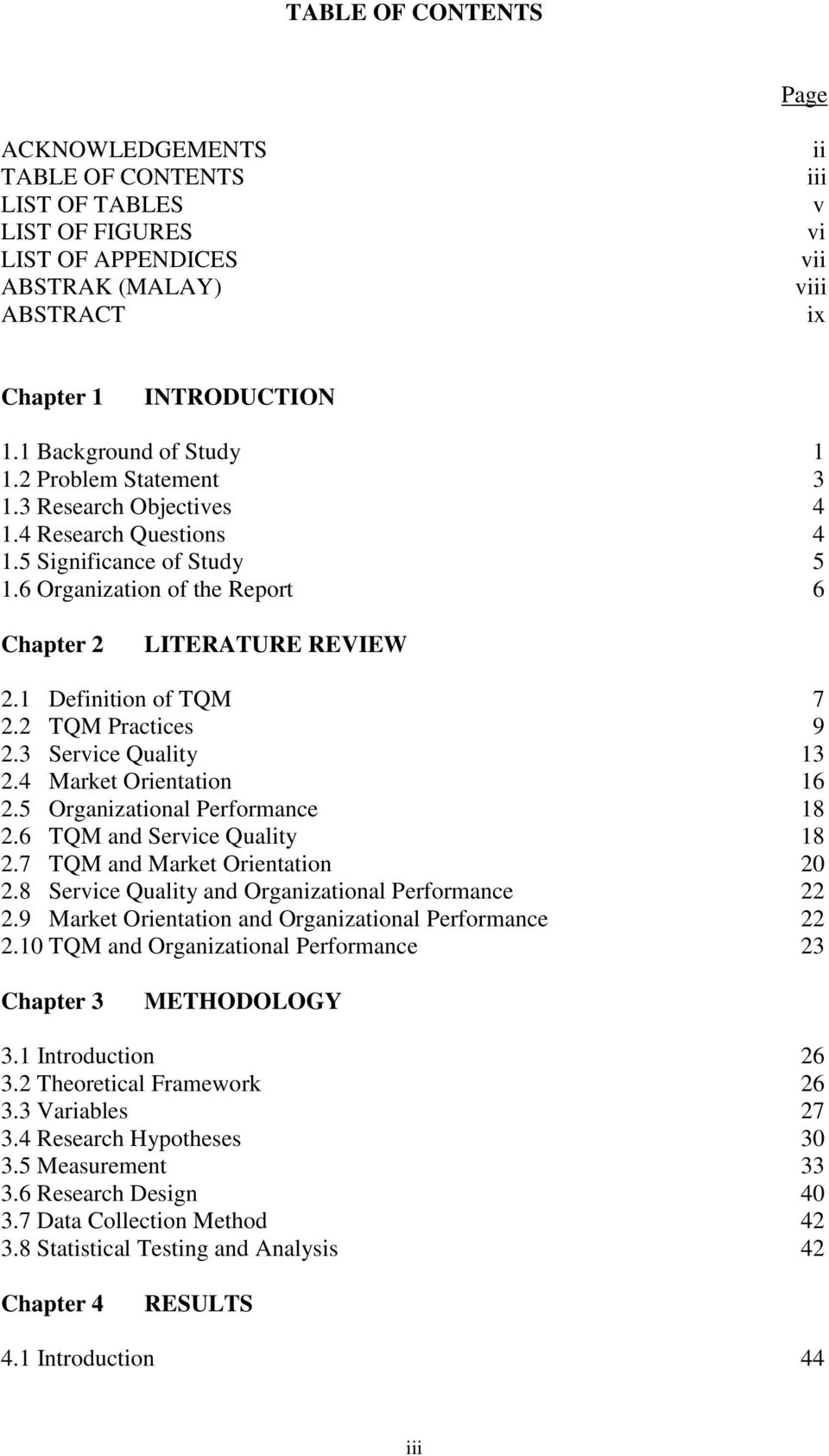
4 4.2 Response Rates Demographic Information Goodness of Measures Descriptive Analyses Hypothesis Testing Summary of Results 57 Chapter 5 DISCUSSION AND CONCLUSIONS 5.1 Introduction Recapitulation of the Study Findings Discussion on Findings Implications Limitations Suggestions for Future Research Conclusion 69 REFERENCES 71 APPENDIX (ES) 82 iv

5 LIST OF TABLES Page Table 4.1 Response Rates 44 Table 4.2 Organization's Demographic Information 45 Table 4.3 Cronbach's Alpha for Each Variable 47 Table 4.4 Descriptive Analyses of Each Variable 48 Table 4.5 Regression Analysis between TQM Practices and Service Quality 50 Table 4.6 Regression Analysis between TQM Practices and Market Orientation 52 Table 4.7 Regression Results between Service Quality and Market Orientation with Organizational Performance 53 Table 4.8 Results of Regression Analysis for Hypothesis 5 and 6 56 Table 4.9 Summary of Overall Results 58 v

6 LIST OF FIGURES Page Figure 3.1 Schematic Diagram for Theoretical Framework 29 Figure 4.1 Test for Mediation 54 vi

7 LIST OF APPENDICES Page Appendix 1 Questionnaire 82 Appendix 2 Frequencies 90 Appendix 3 Reliability Analysis 91 Appendix 4 Descriptive Analyses 103 Appendix 5 Regression Analysis 104 vii

8 ABSTRAK Kedua-dua organisasi, pengeluaran dan perkhidmatan telah menyedari peri pentingnya kualiti. Oleh sebab itu, mereka telah dipengaruhi oleh beberapa program kualiti yang berkaitan pengurusan kualiti menyeluruh (PKM). PKM seringkali diperkatakan menyediakan pelbagai faedah kepada organisasi. Satu daripadanya ialah kualiti perkhidmatan yang lebih baik yang mana ianya adalah penting untuk organisasi-organisasi perkhidmatan dalam memuaskan kehendak dan keperluan pelanggan. Sebahagian daripada faktor-faktor yang mempengaruhi orientasi pasaran adalah juga sebahagian daripada elemen-elemen PKM. Oleh itu, PKM dikatakan mempengaruhi orientasi pasaran, yang mana ianya penting untuk memperbaiki pasaran berkesan dan prestasi organisasi. Tambahan lagi, konsep dan prinsip-prinsip orientasi pasaran telah disahkan boleh mempertingkatkan prestasi organisasi. Tujuan utama kajian ini adalah untuk mengkaji hubungan antara amalan PKM, kualiti perkhidmatan, orientasi pasaran dan juga kesannya ke atas prestasi organisasi dalam organisasi-organisasi perkhidmatan. Borang soal selidik telah diedarkan kepada pengurus-pengurus di 175 buah organisasi perkhidmatan di kawasan utara Malaysia (Kedah, Perak, Pulau Pinang, dan Perlis), dan hanya 101 dikembalikan. Hasil dapatan menunjukkan hanya pemberian kuasa pekerja, maklumat dan komunikasi, keutamaan pelanggan dan pembaikan berterusan yang mempunyai kesan yang bermakna ke atas kualiti perkhidmatan, manakala hanya pemberian kuasa pekerja dan keutamaan pelanggan yang mempunyai kesan yang bermakna kepada orientasi pasaran. Keduadua kualiti perkhidmatan dan orientasi perkhidmatan mempunyai kesan kepada prestasi organisasi tetapi tidak menjadi pemoderat dalam hubungan antara amalan PKM dan prestasi organisasi. viii

9 ABSTRACT Organizations, both manufacturing and service have realized the importance of quality. Therefore, they have been influenced by some quality programs related to Total Quality Management (TQM). TQM is always said to provide a lot of benefits to the organization. One of them is better service quality, which is crucial for service organizations in satisfying customers' needs and wants. Some of the antecedents of market orientation are part of the elements under TQM. Therefore, TQM is said to influence the market orientation, which is important to enhance effective market and organizational performance. Furthermore, it was already established that the concept and principles underlying market orientation could improve organizational performance. The intention of this study was to examine the relationship between TQM practices, service quality and market orientation as well as their impact on organizational performance in service organizations. Questionnaires were distributed to the managers of 175 service organizations in northern region of Malaysia (Kedah, Perak, Penang, and Perlis), and only 101 were returned. The results show that only employee empowerment, information and communication, customer focus and continuous improvement had significant effect on service quality whilst only employee empowerment and customer focus had significant effect on market orientation. Both service quality and market orientation was significant to the organizational performance however; they did not mediate the relationship between TQM practices and organizational performance. ix

10 Chapter 1 INTRODUCTION The importance of quality has become the main concern for many organizations, both public and private. In Malaysia, most organizations have started to consider quality as an essential part of their business plan in order to meet the challenges of new global environment. This chapter gives the overview of the study, which consists of background of the study, problem statement, objectives of the study, research questions, significance of the study and finally the organization of the report. 1.1 Background of Study Quality is always referred as the conformance to requirements (Crosby, 1979) or fitness for use (Juran, 1979). Traditionally, quality is associated with the product or service that a customer receives in which it is broadly defined as the ability of a product or service to consistently meet or exceed customers' expectations. Deming (1982) defines quality as a predictable degree of uniformity and dependability, at low costs and suited to the market. Meanwhile, Total Quality Management (TQM) is a management philosophy which involves everyone in an organization in a continual effort to improve quality and achieve customer satisfaction (Stevenson, 2002). The word total means it applies to everything in which it aims to satisfy all customers, both internal and external. It expands the traditional view of quality, by looking at the quality of every aspect of the process that produces the product and service instead of looking only at the quality of the final product or services. 1

11 The U.S. General Accounting Office (1991) defined TQM as a relatively new approach to the art of management, which seeks to improve products and services quality and increase customer satisfaction by restricting traditional management practices. It integrates strategy, management practice and organizational outcomes to create a quality organization that continuously improves and sustains its performance. As long as it is fully adopted and effectively practiced, it will strengthen the organizational performance. According to Dotchin and Oakland (1994), even though TQM is more related to manufacturing companies, it is believed that the concepts and principles underlying it are equally relevant to service industry. Therefore it can be applied in manufacturing companies as well as service organizations since both manufacturing and service organizations aim to satisfy customer needs and wants. Due to the absence of tangibility of a service, customer satisfaction depends directly and most immediately on the management and monitoring of individual service encounter the period when customer interacts directly with a service (Parasuraman, Zeithaml, & Berry, 1988; Shostack, 1984, 1987; Suprenant & Soloman, 1987; Bitner, 1990). TQM is an approach historically unique to improve the organizational effectiveness with solid conceptual foundations, which at the same time, provides a strategy to enhance business performance, taking into consideration the way companies and their staffs operate (Wruck & Jensen, 1994). 2

12 1.2 Problem Statement The emergence of the service industry nowadays has increased the researchers' interest in service quality. The main objective of TQM is to establish a management system and corporate culture to ensure that customer satisfaction is enhanced, which involves a systematic method for continuous improvement of organizational processes, resulting in high quality products and services (Waldman, 1994). However, most of what has been written on TQM is usually related to manufacturing related organizations (Agus & Abdullah, 2000; Agus, 2000; Ljungstrom & Klefsjo, 2002) even though its principles and concepts can also be applied in service organizations. Quality system like TQM could lead to a better service quality and organizational performance (Cook & Verma, 2002). On the other hand, market oriented behavior is crucial for any organizations in order to compete in the industry. Literature has found that some elements in TQM have a positive impact on market orientation (Litton, 2001). However, most of what have been written on TQM is usually related to manufacturing companies even though it is widely believed that concepts and principles under TQM are equally relevant to service organizations. There is a shortage of TQM study in the service sector in general (Brah, Wong, & Rao, 2000). Therefore this research tries to investigate the impact of TQM practices on service quality, market orientation as well as organizational performance in service organizations. 3

13 1.3 Research Objectives This study is conducted to assess the impact of TQM practices on service quality, market orientation and organizational performance in service organizations. It explains the nature of the relationship between TQM practices, service quality, market orientation as well as their impact on organizational performance. This research is organized in to find the nature of the relationship between TQM practices, service quality, market orientation as well as organization in conjunction with the stated objectives below: 1. To determine which TQM practices significantly contribute to service quality. 2. To determine which TQM practices significantly contribute to market orientation. 3. To determine how service quality and market orientation affect the organizational performance. 4. To determine whether service quality mediates the relationship between TQM practices and organizational performance. 5. To determine whether market orientation mediates the relationship between TQM practices and organizational performance. 1.4 Research Questions This research attempts to address the questions of: 1. Which TQM practices have an impact on service quality and market orientation? 4

14 2. How TQM practices, service quality and market orientation affect the organizational performance? 3. Which TQM practices has a major contribution in developing better service quality, market orientation and organizational performance? 4. Whether service quality and/or market orientation mediates the relationship between TQM practices and organizational or not. 1.5 Significance of the Study Many studies have been done on the success and failure of TQM but this study investigates the impact of TQM on service quality, market orientation, and organizational performance in service organizations. In particular, this study investigates the mediating variables that explain the TQM and organizational performance relationship. This is a contribution to service industry since there are still lack of studies that have been done in relation to TQM in service organizations due to its origin, which is much related to manufacturing organizations. Potential findings resulting from this research should contribute towards understanding the improvement in quality efforts in service organizations in the context of Malaysian practitioners. This research would also provide some theoretical contributions to the TQM development, in relation to service quality, market orientation and their impacts on organizational performance. 5

15 1.6 Organization of the Report This report includes five chapters in which chapter one introduces the importance of TQM in service organizations. Chapter two reviews the literature on TQM practices and its impact on service quality, market orientation, as well as organizational performance. Chapter three addresses the methodology, the theoretical framework of this study and the development of research hypotheses, variables, measurement, sampling design, research design, and statistical tests used in analyzing the data in this study. Chapter four explains the results from the analysis in Chapter three, which comprises organizations' demographic information, goodness of measure, descriptive analysis, results of hypotheses testing, and the summary of results. Chapter five discusses the findings of the study and its implications, limitations and recommendations for future research. 6

16 Chapter 2 LITERATURE REVIEW In contemporary management, TQM has become the major business strategy in the 1990s (Witcher, 1994; Lee & Leung, 1999). The evolution of TQM into an allpervasive philosophy of management took shape through the works of Crosby (1979), Deming (1982, 1986), Feigenbaum (1983), Ishikawa (1972), Juran (1988) and Taguchi (1982). The success of TQM will result in improved employee involvement, improved communication, increased productivity, improved quality and less reworks, improved customer satisfaction, reduced costs of poor quality and improved competitive advantage (Antony, Leung, Knowles, & Gosh, 2002). Strong competitive pressure has embarked organizations in Malaysia to offer high quality products and services as a way to attract and keep their customers. Therefore, many organizations have already implemented TQM, in order to improve their positions in the market place. This chapter reviews what past researchers have done and discussed on TQM practices and their impact on service quality, market orientation and organizational performance. 2.1 Definition of TQM Total Quality Management (TQM) is a management philosophy under which an organization operates, which seeks to improve quality and increase customer satisfaction. The philosophy is holistic, applying to everything (total) with the aims to 7

17 satisfy all customers, both internal and external, specifically users of the customers products and services (quality) and it follows the example set of and reinforced in the organization (management). It is not only a management process but also a corporate philosophy, which recognizes that customer needs and business goals cannot be separated (Agus, Krishnan, & Syed, 2000). Litton (2001) defined TQM as a management philosophy and tools designed to achieve long-term business success by delivering customer satisfaction through a focus on quality and continuous improvement in all business processes. From the various definitions, we used the Malaysian context definition by the Prime Minister's Department (1992) that defined TQM as a continuous process of culture transformation through which the existing elements of the culture are modified, replaced or strengthened with better elements that encompass values and attitudes, systems and procedures, operational practices, organization structure and so forth (Development Administration Circular, 1992). Quality here does not only mean the production of quality products and services but also encompasses all operations and activities pertaining to an organization. At this stage, quality will be reflected in many ways in an organization such as effectiveness of management, ability of the employees, efficiency of the operational systems and so on. 8

18 2.2 TQM Practices A distinction can be made between the TQM content, elements, processes or practices. It is so-called elements (Waldman, 1994) practices and principles (Dean & Bowen, 1994), values and techniques (Hellsten & Klefsjo, 2000), processes and contents (Reed, Lemak, & Mero, 2000), interventions (Hackman & Wageman, 1995), principles and precepts (Sitkin, Sutcliffe, & Schroeder, 1994), etc. Although definitions do not coincide in full, all of them still refer to those fundamentals that make up TQM theoretical frame without which the management system implemented in the organization or the philosophy on which it is based could not be called TQM (Javier, Antonio, & Mignel, 2003). Saraph, Benson, and Schroeder (1989) argues that there are eight critical success factors (CSFs) for TQM implementation such as: top management leadership, role of the quality department, training, product design, supplier quality management, process management, quality data reporting, and employee relations. Meanwhile, Black and Porter (1996) reveals ten major TQM practices. They are people and customer management, supplier partnerships, communication of improvement information, customer satisfaction orientation, external interface management, teamwork structures for improvement, operational quality planning, quality improvement measurement systems, and corporate quality culture. Even so, Antony et al. (2002) describes eleven TQM practices: management commitment, role of the quality department, training and education, employee involvement, continuous improvement, supplier partnership, product/service design, 9

19 quality policies, quality data and reporting, communication to improve quality, and customer satisfaction orientation. Sureshchandar, Rajendran, and Anantharaman (2002) expands the practices even further and come out with twelve major practices comprise of top management commitment and visionary leadership, human resource management, technical system, information and analysis system, benchmarking, continuous improvement, customer focus, employee satisfaction, union intervention, social responsibility, servicescapes, and service culture. Brah et al. (2000) in their study on TQM and business performance in Singapore service sector has come out with eleven constructs of TQM implementation, which are the top management support, customer focus, employee involvement, employee training, employee empowerment, supplier quality management, process improvement, service design, quality improvement rewards, benchmarking, and cleanliness and organization. Based upon the above literature, the researcher has selected the following list of seven main practices of TQM implementation for this study. All practices are selected due to their relation and mostly support in service organization and market oriented behavior: management support and commitment, employee involvement, employee empowerment, information and communication, training and education, customer focus, and continuous improvement. All these seven practices are among 25 TQM practices listed to be the most common extracted across 76 studies on TQM (Sila & Ebrahimpour, 2002). 10

20 2.2.1 Management Support and Commitment To be successful TQM must be top-management driven and focus on maximizing efficiency and effectiveness, and promoting market dominance through improving systems and processes, error prevention, and aligning business objectives and customer needs (Agus et al., 2000). It was found by Ahire, Golhar, and Waller (1996), Flynn, Schroeder, and Sakakibara (1994), Grandzol (1998), and Powell (1995) that top management commitment was positively correlated with many performance measures such as financial and operational results and customer satisfaction Employee Involvement Since the philosophy of TQM is to prevent defects of goods or services early in the production process rather than fix it at a later stage, employee commitment is a necessary element for successful TQM implementation (Lee & Howard, 1994). Quality is everybody's responsibility (Gunasekaran & Goyal, 1998) involving each employees which results to better service quality and market oriented behavior that in turn relates to high organizational performance Employee Empowerment Another key focus area in the TQM implementation is the empowerment of employees like work groups, task teams, functional teams and self-management teams. To be succeeding, both employees and managers must be committed enough and trusteeship must be developed among them (Dean & Helms, 1996). Empowerment practices when simultaneously implemented have a favourable effect 11

21 on employee well being, productivity, performance and service quality (Geralis & Terziovski, 2003) Information and Communication Organization should have correct information to ensure all employees understand with the organization and its process. Therefore, to make sure the information is accurately and effectively disseminated to the right person at the right time, organization need to have a good communication system. Anjard (1998) mentioned that a better communication could be accomplished if an organization implements the TQM effectively. This is because in TQM, people will communicate more open and frequent among them Training and Education In order for employees to be committed and actively participate and contribute their ideas to the successful of TQM, they need to be trained and educate. According to Juran (1989), training must be provided to all employees from all levels. The employees' level of knowledge can be reinforced depending on the attention paid to training and education by the system Customer Focus According to Brah, Serene, and Rao (2002), customer focus refers to organization's effectiveness in recognizing its customer needs, wants and expectations. It is believed that the focus on their needs is important in serving better quality of service (Patel, 1995). Issues related to customer focus and satisfaction received the biggest coverage in the TQM survey literatures analyzed here given the major push toward a customer 12
22 satisfaction orientation in virtually all types of businesses (Sila & Ebrahimpour, 2002) Continuous Improvement Continuous improvement is always refer to better and better quality, less and less variation, which results from process management practices that bring improvements and innovating in products, services, and processes (Zairi, 2002). Work process and improvements are very much focused in TQM implementation (Antony et al., 2002) in which employees will contribute more on the elimination of root causes instead of problem corrections. All of these are to ensure increase in quality and reduce rework and wasting of time. 2.3 Service Quality A service is a process that leads to an outcome during partly simultaneous production and consumption processes (Gronroos, 2001). Service quality is the great differentiator; it gets and keeps the customer s attention (Berry, Parasuraman, & Zeithaml, 1988). According to Gronroos (1984) and Parasuraman, Zeithaml, and Berry (1985, 1991), the traditional approach for defining service quality emphasizes that service quality perception is a comparison of consumer expectations with actual performance. Chia et al. (2002) simplified the definition of service quality as a comparison between consumers' expectations and their perceptions of the service they actually receive. Many studies on the TQM implementation and its effect on performance have been published, but the sample of companies targeted showed that manufacturing 13
23 companies have been surveyed to a greater extent compared to service sector (Sila & Ebrahimpour, 2002). This may be because of TQM has its origin in manufacturing related organizations (Brah et al., 2000) as well as the assessment and measurement of quality management in services may seem more difficult because of the intangible nature of services (Parasuraman et al., 1985). Juran (1979) classified the measurement of quality in a service organization along 2 dimensions: internal and external. Internal measurement is to measure the internal process, while external measurement is to measure the quality of products or services based on customer satisfaction. The main yardstick of performance in quality for service organizations is external customer satisfaction. According to Lee and Howard (1994), in providing preliminary feedback of an organization s quality improvement an internal climate survey could be utilized, which refers to employees and managers perceptions, about their organization and work units along several dimensions. Among various concepts on service quality, two of them are most widely accepted and used by researchers, the SERVQUAL model by Parasuraman, Zeithaml, and Berry (1988) and the Technical/Functional Quality framework by Gronroos (1983, 1990). Parasuraman et al. (1985) proposed a conceptual framework of service quality based on the interpretation of qualitative data from extensive explanatory research performed in four service businesses. SERVQUAL instrument by Parasuraman et al. included two 22-item sections. The intent is to measure customer expectations for various aspects of service quality and customer perceptions of the service they actually received from the local service organization (Lassar et al., 2000). 14
24 Parasuraman et al. (1988) in their research found that customers consider five dimensions in their assessment of service: reliability, responsiveness, assurance, empathy, and tangibles, which represent how the customers organize information on service quality (Cook & Verma, 2002). The SERVQUAL instrument has been used widely all over the world but it cannot avoid from criticisms. Many researches conducted in a variety of settings suggest that the five SERVQUAL dimensions may not be universal for all services and that it is probably unnecessary to administer the expectation every time SERVQUAL is administered (Babakus & Boller, 1992; Carman, 1990; Parasuraman et al., 1991). Apart from expectations-performance methodology by Parasuraman et al. (1988), Cronin and Taylor (1992) claimed that a psychometrically superior assessment of service quality could be obtained through the SERVQUAL performance items alone. According to Lassar et al. (2000), recent researchers have started integrating other constructs and measures along with the SERVQUAL dimensions in order to extend and improve the explanatory power of this model. Gronroos (1983) has his own functional/technical model of service quality. He used a two-dimension model of service quality: [1] technical quality, and [2] functional quality. In this model, he explained that technical quality entails what is provided and functional quality takes into account how it is delivered. He also suggests that service quality is dependent on two variables: the consumers expectations of what the outcome will be, and the consumers perception of the actual result (Dotchin & Oakland, 1994). Gronroos (1984 in Dotchin & Oakland, 1994) indicated that functional quality will compensated for temporary problems with technical quality but 15
25 will not make up for an overall lower quality level. This means that as far as services are concerned, if technical quality is at least satisfactory, then functional quality is the important factor of consumer perceptions. Meanwhile, where technical quality is very similar among firms, functional quality is an important means of differentiation. The two dimensions of service performance (technical and functional quality) are compared to the customers' expectations and eventually the customer has their own service quality perceptions (Chia, Chin, & Chin, 2002), which consists of service culture and service process. According to Anderson and Fornell (1994), Gronroos model has received a lot of attention recently even though it has not been utilized or tested to the extent of the SERVQUAL model. Lassar, Manolis, and Winsor (2000) in his study on service quality perspectives and satisfaction in private banking concluded that technical/functional quality based model of service quality is better suited as compared to the SERVQUAL based model in predicting customer satisfaction when customers are actively involved or highly interested in service delivery. 2.4 Market Orientation Asian firms, especially telecommunication/information technology firms, need to understand the concept and application of market orientation in order to compete successfully in this globalization era (Johnson & Huizenga, 2001). According to Greenley (1995), the concept of market orientation is important in both marketing and strategic management in which the external orientation of an organization towards its markets can be described in terms of being market driven or market oriented. 16
26 Jaworski and Kohli (1993) argued that market orientation is concerned with behaviors and activities in the organization. They have defined the market orientation as the organization-wide generation of market intelligence, disseminating and responding to the market intelligence across departments in the organization. Meanwhile some authors relate the market orientation with cultural perspective such as Narver and Slater (1990), Deshpande, Farley, and Webster (1993) even though in 1989 Deshpande and Farley mentioned that market orientation is not a culture but a set of activities in an organization (Farrell, 2000). However, according to Narver et al. (1998), market orientation is a basic part of organizational culture and not a set of processes and activities that aimed to create a market oriented culture, each employee must understand that the whole purpose of the organization is to create superior value for customers (Farrell, 2000). Narver and Slater (1990) defined market orientation as the organization culture that most effectively creates the necessary behaviors for the creation of superior value for buyers and, thus, continuous superior performance for the business. Besides, they also argue that the behavior and culture of an organization are inter-linked in which an organization s behavior is shaped by its culture and over time culture is shaped by the organization s behavior and performance. Furthermore, Deshpande and Farley (1996) found that market orientation was in reality identical with a customer orientation. As cited in Heiens (2000) Deshpande and Webster (1989) as well as Payne (1988) state that parallel to the marketing concept usually customers have been considered as the main focus of market orientation. According to Selnes (1996) in Gounaris, Stathakopoulos, and Athanassopoulos (2003), when market orientation is developed, generally it leads to positive job 17
27 attitude, commitment and team spirit for the employees. Harris (1999) mentioned that positive job attitude, commitment and team spirit among employees are crucial in the service sector especially to the front-line personnel who play an important role in delivering superior service quality. 2.5 Organizational Performance Many authors have different definitions of performance. Venkatraman and Ramanujan (1986) consider three aspects of performance, among them are: financial performance, business performance, and organization effectiveness and the later has been subsequently known as organizational performance (Chu-Hua, Madu, & Lin, 2001; Terziovski & Samson, 1999). According to Griffin (2003), organizational performance, as a result, is described as the extent to which the organization is able to meet the needs of its stakeholders and its own needs for survival. Therefore, performance is not suitable equated with a certain profit margin, a high market share, or having the best products, although these things may result from fully achieving the description of performance. To him, organizational performance is influenced by multitude factors that are combined in unique ways to both enhance and detract performance. 2.6 TQM and Service Quality Quality programs are designed to boost the organization s potential revenue and reduce the cost of quality (Banks, 1992). Previous empirical studies regarding the linkages between TQM and organizational performance as well as quality have shown strong and positive results. This is agreed by Ahire et al. (1996), Flynn et al. (1994), 18
28 and Samson and Terziovski (1999). This is true since the main focus of TQM as suggested by Deming, Juran, Crosby, and Ishikawa is to improve quality. A research on the relationship between TQM practices, quality performance, and innovation performance conducted by Prajogo and Sohal (2003) concluded that TQM is significantly and positively related to quality performance as well as innovation performance. According to Antony et al. (2002), successful TQM implementation will give benefits in improving quality and reducing rework as well as reduction in costs of poor quality such as scrap, rework, late deliveries, warranty, replacement, etc. Furthermore, Brah et al. (2002) supported the proposition that TQM implementation correlates with quality conformance. Behavioral factors such as role of top management leadership, customer focus, human resource focus, and quality focus as well as TQM tools and techniques like corporate planning, process focus, and information and analysis contribute to the successful TQM implementation. Other TQM elements also give a better result to an organization. When organizations provide supportive structures and processes like TQM for their employees, these employees are more able to provide top quality products and services to their external customers (Gilbert & Parhizgari, 2000). Cook and Verma (2002) in their study on linkages between quality system, service quality and performance excellence found that according to the perceptions of the bank s employees, quality systems affects service quality that in turn relates to organizational performance. 19
29 Litton (2001) also said that TQM process improves quality and service. He concluded in his paper on TQM Concept Articulation that effective TQM processes can generate marked improvements in both product and service quality which then resulted in increased customer satisfaction and organization s profitability. As cited by Geralis and Terziovski (2000), Roth and Jackson (1995) found that by establishing a motivated, customer oriented management philosophy and practice; internal service quality levels will be more favorable. They also found that employees processing organizational knowledge and skills are important in delivering service quality in which high levels of employee morale and satisfaction were found dependent on the empowerment and involvement of employees. All the customer focus, employees skills and knowledge as well as their empowerment and involvement are some of the practices under TQM. Therefore TQM can lead to a better level of service quality in organization. 2.7 TQM and Market Orientation According Javier et al. (2003), the significance of taking into consideration business orientation is already an accepted idea in the TQM literature. Top management such as Chief Executive Officers and Senior Managers are part of the elements in TQM practices. Hambrick and Mason (1964) and Webster (1988) said that it is argued that senior managers shape the direction of the organization as well as its values. Jaworski and Kohli (1993) have found that the amount of emphasis senior managers place on market orientation affects both the acquisition of and responsiveness to information, and that market orientation requires risk taking on the part of senior managers. Therefore this shows that the element in TQM practices, which is top management support, contributes something to a better market orientation in an organization. 20
30 As well as top management support, another main element in TQM practice is customer focus. Recently, most researches suggest that it is more than a marketing concept, but it also refers to the ability to capably and positively impact on the organization s value chain (Javier et al., 2003). Narver and Slater (1990) also found that customer focus is positively related to profitability. Moreover, according to Hensler (1994), which is revealed by Litton (2000) in his paper TQM Concept Articulation, besides becoming a cornerstone of the corporate strategy and being often explicit in the organization s mission statement TQM also provides input to the process of marketing orientation. In other words, Hensler said that those organizations that have held TQM in their strategy and corporate culture are by nature market oriented organizations. As mentioned earlier, TQM leads to product and service quality. This kind of improvements from TQM said Hensler (1994) lead to a higher value perception among customers, which can be the source of differentiation to the organization. Furthermore, for that kind of service improvement, customer will be willing to pay a higher price. Therefore Sparks (1993) said that TQM increases the organization s responsiveness to customer needs, which is part of market orientation, and finally will lead to a longer relationship between the organization and the customer. The antecedents of market orientation by Jaworski and Kohli (1993), some of them are the same with elements in TQM such as management support and commitment, employee involvement and employee empowerment. This means that, market orientation is another good output from TQM. 21
31 2.8 Service Quality and Organizational Performance It is proven by many previous studies that have been done that TQM did improve organization s products and services. In addition, a large number of studies relate a better quality of products and services to better organizational performance (Forker, Vickery, & Droge, 1996; Golhar & Deshpande, 1999; Kroll, Wright, & Heines, 1999). Employee s perception of delivery service quality such as tangibles, reliability, responsiveness, and empathy affects organization s performance as measured by monetary and value gain and it is equally essential to understand that superior quality can lead to higher levels of operational performance (Cook & Verma, 2002). Also, Gounaris et al. (2003) considered service quality as an important factor that allows an organization to differentiate itself from competitors and therefore gain a sustainable competitive advantage. 2.9 Market Orientation and Organizational Performance The influence of market orientation on organizational performance is well already established. Its concept has been defined and empirically validated as a way to improve business performance (Johnson & Huizenga, 2001) and can be a powerful competitive advantage (Porter, 1980; Day, 1990). According to Caruana, Pitt, and Berthon (1999) and Wood, Bhuian, and Kiecker (2000), both market orientation and customer service orientation have a positive impact on different aspects of an organization s financial performance, including delivered quality, especially in the service sector. 22
32 Narver and Slater (1990) tested empirically and found a link between market orientation and business performance. Meanwhile, Jaworski and Kohli (1993) found that market orientation is related to overall business performance (but not the market share), employee organizational commitment and team spirit, and it affords psychological and social benefits to employees. However, a study on Market Orientation in the Asian Mobile Telecom Industry by Johnson and Huizenga (2001) has found a different result. The study discovered that market orientation was not significantly related to business performance when using combined business performance measures: market share, sales growth, and size of revenue and profitability. Also, a research done by Hult and Ketchen (2001) on the relationship between positional advantage and performance found that the linkage between market orientation and organizational performance is not linear, but rather is embedded within a more complex web of relationships. Heiens (2000) suggest that if an organization fails to develop a market orientation, either customer or competitorfocused, may unfavorably affect business performance TQM and Organizational Performance As stated earlier, a better quality of services leads to a better organizational performance, in which this being one of the possible impacts of TQM on organizational performance. The intensity of TQM practices does contribute significantly to the performance (Samson & Terziovski, 1999). 23
33 The relationship between TQM implementation and the quality of the organization products has been empirically validated (e.g. Choi & Eboch, 1998; Forza, 1995). A large number of studies relate better quality of the products and services to better organizational performance (Forker et al., 1996; Golhar & Deshpande, 1999; Kroll et al., 1999). This shows the impact of TQM on organizational performance. Easton and Jarrel (1994) as cited in Brah et al. (2000), report evidence of improved financial performance associate with the implementation of TQM. Powell (1995) studied the relationship between TQM and the organizational performance of 54 firms and found that TQM could add economic value to the firm. Kuei and Madhu (1995) also indicated strong relations between quality measures (customer satisfaction, employee satisfaction and employee service quality) and organizational performance. Agus (2000) highlighted the unique contribution of TQM practices and the significant role of competitive advantage as a mediating variable in the relationship between TQM and financial performance. In turn, TQM elements are related to organizational performance, using a perspective that is one of the characteristics of the industrial psychology, by ways of the transformations produced in organization members, both regarding what they do and what they are able to do, on one hand, and the efforts made to do it, on the other (Javier et al., 2003). The U.S. Government Accounting Office Study (GAO, 1991) found a strong relationship between the company's use of TQM (such as strong customer focus, senior management leadership, a commitment to employee training, empowerment, involvement and the application of systematic fact finding and decision making 24
The impact of quality management principles on business performance. A comparison between manufacturing and service organisations
 The impact of quality principles on A comparison between manufacturing and service organisations by Åsa Rönnbäck* and Lars Witell** *Division of Sciences, Chalmers University of Technology, SE-412 96 Göteborg,
THE IMPACT OF QUALITY MANAGEMENT PRACTICES ON ORGANIZATION PERFORMANCE AT KUCHING
 UNIVERSITI SARAWAK Faculty of Economics and Business MALAYSIA U N I M A S Fakulti Ekonomi dan Perniagaan THE IMPACT OF QUALITY MANAGEMENT PRACTICES ON ORGANIZATION PERFORMANCE AT KUCHING Chong Mei Chin
IMPROVING SERVICE REUSABILITY USING ENTERPRISE SERVICE BUS AND BUSINESS PROCESS EXECUTION LANGUAGE AKO ABUBAKR JAAFAR
 IMPROVING SERVICE REUSABILITY USING ENTERPRISE SERVICE BUS AND BUSINESS PROCESS EXECUTION LANGUAGE AKO ABUBAKR JAAFAR A project report submitted in partial fulfillment of the requirements for the award
Pak J Commer Soc Sci Pakistan Journal of Commerce and Social Sciences 2013, Vol. 7 (1), 184-197
 Pak J Commer Soc Sci Pakistan Journal of Commerce and Social Sciences 2013, Vol. 7 (1), 184-197 The Impact of Total Quality Management Practices towards Competitive Advantage and Organizational Performance:
THE RELATIONSHIP BETWEEN HUMAN RESOURCE INFORMATION SYSTEM (HRIS) AND HUMAN RESOURCE MANAGEMENT (HRM) ALFRED PUN KHEE SEONG
 THE RELATIONSHIP BETWEEN HUMAN RESOURCE INFORMATION SYSTEM (HRIS) AND HUMAN RESOURCE MANAGEMENT (HRM) ALFRED PUN KHEE SEONG UNIVERSITI TEKNIKAL MALAYSIA MELAKA I / We * hereby declare that have read For
CRITICAL FACTORS OF QUALITY MANAGEMENT USED IN RESEARCH QUESTIONNAIRES: A REVIEW OF LITERATURE
 CRITICAL FACTORS OF QUALITY MANAGEMENT USED IN RESEARCH QUESTIONNAIRES: A REVIEW OF LITERATURE KANAGI KANAPATHY Sunway University College No. 5, Jalan Universiti, Bandar Sunway 46150 Petaling Jaya, Selangor
Evaluating the Relationship between Service Quality and Customer Satisfaction in the Australian Car Insurance Industry
 2012 International Conference on Economics, Business Innovation IPEDR vol.38 (2012) (2012) IACSIT Press, Singapore Evaluating the Relationship between Service Quality and Customer Satisfaction in the Australian
Applications of Total Quality Management in Indian Airline Industry
 Applications of Total Quality Management in Indian Airline Industry Charu Gupta 1, Dr. R. M. Belokar 2 1 Pec University, Department of Production Engineering, Sector-12, Chandigarh 160012, India 2 Pec
Total Quality Management in the Malaysian Automobile Industry
 Total Quality Management in the Malaysian Automobile Industry Ismah Osman Faculty of Business Management, Universiti Teknologi MARA 40450, Shah Alam, Selangor, Malaysia Tel: 60-3-554-4446 E-mail: [email protected]
The Study of TQM Implementation and Competitiveness for High Technology Industries
 The Study of TQM Implementation and Competitiveness for High Technology Industries Ming-Tzong Wang 1, Sophia Wang 2, Simon Wang 2, Hsu-Hua Lee 2, Shen-Li Hong 2, Shi-Min Wang 2, Tony Huang 2, and Luke
The impact of quality practices on customer satisfaction and business results: product versus service organizations
 Journal of Quality Management 6 (2001) 5 27 www.journalofqualitymanagement.com The impact of quality practices on customer satisfaction and business results: product versus service organizations Lars Nilsson
How To Improve Quality Control
 P P P IJISET - International Journal of Innovative Science, Engineering & Technology, Vol. 2 Issue 8, July 2015. Implementation of Total Quality Management in Rajasthan SME s 3 2 1 1 2 3 Yogesh BoyalP
QUALITY MANAGEMENT IMPLEMENTATION AND QUALITY OF PRODUCTION IN MALAYSIA S MANUFACTURING COMPANIES
 IMPACT: International Journal of Research in Business Management (IMPACT: IJRBM) ISSN(E): 2321-886X; ISSN(P): 2347-4572 Vol. 2, Issue 3, Mar 2014, 53-60 Impact Journals QUALITY MANAGEMENT IMPLEMENTATION
A STUDY ON MOTIVATION TO START UP A BUSINESS AMONG CHINESE ENTREPRENEURS
 A STUDY ON MOTIVATION TO START UP A BUSINESS AMONG CHINESE ENTREPRENEURS A master project submitted to the Graduate School in partial fulfillment of the requirements for the degree Master of Business Administration,
The Influence of Soft and Hard TQM Factors on Knowledge Management: Perspective from Malaysia
 2011 International Conference on Management and Service Science IPEDR vol.8 (2011) (2011) IACSIT Press, Singapore The Influence of Soft and Hard TQM Factors on Knowledge Management: Perspective from Malaysia
2. Background and Purpose of the Study
 A Theoretical Model for Implementing Quality Management in an Automated Environment Oswald S. W. Franks PhD. Pr Eng Cape Peninsula University of Technology [email protected] Abstract This paper will present
SPAM FILTERING USING BAYESIAN TECHNIQUE BASED ON INDEPENDENT FEATURE SELECTION MASURAH BINTI MOHAMAD
 SPAM FILTERING USING BAYESIAN TECHNIQUE BASED ON INDEPENDENT FEATURE SELECTION MASURAH BINTI MOHAMAD A project report submitted in partial fulfillment of the requirements for the award of the degree of
TRANSFORMATIONAL PROJECT MANAGER: AN ENABLER OF AN ENTERPRISE RESOURCE PLANNING (ERP) IMPLEMENTATION SUCCESS JOHN ONYEKACHI OKUGO
 i TRANSFORMATIONAL PROJECT MANAGER: AN ENABLER OF AN ENTERPRISE RESOURCE PLANNING (ERP) IMPLEMENTATION SUCCESS JOHN ONYEKACHI OKUGO A dissertation submitted in partial fulfillment of the requirements for
The Practice of Internal Marketing is Influence the Market Orientation and Innovation
 The Practice of Internal Marketing is Influence the Market Orientation and Innovation Yafang Tsai Associate Professor, Department of Health Policy and Management, Chung-Shan Medical University, Taiwan
DEVELOPING AN ISP FOR HOTEL INDUSTRY: A CASE STUDY ON PUTRA PALACE HOTEL
 DEVELOPING AN ISP FOR HOTEL INDUSTRY: A CASE STUDY ON PUTRA PALACE HOTEL A report submitted to the Graduate School in partial fulfillment of the requirement for the Degree Master of Science (Information
MASTER S PROJECT REPORT SUMMARY
 MASTER S PROJECT REPORT SUMMARY LEVEL OF SERVICE (LOS) FOR MULTILANE HIGHWAY AND ROAD ACCIDENT INFORMATION SYSTEM DEVELOPMENT OF BATU PAHAT AREA (LORIS) Prepared by: Mohd Ezree Bin Abdullah Master of Engineering
STRESS EFFECT STUDY ON 6 DIFFERENT PATTERN OF TYRES FOR SIZE 175/70 R13 SYAHRIL AZEEM ONG BIN HAJI MALIKI ONG. for the award of the degree of
 STRESS EFFECT STUDY ON 6 DIFFERENT PATTERN OF TYRES FOR SIZE 175/70 R13 SYAHRIL AZEEM ONG BIN HAJI MALIKI ONG A report submitted in partial fulfilment of the requirements for the award of the degree of
Julian Paul Sidin Syed Azizi Wafa Syed Khalid Wafa Stephen Laison Sondoh Jr. Universiti Malaysia Sabah Faculty of Business, Economics & Accountancy
 QUALITY MANAGEMENT INITIATIVES IN MALAYSIA S MANUFACTURING FIRMS: IMPLICATIONS ON EMPLOYEE INVOLVEMENT, NEW PRODUCT DEVELOPMENT AND QUALITY OF PRODUCTION Julian Paul Sidin Syed Azizi Wafa Syed Khalid Wafa
High Performance Quality Management Systems and Work-Related Outcomes: Exploring the Role of Audit Readiness and Documented Procedures Effectiveness
 Eastern Michigan University DigitalCommons@EMU Master's Theses and Doctoral Dissertations Master's Theses, and Doctoral Dissertations, and Graduate Capstone Projects 10-23-2007 High Performance Quality
CLIENT SERVER APPLICATION FOR SERVER FARM PERFORMANCE MONITORING ABDIRASHID HASSAN ABDI
 ii CLIENT SERVER APPLICATION FOR SERVER FARM PERFORMANCE MONITORING ABDIRASHID HASSAN ABDI A project submitted in partial fulfillment of the requirements for the award of the degree of Master of Computer
CRITICAL SUCCESS FACTORS FOR TOTAL QUALITY MANAGEMENT IMPLEMENTATION WITHIN THE LIBYAN IRON AND STEEL COMPANY
 CRITICAL SUCCESS FACTORS FOR TOTAL QUALITY MANAGEMENT IMPLEMENTATION WITHIN THE LIBYAN IRON AND STEEL COMPANY Massoud M. Arshida Tun Abdul Razak University, Graduat School of Business, Capital Square,
RELATIONSHIP BETWEEN WORK MOTIVATION AND JOB PERFORMANCE: ORGANIZATIONAL COMMITMENT AS A MEDIATOR
 RELATIONSHIP BETWEEN WORK MOTIVATION AND JOB PERFORMANCE: ORGANIZATIONAL COMMITMENT AS A MEDIATOR ROSMARIANI BINTI AB GHANI This project is submitted in partial fulfilment of the requirements for a Bachelor
Measuring Quality in Graduate Education: A Balanced Scorecard Approach
 Measuring Quality in Graduate Education: A Balanced Scorecard Approach Dr. S. Kim Sokoya Professor of Management Associate Dean, Graduate and Executive Education Jones College of Business Middle Tennessee
Service Quality Value Alignment through Internal Customer Orientation in Financial Services An Exploratory Study in Indian Banks
 Service Quality Value Alignment through Internal Customer Orientation in Financial Services An Exploratory Study in Indian Banks Prof. Tapan K.Panda* Introduction A high level of external customer satisfaction
Literature review on TQM
 Literature review on TQM 1 Kamini Srinivasa Rao, 2 Dr Adimulam Yesu Babu 1 Asst.Professor, 1 Department of information technology 1 Bapatla Engineering college,bapatla 2 I/C Principal, 2 Department of
DEVELOP AND DESIGN SHEMATIC DIAGRAM AND MECHANISM ON ONE SEATER DRAG BUGGY MUHAMMAD IBRAHIM B MD NUJID
 DEVELOP AND DESIGN SHEMATIC DIAGRAM AND MECHANISM ON ONE SEATER DRAG BUGGY MUHAMMAD IBRAHIM B MD NUJID A report in partial fulfillment of the requirements For award of the Diploma of Mechanical Engineering
UNIVERSITI TEKNOLOGI MARA THE EFFECTIVENESS OF MARKETING MIX STRATEGY CASE STUDY: SETIA ALAM
 UNIVERSITI TEKNOLOGI MARA THE EFFECTIVENESS OF MARKETING MIX STRATEGY CASE STUDY: SETIA ALAM HIZMA RAZLIATI BINTI ABDUL RAHIM SEPTEMBER 2011-JANUARI 2012 JABATAN PENGURUSAN HARTANAH FAKULTI SENIBINA PERANCANGAN
PRODUCTIVITY IMPROVEMENT VIA SIMULATION METHOD (MANUFACTURING INDUSTRY) HASBULLAH BIN MAT ISA
 PRODUCTIVITY IMPROVEMENT VIA SIMULATION METHOD (MANUFACTURING INDUSTRY) HASBULLAH BIN MAT ISA Thesis submitted in fulfillment of the requirements for the award of the degree of Bachelor of Mechanical Engineering
Universiti Teknologi MARA. User Perception on Electronic Customer Relationship Management (E-CRM) Features in Online Hotel Reservation
 Universiti Teknologi MARA User Perception on Electronic Customer Relationship Management (E-CRM) Features in Online Hotel Reservation HasUza Binti Azizan Thesis submitted in fulfillment of the requirements
Chapter 2 Concept of Total Quality Management 4
 Chapter 2 Concept of Total Quality Management 4 2.1 Introduction This chapter focuses on the identification of the concept of TQM on the basis of the literature review. Section 2.2 presents the concept
BENEFITS DERIVED BY SMEs THROUGH IMPLEMENTATION OF TQM
 BENEFITS DERIVED BY SMEs THROUGH IMPLEMENTATION OF TQM Yogesh A. Chauhan 1 1 Associate Professor, Mechatronics Engineering Department, G.H.Patel College of Engineering & Technology, Gujarat, India, Abstract
The relationship between organization strategy, total quality management (TQM), and organization performance the mediating role of TQM
 European Journal of Operational Research 168 (2006) 35 50 Production, Manufacturing, Logistics The relationship between organization strategy, total quality management (TQM), and organization performance
Total quality management: today s business excellence strategy
 International Letters of Social and Humanistic Sciences Vol. 32 (2014) pp 188-196 Online: 2014-06-24 (2014) SciPress Ltd., Switzerland doi:10.18052/www.scipress.com/ilshs.32.188 Total quality management:
SUPPLY CHAIN MANAGEMENT PRACTICES, SUPPLY CHAIN INTEGRATION AND SUPPLY CHAIN PERFORMANCE: A STUDY OF ELECTRONICS FIRMS IN MALAYSIA
 SUPPLY CHAIN MANAGEMENT PRACTICES, SUPPLY CHAIN INTEGRATION AND SUPPLY CHAIN PERFORMANCE: A STUDY OF ELECTRONICS FIRMS IN MALAYSIA VEERA PANDIYAN KALIANI SUNDRAM THESIS SUBMITTED IN FULFILMENT OF THE REQUIREMENTS
Intl' Conf. on Chemical, Integrated Waste Management & Environmental Engineering (ICCIWEE'2014) April 15-16, 2014 Johannesburg
 Application of Total Quality Management (TQM) and Statistical Process Control (SPC) in Improving Business Competitiveness for Manufacturing Organizations IgnatioMadanhire, and Charles Mbohwa Abstract---The
MANAGING CHANGES FOR IMPLEMENTING TQM IN INNOVATION PROCESS
 MANAGING CHANGES FOR IMPLEMENTING TQM IN INNOVATION PROCESS Cosmin DOBRIN The Bucharest Academy of Economic Studies, Bucharest, Romania [email protected] Ana-Maria STĂNCIUC The Bucharest Academy
International Review of Business Research Papers Vol. 3 No.5 November 2007 Pp.134-145. Internal Marketing Issues in Service Organizations in Malaysia
 International Review of Business Research Papers Vol. 3 No.5 November 2007 Pp.134-145 Internal Marketing Issues in Service Organizations in Malaysia Norbani Che Ha*, Raida Abu Bakar* & Syed Izzaddin Syed
LIGHTNING AS A NEW RENEWABLE ENERGY SOURCE SARAVANA KUMAR A/L ARPUTHASAMY UNIVERSITI TEKNOLOGI MALAYSIA
 LIGHTNING AS A NEW RENEWABLE ENERGY SOURCE SARAVANA KUMAR A/L ARPUTHASAMY UNIVERSITI TEKNOLOGI MALAYSIA LIGHTNING AS A NEW RENEWABLE ENERGY SOURCE SARAVANA KUMAR A/L ARPUTHASAMY A project report submitted
Quality in private higher education system; New challenges regarding student s satisfaction
 Quality in private higher education system; New challenges regarding student s satisfaction Skender Bruçaj ABSTRACT PhD candidate, Educational Sciences, Bedër University, Tirana, Albania [email protected]
Examining the Marketing - Sales Relationships and its Implications for Business Performance
 Page 1 of 8 ANZMAC 2009 Examining the Marketing - Sales Relationships and its Implications for Business Performance Ken Grant*, Monash University, [email protected] Hanny Nasution, Monash
INFORMATION TECHNOLOGY INFRASTRUCTURE LIBRARY (ITIL): AN APPROACH TO OPTIMIZE BEST PRACTICES IN IT SERVICE DELIVERY
 INFORMATION TECHNOLOGY INFRASTRUCTURE LIBRARY (ITIL): AN APPROACH TO OPTIMIZE BEST PRACTICES IN IT SERVICE DELIVERY LEE CHIH HUI UNIVERSITI SAINS MALAYSIA 2012 ACKNOWLEDGEMENT In moment upon accomplishment
TOTAL QUALITY MANAGEMENT (TQM) ADVANCEMENT AND CRITICAL SUCCESS FACTORS FOR IMPLEMENTATION IN MANUFACTURING SMALL AND MEDIUM SIZED ENTERPRISE (SMEs)
 TOTAL QUALITY MANAGEMENT (TQM) ADVANCEMENT AND CRITICAL SUCCESS FACTORS FOR IMPLEMENTATION IN MANUFACTURING SMALL AND MEDIUM SIZED ENTERPRISE (SMEs) FINAL REPORT FOR RMC SHORT TERM RESEARCH GRANT VOT 71663
The Investigation On Sustainability Of Total Quality Management In Higher Education Through Deming s Pdca Cycle
 The Investigation On Sustainability Of Total Quality Management In Higher Education Through Deming s Pdca Cycle Göktaş Pinar, Çetinceli Esra Süleyman Demirel Üniversitesi Isparta Meslek Yüksekokulu,Isparta
THE IMPACT OF TOTAL QUALITY MANAGEMENT COMPONENTS ON SMALL AND MEDIUM ENTERPRISES FINANCIAL PERFORMANCE IN JORDAN
 THE IMPACT OF TOTAL QUALITY MANAGEMENT COMPONENTS ON SMALL AND MEDIUM ENTERPRISES FINANCIAL PERFORMANCE IN JORDAN Dr. Yaser Mansour Almansour, Al Balqa Applied University, Amman Jordan. ABSTRACT Total
FACTORS AFFECTING TRANSFER OF TRAINING SAMER SALEH ALI ABUJAZAR
 FACTORS AFFECTING TRANSFER OF TRAINING by SAMER SALEH ALI ABUJAZAR Research report in partial fulfillment of the requirements for the degree of Masters of Business Administration MARCH 2004 DEDICATION
TOPIC 8 QUALITY OBJECTIVE. Quality
 TOPIC 8 QUALITY Q Copyright Houghton Mifflin Company. All rights reserved. 8-1 OBJECTIVE What is Quality & Its Importance Total Quality Management (TQM) Dimensions of Quality Element of TQM TQM vs. Traditional
DEPARTMENT OF ESTATE -MANAGEMENT FACULTY OF ARCHITECTURE, PLANNING AND SURVEYING UNIVERSITI TEKNOLOGI MARA
 DEPARTMENT OF ESTATE -MANAGEMENT FACULTY OF ARCHITECTURE, PLANNING AND SURVEYING UNIVERSITI TEKNOLOGI MARA FACILITY MANAGEMENT AT HOSPITAL SULTANAH BAHIYAH, ALOR STAR This dissertation is submitted in
Topic 12 Total Quality Management. From Control to Management. Deming s Fourteen Points for TQM
 Topic 12 Total Quality Management From Control to Management 1 Inspection Error detection of finished goods Rectification Reading guide: Chapter 20 (Slack et al, 2004) and MGT326 Slides/Handout 1 2 Quality
Comparison Between Joint Commission Standards, Malcolm Baldrige National Quality Award Criteria, and Magnet Recognition Program Components
 Comparison Between Joint Commission Standards, Malcolm Baldrige National Quality Award Criteria, and Magnet Recognition Program Components The Joint Commission accreditation standards, the National Institute
TABLE OF CONTENTS. SUPERVISOR S DECLARATION ii STUDENT S DECLARATION iii DEDICATION ACKNOWLEDGEMENTS v ABSTRACT LIST OF TABLES
 ACKNOWLEDGEMENT I would like to express my gratitude and appreciation to all those who gave me the possibility to complete this report. A special thanks to our final year project coordinator, Mr. Zamri,
Baldrige Core Values and Concepts Customer-Driven Excellence Visionary Leadership
 Baldrige Core Values and Concepts These beliefs and behaviors are embedded in high-performing organizations. They are the foundation for integrating key performance and operational requirements within
RESEARCH PAPER Total quality management (TQM) strategy and organisational characteristics: Evidence from a recent WTO member
 Total Quality Management Vol. 21, No. 9, September 2010, 931 951 RESEARCH PAPER Total quality management (TQM) strategy and organisational characteristics: Evidence from a recent WTO member Dinh Thai Hoang
The Relationship between Quality Approaches and Their Impact on Portuguese Companies Quality Performance
 Proceedings of the 2014 International Conference on Industrial Engineering and Operations Management Bali, Indonesia, January 7 9, 2014 The Relationship between Quality Approaches and Their Impact on Portuguese
Status of Customer Relationship Management in India
 Status of Customer Relationship Management in India by Dr. G. Shainesh & Ramneesh Mohan Management Development Institute Gurgaon, India Introduction Relationship marketing is emerging as the core marketing
Total quality management and performance The role of organization support and co-worker support
 The current issue and full text archive of this journal is available at www.emeraldinsight.com/0265-671x.htm Total quality management and The role of organization support and co-worker support Therese
The Effect of Internal Marketing on Employees' Customer Orientation in Social Security Organization of Gilan
 The Effect of Internal Marketing on Employees' Customer Orientation in Social Security Organization of Gilan Dr. Shahram Gilaninia 1. Dr. Bijan Shafiei 2. Rashid Shadab 3 1. Department of Industrial Management,
DETERMINING FACTORS FOR THE USAGE OF WEB-BASED MARKETING APPLICATIONS: AN ANALYSIS OF SMEs IN PENANG, MALAYSIA LIM BEE LIN
 DETERMINING FACTORS FOR THE USAGE OF WEB-BASED MARKETING APPLICATIONS: AN ANALYSIS OF SMEs IN PENANG, MALAYSIA LIM BEE LIN Research report in partial fulfillment of the requirements for the degree of Master
TQM Practices in Manufacturing and Service Companies in Peru
 TQM Practices in Manufacturing and Service Peruvian Companies 47 JCC Journal of CENTRUM Cathedra TQM Practices in Manufacturing and Service Companies in Peru by Ricardo M. Pino* Professor, CENTRUM Católica,
IMPLEMENTING TOTAL QUALITY MANAGEMENT IN THE HOTEL INDUSTRY
 IMPLEMENTING TOTAL QUALITY MANAGEMENT IN THE HOTEL INDUSTRY Mukhles Al-Ababneh College of Archaeology, Tourism and Hotel Management, Al - Hussein Bin Talal University Ma'an, Jordan e-mail: [email protected]
Bachelor's Degree in Business Administration and Master's Degree course description
 Bachelor's Degree in Business Administration and Master's Degree course description Bachelor's Degree in Business Administration Department s Compulsory Requirements Course Description (402102) Principles
INTEGRATING CONSUMER TRUST IN BUILDING AN E-COMMERCE WEBSITE NUR ZAILAN BIN OTHMAN
 i INTEGRATING CONSUMER TRUST IN BUILDING AN E-COMMERCE WEBSITE NUR ZAILAN BIN OTHMAN A project report submitted in partial fulfillment of the requirements for the award of the degree of Master of Science
SUCCESSION PLANNING AND MANAGEMENT PRACTICES AMONG PRIVATE SECTOR FIRMS IN MALAYSIA KRISHNA NAIDU S/O D. SUPPIAH
 SUCCESSION PLANNING AND MANAGEMENT PRACTICES AMONG PRIVATE SECTOR FIRMS IN MALAYSIA KRISHNA NAIDU S/O D. SUPPIAH GRADUATE SCHOOL OF BUSINESS FACULTY OF BUSINESS AND ACCOUNTANCY UNIVERSITY OF MALAYA JUNE
The Influence of Human Resource Management Practices on the Retention of Core Employees of Australian Organisations: An Empirical Study
 The Influence of Human Resource Management Practices on the Retention of Core Employees of Australian Organisations: An Empirical Study Janet Cheng Lian Chew B.Com. (Hons) (Murdoch University) Submitted
WEB-BASED PROPERTY MANAGEMENT SYSTEM SAFURA ADEELA BINTI SUKIMAN
 i WEB-BASED PROPERTY MANAGEMENT SYSTEM SAFURA ADEELA BINTI SUKIMAN A thesis submitted in fulfillment of the requirements for the award of the degree of Masters of Science (IT Management) Faculty of Computer
CUSTOMER LOYALTY AND CINEPLEX PATRONAGE: THE INFLUENCE OF CORPORATE IMAGE, PERCEIVED QUALITY, PERCEIVED VALUE AND CUSTOMER SATISFACTION
 CUSTOMER LOYALTY AND CINEPLEX PATRONAGE: THE INFLUENCE OF CORPORATE IMAGE, PERCEIVED QUALITY, PERCEIVED VALUE AND CUSTOMER SATISFACTION By NORLISHAM BIN NORDIN Research report in partial fulfillment of
Hand IN Hand: Balanced Scorecards
 ANNUAL CONFERENCE T O P I C Risk Management WORKING Hand IN Hand: Balanced Scorecards AND Enterprise Risk Management B Y M ARK B EASLEY, CPA; A L C HEN; K AREN N UNEZ, CMA; AND L ORRAINE W RIGHT Recent
THE APPLICATION OF EARNED VALUE MANAGEMENT IN EVENT PROJECT MANAGEMENT INDUSTRY YEOH XIN HAO
 THE APPLICATION OF EARNED VALUE MANAGEMENT IN EVENT PROJECT MANAGEMENT INDUSTRY YEOH XIN HAO Thesis submitted in fulfilment of the requirements for the award of the degree of Bachelor of Project Management
CUSTOMER SATISFACTION ON SERVICE QUALITY IN PRIVATE COMMERCIAL BANKING SECTOR IN BANGLADESH
 CUSTOMER SATISFACTION ON SERVICE QUALITY IN PRIVATE COMMERCIAL BANKING SECTOR IN BANGLADESH Rashed Al Karim [Assistant Professor, School of Business, East Delta University, Tabassum Chowdhury [Lecturer,
ABSTRACT JEL: M31. KEYWORDS: TQM adoption, Management, Employees, Public hospitals, ANOVA INTRODUCTION
 TOTAL QUALITY MANAGEMENT ADOPTION IN A PUBLIC HOSPITAL: EVIDENCE FROM MAURITIUS Prabha Ramseook-Munhurrun, University of Technology, Mauritius Vedmani Munhurrun, Industrial Engineer and Researcher Arkrasunsingh
AN ASSESSMENT OF SERVICE QUALTIY IN INTERNATIONAL AIRLINES
 AN ASSESSMENT OF SERVICE QUALTIY IN INTERNATIONAL AIRLINES Seo, Hwa Jung Domestic & Airport Service Office, Seoul, Asiana Airlines, [email protected] Ji, Seong-Goo College of Economics and Commerce,
Knowledge Management and Organizational Learning in Food Manufacturing Industry
 Proceedings Book of ICEFMO, 2013, Malaysia Handbook on the Economic, Finance and Management Outlooks ISBN: 978-969-9347-14-6 Knowledge Management and Organizational Learning in Food Manufacturing Industry
SURVEY THE EFFECTS OF MARKET ORIENTATION ON ECONOMIC PERFORMANCE OF INSURANCE COMPANIES (CASE STUDY: INSURANCE COMPANIES OF GUILLAN PROVINCE)
 SURVEY THE EFFECTS OF MARKET ORIENTATION ON ECONOMIC PERFORMANCE OF INSURANCE COMPANIES (CASE STUDY: INSURANCE COMPANIES OF GUILLAN PROVINCE) Mohammad Reza Taghizadeh Joorshari 1 and *Arash Farhoudi 2
MBA Degree Plan in Total Quality Management. (Thesis Track)
 MBA Degree Plan in Total Quality Management (Thesis Track) Plan Number 2012 T IV. GENERAL RULES AND CONDITIONS: 1. This plan conforms to the valid regulations of the Programs of graduate studies. Areas
A STUDY OF SECURITY LIMITATIONS IN VIRTUAL LOCAL AREA NETWORK IMPLEMENTATION
 A STUDY OF SECURITY LIMITATIONS IN VIRTUAL LOCAL AREA NETWORK IMPLEMENTATION By ARUMUGAM BALASUNDARAM Thesis Submitted to the School of Graduate Studies,, in Fulfillment of the Partial Requirements for
TOTAL QUALITY MANAGEMENT APPROACH, A CASE STUDY IN MANUFACTURING INDUSTRY YAP PEI XIANG
 TOTAL QUALITY MANAGEMENT APPROACH, A CASE STUDY IN MANUFACTURING INDUSTRY YAP PEI XIANG A report submitted in partial fulfilment of the requirements for the award of the degree of Bachelor of Mechanical
THE INFLUENCE OF SUPPLY CHAIN MANAGEMENT (SCM) PRACTICES ON ORGANIZATIONAL PERFORMANCE: KNOWLEDGE MANAGEMENT PROCESSES AS MEDIATOR CHENG CHOON HO
 THE INFLUENCE OF SUPPLY CHAIN MANAGEMENT (SCM) PRACTICES ON ORGANIZATIONAL PERFORMANCE: KNOWLEDGE MANAGEMENT PROCESSES AS MEDIATOR BY CHENG CHOON HO Research report submitted in Partial Fulfillment of
CUSTOMER RELATIONSHIP MANAGEMENT OF SELECT LIFE INSURANCE COMPANIES
 I n t e r n a t i o n a l J o u r n a l o f M a n a g e m e n t F o c u s 1 CUSTOMER RELATIONSHIP MANAGEMENT OF SELECT LIFE INSURANCE COMPANIES G. RAJU Asst. Professor of Business Administration, St. Thomas
An Investigation of Total Quality Management Practices in Pakistan
 An Investigation of Total Quality Management Practices in Pakistan Muhammad Shafiq A Doctoral Thesis Submitted in fulfilment of requirements for the award of the degree of Doctor of Philosophy in Management
The Philosophy of TQM An Overview
 The Philosophy of TQM An Overview TQM = Customer-Driven Quality Management References for Lecture: Background Reference Material on Web: The Philosophy of TQM by Pat Customer Quality Measures Customers
DETERMINANTS OF CUSTOMER SATISFACTION IN FAST FOOD INDUSTRY
 DETERMINANTS OF CUSTOMER SATISFACTION IN FAST FOOD INDUSTRY Shahzad Khan, Lecturer City University of Science & I-T, Peshawar Pakistan Syed Majid Hussain, BBA (Hons) student, City University of Science
THE PRACTICES OF TQM AMONG MS : ISO 9000 CERTIFIED COMPANY
 2011 3rd International Conference on Information and Financial Engineering IPEDR vol.12 (2011) (2011) IACSIT Press, Singapore THE PRACTICES OF TQM AMONG MS : ISO 9000 CERTIFIED COMPANY 1 Rohaizan R, 2
Customer-Defined Market Orientation in Non-Profit Organization: Malaysian Case Fariza Hashim and Abdul Rahim Abu Bakar. Abstract.
 Customer-Defined Market Orientation in Non-Profit Organization: Malaysian Case Fariza Hashim and Abdul Rahim Abu Bakar Abstract Another perspective on market orientation suggests that strategic insights
BIJ 15,1. The current issue and full text archive of this journal is available at www.emeraldinsight.com/1463-5771.htm
 The current issue and full text archive of this journal is available at wwwemeraldinsightcom/1463-5771htm BIJ 52 Developing and validating total quality management (TQM) constructs in the context of Thailand
UNLEASH POTENTIAL THROUGH EFFECTIVE SERVICE QUALITY DETERMINANTS
 UNLEASH POTENTIAL THROUGH EFFECTIVE SERVICE QUALITY DETERMINANTS Viruli de Silva ABSTRACT This article is based on a recent research conducted in the Sri Lankan banking sector and it discusses how the
Factors affecting people investing in Mutual Fund. in Malaysia: An application of the. Theory of Planned Behavior
 Factors affecting people investing in Mutual Fund in Malaysia: An application of the Theory of Planned Behavior Kuah Kean Lam Research report in partial fulfillment of the requirements for the degree of
How To Understand The Effects Of Total Quality Management On Financial Performance Of Banks In Pakistani Banks
 Ameliorating Financial Performance through Implementing Total Quality Management Practices: A Study of Pakistani Banks Abdul Aziz 1, Gobind M. Herani 2 and Asim Nasar 3 ABSTRACT The research is being conducted
HELP DESK SYSTEM IZZAT HAFIFI BIN AHMAD ARIZA
 HELP DESK SYSTEM IZZAT HAFIFI BIN AHMAD ARIZA A thesis submitted in fulfillment of the requirement for the awards of Bachelor of Computer Science (Computer Systems & Networking) with Honours Faculty of
ADAPTABILITY OF TOTAL QUALITY MANAGEMENT TO SERVICE SECTOR
 International Journal of Computer Science & Management Studies, Vol. 11, Issue 02, August 2011 93 ADAPTABILITY OF TOTAL QUALITY MANAGEMENT TO SERVICE SECTOR Deepak Juneja 1, Shahzad Ahmad 2, Sunil Kumar
Leadership Studies, Ph.D. University of San Diego. 2014 Exit Survey Results
 Leadership Studies, Ph.D. School of Leadership and Education Sciences University of San Diego 2014 Exit Survey Results This report was prepared by the USD-SOLES Office of Assessment on October 6, 2014.
Survey Relationship between Human Resources Roles and Human Resources Competencies
 Survey Relationship between Human Resources Roles and Human Resources Competencies Hasan Darvish Faculty Member, Department of management, Payam Noor University, PO BOX 19395-3697 Tehran, Iran Alireza
AMOCO SKILLS APPRAISAL
 AMOCO SKILLS APPRAISAL APM-MPG s Inventory The Inventory is divided into eight performance dimension sections identifying the skills required to do your job. Communication Creativity/Innovation Decision
Investigating the effective factors on Customer Relationship Management capability in central department of Refah Chain Stores
 Investigating the effective factors on Customer Relationship Management capability in central department of Refah Chain Stores Salar Fathi, M.A. Student, Department of Management, Business Branch, Islamic