
Do School Lunches Contribute to Childhood Obesity?
|
|
|
- Morgan Wilkins
- 10 years ago
- Views:
Transcription
1 PRELIMINARY AND INCOMPLETE COMMENTS WELCOME Do School Lunches Contribute to Childhood Obesity? Diane Whitmore University of Chicago October 5, 2004 The most recent figures show that 13 percent of children aged 6-11 are overweight almost twice the rate of overweight in the early 1980s. There are few straightforward policy tools to combat the high level of overweight. Almost three quarters of school children eat a National School Lunch Program lunch, and consume about one-third of their total calories from this meal. Previous studies have established that the school lunch program lunches often fail to meet nutrition requirements, and have an especially high fat content. In this project, I assess whether the National School Lunch Program plays a role in the incidence of childhood overweight. I then employ a panel data set to follow children over time, and find that children who consume school lunches are about 2 percentile points more likely to be obese than those who brown bag their lunches. But since both groups of children enter kindergarten with the same obesity rates, the panel data suggests that the difference in obesity rates is not merely a function of fixed differences between children who select into the school lunch program. To assess the plausibility of this finding, I investigate the additional calories consumed by those in the school lunch program. Using NHANES food diary data, I find that children who eat school lunch consume more calories at lunch than those who brown bag, but that both groups of children consume the same amount of calories the rest of the day (not including lunch). I estimate that for children an extra calories per day would increase the incidence of overweight by 2 to 4 percentile points the same as the observed increase in overweight. I estimate that if school lunches were made healthier and consistently met the nutrition requirements set for them, the childhood obesity rate would decline.

2 I. Introduction Obesity is a pressing national health problem. Recent statistics indicate that 30 percent of adults are obese, and another 30 percent are overweight. Thirteen percent of 6-11 year olds are overweight up from 4 percent in the mid-1970s. 1 A recent 450-page report by the National Research Council even reported that one-quarter of all American cats and dogs are obese. The causes of the recent surge in obesity are not well understood, and there are few policy interventions that have been able to reduce obesity. The National School Lunch Program serves lunch to almost 30 million students 60 percent of the total student population. Although a large fraction of school lunch participants get their lunch free (48 percent) or at a reduced price (9 percent), a substantial number (43 percent) are from non-poor families and pay full price. As a result, if school lunches are contributing to childhood overweight, making lunches healthier could potentially impact a large number of children across socio-economic status, race, and geography boundaries. The government plays a large role in the school lunch program, providing $6.1 billion in total cash payments to local schools. 2 In addition, the government provides another 15.5 cents per lunch served in surplus food commodities. Although the government s bankrolling of the program might suggest that they are able to influence what is served as part of school lunches, they seem to not leverage that influence 1 Overweight in children is not typically referred to as obesity, though I will use the terms interchangeably in this paper. Overweight is defined as a body mass index (BMI, the ratio of weight in kg to height in meters squared) that surpasses the 95 th percentile of a fixed distribution for a child s age and gender. For elementary school students, the cutoff is around a BMI of For comparison, Title I provided $9.8 billion in The government reimburses schools $2.14 for every free lunch served, $1.74 for each reduced price lunch, and $0.20 for each full price lunch.

3 effectively to date. For example, in 1995 new guidelines were instituted for healthier school lunches, but even today few schools actually meet those goals. In this paper, I show that school lunch eaters consume more calories at lunch but not at other times of the day than brown baggers. These additional calories could lead to a 2-4 percentage point higher obesity rate among school lunch eaters. Furthermore my results show that, holding all else constant, there was no difference between school lunch eaters and brown baggers when they entered kindergarten, before they were exposed to school lunches. After they have been in school for a couple of years, though, school lunch eaters do experience higher obesity rates than brown baggers. If school lunches were made healthier, a significant decline in childhood obesity would likely occur. II. Previous Research and Policy Context Economists have relatively recently come to be interested in the study of obesity and overweight. In a recent paper, Cutler, Glaeser and Shapiro (2003) study the doubling of obesity rates among adults over the past 20 years. They estimate that the increase in obesity can be accounted for by a calorie imbalance of 100 to 150 calories per day, and find that the recent increase is likely due to eating more calories (opposed to burning fewer calories through activity). 3 Comparing recent food diaries to those collected in the early 1980s, they find that the increase in calorie intake appears to come from the consumption of more meals and snacks per day, and not from super-sizing that is, eating a larger number of calories per meal. 3 Lakdawalla and Philipson, 2002, find that much of the increase in body weight over the past century is due to decreased physical activity largely from workers moving away from physically demanding jobs and toward sedentary ones.

4 Even less work has been done by economists to examine overweight among children. Anderson, Butcher and Levine (2003) use the National Longitudinal Survey of Youth to follow children over time, and measure the effects of increased maternal employment rates over the past 30 years including all the attendant changes in children s lives that come when mothers become employed, such as eating more preprepared meals and potentially playing outside less. Altogether, increased maternal employment can only explain less than one percentage point of the 9 percentage point increase in overweight. 4 The role of schools in addressing children s overweight has gotten increased policy attention. In 1995, after research showed that many school lunches failed to meet nutrition requirements, Congress passed the School Meals Initiative for Healthy Children. The new policy required food served to meet one-third of the child recommended daily allowance (RDA) of calories, protein, calcium, iron, and vitamins A and C, and for no more than 30 percent of calories to come from fat. 5 In addition, schools were to restrict foods of minimal nutritional value such as soda. In a subsequent survey, two-thirds of cafeteria planners reported that the new guidelines had at least somewhat changed their school menus. 6 School districts around the country have also responded to the obesity epidemic. New York City received considerable press attention when they announced they were mounting an aggressive campaign to make school lunches healthier, developing 4 Anderson and Butcher are currently investigating the impact of vending machines, which are much more prevalent in high schools. Over 60 percent of high schools have vending machines, while only 11 percent of elementary schools do. 5 Saturated fat was to account for fewer than 12 percent of calories. 6 By my calculations of the SNDA-2, fewer than 4 percent of schools meet all of the guidelines outlined in the Healthy Children Initiative.

5 healthier recipes for some favorite foods, banning beef ravioli and potato salad altogether, and removing soda and candy from vending machines. In essence, their aggressive campaign will serve to meet the 1995 lunch standards by Oakland, California was the first major school district to ban junk food in vending machines in January, 2002, which cost them an estimated $650,000 in lost revenues annually. Many other school districts have jumped on the bandwagon; on June 23, 2004, Chicago Public Schools banned vending machines in elementary and middle schools, and imposed a requirement that snacks sold in vending machines in high schools meet reasonably stringent nutritional standards. Focusing on calories burned instead of calories eaten, Texas recently toughened their gym requirement. In 1995, in an effort to strengthen academic achievement, students were no longer required to take gym class daily, but the state school board reversed itself in 2001, requiring at least 135 minutes of gym per week in order to combat childhood obesity, heart disease and diabetes. III. Measuring the Impact of School Lunches Students who eat school lunches are more likely to be overweight than their classmates who brown bag their lunch. But, as mentioned above, this correlation could reflect other characteristics that influence both the probability of being obese and the probability of eating school lunch, since of course children are not randomly assigned into school lunch and brown bag treatments. There are all sorts of observable and unobservable factors that predict the likelihood that a child will eat a school lunch for example, low-income, African American and Hispanic children are more likely to eat school lunch. Unfortunately, many of these same observable and unobservable factors

6 are also associated with being overweight, so a naïve regression of school lunch on overweight may overstate the causal impact of lunch if not all other related factors are perfectly controlled. As described below, I take several steps to address this, including looking at changes in obesity over time, attempting a regression-discontinuity approach, and propensity-score adjusting. These approaches suggest that, all else equal, children who eat school lunches are about 2 percentage points more likely to be overweight than brown baggers. I then show food diary data that indicates that children who eat school lunches consume an extra 60 or so calories per day, and that a calorie increase of this magnitude is large enough to cause the observed obesity increase. Changes over time One way to isolate the effect of school lunches is to follow a cohort of children over time starting at school entry. If children who eat different types of lunches enter school with similar levels of obesity, but after a few years end up with different obesity rates by school lunch type, this may indicate that school lunches contribute directly to obesity. Fortunately, there is a dataset available that allows such a comparison to be made. The Early Childhood Longitudinal Study Kindergarten Cohort (ECLS-K) is a panel data following children from kindergarten through first grade, collected by the US Department of Education. 7 The dataset covers approximately 15,000 students in 1000 different schools and collected a wide range of information on children, their families and their schools. In addition, children s heights and weights were directly measured by the survey collectors at the beginning and end of kindergarten, and at the end of first grade. 8 7 The latest panel following the same children through 3 rd grade should be available this summer. 8 Data were collected on a subset of the respondents at the beginning of 1 st grade as well.

7 I limit the analysis in this section to only white students who are ineligible for free or reduced-price lunch (who attend schools that participate in the school lunch program). As a result, as shown in Table 1, students who brown bag their lunches look quite similar along many dimensions compared to those who eat school lunches. Tables 1 and 2 compare students by lunch type conditional on school fixed effects interacted with mother s labor force status (that is, whether she is in the labor force including employed, unemployed and working part time or not). As a result, the differences are measured between school lunch eaters and brown baggers in the same school who have mothers in the same employment category. As shown in Table 1, brown baggers and school lunch eaters have parents with similar education levels, have similar test scores, and had similar weights both at birth and at kindergarten entry. There are some differences, though: brown baggers come from slightly larger families and have slightly larger numbers of children s books in their homes, while school lunch eaters were more likely to have been in day care before kindergarten (even conditional on mothers employment status). While I control directly for all of these characteristics in the results that follow, if there are also unobservable differences between the groups that impact the trajectory of obesity, then the effect of school lunches will be biased. 9 Table 2 shows regression-adjusted results. When children enter kindergarten, the type of school lunch they will go on to eat in kindergarten and first grade is not associated with any differences in obesity rates, whether or not covariates are controlled. By the end of first grade, however, school lunch eaters are 2.4 percentage points more likely to be overweight, controlling for observable characteristics and school-by- 9 Since the children have similar levels of overweight at kindergarten entry, the unobservable characteristics would have to impact the change in overweight and not the level.

8 mother s-employment fixed effects. When baseline obesity is included as an explanatory variable, the difference in obesity rates edges down to about 2 percentage points. 10 In either case, after two years of exposure to school lunches children are 2 percentage points (on a base of 9 percent) more likely to be overweight than their classmates who brown bag their lunch. Specification checks One cause of concern in interpreting these results might be that even though brown baggers and lunch eaters come into school with the same rates of overweight, there might be other changes in the child s family that would contribute to overweight and be correlated with lunch status. For example, since Anderson et al. (2003) find that maternal employment predicts childhood overweight, if a mother returns to work when her child enters kindergarten and no longer has time to prepare healthy meals (including a brown bagged lunch), that may contribute to a child becoming overweight in kindergarten and first grade. Other, harder to measure differences may creep in around the same time and be correlated with lunch status. For example, parents who care more about health may be more likely to enroll their children in after-school sports and brown bag their lunches, but since after-school and club sports usually begin in kindergarten or first grade, the impact they have on reducing overweight may not kick in until after kindergarten enrollment. 10 As a check on these results, I have limited the sample to only those who change obesity status between kindergarten and first grade. School lunch eaters are much more likely to move from normal weight to overweight. In addition, half-day kindergartners (who do not eat lunch at school) do not show a difference in obesity rate by first-grade lunch status during kindergarten. In first grade, though, the obesity gap opens among these children between brown baggers and lunch buyers.

9 In order to test the robustness of the findings, in Table 3 I run several alternate specifications. In about 10 percent of the sample, mothers enter employment after their children enter kindergarten. When I limit the sample to children whose mothers did not change employment status between their child s entry into kindergarten and the end of first grade, the impact of school lunch on overweight remains about the same. Similarly, when I limit to children who already had school age siblings, or those who still have younger pre-school age siblings on the basis that the impact of lunch on overweight might differ by family structure there is no change in the magnitude of school lunch. The effect is also robust to limiting the sample only to obesity movers that is, only including those who move from overweight in kindergarten to non-overweight by the end of first grade, and vice versa. School lunch eaters are much more likely to move into overweight. 11 I employed several other tests to see whether there was an unobserved shift in the propensity toward overweight starting in kindergarten that may have impacted children likely to each school lunches differently. The results are also robust to redefining the outcome of interest from overweight to at risk of overweight, which is defined as the 85 th percentile of a fixed distribution of body mass index conditional on age, and to using body mass index itself instead of a binary indicator for overweight. 12 I also separately examined children in half-day kindergarten who were not given the opportunity to eat lunch at school. Their later school lunch status does not impact overweight by the 11 I also tested to make sure that there was no difference, on average, in the height or age of children by school lunch status. 12 A promising approach that has not panned out was to leverage the sharp discontinuity in eligibility for free- and reduced-price lunches. While those with incomes just below the reduced-price lunch cutoff of 185 percent were more likely to eat school lunch and be overweight at the end of first grade than their peers above the income cutoff, they also entered kindergarten with higher rates of overweight. It is possible that other programs with similar income cutoffs such as Head Start or Medicaid may impact overweight before school starts, which would be interesting to test in the ECLS-Birth Cohort.

10 beginning of kindergarten or first grade, but does impact overweight by the end of first grade after they have been exposed to school lunch. (Add Table 4). A random subset of students was surveyed at the beginning of first grade, giving me the opportunity to investigate whether school lunch status has an impact on weight gain (or loss) over the summer. I find that conditional on obesity at the end of kindergarten school lunch status does not predict change in weight over the summer. Up to this point, we have concentrated on the impact of additional calories consumed on obesity. But a person s weight is a function of calorie intake and calorie outflow, and it may be the case that children who brown bag their lunches are for some reason more active and that is the cause of the weight disparity. Since all results have been estimated conditional on school fixed effects, we would not expect differences in school-time physical activity to be driving the results for example, all students are subject to the same physical education requirements, regardless of school lunch status. But there may be important differences in non-school activity levels that are correlated with lunch status. The ECLS data collected limited information about after-school activities such as participation in sports and dance, and also parental assessment of a child s activity level and amount of weekly aerobic activity. While measures of activity are directly related to overweight (for example, children who are less active than other children are 13 points more likely to be overweight), these activity measures are not related to a child s school lunch status. 13 One drawback of these measures is that they are measured at the end of kindergarten and not at baseline. IV. Is the Impact Plausible? 13 Other measures of parental inputs such as trips to the museum do not differ by lunch status, either.

11 I find that children who eat a National School Lunch Program lunch for two school years are 2 percentage points more likely to be overweight. In this section, I provide evidence that this is a plausible magnitude. On average, students eating a school lunch consume an extra 40 calories per day all at lunch and holding all else constant, that increase could account for the observed weight gain. Measuring Calories in School Lunches In order to measure the difference in average calories consumed by brown baggers and school lunch eaters, I employ two food diary datasets. Using such data is often problematic because food consumption is notoriously underreported. 14 Furthermore, the very act of recording it is known to alter one s food intake. These problems may be attenuated in this case because I am measuring the difference in calories. If calories are underreported by the same amount by both groups of children, for example, the difference in calories would still be accurate. 15 The datasets I use are the NHANES III, a nationally representative dataset collected by the Centers for Disease Control in , and the Continuing Survey of Food Intake by Individuals (CSFII), also nationally representative but collected by the USDA. The datasets took different approaches to measuring children s food intake. In the NHANES, children under age 12 were interviewed in the presence of a parent so that the parent could assist the child s recall. The CSFII, on the other hand, was particularly geared toward estimating the amount of plate waste; as a result, children were 14 For example, Cutler et al. (2003) simulate that if American men were really consuming the number of calories reported in NHANES food diaries, they would have an average weight of a mere 108 pounds. 15 It is possible that school lunches are more accurately reported if, for example, the family has a school lunch menu that they use as an aid when reporting the child s intake. On the other hand, if a parent packed the child s brown bag lunch then they may have a similarly good recollection of the child s intake.

12 interviewed without their parents so they would be more likely to be honest about which foods they actually ate and which ones they traded or discarded. 16 Table 6 presents regression results where the first dependent variable is the number of calories consumed at lunch, and the second is all non-lunch calories consumed. The sample is limited to weekdays not during the summer. 17 Students report and I use as the school lunch variable whether they eat school lunch every day or most days; there is no direct information about whether they ate the school lunch on the particular days that the food diary was collected. In addition, defining what is lunch is non-trivial, so I take several approaches. The food diaries collect information on what is eaten, when, where, and how the eater would categorize it (e.g. breakfast, snack, etc.). One measure of lunch, of course, is everything eaten that the respondent categorizes as lunch. One problem arises with this definition because there are multiple words in Spanish for lunch some children report the noontime meal as almuerzo while others report it as comida. Unfortunately, comida can also be used to describe other meals, so a definition that incorporates these three categories (lunch, almuerzo and comida) as lunch will also contain an evening meal in many cases. To address this problem, one can instead define lunch as anything eaten around noontime, regardless of the name of the meal. It turns out that because of tight school and cafeteria schedules, some students eat lunch as early as 10 AM. 18 As a result, defining lunch as anything eaten between 10 AM (after breakfast, but early enough to catch early lunch times) and 1:30 PM (before 16 In the next version of this paper (!!!), I will include a table of summary statistics from both datasets so among other things we can compare the average number of calories reported in each. 17 There is no direct measure of whether the diary day is a school day, though the location of the consumption (e.g. at school ) is reported. 18 Many of the students who eat lunch early in the day (reasonably!) report the meal as a snack and report eating lunch either after school is over or not at all, so the category-based definition of lunch would have excluded these students participation in the school lunch program.

13 after-school snacks, but late enough for late lunch shifts) appears to be a reasonable definition, and is my preferred method. 19 As shown in Table 6, students in the NHANES who eat a school lunch daily appear to consume 46 more calories at lunch than those who regularly brown bag their lunch, but consume the same number of calories at other times of the day. That is, controlling for observable characteristics such as age, race, gender, parents BMI and family size, school lunch eaters consume about 40 extra calories per day, but this additional consumption comes entirely at lunch. The next version of the paper will have comparable results from the CSFII. In the meantime, results from that dataset come from a Mathematica Policy Research report, which finds that school lunch participants consume an extra 120 calories per day again, all at lunch. Although they make different choices about how to define lunch and which variables to control that will tend to maximize the difference between school lunch and brown bag lunch, their results are reasonable. It appears that school lunch participants consume between 40 and 120 extra calories per day compared to brown baggers, and all of the difference comes from eating a larger lunch. 20 Measuring the Potential Effect of Additional Calories Are as few as 40 extra calories per day enough to cause a measurable difference in obesity rates in children? Following the approach in Shofield (1985), I simulate the 19 Another method that seems reasonable at first glance is to separate all food consumed at school and at non-school, but this inadvertently includes school breakfasts and any after-school snacks eaten at school during after-school programs or sports events. 20 It is worth noting that this does not imply that brown baggers themselves eat a healthy lunch. The number of calories consumed does not indicate whether the food packed is largely prepackaged such as Lunchables, potato chips, or yogurt in frightening and unnatural colors or is a homemade sandwich and fruit. In future work, I hope to investigate how the composition of brown bag lunches has changed over time and whether that can account for any of the large increase in children s overweight.

14 potential impacts of additional calories for first graders, based on the following equation 21 : K = a + (B + E)*W + 0.1K where K is caloric intake in kilocalories, and W is weight in kilograms. The constants a and B represent the Basal Metabolic Rate for females and males ages 3-10, and vary only by gender in the current simulation. E is the energy expenditure constant, which represents the amount of physical activity the children engage in; calories burned through physical activity depend both on E and on the child s weight. 22 The final term in the equation represents the thermic effect of food that is, the calories burned from eating and digesting food. Results from the simulation are presented in Table 7. If first graders consume just an additional 40 calories, then the rate of overweight increases by 1.7 percentage points. As a result, we could expect to observe school lunch eaters obesity rates to be about 2 percentage points higher than brown baggers rates, all else equal. If the number of additional calories in a school lunch is closer to 120 as the Mathematica Policy Research report suggests, the difference in obesity rates could be as high as 7 percentage points. In either case, the seemingly small difference in calories if consumed every day could lead to a measurable increase in overweight. 23 V. Potential Impacts on Hunger 21 This is similar to the simulations in Cutler, Glaeser and Shapiro (2003.) 22 In the simulation, I hold constant the amount of physical activity when more calories and weight are added. In reality, children may be less active if they weigh more, and this method would therefore understate the increase in obesity from extra calories. 23 To put the calorie increase in context, a can of cola has about 145 calories and a fun size Snickers candy bar has about 70 calories.

15 It appears that school lunches increase the probability that a child is overweight by about 2 percentage points, and this suggests the relatively straightforward policy intervention of making school lunches healthier. But since the school lunch program is primarily intended to combat hunger, it is important to also consider the potential impact of any policy changes on the underfed. For example, reducing calories served by 40 across the board increases the simulated rate of underweight by 0.5 percentage points from 1.4 to 1.9. One potential method to address underweight is through the school breakfast program. Fifteen percent of children who are underweight and from low-income families attend schools that do not offer the school breakfast program, even though they participate in the school lunch program. In addition, underweight students who do attend schools with a breakfast program are less likely to participate in the program than their classmates who are not underweight. Encouraging eligible students to enroll in the school breakfast program could offset any increase in underweight associated with reducing calories in school lunches. It also appears to be the case that as shown in Table 8 schools with a higher fraction of low-income students already serve healthier lunches. 24 On average, schools with the lowest percent of low-income students serve lunches with about 80 more calories than schools with the highest percent of low-income students. Other nutrition measures such as meeting the standards for iron, calcium and vitamins, or keeping the percentage of calories from fat below 30 percent are either flat or improve as the fraction of low-income students increases. This implies that an intervention in favor of 24 The underlying data in this table come from the SNDA-II, a survey of school and district food services with a sample size of about Note that even though low-income students are more likely to be obese, this does not appear to be caused by school lunches.

16 healthier lunches should likely be targeted at higher-income schools, which are less likely to have students suffering hunger. VI. Conclusions When compared to their classmates who brown bag their lunches, school lunch participants are 2 percentage points more likely to be overweight all else equal. Analysis of food diary data suggests that school lunch eaters consume between 40 and 120 calories more at lunch than brown baggers, but both groups consume the same number of calories the rest of the day. A simulation of the relationship between weight and caloric intake among children indicates that as few as 40 additional calories per day could lead to a 2 percentage point difference in obesity rates. Although this explains a relatively small part of the overall obesity rate, and is not a strong candidate for describing the cause of the large and rapid increase in the rate, it suggests a relatively straightforward policy intervention and since the Federal government spends over $6 billion per year on the program one in which the government wields considerable leverage.

17 References Anderson and Butcher (2004). Reading, Writing and Raisinettes, mimeo. Anderson, Butcher and Levine (2003). Maternal Employment and Overweight Children, Journal of Health Economics, 22: Cutler, Glaeser and Shapiro (2003). Why Have Americans Become More Obese? Journal of Economic Perspectives 17: Lakdawalla and Philipson (2002). The Growth of Obesity and Technological Change: A Theoretical and Empirical Examination, NBER Working Paper Mathematica Policy Research Schofield, Schofield and James (1985). Basal Metabolic Rate: Review and Prediction Together with Annotated Bibliography of Source Material. Human Nutrition: Clinical Nutrition 39C, Supplement 1, 5-96.

Do School Lunches Contribute to Childhood Obesity?
 Do School Lunches Contribute to Childhood Obesity? Diane Whitmore Schanzenbach University of Chicago October 2005 The most recent figures show that 16 percent of children aged 6-11 are obese almost twice
Access to Healthy Food for Young Children Act
 Access to Healthy Food for Young Children Act Summary Reduce the Child and Adult Care Food Program (CACFP) area eligibility test from 50 percent to 40 percent eligible to streamline access to healthy meals
All students in grades K-12 will have opportunities, support, and encouragement to be physically active on a regular basis.
 EFA. DISTRICT WELLNESS PROGRAM Introduction Childhood obesity has become a national epidemic. Obesity rates have doubled in children and adolescents over the last two decades (NIH Word on Health, June
Healthy Schools Grant Application
 Grant Description: Healthy Schools Grant Application Describe the activities or programs you intend to provide with this grant. Please include the total project cost (attach separately if needed), your
Welcome. Dear Chef, Welcome!
 A Chef s Guide Dear Chef, Welcome! Congratulations on joining Chefs Move to Schools. The Chefs Move to Schools program is an important component of First Lady Michelle Obama s Let s Move! initiative, which
2011-2012 Grant Application for the Healthy Schools Program
 2011-2012 Grant Application for the Healthy Schools Program Application Deadline September 28, 2011 by 3:00 pm Mail, Fax or Email Completed Grant Application to: Linda Graves, M.Ed. Prevention Specialist/Physical
Chapter 5 DASH Your Way to Weight Loss
 Chapter 5 DASH Your Way to Weight Loss The DASH diet makes it easy to lose weight. A healthy diet, one that is based on fruits, vegetables, and other key DASH foods, will help you have satisfying meals,
County of Santa Clara Public Health Department
 County of Santa Clara Public Health Department PH05 042710. DATE: April 27, 2010 Prepared by:. Colleen Martin Health Care Program Manager TO: Board of Supervisors FROM: Dan Peddycord, RN, MPA/HA Public
Building Healthy Communities: Engaging elementary schools through partnership
 Building Healthy Communities: Engaging elementary schools through partnership 2015 2016 Request for Applications Applications due: March 2, 2015 More information can be found at bcbsm.com/buildhealth Engaging
MONTANA SCHOOL NUTRITION PROGRAMS
 Table of Contents MONTANA SCHOOL NUTRITION PROGRAMS Motlas, Teresa OPI [Company address]january 2014 Annual Report Page 1 Table of Contents Introduction... 3 School Breakfast Program... 4 Fresh Fruit and
School Nutrition Policy Background
 School Nutrition Policy Background Overview: From what s offered in lunch lines to what s stocked in vending machines, schools are in a powerful position to influence children s lifelong dietary habits.
Make a Difference at Your School!
 Make a Difference at Your School! CDC Resources Can Help You Implement Strategies to Prevent Obesity Among Children and Adolescents U.S. Department of Health and Human Services Centers for Disease Control
Talmudical Academy Wellness Policies on Physical Activity and Nutrition
 Talmudical Academy Wellness Policies on Physical Activity and Nutrition Preamble Whereas, children need access to healthful foods and opportunities to be physically active in order to grow, learn, and
Governor s Nutrition and Physical Activity Scorecard
 Governor s Nutrition and Physical Activity Scorecard Purpose: To recognize and reward schools for implementing best practices that support proper nutrition and increased physical activity to promote student
The relationship between socioeconomic status and healthy behaviors: A mediational analysis. Jenn Risch Ashley Papoy.
 Running head: SOCIOECONOMIC STATUS AND HEALTHY BEHAVIORS The relationship between socioeconomic status and healthy behaviors: A mediational analysis Jenn Risch Ashley Papoy Hanover College Prior research
Fuel Up to Play 60/C CAP Scholarship Program
 C CAP Program Overview Fuel Up to Play 60 (FUTP 60) is a unique in school program that encourages the availability and consumption of nutrient rich foods, along with at least 60 minutes of daily physical
WELLNESS POLICY Comprehensive Health Education
 WELLNESS POLICY The Academy recognizes that it cannot achieve their primary mission of educating students for lifelong learning and success if students and staff are not physically, mentally and socially
New Jersey School Nutrition Policy Questions and Answers
 New Jersey School Nutrition Policy Questions and Answers FOR ALL GRADE LEVELS: Items that are prohibited to be served, sold or given out as free promotion anywhere on school property at anytime before
School Nutrition Programs
 Nutrition Programs nutrition programs have a long hisry of meeting the food and nutrition needs of children. Children need be well nourished and school meals help meet this goal. nutrition programs must
Indiana Model School Wellness Policy on Physical Activity and Nutrition. Wellness Policy on Physical Activity and Nutrition
 Intent of this Policy Indiana Model School Wellness Policy on Physical Activity and Nutrition The intent of this model school wellness policy is to provide language for physical activity and nutrition
Testimony of Susan R. Cooper, MSN, RN Commissioner, Tennessee Department of Health
 Testimony of Susan R. Cooper, MSN, RN Commissioner, Tennessee Department of Health Before the Senate Health, Education, Labor and Pensions Subcommittee on Children and Families Childhood Obesity: The Declining
Australian Health Survey
 Australian Health Survey Louise Gates Director, ABS Health section [email protected] Paul Atyeo Assistant Director, Health section Susan Shaw Senior Analyst, Health Surveys Section July 2014 Structure
QUALIFYING STUDENTS FOR SCHOOL MEALS
 QUALIFYING STUDENTS FOR SCHOOL MEALS Key strategies for increasing federal reimbursements & leveraging additional funding opportunities in Maryland Collecting School Meal Applications Benefit School Budgets
Policy 6.031 Comprehensive Nutrition and Physical Activity in Schools
 Policy 6.031 Comprehensive Nutrition and Physical Activity in Schools Consistent with the Child Nutrition and WIC Reauthorization Act of 2004 (Public Law 108-265), and An Act Concerning Childhood Obesity
Request for Application NEW JERSEY DEPARTMENT OF HEALTH. Funds for Chronic Disease Prevention and Control and School Health Promotion
 Request for Application NEW JERSEY DEPARTMENT OF HEALTH Funds for Chronic Disease Prevention and Control and School Health Promotion in Low-Income School Districts July 1, 2014 June 30, 2015 Background
Doctors Charter School Wellness Plan
 Doctors Charter School Wellness Plan To help combat childhood obesity, Congress passes a law requiring each local educational agency participating in the United States Department of Agriculture s school
H. R. ll IN THE HOUSE OF REPRESENTATIVES A BILL
 F:\M\WOOLSE\WOOLSE_.XML TH CONGRESS ST SESSION... (Original Signature of Member) H. R. ll To amend the Child Nutrition Act of to improve the nutrition and health of schoolchildren and protect the Federal
Bay District Schools Wellness Plan
 Bay District Schools Wellness Plan Health Wellness Nutrition Achievement Success The electronic edition of the Bay District Schools Wellness Plan is the latest edition. It replaces earlier electronic and
Case Study: U.S. Department of Defense Initiatives
 Case Study: U.S. Department of Defense Initiatives June 2012 Case Study: U.S. Department of Defense Initiatives 1 Following the end of World War II, President Truman worried about the impact of poor nutrition
Prevention Status Report 2013
 The Prevention Status Reports (PSRs) highlight for all 50 states and the District of Columbia the status of public health policies and practices designed to prevent or reduce important health problems.
 California School Nutrition Association June 2006 Summary of Requirements for Foods & Beverages Sold in California Schools The following is a summary of requirements for food sales in California schools.
The Child Nutrition and WIC Reauthorization Act of 2004 mandated that
 Local School Wellness Policies: How Are Schools Implementing the June 2009 Research Brief The Child Nutrition and WIC Reauthorization Act of 2004 mandated that school districts participating in any federally
Healthy Schools Strategy
 Chapter 3 Section 3.03 Ministry of Education Healthy Schools Strategy Background While academic success is a major priority for the Ministry of Education (Ministry), so too is student health and well-being.
Code No. 507.9 WELLNESS POLICY
 WELLNESS POLICY Code No. 507.9 The Chariton Community School District supports a healthy environment where students learn and participate in positive dietary and lifestyle practices. The board promotes
NE LESSON CODE NR-000-13 Fad Diets
 NE LESSON CODE NR-000-13 Fad Diets OBJECTIVES Participants will be able to recognize a fad diet from brief descriptions. Participants will be able to list two red flags of fad diets. Participants will
Calories. 23 calories from fat + 48 calories from carbohydrates + 32 calories from protein = 103 Calories in 1 cup of 1% milk
 Calories What's the magical formula to achieve your weight goals? Calorie needs are based on individual needs. In order for your weight to stay the same, the energy (or Calories) you consume must equal
Page 1 Sugar Creek Charter School Wellness Plan Introduction
 Sugar Creek Charter School Wellness Plan To help combat childhood obesity, Congress passed a law requiring each local educational agency participating in the United States Department of Agriculture s school
WEIGHT MANAGEMENT PROGRAMS & RESOURCES
 WEIGHT MANAGEMENT PROGRAMS & RESOURCES At Tufts Health Plan, we know it s important to help our members achieve and maintain a healthy weight. Being at a healthy weight can improve your health and reduce
Food, Nutrition & Healthful Eating What Do Kids Think? Tami Cline, PHD, RD, SNS Sharon Olson, MBA CIA Healthy Flavors, Healthy Kids May 12, 2011
 Food, Nutrition & Healthful Eating What Do Kids Think? Tami Cline, PHD, RD, SNS Sharon Olson, MBA CIA Healthy Flavors, Healthy Kids May 12, 2011 How Y-Pulse Works Professional Insight National Panel of
 Form Approved OMB No: 0920-0445 Expiration Date: 11/30/2008 Food Service State Questionnaire School Health Policies and Programs Study 2006 Attn: Beth Reed, Project Manager 126 College Street Burlington,
Soft Drinks and School-Age Children:
 Soft Drinks and School-Age Children: Trends in Soft Drink Consumption Soft Drink Contribution to Diets of Adolescents 6 According to the USDA, the per capita soft-drink consumption has increased almost
Nutrition Education Competencies Aligned with the California Health Education Content Standards
 Nutrition Education Competencies Aligned with the California Health Education Content Standards Center for Nutrition in Schools Department of Nutrition University of California, Davis Project funded by
NEW BEGINNINGS SCHOOL FOUNDATION SCHOOL WELLNESS POLICY
 Purpose: New Beginnings School Foundation wellness policy was developed to fulfill the school s commitment to the health of its students, as well as to comply with the federal Child Nutrition Reauthorization
MATERNAL AND CHILD HEALTH BRIEF #2:
 MATERNAL AND CHILD HEALTH BRIEF #2: OBESITY AMONG CHILDREN AND ADOLESCENTS SEPTEMBER 2012 OBESITY DEFINED Obesity and overweight are typically measured OVERVIEW in terms of Body Mass Index or BMI. BMI
Food and Beverage Marketing to Children. July 1, 2015
 Food and Beverage Marketing to Children July 1, 2015 2 Objectives and Method Methodology Composition and Recruitment A total of eight in-person focus groups were conducted: four with White moms, two with
The Benefit of After School Programs
 Healthy City Advancement Project June 22, 2012 www.advancementprojectca.org www.healthycity.org For many children, after-school programs provide a structured, safe, supervised place to be after school
Friends of School Health
 Friends of School Health Testimony Expanding Funding for CDC School Health Programs Statement of Sharon Murray, MHSE, CHES Executive Director, Society of State Directors of Health, Physical Education and
Proposal for Supplemental Nutrition Assistance Program Nutrition Education (SNAP-Ed) in Menominee and Shawano Counties during Fiscal Year 2014
 Proposal for Supplemental Nutrition Assistance Program Nutrition Education (SNAP-Ed) in Menominee and Shawano Counties during Fiscal Year 2014 Overview of Supplemental Nutrition Assistance Program Nutrition
The Benefit of After School Programs
 Healthy City Advancement Project June 22, 2012 www.advancementprojectca.org www.healthycity.org For many children, after-school programs provide a structured, safe, supervised place to be after school
OBESITY: Health Crisis in Orange County
 OBESITY: Health Crisis in Orange County Orange County Health Needs Assessment Poor Diet + No Exercise = FAT Why are so many children and adults getting fat? While it is true that several factors have contributed
Physical Activity and Healthy Eating Among Children and Youth. Key Findings from the 2009-2010 Study
 Physical Activity and Healthy Eating Among Children and Youth Key Findings from the 2009-2010 Study June 2012 Table of Contents BACKGROUND AND CONTEXT... 2 PARTICIPANTS... 3 METHODOLOGY... 3 FINDINGS:
Kansas Behavioral Health Risk Bulletin
 Kansas Behavioral Health Risk Bulletin Kansas Department of Health and Environment November 7, 1995 Bureau of Chronic Disease and Health Promotion Vol. 1 No. 12 Diabetes Mellitus in Kansas Diabetes mellitus
Comprehensive Growth. Screening Program for Schools
 Comprehensive Growth Screening Programs for Schools Mary Ann Gapinski, RN, MSN, NCSN School Health Advisor Massachusetts Department of Public Health Comprehensive Growth Screening Program for Schools Screening
CONNECTICUT STATE BOARD OF EDUCATION Hartford
 III.A. CONNECTICUT STATE BOARD OF EDUCATION Hartford TO BE PROPOSED: April 6, 2015 RESOLVED, That the State Board of Education, pursuant to Section 10-215f of the Connecticut General Statutes, approves
POLICY REGARDING WELLNESS
 POLICY REGARDING WELLNESS It is the policy of the Bozrah Board of Education to promote the health and wellbeing of district students. In furtherance of this policy, the Board has created an Advisory Council
Nutrition for Family Living
 Susan Nitzke, Nutrition Specialist; [email protected] Sherry Tanumihardjo, Nutrition Specialist; [email protected] Amy Rettammel, Outreach Specialist; [email protected] Betsy Kelley,
Selection and Preparation of Foods Management of the Food Budget*
 Selection and Preparation of Foods Management of the Food Budget* Healthy meals on a limited budget! How can you serve healthy meals on a limited budget? It takes some time and planning, but you and your
Cornerstones of Care DIET/HEALTHY ACTIVITIES WELLNESS PLAN
 Cornerstones of Care DIET/HEALTHY ACTIVITIES WELLNESS PLAN Committee Members: 05-17-2016 Director of Health services integration Cheryl Carson MS RD LD Nutritional Health Services: Personnel Manager, Administrative
Help Your Child Grow Up Healthy and Strong
 Help Your Child Grow Up Healthy and Strong Department of Health and Human Services Department of Agriculture Department of Education Body Mass Index: A Useful Tool Body Mass Index, or bmi, is used to assess
Ending childhood hunger: A social impact analysis
 Ending childhood hunger: A social impact analysis Contributing authors: Robin Augustine-Thottungal, Consultant John Kern, Manager Jackie Key, Senior Consultant Becca Sherman, Consultant As used in this
D.C. Hunger Solutions. Ending hunger in the nation s capital
 The Healthy Schools Act is a landmark law designed to improve health and wellness and reduce hunger among students attending D.C. public and public charter schools. Schools are required to implement this
Local School Wellness Policy Goals for Student Health: Nutrition promotion/food marketing
 Local School Wellness Policy Goals for Student Health: Nutrition promotion/food marketing Definition School based promotion/marketing of positive nutrition behaviors and foods using marketing techniques
Project Healthy Schools
 Project Healthy Schools Ann Arbor, Michigan Intensive Site We Can! provided a new dimension for Project Healthy School. We now have something to offer the parents! Description The University of Michigan
GAO SCHOOL FINANCE. Per-Pupil Spending Differences between Selected Inner City and Suburban Schools Varied by Metropolitan Area
 GAO United States General Accounting Office Report to the Ranking Minority Member, Committee on Ways and Means, House of Representatives December 2002 SCHOOL FINANCE Per-Pupil Spending Differences between
Fad Diets vs Healthy Weight Management: A Guide for Teens
 Center for Young Women s Health www.youngwomenshealth.org Fad Diets vs Healthy Weight Management: A Guide for Teens Fad diets are marketed as quick ways to lose weight. The most popular fads tend to change
Do You Know Your GI Risks?
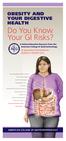 OBESITY AND YOUR DIGESTIVE HEALTH Do You Know Your GI Risks? A Patient Education Resource from the American College of Gastroenterology GI Specialists Committed to Quality in Patient Care Gastroesophageal
What kind of work does Shape do?
 What is Georgia Shape? Georgia Shape is the Governor s statewide, multi-agency and multi-dimensional initiative that brings together governmental, philanthropic, academic and business communities to address
State of Arizona Department of Education MEMORANDUM
 State of Arizona Department of Education HNS 21-2013 USDA SP 32-2013 MEMORANDUM TO: FROM: Sponsors of the National School Lunch Program Mary Szafranski, Deputy Associate Superintendent Arizona Department
Income is the most common measure
 Income Goal A healthy standard of living for all Income is the most common measure of socioeconomic status, and a strong predictor of the health of an individual or community. When assessing the health
GAO SCHOOL LUNCH PROGRAM. Efforts Needed to Improve Nutrition and Encourage Healthy Eating. Report to Congressional Requesters
 GAO United States General Accounting Office Report to Congressional Requesters May 2003 SCHOOL LUNCH PROGRAM Efforts Needed to Improve Nutrition and Encourage Healthy Eating GAO-03-506 May 2003 SCHOOL
UNDERSTANDING MILLENNIAL EATING BEHAVIOR MARCIA GREENBLUM MS, RD SENIOR DIRECTOR, HEALTH AND WELLNESS
 UNDERSTANDING MILLENNIAL EATING BEHAVIOR MARCIA GREENBLUM MS, RD SENIOR DIRECTOR, HEALTH AND WELLNESS WHY ADDRESS EATING BEHAVIOR IN THE FIRST PLACE? Rise of obesity: The Millennial generation has poor
A Province-Wide Life-Course Database on Child Development and Health
 Patterns of health and disease are largely a consequence of how we learn, live and work A Province-Wide Life-Course Database on Child Development and Health Summary of Results April 2007 Principal Investigator