
Foreign Investment Law in Malawi
|
|
|
- Alyson Barker
- 5 years ago
- Views:
Transcription
1 Executive Summary Malawi is open to foreign direct investment. In general there are adequate legal instruments to protect investors and such investors are accorded national treatment. Malawi's constitution prohibits deprivation of an individual's property without due compensation. There is an established mediation process to promote agreements between parties in disputes before court proceedings start. Both foreign and domestic investors have access to Malawi's legal system, which functions fairly well and is generally unbiased. All investors have the right to establish, acquire, and dispose of interests in business enterprises. Foreigners require a business residence permit (BRPs) to carry out any business activity in Malawi. Government continues to undertake various reforms to ensure that no tax, labor, environment, health and safety or other laws distort or impede investment. However, procedural delays and red tape continue to impede the business and investment approval process. Malawi has been largely free of political violence since gaining independence in Although divisions do exist, Malawi has no significant tribal, religious, regional, ethnic, or racial tensions that could be expected to lead to violent confrontation. Although progress has been made addressing the issue of corruption, it continues to be viewed as a major obstacle to doing business in Malawi. There have been serious allegations of corruption, which is perceived to be particularly endemic in the following sectors: Police, immigration, road traffic, tax administration, traditional leaders, and government procurement. 1. Openness To, and Restrictions Upon, Foreign Investment Malawi is open to foreign investment and foreign investors are generally granted national treatment. The Malawi constitution protects investment irrespective of ownership. The government encourages both domestic and foreign investment in most sectors of the economy without major restrictions on ownership, size of investment, source of funds, or the destination of the final product. Restrictions on foreign investment are few and are based on environmental, health, and national security concerns. Affected items are firearms and ammunition; chemical and biological weapons; explosives; and manufacturing involving hazardous waste treatment/disposal or radioactive material. Since industrial licensing in Malawi applies to both domestic and foreign investment, and is only restricted to a short list of products, it does not limit competition, protect domestic interests, or discriminate against foreign investors at any stage of investment. Restrictions are mostly regulations affecting trade (foreign exchange, taxes, etc.) and apply equally to domestic and foreign investors. While not discriminatory to foreign investors, investments in Malawi require multiple bureaucratic processes, which may include licensing and land use permissions that can be time consuming and may constitute an impediment to investment. Despite the generally favorable attitude to foreign investment, investors face many challenges in terms of starting a business and these include lengthy procedures to incorporate and register a business with the Registrar General, and difficulties in obtaining temporary employment permits (TEP) and business residency permits (BRPs). 1

2 Apart from the privatization program, the government's overall economic and industrial policy does not have discriminatory effects on foreign investors. There is no government policy to screen foreign direct investment. However, Foreign Direct Investment (FDI) needs to be registered with the Malawi Investment and Trade Center (MITC) and the investment capital must be registered with the Reserve Bank of Malawi through any commercial bank in Malawi. The minimum investment qualifying is USD 50, There has been no external investment policy reviews undertaken on Malawi by any international organizations. However, the World Trade Organizations conducts periodic Trade Policy Reviews on Malawi. The last one was conducted in These trade policy reviews have informed future co-operation and assistance to Malawi. The Malawi Growth and Development Strategy (MGDSII) ( ) identifies a number of sectors as priority growth areas. FDI is particularly encouraged in Agriculture, Mining, Tourism, Energy and Transport Infrastructure. Sugar cane production and processing, legumes, livestock production and dairy farming, irrigation farming, and large scale commercial agriculture have the highest priority in the agricultural sector. Independent power producers particularly for hydropower and other renewable power sources are encouraged. Government is also calling for the private sector (both local and foreign) to develop the tourism sector. A nation-wide resource mapping project supported by the World Bank and the French Government is underway to define Malawi s mineral resources. Private sector led mineral exploration is also promoted. One restriction in the mining industry is that small-scale prospecting and mining operations are reserved for Malawians and foreigners who have resided in Malawi for a minimum of four years. The Malawi Competition and Fair Trading Act (CFTA) (1998) only became operational in Since its passage, the CFTA has governed the review and determinations on over a dozen mergers and acquisitions and cases of alleged abuse of a dominant position by an enterprise. The CFTA s role is to encourage competition in the economy, to regulate and monitor monopolies and concentrations of economic power, to protect consumer welfare and to ensure the best possible fair market conditions. So far no mergers or acquisitions have been disapproved and there have been no reported cases of contested decisions of CFTA. Malawi has privatized 66 formerly state-owned enterprises. A revised divestiture sequence plan to privatize another 65 public enterprises stalled in the cabinet and government decided to revive the original divesture plan but with emphasis on public/private partnerships other than outright sales as was the case under this plan. Malawi has about 60 state-owned enterprises that are involved in commercial operations particularly in the public utilities sector, agriculture, housing, finance, education and aviation. All investors, irrespective of ethnic group or source of capital (foreign or local) may participate in the privatization program. However, Malawi Stock Exchange regulations limit participation of an individual foreign portfolio investor to a maximum of 10% of any class or category of security under the program and limit maximum total foreign investment in any portfolio to 49%. Malawian nationals are offered preferential treatment, including discounted share prices and subsidized credit. Subsidized credit carries a precondition that the shares or assets be retained for at least two years. 2

3 TABLE 1: The following chart summarizes several well-regarded indices and rankings. Measure Year Rank or value TI Corruption Perceptions index 2013 (91 of 177) Website Address ts/ Heritage Foundation s Economic Freedom index World Bank s Doing Business Report Ease of Doing Business 2013 (124 of 177) (161 of 189) http//doingbusiness.org/rankings Global Innovation Index 2013 (119 of 142) ontent.aspx?page=gii-full-report- 2013#pdfopener World Bank GNI per capita 2012 USD GNP.PCAP.CD TABLE 1B - Scorecards: The Millennium Challenge Corporation, a U.S. Government entity charged with delivering development grants to countries that have demonstrated a commitment to reform, produced scorecards for countries with a 2012 per capita gross national income (GNI) or $4,085 or less. A list of countries/economies with MCC scorecards and links to those scorecards is available here: Details on each of the MCC s indicators and a guide to reading the scorecards are available here: 2. Conversion and Transfer Policies There are no restrictions on remittance of foreign investment funds (including capital, profits, loan repayments and lease repayments) as long as the capital and loans were obtained from foreign sources and registered with the Reserve Bank of Malawi (RBM). The terms and conditions of international loans, management contracts, licensing and royalty arrangements, and similar transfers require initial RBM approval. The RBM grants approval according to prevailing international standards; subsequent remittances do not require further approval. All commercial banks are authorized by the RBM to approve remittances, and approvals are fairly automatic as long as the applicant's accounts have been audited and sufficient foreign exchange is available. In practice, foreign exchange availability is very limited and remittances periodically cannot be made immediately. Foreign exchange availability improved in 2013 after the local currency was devalued and floated in May The foreign exchange market has experienced major volatility and, as a result, businesses have experienced difficulties in planning for import bills for their imported raw materials was a very exceptional year in Malawi. Foreign exchange supply was adequate throughout the year and Malawi s import cover remained above two 3

4 months even during the traditional lean periods. Traditionally, foreign exchange availability follows the agricultural cycle. It is generally plentiful from April through September (when tobacco sales generate foreign exchange inflows), and scarce from October through March. During periods of scarcity, investors may experience extended periods without access to foreign exchange. The Reserve Bank of Malawi (RBM) devalued and floated the Malawi Kwacha exchange rate on May 7, Since then, the value of the kwacha against the USD has experienced very wide swings, moving from 168 to 422 Malawi Kwacha to one USD before moving back to 360 and then up again to 450 Malawi Kwacha to the USD, all in a period of less than 18 months. 3. Expropriation and Compensation Malawi's constitution prohibits deprivation of an individual's property without due compensation. There are effective laws that protect both local and foreign investment. The likelihood of direct expropriations has been low since the repeal of the Forfeiture Act in Some measures with exproprietory effects are occasionally imposed. For example, in both 2008 and early 2012 the government imposed export bans on maize which have not been lifted. Furthermore, the government unilaterally revoked the licenses of all private maize traders in the country. These restrictions applied equally to foreign and domestic investors. Although public tenders for the sale of shares of state-owned enterprises often require local participation, foreign investors tend to dominate the share-holding of large Malawi Stock Exchange-listed companies requiring significant technical and financial resources. The Land Reform Commission which the government established in 1996 to review land tenure and establish a new land reform program presented its final report to the President in November In January 2002, the Ministry of Lands published a new land policy. Draft legislation consisting of six bills have been prepared that incorporates many recommendations of the Commission's report. These bills are: the Land Acquisition Act Amendment ( provides for compensation of persons affected by land acquisition), the Registered Land Act ( bill provides for title registration for all land categories including customary estates), the Physical Planning Bill (seeks to enforce orderly and progressive development of land in both rural and urban areas and to preserve and improve land amenities), the Land Survey Bill (seeks to establish Land Surveyors Registration Board, Malawi Geographic Information Center, licensing and control of Land surveyors), the Local Government Amendment (seeks to introduce consequential amendment to the Local Government Act emanating from the proposed new land laws), and the Customary Land Bill (seeks to repeal the Customary Land Act and replace it with new legislation on the management and regulation of customary land) including the abolition of freehold tenure [owners holding permanent title] and the conversion of all freehold titles to leasehold (owners holding land on lease for a maximum period of 99 years). The Ministry of Lands and the cabinet have approved these new bills and presented them to the Malawi Parliament in None of the bills have been passed to become law due to public outcry that more consultations need to be done. Since July 2000, the Malawi Government stopped issuing new freehold land certificates in anticipation of this new legislation. However, freehold land is still transferable to both Malawians and non-malawians. Land of all tenures continue to be tradable regardless of nationality though Malawians are given the first priority. If a foreigner wants to buy leasehold land, the offer price must to be publicly declared in a newspaper. If no 4

5 Malawian comes up with a counter offer, the land transfer can be affected; otherwise the interested Malawian is offered the land to buy instead. There are three types of land tenure in Malawi---Customary land (controlled by traditional leaders), Public Land (controlled by government local and/or central government) and Leasehold (legal title held by private individuals or company). Leasehold title can either be for a fixed period (25-99 years renewable) or freehold (usually 99 years and above). The bulk of land in Malawi is under customary tenure with land passing on to the next generation through blood relation (hereditary) or through the traditional chief to a new settler (this applies to unused/unclaimed land). At present, the government may employ land acquisition procedures set forth in the Land Acquisition Act of According to this Act, the government must justify its acquisition as being in the public interest and must pay fair market value for the land. Fair market value is assessed by summing the amount the owner originally paid for the land, the value of any permanent improvements that increase the productive capacity, utility or amenity of the land, and any appreciation of the land value. If the private landowner objects to the level of compensation, he may obtain an independent assessment of the land value. According to the Act, however, such cases may not be challenged in court; the Ministry of Lands, Housing and Urban Development remains the final judge. 4. Dispute Settlement Malawi has an independent judiciary, which derives its procedures from English Common Law. There has been little government interference in the court system. The commercial courts are working efficiently now that they have qualified personnel who are working toward the improvement of the court system in Malawi. The Commercial Court in Blantyre has three judges, and has its own registry. There is an established mediation process to promote agreements between parties in disputes before court proceedings start. Although processing of commercial cases has significantly improved in the court system, enforcement of judgments continues to be a problem. The Commercial Court now has one dedicated enforcement Sheriff. Before that the Commercial Court used Sheriffs assigned to the High Court who did not grant priority to commercial enforcements. The court system in Malawi accepts and enforces foreign court judgments that are registered locally in accordance with established legal procedure. There are reciprocal agreements among Commonwealth countries to enforce judgments without this registration obligation. However, the fact that there is no such agreement between Malawi and the United States does not mean that judgments involving the two countries cannot be enforced. Malawi has legislation that offers adequate protection for property and contractual rights. Malawi has written commercial laws which codify Common Law. The Sale-Of-Goods Act, the Hire-Purchase Act, the Competition Fair Trading Act, and the Companies Act cover commercial practices. The first two acts have been consistently applied, and there is a track record of cases involving commercial law. In 2007, Malawi established a Commercial Court in the city Blantyre. 5

6 The Lilongwe division of the Commercial Court opened in 2010 and has two judges. There is also a written and consistently applied Bankruptcy Law based on Common Law. Under the Bankruptcy Law, secured creditors rank-ordered based upon investment registration dates have first priority in recovering money. Monetary judgments are usually made in the investor's currency. However, the immediate availability of foreign exchange is dependent upon supply, which varies on a seasonal basis and was chronically low for the past four years. The 2006 Money Laundering, Proceeds of Serious Crime and Terrorist Financing Act established an autonomous Financial Intelligence Unit (FIU) to combat money laundering and terrorist financing. The FIU is responsible for analyzing disclosures from financial institutions and referring actionable cases to competent authorities. It is also mandated to monitor compliance by reporting institutions. Malawi is a member of the International Center for Settlement of Investment Disputes (ICSID), and accepts binding international arbitration of investment disputes between foreign investors and the state if specified in a written contract. There have been no major investment disputes involving U.S. companies since Performance Requirements and Investment Incentives Malawi is not in compliance with World Trade Organization (WTO) Trade Related Investment Measures (TRIM) notification requirements. Malawi does not set performance requirements for establishing, maintaining or expanding an investment, nor does it place requirements on source of financing, or geographic location. The government accords Export Processing Zone (EPZ) status only to firms (foreign or domestic) that produce exclusively for export. The Malawi Government offers a wide range of tax and non-tax incentives which apply equally to domestic and foreign investors. These incentives apply to several sectors including manufacturing, agriculture, mining and others relating to businesses in general. Customs and excise tax incentives are provided on raw materials, machinery and equipment in the following sectors: construction, electricity generation and distribution, communication, tourism, agriculture, transport, mining, health, education, banking, and EPZs. Two priority industries have been targeted for tax relief: agro-processing and electricity generation, transmission and distribution. A detailed list of these incentives can be found at the Malawi Investment and Trade Center (MITC) website: The above incentives are applied consistently but many companies have complained about long delays in accessing the accrued benefits, especially those that require investors to spend first and claim later. Foreign investors are generally accorded the same treatment as nationals. U.S. and other foreign firms are able to participate in government/donor-financed and/or subsidized research and development programs. The following information is required to register and incorporate a company: name of the company, authorized share capital, registered office, location of account books, address of the company secretary, and the names of directors and shareholders. There is also a requirement that at least two Malawian residents be appointed directors for such a subsidiary company. 6

7 Visas do not inhibit investors, but the need for employment permits sometimes can. Expatriate employees (of both domestic and foreign businesses) who reside and work in Malawi must obtain temporary employment permits (TEPs). TEPs have been very difficult to obtain in some instances. Government policy on TEPs has been unchanged since a "Policy Statement and New Guidelines for The Issuance and Renewal of [Expatriate] Employment Permits" was issued in November The guidelines state that investors may employ expatriate personnel in areas where there is a shortage of "suitable and qualified" Malawians. The policy provides for two types of TEPs: Those for "key posts" (defined as positions of "strategic importance" in business operations) which are granted for the lifespan of the organization. Those for "time posts" (defined as positions with contracts of three-year duration or less) which are granted for three-year periods and renewable once. The policy underscores the government's desire to make TEPs readily available to expatriates, and mandates that processing times for TEP applications shall not exceed 40 working days. In practice these guidelines have been applied inconsistently, leading to delays and considerable uncertainty. 6. Right to Private Ownership and Establishment The government encourages both domestic and foreign investors to establish and own business enterprises in most sectors of the economy. All investors have the right to establish, acquire, and dispose of interests in business enterprises. Foreigners require a business residence permit (BRPs) to carry out any business activity in Malawi. The government issues BRPs to foreign nationals who own/operate businesses. BRPs are issued for five-year periods and are renewable. Permanent Residence Permits (PRPs) are issued to foreign spouses who reside permanently in Malawi, and to owners/operators of businesses who reside in Malawi for periods in excess of ten years. PRP holders cannot work as employees. Malawi's immigration laws governing BRPs and PRPs have been revised. There are three categories of residence permits based on the amount of investment, the status of applicant (investor, retiree, student, or wife of a Malawian citizen) and the period of the business assignment. The maximum number of resident permits per organization is five positions, with the actual number allowed depending on the amount of investment. There are some restrictions to land ownership by foreigners. Sale of land to foreigners is approved only after no Malawian has shown interest to match the price offered by the foreigner. However, land acquired as part of a business establishment is not subject to this rule. 7. Protection of Property Rights Both foreign and domestic investors have access to Malawi's legal system, which functions fairly well and is generally unbiased. Heavy caseloads and staffing limitations, however, mean that legal remedies can take a long time to achieve. Malawi has laws that govern the acquisition, disposition, recording and protection of all property rights (land, buildings, etc.) as well as intellectual property rights (copyrights, patents and trademarks, etc.). 7
![Government policy on TEPs has been unchanged since a "Policy Statement and New Guidelines for The Issuance and Renewal of [Expatriate] Employment Permits" was issued in November 1998.](/docs-images/52/12523871/images/page_7.jpg "The guidelines state that investors may employ expatriate personnel in areas where there is a shortage of \"suitable and qualified\" Malawians.")
8 Real Property Efforts to improve on Land Tenure are underway. At present most land is under customary land tenure with occupants holding no legally bidding title. More than half of arable land is untitled (customary). Government has developed draft legislation to legalize customary land tenure to leasehold title so that those currently using that land can have legal rights to the land. This would enable them to use such land as collateral for acquiring financing to develop the land and/or to finance other business ventures. However, traditional leaders are against this development as it will limit their powers over land once the draft bills are passed into law. Government has been preparing for these new developments and already started training people to be engaged as land surveyors and registrars at the local government level. Currently record keeping for registering land ownership is centralized and inefficient. Efforts are underway to computerize the recordkeeping and to decentralize to the district councils. Malawi recognizes the importance of intellectual property (IP) protection and enforcement but lacks adequate resources to do so. The Registrar General administers the Patent and Trademarks Act, which protects industrial intellectual property rights in Malawi. A public registry of patents and patent licenses is kept. Patents must be registered. Trademarks are registered publicly following advertisement and a period of no objection. The government has signed and adheres to bilateral and multilateral investment guarantee treaties and key agreements on intellectual property rights. Malawi is a member of the convention establishing the Multilateral Investment Guarantee Agency, the World Intellectual Property Organization (WIPO), the Berne Convention, and the Universal Copyright Convention. Enforcement of IP is inadequate due to resource constraints. However, general awareness of the importance of protecting IP in all forms (copyrights, trademarks, patents, trade secrets, and others) has improved. IP enforcement agencies have commemorated the World IP Day on April 26 for the past two years and this has helped to promote the importance of IP protection in the country. Malawi is not listed in USTR s Special 301 Report. The Copyright Society of Malawi (COSOMA), established in 1992, administers the 1989 Copyright Act which protects copyrights and "neighboring" rights in Malawi. WTO rules allow Malawi (as a less developed country) to delay full implementation of the Trade-Related Aspects of Intellectual Property Rights (TRIPs) agreement until The Ministry of Industry and Trade is working with COSOMA, the Registrar General, and the Africa Regional Intellectual Property Organization (ARIPO) to align relevant domestic legislation with the WTO TRIPs agreement. For additional information about treaty obligations and points of contact at local IP offices, please see WIPO s country profiles at Embassy point of contact: Heather Dresser, [email protected] Local attorneys list: 8. Transparency of the Regulatory System 8

9 Malawi's industrial and trade reform program including rationalization of the tax system, liberalization of the foreign exchange regime, and the elimination of trade and industrial licenses for several items and businesses has produced written guidelines intended to increase government use of transparent and effective policies to foster competition. Government continues to undertake various reforms to ensure that no tax, labor, environment, health and safety or other laws distort or impede investment. However, procedural delays and red tape continue to impede the business and investment approval process. While market prices for goods are generally not controlled, prices of most agricultural goods such as maize and state-provided utilities are regulated. In recent years the government has announced minimum prices for tobacco, cotton and maize which buyers have been obliged to offer, under threat of the loss of their buyers licenses. Buyers have complained of a lack of transparency in the setting of these prices. This led the largest cotton ginning company in Malawi, a U.S. company, to withdraw from the country in 2009 after the government-set minimum prices for cotton were deemed too high for profitable operations. The new government that took office in April 2012 has moved away from the antagonistic tendency of the previous government against buyers in commodity markets such as tobacco and cotton though minimum prices are still being released. Government has instituted automatic pricing mechanisms for fuel and electricity prices. In addition to these progressive reforms, the government removed a levy on fuel for a price stabilization fund and thereby mitigated overall price increases while removing a contentious tax whose account had been misappropriated by the government in the past. There have been positive steps toward increasing regulatory transparency and improving the foreign investment environment. The government also privatized Air Malawi, the loss making national airline in 2013 when Ethiopian Airlines acquired a 49% stake. Air Malawi was renamed Malawian Airlines and is under the management of Ethiopian Airlines. 9. Efficient Capital Markets and Portfolio Investment The Malawi government recognizes the importance of foreign portfolio investment and has made efforts to provide for a platform for such investment through the establishment of a Malawi Stock Exchange (MSE). MSE hosts about a dozen listed companies. Most of these companies are local and a few are transnational. The MSE is regulated by the Reserve Bank of Malawi. The Companies Act, the Capital Market Development Act (1990), and the Capital Market Development Regulations (1992) as amended in 2013 provide the legislative and regulatory framework for portfolio investment in Malawi. These acts govern the MSE. Foreign investors can buy and sell shares at the stock market without any restrictions. Trading in shares can either be direct or through established stock market brokers. Stockbrokers Malawi Limited (SML) is the major registered stockbroker in Malawi. Other brokerage firms are Continental Discount House, First Discount House and Trust Securities Limited. The MSE is regulated by the Stock Exchange Commission. SML also runs a secondary market in government securities, and both local and foreign investors have equal access to the purchase of these securities. 9

10 The MSE is still in a nascent stage, and hostile takeovers have not yet occurred. The demand and supply of shares for existing listed companies is therefore limited. However, demand for newly listed companies always exceeds shares on offer. Apart from the restrictions under the privatization program (prohibiting 100% foreign ownership), there are no specific measures taken by private firms or government to restrict foreign investment or participation. Foreign investors tend to be the dominant shareholders in large MSE-listed companies requiring significant technical and financial resources. Liquidity for stock market participation is not a major problem as the private sector in Malawi has a variety of credit instruments. Credit is generally allocated on market terms. The main problem is the cost of such credit finance. Foreign investors may utilize domestic credit, but proceeds from investments made using local resources are not remittable. Malawi has a sound banking sector, overseen and regulated by the Reserve Bank of Malawi the central bank. There are twelve full-service commercial banks. Malawi s four largest banks (National Bank of Malawi, First Merchant Bank, Standard Bank, and New Building Society Bank) command 90% of the market, with a total capitalization of over $2 billion. The Competition and Fair Trading Act does not cover the day-to-day trading on the MSE, but regulates mergers, acquisitions, and takeovers. 10. Competition from State-Owned Enterprises Malawi has over 60 State-Owned Enterprises (SOEs) scattered across many industries/sectors including agriculture and agribusiness, education, construction, energy, finance, health, information and communication, media, and services. A list of these enterprises is available at the Office of the President and Cabinet. Government does not publish such list in the media. These enterprises are defined by the level of support that they require from government in order to operate, that is, those that are listed as fully funded, partially funded and fully commercial. Government is sometimes required to bail out commercially run SOEs when they have incurred losses. Private and public enterprises freely compete on the same terms and conditions for access to markets, credit and other business opportunities. There are exceptions, however, for some public works assignments where public enterprises tend to be given special preference by government. There have been several instances in the past where public enterprises such as the Agricultural Development and Marketing Corporation (ADMARC) and the Small-holder Farmers Fertilizer Revolving Fund (SFFRF) have been awarded contracts to distribute subsidized agricultural inputs without competing with private sector enterprises. These SOEs also access cheap financing from government thereby acquiring unfair advantage over private sector traders in the agricultural sector. There are no set rules or criteria on such exceptions the government tends to decide (often capriciously) on a case by case basis. In general SOEs tend to get a bigger share of government contracts than privately-owned enterprises. Not all SOEs perform public function mandates. Malawi has a mixed bag system of SOEs where some SOEs are purely performing a public good function, others are commercial, and the rest both. All SOEs are subject to government regulations that apply to other government departments including employment and on procurement procedures, though some variations apply to some. 10

11 All SOEs are required by law to produce annual reports, which are not always audited by independent professional audit firms despite the law requirement. SOEs in the agriculture, education and health sectors spend more on research and development than private sector players (both local and foreign) and they tend to do so for the public good than for profit. SOEs are subject to the same taxes including value added tax as their private sector counterparts. However, capital acquisition (motor vehicles, equipment and machinery) are not subject to the same taxes. SOEs, particularly non-profit SOEs, also enjoy better and preferential access to land than private sector competitors, for example a government run agricultural college or research institution. All State Owned Enterprises (SOEs) report to a line ministry but also have a Chairperson and Board of Directors. The boards are composed of politicians and professionals as directors. All such boards also have senior government officials representing government departments as exofficio/non-voting members. The participation of members of the government as ex-officio/nonvoting members on these boards creates a perceived and/or real conflict of interest. Malawi does not have a Sovereign Wealth Fund or Asset Management Bureau. Although signed in April 2011, the U.S. Government s Millennium Challenge Corporation (MCC) US$350.7 million Compact was put on operational hold in mid-2011 owing to concerns over negative trends in economic and political governance. The Compact was re-instated in June 2012 after President Banda s positive steps to address the MCC concerns that led to its operational hold and eventual suspension. The MCC Compact Program entered into force in September 2013 and focuses on the power sector (strengthening ESCOM and transmission and distribution infrastructure) and promoting private sector investment in power production. 11. Corporate Social Responsibility There is a well-developed sense of corporate social responsibility in Malawi and most corporate entities make a point to publicize such activities in the local media. Large domestic companies and international enterprises tend to be more active and generous than small domestic companies. There are no established laws and regulations governing Corporate Social Responsibility (CSR), nor does the government direct destination of CSR to particular sectors. However, there are laws governing protection of the environment and waste disposal for producers and consumers. Enforcement of these regulations is, however, inadequate. Government expects all enterprises to follow all laws of Malawi regarding employment and compensation. Malawi has enacted a number of labor laws governing employment, work environment, industrial safety, age limits, hours of work and minimum wages among many others. Government has enacted accounting standards that conform to international standards that the corporate sector is expected to adhere to. However, executive compensations are not defined. 11

12 All MSE listed companies are required by law to publish their annual audited accounts in the local newspapers. Listed companies are also required to publicly declare their profits, dividends to be paid out, planned takeovers (or major portfolio investments in or out of the company) and all relevant information that shareholders need to make informed decisions. They are also required to announce their annual shareholders meetings in the newspapers. 12. Political Violence Malawi has been largely free of political violence since gaining independence in Apart from the disarming of the Malawi Young Pioneers, a paramilitary group active during Malawi's 1994 transition to democracy, incidents of violence have been few. Sporadic violence occurred in the run-up and immediately following the 2004 elections. Presidential and parliamentary elections in May 2009 were peaceful, with no significant incidences of violence. On July 20 and 21, 2011, nationwide demonstrations over economic and political governance turned violent and 20 Malawians died in the civil unrest that ensued. There was a peaceful transition of power after President Mutharika s death to his Vice President, Joyce Banda, who was not a member of Mutharika s ruling party at the time of his death. Despite two days of uncertainty, the constitution was followed and Joyce Banda was sworn in as the new president. Presidential, parliamentary, and local government elections will take place in May Each major party and presidential candidate has committed to running a peaceful and nonviolent campaign. Although divisions do exist, Malawi has no significant tribal, religious, regional, ethnic, or racial tensions that could be expected to lead to violent confrontation. Incidents of labor unrest occasionally occur, but these are usually nonviolent. There are no nascent insurrections or other politically motivated activities of major concern to investors. However there have been some political tensions with neighboring Mozambique, Zambia, and Tanzania in recent times. Tanzania and Malawi are currently trying to resolve a border dispute over the North Eastern portion of Lake Malawi. 13. Corruption The Corrupt Practices Act (No.18 of 1995), under Section 4(1) establishes the Anti-Corruption Bureau (ACB). The Director and the Deputy Director of the Bureau are both appointed by the President subject to confirmation by the Public Appointments Committee of Parliament. The Bureau began full operations in On April 16, 2004 the Corrupt Practices Act was amended giving the ACB increased powers to carry out its work of controlling corruption in Malawi. The definition of corruption was widened to include, among other things, offences for abuse of office and possession of unexplained wealth. As a result of the amendment, the Act provides for the investigation of cases not only for corruption but for other offences that come to light during the course of investigating corruption. The Act also provides for protection of whistleblowers, which was absent in the original law. The ACB has a legal mandate of preventing corruption in Malawi. It is therefore given the function of taking a lead in the fight against corruption. 12

13 The law provides for criminal penalties for corruption by officials. There were numerous reports of government corruption at the national and local level during the reporting period. Beginning in September 2013, a national corruption scandal known as Cashgate, involving the theft of at least 20 billion MWK ($49 million) through fraudulent transactions using the government s automated payments system, gained significant attention among the government, donors and civil society. Although the fraudulent transactions began as early as 2010, they peaked in the middle of the year, according to investigators. More than 70 individuals were arrested; their prosecution is underway. Although progress has been made in addressing the issue, corruption continues to be viewed as a major obstacle to doing business in Malawi. There have been serious allegations of corruption, which is perceived to be particularly endemic in the following sectors: police, immigration, road traffic, tax administration, traditional leaders, and government procurement. Malawi recognizes that the fight against corruption cannot be won without the involvement of all. Thus, companies are encouraged to participate in the fight. The Bureau has embarked on a program to assist institutions to develop and implement Corruption Prevention Policy frameworks as a way of mainstreaming anticorruption initiatives into their operations. Many companies have signed up to the anti-corruption campaign. The business sector has its own anticorruption campaign drive called Business Action Against Corruption and deals with corruption issues within the private sector. The civil society organizations also formed their own institution called Civil Society Action Against Corruption to deal with corruption within the civil society. Malawi signed and ratified the UN Anticorruption Convention. Malawi subscribes to the provisions of the OECD Anti-bribery Convention, though it is not yet a signatory to the Convention. Malawi's Penal Code prohibits bribery. Giving or receiving a bribe whether to or from a Malawian or foreign official is a crime under Malawi s penal code. ACB co-operates with other anti-corruption bureaus in the region. ACB Contact details: Justice Rizine Mzikamanda Director Anti Corruption Bureau, Mulanje House, PO Box 2437 Capital City, Lilongwe Tel: Fax: [email protected] Toll Free: 113. Website: Bilateral Investment Agreements Malawi's policy is to negotiate bilateral investment treaties with countries whose nationals opt to invest in Malawi. Malawi has signed investment agreements Italy, Libya, Netherlands and 13

14 Zimbabwe. Bilateral investment agreements have also been initialed with Brazil, China, Germany, India and the OPEC Fund for International Development. Malawi acceded to the Multilateral Investment Guarantee Agency (MIGA) in 1985/86. Malawi has not renewed several investment treaties that lapsed after 1986 since MIGA provides mechanisms for the settlement of investment disputes. 15. OPIC and Other Investment Insurance Programs Malawi has had an OPIC investment guarantee agreement since In August 1999, the U.S. Export-Import Bank included Malawi under its new Africa Short-term Export Credit Insurance Program. 16. Labor The Government of Malawi estimates that more than half of the population is of working age. Unskilled labor is plentiful. Skilled and semi-skilled labor is scarce. Occupational categories with skills shortages include accountants and related personnel, economists, engineers, primary and secondary school teachers, lawyers, and medical/health personnel. The University of Malawi provides bachelors and masters degrees in economics, engineering, medicine, education, agriculture and administration. The Malawi College of Accountancy teaches accounting. Chancellor College operates the country's law school. In early 1999, the government established the Technical, Entrepreneurial and Vocational Education and Training Authority (TEVETA) program to address technical skills shortages in industry. The Labor Relations Act (LRA), enacted in 1997, governs labor-relations management in Malawi. The Act allows strikes and lockouts for registered workers and employers after dispute settlement procedures in collective agreements and conciliation have failed. As trade union rights have existed only since the transition to multiparty democracy in 1994, industrial relations are still evolving. Employers, labor unions, and the government lack sufficient knowledge of their legitimate roles in labor relations/disputes. Workers have the legal right to form and join trade unions. Twenty-nine unions are registered. Union membership is low, however, given the small percentage of the work force in the formal sector, the lack of awareness of worker rights and benefits, and a resistance on the part of many employees to join unions. Only 18% of people employed in the formal sector belong to unions. Unions may form or join federations and have the right to affiliate with, and participate in, the affairs of international workers' organizations. While the government is a signatory to the ILO Convention protecting worker rights, mechanisms for enforcing the provisions of the convention are weak. There are serious manpower shortages at the Ministry of Labor, resulting in very few labor-standards inspections. There was no new legislation enacted during the reporting period. 17. Foreign Trade Zones/Free Ports 14

15 Legislation for the establishment of export processing zones (EPZs) came into force in All companies engaged exclusively in manufacture for export may apply for EPZ status. As of April 2014, 13 were operating under the EPZ scheme. Almost all of these are foreign owned companies though the law does not discriminate on ownership. A Manufacturing Under Bond (MUB) scheme offers slightly less attractive incentives to companies that export some, but not all, of their products. Most investors prefer to operate under EPZ arrangement. 18. Foreign Direct Investment and Foreign Portfolio Investment Statistics TABLE 2: Key Macroeconomic data, U.S. FDI in host country/economy Host Country USG or international Statistical Source of data source* USG or international statistical source (Source of Data: BEA; IMF; Eurostat; UNCTAD, Other) Economic Data Year Amount Year Amount Host Country 2012 Amount Gross Domestic Product (GDP) (Millions U.S. Dollars) 2012 $4.557 billion $4.264 billion Foreign Direct Investment Host Country Statistical source* USG or international statistical source USG or international Source of data: BEA; IMF; Eurostat; UNCTAD, Other U.S. FDI in partner country (Millions U.S. Dollars, stock positions) Host country s FDI in the United States (Millions U.S. Dollars, stock positions) 2012 Data not 2012 Available 2012 Data not 2012 Available Amount (BEA) click selections to reach. Bureau of Economic Analysis 2.0 Balance of Payments and Direct Investment Position Data U.S. Direct Investment Position Abroad on a Historical-Cost Basis By Country only (all countries) (Millions of Dollars) Amount (BEA) click selections to reach Balance of Payments and 0.0 Direct Investment Position Data Foreign Direct Investment Position in the United States 15

16 Total inbound Amount stock of FDI as % host GDP (calculate) * Malawi National Statistics Office. on a Historical-Cost Basis By Country only (all countries) (Millions of Dollars) TABLE 3: Sources and Destination of FDI No data is posted for Malawi TABLE 4: Sources of Portfolio Investment No data is available for Malawi Malawi is one of the least developed and most densely populated countries in the world. Malawi s economy is based on agriculture which accounts for over 30% of GDP and 90% of export revenues. Small shareholder agriculture is the source of income for more than 80% of the population. Malawi's economy depends on substantial inflows of foreign aid from the IMF, the World Bank, and individual donor nations. Both the Reserve Bank of Malawi (RBM) and the Malawi Investment and Trade Center (MITC) maintain records on the value and composition of Foreign Direct Investment (FDI) in Malawi. Neither the RBM nor MITC, however, currently capture actual FDI figures. The following chart shows the amount of approved FDI into Malawi since 2005 as well as its relative percentage of the GDP for that year. Year FDI Inflows (US$) % GDP ,327, ,192, ,055, ,424, ,130, ,010, ,407, ,500, Source: Annual Economic Reports, Malawi Government. Foreign Direct Investment (FDI) from 2005 to 2012 ranged from 1 to 4.6% of GDP. The prospect for future FDI is bright following government s move to devalue and float the currency, the Malawi Kwacha. Malawi s government is implementing its economic recovery plan that is expected to stimulate the growth of the economy and attract foreign direct investment. The 16

17 economy is likely to grow by between 4.6% and 5.5% in 2013 according to international forecasts. The liberalization of the exchange rate regime is an important step toward improving Malawi s investment climate. 19. Contact Point at Post for Public Inquiries Mr. Priston Msiska Economic and Commercial Specialist U.S. Embassy, Lilongwe, Malawi x3253 [email protected] 17

Executive Summary Port Cotonou
 Executive Summary Benin continues its efforts to attract private investment in support of economic development. The Government of Benin in conjunction with the World Bank Group, the African Development
DOING BUSINESS IN MALAYSIA
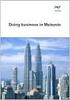 DOING BUSINESS IN MALAYSIA COUNTRY INTRODUCTION Strategically located in Southeast Asia with an area of 329,750 km 2. Practices parliamentary democracy with a Constitutional Monarch. Population comprises
NOTICE 1087 OF 2013 DEPARTMENT OF TRADE AND INDUSTRY PROMOTION AND PROTECTION OF INVESTMENT BILL,2013
 STAATSKOERANT, 1 NOVEMBER 2013 No. 36995 3 GENERAL NOTICE NOTICE 1087 OF 2013 DEPARTMENT OF TRADE AND INDUSTRY PROMOTION AND PROTECTION OF INVESTMENT BILL,2013 INVITATION FOR THE PUBLIC TO COMMENT ON THE
Competitive Advantage of Libyan Business Environment
 Economics World, ISSN 23287144 May 2014, Vol. 2, No. 5, 325332 D DAVID PUBLISHING Competitive Advantage of Libyan Business Environment Salem Abdulla Azzaytuna University, Tripoli, Libya The economic development
Executive Summary. 1. Openness To, and Restrictions Upon, Foreign Investment
 Executive Summary Political stability, good infrastructure, and modern banking and financial systems are some of the factors making Namibia an attractive destination for Foreign Direct Investment (FDI).
R. JAYARAJ, M.A., Ph.D.,
 Analyzing the international business environment and identifying key factors for international business operations R. JAYARAJ, M.A., Ph.D., 1-1 What is International Business All commercial transactions
Law of Georgia On the Investment Activity Promotion and Guarantees
 Law of Georgia On the Investment Activity Promotion and Guarantees The present law defines the legal bases for realizing both foreign and local investments and their protection guarantees on the territory
PUBLIC FINANCE MANAGEMENT ACT
 LAWS OF KENYA PUBLIC FINANCE MANAGEMENT ACT CHAPTER 412C Revised Edition 2014 [2013] Published by the National Council for Law Reporting with the Authority of the Attorney-General www.kenyalaw.org [Rev.
Minerals Technologies Inc. Summary of Policies on Business Conduct
 Minerals Technologies Inc. Summary of Policies on Business Conduct Lawful and Ethical Behavior is Required at All Times This Summary of Policies on Business Conduct (this "Summary") provides an overview
Corporate Governance Code for Shareholding Companies Listed on the Amman Stock Exchange
 Corporate Governance Code for Shareholding Companies Listed on the Amman Stock Exchange CONTENTS Topic Page Preamble 3 Chapter One: Definitions 5 Chapter Two: The Board of Directors of the Shareholding
CUBAN FOREIGN INVESTMENT LEGISLATION
 CUBAN FOREIGN INVESTMENT LEGISLATION Decree Law 50 of 1982 ( Decree Law 50 ) was Cuba s first foreign investment act authorizing the formation of international joint-ventures with foreign investors. In
AGREEMENT BETWEEN THE GOVERNMENT OF THE ITALIAN REPUBLIC AND THE GOVERNMENT OF ON THE PROMOTION AND PROTECTION OF INVESTMENTS
 AGREEMENT BETWEEN THE GOVERNMENT OF THE ITALIAN REPUBLIC AND THE GOVERNMENT OF ON THE PROMOTION AND PROTECTION OF INVESTMENTS The Government of the Italian Republic and the Government of the..., hereafter
PERU TRADE BARRIERS FREE TRADE NEGOTIATIONS
 PERU TRADE BARRIERS The U.S. trade deficit with Peru was $1.6 billion in 2004, an increase of $895 million from $710 million in 2003. U.S. goods exports in 2004 were $2.1 billion, up 23.4 percent from
Monopoly Regulation and Fair Trade Act
 Monopoly Regulation and Fair Trade Act December 2, 2011 (Only the Korean text is/are authentic) Korea Fair Trade Commission page 1 / 112 Monopoly Regulation and Fair Trade Act [Implemented on December
Marketers must: The Political, Legal, and Regulatory Environments of Global Marketing. Nation-States and Sovereignty. The Political Environment
 Marketers must: The Political, Legal, and Regulatory Environments of Global Marketing Global Marketing Chapter 5 Attempt to comply with each nation s laws and regulations. Keep up with laws and regulations
LAW OF MONGOLIA ON CONCESSIONS CHAPTER ONE. GENERAL PROVISIONS
 LAW OF MONGOLIA 28 January 2010 State Palace, Ulaanbaatar city Article 1. Purpose of the law ON CONCESSIONS CHAPTER ONE. GENERAL PROVISIONS 1.1. The purpose of this law is to regulate matters related to
Section Council Scope Notes Revised September 2006
 Section Council Scope Notes Revised September 2006 Administrative Law To inform and advise the members of the bar who practice in the field on current developments in administrative law. To provide a forum
TAXATION AND AID FOR DOMESTIC RESOURCE MOBILIZATION (D.R.M.) AID: HELPING OR HARMING DOMESTIC RESOURCE MOBILIZATION IN AFRICA
 TAXATION AND AID FOR DOMESTIC RESOURCE MOBILIZATION (D.R.M.) AID: HELPING OR HARMING DOMESTIC RESOURCE MOBILIZATION IN AFRICA My presentation deals with i. Definition and Importance of Domestic Resource
/ Insurance. Regional Highlights * Bosnia and Herzegovina. karanovic/nikolic. /March 2015/
 / Insurance Regional Highlights * /March 2015/ The insurance sector in South Eastern Europe has undergone considerable change in recent years, marked by Croatia s accession to the EU, amendments to legislation
PROMOTION AND PROTECTION OF INVESTMENT BILL
 REPUBLIC OF SOUTH AFRICA PROMOTION AND PROTECTION OF INVESTMENT BILL (As introduced in the National Assembly (proposed section 75); explanatory summary of Bill published in Government Gazette No. 39009
1. Terms and Conditions
 TRADING AGREEMENT The Trading Agreement (hereinafter referred to as the Agreement ) is made and entered into by and between Simple Trading Corporation Limited (hereinafter referred to as Simple Trade )
DESIRING to intensify economic cooperation between both States;
 AGREEMENT BETWEEN THE GOVERNMENT OF THE REPUBLIC OF TRINIDAD AND TOBAGO AND THE GOVERNMENT OF THE REPUBLIC OF CUBA ON THE RECIPROCAL PROMOTION AND PROTECTION OF INVESTMENTS The Government of the Republic
DEBT RECOVERY IN BELGIUM Law Firm Van Dievoet, Jegers, Van der Mosen & Partners
 Error!Marcador no definido.introduction The implementation of Directive 2000/35/EC of the European Parliament and of the Council of June 29, 2000 into Belgian law The European directive had to be implemented
Our Vendor Code of Conduct
 Our Vendor Code of Conduct Jones Lang LaSalle and LaSalle Investment Management Vendor Code of Conduct Copyright Jones Lang LaSalle IP, Inc. Ethics Everywhere Where we stand Jones Lang LaSalle stands for
The 2013 Amendment to the 1980 Arab League Investment Agreement
 The 2013 Amendment to the 1980 Arab League Investment Agreement A step towards improving the region s attractiveness to investors NOTE: This draft brochure responds to a request of the League of Arab States
THE CROATIAN PARLIAMENT DECISION PROMULGATING THE ACT ON INVESTMENT FUNDS WITH A PUBLIC OFFERING
 THE CROATIAN PARLIAMENT Pursuant to Article 89 of the Constitution of the Republic of Croatia, I hereby pass the DECISION PROMULGATING THE ACT ON INVESTMENT FUNDS WITH A PUBLIC OFFERING I hereby promulgate
Law of Mongolia on Concessions
 Economic Policy Reform and Competitiveness Project April 2005 Ulaanbaatar, Mongolia This publication was produced for review by the United States Agency for International Development The views expressed
Ministry of Labour and Social Policy LAW ON VOLUNTARY FULLY FUNDED PENSION INSURANCE (189347.11)
 Ministry of Labour and Social Policy LAW ON VOLUNTARY FULLY FUNDED PENSION INSURANCE 1 Table of Contents CHAPTER 1 GENERAL PROVISIONS... 3 CHAPTER 2 VOLUNTARY PENSION FUNDS... 7 CHAPTER 3 PENSION COMPANIES
Investment EXECUTIVE SUMMARY
 9 Investment The Trans-Pacific Partnership (TPP) levels the playing field for American workers and American businesses, leading to more Made-in-America exports and more higher-paying American jobs here
Regulations on the Employment of Human Resources, Insurance and Social Security in the Free Zones of the Islamic Republic of Iran
 Regulations on the Employment of Human Resources, Insurance and Social Security in the Free Zones of the Islamic Republic of Iran Chapter one: General Article 1 In these regulations, the following terms
Pursuant to Article 88 item 2 of the Constitution of the Republic of Montenegro I hereby issue the
 Pursuant to Article 88 item 2 of the Constitution of the Republic of Montenegro I hereby issue the DECREE PROMULGATING THE LAW ON FOREIGN CURRENT AND CAPITAL TRANSACTIONS (Official Gazette of Montenegro
REPUBLIC OF MONTENEGRO FOREIGN INVESTMENT LAW
 REPUBLIC OF MONTENEGRO FOREIGN INVESTMENT LAW Montenegrin Investment Promotion Agency (www.mipa.cg.yu) 1 I Basic provisions FOREIGN INVESTMENT Article 1 Foreign investors can, in order to conduct economic
G20 ANTI-CORRUPTION WORKING GROUP PROGRESS REPORT 2013
 G20 ANTI-CORRUPTION WORKING GROUP PROGRESS REPORT 2013 September, 2013 G20 Anti-Corruption Working Group Progress Report 2013 ANTI-CORRUPTION WORKING GROUP PROGRESS Introduction 1. The renewal of the G20
INSURANCE. www.advokatskafirmasajic.com
 INSURANCE www.advokatskafirmasajic.com Law Firm Sajić is established in a form of a partnership in 2003. With six attorneys and ten expert associates and trainees is the largest law firm in the Republic
COTTON DEBT RESOLUTION SCHEME. Dushanbe June 2,2007
 COTTON DEBT RESOLUTION SCHEME Dushanbe June 2,2007 Cotton Debt Resolution Scheme: current situation About 70% of the population resides in rural areas 45% of irrigated arable land is used for cotton production
LAW ON FOREIGN EXCHANGE OPERATIONS OF FEDERATION OF BOSNIA AND HERZEGOVINA
 The translation of BiH legislation has no legal force and should be used solely for informational purposes. Only legislation published in the Official Gazettes in BiH is legally binding. LAW ON FOREIGN
LAW ON FOREIGN CURRENT AND CAPITAL OPERATIONS I BASIC PROVISIONS
 Law on Foreign Current and Capital Operations In accordance with Article 88 Item 2 of the Constitution of the Republic of Montenegro I hereby pass the ENACTMENT ON PROCLAMATION OF THE LAW ON FOREIGN CURRENT
A Guide to Crowdfunding for Companies Seeking to Raise Capital
 A Guide to Crowdfunding for Companies Seeking to Raise Capital A publication of the Securities Law Practice mefiifmp=kfwbo LLP June 2012 On April 5, 2012, President Obama signed into law the Jumpstart
REGULATIONS FOR THE DEGREE OF MASTER OF SCIENCE IN CONSTRUCTION PROJECT MANAGEMENT (MSc[ConstProjectMan])
![REGULATIONS FOR THE DEGREE OF MASTER OF SCIENCE IN CONSTRUCTION PROJECT MANAGEMENT (MSc[ConstProjectMan])](/thumbs/24/2944065.jpg "REGULATIONS FOR THE DEGREE OF MASTER OF SCIENCE IN CONSTRUCTION PROJECT MANAGEMENT (MSc[ConstProjectMan])") 65 REGULATIONS FOR THE DEGREE OF MASTER OF SCIENCE IN CONSTRUCTION PROJECT MANAGEMENT (MSc[ConstProjectMan]) (See also General Regulations) Any publication based on work approved for a higher degree should
65 REGULATIONS FOR THE DEGREE OF MASTER OF SCIENCE IN CONSTRUCTION PROJECT MANAGEMENT (MSc[ConstProjectMan]) (See also General Regulations) Any publication based on work approved for a higher degree should
CORPORATE GOVERNANCE CODE OF OPEN JOINT-STOCK COMPANY OIL COMPANY ROSNEFT
 APPROVED BY Resolution of the Board of Directors Minutes No. 6 dated May 17, 2006 CORPORATE GOVERNANCE CODE OF OPEN JOINT-STOCK COMPANY OIL COMPANY ROSNEFT With amendments: No.1 (approved by the Board
Competition policy and Law in Nepal.
 Rajib Gautam Under Secretary (Law) Ministry of Local Development Nepal. Competition is a key to survival in any market driven economy. Where markets operate freely and effectively, competition can be expected
Doing Business in Canada. SCG Legal Annual Meeting Vancouver, British Columbia September 2015
 Doing Business in Canada SCG Legal Annual Meeting Vancouver, British Columbia September 2015 Introduction World s second largest country by area As of July 1, 2014 the population was estimated at 35,540,400
PRC REGULATORY OVERVIEW
 Our business is mainly conducted in China. The key laws and regulations regulating our business operations in China include the following: Measures on the Administration of Foreign Investment in the Leasing
The UNIDROIT/FAO/IFAD Legal Guide on Contract Farming
 The UNIDROIT/FAO/IFAD Legal Guide on Contract Farming An Overview What is Contract Farming? The Importance of the Legal Framework The UNIDROIT/FAO/IFAD Legal Guide on Contract Farming Purpose of the Guide
the sale of mercury to natives. According to Ofosu-Mensah the law was passed by the colonial
 Index of Laws Mining Laws The Mercury Ordinance, 1933 The Mercury Ordinance was proclaimed by the government of the Gold Coast colony, banning the sale of mercury to natives. According to Ofosu-Mensah
SCREENING CHAPTER 24 JUSTICE, FREEDOM AND SECURITY AGENDA ITEM 7A: ORGANISED CRIME
 1 SCREENING CHAPTER 24 JUSTICE, FREEDOM AND SECURITY Country Session: Republic of TURKEY 13-15 February 2006 CONTENT -LEGAL BASIS -ORGANISATION -COMBATTING INSTRUMENTS -EXPERTISE AND TRAINING -INTERNATIONAL
THE PROCESS OF PLANNING AND INSTITUTIONAL FRAMEWORK FOR POVERTY REDUCTION STRATEGY: THE CASE OF UGANDA.
 THE PROCESS OF PLANNING AND INSTITUTIONAL FRAMEWORK FOR POVERTY REDUCTION STRATEGY: THE CASE OF UGANDA. By Margaret Kakande Poverty Analyst Ministry of Finance, Planning and Economic Development, Government
Investment Treaty Arbitration: A Primer
 Latham & Watkins International Arbitration Practice Number 1563 July 29, 2013 Investment Treaty Arbitration: A Primer International investors enjoy varying degrees of protection and opportunities to seek
Mexico Country Profile 2010. Region: Latin America & Caribbean Income Group: Upper middle income Population: 105,280,515 GNI per capita: US$8,340.
 Mexico Country Profile 2010 Region: Latin America & Caribbean Income Group: Upper middle income Population: 105,280,515 GNI per capita: US$8,340.00 Contents Introduction Business Environment Obstacles
NEGOTIATING FRAMEWORK FOR TURKEY. Principles governing the negotiations
 NEGOTIATING FRAMEWORK FOR TURKEY Principles governing the negotiations 1. The negotiations will be based on Turkey's own merits and the pace will depend on Turkey's progress in meeting the requirements
Options for Business Activities in the UAE
 October 2013 Options for Business Activities in the UAE The matrix below provides an overview of the options available for a foreign company to conduct business activities within the United Arab Emirates
WHAT WE HEARD Feedback from the Public Consultation on the legislation that regulates The Real Estate Industry in Newfoundland and Labrador
 Government of Newfoundland and Labrador Service NL WHAT WE HEARD Feedback from the Public Consultation on the legislation that regulates The Real Estate Industry in Newfoundland and Labrador Background
The Foreign Account Tax Compliance Act (FATCA)
 The Foreign Account Tax Compliance Act (FATCA) I. OVERVIEW A. What is FATCA? FATCA, as it is colloquially known, refers to Chapter 4 of the US Internal Revenue Code, which was enacted by the Hiring Incentives
ENTERPRISE DEVELOPMENT STRATEGY Small- and Medium-Sized Enterprises. I. Introduction
 ENTERPRISE DEVELOPMENT STRATEGY Small- and Medium-Sized Enterprises I. Introduction I.1 Current Challenge: Most countries in the region are undergoing reforms that are opening their economies to greater
LIQUOR LIABILITY COVERAGE FORM
 COMMERCIAL GENERAL LIABILITY CG 00 34 12 07 LIQUOR LIABILITY COVERAGE FORM THIS FORM PROVIDES CLAIMS-MADE COVERAGE. PLEASE READ THE ENTIRE FORM CAREFULLY. Various provisions in this policy restrict coverage.
English Translation of Finance Companies Control Law
 English Translation of Finance Companies Control Law Article 1 Introductory Chapter Definitions The following terms and phrases wherever mentioned in this Law shall have the meanings assigned thereto unless
CORRUPTION. A Reference Guide and Information Note. to support the fight against Corruption. Safeguarding public sector integrity
 FINANCIAL ACTION TASK FORCE CORRUPTION A Reference Guide and Information Note on the use of the FATF Recommendations to support the fight against Corruption The Financial Action Task Force (FATF) is the
The FDI regime in Brazil has been fairly open during the last decades. Except in specific situations in the legislation or as a manner to circumvent
 The FDI regime in Brazil has been fairly open during the last decades. Except in specific situations in the legislation or as a manner to circumvent FDI limitations, there is no distinction between established
CHAPTER I I. Formation of a limited liability company CHAPTER I. GENERAL PROVISIONS
 Law of the Republic of Kazakhstan dated April 22, 1998 220-I On limited liability companies and additional liability companies (with alterations and amendments as of 29.12.2014) CHAPTER I. General provisions
COMMISSION RECOMMENDATION. of 12.3.2014. on a new approach to business failure and insolvency. (Text with EEA relevance) {SWD(2014) 61} {SWD(2014) 62}
 EUROPEAN COMMISSION Brussels, 12.3.2014 C(2014) 1500 final COMMISSION RECOMMENDATION of 12.3.2014 on a new approach to business failure and insolvency (Text with EEA relevance) {SWD(2014) 61} {SWD(2014)
Luxembourg Life Assurance for International Investors
 Luxembourg Life Assurance for International Investors 2 3 CONTENTS 4 Luxembourg Life Assurance for International Investors 4 A truly international focus 6 Maximum protection 8 Solutions designed for sophisticated
View more Country Profiles on-line at http://earthtrends.wri.org
 Environmental Institutions and Governance-- Kuwait Governance Indices Freedom House Indices {a}, 21 Level of Freedom (free, partly free, not free) Kuwait Political Rights (1=most free, 7=least free) 4
Regional Anti-Corruption Action Plan for Armenia, Azerbaijan, Georgia, the Kyrgyz Republic, the Russian Federation, Tajikistan and Ukraine.
 Anti-Corruption Network for Transition Economies OECD Directorate for Financial, Fiscal and Enterprise Affairs 2, rue André Pascal F-75775 Paris Cedex 16 (France) phone: (+33-1) 45249106, fax: (+33-1)
The Committee of Seventy s 2015 INTEGRITY AGENDA PHILADELPHIA CITY COUNCIL
 The Committee of Seventy s 2015 INTEGRITY AGENDA PHILADELPHIA CITY COUNCIL City Council At-Large Candidate Dan Tinney The Committee of Seventy is asking you and the other declared candidates for Philadelphia
SOCIAL AND ETHICAL CHARTER FOR OUR SUPPLIERS
 SOCIAL AND ETHICAL CHARTER FOR OUR SUPPLIERS CARREFOUR S COMMITMENT FOR RESPONSIBLE TRADE. 4 SOCIAL AND ETHICAL CHARTER FOR OUR SUPPLIERS CARREFOUR SOCIAL AND ETHICAL RESPONSIBILITY The Carrefour group,
CC255 C O R P O R A T E. Altus FCPA Policy. Last revised: 12 October 2010
 CC255 Altus FCPA Policy Last revised: 12 October 2010 C O R P O R A T E Foreign Corrupt Practices Act Policy Purpose The purpose of this Policy is to ensure compliance by Altus and its directors, officers,
BUSINESS VALUATION QUESTIONNAIRE
 BUSINESS VALUATION QUESTIONNAIRE The responses to the questions contained in this questionnaire will be used in our valuation analysis. As such, please provide as much detail in your responses as possible.
Presidential Decree Law No. 01/P, March 17, 2008
 Contents Section I... General Provisions... Section II... Foreign Exchange Trading... Section III... Opening and using of bank deposit accounts in foreign currency by a resident and a nonresident of the
World Bank Guidelines on the Treatment of Foreign Direct Investment
 World Bank Guidelines on the Treatment of Foreign Direct Investment The Development Committee Recognizing that a greater flow of foreign direct investment brings substantial benefits to bear on the world
Legal Aspects of Doing Business in Russia
 Legal Aspects of Doing Business in Russia Dmitry Labin Professor, Moscow Institute of International Relations (MGIMO University) Senior Counsel, Danilov & Konradi LLP ROADSHOW Portugal Global, 22 September
THE FOREIGN EXCHANGE MANAGEMANT LAW. (10 August 2012) Pyihtaungsu Hluttaw Law No. 12/2012. Introduction
 THE FOREIGN EXCHANGE MANAGEMANT LAW (10 August 2012) Pyihtaungsu Hluttaw Law No. 12/2012 8 th Waning of Second Waso 1374 M.E. Introduction In order to be better manage and support the development of the
Department of Enterprise Trade and Employment. 27 th February 2008. No 1 of 2008. The Social Welfare and Pension Act 2008
 New Laws enacted during Fianna Fail Progressive Democrats Green Party Partnership Government, 2008 Name of New Law and Its Number: What does this Act do? Contact Department: Signed by the President on:
Electricity in Egypt
 T: (+20) 2 3760 4592 F: (+20) 2 3760 4593 A: 16 Hussein Wassef Street, Messaha Square Dokki, Giza, Egypt 12311 www.ide.com.eg Electricity in Egypt Policy and Regulatory Reform November 2015 Electricity
(Unofficial translation by the Financial and Capital Market Commission)
 (Unofficial translation by the Financial and Capital Market Commission) Text consolidated with amending laws of 12 December 2008; 01 December 2009; 10 December 2009. If a whole or part of a section has
Investment Brief for the Electricity Sector in Ghana
 Investment Brief for the Electricity Sector in Ghana Overview Ghana s economy growth decelerated sharply to an estimated 4.2% in 2014, down from 7.4 % in 2013. Manufacturing and oil production from the
METLAW LEGAL SERVICES PLAN FACT SHEET
 METLAW LEGAL SERVICES PLAN FACT SHEET HOW TO GET LEGAL SERVICES To use your Legal Plan, visit our web site at www.legalplans.com or call Hyatt Legal Plans' Client Service Center at 1-800-821-6400. Be prepared
LAW OF MONGOLIA ON ELECTRONIC SIGNATURE
 LAW OF MONGOLIA ON ELECTRONIC SIGNATURE December 15, 2011 Ulaanbaatar CHAPTER ONE GENERAL PROVISIONS Article 1. Purpose of the law 1.1 The purpose of this Law is to determine the legal base of using electronic
LAW ON ELECTRONIC TRANSACTIONS
 Lao People s Democratic Republic Peace Independence Democracy Unity Prosperity National Assembly No 20/NA Vientiane Capital, Date: 7 December 2012 (Unofficial Translation) LAW ON ELECTRONIC TRANSACTIONS
Corporate Governance Guidelines
 Corporate Governance Guidelines 1. Introduction Entra ASA ( Entra ), and together with its subsidiaries, ( the group ) will be subject to the reporting requirements on corporate governance set out in 3
M E M O R A N D U M. The Policy provides for blackout periods during which you are prohibited from buying or selling Company securities.
 M E M O R A N D U M TO: FROM: All Directors, Officers and Covered Persons of Power Solutions International, Inc. and its Subsidiaries Catherine Andrews General Counsel and Insider Trading Compliance Officer
LAW ON PUBLIC DEBT MANAGEMENT
 LAW ON PUBLIC DEBT MANAGEMENT THE NATIONAL ASSEMBLY - SOCIALIST REPUBLIC OF VIET NAM Independence Freedom Happiness - No. 29/2009/QH12 Hanoi, June 17, 2009 LAW ON PUBLIC DEBT MANAGEMENT Pursuant to the
REGULATIONS FOR THE DEGREE OF MASTER OF SCIENCE IN CONSTRUCTION PROJECT MANAGEMENT (MSc[ConstProjectMan])
![REGULATIONS FOR THE DEGREE OF MASTER OF SCIENCE IN CONSTRUCTION PROJECT MANAGEMENT (MSc[ConstProjectMan])](/thumbs/27/9860033.jpg "REGULATIONS FOR THE DEGREE OF MASTER OF SCIENCE IN CONSTRUCTION PROJECT MANAGEMENT (MSc[ConstProjectMan])") 64 REGULATIONS FOR THE DEGREE OF MASTER OF SCIENCE IN CONSTRUCTION PROJECT MANAGEMENT (MSc[ConstProjectMan]) (See also General Regulations) Any publication based on work approved for a higher degree should
64 REGULATIONS FOR THE DEGREE OF MASTER OF SCIENCE IN CONSTRUCTION PROJECT MANAGEMENT (MSc[ConstProjectMan]) (See also General Regulations) Any publication based on work approved for a higher degree should
LAW. No. 8788, dated May 7, 2001 ON NON-PROFIT ORGANIZATIONS
 LAW No. 8788, dated May 7, 2001 ON NON-PROFIT ORGANIZATIONS In reliance on articles 78 and 83 point 1 of the Constitution, on the proposal of Council of the Ministers, THE ASSEMBLY OF THE REPUBLIC OF ALBANIA
For the purposes of this Chapter: by a national of a Party in the territory of the other Party;
 CHAPTER 11 : CROSS BORDER TRADE IN SERVICES ARTICLE 11.1 : DEFINITIONS For the purposes of this Chapter: 1. cross border supply of services or cross border trade in services means the supply of a service:
Central African Republic Country Profile 2011
 Central African Republic Country Profile 2011 Public Disclosure Authorized Public Disclosure Authorized Public Disclosure Authorized Public Disclosure Authorized Region: Sub-Saharan Africa Income Group:
Companies Law of the People's Republic of China
 Companies Law of the People's Republic of China Order of the President of the People s Republic of China No. 42 The Companies Law of the People s Republic of China has been revised and adopted at the 18th
Monaco Corporate Taxation
 Introduction Monaco is a sovereign principality. France is a guarantor of the sovereignty and territorial integrity of Monaco, while Monaco is to conform to French interests. Although the Prince is the
Code of Conduct Code of Conduct for Business Ethics and Compliance
 Allianz Group Code of Conduct Code of Conduct for Business Ethics and Compliance Group Compliance Preamble Allianz Group is based upon the trust which our clients, shareholders, employees and public opinion
PROHIBITION OF MERCENARY ACTIVITIES AND PROHIBITION AND REGULATION OF CERTAIN ACTIVITIES IN AREAS OF ARMED CONFLICT BILL
 REPUBLIC OF SOUTH AFRICA PROHIBITION OF MERCENARY ACTIVITIES AND PROHIBITION AND REGULATION OF CERTAIN ACTIVITIES IN AREAS OF ARMED CONFLICT BILL (As introduced in the National Assembly as a section 75
FEDERAL LAW NO. 40-FZ OF FEBRUARY 25, 1999 ON INSOLVENCY (BANKRUPTCY) OF CREDIT INSTITUTIONS (with the Amendments and Additions of January 2, 2000)
 FEDERAL LAW NO. 40-FZ OF FEBRUARY 25, 1999 ON INSOLVENCY (BANKRUPTCY) OF CREDIT INSTITUTIONS (with the Amendments and Additions of January 2, 2000) Approved by the State Duma 18, 1998 Approved by the Federation
ON CIRCULATION OF CREDIT INFORMATION AND ACTIVITIES OF CREDIT BUREAUS THE REPUBLIC OF ARMENIA LAW
 THE REPUBLIC OF ARMENIA LAW ON CIRCULATION OF CREDIT INFORMATION AND ACTIVITIES OF CREDIT BUREAUS Adopted October 22, 2008 Article 1. Subject of Law CHAPTER 1 GENERAL PROVISIONS 1. This law regulates terms