
Mortgages and Contracts for Deed
|
|
|
- Mervin King
- 10 years ago
- Views:
Transcription
1 Chapter Three Mortgages and Contracts for Deed 33 Chapter Three Mortgages and Contracts for Deed I. Mortgages and contracts for deed a basic introduction Mortgages and contracts for deed are among the most important and most complicated documents that farmers sign. It is important, therefore, to understand the exact terms of these agreements before signing them. This chapter contains only a general discussion of mortgages and contracts for deed and some of their important terms. Each farmer s situation and contract can be different. Recording real estate documents Many real estate documents used by farmers such as mortgages and contracts for deed are officially recorded. This means whoever is being paid typically the lender is responsible for filing them with the registrar of titles or the recorder of the county in which the real estate is located. A. Mortgages In a mortgage, the borrower is the mortgagor, and the lender is the mortgagee. The mortgagee can be an individual, a private bank, the government, Farm Credit Services, or another financial institution. Mortgagor The borrower. This book assumes that the farmer is the borrower. Mortgagee The lender. Most farm mortgages are given by a farmer borrower to a lender as collateral for a loan, usually to enable the borrower to purchase or improve land. A mortgage gives the lender a claim against real estate identified in the mortgage agreement. The lender can foreclose on the property if the borrower fails to repay the loan or otherwise violates the loan terms.

2 Farmers Guide to 34 Minnesota Lending Law Although a mortgage allows the lender to foreclose on the land if the borrower defaults, the borrower legally owns the mortgaged land. 1. There are typically two documents in a mortgage transaction When obtaining a loan secured by a mortgage, borrowers will likely sign two documents: a promissory note and the mortgage itself. It is possible that these agreements could be combined. a. Promissory note A promissory note is a promise to pay money. It sets the terms of the promise to the lender, including the amount owed, the interest rate charged, when payments are due, and so forth. A promissory note may be enforceable even if the mortgage is not, and it may remain enforceable even after a foreclosure. b. Mortgage As mentioned earlier, a mortgage is an agreement giving the lender the right to foreclose on the real estate if the borrower fails to pay the loan or otherwise violates the terms of the loan. That is, the mortgage gives the lender added assurance that the debt will be repaid because the lender can take any property named in the mortgage and sell it to raise funds to reduce or eliminate the debt. Mortgages are usually officially recorded, which, if done correctly, gives notice to the general public of the mortgage. Failure to properly record a mortgage can affect the lender s rights in the property in relation to the borrower s other creditors. However, it does not affect the binding nature of the agreement between the borrower and the lender. 2. Satisfaction of mortgage When a borrower finishes repaying the loan, he or she can ask the lender for a satisfaction of mortgage certificate. The satisfaction of mortgage certificate should say that the lender no longer has a legal interest in the real estate. In general, a lender must give this certificate to the borrower within ten days after it is requested. 1 The borrower should record the satisfaction of mortgage certificate with the recorder of the county where the real estate is located. 2 Until the certificate is filed, the mortgage may impair or affect the legal title of the real estate of the land, which can hold up sales or make it difficult to obtain another mortgage on the real estate. If the borrower somehow cannot get the lender to provide a certificate, the law provides penalties against the lender and allows some borrowers to file a document that has a similar effect. 3 1 Minn. Stat Minn. Stat If a mortgage can be recorded in more than one county and a satisfaction of mortgage certificate can be filed in one of those counties, a certified copy of the certificate may be recorded in another county as if it were the original. 3 Minn. Stat to This is only allowed for mortgages with an original principal amount of $1,500,000 or less and may only be done by a title insurance company for a borrower where the lender failed to file the release. Minn. Stat

3 Chapter Three Mortgages and Contracts for Deed 35 B. Contracts for deed In a typical contract for deed, a buyer purchases land directly from a seller with a binding contract. Often in a contract for deed, the buyer is called the vendee and the seller is called the vendor. Vendee The person who buys the property. This book assumes that the farmer is the vendee. Vendor The seller of the property. The seller in a contract for deed promises to transfer title to the land after the buyer makes a certain number of payments over a set time. While the payments are being made, the buyer does not own the land; the buyer does, however, have an equitable interest in the land. This means that the buyer can occupy and generate income from the land for example, by farming it. The contract for deed should list the rights and obligations of both buyer and seller. Buyers must record the contract with the county recorder or registrar of titles in the county where the land is located within four months after the contract is signed. 4 Buyers who fail to record the contract for deed within this time period are subject to a civil penalty equal to 2 percent of the principal amount of the contract debt. 5 Once all payments are made under a contract for deed, the seller should give the buyer a deed stating that ownership of the real estate passes from the seller to the buyer. The buyer should file the deed with the registrar of titles or the county recorder of the county in which the land is located. 6 In 2001 the Minnesota Legislature created a new legal arrangement called a transfer statement for a contract for deed. 7 Contract for deed sellers sometimes pledge their interest in a contract for deed which is the right to a stream of payments until the contract for deed is paid in full to another party. 8 If these rights are assigned to a third party, the buyer then sends payments under the contract to that third party, while the original seller retains title to the property. 9 The new transfer statement for a contract for deed allows the formal transfer of rights in the property from the original seller to the third party upon the completion of all recording 4 Minn. Stat Minn. Stat , subd Minn. Stat Minn. Stat , , , and 508A.491. This legislation was in response to the adoption of changes to Minnesota's secured credit laws, known as Revised Article 9 of the Uniform Commercial Code. For an overview of these changes, see Larry M. Wertheim, Revised Article 9 of the U.C.C. and Minnesota Contracts for Deed, 28 WM. MITCHELL L. REV (2002) available at Issue4/05_Wertheim.pdf. Chapter 4 discusses secured credit and Revised Article 9. 8 Minn. Stat (a)(2). 9 Minn. Stat ,

4 Farmers Guide to 36 Minnesota Lending Law requirements. 10 The formal recognition of this transfer allows the buyer to obtain title to the property directly from the third party when all of the payments under the contract have been made. 11 C. Differences between mortgages and contracts for deed Farmers use both contracts for deed and mortgages to buy real estate. There are important differences between the two. When a commercial lender is involved, mortgages are usually used. Contracts for deed are more common when the transaction is between family members or private individuals. Important differences between the two types of agreements include the following. 1. Buyers can lose money already paid if a contract for deed is canceled In a contract for deed, the seller keeps legal title to the property until the full contract price is paid. This means that the buyer does not really own the land until the whole contract is paid off and title changes hands. If the buyer defaults and the contract is canceled, the buyer can lose all of the money paid up to that point. This result, and possible exceptions to it, are discussed starting at page 66. Mortgages are different in that the borrower has legal title to the mortgaged property. If there is a default on a mortgage loan, the borrower will be credited for the amount already paid, and the lender will only be entitled to take value from the property up to the amount of the unpaid debt. 2. Contracts for deed can allow sellers to act more quickly after default In practice, a contract for deed can be canceled more quickly than a mortgage can be foreclosed, especially if the foreclosure is by action. (Foreclosures by action are explained below.) This may make a contract for deed more attractive to a private seller. In addition, contract for deed purchasers do not have a right of redemption; mortgage purchasers do have this right. The right of redemption, discussed beginning at page 53, can extend a defaulting borrower s right to possess and use the property. 3. Tax differences Mortgages and contracts for deed can have different tax consequences. Although the effect on any single person s taxes can vary greatly, for many sellers there is a tax advantage to using a contract for deed, because the income from the sale is spread out over time rather than coming in one lump sum Mortgages can give sellers finality If the land purchase is financed through a mortgage, the seller is usually completely finished with the transaction when the loan is made. Later, if the borrower has problems 10 Minn. Stat (b). 11 Wertheim at U.S.C. 453; Roger A. McEowen and Neil E. Harl, PRINCIPLE OF AGRICULTURAL LAW 7:05 (2001).
5 Chapter Three Mortgages and Contracts for Deed 37 making payments, it is the bank or other lender not the seller who takes action. With a contract for deed, however, the seller is the one who takes action if there is a default. 5. A contract for deed may be cheaper for the buyer A contract for deed may be easier for the buyer to arrange financially. Because contracts for deed offer some financial advantages for the seller, interest on a contract for deed is often less than that for a mortgage. In addition, the down payment for a contract for deed is usually lower than the down payment on a mortgage. II. Mortgages and contracts for deed basic terms It is important to read and understand every part of the mortgage and loan agreement or contract for deed before signing. 13 Basic rights and responsibilities are explained in that agreement. For example, a contract for deed lists the price of the real estate, the interest rate charged on the remaining balance, and the amount and due date for each installment. Violations of the terms of a mortgage or contract for deed may bring foreclosure or cancellation. Farmers who have questions about any real estate credit transaction, including a mortgage agreement or contract for deed, should talk to a lawyer. Some of the important terms in mortgages and contracts for deed are discussed below. A. Real property, personal property, and fixtures There are two basic legal categories of property that are important for credit agreements: real property and personal property. The difference can be important because most mortgages cover only real property. Personal property may be used as collateral for debt and may be repossessed by creditors, but the rules are different. 1. Real property vs. personal property The difference between personal and real property is unfortunately not always clear, and lawyers can go round and round arguing the fine points of distinction between the two. In general, real property includes land and buildings. A mortgage or contract for deed covering real property, therefore, usually includes buildings on the land. Property not completely connected to the land, such as tractors, livestock, cars, and household goods, is usually personal property. 13 Helpful sources for mortgages and contracts for deed include: Phillip L. Kunkel and Scott T. Larison, Mortgages and Contracts for Deed, UNIVERSITY OF MINNESOTA EXTENSION, available at Phillip L. Kunkel and Scott T. Larison, Termination of Contracts for Deed, UNIVERSITY OF MINNESOTA EXTENSION, available at DF7294.html; and Phillip L. Kunkel and Scott T. Larison, Mortgage Foreclosures, UNIVERSITY OF MINNESOTA EXTENSION, available at

6 Farmers Guide to 38 Minnesota Lending Law 2. Fixtures Near the dividing line between real property and personal property are fixtures. Fixtures can be covered be covered by a mortgage or contract for deed. 14 The question of what is or is not a fixture, and therefore whether or not the property is covered by the mortgage or contract for deed, can be complicated. In general, fixtures are something that is attached to the land. Storage bins, some silos, and milking equipment are examples of property that might be fixtures. Whether or not property is a fixture can depend on a number of factors, such as the extent to which the property was attached to the land and the intent of the person putting the fixture in place. The best way to avoid disagreements and confusion about whether a fixture is covered by a lending agreement is to explain in the mortgage or contract for deed what will and will not be covered Crops Crops are personal property and therefore are usually not covered by a mortgage or contract for deed. Unless the crops are specifically included, therefore, a lender may not claim an interest in a crop based on a mortgage or contract for deed. A rents or profits clause in a mortgage may, however, allow the lender to claim an interest in the farmer s income from the land, including crops. Rents or profits clauses are discussed at page 60. B. Description of the property Before signing a mortgage or contract for deed, farmers should be certain that the description of the real estate and personal property is correct. Farmers who are not sure should ask a professional such as an appraiser, surveyor, or attorney to review the legal description. C. Cross-collateralization or dragnet clause A lender who has made multiple loans to the same borrower may seek the right to take the property obtained with the funds from one loan as security in case of a default on the borrower s other outstanding loans. That is, a borrower who obtains a loan to purchase real estate may be asked to include a term in the mortgage allowing the lender to foreclose on the real estate if the borrower defaults on any loan owed to the lender. This is called crosscollateralization, and a provision in a loan agreement giving this right to a lender is sometimes called a dragnet clause. Under such a clause, the collateral given in one agreement crosses over to cover all of the loans with that lender. For example, suppose that in 1990 a farmer obtained an operating loan from First Big Bank. Then, in 1992, First Big Bank gave the farmer another loan secured by a mortgage on the farmer s real estate. The mortgage agreement for the 1992 loan says: This Mortgage Agreement serves as security for all existing and future indebtedness of Farmer to First Big Bank, including but not limited to the loan advanced in DUNNELL MINN. DIGEST, Fixtures (4th ed. 1994); 31 DUNNELL MINN. DIGEST, Mortgages, 1.06(d) (4th ed. 1996). 15 Minnesota Valley Breeders Ass n v. Brandt, 348 N.W.2d 115 (Minn. Ct. App. 1984).
7 Chapter Three Mortgages and Contracts for Deed 39 As a result of this sentence, the mortgage will be security for the 1992 loan and the existing... indebtedness of the loan advanced in So, if the farmer defaults on the 1990 loan, First Big Bank will likely be able to take the farmer s real estate to pay what is owed on the 1990 loan, even though in 1990 the farmer did not give the bank a mortgage for that loan. The enforceability of cross-collateralization clauses is somewhat unsettled, and whether any particular cross-collateralization clause is legal can be confusing. 16 If a creditor is enforcing a cross-collateralization agreement against a farmer, the farmer should speak with an attorney. D. Interest Mortgage loan papers and contracts for deed should specify the rate of interest to be paid. Borrowers should make sure the mortgage loan amount and the interest rate on the loan papers are correct. In a contract for deed, it is important for the buyer to make sure that the installment payments do not add up to more than the agreed-on purchase price plus interest. An amortization schedule, which any bank should have, can help with calculating the proper payments. There are legal limits on the amount of interest many creditors can charge. 17 E. Using the loan money A mortgage loan agreement may limit the use the borrower may make of the loan money. Violating any of these restrictions may put the borrower in default on the loan. F. Other payments and penalties In addition to regular payments and interest, other payments may be required by the mortgage loan or contract for deed. For example, a borrower/buyer may be required to keep current on taxes and assessments, insurance premiums, and payments on other loans or leases affecting the property. 18 If such other payments are required, they are as important as payments on the loan or contract for deed itself, and failure to pay them might be considered a default. In some cases, mortgage loan papers or contracts for deed allow the lender or seller to charge a penalty or extra interest if certain conditions are not met. For example, the agreement may permit extra charges if the borrower/buyer makes a late payment. In addition, the mortgage loan or contract for deed may say that if the borrower/buyer does not promptly repair damage to buildings on the real estate, the lender/seller can complete the repairs, bill the borrower/buyer for the work, and add a penalty and interest to the amount owed. 16 See Grant S. Nelson & Dale A. Whitman, REAL ESTATE FINANCE LAW, Vol. 2, 12.8 at (4th ed. 2002); Milton Roberts, Annotation, Debts Included in Provision of Mortgage Purporting to Cover All Future and Existing Debts (Dragnet Clause) Modern Status, 3 A.L.R. 4th 690 (1981 & Supp. 2001). 17 For some creditors, if a loan of under $100,000 is made for an agricultural purpose, the interest may not be more than 4.5 percentage points over the federal discount rate at the time of the loan. Minn. Stat , subds. 1, 3. Banks and other financial institutions may charge up to percent interest. Minn. Stat , subd. 3. See Appendix A for a more detailed discussion of interest rate limits. 18 Agricultural mortgages executed after July 31, 2001, are exempt from paying the mortgage registry tax assessed by Minn. Stat Minn. Stat An agricultural mortgage is one where the proceeds are used to acquire or improve agricultural property as classified by state property tax laws.

8 Farmers Guide to 40 Minnesota Lending Law Any such extra charges or penalties must be clearly specified in the terms of the loan or contract for deed. It is important to read these documents thoroughly to understand what obligations are included and what the consequences can be for failing to meet any obligations. G. Acceleration clauses Real estate purchases usually involve scheduled payments over a long period of time sometimes many decades. One consequence of defaulting on a mortgage loan or contract for deed can be that the payment schedule is accelerated and the entire debt becomes due immediately. Mortgages and contracts for deed often set out the circumstances in which the lender or seller can accelerate the debt. H. Due on sale clauses A due on sale clause in a mortgage loan means the lender can accelerate the debt if the borrower sells or transfers part or all of the mortgaged land without the lender s permission. A due on sale clause in a contract for deed has the same effect. I. Mortgage power of sale clauses A power of sale clause in a mortgage allows the lender to foreclose by advertisement, that is, without filing a lawsuit. If the mortgage does not include a power of sale clause, the lender must file a court action to foreclose on the loan. 19 Foreclosure by advertisement is discussed below. J. Mortgage rents and profits clauses It is legal for lenders to take as additional security for a debt the rents and profits from mortgaged property. If the borrower signs such an agreement, he or she gives as collateral for the loan the income from the land, as well as the land itself. Such an agreement may make sense for a farmer when the loan is made if, for example, it secures new credit; but a rents and profits clause may prove costly during a foreclosure. A rents and profits clause gives a mortgage lender the right to claim the rents and profits from the land after a foreclosure and before the end of the borrower s right of redemption. In some cases, a rents and profits clause can lead to the borrower s loss of the property during this period. These clauses are discussed in more detail below at page 60. K. Warranties of title Warranties of title are important in real estate purchases because they help ensure that the seller is providing good title to the property being purchased. That is, warranties of title help ensure that there are not other parties who claim an interest in the property that conflicts with the seller s interest. Nearly every mortgage and contract for deed, therefore, should include some form of warranty of title. In general, mortgage lenders insist on such a warranty. Contract for deed buyers should make sure that the contract has a warranty of title. 19 Minn. Stat ; 31 DUNNELL MINN. DIGEST, Mortgages (4th ed. 1996).
9 Chapter Three Mortgages and Contracts for Deed 41 Many legal interests can affect a title to real estate. A common example is an easement. 20 An easement might allow other people to cross the land, for example, or permit a utility to place lines or maintain buried lines on the property. The interests of other creditors, such as previous lenders or those holding a mechanic s lien, can also affect title to real estate. Many such interests can be found with a title search by a lawyer or title insurance company. L. Types of deeds When purchasing property, the seller gives the buyer a deed. In a contract for deed situation, the buyer obtains a deed when the purchase price has been paid in full. In a mortgage situation, the borrower obtains a deed at the beginning when the loan is issued and the seller is paid off. When the deed is recorded, the public is put on notice that the real estate was conveyed to the buyer. 21 The type of deed received can be important. In general, there are three different types: warranty deeds, limited or special warranty deeds, and quit claim deeds. 22 If the type of deed is not listed in the sales agreement, the seller must provide a warranty deed Warranty deed A warranty deed gives the buyer title to the real estate. 24 In addition, the seller promises that: (1) the seller holds title and possession to the real estate and has the right to convey it to the buyer; (2) the real estate is free of other legal interests; (3) the buyer will have peaceful possession of the property, meaning no other person has a claim to possession of the real estate; and (4) the seller will defend the title to the real estate if anyone else claims an interest in it Limited or special warranty deed A limited or special warranty deed usually gives the same warranties as a warranty deed, except that the warranties only extend to the period when the seller owned the real estate. Therefore, if it turns out that the seller did not have good title, due to something that occurred prior to the time the seller originally purchased the property, the seller is not responsible for defending the buyer from any such claims against the real estate. 3. Quit claim deed A quit claim deed gives the buyer title to the real estate but no warranties from the seller. 26 The seller is conveying all of his or her interest in the property but makes no promises about whether someone else might also have an interest in the property. If the DUNNELL MINN. DIGEST, Easements (4th ed. 1992). 21 Minn. Stat Minnesota Statutes provide model examples of warranty and quit claim deeds. Minn. Stat See also 6A MINNESOTA PRACTICE, What type of deed to use 43.3 (3rd ed. 1990). 23 Building Indus., Inc. v. Wright Prod., 62 N.W.2d 208 (Minn. 1953). 24 Minn. Stat Minn. Stat ; Bell v. Olson, 424 N.W.2d 829, 833 (Minn. Ct. App. 1988). 26 Minn. Stat
10 Farmers Guide to 42 Minnesota Lending Law seller will only give a quit claim deed, the buyer should consider buying title insurance from a title insurance company. M. Title insurance Title insurance helps protect the buyer s legal right to the ownership of the real estate. It does not, however, give a guarantee of a clear title. This is true for two reasons. First, the title insurance policy likely will include a number of policy exceptions, which will be listed. For example, many title insurance policies do not cover whether the property is zoned for a particular use. Second, a title insurance policy does not always mean that no one else has an interest in the real estate. Instead, the policy usually is an agreement by the title insurance company to pay for the cost of defending the buyer s legal interest in the real estate if there is a problem. Some policies do cover losses the buyer suffers if rights in the real estate are lost. N. Environmental contamination In the last decade or so, liability for hazardous wastes on real estate has become a concern for landowners. Both federal and state laws can make owners and other responsible persons pay for environmental cleanup, and cleanups can be very expensive. 27 Both federal and state laws contain exemptions for innocent landowners, but the liability any person may have for environmental damage is hard to predict. As a result, many real estate sale contracts now include an environmental warranty. 1. Mortgage lenders Congress enacted legislation in 1996 that protects a lender from liability as an owner or operator of foreclosed mortgaged property, provided the lender attempts to sell the mortgaged property as soon as possible. 28 However, lenders who actively participate in management of a mortgaged property may still face liability for environmental contamination. To protect themselves and to preserve the value of their interests in mortgaged property, lenders often require that borrowers promise not to use or store certain chemicals on the real estate and promise to pay the lender for its costs if chemicals are found there. 2. Contract for deed sellers Buyers using contracts for deed should protect themselves from liability by making sure that they do not buy contaminated real estate. One way to do this is to get a warranty from the seller that no chemicals were used on the real estate and that the seller will pay any costs imposed if chemicals are found there. A contract for deed seller may also want warranties from the buyer concerning environmental contamination since the buyer will have the ability to pollute the real estate during the term of the contract, while the property is still owned by the seller U.S.C. 9607; Minn. Stat. 115B.03; Gopher Oil Co., Inc. v. Union Oil Co., Inc., 955 F.2d 519 (8th Cir. 1992) U.S.C. 9601(20)(E). Minnesota law provides similar liability protection to creditors foreclosing on mortgages and terminating contracts for deed. Minn. Stat. 115B.03, subds. 6, 7.

11 Chapter Three Mortgages and Contracts for Deed 43 O. General restrictions in mortgages and contracts for deed Mortgages and contracts for deed often contain restrictions on the borrower/buyer s use of the property and on other borrower/buyer s business decisions. These restrictions apply only until the mortgage or contract for deed is paid off. These agreements also often require the borrower or buyer to provide certain information to the lender or seller. With the written consent of the lender or contract for deed seller, sometimes a borrower or buyer can be released from restrictions like the ones discussed below. 1. Using the property Mortgages and contracts for deed often restrict the use of the property while the debt is outstanding. For example, use of the land may be restricted to farming. Other common limitations include preventing the borrower or buyer from: (1) mortgaging or leasing the property, (2) allowing a third party to obtain a lien against the property, or (3) changing the real estate. Agreements also commonly require that the real estate be tended so it does not decrease in value and that the real estate be kept in good repair. 2. Business decisions A mortgage or contract for deed also may restrict certain business decisions or require the consent of the lender or seller before some business actions are taken. It is common, for example, for these agreements to: (1) restrict transfer or mortgaging of the borrower/buyer s assets, (2) ban bankruptcy filings, and (3) ban changes in the leadership of a corporation or partnership that owns the property. In addition, some contracts for deed restrict the purchaser s right to transfer his or her interest in the property Providing information Borrowers and contract for deed buyers may also be required to provide the lender or seller with certain information. For example, lenders may want to see annual financial statements or be notified of lawsuits filed against the borrower/buyer. P. Default The definition of a default in loan or contract for deed documents is crucial for two reasons. First, the foreclosure of a mortgage and cancellation of a contract for deed is usually triggered by a default. Second, the definition of a default is not found in the law; therefore, the definition in the loan documents is legally binding. Usually people think of a default as being late with payments. Actually, a default can include many other problems as well including some problems that would otherwise not seem that serious, such as being late with a property tax payment. The loan agreement or contract for deed will usually provide a long list of actions by the borrower or buyer that count as a default. 29 In Bank Midwest v. Lipetzky, C (Minn. Ct. App. May 20, 2003), the Minnesota Court of Appeals held that contract for deed language prohibiting the buyers from selling, transferring, or assigning their interest in the contract without written permission from the seller did not limit the buyers right to mortgage their interests as contract for deed buyers.
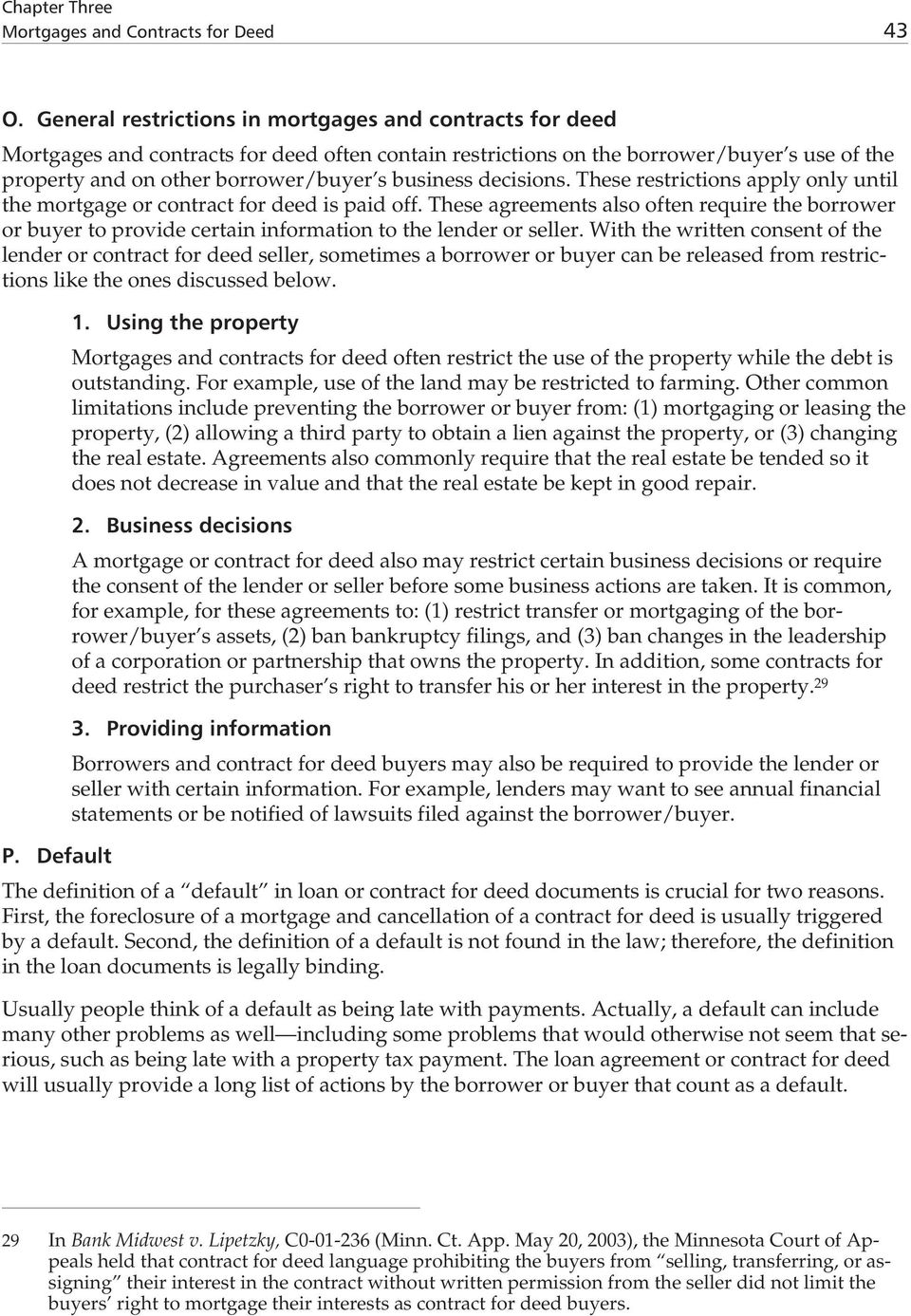
12 Farmers Guide to 44 Minnesota Lending Law The consequences of a default can be severe. It cannot be emphasized enough that farmers need to know exactly what triggers a default. Q. Notice and cure Mortgages and contracts for deed sometimes include the right to notice and cure. This means that the lender or seller must give notice to the borrower or buyer if there is a default. The lender or seller must then also give the borrower or buyer the right to cure the default within a reasonable amount of time before taking action to enforce the debt or cancel the contract for deed. R. Remedies for lenders and sellers If a borrower or buyer defaults, the lender or seller typically has the right to certain remedies. For example, under some mortgage agreements, default by the borrower allows the lender to take over the operation of the farm. While these remedies are limited to some degree by the law, in general the written agreements set out lender or seller options. III. Mortgage foreclosures If a borrower defaults on a mortgage, the lender may attempt to foreclose, and the borrower faces losing possession of the real estate. Farmer borrowers may be able to cure a default or negotiate an agreement with the lender and also may be eligible for farmer-lender mediation. After the foreclosure process begins, a borrower has the chance to reinstate the mortgage by complying with its terms. Reinstatement can prevent a foreclosure sale. If there is a foreclosure sale, the borrower has a right of redemption and perhaps a right of first refusal as well. After foreclosure, a borrower may be required to pay a deficiency judgment if the foreclosure sale does not cover all that was owed to the lender. Possible steps in a foreclosure The following is a rough listing of the possible steps in a foreclosure. 1. Default and acceleration. 2. Mediation and possibly notice and cure. 3. Negotiation with the lender possibly including a deed in lieu of foreclosure or settlement that ends foreclosure. 4. Creditor begins foreclosure process by action or advertisement. 5. Reinstatement of mortgage which ends foreclosure. 6. Foreclosure sale. 7. Redemption period. 8. Deficiency judgment if sale of the property does not cover the debt. 9. Right of first refusal. A. Default and acceleration As discussed earlier, borrowers should carefully review their loan agreements to understand what actions will be considered a default on their mortgage loans. If a default occurs, the loan

13 Chapter Three Mortgages and Contracts for Deed 45 agreement should specify what actions the lender may take. This may include demands for special fees and penalties. Acceleration of all payments is a common result of default on a loan. This is typically the lender s first step in the foreclosure process. Borrowers who receive an acceleration notice should treat it very seriously and are advised to seek legal advice early to better understand their options for responding to the notice. B. Mediation Lenders deciding to foreclose on a farm mortgage in Minnesota may be required to serve the borrower with a written notice of the availability of farmer-lender mediation. 30 Chapter Seven discusses mediation. C. Notice and cure As mentioned earlier, a mortgage agreement might give the borrower a right to notice and cure of a loan default. If a mortgage includes such a provision, the lender must notify the borrower if there is a default and give the borrower or buyer the right to cure the default within a reasonable amount of time before taking action to enforce the debt. 31 Borrowers should review their mortgage agreements carefully to determine whether they have a right to notice and cure of any default. D. Special procedures for mortgages held by Farm Credit Services and the Farm Service Agency (formerly FmHA) If Farm Credit Services (FCS) is the lender, it is required to send borrowers a restructuring policy before beginning foreclosure. 32 If FCS does not send the policy, the debtor may be able to stop the foreclosure. 33 If the lender is the Farm Service Agency (FSA) formerly the Farmers Home Administration (FmHA) different rules and procedures apply. Contact FLAG for more information about FSA borrower rights. E. Deeds in lieu of foreclosure Some lenders may suggest that a defaulting borrower voluntarily surrender the land to the lender before foreclosure. Usually this is done through a deed in lieu of foreclosure. A deed in lieu of foreclosure, therefore, is a substitute for a foreclosure. The borrower s right of redemption (discussed later at page 53) is lost if a deed in lieu of foreclosure is used to transfer the 30 Minn. Stat See, for example, McKay v. Ryan, 284 N.W. 57 (Minn. 1939), where the Minnesota Supreme Court held that the buyer s demand four days prior to the end of a 60-day period to cure a default with a contract for deed did not allow the seller reasonable time to cure the default U.S.C. 2202a. 33 Burgmeier v. Farm Credit Bank of St. Paul, 499 N.W.2d 43 (Minn. Ct. App. 1993).

14 Farmers Guide to 46 Minnesota Lending Law mortgaged property to the lender. 34 Some factors to consider about deeds in lieu of foreclosure include the following Borrower loses the entire property and loses it more quickly In a deed in lieu of foreclosure, borrowers essentially give up any legal arguments they might have used to prevent the foreclosure. They also give up their right to redeem the property (discussed later at page 53), particularly the right to designate and redeem the homestead portion of the property. In addition, borrowers lose land more quickly under a deed in lieu of foreclosure than if there is a foreclosure sale. Foreclosures take some time to enforce, and, even after a foreclosure sale, many borrowers can remain on the land during the redemption period. 2. It costs less for the lender If the lender goes ahead with the foreclosure, the borrower may be charged with the cost of the foreclosure action itself, which can be considerable. Although the lender pays the foreclosure costs up front, the lender can try to pass them along to the borrower later. A deed in lieu of foreclosure avoids much of this cost. 3. It can help in negotiations with the lender The fact that a deed in lieu of foreclosure is less trouble and expense for the lender and resolves the whole issue sooner gives the borrower a negotiating point with the lender. If the borrower agrees to a deed in lieu of foreclosure, the lender might, for example, waive its right to seek a deficiency judgment for any debt that is not covered by the value of the mortgaged property. F. Foreclosure by action or by advertisement Foreclosures in Minnesota come in two types: by action and by advertisement. Most foreclosures are by advertisement, because they are quicker and cheaper for the lender. For borrowers, the difference between the two determines the way the lender gives notice of the foreclosure sale and the way the lender gets permission to foreclose. In general, lenders are more likely to use a foreclosure by action if they want to seek a deficiency judgment against the borrower or there are some legal issues that would make foreclosure by advertisement difficult. 34 In a few circumstances, a deed in lieu of foreclosure is not legal. This includes, for example, if the lender has taken unconscionable advantage of the borrower, if there is not fair consideration given for the bargain, or if the transaction was intended to provide additional security for the mortgage debt and not as a sale of the real estate. Gandrud v. Hansen, 297 N.W. 730 (Minn. 1941); O Connor v. Schwan, 251 N.W. 180 (Minn. 1933). 35 If the borrower voluntarily surrenders the mortgaged property, the borrower might also lose the right to harvest a crop already planted. Seifert v. Mutual Ben. Life Ins. Co., 281 N.W. 770 (Minn. 1938); Gunderson v. Hoff, 209 N.W. 37 (Minn. 1926).

15 Chapter Three Mortgages and Contracts for Deed Foreclosure by action Foreclosure by action is technically a lawsuit in which the creditor goes to court to get permission to foreclose on the property. Possible steps in a foreclosure by action 1. Summons and complaint 2. Hearing 3. Judgment 4. Notice 5. Sale a. Summons and complaint When filing the lawsuit in a foreclosure by action, the lender delivers a summons and complaint to the borrower. 36 The complaint describes the default and asks the court for a judgment and an order to sell the borrower s real estate to pay the debt. 37 Notice of the borrower s opportunity to designate property as homestead or as separate agricultural tracts must also be included in the summons and complaint. 38 The borrower has 20 days after being served with the summons and complaint to file an answer with the court. 39 The answer should make any legal arguments the borrower has in response to the complaint. b. Hearing After the answer is filed, the court will issue a scheduling order that sets out the timeline for how the case will proceed. This scheduling order will include the date of any pre-trial conferences and the hearing date. 40 At the hearing, or sometime after the hearing, the judge will decide whether the lender is entitled to foreclose on the borrower s property. In some cases, the judge may also determine how much money is due to the lender and whether the mortgage is valid. Borrowers are allowed to represent themselves in the foreclosure hearing. To be effective, however, borrowers will probably need an attorney, both to prepare legal papers and to represent them in court. 36 Minn. Stat ; Minn. R. Civ. P. 3.01, Minnesota court rules allow a summons and complaint to be served by publication in mortgage foreclosure cases if the lender is unable to locate the borrower. Minn. R. Civ. P. 4.04(a)(5). 37 Minn. R. Civ. P. 8.01, Minn. Stat , Minn. R. Civ. P Minn. R. Civ. P If a party fails to obey a scheduling or pretrial order, fails to appear at a scheduling conference, or does not participate in the process in good faith, the court may order monetary sanctions against that party. Minn. R. Civ. P

16 Farmers Guide to 48 Minnesota Lending Law c. Judgment If the borrower does not file an answer to a complaint in 20 days, the lender will generally ask for a default judgment. 41 A default judgment means that the lender wins because the borrower defaulted by not answering the complaint. If the lender is given a default judgment or if the borrower challenges the foreclosure in a hearing and loses, the court will enter a judgment and order the sheriff to hold a foreclosure sale to pay the debt. 42 If the borrower files an answer and the judge agrees with the borrower, the foreclosure will be stopped or at least delayed. In some cases, the judge may only require the borrower to pay part of what the lender is demanding. d. Notice The borrower will receive notice of the court s decision and foreclosure sale. 43 Normally the foreclosure sale notice will be delivered by the sheriff. The notice will describe the court s decision and set out the date, time, and place of the sheriff s sale. The sheriff will also post and publish for six weeks in a local newspaper in the county where the mortgaged property is located a notice of foreclosure sale listing the date, time, and place of the sale and a description of the property to be sold Foreclosure by advertisement Minnesota law sets out a step-by-step process that lenders may use for foreclosure by advertisement. In this process, the lender does not need to file a lawsuit or seek court approval before foreclosure. Because of the relative simplicity of this process and lower cost, in most cases lenders choose to foreclose mortgages by advertisement. a. When lenders can use advertisement If the borrower defaults, a lender can foreclose by advertisement if: (1) the mortgage has a power of sale clause that allows foreclosure in case of default, (2) the lender is not seeking to recover the debt through any court action against the borrower, and (3) the mortgage is officially recorded. 45 b. Required notice If these requirements are met, the lender can begin foreclosure by publishing a notice of foreclosure in a local newspaper in the county where the mortgaged 41 Minn. R. Civ. P Minn. Stat Minn. Stat Minn. Stat Posting in three public places within the county in which the property is located satisfies the public posting requirements. Minn. Stat , subd. 1; Fidelity & Deposit Co. v. Riopelle, 216 N.W.2d 674, 680 (Minn. 1974). 45 Minn. Stat , The lender must discontinue any existing legal action against the borrower, but it may foreclose if a prior judgment was completed but not fully paid. Any assignments of the mortgage must also be recorded.

17 Chapter Three Mortgages and Contracts for Deed 49 property is located. The notice must be published for six weeks and must list the date, time, and place of the sale. 46 If the borrower occupies the land, the lender must also serve the borrower with a copy of the notice at least four weeks before the foreclosure sale. 47 The notice must include certain information, including notice of the borrower s opportunity to designate some of the mortgaged property as homestead or separate agricultural tracts that may be redeemed separately and notice that the borrower has the right of redemption. 48 If the information in the notice of sale is wrong, or if the notice is not published properly, a foreclosure may be invalid Foreclosure and court action for the debt A lender might decide to sue a defaulting borrower to collect the amount due under the promissory note or loan agreement. This is different from a foreclosure. In an action on the debt, the lender is not directly trying to take the mortgaged property. If a lender does seek a personal judgment against a borrower on a promissory note and the lender holds a mortgage on real property used in agricultural production, the maximum judgment that the lender can get is the difference between the amount due on the note and the fair market value of the property. 50 In many cases, the lender will not be able to seek both a court judgment for the debt and foreclosure of the mortgage at the same time. Lenders may not, for example, use the foreclosure by advertisement process and at the same time bring any other legal action against the borrower on the debt. 51 In addition, if the borrower signed the mortgage before March 23, 1986, and the mortgage is on property used in agricultural production, 46 Minn. Stat , The notice must also include: (1) the name of the mortgagor and mortgagee, (2) the original principal amount secured by the mortgage, (3) the date of the mortgage and information on when and where it was recorded or registered, (4) the amount claimed to be due and any taxes paid by the lender, (5) a description of the premises, and (6) the time allowed for redemption. Minn. Stat There must be at least 42 days from first publication to date of sale. White v. Mazal, 257 N.W. 281 (Minn. 1934). 47 Minn. Stat Tenants in possession must be served notice of the foreclosure except where they are the junior or subordinate tenant. Casserly v. Morrow, 111 N.W. 654 (Minn. 1907); Farm Credit Bank v. Kohnen, 494 N.W.2d 44 (Minn. Ct. App. 1992). 48 Minn. Stat , , See Minn. Stat Minn. Stat , subds. 4, 6. Limits on judgments on after-acquired property and the three-year statute of limitations mentioned at page 65 also apply to these judgments. Minn. Stat , subds. 7, 9. Judgments are discussed in Chapter Five. 51 Minn. Stat (2). In order to foreclose by advertisement, the lender must stop other legal action to collect the debt. If an earlier judgment on the debt was executed but not completed, the lender may use the foreclosure by advertisement process.
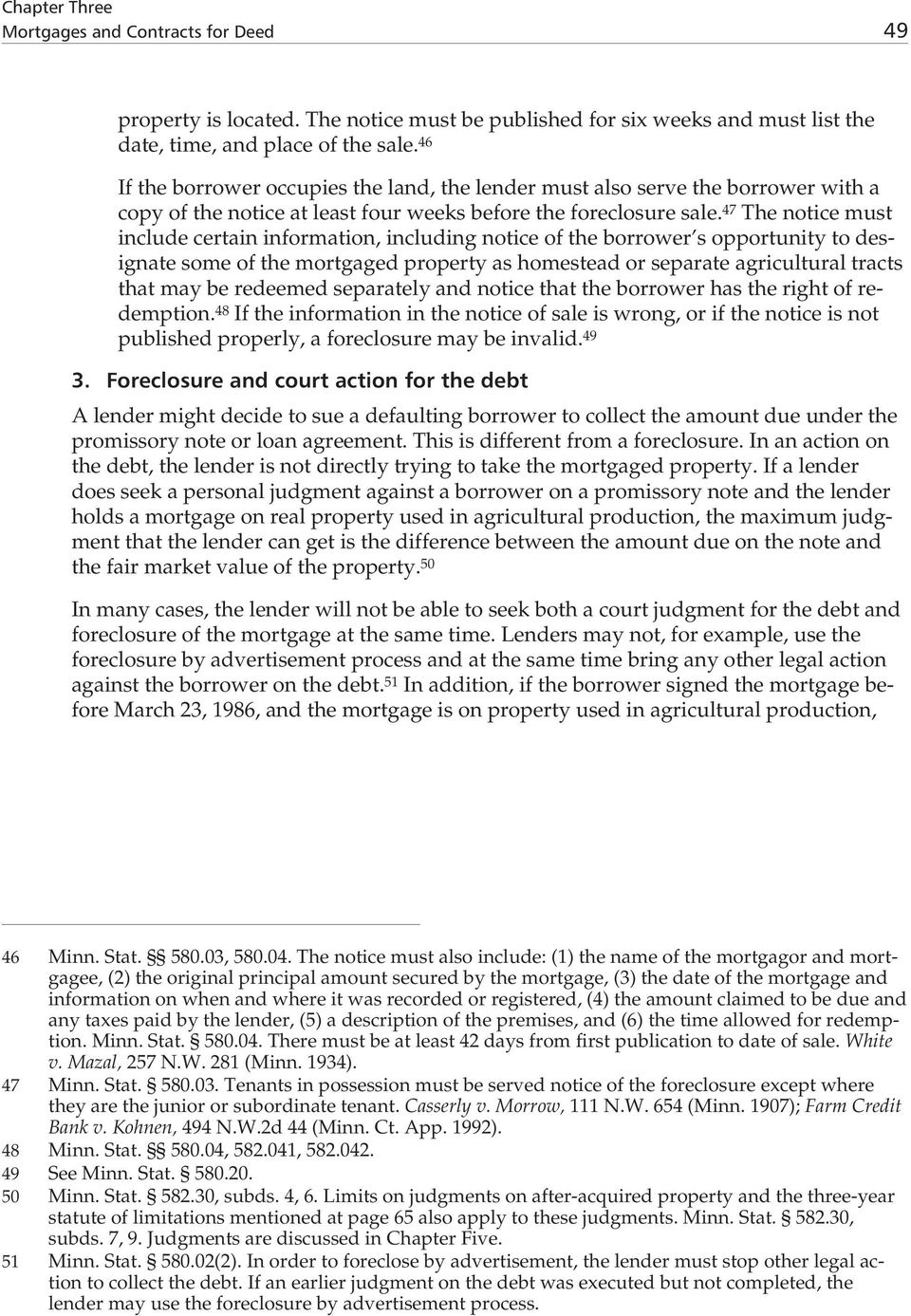
18 Farmers Guide to 50 Minnesota Lending Law the lender may either foreclose on the mortgage or seek a judgment and payment on the note, but not both Defending against foreclosure In most cases, a lender seeking a foreclosure acts legally. Depending on the circumstances, however, it may be possible for borrowers to challenge foreclosures by showing that the mortgage or foreclosure process used by the lender did not satisfy all legal requirements for a valid foreclosure. For example, if the mortgage is defective because it was drafted incorrectly, was not properly notarized and recorded, or lacks a power of sale clause or an acceleration clause, foreclosure may be invalid. Similarly, a borrower might be able to argue that the lender did not send out required cure notices or failed to fulfill the foreclosure notice requirements. 53 Or it might be the case that the default claimed by the lender as the basis for the foreclosure is not considered a default under the terms of the note or mortgage. In such situations, the borrower may be able to slow, or in some cases even prevent, a foreclosure. It is probably not realistic for a borrower to try to stop a foreclosure alone. Successfully challenging a foreclosure by a lender will probably require the help of a lawyer. G. Designating separate parcels for sale and redemption As mentioned earlier, farm borrowers facing foreclosure should be provided with notices about their rights to designate separate parcels within the mortgaged property if certain requirements are met. In a foreclosure by action, these notices should be provided with the summons and complaint. 54 In a foreclosure by advertisement, these notices should be included in the initial foreclosure notice. 55 It may be to the borrower s advantage to designate real estate to be sold and redeemed separately. That way the borrower can redeem the part of the property he or she most wants to keep without being forced to try to redeem and pay for all of the mortgaged property. 1. Designating homestead property If the real estate contains the borrower s home, the borrower should receive a homestead designation notice. 56 This notice explains that the home and some of the land surrounding it may be designated as a homestead and that this property can be sold and redeemed separately from the rest of the borrower s real estate Minn. State ; Metropolitan Life Ins. Co. v. Christison, 451 N.W.2d 222 (Minn. Ct. App. 1990). This statute only protects a party against whom a lender could have commenced both actions and not where another party guarantees the mortgage. Ed Herman & Sons v. Russell, 535 N.W.2d 803 (Minn. 1995). This provision was held not to apply where FmHA (now FSA) partially released some mortgage notes to facilitate a sale of farm property and the court determined that it was not a foreclosure. United States v. Nelson, 101 F.3d 1284 (8th Cir. 1996). 53 Minn. Stat (1). 54 Minn. Stat , Minn. Stat , Minn. Stat , subd Minn. Stat , subd. 2.
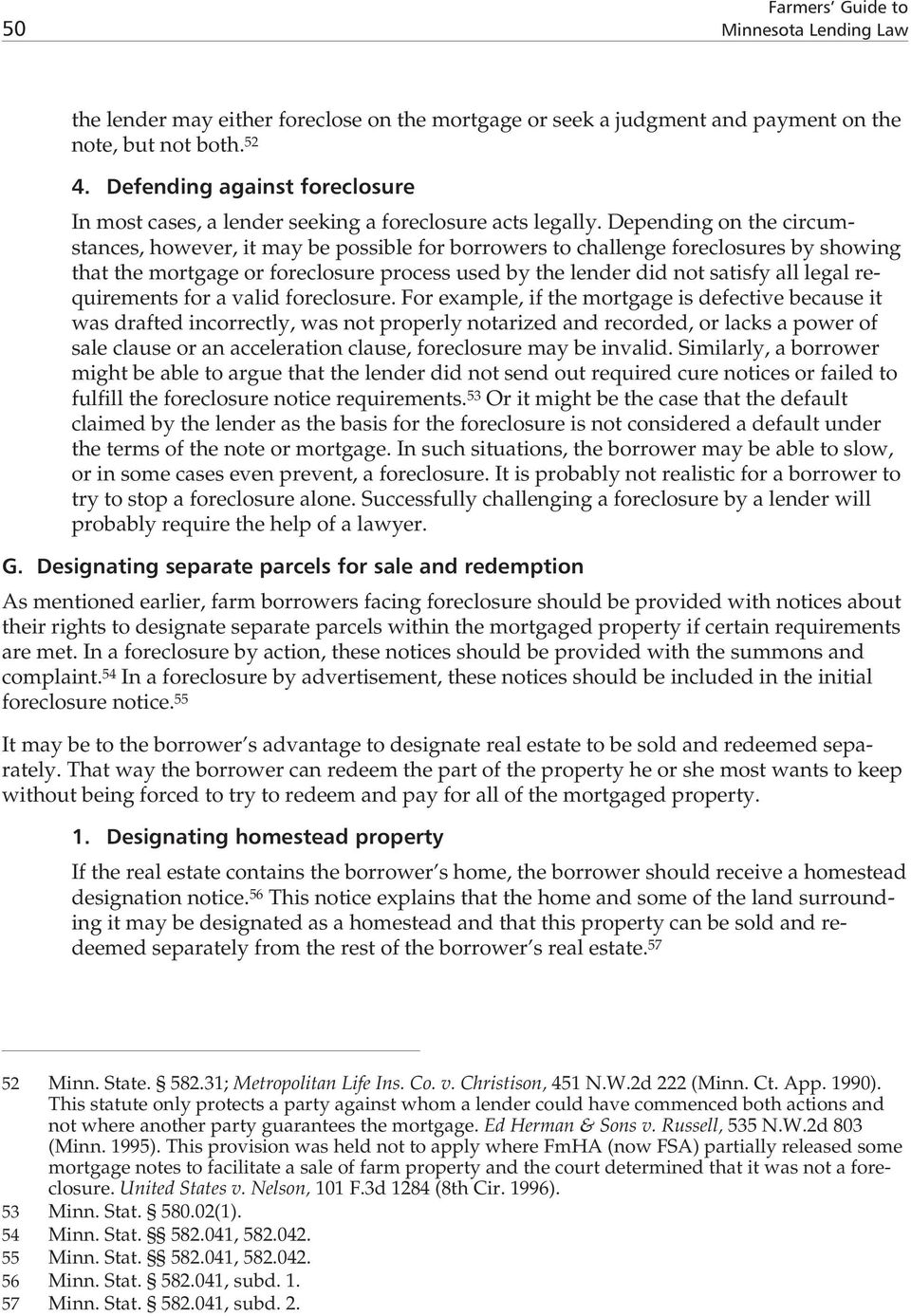
19 Chapter Three Mortgages and Contracts for Deed 51 The homestead may include any amount of real estate as long as it: (1) includes the home, (2) conforms to local zoning rules, and (3) is compact so as not to unreasonably affect the value of the rest of the real estate. 58 The lender and the sheriff do not have the right to change the homestead designation on their own if they do not like it or think it is illegal Designating agricultural tracts If the borrower s real estate is agricultural land and contains separate tracts parcels of land with separate legal descriptions the borrower will receive a designation notice explaining that, if the borrower requests, the tracts will be sold and available for redemption separately. 60 Tracts designated to be sold separately must: (1) have been previously recorded as separate tracts, (2) meet local zoning ordinance requirements, (3) have an entrance by direct access to a public road or by permanent easement, and (4) not have a shape that unreasonably affects the value of the remaining real estate How to designate the separate parcels The procedure for designating parcels is different, depending on whether the foreclosure is by action or advertisement. If the foreclosure is by advertisement, the borrower must serve a copy of the legal descriptions of the separate parcels whether homestead property or separate agricultural tracts on the lender, the sheriff, and the county recorder or registrar of titles at least ten business days before the scheduled foreclosure sale. 62 If the foreclosure is by action, the borrower must provide a copy of the legal descriptions of the separate parcels to the court as part of the foreclosure proceeding. 63 If the legal requirements for a homestead designation or agricultural tract designations are met, the sheriff must offer and sell the parcels separately. 64 The borrower may then redeem the parcels separately or redeem all of the property Minn. Stat , subd. 3. For example, a designation creating a landlocked parcel could unreasonably affect the value of the remaining land. Federal Land Bank of St. Paul v. Carlson, 398 N.W.2d 595 (Minn. Ct. App. 1986). 59 Federal Land Bank of St. Paul v. Carlson, 398 N.W.2d 595 (Minn. Ct. App. 1986). 60 Minn. Stat , subd. 1. Agricultural land is not defined in the statute. One court has suggested that borrowers are only eligible for this designation if they qualify as either a family farm or a family farm corporation. Resolution Trust Corp. v. Lipton, 983 F.2d 901 (8th Cir. 1993). The statutory authority for this requirement is not found in Minn. Stat The court may have concluded that farmers should not be eligible for this designation unless they are also eligible for farmer-lender mediation under Minn. Stat Minn. Stat , subd Minn. Stat , subd. 3, , subd Minn. Stat , subd. 3, , subd Minn. Stat , subd. 4, , subd The redemption period is the same for all of the property. Minn. Stat , subd. 5, , subd. 5.
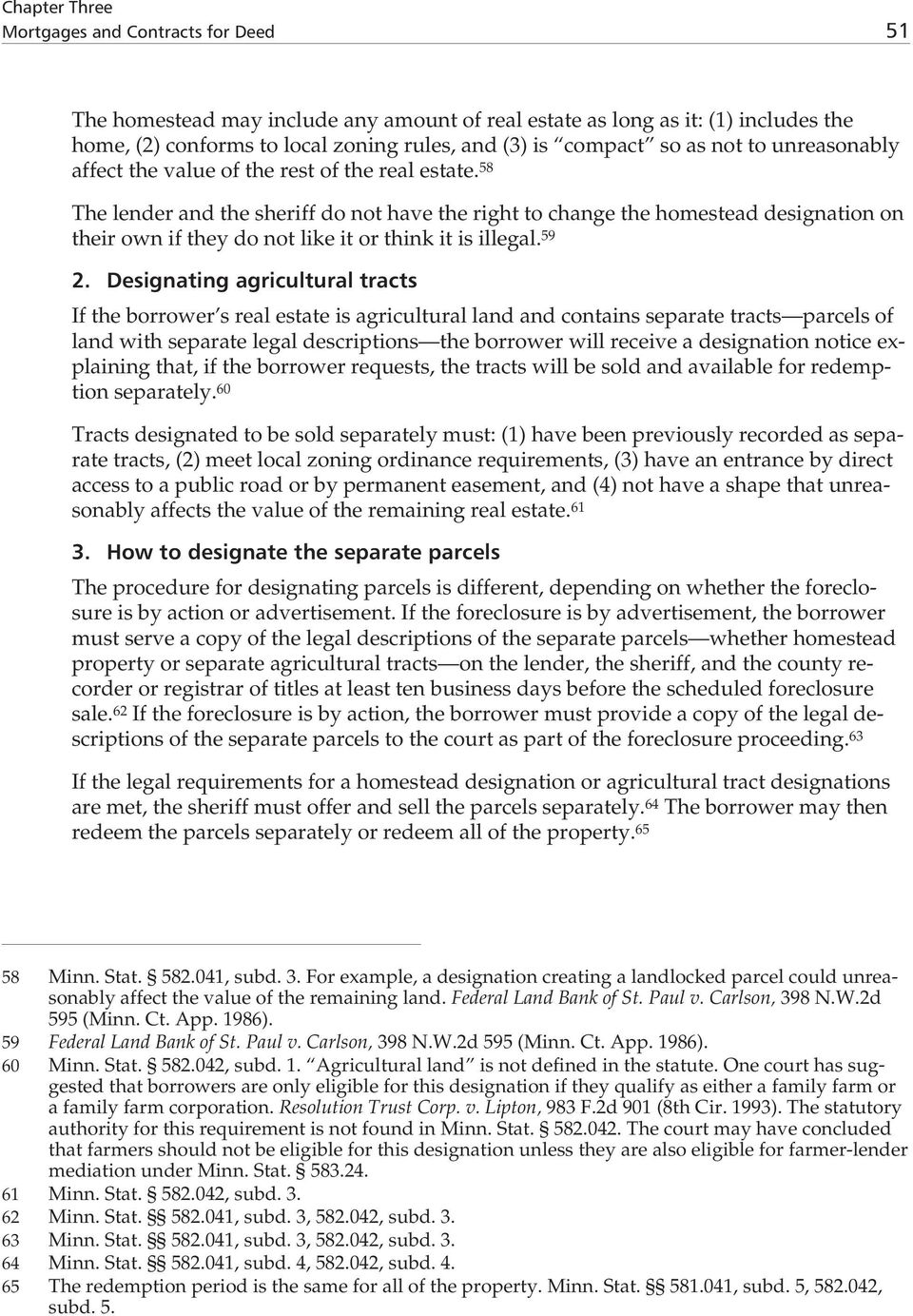
20 Farmers Guide to 52 Minnesota Lending Law H. Reinstatement of the mortgage before the sale A mortgage may be reinstated any time before the foreclosure sale. Reinstatements eliminate the default that triggered foreclosure in the first place. To reinstate the mortgage, the borrower pays to the sheriff, the holder of the mortgage, or the foreclosing attorney the amount needed to bring the mortgage current. 66 A borrower has a reinstatement right whether the lender sought foreclosure by action or by advertisement. The amount the borrower must pay to reinstate the mortgage includes all payments due up to the time the reinstatement payment is made, any interest owed, and reasonable lender expenses. 67 Reinstatement is possible even if the mortgage has been accelerated. If the lender accelerated the loan, the borrower does not need to pay the full, accelerated amount of the loan only the amount that would have been owed had the lender not accelerated. 68 I. Foreclosure sale Foreclosure sales are auctions. 69 Sale proceeds are paid to the lender for the mortgage debt, and the borrower gets back any surplus. 70 If the sale proceeds do not fully satisfy the borrower s debt, the lender may seek a deficiency judgment, discussed starting at page Usually, but not always, the highest bidder at a foreclosure sale is the lender. Most lenders seek to add the cost of the foreclosure to the amount the borrower owes under the mortgage. In a foreclosure by advertisement, in order to have a legal right to recover these costs, the lender must file papers proving the costs with the county recorder within ten days after filing the record of the sale. 72 Costs for a foreclosure by action are handled by the court Selling parcels separately The borrower may prefer to have the mortgaged property divided into more than one parcel for the foreclosure sale. For example, if parcels are sold separately, it may be easier to keep part of the farm in the family. Whether farm and homestead property will be sold in separate parcels will usually be controlled by the borrower s redemption designations, discussed earlier. 66 Minn. Stat Minn. Stat ; First Trust Co. v. Leibman, 445 N.W.2d 547 (Minn. 1989). Reasonable expenses can include insurance or delinquent taxes paid by the lender, attorneys fees, and other costs. Attorneys fees are discussed at Minn. Stat , Davis v. Davis, 196 N.W.2d 473 (Minn. 1972). 69 Minn. Stat , The auction is held in the same county where the real estate is located. Foreclosure sales operate the same way whether the foreclosure was by advertisement or action. 70 Minn. Stat , Minn. Stat , , Minn. Stat An excessive claim of costs or interest can result in a triple recovery for the borrower if the borrower brings a successful lawsuit within one year after the sale. Minn. Stat ; Pokorny v. Builders Fin., C (Minn. Ct. App. Aug. 24, 1993) (unpublished). 73 Minn. Stat

21 Chapter Three Mortgages and Contracts for Deed 53 If the borrower for some reason is not eligible to make those designations, the law still limits how the property will be sold. In a foreclosure by advertisement, if the mortgaged property includes separate and distinct farms or tracts, they should be sold separately unless this option is waived by the borrower. 74 Also, no more farms or tracts should be sold than are needed to satisfy the amount owed. 75 In a foreclosure by action, the judge may rule that distinct farms and tracts be auctioned together if it will be most beneficial to the parties. 76 In other words, it should be to the benefit of both the borrower and the lender. 2. Confirmation of the sale in foreclosure by action If the foreclosure is by action, after the sale the court will issue an order confirming the sale. 77 The sheriff must then issue a certificate of sale, which is to be recorded, presumably by the lender or purchaser, within 20 days Mistakes in the foreclosure sale If a foreclosure sale is conducted improperly, it may be possible to have the sale set aside. 79 However, in many cases a foreclosure sale will be enforced despite problems with the process. A lender will often be able to foreclose again to correct the error. 80 J. The right of redemption If the real estate is sold at a foreclosure sale, the borrower has the right to redeem the property. The borrower may, in other words, repurchase the property for the foreclosure sale price plus interest from the date of the sale and reasonable expenses Timing length of redemption period The right of redemption lasts for a limited time. In general, the borrower will either have 12 months or 6 months from the date of the sale to redeem. If the foreclosure was by advertisement, the redemption period begins on the day of the foreclosure sale. 82 If the foreclosure was by action, the redemption period begins on the day the court issues the order to confirm the sale. 83 Most farmers have a 12-month redemption period, but it is important to make sure. Whether the borrower has a 6- or 12-month redemption period is determined by the hodgepodge of factors discussed below. 74 Minn. Stat ; John W. Swenson & Sons, Inc. v. Aetna Life Ins. Co., 571 F. Supp. 895 (D. Minn. 1983); In re Kjeldahl, 52 B.R. 916, on remand, 52 B.R. 926 (Bankr. D. Minn. 1985). 75 Minn. Stat The amount owed includes interest, taxes paid, and costs of the sale. 76 Minn. Stat Minn. Stat Minn. Stat See Minn. Stat , Gerdin v. Princeton State Bank, 384 N.W.2d 868, 872 n.7 (Minn. 1986). See also Minn. Stat Minn. Stat , Minn. Stat , Minn. Stat , , ,
22 Farmers Guide to 54 Minnesota Lending Law a. Twelve-month redemption period Borrowers have 12 months to redeem their property if any of the following six circumstances applies to the mortgage. 84 (1) Mortgaged before July 1, 1967 If the mortgage was signed before July 1, 1967, the borrower has a 12-month redemption period for that property. The size or use made of the property does not matter. (2) More than one-third of principal paid off If the borrower has paid off more than one-third of the original principal secured by the mortgage, the borrower has a 12-month redemption period for that property. 85 The size or use made of the property does not matter. (3) Mortgaged before July 1, 1987 and over ten acres If the mortgage was signed before July 1, 1987, and the mortgaged land at the time of the mortgage signing covered more than ten acres, the borrower has a 12-month redemption period for property under that mortgage. 86 (4) Over 40 acres mortgaged If the mortgaged property as of the date of the mortgage signing covered more than 40 acres, the borrower has a 12-month redemption period. The timing of the mortgage and the use of the land do not matter. 87 (5) Land in agricultural use, over 10 acres, but less than 40 acres The borrower has a 12-month redemption period if the mortgaged land as of the day the mortgage was signed covered more than 10 but less than 40 acres and was in agricultural use. 88 The question of what land is or is not in agricultural use may be more complicated than it seems at first. Minnesota law uses two different definitions of agricultural use for deciding redemption periods depending on when the mortgage was signed. 89 (a) If signed before August 1, 1994 The legal definition of land in agricultural use for mortgages executed before August 1, 1994, covers most typical farms. Livestock 84 Minn. Stat , subd. 2, Minn. Stat , subd. 2(2). Technically, the amount claimed to be due and owing on the day of the notice of the foreclosure sale must be less than 66-2/3 percent of the original principal amount secured by the mortgage. 86 Minn. Stat , subd. 2(3). 87 Minn. Stat , subd. 2(5). 88 Minn. Stat , subds. 2(4), (6). 89 Lenders may ask borrowers to sign an affidavit of nonagricultural use that can be recorded with the county records to ensure that the borrower will not later be able to claim that the property was in agricultural use. Minn. Stat , subd. 3.
23 Chapter Three Mortgages and Contracts for Deed 55 production, dairying, grain farming, and horticulture qualify. Also included in this definition of land in agricultural use are wetlands, forests, and wildlife land. 90 (b) If signed on or after August 1, 1994 The legal definition of land in agricultural use for mortgages signed on or after August 1, 1994, is based on property tax assessment classifications. Property is defined as in agricultural use if at least a portion of the mortgaged land is classified for property tax purposes as agricultural property or exempt wetland property. 91 If a mortgage was signed on or after August 1, 1994, it is worth asking the county tax assessor to make sure that the land meets one of these technical classifications: (1) Class 1b agricultural homestead property, (2) Class 2a agricultural homestead property, (3) Class 2b rural or agricultural non-homestead property, or (4) exempt wetlands. If the land meets one of these classifications, it is agricultural property and has a 12-month redemption period, so long as it meets the acreage requirement. 90 Agricultural use is defined as the production of livestock, dairy animals, dairy products, poultry or poultry products, fur-bearing animals, horticultural or nursery stock, fruits, vegetables, forage, grains, timber, trees, or bees and apiary products. It also includes wetlands, pasture, forest land, wildlife land, and other uses that depend on the inherent productivity of the land. Minn. Stat. 40A.02, subd Tax classification definitions can be found at Minn. Stat , subds. 22, 23, , subd. 11. In general, property qualifies under the tax laws as agricultural if it is contiguous acreage of ten acres or more used during the preceding year for agricultural purposes. Agricultural purposes means the raising or cultivation of agricultural products. Agricultural purposes also includes enrollment in the Reinvest in Minnesota program or the federal Conservation Reserve Program if the property was agricultural before it was enrolled in a conservation program. Property enrolled in a conservation program in 2002 retains its agricultural classification Minn. Laws. ch. 127, art. 2, 14 (to be codified at Minn. Stat , subd. 23(c)). Contiguous acreage on the same parcel, or contiguous acreage on an immediately adjacent parcel under the same ownership, may also qualify as agricultural land, but only if it is pasture, timber, waste, unusable wild land, or land included in state or federal farm programs. Real estate of less than ten acres used principally for raising or cultivating agricultural products is considered agricultural land if it is not used primarily for residential purposes. Minn. Stat , subd. 23(c)-(f). Exempt wetlands typically produce little if any income and have no use except wildlife or water conservation.
24 Farmers Guide to 56 Minnesota Lending Law You are entitled to a 12-month redemption period if: 1. You mortgaged before July 1, 1967; or 2. You have more than one-third of the principal paid off; or 3. You mortgaged before July 1, 1987 and have over 10 acres mortgaged; or 4. You have over 40 acres mortgaged; or 5. The land is agricultural land and over 10 acres but less than 40 acres. b. Six-month redemption period In general, borrowers who do not qualify for a 12-month redemption period will have a redemption period of 6 months. 92 c. Other redemption periods Other very short redemption periods that are sometimes allowed under the law would almost never apply to an active family farm. 93 d. Waiving the 12-month redemption period In some cases, the lender may ask the borrower to waive the right to a 12-month redemption period and accept a 6-month redemption period instead. Such a waiver will be legally enforceable if: (1) the waiver is in writing; (2) the mortgage was executed on or after August 1, 1994; (3) the mortgage covers more than 10 acres but not more than 40 acres; (4) the land is used for agricultural purposes; and (5) the lender records the waiver Minn. Stat , subd. 1, Redemption periods for voluntary foreclosures and vacant property are shorter. The two-month redemption period for a voluntary foreclosure for mortgages executed after August 1, 1993, is not applicable to homestead or agricultural property. Minn. Stat Agricultural use is defined in Minn. Stat. 40A.02, subd 3, and homestead in Minn. Stat Beginning with the 2004 property tax assessment, to retain eligibility for the special agricultural homestead classification, landowners must complete a one-page abbreviated version of the full initial application in subsequent years that states the farming operations have not changed Minn. Laws ch. 127, art. 2, 12 (to be codified at Minn. Stat , subd. 14(h)). Vacant and abandoned property may have a five-week redemption period if the mortgage was executed after December 31, 1989, but only if the property, at the time of the foreclosure, was not in agricultural production and the mortgage covers no more than ten acres. Minn. Stat Minn. Stat , subd. 4. The waiver must be either: (1) a document separate from the mortgage, or (2) a separately executed and acknowledged addendum to the mortgage on a separate page. If the waiver is a separate document, it must be in recordable form and either recite the recorded or filed document number of the mortgage or recite the name of the mortgagor or mortgagee, the legal description of the property, and the date of the mortgage. A waiver that is a separate document must be recorded or filed no later than ten days after the recording or filing of the mortgage.
25 Chapter Three Mortgages and Contracts for Deed Exercising the right to redeem The right to redeem foreclosed real estate is an important one for farm borrowers in financial distress. The law sets out detailed requirements that must be satisfied to exercise this right. Borrowers who are intending or even just considering exercising their right of redemption should make sure that they know exactly what will be required, and when. a. Amount the borrower pays A borrower can redeem a parcel of real estate by paying the total of: (1) the amount bid at the sale for that parcel, (2) interest, and (3) other foreclosure-related costs for which the borrower is responsible. 95 The borrower must pay interest on the bid amount and on other lender expenses for the period from the foreclosure sale to the time the borrower redeems. 96 If the foreclosure was by advertisement, the interest rate will be the same as it was on the mortgage. 97 If the foreclosure was by action, the interest rate will be the same as it was on the mortgage except that the rate charged after the foreclosure can be no more than 8 percent. 98 Other costs are those paid by the lender, such as taxes, insurance, and other mortgages. The lender must formally file a record of these costs. 99 b. Payment procedure The borrower must pay either the person who purchased the real estate at the foreclosure sale or the sheriff. 100 The payment must be made by the end of the 6- or 12-month redemption period that applies to the borrower. 101 Along with the payment, the borrower must provide: (1) a certified copy of the judgment, mortgage, or other document under which the borrower claims a right of redemption; 102 and (2) an affidavit a written, sworn statement of the amount owed Minn. Stat , Minn. Stat , , Minn. Stat , subds. 1, 2. If the mortgage did not include a rate of interest, interest is 6 percent. 98 Minn. Stat If the mortgage did not include a rate of interest, interest is 6 percent. 99 Payments such as taxes, assessments, insurance, and mortgage payments, as well as the cost of protecting the property from damage or destruction, must be proved by the lender by an affidavit filed with the county recorder or registrar of titles. A copy must be given to the sheriff at least ten days before the end of the redemption period. Minn. Stat , If the affidavit is not filed on time, the costs may not be added to the borrower s redemption obligation. Tomasko v. Cotton, 273 N.W. 628 (Minn. 1937). 100 Minn. Stat , Sieve v. Rosar, 613 N.W.2d 789 (Minn. Ct. App. 2000). 102 Minn. Stat (1), Normally this would be a deed or mortgage, but it could in some cases be a copy of the docket of the judgment. 103 Minn. Stat (3), If the right to redeem has been assigned, documentation of this right must also be included. Minn. Stat (2),
26 Farmers Guide to 58 Minnesota Lending Law Within 24 hours after the redemption, the borrower must file these documents with the county recorder or registrar of titles. 104 If the redemption was made at any place other than the county seat, the borrower can satisfy the filing requirement by mailing the documents forthwith from the nearest post office to the county recorder or registrar of titles. 105 c. Certificate of redemption After making a redemption payment, the borrower should receive a certificate of redemption from the person he or she paid. 106 The certificate should include: (1) the borrower s name, (2) the amount paid, (3) a description of the foreclosure sale and the property redeemed, and (4) a statement of the source of the borrower s right to redeem. 107 The certificate of redemption must be filed with the county recorder or registrar of titles of the county where the property is situated within four business days after the borrower s right of redemption expires. 108 d. Filing requirements The two filing requirements for redemptions are extremely important. If the borrower does not file the certificate of redemption within four business days, for example, the redemption right may be lost. (1) Within 24 hours of redemption Within 24 hours of redemption, the borrower must file with the county recorder or registrar of titles the documents used in making payment. 109 (2) Within four days of the end of the redemption period The borrower must record the certificate of redemption within four business days after the end of the redemption period. 110 If the borrower fails to record the certificate of redemption, the redemption may be voided by any person who later attempts to redeem the same property Minn. Stat (3), Minn. Stat (3), Minn. Stat Minn. Stat Minn. Stat Under Minnesota law, if the last day of a period of time falls on a Saturday, Sunday, or legal holiday, that day does not count, and the period of time is extended. Minn. Stat Minn. Stat ; Sieve v. Rosar, 613 N.W.2d 789, 792 (Minn. Ct. App. 2000). 110 Minn. Stat ; Tesch v. Drew, 225 N.W. 815 (Minn. 1929). 111 Minn. Stat
27 Chapter Three Mortgages and Contracts for Deed 59 Three steps to redemption after foreclosure 1. Before your redemption deadline, present: a. Payment; b. Documentation of your interest in the real estate; and c. An affidavit listing the amount you owe. 2. Within 24 hours after you hand over your payment, file the documentation of your interest and the affidavit with the county recorder or registrar of titles. 3. Within four business days after your right of redemption expires, record the certificate of redemption with the county recorder or registrar of titles. 3. Effect of redemption If the borrower properly redeems the property, the foreclosure sale is annulled What happens to property during the redemption period? Not all borrowers will want or be able to redeem their foreclosed real estate. Nonetheless, the redemption period is an important time for all borrowers because they will generally be allowed to remain on the foreclosed real estate during that period. The borrower may also be entitled to receive the income from the property during the redemption period, unless the mortgage included a rent and profits clause. a. Right to occupy the land Borrowers are usually allowed to live on and use the foreclosed real estate during the redemption period. 113 Borrowers must keep the real estate in reasonably good shape during the redemption period, but in general they may continue to use it as they have in the past. 114 The lender or purchaser will have a very limited right to enter the property if it is vacant or unoccupied for example, to prevent or minimize damage to the property by changing locks, boarding up windows, and the like. 115 But the borrower is entitled to a key to any lock put on by the purchaser or lender Minn. Stat , Minn. Stat ; Mutual Ben. Life Ins. Co. v. Frantz Klodt & Son, Inc., 237 N.W.2d 350 (Minn. 1975); G. M. Prindle & Co., 240 N.W. 351 (Minn. 1932); Crowell v. Delafield Farmers Mutual Fire Ins. Co., 453 N.W.2d 724 (Minn. Ct. App. 1990); Woodman of World Life Ins. Soc y v. Sears Roebuck & Co., 200 N.W.2d 181 (Minn. 1972). 114 Minn. Stat ; Mutual Ben. Life Ins. Co. v. Frantz Klodt & Son, Inc., 237 N.W.2d 350 (Minn. 1975). 115 Minn. Stat , Minn. Stat
28 Farmers Guide to 60 Minnesota Lending Law b. Rents and profits from the land In general, rents and profits are the income from the land, including lease payments, federal farm payments, net income from crops, and the like. 117 Borrowers normally have the right to receive rent, income, and profits from foreclosed real estate during the redemption period. 118 If, however, the mortgage included a rents and profits clause, the situation may be very different, and borrowers may lose that potential income source. (1) How lenders can claim rents and profits Written agreements are the key to understanding what the lender can do with farm income and property during the redemption period. The loan agreement may give the lender the legal right to the rents and profits from the land. If the rents and profits clause is part of a properly recorded mortgage and it meets the other legal requirements for a security interest, the lender may have a lien on the rents and profits from the land. Chapter Four discusses security interests. It is important to keep in mind that the lien only exists as security to pay back the amount owed to the lender. Therefore, if the entire amount owed is paid, the lender s right to claim rents and profits from the land expires. 119 (2) Requirements for rents and profits clauses Not all rents and profits clauses are enforceable, and not all of a borrower s farm is subject to the clause even if it is enforceable. In order for a rents and profits clause to be legally enforceable, all of the following must be true. 120 (a) Mortgage signed or formally modified after August 1, 1977 For the lender s claim to be enforceable, either the mortgage including the rents and profits clause must have been executed after August 1, 1977, or a legal modification of the mortgage must have been executed after August 1, The exact meaning of the rents and profits when it comes to farmland could become a point of dispute. For title insurance certification purposes, assignment of rents and profits is defined as an assignment, whether in a separate document or in a mortgage, of any of the benefits accruing under a recorded or unrecorded lease or tenancy existing, or subsequently created, on property encumbered by a mortgage, which is given as additional security for the debt secured by the mortgage. Minn. Stat , subd. 1. In a somewhat different context, a court has ruled that rents include payment made by tenants to occupy real estate, and that a profit is the benefit, advantage, or pecuniary gain accruing to the owner or occupant of land from its actual use. In re Mid-City Hotel Ass n, 114 B.R. 634 (Bankr. D. Minn. 1990). 118 Minn. Stat ; Crowell v. Delafield Farmers Mut. Fire Ins. Co., 463 N.W.2d 737, 738 (Minn. 1990). 119 Minn. Stat , subd. 3; Cross Companies, Inc. v. Citizens Mortgage Inv. Trust, 232 N.W.2d 114 (Minn. 1975). 120 Minn. Stat ; Travelers Ins. Co. v. Westridge Mall Co., 994 F.2d 460 (8th Cir. 1993).
29 Chapter Three Mortgages and Contracts for Deed 61 (b) Minimum loan of $100,000 For the lender s claim to be enforceable, the original principal loan amount secured by the mortgage must have been at least $100, (c) Not homesteaded The lender s claim to rents and profits is not enforceable against property that was entirely homesteaded as agricultural property. 122 The statute gives no definition of this term. The likely effect of this provision is that a rents and profits clause will be valid on all non-homesteaded agricultural land. For example, if a bank has a mortgage on 300 acres and 160 of those acres are homesteaded, the rents and profits clause would be valid only for the other 140 acres. The question remains, however, how to define homestead for this purpose. One possible answer is to use the homestead designation from a redemption notice, but it seems possible that the courts could use other definitions. 123 In practice, this restriction means that if the mortgage includes a rents and profits clause, during the redemption period the borrower will not have a legal right to keep the rents and profits from the farm that do not come from homesteaded land. (3) Receiverships under rents and profits clauses A rents and profits clause in a loan agreement may give the lender the right to have a receiver appointed to manage the property. 124 If properly written and executed, this part of a rents and profits clause can be legally enforceable. A receiver is a third party appointed by the court to control the property; collect the rents, profits, and other income from the property; take a fee; and dispose of the rents and profits as the court orders. 125 To get a receiver appointed, the lender must go to the court and request one. 126 If the written loan agreement says that a receiver is to be appointed 121 If the lien is on residential real estate with five or more dwelling units, the loan may be for less than $100, Minn. Stat , subd. 2(3)(iii). 123 The advantage for the borrower in using the redemption designation is that it is flexible and can largely be defined by the borrower. Minn. Stat , subd. 3. In some cases, however, other designations, such as those used for exemptions from judgments or federal bankruptcy, might be better. Further, the statute does not explain what happens if the borrower fails to make a homestead designation. 124 Minn. Stat , subd Minn. Stat , subd. 2. Receivers are neutral parties and must be experienced property managers. The court determines a bond that the receiver must post. The court, not the lender, chooses the receiver. Minnesota Hotel Co., Inc. v. ROSA Dev. Co., 495 N.W.2d 888 (Minn. Ct. App. 1993). 126 The lender must bring an action in the district court of the county in which the mortgaged premises or any part thereof is located for the appointment of a receiver. Minn. Stat , subd. 2.
30 Farmers Guide to 62 Minnesota Lending Law after a specific event for example, the foreclosure the court will appoint the receiver. 127 If no mention is made of a receiver in the agreement, or if the agreement only says that the receiver may be appointed by the courts, the court may well decide not to appoint one What happens to the crops at the end of the redemption period? If a redemption period ends when there are crops in the ground, there are some complicated rules for sorting out the claims of the borrower and the lender or purchaser of the property. a. Crops are the personal property of the farmer Crops that a borrower plants on foreclosed land during a redemption period are the borrower s personal property, so long as the borrower had the legal right to plant them. 129 As a result, if the borrower has unharvested crops in the field when the redemption period ends, the borrower is still the planting crop owner even though redemption of the real estate has become impossible. 130 b. New owner may have priority in crop proceeds In 2001 the Minnesota Legislature repealed the law that had provided options for how the crops could be harvested at the end of the redemption period because it caused inconsistent lien priorities for certain parties in limited circumstances. 131 Under the new law, if the new owner who is usually the lender has a properly filed or perfected security interest 132 in the crops, the new owner will have a priority claim to the crops and crop proceeds over any claim of the borrower who is a planting crop owner. 133 Chapter Four discusses security interests and agricultural liens. K. Deficiency judgments If the sale of a borrower s real estate does not bring enough money to pay off the mortgage debt and any other money owed related to the mortgage, the borrower may be subject to a deficiency judgment. 134 In a deficiency judgment action, the lender forecloses on the real estate and also seeks additional money from the borrower to satisfy the debt. 127 Minn. Stat , subd. 2(a). 128 Minn. Stat , subd. 2(b). Traditionally, it has been difficult for lenders to have receivers appointed. Mutual Benefit Life Ins. Co. v. Frantz Klodt & Son, 237 N.W.2d 350 (Minn. 1975). 129 Minn. Stat Planting crop owners may also include farmers who had a leasehold interest and a contract for deed buyer s interest Minn. Laws ch. 57, 7 (repealing Minn. Stat ). 132 A security interest is a legal claim of a creditor allowing the creditor to take possession of the debtor s property or claim proceeds from the sale of the debtor s property if the debtor defaults on the debt. Some security interests are created by law or by order of a court. Most commonly, however, security interests are agreed to by debtors as part of a credit arrangement. 133 Minn. Stat (i). 134 Minn. Stat , subd. 2, , subds. 1, 2.
31 Chapter Three Mortgages and Contracts for Deed 63 Whether or not the lender is eligible for a deficiency payment should affect negotiations with the lender from the first moment the borrower is in default. 1. Availability of a deficiency Assuming that the proceeds from the foreclosure sale do not cover the full amount owed to the lender, the lender s ability to claim a deficiency hinges on: (1) whether the foreclosure was of rented land where the tenant is not the borrower, (2) whether the foreclosure was by action or advertisement, and (3) the length of the redemption period. 135 The length of the redemption period is explained above. In general, borrowers will be in one of the following four categories of circumstances. a. Foreclosure of mortgage on rented agricultural property executed on or after May 22, 1999 no deficiency If the mortgage was executed or amended on or after May 22, 1999, and the mortgaged property is used in agricultural production only by a tenant who is not the borrower, the lender will not have the right to seek a deficiency judgment. 136 This is true regardless of whether the foreclosure is by advertisement or by action. b. Foreclosure by advertisement and six-month redemption period no deficiency If the foreclosure is by advertisement and the borrower has a six-month redemption period, the lender will not have the right to seek a deficiency judgment. 137 The lender cannot simply extend the redemption period to 12 months in order to become eligible to seek a deficiency. 138 c. Foreclosure by action deficiency possible If the foreclosure is by action, a deficiency judgment is possible. 139 The length of the redemption period does not affect this possibility. d. Twelve-month redemption period deficiency possible If the redemption period is 12 months, a deficiency judgment is possible. 140 Whether the foreclosure is by action or advertisement does not affect this possibility. 135 Minn. Stat , , ; National City Bank v. Lundgren, 435 N.W.2d 588 (Minn. Ct. App. 1989); Norwest Bank Hastings v. Franzmeier, 355 N.W.2d 431 (Minn. Ct. App. 1984). 136 Minn. Stat , subd. 1(c). 137 Minn. Stat , subd American Nat l Bank v. Blaeser, 326 N.W.2d 163 (Minn. 1982). 139 Minn. Stat , subd. 2; Suburban Nat l Bank v. Kopstein, C (Minn. Ct. App. Sept. 6, 1994) (unpublished). 140 Minn. Stat
32 Farmers Guide to 64 Minnesota Lending Law Does the lender have the right to seek a deficiency judgment? Action Foreclosure by: Advertisement 6-month redemption period Yes No 12-month redemption period Yes Yes 2. Requirements for obtaining a deficiency judgment for mortgages on agricultural property A lender that wants a deficiency judgment against a borrower must file a lawsuit and ask the court for the judgment. 141 If the deficiency is related to a foreclosure on agricultural property, the lender begins the lawsuit by filing an action for the deficiency judgment and a determination of the fair market value of the property within 90 days after the foreclosure sale. 142 a. Reasonable foreclosure For a deficiency to be available, the court must conclude that the foreclosure sale was conducted in a commercially reasonable manner. 143 If the foreclosure was not commercially reasonable, no deficiency will be allowed, no matter how short the foreclosure price was of the amount owed to the lender. b. Maximum amount of deficiency on agricultural property foreclosures Even if a foreclosure sale is commercially reasonable, it may still result in a bid that is too low in the eyes of the law. The maximum deficiency in a mortgage on agricultural property is limited to the difference between: (1) the fair market value of the property; and (2) either the amount remaining on the mortgage, if the foreclosure was by advertisement, or the amount of the judgment, if the foreclosure was by action. 144 The statute setting this limit notes that the property may not be presumed to be sold at the foreclosure sale for its fair market value. 145 Borrowers have the right to submit evidence establishing the fair market value of the agricultural property. For example, if the borrower owes $200,000 to the lender and $150,000 was bid at 141 Minn. Stat , subds. 3, Agricultural property is property used in agricultural production. To file an action for the deficiency judgment, the lender must serve the borrower with a summons and complaint within 90 days of the foreclosure sale. Merely filing the summons and complaint with the court is not enough. Federal Land Bank of St. Paul v. Bennett, 445 N.W.2d 279 (Minn. Ct. App. 1989). 143 Minn. Stat , subds. 3, 5. The statute does not provide a definition of commercially reasonable. Perhaps the court would follow the factors used under the Uniform Commercial Code and Minn. Stat (b), Chapter Four discusses commercial reasonableness in this context. 144 Minn. Stat , subds. 3, Minn. Stat , subds. 3(b), 5(b).
33 Chapter Three Mortgages and Contracts for Deed 65 the foreclosure sale, in most foreclosures the borrower might be subject to a deficiency judgment of $50,000. In a foreclosure on agricultural property, however, if the court decides that the fair market value of the property was higher than the amount bid for example, $180,000 the borrower s deficiency judgment would be limited to $20,000. c. Limits on enforcing deficiency judgments for mortgages of agricultural property State law imposes some additional restrictions on deficiency judgments for mortgage debt on agricultural property. These restrictions limit a lender s ability to collect under such a judgment. (1) After-acquired property not available to satisfy the judgment A deficiency judgment to enforce a mortgage debt on property used in agricultural production does not attach or apply to property either real property or personal property that is acquired by the borrower after the judgment is entered. 146 (2) Statute of limitations to collect under the judgment three years If a deficiency judgment on a mortgage debt on property used in agricultural production is to be enforced by carrying out the deficiency judgment, the judgment may not be executed more than three years after the judgment was entered. 147 This is in contrast to the normal ten-year execution period for non-agricultural property. Chapter Five discusses judgments and executions. 3. Deficiency for mortgages on nonagricultural property The rules for a deficiency on mortgaged property not used in agricultural production are similar to the rules discussed here, although the fair market value of the property is not considered and a different statute of limitations applies Minn. Stat , subd Minn. Stat , subd. 7; Westchester Fire Ins. Co. v. Hasbargen, 632 N.W.2d 754, 757 (Minn. Ct. App. 2001). This limit almost certainly does not apply to federal agencies. The United States government is not bound by a statute of limitations unless Congress requires it. United States v. Summerlin, 310 U.S. 414, (1940). Federal agency collection actions are somewhat limited by a six-year federal statute of limitations under 28 U.S.C. 2415, 2416; United States v. Sather, 131 F. Supp. 2d 1146 (D.S.D. 2001). 148 Minn. Stat , subds. 1, 7.
34 Farmers Guide to 66 Minnesota Lending Law IV. Cancellation of contracts for deed If a buyer defaults on a contract for deed, the seller will typically have the right to cancel the contract and keep the land. The buyer faces losing not only possession of the real estate but also all of the payments made up to the point of cancellation. A. Seller s options if the buyer defaults If the buyer defaults on a contract for deed, the seller might agree to negotiate and restructure the contract terms. Or, after a default, the seller may begin the process of canceling the contract. However, other remedies are also available. 1. Action for specific performance and damages In an action for specific performance of a contract for deed, the seller can sue the buyer for money rather than cancel the contract in case of default. This remedy is more likely to be used if the contract contains an acceleration clause. 149 The typical contract for deed does not have an acceleration clause, and without a contract clause that allows acceleration of the payment schedule, sellers must sue for each delinquent installment payment as it comes due. 150 Damage actions are also possible against a defaulting contract for deed buyer, although the seller may not both cancel the contract and sue to force the buyer to meet the terms of the contract Judicial termination Judicial terminations of contracts for deed are rarely used. Statutory cancellation is quicker and cheaper for the seller and is therefore preferred. Judicial termination requires a declaratory judgment that the contract is terminated. This type of action might be used by a seller if there is some doubt as to whether the contract can be properly terminated under the statute Deed in lieu of cancellation If the buyer gives the seller a deed in lieu of cancellation, the buyer gives up the right to purchase the land with that contract. 149 Summit House Co. v. Gershman, 502 N.W.2d 422 (Minn. Ct. App. 1993). 150 Kosbau v. Dress, 400 N.W.2d 106 (Minn. Ct. App. 1987). The court can retain jurisdiction to supervise the performance. This avoids the need for multiple suits. Rodeberg v. Weckwerth, 409 N.W.2d 57 (Minn. Ct. App. 1987). 151 Wayzata Enter., Inc. v. Herman, 128 N.W.2d 156, 158 (Minn. 1964); Covington v. Prichett, 428 N.W.2d 121 (Minn. Ct. App. 1988); Kosbau v. Dress, 400 N.W.2d 106 (Minn. Ct. App. 1987). The seller also may not cancel the contract and then sue the buyer for unreasonably abusing or neglecting the land. Rudnitski v. Seely, 452 N.W.2d 664 (Minn. 1990). 152 Covington v. Pritchett, 428 N.W.2d 121 (Minn. Ct. App. 1988); O Meara v. Olson, 414 N.W.2d 563 (Minn. Ct. App. 1987).
35 Chapter Three Mortgages and Contracts for Deed Statutory cancellation The vast majority of contract for deed sellers use statutory cancellation as a remedy for a default. This remedy is discussed below. B. Farmer-lender mediation A seller who wants to cancel a contract for deed may first be required to serve the buyer with a notice of the availability of farmer-lender mediation. 153 Chapter Seven discusses mediation. C. Notice of cancellation of a contract for deed Before canceling a contract for deed, the seller must personally deliver to the buyer a notice of termination or cancellation. 154 The notice explains that the contract will be canceled if the buyer does not cure the default according to the procedures in the notice. The notice must also explain: (1) why the buyer is in default, (2) how to cure the default, and (3) how long the buyer has to cure the default. The notice should include the name, address, and telephone number of the seller or an attorney authorized to accept payments and should state where the payment can be made. 155 D. Reinstatement The requirements of the notice and of the buyer s possible cure vary somewhat depending on when the contract for deed was signed. Every contract for deed reinstatement requires at least three actions on the buyer s part. A more recent contract for deed may require one or two more buyer actions. 1. Reinstatement rules for every contract for deed Every person reinstating a contract for deed must: a. Eliminate the default The buyer must eliminate whatever problem is described in the notice as creating a default. 156 Usually but not always this will be late payments. For example, if the buyer has not paid real estate taxes but was required to do so in the contract and is therefore in default, the buyer must pay the taxes to stop the cancellation Minn. Stat Minn. Stat , subd. 4. Notice will be served within the state in the same manner as a summons in district court. Federal and state tax liens on the buyer s interest require separate notices to the taxing authorities. 26 U.S.C. 7425; Minn. Stat , subd. 7. Failure to make the required service on the IRS does not void a cancellation and the seller is subject to the tax lien. Bartels v. Blattner, 595 N.W.2d 527 (Minn. Ct. App. 1999). 155 Minn. Stat , subd. 4(a). 156 Minn. Stat , subds. 1b, 1c, 2a. 157 One subtle point is that in order to reinstate the contract, the buyer is required only to make the back payments that are described in this notice not any payments that came due after the notice but are not included in it. Minn. Stat , subd. 4(c).
36 Farmers Guide to 68 Minnesota Lending Law b. Pay cost of service The buyer must pay the seller s reasonable costs of serving the notice of cancellation but only if the seller notifies the buyer of the costs by certified mail to the buyer s last known address at least ten days before the termination date. 158 c. Pay attorneys fees The buyer will likely have to pay for the seller s attorneys fees actually expended or incurred. These fees will be either $100, $200, $250, or $500, depending on when the contract was executed Additional reinstatement rule for contracts executed after April 30, 1980 pay all due and owing If the contract for deed was executed after April 30, 1980, the payments needed to cure a default may be higher. To cure a default and reinstate a contract covered by this rule, the buyer must make all payments due to the seller under the contract through the date that payment is made Additional reinstatement rule for contracts executed after July 31, percent charge If the contract for deed was executed after July 31, 1985, the buyer must also pay an extra charge of 2 percent of any amount in default at the time the notice of cancellation was served Minn. Stat , subds. 4(c)(3), 1b(2), 1c(2), 1d(3), 2a(3). 159 The different amounts are based on the date the contract was executed. Minn. Stat , subds. 4(c)(5), 1b(3), 1c(3), 1d(3), 2a(5). Amounts are as follows: for mortgages executed before August 2, 1976, the amount is $100; for those executed after August 1, 1976, and before May 1, 1980, the amount is $200; for those executed after April 30, 1980, and before August 1, 1999, the amount is $250; and for those executed after July 31, 1999, the amount is $500. No fees are due on a contract executed after July 31, 1985, unless the contract is in default for at least 30 days before the notice is served. Minn. Stat , subd. 2a(5). On contracts executed on or before July 31, 1985, no fees are due unless the contract is in default for at least 45 days before the notice is served. Minn. Stat , subds. 1b(3), 1c(3), 1d(4). Attorneys fees are reduced if the amount of the default is less than $1, Minn. Stat , subd. 4(c)(2). 161 Minn. Stat , subds. 4(c)(4), 2a(4). This does not include earnest money contracts, purchase agreements, exercised options, final balloon payments, any taxes, assessments, mortgages, or prior contracts assumed by the purchaser.
37 Chapter Three Mortgages and Contracts for Deed 69 How to reinstate a contract for deed Contract executed before April 30, 1980 Contract executed between April 30, 1980, and July 31, 1985 Contract executed after July 31, 1985 Cure default through date of notice Pay cost of service Pay attorneys fees Cure default through date of payment Pay 2 percent penalty E. How to make payments for reinstatements The notice of cancellation of a contract for deed will tell the buyer where to make any payments needed for reinstatement. If, however, the notice was not signed by the lawyer for the seller and the buyer either cannot find the seller or the seller is not in the state, the buyer can make the payment to the court administrator of the district court in the county where the property is located. 162 The buyer should also file proof that any other defaults have been eliminated. 163 F. How long the buyer has to reinstate A notice of cancellation of a contract for deed should also explain how long the buyer has to reinstate the contract. The buyer should have at least 30 days after the service of the notice, and usually 60 days for more recent contracts, to reinstate Minn. Stat , subd. 4(e). 163 Minn. Stat , subd. 4(e). If the contract for deed payments were assigned by the seller to a creditor, the buyer should, after receiving notice, send payments to the creditor, who also has the right to enforce the contract for deed. Minn. Stat (a)(1)(A), Minn. Stat , subd. 2a.
38 Farmers Guide to 70 Minnesota Lending Law For somewhat older contracts for deed, the amount of time the buyer has to reinstate the contract varies, depending on when the contract was executed and how much the buyer has paid on the purchase price. The following calculations depend on the percent of the purchase price that has been paid. The purchase price includes the down payment. Payments include the down payment under the contract but not interest payments. 165 In general, therefore, the reinstatement period depends on when the contract was executed Contracts executed before August 2, 1976 If the contract was executed before August 2, 1976, the reinstatement period is 30 days in all cases. That is, the buyer has 30 days after service of the notice of cancellation to cure the default and satisfy the reinstatement requirements. 2. Contracts executed from August 2, 1976, to April 30, 1980 If the contract was executed from August 2, 1976, to April 30, 1980, the reinstatement period is: (1) 30 days if the buyer has paid off less than 30 percent of the contract; (2) 45 days if the buyer has paid 30 percent or more of the contract but less than 50 percent; and (3) 60 days if the buyer has paid off 50 percent or more of the contract. 3. Contracts executed from May 1, 1980, to July 31, 1985 If the contract was executed from May 1, 1980, to July 31, 1985, the reinstatement period is: (1) 30 days if the buyer has paid off less than 10 percent of the contract; (2) 60 days if the buyer has paid off 10 percent or more but less than 25 percent of the contract; and (3) 90 days if the buyer has paid off 25 percent or more of the contract. 4. Contracts executed after July 31, 1985 If the contract was executed after July 31, 1985, the reinstatement period is 60 days in all cases. 5. Deadlines are strict The deadlines for curing contract for deed defaults are strictly enforced Mortgages, prior contracts for deed, special assessments, delinquent real estate taxes, or other obligations or encumbrances assumed by the buyer are not included as either part of the purchase price or the payments. Minn. Stat , subd. 1e. 166 Minn. Stat Extraordinary Learn. & Ed. v. New Bethel Baptist Ch., 430 N.W.2d 184 (Minn. Ct. App. 1988).
39 Chapter Three Mortgages and Contracts for Deed 71 Reinstatement How long do buyers have to reinstate after receiving the notice of cancellation? 30 days 45 days 60 days 90 days Contract executed before August 2, 1976 Contract executed between August 2, 1976, and April 30, 1980, and the buyer has paid off: Less than 30% of the principal 30% or more of principal but less than 50% 50% or more of principal Contract executed between May 1, 1980, and July 31, 1985, and the buyer has paid off: Less than 10% of principal 10% or more of principal but less than 25% 25% or more of principal Contract executed after July 31, 1985 G. Seller can waive the right to cancel Even if the buyer is in default, the seller can voluntarily decide to stop the cancellation process at any time before the period to cure has run. 168 If after serving the notice of cancellation the seller voluntarily accepts a payment or some other benefit from the contract, the seller waives the cancellation. For the action of the seller to be a waiver of the cancellation right, however, there must be some showing that it was a voluntary action with the seller having full knowledge of the facts and available legal rights, and with the intent to relinquish those rights. 169 For example, if the seller retains a late payment after service of the notice of cancellation and informs the buyer that other payments are still due, that is not a waiver of the cancellation Kosbau v. Dress, 400 N.W.2d 106 (Minn. Ct. App. 1987). 169 Thomey v. Stewart, 391 N.W.2d 533 (Minn. Ct. App. 1986); Freitag v. Wolf, 226 N.W.2d 868 (Minn. 1975); Fraser v. Scharber, 173 N.W.2d 328 (Minn. 1969); Odegaard v. Moe, 119 N.W.2d 281 (Minn. 1962). 170 Knutson v. Seeba, C (Minn. Ct. App. Mar. 30, 1999) (unpublished).
40 Farmers Guide to 72 Minnesota Lending Law H. Fighting the cancellation The buyer has a right to contest, in court, the cancellation of a contract for deed in court. The court can stop the seller s movement toward cancellation with an injunction if the buyer can show any reason why termination should not occur. 171 As a condition of granting the injunction, the court will likely require the buyer to either make some sort of payment or give some money as security deposit. 172 Although the buyer is permitted to do this without legal assistance, to be effective, the buyer probably will need the help of an attorney. I. If a contract for deed is canceled If the buyer is unable to cure the default or work out an agreement with the seller in mediation or otherwise, the seller can cancel the contract for deed. 173 Until terminated, the terms and conditions of the contract for deed remain in full force and effect. 174 A contract for deed cancellation results in the following. 1. The buyer loses the property When a contract for deed is canceled, the buyer loses the right to possess the property. If the buyer does not leave, the seller will probably be able to start an unlawful detainer action to remove the buyer. 2. The buyer loses money already paid If a contract for deed is canceled, the buyer loses all of the money paid on the contract. 3. No deficiency judgments When a contract for deed is canceled, the seller cannot sue the buyer for a deficiency judgment. 4. Unjust enrichment claim possible In some cases, courts conclude that a contract for deed seller was unjustly enriched by payments and improvements made by the buyer before cancellation and order the seller to refund some of the buyer s investment. 175 Usually, however, in order to claim that the seller was unjustly enriched, the buyer must show that the seller somehow 171 Minn. Stat , subd. 1. This remedy is in addition to any other rights the buyer has under the contract or in the law. Minn. Stat , subd The courts have broad discretion as to what security, if any, to require of the buyer. Security need not necessarily equal the default amount. Carlson v. Mixell, 412 N.W.2d 771 (Minn. Ct. App. 1987). Any ongoing contract payments must be paid either to the seller or the court. Seger v. DeGardner, 355 N.W.2d 465 (Minn. Ct. App. 1984). If the injunction is lifted, the buyer has another 15 days to act. Minn. Stat , subd Minn. Stat , subd. 4(d). If a seller cancels a contract for deed, a transfer statement for a contract for deed cannot be used to transfer the seller s interest and the transfer statement is not effective as a conveyance. Minn. Stat (a)(3). 174 Boehm s, Inc. v. Wacholz, 495 N.W.2d 447 (Minn. Ct. App. 1993). 175 Anderson v. DeLisle, 352 N.W.2d 794 (Minn. Ct. App. 1984).
41 Chapter Three Mortgages and Contracts for Deed 73 misrepresented the situation to the buyer, engaged in fraud, or acted in an immoral manner Seller can recover personal property covered by the contract When personal property is included in a contract for deed, cancellation of the contract entitles the seller to recover the personal property What happens to growing crops if the contract is canceled If a contract for deed is canceled when there are crops in the ground, there are some complicated rules for sorting out the claims of the buyer and the seller. a. Crops are the personal property of the farmer who planted them Crops that a farmer plants are his or her personal property, as long as the farmer had the legal right to plant them. 178 As a result, if the buyer has unharvested crops in the field after the contract for deed is canceled, the buyer is still the planting crop owner even though the right to occupy and possess the land is lost. b. Seller may have priority in crops In 2001, the Minnesota Legislature repealed the law that provided options for how the crops will be harvested after a contract for deed cancellation because it caused inconsistent lien priorities for certain parties in limited circumstances. 179 The Minnesota Legislature also repealed the lien that the planting farmer had on the crop and the crop proceeds. 180 Under the new law, if the seller has a perfected security interest in the crops, the seller has priority over any claim of other lienholders and creditors of the buyer except a perfected landlord s lien unless the seller is also the landlord. 181 Chapter Four discusses security interests and agricultural liens. 7. If the buyer gave a promissory note as a down payment In some cases, the buyer on a contract for deed gives the seller a promissory note as a down payment. If so, the seller may try to enforce the note even though the contract for deed has been canceled. If the note was given as a substitute for a payment, however, the note will likely be canceled along with the contract for deed Coddon v. Youngkranz, 562 N.W.2d 39 (Minn. Ct. App. 1997); Covington v. Pritchett, 428 N.W.2d 121 (Minn. Ct. App. 1988); Kosbeau v. Dress, 400 N.W.2d 106 (Minn. Ct. App. 1987); Fort Dodd P ship v. Trooien, 392 N.W.2d 46 (Minn. Ct. App. 1986); Anderson v. DeLisle, 352 N.W.2d 794 (Minn. Ct. App. 1984). 177 Rudnitski v. Sely, 452 N.W.2d 664 (Minn. 1990). 178 Minn. Stat , , subd Minn. Laws ch. 57, 7 (repealing Minn. Stat ) Minn. Laws ch. 57, 7 (repealing Minn. Stat ). 181 Minn. Stat (i). 182 Novus Equities Corp. v. Em-ty P ship, 381 N.W. 2d 426 (Minn. 1986); Nelson v. McBride, 414 N.W.2d 459 (Minn. Ct. App. 1987). The seller must overcome an assumption by the court that notes are not intended as down payments.
42 Farmers Guide to 74 Minnesota Lending Law J. If the seller defaults It is not common for the seller to default on a contract for deed, but it can happen. In such cases, buyers have several possible remedies. 1. Self help or taking action without court involvement The seller may have financial problems. For example, he or she may be behind on mortgage payments for the same land. If the seller fails to pay an underlying mortgage, the buyer probably will have the right to make the mortgage payment and offset that amount from the contract for deed payments. If as a result the seller begins a cancellation of the contract for deed, the buyer should not withhold payment. Instead, the buyer should seek a court injunction to stop the cancellation Action for fraud If the seller has committed fraud or has otherwise violated the contract for deed, the buyer may be able to rescind, meaning cancel, the contract. 184 A court likely will attempt to put the parties back to their original position before the contract was executed. A refund of the payments, less a reasonable rent, is one possible remedy Specific performance and action for damages In most instances, a contract for deed buyer seeks specific performance. That is, the buyer wants the promises in the contract to be fulfilled. If the buyer has satisfied his or her obligations under the contract but the seller has not, a court can order the seller to meet the terms of the contract. 186 There may, in addition, be minor damages incurred as a result of the seller s actions. V. Minnesota right of first refusal The right of first refusal gives some farmers another chance to buy or rent their farm after it has been lost to a creditor. Two different types are possible: a Minnesota right of first refusal and a federal right of first refusal. Eligibility can be tricky, however, and some problems are hard to predict in advance. Under the Minnesota right of first refusal, if the farmer lost agricultural land or the farm homestead because a creditor enforced a debt against it, the creditor may not be able to rent or sell that property to anyone else without first giving the farmer a chance to match any offer Minn. Stat The court will determine the relative rights and responsibilities of the parties. 184 Gustafson v. Gervais, 189 N.W.2d 186 (Minn. 1971). 185 Autrey v. Trkla, 350 N.W.2d 409 (Minn. Ct. App. 1984). 186 Gethsemane Lutheran Church v. Zacho, 104 N.W.2d 645 (Minn. 1960); Schumacher v. Ihrke, 469 N.W.2d 329 (Minn. Ct. App. 1991). 187 The Minnesota Right of First Refusal was moved from Minn. Stat to Minn. Stat in Minn. Laws. ch. 126, 6.
43 Chapter Three Mortgages and Contracts for Deed 75 A. Eligibility Eligibility for first refusal rights hinges on: (1) whether the farmer can qualify as an immediately preceding former owner, (2) whether it was a corporation or government agency that took the property from the immediately preceding owner by enforcing a debt, and (3) the type of real estate property taken by the agency or corporation. For many farmers, eligibility for the right of first refusal is fairly straightforward. In some cases, however, farmer eligibility, especially the ability to qualify as an immediately preceding former owner, can be complicated. In addition, farmers may or may not be eligible based on things over which they have no control. So while the Minnesota right of first refusal is a very valuable tool to keep farmers on the land, it can be unpredictable and should not be counted on in advance. 1. Must be an immediately preceding former owner To qualify for first refusal rights, the farmer must be the immediately preceding former owner of agricultural property or a farm homestead. 188 This can be more complicated than it sounds. In general, it includes the following. a. Once had legal title to the property The farmer must have had legal title to the property. 189 For the purposes of the right of first refusal, a contract for deed buyer is assumed to have that legal title. 190 b. Lost the property due to enforcement of a debt The farmer must have lost the property because someone enforced a debt against the agricultural land or homestead. This includes a mortgage foreclosure, a deed in lieu of foreclosure, a contract for deed cancellation, or a deed in lieu of a contract for deed cancellation. 191 First refusal rights do not apply if a lease was terminated due to a default. 192 However, if the lease included an option to purchase and lease payments were applied to the purchase price, this could be treated as a contract for deed by the courts Minn. Stat , subd. 1(b). 189 Minn. Stat , subd. 1(b). 190 Minn. Stat , subd. 1(b), (h). If the farm debtor is in bankruptcy, the farm debtor still qualifies as the immediately preceding former owner even if technically the bankruptcy estate may have had title and lost the property. Farm Credit Bank of St. Paul v. Halverson (In re Solberg), 125 B.R (Bankr. D. Minn. 1991). 191 Minn. Stat , subd. 1(a)-(b). Farmers have first refusal rights after foreclosure even if they are still in possession of the property during the redemption period. Harbal v. Federal Land Bank of St. Paul, 449 N.W.2d 442 (Minn. Ct. App. 1989). 192 Minn. Stat , subd. 1(a). 193 Wurdemann v. Hjelm, 102 N.W.2d 811, 818 (Minn. 1960).
44 Farmers Guide to 76 Minnesota Lending Law c. Must be a family farmer An immediately preceding former owner must also be a family farmer, a family farm corporation, a family farm partnership, or a family farm limited liability company The land was taken by a corporation or government agency First refusal rights also depend on who it was that enforced the debt and took the property. 195 First refusal rights apply if the property was taken by: (1) a state or federal agency, (2) a limited partnership, (3) a corporation, or (4) a limited liability company. First refusal rights do not apply, however, if the property was taken by an individual, a family farm corporation, or an authorized family farm corporation. 196 For example, if a contract for deed is canceled by a private individual, he or she does not have to offer the buyer the right of first refusal. Or if the highest bidder for a farmer s property at a foreclosure sale is a private individual, the farmer will not have first refusal rights. 3. Creditor sells or leases the property First refusal rights are triggered when the creditor tries to lease or sell the property. If this is never attempted, the farmer may never have first refusal rights. 4. Property must be agricultural land or farm homestead First refusal rights apply only if the property in question was either agricultural land or a farm homestead. 197 a. Agricultural land For the purposes of Minnesota first refusal rights, agricultural land is defined as land used for producing agricultural products, such as crops, livestock, and milk, as well as fruit and horticultural products. It does not, however, include land used for timber production or poultry or feeding and caring for livestock that are delivered 194 Minn. Stat , subd. 1(b). A family farm is an unincorporated farming unit owned by one or more people living on the farm or actively farming. Minn. Stat , subd. 2(b). In general, a family farm corporation is founded for the purpose of farming and owning agricultural land. The stock is controlled mostly by family members, and no corporation holds any of the stock. At least one family member lives on or actively operates the farm. Minn. Stat , subd. 2(c). In general, a family farm partnership is a limited partnership formed for the purpose of farming and owning agricultural land. The majority of the partnership is held by family members. At least one family member lives on or actively operates the farm. None of the partners are corporations. Minn. Stat , subd. 2(h). In general, a family farm limited liability company is founded for the purpose of farming and owning agricultural land. The company has a majority of members that are family members and these family members hold a majority interest. At least one family member actively operates the farm. None of the members are corporations or limited liability companies. Minn. Stat , subd. 2(l). 195 Minn. Stat , subd. 1(a). Land sold or leased under the Minnesota family farm security program is exempt. Minn. Stat. ch Minn. Stat , subd. 1(a). 197 Minn. Stat , subds. 2(a), 2(g), 2(i), , subd. 1(a).
45 Chapter Three Mortgages and Contracts for Deed 77 to a corporation for slaughter or processing for up to 20 days before slaughter or processing. 198 b. Farm homestead A farm homestead is the house and adjoining buildings that are either on the agricultural land used by the farm or that are somehow used in the farming operation. 199 c. Ensuring that the property qualifies In order to make sure that certain property meets the definition of agricultural land or farm homestead and is eligible for first refusal rights, a farmer can get a certificate signed by the county assessor that says the land is agricultural land or a farm homestead. The farmer should file a copy of that certificate in the office of the county recorder or registrar of titles. Once this is done, it will be very difficult for anyone to claim that the property does not qualify as agricultural land or a farm homestead. 200 B. When the farmer must be offered the right of first refusal Farmers who are eligible for first refusal rights will have lost their property to a corporation or government agency. Once the corporation or agency receives an acceptable offer from a third party for the sale or lease of the farmer s first refusal property, the farmer must first be offered the chance to purchase or lease the property at a price no higher than the acceptable third-party offer. 201 In some cases, the farmer may never have a right of first refusal. For example, if another creditor redeems the property, this does not trigger the farmer s right of first refusal, although that creditor may still be required to offer the farmer first refusal rights. 202 In addition, if a lender obtained a money judgment and then conducted an execution sale on the property before another lender foreclosed on the mortgage, the farmer may have no right to first refusal at all. 203 C. Notice of first refusal rights The creditor agency or corporation must notify the farmer of his or her first refusal rights at least 14 days before the first refusal property is offered for sale or lease. 204 A notice of offer must 198 Agricultural land also does not include land used for processing, refining, or packaging products, or land used for providing spraying or harvesting services to processors or distributors of farm products. Minn. Stat , subd. 2(a). 199 Minn. Stat , subd. 2(i). Farming operation is not defined, although farming is defined as activities listed under the definition of agricultural land above. 200 Minn. Stat , subd. 1(j). 201 Minn. Stat , subd. 1(a), (d). 202 Farmers and Merchants Bank of Preston v. Junge, 458 N.W.2d 698 (Minn. Ct. App. 1990); Carlson v. Lilyerd, 449 N.W.2d 185 (Minn. Ct. App. 1989); Sands v. Production Credit Ass n, No. C (Minn. Ct. App. Oct. 23, 1990) (unpublished). 203 Farm Credit Bank of St. Paul v. Michels, 513 N.W.2d 7 (Minn. Ct. App. 1994). 204 They must either personally deliver the notice with a signed receipt or send it by certified mail with a receipt of mailing to the farmer s last known address. Minn. Stat , subds. 1(a), 1(f), 2, 3.
46 Farmers Guide to 78 Minnesota Lending Law say that the property is about to either be sold or leased to a third party. It must also explain that the farmer can buy or lease the property on the same or equivalent terms. A notice of offer must also include a description of the property, a copy of the acceptable third-party offer that the farmer must match, and the specific terms the farmer must meet. 205 Notices must also warn the farmer about limits on the farmer s ability to sell the property later. These limits are discussed below at page 81. D. The terms the farmer must meet The notice will explain the exact terms the farmer must meet to exercise the right of first refusal. The price offered to the farmer must not be higher than the acceptable offer made by the third party Cash price offer The price the farmer must pay is straightforward if the third party made an acceptable direct cash price offer. For example, suppose a third party offered $200,000 cash to a bank that now has the farmer s property after a foreclosure. The first refusal offer to the farmer will also be $200,000 cash. The farmer may be able to arrange financing from another source, but the first refusal payment must be in cash. 2. Time price offer If the third party made a time price offer such as a purchase under a contract for deed in which the payments are not all made up front, calculating the price for the farmer s offer can be more complicated. Time price offers are common. Any lease with payments extending over time is a time price offer, as is a sale of the property if a bank sells the land and also finances the purchase with a mortgage. When the acceptable third-party offer is a time price offer, the corporation or agency has a choice. It may either offer the farmer exactly the same terms, or it may make an equivalent cash offer to the farmer. The calculation of an equivalent cash offer takes into account the present value of payments scheduled to be made over time. For example, suppose the acceptable third-party offers $200,000, paid out over 30 years, to a bank that now has the farmer s foreclosed property. Because of inflation, a payment of $200,000 stretched out over 30 years is worth less than a $200,000 cash payment today. 205 Minn. Stat , subd. 1(b)-(c). If the property is to be sold, a copy of the purchase agreement, including the price and terms of the third-party s acceptable offer, must be in the farmer s notice. The notice must also include a signed affidavit by the corporation or agency that the purchase agreement is true, accurate, and made in good faith. If the property is to be leased, the notice must include a copy of the lease, including the price and terms of the third-party s acceptable offer. The notice must also include a signed affidavit by the corporation or agency that the lease is true, accurate, and made in good faith. 206 Minn. Stat , subd. 1(a)-(d). An equivalent cash offer is not required if the state participates in an offer to a third party through the Rural Finance Authority.
47 Chapter Three Mortgages and Contracts for Deed 79 Therefore, the equivalent cash price, which is figured by a mathematical equation in the statute, will be somewhat less than $200,000, but the farmer must make that payment in cash. If the corporation or agency makes an offer based on an equivalent cash value, it will say so. Since figuring the equivalent value can be complicated, farmers should ask someone familiar with such calculations to check it. E. Accepting the offer to lease or purchase 1. Accept in writing An acceptance form for the right of first refusal should be included in the notice. The farmer should hand deliver the acceptance to the creditor or mail it by certified mail, return receipt requested. 207 If the farmer does not meet the deadlines listed below, the farmer will lose his or her first refusal rights. 2. Accepting offers to lease 15 days The farmer must make use of a right to lease property in writing within 15 calendar days after an offer is mailed with a receipt of mailing or personally delivered. 208 An offer cannot be initiated until the 14-day pre-offer period has expired Accepting offers to purchase 65 days The farmer must make use of a right to buy property in writing within 65 calendar days after the notice is mailed with a receipt of mailing or personally delivered. 210 An offer cannot be initiated until the 14-day pre-offer period has expired. 211 F. Meeting the obligations 10 days Within ten calendar days after accepting an offer to lease or purchase the real estate, the farmer must meet his or her obligations under the offer, including making payments due at that time. 212 In a lease, for example, the obligation may be to pay a security deposit and the rent for that month. For a sale, the obligation may be to pay the remainder of the original purchase price. If the farmer does not meet this deadline, he or she loses first refusal rights. G. Purchasing or leasing only part of the property The farmer may want to use the right of first refusal to purchase or lease only a part of the property. 213 If so, the farmer should give written notice to the agency or corporation describing the part of the property to be sold or leased separately. If the agency or corporation does not want to sell the property in parts, however, the farmer cannot force it to do so. Any separated parts of 207 Minn. Stat , subd. 2(a). 208 Minn. Stat , subd. 1(i). 209 Minn. Stat , subd. 1(a). 210 Minn. Stat , subd. 1(i). 211 Minn. Stat , subd. 1(a). 212 Minn. Stat , subd. 1(i). 213 Minn. Stat , subd. 1(c), (e)(3), (i).
48 Farmers Guide to 80 Minnesota Lending Law the property must be compact and connected so that separation does not unreasonably reduce either access to the rest of the land or its value. If the farmer elects to lease or buy only one or more parts of the property, those parts must be described in writing in the farmer s acceptance. If only part of the property is purchased or leased, the farmer will not have a right of first refusal for the remaining property after the farmer gives written notice. 214 H. Expiration and termination of refusal rights Eventually, if the corporation or agency owns the property long enough, first refusal rights expire. 1. Lengthy possession by the corporation or agency The right of first refusal may end if the corporation or agency simply keeps the land for a long time usually but not always more than five years. 215 Both purchasing and leasing rights expire if this happens. If the corporation or agency got the property from the farmer on or after May 1, 1988, the farmer loses first refusal rights once the corporation or agency keeps it for more than five years. If they got the property from the farmer before that date, first refusal rights end after they have held the property for more than ten years. The farmer cannot force the corporation or agency to sell the property. 2. The farmer rejects an offer to lease first refusal lease rights are terminated If the farmer ever rejects an offer to lease first refusal property, the farmer loses the right to lease it from then on. Otherwise, first refusal leasing rights apply each time the property is leased. 216 Therefore, if the farmer accepts an offer to lease the property the first time it is offered, he or she will still have the right of first refusal the next time the property comes up for lease. If the farmer rejects an offer to lease, he or she still keeps first refusal purchase rights. For example, suppose a farmer lost land to the bank in a foreclosure. In the first year, the farmer is offered first refusal leasing rights and accepts. In the second year, the farmer rejects a first refusal offer to lease the land. In the third year, and anytime thereafter, the farmer will have no first refusal leasing rights. If the bank gets an offer to purchase the land in the fourth year, however, the farmer still has first refusal purchase rights. 3. The land is sold After the land is sold, the farmer loses first refusal rights. 217 Although the statute is not clear on this point, the farmer might not lose any future first refusal rights if he or she 214 Minn. Stat , subd. 1(e)(3). 215 Minn. Stat , subd. 2(v); , subd. 1(e); Travelers Ins. Co. v. Horseshoe Lake Farms, Inc., 456 N.W.2d 453 (Minn. Ct. App. 1990). 216 Minn. Stat , subd. 1(e)(1); Coolidge v. First Am. State Bank of Sargeant, C (Minn. Ct. App. Apr. 4, 1989) (unpublished). 217 Minn. Stat , subd. 1(e)(1)-(2).
49 Chapter Three Mortgages and Contracts for Deed 81 rejects a first refusal offer to purchase but for some reason the third party does not buy the property. Therefore, if the acceptable third-party offer to purchase the land which triggered the first refusal opportunity to purchase to begin with falls through or is somehow stopped with a default, the farmer should arguably still have the right to first refusal leasing and purchasing rights. 4. Using first refusal on only part of the property If a farmer purchases or leases only a part of the property, he or she loses the right of first refusal for the remaining property. 218 The statute does not address if the corporation/agency initiates a partial sale or lease of the property. Arguably, the farmer should maintain his or her right of first refusal on the parts of the property not yet offered for sale or lease. I. Waiving first refusal rights A waiver or contractual limitation of first refusal rights can in some cases be enforceable if the farmer signed an agreement that explained plainly what rights were given up. 219 For example, waivers included in a deed in lieu of foreclosure or contract for deed cancellation are legal. 220 In general, however, waiver of a farmer s right of first refusal as a condition for obtaining a loan is illegal. 221 If a farmer does grant a legal waiver directly to an agency or corporation that now has the right to own the farmer s land and must otherwise give first refusal rights, the farmer may change his or her mind about the waiver by contacting the agency or corporation in writing within 20 calendar days after signing the waiver. 222 J. Rights not transferable The right of first refusal may be inherited but may not be sold or given to someone else. 223 K. Reselling the first refusal property after purchasing it Since the purpose of the right of first refusal is to keep the farm in the hands of family farmers, there are strict rules about reselling land after the right of first refusal is used to purchase it. 224 Two important exceptions to these rules will help some farmers Minn. Stat , subd. 1(e)(3). 219 Minn. Stat , subd. 1(l), 325G Minn. Stat , subd. 1(l)(1)-(2). This is only permitted for agricultural land. 221 Minn. Stat , subd. 1. The statute also allows for several other limited waivers of the right of first refusal. These include a waiver to cure a title defect and a waiver to sell property under a contract for deed. Minn. Stat , subd. 1(l)(4)-(5). 222 Minn. Stat , subd. 1(l)(3). 223 Minn. Stat , subd. 1(m); Estate of Smith v. Federal Land Bank of St. Paul, 424 N.W.2d 312 (Minn. Ct. App. 1988). Only heirs at law or devisees named in a will are legally entitled to the notice provided by Minn. Stat Jonathan F. Mitchell, Comment, Can a Right of First Refusal Be Assigned?, 68 U. CHI. L.REV. 985, (2001). 225 Minn. Stat , subd. 1(n). Farmers who violate these restrictions may be liable to a person who is harmed by a sale for damages and costs.
50 Farmers Guide to 82 Minnesota Lending Law 1. Cannot agree to sell the land beforehand The farmer may not sell first refusal land to someone else if the farmer negotiated or agreed to the sale before accepting the first refusal offer Selling first refusal property within 270 days If the farmer sells first refusal land within 270 days after accepting the first refusal offer, the law makes a rebuttable presumption that the farmer has violated the law by negotiating the sale beforehand. 227 This means that even though there may be no other evidence showing that the farmer negotiated or agreed to the sale before accepting the first refusal offer, unless he or she can prove otherwise, a court will assume that the farmer did so. 3. Exceptions to the limit on agreements to sell beforehand Two separate exceptions limit these restrictions. Both exceptions must be followed carefully. 228 a. Continue farming first refusal land for one year A farmer may negotiate to sell some of his or her first refusal land before accepting the first refusal offer if the farmer: (1) is now actively engaged in farming, and (2) agrees to remain actively engaged in farming on part of the first refusal land for at least one year after accepting the first refusal offer. 229 b. The sale is to a family member A farmer may negotiate to sell first refusal property before accepting the first refusal offer if the sale negotiated is to a member of the farmer s family. 230 In this case, family means the farmer s spouse, parents, sisters, brothers, children, and the spouse s sisters and brothers. 231 However, if the property is sold to a member of the family and that family member then sells the property to a third party, a court may define this as a sham transaction and rule that the requirement that the sale be to a family member is not met Minn. Stat , subd. 1(n). 227 Minn. Stat , subd. 1(n). 228 Kjesbo v. Ricks, 517 N.W.2d 585 (Minn. 1994). 229 Minn. Stat , subds. 2(a), , subd. 1(n). 230 Minn. Stat , subd. 1(n). 231 Minn. Stat , subd. 1(n); Schumacher v. Ihrke, 469 N.W.2d 329 (Minn. Ct. App. 1991). 232 Kjesbo v. Ricks, 517 N.W.2d 585 (Minn. 1994); Schumacher v. Ihrke, 469 N.W.2d 329 (Minn. Ct. App. 1991).
51 Chapter Three Mortgages and Contracts for Deed 83 L. Wrongful denial of first refusal rights If the farmer was wrongfully denied first refusal rights, any lawsuit the farmer wishes to file to protect his or her rights must be brought within three years. 233 If fraud is the origin of the lawsuit, meaning there was a representation that was false, the three-year limit does not apply. 234 VI. Federal right of first refusal for Farm Credit Services (FCS) borrowers If the lender is part of the Farm Credit Services (FCS) system, the farmer may also have a separate right of first refusal under federal law. Federal first refusal rights may apply if FCS elects to sell or rent the property. In some cases, the farmer may have more than one chance to exercise first refusal rights. It is possible that the farmer is eligible for first refusal rights under both federal and Minnesota laws. If so, the lender must honor both. 235 A. Keeping in contact with FCS If the farmer is eligible for federal first refusal rights, FCS must send the farmer certain notices regarding the sale and how the farmer may use his or her federal first refusal rights. 236 FCS meets its legal notice requirements if it sends the required notices by certified mail to the farmer s last known address. 237 Farmers who think they may be eligible for first refusal rights should make sure FCS has their proper address. B. Eligibility In order to be eligible for federal first refusal rights, the lender must be part of the Farm Credit Services system, and the farmer must be the previous owner of acquired agricultural real estate. 1. The creditor is FCS Federal first refusal rights apply if the creditor is part of the Farm Credit Services system. 238 FCS has gone through a number of name changes over the years. If the farmer s old loan papers say Federal Land Bank or PCA, for example, the lender is now FCS. 239 AgStar Financial Services, ACA is also part of FCS. 240 A list of FCS institutions is available on the Internet Minn. Stat , subd Minn. Stat , subd. 3; Sands v. Production Credit Ass n, C (Minn. Ct. App. 1990) (unpublished) (citing Davis v. Re-Trac Mfg. Corp., 149 N.W.2d 37, 38 (Minn. 1967)) U.S.C. 2219a(h); 12 C.F.R (g) (2003) U.S.C. 2219a(b)-(d); 12 C.F.R (2003) U.S.C. 2219a(g); 12 C.F.R (f) (2003) U.S.C. 2219a(a); 12 C.F.R (a)(3) (2003). For an overview of early FCS litigation see James T. Massey, Farmers Home Administration and Farm Credit System Update, 73 NEBR. L.REV. 187, (1994). 239 For more information about the Farm Credit Services system see See See
52 Farmers Guide to 84 Minnesota Lending Law A farmer may also have first refusal rights if he or she was not an FCS borrower but owned land that served as collateral for someone who was an FCS borrower, and FCS eventually took the land The farmer is a previous owner of FCS-acquired agricultural real estate To be eligible for federal first refusal rights, the farmer must be the previous owner of the agricultural real estate that FCS has acquired. 243 This means FCS now has title to the property and FCS got it as a result of either a loan foreclosure or a voluntary conveyance. If FCS got the land through a voluntary conveyance, for the farmer to be eligible for first refusal rights, FCS must have believed at the time of the conveyance that the farmer did not have the financial resources to avoid foreclosure. Whether or not the farmer had the resources to avoid foreclosure is decided by FCS. When FCS took possession of the land, it should have decided whether or not the farmer had the financial resources to avoid foreclosure and documented its conclusion in its files. Federal first refusal rights only apply to agricultural real estate. They do not apply to other property such as machinery and crops. 3. Changes in the law 1996 The Farm Credit System Reform Act of 1996 significantly limited borrowers federal rights to first refusal. 244 As of February 10, 1996, it is possible that a new FCS loan will not have the borrower rights that are discussed in this section. The change should not affect borrowers who already had loans with FCS before the act became law. Prospective borrowers should receive written notice that they will not have the borrower rights explained below. C. The farmer s right to buy FCS elects to sell the property If a farmer is eligible for federal first refusal rights and FCS elects to sell any part of the acquired property, FCS must, within 15 calendar days of it s decision to sell the property, notify the farmer of the right to buy the property. 245 FCS will give the farmer two choices. The farmer may either offer to purchase the property at the appraised fair market value or offer to buy the property at less than the appraised fair market value C.F.R (a)(2) (2003) U.S.C. 2219a(a); 12 C.F.R (a)-(b) (2003). Agricultural real estate is not defined for the purposes of federal first refusal rights, although it can include a house. 244 Pub. L. No , 110 Stat. 162 (codified at 12 U.S.C. 2202a(a)(5), 2279aa-9(B)). FCS may limit borrower rights if the loan is designated as one that will be sold into a secondary market U.S.C. 2219a(b)(1); 12 C.F.R (c) (2003) U.S.C. 2219a(b)(1).
53 Chapter Three Mortgages and Contracts for Deed Making a first refusal offer to FCS 30-day deadline To buy the property, the farmer must give FCS an offer within 30 calendar days after receiving the notice. 247 If the deadline is missed, first refusal rights are lost. 2. Fair market value appraisals The FCS notices include a listing of the fair market value of the property. 248 The law requires only that this value be set by an accredited appraiser. 249 As long as the appraiser is accredited, the farmer probably will not be able to challenge the accuracy of the appraisal. 3. If the offer is for appraised value FCS must sell to the farmer If FCS gets an offer from the farmer to purchase the property at the appraised value, FCS must accept the offer within 15 calendar days and sell the property to the farmer If the offer is for less than appraised value FCS may sell to the farmer If FCS gets an offer from the farmer to purchase the property at less than the appraised value, FCS may still accept the offer and sell it to the farmer. FCS must, within 15 calendar days, give the farmer notice of whether it has accepted or rejected the offer If the offer is for less than appraised value and FCS rejects it If the farmer s offer was for less than the appraised value and FCS rejected the offer, the farmer may still have first refusal rights. 252 FCS must send notice of any other first refusal rights that apply. The farmer has 15 calendar days to make an offer to purchase the property. 253 The farmer s rights hinge on a comparison between the rejected offer and an offer by a third party to purchase the property from FCS. a. Third party offers more than the farmer If a third party offers to buy the property and the third party s offer is more than the farmer s earlier rejected offer, FCS may accept the third-party offer. The sale may go forward even if FCS accepts less than the appraised value from the third party U.S.C. 2219a(b)(2); 12 C.F.R (c) (2003) U.S.C. 2219a(b)(1); 12 C.F.R (c) (2003) U.S.C. 2219a(b)(1)(A); 12 C.F.R (c)(1) (2003). In K Lazy K Ranch, Inc. v. Farm Credit Bank of Omaha, 127 B.R (Bankr. D.S.D. 1991), the court allowed appraisals by FCS employees U.S.C. 2219a(b)(3); 12 C.F.R (c)(2) (2003) U.S.C. 2219a(b)(4); 12 C.F.R (c)(3) (2003) U.S.C. 2219a(b)(5)(A); 12 C.F.R (c)(3) (2003) U.S.C. 2219a(b)(5)(B); 12 C.F.R (c)(3) (2003).
54 Farmers Guide to 86 Minnesota Lending Law b. Third party offers same or less than the farmer If a third party offers to buy the property for an amount equal to or below the farmer s earlier rejected offer, FCS may not sell the property to the third party without first giving the farmer a chance to match the third-party s offer. c. Third party offers different terms than the farmer If a third party offers to buy the property and the offer includes different terms and conditions than those which were extended to the farmer, FCS may not sell the property to the third party without first giving the farmer the chance to match the conditions in the third-party s offer. 254 For this purpose, financing by FCS is not a term or condition of a sale of acquired real estate. 255 Therefore, if FCS offers to sell the property to a third party for a certain price and offers to finance the purchase with a mortgage, FCS is not required to offer the farmer mortgage financing as well. 6. FCS not required to finance the purchase FCS is not required to finance any purchases under the right of first refusal. 256 D. The farmer s right to rent FCS elects to lease the property If FCS decides to lease the property, the farmer also has first refusal rights. If the farmer is eligible for federal first refusal rights and FCS elects to lease any part of the acquired property, FCS must notify the farmer of his or her right to lease the property within 15 calendar days of FCS s decision to lease the property. 257 FCS will give the farmer two choices. The farmer may either offer to lease the property at the appraised fair market lease value or offer to lease the property at less than the appraised fair market lease value. 1. Fifteen-day deadline To lease the property, the farmer must give FCS an offer within 15 calendar days after receiving the notice. 258 If this deadline is missed, first refusal rights are lost. 2. Fair market value appraisals The FCS notice of first refusal lease rights should include a listing of the fair market lease value of the property. 259 The law requires only that this value be set by an accredited 254 Conditions and terms designed to protect the third party in case the farmer contests the sale may provide an exception to this rule. K Lazy K Ranch, Inc. v. Farm Credit Bank of Omaha, 127 B.R (Bankr. D.S.D. 1991) U.S.C. 2219a(e); 12 C.F.R (c)(4) (2003) U.S.C. 2219a(f); 12 C.F.R (c)(4) (2003) U.S.C. 2219a(c)(1)-(5), (d)(3); 12 C.F.R (d)(1)-(2) (2003) U.S.C. 2219a(c)(6)(B); 12 C.F.R (d)(3) (2003) U.S.C. 2219a(c)(1)(A); 12 C.F.R (d)(1) (2003).
55 Chapter Three Mortgages and Contracts for Deed 87 appraiser. 260 As long as the appraiser is accredited, the farmer probably will not be able to challenge the accuracy of the appraisal. 3. The offer is for appraised value FCS probably will lease to the farmer If FCS gets an offer from the farmer to lease the property at the appraised value, FCS must usually accept the offer within 15 calendar days and lease the property to the farmer. 261 If, however, FCS decides that the farmer does not have the resources available to conduct a successful farming operation or cannot meet all of the payments and terms of the lease, FCS may reject the offer The offer is for less than appraised value FCS may lease to the farmer If FCS gets an offer from the farmer to lease the property at less than the appraised value, FCS may still accept the offer and lease to the farmer. 263 FCS must give notice of whether or not it has accepted the offer within 15 calendar days after it receives the offer If FCS rejects the offer future rights to lease If FCS rejects the farmer s offer to lease the property for less than the appraised value, the farmer still keeps a limited right of first refusal for leasing. 265 FCS must send notice if these rights apply. 266 The farmer has 15 calendar days after receiving the notice to agree to lease the property. 267 The farmer s rights hinge on a comparison between the farmer s rejected offer and an offer by a third party to lease the property from FCS. a. Third party offers more than the farmer If a third party offers to lease the property for more than the farmer s earlier rejected offer, FCS may accept the third-party offer. 268 The lease may go forward even if FCS accepts less than the appraised value from the third party. b. Third party offers same or less than the farmer If a third party offers to lease the property for an amount equal to or below the farmer s earlier rejected offer, FCS may not lease the property to the third party without first giving the farmer a chance to match the third-party s offer U.S.C. 2219a(c)(1)(A); 12 C.F.R (d)(1) (2003) U.S.C. 2219a(c)(3); 12 C.F.R (d)(2) (2003) U.S.C. 2219a(c)(3)(A)-(B); 12 C.F.R (d)(2)(i)-(ii) (2003) U.S.C. 2219a(c)(4); 12 C.F.R (d)(3) (2003) U.S.C. 2219a(c)(5); 12 C.F.R (d)(3) (2003) U.S.C. 2219a(c)(6); 12 C.F.R (d)(3)(i)-(ii) (2003) U.S.C. 2219a(c)(6)(B); 12 C.F.R (d)(3)(ii) (2003) U.S.C. 2219a(c)(6)(B); 12 C.F.R (d)(3) (2003) U.S.C. 2219a(c)(6)(A); 12 C.F.R (d)(3) (2003) U.S.C. 2219a(c)(6)(A)(i); 12 C.F.R (d)(3)(i) (2003).
56 Farmers Guide to 88 Minnesota Lending Law c. Third party offers different terms than the farmer If a third party offers to lease the property and the offer includes different terms and conditions than those which were extended to the farmer, FCS may not lease the property to the third party without first giving the farmer the chance to match the conditions in the third-party s offer. 270 For example, if a farmer offered to pay $100 an acre to lease the property from FCS and FCS rejected the offer, FCS could accept an offer from someone else to rent the same land for $110 per acre without offering refusal rights to the farmer again. If, on the other hand, FCS was about to rent the land for $100 an acre, or $90 an acre, FCS would first have to give the farmer a chance to rent the land for that amount and match any other conditions in the third-party s offer. E. FCS sells or leases at an auction A separate federal first refusal right also applies if FCS elects to sell or lease the property through a public auction or some similar competitive bidding process. 271 If this happens, FCS must notify the farmer that the property is available for sale or lease. 272 The notice must list the minimum amount, if any, required to qualify a bid as acceptable to FCS. In addition, the notice must tell the farmer any terms or conditions for the sale or lease. 273 FCS may not discriminate against the farmer in any way at the auction. 274 If the farmer s bid ties another person s as the highest at the auction, the farmer with first refusal rights wins the bidding. 275 A farmer s first refusal rights regarding an auction apply in addition to the rest of his or her other federal first refusal rights. This means, for example, that if FCS s first attempt to sell the property is through an auction, the farmer still has the right to buy the property for the appraised value before the auction. 276 F. Reselling federal first refusal property The farmer is free to sell land if he or she bought the land through the federal right of first refusal. 277 VII. Rights of FmHA or FSA borrowers Farmers Home Administration (FmHA), now Farm Service Agency (FSA), borrowers may have additional rights U.S.C. 2219a(c)(6)(A)(ii); 12 C.F.R (d)(3)(ii) (2003) U.S.C. 2219a(d); 12 C.F.R (e) (2003) U.S.C. 2219a(d)(1); 12 C.F.R (e)(1) (2003) U.S.C. 2219a(d)(1); 12 C.F.R (e)(1) (2003) U.S.C. 2219a(d)(1)(3); 12 C.F.R (e)(3) (2003) U.S.C. 2219a(d)(2)-(3); 12 C.F.R (e)(2)-(3) (2003). 276 Farm Credit Bank of St. Paul v. Halverson (In re Solberg), 125 B.R (Bankr. D. Minn. 1991); Leckband v. Naylor, 715 F. Supp (D. Minn. 1988). 277 Weiner v. Farm Credit Bank of St. Louis, 759 F. Supp. 510 (E.D. Ark. 1991). 278 See volume 7 of the Code of Federal Regulation, or contact FLAG with specific questions.
FARM LEGAL SERIES June 2015 Mortgage Foreclosures
 Agricultural Business Management FARM LEGAL SERIES June 2015 Mortgage Foreclosures Phillip L. Kunkel, Jeffrey A. Peterson, Jason Thibodeaux Attorneys, Gray Plant Mooty INTRODUCTION If a farm debtor is
FARM LEGAL SERIES June 2015 Mortgages and Contracts for Deed
 Agricultural Business Management FARM LEGAL SERIES June 2015 Mortgages and Contracts for Deed Phillip L. Kunkel, Jeffrey A. Peterson, Jason Thibodeaux Attorneys, Gray Plant Mooty INTRODUCTION Purchases
FARM LEGAL SERIES June 2015 Foreclosure of Security Interests in Personal Property
 Agricultural Business Management FARM LEGAL SERIES June 2015 Foreclosure of Security Interests in Personal Property Phillip L. Kunkel, Jeffrey A. Peterson, Jason Thibodeaux Attorneys, Gray Plant Mooty
1. Under an installment contract, the title to the property is held by the A) vendor. B) vendee. C) trustor. D) trustee.
 Name: Date: 1. Under an installment contract, the title to the property is held by the A) vendor. B) vendee. C) trustor. D) trustee. 2. Charging more interest than is legally allowed is known as A) escheat.
FARM LEGAL SERIES June 2015 Security Interests in Personal Property
 Agricultural Business Management FARM LEGAL SERIES June 2015 Security Interests in Personal Property Phillip L. Kunkel, Jeffrey A. Peterson, Jason Thibodeaux Attorneys, Gray Plant Mooty INTRODUCTION The
Basics of Mortgage Foreclosure and Contract-for-Deed Cancellation for Tenants
 Basics of Mortgage Foreclosure and Contract-for-Deed Cancellation for Tenants by Paul Birnberg HOME Line 3455 Bloomington Avenue Minneapolis, MN 55407 612/728-5770, ext. 101 [email protected] www.homelinemn.org
CHAPTER 32-19 FORECLOSURE OF REAL ESTATE MORTGAGES BY ACTION
 CHAPTER 32-19 FORECLOSURE OF REAL ESTATE MORTGAGES BY ACTION 32-19-01. Action to foreclose mortgage on real estate authorized. The plaintiff shall bring an action in district court for the foreclosure
An Overview of Foreclosure
 An Overview of Foreclosure While the rising number of foreclosures is an alarming national trend, the real hardship is for any individual or family who knows the threat of foreclosure firsthand. Unfortunately,
Chapter 5. Real Estate Finance Instruments. Chapter Objectives. Promissory Notes 10/11/2012
 Chapter 5 Real Estate Finance Instruments 1 Chapter Objectives Contrast a financing instrument from a security instrument. Discuss advantages and disadvantages of trust deeds. Discuss advantages and disadvantages
The Lien Handbook: An A to Z Guide on All Things Property Liens
 The Lien Handbook: An A to Z Guide on All Things Property Liens Introduction Anyone who buys, sells or owns real property will likely deal with property liens at some point and in some fashion. Some property
Statutory Redemption. Redemption. Example: Minnesota Statute 4/1/2013
 Redemption Until a foreclosure sale occurs, mortgagor has right of equitable redemption, by paying off the entire balance of the debt (ALL states) In some states, even AFTER foreclosure sale takes place,
Home Equity Conversion Mortgage (Reverse Mortgage) This Mortgage ("Security Instrument") is given on (date). The Mortgagor is (Name), of
 Home Equity Conversion Mortgage (Reverse Mortgage) This Mortgage ("Security Instrument") is given on (date). The Mortgagor is (Name), of (street address, city, county, state, zip code), hereafter called
January 9, 2006. The Self Help Legal Center. Southern Illinois University School Of Law Carbondale, IL 62901 (618) 453-3217
 January 9, 2006 The Self Help Legal Center Southern Illinois University School Of Law Carbondale, IL 62901 (618) 453-3217 2 TABLE OF CONTENTS Table of Contents 2 Disclaimer 3 Warning to all readers 4 Who
A security deed is an absolute conveyance of title to land from borrower to lender that includes the following provisions:
 Chapter 39 The Security Deed and the Promissory Note SECURITY DEEDS A security deed (also known as a deed to secure debt, loan deed, or warranty deed to secure debt) is the most common form of securing
S.F. No. 2430, 3rd Engrossment - 86th Legislative Session (2009-2010) [s2430-3]
![S.F. No. 2430, 3rd Engrossment - 86th Legislative Session (2009-2010) [s2430-3]](/thumbs/27/11564477.jpg "S.F. No. 2430, 3rd Engrossment - 86th Legislative Session (2009-2010) [s2430-3]") 1.1 1.2 1.3 1.4 1.5 1.6 1.7 1.8 1.9 1.10 1.11 1.12 A bill for an act relating to mortgages; regulating reverse mortgages; requiring certain notices related to redemption rights be made to a mortgagor;
1.1 1.2 1.3 1.4 1.5 1.6 1.7 1.8 1.9 1.10 1.11 1.12 A bill for an act relating to mortgages; regulating reverse mortgages; requiring certain notices related to redemption rights be made to a mortgagor;
General Mortgage Conditions for England and Wales
 You can order all our publications in large print, Braille, audio cassette or CD. Your local branch will arrange this for you or you can contact us on 08457 30 20 10. If you have hearing or speech difficulties
CODING: Words stricken are deletions; words underlined are additions. hb0087-00
 1 2 3 4 5 6 7 8 9 10 11 12 13 14 15 16 17 18 19 20 21 22 23 24 25 26 27 28 A bill to be entitled An act relating to mortgage foreclosures; amending s. 95.11, F.S.; revising the limitations period for commencing
CHAPTER 2013-137. Committee Substitute for Committee Substitute for House Bill No. 87
 CHAPTER 2013-137 Committee Substitute for Committee Substitute for House Bill No. 87 An act relating to mortgage foreclosures; amending s. 95.11, F.S.; revising the limitations period for commencing an
THE PURCHASE AND SALE AGREEMENT
 Buying a Home 1 2 INTRODUCTION Buying a home may be the biggest single investment of your lifetime. Your life s savings may be invested in this one venture. Thus, it is extremely important that you, the
(Space Above This Line For Recording Data) SECOND MORTGAGE
 This document was prepared by: When recorded, please return to: Illinois Housing Development Authority 401 N. Michigan Avenue, Suite 700 Chicago, IL 60611 Attn: Home Ownership Programs (Space Above This
MORTGAGE TERMS. Assignment of Mortgage A document used to transfer ownership of a mortgage from one party to another.
 MORTGAGE TERMS Acceleration Clause This is a clause used in a mortgage that can be enforced to make the entire amount of the loan and any interest due immediately. This is usually stipulated if you default
Home Mortgage Foreclosures in Maine
 Home Mortgage Foreclosures in Maine Find more easy-to-read legal information at www.ptla.org Important Note: This is very general information about home mortgage and foreclosure rules in Maine. It is not
BUYING A HOME Office of the Staff Judge Advocate, MacDill Air Force Base, Florida (813) 828-4422
 BUYING A HOME Office of the Staff Judge Advocate, MacDill Air Force Base, Florida (813) 828-4422 BUYING A HOME Buying a home may be the biggest single investment of your lifetime. An entire life's savings
THE PURCHASE AND SALE AGREEMENT
 Buying a Home INTRODUCTION Buying a home may be the biggest single investment of your lifetime. Your life s savings may be invested in this one venture. Thus, it is extremely important that you, the prospective
FORECLOSURE. I don t think I can make my mortgage payments but I don t want to go through a foreclosure. What are some of my options?
 FORECLOSURE When you borrow money to buy a house or land, the creditor usually takes a security interest in the property you buy. This means that if you don t pay, the creditor can foreclose upon (or take
AN ACT RELATING TO PROPERTY; ENACTING THE MORTGAGE FORECLOSURE CONSULTANT FRAUD PREVENTION ACT; IMPOSING PENALTIES.
 AN ACT RELATING TO PROPERTY; ENACTING THE MORTGAGE FORECLOSURE CONSULTANT FRAUD PREVENTION ACT; IMPOSING PENALTIES. BE IT ENACTED BY THE LEGISLATURE OF THE STATE OF NEW MEXICO: Section 1. SHORT TITLE.--This
To help you better understand the foreclosure process, these definitions are presented in a logical order, rather than alphabetical order.
 FORECLOSURE GLOSSARY NOTICE: This glossary of legal words and phrases related to foreclosure is provided to you by the Clermont County Common Pleas Court to help you better understand your legal problem
How to Buy and Sell Property FAST in Today s Market!
 How to Buy and Sell Property FAST in Today s Market! A land contract is a written agreement between a person who has sold property ("the Seller or Vendor") and the person who bought that property ("the
Chapter 13: Residential and Commercial Property Financing
 Chapter 13 Outline / Page 1 Chapter 13: Residential and Commercial Property Financing Understanding the Mortgage Concept - secured vs. unsecured debt - mortgage pledge of property to secure a debt (See
Real Estate Finance: Vermont
 View the online version at http://us.practicallaw.com/4-575-9565 Real Estate Finance: Vermont R. PRESCOTT JAUNICH AND KANE H. SMART, DOWNS RACHLIN MARTIN PLLC, WITH PRACTICAL LAW REAL ESTATE A Q&A guide
Georgia 2013 Legislation as of March 14, 2013
 Georgia 2013 Legislation as of March 14, 2013 The Regular 2013 Session for the Georgia General Assembly began in January 2013. Below are updates on the bills of importance to the default servicing community.
Insight from Carlton Fields
 Insight from Carlton Fields 2011 Nuts and Bolts of the Florida By Kathleen S. McLeroy Introduction Florida is a judicial foreclosure state. Mortgage foreclosures in Florida are judicial proceedings, and
WHAT IS TITLE INSURANCE?
 WHAT IS TITLE INSURANCE? A title is the collective ownership records of a piece of real estate, including the transfer of any property rights and any loans using the property as collateral. A clear line
GENERAL TIPS FOR BUYING/SELLING A HOME Office of the Staff Judge Advocate, MacDill Air Force Base, Florida (813) 828-4422
 GENERAL TIPS FOR BUYING/SELLING A HOME Office of the Staff Judge Advocate, MacDill Air Force Base, Florida (813) 828-4422 TYPES OF HOMES Buying a house will be one of the biggest investments one will ever
FUNDAMENTALS OF UCC FORECLOSURES Bankruptcy Section Meeting October 25, 2011. Presented by Dennis G. Fenerty GROH EGGERS, LLC. fenertyd@groheggers.
 FUNDAMENTALS OF UCC FORECLOSURES Bankruptcy Section Meeting October 25, 2011 Presented by Dennis G. Fenerty [email protected] This outline describes the process required under Alaska s Uniform Commercial
WHAT YOU SHOULD KNOW!! By Speare Valasakos & Lance D. Churchill, J.D. Compliments of:
 TRUST DEED INVESTMENTS WHAT YOU SHOULD KNOW!! By Speare Valasakos & Lance D. Churchill, J.D. Compliments of: F FRONTLINE Financing L 967 E. Parkcenter Blvd., #311 Boise, ID 83706 Phone: 208 846 9644 Fax:
LANDLORD-TENANT AND OTHER REAL ESTATE ISSUES FOR MILITARY MEMBERS
 I. Landlord Tenant LANDLORD-TENANT AND OTHER REAL ESTATE ISSUES FOR MILITARY MEMBERS A. Generally. As a member of the military, there are special laws that can have a substantial influence on your rights
Foreclosures: Everything You Wanted to Know but Was Afraid to Ask. 1. Lawsuit with Judge or Jury 2. Remedy for Defaults on Mortgages
 Foreclosures: Everything You Wanted to Know but Was Afraid to Ask A. Types of Foreclosures a. Judicial Foreclosure 1. Lawsuit with Judge or Jury 2. Remedy for Defaults on Mortgages b. Power of Sale Foreclosure
Real Property Contracts Key Clauses
 Real Property Contracts Key Clauses Parties, including the names of Buyer and seller (including marital status if two of them are married) Name of the agent or broker Corporate information if either side
Foreclosure. in Alberta. Financial Series. Property foreclosure can be a complicated and confusing experience for
 sd Financial Series Foreclosure in Alberta Property foreclosure can be a complicated and confusing experience for You should not rely on this booklet for legal advice. It provides general information on
Definitions. In some cases a survey rather than an ILC is required.
 Definitions 1. What is the closing? The closing is a formal meeting at which both the buyer and seller meet to sign all the final documentation required for the buyer's mortgage loan. Once the closing
A Guide To Understanding The Community Association Collection And Foreclosure Process
 A Guide To Understanding The Community Association Collection And Foreclosure Process What is the initial demand letter? What is a Claim of Lien? What is a thirty (30) day letter? How do you foreclose
4235.1 REV-1 APPENDIX 4. [Space Above This Line For Recording Data]
![4235.1 REV-1 APPENDIX 4. [Space Above This Line For Recording Data]](/thumbs/33/16093938.jpg "4235.1 REV-1 APPENDIX 4. [Space Above This Line For Recording Data]") APPENDIX 4 FHA Case No. MODEL SECOND MORTGAGE FORM (HOME EQUITY CONVERSION) [See Instructions Attached] [Space Above This Line For Recording Data] SECOND MORTGAGE THIS MORTGAGE ("Security Instrument" or
APPENDIX 4 FHA Case No. MODEL SECOND MORTGAGE FORM (HOME EQUITY CONVERSION) [See Instructions Attached] [Space Above This Line For Recording Data] SECOND MORTGAGE THIS MORTGAGE ("Security Instrument" or
Purchase and Sale of Distressed Real Estate-Secured Loans
 Purchase and Sale of Distressed Real Estate-Secured Loans By Doug Van Gessel and Katharine Allen As the credit crisis continues and financial institutions seek to rid themselves of "toxic" real estate
Unit 11 Real Property: Acquisition and Disposition ARE 306
 Unit 11 Real Property: Acquisition and Disposition ARE 306 I. Contracts for Sale of Land A contract of sale is an agreement to acquire or to dispose of property at some specified date. Both parties are
[Space Above This Line For Recording Data] which has the address of
![[Space Above This Line For Recording Data] which has the address of](/thumbs/25/4793700.jpg "[Space Above This Line For Recording Data] which has the address of") FORM 3C.8 HOME EQUITY CONVERSION: MODEL MORTGAGE FORM [Space Above This Line For Recording Data] State of [see note 1] MORTGAGE THIS MORTGAGE ( Security Instrument ) is given on, 20. The mortgagor is,
FORM 3C.8 HOME EQUITY CONVERSION: MODEL MORTGAGE FORM [Space Above This Line For Recording Data] State of [see note 1] MORTGAGE THIS MORTGAGE ( Security Instrument ) is given on, 20. The mortgagor is,
WARM SPRINGS TRIBAL CODE CHAPTER 206 REAL PROPERTY SECURED TRANSACTIONS. Table of Contents
 WARM SPRINGS TRIBAL CODE CHAPTER 206 REAL PROPERTY SECURED TRANSACTIONS Table of Contents Page 206.001 Legislative History... 1 206.010 Tribal Court Jurisdiction... 1 206.015 Security Interests Created
UNITED STATES BANKRUPTCY COURT EASTERN DISTRICT OF MICHIGAN SOUTHERN DIVISION
 UNITED STATES BANKRUPTCY COURT EASTERN DISTRICT OF MICHIGAN SOUTHERN DIVISION In Re: Jason D. Misleh, Case Number: 15-41721 Debtor. Chapter 13 Honorable Mark A. Randon / I. INTRODUCTION OPINION AND ORDER
 TOP 20 TITLE ISSUES In no particular order, here are brief summaries of the top 20 title issues that can arise in a real estate transaction: 1. Trusts 2. Power of Attorney 3. Death 4. Divorce 5. Foreclosure
11 LC 14 0449ER A BILL TO BE ENTITLED AN ACT
 House Bill 338 By: Representative Bryant of the 160 th A BILL TO BE ENTITLED AN ACT 1 2 3 4 5 6 7 8 9 10 11 12 13 14 15 16 To amend Title 44 of the Official Code of Georgia Annotated, relating to property,
Creditor Lawsuits Handbook
 Creditor Lawsuits Handbook In Magisterial District Court A Handbook for people dealing with creditor lawsuits, including information on such suits and common defenses. Revised July 2009 Introduction This
Glossary of Foreclosure Fairness Mediation Terminology
 Glossary of Foreclosure Fairness Mediation Terminology Adjustable-Rate Mortgage (ARM) Mortgage repaid at the rate of interest that increases or decreases over the life of the loan based on market conditions.
Short Sale Seller Advisory
 Short Sale Seller Advisory Short Sale Seller Advisory Recent economic challenges have resulted in many homeowners needing to sell their home but owing more on their home than the home is worth. This advisory
BUSINESS CREDIT AND CONTINUING SECURITY AGREEMENT
 BUSINESS CREDIT AND CONTINUING SECURITY AGREEMENT This Business Credit and Continuing Security Agreement ("Agreement") includes this Agreement and may include a Business Credit Agreement Rider and Business
TEN LOOPHOLES THAT CAN STOP FORCLOSURE FAST
 TEN LOOPHOLES THAT CAN STOP FORCLOSURE FAST Copyright Notice All rights reserved. No part of this publication may be reproduced or transmitted in any form or by any means electronic or mechanical. Any
Glossary of Title Insurance Terms
 Glossary of Title Insurance Terms abstract of title The condensed history of the title to a particular parcel of real estate, consisting of a summary of the original grant and all subsequent conveyances
State by State Foreclosure Laws
 State by State Foreclosure Laws Alabama Foreclosure Laws 49-74 21 365 Trustee Comments: Judicial Foreclosures are not common Alabama foreclosures occur both in court and out-of-court. The typical foreclosure
Florida Foreclosure/Real Estate Law. E-Book. A Simple Guide to Florida Foreclosure/Real Estate Law. by: Florida Law Advisers, P.A.
 Florida Foreclosure/Real Estate Law E-Book A Simple Guide to Florida Foreclosure/Real Estate Law by: Florida Law Advisers, P.A. 1 Call: 800-990-7763 Web: www.floridalegaladvice.com TABLE OF CONTENTS INTRODUCTION...
NORTH CAROLINA POWER OF SALE FORECLOSURE ABSTRACT - LONG FORM
 NORTH CAROLINA POWER OF SALE FORECLOSURE ABSTRACT - LONG FORM Special Proceeding No. SP County, North Carolina Deed of Trust Foreclosed (DTF): Book Page Abstracted by on, 20 OWNER/PROPERTY/INTEREST FROM
Types of Mortgages. Permanent vs. Construction. Types of Collateral: Construction loans finance development projects
 Mortgage Basics Types of Mortgages Types of Collateral: Residential 1 to 4 family homes (up to 4 units) Commercial Larger apartments & non-residential Permanent vs. Construction Perm on completed existing
What does it mean? A Glossary of terms. Home Ownership Fact Sheet. Housing Programs Department of Housing and Public Works
 Home Ownership Fact Sheet What does it mean? A Glossary of terms There are many words that are specific to property buyers, sellers and lenders. This list is designed to explain some of these words which
DELINQUENT PERSONAL PROPERTY TAXES TABLE OF CONTENTS. Introduction: Tax Lien... 7305. General Tax Lien Information... 7310
 TABLE OF CONTENTS SECTION HEADING SECTION NUMBER Introduction: Tax Lien... 7305 General Tax Lien Information... 7310 Guidelines for Filing a Tax Lien... 7315 Notice of Tax Lien... 7320 Renewal of Tax Lien...
DEED OF TRUST (Due on Transfer Strict)
 1 2 3 4 5 6 7 8 9 10 11 12 13 14 15 16 17 18 19 20 21 22 23 24 25 26 27 28 29 30 31 32 33 34 35 36 37 38 39 40 41 42 43 44 45 46 47 48 49 50 51 52 53 54 55 56 57 The printed portions of this form, except
Revised Tax Lien Procedures and Fees (changes in bold effective 7/12/2012) When are taxes normally do, and what happens if you pay your taxes late?
 Revised Tax Lien Procedures and Fees (changes in bold effective 7/12/2012) When are taxes normally do, and what happens if you pay your taxes late? Property taxes due by 12/31 5% penalty if paid after
PATHS OF A FORECLOSURE IN NEW YORK STATE
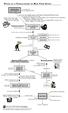 PATHS OF A FORECLOSURE IN NEW YORK STATE BORROWER DELINQUENT 2-3 months late with mortgage payments Lender sends notices, bills, letters to borrower stating that he/she is delinquent Borrower has multiple
CHAPTER 35-22 FORECLOSURE OF MORTGAGES OF REAL PROPERTY BY ADVERTISEMENT
 CHAPTER 35-22 FORECLOSURE OF MORTGAGES OF REAL PROPERTY BY ADVERTISEMENT 35-22-01. Foreclosure under power of sale - Prohibition - Exception. Every mortgage of real property held by the state or any of
Adjustment Date - The date on which the interest rate changes for an adjustable-rate mortgage (ARM).
 Glossary A Adjustable Rate Mortgage - An adjustable rate mortgage, commonly referred to as an ARM, is a loan type that allows the lender to adjust the interest rate during the term of the loan. Generally,
BANKRUPTCY ISSUES RELATED TO MORTGAGE FORECLOSURES
 TABAS FREEDMAN Attorneys One Flagler Building 14 Northeast First Avenue, Penthouse Miami, Florida 33132 Telephone 305.375.8171 Facsimile 305.381.7708 www.tabasfreedman.com Gary M. Freedman [email protected]
Special Report: IRS Tax Lien
 Special Report: IRS Tax Lien TAX PLANNING AND IRS DEFENSE C a l l T o d a y! 540-438- 5344 What an IRS Tax Lien is and How it Works What is Inside? Why the IRS Files a Notice of Federal Tax Lien IRS Tax
Foreclosure Report Survey of State Foreclosure Laws
 Foreclosure Report Survey of State Foreclosure Laws State: Alabama Statutory citation: Ala. Code 35-10-1 to 35-10-30 and 6-5-247 to 6-5-256 Most Common Method of Foreclosure: Non-judicial; Power of Sale
Assembly Bill No. 284 Assemblymen Conklin, Horne; and Kirkpatrick
 Assembly Bill No. 284 Assemblymen Conklin, Horne; and Kirkpatrick CHAPTER... AN ACT relating to real property; revising provisions governing the recording of assignments of mortgages and deeds of trust;
BUYING A HOME. Looking for the Best Mortgage. Obtain Information from Several Lenders
 OFFICE OF THE STAFF JUDGE ADVOCATE 48 TH FIGHTER WING, RAF LAKENHEATH, UK Looking for the Best Mortgage BUYING A HOME Shopping around for a home loan or mortgage will help you to get the best financing
14 Options Every Home Owner Must Know When Faced With Foreclosure. By: Scott MacDonald
 14 Options Every Home Owner Must Know When Faced With Foreclosure By: Scott MacDonald Foreclosure is affecting millions of Americans today. It can be a very frightening time for many families who do not
Broker. Financing Real Estate. Chapter 12. Copyright Gold Coast Schools 1
 Broker Chapter 12 Financing Real Estate Copyright Gold Coast Schools 1 Learning Objectives Describe the difference between a note and a mortgage Explain the benefits of having the first recorded lien on
First Central Credit Union Texas Equity Questionnaire
 First Central Credit Union Texas Equity Questionnaire 1. Is your property within the limits of an incorporated city? 2. Is your property a rural homestead? A homestead is rural if it is not in a city or
Terms And Conditions Governing HDB Home Loan
 Oversea-Chinese Banking Corporation Limited 65 Chulia Street OCBC Centre Singapore 049513 Tel: +65 6363 3333 FAX: +65 6533 7955 www.ocbc.com Terms And Conditions Governing HDB Home Loan 1. Definitions
PATHS OF A FORECLOSURE IN NEW YORK STATE
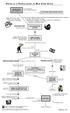 PATHS OF A FORECLOSURE IN NEW YORK STATE BORROWER DELINQUENT 2-3 months late with mortgage payments 90-DAY PRE-FORECLOSURE NOTICE Lender sends notices, bills, letters to borrower stating that he/she is
UCC DEFINITIONS. Account: A document that is filed to note some type of change to the original financing statement. Amendment:
 UCC DEFINITIONS Uniform Commercial Code (UCC): A code of laws governing various commercial transactions. The Uniform Commercial Code has eleven substantive articles. Article 9, Secured Transactions, may
Home Equity Line of Credit Loan Agreement and Promissory Note
 Home Equity Line of Credit Loan Agreement and Promissory Note This agreement sets forth the terms under which Pelican State Credit Union makes a home equity loan to you. By signing this agreement, you
Defaulted Real Estate Loan Remedies in Tennessee
 Defaulted Real Estate Loan Remedies in Tennessee Nelwyn Inman Jay Ebelhar [email protected] [email protected] 423.752.4405 901.577.8204 Baker Donelson Offices 2 Tennessee Deed of Trust
Common Mortgage and Foreclosure Terms
 H ELP FOR N EW Y ORK S TATE H OMEOWNERS C ONCERNED A BOUT F ORECLOSURE Common Mortgage and Foreclosure Terms Talking about mortgages can feel like speaking a foreign language and is even more confusing
Title 33: PROPERTY. Chapter 9: MORTGAGES OF REAL PROPERTY. Table of Contents
 Title 33: PROPERTY Chapter 9: MORTGAGES OF REAL PROPERTY Table of Contents Subchapter 1. GENERAL PROVISIONS... 3 Section 501. FORMS... 3 Section 501-A. "POWER OF SALE"... 3 Section 502. ENTRY BY MORTGAGEE...
January 9, 2006. The Self Help Legal Center. Southern Illinois University School Of Law Carbondale, IL 62901 (618) 453-3217
 January 9, 2006 The Self Help Legal Center Southern Illinois University School Of Law Carbondale, IL 62901 (618) 453-3217 2 TABLE OF CONTENTS Table of Contents 2 Disclaimer 3 Warning to all readers 4 Who
LEARN ABOUT YOUR RIGHTS AND OPTIONS IN A FORECLOSURE
 Helpful Agencies Here are some agencies which may lead you to lawyers who can help you: Lake County Bar Association 7 North County Street Waukegan, IL 60085 847-244-3140 www.lakebar.org Prairie State Legal
Foreclosure. for Landlords and Tenants. Alberta. in Alberta. This booklet is meant to explain the foreclosure process in Alberta for
 in Alberta Foreclosure for Landlords and Tenants Feverpitched Dreamstime.com You should not rely on this You booklet should for not legal rely advice. on this It booklet provides for general legal advice.
I m behind in my mortgage payments, what should I do?
 FORECLOSURES This handout was prepared by Legal Services of Greater Miami, Inc.(LSGMI) with support from the Institute for Foreclosure Legal Assistance. LSGMI represents homeowners in foreclosure and homeowners
MORTGAGE DICTIONARY. Amortization - Amortization is a decrease in the value of assets with time, which is normally the useful life of tangible assets.
 MORTGAGE DICTIONARY Adjustable-Rate Mortgage An adjustable-rate mortgage (ARM) is a product with a floating or variable rate that adjusts based on some index. Amortization - Amortization is a decrease
NON-RESIDENTS PURCHASING REAL PROPERTY IN THE U.S.
 NON-RESIDENTS PURCHASING REAL PROPERTY IN THE U.S. A. The Attorneys Role in the Purchase of Real Estate The purchase of real estate in the U.S. without the proper assistance can become a complex transaction.
Glossary. is the process of increasing account value, usually associated with interest or other time-dependent increments of account value.
 ACCELERATION ACCOUNT SERVICING ACCRUE ACTIVE COLLECTION ADMINISTRATIVE COSTS/ LATE CHARGES ADMINISTRATIVE OFFSET ADMINISTRATIVE WAGE GARNISHMENT (AWG) is declaring the full amount of a debt due and payable
Barbara W. Griest Trident Land Transfer Company
 Barbara W. Griest Trident Land Transfer Company 1 Why learn about Short Sales & Foreclosures? Excellent opportunity to grow your real estate business! Changes in the Real Estate Market Declining Markets