
Strategic Risk Management and Risk Monitoring for Pension Funds
|
|
|
- Ashlynn O’Brien’
- 10 years ago
- Views:
Transcription
1 Strategic Risk Management and Risk Monitoring for Pension Funds by: Bert Kramer, Sacha van Hoogdalem and Guus Boender The worldwide credit crisis has also led to financial problems for pension funds. In a large number of countries, there are doubts about the sustainability of the pension system. In the Netherlands, in addition to the cost of longevity, pension funds were hit hard by dropping investment returns and low interest rates. Mid 2010, the average funding ratio for Dutch pension funds was 100%. Of all Dutch pension funds, around 65% was underfunded (that is, had a funding ratio below 105%). Weighted with the number of participants, these underfunded pension funds represent 88% of the Dutch market 1. As a consequence, pension premiums are raised, and pension rights cannot be indexed and in the near future even have to be lowered. The public illusion of a guaranteed pension is shattered. The current crisis reemphasizes the necessity of a well founded strategic risk management that focuses on funded ratio risk, rather than on implementation risk. In this paper we describe our methodology on how strategic risk management of a pension funds should ideally be organized. Bert Kramer Dr. Bert Kramer (1968) studied econometrics at the University of Groningen. In 1996, he received a PhD degree in Management. Bert joined Ortec Finance in His current position is team manager Research. His fields of expertise are ALM for non-life insurance companies, housing corporations and property investors. From Bert also was Assistant Professor of Finance at Tilburg University. Sacha van Hoogdalem Drs. Sacha van Hoogdalem RBA is Head of Products at Ortec Finance. She is responsible for all models and methodologies. Sacha joined ORTEC in She has been involved in strategic decision support of pension funds since From 2000 to 2006 Sacha was head of the ALM department. She studied Business Econometrics at Erasmus University in Rotterdam. Key issues As the return on a risk free investment portfolio will usually be too low to guarantee, at an acceptable contribution level, the long term ambition of a pension fund, a pension fund will have to take risk. The first key question then is how much risk the stakeholders are willing to take (i.e., what is the risk appetite), distinguished in funded ratio risk, contribution risk and pension risk. E.g. in The Netherlands indexation of the pension rights is conditional on the solvency level, so that a limit on maximal indexation is a crucial risk budget within the system. Guus Boender Prof. Dr. Guus Boender (1955) is board member of Ortec Finance and professor Asset Liability Management at the Free University at Amsterdam. He is one of the co-founders of ORTEC, a specialist in Asset Liability Management, Risk Management and Performance attribution for pension funds, insurance companies and housing corporations. Ortec Finance has now over 160 employees and offices in the Netherlands, Switzerland and UK. Guus gained his PhD in Econometrics and Operations research at The Erasmus University Rotterdam and published over 25 articles in leading international journals. 1 Source: De Nederlandsche Bank (DNB). The funding ratio is measured as the market value of the assets divided by the market value of the liabilities. 12 AENORM vol. 20 (75) May 2012

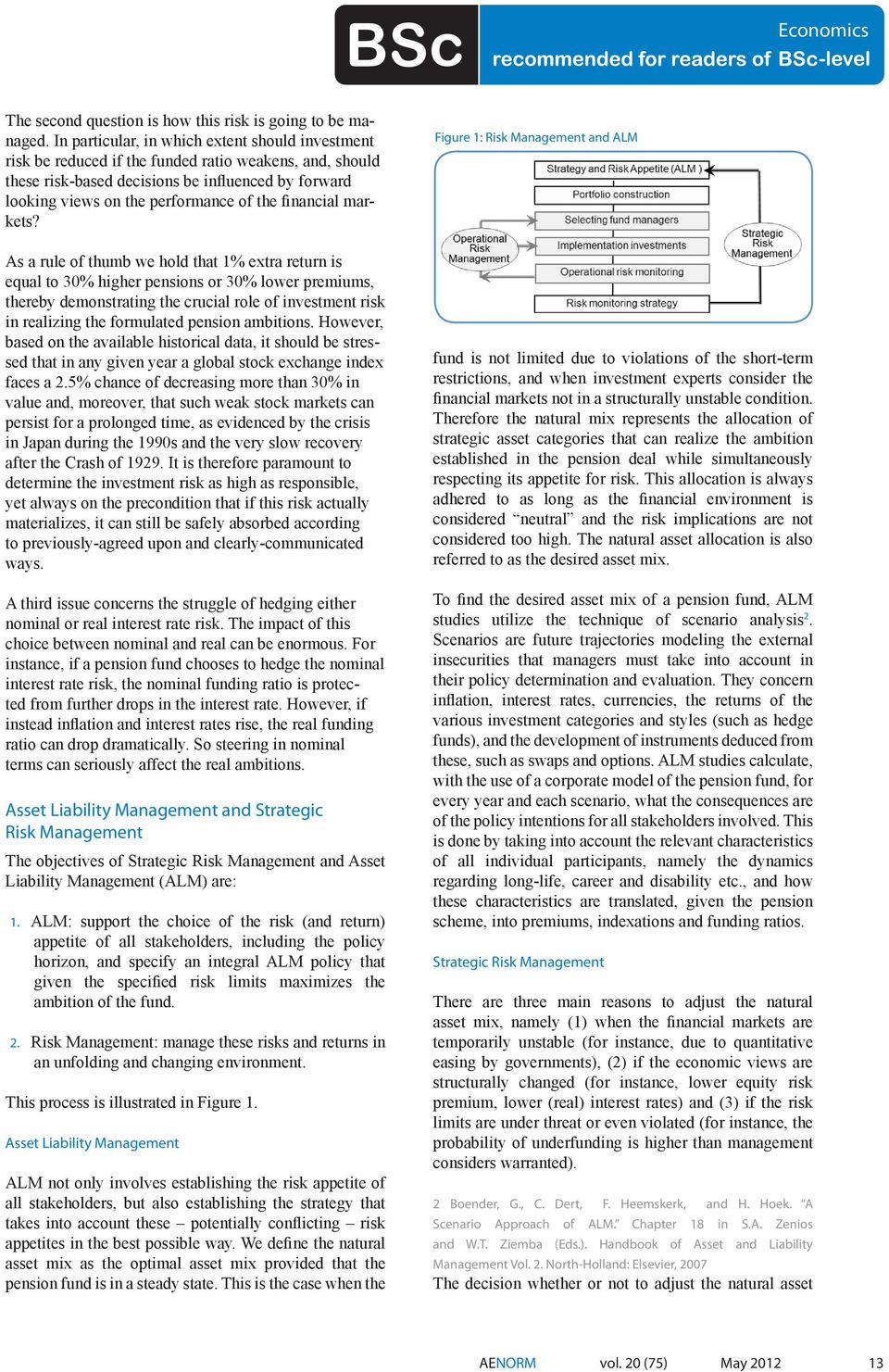
2 The second question is how this risk is going to be managed. In particular, in which extent should investment risk be reduced if the funded ratio weakens, and, should these risk-based decisions be influenced by forward looking views on the performance of the financial markets? As a rule of thumb we hold that 1% extra return is equal to 30% higher pensions or 30% lower premiums, thereby demonstrating the crucial role of investment risk in realizing the formulated pension ambitions. However, based on the available historical data, it should be stressed that in any given year a global stock exchange index faces a 2.5% chance of decreasing more than 30% in value and, moreover, that such weak stock markets can persist for a prolonged time, as evidenced by the crisis in Japan during the 1990s and the very slow recovery after the Crash of It is therefore paramount to determine the investment risk as high as responsible, yet always on the precondition that if this risk actually materializes, it can still be safely absorbed according to previously-agreed upon and clearly-communicated ways. A third issue concerns the struggle of hedging either nominal or real interest rate risk. The impact of this choice between nominal and real can be enormous. For instance, if a pension fund chooses to hedge the nominal interest rate risk, the nominal funding ratio is protected from further drops in the interest rate. However, if instead inflation and interest rates rise, the real funding ratio can drop dramatically. So steering in nominal terms can seriously affect the real ambitions. Asset Liability Management and Strategic Risk Management The objectives of Strategic Risk Management and Asset Liability Management (ALM) are: 1. ALM: support the choice of the risk (and return) appetite of all stakeholders, including the policy horizon, and specify an integral ALM policy that given the specified risk limits maximizes the ambition of the fund. 2. Risk Management: manage these risks and returns in an unfolding and changing environment. This process is illustrated in Figure 1. Asset Liability Management ALM not only involves establishing the risk appetite of all stakeholders, but also establishing the strategy that takes into account these potentially conflicting risk appetites in the best possible way. We define the natural asset mix as the optimal asset mix provided that the pension fund is in a steady state. This is the case when the Figure 1: Risk Management and ALM fund is not limited due to violations of the short-term restrictions, and when investment experts consider the financial markets not in a structurally unstable condition. Therefore the natural mix represents the allocation of strategic asset categories that can realize the ambition established in the pension deal while simultaneously respecting its appetite for risk. This allocation is always adhered to as long as the financial environment is considered neutral and the risk implications are not considered too high. The natural asset allocation is also referred to as the desired asset mix. To find the desired asset mix of a pension fund, ALM studies utilize the technique of scenario analysis 2. Scenarios are future trajectories modeling the external insecurities that managers must take into account in their policy determination and evaluation. They concern inflation, interest rates, currencies, the returns of the various investment categories and styles (such as hedge funds), and the development of instruments deduced from these, such as swaps and options. ALM studies calculate, with the use of a corporate model of the pension fund, for every year and each scenario, what the consequences are of the policy intentions for all stakeholders involved. This is done by taking into account the relevant characteristics of all individual participants, namely the dynamics regarding long-life, career and disability etc., and how these characteristics are translated, given the pension scheme, into premiums, indexations and funding ratios. Strategic Risk Management There are three main reasons to adjust the natural asset mix, namely (1) when the financial markets are temporarily unstable (for instance, due to quantitative easing by governments), (2) if the economic views are structurally changed (for instance, lower equity risk premium, lower (real) interest rates) and (3) if the risk limits are under threat or even violated (for instance, the probability of underfunding is higher than management considers warranted). 2 Boender, G., C. Dert, F. Heemskerk, and H. Hoek. A Scenario Approach of ALM. Chapter 18 in S.A. Zenios and W.T. Ziemba (Eds.). Handbook of Asset and Liability Management Vol. 2. North-Holland: Elsevier, 2007 The decision whether or not to adjust the natural asset AENORM vol. 20 (75) May
3 mix is part of Strategic Risk Management. Figure 2 illustrates the strategic risk management process. Pension funds should find a balance between continuously Figure 2: Strategic Risk Management account long term ambitions. Or the investment committee advises a decision to accommodate the long term ambition while exceeding short term risk limits. 4. Monitor Which information should the monitor of the strategic risk management process contain? Monitoring Reports Up-to-date and easy to understand risk monitoring reports are an essential tool to support pension fund management in their Strategic Risk Management. Fund management should be able to develop a considered opinion based on these monitoring reports. Monitoring reports typically contain: adapting their policy based on short term developments and sticking too long to their long term policy. In our opinion, the agreed upon strategy and risk appetite are leading. Furthermore, all assumptions that formed the basis of this strategy should be monitored. Indeed, if the assumptions underlying the strategy are no longer considered valid, the strategy is no longer valid. Temporary deviations should lead to temporary policy adjustments that take into account short term consequences (this is often called risk management). Structural changes to the assumptions should lead to structural adjustments of the pension deal (this is often called ALM). Both aspects are an integral part of Strategic Risk Management. 1. The status quo with respect to a number of key statistics like risk limits and the funding ratio. Figure 3 gives a graphical example. With a funding ratio of 115%, this fund does not meet the required buffer of 20%. Figure 3: Change in solvency of the fund compared to the previous quarter It is important to clearly define the decision making process beforehand. We distinguish four components of strategic risk management: 1. Risk component a. What actions are undertaken if the risk limits are in danger or violated? b. Is risk management action undertaken irrespective of macroeconomic views? c. Which detection and decision processes are followed? d. Which actions are we allowed to take? 2. Investment component Does the macroeconomic view play a role? If so, formalize a predefined process of information provision and decision making to temporarily or structurally adjust the strategy 3. Governance component Establish who is responsible for what, also in case of crises. Otherwise nobody is responsible if things go wrong. Or different committee s undertaken incomplete actions. For instance: the risk committee decides to hedge short term risk without taking into 14 AENORM vol. 20 (75) May 2012

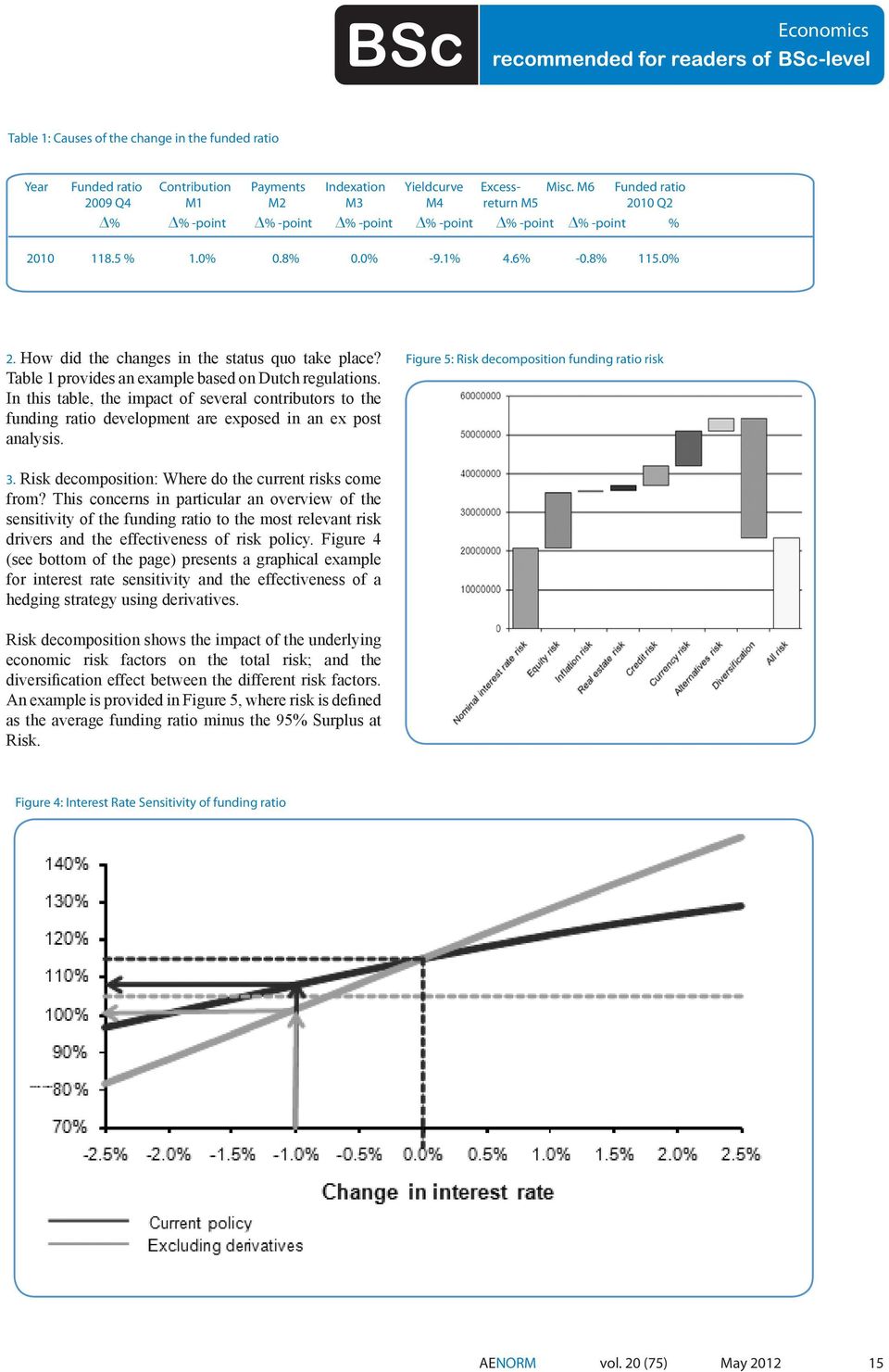
4 Table 1: Causes of the change in the funded ratio Year Funded ratio Contribution Payments Indexation Yieldcurve Excess- Misc. M6 Funded ratio 2009 Q4 M1 M2 M3 M4 return M Q2 % % -point % -point % -point % -point % -point % -point % % 1.0% 0.8% 0.0% -9.1% 4.6% -0.8% 115.0% 2. How did the changes in the status quo take place? Table 1 provides an example based on Dutch regulations. In this table, the impact of several contributors to the funding ratio development are exposed in an ex post analysis. Figure 5: Risk decomposition funding ratio risk 3. Risk decomposition: Where do the current risks come from? This concerns in particular an overview of the sensitivity of the funding ratio to the most relevant risk drivers and the effectiveness of risk policy. Figure 4 (see bottom of the page) presents a graphical example for interest rate sensitivity and the effectiveness of a hedging strategy using derivatives. Risk decomposition shows the impact of the underlying economic risk factors on the total risk; and the diversification effect between the different risk factors. An example is provided in Figure 5, where risk is defined as the average funding ratio minus the 95% Surplus at Risk. Figure 4: Interest Rate Sensitivity of funding ratio AENORM vol. 20 (75) May
5 4. Future risk-return perspectives. Use ex ante analysis to monitor strategic risk limits. For example, an ex ante analysis of possible future developments of the funding ratio as in Figure 6. Figure 6: Future development of nominal funding ratio as of 30 June Orange rectangle: underfunded (<105%), dark blue rectangle: insufficient risk buffer (<120%) 5. Analyze consequences of stress scenarios such as hyperinflation, deflation or stagflation. We consider it of crucial importance that the consequences of policy changes triggered by stress scenarios are not only, as usual, evaluated on their short term consequences, but that the long term consequences are taken into account in the decision making as well. no long voyage should be navigated fully on autopilot, and one must therefore always keep a close watch on the risk monitoring reports Conclusions The fundamental choices pension funds will have to make regarding their investment policy are: What are the risk limits of all the stakeholders, both in equilibrium, and on the short term, and which ALM strategy, including the strategic asset allocation satisfies these risk limits in the most efficient way? How do we deviate from the strategy from a risk management point of view? The key message is clear: lay down an ambition that is feasible under the risk appetite of the pension fund and which is accompanied by a suitable investment strategy. But no long voyage should be navigated fully on autopilot, and one must therefore always keep a close watch on the risk monitoring reports, so that, if the situation truly demands it, one has the ability and good sense to redirect its strategic course. How do we deviate from the strategy given our view on the financial markets? What is the content of the monitor that optimally serves the dynamics of strategic risk management? What is the governance of strategic risk management? 16 AENORM vol. 20 (75) May 2012

ORSA and Economic Modeling Choices. Bert Kramer, André van Vliet, Wendy Montulet
 ORSA and Economic Modeling Choices Bert Kramer, André van Vliet, Wendy Montulet OFRC Applied Paper No. 2011-04 May 2011 OFRC WORKING PAPER SERIES ORSA and Economic Modeling Choices Bert Kramer, André van
Ortec Finance Financial Risk Management for Pension Funds. Sacha van Hoogdalem Loranne van Lieshout Elske van de Burgt Martijn Vos Ton van Welie
 Ortec Finance Financial Risk Management for Pension Funds Sacha van Hoogdalem Loranne van Lieshout Elske van de Burgt Martijn Vos Ton van Welie Contents 1 Introduction 2 2 Risk Management 3 3 Investment
SCOR Papers. Using Capital Allocation to Steer the Portfolio towards Profitability. Abstract. September 2008 N 1
 September 28 N 1 SCOR Papers Using Allocation to Steer the Portfolio towards Profitability By Jean-Luc Besson (Chief Risk Officer), Michel Dacorogna (Head of Group Financial Modelling), Paolo de Martin
Towards sustainable Dutch occupational pensions
 Towards sustainable Dutch occupational pensions Ilja Boelaars, Lans Bovenberg, Dirk Broeders, Peter Gortzak, Sacha van Hoogdalem, Theo Kocken, Marcel Lever, Theo Nijman and Jan Tamerus 1 November, 14,
Investment opportunities Locking the potential of future benefits
 Investment opportunities Locking the potential of future benefits Ivo van der Veen Senior Manager Risk Services Deloitte Sjoerd Kampen Junior Manager Risk Services Deloitte 72 The last couple of years
Fiduciary Management at BNP Paribas Investment Partners A true partnership approach. For Professional Investors
 Fiduciary Management at BNP Paribas Investment Partners A true partnership approach For Professional Investors By taking the fiduciary journey with us, you are engaging in a true working partnership,,
Global Currency Hedging
 Global Currency Hedging John Y. Campbell Harvard University Arrowstreet Capital, L.P. May 16, 2010 Global Currency Hedging Joint work with Karine Serfaty-de Medeiros of OC&C Strategy Consultants and Luis
OPAL platform Goal-based financial planning for private investors Retail banking - Private banking - Wealth management
 OPAL platform Goal-based financial planning for private investors Retail banking - Private banking - Wealth management CONTENT Improve investment decision making For Private investors Take your financial
Rating Methodology for Domestic Life Insurance Companies
 Rating Methodology for Domestic Life Insurance Companies Introduction ICRA Lanka s Claim Paying Ability Ratings (CPRs) are opinions on the ability of life insurance companies to pay claims and policyholder
Theories of Exchange rate determination
 Theories of Exchange rate determination INTRODUCTION By definition, the Foreign Exchange Market is a market 1 in which different currencies can be exchanged at a specific rate called the foreign exchange
PROJECTION OF THE FISCAL BALANCE AND PUBLIC DEBT (2012 2027) - SUMMARY
 PROJECTION OF THE FISCAL BALANCE AND PUBLIC DEBT (2012 2027) - SUMMARY PUBLIC FINANCE REVIEW February 2013 SUMMARY Key messages The purpose of our analysis is to highlight the risks that fiscal policy
The Investment Implications of Solvency II
 The Investment Implications of Solvency II André van Vliet, Ortec Finance, Insurance Risk Management Anthony Brown, FSA Outline Introduction - Solvency II - Strategic Decision Making Impact of investment
Fiduciary Management. What is Fiduciary Management?
 Fiduciary Management What is Fiduciary Management? Fiduciary Management can be defined as a pension management solution which focuses on achieving the long term goals of a pension fund within a defined
Best Styles: Harvesting Risk Premium in Equity Investing
 Strategy Best Styles: Harvesting Risk Premium in Equity Investing Harvesting risk premiums is a common investment strategy in fixed income or foreign exchange investing. In equity investing it is still
Session 9b L&H Insurance in a Low Interest Rate Environment. Christian Liechti
 Session 9b L&H Insurance in a Low Interest Rate Environment Christian Liechti L&H Insurance in a Low Interest Rate Environment SOA Annual Symposium 24-25 June 2013 Macau, China Christian Liechti Swiss
Three Investment Risks
 Three Investment Risks Just ask yourself, which of the following risks is the most important risk to you. Then, which order would you place them in terms of importance. A. A significant and prolonged fall
New tendencies in the European Pension Fund systems
 New tendencies in the European Pension Fund systems Portfolio optimization through low volatility stocks Laurens Swinkels, PhD Robeco Quantitative Strategies Erasmus University Rotterdam Robeco Employees
Figure 1: Lower volatility does not necessarily mean better returns. Asset A Asset B. Return
 November 21 For professional investors and advisers only. Is volatility risk? After a long period without significant market upheavals, investors might be forgiven for pushing volatility down their list
Actuarial Risk Management
 ARA syllabus Actuarial Risk Management Aim: To provide the technical skills to apply the principles and methodologies studied under actuarial technical subjects for the identification, quantification and
STATEMENT OF INVESTMENT BELIEFS AND PRINCIPLES
 STATEMENT OF INVESTMENT BELIEFS AND PRINCIPLES Investment Advisory Board, Petroleum Fund of Timor-Leste August 2014 CONTENTS Page Summary... 1 Context... 3 Mission Statement... 4 Investment Objectives...
ROYAL LONDON ABSOLUTE RETURN GOVERNMENT BOND FUND
 ROYAL LONDON ABSOLUTE RETURN GOVERNMENT BOND FUND For professional investors only A NEW OPPORTUNITY Absolute return funds offer an attractive, alternative source of alpha outright or as part of a balanced
Basic Policy for Employees Pension Insurance Benefit Adjustment Fund
 Basic Policy for Employees Pension Insurance Benefit Adjustment Fund (Established on October 1, 2015) In accordance with Article 112-4, Paragraph (1) of the Local Public Service Mutual Aid Association
San Diego City Employees Retirement System
 San Diego City Employees Retirement System Asset Allocation Review July 9, 2015 Investment advice and consulting services provided by Aon Hewitt Investment Consulting, Inc., an Aon Company. 1 (This page
Low-Volatility Investing: Expect the Unexpected
 WHITE PAPER October 2014 For professional investors Low-Volatility Investing: Expect the Unexpected David Blitz, PhD Pim van Vliet, PhD Low-Volatility Investing: Expect the Unexpected 1 Expect the unexpected
Finance for growth, the role of the insurance industry
 Finance for growth, the role of the insurance industry Dario Focarelli Director General ANIA Visiting Professor, Risk Management and Insurance, 'La Sapienza' Roma Adjunct Professor, 'Tanaka Business School',
Effective downside risk management
 Effective downside risk management Aymeric Forest, Fund Manager, Multi-Asset Investments November 2012 Since 2008, the desire to avoid significant portfolio losses has, more than ever, been at the front
The Dutch Pension System. an overview of the key aspects
 The Dutch Pension System an overview of the key aspects The Dutch Pension System an overview of the key aspects Dutch Association of Industry-wide Pension Funds (VB) Contents 1 Introduction 6 2 The Three
The equity-bond correlation. The most important number you rarely think about
 The equity-bond correlation The most important number you rarely think about September 2014 2 Aon Hewitt Proprietary and Confidential Contact Duncan Lamont, CFA Principal, Asset Allocation +44 (0) 207
How To Understand The Financial Market For Insurers In Swissitzerland
 Actuarial and Insurance Solutions Financial Market Analysis at endyear 2014 15 th January 2015 Audit. Tax. Consulting. Corporate Finance. Contents Executive Summary 1 1 Interest Rates 2 2 Equity Markets
Asset Liability Management / Liability Driven Investment Optimization (LDIOpt)
 Asset Liability Management / Liability Driven Investment Optimization (LDIOpt) Introduction ALM CASH FLOWS OptiRisk Liability Driven Investment Optimization LDIOpt is an asset and liability management
Investment Insights. The future of DGFs have they done what they said and how will they perform in the future? Consideration for trustees
 Quarter One - 2015 Investment Insights The future of DGFs have they done what they said and how will they perform in the future? Over the past ten years the use of Diversified Growth Funds (DGF) by defined
Section 2 Evaluation of current account balance fluctuations
 Section 2 Evaluation of current account balance fluctuations Key points 1. The Japanese economy and IS balance trends From a macroeconomic perspective, the current account balance weighs the Japanese economy
2. The European insurance sector
 2. The European insurance sector Insurance companies are still exposed to the low interest rate environment. Long-term interest rates are especially of importance to life insurers, since these institutions
CONTENTS MODULE 1: INDUSTRY OVERVIEW 4 MODULE 2: ETHICS AND REGULATION 6 MODULE 3: INPUTS AND TOOLS 8 MODULE 4: INVESTMENT INSTRUMENTS 12
 SYLLABUS OVERVIEW 1 CONTENTS MODULE 1: INDUSTRY OVERVIEW 4 CHAPTER 1 The Investment Industry: A Top-Down View MODULE 2: ETHICS AND REGULATION 6 CHAPTER 2 CHAPTER 3 Ethics and Investment Professionalism
Life Cycle Asset Allocation A Suitable Approach for Defined Contribution Pension Plans
 Life Cycle Asset Allocation A Suitable Approach for Defined Contribution Pension Plans Challenges for defined contribution plans While Eastern Europe is a prominent example of the importance of defined
Discussion Topics. Investment Risk Appetite. Risk Appetite Risk Management. Financial Disaster Preparedness Checklist Rebalancing.
 Insurance Investment Practices during an Economic Downturn March 16, 2011 9:45 11 am Marc A. Tourville, CFA, CIPM Cardinal Investment Advisors, LLC Discussion Topics Risk Appetite Risk Management Tactical
ASSET MANAGEMENT ALM FRAMEWORK
 ASSET MANAGEMENT within an ALM FRAMEWORK LE MÉRIDIEN SINGAPORE SEPTEMBER 6 7, 2007 Charles L. Gilbert, FSA, FCIA, CFA Traditional Asset Management Focus on asset returns Assets managed against benchmark
Total Asset, Life Cycle, Wealth Management
 Total Asset, Life Cycle, Wealth Management Total Asset, Life Cycle, Wealth Management is the management of total financial needs and total financial assets over an individual s lifetime. All financial
Real Estate as a Strategic Asset Class. Less is More: Private Equity Investments` Benefits. How to Invest in Real Estate?
 Real Estate as a Strategic Asset Class The Benefits of Illiquid Investments Real estate, a key asset class in a portfolio, can offer stable income returns, partial protection against inflation, and good
Real estate: The impact of rising interest rates
 Fall 015 TIAA-CREF Asset Management Real estate: The impact of rising interest rates Overview TIAA-CREF Global Real Estate Strategy & Research Martha Peyton, Ph.D. Managing Director Edward F. Pierzak,
STRESS TESTING GUIDELINE
 STRESS TESTING GUIDELINE JUIN 2012 Table of Contents Preamble... 2 Introduction... 3 Scope... 5 Coming into effect and updating... 6 1. Stress testing... 7 A. Concept... 7 B. Approaches underlying stress
The Equity Premium in India
 The Equity Premium in India Rajnish Mehra University of California, Santa Barbara and National Bureau of Economic Research January 06 Prepared for the Oxford Companion to Economics in India edited by Kaushik
Friends Life Online Stakeholder Pension Fund guide
 Friends Life Online Stakeholder Pension Fund guide This guide describes the funds available for investment under our Friends Life Online Stakeholder Pension and sets out their aims. Which funds can I choose
Modelling and Management of Tail Risk in Insurance
 Modelling and Management of Tail Risk in Insurance IMF conference on operationalising systemic risk monitoring Peter Sohre, Head of Risk Reporting, Swiss Re Washington DC, 27 May 2010 Visit of ntuc ERM
Draft Prudential Practice Guide
 Draft Prudential Practice Guide SPG 532 Investment Risk Management May 2013 www.apra.gov.au Australian Prudential Regulation Authority Disclaimer and copyright This prudential practice guide is not legal
Investment Portfolio Management and Effective Asset Allocation for Institutional and Private Banking Clients
 Investment Portfolio Management and Effective Asset Allocation for Institutional and Private Banking Clients www.mce-ama.com/2396 Senior Managers Days 4 www.mce-ama.com 1 WHY attend this programme? This
Navigating through flexible bond funds
 WHITE PAPER February 2015 For professional investors Navigating through flexible bond funds Risk management as a key focus point Kommer van Trigt Winfried G. Hallerbach Navigating through flexible bond
Be selective. Swiss Invest. A Swiss portfolio that exceeds expectations.
 Be selective. Swiss Invest A Swiss portfolio that exceeds expectations. Welcome to Switzerland Switzerland is a safe haven for investments, giving you the stability and security you expect from an attractive,
As of July 1, 2013. Risk Management and Administration
 Risk Management Risk Control The ORIX Group allocates management resources by taking into account Group-wide risk preference based on management strategies and the strategy of individual business units.
Successful value investing: the long term approach
 Successful value investing: the long term approach Neil Walton, Head of Global Strategic Solutions, Schroders Do you have the patience to be a value investor? The long-term outperformance of a value investment
1 Introduction. 1.1 Three pillar approach
 1 Introduction 1.1 Three pillar approach The recent years have shown that (financial) companies need to have a good management, a good business strategy, a good financial strength and a sound risk management
Embedded Value Report
 Embedded Value Report 2012 ACHMEA EMBEDDED VALUE REPORT 2012 Contents Management summary 3 Introduction 4 Embedded Value Results 5 Value Added by New Business 6 Analysis of Change 7 Sensitivities 9 Impact
Financial Stability Report 2015/2016
 Financial Stability Report 2015/2016 Press Conference Presentation Miroslav Singer Governor Prague, 14 June 2016 Structure of presentation I. Overall assessment of risks and setting of countercyclical
How To Write A Medium Term Debt Strategy
 Medium-Term Debt Strategy Based on Client Presentation May 2010 1 Outline Developing a Medium-Term Debt Strategy Risk Indicators and Sensitivity Analysis Cost-Risk Analysis Implementation Performance Measurement
Stress testing and capital planning - the key to making the ICAAP forward looking PRMIA Greece Chapter Meeting Athens, 25 October 2007
 Stress testing and capital planning - the key to making the ICAAP forward looking Athens, *connectedthinking Agenda Introduction on ICAAP requirements What is stress testing? Regulatory guidance on stress
ING Insurance Economic Capital Framework
 ING Insurance Economic Capital Framework Thomas C. Wilson Chief Insurance Risk Officer Kent University, September 5, 2007 www.ing.com Objectives of this session ING has been using economic capital internally
Keynote Speech, EIB/IMF Meeting, 23 October, Brussels
 Keynote Speech, EIB/IMF Meeting, 23 October, Brussels Governor Carlos Costa Six years since the onset of the financial crisis in 2008, output levels in the EU are below those observed before the crisis.
Rethinking Fixed Income
 Rethinking Fixed Income Challenging Conventional Wisdom May 2013 Risk. Reinsurance. Human Resources. Rethinking Fixed Income: Challenging Conventional Wisdom With US Treasury interest rates at, or near,
Consolidated Financial Results for the First Two Quarters of the Fiscal Year Ending March 31, 2016 (Japan GAAP)
 Consolidated Financial Results for the First Two Quarters of the Fiscal Year Ending March 31, 2016 (Japan GAAP) Name of Listed Company: Yokogawa Electric Corporation (the Company herein) Stock Exchanges
Programme Advice. Eric Huizing Chief Investment Officer Ahold Pensioenfonds. Jeroen Kakebeeke Portfolio Manager External Managers Timeos
 Programme Advice When choosing the topics to be included in the programme, Institutional Investor continuously speaks to investors in the region to ensure the sessions are topical and exactly tailored
Schroders Insurance-Linked Securities
 May 2014 For professional investors or advisers only. Not suitable for retail clients. Schroders Insurance-Linked Securities Advised by Secquaero Advisors AG Schroders Insurance-Linked Securities 1 Why
The package of measures to avoid artificial volatility and pro-cyclicality
 The package of measures to avoid artificial volatility and pro-cyclicality Explanation of the measures and the need to include them in the Solvency II framework Contents 1. Key messages 2. Why the package
International Financial Reporting for Insurers: IFRS and U.S. GAAP September 2009 Session 25: Solvency II vs. IFRS
 International Financial Reporting for Insurers: IFRS and U.S. GAAP September 2009 Session 25: Solvency II vs. IFRS Simon Walpole Solvency II Simon Walpole Solvency II Agenda Introduction to Solvency II
Project LINK Meeting New York, 20-22 October 2010. Country Report: Australia
 Project LINK Meeting New York, - October 1 Country Report: Australia Prepared by Peter Brain: National Institute of Economic and Industry Research, and Duncan Ironmonger: Department of Economics, University
R&I Rating Methodology by Sector
 R&I Rating Methodology by Sector Life Insurance October 31, 2013 R&I applies its rating methodology for life insurance to life insurance companies that provide death benefits centered on mortality insurance
This chapter assesses the risks that were identified in the first chapter and elaborated in the earlier chapters of this report.
 5. Risk assessment This chapter assesses the risks that were identified in the first chapter and elaborated in the earlier chapters of this report. 5.1. Qualitative risk assessment Qualitative risk assessment
Recommendations on the Ortec Finance AG asset liability management review of the After-Service Medical Coverage Scheme
 Document: EB 2014/111/R.17 Agenda: 9(d) Date: 12 March 2014 Distribution: Public Original: English E Recommendations on the Ortec Finance AG asset liability management review of the After-Service Medical
1. This Prudential Standard is made under paragraph 230A(1)(a) of the Life Insurance Act 1995 (the Act).
 Prudential Standard LPS 110 Capital Adequacy Objective and key requirements of this Prudential Standard This Prudential Standard requires a life company to maintain adequate capital against the risks associated
Rating Methodology by Sector. Non-life Insurance
 Last updated: March 26, 2012 Rating Methodology by Sector Non-life Insurance *This rating methodology is a modification of the rating methodology made public on July 13, 2011, and modifications are made
A constant volatility framework for managing tail risk
 A constant volatility framework for managing tail risk Alexandre Hocquard, Sunny Ng and Nicolas Papageorgiou 1 Brockhouse Cooper and HEC Montreal September 2010 1 Alexandre Hocquard is Portfolio Manager,
Asset Management in the UK 2014-2015
 ASSET MANAGEMENT SURVEY 214-15 INDUSTRY OVERVIEW Asset Management in the UK 214-215 The Investment Association Annual Survey SUMMARY September 215 i THE INVESTMENT ASSOCIATION CONTENT ENQUIRIES Ruth Meade,
Good Practice Checklist
 Investment Governance Good Practice Checklist Governance Structure 1. Existence of critical decision-making bodies e.g. Board of Directors, Investment Committee, In-House Investment Team, External Investment
Glide path ALM: A dynamic allocation approach to derisking
 Glide path ALM: A dynamic allocation approach to derisking Authors: Kimberly A. Stockton and Anatoly Shtekhman, CFA Removing pension plan risk through derisking investment strategies has become a major
FRC Risk Reporting Requirements Working Party Case Study (Hospitality Industry)
 FRC Risk Reporting Requirements Working Party Case Study (Hospitality Industry) Table of Contents Executive Summary... 2 Background and Scope... 3 Company Background and Highlights... 3 Sample Risk Register
Bank of America Merrill Lynch Banking & Insurance CEO Conference Bob Diamond
 4 October 2011 Bank of America Merrill Lynch Banking & Insurance CEO Conference Bob Diamond Thank you and good morning. It s a pleasure to be here and I d like to thank our hosts for the opportunity to
Global Investment Trends Survey May 2015. A study into global investment trends and saver intentions in 2015
 May 2015 A study into global investment trends and saver intentions in 2015 Global highlights Schroders at a glance Schroders at a glance At Schroders, asset management is our only business and our goals
LIQUIDITY RISK MANAGEMENT GUIDELINE
 LIQUIDITY RISK MANAGEMENT GUIDELINE April 2009 Table of Contents Preamble... 3 Introduction... 4 Scope... 5 Coming into effect and updating... 6 1. Liquidity risk... 7 2. Sound and prudent liquidity risk
Deriving Value from ORSA. Board Perspective
 Deriving Value from ORSA Board Perspective April 2015 1 This paper has been produced by the Joint Own Risk Solvency Assessment (ORSA) Subcommittee of the Insurance Regulation Committee and the Enterprise
FOUNDATION MODULE 1) FINANZANALYTIKER UND VERMÖGENSVERWALTER 2) FINANZ- UND ANLAGEEXPERTEN 3) EXPERTEN IN FINANZMARKTOPERATIONEN. Copyright 2014, AZEK
 FOUNDATION MODULE 1) FINANZANALYTIKER UND VERMÖGENSVERWALTER 2) FINANZ- UND ANLAGEEXPERTEN 3) EXPERTEN IN FINANZMARKTOPERATIONEN Copyright 2014, AZEK AZEK, Feldstrasse 80, 8180 Bülach, T +41 44 872 35
ECB Financial Stability Review
 Vítor Constâncio ECB Financial Stability Review May 214 28 May 214 Press conference presentation Rubric Recent developments Measures of banking system stress have eased further as banking union preparations
Opinion. of the European Insurance and Occupational Pensions Authority of 24 November 2014 on
 EIOPA-BoS-14/120 24 November 2014 Opinion of the European Insurance and Occupational Pensions Authority of 24 November 2014 on Sound principles for Crisis Prevention, Management and Resolution preparedness
How To Manage A Portfolio
 Asset Management Expertise The expertise required of the financial professional depends on the nature of the job at hand. If you have handed your money to an asset manager for a specific objective, such
Why a Floating Exchange Rate Regime Makes Sense for Canada
 Remarks by Gordon Thiessen Governor of the Bank of Canada to the Chambre de commerce du Montréal métropolitain Montreal, Quebec 4 December 2000 Why a Floating Exchange Rate Regime Makes Sense for Canada
INSURANCE RATING METHODOLOGY
 INSURANCE RATING METHODOLOGY The primary function of PACRA is to evaluate the capacity and willingness of an entity / issuer to honor its financial obligations. Our ratings reflect an independent, professional