
On route to by optimising warfarin monitoring
|
|
|
- Norman Hensley
- 10 years ago
- Views:
Transcription
1 On route to by optimising warfarin monitoring

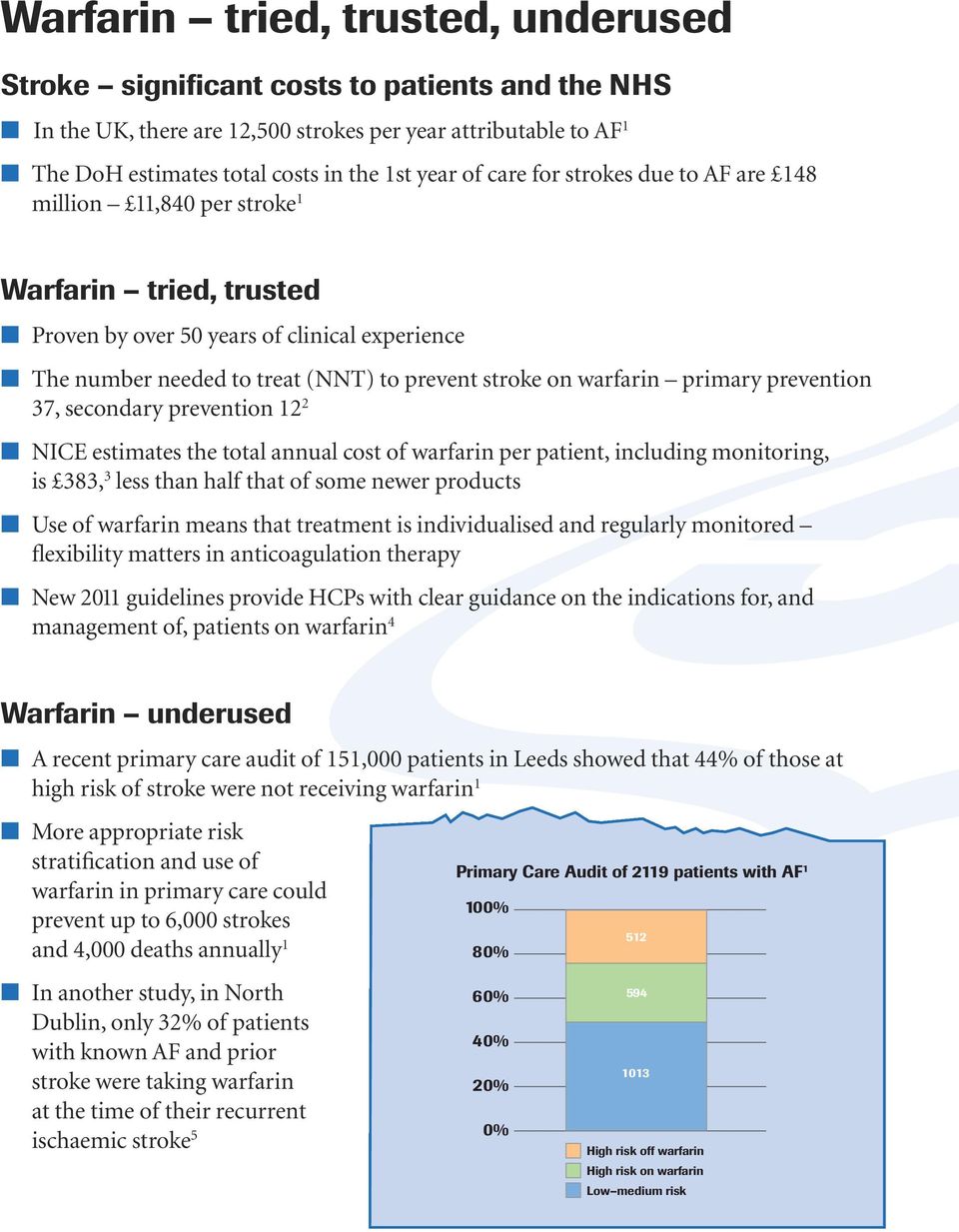
2 Warfarin tried, trusted, underused Stroke significant costs to patients and the NHS In the UK, there are 12,500 strokes per year attributable to AF 1 The DoH estimates total costs in the 1st year of care for strokes due to AF are 148 million 11,840 per stroke 1 Warfarin tried, trusted Proven by over 50 years of clinical experience The number needed to treat (NNT) to prevent stroke on warfarin primary prevention 37, secondary prevention 12 2 NICE estimates the total annual cost of warfarin per patient, including monitoring, is 383, 3 less than half that of some newer products Use of warfarin means that treatment is individualised and regularly monitored flexibility matters in anticoagulation therapy New 2011 guidelines provide HCPs with clear guidance on the indications for, and management of, patients on warfarin 4 Warfarin underused A recent primary care audit of 151,000 patients in Leeds showed that 44% of those at high risk of stroke were not receiving warfarin 1 More appropriate risk stratification and use of warfarin in primary care could prevent up to 6,000 strokes and 4,000 deaths annually 1 Primary Care Audit of 2119 patients with AF 1 100% 80% 512 In another study, in North Dublin, only 32% of patients with known AF and prior stroke were taking warfarin at the time of their recurrent ischaemic stroke 5 60% 40% 20% 0% High risk off warfarin High risk on warfarin Low medium risk
3 The importance of Time within Therapeutic Range (TTR) TTR is the optimal measure of INR control, and has a significant relationship with adverse outcomes in all studies 6 As a result: - a 7% increase in TTR 1 less major haemorrhage/100 patient years - a 12% increase in TTR 1 less thromboembolic event/100 patient years A 5% improvement in time in TTR across UK anticoagulation clinics would prevent strokes per year 7 In international studies, a marked benefit was found against stroke and total vascular events for patients who had mean TTRs 65% 7 What can lead to low TTR? Lack of a clinical governance process to monitor and regulate the implementation of existing guidelines medical practice is an important determinant of TTR 8 Lack of effective, ongoing dose adjustment 6 Patient non-compliance: compliance rates have been estimated at 50% 60% for patients on long term medication. 9 Non compliance has been associated with poor treatment outcomes
4 How can you improve TTR levels and get the best out of warfarin? Anticoagulation clinics Use of anticoagulation clinics can improve TTR, and should include routine measurement of TTR for AF patients and corrective action if the TTR is <65% 7 Computer-assisted dosing has been shown to: 4 - improve TTR - reduce the frequency of testing - significantly reduce risk of bleeding and thromboembolic events - be more cost-effective than manual dosing 10 In one UK practice using INR star, only 11.4% of patients had TTR <65% 11 Number of patients TTR Range 11 <50% 51-57% 58-59% 60-65% >65% Improve compliance Low TTR may be due to poor compliance assess compliance and, if necessary, strategies to ensure compliance should be used 12 The longer half-life and OD dose of warfarin could encourage compliance and provide a more consistent anticoagulant effect than products with a BD dose 13

5 Patient self-testing (PST), self-management (PSM) PST* and PSM** improved the overall quality of OAC therapy compared to standard monitoring 14 The number of thromboembolic events and overall mortality was decreased without any increase in bleeding 14 Regular monitoring increases TTR. Up to 85% of patients remain in target range when monitoring weekly 15 Weekly INR testing is better than monthly 10 Values in therapeutic range (%) 90% 0% 50% Monthly testing 85% Weekly testing Adapted from Heneghan C et al, PSM has been used in Europe for 25 years and is now adopted across 55 countries, yet less than 2% of patients are supported to self-test in the UK Self-monitoring of anticoagulation therapy is an example of an innovation that has been developed but not disseminated to its full potential 16 NHS briefing pack, 2009 * self-testing carrying out their own blood tests with dose adjustments made by HCPs. ** self-managing carrying out their own blood tests and adjusting their dose according to local agreement protocol.

6 Achieving 65% TTR and greater near patient testing Over 350 primary care sites have implemented Near Patient Testing with Coaguchek XS Plus Use of Computer Decision Support Software (CDSS) allows for practice and patient audit of TTR CoaguChek XS Plus has a dedicated EQA scheme through NEQAS to provide the necessary quality assurance CoaguChek XS Plus and XS systems tried and trusted Fully evaluated by the NHS Centre for Evidence based Purchasing (CEP) 2006 Recommended as option for specific patients in NICE AF guidelines Accurate (ISI of 1.0) and precise (CV<4.5%) 19 giving reproducible results time after time

7 Achieving 65% TTR and greater patient self-monitoring Over 10,000 patients in the UK are self- monitoring, either: 17 - self-testing carrying out their own blood tests with dose adjustments made by HCPs - self-managing carrying out their own blood tests and adjusting their dose according to local agreement protocol Published data shows that self-management could deliver TTR of up to 85% 15 CoaguChek XS Plus CoaguChek XS

8 Optimising the potential of warfarin monitoring A tried, trusted but underused anticoagulant Ensuring that patients TTR is 65% can significantly improve outcomes To help achieve this, consider: - near patient testing - use of computer-assisted dosing tools - improving patient compliance - routine, regular monitoring of TTR - through anticoagulation clinics - by maximising the benefits of PST, PSM and Point of Care testing, proven to improve outcomes For self- or Point of Care testing, the obvious choice is CoaguChek For further information, please visit or contact Roche Point of Care on (UK) (IE) References: 1. Heart and Stroke Improvement - Commissioning for Stroke Prevention in Primary Care - The Role of Atrial Fibrillation. NHS Improvement Fuster V et al. ACC/AHA/ESC 2006 guidelines for the management of patients with atrial fibrillation. Eur Heart J 2006; 27: Atrial Fibrillation: the management of AF. Costing report. Implementing NICE guidance in England. NICE Keeling D et al. Guidelines on oral anticoagulation with warfarin fourth edition. B J Haematol 2011 doi: /j x. 5. Hannon N et al. Stroke Associated with Atrial Fibrillation Incidence and Early Outcomes in the North Dublin Population Stroke Study. Cerebrovasc Dis 2010; 29: Wan Y et al. Anticoagulation Control and Prediction of Adverse Events in Patients With Atrial Fibrillation. A Systematic Review. Circ Cardiovasc Qual Outcomes 2008; DOI: /CIRCOUTCOMES Connolly SJ et al. Depends on the Quality of International Normalized Ratio Control Achieved by Benefit of Oral Anticoagulant Over Antiplatelet Therapy in Atrial Fibrillation Centers and Countries as Measured by Time in Therapeutic Range. Circulation 2008; 118: Anticoagulation for Atrial Fibrillation A simple overview to support the commissioning of quality services. NHS Improvement Heart, DiMatteo MR. Patient adherence to pharmacotherapy: the importance of effective communication. Formulary 1995; 30:596 8, 601 2, Jowett S et al. The cost-effectiveness of computer-assisted anticoagulant dosage: results from the European Action on Anticoagulation (EAA) multicentre study. J Thromb Haemost 2009; 7: McCormackT. Paper presented at Anticoagulation in Practice, University of Birmingham, April Horsley W. Dabigatran (Pradaxa ) for prevention of stroke in nonvalvular atrial fibrillation. Guideline from the NHS North East Treatment Advisory Group, July Gage BF. Can we rely on RE-LY? N Engl J Med 2009; 361; Garcia-Alamino JM, Ward AM, Alonso-Coello P et al. Self-monitoring and self-management of oral anticoagulation. Cochrane Database Syst Rev 2010; 4:CD Heneghan C et al. Self monitoring of oral anticoagulation: a systematic review and meta-analysis. Lancet 2006;367: Innovation for a healthier future. NHS briefing pack, Department of Health 2009, page Data on File, Roche Diagnostics. 18. Atrial fibrillation. The management of atrial fibrillation. NICE clinical guideline 36, June CoaguChek XS test strip pack insert, Roche Diagnostics CoaguChek and Because it s my life are registered trademarks of the Roche Group. To improve the quality of our service, calls received or made by Roche Diagnostics may be recorded Roche Diagnostics Ltd Charles Avenue, Burgess Hill RH15 9RY United Kingdom Registration No: Date of preparation: October 2011

Service Specification Template Department of Health, updated June 2015
 Service Specification Template Department of Health, updated June 2015 Service Specification No. : 2 Service: Commissioner Lead: Provider Lead: Period: Anti-coagulation monitoring Date of Review: 31 st
I know my value. CoaguChek XS Plus system Smart INR monitoring at your practice. 1 of 6
 I know my value CoaguChek XS Plus system Smart INR monitoring at your practice 1 of 6 CoaguChek XS Plus system A better choice for your patients and your practice There has been an extraordinary increase
FOR THE PREVENTION OF ATRIAL FIBRILLATION RELATED STROKE
 www.bpac.org.nz keyword: warfarinaspirin FOR THE PREVENTION OF ATRIAL FIBRILLATION RELATED STROKE Key Concepts In atrial fibrillation (AF) warfarin is more effective than aspirin for stroke prevention.
Introduction. Background to this event. Raising awareness 09/11/2015
 Introduction Primary Care Medicines Governance HSCB Background to this event New class of medicines Availability of training Increasing volume of prescriptions Reports of medication incidents Raising awareness
STROKE PREVENTION IN ATRIAL FIBRILLATION
 STROKE PREVENTION IN ATRIAL FIBRILLATION OBJECTIVE: To guide clinicians in the selection of antithrombotic therapy for the secondary prevention of ischemic stroke and arterial thromboembolism in patients
NICE TA 275: Apixaban for the prevention of stroke and systemic embolism in people with non-valvular atrial fibrillation
 Service Notification in response to DHSSPS endorsed NICE Technology Appraisals NICE TA 275: Apixaban for the prevention of stroke and systemic embolism in people with non-valvular atrial fibrillation 1
4/9/2015. Risk Stratify Our Patients. Stroke Risk in AF: CHADS2 Scoring system JAMA 2001; 285: 2864-71
 Anticoagulation in the 21 st Century Adam Karpman, D.O. Saint Francis Medical Center/Oklahoma State University Medical Center Disclosures: None Atrial Fibrillation Most common arrhythmia in clinical practice.
Introduction. Methods. Study population
 New Technologies, Diagnostic Tools and Drugs Schattauer 2012 1 Net clinical benefit of new oral anticoagulants (dabigatran, rivaroxaban, apixaban) versus no treatment in a real world atrial fibrillation
A focus on atrial fibrillation
 A focus on atrial fibrillation Is being female really a risk factor for stroke? Dr Justin Mariani MBBS BMedSci PhD FRACP FCSANZ Consultant Cardiologist and Interventional Heart Failure Specialist Alfred
Appendix C Factors to consider when choosing between anticoagulant options and FAQs
 Appendix C Factors to consider when choosing between anticoagulant options and FAQs Choice of anticoagulant for non-valvular* atrial fibrillation: Clinical decision aid Patients should already be screened
ΠΟΙΟ ΑΝΤΙΠΗΚΤΙΚΟ ΓΙΑ ΤΟΝ ΑΣΘΕΝΗ ΜΟΥ? ΚΛΙΝΙΚΑ ΠΑΡΑΔΕΙΓΜΑΤΑ. Σωκράτης Παστρωμάς Καρδιολόγος Νοσοκομείο Ερρίκος Ντυνάν
 ΠΟΙΟ ΑΝΤΙΠΗΚΤΙΚΟ ΓΙΑ ΤΟΝ ΑΣΘΕΝΗ ΜΟΥ? ΚΛΙΝΙΚΑ ΠΑΡΑΔΕΙΓΜΑΤΑ Σωκράτης Παστρωμάς Καρδιολόγος Νοσοκομείο Ερρίκος Ντυνάν The AF epidemic Mayo Clinic data (assuming a continued increase in the AF incidence) Mayo
Out with the Old and in with the New? Target Specific Anticoagulants for Atrial Fibrillation
 Out with the Old and in with the New? Target Specific Anticoagulants for Atrial Fibrillation Goal Statement Pharmacists and technicians will gain knowledge in the use of target specific oral anticoagulants
Adherence to NOACs. Disclosure. Patricia van den Bemt EAHP Hamburg 2015
 Adherence to NOACs Patricia van den Bemt EAHP Hamburg 2015 Disclosure Unrestricted research grants from Glaxo-SmithKline Boehringer Ingelheim Daiichi Sankyo Bayer Pfizer For research on medication safety
How To Treat Aneuricaagulation
 Speaker Introduction Jessica Wilhoite, PharmD, BCACP Doctor of Pharmacy: Purdue University Postgraduate Residency Training: PGY1 Pharmacy Practice St. Vincent Hospital PGY2 Ambulatory Care St. Vincent
RR 0.88 (95% CI: 0.77 1.00) P=0.051 (superiority) 3.75
 ALL-CAUSE MORTALITY RR 0.88 (95% CI: 0.77 1.00) P=0.051 (superiority) Rate per year (%) 5.0 4.0 3.0 2.0 1.0 0 3.64 D150 mg BID 3.75 D110 mg BID RR 0.91 (95% CI: 0.80 1.03) P=0.13 (superiority) 4.13 Warfarin
Kevin Saunders MD CCFP Rivergrove Medical Clinic Wellness Institute @ SOGH April 17 2013
 Kevin Saunders MD CCFP Rivergrove Medical Clinic Wellness Institute @ SOGH April 17 2013 Family physician with Rivergrove Medical Clinic Practice in the north end since 1985 Medical Director of the Wellness
Failure or significant adverse effects to all of the alternatives: Eliquis and Xarelto
 This policy has been developed through review of medical literature, consideration of medical necessity, generally accepted medical practice standards, and approved by the IEHP Pharmacy and Therapeutics
I know my value. Be an active part of your anticoagulation therapy with INR self-monitoring
 I know my value Be an active part of your anticoagulation therapy with INR self-monitoring INR* self-monitoring needs only a drop of blood, is easy, fast and decreases the possibility Be involved in your
New therapeutic approaches for the protection of AF patients from stroke: Do aspirin or warfarin have a role anymore?
 New therapeutic approaches for the protection of AF patients from stroke: Do aspirin or warfarin have a role anymore? Dr Tina Biss Consultant Haematologist The Newcastle Hospitals NHS Foundation Trust
Prevention of thrombo - embolic complications
 Update on atrial fibrillation Prevention of thrombo - embolic complications Felicita Andreotti Dept of Cardiovascular Science Catholic University, Rome, IT Consultant or speaker in past 2 years for Amgen,
Long term anticoagulant therapy in patients with atrial fibrillation at high risk of stroke: a new scenario after RE-LY trial
 Long term anticoagulant therapy in patients with atrial fibrillation at high risk of stroke: a new scenario after RE-LY trial Camillo Autore Università di Roma Sapienza II Facoltà di Medicina e Chirurgia
HERTFORDSHIRE MEDICINES MANAGEMENT COMMITTEE (HMMC) RIVAROXABAN RECOMMENDED see specific recommendations for licensed indications below
 Name: generic (trade) Rivaroxaban (Xarelto ) HERTFORDSHIRE MEDICINES MANAGEMENT COMMITTEE (HMMC) RIVAROXABAN RECOMMENDED see specific recommendations for licensed indications below What it is Indications
1/7/2012. Objectives. Epidemiology of Atrial Fibrillation(AF) Stroke in AF. Stroke Risk Stratification in AF
 Objectives Atrial Fibrillation and Prevention of Thrombotic Complications: Therapeutic Update Andrea C. Flores Pharm.D Pharmacy Resident at the Miami VA Healthcare System Review the epidemiology, pathophysiology
NICE clinical guideline 180: Atrial fibrillation Prescribing and medicines optimisation issues
 NICE clinical guideline 180: Atrial fibrillation Prescribing and medicines optimisation issues Andy Hutchinson Medicines Education Technical Adviser NICE Medicines and Prescribing Centre Note: this is
New Anticoagulants. Stroke Prevention in AF Commencing Novel Oral Anticoagulants (NOACs) in the GP Setting. 30-Oct-14
 Stroke Prevention in AF Commencing Novel Oral Anticoagulants (NOACs) in the GP Setting A/Prof Michael Nguyen Fremantle Hospital Access Cardiology General Practice Education Day Oct 2014 ORAL TTP889 Rivaroxaban
Dabigatran etexilate for the treatment and secondary prevention of deep vein thrombosis and/or pulmonary embolism ERRATUM
 Dabigatran etexilate for the treatment and secondary prevention of deep vein thrombosis and/or pulmonary embolism ERRATUM This report was commissioned by the NIHR HTA Programme as project number 12/78
22-Oct-14. Oral Anticoagulation Which Drug for Which Patient in the era of New Oral Anti-coagulants. Atrial Fibrillation. AF as an embolic risk factor
 Oral Anticoagulation Which Drug for Which Patient in the era of New Oral Anti-coagulants Dr Scott McKenzie BSc MBBS FRACP FCSANZ Cardiologist, Vascular Physician, Telehealth Specialist, Advanced Heart
The 50-year Quest to Replace Warfarin: Novel Anticoagulants Define a New Era. CCRN State of the Heart 2012 June 2, 2012
 The 50-year Quest to Replace Warfarin: Novel Anticoagulants Define a New Era CCRN State of the Heart 2012 June 2, 2012 Disclosures I have I have been involved in trials of new anticoagulants and have received
The author has no disclosures
 Mary Bradbury, PharmD, BCPS Clinical Pharmacy Specialist, Cardiac Surgery September 18, 2012 [email protected] This presentation will discuss unlabeled and investigational use of products The author
Three new/novel oral anticoagulants (NOAC) have been licensed in Ireland since 2008:
 Key Points to consider when prescribing NOACs Introduction Three new/novel oral anticoagulants (NOAC) have been licensed in Ireland since 2008: Dabigatran Etexilate (Pradaxa ) 75mg, 110mg, 150mg. Rivaroxaban
Commissioning effective anticoagulation services for the future
 anticoagulation ( ) UK Commissioning effective anticoagulation services for the future A resource pack for commissioners The development of this commissioning toolkit was supported by Bayer HealthCare.
Dorset Cardiac Centre
 P a g e 1 Dorset Cardiac Centre Patients with Atrial Fibrillation/Flutter undergoing DC Cardioversion or Ablation procedures- Guidelines for Novel Oral Anti-coagulants (NOACS) licensed for this use February
Breakfast symposium: From hospital to home - the focus on the patient
 Breakfast symposium: From hospital to home - the focus on the patient Nadya Hamedi DARZI Fellow UCLPartners and Barts Health NHS Trust in collaboration with North Central London Local Pharmaceutical Committee
TA 256: Rivaroxaban for the prevention of stroke and systemic embolism in people with atrial fibrillation
 Service Notification in response to DHSSPS endorsed NICE Technology Appraisals TA 256: Rivaroxaban for the prevention of stroke and systemic embolism in people with atrial fibrillation 1 Name of Commissioning
Oral Anticoagulants for Stroke Prevention in Atrial Fibrillation: A Brief Comparison of Four Agents
 Oral Anticoagulants for Stroke Prevention in Atrial Fibrillation: A Brief Comparison of Four Agents Abbreviations AF: Atrial fibrillation ARISTOTLE: Apixaban for Reduction in Stroke and Other Thromboembolic
Costs and Benefits of Antithrombotic Therapy in Atrial Fibrillation in England: An Economic Analysis based on GRASP-AF
 Costs and Benefits of Antithrombotic Therapy in Atrial Fibrillation in England: An Economic Analysis based on GRASP-AF Marion Kerr Insight Health Economics for NHS We would like to acknowledge PRIMIS who
Review of Non-VKA Oral AntiCoagulants (NOACs) and their use in Great Britain
 Review of Non-VKA Oral AntiCoagulants (NOACs) and their use in Great Britain Dr Alexander (Ander) Cohen Guy s and St Thomas Hospitals, King s College London, UK Pavia Spring Meeting 13 June 2014 Overview
3/25/14. To Clot or Not What s New In Anticoagulation? Clotting Cascade. Anticoagulant drug targets. Anita Ralstin, MS CNS CNP. Heparin.
 To Clot or Not What s New In Anticoagulation? Anita Ralstin, MS CNS CNP 1 Clotting Cascade 2 Anticoagulant drug targets Heparin XI VIII IX V X VII LMWH II Warfarin Fibrin clot 1 Who Needs Anticoagulation
Goals 6/6/2014. Stroke Prevention in Atrial Fibrillation: New Oral Anti-Coagulants No More INRs. Ashkan Babaie, MD
 Stroke Prevention in Atrial Fibrillation: New Oral Anti-Coagulants No More INRs Ashkan Babaie, MD Arrhythmia Service Providence Heart Clinic June 8 th, 2014 Goals Discuss the data behind approval of NOACs
Xarelto (Rivaroxaban)
 Xarelto (Rivaroxaban) Hightly selective, reversible, direct oral FXa inhibitor Maxium concentratiion after 2 to 4 hrs High bioavailability(66%),increase with food ( suggest with food) 1/3 from renal excretion,
Anticoagulation Initiation,Monitoring and Titration. Ng Heng Joo Department of Haematology Singapore General Hospital
 Anticoagulation Initiation,Monitoring and Titration Ng Heng Joo Department of Haematology Singapore General Hospital The 3 I s on the Anticoagulated Patient Indication? Intensity? Indefinite? Indications
Analyzing Clinical Trial Findings of the Efficacy and Safety Profiles of Novel Anticoagulants for Stroke Prevention in Atrial Fibrillation
 Analyzing Clinical Trial Findings of the Efficacy and Safety Profiles of Novel Anticoagulants for Stroke Prevention in Atrial Fibrillation Drew Baldwin, MD Virginia Mason Seattle, Washington NCVH May 29,
New Anticoagulation Options for Stroke Prevention in Atrial Fibrillation. Joy Wahawisan, Pharm.D., BCPS April 25, 2012
 New Anticoagulation Options for Stroke Prevention in Atrial Fibrillation Joy Wahawisan, Pharm.D., BCPS April 25, 2012 Stroke in Atrial Fibrillation % Stroke 1991;22:983. Age Range (years) CHADS 2 Risk
Efficacy and safety of edoxaban in comparison with dabigatran, rivaroxaban and apixaban for stroke prevention in atrial fibrillation
 New Technologies, Diagnostic Tools and Drugs 981 Efficacy and safety of edoxaban in comparison with dabigatran, rivaroxaban and apixaban for stroke prevention in atrial fibrillation An indirect comparison
The Role of the Newer Anticoagulants
 The Role of the Newer Anticoagulants WARFARIN = Coumadin DAGIBATRAN = Pradaxa RIVAROXABAN = Xarelto APIXABAN = Eliquis INDICATION DABIGATRAN (Pradaxa) RIVAROXABAN (Xarelto) APIXABAN (Eliquis) Stroke prevention
Stroke Risk Scores. CHA 2 DS 2 -VASc. CHA 2 DS 2 -VASc Scoring Table 2
 Bleeding/Clotting Risk Evaluation Tools for Atrial Fibrillation Patients Before prescribing anticoagulants, providers should weigh the risk of thrombosis against the risk of bleeding. The tools below can
KDIGO THE GEORGE INSTITUTE FOR GLOBAL HEALTH. Antiocoagulation in diabetes and CKD Vlado Perkovic
 THE GEORGE INSTITUTE FOR GLOBAL HEALTH Antiocoagulation in diabetes and CKD Vlado Perkovic Executive Director, George Institute Australia Professor of Medicine, University of Sydney Affiliated with the
Cardiovascular Subcommittee of PTAC Meeting held 27 February 2014. (minutes for web publishing)
 Cardiovascular Subcommittee of PTAC Meeting held 27 February 2014 (minutes for web publishing) Cardiovascular Subcommittee minutes are published in accordance with the Terms of Reference for the Pharmacology
Point-of-care (POC) versus central laboratory instrumentation for monitoring oral anticoagulation
 Point-of-care (POC) versus central laboratory instrumentation for monitoring oral anticoagulation David M Dorfman a, Ellen M Goonan a, M Kay Boutilier a, Petr Jarolim a, Milenko Tanasijevic a and Samuel
Limitations of VKA Therapy
 Fibrillazione Atriale Non Valvolare Ischemia o Emorragia le Due Utopie Rivali nella Scelta dei NAO Gianluca Botto, MD, FESC, UO Elettrofisiologia, Dip Medicina Limitations of VKA Therapy Unpredictable
Title of Guideline. Thrombosis Pharmacist)
 Title of Guideline Contact Name and Job Title (author) Guideline for patients receiving Rivaroxaban (Xarelto ) requiring Emergency Surgery or treatment for Haemorrhage Julian Holmes (Haemostasis and Thrombosis
NORTH WEST LONDON GUIDANCE ANTITHROMBOTIC MANAGEMENT OF ATRIAL FIBRILLATION
 North West London CardioVascular & Stroke Network NORTH WEST LONDON GUIDANCE ON ANTITHROMBOTIC MANAGEMENT OF ATRIAL FIBRILLATION Key Messages 1. Efforts should be made to identify patients with Atrial
Rivaroxaban for the prevention of stroke and systemic embolism in people with atrial fibrillation
 Rivaroxaban for the prevention of stroke and systemic embolism in people with atrial fibrillation Issued: May 2012 guidance.nice.org.uk/ta256 NICE has accredited the process used by the Centre for Health
Committee Approval Date: September 12, 2014 Next Review Date: September 2015
 Medication Policy Manual Policy No: dru361 Topic: Pradaxa, dabigatran Date of Origin: September 12, 2014 Committee Approval Date: September 12, 2014 Next Review Date: September 2015 Effective Date: November
Direct oral anticoagulants in daily care: what do we know today and what are the remaining issues?
 De afbeelding kan niet worden weergegeven. Mogelijk is er onvoldoende geheugen beschikbaar om de afbeelding te openen of is de afbeelding beschadigd. Start de computer opnieuw op en open het bestand opnieuw.
All Wales Risk/Benefit Assessment Tool for Oral Anticoagulant Treatment in People with Atrial Fibrillation
 All Wales Risk/Benefit Assessment Tool for Oral Anticoagulant Treatment in People with Atrial Fibrillation October 2013 This report has been prepared by a multiprofessional collaborative group, with support
Birmingham, Sandwell and Solihull Cardiac and Stroke Network. Rivaroxaban or warfarin for treatment of Atrial Fibrillation: Position statement
 Birmingham, Sandwell and Solihull Cardiac and Stroke Network Rivaroxaban or warfarin for treatment of Atrial Fibrillation: Position statement Introduction This guidance informs prescribers and commissioners
Risk Benefit of Apixaban and Other New Oral Anticoagulants Compared with Standard of Care for the Prevention of Stroke
 Risk Benefit of Apixaban and Other New Oral Anticoagulants Compared with Standard of Care for the Prevention of Stroke Alexander Niessner Medical University of Vienna Content Unmet needs in atrial fibrillation
Atrial fibrillation: medicines to help reduce your risk of a stroke what are the options?
 Patient decision aid Atrial fibrillation: medicines to help reduce your risk of a stroke what are the options? http://guidance.nice.org.uk/cg180/patientdecisionaid/pdf/english Published: June 2014 About
Prior Authorization Guideline
 Guideline Guideline Name Formulary Xarelto (rivaroxaban) UnitedHealthcare Community & State Approval Date 0/0/203 Revision Date 8//204 Technician Note: CPS Approval Date: /5/20; CPS Revision Date: 8/20/204
Anticoagulant therapy
 Anticoagulation: The risks Anticoagulant therapy 1990 2002: 600 incidents reported 120 resulted in death of patient 92 deaths related to warfarin usage 28 reports related to heparin usage Incidents in
NHS DORSET CLINICAL COMMISSIONING GROUP POSITION STATEMENT ON ORAL ANTICOAGULANTS IN ATRIAL FIBRILLATION
 Version 3 August 2014 NHS DORSET CLINICAL COMMISSIONING GROUP POSITION STATEMENT ON ORAL ANTICOAGULANTS IN ATRIAL FIBRILLATION Dorset CCG commissions the use of newer oral anti-coagulants in accordance
DERBYSHIRE JOINT AREA PRESCRIBING COMMITTEE (JAPC) MANAGEMENT of Atrial Fibrillation (AF)
 DERBYSHIRE JOINT AREA PRESCRIBING COMMITTEE (JAPC) MANAGEMENT of Atrial Fibrillation (AF) Key priorities Identification and diagnosis Treatment for persistent AF Treatment for permanent AF Antithrombotic
STROKE PREVENTION IN ATRIAL FIBRILLATION. TARGET AUDIENCE: All Canadian health care professionals. OBJECTIVE: ABBREVIATIONS: BACKGROUND:
 STROKE PREVENTION IN ATRIAL FIBRILLATION TARGET AUDIENCE: All Canadian health care professionals. OBJECTIVE: To guide clinicians in the selection of antithrombotic therapy for the secondary prevention
What s New in Stroke?
 5 th McMaster University Review Course in INTERNAL MEDICINE What s New in Stroke? Robert Hart, M.D. HHS / McMaster Stroke Program Department of Medicine (Neurology) McMaster University Hamilton, Ontario
ABOUT XARELTO CLINICAL STUDIES
 ABOUT XARELTO CLINICAL STUDIES FAST FACTS Xarelto (rivaroxaban) is a novel, oral direct Factor Xa inhibitor. On September 30, 2008, the European Commission granted marketing approval for Xarelto for the
VOLUME No: 21 04 written by Sara Wilds & Kathryn Buchanan. Date of issue: June 2012 (updated November 2012 following NICE TA 256)
 Prescribing Points A NEWSLETTER FOR ALL HEALTH CARE PROFESSIONALS IN OXFORDSHIRE, WRITTEN BY THE MEDICINES MANAGEMENT TEAM, OXFORDSHIRE PCT, JUBILEE HOUSE, OXFORD BUSINESS PARK SOUTH, OXFORD, OX4 2LH.
PHARMACOLOGICAL Stroke Prevention in Atrial Fibrillation STROKE RISK ASSESSMENT SCORES Vs. BLEEDING RISK ASSESSMENT SCORES.
 PHARMACOLOGICAL Stroke Prevention in Atrial Fibrillation STROKE RISK ASSESSMENT SCORES Vs. BLEEDING RISK ASSESSMENT SCORES. Hossam Bahy, MD (1992 2012), 19 tools have been identified 11 stroke scores 1
Anticoagulation at the end of life. Rhona Maclean [email protected]
 Anticoagulation at the end of life Rhona Maclean [email protected] Content Anticoagulant Therapies Indications for anticoagulation Venous thromboembolism (VTE) Atrial Fibrillation Mechnical Heart
Elisabetta Toso, MD Dipartment of Medical Sciences University of Turin
 Security and efficacy of Rivaroxaban in real life in the prevention of the stroke in non valvular AF patients: presentation of the results of the international study Xantus Elisabetta Toso, MD Dipartment
Stroke Prevention in Patients with Atrial Fibrillation Dr. Karen Au Yeung June 2011 Volume 1 Issue 1 Doctors Academy Publications
 Stroke Prevention in Patients with Atrial Fibrillation Dr. Karen Au Yeung June 2011 Volume 1 Issue 1 Publications Atrial fibrillation (AF) significantly increases a patient s risk of developing vascular
New Treatments for Stroke Prevention in Atrial Fibrillation. John C. Andrefsky, MD, FAHA NEOMED Internal Medicine Review course May 5 th, 2013
 New Treatments for Stroke Prevention in Atrial Fibrillation John C. Andrefsky, MD, FAHA NEOMED Internal Medicine Review course May 5 th, 2013 Classification Paroxysmal atrial fibrillation (AF) Last < 7
Secondary Stroke Prevention Luke Bradbury, MD 10/4/14 Fall WAPA Conferfence
 Guidelines Secondary Stroke Prevention Luke Bradbury, MD 10/4/14 Fall WAPA Conferfence Stroke/TIA Nearly 700,000 ischemic strokes and 240,000 TIAs every year in the United States Currently, the risk for
Novel OACs: How should we use them?"
 Novel OACs: How should we use them?" Iqwal Mangat, MD FRCPC" Director, Arrhythmia Service, St. Michaelʼs Hospital" Assistant Professor of Medicine, University of Toronto" Presenter Disclosure Dr. Iqwal
} Most common arrhythmia. } Incidence increases with age. } Anticoagulants approved for AF
 Deniz Yavas, PharmD PGY-2 Ambulatory Care Pharmacy Resident Detroit Veterans Affairs Medical Center } Most common arrhythmia 0.4-1% of Americans (2.2 mil people) 1,2 } Incidence increases with age 6% (65
Anticoagulants in Atrial Fibrillation
 Anticoagulants in Atrial Fibrillation Starting and Stopping Them Safely Carmine D Amico, D.O. Overview Learning objectives Introduction Basic concepts Treatment strategy & options Summary 1 Learning objectives
9/5/14. Objectives. Atrial Fibrillation (AF)
 Novel Anticoagulation for Prevention of Stroke in Patients with Atrial Fibrillation Objectives 1. Review current evidence on use of warfarin in individuals with atrial fibrillation 2. Compare the three
Non- Valvular Atrial Fibrillation and Stroke Prevention: Which OAC Do I Choose. Warfarin vs the NOACs
 Non- Valvular Atrial Fibrillation and Stroke Prevention: Which OAC Do I Choose Warfarin vs the NOACs Dr. Lori McIntosh D.O. Board Certified Neurologist Objectives Be able to list the current options of
FDA Approved Oral Anticoagulants
 FDA Approved Oral Anticoagulants Generic (Trade Name) Warfarin (Coumadin, Jantoven ) 1 FDA approved indication Prophylaxis and treatment of venous thromboembolism (VTE) Prophylaxis and treatment of thromboembolic
Bridging the Gap: How to Transition from the NOACs to Warfarin
 Bridging the Gap: How to Transition from the NOACs to April 24 th 2015 UAN: 0048-0000-15-034-L01-P Amanda Styer, Pharm.D. Marion General Hospital, OhioHealth Objectives: 1. Review labeling regarding transition
Cardiovascular Disease
 Cardiovascular Disease 1 Cardiovascular Disease 1. More target specific oral anticoagulants (TSOAC) 2. Vorapaxar (Zonivity) 3. Continued noise about a polypill 4. WATCHMAN 3 1 2 3 4 Left Atrial Appendage