
AT&T Switched Ethernet = ASE. In depth, technical presentation slides are available pages
|
|
|
- Felicia Anderson
- 10 years ago
- Views:
Transcription
1

2 AT&T Switched Ethernet = ASE Newest, Ethernet based product from AT&T Replacement for MetroE (Bell South) and OPT E MAN (Southwestern/PacBell) In depth, technical presentation slides are available pages
3 What ASE is NOT It does NOT include IP/Internet services (go to MIS/EaMIS products). It is NOT a service that can be terminated into an existing MetroE or OPT E MAN host circuit. 3

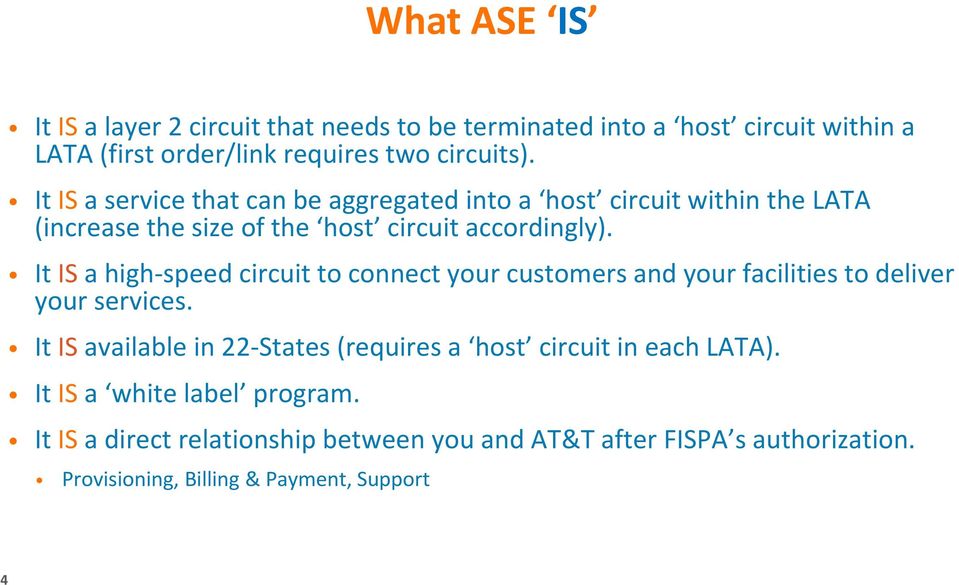
4 What ASE IS It IS a layer 2 circuit that needs to be terminated into a host circuit within a LATA (first order/link requires two circuits). It IS a service that can be aggregated into a host circuit within the LATA (increase the size of the host circuit accordingly). It IS a high speed circuit to connect your customers and your facilities to deliver your services. It IS available in 22 States (requires a host circuit in each LATA). It IS a white label program. It IS a direct relationship between you and AT&T after FISPA s authorization. Provisioning, Billing & Payment, Support 4
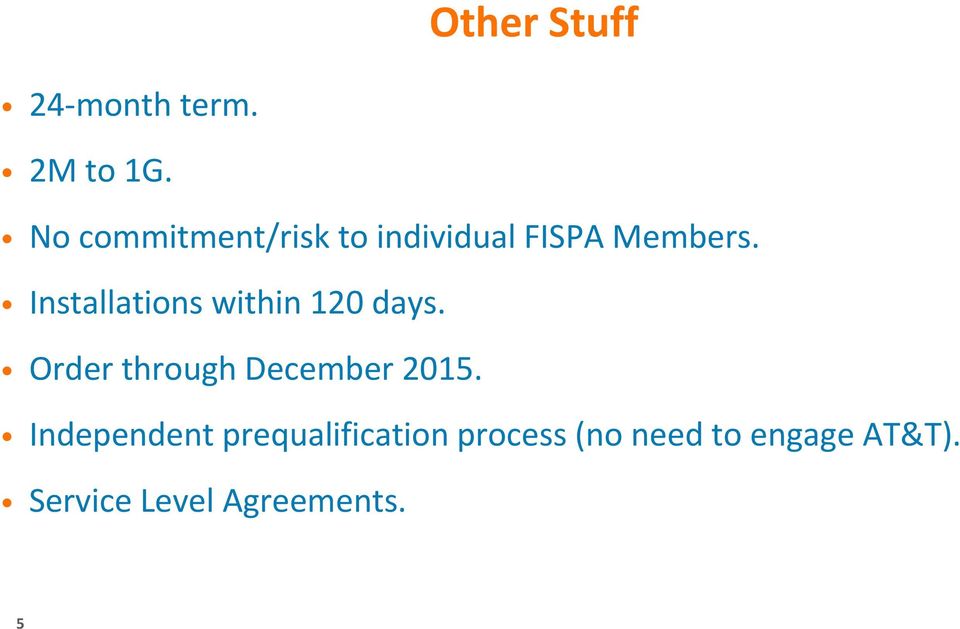
5 Other Stuff 24 month term. 2M to 1G. No commitment/risk to individual FISPA Members. Installations within 120 days. Order through December Independent prequalification process (no need to engage AT&T). Service Level Agreements. 5
6 Pending Stuff 36 month term & pricing. 2G to 10G. Extend agreement through

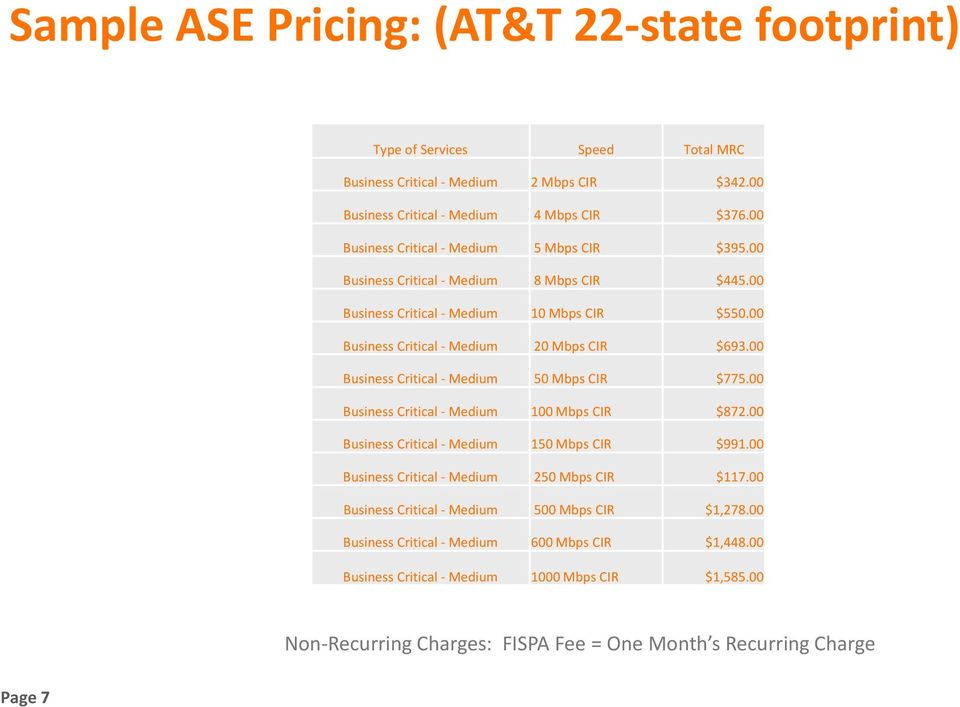
7 Sample ASE Pricing: (AT&T 22 state footprint) Type of Services Speed Total MRC Business Critical Medium 2 Mbps CIR $ Business Critical Medium 4 Mbps CIR $ Business Critical Medium 5 Mbps CIR $ Business Critical Medium 8 Mbps CIR $ Business Critical Medium 10 Mbps CIR $ Business Critical Medium 20 Mbps CIR $ Business Critical Medium 50 Mbps CIR $ Business Critical Medium 100 Mbps CIR $ Business Critical Medium 150 Mbps CIR $ Business Critical Medium 250 Mbps CIR $ Business Critical Medium 500 Mbps CIR $1, Business Critical Medium 600 Mbps CIR $1, Business Critical Medium 1000 Mbps CIR $1, Non Recurring Charges: FISPA Fee = One Month s Recurring Charge Page 7
8 Join FISPAhttp:// to join/ $595 Annual Membership 1 5 employees includes (1) FISPA meeting registration; or, $995 Annual Membership 6+ employees includes (2) FISPA meeting registrations or attend June in Atlanta for $595 (includes membership) Complete FISPA s 3 page Special Price Agreement that enables you to order under FISPA s AT&T agreement(s). Start ordering. How To Participate FISPA charges an Order Processing Fee on each circuit = 1 Month s Recurring Charge 8

9 Let s Talk x102 Jim See You in Atlanta? June Thank You! 9


10 AT&T Switched Ethernet Service SM Next Generation of Switched Ethernet In-Depth Version October 2013 AT&T Confidential Informat on
11 Contents 1. Introduction: AT&T Carrier Ethernet and Industry Recognition 2. What s New vs. Legacy OPT-E-MAN Service or Metro Ethernet Service? 3. AT&T Switched Ethernet Service SM Product Overview 4. Design Choices 5. In-Depth Design Considerations a) How to approach Network Design b) Private Line vs. VPLS (E-Line vs. E-LAN) c) Per Packet Class of Service 6. Class of Service and Pricing 7. Business Continuity Options 8. Access to WANs and Out of Franchise 9. Network infrastructure 10. Glossary How to Use this Presentation: This presentation contains many details in an effort to include all. If using as a resource to learn, review sections at a time, in sequence. If searching for key information use the Table of Contents (ToC) or word search to find topic. If presenting to a live audience, skip or delete slides that are not key focus area of presentation. The ToC has links to each section title page, and each section title page has a link back to the ToC. 2

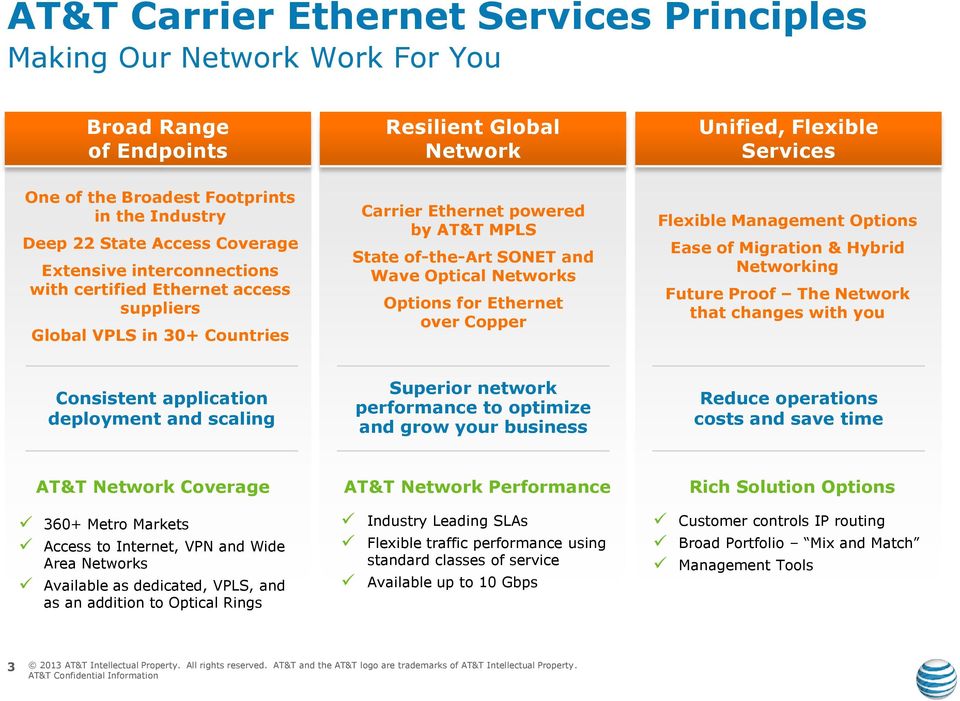
12 AT&T Carrier Ethernet Services Principles Making Our Network Work For You Broad Range of Endpoints Resilient Global Network Unified, Flexible Services One of the Broadest Footprints in the Industry Deep 22 State Access Coverage Extensive interconnections with certified Ethernet access suppliers Global VPLS in 30+ Countries Carrier Ethernet powered by AT&T MPLS State of-the-art SONET and Wave Optical Networks Options for Ethernet over Copper Flexible Management Options Ease of Migration & Hybrid Networking Future Proof The Network that changes with you Consistent application deployment and scaling Superior network performance to optimize and grow your business Reduce operations costs and save time AT&T Network Coverage 360+ Metro Markets Access to Internet, VPN and Wide Area Networks Available as dedicated, VPLS, and as an addition to Optical Rings AT&T Network Performance Industry Leading SLAs Flexible traffic performance using standard classes of service Available up to 10 Gbps Rich Solution Options Customer controls IP routing Broad Portfolio Mix and Match Management Tools 3
13 Metro Ethernet Forum: AT&T has a Comprehensive, Innovative Ethernet Portfolio AT&T wins: MEF Service Provider of the Year Best Business Ethernet Award AT&T was named the North America Service Provider of the Year, a distinction awarded to the provider with the highest cumulative score across three criteria and an additional score for service coverage. AT&T was also selected as the winner of the Best Business Ethernet Service award for providing the most unique and innovative Business Ethernet Service to enterprise customers within the areas it serves. Carrier Ethernet is a key technology to help companies quickly and easily adapt their networks to the changing demands of today s business landscape, said Nan Chen, President of the Metro Ethernet Forum. Our independent judging panel selected AT&T as Service provider for the Year based on its innovation and leadership in the carrier Ethernet space, as well as for its comprehensive portfolio of Ethernet services and excellent coverage area. 4

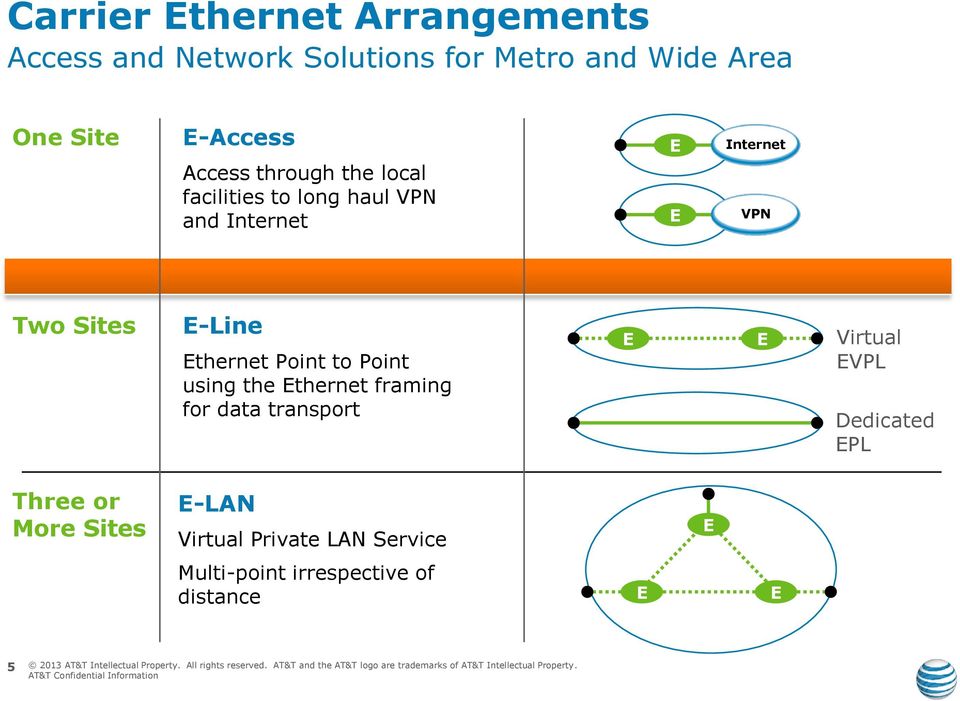
14 Carrier Ethernet Arrangements Access and Network Solutions for Metro and Wide Area One Site E-Access E Internet Access through the local facilities to long haul VPN and Internet E VPN Two Sites E-Line Ethernet Point to Point using the Ethernet framing for data transport E E Virtual EVPL Dedicated EPL Three or More Sites E-LAN Virtual Private LAN Service E Multi-point irrespective of distance E E 5
15 AT&T Switched Ethernet Service SM Compare to Legacy Services Presenter / reader notes: Delete / skip this section if you do not need to compare with legacy metro Ethernet services OPT-E-MAN, CSME or Metro Ethernet Click to Return to Table of Contents AT&T Confidential Informat on
16 What s New vs. Legacy Services? Compare to OPT-E-MAN / Metro Ethernet Services? What is the same or similar? First metro Ethernet product to be offered identically across the 22 state AT&T Telco footprint; consistent methods and procedures Carrier Ethernet, a full feature, highly reliable switched Ethernet service enabling custom networks of point-to-point or multipoint configuration using virtual circuits and scalable core switching managed by AT&T Ethernet Network Operations Center As with OPT-E-MAN service, AT&T Switched Ethernet Service SM uses MPLS in a protected scalable core network Multiple grades (aka classes) of service, speeds, interfaces and media (both copper and fiber-enabled service) SLAs associated with Layer 2 performance (latency, jitter, packet delivery rate) as well as network availability IntraLATA telco service offered by the AT&T ILEC (Telco) in-franchise Can be used to connect to WAN networks via customer selected WAN provider, including AT&T (T-Corp) and other carriers 7

17 What s New vs. Legacy Services? Compare to OPT-E-MAN or Metro Ethernet Services? What is different or enhanced? Higher speed (10G) core and new 10 Gbps customer port option with new logical port speeds ( Port CIR ) above 1G (limits apply) New port CIRs: 2, 2.5, 4, 5, 7.5, 9.5, 10 Gbps Max CIR between 2 ports: point to point = 2G; multipoint = 1G; exceptions ICB E-Mux core and loop deployment for increased coverage and potentially shorter fiber build intervals New termination options: exterior and 1000BaseT electrical interface Diverse Access and other options for business continuity Exciting new class of service choices: Per Packet Class of Service: customer assigns priority via Ethernet frame, allowing each packet to carry its own priority; ideal for integrated voice / data networks Basic (fixed CoS): 5 choices of CoS, each with its own SLA Improved Layer 2 functions: larger frame sizes, fewer MAC Address limits, Enhanced Multicast option AT&T BusinessDirect Web Portal with four applications 8

18 AT&T Switched Ethernet Service SM Product Overview Click to Return to Table of Contents AT&T Confidential Informat on



19 AT&T Switched Ethernet Service SM Ethernet Virtual Private LAN Service (VPLS) to connect 3 or more sites, or Ethernet Private Line (EPL) to connect two sites or access to Internet or WAN networks. Customer Location A Single Tenant Unit Customer Location B Single Tenant Unit ISP Backbone for Internet Access Ethernet Switch Core Ethernet Optical Network Ethernet Switch PBX Floor 12 CPE Multi-Tenant Unit Benefits Performance 24x7 proactive monitoring and maintenance with industry-leading SLAs Agility Committed bandwidth, managed NPE, multiple configurations Control Ethernet switching with customer LAN interface, multiple CoS Security AT&T network security 10
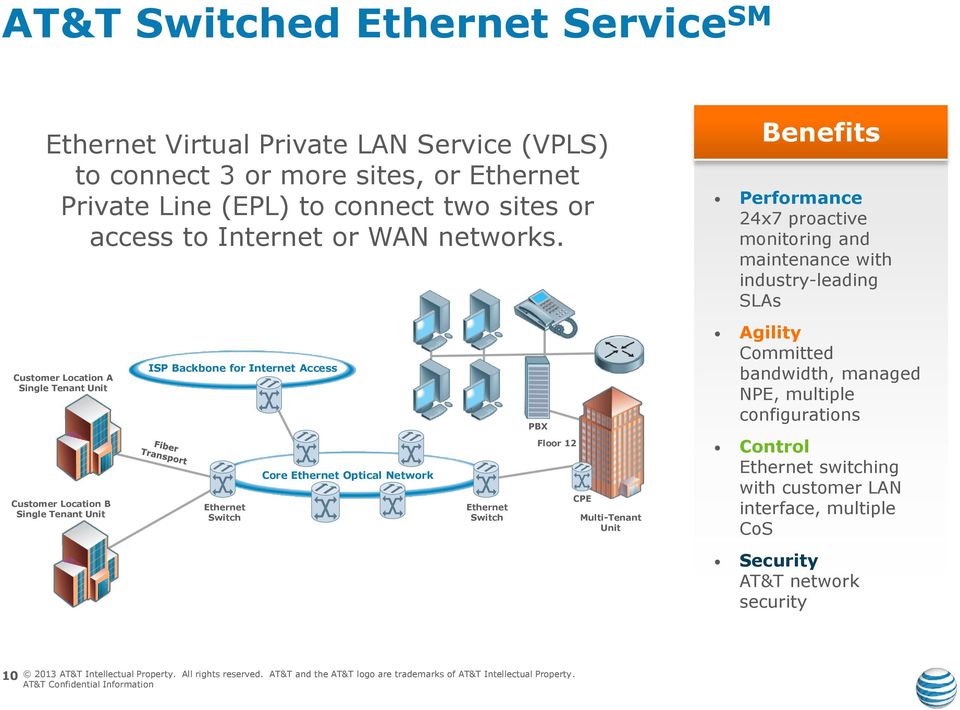
20 AT&T Switched Ethernet Service SM Product Overview 11 What is it? AT&T Switched Ethernet Service offers Ethernet connectivity for customers with multiple locations in a metro area, with a variety of configurations to meet your needs with flexibility to grow and adapt as your needs change: Ports offered in 3 sizes: 100 Mbps, 1 Gbps, & 10 Gbps Committed Information Rate (bandwidth) offered in 20 sizes: 2 Mbps to 10 Gbps Six classes of service offering the right performance / SLA for your applications Optional Class of Service prioritization for integrated voice and data networks Ethernet Private Line (EPL/EVPL) for connections between two locations Virtual Private LAN Service (VPLS) for connections between 3 or more locations How does it work? Each customer location is served by an Ethernet port Ports are connected via the MPLS-based core network using highly secure Ethernet Virtual Connections (EVCs) to enable Virtual Private Networks (VPNs)

21 AT&T Switched Ethernet Service SM Easy Connections and Service Management Local access loop to customer is provisioned over fiber (all speeds) Ethernet over Copper (EoCu) may be used when the CIR is 2 to 10 Mbps Handoffs to customer are electrical (100 or 1000BaseT) or optical (1G LX/LH and SX; 10G Base-SR/SW and 10G Base-LR/LW) Demarcation point is patch panel (RJ45 or fiber SC) Network Terminal Equipment (NTE) enables AT&T visibility to edge of network for SLA and maintenance 24x7 Ethernet Network Operations Center (ENOC) Responsible for provisioning and maintenance activity Customer Provisioning Center Service Assurance Center Multiple tiers of technical expertise emaintenance application offered via AT&T BusinessDirect Web Portal 12
22 Who Uses AT&T Switched Ethernet Service SM? Customers use AT&T Switched Ethernet Service to connect multiple metro locations in a Metro Area Network (MAN) or to access their WAN services Government, Education, Medical, Manufacturing, Financial, Entertainment, Service Providers, and System Integrators are some of the key customer market segments As the networking world evolves to IP/Ethernet-centric applications, every business (within the AT&T Switched Ethernet Service area) that needs multi-site connectivity is a potential candidate for AT&T Switched Ethernet Service Customers seeking the best combination of price and value choose AT&T Switched Ethernet Service over competitors: Better availability & reliability via new carrier grade network Competitive pricing with many service and configuration choices Part of broad portfolio of reliable solutions from AT&T companies 13

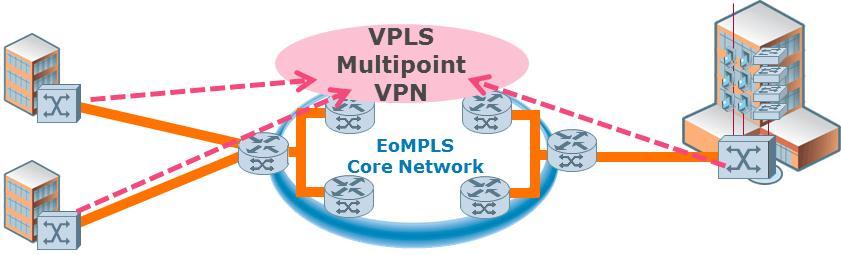
23 Network Applications Ethernet Private Line Expand your business to a 2 nd location with LAN-like performance Connect your primary data center to a back-up data center Connect to an Internet Service Provider or another WAN service at Ethernet speeds Use virtual EPL to support private line connections to multiple remote locations from a single hub port Virtual Private LAN Service Bring all locations together in a single network with any to any LAN-like connectivity Use Virtual LAN (VLANs) to segregate your network as needed by department, application, or location Support a variety of applications by applying different priorities to your Ethernet frames (Real Time vs. Non-Critical) for performance and efficiency 14
24 Ethernet Private Line Service (E-Line) Creates a point-to-point Virtual Private Wire Service as if dedicated facility between two locations Symmetric bandwidth at each location to avoid flow mismatches Unlimited MAC addresses and unlimited BUM (Broadcast, Unidentified Unicast and Multicast) frames Can be used for extranet communications or connections to partner networks Offers six Classes of Service with variety of performance objectives (SLAs) Customer Location C Customer Location A Fiber Transport Floor 12 Multi-Tenant Unit Network Terminating Equipment (NTE) CO EoMPLS Core Network CO NTE 15
25 Virtual Private LAN Service (E-LAN) Creates a Layer 2 Virtual Private LAN Service (VPLS) over an MPLS core allowing multiple LANs to appear as a single MAN/WAN Design metro hubs for concentrated resources: primary or back-up data centers, access to backbone or cloud networks Connect any to any or hub and spoke as needed Recommended option for Class of Service prioritization maximizes efficiency of integrated voice and data networks Customer Location A Fiber Transport Customer Location C VPLS Multipoint VPN Floor 12 Multi-Tenant Unit Customer Location B Copper Transport CO EoMPLS Core Network CO NTE Network Terminating Equipment (NTE) 16
26 AT&T Switched Ethernet Service SM Six Classes of Service 9 14 Sales Office 1Gb Port 250 Mb CIR Manufacturing 1Gb Port 500Mb CIR Ciena Edge Equipment SWC R&D 10/100 Port 100Mb CIR AT&T Switched Ethernet Core Network SWC Cell Site 1Gb Port 100 Mb CIR Regional Corporate HQ 10 Gb Port 2.5 Gb CIR Scalable and highly Secure MPLS core featuring Juniper carrier-grade routers High Density deployment over ROADM and fiber for maximum footprint Protected 10G Core links to help ensure performance Point-to-point, point-to-multipoint, full multipoint Warehouse 10/100 Port 10Mb CIR Cell Site 1Gb Port 500 Mb CIR Internet Service 100 Mb CIR Access to Wide Area Ethernet and Layer 3 Services Juniper MPLS Routers Wireless Hub (MTSO) 10Gb Port 10Gb CIR 100Mb / 1Gig / 10Gig ports 2 Mb to 10 Gbps speeds Jumbo frame support (1G & 10G ports) End to End SLAs Real Time Interactive Business Critical High Business Critical Medium Service Level Agreements: Latency: 5 ms Jitter: 3 ms Packet Delivery Rate: % Network Availability: 99.99% Service Level Agreements: Latency: 13 ms Jitter: 10 ms Packet Delivery Rate: 99.95% Network Availability: 99.99% Service Level Agreements: Latency: 20 ms Jitter: not offered Packet Delivery Rate: 99.9% Network Availability: 99.99% Service Level Agreements: Latency: 30 ms Jitter: not offered Packet Delivery Rate: 99.5% Network Availability: 99.99% Service Level Objective: MTTR: 4 hours Service Level Objective: MTTR: 4 hours Service Level Objective: MTTR: 4 hours Service Level Objective: MTTR: 4 hours Not Shown: Non-Critical (High and Low) Classes of Service; Non-Critical Low is only offered with Per Packet Class of Service 17 AT&T Confidential Informat on
27 AT&T Switched Ethernet Service SM Design Choices: Most Popular Click to Return to Table of Contents AT&T Confidential Informat on
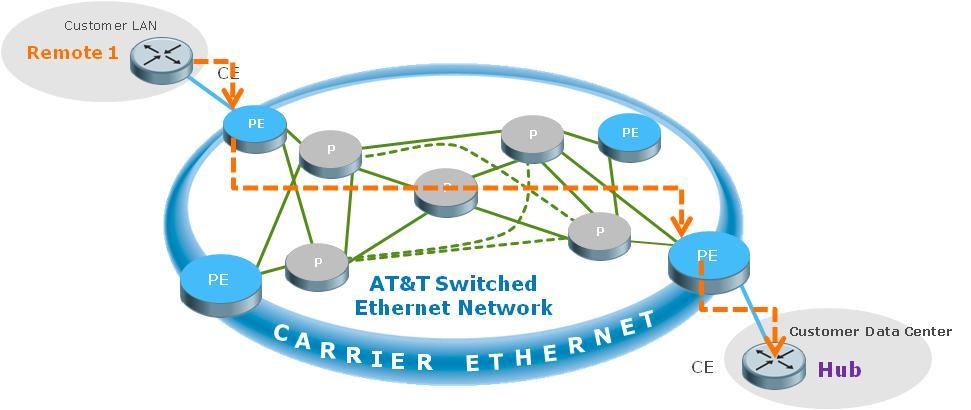

28 Most Popular Ethernet Configurations Private Line 2 site network Replacement for legacy TDM (e.g. DS1, DS3 private line) Symmetric bandwidth scalable from 2 Mbps to 2 Gbps Can be modified to VPLS or VPL if additional sites added in future Virtual Private Line 3 or more site network Uses hub and spoke arrangement Single port at hub uses VLANs to create a virtual private line to each remote Point to Point connections are symmetrical Remote to remote only thru hub Virtual Private LAN 3 or more site network Direct connectivity among all sites ( any to any ) Customer administered VLAN and application / CoS priorities Size each site to required bandwidth 19 AT&T Confidential Informat on
29 Ethernet Private Line (EPL / E-Line) Point to Point Ethernet Virtual Connection Between Two Ports Pros: Predictable performance Symmetrical bandwidth Supports tagged or untagged traffic Passes most L2 Control Protocol No MAC or BUM limits Ports at full rate may not need shaping Cons: No real Cons for a two-site need If plan to add additional sites in the future as multipoint EVPLS, will require EVC to be reconfigured If future will be EVPL, start with a VLAN based hub so that adding a new remote is easy and does not impact port configuration 20 AT&T Proprietary (Internal Use Only)
30 Ethernet Virtual Private Line (EVPL /E-Line) Design with Point to Point Ethernet Virtual Connections Pros: Point to point symmetrical EVCs to each site provides predictable performance and worst case capacity Bandwidth set for each remote site No MAC or BUM limits Ports at full rate may not need shaping Cons: Spoke to spoke traffic must hairpin via hub VLAN based hub cannot use CVLANs without QinQ Design supports worst case traffic; hub CIR => aggregate spoke CIR AT&T Intellectual Property. All rights reserved. AT&T and the AT&T logo are tradem AT&T Proprietary (Internal Use Only)
31 Ethernet Virtual Private LAN Service (E-LAN) All locations in single bridged domain Ethernet Virtual Connection Pros: Enables hub & spoke or any-to-any Easily allows customer VLANs Each port CIR set to needs of port o Hub cost efficient with X:1 fan-in ratio Ports at full rate may not need shaping Cons: Risk of dropped or delayed packets o Port-speed mismatch (e.g. hub 10G to 1G spoke) o Fan-in congestion (e.g. 20G spokes : 10G Hub) BUM and MAC limits apply o Lower impact If router used and limited BUM o MAC and Multicast options can address 22 AT&T Proprietary (Internal Use Only)

32 Ethernet Virtual Private LAN Service (E-LAN) All locations in single bridged domain Ethernet Virtual Connection Hubs/Data Centers PE Port-Based VL1 VL2 MP-EVC VL4 VL3 Port-Based PE Port-Based Customers may leave the network as single bridged domain, or May enable more controlled connectivity using customer VLANs that are transparent to AT&T For example, each remote may be assigned a VLAN at the primary and secondary data center Port-Based CE Remote PE Port-Based CE Remote Or a multipoint VLAN might be used for VoIP and other any to any traffic CE 23 Remote These customer controlled VLANs may be deployed by the customer at will and are not subject to AT&T VLAN limits or rules, as they are transparent to AT&T. AT&T Proprietary (Internal Use Only)
33 EVPLS with Per Packet Class of Service Router sets per frame priority to be applied in the ASE network Pros: Same as previous design, PLUS Aligns with customer s L3 CoS PPCoS will minimize cons o Port speed mismatch less likely to impact high priority applications o Efficient hub sizing; plus top applications get priority CE SPOKE PE Dual Hub Port-Based VL1 VL3 VL2 MP-EVC VL4 PE PE Port-Based CE SPOKE Cons: Requires customer to set 802.1q priority o Enabled when setting router configs Still potential impact of mismatch / fan-in o But greatly minimized by PPCoS BUM and MAC limits apply o Lower impact If router used and limited BUM o MAC and Multicast options can address CE 24 SPOKE Customer with converged network can use 802.1p in their VLAN header to prioritize delay sensitive applications and AT&T PPCoS will respect the priority even though we do not manage the VLANs AT&T Proprietary (Internal Use Only)
34 VLAN-Based Service to Port-Based Service Tagging alternatives including QinQ on a VLAN based hub port Tagged Traffic Tagged (QinQ) Traffic OR Un-Tagged Traffic Tagged Traffic If remote port does not need to pass customer VLANs the native traffic will be untagged 25 From the remote, the untagged frame traverses the core network and ASE adds a VLAN tag at egress From the hub, the CE places a tag which identifies the EVC on the VLAN-based port; tag is stripped for transport across network & untagged frame is forwarded to port-based remote site If remote port uses tags (for multiple VLANs, or to communicate 802.1p to AT&T) Tag is carried transparently across core, VLAN tag is added for forwarding to VLAN-based port CE Router receives packet with 2 Tags (QinQ); fairly straight forward config on IOS/Router Can be much more complicated with switches as CPE
35 Ethernet Virtual Connections (EVCs) Aggregate assigned EVC CIR cannot exceed that port s subscribed port CIR Maximum of 2G aggregate EVC CIR between any TWO customer ports* Point-to Point EVCs Point to point EVCs are symmetrical; EVC CIR at each end must be the same Maximum EVC size = 2G * Multipoint EVCs May be asymmetrical; set EVC CIR at each port to the BW needed at that port Maximum EVC size = 1G * Caution to consider risk of over-booking (e.g. hub port being flooded by aggregate of remote ports) and port speed mismatches (e.g. a 10G hub port 1G to a remote 100M) as these conditions can lead to dropped packets and are exempt from SLA PPCoS helps minimize risks by dropping lower priority packets first AT&T Intelle AT&T Confidential Inf Maximum EVCs per Port Port Type Maximum # of EVCs 100 Mbps Up to 8 EVCs 1 Gbps Up to 64 EVCs 10 Gbps Up to 508 EVCs * Exceptions to these limits may be considered on an ICB where facilities allow
36 Design Considerations Broadcast / Unknown Unicast / Multicast (BUM) Limits Point to point EVCs have no BUM limits Multipoint EVCs are limited to 2 Mbps of BUM traffic BUM limits protect the integrity of the network from traffic storms and improve security; customers are advised to enable CPE BUM controls NEW! Enhanced Multicast feature allows higher rate of BUM traffic for ports needing more than 2 Mbps BUM Each EVC on that port can be ordered with up to 30 Mbps of BUM Requests for higher limits may be approved on an ICB 27 Restricted Protocols VLAN-based ports may not carry certain Layer 2 control protocols if they are sent without a VLAN tag or with native tag; many L2 protocol frames will be passed if tagged with a routable customer VLAN ID Port-based ports will pass most L2 control protocols Refer to the matrix on the Customer Data Format Requirements document for specific protocols and network actions for different service configurations
37 Enhanced Multicast New Feature Enhanced Multicast is an optional feature offered on a per port basis and allows higher Broadcast, Unidentified Unicast, and Multicast (BUM) limits on multipoint EVCs (point-to-point EVCs do not have BUM limits) Standard limit will remain 2 Mbps of combined BUM per multipoint EVC By subscribing to Enhanced Multicast, the multipoint EVCs associated with that port can have up to 30 Mbps of combined BUM traffic Each multipoint EVC on the port can have up to 30 Mbps of combined BUM traffic, orderable in 1 Mbps increments Multipoint EVC orders for that do not specify a higher limit will be limited to the standard default of 2 Mbps of BUM Enhanced Multicast carries a monthly recurring charge and the administrative nonrecurring charge will apply for adding or removing the feature on an existing port 28
38 Traffic Control Considerations Traffic Shaping and Policing Traffic Shaping: Customers that subscribe to CIR rates lower than the physical port speed (e.g. 50Mbps EVC CIR using a 100 Mbps physical port) should use Traffic Shaping on their router to ensure packets are not dropped when entering the network Policing: the subscribed port CIR and EVC CIR is enforced on network ingress and egress; packets in excess of CIR will be dropped 29 Media Access Control (MAC) Address Limits: Point to point EVCs have no MAC limits Multipoint EVCs are limited to 250 source MAC addresses Ports with router normally present a single MAC address to the network if VLAN based port, an additional MAC per VLAN Limit refers to the source MAC addresses present at that port on the multipoint EVC; it does not refer to the number of MACs associated with distant (destination) ports Additional MAC Address option increases limit to 500 (per multipoint EVC) all multipoint EVCs on that port get the higher limit If the MAC limit is exceeded, unknown traffic will be flooded in the network as unknown unicast so still passed but could then be limited by BUM limits
39 Frame Size Considerations Maximum Message Transfer Unit / Frame Size All port types now allow 9126 byte frames, except as below 100 Mbps ports installed prior to 8/2013 may have 1526 byte limit 100 Mbps & 1G ports with 10 Mbps or lower port CIR may have 1526 Consider maximum frame size when planning QinQ, encryption, etc. Frame Overhead AT&T appends a 4 byte S-VLAN tag to customer frames; customers performing rate shaping may want to account for this overhead; the impact on the available CIR is dependent on the frame size For larger frame sizes, these 4 bytes may be insignificant and a small portion of CIR For small frame sizes, the 4 bytes may be significant, impacting the perceived available CIR 30
40 CPE Connection Options Customers can connect to the network using Bridge, Switch or Router Layer 2 Ethernet Switch / Bridge This Layer 2 device provides Ethernet communications among separate network connections in a common broadcast domain or subnet. A switch is a fast bridge. Since a switch or bridge often supports many MACs and have limited traffic shaping capabilities, care should be taken when using a L2 switch or bridge to connect AT&T Switched Ethernet Service, especially when the subscribed CIR is less than the physical limit of the Ethernet port. Router / Layer 3 Switch This Layer 3 device connects separate network broadcast segments (subnets) together and forwards packets among them. Aligns well with all AT&T Switched Ethernet Service configurations and provides benefits of limiting MAC addresses and broadcast traffic presented to the network; traffic shaping (limited support on some L3 switches) can improve performance in some designs. 31
41 AT&T Switched Ethernet Service In-Depth Design Considerations: How to Approach Network Design Click to Return to Table of Contents AT&T Confidential Informat on
42 Step 1) Decide Topology & Bandwidth How does data flow between sites? % Hub and spoke % Any to any What is the peak bandwidth (Committed Information Rate or CIR) that is required at each site? 2 Mbps to 10 Gbps Based on current or future site requirements. Ethernet Private Line? (e.g. 2 site network) Ethernet Virtual Private Line? (e.g. hub with EVPL to multiple remotes) Ethernet Virtual Private LAN? (shared bus among 3 or more sites) 33 AT&T Confidential Informat on
43 Step 2) Application Needs Determine CoS What applications (and protocols) are used? Voice (VoIP, TDM)? Video or Multimedia (Streaming, broadcast or interactive?) Data (real time transactions, file transfers, Internet/WAN)? What performance is required for each application? Latency (impacts voice, transactions and other interactive apps) Jitter (also impacts voice and interactive transactions) Packet Delivery Rate (impacts effective throughput of large files) How will the applications share the network? Separate physical connections or separate VLANs? Combined using prioritization methods Do different applications peak at different times? 34 AT&T Confidential Informat on
44 Step 3) Choose Serving Arrangement Fixed Class of Service (Basic) Ideal for E-Line/EPL/EVPL configurations since no inherent mismatch of capacity (fan-in or port speed) Each Virtual Connection has its own Class of Service All packets within that EVC have equal priority EVC ordered with choice of CoS =< the port s CoS Point to Point EVCs get no direct benefit from PPCoS 35 AT&T Confidential Informat on Per Packet Class of Service (PPCoS) Ideal for E-LAN/VPLS configurations to maximize efficiency and performance at the hub (fan-in) Customer router applies a priority in the VLAN tag AT&T uses this priority in the network including points of congestion such as egress to hub site Lower priority data traffic can burst into unused Real Time / Interactive CoS PPCoS is described in more detail in the next section. PPCoS is not available on ports provisioned on an E-Mux, or via Ethernet over Copper (EoCu), or with Advanced Access Failover.
45 Step 4) Design & Price Network Network Configuration: Single enterprise networks with 3 or more may be best served with port-based E-LAN / VPLS with Per Packet Class of Service E-Line / EPL best fit for 2 site networks; EVPL when 2 or more remotes want a private line to hub Port Configuration: Choose 100 Mbps, 1G or 10G based on max need at that site E-LAN / VPLS: port-based when feasible for greater customer control EPL should be port-based unless future sites to be added as EVPL EVPL go with VLAN-based hub and usually port-based remotes Committed Information Rate & Class of Service: VPLS PPCoS: most customers with VoIP choose Multi-Media Standard EPL/EVPL: most customer with VoIP choose Interactive CoS Customer needs may drive lower or higher CIR / COS; see SLAs 36 AT&T Confidential Informat on
46 AT&T Switched Ethernet Service In-Depth Design Considerations: Private Line vs. VPLS (E-Line vs. E-LAN) Click to Return to Table of Contents AT&T Confidential Informat on
47 Ethernet Made for Shared Infrastructure Enables connectivity between resources via shared transport media, MAC address, and collision management Originally 10 Mbps half-duplex coaxial pipe shared among all users in the broadcast segment - collision domain NIC Ethernet Hub 38
48 Ethernet Switches & VLANs Evolution to allow higher speeds, hubs and bridges, and improved contention improved utilization and capacity Ethernet hubs replaced by Ethernet switches; limits traffic on links, eliminates collisions; utilization can increase to ~80% Each Ethernet switch can be partitioned into separate virtual LANs Broadcasts now confined to single VLAN Better security, VLANS are isolated unless router enables linkage Workstations on different physical floors can be logically grouped into same VLAN (marketing, finance, engineering) Ethernet switches add some routing (Layer 3) capabilities too 39
49 Emergence of Carrier Ethernet Metro and Best Effort Early services were within the metro Price per Mbps outweighs performance concerns Limited availability, dedicated facilities Wider Reach and Higher Expectations Ethernet WAN and Ethernet access to Layer 3 emerge in scale More stringent SLAs required to support converged applications Mission critical networks rather than low cost alternative The Best Gets Better AT&T is a proven market leader with strength in metro and WAN solutions Next generation VPLS services launched for new millennium OPT-E-WAN (National and Global) AT&T Switched Ethernet Service SM (Metro and Access) Per Packet Class of Service to efficiently support converged networks and applications 40
50 Point to Point Provides Private Line Experience Each remote port has an Ethernet Virtual Connection (EVC) to the host hub with the bandwidth (committed information rate or CIR) needed to serve that remote The hub has a single port serving multiple EVCs, one for each remote; the hub CIR must be equal to or higher than the sum of the aggregate remote EVCs Customer LAN Customer LAN Remote 2 1G Port 250M CIR 1 250M CE PE P P CE PE Remote 1 1G Port 250M CIR 1 250M P Customer LAN Remote 3 CE PE P AT&T Switched Ethernet Network R I E R PE CE Customer Data Center Hub 1G Port 250M CIR 1 250M CE P PE Customer Edge, can be Ethernet switch or router Provider router in MPLS network Provider Edge Switch in VPLS network Attachment Circuit: Ethernet Access Physical connection (MPLS) Logical connection (MPLS) Customer LAN 1G Port 1G CIR 3 250M each 41 AT&T Confidential Informat on
51 Does Private Line = Greater Throughput? With a private line/fiber network, the 1G from each remote is terminated on a CPE WAN switch, which then connects to the LAN switch; there is a WAN/LAN mismatch Normally there are far fewer ports and lower speeds at the LAN data center Aggregation occurs in CPE switch Private Fiber Potential Choke Points Internet Gigabit Primary Data Center Recommend Choke Point (Internet Access Speed) LAN Speed WAN Speed 1G not 6G (in this example) LAN Switch Gigabit Server Choke Point (1G in this example) Gigabit 100 Mbps Choke Point ( 600M per server) Choke Point (100M per server) Customer WAN Switch Server Direct remote-toremote communications 1Gbps Dark Fiber Network Direct remote-toremote communications 1Gbps Rule of Thumb: LAN Speed WAN Speed (not true with many deployments) Σ Server Speed + Interent Speed WAN Speed 1G 1G 1G 1G 1G 1G Remote 1 Remote 2 Remote 3 Remote 4 Remote 5 Remote 6 With AT&T Switched Ethernet VPLS solution, the required aggregation is performed by a carrier grade switch in the AT&T cloud The capacity connected to the customer WAN switch is better tuned to match the capacity at the LAN The same data center capacity is available to both solutions but the latter is better matched 42 AT&T Switched Ethernet Service Potential Choke Points Primary Data Center AT&T Switched Ethernet Network Σ Server Speed + Interent Speed WAN Speed Internet Gigabit Choke Point (Internet Access Speed) LAN Switch Gigabit Server Choke Point (1G in this example) Gigabit 100 Mbps Choke Point ( 600M per server) Choke Point (100M per server) Recommend LAN Speed WAN Speed 1G 1G (in this example) Customer WAN Switch Server 1G E-LAN Direct remote-toremote communications 1Gbps Direct remote-toremote communications 1Gbps Rule of Thumb: LAN Speed WAN Speed (true in most deployments) 1G 1G 1G 1G 1G 1G Remote 1 Remote 2 Remote 3 Remote 4 Remote 5 Remote 6
52 Hub Port Utilization What you might think VLAN 1 VLAN 2 VLAN 3 VLAN 4 VLAN 5 VLAN 6 VLAN 7 Time Division Multiplexing utilizes one time slot per channel o each location gets its own reserved bandwidth to ensure performance Hub Port CIR must equal the sum of all remotes CIRs What it really is VLAN1 VLAN2 VLAN3 VLAN7 VLAN3 VLAN5 VLAN1 VLAN6 43 Ethernet switching puts traffic in a SINGLE flow containing the interspersed VLAN traffic In most cases hub utilization will be far lower than the aggregate speed of each EVC
53 VPLS Multipoint Provides LAN Efficiency Each port is a member of a common multipoint VPN, enabling efficient any to any traffic for branch to branch communications such as voice or video Even when majority of data flow is hub and spoke, data is carried as effectively as point to point EVCs Each port is sized according to the bandwidth needed at that site; multipoint does NOT require hub to be sized equal to all remotes Save money with fewer hub ports and/or lower CIR Customer LAN Remote 2 1G Port 250M CIR 1 250M CE PE P VPLS Multipoint VPN P CE PE Customer LAN Remote 1 1G Port 250M CIR 1 250M P P Customer LAN Remote 3 CE PE P AT&T Switched Ethernet Network R I E R PE CE Customer Data Center Hub 1G Port 250M CIR 1 250M 1G Port 600M CIR 1 600M 44 AT&T Confidential Informat on
54 VPLS Multipoint Egress to Hub Contention 45 Greater Risk Before PPCoS Always important to understand traffic flows and peak / average data rates between sites, in order to size the port s CIR correctly Some customers will use the EVPL model and size hub to the aggregate sum of remote sites but pay a higher price for that comfort If hub is sized based on expected peak traffic, the normally bursty nature of Ethernet traffic and contention should allow a 2:1 or 3:1 fan-in ratio and still provide a satisfactory experience; ideal ratio may vary by customer Many OPT-E-MAN, CSME and Metro Ethernet customers use multipoint networks BUT, if hub is undersized traffic demand could exceed hub capacity and some packets could be dropped If non-real time data packets (e.g. ) are dropped, there is minimal impact If voice or other interactive packets are dropped, the result may be apparent to users with lower performance So the challenge is How to leverage the data efficiency of Ethernet, while helping to ensure high performance for voice or critical data applications? Answer: PPCoS!
55 AT&T Switched Ethernet Service In-Depth Design Considerations: Per Packet Class of Service Click to Return to Table of Contents AT&T Confidential Informat on
56 What is Per Packet Class of Service (PPCoS)? New Serving Arrangement for ASE 47 Original ASE (Basic Serving Arrangement) offers fixed class of service ; traffic priority and SLAs are applied per EVC All traffic in the EVC has equal priority regardless of application need CIRs need to be sized for worst case to ensure vital applications get through Per Packet Class of Service Serving Arrangement allows customer to assign priority to each Ethernet frame, for example 1. Voice and other real-time applications may get highest priority 2. Critical interactive data applications like transactions may get next highest 3. Streaming video may get next highest 4. General file transfers / Internet browsing Traffic priority is used by the ASE network and customer devices to ensure highest priority applications achieve best performance while efficiently transporting lower priority bursty data applications PPCoS is not available on ports provisioned ports provisioned on an E- Mux or via Ethernet over Copper (EoCu) or with Advanced Access Failover
57 Efficient Use of Network Allows for Bursts Real Time Applications Get Priority As before, the E-LAN design via Virtual Private LAN Service (VPLS) connects 3 or more locations with simplicity, efficiency and customer control of a LAN If combined remotes exceed hub capacity, high priority packets get thru If hub bursts at full speed to lower speed remote (speed mismatch), low priority packets would be firs dropped Reserve capacity for Real Time and Interactive traffic while still allowing lower priority traffic to burst into that capacity when available AT&T Intellectua AT&T Confidential Informa AT&T Proprietary Information For Internal Use Only
58 Applying Priority at Network Ingress Traditional single CoS EVC Customer that requires Real Time (RT) priority for voice must order the EVC as RT, and all traffic is handled with same priority JUNIPER 480/960 CPE RT RT NTE RT Voice, video, financial transaction, Internet, and RT RT RT RT RT 250 Mbps EVC AT&T Switched Ethernet Service SM Network JUNIPER 480/960 CPE RT NTE RT NCH PPCoS Customer Applies Priority IA 2013 AT&T Intellectual Property. All rights reserved. AT&T and the AT&T logo are trademarks of AT&T Intellectual Property IA IA BCH 250 Mbps EVC Customer applies priority tag to each frame, choosing among 6 priorities including RT The network will adhere to that priority thru the network and critically, at the egress to the hub port 49 BCH RT IA BCH NCH Real Time Traffic receives the highest priority in the network Ethernet frame with Real Time CoS Ethernet frame with Interactive CoS Ethernet frame With Business Critical High CoS Ethernet frame with Non-Critical High CoS
59 Queuing Priority at Network Egress JUNIPER 480/960 Multipoint VPN Dropped based on WRED NCH JUNIPER 480/9 Applies the PPCoS priority ordered on the hub port, so upon congestion RT and IA are not dropped Not Shown: Without PPCoS, similar egress congestion would cause random discard that could include voice or delay sensitive data. RT RT RT IA IA IA BCH BCH CPE 600 Mbps EVC PPCoS Customer Sets Hub Priority Hub port set to allow up to 50% RT traffic; lower level data can burst, so if no RT is present, entire capacity is available for data If congestion occurs, customer s priority tags ensure most vital traffic receives highest priority and throughput Dropped lower priority packets will be resent moments later as per normal Ethernet CPE behavior 50 AT&T Confidential AT&T Proprietary Information (Internal Use Only) RT Ethernet frame with Real Time CoS IA BCH NCH Ethernet frame with Interactive CoS Ethernet frame With Business Critical High CoS Ethernet frame with Non-Critical High CoS
60 Why Do Customers Need PPCoS? Intelligent network reacts to customer assigned priorities Real-time / interactive applications are bursty and require minimal latency and jitter including: voice and video applications Other applications may be high priority, such as a financial transaction or an MRI image transfer, but are more delay tolerant Still other applications are lower bandwidth, bursty and easily sequenced in normal Ethernet traffic controls, such as , Internet & instant messaging Per Packet Class of Service allows customers to prioritize their traffic and optimize their bandwidth usage Instead of assigning all traffic the highest priority (e.g. Real Time), or segregating application types via VLAN, they can apply their Layer 3 CoS strategy to maximize performance and efficiency on their Ethernet L2 network 51
61 52 How Does PPCoS Benefit Customers? PPCoS in a port based multipoint EVC allows customers to: Connect each site to the Ethernet cloud with total bandwidth needed Customer enables & controls traffic flow based on MAC address or VLANs Higher priority frames receive priority within the AT&T network Customer sizes hub to support average combined peak bandwidth from all remote sites Achieves maximum utilization based on bursty Ethernet traffic flows Does not require dedicated bandwidth per site at the hub; all sites have access to aggregate bandwidth as available Customer sets percentage for highest CoS (e.g. 40% Real Time to ensure adequate capacity for VoIP), and allocates remaining bandwidth among lower CoS o Data classes of service (Business Critical and Non-Critical) can burst into higher CoS bandwidth; e.g. if there is no active voice, the data applications have access to the full capacity of the port Potential congestion at hub, or speed mismatch (high speed hub CIR to low speed remote CIR) is handled more elegantly by prioritizing real time traffic for better application performance
62 PPCoS Offers Six Classes of Service (6 CoS) PPCoS uses the same Classes of Service as fixed CoS ASE, with additional choices CoS are listed as a hierarchy, from highest to lowest based on network prioritization and performance as follows: 1. Real-Time 2. Interactive 3. Business Critical-High 4. Business Critical-Medium 5. Non-Critical High 6. Non-Critical Low 1 1 This CoS is only offered as part of PPCoS and is not available as a fixed CoS. CoS is assigned on a per packet basis, the customer chooses the profile or percentage of each CoS to be allowed on the port Top priority (e.g. Real Time) assigned first; then remainder split among lower CoS; BC and NC can burst into unused portions of higher CoS Customer selects a CIR Package that specifies what profiles (percentages) of each CoS can be ordered on that port 53
63 Bursting for Per Packet Class of Service Lower CoS can burst into unused capacity of higher CoS CoS Name CoS # P-Bit Setting Real Time CoS1 (.1p bit =5) Interactive CoS2v (.1p bit =4) Business Critical High CoS2 (.1p bit=3) Business Critical Medium CoS3 (.1p bit =2) Bursting Rules Real Time and Interactive CoS cannot burst above specified %. Can burst up to the available port or EVC CIR, if there is unused bandwidth available. CIR Packages Multimedia High: Allows up to 100% Real Time; Multimedia Standard: Allows up to 50% Real Time; All non-real time traffic can be allocated among other CoS Critical Data: Allows up to 80% Business Critical High; other traffic allocated among lower CoS Business Data: Allows up to 90% Business Critical Medium; other traffic allocated among lower CoS Non-Critical High CoS4 (.1p bit =0) Allocated for lower priority Non-Critical Low CoS5 (.1p bit =1) traffic within the above packages 54
64 Scheduling Profile Ingress vs. Egress Customer can choose same or different profile Many EVCs will have the same profile for ingress (traffic sent from CPE into the network) and egress (traffic coming from network to CPE), but this will not always be the case, for example: EVC on a port that generates multi media might have high % of Interactive or Real Time on ingress, but since it is not two-way they may not need same profile on egress EVC that is data oriented may have a data-oriented profile on ingress, but for egress the customer may prefer a single schedule for all EVCs on the port to maximize port s capacity to support real time apps Hub ports are the most likely case where the ingress and egress traffic might have different characteristics All EVCs will require an ingress bandwidth profile to be ordered with the EVC; the egress profile will automatically be the same as the ingress unless the order specifies a different egress profile See the next section for specific choices to be made regarding egress 55


65 Two Types of PPCoS Egress Scheduling Per Port Scheduling aka Single Scheduler 1 This method is used on all port-based PPCoS ports It MAY be the right choice on VLAN-based ports if customer wants priority to be applied without regard to VLAN (i.e. any voice comes before any data ) Single egress queue profile / scheduler for all traffic on port Per VLAN Scheduling aka Multi Scheduler 1 This method is an option for VLAN-based ports This provides an egress queue profile for each EVC on the port These EVC egress profiles may each be unique or some may be common Using Per VLAN scheduling may lead to cases where traffic is being dropped due to capacity of the VLAN even though there is spare capacity on the port Customer using ASE enforced VLANs for different business operations may prefer the PPCoS priority to be applied separately on each VLAN 56 1 Note: scheduling names above are used interchangeably; some systems (e.g. PC Globes) use Single Scheduler and Multi Scheduler 2013 AT&T Intellectual P operty. All rights eserved. AT&T and the AT&T logo are trademarks of AT&T Intellectual Property.
66 Port Level Egress Scheduling VLAN Level Egress Scheduling Port Level Egress Scheduling uses one profile for the port First, customer decides how much RT bandwidth is needed, in this case 60% Next, customer assigns a % to each / any of the remaining CoS needed Notice these lower CoS assignments add up to 100%, 57 PROFILE % RT 40% IA 5% BC-H 25% BC-M 30% NC-H 0% NC-L VLAN 18 Profile VLAN 22 Profile VLAN 45 Profile VLAN 694 Profile VLAN 3 Profile AT&T Confidential Informat on 50% RT 0% IA 0% BC-H 0% BC-M 100% NC-H 0% NC-L 40%RT 0% IA 80% BC-H 10% BC-M 10% NC-H 0%NC-L 20 %RT 25% IA 25% BC-H 25% BC-M 25% NC-H 0% NC-L 30% RT 25% IA 50% BC-H 15% BC-M 5% NC-H 5% NC-L 5% RT 15% IA 25% BC-H 15% BC-M 40% NC-H 5% NC-L VLAN Level Egress Scheduling uses one profile for each VLAN Each VLAN can have a different profile Settings must be within the port subscription limits Customer can order specific % settings or can order from standard profiles Customer selects the % used with highest CoS Then decides how to allocate among the remaining CoS
67 AT&T Switched Ethernet Service SM Class of Service and Pricing Click to Return to Table of Contents AT&T Confidential Informat on
68 Anatomy of AT&T Switched Ethernet Port Many choices in configuration and feature options, but the service always has the components shown below Customer port connection (Port): provides the physical connection and associated speed between the customer and the AT&T Switched Ethernet Service SM core network 3 choices: 100 Mbps, 1,000 Mbps (1 GigE) and 10,000 Mbps (10 GigE) Committed Information Rate (CIR): specifies the amount of bandwidth or logical channel that can be transmitted over the port / network Offered in 20 increments from 2 Mbps to 10 Gbps and may be increased or decreased within the port speed without truck roll in most cases Ethernet Virtual Connection (EVC): creates a virtual connection or L2 virtual private network between 2 or more ports; there is no charge for standard EVCs EVC also has a CIR that is =< than the port CIR; the sum of EVC CIRs cannot exceed the port CIR Point to point EVC CIRs are symmetrical; multipoint EVC CIRs may vary at each port Customer Switch / Router Network Terminating Equipment (NTE) AT&T Switched Ethernet Service SM Core Network Customer interface is 100 or 1000BaseT, or 1/10GigE optical via patch panel (not shown) Customer Port Connection (Port) & Committed Information Rate (CIR) Ethernet Virtual Connection (EVC) to connect with one or more distant ports Distant Port 59
69 Class of Service (CoS) for Performance 60 CoS categories specify the priority within the AT&T Switched Ethernet Service SM network of a particular EVC (Basic or fixed CoS) or Ethernet packet (Per Packet CoS) AT&T Switched Ethernet Service offers up to six choices in CoS, each with a performance objective and associated Service Level Agreement (SLA) These choices are listed as a hierarchy, from highest to lowest based on network prioritization and performance as follows: 1. Real-Time 2. Interactive 3. Business Critical-High 4. Business Critical-Medium 5. Non-Critical High 6. Non-Critical Low 1 1 This CoS is only offered as part of PPCoS and is not available as a fixed CoS. For Basic Serving Arrangement (fixed CoS), the port CIR specifies the default CoS for the port and all EVCs must have a CoS =< than that CoS For PPCoS, the ports and EVCs may have a combination of CoS as described later in this presentation
70 Class of Service (CoS) for Performance Class of Service Service Measurement Latency (one-way) Jitter Packet Delivery Rate (PDR) Real Time 5 ms 3 ms % Interactive 13 ms 10 ms 99.95% Business Critical High 20 ms n/a 99.9% Business Critical - Medium 30 ms n/a 99.9% Non-Critical High 50 ms n/a 99.5% Non-Critical Low 1 n/a n/a n/a Determine the performance required for the application(s) that will be transported via AT&T Switched Ethernet Service See design options section for details on topology and service choices Class of Service requirements will determine the solution price 1 Non-Critical Low is only offered as part of the PPCoS CIR package. 61
71 How is Service Priced? AT&T Switched Ethernet Service SM is offered under terms and conditions specified in the AT&T Interstate Guidebook Each port is priced according to service requirements with at least 2 rate elements: 1. Customer Port Connection (Port): Basic or PPCoS Port(s); 100M/1G/10G 2. CIR speed for the port(s); the CIR price will vary by CoS choice 3. Optional features (if any): e.g. Diverse, Additional MAC, etc. 4. Length of term plan: 1 year minimum on new ports; rates offered for 1, 2, 3, 4 or 5 year terms and month-to-month on expired terms only There are no mileage charges but regenerator charge may apply for ports located far from the nearest core switch, as determined by AT&T engineers Standard prices are shown in the AT&T Interstate Guidebook, available for internal or external viewing 62
72 Choosing the Best CIR Based on CoS Basic and PPCoS use different methods to select CIR For Basic Serving Arrangement ports, select the CIR with a CoS equal to the HIGHEST CoS necessary to support the application EVC(s) on this port can have the same or lower CoS as the selected Port CIR CoS For PPCoS Serving Arrangement ports, the CIR choices need to account for the variety of potential combinations of different CoS The customer is allowed to use different CoS on a per packet basis, the customer chooses the CIR based on the type and proportion of CoS they need on the port Port CIR CoS is offered in packages that specify what profiles (percentages) of each CoS can be ordered on that port Determine the % of bandwidth needed for the top priority CoS first (e.g. Real Time), then the remainder can be split among lower CoS; BC and NC can burst into unused portions of higher CoS For example, if a 1 Gbps port has 1G CIR and determines the maximum amount of voice or other delay sensitive applications is 400 Mbps, thus the port needs up to 40% of Real Time packets, select Multi Media Standard package; their port CIR profile will then allow up to 50% to be Real Time; they can specify the other CoS % using any combination = 100% 63
73 PPCoS CIR Package is Selected per Port Speeds of CIR offered in four packages Multimedia High (MM-High) allows up to 100% of port CIR to be allocated to Real Time traffic; the remaining percentage (if any) can be divided among any/all CoS (below Real Time) Multimedia Standard (MM-S) allows up to 50% of port CIR to be allocated to Real Time traffic; the remaining percentage can be divided among any/all CoS (below Real Time) Critical Data allows up to 80% of port CIR to be allocated to "Business Critical - High" and the remaining percentage can be divided among any/all CoS (below Business Critical - High); this package has no Real Time or Interactive traffic Business Data allows up to 90% of port CIR to be allocated to Business Critical - Medium" and the remaining percentage can be divided among any/all CoS (below Business Critical - Medium); this package has no Real Time, Interactive, or Business Critical High Note: Each of the above CoS settings may be ordered in 5% increments (between 5% and 30%) and in 10% increments (from 40% to 100%). Package prices are aligned to comparable fixed CoS pricing Multi-Media High = Real Time Multi-Media Standard = Interactive Critical Data = Business Critical Medium Business Data = Non-Critical High
74 AT&T Switched Ethernet Service SM Business Continuity Options Click to Return to Table of Contents AT&T Confidential Informat on
75 Business Continuity Options for Redundancy Customers rely on Ethernet networks for mission critical applications AT&T Switched Ethernet Service SM offers a variety of service configuration options designed to enable Business Continuity Each customer may have a different design and recovery plan Within the basic service offer, customers may make the following choices to support their continuity plans EVCs that connect to both primary and secondary data centers Request DC powered NTE and serve from customer DC power including back-up generator Request dual power supply NTE and provide power from 2 sources and/or from a customer owned Uninterruptible Power Supply (UPS) system Customers may also order more than one port and/or optional features on a port to create more robust networks, including: Alternate Serving Switch, Diverse Access or Advanced Access Failover 66
76 Comparing Optional Features Concerned with potential single points of failure (SPOF)? SPOFs may include the customer router or switch, servers/cpus, power, intra-building wiring and other components not directly provided by AT&T AT&T Switched Ethernet Service SM is built on a carrier grade MPLS core, designed to survive many single failure events; however the customer port connection is inherently unprotected and thus a potential SPOF Like insurance, customer evaluates cost of coverage vs. risk of loss Some will tolerate SPOF; some will accept SPOF at remote but not at hub Customers may typically choose one of two ways to avoid port SPOF 1. Order two ports with diversity for the location (Diverse Access) 2. Order one port with protection (Advanced Access Failover) These two features are mutually exclusive Other choices include: Alternate Serving Switch and Route Other Than Normal Each method is described in subsequent slides Optional features do not include construction of dual entrance facilities, but such can be constructed at customer expense if requested 67
77 Diverse Access Diverse Access (DA) is an optional feature offered on a pair of ports (1G or 10G) for the same customer & location; DA USOC charge applies to both ports and is used to retain diverse relationship in network inventory Customer manages load balance or failover of CPE Customer Switch / Router Network Terminating Equipment (NTE) AT&T Switched Ethernet Service SM Core Network Back-Up Data Center Host Port One customer interface (1G or 10G) per UNI port; two ports are required in a diverse arrangement; Each port is active ; load-share or failure detection / re-route is handled by customer equipment. Two routers are recommended but not required. Loop and core network facilities are diverse to the extent facilities allow and may vary on each case. Dual NTE Each provisioned with one customer facing port (UNI) and one network facing port (NNI). Each port is associated with its own EVC(s) to associated distant port(s). Primary Data Center Host Port Diagram depicts point-to-point EVCs to different distant ports. Other designs are available. The Diverse Access arrangement depicted on left side of diagram ends at the Provider Edge (PE) core switch; survivability in the core is inherent in the MPLS core design.
78 Advanced Access Failover Advanced Access Failover (AAF) provides automatic failover to a redundant facility in the event of a failure of a protected facility Ethernet Virtual Circuits (EVCs) associated with that port will continue to operate over the standby path AAF port has a single customer interface (1G or 10G) and single NTE served by 2 fiber facility pairs that are separated from each other to the extent possible and will terminate on two different core switches Customer Switch / Router Network Terminating Equipment (NTE) AT&T Switched Ethernet Service SM Core Network Single Customer interface (1G or 10G) Single NTE One customer facing port (UNI) Two network facing ports (NNI) Two fiber pairs, separated to the extent facilities allow, connecting to two different core switches Distant Port Network will run hot/standby; if hot is disrupted network will switch to standby. Diagram depicts a point-to-point EVC to a distant port without AAF. Other designs are available. 69
79 Alternate Serving Switch Alternate Serving Switch Allows Customers to order AT&T Switched Ethernet Service SM from a switch that is different from the AT&T Switched Ethernet Service switch that would normally serve the Customer s premises May be requested when customer is concerned that ports at different locations are being served by same switch Since Diverse Access is only available between two ports at same location, that feature would not be used but Alternate Serving Switch could cause one of the ports to be served from a different switch May be requested when customer is concerned that other services (voice, private line, other Ethernet services, etc.) are served by a given AT&T Central Office or switch and requests a port to be served by an Alternate Switch Note, this is NOT a feature used with either Diverse Access or Advanced Access Failover. For those features, if a 2 nd core switch is available to be used, it is done as part of that feature and does not require the addition of the Alternate Serving Switch feature. 70
80 AT&T Switched Ethernet Service SM Access to Wide Area Network (WAN) & Out of Franchise Click to Return to Table of Contents AT&T Confidential Informat on
81 Access to Wide Area Services AT&T Switched Ethernet Service SM can be used to connect to Wide Area Network Service Providers (WAN SPs) that provide interlata services such as Layer 3 Internet or Virtual Private Network WAN services, or Layer 2 Ethernet-based WAN services AT&T Switched Ethernet Service may be ordered as baseline or total service, according to the Service Provider and customer needs Connection to WAN SP POP may be VLAN based (transports multiple VLANs on single port) or port based (supports a single VLAN between two customer ports), based on the service provider s preferred connection options; physical connection may be at actual POP, AT&T Telco Collocation POP, or 3rd party data center AT&T family of companies offer Managed Internet Service, AT&T Virtual Private Network, Private Network Transport, Ethernet Private Line WAN Service and OPT-E-WAN Virtual Private LAN Service (VPLS) Service under these arrangements; refer to each respective service for details of its access options 72
82 Dedicated Internet Access Transport Internet Service Provider (ISP) subscribes to one or more 1 Gbps or 10 Gbps connections in a given AT&T Switched Ethernet Service SM metro network, to support multiple end-user customers over a single connection (aggregation port) ISP may include the end-user AT&T Switched Ethernet Service port that will be dedicated for Internet access as a single service ( total service ) ISP may sell a VLAN Only service, allowing a customer that has their own AT&T Switched Ethernet Service port to establish an Ethernet Virtual Circuit to the ISP POP Check the ISP for specifics of speeds and configurations offered Customer 1 Customer 2 P2P EVC EoMPLS Core Network Service Multiplexing or Aggregation Port Internet Provider 1 or 10 Gbps transport 73
83 Out of Franchise but Within the LATA AT&T Switched Ethernet Service SM is offered on AT&T owned and operated facilities, and is not offered outside the 22 state footprint Within 22 states, there are two methods to serve customer locations in another ILEC s franchise territory, Out of Franchise Facilities Based: In some areas, the AT&T ILEC operates as a facilitiesbased CLEC in another ILEC s franchise area (e.g. parts of Dallas & Los Angeles LATAs) and provides fiber based service to some locations Meet Point Serving Arrangement: AT&T and the other ILEC may be willing to jointly provide an Ethernet solution to a customer AT&T Switched Ethernet Service is provided in our franchise area; the other ILEC provides service to locations within its franchise AT&T offers two Meet Point serving arrangements: Ethernet NNI (Network to Network Interface) a shared trunk Direct LEC (Local Exchange Carrier) a dedicated port See next slides or full details in the AT&T Meet Point Sales Guide Meet Point availability and serving arrangement will vary by ILEC territory 74
84 Network to Network Interface (NNI) Provides a shared trunk between the AT&T and another ILEC within the same LATA where the two ILECs have agreed to jointly provide service NNI is a 1G Ethernet over Fiber trunk between the companies switches Each ILEC is responsible to price, order, install, bill and maintain its portion of service and will coordinate with other ILEC Any AT&T Switched Ethernet Service port may order an EVC to connect to the other ILEC via the NNI 75.
85 Direct Local Exchange Carrier (LEC) Direct LEC is an AT&T Switched Ethernet port that is extended to the meet point and is used exclusively for one customer (not shared) 76 As such it is a normal port and CIR, and may be port-based or VLANbased with one or more EVCs connecting to in-franchise ASE port(s) Normally is connected to a single port / location in the other ILEC footprint Each ILEC is responsible to price, order, install, bill and maintain its portion of service and will coordinate with other ILEC
86 AT&T Switched Ethernet Service SM Network Infrastructure Click to Return to Table of Contents AT&T Confidential Informat on
87 Core Network is Ethernet over MPLS (EoMPLS) Greater service flexibility and reliability via highly resilient core network Provides highly reliable connections while minimizing latency and jitter, key requirements of advanced IP-based services (such as VoIP and Video over IP) Enables large numbers of customer connections while meeting stringent SLA requirements More security from dedicated secure MPLS tunnel AT&T Switched Ethernet Service SM is not an MPLS service ; it is an Ethernet transport service built on an MPLS core network Service Demark MPLS Core Network Service Demark NTE Secure MPLS tunnel NTE 78
88 AT&T Switched Ethernet Network CPE Ciena FIBER EMUX JUNIPER 480/960 FIBER Ciena CPE CPE Ciena FIBER CPE Ciena FIBER JUNIPER 480/960 MPLS CORE JUNIPER 480/960 Ciena CPE 100/1000 Base T 1000 Base SX 1000 Base LX/LH 10GBase SR 10GBase LR JUNIPER 480/960 FIBER CPE EoCu NTE COPPER TA5000 FIBER Ciena CPE 79 Juniper MX 480 or MX 960 Core Switches MPLS-enabled core switched network Core switches interconnected with dual, diverse 10G links EMUX is a new CO or loop-based aggregation device Ciena (fiber) & Adtran (EoCu when available) provide NTE
89 Core Network Based on MPLS Switches Juniper provides core routing platform Fully Configured MX480 Platform Fully Configured MX960 Platform 80
90 Ethernet Aggregation Multiplexors Ciena provides E-Mux; Adtran provides TA 5000 Ciena CN 5140 Loop E-Mux CN 5140 (Loop E-Mux) is an infrastructure device to aggregate fiber connections from multiple NTE units into a fewer number of core network uplink fibers. It is hardened for use in outside cabinets as well as in interior spaces such as CEVs and multi-tenant locations. The core network uplinks from the E-Mux to the Juniper platform will utilize Link Aggregation (802.3ad) to provide resiliency and additional bandwidth across multiple uplinks. Port CIRs are limited to 250Mbps at this time. Ciena CN 3940 CO E-Mux CN3940 (CO E-Mux) is used in CO environments to terminate and aggregate multiple NTE platforms from customer sites into fewer network uplinks. The network uplinks from the E-Mux to the Juniper platform will utilize Link Aggregation (802.3ad) to provide resiliency and additional bandwidth across multiple uplinks. Port CIRs are limited to 250Mbps at this time. Adtran TA 5000 CO Copper Controller TA 5000 enables Ethernet service to be transported over copper loop facilities. Customer ports connect to the NV 838 which uses bonded copper loop facilities to connect to this controller in the CO. The TA 5000 is connected to a core router with redundant 1GigE links. This device must be deployed (or approved for deployment) in a Serving Wire Center in order to sell EoCu based Ethernet to a location served by that SWC. Maximum port CIR may vary by facility conditions up to maximum CIR of 10M. 81
91 Network Terminating Equipment (NTE) Ciena provides fiber-based NTE; Adtran provides EoCu The 3931 can be used with single or dual AC or DC power supply either indoors or outdoors. The platform s primary application is in the outdoor environment but is also the first choice for indoor wall mounted installations. The CN3931 is a completely self contained NTE/NID with no additional interface equipment necessary (i.e. external cross-connect) is used for interior spaces when determined by AT&T engineer. Normally powered by a single AC power supply, but can accommodate either single or dual AC or DC power supplies. UNI port is terminated on external optical or electrical patch panel as the demarcation point. CN3960 is used in interior spaces to terminate 10GE UNI ports. While it also contains 10/100/1000 Base T and 1G optical ports those are not normally served by this platform. Adtran NV 838 Interior/Exterior 10/100 BaseT (RJ45) 1000 Base SX (SC) 1000 Base LX/LH (SC) NV 838 is used in interior and exterior environments when the loop facilities are copper. Serving Wire Center must be deployed with EoCu Aggregator. Maximum port CIR may vary by facility conditions up to maximum CIR of 10M. 82
92 Ciena NTE/E-Mux Equipment - AT&T Certified Service Delivery Switches (SDS) Service Aggregation Switches (SAS) 3930 (NTE) 3940 (CO E-Mux) 3931 (NTE) Model NNI Ports UNI Ports Customer Interface Power Form Factor 3930 (1) 1G/10G SFP+ (2) 1/10G SFP future 3931 (1) 1G/10G SFP+ (2) 1/10G SFP future* 3960 (1) 10G XFP certified (2) 10G XFP future* M / 1G (8 SFP 4 RJ45) 4-100M / 1G 4 SFP 4 RJ-45) 3960 (NTE) (1) 10G XFP certified (8) 1G UNI SFP future* 100/1000 BaseT (RJ45) 1000 Base SX (SC) 1000 Base LX/LH (SC) Terminates on separate patch panel. 100/1000 BaseT (RJ45) 1000 Base SX (SC) 1000 Base LX/LH (SC) Does not require separate patch panel. 10G Base-SR (SC) 10GBASE-LR (SC) Terminates on separate patch panel AC or DC (Optional dual) AC or DC (Optional dual) AC or DC (optional dual) 5140 (Loop E-Mux) Temp Range 1RU -40C to +65C Sealed Enclosure -40C to +65C 1RU 0C to +50C 3940 (2 or 4) Gig SFP 14 (of 19) 1G SFP This is not a customer interfacing device. AC or DC (optional dual) 1RU 0C to +50C 5140 (2 or 4) Gig SFP 14 (of 19) 1G SFP This is not a customer interfacing device. Front Fixed DC 2RU ETSI -40C to +65C Note: future* - may be certified over time AT&T Confidential Informat on
93 Customer Premises Requirements Service installed at the optical demarcation point for the premises Same location as existing fiber based services (if any) at that premises If no existing fiber demark, a new one will be established For multi-tenant unit (MTU) buildings, this determination is made by the building owner as either a single-demark or multi-demark building and does not vary by tenant or service If service is requested to be extended beyond the demarcation, it is considered inside wiring and can be done by AT&T under contract based on time and materials Uncertainty about demarcation location should be resolved during price / design presale as subsequent changes could impact price and interval The customer must provide: Conduit between property line and demarcation location Appropriate space, power and access to the demark location Specify any non-standard requests, such as external environment, secondary entrance, future growth, etc. 84

94 Thank You 85 AT&T Confidential Informat on
95 Glossary Acronym AC AMP Term Alternating Current Ampere ASE ATM AVPN BUM C-VLAN CDP CIR CO CoS CPE DC AT&T Switched Ethernet Service SM Asynchronous Transfer Mode AT&T VPN Service Broadcast, Unknown Unicast, and Multicast Ethernet Service Frames Customer VLAN Cisco Discovery Protocol Committed Information Rate Central Office (See SWC ) Class of Service Customer Provided Equipment Direct Current 86
96 Glossary Acronym Demark EMUX ENOC EoCu EoMPLS EPL ERS EVC EVPL EWS FR Gbps (also presented as G, Gb, GE, and GigE ) GPR Term Demarcation Ethernet Multiplexer Ethernet Network Operations Center Ethernet over Copper Ethernet over MPLS Ethernet Private Line Ethernet Relay Service Ethernet Virtual Circuit Ethernet Virtual Private Line Ethernet Wire Service Frame Relay Gigabits per Second Global Performance Reporting 87
97 Glossary Acronym GYOR ICB ILEC IP IPAG ISOM ISP LATA L2 L3 LAN LD MAC Term Green, Yellow, Orange, and Red Availability Report Individual Case Basis Incumbent Local Exchange Carrier Internet Protocol Internet Protocol Aggregation Gateway Integrated SLA Offer Management Internet Service Provider Local Access and Transport Area Layer 2 Networking Layer 3 Networking Local Access Network Long Distance Media Access Control 88
98 Glossary Acronym MACD MAN Mbps (also presented as M and Mb ) MIS MPLS ms MTTR Term Move, Add, Change, and Disconnect Orders Metropolitan Area Network Megabits per Second Managed Internet Service Multiprotocol Label Switching Milliseconds Mean Time to Repair MTU 1. Multi-tenant Unit or- 2. Maximum Transmission Unit NID NTE OOF P2P PNT Network Interface Device Network Terminating Equipment Out of Franchise Point to Point MPLS Private Network Transport 89
99 Glossary Acronym POP PPCOS Q-in-Q ROADM ROTN S-VLAN SLA SP SWC TLS UNI VLAN VoIP Term Point of Presence Per Packet Class of Service IEEE 802.1QinQ Reconfigurable Add/Drop Multiplexer Route Other Than Normal Service Provider VLAN Service Level Agreement Service Provider Serving Wire Center (See CO ) Transparent LAN Service User Network Interface Virtual LAN Voice over Internet Protocol 90
100 Glossary Acronym VPLS VPN VTP WAN Term Virtual Private LAN Service Virtual Private Network VLAN Trunking Protocol Wide Area Network 91
101 92 AT&T Confidential Informat on
AT&T Switched Ethernet Service SM
 AT&T Switched Ethernet Service SM Next Generation of Switched Ethernet Overview Version Contents Introduction: AT&T Carrier Ethernet and Industry Recognition What s New vs. Legacy OPT-E-MAN Service or
UNDERSTANDING BUSINESS ETHERNET SERVICES
 UNDERSTANDING BUSINESS ETHERNET SERVICES EMPOWER YOUR BUSINESS TO MEET 21ST CENTURY DEMANDS INTRODUCTION The network is your business has been a mantra for many years indicating how businesses rely more
UNDERSTANDING BUSINESS ETHERNET SERVICES
 EMPOWER YOUR BUSINESS TO MEET 21ST CENTURY DEMANDS INTRODUCTION The network is your business has been a mantra for many years indicating how businesses rely more heavily on being networked between their
VENDOR NAME: AT&T Corporation FEIN: 06-0542646 SERVICE/PRODUCT NAME: AT&T Switched Ethernet Service
 DOIT MASTER AGREEMENT NUMBER: B-03-006 DOIT APPROVAL DATE: 12/2/13 VENDOR NAME: AT&T Corporation FEIN: 06-0542646 SERVICE/PRODUCT NAME: AT&T Switched Ethernet Service SERVICE/PRODUCT DESCRIPTION: AT&T
AT&T Ethernet Services. Your Network Should Fit Your Business Needs, Not The Other Way Around
 AT&T Services Your Network Should Fit Your Business Needs, Not The Other Way Around Your network has growing demands for new high speed data applications and service consolidation. Services can help meet
Enterprise Business Products 2014
 Enterprise Business Products 2014 Enterprise Ethernet Services EPL (Ethernet Private Line) - provides point-to-point connectivity between two business locations with scalable bandwidth speeds via an Ethernet
Using & Offering Wholesale Ethernet Network and Operational Considerations
 White Paper Using and Offering Wholesale Ethernet Using & Offering Wholesale Ethernet Network and Operational Considerations Introduction Business services customers are continuing to migrate to Carrier
WAN and VPN Solutions:
 WAN and VPN Solutions: Choosing the Best Type for Your Organization xo.com WAN and VPN Solutions: Choosing the Best Type for Your Organization WAN and VPN Solutions: Choosing the Best Type for Your Organization
Transport for Enterprise VoIP Services
 Transport for Enterprise VoIP Services Introduction Many carriers are looking to advanced packet services as an opportunity to generate new revenue or lower costs. These services, which include VoIP, IP
EPIPE Connectivity Services
 EPIPE Connectivity Services VTCW018 - I 08/13 EPIPE Connectivity Services 2 In an always on hyperconnected world choosing the right networking technology is now more important than ever. Around the world
WHY CHOOSE COX BUSINESS FOR YOUR COMPANY S NETWORK SERVICE NEEDS?
 WHY CHOOSE COX BUSINESS FOR YOUR COMPANY S NETWORK SERVICE NEEDS? This document provides an overview of the Cox Business portfolio of business networking services and explains why customers should consider
Simwood Carrier Ethernet
 Simwood Carrier Ethernet Simwood Carrier Ethernet is a high security, low latency means to connect sites or services either point-to-point or as a mesh. We use a number of technologies on top of our own
WHITEPAPER. VPLS for Any-to-Any Ethernet Connectivity: When Simplicity & Control Matter
 WHITEPAPER VPLS for Any-to-Any Ethernet Connectivity: When Simplicity & Control Matter The Holy Grail: Achieving Simplicity and Control in the IT Infrastructure Today s Information Technology decision-makers
Metro Ethernet Services
 CHAPTER 6 Metro Ethernet Service Framework This chapter describes the typical available from service providers (SPs). For the most part, these services are derived from and map to the following Metro Ethernet
Standardized Carrier Ethernet Services for Optical Transport Networks
 Standardized Carrier Services for Optical Transport Networks Carsten Rossenhövel MEF EMEA Marketing Co-Chair Managing Director, European Advanced Networking Test Center (EANTC) 1 Developing, Marketing
The Evolution of Ethernet
 June 2010 White Paper The Evolution of Ethernet How Ethernet solutions, such as NTT America s VLink, can help businesses reduce private networking costs while leveraging Ethernet technology. Introduction
Extraordinary UK Ethernet
 Extraordinary UK Ethernet Ethernet Guide. The world of 21CN Ethernet connectivity can be a daunting place. As one of the leading forces in Ethernet Aggregation in the UK, we've seen our fair share of poor
Driving Ethernet Deeper Ethernet Business Services over DOCSIS COX New Orleans (NOLA) Case Study
 Driving Ethernet Deeper Ethernet Business Services over DOCSIS COX New Orleans (NOLA) Case Study Kashif Islam, Technical Leader Cisco Carlos Sanchez, Systems Engineer Cisco Edward Kerner, Network Engineering
Fundamentals of MPLS for Broadcast Applications
 Fundamentals of MPLS for Broadcast Applications Ron Clifton, P. Eng., BAS c, MAS c CliftonGroup International Limited Page: 1 The Paradigm Shift The connectivity and technology exist today to implement
Service Definition. Internet Service. Introduction. Product Overview. Service Specification
 Service Definition Introduction This Service Definition describes Nexium s from the customer s perspective. In this document the product is described in terms of an overview, service specification, service
Multi Protocol Label Switching (MPLS) is a core networking technology that
 MPLS and MPLS VPNs: Basics for Beginners Christopher Brandon Johnson Abstract Multi Protocol Label Switching (MPLS) is a core networking technology that operates essentially in between Layers 2 and 3 of
Sprint Global MPLS VPN IP Whitepaper
 Sprint Global MPLS VPN IP Whitepaper Sprint Product Marketing and Product Development January 2006 Revision 7.0 1.0 MPLS VPN Marketplace Demand for MPLS (Multiprotocol Label Switching) VPNs (standardized
CARRIER MPLS VPN September 2014
 CARRIER MPLS VPN September 2014 SERVICE OVERVIEW The International MPLS IP-VPN service provides a full range of VPN connectivity solutions, including: Carrier MPLS IP VPN: dedicated to operators looking
Cox Business. L2 / L3 and Network Topology Overview. February 1, 2011
 Cox Business L2 / L3 and Network Topology Overview February 1, 2011 Layer 3 / Layer 2 Comparo Protocol Architecture Control Change: Adding sites Change: IP changes Faults: Management Faults: Calls Layer
Ethernet Services Overview
 Ethernet Services Overview Verizon Ethernet Overview Ethernet To Meet Your Business And Bandwidth Needs Designed to scale with your evolving bandwidth requirements, Verizon s Ethernet services deliver
November 2013. Defining the Value of MPLS VPNs
 November 2013 S P E C I A L R E P O R T Defining the Value of MPLS VPNs Table of Contents Introduction... 3 What Are VPNs?... 4 What Are MPLS VPNs?... 5 What Are the Benefits of MPLS VPNs?... 8 How Do
ROGERS DELIVERS THE SPEED, POWER AND RELIABILITY OF FIBRE RIGHT TO YOU.
 ROGERS DELIVERS THE SPEED, POWER AND RELIABILITY OF FIBRE RIGHT TO YOU. ROGERS BUSINESS SOLUTIONS When you partner with Rogers Business Solutions, you benefit from on-going collaboration with our team
MITEL. NetSolutions. Flat Rate MPLS VPN
 MITEL NetSolutions Flat Rate MPLS VPN A Comprehensive, Intelligent Network-based Solution Businesses today demand an ever-evolving list of requirements of their networks. From connecting branch locations
Technical Specification MEF 6.1. Ethernet Services Definitions - Phase 2. April, 2008
 Technical Specification Ethernet Services Definitions - Phase 2 April, 2008 contain the following statement: "Reproduced with permission of the Metro Ethernet Forum." No user of this document is authorized
The Role of Carrier Ethernet in Business Applications
 The Role of Carrier Ethernet in Business Applications Examining the Choices for your Business Applications February 2012 Positioning Paper Page 1 of 11 Table of Contents 1 Introduction... 3 2 Characteristics
Ethernet is service provider terms can be delivered from speeds starting from 1mb all the way up to 1Gb+.
 Carrier Ethernet vs. (Standard) Ethernet The Ethernet Evolution. The Basics What is Ethernet? Ethernet (technical term is IEEE 802.3) has set the standard in how service providers connect customers to
WHITEPAPER MPLS: Key Factors to Consider When Selecting Your MPLS Provider
 WHITEPAPER MPLS: Key Factors to Consider When Selecting Your MPLS Provider INTRODUCTION Multiprotocol Label Switching (MPLS), once the sole domain of major corporations and telecom carriers, has gone mainstream
The Business Case for Ethernet Services Whitepaper Sponsored by Time Warner Cable Business Class
 The Business Case for Ethernet Services Whitepaper Sponsored by Time Warner Cable Business Class Executive Summary Network-based applications such as Voice over IP (VoIP), cloud, collaboration services
This chapter covers the following topics: L2 Switching Basics Metro Ethernet Services Concepts Example of an L2 Metro Ethernet Service Challenges
 This chapter covers the following topics: L2 Switching Basics Metro Ethernet Services Concepts Example of an L2 Metro Ethernet Service Challenges with All-Ethernet Metro Networks C H A P T E R 3 Metro
Please review the following common configurations to optimize performance.
 Business ETHERNET Welcome to Business Ethernet. We are committed to providing you with high quality services and superior customer support. This guide includes key information about your Ethernet services,
MPLS: Key Factors to Consider When Selecting Your MPLS Provider Whitepaper
 MPLS: Key Factors to Consider When Selecting Your MPLS Provider Whitepaper 2006-20011 EarthLink Business Page 1 EXECUTIVE SUMMARY Multiprotocol Label Switching (MPLS), once the sole domain of major corporations
Improving Quality of Service
 Improving Quality of Service Using Dell PowerConnect 6024/6024F Switches Quality of service (QoS) mechanisms classify and prioritize network traffic to improve throughput. This article explains the basic
Best Effort gets Better with MPLS. Superior network flexibility and resiliency at a lower cost with support for voice, video and future applications
 Best Effort gets Better with MPLS Superior network flexibility and resiliency at a lower cost with support for voice, video and future applications A White Paper on Multiprotocol Label Switching October,
Building a Bigger Pipe: Inverse Multiplexing for Transparent Ethernet Bridging over Bonded T1/E1s
 Building a Bigger Pipe: Inverse Multiplexing for Transparent Ethernet Bridging over Bonded T1/E1s The fast path to increased bandwidth for carriers, service providers, and enterprises Printed in the USA.
ethernet services for multi-site connectivity security, performance, ip transparency
 ethernet services for multi-site connectivity security, performance, ip transparency INTRODUCTION Interconnecting three or more sites across a metro or wide area network has traditionally been accomplished
The Connected 5,000: Making the Transition to Business Ethernet Services
 The Connected 5,000: Making the Transition to Business Ethernet Services The Connected 5,000 characterizes enterprises with business critical data networks that are ready to take advantage of Business
The Keys for Campus Networking: Integration, Integration, and Integration
 The Keys for Campus Networking: Introduction Internet Protocol (IP) is considered the working-horse that the vast majority of current and future applications use as the key technology for information exchange,
VPLS lies at the heart of our Next Generation Network approach to creating converged, simplified WANs.
 Virtual Private LAN Service (VPLS) A WAN that thinks it s a LAN. VPLS is a high security, low latency means to connect sites or services either point-to-point or as a mesh. We use Virtual Private LAN Service
multi-site, private networking service Uses MPLS access-agnostic transport routing intelligence in the network Class of Service (CoS)
 MPLS IP-VPN Overview XO MPLS IP-VPN is a multi-site, private networking service for IP data and voice transport Uses MPLS and is competitive with legacy services such as ATM, Frame-Relay, and long-haul
Rohde & Schwarz R&S SITLine ETH VLAN Encryption Device Functionality & Performance Tests
 Rohde & Schwarz R&S Encryption Device Functionality & Performance Tests Introduction Following to our test of the Rohde & Schwarz ETH encryption device in April 28 the European Advanced Networking Test
Region 10 Videoconference Network (R10VN)
 Region 10 Videoconference Network (R10VN) Network Considerations & Guidelines 1 What Causes A Poor Video Call? There are several factors that can affect a videoconference call. The two biggest culprits
Understanding PBB-TE for Carrier Ethernet
 Understanding PBB-TE for Carrier Ethernet Introduction Ethernet is evolving from an enterprise LAN technology to a much more robust, carrier-grade transport technology for metropolitan service networks.
Virtual Privacy vs. Real Security
 Virtual Privacy vs. Real Security Certes Networks at a glance Leader in Multi-Layer Encryption Offices throughout North America, Asia and Europe Growing installed based with customers in 37 countries Developing
LoopStar 700. Next Generation Ethernet Access and Transport Solutions
 LoopStar 700 Next Generation Ethernet Access and Transport Solutions The LoopStar 700 Product Family The LoopStar 700 product family delivers all efficiently consolidate all services onto a the features
How To Get More Bandwidth From Your Business Network
 Choosing Ethernet Services IS ETHERNET THE RIGHT CHOICE FOR YOUR NETWORK? Business Ethernet Including Ethernet over Copper (EoC) and Ethernet over Digital Signal Cross-connect (EoDSx) Delivers Cost- Effective,
Your Wide Area Network Just Got a Whole Lot Wider.
 Your Wide Area Network Just Got a Whole Lot Wider. Rely on XO for networking solutions that will enhance your business today and tomorrow. Contact your local XO sales representative or visit us at www.xo.com
Adtran, Inc. 2007 All rights reserved
 Adtran, Inc. 2007 All rights reserved Agenda Intro Basic IP/Ethernet Technology Review Advanced IP/Ethernet Technology QoS Services Migration Applications ATM to Ethernet Interworking Business Services
Alcatel-Lucent 1665 Data Multiplexer (DMX) for Service Providers
 Alcatel-Lucent 1665 Data Multiplexer (DMX) for Service Providers Bridges the bandwidth gap between LANs and core backbone networks. Offers multiservice growth from traditional voice/private line services
Business Services. Is Ethernet the Right Choice for Your Network? Learn More: Call us at 877.634.2728. www.megapath.com
 Business Services Is Ethernet the Right Choice for Your Network? Learn More: Call us at 877.634.2728. www.megapath.com Is Ethernet the Right Choice for Your Network? Business Ethernet including Ethernet
Public Network. 1. Relatively long physical distance 2. Requiring a service provider (carrier) Branch Office. Home. Private Network.
 Introduction to LAN TDC 363 Week 4 Connecting LAN to WAN Book: Chapter 7 1 Outline Wide Area Network (WAN): definition WAN Topologies Choices of WAN technologies Dial-up ISDN T1 Frame Relay DSL Remote
Connection-oriented Ethernet (COE) Combining the Reliability, Performance, and Security of SONET with the Flexibility and Efficiency of Ethernet
 Connection-oriented ernet (COE) Combining the Reliability, Performance, and Security of SONET with the Flexibility and Efficiency of ernet Topics Just what is connection-oriented ernet (COE) anyway? Fundamental
Carrier-class Ethernet: A Services Definition
 m w w w. a for Business Opening Optical Networks fo W h i t e P a p e r Carrier-class Ethernet: A Services Definition Introduction Ethernet has become central to the data service definitions now coming
WHITE PAPER: Broadband Bonding for VoIP & UC Applications. In Brief. mushroomnetworks.com. Applications. Challenge. Solution. Benefits.
 In Brief Applications UC & VoIP Challenge Cut telecom cost by finding an alternative to costly MPLS Improve Internet connectivity speeds Fortify business continuity Solution Mushroom Networks Truffle Internet
XO Wide Area Network ( WAN ) Services IP Virtual Private Network Services Ethernet VPLS Services
 1.0 PRODUCT AND SERVICES 1.1 Product Descriptions. XO Wide Area Network ( WAN ) Services IP Virtual Private Network Services Ethernet VPLS Services (a) XO IP VPN. XO IP VPN is a layer 3 data networking
Deploying Multiservice Applications Using RPR Over the Existing SONET Infrastructure
 Deploying Multiservice Applications Using RPR Over the Existing SONET Infrastructure Introduction The migration of Ethernet technology from the LAN to metro networks, driven by increasing demand in VoIP,
WHITE PAPER. Network Virtualization: A Data Plane Perspective
 WHITE PAPER Network Virtualization: A Data Plane Perspective David Melman Uri Safrai Switching Architecture Marvell May 2015 Abstract Virtualization is the leading technology to provide agile and scalable
Building Access Networks that Support Carrier Ethernet 2.0 Services and SDN
 In cooperation with Building Access Networks that Support Carrier Ethernet 2.0 Services and SDN COMMTECH Show Toronto, April 15-16 Mississauga Center by Pasquale Tagliarini Senior Solutions Engineer Agenda
ETHERNET CONNECT. CONNECT YOUR BUSINESS WITH A FLEXIBLE, HIGH-PERFORMANCE NETWORK THAT S BUILT FOR RELIABILITY.
 ETHERNET CONNECT. CONNECT YOUR BUSINESS WITH A FLEXIBLE, HIGH-PERFORMANCE NETWORK THAT S BUILT FOR RELIABILITY. I can t believe how much I ve done already. Link your sites across the UK with one secure
Optimizing Networks for NASPI
 Optimizing Networks for NASPI Scott Pelton, CISSP National Director AT&T Enterprise Network Architecture Center 2008 AT&T Intellectual Property. All rights reserved. AT&T and the AT&T logo are trademarks
PRODUCT SUPPLEMENT MPLS IP-VPN to the Master Service Agreement
 PRODUCT SUPPLEMENT MPLS IP-VPN to the Master Service Agreement This Product Supplement MPLS IP-VPN (this Supplement ) is incorporated by reference into and made a part of that certain Master Service Agreement
Alcatel-Lucent 1645 AMC Access Mutiplexer Compact. Cost-effective and compact STM-1/4 multiservice metro access
 Alcatel-Lucent 1645 AMC Access Mutiplexer Compact Cost-effective and compact STM-1/4 multiservice metro access The Alcatel-Lucent 1645 Access Multiplexer Compact (AMC) is a Synchronous Transport Module
CLOUD NETWORKING FOR ENTERPRISE CAMPUS APPLICATION NOTE
 CLOUD NETWORKING FOR ENTERPRISE CAMPUS APPLICATION NOTE EXECUTIVE SUMMARY This application note proposes Virtual Extensible LAN (VXLAN) as a solution technology to deliver departmental segmentation, business
Virtual Private LAN Service (VPLS)
 Virtual Private LAN Service (VPLS) Walking through Wan history, from the early days Leased lines Customers subscribe to dedicated point-to-point links Cost prohibitive for customers Started in the 1980
MPLS in Private Networks Is It a Good Idea?
 MPLS in Private Networks Is It a Good Idea? Jim Metzler Vice President Ashton, Metzler & Associates March 2005 Introduction The wide area network (WAN) brings indisputable value to organizations of all
Product Presentation L2 MPLS Services. Aircel Business Solutions
 Product Presentation L2 MPLS Services Aircel Business Solutions Aircel Business Solutions o GSM Service provider with license to operate in 23 telecom circles of India o 20Million+ subscribers in India
Bandwidth Profiles for Ethernet Services Ralph Santitoro
 Ralph Santitoro Abstract This paper provides a comprehensive technical overview of bandwidth profiles for Ethernet services, based on the work of the Metro Ethernet Forum (MEF) Technical Committee. The
Guide. Connect with Ethernet. your network should fit your business needs, not the other way around
 Guide Connect with your network should fit your business needs, not the other way around Your network has growing demands for new high speed data applications and service consolidation. Services can help
Evaluating Carrier-Class Ethernet Services
 Technical Paper Evaluating Carrier-Class Ethernet Services Demand for Ethernet-based services is on the rise, and the key driving force behind this is continuous growth of data traffic in the metro/access
Preparing Your IP network for High Definition Video Conferencing
 White Paper Global Services April 2007 Table of Contents 1.0 OVERVIEW...3 2.0 VIDEO CONFERENCING BANDWIDTH DEMAND...3 3.0 AVAILABLE BANDWIDTH...5 3.1 Converged Network Links... 6 3.2 Dedicated Network
APPLICATION NOTE. Benefits of MPLS in the Enterprise Network
 APPLICATION NOTE Benefits of MPLS in the Enterprise Network Abstract As enterprises evolve to keep pace with the ever-changing business climate, enterprises networking needs are becoming more dynamic.
Colt IP VPN Services. 2010 Colt Technology Services Group Limited. All rights reserved.
 Colt IP VPN Services 2010 Colt Technology Services Group Limited. All rights reserved. Agenda An introduction to IP VPN Colt IP VPN Hybrid Networking Workforce Mobility Summary 2 Drivers behind IP VPN
Ethernet Passive Optical Networks EPON
 Ethernet Passive Optical Networks EPON IEEE 802.3 Ethernet in the First Mile Study Group January 8-9, 2001, Irvine, CA Gerry Pesavento Alloptic, Inc. Tel 925-245-7647 Email [email protected]
VLAN and QinQ Technology White Paper
 VLAN and QinQ Technology White Paper Issue 1.01 Date 2012-10-30 HUAWEI TECHNOLOGIES CO., LTD. 2012. All rights reserved. No part of this document may be reproduced or transmitted in any form or by any
Converged Optical Ethernet White Paper. OnSite OS-10 Multi-Services over SDH Provisioning
 Converged Optical White Paper OnSite -10 Multi-Services over SDH Provisioning Copyright Copyright 2009, Patton Electronics Company. All rights reserved. Printed in the USA. 2 Introduction Most service
A Simple Idea: Multiple Carriers, One Point of Contact
 A Simple Idea: Multiple Carriers, One Point of Contact Private Network & MPLS Gurus 10 Years of Experience Industry Recognition Experienced Install & Provisioning Support Thousands of Installs Hundreds
Ethernet Wide Area Networking, Routers or Switches and Making the Right Choice
 Ethernet Wide Area Networking, Routers or Switches and Making the Right Choice The Road To Ethernet WAN Various industry sources show trends in globalization and distribution, of employees moving towards
Bandwidth Profiles for Ethernet Services Ralph Santitoro
 Ralph Santitoro Abstract This paper provides a comprehensive technical overview of bandwidth profiles for Ethernet services, based on the work (as of October 2003) of the Metro Ethernet Forum (MEF) Technical
Cisco ASR 9000 Series: Carrier Ethernet Architectures
 Cisco ASR 9000 Series: Carrier Ethernet Architectures The initial phase of network migrations in the past several years was based on the consolidation of networks over the IP/Multiprotocol Label Switching
www.careercert.info Please purchase PDF Split-Merge on www.verypdf.com to remove this watermark.
 2007 Cisco Systems, Inc. All rights reserved. DESGN v2.0 3-11 Enterprise Campus and Data Center Design Review Analyze organizational requirements: Type of applications, traffic volume, and traffic pattern
Time Warner Cable Business Class Product Overview. Matt Ellison VAR Channel Manager [email protected]
 Time Warner Cable Business Class Product Overview Matt Ellison VAR Channel Manager [email protected] Our National Footprint and Network Time Warner Cable Proprietary and Confidential 2 Why Time
Carrier Ethernet: New Game Plan for Media Converters
 Introduction IEEE Std. 802.3ah, also referred to as Ethernet in the First Mile (EFM) standard, has a well established name within the industry today. It lays out ground rules for implementing Ethernet
Benefits of RPR for Utility Critical Infrastructure Networks
 Benefits of RPR for Utility Critical Infrastructure Networks Introduction Utility company professionals charged with designing, maintaining and managing survivable communications networks to support CI,
DPoE Support of Carrier Ethernet Services
 DPoE Support of Carrier Ethernet Services Hesham ElBakoury March 2012 www.huawei.com HUAWEI TECHNOLOGIES CO., LTD. HUAWEI TECHNOLOGIES CO., LTD. Page 1 Agenda MEF Carrier Ethernet Carrier Ethernet Architecture
Virtual Private LAN Service
 Virtual Private LAN Service Authors Kireeti Kompella, Juniper Networks, 1194 N Mathilda Avenue, Sunnyvale, CA 94089, USA E-mail : [email protected] Jean-Marc Uzé, Juniper Networks, Espace 21, 31 Place
Carrier Ethernet Service, Release 4 Swinog #18. Martin Gysi Network Development Engineer
 Carrier Ethernet Service, Release 4 Swinog #18 Martin Gysi Network Development Engineer 2 Agenda Core and metro network overview Carrier Ethernet Service -- CES New features with CES Release 4 CES uses
L2 VPNs. Pseudowires. Virtual Private LAN Services. Metro/Carrier Ethernet.
 L2 VPNs. Pseudowires. Virtual Private LAN Services. Metro/Carrier Ethernet. Petr Grygárek rek 1 Layer 2 VPNs 2 Usages of L2 VPNs Server farms/clusters and other L2- dependent applications redundancy and
MPLS and IPSec A Misunderstood Relationship
 # 129 TECHNOLOGY WHITE PAPER Page: 1 of 5 MPLS and IPSec A Misunderstood Relationship Jon Ranger, Riverstone Networks ABSTRACT A large quantity of misinformation and misunderstanding exists about the place
Layer 3 Network + Dedicated Internet Connectivity
 Layer 3 Network + Dedicated Internet Connectivity Client: One of the IT Departments in a Northern State Customer's requirement: The customer wanted to establish CAN connectivity (Campus Area Network) for
network infrastructure: getting started with VoIP
 hp procurve networking business may 2003 network infrastructure: getting started with VoIP technical brief table of contents introduction 2 network optimization for VoIP 2 bandwidth provisioning 3 end-to-end
BT Connect Networks that think
 Networks that think We run network services for 3,000 organisations in 197 countries/territories BT Ethernet Connect update, December 2011 BT Ethernet Connect Quick recap What s new/changed What s coming
EVALUATING NETWORKING TECHNOLOGIES
 WHITE PAPER EVALUATING NETWORKING TECHNOLOGIES CONTENTS EXECUTIVE SUMMARY 01 NETWORKS HAVE CHANGED 02 Origin of VPNS Next-generation VPNS TODAY S CHOICES 04 Layer 3 VPNS Layer 2 VPNS MAKING YOUR DECISION
John Ragan Director of Product Management. Billy Wise Communications Specialist
 John Ragan Director of Product Management Billy Wise Communications Specialist Current Substation Communications Physical Infrastructure Twisted Pair, 4 Wire, COAX, Cat5 & Cat6, 9 Pin Serial Cable, Single-mode