
Sixth Edition Foreign Corrupt Practices Act An O Melveny Handbook
|
|
|
- Lynn Wiggins
- 10 years ago
- Views:
Transcription
1 Sixth Edition Foreign Corrupt Practices Act An O Melveny Handbook

2

3 TABLE OF CONTENTS I. INTRODUCTION TO HANDBOOK....1 A. What is the FCPA? A Short History of the Act A Brief Overview of the Act How do FCPA Issues Arise and How are They Resolved?...3 B. Why Should You Pay Attention to FCPA Issues?...4 C. OMM s FCPA Practice...6 II. ANALYSIS OF THE FOREIGN CORRUPT PRACTICES ACT...8 A. To Whom Does the FCPA Apply? Anti-bribery Provisions Accounting Provisions...14 B. What are the Elements of a Violation of the FCPA? Anti-bribery Provisions What are the Exceptions and Defenses to FCPA s Anti-bribery Provision? Accounting Provisions...22 C. What are the Consequences of an FCPA Violation? Fines, Imprisonment and Other Penalties Liability of Officers and Directors Related Civil Litigation Other Adverse Consequences...28 D. What Other U.S. Laws are Relevant to FCPA Compliance and Enforcement? Separate Requirements Relating to Internal Controls and Compliance Programs: Sarbanes-Oxley Laws that Create Collateral Consequences in FCPA Enforcement Matters III. The FCPA in Context A. Common Misunderstandings about the Breadth of the FCPA: Promotional Expenses, Taxes and Fees, and Payments Made Pursuant to a Contract Non-Corrupt Expenditures to Foreign Officials for Gifts and Entertainment Unrelated to Promotions...40

4 2. Managing Travel and Entertainment Within the Limits of the Affirmative Defense Payments to Officials Responsible for Collection of Government Fees and Taxes and Other Business Regulation Payments Made Pursuant to a Contract B. Political Donations and Charitable Contributions Political Donations Charitable Contributions C. Liability for Payments Made by Others on Behalf of a Company Payments by Agents and Other Intermediaries Risks with Joint Venture Partners Improper Payments by Subsidiaries Government Entities or Officials as Partners, Employees, or Consultants. 56 D. FCPA Due Diligence The FCPA s Impact on Many Recent M&A Deals DOJ Expectations for Acquisition Diligence Practical Approaches to Due Diligence IV. HOW TO ESTABLISH AND IMPLEMENT AN EFFECTIVE FCPA COMPLIANCE PROGRAM...66 A. The Importance of FCPA Compliance Programs to Your Company...66 B. Elements of an Effective FCPA Compliance Program A Code of Ethics DOJ s ABB Opinion: The Standard for FCPA Compliance Programs and Internal Controls Core Areas of FCPA Risk...70 C. How to Implement an Effective FCPA Compliance Program Prudent Allocation of Responsibility Tailoring Compliance Program to the Company Guidelines, Rules, and Examples Implementing Controls on the Method of Payment Effective Training Attention to Other U.S. Laws that Regulate International Business Will Make the FCPA Compliance Program More Effective and Efficient...78

5 V. What to do when a potential violation is discovered: strategies for internal investigations and voluntary disclosure...80 A. What is the Purpose of an Internal Investigation and Should One Be Conducted At All? The Potential Consequences of Failing to Investigate Getting an Initial Assessment of the Source, Nature, and Credibility of an Alleged FCPA Violation Weighing the Advantages and Disadvantages of Conducting an Investigation Understanding DOJ and SEC Expectations...83 B. The Goals of an Effective Investigation...85 C. Strategies for Ensuring an Effective and Efficient Investigation Define the Scope of the Investigation and Develop a Strategic Plan for Conducting the Investigation at the Outset Decide Who Should Conduct the Investigation Ensure Proper Authorization Designate Company Contacts Anticipate Press Inquiries, Ancillary Litigation, and Regulatory Inquiries Understand Local Law Issues and Considerations Assume Third Parties Will Have Access to Investigation Materials D. Determining Whether to Voluntarily Disclose a Potential Violation and the Results of an Internal Investigation When Should a Voluntary Disclosure Be Considered? Is Disclosure Required Under Relevant Securities Laws? Does Voluntary Disclosure Result in an Actual Benefit to a Company? How to Get the Most Out of a Voluntary Disclosure...97 VI. THE GLOBAL CAMPAIGN AGAINST CORRUPTION A. Organized Multi-National Efforts The OECD Anti-bribery Convention Inter-American Convention Against Corruption UN Convention Against Corruption

6 4. The European Union Convention on the Fight Against Corruption African Union Convention on Preventing and Combating Corruption Council of Europe Convention on Corruption B. Efforts of Individual International Institutions World Bank International Monetary Fund The Asian Development Bank World Trade Organization Transparency International Initiatives by Other Non-Governmental Organizations ( NGOs ) and Institutions C. Bilateral Agreements D. National Legislation O melveny & myers fcpa contact sheet TABLE OF APPENDICES A. Text of The Foreign Corrupt Practices Act....A-1 B. Index of U.S. Department of Justice Opinion and Review Procedure Releases: A-20 C. Sample FCPA Representations and Warranties...A-27

7 I. INTRODUCTION TO HANDBOOK 1 A. What is the FCPA? 1. A Short History of the Act The Foreign Corrupt Practices Act ( FCPA or Act ) is a groundbreaking law that targets public corruption and fraud in the international marketplace. The Act, which imposes both civil and criminal penalties, makes it a federal criminal offense for any U.S. person or entity or any issuer of U.S. securities, acting anywhere in the world, or any foreign persons that cause an act in the United States, to make a corrupt payment to any foreign government official, directly or indirectly, to obtain or retain business. It also contains provisions requiring companies with securities registered on U.S. stock exchanges to maintain accurate records and implement adequate internal controls. Although it predated the U.S. Sentencing Guidelines for Organizations by 14 years and the Sarbanes-Oxley Act by 25 years, the FCPA applied many principles later incorporated in those laws. Today, it has an ever-increasing impact on the ways in which companies conduct business around the globe. Congress enacted the FCPA in 1977 in response to a report by the Watergate Special Prosecutor indicating that major American corporations were engaging in systematic bribery of foreign government officials. Until its passage, the U.S. criminal laws did not expressly prohibit the bribery of foreign officials. The FCPA was the first legislation of its kind, and most other countries did not enact similar anti-corruption regulations until almost 20 years later. As a result, in the years following the FCPA s initial enactment, American businesses with operations overseas complained that they faced a competitive disadvantage and sought to have the legislation relaxed or repealed. Although repeal efforts were unsuccessful, Congress amended the FCPA in 1988 to modify the state of mind required for a violation of the Act when paying an intermediary and by adding one exception and two affirmative defenses. At the same time, Congress urged the executive branch to encourage the United States trading partners to adopt similar anti-corruption legislation. 2 Congress amended the FCPA again in 1998, in legislation ratifying and implementing the Organization for Economic Cooperation and Development s Convention on Combating Bribery of Foreign Public Officials in International Business Transactions ( OECD Convention ). The 1998 amendments broadened the scope and applicability of the FCPA in several significant ways, including: expanding the jurisdictional reach of the statute to include all U.S. nationals or U.S. companies that do any act outside the United States in furtherance of an improper payment, regardless of whether they use the mails or any means of interstate commerce, as previously required; extending FCPA liability to foreign nationals and foreign businesses that do any act in furtherance of a prohibited payment while in U.S. territory; providing criminal sanctions for FCPA violations for foreign nationals employed by, or acting as agents of, U.S. businesses; 1 Authors for the Sixth Edition of the FCPA Handbook are Greyson Bryan, Michael Camunez, Richard Grime, Greta Lichtenbaum, Jeremy Maltby, Grant Gelberg, Jon Monson, David Mortlock, Alexander Slater, and Maryann Surrick. Other contributors include Brandis Anderson, David Berger, Jonathan Greenblatt, Chris Klimmek, Elizabeth McBrearty, Gabriel Pardo, Stephanie Rogers, Diana Roman, David Sandler, and Lilit Voskanyan. The Handbook was originally developed by James Ukropina of our Los Angeles office, and later editions were carried forward by Ira Raphaelson, formerly a partner in our Washington, D.C. office. This edition reflects the lessons and experience passed along by those gentlemen. 2 See 1988 Trade Act, 5003(d)(1), amending the FCPA. Foreign Corrupt Practices Act Handbook

8 expanding the definition of foreign officials to whom payments are prohibited to include officers or employees of public international organizations, as designated by the President; and prohibiting payments to foreign officials for the purposes of securing any improper advantage (previously, the FCPA had prohibited payments for the purpose of (1) influencing a foreign official s acts or decisions, or (2) inducing a foreign official to act in violation of a lawful duty or order to obtain or retain business). At the same time, the U.S. Securities and Exchange Commission ( SEC ) and the U.S. Department of Justice ( DOJ ) were stepping up their FCPA enforcement efforts, marking a dramatic enhancement in U.S. anti-bribery efforts around the globe. As illustrated in the Tables at the end of this introduction, in the ten years since the 1998 amendments, FCPA enforcement has increased exponentially. In recent years, countries around the world increasingly have recognized that unchecked corruption damages the global marketplace and harms development efforts; accordingly, they have entered into treaties and enacted legislation aimed at eliminating bribery and other forms of corruption. The first such treaty was the Organization for Economic Cooperation and Development s Convention on Combating Bribery of Foreign Public Officials in International Business Transactions ( OECD Convention ) in 1998; but, as discussed in detail in Chapter VII, the past several years have witnessed a proliferation of international anti-bribery measures at all levels, including in the multilateral (including the United Nations ( UN ) and the Organization for Economic Cooperation and Development ( OECD )), regional, institutional/bilateral, and national arenas. As enforcement efforts increase worldwide, there has been more cooperation among governments as they target multi-national companies. Mutual Legal Assistance Treaties ( MLATs ) have increased the ability of U.S. and foreign prosecutors to enforce U.S. criminal law and to exchange information freely. Similarly, information-sharing agreements or memoranda of understanding ( MOUs ) with foreign securities regulators greatly facilitate the investigation of FCPA violations that largely occur abroad. Although the specific levels of cooperation vary, a number of these agreements provide for cooperation and information sharing between agencies in furtherance of international securities law-enforcement. 2. A Brief Overview of the Act The FCPA has two principal parts: the anti-bribery provisions and the accounting provisions. The antibribery provisions prohibit the authorization, offer, promise to pay, or payment of anything of value to a foreign official for a corrupt purpose. The elements of an anti-bribery violation are: An act by a covered person (including U.S. and foreign issuers of U.S. securities, non-public U.S. companies and U.S. residents, and some foreign non-residents), in furtherance of an offer, payment, promise to pay, or authorization of payment of anything of value, directly or indirectly, to a foreign official, corruptly, 2 Foreign Corrupt Practices Act Handbook

9 for the purpose of influencing official action or decision, inducing an unlawful act, inducing official influence over government action, or securing any improper advantage, and in order to obtain or retain or redirect business. The Act s anti-bribery provisions provide two affirmative defenses: (1) that the payment was lawful under the written laws of the foreign country, or (2) that the payment was a reasonable and bona fide expenditure, such as travel and lodging expenses, incurred by or on behalf of a foreign official, and directly related to the demonstration or explanation of a product or service or performance of a contract with a government agency. Additionally, the Act includes an exception allowing grease or facilitating payments, which are payments made to expedite or secure performance of a routine, non-discretionary governmental action. The accounting provisions of the FCPA require companies issuing securities registered on the U.S. stock exchanges to maintain accurate books and records and proper systems of internal controls regarding all transactions, not just those that might violate the anti-bribery provisions. Violations of the FCPA carry significant penalties, including criminal liability (including terms of imprisonment for individual officers, directors, or stockholders), civil fines, substantial loss of goodwill, and other meaningful consequences, including the potential loss of government licenses. Accordingly, while the focus of this handbook is on the accounting provisions as they affect corruption and fraud in international business, it is important to be aware of the fact that these provisions have a broader application. As discussed in more detail in Chapter II, the two parts of the Act apply to different entities or covered persons. The anti-bribery provisions proscribe certain corrupt payments by issuers, domestic concerns acting anywhere, and other persons acting within the United States or using the U.S. mails and wires. The accounting provisions apply only to issuers and not domestic concerns. This means that the entire Act applies to any company subject to the registration or reporting requirements of the Securities Exchange Act of 1934 ( issuers ), but only the anti-bribery provisions apply to the broader category of domestic concerns (which encompasses any U.S. person or business entity, including U.S. citizens working for foreign concerns), as well as any person acting within the United States, including by using U.S. mails and wires. Importantly, both provisions affect foreign subsidiaries and affiliates of issuers, and also make U.S. companies liable for acts taken outside the United States by those subsidiaries and affiliates. Both the SEC and DOJ have jurisdiction to enforce the FCPA, although only DOJ can pursue criminal penalties. Historically, DOJ focused primarily on compliance with the anti-bribery provisions, and the SEC pursued violations of the accounting provisions. Today, the lines are far less clear. In recent years, DOJ and the SEC each have brought enforcement actions for violations of both parts of the Act, and they typically work together on FCPA matters. 3. How do FCPA Issues Arise and How are They Resolved? Whenever a company covered by the Act, or anyone acting on its behalf, interacts with a government entity (including a state-owned business enterprise) whether as a customer or as a regulator there is some danger of running afoul of the FCPA. Any interaction with a government official (or a family member) that involves the provision or offer of anything of value presents a possible pitfall. Although the early years of FCPA enforcement focused on defense contractors and the energy industry (business sectors highlighted by the Watergate Special Prosecutor as being somewhat insensitive Foreign Corrupt Practices Act Handbook

10 to corruption issues), today no industry is immune. In recent years, the SEC and DOJ have pursued FCPA investigations in many different industries, such as telecommunications and the medical devices industry. Companies that have been subject to FCPA enforcement actions include those that only recently began to invest in emerging countries and those in industries that had not previously experienced much FCPA enforcement activity. Additionally, in the current climate, compliance with the books and records provisions of the FCPA is equally as important as the anti-bribery provisions, as enforcement activity under the two provisions is nearing parity, with the lower evidentiary requirements of the books and records provisions often used in borderline cases. A company may learn that it is facing an FCPA problem in a number of ways. A robust compliance program will encourage employees to report suspected violations, via calls to compliance hotlines or other avenues for internal reporting. Additionally, suspicious expenditures submitted for reimbursement and other questionable activities may be identified through compliance audits. A company may learn of an FCPA problem at a potential acquisition target during standard due diligence. Less ideally, a company will learn about a potential problem from a third party, such as a whistleblower or through a civil lawsuit filed by an employee or a competitor. Of course, a company may first hear about a problem from an enforcement agency, either domestically or abroad, that has started an investigation of potential FCPA violations. Government agencies may learn of potential FCPA violations by way of many avenues, including the ones discussed above. In some instances, private plaintiffs will bring FCPA-based actions that prompt government investigations. Other times, enforcement actions by foreign governments could trigger U.S. scrutiny. In today s internet world, information travels quickly. One need only set up a Google alert to learn on a daily basis about the investigations going on around the world. More and more, however, companies are choosing to self-report potential violations with hopes of obtaining leniency from the government. However, as described in detail in Chapter V, voluntary disclosure does not guarantee avoiding substantial penalties, even with extraordinary cooperation. Historically, FCPA violations rarely have resulted in litigated decisions. Instead, FCPA guidance must be derived from DOJ opinions or from announcements of settlements with DOJ or the SEC arising from voluntary or third-party disclosure of a problem. Most cases brought by DOJ are resolved through settlements. The government increasingly is entering into non-prosecution agreements ( NPAs ) or deferred prosecution agreements ( DPAs ) with companies in which they agree not to prosecute in exchange for proof of continuing compliance. NPAs are similar to plea agreements in that they generally include fines and other penalties, in addition to ongoing monitoring. Additionally, a recent trend in settlements of FCPA investigations is for the government to require independent monitors at company cost to ensure that the company has in place sufficient internal controls to detect and deter future FCPA violations. B. Why Should You Pay Attention to FCPA Issues? In today s climate of substantially increased enforcement, any company involved in business that extends beyond U.S. borders, either directly or through the actions of an affiliate or subsidiary, must focus on FCPA compliance. In the past five years alone, there has been a dramatic increase in FCPA enforcement activities by both DOJ and the SEC. In his annual report to Congress on January 30, 2008, Attorney General Michael B. Mukasey noted that DOJ brought 16 FCPA enforcement actions against individuals and corporations in 2007, representing a 100 percent increase over the eight enforcement 4 Foreign Corrupt Practices Act Handbook
11 actions brought in 2006 (itself the largest total in the FCPA s 30-year history). 3 In addition to the increase in sheer numbers of investigations being initiated, several enforcement trends have emerged. U.S. authorities are more willing than ever to pursue individuals, as well as companies, for FCPA violations, and there is an increased focus on rooting out corruption in entire industries that are known to be rife with it. Additionally, companies now face an increased threat of prosecution by foreign enforcement authorities, as countries and multilateral organizations around the world have entered into treaties and enacted legislation aimed at eliminating corruption and bribery. The penalties for companies that fail to focus sufficiently on FCPA compliance enforcement can be grave and are ever-increasing. Recent years have witnessed a dramatic escalation in the penalties imposed on those who violate the FCPA. As is discussed more fully in Chapter III, it is not uncommon for companies to face millions of dollars in criminal and civil fines and penalties, including disgorgement of profits, as a result of FCPA violations. Recent actions involving substantial fines include: Siemens AG: In December 2008, Siemens AG agreed to pay a $450 million criminal penalty for falsifying books and records and evading internal controls in order to make corrupt payments to government officials in Iraq, Argentina, Bangladesh and other countries to obtain contracts. It also agreed to pay $350 million in disgorgement to the SEC. In addition, the German government, through the Munich Public Prosecutor s Office, imposed fines and disgorgement of 395 million, on top of a 201 million payment a year earlier, for a combined total of more than $1.6 billion. Baker Hughes: In April 2007, Baker Hughes agreed to pay a criminal fine of $11 million and a civil penalty and disgorgement of approximately $33 million to resolve charges that it and its wholly owned subsidiary had violated, and conspired to violate, both the anti-bribery and the books and records provisions of the FCPA. Vetco Int l: In 2007, three subsidiaries of Vetco International agreed to pay $26 million in criminal fines for violations of the FCPA involving bribes paid to customs officials through a major international freight forwarding and customs clearance company. Chevron: Also in 2007, Chevron agreed to pay $28 million in fines and forfeitures, including a $3 million civil penalty, to resolve allegations that it made $20 million in illegal surcharge payments as part of its purchase of Iraqi oil through third-party contractors participating in the UN Oil-for-Food Program. Statoil ASA: In 2006, this Norwegian company, listed on the NYSE, agreed to pay a $10.5 million criminal fine from DOJ and $10.5 million in disgorgement from the SEC, as well as a $3 million fine to Norwegian authorities that was credited in the DOJ penalty, to resolve charges involving books and records and anti-bribery violations that arose from an effort to induce an Iranian official to direct oil and gas contracts to the company. Titan Corp.: In this 2005 matter involving illicit political contributions, Titan pled guilty to three counts of violating the FCPA, and paid a criminal fine of $13 million and disgorgement of $15.5 million. 3 Statement of the Honorable Michael B. Mukasey, Attorney General, United States Department of Justice, before the United States Senate Committee on the Judiciary, concerning Oversight of the U.S. Department of Justice, January 30, 2008, available at cfm?id=3069&wit_id=6876. Foreign Corrupt Practices Act Handbook
12 The Siemens AG payment, a combined total of more than $1.6 billion in fines, penalties and disgorgement of profits, with $800 million paid to U.S. authorities, is the high mark in a trend of increased penalties, as the other recent cases described above make clear. With fines and penalties like these becoming more common, a company that operates overseas simply cannot afford not to have an effective FCPA compliance program. Furthermore, press accounts have predicated settlements of more than $500 million with Daimler. Non-U.S. companies with U.S. ties are also affected. As discussed in Chapter III, the DOJ and SEC have investigated many foreign companies. Individuals, too, face stiff penalties for violations of the FCPA, and an issuer may not indemnify individuals for fines imposed under the Act. Individuals who violate the anti-bribery provisions may be imprisoned for up to five years per count, and face criminal fines of up to $100,000 per violation, and civil penalties of up to $10,000 per violation. Alternatively, under 18 U.S.C. 3571, a court may impose a fine of $250,000 or double the gross gain or loss from the unlawful activity, whichever is greater. An individual who knowingly commits a violation of the books and records provision may be fined $5 million, imprisoned for up to 20 years, and may face up to $100,000 in civil penalties. As with corporate FCPA prosecutions, individual prosecutions are increasing. In 2007, several individuals were charged with violations of the Act. Most notably, the U.S. government prosecuted Representative William Jefferson for alleged FCPA violations including soliciting bribes and offering bribes to Nigerian government officials. Companies also must be mindful that FCPA violations can trigger other forms of criminal liability. Increasingly, matters that start as FCPA enforcement actions end up generating charges under related criminal laws and regulations, such as money laundering, mail and wire fraud, export control, prohibitions on terrorist financing, Racketeer Influence and Corrupt Organization Act ( RICO ) (with Travel Act, money laundering, and mail/wire fraud as predicate acts), and state unfair competition laws. A prominent example of this is seen in the recent legal woes of Chiquita Brands International. In 2001, Chiquita settled a civil FCPA action with a cease-and-desist order and $100,000 civil penalty for payments made by an employee at its wholly owned subsidiary, Banadex, to Colombian customs officials. In 2007, Chiquita entered into a plea agreement, based again on illegal payments made by Banadex employees, under which it pled guilty to one count of Engaging in Transactions with a Specially-Designated Global Terrorist, and agreed to pay a $25 million criminal penalty and to five years probation. In addition to broader criminal liability, FCPA violations can lead to crippling civil liability. For example, companies charged with FCPA violations by the government often will face shareholder suits under securities laws or derivative shareholder actions based on alleged malfeasance by officers and directors. C. OMM s FCPA Practice In the three years since the publication of the Fifth Edition of our FCPA Handbook, the FCPA has taken center stage in the enforcement efforts of both the SEC and DOJ. In the current enforcement climate, thorough guidance on the thicket of issues presented by the FCPA is all too important. Like its predecessors, this Sixth Edition of our FCPA Handbook (prepared as of December 22, 2008) seeks to assist clients and others who are experienced in managing the risks of doing business overseas, those just starting to do business overseas, and those seeking to enhance their risk management practices. Our goal with this Handbook is to educate who that may be affected by the FCPA on the substantive and procedural elements of the Act and its international counterparts, and to provide guidance on how to spot and avoid problems. To accomplish this, we provide specific examples of cases in which FCPA problems have arisen in the past. We also set forth practical guidance on how 6 Foreign Corrupt Practices Act Handbook

13 to design an effective compliance program to limit potential problems going forward. And, for those instances in which prophylactic compliance efforts fail, we set forth strategies for conducting a thorough FCPA internal investigation and for managing situations in which enforcement actions arise or voluntary disclosure may be appropriate. O Melveny regularly counsels clients about issues arising under the FCPA, and has worked closely with corporate officers, representatives of sole proprietorships, partnerships and joint ventures, general counsel, members of corporate legal staffs, accountants, auditing firms, and private investigative firms. The Firm also has represented corporations, individuals, and others in seeking guidance from, in negotiating with, and in defending against proceedings brought by various enforcement agencies, including the SEC and DOJ, as well as many of their counterparts in Asia and Europe. A Contact Sheet of O Melveny & Myers attorneys available to answer questions related to the Foreign Corrupt Practices Act is located prior to the Appendices. The firm also provides regular client alerts on significant FCPA developments, which can be found at FCPA cases against companies FCPA cases against individuals DOJ SEC Highest settlements Baker Hughes $44.1 million Siemens $1.6 billion Vetco Int'l $26 million Titan $28.5 million ABB $16.4 million 2002 Syncor $2.5 million 0 $10 $20 $30 $40 $50 $60 $70 $80 $90 $1 billion $ Amount in millions Foreign Corrupt Practices Act Handbook

14 II. ANALYSIS OF THE FOREIGN CORRUPT PRACTICES ACT A. To Whom Does the FCPA Apply? The two parts of the Act the anti-bribery provisions and the accounting provisions apply to different entities ( covered persons ). 1. Anti-bribery Provisions The FCPA s anti-bribery provisions reach the conduct of issuers of U.S. securities, domestic concerns (a broad term that includes U.S.-based companies, U.S. citizens, and permanent residents), and foreign parties with sufficient jurisdictional connection to the United States. These provisions cover U.S. companies, citizens and permanent residents anywhere that they act in the world. As interpreted and enforced by U.S. authorities, the anti-bribery provisions also extend to foreign companies and individuals for acts in the United States. Finally, the anti-bribery provisions cover persons acting on behalf of the above three categories (issuers, domestic concerns and foreign non-residents), such as directors, officers, employees, agents, and stockholders. As the following discussion makes clear, the FCPA s reach has expanded in recent years. Though companies and individuals facing enforcement proceedings may be able to construct viable jurisdictional defenses after the fact, modern telecommunications increase the likelihood of a jurisdictional connection, and make it increasingly difficult to establish the lack of jurisdiction. Accordingly, any individual working for or on behalf of a U.S. company can safely assume that his or her actions, anywhere in the world, can subject the company to FCPA liability, and may also give rise to personal liability. Any foreign company doing business with a U.S. connection can safely make similar assumptions. a. Issuers The FCPA applies to an issuer that registers securities under Section 12 of the Securities and Exchange Act of 1934, or is required to file reports under Section 15(d) of that Act, and also to its officers, directors, employees, agents, and stockholders (regardless of nationality or place of residence). Issuers include not only companies incorporated in the United States, but also foreign corporations (sometimes known as foreign private issuers ) that list shares on U.S. stock exchanges, often through American Depository Receipts ( ADRs ). 4 The FCPA prohibits issuers and their officers, directors, employees, agents and stockholders from using the U.S. mails or wires (or other instrumentalities of interstate commerce) in furtherance of a corrupt payment to a foreign official. 5 The FCPA does not require that the improper payment itself travel across state lines. Rather, the government has taken the position that U.S. courts may assert jurisdiction so long as the use of interstate commerce through a telephone call, , or wire transfer, for example facilitates or promotes the improper payment in some way. 6 An act in furtherance of a bribe is a low threshold intended to ensure that the defendant does more than merely conceive the 4 Don Zarin, Doing Business Under the Foreign Corrupt Practices Act, 4:1.1 n.7 (1995) U.S.C. 78dd-1(a). 6 See United States v. Kay, 513 F.3d 432, 453 (5th Cir. 2007), cert. denied, 129 S.Ct. 42 (2008); United States, Supplemental Response of the United States to the Phase I Questionnaire ( OECD Questionnaire ), art. 4.4, available at srph1quest.html. 8 Foreign Corrupt Practices Act Handbook
15 idea of paying a bribe without actually undertaking to do so. 7 Notably, the use of interstate commerce that confers jurisdiction can take place outside the physical boundaries of the United States, such as by placing a telephone call to the United States or sending an that passes through the U.S. wires. 8 Recent enforcement actions demonstrate that the government will invoke the FCPA against foreign private issuers where the corrupt conduct occurred overseas and had been punished by an overseas regulator. Statoil ASA, an international oil company headquartered in Norway, acknowledged bribing Iranian officials in order to secure oil and gas development rights in Iran. The government asserted jurisdiction because Statoil listed ADRs on the New York Stock Exchange ( NYSE ) and two of the bribes were made by wire transfer from a New York bank account. Statoil paid a $10.5 million criminal penalty and disgorged an additional $10.5 million in profits, although the government credited the penalty already paid by the company in resolving an action by the Norwegian authorities. 9 In a separate case, the government brought an action against a Swiss foreign private issuer that paid bribes in Nigeria, Angola, and Kazakhstan where some of the payments were wired through a U.S. bank account. 10 Alternatively, under the principle of nationality jurisdiction, U.S. issuers and officers, directors, employees, agents or stockholders who are United States person[s] 11 may be held liable under the FCPA for acts performed outside the United States in furtherance of a corrupt payment, irrespective of whether the act involved interstate commerce. 12 Under the principles of respondeat superior, the Act also applies to the acts of an issuer s officers, directors, employees, agents or stockholders outside the United States, regardless of their personal liability. In contrast, foreign private issuers and their non-u.s. officers, directors, employees or agents will be subject to U.S. jurisdiction only if they make use of the instrumentalities of U.S. commerce 13 or act within the territory of the United States. 14 b. Domestic Concerns The FCPA also applies to domestic concerns 15 that are not otherwise covered as issuers. Domestic concerns include: (1) U.S. citizens, (2) business entities that are incorporated in the United States or are incorporated overseas but maintain their principal place of business in the United States, and (3) foreign residents of the United States, as well as officers, directors, employees, agents and stockholders acting on their behalf. As with issuer liability, the FCPA prohibits domestic concerns from using interstate commerce in furtherance of a corrupt payment to a foreign official. In addition, the government may invoke nationality jurisdiction against U.S. businesses and citizens for acts done outside the United States irrespective of the use of interstate commerce. The government, for the first time, relied 7 Supplemental Response of the United States to the Phase I Questionnaire, supra note 5, at art The FCPA defines the term interstate commerce as trade, commerce, transportation, or communication among the several States, or between any foreign country and any State or between any State and any place or ship outside thereof, and such term includes the intrastate use of (A) a telephone or other interstate means of communication, or (B) any other interstate instrumentality. 15 U.S.C. 78dd-2(h)(5). 9 See Press Release, Department of Justice, U.S. Resolves Probe Against Oil Company that Bribed Iranian Official (Oct. 13, 2006), available at SEC v. ABB Ltd., No. 04-CV (D.D.C. filed July 6, 2004) (Complaint at 4). 11 The FCPA defines United States person as a U.S. national (as defined by the Immigration and Nationality Act). A U.S. national is a U.S. citizen or anyone owing permanent allegiance to the United States. 8 U.S.C. 1101(a)(22); 15 U.S.C. 78dd-1(g)(2). 12 See 15 U.S.C. 78dd-1(g)(1). 13 See 15 U.S.C. 78dd-1(a). 14 See 15 U.S.C. 78dd-3(a) U.S.C. 78dd-2. Foreign Corrupt Practices Act Handbook

16 on nationality jurisdiction in its case against a U.S. citizen working as an interpreter in Iraq. 16 The illegal conduct offering a $60,000 bribe to an Iraqi police official occurred exclusively abroad. Nationality jurisdiction does not apply to the remaining categories of domestic concerns, namely individual foreign residents in the United States and foreign business entities that maintain their principal place of business in the United States. The FCPA does not define residency, and it is unclear if the residency requirement applies only to lawful permanent residents, if it also includes individuals that continuously reside in the United States under some other immigration status, or if other definitions of residency, such as those found in the tax code, pertain. Though also undefined by the Act, a company s principal place of business is typically the center of its business operations. If its operations are far flung, however, the principal place of business may be the place where the company s executive and administrative functions are located. 17 Accordingly, New York would be the principal place of business of a Bermuda corporation that based its executives in, and generated most of its business from, its midtown Manhattan office. c. Foreign Non-Residents Congress amended the FCPA in 1998 to prohibit any person from using the U.S. mails and wires, while in the territory of the United States, in furtherance of a corrupt payment. 18 The 1998 amendments cover individual non-u.s. residents and foreign business entities that maintain their principal place of business overseas. 19 The DOJ liberally construes the phrase while in the territory of the United States to include foreign non-residents who cause, either directly or through an agent, an act in furtherance of a corrupt payment in U.S. territory. 20 Under this view, physical presence in the United States is not required to create jurisdiction. This construction seemingly makes it almost a certainty that, if U.S. mails and wires are used, the territory nexus is satisfied. The DOJ has prosecuted foreign subsidiaries of U.S. companies under this provision. 21 In United States v. Syncor Taiwan, Inc., the Taiwanese subsidiary indirectly owned by a California medical device manufacturer pleaded guilty to paying physicians employed by government-owned hospitals in an effort to boost sales. The criminal information alleged that the foreign subsidiary had mailed budgets that included line items reflecting the corrupt payments to the parent company in California. In another case, the government brought and settled an enforcement action against a foreign subsidiary that had sent invoices to, and received wire transfers from, its U.S.-based parent company in connection with improper payments to employees of state-owned steel producers in China. 22 d. Officers, Directors, Employees, Agents, and Stockholders As noted, the anti-bribery provisions apply specifically to the officers, directors, employees, agents, and stockholders of any the above entities, regardless of their own nationality or residency. As a result, 16 United States v. Salam, No. 06-CR-94 (D.D.C. 2006) B Charles Alan Wright, Arthur R. Miller, Edward R. Cooper, Federal Practice and Procedure 3625 (3d ed. 1998) U.S.C. 78dd-3(a). 19 Whether U.S. courts may exercise personal jurisdiction over a foreign non-resident is a separate issue the government must satisfy in order to mount a prosecution. In order to establish personal jurisdiction, the foreign non-resident must have sufficient connections or contacts to the United States. 20 United States Department of Justice, Lay-Person s Guide to the FCPA Statute (June 2001), available at dojdocb.html; see also United States Department of Justice, Criminal Resource Manual (Nov. 2000), tit. 9, 1018, available at gov/usao/eousa/foia_reading_room/usam/ title9/crm01018.htm. 21 United States v. Syncor Taiwan, Inc., No. CR (C.D. Cal. 2002). 22 United States v. SSI Int l Far East, Ltd., No. 06-CR-398 (D. Or. 2006). 10 Foreign Corrupt Practices Act Handbook

17 parties falling into each of these categories face individual criminal liability for violating the Act. In recent years, the government has relied on this provision to bring criminal and civil actions against foreign nationals for conduct with a fleeting connection to the United States. A grand jury in Miami indicted a French citizen and a Costa Rican citizen, both executives at the French telecommunications company Alcatel, for their role in allegedly paying bribes to members of the board of directors of the Costa Rican telecom authority. 23 The FCPA applied because Alcatel traded ADRs on the NYSE and certain wire transfers passed through U.S. banks. In 2001, the SEC and the DOJ, for the first time, brought a joint civil action against KPMG-SSH, a public accounting firm based in Jakarata, and Sonny Harsono, an Indonesian national and a partner at KPMG-SSH. 24 U.S. enforcement authorities alleged that, acting as agents for Baker Hughes, Inc. (a publicly traded U.S. company), KPMG-SSH and Harsono paid a $75,000 bribe to an Indonesian tax official on behalf of Baker Hughes Indonesian affiliate in order to reduce a tax assessment entered against the affiliate. These cases, like Statoil, illustrate the government s willingness to enforce the FCPA even where the conduct has little direct connection to the United States. In addition, under most circumstances, basic principles of respondeat superior and corporate criminal liability will make covered persons liable for the FCPA violations committed by their employees or agents. The conduct of agents, a group that may include foreign non-residents who act outside the United States on behalf of a covered person, is particularly important, because a company may be held criminally liable for the acts of a single individual, even if its key officers did not know of the illegal payments. For a discussion of the diligence required of agents, see Chapter III.D.3.ii., and for a discussion of the components of a compliance program pertaining to agents, see Chapter IV.B.3. e. Special Considerations for Subsidiaries and Affiliates The DOJ takes the position that U.S. companies may be held liable for actions of their foreign subsidiaries. The government may rely on several legal theories to support this view. First, in other contexts, criminal responsibility arises where the parent and subsidiary are found to be part of a unitary enterprise and the parent controls and directs the subsidiary. This theory, however, is typically applied in the case of majority-owned or wholly-owned subsidiaries that operate as part of a single group. In its simplest form, the subsidiary is found to be the alter ego of the parent, and a court will pierce the corporate veil in either a civil or criminal context. Second, a parent could potentially be held criminally liable when it ratifies or acquiesces in acts of a subsidiary i.e., where the parent, after the fact, learns of the subsidiary s conduct and knowingly accepts the benefits of the criminal activity. This is an important consideration in the mergers and acquisition context. Third, as discussed in the previous subsection, under basic principles of agency and criminal law, a company is vicariously responsible for the actions of its agents, including independent consultants and foreign subsidiaries acting as agents. This is an emerging area in the context of FCPA enforcement. Because no cases have litigated the issue since the 1998 amendments, lessons must be drawn from plea agreements or other settlements with the government where the theory of liability is not always clear. Further complicating matters is a trend where the foreign subsidiary accepts criminal responsibility 23 United States v. Sapsizian, No CR (S.D. Fla. 2006). 24 United States & SEC v. KPMG Siddharta Siddharta & Harsono and Sonny Harsono, No. H (S.D. Tex. 2001); see also SEC v. Eric L. Mattson & James W. Harris, No. H-01-CV-3106 (S.D. Tex. 2001). Foreign Corrupt Practices Act Handbook
18 for making corrupt payments while the U.S. parent settles the separate civil case (without admitting liability) brought by the SEC. These settlements can overemphasize the importance of the agency relationship in a particular case where non-public evidence may suggest that the parent knew of or participated in the illegal conduct. Prior to the 1998 amendments, there was some question as to whether a U.S. company could be held liable for the acts of its foreign subsidiary under an agency theory. At least one court, in the context of a civil RICO suit, analyzed the FCPA s legislative history and found that Congress had excluded foreign subsidiaries of U.S. corporations from the Act. 25 Since then, enforcement authorities have used an agency theory against both U.S. parent companies and their foreign subsidiaries. In one recent case, the DOJ filed criminal charges against the Chinese subsidiary of a U.S. corporation for cash payments made to employees of state-owned hospitals, and the SEC brought and settled a civil case against the parent. 26 The FCPA applied to the foreign subsidiary because it was acting as an agent of a U.S. company. In turn, the SEC based its case against the U.S. parent on the same agency relationship. The parent company faced liability even though there were few allegations concerning the Chinese subsidiary s status as an agent, and the parent halted the improper payments shortly after uncovering the practice and took additional remedial measures, including the establishment of a compliance program. 27 While the threshold for when a subsidiary qualifies as an agent of its parent is not always clear, any insulation otherwise offered by the separate incorporation of the subsidiary will be jeopardized when a parent company controls and directs a foreign subsidiary or a foreign employee of a subsidiary. Even when a subsidiary is acting independently, a parent may be liable for failing to prevent violations of which it knew or should have known. Similarly, a parent company may be held liable for ratifying prior conduct by accepting its benefits after the fact. Even where no agency relationship was alleged, the government has instituted proceedings against both U.S. companies for the actions of their foreign subsidiaries and foreign subsidiaries of U.S. corporations. For example, the SEC brought an enforcement action against a California company for bribes paid through its foreign subsidiaries in Taiwan, Mexico and Europe. 28 The SEC alleged that, at least on some occasions, the payments were made with the knowledge and approval of the parent company s founder and chairman of the board. The DOJ charged the subsidiary as a foreign non-resident because these acts took place in the United States. In another case, the SEC alleged that a Pennsylvania corporation made unlawful payments to Indian government employees through a fourth-tier foreign subsidiary. 29 The SEC asserted that the subsidiary s chairman, a non-u.s. resident and vice president of the parent company, knew about and did nothing to prevent the corrupt payments. 30 The SEC did not plead specific facts establishing the use of U.S. mails and wires by employees of the parent or the subsidiary. The complaint suggests that knowledge and inaction by a dual employee was sufficient to trigger liability 25 Dooley v. United Technologies Corp., 803 F. Supp. 428, 439 (D.D.C. 1992). 26 United States v. DPC (Tianjin) Co. Ltd., No. 05-CR-482 (C.D. Cal. 2005). 27 In the Matter of Diagnostic Products Corp., SEC Administrative Proceeding File No (May 20, 2005). 28 SEC v. Syncor Int l Corp., No. 02-CV-2421 (D.D.C. 2002); United States v. Syncor Taiwan, Inc., No. CR (C.D. Cal. 2002). 29 SEC v. Westinghouse Air Brake Tech. Corp. (WABTEC), No. 08-CV-706 (E.D. Pa. 2008). The parent company separately entered into a deferred prosecution agreement with the DOJ and agreed to pay $300,000. Press Release, Department of Justice, Westinghouse Air Brake Technologies Corporation Agrees to Pay $300,000 Penalty to Resolve Foreign Bribery Violations in India (Feb. 14, 2008), available at pr/2008/february/08_crm_116.html. 30 Securities and Exchange Commission, Order Instituting Cease-and-Desist Proceedings Pursuant to Section 21C of the Securities Exchange Act of 1934, Making Findings, and Imposing a Cease-and-Desist Order, Exchange Act Release No (Feb. 14, 2008), available at sec.gov/litigation/admin/2008/ pdf. 12 Foreign Corrupt Practices Act Handbook

19 for acts of a foreign subsidiary. It remains to be seen whether the government will apply this standard in future cases. Foreign subsidiaries of foreign issuers have also faced prosecution under the FCPA. In 2004, ABB Vetco Gray UK Ltd., the United Kingdom subsidiary of a Swiss company, pleaded guilty for its role in paying over $1.1 million to Nigerian government officials in an effort to secure oil and gas contracts. 31 The parent company, ABB Ltd., settled an SEC action alleging violations of the FCPA s anti-bribery and books and records provisions for using its subsidiaries to pay bribes to officials at state-owned oil and gas companies in Nigeria, Angola, and Kazakhstan. 32 The government asserted jurisdiction based on acts performed through ABB Ltd. s subsidiary in Texas. f. Conspiracy Liability The Act s jurisdictional reach extends even further (over both corporations and individuals) where the government charges a conspiracy to bribe a foreign official. A conspiracy charge likely permits the government to use an international phone call or by one member of the conspiracy to assert jurisdiction over the remaining co-conspirators. 33 For example, if five individuals agree to bribe a Chinese government official and the payment is made in Dubai, an confirming the payment sent by one of the co-conspirators that passes over U.S. wires could be viewed by U.S. authorities as sufficient to trigger FCPA jurisdiction for all five members of the conspiracy. 34 Indeed, in a related context, the government has taken the position that the FCPA does not require that each individual defendant personally use an interstate facility or even authorize one to be used See Press Release, Department of Justice, ABB Vetco Gray, Inc. and ABB Vetco Gray UK Ltd. Plead Guilty To Foreign Bribery Charges (July 6, 2004), available at 32 SEC v. ABB Ltd., No. 04-CV (D.D.C. 2004). 33 See, e.g., United States v. Smith, 920 F. Supp. 245, 249 (D. Me. 1996) (attributing use of interstate commerce by conspiracy as a whole to defendant in drug distribution case); United States v. Rosa, 17 F.3d 1531, 1546 (2d Cir. 1994) (finding that knowledge by one member of conspiracy of interstate travel of stolen goods satisfied jurisdictional element as to all members of the conspiracy); Matthew J. Feeley, U.S. Foreign Corrupt Practices Act s Applicability to Non-U.S. Entities Sponsoring American Depository Receipts, 8 Bus. L. Int l 91, 97 (2007) (citing United States v. Lothian, 976 F.2d 1257, (9th Cir. 1992) ( Like co-conspirators, knowing participants in the scheme are legally liable for their co-schemers use of the mails or wires. ) (internal citations omitted)). 34 Feeley, supra note 32, at United States, Response of the United States to Questions Relating to Phase I and Phase II (OECD Questionnaire), question 1.1, available at Foreign Corrupt Practices Act Handbook

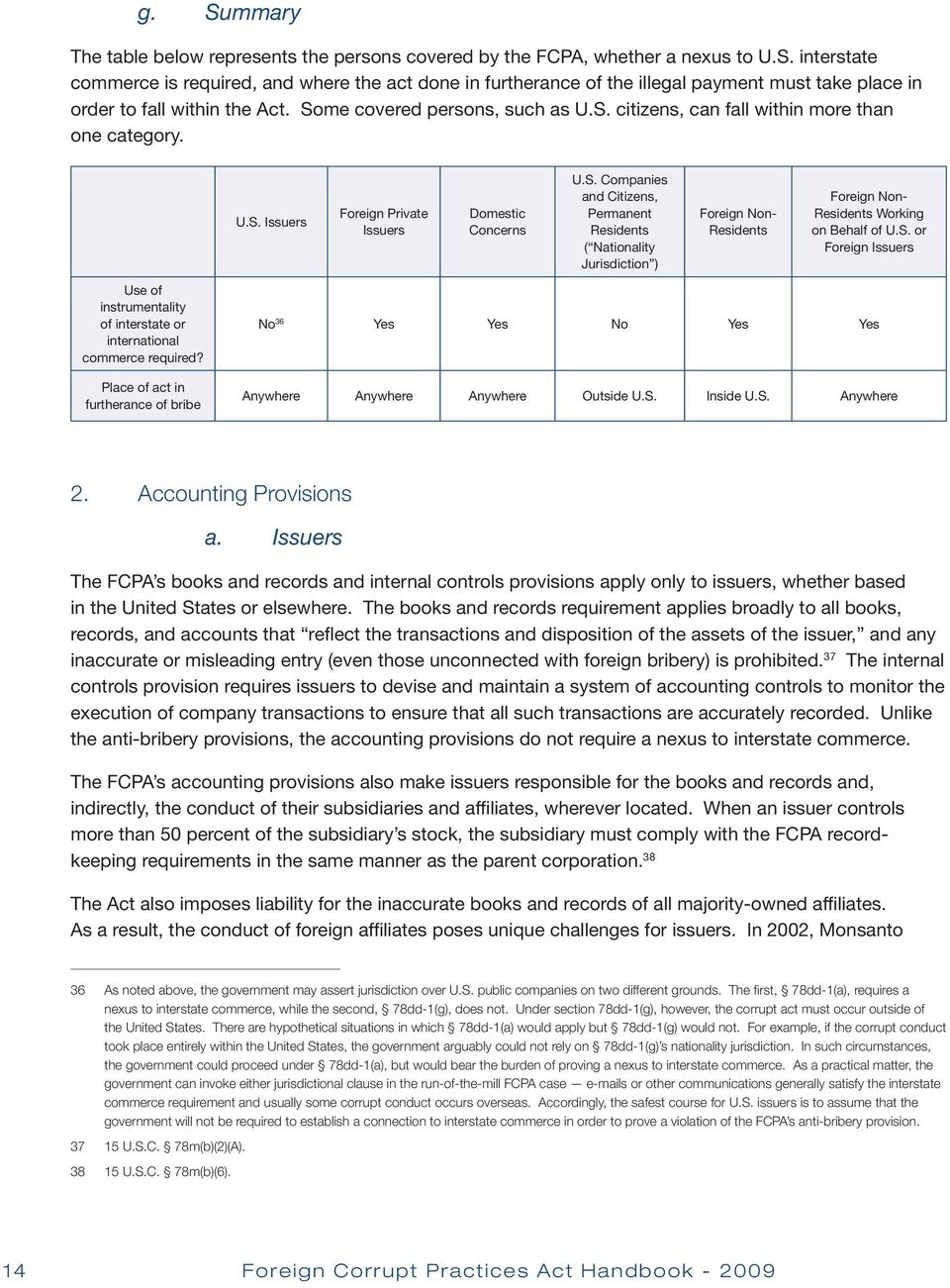
20 g. Summary The table below represents the persons covered by the FCPA, whether a nexus to U.S. interstate commerce is required, and where the act done in furtherance of the illegal payment must take place in order to fall within the Act. Some covered persons, such as U.S. citizens, can fall within more than one category. 36 U.S. Issuers Foreign Private Issuers Domestic Concerns U.S. Companies and Citizens, Permanent Residents ( Nationality Jurisdiction ) Foreign Non- Residents Foreign Non- Residents Working on Behalf of U.S. or Foreign Issuers Use of instrumentality of interstate or international commerce required? Place of act in furtherance of bribe No 36 Yes Yes No Yes Yes Anywhere Anywhere Anywhere Outside U.S. Inside U.S. Anywhere 2. Accounting Provisions a. Issuers The FCPA s books and records and internal controls provisions apply only to issuers, whether based in the United States or elsewhere. The books and records requirement applies broadly to all books, records, and accounts that reflect the transactions and disposition of the assets of the issuer, and any inaccurate or misleading entry (even those unconnected with foreign bribery) is prohibited. 37 The internal controls provision requires issuers to devise and maintain a system of accounting controls to monitor the execution of company transactions to ensure that all such transactions are accurately recorded. Unlike the anti-bribery provisions, the accounting provisions do not require a nexus to interstate commerce. The FCPA s accounting provisions also make issuers responsible for the books and records and, indirectly, the conduct of their subsidiaries and affiliates, wherever located. When an issuer controls more than 50 percent of the subsidiary s stock, the subsidiary must comply with the FCPA recordkeeping requirements in the same manner as the parent corporation. 38 The Act also imposes liability for the inaccurate books and records of all majority-owned affiliates. As a result, the conduct of foreign affiliates poses unique challenges for issuers. In 2002, Monsanto 36 As noted above, the government may assert jurisdiction over U.S. public companies on two different grounds. The first, 78dd-1(a), requires a nexus to interstate commerce, while the second, 78dd-1(g), does not. Under section 78dd-1(g), however, the corrupt act must occur outside of the United States. There are hypothetical situations in which 78dd-1(a) would apply but 78dd-1(g) would not. For example, if the corrupt conduct took place entirely within the United States, the government arguably could not rely on 78dd-1(g) s nationality jurisdiction. In such circumstances, the government could proceed under 78dd-1(a), but would bear the burden of proving a nexus to interstate commerce. As a practical matter, the government can invoke either jurisdictional clause in the run-of-the-mill FCPA case s or other communications generally satisfy the interstate commerce requirement and usually some corrupt conduct occurs overseas. Accordingly, the safest course for U.S. issuers is to assume that the government will not be required to establish a connection to interstate commerce in order to prove a violation of the FCPA s anti-bribery provision U.S.C. 78m(b)(2)(A) U.S.C. 78m(b)(6). 14 Foreign Corrupt Practices Act Handbook
21 Company discovered that two of its Indonesian affiliates, utilizing off-book slush funds, paid over $700,000 in bribes to government officials and inaccurately recorded the payments as bona fide services and product sales. 39 Monsanto incorporated these inaccurate books into its consolidated financials. Without admitting liability, the company agreed to pay a $500,000 civil penalty and a $1 million criminal fine. In another case, AB Volvo the Swedish transport company that trades ADRs on the NASDAQ settled an SEC action and entered into a DPA with the DOJ based on the conduct of two wholly-owned foreign subsidiaries in connection with the UN Oil-for-Food Program. 40 The government alleged that the subsidiaries paid government ministries, in the form of kickbacks, approximately 10 percent of the value of contracts awarded by the Iraqi government under the UN program. The subsidiaries improperly recorded these disbursements as payments to suppliers or commissions. AB Volvo subsequently incorporated these inaccurate books into its year-end financial statements. The company agreed to pay over $19.6 million in disgorgement, pre-judgment interest, and civil and criminal penalties to settle the actions. Liability under the books and records provision allows the government to reach payments far down the corporate chain and enforce improperly recorded payments to non-governmental entities. For example, the SEC brought an action against a U.S. company for the failure of a fifth-tier foreign subsidiary to book accurately payments to Indian officials where the payments were made without knowledge or approval of the U.S. parent. 41 In another case, a U.S. company settled with the government after its employees paid commercial bribes (in addition to payments to foreign officials) to sales managers of privatelyowned steel mills in China and South Korea. The payments violated the FCPA because they were improperly recorded as commissions or rebates. 42 The books and records provisions also permit the government to penalize issuers for purely foreign payments by foreign parties in circumstances where the government likely could not establish jurisdiction under the anti-bribery provisions. The Dow Chemical settlement provides one example of this. There, employees of one of Dow s Indian subsidiaries made payments to key members of a federal regulatory committee in connection with the registration of the subsidiary s agro-chemical products. 43 In addition, the subsidiary bribed thousands of state licensing officers, typically in increments of less than $100. The Indian subsidiary did not accurately record these payments in its books and records. The government likely lacked jurisdiction to bring a criminal or civil anti-bribery claim because the payments were made by Indian employees of an Indian corporation outside of the United States and, based on the publicly available information, there was no use (via , telephone or otherwise) of the instrumentalities of U.S. commerce. However, the failure of the subsidiary to record the payments accurately (i.e., as bribes) made it possible for the SEC to penalize the issuer for the underlying conduct of its subsidiary. Where an issuer holds less than 50 percent of the voting power, the accounting provisions require it to proceed in good faith to use its influence, to the extent reasonable under the issuer s circumstances, to 39 SEC v. Monsanto Co., No. 05-CV-14 (D.D.C. 2005). The DOJ s investigation of Monsanto was resolved through a NPA in Press Release, Department of Justice, Monsanto Company Charged with Bribing Indonesian Government Official: Prosecution Deferred for Three Years (January 6, 2005), available at 40 SEC v. AB Volvo, No. 08-CV-473 (D.D.C. 2008); United States v. Volvo Construction Equipment, AB, 08-CR-68 (D.D.C. 2008); United States v. Renault Truck SAS, 08-CR-68 (D.D.C. 2008). 41 SEC v. The Dow Chemical Co., No (D.D.C. 2007). 42 See United States v. SSI Int l Far East, Ltd., No. 06-CR-398 (D. Or. 2006). 43 SEC v. The Dow Chemical Co., No (D.D.C. 2007). Foreign Corrupt Practices Act Handbook
22 cause such domestic or foreign firm to devise and maintain a system of internal accounting controls. 44 What is reasonable under the circumstances will vary depending on the degree of control and the laws and practices of the country in which the subsidiary or affiliate is located. For example, while it may not be feasible to impose U.S.-style generally accepted accounting principles on a minority-owned foreign affiliate, U.S. enforcement authorities expect issuers to take prompt action upon discovery of corrupt payments. If the issuer can show good-faith efforts to use its influence, it will have presumptively fulfilled its legal obligation. In other contexts, the SEC has taken the position that an ownership interest of less than 50 percent may nonetheless confer control, depending on the relative shares of ownership and minority shareholder rights, such as the ability to block or veto certain activities, to appoint senior management, or to block a quorum. 45 A U.S. company capable of using such minority shareholder rights to exercise de facto control may thus face a greater burden under the accounting provisions. b. Individuals The accounting provisions also apply to individuals, including officers, directors, employees and shareholders of issuers, who cause the falsification of the issuer s books and records or fail to implement or circumvent required internal accounting controls. For a discussion of the elements of a violation of the accounting provisions, see Section II.B.3., infra. B. What are the Elements of a Violation of the FCPA? 1. Anti-bribery Provisions The FCPA s anti-bribery provision contains seven separate elements: a. An Act By a Covered Person As discussed above, the Act applies to U.S. and foreign issuers, domestic concerns, and foreign nonresidents who meet the various jurisdictional requirements. b. In Furtherance of an Offer, Payment, Promise to Pay, or Authorization of Payment While the FCPA requires an act, it is critical to note that it does not require that a payment or transfer be made. Merely offering or authorizing a bribe triggers liability under the FCPA, and the statute applies even if the foreign official never bestows the desired benefit. In Monsanto, the company authorized an employee of a consulting firm to pay a senior Indonesian environmental official $50,000 to rescind or amend a requirement that Monsanto s products undergo an environmental impact study. 46 U.S. enforcement authorities instituted proceedings despite the fact that the official never took any action in Monsanto s favor. c. Anything of Value There is no minimum threshold under the Act liability exists from the offer or payment of the first dollar U.S.C. 78m(b)(6). 45 See, e.g., Investment Company Act of (a)(9), Pub. L. No , 54 Stat. 789, 15 U.S.C. 80a-2(a)(9) (incorporating a presumption that any person who owns more than 25 percent of the voting securities of the company controls the company). 46 SEC v. Monsanto Co., No. 05-CV-14 (D.D.C. 2005). 16 Foreign Corrupt Practices Act Handbook
23 or dinar. Indeed, the government has pursued actions for the payment of as little as $43,000 in the aggregate. 47 In the Dow Chemical matter, the total payments exceeded $200,000 in the aggregate, but individual payments often amounted to less than $100 each. 48 Moreover, although the FCPA does not define anything of value, the term is as broad as it sounds, and is not limited to the offer or payment of money. Companies and individuals have faced liability for providing travel and entertainment, funneling money to the election campaign of a political candidate, paying for shopping excursions and medical expenses, and for arranging the services of prostitutes. Courts have also construed the phrase broadly in the context of domestic bribery prosecutions. 49 These cases teach that the relevant value is not an item s objective worth, but rather the subjective value attached by the recipient. Though the object may have little real value, corruption occurs when a public official agrees to misuse his office in the expectation of gain, whether or not he has correctly assessed the worth of the bribe. 50 In a noteworthy enforcement action, Schering-Plough, a New Jersey-based pharmaceutical company, settled books and records and internal controls charges brought by the SEC in connection with payments by its Polish subsidiary to the Chudow Castle Foundation, a charitable organization established to preserve and restore castles in Poland s Silesian region. 51 According to the SEC s complaint, Schering-Plough s subsidiary donated approximately $76,000 to the Foundation over a threeyear period. During this time, the Foundation s founder served as the director of the Silesian Health Fund, a government body that oversaw the procurement of medical supplies for regional hospitals. The SEC determined that Schering-Plough s employees provided false justifications for the donations and that the director did not view the payments as donations to a bona fide charity, but rather as dues intended to secure favorable treatment from the Health Fund. 52 While the SEC did not allege violations of the anti-bribery provisions (perhaps for jurisdictional reasons), it regarded the payments as an effort to influence official action by providing a benefit to an organization near and dear to the director. Recent enforcement actions have also focused on travel and entertainment provided to foreign government officials. In the Lucent Technologies matter, the government alleged that Lucent spent $10,000,000 over a three-year period to provide travel and other things of value to high-level employees of state-owned telecom companies in China. 53 These companies were existing customers or enterprises with which Lucent sought to do business. Lucent spent over $1.3 million dollars on pre-sale trips for foreign officials to attend seminars and visit Lucent facilities. Many of these trips consisted primarily of sightseeing and other leisure activities. Lucent also sponsored factory inspection tours. Lucent, however, had outsourced its manufacturing, and the trips valued at $25,000-$50,000 per person primarily constituted sightseeing in major U.S. cities, as well as tours of Universal Studios and Disneyland. Enforcement authorities viewed the skewed ratio between social outings and business meetings and Lucent s mischaracterization of the trips as improper. Again, while the DOJ did not pursue an anti-bribery prosecution, it found that the travel and entertainment constituted a thing of value that 47 SEC v. Delta & Pine Land Co., 07-CV_1352 (D.D.C. 2007). 48 SEC v. The Dow Chemical Co., No (D.D.C. 2007). Dow settled an accounting provisions case brought by the SEC, but it is unlikely that enforcement authorities would have pursued the matter unless they regarded the underlying payments as improper U.S.C See United States v. Gorman, 807 F.2d 1299, (6th Cir. 1986); United States v. Williams, 705 F.2d 603, (2d Cir. 1983). 50 Williams, 705 F.2d at SEC v. Schering-Plough Corp., 04-CV-945 (D.D.C. 2004). 52 In re Schering Plough Corp., SEC Administrative Procedure File No (June 9, 2004). 53 SEC v. Lucent Tech., Inc., 07-CV-2301 (D.D.C. 2007). Foreign Corrupt Practices Act Handbook
24 Lucent inaccurately recorded in its books and records. 54 Lucent settled the matter and paid penalties totaling $2.5 million. d. Directly or Indirectly As Monsanto illustrates, the FCPA prohibits doing indirectly what cannot legally be done directly. That is, a covered person cannot use third parties to circumvent the Act if it knows, or consciously disregards a high probability, of a corrupt payment made on its behalf. Congress specifically included a broad definition of knowledge to negate the head in the sand defense. In the largest FCPA settlement to date, an oil services company admitted that it, along with its wholly-owned subsidiary, paid millions of dollars in commissions to a consulting firm, an agent located on the Isle of Man. It did so knowing that the agent would transfer the funds to officials at the Kazakhstan national oil company in order to win a services contract on a massive drilling project. 55 The government has also targeted companies that paid agents with links to the government (who then bribed foreign officials) without conducting sufficient due diligence 56 and where officers disregarded evidence that a local distributor, who was not an agent or employee of the company, intended to make illicit payments to secure additional business. 57 These cases teach that companies cannot overlook suspicious conduct by consultants, subsidiaries, or agents and successfully claim that they did not know bribes had been paid. (See Chapter II.C.1 for a discussion of red flags that require further investigation.) e. To a Foreign Official Contrary to common assumptions, the FCPA does not only prohibit payments to elected government officials or ministers. The statutory definition of a foreign official is far broader, and includes any officer or employee of a foreign government, or any department, agency or instrumentality thereof, or of a public international organization, or to a foreign political party, official of a political party, or foreign political candidate. 58 This broad definition covers any employee of any branch of state, local, or federal government, including the judiciary, appointed as well as elected officials, the police and the military, and employees of state-owned or state-controlled enterprises. Although the statute does not define an instrumentality of foreign government, U.S. enforcement authorities have taken the position that the term includes state-owned or controlled commercial enterprises. There is no clear rule regarding what percentage of ownership triggers the coverage under the Act. At a minimum, any enterprise in which a foreign government owns more than 50 percent is likely an instrumentality of a foreign government, and its employees are therefore foreign officials for purposes of the FCPA. However, the percentage of ownership is just one of several factors that the government will consider in assessing the status of an entity under the act. Enforcement authorities will also consider such factors as the foreign state s own characterization of the enterprise and its 54 Deferred Prosecution Agreement between the United States Department of Justice and Lucent Technologies, Inc., Appendix A at 6, available at 55 United States v. Baker Hughes Servs. Int l, Inc., Criminal No. H (S.D. Tex. filed Apr. 11, 2007) (Information at 6, 12). 56 SEC v. The Titan Corp., Civ. Action No (D.D.C. filed Mar. 1, 2005) (Complaint at 1, 11). 57 SEC v. GE InVision, Inc., No. C (N.D. Cal. filed Feb. 14, 2005) (Complaint at 4). 58 The inclusion of public international organization in the definition of foreign official was another significant aspect of the 1998 amendment. The Act defines public international organization to include organizations in which the United States participates pursuant to any treaty or under any Act of Congress and designated by the President through appropriate Executive Order, through the International Organizations Immunities Act, Pub. L. No , 59 Stat. 669, 22 U.S.C. 288; or any other international organization specifically designated by the President by Executive Order. See 15 U.S.C. 78dd-1(f)(1). This includes organizations like the International Monetary Fund, the World Health Organization, and the International Committee of the Red Cross. 18 Foreign Corrupt Practices Act Handbook
25 employees, i.e., whether it prohibits and prosecutes bribery of the enterprise s employees as public corruption, the purpose of the enterprise, and the degree of control exercised over the enterprise by the foreign government. 59 Accordingly, even where the state owns less than 50 percent of an enterprise, if it can exercise effective control (such as through golden shares), it may be regarded as an instrumentality of government. In short, the FCPA prohibits more than the bribery of high government officials and includes improper payments to employees of state-owned or controlled enterprises. In many parts of the world, the state owns companies in a broad cross section of industries. As a result, payments which have little chance of distorting sovereign functions of government fall within the scope of the FCPA. Enforcement authorities have targeted improper payments made to employees at state-owned hospitals, 60 oil companies, 61 and steel mills, 62 members of political parties, and tax, customs or other regulatory officials. 63 Moreover, as the Schering-Plough example illustrates, though the Act applies to corrupt payments to individual officials or political parties, care must be taken to ensure that payments to other entities, such as a bona fide charities, do not provide value (psychic or otherwise) to foreign officials. f. Corruptly The FCPA criminalizes those payments intended to improperly influence a foreign official. The intent to secure a quid pro quo is essential. The individual offering the bribe must intend to buy the misuse of the foreign official s position, though there need not be an explicit agreement or meeting of the minds between offeror and offeree; it is enough for the offeror to intend such an exchange. 64 The need for corrupt intent overlaps with the requirement, discussed in subsections (g) and (h), that a payment be made to influence an official act or secure any improper advantage in an effort to win or retain business. The three elements are most sensible when applied in conjunction and should be read together. For instance, while courts have not yet addressed the issue, it is unlikely that a defendant could successfully argue that he did not intend a quid pro quo where the offer or payment to the foreign official could improperly aid his business in a direct way. The illicit nature of a payment may be inferred by, among other things, its lavishness, lack of transparency, whether the company has pending business before the government official or agency and, with respect to agents, whether the payment is commensurate with the work performed or expertise involved. In several written opinions issued in connection with the participation of foreign officials in conferences or promotional tours sponsored by U.S. companies, the DOJ has noted, in finding no FCPA violation, the importance of several of these factors, including, the lack of business with the relevant government agency; that the company played no role in selecting the government employees for the conference or tour; the officials did not have direct authority to award future contracts or licenses; the company paid all expenses for travel and accommodations directly or reimbursed the attendees only upon presentation of a receipt; the company paid, at most, only a modest per diem for expenses; 59 United States, Review of the Implementation of the [OECD] Convention and 1997 Recommendation at 6, available at dataoecd/16/50/ pdf. 60 United States v. Syncor Taiwan, Inc., No. CR (C.D. Cal. 2002). 61 United States v. Baker Hughes Servs. Int l, Inc., Criminal No. H (S.D. Tex. 2007). 62 United States v. SSI Int l Far East, Ltd., No. 06-CR-398 (D. Or. 2006). 63 See United States v. Kay, 359 F.3d 738 (5th Cir. 2004). 64 H.R. Re p. No (1977), reprinted in 1977 U.S.C.C.A.N. 4098; Stichting Ter Behartiging Van de Belangen Van Oudaandeelhouders In Het Kapitaal Van Saybolt International B.V. v. Schreiber, 327 F.3d 173, 183 (2d Cir. 2003); United States v. Kozeny, 493 F. Supp. 2d 693, 704 (S.D.N.Y. 2007). Foreign Corrupt Practices Act Handbook
26 spouses and family did not accompany the officials; and the total cost was reasonable under the circumstances. 65 g. For the Purpose of: Influencing Official Action or Decision, Inducing an Unlawful Act, Inducing Official Influence Over Government Action, or Securing Any Improper Advantage As noted in the previous subsection, the official action element is inter-related to the presence of corrupt intent and the requirement of a business nexus. When read together, the three elements require the intent to buy government action in order to secure business. Because the FCPA targets the misuse of official power, the offer or payment must implicate the individual s official authority. Accordingly, paying an agriculture minister to join Murder, Inc. is unlikely to violate the FCPA hiring him as an assassin does not tend to implicate his official duties, though it obviously violates a host of other laws while bribing the same official to award a contract is prohibited. Congress added improper advantage in 1998 in order to more closely track the language of the OECD Convention. As the court explained in United States v. Kay, the Convention s use of improper advantage refers to something to which the company concerned was not clearly entitled, for example, an operating permit for a factory which fails to meet the statutory requirements. 66 According to the Fifth Circuit, the 1998 amendments expanded the scope of the FCPA because the Act was no longer limited to bribes intended to buy any act or decision... [or] to induce the doing or omitting of an official function. The Kay defendants argued that the Act only covered improper payments intended to secure a specific government contract. Therefore, they contended, bribing Haitian officials in exchange for reduced customs and tax liability was permissible. The court disagreed and found that these bribes constitute[d] a type of payment that can fall within [the FCPA s] broad coverage. The court held that Congress intended for the FCPA to apply broadly to payments intended to assist the payor, either directly or indirectly, in obtaining or retaining business for some person. Lower taxes might allow the company to underbid competition or turn a bankruptcy-inducing loss into an operating profit. Recent enforcement actions and investigations have followed Kay s lead by targeting payments unrelated to a specific contract, including those seeking favorable tax or regulatory treatment. 67 The broadening of this element has correspondingly narrowed the facilitating payment exception discussed below, see infra at Section II.B.2.a. 2. What are the Exceptions and Defenses to FCPA s Anti-bribery Provision? a. Exception for Facilitating Payments The FCPA does not prohibit so-called facilitating (or grease ) payments intended to secure the performance of routine governmental action by a foreign official. The statute defines routine governmental action to mean only those actions that are ordinarily and commonly performed, including: Obtaining permits or licenses that qualify a person to do business in a foreign country; 65 See Department of Justice, FCPA Opinion Procedure Release Nos (July 24, 2007) and (Jan. 6, 2004). 66 United States v. Kay, 359 F.3d 738, (5th Cir. 2004). 67 See SEC v. The Dow Chemical Co., No (D.D.C. 2007); In re Bristow Grp., Inc., Administrative Proceeding File No (Sept. 26, 2007); Kay, 359 F.3d at 754; United States & SEC v. KPMG Siddharta Siddharta & Harsono and Sonny Harsono, No. H (S.D. Tex. 2001). 20 Foreign Corrupt Practices Act Handbook
27 Processing government papers, such as visas; Providing police protection, mail pick-up and delivery, or scheduling inspections or customs inspections; and Providing utility service, loading and unloading of cargo, or protecting perishable products from deterioration. Facilitating payments essentially cover ministerial acts that do not involve the exercise of discretion; the exception never applies to decisions by foreign officials to award or maintain business. Rather, the exception focuses on payments intended to obtain governmental action that is already required by law. However, even some actions that appear on their face to fall within the examples given above may be problematic under the FCPA. Kay emphasized the narrow scope of the facilitating payments exception: routine governmental action does not include the issuance of every official document or every inspection, but only (1) documentation that qualifies a party to do business and (2) scheduling an inspection very narrow categories of largely non-discretionary, ministerial activities performed by midor low-level foreign functionaries. 68 Moreover, the government strictly interprets this provision. Recent enforcement actions and investigations have focused on conduct potentially covered by the statutory exclusion, such as payments related to customs clearance, permits and licenses. At least one pending DOJ investigation appears to involve payments for military protection. 69 As a practical matter, the exception likely excludes anything more than small payments to low-level employees. And it does not relieve a company of its obligation to accurately record such payments nor excuse a company s violation of local law. Accordingly, where a covered person pays the stateowned power company a little extra to keep the lights on, it must record the true nature of the facilitating payment, even if by doing so it admits to a violation of the law of the foreign country. In this latter regard, it is important to stress that in many, if not most, countries, facilitating payments are illegal under local law, even if those laws are seldom enforced. Moreover, the OECD anti-bribery convention does not provide for facilitating payments, and a number of states-party have declined to include this exception in the treaty s implementing legislation. 70 What separates a permissible facilitating payment from a prohibited bribe depends on the facts of a particular case and often requires careful legal analysis. Recent enforcement in areas potentially excluded from the Act creates additional uncertainty. In light of these risks, front-line employees should not make decisions about the propriety of facilitating payments without first consulting with their legal or compliance department. For a discussion of compliance programs, see Chapter 4, infra. b. Defense of Lawfulness under Local Law The FCPA provides a defense to liability where the payment is lawful under the written laws and regulations of the foreign official s country. The written law requirement prevents reliance on prevailing business customs and practices, or even rules of a local business association, as a defense. In reality, 68 Kay, 359 F.3d at Tim Shorrock, Freeport Shareholders on the War Path, Asia Times, June 23, 2004, available at FF23Ae02.html. 70 See Organisation for Economic Cooperation and Development, Convention on Combating Bribery of Foreign Public Officials in International Business Transactions and Related Documents (Apr. 8, 1998), available at Organisation for Economic Cooperation and Development, OECD Anti-Bribery Convention: National Implementing Legislation, available at document/30/0,3343,en_2649_34859_ _1_1_1_1,00.html. Foreign Corrupt Practices Act Handbook
28 the laws of most countries even those where corruption runs rampant prohibit kickbacks or other corrupt payments. As a result, it is often difficult to obtain an ironclad opinion letter from local counsel that an otherwise corrupt payment is permitted by the laws of the foreign country. This defense may be most useful in situations where local law requires a company to take certain actions as a condition to doing business in the country. The expenditure, however, must match the scope of the law at issue. For example, where the law mandates foreign businesses to contribute to a sovereign education fund, making contributions to a foreign official s favorite educational foundation would go too far and likely fail as an affirmative defense to liability. c. Promotional Expenses i. Defense of Promotion of Products or Services The Act carves out a defense for the payment of reasonable and bona fide expenses of a foreign official, such as for travel or lodging, directly related to the promotion, demonstration, or explanation of products or services. This defense often comes into play in connection with promotional travel, meals, gifts, and other efforts related to business involving foreign governments or state-owned enterprises. The risks of promotional activity, and the ways to mitigate such risks, are discussed in greater detail in Section III.A.1., infra. ii. Defense of Performance of a Government Contract The second aspect of this defense permits the payment of reasonable and bona fide expenditures directly related to the execution or performance of a government contract. This defense frequently overlaps with the lawfulness under local law defense where the contract, such as an oil concession, is incorporated into local law. Under the contract, for example, government officials may receive reasonable travel expenses to inspect a factory or receive other reasonable payments directly related to the implementation of the agreement. The contract, however, must be with the state or a governmental agency and not with an individual or a political party. d. Absence of Necessary Element of an FCPA Violation By design, the facilitating payments exception and the two affirmative defenses offer only limited protection. Each is construed narrowly, and the burden of proving the defenses falls on the defendant. But, in addition to these carve outs, the absence of one of the seven elements of an FCPA violation also precludes liability. For example, payments made without a corrupt intent or to someone who does not satisfy the definition of a foreign official, do not contravene the Act. And, though not a formal defense, transparent conduct will, as a practical matter, dispel any inference of an improper motive. Avoiding FCPA pitfalls insufficient due diligence, retaining agents with close ties to government decisionmakers, or lavish goodwill tours for high foreign officials, to name a few can dispel the appearance of corruption and avoid FCPA issues before they arise. 3. Accounting Provisions a. In General The FCPA s accounting provisions consist of two sections. First, the books and records provisions require all issuers to make and keep books, records, and accounts, which, in reasonable detail, 22 Foreign Corrupt Practices Act Handbook
29 accurately and fairly reflect the transactions and dispositions of the assets of the issuer. 71 Second, the internal controls provisions require issuers to devise and maintain an adequate system of internal accounting controls. 72 Notwithstanding the name The Foreign Corrupt Practices Act, these provisions apply to wholly domestic transactional matters as well. In fact, the SEC brought one of the first enforcement actions under these provisions against Playboy Enterprises for entirely domestic conduct (the company failed to record accurately expenses incurred by Hugh Hefner). In addition, the accounting provisions apply to inaccurately recorded transactions with private as well as governmental entities. And, though these provisions apply directly to issuers, they also reach the conduct of employees and other persons who intentionally falsify an issuer s books and records or knowingly circumvent or fail to implement an issuer s internal controls. The accounting provisions have both a civil and, for knowing violations, a criminal component (see Section II.B.3.d, infra). Under the civil provisions, enforced principally by the SEC, the government has taken the position that the Act imposes strict liability on issuers. 73 If an issuer does not have adequate controls, or if its books and records contain any false, incomplete, or misleading entries, it faces civil penalties without any showing that it had knowledge of the underlying violation. Nor do the accounting provisions contain a materiality requirement. As in the Dow Chemical matter, the SEC may pursue matters involving the inaccurate recording of small payments that are not material to the books of the subsidiary or the issuer, even when aggregated over several years. The practical consequences can be far-reaching. When the DOJ cannot make out a criminal violation of the anti-bribery provisions, which requires proof of scienter, a books and records violation can be much easier to establish. Individuals also face civil liability for violations of the accounting provisions, often in ways that demonstrate the dramatic reach of the Act. 74 The government has targeted both the employees who caused a foreign subsidiary to book improper payments inaccurately and the issuer that incorporated its subsidiary s inaccurate records into its consolidated financial statements. 75 In a separate case, the SEC filed and settled a civil suit against four former employees of subsidiaries of a Swiss company for their role in bribing Nigerian oil officials and then attempting to cover their tracks by submitting phony invoices. 76 The employees, three UK citizens and an American, paid a combined penalty of $170,000. The government has also brought proceedings against employees (without charging the company) for circumventing applicable internal controls and for aiding and abetting the company s books and records violation U.S.C. 78m(b)(2)(A) U.S.C. 78m(b)(2)(B). 73 Brief for Securities and Exchange Commission, McConville v. SEC, 465 F.3d 780 (7th Cir. 2006); see also SEC v. McNulty, 137 F.3d 732, 736, 741 (2d Cir. 1998). McConville and McNulty involved books and records violations outside the context of foreign bribery. See Securities Exchange Act of , 48 Stat. 894, 15 U.S.C. 78m. 74 Securities and Exchange Act Rule 13b2-1, 17 C.F.R b SEC v. Fu, 07-CV-1735 (D.D.C. filed Sept. 27, 2007) (Complaint at 7); United States v. Syncor Taiwan, Inc., No. CR (C.D. Cal. 2002); SEC v. Syncor Int l Corp., No. 02-CV-2421 (D.D.C. 2002). 76 SEC v. Samson, Munro, Campbell & Whelan, No. 06-CV-1217 (D.D.C. 2006). 77 SEC v. Ott, No. 06-CV-4195 (D.N.J. 2006). Foreign Corrupt Practices Act Handbook
30 b. Books and Records Historically, the SEC has focused on whether the accounting records of a company accurately document certain types of transactions, even when such transactions are not illegal under the securities laws, including: political contributions; payments to government officials; commercial bribes or kickbacks; rebates to customers that are illegal or of questionable legality; violations of laws regulating alcohol, tobacco, drugs, narcotics, or firearms; violations of customs or currency control laws; income tax fraud; and self-dealing by insiders. It is important to note that the books and records of an issuer include not only its reported financial statements, but also records kept in the ordinary course of business, including things like proposed itineraries, expense reports, and even receipts used to support requests for reimbursement. As a result, such mundane things as including a phantom guest in seeking reimbursement for a company dinner or even failing to record every guest at such a dinner may constitute a books and records violation. 78 The documentation must correctly record not only the financial facts of the transaction itself but also such other information as may be necessary to give a reviewer a complete understanding of the significant aspects of the transaction. The FCPA requires that all reported information be reasonably current and in reasonable detail or maintained at such level of detail and degree of assurance as would satisfy prudent officials in the conduct of their own affairs. 79 This requirement is not meant to produce documentation far more extensive than ordinary course-of-business transactions. The SEC made it clear that neither inadvertent record-keeping mistakes nor record falsification that a company s management did not know of and that it reasonably should not have known of would give rise to prosecution. 80 But it is illegal to falsify, misrepresent, or omit information in the records kept under the FCPA. Following the enactment of the Act, the SEC announced rules to prohibit issuers from falsifying books and records and to prohibit officers or directors from misrepresenting, misleading, or omitting to state material facts in the preparation of these records. Records are inaccurate and violate the Act if they fail to record illegal or even improper transactions, or falsify or disguise such transactions. For example, in the Lucent matter described above, the company paid for lavish trips for employees of state-owned enterprises. Lucent booked many of these visits to its Factory Inspection Account even though 78 United States v. Jensen, 532 F. Supp. 2d 1187, (N.D. Ca. 2008) U.S.C. 78m(b)(7). 80 Zarin, supra note 3, at 2:2. 24 Foreign Corrupt Practices Act Handbook
31 the trip did not include a factory tour. 81 The accuracy of records also depends on the specificity of the description of the transaction. Literally true descriptions of commissions paid, entertainment expenses, or other expenditures are misleading under the Act if they are insufficiently detailed. 82 The books and records requirement also overlaps with the propriety of making facilitating payments (discussed in Section II.B.2.a., supra) because, even if the grease payment is legal under the anti-bribery provisions, a company violates the FCPA if it does not properly record the true nature of the payment. Because such payments are generally illegal in foreign countries, complying with the FCPA creates a record of a violation of local law. c. Internal Controls The Act requires public companies and their majority-owned affiliates to devise and maintain a system of internal accounting controls sufficient to provide reasonable assurances that: transactions are executed according to management s general or specific authorization; transactions are recorded as necessary to permit preparation of financial statements according to generally accepted standards and to maintain accountability for assets; access to assets is permitted only in accordance with management s general or specific authorization; and the recorded accountability for assets is compared with the existing assets at reasonable intervals, and appropriate action is taken with respect to any differences. Like the record keeping provision, the internal controls requirement has no materiality threshold, or any limit as to transactions above a certain value. The legislative history of the internal controls provision reveals that Congress expected management to estimate and evaluate cost-benefit relationships and reject controls that could not be justified economically. The factors that Congress expected management to consider include the size of the business, the diversity of operations, the degree of centralization of financial and operating management, and the amount of contact by top management with day-to-day operations. Thus, the SEC does not mandate any specific internal accounting controls. Instead, the test for compliance turns on whether an internal control system, taken as a whole, reasonably meets the statute s specified objectives. In the Lucent matter, enforcement authorities determined that the company had failed to develop sufficient internal accounting controls to monitor travel and entertainment provided to foreign officials or to ensure the accurate recording of such expenses. 83 d. Knowing Violations of the Accounting Provisions As discussed above, while the government has taken the position that companies may face strict liability for civil violations of the FCPA s accounting requirements, criminal responsibility arises only 81 Litigation Release No , SEC v. Lucent Technologies, Inc. (Dec. 21, 2007), available at lr20414.htm. 82 See id. 83 Deferred Prosecution Agreement between the United States Department of Justice and Lucent Technologies, Inc., Appendix A at 9, available at Foreign Corrupt Practices Act Handbook
32 for knowing violations. 84 In this context, courts have held that deliberate falsification constitutes knowledge under the Act. 85 The criminal provisions, enforced principally by the DOJ, provide severe penalties for willful violations. 86 Individuals can face a maximum $5 million fine and 20 years imprisonment, while the maximum fine for corporations is $25,000,000. In 2007, a subsidiary of Baker Hughes, Inc. a publicly traded oil services company agreed to pay an $11 million criminal fine, in part, for aiding and abetting its parent company s books and records violation. There, the subsidiary paid an agent over $4 million knowing that a significant portion of the funds would be transferred to employees of the Kazakhstan national oil company. 87 The subsidiary, BHSI, faced criminal liability under the Act s accounting provision because it recorded the payments as commissions, fees, or legal services, when it knew the agent would channel the funds to the Kazakh oil officials. The Baker Hughes matter illustrates the potential for criminal prosecution under both the anti-bribery and accounting provisions for using foreign agents as a conduit for illegal payments and then facilitating the inaccurate recording of such payments in an issuer s books and records. C. What are the Consequences of an FCPA Violation? 1. Fines, Imprisonment and Other Penalties The FCPA can result in criminal and civil liability for companies, and for their individual officers, directors, employees, and agents. Companies face fines and collateral consequences such as debarment from government business, while individuals risk imprisonment, fines, and other potential collateral consequences. Criminal sanctions can arise either from violations of the anti-bribery provisions or the accounting standards designed to reveal such illegal payments. Typically, individuals prosecuted criminally both intended to violate the Act and to conceal their conduct. The criminal penalties for violation of the anti-bribery provisions are: up to a $2 million fine per violation for public companies and domestic concerns; up to a $250,000 fine and five years in prison for individuals pursuant to 18 U.S.C. 3571(b); and alternative fines for corporate entities and individuals where there is gain to the defendant or loss to the victim equal to twice the amount of the total gain or loss pursuant to 18 U.S.C. 3571(d). These penalties can be imposed for each violation of the FCPA. The criminal penalties for willful violation of the books and records provision or willfully and knowingly making, or causing to be made, a false or misleading statement in any application, report, or document required to be filed are even more severe: for a natural person, up to a $5 million fine and 20 years in prison, or both; up to a $25 million fine for public companies; and 84 See Section II.B., supra. 85 Jensen, 532 F. Supp. 2d at ; United States v. Tarallo, 380 F.3d 1174, 1188 (9th Cir. 2004) U.S.C. 78m(b)(4) & (5); 78ff. 87 United States v. Baker Hughes Servs. Int l, Inc., Criminal No. H (S.D. Tex. 2007); see also SEC v. Baker Hughes Inc. and Roy Fearnley, No. H (S.D. Tex. filed Apr. 26, 2007) (Complaint at 1). 26 Foreign Corrupt Practices Act Handbook
33 alternative fines for corporate entities and individuals where there is gain to the defendant or loss to the victim equal to twice the amount of the total gain or loss pursuant to 18 U.S.C. 3571(d). These penalties can be imposed for each violation of the FCPA. The FCPA also allows a civil penalty of up to $10,000 against any firm or any of its officers, directors, employees, or agents violating the anti-bribery provisions of the FCPA. Civil penalties for violations of the accounting provisions can range from $5,000 to $100,000 for individuals, and $50,000 to $500,000 for corporations. The 1998 amendments eliminated the current disparity and penalties applicable to U.S. nationals and foreign nationals employed by or acting as agents of U.S. companies. Formerly, foreign nationals were subject only to civil penalties. With this new revision, all employees or agents of U.S. businesses are subject to both civil and criminal penalties. Both the DOJ and the SEC may obtain injunctions to prevent violations of the FCPA. Importantly, a host of other draconian sanctions under various other federal statutes might apply to violations of the Act, including federal contract debarment and the denial of export licenses. Additionally, the proceeds of FCPA violations and foreign corruption are money laundering predicates, and can thus expose violators to possible criminal liability under the money laundering and RICO statutes, as well as civil and criminal forfeiture and civil RICO actions if the proceeds are transported to or from the United States or pass through U.S. financial institutions. 2. Liability of Officers and Directors Employees and agents who actually make or offer bribes are not the only individuals subject to FCPA liability; officers and directors may also be liable for FCPA violations. Dozens of FCPA cases have imposed some form of liability on officers and directors. While some of these cases involve the anti-bribery provisions, most of the actions against directors and officers have been filed under the accounting provisions of the FCPA under the theory that individuals caused the company to record payments inaccurately or that they circumvented internal accounting controls. Although a corporation may sometimes indemnify its directors and officers for liability, the SEC takes the position that an issuer may not indemnify for liability under the federal securities laws, including the FCPA. 88 As discussed further below in Section IV.A., board oversight is increasingly considered an important element of directors duties. Oversight of the FCPA s provisions is arguably an important duty for directors, particularly given the potential magnitude of the monetary and intangible damage that a corporation may suffer in the event of a significant violation. In short, directors are well-advised to ensure the adequacy of corporate compliance programs as they relate to the FCPA. 3. Related Civil Litigation The disclosure of an FCPA investigation or enforcement action can lead to a variety of civil claims. Shareholders have instituted derivative suits. In May 2008, shareholders of Alcoa, Inc. sued the company and its officers and directors alleging that the company paid bribes to Bahraini government officials and employees of a state-owned metals company. 89 The lawsuit followed the filing of a civil complaint by the Government of Bahrain and the initiation of a criminal investigation by the DOJ. The plaintiffs asserted that the officers and directors misled shareholders about the company s business practices and its compliance with applicable anti-bribery laws. The complaint alleged that even if 88 See, e.g., Eichenholtz v. Brennan, 52 F.3d 478, 483 (3d Cir. 1995). 89 Hawaii Structural Ironworkers Pension Trust Fund, derivatively on behalf of Alcoa, Inc. v. Belda, 08-CV-614 (W.D. Pa. May 6, 2008). Foreign Corrupt Practices Act Handbook
34 the civil suit brought by the government of Bahrain was unsuccessful and the DOJ elected not to bring criminal charges, the [c]ompany will expend millions of dollars responding to the claims and/or investigating and disproving the charges, suffering immense reputational harm in the process. 90 The plaintiff s bar has also brought RICO claims with the accompanying threat of treble damages for alleged FCPA violations. Bribery qualifies as a predicate act and the laundering of the illegal payment through U.S. banks can also create liability under RICO. Plaintiffs may also look to state unfair competition laws to bring a claim in state court. And, in a recent trend, employees have alleged unlawful retaliation in wrongful termination suits for bringing corruption concerns to the attention of their former bosses. For a discussion of other laws that apply to FCPA enforcement, see Section E, infra. 4. Other Adverse Consequences Apart from statutory sanctions, there are other potential costs associated with foreign bribe payments. The cost of a major corporate internal investigation to determine why payments were made, to whom they were actually made, the circumstances under which they were made, and why payments were made in violation of the company s code of ethics is substantial. In fiscal year 2007 alone, Siemens reportedly paid over $500 million to outside attorneys and forensic accountants as part of a wideranging internal investigation. 91 Should bribe payments come to light during due diligence associated with a merger or other investment, the impact on both acquiring and target company can be extreme. Evidence of corrupt payments uncovered as part of Lockheed Martin s pre-acquisition due diligence cratered its proposed merger with Titan. A recent enforcement trend treats the proceeds of contracts tainted by violations of the Act as money laundering proceeds to be forfeited or disgorged. In this regard, acquiring tainted assets through an asset purchase or joint venture (rather than a merger or stock purchase) does not provide immunity from FCPA liability for the acquiring company. And any company violating the FCPA will incur additional substantial costs in settling with government enforcement agencies because such settlements often require that an independent outside expert review annually the adequacy of the company s future FCPA compliance. Moreover, the ability of a U.S. company to do business in a foreign country may be jeopardized. Even if the foreign country itself informally permits such payments, official reaction will be less favorable in light of the anti-corruption laws on the books of most countries, including those highly ranked on the Transparency International corruption index. (See discussion infra, Section VI.B.5.) The most painful sanctions for an FCPA violation may not be those imposed by law. Instead, they may be the loss of goodwill, negative impact on employee morale, and even the loss of jobs, including those of the CEO or the general counsel. Moreover, the negative publicity resulting from substantial penalties can have a direct effect on a company s stock price. 92 For this reason, prudent counsel often instructs clients to be sure that any payment, whether or not it violates the FCPA, is worth the cost of potentially adverse publicity that could appear on the front page of the Wall Street Journal or the New York Times. 90 Id. (Complaint at 1). 91 Mike Esterl, David Crawford & Nathan Koppel, Siemens Internal Review Hits Hurdles Costly Year-long Probe By New York Law Firm Turns Up Little Clarity, Wa l l St. J., Jan. 23, 2008, at A See Scott Lee et al., How is Corporate Misconduct Penalized? Enforcement Actions Through the Foreign Corrupt Practices Act, Texas A&M Univ. Private Enterprise Research Center Working Paper 0314, 2003, available at WorkingPapers03.htm# Foreign Corrupt Practices Act Handbook
35 D. What Other U.S. Laws are Relevant to FCPA Compliance and Enforcement? Companies should be mindful of other U.S. laws that can come into play in the FCPA enforcement arena. These laws fall into two categories: (1) laws that create affirmative obligations in the area of disclosure and compliance programs, principally the Sarbanes-Oxley Act; and (2) other U.S. laws that create collateral legal exposure, because they form the basis of alternative or supplemental charges in the context of anti-corruption (including FCPA) enforcement matters. 1. Separate Requirements Relating to Internal Controls and Compliance Programs: Sarbanes-Oxley a. The Sarbanes-Oxley Act of 2002 and SAB 99 Congress enacted the Sarbanes-Oxley Act in the summer of 2002 in response to several highly publicized corporate accounting scandals. Though it also focuses on record keeping and internal control requirements and reflects similar concerns, Sarbanes-Oxley supplements the obligations the FCPA imposes on public companies. Corporate Compliance Enhancements. Many provisions of the Sarbanes-Oxley Act mandate enhancements to corporate compliance programs. These are: Internal Controls Attestations Section 404. Section 404 of the Sarbanes-Oxley Act and Item 308 of Regulation S K require that certain public companies include in their annual reports an independent auditor s attestation of management s report as to the adequacy of the company s internal controls and procedures. Auditing standards promulgated by the Public Company Accounting Oversight Board pursuant to Section 404 recognize fraud-related controls as significant, and include guidance that focuses on procedures designed to reduce fraud. Issuers that fail to implement adequate controls will be unable to receive clean internal controls certifications. Section 302. This section, and the implementing regulations adopted by the SEC, require CEOs and CFOs to sign off on the accuracy of their companies financial statements, with severe civil and criminal penalties for false certifications. In practice, most prudent companies have adopted procedures that require lower-level employees involved in the oversight of financial reporting to certify as to the accuracy of reports under their purview, and so on, up the financial reporting chain. Code of Ethics Disclosure. Sarbanes-Oxley Section 406 and the SEC s implementing regulations require a public company to disclose whether it has adopted a written code of ethics that applies to its principal executive officer, principal financial officer, principal accounting officer or controller, or persons performing similar functions. 93 If the company has not adopted such a code of ethics, it must disclose the reason why it has not. These disclosures must appear in the company s annual report. In addition, a company must 93 Securities and Exchange Commission, Disclosure Required by Sections 406 and 407 of the Sarbanes-Oxley Act of 2002 (Jan. 31, 2003), 68 Fed. Reg. 5110, 5112, available at Foreign Corrupt Practices Act Handbook
36 disclose any change in, or waiver of, such a code within four business days of the event on Form 8 K. 94 Whistleblower Provisions Section 301 and Exchange Act Rule 10A-3. The audit committee of a public company must establish procedures for the receipt, retention, and treatment of complaints regarding accounting, internal accounting controls, or auditing matters. These procedures must include a way for employees to submit anonymous complaints regarding such matters. Section 806. This provision prohibits a company from taking any adverse employment action against, or otherwise discriminating against, employees who have provided information to a supervisor, federal agency, or a member or committee of Congress regarding potential violations of Sarbanes-Oxley, any rule or regulation of the SEC, or any federal law relating to fraud against shareholders. Section Under this provision, an employer or agent of the employer who intentionally retaliates against an employee who provides truthful information to a law enforcement officer relating to the commission or possible commission of any federal offense faces possible criminal sanctions. Up-the-Ladder Reporting by Counsel Under Section 307 and the SEC s implementing regulations, outside and in-house counsel who appear and practice before the SEC must report up-the-ladder evidence of material violations of the securities laws or breaches of fiduciary duty by the company or by any of its officers, directors, employees, or agents. 95 With respect to in-house counsel, these provisions require that any attorney report such evidence to the CLO or to both the CLO and CEO. 96 If the attorney does not receive a timely and appropriate response, the attorney then must report the evidence to the Audit Committee, another Board committee, or the full Board. Disclosure Requirements Sarbanes-Oxley not only requires enhancements to internal controls, it also may require companies to disclose in their SEC filings when they uncover FCPA violations. Because the FCPA does not explicitly require companies to disclose or report FCPA violations, some practitioners have taken the position that conducting an internal investigation, correcting books and records problems, imposing appropriate discipline, and documenting corrective action (in the event of a subsequent inquiry) satisfies a company s obligations upon learning of an FCPA violation. Sarbanes-Oxley, however, may create a pragmatic necessity to disclose the violation and corrective action. Where an FCPA violation occurred as a result of inadequate internal controls, the company will have to respond to those deficiencies and may have to disclose the failure of those controls as a material weakness. To the extent SEC implementing regulations would require a correction of the books that would be publicly disclosed, prudence could dictate voluntary disclosure to appropriate DOJ officials before such corrections are made public. 94 Rules of the NYSE and Nasdaq also require listed companies to adopt and disclose codes of business conduct. See Section 303A.10 of the NYSE Euronext Listed Company Manual and Rule 4350(n) of the Nasdaq Marketplace Rules C.F.R If the company has created a Qualified Legal Compliance Committee ( QLCC ), the attorney may report the evidence directly to the QLCC. 30 Foreign Corrupt Practices Act Handbook
37 Questions concerning the necessity of voluntary disclosure to DOJ are further complicated by Staff Accounting Bulletin No. 99 ( SAB 99 ), 97 which contains a qualitative materiality standard for disclosure. Under a strictly quantitative approach, violations involving small sums of money are unlikely to be material, particularly in the context of large corporations. (Though given increased penalties and new theories of forfeiture, even apparently small payments can result in significant liabilities.) These issues remain in flux, but warrant particular attention on a case-by-case basis in light of the evolving standards. 2. Laws that Create Collateral Consequences in FCPA Enforcement Matters Laws like the anti-money laundering statutes and economic sanctions laws are alternatives to prosecutors for situations when the FCPA is unavailable, either on jurisdictional grounds or because not all elements of a bribery charge are present. These laws may also form the basis for supplemental charges in the context of a bribery or FCPA books and records case. In addition, failures in managing FCPA compliance can cause or involve collateral exposure under other laws, such as the securities laws. a. Mail and Wire Fraud The government has also used the mail and wire fraud statutes to target private corruption. 98 The mail and wire fraud statutes offer a firm basis for supplemental charges in an FCPA enforcement matter. The wire fraud statute provides, in pertinent part: [w]hoever, having devised or intending to devise any scheme or artifice to defraud, or for obtaining money or property by means of false or fraudulent pretenses, representations, or promises, transmits or causes to be transmitted by means of wire communication in interstate commerce, any writings, signs, signals, pictures, or sounds for the purpose of executing such scheme or artifice, shall [be guilty of a crime]. 99 One recent example of the FCPA wire fraud overlap was the government s 2006 settlement of charges against Schnitzer Steel Industries, an Oregon-based steel company that sells scrap metal. In October of that year, the company entered into agreements with the DOJ and the SEC according to which its subsidiary would plead guilty to wire fraud stemming from bribes the subsidiary paid to managers of both government-controlled and privately owned steel mills in China to induce them to purchase scrap metal. The subsidiary paid the bribes with funds received from the U.S. parent via wire transfers into the subsidiary s bank accounts in South Korea. Although the FCPA s anti-bribery provisions did not cover the managers of the privately owned steel mills, the government alleged that the payments constituted mail and wire fraud because the bribes inflated the price of the scrap metal purchased by the customers; and therefore defrauded the companies that employed the recipients of the bribes. As part of the agreements, the subsidiary also agreed to plead guilty to violations of the FCPA s anti-bribery, books and records, and internal controls provisions, and pay a $7.5 million criminal fine, while Schnitzer agreed to pay a $7.7 million civil penalty for the corrupt deals. 100 The use of mail and wire statutes may signal a new zeal to prosecute commercial bribery abroad. Wire fraud has also been both an alternative and supplementary charge in prosecutions for schemes alleged to involve the siphoning of funds owed to national treasuries. In United States v. Chalmers, C.F.R. 211(b). 98 United States v. SSI Int l Far East, Ltd., No. 06-CR-398 (D. Or. 2006) USC Press Release, Department of Justice, Schnitzer Steel Industries Inc. s Subsidiary Pleads Guilty to Foreign Bribes and Agrees to Pay a $7.5 Million Criminal Fine (Oct. 16, 2006), available at In the Matter of Schnitzer Steel Industries, Inc., SEC Administrative Proceeding File No , Order Instituting Cease-and-Desist Proceedings, Exchange Act Release No (Oct. 16., 2006), available at Foreign Corrupt Practices Act Handbook
38 where the defendants were charged with making prohibited payments via wire to the Iraq government in order to secure rights to Iraqi oil under the UN Oil-for-Food Program, prosecutors charged the defendants with both wire fraud and violations of U.S. economic sanctions laws (discussed further below). Such payments allegedly defrauded the Iraqi people of the proceeds of Iraqi oil sales by sending the payments directly to Iraqi officials instead of the UN Oil-for-Food Program s escrow account, which was used to purchase humanitarian aid for Iraqi citizens. That case did not assert FCPA anti-bribery charges, apparently because the payments were made to the government and not individual government officials. 101 In United States v. Giffen, where prosecutors indicted the CEO of a New York merchant bank for bribing Kazakh officials, the bribery funds were allegedly transferred by wire into Swiss bank accounts held in the name of corporations controlled by the Kazakh officials. The funds included the monetary proceeds of oil transactions belonging to the Republic of Kazakhstan. Prosecutors alleged both wire fraud and violations of the FCPA s anti-bribery provisions in the indictment. The former allegations rested on the theory that the bribes sought to defraud the Republic and its citizens, at the expense of the bribe recipients. 102 More recently, a case involving supplementary wire fraud charges illustrated the DOJ s willingness to apply successor liability to FCPA cases. In SEC v. York Int l Corp., the government accused York International Corporation of conspiracy to commit wire fraud and violations of the books and records provisions for allowing its subsidiaries to make illicit payments to secure and maintain business opportunities worldwide, including bribery payments to United Arab Emirate government officials to influence the reward of government contracts and illicit consultancy payments made in the Middle East, Africa, Asia, and Europe to government officials. York ultimately entered into a DPA with the DOJ and paid $10 million criminal fine. At the same time, York entered into a settlement with the SEC and paid a $2 million civil fine, and $10 million in disgorgement to settle an SEC action. 103 b. RICO and State Unfair Competition Laws Conduct that violates the FCPA s anti-bribery provisions may supply the basis for a private cause of action for treble damages under RICO. Although the RICO statute specifically identifies bribery of public officials in the United States as a predicate act to a RICO violation, 104 some courts have accepted conduct in violation of the FCPA s anti-bribery provisions as also providing the necessary foundation for racketeering behavior in the context of civil litigation. 105 The relationship between civil RICO claims and conduct in violation of the FCPA s bribery statute is demonstrated in Robert W. Dziubl v. Cargill Inc. The plaintiff, a lawyer from California, sought damages in excess of $50 million arising out of a real estate joint venture in Thailand, claiming that Cargill had 101 United States v. Chalmers, 474 F. Supp. 2d 555 (S.D.N.Y. 2007). 102 United States v. Giffen, 473 F. 3d. 30 (2d Cir. 2006). 103 SEC v. York Int l Corp., No. 07-CV-1750 (D.D.C. 2007). The DOJ s investigation of York International Corp. was resolved through a DPA in Press Release, Department of Justice, Justice Department Agrees to Defer Prosecution of York International Corporation in Connection with Payment of Kickbacks Under the UN Oil-for-Food Program (October 1, 2007), available at U.S.C. 1961(1)(B). 105 See, e.g., Envtl. Tectonics v. W.S. Kirkpatrick, Inc., 847 F. 2d 1052, 1067 (3d. Cir. 1988) (violations of FCPA anti-bribery provision accepted as a predicate act under RICO), aff d on other grounds, 493 U.S. 400, 110 S. Ct 701 (1990); Dooley v. United Techs. Corp., 803 F. Supp. 428, (D.D.C. 1992) (allowing a plaintiff s FCPA bribery violation claim to serve as a predicate for his civil RICO action); but see Eisenberger v. Spectex Indus., Inc., 644 F. Supp. 48, 51 (E.D.N.Y. 1986) (refusing to recognize an FCPA accounting provision violation as a predicate offense in a civil RICO action). 32 Foreign Corrupt Practices Act Handbook
39 stolen his interest through a pattern of illegal action. One of the alleged illegal activities was Cargill s payment in 2000 of a $1.5 million bribe to a Thai politician to secure the politician s cooperation in removing opposition to a local real estate deal and forcing the plaintiff out of the joint venture, a payment the plaintiff alleged was in violation of the anti-bribery provisions of the FCPA. Although the court ultimately dismissed the case against Cargill after finding the plaintiff s claims subject to arbitration in Singapore, it left open the possibility for the plaintiff to challenge the award at the enforcement stage. 106 Civil RICO suits have also triggered internal corporate audits and federal investigations resulting in FCPA liability, even where a court found the original civil suit to have no merit. For example, after the filing of Nat l Group for Commc ns and Computers Ltd. v. Lucent Techs, Inc., 107 a civil RICO suit in which the plaintiff, a Saudi communications company, alleged that Lucent, in concert with others, bribed the Saudi Arabian telecommunications minister to cancel the company s contracts after it refused to pay Lucent and its Saudi Arabian partners kickbacks on construction contracts, the DOJ and SEC launched investigations into potential FCPA violations arising out of Lucent s Saudi operations. 108 Lucent itself subsequently undertook a sweeping internal review of its business activity in more than 20 countries, uncovering potential violations of the FCPA in Lucent s China unit and resulting in the dismissal of that operation s President and the Chief Operating Officer. 109 After Lucent disclosed these activities to U.S. government officials in late 2007, it agreed to pay a total of $2.5 million in fines to settle claims with the DOJ and the SEC that its China activities violated the FCPA s anti-bribery and internal control provisions. 110 Ironically, one year prior to the settlement, the trial court in 2006 dismissed the original civil RICO suit based on the expiry of the statute of limitations and the plaintiff s failure to allege adequately an enterprise as required for a RICO violation. 111 Plaintiffs have also used civil RICO suits as a prophylactic measure against federal investigation, employing litigation as a way to assert their own innocence of violations of FCPA anti-bribery provisions. For example, in Grynberg v. BP P.L.C., Grynberg Production Corporation, a U.S. oil and natural gas company owned and operated by Jack Grynberg, filed suit under RICO against its partners British Petroleum, its former Chairman, its former CEO, and its current CEO, alleging that defendants used funds attributed to Grynberg through joint ventures without his knowledge to bribe Kazakh officials as part of a larger scheme to influence their disposition of national natural resource assets. 112 According to the complaint, [t]he Foreign Corrupt Practices Act not only bar[s] this type of activity directly but at the same time compel[s] both the corporate Plaintiffs and Jack J. Grynberg to take independent action to disassociate themselves, in their contractual capacity, from these illegal acts. 113 Indeed, Mr. Grynberg has indicated in published reports that he brought the suit precisely because he wanted to ward off possible DOJ bribery charges: Unless I assert that I was an unwilling participant in this, my neck could be on the line. I m too old to go to prison, said Mr. Grynberg, who is Dzibula v. Cargill Inc., No. CV (C. D. Cal. filed July 14, 2004) (Order granting Cargill s dismissal). 107 Nat l Group for Commc ns and Computers Ltd. v. Lucent Techs, Inc., 420 F. Supp. 2d 253 (S.D.N.Y. 2006). 108 Christopher Rhoads, Royal Treatment: Lucent Faces Bribery In Giant Saudi Telecom Project, Wa l l St. J., November 16, 2004, at A Id. 110 Press Release, Department of Justice, Lucent Technologies Inc. Agrees to Pay $1 Million Fine to Resolve FCPA Allegations (Dec. 21, 2007), available at Nat l Group for Commc ns and Computers Ltd. v. Lucent Techs, Inc., 420 F. Supp. 2d 253, 273 (S.D.N.Y. 2006). 112 Grynberg v. BP P.L.C., No. 08-CV-301 (D.D.C. 2008). 113 Grynberg v. BP P.L.C., No. 08-CV-301 (D.D.C. filed Feb. 21, 2008) (Complaint at 14). 114 James Quinn, Oil BP and its bosses sued over alleged bribery of officials, Th e Da i l y Te l e g r a p h, April 10, 2008, at p. 3. Foreign Corrupt Practices Act Handbook
40 c. Anti-Money Laundering Law Numerous enforcement actions arising from foreign bribery include money laundering charges either in lieu of an FCPA charge, or as supplementary charges. Even where the FCPA does not itself reach the activity in question, acts of bribery may provide a predicate to money laundering charges under U.S. law, provided that other jurisdictional bases are satisfied. Under 18 U.S.C. 1957, if one knowingly engages in a transaction involving criminally derived property, that is a separate anti-money laundering offense. More specifically, the anti-money laundering statute provides in relevant part: (a) Whoever, in any of the circumstances set forth in subsection (d), knowingly engages or attempts to engage in a monetary transaction in criminally derived property of a value greater than $10,000 and is derived from specified unlawful activity, shall be punished as provided in subsection (b). The term criminally derived from means any property constituting, or derived from, proceeds obtained from a criminal offense. The term specified unlawful activity, defined in section 1956, includes bribery of a public official, or the misappropriation, theft, or embezzlement of public funds by or for the benefit of a public official. 115 In United States v. Giffen, federal prosecutors charged James Giffen, the principal shareholder, board chairman and CEO of Mercator Corp., a New York merchant bank, with, among other things, violation of the anti-bribery provisions of the FCPA and money-laundering for $80 million in bribes allegedly paid to government officials in Kazakhstan to influence and maintain Mercator s standing as advisor to the Kazakh government on the disposition of national natural resource assets. Giffen allegedly created Swiss bank accounts in the names of offshore companies owned by the officials or members of their families, and made payments into those accounts from fees that he and Mercator received in oil deals they brokered for the Republic, as well as from escrow accounts holding payments due the Republic from oil transactions. These deposits were alleged to be bribes, disguised in some cases as loans or as payments of the fees of consultants who had helped negotiate oil deals for Kazakhstan. 116 In United States v. Bodmer, prosecutors charged Hans Bodmer, a Swiss lawyer, with conspiracy to launder money and violate the FCPA s anti-bribery provisions for his participation in a scheme to bribe officials in the Azerbaijan government so as to secure a controlling interest in the State Oil Company of Azerbaijan ( SOCAR ) for his client, an investment consortium that included U.S. investors. Bodmer allegedly opened Swiss bank accounts and used his law firm s client account at a Swiss bank, where he sat on the board of directors, to launder millions of dollars in furtherance of the scheme, and transferred the bribery funds by charter jet and wire through banks in Switzerland, the Netherlands, and the United Arab Emirates. Although the trial court dismissed the FCPA charges on the grounds that the pre-1998 version of the FCPA did not give fair notice that its criminal penalties applied to the conduct of a nonresident foreign national who acted as an agent for a domestic concern, the court refused to dismiss the money-laundering charge, judging the conduct alleged was sufficient on its own to substantiate a violation of the money-laundering statute because it promoted unlawful activity. 117 In United States v. Kozeny, the government prosecuted certain members of Bodmer s investment consortium for violations of the FCPA, anti-money laundering laws and the Travel Act (discussed below). The government alleged in part that the defendant U.S. investors had provided financing to the consortium based in part on the knowledge that defendant Viktor Kozeny, President and Chairman U.S.C. 1956(c)(7)(B)(iv). 116 United States v. Giffen, 473 F.3d 30 (2d Cir. 2006). 117 United States v. Bodmer, 342 F. Supp. 2d 176 (S.D.N.Y. 2004). 34 Foreign Corrupt Practices Act Handbook
41 of two companies participating in the consortium, had paid and would pay bribes to Azeri officials to ensure SOCAR s privatization and the investment consortium s participation in the privatization. 118 The bribes took the form of cash, shares of profits from SOCAR s privatization, vouchers and options, wire transfers, stock, personal items, medical expenses, and other things of value. Although the trial court originally dismissed the charges as time-barred by the general five-year non-capital offense statute of limitations, it reinstated some of the charges upon reconsideration, including the charges of conspiracy to violate the FCPA, the Travel Act, and to launder money. The case is currently adjourned pending the appellate court s resolution of a challenge to the trial court s reinstatement order. Even in foreign public corruption cases where FCPA charges are not possible for jurisdictional reasons, such as because no one involved in the original scheme had sufficient contacts with the United States to invoke the statute s jurisdiction, anti-money laundering charges are possible provided the funds in the scheme subsequently have contact with the United States. For instance, in United States v. Proceeds of Crime Transferred to Certain Domestic Fin. Accounts, the court granted the government s forfeiture request alleging violations of U.S. anti-money laundering law on the basis of the transfer into U.S. banks of funds obtained through the bribery of an Italian public official by Italian citizens. The government alleged the U.S. accounts were used to conceal the source or ownership of a portion of the proceeds of a fraudulently obtained Italian appeals court damages award of approximately $575.9 million, where the presiding judge received payments to fix the case s outcome and whose conviction for bribery in judicial acts the Supreme Court of Italy upheld in Although this was a civil forfeiture action to recover the funds, the logic underlying the action would likely support criminal money laundering charges against the parties responsible for transferring the funds with the intent to conceal them. 119 Similarly, in United States v. Lazarenko, prosecutors charged the defendant, a former Ukrainian prime minister whose corrupt acts resulted in the misappropriation of millions of dollars in public funds during his tenure in office, with wire fraud and money-laundering for transferring the misappropriated proceeds to banks in San Francisco. Although the defendant s corrupt acts did not involve U.S. persons, and therefore did not implicate the FCPA, the government s action shows U.S. prosecutors aggressive attitude toward halting foreign public corruption by using any contacts that the fruits of the corrupt activity have with the United States as grounds for prosecution. 120 For Lazarenko, the government s efforts resulted in a conviction on the money laundering and wire fraud charges, a nine-year prison sentence, and a fine of $10 million. 121 d. U.S. Economic Sanctions The recent international corruption cases involving corporate payments of illegal surcharges to the Iraqi government in order to secure rights to Iraqi oil as part of the UN Oil-for-Food Program also implicate 118 United States v. Kozeny, 493 F. Supp. 2d 693 (S.D.N.Y. 2007). 119 United States v. Proceeds of Crime Transferred to Certain Domestic Fin. Accounts, No CIV (S.D. Fla. 2007). 120 United States v. Lazarenko, No. CR , 2004 U.S. Dist. LEXIS (N.D. Cal. May 7, 2004). 121 Jesse McKinley, World Briefing Europe: Ukraine: 9 Years in U.S. Prison For Ex-Premier, N.Y. Tim e s, August 26, 2006, at A2. Foreign Corrupt Practices Act Handbook
42 U.S. economic sanctions laws. 122 Under that program, UN-designated officials set the sale price of Iraqi oil in consultation with private traders and the Iraqi government retained the right to choose which traders would receive the rights to buy its oil at the set price. All proceeds from the sale of Iraqi oil were to be deposited into an escrow account used for the purchase of humanitarian goods for the Iraqi people. However, many buyers of Iraqi oil ended up paying secret surcharges directly to the Iraqi government in order to influence the government s choice of who would secure the oil purchase rights. Such payments were illegal under various UN Security Council Resolutions and the U.S. Iraq Sanctions Regulations, which, among other things, prohibited unlicensed financial transactions with the Iraqi government. In United States v. Chalmers, for example, prosecutors accused defendant David Chalmers, a U.S. citizen and sole shareholder of defendant Bayoil Sales and Trading (a Bahamanian company), and defendant Oscar Wyatt (a U.S. citizen), among others, with making illegal surcharge payments and facilitating the Iraqi government s plan to enable the payment of these surcharges on Iraqi oil. Some of the surcharges were allegedly funneled through inflated commission charges on transactions for rights to Iraqi oil that, based on instructions from Iraqi officials, representatives of Bayoil Sales and Trading sent through wire transfers to an account in the United Arab Emirates in the name of a company operating as a front for the Iraqi government. These illegal payments violated the Iraq Sanctions Regulations ban on unlicensed financial transactions with the Iraqi government. Although the district court ultimately dismissed the sanctions charges against Bayoil Sales and Trading on the grounds that, as a Bahamanian company, it was not a U.S. person and therefore not subject to the regulations, the case proceeds against the remaining defendants. 123 The U.S. government has resolved several of the Oil-for-Food cases through settlements. On February 21, 2008, Flowserve (a supplier of equipment and services for the power, oil, gas, and chemical industries) agreed to pay $10.5 million to settle DOJ and SEC claims of conspiracy to commit wire fraud and violation of the FCPA books and records provisions and acknowledged responsibility for its subsidiary s alleged payment, between 2002 and 2003, of over $600,000 in kickbacks to the Iraqi government in order to obtain contracts for the sale of large-scale water pumps and spare parts for use in Iraqi oil refineries. 124 On November 8, 2007, Chevron Corporation, a full-service petroleum products company, entered into an NPA with the DOJ, OFAC, and the New York District Attorney s Office ( NYDA ) under which the DOJ, OFAC, and the NYDA agreed not to charge Chevron in connection with allegations that it made $20 million in illegal surcharge payments as part of its purchase of Iraqi oil through third-party contractors participating in the UN Oil-for-Food Program. Under the settlement, Chevron agreed to pay $27 million in fines and forfeitures, which the court raised to $28 million, including 122 The United States maintains economic sanctions against a number of countries. The countries currently targeted by comprehensive U.S. sanctions are Cuba, Iran, and Sudan, while transactions involving Burma, North Korea, and Syria are subject to certain less comprehensive restrictions. Comprehensive sanctions against Iraq and Libya were lifted in 2003 and 2004, respectively. U.S. laws also restrict or prohibit business by U.S. persons with certain specific individuals and entities, wherever they may be located. The U.S. Treasury Department s Office Foreign Assets Control ( OFAC ) and the State Department both play a role in implementing economic sanctions programs. The comprehensive sanctions programs prohibit virtually all business transactions between sanctioned countries/entities and U.S. persons. These include transactions in connection with the export or import of goods, services and technology to or from sanctioned countries, and dealing in goods originating in sanctioned countries. Most financial transactions involving sanctioned entities and countries are also prohibited. In some cases, the OFAC regulations serve to block assets subject to U.S. jurisdiction in which a sanctioned government or person has an interest. 123 United States v. Chalmers, 474 F. Supp. 2d 555 (S.D.N.Y. 2007). 124 Press Release, Department of Justice, Flowserve Corporation to Pay $4 Million Penalty for Kickback Payments to the Iraqi government under the UN Oil-for-Food Program (Feb. 21, 2008), available at 36 Foreign Corrupt Practices Act Handbook
43 $3 million to settle any violations of the Iraqi Sanctions Regulations. 125 The SEC had originally charged Chevron with violations of the FCPA s books and records and internal control provisions for its failure to enforce a company-wide policy prohibiting the payment of surcharges in connection with the purchase of Iraqi oil from third parties and its improper recording of the surcharge payments as premiums. On February 7, 2007, the SEC and DOJ reached agreements with publicly traded El Paso Corporation regarding allegations that it paid approximately $5.5 million in illegal surcharges to the former government of Iraq between June 2001 and June 2002 in connection with purchases of crude oil from third parties under the United Nations Oil-for-Food Program. 126 The SEC filed FCPA books and records and internal controls charges against El Paso and ordered the company to pay a civil penalty of $2.25 million. The U.S. Attorney s Office for the Southern District of New York entered into an NPA with El Paso in which El Paso agreed to forfeit an additional $5,482,363. None of these cases originally involved allegations of violations of FCPA anti-bribery provisions, presumably because (as with Chalmers) prosecutors concluded that they could not prove that the payments were made to a foreign official as required under the FCPA. These cases did, however, involve charges under the Iraqi Sanctions Regulations. e. Travel Act The Travel Act prohibits travel or the use of the mail or any facility in foreign commerce with the intent to, among other things, promote or facilitate the promotion or carrying on of unlawful activity. 127 Under the Act, unlawful activity includes bribery in violation of the laws of the United States. 128 Consequently, FCPA violations that involve travel, use of the mails or any facility in foreign commerce generally implicate the terms of the Travel Act. In Kozeny, for example, the reinstated charges of conspiracy to violate the Travel Act arose from the payment of the medical expenses of an Azeri official as part of the bribery scheme. Moreover, since violations of the Travel Act serve as predicate acts to RICO violations, 129 conduct in violation of the FCPA that also violates the Travel Act may give rise to RICO claims. 130 f. SEC Disclosure Rules One notable example of collateral exposure is in the securities arena, where inaccurate FCPA disclosures have lead to claims under Section 10(b) of the Securities Exchange Act of The FCPA contains no private right of action. However, in the past few years companies have nevertheless faced lawsuits based on violations of the FCPA, but framed as violations of Section 10(b) of the Exchange Act and Rule 10b-5 thereunder. These actions have been filed at different times during the process of an FCPA investigation. In Immucor, 131 plaintiffs sued the company and two of its officers. The complaint alleged that between August 16, 2004 and August 29, 2005, the defendants made numerous statements about corruption problems at Immucor s Italian subsidiary. Specifically, the plaintiffs alleged that the 125 SEC v. Chevron Corp., No. 07-CV (S.D.N.Y. 2007); see also Litigation Release No , SEC v. Chevron Corp. (Nov. 14, 2007), available at Litigation Release No , SEC v. El Paso Corp. (Feb. 7, 2007), available at U.S.C. 1952(a)(3) U.S.C. 1952(b) USC 1961(1)(B). 130 See, e.g., Dooley v. United Techs Corp., 803 F. Supp. 428, 440 (D.D.C. 1992) (permitting plaintiff s civil RICO claim on basis that the predicate Travel Act violation may arise as a result of the defendant falling under the jurisdiction of the FCPA). 131 In re Immucor Inc. Sec. Litig., No. 05-CV-2276, 2006 WL (N.D. Ga. Oct. 4, 2006). Foreign Corrupt Practices Act Handbook
44 defendants misrepresented to investors an overly optimistic assessment of Immucor s corrupt foreign business practices and the strength of Immucor s internal control mechanisms. The defendants moved to dismiss the complaint contending that the complaint failed to allege any false or misleading statements. The district court denied the motion to dismiss as to several of the allegedly misleading statements. The company had disclosed the existence of an Italian criminal investigation and an internal investigation of allegedly improper payments. Nevertheless, the Judge found that these disclosures created the impression that the investigation was limited to a single incident of poor bookkeeping by Immucor. The court stated that plaintiffs allege that multiple legally dubious payments made by De Chirico [the former head of the Italian subsidiary and CEO at the time the alleged misstatements were made] or under his direction were being investigated. The omission creates a distorted picture of Immucor s alleged liabilities. That is, while parts of the disclosure may have been accurate, Defendants duty was to describe fully the nature and scope of the conduct under investigation There are some significant conclusions to be drawn from this decision. First, upon discovering a potential FCPA issue a company must quickly determine all the facts and its potential exposure. If the problem is serious, the company may have little choice but to disclose the issue. Once that determination is made, a full and accurate disclosure to investors should be made. In addition, since the DOJ and SEC monitor corporate filings, a voluntary disclosure to the government should also occur. 133 Second, if, during the course of the investigation, additional facts come to light which suggest that the initial disclosure, albeit accurate at the time, is now inaccurate, an updated disclosure should be considered. This principle is particularly important if the company is in the process of a merger, and disclosures concerning the FCPA are included in proxy materials. Such was the case in 2003, with Lockheed Martin s acquisition (ultimately scuttled) of the Titan Corporation. On September 15, 2003, Titan became a party to a merger agreement, in which Lockheed Martin agreed to acquire Titan, pending certain contingencies. Titan affirmatively represented in the merger agreement that: To the knowledge of the Company, neither Company nor any of its Subsidiaries, nor any director, officer, agent or employee of the Company or any of its Subsidiaries, has taken any action which would cause the Company or any of its Subsidiaries to be in violation of the Foreign Corrupt Practices Act of 1977, as amended, or any applicable law of similar effect. Ultimately, Titan settled an enforcement action with the SEC and the DOJ by paying over $28 million in fines, penalties and disgorgement. At the same time as the enforcement action, the SEC issued a report pursuant to Section 21(a) of the Exchange Act. In that report the SEC stated that: When an issuer makes a public disclosure of information via filing a proxy statement or otherwise the issuer is required to consider whether additional disclosure is necessary in order to put the information 132 Id. at * In its recent statement on whether to impose corporate penalties, the SEC stated [e]ffective compliance with the securities laws depends upon vigilant supervision, monitoring, and reporting of violations. When securities law violations are discovered, it is incumbent upon management to report them to the Commission and to other appropriate law enforcement authorities. Press Release, Securities and Exchange Commission, Statement of the Securities and Exchange Commission Concerning Financial Penalties (Jan. 4, 2006), available at While often overlooked, this statement appears to impose an affirmative obligation upon companies to disclose violations. Moreover, the Commission views that obligation as an important consideration of whether to impose a penalty. 38 Foreign Corrupt Practices Act Handbook
45 contained in, or otherwise incorporated into that publication, into context so that such information is not misleading....[accordingly]... if additional material facts exist, such as those contradicting or qualifying the disclosure of the original representation..., omission of which makes that disclosure misleading, a company would also be required to disclose those facts Securities and Exchange Commission, Report of Investigation Pursuant to Section 21(a) of the Securities Exchange Act of 1934 and Commission Statement on Potential Exchange Act Section 10(b) and Section 14(a) liability, Exchange Act Release No (Mar. 1, 2005), available at Foreign Corrupt Practices Act Handbook
46 III. The FCPA in Context The best way to understand the breadth of the FCPA and its consequences for American businesses abroad is to examine how it has been enforced. In the absence of more than a few court opinions, past settled enforcement actions provide the most substantial guidance for the interpretation of the statute. Since 2001, the DOJ has brought 24 criminal actions against corporations, 14 of those in The SEC, with overlapping FCPA enforcement jurisdiction against issuers, has brought 54 enforcement actions since 1995, 16 of those in From these cases, patterns emerge regarding the government s enforcement priorities and its interpretation of the statute s scope. The DOJ also provides guidance on particular circumstances through the opinion release process. Under this procedure, companies may submit factual scenarios to the DOJ, which will review the request and issue an opinion announcing whether it would take any action based on the facts presented. The publicly released opinions provide guidance on both the limits of the FCPA and acceptable compliance practices. Lessons learned from enforcement actions and opinion releases provide insights into the scope of this complex statute and provide a context within which companies can more ably develop and implement an effective compliance program. Because few of the critical concepts in the statute have received any judicial interpretation, the settlements between companies and the government, while useful, do not provide authoritative determinations of the FCPA. Instead, they represent the government s likely contentions in future litigation. A. Common Misunderstandings about the Breadth of the FCPA: Promotional Expenses, Taxes and Fees, and Payments Made Pursuant to a Contract Among the areas that create significant compliance headaches and have been the focus of recent enforcement actions and many DOJ opinion releases are gifts and entertainment unrelated to the specific promotion of a company s products or services, the FCPA s affirmative defense for reasonable promotion expenses and the payment of fees and taxes. As many companies have discovered after pushing the envelope in these areas, the scope of permissible payments is limited, and the government enforces that narrow scope. The cases discussed below illustrate how difficult it can be to manage the risks associated with these types of payments. 1. Non-Corrupt Expenditures to Foreign Officials for Gifts and Entertainment Unrelated to Promotions The FCPA does not prohibit the giving of gifts and entertainment to foreign officials if they are not given with a corrupt intent or for the purpose of obtaining or retaining business. Accordingly, companies may provide gifts, entertainment, and travel to foreign officials, but should ensure that the value and all the relevant circumstances of the gifts and entertainment do not allow the government to draw a negative inference and suggest that the items were provided with a corrupt intent. Those circumstances will include the value of the gift, whether it is permitted under local law, the past history of any items of value provided to the official, the business pending before the official, whether there is evidence of a quid pro quo, and whether the items of value were requested by the official. In the past, the DOJ has indicated that it will not take enforcement action where there was no indication 40 Foreign Corrupt Practices Act Handbook
47 of corrupt intent. One of the strongest indicators of a lack of corrupt intent is a lack of business before the foreign government agency. In Opinion Release 96-01, for example, an American nonprofit corporation proposed to pay for up to ten government officials to attend environmental training in the United States. 135 The non-profit, by the nature of its business, was not interested in obtaining or retaining business with the regional governments of the officials. The DOJ notified the corporation that it would take no enforcement action with respect to the proposed trip. In 2004, the DOJ addressed expenditures for travel in three different opinions. In Opinion Releases 04-01, 04-03, and 04-04, the Department responded to requests from an American company and two U.S. law firms to review proposals for these entities to pay the costs of trips by foreign officials. 136 The officials were to participate in the trips to meet their U.S. counterparts, attend a seminar, and conduct a fact-finding mission. For each of the trips, the companies represented that they had allowed the foreign government to select the officials who would attend, that the company intended to pay all costs directly to the providers or reimburse costs incurred only upon presentation of a receipt, that the company would not compensate the officials or fund any activities other than those described, and that the trips would not violate the local laws of the officials nations. Neither the company nor the law firms in these releases had business pending before the foreign agencies involved in the trip, meaning that the companies could not rely on the defense for bona fide expenditures tied to promotional activities. In fact, unlike the releases discussed in Section 2, infra, the releases do not mention the affirmative defense. Instead, the lack of any business before the foreign agency was itself a factor weighing against a finding of corrupt intent. In addition to the lack of business before the foreign agency, these three Opinion Releases provide other guidelines similar to those for promotional expenditures to ensure that the expenditures remain reasonable and bona fide to bolster the DOJ s decision not to take enforcement action. Lessons Learned There should be no business pending before the foreign government agency whose officials are the beneficiaries of gifts, travel, or entertainment expenditures. The expenditures should not be lavish, on either a per capita or event basis; Expenditures should be limited to business persons, not family or guests; Gifts should be infrequent; Gifts and entertainment should be legal, within accepted industry norms, and consistent with company policy; The expenditures should be accurately and adequately documented in the company s books and records, including their business purpose, value, and proof of pre-approval; and 135 Department of Justice, FCPA Opinion Procedure Release No (Nov. 25, 1996), available at opinion/1996/9601.html. 136 Department of Justice, FCPA Opinion Procedure Release No (Jan. 6, 2004), available at opinion/2004/0401.html; Department of Justice, FCPA Opinion Procedure Release No (June 14, 2004), available at criminal/fraud/fcpa/opinion/2004/0403.html; Department of Justice, FCPA Opinion Procedure Release No (Sept. 3, 2004), available at Foreign Corrupt Practices Act Handbook
48 When arranging travel and hotel expenses for government officials, companies should generally make the arrangements and pay hotel and travel expenses directly, rather than allowing the officials to pay their own way and to seek reimbursement. 2. Managing Travel and Entertainment Within the Limits of the Affirmative Defense As discussed in Chapter I, the Act carves out an affirmative defense for the payment of reasonable and bona fide expenditures such as travel and lodging expenses, incurred by the foreign official that are directly related to the promotion, demonstration, or explanation of products or services. This defense often comes into play in connection with promotional travel, meals, gifts, and other efforts related to business involving foreign governments or state-owned enterprises. Companies can effectively operate within the bounds of this affirmative defense, but should carefully monitor their activities to ensure that expenses qualify. As is made clear in the legislative history, evidence of a corrupt intent will defeat any attempt to establish that the gift or entertainment was bona fide. 137 One form of promotional expense that companies incur is the goodwill tour : the payment of travel and associated expenses for foreign officials invited to meet with company representatives regarding the company s business. Payments for travel and entertainment do not qualify as lawful promotional expenses unless they are reasonable and directly related to showcasing the company s products or services and are made without a corrupt intent. Although there have been a few enforcement actions in this area, none of them provide any clear and definitive guidance. The DOJ has declined to take enforcement action against proposed trips when the sponsoring companies take very specific precautions to ensure no appearance of a corrupt intent, including limitations on lavish expenses, and playing no part in the selection of the individuals attending. In both of the following Opinion Releases, the DOJ specifically noted that the actions of the companies were consistent with the FCPA s promotional expenses affirmative defense. In Opinion Release 07-01, an American company informed the Department that it intended to pay the domestic expenses for a four-day educational and promotional trip to the United States by a six-person delegation from the government of an Asian country. 138 The trip was intended to familiarize the delegates with the company s operations with the hope that the company would expand its business to the Asian country. The company represented that it would not host any entertainment or leisure activities for the delegates, that it would make all payments directly to service providers, and that the foreign government, not the company, would select the delegates for the trip. In addition, the company had obtained a written opinion from an established law firm that the sponsorship was not contrary to the law of the Asian country. The DOJ responded that it did not intend to take any enforcement action with respect to the proposal. Similarly, in Opinion Release 07-02, the requesting company represented that it intended to cover the domestic expenses for a six-day trip within the United States for six foreign government officials. 139 The company intended to pay for domestic economy class airfare, lodging, transportation, meals, and a fixed amount of incidental expenses. The company represented that it would not pay for the officials 137 If the payment or gift is corruptly made, in return for an official act or omission, then it cannot be a bona fide, good-faith payment, and this defense would not be available. H.R. Co n f. Re p. No , at 922 (1988), reprinted in 1988 U.S.C.C.A.N. 1547, Department of Justice, FCPA Opinion Procedure Release No (July 24, 2007), available at opinion/2007/0701.html. 139 Department of Justice, FCPA Opinion Procedure Release No (Sept. 11, 2007), available at opinion/2007/0702.html. 42 Foreign Corrupt Practices Act Handbook
49 international airfare, would not host family members or guests of the officials, and would pay all costs directly to service providers, with the exception of a modest per diem allowance paid upon presentation of a receipt. The Department announced that it did not intend to take any enforcement action with respect to the proposal. Sometimes these guidelines are not followed and enforcement actions follow. In 2004, a federal investigation into payments to secure oil and gas projects in three countries resulted in $16.4 million in fines and civil penalties against ABB Ltd. 140 Following that settlement, in 2006, the SEC sued four individuals involved in that case for allegedly paying approximately $1 million to officials of a Nigerian state-owned agency responsible for overseeing oil exploration to gain an advantage in a bid. 141 As part of the $1 million, one of the defendants used his corporate credit card and cash advances from the company to pay for the Nigerian officials accommodations, meals, and car services during their trips to the United States and to provide them with other gifts and cash while they were in the United States. Those payments totaled over $176,000. The individuals settled the case and paid penalties of $40,000 or $50,000. The payments did not qualify for the affirmative defense because they were made corruptly and with the intention of inducing the Nigerian government officials to provide confidential competitor bid information rather than to promote the company s products or services. In another example of when promotional expenditures go too far, Lucent Technologies Inc., a global communications solutions provider, paid for Chinese government officials to travel to the United States and elsewhere for sightseeing, entertainment, and leisure purposes. According to the government, Lucent spent over $10 million on travel and entertainment expenses from 2000 to 2003 for approximately 1,000 employees of state-owned or state-controlled telecommunications enterprises in China which were prospective or existing Lucent customers. Although many of the approximately 315 trips were ostensibly to provide training or to allow inspection of Lucent s factories, the foreign officials in fact spent little or no time in the United States visiting Lucent s facilities. Instead, they visited tourist destinations, such as Hawaii, Las Vegas, New York City, Niagara Falls, the Grand Canyon, Disney World, and Universal Studios. Lucent resolved the matter by paying $2.5 million $1.5 million to the SEC and $1 million to the DOJ. 142 The SEC and DOJ also brought enforcement actions against Ingersoll-Rand Company Ltd. for the company s payment of leisure travel for Iraqi government officials. In connection with the UN Oil-for- Food Program, several subsidiaries of Ingersoll-Rand made kickbacks and provided leisure travel for the officials in order to obtain humanitarian aid contacts. Despite a prohibition on such expenses in the company s compliance policies, the DOJ and SEC charged that Ingersoll-Rand was aware of the payments and therefore liable for violations of the FCPA SEC v. ABB Ltd., Litigation Release No (July 6, 2004), available at SEC v. John Samson, John G.A. Munro, Ian Campbell, and John H. Whelan, No. 06-CV-1217 (D.D.C. 2006); see also Litigation Release No (July 5, 2006), available at SEC v. Lucent Technologies Inc., No. 07-CV-2301 (D.D.C. 2008); see also Litigation Release No (Dec. 21, 2007), available at The DOJ s criminal investigation of Lucent was resolved on a NPA in Press Release, Department of Justice, Lucent Technologies Inc. Agrees to Pay $1 Million Fine to Resolve FCPA Allegations (Dec. 21, 2007), available at usdoj.gov/opa/pr/2007/december/07_crm_1028.html. 143 SEC v. Ingersoll-Rand Company Ltd., No. 07-CV-1955 (D.D.C. 2007); see also Litigation Release No (Oct. 31, 2007), available at The DOJ s investigation of Ingersoll-Rand was resolved through a NPA in Press Release, Department of Justice, Ingersoll-Rand Agrees to Pay $2.5 Million Fine in Connection with Payment of Kickbacks Under the UN Oil-for-Food Program (Oct. 31, 2007), available at Foreign Corrupt Practices Act Handbook
50 Lessons Learned Companies can incorporate prophylactic devices into their procedures to ensure that promotional courtesies provided to public officials do not run afoul of the FCPA. Ensure transparency by using invitation letters that lay out the proposed itinerary and detail with specificity which expenses the host proposes to provide; Ensure that the trip does not violate the written laws of the foreign country or the internal regulations/policies of the entity that employs the visitors; Ensure that the purpose of the trip has a clear business element and any side trips are minimized; Pay the services providers hotels and airlines and not the foreign officials; Avoid any cash payments; Invite only business people, not spouses or guests with no business purpose; Ensure that the government agency or sponsor selects the individuals who will be traveling on behalf of the agency in connection with any promotional trips arranged by the company; Comply with all company policies; Record all expenses accurately; and Ensure that the expenditures are not lavish, suggesting an attempt to influence an official. 3. Payments to Officials Responsible for Collection of Government Fees and Taxes, and Other Business Regulation. Another type of expense that has led to many FCPA enforcement actions is payments to foreign government officials in order to avoid higher payments of fees or taxes, or similar favorable regulatory treatment. Until recently there was a belief that payment to reduce or eliminate government fees or taxes did not fall within the business purpose element of the FCPA. In 2001, the government brought an action against Douglas Murphy and David Kay, respectively former president and former vice president of American Rice, Inc. ( ARI ). Murphy and Kay were accused of bribing Haitian customs and tax officials to reduce the Haitian import tax on ARI s imports. Instead of paying the import tax to the appropriate government agency, the defendants made smaller payments directly to the tax officials overseeing the imports. The District Court dismissed the indictments, holding that the FCPA did not apply to the payments because they were not made to obtain business or retain new business. The Fifth Circuit reversed that decision in United States v. Kay, holding that the phrase obtain or retain business refers to any intention to either directly or indirectly assist the payer in obtaining or retaining business. 144 On remand, the jury found both Murphy and Kay guilty on all counts. On appeal, the Fifth Circuit upheld the convictions reaffirming that the business purpose element of the FCPA had broad application: Although ARI did not make corrupt payments to guarantee one particular contract s success, ARI ensured, through bribery, that it could continue to sell its rice without having F.3d 738 (5th Cir. 2004). 44 Foreign Corrupt Practices Act Handbook
51 to pay the full tax and customs duties demanded of it. Trial testimony indicates that ARI believed these payments were necessary to compete with other companies that were paid lower or no taxes on similar imports in other words, in order to retain business in Haiti, the company took measures to keep up with competitors. 145 Other examples of enforcement actions in this area include In the Matter of Baker Hughes Inc., in which Baker Hughes auditor, at the alleged direction of Baker Hughes executives, authorized payment to an Indonesian tax official to reduce a tax assessment entered against a Baker Hughes subsidiary from $3.2 million to $270, Baker Hughes consented to a cease and desist order to resolve the matter. Similarly, the SEC brought an action against BJ Services Co. in 2004 after a company subsidiary allegedly paid Argentine customs officials 65,000 pesos to overlook violations of the customs law. After an internal investigation, BJ Services reported the payments to the SEC and settled the case with the filing of a cease and desist order. 147 The payment in that case did not qualify as a facilitating expense, because the payment was made to overlook, rather than satisfy, a routine regulatory requirement. Recently, Westinghouse Air Brake Technologies Corporation settled an enforcement action with the SEC and DOJ for payments by its Indian subsidiary that skirted the edges of the affirmative defense of facilitation payments. Westinghouse paid significant fines in connection with payments to the Indian Railway Board for facilitating the scheduling of product inspections and issuing compliance certificates, and payments to the Central Board of Excise and Customs to discontinue frequent audits. 148 In another case, Con-way Inc., an international freight transportation company headquartered in California, settled an enforcement action with the SEC after disclosing a subsidiary s improper payments of approximately $417,000 to customs officials and employees of majority state-owned airlines in Manila. Con-way s wholly-owned subsidiary possessed a 55 percent voting interest in Emery Transnational, a Philippine-based firm. From 2000 to 2003, Emery paid the local customs officials and airline employees in order to receive preferential treatment and did not characterize these payments in its books and records as bribes. 149 Con-way settled the action by paying a $300,000 penalty and agreeing to the entry of a cease-and-desist order. 150 Companies can avoid violations of the statute by paying fees directly to a government entity rather than to a foreign official. In Opinion Release 07-03, the requesting company sought the DOJ s position on the payment of approximately $9,000 to an Asian court to cover expenses related to a court-appointed administrator. 151 The Department responded that it did not intend to take any enforcement action because, consistent with the FCPA, the payment would be made to the court clerk s office and there was 145 United States v. Kay, 513 F.3d 432, (5th Cir. 2007), cert. denied, 129 S.Ct. 42 (2008). 146 SEC Administrative Proceeding File No (Sep. 12, 2001). 147 In the Matter of BJ Services Co., SEC Administrative Proceeding File No (Mar. 10, 2004). 148 One of the company s Indian subsidiaries, a manufacturer of brake subsystem and other locomotive products, also had made payments to Indian officials in order to obtain and retain business from the state railway system. Westinghouse was charged with violations of the FCPA s books and records and internal controls provisions and fined $87,000 and paid almost $300,000 in disgorgement and interest. Both the SEC and DOJ also charged Westinghouse under the anti-bribery provisions of the statute for knowing of the subsidiaries conduct, and the DOJ assessed a separate $300,000 fine. SEC v. Westinghouse Air Brake Technologies Corp., No. 08-CV-706 (E.D. Pa. 2008); see also Litigation Release No (Feb.14, 2008), available at Preferential treatment included payments to customs officials to overlook regulatory requirements, and payments to airlines officials to favorably adjust shipping records. 150 SEC v. Con-way Inc., No. 08-CV-1478 (D.D.C. 2008); see also Litigation Release No (Aug. 27, 2008), available at litigation/litreleases/2008/lr20690.htm. 151 Department of Justice, FCPA Opinion Procedure Release No (Dec. 21, 2007), available at opinion/2007/0703.html. Foreign Corrupt Practices Act Handbook
52 nothing to suggest that the presiding judge or estate administrator would personally benefit from the funds once they were paid into the government account. When dealing with requests for payments by officials responsible for imposing fees or taxes, companies should not rely upon the FCPA s facilitation payments exception except in very rare instances when such payments are intended to obtain non-discretionary governmental action that is already required by law, such as a small payment to the official to consider a permit for which all the requirements have already been met. See Section II.B.2.a, supra. Lessons Learned The FCPA does not prohibit companies from paying taxes, fees, and fines levied by foreign governments, but such payments should be made directly to the government. Companies should: Pay only those charges required by published judicial, legislative or administrative order of the foreign country or else approved by their legal departments; Pay taxes, fees, and fines directly to the government or agency rather than to individual government officials; and Accurately document all taxes, fees, and fines to avoid duplicative payments and to detect any corruption or the appearance of corruption. 4. Payments Made Pursuant to a Contract The FCPA s second affirmative defense is for payments made pursuant to the performance of a contract with a foreign government or agency. Often, companies will be required to make certain expenditures by the terms of their contract with a foreign government. These situations often arise in connection with contracts that call for education or training of officials or for a company to provide subsidies or benefits directly to the government or officials. The defense is limited to payments or gifts that are reasonable and bona fide expenditures incurred by or on behalf of a foreign official and directly related to the execution or performance of a contract with a foreign government or agency. DOJ Opinion Releases have indicated that the agency considers expenses permissible when required by or necessary to comply with a contract, most often a concession or production sharing agreement with a state-owned entity or government agency. For example, the DOJ indicated it would take no enforcement action in Opinion Release when a U.S. company proposed paying the necessary and reasonable costs of training employees of a foreign government pursuant to a production sharing agreement and as required by local law. 152 Where a contract does not explicitly require the expense, companies enter riskier territory, and a company should ensure that the costs are directly related to performing its obligations under the contract with the government. Contracts will often require expenditures for fees or travel and companies should ensure that such expenditures remain within those limits in order to comply with the statute. For example, in the Lucent Technologies matter, the company s contract with state-owned telecom companies in China required Lucent to pay for training and certain travel. But Lucent went above and beyond the requirements of the contract, spending $10 million over a three-year period for travel consisting primarily 152 Department of Justice, FCPA Opinion Procedure Release No (February 1992), available at review/1992/r9201.html. 46 Foreign Corrupt Practices Act Handbook
53 of sightseeing and other leisure activities, including visits to Universal Studios and Disneyland, resulting in an SEC enforcement action and a penalty of $2.5 million. 153 B. Political Donations and Charitable Contributions 1. Political Donations Though foreign nationals are prohibited from making political donations in the United States, U.S. companies foreign operations often may make contributions to political parties and candidates on behalf of the company. As foreign political parties and candidates are foreign officials within the meaning of the FCPA, companies can run afoul of the FCPA by offering payments to political parties or an official of a political party. Contributions within the purview of the FCPA include not only cash donations to political parties or candidates, but also expenditures in support of candidates, such as fundraising events. In 2005, the then-largest fine ever imposed under the FCPA was paid as the result of an allegedly corrupt political donation. 154 Titan Corporation, a military and intelligence contractor, authorized by at least one company executive, made payments via its agent, of approximately $2.0 million to the re-election campaign of Benin s president to assist in the development of the company s telecommunications project in that country. The SEC sued Titan, alleging that the company s internal controls were grossly insufficient and that Titan had falsified documents in connection with this and other payments. The company paid disgorgement of $15.5 million, and Titan also pled guilty to three counts of violating the FCPA and paid a fine of $13 million. Lessons Learned Companies should ensure that political donations are legal under local laws; Companies should also ensure that they do not give with the intent to receive a direct or indirect benefit from the candidate or any government official; Donations should be fully and accurately documented; and Companies should have internal control mechanisms to require appropriate review and approval of donations by the legal or compliance department. 2. Charitable Contributions Though the payments are not made directly to foreign officials (and so are beyond the explicit scope of the statute requiring something of value be provided to a foreign official), the U.S. government may consider charitable donations to organizations affiliated with foreign officials to be violations of the FCPA, as an indirect payment to a foreign official. In some cases, the issue may be that the charity is 153 SEC v. Lucent Technologies Inc., No. 07-CV-2301 (D.D.C. 2008); see also Litigation Release No (Dec. 21, 2007), available at sec.gov/litigation/litreleases/2007/lr20414.htm. 154 United States v. Titan Corp., No. 05-CR-314 (S.D. Cal. 2005). Foreign Corrupt Practices Act Handbook
54 being used as a conduit for payments to the government official. In other more difficult situations,the government may argue that a payment to a third-party nevertheless benefits the government official. 155 Ensuring that donations are made to a bona fide charity may not be enough; companies are responsible for ensuring that the donations are not being used to influence a decision-maker and are documented accurately. Risk under the FCPA exists where the donation has the effect of promoting the company s business interests (even if only indirectly), even where the beneficiary itself does not fall within the class of governmental entities targeted by the FCPA. Creating another area of risk, companies entering into contracts with foreign governments or state-owned entities are often required by the contract to build schools, roads, hospitals, or similar infrastructure. These funds frequently find their way into the hands of government officials in order to perpetuate the company s business in that country. If the company knows about the impropriety, it may be liable for bribery or books and records violations of the FCPA. The SEC brought a civil action based on a charitable contribution in SEC v. Schering-Plough Corp. 156 From February 1999 to March 2002, Schering-Plough Corporation s Polish subsidiary donated approximately $76,000 to a Polish charitable foundation. The president of the foundation was also a Polish government official, and the company made the donation to induce the government to purchase the company s pharmaceutical products. The SEC filed a civil complaint against the company in 2004, which the company settled by paying $500,000 without admitting or denying the allegations in the complaint. Notably, there were no anti-bribery charges alleged by the SEC. Instead, the SEC charged the company with violations of the books and records and internal controls provisions of the FCPA because the donations were inaccurately documented, and the company did not have sufficient controls to detect such payments. In Opinion Release the DOJ addressed a permissible charitable arrangement. 157 The requesting company proposed to fund the construction of an elementary school near the company s plant in Asia. The company agreed to obtain a written agreement from the government restricting the funds to construction of the elementary school and guaranteeing the availability of land, teachers, and additional funding for administration of the school. The DOJ agreed that the donation did not implicate the FCPA when the payment was made directly to a government entity and not to any individual official. 155 The OECD Phase 1 report for the Unites States provides that [T]he U.S. confirms that the benefit does not have to be paid directly into the hands of the foreign public official. For instance, if the government official agrees to award a contract to a company in exchange for the conferring of a benefit by that company on a third person, the foreign public official is considered to have received a benefit. The ability to designate a third party as the beneficiary of the benefit, however intangible that benefit might be, is also a benefit to the foreign public official and is sufficient for the purpose of the FCPA. United States, Review of Implementation of The Convention and 1997 Recommendation, art (June 27, 2000), available at org/dataoecd/16/50/ pdf. Ultimately, the OECD working group was skeptical that the current law echoed the government s position. In the Phase 2 report it stated: [a]nother area of uncertainty is the situation where a benefit is directed to a third party by a foreign public official. The FCPA does not expressly cover the situation and there are no cases supporting the contention of the U.S. that it would be covered in practice. OECD, Report on Application of the Convention on Combating Bribery of Foreign Public Officials In International Business Transactions and The 1997 Recommendation on Combating Bribery In International Business Transactions, 106 (Oct. 2, 2002), available at dataoecd/52/19/ pdf. 156 SEC v. Schering-Plough Corp., No. 04-CV-945 (D.D.C. 2004); see also Litigation Release No (June 9, 2004), available at gov/litigation/litreleases/lr18740.htm. 157 Department of Justice, FCPA Opinion Procedure Release No (Nov. 5, 1997), available at opinion/1997/9702.html. 48 Foreign Corrupt Practices Act Handbook
55 Similarly, in Opinion Release 95-01, the DOJ determined that a $10 million donation to fund a medical facility near the donor s future energy plant did not violate the FCPA. 158 The company made the payments directly to a charitable organization and required certifications that the donation would not be used in a manner that would violate the FCPA and that none of the persons acting on behalf of the charity were affiliated with the foreign government. In addition, the company requested audited financial reports for the use of the funds. In many countries, charitable efforts can often be directly intertwined with the government. Companies should follow similar guidelines and caution in order to avoid the appearance of, or actual, impropriety. In Opinion Release 06-01, an American company located in Switzerland planned to contribute $25,000 to a local ministry of finance in an African country to provide local customs officials with financial incentives for positive performance. 159 The company planned to make the payment directly to an official government bank account, and the ministry would then determine the recipients and the value of awards, with the company monitoring the program through periodic reviews. The DOJ indicated that it did not intend to take any enforcement action with respect to the payment. The companies stated intent to make the payment directly to the government and to minimize the subjectivity in selecting recipients negated any corrupt intent that the DOJ may have inferred from the payment. Lessons Learned Companies should monitor and carefully evaluate their donations to foreign charities or foreign governments for charitable purposes; Companies should not make charitable donations with the intent of obtaining or retaining business or to secure an improper business advantage; The contribution should be legal under the local law and properly recorded; Companies should also publicize the contribution to promote full transparency; Companies should conduct appropriate due diligence to assure there is no connection between the charity, its board or staff, and any government official; and Companies should promulgate and adhere to policies governing charitable contributions; such issues should not be addressed on an ad hoc basis. Where a foreign government requires or encourages local charitable contributions, companies should consider using a third party, such as a non-governmental organization, to select a suitable recipient. C. Liability for Payments Made by Others on Behalf of a Company 1. Payments by Agents and Other Intermediaries Vendors, agents, and other intermediaries present one of the more recognized areas of potential risk with regard to FCPA violations. Under basic principles of criminal and agency law, companies are liable 158 Department of Justice, FCPA Opinion Procedure Release No (Jan. 11, 1995), available at opinion/1995/9501.html. 159 Department of Justice, FCPA Opinion Procedure Release No (Oct. 16, 2006), available at opinion/2006/0601.html. Foreign Corrupt Practices Act Handbook
56 for acts of agents acting within the scope of employment. Whether these principles apply to all of the identified third parties depends on the specific circumstances. In classic agent arrangements, companies have been the subject of enforcement actions after failing to properly control the conduct of their agents and failing to know and/or stop their agents from engaging in bribery. In SEC v. Monsanto Co., Monsanto settled the enforcement action by paying a $1 million fine from the DOJ and a $500,000 penalty from the SEC after a consultant for the company paid a local Indonesian government official $50,000 to try and lessen regulatory and administrative burdens on the company related to an environmental impact assessment the company was required to obtain. 160 Similarly, Baker Hughes faced an SEC enforcement action after paying several million dollars to a consultant, hired at the suggestion of Kazakhoil officials. 161 The company agreed to pay the consultant a commission from its revenues under its contract with Kazakhoil, allegedly knowing that the firm would transfer the commission payments to an undisclosed official or officials at Kazakhoil. The company also made substantial payments to consultants in Angola, Russia, and Uzbekistan without conducting sufficient diligence to ensure the money would not be passed on to government officials. Baker Hughes settled with the SEC and paid over $23 million in disgorgement for these violations as well as an additional $10 million civil penalty for violating a 2001 cease-and-desist order from an earlier FCPA violation. In the parallel DOJ proceeding, a Baker Hughes subsidiary pleaded guilty to violating the FCPA and paid an additional fine of $13 million. Companies should exercise caution from the initiation of the relationship. A comprehensive protection scheme was described in Opinion Release The subsidiary of an American company sought to retain a law firm in a foreign country to prepare applications to a government agency. The subsidiary had worked with the firm in the past, which had come highly recommended to the company. Nonetheless, the company requested all employees of the law firm and any third parties retained on the matter sign forms confirming that they had not and would not violate the FCPA and that they had not been and were not related to any government official for the past three years. The agreement with the law firm also required weekly progress reports and access to relevant records of the firm. Being responsible for the conduct of their agents, companies should also exercise sufficient supervision of their conduct once they are engaged. In Opinion Release 01-03, an American company contacted the DOJ after the president of the company s foreign dealer made remarks indicating that the dealer had made payments to government officials to support a bid by the company. 163 The company immediately commenced an investigation by outside counsel, but found no evidence to substantiate any wrongdoing. The company also obtained the dealer s representation that he had not made payments or promises of payments to officials in connection with the bid. The company noted that it had obtained termination and audit rights with the dealer. By taking seriously its on-going duty to monitor the conduct of its agents, the company avoided potentially significant legal sanctions. Another recent investigation has highlighted a company s liability for the conduct its of agents. In 160 No. 05-CV-14 (D.D.C. 2005); see also Litigation Release No (Jan. 6, 2005), available at SEC v. Baker Hughes Inc., No. 07-CV-1408 (S.D. Tex. 2007); United States v. Baker Hughes Svcs. Int l, Inc., No. 07-CR-129 (S.D. Tex. 2007). The DOJ s criminal investigation of Baker Hughes, Inc. was resolved on a NPA in Press Release, Department of Justice, Baker Hughes Incorporated Enters Into a Deferred Prosecution Agreement Following Cooperation with Justice Department (April 26, 2007), available at usdoj.gov/opa/pr/2007/december/07_crm_1028.html. 162 Department of Justice, FCPA Opinion Procedure Release No (Dec. 31, 2006), available at opinion/2006/0602.html. 163 Department of Justice, FCPA Opinion Procedure Release No (Dec. 11, 2001), available at opinion/2001/0103.html. 50 Foreign Corrupt Practices Act Handbook
57 connection with a February 2007 settlement with subsidiaries of Vetco International Ltd., the government charged that a major international freight forwarding and customs clearance company used by a Vetco subsidiary had paid bribes to employees of the Nigerian Customs Service. The purpose of the payments was to move goods through customs quickly, and in many instances, without paying applicable duties. To resolve the case, three subsidiaries of Vetco International agreed to a combined criminal fine of $26 million. 164 The government charged that an agent forwarded invoices for the illegal payments to one of Vetco s subsidiaries in Houston with charges for other services that were neither listed nor openly advertised, including express courier payments, interventions and evacuations, and the subsidiary paid them with the knowledge of the bribery. Liability rested on the company because its employees knew that in connection with its unlisted services [the agent] made corrupt payments to [Nigerian] officials to induce those officials to disregard their official duties and responsibilities and to provide preferential treatment 165 The agent made at least 378 separate payments totaling $2.1 million to Nigerian Customs Service officials. The agent, since identified as Swiss company Panalpina, has ensnared several major corporations in a government investigation of its practices. The DOJ and SEC have asked several of Panalpina s customers to detail their relationships with Panalpina, and those customers are now cooperating with U.S. prosecutors. 166 In recent years, the SEC has used the internal controls requirements of the FCPA to impose responsibility for the conduct of distributors on U.S. companies. Though companies exercise less control over the conduct of distributors than agents, the government has taken the position that companies should be aware of and, accordingly, be responsible for, the conduct of those entities distributing the company s products abroad. In the first such instance, InVision, Inc. entered into an NPA with the DOJ in 2004 and agreed to a cease-and-desist order with the SEC in The government charged that InVision, a company acquired by General Electric after the alleged violations, was aware of a high probability that its foreign sales agents and distributors made or offered improper payments to foreign officials in Thailand, China, and the Philippines in order to acquire and retain business. Though the company had sold its goods and title had passed to the distributor, the government claimed that the company s internal controls were insufficient to detect the payments. The investigation resulted in a $500,000 penalty from the SEC, $589,000 in disgorgement, and an additional payment of $800,000 under the DOJ s NPA. In relation to the UN Oil-for-Food program, the DOJ and SEC brought several actions against companies on whose behalf a distributor had made kickbacks to Iraqi officials. Where the companies knew of the payments, however, the companies classification and control of the third party made no difference. A subsidiary of AB Volvo, for example, attempted to distance itself from the bribes by making its Jordanian agent a distributor. Though the distributor purchased the vehicles directly from the AB Volvo subsidiary before making the corrupt payments, AB Volvo remained responsible under the FCPA when it knew of 164 Press Release, Department of Justice, Three Vetco International Ltd. Subsidiaries Plead Guilty to Foreign Bribery and Agree to Pay $26 Million in Criminal Fines (Feb. 6, 2007), available at United States v. Aibel Grp. Ltd., No. 07-CR-5 (S.D. Tex. filed Feb. 6, 2007) (Deferred Prosecution Agreement, at 38). 166 Douwe Miedema, Panalpina Stock Plummets on Bribery Probe, Re u t e r s, July 25, 2007, available at tnbasicindustries-sp/idusl Department of Justice, Press Release, InVision Technologies, Inc. Enters into an Agreement with the United States (Dec. 6, 2004), available at In the Matter of GE Invision, Inc., SEC Administrative Proceeding File No (Feb. 14, 2005). Foreign Corrupt Practices Act Handbook
58 the payments and maintained the arrangement with the distributor. 168 AB Volvo settled with the SEC for a $4 million civil penalty and approximately $8.6 million in disgorgement, and paid a $7 million fine in an agreement with the DOJ. Under similar circumstances, several subsidiaries of Ingersoll-Rand that arranged for distributors to resell goods into Iraq were liable for those payments under the FCPA. The subsidiaries provided sales deductions to the distributors that the distributors then passed on to Iraqi officials. Liability rested on these companies because the DOJ and SEC contended that the companies knew of the payments and did not withdraw from the arrangement, resulting in penalties of $4.45 million and $2.27 million in disgorgement. 169 In determining the choice of agent and business partners generally, the FCPA s legislative history strongly suggests that issuers have a duty to inquire further upon discovering facts that would indicate to a reasonable person the possibility of illegitimate payments. The House of Representatives offered the following list of warning signs that should trigger a reasonable actor to investigate further: any unusual proposal about the method of payment to any participants in the transaction, particularly through third countries or in third-country currency; any known or suspected family relationship between any participants in the transaction and any government officials; refusal by any participants to sign affidavits or make representations that they will not violate the FCPA; requests for payments disproportionate to the services performed; any known or suspected misrepresentations by the agent or others in connection with the proposed transaction; requests by any participant in the transaction that the company prepare false invoices or any other type of false documentation; or any negative information developed as part of the independent investigation into the activities and reputation of the agent or other participants in the transaction, including any information developed regarding the financial interests of any foreign government official in any company participating directly or indirectly in the transaction. Lessons Learned As the line between agent and non-agent is often too subtle and difficult to draw, it is advisable to have the same strong prophylactic measures for all third parties who deal with the government or stateowned enterprises, whether the company considers them to be agents or not. In recent settlements, companies have been held responsible where they knew or should have known of payments by an agent or distributor. Thus, companies have the responsibility to prevent and root out violations by their agents. 168 SEC v. AB Volvo, No. 08-CV-473 (D.D.C. 2008); see also Litigation Release No (March 20, 2008), available at litreleases/2008/lr20504.htm. The DOJ s investigation of AB Volvo was resolved through an NPA in Press Release, Department of Justice, AB Volvo to Pay $7 Million Penalty for Kickback Payments to the Iraqi government under the UN Oil-for-Food Program (March 20, 2008), available at SEC v. Ingersoll-Rand Company Ltd., No. 07-CV-1955 (D.D.C. 2007); see also Litigation Release No (Oct. 31, 2007), available at The DOJ s investigation of Ingersoll-Rand was resolved through an NPA in Press Release, Department of Justice, Ingersoll-Rand Agrees to Pay $2.5 Million Fine in Connection with Payment of Kickbacks Under the UN Oil-for-Food Program (Oct. 31, 2007), available at 52 Foreign Corrupt Practices Act Handbook
59 Adopting a head in the sand approach is not a successful strategy for avoiding FCPA liability. Companies should have written policies that require due diligence in selecting and supervising all vendors, contractors, resellers, and distributors; Companies should conduct the necessary diligence and monitoring of their agents. Robust due diligence in connection with third parties can prevent FCPA violations, avoid the assumption of liability for violations by others, and also forestall prosecution for acts of bribery committed by parties for whom a company is legally responsible. See, infra, Chapter III, Section D; Companies should obtain appropriate representations and warranties from all agents regarding knowledge of and compliance with the FCPA and local anti-bribery statutes; Understand the extent to which a particular business depends on interaction with a foreign government, either as a customer or a regulator. Where a company sells goods to a foreign government or SOEs, or its business otherwise depends on government benefits or favorable regulatory treatment, enhanced scrutiny is advisable; Ensure that agents compensation is reasonable; Be aware of common red flags, such as those listed above; and Obtain and exercise audit rights. 2. Risks with Joint Venture Partners Companies subject to the FCPA face a real risk of liability for the actions of their foreign joint venture partners. Companies are increasingly teaming up with business partners to share the risk and cost of expanding into new countries. Joint ventures, whereby companies pool their resources to operate a jointly owned subsidiary, often present FCPA issues. The DOJ addressed partner-liability in Opinion Release A U.S. company planned to enter into a joint venture ( JV ) with a French company whereby both companies would contribute pre existing contracts to the JV. The U.S. company expressed concern that some of the French company s contracts pre-dated France s anticorruption laws, and so took a number of precautions to avoid a knowing violation of the FCPA. The U.S. company obtained a representation from the French company that none of the contracts and transactions to be contributed by the French company had been procured in violation of applicable antibribery or other laws. Moreover, the JV agreement contained a provision allowing the U.S. company to terminate the JV, if the French company was convicted of bribery, admitted bribery, or a violation ha[d] a material adverse effect upon the joint venture. Given these and other safeguards, the DOJ authorized the JV arrangement, with the explicit caveat that the materially adverse effect standard for terminating the joint venture agreement may be unduly restrictive and that if the company s inability to extricate itself should cause it to take acts in furtherance of original acts of bribery by the French company, the [U.S. company] may face liability under the FCPA. The DOJ recently addressed another JV arrangement in Opinion Release The requesting U.S. company had negotiated with a foreign private company to acquire a controlling share in a state- 170 Department of Justice, FCPA Opinion Procedure Release No (May 24, 2001), available at opinion/2001/0101.html. 171 Department of Justice, FCPA Opinion Procedure Release No (Jan. 15, 2008), available at opinion/2008/0801.pdf. Foreign Corrupt Practices Act Handbook
60 owned target that the foreign government was divesting. The DOJ announced that it would not take any enforcement action with respect to the proposed transaction. It based its decision on the fact that the company conducted and documented reasonable due diligence on the seller of the shares, the company obtained transparency through adequate disclosures to the relevant government entities of the significant premium paid by the company to the foreign private company, the U.S. company obtained representations and warranties regarding past and future anti-corruption compliance, and the company obtained termination rights from the JV partner. Lessons Learned Given the expansive reach of the FCPA, any company subject to the statute engaged in overseas ventures, even as a minority shareholder, should use its best efforts and influence to ensure that effective compliance programs and internal controls are in place at the JV. Careful due diligence should be carried out on any JV partner that will include written assurances from the prospective business partner that it has not made a prohibited payment under the FCPA (nor been accused of such conduct) during the preceding years. See, infra, Section D. It is also prudent to adopt contractual measures to insulate a company from liability for future partner misconduct. In this regard, where there is a higher risk of an FCPA violation, companies should consider negotiating a put feature in the JV contract for a put or mandatory sale of the contractor s interest in the event the U.S. company discovers an FCPA violation by the JV. These put arrangements come in all shapes and sizes. For example, some puts require that the investment of a withdrawing JV partner be purchased at a profit; others at a break-even amount; and still others on a formula basis such as the book value, or at a designated price-earnings multiple at the time of purchase. Directors, officers, or employees representing a U.S. company on the board or in the management of an overseas JV in which it is a minority shareholder should be responsible for exerting best efforts to ensure that management institutes adequate controls and compliance programs. They should also be aware that their conduct in connection with such a joint venture may subject them and their U.S. employer to liability under the FCPA. U.S. companies placing its officers and employees in such positions should take care to educate them about these risks. 3. Improper Payments by Subsidiaries U.S. companies face criminal and civil liability under the anti-bribery provisions of the FCPA for their subsidiaries conduct where the parent knew, authorized, or directed such conduct. Even if the companies do not know of wrongful conduct by a subsidiary, public companies can still be held civilly liable under the books and records and internal controls provisions for inaccurately described payments. In short, the government expects companies to minimize the risk of FCPA violations through the conduct of subsidiaries by maintaining internal controls sufficient to discover any improper payments or other potential violations. In one example, York International Corporation paid $12 million in penalties and fines, as well as almost $11 million in disgorgement and interest after it paid, through various subsidiaries, hundreds of bribes to foreign officials to secure private contracts in various countries. 172 The use of its subsidiaries to make the payments did not insulate the parent company from liability. 172 SEC v. York Int l Corp., No. 07-CV-1750 (D.D.C. 2007); see also Litigation Release No (Oct. 1, 2007), available at litigation/litreleases/2007/lr20319.htm. 54 Foreign Corrupt Practices Act Handbook
61 Beyond knowledge and approval, publicly held companies can also be held liable for the conduct of their subsidiaries through the internal controls and books and records provisions relating to issuers, even if the parent company has no knowledge whatsoever of the subsidiary s wrongdoing. In SEC v. Dow Chemical Co., Dow was held liable for payments to government officials by a fifth-tier subsidiary. 173 From 1996 until 2001, the subsidiary used contractors to make payments to Indian government officials to expedite the registration of its products. The subsidiary often used false invoices or fictitious charges to cover the payments. The SEC accused Dow of failing to impose sufficient internal controls and for maintaining accurate books and records. Though the SEC did not allege that Dow had any knowledge of the payments, the company consented to a $325,000 civil penalty for the violations. In another case, Akzo Nobel, N.V. consented to a civil penalty of $750,000 and over $2 million in disgorgement based on the books and records and internal controls provisions after two of its subsidiaries made approximately $300,000 in kickback payments to the Iraqi government in connection with the UN Oil-for-Food Program. 174 The subsidiaries recorded the payments as commissions, resulting in inaccurate entries in the parent company s own books. That was enough to trigger the record-keeping provisions for issuers and prompt an SEC enforcement action. The company also entered into an NPA with the DOJ, requiring it to pay a criminal fine in the Netherlands. Westinghouse, discussed above in Section III.A.3., also involved improper payments by an Indian subsidiary, with the SEC alleging that Westinghouse violated the anti-bribery provisions of the statute for knowing the subsidiary s conduct. 175 Con-way, also discussed above in Section III.A.3, likewise involved charges associated with problematic payments by a foreign subsidiary. For subsidiaries in which the issuer holds less than 50 percent of the voting power, the accounting provisions require it to proceed in good faith to use its influence, to the extent reasonable under the issuer s circumstances, to cause such domestic or foreign firm to devise and maintain a system of internal accounting controls, consistent with the requirements of the Act. 176 However, an issuer capable of using minority shareholder rights to exercise de facto control may arguably face a greater burden because the government may claim that it should exercise such rights to control the venture s activities even though it had no obligation to do so. Accordingly, a company should be careful in negotiating such rights and consider whether it makes sense to obtain such control rights over the joint venture. Lessons Learned Companies should ensure that their internal controls are sufficient to ensure FCPA compliance throughout the company, especially in their foreign subsidiaries since those entities expose the parent entity to significant risk. As discussed further in Chapter IV, companies should ensure that their compliance programs apply equally to foreign subsidiaries as to domestic operations. 173 SEC v. The Dow Chemical Co., No. 07-CV-336 (D.D.C. 2007); see also Litigation Release No (Feb.13, 2007), available at gov/litigation/litreleases/2007/lr20000.htm. 174 SEC v. Akzo Nobel, N.V., No. 07-CV-2293 (D.D.C. 2007); see also Litigation Release No (Dec. 20, 2007), available at litigation/litreleases/2007/lr20000.htm. The DOJ s investigation of Akzo Nobel was resolved through a NPA. See Press Release, Department of Justice, Akzo Nobel Acknowledges Improper Payments Made by its Subsidiaries to Iraqi government Under the UN Oil-for-Food Program, Enters Agreement with Department of Justice (Dec. 20, 2007), available at SEC v. Westinghouse Air Brake Technologies Corp., No. 08-CV-706 (E.D. Pa. 2008); see also Litigation Release No (Feb. 14, 2008), available at U.S.C. 78m(b)(6). Foreign Corrupt Practices Act Handbook
62 Training and monitoring are critical to fostering a bribe-free culture in foreign subsidiary operations. 4. Government Entities or Officials as Partners, Employees, or Consultants Another potential issue involves joint ventures with state-owned entities, where government officials serve on a joint board, and their compensation depends on the profitability of the venture, which such officials can often affect through official action. The FCPA does not prohibit JVs with host governments and their instrumentalities. In fact, the laws of some countries require such relationships for concession and licensing arrangements. Special issues arise in this context, however, including compensation paid to a government official. Companies should exercise particular caution when partnering with businesses owned by foreign governments. In Opinion Release 93-02, an American company entered into a sales agreement with a foreign government-owned enterprise with a virtual monopoly on the nation s defense industry. 177 All foreign suppliers were required to pay the state-owned business a percentage of the total contract price. The DOJ announced that the arrangement did not implicate the FCPA so long as all commissions were paid directly to the state s treasury or else deducted by the state-enterprise from the purchase costs. The DOJ has provided its opinion on salary payments to foreign officials in the context of JVs. First, in Opinion Release 93-01, a U.S. company sought the DOJ s opinion regarding payment of foreign directors fees and expenses where the board of the JV would include representatives of the foreign partner, a state-owned entity. 178 The DOJ concluded that because the foreign directors fees would ultimately be paid by the foreign partner, either from its share of the net partnership profits or from its other funds, and because the company would make efforts to educate the directors about the FCPA, it would not take any enforcement action. Second, in Opinion Release 95-03, the DOJ permitted payments to a joint venture officer who was a foreign official and relative of the leader of the country in which the JV would operate. The Department did not bring an enforcement action where the foreign official indicated that his official duties did not involve any decisions to award business in connection with the government projects sought by the Joint Venture or in the appointment, promotion, or compensation of the government officials who w[ould] decide which companies will receive such business. 179 Moreover, the foreign government official and his family represented directly to the DOJ that they w[ould] comply with the FCPA as if they were subject to the Act. 180 Third, in 2001, the DOJ confirmed in Opinion Release issued at the request of an American company that sought to form a consortium with a foreign company to bid on business with the government of the foreign company s home country that a key factor in its decision not to pursue enforcement action with respect to the involvement of a foreign official in a JV or, in this case, a consortium with a foreign company, turned on the representation that the duties of the official, who was 177 Department of Justice, FCPA Opinion Procedure Release (May 11, 1993), available at opinion/1993/9302.html. 178 Department of Justice, FCPA Opinion Procedure Release (April 20, 1993), available at opinion/1993/9301.html. 179 Department of Justice, FCPA Opinion Procedure Release (Sept. 14, 1995), reprinted in Do n Za r i n, Do i n g Bu s i n e s s Un d e r t h e Fo r e i g n Co r r u p t Practices Act, at App. B-70 (PLI 1995). 180 Id. at B-71. See also Department of Justice, FCPA Opinion Procedure Release (Oct. 29, 1980), available at fraud/fcpa/review/1980/r8002.html (concerning whether an employee of a foreign subsidiary could run for office as a part-time legislator). 56 Foreign Corrupt Practices Act Handbook
63 also the chairman and shareholder of the foreign company, did not involve him acting in any official capacity concerning the award of the relevant business project. 181 Moreover, the chairman of the foreign company, who also acted as an advisor to one of his country s senior government officials and held a position as a senior official in public education, signed the FCPA opinion request and represented, among other things, that his position as a senior official in public education could not affect or influence his government s process of reviewing the consortium s bid and granted him no influence over the business project. The foreign company s chairman also agreed to recuse himself from any discussion of the business project when operating in his official capacity. Furthermore, the consortium agreement required each member to acknowledge and agree to abide by the FCPA, and allowed each side to terminate the agreement in the event of a breach. Companies concerns should extend to the retention of government officials as consultants or experts. These individuals could include employees of state universities, employees of state-owned business entities, and similar government employees. On those occasions, a company should exercise the same caution to ensure that the payments are not made to a government official who could have influence over business sought by the company. Lessons Learned These opinions indicate that when partnering with a government entity or person extra care should be taken to ensure that: The government official involved credibly represents that he or she has no ability to influence the awarding of business contracts, or is able to and will recuse him or herself from taking part in any such decision. Giving anything of value or payment, including directors fees, to an individual with authority to award contracts or otherwise confer a government benefit is likely to attract scrutiny and carries significant FCPA risk. Payments made to the state entity carry significantly less risk than payments to government officials individually. D. FCPA Due Diligence FCPA due diligence should be a part of a company s standard diligence in considering acquisitions of companies doing business overseas to minimize certain key risks. First, companies are potentially liable for the past corrupt acts of a target company. Second, the value of the target may be reduced or eliminated if it is later discovered that its business depends on bribes to be profitable. Third, a company s reputation will be tarnished if it is discovered later that one of its subsidiaries was or is engaged in bribery. Diligence will allow the acquiring company to assess not only the FCPA risks that the target s operations will present going forward, but also the potential exposure from the target s past activities so the acquirer may obtain appropriate indemnification or other protection. Both preacquisition and continuing post-acquisition diligence also may help demonstrate the absence of knowledge should an improper payment be made. Moreover, it is our experience that the DOJ and the SEC expect a U.S. company s due diligence in international mergers and acquisitions to include FCPA 181 Department of Justice, FCPA Opinion Procedure Release (July 18, 2001), available at opinion/2001/0102.html. Foreign Corrupt Practices Act Handbook
64 diligence. 182 Alice Fisher, then-assistant Attorney General, recently confirmed this notion: [T]he point here is that transactional due diligence is good for business, and I strongly encourage you and your clients to do thorough FCPA due diligence in transactions involving overseas companies. 183 In a number of recent DOJ investigations, U.S. officials have emphasized the importance of corporate due diligence in assessing corporate culpability. In doing so, senior DOJ officials have stated that these diligence obligations extend not only to the retention of agents, but to diligence reviews of the activities of joint-venturers, contractors, and even reviews of subcontractors. This standard is rooted in the same principles as the know your customer requirements for anti-money laundering programs. Such diligence may have the collateral benefit of reducing potential scams against the company. 184 By taking a more active role in vetting and monitoring agents, companies can avoid these costs, while simultaneously reducing risks under the FCPA. Reasonable diligence means different things in different contexts. Diligence must be tailored to the specific situation and be modified for a multitude of factors, including global region, the type of business in question, the nature of the business transaction/acquisition (e.g., IPO vs. competitive bid situation), and the target s relationship with the government. The level of diligence will also depend on the type of agreement in question; sufficient diligence on an agent will differ significantly than that necessary for a potential acquisition. To begin, the former diligence will be conducted over a shorter period than the latter, but companies also need to understand what type of questions to ask and what type of information to gather for each. The following examples explain how to determine what amount and type of diligence is appropriate in a particular situation. 1. The FCPA s Impact on Many Recent M&A Deals The following examples of criminal and civil actions and DOJ reviews demonstrate the importance of conducting the necessary due diligence in a transactions context. Those companies that discovered FCPA violations before completing the transaction often minimized civil and criminal penalties as well as their own losses. These cases illustrate that companies do not need to purchase FCPA liability along with a new subsidiary, provided the company performs appropriate due diligence on the target s compliance. If discovered during that process, the government is more likely to pursue enforcement actions against the target and not the acquiring company itself. Moreover, such due diligence can also result in a lower purchase price when potential liability is discovered. In United States v. Titan Corp., Titan was the subject of both civil and criminal actions. 185 The actions by the SEC and DOJ were the direct result of information that emerged during due diligence conducted 182 See Department of Justice, FCPA Opinion Procedure Release (Jan. 15, 2008), available at opinion/2008/0801.pdf. 183 Alice S. Fisher, Assistant Attorney General, Prepared Remarks at the American Bar Association National Institute on the Foreign Corrupt Practices Act (Oct. 16, 2006), available at For example, a 2004 report by KPMG concluded: Companies with third-party suppliers, business partners or vendor relationships that are based on the concept of self-reporting lose millions of dollars each year because of insufficient controls over such business models. Press Release, KPMG, KPMG Report: Poor Controls Over Self-reporting Business Relationships Costing Companies Millions (April 14, 2004); see KPMG, The Self- Reporting Economy: A Matter of Transparency and Trust (March 2004), available at US.pdf. The report focused particularly on increased corporate risk involving self-reporting by sales agents where each business partner provides the other with pertinent financial and other information used to measure activity, such as sales-volume figures. Poor internal controls and oversight cause the majority of self-reporting information to be wrong, causing companies to lose millions in potential revenue. KPMG Press Release, supra. See also Scams Expose Weaknesses: Do processors vet merchants well enough?, American Banker (June 9, 2004) (discussing the importance of vetting merchants in banking). 185 No. 05-CR-314 (S.D. Cal. 2005); see also SEC v. Titan Corporation, 05-CV-411 (D.D.C. 2005); see also Litigation Release No (March 1, 2005), available at 58 Foreign Corrupt Practices Act Handbook
65 by Lockheed Martin as part of a proposed merger. Part of Titan business included developing and constructing wireless telephone systems for developing nations. A senior Titan official based in the United States ordered the subsidiaries to make political donations to the president of Benin so that the president would facilitate the development of a national telecommunications project. Titan s subsidiaries paid about $2 million to the president s re-election fund. Titan falsified documents filed with the U.S. government and underreported commission payments for its dealings in France, Japan, Nepal, Bangladesh, and Sri Lanka. Titan pleaded guilty to three felony violations of the FCPA, and settled an action filed by the SEC. In all, Titan paid a $13 million criminal fine and $15.5 million in disgorgement of profits to the SEC relating to its activities in Benin. Following the discovery of Titan s activities, Lockheed Martin adjusted the terms of its offer and lowered the price from approximately $2.4 billion to $2.2 billion. Eventually, the proposed merger between the two companies did not proceed. It is clear from this case that proper due diligence allowed Lockheed Martin to carefully evaluate whether and how to proceed with the merger and at what price. Moreover, it did not inherit the FCPA issues evident at Titan. Following a round of pre-acquisition diligence, Syncor International disclosed violations of the FCPA by a new subsidiary. Syncor s subsidiary, Syncor Taiwan, made payments totaling at least $457,117 to physicians employed by hospitals owned by legal authorities in Taiwan. Syncor Taiwan derived up to 20 percent of its gross sales from the business generated by those payments. In United States v. Syncor Taiwan, Inc., Syncor Taiwan pleaded guilty to violating the anti-bribery provision of the FCPA and agreed to a $2 million fine, while the parent company consented to a civil fine of $500,000 in a related action brought by the SEC. 186 ITXC Corp., a U.S.-based telecommunications provider, discovered and disclosed several FCPA violations following ITXC s merger with Teleglobe International Holdings, Ltd. in Yaw Osei Amoako, ITXC s regional director for Africa, had helped to arrange payments totaling $267, to Nigerian, Rwandan, and Senegalese officials at government-owned telephone companies in exchange for lucrative telephone contracts. Following its merger diligence, Teleglobe reported the improper payments to the SEC and the DOJ and conducted its own investigation. Teleglobe commissioned an independent internal investigation, and delayed the filings of its second quarter Form 10-Q pending the conclusion of the investigation, an action which resulted in a NASDAQ delisting notice. Teleglobe was subsequently relisted, with the NASDAQ Listing Qualifications Panel specifically acknowledging the company s significant efforts to address the FCPA issues and attempts to keep the investing public apprised of the results of the internal investigation. Beginning in June 2005, the SEC and the DOJ brought separate actions against Amoako for violations of the FCPA. 187 In SEC v. GE InVision Inc., the government prosecuted InVision Technologies for violations that came to light after InVision agreed to an acquisition by General Electric. 188 InVision s sales agents and distributors made payments to foreign officials in Thailand, China, and the Philippines in order to 186 No. 02-CR (C.D. Cal. 2002); SEC v. Syncor International Corp., No (D.D.C. 2002); see also Litigation Release No (Dec. 10, 2002), available at United States v. Amoako, No. 05-MJ-1122 (D.N.J. filed June 25, 2005) (arrest warrant); SEC v. Amoako, No. 05 CV-4284 (D.N.J. filed Sept. 6, 2005); see also Litigation Release No (Sept. 1, 2005), available at United States v. Amoako, 06-CR-702 (D.N.J. filed Sept. 3, 2006). 188 No. 05-CV-660 (N.D. Cal. 2005); see also Litigation Release No (Feb. 14, 2005), available at htm; Department of Justice, Press Release, InVision Technologies, Inc. Enters into an Agreement with the United States (Dec. 6, 2004), available at In the Matter of GE Invision, Inc., SEC Administrative Proceeding File No (Feb. 14, 2005). Foreign Corrupt Practices Act Handbook
66 acquire and retain business. After General Electric discovered the wrongdoing through its diligence efforts, the DOJ conducted its own investigation, finding a high probability that senior employees at InVision knew about the payments and did nothing to confirm their legality. The DOJ noted that InVision paid compensation to the intermediaries without conducting any additional due diligence. InVision paid $800,000 under an NPA with the DOJ and instituted an FCPA compliance program and internal controls to avoid future violations. InVision settled with the SEC for a $500,000 civil fine and $589,000 in disgorgement. General Electric, however, avoided any enforcement action and did not inherit liability along with the acquisition. Monsanto Company discovered several violations by a target during a potential acquisition and, as a result, avoided potential liability. In June 2007, Monsanto acquired Delta & Pine Land Company, a U.S. company. Before completion of the deal, however, Monsanto discovered that Delta s subsidiary had paid approximately $43,000 to Turkish officials to secure favorable government reports for its operations in Turkey. Delta and its subsidiary consented to a $300,000 penalty for alleged FCPA s books and records violations for Delta and for anti-bribery violations for the subsidiary DOJ Expectations for Acquisition Diligence Opinion Release is generally considered to outline the aspirational standard for due diligence on a potential acquisition. 190 JPMorgan Partners Global Fund and its partners sought the DOJ s guidance on the purchase of several subsidiaries of ABB Ltd. JPMorgan discovered during a pre-sale FCPA compliance review that the ABB subsidiaries had engaged in several violations of the statute. Before agreeing to the purchase, JPMorgan and ABB conducted a comprehensive internal investigation. Outside counsel reviewed over 1,600 boxes of documents and conducted over 165 interviews of current and former employees. They also employed forensic accountants, with a staff of over 100, to visit 21 countries to review and analyze transactions. In all, over 115 lawyers worked over 44,700 hours to conduct the review. JPMorgan and ABB briefed the DOJ on the investigation and submitted 22 analytical reports. In July 2004, the ABB subsidiaries plead guilty to violations of the FCPA and ABB settled a civil action with the SEC. Nonetheless, the diligence efforts described in the DOJ s opinion have been generally accepted as the aspirational standard of diligence for acquisitions, particularly where one party knows or should know of a past violation. The DOJ revisited the standard for necessary diligence on acquisitions in Opinion Release The U.S. company requesting the review had negotiated with a foreign private company to enter into a joint venture to acquire control of a company in which a foreign government was divesting its controlling share. The U.S. company represented to the DOJ that, as part of its diligence conducted, it had: commissioned a report on the potential JV partner by a reputable international investigative firm, 189 SEC v. Delta & Pine Co. and Turk DeltaPine, Inc., No. 07-CV-1352 (D.D.C. 2007); see also Litigation Release No (July 26, 2007), available at In the Matter of Delta & Pine Land Company and Turk Deltapine, Inc., SEC Administrative Proceeding File No (July 26, 2007). 190 Department of Justice, FCPA Opinion Procedure Release (July 12, 2004), available at opinion/2004/0402.html. Opinion Release is described in detail in Chapter IV, Section B.2, infra. 191 Department of Justice, FCPA Opinion Procedure Release No (Jan. 15, 2008), available at opinion/2008/0801.pdf. 60 Foreign Corrupt Practices Act Handbook
67 retained a business consultant in the foreign municipality to provide advice on possible due diligence procedures in the country, commissioned company profiles on the investment target and the potential JV partner from the U.S. Department of Commerce, searched for the names of all relevant parties in public and private databases, met with representatives of the U.S. embassy in the foreign municipality, retained outside counsel to conduct an investigation and issue a report, and retained an outside accounting firm to prepare a due diligence report. The U.S. company also retained a second law firm to review the diligence. After obtaining the necessary representations and warranties and making disclosures to the foreign government, the U.S. company submitted the proposal to the DOJ. The DOJ responded that in light of the diligence conducted, and several other steps taken by the requesting company, the government indicated that the diligence was sufficient and that it would not take any action on the proposed deal. The DOJ recently addressed the issue of whether the inability to conduct sufficient due diligence prior to closing would mean that payments to the target s shareholders could be construed as violating the FCPA or whether the purchaser would inherit liability for the subsidiary s potential violations. Opinion Release The requestor, Halliburton, was engaged in a bidding war for the share capital of a 4,0000-employee company traded on the London Stock Exchange. Halliburton represented that it would not have sufficient time and had no rights under United Kingdom law to complete the necessary due diligence prior to closing. First, the DOJ responded that the purchase price would not be considered a payment in furtherance of a bribe under the FCPA in the event the target was engaged in violations of the statute. The target was traded on the London Stock Exchange and 65 percent of the shares were held by large, institutional investors; any purchase price would go to shareholders and not to the target itself. Second, the DOJ advised that it would not bring any enforcement action against Halliburton for pre-deal violations by the subsidiary if Halliburton proceeded with its plan to, in summary, conduct due diligence and any necessary remediation within 180 days of closing, to disclose any discovered violations to the DOJ, and to establish and train new employees on a code of conduct within 90 days of closing. The DOJ also stated that it would not bring any enforcement action against Halliburton for violations committed by the target during the 180-day due diligence period, provided no employee of Halliburton were involved in the violation. The DOJ reserved its right to bring an action against the target for any discovered violations. Lessons Learned When one company acquires another, it may also be assuming liability for prior FCPA violations at the target company, particularly if those violations could have been detected through reasonable review prior to the acquisition. The FCPA does not include an affirmative defense of due diligence. Nevertheless, having conducted due diligence before entering into a business deal like conducting due diligence before making a payment, or engaging an agent or consultant may permit the buyer to lower the price or pull out of the transaction. Furthermore, the acquiring company may choose to self-report the improper 192 Department of Justice, FCPA Opinion Procedure Release (June 13, 2008), available at opinion/2008/0802.htm. Foreign Corrupt Practices Act Handbook
68 payments to the government to avoid successor liability altogether for past payments. Should the buyer nevertheless proceed after due diligence showing improper payments in the past and it later turn out that an improper payment was made after the buyer acquired the target, that due diligence may serve as valuable evidence that a U.S. company did not have the corrupt purpose or knowledge required to violate the FCPA. Companies often seek to mitigate successor liability for the FCPA violations of the target by engaging in an asset purchase rather than purchasing all the stock of the target. While this approach is generally regarded as less risky because the liabilities of the old company generally will not pass to the newly formed acquisition vehicle, those risks cannot be entirely eliminated. If pre-acquisition diligence is not commercially practical, the acquirer should conduct expeditious postclosing diligence and should move quickly to integrate its compliance program with that of the target. 3. Practical Approaches to Due Diligence The basic steps of FCPA due diligence for unrelated parties agents, new business partners, and potential acquisitions are similar. As discussed above, due diligence for any party, however, should be tailored to the country and business of the target company and in the acquisition context to the timing of the deal. i. M&A Due Diligence Due diligence in the transactional context must be conducted with some discretion and sensitivity to the fact that the target s management and employees may have been previously operating under a different set of legal and compliance-related standards than a U.S. company. On any particular occasion, the diligence must be tailored to the specific agent and circumstances involved. For example, one should consider the country in which the target is operating, the target s business history, the type of business involved, its existing relationship and contacts with the government, and its dependence on government licensing. The appropriate level of diligence will depend greatly on these and the other circumstances involved. Begin with public information, then consider interviews and FCPA questionnaires directed to relevant personnel, all of which may be helpful in uncovering information that would not be obvious from a review of documents. To the extent that investigation discloses red flags, such as operations in problem countries, a heavy reliance on government contracts, a business dependent on government approvals, or significant unidentified expenditures, further diligence should be conducted. This may involve the use of investigative services. It may be advisable for the acquiring company to obtain certifications from target company officers regarding the absence of any questionable payments in the company s past. The certifications and results of the due diligence then should be backed up with representations and warranties and, if appropriate, indemnification provisions. Depending on the circumstances, the acquirer may want to require that the target implement an FCPA compliance program or enhanced internal controls upon closing. Should due diligence reveal previous improper payments, the acquiring company should consult with counsel regarding its potential exposure and the appropriate steps to protect itself. As a general matter, in the absence of a merger (either actual or de facto), a corporation does not assume the past liabilities of a company it purchases unless it agrees to do so. Nevertheless, there may be theories under which an enforcement action against a U.S. acquirer could be brought, particularly to the extent that the 62 Foreign Corrupt Practices Act Handbook
69 acquirer knowingly takes advantage of a business that the acquired company obtained through improper payments to government officials. In any event, knowledge of past improprieties enhances the risk of liability, should the acquired company engage in similar conduct in the future, and thus calls for the implementation of enhanced compliance measures and appropriate remedial actions. The types of information about the target s operations typically developed during deal diligence should reveal FCPA-relevant information such as: The percentage of the target s business derived from government contracts; The types and identities of agents and consultants it uses and their compensation arrangements; Its countries of operation; The target s reputation; The extent of its interaction with government, whether as customer or regulator (the latter category includes the extent to which the company s business requires licenses, permits, and the like); The involvement of government officials in its business (either as owners or directors or employees or relatives of any of the foregoing); Whether aspects of the target company s business have received government-issued permits and licenses, and, if so, under what circumstances; The state of its internal controls and books and records, including sources of off-the-books or discretionary funds that may have been used to pay bribes, and the target s compliance apparatus and culture in the area of improper payments and more generally. It is also important to obtain appropriate representations, warranties, and indemnification, and to take appropriate remedial and compliance steps upon closing. ii. Agent Due Diligence Appropriate due diligence may begin directly with its subject, through oral questions, written questionnaires, and requests for references and documentary support. Depending on the circumstances, FCPA due diligence about potential consultants, agents, vendors, partners, or acquisitions should include the following topics and questions: Ow n e r s h i p: When contemplating business with a corporation or some other legal person, the first step is always to learn the identity of its owner or owners, and its key officers and employees. It is critical that diligence document the effort to ensure that the company s funds are not going directly or indirectly to a government official through the acquisition or relationship being created. Be sure to ask: Who are the subject s owners, officers, and employees? Are any of these parties government officials, former government officials, or otherwise connected to present government officials (e.g., through family or business relations)? It is very important to identify any relationships between a consultant or partner and foreign government Foreign Corrupt Practices Act Handbook
70 officials. These relationships may include not only family ties, but also business dealings. In some countries, it is particularly difficult to unravel these relationships, or to determine the ultimate owner behind a named investor, notwithstanding due diligence efforts. In this regard, a U.S. company needs to conduct a reasonable investigation and document the investigative efforts. Many counsel also recommend obtaining an FCPA certificate from a prospective partner or agent concerning such relationships. Where such a certificate identifies a foreign government official, it also may be appropriate to obtain certification from the relevant government official that he or she has no financial interest in the agency or partnership relationship. In choosing a consultant, many U.S. companies find that the best candidate is someone who is a government official or a relative of an official. In many emerging countries, the distinction between governmental and private conduct is ambiguous. When deciding whether to retain a consultant or join a partner who has a family member in government or who is a member of the government, the U.S. company may face a number of significant issues, including the fact that a relative may be the most competent party to handle a particular assignment. Ex p e r i e n c e a n d r e p u t a t i o n: Determine the competence, expertise, and reputation of the party, as well as the party s contacts with important government decision makers. This analysis should focus on the party s experience, education, former governmental or military service, family and business relationships, and reputation for honesty. Questions may include: What is the nature of the subject s business? How long has it been in business? What are its qualifications? Who are its clients/customers? What projects has it performed in recent years? Does it use agents or subcontractors? Has it made any improper payments to government officials, or been investigated or accused of such payments? Has it been involved in any lawsuits, enforcement actions, or government investigations? Does it have an anti-corruption compliance program? If so, does this program include written policies and procedures and employee training? Co m p e n s a t io n: Evaluate whether the proposed compensation to be paid in exchange for the services rendered or products delivered is reasonable. Success fees deserve special scrutiny. Avoid bundled service contracts and commissions that make retrospective fair market analysis difficult. Tr a n s p a r e n c y: To the extent possible, ensure transparency in financial arrangements, such as by informing relevant foreign government authorities of any payments or benefits given to intermediaries and/or government employees. Le g a l o p i n io n s: Contact local counsel to ensure that the proposed arrangement will not violate local law (a step that is even more important after 1998, with many countries adopting FCPA counterparts 64 Foreign Corrupt Practices Act Handbook
71 generated by the OECD Convention). If a payment is legal under the written laws of a foreign country, such an opinion may serve as an affirmative defense or safe harbor to a violation under the FCPA. In any event, the legality of a payment or transaction under local law is an important due diligence criterion in evaluating FCPA compliance. (Keep in mind that even if a payment may be legal under the laws of this country and the relevant foreign country, it may be in violation of a company s code of ethics, which will present corporate policy issues rather than legal issues.) In some circumstances, it may also be prudent to seek a legal opinion from corporate or outside counsel regarding whether a payment or transaction would violate the FCPA. Because the FCPA contains many ambiguous provisions (e.g., what is knowledge ), most opinions obtained from counsel will be reasoned rather than unqualified opinions. Re p r e s e n t a t i o n s a n d w a r r a n t i e s: Insert standard representations and warranties concerning compliance with the FCPA and other laws and regulations in contracts. Accurate books and records: Require the consultant or partner to maintain accurate books and records. Co m m o n s e n s e: Apply a common sense smell test to the proposed arrangement. Are there red flags that deserve follow-up? Do c u m e n t a t io n: After completing diligence, prepare a file memorandum to record the diligence steps taken. Maintain the file throughout the relationship and for a reasonable period of time thereafter. If the arrangement turns out to be tainted, documentation of the due diligence conducted will be important in establishing the absence of knowledge of an arrangement that would violate the FCPA. Documenting a party s reputation, expertise, and connections with government (if any) is an essential aspect of all due diligence. If a potential partner appears unqualified for the task, presents any questionable reputational issues, or appears closely connected to government officials, there may be an increased risk of indirect payments or provision of value to government authorities. Verification: Once the subject of the due diligence has provided its responses, a company should consult outside sources to verify answers and to fill any gaps. There are many potential sources to assist in this process, including auditing firms, law firms, the relevant U.S. Embassy, the Commerce Department, the State Department, banking institutions, leaders in the local community, credit agencies, reliable internet databases and media sources, and, depending upon the circumstances, private investigations. When conducting a thorough investigation, a U.S. company is likely, particularly in emerging countries, to hear some negatives about a prospective partner or consultant. Though such comments should be scrutinized carefully, some may be prompted by jealousy or an attempt to direct business elsewhere. Whenever possible, the partner or consultant should be asked to supply business references from other U.S. companies with which the partner or consultant has worked. Ad v i so r y Opinion: An ultimate step in diligence may be to seek an advisory opinion from the DOJ. Few companies have availed themselves of that step for various reasons, including the expense and time involved, and the narrow comfort accorded by virtue of the fact that an opinion provides protection only to the extent that all facts and circumstances were accurately and completely disclosed. Foreign Corrupt Practices Act Handbook
72 IV. HOW TO ESTABLISH AND IMPLEMENT AN EFFECTIVE FCPA COMPLIANCE PROGRAM A. The Importance of FCPA Compliance Programs to Your Company Establishing a sound FCPA compliance program has never been more important for companies doing business abroad, particularly for public companies. The U.S. Sentencing Guidelines, 193 the recently released Principles of Federal Prosecution of Business Organizations, 194 the Sarbanes-Oxley Act, 195 the broadening of individual directors liability through such cases as Caremark International, Inc., 196 the ABB DOJ Opinion Procedure Release No , 197 and continuing aggressive FCPA enforcement, collectively emphasize the need for companies to create, enforce, and update effective FCPA compliance programs. Indeed, among the primary allegations in almost every recent FCPA case has been that the internal controls of the company were inadequate for the risks facing that organization. For example, in the SEC s complaint against Baker Hughes, the SEC alleged that the company failed to implement sufficient internal controls to determine whether [] payments were for legitimate services, whether [] payments would be shared with government officials, or whether [] payments [were] accurately recorded in [the company s] books and records. 198 Read together with the requirements of the FCPA, these developments should lead companies and their Boards of Directors to emphasize oversight and to undertake periodic risk assessments of businesses and compliance programs. 199 Further, many of the provisions of the Sarbanes-Oxley Act essentially mandate enhancements to corporate compliance programs for public companies. These provisions include internal controls attestations, disclosures relating to the issuer s Code of Ethics, whistleblower provisions, up-the-ladder reporting by counsel, and disclosure requirements relating to material violations of the law. Of these provisions, the one with the most direct impact upon corporate compliance is the requirement that a public company disclose whether it has adopted a written Code of Ethics, and the reasons for any failure to do so. This requirement effectively compels public companies to adopt a strong, written code of ethics. As discussed below, a written Code of Ethics is the foundation for a company s FCPA policies and procedures, as well as for measures of compliance with other laws. 193 Sentencing Reform Act of 1984, Pub. L. No , 98 Stat (codified as amended at 18 U.S.C et seq. and 28 U.S.C 991 et seq.). 194 Department of Justice, U.S. Attorneys Manual et seq., Principles of Federal Prosecution of Business Organizations (August 2008), available at (setting forth the DOJ s standards for deciding when to prosecute corporations and other business organizations). 195 Sarbanes-Oxley Act of 2002, Pub. L. No , 116 Stat. 745 (codified at 15 U.S.C et seq. and other scattered sections of the United States Code). 196 In re Caremark Int l Inc. Derivative Litig., 698 A.2d 959 (Del. Ch. 1996). 197 Department of Justice, FCPA Opinion Procedure Release No (July 12, 2004), available at opinion/2004/0402.html. 198 SEC v. Baker Hughes Inc., 07-CV-1408 (S.D. Tex. filed Apr. 26, 2007) (Complaint at 6). 199 See Office of the Comptroller of the Currency, Detecting Red Flags in Board Reports: A Guide for Directors (October 2003), available at It is also consistent with another significant legislative initiative, the Anti-Money Laundering provisions of the USA PATRIOT Act. See International Money Laundering Abatement and Financial Anti-Terrorism Act of 2001, Pub. L. No , 115 Stat. 272 (codified in scattered sections of 31 U.S.C., 18 U.S.C., 28 U.S.C. and 12 U.S.C.). Federal regulations enacted under the USA PATRIOT Act s Customer Identification Procedures provisions require financial institutions to develop risk-based procedures for customer identification. These procedures set different levels of due diligence based on certain risk factors. See 31 C.F.R Such an approach is consistent with the Office of the Comptroller of the Currency guidance for directors in discharging their duties in that the instructions similarly focus on independent review of risk and potential red flags. 66 Foreign Corrupt Practices Act Handbook
73 In sum, the sanctions imposed on corporations for violations of many federal statutes, and the new counterpart foreign statutes, can be draconian, particularly under the revised Sentencing Guidelines. 200 Yet, these sanctions can be mitigated by establishing and maintaining an effective compliance program, and enforcing it in a consistent and even-handed manner. B. Elements of an Effective FCPA Compliance Program An effective FCPA compliance program is based on two separate but complementary instruments: a broad Code of Ethics and FCPA-specific policies and procedures. A Code of Ethics sets the company s general standard for ethical and legal actions. The company s policy to comply with all applicable laws, including the FCPA, is set forth in a Code of Ethics. Specific compliance policies and procedures (including for the FCPA) are grounded in a Code of Ethics. The ABB Opinion release (discussed in detail below) identifies the core components of FCPA-specific compliance policies and procedures. Within that structure, companies must ensure that their programs include guidelines and procedures for managing the whole range of FCPA risk areas. 1. A Code of Ethics The concept of a Code of Ethics has evolved over the past several decades. The general function of such a code is to delineate the high ethical standards that a company demands of its employees, reflecting the importance of honest and ethical behavior, as well as compliance with applicable laws. The Code sets the tone at the top corporate management s message to all employees of its commitment to follow applicable laws and core ethical principles. As noted above, see Section II.D.1., supra, for public companies, the disclosure requirements in the Sarbanes-Oxley Act essentially compel public companies to adopt a Code of Ethics. The SEC has defined a Code of Ethics to mean written standards that are reasonably designed to deter wrongdoing and to promote (1) [h]onest and ethical conduct, including the ethical handling of conflicts of interest... ; (2) [f]ull, fair, accurate, timely and understandable disclosure in reports and documents... file[d] with, or submit[ted] to, the [SEC] and in other public communications... ; (3) [c]ompliance with applicable [] laws, rules and regulations; (iv) [t]he prompt internal reporting of violations of the code to an appropriate person... ; and (v) [a]ccountability for adherence to the Code. 201 The SEC has not mandated specific elements for Codes of Ethics, leaving that decision to the discretion of individual companies. Typical elements of Codes of Ethics are: A preamble signed by the CEO that sets forth the company s values. Such preambles are aimed at establishing a compliance-oriented tone from the top. Broad statements concerning the importance of ethical and honest behavior, compliance with applicable laws, the avoidance of conflicts of interest, loyalty to the company, confidentiality, health and safety, and protection of company assets. Policy statements concerning specific laws. In addition to the FCPA, Codes of Ethics will often 200 Notwithstanding the Supreme Court s decision in United States v. Booker, which limits the mandatory application of the Sentencing Guidelines in calculating sentences, the Sentencing Guidelines standards for effective compliance remain authoritative. 543 U.S. 220 (2005). Indeed, the Department of Justice reaffirmed its intention to adhere to the Sentencing Guidelines in guidance it issued after the decision in Booker. See Memorandum from James Comey, Deputy Attorney General, Department of Justice, to All Federal Prosecutors regarding Department Policies and Procedures Concerning Sentencing (January 28, 2005), available at comey_memo_on_booker.pdf C.F.R , Foreign Corrupt Practices Act Handbook
74 cover insider trading, antitrust, discrimination and harassment, and other laws applying to international business, such as export controls, economic sanctions, and anti-boycott laws. A reporting mechanism and safety valve. Often referred to as a hotline, companies are now often providing and web access to the office of the general counsel or chief compliance officer, as well as a toll-free telephone number that is answered 24-hours per day. While not required for privately held entities, a Code of Ethics is helpful for creating a broader compliance culture within which to establish a company s FCPA compliance policies and procedures, thereby offering an improved prospect of successful implementation of such specific and detailed FCPA controls. 2. DOJ s ABB Opinion: The Standard for FCPA Compliance Programs and Internal Controls DOJ s Opinion Procedure Release ( Opinion Procedure Release ) 202 establishes a paradigm for FCPA compliance programs and procedures. The opinion, issued in response to a request submitted by entities acquiring certain ABB Ltd. companies and assets, describes in detail the elements of a compliance program and internal controls adopted by those entities to address past FCPA violations. Although the DOJ declined to endorse the policy formally a reservation consistent with DOJ practice it described them as constituting significant precautions against future violations. 203 Since the publication of Opinion Procedure Release 04-02, FCPA compliance programs and internal controls have been measured against its tenets. These measures, as described for the newly established entity holding the ABB businesses and assets ( Newco ) include: A clearly articulated corporate policy against violations of the FCPA and foreign anti-bribery laws; The establishment of compliance standards and procedures to be followed by all directors, officers, employees, and all business partners, including, but not limited to, agents, consultants, representatives, and joint venture partners and teaming partners, involved in business transactions, representation, or business development or retention in a foreign jurisdiction (respectively, Agents and Business Partners ) that are reasonably capable of reducing the prospect of violations of the FCPA, any applicable foreign anti-corruption law, or Newco s Compliance Code; The assignment to one or more independent senior Newco corporate officials, who shall report directly to the Compliance Committee of the Audit Committee of the Board of Directors, of responsibility for the implementation and oversight of compliance with policies, standards, and procedures established in accordance with Newco s Compliance Code; The effective communication to all shareholders representatives directly involved in the oversight of Newco ( Shareholders ), and to all directors, officers, employees, Agents, and Business Partners of corporate and compliance policies, standards, and procedures regarding the FCPA and applicable foreign anti-corruption laws, by requiring (i) regular training concerning the requirements of the FCPA and applicable foreign anti-corruption laws on a periodic basis to 202 See Department of Justice, FCPA Opinion Procedure Release No (July 12, 2004), available at opinion/2004/0402.html. 203 See id. The same or similar requirements are often imposed by the DOJ as part of deferred- or NPAs. 68 Foreign Corrupt Practices Act Handbook
75 all Shareholders, directors, officers, employees, Agents, and Business Partners, and (ii) annual certifications by all Shareholders, directors, officers, employees, including the head of each Newco business or division, Agents, and Business Partners certifying compliance therewith; A reporting system, including a Helpline for directors, officers, employees, Agents, and Business Partners to report suspected violations of the Compliance Code or suspected criminal conduct; Appropriate disciplinary procedures to address matters involving violations or suspected violations of the FCPA, foreign anti-corruption laws, or the Compliance Code; Clearly articulated corporate procedures designed to ensure that all necessary and prudent precautions are taken to cause Newco to form business relationships with reputable and qualified Business Partners; Extensive pre-retention due diligence requirements pertaining to, as well as post-retention oversight of, all Agents and Business Partners, including the maintenance of complete due diligence records at Newco; Clearly articulated corporate procedures designed to ensure that Newco exercises due care to assure that substantial discretionary authority is not delegated to individuals whom Newco knows, or should know through the exercise of due diligence, have a propensity to engage in illegal or improper activities; A committee consisting of senior Newco corporate officials to review and to record, in writing, actions relating to (i) the retention of any Agent or sub-agents thereof, and (ii) all contracts and payments related thereto; The inclusion in all agreements, contracts, and renewals thereof with all Agents and Business Partners of provisions: (i) setting forth anti-corruption representations and undertakings; (ii) relating to compliance with foreign anti-corruption laws and other relevant laws; (iii) allowing for internal and independent audits of the books and records of the Agent or Business Partner to ensure compliance with the foregoing; and (iv) providing for termination of the Agent or Business Partner as a result of any breach of applicable anti-corruption laws and regulations or representations and undertakings related thereto; Financial and accounting procedures designed to ensure that Newco maintains a system of internal accounting controls and makes and keeps accurate books, records, and accounts; and Independent audits by outside counsel and auditors, at no longer than three-year intervals, to ensure that the Compliance Code, including its anti-corruption provisions, are implemented in an effective manner See id. The Release identifies third-party audits, but internal audits can also be a valuable component to compliance. A compliance program that is not tested and enforced by institutions of authority within the company is more easily undermined. Random audits should be conducted of all divisions of the company, while those divisions that have the highest risk of FCPA violation (e.g., the most contact with government officials or a history of improper payments) should be audited regularly. The internal audit department must have the authority to inspect the books and records of each division within the company and report its findings directly to the general counsel and the Audit Committee of the Board. This will encourage managers in the field to respect the compliance policy and enforce it evenhandedly. The office of the general counsel or chief compliance officer must have the authority to terminate employees for violation of the compliance policies, regardless of the employee s perceived value to the company. Foreign Corrupt Practices Act Handbook
76 It is important to recognize a compliance program that includes each of the components delineated in Opinion Procedure Release will not forestall every mistake and eliminate every risk. However, with a compliance program that meets the requirements of Opinion Procedure Release 04-02, a company can tell a compelling story of compliance that has limited, and in our view will continue to limit, the penalties sought by the U.S. enforcement authorities. 3. Core Areas of FCPA Risk Companies face a variety of risks when competing for business abroad. A company s individual business model will drive the compliance program necessary to mitigate those risks. Described below are some of the most common areas of FCPA risk. The activities of agents and other intermediaries are a principal area of FCPA risk, and procedures relating to agents and other intermediaries have therefore long been the main focus of company FCPA compliance programs. Consistent with that, Opinion Procedure Release includes specific elements relating to retention and use of agents and other intermediaries, a predominant area of FCPA risk. Due diligence, contractual commitments to comply with the FCPA, and training are the three key risk mitigation strategies for intermediaries. These strategies for managing these risks are discussed in detail later in this chapter. While it is critical to control the activities of intermediaries in compliance programs, there are other areas that are equally important and challenging to manage. A company s focus should extend to all the areas where payments are made to government officials, or for the benefit of government officials, even where no intermediary is involved. These areas include promotional expenses, travel and entertainment, facilitating expenses, charitable donations, and lobbying. a. Promotional Expenses Although the FCPA provides an affirmative defense for reasonable promotional expenditures, it should be emphasized that the DOJ and the SEC construe this and other defenses narrowly and that, in practice, this is an area that is difficult to control without effort. Because a promotional expense policy requires balance between the legitimate need to market products oversees (often in markets where local customs encourage or require gift-giving) and the obvious risk that expenditures will be designed to improperly influence a decision-maker, policies in this area are difficult to develop and even more difficult to manage. The failure to develop such policies and manage this risk, however, may create a significant loophole in any company s FCPA compliance program. Companies should address business travel and entertainment (discussed in more detail below) in the context of the same policy. The various DOJ opinion letters in this area, discussed in Section III.A, supra, suggest that policies on promotional expenses should include: Clear guidelines on the circumstances in which promotional expenditures are appropriate; A requirement of complete and accurate record keeping on the promotional expenditures, including what is being promoted and why; Pre-approval by designated persons to ensure accountability; Periodic audit of expenses; Certification of compliance with local law; 70 Foreign Corrupt Practices Act Handbook
77 An NY Times standard (no inappropriate forms of entertainment that would tarnish the public image of the company); and A statement against lavish entertainment that creates an appearance of impropriety. Promotional gifts must also be carefully monitored. In accordance with the general guidance described above, an FCPA policy should ensure that gifts: Are not in the form of cash; Are of nominal value so as to avoid any perception that they are intended to influence the recipient; Are infrequent; Are legal, within accepted industry norms, and consistent with company policy; and Are accurately and adequately documented in the company s books and records, including their business purpose, value, and proof of pre-approval. Employers can also adopt other safeguards to reduce the likelihood of improper use of promotional expenditures, such as providing dollar limits on expenditures and tracking the annual, aggregated benefit to officials. Providing transparency by informing government employers when government employees are obtaining benefits also helps to prevent officials from taking the benefits at the expense of the government entity. (There are a variety of ways to achieve such transparency, including: requiring written approval by the entertained/educated individual s supervisor and extending benefits to entities rather than individuals, thereby allowing the entity to choose the attendee.) b. Travel and Entertainment Like promotional expenditures, travel and entertainment expenditures may be permitted if: (1) they do not meet the elements of an FCPA violation (e.g., they are not made corruptly, to obtain or retain business, etc.); (2) they are lawful under the written laws of the foreign country; or (3) they constitute bona fide promotional expenditures. Again, however, the DOJ and the SEC interpret these exceptions and defenses very narrowly; thus, the analysis is often quite fact-specific. Nevertheless, compliance programs should establish some general guidelines in this area. With respect to meals and entertainment: The expenditures should not be lavish, on either a per capita or event basis; A valid business purpose should be associated with the activity and not simply relationship building; They should be limited to business persons, not family or guests; They should be infrequent; They should be legal, within accepted industry norms, and consistent with company policy; The expenditures should be accurately and adequately documented in the company s books and records, including their business purpose, value, and proof of pre-approval; and Foreign Corrupt Practices Act Handbook
78 When arranging travel and hotel expenses for government officials, companies should generally make the arrangements and pay hotel and travel expenses directly, rather than allowing the officials to pay their own way and to seek reimbursement. c. Facilitating Payments Though permissible if they meet the stringent criteria of the FCPA, facilitating payments often violate local law. A policy that addresses these payments should clearly state at the outset whether such payments are categorically disallowed. If allowed, there should be accountability for the determination, with requirements for high-level approval. Except in true emergency situations such as the need to obtain an exit visa at an airport approval for any facilitating payment should be requested in advance and obtained in writing. As the line between a permissible facilitating payment and a prohibited bribe is often blurry, facilitating payments should be discouraged. Facilitating payments should only be made if all of the below criteria are met. The payment is: Necessary to secure or expedite a routine government action that is non-discretionary in nature; Necessary to prevent damage to an important commercial interest of the company with no reasonable alternative; Modest in amount; Customary; Legal under local law; and Accurately recorded in the books and records as Legal Facilitating Payment. d. Charitable Donations As discussed in Section III.B.2, supra, the SEC settlement involving Schering-Plough demonstrates that companies need to monitor charitable donations closely. Ensuring that donations are made to a bona fide charity is not enough; companies are responsible for ensuring that the donations are not being used to influence a decision-maker. Risk under the FCPA exists where the donation has the effect of promoting the company s business interests (even if only indirectly), even where the beneficiary itself does not fall within the class of governmental entities targeted by the FCPA. Indeed, a donation to an apparently unrelated party or entity may be a way of conferring an indirect benefit on a decision-maker. A proper donations policy should require: An advance written request describing the charitable purpose for the donation, any business reason for the donation, and all details about the recipient; Screening to ensure that any recipient is a legitimate organization, does not support terrorism, and that there is a proper charitable reason for the donation; Screening to verify that any recipient has no connection to a government contract decisionmaker or government or political official (or their agent or spouse) capable of providing the company with an unfair competitive advantage. (This inquiry should indicate that the charity was not suggested or referred by such a party); 72 Foreign Corrupt Practices Act Handbook
79 An opinion from a local lawyer of good standing confirming that the donation is lawful under the written laws and regulations of the country or state in which it is made; Advance written approval of the donation by senior management or committee, including a statement explaining why the donation is in the interests of the company; A receipt from the recipient of the donation confirming receipt and warranting that the donation will not benefit directly or indirectly any government official or political party official or be used to support any country or organization supporting terrorism; and Detailed and accurate description of the donation in the company s books and records. e. Lobbying Like many other activities overseas, lobbying should be conducted in a manner consistent with local anti-corruption laws, the FCPA and other applicable laws, including OECD anti-corruption laws. This means that adequate safeguards should be utilized both prior to engaging in lobbying and when engaging a lobbyist. Before undertaking lobbying efforts in a foreign country, it is prudent to do the following, all of which could reasonably be contained in a lobbying policy: Secure a written opinion of local counsel on any legal restrictions on lobbying by a U.S. company focusing on executive, legislative, and administrative agency distinctions under the local law. Adopt a written policy for lobbying activity that is consistent with the firm s anti-corruption and other policies. The written policy should include: An explicit prohibition against making a payment or promise to a covered person in exchange for business or unfair advantage; and A requirement that entertainment must be appropriate and legal under local law without being lavish. (Explicit guidelines in high-risk countries based on local law opinions are prudent.) Develop mechanisms to supervise, monitor and audit lobbying, lobbying objectives, and lobbying expenditures. In addition to the lobbying policy described above and the general due diligence requirements laid out in Section III.D, supra, when hiring a lobbyist, the company should conduct a thorough background review to ensure that the lobbyist is well-reputed and not a relative or agent of a current or former government official or other covered person. (In limited circumstances, such persons may be engaged as lobbyists but only with appropriate safeguards, attestations, and input from the corporate legal department.) The due diligence should be documented and should include an assessment of the fair market value of the services. Fees should be consistent with that fair market analysis. The company should also secure a written engagement wherein the lobbyist acknowledges the company s anti-corruption policies and commits to abide by them and all applicable laws. The engagement should contain a certification that the lobbyist is not a covered person, does not represent a covered person, and will not share any fees with a covered person. Foreign Corrupt Practices Act Handbook
80 Lobbyists should also be trained to be sensitive to the risks (including risks to appearances) involved in lobbying activities connected with participation in particular projects (as opposed to lobbying in connection with the legislation or regulation of broad application). All payments to lobbyists and all expenses incurred by lobbyists in connection with their efforts should be documented meticulously. C. How to Implement an Effective FCPA Compliance Program With the essential elements of an FCPA compliance at hand, the question becomes how best to implement controls that prevent violations without creating unnecessary obstacles to the conduct of business. The relative effectiveness of an FCPA compliance program will turn on whether a company makes sound judgments in tailoring its program, appoints the right personnel to oversee and manage the risks, and creates procedures that are well understood and easy to follow. 1. Prudent Allocation of Responsibility As a threshold matter, it is important to set up the appropriate structure within the company both to oversee and implement the compliance regime. A well-crafted compliance program should carefully consider the appropriate limits of discretion for personnel in the field; in most cases, the best approach is for senior staff in consultation with legal counsel to make judgments and set rules regarding whether hotel, travel, or other promotional expenses are bona fide and lawful under local law; or whether exceptions for facilitating payments or affirmative defenses are available. A prudent approach in many cases, for example, is to create a presumption against providing gifts, travel, or other things over a set monetary value for government officials, while allowing counsel either in corporate headquarters or at an appropriately senior level in a region to make judgments about the possible application of the FCPA to be certain that a payment will be a facilitating payment, one that is permissible under the written laws and regulations of the foreign official s country, or a reasonable promotional expense. Also, a policy decision may have to be made as to whether the payment, even though permitted under the FCPA, can be rationalized under the company s code of ethics. For example, it is crucial to also ensure that expenditures that are otherwise legal under the FCPA do not violate some local commercial bribery or official corruption law or custom a question often best put to a combination of local counsel, the U.S. Embassy/Counsel, and local chambers of commerce. Accordingly, a sensible compliance program should channel these difficult, high-stakes, and often sensitive legal and business questions away from local business people towards experienced senior legal and compliance personnel. Policy should never be made on the ground, yet mechanisms must be in place to ensure that policy questions raised on the ground are addressed promptly and by the appropriate personnel. 2. Tailoring Compliance Program to the Company A compliance program should be well-tailored to fit the unique characteristics and culture of each individual company. A common mistake is the quick fix approach: it is very tempting to borrow another company s compliance program and adopt that program virtually wholesale, without regard to differences in company culture, the nature of the risks faced by the different companies, and specific management structure and business systems. A more effective approach is a bottomup approach first identifying the FCPA risks that exist, the personnel making payments, and the personnel in the best position to make real-time decisions as risks arise. With this information, the company can identify prophylactic measures that will protect the company from the consequences of violating the FCPA, while also limiting unnecessary restrictions on the conduct of the business. For example, will a categorical prohibition on facilitating payments unduly restrict business in some 74 Foreign Corrupt Practices Act Handbook
81 markets? Compliance practices should be calibrated to manage the risk at hand, and the company may find that different business realities across different markets warrant varied compliance approaches. In this regard, the company should also consider the country or countries in which the company is doing business specifically where the country falls on the Transparency International Corruption Perceptions Index, see Section III.D.3, supra, and what challenges companies doing business in that country or countries face. Most obviously, a company doing business in India, China or Nigeria will need to structure its compliance program differently than a company doing business only in France or the United Kingdom. For example, for companies doing business in countries with significant stateowned enterprises (e.g., China), guidelines and training must focus on the range of individuals who are considered government officials. An important aspect to tailoring a program is periodic reassessment of that program, particularly as the business grows. It is critical for companies to periodically re-assess the types of intermediaries that they use and the ultimate recipients of payment from such intermediaries, in order to evaluate whether existing controls are appropriate to the FCPA risks presented by such payments. For example, the many cases and on-going investigations involving customs officials demonstrate that payments to lower level government employees should be scrutinized and controlled. 205 By extension, payments to such officials by agents or other intermediaries (e.g., customs brokers or freight forwarders) also bear scrutiny, and should be controlled through a company s agent Guidelines, Rules, and Examples Central to an effective set of written FCPA compliance policies and procedures is a three-prong structure of rules, guidelines, and examples for each of the core risk areas. Guidelines provide basic explanations of the standards for employee conduct. Rules in turn delineate strict requirements which, if violated, could lead to disciplinary action. Examples assist the employee to apply the guidelines and rules to a specific work function. Following is an example of guidance contained in a compliance program for a company doing business in India. Contributions may be made to charitable organizations, including organizations that are customers or affiliated with customers, provided that the purpose of the contributions is limited to genuinely charitable aims. As leaders of their communities, government officials are often involved in requesting charitable contributions from the Company. While charitable contributions are encouraged, contribution requests must be examined carefully anytime they originate from a customer, and even more carefully when the request originates from a government official. Employees who are responsible for reviewing and approving a contribution must satisfy themselves that the contribution is not a disguised way of conferring a personal benefit on a government official, and that the contribution is not connected to a purchasing or other decision involving Company products or services. 205 See, e.g., Order Release No , SEC, In the Matter of BJ Services Co., Administrative Proceeding File No (Mar. 10, 2004), available at United States v. Kay, 513 F.3d 432 (2007), cert. denied, 129 S.Ct. 42 (2008). 206 See, e.g., Litigation Release No , SEC v. Triton Energy Corp., No. 97-CV-401 (June 26, 1997), available at litreleases/lr15396.txt (payments through agents). Foreign Corrupt Practices Act Handbook
82 The Guidelines are followed by a rule: Contributions may never be made as part of an exchange of favors with any government official, even if the recipient organization is a bona fide charity. If a government official has promised any benefit, or issued any threat, in connection with a contribution request, the contribution request must be denied. All contributions of greater than Rs. 700, or greater than Rs in a calendar year, must be considered according to the following procedures: Request must be in writing: All requests for contributions must be made in writing. The request must specify at a minimum (i) the person or organization requesting the contribution, (ii) a description of the contribution request, and (iii) the purpose of the contribution. The request must be on official letterhead of the requesting organization and it must be signed by a person authorized to sign on behalf of the organization. Written requests must be forwarded to management for review. Investigation: All charitable contributions must be carefully reviewed to assess whether the contribution is likely to confer a personal benefit on a government official. Decision: The final decision to approve a charitable contribution must be made by management. Response: The Company, through management, must provide a written response to every written contribution request. Evidence of Receipt: The Company, through management, must obtain evidence of receipt for each contribution made by the Company. Contributions not greater than Rs. 700, or Rs in a calendar year, may be awarded without the prior approval of management. However, such contributions must be reported within two days to management. All of the written records connected with each charitable contribution (including the written request, due diligence, letter of acceptance or rejection, evidence of receipt, and any publicity) must be maintained by management. Under no circumstances may the Company make a charitable contribution in cash (or cash equivalent, such as a check or wire transfer) directly to a government official or to any personal bank account. Thirdly, examples (or Frequently Asked Questions ) assist the employee to apply the guidelines and rules to a given work function. One of those examples follows. Question: Company is seeking to expand its distribution network into a new region of India. During the first weeks of that effort, the Company and its local agent have each been asked by a regional official to contribute $5,000 to help construct a bus depot in a small town. The town has no official bank account, so the Company has been asked to make the contribution in cash directly to the regional official who will in turn award the construction contract. You have learned that the official has his own contracting company, but he has promised not to award the contract to himself. Company s local agent supports making the contribution, and warns that failing to do so could make it much more difficult to do business in the region. 76 Foreign Corrupt Practices Act Handbook
83 Answer: Contributions may not be made in cash to government officials under any circumstances. In addition, the circumstances surrounding this request the lack of an official bank account, the request to give cash directly to an official, the lack of transparency and openness, the fact that the official would have discretion to award the contract to himself or a friend present a significant risk that some of the money will be diverted to the official s personal use. As requested, this contribution is not permissible. 4. Implementing Controls on the Method of Payment Another key strategy to increasing the effectiveness of an FCPA compliance program is to implement controls on the method of payment. Global enforcement authorities are increasingly focused on the intersection between corruption and money laundering, 207 requiring companies to impose rigid and effective controls concerning the method and location of all payments, whether these are fees, commissions, charitable donations, or expenses for travel, entertainment, or promotion. Cash is easily misused, and payments to particular jurisdictions can be questionable, either because the jurisdiction has no connection to the transaction, or because it has a reputation for illegal activity of some kind. Many companies control FCPA risk by adopting policies that mirror those designed to prevent money laundering; such an approach makes it harder for employees or agents or others to divert apparently proper payments for improper purposes. Such policies include requirements for receipts, payment in local currency, and payment to local bank accounts only in the name of the payee. In connection with travel, entertainment, and promotional expenses, some companies now insist on paying directly for travel and lodging, rather than paying travel stipends, or allowing guests to make their own arrangements and later seek reimbursement. In evaluating the payment structure in any transaction, companies should investigate the following red flags: Payments to or by offshore holding companies in jurisdictions that have been linked to money laundering; Payments through Casas De Cambio, or other money remitters, which have often been linked to money laundering schemes in South and Central America; Payments from foreign bank drafts, which may enable the purchaser to conceal his or her identity; Payments from third parties who are not apparently linked to the purchaser; Payments that appear out of place, such as: Any payments that appear too large for the business line, e.g., payments over $100 in cash, money orders, or travelers checks to a parking garage or car wash; Any payments from a locale that does not fit the business line, e.g., payments from another country to a business that is cash intensive; 207 Generally, money laundering statutes prohibit transporting or conducting financial transactions with the proceeds of an illegal activity, knowing that the money is derived from an illegal activity and knowing that the transaction is designed to conceal or disguise the nature of the illegal activity or to avoid a transaction reporting requirement. See 18 U.S.C Foreign Corrupt Practices Act Handbook
84 Wire transfers that do not indicate the identity of the sender; Wire transfer activity to/from a high-risk geographic location without an apparent business reason, or when it is inconsistent with the customer s business or history; and Payments or receipts with no apparent links to legitimate contracts, goods, or services Effective Training Effective training depends on determining the appropriate scope of the program: who to train and the content of that training. Every person affiliated with the company from the Board to sales associates to third-party consultants should, at a minimum, be provided sensitivity training on the FCPA regulations, whether they are in a position to make decisions relevant to FCPA compliance or not. This should take place at the time they join the company and periodically thereafter, with their attendance documented. It is also critical to ensure that all employees that are in a position to make decisions relating to risky payments are provided adequate, in-depth training. This will include more than the legal staff and senior managers. Indeed, many recent enforcement actions have shown that it is often those in the middle to lower tiers of management that make the decisions that get companies into trouble. Substance is also critical; materials need to be both comprehensive and understandable, which usually means free of legalese. Training should be conducted in the native language of the audience and in a manner that keeps the interest and attention of the employees. Time should also be built in for questions and answers. Question and answer periods permit the trainer to assist the attendees with compliance, and also gives management insights into issues that may need to be addressed on the ground. Important questions raised in training sessions are often useful for formulating content for subsequent training materials and guidelines. 6. Attention to Other U.S. Laws that Regulate International Business Will Make the FCPA Compliance Program More Effective and Efficient A lack of coordination among different functional areas can expose companies to liability under other laws that apply to international business. The FCPA is one of many U.S. laws that regulate the conduct of U.S. companies overseas. While the jurisdictional reach of these other laws can vary from the reach of the FCPA, generally, U.S. companies that export or invest abroad are subject to an array of U.S. laws in connection with such activities, including the securities laws, export control laws, economic sanctions laws, anti-boycott laws, and anti-money laundering laws. (See Section II.D, supra, for a brief discussion of some of these laws.) A coordinated compliance program will be more effective in reducing the overall risk of liability. For example, Immuncor and Titan, discussed in Section II.D.2.f, supra, illustrate that the failure of coordination between functional areas the deal team and the disclosure team can expose companies to additional risk under the securities laws. Cases involving customs agents (e.g., BJ Services) highlight the importance of coordination between those charged with FCPA compliance and those responsible for logistics and import compliance. The Titan matter also highlights the fact that both 208 See Office of the Comptroller of the Currency, Money Laundering: A Banker s Guide to Avoiding Problems (December 2002), available at Foreign Corrupt Practices Act Handbook
85 the FCPA and the Internationals Traffic in Arms Regulations ( ITAR ) regulate the accurate reporting and accounting of agent commission payments. 209 These examples highlight the importance of establishing compliance programs that manage risk arising from all of the laws that apply to international business. In addition, companies that do not coordinate their risk management efforts miss opportunities for bolstering the efficiency of compliance programs. Companies can both lessen their risk and bring down compliance costs if these areas are coordinated. For example, for defense contractors, coordination between the FCPA compliance and export control teams can increase the likelihood that commissions will be accurately recorded on company books and records, the amount of payments are carefully monitored, and such payments are accurately reported to the State Department. Another example is the activities of agents, which can implicate not only the FCPA, but also economic sanctions and anti-boycott laws. In a coordinated program, agent due diligence would include not only questions related to ties to government officials, but also to terrorist groups and sanctioned countries. In the same vein, the activities of agents in countries that participate in the Arab boycott of Israel can be imputed to the principal; when agents are trained on the FCPA, therefore, efficiencies are gained if that training is combined with U.S. anti-boycott law training, and the certificates of compliance apply to both legal regimes. Coordination among those responsible for these areas thus increases the overall effectiveness and efficiency of the program. 209 In addition to its FCPA fine, Titan entered into a $1.5 million settlement agreement with the State Department to settle charges that it made false statements and failed to report its agent commissions related to exports of defense articles, as required under the ITAR. See Order, Department of State, Bureau of Political-Military Affairs, Directorate of Defense Trade Controls, In the Matter of L-3 Communications Corp. (October 18, 2006), available at Foreign Corrupt Practices Act Handbook
86 V. what to do when a potential violation is discovered: strategies for internal investigations and voluntary disclosure As the DOJ and SEC continue to increase their FCPA enforcement activity, it is becoming more and more apparent that companies subject to the Act must have an effective strategy in place for intelligently responding to potential violations. Issues concerning questionable payments to foreign officials or improper accounting can arise in any number of situations. Such concerns can often spiral out of control if a company is not prepared to respond immediately to investigate a potential claim and mitigate any resulting damage. The role of counsel is to help structure an investigation in a way to quickly assess the facts and determine an effective strategy to limit the damage to the company. This Chapter focuses on the various considerations companies in today s compliance environment must take into account in determining whether and how to investigate potential FCPA violations, and under what circumstances a company should consider voluntarily disclosing a possible violation to the authorities. A. What is the Purpose of an Internal Investigation and Should One Be Conducted At All? The first issue a company must decide when faced with evidence of a potential FCPA violation is whether to conduct an internal investigation at all. When a potential FCPA violation comes to the attention of management, the facts are not always clear. The usual case does not involve a blatant violation or government subpoena that will almost always require a thorough investigation, but rather a red flag that may require a more detailed inquiry depending on the circumstances. These red flags arise from a variety of situations, including due diligence in connection with a planned transaction, an internal audit or control measure, a whistleblower, or a press report. While it is generally advisable in today s enforcement climate to investigate any FCPA issues that arise, not every circumstance necessarily warrants a full-blown investigation. The decision about whether to conduct an investigation involves an important balancing of many factors, including SEC disclosure obligations for public companies, the potential consequences of failing to investigate, reputational and economic risks, limited available resources, and disruption to on-going business operations. In weighing these factors, it is important to understand the purposes that an internal investigation serves. Obviously, an internal investigation aims to gather all the facts surrounding a potential FCPA issue the who, what, where, when, and why. But it should be viewed more generally as a means of preparing a company to make integral decisions about how to effectively respond to an allegation that the company (or one of its agents) has violated the FCPA. Internal investigations allow a company to better position itself to analyze potential liability and determine what needs to be done to remediate a violation and prevent another problem from occurring in the future. Investigations also help companies discover and address global deficiencies in the existing compliance structure. In this way, they perform not only a basic fact-finding function but also a means of internal due diligence and risk mitigation. 1. The Potential Consequences of Failing to Investigate The risks of failing to respond effectively to a potential FCPA violation can be staggering. Above all else, the company and its employees or agents may face potentially dire direct consequences from any 80 Foreign Corrupt Practices Act Handbook
87 illegal conduct under the FCPA. As discussed in Chapter II, supra, FCPA wrongdoers may be subject to a host of criminal, civil, and regulatory penalties, including individual or corporate criminal prosecution, regulatory enforcement, collateral civil litigation, and potential debarment. Just as important, however, are the indirect consequences that may result from failing to properly investigate a potential FCPA violation. Companies or individual employees who turn a blind eye to a potential FCPA problem do so at their own risk. Indeed, the following are just a few examples of potential consequences that can result from the failure to fully investigate a potential FCPA violation: A company may be found criminally and civilly liable under the FCPA for a violation even without actual knowledge of an illicit payment, if the company consciously disregards a potential FCPA violation. In many cases, this imposes an affirmative duty to inquire about and remediate potential FCPA problems. 210 In the criminal context, willful ignorance by a company that fails to properly investigate a potential FCPA claim is an aggravating factor under the U.S. Sentencing Guidelines. 211 Failure to investigate an FCPA issue can be treated as putative ratification of wrongful conduct, which can heighten the risk of potential civil liability and even lead to the imposition of costly punitive damage judgments against the company. 212 An individual officer or director who breaches his or her fiduciary duty to a corporation by failing to investigate FCPA red flags may be found personally liable for any resulting damage to the corporation. 213 Auditors may refuse to issue timely quarterly reports and instead insist on an investigation as part of their obligations under Section 10A of the 1934 Securities Exchange Act. 214 Companies would be wise to note significant recent examples where corporations have suffered dire consequences for failing to fully investigate a potential enforcement problem. In the FCPA context, SEC v. Triton Energy is the most frequently cited example. In Triton Energy, the SEC alleged that two former senior officers of a Triton Indonesian subsidiary authorized numerous improper bribes to Indonesian officials. Although Triton Energy the parent corporation did not authorize or direct these payments (and the subsequent false accountings), its management failed to investigate and remediate the problems once they learned of them from company auditors. In a later settlement with the SEC, Triton Energy consented to a cease-and-desist order and a $300,000 penalty, resulting in immense reputational damage. 215 As Paul V. Gerlach then-associate Director of the SEC s Division of 210 See supra, Chapter II.B.1.d. 211 U.S. Sentencing Guidelines Manual 8C See Restatement (Second) of Torts 909(d); see also, e.g., Davis v. Merrill Lynch, Pierce, Fenner, & Smith, Inc., 906 F.2d 1206, (8th Cir. 1990) (affirming imposition of $2 million punitive damage judgment against corporation for failing to investigate unauthorized trade activity). 213 See In re Caremark Int l, Inc. Derivative Litig., 698 A.2d 959, 967 (Del. Ch. 1996) (noting that directors and officers can be held personally liable for breaching fiduciary duties if they fail to exercise reasonable oversight to ensure compliance with the law). 214 Securities Exchange Act of A, 15 U.S.C. 78j-1 (2000). 215 Litigation Release No , SEC v. Triton Energy Corp. (Feb. 27, 1997), available at Foreign Corrupt Practices Act Handbook
88 Enforcement remarked: The result in Triton makes clear that whenever senior management becomes aware of FCPA violations, even if it did not authorize them in the first instance, it is liable for failure to investigate and put an end to such violations Getting an Initial Assessment of the Source, Nature, and Credibility of an Alleged FCPA Violation Given the breadth and complexity of the modern corporation doing business globally, and the diversity of circumstances in which an FCPA violation may occur, in-house counsel and senior management can face serious challenges in ascertaining whether and under what circumstances an FCPA red flag merits a full-blown internal investigation. In the current enforcement climate, as noted, companies and individuals risk much in failing to take such red flags seriously. Realistically, however, a company must have some method for evaluating the source, nature, and credibility of facts and circumstances that suggest a potential FCPA violation in order to determine whether and how best to conduct an investigation. At a minimum, companies may consider the following questions in trying to determine the nature and credibility of a potential FCPA violation in order to fashion an appropriate response: Who brought the potential FCPA violation to light? Although it is difficult (and dangerous) to dismiss allegations based solely on their source, it may also be true that certain sources are especially credible and should be paid close attention to (for example, allegations revealed through internal audits, transactional due diligence, and whistleblowers). Where was the questionable payment made? Allegations concerning business activities in red flag jurisdictions with known corruption risks are especially serious and may merit particular scrutiny. When did the alleged activity occur? Is this an on-going problem that must be immediately remediated or something that happened several years ago? What type of oversight has the company historically exercised over the business unit at issue? Does the allegation concern a business unit over which the company has well-established and frequently monitored internal controls? Does this business unit have a history of compliance problems, whether related to the FCPA or not? This bears not only on the credibility of the allegations, but also on the potential risks to the company repeated violations are much more likely to result in stiff civil and regulatory penalties and potential criminal prosecution. Does the allegation implicate management or other senior employees? Improper payments related to senior company executives may increase the potential penalties assessed to the company as a whole and amplify the company s reputational risks from failing to investigate. 217 Does the allegation suggest that the problem is of a systemic or isolated nature? Even if the problem appears to be isolated, how likely is it that a thorough investigation will reveal more widespread problems? 216 Testimony of Paul V. Gerlach Concerning H.R Before the Subcommittee on Finance & Hazardous Materials Committee on Commerce, 1998 WL , at *3 (Sept. 10, 1998). 217 Involvement of senior executives is also an aggravating sentencing factor under the Organizational Sentencing Guidelines. See U.S. Sentencing Guidelines Manual 8C Foreign Corrupt Practices Act Handbook
89 Is the conduct the subject of an already existing investigation or litigation either in the United States or elsewhere? A company cannot assume that an allegedly improper payment is just a local issue it could be indicative of a global enforcement problem. 3. Weighing the Advantages and Disadvantages of Conducting an Investigation Having given preliminary consideration to the nature, source, and credibility of the evidence suggesting a possible FCPA violation, a company must quickly decide whether to initiate a full-blown investigation. To be sure, there are substantial risks associated with the mere pursuit of such an investigation, including, at a minimum, investigatory costs, attorneys fees, disruption of business operations, and potential discovery of evidence that may, ultimately, be used against the company. Nevertheless, in most cases the benefits of an investigation greatly outweigh such costs. In addition to the immediate benefits of gathering the relevant facts, an investigation may: Aid the company in determining what steps need to be taken to promptly remediate any systemic compliance issues, minimizing the overall damage and preventing future allegations that the company turned a blind eye to potential violations; Demonstrate to the government that the company is fully cooperating with an investigation, which may reduce any eventual fines and penalties; Mitigate the risk of later whistle-blowing allegations and on-going violations; Enhance the company s global focus on effective compliance, contributing to a broader theme of good corporate citizenship; Protect the company and its senior executives and directors from allegations that they breached their fiduciary duties by failing to properly investigate a claim; and Prepare potential witnesses for testimony in later criminal, civil, or regulatory investigations by refreshing their memory and familiarizing them with the interview process. 4. Understanding DOJ and SEC Expectations In formulating its response to a potential FCPA violation, it is critical that a company have a clear understanding of what the respective expectations of the DOJ and SEC will be with respect to investigating red flags. According to the U.S. Organizational Sentencing Guidelines, for example, the DOJ has stated that [a]fter criminal conduct has been detected, the organization shall take reasonable steps to respond appropriately to the criminal conduct and to prevent further similar criminal conduct, including making any necessary modifications to the organization s compliance and ethics program. 218 This edict is consistent with the DOJ s and SEC s guidelines on assessing penalties on corporations, both of which emphasize the thoroughness of an investigation and subsequent remediation as key factors in determining proper sanctions. 218 U.S. Sentencing Guidelines Manual 8B2.1(b)(7). Foreign Corrupt Practices Act Handbook
90 The DOJ s Filip Memo On August 28, 2008, Deputy Attorney General Mark R. Filip announced new DOJ Principles of Federal Prosecution of Business Organizations (the Filip Memo ). 219 The Filip Memo superseded previously issued guidance contained in the December 2006 McNulty Memo and January 2003 Thompson Memo. The DOJ s issuance of the Filip Memo reflected a dramatic shift in policy from previous DOJ charging guidelines by, among others things, expressly prohibiting federal prosecutors from considering, when evaluating a corporation s cooperation under the charging guidelines, whether (i) it has refused to waive its attorney client privilege and work-product protections; (ii) it has entered into a joint defense agreement with other potential co-defendants; and (iii) it has advanced or reimbursed attorneys fees or agreed to provide counsel to employees, officers, or directors under investigation or indictment. 220 Despite these significant policy changes, however, the fundamental factors DOJ takes into account, as they relate to internal investigations, have not significantly changed. As did the McNulty Memo, the Filip Memo sets out nine factors that federal prosecutors must take into account when determining whether corporations should be charged, including: the pervasiveness of wrongdoing within the corporation, including the complicity in, or the condoning of, the wrongdoing by corporate management; the corporation s timely and voluntary disclosure of wrongdoing and its willingness to cooperate in the investigation of its agents; and the corporation s remedial actions, including any efforts to implement an effective corporate compliance program or to improve an existing one, to replace responsible management, to discipline or terminate wrongdoers, to pay restitution, and to cooperate with the relevant government agencies. 221 While the guidelines do not assign specific weight to each of these factors, the degree of cooperation is emphasized throughout. The guidelines specifically state that the DOJ encourages corporations, as part of their compliance programs, to conduct internal investigations and to disclose the relevant facts to the appropriate authorities. 222 The guidelines also stress the position that a corporation s response to misconduct says much about its willingness to ensure that such misconduct does not recur. 223 The SEC s Seaboard Decision Notwithstanding recent DOJ policy changes and guidance, the SEC s guidelines concerning treatment of corporations, have not, as of the time of this publication, changed. Commonly called the Seaboard Decision, the SEC s guidance strikes a similar tone on the essential elements of corporate cooperation; the SEC is not, however, prohibited from seeking waivers of the attorney client privilege or attorneywork-product protections. 224 In the Seaboard Decision, the SEC expressed a willingness to credit 219 Principles of Federal Prosecution of Business Organizations et seq. (Aug. 28, 2008), available at documents/corp-charging-guidelines.pdf. 220 Id , Id Id Id Exchange Act Release No , SEC, Report of Investigation Pursuant to Section 21(a) of the Securities Exchange Act of 1934 and Commission Statement on the Relationship of Cooperation to Agency Enforcement Decisions (Oct. 23, 2001), available at investreport/ htm. 84 Foreign Corrupt Practices Act Handbook
91 cooperation by a corporation that discovers and discloses wrongdoing. The SEC further stated that, in evaluating the extent of a corporation s cooperation, it would consider the following questions (among others): What steps did the company taken upon learning of the misconduct? What process did the company follow to... ferret out necessary information? Did the company commit to learning the truth, fully and expeditiously? and Did it do a thorough review of the nature, extent, origins and consequences of the conduct and related behavior? The Seaboard Decision thus re-affirmed the SEC s dedication to rewarding self-policing, self-reporting and remediation. 225 Both the Filip Memo and Seaboard Decision reflect the DOJ s and SEC s expectation that companies will conduct prompt and thorough internal investigations when faced with a potential FCPA violation. Thus, while the advantages and disadvantages of commencing an internal investigation often place company executives in a difficult position, the reality of today s enforcement climate renders a prompt internal investigation an almost complete necessity. Indeed, as time goes on and the DOJ and SEC continue to place increased scrutiny on companies FCPA compliance the number of situations where internal investigations remain inadvisable are rapidly dwindling. B. The Goals of an Effective Investigation Once the decision to conduct an internal investigation has been made, the focus should turn to how to effectively and efficiently conduct that investigation. Depending on the circumstances, internal investigations about a questionable payment or accounting under the FCPA should include the following general goals: Gather and Preserve Documentary and Electronic Evidence: This important step includes issuing appropriate document retention and preservation notices, designing a document collection plan, ensuring the retention of electronic data (including s, hard drives, network drives, and in some cases back-up tapes), and conducting detailed searches for relevant documentary information. In the FCPA context, this step is especially important because the audit trail supporting a questionable payment is often a significant piece of evidence the government uses to (i) link a payment to a questionable source; and (ii) support a potential violation of the FCPA s accounting provisions. Identify and Interview All Relevant Witnesses: This step typically includes identifying and interviewing key witnesses both inside the company (e.g., first-hand witnesses and senior company management) and outside the company (e.g., auditors, agents, distributors, and other third parties) to gain a better understanding of the justification for, and motive behind, the questionable payments. Caution should be taken to ensure that witnesses especially company employees are properly advised of the role of company counsel and the company s right to use and disclose any evidence or statements made in connection with the 225 The SEC also included cooperation in the list of factors it considers in determining whether to impose a penalty on a corporation. See Press Release, SEC, Statement of the Securities and Exchange Commission Concerning Financial Penalties (Jan. 4, 2006), available at press/ htm. Foreign Corrupt Practices Act Handbook
92 investigation. 226 Companies should also carefully consider whether employees require separate counsel and what, if any, statutory or contractual indemnity obligations the company may have that would require it to advance attorney fees to any employees actions that the DOJ, as explained above, can no longer take into account when assessing a company s cooperation under the charging guidelines (except in rare situations where a corporation s payment of its attorneys fees rises to the level of obstruction of justice). 227 Evaluate the Company s Business Model and Assess Whether There Is a Systemic FCPA Compliance Problem and Adequate Internal Controls: This is one of the most important goals of an effective FCPA investigation. A primary focus of the investigation should be to understand how the company does business and achieves it business goals, and to assess whether, in light of that reality, the company has implemented appropriate controls. Fees, sanctions, sentences, or other penalties are likely to be much less significant if a problem is merely an isolated instance of wrongdoing that has occurred in the context of an otherwise robust compliance culture, rather than one that reveals a more systemic problem resulting from a lack of internal controls. A thorough understanding of existing internal controls helps investigators determine potential liability for the corporation and identify any potential weakness in the compliance structure that must be remediated. Determine Whether and How the Company Benefited from the Alleged Payment: As part of assessing what exposure the company may face from an FCPA violation, a critical objective of any internal investigation should be to ascertain exactly how the company has benefited from an alleged improper payment. This figure will factor not only into a determination of whether to prosecute the company or individuals, but it will also invariably constitute the amount that the company will be required to disgorge as part of any eventual settlement. Companies should understand that the disgorgement risk can be quite substantial and is an increasingly important component of recent settlements. For example, in one recent case, Titan Corporation agreed to disgorge $12.9 million (plus $2.9 million in pre-judgment interest) stemming from payments the DOJ and SEC determined had violated the FCPA. And this was separate from the $13 million criminal penalty imposed by the DOJ and the added cost the company assumed by having to retain an independent monitor at its own expense. 228 Determine Whether Payments Were Accurately Recorded: As stated supra, a company can be found independently liable under the FCPA s accounting provisions even if a payment was not made for an improper purpose, if the payment was inaccurately recorded in the company s books and records. Careful attention must therefore be paid to how the payment was disclosed and whether that disclosure could result in an independent basis of liability under the FCPA. Report Findings to Senior Management: Once all the relevant facts are gathered, investigators should strategize about the best way to report their findings to the company. Findings can be reported orally or in writing, and written reports can be of varying detail. This can have important consequences in later civil and criminal litigation, because written reports may eventually be 226 See Upjohn v. United States, 449 U.S. 383 (1981). 227 Principles of Federal Prosecution of Business Organizations Companies may also want to consider the potential advantages and disadvantages of entering into a joint defense agreement with other possible targets or co-defendants, an action that, like indemnification and advancement of attorneys fees to employees, can no longer be held against a corporation in a charging decision by federal prosecutors under the Filip Memo (unless such an agreement will prevent the company from disclosing relevant facts learned in the investigation). See id. 228 Litigation Release No , SEC v. Titan Corp. (Mar. 1, 2005), available at 86 Foreign Corrupt Practices Act Handbook
93 disclosed voluntarily to government regulators and, by compulsion, to opposing civil litigants. Investigators must recognize the reality that much of the work product they create is likely to be produced at some point in subsequent litigation. Recommend Steps for Remediation and Improvement of Existing Compliance Systems: Where appropriate, investigators should use the information they gather during an investigation (even if no impropriety was found) to recommend ways to remediate problems (including potential discipline for offending employees) or improve existing compliance structures. Under the DOJ s Filip Memo, a company s decision to discipline or terminate an employee may not be considered by prosecutors in evaluating a corporation s cooperation. 229 Evaluate the Necessity or Advisability of Voluntary Disclosure: If an investigation reveals that an improper payment was made, it may be necessary or advisable to voluntarily disclose that issue to the relevant authorities in the U.S. and, possibly, abroad. Under certain circumstances, the company may also be required to disclose the problem in its public reporting disclosures. The issue of voluntary disclosure is discussed in more depth in Section V.D, infra. C. Strategies for Ensuring an Effective and Efficient Investigation There are a number of important strategic decisions companies must make at the outset of an investigation that can have profound effects on its effectiveness. An internal investigation is a long process with multiple fronts, and its course should be plotted, to the extent possible, from the beginning. This is especially true in the FCPA context, where much of the investigation may need to be conducted overseas, complicating an already complex process. This Section discusses steps companies should take to maximize the effectiveness of an internal investigation. 1. Define the Scope of the Investigation and Develop a Strategic Plan for Conducting the Investigation at the Outset It is imperative that the company define the scope of the investigation as early as possible. For example, should the investigation be limited to a single payment in a single business unit, or is there concern that the wrongdoing may span multiple business units? How many people are directly implicated by the allegations? What time frame is at issue? Is the wrongdoing limited to one country, or is it a multi-jurisdictional issue? Are there investigations or parallel litigations pending? How quickly does the company need an answer in order to assess whether a voluntary disclosure will be made? What are the available resources for the investigation? These are all important factors that weigh on how the investigation is run. An investigation into a single suspicious payment, for example, may involve a much narrower set of documents and relatively few interviews, whereas a more comprehensive investigation into global compliance practices will likely involve a more substantial amount of evidence and more numerous interviews (including people higher up the corporate chain). Defining the scope of the investigation as early as possible will help guide investigators to efficiently conduct the investigation in a manner that minimizes the burden on the company and prioritizes issues that need to be analyzed immediately. That said, companies must maintain flexibility and be prepared to expand the scope of the investigation if necessary (often on a moment s notice). Frequently in FCPA investigations, a company will learn 229 Id , 900. A corporation s decision to discipline or terminate an employee that the corporation identifies as culpable may be considered only for the purpose of evaluating the corporation s remedial measures or compliance program. Foreign Corrupt Practices Act Handbook
94 of other issues outside the scope of the investigation that may require further analysis, such as questionable payments on unrelated contracts, or broader questions about general billing and budget practices. An employee interviewed about an alleged bribe could justify the payment based on past practices that may, in and of themselves, have violated the FCPA. Likewise, investigators may identify other questionable payments in company books and records during normal document review efforts. These issues should be identified and presented to the company to determine whether it may be prudent to expand the scope of the investigation. Importantly, if a company determines that it will voluntarily disclose suspected misconduct to the DOJ or the SEC, it should be prepared to expand the scope of its investigation sufficiently to convince itself, and the government, that the FCPA problem does not extend beyond the one being disclosed. 2. Decide Who Should Conduct the Investigation One of the most important decisions a company will make in an internal investigation is determining who will conduct the investigation. The decision typically comes down to one of three possibilities: (i) existing internal, non-legal personnel (such as internal auditors and/or compliance personnel); (ii) in-house counsel or regular outside counsel; or (iii) independent outside counsel. While internal staff personnel and in-house counsel are far less costly and disruptive to the company (not to mention significantly more familiar with the company s business model and relevant compliance practices), it is almost always advisable to retain experienced independent outside counsel to conduct investigations into FCPA violations. The substantial benefits of retaining experienced outside counsel generally compensate for their added cost and include the following: Qualified outside counsel may be viewed as being less self-interested than those employed by the company directly (or regular outside counsel with an on-going business relationship). This appearance of independence makes it more likely that the government will give credence to the findings of an investigation and reward the company for effectively responding to a potential violation. Retaining qualified outside counsel demonstrates to the government (and to shareholders) that the company is taking the allegations seriously and is dedicated to uncovering the truth. Qualified outside counsel have more experience conducting internal investigations focused specifically on FCPA violations. They are more familiar with the specific legal requirements of the FCPA and are better positioned to identify the company s risk factors and structure the investigation in a way to more efficiently analyze the company s compliance with those requirements. Outside counsel, because they are independent, are better able to bypass potential cultural barriers within the company. They do not have to deal with awkwardness inherent in interviewing employees with whom in-house counsel have personal relationships. Company employees also tend to take investigations conducted by outside counsel more seriously. Outside counsel are better able to view facts objectively through the eyes of regulators. Outside counsel do not have a direct stake in the outcome of the investigation and, therefore, are not swayed by company allegiances. Using outside counsel has the added advantage of maximizing the chances that applicable privileges will attach to the underlying investigatory material, keeping the government and 88 Foreign Corrupt Practices Act Handbook
95 other potential adversaries from exploiting the fruits of the investigation in subsequent litigation against the company. A company that uses either non-attorney personnel or in-house counsel runs a significant risk that investigatory material will not be protected from subsequent disclosure under the attorney client privilege or attorney-work-product doctrines. For example, the Filip Memo highlights the risks of using non-attorney personnel to conduct an internal investigation. It notes that, while [m]any corporations choose to collect information about potential misconduct through lawyers, a process that may confer attorney client privilege or attorney-workproduct protection on at least some of the information collected[, o]ther corporations may choose a method of fact-gathering that does not have that effect for example, having employee or other witness statements collected after interviews by non-attorney personnel. 230 As the Filip Memo warns, using non-attorney personnel to conduct an internal investigation may open up an entire investigation to subsequent disclosure to the government and potential civil adversaries. 231 Utilizing in-house counsel to conduct an internal investigation may yield similar problems. Determining whether attorney client privilege or work-product protections apply to conceal investigatory material from subsequent disclosure often turns on whether the purpose of the investigation is litigation or business-related. The problem with in-house counsel and, to a lesser extent, regular outside counsel is that courts tend to be far more critical about their assertion of privileges because they play a primary business role within the corporation. Retaining outside counsel helps show the court that the investigation has an overall litigation purpose and therefore maximizes the chances of retaining applicable privileges over investigation material Ensure Proper Authorization Before initiating an internal investigation, a company should take steps to document the purpose of, and authority for, the investigation. It is important to decide from the beginning who will have the ultimate decision-making authority over the investigation. This decision is relevant not only to establishing who has authority over decisions related to the actual investigation, but also ultimate decisions about remediation, discipline, litigation, settlement, plea negotiation, etc. In some instances especially where the allegations implicate senior officers or directors of the company it is advisable for the company to obtain a written authorization for the investigation from a special committee of independent directors. To ensure protection of applicable privileges over investigatory material, that authorization should state explicitly that the overriding purpose of the investigation is to obtain information necessary for counsel to render legal advice about potential liability, and it should cite to any pending or potential government investigations or related litigation. 230 Principles of Federal Prosecution of Business Organizations (emphasis added). 231 It is worth emphasizing that the use of attorneys to conduct an internal investigation will not insulate the facts discovered concerning potential misconduct from disclosure. Indeed, nothing in the new Filip Memo prevents DOJ from seeking voluntary disclosure of the key facts learned in the course of the company s investigation. However, the DOJ is now expressly prohibited from seeking interview memos or notes taken by counsel in the course of the investigation that are subject to the attorney client privilege and attorney-work-product protections, which reinforces the importance of counsel s involvement in the investigation. 232 See, e.g., Diversified Indus., Inc. v. Meredith, 572 F.2d 596, 610 (8th Cir. 1977) (hiring of an outside law firm is prima facie evidence that purpose of investigation was to procure legal advice); Rossi v. Blue Cross & Blue Shield of Greater N.Y., 540 N.E.2d 703, (N.Y. 1989) (same). But see In re Grand Jury Subpoenas, 599 F.2d 504, 511 (2d Cir. 1979) (participation of lawyer in internal investigation does not automatically cloak the investigation with legal garb ). Foreign Corrupt Practices Act Handbook
96 4. Designate Company Contacts It is imperative that the company designate a specific employee contact (or contacts) with general knowledge of company practices and the means and authority to schedule interviews and assist investigators in collecting documents and electronic evidence. This should be a company representative who is not connected to any of the allegations being investigated, and preferably someone with the time and available resources to promptly respond to requests for information from the investigator. 5. Anticipate Press Inquiries, Ancillary Litigation, and Regulatory Inquiries It is not uncommon to receive requests for information from outside parties while an investigation is pending. Information may be leaked to the press. Regulators may request information after getting wind of a potential problem through audit disclosures, press reports, whistle-blowers, or other sources. And issues about questionable payments may arise in ancillary litigation. It is imperative that companies anticipate such requests and prepare, where appropriate, to defend against disclosure of privileged investigatory material. As appropriate, public and investor relations personnel should be thoroughly briefed on the issue and told what they can and cannot say. In certain cases, companies should consider hiring public relations consultants to help strategize a proper response to minimize any damage from public disclosure. It is also important that companies take all possible steps to ensure that everyone involved in the investigation is aware that information they have is confidential and should not be discussed. For example, all requests for information from the press or other parties should first be directed to counsel conducting the investigation. Company employees should also be instructed about confidentiality at the outset of the investigation, and all investigation-related documents should be labeled as confidential and privileged. 6. Understand Local Law Issues and Considerations A company investigating suspected FCPA violations must be aware of any potentially applicable foreign laws that may affect how the investigation is conducted. First, companies must be familiar with local constraints on foreign investigations due to local privacy and data protection laws, which are taken extremely seriously in many jurisdictions. For example, many jurisdictions, like the European Union, have significant privacy laws that restrict access and production of employee s and other documents. Thus, at the outset of an investigation, specific written consents may be necessary to obtain and review employee s. Special attention should be paid to outside experts and private investigators, who must be instructed about local privacy rules and monitored to ensure that their investigative activities are not exposing the company to further potential liability. Second, substantive local laws may authorize certain payments to local officials, which may be imperative to developing affirmative defenses to an allegation of an FCPA violation. Third, local discovery rules should be contemplated when conducting investigations overseas a company should closely analyze any applicable foreign discovery rules to minimize the likelihood that material will become discoverable overseas. For each of these reasons, a company should contemplate whether appropriate local (foreign) counsel should be retained to assist U.S. counsel in analyzing potential FCPA violations. 7. Assume Third Parties Will Have Access to Investigation Materials Although counsel conducting an investigation will go to great lengths to ensure the confidentiality of investigatory material, circumstances beyond the company s control will often result in an unavoidable waiver of privileges. Documents may be inadvertently disclosed or leaked. Courts may come to contradictory privilege and waiver decisions. A company may have no choice but to comply with a 90 Foreign Corrupt Practices Act Handbook
97 government demand for a widespread waiver. Or a company may be forced to disclose work product to prove the independence and reasonableness of an internal investigation in order to fend off a putative shareholder derivative action. Any number of scenarios can result in sensitive investigation material being produced to government or private civil adversaries. It is therefore prudent to advise all involved parties to assume that any communication they transmit, and any document they draft, may eventually be disclosed to third parties, including the government. Company counsel should therefore evaluate appropriate strategies for conducting the investigation in a manner that best protects the company s interests in appropriately addressing an FCPA violation while protecting against risk of further liability. D. Determining Whether to Voluntarily Disclose a Potential Violation and the Results of an Internal Investigation 1. When Should a Voluntary Disclosure Be Considered? SEC disclosure obligations aside, a corporation is not legally obligated to report a potential FCPA violation. While corporations do not have Fifth Amendment rights per se, and therefore have no specific right against self-incrimination, a corporation nevertheless does not have an affirmative duty to incriminate itself. That said, companies should carefully weigh the advantages and disadvantages of self-disclosure, which can vary significantly depending on the circumstances. 233 There are a number of factors that a corporation should consider in deciding whether to voluntarily disclose a violation, including: The seriousness of the violation and extent to which improper payments may have harmed third parties (including competitors); The amount of benefit that accrued to the corporation as a result of the improper payment(s); The strength of the evidence supporting the infraction or, conversely, the strength of evidence supporting any affirmative defenses that the company might have; The risk of disclosure to third parties, including the press and domestic and foreign regulators; Whether the company is legally obligated to publicly disclose the violation under relevant securities laws (see infra); The reputational risk and potential for future violations (i.e., maintaining goodwill with the DOJ and SEC can be imperative, especially if a company engages in business abroad in red flag jurisdictions with on-going risks of future FCPA violations); The timeliness of a potential disclosure and the balance between needing to know all the facts and making a timely disclosure; and The potential benefit that may accrue to the corporation from disclosure, including leniency under DOJ and SEC guidelines for voluntary cooperation with an investigation. 233 See discussion Section IV.C, supra, (discussing the benefits of prompt disclosure). Foreign Corrupt Practices Act Handbook
98 2. Is Disclosure Required Under Relevant Securities Laws? Disclosure is often not simply an enforcement issue it may also be a reporting issue if a corporation is required to disclose an FCPA violation under Sarbanes Oxley and other related securities laws. The decision of whether or not to voluntarily disclose an FCPA violation may be moot if a company is required to disclose the violation in its company filings. By failing to disclose an FCPA violation pursuant to securities disclosure regulations, a company (and its officers and directors) may risk incurring liability that is completely independent of an underlying FCPA violation. Determining whether a company is required to disclose an FCPA violation is unquestionably complex and fraught with risk. There are countless provisions potentially at play. For example, as discussed supra, Section 302 of the Sarbanes-Oxley Act could force a company to disclose an FCPA violation if senior officers are unable to certify the adequacy of the company s internal controls. 234 Disclosure could also be required under Section 404 s internal controls provisions, which require disclosure of any fraud, whether material or not material, that involves management or other employees who have a significant role in the enforcing the company s internal controls. And even if an FCPA issue cannot be considered a fraud, it may still be necessary to disclose it under Section 404 if it occurred as a result of material deficiencies in the company s internal controls. 235 A prime example of the SEC s focus on disclosure of FCPA violations is its March 2005 Report of Investigation relating to an enforcement action against Titan Corporation. 236 Titan was being investigated by the DOJ and SEC for over $2 million in bribe payments made by a company agent to the election campaign of the incumbent President of Benin, Africa. While Titan settled its underlying FCPA case (see infra), the SEC nevertheless issued a report indicating its views on certain disclosures made by Titan. In a merger agreement with Lockheed Martin, Titan had represented that it was not aware of any FCPA violations, a representation that was later included in its proxy statement. While Titan later amended the merger agreement and proxy statement to reflect pending DOJ and SEC investigations concerning potential FCPA violations, it did not amend its original FCPA representation. The SEC s issuance of a report highlighting this potential disclosure violation gave notice to companies that the SEC may pursue enforcement actions for both an underlying FCPA violation and any related false or misleading public disclosures and omissions related to information gathered during a company investigation. 3. Does Voluntary Disclosure Result in an Actual Benefit to a Company? In the past five years, there has been a well-documented increase in voluntary disclosures related to FCPA investigations, and there is no sign that the trend will be reversed. For example, in 2006 alone, 234 Sarbanes-Oxley Act of 2002, Pub. L. No , 116 Stat. 745 (2002). 235 Even disregarding the stringent disclosure and certification provisions under Sarbanes-Oxley, public companies should still consider general disclosure obligations under Section 10(b) and Rule 10b-5 and Section 14(a) of the Securities Exchange Act of 1934, which prohibit material omissions and misstatements in public filings. Guidance outside the FCPA-arena suggests that the SEC may be beginning to broadly interpret those rules to require disclosure in some cases, even where the alleged wrongdoing implicates relatively nominal amounts of money. See SEC Staff Accounting Bulletin: No Materiality, Exchange Act Release No. SAB 99 (Aug. 12, 1999), available at In doing so, the SEC has signaled a willingness in the future to adopt a qualitative approach to materiality. See, e.g., In the Matter of Huntington Bancshares, Inc., Exchange Act Release No (June 2, 2005), available at: (finding that accounting practices that resulted in financial misstatements of even a small magnitude in this case, less than $.01/share were qualitatively material because they allowed the company to exceed analysts estimates). The jury is still out on whether the SEC will adopt a qualitative approach for FCPA violations. At a minimum, this guidance suggests that companies should at least consider other factors besides the pure monetary value of a potential violation --for example, whether a pattern of bribery raises questions about the integrity of management. 236 Exchange Act Release No , SEC, Report of Investigation Pursuant to Section 21(a) of the Securities Exchange Act of 1934 and Commission Statement on Potential Exchange Act Section 10(b) and Section 14(a) Liability (Mar. 1, 2005), available at investreport/ htm. 92 Foreign Corrupt Practices Act Handbook
99 17 of 22 newly disclosed FCPA investigations were voluntarily disclosed to the DOJ or SEC after the companies conducted internal investigations. Whether such voluntary disclosures actually benefit a company is not always easy to determine. a. What does a Company Hope to Gain from Voluntary Disclosure? Despite the premium that the Filip Memo and Seaboard Decision appear to place on complete cooperation and voluntary disclosure (see supra), neither of those guidelines prescribe what actual benefits will result from disclosure. The question therefore becomes: What exactly does a company hope to gain by voluntary disclosing an FCPA violation? The best result, of course, would be that the government takes no action at all, determining either that the violation is an aberrant incident in an otherwise robust compliance culture, enforcement resources are too limited to pursue the case, or that the evidence supporting a violation is weak. In fact, there is evidence suggesting that this is the result in many voluntarily disclosure cases. 237 Assuming that a company is not able to obtain complete vindication, however, voluntary disclosure may still help a company avoid prosecution and minimize potential civil and criminal penalties or sanctions. In the criminal context, voluntary disclosure can help a company avoid prosecution altogether through an NPA, or at least obtain a DPA, in which the government files criminal charges against the company but agrees to stay those charges and later drop them if it is satisfied by the company s cooperation. For less egregious violations that attract the attention of only the SEC, a voluntary disclosure may help a company avoid substantial penalties and be subject only to a cease-and-desist order, which requires the company to simply refrain from violating the FCPA in the future. b. The Government s Position on the Benefits of Voluntary Disclosure As stated previously, both the SEC and DOJ place a high emphasis on voluntary disclosure and cooperation in their guidelines concerning whether, and to what extent, corporations should be punished for FCPA violations. To be clear, however, voluntary disclosure does not assure favorable treatment from the government. In both the DOJ s Filip Memo and the SEC s Seaboard Decision, cooperation and voluntary disclosure are only one of several factors the government takes into account when determining the proper penalty. In a recent speech in Washington D.C., Alice Fisher then-assistant Attorney General for the Criminal Division at DOJ provided a telling view into the DOJ s position on voluntary disclosures. Among other comments about the importance of FCPA prosecution, Ms. Fisher stated: [It] would not be in the best interests of law enforcement to make promises about lenient treatment in cases where the magnitude, duration, or high-level management involvement in the disclosed conduct may warrant a guilty plea and a significant penalty. But what I can say is that there is always a benefit to corporate cooperation, including voluntary disclosure, as contemplated by the Thompson memo[, the McNulty Memo s predecessor]. The fact is, if you are doing the things you should be doing whether it is self-policing, self-reporting, conducting proactive risk assessments, improving your controls and procedures, training on the FCPA, or cooperating with an investigation after it starts you will get a benefit. It may not mean that you and your client will get a complete pass, but you will get a real, tangible benefit. 237 See Interview with William Pendergast, Partner, Paul Hastings, Washington, D.C., 20 Corp. Crime Rep. 38 (Oct. 2, 2006). Foreign Corrupt Practices Act Handbook
100 There have been cases where companies have come in and voluntarily disclosed real FCPA violations that we have not prosecuted at all. On the other hand, in other cases, a voluntary disclosure might result in a guilty plea, depending on the circumstances. So although nothing is off the table when you voluntarily disclose, I can tell you in unequivocal terms that you will get a real benefit (emphasis added). As these comments demonstrate, while disclosure guarantees no assurances from the government, it certainly places the company in a better position to argue for lenient treatment. And clearly the government is dedicated to providing some benefit in order to encourage more companies to come forward. The question is whether that benefit is substantial enough to outweigh the significant disadvantages of voluntary disclosure. c. The Disadvantages of Voluntary Disclosure To be clear: disclosure has its potential pitfalls. While a cooperative posture with the government may result in favorable treatment, the U.S. Supreme Court s recent decision, United States v. Booker, has rendered the Sentencing Guidelines (and thus its guidelines on the sentencing benefits of disclosure and cooperation) non-binding and merely advisory. 239 And, in addition to this uncertainty about whether potential penalties may be minimized through voluntary disclosure, there are significant adverse effects that will likely result from disclosing a violation. For example: Even if a company s internal investigation concludes that an FCPA violation is a relatively insignificant, isolated incident, a voluntary disclosure may result in a broad government investigation that will be costly, disruptive, and time-consuming. Disclosure to the government will usually require the company to thoroughly investigate its global FCPA compliance practices in order to represent that the disclosed problems (and others like it) do not exist elsewhere in the company. This can result in a dramatic expansion of the initial investigation and correspondingly heightened costs. Even if the government agrees to a favorable settlement after its own investigation, the company will still suffer the reputational damage of public disclosure of the violation (not to mention likely shareholder suits). The recent trend in settlements of FCPA investigations is for the government to require independent monitors at company cost to ensure that the company has in place sufficient internal controls to detect and deter future FCPA violations. This can be a cumbersome and disruptive process. An SEC injunction or cease-and-desist order may be very difficult to follow in high-risk jurisdictions, and the penalties for repeated violations will be severe Alice S. Fisher, then-assistant Attorney General, Remarks at the ABA Nat l Institute on the Foreign Corrupt Practices Act (Oct. 16, 2006), available at U.S. 220 (2005). 240 In April 2007, for example, Baker Hughes, Inc. was forced to retain a monitor and pay over $20 million in disgorgement and prejudgment interest, and a $10 million civil penalty to the SEC after an investigation revealed several illegal bribes to Kazakhstan officials by Baker Hughes, Inc. employees, actions that violated a 2001 cease-and-desist order that had been levied against Baker Hughes for previous FCPA violations. See Litigation Release No , SEC v. Baker Hughes, Inc. (Apr. 26, 2007) available at 94 Foreign Corrupt Practices Act Handbook
101 A voluntary disclosure coupled with discipline of employees may negatively affect company morale and lead employees to the impression that the company is selling them out. d. Case Studies: Recent Outcomes from Voluntary Disclosure While the jury is still out on whether there is a substantial advantage to voluntary disclosures, recent cases suggest that disclosing companies have, in fact, avoided prosecution, albeit while still being subjected to substantial fines and other damaging repercussions. Oil States International, Inc. Lesson learned: Voluntary disclosure of a minor FCPA violation can help a company avoid penalties altogether. In April 2006, the SEC announced that Oil States had consented to a cease-and-desist order for its Venezuelan subsidiaries role in making improper payments to officials at a state-owned oil company, Petroleos de Venezuela, S.A. The subsidiary had hired a consultant to implement a kickback scheme that resulted in approximately $350,000 in improper payments. After discovering the scheme, Oil States immediately instituted an internal investigation, which concluded that no one at Oil States had been aware of the kickback scheme. The parent corporation then undertook substantial remedial measures, voluntarily disclosed the violation to the DOJ and SEC and cooperated with their investigation, disciplined relevant employees, and strengthened its existing compliance structure. In response to these actions, the DOJ declined to press charges, and the SEC imposed no financial penalties, instead issuing a cease-and-desist order. In rendering its decision, the SEC noted that it relied heavily on Oil States cooperation with SEC staff and voluntary disclosure of the violation. 241 Schnitzer Steel and Statoil Lesson learned: Voluntary disclosure may help a company avoid criminal prosecution, even in cases of extremely significant FCPA infractions. In October 2006, the DOJ and SEC announced settlements of FCPA anti-bribery and accounting violations in two cases, one against Schnitzer Steel Industries, Inc., and another against Statoil ASA. Both of these cases demonstrate some of the potential benefits that accrue to a company that chooses to voluntarily disclose an FCPA infraction and cooperate with DOJ and SEC investigations. In the case of Schnitzer Steel, according to public records, evidence showed that employees of Schnitzer s Korean subsidiary paid more than $1.8 million in bribes to employees of steel companies owned by the Chinese government. This included a broad range of payments, including commission expenses and gift and entertainment expenses. The purpose of these payments was to induce the purchase of scrap metal from Schnitzer. The company uncovered these payments in 2004, after instituting a new compliance program. It then voluntarily disclosed the payments to the DOJ and SEC and cooperated with their investigations. In October 2006, the DOJ announced criminal charges against Schnitzer s Korean subsidiary, but entered into a DPA with Schnitzer. The Korean subsidiary was ordered to pay a $7.5 million criminal fine. For its part, Schnitzer was ordered to pay $7.7 million in disgorgement. In addition, Schnitzer was required to institute an independent monitor to ensure FCPA 241 Exchange Act Release No , SEC, In re Oil States Int l Inc., Order Instituting Cease-and-Desist Proceedings, Making Findings, and Imposing a Cease-and-Desist Order Pursuant to Section 21C of the Securities Exchange Act of 1934 (Apr. 27, 2006), available at admin/2006/ pdf. Foreign Corrupt Practices Act Handbook
102 compliance for three years, and to adopt all of its recommendations. The SEC also imposed a ceaseand-desist order. 242 At about the same time the DOJ and SEC announced settlements with Schnitzer Steel, they also announced the resolution of an ongoing investigation against Statoil ASA, a Norwegian company listed on the NYSE. As part of its DPA, Statoil admitted that it entered into an agreement to send over $15 million in sham consulting payments which were improperly recorded as legitimate payments in company books and records in order to induce an Iranian official to direct oil and gas contracts to the company. Payments totaling over $5 million were made before being stopped by Statoil s CFO. After the payments were uncovered by the company s internal audit department, they were leaked to the Norwegian press, and Norwegian authorities then instituted their own investigation. Statoil retained outside counsel to conduct an internal investigation and adopted a more stringent compliance program. 243 Statoil also cooperated with all investigations by voluntarily disclosing the results of an internal investigation to the DOJ and SEC, waiving attorney client privileges, and making employees available for interviews. In addition to a $3 million fine from Norwegian authorities, Statoil agreed to a $10.5 million criminal fine with the DOJ and a $10.5 million penalty in disgorgement from the SEC (set-off by the $3 million Norwegian fine). 244 The DOJ has since characterized the DPAs obtained by Schnitzer and Statoil as good examples of what a corporation can hope to achieve by cooperating with the government. Specifically, the DOJ noted that it considered the following factors in agreeing not to prosecute Statoil and Schnitzer: Their voluntary disclosure of the FCPA violations to the relevant authorities; Their prompt initiation of an internal investigation, the results of which were shared with the government; Their extensive cooperation, including arranging foreign witnesses at company expense; Their prompt remedial measures, including replacement of senior management; and Their dedication to implementing significant improvements to their existing compliance programs. ABB, Ltd. and Titan-Lockheed Martin Lesson learned: Voluntary disclosure does not guarantee avoiding substantial penalties, even with extraordinary cooperation. In July 2004, the DOJ and SEC announced the results of its investigation into potential FCPA violations by ABB Ltd. and two of its subsidiaries. The allegations were that ABB s U.S. and foreign subsidiaries had paid over $1.1 million in bribes to government officials in Nigeria, Angola, and Kazakhstan. After noticing the payments, ABB voluntarily disclosed the issue to the SEC and DOJ and fully cooperated 242 Exchange Act Release No , SEC, In re Shnitzer Steel Indus., Order Instituting Cease-and-Desist Proceedings, Making Findings, and Imposing a Cease-and-Desist Order Pursuant to Section 21C of the Securities Exchange Act of 1934 (Oct. 13, 2006), available at litigation/admin/2006/ pdf. 243 Press Release, Statoil ASA, Horton Case Settlement (Oct. 13, 2006), available at statoilcom/svg00990.nsf?opendatabase &lang=en&artid=41256a3a0055dd32c a Exchange Act Release No , SEC, In re Statoil, ASA, Order Instituting Cease-and-Desist Proceedings, Making Findings, and Imposing a Cease-and-Desist Order Pursuant to Section 21C of the Securities Exchange Act of 1934 (Oct. 13, 2006), available at admin/2006/ pdf. 96 Foreign Corrupt Practices Act Handbook
103 with the investigation. In the later criminal proceeding, two of ABB s subsidiaries pleaded guilty to two counts of bribery. The DOJ fined each entity $5.25 million. Under a parallel SEC settlement, ABB was assessed $5.9 million in disgorgement and prejudgment interest, a $10.5 million penalty (offset by the DOJ penalty), and an injunction. Thus, despite voluntarily disclosing the issue, ABB still ended up paying over $16.4 million in penalties. 245 One year later, in March 2005, the DOJ and SEC announced settlements against Titan Corporation in connection with the bribery scheme unearthed during its doomed merger discussions with Lockheed Martin (see supra). Despite Titan s voluntary disclosure of the FCPA issues to the DOJ and SEC, it was nonetheless hit with the most substantial FCPA fine as of that date, including a guilty plea, a $13 million criminal penalty, a payment to the SEC of $12.6 million in disgorgement and $2.9 million in prejudgment interest. Titan was also required to engage an independent monitor How to Get the Most Out of a Voluntary Disclosure Assuming a company decides that voluntary disclosure is the best avenue to pursue, it still must decide how best to accomplish that disclosure. A company can maximize the chances of getting a substantial benefit by properly disclosing a violation. Under the Filip Memo and Seaboard Decision, regulators expect early disclosure, full cooperation, full investigation of potential misconduct, and realtime updates. But without a formal voluntary disclosure program such as exists at the Department of Defense and DOJ s Antitrust Division determining how to go about disclosing a violation can be more difficult than it sounds. a. When Should Disclosures Be Made? The first issue a company must decide is when to disclose a potential violation, which can be a difficult issue to resolve depending on the state of available information, the strength of evidence supporting an FCPA violation, and other factors. In a perfect world, a company would voluntarily disclose only after it is able to complete its investigation and analyze the full scope of the problem. Such ideal conditions do not exist, however, in today s enforcement climate. To the contrary, companies should recognize that federal enforcement authorities have publicly expressed that they expect a real-time disclosure of potential FCPA violations as soon as the company is aware of a problem. Increasingly, this has resulted in companies deciding to make preliminary disclosures of potential violations, laying out an investigation game plan and committing to keep the SEC and DOJ apprised of investigatory developments as they occur. Some experienced counsel view this as the safest course to ensure that a company obtains the full benefit of a voluntary disclosure. Needless to say, not all companies are willing to play by such potentially risky rules. A company should work closely with its counsel to determine the proper timing of a disclosure to strike a balance between the need to gather relevant information and the need to get a benefit from disclosure. At an absolute minimum, a company should be sure to disclose the existence of a violation to the FCPA enforcement authorities at the SEC and DOJ well before any other type of public disclosure is made (such as in a company s Form 8-K or other public filing). b. How Will the Government Respond? Once a disclosure has been made, the company should anticipate receiving a response from the government with several additional requests for information, including questions about: 245 Litigation Release No , SEC v. ABB Ltd (July 6, 2004), available at Litigation Release No , SEC v. Titan Corp. (Mar. 1, 2005), available at Foreign Corrupt Practices Act Handbook
104 The nature of the violation and the factual circumstances surrounding it; Whether the potentially improper payments stopped; The strength of the company s existing internal controls and compliance programs, including training on the FCPA and what was done in this specific instance to prevent the violation; Other FCPA issues in the past five years and how they have been investigated; The degree of confidence that the scope of the problem has been identified, and why the company thinks that is; If the scope has not yet been identified, what the company is doing to gather all the facts. It is critical that sufficient steps have been taken to secure all relevant electronic information to prevent intentional or inadvertent destruction; What remediation and/or discipline has, or is planned, to take place, and if none, why not; What information the company is willing to share, including whether and when it will disclose the results of the on-going investigation; If a disclosure has been made to any foreign authority or if a disclosure is contemplated; and When the government can expect another briefing. c. Is There Such a Thing as a Partial or Discreet Disclosure? Under some circumstances, a company may consider making a partial or discreet disclosure i.e., disclosing certain FCPA violations but not others that were unearthed during the investigation. A company typically does so at its own peril, because the government will typically request information on all prior potential violations of the Act and expect them to be disclosed. Companies thinking about making a partial or discreet disclosure should take caution at the outcome of Stolt-Nielsen, S.A. v. United States. 247 In 2003, Stolt-Neilsen voluntarily disclosed its involvement in a criminal antitrust conspiracy under the Antitrust Division s Amnesty Program in exchange for the government s promise not to prosecute. One year into the NPA, however, the Antitrust Division reneged on the agreement and indicted Stolt-Nielson on the grounds that the company s disclosure had understated the time period of its involvement in the antitrust conspiracy. On appeal, the Third Circuit Court of Appeals upheld the government s decision to indict the company. Although a U.S. District Court in Philadelphia ultimately dismissed the indictment in November of 2007 (an order the DOJ chose not to appeal), this case demonstrates that making a partial disclosure risks eliminating the very benefits that a company hopes to gain through voluntary disclosure. 248 d. Making Disclosures in a Way That Protects Privileges In making a voluntary disclosure, a company should not lose sight of the fact that other potential adversaries including shareholders and other potential civil litigants will likely seek access to results of investigations disclosed to the government. If the company does decide to disclose a F.3d 177, (3d Cir. 2006). 248 See United States v. Stolt-Nielsen S.A., 524 F. Supp. 2d 609 (E.D. Pa. 2007). 98 Foreign Corrupt Practices Act Handbook
105 potential FCPA violation, it should avoid (where possible) disclosing actual investigatory material, in order to maximize the chances of protecting company privileges. Indeed, in contrast to the McNulty Memo, which permitted prosecutors to request waivers of attorney client and work-product protections when there is a legitimate need for the privileged information to fulfill their law enforcement obligations, the new DOJ Filip Memo expressly forbids federal prosecutors from taking into account a corporation s refusal to waive the attorney client and work-product protections. 249 Nevertheless, under the new guidelines, federal prosecutors may still seek the disclosure of relevant facts concerning alleged misconduct. 250 This has two important implications on how companies disclose information to the government. First, a company should take care to ensure that it protects these privileges when making disclosures to the government. Second, and perhaps more importantly, a company should make substantial efforts to ensure that underlying investigation material is covered by an applicable privilege. For example, interview memoranda should, where possible, be written by attorneys and should not contain verbatim transcripts of the interview. 251 Investigatory material should also be labeled as confidential work product, where appropriate. Taking efforts to ensure that material is covered by a privilege will maximize the chances that the government will not be able to access potentially sensitive material. Likewise, company counsel should try to negotiate a confidentiality agreement with the government that limits the ability of the government to disclose material to outside parties. In some courts (albeit the minority), such an agreement will allow a party to selectively waive its privilege i.e., waive the privilege as to the government, but retain it as to other third parties. The company should be careful to check the law in its jurisdiction. 249 There are two limited exceptions to this general mandate: (i) where the corporation relies on an advice of counsel defense; and (ii) where communications between counsel and the corporation are made in furtherance of a crime or fraud. See Principles of Federal Prosecution of Business Organizations, (b)(i)-(ii). 250 The Filip Memo explicitly states that prosecutors will seek access to non-privileged documents and other evidence that go beyond the mere disclosure of facts. Id The Filip Memo highlights the substantial differences between the protections afforded to information gathered by lawyers versus information gathered by non-attorney personnel. See id at 10. Foreign Corrupt Practices Act Handbook
106 VI. THE GLOBAL CAMPAIGN AGAINST CORRUPTION A. Organized Multi-National Efforts The last several years have witnessed a proliferation of international anti-bribery measures, ranging from the multilateral level (UN and OECD), to the regional, institutional/bilateral and national levels. The common thread underlying all of these anti-bribery measures is the prohibition of a quid pro quo exchange of value for a business benefit. 1. The OECD Anti-bribery Convention The OECD is a group of 30 nations, plus a number of non-member observer countries, whose purpose is to stimulate economic progress and world trade. 252 In November 1997, after years of behind-the-scenes negotiations and several days of open debate, the then-29 OECD members unanimously adopted in principle a convention setting forth a policy combating bribery of foreign public officials in international business transactions, as well as a proposed basis for international judicial cooperation in such matters. 253 On December 17, 1997, the OECD members and four non-member nations (Argentina, Brazil, Bulgaria, Chile) signed the OECD Convention, which entered into force on February 15, Slovenia and Estonia have become the fifth and sixth nonmembers to sign, with South Africa signing in June In the United States, Congress enacted the implementing legislation of the OECD Convention through the International Anti-bribery and Fair Competition Act of 1998, which expanded the scope of the existing FCPA. 256 The OECD Convention represents a statement of intention to combat corruption by all signatories, many of which had previously shown no enthusiasm for anti-bribery legislation. 257 After ratifying the OECD Convention, each of the signatory nations submitted it to their legislative bodies for adoption and was required to enact implementing legislation by December 31, 1998 and thereafter to enforce those laws. In a world where the United States once appeared virtually alone in its concern about this species of corruption leading to concerns that U.S. companies faced competitive disadvantages the OECD Convention has been a welcome development. The OECD Convention requires signatories to pass legislation that makes it a criminal offense intentionally to offer, promise or give any undue pecuniary or other advantage, whether directly or through intermediaries, to a foreign public official in order to induce that official to act or to refrain from acting with respect to the award or renewal of business. 258 It also prohibits making or offering payments 252 The group includes: Australia, Austria, Belgium, Canada, Czech Republic, Denmark, Finland, France, Germany, Greece, Hungary, Iceland, Ireland, Italy, Japan, Korea, Luxembourg, Mexico, Netherlands, New Zealand, Norway, Poland, Portugal, Slovak Republic, Spain, Sweden, Switzerland, Turkey, the United Kingdom, and the United States. 253 See Edmund L. Andrews, 29 Nations Agree To Outlaw Bribing Foreign Officials, N.Y. Tim e s, Nov. 21, 1997, at A1 (describing years of negotiations and negotiations at the convention). 254 See Fact Sheet: On Status of OECD Anti-Bribery Convention (Feb. 16, 2000), available at htm. The Slovak Republic was a non-member nation when it signed, but subsequently became the thirtieth member of the OECD. 255 See OECD, Ratification Status as of 12 March 2008, available at Pub. L. No , 112 Stat (1998). includes information about regulatory reforms occurring within the OECD countries. 257 See Edmund L. Andrews, 29 Nations Agree To Outlaw Bribing Foreign Officials, N.Y. Tim e s, Nov. 21, 1997, at A OECD Convention On Combating Bribery Of Foreign Public Officials In International Business Transactions, art Foreign Corrupt Practices Act Handbook
107 to obtain improper advantage from foreign public officials in the conduct of international business. 259 (As noted above in Chapter II, Section B.1.g., the concept of improper advantage is undefined, lending itself to potentially broad interpretation.) A foreign public official is defined as, among others, any person holding a legislative, administrative, or judicial office of a foreign country, whether that person is appointed or elected. 260 Notably, the definition includes officials of public international organizations, such as the World Bank and the United Nations, but does not cover political parties and party officials as does the FCPA. 261 Accordingly, while the Convention prohibits business-related bribes to foreign public officials when made through political parties and party officials, bribery directed solely to non-governmental political figures represents a significant area of potential abuse. Given the close, often indistinguishable relationship between governments, political parties, and candidates for political office, it will require little ingenuity in many venues to stay within the letter of the Convention-based anti-bribery law while effectively buying government action on commercial matters. Though such circumvention of the anti-bribery laws will be discouraged in other ways such as by the International Monetary Fund s warning that it may suspend or delay funding if it perceives that inadequate steps have been taken to discourage corruption 262 these other constraints are obviously far less effective than a clear, direct prohibition on bribery through political contribution. The U.S government shares this view, and has continued to press for broader coverage. Accompanying the Convention is an Agreed Commentary that gives further content to these basic principles. One commentary provision exempts small facilitation payments (also commonly called grease payments) from the ambit of the Convention. 263 Thus, for example, a payment made to induce a public official to perform a non-discretionary ministerial function, such as having phone service connected, would likely be excluded from the coverage of the Convention. The somewhat opaque OECD comment on this issue states that criminalizing such payments did not seem to the membership to be a practical or effective complementary action. 264 This approach is consistent with the FCPA, which also exempts from its coverage small payments to government officials that are made to facilitate or expedite routine actions. 265 The OECD membership recommends that bribery of a foreign public official be met with criminal sanctions that are effective, proportionate and dissuasive. 266 The range of penalties, according to the Convention, is to be comparable to those applicable to the bribery of a country s own public officials. 267 Recognizing that anti-bribery laws are weak or non-existent in many countries, the Convention provides that if a particular country does not impose criminal responsibility for such actions, that country must ensure that the individuals involved are subject to proportionate non-criminal sanctions, including 259 Id. 260 Id. at art. 1 4(a). 261 Id. 262 Guidance Note, IMF, The Role Of The IMF In Governance Issues (1997) at 16, available at htm#i. 263 OECD, Commentaries on the OECD Convention on Combating Bribery, Id U.S.C. 78dd-1(b), 78dd-2(b), 78dd-3(b). 266 OECD Convention On Combating Bribery Of Foreign Public Officials In International Business Transactions, art Id. Foreign Corrupt Practices Act Handbook
108 fines. 268 Notably, the sanctions for FCPA violations remain far more harsh than sanctions for similar crimes under legislation passed by member states in conformity with the OECD Convention. 269 The Convention also provides for mutual cooperation among countries, including waiver of the application of bank secrecy laws and cooperation in criminal investigations and proceedings, as well as extradition proceedings. 270 Like the FCPA, the Convention goes beyond merely forbidding particular conduct by reaching the tools that are commonly employed to facilitate that conduct. For example, Article 8 of the Convention targets accounting practices designed to facilitate or conceal prohibited activity. Specifically, the Convention recommends prohibition of the following accounting devices because they may easily serve as vehicles for bribing or for concealing the bribery of foreign officials: off-the-book accounts; off-the-book or inadequately identified transactions; non-existent expenditures; liabilities with incorrect identification of their object; and false documents. 271 If enforced consistently, the OECD Convention has the potential to enhance U.S. firms ability to compete with foreign competitors. While many countries have implemented the Convention, enforcement remains a challenge. Transparency International notes that there are significant deficiencies in the enforcement systems of two-thirds of the countries covered. 272 At present levels of enforcement, Transparency International concludes that much of the international community is not yet convinced that foreign bribery laws must be obeyed. 273 Even in those countries with some enforcement, the lack of a uniform standard for sanctions has led some to conclude that national sanctions for illegal bribes do not have a strong deterrent effect. 274 Several countries have launched investigations into foreign bribery claims, some of which have resulted in conviction and penalties. Australia, Belgium, Finland, Spain, Switzerland, and Germany reported investigations underway for violation of anti-bribery statutes, but none of these investigations have to date resulted in indictment or prosecution. Bulgaria, Canada, France, Italy, Korea, Norway, and Sweden have reported successful prosecutions for violation of anti-bribery statutes and continue to open investigations into new foreign bribery claims. 2. Inter-American Convention Against Corruption In March 1996, the Organization of American States ( OAS ) approved the Inter-American Convention Against Corruption ( Inter-American Convention ). 275 The Inter-American Convention, the first international agreement to address corruption, entered into force on March 6, 1997, and 33 of the OAS s 34 members (including the United States) have ratified it Id. art Peter W. Schroth, The United States and the International Bribery Conventions, 50 Am. J. Comp. L. 593, 614 (2002). 270 OECD Convention at art Id. art Ethan S. Burger and Mary S. Holland, Why the Private Sector is Likely to Lead the Next Stage in the Global Fight Against Corruption, 30 Fordham Int l L.J. 45, 54 (2006) (citing Fritz Heimann & Gillian Dell, 2006 Transparency International Progress Report: Enforcement of the OECD Convention on Combating Bribery of Foreign Public Officials 3 (June 26, 2006), available at TISecondOECDProgressReportFinal.pdf). 273 Id. at Id. at Available at Interpol, Conventions regarding Anti-Corruption Foreign Corrupt Practices Act Handbook
109 In pursuit of its goal to prevent, detect, punish and eradicate corruption in performance of the public functions, 277 the Inter-American Convention promotes anti-corruption institutions at the member-state level and cooperation amongst States Parties toward improving the effectiveness and enforceability of national anti-corruption legislation. The Convention requires signatories to criminalize specified corrupt acts, develop anti-corruption institutions, provide mutual legal assistance and technical assistance, and the seizure of assets that result from corrupt dealings. Most recently, on April 23, 2007, the Secretary Generals of both the OAS and OECD signed an MOU. 278 This document, the purpose of which was to strengthen the cooperative relationship between the two organizations in relation to state modernisation, and preventing and fighting corruption, formalized the cooperation that each organization expected from the other. It delineated the specific areas in which the two organizations pledged cooperation, listed specific activities that the two organizations would jointly undertake, and listed the names of individual contacts at each organization who should be contacted regarding each measure of cooperation. 3. UN Convention Against Corruption The UN Convention Against Corruption, which entered into force on December 14, 2005, is the first global, legally binding instrument against corruption, requiring countries to establish criminal offenses to cover a wide range of acts of corruption. 279 It is significant because it demonstrates an emerging global consensus on the importance of fighting corruption. It remains to be seen, however, whether the Convention will be effectively implemented or enforced. As of September 2008, there were 140 signatories to the Convention, although only 126 of those countries (including the United States) had ratified or acceded to the Convention. 280 The Convention addresses many critical corruption issues: Article 5 stresses the importance of issues of transparency and accountability in national legal systems; Article 9 focuses on public procurement and calls upon public authorities to take the necessary steps to establish appropriate systems of procurement, based on transparency, competition and objective criteria in decision-making, that are effective, inter alia, in preventing corruption; Article 10 discusses the issue of secrecy in public administration and calls for actions to secure greater freedom of information; Article 11 calls upon governments to safeguard the integrity and independence of the judiciary by preventing bribery; Article 12 discusses corporate governance and calls for strengthened regulatory and legal actions to curb private-sector corruption; 277 Inter-American Convention Against Corruption, Preeamble. 278 Memorandum of Understanding Between the General Secretariat of the Organization of American States and The Organisation for Economic Co-Operation and Development for Strengthening Co-Operation with Respect to State Modernisation and the Fight Against Corruption, available at United Nations Convention against Corruption, available at UN Office on Drugs and Crime, Signatories to the United Nations Convention against Corruption, signatories.html. Foreign Corrupt Practices Act Handbook
110 Article 14 focuses on anti-money laundering matters to boost prevention, strengthen reporting, and tighten regulation of financial institutions; Articles 15 and 16 denounce the bribery of national foreign government officials and call for actions to stop such practice; Article 33 underscores the need to protect people who report acts of corruption; and Article 43 stresses the need for international cooperation to curb corruption and calls for strengthened actions. 4. The European Union Convention on the Fight Against Corruption The European Union Convention on the Fight against Corruption ( EU Convention ) was adopted in May The EU Convention requires that signatory Member States criminalize passive corruption (i.e., directly or indirectly soliciting or receiving bribes), as well as active corruption (i.e., deliberately attempting to promise or to give bribes directly or indirectly). 281 The EU Convention also stipulates that company officers and directors must be held responsible for corruption committed by a person subject to their authority or on behalf of the company. 282 Under the EU Convention, each Member State must criminalize corrupting conduct, as well as acts of complicity in incitement, by the use of appropriate and deterrent penal sanctions. 283 Efficiency and a lack of jurisdictional wrangling are central to the EU Convention s terms. Each Member State must take the measures necessary to establish its jurisdiction over the offences it has established. 284 The authors of the EU Convention intended to prevent problems of jurisdiction from hindering the effective implementation of actions undertaken against those that violate the provisions of the EU Convention African Union Convention on Preventing and Combating Corruption In 1999, eleven African countries 286 meeting under the auspices of the Global Coalition for Africa ( GCA ) developed the Principles to Combat Corruption in African Countries. 287 Two years later, the fourteen South African Development Community ( SADC ) members 288 adopted the South African Development Community Protocol Against Corruption. 289 In the same year, the fifteen states of the Economic Community of West African States ( ECOWAS ) 290 adopted the ECOWAS Protocol on the Fight Against Corruption. While these efforts represented important steps toward tackling the issue of corruption, they 281 Council Act 195/01, 1997 O.J. (C 195) (EU). 282 Id. 283 François Falletti, Gen. Prosecutor in the Court of Appeal in Lyon, Fr., Address to the IVth Conference of the Int l Ass n of Pub. Prosecutors, Stepping up the Fight against Corruption within European Institutions (Sept. 1999), available at Council Act 195/01, 1997 O.J. (C 195) (EU). 285 Falletti, Stepping up the Fight against Corruption within European Institutions (Sept. 1999), available at i/0/as8czfq.html. 286 These eleven countries were Benin, Botswana, Ethiopia, Ghana, Malawi, Mali, Mozambique, Senegal, South Africa, Tanzania, and Uganda. 287 Available at The fourteen SADC member states are Angola, Botswana, the Democratic Republic of Congo, Lesotho, Madagascar, Malawi, Mauritius, Mozambique, Namibia, South Africa, Swaziland, United Republic of Tanzania, Zambia and Zimbabwe. 289 Available at The fifteen member nations of ECOWAS are Benin, Burkina Faso, Cape Verde, Côte d Ivoire, Gambia, Ghana, Guinea, Guinea-Bissau, Liberia, Mali, Niger, Nigeria, Senegal, Sierra Leone, and Togo. 104 Foreign Corrupt Practices Act Handbook
111 were not unified continent-wide pacts. In order to homogenize efforts across Africa, the African Union 291 conducted two years of drafting, culminating in the adoption of the first continent-wide instrument, the African Union Convention on Preventing and Combating Corruption (the AU Convention ) on July 11, The AU Convention entered into force on August 5, 2006, 30 days after the ratification of the 15 th state party. As of July 7, 2007, 25 state parties had signed and ratified the AU Convention, 293 and 18 states have signed but not ratified the AU Convention. 294 Eight African countries have neither signed nor ratified the Convention. 295 The AU Convention covers both public and private sector corruption, and a wide range of criminal offenses including bribery (domestic or foreign), diversion of property by a public official, 296 illicit enrichment, money laundering, concealment of property, and conspiracy to commit a corrupt act. 297 Article 5 specifically calls for (1) criminalization of the aforementioned acts; 298 (2) strengthening of national control measures to ensure that establishment and operations of foreign companies are subject to national legislation; 299 (3) creation and/or support of national anti-corruption agencies; 300 (4) adoption of better internal accounting and auditing systems for public income and expenditures; 301 (5) adoption of measures protecting whistleblowers and citizens who report corruption (and punishing those who make false reports); 302 and (6) promotion of education about corruption. 303 The AU Convention also sets the stage for international cooperation to prevent corruption and improve law enforcement in Africa 304 and develops a framework for the confiscation and seizure of assets Council of Europe Convention on Corruption The Council of Europe Convention on Corruption ( COE Convention ) was adopted in response to heightening global pressure to act in the face of the growing threat of foreign corruption and the perception that the EU Convention was not strong enough to effectively combat corruption because it lacked a monitoring or enforcement mechanism that would render it powerful enough to compel compliance. The COE Convention includes both the Criminal and Civil Law Conventions. 291 The African Union grew out of the former Organization of African Unity. The only African nation that is not a member of the AU is Morocco, which opposes the membership of Western Sahara in the AU. 292 Available at Convention%20on%20Combating%20 Corruption.pdf. 293 State parties that have signed and ratified the AU Convention are Algeria, Benin, Burkina Faso, Burundi, Comoros, Congo, Ethiopia, Ghana, Kenya, Libya, Lesotho, Liberia, Madagascar, Mali, Mozambique, Namibia, Nigeria, Niger, Rwanda, South Africa, Senegal, Tanzania, Uganda, Zambia, and Zimbabwe. In addition, Malawi and Seychelles have ratified, but were not signatories. 294 States that have only signed the AU Convention include Angola, Cameroon, Chad, Ivory Coast, Djibouti, Democratic Republic of the Congo, Equatorial Guinea, Gabon, Gambia, Guinea Bissau, Guinea, Mauritania, Mauritius, Sierra Leone, Somalia, Sudan, Swaziland, and Togo. 295 The eight countries that have not signed the AU Convention are Botswana, Central African Republic, Cape Verde, Egypt, Eritrea, Sahrawi Arab Democratic Republic, Sao Tome and Principe, and Tunisia. 296 The AU Convention defines public official as any official or employee of the State or its agencies including those who have been selected, appointed, or elected to perform activities or functions in the name of the state or in the service of State at any level of its hierarchy. AU Convention art Id. art Id. Art Id. art Id. art Id. art Id. art Id. art Id. arts. 9, 15, 18, Id. arts. 16, 17. Foreign Corrupt Practices Act Handbook
112 The Criminal Law Convention was adopted in January It is like other international conventions in that it requires the criminalization of both active and passive domestic and foreign bribery, and also makes illegal trading in influence and money laundering. 307 However, it is more stringent than other conventions in that it makes bribery in the private sector illegal as well. 308 Recordkeeping issues are addressed using criminal law provisions, which is also a unique approach among international conventions. 309 The Criminal Law Convention also has explicit provisions holding corporations responsible for offenses committed for their benefit by a natural person with a leading position within the company. 310 To facilitate enforcement of anti-corruption laws, the Criminal Law Convention requires cooperation among the national authorities of different states. 311 The Civil Law Convention was passed later, in November 1999, and offers redress to those injured as a result of acts of corruption, to enable them to defend their rights and interests, including the possibility of obtaining compensation for damage. 312 The Explanatory Report notes that this Convention was passed because combating corruption cannot rely exclusively on criminal law. 313 The Civil Law Convention requires nations to take any necessary measures to ensure corporate accounting presents a true and fair view of the company s financial position and that auditors be required to confirm this. 314 The Civil Law Convention addresses the accessibility and effectiveness of civil law remedies, the validity of contracts, the role of auditors, whistleblower protection of employees, and litigation costs and international cooperation. 315 B. Efforts of Individual International Institutions In recent years, international institutions and organizations have increased their focus on corruption. Institutions engaging in recent anti-corruption efforts include The World Bank and the International Monetary Fund. 1. World Bank The World Bank (the Bank ) acknowledges that corruption is one of the greatest obstacles to economic and social development. 316 Former Bank President James Wolfensohn first singled out corruption as a problem in During his tenure, the Bank created an internal department to investigate corruption and fraud in Bank-funded projects, and developed diagnostic measurements and corruption indices that are now widely used by external actors, including the U.S. government. 318 Since 1996, the Bank has provided support for some 600 anti-corruption programs and governance initiatives 306 Criminal Law Convention on Corruption, Jan. 27, 1999, Europ. T.S. No Id. arts. 12, Id. arts. 7, Id. art Id. art Id. art Civil Law Convention on Corruption, art. 1, Nov.4, 1999, Europ. T.S. No Explanatory Report, available at Civil Law Convention, art Id. arts. 3, 4, 8, 9, 10, World Bank, Anticorruption, World Bank, Helping Countries Combat Corruption, World Bank, Helping Prevent Corruption World-Wide, Foreign Corrupt Practices Act Handbook
113 in its member countries, and now governance assessments are part of every Country Assistance Strategy. 319 Wolfensohn s successor, Paul Wolfowitz, made anti-corruption an even stronger priority for his administration. While the Wolfensohn Bank discussed corruption, developed tools, and published surveys and reports on corruption, it did little to restrict loans to corrupt countries. Wolfowitz continued Wolfensohn s anti-corruption efforts, but also aggressively tackled corruption by suspending loans for projects in a number of countries, including Argentina, Chad, Kenya, India, Uzbekistan, and Vietnam. While supporters lauded Wolfowitz s seriousness in dealing with corruption, critics charged that Wolfowitz s heavy-handed anti-corruption strategy unjustifiably hurt the poor by punishing them for their corrupt leaders. 320 Realizing the need for a comprehensive governance and anti-corruption strategy, the Bank embarked on a number of global consultations between November 2006 and January 2007 with more than 3200 representatives of governments, parliaments, donors, civil society, private sector, academia, and other stakeholders. 321 In March 2007, the World Bank Board of Directors unanimously endorsed a new governance and anti-corruption strategy paper entitled Strengthening Bank Group Engagement on Governance and Anticorruption. The three main pillars of this strategy are: (1) enhancing country efforts to eliminate corruption, (2) minimizing risk of corruption in Bank-funded projects, and (3) expanding partnerships with other development institutions, the private sector, civil society, and other groups to combat corruption. 322 The Bank recently released for comment an implementation plan for this strategy paper. 323 The new World Bank President, Robert Zoellick has not issued any additional specific anti-corruption policies, but has stated that corruption will continue to be a high priority. 2. International Monetary Fund The International Monetary Fund (the IMF ) began addressing corruption in 1996, when the IMF s Board of Governors urged the Fund to promot[e] good governance in all its aspects, including by ensuring the rule of law, improving the efficiency and accountability of the public sector, and tackling corruption, as essential elements of a framework within which economies can prosper. 324 The IMF has since expanded its promotion of good governance, but continues to limit its activities to those economic aspects of governance that have the potential for significant macroeconomic impact. 325 The IMF publishes a number of working papers on corruption, monitors for abuse of IMF funds, makes corruption a part of its country evaluation process, and promotes policies supporting fiscal and monetary transparency. Like the World Bank, the IMF has also recently suspended relations with persistently corrupt IMF loan recipients. Finally, the IMF and the World Bank have together endorsed internationally 319 World Bank, Country Assistance Strategies, See Steven R. Weisman, Wolfowitz Corruption Drive Rattles World Bank,, N.Y. Times, Sept. 14, 2006, at C1; Steven R. Weisman, Panel Urges World Bank to Overhaul Antigraft Plan, N.Y. Times, Sept. 13, 2006, at A14; Emid Mekay, Wolfowitz Crusade Could Hurt Poor, Group Warns, Inter Press Service, Sept. 22, World Bank, Implementation Plan for Strengthening World Bank Group Engagement on Governance and Anticorruption, org/6hhk3ndgl Id. 323 Id. 324 IMF, The IMF s Approach to Promoting Good Governance and Combating Corruption - A Guide, index.htm. 325 Id. Foreign Corrupt Practices Act Handbook
114 recognized standards and codes related to corporate governance, accounting, auditing, securities, insurance, and transparency. 3. The Asian Development Bank The Asian Development Bank ( ADB ) and the OECD sponsor the Anti-Corruption Action Plan for Asia and the Pacific ( Plan ), a non-binding initiative that contains principles and standards to assist the region s countries in developing policies to combat corruption. 326 The Plan describes three pillars of action : (1) developing effective and transparent systems for public service; (2) strengthening anti-bribery legislation; and (3) supporting active public involvement. 327 Further, the Plan lays out a broad plan for implementing these pillars. 328 The ADB has also given power to investigate corruption allegations and created an enhanced anticorruption division to the Office of the Auditor General within the bank. 4. World Trade Organization The World Trade Organization ( WTO ), through its Committee on Government Procurement and the Government Procurement Agreement, is attempting to increase transparency in the processes by which governments award contracts. By making the process of, and criteria for, awarding contracts and conferring other benefits more transparent, governments limit the discretion of their officials, thereby reducing the risk of improper influence. WTO members have also agreed to implement domestic procedures to enforce rules against government officials that abuse the procurement process. 5. Transparency International Transparency International ( TI ), founded in 1993, is a leading international non-governmental organization focusing on combating corruption, with 90 chapters and chapters-in-formation around the world. TI s major achievement in its 15 years of operation has been to bring worldwide attention to the problem of corruption, putting the issue on the agenda of international bodies, such as the United Nations, World Bank, and IMF. TI assisted in the formation of a number of international and regional conventions addressing corruption, such as the UN Convention Against Corruption, the OECD Anti-Bribery Convention, and the African Union Convention on Preventing and Combating Corruption. TI does not investigate individual instances of corruption, but develops global, regional, and national strategies to combat corruption and aids in implementing these strategies in conjunction with civil society, private, and public partners. TI s five global priorities in the fight against corruption are: (1) corruption in politics, (2) corruption in public contracting, (3) corruption in the private sector, (4) international anti-corruption conventions, and 5) poverty and development. 329 TI has a number of different informative tools to combat corruption in each of these areas. Its most well-known tool is the annual Corruption Perceptions Index ( CPI ), first released in Using expert assessments and opinion surveys, the CPI scores and ranks 163 countries by their perceived levels of corruption. Since publishing the CPI, TI has also developed other tools measuring corruption. The Bribe Payers Index reviews the propensity of companies from the 30 leading industrialized countries to bribe when conducting business abroad i.e., the supply side of corruption. In 2003, TI began publishing the 326 Available at Anti-Corruption Action Plan for Asia and the Pacific at Id. at 6-8. Australia, Bangladesh, Bhutan, Cambodia, People s Republic of China, Cook Islands, Fiji Islands, Hong Kong, China, India, Indonesia, Japan, Republic of Kazakhstan, Republic of Korea, Kyrgyz Republic, Macao, China, Malaysia, Mongolia, Nepal, Pakistan, Republic of Palau, Papua New Guinea, the Philippines, Samoa, Singapore, Sri Lanka, Thailand, Vanuatu, and Vietnam have all signed the Plan. 329 Transparency International, Global Priorities, Foreign Corrupt Practices Act Handbook
115 annual Global Corruption Barometer, a report summarizing the results from surveys assessing public opinion toward and experience with corruption in more than 60 countries. TI s latest global tool is the Promoting Revenue Transparency Project, 330 which aims to promote transparency and accountability of revenues from extractive industries by reporting data on both companies and host governments. TI also publishes a number of other resources, including the Anti-Corruption Handbook, a cross-sector guide for practitioners on developing and implementing anti-corruption measures; Business Principles for Countering Bribery, which provides companies a comprehensive anti-bribery model; and the Corruption Fighters Tool Kit, a compilation of practical and innovative tools developed and implemented by civil society organizations and TI national chapters to monitor public institutions and combat corruption. 331 TI also works at regional and local levels through its regional departments and national chapters. TI s four regional departments cover Africa and the Middle East, the Americas, Asia and the Pacific, and Europe and Central Asia, and each department develops regionally specific strategies for combating corruption within the region. In addition to supporting the national chapters and acting as a networking resource, these regional departments aid in TI s five global priorities in fighting corruption. 6. Initiatives by Other Non-Governmental Organizations ( NGOs ) and Institutions A wide variety of other organizations and institutions also focus on the issue of corruption. These entities address corruption from local, national, regional, and international levels, and work across and within sectors. The following represents just a sample of the activities and initiatives by some organizations and institutions around the world. International financial institutions other than the World Bank and IMF have taken efforts to confront corruption issues. The Inter-American Development Bank ( IDB ) also has an anti-corruption policy, and like the ADB, will sanction firms and individuals for fraudulent and corrupt practices, and declare them ineligible for bank funding for a determined period of time. 332 Unlike the ADB, however, the IDB Sanctions Committee publicly lists the firms and individuals it has sanctioned and may also forward information to national authorities for criminal prosecution. 333 More broadly, within the past year and a half, the leaders of the African Development Bank, ADB, European Bank for Reconstruction and Development, European Investment Bank, IMF, IDB, and the World Bank established a Joint International Financial Institution Anti-Corruption Task Force charged with the responsibility of developing a coordinated strategy to reduce and prevent corruption in the member institutions activities and operations. 334 In the NGO sector, TI is the leading organization working on anti-corruption. However, many NGOs that focus on governance or elections also direct significant resources toward combating corruption. For example, the National Democratic Institute 335 has programs that reduce election fraud, promote 330 This project builds on previous reports written by Save the Children UK, and is being conducted in partnership with Revenue Watch International. See The project s first report is the 2008 Report on Revenue Transparency of Oil and Gas Companies, available at press_releases/2008/2008_04_28_prt_report_launch. 331 See See IDB, Sanctioning Regulations at the IDB, Id. 334 The Task Force s Uniform Framework for Preventing and Combating Fraud and Corruption can be found at Framework&Gdlines.pdf. 335 The National Democratic Institute concentrates its energies on political party development, citizen and women s participation, electoral processes, and strengthening legislatures. Foreign Corrupt Practices Act Handbook
116 transparency, and encourage legislative oversight of the executive branch which all work to reduce and prevent corruption. Other civil society groups, such as Open Society, Global Witness, Poder Ciudadano in Argentina, Mazdoor Kisan Shakti Sangathan in India, Uganda Debt Network, and others, 336 have actively monitored both public and private activity and pushed for accountability in a variety of sectors, including extractive industries and government. In addition to international institutions and NGOs, many think tanks and academic centers have begun to examine the issue of corruption. American University established the Transnational Crime and Corruption Center, which examines the issues of terrorism, transnational crime, and corruption. Another U.S. based institute, the Center for International Private Enterprise, 337 has anti-corruption programs around the world and has issued policy statements addressing both the supply and the demand side of corruption. One non-u.s. example is the Center for the Study of Democracy (CSD) in Bulgaria. CSD writes annual Corruption Assessment Reports, which provide an evaluation of corruption in Bulgarian society and of the past year s anti-corruption efforts. In the business community, the International Chamber of Commerce (ICC) continues to promote its Rules of Conduct and Recommendations for Combating Extortion and Bribery, and currently publishes a Fighting Corruption handbook for companies. In 2006, the ICC formed a coalition with TI, the Global Compact, and the World Economic Forum Partnering against Corruption Initiative to coordinate business efforts in the fight against corruption. In the NGO sector, eleven of the world s leading international NGOs 338 endorsed in June 2006 the first ever global accountability charter for the non-profit sector, citing a desire to maintain the high level of public trust in NGOs. Although national regulations govern much NGO behavior, this initiative is the first to put forth an international, cross-sector set of standards and code of conduct for NGOs. C. Bilateral Agreements The SEC is increasingly relying on bilateral agreements to assist it in investigating extraterritorial violations of U.S. securities laws, including the FCPA. To date, the SEC has entered into informationsharing agreements, or memoranda of understanding ( MOUs ), with at least 36 foreign securities regulators. 339 A number of these agreements provide for cooperation and information sharing between agencies in furtherance of international securities law enforcement. Following the recommendations of the International Organization of Securities Commissions ( IOSCO ), some MOUs significantly expand the ability of the SEC, as the Requesting Authority, to gather information outside of U.S. borders. For example, under certain MOUs, the foreign agency, the Requested Authority, agrees to transmit information it already has, or to collect new information from its citizens, and even to permit the Requesting Authority s investigators to attend or participate 336 For more on these case studies, see Richard Holloway, NGO Corruption Fighters Resource Book: How NGOs Can Use Monitoring and Advocacy to Fight Corruption, available at The Center for International Private Enterprise is a non-profit affiliate of the U.S. Chamber of Commerce. 338 These eleven NGOs include ActionAid International, Amnesty International, CIVICUS World Alliance for Citizen Participation, Consumers International, Greenpeace International, Oxfam International, International Save the Children Alliance, Survival International, International Federation Terre des Hommes, Transparency International, and World YWCA. 339 The SEC has MOUs with regulators in, among others, Argentina, Australia, Belgium, Brazil, Bulgaria, Canada, Chile, China, Committee of European Securities Regulators, Costa Rica, Egypt, the European Community, France, Germany, Hong Kong, Hungary, IADB/UNECLAC, India, Indonesia, IOSCO, Israel, Italy, Japan, Jersey, Korea, Mexico, Netherlands, Norway, Portugal, Russia, Singapore, South Africa, Spain, Sweden, Switzerland, and the United Kingdom. See SEC, Cooperative Arrangements with Foreign Regulators, cooparrangements.htm. 110 Foreign Corrupt Practices Act Handbook
117 in witness interviews and other investigatory processes. 340 Because these MOUs are reciprocal agreements, they not only enhance the jurisdictional reach of the SEC, but also pave the way for foreign authorities to use information collected by the SEC. To this end, the Securities Exchange Act specifically permits the SEC to conduct investigations, if so requested by foreign authorities, regardless of whether the alleged acts would violate U.S. law. 341 D. National Legislation National legislation results in many instances from the implementation of individual countries obligations under the international agreements and conventions discussed above. Another major incentive is accession to international trading bodies. China s crackdown on bribery and other white collar crime is motivated in large part by commitments made in the WTO accession process. Similarly, several eastern European states have implemented anti-corruption measures in the context of EU accession efforts. Most countries, even those that score badly on TI s Corruption Perceptions Index. have anti-bribery laws. Countries like Bangladesh and Kazakhstan, which fall into the lowest quartile of TI s Corruption Perception Index, 342 have set up independent government bodies to battle corruption. 343 The fact that corruption remains pervasive among countries with such laws demonstrates that the lack of national enforcement is a key weakness in the global war against corruption. 340 See Hendrik F. Jordaan, Has IOSCO Advanced International Securities Law Enforcement: An Analysis in Light of SEC MOUs with Emerging Markets, 26 Sec. Reg. L.J. 269, 288, 298 (1988). 341 See Securities Exchange Act of (a)(2), 15 U.S.C. 78u(a)(2). 342 Available at See Free Anti-Graft Body Bill Passed After Change, The Daily Star, Feb. 18, 2004, available at d htm (Bangladesh); Business Anti-Corruption Portal, Country Profile: Kazakhstan, asp?pageid=342 (Kazakhstan). Foreign Corrupt Practices Act Handbook
118 O Melveny & Myers FCPA Contact Sheet O Melveny & Myers LLP hopes that this Sixth Edition of the FCPA Handbook has been informative. If you have additional questions on Foreign Corrupt Practices Act issues, please contact any of these lawyers. Washington, DC Richard W. Grime (202) [email protected] Greta L.H. Lichtenbaum (202) [email protected] Arthur B. Culvahouse, Jr. (202) [email protected] Steve Bunnell (202) [email protected] Los Angeles Greyson Bryan (310) [email protected] Jeremy Maltby (213) [email protected] New York Howard Heiss (212) [email protected] San Francisco Daniel H. Bookin (415) [email protected] Greater China (Hong Kong, Beijing and Shanghai) Nathan G. Bush [email protected] Susan Munro [email protected] Tokyo Yoji Maeda [email protected] 112 Foreign Corrupt Practices Act Handbook
119 APPENDIX A Text of The Foreign Corrupt Practices Act Current through Pub. L (November 10, 1998) UNITED STATES CODE TITLE 15. COMMERCE AND TRADE CHAPTER 2B SECURITIES EXCHANGES 78m. Periodical and other reports (a) Reports by issuer of security; contents Every issuer of a security registered pursuant to section 78l of this title shall file with the Commission, in accordance with such rules and regulations as the Commission may prescribe as necessary or appropriate for the proper protection of investors and to insure fair dealing in the security (1) such information and documents (and such copies thereof) as the Commission shall require to keep reasonably current the information and documents required to be included in or filed with an application or registration statement filed pursuant to section 78l of this title, except that the Commission may not require the filing of any material contract wholly executed before July 1, (2) such annual reports (and such copies thereof), certified if required by the rules and regulations of the Commission by independent public accountants, and such quarterly reports (and such copies thereof), as the Commission may prescribe. Every issuer of a security registered on a national securities exchange shall also file a duplicate original of such information, documents, and reports with the exchange. (b) Form of report; books, records, and internal accounting; directives (2) Every issuer which has a class of securities registered pursuant to section 78l of this title and every issuer which is required to file reports pursuant to section 78o(d) of this title shall (A) (B) make and keep books, records, and accounts, which, in reasonable detail, accurately and fairly reflect the transactions and dispositions of the assets of the issuer; and devise and maintain a system of internal accounting controls sufficient to provide reasonable assurances that (i) transactions are executed in accordance with management s general or specific authorization; Foreign Corrupt Practices Act Handbook A-1
120 (ii) (iii) transactions are recorded as necessary (I) to permit preparation of financial statements in conformity with generally accepted accounting principles or any other criteria applicable to such statements, and (II) to maintain accountability for assets; access to assets is permitted only in accordance with management s general or specific authorization; and (iv) the recorded accountability for assets is compared with the existing assets at reasonable intervals and appropriate action is taken with respect to any differences. (3) (A) With respect to matters concerning the national security of the United States, no duty or liability under paragraph (2) of this subsection shall be imposed upon any person acting in cooperation with the head of any Federal department or agency responsible for such matters if such act in cooperation with such head of a department or agency was done upon the specific, written directive of the head of such department or agency pursuant to Presidential authority to issue such directives. Each directive issued under this paragraph shall set forth the specific facts and circumstances with respect to which the provisions of this paragraph are to be invoked. Each such directive shall, unless renewed in writing, expire one year after the date of issuance. (B) Each head of a Federal department or agency of the United States who issues such a directive pursuant to this paragraph shall maintain a complete file of all such directives and shall, on October 1 of each year, transmit a summary of matters covered by such directives in force at any time during the previous year to the Permanent Select Committee on Intelligence of the House of Representatives and the Select Committee on Intelligence of the Senate. (4) No criminal liability shall be imposed for failing to comply with the requirements of paragraph (2) of this subsection except as provided in paragraph (5) of this subsection. (5) No person shall knowingly circumvent or knowingly fail to implement a system of internal accounting controls or knowingly falsify any book, record, or account described in paragraph (2). (6) Where an issuer which has a class of securities registered pursuant to section 78l of this title or an issuer which is required to file reports pursuant to section 78o(d) of this title holds 50 per centum or less of the voting power with respect to a domestic or foreign firm, the provisions of paragraph (2) require only that the issuer proceed in good faith to use its influence, to the extent reasonable under the issuer s circumstances, to cause such domestic or foreign firm to devise and maintain a system of internal accounting controls consistent with paragraph (2). Such circumstances include the relative degree of the issuer s ownership of the domestic or foreign firm and the laws and practices governing the business operations of the country in which such firm is located. An issuer which demonstrates good faith efforts to use such influence shall be conclusively presumed to have complied with the requirements of paragraph (2). (7) For the purpose of paragraph (2) of this subsection, the terms reasonable assurances and reasonable detail mean such level of detail and degree of assurance as would satisfy prudent officials in the conduct of their own affairs. A-2 Foreign Corrupt Practices Act Handbook
121 78dd-1. Prohibited foreign trade practices by issuers (a) Prohibition It shall be unlawful for any issuer which has a class of securities registered pursuant to section 78l of this title or which is required to file reports under section 78o(d) of this title, or for any officer, director, employee, or agent of such issuer or any stockholder thereof acting on behalf of such issuer, to make use of the mails or any means or instrumentality of interstate commerce corruptly in furtherance of an offer, payment, promise to pay, or authorization of the payment of any money, or offer, gift, promise to give, or authorization of the giving of anything of value to (1) any foreign official for purposes of (A) (B) (i) influencing any act or decision of such foreign official in his official capacity, (ii) inducing such foreign official to do or omit to do any act in violation of the lawful duty of such official, or (iii) securing any improper advantage; or inducing such foreign official to use his influence with a foreign government or instrumentality thereof to affect or influence any act or decision of such government or instrumentality, in order to assist such issuer in obtaining or retaining business for or with, or directing business to, any person; (2) any foreign political party or official thereof or any candidate for foreign political office for purposes of (A) (B) (i) influencing any act or decision of such party, official, or candidate in its or his official capacity, (ii) inducing such party, official, or candidate to do or omit to do an act in violation of the lawful duty of such party, official, or candidate, or (iii) securing any improper advantage; or inducing such party, official, or candidate to use its or his influence with a foreign government or instrumentality thereof to affect or influence any act or decision of such government or instrumentality. in order to assist such issuer in obtaining or retaining business for or with, or directing business to, any person; or (3) any person, while knowing that all or a portion of such money or thing of value will be offered, given, or promised, directly or indirectly, to any foreign official, to any foreign political party or official thereof, or to any candidate for foreign political office, for purposes of (A) (i) influencing any act or decision of such foreign official, political party, party official, or candidate in his or its official capacity, (ii) inducing such foreign official, political party, party official, or candidate to do or omit to do any act in violation of the lawful duty of such Foreign Corrupt Practices Act Handbook A-3
122 foreign official, political party, party official, or candidate, or (iii) securing any improper advantage; or (B) inducing such foreign official, political party, party official, or candidate to use his or its influence with a foreign government or instrumentality thereof to affect or influence any act or decision of such government or instrumentality, in order to assist such issuer in obtaining or retaining business for or with, or directing business to, any person. (b) Exception for routine governmental action Subsections (a) and (g) of this section shall not apply to any facilitating or expediting payment to a foreign official, political party, or party official the purpose of which is to expedite or to secure the performance of a routine governmental action by a foreign official, political party, or party official. (c) Affirmative defenses It shall be an affirmative defense to actions under subsection (a) or (g) of this section that (1) the payment, gift, offer, or promise of anything of value that was made, was lawful under the written laws and regulations of the foreign official s, political party s, party official s, or candidate s country; or (2) the payment, gift, offer, or promise of anything of value that was made, was a reasonable and bona fide expenditure, such as travel and lodging expenses, incurred by or on behalf of a foreign official, party, party official, or candidate and was directly related to (A) (B) the promotion, demonstration, or explanation of products or services; or the execution or performance of a contract with a foreign government or agency thereof. (d) Guidelines by Attorney General Not later than one year after August 23, 1988, the Attorney General, after consultation with the Commission, the Secretary of Commerce, the United States Trade Representative, the Secretary of State, and the Secretary of the Treasury, and after obtaining the views of all interested persons through public notice and comment procedures, shall determine to what extent compliance with this section would be enhanced and the business community would be assisted by further clarification of the preceding provisions of this section and may, based on such determination and to the extent necessary and appropriate, issue (1) guidelines describing specific types of conduct, associated with common types of export sales arrangements and business contracts, which for purposes of the Department of Justice s present enforcement policy, the Attorney General determines would be in conformance with the preceding provisions of this section; and A-4 Foreign Corrupt Practices Act Handbook
123 (2) general precautionary procedures which issuers may use on a voluntary basis to conform their conduct to the Department of Justice s present enforcement policy regarding the preceding provisions of this section. The Attorney General shall issue the guidelines and procedures referred to in the preceding sentence in accordance with the provisions of subchapter II of chapter 5 of Title 5 and those guidelines and procedures shall be subject to the provisions of chapter 7 of that title. (e) Opinions of Attorney General (1) The Attorney General, after consultation with appropriate departments and agencies of the United States and after obtaining the views of all interested persons through public notice and comment procedures, shall establish a procedure to provide responses to specific inquiries by issuers concerning conformance of their conduct with the Department of Justice s present enforcement policy regarding the preceding provisions of this section. The Attorney General shall, within 30 days after receiving such a request, issue an opinion in response to that request. The opinion shall state whether or not certain specified prospective conduct would, for purposes of the Department of Justice s present enforcement policy, violate the preceding provisions of this section. Additional requests for opinions may be filed with the Attorney General regarding other specified prospective conduct that is beyond the scope of conduct specified in previous requests. In any action brought under the applicable provisions of this section, there shall be a rebuttable presumption that conduct, which is specified in a request by an issuer and for which the Attorney General has issued an opinion that such conduct is in conformity with the Department of Justice s present enforcement policy, is in compliance with the preceding provisions of this section. Such a presumption may be rebutted by a preponderance of the evidence. In considering the presumption for purposes of this paragraph, a court shall weigh all relevant factors, including but not limited to whether the information submitted to the Attorney General was accurate and complete and whether it was within the scope of the conduct specified in any request received by the Attorney General. The Attorney General shall establish the procedure required by this paragraph in accordance with the provisions of subchapter II of chapter 5 of Title 5 and that procedure shall be subject to the provisions of chapter 7 of that title. (2) Any document or other material which is provided to, received by, or prepared in the Department of Justice or any other department or agency of the United States in connection with a request by an issuer under the procedure established under paragraph (1), shall be exempt from disclosure under section 552 of Title 5 and shall not, except with the consent of the issuer, be made publicly available, regardless of whether the Attorney General responds to such a request or the issuer withdraws such request before receiving a response. (3) Any issuer who has made a request to the Attorney General under paragraph (1) may withdraw such request prior to the time the Attorney General issues an opinion in response to such request. Any request so withdrawn shall have no force or effect. (4) The Attorney General shall, to the maximum extent practicable, provide timely guidance concerning the Department of Justice s present enforcement policy with respect to the Foreign Corrupt Practices Act Handbook A-5
124 preceding provisions of this section to potential exporters and small businesses that are unable to obtain specialized counsel on issues pertaining to such provisions. Such guidance shall be limited to responses to requests under paragraph (1) concerning conformity of specified prospective conduct with the Department of Justice s present enforcement policy regarding the preceding provisions of this section and general explanations of compliance responsibilities and of potential liabilities under the preceding provisions of this section. (f) Definitions For purposes of this section: (1) (A) The term foreign official means any officer or employee of a foreign government or any department, agency, or instrumentality thereof, or of a public international organization, or any person acting in an official capacity for or on behalf of any such government or department, agency, or instrumentality, or for or on behalf of any such public international organization. (B) For purposes of subparagraph (A), the term public international organization means (i) (ii) an organization that is designated by Executive Order pursuant to section 1 of the International Organizations Immunities Act (22 U.S.C. 288); or any other international organization that is designated by the President by Executive Order for the purposes of this section, effective as of the date of publication of such order in the Federal Register. (2) (A) A person s state of mind is knowing with respect to conduct, a circumstance, or a result if (i) (ii) such person is aware that such person is engaging in such conduct, that such circumstance exists, or that such result is substantially certain to occur; or such person has a firm belief that such circumstance exists or that such result is substantially certain to occur. (B) When knowledge of the existence of a particular circumstance is required for an offense, such knowledge is established if a person is aware of a high probability of the existence of such circumstance, unless the person actually believes that such circumstance does not exist. (3) (A) The term routine governmental action means only an action which is ordinarily and commonly performed by a foreign official in (i) obtaining permits, licenses, or other official documents to qualify a person to do business in a foreign country; A-6 Foreign Corrupt Practices Act Handbook
125 (ii) (iii) processing governmental papers, such as visas and work orders; providing police protection, mail pick-up and delivery, or scheduling inspections associated with contract performance or inspections related to transit of goods across country; (iv) providing phone service, power and water supply, loading and unloading cargo, or protecting perishable products or commodities from deterioration; or (v) actions of a similar nature. (B) The term routine governmental action does not include any decision by a foreign official whether, or on what terms, to award new business to or to continue business with a particular party, or any action taken by a foreign official involved in the decision-making process to encourage a decision to award new business to or continue business with a particular party. (g) Alternative Jurisdiction (1) It shall also be unlawful for any issuer organized under the laws of the United States, or a State, territory, possession, or commonwealth of the United States or a political subdivision thereof and which has a class of securities registered pursuant to section 12 of this title or which is required to file reports under section 15(d) of this title, or for any United States person that is an officer, director, employee, or agent of such issuer or a stockholder thereof acting on behalf of such issuer, to corruptly do any act outside the United States in furtherance of an offer, payment, promise to pay, or authorization of the payment of any money, or offer, gift, promise to give, or authorization of the giving of anything of value to any of the persons or entities set forth in paragraphs (1), (2), and (3) of this subsection (a) of this section for the purposes set forth therein, irrespective of whether such issuer or such officer, director, employee, agent, or stockholder makes use of the mails or any means or instrumentality of interstate commerce in furtherance of such offer, gift, payment, promise, or authorization. (2) As used in this subsection, the term United States person means a national of the United States (as defined in section 101 of the Immigration and Nationality Act (8 U.S.C. 1101)) or any corporation, partnership, association, joint-stock company, business trust, unincorporated organization, or sole proprietorship organized under the laws of the United States or any State, territory, possession, or commonwealth of the United States, or any political subdivision thereof. 78dd-2. Prohibited foreign trade practices by domestic concerns (a) Prohibition It shall be unlawful for any domestic concern, other than an issuer which is subject to section 78dd-1 of this title, or for any officer, director, employee, or agent of such domestic concern or any stockholder thereof acting on behalf of such domestic concern, to make use of the mails or any means or instrumentality of interstate commerce corruptly in furtherance of an offer, payment, promise to pay, or Foreign Corrupt Practices Act Handbook A-7
126 authorization of the payment of any money, or offer, gift, promise to give, or authorization of the giving of anything of value to (1) any foreign official for purposes of (A) (B) (i) influencing any act or decision of such foreign official in his official capacity, (ii) inducing such foreign official to do or omit to do any act in violation of the lawful duty of such official, or (iii) securing any improper advantage; or inducing such foreign official to use his influence with a foreign government or instrumentality thereof to affect or influence any act or decision of such government or instrumentality, in order to assist such domestic concern in obtaining or retaining business for or with, or directing business to, any person; (2) any foreign political party or official thereof or any candidate for foreign political office for purposes of (A) (B) (i) influencing any act or decision of such party, official, or candidate in its or his official capacity, (ii) inducing such party, official, or candidate to do or omit to do an act in violation of the lawful duty of such party, official, or candidate, or (iii) securing any improper advantage; or inducing such party, official, or candidate to use its or his influence with a foreign government or instrumentality thereof to affect or influence any act or decision of such government or instrumentality, in order to assist such domestic concern in obtaining or retaining business for or with, or directing business to, any person; (3) any person, while knowing that all or a portion of such money or thing of value will be offered, given, or promised, directly or indirectly, to any foreign official, to any foreign political party or official thereof, or to any candidate for foreign political office, for purposes of (A) (B) (i) influencing any act or decision of such foreign official, political party, party official, or candidate in his or its official capacity, (ii) inducing such foreign official, political party, party official, or candidate to do or omit to do any act in violation of the lawful duty of such foreign official, political party, party official, or candidate, or (iii) securing any improper advantage; or inducing such foreign official, political party, party official, or candidate to use his or its influence with a foreign government or instrumentality thereof to affect or influence any act or decision of such government or instrumentality, in order to assist such domestic concern in obtaining or retaining business for or with, or directing business to, any person. A-8 Foreign Corrupt Practices Act Handbook
127 (b) Exception for routine governmental action Subsections (a) and (i) of this section shall not apply to any facilitating or expediting payment to a foreign official, political party, or party official the purpose of which is to expedite or to secure the performance of a routine governmental action by a foreign official, political party, or party official. (c) Affirmative defenses It shall be an affirmative defense to actions under subsection (a) or (i) of this section that (1) the payment, gift, offer, or promise of anything of value that was made, was lawful under the written laws and regulations of the foreign official s, political party s, party official s, or candidate s country; or (2) the payment, gift, offer, or promise of anything of value that was made, was a reasonable and bona fide expenditure, such as travel and lodging expenses, incurred by or on behalf of a foreign official, party, party official, or candidate and was directly related to (A) (B) the promotion, demonstration, or explanation of products or services; or the execution or performance of a contract with a foreign government or agency thereof. (d) Injunctive relief (1) When it appears to the Attorney General that any domestic concern to which this section applies, or officer, director, employee, agent, or stockholder thereof, is engaged, or about to engage, in any act or practice constituting a violation of subsection (a) or (i) of this section, the Attorney General may, in his discretion, bring a civil action in an appropriate district court of the United States to enjoin such act or practice, and upon a proper showing, a permanent injunction or a temporary restraining order shall be granted without bond. (2) For the purpose of any civil investigation which, in the opinion of the Attorney General, is necessary and proper to enforce this section, the Attorney General or his designee are empowered to administer oaths and affirmations, subpoena witnesses, take evidence, and require the production of any books, papers, or other documents which the Attorney General deems relevant or material to such investigation. The attendance of witnesses and the production of documentary evidence may be required from any place in the United States, or any territory, possession, or commonwealth of the United States, at any designated place of hearing. (3) In case of contumacy by, or refusal to obey a subpoena issued to, any person, the Attorney General may invoke the aid of any court of the United States within the jurisdiction of which such investigation or proceeding is carried on, or where such person resides or carries on business, in requiring the attendance and testimony of witnesses and the production of books, papers, or other documents. Any such court may issue an order requiring such person to appear before the Attorney General or his designee, there to produce records, if so ordered, or to give testimony Foreign Corrupt Practices Act Handbook A-9
128 touching the matter under investigation. Any failure to obey such order of the court may be punished by such court as a contempt thereof. All process in any such case may be served in the judicial district in which such person resides or may be found. The Attorney General may make such rules relating to civil investigations as may be necessary or appropriate to implement the provisions of this subsection. (e) Guidelines by Attorney General Not later than 6 months after August 23, 1988, the Attorney General, after consultation with the Securities and Exchange Commission, the Secretary of Commerce, the United States Trade Representative, the Secretary of State, and the Secretary of the Treasury, and after obtaining the views of all interested persons through public notice and comment procedures, shall determine to what extent compliance with this section would be enhanced and the business community would be assisted by further clarification of the preceding provisions of this section and may, based on such determination and to the extent necessary and appropriate, issue (1) guidelines describing specific types of conduct, associated with common types of export sales arrangements and business contracts, which for purposes of the Department of Justice s present enforcement policy, the Attorney General determines would be in conformance with the preceding provisions of this section; and (2) general precautionary procedures which domestic concerns may use on a voluntary basis to conform their conduct to the Department of Justice s present enforcement policy regarding the preceding provisions of this section. The Attorney General shall issue the guidelines and procedures referred to in the preceding sentence in accordance with the provisions of subchapter II of chapter 5 of Title 5 and those guidelines and procedures shall be subject to the provisions of chapter 7 of that title. (f) Opinions of Attorney General (1) The Attorney General, after consultation with appropriate departments and agencies of the United States and after obtaining the views of all interested persons through public notice and comment procedures, shall establish a procedure to provide responses to specific inquiries by domestic concerns concerning conformance of their conduct with the Department of Justice s present enforcement policy regarding the preceding provisions of this section. The Attorney General shall, within 30 days after receiving such a request, issue an opinion in response to that request. The opinion shall state whether or not certain specified prospective conduct would, for purposes of the Department of Justice s present enforcement policy, violate the preceding provisions of this section. Additional requests for opinions may be filed with the Attorney General regarding other specified prospective conduct that is beyond the scope of conduct specified in previous requests. In any action brought under the applicable provisions of this section, there shall be a rebuttable presumption that conduct, which is specified in a request by a domestic concern and for which the Attorney General has issued an opinion that such conduct is in conformity with the Department of Justice s present enforcement policy, A-10 Foreign Corrupt Practices Act Handbook
129 is in compliance with the preceding provisions of this section. Such a presumption may be rebutted by a preponderance of the evidence. In considering the presumption for purposes of this paragraph, a court shall weigh all relevant factors, including but not limited to whether the information submitted to the Attorney General was accurate and complete and whether it was within the scope of the conduct specified in any request received by the Attorney General. The Attorney General shall establish the procedure required by this paragraph in accordance with the provisions of subchapter II of chapter 5 of Title 5 and that procedure shall be subject to the provisions of chapter 7 of that title. (2) Any document or other material which is provided to, received by, or prepared in the Department of Justice or any other department or agency of the United States in connection with a request by a domestic concern under the procedure established under paragraph (1), shall be exempt from disclosure under section 552 of Title 5 and shall not, except with the consent of the domestic concern, be made publicly available, regardless of whether the Attorney General response to such a request or the domestic concern withdraws such request before receiving a response. (3) Any domestic concern who has made a request to the Attorney General under paragraph (1) may withdraw such request prior to the time the Attorney General issues an opinion in response to such request. Any request so withdrawn shall have no force or effect. (4) The Attorney General shall, to the maximum extent practicable, provide timely guidance concerning the Department of Justice s present enforcement policy with respect to the preceding provisions of this section to potential exporters and small businesses that are unable to obtain specialized counsel on issues pertaining to such provisions. Such guidance shall be limited to responses to requests under paragraph (1) concerning conformity of specified prospective conduct with the Department of Justice s present enforcement policy regarding the preceding provisions of this section and general explanations of compliance responsibilities and of potential liabilities under the preceding provisions of this section. (g) Penalties (1) (A) Any domestic concern that is not a natural person and that violates subsection (a) or (i) of this section shall be fined not more than $2,000,000. (B) Any domestic concern that is not a natural person and that violates subsection (a) or (i) of this section shall be subject to a civil penalty of not more than $10,000 imposed in an action brought by the Attorney General. (2) (A) Any natural person that is an officer, director, employee, or agent of a domestic concern, or stockholder acting on behalf of such domestic concern, who willfully violates subsection (a) or (i) of this section shall be fined not more than $100,000 or imprisoned not more than 5 years, or both. (B) Any natural person that is an officer, director, employee, or agent of a domestic concern, or stockholder acting on behalf of such domestic concern, who violates subsection (a) or Foreign Corrupt Practices Act Handbook A-11
130 (i) of this section shall be subject to a civil penalty of not more than $10,000 imposed in an action brought by the Attorney General. (3) Whenever a fine is imposed under paragraph (2) upon any officer, director, employee, agent, or stockholder of a domestic concern, such fine may not be paid, directly or indirectly, by such domestic concern. (h) Definitions For purposes of this section: (1) The term domestic concern means (A) (B) any individual who is a citizen, national, or resident of the United States; and any corporation, partnership, association, joint-stock company, business trust, unincorporated organization, or sole proprietorship which has its principal place of business in the United States, or which is organized under the laws of a State of the United States or a territory, possession, or commonwealth of the United States. (2) (A) The term foreign official means any officer or employee of a foreign government or any department, agency, or instrumentality thereof, or of a public international organization, or any person acting in an official capacity for or on behalf of any such government or department, agency, or instrumentality, or for or on behalf of any such public international organization. (B) For purposes of subparagraph (A), the term public international organization means (i) (ii) an organization that has been designated by Executive order pursuant to Section 1 of the International Organizations Immunities Act (22 U.S.C. 288); or any other international organization that is designated by the President by Executive order for the purposes of this section, effective as of the date of publication of such order in the Federal Register. (3) (A) A person s state of mind is knowing with respect to conduct, a circumstance, or a result if (i) (ii) such person is aware that such person is engaging in such conduct, that such circumstance exists, or that such result is substantially certain to occur; or such person has a firm belief that such circumstance exists or that such result is substantially certain to occur. (B) When knowledge of the existence of a particular circumstance is required for an offense, such knowledge is established if a person is aware of a high probability of the existence of such circumstance, unless the person actually believes that such circumstance does not exist. A-12 Foreign Corrupt Practices Act Handbook
131 (4) (A) The term routine governmental action means only an action which is ordinarily and commonly performed by a foreign official in (i) (ii) (iii) obtaining permits, licenses, or other official documents to qualify a person to do business in a foreign country; processing governmental papers, such as visas and work orders; providing police protection, mail pick-up and delivery, or scheduling inspections associated with contract performance or inspections related to transit of goods across country; (iv) providing phone service, power and water supply, loading and unloading cargo, or protecting perishable products or commodities from deterioration; or (v) actions of a similar nature. (B) The term routine governmental action does not include any decision by a foreign official whether, or on what terms, to award new business to or to continue business with a particular party, or any action taken by a foreign official involved in the decision-making process to encourage a decision to award new business to or continue business with a particular party. (5) The term interstate commerce means trade, commerce, transportation, or communication among the several States, or between any foreign country and any State or between any State and any place or ship outside thereof, and such term includes the intrastate use of (A) (B) a telephone or other interstate means of communication, or any other interstate instrumentality. (i) Alternative Jurisdiction (1) It shall also be unlawful for any United States person to corruptly do any act outside the United States in furtherance of an offer, payment, promise to pay, or authorization of the payment of any money, or offer, gift, promise to give, or authorization of the giving of anything of value to any of the persons or entities set forth in paragraphs (1), (2), and (3) of subsection (a), for the purposes set forth therein, irrespective of whether such United States person makes use of the mails or any means or instrumentality of interstate commerce in furtherance of such offer, gift, payment, promise, or authorization. (2) As used in this subsection, a United States person means a national of the United States (as defined in section 101 of the Immigration and Nationality Act (8 U.S.C. 1101)) or any corporation, partnership, association, joint-stock company, business trust, unincorporated organization, or sole proprietorship organized under the laws of the United States or any State, territory, possession, or commonwealth of the United States, or any political subdivision thereof. Foreign Corrupt Practices Act Handbook A-13
132 78dd-3. Prohibited foreign trade practices by persons other than issuers or domestic concerns (a) Prohibition It shall be unlawful for any person other than an issuer that is subject to section 30A of the Securities Exchange Act of 1934 or a domestic concern, as defined in section 104 of this Act, or for any officer, director, employee, or agent of such person or any stockholder thereof acting on behalf of such person, while in the territory of the United States, corruptly to make use of the mails or any means or instrumentality of interstate commerce or to do any other act in furtherance of an offer, payment, promise to pay, or authorization of the payment of any money, or offer, gift, promise to give, or authorization of the giving of anything of value to (1) any foreign official for purposes of (A) (B) (i) influencing any act or decision of such foreign official in his official capacity, (ii) inducing such foreign official to do or omit to do any act in violation of the lawful duty of such official, or (iii) securing any improper advantage; or inducing such foreign official to use his influence with a foreign government or instrumentality thereof to affect or influence any act or decision of such government or instrumentality, in order to assist such person in obtaining or retaining business for or with, or directing business to, any person; (2) any foreign political party or official thereof or any candidate for foreign political office for purposes of (A) (B) (i) influencing any act or decision of such party, official, or candidate in its or his official capacity, (ii) inducing such party, official, or candidate to do or omit to do an act in violation of the lawful duty of such party, official, or candidate, or (iii) securing any improper advantage; or inducing such party, official, or candidate to use its or his influence with a foreign government or instrumentality thereof to affect or influence any act or decision of such government or instrumentality. in order to assist such person in obtaining or retaining business for or with, or directing business to, any person; or (3) any person, while knowing that all or a portion of such money or thing of value will be offered, given, or promised, directly or indirectly, to any foreign official, to any foreign political party or official thereof, or to any candidate for foreign political office, for purposes of (A) (i) influencing any act or decision of such foreign official, political party, party official, or candidate in his or its official capacity, (ii) inducing such foreign official, political party, party official, or candidate to do or omit to do any act in violation of the lawful duty of such A-14 Foreign Corrupt Practices Act Handbook
133 foreign official, political party, party official, or candidate, or (iii) securing any improper advantage; or (B) inducing such foreign official, political party, party official, or candidate to use his or its influence with a foreign government or instrumentality thereof to affect or influence any act or decision of such government or instrumentality, in order to assist such person in obtaining or retaining business for or with, or directing business to, any person. (b) Exception for routine governmental action Subsection (a) of this section shall not apply to any facilitating or expediting payment to a foreign official, political party, or party official the purpose of which is to expedite or to secure the performance of a routine governmental action by a foreign official, political party, or party official. (c) Affirmative defenses It shall be an affirmative defense to actions under subsection (a) of this section that (1) the payment, gift, offer, or promise of anything of value that was made, was lawful under the written laws and regulations of the foreign official s, political party s, party official s, or candidate s country; or (2) the payment, gift, offer, or promise of anything of value that was made, was a reasonable and bona fide expenditure, such as travel and lodging expenses, incurred by or on behalf of a foreign official, party, party official, or candidate and was directly related to (A) (B) the promotion, demonstration, or explanation of products or services; or the execution or performance of a contract with a foreign government or agency thereof. (d) Injunctive relief (1) When it appears to the Attorney General that any person to which this section applies, or officer, director, employee, agent, or stockholder thereof, is engaged, or about to engage, in any act or practice constituting a violation of subsection (a) of this section, the Attorney General may, in his discretion, bring a civil action in an appropriate district court of the United States to enjoin such act or practice, and upon a proper showing, a permanent injunction or a temporary restraining order shall be granted without bond. (2) For the purpose of any civil investigation which, in the opinion of the Attorney General, is necessary and proper to enforce this section, the Attorney General or his designee are empowered to administer oaths and affirmations, subpoena witnesses, take evidence, and require the production of any books, papers, or other documents which the Attorney General deems relevant or material to such investigation. The attendance of witnesses and the Foreign Corrupt Practices Act Handbook A-15
134 production of documentary evidence may be required from any place in the United States, or any territory, possession, or commonwealth of the United States, at any designated place of hearing. (3) In case of contumacy by, or refusal to obey a subpoena issued to, any person, the Attorney General may invoke the aid of any court of the United States within the jurisdiction of which such investigation or proceeding is carried on, or where such person resides or carries on business, in requiring the attendance and testimony of witnesses and the production of books, papers, or other documents. Any such court may issue an order requiring such person to appear before the Attorney General or his designee, there to produce records, if so ordered, or to give testimony touching the matter under investigation. Any failure to obey such order of the court may be punished by such court as a contempt thereof. (4) All process in any such case may be served in the judicial district in which such person resides or may be found. The Attorney General may make such rules relating to civil investigations as may be necessary or appropriate to implement the provisions of this subsection. (e) Penalties (1) (A) Any juridical person that violates subsection (a) of this section shall be fined not more than $2,000,000. (B) Any juridical person that violates subsection (a) of this section shall be subject to a civil penalty of not more than $10,000 imposed in an action brought by the Attorney General. (2) (A) Any natural person who willfully violates subsection (a) of this section shall be fined not more than $100,000 or imprisoned not more than 5 years, or both. (B) Any natural person who violates subsection (a) of this section shall be subject to a civil penalty of not more than $10,000 imposed in an action brought by the Attorney General. (3) Whenever a fine is imposed under paragraph (2) upon any officer, director, employee, agent, or stockholder of a person, such fine may not be paid, directly or indirectly, by such person. (f) Definitions For purposes of this section: (1) The term person, when referring to an offender, means any natural person other than a national of the United States (as defined in 8 U.S.C. 1101) or any corporation, partnership, association, joint-stock company, business trust, unincorporated organization, or sole proprietorship organized under the law of a foreign nation or a political subdivision thereof. (2) (A) The term foreign official means any officer or employee of a foreign government or any department, agency, or instrumentality thereof, or of a public international organization, or any person acting in an official capacity for or on behalf of any such government or department, agency, or instrumentality, or for or on behalf of any such public international organization. A-16 Foreign Corrupt Practices Act Handbook
135 (B) For purposes of subparagraph (A), the term public international organization means (i) an organization that has been designated by Executive Order pursuant to Section 1 of the International Organizations Immunities Act (22 U.S.C. 288); or (ii) any other international organization that is designated by the President by Executive order for the purposes of this section, effective as of the date of publication of such order in the Federal Register. (3) (A) A person s state of mind is knowing with respect to conduct, a circumstance, or a result if (i) (ii) such person is aware that such person is engaging in such conduct, that such circumstance exists, or that such result is substantially certain to occur; or such person has a firm belief that such circumstance exists or that such result is substantially certain to occur. (B) When knowledge of the existence of a particular circumstance is required for an offense, such knowledge is established if a person is aware of a high probability of the existence of such circumstance, unless the person actually believes that such circumstance does not exist. (4) (A) The term routine governmental action means only an action which is ordinarily and commonly performed by a foreign official in (i) (ii) (iii) obtaining permits, licenses, or other official documents to qualify a person to do business in a foreign country; processing governmental papers, such as visas and work orders; providing police protection, mail pick-up and delivery, or scheduling inspections associated with contract performance or inspections related to transit of goods across country; (iv) providing phone service, power and water supply, loading and unloading cargo, or protecting perishable products or commodities from deterioration; or (v) actions of a similar nature. (B) The term routine governmental action does not include any decision by a foreign official whether, or on what terms, to award new business to or to continue business with a particular party, or any action taken by a foreign official involved in the decision-making process to encourage a decision to award new business to or continue business with a particular party. (5) The term interstate commerce means trade, commerce, transportation, or communication among the several States, or between any foreign country and any State or between any State Foreign Corrupt Practices Act Handbook A-17
136 and any place or ship outside thereof, and such term includes the intrastate use of (A) (B) a telephone or other interstate means of communication, or any other interstate instrumentality. 78ff. Penalties (a) Willful violations; false and misleading statements Any person who willfully violates any provision of this chapter (other than section 78dd 1 of this title), or any rule or regulation thereunder the violation of which is made unlawful or the observance of which is required under the terms of this chapter, or any person who willfully and knowingly makes, or causes to be made, any statement in any application, report, or document required to be filed under this chapter or any rule or regulation thereunder or any undertaking contained in a registration statement as provided in subsection (d) of section 78o of this title, or by any self-regulatory organization in connection with an application for membership or participation therein or to become associated with a member thereof, which statement was false or misleading with respect to any material fact, shall upon conviction be fined not more than $5,000,000, or imprisoned not more than 20 years, or both, except that when such person is a person other than a natural person, a fine not exceeding $25,000,000 may be imposed; but no person shall be subject to imprisonment under this section for the violation of any rule or regulation if he proves that he had no knowledge of such rule or regulation. (b) Failure to file information, documents, or reports Any issuer which fails to file information, documents, or reports required to be filed under subsection (d) of section 78o of this title or any rule or regulation thereunder shall forfeit to the United States the sum of $100 for each and every day such failure to file shall continue. Such forfeiture, which shall be in lieu of any criminal penalty for such failure to file which might be deemed to arise under subsection (a) of this section, shall be payable into the Treasury of the United States and shall be recoverable in a civil suit in the name of the United States. (c) Violations by issuers, officers, directors, stockholders, employees, or agents of issuers (1) (A) Any issuer that violates subsection (a) or (g) of section 78dd-1 of this title shall be fined not more than $2,000,000. (B) Any issuer that violates subsection (a) or (g) of section 78dd-1 of this title shall be subject to a civil penalty of not more than $10,000 imposed in an action brought by the Commission. A-18 Foreign Corrupt Practices Act Handbook
137 (2) (A) Any officer, director, employee, or agent of an issuer, or stockholder acting on behalf of such issuer, who willfully violates subsection (a) or (g) of section 78dd-1 of this title shall be fined not more than $100,000, or imprisoned not more than 5 years, or both. (B) Any officer, director, employee, or agent of an issuer, or stockholder acting on behalf of such issuer, who violates subsection (a) or (g) of section 78dd-1 of this title shall be subject to a civil penalty of not more than $10,000 imposed in an action brought by the Commission. (3) Whenever a fine is imposed under paragraph (2) upon any officer, director, employee, agent, or stockholder of an issuer, such fine may not be paid, directly or indirectly, by such issuer. Foreign Corrupt Practices Act Handbook A-19
138 APPENDIX B Index of U.S. Department of Justice Opinion and Review Procedure Releases: Subject Areas: 1. Third-Party Agreements: Agents, Sales Representatives, Distributors and Consultants 2. Charitable Donations 3. Payments of Government Fees and Regulatory Approvals 4. Employment of Foreign Officials 5. Joint Ventures and Consortium Agreements 6. Due Diligence and Compliance Programs in the Context of Mergers and Acquisitions 7. Promotional Expenses and Trainings This index is designed for quick reference, and the summaries are not intended to be comprehensive. Before relying on such opinions, we therefore recommend that readers review the opinions in their entirety at and fcpa/opinion/. 1. Third-Party Agreements: Agents, Sales Representatives, Distributors and Consultants No , August 5, 1998: A U.S. company sought to enter into agreements with a privately- owned company in the foreign country for consulting and teaming services. The U.S. company conducted due diligence and obtained FCPA assurances after a previous agreement with the privately-owned foreign company was determined to be invalid under local law. a. b. c. d. No , December 31, 2006: A foreign subsidiary of a U.S. company sought to engage a foreign law firm to assist it in obtaining foreign currency from the local government. The law firm would be paid by commission, rather than an hourly rate. The U.S. company described its due diligence on the law firm, as well as the FCPA measures it would implement in connection with the proposed engagement agreement. No , December 11, 2001: A U.S. company s subsidiary placed a bid through a dealer to sell equipment to a foreign government. The company received an allegation that the dealer had bribed a government official in connection with the bid. The company continued to pursue the business after an internal investigation did not confirm the allegation, and it obtained from the dealer both a certification that it had made no improper payments and audit rights. No , February 27, 1997: After due diligence and implementing various compliance measures, a U.S. company entered into a representative agreement with a foreign company that was alleged to have bribed a government official fifteen years before. Additional due diligence was conducted and other anti-corruption measures implemented. A-20 Foreign Corrupt Practices Act Handbook
139 e. f. g. h. i. j. k. l. m. n. o. No , November 25, 1996: A U.S. company sought to renew a marketing agreement with a foreign country s state-owned enterprise to serve as the U.S. company s exclusive sales representative, after obtaining certain representations and warranties and determining that the foreign enterprise was not in a position to influence procurement decisions. No , May 11, 1993: A U.S. company was required to pay a commission on its military equipment sales to a foreign government-owned enterprise that was the procurement agent for that country s military. The U.S. company signed an agreement that provided that it would pay its commission to the government directly, in lieu of paying the government-owned business. No , December 17, 1987: A U.S. company obtained FCPA representations and warranties from a U.K. company in connection with sales to the Nigerian government. No , January 20, 1987: A U.S. company sought to hire a former foreign government official to act as its agent in negotiating a settlement of a claim it had against the foreign government, where the agent entered into a written agreement to comply with the FCPA. No , August 20, 1984: A U.S. company took various compliance steps after learning of an allegation that its foreign agent was considering the payment of a small bribe in connection with efforts to obtain a regulatory approval. No , May 12, 1983: A U.S. company sought to retain a Sudanese communications corporation as a sales agent. The director of the Sudanese entity was appointed by the president of Sudan, but was operationally independent of the Sudanese government. No , November 11, 1982: A U.S. company sought to pay a commission to a foreign agent in connection with a sale to a foreign government. The agent s brother was a government official. The agent and his brother signed affidavits pledging to adhere to the FCPA and agreed to other FCPA compliance measures. No , April 22, 1982: A U.S. company was required by a foreign government military procurement agency to retain a government sub-unit as its agent and pay a commission for such services. No payments would be made to individual foreign officials. No , February 18, 1982: A U.S. company that sold voting machines sought to pay a commission to a low-level government employee for assistance in concluding a contract between the company and the foreign government s election commission. The proposed agent s employment duties were unrelated to the election commission. No , November 25, 1981: A U.S. company obtained FCPA representations and warranties in connection with a consultancy agreement with a multinational auditing and tax corporation headquartered in the Philippines. No , October 29, 1980: A U.S. company requested the DOJ review a contract with an attorney in West Africa that included two provisions requiring the attorney to follow the FCPA with regard to gifts and his own political activities. The DOJ found that reviewing such contractual provisions, absent further facts and a circumstance that would reasonably cause concern, was not one of its functions. Foreign Corrupt Practices Act Handbook A-21
140 p. No , October 29, 1980: A foreign employee of a U.S. subsidiary running for part-time public office unrelated to his duties as an employee sought to continue his employment if elected. The company obtained a local law opinion regarding the legality of continuing to employ the foreign employee and the employee agreed to disclose his position to his party and the legislature. 2. Charitable Donations No , October 16, 2006: A U.S. company sought to make a donation to a regional anti- bribery fund that rewarded customs officials for enforcing anti-counterfeiting laws and adopted various compliance measures to safeguard against improper uses of the contribution. a. b. c. d. No , November 5, 1997: A U.S. company sought to assist in the funding of the construction of an elementary school in a foreign country. The company sought various written assurances from the foreign government in connection with the donation. No , January 11, 1995: A U.S. company sought to donate money to a foreign medical complex adjacent to a plant it was in the process of acquiring. The company proposed making its donation through a U.S. charitable organization and a public limited liability company in the foreign country and sought written assurances from those entities in connection with the donation. No , October 29, 1980: A U.S. law firm sought to establish a fund to pay for the American education of a foreign official s children. The parents were not in a position to make or influence decisions that would affect the law firm. 3. Payments of Government Fees and Regulatory Approvals a. b. c. d. e. No , December 31, 2007: A U.S. permanent resident involved in judicial proceedings in a foreign country for the disposition of real and personal property in a deceased relative s estate sought the DOJ s review of a payment requested by the family court judge. No , February 23, 1998: A U.S. company believed that a portion of a proposed contractor fee for environmental clean up would actually be paid to foreign government officials. The DOJ reviewed the facts and stated that it would commence an investigation to determine if a criminal prosecution was warranted if the company paid the contractor. No , May 12, 1988: In order to participate in a foreign government-sponsored debt-equity swap program, a U.S. company was required to pay a fee to the foreign government and its U.S. financial agent. The U.S. company sought assurances that the fee payments would not be used for any purpose prohibited by the FCPA and were lawful under local law. No , August 20, 1984: A U.S. company took various compliance steps after learning of an allegation that its foreign agent was considering the payment of a small bribe in connection with efforts to obtain regulatory approval. No , August 16, 1984: A U.S. company sought to retain a foreign marketing firm. The marketing firm s principals were related to the head of state, and one of the principals managed the head of state s private business affairs and investments. The U.S. company implemented various FCPA compliance measures with the marketing firm. A-22 Foreign Corrupt Practices Act Handbook
141 4. Employment of Government Officials a. b. c. d. e. f. g. h. i. No , July 18, 2001: A U.S. company sought to enter into a consortium agreement with a foreign company. The foreign company s chairman and shareholder acted as advisor to the country s top officials and was a senior official in public education in that country. The U.S. company proposed to implement various FCPA compliance measures to circumscribe the chairman s activities within the consortium. No , March 29, 2000: A U.S. law firm s partner in a foreign country was appointed to a high government position. The firm sought to pay certain benefits during the partner s tenure in government. The law firm took various steps to ensure that the partner was recused from all government matters involving the firm. No , May 13, 1994: A U.S. company sought to hire the director of a state enterprise as a consultant to assist the company to obtain permits for construction utilities. The director would enter into the agreement as a private actor and not influence the permits in his capacity as a government official. The company affirmed a number of commitments to comply with the FCPA in its arrangements with the government official. No , July 18, 1986: The DOJ reviewed three cases of U.S. corporations that sought to employ members of parliaments in various foreign localities to represent their business interests. In each of the cases, the members of parliament agreed to accept reasonable compensation for their services, fully disclose their relationship with the U.S. corporation, and not use their office to influence acts or decisions to benefit the corporation. No , January 20, 1987: A U.S. company sought to hire a former foreign government official to act as its agent in negotiating a settlement of a claim it had against the foreign government, where the agent entered into a written agreement to comply with the FCPA. No , August 16, 1984: A U.S. company sought to retain a foreign marketing firm. The marketing firm s principals were related to the head of state and one of the principals managed the head of state s private business affairs and investments. The U.S. company implemented various FCPA compliance measures with the marketing firm. No , May 12, 1983: A U.S. company sought to retain a Sudanese communications corporation as a sales agent. The director of the Sudanese entity was appointed by the president of Sudan, but was operationally independent of the Sudanese government. No , February 18, 1982: A U.S. company that sold voting machines sought to pay a commission to a low-level government employee for assistance in concluding a contract between the company and the foreign government s election commission. The proposed agent s employment duties were unrelated to the election commission and numerous other preventive measures were adopted. No , October 29, 1980: A U.S. defense contractor planned to enter into an agreement with a Saudi Arabian financial firm to engage in a prospective business transaction with the Government of Saudi Arabia and the government-owned Saudi Arabian Airlines Corporation. The Chairman of the Saudi financial firm was an outside director of the Airlines, but held no government position and agreed to abstain from voting in his board position when the U.S. firm s interests would be involved. Foreign Corrupt Practices Act Handbook A-23
142 j. No , October 29, 1980: A foreign employee of a U.S. subsidiary running for part-time public office unrelated to his duties as an employee sought to continue his employment if elected. The company obtained a local law opinion regarding the legality of continuing to employ the foreign employee and the employee agreed to disclose his position to his party and the legislature. 5. Joint Ventures and Consortium Agreements a. b. c. d. e. No , January 15, 2008: A U.S. company sought to purchase a controlling interest in a foreign concern with a majority owner state-owned company, and a minority owner was deemed to be a foreign official. The U.S. company conducted extensive due diligence to confirm that all proposed payments in connection with the acquisition were consistent with the FCPA and stipulated to a number of FCPA compliance measures. No , July 18, 2001: A U.S. company sought to enter into a consortium agreement with a foreign company. The foreign company s chairman and shareholder acted as advisor to the country s top officials and was a senior public education official. The U.S. company proposed to implement various FCPA compliance measures to circumscribe the chairman s activities within the consortium. No , May 24, 2001: A U.S. and French company each contributed certain pre-existing contracts and transactions to a joint venture. The contracts contributed by the French company were entered into before that country enacted its current anti-bribery laws. The French company represented that no corruption was involved in their procurement. The companies agreed to various compliance measures in connection with agency agreements. The DOJ caveated its decision not to take any enforcement action, noting that the French company s representations were potentially too narrow, and declining to endorse the joint venture agreement s materially adverse effect provision (allowing under certain circumstances the termination of the agreement if bribes are discovered), judging it to be too restrictive. No , April 20, 1993: A U.S. company entered into a joint venture with a state-owned enterprise. The board overseeing the joint venture included several directors who were employees of the state-owned enterprise. The foreign partner would ultimately pay the directors fees, and the directors would be trained on the FCPA. No , July 26, 1983: A U.S. company sought to extend the U.S. vacation of a general manager of a government-owned joint venture partner so that he could tour the company s U.S. facilities. The company intended to pay for lodging, travel expenses, and entertainment for the employee and his spouse. 6. Due Diligence and Compliance Programs in the Context of Mergers and Acquisitions a. No , June 13, 2008: A U.S. company was prevented under local legal restrictions from performing due diligence on its foreign target until after closing the transaction. The U.S. company sought temporary protection post-acquisition from liability for FCPA violations by the target until it could perform appropriate due diligence. The DOJ stated that it would not take any enforcement action against the company for certain post-acquisition violations of the FCPA by the foreign target during the 180 days following closing, provided that the buyer immediately implemented specific FCPA compliance measures, performed due diligence, and fulfilled certain other conditions. A-24 Foreign Corrupt Practices Act Handbook
143 b. c. d. No , July 12, 2004: An investment group sought to acquire entities that had previously pled guilty to FCPA violations. The investment group and the entities to be acquired held independent investigations to review FCPA compliance. The investment group described in detail the elements of an FCPA program it intended to implement post-closing. The DOJ described the program as significant precautions although it did not endorse any specific aspect of the program. No , January 15, 2003: A U.S. company sought to proceed with an acquisition of a U.S. company with foreign subsidiaries after discovering likely FCPA violations in its due diligence. The DOJ reported that it would not take an enforcement action against the U.S. company for the pre-acquisition conduct of the company, but added a caveat that its decision would not apply to payments made after the acquisition making or authorizing the payments. No , September 14, 1995: Two U.S. companies were establishing a new foreign entity that would have business with a foreign military and which would have minority shareholders with a passive ownership interest. The companies described various safeguards they intended to implement to ensure that no illegal payments were made to such shareholders. 7. Promotional Expenses and Trainings a. b. c. d. e. No , July 11, 2008: A U.S. organization that provided assistance to its members in complying with anti-bribery laws proposed to pay defined expenses for all Chinese journalists that planned to attend a press conference in China. Most of the journalists that would attend the conference were employees of the Chinese government. The organization did not have any business pending with any Chinese government agency, and the payments were not contingent on receiving favorable press coverage. The DOJ concluded that the payments fell within the FCPA s promotional expenses affirmative defense. No , July 24, 2007: A U.S. company sought to pay the domestic expenses of foreign officials for a promotional tour in the United States. The purpose of the tour was to familiarize the visitors with the American company s operations and reputation. The company described various guidelines for the payments to ensure that they were reasonable and consistent with the promotional expenses affirmative defense, and the DOJ agreed that the defense applied. No , September 11, 2007: A U.S. insurance company sought to pay the domestic expenses of foreign officials for a domestic promotional tour that would take place at the conclusion of a broader U.S. business visit by the foreign officials. The company described various guidelines for the payments to ensure that they were reasonable and consistent with the promotional expenses affirmative defense, and the DOJ agreed that the defense applied. No , September 3, 2004: A U.S. company proposed to pay expenses for a study tour for foreign officials. The U.S. company did not have a presence or business in the country in question. The company described various guidelines for the payments to ensure that they were reasonable and consistent with the promotional expenses affirmative defense. No , June 14, 2004: A U.S. company sought to sponsor the trip of twelve Chinese government officials to the United States for meetings with U.S. public-sector officials to discuss labor and employment issues and dispute resolution. The company described various guidelines for the payments to ensure that they were reasonable and consistent with the promotional expenses affirmative defense. Foreign Corrupt Practices Act Handbook A-25
144 f. g. h. i. j. k. l. m. No , January 6, 2004: A U.S. company intended to organize a seminar in China on U.S. employment practices and pay for Chinese government officials to attend. The company described various guidelines for the payments to ensure that they were reasonable and consistent with the promotional expenses affirmative defense. No , November 25, 1996: A U.S. non-profit sought to sponsor government representatives to attend environmental training in the United States. The non-profit did not intend to do business with the foreign governments. The company described various guidelines for the payments, limiting them to basic travel expenses, and granting funds based on financial need and other objective factors. No , February 1992: A U.S. company entering into a joint venture in Pakistan s Ministry of Petroleum and Natural Resources was required by Pakistan s law to provide funding to train government officials. The company requested the DOJ to review its plans to provide funding and hold trainings in the United States and Europe and pay for government officials travel, lodging, and meals, and seminar fees. No , July 16, 1985: A U.S. company proposing to build a chemical plant in France intended to invite and subsidize a U.S. inspection tour for French government officials responsible for issuing required permits. No , July 26, 1983: A U.S. company in association with the Missouri Department of Agriculture sought to pay the expenses of a Singapore government official for a promotional tour in Missouri for site inspections, demonstrations and meetings. No , July 26, 1983: A U.S. company sought to extend the U.S. vacation of a general manager of a government-owned joint venture partner so that he could tour the company s U.S. facilities. The company intended to pay for lodging, travel expenses, and entertainment for the employee and his spouse. No , January 27, 1982: The Missouri Department of Agriculture sought to pay for officials from the Mexican government to attend a series of meetings on agricultural business in Missouri and furnish them with lodging, entertainment, and samples of their products. No , December 11, 1981: The Iowa Beef Packers sought to provide free samples of its packaged beef products to Soviet officials in the Ministry of Foreign Trade for testing, inspecting, and sampling and to make the officials aware of the quality of its products. A-26 Foreign Corrupt Practices Act Handbook
145 APPENDIX C Sample FCPA Representations and Warranties The following are examples of representations and warranties relating to compliance with the FCPA and other anti-bribery laws. These examples are illustrative. As with all sample clauses, the clauses below would require tailoring to fit a specific transaction. Example One: This form has been used in a distributor agreement, although it might be adapted for other contexts. The clause covers both bribery and books and records. It includes many elements that are typically found in an agency agreement, including a right to audit and a commitment to comply with Supplier s FCPA policy. Anti-Bribery. (a) (b) (c) Distributor, including any shareholder in Distributor, parent, subsidiary, affiliate, employee or agent thereof, shall neither offer, nor make, nor promise to make, nor authorize the making of any gift or payment of money or anything of value either directly or indirectly to any officer or employee of a non-u.s. government or any department, agency, or instrumentality thereof, which shall include any state-owned enterprise formed in the Territory, or to any person acting in an official capacity for or on behalf of any such non-u.s. government or department, agency or instrumentality or to any political party or candidate for political office (all of the foregoing individuals being individually and collectively referred to herein as Foreign Officials ) for purposes of (i) influencing any act or decision of such Foreign Official in his official capacity, or (ii) inducing such Foreign Official to do or omit to do any act in violation of the lawful duty of such official, or (iii) inducing such Foreign Official to use his influence with a non-u.s. government or instrumentality thereof to affect or influence any act or decision of such government or instrumentality in order to obtain, retain or direct or assist in obtaining, retaining or directing business to Distributor, its parent, or any subsidiary or affiliate thereof. Distributor represents and warrants that no present or future owner, shareholder, partner, officer, director or employee of Distributor, or any holder of any financial interest in Distributor or any parent, subsidiary or affiliate thereof, is or will be a Foreign Official during the term of the Agreement. Distributor, including any parent, subsidiary, or affiliate thereof, warrants that it is fully in compliance with and agrees to comply fully at all times with all applicable laws, including without limitation the U.S. Foreign Corrupt Practices Act and all applicable laws, regulations and other statutory law of the Territory, except to the extent that such laws, regulations or other statutory law conflict with applicable U.S. laws. Distributor, including any parent, subsidiary or affiliate thereof, warrants that its books and records are complete and accurate, and that all records, information, and representations that it has provided to Supplier before the signing of this Agreement and will provide to Supplier in the future, including any parent, subsidiary, or affiliate thereof, are and will be complete and accurate. Foreign Corrupt Practices Act Handbook A-27
146 (d) (e) (f) (g) Distributor will, when and as may be requested by Supplier from time to time, provide to Supplier a certificate in form and substance satisfactory to Supplier signed by its Legal Representative that Distributor is in compliance with this Section. Distributor agrees to comply with relevant provisions of the Supplier s Foreign Corrupt Practices Compliance Policy, a copy of which shall be made available to Distributor upon the signing of this Agreement. Distributor will, when and as may be requested by Supplier from time to time, provide Supplier with access to its books and records pertaining to Distributor s business in connection with Distributor s performance of this Agreement. Distributor represents and certifies that it has not been convicted of or pleaded guilty to a criminal offense, including one involving fraud, corruption, or moral turpitude, that it is not now, to the best of its knowledge, the subject of any government investigation for such offenses, and that it is not now listed by any government agency as debarred, suspended, proposed for suspension or debarment, or otherwise ineligible for government programs. Example Two: Where appropriate, these clauses can be adapted to apply not only to the FCPA, but also to other applicable bribery laws as well as other laws and regulations that may govern cross-border trade and investment. This example covers the Canadian corruption laws and the FCPA, as well as applicable export control and economic sanctions laws. Section 1 Anti-bribery, Economic Sanctions and Export Control Laws If and to the extent applicable, each company entity has complied in all material respects with applicable anti-bribery, export control, and economic sanctions laws, including the Corruption of Foreign Public Officials Act and, to the extent applicable, the U.S. Foreign Corrupt Practice Act ( FCPA ), and Export Administration Regulations. No company entity has made any payment not specifically permitted by the Corruption of Foreign Public Officials Act, or, with the corrupt intent to obtain or retain business, directly or indirectly offered, paid or promised to pay, or authorized the payment of, any money or other thing of value (including any fee, gift, sample, travel expense or entertainment with a value in excess of US$100 in the aggregate to any one individual in any year) or any commission payment to: (i) any Person who is an official, officer, agent, employee or representative of any Governmental Entity; (ii) any political party or official thereof; or (iii) any candidate for political or political party office in violation of applicable laws (including applicable anti-bribery laws). Each transaction is properly and accurately recorded in all material respects on the books and records of the applicable company entity, and each document upon which entries such books and records are based is complete and accurate in all material respects. Each company entity maintains a system of internal accounting controls reasonably designed to insure that such company entity maintains no off-the-books accounts and such company entity s assets are used only in accordance with such company entity s management directives. Each company entity has at all times been in compliance with all applicable laws relating to export controls and economic sanctions. A-28 Foreign Corrupt Practices Act Handbook
147 Example Three: This clause is similar to Example Two, but offers some explanatory language and definition of Government Entity. FCPA and anti-bribery laws: The U.S. Foreign Corrupt Practices Act ( FCPA ) and the anti-corruption laws of many other countries prohibit bribery of foreign officials and require accurate and complete books and records and a system of internal controls designed to prevent such bribery. Violators of the FCPA are subject to civil and criminal penalties. (i) Neither the Company, the Company s subsidiary or any director, officer, agent, employee, nor any other person acting for or on behalf of the foregoing (individually and collectively, a Company Affiliate ) have violated the U.S. Foreign Corrupt Practices Act or any other applicable anti-bribery or anti-corruption laws, nor has any Company Affiliate offered, paid, promised to pay, or authorized the payment of any money, or offered, given, promised to give, or authorized the giving of anything of value, to any officer, employee or any other person acting in an official capacity for any Government Entity, as defined below, to any political party or official thereof or to any candidate for political office (individually and collectively, a Government Official ) or to any person under circumstances where such Company Affiliate knew or was aware of a high probability that all or a portion of such money or thing of value would be offered, given or promised, directly or indirectly, to any Government Official, for the purpose of: (a) (1) influencing any act or decision of such Government Official in his official capacity, (2) inducing such Government Official to do or omit to do any act in violation of his lawful duty, (3) securing any improper advantage, or (4) inducing such Government Official to influence or affect any act or decision of any Government Entity, or (b) assisting the Company or its subsidiary in obtaining or retaining business for or with, or directing business to, the Company or its subsidiary. (ii) Government Entity as used in the previous paragraph means any government or any department, agency or instrumentality thereof, including any entity or enterprise owned or controlled by a government, or a public international organization. Example Four: In cases where the party offering the representation and warranty is not subject to U.S. law, and/or objects to U.S. law references in general, the clause can be drafted to cover conduct that is prohibited under the FCPA, without the non-u.s. party agreeing to comply with the FCPA directly. 1. Anti-bribery The Company has not, and to the Sellers knowledge no Representatives of the Company or Sellers or any other Person on the Company s behalf, no joint venture partner, teammate or other Person associated with the Company or Sellers has, offered or given anything of value to: (i) any official, member, employee or customer of a governmental entity, any political party or official thereof, or any candidate for political office; (ii) any customer or member of the government; or (iii) any other Foreign Corrupt Practices Act Handbook A-29
148 Person, in any such case while knowing or having reason to know that all or a portion of such money or thing of value may be offered, given or promised, directly or indirectly, to any customer, member of the government or candidate for political office for the purpose of the following: (A) influencing any action or decision of such Person, in his or its official capacity, including a decision to fail to perform his or its official function; (B) inducing such Person to use his or its influence with any government or instrumentality thereof to affect or influence any act or decision of such government or instrumentality to assist the Company in obtaining or retaining business for, or with, or directing business to, any Person; (C) securing any improper advantage; (D) where such payment is or was contingent upon the award of any Government Contract to the Company or that would otherwise be in violation of any applicable law; or (E) where such payment would constitute a bribe, kickback or illegal or improper payment to assist the Company in obtaining or retaining business for, or with, or directing business to, any Person. The Company has made all payments to third parties by check mailed to such third parties principal place of business or by wire transfer to a bank located in the same jurisdiction as such party s principal place of business. Each such transaction is (and has been since inception) properly and accurately recorded on the books and records of the Company, as the case may be, and each document upon which such entries in each of the Company books and records are based is complete and accurate in all respects. The Company maintains a system of internal accounting controls adequate to insure that the Company maintains no off-the-books accounts and that the Company s assets are used only in accordance with the Company s management directives. A-30 Foreign Corrupt Practices Act Handbook
149
150 Offices Beijing Yin Tai Centre, Office Tower 37th Floor No. 2 Jianguomenwai Ave. Chao Yang District Beijing People s Republic of China Brussels Blue Tower Avenue Louise Brussels, Belgium Century City 1999 Avenue of the Stars 7th Floor Los Angeles, CA Hong Kong 31st Floor, AIA Central 1 Connaught Road Central Hong Kong S.A.R London Warwick Court 5 Paternoster Square London, EC4M 7DX, England Los Angeles 400 South Hope Street Los Angeles, CA New York Times Square Tower 7 Times Square New York, NY Newport Beach 610 Newport Center Drive 17th Floor Newport Beach, CA San Francisco Two Embarcadero Center 28th Floor San Francisco, CA Shanghai Plaza 66, Tower 1 37th Floor 1266 Nanjing Road West Shanghai People s Republic of China Silicon Valley 2765 Sand Hill Road Menlo Park, CA Singapore 9 Raffles Place #22-01/02 Republic Plaza 1 Singapore Tokyo Meiji Yasuda Seimei Building 11th Floor 2-1-1, Marunouchi Chiyoda-ku, Tokyo , Japan Washington, DC 1625 Eye Street, NW Washington, DC This memorandum is a summary for general information and discussion only and may be considered an advertisement for certain purposes. It is not a full analysis of the matters presented and may not be relied upon as legal advice. Prior results do not guarantee a similar outcome. Please direct all inquiries regarding our conduct under New York s Code of Professional Responsibility to O Melveny & Myers LLP, Times Square Tower, 7 Times Square, New York, NY, 10036, Phone: O Melveny & Myers LLP. All Rights Reserved.
Understanding the Reach of U.S. Jurisdiction Under the Foreign Corrupt Practices Act
 Understanding the Reach of U.S. Jurisdiction Under the Foreign Corrupt Practices Act James T. Parkinson and Clancy Galgay Over the past 5 years, many barrels of ink have been spilled describing the sharp
Anti-Bribery Provisions of the Foreign Corrupt Practices Act: Application to Foreign Corporations and Individuals
 Anti-Bribery Provisions of the Foreign Corrupt Practices Act: Application to Foreign Corporations and Individuals LeClairRyan Carlos F. Ortiz 973.491.3365 [email protected] Valerie C. Charles
A Summary of U.S. Law Against the Bribery of Foreign Officials:
 Fall Winter 2005 A Summary of U.S. Law Against the Bribery of Foreign Officials: The U.S. Foreign Corrupt Practices Act The U.S. Foreign Corrupt Practices Act (the FCPA ) prohibits corrupt payments to
PHILIP H. HILDER H I L D E R A N D A S S O C I A T E S, P. C. 8 1 9 L O V E T T B L V D. H O U S T O N, T E X A S 7 7 0 0 6 7 1 3-6 5 5-9 1 1 1 W W W
 FCPA Now and Later PHILIP H. HILDER H I L D E R A N D A S S O C I A T E S, P. C. 8 1 9 L O V E T T B L V D. H O U S T O N, T E X A S 7 7 0 0 6 7 1 3-6 5 5-9 1 1 1 W W W. H I L D E R L A W. C O M Purpose
FOREIGN CORRUPT PRACTICES ACT ANTIBRIBERY PROVISIONS
 FOREIGN CORRUPT PRACTICES ACT ANTIBRIBERY PROVISIONS United States Department of Justice Fraud Section, Criminal Division 10th & Constitution Ave. NW (Bond 4th fl.) Washington, D.C. 20530 Phone: (202)
Non-U.S. Companies May Also be Subject to the FCPA
 Corporate Investigations & White Collar Defense Japan Practice International Trade Foreign Corrupt Practices Act April 30, 2009 Non-U.S. Companies May Also be Subject to the FCPA by Daniel Margolis and
Introduction to the U.S. Foreign Corrupt Practices Act
 Introduction to the U.S. Foreign Corrupt Practices Act Pablo C. Ferrante June 2010 Partner 713-238-2662 [email protected] Mayer Brown is a global legal services organization comprising legal practices
Securities Litigation Alert The Foreign Corrupt Practices Act: The Next Corporate Scandal?
 Securities Litigation Alert The Foreign Corrupt Practices Act: The Next Corporate Scandal? January 28, 2008 by christopher j. steskal As the stock option backdating cases wind down, what will be the next
Foreign Corrupt Practices Act (FCPA): Congressional Interest and Executive Enforcement
 Foreign Corrupt Practices Act (FCPA): Congressional Interest and Executive Enforcement Michael V. Seitzinger Legislative Attorney October 21, 2010 Congressional Research Service CRS Report for Congress
Foreign Corrupt Practices Act & Compliance Policy
 Team Resources Management () INTEGRITY MANAGEMENT SYSTEM (IMS) Printed documents are considered uncontrolled. Controlled documents can be found on the Atlantica server. -2-POL-057 1 0 02-Dec-2013 1 of
SEMGROUP CORPORATION. Anti-Corruption Compliance Policy August, 2011
 SEMGROUP CORPORATION Anti-Corruption Compliance Policy August, 2011 SCOPE This is a global policy (the Policy ) applicable to the worldwide operations of SemGroup Corporation ("SemGroup") and all of its
CLARIPHY COMMUNICATIONS, INC. FCPA. Foreign Corrupt Practices Act. FIN-161- Compliance Policy Revision C August 1, 2015
 CLARIPHY COMMUNICATIONS, INC. FCPA Foreign Corrupt Practices Act FIN-161- Compliance Policy Revision C August 1, 2015 7585 Irvine Center Drive, Suite 100 Irvine, CA 92618 Phone: 949.861.3074 Fax: 949.861.3087
Complying with the U.S. Foreign Corrupt Practices Act
 Complying with the U.S. Foreign Corrupt Practices Act 1. About This Manual This Manual describes the Foreign Corrupt Practices Act ( FCPA ), 15 U.S.C. 78m, 78dd, 78ff (collectively, FCPA ), anti-corruption
FCPA and International Compliance
 FCPA and International Compliance Briefing to San Antonio Post, SAME C. Ernest Edgar IV General Counsel, Atkins North America 1 Agenda Understanding the FCPA The Nuts and Bolts of the FCPA Who Is Covered
FCPA: DOJ and SEC Guidance (Part 2) Parent-Subsidiary and Successor Liability
 Introduction FCPA: DOJ and SEC Guidance (Part 2) Parent-Subsidiary and Successor Liability In this second part of our client alert series on the Foreign Corrupt Practices Act ( FCPA ), we focus on how
Foreign Corrupt Practices Act ( FCPA )
 Foreign Corrupt Practices Act ( FCPA ) OVERVIEW The Foreign Corrupt Practices Act ( FCPA ) was passed in 1977 in an effort to address concerns over the integrity of U.S. markets after hundreds of U.S.
Application of the Foreign Corrupt Practices Act in China
 Application of the Foreign Corrupt Practices Act in China Introduction U.S. companies and their subsidiaries in China must have an adequate Foreign Corrupt Practices Act ( FCPA ) compliance program. Doing
Understanding the Foreign Corrupt Practices Act. A training program for Evergreen
 Understanding the Foreign Corrupt Practices Act A training program for Evergreen 2012 Why this is Important to know The FCPA has had a significant impact on the way American firms do business since it
{>> Foreign Corrupt Practices Act //]
![{>> Foreign Corrupt Practices Act //]](/thumbs/37/17735432.jpg "{>> Foreign Corrupt Practices Act //]") {>> Foreign Corrupt Practices Act //] FCPA Defintion FCPA Definition FOREIGN CORRUPT PRACTICES ACT - The risk of doing business abroad has just increased dramatically as non compliance with the Foreign
{>> Foreign Corrupt Practices Act //] FCPA Defintion FCPA Definition FOREIGN CORRUPT PRACTICES ACT - The risk of doing business abroad has just increased dramatically as non compliance with the Foreign
Anti-Bribery Provision. 30A of the Securities Exchange Act of 1934. [15 U.S.C. 78dd-1]
![Anti-Bribery Provision. 30A of the Securities Exchange Act of 1934. [15 U.S.C. 78dd-1]](/thumbs/32/15505276.jpg "Anti-Bribery Provision. 30A of the Securities Exchange Act of 1934. [15 U.S.C. 78dd-1]") Anti-Bribery Provision 30A of the Securities Exchange Act of 1934 [15 U.S.C. 78dd-1] 30A - Prohibited Foreign Trade Practices by Issuers (a) Prohibition It shall be unlawful for any issuer which has a
Anti-Bribery Provision 30A of the Securities Exchange Act of 1934 [15 U.S.C. 78dd-1] 30A - Prohibited Foreign Trade Practices by Issuers (a) Prohibition It shall be unlawful for any issuer which has a
Anti-Bribery and Books & Records Provisions of. The Foreign Corrupt Practices Act. Current through Pub. L. 105-366 (November 10, 1998)
 [As of July 22, 2004] Anti-Bribery and Books & Records Provisions of The Foreign Corrupt Practices Act Current through Pub. L. 105-366 (November 10, 1998) UNITED STATES CODE TITLE 15. COMMERCE AND TRADE
PHOENIX NEW MEDIA LIMITED FOREIGN CORRUPT PRACTICES ACT COMPLIANCE POLICY
 PHOENIX NEW MEDIA LIMITED FOREIGN CORRUPT PRACTICES ACT COMPLIANCE POLICY Phoenix New Media Limited (together with its subsidiaries, the Company ) is committed to conducting all aspects of its business
The Long Arm of the U.S. Foreign Corrupt Practices Act: Complying with the FCPA in the Vietnamese Landscape
 The Long Arm of the U.S. Foreign Corrupt Practices Act: Complying with the FCPA in the Vietnamese Landscape Foreign Corrupt Practices Act: The Act What is the Act? Anti-Bribery Provisions Book and Record
Foreign Corrupt Practices Act Amendments 1
 Foreign Corrupt Practices Act Amendments 1 Appendix E SEC. 5001. SHORT TITLE. This part may be cited as the Foreign Corrupt Practices Act Amendments of 1988. SEC. 5002. PENALTIES FOR VIOLATIONS OF ACCOUNTING
Foreign Corrupt Practices Act Policy August 19, 2015
 I. PURPOSE To provide guidelines to all officers, directors, employees, consultants and agents that are employed by the Company to ensure compliance with the Foreign Corrupt Practices Act of the United
Anti-Corruption and FCPA Compliance Policy
 Anti-Corruption and FCPA Compliance Policy Purpose and Scope Vicor Corporation ( Vicor or the Company ) must comply with the U.S. Foreign Corrupt Practices Act of 1977, as amended (the "FCPA") and all
NCI BUILDING SYSTEMS, INC. FOREIGN CORRUPT PRACTICES ACT POLICY STATEMENT AND COMPLIANCE GUIDE
 NCI BUILDING SYSTEMS, INC. FOREIGN CORRUPT PRACTICES ACT POLICY STATEMENT AND COMPLIANCE GUIDE Introduction The Foreign Corrupt Practices Act as amended by the International Anti-bribery and Fair Competition
ANTI-CORRUPTION AND ANTI-BRIBERY POLICY
 COMPLIANCE 18.0 ANTI-CORRUPTION AND ANTI-BRIBERY POLICY I. SCOPE This policy applies to all directors, officers, employees, agents, and shareholders of UHS of Delaware, Inc. (hereafter, UHS ), its subsidiaries
ANTI BRIBERY AND FOREIGN CORRUPT PRACTICES ACT COMPLIANCE POLICY
 ANTI BRIBERY AND FOREIGN CORRUPT PRACTICES ACT COMPLIANCE POLICY THIS POLICY DOES NOT CREATE A CONTRACT OF EMPLOYMENT OR ALTER THE AT WILL NATURE OF ANY EMPLOYEE S EMPLOYMENT IN ANY WAY. 1. Statement of
LANTHEUS HOLDINGS, INC. Foreign Corrupt Practices Act and Anti-Bribery Compliance Policy
 LANTHEUS HOLDINGS, INC. Foreign Corrupt Practices Act and Anti-Bribery Compliance Policy 1. Introduction. Applicability. This Foreign Corrupt Practices Act and Anti-Bribery Compliance Policy (this Policy
ELEPHANT TALK COMMUNICATIONS CORP. FOREIGN CORRUPT PRACTICES ACT COMPLIANCE POLICY
 ELEPHANT TALK COMMUNICATIONS CORP. FOREIGN CORRUPT PRACTICES ACT COMPLIANCE POLICY I. POLICY STATEMENT This Foreign Corrupt Practices Act Compliancy Policy (the Policy ) has been adopted by Elephant Talk
Anti-Corruption: An Overview for I.R. Professionals
 Anti-Corruption: An Overview for I.R. Professionals Presented by Stephen Double May 1, 2012 New York City Pop Quiz 2 True or False? A publicly owned German company that has stock traded on a U.S. stock
The ITAR and the FCPA: What You Disclose May Hurt You. October 7, 2014
 The ITAR and the FCPA: What You Disclose May Hurt You October 7, 2014 Presenters Mark Srere Bryan Cave LLP Susan Kovarovics Bryan Cave LLP 2 Agenda Background on the FCPA Background on ITAR ITAR Part 129
DIGITAL RIVER, INC. FOREIGN CORRUPT PRACTICES ACT AND ANTI-BRIBERY POLICY. (Adopted by resolution of the Board of Directors on December 1, 2011)
 DIGITAL RIVER, INC. FOREIGN CORRUPT PRACTICES ACT AND ANTI-BRIBERY POLICY (Adopted by resolution of the Board of Directors on December 1, 2011) Digital River, Inc. and our affiliates ( DR ) must comply
CC255 C O R P O R A T E. Altus FCPA Policy. Last revised: 12 October 2010
 CC255 Altus FCPA Policy Last revised: 12 October 2010 C O R P O R A T E Foreign Corrupt Practices Act Policy Purpose The purpose of this Policy is to ensure compliance by Altus and its directors, officers,
ANTI-BRIBERY AND FOREIGN CORRUPT PRACTICES ACT COMPLIANCE POLICY
 Issued: November 12, 2013 ANTI-BRIBERY AND FOREIGN CORRUPT PRACTICES ACT COMPLIANCE POLICY SCOPE This policy applies to all Magnetek, Inc. ( Magnetek ) employees, its subsidiaries and affiliates worldwide,
Foreign Corrupt Practices Act Summary and Policy
 I. Introduction/Overview Foreign Corrupt Practices Act Summary and Policy It is the policy of Cantel Medical Corp. and its subsidiaries (the Company ) to comply with all applicable laws, rules and regulations,
Guidance from the FCPA Experience Building an Effective Approach to the UK Bribery Act
 Guidance from the FCPA Experience Building an Effective Approach to the UK Bribery Act Presented by: Toby Vick McGuireWoods LLP 1 I. THE FCPA EXPERIENCE THE FCPA HAS BECOME A PROMINENT COMPLIANCE ISSUE
Corporate Code of Conduct
 Corporate Code of Conduct Statement of Policy. It is the policy of Casa Mining Limited (the "Company") that all of its officers, directors, employees, contractors, consultants and agents representing the
news PROCEED WITH CAUTION First published on the Latin Lawyer website, 8th April 2011 www.latinlawyer.com
 PROCEED WITH CAUTION FCPA update Opinion in Latin Lawyer March 2011 Friday, 8th April 2011 Non-US nationals must take care when conducting international business in Latin America and avoid violating the
The Foreign Corrupt Practices Act: A 70s Revival?
 Vol. III Issue Three June/July 2008 The Foreign Corrupt Practices Act: A 70s Revival? The Foreign Corrupt Practices Act (FCPA) a venerable statute from the 1970s is going through a 21 st Century revival,
PROTIVITI FLASH REPORT
 PROTIVITI FLASH REPORT Even Retailers and Consumer Products Manufacturers Must Manage Compliance with the U.S. Foreign Corrupt Practices Act and Other Anti-Bribery Laws May 3, 2012 Recent reports of alleged
Foreign Corrupt Practices Act Compliance
 Document ID: LGL-D010 Rev 0 February 11, 2010 Page 1 of 6 Applies to: Aerojet Document Owners: Vice President, General Counsel and Executive Director, Contracts, Ethics & Compliance Purpose Background
Understanding the FCPA. Charles E. Meacham Gardere Wynne Sewell LLP Phone: 713.276.5633 [email protected]
 Understanding the FCPA Charles E. Meacham Gardere Wynne Sewell LLP Phone: 713.276.5633 [email protected] Increased FCPA Enforcement Around the World Alcoa pays $384 million to resolve Bahrain-bribery
Foreign Corrupt Practices Act:
 Foreign Corrupt Practices Act: A Guide to U.S. Anti-Bribery Law Roger J. Magnuson 1 1 Guide to U.S. Anti-Bribery Law Foreign Corrupt Practices Act Three Components to this Presentation: Overview of the
ANTI-CORRUPTION COMPLIANCE GUIDELINES
 ANTI-CORRUPTION COMPLIANCE GUIDELINES INTRODUCTION These guidelines establish procedures for handling, and should help you identify anti-corruption concerns. If you are ever uncertain or feel uneasy about
MIDMARK CORPORATION FCPA COMPLIANCE POLICY
 MIDMARK CORPORATION FCPA COMPLIANCE POLICY I. INTRODUCTION The purpose of this guide is to provide all Midmark Corporation teammates an overview of the Foreign Corrupt Practices Act (FCPA) and its application
Foreign Corrupt Practices Act (FCPA)
 Compliance Guideline Foreign Corrupt Practices Act (FCPA) Dachser GmbH & Co. KG Introduction The purpose of this guideline is to provide employees of DACHSER GmbH & Co. KG ( DACHSER ) involved in international
THE FOREIGN CORRUPT PRACTICES ACT: AN OVERVIEW
 THE FOREIGN CORRUPT PRACTICES ACT: AN OVERVIEW 1 This white paper summarizes some of the key points, considerations, and factors when faced with a Foreign Corrupt Practices Act matter. As with any overview,
Gold Resource Corporation
 Gold Resource Corporation FOREIGN CORRUPT PRACTICES ACT COMPLIANCE POLICY Adopted by the Board of Directors effective December 31, 2011 1.0 Introduction The Foreign Corrupt Practices Act (FCPA) is a United
A Comparison of the U.S. Foreign Corrupt Practices Act and the U.K. Bribery Act
 October 2010 A Comparison of the U.S. Foreign Corrupt Practices Act and the U.K. Bribery Act BY MICHELLE DUNCAN, PALMINA FAVA & SAMANTHA KAKATI Introduction The U.S. is the global leader in enforcing anti-corruption
EAGLE PARENT, INC EPICOR SOFTWARE CORPORATION ACTIVANT SOLUTIONS, INC. FOREIGN CORRUPT PRACTICES ACT COMPLIANCE POLICY. (As Adopted - July 2011)
 EAGLE PARENT, INC EPICOR SOFTWARE CORPORATION ACTIVANT SOLUTIONS, INC. FOREIGN CORRUPT PRACTICES ACT COMPLIANCE POLICY (As Adopted - July 2011) 1.0 FOREIGN CORRUPT PRACTICES ACT COMPLIANCE POLICY ( FCPA
Worldwide Anti-Corruption Policy
 Worldwide Anti-Corruption Policy I. PURPOSE The laws of most countries make the payment or offer of payment or even receipt of a bribe, kickback or other corrupt payment a crime, subjecting both Eaton
FOREIGN CORRUPT PRACTICES ACT
 FOREIGN CORRUPT PRACTICES ACT FAQs 1. What is the Foreign Corrupt Practices Act (FCPA)? The FCPA is a federal law, enforced by the U.S. Department of Justice, which prohibits payments, gifts, or even offers
Platform Specialty Products Corporation Foreign Corrupt Practices Act/Anti-Corruption Policy
 1. Introduction. Platform Specialty Products Corporation Foreign Corrupt Practices Act/Anti-Corruption Policy 1.1 Combating Corruption. Platform Specialty Products Corporation, including its subsidiaries,
STATEMENT FROM THE CHAIRMAN
 STATEMENT FROM THE CHAIRMAN In an ever-changing global marketplace, it is important for all of us to have an understanding of the responsibilities each of have in carrying out day-to-day business decisions
Park-Ohio Holdings Corp. Foreign Corrupt Practices Act Policy
 Park-Ohio Holdings Corp. Foreign Corrupt Practices Act Policy I. Policy Park-Ohio Holdings Corp. ( Park Holdings or the Company ) is committed to conducting all operations and activities, including those
Basics of the Foreign Corrupt Practices Act
 Basics of the Foreign Corrupt Practices Act By: Robert W. Tarun What Every General Counsel, Transactional Lawyer and White Collar Criminal Lawyer Should Know April 2006 Edition Robert W. Tarun 2006. All
CHARTER FOR THE THE REGULATORY, COMPLIANCE & GOVERNMENT AFFAIRS COMMITTEE CHARTER THE BOARD OF DIRECTORS
 CHARTER FOR THE THE REGULATORY, COMPLIANCE & GOVERNMENT AFFAIRS COMMITTEE CHARTER OF THE BOARD OF DIRECTORS OF Copyright/permission to reproduce Materials in this document were produced or compiled by
SEKO Logistics Anti-Corruption and Foreign Corrupt Practices Act Policy
 SEKO Logistics Anti-Corruption and Foreign Corrupt Practices Act Policy General Policy: SEKO Logistics ( SEKO ) conducts its business ethically and in compliance with all laws in the countries where SEKO
M&A in 2015: Successor Liability Under the FCPA. Norton Rose Fulbright US LLP Thursday, February 26, 2015
 M&A in 2015: Successor Liability Under the FCPA Norton Rose Fulbright US LLP Thursday, February 26, 2015 Speaker Marsha Z. Gerber Partner Norton Rose Fulbright US LLP Marsha Gerber is a partner in the
CARDINAL RESOURCES LLC INTRODUCTION
 CARDINAL RESOURCES LLC ANTI- BRIBERY AND ANTI- CORRUPTION POLICY INTRODUCTION The purpose of this Anti- bribery and Anti- corruption Policy (the "Policy") is to ensure compliance by the Red Bird Group
HILLENBRAND, INC. AND SUBSIDIARIES. Global Anti-Corruption Policy Statement and Compliance Guide
 HILLENBRAND, INC. AND SUBSIDIARIES Global Anti-Corruption Policy Statement and Compliance Guide Hillenbrand, Inc., including all of its subsidiaries (referred to collectively as the Company ), maintains
Bank of New York Mellon violates FCPA. The United States Securities and Exchange Commission (SEC) announced in
 Bank of New York Mellon violates FCPA The United States Securities and Exchange Commission (SEC) announced in August that Bank of New York Mellon (BNY Mellon) agreed to pay USD 14.8 million (including
Regulation for Compliance with Anti-Corruption Acts
 Regulation for Compliance with Anti-Corruption Acts 2014. 2. 24. Samsung Techwin Co., Ltd. Table of Contents Chapter 1 Article 1 Article 2 Article 3 General Rules Purpose Applicability Definition Chapter
Amgen GLOBAL CORPORATE COMPLIANCE POLICY
 1. Scope Applicable to all Amgen Inc. and subsidiary or affiliated company staff members, consultants, contract workers and temporary staff worldwide ( Covered Persons ). Consultants, contract workers,
LAUREATE ANTI-CORRUPTION POLICY
 LAUREATE ANTI-CORRUPTION POLICY Laureate Anti-Corruption Policy 1.0 PURPOSE AND BACKGROUND This Anti-Corruption Policy establishes basic standards and a framework for the prevention and detection of bribery
Fraud-Related Compliance
 Fraud-Related Compliance Areas of Compliance, Part 1: FCPA, SOX, PCAOB, Dodd-Frank 2015 Association of Certified Fraud Examiners, Inc. Foreign Corrupt Practices Act (FCPA) Enacted to prohibit corrupt payments
MACLEAN-FOGG COMPANY FOREIGN CORRUPT PRACTICES ACT COMPLIANCE POLICY
 MACLEAN-FOGG COMPANY FOREIGN CORRUPT PRACTICES ACT COMPLIANCE POLICY MacLean-Fogg s corporate policy prohibits all improper or unethical payments to government officials anywhere in the world. This is
Siemens Agrees to Largest Settlement in History of FCPA
 Litigation December 2008 Siemens Agrees to Largest Settlement in History of FCPA On December 15, the U.S. Department of Justice announced that the German conglomerate Siemens AG, along with its subsidiaries
Blowing the Whistle on Bribery Overseas: The SEC's New Bounty Program. Don Zarin and David Roth
 Blowing the Whistle on Bribery Overseas: The SEC's New Bounty Program Don Zarin and David Roth On July 21, 2010, President Barack Obama signed into law the Dodd-Frank Wall Street Reform and Consumer Protection
U.S. Foreign Corrupt Practices Act for Beginners
 U.S. Foreign Corrupt Practices Act for Beginners This presentation, related materials and subsequent discussion are provided for educational purposes only. They do not constitute legal advice nor do they
CEMEX Anti-Bribery/Anti-Corruption Global Policy
 CEMEX Anti-Bribery/Anti-Corruption Global Policy Last updated: December 1, 2011 TABLE OF CONTENTS I. Policy... 1 II. International Anti-Bribery Laws... 1 A. Improper Payments... 2 B. Books and Records...
UNITED STATES DISTRICT COURT DISTRICT OF MINNESOTA Criminal No.:
 UNITED STATES DISTRICT COURT DISTRICT OF MINNESOTA Criminal No.: UNITED STATES OF AMERICA, ) ) Plaintiff, ) DEFERRED PROSECUTION ) AGREEMENT v. ) ) BIXBY ENERGY SYSTEMS, INC., ) ) Defendant. ) The United
Enforcement Program and the New Whistleblower Rules. June 16, 2011
 The FCPA,, the SEC s Revamped Enforcement Program and the New Whistleblower Rules June 16, 2011 Today's Presenters Paul Huey-Burns Therese D. Pritchard Mark Srere 2 Topics for Discussion FCPA Enforcement:
THE US FOREIGN CORRUPT PRACTICES ACT ( FCPA ) COMPLIANCE POLICY AND GUIDELINES
 THE US FOREIGN CORRUPT PRACTICES ACT ( FCPA ) COMPLIANCE POLICY AND GUIDELINES 1. INTRODUCTION 1.1 The purpose of this policy is to provide all employees, directors and officers of DRDGOLD Limited, its
Goodyear s Anti-bribery Policy July 1, 2011
 Goodyear s Anti-bribery Policy July 1, 2011 Anti-bribery Policy Goodyear does not wish to obtain business advantages by offering or receiving improper payments or anything of value, even in countries where
Recent Trends and Patterns in FCPA Enforcement (as of October 10, 2007)
 Recent Trends and Patterns in FCPA Enforcement (as of October 10, 2007) In addition to a general increase in FCPA enforcement activity in recent years, four distinctive new trends can be seen. First, both
Foreign Corrupt Practices Act. The Rationale behind the Implementation of the FCPA
 Surname 1 Name: Instructor: Course: Date: Foreign Corrupt Practices Act The Rationale behind the Implementation of the FCPA The foreign corrupt practices act, or FCPA for short, was enacted in 1997. During
Anti-Bribery and Corruption Policy
 Newcrest strictly prohibits bribery and other unlawful or improper payments made to any individual or entity, as outlined in this Anti-Bribery & Corruption Policy. Newcrest's Anti- Bribery & Corruption
Introduction to the Foreign Corrupt Practices Act (a training presentation for employees)
 Introduction to the Foreign Corrupt Practices Act (a training presentation for employees) Introduction Thank you for participating in our Foreign Corrupt Practices Act (FCPA) training program. [Our Company]