
GLOSSARY OF FINANCIAL AID TERMS
|
|
|
- Clement Kelly
- 10 years ago
- Views:
Transcription
1 GLOSSARY OF FINANCIAL AID TERMS Candidates Reply Date Agreement: A college subscribing to this nationally-recognized agreement will not require any applicant offered admission as a first-year student to notify the college of his or her decision to attend or to accept an offer of financial aid (need-based or merit-based) before May 1 of the year the applicant applies. College Board: A not-for-profit membership association whose mission is to connect students to college success and opportunity. Founded in 1900, the association is composed of more than 5,000 schools, colleges, universities, and other educational organizations. It provides services in college admissions, guidance, assessment, financial aid, enrollment, and teaching and learning. Among its best-known programs are the SAT, the PSAT/NMSQT, and the Advanced Placement Program (AP ). College Foundation, Inc. (CFI): A nonprofit organization created by the State of North Carolina in CFI's sole purpose is to assist North Carolina students in paying their education expenses beyond high school. On behalf of the State Education Assistance Authority, CFI administers a number of grant programs. College Foundation of North Carolina (CFNC): A nonprofit partnership between Pathways of North Carolina, College Foundation, Inc., and the North Carolina State Education Assistance Authority, organizations with expertise in helping students to prepare successfully for college and to find the best financial aid alternatives. College Scholarship Service: A service of the College Board that distributes and analyzes the CSS/Financial Aid PROFILE to assist postsecondary institutions, state scholarship programs, and other organizations in the equitable distribution of financial aid funds. Cost of Attendance: The expenses for attending a college or university for one year; includes tuition and fees, housing, food, transportation, books and supplies, personal expenses, and may include other costs, depending on the student s individual circumstances. CSS/Financial Aid PROFILE: The need analysis form published and processed by the College Scholarship Service (CSS). The form should be completed online at Dependent Student: For financial aid purposes, an undergraduate student who is not married, does not have legal dependents, is not a veteran, and is not an orphan or ward of the court. A dependent student is expected to have access to parental financial resources. Differential Packaging: A practice in which a college offers better financial aid packages to the students it finds most desirable. For example, financial aid packages for the students the school wants most to enroll may include a larger percentage of grant money vs. student loans than what other students would receive. Typically in differential packaging financial aid is based solely on the family s financial circumstances, but the grant/loan split is based on the desirability of the student. Endowment: Funds that have been donated to tax-exempt organizations so that the earnings on the principal can be used in perpetuity to support the organization s mission. Because principal is not spent, endowments generate earnings year after year, subsidizing an organization s programs and enabling the organization to provide a higher level of service at a lower price than would be possible otherwise. Expected Family Contribution (EFC): This is the dollar amount that a student and his or her family are expected to pay toward the cost of attendance; determined by a formula which analyzes the family s financial information (the Federal Methodology for federal funds or the Institutional Methodology for

2 institutional funds). Federal Methodology (FM): The formula required by the federal government that must be used to calculate a student s eligibility for federal funds. Federal Grant Programs Federal Pell Grant: A federally funded and administered program that provides grants to undergraduate students with exceptional need. The amount of a student s grant is based on his or her federal eligibility for financial aid and on the cost of education at the institution the student attends. For , Pell Grants range from $555 to $5500 annually. Federal Supplemental Educational Opportunity Grant (SEOG): A federally funded grant program that is administered by individual colleges and universities. SEOG funds are provided to students with the greatest financial need who also are eligible for a federal Pell Grant. Iraq and Afghanistan Service Grant: A federally funded grant program available to students whose parent or guardian was a member of the U.S. Armed Forces and died as a result of service performed in Iraq or Afghanistan after September 11, 2001 may be eligible to receive the Iraq and Afghanistan Service Grant. To be eligible the student must be ineligible for a Federal Pell Grant due only to having less financial need than is required to receive Pell funds, and be under 24 years old, or be enrolled at least part-time at the time of the parent s or guardian s death. The grant award is equal to the amount of a maximum Pell Grant for the award year not to exceed the cost of attendance for that award year. Teacher Education Assistance for College and Higher Education (TEACH): This grant program provides grants of up to $4,000 per year to students who intend to teach in a public or private elementary or secondary school that serves students from low-income families. In exchange for receiving a TEACH Grant, students must agree to serve as a full-time teacher in a high-need field in a public or private elementary or secondary school that serves low-income students. If a student fails to complete this service obligation, all amounts of TEACH Grants that you received will be converted to a Federal Direct Unsubsidized Stafford Loan. Federal Loan Programs Federal Perkins Loan: A federally funded loan program that is administered by individual institutions; funds are awarded based on financial need. Interest is not charged while the student is in school; interest at the rate of 5% begins to accrue when repayment begins, nine months after graduation or withdrawal from school. An undergraduate may borrow a maximum of $4,000 annually. Federal Direct PLUS Loans: These loans are made to creditworthy parents of undergraduate students. Not based on need, PLUS Loans may equal the total cost of the student s education minus other financial aid. PLUS Loans have a fixed interest rate of 7.9%; repayment begins 60 days after the loan is disbursed. Federal Direct Stafford Loan: These low-interest loans are provided by the federal government directly through the college or university. As of July 1, 2011, the interest rate for subsidized Stafford loans will be 3.4%. Effective for , the maximum loan for a first-year student is $5,500; for a student s second year, $6,500; and for the third and fourth years, $7,500. If the loan is made on the basis of financial need, the federal government pays the interest while a student is enrolled in college (subsidized Stafford Loan). Students without financial need will be expected to make interest payments while enrolled in school (unsubsidized Stafford Loan). Federal Work-Study Program: A federally funded employment program that is administered by colleges

3 and universities. Participating colleges provide employment opportunities for students with demonstrated financial need. Financial Aid Award Letter: A notice from a college or other financial aid funding agency that tells a student how much and what kind of aid is being offered. The award letter also usually explains how a student s financial need was determined, describes the contents of the financial aid package, and outlines any conditions attached to the award(s). Financial Aid Package: The total amount of financial aid a student receives; usually includes scholarships and/or grants; long-term, low-interest loans; and student employment. Financial Need: The difference between the cost of attendance and the expected family contribution, as determined by a standard formula (see Federal Methodology and Institutional Methodology). Free Application for Federal Student Aid (FAFSA): The form completed by all applicants for federal student aid. In many states, completion of the FAFSA also is sufficient to determine eligibility for statesponsored aid programs. Some institutions may require only the FAFSA to determine eligibility for institutional aid. Application forms are available in high schools and colleges, and may be filed any time after January 1 of the year for which one is applying for aid (e.g., after January 1, 2012 for academic year financial aid). The form should be completed online at Gapping: This is the practice in which a college offers some financial aid, but not enough to meet the full financial need of the student. This is also referred to as unmet need. Gift Aid: Financial assistance that requires neither repayment nor that work be performed; typically includes grants and scholarships. Independent Student: (updated from FAFSA) For financial aid purposes, a student who answers yes to at least one of the following is considered Independent of his or her parents by the federal government: - Were you born before January 1, 1988? - As of today, are you married? - At the beginning of the school year, will you be working on a master s or doctorate program (such as an MA, MBA, MD, JD, PhD, EdD, or graduate certificate, etc.)? - Are you currently serving on active duty in the U.S. Armed Forces for purposes other than training? - Are you a veteran of the U.S. Armed Forces? - Do you have children who will receive more than half of their support from you between July 1, 2011, and June 30, 2012? - Do you have dependents (other than your children or spouse) who live with you and who receive more than half of their support from you, now and through June 30, 2012? - When you were age 13 or older, were both your parents deceased, were you in foster care or were you a dependent/ward of the court? - As determined by a court in your state of legal residence, are you or were you an emancipated minor? - As determined by a court in your state of legal residence, are you or were you in legal guardianship? - At any time on or after July 1, 2010, did your high school or school district homeless liaison determine that you were an unaccompanied youth who was homeless? - At any time on or after July 1, 2010, did the director of an emergency shelter program funded by the U.S. Department of Housing and Urban Development determine that you were an unaccompanied youth who was homeless? - At any time on or after July 1, 2010, did the director of a runaway or homeless youth basic center or transitional living program determine that you were an unaccompanied youth who was homeless or were self-supporting and at risk of being homeless? Note: A parent s refusal to provide support for his/her child's education is not sufficient for the student to be considered independent.

4 Institutional Methodology (IM): A modified version of the federal formula of need analysis; used by some schools to award need-based institutional funds. Merit-Based Aid: Student assistance awarded because of a student s achievement, talent, and/or potential in a particular area (e.g., academics, athletics, music, art, etc.) National Achievement Scholarship Program: An academic competition that recognizes outstanding African American students. Students may enter both the National Achievement Program and the National Merit Program by taking the Preliminary SAT/National Merit Scholarship Qualifying Test (PSAT/NMSQT) and meeting other requirements. A student's standing is determined independently in each program. National Merit Scholarship Program: An academic competition for recognition and scholarships. High school students enter the National Merit Program by taking the Preliminary SAT/National Merit Scholarship Qualifying Test (PSAT/NMSQT) and by meeting other requirements. Students selected as finalists may be considered for scholarships from the National Merit Scholarship, from corporate sponsors, or from participating colleges and universities. College-sponsored awards are renewable for up to four years of undergraduate study at the sponsor institution and provide annual stipends that range between $500 and $2,000. Some institutions offer very generous additional scholarships to National Merit finalists. North Carolina State Education Assistance Authority (NCSEAA): The state agency in North Carolina that is authorized by the North Carolina General Assembly to administer over 30 postsecondary financial aid programs funded by federal, state, and private sources. NCSEAA is involved in outreach projects, providing opportunities for North Carolina school counselors so that they can better assist students and their families in planning for college. NCSEAA has implemented a new long-term parental savings trust fund to assist North Carolina families in paying for their children's education. Need Analysis: The process used to evaluate a family s financial situation and estimate a student s need for financial assistance to help meet educational expenses. Need Analysis Form: The starting point in applying for need-based financial aid. All students should file the Free Application for Federal Student Aid (FAFSA) to apply for federal financial aid programs. For some colleges, this may be the only need analysis form a student will be required to file. Other colleges, particularly private colleges, may require other forms (e.g., an institutional aid application, the CSS/Financial Aid PROFILE, a business/farm supplement, and/or the Noncustodial PROFILE). Need-Based Aid: Student assistance awarded because a student s family financial resources are not sufficient to cover the cost of post-secondary education. Need-Blind Admission: The policy of making a decision about a student s application for admission without regard to the student s financial circumstances. Need-Sensitive Admission: The policy of considering a student s financial circumstances when deciding whether to admit a student. North Carolina State Grants: Education Access Rewards North Carolina: New in , EARN provides grants to eligible students to enable them to obtain an education beyond the high school level at community colleges, public universities, and independent colleges and universities in North Carolina without incurring student loans during the first two years of their postsecondary education. Maximum amount of $4,000 per academic year. North Carolina Community College Grant: A state-funded grant available to North Carolina residents who 4

5 demonstrate financial need and are enrolled at North Carolina community colleges. North Carolina Education Lottery Scholarship (ELS): A state-funded grant available to eligible needy North Carolina residents attending eligible colleges and universities located within North Carolina. North Carolina Legislative Tuition Grant (NCLTG): A state-funded grant offered to each North Carolina resident who attends a private college or university in North Carolina; $1,850 for North Carolina State Contractual Scholarship Fund (SCSF): A state-funded grant for needy North Carolina residents who attend an approved private postsecondary institution in North Carolina. North Carolina Student Incentive Grant (NCSIG): A grant available to eligible needy North Carolina residents attending eligible colleges and universities located within North Carolina; offered by the North Carolina State Education Assistance Authority through College Foundation, Inc. University of North Carolina Need Based Grant: A state-funded grant available to eligible needy students attending one of the 16 campuses of the University of North Carolina. Outside Scholarships: Scholarships funded and administered by sources other than colleges or universities, federal or state governments. Many civic clubs and organizations, churches, foundations, service clubs, and employers sponsor scholarship programs for college students. High school guidance offices and reference sections of public libraries can be good sources of information about these scholarships. Several Web sites also have free online scholarship searches. These include and others. Professional Judgment: A federal provision for need-based federal aid programs that allows the financial aid administrator to adjust the expected family contribution or the cost of education (with documentation) when extenuating circumstances exist. Some examples in which a financial aid professional may decide to use professional judgment: a parent becomes unemployed, disabled or deceased; the family has unusually high medical and/or dental expenses. Reserve Officers Training Corps (ROTC): Programs conducted by certain colleges in cooperation with the US Air Force, Army and Navy. Some students may be eligible for scholarship assistance through these programs. Information is available from participating colleges and local recruiting offices of the services. Selective Service Registration: A male student must register with the Selective Service to receive federal and/or state student aid. The requirement applies to males who were born on or after January 1, 1960, are at least 18 years old, are citizens or eligible non-citizens, and are not currently on active duty in the armed forces. Self-Help Assistance: Funds provided through the work and effort of the student, including savings from past earnings, income from present earnings, and/or a loan to be repaid from future earnings. Stacking: Adding scholarship dollars to an existing aid award, rather than replacing existing dollars with those scholarship dollars. Stacking is more typically seen when student s need was not fully met to begin with, and these dollars are covering a gap in the aid package. Student Aid Report (SAR): A report produced by the U.S. Department of Education and sent to students who have completed the Free Application for Federal Student Aid (FAFSA). Tuition Payment Plans: Plans that allow families to make monthly payments for direct college costs rather than two or three payments that correspond with the school s academic calendar (semester or quarter). 5

6 Unmet Need: The difference between resources sufficient to meet the measured needs of students at an institution and the total available resources. 11/12 6

2015-2016. ABCs of Financial Aid
 2015-2016 ABCs of Financial Aid 1 What s Inside General Eligibility Requirements for Federal Financial Aid...2 Dependency Status...2 Applying for Financial Aid and the Need Analysis Process...3 Need Analysis
Financial Aid Glossary
 Financial Aid Glossary NASFAA Financial Aid Glossary edited by MN Office of Higher Education Accruing Interest (on a loan): The cost of the loan, represented by the interest which is added to the loan
How long will it take for my financial aid to be processed?
 1 FREQUENTLY ASKED QUESTIONS FINANCIAL AID PROCESS When should I apply for financial aid? Generally, Student Financial Services suggests a student apply for aid a minimum of 90 days prior to the beginning
Financial Aid Overview
 Financial Aid Overview ww.fafsa.ed.gov Presented by: Dorothy Nacita Santa Ana College Financial Aid Office Financial Aid Myths Students with highest GPAs get all the aid Not in full time, won t qualify
Financial Aid Basics for Students and Families. Chad Spencer Associate Dean Davidson College Admission and Financial Aid
 Financial Aid Basics for Students and Families Chad Spencer Associate Dean Davidson College Admission and Financial Aid What will we cover? Applying for Aid Cost of Education Need-Based Aid Merit-Based
AWARD LETTER COMPARISON WORKSHEET
 AWARD LETTER COMPARISON WORKSHEET Different schools have different resources, so financial aid offers can vary greatly from school to school. There are several components of an aid offer you should consider:
Financial Aid 101. UNDERSTANDING THE BASICS Sarah Everitt Associate Director, Financial Aid Gonzaga University
 Financial Aid 101 UNDERSTANDING THE BASICS Sarah Everitt Associate Director, Financial Aid Gonzaga University Goal of Financial Aid Primary goal: Assist students in paying for college and is achieved by:
The formula to determine eligibility for a subsidized Stafford loan is as follows:
 FFELP Loan Amount Eligibility Scenarios Below are various loan eligibility scenarios. In every case you will see that the aid offered never exceeds the cost of attendance. Remember that for both the Stafford
FAFSA Training. U.S. Department of Education Office of Federal Student Aid
 FAFSA Training U.S. Department of Education Office of Federal Student Aid Today s Topics Myths about financial aid Federal Financial Aid Programs The FAFSA: When and How to Apply What to Expect After Applying
Financial Aid: What You Need to Know
 Financial Aid: What You Need to Know South High School December 15, 2014 Sandy Sundstrom St. Olaf College Agenda General Overview and Philosophy of Financial Aid Family Contribution Financial Need Types
Glossary of Financial Aid Terms. Accrued Interest --- interest that has accumulated on the unpaid balance of a loan.
 Glossary of Financial Aid Terms Accrued Interest --- interest that has accumulated on the unpaid balance of a loan. Adjusted Gross Income (AGI) gross income minus deductions. This figure appears on IRS
Financial Aid Workshop. Vicki Hendrickson, Director The University of Tulsa [email protected]
 Financial Aid Workshop Vicki Hendrickson, Director The University of Tulsa [email protected] 1 Different Types of Financial Assistance Outside Scholarship: Outside scholarships are various forms
Financial Aid: What You Need to Know
 Financial Aid: What You Need to Know Presented by: Michelle Anderson Associate Vice President for Enrollment Washington & Jefferson College Presentation Topics What is financial aid? Financial need calculation
TO IMPORTANT FINANCIAL AID INFORMATION. Frequently Asked Questions & Answers for Parents of College Students
 TO IMPORTANT FINANCIAL AID INFORMATION Frequently Asked Questions & Answers for Parents of College Students Welcome to Red Rocks Community College and the Financial Aid Office. We hope that your students
F N I ANCIN I G G Y OU O R COL O L L E L GE G EDUCATI T O I N
 FINANCING YOUR COLLEGE EDUCATION 2013-2014 Award Year 1 Overview Types of Assistance Scholarship Information Applying for Need-Based Aid Eligibility Requirements Application Process Award Notification
Glossary Financial Aid & Student Loan Terms
 Glossary Financial Aid & Student Loan Terms A Academic year A period of time schools use to measure a quantity of study. For example, a school s academic year may consist of a fall and spring semester,
The on-campus student budget includes tuition, room and board, and an allowance for personal and book expenses.
 Financial Aid Student Financial Services is an important resource for families, whether or not they apply for financial aid. The College participates in a number of parent financing plans and offers a
Mike Johnson, Director of Financial Aid Pacific University
 Mike Johnson, Director of Financial Aid Pacific University Community Colleges $ 4,200 tuition, $16,000 total Public Colleges and Universities $ 8,300 tuition, $22,800 total Private Colleges and Universities
Accepted Student Reception Financial Aid Presentation. March 29, 2015
 Accepted Student Reception Financial Aid Presentation March 29, 2015 Understanding Your Financial Aid Award Letter Screen shot of award letter here Screen shot of award letter here Estimated costs and
The SAMFund Presents: Going Back to School Post-Cancer: The Pros, Cons and Hows. Agenda. Going Back to School: The Pros
 The SAMFund Presents: Going Back to School Post-Cancer: The Pros, Cons and Hows Sherri Avery Director of Financial Aid and Student Employment Brandeis University [email protected] Agenda Pros and cons
Financial Aid at Sarah Lawrence
 Financial Aid at Sarah Lawrence From the Director of Financial Aid Dear Students and Parents: Perhaps the best advice any college can give to a prospective student is: Make your educational choice first,
Common Data Set 2008-09 H. FINANCIAL AID. 2009-2010 H6 below: H1 Indicate the academic year for which data are reported for items H1, H2, H2A, and
 H. FINANCIAL AID Aid Awarded to Enrolled Undergraduates: H1 Indicate the academic year for which data are reported for items H1, H2, H2A, and 2009-2010 below: estimated Which needs-analysis methodology
Student loan terms to know
 Definition of words related to federal student loans and the Nelnet payment process. Accrue The act of interest accumulating on the borrower s principle balance. Aggregate Loan Limit The maximum total
2005-06 UC Merced Catalog pp. 32-34 excerpted
 UNDERGRADUATE FINANCIAL AID AND SCHOLARSHIPS The Office of Financial Aid and Scholarships strives to make a college education affordable for all students regardless of their families' financial situations.
PomonaCollege. Understanding. Your Financial Aid. Award Year 2012 13. The Pomona College financial aid program is designed to offer admitted students
 PomonaCollege Your Financial Aid Offer Enclosed! Financial Aid Packet Understanding Your Financial Aid Award Year 2012 13 Office of Financial Aid Pomona College 117 Alexander Hall 550 North College Avenue
FINANCIAL AID. The Basics and then some. Presented by: Bonnie Lee Behm Director of Financial Assistance Villanova University
 FINANCIAL AID The Basics and then some Presented by: Bonnie Lee Behm Director of Financial Assistance Villanova University Before we start. Begin with a positive attitude Involve your child in the admission
A Guide to Your Financial Aid Award >>>
 A Guide to Your Financial Aid Award >>> 2012 2013 Contents 1 3 Important Information for All Students Who to Contact How Your Award Was Determined How to Accept Your Award 3 5 How to Determine Your Bill
H. FINANCIAL AID. Please refer to the following financial aid definitions when completing Section H.
 H. FINANCIAL AID Please refer to the following financial aid definitions when completing Section H. Awarded aid: The dollar amounts offered to financial aid applicants. Financial aid applicant: Any applicant
III ADMISSION TUITION AND FEES FINANCIAL AID
 III ADMISSION TUITION AND FEES FINANCIAL AID Admission AMHERST COLLEGE looks, above all, for men and women of intellectual promise who have demonstrated qualities of mind and character that will enable
THE FINANCIAL AID PROCESS Paying for College
 THE FINANCIAL AID PROCESS Paying for College FINANCING COLLEGE Now that you re planning to go to college, there are a lot of things to think about and many questions you need to ask. Probably the biggest
FINANCIAL AID. Applying for Federal Financial Aid. Eligibility for Federal and State Financial Aid
 FINANCIAL AID Columbia College s financial aid program exists to make education affordable for all students who qualify. The College believes that if students desire to attend college they should not be
Understanding Your 2015 16 Luther Financial Aid Award
 Understanding Your 2015 16 Luther Financial Aid Award Jan Cordell Director of Financial Aid Aaron Steffens Associate Director of Financial Aid Kathy Kerber Financial Aid Counselor Carolyn Schwendeman Financial
WINNING AT THE COLLEGE FINANCIAL AID GAME
 Helping Yourself. Helping Your Parents. Helping Your Children. By the numbers WINNING AT THE COLLEGE FINANCIAL AID GAME With college expenses having risen significantly, financial aid can be a critical
Financial Aid. Application Procedure. Financial Aid
 21 Financial Aid Seattle University is pleased to offer a variety of strategies and resources aimed at helping eligible students meet the costs of education. Approximately 70 percent of undergraduate students
Common Data Set 2008-09 H. FINANCIAL AID
 H. FINANCIAL AID Aid Awarded to Enrolled Undergraduates Enter total dollar amounts awarded to enrolled full-time and less than full-time degree-seeking undergraduates (using the same cohort reported in
Financial Aid Glossary
 Financial Aid Glossary Ability-to-Benefit Academic Year Accreditation Accrue Award Letter Borrower Capitalized Consolidation Cost of Attendance (COA) Default One of the criteria used to establish student
ELON UNIVERSITY: Common Data Set 2007-2008 H. FINANCIAL AID
 ELON UNIVERSITY: Common Data Set 2007-2008 H. FINANCIAL AID Please refer to the following financial aid definitions when completing Section H. Awarded aid: The dollar amounts offered to financial aid applicants.
FINANCIAL AID GLOSSARY
 FINANCIAL AID GLOSSARY Academic Year: A period of time schools use to measure a quantity of study. For example, a school s academic year may consist of a fall and spring semester during which a full-time
Financing a University of Delaware Education. Academic Year 2012-2013
 Financing a University of Delaware Education Academic Year 2012-2013 Estimated Cost-of-Attendance Budget* Below is the estimated 2012-2013 educational budget. Official rates are announced in early July
Alumni Award Recipients are students who are children or grandchildren of Ottawa University graduates.
 Financial Assistance at The College The College has a program of scholarships and grants. This is gift aid that does not have to be repaid. Institutional aid is awarded in a nondiscriminatory fashion,
Washington State University Glossary of Common Financial Aid and Scholarship Terms
 Washington State University Glossary of Common Financial Aid and Scholarship Terms Academic Year A measured term of enrollment (fall and spring semesters). It is the period during which school is in session.
Financial Aid. Scholarships Expenses. Financial Aid
 Financial Aid # Financial Aid Formula # Eligible Applicants # Application Requirements and Suggested Filing Dates # Programs for Which You May Qualify # Verification of Financial Aid Data # Academic Progress
Financial Aid Consumer Information
 Financial Aid Consumer Information In accordance with federal regulations set forth by the Higher Education Act of 1965, as amended, NCE provides this Student Disclosures Schedule as means to disseminate
A-A A-B A-C C-A C-B C-C PS-A PS-B PS-C X X X
 Lesson Plan 1: Financial Aid Vocabulary Core www.ihaveaplaniowa.gov Area: Financial Planning Total Time: 50 minutes Target Grades: Appropriate for 9-12, Recommended for 11 or 12 Suggested Timeline: Grade
FINANCIAL AID. Applying for Federal Financial Aid. Eligibility for Federal and State Financial Aid
 16 Financial Aid FINANCIAL AID Columbia College s financial aid program exists to make education affordable for all students who qualify. The College believes that if students desire to attend college
Seeking Financial Aid
 Seeking Financial Aid your dream, your plan, your future Florida Department of Education (FDOE) Office of Student Financial Assistance (OSFA) Financial Aid Table of Contents Introduction... 1 Federal Student
Student Aid Program Summary
 Student Aid Program Summary Most federal student aid is need-based, taking into account an expected family contribution (EFC). Need-based financial aid comes in three basic types: 1. Grants and scholarships,
Cost of Attendance Expected Family Contribution Students Unmet Need
 Awarding Financial Aid The Financial Aid Office has developed an institutional packaging philosophy to ensure consistent, equitable, and fair distribution of financial aid funds. Federal and State need-based
Types of Financial Aid
 Types of Financial Aid The Financial Aid Office at SUNY Maritime College assists students in financing their education by offering financial assistance in the form of scholarships, grants, loans and work-study
FINANCIAL AID NIGHT 2015 2016
 FINANCIAL AID NIGHT 2015 2016 1 Understanding the College and Financial Aid Application Process Be patient, thorough, and organized as you go through the college admission and financial aid application
Financial Aid 101. What You Need to Know About the College Financial Aid Process. Presented by Jack Zegeer Northern Virginia Community College
 Financial Aid 101 What You Need to Know About the College Financial Aid Process Presented by Jack Zegeer Northern Virginia Community College Topics Why is college important? What is Financial Aid? What
Financing a University of Delaware Education for non Delawareans. Academic Year 2015-2016
 Financing a University of Delaware Education for non Delawareans Academic Year 2015-2016 Topics to be Covered Overview of financial aid available (scholarships, grants, and loans) at the University and
III ADMISSION TUITION AND FEES FINANCIAL AID
 III ADMISSION TUITION AND FEES FINANCIAL AID Admission AMHERST COLLEGE looks, above all, for men and women of intellectual promise who have demonstrated qualities of mind and character that will enable
FINANCIAL AID for Junior Parents: The Basics. April 22, 2015
 FINANCIAL AID for Junior Parents: The Basics April 22, 2015 What is Financial Aid? Cost of Attendance (COA) - Expected Family Contribution (EFC) Student s Financial Need (eligibility) Financial Aid --
COMPONENTS OF AID PACKAGES: WHAT TO EXPECT
 23359_ch01.qxd 7/15/04 9:00 AM Page 176 176 Paying for College based grants or scholarships if the institution provides them, may decrease loans in the aid package and increase grants even at an institution
Colorado Christian University Financial Aid Policies Handbook College of Adult and Graduate Studies 2014-2015
 CAGS 204-205 Colorado Christian University Financial Aid Policies Handbook College of Adult and Graduate Studies 204-205 Service Central Address: 8787 W. Alameda Ave. Lakewood, CO 80226 Hours: Monday -
Financial Aid Overview
 Financial Aid Overview 1/14/2015 1 Presentation Objectives Understand the financial aid process and timeline Know the different types of financial aid and how to access each of them Understand why everyone
Getting Started: 2015 2016 Undergraduate Financing Options. All information is accurate as of December 2014 and subject to change without notice.
 Getting Started: 2015 2016 Undergraduate Financing Options All information is accurate as of December 2014 and subject to change without notice. Everything You Ever Wanted to Know, But Didn t Know What
FINANCIAL AID VOCABULARY
 Award Letter Notification of the terms and requirements of the financial aid package offered by a college. College Scholarship Service (CSS) Profile A financial aid application, in addition to the FAFSA,
FINANCIAL AID UNDERSTANDING YOUR OPTIONS
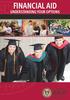 FINANCIAL AID UNDERSTANDING YOUR OPTIONS Affording a Best-Value Jesuit Education Every accepted student who attends Wheeling Jesuit University is considered for financial assistance. Wheeling Jesuit is