
GUIDE TO HEALTH CARE REFORM S TAX PENALTIES
|
|
|
- Griselda Knight
- 10 years ago
- Views:
Transcription
1 The GUIDE TO HEALTH CARE REFORM S TAX PENALTIES Calculate Your Health Insurance Tax Penalty

2 2 Introduction The Affordable Care Act (ACA) requires certain employers and employees to purchase health insurance or else pay a tax penalty. Specifically, starting January 1, 2014: Employers with 50 or more full time equivalent employees are required to provide health coverage to full-time employees or else pay a tax penalty. Employees are required to purchase health coverage or else pay a tax penalty. As a result, employers and employees will need to understand the cost of NOT buying health insurance. This guide includes the following contents: Guide to Calculating the Business Tax Penalty for Not Offering Health Insurance (pg 3) Summary Flow Chart on the Business Tax Penalty (pg 7) Guide to Calculating the Individual Tax Penalty for Not Purchasing Health Insurance (pg 8) Summary Flow Chart on the Individual Tax Penalty (pg 11)

3 3 A Guide to Calculating the Business Tax Penalty for Not Offering Health Insurance The Health Care Reform bill requires certain businesses to offer employees health insurance. Starting in 2014, businesses with more than 50 full-time equivalent employees will be required to either offer health care coverage or pay a tax penalty. So, how exactly do you calculate the business health insurance tax penalty? The Business Health Insurance Tax Rule is NOT Simple: Effective January 1 st, 2014, applicable large employers will be required to offer minimum essential coverage that is affordable to their employees. Applicable large employers who fail to offer minimum essential coverage that is affordable will be required to pay a penalty on their tax return. In order to calculate the business health insurance tax penalty, you must answer the following questions: 1. Are you an applicable large employer? For purposes of the business health insurance tax penalty, a company is defined as an applicable large employer on a calendar year basis. For example, a company could be an applicable large employer in 2015, but not in If the company employed 50 or more full-time employees on average during the preceding calendar year, they are an applicable large employer for the current calendar year. A company is NOT an applicable large employer if the company: 1. Employed less than 50 full-time employees on average during the previous calendar year, or 2. Employed more than 50 full-time employees no more than 120 days during the previous calendar year due to a seasonal workforce. Calculating the number of full-time employees. Generally, a full-time employee is an employee who is employed on average at least 30 hours of service per week in a given month. However, for purposes of determining whether a company is an applicable employer, the company must include all full-time employees plus the full-time equivalent of its part-time employees. To calculate the full-time equivalent of part-time employees, a company should add the number of hours worked by part-time employees and divide the total by 120. The sum of the full-time employees and the full-time equivalent of the part-time employees is the number used to determine whether a company is an applicable large employer. Simple translation: If you have less than 50 employees, you are not an applicable large employer. If you have 50 or more employees, you probably are an applicable large employer.

4 4 2. What qualifies as minimum essential coverage? For purposes of the business health insurance tax penalty, minimum essential coverage is the minimum amount of health insurance coverage an applicable large employer must make available to avoid paying the maximum penalty (see #3, below). In order to avoid paying the maximum penalty, the employer must offer each employee the ability to enroll in minimum essential coverage through an eligible employer-sponsored plan, which is: 1. Any plan or coverage offered in the small or large group market within a State (including small business exchanges), 2. Coverage under a grandfathered health plan, or 3. A qualified governmental plan.

5 5 3. What is the penalty if I do not offer minimum essential coverage? An applicable large employer who does not offer minimum essential coverage may not have to pay a penalty. The employer only pays a penalty if at least one employee enrolls in a health insurance exchange and also qualifies for premium subsidies and/or other tax credits from the federal government. If at least one employee receives federal subsidies due to purchase of health insurance through an exchange in a given month, the employer must pay a monthly penalty based on the number of full-time employees employed during that month. IMPORTANT: When calculating the amount of the penalty, the employer receives a credit of 30 full-time employees. (For example, a company with 50 full-time employees only has to consider 20 employees for purposes of the penalty). The annual per employee penalty is $2,000. To get the monthly per employee penalty, you simply divide the annual penalty by 12. To calculate the total monthly penalty, you multiply the # of full-time employees employed during the month minus 30 by the monthly per employee penalty. Example. In February, ABC Manufacturing employs 60 full-time employees and does not offer minimum essential coverage. In February, at least one employee purchases health insurance through the exchange and receives premium subsidies from the federal government. The annual per employee penalty is $2,000. The monthly per employee penalty is $2,000*(1/12). For purposes of this calculation, we only need to consider 30 full-time employees due to the 30-employee credit. The total monthly penalty is equal to 30*2,000*(1/12) which is $5,000.

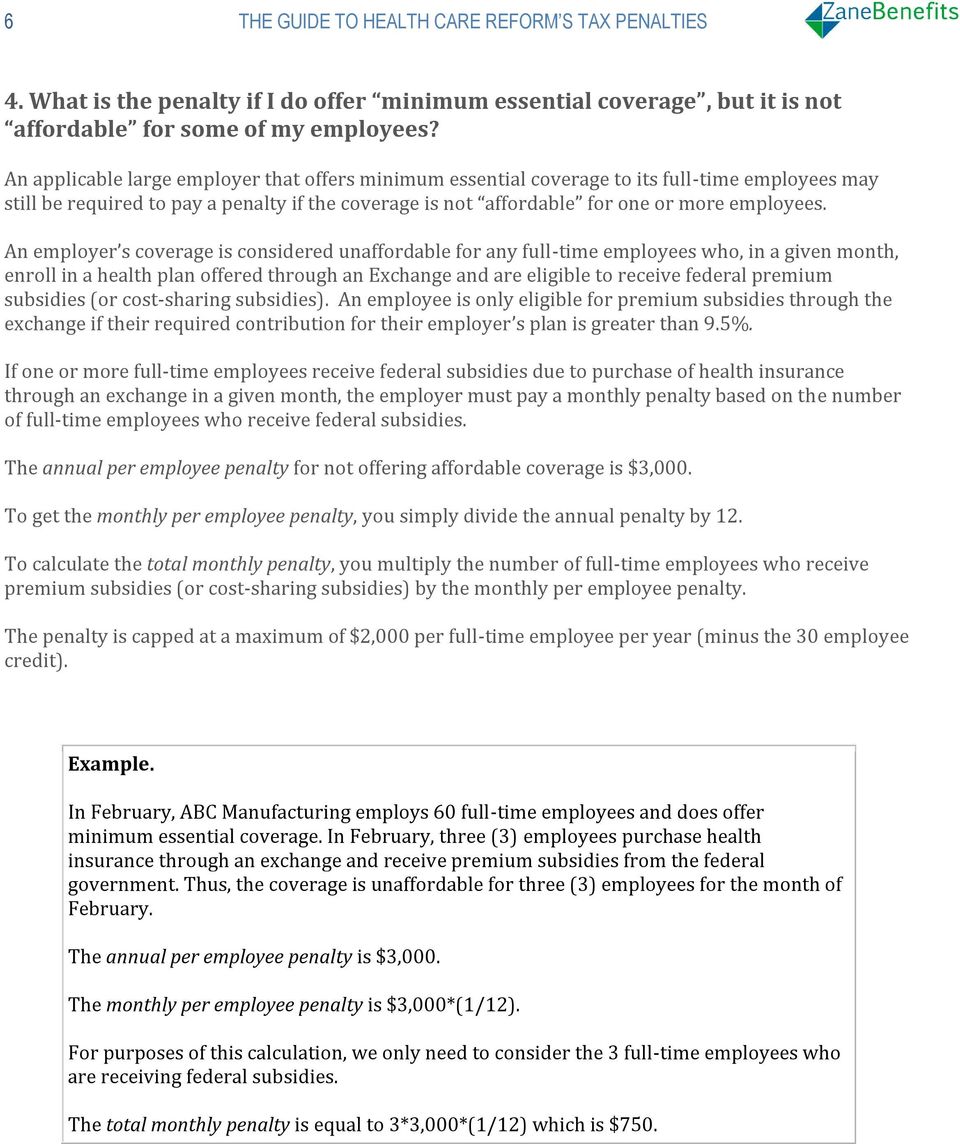
6 6 4. What is the penalty if I do offer minimum essential coverage, but it is not affordable for some of my employees? An applicable large employer that offers minimum essential coverage to its full-time employees may still be required to pay a penalty if the coverage is not affordable for one or more employees. An employer s coverage is considered unaffordable for any full-time employees who, in a given month, enroll in a health plan offered through an Exchange and are eligible to receive federal premium subsidies (or cost-sharing subsidies). An employee is only eligible for premium subsidies through the exchange if their required contribution for their employer s plan is greater than 9.5%. If one or more full-time employees receive federal subsidies due to purchase of health insurance through an exchange in a given month, the employer must pay a monthly penalty based on the number of full-time employees who receive federal subsidies. The annual per employee penalty for not offering affordable coverage is $3,000. To get the monthly per employee penalty, you simply divide the annual penalty by 12. To calculate the total monthly penalty, you multiply the number of full-time employees who receive premium subsidies (or cost-sharing subsidies) by the monthly per employee penalty. The penalty is capped at a maximum of $2,000 per full-time employee per year (minus the 30 employee credit). Example. In February, ABC Manufacturing employs 60 full-time employees and does offer minimum essential coverage. In February, three (3) employees purchase health insurance through an exchange and receive premium subsidies from the federal government. Thus, the coverage is unaffordable for three (3) employees for the month of February. The annual per employee penalty is $3,000. The monthly per employee penalty is $3,000*(1/12). For purposes of this calculation, we only need to consider the 3 full-time employees who are receiving federal subsidies. The total monthly penalty is equal to 3*3,000*(1/12) which is $750.
7 7

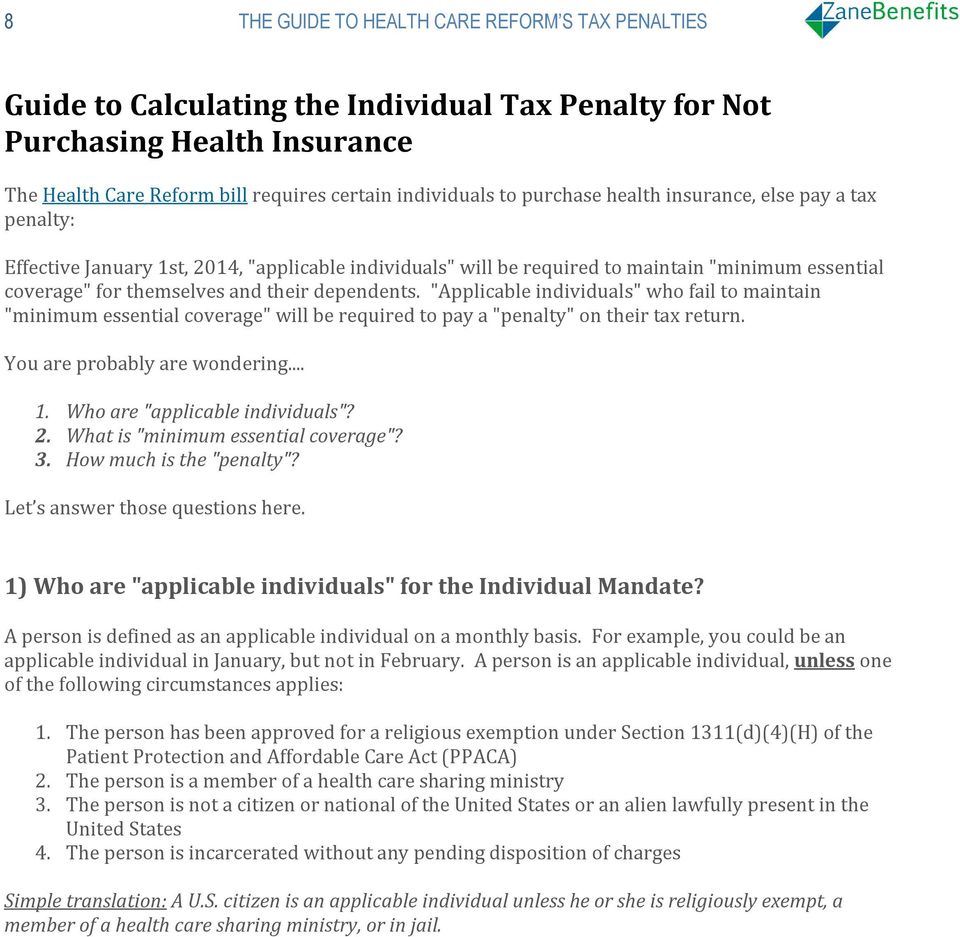
8 8 Guide to Calculating the Individual Tax Penalty for Not Purchasing Health Insurance The Health Care Reform bill requires certain individuals to purchase health insurance, else pay a tax penalty: Effective January 1st, 2014, "applicable individuals" will be required to maintain "minimum essential coverage" for themselves and their dependents. "Applicable individuals" who fail to maintain "minimum essential coverage" will be required to pay a "penalty" on their tax return. You are probably are wondering Who are "applicable individuals"? 2. What is "minimum essential coverage"? 3. How much is the "penalty"? Let s answer those questions here. 1) Who are "applicable individuals" for the Individual Mandate? A person is defined as an applicable individual on a monthly basis. For example, you could be an applicable individual in January, but not in February. A person is an applicable individual, unless one of the following circumstances applies: 1. The person has been approved for a religious exemption under Section 1311(d)(4)(H) of the Patient Protection and Affordable Care Act (PPACA) 2. The person is a member of a health care sharing ministry 3. The person is not a citizen or national of the United States or an alien lawfully present in the United States 4. The person is incarcerated without any pending disposition of charges Simple translation: A U.S. citizen is an applicable individual unless he or she is religiously exempt, a member of a health care sharing ministry, or in jail.
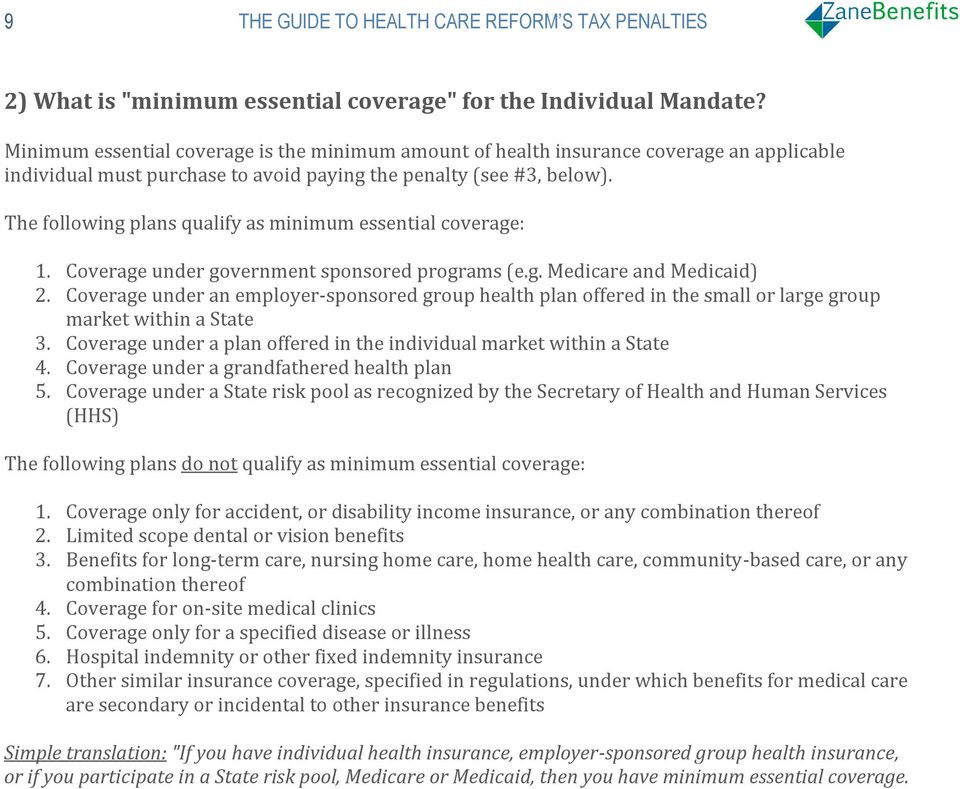
9 9 2) What is "minimum essential coverage" for the Individual Mandate? Minimum essential coverage is the minimum amount of health insurance coverage an applicable individual must purchase to avoid paying the penalty (see #3, below). The following plans qualify as minimum essential coverage: 1. Coverage under government sponsored programs (e.g. Medicare and Medicaid) 2. Coverage under an employer-sponsored group health plan offered in the small or large group market within a State 3. Coverage under a plan offered in the individual market within a State 4. Coverage under a grandfathered health plan 5. Coverage under a State risk pool as recognized by the Secretary of Health and Human Services (HHS) The following plans do not qualify as minimum essential coverage: 1. Coverage only for accident, or disability income insurance, or any combination thereof 2. Limited scope dental or vision benefits 3. Benefits for long-term care, nursing home care, home health care, community-based care, or any combination thereof 4. Coverage for on-site medical clinics 5. Coverage only for a specified disease or illness 6. Hospital indemnity or other fixed indemnity insurance 7. Other similar insurance coverage, specified in regulations, under which benefits for medical care are secondary or incidental to other insurance benefits Simple translation: "If you have individual health insurance, employer-sponsored group health insurance, or if you participate in a State risk pool, Medicare or Medicaid, then you have minimum essential coverage.
10 10 3) How much is the "tax penalty" for the Individual Mandate? If an applicable individual does not maintain minimum essential coverage for one or more months during a tax year, then he or she must pay a penalty. The size of the penalty is phased-in over three years: o o o In 2014, the penalty will be $95 per person up to a maximum of three times that amount for a family ($285)* or 1% of household income if greater In 2015, the penalty will be $325 per person up to a maximum of three times that amount for a family ($975)* or 2% of household income if greater In 2016, the penalty will be $695 per person per year up to a maximum of three times that amount for a family ($2,085)* or 2.5% of household income if greater *Note: If you claim dependents, you are responsible for making sure they have minimum essential coverage. Each year, the penalty is capped at an amount equal to the national average premium for bronze level health plans offered through state exchanges. You can be exempted from the penalty calculation for a month if during the month: 1. You have income below the filing threshold determined by the Secretary of the HHS. 2. Your cost to purchase health insurance exceeds 8% of gross income 3. You are a member of an Indian tribe. 4. The secretary of HHS determines you qualify for a hardship that makes you incapable of obtaining health insurance. Simple translation: The amount of the penalty depends on a number of factors including your income, the size of your household, and your access to affordable health insurance.

11 11

12 12 Zane Benefits is the national leader in HRAs and Defined Contribution Healthcare. The ZaneHRA Software provides a 100% paperless administration experience to employers and insurance professionals that want to offer better health benefits without a traditional group health insurance plan at lower costs. For more information about ZaneHRA, check out our Software. Employers use ZaneHRA to open and manage their own stand-alone HRA or defined contribution health plan completely online, electronically enroll participants and print welcome kits, and monitor expenses and reimbursements in real-time. Employees obtain their own individual health policies from a designated health insurance broker (see below), submit premium and medical expenses online, via fax, or mail, and receive same-day reimbursement via check, payroll addition, or direct deposit. Zane Benefits does not sell health insurance. Insurance Professionals partner with Zane Benefits and use ZaneHRA to provide clients with a cost-saving health benefits option. Insurance brokers earn compensation on ZaneHRA referrals and retain 100% of the health insurance compensation from carriers. ZaneHRA is distributed by leading health insurance carriers, agencies, brokers, and accountants. For additional resources on Health Care Reform, visit Become a Fan on Facebook Follow us on Twitter Join our Defined Contribution Group Watch our videos on YouTube DISCLAIMER The information provided herein by Zane Benefits is general in nature and should not be relied on for commercial decisions without conducting independent review and analysis and discussing alternatives with legal, accounting, and insurance advisors. Furthermore, health insurance regulations differ in each state; information provided does not apply to any specific U.S. state except where noted. See a licensed agent for detailed information on your state.

EMPLOYEE S GUIDE TO HEALTH CARE REFORM S TAX CREDITS
 The EMPLOYEE S GUIDE TO HEALTH CARE REFORM S TAX CREDITS Calculate Your Health Insurance Tax Credit 2 Introduction Beginning in 2014, massive tax credits will become available to help individuals buy health
Health Care Reform Implications for Employers with Seasonal Employees
 Health Care Reform Implications for Employers with Seasonal Employees Many industries (e.g. ski resorts, retail, restaurants, agriculture, fishing and tourism) have a significant number of seasonal employees.
Health Care Reform: 2015 Refresher of the Affordable Care Act (ACA)
 Health Care Reform: 2015 Refresher of the Affordable Care Act (ACA) Brought to you by Aon Presented by: Ryan Comstock & Shawna Brown This information is provided for informational purposes only and is
Introduction. Affordable Care Act Overview of Changes
 Introduction Affordable Care Act Overview of Changes Presented by: Tim Dillingham, CLU Benefit Resource Group, Inc. 201 E Broad Street, Suite 1 Linden, MI 48451 810-735-6500 810-735-6610 (fax) [email protected]
Understanding the Affordable Care Act Premium Tax Credit
 Understanding the Affordable Care Act Premium Tax Credit Most Americans are Required to Have Health Care Coverage The Affordable Care Act (ACA), or health care law, requires most U.S. citizens and legal
Selected Employer Provisions in the Patient Protection and Affordable Care Act and the Health Care and Education Reconciliation Act of 2010
 Selected Employer Provisions in the Patient Protection and Affordable Care Act and the Health Care and Education Reconciliation Act of 2010 This chart outlines, in depth, selected provisions in the Patient
Affordable Care Act FAQ
 Affordable Care Act FAQ Based on regulatory guidance issued as of March 2014 and subject to change. Contents General ACA Questions... 1 ACA Marketplace... 1 ACA Employer Shared Responsibility... 2 ACA
#21 - Should You Provide Health Insurance in 2014?
 #21 - Should You Provide Health Insurance in 2014? Yes, for all size groups, but only if you can afford it and it serves other purposes (such as controlling competition for employees or you don t want
Shared Responsibility: What It Means for Your Business
 Shared Responsibility: What It Means for Your Business The provisions of the Affordable Care Act (ACA) apply to nearly all companies in the United States. The ways they apply, however, can be different
And Changes under Healthcare Reform affecting businesses
 And Changes under Healthcare Reform affecting businesses 1 Individual Mandate 2 First there were two choices Under the Affordable Care Act every individual must have Minimum Essential Healthcare Coverage
Introduction to the New Health Care Laws Michelle Walker, Rocky Mountain Health Plans January 14, 2015
 Introduction to the New Health Care Laws Michelle Walker, Rocky Mountain Health Plans January 14, 2015 Agenda Basics of Health Care Reform Changes in Individual Healthcare Coverage Mandates Affordability
Health Care Reform and Tax Implications
 IMPACT OF HEALTH CARE REFORM ON INDIVIDUAL AND SMALL BUSINESS TAXES ATLANTA ASHEVILLE BIRMINGHAM CHICAGO DALLAS DENVER JACKSONVILLE LOS ANGELES MELBOURNE MEMPHIS MIAMI MINNEAPOLIS NEW YORK ORLANDO PHOENIX
Affordable Care Act: Impact on People with Disabilities
 Affordable Care Act: Impact on People with Disabilities Stephanie Altman, Assistant Director of Healthcare Justice [email protected] October 2014 About Us: The Shriver Center The Sargent Shriver
Potential Penalties for Employers under the Pay or Play Rules
 The Affordable Care Act (ACA) brings many changes to employers and health plans. One such change essentially amounts to a requirement for some employers to offer a certain level health care to their employees
It goes by many names: Patient Protection and Affordable Care Act (PPACA) or ACA or Obama Care or simply Healthcare Reform.
 WHAT IS HEALTHCARE REFORM? Healthcare Reform (HCR) is a law passed by Congress that provides many different requirements. A very important aspect of the law is that it is designed to provide individuals
GLOSSARY OF KEY HEALTH INSURANCE CONCEPTS
 The Affordable Care Act: A Working Guide for MCH Professionals Module 2 GLOSSARY OF KEY HEALTH INSURANCE CONCEPTS Overview A fundamental first step in accessing health care in the United States is having
Treasury Department Proposes Rule Implementing Premium Tax Credits Under the Affordable Care Act
 AUGUST 17 2011 Treasury Department Proposes Rule Implementing Premium Tax Credits Under the Affordable Care Act BY ALDEN J. BIANCHI, MINTZ LEVIN The Patient Protection and Affordable Care Act 1 (the Act)
the Affordable Care Act: What Colorado Businesses Need to Know
 22 About questions the Affordable Care Act: What Colorado Businesses Need to Know 1 What is the Affordable Care Act? Who is impacted (small, large businesses and self-insured)? The Patient Protection and
HHealth HEALTH INSURANCE EXCHANGE FAQs
 HHealth HEALTH INSURANCE EXCHANGE FAQs Page 1 TABLE OF CONTENTS Introduction... 3 Background... 3 Health Insurance Exchange FAQs... 4 What is the Patient Protection and Affordable Care Act (PPACA)?...
Healthcare Reform Provisions Unique to Small Employers/Financial and Other Benefits Concerns for All Employers (updated May 2, 2014)
 /Financial and Other Benefits Concerns for All Employers (updated May 2, 2014) Lisa L. Carlson, J.D., Area Senior Vice President, Compliance Counsel Gallagher Benefit Services, Inc. While most healthcare
Health Care Reform: Health Insurance Marketplace FAQs
 From Filice Insurance Health Care Reform: Health Insurance Marketplace FAQs What is a Health Insurance Marketplace? The Health Insurance Marketplace (Marketplace) is a way to find health coverage that
Patient Protection and Affordable Care Act Compliance Checklist for Employers
 October, 2014 Patient Protection and Affordable Care Act Compliance Checklist for Employers Under the Employer Mandate in the Affordable Care Act, effective January 1, 2015, employers with 50 or more full-time
Health Policy Essentials: Private Health Insurance. Bernadette Fernandez, Annie Mach, & Namrata Uberoi February 13, 2015
 Health Policy Essentials: Private Health Insurance Bernadette Fernandez, Annie Mach, & Namrata Uberoi February 13, 2015 Briefing Agenda What is the purpose of private health insurance (PHI)? How is PHI
Employer s Guide To Health Care Reform
 Employer s Guide To Health Care Reform A nonprofit independent licensee of the Blue Cross Blue Shield Association National strength. Local focus. Individual care. SM As part of our commitment to being
Instructions for Form 8965
 Department of the Treasury Internal Revenue Service Instructions for Form 8965 Health Coverage Exemptions (and instructions for figuring your shared responsibility payment) For each month you must either:
Exchanges and the ACA What You Need to Know for 2014
 Exchanges and the ACA What You Need to Know for 2014 How the Affordable Care Act affects the Individual Health Insurance Market This presentation is for informational purposes only and does not constitute
How To Calculate A Health Care Reform Employer Number
 Health Care Reform Key Points Contact Us 855.220.8634 [email protected] Individual Implications Individual mandate to have health insurance Penalties applies if NO health insurance 2014 -
Chart: Key employer health care reform elements
 Chart: Key employer health care reform elements Health care reform with major implications for employers has now become law, with a package of revisions heading for Senate action. The approved measure
Health Care Reform Frequently Asked Questions
 Health Care Reform Frequently Asked Questions On March 23, 2010, President Obama signed federal health care reform into law, also known as the Patient Protection and Affordability Act. A second, or reconciliation
Summary of Potential Employer Penalties Under the Patient Protection and Affordable Care Act (PPACA)
 Summary of Potential Employer Penalties Under the Patient Protection and Affordable Care Act (PPACA) Hinda Chaikind Specialist in Health Care Financing Chris L. Peterson Acting Section Research Manager
Answers about. Health Care REFORM. for your business
 Answers about Health Care REFORM for your business Since the time of its enactment in 2010, the health care reform law has remained controversial at least in part due to a constitutional challenge to the
MODULE 16: MEDICARE AND THE HEALTH INSURANCE MARKETPLACES
 MODULE 16: MEDICARE AND THE HEALTH INSURANCE MARKETPLACES Objective This module will educate HIICAP counselors about how Medicare is affected (and not affected) by the health insurance Marketplaces. What
HEALTH CARE REFORM: FREQUENTLY ASKED QUESTIONS (Group, Individual, Seasonal)
 Group Health Insurance Q & A HEALTH CARE REFORM: FREQUENTLY ASKED QUESTIONS (Group, Individual, Seasonal) 1. Will small employers continue to have 12 month rates as they exist today? a. Yes. Employer groups
How To Get Health Insurance On A Health Insurance Marketplace
 Health Insurance Marketplace Basics Amanda Ptashkin, JD Outreach and Advocacy Director [email protected] 404-890-5804 WHY SHOULD I GET COVERAGE? Access to the health care system Financial protection
4/8/2013. Health Care Reform and the. NYS Exchange. Dr. Arthur Vercillo, MD Regional President April 8, 2013. Health Care Reform and the NYS Exchange
 Health Care Reform and the NYS Exchange Presentation to the Health Planning Council Advisory Board April 8, 2013, Ithaca NY By Dr. Arthur Vercillo, MD Additional resources on next to last slide. Health
To protect, promote and improve the health of all people in Florida through integrated state, county, and community efforts.
 ADAP PREMIUM PLUS UNDERSTANDING YOUR HEALTH INSURANCE OPTIONS 1 DISCLAIMER The Florida ADAP is providing this presentation solely as an educational service to the community. The information provided in
Employer Reporting of Health Coverage Code Sections 6055 & 6056
 Brought to you by Hickok & Boardman HR Intelligence Employer Reporting of Health Coverage Code Sections 6055 & 6056 The Affordable Care Act (ACA) created new reporting requirements under Internal Revenue
Find health care options that meet your needs and fit your budget. ctober 2014
 O Health Insurance Find health care options that meet your needs and fit your budget. ctober 2014 The Health Care Law In March 2010, President Obama signed the Affordable Care Act into law generally requiring
Health Reform. Employer Penalty Delay: What are the Consequences? Impact of the Delay on Employers
 Health Reform Employer Penalty Delay: What are the Consequences? Martin Haitz (484) 270-2575 [email protected] Issued date: 07/29/13 The employer penalty provisions and two reporting requirements
Healthcare Reform Update. as of February 15, 2013
 Healthcare Reform Update as of February 15, 2013 March 23, 2010: Patient Protection and Affordable Care Act (PPACA aka ACA) signed into law Underlying goals of PPACA: Expand access to healthcare Make healthcare
IRS Issues Guidance on Mandatory Form W-2 Informational Reporting of Employer-Sponsored Health Coverage
 IRS Issues Guidance on Mandatory Form W-2 Informational Reporting of Employer-Sponsored Health Coverage By Seth Perretta, Joel Wood and Matthew Fornataro of Crowell & Moring LLP On March 29, 2011, the
Keeping up with the new health care reform law. Helping you better understand what to expect and when to expect it. anthem.com/ca 14376CAEENABC 8/10
 Keeping up with the new health care reform law Helping you better understand what to expect and when to expect it. 14376CAEENABC 8/10 anthem.com/ca 1 Staying up to date Here s a timeline of what you can
Your guide to health care reform provisions
 Your guide to health care reform provisions February 2014 edition Since the Patient Protection and Affordable Care Act (PPACA) was enacted in March 2010, businesses have been impacted by federal health
AFFORDABLE CARE ACT FAQ
 AFFORDABLE CARE ACT FAQ What is the Healthcare Insurance Marketplace? The Marketplace is a new way to find quality health coverage. It can help if you don t have coverage now or if you have it but want
Currently, for the very low-income, Medicaid is available for children, parents, and individuals who are disabled, elderly, or pregnant.
 0 Currently, for the very low-income, Medicaid is available for children, parents, and individuals who are disabled, elderly, or pregnant. Parents are typically covered at very low income levels, and most
Health Care Law Implementation: What Nonprofits Need to Know WELCOME!
 Health Care Law Implementation: What Nonprofits Need to Know WELCOME! Health Care Law Implementation: What Nonprofits Need to Know (PPACA) Health Care Law Implementation: What Nonprofits Need to Know Heather
American Health Benefit Exchanges Fact Sheet A Provision of the Patient Protection and Affordable Care Act (PPACA)
 American Health Benefit Exchanges Fact Sheet A Provision of the Patient Protection and Affordable Care Act (PPACA) This Fact Sheet reflects the Final Ruling published by the Department of Health and Human
How the Affordable Care Act Affects Medical Support Orders in Oklahoma Frequently Asked Questions Spring, 2014 1
 How the Affordable Care Act Affects Medical Support Orders in Oklahoma Frequently Asked Questions Spring, 2014 1 General 1. Did Oklahoma expand Medicaid? No, Oklahoma did not expand Medicaid. 2. Who is
Summary of the Major Provisions in the Patient Protection and Affordable Health Care Act
 Summary of the Major Provisions in the Patient Protection and Affordable Care Act Updated 10/22/10 On March 23, 2010, President Barack Obama signed into law comprehensive health care reform legislation,
HEALTH INSURANCE MARKETPLACE SURVIVAL GUIDE FOR SMALL BUSINESS. Vermont Edition
 HEALTH INSURANCE MARKETPLACE SURVIVAL GUIDE FOR SMALL BUSINESS Vermont Edition NAVIGATING NEXT STEPS IN HEALTH CARE REFORM There s a constant stream of changes and updates related to health care reform,
Health insurance Marketplace. What to expect in 2014
 Health insurance Marketplace What to expect in 2014 Overview The Affordable Care Act (ACA) includes several provisions geared to extend greater access to health insurance benefits to more people. Beginning
Things Small Businesses Need To Know About Health Care Reform
 7 Things Small Businesses Need To Know About Health Care Reform Make sure your business meets the requirements of the Affordable Care Act on schedule 7 Things Small Businesses Need To Know About Health
HEALTH INSURANCE EXCHANGE FAQS
 HEALTH INSURANCE EXCHANGE FAQS 0 TABLE OF CONTENTS INTRODUCTION... 1 BACKGROUND... 1 HEALTH INSURANCE EXCHANGE FAQS... 1 1 INTRODUCTION IN EARLY 2010, CONGRESS PASSED THE PATIENT PROTECTION AND AFFORDABLE
Two New Reporting Requirements Beginning in 2016 But Are Important Now
 Two New Reporting Requirements Beginning in 2016 But Are Important Now Recently, the IRS published final regulations implementing two new information reporting requirements under ACA that are first due
Legislative Brief: 2015 COMPLIANCE CHECKLIST. Laurus Strategies
 Laurus Strategies Legislative Brief: 2015 COMPLIANCE CHECKLIST The Affordable Care Act (ACA) has made a number of significant changes to group health plans since the law was enacted over four years ago.
A. In this chapter, the following terms have the meanings indicated. A nonprofit health service plan; or. A health maintenance organization.
 ALL NEW MATTER.01 Scope. This chapter applies to: A. Each carrier that offers a medically underwritten health benefit plan in the nongroup market in the State; and B. Each SAAC carrier..02 Definitions.
Christy Tinnes, Brigen Winters and Christine Keller, Groom Law Group, Chartered
 Preparing for Health Care Reform A Chronological Guide for Employers This Article provides an overview of the major provisions of health care reform legislation affecting employers and explains the requirements
SURVIVAL GUIDE FOR SMALL BUSINESS
 HEALTH INSURANCE MARKETPLACE SURVIVAL GUIDE FOR SMALL BUSINESS Vermont edition NAVIGATING NEXT STEPS IN HEALTH CARE REFORM There s a constant stream of changes and updates related to health care reform,