
Pioneering a Different Future Why don t they just leave? (The Booklet) Written by Brian Fox
|
|
|
- Charlene Goodman
- 10 years ago
- Views:
Transcription
1 Why don t they just leave? (The Booklet) Written by Brian Fox - 1 -

2 Forward Pioneering a Different Future During the past five years I have come to learn more about domestic violence and abuse than I ever wanted to know. I have come into contact with this sickening element of human society in some of its many forms and I have gained some insight into how it happens and how it works. Domestic abuse is so much more than just violence; and I will try and cover some of the many other facets of it throughout this booklet. I will also try and explain how it affects the victim and why they simply either refuse to see it or refuse to do anything about it. This booklet is written for not only those in the relationships, but also those that are on the outside, and can't understand why don t they just leave? This booklet is written based on my experience in this area and also my knowledge of people and environments that have helped to me to write the other booklets and the two books that have been published to date. This booklet is provided free of charge and you are encouraged to distribute it as required. I do ask that if you pass it on that you pass it on in its original format. The information contained here is copyrighted, and therefore is my property. I am providing this information and insight in the hope that people who read will get something from it. Please respect the spirit in which it is given and my rights that are associated with it

3 Contents Pioneering a Different Future Introduction... 5 You don t need bruises to be abused... 7 Control through fear after violence...7 The Little Implant...8 Keeping Up Appearances...8 Rights in a relationship Manipulation Why don t they just leave? Denial, Hope and Excuses Denial Hope Excuses Summary The Blame Game Ignorance and Expectations Fear, Fear and more Fear Fear of Danger form Abuser Fear for the children Fear for others Fear of retribution from other than the abuser Fear of failing in the relationship Fear of being alone Fear of not being good enough without them Fear of looking like a fool Fear of the unknown Summary Comfort Zones It never even occurs to them What s left when your self respect is taken? Failure is a big part of the picture How can you help? It has to come from Self Awareness Where can they get help?

4 At the end of the day

5 Introduction My involvement with this subject began about five years ago when I began speaking to Ange via Internet Messenger. At the time Ange was in a very abusive relationship with her husband. She had been married to him for about 7 years, this time, and about 7 years before that. They did actually get divorced and married again. Your first thought, as was mine was why the hell would she marry him a second time after finally being able to get away and get a divorce in the first place. The answer to this question is not a simple one, and that is why I am writing this booklet. There are many different things that you need to consider when looking at an abusive relationship and asking yourself Why don t they just leave? I know where you are with that, because that was my first thought. It always has been; if it is that bad, then why don t they just leave? I have since come to understand a lot more about what goes on in these relationships and I now know the answer to that question; well to a certain degree anyway. The purpose of this booklet is to help you to understand what is actually going on in these relationships, and whether you are in an abusive relationship, or you know someone who is, then reading this booklet will help you to get a better handle on what is going on. I am aiming this at people who are on the outside looking in, because they are the ones that are more than likely to read something like this so they can help someone that they care about. At the same time, I hope that if someone is involved in a relationship reads this, then they will also be able to understand a little more of what is going on and it will help them to start looking for a way out, before it gets worse, or even too late. If you are interested in reading my work further then please feel free to buy a copy of my first book Wake up and Smell the Reality! and my second book Creating Adults; NOT raising Children. They can be ordered by following the links on the website. Please also fell free to contact me if would like to discuss this booklet or anything further at [email protected]

6 I am now married to Ange, and that is a long and complicated story, but the important thing to keep in mind that Ange was eventually able to do something and had her ex-husband charged and jailed on five counts of rape against her. I will write some more on this later, but for now hang on to the thought that there is always a way out, however the key thing is that those involved have to want to get out, and this booklet will help you to understand why someone would not want to get out, as you would think, or at least that is what they will tell you. There are a couple of things that I need to point out before you go on. I am not a psychologist of any kind, I am just someone who understands people and I am able to see what is going on below the surface. The information provided here is simply my view and is designed to help give a different perspective on things. I do not have all of the answers and I do not pretend to take the place of a professional councillor or psychologist. You will find that my writing style is very straight forward and I try to avoid using any psycho-babble and language to confuse you. I tell the truth as I see it in plain and simple terms. I base all of my work on what is going on in the real world, not what is going on in the classroom of some professor who professes to be an expert. I am by know means an expert, but I believe I do have a good understanding of this area, and I am offering you this as is, free of charge, without and smoke and mirrors, it is just my view. I do hope that you find this booklet informative and that if nothing else it helps to look below the surface and think about what is going on. If you at least think about the things that you are going to read and apply them to you, or whoever is involved in an abusive relationship, I am sure will find that it makes sense, and you at least have a different viewpoint. Good Luck

7 You don t need bruises to be abused When you talk of domestic abuse, the first thing that springs to mind is violence, but domestic abuse is so much more than that. It includes a lot of other things that ultimately results in one party having control over the other. I am not talking about one partner being more dominant that the other, I am talking when it goes beyond a leader of the pack so to speak, and becomes a situation where one person is intimidated and controlled to the point where they are not able to lead a normal life. For someone to have this much control over another person there are also a lot of things going on that lead to that situation occurring. For one thing, control has to be given at the same time that it is taken. That can be a little difficult to understand, but if you think about it, someone can only have control over you if you allow them to. There are many different ways that the control happens, and that can be with violence, and or the threat of violence, or threats of many other consequences that will arise if demands are not met. The other way that someone can gain control is through manipulation, and this often follows from the previous point. Manipulation generally forms part of the previous mentioned points, but it can also be very subtle and very destructive. I suppose a question that arises is that if someone is being manipulated, and they do not know about it, is it still abuse? The other point that I want to bring in here is that it does not have to be an abusive relationship to be a bad one. There are many people who are involved in relationships where they simply do not know how to get out of them, even though they may not be abused, they certainly can be manipulated and controlled through those means. It does not make it any less of a prison for someone to be trapped in this kind of relationship. There may be a lack of fear of physical danger, but it is still control and in my mind that makes it a form of abuse. Control through fear after violence One of the most common forms of control is after the initial violence, there is the fear. Once someone is afraid for their physical safety there is always an amount of control that is taken. It may be - 7 -

8 that there have only been one or two incidences of violence, but once they have happened, they cannot be undone. If someone has been hurt, then the simple threat of further hurt is enough to control them. The point that I am trying to make here, is that once it has happened once, there is always the fear that it will happen again, and more often than not, that is enough to have complete control over someone. That is still very much abuse, regardless if the bruises have healed, if someone is controlling someone else through fear of physical attack and violence, then they are most certainly abusing them. I have heard this situation called the little implant. The Little Implant The Little Implant is like a little device that has been put into your brain that controls you by virtue of the fact that you are afraid. Once someone has been violent, there is always that fear that it will happen again. What happens is that when ever the violent person starts to get angry, and maybe even give a certain look, or a certain stance, then that is enough to trigger the little implant, or memory of what happened last time. The victim then does what they can do to avoid creating that situation again. You see how this works. The longer the relationship continues, the further the implant gets imbedded and the more control it has over the victim. It can take many many years to get past this. I have not gone into this in great detail at this time, as there are many elements that go to make an abusive relationship, and I do not think that I need to spend a lot of time explaining what a bad relationship is. I just wanted to make sure that you understand that it does not need bruises to be abuse. It has many forms and many different parts to it. That is what I am hoping this booklet will be able to show you, and help you to understand what is really going on and put you in a better position to be able help. Keeping Up Appearances Have you ever watched Keeping Up Appearances and laughed at how poor old Richard just seems to always be bullied and pushed around? I bet when you watch it you laugh a little, but you do feel sorry for Richard on some level. I know this is just a TV program and it is not - 8 -

9 real, but the situation is real. There are many people who live their lives being bullied by their other half. It is not only the women who get bullied and abused, the men do also. Have you ever wondered why Richard puts up with it, and why he does not just leave her, after all she is a real pain? Although this is put across in a funny way, it is an abusive relationship in terms that there is not mutual respect and understanding. A true relationship contains mutual trust and respect, once that goes, even though there are no bruises, you end up with someone who is bullied, harassed and dominated by someone else, which does count as an abusive relationship, especially if the one being dominated is not happy doing it and is doing against their will

10 Rights in a relationship It seems to me that there can be a little confusion about rights and entitlements in a relationship, so I thought I would include a brief overview of that here. I am going to be concerning myself with what we call Western Society. To me, that means typical European, American, Australian societies that have been built basically around the foundations of the Catholic Church. I know there are lots of variations, and I do not wish to get into any sort of debate about right and wrong and all the rest of it, I am simply trying to clear up a couple of things in the context of this booklet and this subject. So, now that we have cleared that up, I hope, we can get onto what this chapter is all about; and that is what rights the individual has in a relationship. Quite simply, they have absolute equal rights as any individual in any context and time any where. Just because a person is in a relationship, married or not, it does mean they give up any rights as a person. So from that you can take it to mean that if one person is forcing another to have sex against their will, without their consent that it is rape. If someone is being beaten and battered then it is assault. If someone is being blackmailed and bribed, then it is blackmail and bribery. None of these things change simply because you are in a relationship with someone. If you were to be beaten up by a stranger, then you would have them charged with assault. If you were raped by a stranger, you would have them charged with rape; and so on. Getting married and pledging yourself to someone does not give them any more rights over you than at any other time in your life. There is nothing in the law that says that the man owns the woman and can do what he likes with her. All that kind of thinking went out years ago. Do not be misled to thinking anything other than you have the same rights as any other person on the planet when it comes to your own body, your own mind and your own life for that matter. That does not mean that we do not take on roles within the relationship and this is still very much based on gender. But here is the thing to keep in mind; slavery was outlawed 200 years ago. You

11 are not required to do anything that you do want to do, regardless of your marital status, gender or anything else. There are still a lot of people who think that this is actually wrong and most of those beliefs are handed down from the older generations. It is learning and a belief that comes from when times were very different, and the laws perhaps allowed a little in the favour of the man, but not anymore. There is no way that anyone has rights to own, abuse and manipulate another person. Do not be misled or misguided in this. If you are unsure about whether this is true or not, then please contact the police and ask them what you should do about your situation. I hope I have made this chapter clear enough and have not left any doubt on the position here. People are people and everyone has the same rights, regardless of marital status or anything else you may think is a factor here

12 Manipulation The reason that I am including as a separate chapter is because it can be a very big part in an abusive relationship. As I pointed out earlier, you do not need bruises to be abused. The other main factor that can lead to an abusive relationship is manipulation. Manipulation is essentially doing something or forcing someone else to do something that they would not normally do for your own personal gain. That is a pretty broad description, but manipulation uses many tools so that the abuser can get what they want. Some of the things that I am talking about include fear, isolation, dependency, blackmail and stripping of self-respect and selfconfidence. Once again these are broad descriptions that can cover a lot of different things. Let me give you a couple of examples, so that you will be able to get a better sense of what I am talking about. The first example that springs to mind is the fear of physical abuse. Whether or not someone has been physically abused does not really enter in to it when we are talking about fear of physical abuse. The only thing that matters is that they believe they are in danger and the abuser is capable of hurting them. Once this kind of fear is established, either through violence or the threat of violence the abuser is able to control the victim through direct threat. After time is does not even take a direct threat, it can be as little as a certain look or anything that triggers the fear. Fear of abandonment is another way that fear is used to manipulate someone. The abuser is constantly threatening the victim that they will throw them out or leave them in order to get what they want. Isolation is another form of manipulation. Generally this works by alienating everyone else in the victim s life by turning the victim against them. This then creates a dependency because the victim essentially has no one else in their life. If you add this to the previous example, then there is a lot of power and control that is gained over the victim. Manipulation essentially all comes down to giving the abuser control over the victim. The biggest problem with this is that it is not always obvious that it is happening and sort of grows over time. Before the victim even knows they are a victim they have essentially surrendered to the abuser. If you were to try and tell them that are being abused, it would come as a big shock as the

13 way things are tend to become normal and it is not until something major happens that it even occurs to them that they are no longer in control of their own lives. When I am talking about manipulation I am not talking about the normal hierarchy of a relationship. What the means is that generally there is a more dominant personality that seems to control a lot of the things in a relationship. What I am talking about here is when it goes beyond the normal and the victim is suffering in some respect because the dominant person is taking advantage of the situation for their own gain and not showing the normal love and respect that should be the foundation of any relationship. We will talk about control in a little more detail later in this booklet, but I wanted to talk a little about manipulation in the beginning because it is a key part of any abusive relationship and it needs to be understood to a degree. It is something that is not easily defined, and the length to which it is used is not always clear, even to the people involved. Even the manipulator may not be aware that they are doing it, but the key is to look for some kind of imbalance within the relationship and look at how it sort of fits together before deciding to what degree manipulation is playing a part and to what degree the parties are aware of it

14 Why don t they just leave? It is a very simple question, and to someone on the outside there should be a very simple answer, but there isn t, and that is what this booklet is about. From this point on we are going to be looking a little more closely at what goes on inside the victim of an abusive relationship and it will give you a little more understanding as to why there is not a simple answer to this question. At the same time of getting some understanding it should also make you think about the whole thing a little more and also what you can do to help; from the outside looking in. The first thing to consider when looking from the outside in is that you do not know all that goes on. There is a saying that goes nobody knows what goes on behind closed doors. That applies to everyone. You may think that you know what goes on in your daughters or you sisters life, and you may think that from what you know you can't understand why they stay, well here is the big tip on that, you only probably know a very small part of it. I can almost guarantee that you do not know all about it, and it is more than likely that it is so much worse than you think. I am not telling you this to make you feel even worse about the situation, I am telling you this because there is always a lot more going on than you think. To be honest you will find that there is a lot more going on than they are probably prepared to admit to themselves. This leads us very nicely onto looking at some of the reasons why a victim in an abusive relationship will not leave; Denial, Hope and excuses

15 Denial, Hope and Excuses The first thing you will notice about someone who is caught in an abusive relationship is that they do not want to admit to it openly. There are a number of reasons for this, which will go into a little later, but for now we will just work with the fact that the first three things that you will encounter are Denial, Hope and Excuses. If you are trying to help someone in an abusive relationship the first brick wall you will encounter is made up of these. The trouble with someone using these is that you have to be very careful about how you proceed here, if you do continue to push someone at this stage, you will push them away. Let s look at the three individually and describe them in a little more detail. Denial Denial comes in two forms. Firstly there is the denial to themselves that there is a real problem and that it is not just a passing phase that can be wrapped up in an excuse. The second form is the outward denial. This is where they really know they have a problem but they do not want to admit to someone else. The trouble when dealing someone who is in denial, either inwardly or outwardly is that in order to make them see that either it is as bad as it is, or that you know it is as bad as it is you have to attack their partner, whom they are trying to protect. This will create anger towards you and will not help in you in trying to help them. The other thing that you are doing when challenging this situation is that you are either challenging their intelligence because they have failed to see it and so you are therefore pointing out to them that are a bit silly really. And then there is the fact that you are challenging their dignity and self-respect. In order for someone to admit that there is a problem is to admit that they have been foolish enough to allow themselves to get into this situation in the first place. So you can see that when someone is in denial, it is pretty tough to do much about it, and I suggest that the best thing that you can do here is to let them know that you are there for them, do not make any judgments that will push them away, and just wait until they are ready to admit it to you

16 This is one of the most difficult things to do, but there really is not a lot else that you can actually do. Trying to push too hard will result in opening a gap between you and it will mean that when the time comes when they really need your help, the relationship will not be there for you to do anything. After the inward denial then comes hope; however it does not mean that they are able to admit a problem to anyone, it is more that they realise they have a problem themselves, but are not prepared to do anything about it; so they live in Hope. Hope I am putting hope in the centre of the denial and the excuses because it really is the core of both things. Through the denial the hope is that it is not that bad and will change. The same applies for the excuses, in that the hope is always there that things will change. Nobody goes into a relationship with someone that they know is going to abuse them and treat them bad. At some point this changes but the relationship already exists and the chances are that the victim is still in love with the abuser. Well, they think they are in love with the abuser, who they are actually in love with is the person that they knew before they became the abuser, not the person that is treating them badly now. So they hang onto the hope that person will come back to them. Hope is also encouraged by the abuser in many ways. Although they may mean it at the time, it is a tool that is used to make sure that the victim stays around. The way this works is that the victim at some point confronts the abuser about how they are being treated and says that things need to change. The abuser will naturally agree to this and things will indeed change, but this is generally short lived and things will slip back the way they were before. At some point the victim does know that this is going to happen, but hangs on in there because they hope that this time things really will change for good. Hope is a bit of an interesting one in this kind of environment because it is both a positive and a negative. It is a positive in that whilst someone has hope then they still believe that things can get better. It can be negative in that because they believe, or they want to believe that things will change and they will go back to the way they were, and so it prevents them from making the tough choices that need to be made. On the other hand it is a positive because once they give up on the hope, they are left with the thought that

17 this is their lot in life and they just have to put up with it. That is when they essentially give up on trying to make things better and go into pure survival mode. That is when it is really tough to get someone to break away from the relationship. The other thing to be aware of with hope is that it will not be a factor in a relationship that is based on manipulation. Generally speaking denial and excuses are more prominent in an abusive relationship that is operated around manipulation. As this type of abuse is not necessarily based on violence it tends to be something that sort of matures over time, and adjustments are made along the way by the victim, so there is not the confrontations and therefore there is not the hope that things will change, because as far as they can see there is not a problem. Hope is something that you need to be aware and careful off. When someone is using hope as their defence, it means that they want things to change, and therefore still believe in the partner that is abusing them. The only thing you can do is gauge if the hope is real or in fact they are using it as an excuse for not leaving; and therefore covering some of the other reasons that we will talk about as we go on with this booklet. Excuses Perhaps one of the most destructive things that have ever been thought off by people is excuses. It is the one of the most destructive things that people do because quite simply it hides the truth. I could go into a whole rant on excuses in general, but I will hold on to that for now and try and focus on the issue at hand and that is how excuses in this situation tend to work. The first thing that happens is that the victim makes all kind of excuses for the partner, which they think will somehow justify their behaviour. Here are some of the typical ones, which I am sure that you have heard. They are under a lot of pressure at the moment They are just trying to do what is best (usually in manipulation) It is out of character, and I am sure it is going to improve They just lost their temper and with the booze, it just exploded It is not their fault, I just wound them up I should just learn not to push They are a good parent to the kids and they are doing their best

18 I still love them. This list is virtually endless, but I am just trying to give you an example of some of the things to expect. I could go on to a list that explains how it is not that bad really. There are excuses that not only pardon the behaviour in general; there are excuses that justify some of the behaviour because it could have been much worse. And then there the whole range of excuses to justify why they don t just leave. Again the list is endless, and I am not going to even start to list some of them. Needless to say they cover everything from I have nowhere else to go, to the kids need them, to I have no money.. As I said the list is endless. The thing with excuses is that they also have a couple of different purposes. Firstly they fit in nicely with the denial and the hope. If you can excuse it, then you can deny it, if you can deny it there is some hope that it will change. This also works on two different levels. Firstly there are the internal excuses, which the victim believes, because they want to believe. The other kinds are the ones that they don t really believe, but they have to somehow try and justify it. When talking a victim who is making excuses you need to judge for yourself if they are doing it because they actually believe them, or if they are for your benefit, in terms of not having to admit the truth i.e. Denial. It is difficult to offer advice that is going to cover you for this, but the best advice is to be careful how you handle this. I am sure that you can find plenty of reasons to point out how floored the excuses are, and try to break the illusion, but it is not always that easy. Remember that the victim may believe the excuses, and to shatter them will put them into a position of looking silly and that will drive them away. The thing that you cannot do in this situation is to ask Why don t they just leave? because they will have a list of excuses a mile long to explain it. If you force them to tell you, you are just asking them to reinforce all of the excuses to themselves. When they have to explain and justify it, then they believe it even more, because they are justifying to themselves at the same time they are justifying it to you

19 Summary Keeping in mind that excuses, as well as everything else here is running along side of a lot of the other things that we are talking about. No one of these things is ever in isolation, and this information is provided as a guide as it is impossible to know each situation, but generally these are the things that are happening. When you are dealing with someone it is vital that you handle things very carefully. There are so many complexities that it is not simply a matter of taking the sledge hammer approach and try to break down the walls that are being put up. If you chase someone with a sledge hammer, they are going to run. If they run, then you can't help them. It is one of the hardest things to do, but the best thing to do is to try and just support them the best that you can and try to talk and understand the whole situation. It can take a long time, but eventually the truth will catch up with them, and that is when you can really help, but in the mean time it is a case of being gentle, understanding and caring. Keep reading and you will find some more of the things that are going on, which will help you to understand. If you are the victim, there are some things here that will also help you; even if you read it and start to get a different view on things. Most of the things that I talk here are not conscious things. They just sort of happen and quite often the victim is not aware that it is going on. By reading something like this, it can make you a little more aware and then you can start doing something about it

20 The Blame Game This is an interesting part of any abusive relationship. Essentially the blame game is all about who is at fault in a situation. As people, our natural reaction is to blame someone else when it is not all going as planned. On the other side of this there are people who are always willing to take the blame when something goes wrong, regardless of whether it was there fault or not. Typically speaking the abuser in a relationship is not going to take the blame for things going wrong. As far as they are concerned there either is not a problem, or if there is indeed a problem then it is someone else s fault. Quite often they are happy to lay the blame for it all on the victim. Strange as it may seem that some people can actually be blaming someone they are abusing for making them do it. The problem is that quite often the victim will start believing they are actually the cause of their own problems and therefore they deserve whatever they get. This creates some big problems if you are trying to get them to break free of the relationship, because as far as they are concerned they are the cause of the problem and therefore could not possibly do anything that may make it even worse for the abuser than it already is. Until the victim is ready to believe that they are not responsible for what is happening and they are ready to lay the blame where it belongs, with the abuser, then they are not going to even consider doing something about it. Of course this is not an easy thing for someone to do because it means admitting they are in fact a victim and then there are all the other things that we talk about that come into it. If the abuser can actually take the blame for what they do, that generally means that firstly they see that what they are doing is not right and also that they have a problem. Generally when it gets to this point they are able to do something about it, and generally will. It is not very often that this happens; much the same way that it is not often that an alcoholic will admit they have a drinking problem. It is not until they can actually take the blame for themselves that things will change. When confronted by the victim, they will agree that things need to change etc, but more often than not they still do not believe that it is their fault, and will quite often turn it around on the victim and tell them that they need to change which will stop the problems

21 from happening in the first place. I am sure you know what I am talking about here, the abuser will say something like If you cleaned the house properly and looked after the kids better, then I would not have to come home to that, I wont be so angry all the time. This works the same for a rape defence She was all over me, wearing next to nothing, she has to expect to get what she got. No No No, that is not how it works. But you see the point that I am trying to make here, the abuser is not taking the blame for it, and therefore it is the victims fault. In a relationship the victim often comes to believe it, and there is one more reason why they don t just leave
22 Ignorance and Expectations One of the things that you can often find when looking at an abusive relationship is that the people involved do not realise that what is happening is not right. If you look at the way relationships have evolved over the years you will notice that what was once acceptable and normal behaviour is now no longer considered acceptable of even reasonable. If you look at the older generations of our grandparents and even our parents, you will see that there are lots of differences in the way the relationships are. The expectations of the relationship are different and the expectations of the people in the relationship are different. Some would say that it is harder today than it was in the past, but it is no harder or easier now than it was, it is just different. The background of a person before they enter a relationship has a lot bearing on what they expect and also what they consider to be normal and acceptable and what they do not. The same applies for someone on the outside of the relationship, looking in, and things may not seem right, but it does not mean that the people in the relationship see it the same way. Don t get me wrong here, I am in no way making excuses for people in abusive relationships, I am merely pointing out that ignorance can play a very big part in abuse. What is abuse and manipulation to someone does not mean the same as someone else. One of the earlier chapters in this book was about the rights in a relationship, the reason that is there is because it is not unusual for people to believe that once they are married they become the property of the other and that they are entitled to be abusive and even violent. You can see that ignorance can be a very valid part of what is going on. You can bet that if the abuser believes that they are in their rights to do what they are doing, they are certainly going to be telling the victim that time and time again. If you are told something often enough, sooner or later you are going to start believing it. With that in mind, we can come back to our original question of Why don t they just leave? One of the reasons could well be that
23 they do not know any better. They believe that this is the way that it should be, so there is no reason for them to leave. When trying to help someone who is in this situation the key thing is to point out that it is not right and they do need to do something about it. This will be met with resistance and it will take time and patience and you have to be a little careful with pushing too hard
24 Fear, Fear and more Fear Out of all of the human emotions fear is one of the things that controls us probably more than anything. One of the biggest answers to the question is quite simply fear. I know you are probably thinking first and foremost about the fear of physical danger or even death from the abuser, and while that is certainly up there as a reason, you also have to remember that not all abusive relationships are violent. Fear comes in many different forms, and therefore has an effect on what we do in more than one way. In this chapter I am going to talk a little about the different kinds of fears that people in an abusive relationship have that can be powerful enough to override the fear of staying in that relationship. The thing to understand about fear is that is does not have to be based on anything logical. In other words it does not have to make sense. As long as it is felt by the victim strongly enough to override the threat of staying in the relationship it is as good as putting a cage around them. Fear does not have to be real; it just has to be felt by the victim; that is enough. Fear of Danger form Abuser If a relationship has been violent or even if the victim believes there could be violence then this is obviously a major fear. When an abuser is violent and controlling there is no doubt that they will have told the victim over and over again that if they were to leave then they would come after them and even go so far as to threaten to kill them. Generally speaking in order for a victim to get out of a relationship like this they will either have to run or go to the police; neither of these is particularly pleasant to do, and the fear of making this move can most certainly be stronger than the fear of staying and continuing with the abuse. Generally speaking, once a relationship has violence as one of the usual occurrences then it is going to take something major in order to force the victim to make a move. It takes for someone to get seriously hurt to the point where they cannot deny it anymore or the violence start towards to the children or some other type of
25 event for the fear of that happening to take over the fear of staying and the fear of the other options. Moving on from the fear of physical danger, there are many other kinds of fear that are involved. The following are not based on physical threat, although that can also still part of it; these other fears are based on other things. Fear for the children In an abusive relationship there is a lot of manipulation that goes on all the time. One of the more common is continually telling the victim what a bad parent they are. Whenever there is any issue with the kids, regardless of what it is, it automatically becomes the fault of the victim. What this does is creates a constant doubt about the victims ability as a parent, then when it comes down to getting out of the relationship, the abuser will come along with something that says if you leave I will have the kids. Having already established that they are a bad parent, the thought that they could lose the children becomes very real and this can certainly be much stronger than the fear of staying in the relationship. Once again, truth does not have to be a big factor when we are talking about fear; it just needs to be believed to be a factor. Fear for others Apart from the direct threat against the victim there is also the very real chance that anyone around the victim would also be affected. What I mean by this is that if the victim were to leave and go and live with someone else, then they would be bringing the trouble with them. Once again it does not have to be physical threat, but the thought of bringing trouble to family and friends limits the options of where the victim can go even if they wanted to. If you are trying to help a victim, I am sure that you would say to them that you would help them deal with it, regardless of what comes, but if you think about it, nobody wants to bring trouble into someone else s life. If you thought you were going to bring a lot of trouble and hassle into a friend or family member s life, wouldn t you do everything you could to avoid doing that? Fear of retribution from other than the abuser Typically when there is a relationship there are people that are either friends of both people or at least friends of the abuser that the victim has to spend time with. When allegations of abuse start
26 coming against their friend or relative then it is not unheard of for them to react against the victim. Abusers are generally very good about how they do it and it is not uncommon for them to have almost two sides to their personality that most people just don t get to see. To bring allegations against someone, who is part of the same community and circle as the victim can create a lot of tension between people and can create volatile situations between friends. What this does is creates extended problems for the victim and the victims family. The reason that I point this out is because it is not only a matter between the abuser and the victim. Unless they are living on a desert island there are other people involved in one way or another and anything that a victim will do in these situations has further reaching effects which can add the stress and fear of making a move. Fear of failing in the relationship When you enter into a relationship you enter into it because you want to be with the other person. But more than that there are expectations and dreams that all wrapped up in it. It could be marriage and kids, or it could simply be getting a place together and possibly kids as well. At the end of the day it does not really matter, the point is when you enter into a serious relationship there are things that you are looking to achieve and get from the relationship. One of the things that will stop a victim from leaving is that they are afraid of failing in the relationship. Part of this comes from the blame game and manipulation that is used by the abuser and part of it is the expectations of the victim. These expectations can come from a number of places such as their parents, society in general, religion, friends and family. Nobody likes to admit that they have failed in anything. To end a relationship, regardless of how bad it is, is admitting that they were not able to make it work. They were not able to make their partner happy. It does not matter that the partner could just simply be nasty and angry and no matter what you did you were never going to make them happy, fear being what it is, tells the victim that they have
27 failed, and that can be a very big thing for someone to have to admit; to themselves and to other people. Fear of being alone Part of being dominant in a relationship is putting the other person down. This is a typical ploy of an abuser. They will be constantly telling the victim that they are useless, ugly, fat, whatever they need to, to essentially keep the person down. They will also tell them how lucky they are to have them and that nobody else would have them. Once again, if you are told anything often enough, you believe it. When you believe that you are never going to find someone else, you are not good enough to be with anyone else; the fear of spending the rest of your life alone becomes very real and very much a force that you simply cannot push against. This is very much a fear that will keep someone in a relationship; regardless of how bad it is, because without it they will be facing a life of loneliness and solitude. More often than not this is not true, but baring in mind the state of the victim and all of the other factors and it becomes a big issue to deal with. Fear of not being good enough without them When someone is very dominant in a relationship they generally take control of everything. This means that they take charge of the money, the bills and the organisation of everything. At the same time they are doing this they are telling the victim over and over again how they have to do everything because the victim is simply not able to do anything properly. They reinforce in the victim how they simply would not be able to survive if the abuser was not there to take care of them. Once again, they start believing it and it gets to the point where they believe that they simply are not able to function without the abuser and the fear is that could not live without them. Fear of looking like a fool To admit that you have chosen a person who is abusive as a partner is to admit that you have not been very smart about your choice of partner. Chances are that if you are in an abusive relationship, then people have tried to help you to point this out to you and you have denied it and used all of the excuses
28 To then admit to everyone else, and even to themselves is a very big thing for a victim to do. It means that they have to admit they have been wrong even when they have been told over and over again that they are being abused and should leave. To admit this, as far as they are concerned is to admit that they have been foolish to let it go on for so long. This can be a very scary thing to do. Pride is a very big emotion and to admit that you have been wrong takes a lot of courage. Keep in mind that a victim of abuse is not at their best and courage and self-confidence are lacking, so to come out and admit this is very scary and quite often they will choose to keep suffering the abuse rather than suffer being thought foolish. Fear of the unknown We are going to talk about Comfort Zones a little later, but for now we will just touch briefly on the fear of the unknown. For anyone to leave a relationship takes a leap of faith. To break away from a relationship is to break away from a security blanket of sorts. Change is one of the scariest things for anyone. People in general will avoid change if they possibly can. Someone who is being abused is even more scared than usual. You have to remember that the victim has had all of their self-confidence and self-belief taken from them, so to think of a future that is almost completely unknown to them is very scary, and is one of fears that is strong enough to keep them in the relationship, regardless of how bad it is. Summary I have listed some of the main fears that will keep a victim in an abusive relationship; although there are many others. You need to keep in mind that fear is not rational and does not have to be based on truth. You also need to keep in mind that victims are generally at least mentally abused. They are kept down because an abuser always wants to be in a dominant position so they keep the victim down and weak. This is where these fears become insurmountable from a victims point of view. The only way to overcome a lot of these fears is for the victim to get some self-confidence and self-respect back, which is one of the hardest things to do. It takes a lot of help and support from the people around them
29 One of things that you need to focus on if you are trying to help someone out of an abusive relationship is not to reinforce how stupid they are and how they are letting themselves down by staying in this kind of relationship. That will only add to the fears that they are already trying to deal with. The only thing you can do is to be supportive and try and help them overcome the fears within themselves, because that is where the fear lives, within them. It does not have to be real or even reasonable
30 Comfort Zones I am sure that everyone has heard of the expression that goes something like better the devil you know. What this means is that some people will choose to stay in a relationship because although they are not happy there, it is preferred to stay there than face the unknown. They come to believe that they can manage the situation they are in, and over time I am sure they have developed many coping mechanisms to do just that, survive and cope. They come to learn when they can push, when they need to stay out of the way and all of the things they need to do to keep the peace, well most of time anyway. This is where the fear of change and all of the other fears come into it; it is called a comfort zone. This is the place where you know what is going to happen, you are comfortable in that you know what to expect on an almost daily basis, you know what is expected of you and you know what you need to do to survive. Comfort zones do not just apply to people in abusive relationships; they apply to all of us. As people our first instinct is to seek out the things that we know in order to feel comfortable. When we are put in a situation that is new to us, we are not comfortable, so even if it is something that we want to do, the fear of the unknown and the fact of having to push ourselves beyond our comfort zone is a big challenge. Even if the victim s life is a nightmare, it is their nightmare and they understand it and they know about it, which means they are comfortable there. Essentially they become resigned to the fact that their life is simply like that, and they generally do not even think of doing anything else. This is very typical of a comfort zone. How many people do you know that will moan and groan about their job, but if you were to suggest they leave and get another job they would look at you as though you have suggested they jump of a cliff or something. The same applies to a victim in an abusive relationship; their partner may be nasty, vicious, violent and manipulative, but they are still their partner, and it is still their relationship and that is the way that it is
31 Even hell can become home, once you get used to it and it becomes the place that you know, it becomes your comfort zone. When confidence is low, which it generally is, to move out the comfort zone is like trying to climb Everest, even if it is a matter of life and death, sometimes death is preferable to change and the unknown, at least they know where they stand in their comfort zone
32 It never even occurs to them Here is one reason to answer the question, it simply never even occurs to them to leave. In an abusive relationship it generally takes all of your energy and focus to simply get through each day. Sure there are times when they think that they wish it was different and better, but to actually think of doing something about never seriously crosses their mind. If you think about it, unless we are actually chained to a wall there is no reason that we cannot, at any time of day or night simply get up, walk out the door and never come back. I know there are generally a lot of other things involved and this is a simplistic statement to make, but the point is, unless we are locked in a cage, there is nothing stopping us from just leaving; it very rare that it actually happens; but it is possible. There are many reasons why people will put up with their lives, even if they hate it and one of them is simply because it never even crosses their mind that they can do something different. A lot of people go through life without ever realising that they have choices in this world. An abuser does their best to make sure that a victim never comes to realise that they have choices, so they may never actually realise that they do not have to keep living like they do. Choices are not always easy to make, but whether we know it or not, we do make choices all the time. When they stay in an abusive relationship, to a certain extend they are choosing to do that. It could be that they do not even consider that they do have options and choices, but that does not mean that the options do not exist. One of the things that you can do if you are trying to help a victim is to let them know that they do have choices, and they do not have to live like they are. Obviously it can be very difficult to break away from an abuser, and I am not trying to make it sound any easier than it is, all I am trying to say is that it can be done. The first step is actually knowing that it can be done. Becoming aware that there are options is a key part of being able to make a move. There are consequences to all the choices that we make everyday. Some of them are far from easy, and there may well be an element
33 of danger involved, but this is where they need to be aware of their options in order to make an assessment of the consequences. Not making a choice is still making a choice. Deciding to stay and put up with the abuse is still making a choice, for whatever reason, and there are consequences to that choice; and it could well be dangerous. The point of this chapter is simply to point out that not everybody even thinks that they can do anything about their situation. But they absolutely can; and you need to convince them of that
34 What s left when your self respect is taken? Generally speaking a victim is lacking in self-respect and dignity, at least to a certain extent. An abuser will be doing all that they can to make sure that the victim essentially does not have anything to fight back with. What an abuser is ultimately looking for is someone who will be there for them, whatever they want, whenever they want it. They do not want someone who is not going to do what they want, when they want it. In order to make sure that this is the case, the abuser essentially beats the victim down to the point where they do not have a great deal of self-respect left. When your self-respect is low, then you start getting to the point where you do not think you deserve any more than you have. You start to feel unworthy of anything better. When this happens the abuser effectively has control. That is exactly what they wanted all along. At this point the victim does not even think about leaving and doing something different. The only thing they focus on is surviving each day. They work on trying to keep the peace, trying to do whatever they can to stay out of trouble. By now the abuse can only really affect them physically, because emotionally and mentally they really have nothing left. They are essentially at the point where they are no longer insulted by the abuse. Generally when the abuse begins it is an attack on them personally. They still try to fight back, they still believe that they are being mistreated and their self-respect essentially tells them that it is not right that they be treated like this; unfortunately it is during this time that the hope and denial are in control, so they do not do anything about it. By the time the hope and denial are gone, so is the self-respect and they essentially become resigned to the fact that this is their life, and they believe that it is all that they deserve anyway. After all, all the times they were told that they were useless, fat, lazy, stupid and all the rest that tends come from the abuser, they are now believing it. The only way that you can help someone who is at this stage is by trying to build their confidence and their self-respect. This is not
35 easy to do and takes a lot of time, patience and persistence mostly because they do not believe you and essentially they try and resist. They want to believe you, but as soon as they leave you and go home to the abuser, they are told the opposite and it becomes a real battle to try and get them to see things from a different point of view. Once they do get some self-respect back, they also get back some hope, which begins the cycle again. They are more than likely going to want to confront the abuser and tell them that it is not good enough and it needs to change. The abuser will tell them that it will change and go through all the cycle again. Things will change for a short while and then the hope really does take over. The problems will start coming back again, they always do, and then they start going back to where they before. If you can, you need to stop them from believing the abuser when they are told that things will change. It is not easy to do because they will be feeling good about themselves and about life in general, because all of a sudden things are the way they wanted them to be in the first place, but it is up to those supporting the victim to burst this bubble at this time. You need to make them see that it is not really going to change; it never has in the past. It is when they are on this high, that you can really start getting through to them, if they will let you. If you have been helping with their self-respect issues and getting them to this point then you should be able to burst this bubble and keep them moving forward. After every high, comes a new low. When they are up and feeling good, it does not take a lot to drag that away from them, but they do not go back to where they were before the high, they slip a little lower each time. It is critical that you try and prevent this rollercoaster from happening. It is not easy to do, after all you have been working to the point where things are good for them, and when they are you have to let them know that it is not going to last and they need to see that they have been through this many times, and their only option is to get out, before it starts again. And it is the only option. People do not change overnight. Abusers do not suddenly realise the error of their ways; at least it is very rare. You have to remember that if they had any respect for the victim in the first place it would never have started, that respect is not going to come now is it?
36 Failure is a big part of the picture I have touched on this before, in the chapter on fear, but I think it is significant enough to warrant talking some more about it. Failure is a very big thing for people to admit to. It is probably one of the hardest things that anyone will do. Right from the very beginning we are taught that winning is good, everyone loves a winner. Sure there are always those that will say something nice about people who really tried hard and all the rest of it, but when it comes down to it, we are brought up to know that winning is good and failure is bad. Whether you think it is right or wrong, and I certainly have my views on it, does not really matter. The point is that you understand that is how that it works. So for someone in a domestic abuse situation they have to confront failure on many different fronts, as far as they are concerned. It is important to understand that I am talking from the victim s point of view; it is they who think in terms of failure, not me. Let s start from the beginning and have a look at how a perception of failure comes about. In the beginning two people meet and after time they fall in love. They may or may not get married, but in any case the dream is that they will live together, buy a house even have kids and live happily ever after. Once the relationship starts and the abuse starts these sort of dreams rarely come true, but let s be honest here, they rarely come true for most of us anyway, however in an abusive relationship there is the added level of being further away from the dream. In the early stages of the abuse there are the friends and family of victim who will tell them that they have made the wrong choice and they should leave. Hope and Denial are still the order of the day, as well as the fact that they have failed in their choice of partner. They also do not tell anyone about what is really going on because they feel foolish that their life is not living up to those of the people around them. This could lead to isolation, just to save face. Keeping in mind that as things progress the abuser will be blaming everything on the victim; they will be telling them that they are a bad partner, a bad parent and all the other things that we talked about. So now the victim is failing in another couple of areas
37 To leave the relationship is to admit that they have failed. They failed to keep their partner happy; they have failed to live the life they dreamed. If they have to admit it to others, they have to admit that they were wrong when they defended the abuser. As the victim already has low self-esteem these things can be enough to stop them actually breaking out of the relationship. The thought of failing in many of the basic things in life is enough to keep them in the relationship. If there are children involved, this adds to the complexity because they now have to think about depriving the children of one of their parents. It is easy to say that it is better for the kids to be without someone who is abusive in their lives, but remember that none of it has to be rational. But it comes down to the victim failing in their duty to the children to keep the family together. Family is a very big deal in the world. Everyone wants the perfect family and the perfect life, and not to reach some or all of these goals can be looked upon as a failure. So you can see that this can become a very big factor in the mind of a victim that is already low on self-respect and it can become the one thing that they hold on to in order to justify to themselves that even though they have gone through hell, at least they kept the family together and did everything they could. To leave would be to quit. To quit is to fail. To someone outside, this simply does not make sense, but when you are on the inside and hanging on to the little things to try and keep going; these things become a very big deal. The other huge factor that comes into all this is guilt. They feel guilty because they are failing and letting everyone, including themselves, down. In order to help someone with this you need to help them to realise that it is the abuser that has failed in all of these areas; not the victim. The abuser is one who is not able to keep the family together except through force and manipulation. It is the abuser that is failing the children, by teaching them that is the way to treat their partner and their family
38 How can you help? This is where is gets a bit tricky because I am going to tell you there is a lot that you can do to help whilst at the same time there is not a lot you can do. Confused now? It really depends on the person that you are trying help and their state of mind. As you read through this booklet I hope that you have gotten a little insight into the state of mind of the victim and have come the conclusion that it is not simply a matter of packing up and leaving. On the surface it may seem like that, but there is a lot more happening. If the person you are trying to help is receptive and is willing to talk about things, then you are able to help by talking to them and helping them see what is going on and offer support and advice that will help them come to terms with it all. One of the things that you have to focus on is building their self-respect; that means that you need to focus on them as a person and not the situation. I am going to talk a little more about this in the next chapter, but it is them that have to make the changes to their life, you cannot do it for them. What you can do is help them to feel better about themselves and help them to understand that not only are they better than where their life has led them so far, that there are options and choices that they can make to change things. I would love to be able to tell you that the thing you need to do is wait for the right moment, go running in and save them from their life, but that is not the way that it generally is, and unless they are ready to be saved it would not help anyway. All it would do is change them from a friend to an enemy, and that is not going to help. This is the same if the victim is not willing to talk about the situation or listen to what you have to tell them. If they are not ready to make changes in their world then there is not a lot you can actually do about it. The best thing you can do is remain as a friend. If you try and push too hard you will create a problem for them and you will lose them as a friend, so that when the time comes you will not be a position to help anyway. Always keep in mind that they have enough problems in their life as it is and if you keep hassling and nagging them, then as far as they are concerned you are just another problem that they don t need, so they will move away
39 Remember that the abuser will be happy for the victim to have no friends and live in isolation so that they will be available to do what they want when they want it. It will not take a lot of prompting for the abuser to put a wall between you and the victim. Keep in mind that the abuser is in control and if you start making things difficult for them, and then they will do something about it. All you can do is be supportive, be a friend and wait until the victim is ready to do something about it, then, and only then can you help. This is really hard to do, it is hard watching someone you care about getting abused, but they need friends and that is what you can do for them in the short term, be gentle and be careful and when the time comes then you can be ready to help them
40 It has to come from Self Awareness Ultimately it is the victim that has to be ready to make the move. It does not matter how much you think they should leave, it does not matter how hard you push; if they are not ready then they are not going to do it. In order for them to actually make the move then they have to be a position to do it. When their self-respect and confidence is low then they not only don t think that they can leave, they won t leave. They don t think that are capable of doing anything about it. They are the one that has to be strong enough to make the choices to leave. They can't get strong enough to make those choices for themselves, and they can't be bullied into doing it. They need to make the choice to leave, and before that they need to be the one that gets the help that is going to make them strong enough to do it. The time that they may want to make the move is generally when things are at their worst, which means that the victim is at their lowest, which then means that they don t feel that they either deserve to leave and never really consider it as an option. It is during this time that they are just trying to get through and hope that it will get a bit better. The old saying goes that you can lead a horse to water, but you can't make it drink, and it is exactly the same in this situation. It has to be the victim that needs to be ready. You can help them by being there for them and helping build the internal strength to firstly want to leave, or do something about it and secondly to actually do it. This is all part of the frustration, in that it does not matter about the person who is trying to help, it is all down to the victim who is getting worn away by the abuser. That is one of the reasons why these relationships last for so long, it is a real catch 22 situation. But hang in there with them, as frustrating as it is and just be supportive until they are ready to do something. There is nothing worse than reaching the point where they are ready to do something about it only to discover that they don t know what to do and don t know where to go
41 Where can they get help? These are some of the organisations that are able to help those in domestic abuse situations. The first place to start would be with your own GP. You can talk to them and they will have information about the local services that are available. The local Police also have information on the local services. You do not have to lay charges, you can just seek information. The Police also have a domestic violence unit that are able to assist. The Women s Aid National Aid Helpline is You can also contact Ange or me directly at Smell The Reality [email protected] [email protected] If you are a victim, please be aware that you are not alone and there is a lot of help available
42 At the end of the day So now you have reached the end of the booklet, and I bet you are a little exhausted by the whole ordeal. What I have done here is to try and give you a little insight into some of the things that are going on below the surface in a relationship that is abusive. I am not expert on this subject, but I do have some experience in this area and to be honest I have learned a lot over the last couple of years. I was always of the same opinion, in that I could never understand why someone would stay in this situation, which they cannot be happy in, and it was only when I was confronted with it that I realised that there is so much more than meets the eye. The idea of this booklet is not to provide you with all the answers. I certainly do not have them to give. The idea is to try and give you a little more of an understanding of the situation and more importantly to make you think about it in a little more detail. I am not able to speak for everyone and I know that every situation is different, but after reading something like this, you will at least start to look at the whole situation a little differently. Having a different and better understanding will put you in a better position to help. If you are a victim and you are reading this, then it will also put some sense around what is going on and why your life is like it is. I hope it inspires you to make some changes, or at least consider the possibility that you are in fact a victim and you are not to blame. I do not think that there is anything worse than people who take advantage of others simply for their own gain and because they can. I find it difficult to believe that this is still going on in the world today and the amount that it does happen. Remember Nobody knows what goes on behind closed doors, and all is not always as it seems on the surface, so if you really want to help, try to be understanding and supportive, that is the best thing that you can possibly do. If you would like to talk to me about any of the information in this booklet, or anything else then please me on [email protected]
Why Don't They Leave? Domestic Violence/Abuse
 Why Don't They Leave? Domestic Violence/Abuse Why don't women/men leave abusive relationships http://www.squidoo.com/abuse Why don't they leave? is a question that those not in such a relationship often
12 Step Worksheet Questions
 12 Step Worksheet Questions STEP 1 We admitted we were powerless over alcohol that our lives had become unmanageable. The first time I took a drink I knew it wasn't for me. Every time I drank I got drunk
Adjusting to Spinal Cord Injury
 Adjusting to Spinal Cord Injury After a spinal cord injury, everyone copes differently with the journey toward psychological healing and adjustment. The topics below will explore common issues and concerns
For Those in Treatment
 For Those in Treatment This is NA Fellowship-approved literature. Copyright 1991 by Narcotics Anonymous World Services, Inc. All rights reserved. This pamphlet is designed to introduce you to recovery
Quotes from survivors
 Quotes from survivors Once I was able to let my shame go I became a new person. I did not know I was caring such a heavy weight until it was gone. It s great to be free! I can t stop smiling. Pam P. People
Opening Our Hearts, Transforming Our Losses
 Preface Alcoholism is a disease of many losses. For those of us who are the relatives and friends of alcoholics, these losses affect many aspects of our lives and remain with us over time, whether or not
Ididn t think I was an alcoholic. I thought my
 (2) FEAR OF FEAR This lady was cautious. She decided she wouldn t let herself go in her drinking. And she would never, never take that morning drink! Ididn t think I was an alcoholic. I thought my problem
[live] As young members, most of us didn t come to. World Service Office PO Box 9999 Van Nuys, CA 91409 USA
![[live] As young members, most of us didn t come to. World Service Office PO Box 9999 Van Nuys, CA 91409 USA](/thumbs/18/823613.jpg "[live] As young members, most of us didn t come to. World Service Office PO Box 9999 Van Nuys, CA 91409 USA") [ ] [live] Copyright 1983, 2008 by Narcotics Anonymous World Services, Inc. All rights reserved. World Service Office PO Box 9999 Van Nuys, CA 91409 USA TEL (818) 773-9999 FAX (818) 700-0700 WEB www.na.org
[ ] [live] Copyright 1983, 2008 by Narcotics Anonymous World Services, Inc. All rights reserved. World Service Office PO Box 9999 Van Nuys, CA 91409 USA TEL (818) 773-9999 FAX (818) 700-0700 WEB www.na.org
Is someone you know being abused? Do you know the warning signs?
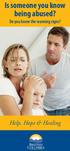 Is someone you know being abused? Do you know the warning signs? Help, Hope & Healing Are you concerned that someone is being abused, but don t know what to do? You may suspect abuse is happening to a
How To Help A Woman Who Is Abused
 If someone you know is experiencing Domestic Abuse November 2013 Note: To both reflect the overwhelming majority and for ease of reading, this document refers to victims/survivors of domestic abuse as
It s hard to know what to do when you know or suspect that a friend or family member is living with violence.
 How can you help? A B It s hard to know what to do when you know or suspect that a friend or family member is living with violence. How do I know what is the right thing to do? Should I say something or
Life With Hope I m Not An Addict I M NOT AN ADDICT 147
 I M NOT AN ADDICT How could I be an addict? My life is great. I live in a very good area of Los Angeles, drive a nice sports car, have a good job, pay all my bills, and have a wonderful family. This is
Related KidsHealth Links
 Grades 9 to 12 Personal Health Series KidsHealth.org/classroom Teacher s Guide This guide includes: Standards Related Links Discussion Questions Activities for Students Reproducible Materials Standards
THEME: We should take every opportunity to tell others about Jesus.
 Devotion NT307 CHILDREN S DEVOTIONS FOR THE WEEK OF: LESSON TITLE: Paul Goes Before Agrippa THEME: We should take every opportunity to tell others about Jesus. SCRIPTURE: Acts 25:13 26:32 Dear Parents
Speaker notes from Indigo Daya at the Borderline Personality Disorder What Works Conference, 2014.
 Speaker notes from Indigo Daya at the Borderline Personality Disorder What Works Conference, 2014. 1 Talking about trauma can be difficult for everyone. The existence and scale of traumatic events can
Substance Abuse. Client Handbook Series January 2015
 Substance Abuse Client Handbook Series January 2015 Developed by Carleton University, Criminal Justice Decision Making Laboratory & Ontario Ministry of Community Safety and Correctional Services Ralph
Talking to our children about Violence and Terrorism: Living in Anxious times
 Talking to our children about Violence and Terrorism: Living in Anxious times Living in Anxious Times: Introductory Remarks Since the September 11 attack America has changed. Children and adults alike
When a Parent Has Mental Illness Helping Children Cope
 When a Parent Has Mental Illness Helping Children Cope World Fellowship for Schizophrenia and Allied Disorders 124 Merton Street, Suite 507 Toronto, Ontario, M4S 2Z2, Canada Email: [email protected]
Young people and drugs
 Young people and drugs Many parents worry about whether their son or daughter is taking illegal drugs, how they can tell, and what to do about it. While there s a lot of concern about illegal drugs in
It s an awfully risky thing to live. Carl Rogers. her family. Daily routines that people were used to are now gone.
 It s All My Fault Feelings When a Family Member Has an Accident and Loses a Limb Easy Read Volume # 18 Issue # 4 May/June 2008 Translated into plain language by Helen Osborne of Health Literacy Consulting
A leaflet about death, bereavement and grief for young people
 A leaflet about death, bereavement and grief for young people www.rd4u.org.uk What is bereavement? Bereavement simply means losing someone through death. It could be one of your parents, grandparents,
THE BASICS Getting a Divorce in New York State
 THE BASICS Getting a Divorce in New York State Either the wife or the husband can ask a Court for a divorce. In this booklet, we say that the wife is the person who will go to Court to request a divorce
Self-Defense and Predominant Aggressor Training Materials
 Self-Defense and Predominant Aggressor Training Materials Self Defense and Defense of Self; There is a Difference The following materials provide an outline of topics to cover by someone in your community
The Kids Book About Family Fighting. By Family Fighting Expert 2009 Erik Johnson www.conflictmediationcoach.com
 The Kids Book About Family Fighting By Family Fighting Expert 2009 Erik Johnson www.conflictmediationcoach.com 1 When a family experiences stress or anxiety they cope by taking on roles to avoid or deflect
Psychic Lotto Formula 3-Step Formula Secret Template To Lottery Secrets Module 3
 Page 1 Table of Content The Psychic Lotto Formula Jackpot to Success System... 4 Part 1 Channeling the Power of Your Mind to Success... 6 Part 2 Visualization... 12 Part 3 Integrating Luck and Making it
RECOVERY ALTERNATIVES
 RECOVERY ALTERNATIVES Contact us at: 1-800-805-0499 http://www.recoveryalternatives.com INTERVENTION PREPARATION WORKSHEET To help guide you through the process of preparing for the intervention, a series
4 Criminal and Family Law
 4 Criminal and Family Law ENG 004/2010 FAMILY LAW FOR WOMEN IN ONTARIO All Women. One Family Law. Know your Rights. Criminal and Family Law This booklet is meant to give you a basic understanding of legal
Walking a Tightrope. Alcohol and other drug use and violence: A guide for families. Alcohol- and Other Drug-related Violence
 Walking a Tightrope Alcohol and other drug use and violence: A guide for families Alcohol- and Other Drug-related Violence Alcohol and other drug use and family violence often occur together. Families
Top 7 Social Security Disability Blunders: How Honest Hardworking Texans Destroy Their Entitlement to Social Security Disability Benefits
 Top 7 Social Security Disability Blunders: How Honest Hardworking Texans Destroy Their Entitlement to Social Security Disability Benefits The social security disability assessment system was designed to
New Beginnings: Managing the Emotional Impact of Diabetes Module 1
 New Beginnings: Managing the Emotional Impact of Diabetes Module 1 ALEXIS (AW): Welcome to New Beginnings: Managing the Emotional Impact of Diabetes. MICHELLE (MOG): And I m Dr. Michelle Owens-Gary. AW:
Voir Dire in Domestic Violence Cases
 Voir Dire in Domestic Violence Cases By Sarah M. Buel, Co-Director, University of Texas School of Law Domestic Violence Clinic Voir dire provides the opportunity to educate jurors while probing for bias,
Sexual Assault of a Child VOIR DIRE QUESTIONS
 ATTORNEYS Sexual Assault of a Child VOIR DIRE QUESTIONS 1. What are your feelings or opinions about criminal defense attorneys? 2. Have you ever had a bad experience with a criminal defense attorney? If
It s Not Right! Neighbours, Friends and Families for Older Adults. What You Can Do to Keep Yourself Safe From Abuse
 It s Not Right! Neighbours, Friends and Families for Older Adults What You Can Do to Keep Yourself Safe From Abuse Everyone has the right to be safe and free from abuse. No one should experience abuse.
Sample Process Recording - First Year MSW Student
 Sample Process Recording - First Year MSW Student Agency: Surgical Floor, City Hospital Client System: Harold Harper, age 68, retired widower Date: November 18, 20xx Presenting Issues: Cardiologist observed
STORIES FOR HOPE. http://www.storiesforhope.org ph: 734.678.5512 (US) / 0788260317 (RW) email: [email protected]
 STORIES FOR HOPE ph: 734.678.5512 (US) / 0788260317 (RW) email: [email protected] Transcript of an Audio-Recorded Conversation in Post-Conflict Rwanda Participants: Munganyinka Melaine Relation: Mother
How To Understand How Oppression In The United States Works
 1 Isolation Emotional SOUTHERNERS ON NEW GROUND HOW DO WE RELATE? The Relationships Between Forms of Oppression Police abuse us, rarely ever help us. We lose our homes through gentrification. Many neighborhoods
IN A SMALL PART OF THE CITY WEST OF
 p T h e L a s t L e a f IN A SMALL PART OF THE CITY WEST OF Washington Square, the streets have gone wild. They turn in different directions. They are broken into small pieces called places. One street
Bullying 101: Guide for Middle and High School Students
 Bullying 101: Guide for Middle and High School Students A guide to the basics of bullying, what it is and isn t, the role of students, and tips on what you can do. 952.838.9000 PACERTeensAgainstBullying.org
Listen, Protect, and Connect
 Page 1 Listen, Protect, and Connect PSYCHOLOGICAL FIRST AID FOR CHILDREN, PARENTS, AND OTHER CAREGIVERS AFTER NATURAL DISASTERS Helping you and your child in times of disaster. Page 2 As a parent or adult
Working with Youth to Develop Critical Thinking Skills On Sexual Violence and Dating Violence: Three Suggested Classroom Activities
 Working with Youth to Develop Critical Thinking Skills On Sexual Violence and Dating Violence: Three Suggested Classroom Activities The Southern Arizona Center Against Sexual Assault s Rape Prevention
Parenting. Coping with A Parent s Problem Drug or Alcohol Use. For children. aged 6 to 12
 Parenting Positively Coping with A Parent s Problem Drug or Alcohol Use For children aged 6 to 12 The information in this booklet is meant to help children who are living with harmful parental drug or
Interview With A Teen. Great Family. Outstanding Education. Heroine Addict
 Interview With A Teen. Great Family. Outstanding Education. Heroine Addict I recently had the incredible opportunity to interview a young man, Gregor, who very quickly fell into a dependent situation with
WHY DO WE GET ANGRY? EVERYONE FEELS ANGRY SOMETIMES
 FEELING ANGRY? WHY DO WE GET ANGRY? There are lots of things that can make us angry. Here are a few examples... EVERYONE FEELS ANGRY SOMETIMES It s normal and healthy to get angry when there is a good
Connectedness and the Emotional Bank Account
 Connectedness and the Emotional Bank Account Directions This is a self-guided activity that can be completed by parents, teens or both. It contains five parts and should take about 45 minutes to complete.
Divorce Mediation Myths
 Divorce Mediation Myths Debunking divorce mediation myths: Facts about the mediation process. Myth: Mediation allows one spouse to dominate another. Fact: A good mediator pays close attention to the power
Families with Children in Care
 Families with Children in Care A guide to your rights if your child is in care Partnership with Families Project Family Advocacy Service support for families with children in care Handbook This guide for
The 3 Biggest Mistakes Investors Make When It Comes To Selling Their Stocks
 3 The 3 Biggest Mistakes Investors Make When It Comes To Selling Their Stocks and a simple three step solution to consistently outperform the market year after year after year. 2 Dear friend and fellow
BOOKLET 4. A Guide To Remaining Smoke Free FOR PERSONAL USE ONLY. DO NOT DUPLICATE. What If You Have A Cigarette?
 BOOKLET 4 TM A Guide To Remaining Smoke What If You Have A Cigarette? Contents Can t I Have Just One Cigarette? 2 Be Prepared for a Slip 3 Watch out for the Effects of a Slip 4 Keep a Slip from Turning
Because Fear Makes No Class Distinctions Abuse Support Group Helps Affluent Women End Silent Suffering
 11:42 PM CDT on Saturday, April 9, 2005 Because Fear Makes No Class Distinctions Abuse Support Group Helps Affluent Women End Silent Suffering By Kim Horner, The Dallas Morning News Dallas lawyer Julianne
Family Law. Lesson: Family Violence. CLB 5-6 Instructional Package
 Lesson: Family Violence CLB 5-6 Instructional Package Family Law: Family Violence (CLB 5-6) CLB Outcomes CLB 5-III: Getting Things Done CLB 6-IV: Comprehending Information CLB5-II: Reproducing Information
PEOPLE V. HARRY POTTER
 PEOPLE V. HARRY POTTER THE COURT: Members of the jury, the defendant, Harry Potter, is charged in a one-count information which reads as follows: On or about November 23, 2008, HARRY POTTER, did unlawfully
Case study 1 - Eileen, 69: A disagreement with a hospital doctor led to the doctor refusing to continue treatment.
 Case studies 1-7: Please note these are fictional case studies from the GMC s Patients help web section, to help patients understand about the process for complaining about a doctor. Case study 1 - Eileen,
CHILDREN'S SELF-ESTEEM
 CENTER FOR EFFECTIVE PARENTING CHILDREN'S SELF-ESTEEM Self-esteem can be defined as how people feel about themselves. Children's levels of self-esteem are evident in their behavior and attitudes. If children
Surviving A Relationship Break-Up - Top 20 Strategies
 Surviving A Relationship Break-Up - Top 20 Strategies Surviving a relationship break-up can be one of the most difficult things we ever do and on an emotional level can be one of the most painful processes
Post-Traumatic Stress Disorder
 Post-Traumatic Stress Disorder It s natural to be afraid when you re in danger. It s natural to be upset when something bad happens to you or someone you know. But if you feel afraid and upset weeks or
What is DOMESTIC VIOLENCE?
 What is DOMESTIC VIOLENCE? Domestic violence is a pattern of control used by one person to exert power over another. Verbal abuse, threats, physical, and sexual abuse are the methods used to maintain power
Using coping statements to avoid common thinking traps
 Using coping statements to avoid common thinking traps Did you know that your thoughts affect how you see yourself and the world around you? You may look at a situation one way, even though there are many
Parenting. Coping with DEATH. For children aged 6 to 12
 Parenting Positively Coping with DEATH For children aged 6 to 12 This booklet will help you to understand more about death and the feelings we all have when someone we care about, like a parent, a brother
Rome Workshop Cooperation between state officials and NGOs
 Rome Workshop Cooperation between state officials and NGOs I understand that participants are expecting to engage in this workshop, so I do not intend to speak initially for very long. l will briefly introduce
Supporting your child after a burn injury
 Royal Manchester Children s Hospital Supporting your child after a burn injury Information for Parents and Carers of Young Children 2 Contents Page Introduction 4 Trauma and children 4 Normal reactions
A PARENT S GUIDE TO CPS and the COURTS. How it works and how you can put things back on track
 A PARENT S GUIDE TO CPS and the COURTS How it works and how you can put things back on track HOW YOU CAN USE THIS HANDBOOK We hope that this handbook will be easy for you to use. You can either read through
USVH Disease of the Week #1: Posttraumatic Stress Disorder (PTSD)
 USVH Disease of the Week #1: Posttraumatic Stress Disorder (PTSD) Effects of Traumatic Experiences A National Center for PTSD Fact Sheet By: Eve B. Carlson, Ph.D. and Josef Ruzek, Ph.D. When people find
DRUG AND ALCOHOL ADDICTION. BY: Kristen Mehl AGE: 17 GRADE: 12. SCHOOL NAME: St. Clair High School
 DRUG AND ALCOHOL ADDICTION BY: Kristen Mehl AGE: 17 GRADE: 12 SCHOOL NAME: St. Clair High School DRUG AND ALCOHOL ADDICTION Drug and alcohol addiction is a rising problem among all ages, including our
MITI Coding: Transcript 5
 1 MITI Coding: Transcript 5 T: Randy, thanks for coming in today. I wonder if it would be ok if I shared just a few facts with you that I ve gotten from the intake worker. And then we can go on to talk
Co-dependency. Fact Sheet on co-dependency from Mental Health America:
 Co-dependency Fact Sheet on co-dependency from Mental Health America: Co-dependency is a learned behavior that can be passed down from one generation to another. It is an emotional and behavioral condition
INTRODUCTION. Just a quick word
 P.P.P. INTRODUCTION Just a quick word Most of us would rather drag a dead horse through a sewer than write an essay. The trouble is, because essays are required by most educational institutions, we must
a threat made in school
 a threat made in school ADAM S BACKGROUND LEADING UP TO THE CRIME Adam, 15, is the youngest of four children. His parents are divorced. He lives with his mother, has regular contact with his father, and
ŒŒŒŒ THE 5 BIGGEST MYTHS ABOUT POTTY TRAINING AND THE TRUTH ABOUT GETTING DIAPER FREE IN JUST ONE DAY!
 THE 5 BIGGEST MYTHS ABOUT POTTY TRAINING ŒŒŒŒ AND THE TRUTH ABOUT GETTING DIAPER FREE IN JUST ONE DAY! Dana Obleman B.A (Psych.) B.Ed. (Elem) www.nosweatpottytraining.com The 5 Biggest Myths About Potty
Helping the Addict or Alcoholic Begin the Journey to Recovery through Intervention:
 Solutions that end addiction. Helping the Addict or Alcoholic Begin the Journey to Recovery through Intervention: It can be challenging to help a loved one struggling with alcoholism or drug addiction.
What is an intervention?
 (Adapted from the Mayo Clinic, 2014) It's challenging to help a loved one struggling with any type of addiction. Sometimes a direct, heart-to-heart conversation can start the road to recovery. But when
SCRIPT FOR OUTREACH. Disconnected and Cyber Predators. Introduction. How many of you have your own cell phones or smart phone?
 SCRIPT FOR OUTREACH Disconnected and Cyber Predators Introduction Hello! How is everyone doing today? My name is and I am here with some friends of mine from the American Bar Association Young Lawyers
"A Young Child's Point of View on Foster Care and Adoption"
 "A Young Child's Point of View on Foster Care and Adoption" Michael Trout Director, The Infant-Parent Institute Reprinted by permission Mr. Trout is a trainer and course leader in infant mental health,
Young homeless people on healthcare. The views of the National Youth Reference Group
 Young homeless people on healthcare The views of the National Youth Reference Group Introduction The Queen s Nursing Institute s Homeless Health Project visited the St Basil s Charity in Birmingham in
THE BASICS Custody and Visitation in New York State
 THE BASICS Custody and Visitation in New York State This booklet answers common questions about custody and visitation when the parents cannot agree about who is responsible for taking care of the children.
Carl Weisman Q&A So Why Have You Never Been Married?
 Carl Weisman Q&A So Why Have You Never Been Married? 1. Why did you write So Why Have You Never Been Married? I wrote the book because I honestly could not answer the question Why have I never been married?
Domestic Violence & Abuse. Signs of Abuse and Abusive Relationships
 Domestic Violence & Abuse Signs of Abuse and Abusive Relationships Domestic violence and abuse can happen to anyone, yet the problem is often overlooked, excused, or denied. This is especially true when
Leslie Vernick DCSW, LCSW Most commonly asked questions on Domestic Violence
 Leslie Vernick DCSW, LCSW Most commonly asked questions on Domestic Violence DOES THIS HAPPEN IN CHRISTIAN HOMES? We'd be surprised. A conservative estimate is that out of every 60 married couples, 10
Target s Guide to Change Management
 Target s Guide to Change Management SUCCESSFUL CHANGE CHANGES EVERYTHING L AMARSH.COM 505 N O R T H L A K E S H O R E D R I V E, S U I T E 1210 C H I C A G O, I L L I N O I S 60611 U S A P. 3 1 2. 4 6
Are you feeling... Tired, Sad, Angry, Irritable, Hopeless?
 Are you feeling... Tired, Sad, Angry, Irritable, Hopeless? I feel tired and achy all the time. I can t concentrate and my body just doesn t feel right. Ray B. I don t want to get out of bed in the morning
THEME: Jesus sent the Holy Spirit to indwell and empower us.
 Devotion NT285 CHILDREN S DEVOTIONS FOR THE WEEK OF: LESSON TITLE: The Day of Pentecost THEME: Jesus sent the Holy Spirit to indwell and empower us. Dear Parents SCRIPTURE: Acts 2:1-41 Dear Parents, Welcome
4 Possessive/Jealous. Men in Relationships
 4 Possessive/Jealous Men in Relationships A possessive/jealous man will: Tell you how to dress; Be overly concerned about where you are going when socializing; Insist on escorting you to mundane places;
Support and Resistance: Trading by Reading a Market
 Support and Resistance: Trading by Reading a Market 2009 [Published by] www.investija.com Page 1 Contents 1.0 Trading method Market Types...3 1.1 Trading method Drawing Lines...7 2.0 The Time...11 3.0
Dealing with Negativity and Learning to. Counter Negative Thoughts
 Dealing with Negativity and Learning to Counter Negative Thoughts 2010 Pandora s Project By: Kate Dealing with any kind of loss, trauma, or grief can inevitably lead to negative thoughts and a general
Real Life Financial Planning
 Real Life Financial Planning An Easy to Understand System to Organize Your Financial Plan and Prioritize Financial Decisions Todd D. Bramson, CFP If you are a C-Level executive or partner interested in
DIVORCE LAW REFORM A SUMMARY OF THE LAW REFORM AND DEVELOPMENT COMMISSION PROPOSALS. Legal Assistance Centre 2005
 DIVORCE LAW REFORM A SUMMARY OF THE LAW REFORM AND DEVELOPMENT COMMISSION PROPOSALS Legal Assistance Centre 2005 This is a summary of a bill proposed by the Law Reform and Development Commission (LRDC).
ISI Debtor Testimonials. April 2015 ISI. Tackling problem debt together
 ISI Debtor Testimonials April 2015 ISI Tackling problem debt together The following are the words of debtors who have availed of the ISI s debt solutions and are real cases. They have reviewed and agreed
CyberbullyNOT Student Guide to Cyberbullying
 CyberbullyNOT Student Guide to Cyberbullying WHAT IS CYBERBULLYING? Cyberbullies use the Internet or cell phones to send hurtful messages or post information to damage people s reputation and friendships.
Seven Things You Must Know Before Hiring a Real Estate Agent
 Seven Things You Must Know Before Hiring a Real Estate Agent Seven Things To Know Before Hiring a Real Estate Agent Copyright All Rights Reserved 1 Introduction Selling a home can be one of the most stressful
Tool kit Domestic Violence
 Tool kit Domestic Violence A self-help resource to help people living with domestic violence Lifeline s domestic violence tool kit provides information about: Understanding what domestic violence is Developing
Conducting Emotionally Difficult Conversations. John Banja, PhD Center For Ethics Emory University [email protected]
 Conducting Emotionally Difficult Conversations John Banja, PhD Center For Ethics Emory University [email protected] How To Break Bad News Robert Buckman (with contributions by Yvonne Kason). Baltimore:
A Young Inspector's Journal report on substance misuse services in Dorset. by Max Purkiss
 A Young Inspector's Journal report on substance misuse services in Dorset by Max Purkiss Introduction As a young inspector for the Dorset area I am used to going to projects and places to inspect and write
TO SURVIVING YOUR FIRST YEAR NUR SING
 A GUIDE TO SURVIVING YOUR FIRST YEAR IN THE NUR SING WORLD By Jennifer R. Tucker Graduation Day to NCLEX Finally, the long awaited graduation day had arrived: a day that had been five years in the making,
LESSON TITLE: Parable of the Workers in the Vineyard
 Devotion NT255 CHILDREN S DEVOTIONS FOR THE WEEK OF: LESSON TITLE: Parable of the Workers in the Vineyard THEME: God is more concerned with our heart s attitude than our service. SCRIPTURE: Matthew 20:1-16
Post-Traumatic Stress Disorder (PTSD)
 Have you lived through a very scary and dangerous event? A R E A L I L L N E S S Post-Traumatic Stress Disorder (PTSD) Post Traumatic Stress Disorder (PTSD) NIH Publication No. 00-4675 Does This Sound
The Mental Capacity Act
 The Mental Capacity Act The Mental Capacity Act Helping and supporting people who are unable to make some decisions for themselves Easyread This booklet gives information on a law called the Mental Capacity
The support you should get if you are a victim of crime
 The support you should get if you are a victim of crime This is an EasyRead booklet showing you what to do. About this booklet The Ministry of Justice wrote this information. This is an EasyRead guide
What the Life Insurance Industry Does Not Want You to Have.
 What the Life Insurance Industry Does Not Want You to Have. 1. Who am I and why should you listen to me? 2. What can go wrong and how can you be affected by this? 3. After the government noticed there
For parents and carers of children with autism
 For parents and carers of children with autism The NSPCC helps parents and carers talk to their children about staying safe. It s part of our work to prevent abuse from happening to any child. And it
THEME: Jesus knows all about us and He loves us.
 Devotion NT224 CHILDREN S DEVOTIONS FOR THE WEEK OF: LESSON TITLE: The Woman at the Well THEME: Jesus knows all about us and He loves us. SCRIPTURE: John 4:1-42 Dear Parents Welcome to Bible Time for Kids!